Awakening, Awareness, Beauty of Nature, Bondage, Change, Contemplation, Creation, Creativity, Emotions, Feelings, God's presence, Grace, Hemmed in, Here I am, Lord., Holy Ground, Holy Spirit, Hope, Insight, Inspiration, Introspection, Isolation, Loneliness, Mystery, Psalm 139, Sacred Pauses, Sacred Space, Soul, Spirit, Transformation, Walls, Wisdom, Writing

Hemmed In!


There are large scale, widespread forces that can trap thousands of people, even millions. Dachau, Katrina, earthquakes, tsunamis, wildfires, natural disasters all over the world and the Coronavirus of 2020. Enormous, catastrophic events can trap people. COVID19 has literally trapped me inside my home. I have to admit, the isolation has taken a toll on my spirit. No visitors! No visits with friends or family. No trips! No haircuts! I have been trapped at some level since my kidney transplant in November. Just at the March milestone that would have allowed me to break the isolation of the transplant, I was even more fully trapped by the infectiousness of this pervasive, unrelenting virus.

Being trapped for so many months has raised up in me feelings of loneliness, isolation, powerlessness, despair, anxiety, even abandonment. And yet, often there is something very good in the center of something very bad. It has been so for me. Yes, I feel trapped in the pervasive power of the coronavirus, but I also sense the arms of God and the embrace of Spirit hemming me in even further. Such a grace-gift it has been to me, as if God has said, “l am hemming you in, and in this space you will hear me clearer and sense me more fully.”

God’s words were truth. Hemmed in, my mind flourished, my heart leapt and my soul entered spaces of calm. I felt enhanced awareness! Even awakening. I saw nature in a different way and basked in the beauty of the rising sun. The sound of the hummingbirds’ trill and the rapid fluttering of their translucent wings were sounds meant just for me. I began to write and paint, to listen more carefully to God’s voice, to allow my spirit to overflow with Holy Spirit. To my hemmed-in call from God, I was compelled to answer, “Here I am, Lord!” When I finally answered God, my hemmed-in place became Holy Ground — a very good place to be that feels more like a holy mystery than a state of being.

Was this pandemic a good thing for me and for millions of people? Absolutely not! But trapped in its dark cloud, God hemmed me in further in ways I am just now beginning to understand. I can say with all honesty that being hemmed in by God has been grace to me.

If I could even begin to choose a favorite Psalm from among the many that inspire me, I would choose Psalm 139. In its weaving of words, there are many passages that are full of comfort. From childhood, I memorized a lot of Scripture and throughout Psalm 139 I memorized several snippets that I often call to mind. One verse that I did not memorize is verse 5: “You hem me in behind and before, and you lay your hand upon me.”

You have searched me, Lord,
and you know me.

You know when I sit and when I rise;
you perceive my thoughts from afar.

You discern my going out and my lying down;
you are familiar with all my ways.

Before a word is on my tongue
you, Lord, know it completely.

You hem me in behind and before,
and you lay your hand upon me.

— Psalm 139:1-5 NIV

I deplore the coronavirus and what it has done to so many people. I deplore the ways it was able to trap me, physically and emotionally. But the virus, with all its ominous, far-reaching force could not trap me spiritually. That was God’s work — hemming me in so that my spirit could rise to fresh, new heights of spiritual consciousness. Being hemmed in by our Creator has been grace for me in these days of isolation. It has become a transforming sacred pause. For in my hemmed-in space, the Creator helped me create — from my mind, from my heart, from my soul. Thanks be to God.

Activism, Ahmaud Arbery, Beloved Community, Celebration, Change, Community activism, Freedom, Hope, Juneteenth, Justice, Liberty, Racism, Rebirth, reconciliation, struggle, Transformation, Uncategorized

Juneteenth 2020 — Oh Freedom!

0B59C2F5-2267-4507-A9EE-44CDC0B315B1
Today may be a Juneteenth like no other.

Juneteenth is a celebration. It’s not solemn, it’s filled with joy and pageantry. It’s not a funeral. But 2020 Juneteenth is uncomfortably juxtaposed with police violence against Black people, protesters in cities all over the nation and funerals — too many funerals.

A Bit of History . . . 

Juneteenth is one of America’s oldest holidays and is observed each year on June 19 to mark the official end of slavery in the United States. The day has long been celebrated by black Americans as a symbol of their long-awaited emancipation. But the story behind the holiday starts 155 years ago today in Galveston, Texas.

On June 19, 1865, Union troops led by General Gordon Granger arrived in Galveston, Texas, to break the news to the last remaining Confederate sympathizers that they had lost the Civil War and that all slaves must be freed. The Union general read aloud to the residents of Galveston:

The people of Texas are informed that in accordance with a Proclamation from the Executive of the United States, all slaves are free. This involves an absolute equality of rights and rights of property between former masters and slaves, and the connection heretofore existing between them becomes that between employer and hired laborer.

The newly freed slaves celebrated emancipation with prayer, feasting, song, and dance, and the following year, the first official Juneteenth celebration was born. But the importance of Juneteenth is that it is rooted in a long history of struggle for freedom and then perhaps the greater struggle to maintain freedom in the face of the enormous repression that was to come.

The Struggle for Freedom Continued

7DC48528-34CF-47FA-9272-ED91E800C437It turned out that being free did not mean being being treated with respect. Yes, it was the true end of the Civil War, but it was also the beginning of Reconstruction, a time that was supposed to be very happy and hopeful. Yet the period of Reconstruction became a miserable time for freed Black people because Reconstruction became part of the redemption of the South. As such, it set out to move African Americans to indentured servitude. While President Abraham Lincoln abolished slavery in his Jan. 1, 1863, Emancipation Proclamation, rebellious Confederate strongholds dotted across the South delayed the widespread implementation.

The South would not hear of the end of slavery, and landowners moved heaven and earth to make sure they had plenty of indentured servants. They were determined to continue the ostentatious lifestyle that they believed was their right and their legacy. They were resolute in their quest to maintain their master/servant status.

Still Today, Elusive Freedom

Juneteenth has been “passed down” through black communities since 1866, but in this year — 2020 — this nation seems to be at the height of a modern-day civil rights movement. My friend says, “2020 is the year of reset!” People throughout this nation of every race and creed hope beyond hope the 2020 will go even beyond “reset” to reconciliation, transformation and rebirth. So that every person is free, respected and cherished as a part of beloved community.

B8EBCA53-AF97-42DD-AA97-BAB122368430The cruel and violent death of George Floyd under the knee of a Minneapolis police officer might mean that this year Juneteenth may not be only about festivals, parades and cookouts. It may well be somewhat of a silent, reflective vigil for George Floyd, Breonna Taylor, Ahmaud Arbery, Rayshard Brooks, Caine Van Pelt, Michael Thomas, Lewis Ruffin, Kamal Flowers, Momodou Lamin Sisay, Ruben Smith, Modesto Reyes . . . and the list could continue.


It is a list of tragedy and horror. It is a list that is a stain that will ever remain on this nation, an indelible mark of shame. It is a list of names we must never forget. So in your commemoration of Juneteenth today, honor those names, pray for their mourning families, and pray that you will confront racial injustice with an unshakeable resolve.

Juneteenth was meant to be a celebration, although many people might not be able to celebrate today. Heartbreak and horror have a tendency to override celebration and joy. Even with hearts broken, I hope we will find in our hearts even a tiny desire to celebrate this day that was, and is, all about freedom.

May the change that comes from the “2020 movement for racial justice” cause us to celebrate, not mourn, every time Juneteenth comes around — today and forevermore. And may each of us and all of us — a people of God’s creation — witness the rebirth of a nation where every person lives under a worldwide canopy of justice, peace, equality, respect and freedom.

May God make it so through us. Amen.


Celebrate, or mourn, today as you spend a few moments watching this moving and poignant video, “Oh Freedom.”

Change, Dreams, Fear, Following Christ, God's Faithfulness, Grace, Gratitude, Hate, healing, Hope, Inspiration, Kindness, Nonviolence, peace, Tikkun Olam, Wholeness

Our Smallest Dreams Can Change the Big World

E43FB412-D00A-458E-8DA7-561F269CCC27
Art by Catrin Welz-Stein, from The Cosmic Dancer Facebook community

A friend sent me a lovely blessing today and I want to share it with you. These days, many neighbors and friends — people all over the world actually — have a new dream, a new calling to change the world. It’s an important dream right about now. Pandemic and protests — and all the causes lying underneath them — desperately need to change, and it will take huge dreams to change them. Trouble is, most people like me and you have only small dreams, a few small dreams that sometimes seem so insignificant. Certainly, they are dreams too small to change the big world.

But maybe not!

The message my friend sent me (actually she posted it on Facebook) reminded me that huge change can most certainly come from small acts. The message was today’s grace for me. So I share the message with you. It comes from The Cosmic Dancer* and is written by Scott Stabile.

She felt like doing her part to change the world, so she started by giving thanks for all of the blessings in her life, rather than bemoaning all that was missing from it.

Then she complimented her reflection in the mirror, instead of criticizing it as she usually did.

Next she walked into her neighborhood and offered her smile to everyone she passed, whether or not they offered theirs to her.

Each day she did these things, and soon they became a habit. Each day she lived with more gratitude, more acceptance, more kindness. And sure enough, the world around her began to change.

Because she had decided so, she was single-handedly doing her part to change it.
— Scott Stabile

Hope is tucked into these words, hidden there and bringing to mind that God highly values gratitude, acceptance, kindness and our smallest, powerful dreams. My dreams and yours can change a world filled with violence, hate, grief, fear and so many more hurts and harms.

EC0B46CE-B762-4C67-933A-BEC6BDE65077
Tikkun Olam Together provides cultural learning opportunities for mothers and  daughters’ grades 6-9 as they work to improve the world – Tikkun Olam.

There is a lovely Hebrew phrase, Tikkun Olam, that means “repair the world” or “heal the world.” The call of Tikkun Olam has always inspired me to more fully offer my life to be a part of the healing God desires for creation, for the earth’s protection and for kindness, equality and justice for all people.

Can we heal the big world with even the smallest acts of kindness and compassion? Doesn’t God whisper to us that we should begin healing the injustice, the violence, the hate, the fear, the mistrust and the deep divisions in the world? Doesn’t God inspire us to know the truth that our dreams are never too small? And doesn’t God promise to guide us and to lead us in following the compassionate footprints of Jesus until we see the world begin to change?

Resting in the grace of inspiration given to us by God, we truly can cast off the gloomy thoughts that our dreams are too small, too weak and too insignificant. And we can hide inside our hearts God’s promise that our dreams can become reality, that our tiny dreams really can change this big world. God will enlarge our smallest dreams if we offer them. We can count on it!

May each of us live “with more gratitude, more acceptance, more kindness” and may even our smallest dreams change — heal — the world.


* The Cosmic Dancer is a Facebook community that shares insights through art, poetry, dance and other “revolutionary rhythms.”


Activism, Beloved Community, Bewilderment, Change, Community, Community activism, Confusion, Contemplation, Covenant, Creating, Division, Exhaustion, God's presence, Hate, Hope, Injustice, Liminal time, Uncategorized

This Liminal Time

FDAFE7CF-FBCA-47E5-A560-EFA6C17EEC75


liminal

in American English
(ˈlɪmɪnəl ; ˈlaɪmɪnəl )

ADJECTIVE

1.  Relating to a transitional or initial stage of a process.

2.  At a boundary or transitional point between two conditions, stages in a process, ways of life, etc.

“Liminal” used in a sentence: We are in a transitional and liminal time: this makes everything unsettled and awkward, and most of us feel tremendous unrest and a sense of urgency.


I choose to mark this particular time in history as a liminal time that demands my courage to stand — to stand in solidarity with every person who is demanding an end to racial injustice. I cannot choose my partners in this struggle. Instead, I have to accept those that appear in my life, bringing with them a determined will to stand for justice.

I must understand that liminal time does not last forever. Liminal time is a place of transition, a liminal stage between justice and oppression, between life and death. So my choices and yours in this liminal time might very well affect what’s going on in the streets of American cities, in police precincts in every community and rural hamlet, in the halls of Congress and in the White House, in our hearts and in the hearts of those we could see as our “enemies.“

CB60C28A-A33B-4386-9B35-C3DC950FC905Here is where I must focus. My heart must long for an end to injustice. So must yours, because God’s heart grieves over the mayhem in our streets and the violence that has its way when a white police officer murders a black man or woman, even a black child.
You and I must yearn for an end to racial injustice — any kind of injustice and oppression — because God’s heart yearns to see us living in holy unity as brothers and sisters.

These days have dramatically shown us our liminal time, and it is NOW.

I have a strong sense that this liminal time has brought the widespread unrest we are witnessing, and that unrest emerges directly from a deep desire for change and transformation. It must be now!

Those of us who remember, know that the Civil Rights Movement came to its boiling point when every marcher, every protester, every non-violent activist and every violent one knew when their liminal time had come. Some people, of course, did not like that time at all, but even those who resisted that movement towards justice knew in their hearts that it was the liminal time, the time of NOW.

The fight was fought by people who spoke and marched, prayed and worshipped, who resisted and stood their ground, who preached and sang their freedom songs. Ah, how those songs of the civil rights movement helped motivate people of all ages and races, from Student Nonviolent Coordinating Committee (SNCC) activists and Freedom Riders to the thousands who marched on Washington, Selma, and Montgomery!

Yet not one person — Civil Rights leader or non-violent protester — could achieve civil rights alone. It required persons living in the poorest neighborhoods and their affluent neighbors across town. It took white folk and black folk, protestors and preachers, eloquent advocates and those who fought silently, lawyers and congresspeople and attorneys general and presidents. It required a community in solidarity. In fact, during the Civil Rights Movement, the creation of community was the quintessential coming-of-age story for Black people. 

Of that historically significant time, Father Richard Rohr writes this:

It was the particular time in history when nonviolent initiatives seeded with contemplative worship practices became acts of public theology and activism. You see, activism and contemplation are not functional opposites. Rather, contemplation is the heart’s reflective activity that is always seeking the spiritual balance between individual piety and communal justice-seeking.

Who could have predicted that America’s apartheid would fall as decisively as the walls of Jericho, when the people marched around the bastions of power carrying little more than their faith and resolve? How audacious it was to take just the remnants of a chattel community, the vague memories of mother Africa, and a desperate need to be free, and translate those wisps into a liberating vision of community. The idea of a beloved community emerged from the deeply contemplative activities of a besieged people — the people of the Civil Rights movement.
— Fr. Richard Rohr

One would think that such a movement that was so powerful, so eloquent and so determined would see its dream become reality, and that such a stunning reality would last forever. So that every person, from that time to this, would live as beneficiaries of beloved community. But here we are in another liminal space of racial indignity, cities in chaos and families mourning the death of their loved ones in Minnesota, in Georgia, in Kentucky and beyond. We did not really believe we would be in this time and space, a time that would demand a civil rights movement of its own.

The in-between liminal spaces of Scripture are pregnant with God’s transformational possibilities:

Noah and his family rebuilding the world after the flood; Abraham holding the knife above Isaac; Jacob’s struggle with the angel; Joseph in the pit; Moses and the Israelites at the edge of the Reed Sea; Israel in the wilderness; Joshua crossing the Jordan; Jesus suffering on the tree; the women at His tomb; the disciples waiting in Jerusalem.

Scripture indeed is fraught with liminal moments – moments of imminent expectation, infused with both hope and doubt — that lead to transformation and change. So change involves tension, and those of us who are longing for a paradigm shift that insists on justice, know that tension all too well.

Betwixt and Between — neither here nor there. It would be safe to say that this liminal time is mostly uncomfortable and confusing. Liminal time is the time between what was and what will be. And not one of us can predict what will be, either in this struggle against injustice or in the uncertain waxing and waning of the deadly coronavirus. The convergence of virus and death and sickness and distancing with racial injustice, violence and protest is almost too much uncertainty for us to navigate.

In the end, I want to believe that this liminal time and every liminal space is the dwelling place of God, the place where God meets us and says, “I will never leave you or forsake you . . . And remember, the Spirit of the Lord is upon you and has anointed you to announce Good News to the poor, to proclaim freedom for the imprisoned and renewed sight for the blind, to release those who have been oppressed. [my paraphrase]

Even in our current time of disconcerting fluid borders, God is with us in this liminal time. God is inseparably bound with us in this moment, and it is in this liminal space where heaven and earth, life and death, joy and sorrow, ecstasy and despair, sleeping and waking, justice and injustice, commingle.

So here’s my challenge to myself and to all of us. What if we choose to experience this liminal time, this uncomfortable now, as a time for insisting upon full solidarity with all of our brothers and sisters? What if we choose to make this particular time — with all of its pandemic and death, chaos and destruction, fire and protest, upheaval and violence as if no lives matter — a liminal time for construction and deconstruction, choice and transformation? What if you and I choose to hold hands and march on in solidarity and community until we reach the mountaintop where injustice is no more?

I want to. Do you?


Activism, Ahmaud Arbery, Anger, anxiety, Art, Beloved Community, Brokenness, Change, Comfort, Community, Community activism, Conflict, Courage, Death, Despair, discouragement, Division, Emotions, Exhaustion, Fear, Freedom, Friendship, George Floyd, grief, Hate, healing, Heartbreak, Holy Spirit, Injustice, Nonviolence, peace, Pentecost, Perseverance, sadness, Sorrow, Spirit, Spirit wind, struggle, Together, Violence, White supremacy

Together!

74F3F032-5117-4474-98A7-A2171243B45E
A blending of two photos: One is an image of protesters in Minneapolis. The second image is a portrayal of people raising their hands to celebrate Pentecost.

This morning I have no words. I have tears. I have sadness. I even have some anger that the people I love whose skin is not “white” are living in grief and frustration. I say only that injustice and oppression cling so close to my friends, today and in centuries past.

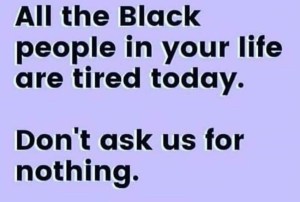
F0ABFCC6-C312-44E2-A39F-35F520174256I hear my dear friends cry out for justice. I hear them using words to make sense of it all, and I hear their voices fall silent. Silent, with just these words, “I’m tired.” A dear friend posted the words on the left this morning. I want to see her face to face. I want to be together. I want to comfort her, hoping beyond hope that it is not too late for comfort.
I read this horrific headline this morning.

Prosecutors in Hennepin County, Minnesota, say evidence shows Chauvin had his knee on Floyd’s neck for a total of 8 minutes and 46 seconds, including two minutes and 53 seconds of which Floyd was non-responsive.   — ABC News

99398631-7958-42F7-9F51-718EE1C289DD
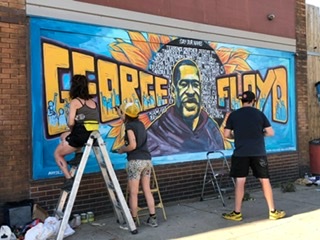
Artists honor George Floyd by painting a mural in Minneapolis on Thursday, May 28, 2020. Artists began work on the mural that morning. (Photo: Jacqueline Devine/Sun-News)

Today I find myself deeply in mourning for the violence that happens in our country. I find myself trying to share in the grief of my friend and knowing I cannot fully feel the depth of it. Today I find myself unable to emotionally move away from it all. Today I contemplate George Floyd’s cry, “I can’t breathe.”

If there is any comfort at all, it comes as a gift of the artists pictured here. In an act of caring, they offer this mural at a memorial for George Floyd.

The names of other victims of violence are painted in the background. The words, “I can’t breathe!” will remain in our memories. Today we are together in mourning.

But tomorrow, I will celebrate Pentecost. I wonder how to celebrate in a time when lamentation feels more appropriate. I wonder how to celebrate when brothers and sisters have died violent deaths and when thousands of protesters line the streets of many U.S. cities. I wonder how to celebrate when protesters are obviously exposing themselves to COVID19.

Still, tomorrow — even in such a time as this — I will celebrate the breath of the Spirit. Tomorrow I will join the celebration that has something to do with being together, being one. To juxtapose the joyous celebration of Pentecost with the horrible picture of what we saw in cities throughout our country for the past few nights seems an impossible undertaking. What does one have to do with the other?

Perhaps they do share a common message. From those who protest, this message:

“We bring our broken hearts and our anger for the killing of our people, for the murders across the ages of people who are not like you. You treat us differently than you treat the people who look like you. For as long as we can remember, you have visited upon us oppression, slavery, racist violence, injustice. And we are tired. We are spent. We are beside ourselves with collective mourning. We can’t breathe!“

From those who celebrate Pentecost, this message:

18bbdca6-8ece-4df4-aa13-fe110e3298cb“How we celebrate the day when the Holy Spirit breathed upon those gathered together, with gifts of wind and fire!

How we celebrate the story told in the 2nd chapter of Acts!”

When the day of Pentecost came, they were all together in one place. Suddenly a sound like the blowing of a violent wind came from heaven and filled the whole house where they were sitting.

They saw what seemed to be tongues of fire that separated and came to rest on each of them. All of them were filled with the Holy Spirit and began to speak in other tongues as the Spirit enabled them.

Now there were staying in Jerusalem God-fearing Jews from every nation under heaven. When they heard this sound, a crowd came together in bewilderment, because each one heard their own language being spoken. Utterly amazed, they asked: “Aren’t all these who are speaking Galileans? Then how is it that each of us hears them in our native language? Parthians, Medes and Elamites; residents of Mesopotamia, Judea and Cappadocia, Pontus and Asia, Phrygia and Pamphylia, Egypt and the parts of Libya near Cyrene; visitors from Rome (both Jews and converts to Judaism); Cretans and Arabs—we hear them declaring the wonders of God in our own tongues!” Amazed and perplexed, they asked one another, “What does this mean?”

Some, however, made fun of them and said, “They have had too much wine.”

Then Peter stood up with the Eleven, raised his voice and addressed the crowd: “Fellow Jews and all of you who live in Jerusalem, let me explain this to you; listen carefully to what I say. These people are not drunk, as you suppose. It’s only nine in the morning! No, this is what was spoken by the prophet Joel:

“‘In the last days, God says,
I will pour out my Spirit on all people.

Your sons and your daughters will prophesy, last days, God says,
your young men will see visions,
your old men will dream dreams.

Even on my servants, both men and women,
I will pour out my Spirit in those days,
and they will prophesy.’”   —
Acts 2:1-18 NIV

The people did not, in fact, have too much wine. Peter made it clear that wine did not empower the people who gathered in Jerusalem —  “every people under heaven” — to speak and understand as they heard every word spoken in their own language. That would be a start, would it not, if we could speak the same language and truly understand — people who have flesh-colored skin, and brown and bronze, and red and black . . . every skin color under the sun. If only we could understand each other.

And then, what if we could gather together, welcoming every person? What if we could truly gather together and wait for Spirit to fall upon us with empowerment like we have never known before? What if we allowed the Spirit to give us breath, together?

41F5FD83-6B7A-4393-BF9E-57F0E4D51023In the end, there is a tiny bit of joy in George Floyd’s tragic story. It is a joy much deeper than reality’s sorrow. The artists completed their mural, and in the very center near the bottom, they had painted words that express the greatest truth of all.

Can you see it behind the little girl? “I can breathe now!”

What if we welcome Spirit Breath that will change us? What if we embrace empowerment from the Holy Spirit to help us change our world? What if we end oppression and injustice, together? What if holy perseverance could inspire us to live and act in solidarity with our sisters and brothers, all of them?

What if we dare to give our soul’s very breath to help bring about Beloved Community, together?

Together! Together!

May my God — and the God of every other person — make it so. Amen.


Celebration, Change, Comfort, Creating, Dancing, Growing up, Joy, life, Memories, Muse, Soul

My Soul’s Muse

13FC4C26-1160-4312-AED4-47DCD8DD80A9
The Muse Terpsichore, the Muse of Dance in Greek Mythology; Rare Ancient Greek art pottery plate. https://www.worthpoint.com/worthopedia/muse-goddess-terpsichore-greek-1868160296

I never dance anymore, and that’s a real shame. It’s about losing a part of my soul, really. Letting persnickety circumstances overshadow what my soul loves and desires, maybe even needs. Persnickety circumstances like . . . My back hurts. I’m too old now. I can’t remember how to do it anymore. There’s no room in my living room. It’s just no fun dancing when I’m dancing by myself. But those thoughts describe now! In the past? Well, as you might expect, my past was very different! I lived to dance whether the music was Rock ‘n Roll, Soul, Greek Folk Dancing or Motown. Especially Motown!

If my friends from the past described me, they would most certainly declare that I was a dancing fiend. I think that would be a fairly accurate description. As a young child, I cut my teeth on what I would describe as Big Fat Greek Dances. There was simply no place to be that was as much fun as those Greek dances that could last well past midnight. Did I fall asleep in a chair in a corner as the music filled the hall? Not a chance! When I heard music, I had to dance! Greek dances in big halls or hotel ballrooms included a lot of Greek dancing, which is probably more fun than any dancing known to humankind. But when the band played American music, I waited in my chair, smiling, and waiting for a boy (or a man) to ask me to dance. The men usually came through — favorite uncles, my Godfather, my Godbrother, family friends. It is no exaggeration to say that I traveled far and wide with my Aunt Koula and Uncle John to go to Greek dances — Montgomery, Atlanta, Mobile and, of course, at home in Birmingham.

So that’s my dance-filled childhood. My teenage years were another story altogether! I continued to dance at Greek weddings and other ballroom dances with my friends Suzanne, Frank, Demetra, Xane, Greg, Terry, Sammy and Gussie, to name only a few that come to mind.

96975CE0-82A4-4CCA-BCD3-2010E385F224
Here’s Proof: I’m posing with my best friend, Suzanne . . . as Ancient Greek Goddesses 

But my best friend, Suzanne, and I were all about Motown! With Motown, there was no holding back, and we didn’t hold back. We scandalized every Motown venue we could find with our slick and sultry dance moves.

On one day, we might be depicting beautiful and stately Ancient Greek Goddesses, golden laurels in our hair. On another day, you might find us at The Hangout in Panama City dancing to the sounds of Motown.

And that’s how I earned the reputation of being a “dancing fiend.”

 
Now that I think back on those years, I don’t accept the title “Dancing Fiend!” Especially now that I am remembering the ABBA song . . .

Friday night and the lights are low, looking out for a place to go
Where they play the right music, getting in the swing
You come to look for a king.

Anybody could be that guy
Night is young and the music’s high
With a bit of rock music, everything is fine.

You’re in the mood for a dance, and when you get the chance . . .

You are the dancing queen, young and sweet, only seventeen.
Dancing queen, feel the beat from the tambourine.

You can dance! You can jive!
Having the time of your life
See that girl, watch that scene
Dig in the dancing queen!

With that ABBA inspiration, I declare myself, not a dancing fiend, but (Wait for it!) “The Dancing Queen!”

But that was then and this is now. I don’t dance anymore, and that is beginning to trouble me. What troubles me isn’t really about the dancing. It’s that something that was a part of my soul has withered away. That can happen to all of us when, at some point in time, we stop hearing our soul’s music. When a certain life circumstance, a crossroads maybe, cuts us off from our muse,* we lose a part of ourselves. We awaken one morning with the stark realization that something that was important to us is lost. So I ask you, as I ask myself, what important thing have you? What does your soul long for, something that you have lost that was once so healing, so comforting, so fulfilling, so much fun?

These are the pressing questions I am asking myself: What has my soul lost? When did I lose it and how did I lose it? For some it might be singing, dancing, teaching, painting, writing, walking, reading. We could list dozens, maybe hundreds, of things that once nourished our souls and we sometimes deeply regret those soul losses.

Sometimes we seem doomed to feel nostalgic despair or disappointment. OR . . . might we find a way to unearth whatever we have lost? Could we reclaim our ability to once again do what we love, in spite of any limitation that the passing years have brought us? It is indeed a question worth pondering.

So you see, this post isn’t just about dancing. It’s about embracing whatever your soul has lost and allowing your muse to spark within you the creative spirit that nourishes the soul. So go ahead and take a chance. Dance! Sing! Teach! Preach! Garden! Read! Paint! Throw yourself again into whatever your soul loves and needs. I predict you will find comfort, peace, joy and a new refreshing of your soul.

As for me . . . If we ever break out of our social distancing mode and you drop by my house, you might just catch a glimpse of me dancing in the living room!

Motown, of course!


SPECIAL BONUS: I want to leave you with a “social distancing video” that will lift you up and inspire your soul. It isn’t Motown music at all, but its music will probably inspire you to celebrate the gift of ballet. Take a few minutes to enjoy it and to celebrate the enormous talent it brings to us from all over the world.

 
* The Muses were the nine Greek goddesses who presided over the arts, including music and dance. An artist or poet about to begin work would call on his particular Muse to inspire him, and a poem itself might begin with such a call; thus, Homer’s Odyssey begins, “Sing to me of the man, Muse” (that is, of Odysseus). Today a muse may be one’s special creative spirit, but some artists and writers have also chosen living human beings to serve as their muses.


Africa, Aging, Bravery, Challenge, Change, Clouds, Comfort, Courage, discouragement, Grace, healing, Hope, Magic, mercy, Mystery, Resilience, Skies, Soul, Spirit, Sue Monk Kidd, Troubles, Uganda, wind, Wings of the morning

Leaving Our MAGIC Behind

EEAFAF51-CE51-42EA-9E96-881CDE08643B
Ugandan Washday at the River. Watercolor art by Kathy Manis Findley

When life moves on — from twenty to forty to seventy — you take into your inner place the ominous idea that if ever there was magic in your life, at some point, you left it behind. You know what I mean. The magic of your first love. The magic of the birth of your child. The magic of the time when you believed you could accomplish anything and everything you set your heart on. The magic that you actually did accomplish that thing, that sparkling thing that made you stand tall and celebrate yourself.

You might be wondering what in the world set my mind on life-magic this morning. I think it might have been carryover from my musings on yesterday’s blog post. But mostly, it came from reading a novel by one of my favorite authors, Sue Monk Kidd. This is the passage that captivated me, captured me as if it were some sort of sacred scripture.

There was a time in Africa the people could fly. Mauma told me this one night when I was ten years old. She said, “Handful, your granny-mauma saw it for herself. She say they flew over trees and clouds. She say they flew like blackbirds. When we came here, we left that magic behind.”

My mauma was shrewd. She didn’t get any reading and writing like me. Everything she knew came from living on the scarce side of mercy.. She looked at my face, how it flowed with such sorrow and doubt, and she said, “You don’t believe me? Where do you think these shoulder blades of yours come from, girl?”

Those skinny bones stuck out from my back like nubs. She patted them and said, “This all what left of your wings. They nothing but these flat bones now, but one day you gon get ‘em back.”

I was shrewd like mauma. Even at ten I knew this story about people flying was pure malarkey. We weren’t some special people who lost our magic. We were slave people, and we weren’t going anywhere. It was later I saw what she meant. 

— Sue Monk Kidd, from her novel, The Invention of Wings

Part of why these words so thoroughly captured me is in the very first sentence that mentions the place I so love, Africa. And even though the words don’t really have all that much to do with Africa, I found myself transported, walking among the banana trees in East Africa — Fort Portal, Uganda to be exact. Walking into a village brimming with people, and oh, the children! So many glimmering eyes, wide smiles and glowing dark faces that expressed everything from sheer delight to excruciating sorrow, and everything in between.

That was in one of my former lives, and pure magic it was! Because when you are able to make a child smile with a sweety (a piece of hard candy), there’s magic in that moment and it is a moment you carry through your day and through the rest of your life. Maybe that’s the grace of growing older — that you carry with you moments of magic from every place you have been, from every soul who touched your life so deeply.

In Sue Monk Kidd’s words, the magic was being able to fly, probably meaning to soar into the clouds above your troubles and woes. It hit me in my deep place, that the Ugandan people we came to know and love did soar into the clouds. Indeed, they left the agonizing hardships of life on the dusty earth below as their wings lifted them up, higher and higher to where life’s pain was replaced by pure exhilaration.

Back on the earth, in their world, not much was very exhilarating. Life was the same, predictable day after predictable day that disheartened them with hunger, malnutrition, thirst for clean water, oppression, soldiers with their machine guns and all the commonplace bad things that formed their lives. But there were better things too, like lush banana groves and children singing; like the music of drums at dusk; like the shimmering embers from their cooking fires rising into the night sky and reminding them that the day’s toil was not so bad when family could still gather together around a centering, comforting fire. There was magic in all of it. It was the magic of surviving war and embracing the loved ones who were still alive. It was the magic of celebrating the extraordinary lives of loved ones who had died and knowing that generations would move forward carrying the family’s magic into the future. It was the magic in their remembering, remembering the holy words they had hidden in their hearts . . .

“For I know the plans I have for you,” says the Lord,
“plans for well-being and not for trouble, to give you a future and a hope.”

— Jeremiah 29:11 New Life Version (NLV)

Maybe you, like me, have forgotten that we brought our magic with us to this day from the scenes of our past, from the happenings and the people we have known. This kind of magic never leaves one’s spirit. This kind of magic is holy mystery, really. It is tucked away within us for the times when we most need to take wing. Still, it does take some courage on our part, some brave resolve that we can lift up our heads and embrace “a future and a hope.”

No, we have not left our magic behind! It waits in us for a moment when we are languishing, when we feel sorrow or discouragement, fear or desperation — for a time when we feel disconsolate. It is in that moment we fly, by the grace-filled mercy of God, on the wings of the morning,* forever lifted above the troubles of the world.

I need that sometimes. Don’t you?


For your meditation time, I share with you this beloved hymn, “Come, Ye Disconsolate.”*


* Psalm 139:9

* “Come, Ye Disconsolate”
Lyrics: Thomas Moore (1779-1852); Altered by Thomas Hastings (1784-1872)
Music: Samuel Webbe (1740-1816)

anxiety, Calamity, Change, Comfort, Community, Compassion, Confusion, Darkness, Death, Despair, Fear, God's Faithfulness, Grace, Hope, Illness, Isolation, life, Loneliness, Loss, Love, Mourning, Pandemic of 2020, Sorrow, Suffering, Tears, Terror

“Crimson Contagion,” Grace and Eternal Hope

1639C8B4-DC47-49B6-84A3-CC49557F0464
Today of all days, with the entire world embroiled in a real live pandemic, I will not write out of political bias. Instead, I want to open our eyes to some very troubling present realities. My focus is on the coronavirus pandemic in the United States and how circumstances have transpired, both on a logistical level and a human one. I read a Huffington Post article this morning revealing that last year the U.S. Department of Health and Human Services conducted a months-long exercise that showed that the nation was unprepared for a pandemic. The exercise, code named “Crimson Contagion,” had chilling similarities to the current real-life coronavirus pandemic. That fact got my attention!

microscopic magnification of coronavirus that causes flu and chronic pneumonia leading to deathThis pandemic has taken a toll on so many Americans. Mothers are struggling with children being at home, some having to learn on the fly how to home school them. Families grieve the loss of loved ones who died from the virus. Older adults fear their increased vulnerability and their body’s inability to fight the virus. Immunosuppressed persons like I am are terrified to leave home and are incessantly washing their hands, wearing masks and using hand sanitizer. Many people have lost their jobs while businesses all over the country have shut their doors. Churches have suspended worship services and other gatherings indefinitely. That is merely a tiny snapshot of the human toll the coronavirus is taking.
On top of any list we could make describing loss, inconvenience or isolation, there is widespread, overwhelming fear that has made its way into our very souls. This is a pandemic that has descended upon all of us — real people with real fear.

I’ll get back to the human toll of this virus, but I want to say a bit more about the “Crimson Contagion” exercise, which involved officials from more than a dozen federal agencies. The Huffington Post described the “Crimson Contagion” scenario:

 . . . several states and hospitals responding to a scenario in which a pandemic flu that began in China was spread by international tourists and was deemed a pandemic 47 days after the first outbreak. By then, in the scenario, 110 million Americans were expected to become ill.

The simulation that ran from January to August exposed problems that included funding shortfalls, muddled leadership roles, scarce resources, and a hodgepodge of responses from cities and states . . . It also became apparent that the U.S. was incapable of quickly manufacturing adequate equipment and medicines for such an emergency . . .

According to a New York Times report, White House officials said that an executive order following the exercise improved the availability of flu vaccines. The administration also said it moved this year to increase funding for a pandemic program in HHS.

But Trump’s administration eliminated a pandemic unit within the Department of Homeland Security in 2018. And weeks after the first real coronavirus case was diagnosed in the U.S., Trump submitted a 2021 budget proposal calling for a $693.3 million reduction in funding for the Centers for Disease Control and Prevention.

There you have it! In the throes of our real time pandemic, we hear of a “play-like” pandemic — a simulation conducted in 2019 that might have prepared us all, including our nation’s leadership. That didn’t happen, and those of us who have been in the world for so many years know the saying well: “Don’t cry over spilt milk.”

So we wipe up the milk that’s all over the table in front of us, and then we go about making our way through the dark, murky waters of this pandemic. We wash our hands, distance ourselves from others, stay at home, figure out how to handle our children who are now at home, cancel our travel plans, mourn those who have died, pray for those who are ill from the virus, grieve the loss of the life we knew before and pick up the pieces of what’s left.

What’s left? Well, what’s left is our ability to find ways to help our neighbor, to feed the hungry, to comfort the sick, to reach out to the lonely, to love the children and to pray for one another without ceasing. We may have to learn to do those things by phone or online chatting, but we will find a way.

1CA928D0-F17B-45DA-87F8-BC306F38EA32
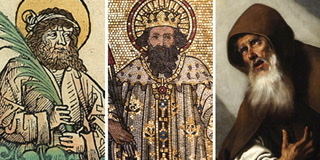
Fr. Lawrence Lew, O.P.; public domain; St. Quirinus of Neuss – for those affected by bubonic plague and smallpox; Edwin the Martyr (St. Edmund) — for victims of pandemics; St. Anthony the Great – Patron of those affected by infectious diseases

Those of us who are religious will pray without ceasing — imploring God to be merciful, asking various saints to intercede for us, lighting candles to express devotion and sitting for a moment in the flickering light that reminds us that God’s promise is about light overcoming the darkness.

The light shines in the darkness,
and the darkness has not overcome it.
(John 1:5)

In the end, perhaps we will have discovered that, through this terrifying and expanding virus, that we have learned how to care more and to love deeper. Perhaps we will find that we have a more heartfelt capacity for compassion. For that, God will pour out grace upon our weariness and renew our eternal hope.

If you pour yourself out for the hungry and satisfy the desire of the afflicted, then shall your light rise in the darkness and your gloom be as the noonday.
(Isaiah 58:10 ESV)

May God make it so. Amen.


Activism, Advocate, Black History Month, Challenge, Change, Courage, Covenant, Injustice, Justice, Racism, reconciliation, Repair the world, Segregation

I NEED YOU to join the fight for change!

24E7C406-2AD0-47CB-A702-2E259A76DCC3
We are well into Black History Month, also called African American History Month.  We celebrate it every year in February. All manner of celebrations and commemorations happen during this month, from school plays, choral concerts, historical dramas to formal tributes and ceremonies in cities, colleges and churches. In the midst of this month, I have been contemplating the idea of white fragility drawing on the books, White Fragility by Robin DeAngelo and Radical Reconciliation: Beyond Political Pietism and Christian Quietism by Alan Boesak and Curtiss Paul De Young. I highly recommend both books to you if you want to advocate for racial justice.

A dear and very wise friend of mine would exhort us to know the history of black people, but more importantly, to enter into serious conversations about equality and unity. She would tell white people to accept the reality that we will never completely understand her history and that we should be sure our conversations include deep listening. She would remind us that the history of injustice to black people has not ended yet and that we must all continue our work for justice and equality. I want to share with you some of the history behind this month.

As a Harvard-trained historian, Carter G. Woodson, like W. E. B. Du Bois before him, believed that truth could not be denied and that reason would prevail over prejudice. His hopes to raise awareness of African American’s contributions to civilization was realized when he and the organization he founded, the Association for the Study of Negro Life and History (ASNLH), conceived and announced Negro History Week in 1925.

The event was first celebrated during a week in February 1926 that encompassed the birthdays of both Abraham Lincoln and Frederick Douglass. The response was overwhelming: Black history clubs sprang up; teachers demanded materials to instruct their pupils; and progressive whites, not simply white scholars and philanthropists, stepped forward to endorse the effort.

The Black Awakening of the 1960s dramatically expanded the consciousness of African Americans about the importance of black history, and the Civil Rights movement focused Americans of all colors on the subject of the contributions of African Americans to our history and culture.

B5AF969F-8A72-44B0-A65B-9EF5BCB8102E

Then the celebration was expanded to a month in 1976, the nation’s bicentennial. President Gerald R. Ford urged Americans to “seize the opportunity to honor the too-often neglected accomplishments of black Americans in every area of endeavor throughout our history.” That year, fifty years after the first celebration, the association held the first African American History Month. By this time, the entire nation had come to recognize the importance of Black history in the drama of the American story

There is so much more I could include, but I will finish with some random thoughts my friend would like for us to know.

— The G.I. Bill of 1944 was denied to a million black veterans of WWII (history.com). These things matter. PUBLIC POLICY throughout American history has deliberately and purposefully limited economic opportunities and advancement of black people.

— It never occurred to me that some white people thought black history month DID NOT involve them.

— During this Black History Month, I ask: Do the white people within our networks remotely get how glorious AND exhausting it is being black in America? Can we talk about why it’s exhausting? Can you handle sitting in an uncomfortable space for awhile? Can you handle it? Can you take it in without deflection, pointing fingers, becoming defensive or proclaiming yourself the victim? Can we REALLY talk?

And finally her heartfelt words about a confrontation that happened in her city, in a neighborhood she knows well, to two people who are her friends.

My soul weeps. My body trembles. Anger and fear take turns occupying the same space. Why? Two people that I hold in high regard experienced the policing of their bodies in a PUBLIC space by white people who feel they get to decide where black people can and cannot be!

As I learned of what occurred I was immediately grateful their positions (elected official and one running for office AND a friend who STEPPED UP) along with their “training “ allowed them to walk away from this experience. Yes this was potentially a life and death event.

43274C05-47A6-49F7-979E-B91258D1809CSo many what if’s ran through my mind. If you are black you will understand what I mean. If you are white, I CHALLENGE you to discuss this LOCAL event with your WHITE friends! I NEED you to discuss it in YOUR churches. I NEED you to discuss with YOUR family.

I NEED YOU to join the fight for change! YOU play a KEY role in ensuring change happens.

I thank my friend for challenging me and encouraging me, not only during Black History Month, but throughout time — every day, every month and for years ahead. To black people, Black History Month begins on January 1st and ends December 31st, and the message of the month for black people has been lifelong. As for those of us who are white, let us not be shackled by “white fragility.” Instead let us move boldly — and with courage — into our communities and confront racism wherever we find it. It is true that racism and white supremacy have been a part of our history always, but we can end this tragic injustice with resolve, unity, faith, courage and the blessing of God who created all people in One image. May God make it so.

Anger, Awakening, Betrayal, Bitterness, Change, Courage, Covenant, Darkness, Despair, Emotions, Friends, Friendship, grief, healing, Heartbreak, Joy, Love, strength, Suffering, Transformation, Trust

“A Box Full of Darkness”

9782060C-0A7E-4CD7-B924-1D8D99B38B1B

Someone I loved once gave me a box full of darkness.
It took me years to understand that this too, was a gift.

― Mary Oliver

For some reason yet unknown to me, I am remembering those words today. At the same time, I have vivid memories of persons I loved — many of them through the years — who gifted me with “a box full of darkness.” Each time, it felt like anything but a gift. I accepted the boxes because I believed I had no choice. I reached out to take the boxes from people I loved and immediately discovered that it was the darkness I held in my hands. Unfortunately, the darkness in my hands was potent enough to engulf me, and for a good amount of time, the darkness was my constant companion. All around me. Above and below me. Darkness so deep that I could not begin to see the path ahead.

What would I do with these ominous gifts? How would I escape the deep effect they had on my soul? How will I cast off the heartbreak? In time, I was able to think beyond my initial acceptance of these boxes moving to the reality that they were given to me by persons I loved. These were loved ones who might ordinarily have given me gifts, but these gifts — these boxes — were filled with darkness! Why? What did these gifts mean?

I held on to the pain of those “gifts” for years, feeling anger on some days, or betrayal, or loss, or rejection. The experiences changed my life in many ways, and changed the very course of my life. Being a person who so values friendship and loyalty, I was left despondent and a bit lost. Okay, a lot lost!

Yet, the passing years actually did bring healing relief. I could not avoid the darkness that my loved ones gave me. I could not get around it, slip under it, or leap over it. It was just there with me, in my life, and feeling like it would be permanent. The boxes were to me a heart rending breach of covenant. And yes, I did experience despair in the darkness, and loneliness and lostness, and bitterness wondering how these gift boxes had such immense power over me.

When the darkness finally lifted, it brought me a brand new love of life. It gave me new courage and new excitement. It gave me an awakening! I experienced a holy transformation. I knew then that I could get on with my life, joyously, and moving forward following my dreams. So Mary Oliver knew something that I had to learn the hard way, over many years. Here’s what she wrote: “It took me years to understand that this too, was a gift.”

And then there is this wise and wonderful postscript that Annie Dillard wrote about her writing. It applies to every vocation or avocation that we love, and it’s really about living life — all out!

One of the few things I know about writing is this: spend it all, shoot it, play it, lose it all, right away, every time. Do not hoard what seems good for a later place in the book, or for another book; give it, give it all, give it now . . . something more will arise for later, something better. These things fill from behind, from beneath, like well water . . . The impulse to keep to yourself what you have learned is shameful, it is destructive.  Anything you do not give freely and abundantly becomes lost to you. You open your safe and find ashes.  (Annie Dillard from her book, The Writing Life)

Finally, James 1:2-4, a Scripture passage very familiar to us says it another way:

My brothers and sisters, whenever you face trials of any kind, consider it nothing but joy, because you know that the testing of your faith produces endurance; and let endurance have its full effect, so that you may be mature and complete, lacking in nothing.

So real and true it was when the people I loved betrayed me with a terrible “box full of darkness.” I had faith in each of them. I trusted them and held their love in my heart. My box full of darkness was indeed a trial and a testing of my faith. But the promise of The Epistle of James is there, in my face. It may just be a Holy Letter addressed directly to me. My challenge was to “consider it nothing but joy,” and to know that the testing of my faith most assuredly created endurance. Thanks be to God.


Adultery, Art, Awakening, Celebration, Change, Dancing, Discovering, Dreams, Freedom, Growing up, Introspection, Joy, life, New Life, Praise, Psalms, Questions, Surprise, Tambourine

With a Tambourine in My Hand

41C0A436-91ED-4E28-B2C7-8CC3FEA229B7
Water Dancers by Canadian artist, Rob Gonsalves

Women in white gowns emerge from the crashing water of  a moonlit waterfall. What in the world does that have to do with me, other than the fact that I am completely enthralled by this painting? I certainly cannot relate or see myself emerging from rushing waters or even dancing with a tambourine in my hand. Yet, there is something about this art that inspired my soul searching and brought up some questions I want to contemplate.

Where did I come from? Where will I go?
What will I do with my life? Which of my dreams will I realize?

I have asked myself similar questions, questions about what made me who I am and if I will ever feel that I have realized my life dreams. It’s true that I have entered my seventieth year of life, and one might wonder why the need for all the introspective questions. But In the core of my being, I believe that I can still dream and that I can still experience wonder about what I see in and around my life.

What people will enter my life leaving cherished gifts of friendship? What wonder will I see around me as I search for meaning? What will Spirit say to me with the gentle breath of her voice that can also enter my life as a rushing, mighty wind? And how does God continue to call me to new ministries of the heart?

I do not know the answer to those questions. Nor do I know who or what I will be when I grow up. So I struggle to know. I plead with God to give me direction. During this season of my life while I am challenged with so many things related to my kidney transplant, I have been somewhat obsessed with finding the answers to all those “who am I?” questions. I despair a little when I can’t find the answers.

Back to the art. Yesterday, I accidentally came across the painting by Canadian artist Rob Gonsalves which is at the top of this post. I was immediately captivated by the image, especially the rushing waterfall that changed into women living life — some of them dancing, others playing their tambourines, others just emerging, still others just beginning to awaken.

The art reminds me of how we might emerge into life — to grow into life, to be open to change, to be willing to embrace a process of becoming. Each of us is engaged in that kind of process whether we know it or not, whether we embrace it or not. We want to experience an awakening that opens our eyes to wonder and our souls to extraordinary newness of life. We want the freedom to be who we are. We don’t want to stay in our awakening place, reticent about moving into the best part of our lives, refusing to move because of our fear. We want to throw off our hesitation and, in search of our dreams, to sing, to dance, to play our tambourines in celebration of our unique personhood.

I am reminded of a beautiful passage of Scripture from the Psalms.

Let them praise his name with dancing,
making melody to him with tambourine and lyre.

— Psalm 149:3 (NRSV)

Isn’t that precisely what we want for our lives? To lean into our true selves so that we are compelled to sing, to dance with tambourines in our hands, to celebrate our lives, to dream and to praise the God who rejoices when we live into freedom and joy!


Awakening, Awareness, Change, Contemplation, Courage, Discernment, Discovering, Emotions, Exploration, God's presence, grief, Guilt, healing, Indecision, Introspection, journey, life, Light, Lingering, Mayo Clinic, Mystery, New Life, New Year, Pain, Prayer, Sacred Space, Self Awareness, Spiritual awakening, Trust

Lingering . . . In the Presence of God

53189F0B-8EF7-4BDC-A66A-B9834A45C0F5

I have observed, at this year’s beginning, as in past years, that humans are more introspective than usual. It may begin with intentions or resolutions for the new year. What I observe is that people are revisiting the past, trying to reinterpret it, digging for the meaning the past held for them and trying to find ways to heal the wounds of the soul theyp have hidden inside them for a long time. Those woulds live in us so long that they become scars, hardened in our spirits and thus more difficult to heal.

Until we have done this spiritual and emotional inner work, we are hesitant, unwilling to move into the future. So we linger in the present and re-live the past. Usually what we  revisit are past sorrows and losses, past disappointments and perceived failures, past pain that continues to pierce the soul. Seldom do we revisit past joys, because joy does not pierce like sorrow does.

It is a positive thing to linger in life review at the beginning of a new year. Just as the year is new, all of us hope that in the work of lingering, we will find newness in ourselves. The work of introspection is important for our well being and we have so many choices about how to strengthen ourselves, body and spirit. Many people use self-counseling, which may include searching their deep selves through personal contemplation and prayer. Others engage in spiritual direction, life coaching, trauma therapy or counseling. Still others tend to their souls through silent contemplation, labyrinth walks, yoga, nature walks, strenuous exercise, reading scripture, self-help books or poetry, and singing hymns or listening to music.

I want to suggest one other form of self-counseling that is unfamiliar to most people — working with Healing Runes as a part of your quiet time. Your first question probably is, “What are Healing Runes?” I want to begin by sharing an invocation written by Ralph H. Blum from his book, The Healing Runes.

Invocation

Practice the Presence of God in all ways,
Both in your coming in and your going out.

In your prayers, invoke God’s Presence.
In your aspirations, stay mindful of the Presence.
In your meditations, breathe in the Presence.

Above all, let the Presence be reflected in your attitude,
For surely then God will sing in your thoughts,
Speak in your voice and shine through your acts.
Let the Presence of God be the medicine
To heal your life, lift your heart and renew your spirit.

Practice the Presence of God in all ways,
Both in your coming in and your going out. Amen

To answer the question, a Healing Rune is a tool that provides a way of deepening  reflection and stirring the soul where we find life meaning and buried emotions. There is an interpretation of each healing rune in the book, The Healing Runes, written by Ralph Blum and Susan Loughan. They offer interpretations presented in graceful and sensitive language that allows the reader to take to heart what is appropriate for their own meditation and leave the rest.

A4B9545F-D3B1-40D5-AC08-23DF8FD547CAThe book adapts the sacred use of Runes as an alphabetic script used by the ancient Germanic and Norse peoples, creating a tool that could be helpful in the healing of body, mind and spirit.*

I suggest that we not fear the Healing Runes by considering them to be some sort of pagan artifact or something that seems like magic. They are more like mystery, something to guide our reflection and introspection. I suggest the we see Healing Runes as one way to guide us deeper into ourselves and into the presence of God, the ultimate healer of our souls.

I would like to choose a Healing Rune for us from my bag. Its meaning may not mean anything to you or to me. It may not open up any places in your soul that need attention. Or it may awaken us to a wound that we need to give some reflective time, some time for healing.

328A8B00-83F2-418F-BFC5-29960E0C06C7The Rune I have randomly chosen is the Rune of Trust. It is the Rune of restoration that calls for the rebuilding of belief in yourself, in your life and in your relationship with God. For some, drawing this Rune asks you to show trust in a present situation. For others, it calls for embracing the changes you are facing with trust and wisdom. In relationships of the heart, remember that I love you and I trust you are two stones for crossing the same stream. Most importat is that you ask your soul if Trust has something to teach you or somewhere to lead you.

Thomas Moore writes, “We separate, each from the other, the sicknesses of body, emotion, meaning and connectedness.” The soul must be moved, touched and healed, and that is why we linger at the door of our pain, trying every way we know to reconcile it, heal it, eliminate it (or just blast it with a sci-fi laser gun!) Thomas Moore has a better remedy than a sci-fi laser gun, a much more informed remedy:

I am convinced that all healing ultimately comes from a shift in deep imagination, grounding our own lives and anchoring our decisions in the very quick of the heart . . . not just relief from anxiety, but profound gifts that signal the presence of soul — intimacy, pleasure, beauty, love and piety.

As you and I explore what hides in our souls as this new year beckons us, may we not be afraid to linger directly in the presence of our fear or woundedness. Instead, let us consider that we are lingering in the comforting presence of God, in the gentle protection of Spirit. It is safe in that sacred space of Presence, safe enough for us to unearth whatever lies deeply in us and allow it to surface into the healing light.

God may be gently, lovingly calling us to do that work of healing and, in that introspection, to reveal our truth — the truth that will set us free!


* The Healing Runes, Ralph H Blum and Susan Loughan; Preface by Thomas Moore; St. Martin’s Press:New York, New York; ©️1995 by Ralph H. Blum.

Adventures, Awareness, Change, Contemplation, Exploration, Grace, Growth, Holy Spirit, Introspection, Life Journeys, Life pathways, Meditation, New Life, Reflection, Spirit wind, Transformation

Uncreated Grace

AA19F30F-F0BC-46B3-9F62-E084BF61258A

I have been reflecting on a phrase I read this morning in Father Richard Rohr’s meditation— Uncreated Grace. It is an intriguing phrase and makes me wonder why I received it at this particular time and place on my journey. I have had a very long journey — many miles of life —- and, in fact, there have been many other forks on the path that seem more sacred places to contemplate uncreated grace. But here it is, today, brought to me at this place on my journey.

As I did some processing on this phrase, I thought of one of my dear friends from ages past, seminary days to be exact. Often, he would share his favorite quotes. This was one of them, an intriguing and thought-provoking quote. This quote always stayed in his favorites file. It hints at a long journey we all must take . . .

We shall not cease from exploration
and the end of all our exploring
will be to arrive where we started
and know the place for the first time.

— T. S. Eliot

We were always left with the question “What do T.S Eliot’s words mean?” Sitting in small groups, the seminarians discussed but never reached an answer, to the question. I imagine that, like me, some of them took the words along with them on their journeys, hoping to discover the meaning at some place of enlightenment on their path.

On my journey, Eliot’s words came to mind many times. Never quite discovering a finite meaning, I did discover infinite applications that touched my life in ways simple and profound. Most always, I came away from reflecting on the words to a better place inside myself and a better space in my world. Still, I wonder why these T.S. Eliot words were brought to my mind today.

The power in these words, I think, is that they are not a directive, not a call to mission, not words of piety, not gleaned from scripture. They are words meant to be understood individually rather than offering a universal message. I identify these words as an invitation, and so today I am left alone with them to intentionally create space for reflection and understanding.

When I do that, I hear many, many other words from different places — from scripture, hymn, poetry, prose and from within myself. It feels like a Spirit encounter, the presence of “another comforter” who will be with us forever, who will, as Jesus promised, “teach you all things, and bring to your remembrance all that I said to you.”

Spirit teaches us and helps us remember. Spirit grounds us so that our circuitous journey will not frighten us. We are free to never “cease from exploration,” because we are comforted to know that we will “arrive where we started . . .”

9889AA3B-16BB-4F9F-9B56-D883A74A49AEAnd know the place for the first time . . .
When the journey leads us back to where we started, how is it that we “know the place for the first time?” I urge you to not take my interpretation as the correct one, because I believe that a “correct” interpretation comes from the soul of each person who chooses to explore. But here is an understanding based on my own musings . . . we can take what comes in our lives, or we can explore places on the journey — our encounters, our joys and sorrows, our events and calamities, our crises and emotions, our disappointments and betrayals, the chance and the wonder.

For me, there is no doubt that exploring all of these life events brings that sense of getting back to the beginning and truly knowing the place for the first time, not necessarily because the beginning place has changed, but that I have changed. The Spirit’s holy breath transformed me with gentleness again and again, transformed by the blowing of Spirit wind into my being.

Father Richard Rohr says that “the Holy Spirit is never created by our actions or behavior. It is naturally indwelling, our inner being with God. In Catholic theology, we called the Holy Spirit “Uncreated Grace.”

How I love those words . . . Uncreated Grace! Perhaps that’s what we all hope for in our explorations on the journey — that in us and through us, there is Uncreated Grace. If we present to the Spirit our selves as uncreated grace, I wonder if Spirit then creates grace within us again and again and again, all along the way. If we never cease from exploration, presenting ourselves as uncreated grace, the Holy Spirit will breathe on us and we will be transformed!

No wonder we know the place where we started for the first time! The place hasn’t changed, we have changed, transformed in our deepest places!

Thanks be to God and to the touch of Spirit breath. Amen

anxiety, Challenge, Change, Chronic illness, Comfort, Contemplation, Courage, Emotions, Energy, Faith, God's presence, grief, healing, Hope, Illness, Life Journeys, New Year, Pain, Perseverance, Psalms, Sorrow, Soul, strength, Suffering, The Year Behind

Holding Hope

FA0DFF1E-0155-456C-BC1A-AF7ABBA0BE5E
A new year has dawned. We’re in it, ready or not! While we cannot control what 2020 brings to us, we can control the way we respond —- to times of joy, times of sorrow and all the times that are just ordinary. No doubt we will greet them all, ready or not!

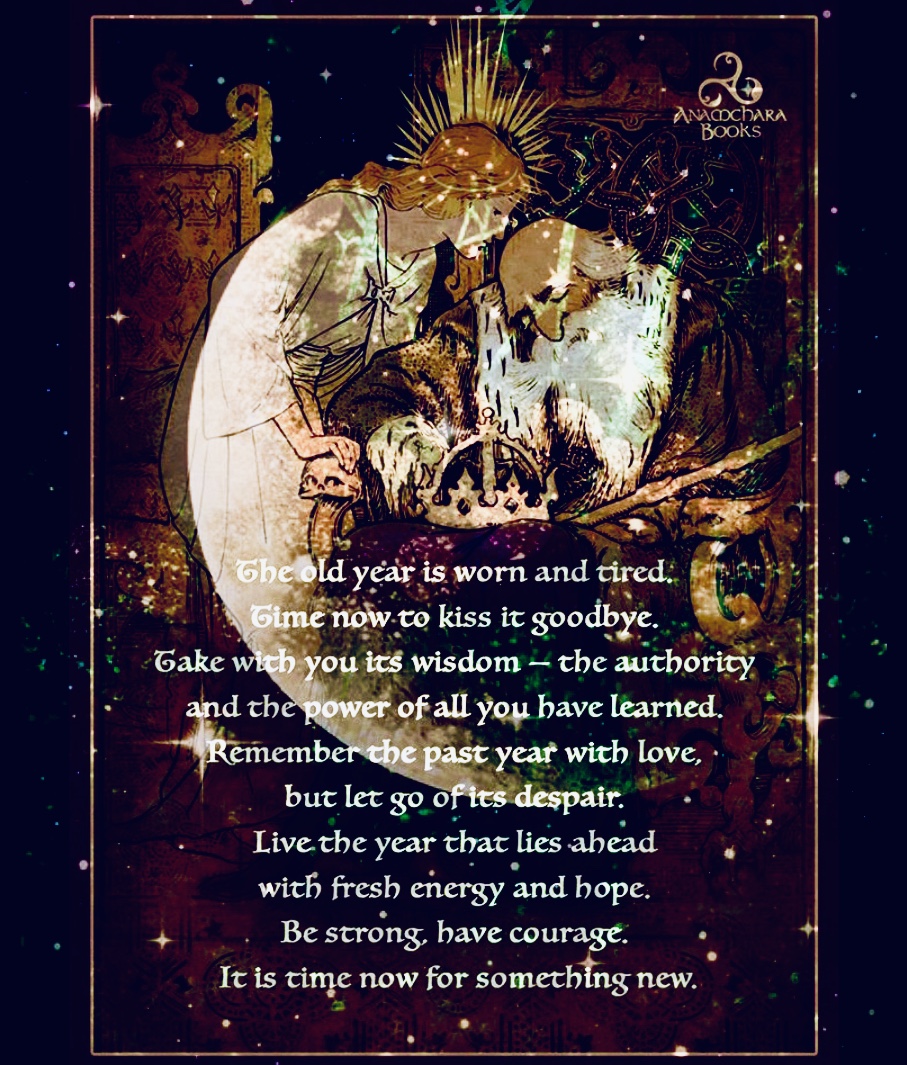
As the poet reminds us, “Live the year that lies ahead with energy and hope. Be strong, have courage. It is time now for something new.” And so it is. But embracing something new is sometimes difficult. Sometimes our hope is small. Sometimes following our journey into an unknown future is frightening. If the year past still holds us in a place of suffering, if illness lingers with us, if depression and anxiety still rages in us, if persistent grief comes with us into the new year, it is difficult, if not impossible, to leave the past pain behind and embrace something new. So if you feel that you cannot leave past suffering behind you, this little message is for you.

The most important thing you can do is to honestly acknowledge the suffering and accept the fact that it will not leave you just because the new year has arrived. Spend some time contemplating your suffering, how it impacted you in the year past. Can you find any newness at all at the beginning of a new year? Is there some of the suffering  you can see in a different light? Can you respond to it differently? Can you find a way to endure it that is better than the way you endured it in the past? Can you make a concerted effort to learn something from your suffering?

Still, if you are in the throes of suffering — physical, emotional or spiritual — the suggestions above can illicit the strong response, “You’ve got to be kidding! This way of looking at the same thing I’ve endured for years is simply impossible!”

I will be the first to acknowledge the truth of that response, but I must also ask, “What do you have to lose?” Even a change in your response to one place of suffering could bring a small change for you, a change ever-so-slight that has the power to offer you increased resilience and hope. It may be worth a try.

I think it’s important to repeat these wise words: “Live the year that lies ahead with energy and hope. Be strong, have courage. It is time now for something new.”

I suggest that, even if we are enduring suffering, we can greet the new year “with energy and hope.” Hope is always available to us, even when we cannot see it or feel it.

From the promises of Scripture . . . 
“ . . . so that we who have fled for refuge might have strong encouragement to hold fast to the hope set before us. We have this as a sure and steadfast anchor of the soul, a hope that enters into the inner place.
 — Hebrews 6:18-19

From the depths of our souls . . .
“Why are you cast down, O my soul, and why are you in turmoil within me? Hope in God; for I shall again praise him, my help and my God.”   — Psalm 42:11

“I wait for the Lord, my soul waits, and in his word I hope.”  
— Psalm 130:5

But I will hope continually and will praise you yet more and more.”  — Psalm 71:14

The Scriptures can be comforting to us. They can lift up courage in us and they can give us strength to face all of our tomorrows, but the place where hope really lives is within us. We can reach down for it, hold it close, and allow it to help us move forward. No matter what manner of suffering we hold, hope can guide us.

I leave you and your journey into 2020 with the wise words of Corrie Ten Boom:

“Never be afraid to trust an unknown future to a known God.”


Change, Family, Fear, Friends, Friendship, God's Faithfulness, Hope, Loss, Love, New Year, Passing years, Poetry, Pondering, The Year Behind

Old Year Ending ~ New Year Beginning


Of all sounds of all bells, the most solemn and touching
is the peal which rings out the Old Year.

— Charles Lamb

We do get rather nostalgic at the end of a year, on the cusp of a new year. Perhaps we have regrets from the passing year. Perhaps the old year brought losses and grief. Perhaps we have fear at the thought of what the year ahead might bring. Nostalgia just seems to go along with year end and year beginning. I have been known to get teary-eyed during the singing of “Auld Lang Syne” in spite of the fact that I had no idea what “Auld Lang Syne” even meant.

Robert Burns wrote “Auld Lang Syne” in 1788. The poem soon became a song that was traditionally used to bid farewell to the old year at the stroke of midnight on New Year’s Eve. It was a ritual song that gave people a ceremonial way to express the discomfort of ending/beginning as well as to speak of the value of old friendships that should not be forgotten.

Another poem written by Robert W. Service (1874-1957) was entitled “The Passing of the Year.” Its seven poignant stanzas come across as a lament of the passing year, and yet the poet also expresses a juxtaposition between a somber response and an expression of fond farewell. Here are some excerpts:

My glass is filled, my pipe is lit,
My den is all a cosy glow;
And snug before the fire I sit,
And wait to feel the old year go.
I dedicate to solemn thought
Amid my too-unthinking days,
This sober moment, sadly fraught
With much of blame, with little praise . . .

And You, deep shrinking in the gloom,
What find you in that filmy gaze?
What menace of a tragic doom?
What dark, condemning yesterdays?
What urge to crime, what evil done?
What cold, confronting shape of fear?
O haggard, haunted, hidden One
What see you in the dying year?

And so from face to face I flit,
The countless eyes that stare and stare;
Some are with approbation lit,
And some are shadowed with despair.
Some show a smile and some a frown;
Some joy and hope, some pain and woe:
Enough! Oh, ring the curtain down!
Old weary year! it’s time to go.

My pipe is out, my glass is dry;
My fire is almost ashes too;
But once again, before you go,
And I prepare to meet the New:
Old Year! a parting word that’s true,
For we’ve been comrades, you and I —
I thank God for each day of you;
There! bless you now! Old Year, good-bye!

As for New Year’s Resolutions, the same poet wrote an expressions of regret in the year past and the resolve inherent in a phrase we know so well: “Just do it.”

RESOLUTIONS

Each New Year’s Eve I used to brood
On my misdoings of the past,
And vowed: “This year I’ll be so good –
Well, haply better than the last.”
My record of reforms I read
To Mum who listened sweetly to it:
“Why plan all this, my son?” she said;
“Just do it.”

Of her wise words I’ve often thought –
Aye, sometimes with a pang of pain,
When resolutions come to naught,
And high resolves are sadly vain;
The human heart from failure bleeds;
Hopes may be wrecked so that we rue them . . .
Don’t let us dream of lovely deeds –
Just do them.

Now that I have shared more poetry than you ever wanted to read, let me conclude with this thought: As a new year approaches, we greet it with all the regrets and losses and emotions of the old year still pressing on our spirits. That affects our attitude about the unknown year ahead, and when we look at the path that leads us into 2020, all we see is darkness. It is for us a journey into the unknown with no instructions for moving forward. We are sometimes not sure we even want to move into the new year.

That may be the very reason for the ball drop in New York, the champagne toasts with all the hugging and kissing, the elaborate party decorations including metallic pointy hats and horns blowing in the night. Maybe we celebrate so hard because we are so hurt, so filled with regret, so shamed, so afraid of the future. We stand at the gate of the new year holding all that we brought from the old one. Sometimes the burden we are carrying is a heavy, heavy burden to carry, but we simply don’t believe we can throw it off and start on the new year’s unknown path, unburdened and free.

Yes, we do leave all our memories behind in the year that has passed, and in the new year, we hope to realize fresh, new dreams. A wise person says that around us, we have those who love us and within us, we have all we need. But the most eloquent advice I know that addresses our old year/new year dilemma comes from yet another poet, Minnie L. Haskins:

And I said to the man who stood at the gate of the year:
Give me a light that I may tread safely into the unknown.

And he replied: “Go out into the darkness and put your hand into the hand of God.
That shall be to you better than light, and safer than a known way.”

Change, Contemplation, Faith, Fear, Hope, Introspection, Laughter, life, New Year, The Year Behind

The Year Behind Us

61A4824A-D792-4F6C-85DE-FE640AAC3CC7
Often one of the things we do as we approach a new year is to lament the old year. We take stock of our days, good and bad — and we disparage the bad far more than we celebrate the good. We spend moments of regret and self-recrimination for the things we left undone or for the things we did not do well. We spend moments blaming ourselves for things that were out of our control, and we critique our performance of those things we did control.

Perhaps we need to check ourselves if we find that we are reviewing the old year with too much reproach, regret and recrimination. It’s not a very good use of precious time. Instead, might we review the old year’s times of celebration — the days of joy, accomplishment, the days when our health was good and our hearts were strong, the days we survived calamity and dodged a few bullets.

Perhaps we should recall the times precious and poignant when our souls rejoiced in sweeter days we will remember with fondness. Perhaps we need to take stock of the ways we became stronger and found resilience in ourselves. Perhaps we need to celebrate the times we were gentle and kind, loving and compassionate. Perhaps we should count our friendships and the loving acts of those who love us.

Might we refuse to see the old year as a series of burdens and see it, instead, as a year that poured blessings on our lives. Is it possible that spending our reflections on the old year, seeing the grace it brought us, will enable us to believe in the grace that the new year will most surely bring?

It is true that this old year will end, for good or ill. Some might long to have it back, while others curse it as it leaves. This poem by Ella Wheeler Wilcox that speaks of “the burden of the year” reminds us of the ways we experienced the old year with both weeping and laughing. That is life’s reality that surely promises that the new year 2020 will bring us the twofold, paradoxical gift of fear and faith, despair and hope.

The Year
Ella Wheeler Wilcox – 1850-1919

What can be said in New Year rhymes,
That’s not been said a thousand times?

The new years come, the old years go,
We know we dream, we dream we know.

We rise up laughing with the light,
We lie down weeping with the night.

We hug the world until it stings,
We curse it then and sigh for wings.

We live, we love, we woo, we wed,
We wreathe our brides, we sheet our dead.

We laugh, we weep, we hope, we fear,
And that’s the burden of the year.

If you will miss the year behind, celebrate what it left you. If it took and demanded your very life-breath, curse it if you need to, and then accept the ways it strengthened you. May we all spend a few moments or a few hours reviewing the year behind us, and find there laughter and weeping, hope and fear. All were meant to teach and to guide and to create strength in us.

Thanks be to God. Amen.


Advent, Angels, Belief, Bethlehem’s Star, Challenge, Change, Darkness, Grace, journey, Life Journeys, New Life, New Normal, Stars

In Believing There Is Hope!

6BEA3F47-6DD3-4978-8400-9F402BA79E5D
The Seventh Day of Advent

Transplant Day Twenty-six
December 7, 2019

CHRISTMAS MIRACLE 

There are those who scoff at miracles.
I don’t know what they make of the birth of the Child.
For that matter,
I don’t know what they make of the birth of any child.

There are those who laugh at dreams.
so they’ve never heard an angel’s voice,
nor seen any unusual light in the night’s sky,
nor felt the yearning to set out in search
of new life.

There are those who do not see the Star.
I wonder where it is they go
when everyone else sets out for Bethlehem.

To those of us who believe,
into every night is born a Star.

— Ann Weems

I do not want to be one of the ones who miss seeing the Star. It’s important, especially when I am so focused on transplant recovery, that I make my way to Bethlehem this Advent. In her poem, Ann Weems writes that some people have never heard an angel’s voice nor seen any unusual light in the night sky. She laments that some people have never felt the yearning to set out in search of new life.

Advent 2019 finds me feeling at least a small yearning to set out in search of new life. Circumstances have left me no choice, really, because ahead of me, a new life is all there is. The old life is over and, with a new kidney to protect, I am facing a new life head-on, like it or not. It won’t be an easy life, but embracing new life seldom is. It is always a change and a challenge, asking for my best effort.

I fear it, as folks most always do when embracing a new life. And I am going to need some help — from my friends, my family and my faith community. I am going to need the singing of angels and the light from Bethlehem’s Star. I am going to need to believe —  really believe — because not believing may leave me stalled on the path to Bethlehem. In believing, there is hope, hope that embraces the longing for new life. Hope that hears the singing of angels. Hope that looks up into the night sky and sees the Star.

There is no doubt about it — in believing, there is hope.

Ann Weems offers the grace of one last promise:
              “To those of us who believe, into every night is born a Star.”C9B596AE-76F4-4215-AF87-B5ED84B119E3

Advent, Angels, anxiety, Belief, Change, Comfort, Courage, Darkness, God, God’s Gift of Stars, Hope, Kidney Transplant, Laughter, New Normal, peace, Suffering

Sometimes God Flings Stars!

0E6B5F26-6125-45C7-8B3C-48718E5A951D
The Fifth Day of Advent

Transplant Day Twenty-four
December 5, 2019

THIS YEAR

I wonder if God comes to the edge of heaven each Advent
and flings the Star into the December sky,
laughing with joy as it lights the darkness of the earth;
and the angels, hearing the laughter of God,
begin to congregate in some celestial chamber
to practice their alleluias.

I wonder if there’s some ordering of rank among the angels
as they move into procession
the seraphim bumping the cherubim from top spot,
the new inhabitants of heaven standing in the back
until they get the knack of it.
(After all, treading air over a stable and annunciating
at the same time can’t be all that easy!)
Or is everybody — that is, every “soul” — free to fly
wherever the spirit moves?
Or do they even think about it?

Perhaps when God calls, perhaps they just come,
this multitude of heavenly hosts.
Perhaps they come,
winging through the winds of time
full of expectancy
full of hope
that this year
perhaps this year
(perhaps)
the earth will fall to its knees
in a whisper of “Peace.”

— Ann Weems

This year for me is unlike any other year, not at all like Advents of my past. This Advent for me is not at all ordinary. It is an Advent that finds me in a bit of suffering, a bit of pain and, most of all, crying out for peace.

The poet asks: “What might it look like if the earth fell to its knees in a whisper of ‘Peace?’” We are always full of expectancy, full of hope that during some Advent, perhaps this year’s Advent, we will finally hear the earth whispering “Peace.” 

From the place I find myself today, I look for that Peace. Recovering from a kidney transplant and trying to live into a new normal, what I need most is peace. Peace after a life upheaval. Peace after a physical trauma. Peace that might help restore my emotional and spiritual self.

I do so want to fall to my knees in a whisper of “Peace.” But probably not today. Not until some parts of me heal a little more. It’s not always an easy thing, falling to my knees, even in the best of times. Today, though — far from home and family, separated from my friends and my faith community — most things are not easy.

I will remember these recovery days as a season of harsh medications, pain, swelling, itching, tremors, instability and anxiety. But there is another part of my memory that remembers that the Apostle Paul wrote some words that have always spoken deep peace to me. He wrote of being “troubled on every side, yet not distressed; perplexed, but not in despair; persecuted, but not forsaken; cast down, but not destroyed.”

And then his most comforting words of all: “We do not lose heart. . . for our light affliction, which is but for a moment, works for us a far more exceeding and eternal weight of glory.” (From 2 Corinthians 4)

Walking through those words of hope, I think I can make it another day. Even in my darkness of a difficult recovery, perhaps I can gather up my courage and perseverance and walk a few more steps. Yes, this is a hard time.

04E87215-AC50-4CC9-B2F4-6612E56D0CB9And yet, I still believe that, in some mysterious way, God comes to the edge of Advent and flings the Star into the night sky, maybe many stars. I can still envision God laughing with joy as starlights illuminate the darkness. And I can almost hear the singing of angels practicing their alleluias.

It is Advent, after all!

Change, Church, Comfort, Community, Covenant, Faith, Family, Friends, healing, Inspiration, Kidney Transplant, Loneliness, Loss, Music, Relationship, Rest, Rootedness

Nearer, Still Nearer

A4824C25-A897-4AFB-BC7C-31E547F84EBA

Transplant Day Seventeen
November 28, 2019

Sometimes an old hymn — a hymn the contemporary church has discarded from its worship — can eloquently speak to the heart. There are many hymns I call hymns of the heart because they touch me so deeply. In these days of recovery when I find myself away from home and separated from friends and family, a particular old hymn comforts me. One line specifically inspires and moves me — “Shelter me safe in that haven of rest.”

The hymn, “Nearer, Still Nearer” was written by Lelia N. Morris and published in 1898. Here are two stanzas of the hymn text.

Nearer, still nearer, close to Thy heart,
Draw me, my Savior — so precious Thou art!
Fold me, oh, fold me close to Thy breast;
Shelter me safe in that haven of rest;
Shelter me safe in that haven of rest.

Nearer, still nearer, while life shall last,
Till safe in glory my anchor is cast;
Through endless ages ever to be
Nearer, my Savior, still nearer to Thee;
Nearer, my Savior, still nearer to Thee!

Finding myself away from my communities of support, I feel the separation acutely. I feel the loneliness of “apart” time. I feel a breach of relationship and the loss of my covenant community. I know it is necessary to be near Mayo Clinic in Jacksonville, Florida for this month so that the transplant team can closely monitor my care. But I miss my home and my faith community and my friends and family, and even my stray cat. I feel isolated at a time when I most need their support and encouragement. And although I strongly feel their prayers from afar, the “afar” part is not so great. I feel vulnerable and I need to feel nearer to my people.

So this hymn that expresses nearness to God is for me a timely expression of my faith and a picture of my current reality. In your contemplative time today, may you be inspired by listening to this beautiful hymn.

https://www.youtube.com/watch?v=gCF2D98szaU


—————————————————
“Nearer, Still Nearer”
Lelia N. Morris, pub.1898
Copyright status is Public Domain

anxiety, Awakening, Awareness, Challenge, Change, Community, Contemplation, Despair, Discernment, Discovering, Emotions, Epiphany, Friends, healing, Hope, Illness, Inspiration, Introspection, Kidney Transplant, Knowing, Life Journeys, Life pathways, Meditation, New Normal, Pain, Perseverance, Reflection, Relationship, Restoration, Rhythm, Soul, Spiritual Direction, strength, struggle, Suffering, Transformation, Troubles, Wholeness, Wisdom

Spiritual Direction

E82BA236-43E0-4EDA-B57B-4E7F6E31779A
Transplant Day Thirteen
November 24, 2019

I have been offered a blessing. From a stranger. 

I met this kind person through a group of clergywomen called RevGalBlogPals. She is a spiritual director from British Columbia. Through the RevGalBlogPals Facebook group, she happened upon parts of my transplant journey in my blog posts. She began praying for me. Then she offered me the gift of spiritual direction as I pass through this complicated time in my life. 

9299C4C7-3373-43D8-A11E-C2349150F942It has been several years since I worked with a spiritual director, so I was very humbled and thankful to hear from her. These were the words of lovingkindness she wrote to me in our first session.

May you feel the gentle touch of Spirit in this session.
May you know that I am holding you in healing Love.
May you be reminded of your worth and strength…
As you rest.
~ This is spiritual direction when pain does not allow for words.

Burning BushOn the day I received her message, it was so true that pain did not allow for words. The assault on my body was unspeakable on that day. I remember when many years ago my husband’s cardiologist came into his hospital room a few days after his heart surgery. The cardiologist said this: “Let’s look at this terrible thing we’ve done to you.”

His words resonated with me post transplant when, in the throes of struggle and pain, I definitely was looking at the terrible thing they had done to me. I could not quite see a brighter, pain-free future. I could only focus on the physical systems that were in complete disarray after the transplant. It did not help when medical staff told me it was all normal. The way I was experiencing it all was far from normal.

I wondered if I would ever live “normal” again. Or if perhaps I would live into a new normal of life after receiving a transplanted organ. I was not sure, and definitely not confident, that all systems would levelize into something I could tolerate. My spiritual director’s wisdom knows that to have physical normalcy, I must also seek emotional and spiritual normalcy. That would mean healing wholly — from the outer visible body to the inner invisible one. It would mean transformation. It would mean living my life while watching constantly and diligently for any sign that something was physically wrong.

Red Wooden Directional Arrow Signs In Green Forest BackgroundWhen my spiritual director suddenly appeared, I knew that she would help me explore my spiritual state, entering into community with me and pointing to the healing I could not yet see.


Thanks be to God for the beloved community she has offered me, community that forms in unexpected places, in unexpected times, just when I needed community the most.