
Subscribe to continue reading
Subscribe to get access to the rest of this post and other subscriber-only content.
God of the Sparrow 🌱 By Kathy Manis Findley
"Do not be afraid. You are worth more than many sparrows." —Jesus
Subscribe to get access to the rest of this post and other subscriber-only content.
Rev. Kathy Manis Findley
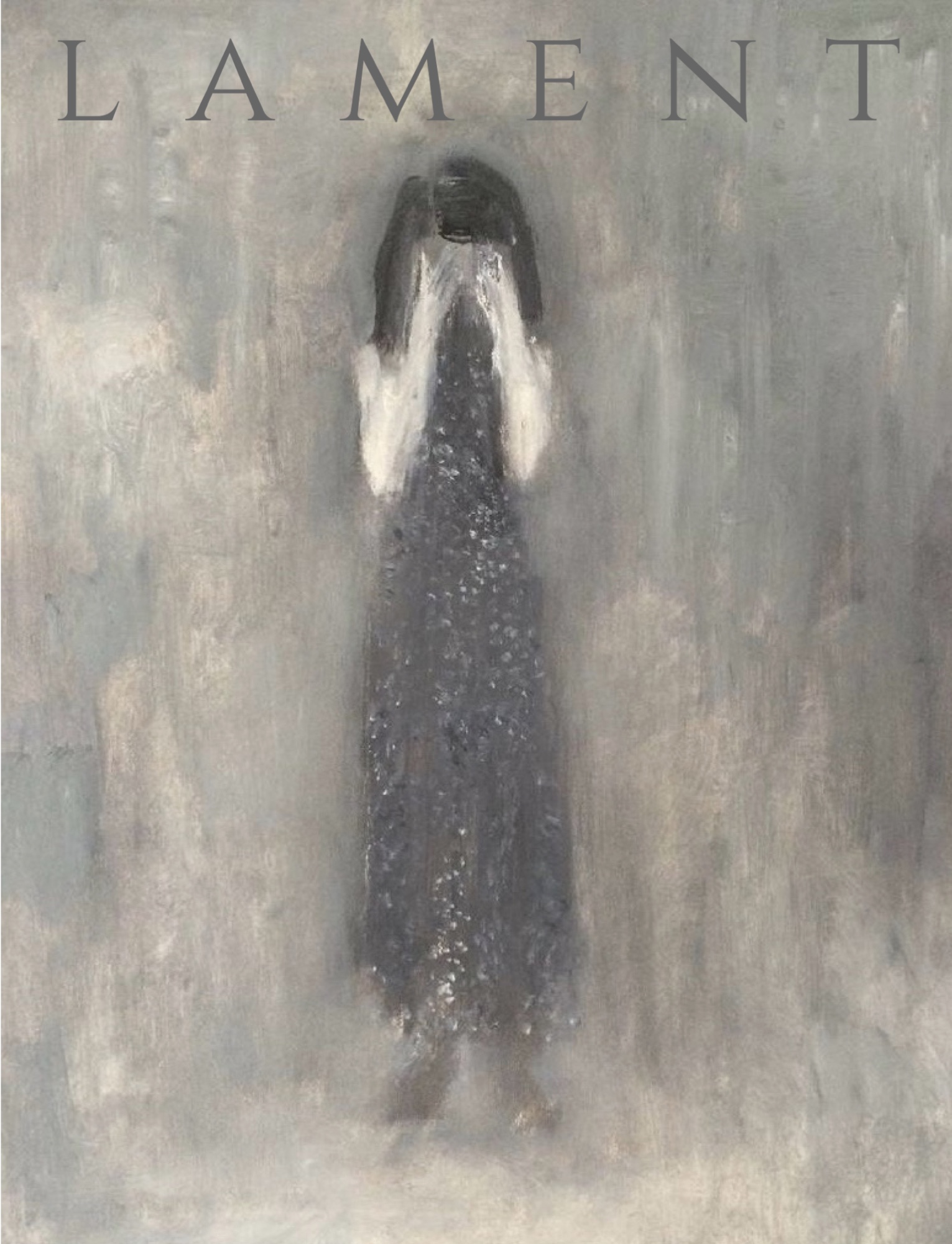
Lately, I have been trying to figure out a number of mysteries, but I have not figured out one single thing-, not lament, not how to fix my life, not transformation, not even the continuous mess in my closet. I simply have not yet been able to go through a reorganization process. The prospect of reorganizing my life—my soul, my spirit, my heart—plus all the treasures in my closet and armoire is so terribly daunting to me. Marie Kondo comes to mind, but I quickly shoo her away from my mess in the closet.
Lots of folk complain about “these days.” I confess that I do my share of complaining. What is it about “these days” that seems so troubling? I cannot fully give you an answer to that question yet, but I have some ideas about it. The issue at hand reminds me that the Bible often refers to “evil days.” I believe that many people see these days as “evil days,” and that cannot turn out well for anyone!
Jennifer Senior, a journalist with The Atlantic, recently wrote a news article in which she asked a another provocative question: What will happen to the American psyche if Trump is reelected? (Don’t worry, this post is not about Donald Trump!) On this question, maybe we really don’t want to know the answer. Instead of taking her question seriously and considering what might happen to “American psyches” following the November election, some folk would rather complain about the division all around, the evil around us, or other things nobody likes.
When we dare to make an honest evaluation of circumstances that surround us, we dig in our heels and balk. We balk because we don’t want to see the division in our nation or the impasse we have reached on important issues. We balk because, in truth, no one wants to lament. Remember, I’m not talking about divisions among us like liberal or conservative, Democrat or Republican, male or female, immigrant or American citizen, black or white . . . I could go on and on naming divisions among us. We have always co-existed with division, but most often in the past we have acknowledged division and simultaneously practiced kindness, respect, and tolerance. Given the current national environment, we might just be justified in calling these days “evil days.”
If reading the Bible is something you typically do, then you might understand more fully the term “evil day.” My heart tells me that “evil days” are definitely taking a toll on us. Instinct tells me that “the evil day” is not a single day, but refers to the times in our lives when we face overwhelming , troubling circumstances. If you are willing, meditate on the following words for a few moments.
—Ephesians 6:13-17 NRSVUE
Therefore, take up the whole armor of God, so that you may be able to withstand the evil day and, having prevailed against everything, to stand firm. 16 Stand, therefore, and belt your waist with truth and put on the breastplate of righteousness15 and lace up your sandals in preparation for the gospel of peace. 16 With all of these, take the shield of faith, with which you will be able to quench all the flaming arrows of the evil one.17 Take the helmet of salvation and the sword of the Spirit, which is the word of God.
I want to remind us all about the unrest we hold inside, too close to our heart and spirit. The proximity is important to pay attention to, as well as the flashpoints, past and present, that people have endured. I would guess that there are many flashpoints and memories of times that have held power over you. You probably face off with flashpoints, knowing that they not only create stress in our bodies, but also create bondage. We can become chained to our lives. Until we have exert some control of the present time of division, hate, turmoil, distrust, disrespect, contempt and other forms of bondage, we cannot find peace that changes the world. We certainly cannot figure out how to accept the possibility of transformation.
These evil days may well be causing our hearts to lament. These days may be days full of nightmares—no dreams at all, not even little dreams. You can name your own tragedies—the ones that are making it hard to breathe for you, or the ones that cover the whole troubled world with sadness. When I think of choosing my personal places of lament, those places where I can pour out the most anxiety, I feel the heavy burden of hopelessness. If you feel that too, you are not alone.
Always looking for a scapegoat, we try to discern what is bringing us down. Of course, life often brings us unforeseen personal tragedies that we must deal with. And there is certainly enough shared anxiety to go around. If you read the daily news, you will undoubtedly hear about the fierce war in Ukraine, the inability to create peace in the Middle East, the rising cost of food, the food deserts in our country, refugee children separated from their parents, difficult financial challenges, mass shootings, fractured relationships, long-term estrangement from loved ones, the opioid crisis and addiction, racism, injustice of all kinds, and politics. Evil days!
There are so many more ills we could add to this list, but we know them already, and the news programs are anxious to tell us about broken politics, as well as the way politics creates broken people. So there you have it! Among the many sources of stress we each experience, we continually stress over the dozens of pointless news stories about politics and the behavior of politicians every day. To top it off, Gloria Mark points out that “we are once again facing a news cycle that will shove our attention—as well as our output, our nerves, our sanity—through a Cuisinart.” No matter how skillfully we deny it, our bodies are not designed to handle chronic stress and trauma.
Just about now, you might want to say that politics doesn’t affect us that much, certainly doesn’t cause depression and hopelessness. But consider this viewpoint written by Pulitzer Prize winning journalist, Jennifer Senior:
The American Psychological Association’s annual stress survey, conducted by the Harris Poll, found that 68 percent of Americans reported that the 2020 election was a significant source of strain. Kevin B. Smith, a political-science professor at the University of Nebraska at Lincoln, found that about 40 percent of American adults identified politics as “a significant source of stress in their lives,” based on YouGov surveys . . . Even more remarkably, Smith found that about 5 percent reported having had suicidal thoughts because of our politics. Evil days!
And of the most divisive election in decades, psychologists are saying that their research shows that more than two-thirds of U.S. adults (68%) say that the 2020 U.S. presidential election was a significant source of stress in life.
It is not a stretch to say that stress plays havoc on our dreams, even our little dreams. I have to confess that my big dreams disappeared into the “impossible“ file, and were then swallowed up by the churning in my stomach and my psyche. I remember my first year in seminary, working part time jobs and going to class. For a while, I worked in the development office where all the catchy slogans, mottos and themes were born. One year, the staff got together to write a theme for the annual development campaign. I don’t know who came up with our brilliant theme, but we loved it. I really loved it and made it my personal mission.
I tried to do just that, and I honestly thought I could, but eventually the scene in my mind of one young woman alone trying to change the world on her own made me shiver. All the lofty goals and the many little dreams, along with a few big dreams, that had my attention were disappearing before me. I despaired at first and then carried long-term grief about it. There would be no big dreams in my heart. I would never see the glory of a big dream come true. Nor would I dream small dreams. People usually don’t dream of whatever is better while they are covered in grief—mourning, lamenting that they lost their dreams in the first place. In “these evil days” we must let go of despair and pray for an extra portion of holy determination!
But people do see the sacred light that sparks dreams. It dawns over them again and again until their dreamless spirit transforms from death, to life, to get their bearings again, and to summon the energ to get up and try
This is my message to you, and to myself: After your time of lament, rejoice! After you have escaped the bondage of evil days, rejoice! After you name your loss, and then put yourself back together, rejoice!
Take heart. Up in the heavens, there is rejoicing for you! Even in the gloomy shadow of dark and evil days, there is rejoicing for you! Even if you are trying to dream even the littlest dream, there is rejoicing for you!
So try a big dream! Change the world a little bit! Your heart longs for it, the world needs it, and the heavens will do what they always do—rejoice!
Let the heavens rejoice, let the earth be glad;
Psalm 16:11 NIV
let the sea resound, and all that is in it.
May even your smallest dreams change the world!
Stand fast therefore in the freedom by which Christ has made us free,
and do not be entangled again with a yoke of bondage.
Galatians 5:1 (NKJV)
What is it about freedom that scares us? What is it about freedom that causes us to refuse to offer it to everyone? Are we afraid that giving freedom to another person or group of persons will diminish our own freedom? What does freedom really mean to persons who are oppressed and to those who live inside the throes of injustice?
I have written very little lately about justice and accountability, the two words most used to describe Derek Chauvin’s conviction. I can’t help but mark this very moment on the “long arc that bends toward justice.” I feel compelled to call our attention to this week! Actually it’s last week now, but you get the idea. Let’s call it “the week of the verdict.”
The week of the verdict has come full circle from George Floyd’s murder on May 25, 2020 to the conviction of Derick Chauvin almost one year later on April 29, 2021. It was a week we will not forget. It brought up emotions in me and perhaps in most people. Most of what I felt mirrored the emotions I imagine George Floyd’s family feeling — happy, calm, relieved, conflicted, hopeful, determined, vindicated. I also felt sad and helpless because the conviction did not end murders of black and brown brothers and sisters. And I felt joyful and hopeful because perhaps this flashpoint in the long history of racial injustice will help us turn the corner and finally see in our communities the justice we long for.
How can that happen? How can we turn the corner and move away from oppressive systems and oppressive people? How do we do that when just minutes after the verdict and less than ten miles away, 16 year old Ma’Khia Bryant was shot and killed by police in Ohio? It happened in the shadow of “the week of the verdict.”
Perhaps for us this is the week of the verdict — the week when the verdict will be read on our failure to end the systemic racism in our communities! Isn’t it past time for us to stand up and stand strong and stand determined and woke? My friends, it is time! This moment in the history of injustice may well be the turning point we need to end racism!
I have said this many times: We cannot just reform injustice, we must transform it. The transformation that results in genuine, lasting justice must begin in the soul and in the heart where intentions are formed. I must lament injustice, confess my own complicity in it, repent of the white supremacy within me, own other forms of oppression and commit to the hard work of transforming injustice in my community and in my world. Only then will transformation happen in the systems that oppress people.
Only transformed people can love neighbors as Jesus loved us. My friend and sister blogger never fails to remind me to answer the ultimate question, “How then shall I live?”* She offers this scripture to us today.
We know love by this, that he laid down his life for us — and we ought to lay down our lives for one another. How does God’s love abide in anyone who has the world’s goods and sees a brother or sister in need and yet refuses help?
1 John 3:16-17
She then reminded us that conditions in India are dire and the people languish.
In India, today the virus surges
Maren
almost beyond control,
hospitals are choked,
people die in line waiting for a doctor.
How can those of us
rejoicing in vaccination,
cautious travel, new gatherings,
not ask how we can help?
How does God’s love abide in anyone who has the world’s goods and sees a brother or sister in need and yet refuses help?
And that is the soul-critical question we must answer. How then shall we live when all around us people suffer every kind of calamity — every kind of violence, disaster, racism, discrimination, dehumanization? Every kind of heartache. How do we, in our suffering world, become the heart, hands and feet of Jesus?Getting back to the lament of my own heart, that one thing that inspires my passion — transforming the injustice of racism, xenophobia, misogyny, homophobia and all forms of evil exclusion and oppression. Transforming injustice! Setting our faces toward the hope of Beloved Community! This one thing I know, the steps of Jesus would have led him to the “healing” of injustice in any form. On every day he walked on this earth, Jesus would be loving every person who was in need and he would be lamenting every injustice that caused harm.
How can we not lament? How can we not expend ourselves in the hard work of transforming injustice? How can we not care for, and pray for, and love our brothers and sisters who are in need? How can we refuse to work for the freedom of black and brown people, indigenous peoples, LGBTQ+ people, immigrants and asylum seekers, and to any person who is enslaved? How can we deny God’s desire for justice and peace?

How can we refuse freedom to black and brown people, indigenous peoples, LGBTQ+ people, immigrants and asylum seekers, and to any person who is enslaved? How can we deny them God’s peace?
— Rev. Kathy Manis Findley
I do not have the answer for how we might do this. But I do have some convictions about it, especially about racism and white supremacy. One of my convictions is that dismantling racism begins in me, in my soul. And eradicating white supremacy begins when I look seriously at my own white supremacy. For you see, as long as white supremacy looks to me like a white-draped person burning a cross, I will never acknowledge that white supremacy is in me. As long as white supremacy looks to me like a man I might see on TV news with a truck, a confederate flag, a rifle and a mission, I can easily distance myself. I am not that white person; I am a different white person that would never tolerate racism.
Am I? Am I that different white person? Or are there ways I contribute to an unjust society? Are there ways I fail to seek Beloved Community? Are there thoughts and feelings within me that diminish other persons, persons not like me? Am I complacent about injustice? Am I complicit? Am I reticent? Am I avoiding, looking the other way?
As long as white supremacy looks to me like a white-draped person burning a cross in someone’s yard, I will never see that white supremacy is in me. As long as white supremacy looks to me like a man I might see on TV news with a pick-up truck, a confederate flag, a rifle and a mission, I can easily distance myself. I am not that kind of white person! Or am I?
Rev. Kathy Manis Findley
Racial injustice may currently be the most visible form of oppression, but we must remember that many groups of people are oppressed. Many people long for freedom from oppression. Only when we “see” and “hear” all of their voices, will we be on the way to transforming injustice. I don’t know everything about oppression, and I don’t know exactly how to make a difference. I don’t really know how to join hands with my community and set about to transform injustice. I do know that I must begin with my own lament, for only lament can open my eyes to every manner of suffering and oppression.
So meet me on the mountain where we find the strength from God to persevere, and then descend with me to all the places where oppression enslaves people. Come with me to the people, and together, let us remove from them the yoke of bondage and offer them new freedom. And may Spirit Wind surround us with courage. Thanks be to God.
*”How then Shall We Live?” was the inspiring theme of the Alliance of Baptists Annual Gathering.
VIDEO CREDITS
Words © Jann Aldredge-Clanton, from Inclusive Hymns for Liberating Christians (Eakin Press, 2006).
Visual Artists:
David Clanton: “The Magic Begins” and dancing children photos: http://www.davidclanton.com/; http://david-clanton.artistwebsites.com/
Shannon Kincaid: woman carrying torch paintings:http://www.shannonkincaid.com/
Mirta Toledo: Christ-Sophia painting: https://www.facebook.com/mirtatoledoart; http://www.jannaldredgeclanton.com/books.php#book3
Chad Clanton: purple irises photo
Instrumentalists:
Keyboard: Ron DiIulio
Percussion: Warren Dewey
Guitar: Danny Hubbard
Bass & Percussion: Jerry Hancock
Music Producer/Arranger:
Ron DiIulio: http://www.silverdollarsounds.com/personality-profiles/ron-diiulioSource

Celebrate with me the birthday of Rosa Parks!
Born in Tuskegee, Alabama on February 4, 1913, she continues to be remembered in the hearts of the American people. What a “herstory” she lived! And how could I even begin to tell her story here? What we think we know about Rosa Parks, in fact, is more like a fairy tale than an accurate picture of the person she was and the powerful transformation she brought in the quest for racial justice.
Rosa Parks was not one to dwell on one event — one bus ride, one boycott, one street named after her — she instead set her “eyes on the prize” for the long haul. She was one persistent woman. She was a mentor to the young people who would ultimately see the prize of equal justice under the law. Rosa Parks was not just a woman to be remembered by holding down one seat on one bus on one day. Instead, she set her sights on the transformation of injustice and never stopped moving towards justice for all.
I cannot tell her story adequately, but I can point to some of her milestones . . .
In August of 1955, black teenager Emmett Till, visiting relatives in Mississippi, was brutally murdered after allegedly flirting with a white woman. Till’s two murderers had just been acquitted. Rosa Parks was deeply disturbed and angered by the verdict. Just four days after hearing the verdict, she took her famous stand on the Montgomery bus ride that cemented her place as a civil rights icon. She later said this when the driver ordered her to move, “I thought of Emmett Till and I just couldn’t go back.”
Rosa Parks sat in the black section, but when the white section filled up, the bus driver demanded that the four black passengers nearest the white section give up their seats. The other three black passengers reluctantly moved, but she did not. She recounted the scene: “When he saw me still sitting, he asked if I was going to stand up, and I said, ‘No, I’m not.’ And he said, ‘Well, if you don’t stand up, I’m going to have to call the police and have you arrested.’ I said, ‘You may do that.’”
Many people have imagined Rosa Parks on that bus as an old woman tired after a long day of work. Yet, in her autobiography, My Story, Parks writes, “People always say that I didn’t give up my seat because I was tired, but that isn’t true. I was not tired physically, or no more tired than I usually was at the end of a working day. I was not old, although some people have an image of me as being old then. I was forty-two. No, the only tired I was, was tired of giving in.”
Rosa Parks endured significant hardships in her life, both during and after the boycott. She was unjustly fired from her department store job. She received an almost constant stream of death threats, so many that she eventually left Montgomery to seek work elsewhere, ultimately moving to Detroit. There she served as secretary and receptionist for Representative John Conyers, befriended Malcolm X, and became active in the Black Power movement.
In 1995, she published her memoir, Quiet Strength, focusing on her Christian faith. She insisted that her abilities to love her enemies and stand up for her convictions were gifts from God:
God has always given me the strength to say what is right. I had the strength of God, and my ancestors.
Rosa Parks died in 2005 at the age of 92 and she became the 31st person, the first woman, the second African American, and the second private citizen to lie in honor in the Capitol Rotunda in Washington, D.C.
One last milestone of her remarkable story . . .
In 1994, the Ku Klux Klan applied to sponsor a section of Interstate 55 near St. Louis, Missouri, which would mean the Klan’s name would appear on roadside signs announcing the sponsorship. In 2001, the US Supreme Court ruled that the state of Missouri cannot discriminate against the Ku Klux Klan when it comes to groups that want to participate in the adopt-a-highway program. Of course, while the name of the Klan is aesthetically disgusting to many people, this decision was a victory for free speech and equal protection under the law, right?
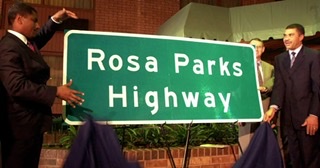 In the end, the Missouri Department of Transportation got sweet revenge! Sure, they couldn’t remove the KKK’s adopt-the-highway sign, but few would dispute the state’s ability to name the highway itself. So the KKK is now cleaning up their adopted stretch of the highway named by the Missouri legislature and christened as “Rosa Parks Highway.”
Rosa Parks did not crave the spotlight. Nor did she care all that much about highways and byways bearing her name. She probably did want to be known as a person who persisted in the struggle for racial justice. She told us that in these words:
I would like to be known as a person who is concerned about freedom and equality and justice and prosperity for all people.
You are remembered as such a person, Mrs, Rosa Parks! Happy birthday in heaven. You are our inspiration. You are one of our sheros, our wonder woman!

We did not ask to be in this liminal space — this liminal time in our lives — but we are in the murky middle of it — a liminal space.
We’re in the liminal space between Covid isolation and our former, normal lives. We’re in the liminal space between the policies and tone of our current president and the hope and change of a starting fresh toward a new direction. We’re in the liminal space between racial protests against injustice and a new day of justice for all persons.
Yet, right now many of us are in a space of discontent. Like me, you may be isolated in a space of safe distancing because of a seemingly endless pandemic. You may miss your grandchildren, your family, your friends and your community of faith. You may be in one of the high risk Covid categories, not daring to go out of your house. I am there, and if that is where you are, I’m there with you feeling all the emotions you might be feeling.
In addition to discontent, we find ourselves in a space we might call discouragement as we look around us and continue to see racial injustice, signs of misogyny and the disparagement of women, evil acts of white supremacy, immigrant children separated from their parents and disrespectful rhetoric from government employees who actually work for us!
As for me, I feel as if my soul is in chaos. I feel heaviness, loss, worry, even despair once-in-a-while. All of us, in these pandemic days, are most assuredly right in the middle of liminal space, a space that is not a comfort zone for any of us. So what do we do when we’re stuck in a space that is so disturbingly out of our comfort zone? The easy answer is: to know in your very soul that liminal space is always a temporary in-between space, a threshold to something ahead, a life “time out.” A more down-to-earth answer is: we languish or we transform. We languish, struggling and sparring with everything that keeps us from finding a way out, OR we stay calmly and contentedly in this cocoon-like space and wait patiently until our “wings” begin to emerge, spread out into the light and begin to flutter away to some delightful space. At that point transformation occurs, a transformed “me” and a transformed space I now occupy.
Father Richard Rohr offers this description of liminal space:
Liminal space is an inner state and sometimes an outer situation where we can begin to think and act in new ways. It is where we are betwixt and between, having left one room or stage of life but not yet entered the next. We usually enter liminal space when our former way of being is challenged or changed—perhaps when we lose a job or a loved one, during illness, at the birth of a child, or a major relocation. It is a graced time, but often does not feel “graced” in any way. In such space, we are not certain or in control. This global pandemic we now face is an example of an immense, collective liminal space.
Is it possible that instead of despairing in the space we are in at this moment in time, perhaps we can consider it just an in-between space and look ahead with hope for something new, better, brighter. Again I turn, as I often do, to author and theologian Richard Rohr who writes that liminal spaces should be introspective places rather than unsettling places. To him, “liminal” is a word meaning “threshold between one stage of life to another.” It is only within these liminal spaces that “genuine newness and the bigger world is revealed.”
The twentieth-century sociologist Joseph Campbell believed that the world was made up of sacred spaces and profane spaces in our lives. Profane spaces are places that we have to go, like our jobs, school, the grocery store or the post office. In contrast, sacred spaces are places where transformation takes place; where we encounter the world and each other to come to a deeper understanding of ourselves, and a world bigger than ourselves.
If you are in this space of betwixt and between, floating uncomfortably in this liminal space, trust that you will not stay here forever. Place your hope in the God of transformation and believe that you will see a transformation — of this current state of life, and of you!
Chaotic spaces in our lives ask us to enter into peace at a time when peace seems so impossible. Chaos urges us to seek out meditative moments of quietness, to open up our souls to God’s embrace and to let our hearts release the pain. I invite you to spend a few quiet moments listening to the music and the text of a reassuring choral anthem entitled God Gives the Song. (Text: Susan Bentall Boersma Music: Craig Courtney)
When words are lost among the tears,
When sadness steals another day,
God hears our cries and turns our sighs into a song.Sing to the One who mends our broken hearts with music.
Sing to the One who fills our empty hearts with love.
Sing to the One who gives us light to step into the darkest night.
Sing to the God who turns our sighs into a song.
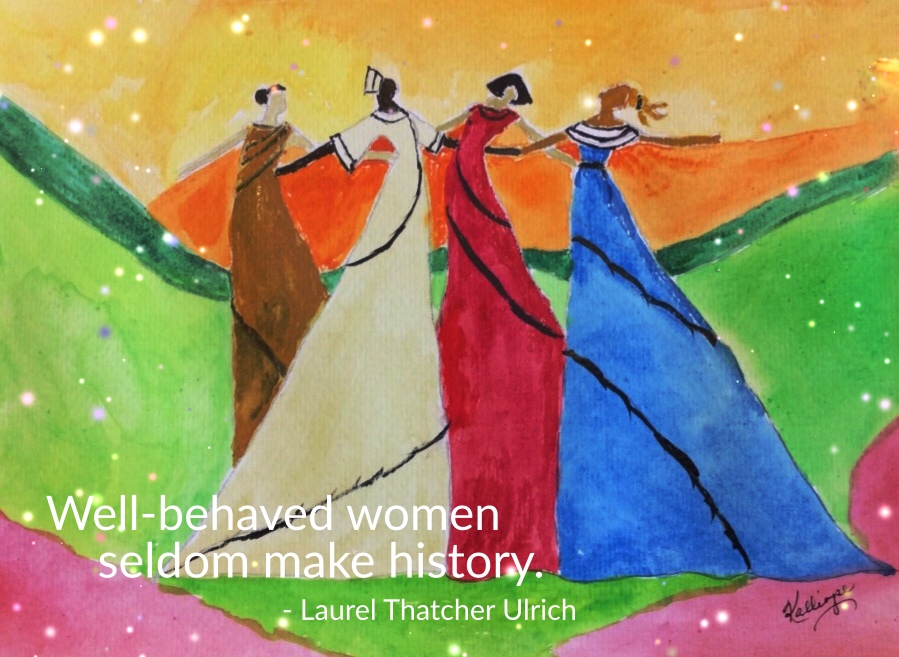
Ah! Women!
With your heart of compassion, your mind full of creative force, your spirit empowered with the rush of Spirit wind and fire!
Ah! Women, with your steady and sturdy will that stands straight and tall and moves into the fray — any fray that harms others, devalues human beings, threatens all of God’s created order, brandishes violence and acts against God’s divine desires!
Ah! Women! Silenced, dismissed, diminished from ages past to this very day!
Ah! Women, now you will summon your courage and move forward with hope and grit! Now — in these unfathomable days of pandemic and protest — you will enter the fray in ways only you can. You will enter the fray bringing with you a transformative power for righting wrongs. You will inter the fray bringing your womanwisdom and the insight that is inside you, given by Spirit!
Ah! Women! Daughters of God,
I will pour out my spirit on all flesh, and your daughters shall rise up and find their own voices, dreaming dreams and seeing visions . . . In these days, even on my female slaves, I will pour out my Spirit.
— From the Prophet Joel 2:28-29 NRSV (a feminist paraphrase)
Ah! Women! As you go forth, never forget when you enter any holy fray God has placed before you, that you do not go alone. From the wisdom of Maya Angelou:
Whenever you go forth into a new project, task or vision, remember that you do not go alone. Behind you is Harriet Tubman In front of you is Sojourner Truth. Beside you is Fannie Lou Hamer and next to you is your grandmother.
Fill in the names of your own revered women, and know that you are going forward with the power of other people.
Ah! Women!
Perhaps, like Esther, God has called you for such a time as this!
Ah! Women! In you, there is hope and grit!
In you, there is unbridled courage!
In you, there is transformation of every wrong!!
May God continue to empower your spirit, steel your heart and grace the sound of your own voice! Amen. A*women.
Hear this choral music and contemplate the calling of God:
Rev. Kathy Manis Findley
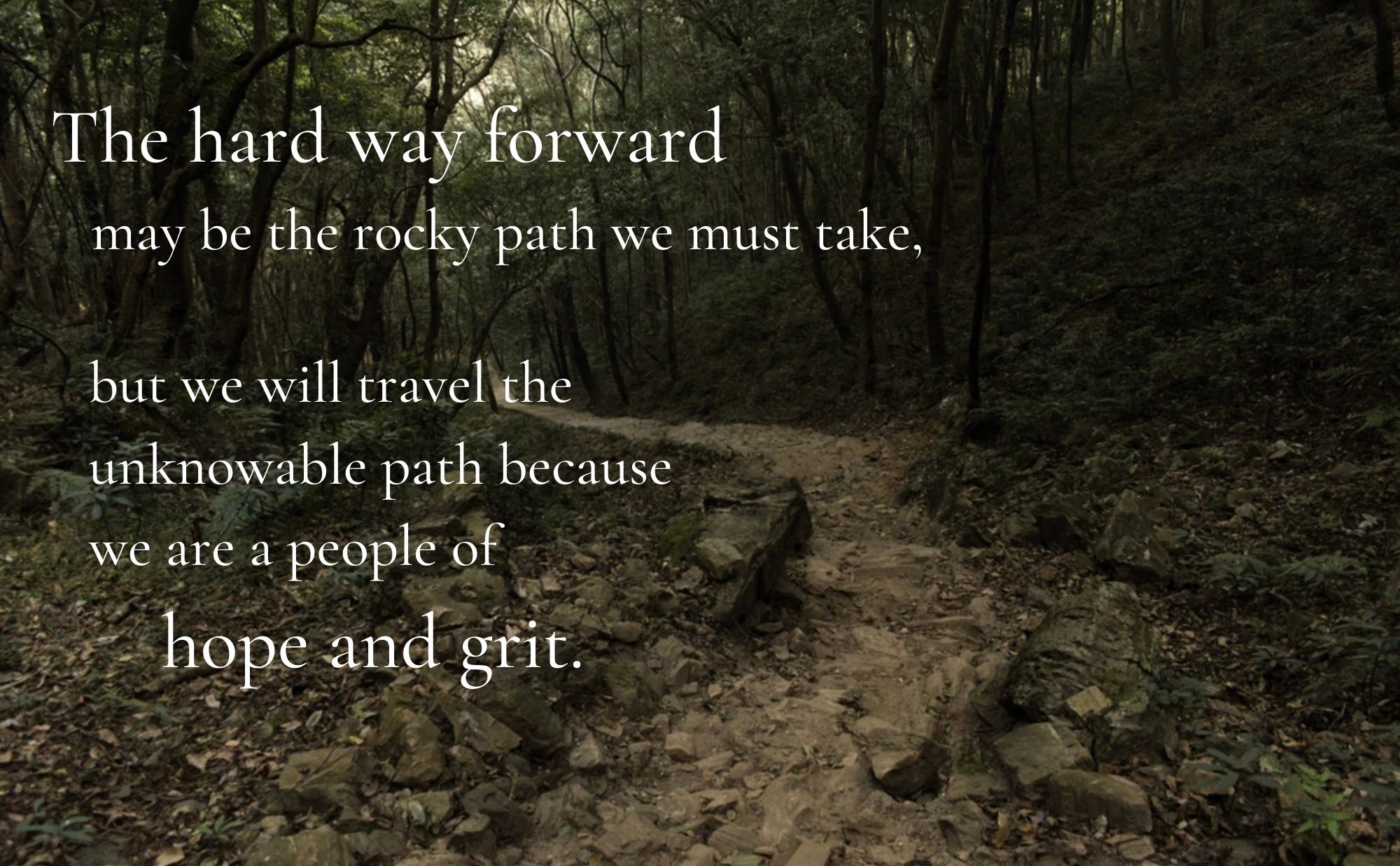
The Hard Way Forward
A sermon preached in virtual worship for New Millennium Church
Little Rock, Arkansas
October 11, 2020
Scripture: Exodus 32:1-14; Psalm 106 (selected verses)
Have you ever come to a point in your life when you had to take the hard way forward? You had no other choices! In fact, the phrase “the hard way forward” paints a an unvarnished picture of these tumultuous days, and the paints on the artist’s brush are dark and foreboding.
What a journey 2020 has been! I have often called it a journey of lament — a journey that has forced us to be in places we never wanted to be and to see things we never wanted to see.
We look around and watch people in shock and dismay — disillusioned and despondent. So many have been personally touched, even ravaged, by the deadly coronavirus, while others are overcome with fear of it. We have witnessed evil, racist assaults; watched police brutality and murder on our television screens; we have grieved over wildfires that threaten to swallow up forests, animals, homes and lives; and over it all we have felt contempt for the reprehensible leadership of an incompetent, insensitive, egocentric, self-serving president. I think it’s safe to assume that many people in this broken nation feel hopeless and heartbroken.
I often ask:
God, are you still leading us on this hard journey? Or have you forsaken us?
Do you have some kind of plan we do not yet see?
These months for so many people have definitely been a hard way forward. As we try to put one foot in front of the other on this journey, perhaps we can imagine ourselves walking with the people of Israel.
So let us listen and hear the Word of God in Holy Scripture
From Exodus, Chapter 32, (selected verses):
When the people saw that Moses delayed to come down from the mountain, the people gathered around Aaron, and said, “Come, make us gods who shall go before us.”
“As for this Moses, the man who brought us out of the land of Egypt, we do not know what has become of him.”
Aaron said to them, “Take off the gold rings that are on the ears of your wives, your sons, and your daughters, and bring them to me.”
So the people took off the gold rings and gave them to Aaron. He took the gold, formed it in a mold, and cast an image of a calf; and the people said,
“These are your gods, O Israel, who brought you up out of the land of Egypt!”
When Aaron saw this, he built an altar before the calf and said, “Tomorrow shall be a festival to the Lord.” They rose early the next day and offered burnt offerings and brought sacrifices; and they sat down to eat and drink, and then rose up to carouse. [my word choice]
(Now the scene changes locations.)
The Lord said to Moses, “Go down at once! Your people have acted perversely . . . they have cast for themselves an image of a calf, and have worshiped it and sacrificed to it. I have seen how stiff-necked these people are. Now leave me alone, so that my wrath may burn hot against them and I may consume them.”
But Moses implored the Lord, and said, “O Lord, why does your wrath burn hot against your people, whom you brought out of Egypt with great power and with a mighty hand? Turn from your fierce wrath; change your mind and do not bring disaster on your people.
And the Lord changed his mind about the disaster that he planned to bring on his people.
And from Psalm 106 (selected verses):
O give thanks to the LORD . . . for God’s steadfast love endures forever.
Both we and our ancestors have sinned; we have committed iniquity, have acted wickedly. They made a calf at Horeb and worshiped a cast image. They exchanged the glory of God for the image of an ox that eats grass. They forgot God who had done great things in Egypt, wondrous works in the land of Ham, and awesome deeds by the Red Sea.Therefore he said he would destroy them — had not Moses stood in the breach before him, to turn away his wrath.
This is the word of God for the people of God.
The story of the Israelites reminds us that our kindred sojourners also traveled some rough paths. The text gives a glimpse of just one snippet of their journey. We see the Israelites on their wilderness pilgrimage, complaining, as they often did — and as we often do.
Apparently, Moses who had just received the ten commandments, stayed on Mount Horeb for a long time, patiently listening as God engaged him in a presentation of all manner of laws, rules and instructions. It took awhile — 40 days and forty nights, a very long time. And the Israelites started complaining about it to the one Moses left in charge — Aaron.
What has become of Moses?
What would he eat on that mountain, anyway?
This Moses, that brought us out here in this mess — where is he?
And then their fateful request to Aaron:
You are the one who is here with us now — make us something we can see. Make us something that will lead us forward, and we will follow it.
Now you probably remember that the Israelites had complained before:
Why did you bring us out of Egypt? To kill us with thirst?
Why have you led us into this forsaken, dangerous wilderness? To kill us with hunger?
Their complaints may sound a bit like our own complaining during the terrible months of pandemic, racial unrest, political rancor, and all manner of upheaval.
Hey God! Are you planning to obliterate this coronavirus, or not?
Are you still with us, God, or not?
Have you brought us to this season for some purpose?
Like the Israelites, we sometimes lose sight of our leader — the God that would give us the courage to move. We are left as a wandering, unsettled people that simply cannot see our way forward.
As Wendell asked in last Sunday’s sermon, “Shouldn’t God do something?”
Shouldn’t a God of enduring, everlasting love do something?
Now remember — we are in good company with several holy bible people. The prophet Isaiah, for one, who asked:
“How long, O Lord
And God actually replied to him:Until the cities lie ruined and without inhabitant,
until the land is desolate and ravaged,
until the land is utterly forsaken.
Not so reassuring!
The Psalm singer asked, too, in Psalm 94.
How much longer will the wicked be glad?
How much longer, Lord?
How much longer will criminals boast about their crimes?They crush your people, Lord; they oppress those who belong to you.
They kill widows and orphans, and murder the strangers who live in our land.Who stood up for me against the wicked? Who took my side against evil?
If God hadn’t been there for me, I never would have made it.
The minute I said, “I’m slipping, I’m falling!
Your love, God, took hold and held me fast.”
Like those holy bible people, we ask — in our impatience and fear — “How long, O Lord?
And even as we ask, we have a wee inkling that God’s love is still holding us in safe arms of grace. George Matheson was a Scottish clergyman and theologian who lived in the late 1800’s. He was blind by the age of 18. Matheson wrote something quite profound about God’s love — the text of the hymn, “O Love That Will Not Let Me Go.” The hymn text formed in his mind during a “dark night of the soul” he experienced, a deeply emotional and spiritual crisis. He tells us about it in his own words.
My hymn was composed in the manse on the evening of the 6th of June, 1882. Something happened to me which was known only to myself, and which caused me the most severe mental suffering. The hymn was the fruit of that suffering. It was the quickest bit of work I ever did in my life . . . the whole work was completed in five minutes, and it never received at my hands any retouching or correction. All the other verses I have ever written are manufactured articles; this one came like a dayspring from on high.
In a time of emotional anguish, God’s creative grace rose up in George Matheson and he wrote about the kind of divine love that would never let him go. I think we owe Rev. George for reminding us about God’s unwavering love. The hymn text is most assuredly Gospel Good News that people throughout the centuries have desperately needed to remember
As you and I walk this journey, we need to know that God’s love will hold us fast, but sometimes we don’t know it. Like George Matheson, we could use a visit from the Dayspring from on high!
In truth, we need assurance — that no matter how hard the way forward, God’s love will not let us go. Threatened by a deadly virus, God’s love will not let us go. In our most disconsolate moments, God’s love will not let us go. When we courageously stand up to denounce racism, white supremacy, police violence and all manner of evil that surrounds us, God’s stubborn love will never let us go!
But that kind of love also places before us a holy mission undergirded with the foundational principle that evil cannot be reformed, it must be transformed — transformed within us before it can be transformed in the world, and transformed in the way described by Dr. King:
Only through an inner spiritual transformation do we gain the strength to fight vigorously the evils of the world in a humble and loving spirit.
You might be wondering what any of this has to do with the Israelites and their golden calf, or the psalm singer who sang something about God’s steadfast love enduring forever, or the idea that someone might possibly stand in the breach for us.
My friends, each of us are traveling through these days with at least some fear and anxiety. It is a hard way forward, and as some clever people have said, “The light at the end of the tunnel is probably a freight train!”
Still, we are inheritors of the hope and grit of so many others who have journeyed hard roads before us — walking, marching, sometimes crawling — at times standing tall, at other times falling face-down in the dust of a hard rocky ground. We have navigated perilous roads and turbulent waters in this season. Yet we walk on, just as those who walked before us and who walk beside us.
I recently saw a news report about a little girl walking with her family among crowds of protesters. She stops at a makeshift memorial to George Floyd. As she pauses there, we can read the sign she carries — a hand printed cardboard sign that says:
My daddy plays with me. My daddy reads to me.
My daddy tucks me in at night. Please don’t kill my daddy.
The little girl walks on with her family.
Tamika Palmer walks on too, tears flowing freely. Tamika Palmer, Breonna’s mother, vows she will never stop walking forward towards justice for the daughter she lost.
It strengthens us to remember those who walked before us in years past and those who walk with us today who are those sparkling examples of hope and grit: Sojourner Truth, Harriet Tubman, Elizabeth Cady Stanton, Oscar Romero, Fannie Lou Hamer, Prathia Hall, Greta Thunberg, Rev Dr. William J. Barber, II, Rosa Parks, Dr. Martin Luther King,Jr., Dorothy Day, Bishop Michael Curry, Nelson Mandela, Ruth Bader Ginsberg, Dr. J. Alfred Smith, Jr,. US Representative John Lewis, Rev. Pastor Judge Wendell Griffen and countless others whose names we revere, as well as so many whose names we do not even know.
Walking, marching, protesting, advocating, praying, writing, speaking, weeping — throughout centuries and to this very time. Compelled by prevailing, persisting injustice, they walk on — we walk on —taking the hard way forward.
So having eavesdropped on a people constructing a golden calf to worship, will we allow their story to call our attention to our own idols? Those idols we have made for ourselves out of our own Egyptian gold? “Idols” might just be the next sermon point, if I used sermon points!
It’s tempting to mistake our own creations for our God. It’s tempting to shape our self-made idols into an image that soothes our anxiety, feeds our anger and our egos, and convinces us it will demolish whatever is evil around us. I don’t know about you, but I can get obsessed at times. My tasks, my work, my advocacy sometimes rise up out of my obsessions. I don’t like that, but have to admit the truth.
So I have to ask myself: Is my work to dismantle injustice part of God’s call and my holy mission, or have I made it my idol?
Whatever that thing is that we have made from Egypt’s gold is not our god. That thing we idolize may symbolize strength and power. It may personify bravery. It may embody rebellion or protest. But as close as we draw to it and place it at the center of our lives, we must understand that it will not lead us to transformation, just as the Israelites’ golden calf could have never led them to the land of promise.
Instead it will shackle us in our impatience, audacity and self-importance. It will shackle us because of our insistence on following our own way instead of God’s way.
Here is another honest confession: It is tempting for me to let hate become my idol, to allow my desire for retribution to goad me into facing off against injustice with hate. But God’s way is always love.
Is it possible that our idol is our hate for people, people who may actually deserve it like white supremacists, neo-Nazis, violent police officers, men wielding projectiles and tear gas, corrupt politicians and leaders? Do we rise up against such people with hate as our weapon, while all the time, God calls us to love our enemies!
The hard way forward is the way of higher ground that invites us to turn away from the idols created by our lesser angels and walk forward in the persistent love that will never let us go.
The hard way forward knows the pain of fear and doubt, but still chooses to follow cloud and fire through the desert-landscape and on to freedom. The hard way forward is to live into God’s abiding, never-ending love.
For you see, seekers of justice who marched the hard way before us faced firehoses and dogs because they longed for holy transformation and because they trusted that God’s love would not let them go. Seekers of justice protesting in the streets of Louisville and in other cities in these hard days face tear gas, police brutality, violent government intervention because they long for holy transformation and because their faith whispers to them, “God’s love will not let you go.”
You and I, in whatever ways we are dismantling injustice, MUST take the hard way forward — facing censure, criticism, indifference, ridicule, disrespect, even violence, because we long for holy transformation and because deep-down, we believe in our hearts that God’s love will never let us go.
That hard way forward is the path to transforming injustice! Doing the same things we’ve done the same way we’ve done them might bring some manner of reform. But we must not settle for reformation. We must set our eyes on transformation.
One last caveat: the change we seek may never be realized even if we are brave enough to take the hard way forward, because the saved up baggage we carry weighs us down — the anger we hold on to, the hatred we feel, the impatience that makes us volatile, the fear that besets us, the hostility we refuse to let go of. Isn’t it time for you and me to kneel before God, confess our sins and accept the healing grace that wipes away our tears and transforms us into a new creation?
Kneeling at the altar of repentance, we will stand up straight and tall and brave — and most importantly, forgiven — and we will take the hard way forward, knowing in our souls that we cannot just act to reform evil, we must resolve to transform it.
So let us bravely and confidently take the hard way forward, knowing that God is standing in the breach on our behalf and that the Dayspring from on high visits us, giving light when we walk through the darkness and the shadow of death, and guiding our feet into the way of peace.
Let us take the hard way forward, proclaiming from the depths of our being that no matter how dark and difficult and long the journey is, God’s love will never let us go. Amen.
I invite you now to spend a few moments of reflection and prayer as you listen to a benediction of choral music in the video below. May you listen in the music for the whisper of God, for Christ’s blessing of grace, for the brush of Spirit wings.
And as you leave this time of holy worship, persevering on the hard way forward, may the God of love go with you and fill you with gentle peace through every tribulation, so that your soul may rise up in hope by the power of the Holy Spirit. Amen.

The Senior Fellows of Auburn Seminary, faith leaders from a multifaith movement for justice, have a deeply personal video blessing for us:
May You Vote!
This is note from their president:
The Fellows gathered in their homes across the country to remind us that a government of the people only works when it’s of the people and by the people.We all have a part to play now! May you be inspired by their words and share them with others. So much is on the line with this election, and with your vote, you can help shape the future of this nation.
By mail or in person if you are able—May You Vote!
Rev. Dr. Katharine R. Henderson
President, Auburn

I wonder sometimes about God — how God works in us, how God graces us, how God calls us. I wonder, too, if I will hear God’s call in the voice of a Mother God or a Father God. The gender of God’s voice matters to me because I sometimes fear the voice of God our Father and instead long to hear a gentle voice spoken by the Divine Feminine. So the God I envision, a God who is both male and female, comes to me in the ways I need, calls out to me in a voice I do not fear. Still, I wonder at times if God speaks to me at all, if God values me. I wonder if I am really worth more to God than the sparrow God watches so intently. (Matthew 10:29-31)
As I contemplated my sacred worth as God’s child, I could not help but think back to my baptism, the first day I felt truly chosen, the first day of my wholeness, the first day I heard so clearly my call by God to ministry. I was eighteen years old, yet I knew beyond any doubt that my life had been transformed. In the years that followed, the brightness of my life transformation dimmed from time to time by those that would degrade my call and devalue me as a Christian and a minister. It was not easy in those days for a woman called to ministry. What God had affirmed, the Church denied, and I felt diminished and despondent many times through the years.
Which brings me to a beautiful, comforting quote I happened to read today that answered my question about whether or not God values me.These words were part of a sermon preached in January of 1998 by The Most Reverend Frank T. Griswold, XXV Presiding Bishop and Primate, The Episcopal Church, USA:
A transformed heart is a heart that has been cracked open by God’s love; it is a heart willing to have its tendency towards accusation and judgement overruled by the same voice Jesus heard at his baptism, a voice that speaks to each one of us and says, “You are my daughter, my Son, my Child, my Beloved, my Chosen One in whom I delight, in whom I rejoice, with whom I am well pleased simply because you are. Live on in my love; enter into my joy; abide in my peace.”
Simply because I am!
I can live with that — knowing that God really does value me as a child of God and knowing that both my transformation and my call to ministry matter. “Live on in my love; enter into my joy; abide in my peace.”
For that knowledge, thanks be to God. Amen.
Every child of God is called. “Follow me” was spoken to fisherfolk, not to the religious leaders of the day. This song is special to me because it was sung at my ordination. I hope it will inspire you in the times you struggle with your call from GOD.

This morning, I prayed a prayer of lament. Lament was the only prayer in my spirit. It is difficult to express the deep sorrow I felt yesterday when I learned that no charges were brought against the police who shot six bullets into Breonna Taylor’s body.
Shortly after midnight on March 13, 2020, Louisville police officers used a battering ram to enter the apartment of Breonna Taylor, a 26-year-old emergency medical technician who had dreams of a bright career ahead. She and her boyfriend had settled in to watch a movie in her bedroom on that tragic night. Police came to her door and minutes later, she was fatally shot. Her death sparked months of protests in Louisville.
Yesterday, six months after the fatal shooting — six bullets — a grand jury indicted a former Louisville police officer on Wednesday for wanton endangerment for his actions during the raid. A grand jury delivered the long-awaited answer about whether the officers would be punished. No charges were announced against the other two officers who fired shots, and no one was charged for causing Breonna Taylor’s death.
For me, there was only lament. I imagine that for Breonna’s family, there was the deepest kind of lament. For her mother, lament was the only response she could express as she wept uncontrollably. And, even for the protesters who filled the streets, I believe there was lament.
Theologian Soong-Chan Rah explains in his book, Prophetic Lament, that in the Bible lament is “a liturgical response to the reality of suffering and engages God in the context of pain and suffering.” He goes on to say that it is a way to “express indignation and even outrage about the experience of suffering.” Racism has inflicted incalculable suffering on black people throughout the history of the United States, and in such a context, lament is not only understandable but necessary.
Perhaps white Christians and all people of faith have an opportunity to mourn with those who mourn and to help bear the burden that racism has heaped on black people. (Romans 12:15) — Jemar Tisby, The Color of Compromise

In the end, many people see only the rage, anger, impatience, violence of the protesters. Can we also see their lament for Breonna, as well as for centuries of racially motivated murder — beatings, burnings, lynchings and murder committed by police officers?
People of faith — white people of faith — will we try to understand the rage of our black and brown sisters and brothers? Will we join them in righteous anger? Will we mourn with them? Will we lament when lament fills their souls and overflows in cries for justice?
We must, in the name of our God who created every person in God’s own image!
Last night, I heard an interview with Brittany Packnett Cunningham on MSNBC. Her words were eloquent pleas for justice. She spoke about how persistent and all-encompassing racism is in our country and about the murders and the protests and the political rancor that fuels it. She acknowledged racism’s strong, unrelenting hold on this nation, a hold that is virtually impossible to break. And she said something I have said for a long time, “Racism cannot be reformed. It must be transformed.”
To me that means a transformation of the heart and soul that compels each of us to lament, to comfort, to speak truth in government’s halls of power, to stand openly against any form of racial injustice.
May God make it so.
Will you pray this prayer of lament with me?
O God, who heals our brokenness, Receive our cries of lament and teach us how to mourn with those who mourn. Receive even our angry lament and transform our anger into righteous action. Hear the anguish of every mother assaulted by violence against her child. Hear the angry shouts of young people as shouts of frustration, fear and despair. Grant us the courage to persist in shouting out your demand for justice, for as long as it takes. When deepest suffering causes us to lament, grant us Spirit wind and help us soar. If we resist your call for justice, compel us to holy action. May our soul’s lament stir us to transform injustice, in every place, for every person, whenever racism threatens, for this is your will and our holy mission. Amen.

INSANITY
Not a word we are fond of. Nothing inspiring about the word. And when the word insanity is more than just a word, we shudder in its grasp. Insanity brings its own bondage, stealing one’s freedom to live, confiscating one’s creative expression. Insanity can be a complete, all-encompassing mental breakdown, even bordering on madness, OR it can be a state of being that most of us have experienced — irrationality, instability, disorientation, mania. Many people (noted scholars) have mused that “the definition of insanity is the most overused expression of all time.” (Salon.com)
Remember the declaration about “doing the same thing over and over again and expecting a different result?” Yes, I know you remember that definition, probably have said it yourself in an exasperating moment!
Where am I going with these bizarre introductory words?
I’m actually going to a place you may not expect. I’m going to the rush and swirl of color in one of my favorite paintings, A Starry Night by the Dutch Post-Impressionist painter Vincent van Gogh. The painting draws me in — into the little village with its steepled church, into a sky filled with sparkling stars, into the glorious luminance of the crescent moon, into the swirls of blues and whites and yellows. I have pondered many times what sort of mind and soul could have created a painting like this one.
The story behind A Starry Night is the unnerving story of Van Gogh. A few months after experiencing a mental breakdown on December 23, 1988 that resulted in the self-mutilation of his left ear, Van Gogh voluntarily admitted himself to the Saint-Paul-de-Mausole Lunatic Asylum. During the year Van Gogh stayed at the asylum, his prolific output of paintings continued and he produced some of the best-known works of his career. A Starry Night was painted by around June 18, the date he wrote to his brother Theo to say he had a new study of a starry sky.
A Starry Night was the only nocturnal painting in the series of views he saw from his bedroom window. In early June, Vincent wrote to Theo, “This morning I saw the countryside from my window a long time before sunrise with nothing but the morning star, which looked very big”. Researchers have determined that Venus was indeed visible at dawn in Provence in the spring of 1889, and was at that time nearly as bright as it could be. So the brightest “star” in the painting, just to the viewer’s right of the cypress tree, is actually Venus.
Too much information? Probably, but here’s my point that is not really about insanity at all. Rather, it’s about breaking free from bondage and taking back my life. You see, sometimes the sight of a big, bright morning star can replace whatever fear or angst I am feeling. Sometimes looking into the deep of a starry night can carry me to resplendent places. Sometimes even my slight insanity can transport me to my deepest expressions of creativity.
For me, insanity is my incessant scurrying around with too many things to do, a kind of mania. That frenzied scurrying is of my own choosing and therefore, leans a little too close to self-imposed insanity. I wonder if instead of that scurrying life of bondage, I could make time for moments of thought that would enable me to say something like what Vincent Van Gogh said from his asylum:
“This morning I saw the countryside from my window a long time before sunrise with nothing but the morning star — the brightest star — which looked very big!“
Contemplate for a moment the insanity of a life encumbered — filled to overflowing with too many things to do — compared with a life of stargazing that might just awaken fresh and bright creativity in you.
As for me, I’m heading toward a spiritual transformation — a life of sacred pauses, a stargazing life, a grace-filled re-awakening!
I hope you are, too.

There are large scale, widespread forces that can trap thousands of people, even millions. Dachau, Katrina, earthquakes, tsunamis, wildfires, natural disasters all over the world and the Coronavirus of 2020. Enormous, catastrophic events can trap people. COVID19 has literally trapped me inside my home. I have to admit, the isolation has taken a toll on my spirit. No visitors! No visits with friends or family. No trips! No haircuts! I have been trapped at some level since my kidney transplant in November. Just at the March milestone that would have allowed me to break the isolation of the transplant, I was even more fully trapped by the infectiousness of this pervasive, unrelenting virus.
Being trapped for so many months has raised up in me feelings of loneliness, isolation, powerlessness, despair, anxiety, even abandonment. And yet, often there is something very good in the center of something very bad. It has been so for me. Yes, I feel trapped in the pervasive power of the coronavirus, but I also sense the arms of God and the embrace of Spirit hemming me in even further. Such a grace-gift it has been to me, as if God has said, “l am hemming you in, and in this space you will hear me clearer and sense me more fully.”
God’s words were truth. Hemmed in, my mind flourished, my heart leapt and my soul entered spaces of calm. I felt enhanced awareness! Even awakening. I saw nature in a different way and basked in the beauty of the rising sun. The sound of the hummingbirds’ trill and the rapid fluttering of their translucent wings were sounds meant just for me. I began to write and paint, to listen more carefully to God’s voice, to allow my spirit to overflow with Holy Spirit. To my hemmed-in call from God, I was compelled to answer, “Here I am, Lord!” When I finally answered God, my hemmed-in place became Holy Ground — a very good place to be that feels more like a holy mystery than a state of being.
Was this pandemic a good thing for me and for millions of people? Absolutely not! But trapped in its dark cloud, God hemmed me in further in ways I am just now beginning to understand. I can say with all honesty that being hemmed in by God has been grace to me.
If I could even begin to choose a favorite Psalm from among the many that inspire me, I would choose Psalm 139. In its weaving of words, there are many passages that are full of comfort. From childhood, I memorized a lot of Scripture and throughout Psalm 139 I memorized several snippets that I often call to mind. One verse that I did not memorize is verse 5: “You hem me in behind and before, and you lay your hand upon me.”
You have searched me, Lord,
and you know me.
You know when I sit and when I rise;
you perceive my thoughts from afar.
You discern my going out and my lying down;
you are familiar with all my ways.
Before a word is on my tongue
you, Lord, know it completely.
You hem me in behind and before,
and you lay your hand upon me.
— Psalm 139:1-5 NIV
I deplore the coronavirus and what it has done to so many people. I deplore the ways it was able to trap me, physically and emotionally. But the virus, with all its ominous, far-reaching force could not trap me spiritually. That was God’s work — hemming me in so that my spirit could rise to fresh, new heights of spiritual consciousness. Being hemmed in by our Creator has been grace for me in these days of isolation. It has become a transforming sacred pause. For in my hemmed-in space, the Creator helped me create — from my mind, from my heart, from my soul. Thanks be to God.

Struggles abound in this unwelcome COVID19 season we are experiencing. Most of us are touched by this virus in some way. We have struggled with so many life changes. I have watched strugglers of the soul work through the illness, others deal with the suffering and death of a friend or family member, often being unable to be with them at their death. Some parents are struggling with decisions affecting school for their children and teachers fear they will be unable to keep their students (and themselves) safe. Others long to see loved they have not seen in months of social distancing.
My circle of friends and family are feeling short on hope while they experience struggles of the soul. Yet, Herman Melville asserts that “Hope is the struggle of the soul.” I have been wondering what exactly that might mean. Perhaps hope gives us the courage we need to move boldly and full of hope into the place where the soul struggles, moving there with the assurance that the hope that led us there will also lead us to healing.
As I look closer at Melville’s words, I begin to see and understand that hope’s struggle eventually empowers us to break loose from the perishable things we hold on to — our wealth, our home, our “things” like cars, boats, RVs, whatever “things” we cherish. Looking at what this virus could bring, knowing that we are facing real life and death situations, cannot help but move our souls to throw off the things that don’t seem so critical anymore — perishable things we do not need. This thought prompts me to look at two of my favorite passages of Scripture.
For you know that it was not with perishable things such as silver or gold that you were redeemed from the empty way of life handed down to you from your ancestors . . .
— 1 Peter 1:18-19 (New International Version)
When the perishable has been clothed with the imperishable, and the mortal with immortality, then the saying that is written will come true: “Death has been swallowed up in victory.”
— 1 Corinthians 15:54 (New International Version)
How do we get there? How do we get through the soul struggles that can bring us to our knees?
I don’t think there is a well developed plan or a series of definite steps to take. The path, the plan, will be unique to each struggler. But the soul struggles I have felt throughout my life have taught me to place hope where hope must be: in Comforter Spirit who hovers over me with her sheltering wings; in the Christ who lives in and through me guiding me as a good shepherd and empowering me to walk with courage in his footsteps; in the Eternal God who holds before me, always, my own eternity.
This is what is available to you as well as you lean into hope’s struggle of the soul and break loose from things that are not important as you bear witness to your own eternity.
May God make it so.
As you leave these words and move with hope into your soul struggles,
May the God of hope go with you and fill you with all joy and peace as you trust in God, so that you may overflow with hope by the power of the Holy Spirit.
— Romans 15:13 (New International Version)
Amen.
I hope you can spend a few minutes in prayer and contemplation as you watch this beautiful, comforting music video, “Still with Thee,” with text written by Harriet Beecher Stowe.

Plans! We find it almost impossible to make them in a life ruled by COVID19. Currently, school plans are foremost in the minds of parents and students.
“Is it safe to send my child back to school? What safety and social distancing measures will schools have in place? Do I choose to keep them at home, opting for virtual learning? How do I manage online school?”
In light of such critical plans and decisions, consider this current news report:
A document prepared for the White House Coronavirus Task Force but not publicized suggests more than a dozen states should revert to more stringent protective measures, limiting social gatherings to 10 people or fewer, closing bars and gyms and asking residents to wear masks at all times.
The document, dated July 14 and obtained by the Center for Public Integrity, says 18 states are in the “red zone” for COVID-19 cases, meaning they had more than 100 new cases per 100,000 population last week. [Georgia is in the “red zone.”]
Eleven states are in the “red zone” for test positivity, meaning more than 10 percent of diagnostic test results came back positive. [Georgia is in this “red zone” too.] https://publicintegrity.org/health/coronavirus-and-inequality/exclusive-white-house-document-shows-18-states-in-coronavirus-red-zone-covid-19/
Even with troubling reports like this one, Georgia’s governor, Gov. Brian Kemp, signed an order on Wednesday, July 15, 2020 banning localities from requiring masks. On this information, parents have to agonize about what’s best for their children. They simply cannot make firm plans as long as the virus is waxing and waning. Mostly waxing!
Plans are difficult for us for all sorts of reasons and circumstances. Every now and then over the years, my life would take un unexpected pause to contemplate this thought written by the late Mary Oliver:
So tell me, what is it that you plan to do with your one wild and precious life?
Unpacking that brief question has been a periodic constant in my life, popping up for me mostly in my down and disheartened times. I hear the poet describing my life as “wild and precious” and it almost shocks me. Yet, my life really has been consistently wild and mostly precious. Anything that urges me to examine my life is a good thing. I can almost always pull up memories of the times when I was wild and free — insistent upon rising higher, realizing a near-impossible dream, charging with courage into new and uncharted places, planning for a future of fresh and sparkling heights, observing just how wild I could dare to be. Unpacking that question has been exhilarating at times, exhausting at other times.
Musing on a life that could be described as precious
Entertaining the thought that my life was precious happened in my deepest soul place. It happened in my moments of introspection, meditative times that urged me to examine all the ways I saw my life as precious, cherished, valued. Of course, I have experienced many precious life moments — my wedding day, my work in Africa, my ordination, awards and recognitions of my work and career and, most of all, the adoption of my one wild and precious son, Jonathan. Examining my precious life was most real when I almost lost my life, my full year of serious illness, five years of dialysis and a kidney transplant made possible by the selflessness of a lovely woman I know only through email.
Such thoughts bring me back to plans. What is it I plan to do with my one wild and precious life? Even a life precious and wild is a life that requires plans, and right now trying to make plans is an exercise fraught with anxiety. I cannot find any words that can minimize this depth of anxiety. There is not one thing you or I can do about plans that have been ravaged by the pandemic we are experiencing, and yet we must make critical plans in this season of uncertainty.
School plans are most difficult in my state and perhaps in yours. As parents agonize over the safety of their children, Georgia’s governor, Brian Kemp, offered this unhelpful comment this morning in a press conference:
I am a believer that kids need to be in the classroom and we’re working with the schools to do that. We’re going to have cases that break out in schools, either with personnel or perhaps students, just like you do with a stomach bug or a flu or anything else. Our schools know how to handle those situations.
The parents and teachers in my life know that this coronavirus is not just a run-of-the-mill “stomach bug or flu.” This virus is deadly, and parents and teachers faced with difficult school decisions know that all too well. During these pandemic days, it is a constant reality that many of us are having to make potentially hazardous plans, but just for a moment, I wonder if we can redirect our thoughts to plans we make for our “one wild and precious life.”
Can we rise above the plans we must make today, even for a moment, and instead consider the bold and courageous plans we could make? Can we set our hearts to think about plans we can make when we are our brave, adventurous and fearless selves? Can we contemplate the plans we might make when we feel bold, resolute and undaunted?
I can remember the times when I was able to make such adventurous plans, times when my plans were dreams — high and lofty dreams of changing the world. I can also remember the time when I no longer dreamed any dreams at all. It was a time when I no longer saw my life as a wild and precious one. I still entertained plans, but my plans were definitely not dreams. I believed I could no longer change the world. I believed I could no longer live a life that made a difference. I believed that my soul was dry and my spirit barren. I believed that, in my life, dangerous and noble things were no longer possible
Why can’t you and I dream dreams instead of making plans? Why can’t my “one wild and precious life” rise higher, high enough to make dreams of my plans? Sometimes I will go to one of my many favorite passages of Scripture hoping to find God’s word to me. Being true to my theological education, I always look at the words in context before I do anything else. But after that hermeneutical exercise I learned in New Testament 101, I might twist the text a bit and maybe even paraphrase it, inviting the text to speak to me specifically, just me. For this day, one of the texts found in the book of Acts reaches into my soul, and, yes, I did paraphrase it.
“In your season of most need,” God says,
“I will restore your soul and make your spirit rise within you.
I will pour out my Spirit on all people.
Your sons and daughters will prophesy,
your youthful hearts will see visions,
your aging hearts will dream dreams.”
— Acts 2:17 (my paraphrase)
Amen.
May God lift our hearts and spirits, assure us that our lives are precious and help us transform our plans into dreams.
So tell me, what is it that you plan to do with your one wild and precious life?

Today may be a Juneteenth like no other.
Juneteenth is a celebration. It’s not solemn, it’s filled with joy and pageantry. It’s not a funeral. But 2020 Juneteenth is uncomfortably juxtaposed with police violence against Black people, protesters in cities all over the nation and funerals — too many funerals.
A Bit of History . . .
Juneteenth is one of America’s oldest holidays and is observed each year on June 19 to mark the official end of slavery in the United States. The day has long been celebrated by black Americans as a symbol of their long-awaited emancipation. But the story behind the holiday starts 155 years ago today in Galveston, Texas.
On June 19, 1865, Union troops led by General Gordon Granger arrived in Galveston, Texas, to break the news to the last remaining Confederate sympathizers that they had lost the Civil War and that all slaves must be freed. The Union general read aloud to the residents of Galveston:
The people of Texas are informed that in accordance with a Proclamation from the Executive of the United States, all slaves are free. This involves an absolute equality of rights and rights of property between former masters and slaves, and the connection heretofore existing between them becomes that between employer and hired laborer.
The newly freed slaves celebrated emancipation with prayer, feasting, song, and dance, and the following year, the first official Juneteenth celebration was born. But the importance of Juneteenth is that it is rooted in a long history of struggle for freedom and then perhaps the greater struggle to maintain freedom in the face of the enormous repression that was to come.
The Struggle for Freedom Continued
 It turned out that being free did not mean being being treated with respect. Yes, it was the true end of the Civil War, but it was also the beginning of Reconstruction, a time that was supposed to be very happy and hopeful. Yet the period of Reconstruction became a miserable time for freed Black people because Reconstruction became part of the redemption of the South. As such, it set out to move African Americans to indentured servitude. While President Abraham Lincoln abolished slavery in his Jan. 1, 1863, Emancipation Proclamation, rebellious Confederate strongholds dotted across the South delayed the widespread implementation.
The South would not hear of the end of slavery, and landowners moved heaven and earth to make sure they had plenty of indentured servants. They were determined to continue the ostentatious lifestyle that they believed was their right and their legacy. They were resolute in their quest to maintain their master/servant status.
Still Today, Elusive Freedom
Juneteenth has been “passed down” through black communities since 1866, but in this year — 2020 — this nation seems to be at the height of a modern-day civil rights movement. My friend says, “2020 is the year of reset!” People throughout this nation of every race and creed hope beyond hope the 2020 will go even beyond “reset” to reconciliation, transformation and rebirth. So that every person is free, respected and cherished as a part of beloved community.
 The cruel and violent death of George Floyd under the knee of a Minneapolis police officer might mean that this year Juneteenth may not be only about festivals, parades and cookouts. It may well be somewhat of a silent, reflective vigil for George Floyd, Breonna Taylor, Ahmaud Arbery, Rayshard Brooks, Caine Van Pelt, Michael Thomas, Lewis Ruffin, Kamal Flowers, Momodou Lamin Sisay, Ruben Smith, Modesto Reyes . . . and the list could continue.
It is a list of tragedy and horror. It is a list that is a stain that will ever remain on this nation, an indelible mark of shame. It is a list of names we must never forget. So in your commemoration of Juneteenth today, honor those names, pray for their mourning families, and pray that you will confront racial injustice with an unshakeable resolve.
Juneteenth was meant to be a celebration, although many people might not be able to celebrate today. Heartbreak and horror have a tendency to override celebration and joy. Even with hearts broken, I hope we will find in our hearts even a tiny desire to celebrate this day that was, and is, all about freedom.
May the change that comes from the “2020 movement for racial justice” cause us to celebrate, not mourn, every time Juneteenth comes around — today and forevermore. And may each of us and all of us — a people of God’s creation — witness the rebirth of a nation where every person lives under a worldwide canopy of justice, peace, equality, respect and freedom.
May God make it so through us. Amen.
Celebrate, or mourn, today as you spend a few moments watching this moving and poignant video, “Oh Freedom.”

Settle in! This is a lengthy post. If you are interested in information about your personality type, the Enneagram is a helpful tool. And if you are interested in the Enneagram, or even curious about it, read on! If you’re not interested in any of that, wait for my next blog post.
“What’s your number?
That is the most frequently asked question about the Enneagram.
The second frequently asked question?
“What in the world is an Enneagram?”
Here’s the official definition according to the Merriam-Webster Dictionary:
en·ne·a·gram
noun
en·nea·gram | \ ˈe-nē-ə-ˌgram \ plural : enneagrams
Definition of enneagram
1. a regular geometric figure with nine points : the figure inscribed within a regular nine-sided polygon
2. a system of classifying personality types that is based on a nine-pointed starlike figure inscribed within a circle in which each of the nine points represents a personality type and its psychological motivations (such as the need to be right or helpful) influencing a person’s emotions, attitudes, and behavior).
When one system is weak — my immune system — why not work on boosting another system? In this case, I mean my psychological system (which actually needs constant attention). So while I am in an immunosuppressed state of imposed isolation inside my house, I have taken some time to look back on the Enneagram notes I have used through the years. When I first studied the Enneagram, I was asking, “Who am I?”
I’m still asking! I now know that determining who I am is a life-long proposition, so I still need a season of introspection from time to time. Hence, I pulled out my Enneagram diagrams and notes. Let me say at the outset that no system can tell you who you are. The best the Enneagram can do is to offer a bit of insight into various personality types. It has been helpful for me, so I decided to share an Enneagram overview today.
I recently read several of Father Richard Rohr’s daily meditations focused on the Enneagram. He understands the Enneagram not merely as a personality typing system, but as a tool for personal transformation. In one of his daily meditations, Father Rohr says this about the Enneagram:
If you know the Enneagram already, my hope is that you will learn something new about yourself, someone you care about, or even someone you don’t care for very much. Compassion, empathy, and forgiveness—for the self and the other—are some of the great fruits of this labor. And if you aren’t familiar with the Enneagram at all, know that these meditations are simply pointing in the direction of a much greater wisdom to be explored.
In the late 1960s, Oscar Ichazo began teaching the “Traditional Enneagram” as we know it today. The Enneagram is widely taught as a way of understanding personality, addiction, relationships, vocation and other areas that all of us need more fully understand. However, the Enneagram symbol has roots in antiquity and can be traced back at least as far as the works of Pythagoras. The philosophy behind the Enneagram contains components from mystical Judaism, Christianity, Islam, Taoism, Buddhism, and ancient Greek philosophy (particularly Socrates, Plato, and the Neo-Platonists)—all traditions that stretch back into antiquity. The Enneagram of Personality Types is a modern synthesis of a number of ancient wisdom traditions. (The Enneagram Institute)
People who know the Enneagram in a superficial way think it’s about putting people into boxes, but it actually works to free people from their self-created boxes. While there are tests and quizzes that can help individuals identify their primary Enneagram type, finding our “number” is just the first step. We get to know our “number” so we can begin freeing ourselves from the passions, fixations, and fears to which our ego has become attached. — Father Richard Rohr
As Father Richard would suggest, we should remember that the Enneagram does not definitively determine one’s personality type. Its nine categories are not meant to restrict us to a certain way of being or “name” us. Rather, it is a dynamic system that recognizes that humans are far too complex to fit easily into simple categories. It does, however, offer insight.
The Enneagram can be a powerful tool for self-discovery and spiritual transformation, but it shouldn’t be our only tool. The Enneagram is most helpful when used in conjunction with other practices like study, contemplation, therapy, spiritual direction, and life in community with others. The Enneagram’s most important purpose is to help us uncover the traps that keep us from being our best selves. That kind of insight is invaluable.
— From the Daily Meditations of Richard Rohr published on February 23, 2020
The Nine Personality Types
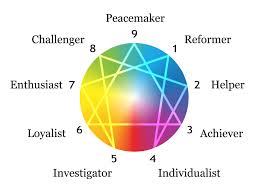 Let’s begin by looking at a traditional Enneagram. The types are normally referred to by their numbers, but sometimes their “characteristic roles” are used instead. There are also “stress” and “security” points which are the types (called Wings) connected by the lines of the enneagram figure and are believed to influence a person who is in more adverse or relaxed circumstances. According to this theory, someone with a primary One type, for example, may begin to think, feel and act more like a Four type when stressed or a Seven type when relaxed.
Most, but not all, Enneagram of Personality theorists teach that a person’s basic type is affected to some extent by the personality dynamics of the two adjacent types as indicated on the enneagram figure. These two types are often called “wings”. A person with the Three personality type, for example, is understood to have points Two and Four as their wing types. A person may be understood, therefore, to have a core type and one or two wing types which influence but do not change the core type.
The table below offers some of the principal characteristics of the nine types along with their basic relationships. This table expands upon Oscar Ichazo’s ego fixations, holy ideas, passions, and virtues, primarily using material from Understanding the Enneagram: The Practical Guide to Personality Types (revised edition) by Don Richard Riso and Russ Hudson.

Every single person has access to all nine numbers. Based on nature, nurture, and discipline, you express the values of each number at varying degrees of intensity based on your lived experience. You are not one thing; you are complex and multifaceted; you are interconnected. This is a vital paradigm shift. When you consider having access to all nine numbers simultaneously, you increase and expand your capacity for thriving. [1]
Considering what you know of the Enneagram so far, in what numbers do you experience ease, or in Jerome Lubbe’s language, sense “efficiency”? Where do you feel less efficient? Great insight can be gained from Richard Rohr’s February 29th meditation that speaks of understanding the Enneagram as a Whole-Identity Profile instead of a single number personality “type,” He says that by seeing the Enneagram as a Whole-Identity Profile, one can expand their capacity for growth in infinite ways.
. . . When you shift the Enneagram Framework from being a number to having efficiencies in all nine numbers, the Enneagram language shifts with it. It becomes about nature and values instead of type and reductive behaviors. For example, number Seven, traditionally associated with the title of “Enthusiast,” is instead represented by the innate human capacity for “Enthusiasm” as well as the value of “Experiences.”
“I am an enthusiast” becomes “I value experiences” which allows more room for nuance, invites growth and begs the question, “. . . and what else do I value?”. . . There is no human who is defined by a single number.
If you have resisted being “pinned down” to any one Enneagram number, perhaps Lubbe’s approach will help you see all of these qualities within yourself. Take a few minutes to read the statements below aloud slowly, pausing for reflection after each one. Notice any sensations in your body. Observe the difference between the impact of “I am” statements versus “I value.” After reading all nine, where do you feel the most energy and resonance? What values are especially meaningful to you? What values do you want to spend more time cultivating? [1] https://cac.org/enneagram-part-one-body-center-weekly-summary-2020-02-29/
Eight: I am a Challenger = I value Autonomy
Nine: I am a Peacemaker = I value Serenity
One: I am a Reformer = I value Justice
Two: I am a Helper = I value Appreciation
Three: I am an Achiever = I value Creativity
Four: I am an Individualist = I value Authenticity
Five: I am an Investigator = I value Clarity
Six: I am a Loyalist = I value Guarantees
Seven: I am an Enthusiast = I value Experiences [2]
When we understand the Enneagram as a Whole-Identity Profile instead of a single number personality “type,” we expand our capacity for growth . . . You are not a personality. You are not even multiple personalities. You have an identity—and what creates and characterizes your identity can be charted by the nine numbers of the Enneagram.
 The anatomy of the brain reflects this: we are not left-brained or right-brained, we are whole brained. [3] The same is true for the Enneagram.
To put it more plainly, you are not a personality type or number on the Enneagram. You are a whole person who has a whole identity — you are all nine numbers.
https://cac.org/enneagram-part-one-body-center-weekly-summary-2020-02-29/
This post may have been too much information for you. Or you may be interested in looking further into the Enneagram. If so, there are many excellent books on the subject as well as online information. You may also be asking how you can determine your Enneagram type. Online you will find many life coaches, spiritual directors, counselors, ministers and others who use Enneagram types with their clients/parishioners. Also at the end of this post I will list some websites that offer free tests that many be helpful to you, with the caveat that after you complete your test, they may offer you further information at a cost.
What’s most important is that whatever personality work you engage in leads you to a deeper knowing of yourself. The goal is to you know who you are, understand your behavior and use the information you have to guide your life journey and follow your dreams. No! The Enneagram test — nor any other personality test — will not make you into your best self. Only you can do that, through self-examination, prayer, contemplation and a process of clearing your soul of anything that might be holding you captive. My prayer for you is that you might search patiently and persistently for whatever brings you inspiration, insight, self-understanding and transformation.
P.S. — I’m a “Three!”
The Enneagram Personality Test – Truity
This personality test is based on the Enneagram personality theory, which describes personality in terms of nine types, each driven by their own set of core emotions, fears, and beliefs. This basic 105 question test is free and takes about 10 minutes to complete. https://www.truity.com/test/enneagram-personality-test
The Fast Enneagram Test. https://enneagramtest.net/
Eclectic Energies Enneagram Tests
Offers two online Enneagram tests help you to determine which personality type you are. Your wing will also be indicated. https://www.eclecticenergies.com/enneagram/test
Additional Resources

Book: The Sacred Enneagram: Finding Your Unique Path to Spiritual Growth; Paperback – published September 5, 2017 by

Chris Heuertz, Enneagram Mapmakers: Exploring the Interior Landscapes of the Ego (Center for Action and Contemplation: 2020), podcast—coming March 24, 2020
Richard Rohr and Russ Hudson, The Enneagram as a Tool for Your Spiritual Journey (Center for Action and Contemplation: 2009), CD, DVD, MP3 download
Don Richard Riso and Russ Hudson, The Wisdom of the Enneagram: The Complete Guide to Psychological and Spiritual Growth for the Nine Personality Types (Bantam Books: 1999)
Richard Rohr and Andreas Ebert, The Enneagram: A Christian Perspective (The Crossroad Publishing Company: 2001, 2013)
[1] Jerome D. Lubbe, Whole-Identity: A Brain-Based Enneagram Model for (W)holistic Human Thriving (Thrive Neuro: 2019), 30-31. Artwork by Aimee Strickland; used with permission.
[2] Ibid., 32. Dr. Lubbe’s upcoming book, which will be available May 26, 2020, The Brain-Based Enneagram: You are not a number (vol. 1), will share his latest work on whole-brained interpretation of the Enneagram. See https://www.amazon.com/Brain-Based-Enneagram-Jerome-Lubbe/dp/173329452X/
[3] Dr. Jerome Lubbe, a functional neurologist and co-founder of Thrive NeuroTheology, has developed a science-based method to understand the Enneagram which he explores in his book, Whole-Identity: A Brain-Based Enneagram Model for (W)holistic Human Thriving

I have come to know Ash Wednesday as the time to draw nearer to my “soul’s insistent yearning.” That can be a frightening prospect, so I always approach Ash Wednesday with a bit of reticence, meeting the day with the self-awareness that I am trying to keep my distance from my “soul’s insistent yearning.” Being closer to one’s soul can well be a disconcerting proposition, but a necessary one. Ash Wednesday presents me with entry into the season of Lent.
I cherish Lent’s forty days, actually, always expecting change to happen in my soul and spirit. And yet, the prospect of repentance, renewal, transformation — and ultimately a personal resurrection — always disquiets me.
 How will I spend Ash Wednesday?
How will I approach the day
that will open the gate of Lent before me?
I have always thought of Lent as a spiritual journey we take alone, a solitary season of introspection and self-reflection during which we contemplate our own spiritual well-being and our relationship with God. For me, Lent has often been alone work.
So I make my Lenten journey into my alone places. I will know that God will abide with me, comforting me in my self-reflection, in my penitence and in my repentance. I will be mindful this Lent of my need to reach into my soul in search of places needing healing, constant and long-time wounds of the soul and spirit. I will search for the traces of my sinfulness, finding in my heart the will to seek sincere penitence, the sad and humble realization of and regret for my misdeeds. I will move beyond penitence to repentance as I resolve to change and to experience transformation.
How will I spend Ash Wednesday?
In whatever way I am able, I will receive ashes on my forehead imposed in a sign of the cross. I will recall the words, “Remember that you are dust, and to dust you shall return.” I will utter as my prayer, the words of Scripture, “Create in me a clean heart, O God, and renew a right spirit within me.” (Psalm 51:10)
As for the actual ashes, I have often wiped them off while in public. I never knew why, just that I was uncomfortable when others saw the cross of ash on my forehead. Perhaps I needed to keep my spiritual practice to myself, or hide the reality of my search for repentance. Years ago, I came across these words, spoken by Sr. Mary Ann Walsh, RSM:
We can feel a little funny with ashes on our foreheads, but for Catholics, that’s how we mark the start of Lent. Ashes don’t say we’re holy. They say we are sinners. They don’t say we are perfect, only that we’re willing to try. They don’t say we’re models of religiosity, but they do say we belong. In today’s world of loners and isolates, that says a lot.
~ Sr. Mary Ann Walsh, RSM
 The essential truth, and gift, of Ash Wednesday is its call to come to terms with ourselves before God. Ash Wednesday says what so much of modern culture denies, namely that we are forever deceiving and justifying ourselves about our sinfulness. So on this day, when we contemplate our sins, when we pay attention to the ash on our foreheads, when we enter into Lent’s forty days, we must make prayer our utmost spiritual intention. So I pray we might embrace our Christian community that we might journey together for these forty days, praying for one another, seeking together the serenity, the reflection and the transformation of Lent, as all the while, we lean into our “soul’s insistent yearning.”
In that spirit of prayer, I hope you will take with you into Lent with this beautiful prayer from Rabbi Naomi Levy:
The rabbi in me would like to offer a prayer for you.
I pray you will learn to see you life as a meaningful story.
I pray you will learn to listen to your soul’s insistent yearning.
I pray you will learn to believe you can transform your life.
I pray you will learn to live and shine inside your imperfect life
and find meaning and joy right where you are.
Most of all I pray you will uncover a great miracle: your extra-ordinary life.
~ From Hope Will Find You by Rabbi Naomi Levy
Most importantly, pray yourself into Lent in the few days we have before Ash Wednesday. Seek God’s heart and seek the depths of your own heart and your “soul’s insistent yearning.” May you know God’s presence as you begin your Lenten journey.

Someone I loved once gave me a box full of darkness.
It took me years to understand that this too, was a gift.
― Mary Oliver
For some reason yet unknown to me, I am remembering those words today. At the same time, I have vivid memories of persons I loved — many of them through the years — who gifted me with “a box full of darkness.” Each time, it felt like anything but a gift. I accepted the boxes because I believed I had no choice. I reached out to take the boxes from people I loved and immediately discovered that it was the darkness I held in my hands. Unfortunately, the darkness in my hands was potent enough to engulf me, and for a good amount of time, the darkness was my constant companion. All around me. Above and below me. Darkness so deep that I could not begin to see the path ahead.
What would I do with these ominous gifts? How would I escape the deep effect they had on my soul? How will I cast off the heartbreak? In time, I was able to think beyond my initial acceptance of these boxes moving to the reality that they were given to me by persons I loved. These were loved ones who might ordinarily have given me gifts, but these gifts — these boxes — were filled with darkness! Why? What did these gifts mean?
I held on to the pain of those “gifts” for years, feeling anger on some days, or betrayal, or loss, or rejection. The experiences changed my life in many ways, and changed the very course of my life. Being a person who so values friendship and loyalty, I was left despondent and a bit lost. Okay, a lot lost!
Yet, the passing years actually did bring healing relief. I could not avoid the darkness that my loved ones gave me. I could not get around it, slip under it, or leap over it. It was just there with me, in my life, and feeling like it would be permanent. The boxes were to me a heart rending breach of covenant. And yes, I did experience despair in the darkness, and loneliness and lostness, and bitterness wondering how these gift boxes had such immense power over me.
When the darkness finally lifted, it brought me a brand new love of life. It gave me new courage and new excitement. It gave me an awakening! I experienced a holy transformation. I knew then that I could get on with my life, joyously, and moving forward following my dreams. So Mary Oliver knew something that I had to learn the hard way, over many years. Here’s what she wrote: “It took me years to understand that this too, was a gift.”
And then there is this wise and wonderful postscript that Annie Dillard wrote about her writing. It applies to every vocation or avocation that we love, and it’s really about living life — all out!
One of the few things I know about writing is this: spend it all, shoot it, play it, lose it all, right away, every time. Do not hoard what seems good for a later place in the book, or for another book; give it, give it all, give it now . . . something more will arise for later, something better. These things fill from behind, from beneath, like well water . . . The impulse to keep to yourself what you have learned is shameful, it is destructive. Anything you do not give freely and abundantly becomes lost to you. You open your safe and find ashes. (Annie Dillard from her book, The Writing Life)
Finally, James 1:2-4, a Scripture passage very familiar to us says it another way:
My brothers and sisters, whenever you face trials of any kind, consider it nothing but joy, because you know that the testing of your faith produces endurance; and let endurance have its full effect, so that you may be mature and complete, lacking in nothing.
So real and true it was when the people I loved betrayed me with a terrible “box full of darkness.” I had faith in each of them. I trusted them and held their love in my heart. My box full of darkness was indeed a trial and a testing of my faith. But the promise of The Epistle of James is there, in my face. It may just be a Holy Letter addressed directly to me. My challenge was to “consider it nothing but joy,” and to know that the testing of my faith most assuredly created endurance. Thanks be to God.

People say walking on water is a miracle,
but to me walking peacefully on earth is the real miracle.
Thich Nhat Hanh
Those words ring so true, but how does one realize “the real miracle?” “Walking peacefully on earth” is much harder than it sounds, much more challenging than it ought to be, at least for most of us. Some have poetically said that walking on earth is our pilgrim journey, and I believe that many people feel that they are walking a pilgrim journey.
In his book, The Pilgrim Journey: A History of Pilgrimage in the Western World, James Harpur asserts that we are now in a new era of pilgrimage and asks: “Why is pilgrimage coming back, especially in a time when many people are questioning traditional religion?” Harpur’s answer is that in these days, there seems to be a deep longing in humans for this form of spiritual practice.
As for me, pilgrimage and journey are very real descriptors of my life. I have often set out on one journey or another, not knowing where to go, only that my soul needs the journey. I am captivated by Harpur’s book, by his tracing the history of why countless people through the ages have embarked on spiritual pilgrimages, by his many stories of pilgrimage through the ages and by his examples of why journey is so relevant to today’s pilgrims. Harpur writes:
If that is done, the destination — a shrine, a holy mountain, or a house of God — will signify not the end of the journey, but the start: a gateway into a new way of being, of seeing life afresh with spiritually cleansed eyes.What is essential is that the journey, by whatever means it is accomplished, gives the pilgrim enough time to expose himself or herself to the possibility of a sacred metamorphosis.
Nothing seems more important to me than seeing my life afresh “with spiritually cleansed eyes.” But getting there is a long process, a journey.
 Walking peacefully on earth requires my full resolve and my desire to reach that place in life. Wouldn’t any of us want to experience transformation and the freedom to be? Wouldn’t any of us want to experience a sacred metamorphosis?
Certainly, it is a long process, a long journey. There are many steps along the way that each person must determine in order to persist on the pilgrimage. There are divergent paths and rough roads and thorny ways and threatening obstacles. Though choosing the path is personal, the graphic at the top of his post illustrates a set of steps we could possibly choose for ourselves. If I chose to take those steps, it would look like this:
First, I must learn to cry again. Crying is very hard for me, as if I dared to cry, my crying might go on forever. Yet, crying is a part of cleansing the soul, and as the quotation says, there is an importance to flowing and finally letting go. Secondly, I need to accept that within me, there is fire and that I must not be afraid to let it burn. I think I must face the flame, adapt and re-ignite my inner fire. Thirdly, I must to open myself up to refreshing air — observe it, breathe it, focus and then decide whatever I need to decide.
The quote also says “remember that you are earth” and ground yourself, give, build and heal. Finally, “remember that you are Spirit” and care for your inner core so that you can connect, listen, know yourself and be still. It’s quite a lesson — a new way of seeing myself — and perhaps it is the way I must journey if I want to walk peacefully on the earth. In these days when peace is in short supply, when nations refuse to beat their swords into plowshares, when political rivals use hate speech against one another, it is so important that peace dwells within my soul.
In the end, all of us long for what James Harpur calls sacred metamorphosis. We all want to realize the miracle of walking peacefully. We want to walk peacefully in our souls. We want to walk peacefully with others. We want to walk peacefully in our families. We simply want to walk peacefully — hand in hand with God and moved by Spirit. We want the choice to walk or to be still, to run or to leap, to breathe or to hold our breath when we kneel before wonder. We want to have the freedom to speak and shout and sing and dance . . . and truly live. That is the miracle!

I have been reflecting on a phrase I read this morning in Father Richard Rohr’s meditation— Uncreated Grace. It is an intriguing phrase and makes me wonder why I received it at this particular time and place on my journey. I have had a very long journey — many miles of life —- and, in fact, there have been many other forks on the path that seem more sacred places to contemplate uncreated grace. But here it is, today, brought to me at this place on my journey.
As I did some processing on this phrase, I thought of one of my dear friends from ages past, seminary days to be exact. Often, he would share his favorite quotes. This was one of them, an intriguing and thought-provoking quote. This quote always stayed in his favorites file. It hints at a long journey we all must take . . .
We shall not cease from exploration
and the end of all our exploring
will be to arrive where we started
and know the place for the first time.
— T. S. Eliot
We were always left with the question “What do T.S Eliot’s words mean?” Sitting in small groups, the seminarians discussed but never reached an answer, to the question. I imagine that, like me, some of them took the words along with them on their journeys, hoping to discover the meaning at some place of enlightenment on their path.
On my journey, Eliot’s words came to mind many times. Never quite discovering a finite meaning, I did discover infinite applications that touched my life in ways simple and profound. Most always, I came away from reflecting on the words to a better place inside myself and a better space in my world. Still, I wonder why these T.S. Eliot words were brought to my mind today.
The power in these words, I think, is that they are not a directive, not a call to mission, not words of piety, not gleaned from scripture. They are words meant to be understood individually rather than offering a universal message. I identify these words as an invitation, and so today I am left alone with them to intentionally create space for reflection and understanding.
When I do that, I hear many, many other words from different places — from scripture, hymn, poetry, prose and from within myself. It feels like a Spirit encounter, the presence of “another comforter” who will be with us forever, who will, as Jesus promised, “teach you all things, and bring to your remembrance all that I said to you.”
Spirit teaches us and helps us remember. Spirit grounds us so that our circuitous journey will not frighten us. We are free to never “cease from exploration,” because we are comforted to know that we will “arrive where we started . . .”
 And know the place for the first time . . .
When the journey leads us back to where we started, how is it that we “know the place for the first time?” I urge you to not take my interpretation as the correct one, because I believe that a “correct” interpretation comes from the soul of each person who chooses to explore. But here is an understanding based on my own musings . . . we can take what comes in our lives, or we can explore places on the journey — our encounters, our joys and sorrows, our events and calamities, our crises and emotions, our disappointments and betrayals, the chance and the wonder.
For me, there is no doubt that exploring all of these life events brings that sense of getting back to the beginning and truly knowing the place for the first time, not necessarily because the beginning place has changed, but that I have changed. The Spirit’s holy breath transformed me with gentleness again and again, transformed by the blowing of Spirit wind into my being.
Father Richard Rohr says that “the Holy Spirit is never created by our actions or behavior. It is naturally indwelling, our inner being with God. In Catholic theology, we called the Holy Spirit “Uncreated Grace.”
How I love those words . . . Uncreated Grace! Perhaps that’s what we all hope for in our explorations on the journey — that in us and through us, there is Uncreated Grace. If we present to the Spirit our selves as uncreated grace, I wonder if Spirit then creates grace within us again and again and again, all along the way. If we never cease from exploration, presenting ourselves as uncreated grace, the Holy Spirit will breathe on us and we will be transformed!
No wonder we know the place where we started for the first time! The place hasn’t changed, we have changed, transformed in our deepest places!
Thanks be to God and to the touch of Spirit breath. Amen
 God of the Sparrow 🌱 By Kathy Manis Findley