Awakening, Dancing, Discernment, Discovering, Freedom, God's presence, Holy Spirit, journey, Life Journeys, Morality, New Life, peace, Pilgrim, Pilgrimage, Self Awareness, Singing, Soul, Spirit wind, Spiritual awakening, Stories, Transformation, Walking peacefully, wind

Walking Peacefully

BC2C5B3D-EFB1-4535-9D46-B4D8A9DB76F3
People say walking on water is a miracle,
but to me walking peacefully on earth is the real miracle.

Thich Nhat Hanh

Those words ring so true, but how does one realize “the real miracle?” “Walking peacefully on earth” is much harder than it sounds, much more challenging than it ought to be, at least for most of us. Some have poetically said that walking on earth is our pilgrim journey, and I believe that many people feel that they are walking a pilgrim journey.

In his book, The Pilgrim Journey: A History of Pilgrimage in the Western World, James Harpur asserts that we are now in a new era of pilgrimage and asks: “Why is pilgrimage coming back, especially in a time when many people are questioning traditional religion?” Harpur’s answer is that in these days, there seems to be a deep longing in humans for this form of spiritual practice.

As for me, pilgrimage and journey are very real descriptors of my life. I have often set out on one journey or another, not knowing where to go, only that my soul needs the journey. I am captivated by Harpur’s book, by his tracing the history of why countless people through the ages have embarked on spiritual pilgrimages, by his many stories of pilgrimage through the ages and by his examples of why journey is so relevant to today’s pilgrims. Harpur writes:

If that is done, the destination — a shrine, a holy mountain, or a house of God — will signify not the end of the journey, but the start: a gateway into a new way of being, of seeing life afresh with spiritually cleansed eyes.What is essential is that the journey, by whatever means it is accomplished, gives the pilgrim enough time to expose himself or herself to the possibility of a sacred metamorphosis.

Nothing seems more important to me than seeing my life afresh “with spiritually cleansed eyes.” But getting there is a long process, a journey.

3BCA9FAD-8CD2-4B6A-B300-6609E1318379Walking peacefully on earth requires my full resolve and my desire to reach that place in life. Wouldn’t any of us want to experience transformation and the freedom to be? Wouldn’t any of us want to experience a sacred metamorphosis?
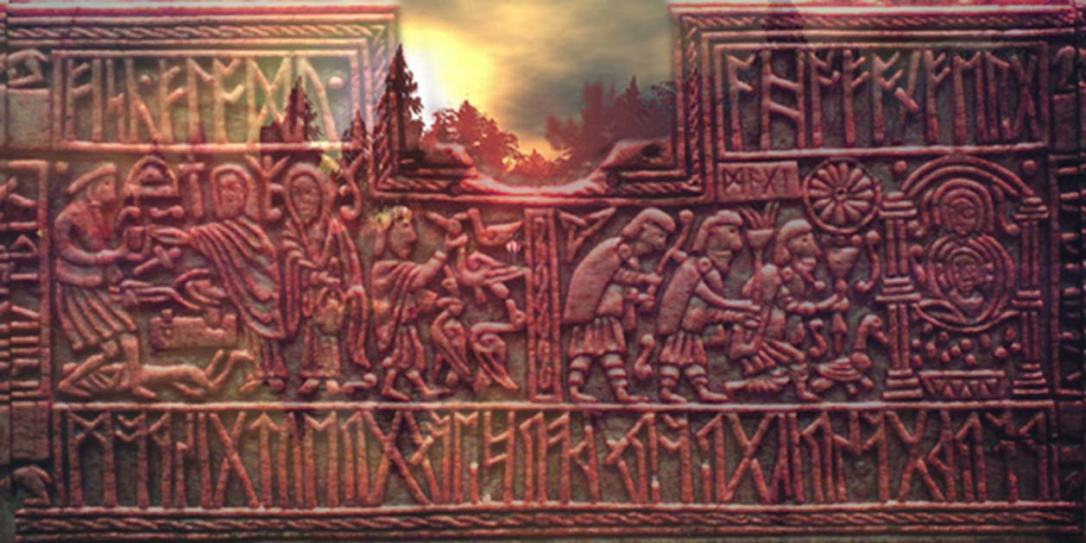
Certainly, it is a long process, a long journey. There are many steps along the way that each person must determine in order to persist on the pilgrimage. There are divergent paths and rough roads and thorny ways and threatening obstacles. Though choosing the path is personal, the graphic at the top of his post illustrates a set of steps we could possibly choose for ourselves. If I chose to take those steps, it would look like this:

First, I must learn to cry again. Crying is very hard for me, as if I dared to cry, my crying might go on forever. Yet, crying is a part of cleansing the soul, and as the quotation says, there is an importance to flowing and finally letting go. Secondly, I need to accept that within me, there is fire and that I must not be afraid to let it burn. I think I must face the flame, adapt and re-ignite my inner fire. Thirdly, I must to open myself up to refreshing air — observe it, breathe it, focus and then decide whatever I need to decide.

The quote also says “remember that you are earth” and ground yourself, give, build and heal. Finally, “remember that you are Spirit” and care for your inner core so that you can connect, listen, know yourself and be still. It’s quite a lesson — a new way of seeing myself — and perhaps it is the way I must journey if I want to walk peacefully on the earth. In these days when peace is in short supply, when nations refuse to beat their swords into plowshares, when political rivals use hate speech against one another, it is so important that peace dwells within my soul.

In the end, all of us long for what James Harpur calls sacred metamorphosis. We all want to realize the miracle of walking peacefully. We want to walk peacefully in our souls. We want to walk peacefully with others. We want to walk peacefully in our families. We simply want to walk peacefully — hand in hand with God and moved by Spirit. We want the choice to walk or to be still, to run or to leap, to breathe or to hold our breath when we kneel before wonder. We want to have the freedom to speak and shout and sing and dance . . . and truly live. That is the miracle!


Adultery, Art, Awakening, Celebration, Change, Dancing, Discovering, Dreams, Freedom, Growing up, Introspection, Joy, life, New Life, Praise, Psalms, Questions, Surprise, Tambourine

With a Tambourine in My Hand

41C0A436-91ED-4E28-B2C7-8CC3FEA229B7
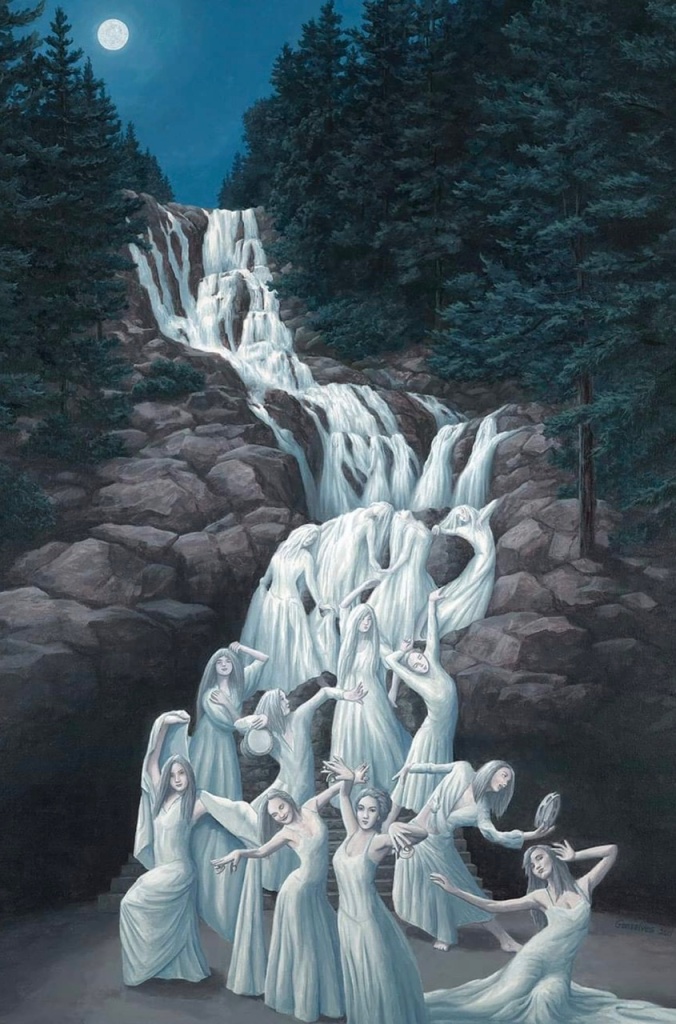
Water Dancers by Canadian artist, Rob Gonsalves

Women in white gowns emerge from the crashing water of  a moonlit waterfall. What in the world does that have to do with me, other than the fact that I am completely enthralled by this painting? I certainly cannot relate or see myself emerging from rushing waters or even dancing with a tambourine in my hand. Yet, there is something about this art that inspired my soul searching and brought up some questions I want to contemplate.

Where did I come from? Where will I go?
What will I do with my life? Which of my dreams will I realize?

I have asked myself similar questions, questions about what made me who I am and if I will ever feel that I have realized my life dreams. It’s true that I have entered my seventieth year of life, and one might wonder why the need for all the introspective questions. But In the core of my being, I believe that I can still dream and that I can still experience wonder about what I see in and around my life.

What people will enter my life leaving cherished gifts of friendship? What wonder will I see around me as I search for meaning? What will Spirit say to me with the gentle breath of her voice that can also enter my life as a rushing, mighty wind? And how does God continue to call me to new ministries of the heart?

I do not know the answer to those questions. Nor do I know who or what I will be when I grow up. So I struggle to know. I plead with God to give me direction. During this season of my life while I am challenged with so many things related to my kidney transplant, I have been somewhat obsessed with finding the answers to all those “who am I?” questions. I despair a little when I can’t find the answers.

Back to the art. Yesterday, I accidentally came across the painting by Canadian artist Rob Gonsalves which is at the top of this post. I was immediately captivated by the image, especially the rushing waterfall that changed into women living life — some of them dancing, others playing their tambourines, others just emerging, still others just beginning to awaken.

The art reminds me of how we might emerge into life — to grow into life, to be open to change, to be willing to embrace a process of becoming. Each of us is engaged in that kind of process whether we know it or not, whether we embrace it or not. We want to experience an awakening that opens our eyes to wonder and our souls to extraordinary newness of life. We want the freedom to be who we are. We don’t want to stay in our awakening place, reticent about moving into the best part of our lives, refusing to move because of our fear. We want to throw off our hesitation and, in search of our dreams, to sing, to dance, to play our tambourines in celebration of our unique personhood.

I am reminded of a beautiful passage of Scripture from the Psalms.

Let them praise his name with dancing,
making melody to him with tambourine and lyre.

— Psalm 149:3 (NRSV)

Isn’t that precisely what we want for our lives? To lean into our true selves so that we are compelled to sing, to dance with tambourines in our hands, to celebrate our lives, to dream and to praise the God who rejoices when we live into freedom and joy!


Awakening, Awareness, Change, Contemplation, Courage, Discernment, Discovering, Emotions, Exploration, God's presence, grief, Guilt, healing, Indecision, Introspection, journey, life, Light, Lingering, Mayo Clinic, Mystery, New Life, New Year, Pain, Prayer, Sacred Space, Self Awareness, Spiritual awakening, Trust

Lingering . . . In the Presence of God

53189F0B-8EF7-4BDC-A66A-B9834A45C0F5

I have observed, at this year’s beginning, as in past years, that humans are more introspective than usual. It may begin with intentions or resolutions for the new year. What I observe is that people are revisiting the past, trying to reinterpret it, digging for the meaning the past held for them and trying to find ways to heal the wounds of the soul theyp have hidden inside them for a long time. Those woulds live in us so long that they become scars, hardened in our spirits and thus more difficult to heal.

Until we have done this spiritual and emotional inner work, we are hesitant, unwilling to move into the future. So we linger in the present and re-live the past. Usually what we  revisit are past sorrows and losses, past disappointments and perceived failures, past pain that continues to pierce the soul. Seldom do we revisit past joys, because joy does not pierce like sorrow does.

It is a positive thing to linger in life review at the beginning of a new year. Just as the year is new, all of us hope that in the work of lingering, we will find newness in ourselves. The work of introspection is important for our well being and we have so many choices about how to strengthen ourselves, body and spirit. Many people use self-counseling, which may include searching their deep selves through personal contemplation and prayer. Others engage in spiritual direction, life coaching, trauma therapy or counseling. Still others tend to their souls through silent contemplation, labyrinth walks, yoga, nature walks, strenuous exercise, reading scripture, self-help books or poetry, and singing hymns or listening to music.

I want to suggest one other form of self-counseling that is unfamiliar to most people — working with Healing Runes as a part of your quiet time. Your first question probably is, “What are Healing Runes?” I want to begin by sharing an invocation written by Ralph H. Blum from his book, The Healing Runes.

Invocation

Practice the Presence of God in all ways,
Both in your coming in and your going out.

In your prayers, invoke God’s Presence.
In your aspirations, stay mindful of the Presence.
In your meditations, breathe in the Presence.

Above all, let the Presence be reflected in your attitude,
For surely then God will sing in your thoughts,
Speak in your voice and shine through your acts.
Let the Presence of God be the medicine
To heal your life, lift your heart and renew your spirit.

Practice the Presence of God in all ways,
Both in your coming in and your going out. Amen

To answer the question, a Healing Rune is a tool that provides a way of deepening  reflection and stirring the soul where we find life meaning and buried emotions. There is an interpretation of each healing rune in the book, The Healing Runes, written by Ralph Blum and Susan Loughan. They offer interpretations presented in graceful and sensitive language that allows the reader to take to heart what is appropriate for their own meditation and leave the rest.

A4B9545F-D3B1-40D5-AC08-23DF8FD547CAThe book adapts the sacred use of Runes as an alphabetic script used by the ancient Germanic and Norse peoples, creating a tool that could be helpful in the healing of body, mind and spirit.*
I suggest that we not fear the Healing Runes by considering them to be some sort of pagan artifact or something that seems like magic. They are more like mystery, something to guide our reflection and introspection. I suggest the we see Healing Runes as one way to guide us deeper into ourselves and into the presence of God, the ultimate healer of our souls.

I would like to choose a Healing Rune for us from my bag. Its meaning may not mean anything to you or to me. It may not open up any places in your soul that need attention. Or it may awaken us to a wound that we need to give some reflective time, some time for healing.

328A8B00-83F2-418F-BFC5-29960E0C06C7The Rune I have randomly chosen is the Rune of Trust. It is the Rune of restoration that calls for the rebuilding of belief in yourself, in your life and in your relationship with God. For some, drawing this Rune asks you to show trust in a present situation. For others, it calls for embracing the changes you are facing with trust and wisdom. In relationships of the heart, remember that I love you and I trust you are two stones for crossing the same stream. Most importat is that you ask your soul if Trust has something to teach you or somewhere to lead you.
Thomas Moore writes, “We separate, each from the other, the sicknesses of body, emotion, meaning and connectedness.” The soul must be moved, touched and healed, and that is why we linger at the door of our pain, trying every way we know to reconcile it, heal it, eliminate it (or just blast it with a sci-fi laser gun!) Thomas Moore has a better remedy than a sci-fi laser gun, a much more informed remedy:

I am convinced that all healing ultimately comes from a shift in deep imagination, grounding our own lives and anchoring our decisions in the very quick of the heart . . . not just relief from anxiety, but profound gifts that signal the presence of soul — intimacy, pleasure, beauty, love and piety.

As you and I explore what hides in our souls as this new year beckons us, may we not be afraid to linger directly in the presence of our fear or woundedness. Instead, let us consider that we are lingering in the comforting presence of God, in the gentle protection of Spirit. It is safe in that sacred space of Presence, safe enough for us to unearth whatever lies deeply in us and allow it to surface into the healing light.

God may be gently, lovingly calling us to do that work of healing and, in that introspection, to reveal our truth — the truth that will set us free!


* The Healing Runes, Ralph H Blum and Susan Loughan; Preface by Thomas Moore; St. Martin’s Press:New York, New York; ©️1995 by Ralph H. Blum.

Adventures, Awareness, Change, Contemplation, Exploration, Grace, Growth, Holy Spirit, Introspection, Life Journeys, Life pathways, Meditation, New Life, Reflection, Spirit wind, Transformation

Uncreated Grace

AA19F30F-F0BC-46B3-9F62-E084BF61258A

I have been reflecting on a phrase I read this morning in Father Richard Rohr’s meditation— Uncreated Grace. It is an intriguing phrase and makes me wonder why I received it at this particular time and place on my journey. I have had a very long journey — many miles of life —- and, in fact, there have been many other forks on the path that seem more sacred places to contemplate uncreated grace. But here it is, today, brought to me at this place on my journey.

As I did some processing on this phrase, I thought of one of my dear friends from ages past, seminary days to be exact. Often, he would share his favorite quotes. This was one of them, an intriguing and thought-provoking quote. This quote always stayed in his favorites file. It hints at a long journey we all must take . . .

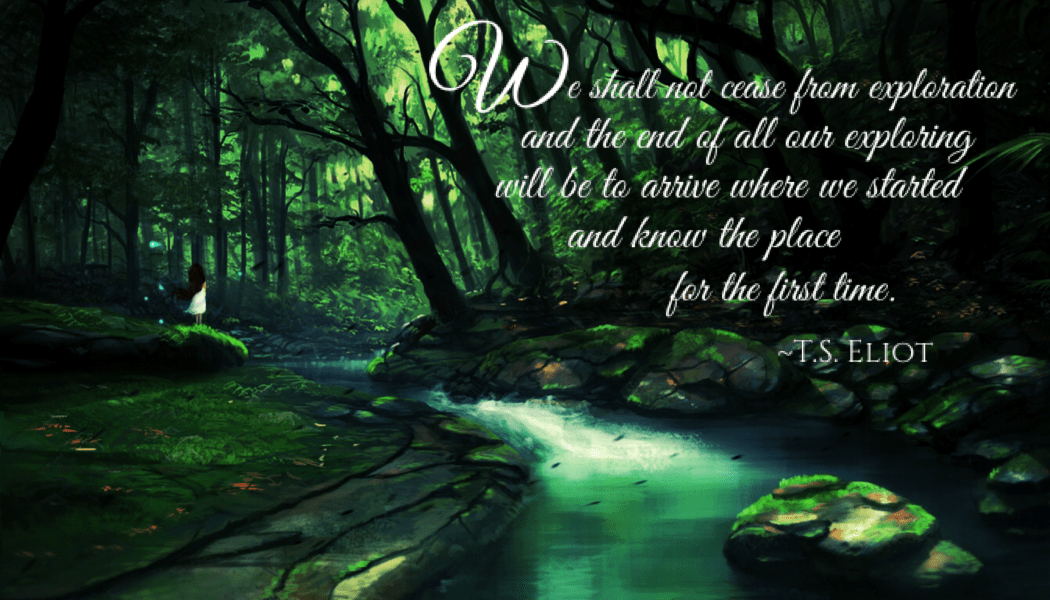
We shall not cease from exploration
and the end of all our exploring
will be to arrive where we started
and know the place for the first time.

— T. S. Eliot

We were always left with the question “What do T.S Eliot’s words mean?” Sitting in small groups, the seminarians discussed but never reached an answer, to the question. I imagine that, like me, some of them took the words along with them on their journeys, hoping to discover the meaning at some place of enlightenment on their path.

On my journey, Eliot’s words came to mind many times. Never quite discovering a finite meaning, I did discover infinite applications that touched my life in ways simple and profound. Most always, I came away from reflecting on the words to a better place inside myself and a better space in my world. Still, I wonder why these T.S. Eliot words were brought to my mind today.

The power in these words, I think, is that they are not a directive, not a call to mission, not words of piety, not gleaned from scripture. They are words meant to be understood individually rather than offering a universal message. I identify these words as an invitation, and so today I am left alone with them to intentionally create space for reflection and understanding.

When I do that, I hear many, many other words from different places — from scripture, hymn, poetry, prose and from within myself. It feels like a Spirit encounter, the presence of “another comforter” who will be with us forever, who will, as Jesus promised, “teach you all things, and bring to your remembrance all that I said to you.”

Spirit teaches us and helps us remember. Spirit grounds us so that our circuitous journey will not frighten us. We are free to never “cease from exploration,” because we are comforted to know that we will “arrive where we started . . .”

9889AA3B-16BB-4F9F-9B56-D883A74A49AEAnd know the place for the first time . . .
When the journey leads us back to where we started, how is it that we “know the place for the first time?” I urge you to not take my interpretation as the correct one, because I believe that a “correct” interpretation comes from the soul of each person who chooses to explore. But here is an understanding based on my own musings . . . we can take what comes in our lives, or we can explore places on the journey — our encounters, our joys and sorrows, our events and calamities, our crises and emotions, our disappointments and betrayals, the chance and the wonder.

For me, there is no doubt that exploring all of these life events brings that sense of getting back to the beginning and truly knowing the place for the first time, not necessarily because the beginning place has changed, but that I have changed. The Spirit’s holy breath transformed me with gentleness again and again, transformed by the blowing of Spirit wind into my being.

Father Richard Rohr says that “the Holy Spirit is never created by our actions or behavior. It is naturally indwelling, our inner being with God. In Catholic theology, we called the Holy Spirit “Uncreated Grace.”

How I love those words . . . Uncreated Grace! Perhaps that’s what we all hope for in our explorations on the journey — that in us and through us, there is Uncreated Grace. If we present to the Spirit our selves as uncreated grace, I wonder if Spirit then creates grace within us again and again and again, all along the way. If we never cease from exploration, presenting ourselves as uncreated grace, the Holy Spirit will breathe on us and we will be transformed!

No wonder we know the place where we started for the first time! The place hasn’t changed, we have changed, transformed in our deepest places!

Thanks be to God and to the touch of Spirit breath. Amen

Activism, Advocate, Bravery, Call, Courage, Defiance, Faith, healing, Justice, Perseverance, Persistence, Protection, Resilience, Stubbornness, Tenacity, Uncategorized, Vulnerability, Women

Stubbornness, Tenacity, Faith

61C5F6CB-7BD9-42ED-8FC4-A47EECD57FB6
Jesus and the Stubbornly Tenacious Woman from Canaan


Leaving that place, Jesus withdrew to the region of Tyre and Sidon. A Canaanite woman from that vicinity came to him, crying out, “Lord, Son of David, have mercy on me! My daughter is demon-possessed and suffering terribly.”

Jesus did not answer a word. So his disciples came to him and urged him, “Send her away, for she keeps crying out after us.”

He answered, “I was sent only to the lost sheep of Israel.”
The woman came and knelt before him. “Lord, help me!” she said. He replied,

“It is not right to take the children’s bread and toss it to the dogs.”

“Yes it is, Lord,” she said. “Even the dogs eat the crumbs that fall from their master’s table.”

Then Jesus said to her, “Woman, you have great faith! Your request is granted.” And her daughter was healed at that moment.

(Matthew 15:21-28)

I wonder . . . was it her faith or her stubborn tenacity that led to her daughter’s healing? Stubbornness is typically not one of the virtues to which Christians aspire. In fact most of Christendom would rebuke a stubborn woman, in ages past as well as in our day. I know this to be truth! I have been rebuked a time or two, or at least received “strong suggestions” that I should dial back my demeanor. The woman of Canaan, though, returned to Jesus again and again until he healed her suffering daughter.

I can be a bit tenacious, but no one would describe me as stubborn. I typically have a very calm and quiet demeanor, but I remember well one of the few times in my life when I was fierce and stubborn. Our son Jonathan was quite young and very sick with severe vomiting, along with strong spasms that caused him to be unable to breathe. The loud inhalations as he struggled to get a breath were extremely frightening to us, especially to him. Jonathan was a strong boy, an athlete, and very self-sufficient, but these long episodes brought him directly to his Momma. We had been to the hospital emergency room and were now in his pediatrician’s office. This violent gasping for air had been going on for hours, and it should have been obvious to the office staff that Jonathan was in trouble.

Now they would know real trouble!

Jonathan had another violent attack. I jumped up from my chair, went to the desk, and had some strong words to say, in a loud voice, with the passion of a mother desperate to protect her child. I got the familiar line about the doctor running behind.

You know, I don’t care if the doctor is behind! (in my loudest voice) Can you not see and hear that my child is throwing up all over your waiting area and is unable to breathe? Do you realize that he could be infecting every child in here? Take us to an exam room, NOW, and get the doctor away from whatever he’s doing! Because if you don’t, I am headed to the president of Baptist Medical Center who knows me very well because I am a chaplain in this hospital!

Not like me at all! But that is a “Momma response” that almost always erupts when her child is hurting or in trouble. We were in a desperate place and were being ignored. Jonathan was terribly frightened and had been dealing with these spasms for hours. In time (too much time) it was resolved and we were able to get Jonathan settled and resting.

And about the “Canaanite Momma” . . . well, she was definitely stubborn and persistent that day. Clearly, Jesus did not realize who he was dealing with. Maybe he did know! Perhaps Jesus knew precisely what he was doing and chose to use his encounter with the woman from Canaan as a teaching moment for his hearers. Or perhaps he was simply in a stubborn mood and found himself facing someone who could easily match him, stubborn for stubborn!

Either way, the story shows us that when it comes to saving what needs to be saved, being merely nice and calm won’t usually win the day. Sometimes we need to dig in our heels and do some hollering! The text simply portrays the Canaanite woman as a stubborn, persistent mother of a very sick daughter.

Remember, the disciples urged Jesus to send her away. She was obviously making a lot of noise, crying out and disturbing their quietude! On top of that, Jesus was somewhat stubborn himself, saying that he was sent only to the lost sheep of Israel.

But this “Canaanite Momma” went back to Jesus straightaway, knelt down before him, saying, “Lord, help me!”

And we know what Jesus finally did. He praised her faith and healed her daughter. So was it faith or was it stubbornness, persistence? Maybe it was both, that her faith empowered her to stubborn persistence. Clearly, she believed Jesus was able to heal her daughter, so she tried to convince Jesus more than once. The disciples didn’t deter her. Jesus Could not dissuade her with his statement about dogs!

“Woman, you have great faith.”

A wonderful portrayal of what this woman might have said about her encounter with Jesus is a poem written by Jan Richardson entitled “Stubborn Blessing.”

Stubborn Blessing

Don’t tell me no.
i have seen you
feed the thousands,
seen miracles spill from your hands like water, like wine,
seen you with circles and circles of crowds pressed around you
and not one soul turned away.

Don’t start with me.

i am saying
you can close the door
but i will keep knocking.
You can go silent
but i will keep shouting.
You can tighten the circle
but i will trace a bigger one
around you,
around the life of my child
who will tell you
no one surpasses a mother for stubbornness.

i am saying
i know what you
can do with crumbs
and i am claiming mine,
every morsel and scrap
you have up your sleeve.
unclench your hand,
your heart.
let the scraps fall
like manna,
like mercy
for the life
of my child,
the life of
the world.

Don’t you tell me no.

— Jan Richardson
https://paintedprayerbook.com/2014/08/11/stubborn-blessing/

The work of protection is definitely not for the faint of heart. The work of advocacy on behalf of another person may take some stubborn persistence, the kind of stubborn persistence that Jesus seemed to call by another name — “great faith.” When we advocate for people who are suffering, especially people in need of profound physical healing or deep spiritual healing, their greatest need calls us to our greatest resolve, a fierce resolve. Maybe a touch of defiance! It is in those moments that we call on our hearts to give us strength for sacred stubbornness that will heal the broken, comfort the brokenhearted, restore justice to those who are oppressed.

That is faith! “Great faith!”

Adventures, Beauty of Nature, Contemplation, Creation, God's presence, Introspection, Meditation, Mindfulness, Praise, Prayer, Psalms, Questions, Restoration, Sacred Space, Serenity, Silence, simple joys, simple pleasures, Soul, Stillness

“My Soul in Silence Waits”

85612761-C3E4-4F2A-ADDE-7BF472AE54D8
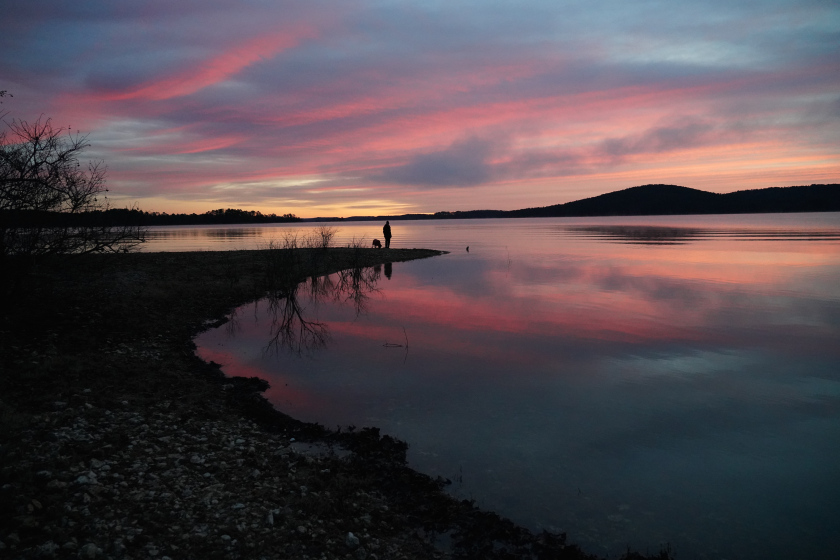
Photography by Jim Dailey: January 1, 2020, Lake Ouachita, Hot Springs, Arkansas

My dear, long-time friend, former Little Rock Mayor Jim Daily, sent me this photo this afternoon. Mayor Jim is a hiker, a camper, a photographer and a naturalist. He loves the outdoors. He is a person of profound thought, and he spends a good amount of his time in thoughtful contemplation — on a lake or an Arkansas River, in a verdant valley or on a mountaintop. He frequently blogs on what he calls his “adventures,” and his blog is filled with thoughts about wherever he is and whatever beauty he has found. For Jim, every day is a new adventure, and his adventures hold sway over him. They change him in so many ways

One more thing — As a tribute to my friend, Mayor Jim, I want to introduce you to his Blog, which you may enjoy viewing at this link: Last Pair of Boots

His Blog, called “Last Pair of Boots,” tells a poignant story — of nature’s beauty, of God’s presence in it, of friendships, of Arkansas’ and America’s holy places, of worship and contemplation and prayer. Here’s what Jim says about naming his blog:

The name “Last Pair of Boots” came to me when my ten year old boots broke down and it occurred to me that at my age the new pair of boots might be my last pair. Metaphorically my boots represent the trails and travels of life.

10648F62-3E20-4939-86D9-97A565CFD322
Whitaker Point … aka Hawksbill Crag! At the Buffalo National River

This is such a thought-provoking description that fits Jim’s love of nature’s splendor. He also hints at endings, not in a melancholy  way, but in words the reveal his life of contemplation and curiosity. Jim’s outings are hiking and wilderness camping, skiing, fishing, exploring, visiting every Arkansas State Park through his job as Arkansas Tourism Director, finding friendships in every small Arkansas hamlet, searching for Arkansas treasures,
finding God in all the places and faces.

I imagine he will hold all of these adventures in his heart now that he has finished his work as Arkansas Tourism Director this past December.

1F0E0755-F01A-4E45-A3BB-92C22820A3D8
HamfestWhatever it is …  it’s gotta be something special to celebrate 50 consecutive years on top of the second highest mountain in Arkansas — Rich Mountain — in the beautiful Ouachita Mountains, Queen Wilhelmina State Park.

Congratulations, Jim, for your many years of service to the citizens of Little Rock and of Arkansas. Your wisdom, your love of nature, your unquenchable thirst for adventure and your unfailing commitment will remain as one of our enduring Arkansas’ treasures.

As I mused about Jim’s outings tonight, I asked myself about the places and times that created my contemplative times. They are few, too few.

For whatever lame reason, I do not take the contemplative times I need. I think that my kidney transplant on November 12th pushed me into a soul-need that beckons me to solitude, silence, contemplation, adventure — new things to examine in the stunning beauty of nature. It calls me out of the house and into the sunlight or under the stars of the night. It calls me to breathe in the fresh air of God’s creation and, with that breath, to take in the miracle of God’s presence.

Now that I’m retired and have time, I tend to fill my time with all manner of preoccupation. At times, I feel busy and frazzled and don’t really know why. Why am I unable to make enough time to spend in the mesmerizing beauty of nature, keeping silence in God’s creation? Why do I not spend time beside still waters, listening to the silence of a pond? What is wrong with my soul that it is rarely drawn to God’s quiet places, and my heart that does not often seek God’s presence in silent space?

I dare not answer those questions until I am prepared to make some life changes. But what I can do is to hold near these reminders of what God desires for me until I can change my life. These reminders might even inspire me to seek change:

O Lord, my heart is not lifted up,
my eyes are not raised too high;
I do not occupy myself with things
too great and too marvelous for me.

But I have calmed and quieted my soul,
like a weaned child with its mother.   
(Psalm 131:1-2)

For God alone my soul in silence waits.   (Psalm 62:1)

The Lord is my shepherd, I shall not be in want. He makes me lie down in green pastures, he leads me beside quiet waters, he restores my soul.   (Psalm 23:1-3)

Let him sit alone in silence, for the Lord has laid it on him.   (Lamentations 3:28)

To you, O God, silence is praise.   (Psalm 65:1)

It is never a bad thing to offer God the praise of silence, to invite God into my contemplation and to allow God’s presence in my moments of prayer and meditation. The truth is that God has always been present with me. But my deepest desire is that I be present with God. As the Psalmist wrote, “My soul in silence waits.”

May those words become my words . . . and yours. Amen.

Bethlehem’s Star, Christ’s Birth, Epiphany, journey, Life Journeys, New Year, Restoration, Sacred Worth, Women

“Wise Women Also Came”

4716B5CE-43A8-4204-8C0D-CECBE609C55F
Art: “Wise Women Also Came” by Jan Richardson

Women’s Christmas! What Is That?

There is a custom, rooted in ireland, of celebrating Epiphany as Women’s Christmas. On January 6, Epiphany brings the Christmas season to a close. Called Nollaig na mBan in irish, Women’s Christmas originated as a day when the women, who often carried the domestic responsibilities all year, took Epiphany as an occasion to celebrate together at the end of the holidays, leaving hearth and home to the men for a few hours. 

Whether your domestic commitments are many or few, Women’s Christmas offers a timely opportunity to pause and step back from whatever has kept you busy and hurried in the past weeks or months. As the Christmas season ends, this is an occasion both to celebrate with friends and also to spend time in reflection before diving into the responsibilities of the new year.

Epiphany might be for you an invitation to rest, to reflect, to contemplate where you are on your journey. Epiphany reminds us of the wise persons who traveled to welcome the Christ Child and who returned home by another way. Perhaps we might consider turning our attention toward questions about our own journey. Epiphany brings us The Wise Men, The Three Kings. But did others also make the journey, following a brilliant star? Were there other travelers whose names we don’t know?

Jan Richardson tells about an experience she had years ago when she was beginning to find her artist soul. She sat down to create a collage to use for Epiphany. She began to imagine who else might have made the journey to welcome Jesus. In her soul, a trio of women began to take shape, carrying their treasures to offer the Child. She named the piece Wise Women Also Came.

I love the idea that three wise women made that journey and saw the Christ Child. There are so many accounts in the Scriptures about women having no rights, no protection, no ability to speak. Many of their names are not even recorded. Even in this day — 2020 — we have been socialized to keep silence in meetings or gatherings. We may even believe that our opinions are not important enough to speak out loud. We shrink back into what is determined to be “our place.” Maybe not all the time, but we have to admit we’ve done it sometimes. It’s all about how much we value ourselves and how much we believe others value us.

But shrinking back behind the scenes and quashing our voice has significant consequences — that our vision will not be given, our inspiration will fail to inspire, our dreams will be lost, our influence will not flourish, our wisdom will not be spoken. And our world will suffer for it, losing our passion for a world that needs passion.

Imagine with me that three wise women made the incredible journey to see the Child. Imagine the gifts they might have brought. Imagine what social constraints they might have broken to go on this journey of a lifetime, and the courage that motivated them. Imagine whether or not you could take such a journey, forbidden by your society, yet moving ahead on the path. Imagine your bravery and your resolve, your your sense of adventure, your hopes and your dreams.

So let’s accept two challenges in the days to come:

To celebrate Women’s Christmas with our friends and also to spend time in personal reflection before diving into the responsibilities of the new year.

To find our voices and our wisdom. To claim our courage, our strength and our passion. And even if others scoff at us, to follow our dreams.

The world needs us!

anxiety, Challenge, Change, Chronic illness, Comfort, Contemplation, Courage, Emotions, Energy, Faith, God's presence, grief, healing, Hope, Illness, Life Journeys, New Year, Pain, Perseverance, Psalms, Sorrow, Soul, strength, Suffering, The Year Behind

Holding Hope

FA0DFF1E-0155-456C-BC1A-AF7ABBA0BE5E
A new year has dawned. We’re in it, ready or not! While we cannot control what 2020 brings to us, we can control the way we respond —- to times of joy, times of sorrow and all the times that are just ordinary. No doubt we will greet them all, ready or not!

As the poet reminds us, “Live the year that lies ahead with energy and hope. Be strong, have courage. It is time now for something new.” And so it is. But embracing something new is sometimes difficult. Sometimes our hope is small. Sometimes following our journey into an unknown future is frightening. If the year past still holds us in a place of suffering, if illness lingers with us, if depression and anxiety still rages in us, if persistent grief comes with us into the new year, it is difficult, if not impossible, to leave the past pain behind and embrace something new. So if you feel that you cannot leave past suffering behind you, this little message is for you.

The most important thing you can do is to honestly acknowledge the suffering and accept the fact that it will not leave you just because the new year has arrived. Spend some time contemplating your suffering, how it impacted you in the year past. Can you find any newness at all at the beginning of a new year? Is there some of the suffering  you can see in a different light? Can you respond to it differently? Can you find a way to endure it that is better than the way you endured it in the past? Can you make a concerted effort to learn something from your suffering?

Still, if you are in the throes of suffering — physical, emotional or spiritual — the suggestions above can illicit the strong response, “You’ve got to be kidding! This way of looking at the same thing I’ve endured for years is simply impossible!”

I will be the first to acknowledge the truth of that response, but I must also ask, “What do you have to lose?” Even a change in your response to one place of suffering could bring a small change for you, a change ever-so-slight that has the power to offer you increased resilience and hope. It may be worth a try.

I think it’s important to repeat these wise words: “Live the year that lies ahead with energy and hope. Be strong, have courage. It is time now for something new.”

I suggest that, even if we are enduring suffering, we can greet the new year “with energy and hope.” Hope is always available to us, even when we cannot see it or feel it.

From the promises of Scripture . . . 
“ . . . so that we who have fled for refuge might have strong encouragement to hold fast to the hope set before us. We have this as a sure and steadfast anchor of the soul, a hope that enters into the inner place.
 — Hebrews 6:18-19

From the depths of our souls . . .
“Why are you cast down, O my soul, and why are you in turmoil within me? Hope in God; for I shall again praise him, my help and my God.”   — Psalm 42:11

“I wait for the Lord, my soul waits, and in his word I hope.”  
— Psalm 130:5

But I will hope continually and will praise you yet more and more.”  — Psalm 71:14

The Scriptures can be comforting to us. They can lift up courage in us and they can give us strength to face all of our tomorrows, but the place where hope really lives is within us. We can reach down for it, hold it close, and allow it to help us move forward. No matter what manner of suffering we hold, hope can guide us.

I leave you and your journey into 2020 with the wise words of Corrie Ten Boom:

“Never be afraid to trust an unknown future to a known God.”


Kindness, New Year, Uncategorized

Happy New Year, My Friends!

6F027E48-6A2B-4B52-AA77-14C494C42202
Wishing you and those you love a new year of deep kindness, exuberant joy and gentle peace. And may you go forward into the unknown without fear, knowing that God will lead you safely into the new year ahead.

I said to the man who stood at the gate of the new year:
Give me a light that I may tread safely into the unknown.

And he replied:
“Go out into the darkness and put your hand into the hand of God.
That shall be to you better than light, and safer than a known way.”

—- Minnie Haskins


Community, Emotions, Fear, Freedom, Friendship, God's Faithfulness, Grace, healing, Heartbreak, Introspection, Loss, Memories, New Year, Reflection, Rootedness, Stories, Vulnerability, Wholeness

Telling Our Stories

C9DDA313-A81D-4148-8B30-33C313F12802

Looking back at the passing year, I am deeply grateful for so many things. Among them is the circle of sisters who listen to my stories so many times and hold me in the light. They are my spiritual community. They “weave invisible nets of love.” They hear my stories with compassion, caring, love and genuine acceptance. They listen, and through their listening, they affirm my soul-place where my stories live.

We are our stories. Our children gain their sense of personhood when they hear their family stories and begin to tell their own. My sense of “me” is entwined with the stories about my parents, grandparents and great grandparents, stories that I have heard over many years and embraced. The stories are origin and memory, history and nostalgia, truth and myth, and as Rachel Held Evans wrote, the stories are a “cautionary tale.” The stories, at least as an adult, have made a place in my soul, teaching me who I am so that now I hold my stories in my heart.

It is sad when we are socialized to keep our stories close to the vest, when we are cautioned not to tell our stories to just anyone. After all, aren’t our stories personal information, meant to be private? That could be our choice, and it is true that telling our stories might make us vulnerable with another person.

But oh, the joy of finding spiritual community and, in community, to find safe and sacred space to share our stories! I have found such communities over the years. Sometimes the community was sharing with just one person. Other communities through the years were made up of a four or five friends. These days, my spiritual community is a cherished circle of caring and loving sisters.

In her final book, “Inspired: Slaying Giants, Walking on Water, and Loving the Bible Again,” Rachel Held Evans wrote this about our origin stories:

The role of origin stories, both in the ancient Near Eastern culture from which the Old Testament emerged and at that familiar kitchen table where you first learned how your grandparents met, is to enlighten the present by recalling the past. Origin stories are rarely straightforward history. Over the years, they morph into a colorful amalgam of truth and myth, nostalgia and cautionary tale, the shades of their significance brought out by the particular light of a particular moment.

In many “particular moments,” I have shared some of my stories with my sisters, watching “the shades of the stories’ significance” emerge within me and with my community. My stories were “brought out by the particular light of a particular moment.” 

8B645361-2CE0-4762-B90F-D317010DA520Sometimes our stories are stories of sheer joy, but sometimes our stories are about loss, pain, heartbreak, fear or the devastating effect a particular traumatic event had on us. That’s when we hold our stories inside, fearing that telling would bring the pain back with a vengeance.

But when we protect our stories, holding them in a private place within us, we miss the healing power of being heard by another person of compassion, caring, acceptance and love. We also miss the pure joy of having been cared for by another person. That experience brings us to our spiritual center, healing old wounds of the soul and spirit; giving us the possibility of experiencing life without the pain of the past. That is God’s gift to us.

There is no better way to end the old year and begin the coming year than to tell our stories of the past, the memories we hold in our hearts, to accept God’s gift of freeing our hearts as we open ourselves to others. That’s a gift worth having! That’s a gift of grace that God wants us to have. That’s a gift that God offers us right now. If we are willing, God is able. Amen.

Change, Family, Fear, Friends, Friendship, God's Faithfulness, Hope, Loss, Love, New Year, Passing years, Poetry, Pondering, The Year Behind

Old Year Ending ~ New Year Beginning


Of all sounds of all bells, the most solemn and touching
is the peal which rings out the Old Year.

— Charles Lamb

We do get rather nostalgic at the end of a year, on the cusp of a new year. Perhaps we have regrets from the passing year. Perhaps the old year brought losses and grief. Perhaps we have fear at the thought of what the year ahead might bring. Nostalgia just seems to go along with year end and year beginning. I have been known to get teary-eyed during the singing of “Auld Lang Syne” in spite of the fact that I had no idea what “Auld Lang Syne” even meant.

Robert Burns wrote “Auld Lang Syne” in 1788. The poem soon became a song that was traditionally used to bid farewell to the old year at the stroke of midnight on New Year’s Eve. It was a ritual song that gave people a ceremonial way to express the discomfort of ending/beginning as well as to speak of the value of old friendships that should not be forgotten.

Another poem written by Robert W. Service (1874-1957) was entitled “The Passing of the Year.” Its seven poignant stanzas come across as a lament of the passing year, and yet the poet also expresses a juxtaposition between a somber response and an expression of fond farewell. Here are some excerpts:

My glass is filled, my pipe is lit,
My den is all a cosy glow;
And snug before the fire I sit,
And wait to feel the old year go.
I dedicate to solemn thought
Amid my too-unthinking days,
This sober moment, sadly fraught
With much of blame, with little praise . . .

And You, deep shrinking in the gloom,
What find you in that filmy gaze?
What menace of a tragic doom?
What dark, condemning yesterdays?
What urge to crime, what evil done?
What cold, confronting shape of fear?
O haggard, haunted, hidden One
What see you in the dying year?

And so from face to face I flit,
The countless eyes that stare and stare;
Some are with approbation lit,
And some are shadowed with despair.
Some show a smile and some a frown;
Some joy and hope, some pain and woe:
Enough! Oh, ring the curtain down!
Old weary year! it’s time to go.

My pipe is out, my glass is dry;
My fire is almost ashes too;
But once again, before you go,
And I prepare to meet the New:
Old Year! a parting word that’s true,
For we’ve been comrades, you and I —
I thank God for each day of you;
There! bless you now! Old Year, good-bye!

As for New Year’s Resolutions, the same poet wrote an expressions of regret in the year past and the resolve inherent in a phrase we know so well: “Just do it.”

RESOLUTIONS

Each New Year’s Eve I used to brood
On my misdoings of the past,
And vowed: “This year I’ll be so good –
Well, haply better than the last.”
My record of reforms I read
To Mum who listened sweetly to it:
“Why plan all this, my son?” she said;
“Just do it.”

Of her wise words I’ve often thought –
Aye, sometimes with a pang of pain,
When resolutions come to naught,
And high resolves are sadly vain;
The human heart from failure bleeds;
Hopes may be wrecked so that we rue them . . .
Don’t let us dream of lovely deeds –
Just do them.

Now that I have shared more poetry than you ever wanted to read, let me conclude with this thought: As a new year approaches, we greet it with all the regrets and losses and emotions of the old year still pressing on our spirits. That affects our attitude about the unknown year ahead, and when we look at the path that leads us into 2020, all we see is darkness. It is for us a journey into the unknown with no instructions for moving forward. We are sometimes not sure we even want to move into the new year.

That may be the very reason for the ball drop in New York, the champagne toasts with all the hugging and kissing, the elaborate party decorations including metallic pointy hats and horns blowing in the night. Maybe we celebrate so hard because we are so hurt, so filled with regret, so shamed, so afraid of the future. We stand at the gate of the new year holding all that we brought from the old one. Sometimes the burden we are carrying is a heavy, heavy burden to carry, but we simply don’t believe we can throw it off and start on the new year’s unknown path, unburdened and free.

Yes, we do leave all our memories behind in the year that has passed, and in the new year, we hope to realize fresh, new dreams. A wise person says that around us, we have those who love us and within us, we have all we need. But the most eloquent advice I know that addresses our old year/new year dilemma comes from yet another poet, Minnie L. Haskins:

And I said to the man who stood at the gate of the year:
Give me a light that I may tread safely into the unknown.

And he replied: “Go out into the darkness and put your hand into the hand of God.
That shall be to you better than light, and safer than a known way.”

Acts 42, anxiety, Awareness, Beauty of Nature, Birdsong, Creation, Faith, Fear, Grace, healing, Hope, Humbug, journey, Life Journeys, Light, Mindfulness, Nature, New Year, peace, Quiet, Reflection, Self Awareness, Self care, simple pleasures, Soul

Finding Simple Pleasures

EF207F13-682F-4572-BB5B-F4AAAB1EDA50
A Saturday of football — what a simple pleasure! I am a fan of certain teams (Roll Tide!), but I am definitely not a football fanatic. And yet, this morning while half-watching Sportscenter, I realized that watching with Fred, not having to focus that much, resting in the ordinary seemed like a simple pleasure.

There are many simple pleasures, of course, far more soulful than watching football — taking a walk in the splendor of nature, listening to birdsong, snuggling with your puppy, looking up at the night’s moon and stars, taking a walk on a labyrinth’s spiritual path . . . There are so many more simple pleasures in life, and most of them do not even require a trip to the grocery store. They cost us nothing, but their worth is priceless.

These are the simple moments that caress the soul, bring peace and calm to the heart and enliven a wounded spirit. These moments, and others like them, are the moments we desperately need, especially in times when we are burdened with the weight of the world, languishing in darkness.

I have learned some things about a wounded spirit: that woundedness happens to all of us; that “dark nights of the soul” happen to everyone at some time in life; that the wounded spirit does not always require sophisticated remedies; that a simple pleasure is sometimes all it takes to begin a healing journey.

The important factor is self-awareness, being mindful of the soul’s health, accepting the reality that healing will require us to self-intervene and that our intervention could begin with entering into a simple pleasure. One worthy New Year’s resolution is to intentionally identify the simple pleasures that feed our souls and then to allow a simple pleasure to enfold us in contemplation.

Normally, I would say “bah humbug” to New Year’s Resolutions that we make, break, and then feel guilty about for an entire year! But a resolution to discover the simple pleasures that give us life is one worthy resolution. So I challenge you to look and listen for the simple pleasures that are “you,” and to hold them near whenever you are experiencing a “dark night of the soul.”

“There comes a time when both body and soul enter into such a vast darkness that one loses light,” wrote Mechtild of Magdeburg. There comes a time when the soul “sinks down into the night.”

Her words are the words of one who knew spiritual journey and seasons of darkness. There is no doubt that at some time throughout your life, you will find yourself traveling the spiritual night. I do know this within my place of deep knowing: when I give myself to spiritual journeying, allowing myself the peace of a simple pleasure that calms my spirit, I realize that God always invites us beyond where we are.

God guides us on the spiritual journey that sometimes means winding through a dark wood. The darkness may frighten us, but it is a necessary part of the trip. When we panic in the darkness, we must try to understand that it’s a holy dark and that the idea is to surrender to it and journey through until we reach God’s light.

And then on to simple pleasures!372C6D47-6761-412E-AACF-420F5B1EE76D

God will be present beside us —- in the light of simple pleasures and in the soul’s dark night.

That is the gift, the grace, that God has freely given to us, and for that we give thanks.

Change, Contemplation, Faith, Fear, Hope, Introspection, Laughter, life, New Year, The Year Behind

The Year Behind Us

61A4824A-D792-4F6C-85DE-FE640AAC3CC7
Often one of the things we do as we approach a new year is to lament the old year. We take stock of our days, good and bad — and we disparage the bad far more than we celebrate the good. We spend moments of regret and self-recrimination for the things we left undone or for the things we did not do well. We spend moments blaming ourselves for things that were out of our control, and we critique our performance of those things we did control.

Perhaps we need to check ourselves if we find that we are reviewing the old year with too much reproach, regret and recrimination. It’s not a very good use of precious time. Instead, might we review the old year’s times of celebration — the days of joy, accomplishment, the days when our health was good and our hearts were strong, the days we survived calamity and dodged a few bullets.

Perhaps we should recall the times precious and poignant when our souls rejoiced in sweeter days we will remember with fondness. Perhaps we need to take stock of the ways we became stronger and found resilience in ourselves. Perhaps we need to celebrate the times we were gentle and kind, loving and compassionate. Perhaps we should count our friendships and the loving acts of those who love us.

Might we refuse to see the old year as a series of burdens and see it, instead, as a year that poured blessings on our lives. Is it possible that spending our reflections on the old year, seeing the grace it brought us, will enable us to believe in the grace that the new year will most surely bring?

It is true that this old year will end, for good or ill. Some might long to have it back, while others curse it as it leaves. This poem by Ella Wheeler Wilcox that speaks of “the burden of the year” reminds us of the ways we experienced the old year with both weeping and laughing. That is life’s reality that surely promises that the new year 2020 will bring us the twofold, paradoxical gift of fear and faith, despair and hope.

The Year
Ella Wheeler Wilcox – 1850-1919

What can be said in New Year rhymes,
That’s not been said a thousand times?

The new years come, the old years go,
We know we dream, we dream we know.

We rise up laughing with the light,
We lie down weeping with the night.

We hug the world until it stings,
We curse it then and sigh for wings.

We live, we love, we woo, we wed,
We wreathe our brides, we sheet our dead.

We laugh, we weep, we hope, we fear,
And that’s the burden of the year.

If you will miss the year behind, celebrate what it left you. If it took and demanded your very life-breath, curse it if you need to, and then accept the ways it strengthened you. May we all spend a few moments or a few hours reviewing the year behind us, and find there laughter and weeping, hope and fear. All were meant to teach and to guide and to create strength in us.

Thanks be to God. Amen.


Angels, Bethlehem’s Star, Call, Calling, Challenge, Here I am, Lord., Hope, Repair the world, The Work of Christmas

The Work of Christmas Begins in Us!

E4CC4385-77BF-4A27-AEEC-E2CE48786502

The angels, the star, the kings and princes, the shepherds — all have moved away from us, taking their splendor with them. Does that mean that the movements and dances of Christmas have ceased? Perhaps.

But the reality that strikes a chord in my spirit every year is the thought that this is the very time when “the work of Christmas begins.” That may be the ultimate hope of Christmas. That might be the call from God that we cannot ignore, but instead answer, “Here I am, Lord. Send me.” No one ever spoke of the idea of the work of Christmas with more heart than Howard Thurman:

When the song of the angels is stilled,
When the star in the sky is gone,
When the kings and princes are home,
When the shepherds are back with their flock,
The work of Christmas begins:
…To find the lost,
To heal the broken,
To feed the hungry,
To release the prisoner,
To rebuild the nations,
To bring peace among brothers,
To make music in the heart.

Howard Thurman

May the work of Christmas begin in us. Amen.

Please take a few moments to hear this song by Dan Forest, “The Work of Christmas.” You will be inspired.

Uncategorized

We Can Still Sing Alleluias!

33067551-A2BE-4F71-BADF-3F9ED2325AD3
Christmas Day

December 25, 2019

LATER

Later
after the angels,
after the stable,
after the Child,
they went back …
as we always must,
back to the world that doesn’t understand
our talk of angels and stars
and especially not the Child.
We go back complaining that it doesn’t last.
They went back singing praises to God!
We do have to go back,
but we can still sing the alleluias!

— Ann Weems

Christmas Day — it will pass too soon, out of sight for another year. The angels topping our trees will be packed away. The stars on our garlands will be neatly rolled up and packed into a box. The tinsel gone! The ornaments gone! The lights unplugged! The candles extinguished! Until another year.

And we all go back to a “world that doesn’t understand our talk of angels and stars and especially not the Child.” The world goes back to life as usual, no longer graced with the brilliance of Christmas. The wars rage on across the globe, swords replacing plowshares. The racism again begins to reign. The political parties spew hatred one to the other. Hunger remains and poverty still devastates. The border wall continues to send its message of exclusion.

It’s all the same, just as it was before. It seems that the gentle spirit of Christmas changed our spirits for only a brief moment. We slip back again into our normal lives, perhaps forgetting the silent night when the star shone over a Child. As the poem says so poignantly, Christmas doesn’t last. We do have to go back to a life that can be oppressively normal, a world that can be oppressively cruel.

But there is Good News! Because God Incarnate came to us, there is Gospel Good News! Even though we have to go back, “we can still sing the alleluias!” We can sing year around if we want to. We can sing alleluias in good times and bad, in times of joy and in times of sorrow.

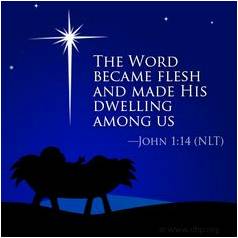
We can sing alleluias, like the angels who still sing in the heavens. CDD97A09-E1FB-4271-9382-B8B7F35697B1We can sing alleluias because “The Word became flesh and dwelt among us.”
Thanks be to God. Amen.

Advent, Angels, Belief, Bethlehem’s Star, Candlelight Service, Celebration, Christ Child, Christ’s Birth, Christmas, Christmas Eve, Church, Community, Contemplation, Faith, Hope, Mary, Mystery, peace, Reflection, Stars, Worship

“Within Reach of Our Full Personhood”

Nativity scene, Christmas star on blue sky and birth of Jesus, illustration
The Twenty-Fourth Day of Advent

Christmas Eve
December 24, 2019

As I near the end of Advent 2019, I am contemplating what these Advent days have taught me. Am I closer to God in deep relationship? Have I spent time in contemplation and prayer? Was I so preoccupied with my surgery and recovery to even think about Advent? Did I experience Advent as a time of waiting, expectation, preparation and hope in the coming of the Christ Child? Did I experience Advent at all?

You might ask yourself questions similar to these. They are questions all of us would do well to answer. As for me, I fully resonate with the statement in Ann Weems’ poem: “we are on our knees, where we are within reach of our full personhood.” Isn’t that part of what Christ’s coming was about — to place before us the hope of reaching our full personhood?

As you contemplate that, read a part of Ann Weems’ poem, “The Church Year.”

For no matter how long the darkness,
God will send the light.
In spite of cursing and violence and the massacring
of human dignity,
we will dance in the streets of Bethlehem,
for He will be born!

We search for something more.
And — of all unlikely places
in a stable
the Deity appears.

The borning of our Lord
bursts in upon our ordinary lives
like fireworks in the snow.
Only God would send a little baby King,
and we are on our knees,
where we are within reach of our full personhood.

— Ann Weems

What else can be said on this Eve of Christmas? We sit with a miracle story, an event marked by angels and the brilliance of an unusual star. We gather together in churches around the world, where we sit together in candlelight and contemplate the birth of the Christ Child, the One who came for us, the One who “became flesh and dwelt among us. We have seen His glory, glory as of the only begotten from the Father, full of grace and truth.“ (John 1:14)

I wonder why we gather for candlelight services on Christmas Eve. I think it’s because we want to experience the holy; we want to contemplate the mystery of a young girl who gives birth to the Christ Child; we want to hear the singing of angels and see the sparkling beam of an unusual star in the night sky;  we want to be together in community because, in our heart of hearts, we truly believe that it is here, together, we will be “within reach of our full personhood.”

It is God’s holy mystery, and we are invited to enter and to see the Christ Child as if it were our very first time; to hear angel song as if it were our first time; to gaze upon Bethlehem’s star as if we had never seen it before. That is the mystery: that Christ is born unto us again and again — God Incarnate, the hope of all nations and hope for our hearts. My gift to you is a video of a beautiful Christmas carol, “Candlelight Carol” written by John Rutter. Particularly if you, like me, are unable to attend a Christmas Eve service, this lovely carol might speak to your spirit and give you peace. After the lyrics, you will find the video. Happy Christmas Eve to you all

How do you capture the wind
On the water?
How do you count all the stars
In the sky?
How can you measure the love
Of a mother?
Or how can you write down
A baby’s first cry?

Candlelight, angel light
Firelight and starglow
Shine on his cradle ’til breaking of dawn
Gloria, gloria, in excelsis dear
Angels are singing, the Christ child is born

Shepherds and wise men will kneel
And adore him
Seraphim round him their vigil will keep
Nations proclaim him their Lord
And their Savior
But Mary will hold him, and sing him to sleep

Candlelight, angel light
Firelight and starglow
Shine on his cradle ’til breaking of dawn
Gloria, gloria, in excelsis deo
Angels are singing, the Christ child is born

Find him at Bethlehem laid
In a manger
Christ our Redeemer asleep
In the hay
Godhead incarnate and hope
Of salvation
A child with his mother
That first Christmas Day

Candlelight, angel light
Firelight and starglow
Shine on his cradle ’til breaking of dawn
Gloria, gloria, in excelsis deo
Angels are singing, the Christ child is born.

Advent, Angels, Bethlehem’s Star, Christ’s Birth, Christmas, Darkness, Fear, Grace, Hope, life, Mary, merry-go-round, Sacred Worth, Skies, Soul, Stars, struggle

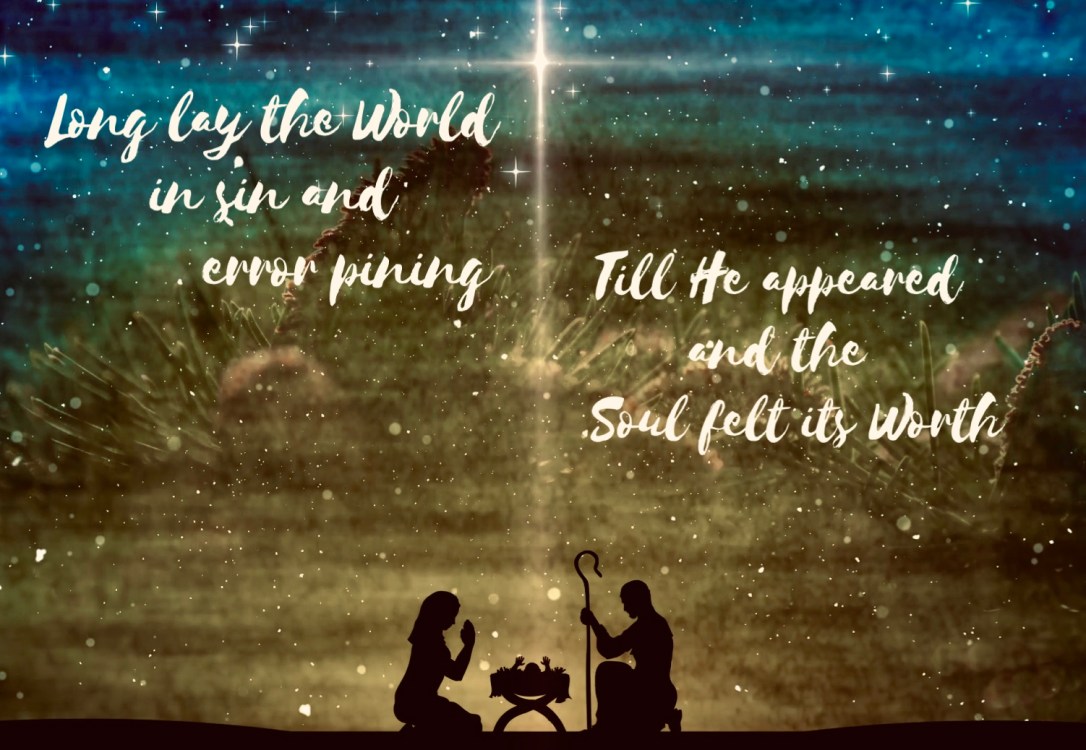
“My Soul Felt Its Worth”

8DA307E5-C1C9-4E28-B8E7-C9F52ACB2A39
The Twenty-Third Day of Advent

December 23, 2019

I think Advent may be asking me to take stock of my soul. Advent may also be beckoning to me, calling me to listen to my life. The fact is I don’t have to listen so intently these days because my life is shouting at me. Life is urging me to live in sacred space, at least for a few moments every day. Life is challenging me to contemplative prayer and times of meditation that will give me strength — to heal, to thrive, to let go of my worries, to attend to my soul, to rest in my sacred worth, to enjoy a deeper faith and to live into hope.

The thing is: I am not really experiencing Advent very deeply, and I am not listening to my life. I often feel as if I’m on a merry-go-round searching for a way to get off safely and land in a good place. I am completely preoccupied with life things, those overwhelming tasks and thoughts and worries and hopes. I could list them: 

recovery from my kidney transplant

concern about my son’s illness and his hospitalization last night
and the fact that they released him with no solutions

hopes that my grandchildren are growing up healthy and happy
and the pain of living so many miles from them

hoping that the new year will bring good tidings to us all

longing for the world to sing, “Peace on earth, goodwill to all!”
and really mean it.

I wonder what Mary worried about on that dark night in Bethlehem. Was she able to look above while this extraordinary, frightening thing was happening to her? Could she look above while she was in labor, in pain? Did she weep — tears of joy or maybe tears of anxiety? Did she despair of being in a strange place in a cold stable? As a young girl of devout faith, did she manage take a few moments to look up into the starlit darkness and see that brightest star shining on the stable? Did she hear, did she listen, to the singing of the angels? Did she listen to her life?

Listening to one’s life may well be the best thing we could do for ourselves. I have a suspicion that most of us don’t do that kind of deep listening, listening that opens us to holy possibilities. There is a beloved song that we have probably heard every year at Christmas. In its verses we find two very profound lines. The hymn writer wrote unforgettable words that made it seem as if he knew well how hard life can be.

Long lay the world in sin and error pining
Till He appeared and the soul felt its worth

—- “O, Holy Night,” Writer, Adolphe Charles Adam, who wrote this Christmas carol Minuit, chrétiens! (1844), later set to different English lyrics and widely sung as “O Holy Night” (1847).

The soul felt its worth! What a thought to aspire to and eventually to know that my soul can feel its worth. I have a feeling that Advent might be calling me to listen to my life, to open myself to the song of angels and the light of Bethlehem’s star, and that in listening, my soul would begin to feel its worth.

Theologian, Fredrick Buechner, says it like this:

Listen to your life. See it for the fathomless mystery that it is. In the boredom and pain of it no less than in the excitement and gladness: touch, taste, smell your way to the holy and hidden heart of it because, in the last analysis, all moments are hidden moments and life itself is grace.

It would indeed be a precious Christmas gift for my heart to know that “life itself is grace,” and that in life’s grace that God gives, I would know beyond all knowing that my soul feels its worth.

Amen.

Advent, Angels, Bethlehem’s Star, Christ’s Birth, Comfort, Despair, Emotions, Fear, God’s Gift of Stars, Grace, grief, healing, Hope, Loss, Love, Mourning, New Normal, Questions, Resilience, struggle, Tears

“Listening for the Rustle of Angels’ Wings”

D621BE3F-47CD-4621-8417-E85BDA660590

The Fourth Sunday of Advent
The Advent Sunday of Love
Transplant Day Forty-One
December 22, 2019


TO LISTEN, TO LOOK

Is it all sewn up — my life?
Is it at this point so predictable,
so orderly,
so neat,
so arranged,
so right,
that I don’t have time or space
for listening for the rustle of angels’ wings
or running to stables to see a baby?
Could this be what he meant when he said
Listen, those who have ears to hear . . .
Look, those who have eyes to see?
Oh God, give me the humbleness of those shepherds
who saw in the cold December darkness
the Coming of Light,
the Advent of Love!

— Ann Weems

I ask myself those Ann Weems questions often:

Is it all sewn up — my life? Is it so predictable, so orderly, so neat, so arranged, so right,
that I don’t have time or space for listening for the rustle of angels’ wings or running to stables to see a baby?

These are among the most important questions I might sit with for a while, pondering my answers. On this Advent Sunday when we light the Candle of Love, I suddenly realize that Advent is ending, bringing Christmas so abruptly, or so it seems. Am I ready, I wonder? Am I ready for the birth of the Child, “Love’s Pure Light?”486917B0-E862-4C44-895D-D08210690B48

Have I prepared a place in my heart for the “pure unbounded love” we sing about in the beloved hymn, “Love Divine, All Loves Excelling?” Was my life so preoccupied that I missed the gentle darkness of the Season of Advent and am now feeling pushed — shoved —into Christmas?

Love in a manger is too holy a gift to take for granted. Love in a manger offers us a gift that we must be prepared to receive, and Advent is our season of preparation. As the season ends, I cannot help but ask myself if I spent these days preparing myself, heart and soul. Did I pray enough? Did I spend enough contemplative time? Did I love my neighbor and care for the persons around me who had so many life needs? Did I create sacred, meditative moments in anticipation, preparing for Emmanuel to come into my life anew?

I’m afraid I must answer, “no.” Yes, I did reflect on Advent now and then as I wrote for my blog, but I definitely did not spend enough time in meditation, preparing myself to receive the Christ Child. I was completely preoccupied with creating my life’s new normal after my kidney transplant. New routines and schedules overwhelmed my mind. I spent virtually all my time adjusting to this new normal. Self-absorbed does not adequately describe me during this Advent.

I haven’t felt much holiness hovering around me. I didn’t have time or space “for listening for the rustle of angels’ wings.” Yet, the transplant itself was a season somewhat like Advent . . . filled with expectation, preparation, anticipation. With Bethlehem’s star shining through the darkest night, and hope — always hope.

And so it was for people waiting for kidneys to renew their lives. Advent offered us a look at journey, a journey that ended in celebration. Celebration came full circle yesterday when I learned that my transplant was a part of a chain of living donors and kidney recipients. The chain included 16 people — donors and recipients — which means eight people got new kidneys. Perhaps that felt to me something like “the rustle of angels’ wings.”

And then it dawned on me that the Christ Child was not born into a world where everything always worked perfectly, where everything was orderly and neat and planned out. The Christ Child was not born into a world where everything was sacred. He was not born into a perfect family, and the people around his manger were not always holy.

Maybe that’s part of what Advent gives us:

the grace to be genuinely who we are — on our holy days and on days we feel not-so-holy. Maybe Advent beckons us to ready ourselves and to prepare our hearts with humbleness so that we can see “in the cold December darkness . . .

the Coming of Light, the Advent of Love!”


Advent, Angels, anxiety, Bethlehem’s Star, Calamity, Challenge, Christ Child, Christ’s Birth, Covenant, Darkness, Despair, Emotions, Exhaustion, Fear, God’s Gift of Stars, grief, Hope, Loss, Newer Skies, Resilience, Skies, Stars, struggle, Suffering

It Is Not Over!

74F6A7EB-ADEC-4722-928F-B154D37CDF66

The Twenty-First Day of Advent
December 21, 2019

The sages of the world came up with this wise saying: “It’s not over ‘till it’s over!” There are some similar sayings around, most notably one about the singing of a “fat lady.” But that one is not at all kind or sensitive! The point is that in life some things are never over. Grief at losing a loved one comes to mind, as does living with an incurable illness, losing a cherished relationship or any number of persisting, chronic, never-ending difficulties.

But the truth is, we are a resilient people, created by God who fully equips us for life’s calamities. We do not shrink in the face of loss. We know that weeping can last through a dark night, but the morning light may bring joy. We do not fear life’s dark times, because we know that our story is not over. There will be brighter days ahead. The brightest stars will give light in the darkest nights. Our resilient spirits will lift us up and, most importantly, God will be near right in the midst of our sufferings. It is not over! I am inspired by the thoughts of Ann Weems about this very thing:

IT IS NOT OVER

It is not over,
this birthing.
There are always newer skies
into which
God can throw stars.
When we begin to think
that we can predict the Advent of God,
that we can box the Christ
in a stable in Bethlehem,
that’s just the time
that God will be born
in a place we can’t imagine and won’t believe.
Those who wait for God
watch with their hearts and not their eyes,
listening
always listening
for angel words.

— Ann Weems

What profound truth: that those who wait for God watch “with their hearts and not their eyes,” listening — always listening — for angel words. We can find another take on that spoken by the Prophet Isaiah:

Those who wait upon the Lord will renew their strength. They will mount up with wings as eagles. They will run and not grow weary. They will walk and not faint.

— Isaiah 40:31

When I think that I have reached the end of my resilience, when I have become weary with my life’s tragedies and believe that it’s over, I want to be able to remember the words Ann Weems wrote, that “it is not over, this birthing, and that there are always newer skies into which God can throw stars.”

Like you, I need newer skies now and then. And if God can throw stars into those new skies, all the better. Advent’s promise is that those stars of hope will appear just when I most need them.

May God make it so, and may we remember stars of hope and angel words whenever we celebrate the Christ Child born under the light of Bethlehem’s star. Amen.


Advent, Angels, Emotions, Fear, grief, Hope, Music, Sorrow, struggle, Suffering, Tears

An Angel-Filled Advent


E280C016-69CC-4A56-AE5E-0FB8E3680287

The Twentieth  Day of Advent
December 20, 2019

With a brief update on my transplant journey 


ANGEL-FILLED ADVENT

Wouldn’t it be wonderful
if Advent came filled with angels and alleluias?
Wouldn’t it be perfect
if we were greeted on these December mornings
with a hovering of heavenly hosts
tuning their harps and brushing up on their fa-la-las?
Wouldn’t it be incredible
if their music filled our waking hours
with the promise of peace on earth
and if each Advent night we dreamed of
nothing but goodwill?
Wouldn’t we be ecstatic
if we could take those angels shopping
or trim the tree or have them hold our hands
and dance through our houses decorating?
And, oh, how glorious it would be
to sit in church next to an angel
and sing our hark-the-heralds!
What an Advent that would be!
What Christmas spirit we could have!
An angel-filled Advent has so many possibilities!
But in lieu of that
perhaps we can give thanks
for the good earthly joys we have been given
and for the earthly “angels” that we know
who do such a good job of filling
our Advent with alleluias!

— Ann Weems

I love the idea of an angel-filled Advent. It sounds like mystical, magical Advent and, most assuredly, an angel-filled Advent does have so many possibilities!

Reality is a very different state for us and, even in Advent, we whisper the word “impossible”. We live with “impossible” in our hearts and deep within our souls where all the pain lives, and all the disappointments, all the grief and all the impossibles. “That’s life,” the sages say, the wise ones who have lived every circumstance and held on their shoulders all sorts of mourning.

And so it is with me and with you. We hold mourning and utter, “This situation is impossible!” During Advent as we prepare to celebrate Christmas, the pain is deeper in us, the losses pierce our hearts, the life challenges seem impossible. When we mourn the loss of a loved one during this season, the mourning hurts more and the loss goes deeper. When we grieve because we struggle with serious illness, the grief is more intense. When we live in fear for our children, the fear is stronger. It is in those circumstances that we ask in frustration, “Where are Advent’s angels? Where is their music?”

I hope you will take a few minutes to enjoy John Rutter’s arrangement of “Angel’s Carol.”Here are the lyrics:

Have you heard the sounds of the angel voices ringing out so sweetly,
ringing out so clear?

Have you seen the star shining out so brightly
as a sign from God that Christ the Lord is here?

Have you heard the news that they bring from heaven
to the humble shepherds who have waited long?

Gloria in excelsis Deo!
Hear the angels sing their joyful song.

He is come in peace in the winter’s stillness,
like a gentle snowfall in the gentle night.

He is come in joy, like the sun at morning,
filling all the world with radiance and with light.

He is come in love as the child of Mary.
In a simple stable we have seen his birth.

Gloria in excelsis Deo!
Hear the angels singing ‘Peace on earth.’

He will bring new light.
He will bring new light to a world in darkness,
like a bright star shining in the skies above.

He will bring new hope.
He will bring new hope to the waiting nations.
When he comes to reign in purity and love.

Let the earth rejoice.
Let the earth rejoice at the Saviour’s coming.
Let the heavens answer with the joyful morn:

Gloria in excelsis Deo!
Hear the angels singing, ‘Christ is born.’

As for me, what kind of mourning am I holding this Advent season? What kind of pain, disappointment, loss am I feeling? I feel worry, of course, about my kidney transplant. When Mayo Clinic called yesterday insisting that I return immediately, I was concerned. My blood levels were dangerously high and I was experiencing a great deal of discomfort. The doctor ordered immediate ultrasounds of my kidney and right leg looking for pockets of fluid or blood clots. I am hopeful that both tests will come back with the word “normal” stamped on the report. In spite of the things that seem “impossible,” I hang on to hope.

That’s what Advent does — fills us with hope that begins on the First Sunday of Advent when we light the Hope Candle.

So to those questions about mourning, pain, disappointment, worry and fear, I have no adequate answers. No matter how much I want an angel-filled Advent and Christmas, I see no way out of the “impossible” seasons of life, but Ann Weems might:

. . . perhaps we can give thanks
for the good earthly joys we have been given
and for the earthly “angels” that we know who do such a good job of
filling our Advent with alleluias!

May Emmanuel — God-with-Us — make it so. Amen.