anxiety, Challenge, Clouds, Comfort, Darkness, discouragement, Faith, Fear, God’s promises, Grace, healing, Heartbreak, Hope, life, Light, Noah, Pandemic of 2020, peace, Prayer, Rainbows, Reflection, Restoration, Sacred Space, Soul, Spirit

On Making Your Own Rainbows

A4907FB5-C512-4C7D-AA48-A1445E359B91

In my kitchen window hangs a small faceted crystal ball. It’s purpose is to hang in the sunlight and make tiny rainbows in my kitchen. When I open the blinds in the morning, the facets on the ball do their job.
AB5CB98D-F367-4BB8-A219-0D201CA5347E

I see about eight small rainbows on the floor — just tiny, insignificant rainbows on the kitchen floor. That’s it!

My first response is, “That’s all you got?”

I had hoped for more, like refracted rainbows all over the kitchen. The little ball hanging in the window apparently needed some human help. So I twisted it several times. When I let it go, the little ball’s gift to me was dancing rainbows, not only on the kitchen floor, but also all over the walls of the kitchen, dining room and living room. Now that’s more like it!

0936BD45-60F2-4663-A251-3FAEC7160D4D

It suddenly occurred to me that I could let the ball just hang motionless in the window, settling for the few rainbows on the floor, or I could twist it and see rainbows in motion creating a celebration all around the walls. So this morning, I made my own rainbows, which is a pretty good mental picture of creating rainbow-like times in life.

It reminds me of part of Noah’s story told in the ninth chapter of Genesis. It’s about the covenant God made with Noah after the great flood had receded. You probably know the story well, but it bears revisiting.

And God said, “This is the sign of the covenant I am making between me and you and every living creature with you, a covenant for all generations to come: I have set my rainbow in the clouds, and it will be the sign of the covenant between me and the earth.

Whenever I bring clouds over the earth and the rainbow appears in the clouds, I will remember my covenant between me and you and all living creatures of every kind. Never again will the waters become a flood to destroy all life. Whenever the rainbow appears in the clouds, I will see it and remember the everlasting covenant between God and all living creatures of every kind on the earth.”

So God said to Noah, “This is the sign of the covenant I have established between me and all life on the earth.”

— Genesis 9:12-17 NIV
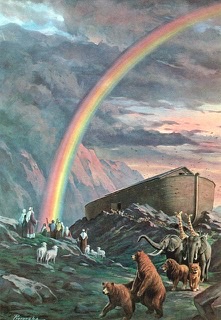
EAB02D98-3E58-48CF-B77D-1C2426E32954I never see a rainbow without remembering the story of God’s covenant with Noah. I always remember that God made the rainbow a sign, the sign of a covenant promise.

What does that have to do with me and you? Maybe not much for some. But for some of us — those of us who want to see tangible signs of God’s promises — the appearance of a rainbow means that God still covenants with us, God still makes promises to us and God still keeps those promises. That is God’s grace to us — God’s hope, God’s light, the very peace that comes to us from God.

With that assurance, we are able to make our own rainbows. Yes, in these days we are covered with a terrible, deadly virus, along with the fear it causes us. But we also know that, in days past, we have faced life storms, dark times that threatened to destroy us. And yet, we survived — with scars from old wounds, to be sure — but we weathered each terrifying time and found our way to better days. To survive the worst times of our lives — times when dark, heavy clouds loomed over us — I’m pretty sure we found ways to make our own rainbows.

What does it look like to make our own rainbows? It looks like seeking out a comforting friend, making sacred space for nurturing your soul, owning heartbreak so that you can be open to the healing of your heart, naming in prayer the wounds and scars of your soul so that your spirit can be made whole.

It seems to me that this is what “making your own rainbows” means — being open to healing through whatever ways you find soul-nurturing. Rainbows are not a bad analogy for the living of these days. A pandemic threatens us. We cannot change that, but we can change our response to this dark time. I believe that we really can make our own rainbows. Maybe for me it will simply be the act of twisting the crystal ball in my kitchen window. But if that insignificant act reminds me of God’s promise to be with me, to be in covenant with me, then I think I can make it through another dark time.

I am confident that, if you listen, your soul will whisper to you and tell you how to make your own rainbows — during these troubling days and for all the troubling times you may face on your journey.

May God make it so for you and those you love!

Be well and stay safe.

— KMF

anxiety, Christ's Passion, Christ’s Resurrection, Comfort, Community, Courage, Faith, Fear, God's presence, Heartbreak, Hope, Isolation, Loss, Pandemic of 2020, Psalms, Resurrection, struggle, Sunday of the Palm and Passion

In a Shaken Time . . . The Unshakable

59D5B9FF-187F-47B4-8727-948A56F8268B

I have written often about times when I have been shaken to my core, the hard times and the seasons of angst. Not because hard times have been a constant in my life, but because in the middle of them, I have found a Divine Constant that sustained me at times and saved me at other times.

As we approach the Sunday of the Palm and Passion, we remember the journey Jesus traveled.

. . . the great crowd that had come to the festival heard that Jesus was coming to Jerusalem. So they took branches of palm trees and went out to meet him, shouting,“Hosanna! Blessed is the one who comes in the name of the Lord— the King of Israel!” (John 1:12-13 NRSV)

Yet, before the day is done, the Gospel of John tells us how troubled Jesus was as he spoke about his death.

Now my soul is troubled. And what should I say—‘Father, save me from this hour’? No, it is for this reason that I have come to this hour. (John 1:27-28 NRSV)

As we recall Christ’s passion, we cannot help but recognize our own — and the passion of our families, friends, neighbors scattered throughout the world. Each of us, no matter where we are, are covered with the fear of a pandemic we can not begin to understand, the virus that knows no boundaries. It goes where it will, infecting those exposed to its microorganisms and leaving fear and anxiety in its wake. We are shaken to the core.

Those who are infected, or have watched as their infected loved ones battle the virus, cry out for mercy, for grace and for comfort. They are in search of the Divine Constant, a “very present help,” who keeps vigil with us offering a comfort that surpasses our ability to comprehend it. There is no better description of divine comfort than the words of the Psalmist in the 46th Psalm that tells us to take heart, hang on, fear not.

God is our refuge and strength,
a very present help in trouble.

Therefore we will not fear, though the earth should change,
though the mountains shake in the heart of the sea;
though its waters roar and foam,
though the mountains tremble with its tumult.

There is a river whose streams make glad the city of God,
the holy habitation of the Most High.
God is in the midst of the city; it shall not be moved;
God will help it when the morning dawns.

The nations are in an uproar, the kingdoms totter;
he utters his voice, the earth melts.
The Lord of hosts is with us;
the God of Jacob is our refuge.

Come, behold the works of the Lord;
see what desolations he has brought on the earth.

He makes wars cease to the end of the earth;
he breaks the bow, and shatters the spear;
he burns the shields with fire.

“Be still, and know that I am God!
I am exalted among the nations,
I am exalted in the earth.”

The Lord of hosts is with us;
the God of Jacob is our refuge.

At the very beginning of the Cold War in 1952, Harry Emerson Fosdick spoke to students and faculty at the Pacific School of Religion. After acknowledging the very real fear and uncertainty in the world at that time, he spoke these words: “The highest use of a shaken time is to discover the unshakable.”

Oh, that we might find the highest use of this time! Oh, that we might find it alone — isolated in our homes, in our prayer closets, in the breeze and beauty of springtime! Oh, that we might find the highest use of this time in community — in all the ways we are striving to create holy community despite our isolation.

Yes, we are shaken right now, but again the Psalmist has the last word of divine comfort and hope.

The Lord is close to the brokenhearted
and saves those who are crushed in spirit.
(Psalm 34:18 NIV)

As I look around, hearing from those closest to me and also hearing the stories of people around the world, I witness signs that we are indeed discovering the unshakable in this shaken time — the unshakable in ourselves, the unshakable faith we hold in our hearts, the unshakable spirit within us and the Unshakable Constant God who pours grace upon us when we most need it.

May each of you stay safe and healthy. May you wave your palms and witness Christ’s passion still believing in the resurrection that will dawn upon our lives again. May you find the unshakable within you and hold the Unshakable God near you.

For a time of prayer and meditation, you may be inspired by listening to this beautiful arrangement of the hymn, “Nearer, My God, to Thee.”


anxiety, Art, Community, Complaints, Dancing, Fear, Friends, healing, Home, Hope, Lent, Mindfulness, Pandemic of 2020, Perseverance, Prayer, Rebirth, Resilience, Rest, Spiritual growth

Times Terrifying and Beautiful

5079BD7F-9718-48CB-A9C2-95648BAC59BA
These days are terrifying and beautiful. After all, in times when we are harried with work responsibilities, we might just say, “I wish I was home in my pajamas!” So here we are at home — maybe in our pajamas — settled in, comfortable, rested, and maybe restless. At least some of us are settled in at home. Some of us are rested. Others, no doubt, find themselves restless. It makes me wonder if the opposite of rested is restless. So I turned to my trusted thesaurus to find out. It turns out that the antonyms — the opposites — of “restless” are peaceful, quiet, relaxed, settled, calm and unworried.

I don’t know about you, but I want to be an antonym of restless. That is, if a person can even be an antonym in the first place. I doubt it, but what I do not doubt is the existence of the kind of human resilience that can weather pandemics. Be assured that human resilience is not a “grin and bear it” state of being. Resilience is not merely being resigned to a situation or just sticking it out. Resilience is not passive acquiescence to challenging situations. Resilience resides in a soul that is able to persevere, to rest calmly through struggle, to abide in a state of mindfulness, to meditate on the goodness of God, to walk in the darkness until the light reappears.

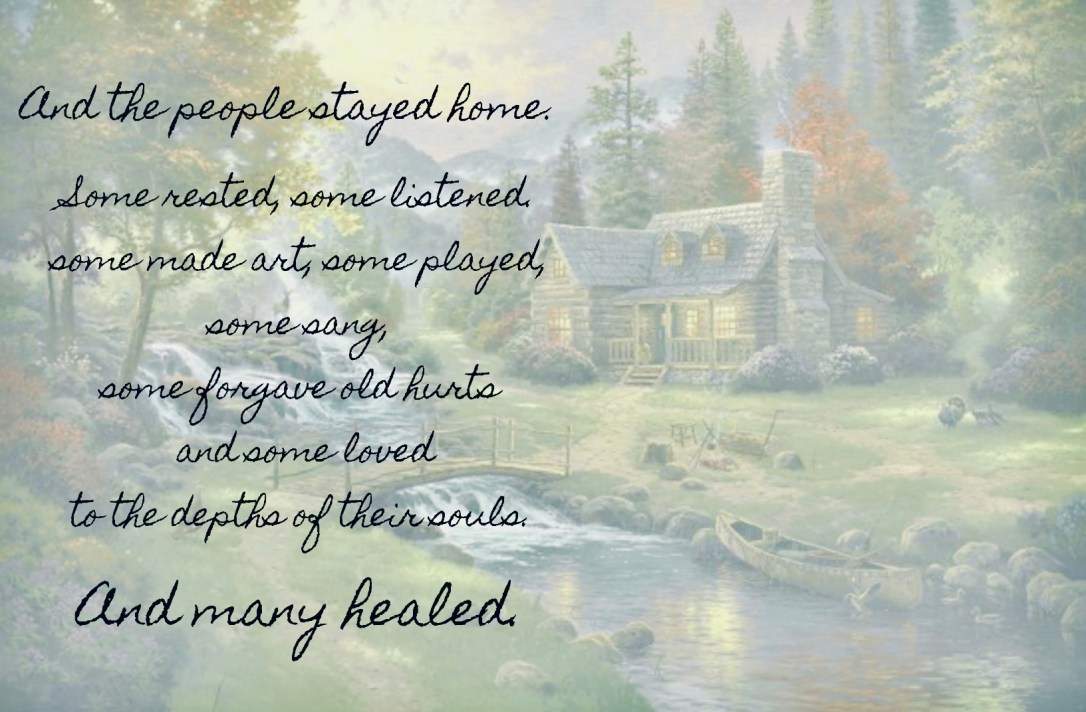
I can certainly identify with the quote that has recently been going around: “And the people stayed home.” It’s striking that, in the midst of the fear and anxiety people feel in these pandemic days, many have recalled and published parts of this quote. Let us spend a few moments contemplating the quote in it’s entirety:

And The People Stayed Home

And the people stayed home. And read books, and listened, and rested, and exercised, and made art, and played games, and learned new ways of being, and were still. And listened more deeply. Some meditated, some prayed, some danced. Some met their shadows. And the people began to think differently.

And the people healed. And, in the absence of people living in ignorant, dangerous, mindless, and heartless ways, the earth began to heal.

And when the danger passed, and the people joined together again, they grieved their losses, and made new choices, and dreamed new images, and created new ways to live and heal the earth fully, as they had been healed.

– Kitty O’Meara

To be clear, I am not suffering this pandemic as one who has contracted the virus. I am suffering the forced isolation, the inability to reach for someone’s hand, to touch a friend, to embrace my grandchildren. And I have not been isolated only because of this pandemic; I have been isolated from others since my kidney transplant on November 12. That’s a very long time to be separated from my community. Through that time, a friend or two visited me, but we could not touch one another or be in close proximity.

And now the coronavirus has isolated virtually everyone, and I suddenly realize that we’re all in this together. It makes me wonder what everyone is doing at home. And it makes me hope that at least a few of us are doing as Kitty O’Meara writes, “Some meditated, some prayed, some danced. Some met their shadows.“

On the idea of meeting our shadows . . .  I consider Lent to be a time of confession, a time of looking into my heart of hearts, my soul of souls, confessing my sins to God and receiving God’s mercy and pardon. I emerge from my confession with my soul cleansed. Only then am I ready. I am ready to steel my heart and set my face toward the journey with Christ to the cross. and then prepare my heart for glorious resurrection.

My confession today is that I have cursed my isolation rather than giving it to God and allowing myself to enter into a place of rest and re-creation, a sacred space that would heal the anxieties of my soul. I confess that I did not dance or pray. I did not rest or make art. But the pandemic changed my soul’s response to my isolation. I found that I was no longer in post transplant isolation, I was now in pandemic isolation and it felt very different to me. It felt dangerous and potentially fatal. It felt far-reaching, pervasive and rampant. It felt lethal, at least potentially lethal.

In the face of the pandemic’s imminent danger, my soul stopped its complaining and began its healing, my healing. It was the healing I needed all along, but now an ominous virus flipped a switch inside me. I did art again for the first time since the transplant. I sang, I prayed, I meditated. And I met my shadow and re-discovered the hidden place where fear reigns within me. That was not a bad thing. Rather, it was a good thing that said to me, “Do not give power to your hidden fear. Let your hidden resilience have the power and let it rise up within you. You will be healed!”

I believed those words — literally, as I hoped for physical healing after my transplant; and completely, body and soul, as I accepted the spiritual and emotional healing my soul craved. I want to leave you with a poem written on March 11, 2020 by Lynn Ungar.

D87DE2F1-852B-4017-B25F-232CA8AB094B
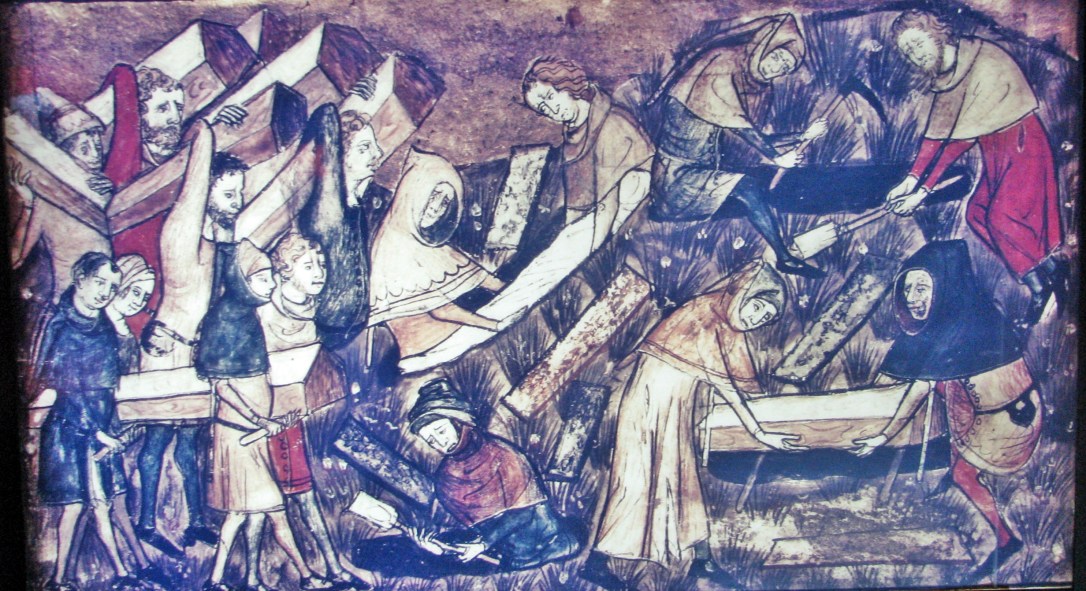
Blackdeath.   Wikimedia Commons

Pandemic

What if you thought of it
as the Jews consider the Sabbath —
the most sacred of times?
Cease from travel.
Cease from buying and selling.
Give up, just for now,
on trying to make the world
different than it is.
Sing. Pray. Touch only those
to whom you commit your life.
Center down.

And when your body has become still,
reach out with your heart.
Know that we are connected
in ways that are terrifying and beautiful.
(You could hardly deny it now.)
Know that our lives
are in one another’s hands.
(Surely, that has come clear.)
Do not reach out your hands.
Reach out your heart.
Reach out your words.
Reach out all the tendrils
of compassion that move, invisibly,
where we cannot touch.

Promise this world your love —
for better or for worse,
in sickness and in health,
so long as we all shall live.

Lynn Ungar is a poet, and wrote this poem on March 11, 2020, in response to the Covid-19 pandemic.


anxiety, Calamity, Change, Comfort, Community, Compassion, Confusion, Darkness, Death, Despair, Fear, God's Faithfulness, Grace, Hope, Illness, Isolation, life, Loneliness, Loss, Love, Mourning, Pandemic of 2020, Sorrow, Suffering, Tears, Terror

“Crimson Contagion,” Grace and Eternal Hope

1639C8B4-DC47-49B6-84A3-CC49557F0464
Today of all days, with the entire world embroiled in a real live pandemic, I will not write out of political bias. Instead, I want to open our eyes to some very troubling present realities. My focus is on the coronavirus pandemic in the United States and how circumstances have transpired, both on a logistical level and a human one. I read a Huffington Post article this morning revealing that last year the U.S. Department of Health and Human Services conducted a months-long exercise that showed that the nation was unprepared for a pandemic. The exercise, code named “Crimson Contagion,” had chilling similarities to the current real-life coronavirus pandemic. That fact got my attention!

microscopic magnification of coronavirus that causes flu and chronic pneumonia leading to deathThis pandemic has taken a toll on so many Americans. Mothers are struggling with children being at home, some having to learn on the fly how to home school them. Families grieve the loss of loved ones who died from the virus. Older adults fear their increased vulnerability and their body’s inability to fight the virus. Immunosuppressed persons like I am are terrified to leave home and are incessantly washing their hands, wearing masks and using hand sanitizer. Many people have lost their jobs while businesses all over the country have shut their doors. Churches have suspended worship services and other gatherings indefinitely. That is merely a tiny snapshot of the human toll the coronavirus is taking.
On top of any list we could make describing loss, inconvenience or isolation, there is widespread, overwhelming fear that has made its way into our very souls. This is a pandemic that has descended upon all of us — real people with real fear.

I’ll get back to the human toll of this virus, but I want to say a bit more about the “Crimson Contagion” exercise, which involved officials from more than a dozen federal agencies. The Huffington Post described the “Crimson Contagion” scenario:

 . . . several states and hospitals responding to a scenario in which a pandemic flu that began in China was spread by international tourists and was deemed a pandemic 47 days after the first outbreak. By then, in the scenario, 110 million Americans were expected to become ill.

The simulation that ran from January to August exposed problems that included funding shortfalls, muddled leadership roles, scarce resources, and a hodgepodge of responses from cities and states . . . It also became apparent that the U.S. was incapable of quickly manufacturing adequate equipment and medicines for such an emergency . . .

According to a New York Times report, White House officials said that an executive order following the exercise improved the availability of flu vaccines. The administration also said it moved this year to increase funding for a pandemic program in HHS.

But Trump’s administration eliminated a pandemic unit within the Department of Homeland Security in 2018. And weeks after the first real coronavirus case was diagnosed in the U.S., Trump submitted a 2021 budget proposal calling for a $693.3 million reduction in funding for the Centers for Disease Control and Prevention.

There you have it! In the throes of our real time pandemic, we hear of a “play-like” pandemic — a simulation conducted in 2019 that might have prepared us all, including our nation’s leadership. That didn’t happen, and those of us who have been in the world for so many years know the saying well: “Don’t cry over spilt milk.”

So we wipe up the milk that’s all over the table in front of us, and then we go about making our way through the dark, murky waters of this pandemic. We wash our hands, distance ourselves from others, stay at home, figure out how to handle our children who are now at home, cancel our travel plans, mourn those who have died, pray for those who are ill from the virus, grieve the loss of the life we knew before and pick up the pieces of what’s left.

What’s left? Well, what’s left is our ability to find ways to help our neighbor, to feed the hungry, to comfort the sick, to reach out to the lonely, to love the children and to pray for one another without ceasing. We may have to learn to do those things by phone or online chatting, but we will find a way.

1CA928D0-F17B-45DA-87F8-BC306F38EA32
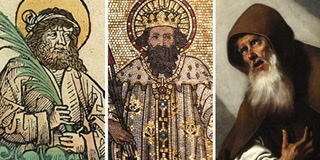
Fr. Lawrence Lew, O.P.; public domain; St. Quirinus of Neuss – for those affected by bubonic plague and smallpox; Edwin the Martyr (St. Edmund) — for victims of pandemics; St. Anthony the Great – Patron of those affected by infectious diseases

Those of us who are religious will pray without ceasing — imploring God to be merciful, asking various saints to intercede for us, lighting candles to express devotion and sitting for a moment in the flickering light that reminds us that God’s promise is about light overcoming the darkness.

The light shines in the darkness,
and the darkness has not overcome it.
(John 1:5)

In the end, perhaps we will have discovered that, through this terrifying and expanding virus, that we have learned how to care more and to love deeper. Perhaps we will find that we have a more heartfelt capacity for compassion. For that, God will pour out grace upon our weariness and renew our eternal hope.

If you pour yourself out for the hungry and satisfy the desire of the afflicted, then shall your light rise in the darkness and your gloom be as the noonday.
(Isaiah 58:10 ESV)

May God make it so. Amen.


Activism, Advocate, Community activism, Compassion, Discrimination, Division, Hope, Inspiration, Racism, reconciliation, Repair the world

A Picture of Good Hope

0EC37F67-B415-44A7-88FC-DEAB6E8A4A81
Photo credit: A group of black medical students posed in front of the slave quarters on a Louisiana plantation for a powerful photo. (Brian Washington Jr./Doyin Johnson)


It happened in Wallace, Louisiana on December 18, 2019.

On that day, a group of Tulane University medical students posed in front of the slave quarters of a Louisiana plantation for a powerful photo. Sydney Labat, one of the students, said this in an interview on Good Morning America:

Standing at the Whitney Plantation in front of the slave quarters of our ancestors with my medical school classmates . . . We are truly our ancestors’ wildest dreams. I think I speak for myself and my classmates that it was an extremely humbling experience, to say the least. We would not be here without the strength and determination of those enslaved and their strength to live and to press on.

Labat speaks of the resilience of her ancestors and she credits her ancestors’ resilience for her ability to pursue an education. I shared the photo (above) because it represents the realization of dreams that many people might label “impossible.” But seeing Labat and 14 of her Tulane University classmates in their white coats looked to me like a portrait of the realization of dreams, persistence against all odds and an emulation of the determination of the ancestors Labat spoke of. This photo of the students was posted to Twitter and was liked more than 65,000 times.

I like the photo, too —  a picture of good hope.

I cannot adequately express my emotions about seeing the photo of these students. No doubt, it brought up my deep concern about the well-being of black children in this country and the many disparities they endure. I can not begin to lay out those disparities in a coherent way, but I can cite this troubling research.

Black adolescents and young adults are at higher risk for the most physically harmful forms of violence (e.g., homicides, fights with injuries, aggravated assaults) compared with whites. In addition, black adults reported exposure to a higher number of adverse childhood experiences than whites.Disproportionate exposure to violence for blacks may contribute to disparities in physical injury and long-term mental and physical health. https://www.ncbi.nlm.nih.gov/pubmed/30139709

A study regarding youth and suicide revealed an age-related trend in racial disparities in suicide rates in elementary and middle school–aged children. The study, published in JAMA Pediatrics, showed that suicide rates for black children aged 5-12 were roughly 2 times higher than those of similarly-aged white children. https://www.ajmc.com/newsroom/racial-disparities-seen-for-black-children-age-512-in-youth-suicide-

A significant amount of research has documented the overrepresentation of certain racial and ethnic populations — including African-Americans and Native Americans —in the child welfare system when compared with their representation in the general population.Although disproportionality and disparity exist throughout the United States, the extent and the populations affected vary significantly across States and localities. https://www.childwelfare.gov/pubpdfs/racial_disproportionality.pdf

This researched information is definitely not a picture of good hope. The research deepens my concern, but what troubles me the most is that my grandchildren are growing up in a raciallly and ethnically divided world. When we raised our son, we certainly experienced racial discrimination. It was painful for all of us, and I hope beyond hope that my young grandchildren will not face the evil of discrimination. But I know better! I do not want to be pessimistic about it; I want to be optimistic that my grandchildren will not be “judged by the color of their skin” and that they will know the freedom to live out their dreams.

Tulane University Medical Students

So these Tulane University Medical students have given me a gift — a picture of good hope. And the photo of these students also introduced me to another place of hope: the Whitney Plantation, the only plantation museum in Louisiana with an exclusive focus on the lives of enslaved people.

73294CDC-A48F-4E27-ABE0-4DD30A9E02FFThe Whitney Plantation has restored buildings designed to encourage guests to enter the world of a Louisiana sugar plantation and to remember those who built and worked this property. Through an hour-and-a-half guided walking tour, a guide shows guests through slave cabins, a freedmen’s church, a detached kitchen and outbuildings, a 1790s owner’s house and memorials built to honor the enslaved.

22DDD58C-BBB8-40E5-AB21-DEA4D972D431
A stunning bronze memorial at The Whitney Plantation in Louisiana *

Guests learn about the lives of 350 people who were held in bondage on these grounds for over 100 years.

Visitors are able to view beautiful memorials built to honor over 100,000 people held in slavery in Louisiana.

Tickets for the tour are available at the Whitney Plantation’s website: https://www.whitneyplantation.org/

Information overload and emotional response

This blog post has included a bit of information and research. That’s the informational part. The truth is, though, that the harsh realities of divisiveness caused by racism, xenophobia and a host of other factors that divide us are not a part of the information we have. Instead, the realities of racism are part of our emotional angst. If we are honest with ourselves, we will realize that we receive informational material with a yawn. We have heard so many statistics and seen so much empirical evidence in our communities and schools that we have become numb to it. We have heard so much about disproportionate minorities in the criminal justice system and mass incarceration that perhaps we just try to block that information out. But we cannot block out our emotional response.

The only thing that will get our attention is a soul understanding of the pain of racism. Only then will we become agents of change, persons of conscience and advocates for justice. For me, this is a calling from God who desires that we “love our neighbors as we love ourselves.”

Consider these passages of Scripture.

In that renewal there is no longer Greek and Jew, circumcised and uncircumcised, barbarian, Scythian, slave and free; but Christ is all and in all.  — Colossians 3:11

Let mutual love continue. Do not neglect to show hospitality to strangers, for by doing that some have entertained angels without knowing it. Remember those who are in prison, as though you were in prison with them; those who are being tortured, as though you yourselves were being tortured.  — Hebrews 13:1-3

The alien who resides with you shall be to you as the citizen among you; you shall love the alien as yourself, for you were aliens in the land of Egypt: I am the Lord your God.  — Leviticus 19:34

Thus says the Lord of hosts: Render true judgments, show kindness and mercy to one another; do not oppress the widow, the orphan, the alien, or the poor; and do not devise evil in your hearts against one another.  — Zechariah 7:9-10

You have heard that it was said, ‘you shall love your neighbor and hate your enemy’. But I say to you, love your enemy and pray for those who persecute you.
— 
Matthew 5:43-44

May each of us listen carefully to the words of Scripture and allow those words to inspire us and may that inspiration compel us to end divisions that harm. May we be inspired to promote unity and justice. May we be inspired to paint a picture of good hope to guide our world.

* Photo credit: https://www.whitneyplantation.org/photo-gallery/


Beauty of Nature, Bible, Birdsong, Comfort, Darkness, Ecclesiastes, Emotions, God’s Gift of Stars, healing, Hope, Joy, Laughter, life, Loss, Music, Nature, Psalms, Restoration, simple joys, Stars, Trees, Troubles

Almost Magic!

3A2F0634-063D-4F26-B01F-F36B8CFE6EF9
Photo by James Ronan,  FOAP/Getty Images

Today, while minding my own business — and browsing the Better Homes & Gardens website — I stumbled across a stunning image of a tree. Those of you who know me, know that I have had a lifelong passion for trees. Trees, for me, are not only beautiful, they also take me often into a spiritual place. This morning while looking at the bark of the Rainbow Eucalyptus tree (Eucalyptus deglupta), my thought was, “This is almost magic! It can’t be real!”

Rainbow Eucalyptus trees look too beautiful to be real (but they are!) (BH&G) 

These  trees have an astounding multicolored bark that looks like it’s been decorated with a humongous paintbrush. They seem like something one might imagine, or see in a fantasy movie, or discover in a Dr. Seuss book. But they do grow naturally with a brilliantly colored bark. The Rainbow Eucalyptus, which grow 100 to 200 feet tall, are native to tropical regions like the Philippines, Papua New Guinea, Indonesia and even in the most southern parts of the U.S. “Though pictures of these trees are stunning, they don’t quite capture the awe of seeing them in person.

A real rainbow eucalyptus can stop you in your tracks, so if you have the chance to travel to see them, it’s well worth the journey. (BH&G)

As you would expect, I did some research to find places where I could see this magical tree in person. San Diego, California, is actually becoming a travel destination for seeing these trees. One can see them at Balboa Park, along Sports Arena Boulevard, at the San Diego Zoo, and in parts of Mission Bay. One can also see them in parts of Florida, Hawaii and Texas. So there really are a few places you can see a Rainbow Eucalyptus without needing a passport.

You might ask, “What’s so important about a tree that looks fake?” And that would be a good question. I’m not sure I have a coherent answer, but I’ll give it a shot. Sometimes we find ourselves in places that feel “blah.” We’ve lost our sense of direction and maybe even our will to move forward in life. Those times can come to us because of grief, illness, family challenges, concern for our children, stagnancy in our careers, waning spirituality or simply feeling out of sorts. Hundreds of life circumstances can bring us to a lethargic or depressed place in life. It’s not a very good place to be, and most of us wonder how we got to such a place.

In those times (and there have been many) when lethargy got the best of me, I tended to search for a bit of magic. No ordinary remedy seemed adequate. I just needed some magic and I have discovered over many years that magic can be found in a myriad of places, beginning with some very hope-filled passages of Scripture.

There is nothing better for mortals than to eat and drink, and find enjoyment in their toil. This also, I saw, is from the hand of God; for apart from him who can eat or who can have enjoyment? For to the one who pleases him God gives wisdom and knowledge and joy . . .
— Ecclesiastes 2:24-26 (NRSV)

In the day of prosperity be joyful, and in the day of adversity consider; God has made the one as well as the other . . .
— Ecclesiastes 7:14 (NRSV)

So I commend enjoyment, for there is nothing better for people under the sun than to eat, and drink, and enjoy themselves, for this will go with them in their toil through the days of life that God gives them under the sun.
— Ecclesiastes 8:15 (NRSV)

For you shall go out in joy
and be led forth in peace;
the mountains and the hills before you
shall break forth into singing,
and all the trees of the field shall clap their hands.

— Isaiah 55:12 (ESV)

Nehemiah, who was the governor, and Ezra the priest and scribe, and the Levites who taught the people said to all the people, “This day is holy to the Lord your God; do not mourn or weep.” For all the people wept when they heard the words of the law. Then he said to them, “Go your way, eat the fat and drink sweet wine and send portions of them to those for whom nothing is prepared, for this day is holy to our Lord; and do not be grieved, for the joy of the Lord is your strength . . .” And all the people went their way to eat and drink and to send portions and to make great rejoicing . . .
— Nehemiah 8:9-12 (NRSV)

And always, words from the Psalmist:

You show me the path of life.
In your presence there is fullness of joy;
in your right hand are pleasures forevermore.

— Psalm 16:11 (NRSV)

I believe that I shall see the goodness of the Lord in the land of the living.
— Psalm 27:13 (NRSV)

Delight yourself in the Lord, and he will give you the desires of your heart.
— Psalm 37:4 (ESV)

These messages from the pages of the Bible bring me joy and a bit of relief from feeling down. Being lifted from depression, sadness, the doldrums and other similar difficult seasons of life can feel like magic, magic that can be found in lots of places — if we’re paying attention. The magic may be found in a forest with a verdant canopy of leaves we can see if we look up. It may be found in the laughter of a child or in listening to joyful songs, the rhythmic melody moving through the heart. Magic may be found in loving relationships, in a garden, in a place of prayer and contemplation. You and I might find magic in birdsong or in the cloud shapes we see in the morning sky. We can even find magic in the darkest of our nights — for 100 thousand million stars sparkle for us in the Milky Way — a gift from the Creator, shining out of the darkness.

4D690E1C-A9E8-491E-8019-44F2602378A5
Photo by Danita Delimont/Getty Images

Today, I found magic in the most unlikely place — in the bark of Rainbow Eucalyptus trees. At least it felt like almost magic! I happened upon this treasure of nature quite by accident, or perhaps it was by providence. Anyway, catching sight of this whimsical, majestic tree brought me the joy of remembering afresh the varied potpourri of the gifts of creation, coming from God, the Father/Mother of lights.

Every good gift and every perfect gift is from above, and comes down from the Father of lights, with whom there is no variableness nor shadow of turning.
— James 1:17 (NKJV)

Thanks be to God for unspeakable gifts of grace. Amen.


Awakening, Beginning again, Discovering, Faith, God’s promises, Hope, life, New Life, Rebirth, Singing, Spring

My Spring

6121C91D-FE4A-43DD-929C-3828A1093D26
The flowers appear on the earth, the time of singing has come . . .
Song of Songs 2:12

Now that February has brought the tiniest green shoots from the ground, I know that it brings a promise of flowers — yellow ones and purple ones — bright promises of the new life that emerges every spring. Perhaps I can take a deep breath now that I am exactly three months today past my kidney transplant. This day is a milestone for my immunosuppressed self, marking the time when my transplant team might tell me that I can possibly escape from my isolation and go out to see the signs of spring. I am making February my personal commemoration month, celebrating, contemplating, dealing with a few deep-set fears and deciding to take a microshift forward.

The beginning of this story was in February of 2014 when suddenly and unexpectedly, I found myself in the emergency department of Baptist Health Medical Center with a diagnosis of end stage kidney disease. I faced a long illness that year that very nearly ended my life, three times during the 58 days I was hospitalized. When I didn’t die, I discovered that I could not walk, feed myself, name colors or even write my name. A kind and dedicated physical therapist helped me work for months after I returned home challenging me to regain those losses. For months, I was very weak, often confused and paralyzed by fear.

The only treatment available to me was dialysis, eight hours a day, seven days a week. Today though, February 12, is another February milestone that allows me to view my transplant three months ago today. Now that I am six years past it, I am looking back on that time that began in February of 2014, and I can see clearly the truths I discovered. I think they are important discoveries for me, of course, but also for anyone who must take an unexpected journey toward an uncertain future. So these are some of the discoveries that give me courage:

Fear takes on many forms and enters my psyche on its own terms.

Gratefulness floods over me at will through a kind word, a phone call, a connection with a friend, old or new.

Faith can be tiny in one moment and large in another, but either way, faith bears me up when I cannot move forward.

Hope constantly calls out to me to remember the source of my hope.

Patience with myself when I am not myself lifts me up, even when I feel physically weak and unable to do all the things I used to do.

These discoveries I know. I also know that, through it all, I have experienced periods of spiritual and emotional depression. Yet, those dark times were interrupted with times when my faith rose from within to comfort me and remind me of my “refuge and strength, an ever-present help in times of trouble. (Psalm 46:1 NASB) How wonderful to be able to see again the light of the Sun of Righteousness and to know that my slumbering soul can most surely rise from its lethargy like the stubborn crocus from the hard winter ground. It feels almost like rebirth.

Everything that has been dead through my winter is slowly waking up to new life, new vibrancy, a new season to grow and live and thrive. Along the way, I remember so much comfort from Scripture, thoughts of new life throughout the pages. This is but one:

The flowers appear on the earth, the time of singing has come,
and the voice of the turtledove is heard in our land.

— Song of Songs 2:12

So spring is near. My spring has come, bringing another season, another chance, another burst of hope. Thanks be to God.

Adventures, Belief, Bravery, Children, Courage, Dreams, Faith, Falling down, Flying, fun, Growing up, Hope, Learning, Magic, Space Jam, Women

A95FCCB7-F996-42AF-B208-DB286900D4EF

When I was a teenager, I was conscripted many times to “watch” my younger brothers. It was a loathsome task for me! Yet, occasionally the two of them were interesting to watch, especially through their superhero fascination. They seemed to favor the superheroes who could fly, like Superman or Batman (who could sort of fly, but was likely to perish when attempting to land). It occurred to me that in the scene I watched in the back yard, the two young guys looked much more like flight-challenged Batman!

One afternoon after school, the boys were outside playing. Through the window, I watched them as they donned their makeshift capes. Then — without a care in the world and believing that they really could take flight — they stood tall on wooden boxes and launched themselves, arms extended, looking up to the sky. They didn’t fly that day, but they believed, they dreamed. And they had great fun!

I also noticed during those days that I never saw girls stand on boxes with arms outstretched ready to launch into flight. I certainly never thought of doing it myself. But it made me wonder if girls had dreams like the boys did. That thought brought my mood low and, looking back on it, I think I might have felt a bit of heaviness and disillusionment. I didn’t believe I could fly, but rather that I would leap off the box straight into the ground with a thud that probably resulted in a skinned knee. As the years passed, I learned for sure that if women had dreams, they would not likely realize them in our reality, which was “a man’s world.” Dreaming, hoping, flying may not be possible for a “girl.”

When my son was growing up, we saw the motion picture, Space Jam, a terrific movie for son Jonathan, who was an avid Michael Jordan fanatic. No doubt, my 6’6” son wanted to “Be Like Mike.” In Space Jam’s soundtrack was the song, I Believe I Can Fly, a 1996 song written and performed by American singer, songwriter and former professional basketball player R. Kelly.  This mom was not very fond of R. Kelly, but the song he wrote literally moved me and filled me up with hopes and dreams for my son. R. Kelly’s message was a great one:

I used to think that I could not go on
And life was nothing but an awful song
But now I know the meaning of true love
I’m leaning on the everlasting arms

If I can see it, then I can do it
If I just believe it, there’s nothing to it

I believe I can fly
I believe I can touch the sky
I think about it every night and day (Night and day)
Spread my wings and fly away
I believe I can soar
I see me running through that open door
I believe I can fly

See I was on the verge of breaking down
Sometimes silence can seem so loud

There are miracles in life I must achieve
But first I know it starts inside of me

If I can see it, then I can be it
If I just believe it, there’s nothing to it
I believe I can fly

believe I can touch the sky
I think about it every night and day
Spread my wings and fly away
I believe I can soar
I see me running through that open door
I believe I can fly
Oh, I believe I can fly ‘cause I believe in me . . .

I hope you will enjoy the video below, which I place here in honor of my son, Jonathan .

If God would grant me just one request, it would be that every boy — and every girl — would climb on their wooden box and believe in their souls that flying is possible. I would want them to stand tall, with hope and courage, dreaming their dreams and seeing the magic of watching them grow.

anxiety, Challenge, Change, Chronic illness, Comfort, Contemplation, Courage, Emotions, Energy, Faith, God's presence, grief, healing, Hope, Illness, Life Journeys, New Year, Pain, Perseverance, Psalms, Sorrow, Soul, strength, Suffering, The Year Behind

Holding Hope

FA0DFF1E-0155-456C-BC1A-AF7ABBA0BE5E
A new year has dawned. We’re in it, ready or not! While we cannot control what 2020 brings to us, we can control the way we respond —- to times of joy, times of sorrow and all the times that are just ordinary. No doubt we will greet them all, ready or not!

As the poet reminds us, “Live the year that lies ahead with energy and hope. Be strong, have courage. It is time now for something new.” And so it is. But embracing something new is sometimes difficult. Sometimes our hope is small. Sometimes following our journey into an unknown future is frightening. If the year past still holds us in a place of suffering, if illness lingers with us, if depression and anxiety still rages in us, if persistent grief comes with us into the new year, it is difficult, if not impossible, to leave the past pain behind and embrace something new. So if you feel that you cannot leave past suffering behind you, this little message is for you.

The most important thing you can do is to honestly acknowledge the suffering and accept the fact that it will not leave you just because the new year has arrived. Spend some time contemplating your suffering, how it impacted you in the year past. Can you find any newness at all at the beginning of a new year? Is there some of the suffering  you can see in a different light? Can you respond to it differently? Can you find a way to endure it that is better than the way you endured it in the past? Can you make a concerted effort to learn something from your suffering?

Still, if you are in the throes of suffering — physical, emotional or spiritual — the suggestions above can illicit the strong response, “You’ve got to be kidding! This way of looking at the same thing I’ve endured for years is simply impossible!”

I will be the first to acknowledge the truth of that response, but I must also ask, “What do you have to lose?” Even a change in your response to one place of suffering could bring a small change for you, a change ever-so-slight that has the power to offer you increased resilience and hope. It may be worth a try.

I think it’s important to repeat these wise words: “Live the year that lies ahead with energy and hope. Be strong, have courage. It is time now for something new.”

I suggest that, even if we are enduring suffering, we can greet the new year “with energy and hope.” Hope is always available to us, even when we cannot see it or feel it.

From the promises of Scripture . . . 
“ . . . so that we who have fled for refuge might have strong encouragement to hold fast to the hope set before us. We have this as a sure and steadfast anchor of the soul, a hope that enters into the inner place.
 — Hebrews 6:18-19

From the depths of our souls . . .
“Why are you cast down, O my soul, and why are you in turmoil within me? Hope in God; for I shall again praise him, my help and my God.”   — Psalm 42:11

“I wait for the Lord, my soul waits, and in his word I hope.”  
— Psalm 130:5

But I will hope continually and will praise you yet more and more.”  — Psalm 71:14

The Scriptures can be comforting to us. They can lift up courage in us and they can give us strength to face all of our tomorrows, but the place where hope really lives is within us. We can reach down for it, hold it close, and allow it to help us move forward. No matter what manner of suffering we hold, hope can guide us.

I leave you and your journey into 2020 with the wise words of Corrie Ten Boom:

“Never be afraid to trust an unknown future to a known God.”


Change, Family, Fear, Friends, Friendship, God's Faithfulness, Hope, Loss, Love, New Year, Passing years, Poetry, Pondering, The Year Behind

Old Year Ending ~ New Year Beginning


Of all sounds of all bells, the most solemn and touching
is the peal which rings out the Old Year.

— Charles Lamb

We do get rather nostalgic at the end of a year, on the cusp of a new year. Perhaps we have regrets from the passing year. Perhaps the old year brought losses and grief. Perhaps we have fear at the thought of what the year ahead might bring. Nostalgia just seems to go along with year end and year beginning. I have been known to get teary-eyed during the singing of “Auld Lang Syne” in spite of the fact that I had no idea what “Auld Lang Syne” even meant.

Robert Burns wrote “Auld Lang Syne” in 1788. The poem soon became a song that was traditionally used to bid farewell to the old year at the stroke of midnight on New Year’s Eve. It was a ritual song that gave people a ceremonial way to express the discomfort of ending/beginning as well as to speak of the value of old friendships that should not be forgotten.

Another poem written by Robert W. Service (1874-1957) was entitled “The Passing of the Year.” Its seven poignant stanzas come across as a lament of the passing year, and yet the poet also expresses a juxtaposition between a somber response and an expression of fond farewell. Here are some excerpts:

My glass is filled, my pipe is lit,
My den is all a cosy glow;
And snug before the fire I sit,
And wait to feel the old year go.
I dedicate to solemn thought
Amid my too-unthinking days,
This sober moment, sadly fraught
With much of blame, with little praise . . .

And You, deep shrinking in the gloom,
What find you in that filmy gaze?
What menace of a tragic doom?
What dark, condemning yesterdays?
What urge to crime, what evil done?
What cold, confronting shape of fear?
O haggard, haunted, hidden One
What see you in the dying year?

And so from face to face I flit,
The countless eyes that stare and stare;
Some are with approbation lit,
And some are shadowed with despair.
Some show a smile and some a frown;
Some joy and hope, some pain and woe:
Enough! Oh, ring the curtain down!
Old weary year! it’s time to go.

My pipe is out, my glass is dry;
My fire is almost ashes too;
But once again, before you go,
And I prepare to meet the New:
Old Year! a parting word that’s true,
For we’ve been comrades, you and I —
I thank God for each day of you;
There! bless you now! Old Year, good-bye!

As for New Year’s Resolutions, the same poet wrote an expressions of regret in the year past and the resolve inherent in a phrase we know so well: “Just do it.”

RESOLUTIONS

Each New Year’s Eve I used to brood
On my misdoings of the past,
And vowed: “This year I’ll be so good –
Well, haply better than the last.”
My record of reforms I read
To Mum who listened sweetly to it:
“Why plan all this, my son?” she said;
“Just do it.”

Of her wise words I’ve often thought –
Aye, sometimes with a pang of pain,
When resolutions come to naught,
And high resolves are sadly vain;
The human heart from failure bleeds;
Hopes may be wrecked so that we rue them . . .
Don’t let us dream of lovely deeds –
Just do them.

Now that I have shared more poetry than you ever wanted to read, let me conclude with this thought: As a new year approaches, we greet it with all the regrets and losses and emotions of the old year still pressing on our spirits. That affects our attitude about the unknown year ahead, and when we look at the path that leads us into 2020, all we see is darkness. It is for us a journey into the unknown with no instructions for moving forward. We are sometimes not sure we even want to move into the new year.

That may be the very reason for the ball drop in New York, the champagne toasts with all the hugging and kissing, the elaborate party decorations including metallic pointy hats and horns blowing in the night. Maybe we celebrate so hard because we are so hurt, so filled with regret, so shamed, so afraid of the future. We stand at the gate of the new year holding all that we brought from the old one. Sometimes the burden we are carrying is a heavy, heavy burden to carry, but we simply don’t believe we can throw it off and start on the new year’s unknown path, unburdened and free.

Yes, we do leave all our memories behind in the year that has passed, and in the new year, we hope to realize fresh, new dreams. A wise person says that around us, we have those who love us and within us, we have all we need. But the most eloquent advice I know that addresses our old year/new year dilemma comes from yet another poet, Minnie L. Haskins:

And I said to the man who stood at the gate of the year:
Give me a light that I may tread safely into the unknown.

And he replied: “Go out into the darkness and put your hand into the hand of God.
That shall be to you better than light, and safer than a known way.”

Acts 42, anxiety, Awareness, Beauty of Nature, Birdsong, Creation, Faith, Fear, Grace, healing, Hope, Humbug, journey, Life Journeys, Light, Mindfulness, Nature, New Year, peace, Quiet, Reflection, Self Awareness, Self care, simple pleasures, Soul

Finding Simple Pleasures

EF207F13-682F-4572-BB5B-F4AAAB1EDA50
A Saturday of football — what a simple pleasure! I am a fan of certain teams (Roll Tide!), but I am definitely not a football fanatic. And yet, this morning while half-watching Sportscenter, I realized that watching with Fred, not having to focus that much, resting in the ordinary seemed like a simple pleasure.

There are many simple pleasures, of course, far more soulful than watching football — taking a walk in the splendor of nature, listening to birdsong, snuggling with your puppy, looking up at the night’s moon and stars, taking a walk on a labyrinth’s spiritual path . . . There are so many more simple pleasures in life, and most of them do not even require a trip to the grocery store. They cost us nothing, but their worth is priceless.

These are the simple moments that caress the soul, bring peace and calm to the heart and enliven a wounded spirit. These moments, and others like them, are the moments we desperately need, especially in times when we are burdened with the weight of the world, languishing in darkness.

I have learned some things about a wounded spirit: that woundedness happens to all of us; that “dark nights of the soul” happen to everyone at some time in life; that the wounded spirit does not always require sophisticated remedies; that a simple pleasure is sometimes all it takes to begin a healing journey.

The important factor is self-awareness, being mindful of the soul’s health, accepting the reality that healing will require us to self-intervene and that our intervention could begin with entering into a simple pleasure. One worthy New Year’s resolution is to intentionally identify the simple pleasures that feed our souls and then to allow a simple pleasure to enfold us in contemplation.

Normally, I would say “bah humbug” to New Year’s Resolutions that we make, break, and then feel guilty about for an entire year! But a resolution to discover the simple pleasures that give us life is one worthy resolution. So I challenge you to look and listen for the simple pleasures that are “you,” and to hold them near whenever you are experiencing a “dark night of the soul.”

“There comes a time when both body and soul enter into such a vast darkness that one loses light,” wrote Mechtild of Magdeburg. There comes a time when the soul “sinks down into the night.”

Her words are the words of one who knew spiritual journey and seasons of darkness. There is no doubt that at some time throughout your life, you will find yourself traveling the spiritual night. I do know this within my place of deep knowing: when I give myself to spiritual journeying, allowing myself the peace of a simple pleasure that calms my spirit, I realize that God always invites us beyond where we are.

God guides us on the spiritual journey that sometimes means winding through a dark wood. The darkness may frighten us, but it is a necessary part of the trip. When we panic in the darkness, we must try to understand that it’s a holy dark and that the idea is to surrender to it and journey through until we reach God’s light.

And then on to simple pleasures!372C6D47-6761-412E-AACF-420F5B1EE76D

God will be present beside us —- in the light of simple pleasures and in the soul’s dark night.

That is the gift, the grace, that God has freely given to us, and for that we give thanks.

Change, Contemplation, Faith, Fear, Hope, Introspection, Laughter, life, New Year, The Year Behind

The Year Behind Us

61A4824A-D792-4F6C-85DE-FE640AAC3CC7
Often one of the things we do as we approach a new year is to lament the old year. We take stock of our days, good and bad — and we disparage the bad far more than we celebrate the good. We spend moments of regret and self-recrimination for the things we left undone or for the things we did not do well. We spend moments blaming ourselves for things that were out of our control, and we critique our performance of those things we did control.

Perhaps we need to check ourselves if we find that we are reviewing the old year with too much reproach, regret and recrimination. It’s not a very good use of precious time. Instead, might we review the old year’s times of celebration — the days of joy, accomplishment, the days when our health was good and our hearts were strong, the days we survived calamity and dodged a few bullets.

Perhaps we should recall the times precious and poignant when our souls rejoiced in sweeter days we will remember with fondness. Perhaps we need to take stock of the ways we became stronger and found resilience in ourselves. Perhaps we need to celebrate the times we were gentle and kind, loving and compassionate. Perhaps we should count our friendships and the loving acts of those who love us.

Might we refuse to see the old year as a series of burdens and see it, instead, as a year that poured blessings on our lives. Is it possible that spending our reflections on the old year, seeing the grace it brought us, will enable us to believe in the grace that the new year will most surely bring?

It is true that this old year will end, for good or ill. Some might long to have it back, while others curse it as it leaves. This poem by Ella Wheeler Wilcox that speaks of “the burden of the year” reminds us of the ways we experienced the old year with both weeping and laughing. That is life’s reality that surely promises that the new year 2020 will bring us the twofold, paradoxical gift of fear and faith, despair and hope.

The Year
Ella Wheeler Wilcox – 1850-1919

What can be said in New Year rhymes,
That’s not been said a thousand times?

The new years come, the old years go,
We know we dream, we dream we know.

We rise up laughing with the light,
We lie down weeping with the night.

We hug the world until it stings,
We curse it then and sigh for wings.

We live, we love, we woo, we wed,
We wreathe our brides, we sheet our dead.

We laugh, we weep, we hope, we fear,
And that’s the burden of the year.

If you will miss the year behind, celebrate what it left you. If it took and demanded your very life-breath, curse it if you need to, and then accept the ways it strengthened you. May we all spend a few moments or a few hours reviewing the year behind us, and find there laughter and weeping, hope and fear. All were meant to teach and to guide and to create strength in us.

Thanks be to God. Amen.


Angels, Bethlehem’s Star, Call, Calling, Challenge, Here I am, Lord., Hope, Repair the world, The Work of Christmas

The Work of Christmas Begins in Us!

E4CC4385-77BF-4A27-AEEC-E2CE48786502

The angels, the star, the kings and princes, the shepherds — all have moved away from us, taking their splendor with them. Does that mean that the movements and dances of Christmas have ceased? Perhaps.

But the reality that strikes a chord in my spirit every year is the thought that this is the very time when “the work of Christmas begins.” That may be the ultimate hope of Christmas. That might be the call from God that we cannot ignore, but instead answer, “Here I am, Lord. Send me.” No one ever spoke of the idea of the work of Christmas with more heart than Howard Thurman:

When the song of the angels is stilled,
When the star in the sky is gone,
When the kings and princes are home,
When the shepherds are back with their flock,
The work of Christmas begins:
…To find the lost,
To heal the broken,
To feed the hungry,
To release the prisoner,
To rebuild the nations,
To bring peace among brothers,
To make music in the heart.

Howard Thurman

May the work of Christmas begin in us. Amen.

Please take a few moments to hear this song by Dan Forest, “The Work of Christmas.” You will be inspired.

Advent, Angels, Belief, Bethlehem’s Star, Candlelight Service, Celebration, Christ Child, Christ’s Birth, Christmas, Christmas Eve, Church, Community, Contemplation, Faith, Hope, Mary, Mystery, peace, Reflection, Stars, Worship

“Within Reach of Our Full Personhood”

Nativity scene, Christmas star on blue sky and birth of Jesus, illustration
The Twenty-Fourth Day of Advent

Christmas Eve
December 24, 2019

As I near the end of Advent 2019, I am contemplating what these Advent days have taught me. Am I closer to God in deep relationship? Have I spent time in contemplation and prayer? Was I so preoccupied with my surgery and recovery to even think about Advent? Did I experience Advent as a time of waiting, expectation, preparation and hope in the coming of the Christ Child? Did I experience Advent at all?

You might ask yourself questions similar to these. They are questions all of us would do well to answer. As for me, I fully resonate with the statement in Ann Weems’ poem: “we are on our knees, where we are within reach of our full personhood.” Isn’t that part of what Christ’s coming was about — to place before us the hope of reaching our full personhood?

As you contemplate that, read a part of Ann Weems’ poem, “The Church Year.”

For no matter how long the darkness,
God will send the light.
In spite of cursing and violence and the massacring
of human dignity,
we will dance in the streets of Bethlehem,
for He will be born!

We search for something more.
And — of all unlikely places
in a stable
the Deity appears.

The borning of our Lord
bursts in upon our ordinary lives
like fireworks in the snow.
Only God would send a little baby King,
and we are on our knees,
where we are within reach of our full personhood.

— Ann Weems

What else can be said on this Eve of Christmas? We sit with a miracle story, an event marked by angels and the brilliance of an unusual star. We gather together in churches around the world, where we sit together in candlelight and contemplate the birth of the Christ Child, the One who came for us, the One who “became flesh and dwelt among us. We have seen His glory, glory as of the only begotten from the Father, full of grace and truth.“ (John 1:14)

I wonder why we gather for candlelight services on Christmas Eve. I think it’s because we want to experience the holy; we want to contemplate the mystery of a young girl who gives birth to the Christ Child; we want to hear the singing of angels and see the sparkling beam of an unusual star in the night sky;  we want to be together in community because, in our heart of hearts, we truly believe that it is here, together, we will be “within reach of our full personhood.”

It is God’s holy mystery, and we are invited to enter and to see the Christ Child as if it were our very first time; to hear angel song as if it were our first time; to gaze upon Bethlehem’s star as if we had never seen it before. That is the mystery: that Christ is born unto us again and again — God Incarnate, the hope of all nations and hope for our hearts. My gift to you is a video of a beautiful Christmas carol, “Candlelight Carol” written by John Rutter. Particularly if you, like me, are unable to attend a Christmas Eve service, this lovely carol might speak to your spirit and give you peace. After the lyrics, you will find the video. Happy Christmas Eve to you all

How do you capture the wind
On the water?
How do you count all the stars
In the sky?
How can you measure the love
Of a mother?
Or how can you write down
A baby’s first cry?

Candlelight, angel light
Firelight and starglow
Shine on his cradle ’til breaking of dawn
Gloria, gloria, in excelsis dear
Angels are singing, the Christ child is born

Shepherds and wise men will kneel
And adore him
Seraphim round him their vigil will keep
Nations proclaim him their Lord
And their Savior
But Mary will hold him, and sing him to sleep

Candlelight, angel light
Firelight and starglow
Shine on his cradle ’til breaking of dawn
Gloria, gloria, in excelsis deo
Angels are singing, the Christ child is born

Find him at Bethlehem laid
In a manger
Christ our Redeemer asleep
In the hay
Godhead incarnate and hope
Of salvation
A child with his mother
That first Christmas Day

Candlelight, angel light
Firelight and starglow
Shine on his cradle ’til breaking of dawn
Gloria, gloria, in excelsis deo
Angels are singing, the Christ child is born.

Advent, Angels, Bethlehem’s Star, Christ’s Birth, Christmas, Darkness, Fear, Grace, Hope, life, Mary, merry-go-round, Sacred Worth, Skies, Soul, Stars, struggle

“My Soul Felt Its Worth”

8DA307E5-C1C9-4E28-B8E7-C9F52ACB2A39
The Twenty-Third Day of Advent

December 23, 2019

I think Advent may be asking me to take stock of my soul. Advent may also be beckoning to me, calling me to listen to my life. The fact is I don’t have to listen so intently these days because my life is shouting at me. Life is urging me to live in sacred space, at least for a few moments every day. Life is challenging me to contemplative prayer and times of meditation that will give me strength — to heal, to thrive, to let go of my worries, to attend to my soul, to rest in my sacred worth, to enjoy a deeper faith and to live into hope.

The thing is: I am not really experiencing Advent very deeply, and I am not listening to my life. I often feel as if I’m on a merry-go-round searching for a way to get off safely and land in a good place. I am completely preoccupied with life things, those overwhelming tasks and thoughts and worries and hopes. I could list them: 

recovery from my kidney transplant

concern about my son’s illness and his hospitalization last night
and the fact that they released him with no solutions

hopes that my grandchildren are growing up healthy and happy
and the pain of living so many miles from them

hoping that the new year will bring good tidings to us all

longing for the world to sing, “Peace on earth, goodwill to all!”
and really mean it.

I wonder what Mary worried about on that dark night in Bethlehem. Was she able to look above while this extraordinary, frightening thing was happening to her? Could she look above while she was in labor, in pain? Did she weep — tears of joy or maybe tears of anxiety? Did she despair of being in a strange place in a cold stable? As a young girl of devout faith, did she manage take a few moments to look up into the starlit darkness and see that brightest star shining on the stable? Did she hear, did she listen, to the singing of the angels? Did she listen to her life?

Listening to one’s life may well be the best thing we could do for ourselves. I have a suspicion that most of us don’t do that kind of deep listening, listening that opens us to holy possibilities. There is a beloved song that we have probably heard every year at Christmas. In its verses we find two very profound lines. The hymn writer wrote unforgettable words that made it seem as if he knew well how hard life can be.

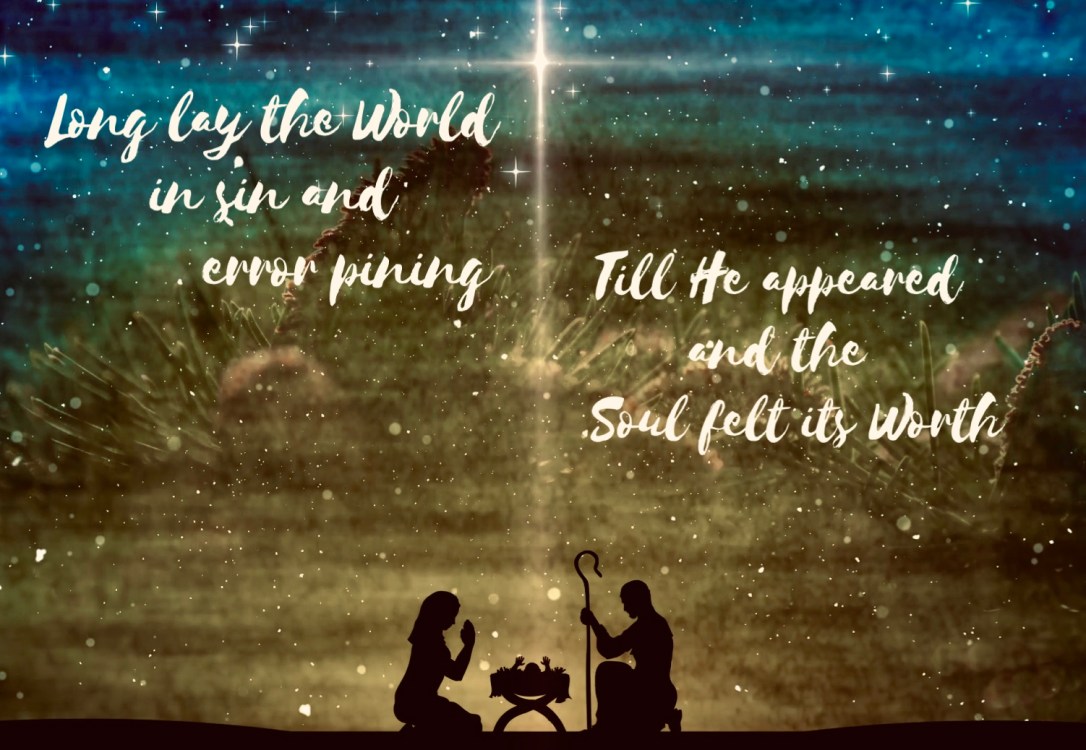
Long lay the world in sin and error pining
Till He appeared and the soul felt its worth

—- “O, Holy Night,” Writer, Adolphe Charles Adam, who wrote this Christmas carol Minuit, chrétiens! (1844), later set to different English lyrics and widely sung as “O Holy Night” (1847).

The soul felt its worth! What a thought to aspire to and eventually to know that my soul can feel its worth. I have a feeling that Advent might be calling me to listen to my life, to open myself to the song of angels and the light of Bethlehem’s star, and that in listening, my soul would begin to feel its worth.

Theologian, Fredrick Buechner, says it like this:

Listen to your life. See it for the fathomless mystery that it is. In the boredom and pain of it no less than in the excitement and gladness: touch, taste, smell your way to the holy and hidden heart of it because, in the last analysis, all moments are hidden moments and life itself is grace.

It would indeed be a precious Christmas gift for my heart to know that “life itself is grace,” and that in life’s grace that God gives, I would know beyond all knowing that my soul feels its worth.

Amen.

Advent, Angels, Bethlehem’s Star, Christ’s Birth, Comfort, Despair, Emotions, Fear, God’s Gift of Stars, Grace, grief, healing, Hope, Loss, Love, Mourning, New Normal, Questions, Resilience, struggle, Tears

“Listening for the Rustle of Angels’ Wings”

D621BE3F-47CD-4621-8417-E85BDA660590

The Fourth Sunday of Advent
The Advent Sunday of Love
Transplant Day Forty-One
December 22, 2019


TO LISTEN, TO LOOK

Is it all sewn up — my life?
Is it at this point so predictable,
so orderly,
so neat,
so arranged,
so right,
that I don’t have time or space
for listening for the rustle of angels’ wings
or running to stables to see a baby?
Could this be what he meant when he said
Listen, those who have ears to hear . . .
Look, those who have eyes to see?
Oh God, give me the humbleness of those shepherds
who saw in the cold December darkness
the Coming of Light,
the Advent of Love!

— Ann Weems

I ask myself those Ann Weems questions often:

Is it all sewn up — my life? Is it so predictable, so orderly, so neat, so arranged, so right,
that I don’t have time or space for listening for the rustle of angels’ wings or running to stables to see a baby?

These are among the most important questions I might sit with for a while, pondering my answers. On this Advent Sunday when we light the Candle of Love, I suddenly realize that Advent is ending, bringing Christmas so abruptly, or so it seems. Am I ready, I wonder? Am I ready for the birth of the Child, “Love’s Pure Light?”486917B0-E862-4C44-895D-D08210690B48

Have I prepared a place in my heart for the “pure unbounded love” we sing about in the beloved hymn, “Love Divine, All Loves Excelling?” Was my life so preoccupied that I missed the gentle darkness of the Season of Advent and am now feeling pushed — shoved —into Christmas?

Love in a manger is too holy a gift to take for granted. Love in a manger offers us a gift that we must be prepared to receive, and Advent is our season of preparation. As the season ends, I cannot help but ask myself if I spent these days preparing myself, heart and soul. Did I pray enough? Did I spend enough contemplative time? Did I love my neighbor and care for the persons around me who had so many life needs? Did I create sacred, meditative moments in anticipation, preparing for Emmanuel to come into my life anew?

I’m afraid I must answer, “no.” Yes, I did reflect on Advent now and then as I wrote for my blog, but I definitely did not spend enough time in meditation, preparing myself to receive the Christ Child. I was completely preoccupied with creating my life’s new normal after my kidney transplant. New routines and schedules overwhelmed my mind. I spent virtually all my time adjusting to this new normal. Self-absorbed does not adequately describe me during this Advent.

I haven’t felt much holiness hovering around me. I didn’t have time or space “for listening for the rustle of angels’ wings.” Yet, the transplant itself was a season somewhat like Advent . . . filled with expectation, preparation, anticipation. With Bethlehem’s star shining through the darkest night, and hope — always hope.

And so it was for people waiting for kidneys to renew their lives. Advent offered us a look at journey, a journey that ended in celebration. Celebration came full circle yesterday when I learned that my transplant was a part of a chain of living donors and kidney recipients. The chain included 16 people — donors and recipients — which means eight people got new kidneys. Perhaps that felt to me something like “the rustle of angels’ wings.”

And then it dawned on me that the Christ Child was not born into a world where everything always worked perfectly, where everything was orderly and neat and planned out. The Christ Child was not born into a world where everything was sacred. He was not born into a perfect family, and the people around his manger were not always holy.

Maybe that’s part of what Advent gives us:

the grace to be genuinely who we are — on our holy days and on days we feel not-so-holy. Maybe Advent beckons us to ready ourselves and to prepare our hearts with humbleness so that we can see “in the cold December darkness . . .

the Coming of Light, the Advent of Love!”


Advent, Angels, anxiety, Bethlehem’s Star, Calamity, Challenge, Christ Child, Christ’s Birth, Covenant, Darkness, Despair, Emotions, Exhaustion, Fear, God’s Gift of Stars, grief, Hope, Loss, Newer Skies, Resilience, Skies, Stars, struggle, Suffering

It Is Not Over!

74F6A7EB-ADEC-4722-928F-B154D37CDF66

The Twenty-First Day of Advent
December 21, 2019

The sages of the world came up with this wise saying: “It’s not over ‘till it’s over!” There are some similar sayings around, most notably one about the singing of a “fat lady.” But that one is not at all kind or sensitive! The point is that in life some things are never over. Grief at losing a loved one comes to mind, as does living with an incurable illness, losing a cherished relationship or any number of persisting, chronic, never-ending difficulties.

But the truth is, we are a resilient people, created by God who fully equips us for life’s calamities. We do not shrink in the face of loss. We know that weeping can last through a dark night, but the morning light may bring joy. We do not fear life’s dark times, because we know that our story is not over. There will be brighter days ahead. The brightest stars will give light in the darkest nights. Our resilient spirits will lift us up and, most importantly, God will be near right in the midst of our sufferings. It is not over! I am inspired by the thoughts of Ann Weems about this very thing:

IT IS NOT OVER

It is not over,
this birthing.
There are always newer skies
into which
God can throw stars.
When we begin to think
that we can predict the Advent of God,
that we can box the Christ
in a stable in Bethlehem,
that’s just the time
that God will be born
in a place we can’t imagine and won’t believe.
Those who wait for God
watch with their hearts and not their eyes,
listening
always listening
for angel words.

— Ann Weems

What profound truth: that those who wait for God watch “with their hearts and not their eyes,” listening — always listening — for angel words. We can find another take on that spoken by the Prophet Isaiah:

Those who wait upon the Lord will renew their strength. They will mount up with wings as eagles. They will run and not grow weary. They will walk and not faint.

— Isaiah 40:31

When I think that I have reached the end of my resilience, when I have become weary with my life’s tragedies and believe that it’s over, I want to be able to remember the words Ann Weems wrote, that “it is not over, this birthing, and that there are always newer skies into which God can throw stars.”

Like you, I need newer skies now and then. And if God can throw stars into those new skies, all the better. Advent’s promise is that those stars of hope will appear just when I most need them.

May God make it so, and may we remember stars of hope and angel words whenever we celebrate the Christ Child born under the light of Bethlehem’s star. Amen.


Advent, Angels, Emotions, Fear, grief, Hope, Music, Sorrow, struggle, Suffering, Tears

An Angel-Filled Advent


E280C016-69CC-4A56-AE5E-0FB8E3680287

The Twentieth  Day of Advent
December 20, 2019

With a brief update on my transplant journey 


ANGEL-FILLED ADVENT

Wouldn’t it be wonderful
if Advent came filled with angels and alleluias?
Wouldn’t it be perfect
if we were greeted on these December mornings
with a hovering of heavenly hosts
tuning their harps and brushing up on their fa-la-las?
Wouldn’t it be incredible
if their music filled our waking hours
with the promise of peace on earth
and if each Advent night we dreamed of
nothing but goodwill?
Wouldn’t we be ecstatic
if we could take those angels shopping
or trim the tree or have them hold our hands
and dance through our houses decorating?
And, oh, how glorious it would be
to sit in church next to an angel
and sing our hark-the-heralds!
What an Advent that would be!
What Christmas spirit we could have!
An angel-filled Advent has so many possibilities!
But in lieu of that
perhaps we can give thanks
for the good earthly joys we have been given
and for the earthly “angels” that we know
who do such a good job of filling
our Advent with alleluias!

— Ann Weems

I love the idea of an angel-filled Advent. It sounds like mystical, magical Advent and, most assuredly, an angel-filled Advent does have so many possibilities!

Reality is a very different state for us and, even in Advent, we whisper the word “impossible”. We live with “impossible” in our hearts and deep within our souls where all the pain lives, and all the disappointments, all the grief and all the impossibles. “That’s life,” the sages say, the wise ones who have lived every circumstance and held on their shoulders all sorts of mourning.

And so it is with me and with you. We hold mourning and utter, “This situation is impossible!” During Advent as we prepare to celebrate Christmas, the pain is deeper in us, the losses pierce our hearts, the life challenges seem impossible. When we mourn the loss of a loved one during this season, the mourning hurts more and the loss goes deeper. When we grieve because we struggle with serious illness, the grief is more intense. When we live in fear for our children, the fear is stronger. It is in those circumstances that we ask in frustration, “Where are Advent’s angels? Where is their music?”

I hope you will take a few minutes to enjoy John Rutter’s arrangement of “Angel’s Carol.”Here are the lyrics:

Have you heard the sounds of the angel voices ringing out so sweetly,
ringing out so clear?

Have you seen the star shining out so brightly
as a sign from God that Christ the Lord is here?

Have you heard the news that they bring from heaven
to the humble shepherds who have waited long?

Gloria in excelsis Deo!
Hear the angels sing their joyful song.

He is come in peace in the winter’s stillness,
like a gentle snowfall in the gentle night.

He is come in joy, like the sun at morning,
filling all the world with radiance and with light.

He is come in love as the child of Mary.
In a simple stable we have seen his birth.

Gloria in excelsis Deo!
Hear the angels singing ‘Peace on earth.’

He will bring new light.
He will bring new light to a world in darkness,
like a bright star shining in the skies above.

He will bring new hope.
He will bring new hope to the waiting nations.
When he comes to reign in purity and love.

Let the earth rejoice.
Let the earth rejoice at the Saviour’s coming.
Let the heavens answer with the joyful morn:

Gloria in excelsis Deo!
Hear the angels singing, ‘Christ is born.’

As for me, what kind of mourning am I holding this Advent season? What kind of pain, disappointment, loss am I feeling? I feel worry, of course, about my kidney transplant. When Mayo Clinic called yesterday insisting that I return immediately, I was concerned. My blood levels were dangerously high and I was experiencing a great deal of discomfort. The doctor ordered immediate ultrasounds of my kidney and right leg looking for pockets of fluid or blood clots. I am hopeful that both tests will come back with the word “normal” stamped on the report. In spite of the things that seem “impossible,” I hang on to hope.

That’s what Advent does — fills us with hope that begins on the First Sunday of Advent when we light the Hope Candle.

So to those questions about mourning, pain, disappointment, worry and fear, I have no adequate answers. No matter how much I want an angel-filled Advent and Christmas, I see no way out of the “impossible” seasons of life, but Ann Weems might:

. . . perhaps we can give thanks
for the good earthly joys we have been given
and for the earthly “angels” that we know who do such a good job of
filling our Advent with alleluias!

May Emmanuel — God-with-Us — make it so. Amen.

Advent, Angels, Bethlehem’s Star, Christ’s Birth, Fear, Hope, Justice, Mary’s Song, Singing, Stars, strength, Truth, Wisdom

Mary’s Spirit Song

943A85DA-7DF3-4FB9-AA79-145F5D159A84

The Thirteenth Day of Advent
December 14, 2019

*MARY’S SPIRIT SONG

Mary did you know,
that your ancient words
would still leap off our pages?

Mary did you know,
that your spirit song
would echo through the ages?

Did you know that your holy cry
would be subversive word,
that the tyrants would be trembling
when they know your truth is heard?

Mary did you know,
that your lullaby
would stir your own Child’s passion?

Mary did you know,
that your song inspires
the work of liberation?

Did you know that your Jubilee
is hope within the heart
of all who dream of justice,
who yearn for it to start?

The truth will teach, the drum will sound, healing for the pain;
The poor will rise, the rich will fall. Hope will live again.

Mary did you know,
that we hear your voice
for the healing of the nations?

Mary did you know,
your unsettling cry
can help renew creation?

Do you know, that we need your faith,
the confidence of you,
May the God that you believe in,
be so true.

— Lyrics by Jennifer Henry (inspired by the song “Mary, Did You Know?”)

On the eve of Advent’s third Sunday, the Sunday of joy, we reflect on Mary. On other Advents, we have been inspired by the angel’s visit to Mary, by her willingness to say, “I am the Lord’s servant,” by her confession of faith in God’s divine plan, by her song that we have loved and know as The Magnificat . . .

My soul magnifies the Lord
and my spirit rejoices in God my Savior,
for he has been mindful
of the humble state of his servant.
From now on all generations will call me blessed,
for the Mighty One has done great things for me —
holy is his name.

— Luke 1:46-49 NIV

But on this Advent, I hope to reflect on other truths about Mary and perhaps see another view of her. Perhaps her song was not merely a song of surrender, a willingness to be the handmaiden of God. Perhaps it was not just a song declaring that she would now be called “blessed” for generations.

This Advent, I invite you to ponder the song lyrics of “Mary’s Spirit Song” written by Jennifer Henry. The words reveal another side of Mary. The song leads us to look at all of Mary and discover some of the things she very likely held in her heart.

Perhaps this Advent we will recognize her as one with the courage to proclaim her society’s truth. Perhaps we will notice that she is singing about God scattering the proud, removing rulers from their thrones and lifting up those who are humble. Mary will sing to us of feeding the hungry and sending the rich away empty.

Is this the subversive Mary proclaiming justice, that “the poor will rise, the rich will fall. hope will live again?” The last part of Mary’s song reveals a Mary who is wise beyond her years, who knows the political climate around her, who is compassionate enough to proclaim mercy for those who hunger, who is strong enough to proclaim her Jubilee of justice and liberation, who is brave enough to say that tyrants will tremble.

His mercy extends to those who fear him,
from generation to generation.
He has performed mighty deeds with his arm;
He has scattered those who are proud in their inmost thoughts.
He has brought down rulers from their thrones
but has lifted up the humble.
He has filled the hungry with good things
but has sent the rich away empty.

He has helped his servant Israel,
remembering to be merciful
to Abraham and his descendants forever,
just as he promised our ancestors.

— Luke 1:50-55 NIV

If we dare to understand the whole of Mary, we can more fully emulate her courage that called for justice and liberation. We will remember the words the angel proclaimed to her, “Do not be afraid, Mary; you have found favor with God. You will conceive and give birth to a son, and you are to call him Jesus.”

We will remember Mary’s fear and the angel who calmed her. We will remember her confession of faith in the God who sent the Holy Spirit to “overshadow” her. And, yes, we will always let Mary lead us to the wondrous gift of the Christ Child as she gently cradles him in her arms — with Bethlehem’s star shining over him, and the joyous song of the angels . . .04E87215-AC50-4CC9-B2F4-6612E56D0CB9

“Glory to God in the highest,
And on earth peace, goodwill toward all!”

 
*Many thanks to Darlene Flaming for sharing “Mary’s Spirit Song” with me.


Advent, Angels, Compassion, Hope, Magic, Rainbows, Sharing God's light, Stars

Swinging on Rainbows

251397F1-D822-42F8-B441-663EB80137A5
The Twelfth Day of Advent

December 13, 2019

WOULDN’T IT BE GRAND TO BE AN ANGEL?

Wouldn’t it be grand to be an angel
and have as your address
“The Realms of the Glory of God”?

And swing on rainbows
and gather stars in your pockets,
winging in and out of earth
in a flurry of moondust
with the messages of God?

Comforting the distressed, warning the righteous
delivering the just, guarding little children?

Of course, we can comfort and warn
and deliver and guard.
Maybe, if we get that right,
we can swing on rainbows later.

— Ann Weems

I have to say that this morning I really feel as if I could swing on rainbows. I was released by Mayo Clinic today after my kidney transplant on November 12th, and I am happy to be going home to Macon. I have missed my friends, my Sunday School class, my family and my church family. And my kitty, of course, who probably wonders where we’ve been for a whole month!

Ann Weems’ poem today speaks of angels swinging on rainbows, gathering stars in their pockets, winging in and out of earth in a flurry of moon dust sharing God’s message. And then there is the work of comforting the distressed, warning the righteous, delivering the just and guarding little children. The poet’s overarching question is this: “Wouldn’t it be grand to be an angel and have as your address ‘The Realms of the Glory of God’”?

Wouldn’t it? The grace-filled truth is that God has gifted each of us with ministries of comforting the distressed, bringing sight to the blind, offering hope to those who have lost hope, guarding little children and hundreds of other works of compassion. We are the hands and feet of God — of Christ — in our world. I am always moved by this quote by Joseph B. Clower from his book, The Church in the Thought of Jesus. This is my imperfect recollection of his words:

If the Living Christ is not confined, then our hearts are moved with his compassion, our hands are coarsened with his labor, our feet are wearied with his walking among humanity.

In some way of holy mystery, when our hands reach out in compassion, we become the incarnation of Christ in the world. Advent is about incarnation, God incarnate in Jesus. In turn, Jesus left us as his embodiment — chosen, ordained, empowered to do the works that he did when he walked among us.

. . . The one who believes in me will also do the works that I do and, in fact, will do greater works than these, because I am going to the Father. (Matthew 14:12 NRSV)

61A24E10-42F0-4043-829B-69B005A420E8And so Advent’s message urges us to do the work of angels and, yes, the works that Jesus did in his years on earth. What a divine and holy calling this is — sharing compassion, giving hope, comforting, caring, giving, working for justice, offering mercy. On top of that, Advent hints that we might also gather a few stars in our pockets, winging in and out of earth in a flurry of moon dust.

Swinging on rainbows is a possibility, too.

That just might be a glorious way
to journey through Advent 2019!