Activism, Ahmaud Arbery, Christian Witness, Community activism, Conflict, Courage, Death, Faith, Freedom, Injustice, Nonviolence, Social justice, struggle, Urgency, Violence, Wendell Griffen, White supremacy, wind

The Whirlwind Is Here


3BDCF281-2B6E-45CE-88C8-BE5FE50667AA
Moon Over Harlem, William H. johnson, 1943-1944. © Washington, DC,                           Smithsonian American Art Museum

I share this blog post today in memory of Ahmaud Arbery, who was killed in the state of Georgia, the state in which I live in full and free safety. Ahmaud Arbery did not know such safety. But today we say his name and honor his memory. There are so many names we could speak today: Tamir Rice, Trayvon Martin, George Floyd. Breonna Taylor and hundreds more, even thousands. What can black parents possibly tell their kids now about staying safe? I also honor the parents who try to find the right words, the right admonitions to say to their children. Most of all, I honor the strong and powerful voices who continually cry out: “Justice!” My friend and pastor, Wendell Griffen, is one who cries “justice” with a particular eloquence.

Wendell Griffen is a pastor, state court trial judge, and social justice activist in Little Rock, Arkansas who lectures and writes about social justice. I am pleased to share with you his most recent article. He will call you out. He will speak plainly to those of us who are white. He will call you to act against injustice, drawing your courage from God, who whose children are deeply loved — all of them!


For they sow the wind, and they shall reap the whirlwind.
Hosea 8:7 (NRSV)

Have you viewed the ten minute and twelve second video of the May 25, 2020 killing of George Floyd by former members of the Minneapolis Police Department?

Why haven’t you? What are you afraid you will see? What are you unwilling to see? What are you unwilling to admit?

Have the four now former members of the Minneapolis Police Department responsible for killing George Floyd in broad daylight before onlookers who also videotaped their conduct been arrested on suspicion of committing a homicide (causing the death of another person) of George Floyd?

Why haven’t they been arrested? Why have they not been held in custody and required to post bond? Who decided they should not be arrested? What message was sent when they were not arrested?

The killing of George Floyd was a criminal act. There are witnesses to the act. The fact of Mr. Floyd’s death is indisputable.  Mr. Floyd was not threatening anyone — none of the officers nor anyone else — when he was killed. The actions of the officers were not taken or necessary to prevent him from threatening anyone.

In other words, there is no legal justification for the actions of the four former police officers who killed George Floyd.  None.  Period.  Full stop.

We should not be surprised that people around the world, including Minneapolis, are furious. George Floyd was slain by agents of the state. His killers are still at large. They have not been arrested. We should not be surprised that people in Minneapolis are outraged by statements on Thursday from local and federal prosecutors calling for “patience.” Why should they be patient about deliberate refusals to arrest known homicide suspects? Why should they “trust” a “process” that reeks with corruption and injustice?

We should not be surprised that people are outraged by the decision of the Minnesota Governor to mobilize the state militia — the Minnesota National Guard. Minneapolis is not under siege or being attacked. The “peace” and “order” of the Minneapolis area is not threatened by the civilians who protested while four Minneapolis police officers killed Mr. Floyd.  It is not threatened by Mr. Floyd’s family members and friends. It is not threatened by the many people who took to the streets to protest his death and how local authorities refused to arrest his killers.

Do the Mayor of Minneapolis and Governor of Minnesota believe that it takes 500 National Guard soldiers to arrest four suspected killers?

And does anyone really believe that the fiery protests seen tonight would have happened if the four suspected killers had been already arrested?

Let’s talk plainly. George Floyd was killed. At minimum, he was recklessly killed. At worse, he was knowingly killed. In Minnesota and every other US jurisdiction, recklessly causing the death of another person is manslaughter. In Minnesota, state prosecutors can charge people who commit manslaughter without convening a grand jury.

Let’s talk plainly. In Minnesota and elsewhere in the United States, a person who cooperates with, assists, helps to conceal, or otherwise interferes with efforts to stop a homicide is liable for the homicide as an accomplice. Each of the officers involved in the homicide of George Floyd should have been arrested and charged days ago with manslaughter! The prosecutors can later seek grand jury indictments for murder if other evidence is uncovered.

Let’s talk plainly.  The Minnesota Governor and Minneapolis Police Department, and the Hennepin County prosecutor are demonstrating their cultural incompetence. That incompetence is not merely personal. It is institutional, pervasive, pernicious, and infuriating!

The same cultural incompetence happened when Ahmaud Arbery was killed in Georgia.

The same cultural incompetence happened when Breonna Taylor was killed in Kentucky.

The same cultural incompetence happened when a white woman named Amy Cooper falsely accused a black man named Christian Cooper (no relationship) of threatening her life.

That cultural incompetence is not new.

The Louisville Police officers who killed Breonna Taylor in her home have not been arrested – yet!

The killers of Ahmaud Arbery were not arrested for months after he was attacked and slain. They were only arrested after (and because) a video was exposed that chronicled how he was killed and who killed him.

We should also demand that the former police officers involved in the Floyd matter be arrested immediately on suspicion of manslaughter. There is plainly probable cause for arresting the officer who held his knees on Floyd.  However, there is also probable cause for arresting the other officers as accessories (accomplices) because of their active presence and complicity in the homicide (manslaughter).

Few statements to date have stressed this fundamental issue. Arrests do not need simultaneous charging actions. There is no need to await charges before each of the former officers who were involved in the homicide of George Floyd is arrested on suspicion of manslaughter. There is no requirement that the autopsy be completed before persons suspected of manslaughter are arrested. There is no requirement that ALL possible information be gathered before suspected killers are arrested.

Each former officer should be arrested on suspicion of having committed manslaughter in the death of George Floyd.

Prophetic people know that refusal to arrest of the former officers is a political statement by the Minneapolis Police Department. The Department has chosen to not arrest killers.  That fact should be strongly proclaimed. Prosecutors do not arrest suspects. That is a policing decision, and the police have deliberately exercised their discretion to NOT arrest four homicide suspects.

Telling people to “trust the process” is infuriating when “the process” is openly working to perpetuate a blatant injustice.

Stop saying “you feel the anger” of people in Minneapolis, and especially “feel the anger” of black and brown people. No, you don’t!  You haven’t suffered this mess. You haven’t dealt with it every day and night.

You haven’t seen people be called “lawless” for loudly protesting a homicide except when the victim is a person of color.

You don’t “feel our anger.” You may feel your own anger. Good. But don’t claim that you “feel our anger” or “share our anger.” You don’t unless you have shared our pain, shared our discrimination, and shared the centuries of blatant state sanctioned slaughter of black and brown people by law enforcement officials. We know you don’t feel and share our anger. Stop fooling yourselves and stop trying to fool us!

Black people are not fools. The U.S. Justice Department is headed by William Barr, the same person who decided that the United States would not charge Daniel Pantaleo, the NYPD officer who killed Eric Garner by choking him to death, with violating Garner’s civil rights.

We live with discrimination every day. We do not have to act like we like it. We do not have to put on a good face about it. And we will not do so. If you aren’t comfortable with our anger and the way we express it, get out of the way. If you aren’t turning over the institutions responsible for our anger and angry behavior, get out of the way.

As the prophet Hosea wrote concerning the ancient Hebrew nation of Israel, this society has always sown the wind of white supremacy with its tolerance of state-sponsored terrorism and slaughter of black, brown, red, yellow, and poor white people. People of color have long known that this society “shall reap the whirlwind.”

The whirlwind from the seeds of long pent-up outrage about systemic law enforcement abusive and homicidal conduct has arrived at the same time the nation and world are gripped by the global Covid 19 pandemic which highlights racial disparities in countless areas of life. The whirlwind from generations of corrupt and racist political leadership now has arrived when the US is led by a vicious idiot, despot, racist, and sociopath named Donald John Trump.

The whirlwind is here. The United States cannot, should not, and will not escape.

©Wendell Griffen, 2020


Amen, my brother. Yes, our country has reaped the whirlwind. We have reaped the whirlwind. Let us gather our resolve and look to our faith to guide us, and then let each of us work to break the bonds of injustice in whatever ways we are able. Today I committed to using my art and writing to portray the rise of white supremacy and the oppression of non-white persons. What gifts could you use to enter the struggle for justice? Can each of us work for justice with a sense of urgency?

May our God find us faithful to the creation of Beloved Community.  Amen.

KMF

#MeToo, Activism, Bravery, Courage, Faith, healing, Injustice, Justice, March for Our Lives, Perseverance, Persistence, Prathia Hall, Questions, Racism, Social justice, Violence against women and children, Women

The Civil Rights Movement and Womanist Theology


217FA8EB-CEFC-4F9F-896B-D1FCD86FFD34
The civil rights movement and womanist theology? Not much in common between the two, it seems. Maybe, maybe not! The thing is: God’s people are guided by Spirit into an unjust world where people are oppressed, not just through a particular movement, whether it is for civil rights or equity for women. People are oppressed beyond any movement. People are oppressed in everyday life, today, as well as in past struggles for liberation.

God is all about liberation from oppression, now and in the future. The battle for liberation is ongoing and never-ending. And God’s people — you and I — cannot follow Christ in “loving our neighbors as we love ourselves” unless we stand alongside people who are oppressed, unless we pour our lives into building a just society where every person is treated according to the well worn and well loved declaration that “all people are created equal.”

If you believe there is nothing in common between the civil rights movement and womanist theology, then you do not know much about The Rev. Dr. Prathia LauraAnn Hall (1940 – 2002), who was an undersung leader for civil rights, a bulwark of the black church in the United States and an advocate of the womanist vision of equity and equality.

In the recently published book, Freedom Faith: The Womanist Vision of Prathia Hall, Courtney Cox paints the portrait of Prathia Hall as a woman of deep conviction, courage and eloquence who literally embodied the longing for the rights of every person and the womanist vision of equality.

You may not know much about her, but Prathia Hall electrified audiences through her speaking and preaching.

I say to you our daughters and sons, it is in you! Every time you behold the world as it is and dare to dream of what it must become that’s the fire of freedom’s faith. . . Every time you grab hold of the United States of America and like Israel dare to wrestle and declare to it — We will not let you go until you bless us — That is freedom faith’s fire. It is in you — It’s in us.     — Prathia Hall

You may not know much about her, but Prathia Hall was an inspiring leader in the Southwest Georgia Project in Albany, Georgia, in the civil rights struggle in Selma, Alabama, and in the multiorganization Atlanta, Georgia project.

Prathia Hall literally changed the course of the civil rights movement. As a “firebrand” in the Student Nonviolent Coordinating Committee (SNCC), Hall labored tirelessly under the central guiding principle of her life, her activism and her ministry. Her life’s guiding principle was “Freedom Faith, the belief that God wants people to be free and equips and empowers those who work for freedom.”

In Hall’s work in door-to-door voter registration, in church-based educational programs, inspirational mass meetings, and through her scholarship and preaching, Freedom Faith found its ultimate expression in her womanist vision of the liberation of all people. For Hall, freedom was not only about the goals of the civil rights movement, it was about the many layered forms of oppression — racism, classism, sexism, ageism, heterosexism, denominationalism — all formidable obstacles to human rights.

You may not know her name, but Prathia Hall was listed in Ebony Magazine’s 1997 “15 Greatest Black Women Preachers.” It is said of Prathia Hall that her call to ministry was both her glory and her burden. Yet her preaching electrified masses of people bowed low by oppression.

They called us: ‘nigger,’ ‘winch,’ ‘buck,’ ‘slave,’ but out there in the brush arbors, the wilderness, and the woods, the God of our ancestors, the God we had known on the other side of the waters met us and whispered words in our ears, and stirred a song in our souls . . .     — Prathia Hall

You may not know much about Prathia Hall, but she was an indefatigable activist for human rights, a brilliant scholar, an engaging speaker, a compelling preacher, a distinguished theologian. Hall’s theology focused on liberation from all forms of oppression, and she did not shrink from the womanist theology that called out sexism and the duplicity of the Black Church in recognizing the call of women only in narrow and constricted ways. In an absolute articulation of her womanist vision of inclusion, Hall espoused a multidimensional structure of oppression. “Gender-based oppression,” she wrote, “isn’t a trivial inconvenuence. It’s human devastation.” As an insider, choosing to remain in ministry in the Baptist Church, Hall’s courage and conviction never ceased from criticizing a Church that opposed racism, but tolerated sexism.

It absolutely boggles my mind as well as grieves my spirit that brothers, with whom I have stood side by side in the struggle, brothers with whom I have bowed, knelt, prayed, worked, struggled, gone to jail, dodged bullets, and caught bullets, claim to be unable to make the transition from the critique of race-based oppression to the critique of gender and class-based oppression.    — Prathia Hall

You may not know much about Prathia Hall, but her very soul was embroiled in the civil rights drama. In the summer of 1962, four black churches in Georgia’s Lee and Terrell Counties, all associated with the movement, were burned by white supremacists.

Hall and other SNCC workers wept together in the ashes of the Mount Olive Baptist Church. The next day the SNCC received a phone call that Martin Luther King, Jr. intended to visit Albany to attend a prayer vigil over the ashes of Mount Olive Baptist Church in Sasser. According to the New York Times, “As the sun sets across the cotton fields, some fifty Negroes and two whites met at Mount Olive for a prayer vigil. Joining hands, they sang softly, ‘We Shall Overcome.’”

After the song, Prathia Hall led the group in prayer, her voice breaking in grief. According to oral tradition, Hall repeated the phrase “I have a dream,” each time followed by a specific vision of racial justice. After the service, King asked for her permission to use the “I have a dream” phrase, which she granted. From the oral evidence gathered from several witnesses, one can definitely make a case for Prathia Hall as the source of King’s “I Have a Dream” speech.      — Courtney Cox, Freedom Faith: The Womanist Vision of Prathia Hall

You may not know much about Prathia Hall, but in the pages of Freedom Faith: The Womanist Vision of Prathia Hall, author Courtney Cox lays bare the world of this fascinating woman of God. She presents Prathia Hall through various lenses: Christian minister, liberation theologian, civil rights activist and leader, professor and scholar, preacher and speaker, mother, daughter, wife, agitator, womanist theologian.

Until now, you may not have known much about Prathia Hall, but many notables spoke of her abilities:

One in a million . . . A model that needs to be lifted up in every seminary of all races . . . so people can get a glimpse of what someone who has really said yes to ministry and who went to her grave living that ministry daily.     — Jeremiah Wright

The best preacher in the United States, possessing proven ability to exegete, illustrate, celebrate and apply the scriptures healingly to the problems, pains and perplexities of the people who sit ready to hear a word from Yahweh.     — Charles Adams, former president of the Progressive National Baptist Convention

. . . She was known for her commitment, her dedication, her stick-to-it-ness, for hanging in there, for never giving up or giving in.      — Rep. John Lewis

So what about the civil rights movement and womanist equality? Is there any commonality between them? Certainly there is commonality — both are never-ending struggles for justice, because we are a country where various groups of people are still denied their civil rights and woman are still suppressed and oppressed. Both movements — and many other struggles for justice — require our commitment, our resolve, our persistence, our courage, our compassion, our best efforts and our faithfulness to God.

At least for me, Prathia Hall’s life begs several questions:

What is it that I am passionate about, willing to follow God with courage to fulfill that passion?

Is there an injustice I must stand against?

Is there any oppression, any wrong, that I am compelled to confront?

Is there anything I care about deeply enough that I will dig deep into myself to find the courage to defend it?

Fair questions, I think, for those who are trying to follow God into places of need! Compelling questions for those who are trying to follow God in offering compassionate  care to the oppressed and hurting people who need us! Compelling questions for those who are trying to follow God in freeing people who live in various forms of bondage!

These are urgent questions for God followers!

I pray that I am able to sit with those questions and respond to them boldly as an act of my faith. I pray that for you, too.

Finally, do we dare we ask what will be our reward for seeking justice for the oppressed people around us? Probably not, yet this beloved passage of Scripture does speak of both our call from God and what we will receive for our commitment to our call.

. . . Remove the chains of oppression and the yoke of injustice, and let the oppressed go free. Share your food with the hungry and open your homes to the homeless poor. Give clothes to those who have nothing to wear . . .

Then my favor will shine on you like the morning sun, and your wounds will be quickly healed. I will always be with you to save you; my presence will protect you on every side. When you pray, I will answer you. When you call to me, I will respond.

If you put an end to oppression, to every gesture of contempt, and to every evil word; if you give food to the hungry and satisfy those who are in need, then the darkness around you will turn to the brightness of noon. And I will always guide you and satisfy you with good things. I will keep you strong and well. You will be like a garden that has plenty of water, like a spring of water that never goes dry.

— Isaiah 58:6-11 Good News Translation (GNT)

So let us follow God into every place of need, every place of injustice, every place where oppression has raised its evil head. Let us follow God — as an embodiment of Christ’s love and compassion — until that day when “the darkness around us turns to the brightness of noon.”

May God make it so. May God find us faithful. Amen.


I offer you this music to listen to as you spend time in prayer and meditation


Africa, Aging, Bravery, Challenge, Change, Clouds, Comfort, Courage, discouragement, Grace, healing, Hope, Magic, mercy, Mystery, Resilience, Skies, Soul, Spirit, Sue Monk Kidd, Troubles, Uganda, wind, Wings of the morning

Leaving Our MAGIC Behind

EEAFAF51-CE51-42EA-9E96-881CDE08643B
Ugandan Washday at the River. Watercolor art by Kathy Manis Findley

When life moves on — from twenty to forty to seventy — you take into your inner place the ominous idea that if ever there was magic in your life, at some point, you left it behind. You know what I mean. The magic of your first love. The magic of the birth of your child. The magic of the time when you believed you could accomplish anything and everything you set your heart on. The magic that you actually did accomplish that thing, that sparkling thing that made you stand tall and celebrate yourself.

You might be wondering what in the world set my mind on life-magic this morning. I think it might have been carryover from my musings on yesterday’s blog post. But mostly, it came from reading a novel by one of my favorite authors, Sue Monk Kidd. This is the passage that captivated me, captured me as if it were some sort of sacred scripture.

There was a time in Africa the people could fly. Mauma told me this one night when I was ten years old. She said, “Handful, your granny-mauma saw it for herself. She say they flew over trees and clouds. She say they flew like blackbirds. When we came here, we left that magic behind.”

My mauma was shrewd. She didn’t get any reading and writing like me. Everything she knew came from living on the scarce side of mercy.. She looked at my face, how it flowed with such sorrow and doubt, and she said, “You don’t believe me? Where do you think these shoulder blades of yours come from, girl?”

Those skinny bones stuck out from my back like nubs. She patted them and said, “This all what left of your wings. They nothing but these flat bones now, but one day you gon get ‘em back.”

I was shrewd like mauma. Even at ten I knew this story about people flying was pure malarkey. We weren’t some special people who lost our magic. We were slave people, and we weren’t going anywhere. It was later I saw what she meant. 

— Sue Monk Kidd, from her novel, The Invention of Wings

Part of why these words so thoroughly captured me is in the very first sentence that mentions the place I so love, Africa. And even though the words don’t really have all that much to do with Africa, I found myself transported, walking among the banana trees in East Africa — Fort Portal, Uganda to be exact. Walking into a village brimming with people, and oh, the children! So many glimmering eyes, wide smiles and glowing dark faces that expressed everything from sheer delight to excruciating sorrow, and everything in between.

That was in one of my former lives, and pure magic it was! Because when you are able to make a child smile with a sweety (a piece of hard candy), there’s magic in that moment and it is a moment you carry through your day and through the rest of your life. Maybe that’s the grace of growing older — that you carry with you moments of magic from every place you have been, from every soul who touched your life so deeply.

In Sue Monk Kidd’s words, the magic was being able to fly, probably meaning to soar into the clouds above your troubles and woes. It hit me in my deep place, that the Ugandan people we came to know and love did soar into the clouds. Indeed, they left the agonizing hardships of life on the dusty earth below as their wings lifted them up, higher and higher to where life’s pain was replaced by pure exhilaration.

Back on the earth, in their world, not much was very exhilarating. Life was the same, predictable day after predictable day that disheartened them with hunger, malnutrition, thirst for clean water, oppression, soldiers with their machine guns and all the commonplace bad things that formed their lives. But there were better things too, like lush banana groves and children singing; like the music of drums at dusk; like the shimmering embers from their cooking fires rising into the night sky and reminding them that the day’s toil was not so bad when family could still gather together around a centering, comforting fire. There was magic in all of it. It was the magic of surviving war and embracing the loved ones who were still alive. It was the magic of celebrating the extraordinary lives of loved ones who had died and knowing that generations would move forward carrying the family’s magic into the future. It was the magic in their remembering, remembering the holy words they had hidden in their hearts . . .

“For I know the plans I have for you,” says the Lord,
“plans for well-being and not for trouble, to give you a future and a hope.”

— Jeremiah 29:11 New Life Version (NLV)

Maybe you, like me, have forgotten that we brought our magic with us to this day from the scenes of our past, from the happenings and the people we have known. This kind of magic never leaves one’s spirit. This kind of magic is holy mystery, really. It is tucked away within us for the times when we most need to take wing. Still, it does take some courage on our part, some brave resolve that we can lift up our heads and embrace “a future and a hope.”

No, we have not left our magic behind! It waits in us for a moment when we are languishing, when we feel sorrow or discouragement, fear or desperation — for a time when we feel disconsolate. It is in that moment we fly, by the grace-filled mercy of God, on the wings of the morning,* forever lifted above the troubles of the world.

I need that sometimes. Don’t you?


For your meditation time, I share with you this beloved hymn, “Come, Ye Disconsolate.”*


* Psalm 139:9

* “Come, Ye Disconsolate”
Lyrics: Thomas Moore (1779-1852); Altered by Thomas Hastings (1784-1872)
Music: Samuel Webbe (1740-1816)

Beginning again, Bravery, Calling, Challenge, Compassion, Courage, Dangerous and noble things, Discernment, Following Christ, Holy Spirit, Insight, Inspiration, journey, Kidney Transplant, Life Journeys, mercy, Passing years, Pondering, Questions, Repairing broken things, Spirit, Spirit wind, Urgency, Weeping

As Though I Had Wings


D112A977-1A19-4123-9462-5BCE716692F9


I want to think again of dangerous and noble things.
I want to be light and frolicsome.
I want to be improbable beautiful and afraid of nothing,
as though I had wings. [1]

I am continually inspired by Mary Oliver’s poetry, today by her phrase, “as though I had wings.” In the past six months or so — since my kidney transplant — I have felt a little wing-less. Not so unusual, because a transplant — before, during and after — is a rather big deal, like a super colossal deal! If I ever thought the enormous physical challenge would be the surgery itself, I was wrong. I think I deluded myself on that. The aftershocks of the surgery proved to be enormous and enduring. Hence, my lack of wings.

Everywhere, one can see eloquently expressed promises of wings. You and I can “mount up with wings as eagles”[2] or “take the wings of the morning.” [3]  There is even a wing promise that God will “raise you up on eagle’s wings.” [4]

I know the promises and I love them, but I also love how poet Mary Oliver brings it all down to where I live — on shifting sands in an ever-shifting world. She expresses it like this: “I want to think again of dangerous and noble things . . . to be improbable beautiful and afraid of nothing, as though I had wings.” [5]

All of a sudden, I have a critical assignment, something I must do myself and for myself. It seems to me that I must start by focusing on my mind, thinking again of things noble and dangerous. Then I must allow my mind (my will) to move through my heart and soul, to the very center of my being, because there is the place inside me where dangerous acts are weighed and noble acts can become resolve. In one of the common phrases of my faith — an admonition I heard in church over and over again — a pastor or teacher would say, “count the cost.”

Here’s where I am honest. So I must admit that doing noble things has seemed impossible for me in the past few years. Prior to my illness, my life was a constant journey of determining the danger of noble things and doing them anyway. I miss the life of being a pastoral presence to a dying patient. I miss keeping vigil in the ER family room with grieving parents mourning the death of a child. I miss offering a memorial service  for a dear congregant and friend. I miss comforting victims of sexual assault as police officers question them, sometimes brusquely and accusingly. I miss trauma counseling with persons who have endured horrific emotional and physical trauma. I miss forensic interviewing even the youngest child victim of abuse. I miss standing firm as a court advocate for child victims of sexual abuse. I even miss being thrown out of the courtroom by a persnickety judge who did not appreciate the intensity level of my advocacy.

I miss it all. It was dangerous. All of this work was dangerous and it was noble. I could do it because of wings — the wings God gave me when I determined I would do dangerous and noble things and do them with urgency.

What about now, this season of my life? What am I doing that’s dangerous and noble? Should I even expect to be able to face danger at my age, with my physical limitations? Last night, a friend listened to me list all the things I cannot do when very intently she interrupted me and asked, “Kathy, what can you do?” She continued, as she so often does, “Your life is not about the things you can’t do. It’s about the things you can do!”

She nailed it. Perhaps she even nailed me, albeit with some gentleness. So I have to sit awhile with that provoking question: “What can you do?” I have to sit with that question with God close by to guide me and Spirit near to remind me of Spirit-wind and Spirit-fire. I am not precluded from Spirit-wind because of age or Spirit-fire because of physical limitations. It is up to me to discern what I need in my life right now. Will I be satisfied with what I have done in the past and let myself off the hook? What dangerous and noble things will I take on?

I cannot help but think of so many nurses and doctors who are caring for persons with COVID19 — how they enter the ICU knowing that a deadly virus is there, believing that they could take the virus home to their families. Dangerous and noble! Somehow, Spirit-wind is raising them up for the task.

I wonder if you have thought about this for yourself, considering the cost of doing dangerous and noble things. Have you considered that the things you are already doing — feeding the poor, caring for the sick, taking a meal to an elderly person sheltered alone in her home — are all dangerous and noble things? That you show mercy to others as you go? That you weep for a broken world with so many broken people in it? That you share in Christ’s compassion?

“Dangerous and noble things! Afraid of nothing as if we had wings!” [6]

I’ve given all of this a lot of thought and I think we might get our wings after we have made the determination to give ourselves to noble things, no matter the danger. I think we get wings when we move to the urgency of Christ’s compassion, when our rhythms begin to emulate the rhythms of God. I think we get wings when we have determined in our hearts and souls to act — after we have counted the cost and have said “Yes!”

Again, the eloquence of the poet may most fully express my deepest longing and yours.

I want to be improbable beautiful and afraid of nothing,
as though I had wings . . .

What I want in my life
is to be willing
to be dazzled—
to cast aside the weight of facts
and maybe even
to float a little
above this difficult world. [7]

May God make it so for us.


1 Mary Oliver, Owls and Other Fantasies: Poems and Essays
2 Isaiah 40:31
3 Psalm 139:9
4 “On Eagles Wing’s” composed by Michael Joncas
5 Starlings in Winter, a poem by Mary Oliver
6 Mary Oliver, Owls and Other Fantasies: Poems and Essays
7 The Ponds, a poem by Mary Oliver

Bondage, Bravery, Call, Calling, Courage, Dancing, Following Christ, Holy Spirit, Inner joy, Mechthild of Magdeburg, Mystic, Singing, Spirit

A Very Unruly Woman of God

228BEA2D-360B-4749-994C-F28F1D756B13
Watercolor by Kathy Manis Findley

She described herself as an unruly woman of God — Mechthild of Magdeburg. “I want also to circle higher still,” she wrote in one of her mystical poems. She had her first vision of the Holy Spirit at the age of twelve. As a young woman, she left her home and “renounced worldly honour and worldly riches.” She was an ascetic, a writer and a mystic who viewed God’s will in unorthodox ways. Her criticism of church dignitaries for religious laxity and claims to theological insight aroused so much opposition that some called for the burning of her writings. Her words seemed to have kept her in deep trouble!

Her story reminded me of Sue Monk Kidd’s book, “The Dance of the Dissident Daughter,” a book that set me on a pilgrimage in 1996 that changed my life. This was a book that screamed out to me, “Find your own soul! Nourish it! Protect it! Bind it closer to God’s soul and, for the first time, live out God’s call to you!”

Sue Monk Kidd said this as she reflected on writing the book’s first edition:

“The Dance of the Dissident Daughter” sparked heated, sometimes scathing reactions, including public accusations of heresy, boycotts of my lectures, and a plethora of derisive letters in my mailbox. One of the more memorable began: Dear Whore of Babylon. It was the “Dear” part that made is so indelible.

This statement rings true when I contemplate the life of Mechthild of Magdeburg. Before we get back to her, though, let’s look for a moment at The Dance of the Dissident Daughter, the book that left me with these nuggets of wisdom I will always hold close.

How many times have I denied my innermost wisdom and silenced this voice? How many times can a woman betray her soul before it gives up and ceases calling to her at all?

We must wake up, journey, name, challenge, shed, reclaim, ground, and heal.

When someone tries to put you back into a box from which you’ve already escaped, you might recall a line from the Indian poet Mirabai. She said, “I have felt the swaying of the elephant’s shoulders and now you want me to climb on a jackass? Try to be serious!}

As women we have a right to ask the hard questions. The only way I have ever understood, broken free, emerged, healed, forgiven, flourished, and grown powerful is by asking the hardest questions and then living into the answers through opening up to my own terror and transmuting it into creativity. I have gotten nowhere by retreating into hand-me-down sureties or resisting the tensions that truth ignited.

The main thing is to stop struggling and nourish yourself. When you nourish yourself, your creative energy is renewed. You are able to pick up your lyre again and sing.

— Sue Monk Kidd, The Dance of the Dissident Daughter

Yes! Sing, and even dance your dissident dance! Your song may sound to all those around you like a revolutionary song, discordant to their ears. Your dancing may scandalize your observers. Still — Sing! Dance! — to the stirrings of Spirit within you!

2869C069-C448-475D-87A3-447D55A041B6That’s exactly what Mechthild of Magdeburg did and the religious world labeled her unruly. In her book, Das fließende Licht der Gottheit (The Flowing Light of Divinity), she described her visions of God. She could not read and write in Latin, but she is known for being the first mystic to write in German. Her confessor, Heinrich von Halle, finally persuaded her in 1250 to write down her visions and spiritual experiences. She did this in her own hand, in the conviction that it was God’s will.
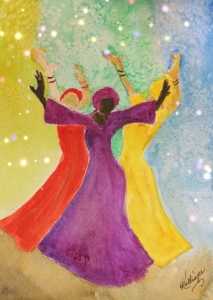
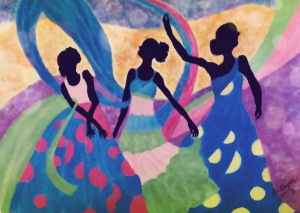
By 1270, six of the seven books of the “Flowing Light” were brought to parchment, collected and given chapter titles by Heinrich. Mechthild saw her book as a message to both believers and clergy, for she feared the church was in danger of being hollowed out from within; she called the powerful church officials, who often enjoyed worldly luxury, “stinking billy-goats.”

Thus, Mechthild was known as a very unruly woman of God — a defiant, dissident and radical rebel! “Stinking billy-goats!” No wonder she became known for her “rebelliousness and unorthodox ways.” The community she was a part of, the Beguine order, was known for the same kind of unorthodox rebelliousness. 

The Beguine order was a Christian religious movement active in Northern Europe during the 13th-16th centuries. The Beguines were women who lived as nuns in semi-monastic communities. Through their intense devotion to God and their somewhat ascetic lifestyle, they came to be known for their acts of rebellion and their unorthodox ways.

99AF81A9-35CC-43E5-A641-B19170914765
Watercolor art: 2019; by Kathy Manis Findley

Mechthild of Magdeburg definitely danced to her own music!

With her order, she was part of a great spiritual revival movement of the thirteenth century, a time when the Catholic Church was falling into disfavor. The Beguines sought to imitate the life Christ through voluntary poverty, care of the poor and sick, and religious devotion.

With advancing age, Mechthild was blind. She was alone, still the object of much criticism. With singing silenced and dancing impossible, she was left to sing songs in her heart and dance the dances of her imagination, always seeking Spirit promptings.

Some scholars have speculated that, due to increased persecution and failing health, Mechthild was forced to retire to the convent of Helfta around 1270. There, she met three other notable writers of the time, Gertrude of Hackeborne, Mechthild of Hackeborne, and Gertrude the Great. Helfta was a good place for a writer such as Mechthild. Under the leadership of Gertrude of Hackeborne, Helfta had become a hub of learning and writing for women and a center for book collecting, copying and illumination.

Still, Mechthild portrayed herself as a reluctant writer urged on by God and her director to continue her work. She calls her director “my dear schoolmaster,” who taught her, “simple and stupid as I am, to write this book.” About the urging of God she said, “I cannot nor do I wish to write “unless feeling the power of the Holy Spirit.” At one point, Mechthild wondered why God did not choose a priest rather than herself for this work, and she is told that God always seeks out the lowest and smallest so that “unlearned lips can teach the learned tongues of the Holy Spirit.”

In spite of the fact that Mechthild was unable to read and write in Latin, these are some powerful quotes by the graceful mystic Mechthild of Magdeburg, from her book Das fließende Licht der Gottheit (The Flowing Light of Divinity), where she describes her visions of God.

The day of my spiritual awakening was the day I saw and knew I saw all things in God and God in all things.

If you love the justice of Jesus Christ more than you fear human judgment then you will seek to do compassion. Compassion means that if I see my friend and my enemy in equal need, I shall help them both equally. Justice demands that we seek and find the stranger, the broken, the prisoner and comfort them and offer them our help. Here lies the holy compassion of God that causes the devils much distress.

From suffering I have learned this: that whoever is sore wounded by love will never be made whole unless she embraces the very same love which wounded her.

A Light of utmost splendor glows on the eyes of my soul. Therein have I seen the inexpressible ordering of all things, and recognized God’s unspeakable glory — that incomprehensible wonder — the tender caress between God and the soul . . . the unmingled joy of union, the living love of eternity as it now is and evermore shall be.


I cannot dance, Lord,
unless you lead me.

If you want me to leap with abandon,
You must intone the song.

Then I shall leap into love,
From love into knowledge,
From knowledge into enjoyment,
And from enjoyment
beyond all human sensations.

There I want to remain,
yet want also to circle higher still.

— Mechthild of Magdeburg

Like her, I want to “circle higher still.” I want to escape from chains that shackle the highest expression of my spirit. I want to sing the songs God placed in my heart! I want to dance to the Spirit’s rhythm hidden in my spirit!

6480931C-BB7C-4745-8CBC-1D2C70C6B09E
Acrylic art by Kathy Manis Findley

Without fear! Without fear . . .

taking the journey set before me to follow Christ into places of poverty, fear, sickness, desperation. Breaking the rules if I must. Taking criticism if I must. Being persecuted if that is in the cards for me. I want to move forward into my calling with the Spirit of God upon me . . .


The Spirit of the Lord is upon me,
because he has anointed me
to bring good news to the poor.

He has sent me to proclaim release to the captives
and recovery of sight to the blind,
to let the oppressed go free.

 — Luke 4:18 New Revised Standard Version (NRSV)

May God make it so for us. Amen.


Christ's Passion, Christ’s Resurrection, Church, Community, Courage, Death, Faith, Fear, Holy Monday, Holy Week, Lament, Loss, Pandemic of 2020, Prayer, Social distancing, Suffering

Lament

763AF584-0CFF-4994-BCAA-4202D8FC97CF
Monday of Holy Week
April 6, 2020

I have been thinking today that this Holy Monday is the threshold into Holy Week, and that I am standing at that threshold in fear. It is true that this time of pandemic has brought a season of fear to many of us, as well as a time of heaviness, concern, confusion and lament. Just one year ago, on April 5, 2019, I posted the following thought.

Courage is not the absence of fear but rather the judgment that something is more important than fear. The brave may not live forever but the cautious do not live at all.

— From the movie “The Princess Diaries” (2001)

I testify to the reality that courage really is deciding “that something is more important than fear.” None of us anticipated what 2020 would bring. It was simpler last Holy Week to write eloquent words about fear and courage. We could contemplate such thoughts far more comfortably than we can in this season of pandemic, the virus assailing the earth and the arrival of the season of Lent just to make sure we are all weighted down sufficiently.

I do not know about you, but I am experiencing these days as heavy. It feels heavy to me being confined to home. It feels heavy to be overly worried about my suppressed immune system since the transplant. It feels heavy to know that so many people all over the world are suffering with the coronavirus and that many have died. I just feel an oppressive heaviness. I feel as though the place we must be right now is a place of lament. 

Who brought the world as we know it to such an abrupt halt? Is one purpose of this pandemic to make us stop and take time to heal our souls? Is another purpose a demand for us to be still and allow our stillness to begin to heal an earth rife with environmental destruction? Is it to tell our churches to stop, to re-think worship that is sometimes predictable, stale, spiritless? Is the pandemic’s purpose to teach us to cherish the community of faith we have taken for granted, as now community is somewhat lost to us?

There are so many things to lament in these days, for all of us. But I have not intruded on your time today just to write about my laments in this season, to tell you all about my heaviness and the heaviness of the world. I write on this Holy Monday in hopes that we will sit quietly for a few moments of contemplating passion and promise — the Passion that leads to Christ’s death and the Promise that always ends up with Christ’s resurrection, and ours.

Not only is the lament, the heaviness, the anguish and fear of death that surrounds us this year a global phenomenon, but the things that Christians normally do in Holy Week to create transcendent meaning are painfully denied us for now: our palms and crosses, our washing of feet, our sharing of the bread and cup. These powerful physical and sacramental expressions of our faith we always do together. We cannot do them together this year.

In some ways, though, we are humanly and globally more united now than we have ever been (by this virus), and yet more separated than ever (by our fear of it). It is as if we have crashed suddenly and directly into the emptiness and shock of Jesus’s tragic death, before we have even started the journey to Jerusalem with him. Let us not rush. Instead may we walk the way of Christ’s story this week, through the times of passion, to the moment Jesus died, and on to the glorious resurrection Rushing through Holy Week is like controlling the story.

Controlling the coronavirus “story” is also problematic because it isn’t just a story. We are in it, and for now none of us can get out of it. But the glory of the Passion story is that it also isn’t just a story. It is, as we Christians have to remind ourselves during this time, the final and ultimate story of “the struggle between life and death” and of life being triumphant in the extraordinary power and mystery of the resurrection.

C09A1F72-2855-4EBA-813E-4231D8CE6A9A
Together in Community

God’s Son breaks the bonds of death and shatters the forces of darkness and sin. We must remember that holy mystery in these days. We must remind ourselves that, even when lamenting our separation one from another, Christ’s resurrection binds us together across the boundaries of time and space and even death itself. 

And, wonder of wonders, the fear and anguish of COVID-19 reminds us of this same fact: that we belong together, in need and vulnerability and compassion and mutual belonging. We are one — both in death and in life.

In this Monday of Holy Week, the coronavirus story meets the Passion story. We may be lamenting the worship we will miss this Holy Week. We may yearn for the physical and spiritual comfort of the familiar traditions that the virus has stolen from us. We quake in fear at the pandemic itself. Yet during this time, we are being stretched in new and unthinkable ways, precisely by that fear and by the temporary loss of worship with our faith community. We stretch to consider afresh the core of our baptismal faith: that the resurrected body of Christ sustains us all, even in and through death itself. 

I wonder how I will spend this very different Holy Week, as I am at home feeling alone on Holy Monday. I am lamenting the temporary loss of my worshipping community. You may be lamenting the same loss. As always, this holy day will lead us into the week and through the Passion of Jesus — his heart breaking for the betrayal of Judas, his moment of feeling that God had forsaken him. We face the Passion story reluctantly this year, already troubled and fearful. We may be afraid to add the story of the crucifixion to the loss the pandemic has also brought us.

But I will not leave us in this place, each of us isolated and lamenting. The very core of our faith — during Holy Monday and always — mystically unites us not only to Christ but to each other.

The coronavirus story will not supplant the story of Christ’s passion and resurrection. The virus will not have the last word, because even in its random cruelty, it may yet turn us back to the transcendent source and unity of our faith. In its scourge, it may open us up to the realization that we are the Body of Christ in this world, together, in radiant community that will endure. The circle of the faithful will not be broken, even by a worldwide pandemic. 

O God, abide with us on this holy day
and through the pain of Holy Week.

Grant that our deep lamentations cease,
even as we walk with Jesus and hear again the story of his death. 

Grant that our deep lamentations cease
as we lift our faith and pray for an end to the pandemic
that harms our entire world.

Help,us, God, to endure what lies before us with hope, courage, patience and faith.

Because our faith tells us, God, that as the Holy Week story continues, our laments will be replaced by praises to God as we witness again the glory of the risen Lord.

Amen.


anxiety, Christ's Passion, Christ’s Resurrection, Comfort, Community, Courage, Faith, Fear, God's presence, Heartbreak, Hope, Isolation, Loss, Pandemic of 2020, Psalms, Resurrection, struggle, Sunday of the Palm and Passion

In a Shaken Time . . . The Unshakable

59D5B9FF-187F-47B4-8727-948A56F8268B

I have written often about times when I have been shaken to my core, the hard times and the seasons of angst. Not because hard times have been a constant in my life, but because in the middle of them, I have found a Divine Constant that sustained me at times and saved me at other times.

As we approach the Sunday of the Palm and Passion, we remember the journey Jesus traveled.

. . . the great crowd that had come to the festival heard that Jesus was coming to Jerusalem. So they took branches of palm trees and went out to meet him, shouting,“Hosanna! Blessed is the one who comes in the name of the Lord— the King of Israel!” (John 1:12-13 NRSV)

Yet, before the day is done, the Gospel of John tells us how troubled Jesus was as he spoke about his death.

Now my soul is troubled. And what should I say—‘Father, save me from this hour’? No, it is for this reason that I have come to this hour. (John 1:27-28 NRSV)

As we recall Christ’s passion, we cannot help but recognize our own — and the passion of our families, friends, neighbors scattered throughout the world. Each of us, no matter where we are, are covered with the fear of a pandemic we can not begin to understand, the virus that knows no boundaries. It goes where it will, infecting those exposed to its microorganisms and leaving fear and anxiety in its wake. We are shaken to the core.

Those who are infected, or have watched as their infected loved ones battle the virus, cry out for mercy, for grace and for comfort. They are in search of the Divine Constant, a “very present help,” who keeps vigil with us offering a comfort that surpasses our ability to comprehend it. There is no better description of divine comfort than the words of the Psalmist in the 46th Psalm that tells us to take heart, hang on, fear not.

God is our refuge and strength,
a very present help in trouble.

Therefore we will not fear, though the earth should change,
though the mountains shake in the heart of the sea;
though its waters roar and foam,
though the mountains tremble with its tumult.

There is a river whose streams make glad the city of God,
the holy habitation of the Most High.
God is in the midst of the city; it shall not be moved;
God will help it when the morning dawns.

The nations are in an uproar, the kingdoms totter;
he utters his voice, the earth melts.
The Lord of hosts is with us;
the God of Jacob is our refuge.

Come, behold the works of the Lord;
see what desolations he has brought on the earth.

He makes wars cease to the end of the earth;
he breaks the bow, and shatters the spear;
he burns the shields with fire.

“Be still, and know that I am God!
I am exalted among the nations,
I am exalted in the earth.”

The Lord of hosts is with us;
the God of Jacob is our refuge.

At the very beginning of the Cold War in 1952, Harry Emerson Fosdick spoke to students and faculty at the Pacific School of Religion. After acknowledging the very real fear and uncertainty in the world at that time, he spoke these words: “The highest use of a shaken time is to discover the unshakable.”

Oh, that we might find the highest use of this time! Oh, that we might find it alone — isolated in our homes, in our prayer closets, in the breeze and beauty of springtime! Oh, that we might find the highest use of this time in community — in all the ways we are striving to create holy community despite our isolation.

Yes, we are shaken right now, but again the Psalmist has the last word of divine comfort and hope.

The Lord is close to the brokenhearted
and saves those who are crushed in spirit.
(Psalm 34:18 NIV)

As I look around, hearing from those closest to me and also hearing the stories of people around the world, I witness signs that we are indeed discovering the unshakable in this shaken time — the unshakable in ourselves, the unshakable faith we hold in our hearts, the unshakable spirit within us and the Unshakable Constant God who pours grace upon us when we most need it.

May each of you stay safe and healthy. May you wave your palms and witness Christ’s passion still believing in the resurrection that will dawn upon our lives again. May you find the unshakable within you and hold the Unshakable God near you.

For a time of prayer and meditation, you may be inspired by listening to this beautiful arrangement of the hymn, “Nearer, My God, to Thee.”


Activism, Advocate, Black History Month, Challenge, Change, Courage, Covenant, Injustice, Justice, Racism, reconciliation, Repair the world, Segregation

I NEED YOU to join the fight for change!

24E7C406-2AD0-47CB-A702-2E259A76DCC3
We are well into Black History Month, also called African American History Month.  We celebrate it every year in February. All manner of celebrations and commemorations happen during this month, from school plays, choral concerts, historical dramas to formal tributes and ceremonies in cities, colleges and churches. In the midst of this month, I have been contemplating the idea of white fragility drawing on the books, White Fragility by Robin DeAngelo and Radical Reconciliation: Beyond Political Pietism and Christian Quietism by Alan Boesak and Curtiss Paul De Young. I highly recommend both books to you if you want to advocate for racial justice.

A dear and very wise friend of mine would exhort us to know the history of black people, but more importantly, to enter into serious conversations about equality and unity. She would tell white people to accept the reality that we will never completely understand her history and that we should be sure our conversations include deep listening. She would remind us that the history of injustice to black people has not ended yet and that we must all continue our work for justice and equality. I want to share with you some of the history behind this month.

As a Harvard-trained historian, Carter G. Woodson, like W. E. B. Du Bois before him, believed that truth could not be denied and that reason would prevail over prejudice. His hopes to raise awareness of African American’s contributions to civilization was realized when he and the organization he founded, the Association for the Study of Negro Life and History (ASNLH), conceived and announced Negro History Week in 1925.

The event was first celebrated during a week in February 1926 that encompassed the birthdays of both Abraham Lincoln and Frederick Douglass. The response was overwhelming: Black history clubs sprang up; teachers demanded materials to instruct their pupils; and progressive whites, not simply white scholars and philanthropists, stepped forward to endorse the effort.

The Black Awakening of the 1960s dramatically expanded the consciousness of African Americans about the importance of black history, and the Civil Rights movement focused Americans of all colors on the subject of the contributions of African Americans to our history and culture.

B5AF969F-8A72-44B0-A65B-9EF5BCB8102E

Then the celebration was expanded to a month in 1976, the nation’s bicentennial. President Gerald R. Ford urged Americans to “seize the opportunity to honor the too-often neglected accomplishments of black Americans in every area of endeavor throughout our history.” That year, fifty years after the first celebration, the association held the first African American History Month. By this time, the entire nation had come to recognize the importance of Black history in the drama of the American story

There is so much more I could include, but I will finish with some random thoughts my friend would like for us to know.

— The G.I. Bill of 1944 was denied to a million black veterans of WWII (history.com). These things matter. PUBLIC POLICY throughout American history has deliberately and purposefully limited economic opportunities and advancement of black people.

— It never occurred to me that some white people thought black history month DID NOT involve them.

— During this Black History Month, I ask: Do the white people within our networks remotely get how glorious AND exhausting it is being black in America? Can we talk about why it’s exhausting? Can you handle sitting in an uncomfortable space for awhile? Can you handle it? Can you take it in without deflection, pointing fingers, becoming defensive or proclaiming yourself the victim? Can we REALLY talk?

And finally her heartfelt words about a confrontation that happened in her city, in a neighborhood she knows well, to two people who are her friends.

My soul weeps. My body trembles. Anger and fear take turns occupying the same space. Why? Two people that I hold in high regard experienced the policing of their bodies in a PUBLIC space by white people who feel they get to decide where black people can and cannot be!

As I learned of what occurred I was immediately grateful their positions (elected official and one running for office AND a friend who STEPPED UP) along with their “training “ allowed them to walk away from this experience. Yes this was potentially a life and death event.

43274C05-47A6-49F7-979E-B91258D1809CSo many what if’s ran through my mind. If you are black you will understand what I mean. If you are white, I CHALLENGE you to discuss this LOCAL event with your WHITE friends! I NEED you to discuss it in YOUR churches. I NEED you to discuss with YOUR family.

I NEED YOU to join the fight for change! YOU play a KEY role in ensuring change happens.

I thank my friend for challenging me and encouraging me, not only during Black History Month, but throughout time — every day, every month and for years ahead. To black people, Black History Month begins on January 1st and ends December 31st, and the message of the month for black people has been lifelong. As for those of us who are white, let us not be shackled by “white fragility.” Instead let us move boldly — and with courage — into our communities and confront racism wherever we find it. It is true that racism and white supremacy have been a part of our history always, but we can end this tragic injustice with resolve, unity, faith, courage and the blessing of God who created all people in One image. May God make it so.

Calling, Christian Witness, Compassion, Courage, Covenant, Duc In Altum, Fishers of people, Here I am, Lord., Holy Ground, Uncategorized

Duc In Altum . . . A Holy Calling

Duc In Altum . . . a different sort of phrase for beginning a blog post. Until recently, I had no idea what this Latin phrase meant! The phrase Duc In Altum is generally translated to mean “put out into the deep.” The phrase draws its name from Luke 5:4 where Jesus instructs Simon Peter to “launch into the deep” or “put out into deep water” or “draw into the deep.” More specifically, the phrase comes to us from the Latin (Vulgate) translation of Luke’s Gospel of the call of Peter.

But “launching into the deep” does not stop with the experience of Simon Peter. It is a part of the Holy Calling of each of us to go deeper in loving, caring and compassion for others. The dilemma we face as Christ followers is that cannot we go to the deeper level with others unless we do so within our own hearts first. Knowing our hearts, searching our hearts is apart of a contemplative life that prepares us to be “fishers of people.” Holy calling is what Duc In Altum is about and is so clear in the story of Jesus calling his first disciples.

One day as Jesus was standing by the Lake of Gennesaret, the people were crowding around him and listening to the word of God. He saw at the water’s edge two boats, left there by the fishermen, who were washing their nets. He got into one of the boats, the one belonging to Simon, and asked him to put out a little from shore. Then he sat down and taught the people from the boat.

When he had finished speaking, he said to Simon, “Put out into deep water, (Duc In Altum) and let down the nets for a catch.”

Simon answered, “Master, we’ve worked hard all night and haven’t caught anything. But because you say so, I will let down the nets.”

When they had done so, they caught such a large number of fish that their nets began to break. So they signaled their partners in the other boat to come and help them, and they came and filled both boats so full that they began to sink.

When Simon Peter saw this, he fell at Jesus’ knees and said, “Go away from me, Lord; I am a sinful man!” For he and all his companions were astonished at the catch of fish they had taken, and so were James and John, the sons of Zebedee, Simon’s partners.

Then Jesus said to Simon, “Don’t be afraid; from now on you will fish for people.” So they pulled their boats up on shore, left everything and followed him.

— Luke 5:1-11 New International Version (NIV)

Launch out into deep waters . . . Duc In Altum . . . A Holy Calling . . .

It was not only a calling to Simon Peter. It was not only a calling for the other men who were with him on that day to experience that sacred encounter with Jesus of Nazareth. The Holy Calling in those days was also a call to women, just as it is today. For all of us have watched many women go out into the deep places of ministry and service. All of us have borne witness to women of faith who “headed out into the deep waters.”

Duc In Altum is not only a holy message of call, it is a place. In the Holy Land, in the town of Magdala, there is a beautiful architectural offering called Duc In Altum. It has been called “the most unique spiritual center in the Holy Land.” The Center does only commemorate the men Jesus called, but also the women. Included in the design and construction of Duc In Altum is a women’s atrium designed to exalt the presence of women in the Gospel. In what the builders and developers call Divine Providence, the idea for this Center materialized in Magdala, birthplace of Mary Magdalene, who was a follower of Jesus, along with other women who supported him with their own means (Luke 8).

The Women’s Atrium features eight pillars, seven of which represent women in the Bible who followed Jesus, while the eighth honors women of faith across all time.

These are the honored women whose names are on the pillars:

Mary Magdalene – follower of Jesus and present at his crucifixion (Luke 8:2)

Susana and Joanna, the wife of Chuza – followers of Jesus (Luke 8:3)

Mary and her sister Martha – followers of Jesus (Luke 10:38)

Salome, the mother of James and John – supporter of Jesus and wife of Zebedee (Matthew 20:20)

Simon Peter’s mother-in-law – healed by Jesus, then supporter of Jesus (Matthew 8:15)

Mary, wife of Cleopas – follower of Jesus and present at his crucifixion (John 19:25)

The Unmarked Pillar – for women of all time who love God and live by faith

The Unmarked Pillar is for you and me, for all women who have heard the Holy Calling and have responded, “Yes!” The Holy Calling is a call for every age with the same message, Duc In Altum, “launch into the deep waters” in faith and commitment. It is for so many women who have set their faces toward a Holy Calling and headed out into the deep waters to meet people in need wherever they are, whatever their needs. It is for women who have heard the Holy Calling and responded, “Here I am, Lord. Send me.”

Jesus said, “I will make you fishers of people!” Amen.

Adventures, Belief, Bravery, Children, Courage, Dreams, Faith, Falling down, Flying, fun, Growing up, Hope, Learning, Magic, Space Jam, Women

A95FCCB7-F996-42AF-B208-DB286900D4EF

When I was a teenager, I was conscripted many times to “watch” my younger brothers. It was a loathsome task for me! Yet, occasionally the two of them were interesting to watch, especially through their superhero fascination. They seemed to favor the superheroes who could fly, like Superman or Batman (who could sort of fly, but was likely to perish when attempting to land). It occurred to me that in the scene I watched in the back yard, the two young guys looked much more like flight-challenged Batman!

One afternoon after school, the boys were outside playing. Through the window, I watched them as they donned their makeshift capes. Then — without a care in the world and believing that they really could take flight — they stood tall on wooden boxes and launched themselves, arms extended, looking up to the sky. They didn’t fly that day, but they believed, they dreamed. And they had great fun!

I also noticed during those days that I never saw girls stand on boxes with arms outstretched ready to launch into flight. I certainly never thought of doing it myself. But it made me wonder if girls had dreams like the boys did. That thought brought my mood low and, looking back on it, I think I might have felt a bit of heaviness and disillusionment. I didn’t believe I could fly, but rather that I would leap off the box straight into the ground with a thud that probably resulted in a skinned knee. As the years passed, I learned for sure that if women had dreams, they would not likely realize them in our reality, which was “a man’s world.” Dreaming, hoping, flying may not be possible for a “girl.”

When my son was growing up, we saw the motion picture, Space Jam, a terrific movie for son Jonathan, who was an avid Michael Jordan fanatic. No doubt, my 6’6” son wanted to “Be Like Mike.” In Space Jam’s soundtrack was the song, I Believe I Can Fly, a 1996 song written and performed by American singer, songwriter and former professional basketball player R. Kelly.  This mom was not very fond of R. Kelly, but the song he wrote literally moved me and filled me up with hopes and dreams for my son. R. Kelly’s message was a great one:

I used to think that I could not go on
And life was nothing but an awful song
But now I know the meaning of true love
I’m leaning on the everlasting arms

If I can see it, then I can do it
If I just believe it, there’s nothing to it

I believe I can fly
I believe I can touch the sky
I think about it every night and day (Night and day)
Spread my wings and fly away
I believe I can soar
I see me running through that open door
I believe I can fly

See I was on the verge of breaking down
Sometimes silence can seem so loud

There are miracles in life I must achieve
But first I know it starts inside of me

If I can see it, then I can be it
If I just believe it, there’s nothing to it
I believe I can fly

believe I can touch the sky
I think about it every night and day
Spread my wings and fly away
I believe I can soar
I see me running through that open door
I believe I can fly
Oh, I believe I can fly ‘cause I believe in me . . .

I hope you will enjoy the video below, which I place here in honor of my son, Jonathan .

If God would grant me just one request, it would be that every boy — and every girl — would climb on their wooden box and believe in their souls that flying is possible. I would want them to stand tall, with hope and courage, dreaming their dreams and seeing the magic of watching them grow.

Anger, Awakening, Betrayal, Bitterness, Change, Courage, Covenant, Darkness, Despair, Emotions, Friends, Friendship, grief, healing, Heartbreak, Joy, Love, strength, Suffering, Transformation, Trust

“A Box Full of Darkness”

9782060C-0A7E-4CD7-B924-1D8D99B38B1B

Someone I loved once gave me a box full of darkness.
It took me years to understand that this too, was a gift.

― Mary Oliver

For some reason yet unknown to me, I am remembering those words today. At the same time, I have vivid memories of persons I loved — many of them through the years — who gifted me with “a box full of darkness.” Each time, it felt like anything but a gift. I accepted the boxes because I believed I had no choice. I reached out to take the boxes from people I loved and immediately discovered that it was the darkness I held in my hands. Unfortunately, the darkness in my hands was potent enough to engulf me, and for a good amount of time, the darkness was my constant companion. All around me. Above and below me. Darkness so deep that I could not begin to see the path ahead.

What would I do with these ominous gifts? How would I escape the deep effect they had on my soul? How will I cast off the heartbreak? In time, I was able to think beyond my initial acceptance of these boxes moving to the reality that they were given to me by persons I loved. These were loved ones who might ordinarily have given me gifts, but these gifts — these boxes — were filled with darkness! Why? What did these gifts mean?

I held on to the pain of those “gifts” for years, feeling anger on some days, or betrayal, or loss, or rejection. The experiences changed my life in many ways, and changed the very course of my life. Being a person who so values friendship and loyalty, I was left despondent and a bit lost. Okay, a lot lost!

Yet, the passing years actually did bring healing relief. I could not avoid the darkness that my loved ones gave me. I could not get around it, slip under it, or leap over it. It was just there with me, in my life, and feeling like it would be permanent. The boxes were to me a heart rending breach of covenant. And yes, I did experience despair in the darkness, and loneliness and lostness, and bitterness wondering how these gift boxes had such immense power over me.

When the darkness finally lifted, it brought me a brand new love of life. It gave me new courage and new excitement. It gave me an awakening! I experienced a holy transformation. I knew then that I could get on with my life, joyously, and moving forward following my dreams. So Mary Oliver knew something that I had to learn the hard way, over many years. Here’s what she wrote: “It took me years to understand that this too, was a gift.”

And then there is this wise and wonderful postscript that Annie Dillard wrote about her writing. It applies to every vocation or avocation that we love, and it’s really about living life — all out!

One of the few things I know about writing is this: spend it all, shoot it, play it, lose it all, right away, every time. Do not hoard what seems good for a later place in the book, or for another book; give it, give it all, give it now . . . something more will arise for later, something better. These things fill from behind, from beneath, like well water . . . The impulse to keep to yourself what you have learned is shameful, it is destructive.  Anything you do not give freely and abundantly becomes lost to you. You open your safe and find ashes.  (Annie Dillard from her book, The Writing Life)

Finally, James 1:2-4, a Scripture passage very familiar to us says it another way:

My brothers and sisters, whenever you face trials of any kind, consider it nothing but joy, because you know that the testing of your faith produces endurance; and let endurance have its full effect, so that you may be mature and complete, lacking in nothing.

So real and true it was when the people I loved betrayed me with a terrible “box full of darkness.” I had faith in each of them. I trusted them and held their love in my heart. My box full of darkness was indeed a trial and a testing of my faith. But the promise of The Epistle of James is there, in my face. It may just be a Holy Letter addressed directly to me. My challenge was to “consider it nothing but joy,” and to know that the testing of my faith most assuredly created endurance. Thanks be to God.


Awakening, Awareness, Change, Contemplation, Courage, Discernment, Discovering, Emotions, Exploration, God's presence, grief, Guilt, healing, Indecision, Introspection, journey, life, Light, Lingering, Mayo Clinic, Mystery, New Life, New Year, Pain, Prayer, Sacred Space, Self Awareness, Spiritual awakening, Trust

Lingering . . . In the Presence of God

53189F0B-8EF7-4BDC-A66A-B9834A45C0F5

I have observed, at this year’s beginning, as in past years, that humans are more introspective than usual. It may begin with intentions or resolutions for the new year. What I observe is that people are revisiting the past, trying to reinterpret it, digging for the meaning the past held for them and trying to find ways to heal the wounds of the soul theyp have hidden inside them for a long time. Those woulds live in us so long that they become scars, hardened in our spirits and thus more difficult to heal.

Until we have done this spiritual and emotional inner work, we are hesitant, unwilling to move into the future. So we linger in the present and re-live the past. Usually what we  revisit are past sorrows and losses, past disappointments and perceived failures, past pain that continues to pierce the soul. Seldom do we revisit past joys, because joy does not pierce like sorrow does.

It is a positive thing to linger in life review at the beginning of a new year. Just as the year is new, all of us hope that in the work of lingering, we will find newness in ourselves. The work of introspection is important for our well being and we have so many choices about how to strengthen ourselves, body and spirit. Many people use self-counseling, which may include searching their deep selves through personal contemplation and prayer. Others engage in spiritual direction, life coaching, trauma therapy or counseling. Still others tend to their souls through silent contemplation, labyrinth walks, yoga, nature walks, strenuous exercise, reading scripture, self-help books or poetry, and singing hymns or listening to music.

I want to suggest one other form of self-counseling that is unfamiliar to most people — working with Healing Runes as a part of your quiet time. Your first question probably is, “What are Healing Runes?” I want to begin by sharing an invocation written by Ralph H. Blum from his book, The Healing Runes.

Invocation

Practice the Presence of God in all ways,
Both in your coming in and your going out.

In your prayers, invoke God’s Presence.
In your aspirations, stay mindful of the Presence.
In your meditations, breathe in the Presence.

Above all, let the Presence be reflected in your attitude,
For surely then God will sing in your thoughts,
Speak in your voice and shine through your acts.
Let the Presence of God be the medicine
To heal your life, lift your heart and renew your spirit.

Practice the Presence of God in all ways,
Both in your coming in and your going out. Amen

To answer the question, a Healing Rune is a tool that provides a way of deepening  reflection and stirring the soul where we find life meaning and buried emotions. There is an interpretation of each healing rune in the book, The Healing Runes, written by Ralph Blum and Susan Loughan. They offer interpretations presented in graceful and sensitive language that allows the reader to take to heart what is appropriate for their own meditation and leave the rest.

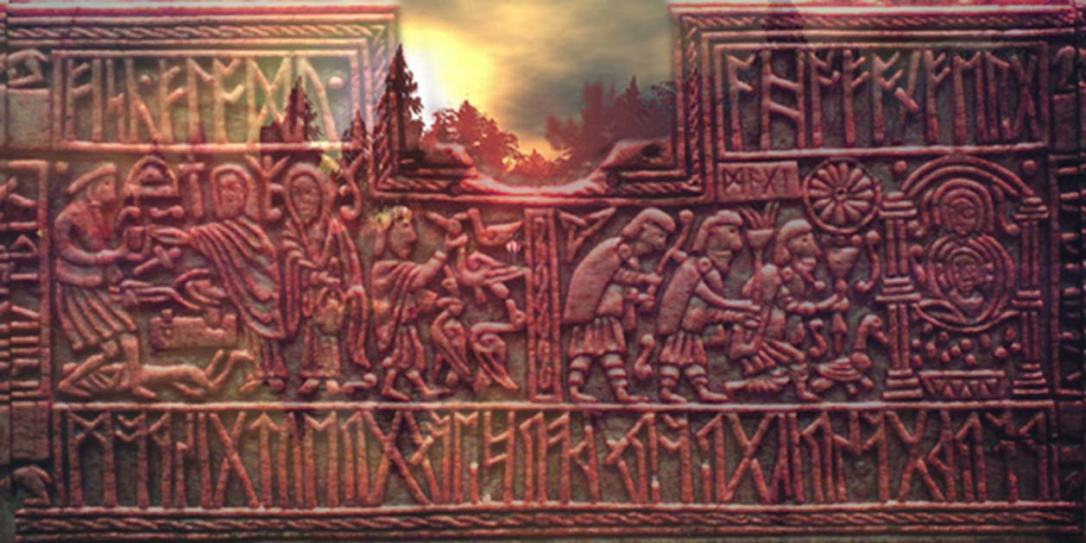
A4B9545F-D3B1-40D5-AC08-23DF8FD547CAThe book adapts the sacred use of Runes as an alphabetic script used by the ancient Germanic and Norse peoples, creating a tool that could be helpful in the healing of body, mind and spirit.*
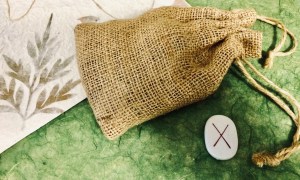
I suggest that we not fear the Healing Runes by considering them to be some sort of pagan artifact or something that seems like magic. They are more like mystery, something to guide our reflection and introspection. I suggest the we see Healing Runes as one way to guide us deeper into ourselves and into the presence of God, the ultimate healer of our souls.

I would like to choose a Healing Rune for us from my bag. Its meaning may not mean anything to you or to me. It may not open up any places in your soul that need attention. Or it may awaken us to a wound that we need to give some reflective time, some time for healing.

328A8B00-83F2-418F-BFC5-29960E0C06C7The Rune I have randomly chosen is the Rune of Trust. It is the Rune of restoration that calls for the rebuilding of belief in yourself, in your life and in your relationship with God. For some, drawing this Rune asks you to show trust in a present situation. For others, it calls for embracing the changes you are facing with trust and wisdom. In relationships of the heart, remember that I love you and I trust you are two stones for crossing the same stream. Most importat is that you ask your soul if Trust has something to teach you or somewhere to lead you.


Thomas Moore writes, “We separate, each from the other, the sicknesses of body, emotion, meaning and connectedness.” The soul must be moved, touched and healed, and that is why we linger at the door of our pain, trying every way we know to reconcile it, heal it, eliminate it (or just blast it with a sci-fi laser gun!) Thomas Moore has a better remedy than a sci-fi laser gun, a much more informed remedy:

I am convinced that all healing ultimately comes from a shift in deep imagination, grounding our own lives and anchoring our decisions in the very quick of the heart . . . not just relief from anxiety, but profound gifts that signal the presence of soul — intimacy, pleasure, beauty, love and piety.

As you and I explore what hides in our souls as this new year beckons us, may we not be afraid to linger directly in the presence of our fear or woundedness. Instead, let us consider that we are lingering in the comforting presence of God, in the gentle protection of Spirit. It is safe in that sacred space of Presence, safe enough for us to unearth whatever lies deeply in us and allow it to surface into the healing light.

God may be gently, lovingly calling us to do that work of healing and, in that introspection, to reveal our truth — the truth that will set us free!


* The Healing Runes, Ralph H Blum and Susan Loughan; Preface by Thomas Moore; St. Martin’s Press:New York, New York; ©️1995 by Ralph H. Blum.

Activism, Advocate, Bravery, Call, Courage, Defiance, Faith, healing, Justice, Perseverance, Persistence, Protection, Resilience, Stubbornness, Tenacity, Uncategorized, Vulnerability, Women

Stubbornness, Tenacity, Faith

61C5F6CB-7BD9-42ED-8FC4-A47EECD57FB6
Jesus and the Stubbornly Tenacious Woman from Canaan


Leaving that place, Jesus withdrew to the region of Tyre and Sidon. A Canaanite woman from that vicinity came to him, crying out, “Lord, Son of David, have mercy on me! My daughter is demon-possessed and suffering terribly.”

Jesus did not answer a word. So his disciples came to him and urged him, “Send her away, for she keeps crying out after us.”

He answered, “I was sent only to the lost sheep of Israel.”
The woman came and knelt before him. “Lord, help me!” she said. He replied,

“It is not right to take the children’s bread and toss it to the dogs.”

“Yes it is, Lord,” she said. “Even the dogs eat the crumbs that fall from their master’s table.”

Then Jesus said to her, “Woman, you have great faith! Your request is granted.” And her daughter was healed at that moment.

(Matthew 15:21-28)

I wonder . . . was it her faith or her stubborn tenacity that led to her daughter’s healing? Stubbornness is typically not one of the virtues to which Christians aspire. In fact most of Christendom would rebuke a stubborn woman, in ages past as well as in our day. I know this to be truth! I have been rebuked a time or two, or at least received “strong suggestions” that I should dial back my demeanor. The woman of Canaan, though, returned to Jesus again and again until he healed her suffering daughter.

I can be a bit tenacious, but no one would describe me as stubborn. I typically have a very calm and quiet demeanor, but I remember well one of the few times in my life when I was fierce and stubborn. Our son Jonathan was quite young and very sick with severe vomiting, along with strong spasms that caused him to be unable to breathe. The loud inhalations as he struggled to get a breath were extremely frightening to us, especially to him. Jonathan was a strong boy, an athlete, and very self-sufficient, but these long episodes brought him directly to his Momma. We had been to the hospital emergency room and were now in his pediatrician’s office. This violent gasping for air had been going on for hours, and it should have been obvious to the office staff that Jonathan was in trouble.

Now they would know real trouble!

Jonathan had another violent attack. I jumped up from my chair, went to the desk, and had some strong words to say, in a loud voice, with the passion of a mother desperate to protect her child. I got the familiar line about the doctor running behind.

You know, I don’t care if the doctor is behind! (in my loudest voice) Can you not see and hear that my child is throwing up all over your waiting area and is unable to breathe? Do you realize that he could be infecting every child in here? Take us to an exam room, NOW, and get the doctor away from whatever he’s doing! Because if you don’t, I am headed to the president of Baptist Medical Center who knows me very well because I am a chaplain in this hospital!

Not like me at all! But that is a “Momma response” that almost always erupts when her child is hurting or in trouble. We were in a desperate place and were being ignored. Jonathan was terribly frightened and had been dealing with these spasms for hours. In time (too much time) it was resolved and we were able to get Jonathan settled and resting.

And about the “Canaanite Momma” . . . well, she was definitely stubborn and persistent that day. Clearly, Jesus did not realize who he was dealing with. Maybe he did know! Perhaps Jesus knew precisely what he was doing and chose to use his encounter with the woman from Canaan as a teaching moment for his hearers. Or perhaps he was simply in a stubborn mood and found himself facing someone who could easily match him, stubborn for stubborn!

Either way, the story shows us that when it comes to saving what needs to be saved, being merely nice and calm won’t usually win the day. Sometimes we need to dig in our heels and do some hollering! The text simply portrays the Canaanite woman as a stubborn, persistent mother of a very sick daughter.

Remember, the disciples urged Jesus to send her away. She was obviously making a lot of noise, crying out and disturbing their quietude! On top of that, Jesus was somewhat stubborn himself, saying that he was sent only to the lost sheep of Israel.

But this “Canaanite Momma” went back to Jesus straightaway, knelt down before him, saying, “Lord, help me!”

And we know what Jesus finally did. He praised her faith and healed her daughter. So was it faith or was it stubbornness, persistence? Maybe it was both, that her faith empowered her to stubborn persistence. Clearly, she believed Jesus was able to heal her daughter, so she tried to convince Jesus more than once. The disciples didn’t deter her. Jesus Could not dissuade her with his statement about dogs!

“Woman, you have great faith.”

A wonderful portrayal of what this woman might have said about her encounter with Jesus is a poem written by Jan Richardson entitled “Stubborn Blessing.”

Stubborn Blessing

Don’t tell me no.
i have seen you
feed the thousands,
seen miracles spill from your hands like water, like wine,
seen you with circles and circles of crowds pressed around you
and not one soul turned away.

Don’t start with me.

i am saying
you can close the door
but i will keep knocking.
You can go silent
but i will keep shouting.
You can tighten the circle
but i will trace a bigger one
around you,
around the life of my child
who will tell you
no one surpasses a mother for stubbornness.

i am saying
i know what you
can do with crumbs
and i am claiming mine,
every morsel and scrap
you have up your sleeve.
unclench your hand,
your heart.
let the scraps fall
like manna,
like mercy
for the life
of my child,
the life of
the world.

Don’t you tell me no.

— Jan Richardson
https://paintedprayerbook.com/2014/08/11/stubborn-blessing/

The work of protection is definitely not for the faint of heart. The work of advocacy on behalf of another person may take some stubborn persistence, the kind of stubborn persistence that Jesus seemed to call by another name — “great faith.” When we advocate for people who are suffering, especially people in need of profound physical healing or deep spiritual healing, their greatest need calls us to our greatest resolve, a fierce resolve. Maybe a touch of defiance! It is in those moments that we call on our hearts to give us strength for sacred stubbornness that will heal the broken, comfort the brokenhearted, restore justice to those who are oppressed.

That is faith! “Great faith!”

anxiety, Challenge, Change, Chronic illness, Comfort, Contemplation, Courage, Emotions, Energy, Faith, God's presence, grief, healing, Hope, Illness, Life Journeys, New Year, Pain, Perseverance, Psalms, Sorrow, Soul, strength, Suffering, The Year Behind

Holding Hope

FA0DFF1E-0155-456C-BC1A-AF7ABBA0BE5E
A new year has dawned. We’re in it, ready or not! While we cannot control what 2020 brings to us, we can control the way we respond —- to times of joy, times of sorrow and all the times that are just ordinary. No doubt we will greet them all, ready or not!

As the poet reminds us, “Live the year that lies ahead with energy and hope. Be strong, have courage. It is time now for something new.” And so it is. But embracing something new is sometimes difficult. Sometimes our hope is small. Sometimes following our journey into an unknown future is frightening. If the year past still holds us in a place of suffering, if illness lingers with us, if depression and anxiety still rages in us, if persistent grief comes with us into the new year, it is difficult, if not impossible, to leave the past pain behind and embrace something new. So if you feel that you cannot leave past suffering behind you, this little message is for you.

The most important thing you can do is to honestly acknowledge the suffering and accept the fact that it will not leave you just because the new year has arrived. Spend some time contemplating your suffering, how it impacted you in the year past. Can you find any newness at all at the beginning of a new year? Is there some of the suffering  you can see in a different light? Can you respond to it differently? Can you find a way to endure it that is better than the way you endured it in the past? Can you make a concerted effort to learn something from your suffering?

Still, if you are in the throes of suffering — physical, emotional or spiritual — the suggestions above can illicit the strong response, “You’ve got to be kidding! This way of looking at the same thing I’ve endured for years is simply impossible!”

I will be the first to acknowledge the truth of that response, but I must also ask, “What do you have to lose?” Even a change in your response to one place of suffering could bring a small change for you, a change ever-so-slight that has the power to offer you increased resilience and hope. It may be worth a try.

I think it’s important to repeat these wise words: “Live the year that lies ahead with energy and hope. Be strong, have courage. It is time now for something new.”

I suggest that, even if we are enduring suffering, we can greet the new year “with energy and hope.” Hope is always available to us, even when we cannot see it or feel it.

From the promises of Scripture . . . 
“ . . . so that we who have fled for refuge might have strong encouragement to hold fast to the hope set before us. We have this as a sure and steadfast anchor of the soul, a hope that enters into the inner place.
 — Hebrews 6:18-19

From the depths of our souls . . .
“Why are you cast down, O my soul, and why are you in turmoil within me? Hope in God; for I shall again praise him, my help and my God.”   — Psalm 42:11

“I wait for the Lord, my soul waits, and in his word I hope.”  
— Psalm 130:5

But I will hope continually and will praise you yet more and more.”  — Psalm 71:14

The Scriptures can be comforting to us. They can lift up courage in us and they can give us strength to face all of our tomorrows, but the place where hope really lives is within us. We can reach down for it, hold it close, and allow it to help us move forward. No matter what manner of suffering we hold, hope can guide us.

I leave you and your journey into 2020 with the wise words of Corrie Ten Boom:

“Never be afraid to trust an unknown future to a known God.”


Advent, Angels, Bethlehem’s Star, Celebration, Christ’s Birth, Clouds, Courage, Dancing, Darkness, grief, Life storms, Rain and Stars, Skies, Stars

“I Am Not a Stranger to the Rain”

F7F250B9-34B2-4C15-BE70-A0AC908D2FB2
The Eleventh Day of Advent

December 12, 2019

THE CHILD IS BORN AGAIN

Each year the Child is born again

Each year some new heart
finally hears
finally sees
finally knows love.

And in heaven
there is great rejoicing!
There is a festival of stars!
There is celebration among the angels!

For in the finding of one lost sheep,
the heart of the Shepherd is glad, and
Christmas has happened once more.

The Child is born anew
and one more knee is bowed!

Ann Weems

Advent promises us angels and stars. And a Child — an extraordinary Child —who is the incarnation of God born into our world. How glorious this is adventure of Advent, year after year, a journey that brings us to angel celebrations and “a festival of stars.” We can count on it. We wait for it with great anticipation. We delight in the season. Advent candles flicker, gently illuminating the darkness until we light the Christ candle. Indeed the Child is born anew! And oh, how we love the songs of the angels, the festival of stars and the brightest star of all that shines on a stable!

But there are nights, even during Advent, when stars are hidden from our sight. Clouds begin to gather and the stars dim. The clouds thicken and the stars, even the brilliant Bethlehem star, disappear. The rains come, gentle at first, and then come down upon us with an unsettling force.

Rains do fall on the lives of all of us. Stars are hidden during seasons of rain and there may even be a startling clap of thunder here and there. Rainy seasons can be times of mourning the loss of a loved one, grieving the end of a relationship, lamenting the reality of a health crisis, worrying about your children or your aging parents. Rain falls on all of us, “the just and the unjust, those who do good and those who do evil.” (Matthew 5:44)

I am reminded of a beautiful song from the Stephen Schwartz musical, “Children of Eden.” The song offers wisdom that reminds us that we are not strangers to the rain: “I won’t say I’ve never felt the pain, but I am not a stranger to the rain.” The song goes on to say something profound that we might take to heart:

I’ve learned not to tremble
When I hear the thunder roar,
I don’t curse what I can’t change . . .

Here are the lyrics to the song followed by a video.

Shed no tears for me
There’ll be rain enough today
I’m wishing you godspeed
As I wave you on your way
This won’t be the first time
I’ve stayed behind to face
The bitter consequences
Of an ancient fall from grace
I’m a daughter of the race of Cain
I am not a stranger to the rain

Orphan in the storm
That’s a role I’ve played before
I’ve learned not to tremble
When I hear the thunder roar
I don’t curse what I can’t change
I just play the hand I’m dealt
When they lighten up the rations
I tighten up my belt
I won’t say I’ve never felt the pain
But I am not a stranger to the rain

And for the boy who’s given me the sweetest love I’ve known
I wish for him another love so he won’t be alone
Because I am bound to walk among the wounded and the slain
And when the storm comes crashing on the plain
I will dance before the lightning to music sacred and profane

Oh, shed no tears for me
Light no candle for my sake
This journey I’ll be making
Is one we all must make
Shoulder to the wind
I’ll turn my face into the spray
And when the heavens open
Let the drops fall where they may
If they finally wash away the stain
From a daughter of the race of Cain
I am not a stranger to the rain

Let it rain.


If we get to a point in our lives where we can say, “let it rain,” we will have found the strength to refuse to curse the things we cannot change. Then we can truly live, free from our need to control the things in life we simply cannot control. As the song says, “when the storm comes crashing on the plain, I will dance before the lightning to music sacred and profane.”

So let it rain and let us dance! And let us delight in Advent’s festival of stars, in the celebration of the angels, in the brilliance of the star of Bethlehem!

Amen.


Advent, Angels, anxiety, Belief, Change, Comfort, Courage, Darkness, God, God’s Gift of Stars, Hope, Kidney Transplant, Laughter, New Normal, peace, Suffering

Sometimes God Flings Stars!

0E6B5F26-6125-45C7-8B3C-48718E5A951D
The Fifth Day of Advent

Transplant Day Twenty-four
December 5, 2019

THIS YEAR

I wonder if God comes to the edge of heaven each Advent
and flings the Star into the December sky,
laughing with joy as it lights the darkness of the earth;
and the angels, hearing the laughter of God,
begin to congregate in some celestial chamber
to practice their alleluias.

I wonder if there’s some ordering of rank among the angels
as they move into procession
the seraphim bumping the cherubim from top spot,
the new inhabitants of heaven standing in the back
until they get the knack of it.
(After all, treading air over a stable and annunciating
at the same time can’t be all that easy!)
Or is everybody — that is, every “soul” — free to fly
wherever the spirit moves?
Or do they even think about it?

Perhaps when God calls, perhaps they just come,
this multitude of heavenly hosts.
Perhaps they come,
winging through the winds of time
full of expectancy
full of hope
that this year
perhaps this year
(perhaps)
the earth will fall to its knees
in a whisper of “Peace.”

— Ann Weems

This year for me is unlike any other year, not at all like Advents of my past. This Advent for me is not at all ordinary. It is an Advent that finds me in a bit of suffering, a bit of pain and, most of all, crying out for peace.

The poet asks: “What might it look like if the earth fell to its knees in a whisper of ‘Peace?’” We are always full of expectancy, full of hope that during some Advent, perhaps this year’s Advent, we will finally hear the earth whispering “Peace.” 

From the place I find myself today, I look for that Peace. Recovering from a kidney transplant and trying to live into a new normal, what I need most is peace. Peace after a life upheaval. Peace after a physical trauma. Peace that might help restore my emotional and spiritual self.

I do so want to fall to my knees in a whisper of “Peace.” But probably not today. Not until some parts of me heal a little more. It’s not always an easy thing, falling to my knees, even in the best of times. Today, though — far from home and family, separated from my friends and my faith community — most things are not easy.

I will remember these recovery days as a season of harsh medications, pain, swelling, itching, tremors, instability and anxiety. But there is another part of my memory that remembers that the Apostle Paul wrote some words that have always spoken deep peace to me. He wrote of being “troubled on every side, yet not distressed; perplexed, but not in despair; persecuted, but not forsaken; cast down, but not destroyed.”

And then his most comforting words of all: “We do not lose heart. . . for our light affliction, which is but for a moment, works for us a far more exceeding and eternal weight of glory.” (From 2 Corinthians 4)

Walking through those words of hope, I think I can make it another day. Even in my darkness of a difficult recovery, perhaps I can gather up my courage and perseverance and walk a few more steps. Yes, this is a hard time.

04E87215-AC50-4CC9-B2F4-6612E56D0CB9And yet, I still believe that, in some mysterious way, God comes to the edge of Advent and flings the Star into the night sky, maybe many stars. I can still envision God laughing with joy as starlights illuminate the darkness. And I can almost hear the singing of angels practicing their alleluias.

It is Advent, after all!

Advent, Angels, Comfort, Courage, Darkness, Emotions, Faith, God’s Gift of Stars, healing, Hope, Humbug, Kidney Transplant, Light, New Normal, Patience, Perseverance, Skies, Soul, Stars, struggle, Weeping

“Humbug!” and Hope!

AC24B7A2-58F3-416F-9366-0FA2DA829A60
The Fourth Day of Advent

Transplant Day Twenty-three
December 4, 2019

IN DECEMBER DARKNESS

The whole world waits in December darkness
for a glimpse of the Light of God.
Even those who snarl “Humbug!”
and chase away the carolers
have been looking toward the skies.

The one who declared he never would forgive
has forgiven,
and those who left home
have returned,

and even wars are halted,
if briefly,
as the whole world looks starward.

In the December darkness
we peer from our windows
watching for an angel with rainbow wings
to announce the Hope of the World.

— Ann Weems

In this season of my life, it would be easy to snarl “Humbug!” and move on to ordinary, tedious, plodding daily living. It’s hard to look starward when pain is your nightly companion, sticking much too close in the darkness of night, the darkness of life. My words this morning are not Advent-inspired words. They are, pure and simple, a factual and real assessment of where I find myself. My most pressing question? How do I get from “Humbug!” to Hope?

It will require an extra measure of faith, patience and perseverance. It will require my willingness to welcome a new normal. It may call for a little extra weeping, a bit more courage, a wide-open soul and maybe even a few angels to illuminate the way ahead.

To be honest, I have to say that on top of my physical pain is my incessant emotional pain that whispers, “You are not okay!” over and over and over again. I know this is not very Advent-like. This view of my current health and well-being is most definitely not Advent-like. But instead of my constant post- transplant complaints and consternations, I want to look for the star in the night sky. I want to listen for the hope-filled sound of the heavenly host singing “Alleluia!” I want to be standing in awe of angels with rainbow wings.

All of this descriptive information is about my current emotional/physical/spiritual space. I know that I don’t want to stay here in this dark place. I know it’s a temporary, necessary time of moving into healing and wholeness. Still, it often feels like darkness. Much more like “Humbug!” than Hope!

So from this dark place, I will myself to look starward, even briefly. I will see past the December darkness. I plan to peer out of my transplant-veiled windows, watching for an angel with rainbow wings announcing the Hope of the World!

May Spirit make it so.

Challenge, Compassion, Complaints, Courage, Faith, God's Faithfulness, God’s promises, Grace, healing, Hope, Joy, Kidney Transplant, Mayo Clinic, Patience, Praise, Prayer, Psalms, Wholeness

Itchy! Shaky! Puffy!*

46E93C1F-F5FB-4786-9949-95BF4FC3ECC0
Transplant Day Sixteen
November 27, 2019

An endearing Physician’s Assistant, Melanie, listened carefully to my symptoms, complaints, concerns and pains, taking very seriously every snippet of information I gave her. She responded with a well thought out remedy for each of my concerns. She was thorough in explaining how we would address every problem and she did so with humor and compassion. Melanie was obviously highly trained and impeccably qualified to treat transplant patients. She had many years of experience and could explain every symptom and prescribe a plan to address it. Her encouragement that the unpleasantness would pass over time was a boost to my courage. Her gift to me was increased patience and a renewal of my hope.

At the end of our session, Melanie offered a summary of the visit, a very descriptive, professional and astute summary. “You’re just having a rough patch right now,” she said, “Itchy, shaky and puffy!”

All of a sudden, I knew her words would be the title of my next blog post. “Itchy, shaky and puffy!” Perfect! Simple descriptive words — not just sterile clinical jargon — but extremely real and true. And that’s what my family and friends want most to know. What are you really feeling?

The truth is that, from the transplant itself, I am recovering well, and now with very little pain. But the effects of my high-powered immunosuppressant medications are playing havoc on my body and all its systems.

Itchy — enough to keep me awake through the night.

Shaky — along with weakness makes it hard to walk and even feed myself.

Puffy — I can’t even describe the pressure in my legs that feels like a balloon about to burst. Two times their normal size is not an exaggeration!

There you have it — a very real, true and human description of how I am faring post transplant. It is pure grace to be able to counter the simple description of my ailments with the simple words of encouragement from the Gospel of Luke:

Are not five sparrows sold for two pennies? Yet not one of them is forgotten in God’s sight. But even the hairs of your head are all counted. Do not be afraid; you are of more value than many sparrows.

— Luke 12:6-7 New Revised Standard Version (NRSV)

When all is said and done, I am beginning to believe that I really will emerge from this transplant with a stronger faith and an everlasting hope, having learned how to trust God more fully and know in my heart of God’s healing mercies. Most of all, I want to get past this transplant with words of praise to God on my lips, like the Psalmist, declaring that my mourning has turned to dancing:

Hear, O Lord, and have mercy on me;
Lord, be my helper!”
You have turned for me my mourning into dancing;
You have put off my sackcloth and clothed me with gladness,
To the end that my glory may sing praise to You and not be silent.
O Lord my God, I will give thanks to You forever.

— From Psalm 30


* With thanks to Melanie.

Art, Bible, Comfort, Courage, Despair, Faith, Friends, Friendship, healing, Joy, Mustard seed faith, Restoration, strength, struggle, Suffering, Troubles, Trust

Speaking of Joyful Things!

266D9A02-403A-44DF-A1CF-54CE9D1C3462
Watercolor art by Rev. Kathy Manis Findley. Prints available at https://kalliopeswatercolors.wordpress.com/category/watercolor-prints/

I may not be able to speak of joyful things today. The physical pain I am experiencing is far too strong, covering me with just a little bit of despair. More than one of my good friends told me in the past few days that I am strong. I am not and, thankfully I don’t have to be because the friends that surround me are being strong for me. They are calling on the minuscule strength I do have and bringing it into view for me. They have told me joyful things when I could not name joyful things for myself. In the process of loving me, my friends call out to the joy and strength that is in me to make itself known. And on top of that, they allow me, without judgement, to be where I am and feel what I feel.

So although I may not be able to speak of joyful things right now, I know that you have already tucked joyfulness into the recesses of your heart. I may not have much hope to send to you today, but you have hope in abundance and it breathes over your spirit during times of courage and times of fear, times when you feel certainty and times when you feel disillusioned. Out of your stores of faith, you encircle me and breathe hope into my spirit . . . and strength and joy.

For that, I am most grateful. And I am grateful that when I am weak, God is my strength. When I am joyless, God covers me with joy. I believe this by faith (a smidgen of mustard seed faith) in those times when I cannot experience those comforts within me, times like this present time of struggle and recovery.

I’ll leave you with these words of comfort that you already know so intimately, words that I also know intimately, but that I need to hear anew today.

And God, the giver of all grace, who has called you to share His eternal glory, through Christ, after you have suffered for a short time, will make you perfect, firm, and strong.   — 1 Peter 5:10

For our light and temporary affliction is producing for us an eternal glory that far outweighs our troubles.
   — 2 Corinthians 4:17

Though I cannot manage to speak of joyful things today, the writers of 1 Peter and 2 Corinthians most definitely can!

Thanks be to God.

Bravery, Challenge, Change, Courage, Emotions, Faith, Grace, grief, Loss, Music, Pain, Soul, Tears, Weeping

“I Can Do This Hard Thing!”

E32E4944-6CCD-4D2D-AE7E-712C6C8A3191
From https://contemplativemonk.com/about/

I can do this hard thing, this recovery from a kidney transplant. But sometimes I need to shed some tears about it all. Tears do not come out of weakness. In fact, tears are the mark of power. Called “the soap of the soul,” tears can help diminish the angst my soul clings to so tightly. Unfortunately, I tend to fight back tears as if they will hurt as they slip down my cheeks. I also nurse the irrational desire to not let anyone see my tears. After all, someone might consider them a sign of my weakness.

Yet, God has another thought about our tears. God counts our tears, keeps up with them, gathers them up and stores them in a bottle. I can imagine the scene of a loving God gently catching every tear and preserving it as a precious elixir worth saving.

Still I avoid weeping at all costs, portraying a false, less-than-honest strength — especially if someone might see.

Today, I am so aware that if I could just cry, the hard time I am going through would feel easier. If I could cry, my tears would cleanse my heart and help minimize my physical, emotional and spiritual pain. If I could just let my tears fall, I would be reclaiming my power.

The truth is that I did not fully understand how hard it would be to endure a kidney transplant and the very, very difficult aftercare regimen. Nor could I have ever imagined the range of emotions I would experience. This is one of life’s hard things.

Last night though, a dear friend sent me a video of a song she chose just for me, just for this moment of my life. I had never heard the song before, but it was exactly what I needed to hear. A mesmerizing tune and simple lyrics written and performed by Carrie Newcomer, “You Can Do This Hard Thing” brought me to tears, tears that really needed to flow.

You can do this hard thing.
It’s not easy I know,
But I believe that its so.
You can do this hard thing.

My faith tells me that I really can do this hard thing, although most of the time I don’t feel that I can. The friends and family who surround me with love remind me that I can. My heart tells me I can do this, but my rational mind tries to convince me that I cannot. I am reminded by the hymn writer that grace for this hard thing comes from God . . .

God giveth more grace when the burdens grow greater;
He sendeth more strength when the labors increase;
To added afflictions He addeth His mercy,
To multiplied trials, His multiplied peace.

When we have exhausted our store of endurance,
When our strength has failed ere the day is half done,
When we reach the end of our hoarded resources
Our Father’s full giving is only begun.

So perhaps it does require our tears, our lament that humbles us before our God of grace. The writer of the Book of James seems to suggest that grieving and weeping brings God near and that our mourning actually strengthens us to live through hard things.

God gives all the more grace . . .
Submit yourselves therefore to God . . .
Draw near to God, and he will draw near to you . . .
Lament and mourn and weep.
Let your laughter be turned into mourning and your joy into dejection.

— From James 4 (NRSV)

It doesn’t make much sense that mourning is a good thing, that flowing tears actually cleanse the soul. But I need to see things this way: Life brings changes — hard changes sometimes. Along with the miracle of my kidney transplant comes the end of one season of life and the advent of a new season of life. While I do celebrate the transplant and the ways it will be life-giving for me, I must also grieve the loss of my previous life that had become so comfortable, so easy.

I will call out to my buried tears. I will open up my heart’s pain, grieve my losses and let my tears fall freely down my cheeks. It seems to be the best way to make sure I can do this hard thing.