Abandonment, Antibodies, Covid variants, Covid-19, Immunocompromised, Isolation, Loneliness, Rev. Kathy Manis Findley, Social distancing

Abandoned in a Covid World

Most of you, maybe all of you, are past Covid-19 mandated restrictions. You are going out to eat, going to theaters, going to church, going to school, to ballgames, reunions, pools, parties and most every place you want to go—unmasked!

“Finally,” you say to yourself, “it’s way past the time of staying locked up! We’re free!” And everyone celebrates, ”No more masking! No more isolating! Just the sun and the sky and a bright and shiny future!”

Congratulations! You have broken out of this terrible Covid isolation. In doing so, you have abandoned about 7 million of us who are so immunocompromised, we must wait here in isolation until it is safe for us to break free. Our Covid isolation time is indeterminable because it’s based on so many unknown factors—the Covid trajectory itself, the level of immunosuppression a person has, other health problems and the age of the person, the availability of antibody medications, vaccines and boosters. AND does this person have even one antibody?

As for me (a kidney transplant patient taking massive doses of immunosuppressive medications), after two Covid vaccines and two boosters, my antibody tests revealed that I have zero (0) antibodies! So the very minute all the people threw their masks in the trash, I was abandoned in this unpredictable world of the indomitable, evolving Covid-19 virus and all of its 772 variants, including double and triple mutant variants.

Covid-19 double mutant variant
Covid-19 triple mutant variant


I could not help but feel abandoned. No sooner than I could safely go unmasked after my kidney transplant, the pandemic descended and the mask returned to my Covid wardrobe. I am now a three-year mask wearer.

But there’s more . . . for me and 7 million other immunosuppressed people in this country. I spend time on several Facebook transplant support groups. So while I certainly do not know the experience of 7 million people, I do know literally hundreds of transplant patients through dialogue on various online platforms.

Here’s what I mean: group conversations on Facebook and Zoom patient support groups, dozens of them every month! In those conversations, I have heard the voices of confusion, despair, isolation, anger, frustration, indecision, fear, uncertainty . . . The people are saying things like this:

They keep telling us that some masks are not effective. What kind should we use? Where do we get them? When do we wear them? How? Where should we wear them? What if others don’t wear them?

We can’t find out whether or not we should get the vaccine—how manydoses? How many boosters? When to get them? Where to get them?

Doctors don’t know, hospitals don’t know, pharmacies don’t know!
Even my transplant center doesn’t know.

Wow, there’s this medication that has been authorized for emergency use for immunocompromised persons! It’s called Evusheld! It is not a vaccine, it’s antibodies, real antibodies because we don’t have any!

EVUSHELD? I can’t find it. What does it do? My doctor never heard of it!
I found some three hours from here, but they don’t have the okay to give it yet.

I flew across the country and finally got some.
No one knows what dose they’re supposed to give.
My transplant center doesn’t have it and they don’t know if they will get some.
I have searched the internet in every state and can’t find it.
Now that the public is not wearing masks, we need it, and we need it now before we contract Covid!
There’s a website that lists every facility in the US and how many doses they received. You could call and see if you might get an appointment.
I found a place that didn’t even know they had any, but they called around and got permission to give it.

All these sentiments, and more, reveal to me that those of us who have no or low immunity are abandoned in isolation limbo, while the rest of the people have broken free to resume a normalcy of life that is unavailable to the rest of us.

Think about us, the 7 million who can’t go with you to a movie or a restaurant. Pray for our safety. Pray for the our well-being that’s harmed by the continuing angst of isolation we are in. Send us positive thoughts. We’ll do the same for you, and hope you never have to say, ”Oh, the places I’ve been! I should have worn a mask.”

And may all of us hope for better, brighter, safer days from Covid, from gun violence, from hate crimes and mass shootings, from abuse, from environmental toxicity and natural disasters, from war, from domestic terrorism and from the dismantling of the civil rights and human rights we hold inviolable.

And may it soon be said of all of us, ”Oh, the places you’ll go!”

anxiety, Beginning again, Bewilderment, Calamity, Despair, Emotions, Faith, Fear, grief, healing, Hope, New Normal, Patience, Psalms, Sorrow, Soul

How Long?

f0db89f4-cc06-4910-8d2b-99ed8dff46de
How long? How long will we have to feel imprisoned by social distancing? How long will we feel this loneliness? How long must we wear masks? How long until my children can safely visit their grandparents? How long until we’re past the danger of catching this virus? How long until life is normal again?

Most people I know had at least one bad day this week. At least three of us had a bad day on the same day, and I was not comforted to learn that two of my close friends suffered on the very same day that brought me suffering. It seems the longer we travel the journey of these distancing days, the more disheartened we become. We are ready to see our families and friends. We are ready to venture out of our secluded place and walk freely and without worry. We are ready to travel, to worship together in the same place and to celebrate with friends that the danger of Covid19 is over.

But it is not over. Not by a long shot. And what seems to be the second wave of the virus brings a second wave of emotion for us — a deep grief that we simply do not know when, or if, our lives will return to the lives we once enjoyed. Some of us can give our grief a name — sadness, anger, confusion, heartbreak, loneliness — maybe a combination of all of these names, and so many others.

Sadly, some people cannot name their grief. They will not! Instead they lash out in a kind of rage that hurts others. Call it domestic violence, child abuse, sexual abuse, interpersonal violation that causes permanent trauma to the soul and spirit. Call it a tragic situation. It happens, in part, to people who refuse to look at their grief and allow it to turn into rage.

Other people who cannot name their grief turn it inward, deep inside themselves. These are the people who are suffering great emotional harm that can last for a lifetime. We can call it trauma, battle fatigue, post traumatic stress injury, etc. Whatever we call it, the grief that people are experiencing as a result of this pandemic seems to be increasing the probability of a widespread mental health crisis.

The COVID-19 virus is not only attacking our physical health; it is also increasing psychological suffering: grief at the loss of loved ones, shock at the loss of jobs, isolation and restrictions on movement, difficult family dynamics, uncertainty and fear for the future. Mental health problems, including depression and anxiety, are some of the greatest causes of misery in our world.  
— U.N. Secretary-General António Guterres

The more we watch our communities relax social distancing, the more we experience a visceral response that speaks to our fear, disappointment and confusion. I asked my Mayo Clinic doctor yesterday via video chat — “When can I get out?” Hoping beyond hope for an answer that meant release, I listened as he gave a thorough scientific, doctor-like explanation. His primary concern, of course, was my physical outcome if  I should be exposed to the virus, but he also spoke about my emotional and social needs. In the end his answer was what I feared it might be: “You must take extreme social distancing precautions, at least until you are one year post transplant.”

That means November for me, provided all goes well with my kidney and with the level of safety in my community. I think my question to my doctor was a common one, “How Long?” Sufferers ask it often. With heartbreaking angst, sufferers in hospital beds ask — “How Long?” — as do persons near death, persons with painful chronic health conditions, persons who wait for mourning to ease, persons who search desperately for work, persons who suffer from unrelenting traumatic stress, persons in a far away place who just long to go home.

“How Long?” is a question of the soul for persons of faith and for persons without faith, for persons who believe in God and for persons who believe there is no God. All persons languish with that question on their lips. People who trust in God have asked the questions in the 13th Psalm for ages, every age with its own sudden catastrophe or its own long, enduring adversity. Every person asks, as did the Psalmist, “How long?”

How long, Lord? Will you forget me forever?
    How long will you hide your face from me?
How long must I wrestle with my thoughts
    and day after day have sorrow in my heart?
Psalm 13: 1-2  (NIV)

If you have been asking, “How long, O Lord?” during this pandemic, you probably know already that you will not receive easy answers. There simply are no easy answers. The current separations from family and friends are painful. The realities and risks of re-entering life as we once knew it are daunting. The irresponsibility of many people who move about without masks and closer to one another than 6 feet is troubling. The worry we carry about our safety and the safety of those we love is constant. And the heaviness of heart we are feeling is unrelenting.

So yes, you are probably asking God, “How long?”as I am. How in the world do we get to “rejoicing” during such a time as this? In these unprecedented days, it seems much harder to move ourselves all the way through Psalm 13 in order to get to a glorious utterance of praise, a declaration of trust, a rejoicing of heart, and even a song of praise to a God of “unfailing love.” The Psalmist seems to have made it all the way through the questions to a time of rejoicing and singing. 

But I trust in your unfailing love;
    my heart rejoices in your salvation.
I will sing the Lord’s praise,
    for he has been good to me.

— Psalm 13:5-6 (NIV)

So ask your questions honestly. God can take whatever questions you ask. Go ahead and ask God, “How long?” But then allow God to restore your weary spirit, to nourish your soul and to make your heart long for something much greater than answers to your questions. 

That’s what I want to do. Now if I can just muster up enough energy — and enough faith and hope — to do it.

May God make it so. For me and for you. Amen.


For your quiet time today, I invite you to use this meditative video as your prayer. 


Bewilderment, Confusion, Fear, peace, Understanding

In Bewilderment: Peace

image
Watercolor art by Kathy Manis Findley

As we celebrate Eastertide with the death of Jesus behind us and his resurrection still in our hearts, the stories that led up to Easter remain in our memories. One of those stories tells of Jesus comforting his disciples. They were bewildered, confused, wanting to know what would happen next.

I can identify with those emotions as this time of distancing grows longer and the spread of the coronavirus continues to threaten. What will happen next? I don’t know about you, but I want an answer to that question. Like the disciples discussing their lives with Jesus in the fourteenth chapter of John’s Gospel, if an answer does come to us, we probably won’t quite understand it.

First Thomas has a pressing question for Jesus. “We don’t know where you are going,” Lord, “so how can we know the way?” The answer from Jesus wasn’t very clear or understandable to Thomas.

Jesus answered, “I am the way and the truth and the life. No one comes to the Father except through me. If you really know me, you will know my Father as well. From now on, you do know him and have seen him.”
— John 14:6-7

Then Philip takes a shot at it, telling Jesus to show them the Father. That would be enough for them to feel comfortable about what was going on around them. But the answer Jesus offered did not clear up the conundrum very much.

Jesus answered: “Don’t you know me, Philip, even after I have been among you such a long time? Anyone who has seen me has seen the Father. How can you say, ‘Show us the Father’? Don’t you believe that I am in the Father, and that the Father is in me?     — John 14:9-10

51E6E9C2-5124-495F-8092-3F0B2579C757
Hands on their faces, the disciples seem bewildered and confused, even fearful.

Finally, Judas (not Judas Iscariot) asked Jesus why he would show himself to them and not to the world. Again, Jesus answered with what might have seemed like a platitude that did not provide much understanding at all.

Jesus replied, “Anyone who loves me will obey my teaching. My Father will love them, and we will come to them and make our home with them. Anyone who does not love me will not obey my teaching. These words you hear are not my own; they belong to the Father who sent me.
— John 14:23-24

We should remember that this entire conversation began with words of comfort from Jesus to his friends. He told them that day, as he tells us in this day, “Do not let your hearts be troubled.” As they began to end this time with Jesus, the disciples still did not fully understand. But finally Jesus speaks to them with a very clear and grace-filled word of comfort.

All this I have spoken while still with you. But the Advocate, the Holy Spirit, whom the Father will send in my name, will teach you all things and will remind you of everything I have said to you. Peace I leave with you; my peace I give you. I do not give to you as the world gives. Do not let your hearts be troubled and do not be afraid.    — John 14:25-27

In the end, that’s all we have that can guide us through uncertainty, confusion and fear. What Jesus left to his disciples, and what Jesus leaves to us, is something simple and pure: PEACE. 

I am not fully certain how this peace really works. I know only that sensing it in my soul is a miracle — every time. When my heart is troubled — PEACE. When I am confused and afraid — PEACE.

And that’s enough!

Thanks be to God. Amen.


Bible, Challenge, Comfort, Community, Compassion, Covenant, Emotions, Faith, Family, Fear, Friends, Friendship, God's presence, God’s promises, Isaiah, Isolation, Jephthah's Daughter, Judges 11, Life Journeys, sadness, Stories

The Sign at the Car Wash

8A1B7807-CC1A-4A52-9991-191E6B040F59

Every Monday morning my routine is the same: wake up early, go get weekly labs drawn.

I have memorized the routine and the route, so I rarely spot anything new or exciting along the way. Until today! It was at the car wash at the intersection just before we enter the ramp onto the interstate. Their colorful LED SIGN caught my eye. On the sign were words I had never seen on that sign before. The words?

Do not be afraid, for I am with you. Do not fear, for I am your God. I will strengthen you and help you. I will hold you up with my victorious right hand.

— Isaiah 41:10 NLT

Normally, I’m not a big fan of sacred scripture rendered in LED. It seems a bit sacrilegious to me. So why did it catch my eye today? And not only did it catch my eye, it reached right into my deeper place. It poked on my heart and grabbed my spirit today. As I mulled over this passage of scripture over the next few minutes, I determined that it was worth remembering, worth my time to dig a little deeper into what it means and why it captured my thoughts today.

It certainly wasn’t the setting or the art that illustrated it. The art, I recall, was bubbles! Just your everyday, predictable car wash bubbles! Not so inspiring. Yet the text lingered with me a while and, obviously, seemed blog-worthy.

So here I am in a place of just a little awe that I might have received a holy message this morning. I am in awe at receiving a word of comfort urging me not to be afraid and promising me the protection of the Most High God. The words were not, “God is with you.” The message given especially to me this day was, “I am with you. I will strengthen you and help you. I will hold you up.”

And all of that on a car wash LED sign illustrated by bubbles!

Even in frightening days like these, days that have brought a deadly virus spreading across the world, we can bury this promise from God deeply within our hearts for the times we need it most . . . “Do not be afraid, for I am with you.”

Yes, I feel fear that the virus will come closer to home, as most of us do. I fear for myself, for my family, for my friends, for my church family. I fear because I know that if the virus does reach into my life, I must be separated from those I love. So all that remains is this comforting promise from God, “I am with you.”

Even for a hyper-religious person like me, that doesn’t feel like enough. I need my family close, and my friends, those who have comforted me throughout my life at different points on my journey. I think maybe all of us need that, even more in these days.

A2A0EC14-7847-4C87-B791-39E5924B30C4
Don’t walk behind me, I may not lead.
Don’t walk in front of me, I may not follow.
Just walk beside me and be my friend.
  Albert Camus

My Sunday School class meets every Sunday night, religiously, because we need one another. Our relationship is a covenant between us and among us, and so we are never afraid to be vulnerable with one another and to tell the stories of where we are, how we feel, what we fear. Our stories are mostly about how we’re making it through days of isolation, what challenges us, what frustrates us, what causes us to worry, what we’re most afraid of . . . and our stories affirm two constants: 1) God is with each of us all along the journey; and 2) We are present with each other when our journeys lead us through times of faith and through times of fear.

My community — my sisters — often bring to mind the heartbreakingly beautiful story of Jephthah’s daughter from the 11th chapter of the Book of Judges. Jephthah’s daughter was in a place of deep mourning because her father inadvertently betrayed her. She was facing death, but before her time of death, she begged her father to give her time to go up into the hills with her sisters to mourn.

Grant me this one request,” she said. “Give me two months to roam the hills and weep with my friends, because I will never marry.”

“You may go,” he said. And he let her go for two months. She and her friends went into the hills and wept.

— Judges 11:37-38

Such a sad story! Like some of our own sad stories, stories we tell only to our special, safe people. This is a good day to remember and to give thanks for my sisters, those who are nearby and those with whom I share a deep connection across many miles and decades.

Today’s blog was a little bit about sad stories, yes! But it was even more about today — a good day for me to notice an LED sign with bubbles and the comforting message: “Do not be afraid, for I am with you.” There is hope in those words on the LED sign. There is comfort there, even if the words are among the bubbles!

I wish for you the peace of this same assurance, that you will know beyond any doubt that God walks with you on your most frightening pathways, and that your community of friends do, too.


Christ's Passion, Christ’s Resurrection, Church, Community, Courage, Death, Faith, Fear, Holy Monday, Holy Week, Lament, Loss, Pandemic of 2020, Prayer, Social distancing, Suffering

Lament

763AF584-0CFF-4994-BCAA-4202D8FC97CF
Monday of Holy Week
April 6, 2020

I have been thinking today that this Holy Monday is the threshold into Holy Week, and that I am standing at that threshold in fear. It is true that this time of pandemic has brought a season of fear to many of us, as well as a time of heaviness, concern, confusion and lament. Just one year ago, on April 5, 2019, I posted the following thought.

Courage is not the absence of fear but rather the judgment that something is more important than fear. The brave may not live forever but the cautious do not live at all.

— From the movie “The Princess Diaries” (2001)

I testify to the reality that courage really is deciding “that something is more important than fear.” None of us anticipated what 2020 would bring. It was simpler last Holy Week to write eloquent words about fear and courage. We could contemplate such thoughts far more comfortably than we can in this season of pandemic, the virus assailing the earth and the arrival of the season of Lent just to make sure we are all weighted down sufficiently.

I do not know about you, but I am experiencing these days as heavy. It feels heavy to me being confined to home. It feels heavy to be overly worried about my suppressed immune system since the transplant. It feels heavy to know that so many people all over the world are suffering with the coronavirus and that many have died. I just feel an oppressive heaviness. I feel as though the place we must be right now is a place of lament. 

Who brought the world as we know it to such an abrupt halt? Is one purpose of this pandemic to make us stop and take time to heal our souls? Is another purpose a demand for us to be still and allow our stillness to begin to heal an earth rife with environmental destruction? Is it to tell our churches to stop, to re-think worship that is sometimes predictable, stale, spiritless? Is the pandemic’s purpose to teach us to cherish the community of faith we have taken for granted, as now community is somewhat lost to us?

There are so many things to lament in these days, for all of us. But I have not intruded on your time today just to write about my laments in this season, to tell you all about my heaviness and the heaviness of the world. I write on this Holy Monday in hopes that we will sit quietly for a few moments of contemplating passion and promise — the Passion that leads to Christ’s death and the Promise that always ends up with Christ’s resurrection, and ours.

Not only is the lament, the heaviness, the anguish and fear of death that surrounds us this year a global phenomenon, but the things that Christians normally do in Holy Week to create transcendent meaning are painfully denied us for now: our palms and crosses, our washing of feet, our sharing of the bread and cup. These powerful physical and sacramental expressions of our faith we always do together. We cannot do them together this year.

In some ways, though, we are humanly and globally more united now than we have ever been (by this virus), and yet more separated than ever (by our fear of it). It is as if we have crashed suddenly and directly into the emptiness and shock of Jesus’s tragic death, before we have even started the journey to Jerusalem with him. Let us not rush. Instead may we walk the way of Christ’s story this week, through the times of passion, to the moment Jesus died, and on to the glorious resurrection Rushing through Holy Week is like controlling the story.

Controlling the coronavirus “story” is also problematic because it isn’t just a story. We are in it, and for now none of us can get out of it. But the glory of the Passion story is that it also isn’t just a story. It is, as we Christians have to remind ourselves during this time, the final and ultimate story of “the struggle between life and death” and of life being triumphant in the extraordinary power and mystery of the resurrection.

C09A1F72-2855-4EBA-813E-4231D8CE6A9A
Together in Community

God’s Son breaks the bonds of death and shatters the forces of darkness and sin. We must remember that holy mystery in these days. We must remind ourselves that, even when lamenting our separation one from another, Christ’s resurrection binds us together across the boundaries of time and space and even death itself. 

And, wonder of wonders, the fear and anguish of COVID-19 reminds us of this same fact: that we belong together, in need and vulnerability and compassion and mutual belonging. We are one — both in death and in life.

In this Monday of Holy Week, the coronavirus story meets the Passion story. We may be lamenting the worship we will miss this Holy Week. We may yearn for the physical and spiritual comfort of the familiar traditions that the virus has stolen from us. We quake in fear at the pandemic itself. Yet during this time, we are being stretched in new and unthinkable ways, precisely by that fear and by the temporary loss of worship with our faith community. We stretch to consider afresh the core of our baptismal faith: that the resurrected body of Christ sustains us all, even in and through death itself. 

I wonder how I will spend this very different Holy Week, as I am at home feeling alone on Holy Monday. I am lamenting the temporary loss of my worshipping community. You may be lamenting the same loss. As always, this holy day will lead us into the week and through the Passion of Jesus — his heart breaking for the betrayal of Judas, his moment of feeling that God had forsaken him. We face the Passion story reluctantly this year, already troubled and fearful. We may be afraid to add the story of the crucifixion to the loss the pandemic has also brought us.

But I will not leave us in this place, each of us isolated and lamenting. The very core of our faith — during Holy Monday and always — mystically unites us not only to Christ but to each other.

The coronavirus story will not supplant the story of Christ’s passion and resurrection. The virus will not have the last word, because even in its random cruelty, it may yet turn us back to the transcendent source and unity of our faith. In its scourge, it may open us up to the realization that we are the Body of Christ in this world, together, in radiant community that will endure. The circle of the faithful will not be broken, even by a worldwide pandemic. 

O God, abide with us on this holy day
and through the pain of Holy Week.

Grant that our deep lamentations cease,
even as we walk with Jesus and hear again the story of his death. 

Grant that our deep lamentations cease
as we lift our faith and pray for an end to the pandemic
that harms our entire world.

Help,us, God, to endure what lies before us with hope, courage, patience and faith.

Because our faith tells us, God, that as the Holy Week story continues, our laments will be replaced by praises to God as we witness again the glory of the risen Lord.

Amen.


anxiety, Calamity, Change, Comfort, Community, Compassion, Confusion, Darkness, Death, Despair, Fear, God's Faithfulness, Grace, Hope, Illness, Isolation, life, Loneliness, Loss, Love, Mourning, Pandemic of 2020, Sorrow, Suffering, Tears, Terror

“Crimson Contagion,” Grace and Eternal Hope

1639C8B4-DC47-49B6-84A3-CC49557F0464
Today of all days, with the entire world embroiled in a real live pandemic, I will not write out of political bias. Instead, I want to open our eyes to some very troubling present realities. My focus is on the coronavirus pandemic in the United States and how circumstances have transpired, both on a logistical level and a human one. I read a Huffington Post article this morning revealing that last year the U.S. Department of Health and Human Services conducted a months-long exercise that showed that the nation was unprepared for a pandemic. The exercise, code named “Crimson Contagion,” had chilling similarities to the current real-life coronavirus pandemic. That fact got my attention!

microscopic magnification of coronavirus that causes flu and chronic pneumonia leading to deathThis pandemic has taken a toll on so many Americans. Mothers are struggling with children being at home, some having to learn on the fly how to home school them. Families grieve the loss of loved ones who died from the virus. Older adults fear their increased vulnerability and their body’s inability to fight the virus. Immunosuppressed persons like I am are terrified to leave home and are incessantly washing their hands, wearing masks and using hand sanitizer. Many people have lost their jobs while businesses all over the country have shut their doors. Churches have suspended worship services and other gatherings indefinitely. That is merely a tiny snapshot of the human toll the coronavirus is taking.
On top of any list we could make describing loss, inconvenience or isolation, there is widespread, overwhelming fear that has made its way into our very souls. This is a pandemic that has descended upon all of us — real people with real fear.

I’ll get back to the human toll of this virus, but I want to say a bit more about the “Crimson Contagion” exercise, which involved officials from more than a dozen federal agencies. The Huffington Post described the “Crimson Contagion” scenario:

 . . . several states and hospitals responding to a scenario in which a pandemic flu that began in China was spread by international tourists and was deemed a pandemic 47 days after the first outbreak. By then, in the scenario, 110 million Americans were expected to become ill.

The simulation that ran from January to August exposed problems that included funding shortfalls, muddled leadership roles, scarce resources, and a hodgepodge of responses from cities and states . . . It also became apparent that the U.S. was incapable of quickly manufacturing adequate equipment and medicines for such an emergency . . .

According to a New York Times report, White House officials said that an executive order following the exercise improved the availability of flu vaccines. The administration also said it moved this year to increase funding for a pandemic program in HHS.

But Trump’s administration eliminated a pandemic unit within the Department of Homeland Security in 2018. And weeks after the first real coronavirus case was diagnosed in the U.S., Trump submitted a 2021 budget proposal calling for a $693.3 million reduction in funding for the Centers for Disease Control and Prevention.

There you have it! In the throes of our real time pandemic, we hear of a “play-like” pandemic — a simulation conducted in 2019 that might have prepared us all, including our nation’s leadership. That didn’t happen, and those of us who have been in the world for so many years know the saying well: “Don’t cry over spilt milk.”

So we wipe up the milk that’s all over the table in front of us, and then we go about making our way through the dark, murky waters of this pandemic. We wash our hands, distance ourselves from others, stay at home, figure out how to handle our children who are now at home, cancel our travel plans, mourn those who have died, pray for those who are ill from the virus, grieve the loss of the life we knew before and pick up the pieces of what’s left.

What’s left? Well, what’s left is our ability to find ways to help our neighbor, to feed the hungry, to comfort the sick, to reach out to the lonely, to love the children and to pray for one another without ceasing. We may have to learn to do those things by phone or online chatting, but we will find a way.

1CA928D0-F17B-45DA-87F8-BC306F38EA32
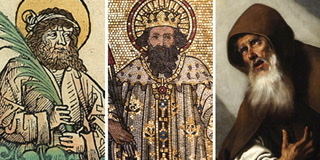
Fr. Lawrence Lew, O.P.; public domain; St. Quirinus of Neuss – for those affected by bubonic plague and smallpox; Edwin the Martyr (St. Edmund) — for victims of pandemics; St. Anthony the Great – Patron of those affected by infectious diseases

Those of us who are religious will pray without ceasing — imploring God to be merciful, asking various saints to intercede for us, lighting candles to express devotion and sitting for a moment in the flickering light that reminds us that God’s promise is about light overcoming the darkness.

The light shines in the darkness,
and the darkness has not overcome it.
(John 1:5)

In the end, perhaps we will have discovered that, through this terrifying and expanding virus, that we have learned how to care more and to love deeper. Perhaps we will find that we have a more heartfelt capacity for compassion. For that, God will pour out grace upon our weariness and renew our eternal hope.

If you pour yourself out for the hungry and satisfy the desire of the afflicted, then shall your light rise in the darkness and your gloom be as the noonday.
(Isaiah 58:10 ESV)

May God make it so. Amen.


Awakening, Awareness, Change, Contemplation, Courage, Discernment, Discovering, Emotions, Exploration, God's presence, grief, Guilt, healing, Indecision, Introspection, journey, life, Light, Lingering, Mayo Clinic, Mystery, New Life, New Year, Pain, Prayer, Sacred Space, Self Awareness, Spiritual awakening, Trust

Lingering . . . In the Presence of God

53189F0B-8EF7-4BDC-A66A-B9834A45C0F5

I have observed, at this year’s beginning, as in past years, that humans are more introspective than usual. It may begin with intentions or resolutions for the new year. What I observe is that people are revisiting the past, trying to reinterpret it, digging for the meaning the past held for them and trying to find ways to heal the wounds of the soul theyp have hidden inside them for a long time. Those woulds live in us so long that they become scars, hardened in our spirits and thus more difficult to heal.

Until we have done this spiritual and emotional inner work, we are hesitant, unwilling to move into the future. So we linger in the present and re-live the past. Usually what we  revisit are past sorrows and losses, past disappointments and perceived failures, past pain that continues to pierce the soul. Seldom do we revisit past joys, because joy does not pierce like sorrow does.

It is a positive thing to linger in life review at the beginning of a new year. Just as the year is new, all of us hope that in the work of lingering, we will find newness in ourselves. The work of introspection is important for our well being and we have so many choices about how to strengthen ourselves, body and spirit. Many people use self-counseling, which may include searching their deep selves through personal contemplation and prayer. Others engage in spiritual direction, life coaching, trauma therapy or counseling. Still others tend to their souls through silent contemplation, labyrinth walks, yoga, nature walks, strenuous exercise, reading scripture, self-help books or poetry, and singing hymns or listening to music.

I want to suggest one other form of self-counseling that is unfamiliar to most people — working with Healing Runes as a part of your quiet time. Your first question probably is, “What are Healing Runes?” I want to begin by sharing an invocation written by Ralph H. Blum from his book, The Healing Runes.

Invocation

Practice the Presence of God in all ways,
Both in your coming in and your going out.

In your prayers, invoke God’s Presence.
In your aspirations, stay mindful of the Presence.
In your meditations, breathe in the Presence.

Above all, let the Presence be reflected in your attitude,
For surely then God will sing in your thoughts,
Speak in your voice and shine through your acts.
Let the Presence of God be the medicine
To heal your life, lift your heart and renew your spirit.

Practice the Presence of God in all ways,
Both in your coming in and your going out. Amen

To answer the question, a Healing Rune is a tool that provides a way of deepening  reflection and stirring the soul where we find life meaning and buried emotions. There is an interpretation of each healing rune in the book, The Healing Runes, written by Ralph Blum and Susan Loughan. They offer interpretations presented in graceful and sensitive language that allows the reader to take to heart what is appropriate for their own meditation and leave the rest.

A4B9545F-D3B1-40D5-AC08-23DF8FD547CAThe book adapts the sacred use of Runes as an alphabetic script used by the ancient Germanic and Norse peoples, creating a tool that could be helpful in the healing of body, mind and spirit.*

I suggest that we not fear the Healing Runes by considering them to be some sort of pagan artifact or something that seems like magic. They are more like mystery, something to guide our reflection and introspection. I suggest the we see Healing Runes as one way to guide us deeper into ourselves and into the presence of God, the ultimate healer of our souls.

I would like to choose a Healing Rune for us from my bag. Its meaning may not mean anything to you or to me. It may not open up any places in your soul that need attention. Or it may awaken us to a wound that we need to give some reflective time, some time for healing.

328A8B00-83F2-418F-BFC5-29960E0C06C7The Rune I have randomly chosen is the Rune of Trust. It is the Rune of restoration that calls for the rebuilding of belief in yourself, in your life and in your relationship with God. For some, drawing this Rune asks you to show trust in a present situation. For others, it calls for embracing the changes you are facing with trust and wisdom. In relationships of the heart, remember that I love you and I trust you are two stones for crossing the same stream. Most importat is that you ask your soul if Trust has something to teach you or somewhere to lead you.

Thomas Moore writes, “We separate, each from the other, the sicknesses of body, emotion, meaning and connectedness.” The soul must be moved, touched and healed, and that is why we linger at the door of our pain, trying every way we know to reconcile it, heal it, eliminate it (or just blast it with a sci-fi laser gun!) Thomas Moore has a better remedy than a sci-fi laser gun, a much more informed remedy:

I am convinced that all healing ultimately comes from a shift in deep imagination, grounding our own lives and anchoring our decisions in the very quick of the heart . . . not just relief from anxiety, but profound gifts that signal the presence of soul — intimacy, pleasure, beauty, love and piety.

As you and I explore what hides in our souls as this new year beckons us, may we not be afraid to linger directly in the presence of our fear or woundedness. Instead, let us consider that we are lingering in the comforting presence of God, in the gentle protection of Spirit. It is safe in that sacred space of Presence, safe enough for us to unearth whatever lies deeply in us and allow it to surface into the healing light.

God may be gently, lovingly calling us to do that work of healing and, in that introspection, to reveal our truth — the truth that will set us free!


* The Healing Runes, Ralph H Blum and Susan Loughan; Preface by Thomas Moore; St. Martin’s Press:New York, New York; ©️1995 by Ralph H. Blum.

Change, Family, Fear, Friends, Friendship, God's Faithfulness, Hope, Loss, Love, New Year, Passing years, Poetry, Pondering, The Year Behind

Old Year Ending ~ New Year Beginning


Of all sounds of all bells, the most solemn and touching
is the peal which rings out the Old Year.

— Charles Lamb

We do get rather nostalgic at the end of a year, on the cusp of a new year. Perhaps we have regrets from the passing year. Perhaps the old year brought losses and grief. Perhaps we have fear at the thought of what the year ahead might bring. Nostalgia just seems to go along with year end and year beginning. I have been known to get teary-eyed during the singing of “Auld Lang Syne” in spite of the fact that I had no idea what “Auld Lang Syne” even meant.

Robert Burns wrote “Auld Lang Syne” in 1788. The poem soon became a song that was traditionally used to bid farewell to the old year at the stroke of midnight on New Year’s Eve. It was a ritual song that gave people a ceremonial way to express the discomfort of ending/beginning as well as to speak of the value of old friendships that should not be forgotten.

Another poem written by Robert W. Service (1874-1957) was entitled “The Passing of the Year.” Its seven poignant stanzas come across as a lament of the passing year, and yet the poet also expresses a juxtaposition between a somber response and an expression of fond farewell. Here are some excerpts:

My glass is filled, my pipe is lit,
My den is all a cosy glow;
And snug before the fire I sit,
And wait to feel the old year go.
I dedicate to solemn thought
Amid my too-unthinking days,
This sober moment, sadly fraught
With much of blame, with little praise . . .

And You, deep shrinking in the gloom,
What find you in that filmy gaze?
What menace of a tragic doom?
What dark, condemning yesterdays?
What urge to crime, what evil done?
What cold, confronting shape of fear?
O haggard, haunted, hidden One
What see you in the dying year?

And so from face to face I flit,
The countless eyes that stare and stare;
Some are with approbation lit,
And some are shadowed with despair.
Some show a smile and some a frown;
Some joy and hope, some pain and woe:
Enough! Oh, ring the curtain down!
Old weary year! it’s time to go.

My pipe is out, my glass is dry;
My fire is almost ashes too;
But once again, before you go,
And I prepare to meet the New:
Old Year! a parting word that’s true,
For we’ve been comrades, you and I —
I thank God for each day of you;
There! bless you now! Old Year, good-bye!

As for New Year’s Resolutions, the same poet wrote an expressions of regret in the year past and the resolve inherent in a phrase we know so well: “Just do it.”

RESOLUTIONS

Each New Year’s Eve I used to brood
On my misdoings of the past,
And vowed: “This year I’ll be so good –
Well, haply better than the last.”
My record of reforms I read
To Mum who listened sweetly to it:
“Why plan all this, my son?” she said;
“Just do it.”

Of her wise words I’ve often thought –
Aye, sometimes with a pang of pain,
When resolutions come to naught,
And high resolves are sadly vain;
The human heart from failure bleeds;
Hopes may be wrecked so that we rue them . . .
Don’t let us dream of lovely deeds –
Just do them.

Now that I have shared more poetry than you ever wanted to read, let me conclude with this thought: As a new year approaches, we greet it with all the regrets and losses and emotions of the old year still pressing on our spirits. That affects our attitude about the unknown year ahead, and when we look at the path that leads us into 2020, all we see is darkness. It is for us a journey into the unknown with no instructions for moving forward. We are sometimes not sure we even want to move into the new year.

That may be the very reason for the ball drop in New York, the champagne toasts with all the hugging and kissing, the elaborate party decorations including metallic pointy hats and horns blowing in the night. Maybe we celebrate so hard because we are so hurt, so filled with regret, so shamed, so afraid of the future. We stand at the gate of the new year holding all that we brought from the old one. Sometimes the burden we are carrying is a heavy, heavy burden to carry, but we simply don’t believe we can throw it off and start on the new year’s unknown path, unburdened and free.

Yes, we do leave all our memories behind in the year that has passed, and in the new year, we hope to realize fresh, new dreams. A wise person says that around us, we have those who love us and within us, we have all we need. But the most eloquent advice I know that addresses our old year/new year dilemma comes from yet another poet, Minnie L. Haskins:

And I said to the man who stood at the gate of the year:
Give me a light that I may tread safely into the unknown.

And he replied: “Go out into the darkness and put your hand into the hand of God.
That shall be to you better than light, and safer than a known way.”

Advent, Angels, Emotions, Fear, grief, Hope, Music, Sorrow, struggle, Suffering, Tears

An Angel-Filled Advent


E280C016-69CC-4A56-AE5E-0FB8E3680287

The Twentieth  Day of Advent
December 20, 2019

With a brief update on my transplant journey 


ANGEL-FILLED ADVENT

Wouldn’t it be wonderful
if Advent came filled with angels and alleluias?
Wouldn’t it be perfect
if we were greeted on these December mornings
with a hovering of heavenly hosts
tuning their harps and brushing up on their fa-la-las?
Wouldn’t it be incredible
if their music filled our waking hours
with the promise of peace on earth
and if each Advent night we dreamed of
nothing but goodwill?
Wouldn’t we be ecstatic
if we could take those angels shopping
or trim the tree or have them hold our hands
and dance through our houses decorating?
And, oh, how glorious it would be
to sit in church next to an angel
and sing our hark-the-heralds!
What an Advent that would be!
What Christmas spirit we could have!
An angel-filled Advent has so many possibilities!
But in lieu of that
perhaps we can give thanks
for the good earthly joys we have been given
and for the earthly “angels” that we know
who do such a good job of filling
our Advent with alleluias!

— Ann Weems

I love the idea of an angel-filled Advent. It sounds like mystical, magical Advent and, most assuredly, an angel-filled Advent does have so many possibilities!

Reality is a very different state for us and, even in Advent, we whisper the word “impossible”. We live with “impossible” in our hearts and deep within our souls where all the pain lives, and all the disappointments, all the grief and all the impossibles. “That’s life,” the sages say, the wise ones who have lived every circumstance and held on their shoulders all sorts of mourning.

And so it is with me and with you. We hold mourning and utter, “This situation is impossible!” During Advent as we prepare to celebrate Christmas, the pain is deeper in us, the losses pierce our hearts, the life challenges seem impossible. When we mourn the loss of a loved one during this season, the mourning hurts more and the loss goes deeper. When we grieve because we struggle with serious illness, the grief is more intense. When we live in fear for our children, the fear is stronger. It is in those circumstances that we ask in frustration, “Where are Advent’s angels? Where is their music?”

I hope you will take a few minutes to enjoy John Rutter’s arrangement of “Angel’s Carol.”Here are the lyrics:

Have you heard the sounds of the angel voices ringing out so sweetly,
ringing out so clear?

Have you seen the star shining out so brightly
as a sign from God that Christ the Lord is here?

Have you heard the news that they bring from heaven
to the humble shepherds who have waited long?

Gloria in excelsis Deo!
Hear the angels sing their joyful song.

He is come in peace in the winter’s stillness,
like a gentle snowfall in the gentle night.

He is come in joy, like the sun at morning,
filling all the world with radiance and with light.

He is come in love as the child of Mary.
In a simple stable we have seen his birth.

Gloria in excelsis Deo!
Hear the angels singing ‘Peace on earth.’

He will bring new light.
He will bring new light to a world in darkness,
like a bright star shining in the skies above.

He will bring new hope.
He will bring new hope to the waiting nations.
When he comes to reign in purity and love.

Let the earth rejoice.
Let the earth rejoice at the Saviour’s coming.
Let the heavens answer with the joyful morn:

Gloria in excelsis Deo!
Hear the angels singing, ‘Christ is born.’

As for me, what kind of mourning am I holding this Advent season? What kind of pain, disappointment, loss am I feeling? I feel worry, of course, about my kidney transplant. When Mayo Clinic called yesterday insisting that I return immediately, I was concerned. My blood levels were dangerously high and I was experiencing a great deal of discomfort. The doctor ordered immediate ultrasounds of my kidney and right leg looking for pockets of fluid or blood clots. I am hopeful that both tests will come back with the word “normal” stamped on the report. In spite of the things that seem “impossible,” I hang on to hope.

That’s what Advent does — fills us with hope that begins on the First Sunday of Advent when we light the Hope Candle.

So to those questions about mourning, pain, disappointment, worry and fear, I have no adequate answers. No matter how much I want an angel-filled Advent and Christmas, I see no way out of the “impossible” seasons of life, but Ann Weems might:

. . . perhaps we can give thanks
for the good earthly joys we have been given
and for the earthly “angels” that we know who do such a good job of
filling our Advent with alleluias!

May Emmanuel — God-with-Us — make it so. Amen.

Advent, Angels, Belief, Faith, Fear, Godburst, Skies, Stars, struggle, Surprise

GODBURST

410E3EC6-FFC1-41D9-9979-14605DD6AF58.jpeg
The Eighth Day of Advent

Transplant Day Twenty-seven
December 9, 2019

GODBURST 

When the Holy Child is born into our hearts
there is a rain of stars
a rushing of angels
a blaze of candles
this God burst into our lives.

— Ann Weems

It seems to me that there is no other way to thrive after a kidney transplant than by allowing God to burst into my life. Certainly, God was already in my life, and has been for many years, but this “Godburst” is a different sort of divine entrance. Godburst enters powerfully, often suddenly and without warning. It is always surprise when God plans a divine appointment, unimaginable surprise.

The other side of a Godburst requires that I intentionally give God access and admittance. It is just as Ann Weems describes it when she tells when to expect the encounter between me and God. Something happens —  “the Holy Child is born into our hearts” — and as a result, I begin to believe deep within my soul that I really can face the challenges and difficulties ahead.

Still, I feel fear deep-down-inside. I fear the after effects of the transplant. The fear is in my mind in the daylight and often consumes my heart in the night. Friends ask me what I most fear, but I am hard-pressed to isolate just one fear. I think about all of them: an increased risk of infections, uncontrolled diabetes, high blood pressure, weight gain, abdominal pain, hair loss, swollen gums, bruising or bleeding more easily, thinning of the bones, mood swings and an increased risk of certain types of cancer, particularly skin cancer. And I cannot yet shake the thought of acute rejection of the kidney and the use of high powered, harsh immunosuppressant medications to prevent that rejection.

This fear has been my constant companion for many months, but since the transplant, the fear has been imminent, deeper and more severe. So last night I determined to try to get a handle on it by listing every fear that feels so ominous to me. I knew it would be a difficult endeavor, but I hoped for even a little easing of the fear.

I’m not sure it addressed the fear that much. What it did do is send me all the way back to the foundation of my being, to the source of my strength. It called my attention back to Godburst, where Ann Weems reminds me how it might look when it happens:

there is a rain of stars
a rushing of angels
a blaze of candles
this God has burst into my life.

With that kind of holy entrance into my life, I think I might just be strong enough to move into the unknown and risky future. Maybe unafraid. Or at least I could be free of the deep fear and anxiety that seems so present right now. Isn’t that a perfect picture of experiencing Advent?

In the end, after making and contemplating the list, I still may not believe strongly enough that Godburst will happen for me. But I believe that my faith will sustain me. I believe that the God who knew me before I was even born will know me still — today and forever.

I believe that Godburst is a deeply personal and powerful encounter between me and God. And I have no doubt that it can change my life!

Advent, anxiety, Bitterness, Darkness, Despair, Exhaustion, Faith, Fear, grief, Guilt, healing, Hope, Light, Loss, Mental health, Mourning, Pain, Perseverance, Reflection, Sorrow, Soul, Suffering, Unfaith, Weeping, Worry

Dark Night or Advent Light

DF745CFF-118C-480C-B837-0A81F4520CEA

The Second Day of Advent
Transplant Day Twenty-One
December 2, 2019

THE CHRISTMAS SPIRIT

The Christmas spirit
is that hope
which tenaciously clings
to the hearts of the faithful
and announces
in the face of any Herod the world can produce
and all the inn doors slammed in our faces
and all the dark nights of our souls
that with God
all things still are possible,
that even now
unto us
a Child is born!

What could this beautiful poem titled The Christmas Spirit possibly have to do with my recent kidney transplant? At first glance, not much. But lingering on the poet’s words made some of them leap from the page for me. I have to admit that the words most piercing to me are these: “. . . all the dark nights of our souls.”

Guilt overwhelmed me after the transplant was complete. I was back in my room six hours after the surgery — barely awake, a little confused, exhausted, in pain and, they tell me, very quick-tempered. I yelled at my husband, something I may have done twice in 50 years of marriage. The truth is I was feeling covered with a blanket of guilt. The nurses, my surgeon, my family were all celebrating the transplant miracle. I was in pain, second-guessing my decision to even have the transplant in the first place and feeling guilty for not acknowledging the miracle everyone else saw.

For the next two days, every person on my transplant team who came to see me entered my room with a large smile and expressed one word, “Congratulations!” said with joy in a most celebratory voice. All the while, I was often weeping pain’s quiet tears. I stared at each congratulating person with a little bit of concealed contempt. In my mind, if not on my lips, was a response that went something like this: “Congratulations? Do you have any idea what kind of pain I am experienced right now? And have you had this surgery yourself? Save your congratulations for another day!”

The physical pain was very real and very intense. The soul pain hurt even deeper. Body and soul — the physical, spiritual and emotional — were so intricately fused together that it was all but impossible to isolate or separate them. Is this just physical pain? Is part of it emotional pain? Am I experiencing, heaven forbid, a spiritual crisis? I found no way to tell. For me, it was pain in all three parts of me and that made it almost intolerable.

For two nights, I did not sleep at all — awake all night, feeling alone, abandoned and in a wrestling match with my pain. As I went over and over in my mind all the reasons I had for getting a transplant, my thoughts morphed into a fairly clear “What have I done?”

It felt so much like a dark night of the soul as I grieved my aloneness and isolation, mourned the loss of my previous life and felt deep fear of the dark, unknown path ahead. And all of those points of crisis made me feel that guilt for not being grateful for the living gift of a kidney.

As Ann Weems’ expresses in the poem, “Hope tenaciously clings to the hearts of the faithful and announces in the face . . . of all the dark nights of our souls, that with God all things still are possible, that even now unto us a Child is born!”

Twenty-one days separated from my transplant, I am able to attest that hope does cling tenaciously in my heart, that hope announces in the face of the dark night of my soul that with God, all things are still possible. And most importantly, “Unto us a Child is born!”

Into me a Child is born, and that presence empowers me to walk through my soul’s darkest night into the light that Advent brings.

Thanks be to God.


Chronic illness, Comfort, Contemplation, Daybreak, Faith, Fear, Kidney Transplant, Uncategorized

Sacred Mystery

657E58B2-41F9-456E-80B8-B43E88801340
Around 3:00 am this morning, I was awake and alert, having tossed and turned for hours, wishing for daybreak. I was also fasted and prepared for medical tests. But before I tell you about this day’s fasting, I need to reach back and call up some of my memories of other times. 
While wide awake in bed, I thought about some of the fasting times I have experienced, each a singular blessing making way for sacred space.

Fasting was a part of my early childhood. Being a Greek Orthodox child with a religiously devout Yiayia (grandmother), I learned early in life about fasting. Even though I was only 8-years old, Yiayia adamantly believed I was old enough to memorize prayers from the liturgy and recite them — in Greek. And a part of her plan was designed to prepare me for Holy Communion. I must give her some good-grandmothing credit — she did have a fasting experience for me that was age-appropriate, meaning it was not as long a fasting time as the adults observed and certainly not as stringent. No meat, of course, but some laxity on dairy and liquids because I was always an orange juice child that needed to drink a lot. 

Yiayia accommodated my need for plenty of juice and chocolate milk. Still, I thought I might starve before my fast was over and I received the wine and, finally, the little square of communion bread that I scarfed down. I am pretty certain, though, that I did not fully embrace this sacred mystery of prayer, fasting and the sacrament of Holy Communion. 

Years passed and young adult fasting times came in times of deep angst. There were troubled times when the only hope I thought I had came through prayer and fasting. Looking back on that time, I realize that I experienced just a glimpse of the meaning behind a fast. More awareness and appreciation of the sacred mystery would come much later in life. 

Maturity and age created in me a seeking spirit that longed for deep meaning. I remember so vividly my time of fasting for my profession of vows before entering the novitiate of the Order of Ecumenical Franciscans. The occasion happened in the desert of Albuquerque, New Mexico, quite an appropriate setting for my introduction to a contemplative life. Dry, expansive desert and big skies that went on forever captured my imagination. It occurred to me at the time that I was experiencing just a tiny glimmer of desert spirituality. This fast in the desert was really the first time I immersed myself fully in the sacred mystery of fasting. 

Now back to this day while waiting for daybreak after a night of tossing and worrying. This fasting morning was not religious at all, but necessary for information the kidney doctors needed from the 30 vials of blood The Mayo Clinic phlebotomist retrieved from my flimsy vein. 

But come to think of it, today’s fasting may be the most sacred of all because it leads to the mystery and science of a kidney transplant. When a donor comes forward willing to give a gift of life from his or her own body, that feels very much like sacred mystery. 

God orchestrated the entire experience. And by the way, God knows all about my tossing and turning in the wee hours of this morning. God understands my anxiety and fear. God understands the emotional place of anticipating a kidney transplant after five years of waiting.

I have always loved the imagery of this scripture verse written by the Psalmist. Today seems like a good day to ponder it.

You have kept count of my tossings;
put my tears in your bottle.
Are they not in your record?

— Psalm 56:8 (NRSV)

Tomorrow is the day. If all goes well, tomorrow I will get a new kidney. If for some medical reason, the transplant does not happen, I still know and understand the sacred mystery that God keeps count of my tossings and saves my tears in a bottle. And that’s enough for me.


F9FA5D3C-53F0-4043-8A72-F9E2D63F7349

On another note, please pray for me as I look toward my kidney transplant tomorrow at Mayo Clinic in Jacksonville, Florida. I am so grateful that you are walking with me on this journey that often felt so frightening. Your thoughts and prayers mean so much. If you would like to rea the story of my illness, please visit the Georgia Transplant Foundation’s website at this link:

://client.gatransplant.org/goto/KathyMFindley

“Go Fund Me” page is set up for contributions to help with the enormous costs related to the transplant, including medications, housing costs for the month we have to stay near the transplant center, and other unforeseeable costs for my care following the transplant. If you can, please be a part of my transplant journey by making a contribution at this link

https://bit.ly/33KXZOj


Confusion, Courage, Darkness, Despair, Faith, Fear, God's Faithfulness, Hope, Indecision, journey, Life Journeys, Life’s murk, Light, Prayer

Swampy, Murky Places

91413DC1-1962-4B79-95D7-004819D8EEF0
October Hunter’s moon rising over Arkansas’ Mallard Lake. Photography by Debbie Marie Smith.

Life can be swampy and murky at times, with not enough light to see the way forward. Not to mention the danger of being mired in the mud unable to move! You have probably been there. I know I have, and when the journey has taken me through those murky waters, I have despaired. So many circumstances can take us through rough places, but the circumstance that immediately comes to mind for me is indecision.

Indecision is that uncomfortably in-between place where you have no idea how to find the way forward, yet you cannot stay in the place you are. Waiting is born of indecision and waiting can be excruciating. Right about now, I wish I could report that one must simply pray and God will instantly change indecision into forward motion, out of any murky swamp. 

I cannot say, however, that a single prayer can make that happen. At least for me, there have been no instant-miraculous-life-changing answers to my prayers. Not even once in my faith journey of many years! What I can tell you with deep assurance is that, although no single prayer has changed my life, continual prayer has changed my life. It is not the prayer of occasional consolation that changes the course of one’s life journey. It is the life of prayer that seeks God in prayer, abiding in God’s presence, for as long as it takes. Richard Rohr says this wise thing about prayer:

The only people who pray well are those who keep praying! In fact, continued re-connecting is what I mean by prayer, not occasional consolations that we may experience.

No doubt, life’s journey will take us through murky, swampy places without enough light to find our way through them. The murkiness of indecision is real, and with it we may experience confusion, fear, despair, desperation. We may even lose hope and question our faith. But we cannot stay there. People of faith are people of resilience and courage. We have within us all the resilience and courage we need. So we must believe in ourselves enough to take a step forward and out, through the mud and the sludge, trusting in faith that God’s light will light up the dark places and give us the strength to move through to the other side.

That’s what I have to believe about painful, oppressive places of indecision. That’s what I have to believe about getting through swampy, murky places. That’s what I have to believe about God.

In the beginning was the Word, and the Word was with God, and the Word was God. He was in the beginning with God. All things came into being through him, and without him not one thing came into being. In him was life, and the life was the light of all people. The light shines in the darkness, and the darkness has not overcome it.

— John 1:1-5

Change, Comfort Zone, Dreams, Fear, Growth, Learning, Uncategorized

Becoming Our Better Selves

295B6520-B0A5-4F94-A0E7-9462C854C39B

I don’t usually write about charts in my blog. I’m not really a chart person at all. But my friend, Kim Rosby, recently sent me a chart that is worth contemplating. The chart is a snapshot of what it might look like when we become our better selves. It’s entitled “The Comfort Zone,” which is a place most of us want to be. 

That’s the problem. There is no growth and maturing in the comfort zone. It can become for us, not just comfortable, but also stagnant.

So I spent some time contemplating this provocative chart, and it definitely provoked some emotions in me. It appears that there are four zones that are possible for us:

  • The Comfort Zone
  • The Fear Zone
  • The Learning Zone
  • The Growth Zone

There you have it! So let’s unpack this chart a bit. When/if we manage to move ourselves out of the comfort zone, a place where we feel safe and in control, we will most likely enter the fear zone. In the fear zone, we are not at all sure of ourselves. We hang on the opinions of other people and use anything we can find as an excuse to remain frozen in place. If we don’t make a move, we can’t make a mistake. Right? We come to a point, though, where we do not believe we can move. We don’t believe we can change. We don’t believe we can seek another way.

Fortunately, some of us do make it out of the fear zone and thus find ourselves in the learning zone. What a renewing place to be, a place where new and fresh ideas are possible. It is in this zone that we realize we have moved at least a few steps past our comfort zone. We learn new skills and we discover that we can navigate challenges and solve problems. As long as we are learning, our path is clear and a future is possible.

So we move with courage into the growth zone, where we will re-invent ourselves in positive and exhilarating ways. As we conquer the objectives that were holding us back, we begin to believe in the possibility of new life goals, a deeper purpose. And then suddenly, we surprise ourselves with dreams and aspirations for something more in our lives, something fresh that inspires us to be our better selves.

I like my friend’s chart. I also like this promise that also says something very compelling about becoming our better selves:

 . . . I came that they might have life, and have it more abundantly.
—Jesus


Dancing, Darkness, Despair, Faith, Fear, Freedom, Hope, Joy, Life Journeys, Life pathways, Pain

Through These Dark Hours

521C7942-66C7-4FF0-A54B-6720CF0EB419
Unafraid, unbound, unleashed from this earth, rising with every step, a dance to lift the human soul.

What do I do through these dark hours? How do I endure them, the lostness, the fear, the spiritual suffering? How do I make my journey and avoid the dark hours that overwhelm me along the way?

Dark hours are a part of our living, a part of our journey. They cover us — even those who are most religious and devout — like an ominous black cloud. Dark hours bring us fear, dread, a lack of hope. Dark hours steal the joy of our faith.

The term “dark night (of the soul)” describes a spiritual crisis in the journey with God, like that described by St. John of the Cross in his poem, “The Dark Night.”

In her letters, St. Teresa of Calcutta described how she endured a dark night of the soul from 1948 almost until her death in 1997, with only brief interludes of relief.

St Thérèse of the Child Jesus wrote of her own experience of the dark night, as she found herself doubting the existence of eternity. She struggled and suffered through a prolonged period of spiritual darkness, declaring to her fellow nuns: “If you only knew what darkness I am plunged into..!”

Examples of the experiences of those we look to as spiritual patrons of the faith do not really enlighten our own faith journeys. We walk our own spiritual paths, always hoping for the best, always striving to experience the holy along the way. And we hope beyond hope that we will not have to endure the suffering of dark hours.

The truth is that dark hours are required on the journey. We cannot walk around our dark hours, moving them aside like the sticks and brush we can so easily move off of our path. Our only option is to keep walking, to stay the course and to embrace the journey just as it is.

As I look back to take stock of my own journey, I see the the dark hours as powerful reminders of struggle and spiritual crisis. As I examine the past, I can say without hesitation that the dark hours were times I do not want to experience again. I can feel the intense pain of them, even now, the formidable affect of them on my spirit. The thought of them brings on a queasy feeling in the pit of my stomach that makes me want to quickly move on to the next life metaphor I might use in this post.

And yet . . . And yet, how clear it is from this vantage point that I endured my dark hours and emerged stronger, better, with faith intact and with a living hope to take with me on the rest of the journey. From the cloud of dark hours, I learned that I could believe again, hope again, move farther into my journey with joy — even unrestrained joy — because of God’s grace that gave me strength.

There is probably no writer that inspires me more than Bishop Steven Charleston. He has taught us how to live in his many writings over the years. In this piece, he shows us the way through our dark hours in these beautiful words:

Let us dance through these dark hours, while others crouch down, seeking shelter from a worried world, hiding in the shadows, afraid to hope for tomorrow, let us give them a sign they can see, a message made of music and motion, two dancers spinning light out of darkness, a waltz in an air raid shelter, unafraid, unbound, unleashed from this earth, rising with every step, a dance to lift the human soul. Let us dance so others can dance, dancers from every direction, standing up to join us, music filling the sky, a revolution of unrestrained joy, an invitation to believe again, to hope again, to be free again, dancing through these dark hours, as if dancing was all that we were born to do.

To be sure, I have felt the pressing urge to “crouch down” many times, “to seek shelter from a worried world, hiding in the shadows, afraid to hope for tomorrow.” But in the end, through dark hours I learned to dance.

Dance then, wherever you may be. I am the Lord of the Dance, said he . . .

It’s a good way to live.

It’s a good way to give witness to the world of our living faith and unrestrained joy!

Amen.

Fear, God's Faithfulness, Home, Lostness, Psalm 139

Lost

0CECED10-AAF6-4CC4-B9B9-0C0C9D112888

When our Jonathan was a toddler, we took a trip to the mountains of North Carolina. Not a child who ever liked his car seat, his reaction on this trip was far worse than usual with a great deal of squirming, fussing and whining. All of a sudden, he cried out in a panicked voice, “I don’t know where my home is!”

Aha! That was the emotional issue at play here. Jonathan had lost his sense of home and the safety and comfort his home gave him. All of us lose our sense of home at times, sometimes figuratively, sometimes literally. From experience, I can attest to the fact that losing home is a trauma. Years ago, a house fire destroyed parts of our home and many of our belongings. We were displaced for months waiting on the house to be restored and live-able, and in that time, I experienced a great deal of unease and anxiety.

And then there’s the fear of getting lost, for me an irrational fear that simply comes over me at times. It’s a feeling of panic when I feel as if the people and places that mean “home” for me are out of my reach, and I am impossibly and hopelessly lost. For instance, the simple joy of walking in a corn maze terrifies me. So I suppose I must admit to having a phobia just as real as the one Jonathan had when he lost home. 

Some of the most beautiful, comforting words in all of scripture are the words of the Psalmist in the 139th Psalm. I can almost imagine these words coming from a person who knows what losing home feels like. His message to us, and even to himself is this: “It is not possible for me to be lost. No matter where I travel — from one end of my world to other worlds far away — I am not lost. For there is One who holds me fast.”

Where can I go from Your Spirit?
Where can I flee from Your presence?

If I ascend into heaven, You are there;
If I make my bed in hell, behold, You are there.

If I take the wings of the morning,
And dwell in the uttermost parts of the sea,
Even there Your hand shall lead me,
And Your right hand shall hold me.

Amen.


Faith, Fear, journey, Kidney Transplant, Life Journeys, Possibilities, Uncategorized

One Step Past Possible

5F59BC0D-8530-45AE-B0BA-403D4E2DC1F2

All journeys begin with one step, just one step, usually into the unknown. Each step that follows goes farther into a journey that most often is made up of twists and turns and sometimes stones in the road. It takes a little faith, embarking on a journey.

Still, faith does not make things easy. But faith does makes them possible. Mildred McAfee says something very wise about moving forward in faith. She says “If you have a great ambition, take as big a step as possible in the direction of fulfilling it. The step may only be a tiny one, but trust that it may be the largest one possible for now.”

Tiny steps remind me of the book microShifts by Gary Jansen who suggests that transforming your life happens one small step at a time. The book’s message makes it quite acceptable to take micro shifts toward something in your life. As for me, microshifts are important. I have made dozens of microshifts to get comfortable with the idea of a kidney transplant.

Microshifts are still shifts, and that means change that we sometimes fear. Faith slips in on us at this point. There’s a tiny verse in the Gospel of Luke that those of us who are followers of Christ grab onto. We believe the message because we want to. We hold the message close to our hearts because we need to. 

For with God nothing shall be impossible.

That’s it. Luke 1:37. Simple and clear. Without superfluous language, Luke asserts that nothing is impossible. And about the “with God” part. Well, I’m guessing that Luke adds that to remind us that faith includes a contract between us and the God of the possible. 

So I am thinking today about what is really is possible, globally and personally. For instance, is it possible to end hate-motivated violence? It is possible to end racial divides? Is it possible to make sure schools are safe places? Is it possible to protect the earth from the effects of climate change? Is it possible for this nation to hold free, fair, respectful political campaigns and elections?

Global questions like those are endless — so many questions, so few answers.

But then I also ask what is possible on a personal level. What’s possible for me or you? Is it possible to live out our faith on the margins where hurt prevails? Is it possible to carve out time for contemplation, meditation and prayer?

And then there’s the question I often ask myself. Is it possible to envision a day of better health? I am thinking specifically about a kidney transplant. Right now, a transplant seems to be one step past possible, meaning that it’s just a little more than possible that it will happen. The possibility , however small, brings up feelings, emotions that have begun to escape from the place inside me that had them locked up. 

I finally believe that a kidney transplant for me is probably going to happen. The stars have aligned. A brave and magnanimous donor has been evaluated by Piedmont Transplant Institute  in Atlanta where both donor and recipient (me) will have the surgery. The National Kidney Registry will search for matches among paired exchange program participants. Even surgery dates are being contemplated. It’s real! After almost five years of wondering, and doubting a transplant would ever happen, a transplant is imminent.

It would not be an exaggeration to say that I feel panic and fear. My heart beats a bit faster these days. I am taking lots of deep, cleansing, centering breaths. My heart is preparing for a surgery that could well offer a new sense of freedom for me. By coincidence, blasting through my speakers I am hearing one of my favorite old country tunes, Martina McBride’s “Independence Day.” It is reminding me that I lost a certain amount of independence the day I got sick in 2014.

So today feels a bit like an independence day is coming for me. It feels like independence to think about a future of not being tethered to a dialysis machine for eight hours a day, every day. It feels like independence to not have permanent tubing emerging from my body. It feels like independence to be able to travel without the strain of taking large medical equipment and multiple boxes of dialysis supplies.

As with anything medical, things can go wrong. There are numerous disqualifying factors that could still preclude a kidney transplant. But right now, living donor and recipient are fully evaluated and the transplant is at least one step past possible. This is a good place to be.

Comfort, Faith, Fear, God's Faithfulness, Illness, Matthew 10, Trust, Truth, Waiting

It’s the Gospel Truth!

8832BB06-FEB5-4DAA-A86D-F8C351B53CA6I was born and raised in the South and spent most of my life in the Bible Belt. In the Bible Belt, one can hear many sayings, expressions and idioms. One of the idioms I seemed to hear continually over the years was, “It’s the Gospel truth!” Always as an exclamation. 

I learned that in life there is truth and there is Gospel truth. I learned that we need both. For instance, in my life at this moment, there is the truth that I am afraid. And there is also the Gospel truth that God watches over me through my fear. 

Sitting on the cusp between daily dialysis and the possibility of a kidney transplant, I entertain varied thoughts and feel disparate emotions. One of them is definitely fear. Thankfully, I feel relatively well physically on most days, but my body never lets me forget that I’m sick. People who know say that a transplant would change my life, that I have become so used to being ill that I don’t know what feeling really well is like. I don’t know about that.

What I do know is that the idea of a transplant is both frightening and enlivening. I also know that it may or may not happen. So I tamp down my emotions, tuck away my fear and basically try not to think about it. Where I am these days is in the place of; 1) not knowing and 2) knowing that God knows. 

As I contemplated this today, I remembered a Gospel song I used to sing back in the day. I have not thought of the song in years, but today its melody ran through my mind over and over. Many well-known musicians have sung it, but the voice I remember most clearly is the voice of Mahalia Jackson.

Why should I feel discouraged, why should the shadows come,
Why should my heart be lonely, and long for heaven and home,
When Jesus is my portion? My constant friend is He:
His eye is on the sparrow, and I know He watches me;
His eye is on the sparrow, and I know He watches me.

I sing because I’m happy, I sing because I’m free,
For His eye is on the sparrow, and I know He watches me.

Whenever I am tempted, whenever clouds arise,
When songs give place to sighing, when hope within me dies,
I draw still closer to Him, from care He sets me free;
His eye is on the sparrow, and I know He watches me . . .

In both Matthew and Luke, Jesus is sending his disciples out into the world. The Gospel of Matthew, chapter 10, begins with these words: 

Jesus called his twelve disciples to him and gave them authority to drive out impure spirits and to heal every disease and sickness. 

In the rest of the chapter, Matthew tells us that Jesus gives his disciples many instructions as he sends them out. Most importantly, he instructs them not to fear. 

Are not two sparrows sold for a penny? Yet not one of them will fall to the ground outside your Father’s care.  And even the very hairs of your head are all numbered. So don’t be afraid; you are worth more than many sparrows.  (Matthew10:29-31 NIV)

Transplant or dialysis for the rest of my life? I don’t know which it will be, and that’s the Gospel truth! I do know that I am afraid, but whenever I fear the future, I am often reminded that I am never outside of God’s care. It is a good thing, an important thing, to know that to God, I am worth more than many sparrows. It’s the Gospel truth!

I thought you might enjoy hearing a contemporary arrangement of “His Eye Is on the Sparrow” performed by Lauryn Hill and Tanya Blount at this link: https://m.youtube.com/watch?v=k7Pk5YMkEcg

Contemplation, Courage, Darkness, Discovering, Fear, Forest, life, Lostness, Nature, Spiritual growth

Finding Ourselves Lost

C61646A1-BE50-4157-A898-E77F1FF191AABecause I have no sense of direction at all, I have an irrational fear of getting lost. Do not tell me to go north or south. I will have no idea how to do that. You must instead say something like, “When you see McDonalds on the right, go past it. Then go past Wendys, Burger King and Barbaritos. Look just past Barbaritos, but on the other side of the road, and you’re there.” It’s a convoluted way of making sure I don’t lose my way. And if one of those fast food places were to close down, I’m lost. 

So as I am contemplating the fear of being lost, I find in my email this morning a meditation by Richard Rohr entitled, “Practice: Being Lost.” I wanted to slip right past that meditation, as I do not need or want to practice being lost. But something held me there, captive to this bizarre meditation that described being lost as a spiritual practice.

Psychologist and wilderness guide Bill Plotkin* highly recommends wandering in nature and experiencing the great gift of “finding ourselves lost.” He calls it “Soulcraft: Crossing into the Mysteries of Nature and Psyche,” and he means that we should find ourselves lost both literally in nature and metaphorically in the midst of life’s changes.

His words remind me that at least four conditions contribute to finding oneself lost: density that conceals paths, obstacles in the pathways that force you to detour, cluelessness about direction, and darkness. I would not like finding myself in a dense forest with boulders blocking some of the pathways, hopelessly lacking any sense of direction after a few detours, and knowing that the sun is setting and darkness will make everything even worse.

And yet . . . finding myself lost as a spiritual discipline seems to be beckoning to me to enter. As a lost wanderer, I might just learn to look deeply into the face of my aloneness and discover what truly gives me life and what doesn’t. I could discover inspiration, belonging, strength, resilience and wisdom in my own company — all by myself — not knowing which way to turn. Knowing only that God will meet me there and that I can “be” who I am, right where I am, lost in a discovering moment.

As David Whyte writes:

When wandering, there is immense value in “finding ourselves lost” because we can find something when we are lost, we can find our selves . . . 

Sometimes it takes darkness and the sweet confinement of your aloneness to learn that anything or anyone that does not bring you alive is too small for you.*   

I would like to be brave enough to give it a try in some spring wood where the verdant trees form a deep, dark canopy of privacy over my soul and where aloneness takes over my psyche. A place where God will meet me, where I can fully embrace finding myself lost, and where I might just find a few sparkles of light along the way.

I have to admit that this is a terrifying prospect for me. Darkness in a dense forest, alone, lost and scared . . . I’m just not sure about that. So maybe I should settle for the swing in my yard that’s just on the edge of the woods. Safer. More acceptable. And God will meet me there, too.

*Bill Plotkin, Soulcraft: Crossing into the Mysteries of Nature and Psyche (New World Library: 2003), 234, 248-249, 263.

*David Whyte, “Fire in the Earth,” Fire in the Earth, Many Rivers Press: 1992, 8.