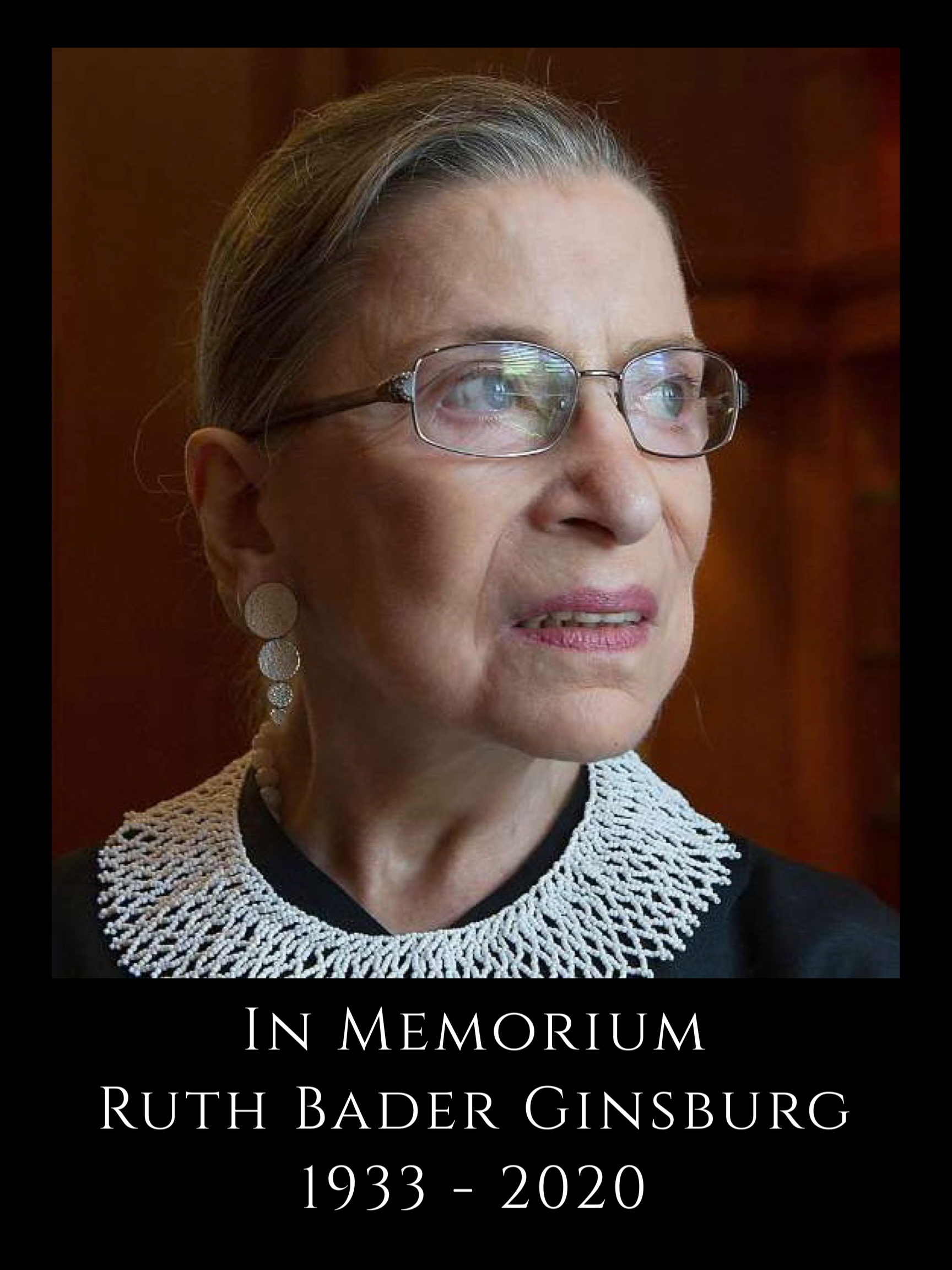
In Memorium, Ruth Bader Ginsburg

In Memorium

A6678674-A951-415C-BAC0-F4C14CBC6E71

I have no words of my own in these hours of night. I have no words to express the loss of Justice Ruth Bader Ginsburg. I have no words to describe the gifts she gave this nation. I have no words to describe the ways she became an inspiration — no, a Rock Star — for women and girls. But I do have wise and true words from my friend and modern day prophet, Ken Sehested. I share his words:

There is no connection between these two things — today’s onset (at sundown) of Rosh Hashanah, the Jewish new year, and the passing of US Supreme Court Justice Ruth Bader Ginsburg — but the coincidence gives added gravitas to both.

Ginsburg, only the second woman, and the first Jewish person to serve on the Supreme Court, surely ranks among the greatest jurists in our nation’s history.

As sometimes happens, New Year festivities are joined by sorrow’s reminder of mortality. Even still, the psalmist assured, “You’ve kept track of my every toss and turn through the sleepless nights, each tear entered in your ledger, each ache written in your book.” —Psalm 56:8 (The Message)

And just as tears serve as reminders of our fervent longing for the day when death itself will come undone, so, too, do bleak and fretful days—as we are presently experiencing—are the opportunity for that hope-beyond-despair to reveal itself.

Kindred, the news is bleak.

Rouse yourselves to maintain custody of your heart.

Kindred, the news is bleak. For we live in the valley of the shadow, when:

the stock market reaches record-breaking levels in the midst of near-record-breaking rates of unemployment;

when 1% of US citizens control $30 trillion of assets while the bottom half is saddled with more debts than assets;

when the median wealth of black households is a tenth of that of whites;

when yet another unarmed black man is shot—in the back, seven times, while getting in his car where his children are sitting—by police;

when polls show 57% of Republicans (along with 33% of Independents and 10% of Democrats) believe our nation’s COVID-19 death toll (many times greater than any other nation) is “acceptable”—despite ours being the wealthiest nation in recorded history, purportedly with the world’s most advanced health care system;

when wildfires in California set yet another record in size and destructive infernos, and similar flames in the Amazon are on track to eclipse 2019’s record;

when 30 million families lacked sufficient nutrition last week, yet the suicide rate among farmers—who provide our food—is five times greater than the national average;

when the federal hourly minimum wage is $7.25 (lowest it’s been since the 1960s when adjusted for inflation), yet Amazon CEO Jeff Bezos earns approximately $8,961,187 per hour;

not to mention a monarch aspirant in high office; and our oldest living president, Jimmy Carter, having described our political economy as “moving toward an oligarchy.”

And yet, and nevertheless.

Though the fig tree does not blossom, / and no fruit is on the vines; / thought the produce of the olive fails / and the fields yield no food; / though the flock is cut off from the fold / and there is no herd in the stalls, / yet I will rejoice in the Sovereign / I will exult in the God of my salvation. (Habakkuk 3:17-18).

Which is to say, rouse yourselves to maintain custody of your heart and shield it from the bootleggers of despair.

Let the baptism of firmeza permanente* — relentless persistence — soak you to the bone, so that you may stand ready to confess: “Another world is not only possible, she is on her way. On a quiet day, I can hear her breathing” (Arundhati Roy).

Indeed, my friend, may we all be baptized in relentless persistence. Thank you, Ken Sehested, for your moving and poignant words.

Read more of Ken’s words at https://www.prayerandpolitiks.org/


*A theological movement within the Brazilian church in the 1970s, born of the same impulse as the active nonviolence campaigns of the 1930s-1940s in India and US civil rights movement in the 1950-1960s.

Bravery, Comfort, Confusion, Contemplation, Courage, Fogginess, Mists, Perseverance, Resilience, Sacred Pauses, Serenity, Silence, Soul, Spirit, Stillness, Vulnerability

Being Brave in the Mists

Are we brave enough to imagine beyond the boundaries of “the real” and then do the hard work of sculpting reality from our dreams? 

Walidah Imarisha


I read a wonderful article this morning written by Madisyn Taylor, who wrote about being in a fog. I related immediately, having just taken my immunosuppressant medications that create all manner of “foggy-ness” for me. Tayler defined it as a feeling of being “muddled and unfocused, unsure of which way to turn.” I resonate with that definition, but beyond the physical fogginess of my mind, I experience an occasional fogginess of spirit. Know what I’m talking about? I would guess you do, since all of us fall into a spirit-fog once in a while.

A fog can feel downright eerie. It isn’t straightforward like darkness, yet we may feel like we can’t see where we’re going or where we’ve come from. We feel fear, as real as our fear of the darkness, afraid that if we move, we might run into something hidden in the mists that surround us. If we’re brave enough to move at all, we move slowly, feeling our way and keeping our eyes open for shapes emerging from the eerie haze.

Maybe being brave is what spirit fogginess is about. Spirit-fog is, of course, is a season of involuntary inactivity (perhaps even precipitated by coronavirus isolation). Although you and I much prefer to be able to see where we are going and move unwaveringly in that direction, maybe we can encourage our spirits to see that being in a fog often brings gifts to us — gifts of stillness, of doing absolutely nothing, a respite from forward inertia, a time to gather up our “brave” to move with forward inertia, even moments of finding for our spirits the Spirit of Comfort and Peace. We might find in the mists of fog the sacred pause that our spirit needs — the kind of sacred pause that creates resilience in us, and perseverance, and whatever we need to be brave.

In the fog, we really do need to be brave. When we are hidden in the mist, we may look within and find that the source of our fogginess is inside us — perhaps an emotional issue that needs tending before we can safely move ahead with steady resolve. The fog that engulfs us may simply be teaching us important lessons about how to continue moving forward even if we have been brought to a standstill by circumstances of life.

If we’re brave, we do not have to wait for the fog to lift. If we’re brave enough, we can center ourselves in the haze, wait for guidance and then move — move on into the unknown places on the journey. I have been a long-time fan of the song “Brave” sung by Sara Bareilles, written by Sara Bareilles and Jack Antonoff. “Brave” is on her 2013 album, “The Blessed Unrest.” The song hits me hard with these words, “sometimes the shadow wins.” I know that to be the hard truth, but I also latch onto the rest of this song’s message: I can be brave! I often think that this section of the lyrics calls out directly to me — calling me, urging me on, encouraging me to “show everyone how big my brave is.”

I wanna see you be brave

Everybody’s been there, everybody’s been stared down
By the enemy
Fallen for the fear and done some disappearing

Bow down to the mighty
Don’t run, stop holding your tongue

Maybe there’s a way out of the cage where you live
Maybe one of these days you can let the light in

Show me how big your brave is

Say what you wanna say
And let the words fall out
Honestly
I wanna see you be brave

Spend a few minutes enjoying this Sara Bereilles song and immerse yourself in the thought of how amazingly brave you are.

Activism, Advocate, Caged children, Child protection, Children, Compassion, Determination, Dreamers, Heartbreak, Hope, ICE, Immigrant detention, Immigration, Inhumanity, Justice, Liberty, Separation, Tears

Love the Stranger as You Love Yourself

My first mistake for this day — reading an article published in the Huffington Post written by journalist Rowaida Abdelaziz! Here’s the headline.

More than 5,000 people have contracted the coronavirus while in immigration detention centers, including more than 800 in the last week.

On a personal note, I must say that I’m very proud of my church’s ministries, especially our English as a Second Language (ESL) classes. The teachers not only teach English, they also provide community for immigrants who often do not have family nearby, as well as many other acts of care and compassion. I could not help but give God thanks for our ESL teachers this morning when I read this headline from the Huffington Post. I can imagine our ESL teachers shifting into advocacy mode to do something about it. Not that any of them have the power to change the abysmal detention centers our government sponsors, but armies of advocates can and have changed circumstances of oppression throughout history

Back to the news article. Abdeaziz went on to further explain the treatment of immigrants:

Immigrants were given face masks only recently, but most of them are forced to reuse single-use masks without being allowed to wash them or receive new ones. Those held were not given soap or sanitizers and some were even exposed to pesticides and other toxic substances. 

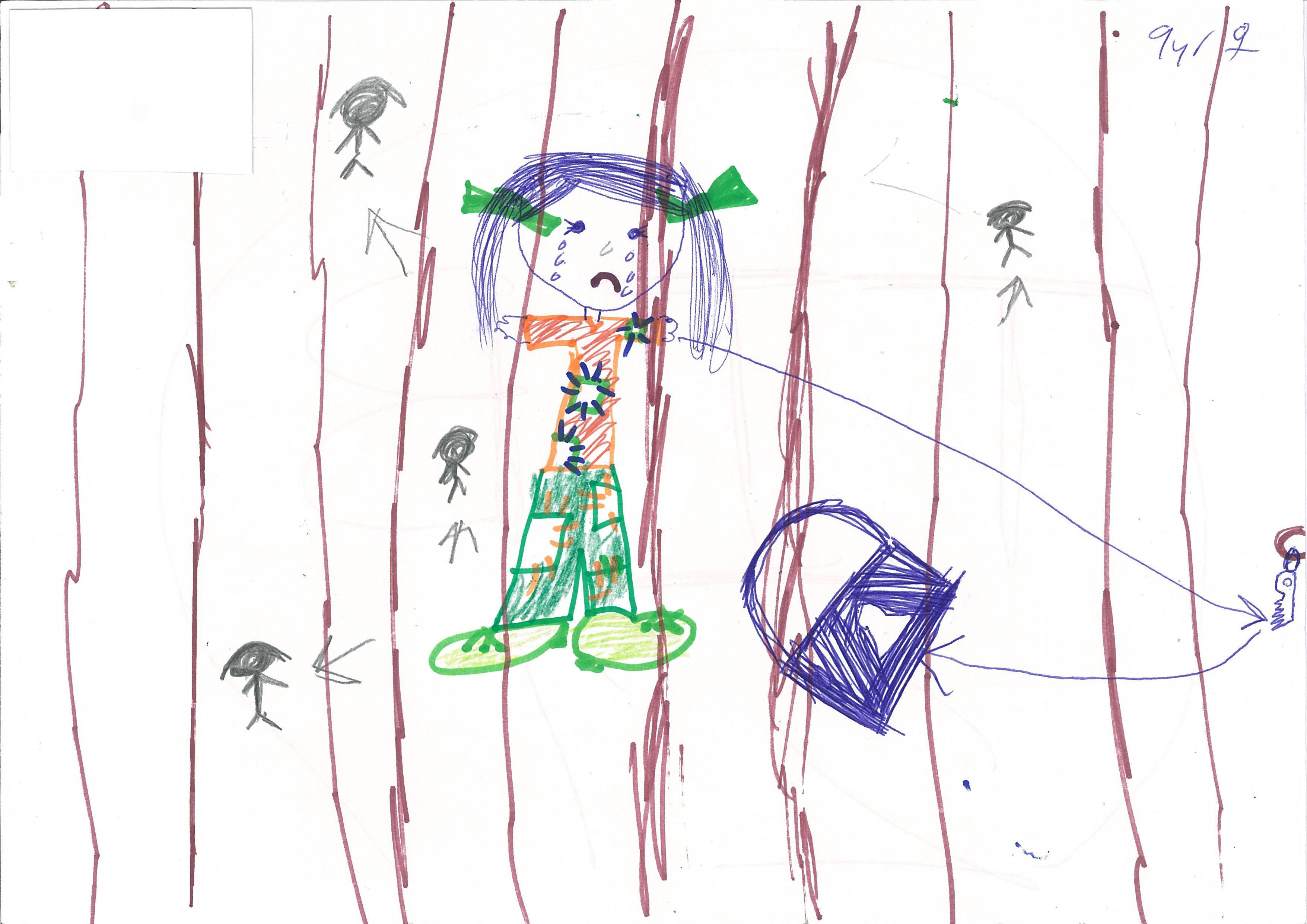
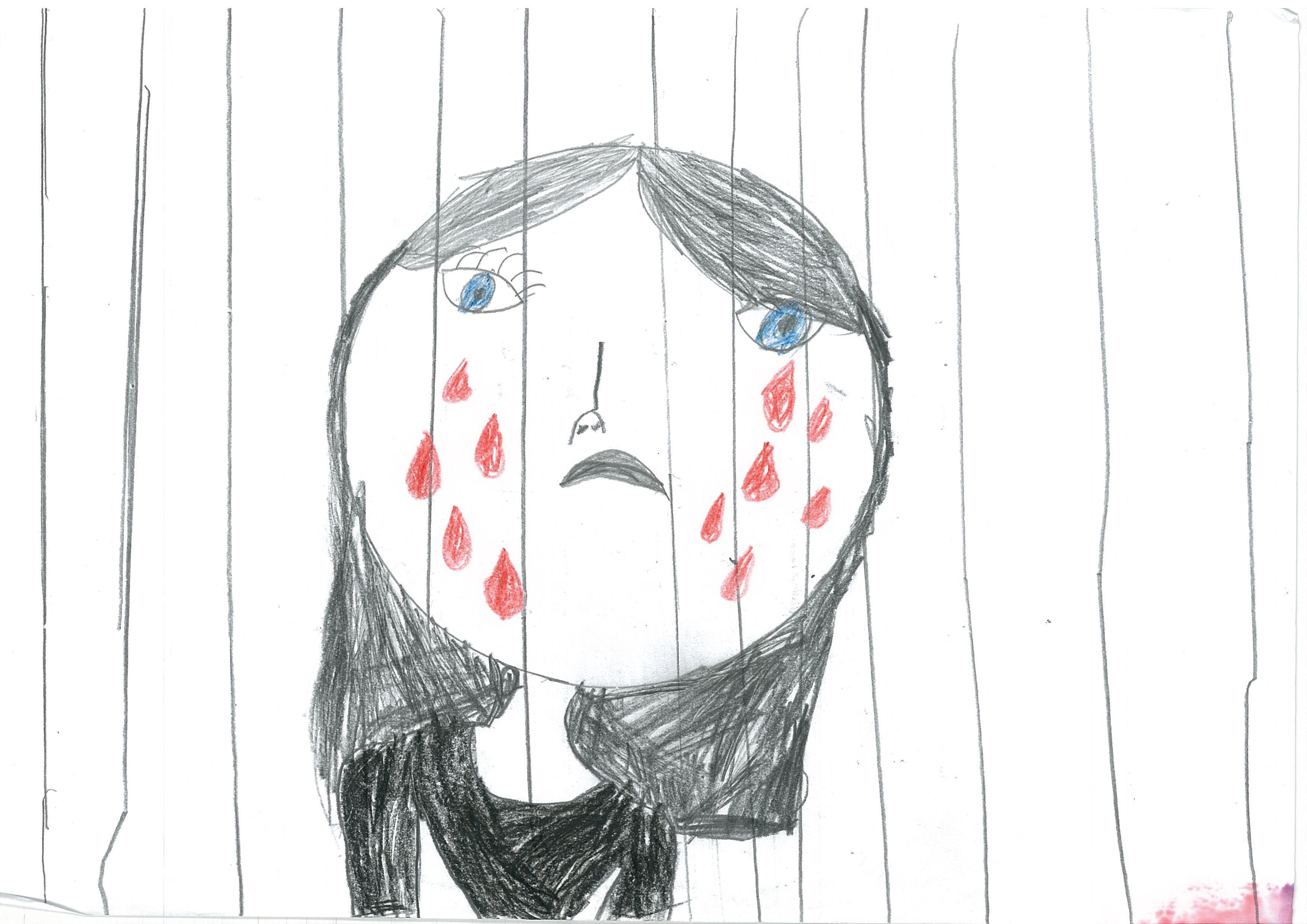
And then we have the horrible reality of “caged children!” It’s a term I do not want to hear because it so deeply troubling to imagine. But children draw and thousands of them have drawn images of caged children. My mind tells me unequivocally, “Don’t look at the drawings!” My heart tells me, “You must look!” My soul tells me, “Spirit will be near as my Comforter when I do look!”

At heart, I have always been an advocate for children, a fierce one. For a very long time advocacy was my career. I cannot abide the ill-treatment of any person, but when I envision thousands of children in custody and in sorely negligent circumstances, it digs at me and pierces my heart like a Holy arrow sent from God. Denise Bell, a researcher at Amnesty International USA said this, “COVID-19 has revealed the fatal flaws and the negligent medical care that ICE has historically provided to people who are detained within its facilities.” Ms. Bell goes on to say, “What’s more disturbing is the carelessness, and I’d even say callousness, with which the government is treating people in its care and custody.”

A969410C-B882-4AF9-A7FA-9C1F6E420740

Despite global lockdown measures, ICE continued to detain, transfer and deport immigrants ― including thousands of children ― all of which has contributed to the spreadof the coronavirus nationally and globally. Foreign governments who accepted deportees said they brought the coronavirus back with them. 
Huffington Post, September 17, 2020


From a CNN article, “Pediatricians share migrant children’s disturbing drawings of their time in US custody.” Slide show above includes drawings shared by those pediatricians and other powerful images. https://www.cnn.com/2019/07/03/health/migrant-drawings-cbp-children/index.html


How can you and I become advocates for these children? To me, it feels like a mandate from a caring, compassionate God. It feels like a mission following the footsteps of Christ who said something quite profound in the eighteenth chapter of Matthew’s Gospel. 

Whoever welcomes one such child in my name welcomes me. If any of you put a stumbling block before one of these little ones who believe in me, it would be better for you if a great millstone were fastened around your neck and you were drowned in the depth of the sea.

Matthew 18: 5-6 (GNT)


And then there’s this:

When a stranger sojourns with you in your land, you shall not do him wrong. You shall treat the stranger who sojourns with you as the native among you, and you shall love him as yourself, for you were strangers in the land of Egypt: I am the Lord your God. (Jeremiah 29:33-34)

Jeremiah 2:33-34 (NRSV)


I need to make sure you understand that I know the drill: I cannot use Holy Scripture to bolster my opinions or take Scripture out of its historical context to prove a point. A learned Professor of Old Testament, James K. Hoffmeier, makes this stringent assertion, “Secularists and liberals, both political and religious, are typically loath to consult the Bible when it comes to matters of public policy. So it is somewhat surprising that in the current debate about the status of illegal immigrants, the Old Testament or Hebrew Bible is regularly cited in defense of the illegal.”

I get that. I am a liberal. I even graduated from seminary. I am not using Scripture to prove my point. Nor do I intend to exegete these texts in an effort to thoroughly understand the translation in historical context. I am just pondering these Scripture passages as inspiration, meditation and perhaps an aid in discerning a call from God to mission. To use the texts in this manner, all I really need to do is read the words and listen for God’s voice. Never in my life, all seventy years of it, has God whispered back to me, “My child, you did not translate that text correctly, nor did you place it in its historical context.”

So where does this leave me? I think it leaves me asking myself, “What will I do? What must I do? Where do I begin in demanding change? How do I call out to my government, imploring them to end this oppressive inhumanity? How do I demand that all of us, including ICE, respect the humanity and the sacred worth of the immigrants in our midst, especially the children?

I hope that you, too, will ask yourself these questions, listen for the voice of God and become a fierce advocate for justice and humanity. If then you sense a call to do something to change the worlds of caged children held in ICE detention centers, visit this website:

https://endchilddetention.org/

Aging, anxiety, Confusion, Despair, discouragement, Faith, Fear, Feelings, God's Faithfulness, God’s promises, Grace, healing, Hope, Isolation, Loneliness, Loss, Music, Prayer, Psalms, Singing, Sorrow, Soul, struggle, Tears, Worry

When Branches Are Flimsy and Songs Cannot Be Sung

I have a certain fondness for sparrows and the spiritual stories we have ascribed to them. That my blog is named “God of the Sparrow” is no accident. I have aspired many times in my life to live like the sparrow lives. I wanted my human, adult, mature and seasoned self to know, beyond any doubt, that God is watching over me. I do not live the simple, sparrow-like life I always hoped to live. But my unshakable faith has always told me that the God who watches over my every moment is also the God of the sparrow. I remember well the words written in the Gospel of Matthew . . .

So do not be afraid; you are of more value than many sparrows. 
— Matthew 10:41 NRSV

Such a comforting passage of Scripture! Yet, its message to us often pales in comparison to all the things that so frighten us. The state of the world that surrounds us in these days seems to have even more power over us than Matthew’s words about our value to God.

How is it that we are valuable to God when God does not act to protect us from all of life’s slings and arrows? Yesterday in my blog post I listed our world’s bad and scary things, so I won’t list them again today. But I will venture a prognosis that many, many people are suffering in many ways in this confusing season. I am one of those suffering people, feeling a bit of hopelessness in these days of racial unrest, coronavirus unsettledness and political divisions.

I heard a moving choral performance this morning. Its text lifted up my helplessness before me and turned it into a prayer so attuned to where I find myself.

God of the sparrow, sing through us
Songs of deliverance, songs of peace. 
Helpless we seek You, God our joy, 
Quiet our troubles, bid them cease. 

Jonathan Cook

I need the sparrow’s God to sing through me. Perhaps you do, too. I need that God-given song because my own music seems to have become quiet, my singing turned to mourning. (Amos 8:10) But this week, I took hold of that mourning. With strong intention, I spent most of one day this week singing my heart out. 

You need to know that I had to choose a day when my husband would be away so that I could sing loud, with abandon. Why did he have to be away? That’s a long story, but in a nutshell, my singing is awful these days. Probably my vocal cords have lost some of their youthful elasticity and, on top of that, I did not sing at all for more than a year. Serious illness took my music.

When I (literally) came back from the dead in 2015, I realized that I had lost so many of my former abilities. Singing was one of them. It felt strange to me when I realized I could no longer sing. My former life was filled with song. Since childhood, there was never a choir I did not join, never a solo I did not sing.

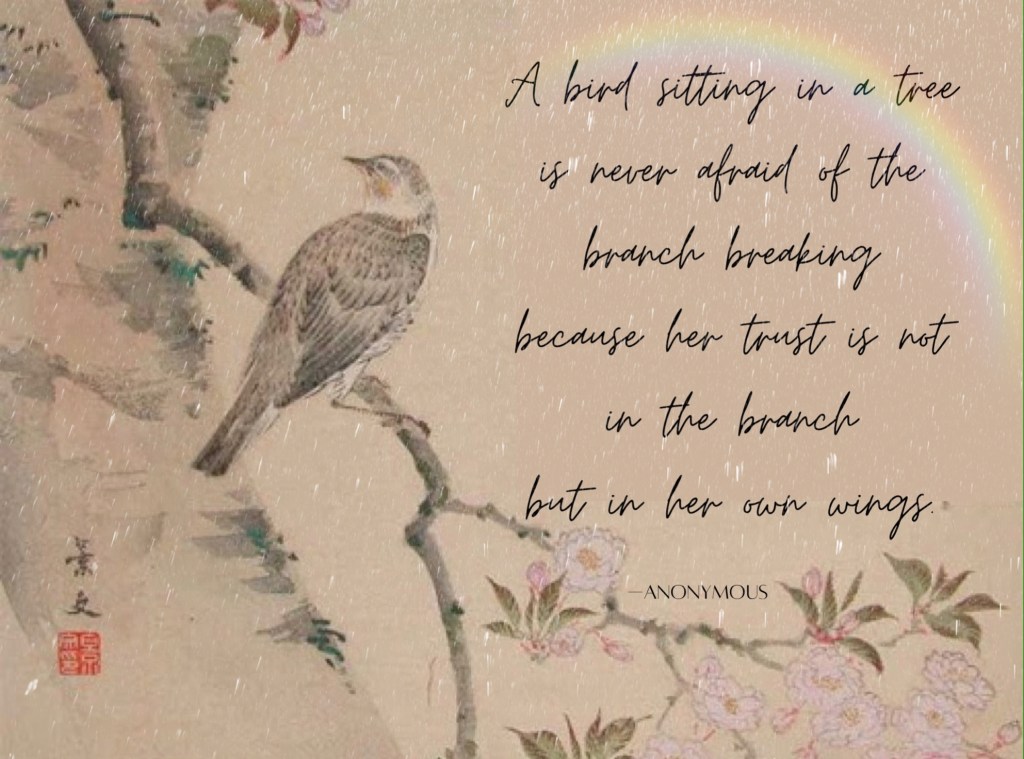
Acknowledging my inability to sing was difficult, just as my life after kidney transplant and this coronavirus is difficult. My isolation has been lengthy, most of nine months, and it is taking its toll on my spirit. Prayer has become both a burden and a grace to me. My singing was my prayer for so many years, and I really need my singing in these hard days. I need to sing my praises to God. I need to sing my lamentations. I need to sing like the sparrow who doesn’t worry about her vocal chords. I need to be like the sparrow who sits on her branch — without fear, without worry — because she knows that if she happens to light on a flimsy branch that does not hold her, her wings will lift her. 

The end of this story is that I need the God of the sparrow to sing through me once again — to sing through me in shadowy days, in times of trouble, in isolation, in fear, in hopelessness. That’s what God does, after all. In a troubled and despairing soul, God creates music, tucking it into every crevice, filling it with songs that can sing out both mourning and celebration. As an added bonus, I have it on good authority that God also turns mourning into dancing.

You have turned my mourning into dancing;
you have taken off my sackcloth
so that my soul may praise you and not be silent.
O Lord my God, I will give thanks to you forever.

Psalm 30 11-12 NRSV

So as you sing, dance to the new rhythms of your soul! Because you can!

Thanks be to God.

Please spend your meditation time today listening to this beautiful song with text written by Jonathan Cook and music by Craig Courtney. The video follows the text.

God of the Sparrow

God of the sparrow, sing through us,
Songs of deliverance, songs of peace.
Helpless we seek You, God our joy,
Quiet our troubles, bid them cease.
Alleluia.

God of the sparrow, God of hope,
Tenderly guide us, be our song,
God of affliction, pain and hurt,
Comfort Your children, make us strong.
Alleluia, alleluia, alleluia.

God of the sparrow, care for us.
Speak in our sorrow, Lord of grief.
Sing us Your music, lift our hearts,
Pour out Your mercy, send relief.

God, like the sparrow, we abide
In Your protection, love and grace.
Just as the sparrow in Your care,

May Your love keep us all our days.

Amen.

anxiety, Despair, Division, Exhaustion, Injustice, Isolation, Lament, Mourning, Natural disasters, Prayer, Racism, Repentance, Violence

“If my people . . .”


I watched the news last night before bed. Not such a good idea! Halfway into the broadcast, I felt a pervasive sense of despair and became very nauseous. I’m feeling it again as I’m writing this. It was the very real and very current events that were so upsetting: hurricanes bringing destruction in Louisiana; California wildfires threatening yet again; protests after the tragic and unwarranted shooting of Jacob Blake; 17-year old Kyle Rittenhouse, who took to the streets of Kenosha, Wisconsin during protests, using a military-style rifle to kill two people; a president who is intent on meeting street protests with military violence; a president who gathers a crowd of supporters, not socially distanced and most not wearing masks; and the coronavirus hovering over it all to make situations even more devastating than they already are.

I turned off my bedside lamp and, in the darkness, pondered the news I had just seen. I could not sleep with the sorry, worry, desperation and helplessness I felt. There was not one thing I could do to change my world. My world seemed out of my control, engulfed in all of the events of our time. I wondered . . . how will we live with natural disasters, protests in the streets, killing, violence, military style weapons, police out of control, political rancor, a deadly pandemic and a seeming disregard for human life? How will I live with it? What can I do to change it?

In these times, we see before our eyes people getting very sick, people dying alone in nursing homes and hospitals because of COVID restrictions, people isolated and lonely for months, people divided by political polarization, people being killed by police, people protesting for racial justice, people pushing back hard, enshrined in their white supremacy, people losing their homes, people fighting out-of-control wildfires, people losing their jobs, people tired from working with so many hospital patients, people afraid to go back to school, people feeling angry and frustrated, people feeling complete despair. Most of all, people are hoping beyond hope for better days ahead.

My mind thought of nothing of any consequence I could personally do to reverse all of this destruction and despair. My heart memory, though, remembered some things God instructed us to do long ago. God addressed instruction to, “my people who are called by my name.” 

“I am called by God’s name,” I thought. “I know exactly what to do!” Of course, I could honor God by standing up for justice — engaging in political activism, contacting government officials to demand change or participating in peaceful protests. I could honor God’s creation by doing more to care for the earth. I could honor God by loving my neighbor and caring for those who have suffered loss. 

People of faith have God’s marching orders that dispatch those called by God’s name to practice all manner of good works. And this we must do. But the critical admonition from God that my heart recalled last night is found in Second Chronicles 7:14. If you are called by God’s name, you will likely know these words well.

If my people who are called by my name humble themselves, pray, seek my face, and turn from their wicked ways, then I will hear from heaven, and will forgive their sin and heal their land. (NRSV)

But wait, Second Chronicles 7:14 doesn’t apply to us. It was for Israel. Our Biblical interpretations must have a solid contextual underpinning. Right?

Of course, many Scriptures taken out of context have done great damage. The context of Second Chronicles is that when God brings judgment on God’s own people, Israel, as a result of their sins, that God would also heal their land. And God would re-establish their blessings when they would pray and “turn from their wicked ways.”

We may look around at all the destruction around us and say, “My sin did not cause any of this.” I don’t have military weapons. I didn’t shoot anyone. I don’t set wildfires, I always wear my mask in public. I certainly cannot stop the ominous storm surge of a hurricane.

True enough! Most of us didn’t sin by doing any of these things. Yet, we should remember two things: 1) While we did not commit those particular sins, we do not fully know the harm inflicted by other sins we may have committed; and 2) We cannot begin to know the transformative power of our sincere, repentant, intercessory prayer.

Instead of entertaining such deep and helpless despair, instead of feeling physically nauseous with worry, I think I will follow the admonition of the Chronicler who gave me God’s call to pray. Of course, the admonition in its historical context truly was for Israel, but if we intend to use the Holy Scripture to guide our lives, we cannot ignore a passage that begins with “If my people.”

Perhaps my prayers and yours will bring transformation, in our spirits and in our world.

May God make it so. Amen.


Attachments, Change, Community, Fear, Hope, Loss, Love, Roots, Separation

Roots Intertwined

I think often about roots — current family roots, ancestry roots and roots in my life that were created from various communities. I can’t help but recall the very first church we served in Arab, Alabama. My husband, Fred, was the minister of music and I was (unofficially) counselor and guide for our youth group. The young people of that church surged into our hearts and, along with most of their families, became a very close community — a deeper bond than even family. I thought my heart would literally break into tiny pieces, and I grieved the loss of leaving them for years.

I was sure that I would never form that kind of bond with anyone ever again. But I did, time and time again, in new places with new people — Alabama, South Carolina, Texas, Arkansas, Georgia, Kentucky and Uganda, East Africa. Every time, deep roots of friendship would reach deeper — reaching Into the soil, reaching toward each other, tangled and intertwined in love. And every time when we pulled up roots to move on to places God was calling us to go, I grieved in the very depths of my soul. Here’s the picture: digging up a tree and pulling it out of the soil is not easy with roots so twisted and connected. Pulling up a plant or a tree does not destroy its roots, but often injures and damages them.

I freely admit that this post is not really about trees and roots. It’s about belonging, forming attachments, community, love. Yet, it’s about more than belonging; it’s about walking away from your belonging, moving away, losing the relationships that mean so much to you, feeling the disconcerting feeling that comes from injuring the roots of your beloved community. A poignant quote by Beryl Markham explains the emotions of pulling up roots.

I have learned that if you must leave a place that you have lived in and loved and where all your yesteryears are buried deep, leave it any way except a slow way. Leave it the fastest way you can. Never turn back and never believe that an hour you remember is a better hour because it is dead. Passed years seem safe ones, vanquished ones, while the future lives in a cloud, formidable from a distance.
Beryl Markham, West with the Night

“The future lives in a cloud, formidable from a distance.” There it is: our fear of a future that holds new experiences and new people. For sure, moving forward truly is formidable. But when all is said and done, it seems that the best way to live is to cherish the roots we have every single day, every moment. Love them. Nourish them. Rest in them. And in some future time in your life, when you must pull up roots and move away, go ahead and grieve your loss, but also let yourself grow deep, spreading roots in another place.

With faith and hope, throw off the fear and uncertainty of an unknown future and plant yourself in a new garden. For there, you may well flourish again, grow deeply with a new community, form new attachments. You may even stumble over a life serendipity and find yourself in a place where you love all over again.

Awakening, Awareness, Beauty of Nature, Bondage, Change, Contemplation, Creation, Creativity, Emotions, Feelings, God's presence, Grace, Hemmed in, Here I am, Lord., Holy Ground, Holy Spirit, Hope, Insight, Inspiration, Introspection, Isolation, Loneliness, Mystery, Psalm 139, Sacred Pauses, Sacred Space, Soul, Spirit, Transformation, Walls, Wisdom, Writing

Hemmed In!


There are large scale, widespread forces that can trap thousands of people, even millions. Dachau, Katrina, earthquakes, tsunamis, wildfires, natural disasters all over the world and the Coronavirus of 2020. Enormous, catastrophic events can trap people. COVID19 has literally trapped me inside my home. I have to admit, the isolation has taken a toll on my spirit. No visitors! No visits with friends or family. No trips! No haircuts! I have been trapped at some level since my kidney transplant in November. Just at the March milestone that would have allowed me to break the isolation of the transplant, I was even more fully trapped by the infectiousness of this pervasive, unrelenting virus.

Being trapped for so many months has raised up in me feelings of loneliness, isolation, powerlessness, despair, anxiety, even abandonment. And yet, often there is something very good in the center of something very bad. It has been so for me. Yes, I feel trapped in the pervasive power of the coronavirus, but I also sense the arms of God and the embrace of Spirit hemming me in even further. Such a grace-gift it has been to me, as if God has said, “l am hemming you in, and in this space you will hear me clearer and sense me more fully.”

God’s words were truth. Hemmed in, my mind flourished, my heart leapt and my soul entered spaces of calm. I felt enhanced awareness! Even awakening. I saw nature in a different way and basked in the beauty of the rising sun. The sound of the hummingbirds’ trill and the rapid fluttering of their translucent wings were sounds meant just for me. I began to write and paint, to listen more carefully to God’s voice, to allow my spirit to overflow with Holy Spirit. To my hemmed-in call from God, I was compelled to answer, “Here I am, Lord!” When I finally answered God, my hemmed-in place became Holy Ground — a very good place to be that feels more like a holy mystery than a state of being.

Was this pandemic a good thing for me and for millions of people? Absolutely not! But trapped in its dark cloud, God hemmed me in further in ways I am just now beginning to understand. I can say with all honesty that being hemmed in by God has been grace to me.

If I could even begin to choose a favorite Psalm from among the many that inspire me, I would choose Psalm 139. In its weaving of words, there are many passages that are full of comfort. From childhood, I memorized a lot of Scripture and throughout Psalm 139 I memorized several snippets that I often call to mind. One verse that I did not memorize is verse 5: “You hem me in behind and before, and you lay your hand upon me.”

You have searched me, Lord,
and you know me.

You know when I sit and when I rise;
you perceive my thoughts from afar.

You discern my going out and my lying down;
you are familiar with all my ways.

Before a word is on my tongue
you, Lord, know it completely.

You hem me in behind and before,
and you lay your hand upon me.

— Psalm 139:1-5 NIV

I deplore the coronavirus and what it has done to so many people. I deplore the ways it was able to trap me, physically and emotionally. But the virus, with all its ominous, far-reaching force could not trap me spiritually. That was God’s work — hemming me in so that my spirit could rise to fresh, new heights of spiritual consciousness. Being hemmed in by our Creator has been grace for me in these days of isolation. It has become a transforming sacred pause. For in my hemmed-in space, the Creator helped me create — from my mind, from my heart, from my soul. Thanks be to God.

Inner joy, Loss, Music, simple joys, simple pleasures, Singing, Soul

I Think I May Have Lost My Music


I think I may have lost my music, and I’m not sure exactly when I lost it, or how. I can probably get away with blaming it on the coronavirus. After all, choirs cannot really sing right now, at least not safely.

The coronavirus has stolen so many things from us all — important things and things that are not so important. For me, one of the stolen things that affects me deeply in my soul is music.

When I hear music, the melodies and rhythms often reach into my soul. Music is my muse. Losing my music is one of my most troubling losses. I know, of course, that I can listen to Pandora or Spotify.  Or I can listen to quality music on National Public Radio and find hundreds of concerts on YouTube.

What I am missing most is being inside my church sanctuary listening to the music of the pipe organ and anthems from our choir. Part of it may well be that I’m missing the people who offer their gift of music every week. Part of it is probably nostalgia when I contemplate the decades I spent singing with choirs and other groups. Part of it is missing my many years as a soloist. Part of it is missing my last ministry position as minister of worship at New Millennium Church in Little Rock, Arkansas. Part of it is having to leave my piano when we moved in 2015. Part of it, I am certain, is that I can’t really sing anymore, at least much of the time. After my illness in 2014 and its very long recovery, I lost my voice. This was such a profound loss for my soul.

For some reason, all of this was on my mind this morning when I had a serendipity moment. I received an email with a brief thought for the day. I receive it every day, but today it happened to include a passage of Scripture closely related to my present thoughts. This is what it said:

But now, get me a player of music, and it will come about that while the man is playing, the hand of God will come on me and I will give you the word of God: and they got a player of music, and while the man was playing, the hand of the God was upon him.

— 2 Kings 3:15

Haven’t we all heard someone singing and playing music when we were touched and changed? All creativity and beauty in this life are but a small reflection of the master musician, our Creator. Listen with your heart and be glad.

John Gaudreau

Music can be our soul’s joy or our heart’s expression. Music can lift us from sorrow’s depths and raise us to higher planes of grace. Music can be our most lavish praise to God. Music can open our spirits and create in us expressions of gladness, even in times of trouble. May God make it so. Amen.

Let me end without any more words, just music. “Listen with your heart and be glad” and hear this beautiful anthem, “Through Love to Light” with text written by Richard Watson Gilder, 1844-1909.

Through love to light! O wonderful the way That leads from darkness to the perfect day; From darkness and from sorrow of the night To morning that comes singing o’er the sea! Through love to light! through light, O God, to Thee, Who art the Love of love, th’ eternal Light of light! Amen.

Comfort, Contemplation, Courage, Discernment, Discovering, Feelings, Freedom, God's presence, God’s promises, journey, Life Journeys, Meditation, Memories

What Do I Do with My Feelings?

How are you feeling today?

“Fine” is almost always the answer because usually the one who asked the question doesn’t really want to know all about how we feel. Not really. So we answer with a word — “fine.” Just “fine.” After all, we don’t often want to reveal our true feelings to anyone, and on top of that, telling them how we really feel would take more time than either of us want to spend on the conversation.

There may also be another reason for responding with just the word “fine.” Sometimes we don’t know how we’re really feeling. Some people are too busy with life responsibilities to consider how they feel. Others know there are deep feelings inside themselves, but they too are too busy to feel them. Still others sense dark, foreboding feelings in their deepest place, and they will not risk the emotional repercussions they might face by lettings their feelings rise into their consciousness. In Leo Tolstoy’s book, Anna Karenina, the dialogue asks, “Is it really possible to tell someone else what one feels?” Perhaps at that point — the seeming impossibility of telling another person how we feel — is where you and I find ourselves.

What happens when you refuse to allow your deepest feelings to enter your consciousness?

The question on the left is a very good question, even a crucial question. What does happen in us when we simply refuse to allow our feelings to come to the light os acknowledgment. The answer is at the very center of our quest for emotional wellness. We start, as the image above instructs, at owning our deepest feelings. Owning means to look at our feelings honestly and without fear. Owning means making no excuses for feelings. Owning means not blaming our feelings on others. Owning means holding our feelings in high esteem and acknowledging how they came to be. Owning means accepting our feelings, embracing then and honoring them

I was so deeply hurt that I just hold it inside until it becomes so unbearable I think I will snap.

He made me feel invisible and I just can’t let go of that feeling. I still feel invisible after all these years.

She made me so angry and I am letting that anger rage inside me and it will not go away. I don’t dare express it or let it surface.

Owning our feelings means being willing to truly “see” them, even when seeing them frightens us or creates in us a sense of dread. We sense we may experience a season of dread that the feelings will hurt us, again and for a long time. We fear what we will see. There is some truth in the fact that we tend to live into our “false self,” the self that is external and often shows little resemblance to our internal self. Contemplation is internal work. For those of us who believe in God, something divine happens when we are immersed in contemplating our hidden feelings — this thing that happens is that God meets us there, at the very moment when a buried feeling begins that awful hurting. I think of the words of promise in Holy Scripture, Jeremiah 29:11.

For I know the plans I have for you, says the Lord, thoughts of peace and not of evil, to give you a future and a hope.

I cannot help but find comfort in the presence of God in my life’s most painful times, and honestly, I have to say that some of those painful times were a part of contemplation and, through contemplation, beginning to own my down-deep feelings. The wise words of Thomas Merton are both instructive and provocative.

Everyone of us is shadowed by an illusory person: a false self . . . We are not very good at recognizing illusions, least of all the ones we cherish about ourselves. Contemplation is not and cannot be a function of this external self. There is an irreducible opposition between the deep transcendent self that awakens only in contemplation, and the superficial, external self which we commonly identify with the first person singular. Our reality, our true self, is hidden . . . We can rise above this unreality and recover our hidden reality . . . God begins to live in me not only as my Creator but as my other and true self.
Thomas Merton, New Seeds of Contemplation

In finding pieces of my hidden, true self, I also found release from harmful feelings, hurtful memories and oppressive people I held on to. Finally, after contemplation, we find the ability to share our feelings — the real ones — with the people we trust to hold them sacred and to help us better understand them. At the moment when I understood my feelings — where they came from; why I was holding on to them; who caused them; what would happen if I let my feelings rise from my depths to the light of day — that was the moment I felt free. I could live again as my best self. I could love myself, my real self. And I could be my best self. Not a small thing! A turning point in my life!

I hope you will spend some time studyIng the Feelings image above. I invite you to look at the seven feelings in the center and to then move to the outer circles. If I feel sad, for instance, the next expansion of the circle further clarifies what “sad” means for me, i.e. lonely, vulnerable or depressed. The outer section may reveal to me that I was victimized or abandoned, grieving or isolated.

Continue to contemplate your hidden, unspoken feelings. Learn to look at them and “own” them without fear, and know that God will meet you at the point of your deepest pain and that you are God’s own creation — cherished, loved, comforted and protected by a God who will never let you go. 

As a part of your contemplative moments, I hope you are strengthened by this arrangement of the  hymn, “O Love that Will Not Let Me Go.” Play it before you begin your meditation time and let its message clear your mind and comfort your soul.

life, Mindfulness, Present moment, Reflection, Rest

In the Graceful Arms of this Present Moment


“Live in the moment.” It is a common admonition I have heard often. “Practice mindfulness,” is a more current admonition that points us to live in the present moment. We are urged to add mindfulness to our vast storehouse of spiritual disciplines. You might wonder what mindfulness means, so I found an answer from a trusted source.

Mindfulness is a mental state achieved by focusing one’s awareness on the present moment while calmly acknowledging and accepting one’s feelings, thoughts, and bodily sensations, used as a therapeutic technique. (psychologytoday.com)

Today, the thought that grabs me comes from Madisyn Taylor, who writes “rest yourself in the graceful arms of the present moment.” (https://www.dailyom.com/cgi-bin/display/inspirations.cgi?view=all )

It is an idea that seems so simple. Yet, resting in the present moment is not always simple. It can be very hard to do, often impossible to do. Sometimes we find ourselves hopelessly  stuck in the past, suffering the soul bondage of its power over us. Dwelling in the past can cause us to languish about no longer having the joys we once enjoyed, the people we loved, the places we used to live, the “best job I ever had.”  The past can also be a haunting place of reliving the past trauma, loss,disappointment or betrayal. Still, there must be an emotionally healthy place to put the past. Perhaps the difference in what we do with the past is a soul struggle between “letting the past have its place” and letting the past have its way. 

I have often let the past have its way in my life as an ominous presence that reminds me of secrets and lies, violence, abandonment, anger and so many other experiences that threaten me through my memories. The critical question I must ask is how do I let the past have its place. What can I do to embrace my past and let it be a guide on my journey, not an oppressor as I walk my journey? I wonder sometimes if I can put the past in its place, no longer allowing it to wield power over my memories and torment my soul. I know It’s worth a try.

And then there’s the future to contend with, that time in life we think we can control although we have no idea what it might hold. The future is unknowable, something to try to envision knowing I cannot. The future can look to us as bright as the sun or as dark as the center of a cave. The future can be dreaming dreams or internalizing dread and fear. The thought that ”the future is taken care of” graces me with a picture of God knowing my future and preparing me to greet it with hope.

“Rest in the graceful arms of the present moment.”

The words bring to mind the many, many times I have sung the beloved hymn, “Leaning on the Everlasting Arms.” 

What have I to dread? What have I to fear, leaning on the everlasting arms?
Leaning, leaning, safe and secure from all alarms.

I think maybe feeling safe and secure, without fear and dread, is exactly what helps us live in the present moment — not rushing through this beautiful life, not missing the real and deep beauty of it. Yet, we persist in pushing our bodies to accomplish its daily tasks without cherishing the workings of the body — its breathing, its moving, tasting and seeing, hearing and enjoying the aromas that surround us. And most often, we fail to pay close attention to the longings of our souls and the promptings of our spirits — what makes us whole, what fills our hearts with joy, what God is saying to us. We simply do not pay close attention to how is God calling us to satisfy both our soul’s yearning and the world’s deepest need.

Like me, perhaps you do not always cherish the present moment enough — all of it — this present moment we have been given by God’s grace. Life passes through us and around us in every passing moment, and we miss it.

And yet, cherishing every moment — our present moment — might just make magic in our lives, filling us with serenity and peacefulness, with lightheartedness and laughter, even bringing us to the honesty of our sorrows and the cleansing power of our tears.

I, for one, want to be continually mindful of my life — every moment of it — in my body, my mind, my world, my soul, my heart, in my yearnings and my sorrows . . . in my dreams and in the deepest desires that fill me with hope.

Celebration, Funeral, In Memorium, John Lewis, Laughter, Mourning, Tears, Uncategorized

Mourning John Lewis — Celebrating His Life

John Robert Lewis
Laid to Rest on July 30, 2020

3E00A651-AF51-47E9-A01F-87B2145D4166

One might have been able to hear church bells ringing this morning, eighty times,
in cities and towns across America, to pay homage to his eighty years of life
.

Later, the headline read, “Three living presidents came together to honor Congressman John Lewis at his funeral today in Atlanta, Georgia.” Yes, three presidents spoke words of mourning, and celebration today — President George W. Bush, President William J Clinton, President Barak Obama. President Jimmy Carter sent his words to be read.
So four living United States Presidents honored John Lewis today. A fifth living United States President did not.

Eloquent words were spoken by so many today at Atlanta’s historic Ebenezer Baptist Church, which has been known best because of its most famous pastor, Dr. Martin Luther King, Jr. We heard stories, memories, words marked with laughter and tears from friends and family members of John Lewis — Rev. Dr. Bernice King, an activist and Martin Luther King Jr.‘s daughter, civil rights pioneer Xernona Clayton, James Lawson,   an activist, Speaker of the House Nancy Pelosi, our three living presidents and many others.

Years later, when I was elected a U.S. Senator, I told him that I stood on his shoulders. When I was elected President of the United States, I hugged him on the inauguration stand before I was sworn in and told him I was only there because of the sacrifices he made. And through all those years, he never stopped providing wisdom and encouragement to me and Michelle and our family. We will miss him dearly.
— President Barak Obama


Americans live in a country that is better today because of John Lewis. John always looked outward, not inward. He always thought of others. He always believed in preaching the gospel, in word and in deed, insisting that hate and fear had to be answered with love and hope. John Lewis believed in the Lord. He believed in humanity, and he believed in America.
— President George W. Bush


John always kept walking to reach the beloved community. He got into a lot of good trouble along the way, but let’s not forget, he developed an absolutely uncanny ability to heal troubled waters. When he could have been angry and determined to cancel his adversaries, he tried to get converts instead. He thought the open hand was better than the clenched fist. He lived by the faith and promise of St. Paul: “Let us not grow weary in doing good, for in due season we will reap if we do not lose heart.” He never lost heart. He fought the good fight, he kept the faith, but we got our last letter from him today on the pages of the New York Times. Keep moving. It is so fitting on the day of his service, he leaves us our marching orders: Keep moving.

John Lewis was many things, but he was a man, a friend and sunshine in the storm, a friend who would walk the stony road that he asked you to walk, that would brave the chastening rods he asked you to be whipped by, always keeping his eyes on the prize, always believing none of us would be free until all of us are equal. I just loved him. I always will. And I’m so grateful that he stayed true to form. He’s gone up yonder and left us with marching orders. I suggest since he’s close enough to God to keep his eye on the sparrow and on us, we salute, suit up and march on.
— President Bill Clinton


We come with a flag flown over the Capitol the night that John passed. When this flag flew there, it said goodbye. It waved goodbye to John. Our friend, our mentor, our colleague. This beautiful man that we all had the privilege of serving with.
— Speaker of the House Nancy Pelosi

That’s when I cried, as I did many times during the four hours I watched this morning, bearing witness to his life, holding vigil at his glag-draped casket I had watched all week. There is no doubt that moving words were uttered today in that holy place where Beloved Community gathered to mourn John Lewis, but none were more full of heart that the words of Ebenezer’s senior pastor, the Rev. Dr. Raphael G. Warnock:

We have come to say goodbye to our friend in these difficult days. Come on, let the nation celebrate, let the angels rejoice … John Lewis, the boy from Troy, the conscience of the Congress. His deeds etched into eternity, he loved America until America learned to love him back.

From 1 Corinthians 15:51-55
Behold, I show you a mystery; We shall not all sleep, but we shall all be changed, 
In a moment, in the twinkling of an eye, at the last trump: for the trumpet shall sound, and the dead shall be raised incorruptible, and we shall be changed. For this corruptible must put on incorruption, and this mortal must put on immortality.

So when this corruptible shall have put on incorruption, and this mortal shall have put on immortality, then shall be brought to pass the saying that is written, Death is swallowed up in victory. O death, where is thy sting? O grave, where is thy victory? 

From Revelation 14: 12-13
Here is a call for the endurance of the saints, those who keep the commandments of God and hold fast to the faith of Jesus. 
And I heard a voice from heaven saying, “Write this: Blessed are the dead who from now on die in the Lord.” “Yes,” says the Spirit, “they will rest from their labors, for their deeds will follow them.”

From the works of William Shakespeare
When he shall die,
Take him and cut him out in little stars,
And he will make the face of heaven so fine
That all the world will be in love with night
And pay no worship to the garish sun.


I cried today, but I laughed a lot, too. I sang a little and — though I did not rise to my feet to dance in celebration of his life well-lived — I still celebrated more than I mourned, because that’s what John Lewis would do. In the end I laughed out loud at the image of mourners dancing their way out of the sanctuary, following the casket, and being glad that John Lewis loved dancing to the music of “Happy Feet!”

Why don’t we all dance our way to Beloved Community!

May God make it so!

Rest in Peace, John Lewis. Rest in Celebration. We got this!

anxiety, Art, Comfort, Courage, Despair, God’s promises, grief, Hope, Life Journeys, Soul, struggle, Suffering, Transformation, Uncategorized

Hope and the Soul’s Struggle

620F798A-69A5-4B11-8719-189E926AEB6C
Struggles abound in this unwelcome COVID19 season we are experiencing. Most of us are touched by this virus in some way. We have struggled with so many life changes. I have watched strugglers of the soul work through the illness, others deal with the suffering and death of a friend or family member, often being unable to be with them at their death. Some parents are struggling with decisions affecting school for their children and teachers fear they will be unable to keep their students (and themselves) safe. Others long to see loved they have not seen in months of social distancing.

My circle of friends and family are feeling short on hope while they experience struggles of the soul. Yet, Herman Melville asserts that “Hope is the struggle of the soul.” I have been wondering what exactly that might mean. Perhaps hope gives us the courage we need to move boldly and full of hope into the place where the soul struggles, moving there with the assurance that the hope that led us there will also lead us to healing.

As I look closer at Melville’s words, I begin to see and understand that hope’s struggle eventually empowers us to break loose from the perishable things we hold on to — our wealth, our home, our “things” like cars, boats, RVs, whatever “things” we cherish. Looking at what this virus could bring, knowing that we are facing real life and death situations, cannot help but move our souls to throw off the things that don’t seem so critical anymore — perishable things we do not need. This thought prompts me to look at two of my favorite passages of Scripture.

For you know that it was not with perishable things such as silver or gold that you were redeemed from the empty way of life handed down to you from your ancestors . . .

— 1 Peter 1:18-19 (New International Version)

When the perishable has been clothed with the imperishable, and the mortal with immortality, then the saying that is written will come true: “Death has been swallowed up in victory.”

— 1 Corinthians 15:54 (New International Version)

How do we get there? How do we get through the soul struggles that can bring us to our knees?

I don’t think there is a well developed plan or a series of definite steps to take. The path, the plan, will be unique to each struggler. But the soul struggles I have felt throughout my life have taught me to place hope where hope must be: in Comforter Spirit who hovers over me with her sheltering wings; in the Christ who lives in and through me guiding me as a good shepherd and empowering me to walk with courage in his footsteps; in the Eternal God who holds before me, always, my own eternity.

This is what is available to you as well as you lean into hope’s struggle of the soul and break loose from things that are not important as you bear witness to your own eternity.

May God make it so.

As you leave these words and move with hope into your soul struggles,

May the God of hope go with you and fill you with all joy and peace as you trust in God, so that you may overflow with hope by the power of the Holy Spirit.

— Romans 15:13 (New International Version)

Amen.

I hope you can spend a few minutes in prayer and contemplation as you watch this beautiful, comforting music video, “Still with Thee,” with text written by Harriet Beecher Stowe.

Beloved Community, Black Lives Matter, Civil Rights Movement, Courage, Good Trouble, In Memorium, John Lewis, Justice, Nonviolence, Perseverance, Persistence, Politics, Prophetic, Racism, strength, struggle, Tenacity

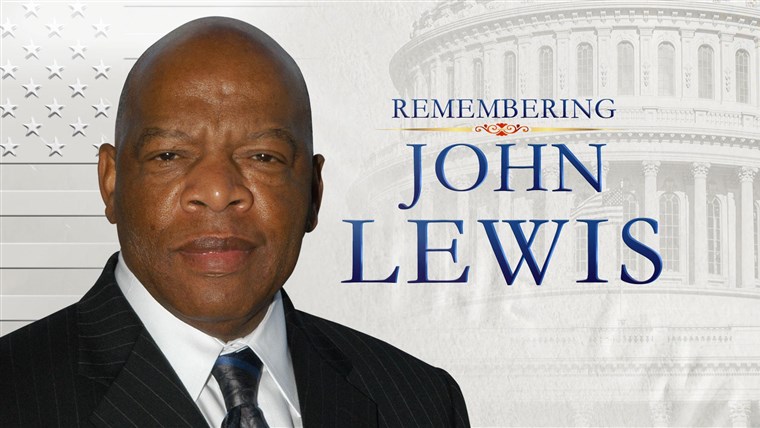
Remembering John Lewis

89BE8169-640A-4DDD-A2AC-E9680BE67E02
Because I am a citizen of the state of Georgia, I can call him mine — my congressman, my conscience, my inspiration.

John Lewis
A warrior in building the soul of America

Representative John Lewis, a son of sharecroppers and an apostle of nonviolence who was bloodied at Selma and across the Jim Crow South in the historic struggle for racial equality, and who then carried a mantle of moral authority into Congress, died on Friday. He was 80.*

Twice he was beaten to an inch of his life.

I have been in some kind of fight — for freedom, equality, basic human rights — for nearly my entire life.    — John Lewis

On the front lines of the bloody campaign to end Jim Crow laws, with blows to his body and a fractured skull to prove it, Mr. Lewis was a valiant stalwart of the civil rights movement and the last surviving speaker from the 1963 March on Washington — where King delivered his famous “I Have a Dream” speech — but Lewis was almost refused to be allowed to speak by march organizers because of his strident criticism of the Kennedy administration.

Lewis went on to serve 17 terms in the US House of Representatives, where he was considered the north star of conscience in Congress.**

Tributes to the life and legacy of John Lewis came from hundreds of voices.

“Not many of us get to live to see our own legacy play out in such a meaningful, remarkable way. John Lewis did,” former President Obama said in a written tribute. “And thanks to him, we now all have our marching orders — to keep believing in the possibility of remaking this country we love until it lives up to its full promise.”

Joe Biden, and his wife, Jill, issued a statement that began, “We are made in the image of God, and then there is John Lewis. How could someone in flesh and blood be so courageous, so full of hope and love in the face of so much hate, violence, and vengeance?”

Sen. Bernie Sanders of Vermont said: “His courage helped transform this country. He won’t ever be forgotten by those who believe America can change when the people stand together and demand it.”

Sen. Kamala Harris of California said of Lewis, “He carried the baton of progress and justice to the very end. It now falls on us to pick it up and march on.” ***

And so we will, to honor his memory and to persist in the fight against injustice.


John Lewis.

America’s inspiration for getting into “good trouble”

Do not get lost in a sea of despair. Be hopeful, be optimistic. Our struggle is not the struggle of a day, a week, a month, or a year, it is the struggle of a lifetime. Never, ever be afraid to make some noise and get in good trouble, necessary trouble.
— A tweet from June 2018

I appeal to all of you to get into this great revolution that is sweeping this nation.  Get in and stay in the streets of every city, every village and hamlet of this nation until true freedom comes, until the revolution of 1776 is complete.
— At the 1963 March on Washington

Freedom is not a state; it is an act. It is not some enchanted garden perched high on a distant plateau where we can finally sit down and rest. Freedom is the continuous action we all must take, and each generation must do its part to create an even more fair, more just society.
From his 2017 memoir, “Across That Bridge: A Vision for Change and the Future of America”

My dear friends: Your vote is precious, almost sacred. It is the most powerful nonviolent tool we have to create a more perfect union.
— From a 2012 speech in Charlotte, North Carolina

You are a light. You are the light. Never let anyone—any person or any force—dampen, dim or diminish your light. Study the path of others to make your way easier and more abundant.
From his 2017 memoir, “Across That Bridge: A Vision for Change and the Future of America”

We have been too quiet for too long. There comes a time when you have to say something. You have to make a little noise. You have to move your feet. This is the time.
— At a 2016 House sit-in following the Pulse shooting in Orlando

When you see something that is not right, not just, not fair, you have a moral obligation to say something. To do something. Our children and their children will ask us, ‘What did you do? What did you say?’ For some, this vote may be hard. But we have a mission and a mandate to be on the right side of history.
— 2019 remarks in the House on impeachment of President Trump


May his words echo in our hearts and reach the soul of every American. 

May he rest in peace and — from above — inspire us to “do justice, love mercy and walk humbly with our God” as he did.


John Lewis
Servant of God and champion for justice, now called to his heavenly home


With thanks to:
* Katharine Q. Seelye, https://www.nytimes.com/2020/07/17/us/john-lewis-dead.html

** Ken Sehested, http://www.prayerandpolitiks.org/

*** Janet Hook, https://www.latimes.com/politics/story/2020-07-18/tributes-rep-john-lewis-dies-civil-rights


Aging, anxiety, Bewilderment, Bravery, Challenge, Child protection, Children, Conflict, Confusion, Contemplation, Courage, Dangerous and noble things, Discernment, Dreams, Indecision, Internal conflict, Introspection, life, Pandemic of 2020, Questions, Sacred Worth, struggle, Transformation

When Plans Are Dreams

05D8F2C8-83DB-40E3-9FEC-43A543D80EC3
Plans!
We find it almost impossible to make them in a life ruled by COVID19. Currently, school  plans are foremost in the minds of parents and students.

“Is it safe to send my child back to school? What safety and social distancing measures will schools have in place? Do I choose to keep them at home, opting for virtual learning? How do I manage online school?”

In light of such critical plans and decisions, consider this current news report:

A document prepared for the White House Coronavirus Task Force but not publicized suggests more than a dozen states should revert to more stringent protective measures, limiting social gatherings to 10 people or fewer, closing bars and gyms and asking residents to wear masks at all times.

The document, dated July 14 and obtained by the Center for Public Integrity, says 18 states are in the “red zone” for COVID-19 cases, meaning they had more than 100 new cases per 100,000 population last week. [Georgia is in the “red zone.”]

Eleven states are in the “red zone” for test positivity, meaning more than 10 percent of diagnostic test results came back positive. [Georgia is in this “red zone” too.] https://publicintegrity.org/health/coronavirus-and-inequality/exclusive-white-house-document-shows-18-states-in-coronavirus-red-zone-covid-19/

Even with troubling reports like this one, Georgia’s governor, Gov. Brian Kemp, signed an order on Wednesday, July 15, 2020 banning localities from requiring masks. On this information, parents have to agonize about what’s best for their children. They simply cannot make firm plans as long as the virus is waxing and waning. Mostly waxing!

Plans are difficult for us for all sorts of reasons and circumstances. Every now and then over the years, my life would take un unexpected pause to contemplate this thought written by the late Mary Oliver:

 So tell me, what is it that you plan to do with your one wild and precious life?

Unpacking that brief question has been a periodic constant in my life, popping up for me mostly in my down and disheartened times. I hear the poet describing my life as “wild and precious” and it almost shocks me. Yet, my life really has been consistently wild and mostly precious. Anything that urges me to examine my life is a good thing. I can almost always pull up memories of the times when I was wild and free — insistent upon rising higher, realizing a near-impossible dream, charging with courage into new and uncharted places, planning for a future of fresh and sparkling heights, observing just how wild I could dare to be. Unpacking that question has been exhilarating at times, exhausting at other times.

Musing on a life that could be described as precious

Entertaining the thought that my life was precious happened in my deepest soul place. It happened in my moments of introspection, meditative times that urged me to examine all the ways I saw my life as precious, cherished, valued. Of course, I have experienced many precious life moments — my wedding day, my work in Africa, my ordination, awards and recognitions of my work and career and, most of all, the adoption of my one wild and precious son, JonathanExamining my precious life was most real when I almost lost my life, my full year of serious illness, five years of dialysis and a kidney transplant made possible by the selflessness of a lovely woman I know only through email.

Such thoughts bring me back to plans. What is it I plan to do with my one wild and precious life? Even a life precious and wild is a life that requires plans, and right now trying to make plans is an exercise fraught with anxiety. I cannot find any words that can minimize this depth of anxiety. There is not one thing you or I can do about plans that have been ravaged by the pandemic we are experiencing, and yet we must make critical plans in this season of uncertainty. 

School plans are most difficult in my state and perhaps in yours. As parents agonize over the safety of their children, Georgia’s governor, Brian Kemp, offered this unhelpful comment this morning in a press conference:

I am a believer that kids need to be in the classroom and we’re working with the schools to do that. We’re going to have cases that break out in schools, either with personnel or perhaps students, just like you do with a stomach bug or a flu or anything else. Our schools know how to handle those situations.

The parents and teachers in my life know that this coronavirus is not just a run-of-the-mill “stomach bug or flu.” This virus is deadly, and parents and teachers faced with difficult school decisions know that all too well. During these pandemic days, it is a constant reality that many of us are having to make potentially hazardous plans, but just for a moment, I wonder if we can redirect our thoughts to plans we make for our “one wild and precious life.”

Can we rise above the plans we must make today, even for a moment, and instead consider the bold and courageous plans we could make? Can we set our hearts to think about plans we can make when we are our brave, adventurous and fearless selves? Can we contemplate the plans we might make when we feel bold, resolute and undaunted?

I can remember the times when I was able to make such adventurous plans, times when my plans were dreams — high and lofty dreams of changing the world. I can also remember the time when I no longer dreamed any dreams at all. It was a time when I no longer saw my life as a wild and precious one. I still entertained plans, but my plans were definitely not dreams. I believed I could no longer change the world. I believed I could no longer live a life that made a difference. I believed that my soul was dry and my spirit barren. I believed that, in my life, dangerous and noble things were no longer possible

Why can’t you and I dream dreams instead of making plans? Why can’t my “one wild and precious life” rise higher, high enough to make dreams of my plans? Sometimes I will go to one of my many favorite passages of Scripture hoping to find God’s word to me. Being true to my theological education, I always look at the words in context before I do anything else. But after that hermeneutical exercise I learned in New Testament 101, I might twist the text a bit and maybe even paraphrase it, inviting the text to speak to me specifically, just me. For this day, one of the texts found in the book of Acts reaches into my soul, and, yes, I did paraphrase it.

“In your season of most need,” God says,
“I will restore your soul and make your spirit rise within you.
I will pour out my Spirit on all people.

Your sons and daughters will prophesy,
your youthful hearts will see visions,
your aging hearts will dream dreams.”

— Acts 2:17 (my paraphrase)

Amen. 

May God lift our hearts and spirits, assure us that our lives are precious and help us transform our plans into dreams.

So tell me, what is it that you plan to do with your one wild and precious life?


anxiety, Community, Darkness, Death, Despair, discouragement, healing, Heartbreak, Indecision, journey, Lament, life, Life Journeys, Life pathways, Mystery, Restoration, Sorrow, Spirit, struggle, Tears, Thin Places, Yiayia

That Mysterious and Mystical Reality

EC73BB1C-C3BB-4B52-8D03-279FE90ADEDE
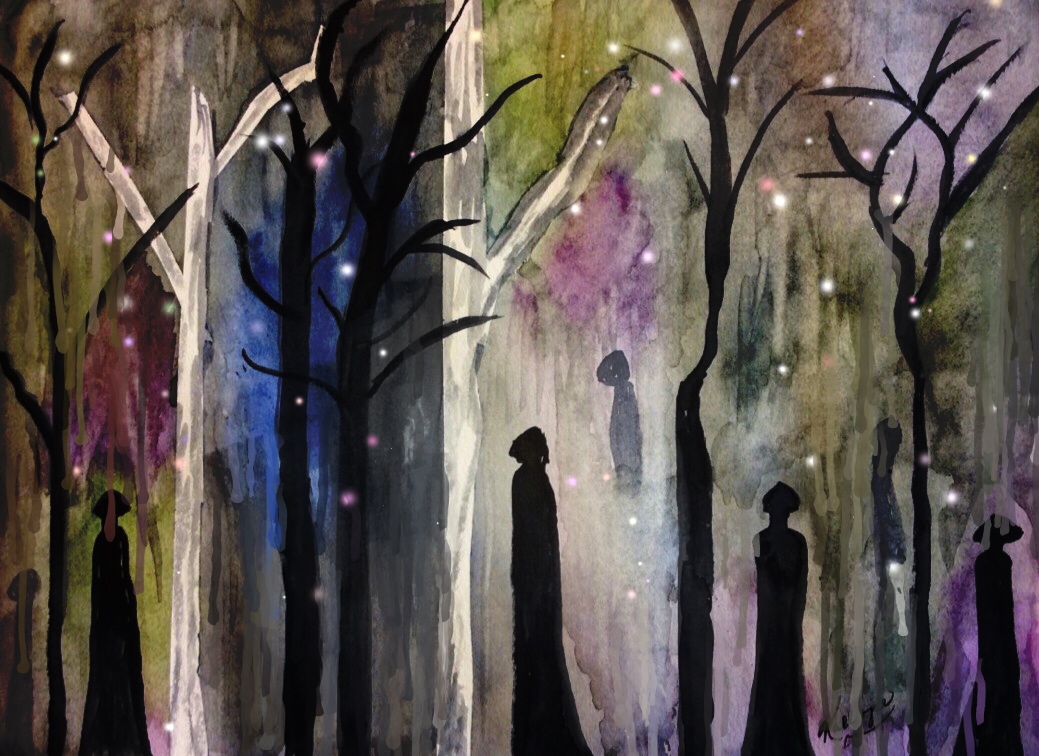
Watercolor art by Kalliope, Holy Ghosts

You might be thinking that both mysterious and mystical are the antithesis of reality. If you are thinking that, you might be wrong. So might I. But in my experience, life itself is a mysterious and mystical reality. That reality fills my spirit with hope in my darkest moments. Dark moments, hours of grief, dark nights of the soul, lamentations of the spirit — all have been part of my life journey. My pathways have often been rough and rocky. My life’s travel has often taken me to disconcerting forks in the road and confusing crossroads. I have known times of despairing and times of uncertainty — reluctance, despondency, angst, heartbreak, fear — “break-out-in-a-sweat times” that forced me into dangerous depths of anguish. For me, taking my own life was not something I could consider. Yet there was that one day — that span of just a few moments — when I was alone, afraid and very far from home.

IMG_5744
Japan’s Aokigahara Suicide Forest

One of the most thoughtful and intriguing movies I have ever experienced is The Sea of Trees. I was captivated by the film that tells the story of a despondent professor. After the death of his wife, he despaired of life and searched for a way to end his. His reflective, angst-filled search led him to Aokigahara, a forest in Japan known also as The Sea of Trees or The Suicide Forest. Aokigahara Forest has been home to over 500 confirmed suicides since the 1950s. It is called “the perfect place to die” and is the world’s second most popular place for suicide.

Don’t worry. This post is not about suicide. Rather it is about the people who loved us in life and continue to love us in death, those who watch over us in our times of deepest anguish. It is about the mysterious and mystical reality that between us and our loved ones in heaven, there is but a thin separation. Heaven and earth,” the Celtic saying goes, “are only three feet apart, but in thin places that distance is even shorter.”

To know that my sweet Yiayia (grandmother in Greek) and my Thea Koula might still be protecting me from harm and life disaster is soul-comforting for me. Perhaps the strength and hope I felt as I was chaplain to disheartened hospital patients came from them. Perhaps they sent me the staying power to comfort, protect and advocate for thousands of abused women and children. Maybe the deep grief of losing my brother to cancer was eased by their prayers from heaven.

I often wondered if my mourning of the loss of the life I knew — replaced by daily dialysis — was lightened by their loving presence with me in a horrible time. I wonder, Yiayia, were you watching over me on November 12th when I closed my eyes in the operating room to receive my kidney transplant? I wonder, Thea Koula, did your intercession save my life on those times when my life literally hung in the balance?

This life is not an easy one. No person gets through life unscathed. No one travels a path smooth and straight. Like me, you have more than likely walked on a rough pathway with stones in the road, dangerous curves and life-altering crossroads. Robert Frost wrote eloquently in his poem, The Road Not Taken, about someone standing at a fork in the road pondering a life-altering choice:

Two roads diverged in a yellow wood,
And sorry I could not travel both
And be one traveler, long I stood
And looked down one as far as I could
To where it bent in the undergrowth . . .

Then took the other, as just as fair,
and having perhaps the better claim
because it was grassy and wanted wear . . .

Oh, I kept the first for another day!
Yet knowing how way leads on to way,
I doubted if I should ever come back.

I shall be telling this with a sigh
Somewhere ages and ages hence:
Two roads diverged in a wood, and I—
I took the one less traveled by,
And that has made all the difference.

My life is filled with “roads not taken,” some not taken by my choice, others thwarted by chance or fate or maybe even God. It is almost like traveling through a “sea of trees” that hide our view of the way ahead, causing us to lose our way. For my art today, I chose one of my watercolor paintings. A few years ago, I painted this “sea” of leafless trees against an ethereal, melancholy wash of color. Interspersed among the trees are ghost-like figures hovering. Actually I titled the painting Holy Ghosts. The painting was inspired by the words of a friend.

When the dead come to mind, they are like holy ghosts, as real as hope or faith, as tangible as trust and love.  – Ragan Courtney

This painting was never meant to be disconcerting or morbid. It represents just the opposite for me. It represents the souls who hover over me for protection, those with whom I shared love and life. It represents my aunt and my Yiayia and my brother because I am certain they protect me, pray for me, lift me up and cheer me on.

Who knows! Maybe my brother Pete, who died of renal cell carcinoma, hovered above me in a kind of holy kidney disease kinship and protected me when I was diagnosed with end stage renal disease in 2014. Maybe he prayed for me during my transplant surgery in 2019. I can, of course, never know that for sure. The veil between heaven and earth, between the dead and the living, is a mystery we simply do not understand. Our understanding does not reach that far, but what we feel in our spirit does reach that far.

In the end, my spirit senses that between us there is but a thin separation, that the spirits of my loved ones are are connected to mine, especially when I am disconsolate and in despair.

In the comfort of that mysterious and mystical reality, I can heal. I can rest. I can continue my journey of dangers, toils and snares. I can know the amazing grace that comes from sacred connections. I can know peace after sorrow. And so can you.

May God make it so. Amen.


Contemplation, Creation, Faith, Meditation, Night sky, Quietude, Sacred Pauses, Sacred Space, Supermoon, Uncategorized

Supermoons and Sacred Pauses

F1BC2288-D107-4584-AE59-9D319BA1F8E9

What’s all this about supermoons and sacred pauses?

You might legitimately ask that question!

Well, this stream of thought began for me when astrological experts said that the Super Pink Moon that appeared on April 7th would be the “most super” of all supermoons this year. They also said that the moon would not be pink at all.

Before you get your hopes up, this “Super Pink Moon” won’t actually look “super pink”—or any hue of pink, really. The Moon will be its usual golden color near the horizon and fade to a bright white as it glides overhead.

— The Old Farmer’s Almanac (https://www.almanac.com/content/full-moon-april)

That information did not please me at all. I had really looked forward to seeing a pink moon. The Farmer’s Almanac — always a reliable source of information since its founding in 1792 — described what the April 7th moon would look like.

It is not to be missed — The Super Pink Moon: The Biggest and Brightest Supermoon of the Year! April’s full Moon will be closer to Earth than any other supermoon in the series. It will be the biggest and brightest full Moon of 2020! How big and how bright, exactly? On average, supermoons are about 7% bigger and about 15% brighter than a typical full Moon.

There you have it, from every farmer’s most tried and tested source on all things earth! But in addition to the disappointment that this supermoon would not be pink in any way, the most devastating disappointment of all was that on April 7, 2020, Macon, Georgia was completely overcast! For all gazing intentions, there was no moon at all that night, not a pink moon and not even a white one. Like other Middle Georgia folk, I missed the whole thing, the entire phenomenally astounding sight!

Other people in other places saw it, though, in all its splendor. They took pictures, some of which looked like a round, dull white ball in the sky. But others — including NASA of course — posted pictures of a brilliant, unforgettable moon. And one person took a stunning picture of this supermoon that was brilliant white and surrounded by an ethereal pink ring! And they said it would definitely not be pink!

The pink-ringed moon picture made me very happy! It was the emotional boost I needed in a time of pandemic isolation. In the midst of such a troubling and fear-filled time when all over the earth, a supervirus was touching people with upheaval, sickness and death, it was a very opportune time for an uplifting supermoon. Still, I wonder why it even mattered to me or anyone else. After all, moons rise and fall every single day. Even supermoons rise on a predictable astrological schedule.

So maybe my lesson here is acknowledging that I seldom go out at night just to gaze at the moon. When I notice a moon in passing, it’s as if I’m thinking, “So what! It’s just another moon!” And yet, the moon might be in the night sky just to remind me that the moon is the Creator’s metaphor for something that is everlasting, permanent and yet changing. I actually do look to the sky once in a while and see a new sliver of a moon on a cloudless night or a full moon glowing brightly enough to light my path. Ever so often, I’m thrilled by the discovery, as though I were seeing it for the first time.

Instead of ignoring a moon that appears most every night, perhaps moon gazing can be a spiritual moment that helps me know that at least something in my life is everlasting, that the promises of God are ever near, that my faith can light my path, that, as the Psalmist writes, the moon is eternal, a “faithful witness in the sky!”

It will be as eternal as the moon,
    my faithful witness in the sky!

— Psalm 89:37 NLT

Moon gazing can also be my time of spiritual comfort as I recall the words of the prophet Isaiah, who speaks of the rising of the sun and the moon as a part of binding up those who are injured and healing the wounds of God’s people.

Moreover the light of the moon will be like the light of the sun, and the light of the sun will be sevenfold, like the light of seven days, on the day when the Lord binds up the injuries of his people, and heals the wounds inflicted by his blow.

— Isaiah 30:26 NRSV

At the end of the day, we can know this: gazing at the moon can remind us of the magnificent smallness of humanity and the overwhelming magnificence of God. The Psalmist invites us to marvel at how we dearly we are prized by God in a Psalm that lifts up both Divine majesty and human dignity, unequivocally declaring that God cares for me, and that God cares for you.

O Lord, our Sovereign,
how majestic is your name in all the earth!
You have set your glory above the heavens . . .

When I look at your heavens, the work of your fingers,
the moon and the stars that you have established;
what are human beings that you are mindful of them,
mortals that you care for them?

Yet you have made them a little lower than God,
and crowned them with glory and honor.

You have given them dominion over the works of your hands;
you have put all things under their feet,

all sheep and oxen,
and also the beasts of the field,

the birds of the air, and the fish of the sea,
whatever passes along the paths of the seas.

O Lord, our Sovereign,
how majestic is your name in all the earth!

— Psalm 8:1, 3-9 NRSV

The last word in my story On this day is that the moon, the sun, the stars — all created things — are not merely created, they are God-created, and God’s creation may very well be worth a few extra moments of gazing into night’s quiet pauses — praying and praising, reflecting and listening. Listening for the voice of God. Listening for the sigh of the soul!

I love the photo of that moon surrounded by a pink circle of reflected light, because it was for me a divine and holy light. I know that it was divine and holy, because it abruptly stopped me. Just a picture it was, not the real moon that I might have seen in my night sky. Yet, it took on the power of my faith that has always assured me that God can be found in all things, simple or sacred, ordinary or holy.

My faith has taught me that, more times than not, a very ordinary thing — an ordinary act or an ordinary moment — can suddenly and surprisingly become holy. Just that one ethereal moon captured in a commonplace photograph silenced me, calmed me, reached into my soul and divinely interrupted me for a much needed sacred pause.

Maybe that’s the meaning of the words we often say about a picture being worth a thousand words. As for me, I will just say thanks be to God for beckoning me to night’s quiet pauses, sacred pauses that I needed so deeply.


Activism, Ahmaud Arbery, Beloved Community, Celebration, Change, Community activism, Freedom, Hope, Juneteenth, Justice, Liberty, Racism, Rebirth, reconciliation, struggle, Transformation, Uncategorized

Juneteenth 2020 — Oh Freedom!

0B59C2F5-2267-4507-A9EE-44CDC0B315B1
Today may be a Juneteenth like no other.

Juneteenth is a celebration. It’s not solemn, it’s filled with joy and pageantry. It’s not a funeral. But 2020 Juneteenth is uncomfortably juxtaposed with police violence against Black people, protesters in cities all over the nation and funerals — too many funerals.

A Bit of History . . . 

Juneteenth is one of America’s oldest holidays and is observed each year on June 19 to mark the official end of slavery in the United States. The day has long been celebrated by black Americans as a symbol of their long-awaited emancipation. But the story behind the holiday starts 155 years ago today in Galveston, Texas.

On June 19, 1865, Union troops led by General Gordon Granger arrived in Galveston, Texas, to break the news to the last remaining Confederate sympathizers that they had lost the Civil War and that all slaves must be freed. The Union general read aloud to the residents of Galveston:

The people of Texas are informed that in accordance with a Proclamation from the Executive of the United States, all slaves are free. This involves an absolute equality of rights and rights of property between former masters and slaves, and the connection heretofore existing between them becomes that between employer and hired laborer.

The newly freed slaves celebrated emancipation with prayer, feasting, song, and dance, and the following year, the first official Juneteenth celebration was born. But the importance of Juneteenth is that it is rooted in a long history of struggle for freedom and then perhaps the greater struggle to maintain freedom in the face of the enormous repression that was to come.

The Struggle for Freedom Continued

7DC48528-34CF-47FA-9272-ED91E800C437It turned out that being free did not mean being being treated with respect. Yes, it was the true end of the Civil War, but it was also the beginning of Reconstruction, a time that was supposed to be very happy and hopeful. Yet the period of Reconstruction became a miserable time for freed Black people because Reconstruction became part of the redemption of the South. As such, it set out to move African Americans to indentured servitude. While President Abraham Lincoln abolished slavery in his Jan. 1, 1863, Emancipation Proclamation, rebellious Confederate strongholds dotted across the South delayed the widespread implementation.

The South would not hear of the end of slavery, and landowners moved heaven and earth to make sure they had plenty of indentured servants. They were determined to continue the ostentatious lifestyle that they believed was their right and their legacy. They were resolute in their quest to maintain their master/servant status.

Still Today, Elusive Freedom

Juneteenth has been “passed down” through black communities since 1866, but in this year — 2020 — this nation seems to be at the height of a modern-day civil rights movement. My friend says, “2020 is the year of reset!” People throughout this nation of every race and creed hope beyond hope the 2020 will go even beyond “reset” to reconciliation, transformation and rebirth. So that every person is free, respected and cherished as a part of beloved community.

B8EBCA53-AF97-42DD-AA97-BAB122368430The cruel and violent death of George Floyd under the knee of a Minneapolis police officer might mean that this year Juneteenth may not be only about festivals, parades and cookouts. It may well be somewhat of a silent, reflective vigil for George Floyd, Breonna Taylor, Ahmaud Arbery, Rayshard Brooks, Caine Van Pelt, Michael Thomas, Lewis Ruffin, Kamal Flowers, Momodou Lamin Sisay, Ruben Smith, Modesto Reyes . . . and the list could continue.

It is a list of tragedy and horror. It is a list that is a stain that will ever remain on this nation, an indelible mark of shame. It is a list of names we must never forget. So in your commemoration of Juneteenth today, honor those names, pray for their mourning families, and pray that you will confront racial injustice with an unshakeable resolve.

Juneteenth was meant to be a celebration, although many people might not be able to celebrate today. Heartbreak and horror have a tendency to override celebration and joy. Even with hearts broken, I hope we will find in our hearts even a tiny desire to celebrate this day that was, and is, all about freedom.

May the change that comes from the “2020 movement for racial justice” cause us to celebrate, not mourn, every time Juneteenth comes around — today and forevermore. And may each of us and all of us — a people of God’s creation — witness the rebirth of a nation where every person lives under a worldwide canopy of justice, peace, equality, respect and freedom.

May God make it so through us. Amen.


Celebrate, or mourn, today as you spend a few moments watching this moving and poignant video, “Oh Freedom.”

Change, Dreams, Fear, Following Christ, God's Faithfulness, Grace, Gratitude, Hate, healing, Hope, Inspiration, Kindness, Nonviolence, peace, Tikkun Olam, Wholeness

Our Smallest Dreams Can Change the Big World

E43FB412-D00A-458E-8DA7-561F269CCC27
Art by Catrin Welz-Stein, from The Cosmic Dancer Facebook community

A friend sent me a lovely blessing today and I want to share it with you. These days, many neighbors and friends — people all over the world actually — have a new dream, a new calling to change the world. It’s an important dream right about now. Pandemic and protests — and all the causes lying underneath them — desperately need to change, and it will take huge dreams to change them. Trouble is, most people like me and you have only small dreams, a few small dreams that sometimes seem so insignificant. Certainly, they are dreams too small to change the big world.

But maybe not!

The message my friend sent me (actually she posted it on Facebook) reminded me that huge change can most certainly come from small acts. The message was today’s grace for me. So I share the message with you. It comes from The Cosmic Dancer* and is written by Scott Stabile.

She felt like doing her part to change the world, so she started by giving thanks for all of the blessings in her life, rather than bemoaning all that was missing from it.

Then she complimented her reflection in the mirror, instead of criticizing it as she usually did.

Next she walked into her neighborhood and offered her smile to everyone she passed, whether or not they offered theirs to her.

Each day she did these things, and soon they became a habit. Each day she lived with more gratitude, more acceptance, more kindness. And sure enough, the world around her began to change.

Because she had decided so, she was single-handedly doing her part to change it.
— Scott Stabile

Hope is tucked into these words, hidden there and bringing to mind that God highly values gratitude, acceptance, kindness and our smallest, powerful dreams. My dreams and yours can change a world filled with violence, hate, grief, fear and so many more hurts and harms.

EC0B46CE-B762-4C67-933A-BEC6BDE65077
Tikkun Olam Together provides cultural learning opportunities for mothers and  daughters’ grades 6-9 as they work to improve the world – Tikkun Olam.

There is a lovely Hebrew phrase, Tikkun Olam, that means “repair the world” or “heal the world.” The call of Tikkun Olam has always inspired me to more fully offer my life to be a part of the healing God desires for creation, for the earth’s protection and for kindness, equality and justice for all people.

Can we heal the big world with even the smallest acts of kindness and compassion? Doesn’t God whisper to us that we should begin healing the injustice, the violence, the hate, the fear, the mistrust and the deep divisions in the world? Doesn’t God inspire us to know the truth that our dreams are never too small? And doesn’t God promise to guide us and to lead us in following the compassionate footprints of Jesus until we see the world begin to change?

Resting in the grace of inspiration given to us by God, we truly can cast off the gloomy thoughts that our dreams are too small, too weak and too insignificant. And we can hide inside our hearts God’s promise that our dreams can become reality, that our tiny dreams really can change this big world. God will enlarge our smallest dreams if we offer them. We can count on it!

May each of us live “with more gratitude, more acceptance, more kindness” and may even our smallest dreams change — heal — the world.


* The Cosmic Dancer is a Facebook community that shares insights through art, poetry, dance and other “revolutionary rhythms.”


Activism, Beloved Community, Bewilderment, Change, Community, Community activism, Confusion, Contemplation, Covenant, Creating, Division, Exhaustion, God's presence, Hate, Hope, Injustice, Liminal time, Uncategorized

This Liminal Time

FDAFE7CF-FBCA-47E5-A560-EFA6C17EEC75


liminal

in American English
(ˈlɪmɪnəl ; ˈlaɪmɪnəl )

ADJECTIVE

1.  Relating to a transitional or initial stage of a process.

2.  At a boundary or transitional point between two conditions, stages in a process, ways of life, etc.

“Liminal” used in a sentence: We are in a transitional and liminal time: this makes everything unsettled and awkward, and most of us feel tremendous unrest and a sense of urgency.


I choose to mark this particular time in history as a liminal time that demands my courage to stand — to stand in solidarity with every person who is demanding an end to racial injustice. I cannot choose my partners in this struggle. Instead, I have to accept those that appear in my life, bringing with them a determined will to stand for justice.

I must understand that liminal time does not last forever. Liminal time is a place of transition, a liminal stage between justice and oppression, between life and death. So my choices and yours in this liminal time might very well affect what’s going on in the streets of American cities, in police precincts in every community and rural hamlet, in the halls of Congress and in the White House, in our hearts and in the hearts of those we could see as our “enemies.“

CB60C28A-A33B-4386-9B35-C3DC950FC905Here is where I must focus. My heart must long for an end to injustice. So must yours, because God’s heart grieves over the mayhem in our streets and the violence that has its way when a white police officer murders a black man or woman, even a black child.

You and I must yearn for an end to racial injustice — any kind of injustice and oppression — because God’s heart yearns to see us living in holy unity as brothers and sisters.

These days have dramatically shown us our liminal time, and it is NOW.

I have a strong sense that this liminal time has brought the widespread unrest we are witnessing, and that unrest emerges directly from a deep desire for change and transformation. It must be now!

Those of us who remember, know that the Civil Rights Movement came to its boiling point when every marcher, every protester, every non-violent activist and every violent one knew when their liminal time had come. Some people, of course, did not like that time at all, but even those who resisted that movement towards justice knew in their hearts that it was the liminal time, the time of NOW.

The fight was fought by people who spoke and marched, prayed and worshipped, who resisted and stood their ground, who preached and sang their freedom songs. Ah, how those songs of the civil rights movement helped motivate people of all ages and races, from Student Nonviolent Coordinating Committee (SNCC) activists and Freedom Riders to the thousands who marched on Washington, Selma, and Montgomery!

Yet not one person — Civil Rights leader or non-violent protester — could achieve civil rights alone. It required persons living in the poorest neighborhoods and their affluent neighbors across town. It took white folk and black folk, protestors and preachers, eloquent advocates and those who fought silently, lawyers and congresspeople and attorneys general and presidents. It required a community in solidarity. In fact, during the Civil Rights Movement, the creation of community was the quintessential coming-of-age story for Black people. 

Of that historically significant time, Father Richard Rohr writes this:

It was the particular time in history when nonviolent initiatives seeded with contemplative worship practices became acts of public theology and activism. You see, activism and contemplation are not functional opposites. Rather, contemplation is the heart’s reflective activity that is always seeking the spiritual balance between individual piety and communal justice-seeking.

Who could have predicted that America’s apartheid would fall as decisively as the walls of Jericho, when the people marched around the bastions of power carrying little more than their faith and resolve? How audacious it was to take just the remnants of a chattel community, the vague memories of mother Africa, and a desperate need to be free, and translate those wisps into a liberating vision of community. The idea of a beloved community emerged from the deeply contemplative activities of a besieged people — the people of the Civil Rights movement.
— Fr. Richard Rohr

One would think that such a movement that was so powerful, so eloquent and so determined would see its dream become reality, and that such a stunning reality would last forever. So that every person, from that time to this, would live as beneficiaries of beloved community. But here we are in another liminal space of racial indignity, cities in chaos and families mourning the death of their loved ones in Minnesota, in Georgia, in Kentucky and beyond. We did not really believe we would be in this time and space, a time that would demand a civil rights movement of its own.

The in-between liminal spaces of Scripture are pregnant with God’s transformational possibilities:

Noah and his family rebuilding the world after the flood; Abraham holding the knife above Isaac; Jacob’s struggle with the angel; Joseph in the pit; Moses and the Israelites at the edge of the Reed Sea; Israel in the wilderness; Joshua crossing the Jordan; Jesus suffering on the tree; the women at His tomb; the disciples waiting in Jerusalem.

Scripture indeed is fraught with liminal moments – moments of imminent expectation, infused with both hope and doubt — that lead to transformation and change. So change involves tension, and those of us who are longing for a paradigm shift that insists on justice, know that tension all too well.

Betwixt and Between — neither here nor there. It would be safe to say that this liminal time is mostly uncomfortable and confusing. Liminal time is the time between what was and what will be. And not one of us can predict what will be, either in this struggle against injustice or in the uncertain waxing and waning of the deadly coronavirus. The convergence of virus and death and sickness and distancing with racial injustice, violence and protest is almost too much uncertainty for us to navigate.

In the end, I want to believe that this liminal time and every liminal space is the dwelling place of God, the place where God meets us and says, “I will never leave you or forsake you . . . And remember, the Spirit of the Lord is upon you and has anointed you to announce Good News to the poor, to proclaim freedom for the imprisoned and renewed sight for the blind, to release those who have been oppressed. [my paraphrase]

Even in our current time of disconcerting fluid borders, God is with us in this liminal time. God is inseparably bound with us in this moment, and it is in this liminal space where heaven and earth, life and death, joy and sorrow, ecstasy and despair, sleeping and waking, justice and injustice, commingle.

So here’s my challenge to myself and to all of us. What if we choose to experience this liminal time, this uncomfortable now, as a time for insisting upon full solidarity with all of our brothers and sisters? What if we choose to make this particular time — with all of its pandemic and death, chaos and destruction, fire and protest, upheaval and violence as if no lives matter — a liminal time for construction and deconstruction, choice and transformation? What if you and I choose to hold hands and march on in solidarity and community until we reach the mountaintop where injustice is no more?

I want to. Do you?