A frenzied life, All Things New, “I Can See Clearly Now”, Beginning again, Bishop Steven Charleston, Bravery, Calm, Challenge, Contemplation, Courage, Determination, Dreamers, Dreams, Following Christ, God's Faithfulness, Heart, Here I am, Lord., I am enough!, Inspiration, New Things, Re-claiming self, Rev. Kathy Manis Findley, Spiritual growth, strength, struggle, Tenacity, Tikkun Olam, Vision, Whispers of God

A Snail’s Pace to the Mountaintop

By Kathy Manis Findley

Slow, slow, up the mountain I’ll go . . .


A PAUSE FOR SOME WHIMSY . . . Why don’t we have a little whimsy today? I have invited my snail-friend to join us. And anyway, we all need a little whimsy in these troubling days! So here goes!

I’m sorry to tell you that the snail in the picture will take forever to reach that mountaintop, and you and I simply don’t have the patience to walk with a snail. Even so, I feel good about my chances when racing a snail to get up on top of a mountain!

DOES THIS MAKE ANY SENSE AT ALL? . . . Not that this makes any sense at all. Why I would even be considering such a race! In fact, this is completely nonsensical, and if you know me, you know I’m far too serious to entertain whimsy! Makes no sense at all. Oh, but it does make some sense. Let me tell you something about me and what I have learned about the wisdom of the snail and its slow journey!

LIFE CAN BE DEVASTATING . . . When I think of the life catastrophes that have been the hardest for me, the ones that hurt me the most, I immediately recognize that I never slowed down enough to clearly see the unrest brewing around me and inside me. Multi-tasking and acting like an overcommitted, overwhelmed wife, mother, professional minister and hospital chaplain squeezed my spirit enough that I became hopelessly entrapped. That was in my younger days, those days when most of us stretch our commitments to the breaking point.

Before I could change course, I could see my dreams fading and my ability failing. It was impossible for me to reach the top of my mountain. It happened before I realized I was in trouble.

In the light of day, I can somewhat see, but at night, I can hardly see anything—literally and figuratively. But at least I have learned to take time to look up at the stars in a dark sky. It’s easy to see, to envision stars twinkling in the heavens, when you’re still young and when you can still find your hope-filled dreaming place inside you. You can still be breathless, open-eyed and awestruck!

CAN I STILL BE BREATHLESS, OPEN-EYED & AWESTRUCK? . . . To be honest, I must confess to you that I find it difficult to see with my soul, to be open-eyed and enthusiastic. I have lived my life with visions of dreams and hopes, and I have loved the fullness of my days. But being retired is another story altogether.

The story of my young and middle adult days was a story of constant activity, challenges, and tall mountains to climb in search of dreams. Dreams, dreams everywhere! Wherever I looked, I found another dream to dream!

RETIREMENT CAN BE DISHEARTENING . . . Retirement is another thing, and I am there! Illness and aging has nearly shut off my dreaming and visioning. Still, though I am sparring mightily with retirement, in the end I have slowed down to a snail’s pace. And snails probably don’t climb mountains or search for dreams.

What pieces of wisdom can we receive from a snail on a slow slither? Perhaps we should look elsewhere for such wisdom. One of my favorite authors gets to my soul with almost everything he writes. His keen spiritual insight has guided my path time after time. This is what Bishop Steven Charleston has to say about seeing more clearly.

I see more clearly, now that I am aging. Not with my eyesight, but with my soul. I see the fine detail of what I missed in younger years. I see the place of faith and forgiveness in my story. I see the possibilities of life in ways I never imagined. I was not blind in my youth, but my vision was limited to only a few seasons of seeing.

Now I am an old man standing on a hill. I see more clearly. The universe stretches above me in infinite glory and the Earth spreads her shawl to wrap me in creation. Open the eyes of your spirit. Look out in wonder. See the fullness of the life you have received. See the promise of love walking in beauty before you.

— Bishop Steven Charleston

MY FRIENDS FINDING NEW WAYS TO DREAM . . . These are words I can hang on to and patiently learn how aging folk can still hope and dream, and maybe even climb new mountains. It’s possible. I have seen several aging folk on top of the mountains they dreamed of. One of my 70 year old friends travels all over the world. Another has launched out in a new calling to counsel kidney transplant patients. Yet another friend faced a closed door, so she picked up her skills and began a brand new ministry. And one friend left the United States to feed hungry people across the ocean.

All of these friends made it up to the mountaintop, though some of them might have traveled at a snail’s pace. That doesn’t matter, and I have a notion that their secret to life has to do with slowing down and stopping their frenetic pace. Why do that?

To give yourself time to dream, time to contemplate and pray, time to pull your soul back together, time to open your eyes and truly see, time to meet God who may well whisper in your ear . . .

Then I heard the voice of the Lord saying,
“Whom shall I send? And who will go for us?”
And I said, “Here am I. Send me!”


—Isaiah 6:8 NIV

TIME FOR SILENCE AND CONTEMPLATION . . .So walk on, slow if you have to. Take your time and wait until you hear God’s voice or sense the presence of the Spirit. Give yourself time for silence and prayer and a lot of contemplation. Keep your courage ready, and then go with all your courage when your heart says it’s time. Don’t let the snail discourage you. Your pace, whatever it is, will get you there. Don’t let anyone block your path or steal your dreams! And I’ll meet you on a mountaintop somewhere!


A LOVELY HYMN FOR YOUR QUIET TIME . . .

Here I Am, Lord (Anniversary Recording) · Dan Schutte
Here I Am, Lord (30th Anniversary Edition)
℗ 2001 2009 OCP, 5536 NE Hassalo, Portland, OR 97213. All rights reserved. Made in USA.
All selections BMI.


SHARE YOUR STORY . . .

If you are a new to my blog or have been reading it for years, you are welcome here. If you would like to leave a comment about your experience with slowing down your pace, finding time for prayer and contemplation, or renewing your spiritual, physical, and emotional life, please tell us about it in the comments. Your story can help others see life more clearly.

Art, Beauty of Nature, Birdsong, Contemplation, Creation, Emotions, Forest, healing, Inner peace, Insight, Pilgrimage, Resilience, Rev. Kathy Manis Findley, Stories, struggle, Truth, Worry, Writing

Reflecting on a Memoir


If I do any reflection or contemplation of spiritual truth, I can best do it in a peaceful place like the one depicted in this watercolor art—soft light, peaceful color, a canopy of trees, nothing going on, just silence with a bit of birdsong. I can’t often go to such places so I paint them and imagine myself there. It works.

I have been writing a spiritual memoir to be released sometime in August. Just imagine—all the multitude of my stories from this blog together in one book! I sort of cringe when I think about it. I have been writing my memoir for months, and the process revealed many truths to me. The stories—I call them Spirit Stories—unfold from reflection, contemplation, and experiencing my life events all over again. Emotions arise in me as I remember, and tears cleanse my spirit. Experiencing past life in present time reveals so much insight and healing. I am learning a lot about “my truth” in the process. These are just a few of the things I have realized so far.

  1. Even the smallest events in my life teach me big, important lessons.
  2. People are not always what they seem, including me!
  3. I think I may have been placed on the earth to be hurt by mean people.
  4. When I fall—face-in-the-dirt fall—I always get back up. So far!
  5. Sometimes I do not fall. Someone pushes me!
  6. I found my truth while reflecting on and writing my memoir.

So that’s what I’ve been up to. That’s why you haven’t heard from me much here. But just wait for the book to be released. You will learn more about me than you ever wanted to know! Deciding to write my memoir was a long, confusing process for me. I ruminated about it for years. But I landed on the fact that speaking my truth (to all three people who want to hear it) is important. Saying it clearly and out loud is an important life thing, even if I’m the only person who hears.

Anne Lamott expresses the important life thing like this:

You are going to feel like hell if you never write the stuff that is tugging on the sleeves of your heart—your stories, visions, memories, songs: your truth, your version of things, in your voice. That is really all you have to offer us, and it’s why you were born.

Anne Lamott
Advent, Calm, coronavirus, God's Faithfulness, God’s promises, Isolation, Lament, Pandemic of 2020, Prayer, Rest, Stillness, struggle, Suffering, Waiting

ALL IS CALM

Watercolor art by Kathy Manis Findley
DE8FDF4E-684E-4427-9F72-C3CF6FE50F58
Watercolor art by Kathy Manis Findley


In Advent’s first week, I really want to feel that all is calm, but in the world that revolves around me, things are anything but calm. During this season of Advent — in the first week of Advent 2020 — hearts are not calm at all and nothing feels more appropriate to do than prayer and lament. 

13,822,249 Coronavirus cases in this country. 272,525 deaths.
And worldwide, 66,786,028 Coronavirus cases and 1,533,302 deaths.

Lament feels right. Calm does not. Lamenting during this season of waiting is not easy. The Psalmist offers us one of the Penitential psalms, Psalm 130 that begins with a cry to God from a place of deep sorrow, from “out of the depths.” The Psalmist also speaks to us of waiting:

I wait for the Lord, my whole being waits,
and in his word I put my hope.
I wait for the Lord
more than watchmen wait for the morning,
more than watchmen wait for the morning.
— Psalm 130:5-6 

I’ve been trying to wait this year, to practice meditation and prayer that emerges “out of the depths” of my soul. How else could it be when I hear the story of five children who lost both parents when Covid ravaged their family? How could I not cry out from the depths when my own family members and friends are suffering with this deadly virus? How could I do anything but Lament as I watch my friends and family suffering the ravages of this virus that has descended upon the world?

My deep prayers and laments, as well as my practice of meditation, has not been going all that well. It’s just too still for me right now, too quiet. Being still makes me impatient to do something. When I stop moving, my mind whirls and all I can think of is all the things I want or need to do.

This voice in my mind is hard to resist, because it seems so reasonable. When I consider the world’s suffering and see it so clearly in my own circle, being still feels like a sin. With the pandemic surging, the injustice we see everywhere, the suffering people who have profound need, how can I justify being calm — still, quiet, resting, breathing, waiting? 

Into my place of anxiety and restlessness, the liturgical year invites me into the holy waiting of Advent. Into a culture that places productivity over presence, Advent invites us to believe that we need to be still. Into a culture that tells us if we don’t do it, it won’t get done, Advent asks us to stop working for a season. 

Isn’t is an act of humility and trust to stop moving and fixing and tending and meddling, to sit still during Advent? Advent teaches us that there are forces at work beyond our own working, beyond our own dreams of repairing the world. The beautiful reality Advent wants us to know is that even when we stop, God still works. So we really can lay down our tools, set aside our pridefulness, and wait for the morning that God always brings.

In these Advent days, practicing stillness is more important than ever, because in this pandemic winter of 2020, everyone’s most important vocation is to be still and wait — at home and distanced from others. Whether we are essential workers, working from home, unemployed, managing our kids’ education, or some combination of these – we are all being called to be still and wait this winter. We are being asked to wait to hug the people we love. We are waiting for visiting our friends, waiting to eat at our favorite restaurant, waiting to fly to places we want to see, waiting to see the ocean again. We are waiting with hurting hearts to visit our families. We are waiting with aching souls to worship together in our sacred spaces.  

Our stillness in this pandemic Advent matters more than it ever has. Yet, we wonder if we can survive it. We wonder if this interminable waiting will eventually make us give up, give in and just go out. Leave our homes. Disregard social distancing. Go visit our best friend in person. Go to church — inside the beautiful sanctuary we so miss — and worship God with loud singing.

In the waiting, in the stillness, how do we find the calm we long for? In the stillness, does God still work in us? We may not be so certain about how to answer those questions, but we do know that this stillness is exactly what will save our neighbors’ lives. This winter, the most important way that we can love our neighbor is to practice stillness.

This winter, we practice Advent as an act of love and an act of hope – hope that this too shall pass. The year 2020 will pass. The pandemic will ease, and we will someday see light emerge from of this dark time. Winter’s cold darkness is not forever. Winter always moves to spring. Night always turns to day. The solitude of Advent always gives way to the Immanuel, God with us of Christmas.

The Psalmist reminds us in poetic verse that the night will pass. “I wait for the Lord,” the poet sings, “more than watchmen wait for the morning, more than watchmen wait for the morning.” 

Julian of Norwich might remind us that “All will be well, and all will be well, and every kind of thing will be well.” I am struck again, as always, by these words . “All will be well” is her golden thought. It is a provocative saying, as much in its calming, repetitive sound as in its assurance of a future reality beyond our grasp. In these days, it is a deeply grounding promise in the midst of a chaotic, painful world. Somehow, despite our current experiences, “All will be well, and all will be well, and every kind of thing will be well.”

And yet, all is not well. We have a growing awareness that our current public health crisis will continue in waves, for God knows how long. Schools and businesses will struggle to prepare for the looming unknown. The economic situation is staggering. And the recent murders of black Americans are forcing yet another reckoning with systemic racism in this country. We yearn for calm while we nurse mixed feelings about how we can navigate this troubling time.

Julian would understand these mixed feelings. Julian lived in isolation during a pandemic — the Black Death. The Black Death (also known as the Pestilence, the Great Mortality, or the Plague) was the deadliest pandemic recorded in human history. The Black Death resulted in the deaths of up to 75–200 million people in Eurasia and North Africa, peaking in Europe from 1347 to 1351. 

In 1373, at age thirty and so seriously ill she thought she was on her deathbed, Julian received a series of visions or “shewings” of the Passion of Christ. While Julian was struck down with the illness, she experienced the visions, which have been passed down to us as “The Revelations of Divine Love” or the “Showings.” For Julian, her revelation that “all will be well” was not calming or soothing, at least not at first. Instead it shocked her. By her own account, the Showings included the divine words “heavily” and “mournfully” and with “very great fear.” Lament perhaps.

“All will be well?” Her instant response was, essentially, how could this possibly be, given the reality of pain, suffering and human frailty we experience? Or in her words: “Ah, good Lord, how could all things be well, because of the great harm which has come through sin to your creatures?” 

According to the final chapter of Showings, she then spent at least 15 years isolated in her cell, immersed in a deep struggle to comprehend the divine meaning of the words that had filled her spirit. Just imagine. Fifteen years contemplating that one line. In other words, she lamented, how can it possibly be that all will be well? 

Through love, she concluded — not that fleeting feeling but the divine love itself, a power and an action that beckons and encompasses everything, even the enormity of human suffering. Without context, without the awareness of Julian’s life-long struggle and spiritual quest, her calming words — “All will be well, and all will be well, and every kind of thing will be well.” — becomes mere platitude.

No, all is not calm in these days, at least in the world we can see. But all is calm in the places we cannot see, in our spirit depths and in our longing souls. Advent helps bring holy calm as we wait in the quietude God desires for us. Advent helps us practice stillness. Even when we are lamenting “the sufferings of this present time,” Advent teaches us to trust that the sun is always going to rise, that the night never goes on forever, that into dark, long periods of history — God comes. Every time.

On the starry, silent night we wait for, all is calm.

Activism, Anger, Black Lives Matter, Breonna Taylor, Call, Change, Church, Comfort, Community activism, Compassion, Defiance, Despair, Hate, healing, Injustice, Lament, Persistence, Prayer, Racism, Sorrow, Soul, Spirit, struggle, The Christian Church, Transformation, Urgency, Violence, White supremacy

Prayers of Lament


This morning, I prayed a prayer of lament. Lament was the only prayer in my spirit. It is difficult to express the deep sorrow I felt yesterday when I learned that no charges were brought against the police who shot six bullets into Breonna Taylor’s body.

Shortly after midnight on March 13, 2020, Louisville police officers used a battering ram to enter the apartment of Breonna Taylor, a 26-year-old emergency medical technician who had dreams of a bright career ahead. She and her boyfriend had settled in to watch a movie in her bedroom on that tragic night. Police came to her door and minutes later, she was fatally shot. Her death sparked months of protests in Louisville.

Yesterday, six months after the fatal shooting — six bullets — a grand jury indicted a former Louisville police officer on Wednesday for wanton endangerment for his actions during the raid. A grand jury delivered the long-awaited answer about whether the officers would be punished. No charges were announced against the other two officers who fired shots, and no one was charged for causing Breonna Taylor’s death.

For me, there was only lament. I imagine that for Breonna’s family, there was the deepest kind of lament. For her mother, lament was the only response she could express as she wept uncontrollably. And, even for the protesters who filled the streets, I believe there was lament. 

Theologian Soong-Chan Rah explains in his book, Prophetic Lament, that in the Bible lament is “a liturgical response to the reality of suffering and engages God in the context of pain and suffering.” He goes on to say that it is a way to “express indignation and even outrage about the experience of suffering.” Racism has inflicted incalculable suffering on black people throughout the history of the United States, and in such a context, lament is not only understandable but necessary.

Perhaps white Christians and all people of faith have an opportunity to mourn with those who mourn and to help bear the burden that racism has heaped on black people. (Romans 12:15)    — Jemar Tisby, The Color of Compromise


In the end, many people see only the rage, anger, impatience, violence of the protesters. Can we also see their lament for Breonna, as well as for centuries of racially motivated murder — beatings, burnings, lynchings and murder committed by police officers? 

People of faith — white people of faith — will we try to understand the rage of our black and brown sisters and brothers? Will we join them in righteous anger? Will we mourn with them? Will we lament when lament fills their souls and overflows in cries for justice?

We must, in the name of our God who created every person in God’s own image!

Last night, I heard an interview with Brittany Packnett Cunningham on MSNBC. Her words were eloquent pleas for justice. She spoke about how persistent and all-encompassing racism is in our country and about the murders and the protests and the political rancor that fuels it. She acknowledged racism’s strong, unrelenting hold on this nation, a hold that is virtually impossible to break. And she said something I have said for a long time, “Racism cannot be reformed. It must be transformed.”

To me that means a transformation of the heart and soul that compels each of us to lament, to comfort, to speak truth in government’s halls of power, to stand openly against any form of racial injustice.

May God make it so.

Will you pray this prayer of lament with me?

O God, who heals our brokenness, Receive our cries of lament and teach us how to mourn with those who mourn. Receive even our angry lament and transform our anger into righteous action. Hear the anguish of every mother assaulted by violence against her child. Hear the angry shouts of young people as shouts of frustration, fear and despair. Grant us the courage to persist in shouting out your demand for justice, for as long as it takes. When deepest suffering causes us to lament, grant us Spirit wind and help us soar. If we resist your call for justice, compel us to holy action. May our soul’s lament stir us to transform injustice, in every place, for every person, whenever racism threatens, for this is your will and our holy mission. Amen.

Aging, anxiety, Confusion, Despair, discouragement, Faith, Fear, Feelings, God's Faithfulness, God’s promises, Grace, healing, Hope, Isolation, Loneliness, Loss, Music, Prayer, Psalms, Singing, Sorrow, Soul, struggle, Tears, Worry

When Branches Are Flimsy and Songs Cannot Be Sung

I have a certain fondness for sparrows and the spiritual stories we have ascribed to them. That my blog is named “God of the Sparrow” is no accident. I have aspired many times in my life to live like the sparrow lives. I wanted my human, adult, mature and seasoned self to know, beyond any doubt, that God is watching over me. I do not live the simple, sparrow-like life I always hoped to live. But my unshakable faith has always told me that the God who watches over my every moment is also the God of the sparrow. I remember well the words written in the Gospel of Matthew . . .

So do not be afraid; you are of more value than many sparrows. 
— Matthew 10:41 NRSV

Such a comforting passage of Scripture! Yet, its message to us often pales in comparison to all the things that so frighten us. The state of the world that surrounds us in these days seems to have even more power over us than Matthew’s words about our value to God.

How is it that we are valuable to God when God does not act to protect us from all of life’s slings and arrows? Yesterday in my blog post I listed our world’s bad and scary things, so I won’t list them again today. But I will venture a prognosis that many, many people are suffering in many ways in this confusing season. I am one of those suffering people, feeling a bit of hopelessness in these days of racial unrest, coronavirus unsettledness and political divisions.

I heard a moving choral performance this morning. Its text lifted up my helplessness before me and turned it into a prayer so attuned to where I find myself.

God of the sparrow, sing through us
Songs of deliverance, songs of peace. 
Helpless we seek You, God our joy, 
Quiet our troubles, bid them cease. 

Jonathan Cook

I need the sparrow’s God to sing through me. Perhaps you do, too. I need that God-given song because my own music seems to have become quiet, my singing turned to mourning. (Amos 8:10) But this week, I took hold of that mourning. With strong intention, I spent most of one day this week singing my heart out. 

You need to know that I had to choose a day when my husband would be away so that I could sing loud, with abandon. Why did he have to be away? That’s a long story, but in a nutshell, my singing is awful these days. Probably my vocal cords have lost some of their youthful elasticity and, on top of that, I did not sing at all for more than a year. Serious illness took my music.

When I (literally) came back from the dead in 2015, I realized that I had lost so many of my former abilities. Singing was one of them. It felt strange to me when I realized I could no longer sing. My former life was filled with song. Since childhood, there was never a choir I did not join, never a solo I did not sing.

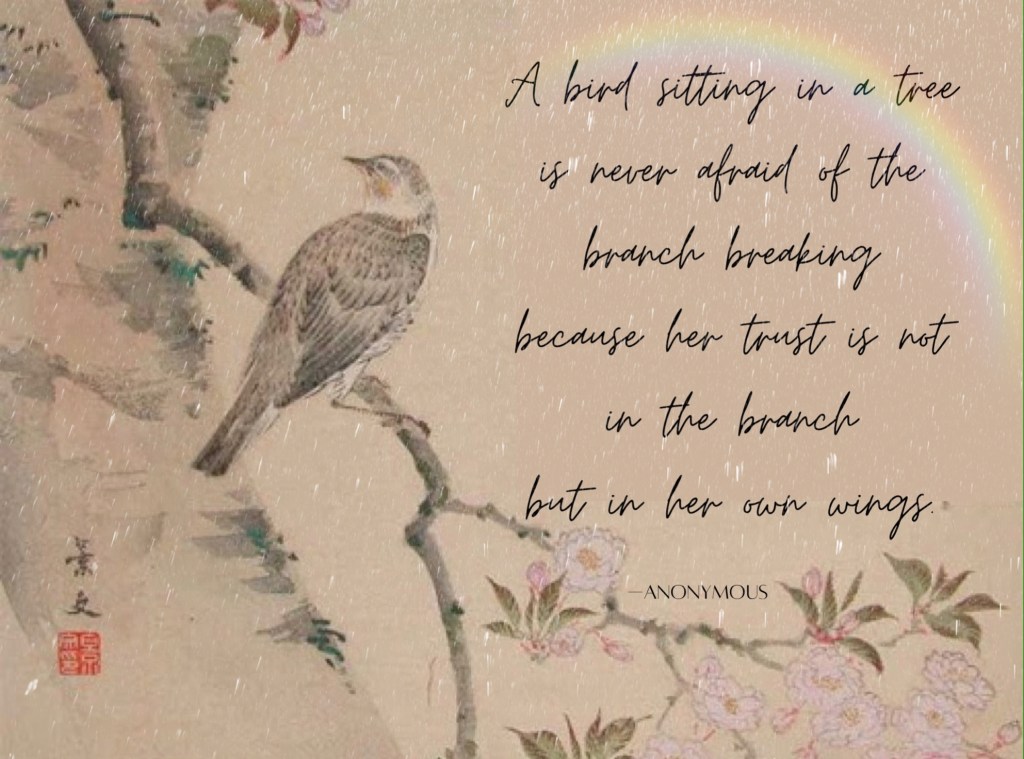
Acknowledging my inability to sing was difficult, just as my life after kidney transplant and this coronavirus is difficult. My isolation has been lengthy, most of nine months, and it is taking its toll on my spirit. Prayer has become both a burden and a grace to me. My singing was my prayer for so many years, and I really need my singing in these hard days. I need to sing my praises to God. I need to sing my lamentations. I need to sing like the sparrow who doesn’t worry about her vocal chords. I need to be like the sparrow who sits on her branch — without fear, without worry — because she knows that if she happens to light on a flimsy branch that does not hold her, her wings will lift her. 

The end of this story is that I need the God of the sparrow to sing through me once again — to sing through me in shadowy days, in times of trouble, in isolation, in fear, in hopelessness. That’s what God does, after all. In a troubled and despairing soul, God creates music, tucking it into every crevice, filling it with songs that can sing out both mourning and celebration. As an added bonus, I have it on good authority that God also turns mourning into dancing.

You have turned my mourning into dancing;
you have taken off my sackcloth
so that my soul may praise you and not be silent.
O Lord my God, I will give thanks to you forever.

Psalm 30 11-12 NRSV

So as you sing, dance to the new rhythms of your soul! Because you can!

Thanks be to God.

Please spend your meditation time today listening to this beautiful song with text written by Jonathan Cook and music by Craig Courtney. The video follows the text.

God of the Sparrow

God of the sparrow, sing through us,
Songs of deliverance, songs of peace.
Helpless we seek You, God our joy,
Quiet our troubles, bid them cease.
Alleluia.

God of the sparrow, God of hope,
Tenderly guide us, be our song,
God of affliction, pain and hurt,
Comfort Your children, make us strong.
Alleluia, alleluia, alleluia.

God of the sparrow, care for us.
Speak in our sorrow, Lord of grief.
Sing us Your music, lift our hearts,
Pour out Your mercy, send relief.

God, like the sparrow, we abide
In Your protection, love and grace.
Just as the sparrow in Your care,

May Your love keep us all our days.

Amen.

anxiety, Art, Comfort, Courage, Despair, God’s promises, grief, Hope, Life Journeys, Soul, struggle, Suffering, Transformation, Uncategorized

Hope and the Soul’s Struggle

620F798A-69A5-4B11-8719-189E926AEB6C
Struggles abound in this unwelcome COVID19 season we are experiencing. Most of us are touched by this virus in some way. We have struggled with so many life changes. I have watched strugglers of the soul work through the illness, others deal with the suffering and death of a friend or family member, often being unable to be with them at their death. Some parents are struggling with decisions affecting school for their children and teachers fear they will be unable to keep their students (and themselves) safe. Others long to see loved they have not seen in months of social distancing.

My circle of friends and family are feeling short on hope while they experience struggles of the soul. Yet, Herman Melville asserts that “Hope is the struggle of the soul.” I have been wondering what exactly that might mean. Perhaps hope gives us the courage we need to move boldly and full of hope into the place where the soul struggles, moving there with the assurance that the hope that led us there will also lead us to healing.

As I look closer at Melville’s words, I begin to see and understand that hope’s struggle eventually empowers us to break loose from the perishable things we hold on to — our wealth, our home, our “things” like cars, boats, RVs, whatever “things” we cherish. Looking at what this virus could bring, knowing that we are facing real life and death situations, cannot help but move our souls to throw off the things that don’t seem so critical anymore — perishable things we do not need. This thought prompts me to look at two of my favorite passages of Scripture.

For you know that it was not with perishable things such as silver or gold that you were redeemed from the empty way of life handed down to you from your ancestors . . .

— 1 Peter 1:18-19 (New International Version)

When the perishable has been clothed with the imperishable, and the mortal with immortality, then the saying that is written will come true: “Death has been swallowed up in victory.”

— 1 Corinthians 15:54 (New International Version)

How do we get there? How do we get through the soul struggles that can bring us to our knees?

I don’t think there is a well developed plan or a series of definite steps to take. The path, the plan, will be unique to each struggler. But the soul struggles I have felt throughout my life have taught me to place hope where hope must be: in Comforter Spirit who hovers over me with her sheltering wings; in the Christ who lives in and through me guiding me as a good shepherd and empowering me to walk with courage in his footsteps; in the Eternal God who holds before me, always, my own eternity.

This is what is available to you as well as you lean into hope’s struggle of the soul and break loose from things that are not important as you bear witness to your own eternity.

May God make it so.

As you leave these words and move with hope into your soul struggles,

May the God of hope go with you and fill you with all joy and peace as you trust in God, so that you may overflow with hope by the power of the Holy Spirit.

— Romans 15:13 (New International Version)

Amen.

I hope you can spend a few minutes in prayer and contemplation as you watch this beautiful, comforting music video, “Still with Thee,” with text written by Harriet Beecher Stowe.

Beloved Community, Black Lives Matter, Civil Rights Movement, Courage, Good Trouble, In Memorium, John Lewis, Justice, Nonviolence, Perseverance, Persistence, Politics, Prophetic, Racism, strength, struggle, Tenacity

Remembering John Lewis

89BE8169-640A-4DDD-A2AC-E9680BE67E02
Because I am a citizen of the state of Georgia, I can call him mine — my congressman, my conscience, my inspiration.

John Lewis
A warrior in building the soul of America

Representative John Lewis, a son of sharecroppers and an apostle of nonviolence who was bloodied at Selma and across the Jim Crow South in the historic struggle for racial equality, and who then carried a mantle of moral authority into Congress, died on Friday. He was 80.*

Twice he was beaten to an inch of his life.

I have been in some kind of fight — for freedom, equality, basic human rights — for nearly my entire life.    — John Lewis

On the front lines of the bloody campaign to end Jim Crow laws, with blows to his body and a fractured skull to prove it, Mr. Lewis was a valiant stalwart of the civil rights movement and the last surviving speaker from the 1963 March on Washington — where King delivered his famous “I Have a Dream” speech — but Lewis was almost refused to be allowed to speak by march organizers because of his strident criticism of the Kennedy administration.

Lewis went on to serve 17 terms in the US House of Representatives, where he was considered the north star of conscience in Congress.**

Tributes to the life and legacy of John Lewis came from hundreds of voices.

“Not many of us get to live to see our own legacy play out in such a meaningful, remarkable way. John Lewis did,” former President Obama said in a written tribute. “And thanks to him, we now all have our marching orders — to keep believing in the possibility of remaking this country we love until it lives up to its full promise.”

Joe Biden, and his wife, Jill, issued a statement that began, “We are made in the image of God, and then there is John Lewis. How could someone in flesh and blood be so courageous, so full of hope and love in the face of so much hate, violence, and vengeance?”

Sen. Bernie Sanders of Vermont said: “His courage helped transform this country. He won’t ever be forgotten by those who believe America can change when the people stand together and demand it.”

Sen. Kamala Harris of California said of Lewis, “He carried the baton of progress and justice to the very end. It now falls on us to pick it up and march on.” ***

And so we will, to honor his memory and to persist in the fight against injustice.


John Lewis.

America’s inspiration for getting into “good trouble”

Do not get lost in a sea of despair. Be hopeful, be optimistic. Our struggle is not the struggle of a day, a week, a month, or a year, it is the struggle of a lifetime. Never, ever be afraid to make some noise and get in good trouble, necessary trouble.
— A tweet from June 2018

I appeal to all of you to get into this great revolution that is sweeping this nation.  Get in and stay in the streets of every city, every village and hamlet of this nation until true freedom comes, until the revolution of 1776 is complete.
— At the 1963 March on Washington

Freedom is not a state; it is an act. It is not some enchanted garden perched high on a distant plateau where we can finally sit down and rest. Freedom is the continuous action we all must take, and each generation must do its part to create an even more fair, more just society.
From his 2017 memoir, “Across That Bridge: A Vision for Change and the Future of America”

My dear friends: Your vote is precious, almost sacred. It is the most powerful nonviolent tool we have to create a more perfect union.
— From a 2012 speech in Charlotte, North Carolina

You are a light. You are the light. Never let anyone—any person or any force—dampen, dim or diminish your light. Study the path of others to make your way easier and more abundant.
From his 2017 memoir, “Across That Bridge: A Vision for Change and the Future of America”

We have been too quiet for too long. There comes a time when you have to say something. You have to make a little noise. You have to move your feet. This is the time.
— At a 2016 House sit-in following the Pulse shooting in Orlando

When you see something that is not right, not just, not fair, you have a moral obligation to say something. To do something. Our children and their children will ask us, ‘What did you do? What did you say?’ For some, this vote may be hard. But we have a mission and a mandate to be on the right side of history.
— 2019 remarks in the House on impeachment of President Trump


May his words echo in our hearts and reach the soul of every American. 

May he rest in peace and — from above — inspire us to “do justice, love mercy and walk humbly with our God” as he did.


John Lewis
Servant of God and champion for justice, now called to his heavenly home


With thanks to:
* Katharine Q. Seelye, https://www.nytimes.com/2020/07/17/us/john-lewis-dead.html

** Ken Sehested, http://www.prayerandpolitiks.org/

*** Janet Hook, https://www.latimes.com/politics/story/2020-07-18/tributes-rep-john-lewis-dies-civil-rights


Aging, anxiety, Bewilderment, Bravery, Challenge, Child protection, Children, Conflict, Confusion, Contemplation, Courage, Dangerous and noble things, Discernment, Dreams, Indecision, Internal conflict, Introspection, life, Pandemic of 2020, Questions, Sacred Worth, struggle, Transformation

When Plans Are Dreams

05D8F2C8-83DB-40E3-9FEC-43A543D80EC3
Plans!
We find it almost impossible to make them in a life ruled by COVID19. Currently, school  plans are foremost in the minds of parents and students.

“Is it safe to send my child back to school? What safety and social distancing measures will schools have in place? Do I choose to keep them at home, opting for virtual learning? How do I manage online school?”

In light of such critical plans and decisions, consider this current news report:

A document prepared for the White House Coronavirus Task Force but not publicized suggests more than a dozen states should revert to more stringent protective measures, limiting social gatherings to 10 people or fewer, closing bars and gyms and asking residents to wear masks at all times.

The document, dated July 14 and obtained by the Center for Public Integrity, says 18 states are in the “red zone” for COVID-19 cases, meaning they had more than 100 new cases per 100,000 population last week. [Georgia is in the “red zone.”]

Eleven states are in the “red zone” for test positivity, meaning more than 10 percent of diagnostic test results came back positive. [Georgia is in this “red zone” too.] https://publicintegrity.org/health/coronavirus-and-inequality/exclusive-white-house-document-shows-18-states-in-coronavirus-red-zone-covid-19/

Even with troubling reports like this one, Georgia’s governor, Gov. Brian Kemp, signed an order on Wednesday, July 15, 2020 banning localities from requiring masks. On this information, parents have to agonize about what’s best for their children. They simply cannot make firm plans as long as the virus is waxing and waning. Mostly waxing!

Plans are difficult for us for all sorts of reasons and circumstances. Every now and then over the years, my life would take un unexpected pause to contemplate this thought written by the late Mary Oliver:

 So tell me, what is it that you plan to do with your one wild and precious life?

Unpacking that brief question has been a periodic constant in my life, popping up for me mostly in my down and disheartened times. I hear the poet describing my life as “wild and precious” and it almost shocks me. Yet, my life really has been consistently wild and mostly precious. Anything that urges me to examine my life is a good thing. I can almost always pull up memories of the times when I was wild and free — insistent upon rising higher, realizing a near-impossible dream, charging with courage into new and uncharted places, planning for a future of fresh and sparkling heights, observing just how wild I could dare to be. Unpacking that question has been exhilarating at times, exhausting at other times.

Musing on a life that could be described as precious

Entertaining the thought that my life was precious happened in my deepest soul place. It happened in my moments of introspection, meditative times that urged me to examine all the ways I saw my life as precious, cherished, valued. Of course, I have experienced many precious life moments — my wedding day, my work in Africa, my ordination, awards and recognitions of my work and career and, most of all, the adoption of my one wild and precious son, JonathanExamining my precious life was most real when I almost lost my life, my full year of serious illness, five years of dialysis and a kidney transplant made possible by the selflessness of a lovely woman I know only through email.

Such thoughts bring me back to plans. What is it I plan to do with my one wild and precious life? Even a life precious and wild is a life that requires plans, and right now trying to make plans is an exercise fraught with anxiety. I cannot find any words that can minimize this depth of anxiety. There is not one thing you or I can do about plans that have been ravaged by the pandemic we are experiencing, and yet we must make critical plans in this season of uncertainty. 

School plans are most difficult in my state and perhaps in yours. As parents agonize over the safety of their children, Georgia’s governor, Brian Kemp, offered this unhelpful comment this morning in a press conference:

I am a believer that kids need to be in the classroom and we’re working with the schools to do that. We’re going to have cases that break out in schools, either with personnel or perhaps students, just like you do with a stomach bug or a flu or anything else. Our schools know how to handle those situations.

The parents and teachers in my life know that this coronavirus is not just a run-of-the-mill “stomach bug or flu.” This virus is deadly, and parents and teachers faced with difficult school decisions know that all too well. During these pandemic days, it is a constant reality that many of us are having to make potentially hazardous plans, but just for a moment, I wonder if we can redirect our thoughts to plans we make for our “one wild and precious life.”

Can we rise above the plans we must make today, even for a moment, and instead consider the bold and courageous plans we could make? Can we set our hearts to think about plans we can make when we are our brave, adventurous and fearless selves? Can we contemplate the plans we might make when we feel bold, resolute and undaunted?

I can remember the times when I was able to make such adventurous plans, times when my plans were dreams — high and lofty dreams of changing the world. I can also remember the time when I no longer dreamed any dreams at all. It was a time when I no longer saw my life as a wild and precious one. I still entertained plans, but my plans were definitely not dreams. I believed I could no longer change the world. I believed I could no longer live a life that made a difference. I believed that my soul was dry and my spirit barren. I believed that, in my life, dangerous and noble things were no longer possible

Why can’t you and I dream dreams instead of making plans? Why can’t my “one wild and precious life” rise higher, high enough to make dreams of my plans? Sometimes I will go to one of my many favorite passages of Scripture hoping to find God’s word to me. Being true to my theological education, I always look at the words in context before I do anything else. But after that hermeneutical exercise I learned in New Testament 101, I might twist the text a bit and maybe even paraphrase it, inviting the text to speak to me specifically, just me. For this day, one of the texts found in the book of Acts reaches into my soul, and, yes, I did paraphrase it.

“In your season of most need,” God says,
“I will restore your soul and make your spirit rise within you.
I will pour out my Spirit on all people.

Your sons and daughters will prophesy,
your youthful hearts will see visions,
your aging hearts will dream dreams.”

— Acts 2:17 (my paraphrase)

Amen. 

May God lift our hearts and spirits, assure us that our lives are precious and help us transform our plans into dreams.

So tell me, what is it that you plan to do with your one wild and precious life?


anxiety, Community, Darkness, Death, Despair, discouragement, healing, Heartbreak, Indecision, journey, Lament, life, Life Journeys, Life pathways, Mystery, Restoration, Sorrow, Spirit, struggle, Tears, Thin Places, Yiayia

That Mysterious and Mystical Reality

EC73BB1C-C3BB-4B52-8D03-279FE90ADEDE
Watercolor art by Kalliope, Holy Ghosts

You might be thinking that both mysterious and mystical are the antithesis of reality. If you are thinking that, you might be wrong. So might I. But in my experience, life itself is a mysterious and mystical reality. That reality fills my spirit with hope in my darkest moments. Dark moments, hours of grief, dark nights of the soul, lamentations of the spirit — all have been part of my life journey. My pathways have often been rough and rocky. My life’s travel has often taken me to disconcerting forks in the road and confusing crossroads. I have known times of despairing and times of uncertainty — reluctance, despondency, angst, heartbreak, fear — “break-out-in-a-sweat times” that forced me into dangerous depths of anguish. For me, taking my own life was not something I could consider. Yet there was that one day — that span of just a few moments — when I was alone, afraid and very far from home.

IMG_5744
Japan’s Aokigahara Suicide Forest

One of the most thoughtful and intriguing movies I have ever experienced is The Sea of Trees. I was captivated by the film that tells the story of a despondent professor. After the death of his wife, he despaired of life and searched for a way to end his. His reflective, angst-filled search led him to Aokigahara, a forest in Japan known also as The Sea of Trees or The Suicide Forest. Aokigahara Forest has been home to over 500 confirmed suicides since the 1950s. It is called “the perfect place to die” and is the world’s second most popular place for suicide.

Don’t worry. This post is not about suicide. Rather it is about the people who loved us in life and continue to love us in death, those who watch over us in our times of deepest anguish. It is about the mysterious and mystical reality that between us and our loved ones in heaven, there is but a thin separation. Heaven and earth,” the Celtic saying goes, “are only three feet apart, but in thin places that distance is even shorter.”

To know that my sweet Yiayia (grandmother in Greek) and my Thea Koula might still be protecting me from harm and life disaster is soul-comforting for me. Perhaps the strength and hope I felt as I was chaplain to disheartened hospital patients came from them. Perhaps they sent me the staying power to comfort, protect and advocate for thousands of abused women and children. Maybe the deep grief of losing my brother to cancer was eased by their prayers from heaven.

I often wondered if my mourning of the loss of the life I knew — replaced by daily dialysis — was lightened by their loving presence with me in a horrible time. I wonder, Yiayia, were you watching over me on November 12th when I closed my eyes in the operating room to receive my kidney transplant? I wonder, Thea Koula, did your intercession save my life on those times when my life literally hung in the balance?

This life is not an easy one. No person gets through life unscathed. No one travels a path smooth and straight. Like me, you have more than likely walked on a rough pathway with stones in the road, dangerous curves and life-altering crossroads. Robert Frost wrote eloquently in his poem, The Road Not Taken, about someone standing at a fork in the road pondering a life-altering choice:

Two roads diverged in a yellow wood,
And sorry I could not travel both
And be one traveler, long I stood
And looked down one as far as I could
To where it bent in the undergrowth . . .

Then took the other, as just as fair,
and having perhaps the better claim
because it was grassy and wanted wear . . .

Oh, I kept the first for another day!
Yet knowing how way leads on to way,
I doubted if I should ever come back.

I shall be telling this with a sigh
Somewhere ages and ages hence:
Two roads diverged in a wood, and I—
I took the one less traveled by,
And that has made all the difference.

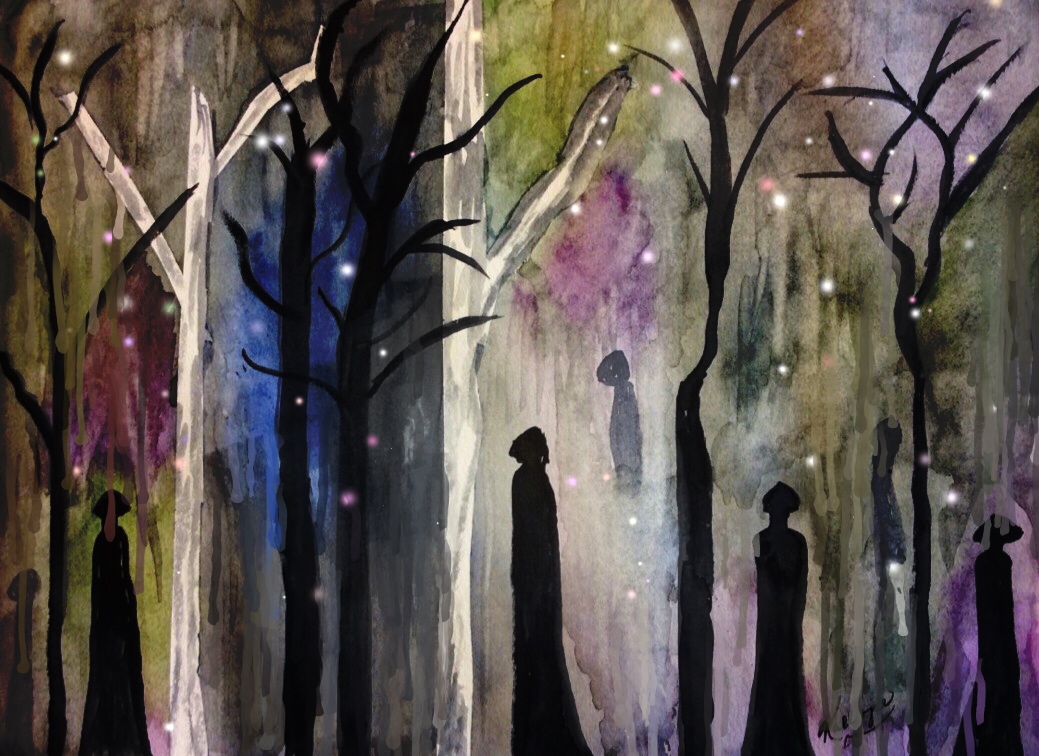
My life is filled with “roads not taken,” some not taken by my choice, others thwarted by chance or fate or maybe even God. It is almost like traveling through a “sea of trees” that hide our view of the way ahead, causing us to lose our way. For my art today, I chose one of my watercolor paintings. A few years ago, I painted this “sea” of leafless trees against an ethereal, melancholy wash of color. Interspersed among the trees are ghost-like figures hovering. Actually I titled the painting Holy Ghosts. The painting was inspired by the words of a friend.

When the dead come to mind, they are like holy ghosts, as real as hope or faith, as tangible as trust and love.  – Ragan Courtney

This painting was never meant to be disconcerting or morbid. It represents just the opposite for me. It represents the souls who hover over me for protection, those with whom I shared love and life. It represents my aunt and my Yiayia and my brother because I am certain they protect me, pray for me, lift me up and cheer me on.

Who knows! Maybe my brother Pete, who died of renal cell carcinoma, hovered above me in a kind of holy kidney disease kinship and protected me when I was diagnosed with end stage renal disease in 2014. Maybe he prayed for me during my transplant surgery in 2019. I can, of course, never know that for sure. The veil between heaven and earth, between the dead and the living, is a mystery we simply do not understand. Our understanding does not reach that far, but what we feel in our spirit does reach that far.

In the end, my spirit senses that between us there is but a thin separation, that the spirits of my loved ones are are connected to mine, especially when I am disconsolate and in despair.

In the comfort of that mysterious and mystical reality, I can heal. I can rest. I can continue my journey of dangers, toils and snares. I can know the amazing grace that comes from sacred connections. I can know peace after sorrow. And so can you.

May God make it so. Amen.


Activism, Ahmaud Arbery, Beloved Community, Celebration, Change, Community activism, Freedom, Hope, Juneteenth, Justice, Liberty, Racism, Rebirth, reconciliation, struggle, Transformation, Uncategorized

Juneteenth 2020 — Oh Freedom!

0B59C2F5-2267-4507-A9EE-44CDC0B315B1
Today may be a Juneteenth like no other.

Juneteenth is a celebration. It’s not solemn, it’s filled with joy and pageantry. It’s not a funeral. But 2020 Juneteenth is uncomfortably juxtaposed with police violence against Black people, protesters in cities all over the nation and funerals — too many funerals.

A Bit of History . . . 

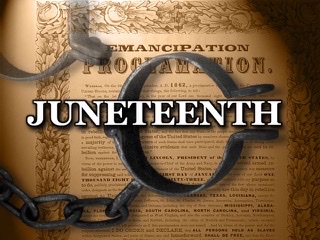
Juneteenth is one of America’s oldest holidays and is observed each year on June 19 to mark the official end of slavery in the United States. The day has long been celebrated by black Americans as a symbol of their long-awaited emancipation. But the story behind the holiday starts 155 years ago today in Galveston, Texas.

On June 19, 1865, Union troops led by General Gordon Granger arrived in Galveston, Texas, to break the news to the last remaining Confederate sympathizers that they had lost the Civil War and that all slaves must be freed. The Union general read aloud to the residents of Galveston:

The people of Texas are informed that in accordance with a Proclamation from the Executive of the United States, all slaves are free. This involves an absolute equality of rights and rights of property between former masters and slaves, and the connection heretofore existing between them becomes that between employer and hired laborer.

The newly freed slaves celebrated emancipation with prayer, feasting, song, and dance, and the following year, the first official Juneteenth celebration was born. But the importance of Juneteenth is that it is rooted in a long history of struggle for freedom and then perhaps the greater struggle to maintain freedom in the face of the enormous repression that was to come.

The Struggle for Freedom Continued

7DC48528-34CF-47FA-9272-ED91E800C437It turned out that being free did not mean being being treated with respect. Yes, it was the true end of the Civil War, but it was also the beginning of Reconstruction, a time that was supposed to be very happy and hopeful. Yet the period of Reconstruction became a miserable time for freed Black people because Reconstruction became part of the redemption of the South. As such, it set out to move African Americans to indentured servitude. While President Abraham Lincoln abolished slavery in his Jan. 1, 1863, Emancipation Proclamation, rebellious Confederate strongholds dotted across the South delayed the widespread implementation.

The South would not hear of the end of slavery, and landowners moved heaven and earth to make sure they had plenty of indentured servants. They were determined to continue the ostentatious lifestyle that they believed was their right and their legacy. They were resolute in their quest to maintain their master/servant status.

Still Today, Elusive Freedom

Juneteenth has been “passed down” through black communities since 1866, but in this year — 2020 — this nation seems to be at the height of a modern-day civil rights movement. My friend says, “2020 is the year of reset!” People throughout this nation of every race and creed hope beyond hope the 2020 will go even beyond “reset” to reconciliation, transformation and rebirth. So that every person is free, respected and cherished as a part of beloved community.

B8EBCA53-AF97-42DD-AA97-BAB122368430The cruel and violent death of George Floyd under the knee of a Minneapolis police officer might mean that this year Juneteenth may not be only about festivals, parades and cookouts. It may well be somewhat of a silent, reflective vigil for George Floyd, Breonna Taylor, Ahmaud Arbery, Rayshard Brooks, Caine Van Pelt, Michael Thomas, Lewis Ruffin, Kamal Flowers, Momodou Lamin Sisay, Ruben Smith, Modesto Reyes . . . and the list could continue.

It is a list of tragedy and horror. It is a list that is a stain that will ever remain on this nation, an indelible mark of shame. It is a list of names we must never forget. So in your commemoration of Juneteenth today, honor those names, pray for their mourning families, and pray that you will confront racial injustice with an unshakeable resolve.

Juneteenth was meant to be a celebration, although many people might not be able to celebrate today. Heartbreak and horror have a tendency to override celebration and joy. Even with hearts broken, I hope we will find in our hearts even a tiny desire to celebrate this day that was, and is, all about freedom.

May the change that comes from the “2020 movement for racial justice” cause us to celebrate, not mourn, every time Juneteenth comes around — today and forevermore. And may each of us and all of us — a people of God’s creation — witness the rebirth of a nation where every person lives under a worldwide canopy of justice, peace, equality, respect and freedom.

May God make it so through us. Amen.


Celebrate, or mourn, today as you spend a few moments watching this moving and poignant video, “Oh Freedom.”

Activism, Ahmaud Arbery, Anger, anxiety, Art, Beloved Community, Brokenness, Change, Comfort, Community, Community activism, Conflict, Courage, Death, Despair, discouragement, Division, Emotions, Exhaustion, Fear, Freedom, Friendship, George Floyd, grief, Hate, healing, Heartbreak, Holy Spirit, Injustice, Nonviolence, peace, Pentecost, Perseverance, sadness, Sorrow, Spirit, Spirit wind, struggle, Together, Violence, White supremacy

Together!

74F3F032-5117-4474-98A7-A2171243B45E
A blending of two photos: One is an image of protesters in Minneapolis. The second image is a portrayal of people raising their hands to celebrate Pentecost.

This morning I have no words. I have tears. I have sadness. I even have some anger that the people I love whose skin is not “white” are living in grief and frustration. I say only that injustice and oppression cling so close to my friends, today and in centuries past.

F0ABFCC6-C312-44E2-A39F-35F520174256I hear my dear friends cry out for justice. I hear them using words to make sense of it all, and I hear their voices fall silent. Silent, with just these words, “I’m tired.” A dear friend posted the words on the left this morning. I want to see her face to face. I want to be together. I want to comfort her, hoping beyond hope that it is not too late for comfort.
I read this horrific headline this morning.

Prosecutors in Hennepin County, Minnesota, say evidence shows Chauvin had his knee on Floyd’s neck for a total of 8 minutes and 46 seconds, including two minutes and 53 seconds of which Floyd was non-responsive.   — ABC News

99398631-7958-42F7-9F51-718EE1C289DD
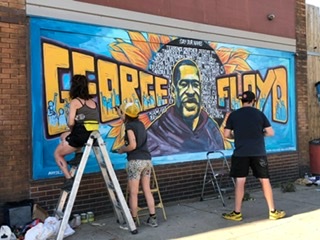
Artists honor George Floyd by painting a mural in Minneapolis on Thursday, May 28, 2020. Artists began work on the mural that morning. (Photo: Jacqueline Devine/Sun-News)

Today I find myself deeply in mourning for the violence that happens in our country. I find myself trying to share in the grief of my friend and knowing I cannot fully feel the depth of it. Today I find myself unable to emotionally move away from it all. Today I contemplate George Floyd’s cry, “I can’t breathe.”

If there is any comfort at all, it comes as a gift of the artists pictured here. In an act of caring, they offer this mural at a memorial for George Floyd.

The names of other victims of violence are painted in the background. The words, “I can’t breathe!” will remain in our memories. Today we are together in mourning.

But tomorrow, I will celebrate Pentecost. I wonder how to celebrate in a time when lamentation feels more appropriate. I wonder how to celebrate when brothers and sisters have died violent deaths and when thousands of protesters line the streets of many U.S. cities. I wonder how to celebrate when protesters are obviously exposing themselves to COVID19.

Still, tomorrow — even in such a time as this — I will celebrate the breath of the Spirit. Tomorrow I will join the celebration that has something to do with being together, being one. To juxtapose the joyous celebration of Pentecost with the horrible picture of what we saw in cities throughout our country for the past few nights seems an impossible undertaking. What does one have to do with the other?

Perhaps they do share a common message. From those who protest, this message:

“We bring our broken hearts and our anger for the killing of our people, for the murders across the ages of people who are not like you. You treat us differently than you treat the people who look like you. For as long as we can remember, you have visited upon us oppression, slavery, racist violence, injustice. And we are tired. We are spent. We are beside ourselves with collective mourning. We can’t breathe!“

From those who celebrate Pentecost, this message:

18bbdca6-8ece-4df4-aa13-fe110e3298cb“How we celebrate the day when the Holy Spirit breathed upon those gathered together, with gifts of wind and fire!

How we celebrate the story told in the 2nd chapter of Acts!”

When the day of Pentecost came, they were all together in one place. Suddenly a sound like the blowing of a violent wind came from heaven and filled the whole house where they were sitting.

They saw what seemed to be tongues of fire that separated and came to rest on each of them. All of them were filled with the Holy Spirit and began to speak in other tongues as the Spirit enabled them.

Now there were staying in Jerusalem God-fearing Jews from every nation under heaven. When they heard this sound, a crowd came together in bewilderment, because each one heard their own language being spoken. Utterly amazed, they asked: “Aren’t all these who are speaking Galileans? Then how is it that each of us hears them in our native language? Parthians, Medes and Elamites; residents of Mesopotamia, Judea and Cappadocia, Pontus and Asia, Phrygia and Pamphylia, Egypt and the parts of Libya near Cyrene; visitors from Rome (both Jews and converts to Judaism); Cretans and Arabs—we hear them declaring the wonders of God in our own tongues!” Amazed and perplexed, they asked one another, “What does this mean?”

Some, however, made fun of them and said, “They have had too much wine.”

Then Peter stood up with the Eleven, raised his voice and addressed the crowd: “Fellow Jews and all of you who live in Jerusalem, let me explain this to you; listen carefully to what I say. These people are not drunk, as you suppose. It’s only nine in the morning! No, this is what was spoken by the prophet Joel:

“‘In the last days, God says,
I will pour out my Spirit on all people.

Your sons and your daughters will prophesy, last days, God says,
your young men will see visions,
your old men will dream dreams.

Even on my servants, both men and women,
I will pour out my Spirit in those days,
and they will prophesy.’”   —
Acts 2:1-18 NIV

The people did not, in fact, have too much wine. Peter made it clear that wine did not empower the people who gathered in Jerusalem —  “every people under heaven” — to speak and understand as they heard every word spoken in their own language. That would be a start, would it not, if we could speak the same language and truly understand — people who have flesh-colored skin, and brown and bronze, and red and black . . . every skin color under the sun. If only we could understand each other.

And then, what if we could gather together, welcoming every person? What if we could truly gather together and wait for Spirit to fall upon us with empowerment like we have never known before? What if we allowed the Spirit to give us breath, together?

41F5FD83-6B7A-4393-BF9E-57F0E4D51023In the end, there is a tiny bit of joy in George Floyd’s tragic story. It is a joy much deeper than reality’s sorrow. The artists completed their mural, and in the very center near the bottom, they had painted words that express the greatest truth of all.
Can you see it behind the little girl? “I can breathe now!”

What if we welcome Spirit Breath that will change us? What if we embrace empowerment from the Holy Spirit to help us change our world? What if we end oppression and injustice, together? What if holy perseverance could inspire us to live and act in solidarity with our sisters and brothers, all of them?

What if we dare to give our soul’s very breath to help bring about Beloved Community, together?

Together! Together!

May my God — and the God of every other person — make it so. Amen.


Activism, Ahmaud Arbery, Christian Witness, Community activism, Conflict, Courage, Death, Faith, Freedom, Injustice, Nonviolence, Social justice, struggle, Urgency, Violence, Wendell Griffen, White supremacy, wind

The Whirlwind Is Here


3BDCF281-2B6E-45CE-88C8-BE5FE50667AA
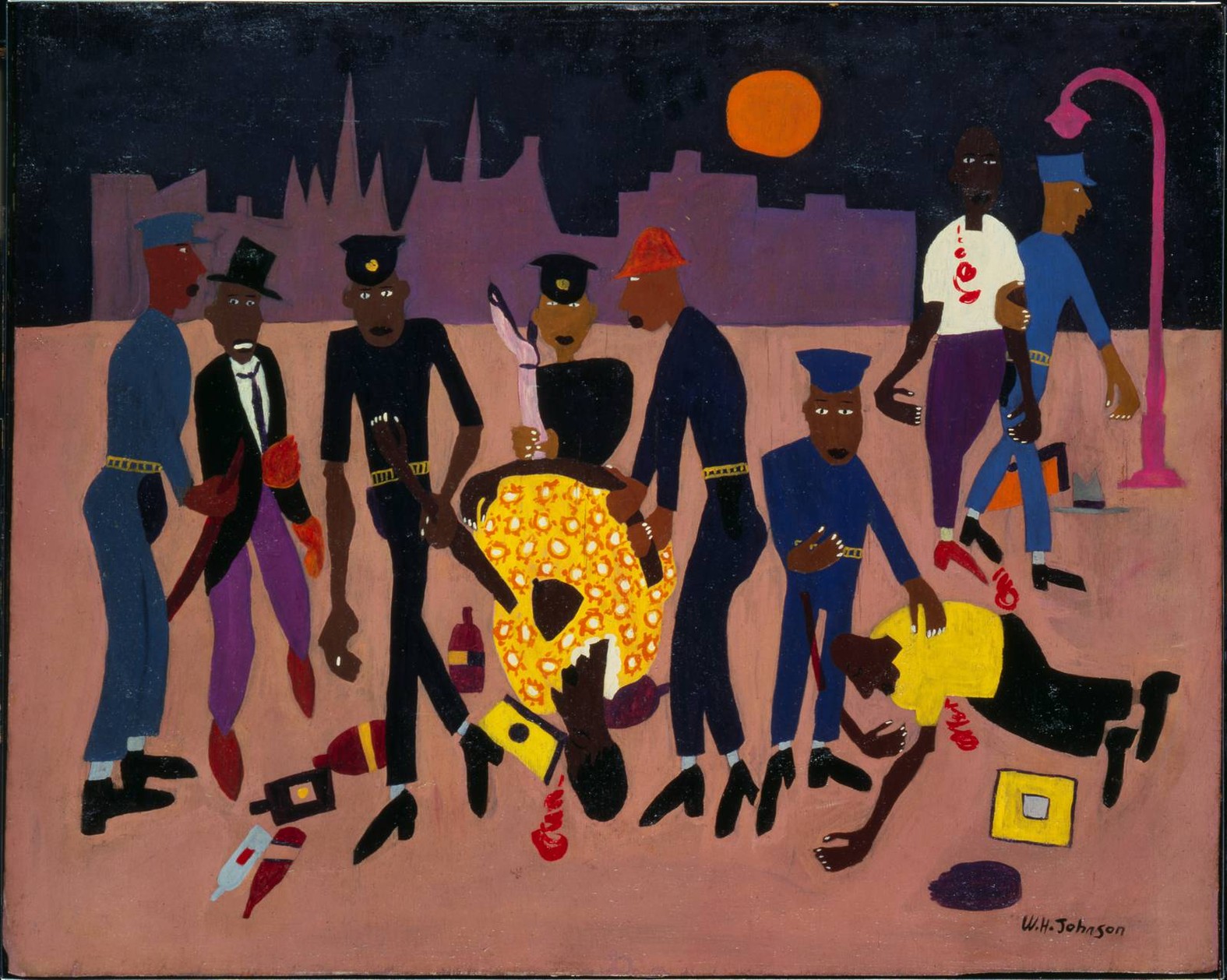
Moon Over Harlem, William H. johnson, 1943-1944. © Washington, DC,                           Smithsonian American Art Museum

I share this blog post today in memory of Ahmaud Arbery, who was killed in the state of Georgia, the state in which I live in full and free safety. Ahmaud Arbery did not know such safety. But today we say his name and honor his memory. There are so many names we could speak today: Tamir Rice, Trayvon Martin, George Floyd. Breonna Taylor and hundreds more, even thousands. What can black parents possibly tell their kids now about staying safe? I also honor the parents who try to find the right words, the right admonitions to say to their children. Most of all, I honor the strong and powerful voices who continually cry out: “Justice!” My friend and pastor, Wendell Griffen, is one who cries “justice” with a particular eloquence.

Wendell Griffen is a pastor, state court trial judge, and social justice activist in Little Rock, Arkansas who lectures and writes about social justice. I am pleased to share with you his most recent article. He will call you out. He will speak plainly to those of us who are white. He will call you to act against injustice, drawing your courage from God, who whose children are deeply loved — all of them!


For they sow the wind, and they shall reap the whirlwind.
Hosea 8:7 (NRSV)

Have you viewed the ten minute and twelve second video of the May 25, 2020 killing of George Floyd by former members of the Minneapolis Police Department?

Why haven’t you? What are you afraid you will see? What are you unwilling to see? What are you unwilling to admit?

Have the four now former members of the Minneapolis Police Department responsible for killing George Floyd in broad daylight before onlookers who also videotaped their conduct been arrested on suspicion of committing a homicide (causing the death of another person) of George Floyd?

Why haven’t they been arrested? Why have they not been held in custody and required to post bond? Who decided they should not be arrested? What message was sent when they were not arrested?

The killing of George Floyd was a criminal act. There are witnesses to the act. The fact of Mr. Floyd’s death is indisputable.  Mr. Floyd was not threatening anyone — none of the officers nor anyone else — when he was killed. The actions of the officers were not taken or necessary to prevent him from threatening anyone.

In other words, there is no legal justification for the actions of the four former police officers who killed George Floyd.  None.  Period.  Full stop.

We should not be surprised that people around the world, including Minneapolis, are furious. George Floyd was slain by agents of the state. His killers are still at large. They have not been arrested. We should not be surprised that people in Minneapolis are outraged by statements on Thursday from local and federal prosecutors calling for “patience.” Why should they be patient about deliberate refusals to arrest known homicide suspects? Why should they “trust” a “process” that reeks with corruption and injustice?

We should not be surprised that people are outraged by the decision of the Minnesota Governor to mobilize the state militia — the Minnesota National Guard. Minneapolis is not under siege or being attacked. The “peace” and “order” of the Minneapolis area is not threatened by the civilians who protested while four Minneapolis police officers killed Mr. Floyd.  It is not threatened by Mr. Floyd’s family members and friends. It is not threatened by the many people who took to the streets to protest his death and how local authorities refused to arrest his killers.

Do the Mayor of Minneapolis and Governor of Minnesota believe that it takes 500 National Guard soldiers to arrest four suspected killers?

And does anyone really believe that the fiery protests seen tonight would have happened if the four suspected killers had been already arrested?

Let’s talk plainly. George Floyd was killed. At minimum, he was recklessly killed. At worse, he was knowingly killed. In Minnesota and every other US jurisdiction, recklessly causing the death of another person is manslaughter. In Minnesota, state prosecutors can charge people who commit manslaughter without convening a grand jury.

Let’s talk plainly. In Minnesota and elsewhere in the United States, a person who cooperates with, assists, helps to conceal, or otherwise interferes with efforts to stop a homicide is liable for the homicide as an accomplice. Each of the officers involved in the homicide of George Floyd should have been arrested and charged days ago with manslaughter! The prosecutors can later seek grand jury indictments for murder if other evidence is uncovered.

Let’s talk plainly.  The Minnesota Governor and Minneapolis Police Department, and the Hennepin County prosecutor are demonstrating their cultural incompetence. That incompetence is not merely personal. It is institutional, pervasive, pernicious, and infuriating!

The same cultural incompetence happened when Ahmaud Arbery was killed in Georgia.

The same cultural incompetence happened when Breonna Taylor was killed in Kentucky.

The same cultural incompetence happened when a white woman named Amy Cooper falsely accused a black man named Christian Cooper (no relationship) of threatening her life.

That cultural incompetence is not new.

The Louisville Police officers who killed Breonna Taylor in her home have not been arrested – yet!

The killers of Ahmaud Arbery were not arrested for months after he was attacked and slain. They were only arrested after (and because) a video was exposed that chronicled how he was killed and who killed him.

We should also demand that the former police officers involved in the Floyd matter be arrested immediately on suspicion of manslaughter. There is plainly probable cause for arresting the officer who held his knees on Floyd.  However, there is also probable cause for arresting the other officers as accessories (accomplices) because of their active presence and complicity in the homicide (manslaughter).

Few statements to date have stressed this fundamental issue. Arrests do not need simultaneous charging actions. There is no need to await charges before each of the former officers who were involved in the homicide of George Floyd is arrested on suspicion of manslaughter. There is no requirement that the autopsy be completed before persons suspected of manslaughter are arrested. There is no requirement that ALL possible information be gathered before suspected killers are arrested.

Each former officer should be arrested on suspicion of having committed manslaughter in the death of George Floyd.

Prophetic people know that refusal to arrest of the former officers is a political statement by the Minneapolis Police Department. The Department has chosen to not arrest killers.  That fact should be strongly proclaimed. Prosecutors do not arrest suspects. That is a policing decision, and the police have deliberately exercised their discretion to NOT arrest four homicide suspects.

Telling people to “trust the process” is infuriating when “the process” is openly working to perpetuate a blatant injustice.

Stop saying “you feel the anger” of people in Minneapolis, and especially “feel the anger” of black and brown people. No, you don’t!  You haven’t suffered this mess. You haven’t dealt with it every day and night.

You haven’t seen people be called “lawless” for loudly protesting a homicide except when the victim is a person of color.

You don’t “feel our anger.” You may feel your own anger. Good. But don’t claim that you “feel our anger” or “share our anger.” You don’t unless you have shared our pain, shared our discrimination, and shared the centuries of blatant state sanctioned slaughter of black and brown people by law enforcement officials. We know you don’t feel and share our anger. Stop fooling yourselves and stop trying to fool us!

Black people are not fools. The U.S. Justice Department is headed by William Barr, the same person who decided that the United States would not charge Daniel Pantaleo, the NYPD officer who killed Eric Garner by choking him to death, with violating Garner’s civil rights.

We live with discrimination every day. We do not have to act like we like it. We do not have to put on a good face about it. And we will not do so. If you aren’t comfortable with our anger and the way we express it, get out of the way. If you aren’t turning over the institutions responsible for our anger and angry behavior, get out of the way.

As the prophet Hosea wrote concerning the ancient Hebrew nation of Israel, this society has always sown the wind of white supremacy with its tolerance of state-sponsored terrorism and slaughter of black, brown, red, yellow, and poor white people. People of color have long known that this society “shall reap the whirlwind.”

The whirlwind from the seeds of long pent-up outrage about systemic law enforcement abusive and homicidal conduct has arrived at the same time the nation and world are gripped by the global Covid 19 pandemic which highlights racial disparities in countless areas of life. The whirlwind from generations of corrupt and racist political leadership now has arrived when the US is led by a vicious idiot, despot, racist, and sociopath named Donald John Trump.

The whirlwind is here. The United States cannot, should not, and will not escape.

©Wendell Griffen, 2020


Amen, my brother. Yes, our country has reaped the whirlwind. We have reaped the whirlwind. Let us gather our resolve and look to our faith to guide us, and then let each of us work to break the bonds of injustice in whatever ways we are able. Today I committed to using my art and writing to portray the rise of white supremacy and the oppression of non-white persons. What gifts could you use to enter the struggle for justice? Can each of us work for justice with a sense of urgency?

May our God find us faithful to the creation of Beloved Community.  Amen.

KMF

Emotions, Faith, Illness, Isaiah, Psalm 73, Questions, struggle, Uncategorized, Unfaith

Musings on Unfaith

5F472BF2-E04D-496D-AC90-5437A0EA2384
Unfaith! Such an unsettling word that may well describe where we sometimes find ourselves! I am certain that unfaith applies to me, to the times when my soul is troubled, to the seasons when my faith becomes small. Unfaith most definitely takes over in my heart at times, and in those times, my journey is a struggle. So I battle against unfaith, all the while simply wanting to understand it. This is my truth: I fight unfaith, praying to be rid of it, writing down my emotions around it, reading my Bible when I cannot live with unfaith another minute. My skirmish with unfaith often leads me to the words of the Psalmist.

In yesterday’s struggle with unfaith, I happened upon Psalm 73. It is a rather lengthy Psalm, as Psalms go, and it spends a great deal of time describing wicked people. I rushed through it, I think, because I was searching for inspiring words about unfaith and because I all already know a lot about wicked people. I can, in fact, describe wicked people almost as passionately as does the Psalmist. On top of that, my description of wicked people often includes some choice and inappropriate words.

I plowed on through the Psalm when, out of the blue, one particular verse “hit me upside the head!” (That’s southern slang!) Verse 14 came much too close to my soul. It described my emotions and showed me myself.

All day long I have been afflicted,
and every morning brings new punishments.

— Psalm 73:14 NIV

Oh my! There it is: a succinct statement that so fully reflects what I had been feeling for the past week. It is unpleasant to read, as if it is stating my disconcerting reality and then forcing me to ask myself a question I would rather avoid. Still, I dare to ask myself — “So what are you going to do about your current state?” — knowing that I will likely not have an immediate answer nor a reassuring one. Sometimes I think that all of my feelings and responses come from my unfaith.

I should give you the backdrop for my Psalm 73 experience. I have felt unwell for several days — unrelenting fatigue, deep muscle aches, shortness of breath, trembling, hand tremors and several other troubling symptoms. The reality is that since my kidney transplant in November, I have been plagued with less than perfect health and a very compromised immune system.

Last week, my immunosuppressant medication dosage was increased, something I always dread because I know the distress that usually follows. This time, the side-effects seem worse than they have ever been. I struggle with the reality that so many parts of my body are just not working normally and despair is one of my recurring feelings, despair that, on most days, I have to fight against.

I have learned that I can fight against despair and that often I must. Despair does a number on the soul and spirit, on the place where my emotions live. So, yes, I can fight it, but the fight is exhausting. I can stand courageously and face off with despair. At times, I can even rise above it, but the encounter leaves me deep-down weary.

As for my spirit? Well, my spirit constantly searches for God’s comfort, for holy relief and answers to my questions. I try to attend to my spiritual health, as well as my emotional and physical health, often without much success. I sometimes experience God as a comforter who is far away. I do not often hear God’s voice, and I am not one to beg God for healing. Is all of this struggle because of my unfaith?

I have shared far more confession and self-revelation than anyone needs to hear. I do it because sometimes I believe that release might come if I can give voice to my pain and discouragement, if I can own my weariness and tell my story. Telling is not a quick-fix miracle cure, but telling another person how I feel gives me an extra measure of strength and resolve. And telling all of you who read my blog always means that many of you will offer prayers for me.

After sharing with you that I sometimes feel distant from God, this morning I caught an unexpected glimpse of God. It was just a tiny glimpse, though it was also a comforting, healing glimpse. I caught a glimpse of God in the place I find God most often — through the words of the Prophet Isaiah. The Book of Isaiah is my go-to place when I find myself so weary that I feel as if I cannot take another step.

Selected passages from Isaiah 40 and 41:

Do you not know?  Have you not heard?
The Lord is the everlasting God, the Creator of the ends of the earth.
He will not grow tired or weary, and his understanding no one can fathom.

He gives strength to the weary and increases the power of the weak.

Even youths grow tired and weary, and young men stumble and fall;
but those who hope in the Lord will renew their strength.
They will soar on wings like eagles;
they will run and not grow weary,
they will walk and not be faint.

Isaiah 40:28-31 NIV

So do not fear, for I am with you; do not be dismayed, for I am your God.
I will strengthen you and help you; 
I will uphold you with my righteous right hand.

For I am the Lord your God who takes hold of your right hand
and says to you, Do not fear; I will help you.

— Isaiah 41:10,13 NIV

For some reason, I felt an urging to read Psalm 73 again. As I read it again, I found a clear and enduring declaration of God’s presence that rings so true to me on my best days.

Yet I am always with you; you hold me by my right hand.

You guide me with your counsel, and afterward you will take me into glory.

Whom have I in heaven but you? And earth has nothing I desire besides you.

My flesh and my heart may fail,
but God is the strength of my heart
 and my portion forever.

—Psalm 73:23-26 NIV

This is the spiritual place I want to be — the place where I know that God is the strength of my heart and my portion forever — in spite of pain, in spite of discomfort, in spite of uncertainty, in spite of the life reality that my questions will not always have answers, in spite of my unfaith. I am convinced that unfaith is always with us like “a thorn in the flesh,” an ever-present oppressor, a silent demon that steals into the soul. But I am even more certain that, along with unfaith, there is pure and true faith. Perhaps we cannot know abiding faith without also knowing the disconcerting seasons of unfaith.

So these are my musings about unfaith, prompted by a Psalm. Isn’t that just like God, though, offering me a grace gift by gently guiding me through a Psalm that reaffirms God’s protection? Isn’t that like God, to freely give me reassuring grace? Isn’t it just like God, to give me the gift of presence, a gift freely given to me even when I doubt, even when I am struggling with a season of unfaith?

Thanks be to God for the epiphany that, in my heart and soul, faith has most assuredly come, though bringing unfaith with it. Thanks be to God for this insight: that growing in faith means descending into my unfaith for as long as it takes for its oppressive darkness to give way to God’s wonderful light.

As I walked through this part of my faith journey, I could not help but remember the words of a hymn that declares that we are held by a firm foundation and, through words spoken by God, promises us protection, strength and grace.

* Fear not, I am with thee, O be not dismayed,
For I am thy God, and will still give thee aid;
I’ll strengthen thee, help thee, and cause thee to stand,
Upheld by My righteous, omnipotent hand.

When through the deep waters I call thee to go,
The rivers of sorrow shall not overflow;
For I will be with thee, thy troubles to bless,
And sanctify to thee thy deepest distress.

When through fiery trials thy pathway shall lie,
My grace, all sufficient, shall be thy supply;
The flame shall not hurt thee; I only design
Thy dross to consume, and thy gold to refine.

In your quiet time, spend a few moments hearing this hymn as you worship with the congregation of First-Plymouth Church in Lincoln, Nebraska.

*Author: George Keith 1787; R. Keen, 1787
Source: Rippon’s A Selection of Hymns, 1787
Copyright: Public Domain

anxiety, Christ's Passion, Christ’s Resurrection, Comfort, Community, Courage, Faith, Fear, God's presence, Heartbreak, Hope, Isolation, Loss, Pandemic of 2020, Psalms, Resurrection, struggle, Sunday of the Palm and Passion

In a Shaken Time . . . The Unshakable

59D5B9FF-187F-47B4-8727-948A56F8268B

I have written often about times when I have been shaken to my core, the hard times and the seasons of angst. Not because hard times have been a constant in my life, but because in the middle of them, I have found a Divine Constant that sustained me at times and saved me at other times.

As we approach the Sunday of the Palm and Passion, we remember the journey Jesus traveled.

. . . the great crowd that had come to the festival heard that Jesus was coming to Jerusalem. So they took branches of palm trees and went out to meet him, shouting,“Hosanna! Blessed is the one who comes in the name of the Lord— the King of Israel!” (John 1:12-13 NRSV)

Yet, before the day is done, the Gospel of John tells us how troubled Jesus was as he spoke about his death.

Now my soul is troubled. And what should I say—‘Father, save me from this hour’? No, it is for this reason that I have come to this hour. (John 1:27-28 NRSV)

As we recall Christ’s passion, we cannot help but recognize our own — and the passion of our families, friends, neighbors scattered throughout the world. Each of us, no matter where we are, are covered with the fear of a pandemic we can not begin to understand, the virus that knows no boundaries. It goes where it will, infecting those exposed to its microorganisms and leaving fear and anxiety in its wake. We are shaken to the core.

Those who are infected, or have watched as their infected loved ones battle the virus, cry out for mercy, for grace and for comfort. They are in search of the Divine Constant, a “very present help,” who keeps vigil with us offering a comfort that surpasses our ability to comprehend it. There is no better description of divine comfort than the words of the Psalmist in the 46th Psalm that tells us to take heart, hang on, fear not.

God is our refuge and strength,
a very present help in trouble.

Therefore we will not fear, though the earth should change,
though the mountains shake in the heart of the sea;
though its waters roar and foam,
though the mountains tremble with its tumult.

There is a river whose streams make glad the city of God,
the holy habitation of the Most High.
God is in the midst of the city; it shall not be moved;
God will help it when the morning dawns.

The nations are in an uproar, the kingdoms totter;
he utters his voice, the earth melts.
The Lord of hosts is with us;
the God of Jacob is our refuge.

Come, behold the works of the Lord;
see what desolations he has brought on the earth.

He makes wars cease to the end of the earth;
he breaks the bow, and shatters the spear;
he burns the shields with fire.

“Be still, and know that I am God!
I am exalted among the nations,
I am exalted in the earth.”

The Lord of hosts is with us;
the God of Jacob is our refuge.

At the very beginning of the Cold War in 1952, Harry Emerson Fosdick spoke to students and faculty at the Pacific School of Religion. After acknowledging the very real fear and uncertainty in the world at that time, he spoke these words: “The highest use of a shaken time is to discover the unshakable.”

Oh, that we might find the highest use of this time! Oh, that we might find it alone — isolated in our homes, in our prayer closets, in the breeze and beauty of springtime! Oh, that we might find the highest use of this time in community — in all the ways we are striving to create holy community despite our isolation.

Yes, we are shaken right now, but again the Psalmist has the last word of divine comfort and hope.

The Lord is close to the brokenhearted
and saves those who are crushed in spirit.
(Psalm 34:18 NIV)

As I look around, hearing from those closest to me and also hearing the stories of people around the world, I witness signs that we are indeed discovering the unshakable in this shaken time — the unshakable in ourselves, the unshakable faith we hold in our hearts, the unshakable spirit within us and the Unshakable Constant God who pours grace upon us when we most need it.

May each of you stay safe and healthy. May you wave your palms and witness Christ’s passion still believing in the resurrection that will dawn upon our lives again. May you find the unshakable within you and hold the Unshakable God near you.

For a time of prayer and meditation, you may be inspired by listening to this beautiful arrangement of the hymn, “Nearer, My God, to Thee.”


Determination, Dreams, Greta Thunberg, Helena Morrissey, International Women’s Day, Malala Yousafzai, Perseverance, Persistence, Sarah Hesterman, Sarah Tenoi, struggle, Stubbornness, Tenacity, Women

On Rearranging Things: 2020 International Women’s Day

C1B6D1BF-6B4B-4737-BFDF-A4B476F3E63D
March 8 — 2020 International Women’s Day

Commemorating 2020 International Women’s Day seems important. It is important to me to pause on this day, because I am a woman who has struggled for equality. My female friends and colleagues have had similar struggled.

In the past weeks we have watched one woman after another end their candidacies for president of the United States. Senator Elizabeth Warren commented that Americans still may not be able to see a woman in the role of president. She said it with obvious sadness and with a catch in her throat, displaying the disappointment of many women and girls. Those of us who are older lament that we will not see a woman as president in our lifetimes, while little girls, teens and young women were hoping beyond hope for evidence in 2020 that dreams are possible. Lily Adams, granddaughter of the late Texas Governor Ann Richards, said this on Thursday night in an MSNBC interview: “Women have to run faster to get half as far.” How true that is!

6ABA8DA9-32CD-49DC-B9A7-BEB584D83D27International Women’s Day gives me an opportunity to celebrate women who are all-in, working tirelessly for equality, justice and positive change and constantly rearranging things. This years theme is “If you can see her, you can be her.” It is an appropriate theme for women who struggle daily to be seen and respected as equals.
In these days, we are seeing, right before our eyes, so many stunning examples of women who champion various causes.

FC5FBE11-6734-47C6-A38E-933B9D902D1FSarah Tenoi
Activist Sarah Tenoi is leading the charge against female genital mutilation (FGM) in Kenya.


92066DDD-0F40-4E55-98AD-AB30B1A9D94BMalala Yousafzai
In 2012 at the age of 15, Malala Yousafzai, was shot in the head by the Taliban in Pakistan. The assassination attempt was a response to her stand for the right of girls to gain an education after the Taliban banned them from attending school.


DD465146-0702-479F-A8E9-67C6EAEF42D3Helena Morrissey
Helena Morrissey is a British businesswoman and mother of nine who is helping to change the face of British boardrooms.

 
6E324393-F712-4FE2-AD26-04DC9FEE1425Sarah Hesterman
As the founder and acting president of Girl Up in Qatar, Sarah Hesterman works with the UN to provide young girls with education in developing countries. Hesterman hopes that providing greater opportunities will allow girls to grow up with more self-confidence.

D50E2B31-E103-4C36-8BE9-9A07B452E4AFGreta Thunberg
Greta is a Swedish environmental activist on climate change whose campaigning has gained international recognition. She is known for her straightforward speaking manner through which she urges immediate action to address the climate crisis.

“We can’t just continue living as if there was no tomorrow, because there is a tomorrow,” she says, tugging on the sleeve of her blue sweatshirt. “That is all we are saying.”

It’s a simple truth, delivered by a teenage girl in a fateful moment in our time. (Time Magazine) 

FA268BA8-7679-4678-9854-8DC8EAEFB454

In the early years of my career as a graphic designer and then through my years of ministry, I was often accused of being aggressive. Now you need to understand that “Aggressive” would be the last word I would have used to describe myself. But like many women, I often found myself biding my time, playing the game of acting “ladylike” around my male colleagues, and choosing my words and my demeanor carefully when I wanted to make a point.

That was Stage 1 of me.
Stage 2 of me is the one that was labeled aggressive. Those who know me well would say that there is not an aggressive bone in my body. And that is true (unless I have to defend my child or my grandchildren). But I can be as aggressive as I need to be when injustice rears its ugly head or someone I love needs defending. Stage 3 of me has learned to be respectfully assertive. “Respectfully assertive” behavior helped to open doors that once were closed to me. That’s a good thing.

But here’s the caveat — as other women have, I have been compelled to learn how to be aggressive/assertive along a continuum, examining my situation and wisely choosing what my aggressive/assertive level should be at any given moment. The continuum looks something like this . . .

4B0B7E39-A6A8-4CDA-BAD4-8BF73C7C95CD
Like many, many women, I know that in order to effect positive change in the world, positive assertiveness is key. It’s all a matter of being self-confident enough to step up even if others criticize, speak out even when others try to silence you, persevere even when your detractors try to stop you from moving forward, hold on to your dreams even when dream-less persons tell you that your dreams are impossible.

My path to ordination was riddled with people around me telling me that ordination for a woman was impossible. At that time, there was only one ordained Baptist woman in the state of Arkansas and she was ordained in another state. My ordination process required enormous change in almost every person and institution around me. That change was not pleasant for anyone. It went on for months with lots of chaos and no resolution in sight. At the time, I thought I had only two choices: to abandon my desire for change or to stay in the struggle until change happened. I faced off with criticizers, silencers, discouragers and dream-less persons. Perseverance won that time!

My ordination quest was only one of many situations in which I had to fight for positive change. So I was almost always on the bad side of someone, and most unfortunately, I earned a reputation of being persistent, stubborn, insistent, resolved, Tenacious, determined, single-minded, resolute, uncompromising, annoying, troublesome, unconscionable and — wait for it — aggressive. I actually like most of those labels!

During a particularly discordant struggle with Little Rock city government about advocacy programs have for young people, a friend and mentor, who was the city’s Director of Community Programs, shared with me a Sierra Leonean Proverb that turned out to be an incredibly practical piece of wisdom. I immediately framed it and put it in my office so that I could see it often. She gave me that proverb in the late 90’s and, to this day, it is visible and prominent in my space.

She who upsets a thing should know how to rearrange it.
— a Sierra Leonean proverb

I seemed to upset lots of things in my lifetime. Often, I had no idea how to rearrange them. So I want to tell you about a woman who achieved what seemed impossible in her life and rearranged many things — discrimination, injustice, racism. She definitely upset things in her workplace, in the people around her and in NASA’s algorithms for space travel. She also rearranged those algorithms and helped send our astronauts into space.

625274F6-C5B5-47FD-A72E-3B8A4BEC9983Today I celebrate and remember Katherine Johnson, famed NASA mathematician and inspiration for the film “Hidden Figures.” She died a few weeks ago at 101 years of age. For almost her entire life, her brilliant work in American space travel went unnoticed. She was a pioneering mathematician who, along with a group of other brilliant black women, made U.S. space travel possible. And no one noticed for decades.

In fact, her work went largely unrecognized until the release of “Hidden Figures,” a film portrayal of Johnson’s accomplishments while the space agency was still largely segregated. Only the film, which was released in 2017, resulted in international recognition of Katherine Johnson’s genius.

Interestingly enough, her talent was evident early on. Her natural aptitude for math was quickly evident, and she became one of three black students chosen to integrate West Virginia’s graduate schools. After graduating from high school at age 14, Katherine Johnson enrolled at West Virginia State, a historically black college. As a student, she took every math course offered by the college. Multiple professors mentored her, including W. W. Schieffelin Claytor, the third African-American to receive a Ph.D. in mathematics. Claytor added new mathematics courses just for Johnson, and she graduated summa cum laude in 1937 at age 18, with degrees in mathematics and French. She started her career as a teacher but had her sights set on mathematical research.

Following an executive order that prohibited racial discrimination in the defense industry, Johnson was hired at the National Advisory Committee for Aeronautics, NASA’s predecessor. She was one of several black researchers with college degrees hired for the agency’s aeronautical lab through the initiative.

Johnson was part of NASA’s Computer Pool, a group of mathematicians whose data powered NASA’s first successful space missions. The group’s success largely hinged on the accomplishments of its black women members. Katherine Johnson was tasked with performing trajectory analysis for Alan Shepherd’s 1961 mission, the first American human spaceflight. She co-authored a paper on the safety of orbital landings in 1960, the first time a woman in the Flight Research Division received credit for a report.

In 1953 she worked in the facility’s segregated wing for women, but was quickly transferred to the Flight Research Division, where she remained for several years. But midway through the ’50s, the space race between the U.S. and the Soviet Union began to intensify. So did Katherine Johnson’s career. Without the precision of “human computer” Katherine Johnson, NASA’s storied history might have looked a lot different. Her calculations were responsible for safely rocketing men into space and securing the American lead in the space race against the Soviet Union.

After the release of the book “Hidden Figures,” which was published in 2016 and turned into a film the following year, officials lobbed heaps of praise on Johnson and two other black women mathematicians in the agency’s Computer Pool, Dorothy Vaughan and Mary Jackson. NASA renamed a facility for Johnson in February 2019. A street in front of NASA headquarters in Washington was renamed “Hidden Figures Way” for the three women in July.

In November of 2019, the three women — plus engineer Christine Darden — received Congressional Gold Medals for their contributions to space travel. Vaughan and Jackson received theirs posthumously. NASA administrator Jim Bridenstine called Johnson an “American Hero who helped our nation enlarge the frontiers of space even as she made huge strides that also opened doors for women and people of color in the universal human quest to explore space.”

President Barack Obama honored Johnson with the Presidential Medal of Freedom for her pivotal work in American space travel. Yet, Johnson’s work was still minimized and unrecognized by her male co-workers. Around her NASA workplace in the 1960s, she and her colleagues were known as “computers in skirts.”

I saved for last the best story of all! In 1962, John Glenn actually demanded Katherine Johnson’s help before his orbit around Earth. He was skeptical of the computers that calculated his spacecraft’s trajectory, so he told engineers to “get the girl” and to compare her handwritten calculations to the computer’s.

“‘If she says they’re good, then I’m ready to go,'” Johnson remembered Glenn saying. She gave the OK, and Glenn’s flight was a success.

Not to be flippant about the 2020 democratic presidential nomination process, but here’s a good message to send to whichever white guy gets the nomination: “When you are choosing your running mate, ‘get the girl!’”

And to all the women who hold up far more than half the sky, I honor you on this International Women’s Day and cheer you on toward your dreams and toward your mission of rearranging the world.


Advent, Angels, Bethlehem’s Star, Christ’s Birth, Christmas, Darkness, Fear, Grace, Hope, life, Mary, merry-go-round, Sacred Worth, Skies, Soul, Stars, struggle

“My Soul Felt Its Worth”

8DA307E5-C1C9-4E28-B8E7-C9F52ACB2A39
The Twenty-Third Day of Advent

December 23, 2019

I think Advent may be asking me to take stock of my soul. Advent may also be beckoning to me, calling me to listen to my life. The fact is I don’t have to listen so intently these days because my life is shouting at me. Life is urging me to live in sacred space, at least for a few moments every day. Life is challenging me to contemplative prayer and times of meditation that will give me strength — to heal, to thrive, to let go of my worries, to attend to my soul, to rest in my sacred worth, to enjoy a deeper faith and to live into hope.

The thing is: I am not really experiencing Advent very deeply, and I am not listening to my life. I often feel as if I’m on a merry-go-round searching for a way to get off safely and land in a good place. I am completely preoccupied with life things, those overwhelming tasks and thoughts and worries and hopes. I could list them: 

recovery from my kidney transplant

concern about my son’s illness and his hospitalization last night
and the fact that they released him with no solutions

hopes that my grandchildren are growing up healthy and happy
and the pain of living so many miles from them

hoping that the new year will bring good tidings to us all

longing for the world to sing, “Peace on earth, goodwill to all!”
and really mean it.

I wonder what Mary worried about on that dark night in Bethlehem. Was she able to look above while this extraordinary, frightening thing was happening to her? Could she look above while she was in labor, in pain? Did she weep — tears of joy or maybe tears of anxiety? Did she despair of being in a strange place in a cold stable? As a young girl of devout faith, did she manage take a few moments to look up into the starlit darkness and see that brightest star shining on the stable? Did she hear, did she listen, to the singing of the angels? Did she listen to her life?

Listening to one’s life may well be the best thing we could do for ourselves. I have a suspicion that most of us don’t do that kind of deep listening, listening that opens us to holy possibilities. There is a beloved song that we have probably heard every year at Christmas. In its verses we find two very profound lines. The hymn writer wrote unforgettable words that made it seem as if he knew well how hard life can be.

Long lay the world in sin and error pining
Till He appeared and the soul felt its worth

—- “O, Holy Night,” Writer, Adolphe Charles Adam, who wrote this Christmas carol Minuit, chrétiens! (1844), later set to different English lyrics and widely sung as “O Holy Night” (1847).

The soul felt its worth! What a thought to aspire to and eventually to know that my soul can feel its worth. I have a feeling that Advent might be calling me to listen to my life, to open myself to the song of angels and the light of Bethlehem’s star, and that in listening, my soul would begin to feel its worth.

Theologian, Fredrick Buechner, says it like this:

Listen to your life. See it for the fathomless mystery that it is. In the boredom and pain of it no less than in the excitement and gladness: touch, taste, smell your way to the holy and hidden heart of it because, in the last analysis, all moments are hidden moments and life itself is grace.

It would indeed be a precious Christmas gift for my heart to know that “life itself is grace,” and that in life’s grace that God gives, I would know beyond all knowing that my soul feels its worth.

Amen.

Advent, Angels, Bethlehem’s Star, Christ’s Birth, Comfort, Despair, Emotions, Fear, God’s Gift of Stars, Grace, grief, healing, Hope, Loss, Love, Mourning, New Normal, Questions, Resilience, struggle, Tears

“Listening for the Rustle of Angels’ Wings”

D621BE3F-47CD-4621-8417-E85BDA660590

The Fourth Sunday of Advent
The Advent Sunday of Love
Transplant Day Forty-One
December 22, 2019


TO LISTEN, TO LOOK

Is it all sewn up — my life?
Is it at this point so predictable,
so orderly,
so neat,
so arranged,
so right,
that I don’t have time or space
for listening for the rustle of angels’ wings
or running to stables to see a baby?
Could this be what he meant when he said
Listen, those who have ears to hear . . .
Look, those who have eyes to see?
Oh God, give me the humbleness of those shepherds
who saw in the cold December darkness
the Coming of Light,
the Advent of Love!

— Ann Weems

I ask myself those Ann Weems questions often:

Is it all sewn up — my life? Is it so predictable, so orderly, so neat, so arranged, so right,
that I don’t have time or space for listening for the rustle of angels’ wings or running to stables to see a baby?

These are among the most important questions I might sit with for a while, pondering my answers. On this Advent Sunday when we light the Candle of Love, I suddenly realize that Advent is ending, bringing Christmas so abruptly, or so it seems. Am I ready, I wonder? Am I ready for the birth of the Child, “Love’s Pure Light?”486917B0-E862-4C44-895D-D08210690B48

Have I prepared a place in my heart for the “pure unbounded love” we sing about in the beloved hymn, “Love Divine, All Loves Excelling?” Was my life so preoccupied that I missed the gentle darkness of the Season of Advent and am now feeling pushed — shoved —into Christmas?

Love in a manger is too holy a gift to take for granted. Love in a manger offers us a gift that we must be prepared to receive, and Advent is our season of preparation. As the season ends, I cannot help but ask myself if I spent these days preparing myself, heart and soul. Did I pray enough? Did I spend enough contemplative time? Did I love my neighbor and care for the persons around me who had so many life needs? Did I create sacred, meditative moments in anticipation, preparing for Emmanuel to come into my life anew?

I’m afraid I must answer, “no.” Yes, I did reflect on Advent now and then as I wrote for my blog, but I definitely did not spend enough time in meditation, preparing myself to receive the Christ Child. I was completely preoccupied with creating my life’s new normal after my kidney transplant. New routines and schedules overwhelmed my mind. I spent virtually all my time adjusting to this new normal. Self-absorbed does not adequately describe me during this Advent.

I haven’t felt much holiness hovering around me. I didn’t have time or space “for listening for the rustle of angels’ wings.” Yet, the transplant itself was a season somewhat like Advent . . . filled with expectation, preparation, anticipation. With Bethlehem’s star shining through the darkest night, and hope — always hope.

And so it was for people waiting for kidneys to renew their lives. Advent offered us a look at journey, a journey that ended in celebration. Celebration came full circle yesterday when I learned that my transplant was a part of a chain of living donors and kidney recipients. The chain included 16 people — donors and recipients — which means eight people got new kidneys. Perhaps that felt to me something like “the rustle of angels’ wings.”

And then it dawned on me that the Christ Child was not born into a world where everything always worked perfectly, where everything was orderly and neat and planned out. The Christ Child was not born into a world where everything was sacred. He was not born into a perfect family, and the people around his manger were not always holy.

Maybe that’s part of what Advent gives us:

the grace to be genuinely who we are — on our holy days and on days we feel not-so-holy. Maybe Advent beckons us to ready ourselves and to prepare our hearts with humbleness so that we can see “in the cold December darkness . . .

the Coming of Light, the Advent of Love!”


Advent, Angels, anxiety, Bethlehem’s Star, Calamity, Challenge, Christ Child, Christ’s Birth, Covenant, Darkness, Despair, Emotions, Exhaustion, Fear, God’s Gift of Stars, grief, Hope, Loss, Newer Skies, Resilience, Skies, Stars, struggle, Suffering

It Is Not Over!

74F6A7EB-ADEC-4722-928F-B154D37CDF66

The Twenty-First Day of Advent
December 21, 2019

The sages of the world came up with this wise saying: “It’s not over ‘till it’s over!” There are some similar sayings around, most notably one about the singing of a “fat lady.” But that one is not at all kind or sensitive! The point is that in life some things are never over. Grief at losing a loved one comes to mind, as does living with an incurable illness, losing a cherished relationship or any number of persisting, chronic, never-ending difficulties.

But the truth is, we are a resilient people, created by God who fully equips us for life’s calamities. We do not shrink in the face of loss. We know that weeping can last through a dark night, but the morning light may bring joy. We do not fear life’s dark times, because we know that our story is not over. There will be brighter days ahead. The brightest stars will give light in the darkest nights. Our resilient spirits will lift us up and, most importantly, God will be near right in the midst of our sufferings. It is not over! I am inspired by the thoughts of Ann Weems about this very thing:

IT IS NOT OVER

It is not over,
this birthing.
There are always newer skies
into which
God can throw stars.
When we begin to think
that we can predict the Advent of God,
that we can box the Christ
in a stable in Bethlehem,
that’s just the time
that God will be born
in a place we can’t imagine and won’t believe.
Those who wait for God
watch with their hearts and not their eyes,
listening
always listening
for angel words.

— Ann Weems

What profound truth: that those who wait for God watch “with their hearts and not their eyes,” listening — always listening — for angel words. We can find another take on that spoken by the Prophet Isaiah:

Those who wait upon the Lord will renew their strength. They will mount up with wings as eagles. They will run and not grow weary. They will walk and not faint.

— Isaiah 40:31

When I think that I have reached the end of my resilience, when I have become weary with my life’s tragedies and believe that it’s over, I want to be able to remember the words Ann Weems wrote, that “it is not over, this birthing, and that there are always newer skies into which God can throw stars.”

Like you, I need newer skies now and then. And if God can throw stars into those new skies, all the better. Advent’s promise is that those stars of hope will appear just when I most need them.

May God make it so, and may we remember stars of hope and angel words whenever we celebrate the Christ Child born under the light of Bethlehem’s star. Amen.


Advent, Angels, Emotions, Fear, grief, Hope, Music, Sorrow, struggle, Suffering, Tears

An Angel-Filled Advent


E280C016-69CC-4A56-AE5E-0FB8E3680287

The Twentieth  Day of Advent
December 20, 2019

With a brief update on my transplant journey 


ANGEL-FILLED ADVENT

Wouldn’t it be wonderful
if Advent came filled with angels and alleluias?
Wouldn’t it be perfect
if we were greeted on these December mornings
with a hovering of heavenly hosts
tuning their harps and brushing up on their fa-la-las?
Wouldn’t it be incredible
if their music filled our waking hours
with the promise of peace on earth
and if each Advent night we dreamed of
nothing but goodwill?
Wouldn’t we be ecstatic
if we could take those angels shopping
or trim the tree or have them hold our hands
and dance through our houses decorating?
And, oh, how glorious it would be
to sit in church next to an angel
and sing our hark-the-heralds!
What an Advent that would be!
What Christmas spirit we could have!
An angel-filled Advent has so many possibilities!
But in lieu of that
perhaps we can give thanks
for the good earthly joys we have been given
and for the earthly “angels” that we know
who do such a good job of filling
our Advent with alleluias!

— Ann Weems

I love the idea of an angel-filled Advent. It sounds like mystical, magical Advent and, most assuredly, an angel-filled Advent does have so many possibilities!

Reality is a very different state for us and, even in Advent, we whisper the word “impossible”. We live with “impossible” in our hearts and deep within our souls where all the pain lives, and all the disappointments, all the grief and all the impossibles. “That’s life,” the sages say, the wise ones who have lived every circumstance and held on their shoulders all sorts of mourning.

And so it is with me and with you. We hold mourning and utter, “This situation is impossible!” During Advent as we prepare to celebrate Christmas, the pain is deeper in us, the losses pierce our hearts, the life challenges seem impossible. When we mourn the loss of a loved one during this season, the mourning hurts more and the loss goes deeper. When we grieve because we struggle with serious illness, the grief is more intense. When we live in fear for our children, the fear is stronger. It is in those circumstances that we ask in frustration, “Where are Advent’s angels? Where is their music?”

I hope you will take a few minutes to enjoy John Rutter’s arrangement of “Angel’s Carol.”Here are the lyrics:

Have you heard the sounds of the angel voices ringing out so sweetly,
ringing out so clear?

Have you seen the star shining out so brightly
as a sign from God that Christ the Lord is here?

Have you heard the news that they bring from heaven
to the humble shepherds who have waited long?

Gloria in excelsis Deo!
Hear the angels sing their joyful song.

He is come in peace in the winter’s stillness,
like a gentle snowfall in the gentle night.

He is come in joy, like the sun at morning,
filling all the world with radiance and with light.

He is come in love as the child of Mary.
In a simple stable we have seen his birth.

Gloria in excelsis Deo!
Hear the angels singing ‘Peace on earth.’

He will bring new light.
He will bring new light to a world in darkness,
like a bright star shining in the skies above.

He will bring new hope.
He will bring new hope to the waiting nations.
When he comes to reign in purity and love.

Let the earth rejoice.
Let the earth rejoice at the Saviour’s coming.
Let the heavens answer with the joyful morn:

Gloria in excelsis Deo!
Hear the angels singing, ‘Christ is born.’

As for me, what kind of mourning am I holding this Advent season? What kind of pain, disappointment, loss am I feeling? I feel worry, of course, about my kidney transplant. When Mayo Clinic called yesterday insisting that I return immediately, I was concerned. My blood levels were dangerously high and I was experiencing a great deal of discomfort. The doctor ordered immediate ultrasounds of my kidney and right leg looking for pockets of fluid or blood clots. I am hopeful that both tests will come back with the word “normal” stamped on the report. In spite of the things that seem “impossible,” I hang on to hope.

That’s what Advent does — fills us with hope that begins on the First Sunday of Advent when we light the Hope Candle.

So to those questions about mourning, pain, disappointment, worry and fear, I have no adequate answers. No matter how much I want an angel-filled Advent and Christmas, I see no way out of the “impossible” seasons of life, but Ann Weems might:

. . . perhaps we can give thanks
for the good earthly joys we have been given
and for the earthly “angels” that we know who do such a good job of
filling our Advent with alleluias!

May Emmanuel — God-with-Us — make it so. Amen.

Advent, Angels, Belief, Faith, Fear, Godburst, Skies, Stars, struggle, Surprise

GODBURST

410E3EC6-FFC1-41D9-9979-14605DD6AF58.jpeg
The Eighth Day of Advent

Transplant Day Twenty-seven
December 9, 2019

GODBURST 

When the Holy Child is born into our hearts
there is a rain of stars
a rushing of angels
a blaze of candles
this God burst into our lives.

— Ann Weems

It seems to me that there is no other way to thrive after a kidney transplant than by allowing God to burst into my life. Certainly, God was already in my life, and has been for many years, but this “Godburst” is a different sort of divine entrance. Godburst enters powerfully, often suddenly and without warning. It is always surprise when God plans a divine appointment, unimaginable surprise.

The other side of a Godburst requires that I intentionally give God access and admittance. It is just as Ann Weems describes it when she tells when to expect the encounter between me and God. Something happens —  “the Holy Child is born into our hearts” — and as a result, I begin to believe deep within my soul that I really can face the challenges and difficulties ahead.

Still, I feel fear deep-down-inside. I fear the after effects of the transplant. The fear is in my mind in the daylight and often consumes my heart in the night. Friends ask me what I most fear, but I am hard-pressed to isolate just one fear. I think about all of them: an increased risk of infections, uncontrolled diabetes, high blood pressure, weight gain, abdominal pain, hair loss, swollen gums, bruising or bleeding more easily, thinning of the bones, mood swings and an increased risk of certain types of cancer, particularly skin cancer. And I cannot yet shake the thought of acute rejection of the kidney and the use of high powered, harsh immunosuppressant medications to prevent that rejection.

This fear has been my constant companion for many months, but since the transplant, the fear has been imminent, deeper and more severe. So last night I determined to try to get a handle on it by listing every fear that feels so ominous to me. I knew it would be a difficult endeavor, but I hoped for even a little easing of the fear.

I’m not sure it addressed the fear that much. What it did do is send me all the way back to the foundation of my being, to the source of my strength. It called my attention back to Godburst, where Ann Weems reminds me how it might look when it happens:

there is a rain of stars
a rushing of angels
a blaze of candles
this God has burst into my life.

With that kind of holy entrance into my life, I think I might just be strong enough to move into the unknown and risky future. Maybe unafraid. Or at least I could be free of the deep fear and anxiety that seems so present right now. Isn’t that a perfect picture of experiencing Advent?

In the end, after making and contemplating the list, I still may not believe strongly enough that Godburst will happen for me. But I believe that my faith will sustain me. I believe that the God who knew me before I was even born will know me still — today and forever.

I believe that Godburst is a deeply personal and powerful encounter between me and God. And I have no doubt that it can change my life!