#RevGalBlogPals, Diane Strickland, God’s Mercy, Grace, mercy, peace, Spirit, Spirit wind, Suffering

“Undo Me With Your Grace”

I’m not sure I know what it feels like to have God “undo me with grace,” but I have learned how it feels to need more grace, to long for Spirit breezes to gently blow around me with winds of grace. I need grace for enduring illness, grace for being separated from my son and his family, especially my five grandchildren. I need grace when I’m angry or disappointed or heartbroken. I need grace when I feel like giving up and giving in. I need God’s grace — the grace of the Spirit — to help me live in this season of my life.

I read a provocative prayer today. It kind of grabbed at my heart, asking me what exactly is in my heart right now. It asked me what I’m struggling with. The brilliant writer of prayers, Diane Strickland, writes again and again in her prayer the words, ”Undo my life with your grace,” leaving me asking myself what might happen if God decided to undo my life, even through God would likely be merciful enough to undo my life with grace.

The truth is that those words so grabbed me that my prayer was, ”God, I think I need to let you undo my life.” Maybe I feel the need to re-do my life with string of second chances. Maybe I need forgiveness for regrets, release from memories of pain. Whatever it means to have one’s life undone by God, my heart responded, with longing, to this prayer.

O, my Creator,

In the injustice of my country I caught a glimpse of the bottom of the iceberg this week. I saw how my life lived above the waterline rests on wrong assumptions of privilege, great and small and many. I am cold inside. I don’t want to be cold inside.

Undo my life with your grace. Pick out the seams sewn by fear and mend the tears made by violence. Patch the holes that were always there from the start because I don’t know much about the rest of the world or how life works for others you love just as much as you love me.

Undo me with your grace. Shake out the fabric of me. Unfold and fold me anew. Reveal your image in there somewhere and surprise me with what You make of me when mercy prevails and justice leads and love accompanies us.

Undo me with your grace. I’ve lived a long time now, long enough to know there’s more to be if I can lay down what has mattered more than it needed to, and take up what I’ve barely used at all.

I don’t feel there’s so much wrong with me that we must start over. I feel there’s more of me somewhere that fits better for now and will make room for later. Release more gospel into my life and from my life. Warm me up again. Humble me with wisdom and truth and promise and hold me together with those same gifts.

Undo me with your grace. Just a little bit more today, Spirit. Just a little more.

“Undo me with your grace. Just a little bit more today, Spirit. Just a little more.”

As I reflected on those words, my thoughts ended up with this conclusion. I don’t need grace to extricate me or liberate me from all that is difficult, heartbreaking and oppressive about my life. But I definitely need Spirit wind to live my life.

I don’t need grace to rescue me. But I do need Spirit-grace that moves in my life with me, giving me life-saving and healing grace for each moment. I need Spirit because I have known her holy presence with me and I have learned to experience the wonder of being moved by wind wild and calm, her breeze blowing around me with both tender comfort and empowering promise.

With that kind of sacred promise, I can live into my life, not shrink from it or fear it. I can move into my life, whatever it brings, with Spirit’s blessing. That’s how she impels me to honor the grace I have received — by giving it away. Her winds have impelled me for many years to minister to God’s people, and I do not intend to stop now. My call from God was for life, not meant to expire when I retired or when my health failed.

I know that God gives grace for waning health and I have it on good authority that God gives “more grace when burdens grow greater.”* When I consider the grace that has so filled my life, I think of the story of Annie Johnson Flint who wrote the text of the hymn, ”He Giveth More Grace.”

Annie Johnson Flint, born in 1866, was an inspiration to all who knew her. This is just a tiny bit of her story. The fullness of Annie Johnson Flint’s story includes a life-long string of losses and difficulties. By the time she was six years old, she had lost her mother and father to illnesses and was adopted by a family named Flint. She loved poetry and dreamed of being a composer and concert pianist. After graduating from high school, Annie went on to become an elementary school teacher, but in her second year was afflicted with arthritis that steadily and quickly worsened. She lost her ability to walk, but she became a prolific writer of poems and hymn texts.

The many stories written about her stories tell how later in life she was unable to open her hands and could no longer write, yet continued to compose her on a typewriter using her knuckles. And that “she sought healing, but in the end she was thoroughly convinced that God intended to glory Himself through her, in her weak earthen vessel.”

The words of the hymn text she wrote, ”He Giveth More Grace,” reflect the many disheartening moments she experienced throughout her life. She died at the age of 66, leaving as her legacy so many faith-strengthening words, including these:

He giveth more grace when the burdens grow greater,
He sendeth more strength when the labours increase;
To added afflictions He addeth His mercy,
To multiplied trials, His multiplied peace.

When we have exhausted our store of endurance,
When our strength has failed ere the day is half done,
When we reach the end of our hoarded resources
Our Father’s full giving is only begun.

Fear not that your need shall exceed His provision,
Our God ever yearns His resources to share;
Lean hard on the arm everlasting, availing;
The Father, both you and your load will upbear.

His love has no limits, His grace has no measure,
His power no boundary known unto men;
For out of His infinite riches in Jesus
He giveth, and giveth, and giveth again.

I have loved this hymn for years in spite of its masculine language. It moves me and uplifts me. It always reminds me of the infinite grace I have known in my life. I hope you will listen to this hymn as a part of your contemplative time.

“He Giveth More Grace” performed by The Celebrant Singers.
From their album, “Still Standing.”

*Diane Strickland is in her 33rd year as an ordained minister now serving in The United Church of Canada as retired clergy. She is a Certified Community and Workplace Traumatologist, Compassion Fatigue Specialist-Therapist, and Critical Incident Responder, author and creator of trauma informed resources.

Dark night of the soul, Darkness, Light, Soul, Spirit, Spiritual and emotional darkness, Spiritual growth, Spirituality

The Dance of Darkness and Light

Stunning photo of an Oklahoma ranch provided by my friend, Molly Hunt

I was amazed today by this breathtaking image of a ranch in Oklahoma. Sometimes it doesn’t take a lot to amaze me, but today the object of amazement for me is quite stunning. It’s art, an image to contemplate and appreciate, an image in which one could find meaning. Finding meaning in it is exactly what happened for me.

I see a play of lightness and darkness and I see that to experience light is also to experience darkness. We cannot really embrace one without the other. The beauty of one enhances the beauty of the other. Light and darkness are inseparable. I have always been intrigued by the wisdom of this thought written by Gregory Maguire, “The eye is always caught by light, but shadows have more to say.” I find such truth in these words, and they are illustrated by the shadows — the times of darkness — in my life.

Oh, the stories I could tell about the many times when my reality has been lightness and darkness together. Both juxtaposed and moving, blending and coalescing, always showing me a kind of dance, a holy movement that makes both appear beautiful. But this “light and darkness together”thing came to me late in life. Emotional and spiritual maturity offered me this important insight that both darkness and light are in me and around me simultaneously. I experience them both together.

I also remember the past when I feared the darkness, wanting always to be in the middle of the light of things. During my illness and long hospitalization in 2014, I hated the nights. I had come to believe over the years that in hospitals, bad things happen at night. That thought was cemented in my mind when I was a hospital chaplain. In thinking of the many nights when I was on call, what I recall most were dark crises that happened at night — deaths, terrible accidents in the ER, patients on the psych unit having meltdowns.

What I’m recalling today is one particular night in the hospital. I was so sick for so long and so lonely at night. This particular night remains in my nightmares. It was actually in the middle of the night when I experienced an excruciating pain in my kidney area. I almost screamed in pain, but tried to stifle myself. The pain continued for several minutes, long enough that I felt as if I would pass out. I called for the nurse, who could hear panic in my voice and came immediately. The doctor followed within minutes. By that time, I had been given pain and anxiety medications, so I was in a kind of twilight. I knew that the room was now full of people doing things, but I had no idea what sort of things they were doing. The ultrasound people came and soon after that, the crisis team came to get me. I was moved to a hard stretcher and was quickly transported to . . . somewhere for some kind of procedure.

The only words I really understood were, “Call her husband and tell him to get here immediately!” Not such a calming message to hear, but in a medication-induced twilight, it really didn’t matter. The crisis team moved me into the inner sanctum of the hospital. They moved me through the cold halls so quickly that the wind felt cold and the ceilings of the corridors were a blur, one minute bright lights above, the next corridor completely dark. The speed of the ride made the corridors look as if they were one seamless movement of light and dark.

One repaired internal bleed later, the pain was eased and I was comfortable, back in my familiar hospital room full of cards and flowers, and with late night television still on. Obviously, I survived the darkness and lightness of my transport and the repair of my bleed. And I still survive, every day, the darkness and lightness that is my life. I did not know that night what I have learned since: that darkness and light always exist together.

Darkness and Light:
Together


To be certain, I have experienced darknesses that seemed to smother me completely and leave me with only the darkest dark. I have felt the unrelenting darkness of the soul at times. My spirit has cohabited with the deepest darkness in life that seemed never-ending, with not a single source of light anywhere.

Thankfully, the great Teacher has taught me to see the darkness and the light all at once, moving together through my life. I have learned that light is almost always a welcomed force, but it is in the darkness that I find the most life-changing, cherished moments. in myself. The darkness is the place where my soul sees itself, where my spirit entertains its longings and urges and dreams. The darkness is where my heart can break into a million pieces in mourning and lament. In those dark moments, I can see the dance, the slow and soothing rhythms that enfold me in both — darkness and light — because the two exist together. Thanks be to God.

Darkness was
and darkness was good.
As with light.
Light and darkness
dancing together,
born together,
Born of each other,
neither preceding,
neither following,
Both fully being,
in joyful rhythm
.

— Madeleine L’Engle
Covid-19, Disconsolate, discouragement, Faith, Holy Spirit, Hope, Isolation, Social distancing, Spirit, Spirit wind

Just Gray!

5A2EB8AE-EAB9-4CD6-9915-CBFC3BBE670F
“Grays” A watercolor painting by Kathy Manis Findley
https://kalliopeswatercolors.com/

Sometimes some things don’t work! Like today as I am trying to insert the image for this post. It’s a watercolor painting I did a couple of years ago titled “Grays.” I don’t remember what was gray about that day or why I felt surrounded by gray, but I know that something was troubling about the day.

Like today! No, it’s definitely not gray outdoors. No gray skies above while the sun is shining brightly. Yet, I feel the “gray” closing in on me today, and for the past few days. News of the world’s hurt certainly has something to do about it. I can’t bear to hear of the spike in Covid cases, the danger of the Delta variant, exhausted health care providers gasping for relief, maltreated children at the overcrowded migrant center in Fort Bliss, Texas. I can hardly bear to hear another report about my friend who is very ill or about another friend I spoke to this morning who lost two love ones this week.

It feels gray in me right now. I think the gray feeling has a lot to do with the chat I had with my nephrologist at Mayo Clinic this week. He was beyond concerned about our current pandemic situation for his transplant patients. Of course, I am one of those patients. He was adamant that we immunosuppressed patients must begin isolating again immediately.

So again, the outlook for me is bleak. Not only am I one of his patients who are on high doses of immunosuppressant medications, but also I am one of the people for whom vaccines are not very effective. So while the general vaccinated public is around 90% protected from the virus, we are 50% (or less) protected. My doctor ordered an antibody test and, sure enough, it revealed that I have zero antibodies, which means I am not protected from Covid and that I can infect others.

I think that means retreating again from public gatherings — from stores, from groups of friends, from medical offices, from church. The time I was so looking forward to — seeing my grandchildren — is now a more distant possibility. All of that looks pretty darn gray to me!

I know in the depths of my soul that there are no simple answers for the gray times, the times when I am disconsolate and despondent. I know that I cannot change every adverse circumstance of my life. I know, too, that we cannot always change our soul’s response to those difficult circumstances. Sometimes, the “gray” of despondency simply has its way in me, and I cannot pull myself up and out. Sometimes I feel as if I am in a desert wilderness, and although streams of water may be there, I do not find them.

In such times, I have found that my ability to hold on to my very self comes directly from the Spirit, who is my sure and certain comforter. And I have learned that, while Holy Scripture and contemplative space do not always mysteriously rescue me or magically change my circumstance, I receive the peace and strength I need to live.

Jesus said to them:
“I must leave you, but I will ask God,
and our Mother snd Father God will give you another Comforter.
This Comforter will stay with you forever. 
She is the Spirit, who reveals all that is true and real about God. . . .
So when I go, you will not be left all alone . . .
I leave my peace with you. I give my peace to you.
So do not let your hearts be troubled. And do not be afraid.”

John 14:1, 16-18, 27 (my translation)


My flesh and my heart may fail,
    but God is the strength of my heart
and my portion forever.

Psalm 73:26


May you find that Spirit wind is moving gently within your spirit, and may God be the strength of your heart forever. Amen

Aging, anxiety, Awareness, Beauty of Nature, Bishop Steven Charleston, Change, Faith, Forest, Grace, life, Life Journeys, Living Hope, Pondering, Spirit

Pondering a Soul in Transit

“A soul in transit.” What does that phrase even mean? It sounds a bit ominous to me, like something bad couched in flowery language. Maybe like words of a poem that make little sense because they point to something otherworldly. Perhaps it means something related to a soul that lives, gets old, and dies — in transit from birth to death and beyond. Pondering!

I’m not up for those thoughts right now, because I am in the troubling place of feeling old sometimes. It’s something like aging anxiety, I think. Feeling old should not be so surprising to me since I really am kind of old. But sometimes I feel old in a bad way, the way that sends negative thoughts through my mind. Thoughts like . . .

I can’t do much anymore,
I don’t feel well most of the time,
my joints hurt,
or even, I may die soon.

It is not helpful for my soul to entertain such thoughts, even though some of them are downright truth. Pondering! You have probably heard that “getting old is not for sissies.” It holds some truth, I imagine, for those of us who have come face to face with normal aging, aging that feels not so normal at all. But what about the great juxtaposition? What about the positive exercise that puts thoughts side by side so that we can see what is life-giving instead of what is troubling? For instance . . .

I am old. — I am wise.

I feel weak. — My spirit is strong and still vibrant.

My back aches when I exert myself. — I can still move.

So much for pondering juxtaposed thoughts. They may not be all that helpful, although re-imagining so that we recognize what is spirited and sparkling about ourselves can be very helpful. Still my words on this subject are pretty empty. I think I need assurance from someone else’s words, and I can’t help but turn to a very wise and insightful spiritual guide, Bishop Steven Charleston, whose thoughts are captivating, enlightening and filled with wisdom. And on top of that, the wise bishop is the one who offered up the phrase, “a soul in transit” in the first place.

We will not grow old, not in spirit. In mind and body, yes, we will age as all things age, all making the pilgrimage through time to find the place of sources. But in our spirit, no, we will not grow old. The child that was us will run forever through the fields. The dreams we spun from the fine wool of cloud watching will forever lead us to the next wonder that awaits us. The love we knew, so quiet, so life giving, will always be there to lift us up and hold us close. The spirit of life is eternal. It does not diminish. It does not forget. It does not alter. The spirit within us is the sum total of our sacred experience. It is what we were sent here to be and to do. Our spirit, a soul in transit, has a life outside of time. It will not grow old because it is on loan from a source more ancient than time itself.

Bishop Steven Charleston

Still pondering! I see more clearly that the “soul in transit” has “a life outside of time.” Eternal! That is what our faith has taught us for generations, for ages, always. But it is a truth that we can barely fathom, much less find comfort in. It’s not so easy to accept a truth that ultimately represents death, even if it includes that timeless and stunning place that is called eternity. The introductory words of 1 Peter give us a most glorious glimpse of eternity, a living hope.

May grace and peace be yours in abundance. Blessed be the God and Father of our Lord Jesus Christ! By his great mercy he has given us a new birth into a living hope through the resurrection of Jesus Christ from the dead, and into an inheritance that is imperishable, undefiled, and unfading, kept in heaven for you, who are being protected by the power of God through faith for a salvation ready to be revealed in the last time.

— 1 Peter 1: 2-5 NRSV


Pondering still as I ask, “what does it all mean for me, the words, the images?” I feel much like the Psalmist who said, “my eyes are not raised too high; I do not occupy myself with things too great and too marvelous for me.” (Psalm 131:1) And yet, I do search and struggle with the thought of aging, of what it means for me and of what comes next. I hear the words:

“. . . in our spirit, no, we will not grow old. The child that was us will run forever through the fields. The dreams we spun from the fine wool of cloud watching will forever lead us to the next wonder that awaits us. The love we knew, so quiet, so life giving, will always be there to lift us up and hold us close. The spirit of life is eternal. It does not diminish. It does not forget. It does not alter. The spirit within us is the sum total of our sacred experience.”

I hear the words, and the spirit of me understands, even if my mind does not. When I write, I ponder deeply. In my pondering this day, I am compelled to admit that I definitely feel the sting of aging. I am very human, after all! But I can usually move from anxiety to a good kind of awareness. That good awareness shows me that it is comforting to hold on tightly to the thought that the spirit is eternal, that my spirit is eternal. Dwelling on aging isolates me, but knowing in my heart that my spirit is eternal is a grace-gift that sets me free to really live.

I know from experience that pondering can be hurtful, leading me through all kinds of unpleasant scenarios. But sacred pondering, the kind that allows one’s faith to sit with a problem until it seems acceptable, can open the mind and heart to the eternal and empower us to see the plans for good that God has for us, “a future and a hope.” (Jeremiah 29:11)

So, after a time of sacred pondering, I am blessed with a fresh awareness. I can see more clearly God’s truth that my spirit will remain with my grandchildren, always. My spirit will hold on to the sweet love I have known. My spirit will immerse itself in the beauty of nature that has always been present. My spirit will run through the fields like a young person, and through the forests, it will love the trees I have always loved.

My body will do what bodies do, but my spirit will not die and will not grow old!

Thanks be to God. Amen.

anxiety, Calm, Contemplation, Feelings, grief, healing, Heartbreak, life, Loneliness, Loss, Lostness, Mindfulness, Pain, Pandemic of 2020, peace, Quiet, Rest, Restoration, Sacred Pauses, Sacred Space, Soul, Spirit, Spirit wind, Time

There Was a Time


There was a time when I believed that I was invincible, with all the time in the world. Lately, though, I have thought a lot about how quickly time passes and about how I tend to constantly say, “I don’t have time.” I have also been thinking about healing. The reason for my healing thoughts could well be because at least two parts of my body really need physical healing, and soon. I don’t have time to be incapacitated, or so I believe. I don’t have time for pain and I wonder if my two places of physical pain were of my own making. For instance, my wrist sprain — now an orangey ochre color from my knuckles to halfway up my elbow — that the doctor says will heal in 6 to 10 weeks is taking way too long to mend. 6 to 10 weeks is entirely unacceptable! Was my ungraceful fall in the kitchen due to my carelessness or my lack of mindfulness?

And then there’s the terribly painful throat invasion, allegedly identified as a cricopharyngeal spasm, that feels like choking with a large object stuck in my throat while something is tightening around my neck. Direct from Healthline.com: “Anxiety about the condition can aggravate your symptoms.”

Aha! Anxiety! Therein may be the source of many ailments. That, and a lack of rest, relaxation, quietness, peacefulness or mindfulness, all of which are highly touted methods of natural healing. Healing of the body, yes, but also the critically important healing of my heart, my mind, my soul and my spirit — emotional and spiritual healing. That healing is often harder than physical healing. 

So I turned my thoughts, while suffering incessant physical pain, on the subject of emotional and spiritual healing. My thoughts raised the question of what exactly is the difference between the soul and the spirit, and how in the world would I heal there.

Here’s my attempt at an answer. Most of us would agree that we consist of body, soul and spirit. In fact, the Bible affirms the existence of all three:

May your whole spirit, soul and body
be preserved blameless at the coming of our Lord Jesus.

(I Thessalonians 5:23). 

Our physical bodies are fairly evident to us, but our souls and spirits are less distinguishable. In the preceding scripture passage, the Greek word for soul is psuche (ψυχή), or as we might call it, “psyche.” This word “soul” implies our mind, our will and desires as evidenced by our personal preferences, choices, and emotional responses to life’s situations. Our soul is reflected in our personality. Our soul is our life.

“Spirit” is a completely different word. The Greek word for spirit is pneuma (πνεύμα). It refers to the part of us that connects with God and receives the breath of life from the Holy Spirit (Άγιο πνεύμα). Our spirit is our breath, the breath that animates and enlivens us from deep within. I like the way Theologian David Galston explains it: 

The soul is life, and the Greek word is psyche. The spirit is breath, and the Greek word is pneuma. Natural confusion exists between the [meaning of the] spirit and the soul since both words, in their roots, mean breath. But for the Greeks, there were two kinds of breath: the kind necessary for life, the psyche, and the kind necessary for [our very breath], the pneuma. In modern English, we might distinguish the two as life and energy.

I often ask my clients, mentees and friends this question: How is your heart? They usually have an understanding of how their heart is and why. But ask these questions — How is your soul? How is your spirit? — and the answers don’t come as easily. I’m not sure exactly why, but I think that, for myself, it is that I am able to more easily know my heart. I am more in touch with it. On the many times throughout my life when I was brokenhearted, I knew how my heart reacted and why. When I am sorrowful, happy, excited, surprised or feel many other emotions, I can place my hand over my heart and feel is as if I have literally touched it, that my heart has told me what emotion is there.

As for my soul and my spirit, well, they are deeper in me. In the innermost places of me, my soul mourns and celebrates and holds all manner of emotions. In my innermost parts, my spirit lies quietly within me always waiting for the brush of Spirit wings, waiting in stillness for the breath that animates and enlivens and ennobles. There was a time when I would always find time for the healing my soul and spirit needed.

So in the dense forrest of all of the 700+ words I just wrote, what is the lesson? What is the message from God we need to hear? Believe it or not, it’s not complicated. Isn’t it just like God to send us an uncomplicated message that we immediately make complicated? God’s bottom line here is easy, simple, uncomplicated: “Guard your heart, your soul, your spirit . . . all that is within you.

From Joshua
Now, vigilantly guard your souls: Love God, your God.

From Deuteronomy
Keep your soul diligently, so that you do not forget the things which your eyes have seen
and they do not depart from your heart all the days of your life.

From Proverbs
Above all, guard your heart with all diligence; for from it flow the wellsprings of life.

From 1 Thessalonians
And the God of peace sanctify you wholly, and may your spirit and soul and body be preserved complete, without blame, at the coming of our Lord Jesus Christ.


And that’s it. There was a time when I would write 700 more words to tell you specifically how to do that. But today, I am not going to tell you how to heal. The ways are individually unique and the paths are many. So I will leave you with just one path that you may choose to follow: the path that leads you deep within yourself to your sacred, quiet place and then implores you to listen for God’s whisper and wait for the breeze of the Spirit. Where? In a beautiful, peaceful place, under a starlit sky, in a quiet filled with sounds of music.

In these many months of pandemic, experiencing loss and lostness, loneliness and isolation, mourning and tears, may you find comfort in the words of poet, William Wadsworth, here turned into beautiful music by Elaine Hagenberg.


Though nothing can bring back the hour
Of splendour in the grass, of glory in the flower;
We will grieve not, rather find
Strength in what remains behind.


Complete text of anthem:

There was a time when meadow, grove, and stream,
The earth, and every common sight,
To me did seem
Apparell’d in celestial light,
The glory of a dream.

The rainbow comes and goes,
And lovely is the rose;
The moon doth with delight
Look round her when the heavens are bare;
Waters on a starry night
Are beautiful and fair;
The sunshine is a glorious birth;
But yet I know, where’er I go,
That there hath pass’d away a glory from the earth.

Though nothing can bring back the hour
Of splendour in the grass, of glory in the flower;
We will grieve not, rather find
Strength in what remains behind.

“There Was a Time” by Elaine Hagenberg
Poem by William Wordsworth
https://www.elainehagenberg.com/there…

anxiety, Calm, Comfort, Emotions, Fear, Feelings, God's Faithfulness, God’s promises, Grace, grief, Hate, healing, Hope, Pain, Pandemic of 2020, peace, Prayer, Preaching, Present moment, Resilience, Sacred Space, Spirit, Violence

What Do You Say to a Broken World?

I once preached a sermon entitled, “What Do You Say to a Broken World?” In this week, after our nation’s Capitol was breached and defiled, I have wondered if ministers who will stand before congregations in two days are asking themselves a similar question: “What will I say on this day to a broken world?”

A friend of mine is preaching this week. I am praying that she will have an extra measure of wisdom, because standing before a congregation while the nation is in chaos is not a responsibility to be taken lightly. My first feeling as I thought about preaching for this Sunday was relief that I was no longer a pastor with such a heavy responsibility, that I did not have to summon the wisdom to speak to a people with heavy hearts who need to hear of healing grace and hope. But my most intense feeling was envy, not hostile envy, but heart envy about my deep desire to speak Gospel Good News to people who need to hear good news. Still I envied my friend and wished that, this Sunday, I could stand before a congregation with wisdom, open my spirit and invite God to speak through me. It is a heavy responsibility and a sacred calling.

Dr. Greg Carey, Professor of New Testament at Lancaster Theological Seminary, wrote an essay this week entitled “Preaching When It’s Broken.” In the essay he says this:

God bless you, preachers who will address congregations this Sunday . . . Here in the United States, things are broken, most people know they’re broken, and we all need healing and truth.

For many of us, the invasion of the Capitol and the response to it by people we know, love and admire, brings this brokenness to the foreground. Since that terrible, violent day, I have heard dozens of interviews that expressed anger, frustration, contempt, indignation and all manner of raw emotion. I have also heard wise leaders express their resoluteness to lead this nation into healing, unity and hope.

Indeed, the questions about this Sunday’s preaching call us to attention: How do our pastors, our priests, our rabbis, our imams, our bhikkhus and bhikkhunis stand before their congregations offering comfort when our nation is so broken, so angry, so mournful in the face of violent acts? What will they proclaim? What will they preach? What will they pray? What will they sing?

Minneapolis Pastor and Poet, Rev. Meta Herrick Carlson, has given us a grace-gift with this poem entitled, “A Blessing for Grieving Terrorism.”

A Blessing for Grieving Terrorism

There is sickness
with symptoms as old as humankind,
a rush of power born by inciting fear in others,
a wave of victoryin causing enemies pain.

There is a push to solve the mystery,
to isolate the suspect and
explain the evil simply
to a safe distance from the anomaly.

There is a temptation
to skip the part that feels
near the suffering
that shares the sadness,
that names our shared humanity.

There is a courage
in rejecting the numbing need for data
in favor of finding the helpers,
loving the neighbor,
resisting terror through random acts of connection.

There is a sickness
with symptoms as old as humankind,
but so is the remedy.

From Rev. Meta Herrick Carlson’s book “Ordinary Blessings: Prayers, Poems, and Meditations for Everyday Life.” Used with permission.

So much truth in her words, so much wisdom “for the living of these days.” In her words, I feel all over again the desire of my heart, the impossible dream of standing in a pulpit this Sunday, speaking to a congregation that needs strength in the midst of adversity. I will not stand behind a pulpit this week, but I will pray for those who will stand in that sacred space. I will pray for them, the proclaimers, and I will pray for their hearers across this nation. I will lean on this beautiful prayer written by Reverend Valerie Bridgeman:

May God Strengthen You for Adversity

A blessing for today: 

May God strengthen you for adversity
and companion you in joy.

May God give you the courage of your conviction
and the wisdom to know when to speak and act.

May you know peace.
May you be gifted with deep,true friendship and love. 

May every God-breathed thing
you put your hand to prosper and succeed.

May you have laughter to fortify you
against the disappointments.
May you be brave. 

© Valerie Bridgeman, December 18, 2013

When all is said and done, more important than what the “proclaimer in the pulpit” says is what the hearers hear. For in this time — when violence, riots, terrorism, pandemic and all manner of chaos is so much a part of life — those who listen need to hear a clear message of a God who dwells among us, a Christ who leads us, a Spirit who comforts us under the shadow of her wings. For hearts in these days are heavy, souls are wounded, spirits seek hope. And all the people want to believe that they do not walk alone through their present angst.

I pray that you know that you are not alone, that God’s grace-filled presence is with you and that “in God you live and move and have your being. As some of your poets have said, ‘We are God’s children.’” (Acts 17:28)

I pray that your heart will heal and be filled anew with hope. I pray that the wounds of your soul and spirit will heal and be filled anew with the peace of God. I pray that, when you listen in faith, you will hear the voice of God whispering in your ear, “You do not walk alone.”

I invite you to spend a few moments of meditation hearing the message of this music:

May you see God’s light on the path ahead
when the road you walk is dark.

May you always hear
even in your hour of sorrow
the gentle singing of the lark.

When times are hard

May you always remember when the shadows fall–
You do not walk alone.

Bethlehem’s Star, Christ’s Birth, Conflict, Confusion, Darkness, Epiphany, Hope, Light, Magi, Meditation, Night sky, Repair the world, Sacred Pauses, Singing, Spirit, Stars, Tears, Transcendence

A TRANSCENDENT MOMENT IN THE SHADOW OF CHAOS

Although churches all over the world celebrated Epiphany last Sunday, today is the actual day of Epiphany. So I invite you to pause for a few moments today and celebrate Epiphany with me. Epiphany, also known as Theophany in the east, is a Christian feast day that celebrates the revelation of God incarnate that came to us in the form of the infant Christ.

In Western Christianity, Epiphany commemorates the visit of the Magi to the Christ Child, and thus Jesus’ physical manifestation to the Gentiles. Epiphany always includes the story of the star that appeared in the dark sky to guide the Magi to the infant Christ. Epiphany also reminds us to “see” and to open our hearts to the coming of God to us in the form of an infant.

So having decided to sit quietly and contemplate the light of Epiphany, I am suddenly disturbed by terrible sounds coming from the television in the next room. What sort of chaos can so forcefully disrupt my sacred pause on this day? Crowds are storming the United States Capitol, breaching the doors, pushing past the Capitol police, violent confrontations, breaking windows, persons shot, members of Congress made to shelter of place in the building, protesters engaged in an armed standoff in front of the House of Representatives’ chamber. In this very moment — on the day of Epiphany — this is what I am hearing. I feel sad, frightened, disappointed, ashamed  — tears come and I ask why the light of Epiphany seems so dim.

Why this darkness? Why this danger? Why, on the day of Epiphany?

Then I suddenly have my own personal Epiphany and it is this: God is present. In some way, by some miracle, in the mystical wind of Spirit, God is present. With me! With our nation! With the melee! With the confused crowds that have gathered!

“Celebrate through this!” the Spirit is saying to me. “Celebrate the Epiphany — keep listening for God’s voice, pray, praise, worship, sing — because the Magi followed the star in the darkness and found the Prince of Peace!”

As I celebrate Epiphany today, I am surprised by my personal epiphany — a sudden, striking realization that indeed, “The people who walked in darkness have seen a great light; those who lived in a land of deep darkness— on them light has shined.” (Isaiah 9:2)

God of light and of darkness,

My epiphany came today when I realized anew that your divine power is working in my life. When I still know that your divine power is working, even in anarchy, even in the intentions of the violent, chaotic crowds that now gather. I know, God, that your divine power brings light in the midst of darkness, as it always has. I know that your divine power brings sudden, transcendent moments, even in the shadow of chaos.

I have encountered you, God, in these troubling moments. I weep and I grieve. Yet you, God, have given me a transcendent moment of awe that will forever change how I experience this violent world that has always been violent. And so, God, I am lifting my eyes to the dark sky and I am seeing the gleaming Epiphany star in the darkness. I pray to you, God, and I worship you. My heart is filled with gratitude for your constant presence. I praise you and I sing, because singing in the darkness is the way I always get to the light. 

Grant us your peace, God. Send your Spirit of peace to hover over us in this moment of violence in our nation’s Capitol. Send your Spirit of peace for this day of darkness, for the strife of disunity, for the hate and chaos. Send us your Spirit of peace to remain with us forever. 

Help us, God, to keep our eyes on Epiphany’s star. Help us to never choose violence and hate. Help us to persist in faith. Help us to proclaim abiding hope as we lift our voices. As we sing! Amen.

And now, friends, I invite you to lift your voice with the Aeolians of Oakwood University, as they sing of the kind of hope we need, their interpretation of “Lift Every Voice and Sing” arranged by Roland M. Carter. 

Songwriters: R.M. Carter / J.R. Johnson / J.W. Johnson. Lyrics are below.

Lift every voice and sing
Till earth and heaven ring
Ring with the harmonies of Liberty;
Let our rejoicing rise,
High as the list’ning skies, let it resound loud as the rolling sea

Sing a song full of faith that the dark past has taught us,
Sing a song full of the hope that the present has brought us;
Facing the rising sun of our new day begun,
Let us march on till victory is won.

Stony the road we trod,
Bitter the chast’ning rod,
Felt in the day that hope unborn had died;
Yet with a steady beat,
Have not our weary feet,
Come to the place on which our fathers sighed?

We have come over a way that with tears has been watered,
We have come, treading our path through the blood of the slaughtered,
Out from the gloomy past, till now we stand at last
Where the white gleam of our star is cast.

God of our weary years,
God of our silent tears,
Thou who has brought us thus far on the way;
Thou who has by thy might,
Led us into the light,
Keep us forever in the path, we pray

Lest our feet stray from the places, our God, where we met thee,
Least our hearts, drunk with the wine of the world, we forget thee,
Shadowed beneath the hand,
May we forever stand,
True to our God, True to our native land.

Advent, Calling, Challenge, Compassion, Confusion, coronavirus, Covenant, Dreamers, Dreams, Isaiah, Justice, Mission, Pandemic of 2020, peace, Repentance, Righteousness, Sin, Sorrow, Spirit

THOSE WHO DREAM

Copyright A Sanctified Artsanctifiedart.org

A passage of Scripture that encourages me every time I read it came up this week in my Advent devotional booklet entitled, “Those Who Dream.” The beauty of reflection I have found in this booklet has definitely awakened dreams in me. As I reflected on Advent Scripture each morning, God never failed to remind me that the world is in chaos in so many ways. In the year we will remember as 2020, people languished and lamented through a seemingly uncontrollable pandemic. Many people prayed, many died, many wept, and some were even able to dream.

The sacred text for this past Thursday was from the eloquent Prophet Isaiah. I have always thought of this Prophet as a realistic dreamer who never failed to paint a true picture of a world both evil and good. Isaiah had a way of proclaiming the deep need for repentance while also calling the people to dream of all that could be better and brighter. The bottom line for this Prophet was sin followed by repentance, what that would look like and what a world of righteousness would look like. Thursday’s prophetic and inspiring word was from Isaiah 61.

The spirit of the Lord God is upon me, because the Lord has anointed me; he has sent me to bring good news to the oppressed, to bind up the brokenhearted, to proclaim liberty to the captives, and release to the prisoners; to proclaim the year of the Lord’s favor, and the day of vengeance of our God; to comfort all who mourn; to provide for those who mourn in Zion — to give them a garland instead of ashes, the oil of gladness instead of mourning, the mantle of praise instead of a faint spirit.

They will be called oaks of righteousness, the planting of the Lord, to display his glory.

They shall build up the ancient ruins; they shall raise up the former devastations; they shall repair the ruined cities, the devastations of many generations.

Isaiah 61:1-4 NRSV


For I the Lord love justice, I hate robbery and wrongdoing; I will faithfully give them their recompense, and I will make an everlasting covenant with them. Their descendants shall be known among the nations, and their offspring among the peoples; all who see them shall acknowledge that they are a people whom the Lord has blessed.

I will greatly rejoice in the Lord, my whole being shall exult in my God, ffor he has clothed me with the garments of salvation, he has covered me with the robe of righteousness as a bridegroom decks himself with a garland, and as a bride adorns herself with her jewels.

For as the earth brings forth its shoots, and as a garden causes what is sown in it to spring up, so the Lord God will cause righteousness and praise to spring up before all the nations.

Isaiah 61:8-11 NRSV


Standing in the midst of a pandemic world with all the grave challenges before us, Advent sends us a message. The last good word in these proclamations from Isaiah tell us that our Lord will cause righteousness to spring up before us, before all nations. When righteousness has her way in us, then — and only then — will we dream again. Our dreams empowered with God’s anointing will bring the advent of righteousness.

After repentance! Only after repentance!

Look closely at Isaiah’s words and you will see anew that God has anointed us to bring good news to oppressed people, to hold in our arms those who are brokenhearted, to comfort the mourning people, to set free people who are bound with chains of their own making and finally, as the Prophet said, “to give them a garland instead of ashes, the oil of gladness instead of mourning, the mantle of praise instead of a faint spirit.

What Isaiah tells us after that is my dream for this Advent 2020: “They shall build up the ancient ruins; they shall raise up the former devastations; they shall repair the ruined cities, the devastations of many generations.”

All around us are the ruins we have left behind from all that we have done to our world, collectively and individually. The politicians make war among themselves, increasing the chasm that divides them. The people put politics before unity and spew hate at one another. The white supremacists barrage our cities with evil. Some of our people protest the racial injustice they have long endured. Hungry people still wait in the cold for a morsel of sustenance. People who have no home shiver in cold porticos, in parks, under bridges. Violence with its many faces is ever with us. The Coronavirus ravages on. The teachers and parents languish in confusion and disappointment. The frontline health professionals fall in literal exhaustion. Our children ask us when life will be normal again.

Every year, I recall the text of one of my favorite Christmas carols, “I Heard the Bells on Christmas Day.” The carol’s text, written by Henry Wadsworth Longfellow on Christmas Day of 1863, is a poem in which he expresses the terror of peace evolving into a world of darkness, hate and war. Two years before writing this poem, Longfellow‘s personal peace was shaken when his wife of 18 years was fatally burned in an accidental fire. Then in 1862, during the American Civil War, Longfellow’s oldest son joined the Union Army and was severely wounded in November of 1863 in the Battle of Mine Run. Longfellow’s words reach deeply into my soul and plant sadness there. Yet, the words are real and true about his world and perhaps, in some ways, his words are real in the world in which we live.

Till, ringing, singing on its way,
The world revolved from night to day
    A voice, a chime,
    A chant sublime
Of peace on earth, good-will to men!

Then from each black, accursed mouth,
The cannon thundered in the South,
    And with the sound
    The carols drowned
Of peace on earth, good-will to men!

It was as if an earthquake rent
The hearth-stones of a continent,
    And made forlorn
    The households born
Of peace on earth, good-will to men!

And in despair I bowed my head ; 
“There is no peace on earth,” I said; 
    “For hate is strong
    And mocks the song
Of peace on earth, good-will to men!”

Then pealed the bells more loud and deep: 
“God is not dead ; nor doth he sleep!
    The Wrong shall fail,
    The Right prevail,
With peace on earth, good-will to men!”

We do not fully understand the ways that Longfellow suffered when he wrote this poem. Yet, we might have an inkling that some of the words describe us, describe our world. In the end, when all is said and done, the carol proclaims that the bells are still ringing loudly and deeply, that God is not dead, nor is God sleeping. Instead God is speaking to us so that we will know, beyond any doubt, that “the Spirit of the Lord is upon us.” And with that anointing, we will fulfill a covenant with God — the mission God has given us to pray and labor and dream God’s dream of repairing the ruined cities, the devastations of past generations, as well as the devastations we are seeing before us in this moment in time.

May God make it so. Amen.

An version of Longfellow’s carol was sung by The Carpenters many years ago. Here is the video:

Comfort, Contemplation, Emotions, Feelings, God's presence, healing, life, Meditation, Poetry, Politics, Racism, Reflection, Repentance, Restoration, Sacred Pauses, Sacred Space, Silence, Soul, Spirit, Spiritual Discipline, Stillness, Trump, Wholeness

NO MORE AIRTIME, MR. TRUMP!

 D7940A7F-BEAB-4445-B30D-C9739A8076AE

The time for Donald Trump’s airtime is over! In my life, I have no available airtime for him, and I wish the media would follow my example. I’ve heard enough of his rants and tweets. I’ve heard enough of his incendiary speech. I’ve heard enough of his indiscriminate name-calling. I’ve heard enough of his lying. I’ve heard more than enough of his disrespectful, hate-filled, divisive rhetoric. More than enough!

My soul will no longer give Donald Trump airtime. Why? Because often my responses to hearing him were anger, disgust, self righteousness and even hate. And those emotions darken my soul. Those emotions do not belong in my soul at all, because they have a way of displacing love, compassion, gentleness, peace, hope, light and grace — all the good emotions that God plants in the soul through Spirit breath.

I think of the beloved hymn . . .

Holy Spirit, breathe on me until my heart is clean.
Let sunshine fill my inmost parts with not a cloud between.

Breathe on me, breathe on me, Holy Spirit, breathe on me; 
Take Thou my heart, cleanse every part,
Holy Spirit breathe on me. 

— Words by Edwin Hatch, Music by B.B. McKinney

In these days of harmful politics, racial injustice, coronavirus fear and isolation, I need a Spirit-cleansing of my heart and soul. God has been ready to begin the cleansing for a while now. God has heard my repentant prayers admitting anger and hatred. God has waited patiently for me to embrace the stillness that can begin to heal my soul. 

Stillness! Stillness longing for healing. Stillness whispering words of repentance. Stillness yearning for calm. Stillness seeking peace. Stillness waiting in solitude for the presence of the Healer of the Soul.

I’m going there — to that place of solitude where one can breathe slower, sigh deeper, listen attentively to the whisper of God and the breath of the Spirit. I’m going to solitude’s “luminous warmth” as John O’Donohue’s poem in which he describes the soul as the divine space. 

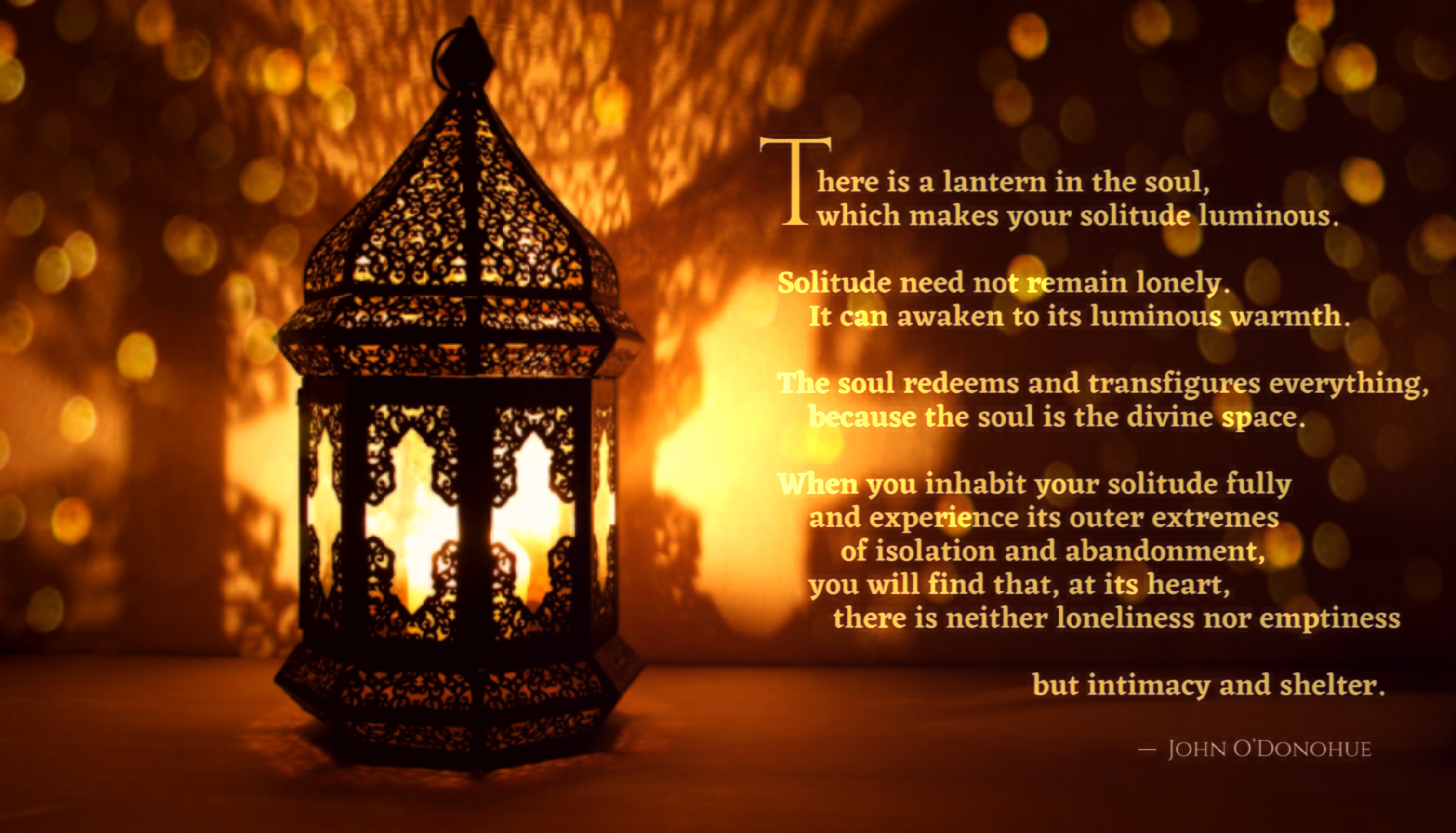
There is a lantern in the soul, which makes your solitude luminous. 
Solitude need not remain lonely. It can awaken to its luminous warmth. 

The soul redeems and transfigures everything
because the soul is the divine space. 

When you inhabit your solitude fully and experience its outer extremes of isolation and abandonment, you will find that, at its heart, there is neither loneliness nor emptiness but intimacy and shelter.

― John O’Donohue, Anam Cara: A Book of Celtic Wisdom

Right now, in the midst of the disheartening mood of the year 2020, I am entering the solitude I desperately need so that I can experience my soul as the divine space it is. 

Politicians, continue your rancor in loud and powerful voice! I will not hear you from my place of solitude, from my soul’s divine space. And as for you, Mr. Trump, I have no further airtime for you. I refuse to sit in front of my television for another minute, anticipating — hoping — that you will finally say or do something appropriate, beneficial, worthwhile, productive, compassionate or kind.

Instead, I will change the channel to more soul-healing television. In fact, I will leave the television altogether and go to a better place, higher ground where peace and silence and reverence and awe can begin the holy work of healing my soul. I am taking a sacred pause from my life that has been so anxious and worried and isolated. I will wait there in that sacred space where my “soul redeems and transfigures everything.” Thanks be to God.

Activism, Anger, Black Lives Matter, Breonna Taylor, Call, Change, Church, Comfort, Community activism, Compassion, Defiance, Despair, Hate, healing, Injustice, Lament, Persistence, Prayer, Racism, Sorrow, Soul, Spirit, struggle, The Christian Church, Transformation, Urgency, Violence, White supremacy

Prayers of Lament


This morning, I prayed a prayer of lament. Lament was the only prayer in my spirit. It is difficult to express the deep sorrow I felt yesterday when I learned that no charges were brought against the police who shot six bullets into Breonna Taylor’s body.

Shortly after midnight on March 13, 2020, Louisville police officers used a battering ram to enter the apartment of Breonna Taylor, a 26-year-old emergency medical technician who had dreams of a bright career ahead. She and her boyfriend had settled in to watch a movie in her bedroom on that tragic night. Police came to her door and minutes later, she was fatally shot. Her death sparked months of protests in Louisville.

Yesterday, six months after the fatal shooting — six bullets — a grand jury indicted a former Louisville police officer on Wednesday for wanton endangerment for his actions during the raid. A grand jury delivered the long-awaited answer about whether the officers would be punished. No charges were announced against the other two officers who fired shots, and no one was charged for causing Breonna Taylor’s death.

For me, there was only lament. I imagine that for Breonna’s family, there was the deepest kind of lament. For her mother, lament was the only response she could express as she wept uncontrollably. And, even for the protesters who filled the streets, I believe there was lament. 

Theologian Soong-Chan Rah explains in his book, Prophetic Lament, that in the Bible lament is “a liturgical response to the reality of suffering and engages God in the context of pain and suffering.” He goes on to say that it is a way to “express indignation and even outrage about the experience of suffering.” Racism has inflicted incalculable suffering on black people throughout the history of the United States, and in such a context, lament is not only understandable but necessary.

Perhaps white Christians and all people of faith have an opportunity to mourn with those who mourn and to help bear the burden that racism has heaped on black people. (Romans 12:15)    — Jemar Tisby, The Color of Compromise


In the end, many people see only the rage, anger, impatience, violence of the protesters. Can we also see their lament for Breonna, as well as for centuries of racially motivated murder — beatings, burnings, lynchings and murder committed by police officers? 

People of faith — white people of faith — will we try to understand the rage of our black and brown sisters and brothers? Will we join them in righteous anger? Will we mourn with them? Will we lament when lament fills their souls and overflows in cries for justice?

We must, in the name of our God who created every person in God’s own image!

Last night, I heard an interview with Brittany Packnett Cunningham on MSNBC. Her words were eloquent pleas for justice. She spoke about how persistent and all-encompassing racism is in our country and about the murders and the protests and the political rancor that fuels it. She acknowledged racism’s strong, unrelenting hold on this nation, a hold that is virtually impossible to break. And she said something I have said for a long time, “Racism cannot be reformed. It must be transformed.”

To me that means a transformation of the heart and soul that compels each of us to lament, to comfort, to speak truth in government’s halls of power, to stand openly against any form of racial injustice.

May God make it so.

Will you pray this prayer of lament with me?

O God, who heals our brokenness, Receive our cries of lament and teach us how to mourn with those who mourn. Receive even our angry lament and transform our anger into righteous action. Hear the anguish of every mother assaulted by violence against her child. Hear the angry shouts of young people as shouts of frustration, fear and despair. Grant us the courage to persist in shouting out your demand for justice, for as long as it takes. When deepest suffering causes us to lament, grant us Spirit wind and help us soar. If we resist your call for justice, compel us to holy action. May our soul’s lament stir us to transform injustice, in every place, for every person, whenever racism threatens, for this is your will and our holy mission. Amen.

Bravery, Comfort, Confusion, Contemplation, Courage, Fogginess, Mists, Perseverance, Resilience, Sacred Pauses, Serenity, Silence, Soul, Spirit, Stillness, Vulnerability

Being Brave in the Mists

Are we brave enough to imagine beyond the boundaries of “the real” and then do the hard work of sculpting reality from our dreams? 

Walidah Imarisha


I read a wonderful article this morning written by Madisyn Taylor, who wrote about being in a fog. I related immediately, having just taken my immunosuppressant medications that create all manner of “foggy-ness” for me. Tayler defined it as a feeling of being “muddled and unfocused, unsure of which way to turn.” I resonate with that definition, but beyond the physical fogginess of my mind, I experience an occasional fogginess of spirit. Know what I’m talking about? I would guess you do, since all of us fall into a spirit-fog once in a while.

A fog can feel downright eerie. It isn’t straightforward like darkness, yet we may feel like we can’t see where we’re going or where we’ve come from. We feel fear, as real as our fear of the darkness, afraid that if we move, we might run into something hidden in the mists that surround us. If we’re brave enough to move at all, we move slowly, feeling our way and keeping our eyes open for shapes emerging from the eerie haze.

Maybe being brave is what spirit fogginess is about. Spirit-fog is, of course, is a season of involuntary inactivity (perhaps even precipitated by coronavirus isolation). Although you and I much prefer to be able to see where we are going and move unwaveringly in that direction, maybe we can encourage our spirits to see that being in a fog often brings gifts to us — gifts of stillness, of doing absolutely nothing, a respite from forward inertia, a time to gather up our “brave” to move with forward inertia, even moments of finding for our spirits the Spirit of Comfort and Peace. We might find in the mists of fog the sacred pause that our spirit needs — the kind of sacred pause that creates resilience in us, and perseverance, and whatever we need to be brave.

In the fog, we really do need to be brave. When we are hidden in the mist, we may look within and find that the source of our fogginess is inside us — perhaps an emotional issue that needs tending before we can safely move ahead with steady resolve. The fog that engulfs us may simply be teaching us important lessons about how to continue moving forward even if we have been brought to a standstill by circumstances of life.

If we’re brave, we do not have to wait for the fog to lift. If we’re brave enough, we can center ourselves in the haze, wait for guidance and then move — move on into the unknown places on the journey. I have been a long-time fan of the song “Brave” sung by Sara Bareilles, written by Sara Bareilles and Jack Antonoff. “Brave” is on her 2013 album, “The Blessed Unrest.” The song hits me hard with these words, “sometimes the shadow wins.” I know that to be the hard truth, but I also latch onto the rest of this song’s message: I can be brave! I often think that this section of the lyrics calls out directly to me — calling me, urging me on, encouraging me to “show everyone how big my brave is.”

I wanna see you be brave

Everybody’s been there, everybody’s been stared down
By the enemy
Fallen for the fear and done some disappearing

Bow down to the mighty
Don’t run, stop holding your tongue

Maybe there’s a way out of the cage where you live
Maybe one of these days you can let the light in

Show me how big your brave is

Say what you wanna say
And let the words fall out
Honestly
I wanna see you be brave

Spend a few minutes enjoying this Sara Bereilles song and immerse yourself in the thought of how amazingly brave you are.

Awakening, Awareness, Beauty of Nature, Bondage, Change, Contemplation, Creation, Creativity, Emotions, Feelings, God's presence, Grace, Hemmed in, Here I am, Lord., Holy Ground, Holy Spirit, Hope, Insight, Inspiration, Introspection, Isolation, Loneliness, Mystery, Psalm 139, Sacred Pauses, Sacred Space, Soul, Spirit, Transformation, Walls, Wisdom, Writing

Hemmed In!


There are large scale, widespread forces that can trap thousands of people, even millions. Dachau, Katrina, earthquakes, tsunamis, wildfires, natural disasters all over the world and the Coronavirus of 2020. Enormous, catastrophic events can trap people. COVID19 has literally trapped me inside my home. I have to admit, the isolation has taken a toll on my spirit. No visitors! No visits with friends or family. No trips! No haircuts! I have been trapped at some level since my kidney transplant in November. Just at the March milestone that would have allowed me to break the isolation of the transplant, I was even more fully trapped by the infectiousness of this pervasive, unrelenting virus.

Being trapped for so many months has raised up in me feelings of loneliness, isolation, powerlessness, despair, anxiety, even abandonment. And yet, often there is something very good in the center of something very bad. It has been so for me. Yes, I feel trapped in the pervasive power of the coronavirus, but I also sense the arms of God and the embrace of Spirit hemming me in even further. Such a grace-gift it has been to me, as if God has said, “l am hemming you in, and in this space you will hear me clearer and sense me more fully.”

God’s words were truth. Hemmed in, my mind flourished, my heart leapt and my soul entered spaces of calm. I felt enhanced awareness! Even awakening. I saw nature in a different way and basked in the beauty of the rising sun. The sound of the hummingbirds’ trill and the rapid fluttering of their translucent wings were sounds meant just for me. I began to write and paint, to listen more carefully to God’s voice, to allow my spirit to overflow with Holy Spirit. To my hemmed-in call from God, I was compelled to answer, “Here I am, Lord!” When I finally answered God, my hemmed-in place became Holy Ground — a very good place to be that feels more like a holy mystery than a state of being.

Was this pandemic a good thing for me and for millions of people? Absolutely not! But trapped in its dark cloud, God hemmed me in further in ways I am just now beginning to understand. I can say with all honesty that being hemmed in by God has been grace to me.

If I could even begin to choose a favorite Psalm from among the many that inspire me, I would choose Psalm 139. In its weaving of words, there are many passages that are full of comfort. From childhood, I memorized a lot of Scripture and throughout Psalm 139 I memorized several snippets that I often call to mind. One verse that I did not memorize is verse 5: “You hem me in behind and before, and you lay your hand upon me.”

You have searched me, Lord,
and you know me.

You know when I sit and when I rise;
you perceive my thoughts from afar.

You discern my going out and my lying down;
you are familiar with all my ways.

Before a word is on my tongue
you, Lord, know it completely.

You hem me in behind and before,
and you lay your hand upon me.

— Psalm 139:1-5 NIV

I deplore the coronavirus and what it has done to so many people. I deplore the ways it was able to trap me, physically and emotionally. But the virus, with all its ominous, far-reaching force could not trap me spiritually. That was God’s work — hemming me in so that my spirit could rise to fresh, new heights of spiritual consciousness. Being hemmed in by our Creator has been grace for me in these days of isolation. It has become a transforming sacred pause. For in my hemmed-in space, the Creator helped me create — from my mind, from my heart, from my soul. Thanks be to God.

anxiety, Community, Darkness, Death, Despair, discouragement, healing, Heartbreak, Indecision, journey, Lament, life, Life Journeys, Life pathways, Mystery, Restoration, Sorrow, Spirit, struggle, Tears, Thin Places, Yiayia

That Mysterious and Mystical Reality

EC73BB1C-C3BB-4B52-8D03-279FE90ADEDE
Watercolor art by Kalliope, Holy Ghosts

You might be thinking that both mysterious and mystical are the antithesis of reality. If you are thinking that, you might be wrong. So might I. But in my experience, life itself is a mysterious and mystical reality. That reality fills my spirit with hope in my darkest moments. Dark moments, hours of grief, dark nights of the soul, lamentations of the spirit — all have been part of my life journey. My pathways have often been rough and rocky. My life’s travel has often taken me to disconcerting forks in the road and confusing crossroads. I have known times of despairing and times of uncertainty — reluctance, despondency, angst, heartbreak, fear — “break-out-in-a-sweat times” that forced me into dangerous depths of anguish. For me, taking my own life was not something I could consider. Yet there was that one day — that span of just a few moments — when I was alone, afraid and very far from home.

IMG_5744
Japan’s Aokigahara Suicide Forest

One of the most thoughtful and intriguing movies I have ever experienced is The Sea of Trees. I was captivated by the film that tells the story of a despondent professor. After the death of his wife, he despaired of life and searched for a way to end his. His reflective, angst-filled search led him to Aokigahara, a forest in Japan known also as The Sea of Trees or The Suicide Forest. Aokigahara Forest has been home to over 500 confirmed suicides since the 1950s. It is called “the perfect place to die” and is the world’s second most popular place for suicide.

Don’t worry. This post is not about suicide. Rather it is about the people who loved us in life and continue to love us in death, those who watch over us in our times of deepest anguish. It is about the mysterious and mystical reality that between us and our loved ones in heaven, there is but a thin separation. Heaven and earth,” the Celtic saying goes, “are only three feet apart, but in thin places that distance is even shorter.”

To know that my sweet Yiayia (grandmother in Greek) and my Thea Koula might still be protecting me from harm and life disaster is soul-comforting for me. Perhaps the strength and hope I felt as I was chaplain to disheartened hospital patients came from them. Perhaps they sent me the staying power to comfort, protect and advocate for thousands of abused women and children. Maybe the deep grief of losing my brother to cancer was eased by their prayers from heaven.

I often wondered if my mourning of the loss of the life I knew — replaced by daily dialysis — was lightened by their loving presence with me in a horrible time. I wonder, Yiayia, were you watching over me on November 12th when I closed my eyes in the operating room to receive my kidney transplant? I wonder, Thea Koula, did your intercession save my life on those times when my life literally hung in the balance?

This life is not an easy one. No person gets through life unscathed. No one travels a path smooth and straight. Like me, you have more than likely walked on a rough pathway with stones in the road, dangerous curves and life-altering crossroads. Robert Frost wrote eloquently in his poem, The Road Not Taken, about someone standing at a fork in the road pondering a life-altering choice:

Two roads diverged in a yellow wood,
And sorry I could not travel both
And be one traveler, long I stood
And looked down one as far as I could
To where it bent in the undergrowth . . .

Then took the other, as just as fair,
and having perhaps the better claim
because it was grassy and wanted wear . . .

Oh, I kept the first for another day!
Yet knowing how way leads on to way,
I doubted if I should ever come back.

I shall be telling this with a sigh
Somewhere ages and ages hence:
Two roads diverged in a wood, and I—
I took the one less traveled by,
And that has made all the difference.

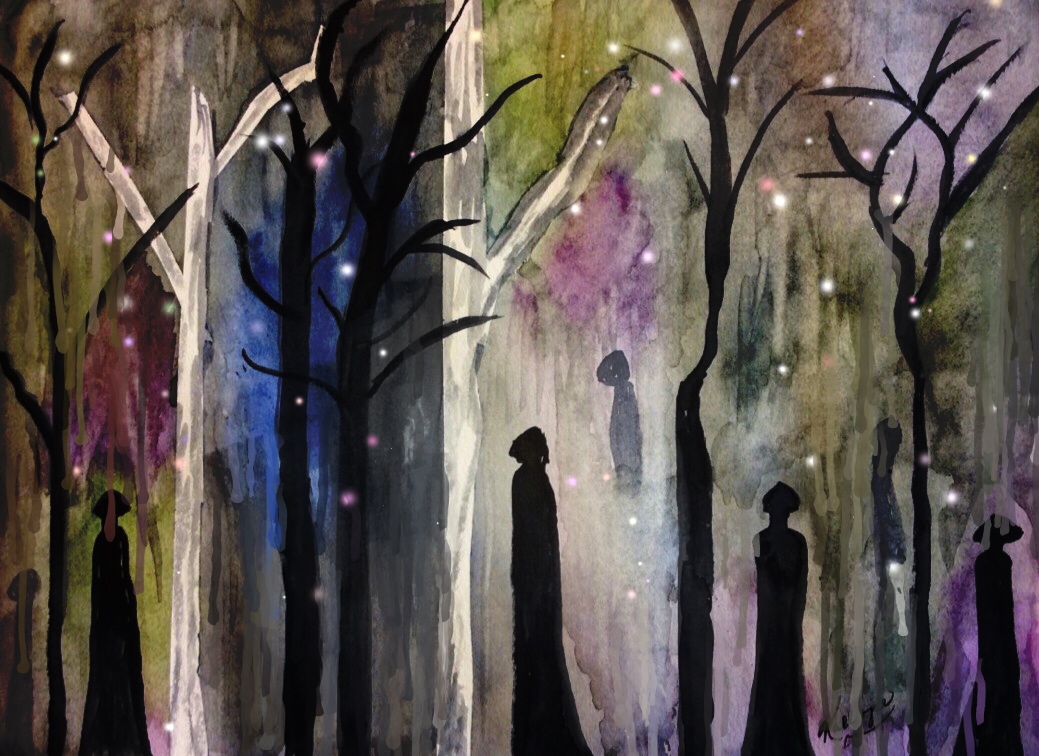
My life is filled with “roads not taken,” some not taken by my choice, others thwarted by chance or fate or maybe even God. It is almost like traveling through a “sea of trees” that hide our view of the way ahead, causing us to lose our way. For my art today, I chose one of my watercolor paintings. A few years ago, I painted this “sea” of leafless trees against an ethereal, melancholy wash of color. Interspersed among the trees are ghost-like figures hovering. Actually I titled the painting Holy Ghosts. The painting was inspired by the words of a friend.

When the dead come to mind, they are like holy ghosts, as real as hope or faith, as tangible as trust and love.  – Ragan Courtney

This painting was never meant to be disconcerting or morbid. It represents just the opposite for me. It represents the souls who hover over me for protection, those with whom I shared love and life. It represents my aunt and my Yiayia and my brother because I am certain they protect me, pray for me, lift me up and cheer me on.

Who knows! Maybe my brother Pete, who died of renal cell carcinoma, hovered above me in a kind of holy kidney disease kinship and protected me when I was diagnosed with end stage renal disease in 2014. Maybe he prayed for me during my transplant surgery in 2019. I can, of course, never know that for sure. The veil between heaven and earth, between the dead and the living, is a mystery we simply do not understand. Our understanding does not reach that far, but what we feel in our spirit does reach that far.

In the end, my spirit senses that between us there is but a thin separation, that the spirits of my loved ones are are connected to mine, especially when I am disconsolate and in despair.

In the comfort of that mysterious and mystical reality, I can heal. I can rest. I can continue my journey of dangers, toils and snares. I can know the amazing grace that comes from sacred connections. I can know peace after sorrow. And so can you.

May God make it so. Amen.


Activism, Ahmaud Arbery, Anger, anxiety, Art, Beloved Community, Brokenness, Change, Comfort, Community, Community activism, Conflict, Courage, Death, Despair, discouragement, Division, Emotions, Exhaustion, Fear, Freedom, Friendship, George Floyd, grief, Hate, healing, Heartbreak, Holy Spirit, Injustice, Nonviolence, peace, Pentecost, Perseverance, sadness, Sorrow, Spirit, Spirit wind, struggle, Together, Violence, White supremacy

Together!

74F3F032-5117-4474-98A7-A2171243B45E
A blending of two photos: One is an image of protesters in Minneapolis. The second image is a portrayal of people raising their hands to celebrate Pentecost.

This morning I have no words. I have tears. I have sadness. I even have some anger that the people I love whose skin is not “white” are living in grief and frustration. I say only that injustice and oppression cling so close to my friends, today and in centuries past.

F0ABFCC6-C312-44E2-A39F-35F520174256I hear my dear friends cry out for justice. I hear them using words to make sense of it all, and I hear their voices fall silent. Silent, with just these words, “I’m tired.” A dear friend posted the words on the left this morning. I want to see her face to face. I want to be together. I want to comfort her, hoping beyond hope that it is not too late for comfort.
I read this horrific headline this morning.

Prosecutors in Hennepin County, Minnesota, say evidence shows Chauvin had his knee on Floyd’s neck for a total of 8 minutes and 46 seconds, including two minutes and 53 seconds of which Floyd was non-responsive.   — ABC News

99398631-7958-42F7-9F51-718EE1C289DD
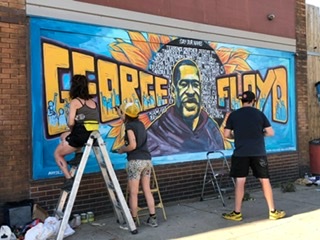
Artists honor George Floyd by painting a mural in Minneapolis on Thursday, May 28, 2020. Artists began work on the mural that morning. (Photo: Jacqueline Devine/Sun-News)

Today I find myself deeply in mourning for the violence that happens in our country. I find myself trying to share in the grief of my friend and knowing I cannot fully feel the depth of it. Today I find myself unable to emotionally move away from it all. Today I contemplate George Floyd’s cry, “I can’t breathe.”

If there is any comfort at all, it comes as a gift of the artists pictured here. In an act of caring, they offer this mural at a memorial for George Floyd.

The names of other victims of violence are painted in the background. The words, “I can’t breathe!” will remain in our memories. Today we are together in mourning.

But tomorrow, I will celebrate Pentecost. I wonder how to celebrate in a time when lamentation feels more appropriate. I wonder how to celebrate when brothers and sisters have died violent deaths and when thousands of protesters line the streets of many U.S. cities. I wonder how to celebrate when protesters are obviously exposing themselves to COVID19.

Still, tomorrow — even in such a time as this — I will celebrate the breath of the Spirit. Tomorrow I will join the celebration that has something to do with being together, being one. To juxtapose the joyous celebration of Pentecost with the horrible picture of what we saw in cities throughout our country for the past few nights seems an impossible undertaking. What does one have to do with the other?

Perhaps they do share a common message. From those who protest, this message:

“We bring our broken hearts and our anger for the killing of our people, for the murders across the ages of people who are not like you. You treat us differently than you treat the people who look like you. For as long as we can remember, you have visited upon us oppression, slavery, racist violence, injustice. And we are tired. We are spent. We are beside ourselves with collective mourning. We can’t breathe!“

From those who celebrate Pentecost, this message:

18bbdca6-8ece-4df4-aa13-fe110e3298cb“How we celebrate the day when the Holy Spirit breathed upon those gathered together, with gifts of wind and fire!

How we celebrate the story told in the 2nd chapter of Acts!”

When the day of Pentecost came, they were all together in one place. Suddenly a sound like the blowing of a violent wind came from heaven and filled the whole house where they were sitting.

They saw what seemed to be tongues of fire that separated and came to rest on each of them. All of them were filled with the Holy Spirit and began to speak in other tongues as the Spirit enabled them.

Now there were staying in Jerusalem God-fearing Jews from every nation under heaven. When they heard this sound, a crowd came together in bewilderment, because each one heard their own language being spoken. Utterly amazed, they asked: “Aren’t all these who are speaking Galileans? Then how is it that each of us hears them in our native language? Parthians, Medes and Elamites; residents of Mesopotamia, Judea and Cappadocia, Pontus and Asia, Phrygia and Pamphylia, Egypt and the parts of Libya near Cyrene; visitors from Rome (both Jews and converts to Judaism); Cretans and Arabs—we hear them declaring the wonders of God in our own tongues!” Amazed and perplexed, they asked one another, “What does this mean?”

Some, however, made fun of them and said, “They have had too much wine.”

Then Peter stood up with the Eleven, raised his voice and addressed the crowd: “Fellow Jews and all of you who live in Jerusalem, let me explain this to you; listen carefully to what I say. These people are not drunk, as you suppose. It’s only nine in the morning! No, this is what was spoken by the prophet Joel:

“‘In the last days, God says,
I will pour out my Spirit on all people.

Your sons and your daughters will prophesy, last days, God says,
your young men will see visions,
your old men will dream dreams.

Even on my servants, both men and women,
I will pour out my Spirit in those days,
and they will prophesy.’”   —
Acts 2:1-18 NIV

The people did not, in fact, have too much wine. Peter made it clear that wine did not empower the people who gathered in Jerusalem —  “every people under heaven” — to speak and understand as they heard every word spoken in their own language. That would be a start, would it not, if we could speak the same language and truly understand — people who have flesh-colored skin, and brown and bronze, and red and black . . . every skin color under the sun. If only we could understand each other.

And then, what if we could gather together, welcoming every person? What if we could truly gather together and wait for Spirit to fall upon us with empowerment like we have never known before? What if we allowed the Spirit to give us breath, together?

41F5FD83-6B7A-4393-BF9E-57F0E4D51023In the end, there is a tiny bit of joy in George Floyd’s tragic story. It is a joy much deeper than reality’s sorrow. The artists completed their mural, and in the very center near the bottom, they had painted words that express the greatest truth of all.


Can you see it behind the little girl? “I can breathe now!”

What if we welcome Spirit Breath that will change us? What if we embrace empowerment from the Holy Spirit to help us change our world? What if we end oppression and injustice, together? What if holy perseverance could inspire us to live and act in solidarity with our sisters and brothers, all of them?

What if we dare to give our soul’s very breath to help bring about Beloved Community, together?

Together! Together!

May my God — and the God of every other person — make it so. Amen.


Africa, Aging, Bravery, Challenge, Change, Clouds, Comfort, Courage, discouragement, Grace, healing, Hope, Magic, mercy, Mystery, Resilience, Skies, Soul, Spirit, Sue Monk Kidd, Troubles, Uganda, wind, Wings of the morning

Leaving Our MAGIC Behind

EEAFAF51-CE51-42EA-9E96-881CDE08643B
Ugandan Washday at the River. Watercolor art by Kathy Manis Findley

When life moves on — from twenty to forty to seventy — you take into your inner place the ominous idea that if ever there was magic in your life, at some point, you left it behind. You know what I mean. The magic of your first love. The magic of the birth of your child. The magic of the time when you believed you could accomplish anything and everything you set your heart on. The magic that you actually did accomplish that thing, that sparkling thing that made you stand tall and celebrate yourself.

You might be wondering what in the world set my mind on life-magic this morning. I think it might have been carryover from my musings on yesterday’s blog post. But mostly, it came from reading a novel by one of my favorite authors, Sue Monk Kidd. This is the passage that captivated me, captured me as if it were some sort of sacred scripture.

There was a time in Africa the people could fly. Mauma told me this one night when I was ten years old. She said, “Handful, your granny-mauma saw it for herself. She say they flew over trees and clouds. She say they flew like blackbirds. When we came here, we left that magic behind.”

My mauma was shrewd. She didn’t get any reading and writing like me. Everything she knew came from living on the scarce side of mercy.. She looked at my face, how it flowed with such sorrow and doubt, and she said, “You don’t believe me? Where do you think these shoulder blades of yours come from, girl?”

Those skinny bones stuck out from my back like nubs. She patted them and said, “This all what left of your wings. They nothing but these flat bones now, but one day you gon get ‘em back.”

I was shrewd like mauma. Even at ten I knew this story about people flying was pure malarkey. We weren’t some special people who lost our magic. We were slave people, and we weren’t going anywhere. It was later I saw what she meant. 

— Sue Monk Kidd, from her novel, The Invention of Wings

Part of why these words so thoroughly captured me is in the very first sentence that mentions the place I so love, Africa. And even though the words don’t really have all that much to do with Africa, I found myself transported, walking among the banana trees in East Africa — Fort Portal, Uganda to be exact. Walking into a village brimming with people, and oh, the children! So many glimmering eyes, wide smiles and glowing dark faces that expressed everything from sheer delight to excruciating sorrow, and everything in between.

That was in one of my former lives, and pure magic it was! Because when you are able to make a child smile with a sweety (a piece of hard candy), there’s magic in that moment and it is a moment you carry through your day and through the rest of your life. Maybe that’s the grace of growing older — that you carry with you moments of magic from every place you have been, from every soul who touched your life so deeply.

In Sue Monk Kidd’s words, the magic was being able to fly, probably meaning to soar into the clouds above your troubles and woes. It hit me in my deep place, that the Ugandan people we came to know and love did soar into the clouds. Indeed, they left the agonizing hardships of life on the dusty earth below as their wings lifted them up, higher and higher to where life’s pain was replaced by pure exhilaration.

Back on the earth, in their world, not much was very exhilarating. Life was the same, predictable day after predictable day that disheartened them with hunger, malnutrition, thirst for clean water, oppression, soldiers with their machine guns and all the commonplace bad things that formed their lives. But there were better things too, like lush banana groves and children singing; like the music of drums at dusk; like the shimmering embers from their cooking fires rising into the night sky and reminding them that the day’s toil was not so bad when family could still gather together around a centering, comforting fire. There was magic in all of it. It was the magic of surviving war and embracing the loved ones who were still alive. It was the magic of celebrating the extraordinary lives of loved ones who had died and knowing that generations would move forward carrying the family’s magic into the future. It was the magic in their remembering, remembering the holy words they had hidden in their hearts . . .

“For I know the plans I have for you,” says the Lord,
“plans for well-being and not for trouble, to give you a future and a hope.”

— Jeremiah 29:11 New Life Version (NLV)

Maybe you, like me, have forgotten that we brought our magic with us to this day from the scenes of our past, from the happenings and the people we have known. This kind of magic never leaves one’s spirit. This kind of magic is holy mystery, really. It is tucked away within us for the times when we most need to take wing. Still, it does take some courage on our part, some brave resolve that we can lift up our heads and embrace “a future and a hope.”

No, we have not left our magic behind! It waits in us for a moment when we are languishing, when we feel sorrow or discouragement, fear or desperation — for a time when we feel disconsolate. It is in that moment we fly, by the grace-filled mercy of God, on the wings of the morning,* forever lifted above the troubles of the world.

I need that sometimes. Don’t you?


For your meditation time, I share with you this beloved hymn, “Come, Ye Disconsolate.”*


* Psalm 139:9

* “Come, Ye Disconsolate”
Lyrics: Thomas Moore (1779-1852); Altered by Thomas Hastings (1784-1872)
Music: Samuel Webbe (1740-1816)

Beginning again, Bravery, Calling, Challenge, Compassion, Courage, Dangerous and noble things, Discernment, Following Christ, Holy Spirit, Insight, Inspiration, journey, Kidney Transplant, Life Journeys, mercy, Passing years, Pondering, Questions, Repairing broken things, Spirit, Spirit wind, Urgency, Weeping

As Though I Had Wings


D112A977-1A19-4123-9462-5BCE716692F9


I want to think again of dangerous and noble things.
I want to be light and frolicsome.
I want to be improbable beautiful and afraid of nothing,
as though I had wings. [1]

I am continually inspired by Mary Oliver’s poetry, today by her phrase, “as though I had wings.” In the past six months or so — since my kidney transplant — I have felt a little wing-less. Not so unusual, because a transplant — before, during and after — is a rather big deal, like a super colossal deal! If I ever thought the enormous physical challenge would be the surgery itself, I was wrong. I think I deluded myself on that. The aftershocks of the surgery proved to be enormous and enduring. Hence, my lack of wings.

Everywhere, one can see eloquently expressed promises of wings. You and I can “mount up with wings as eagles”[2] or “take the wings of the morning.” [3]  There is even a wing promise that God will “raise you up on eagle’s wings.” [4]

I know the promises and I love them, but I also love how poet Mary Oliver brings it all down to where I live — on shifting sands in an ever-shifting world. She expresses it like this: “I want to think again of dangerous and noble things . . . to be improbable beautiful and afraid of nothing, as though I had wings.” [5]

All of a sudden, I have a critical assignment, something I must do myself and for myself. It seems to me that I must start by focusing on my mind, thinking again of things noble and dangerous. Then I must allow my mind (my will) to move through my heart and soul, to the very center of my being, because there is the place inside me where dangerous acts are weighed and noble acts can become resolve. In one of the common phrases of my faith — an admonition I heard in church over and over again — a pastor or teacher would say, “count the cost.”

Here’s where I am honest. So I must admit that doing noble things has seemed impossible for me in the past few years. Prior to my illness, my life was a constant journey of determining the danger of noble things and doing them anyway. I miss the life of being a pastoral presence to a dying patient. I miss keeping vigil in the ER family room with grieving parents mourning the death of a child. I miss offering a memorial service  for a dear congregant and friend. I miss comforting victims of sexual assault as police officers question them, sometimes brusquely and accusingly. I miss trauma counseling with persons who have endured horrific emotional and physical trauma. I miss forensic interviewing even the youngest child victim of abuse. I miss standing firm as a court advocate for child victims of sexual abuse. I even miss being thrown out of the courtroom by a persnickety judge who did not appreciate the intensity level of my advocacy.

I miss it all. It was dangerous. All of this work was dangerous and it was noble. I could do it because of wings — the wings God gave me when I determined I would do dangerous and noble things and do them with urgency.

What about now, this season of my life? What am I doing that’s dangerous and noble? Should I even expect to be able to face danger at my age, with my physical limitations? Last night, a friend listened to me list all the things I cannot do when very intently she interrupted me and asked, “Kathy, what can you do?” She continued, as she so often does, “Your life is not about the things you can’t do. It’s about the things you can do!”

She nailed it. Perhaps she even nailed me, albeit with some gentleness. So I have to sit awhile with that provoking question: “What can you do?” I have to sit with that question with God close by to guide me and Spirit near to remind me of Spirit-wind and Spirit-fire. I am not precluded from Spirit-wind because of age or Spirit-fire because of physical limitations. It is up to me to discern what I need in my life right now. Will I be satisfied with what I have done in the past and let myself off the hook? What dangerous and noble things will I take on?

I cannot help but think of so many nurses and doctors who are caring for persons with COVID19 — how they enter the ICU knowing that a deadly virus is there, believing that they could take the virus home to their families. Dangerous and noble! Somehow, Spirit-wind is raising them up for the task.

I wonder if you have thought about this for yourself, considering the cost of doing dangerous and noble things. Have you considered that the things you are already doing — feeding the poor, caring for the sick, taking a meal to an elderly person sheltered alone in her home — are all dangerous and noble things? That you show mercy to others as you go? That you weep for a broken world with so many broken people in it? That you share in Christ’s compassion?

“Dangerous and noble things! Afraid of nothing as if we had wings!” [6]

I’ve given all of this a lot of thought and I think we might get our wings after we have made the determination to give ourselves to noble things, no matter the danger. I think we get wings when we move to the urgency of Christ’s compassion, when our rhythms begin to emulate the rhythms of God. I think we get wings when we have determined in our hearts and souls to act — after we have counted the cost and have said “Yes!”

Again, the eloquence of the poet may most fully express my deepest longing and yours.

I want to be improbable beautiful and afraid of nothing,
as though I had wings . . .

What I want in my life
is to be willing
to be dazzled—
to cast aside the weight of facts
and maybe even
to float a little
above this difficult world. [7]

May God make it so for us.


1 Mary Oliver, Owls and Other Fantasies: Poems and Essays
2 Isaiah 40:31
3 Psalm 139:9
4 “On Eagles Wing’s” composed by Michael Joncas
5 Starlings in Winter, a poem by Mary Oliver
6 Mary Oliver, Owls and Other Fantasies: Poems and Essays
7 The Ponds, a poem by Mary Oliver

anxiety, Challenge, Clouds, Comfort, Darkness, discouragement, Faith, Fear, God’s promises, Grace, healing, Heartbreak, Hope, life, Light, Noah, Pandemic of 2020, peace, Prayer, Rainbows, Reflection, Restoration, Sacred Space, Soul, Spirit

On Making Your Own Rainbows

A4907FB5-C512-4C7D-AA48-A1445E359B91

In my kitchen window hangs a small faceted crystal ball. It’s purpose is to hang in the sunlight and make tiny rainbows in my kitchen. When I open the blinds in the morning, the facets on the ball do their job.
AB5CB98D-F367-4BB8-A219-0D201CA5347E

I see about eight small rainbows on the floor — just tiny, insignificant rainbows on the kitchen floor. That’s it!

My first response is, “That’s all you got?”

I had hoped for more, like refracted rainbows all over the kitchen. The little ball hanging in the window apparently needed some human help. So I twisted it several times. When I let it go, the little ball’s gift to me was dancing rainbows, not only on the kitchen floor, but also all over the walls of the kitchen, dining room and living room. Now that’s more like it!

0936BD45-60F2-4663-A251-3FAEC7160D4D

It suddenly occurred to me that I could let the ball just hang motionless in the window, settling for the few rainbows on the floor, or I could twist it and see rainbows in motion creating a celebration all around the walls. So this morning, I made my own rainbows, which is a pretty good mental picture of creating rainbow-like times in life.

It reminds me of part of Noah’s story told in the ninth chapter of Genesis. It’s about the covenant God made with Noah after the great flood had receded. You probably know the story well, but it bears revisiting.

And God said, “This is the sign of the covenant I am making between me and you and every living creature with you, a covenant for all generations to come: I have set my rainbow in the clouds, and it will be the sign of the covenant between me and the earth.

Whenever I bring clouds over the earth and the rainbow appears in the clouds, I will remember my covenant between me and you and all living creatures of every kind. Never again will the waters become a flood to destroy all life. Whenever the rainbow appears in the clouds, I will see it and remember the everlasting covenant between God and all living creatures of every kind on the earth.”

So God said to Noah, “This is the sign of the covenant I have established between me and all life on the earth.”

— Genesis 9:12-17 NIV

EAB02D98-3E58-48CF-B77D-1C2426E32954I never see a rainbow without remembering the story of God’s covenant with Noah. I always remember that God made the rainbow a sign, the sign of a covenant promise.
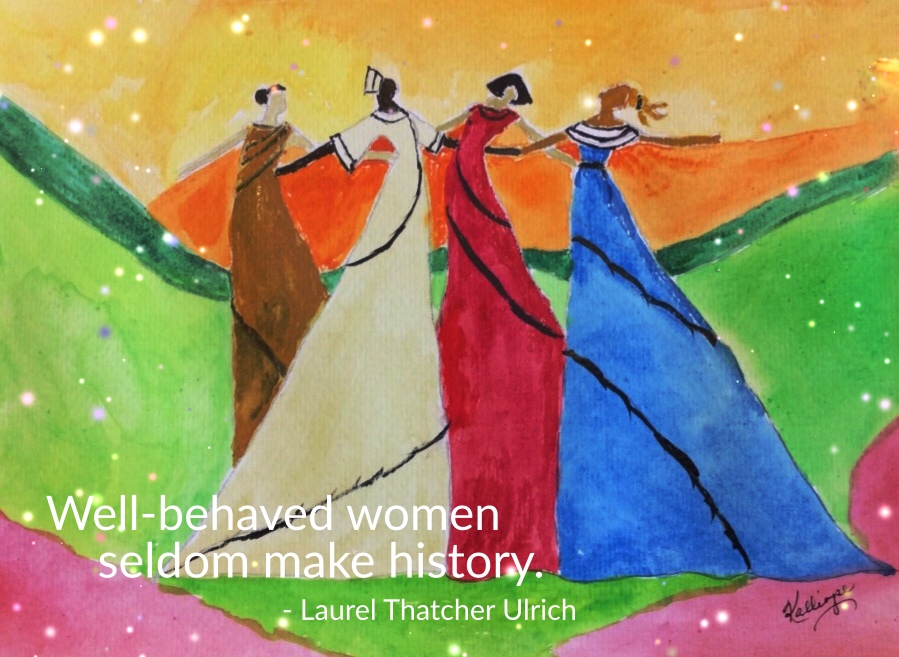
What does that have to do with me and you? Maybe not much for some. But for some of us — those of us who want to see tangible signs of God’s promises — the appearance of a rainbow means that God still covenants with us, God still makes promises to us and God still keeps those promises. That is God’s grace to us — God’s hope, God’s light, the very peace that comes to us from God.

With that assurance, we are able to make our own rainbows. Yes, in these days we are covered with a terrible, deadly virus, along with the fear it causes us. But we also know that, in days past, we have faced life storms, dark times that threatened to destroy us. And yet, we survived — with scars from old wounds, to be sure — but we weathered each terrifying time and found our way to better days. To survive the worst times of our lives — times when dark, heavy clouds loomed over us — I’m pretty sure we found ways to make our own rainbows.

What does it look like to make our own rainbows? It looks like seeking out a comforting friend, making sacred space for nurturing your soul, owning heartbreak so that you can be open to the healing of your heart, naming in prayer the wounds and scars of your soul so that your spirit can be made whole.

It seems to me that this is what “making your own rainbows” means — being open to healing through whatever ways you find soul-nurturing. Rainbows are not a bad analogy for the living of these days. A pandemic threatens us. We cannot change that, but we can change our response to this dark time. I believe that we really can make our own rainbows. Maybe for me it will simply be the act of twisting the crystal ball in my kitchen window. But if that insignificant act reminds me of God’s promise to be with me, to be in covenant with me, then I think I can make it through another dark time.

I am confident that, if you listen, your soul will whisper to you and tell you how to make your own rainbows — during these troubling days and for all the troubling times you may face on your journey.

May God make it so for you and those you love!

Be well and stay safe.

— KMF

Bondage, Bravery, Call, Calling, Courage, Dancing, Following Christ, Holy Spirit, Inner joy, Mechthild of Magdeburg, Mystic, Singing, Spirit

A Very Unruly Woman of God

228BEA2D-360B-4749-994C-F28F1D756B13
Watercolor by Kathy Manis Findley

She described herself as an unruly woman of God — Mechthild of Magdeburg. “I want also to circle higher still,” she wrote in one of her mystical poems. She had her first vision of the Holy Spirit at the age of twelve. As a young woman, she left her home and “renounced worldly honour and worldly riches.” She was an ascetic, a writer and a mystic who viewed God’s will in unorthodox ways. Her criticism of church dignitaries for religious laxity and claims to theological insight aroused so much opposition that some called for the burning of her writings. Her words seemed to have kept her in deep trouble!

Her story reminded me of Sue Monk Kidd’s book, “The Dance of the Dissident Daughter,” a book that set me on a pilgrimage in 1996 that changed my life. This was a book that screamed out to me, “Find your own soul! Nourish it! Protect it! Bind it closer to God’s soul and, for the first time, live out God’s call to you!”

Sue Monk Kidd said this as she reflected on writing the book’s first edition:

“The Dance of the Dissident Daughter” sparked heated, sometimes scathing reactions, including public accusations of heresy, boycotts of my lectures, and a plethora of derisive letters in my mailbox. One of the more memorable began: Dear Whore of Babylon. It was the “Dear” part that made is so indelible.

This statement rings true when I contemplate the life of Mechthild of Magdeburg. Before we get back to her, though, let’s look for a moment at The Dance of the Dissident Daughter, the book that left me with these nuggets of wisdom I will always hold close.

How many times have I denied my innermost wisdom and silenced this voice? How many times can a woman betray her soul before it gives up and ceases calling to her at all?

We must wake up, journey, name, challenge, shed, reclaim, ground, and heal.

When someone tries to put you back into a box from which you’ve already escaped, you might recall a line from the Indian poet Mirabai. She said, “I have felt the swaying of the elephant’s shoulders and now you want me to climb on a jackass? Try to be serious!}

As women we have a right to ask the hard questions. The only way I have ever understood, broken free, emerged, healed, forgiven, flourished, and grown powerful is by asking the hardest questions and then living into the answers through opening up to my own terror and transmuting it into creativity. I have gotten nowhere by retreating into hand-me-down sureties or resisting the tensions that truth ignited.

The main thing is to stop struggling and nourish yourself. When you nourish yourself, your creative energy is renewed. You are able to pick up your lyre again and sing.

— Sue Monk Kidd, The Dance of the Dissident Daughter

Yes! Sing, and even dance your dissident dance! Your song may sound to all those around you like a revolutionary song, discordant to their ears. Your dancing may scandalize your observers. Still — Sing! Dance! — to the stirrings of Spirit within you!

2869C069-C448-475D-87A3-447D55A041B6That’s exactly what Mechthild of Magdeburg did and the religious world labeled her unruly. In her book, Das fließende Licht der Gottheit (The Flowing Light of Divinity), she described her visions of God. She could not read and write in Latin, but she is known for being the first mystic to write in German. Her confessor, Heinrich von Halle, finally persuaded her in 1250 to write down her visions and spiritual experiences. She did this in her own hand, in the conviction that it was God’s will.

By 1270, six of the seven books of the “Flowing Light” were brought to parchment, collected and given chapter titles by Heinrich. Mechthild saw her book as a message to both believers and clergy, for she feared the church was in danger of being hollowed out from within; she called the powerful church officials, who often enjoyed worldly luxury, “stinking billy-goats.”

Thus, Mechthild was known as a very unruly woman of God — a defiant, dissident and radical rebel! “Stinking billy-goats!” No wonder she became known for her “rebelliousness and unorthodox ways.” The community she was a part of, the Beguine order, was known for the same kind of unorthodox rebelliousness. 

The Beguine order was a Christian religious movement active in Northern Europe during the 13th-16th centuries. The Beguines were women who lived as nuns in semi-monastic communities. Through their intense devotion to God and their somewhat ascetic lifestyle, they came to be known for their acts of rebellion and their unorthodox ways.

99AF81A9-35CC-43E5-A641-B19170914765
Watercolor art: 2019; by Kathy Manis Findley

Mechthild of Magdeburg definitely danced to her own music!

With her order, she was part of a great spiritual revival movement of the thirteenth century, a time when the Catholic Church was falling into disfavor. The Beguines sought to imitate the life Christ through voluntary poverty, care of the poor and sick, and religious devotion.

With advancing age, Mechthild was blind. She was alone, still the object of much criticism. With singing silenced and dancing impossible, she was left to sing songs in her heart and dance the dances of her imagination, always seeking Spirit promptings.

Some scholars have speculated that, due to increased persecution and failing health, Mechthild was forced to retire to the convent of Helfta around 1270. There, she met three other notable writers of the time, Gertrude of Hackeborne, Mechthild of Hackeborne, and Gertrude the Great. Helfta was a good place for a writer such as Mechthild. Under the leadership of Gertrude of Hackeborne, Helfta had become a hub of learning and writing for women and a center for book collecting, copying and illumination.

Still, Mechthild portrayed herself as a reluctant writer urged on by God and her director to continue her work. She calls her director “my dear schoolmaster,” who taught her, “simple and stupid as I am, to write this book.” About the urging of God she said, “I cannot nor do I wish to write “unless feeling the power of the Holy Spirit.” At one point, Mechthild wondered why God did not choose a priest rather than herself for this work, and she is told that God always seeks out the lowest and smallest so that “unlearned lips can teach the learned tongues of the Holy Spirit.”

In spite of the fact that Mechthild was unable to read and write in Latin, these are some powerful quotes by the graceful mystic Mechthild of Magdeburg, from her book Das fließende Licht der Gottheit (The Flowing Light of Divinity), where she describes her visions of God.

The day of my spiritual awakening was the day I saw and knew I saw all things in God and God in all things.

If you love the justice of Jesus Christ more than you fear human judgment then you will seek to do compassion. Compassion means that if I see my friend and my enemy in equal need, I shall help them both equally. Justice demands that we seek and find the stranger, the broken, the prisoner and comfort them and offer them our help. Here lies the holy compassion of God that causes the devils much distress.

From suffering I have learned this: that whoever is sore wounded by love will never be made whole unless she embraces the very same love which wounded her.

A Light of utmost splendor glows on the eyes of my soul. Therein have I seen the inexpressible ordering of all things, and recognized God’s unspeakable glory — that incomprehensible wonder — the tender caress between God and the soul . . . the unmingled joy of union, the living love of eternity as it now is and evermore shall be.


I cannot dance, Lord,
unless you lead me.

If you want me to leap with abandon,
You must intone the song.

Then I shall leap into love,
From love into knowledge,
From knowledge into enjoyment,
And from enjoyment
beyond all human sensations.

There I want to remain,
yet want also to circle higher still.

— Mechthild of Magdeburg

Like her, I want to “circle higher still.” I want to escape from chains that shackle the highest expression of my spirit. I want to sing the songs God placed in my heart! I want to dance to the Spirit’s rhythm hidden in my spirit!

6480931C-BB7C-4745-8CBC-1D2C70C6B09E
Acrylic art by Kathy Manis Findley

Without fear! Without fear . . .

taking the journey set before me to follow Christ into places of poverty, fear, sickness, desperation. Breaking the rules if I must. Taking criticism if I must. Being persecuted if that is in the cards for me. I want to move forward into my calling with the Spirit of God upon me . . .


The Spirit of the Lord is upon me,
because he has anointed me
to bring good news to the poor.

He has sent me to proclaim release to the captives
and recovery of sight to the blind,
to let the oppressed go free.

 — Luke 4:18 New Revised Standard Version (NRSV)

May God make it so for us. Amen.