Activism, Advocate, Beauty of Nature, Bravery, Calling, Committment, Community, Community activism, Conflict, Courage, Dandelions, Faith, Fear, God, Grace, Holy Spirit, Hope, Injustice

Start Something! It’s Easy!

—Mary Oliver

Starting something really is easy, but the pathway from beginning something and then taking it to completion reveals challenges that test our resolve. I always begin projects with enthusiasm and optimism, filled with ideas and plans, but as obstacles arise, my motivation almost always wanes, my progress slows, and distractions multiply. In this environment, fear definitely thrives. But the projects stay on my shoulders as long as I remember them, and so the contrast between the initial excitement versus the realities of sustained effort calls for persistence and commitment. The tumultuous path from beginning to completion can cause me to become weary and quit, just to get the heavy pack of projects off my shoulders.

Of course, most of us can admit that in these days, one important example of our tumultuous path is the dismantling of our democracy. Of course, not everyone agrees about the severity of the situation, but I have to say that in my world, people are afraid, angry, despondent, disheartened . . . although some are elated. Let’s entertain this thought for a few minutes: when people are convinced that real danger is coming, they often gird themselves with “protective gear” (the Bible would say, “gird up your loins”) after which you can attack the stronghold that threatens you. We see an example of this in the protests and/or marches that are happening in cities and towns across the nation and around the world. Let me dare to say this in hopes that no person will take offense. The aim of those who dissent to the actions of the Trump administration are deeply concerned and afraid. Even people of faith are beginning to see this version of the world as something to fear. 

Today, as I write this post, I am thinking of so many people who live in fear: immigrants who are currently locked up like prisoners, children who have been separated from their parents, people who suddenly lose their jobs, thousands of immigrants being rounded up and deported, the community at-large as they lose some of their rights, and even the elected congressional leaders who are afraid of personal repercussions from Donald Tump. Afraid! All of them afraid!

“Here is the world. Beautiful and terrible things will happen.
Don’t be afraid.”

― Frederick Buechner, Beyond Words: Daily Readings in the ABC’s of Faith

You see, whether we support the relentless changes in our government or not, Mr. Trump is stoking fear among Americans as he dismantles institutions, agencies, and departments. Let me list some of them: The Department of Education, the Department of Health and Human Services, the Departments of Agriculture, Defense, Energy, Housing and Urban Development, and Transportation. And then there is the layoff of thousands of federal employees, the closing of USAID, and the indiscriminate and inhumane deportation of thousands of immigrants and immigrant U.S. citizens.

The question I ask myself over and over again is whether there is anything I can do to help end this destruction. Is it really true that starting something is easy? Not always! So what can I do to help change our trajectory. Am I kidding myself? What can one person with zero power do to end this? The answer is “nothing” every time I ask! Good intentions I may have in abundance, but the answer in my spirit does not change, “There is nothing one person can do. I have no power.”

Yet, for all of us who are people of faith, there is always an opportunity to live out our faith through our actions, and within a faith community. Perhaps we can make a significant change, together.

Jesus is our example, showing us how to heal destructive acts committed by power-hungry, destructive people. Jesus left us instructions, as did the prophets, the psalmist, and the epistle writers. Yet, we persist in believing the lie that we have no power. Contemplate these bits of wisdom:

Very truly, I tell you, the one who believes in me will also do the works that I do and, in fact, will do greater works than these      —John 14:12

When you give a banquet, invite the poor, the crippled, the lame, and the blind. And you will be blessed.     —Luke 14:12-14

When Jesus came to Nazareth . . . he went to the synagogue on the sabbath day, as was his custom. He stood up to read, and the scroll of the prophet Isaiah was given to him. He unrolled the scroll and found the place where it was written: ‘The Spirit of the Lord is upon me, because he has anointed me to bring good news to the poor. He has sent me to proclaim release to the captives and recovery of sight to the blind, to let the oppressed go free, to proclaim the year of the Lord’s favor.’      —Luke 4:16-19

But woe to you Pharisees! For you tithe mint and rue and herbs of all kinds, and neglect justice and the love of God.      —Luke 11:40

This is what the LORD Almighty said: ‘Administer true justice; show mercy and compassion to one another. Do not oppress the widow or the fatherless, the foreigner or the poor. Do not plot evil against each other.      —Zechariah 7:9-10

Defend the cause of the weak and the fatherless; maintain the rights of the poor and oppressed. Rescue the weak and needy; deliver them from the hand of the wicked.  —Psalm 82:2-4

He raises the poor from the dust and lifts the needy from the ash heap.   — Psalm 113:7

Speak up for those who cannot speak for themselves, for the rights of all who are destitute. Speak up and judge fairly; defend the rights of the poor and needy.  —Proverbs 31:8-9

Learn to do right; seek justice. Defend the oppressed. Take up the cause of the fatherless; plead the case of the widow.   —Isaiah 1:17

Loose the chains of injustice and untie the cords of the yoke, to set the oppressed free and break every yoke . . . share your food with the hungry and provide the poor wanderer with shelter— when you see the naked, clothe them.     —Isaiah 58:6-7

Do not neglect to show hospitality to strangers, for by doing that some have entertained angels without knowing it. Remember those who are in prison, as though you were in prison with them; those who are being tortured, as though you yourselves were being tortured. —Hebrews 13:1-3

Speak up for those who cannot speak for themselves, for the rights of all who are destitute. Speak up and judge fairly; defend the rights of the poor and needy.     —Proverbs 31:8-9

Defend the cause of the weak and the fatherless; maintain the rights of the poor and oppressed. Rescue the weak and needy; deliver them from the hand of the wicked.  —Psalm 82:2-4

Do not neglect to show hospitality to strangers, for by doing that some have entertained angels without knowing it. Remember those who are in prison, as though you were in prison with them; those who are being tortured, as though you yourselves were being tortured. —Hebrews 13:1-3

Speak up for those who cannot speak for themselves, for the rights of all who are destitute. Speak up and judge fairly; defend the rights of the poor and needy.     —Proverbs 31:8-9

Learn to do right; seek justice. Defend the oppressed. Take up the cause of the fatherless; plead the case of the widow.      —Isaiah 1:17

Loose the chains of injustice and untie the cords of the yoke, to set the oppressed free and break every yoke . . . share your food with the hungry and provide the poor wanderer with shelter— when you see the naked, clothe them.      —Isaiah 58:6-7

Defend the cause of the weak and the fatherless; maintain the rights of the poor and oppressed. Rescue the weak and needy; deliver them from the hand of the wicked.  —Psalm 82:2-4

“My commandment is this: Love each other as I have loved you.
Greater love has no one than this: to lay down one’s life for one’s friends.”

And we claim we have no power! Nothing is farther from the truth. It is not a new revelation that faith will be the holy impetus, the power, that pushes us into kindness, compassion, and love. This kind of kindness, compassion and love will inspire us to head into the rancor and division that currently seems to be having its way. I doubt we will ever see, in my lifetime, the completion of a more gentle and loving community of acceptance and compassion. I don’t believe we will all swing doors open instead of locking them.  I doubt we will complete the work that respects all humanity, but starting the task is easy, and important. As far as finishing the work we have chosen, maybe its “a roll of the dice” sort of thing, or a “stroke of luck,” or being in the right place at the right time. Perhaps it has more to do with being anointed by God to make change through care, compassion, and even anger. 

So I will look for you on the streets as you lead the people to the arc of justice. I will listen for your voice when you are proclaiming the evils of injustice on every corner! I will join in your song that celebrates a new day of peace, love and compassion. I will sense your sacred time of reaching out to God in prayer and lament. I will celebrate when your anger turns into righteous anger that defends the people among us who need protection.

We can start one of two ways. We can fight in anger, motivated by our rage, and risk completely destroying something we are trying to fix. We can do it through sheer human strength and force, knowing we have the power to succeed. Or we can try the better way: the tender way that leads us to solitude, meditation and prayer, and reminds us of dandelions letting go of their seeds. I think that being committed to become part of needed change is holy work. God has anointed us to confront the wrong; Jesus gives us the gift of his example of walking a sacred path; the Spirit gives us the wind to go where we need to be. Can you see yourself looking almost like a dandelion blowing its seeds about in a soft breeze? I can see it!


All Things New, Bishop Steven Charleston, Blessing, Call, Change, Covenant, Faith, healing, Holy Spirit, Hope, Meditation, New Things, Rev. Kathy Manis Findley

Help Me Call a Blessing Down


Help me call a blessing down, for I think our poor old world needs it, a blessing of peace, a blessing of the ordinary, a blessing of national life without chaos and personal life without fear. 

Help me pray a healing down, for I know how much we need it, a strengthening of the bonds between us, simple respect and patient listening, a new beginning for us all. 

Help me welcome the sacred down, the wide-winged Spirit, drawn from every corner of heaven, to walk among us once more, to show us again how it can be, when justice is the path and love the destination.

~ Bishop Steven Charleston

Advocate, All Shall Be Well, Courage, God's presence, God’s promises, Heart, Holy Spirit, Wellspring of life

Guarding My Heart

Proverbs 4:23

With all the chaos blowing about in the world—the swirling debris of discord, fear, hate, division, tumult all around us—we cannot help but try to drill down to the solid place of our foundation. When we shake in the chaos, swaying from side to side until we fear we may by pushed over, our soul speaks up to come to our aid. It’s simple really, to find our sure foundation, the solid rock of who we are and what we must do to stay upright—that means healthy in body, mind and spirit.

I think some of you are pray-ers and others sing until you feel safely grounded. Some of you meditate and others of you read Holy Scripture. Some write poetry or create art. Whatever you might do in your times of unsteadiness, remember that you do not have to repair everything in your life or turn yourself into a person of incomparable strength and courage. I know what you’re thinking! That these are terrifying evil days that require unparalleled faith and perseverance. True enough! I remember the terrifying parts every time I watch the news. And more than once in the past several years, I have thought of this text:

Therefore take up the whole armor of God, that you may be able to withstand in the evil day, and having done all, to stand.

Ephesians 6:13 (NKJV)

That’s the way I learned that verse of scripture, but others have translated it differently, maybe better. The New International Reader’s Version perhaps speaks to us more simply and directly, and with the bold promise that we could be able to stand up to any evil day, any evil person.

So put on all of God’s armor. Evil days will come. But you will be able to stand up to anything. And after you have done everything you can, you will still be standing. —Ephesians 6:13 (NIRV)

I concur that I will still be standing, whatever comes. Too many things in my life have knocked me to the ground, and every time I have gotten up on my feet to try to live another day. I suspect you have had the same experience.We were able to stand, not because we had built up incomparable strength, but because Spirit was strength in us, beside us, before and behind us. You see, that was God’s plan all along. ”I will not leave you comfortless,” said Jesus, carrying out the precise plan of the Creator God. “I will ask the Father, and he will give you another Comforter, to be with you forever … the Spirit of truth.” (From John 14)

Just one more bit of wisdom for evil days! I have a notion that you and I do many things to protect ourselves from evil or chaos or betrayal or difficulty . … the list goes on and on. Every remedy helps a little. Every act of self-help or self-care helps a little. Some of it helps a lot. In my experience, everything I do to maintain my equilibrium and keep myself safe from chaos helps. But there is one word of advice that has stayed with me through the years, and it is this:

Above all else, guard your heart. For from it flows the wellspring of life.

Proverbs 4:23

That admonishment from Proverbs 4 is translated in many different ways—guard your heard with all diligence; with all vigilance; with utmost care; with all watchfulness; guard your heart above all else. I think we get the message clearly. And so I leave you with this blessing .…


As you journey through all manner of evil chaos,
May you walk the road without fear,

Knowing the deep peace of God’s grace,
With the shadow of Christ walking ahead of you,
With the presence of the Holy Spirit dwelling in your soul,
With
your resolve firmly set to guard your heart with all watchfulness,
So that you will know beyond any doubt

that from your heart flows the wellspring of life. Amen

Covid-19, Disconsolate, discouragement, Faith, Holy Spirit, Hope, Isolation, Social distancing, Spirit, Spirit wind

Just Gray!

5A2EB8AE-EAB9-4CD6-9915-CBFC3BBE670F
“Grays” A watercolor painting by Kathy Manis Findley
https://kalliopeswatercolors.com/

Sometimes some things don’t work! Like today as I am trying to insert the image for this post. It’s a watercolor painting I did a couple of years ago titled “Grays.” I don’t remember what was gray about that day or why I felt surrounded by gray, but I know that something was troubling about the day.

Like today! No, it’s definitely not gray outdoors. No gray skies above while the sun is shining brightly. Yet, I feel the “gray” closing in on me today, and for the past few days. News of the world’s hurt certainly has something to do about it. I can’t bear to hear of the spike in Covid cases, the danger of the Delta variant, exhausted health care providers gasping for relief, maltreated children at the overcrowded migrant center in Fort Bliss, Texas. I can hardly bear to hear another report about my friend who is very ill or about another friend I spoke to this morning who lost two love ones this week.

It feels gray in me right now. I think the gray feeling has a lot to do with the chat I had with my nephrologist at Mayo Clinic this week. He was beyond concerned about our current pandemic situation for his transplant patients. Of course, I am one of those patients. He was adamant that we immunosuppressed patients must begin isolating again immediately.

So again, the outlook for me is bleak. Not only am I one of his patients who are on high doses of immunosuppressant medications, but also I am one of the people for whom vaccines are not very effective. So while the general vaccinated public is around 90% protected from the virus, we are 50% (or less) protected. My doctor ordered an antibody test and, sure enough, it revealed that I have zero antibodies, which means I am not protected from Covid and that I can infect others.

I think that means retreating again from public gatherings — from stores, from groups of friends, from medical offices, from church. The time I was so looking forward to — seeing my grandchildren — is now a more distant possibility. All of that looks pretty darn gray to me!

I know in the depths of my soul that there are no simple answers for the gray times, the times when I am disconsolate and despondent. I know that I cannot change every adverse circumstance of my life. I know, too, that we cannot always change our soul’s response to those difficult circumstances. Sometimes, the “gray” of despondency simply has its way in me, and I cannot pull myself up and out. Sometimes I feel as if I am in a desert wilderness, and although streams of water may be there, I do not find them.

In such times, I have found that my ability to hold on to my very self comes directly from the Spirit, who is my sure and certain comforter. And I have learned that, while Holy Scripture and contemplative space do not always mysteriously rescue me or magically change my circumstance, I receive the peace and strength I need to live.

Jesus said to them:
“I must leave you, but I will ask God,
and our Mother snd Father God will give you another Comforter.
This Comforter will stay with you forever. 
She is the Spirit, who reveals all that is true and real about God. . . .
So when I go, you will not be left all alone . . .
I leave my peace with you. I give my peace to you.
So do not let your hearts be troubled. And do not be afraid.”

John 14:1, 16-18, 27 (my translation)


My flesh and my heart may fail,
    but God is the strength of my heart
and my portion forever.

Psalm 73:26


May you find that Spirit wind is moving gently within your spirit, and may God be the strength of your heart forever. Amen

#MeToo, Activism, Beloved Community, Bondage, Challenge, Change, Community activism, Courage, Discrimination, Freedom, Hate, Holy Spirit, Hope, Injustice, Lament, peace, Racism, Social justice, Spirit wind, Transformation, Transforming Injustice, White supremacy

Removing Yokes of Bondage

“We Sound a Call to Freedom” Hymn text by Rev. Dr. Jann Aldredge-Clanton; http://jannaldredgeclanton.com/changing-church-resource-“we-sound-a-call-to-freedom”-video-2/


Stand fast therefore in the freedom by which Christ has made us free,
and do not be entangled again with a yoke of bondage.
Galatians 5:1 (NKJV)

What is it about freedom that scares us? What is it about freedom that causes us to refuse to offer it to everyone? Are we afraid that giving freedom to another person or group of persons will diminish our own freedom? What does freedom really mean to persons who are oppressed and to those who live inside the throes of injustice?

I have written very little lately about justice and accountability, the two words most used to describe Derek Chauvin’s conviction. I can’t help but mark this very moment on the “long arc that bends toward justice.” I feel compelled to call our attention to this week! Actually it’s last week now, but you get the idea. Let’s call it “the week of the verdict.”

The week of the verdict has come full circle from George Floyd’s murder on May 25, 2020 to the conviction of Derick Chauvin almost one year later on April 29, 2021. It was a week we will not forget. It brought up emotions in me and perhaps in most people. Most of what I felt mirrored the emotions I imagine George Floyd’s family feeling — happy, calm, relieved, conflicted, hopeful, determined, vindicated. I also felt sad and helpless because the conviction did not end murders of black and brown brothers and sisters. And I felt joyful and hopeful because perhaps this flashpoint in the long history of racial injustice will help us turn the corner and finally see in our communities the justice we long for.

How can that happen? How can we turn the corner and move away from oppressive systems and oppressive people? How do we do that when just minutes after the verdict and less than ten miles away, 16 year old Ma’Khia Bryant was shot and killed by police in Ohio? It happened in the shadow of “the week of the verdict.”

Perhaps for us this is the week of the verdict — the week when the verdict will be read on our failure to end the systemic racism in our communities! Isn’t it past time for us to stand up and stand strong and stand determined and woke? My friends, it is time! This moment in the history of injustice may well be the turning point we need to end racism!

I have said this many times: We cannot just reform injustice, we must transform it. The transformation that results in genuine, lasting justice must begin in the soul and in the heart where intentions are formed. I must lament injustice, confess my own complicity in it, repent of the white supremacy within me, own other forms of oppression and commit to the hard work of transforming injustice in my community and in my world. Only then will transformation happen in the systems that oppress people.

Only transformed people can love neighbors as Jesus loved us. My friend and sister blogger never fails to remind me to answer the ultimate question, “How then shall I live?”* She offers this scripture to us today.

We know love by this, that he laid down his life for us — and we ought to lay down our lives for one another. How does God’s love abide in anyone who has the world’s goods and sees a brother or sister in need and yet refuses help?

1 John 3:16-17 

She then reminded us that conditions in India are dire and the people languish.

In India, today the virus surges
almost beyond control,

hospitals are choked,
people die in line waiting for a doctor.

How can those of us
rejoicing in vaccination,
cautious travel, new gatherings,
not ask how we can help?

Maren

How does God’s love abide in anyone who has the world’s goods and sees a brother or sister in need and yet refuses help?

And that is the soul-critical question we must answer. How then shall we live when all around us people suffer every kind of calamity — every kind of violence, disaster, racism, discrimination, dehumanization? Every kind of heartache. How do we, in our suffering world, become the heart, hands and feet of Jesus?

Getting back to the lament of my own heart, that one thing that inspires my passion — transforming the injustice of racism, xenophobia, misogyny, homophobia and all forms of evil exclusion and oppression. Transforming injustice! Setting our faces toward the hope of Beloved Community! This one thing I know, the steps of Jesus would have led him to the “healing” of injustice in any form. On every day he walked on this earth, Jesus would be loving every person who was in need and he would be lamenting every injustice that caused harm.

How can we not lament? How can we not expend ourselves in the hard work of transforming injustice? How can we not care for, and pray for, and love our brothers and sisters who are in need? How can we refuse to work for the freedom of black and brown people, indigenous peoples, LGBTQ+ people, immigrants and asylum seekers, and to any person who is enslaved? How can we deny God’s desire for justice and peace?

How can we refuse freedom to black and brown people, indigenous peoples, LGBTQ+ people, immigrants and asylum seekers, and to any person who is enslaved? How can we deny them God’s peace?

— Rev. Kathy Manis Findley

I do not have the answer for how we might do this. But I do have some convictions about it, especially about racism and white supremacy. One of my convictions is that dismantling racism begins in me, in my soul. And eradicating white supremacy begins when I look seriously at my own white supremacy. For you see, as long as white supremacy looks to me like a white-draped person burning a cross, I will never acknowledge that white supremacy is in me. As long as white supremacy looks to me like a man I might see on TV news with a truck, a confederate flag, a rifle and a mission, I can easily distance myself. I am not that white person; I am a different white person that would never tolerate racism.

Am I? Am I that different white person? Or are there ways I contribute to an unjust society? Are there ways I fail to seek Beloved Community? Are there thoughts and feelings within me that diminish other persons, persons not like me? Am I complacent about injustice? Am I complicit? Am I reticent? Am I avoiding, looking the other way?

As long as white supremacy looks to me like a white-draped person burning a cross in someone’s yard, I will never see that white supremacy is in me. As long as white supremacy looks to me like a man I might see on TV news with a pick-up truck, a confederate flag, a rifle and a mission, I can easily distance myself. I am not that kind of white person! Or am I?

Rev. Kathy Manis Findley

Racial injustice may currently be the most visible form of oppression, but we must remember that many groups of people are oppressed. Many people long for freedom from oppression. Only when we “see” and “hear” all of their voices, will we be on the way to transforming injustice. I don’t know everything about oppression, and I don’t know exactly how to make a difference. I don’t really know how to join hands with my community and set about to transform injustice. I do know that I must begin with my own lament, for only lament can open my eyes to every manner of suffering and oppression.

So meet me on the mountain where we find the strength from God to persevere, and then descend with me to all the places where oppression enslaves people. Come with me to the people, and together, let us remove from them the yoke of bondage and offer them new freedom. And may Spirit Wind surround us with courage. Thanks be to God.


*”How then Shall We Live?” was the inspiring theme of the Alliance of Baptists Annual Gathering.

VIDEO CREDITS
Words  © Jann Aldredge-Clanton, from Inclusive Hymns for Liberating Christians (Eakin Press, 2006).

Visual Artists:
David Clanton: “The Magic Begins” and dancing children photos: http://www.davidclanton.com/http://david-clanton.artistwebsites.com/

Shannon Kincaid: woman carrying torch paintings:http://www.shannonkincaid.com/

Mirta Toledo: Christ-Sophia painting:  https://www.facebook.com/mirtatoledoarthttp://www.jannaldredgeclanton.com/books.php#book3

Chad Clanton: purple irises photo

Instrumentalists:
Keyboard: Ron DiIulio
Percussion: Warren Dewey
Guitar: Danny Hubbard
Bass & Percussion: Jerry Hancock

Music Producer/Arranger:
Ron DiIulio: http://www.silverdollarsounds.com/personality-profiles/ron-diiulioSource

All Shall Be Well, anxiety, Bewilderment, Brokenness, Comfort, Despair, discouragement, Emotions, Feelings, God's Faithfulness, Grace, healing, Heartbreak, Holy Spirit, Hope, life, Loss, Rev. Kathy Manis Findley, Sacred Pauses, sadness, Sorrow, Stories, Weeping

How Is Your Heart?

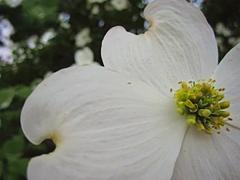
Yesterday I noticed a dogwood tree in full bloom, the first blooming dogwood I have seen this year. The sight of it did my heart good, because it reminded me that some simple and beautiful things remain. They return every year. They mark a season. They grow, and their blooms become ever more vibrant, or so it seems.

The dogwood has its own story, a lovely legend that explains the tree’s qualities. The legend holds that the tree was once very large, like a Great Oak tree, and because its wood was strong and sturdy, it provided building material for a variety of purposes. According to the story, it was the dogwood tree that provided the wood used to build the cross on which Jesus was crucified.

Because of its role in the crucifixion, it is said that God both cursed and blessed the tree. It was cursed to forever be small, so that it would never grow large enough again for its wood to be used as a cross for a crucifixion. Its branches would be narrow and crooked — not good for building at all. At the same time, the tree was blessed so that it would produce beautiful flowers each spring, just in time for Easter. The legend says that God it is gave it a few traits so that whoever looks upon it will never forget. 

81189983-8ADE-4D60-9088-C52DA3983583The petals of the dogwood actually form the shape of a cross. The blooms have four petals. The tips of each of the petals are indented, as if they bear a nail dent. The hint of color at the indentation bring to mind the drops of blood spilled during the crucifixion.
8DEA0FBE-8A3E-4AF8-8142-DA825CA72359


Diana Butler Bass tells the story like this:

There’s an old southern legend that dogwoods grew in Jerusalem — and that one gave its wood for Jesus’s cross. Because of this, the dogwood was cursed (its short stature a ‘punishment’ for being the wood of death) but it also became a blessing. Blessing? For on each twisted branch burst forth petals of lightness and light.

So let’s leave the dogwood’s story and look at our stories — your story and my story. People often use the term “storied past.” Well, a storied past is something all of us have.

In talking with a friend a few days ago, I asked, “How is your heart?” She began to tell me her story, which was a long and winding one that included many mini-stories — happy ones snd sad ones — from her life’s journey. Toward the end of her story, she said, “I feel as if I am cursed by God.” That was her bottom line answer to my question, “How is your heart?” Hers was an honest, heartbroken response that instantly revealed that her heart was not all that good, but that was a critical part of her story.

If you and I are honest, we will admit that our hearts were broken and hurting at several places in our stories. Recalling our brokenhearted times is something we always do when we tell our stories, and it’s an important part of the telling. My story and yours is never complete if we leave out the heartbroken moments, for at those points, what feels like God’s curse almost always transforms into God’s grace.

If not for our heartbroken moments, the hurting places in our hearts might never “burst forth with lightness and light.” Our heartbroken moments change us and grow us. They set us on better paths and they embrace our pain with grace. Our heartbroken moments give us pause, and in that pause, we find that once again, our hearts are good. Our broken hearts are once again peaceful hearts — healed, restored, transformed, filled with God’s grace.

How is your heart? That is a question we would do well to ask ourselves often, because languishing with our heartbreak for long spans of time can cause our stories to be stories mostly of pain. Instead, stop right here in this post for just a few moments and ask yourself, “How is my heart?”

48BB4DCE-068F-4CC2-B1D0-A6B95549B35D

Your answer may well be your path to a contemplative, sacred pause that can become a moment of healing, a time for God’s grace to embrace whatever is broken in your heart and to transform it into love, light and hope. So don’t be afraid to look into your heart when pain is there. In looking, you may find reasons, many and and complex, that are causing deep pain and brokenness. You may also find the healing touch of the Spirit of God waiting there for you and offering healing grace — a Godburst of new hope.

May your story be filled always with times when your was light with joy and times when your heart was broken with loss, mourning, discouragement, disappointment. Both create your extraordinary story — the joyful parts and the sorrowful parts. So tell your story again and again to encourage yourself and to give the hope of God’s healing grace to all who hear it.

I remember a beloved hymn that is a prayer for the Spirit of God to “descend upon my heart.” May this be your prayer today.

Spirit of God, descend upon my heart;
Wean it from earth; through all its pulses move.
Stoop to my weakness, mighty as Thou art,
And make me love Thee as I ought to love.

Hast Thou not bid me love Thee, God and King?
All, all Thine own, soul, heart and strength and mind.
I see Thy cross; there teach my heart to cling:
Oh, let me seek Thee, and, oh, let me find!

Teach me to feel that Thou art always nigh;
Teach me the struggles of the soul to bear,
To check the rising doubt, the rebel sigh;
Teach me the patience of unanswered prayer.

Teach me to love Thee as Thine angels love,
One holy passion filling all my frame;
The kindling of the heav’n-descended Dove,
My heart an altar, and Thy love the flame.

Awakening, Awareness, Beauty of Nature, Bondage, Change, Contemplation, Creation, Creativity, Emotions, Feelings, God's presence, Grace, Hemmed in, Here I am, Lord., Holy Ground, Holy Spirit, Hope, Insight, Inspiration, Introspection, Isolation, Loneliness, Mystery, Psalm 139, Sacred Pauses, Sacred Space, Soul, Spirit, Transformation, Walls, Wisdom, Writing

Hemmed In!


There are large scale, widespread forces that can trap thousands of people, even millions. Dachau, Katrina, earthquakes, tsunamis, wildfires, natural disasters all over the world and the Coronavirus of 2020. Enormous, catastrophic events can trap people. COVID19 has literally trapped me inside my home. I have to admit, the isolation has taken a toll on my spirit. No visitors! No visits with friends or family. No trips! No haircuts! I have been trapped at some level since my kidney transplant in November. Just at the March milestone that would have allowed me to break the isolation of the transplant, I was even more fully trapped by the infectiousness of this pervasive, unrelenting virus.

Being trapped for so many months has raised up in me feelings of loneliness, isolation, powerlessness, despair, anxiety, even abandonment. And yet, often there is something very good in the center of something very bad. It has been so for me. Yes, I feel trapped in the pervasive power of the coronavirus, but I also sense the arms of God and the embrace of Spirit hemming me in even further. Such a grace-gift it has been to me, as if God has said, “l am hemming you in, and in this space you will hear me clearer and sense me more fully.”

God’s words were truth. Hemmed in, my mind flourished, my heart leapt and my soul entered spaces of calm. I felt enhanced awareness! Even awakening. I saw nature in a different way and basked in the beauty of the rising sun. The sound of the hummingbirds’ trill and the rapid fluttering of their translucent wings were sounds meant just for me. I began to write and paint, to listen more carefully to God’s voice, to allow my spirit to overflow with Holy Spirit. To my hemmed-in call from God, I was compelled to answer, “Here I am, Lord!” When I finally answered God, my hemmed-in place became Holy Ground — a very good place to be that feels more like a holy mystery than a state of being.

Was this pandemic a good thing for me and for millions of people? Absolutely not! But trapped in its dark cloud, God hemmed me in further in ways I am just now beginning to understand. I can say with all honesty that being hemmed in by God has been grace to me.

If I could even begin to choose a favorite Psalm from among the many that inspire me, I would choose Psalm 139. In its weaving of words, there are many passages that are full of comfort. From childhood, I memorized a lot of Scripture and throughout Psalm 139 I memorized several snippets that I often call to mind. One verse that I did not memorize is verse 5: “You hem me in behind and before, and you lay your hand upon me.”

You have searched me, Lord,
and you know me.

You know when I sit and when I rise;
you perceive my thoughts from afar.

You discern my going out and my lying down;
you are familiar with all my ways.

Before a word is on my tongue
you, Lord, know it completely.

You hem me in behind and before,
and you lay your hand upon me.

— Psalm 139:1-5 NIV

I deplore the coronavirus and what it has done to so many people. I deplore the ways it was able to trap me, physically and emotionally. But the virus, with all its ominous, far-reaching force could not trap me spiritually. That was God’s work — hemming me in so that my spirit could rise to fresh, new heights of spiritual consciousness. Being hemmed in by our Creator has been grace for me in these days of isolation. It has become a transforming sacred pause. For in my hemmed-in space, the Creator helped me create — from my mind, from my heart, from my soul. Thanks be to God.

Activism, Ahmaud Arbery, Anger, anxiety, Art, Beloved Community, Brokenness, Change, Comfort, Community, Community activism, Conflict, Courage, Death, Despair, discouragement, Division, Emotions, Exhaustion, Fear, Freedom, Friendship, George Floyd, grief, Hate, healing, Heartbreak, Holy Spirit, Injustice, Nonviolence, peace, Pentecost, Perseverance, sadness, Sorrow, Spirit, Spirit wind, struggle, Together, Violence, White supremacy

Together!

74F3F032-5117-4474-98A7-A2171243B45E
A blending of two photos: One is an image of protesters in Minneapolis. The second image is a portrayal of people raising their hands to celebrate Pentecost.

This morning I have no words. I have tears. I have sadness. I even have some anger that the people I love whose skin is not “white” are living in grief and frustration. I say only that injustice and oppression cling so close to my friends, today and in centuries past.

F0ABFCC6-C312-44E2-A39F-35F520174256I hear my dear friends cry out for justice. I hear them using words to make sense of it all, and I hear their voices fall silent. Silent, with just these words, “I’m tired.” A dear friend posted the words on the left this morning. I want to see her face to face. I want to be together. I want to comfort her, hoping beyond hope that it is not too late for comfort.
I read this horrific headline this morning.

Prosecutors in Hennepin County, Minnesota, say evidence shows Chauvin had his knee on Floyd’s neck for a total of 8 minutes and 46 seconds, including two minutes and 53 seconds of which Floyd was non-responsive.   — ABC News

99398631-7958-42F7-9F51-718EE1C289DD
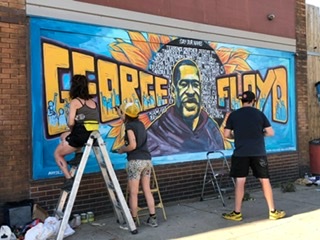
Artists honor George Floyd by painting a mural in Minneapolis on Thursday, May 28, 2020. Artists began work on the mural that morning. (Photo: Jacqueline Devine/Sun-News)

Today I find myself deeply in mourning for the violence that happens in our country. I find myself trying to share in the grief of my friend and knowing I cannot fully feel the depth of it. Today I find myself unable to emotionally move away from it all. Today I contemplate George Floyd’s cry, “I can’t breathe.”

If there is any comfort at all, it comes as a gift of the artists pictured here. In an act of caring, they offer this mural at a memorial for George Floyd.

The names of other victims of violence are painted in the background. The words, “I can’t breathe!” will remain in our memories. Today we are together in mourning.

But tomorrow, I will celebrate Pentecost. I wonder how to celebrate in a time when lamentation feels more appropriate. I wonder how to celebrate when brothers and sisters have died violent deaths and when thousands of protesters line the streets of many U.S. cities. I wonder how to celebrate when protesters are obviously exposing themselves to COVID19.

Still, tomorrow — even in such a time as this — I will celebrate the breath of the Spirit. Tomorrow I will join the celebration that has something to do with being together, being one. To juxtapose the joyous celebration of Pentecost with the horrible picture of what we saw in cities throughout our country for the past few nights seems an impossible undertaking. What does one have to do with the other?

Perhaps they do share a common message. From those who protest, this message:

“We bring our broken hearts and our anger for the killing of our people, for the murders across the ages of people who are not like you. You treat us differently than you treat the people who look like you. For as long as we can remember, you have visited upon us oppression, slavery, racist violence, injustice. And we are tired. We are spent. We are beside ourselves with collective mourning. We can’t breathe!“

From those who celebrate Pentecost, this message:

18bbdca6-8ece-4df4-aa13-fe110e3298cb“How we celebrate the day when the Holy Spirit breathed upon those gathered together, with gifts of wind and fire!

How we celebrate the story told in the 2nd chapter of Acts!”

When the day of Pentecost came, they were all together in one place. Suddenly a sound like the blowing of a violent wind came from heaven and filled the whole house where they were sitting.

They saw what seemed to be tongues of fire that separated and came to rest on each of them. All of them were filled with the Holy Spirit and began to speak in other tongues as the Spirit enabled them.

Now there were staying in Jerusalem God-fearing Jews from every nation under heaven. When they heard this sound, a crowd came together in bewilderment, because each one heard their own language being spoken. Utterly amazed, they asked: “Aren’t all these who are speaking Galileans? Then how is it that each of us hears them in our native language? Parthians, Medes and Elamites; residents of Mesopotamia, Judea and Cappadocia, Pontus and Asia, Phrygia and Pamphylia, Egypt and the parts of Libya near Cyrene; visitors from Rome (both Jews and converts to Judaism); Cretans and Arabs—we hear them declaring the wonders of God in our own tongues!” Amazed and perplexed, they asked one another, “What does this mean?”

Some, however, made fun of them and said, “They have had too much wine.”

Then Peter stood up with the Eleven, raised his voice and addressed the crowd: “Fellow Jews and all of you who live in Jerusalem, let me explain this to you; listen carefully to what I say. These people are not drunk, as you suppose. It’s only nine in the morning! No, this is what was spoken by the prophet Joel:

“‘In the last days, God says,
I will pour out my Spirit on all people.

Your sons and your daughters will prophesy, last days, God says,
your young men will see visions,
your old men will dream dreams.

Even on my servants, both men and women,
I will pour out my Spirit in those days,
and they will prophesy.’”   —
Acts 2:1-18 NIV

The people did not, in fact, have too much wine. Peter made it clear that wine did not empower the people who gathered in Jerusalem —  “every people under heaven” — to speak and understand as they heard every word spoken in their own language. That would be a start, would it not, if we could speak the same language and truly understand — people who have flesh-colored skin, and brown and bronze, and red and black . . . every skin color under the sun. If only we could understand each other.

And then, what if we could gather together, welcoming every person? What if we could truly gather together and wait for Spirit to fall upon us with empowerment like we have never known before? What if we allowed the Spirit to give us breath, together?

41F5FD83-6B7A-4393-BF9E-57F0E4D51023In the end, there is a tiny bit of joy in George Floyd’s tragic story. It is a joy much deeper than reality’s sorrow. The artists completed their mural, and in the very center near the bottom, they had painted words that express the greatest truth of all.
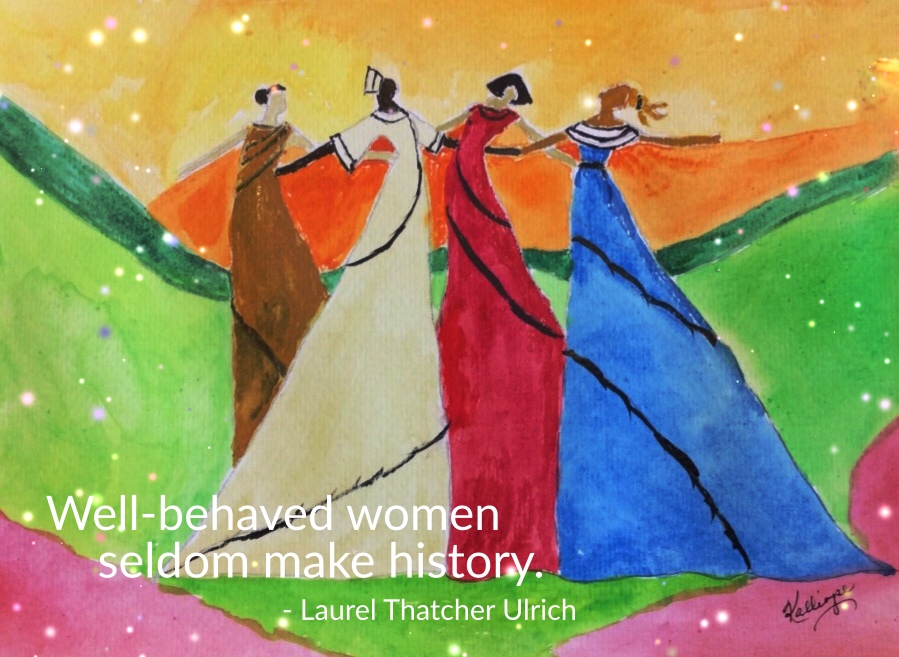
Can you see it behind the little girl? “I can breathe now!”

What if we welcome Spirit Breath that will change us? What if we embrace empowerment from the Holy Spirit to help us change our world? What if we end oppression and injustice, together? What if holy perseverance could inspire us to live and act in solidarity with our sisters and brothers, all of them?

What if we dare to give our soul’s very breath to help bring about Beloved Community, together?

Together! Together!

May my God — and the God of every other person — make it so. Amen.


Beginning again, Bravery, Calling, Challenge, Compassion, Courage, Dangerous and noble things, Discernment, Following Christ, Holy Spirit, Insight, Inspiration, journey, Kidney Transplant, Life Journeys, mercy, Passing years, Pondering, Questions, Repairing broken things, Spirit, Spirit wind, Urgency, Weeping

As Though I Had Wings


D112A977-1A19-4123-9462-5BCE716692F9


I want to think again of dangerous and noble things.
I want to be light and frolicsome.
I want to be improbable beautiful and afraid of nothing,
as though I had wings. [1]

I am continually inspired by Mary Oliver’s poetry, today by her phrase, “as though I had wings.” In the past six months or so — since my kidney transplant — I have felt a little wing-less. Not so unusual, because a transplant — before, during and after — is a rather big deal, like a super colossal deal! If I ever thought the enormous physical challenge would be the surgery itself, I was wrong. I think I deluded myself on that. The aftershocks of the surgery proved to be enormous and enduring. Hence, my lack of wings.

Everywhere, one can see eloquently expressed promises of wings. You and I can “mount up with wings as eagles”[2] or “take the wings of the morning.” [3]  There is even a wing promise that God will “raise you up on eagle’s wings.” [4]

I know the promises and I love them, but I also love how poet Mary Oliver brings it all down to where I live — on shifting sands in an ever-shifting world. She expresses it like this: “I want to think again of dangerous and noble things . . . to be improbable beautiful and afraid of nothing, as though I had wings.” [5]

All of a sudden, I have a critical assignment, something I must do myself and for myself. It seems to me that I must start by focusing on my mind, thinking again of things noble and dangerous. Then I must allow my mind (my will) to move through my heart and soul, to the very center of my being, because there is the place inside me where dangerous acts are weighed and noble acts can become resolve. In one of the common phrases of my faith — an admonition I heard in church over and over again — a pastor or teacher would say, “count the cost.”

Here’s where I am honest. So I must admit that doing noble things has seemed impossible for me in the past few years. Prior to my illness, my life was a constant journey of determining the danger of noble things and doing them anyway. I miss the life of being a pastoral presence to a dying patient. I miss keeping vigil in the ER family room with grieving parents mourning the death of a child. I miss offering a memorial service  for a dear congregant and friend. I miss comforting victims of sexual assault as police officers question them, sometimes brusquely and accusingly. I miss trauma counseling with persons who have endured horrific emotional and physical trauma. I miss forensic interviewing even the youngest child victim of abuse. I miss standing firm as a court advocate for child victims of sexual abuse. I even miss being thrown out of the courtroom by a persnickety judge who did not appreciate the intensity level of my advocacy.

I miss it all. It was dangerous. All of this work was dangerous and it was noble. I could do it because of wings — the wings God gave me when I determined I would do dangerous and noble things and do them with urgency.

What about now, this season of my life? What am I doing that’s dangerous and noble? Should I even expect to be able to face danger at my age, with my physical limitations? Last night, a friend listened to me list all the things I cannot do when very intently she interrupted me and asked, “Kathy, what can you do?” She continued, as she so often does, “Your life is not about the things you can’t do. It’s about the things you can do!”

She nailed it. Perhaps she even nailed me, albeit with some gentleness. So I have to sit awhile with that provoking question: “What can you do?” I have to sit with that question with God close by to guide me and Spirit near to remind me of Spirit-wind and Spirit-fire. I am not precluded from Spirit-wind because of age or Spirit-fire because of physical limitations. It is up to me to discern what I need in my life right now. Will I be satisfied with what I have done in the past and let myself off the hook? What dangerous and noble things will I take on?

I cannot help but think of so many nurses and doctors who are caring for persons with COVID19 — how they enter the ICU knowing that a deadly virus is there, believing that they could take the virus home to their families. Dangerous and noble! Somehow, Spirit-wind is raising them up for the task.

I wonder if you have thought about this for yourself, considering the cost of doing dangerous and noble things. Have you considered that the things you are already doing — feeding the poor, caring for the sick, taking a meal to an elderly person sheltered alone in her home — are all dangerous and noble things? That you show mercy to others as you go? That you weep for a broken world with so many broken people in it? That you share in Christ’s compassion?

“Dangerous and noble things! Afraid of nothing as if we had wings!” [6]

I’ve given all of this a lot of thought and I think we might get our wings after we have made the determination to give ourselves to noble things, no matter the danger. I think we get wings when we move to the urgency of Christ’s compassion, when our rhythms begin to emulate the rhythms of God. I think we get wings when we have determined in our hearts and souls to act — after we have counted the cost and have said “Yes!”

Again, the eloquence of the poet may most fully express my deepest longing and yours.

I want to be improbable beautiful and afraid of nothing,
as though I had wings . . .

What I want in my life
is to be willing
to be dazzled—
to cast aside the weight of facts
and maybe even
to float a little
above this difficult world. [7]

May God make it so for us.


1 Mary Oliver, Owls and Other Fantasies: Poems and Essays
2 Isaiah 40:31
3 Psalm 139:9
4 “On Eagles Wing’s” composed by Michael Joncas
5 Starlings in Winter, a poem by Mary Oliver
6 Mary Oliver, Owls and Other Fantasies: Poems and Essays
7 The Ponds, a poem by Mary Oliver

Bondage, Bravery, Call, Calling, Courage, Dancing, Following Christ, Holy Spirit, Inner joy, Mechthild of Magdeburg, Mystic, Singing, Spirit

A Very Unruly Woman of God

228BEA2D-360B-4749-994C-F28F1D756B13
Watercolor by Kathy Manis Findley

She described herself as an unruly woman of God — Mechthild of Magdeburg. “I want also to circle higher still,” she wrote in one of her mystical poems. She had her first vision of the Holy Spirit at the age of twelve. As a young woman, she left her home and “renounced worldly honour and worldly riches.” She was an ascetic, a writer and a mystic who viewed God’s will in unorthodox ways. Her criticism of church dignitaries for religious laxity and claims to theological insight aroused so much opposition that some called for the burning of her writings. Her words seemed to have kept her in deep trouble!

Her story reminded me of Sue Monk Kidd’s book, “The Dance of the Dissident Daughter,” a book that set me on a pilgrimage in 1996 that changed my life. This was a book that screamed out to me, “Find your own soul! Nourish it! Protect it! Bind it closer to God’s soul and, for the first time, live out God’s call to you!”

Sue Monk Kidd said this as she reflected on writing the book’s first edition:

“The Dance of the Dissident Daughter” sparked heated, sometimes scathing reactions, including public accusations of heresy, boycotts of my lectures, and a plethora of derisive letters in my mailbox. One of the more memorable began: Dear Whore of Babylon. It was the “Dear” part that made is so indelible.

This statement rings true when I contemplate the life of Mechthild of Magdeburg. Before we get back to her, though, let’s look for a moment at The Dance of the Dissident Daughter, the book that left me with these nuggets of wisdom I will always hold close.

How many times have I denied my innermost wisdom and silenced this voice? How many times can a woman betray her soul before it gives up and ceases calling to her at all?

We must wake up, journey, name, challenge, shed, reclaim, ground, and heal.

When someone tries to put you back into a box from which you’ve already escaped, you might recall a line from the Indian poet Mirabai. She said, “I have felt the swaying of the elephant’s shoulders and now you want me to climb on a jackass? Try to be serious!}

As women we have a right to ask the hard questions. The only way I have ever understood, broken free, emerged, healed, forgiven, flourished, and grown powerful is by asking the hardest questions and then living into the answers through opening up to my own terror and transmuting it into creativity. I have gotten nowhere by retreating into hand-me-down sureties or resisting the tensions that truth ignited.

The main thing is to stop struggling and nourish yourself. When you nourish yourself, your creative energy is renewed. You are able to pick up your lyre again and sing.

— Sue Monk Kidd, The Dance of the Dissident Daughter

Yes! Sing, and even dance your dissident dance! Your song may sound to all those around you like a revolutionary song, discordant to their ears. Your dancing may scandalize your observers. Still — Sing! Dance! — to the stirrings of Spirit within you!

2869C069-C448-475D-87A3-447D55A041B6That’s exactly what Mechthild of Magdeburg did and the religious world labeled her unruly. In her book, Das fließende Licht der Gottheit (The Flowing Light of Divinity), she described her visions of God. She could not read and write in Latin, but she is known for being the first mystic to write in German. Her confessor, Heinrich von Halle, finally persuaded her in 1250 to write down her visions and spiritual experiences. She did this in her own hand, in the conviction that it was God’s will.

By 1270, six of the seven books of the “Flowing Light” were brought to parchment, collected and given chapter titles by Heinrich. Mechthild saw her book as a message to both believers and clergy, for she feared the church was in danger of being hollowed out from within; she called the powerful church officials, who often enjoyed worldly luxury, “stinking billy-goats.”

Thus, Mechthild was known as a very unruly woman of God — a defiant, dissident and radical rebel! “Stinking billy-goats!” No wonder she became known for her “rebelliousness and unorthodox ways.” The community she was a part of, the Beguine order, was known for the same kind of unorthodox rebelliousness. 

The Beguine order was a Christian religious movement active in Northern Europe during the 13th-16th centuries. The Beguines were women who lived as nuns in semi-monastic communities. Through their intense devotion to God and their somewhat ascetic lifestyle, they came to be known for their acts of rebellion and their unorthodox ways.

99AF81A9-35CC-43E5-A641-B19170914765
Watercolor art: 2019; by Kathy Manis Findley

Mechthild of Magdeburg definitely danced to her own music!

With her order, she was part of a great spiritual revival movement of the thirteenth century, a time when the Catholic Church was falling into disfavor. The Beguines sought to imitate the life Christ through voluntary poverty, care of the poor and sick, and religious devotion.

With advancing age, Mechthild was blind. She was alone, still the object of much criticism. With singing silenced and dancing impossible, she was left to sing songs in her heart and dance the dances of her imagination, always seeking Spirit promptings.

Some scholars have speculated that, due to increased persecution and failing health, Mechthild was forced to retire to the convent of Helfta around 1270. There, she met three other notable writers of the time, Gertrude of Hackeborne, Mechthild of Hackeborne, and Gertrude the Great. Helfta was a good place for a writer such as Mechthild. Under the leadership of Gertrude of Hackeborne, Helfta had become a hub of learning and writing for women and a center for book collecting, copying and illumination.

Still, Mechthild portrayed herself as a reluctant writer urged on by God and her director to continue her work. She calls her director “my dear schoolmaster,” who taught her, “simple and stupid as I am, to write this book.” About the urging of God she said, “I cannot nor do I wish to write “unless feeling the power of the Holy Spirit.” At one point, Mechthild wondered why God did not choose a priest rather than herself for this work, and she is told that God always seeks out the lowest and smallest so that “unlearned lips can teach the learned tongues of the Holy Spirit.”

In spite of the fact that Mechthild was unable to read and write in Latin, these are some powerful quotes by the graceful mystic Mechthild of Magdeburg, from her book Das fließende Licht der Gottheit (The Flowing Light of Divinity), where she describes her visions of God.

The day of my spiritual awakening was the day I saw and knew I saw all things in God and God in all things.

If you love the justice of Jesus Christ more than you fear human judgment then you will seek to do compassion. Compassion means that if I see my friend and my enemy in equal need, I shall help them both equally. Justice demands that we seek and find the stranger, the broken, the prisoner and comfort them and offer them our help. Here lies the holy compassion of God that causes the devils much distress.

From suffering I have learned this: that whoever is sore wounded by love will never be made whole unless she embraces the very same love which wounded her.

A Light of utmost splendor glows on the eyes of my soul. Therein have I seen the inexpressible ordering of all things, and recognized God’s unspeakable glory — that incomprehensible wonder — the tender caress between God and the soul . . . the unmingled joy of union, the living love of eternity as it now is and evermore shall be.


I cannot dance, Lord,
unless you lead me.

If you want me to leap with abandon,
You must intone the song.

Then I shall leap into love,
From love into knowledge,
From knowledge into enjoyment,
And from enjoyment
beyond all human sensations.

There I want to remain,
yet want also to circle higher still.

— Mechthild of Magdeburg

Like her, I want to “circle higher still.” I want to escape from chains that shackle the highest expression of my spirit. I want to sing the songs God placed in my heart! I want to dance to the Spirit’s rhythm hidden in my spirit!

6480931C-BB7C-4745-8CBC-1D2C70C6B09E
Acrylic art by Kathy Manis Findley

Without fear! Without fear . . .

taking the journey set before me to follow Christ into places of poverty, fear, sickness, desperation. Breaking the rules if I must. Taking criticism if I must. Being persecuted if that is in the cards for me. I want to move forward into my calling with the Spirit of God upon me . . .


The Spirit of the Lord is upon me,
because he has anointed me
to bring good news to the poor.

He has sent me to proclaim release to the captives
and recovery of sight to the blind,
to let the oppressed go free.

 — Luke 4:18 New Revised Standard Version (NRSV)

May God make it so for us. Amen.


Awakening, Dancing, Discernment, Discovering, Freedom, God's presence, Holy Spirit, journey, Life Journeys, Morality, New Life, peace, Pilgrim, Pilgrimage, Self Awareness, Singing, Soul, Spirit wind, Spiritual awakening, Stories, Transformation, Walking peacefully, wind

Walking Peacefully

BC2C5B3D-EFB1-4535-9D46-B4D8A9DB76F3
People say walking on water is a miracle,
but to me walking peacefully on earth is the real miracle.

Thich Nhat Hanh

Those words ring so true, but how does one realize “the real miracle?” “Walking peacefully on earth” is much harder than it sounds, much more challenging than it ought to be, at least for most of us. Some have poetically said that walking on earth is our pilgrim journey, and I believe that many people feel that they are walking a pilgrim journey.

In his book, The Pilgrim Journey: A History of Pilgrimage in the Western World, James Harpur asserts that we are now in a new era of pilgrimage and asks: “Why is pilgrimage coming back, especially in a time when many people are questioning traditional religion?” Harpur’s answer is that in these days, there seems to be a deep longing in humans for this form of spiritual practice.

As for me, pilgrimage and journey are very real descriptors of my life. I have often set out on one journey or another, not knowing where to go, only that my soul needs the journey. I am captivated by Harpur’s book, by his tracing the history of why countless people through the ages have embarked on spiritual pilgrimages, by his many stories of pilgrimage through the ages and by his examples of why journey is so relevant to today’s pilgrims. Harpur writes:

If that is done, the destination — a shrine, a holy mountain, or a house of God — will signify not the end of the journey, but the start: a gateway into a new way of being, of seeing life afresh with spiritually cleansed eyes.What is essential is that the journey, by whatever means it is accomplished, gives the pilgrim enough time to expose himself or herself to the possibility of a sacred metamorphosis.

Nothing seems more important to me than seeing my life afresh “with spiritually cleansed eyes.” But getting there is a long process, a journey.

3BCA9FAD-8CD2-4B6A-B300-6609E1318379Walking peacefully on earth requires my full resolve and my desire to reach that place in life. Wouldn’t any of us want to experience transformation and the freedom to be? Wouldn’t any of us want to experience a sacred metamorphosis?

Certainly, it is a long process, a long journey. There are many steps along the way that each person must determine in order to persist on the pilgrimage. There are divergent paths and rough roads and thorny ways and threatening obstacles. Though choosing the path is personal, the graphic at the top of his post illustrates a set of steps we could possibly choose for ourselves. If I chose to take those steps, it would look like this:

First, I must learn to cry again. Crying is very hard for me, as if I dared to cry, my crying might go on forever. Yet, crying is a part of cleansing the soul, and as the quotation says, there is an importance to flowing and finally letting go. Secondly, I need to accept that within me, there is fire and that I must not be afraid to let it burn. I think I must face the flame, adapt and re-ignite my inner fire. Thirdly, I must to open myself up to refreshing air — observe it, breathe it, focus and then decide whatever I need to decide.

The quote also says “remember that you are earth” and ground yourself, give, build and heal. Finally, “remember that you are Spirit” and care for your inner core so that you can connect, listen, know yourself and be still. It’s quite a lesson — a new way of seeing myself — and perhaps it is the way I must journey if I want to walk peacefully on the earth. In these days when peace is in short supply, when nations refuse to beat their swords into plowshares, when political rivals use hate speech against one another, it is so important that peace dwells within my soul.

In the end, all of us long for what James Harpur calls sacred metamorphosis. We all want to realize the miracle of walking peacefully. We want to walk peacefully in our souls. We want to walk peacefully with others. We want to walk peacefully in our families. We simply want to walk peacefully — hand in hand with God and moved by Spirit. We want the choice to walk or to be still, to run or to leap, to breathe or to hold our breath when we kneel before wonder. We want to have the freedom to speak and shout and sing and dance . . . and truly live. That is the miracle!


Adventures, Awareness, Change, Contemplation, Exploration, Grace, Growth, Holy Spirit, Introspection, Life Journeys, Life pathways, Meditation, New Life, Reflection, Spirit wind, Transformation

Uncreated Grace

AA19F30F-F0BC-46B3-9F62-E084BF61258A

I have been reflecting on a phrase I read this morning in Father Richard Rohr’s meditation— Uncreated Grace. It is an intriguing phrase and makes me wonder why I received it at this particular time and place on my journey. I have had a very long journey — many miles of life —- and, in fact, there have been many other forks on the path that seem more sacred places to contemplate uncreated grace. But here it is, today, brought to me at this place on my journey.

As I did some processing on this phrase, I thought of one of my dear friends from ages past, seminary days to be exact. Often, he would share his favorite quotes. This was one of them, an intriguing and thought-provoking quote. This quote always stayed in his favorites file. It hints at a long journey we all must take . . .

We shall not cease from exploration
and the end of all our exploring
will be to arrive where we started
and know the place for the first time.

— T. S. Eliot

We were always left with the question “What do T.S Eliot’s words mean?” Sitting in small groups, the seminarians discussed but never reached an answer, to the question. I imagine that, like me, some of them took the words along with them on their journeys, hoping to discover the meaning at some place of enlightenment on their path.

On my journey, Eliot’s words came to mind many times. Never quite discovering a finite meaning, I did discover infinite applications that touched my life in ways simple and profound. Most always, I came away from reflecting on the words to a better place inside myself and a better space in my world. Still, I wonder why these T.S. Eliot words were brought to my mind today.

The power in these words, I think, is that they are not a directive, not a call to mission, not words of piety, not gleaned from scripture. They are words meant to be understood individually rather than offering a universal message. I identify these words as an invitation, and so today I am left alone with them to intentionally create space for reflection and understanding.

When I do that, I hear many, many other words from different places — from scripture, hymn, poetry, prose and from within myself. It feels like a Spirit encounter, the presence of “another comforter” who will be with us forever, who will, as Jesus promised, “teach you all things, and bring to your remembrance all that I said to you.”

Spirit teaches us and helps us remember. Spirit grounds us so that our circuitous journey will not frighten us. We are free to never “cease from exploration,” because we are comforted to know that we will “arrive where we started . . .”

9889AA3B-16BB-4F9F-9B56-D883A74A49AEAnd know the place for the first time . . .

When the journey leads us back to where we started, how is it that we “know the place for the first time?” I urge you to not take my interpretation as the correct one, because I believe that a “correct” interpretation comes from the soul of each person who chooses to explore. But here is an understanding based on my own musings . . . we can take what comes in our lives, or we can explore places on the journey — our encounters, our joys and sorrows, our events and calamities, our crises and emotions, our disappointments and betrayals, the chance and the wonder.

For me, there is no doubt that exploring all of these life events brings that sense of getting back to the beginning and truly knowing the place for the first time, not necessarily because the beginning place has changed, but that I have changed. The Spirit’s holy breath transformed me with gentleness again and again, transformed by the blowing of Spirit wind into my being.

Father Richard Rohr says that “the Holy Spirit is never created by our actions or behavior. It is naturally indwelling, our inner being with God. In Catholic theology, we called the Holy Spirit “Uncreated Grace.”

How I love those words . . . Uncreated Grace! Perhaps that’s what we all hope for in our explorations on the journey — that in us and through us, there is Uncreated Grace. If we present to the Spirit our selves as uncreated grace, I wonder if Spirit then creates grace within us again and again and again, all along the way. If we never cease from exploration, presenting ourselves as uncreated grace, the Holy Spirit will breathe on us and we will be transformed!

No wonder we know the place where we started for the first time! The place hasn’t changed, we have changed, transformed in our deepest places!

Thanks be to God and to the touch of Spirit breath. Amen

Change, God's presence, Holy Spirit, Inspiration, Pentecost, Quiet, Rebirth, Repair the world, Sacred Space, Silence, wind

Who Has Seen the Wind?

5D279BA7-5431-4872-93DC-BDF5BFA11178

. . . And the wind? Ah, who has seen the wind go by? Neither you nor I. But when we see the trees bow down their heads, we know the wind is passing by. That is the way the Holy Spirit works: silently and effectively. *

There was never a more needful time for the fresh winds of the Holy Spirit. We inhabit a world divided . . . nations divided by tenuous agreements; white people divided from brothers and sisters black and brown; people of faith divided by differing traditions; immigrants divided from those who claim to “own” this nation; citizens divided from their president; politicians divided by ideology, greed and self-interest. There are so many examples of division. And whether we will admit it or not, division diminishes us.

The divisions among us — the ones we personally experience and the ones we observe — create an unsettled environment around us and an unsettled spirit within us. The acrimony, the hate and the disrespect we witness all around creates an unrest in us. Perhaps, from the weariness of the constant hostility we see, our heart becomes hardened. Perhaps we are closed off from the Spirit Wind that fills us and creates in us rebirth, fresh and new.

We can never think of wind without recalling the day of Pentecost. The disciples of Jesus and other followers were gathered together when a rushing, mighty wind filled the entire house, and all of them were filled with the Holy Spirit. (Acts 2:1-4) That day was the beginning, and from that day when Spirit Wind came, the holy promise came into view: that God would pour out the Spirit on all people, that sons and daughters would prophesy, that some would have visions and others dreams.

We need it again, the Spirit Wind. We need it to fill us with courage for the living of these days. We need it to fill us with love that can change the world. We need it for the will to save our planet from devastating climate change. We need it to responsibly open our borders, to become again a nation of welcome, to reach out our hands to sojourners searching for safe refuge, to rescue children from the unwelcoming places where they are detained and kept from their parents. We need it to repair the world in all the ways possible to us, to repair its brokenness.

To become God’s people in a broken world, we need the wind of the Spirit. Now.

But how does Spirit Wind come in these days? I have heard of no “Pentecostal” experiences of rushing mighty wind. I have heard of no one who has seen a sudden whirlwind. (1 Kings 19:11)  I do not know of a person who saw the winds cease at the command, “Peace. Be still.” (Mark 4:39)

So how does the Spirit Wind come? I can share only what I know from my own experience, and that is this: when I am very still and very present with God, the Spirit comes quietly, gently — but surely. I do not see her. I do not hear her come with any sound of rushing wind. I cannot touch her. Yet I feel her, covering me, filling me, empowering me. I go away with that sense of being reborn and renewed, like I might be “born from above.”

2CE74B96-9488-4F0B-81B2-69824F5EAEC8
Art by Charlotte Nickel, “Mighty Rushing Wind,” acrylic on canvas.

You know well enough how the wind blows this way and that. You hear it rustling through the trees, but you have no idea where it comes from or where it’s headed next. That’s the way it is with everyone ‘born from above’ by the wind of God, the Spirit of God.

— John 3:8 (The Message Bible)


*From the Carmelite Bulletin, Carmel of Saint Teresa of Jesus, Little Rock, Arkansas, “Who Has Seen the Wind?” Christina Rossetti – 1830-1894


*******************************************************

On another note . . .

Please pray for me as I await a life-saving kidney transplant. I am grateful that you are walking with me on this journey that often feels so frightening. Your thoughts and prayers mean so much. If you would like to read the story of my illness, please visit the Georgia Transplant Foundation’s website at this link:

http://client.gatransplant.org/goto/KathyMFindley

A “Go Fund Me” page is set up for contributions to help with the enormous costs related to the transplant, including medications, housing costs for the month we have to stay near the transplant center, and other unforeseeable costs for my care following the transplant. If you can, please be a part of my transplant journey by making a contribution at this link:

https://bit.ly/33KXZOj


Hate, healing, Holy Spirit, Hope, Love, Prayer, Racism, Spirit wind, Wisdom

Come Now, Spirit of Power!


CE768FCC-723B-4F8F-B86A-D871B338B1E7

Come now Spirit of power.
Come now quickly and seize this moment.
Come Spirit from all four sacred directions,
from every color and culture,
come and use this sorrowful moment for good.

Very often, the prayers of Bishop Steven Charleston become a part of my meditation time. His prayers have a way of calming my heart, comforting my spirit and inspiring me to greater works. His words are expressive and full of energy. He paints pictures of things as they are and things as they should be.

In response to the tragedies in El Paso and Dayton, Bishop Charleston speaks of the deep divisions in our nation and the old wounds that have been opened. Indeed. He is right. But then he calls us to better things, to a time for love that has the power to heal.

So let us pray this prayer today, in this moment, as we long for healing.

Come now Spirit of power, come now quickly and seize this moment. The conscience of our nation teeters on the edge of change. Old wounds between us have opened. Deep divisions have been revealed. We are stunned by the cost of our own behavior. 

Now is the time. Now is an historic opportunity for love. 

Pull prejudice from us like a poison. 

Draw out the fear that breeds our racism. 

Open our eyes to behold our common humanity. 

Silence the justifications and the denials before they begin and keep our eyes fixed firmly on the prize, not on the politics. 

Come Spirit from all four sacred directions, from every color and culture, come and use this sorrowful moment for good. Heal our racism now.

May God make it so.  Amen.


Art: “Four Sacred Directions” by Drea Jensen, 2002

Child protection, Children, Compassion, healing, Holy Spirit, Hope, Immigration, Justice, Maren Tirabassi, Repair the world, Spirit wind

Brooding

1A4072F7-B30A-43DB-9F51-A5AFBF363C94

My friend and sister blogger, Maren, never fails to inspire, convict or challenge me. I look forward to her blog posts, knowing that by the end, I will find myself in a gasp, or at least a sigh. She is gifted at helping her readers stay in touch with the current angst of the times, the events and realities of our world. This is her latest post:

My little hand holds (and not the great world)
the small shining of shook foil

and there is no beauty that I see,
only the blankets on children detained —
alone and frightened, cold,

and without care,
without — O you grand and broken God,
toothpaste and soap,

and parents,

without justice, compassion,
but not without hope,
because that alone, hope

is never spent, but lights the western sky
as night falls
on the long walk from the south,
even if dimly, touches
with fingers a rim of east
every morning, every detention center.

Hope brought them here
to the terrible inhospitality
that smears
all this country ever thought to be.

And it is left to us and the Holy Spirit
to brood
over those who are lost,
and bend the world
so that the living children
might someday be found
by bright wings.

And here is where it grabbed my heart . . .

What does it mean for me to join with the Holy Breath of Life “to brood over those who are lost, and bend the world?” What would that look like? How do I do it? Does it mean to “brood” over the lostness of our world and call forth life?

What a need that is! How desperately we need to bend the world toward mercy and justice. To lift up the children who sleep on cold concrete floors. To lift them high above the world’s cruelty to the place of “bright wings!”

May God help us to comprehend the brooding Spirit and her open arms. And may she reach down to grab us and hold us up inside the wind that heals.


Maren C. Tirabassi served as local church pastor in the United Church of Christ for thirty-seven years in Massachusetts and New Hampshire.  She is the author or editor of twenty books. Visit her blog at:
https://giftsinopenhands.wordpress.com/2019/06/26/prayer-for-the-immigration-crisis-an-homage-to-gerard-manley-hopkins-gods-grandeur/

Holy Spirit, Mission, Pentecost, Repair the world, Tikkun Olam

Pentecost!

18bbdca6-8ece-4df4-aa13-fe110e3298cb

The Day of Pentecost — my favorite Sunday of the church year! A grand and glorious celebration of the coming of the Holy Spirit.

“Do not let your hearts be troubled,” Jesus told his friends. “I’m going to prepare a place for you. And in the meantime, know that I will ask the Father and he will send you another Comforter to be with you forever.” (From John 14:1-18,  paraphrased)

On the day we celebrate as Pentecost, Jesus made good on the promise that the Comforter would come. They gathered in the upper room that day, men and women, disciples and kinfolk, perhaps waiting to be baptized with the Holy Spirit as Jesus promised. (Acts 1) Or maybe they were just there to have good conversation, to discuss the politics of the day. Or maybe they just wanted to hang out.

Whatever their reason for gathering, they were in for the surprise of a lifetime, the coming of the Holy Spirit. I can try to find the best words to tell you how it happened, but I cannot say it any better than this: 

When the day of Pentecost had come, they were all together in one place. And suddenly from heaven there came a sound like the rush of a violent wind, and it filled the entire house where they were sitting. Divided tongues, as of fire, appeared among them, and a tongue rested on each of them. All of them were filled with the Holy Spirit and began to speak in other languages, as the Spirit gave them ability.

The Church was born on that day, born on the wind. The rush of the violent wind blew through their lives. Tongues that looked like flames of fire rested on every one of them, and from that dayon, their lives were changed. They left that room with renewed courage, with a confident boldness. Maybe they even believed they could change the world!

Ah, that renewing Holy Spirit! That breath of life that sweeps through us and prepares us for holy mission. In these days of ours, so many things need the kind of change that can only happen through the wind of the Spirit. There are divisions to heal and children to protect. There are wrongs that need to be righted and truth that needs to be told. There are walls to tear down and people to shelter. The world, so broken, needs repairing. To be summoned to the mission of repairing the world is our honor. 

I am inspired by the Jewish teaching Tikkun Olam, which means “repair the world.”  Rabbi Menachem M. Schneerson described tikkun olam as the mission of every human being. With a voice of urgency, he spoke with the conviction that in our times, one small deed could bring the world to the resolution for which it has yearned since its creation.

For this kind of mission, the Holy Spirit comes to us, bringing the breath of holy change and inviting us to be a part of it. That refreshing, renewing Holy Spirit, Pentecostal power, wind and flame that can change our world! May the wind blow among us and the flame kindle our passions to bring that change!

It is as the hymn says:

O Breath of Life, come sweeping through us,
revive your church with life and power;
O Breath of Life, come, cleanse, renew us,
and fit your church to meet this hour.

— Bessie Porter Head

Spirit of God, make it so.


Chronic illness, Comfort, Darkness, Despair, Emotions, Faith, Grace, grief, Holy Spirit, Hope, Illness, Inspiration, Introspection, life, Light, Pain, Romans 8:26, Silence, Sorrow, struggle, Trust, Wisdom

To the Other Side of Silence

9F2CA72F-217D-4CF9-A56D-D75B789A45C1
Barbara Resch Marincel, lifeisgrace.blog

Today is another “Wordless Wednesday.” My friend, Barbara Resch Marincel, is a sister blogger, an insightful writer, and a photographer extraordinaire. You can see one of her amazing works in the image on this post. The image reminds me of a dark time that is slowly changing with the glow of new light. And in that light, the flying birds speak to me of the wind of the Spirit. Barbara’s images are a gift to me, always bringing up a range of emotions.

Here is a bit of how she describes herself on her blog, lifeisgrace.blog.

Blogger, writer, photographer, in varying order. Finding the grace in the everyday—and the not so everyday, while living a full and creative life despite chronic pain and depression.

If you take a few moments of your day to visit Barbara’s blog, you will find enchantingly stunning photography that speaks of joy, pain, life and grace.

Back to “Wordless Wednesday.” So many reasons to be wordless. Some people may not have adequate words to express joy. Others cannot speak of deep sorrow. Some of us have no words because of pain, while others are wordless because they have fallen into the depths of depression.

There is no end to the reasons people are wordless, no end to the seasons in which they find they are without words. I have lived in that season many times, and in that place I could not speak of my pain because words were completely inadequate. I could not speak the pain out loud to any friend, and even for prayer, I had no words. Silence was my close companion.

I love that my friend, Barbara, entitles her blog post “Wordless Wednesday” every week, because in the middle of every week, she reminds me of my seasons without words. Her art is a reminder for me to give thanks that I survived those times, and celebrate that I am now on the other side of silence.

But will not forget that it is no small feat to get to the other side of silence. I must remember that it is not easy to endure silent, grief-filled times and to the other side of them. While living in my seasons of unspoken angst, one passage of Scripture brought me comfort and hope.

The Spirit helps us in our weakness; for we do not know how to pray as we ought, but that very Spirit intercedes with sighs too deep for words. 
— Romans 8:26 (NRSV)

When grief has stolen our words, when we cannot speak and find ourselves in silence, may open our lives to hope, trusting the intercession of the Spirit’s sighs that are far deeper than words. 

Thank you, my friend, for “Wordless Wednesdays.”

And thanks be to God for allowing me to move to the other side of silence.

Amen.

Holy Spirit, Inspiration, Life pathways, Mountaintop, Transformation

Can’t Stay on the Mountaintop

909AB186-15E1-4DA7-9027-5FC7B28578BDChrist-followers will always know ascent and descent, knowing and not-knowing. I can recall so many spiritual retreats that ended too soon, leaving me with a reluctance to go back into ordinary time. I wanted to stay in the place where God’s Spirit was moving within me. But every single time, I had to go home, leaving the mountaintop of my transformative spiritual experience.

In the Scriptures, two companion pieces tell of a “God experience.” Moses on Mount Sinai and Jesus on the Mount of Transfiguration. When Moses is on Mount Sinai, God is somehow manifest in thick darkness. “You saw no shape on that day at Horeb.” (Deuteronomy 4:15) Moses “sees” and “hears” to some degree, yet YHWH does not allow Moses to see God’s “glory” or “face.” The most that Moses can see is, humorously, YHWH’s backside. God placed Moses in a cleft in the rock and covered him until He had passed by. Moses would not see his face.

The Lord replied, “My Presence will go with you, and I will give you rest.”

Then Moses said to him, “If your Presence does not go with us, do not send us up from here. How will anyone know that you are pleased with me and with your people unless you go with us? What else will distinguish me and your people from all the other people on the face of the earth?”

And the Lord said to Moses, “I will do the very thing you have asked, because I am pleased with you and I know you by name.”

Then Moses said, “Now show me your glory.”

And the Lord said, “I will cause all my goodness to pass in front of you, and I will proclaim my name, the Lord, in your presence. I will have mercy on whom I will have mercy, and I will have compassion on whom I will have compassion. But,” he said, “you cannot see my face, for no one may see me and live.”

Then the Lord said, “There is a place near me where you may stand on a rock.When my glory passes by, I will put you in a cleft in the rock and cover you with my hand until I have passed by. Then I will remove my hand and you will see my back; but my face must not be seen.”

— Exodus 33:14-23 NIV

In the parallel story of Jesus on the Mount of Transfiguration (Luke 9:28-36; Mark 9:2-8; Matthew 17:1-9), there is first dazzling light. Yet a cloud soon overshadows the whole scene. Richard Rohr explains that “the epiphany is both light and darkness, knowability and unknowability, disclosure and non-disclosure.”

After the astounding experience on the mountain, Jesus deliberately walks with the disciples back down the mountain, onto the plain and desert of everyday life. Richard Rohr says that Jesus wanted to move the disciples “out of this enlightening, but also dangerously ego-inflating experience.”

We know that, always, we must return to the ordinary. We must come down from our mountaintops and walk on the rough road where life happens. We must experience the path’s twists and turns that take us through green pastures as well as through valleys of death’s shadow. That is the life we must live. Our Christian faith does not allow for permanent ascents. Mountaintop experiences for us are times of strength-gathering that make the rough roads bearable.

Jesus tells the disciples who witnessed his glorious transfiguration, “Don’t talk about it!” (Matthew 17:9). Because Jesus knew that talking too soon would only weaken the experience. Silence is important. Silence is necessary to preserve the sacred and the mysterious. Silence helps us remember how we felt on the “mountaintop.” And remembering helps us walk on, facing wherever life’s journey takes us with faith, confidence and perseverance. Thanks be to God. Amen.

Aging, Bible, Dreams, Faith, Holy Spirit, Hope, Inspiration, Luke 2: 21-38, Passing years, Prayer, Preaching, Prophetic, Waiting, Wisdom

At Any Age

D543405F-29D8-492C-B48A-4BB0EC12CF72I asked my husband a rather strange question last night. It was about my recent preaching at First Baptist Church of Christ in Macon. This was how I posed the question to him:

“You have listened to me preach a gazillion times in past years when I was young. But now do I just seem like a little old lady in the pulpit?”

Apologies to all little old ladies who might very well preach as prophetically as ever in a similar situation! But back to my question, and my husband’s response.

“No! Not at all,” he said. “If anything, you seemed more confident and powerful than I have ever seen you.”

So much for my feelings of being inadequate just because I am now a retired senior adult who has not preached a sermon in a very long time. The truth is I agreed with my husband. I felt very confident within myself. I believed that I had received a holy and prophetic word from God, and was honored that God (and my pastor) chose me to speak that word. When I stood in the pulpit, I felt the memory and the wisdom of ministries past, all of them, and that recognition of God’s workings within me over the years filled me with assurance.

Still, we are used to prophets being young, like Jeremiah and John the Baptist. Prophets, after all, are given the mission of looking ahead. On the other hand, we think of elders as caretakers of the past. 

Pope Francis spoke about this in 2014 in his homily on the Feast of the Presentation of the Lord. In that homily, he asks us to see the mission of our elders as looking ahead to the future. And looking ahead to the future as persons who possess the wisdom of age. He gives us Simeon and Anna as our role models, naming them “senior citizen prophets.” And what role models they are! Among all the stories in Scripture, I have long been inspired and moved by the stories of Anna and Simeon.

In the story, this older woman and man have just met the new parents, Mary and Joseph, who were bringing their baby Jesus to the Temple. Pope Francis preached it with these words.

“It is a meeting between young people who are full of joy in observing the Law of the Lord, and the elderly who are filled with joy for the action of the Holy Spirit. It is a unique encounter between observance and prophecy, where young people are the observers and the elderly are prophetic!”

This is their story from the second chapter of Luke, verses 21-38:

And when eight days had passed, before His circumcision, His name was then called Jesus, the name given by the angel before He was conceived in the womb.

And when the days for their purification according to the law of Moses were completed, they brought Him up to Jerusalem to present Him to the Lord (as it is written in the Law of the Lord, “Every firstborn male that opens the womb shall be called holy to the Lord”), and to offer a sacrifice according to what was said in the Law of the Lord, “A pair of turtledoves or two young pigeons.”

And there was a man in Jerusalem whose name was Simeon; and this man was righteous and devout, looking for the consolation of Israel; and the Holy Spirit was upon him. And it had been revealed to him by the Holy Spirit that he would not see death before he had seen the Lord’s Christ. And he came in the Spirit into the temple; and when the parents brought in the child Jesus, to carry out for Him the custom of the Law, then he took Him into his arms, and blessed God, and said,

Lord, now lettest thou thy servant depart in peace, according to thy word:
For mine eyes have seen thy salvation,
Which thou hast prepared before the face of all people;
A light to lighten the Gentiles, and the glory of thy people Israel.

And His father and mother were amazed at the things which were being said about Him. And Simeon blessed them and said to Mary His mother, “Behold, this Child is appointed for the fall and rise of many in Israel, and for a sign to be opposed — and a sword will pierce even your own soul — to the end that thoughts from many hearts may be revealed.”

And there was a prophetess, Anna the daughter of Phanuel, of the tribe of Asher. She was advanced in years and had lived with her husband seven years after her marriage, and then as a widow to the age of eighty-four. She never left the temple, serving night and day with fastings and prayers. At that very moment she came up and began giving thanks to God, and continued to speak of Him to all those who were looking for the redemption of Jerusalem.

— Luke 2: 21-38 (KJV, NASB)

Simeon, a righteous and devout man who was looking for the consolation of Israel, was graced by the Holy Spirit. And in that Spirit, he came into the temple, finally holding Jesus in his arms and blessing him. This was the moment Simeon had hoped for over many years. And after prophesying about the child Jesus, he blessed the parents and began Mary’s preparation for the pain she was destined to experience when her son was crucified.

And the Prophetess Anna, now advanced in age, was there “at that very moment” the Scripture says. Anna never left the temple and she served God “night and day with fasting and prayer.” She lifted up her prayers of thanks to God for this child. And on top of that she proclaimed the message of hope that this child had come! Glorious news it was to “all those who were looking for the redemption of Israel.”

The stories of Anna and Simeon give us a portrait of elderly citizens, full of life’s wisdom and the Holy Spirit, who prophetically present to the world Jesus as Messiah!

And their story is full of hope for us, too. Perhaps those of us who are “of a certain age” are truly senior citizen prophets. Perhaps the hope we need to hear is the hope that, at any age, God calls us to prophetic mission. At any age, God will use our voices to speak hope to a world in despair, a world waiting for the consolation that comes only from God’s Spirit.

Holy Spirit, Pentecost

Wind and Flame

2E00E9CE-6DD5-449C-A11E-A0C9B7874B61Pentecost Sunday! I won’t let it pass without giving thanks for the Spirit-wind that rushes through my life. In and out, at times a gentle breeze, at times a rushing, mighty wind. I enjoy a windswept life, always able to count on the wind of the Spirit to move me where I need to be.

The Holy Spirit, though, comes in other forms. How it comforts me to experience the Holy Spirit as a descending dove, peaceful, gentle, bringing the accepting voice of God as it did in the story of the baptism of Jesus.

At that time Jesus came from Nazareth in Galilee and was baptized by John in the Jordan. Just as Jesus was coming up out of the water, he saw heaven being torn open and the Spirit descending on him like a dove. And a voice came from heaven: “You are my Son, whom I love; with you I am well pleased.”   (Mark 1: 9-11)

I do experience that kind of Holy Spirit — the descent upon me of a gentle peace, a comforting presence that declares, “You are my beloved daughter.” What an uplifting experience that affirms who I am. I need the Holy Spirit who whispers to me, “You are enough.”

Still, the rushing, mighty Spirit-wind is what I long for. It’s what I hope for. I wait expectantly, full of faith that I will know beyond a doubt the very moment that the Holy Spirit comes upon me. 

Like the wind that appeared on the Day of Pentecost, the wind of the Spirit breathes life into me, again and again. 

When the Day of Pentecost had fully come, they were all with one accord in one place. And suddenly there came a sound from heaven, as of a rushing mighty wind, and it filled the whole house where they were sitting. Then there appeared to them divided tongues, as of fire, and one sat upon each of them. And they were all filled with the Holy Spirit and began to speak with other tongues, as the Spirit gave them utterance. (Acts 2:1-4)

After this, in a time of confusion over what had happened and the claim that the people were drunk with wine, Peter stood up, lifted his voice, and preached a sermon.

 . . . this is what was spoken by the prophet Joel:

 And it shall come to pass in the last days, says God,
That I will pour out of My Spirit on all flesh;

Your sons and your daughters shall prophesy,
Your young men shall see visions,
Your old men shall dream dreams.
And on My menservants and on My maidservants
I will pour out My Spirit in those days;

And they shall prophesy. (Acts 2:16-18)

My how we love the Spirit’s wind. But something else appeared on the Day of Pentecost. Fire! The Holy Spirit as flame can be shocking. It can be fierce and unbridled, the power of fire, the incinerating blaze — all-consuming, refining —a force that can destroy in an instant. 

Can I be grateful, also, for the presence of Spirit fire in my life? Is it Spirit fire that gives me tenacity? Is it Spirit fire that refines me with flame that, even when reduced to ashes, I miraculously emerge alive, completely changed, with a heart rekindled and a soul ablaze for God’s greatest use?

One of the most moving hymns for Pentecost was written in 1983 by Thomas H. Troeger.

Wind who makes all winds that blow—
    gusts that bend the saplings low,
    gales that heave the sea in waves,
    stirrings in the mind’s deep caves—
aim your breath with steady power
    on your church, this day, this hour.
Raise, renew the life we’ve lost,
Spirit God of Pentecost.

Fire who fuels all fires that burn—
    suns around which planets turn,
    beacons marking reefs and shoals,
    shining truth to guide our souls—
come to us as once you came;
    burst in tongues of sacred flame!
Light and Power, Might and Strength,
fill your church, its breadth and length.

Holy Spirit, Wind and Flame,
    move within our mortal frame.
Make our hearts an altar pyre.
Kindle them with your own fire.
Breathe and blow upon that blaze
    till our lives, our deeds, and ways 
    speak that tongue which every land 
    by your grace shall understand. 

I dare not add a single word of commentary to the sacred message of that hymn, but this is my sincerest prayer:

 . . . Come to us as once you came; burst in tongues of sacred flame!
Light and Power, Might and Strength, fill your church, its breadth and length.

Amen.