A frenzied life, All Things New, “I Can See Clearly Now”, Beginning again, Bishop Steven Charleston, Bravery, Calm, Challenge, Contemplation, Courage, Determination, Dreamers, Dreams, Following Christ, God's Faithfulness, Heart, Here I am, Lord., I am enough!, Inspiration, New Things, Re-claiming self, Rev. Kathy Manis Findley, Spiritual growth, strength, struggle, Tenacity, Tikkun Olam, Vision, Whispers of God

A Snail’s Pace to the Mountaintop

By Kathy Manis Findley

Slow, slow, up the mountain I’ll go . . .


A PAUSE FOR SOME WHIMSY . . . Why don’t we have a little whimsy today? I have invited my snail-friend to join us. And anyway, we all need a little whimsy in these troubling days! So here goes!

I’m sorry to tell you that the snail in the picture will take forever to reach that mountaintop, and you and I simply don’t have the patience to walk with a snail. Even so, I feel good about my chances when racing a snail to get up on top of a mountain!

DOES THIS MAKE ANY SENSE AT ALL? . . . Not that this makes any sense at all. Why I would even be considering such a race! In fact, this is completely nonsensical, and if you know me, you know I’m far too serious to entertain whimsy! Makes no sense at all. Oh, but it does make some sense. Let me tell you something about me and what I have learned about the wisdom of the snail and its slow journey!

LIFE CAN BE DEVASTATING . . . When I think of the life catastrophes that have been the hardest for me, the ones that hurt me the most, I immediately recognize that I never slowed down enough to clearly see the unrest brewing around me and inside me. Multi-tasking and acting like an overcommitted, overwhelmed wife, mother, professional minister and hospital chaplain squeezed my spirit enough that I became hopelessly entrapped. That was in my younger days, those days when most of us stretch our commitments to the breaking point.

Before I could change course, I could see my dreams fading and my ability failing. It was impossible for me to reach the top of my mountain. It happened before I realized I was in trouble.

In the light of day, I can somewhat see, but at night, I can hardly see anything—literally and figuratively. But at least I have learned to take time to look up at the stars in a dark sky. It’s easy to see, to envision stars twinkling in the heavens, when you’re still young and when you can still find your hope-filled dreaming place inside you. You can still be breathless, open-eyed and awestruck!

CAN I STILL BE BREATHLESS, OPEN-EYED & AWESTRUCK? . . . To be honest, I must confess to you that I find it difficult to see with my soul, to be open-eyed and enthusiastic. I have lived my life with visions of dreams and hopes, and I have loved the fullness of my days. But being retired is another story altogether.

The story of my young and middle adult days was a story of constant activity, challenges, and tall mountains to climb in search of dreams. Dreams, dreams everywhere! Wherever I looked, I found another dream to dream!

RETIREMENT CAN BE DISHEARTENING . . . Retirement is another thing, and I am there! Illness and aging has nearly shut off my dreaming and visioning. Still, though I am sparring mightily with retirement, in the end I have slowed down to a snail’s pace. And snails probably don’t climb mountains or search for dreams.

What pieces of wisdom can we receive from a snail on a slow slither? Perhaps we should look elsewhere for such wisdom. One of my favorite authors gets to my soul with almost everything he writes. His keen spiritual insight has guided my path time after time. This is what Bishop Steven Charleston has to say about seeing more clearly.

I see more clearly, now that I am aging. Not with my eyesight, but with my soul. I see the fine detail of what I missed in younger years. I see the place of faith and forgiveness in my story. I see the possibilities of life in ways I never imagined. I was not blind in my youth, but my vision was limited to only a few seasons of seeing.

Now I am an old man standing on a hill. I see more clearly. The universe stretches above me in infinite glory and the Earth spreads her shawl to wrap me in creation. Open the eyes of your spirit. Look out in wonder. See the fullness of the life you have received. See the promise of love walking in beauty before you.

— Bishop Steven Charleston

MY FRIENDS FINDING NEW WAYS TO DREAM . . . These are words I can hang on to and patiently learn how aging folk can still hope and dream, and maybe even climb new mountains. It’s possible. I have seen several aging folk on top of the mountains they dreamed of. One of my 70 year old friends travels all over the world. Another has launched out in a new calling to counsel kidney transplant patients. Yet another friend faced a closed door, so she picked up her skills and began a brand new ministry. And one friend left the United States to feed hungry people across the ocean.

All of these friends made it up to the mountaintop, though some of them might have traveled at a snail’s pace. That doesn’t matter, and I have a notion that their secret to life has to do with slowing down and stopping their frenetic pace. Why do that?

To give yourself time to dream, time to contemplate and pray, time to pull your soul back together, time to open your eyes and truly see, time to meet God who may well whisper in your ear . . .

Then I heard the voice of the Lord saying,
“Whom shall I send? And who will go for us?”
And I said, “Here am I. Send me!”


—Isaiah 6:8 NIV

TIME FOR SILENCE AND CONTEMPLATION . . .So walk on, slow if you have to. Take your time and wait until you hear God’s voice or sense the presence of the Spirit. Give yourself time for silence and prayer and a lot of contemplation. Keep your courage ready, and then go with all your courage when your heart says it’s time. Don’t let the snail discourage you. Your pace, whatever it is, will get you there. Don’t let anyone block your path or steal your dreams! And I’ll meet you on a mountaintop somewhere!


A LOVELY HYMN FOR YOUR QUIET TIME . . .

Here I Am, Lord (Anniversary Recording) · Dan Schutte
Here I Am, Lord (30th Anniversary Edition)
℗ 2001 2009 OCP, 5536 NE Hassalo, Portland, OR 97213. All rights reserved. Made in USA.
All selections BMI.


SHARE YOUR STORY . . .

If you are a new to my blog or have been reading it for years, you are welcome here. If you would like to leave a comment about your experience with slowing down your pace, finding time for prayer and contemplation, or renewing your spiritual, physical, and emotional life, please tell us about it in the comments. Your story can help others see life more clearly.

Art, Beauty of Nature, Birdsong, Contemplation, Creation, Emotions, Forest, healing, Inner peace, Insight, Pilgrimage, Resilience, Rev. Kathy Manis Findley, Stories, struggle, Truth, Worry, Writing

Reflecting on a Memoir


If I do any reflection or contemplation of spiritual truth, I can best do it in a peaceful place like the one depicted in this watercolor art—soft light, peaceful color, a canopy of trees, nothing going on, just silence with a bit of birdsong. I can’t often go to such places so I paint them and imagine myself there. It works.

I have been writing a spiritual memoir to be released sometime in August. Just imagine—all the multitude of my stories from this blog together in one book! I sort of cringe when I think about it. I have been writing my memoir for months, and the process revealed many truths to me. The stories—I call them Spirit Stories—unfold from reflection, contemplation, and experiencing my life events all over again. Emotions arise in me as I remember, and tears cleanse my spirit. Experiencing past life in present time reveals so much insight and healing. I am learning a lot about “my truth” in the process. These are just a few of the things I have realized so far.

  1. Even the smallest events in my life teach me big, important lessons.
  2. People are not always what they seem, including me!
  3. I think I may have been placed on the earth to be hurt by mean people.
  4. When I fall—face-in-the-dirt fall—I always get back up. So far!
  5. Sometimes I do not fall. Someone pushes me!
  6. I found my truth while reflecting on and writing my memoir.

So that’s what I’ve been up to. That’s why you haven’t heard from me much here. But just wait for the book to be released. You will learn more about me than you ever wanted to know! Deciding to write my memoir was a long, confusing process for me. I ruminated about it for years. But I landed on the fact that speaking my truth (to all three people who want to hear it) is important. Saying it clearly and out loud is an important life thing, even if I’m the only person who hears.

Anne Lamott expresses the important life thing like this:

You are going to feel like hell if you never write the stuff that is tugging on the sleeves of your heart—your stories, visions, memories, songs: your truth, your version of things, in your voice. That is really all you have to offer us, and it’s why you were born.

Anne Lamott
Abundance, All Things New, Beginning again, Belonging, Bewilderment, Change, Comfort, Contemplation, Daybreak, Dreams, Fear, Freedom, God's love, Grace, healing, Heartbreak, I am enough!, Joy, New Life, Re-claiming self, Rev. Kathy Manis Findley, Sorrow, Tears, Weeping

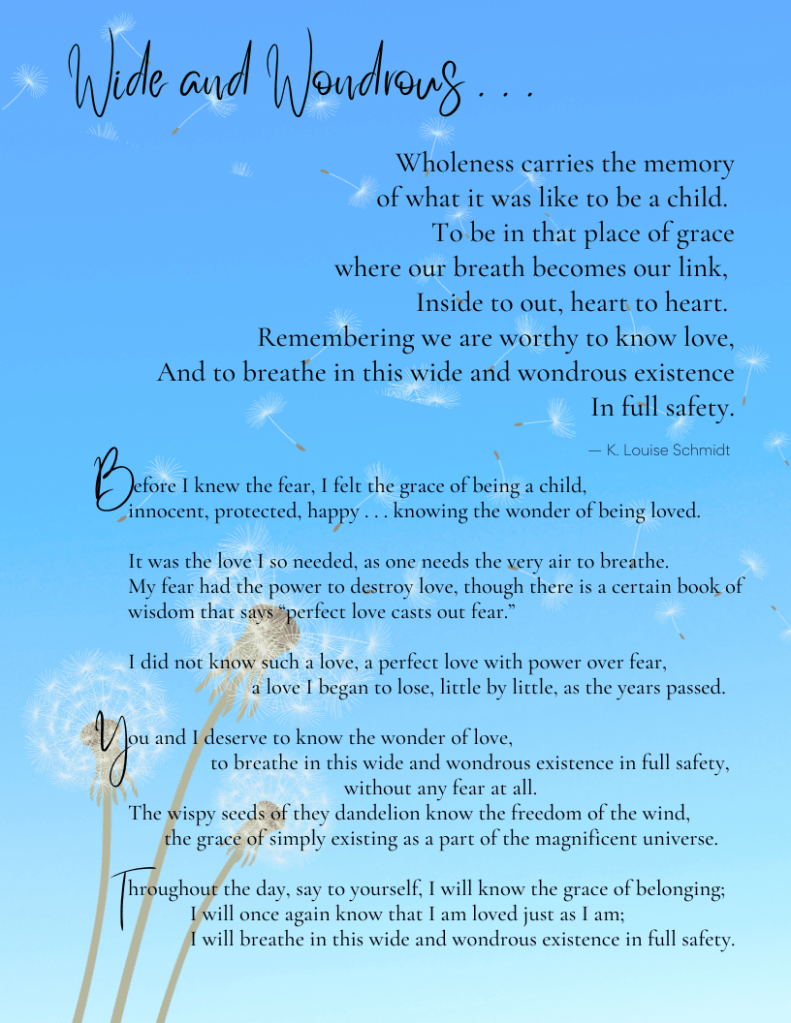
Wide and Wondrous

How true it is that when we know nights of sorrow, when weeping is all we can muster, that daybreak does eventually come as it always has. And with the rising of the sun, perhaps our tears are replaced with at least some measure of inner joy.

The universe is wide and wondrous, full of love, full of grace, and sparked by freedom. Those three—love, grace and freedom—are the things we most need, all of us.

I offer you this meditation, praying that you are surrounded in love, that you know the grace that accepts every part of yourself, and that you feel the the freedom to run with the wind in wide and wondrous places, toward your dreams.

As you continue the quiet time you claim for yourself today, I hope you will be be inspired and comforted by this beautiful choral piece by the brilliant composer Elaine Hagenberg, ”All Things New.”

Poem by Frances Havergal
and text adapted from
Revelation 21:5-6

Light after darkness, gain after loss
Strength after weakness, crown after cross;
Sweet after bitter, hope after fears
Home after wandering, praise after tears

Alpha and Omega
Beginning and the end
He is making all things new
Springs of living water
Shall wash away each tear
He is making all things new


Sight after mystery, sun after rain
Joy after sorrow, peace after pain;
Near after distant, gleam after gloom
Love aftеr wandering, life after tomb

Beginning again, Change, Contemplation, Meditation, Meditations for Healing, Sacred Pauses, Sacred Space

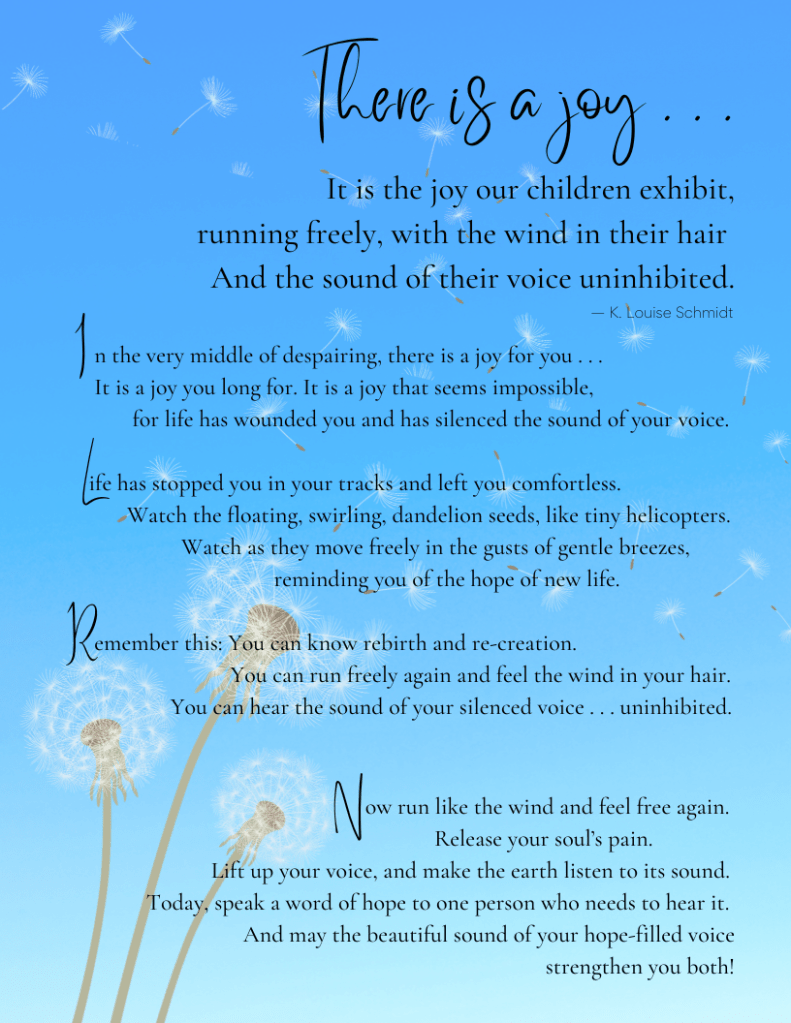
There Is a Joy

In 1998, I wrote a book of thirty-one meditations, Meditations for Healing, specifically for survivors of sexual abuse. In 2006, I revised the the first addition and in 2022, I intend to revise it again. The meditations for each day of the month are prompts to help us find contemplative sacred pauses, very needful not only for survivors of violence, but also for all of us.

As I work on the revision, I am struck by the reality that all of us are survivors of violence, depending on how one defines violence. Is violence a horrific attack on a person’s body? Is that all it is? People who have experienced violence, and I contend that means all of us, know that violence is not only a physical assault, it is also an emotional and spiritual assault on everything we are.

“Violence in all its forms” is a phrase I use often. Defining that phrase is straightforward. Violence in all its forms does, of course, means the obvious: sexual violence, intimate partner violence, homicide, suicide and all the other big, bad forms of violence we observe or experience.

Might violence also manifest its destructive power in verbal abuse, gaslighting, racially motivated acts, the marginalization of women, homophobia, xenophobia, child neglect . . . this list could go on and on.

So as you and I name the forms of violence we have experienced in our lives, contemplative healing becomes important. So I offer you this meditation for healing:

As you enter into moments of sacred pause, this musical arrangement may open your soul to rest, peace, comfort and new hope.

The text of this choral arrangement by Elaine Hagenberg, Still with Thee, uses excerpts from a poem by Harriet Beecher Stowe.

Still, still with Thee, when purple morning breaketh, 
When the bird waketh and the shadows flee; 
Fairer than morning, lovelier than the daylight, 
Dawns the sweet consciousness, I am with Thee! 

When sinks the soul, subdued by toil, to slumber,
Its closing eye looks up to Thee in prayer;
Sweet the repose beneath the wings o’ershading,
But sweeter still to wake and find Thee there.

So shall it be at last, in that bright morning 
When the soul waketh and life’s shadows flee; 
O in that hour, fairer than daylight dawning, 
Shall rise the glorious thought, I am with Thee!

Alone, Contemplation, Meditation, Prayer, Quiet, Quietude, Reflection, Rev. Kathy Manis Findley, Sacred Pauses, Sacred Space, Silence

In My Sacred Space

Photography by Johannes Groll

I write about sacred space a lot. I struggle to create sacred space a lot. I rest in sacred space . . . not so much. Certainly not enough. I confess that I, as a person who claims to cherish sacred space, can rarely find it. I must also confess that I need it. Yet, that space where I am tranquil, not agitated and troubled, is elusive to me. As some folk put it, “I’m staying busy!” Too busy!

Photography by Kevin Young

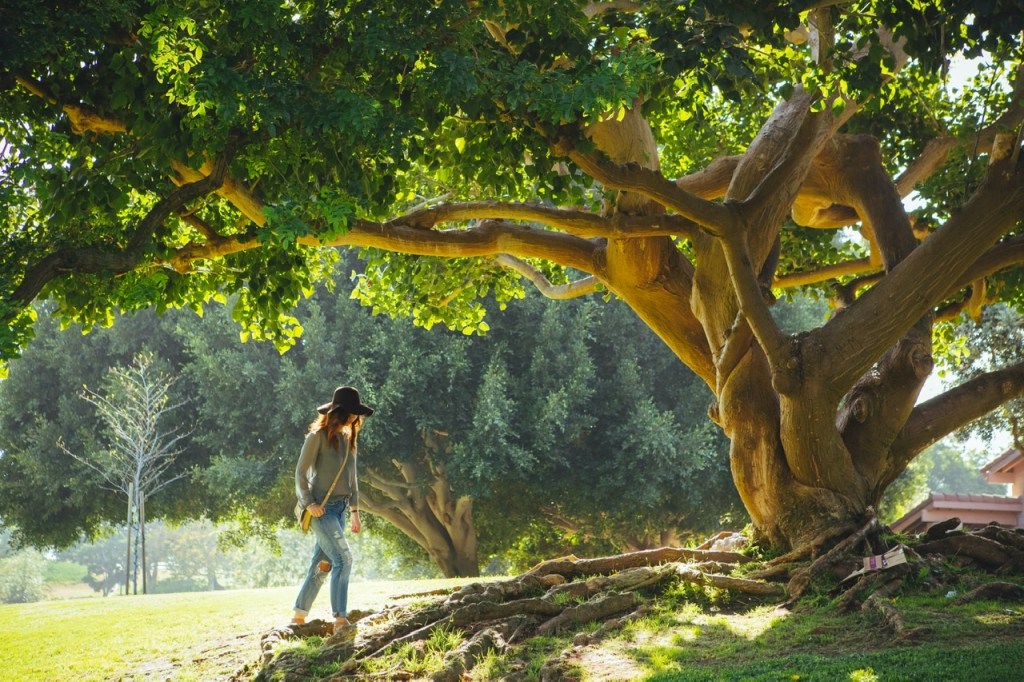
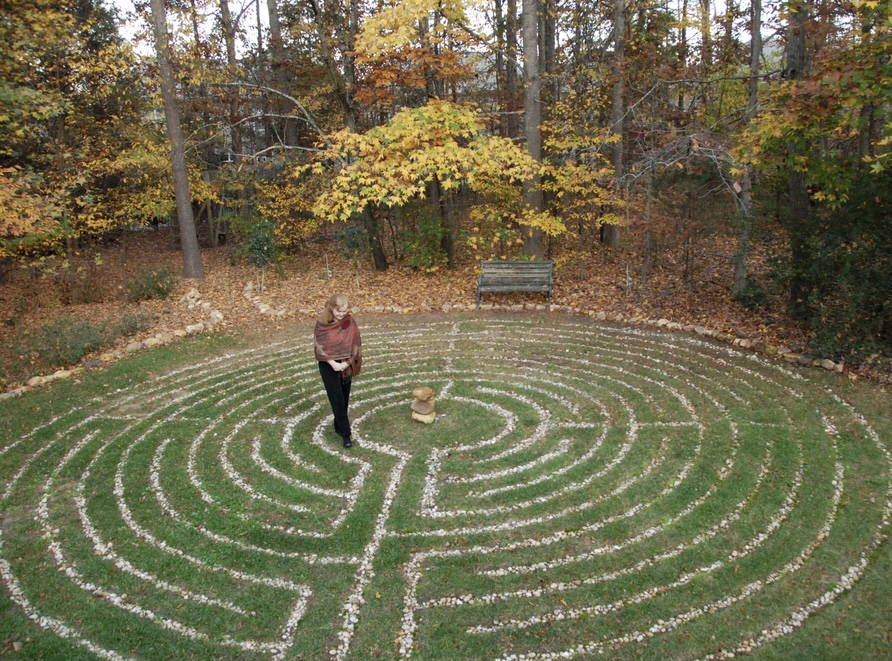
Sacred space is different for every person. Each person will know her/his sacred space intuitively, and by faith. Mine would be under a tree with spreading, low hanging branches or walking my own garden labyrinth.


Your sacred space may be beside the seashore, a place where you find calm, peace, or the ”silence” of the ever-moving ocean. Or you may not require a particular place at all, just a state of mind and an open spirit. If you long for a place of solace, inspiration, or re-creation, you will eventually create a sacred space, either a place that nature has created, a holy place that you have found, or a place you create in your own home. You will know the place, because you will sense what it is doing for your body and soul. Still, you won’t necessarily have to find your sacred space. Your sacred space may find you. And if you have only a few moments each day, make it your sacred pause.

Your sacred space may be beside the seashore, a place where you find calm, peace, or the ”silence” of the ever-moving ocean.


Do not strain to see where your sacred space is or what it should look like. A sacred space has many faces, many facets and dimensions.

Imagine . . .

Once you find your sacred space, spend time there. You may choose to redecorate a quiet place in your home, build something in your garden that can center your thoughts, or find a quiet, beautiful place nearby that you can get to frequently and easily. As for what you do in your sacred space . . . well that will be as varied as the different spaces people choose.
Pray, breathe, sing, meditate, sit in holy silence—whatever you are moved to do is your own sacred moment—a very personal sacred moment. There is, however, one bit of wisdom that seems important—words from Joseph Campbell: “Your sacred space is where you can find yourself over and over again.”


Music for Contemplation

Sacred Space ~ Music for Meditation


All Shall Be Well, Ash Wednesday, Contemplation, Joel 2:12-13, Lent, Return to me with all your heart, Sacred Space

ALL SHALL BE WELL . . . A VIDEO BLOG ON SPIRITUALITY – EPISODE NUMBER 4

“ALL SHALL BE WELL” is a video blog that will help us enhance our personal spirituality and lead us into sacred pauses that will nourish our souls.

Welcome to “All Shall Be Well,” where we will explore together our spiritual center, create a moment of sacred pause and join together in contemplation and silence. In this episode, I want to focus our thoughts on the spirituality of Lent. On Ash Wednesday, the first day of Lent. God speaks to us through the Prophet Joel in chapter 2, saying,

Even now,” declares the Lord,
    “return to me with all your heart,
    with fasting and weeping and mourning.”

Rend your heart
    and not your garments.

We begin Lent with Ash Wednesday, the day that we receive a cross on our foreheads — a cross of ashes blended with just a drop of sanctified oil. I do not wipe off the cross, but let it remain for the entire day.

In a way, it’s comforting to know that something holy and tangible interrupted my ordinary day, a cross of ashes to remind me of sacred things I already know — that Lent is a time of reflection, penitence, repentance, prayer, fasting, giving up things, returning to God. And on top of all of those things I must ponder for forty days, things that weigh heavily on my heart, a minister says this to me as she (he) forms the ashen cross on my forehead:

Remember you are dust, and to dust you will return.

God’s words to Adam in Genesis 3:19

There are so many life events to remind us that we are but dust. But is that really what a Lenten journey is about? Is it really meant to hold our sins over us and urge us to do penance? Is Lent just a time of repentance, remembering our sin and our frailty?

Maybe Lent is also about God’s extravagant mercy, God’s grace that is greater than all our sins, and the ultimate sacrifice of Jesus that made us all beloved children of God.

Imagine for a moment that our cross of ashes is really not really made of ashes at all. If you look at it closely — as you imagine God’s lavish grace — you might not see ashes, but instead, stardust!

Please join me via video for a few moments of Lenten reflection . . .

Contemplation, Faith, Joy, Music, Singing, Theology

Where Is Our Joy?

Graphic by Kathy Manis Findleyo

After about five years of co-teaching my Sunday School class, known as the Voices Class, I have had an insight, a rather critical insight. Teaching this class, in particular, has been a gift for me and possibly for the other class members. We have bonded in important and meaningful ways. Most importantly, we “bear one another’s burdens” (Galatians 6:2) and most definitely, we weep with our sisters who have found themselves weeping along the journey. (Romans 12:15)

And what a journey it has been for our class. We began with a lovely Lenten study titled, “Praying with Your Pen,” which took us into the wonderful world of contemplative writing. Such a spiritual disciple leads into all manner of emotional and spiritual discovery, not all of which is positive. The study was emotionally and spiritually taxing at times, while being life-giving for us all.

We then studied a three-month series of biblical women who faced various hardships and later revisited that study for an additional seven weeks. As we followed the journeys of these biblical women, we found kindred spirits and grace for our own journeys. But the lives of the biblical women were harsh, harsh enough to bring up in us an examination of the harshness we have encountered. So this study was a difficult one as well.

Other Lenten and Advent studies through the years kept us in a contemplative, and often melancholy, space where we learned so much about ourselves, our faith and our relationship with God and with each other. We followed Christ Sophia for a while, as we considered the feminine nature of God, and as we followed her, we uncovered spiritual layers in us that have long been touched by Spirit Wisdom.

All of our studies along the way took us to tender places within, places where spiritual maturity occurs and faith deepens. A deepened faith, it seems, was especially important as we entered the pandemic that separated us from each other, at least physically. We adapted valiantly and immediately, and our class continued via virtual Zoom meetings. The meetings, that regularly lasted two hours or more, seemed to ensure our sanity as we navigated pandemic lifestyles that we certainly did not choose. Suddenly, the day to day living became harder, school more complicated, safety measures all-encompassing, family isolation straining. Figuring out this new way to live became draining beyond belief.

That, too, we navigated together, holding one another in the light, learning to find church in uncommon places and keeping each other gathered close, covered in the love each of us brought to our circle. Gathering close to each other was critically important as we lost friends, church members and close family members to this pandemic. Apart from the pandemic tragedies we watched, our class was brought low by other illness and deaths of persons close to us.

So a few weeks ago, my soul cried out, “Enough!” Then I asked myself, ”Where is our joy?” We’ve got the ‘weep with those who weep’ part, God. Can we just move on to the ‘rejoicing with those who rejoice’ part?”

Where is our joy? That’s the part of faith I cannot discern, because right now, it’s just too far away. Still, I asked myself the question.

And I answered myself immediately.
It’s in our hymns! Our joy is in our singing.


So the Voices Class started a new study titled,

Singing Theology: Hymns & the Formation of Faith
Our Worship, Hymnody and Theology

A delightful study it has been for us, as we explore how hymns express the theology of a particular Christian community or tradition. Searching deeply into one hymn each week, we have asked: how does the hymn’s theology shape and form our faith, our belief, our mission and our action? “As the church sings, so she believes,” writes Beth Bowers. We had discovered in this new study an informative, important—and fun—exploration of song!

Hymns We Have Studied Each Week . . .


Here is our joy, in the hymns we sing — in their rhythms and their melodies, their thoughts and words. Hymns express our faith, our longing, our petition, our awe, our need, our regret, our grief, our testimony, our theology, our conviction and the deepest joy of our hearts. May it always be so!

My life goes on in endless song
Above earth´s lamentations,
I hear the real, though far-off hymn
That hails a new creation.

Through all the tumult and the strife
I hear its music ringing,
It sounds an echo in my soul.
How can I keep from singing?

While though the tempest loudly roars,
I hear the truth, it liveth.
And though the darkness ’round me close,
Songs in the night it giveth.

No storm can shake my inmost calm,
While to that rock I´m clinging.
Since love is lord of heaven and earth
How can I keep from singing?

When tyrants tremble in their fear
And hear their death knell ringing,
When friends rejoice both far and near
How can I keep from singing?

In prison cell and dungeon vile
Our thoughts to them are winging,
When friends by shame are undefiled
How can I keep from singing?

Songwriters: Eithne Ni Bhraonain / Nicky Ryan / Roma Ryan

Change, Compassion, Contemplation, healing, Inner joy, Repair the world, Repairing broken things, Tikkun Olam

Trying To Save The Whole World

Some of us feel compelled to rescue the world, and we try to do it in so many ways. The ways we rescue may be simple or complex, close to home or global. We try to repair them all, from multiple interventions when our kids get in trouble at school to advocating for an end to the climate change that’s currently burning down the beautiful Greek island of Evia.

For me, it’s a given that I should rescue things and people. After all, I am a minister. Isn’t that what we do? I really do want to save the whole world from whatever ailments or tragedies are inflicted upon it — the earth itself and the people in it. The thought that writer and theologian Frederick Buechner writes about this makes so much sense to me: “Your vocation in life is where your greatest joy meets the world’s greatest need.” I suppose that my desire to change, rescue and fix could very well be my undoing, because the stark reality is that I — one person — can do very little that would make much of a difference.

That’s the overwhelming part. How can we watch the world’s great need and not answer our inner compulsion to repair it? When asking myself this kind of question, I always think of tikkun olam, which is a jewish concept defined by acts of kindness performed to perfect or repair the world.


The phrase tikkun olam is found in the Mishnah, a body of classical rabbinic teachings. It is often used when discussing issues of social policy, insuring a safeguard to those who may be at a disadvantage. In modern Jewish circles, tikkun olam has become synonymous with the notion of social action and the pursuit of social justice.

To those who, like me, have this inner desire to change things and fix things, I can not offer any easy answers, because I do not have any. There simply aren’t any. I’m fond, though, of this idea: do the next right thing. When faced with big needs and small ones, sometimes that’s all we know to do, the next right thing.

I think that’s okay. The “next right thing” is like following the light we have or following God into the pressing needs the Spirit shows us. One thing I have learned is that before any act of repairing or helping, there must be a time of waiting, a time when the soul finds a sacred pause and waits there for holy direction. Then, just maybe we will have discovered what we need to “save the whole world.”

I love the way that poet and author Martha Postlethwaite describes a way forward for us fixers. I also love the way she invites us to find “the song that is our life” and to open our hands to receive it. Her thoughts come through so powerfully in her beautiful poem, “The Clearing.”

Do not try to save
the whole world
or do anything grandiose.

Instead, create
a clearing
in the dense forest
of your life
and wait there
patiently
until the song
that is your life
falls into your own cupped hands
and you recognize and greet it.

Only then will you know
how to give yourself to this world
so worthy of rescue.
Creating a clearing.

“The Clearing” by Martha Postlethwaite

We probably can all agree with the song John Mayer sings that we’re “waiting on the world to change.” We need changes big and small for bees, elephants, giraffes, oceans, blue whales, sea turtles, polar bears, monarch butterflies and all things nature. And then we need to clearly see the humans who probably need help most of all. So many humans live lives of deep need through no fault of their own, suffering because they’re facing incredible hardships and personal tragedies.

Martha Postlethwaite would suggest that we clear away the forest of our life and wait patiently in the clearing until what she calls, “the song that is our life,” becomes crystal clear. With that song, we will find the place of the world’s great need that is calling out to us for help.

So be present and mindful in the clearing. May God help each of us open our hands to receive our song, and then go out into the needy world singing. Amen.

Aging, Change, Contemplation, Courage, discouragement, Fear, Illness, Risk, Stillness

Here’s to the Crazy Ones!

It’s true, isn’t it? Without the risk of going too far, stepping out of our comfort zone, we will probably never know just how far we can possibly go. But oh, the complete comfort of that comfort zone hems us in completely. We cannot move. We cannot take a step into new life. We cannot know what we might have accomplished. We cannot free ourselves from the bondage of fear.

I’ve been there and I have a notion you have, too. In fact, I can recall many times when I could not overcome my fear enough to take a risk. One time in particular has haunted me for almost 30 years. I wonder what my life would look like today if I had taken that particular risk — moving to a new state, to a new position, to a larger city, to a different house on a different street. That one single refusal to step out of my comfort zone has troubled me to this day.

Risk-taking is not easy. Change is difficult for some people, and some of us can convince ourselves to avoid change at any cost. Huge changes, even tiny changes, simply frighten those of us who have convinced ourselves that we are not risk-takers. Yet, I can think of so many persons who have decided that changing their lives — maybe even changing the world — is worth the risk. I will never forget one of my seminary professors whose words in a chapel sermon changed the course of my life.

Is what you’re doing worth giving your life for? Because every day you live, you are actually expending your life a little at a time doing whatever it is you’re doing.

– Dr. Paul Simmons

I left the chapel that day, walked across the campus to my office and resigned from my job, setting my sights on enrolling in classes to complete a Theology degree. A risk! A big risk that I was determined to take for two reasons: 1) I actually believed I could change the world; and 2) I was young, bold and unafraid. I’m not so young anymore, and the courage and boldness to change is small in me. It feels like being stuck, and I think it’s the first time in my life I have felt so thoroughly stuck. A brand new mantra for my life is this: “Stuck is more harmful to me than risk. I am not afraid to take a risk!”

Still, there is a part of me who longs to change the world, at least my corner of it. There is this alter ego inside me who actually believes she can change the world. That is the part of me that believes injustice can be conquered, wrongs can be righted, equality can be reality and liberation can emerge out of any form of bondage. Crazy? Probably, but I know of many kindred spirits who would be all-in on changing the world — Malala Yousafzai, Emma Gonzalez, Greta Thunberg, Crystal Echo Hawk, Amanda Gorman. Men are on the list of risk-takers, too. One in particular died in 2011 at age 56, but left behind a lasting legacy that was an example of what a human being is capable of doing.

The ones who are crazy enough to think they can change the world, are the ones who do.

– Steve Jobs

I have given thought to those words, as well as something else Steve Jobs said when he was dying of pancreatic cancer: “Death is mankind’s best invention! I looked in the mirror every day wondering if what I am doing today is fun for me. If the answer was no for several consecutive days, then I have to change something!”

Yes, I am stuck right now, and for several days I have had to admit that what I am doing every day is not fun for me. Nor is it anything significant enough to change the world. So I do need to change something. I’m not sure what sort of change I need to make or how risky the change might be. STUCK! No matter what I decide to change — big risk or small risk — it won’t be easy. And I have to look into myself, into my soul, and ask myself if I am able to take a risk or even willing to take a risk. Truthfully, I know in the depths of my being that refusing to take a risk right now will leave me stuck, maybe even permanently stuck. I don’t like the sound of that. I don’t like the stark reality of that. Small risk or big risk — I know I need to change something in order to truly live!

Like the little goldfish in the small bowl, I’ll skip the bigger bowl and shoot for the ocean.

– Rev. Kathy Manis Findley


I used to be “one of the crazy ones,” always taking risks and most often taking big ones. The visual goldfish metaphor is one that described me well throughout my years. I was not one to leap from a small fishbowl to one that was a little larger. I was much more likely to take a brave, risky leap out of a fishbowl and into an ocean! Until now! Until aging and illness and displacement took its toll. I’m definitely not as young as I was in my former and more courageous days. I am not as physically well as I used to be, and I am not living in the town that was my home.

I am facing a three-headed enemy — age, health and displacement. In truth, this enemy does have enough power to keep me stuck, depressed and disheartened. At this moment, I don’t yet know what I plan to do about it, but I do know it will probably call for a leap, a risk, a change and maybe doing something a little crazy.

At this moment, I’m not up for crazy. I need a little contemplative time in my safe space to look deeper into my soul. I’m not at all sure what will come out of my time looking at soul things —maybe some extra peace or maybe renewed hope, new thinking, fresh courage, some sort of healing. Maybe even a little craziness that helps me consider some risky changes in my life. What I am sure of is that I do not enter my soul-searching space alone, for God has walked with me on every step of my journey. I cannot plan anything right now, but there is someone who watches over me who is making plans I cannot make.

For I know what I have planned for you,’ says the Lord.
‘I have plans to prosper you, not to harm you.
I have plans to give you a future filled with hope.
When you call out to me and come to me in prayer,
I will hear your prayers.’

Jeremiah 29:11-12 NET

I will take risks again someday. I will reclaim the “crazy” part of myself that was never afraid to risk going too far. I will embrace change, inevitable change, with more courage than I have at this moment. I will take another big risk one day soon that will remind me how far I can go and how high I can leap. Like the little goldfish in the small bowl, I’ll skip the bigger bowl and shoot for the ocean. Until I can do that, I’ll be in my sacred space with the One who has never left me and has never let me walk alone.

Thanks be to God. Amen.

You Do Not Walk Alone, Elaine Hagenberg


“I Can See Clearly Now”, Birdsong, Bravery, Change, Contemplation, Ignatian Spirituality

What’s Real!

Ever wonder what’s real and what’s not-so-real? Once in a while, I do look at what’s going on around me and ask myself how real it is. This friendship — is it real? This situation I’m dealing with — is it real? This life I’m living — how real is it, really? Such questions are problematic for one major reason — that we take things so much for granted that we cannot gauge their real value. Friendships just are; situations just happen; life is pretty much a destined routine.

That is, until betrayal breaks friendships, crisis suddenly creates a situation that cannot be ignored and an unplanned event brings total upheaval to our lives. These are the times when we ponder what is real and what is not. These are the times when all things in us and around us are downright messy. These are flash points in life that force us to examine what we believe is real. Maybe these flash point times take us inward to the private space in us, and in that space, we examine and evaluate what is truly real. Problem is that sometimes our examining leads us into mulling over things that are a mess, and looking at our “real” feels like brooding.

Such downcast and disconsolate moments are not the best times for any of us to ponder what we believe to be real. Could we not open our eyes to what is real all the time? Like when we are overcome with nature’s beauty or the sweet melodies of birdsong. Like when our souls are touched by moments of worship or the mesmerizing sounds of a symphony orchestra.

It seems important to face life with listening ears and open eyes ready to embrace “the real!” It seems important to do so in sunshine and in shadow, when our souls are burdened and when our souls are stirred to sing songs of joy. It seems important to look at what’s real even when we have to do so while feeling a deep down melancholy.

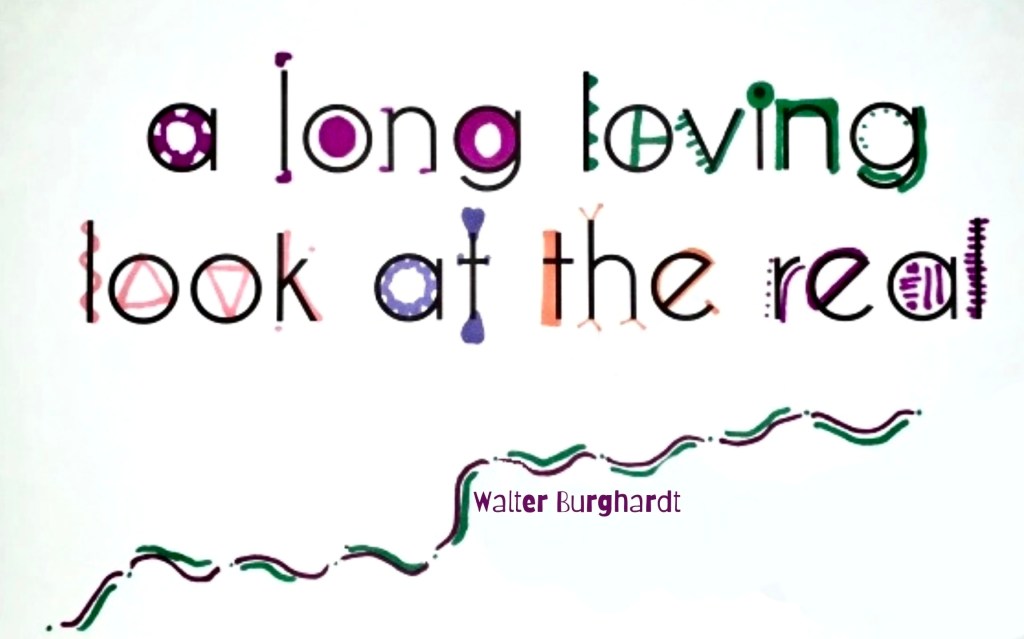
Still, I invite you to choose to “see,” the real that surrounds you — the real that is inside you, above you, below you and beside you. As Jesuit theologian Walter Burghardt summons us, “take a long, loving look at the real.” That’s how Burghardt characterized contemplation, describing it as a sustained gaze, never merely a glance. 

Flash point times take us inward to the private space in us, and in that space, we examine what is truly real.


So value “your real.” Do it as you go and as your journey moves forward on varied paths. Look at all that is “your real” — the commotion in your soul, the catastrophes of your relationships, the messes in your life. Take a sustained, contemplative look. Look bravely snd without fear, because whoever or whatever God is for you is waiting to meet you at the crossroads of what is real and what is not real. 

More than you think, your soul needs you to open your eyes and “take a long, loving look at the real.” No matter how messy it is!

anxiety, Calm, Contemplation, Feelings, grief, healing, Heartbreak, life, Loneliness, Loss, Lostness, Mindfulness, Pain, Pandemic of 2020, peace, Quiet, Rest, Restoration, Sacred Pauses, Sacred Space, Soul, Spirit, Spirit wind, Time

There Was a Time


There was a time when I believed that I was invincible, with all the time in the world. Lately, though, I have thought a lot about how quickly time passes and about how I tend to constantly say, “I don’t have time.” I have also been thinking about healing. The reason for my healing thoughts could well be because at least two parts of my body really need physical healing, and soon. I don’t have time to be incapacitated, or so I believe. I don’t have time for pain and I wonder if my two places of physical pain were of my own making. For instance, my wrist sprain — now an orangey ochre color from my knuckles to halfway up my elbow — that the doctor says will heal in 6 to 10 weeks is taking way too long to mend. 6 to 10 weeks is entirely unacceptable! Was my ungraceful fall in the kitchen due to my carelessness or my lack of mindfulness?

And then there’s the terribly painful throat invasion, allegedly identified as a cricopharyngeal spasm, that feels like choking with a large object stuck in my throat while something is tightening around my neck. Direct from Healthline.com: “Anxiety about the condition can aggravate your symptoms.”

Aha! Anxiety! Therein may be the source of many ailments. That, and a lack of rest, relaxation, quietness, peacefulness or mindfulness, all of which are highly touted methods of natural healing. Healing of the body, yes, but also the critically important healing of my heart, my mind, my soul and my spirit — emotional and spiritual healing. That healing is often harder than physical healing. 

So I turned my thoughts, while suffering incessant physical pain, on the subject of emotional and spiritual healing. My thoughts raised the question of what exactly is the difference between the soul and the spirit, and how in the world would I heal there.

Here’s my attempt at an answer. Most of us would agree that we consist of body, soul and spirit. In fact, the Bible affirms the existence of all three:

May your whole spirit, soul and body
be preserved blameless at the coming of our Lord Jesus.

(I Thessalonians 5:23). 

Our physical bodies are fairly evident to us, but our souls and spirits are less distinguishable. In the preceding scripture passage, the Greek word for soul is psuche (ψυχή), or as we might call it, “psyche.” This word “soul” implies our mind, our will and desires as evidenced by our personal preferences, choices, and emotional responses to life’s situations. Our soul is reflected in our personality. Our soul is our life.

“Spirit” is a completely different word. The Greek word for spirit is pneuma (πνεύμα). It refers to the part of us that connects with God and receives the breath of life from the Holy Spirit (Άγιο πνεύμα). Our spirit is our breath, the breath that animates and enlivens us from deep within. I like the way Theologian David Galston explains it: 

The soul is life, and the Greek word is psyche. The spirit is breath, and the Greek word is pneuma. Natural confusion exists between the [meaning of the] spirit and the soul since both words, in their roots, mean breath. But for the Greeks, there were two kinds of breath: the kind necessary for life, the psyche, and the kind necessary for [our very breath], the pneuma. In modern English, we might distinguish the two as life and energy.

I often ask my clients, mentees and friends this question: How is your heart? They usually have an understanding of how their heart is and why. But ask these questions — How is your soul? How is your spirit? — and the answers don’t come as easily. I’m not sure exactly why, but I think that, for myself, it is that I am able to more easily know my heart. I am more in touch with it. On the many times throughout my life when I was brokenhearted, I knew how my heart reacted and why. When I am sorrowful, happy, excited, surprised or feel many other emotions, I can place my hand over my heart and feel is as if I have literally touched it, that my heart has told me what emotion is there.

As for my soul and my spirit, well, they are deeper in me. In the innermost places of me, my soul mourns and celebrates and holds all manner of emotions. In my innermost parts, my spirit lies quietly within me always waiting for the brush of Spirit wings, waiting in stillness for the breath that animates and enlivens and ennobles. There was a time when I would always find time for the healing my soul and spirit needed.

So in the dense forrest of all of the 700+ words I just wrote, what is the lesson? What is the message from God we need to hear? Believe it or not, it’s not complicated. Isn’t it just like God to send us an uncomplicated message that we immediately make complicated? God’s bottom line here is easy, simple, uncomplicated: “Guard your heart, your soul, your spirit . . . all that is within you.

From Joshua
Now, vigilantly guard your souls: Love God, your God.

From Deuteronomy
Keep your soul diligently, so that you do not forget the things which your eyes have seen
and they do not depart from your heart all the days of your life.

From Proverbs
Above all, guard your heart with all diligence; for from it flow the wellsprings of life.

From 1 Thessalonians
And the God of peace sanctify you wholly, and may your spirit and soul and body be preserved complete, without blame, at the coming of our Lord Jesus Christ.


And that’s it. There was a time when I would write 700 more words to tell you specifically how to do that. But today, I am not going to tell you how to heal. The ways are individually unique and the paths are many. So I will leave you with just one path that you may choose to follow: the path that leads you deep within yourself to your sacred, quiet place and then implores you to listen for God’s whisper and wait for the breeze of the Spirit. Where? In a beautiful, peaceful place, under a starlit sky, in a quiet filled with sounds of music.

In these many months of pandemic, experiencing loss and lostness, loneliness and isolation, mourning and tears, may you find comfort in the words of poet, William Wadsworth, here turned into beautiful music by Elaine Hagenberg.


Though nothing can bring back the hour
Of splendour in the grass, of glory in the flower;
We will grieve not, rather find
Strength in what remains behind.


Complete text of anthem:

There was a time when meadow, grove, and stream,
The earth, and every common sight,
To me did seem
Apparell’d in celestial light,
The glory of a dream.

The rainbow comes and goes,
And lovely is the rose;
The moon doth with delight
Look round her when the heavens are bare;
Waters on a starry night
Are beautiful and fair;
The sunshine is a glorious birth;
But yet I know, where’er I go,
That there hath pass’d away a glory from the earth.

Though nothing can bring back the hour
Of splendour in the grass, of glory in the flower;
We will grieve not, rather find
Strength in what remains behind.

“There Was a Time” by Elaine Hagenberg
Poem by William Wordsworth
https://www.elainehagenberg.com/there…

All Shall Be Well, Ash Wednesday, Contemplation, Joel 2:12-13, Lent, Return to me with all your heart, Sacred Space

ALL SHALL BE WELL . . . A VIDEO BLOG ON SPIRITUALITY – EPISODE NUMBER 3

“ALL SHALL BE WELL” is a video blog that will help us enhance our personal spirituality and lead us into sacred pauses that will nourish our souls.

Welcome to “All Shall Be Well,” where we will explore together our spiritual center, create a moment of sacred pause and join together in contemplation and silence. In this episode, I want to focus our thoughts on spirituality and Lent. Today, Ash Wednesday, is the first day of Lent. God speaks to us through the Prophet Joel in chapter 2, saying,

Even now,” declares the Lord,
    “return to me with all your heart,
    with fasting and weeping and mourning.”

13 Rend your heart
    and not your garments.

Finding sacred space as Ash Wednesday leads us into Lent

All Shall Be Well, Contemplation, coronavirus, Darkness, Sacred Pauses, Sacred Space

ALL SHALL BE WELL . . . A VIDEO BLOG ON SPIRITUALITY – EPISODE NUMBER 2

“ALL SHALL BE WELL” is a video blog that will help us enhance our personal spirituality and lead us into sacred pauses that will nourish our souls.

Welcome to “All Shall Be Well,” where we will together explore our spiritual center, create a moment of sacred pause and join together in contemplation and silence. Tonight my thoughts will focus on the dark times of our lives, the spiritual and emotional darkness that sometimes engulfs us and the ways we can dwell in our darkness to learn the secrets the darkness teaches us. We will listen in sacred space to hear the sigh of our souls.

Finding sacred spaces while hopelessly trapped in darkness

Comfort, Contemplation, Emotions, Feelings, God's presence, healing, life, Meditation, Poetry, Politics, Racism, Reflection, Repentance, Restoration, Sacred Pauses, Sacred Space, Silence, Soul, Spirit, Spiritual Discipline, Stillness, Trump, Wholeness

NO MORE AIRTIME, MR. TRUMP!

 D7940A7F-BEAB-4445-B30D-C9739A8076AE

The time for Donald Trump’s airtime is over! In my life, I have no available airtime for him, and I wish the media would follow my example. I’ve heard enough of his rants and tweets. I’ve heard enough of his incendiary speech. I’ve heard enough of his indiscriminate name-calling. I’ve heard enough of his lying. I’ve heard more than enough of his disrespectful, hate-filled, divisive rhetoric. More than enough!

My soul will no longer give Donald Trump airtime. Why? Because often my responses to hearing him were anger, disgust, self righteousness and even hate. And those emotions darken my soul. Those emotions do not belong in my soul at all, because they have a way of displacing love, compassion, gentleness, peace, hope, light and grace — all the good emotions that God plants in the soul through Spirit breath.

I think of the beloved hymn . . .

Holy Spirit, breathe on me until my heart is clean.
Let sunshine fill my inmost parts with not a cloud between.

Breathe on me, breathe on me, Holy Spirit, breathe on me; 
Take Thou my heart, cleanse every part,
Holy Spirit breathe on me. 

— Words by Edwin Hatch, Music by B.B. McKinney

In these days of harmful politics, racial injustice, coronavirus fear and isolation, I need a Spirit-cleansing of my heart and soul. God has been ready to begin the cleansing for a while now. God has heard my repentant prayers admitting anger and hatred. God has waited patiently for me to embrace the stillness that can begin to heal my soul. 

Stillness! Stillness longing for healing. Stillness whispering words of repentance. Stillness yearning for calm. Stillness seeking peace. Stillness waiting in solitude for the presence of the Healer of the Soul.

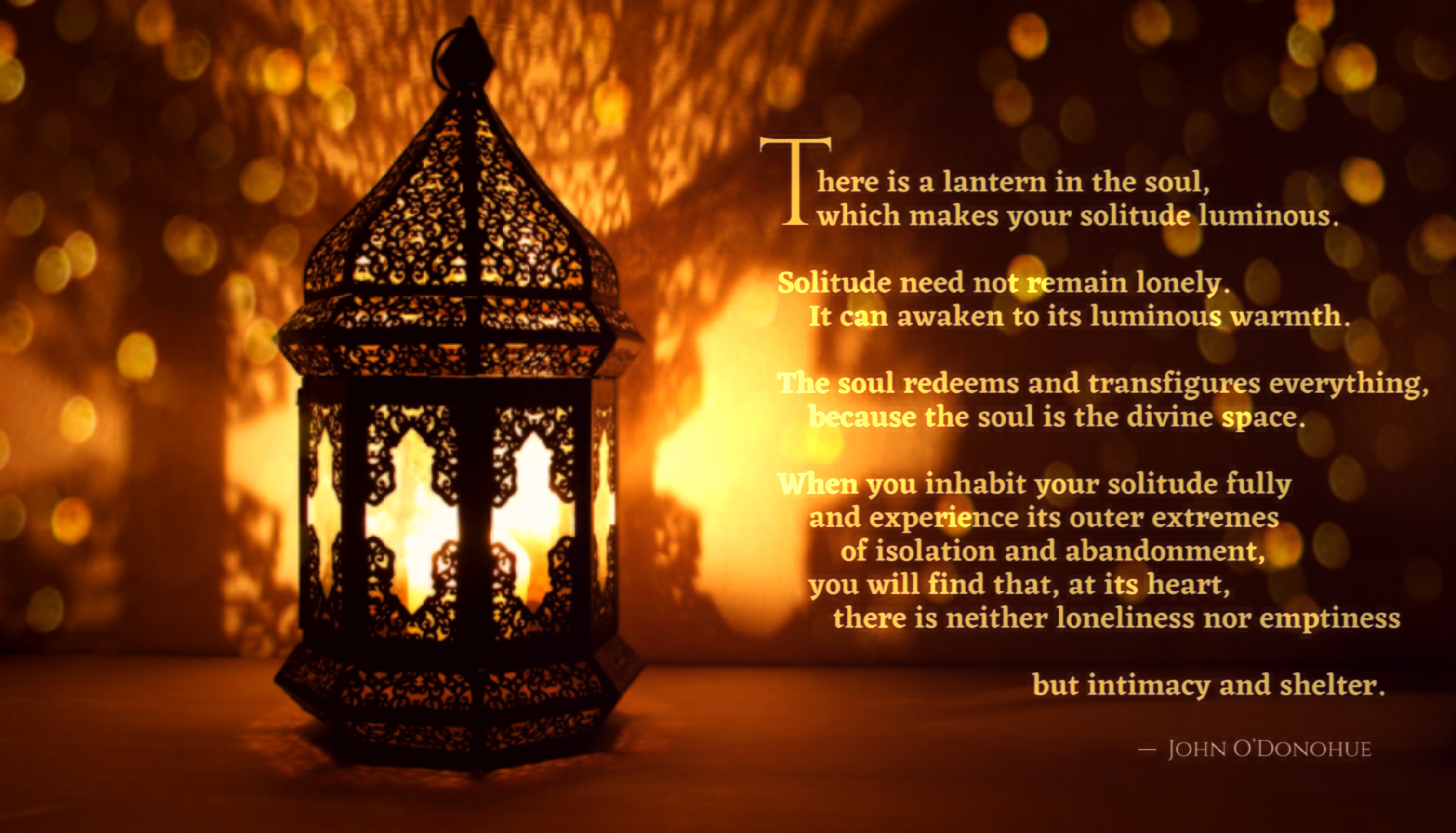
I’m going there — to that place of solitude where one can breathe slower, sigh deeper, listen attentively to the whisper of God and the breath of the Spirit. I’m going to solitude’s “luminous warmth” as John O’Donohue’s poem in which he describes the soul as the divine space. 

There is a lantern in the soul, which makes your solitude luminous. 
Solitude need not remain lonely. It can awaken to its luminous warmth. 

The soul redeems and transfigures everything
because the soul is the divine space. 

When you inhabit your solitude fully and experience its outer extremes of isolation and abandonment, you will find that, at its heart, there is neither loneliness nor emptiness but intimacy and shelter.

― John O’Donohue, Anam Cara: A Book of Celtic Wisdom

Right now, in the midst of the disheartening mood of the year 2020, I am entering the solitude I desperately need so that I can experience my soul as the divine space it is. 

Politicians, continue your rancor in loud and powerful voice! I will not hear you from my place of solitude, from my soul’s divine space. And as for you, Mr. Trump, I have no further airtime for you. I refuse to sit in front of my television for another minute, anticipating — hoping — that you will finally say or do something appropriate, beneficial, worthwhile, productive, compassionate or kind.

Instead, I will change the channel to more soul-healing television. In fact, I will leave the television altogether and go to a better place, higher ground where peace and silence and reverence and awe can begin the holy work of healing my soul. I am taking a sacred pause from my life that has been so anxious and worried and isolated. I will wait there in that sacred space where my “soul redeems and transfigures everything.” Thanks be to God.

anxiety, Beginning again, Brokenness, Comfort, Contemplation, Despair, Emotions, Exhaustion, Liminal space, Liminal time, Pandemic of 2020, Transformation

BETWIXT and BETWEEN: THE LIMINAL SPACE WE DID NOT ASK FOR

453E29B9-6B3B-47E6-A731-52A38872C1B3

We did not ask to be in this liminal space — this liminal time in our lives — but we are in the murky middle of it — a liminal space.

We’re in the liminal space between Covid isolation and our former, normal lives. We’re in the liminal space between the policies and tone of our current president and the hope and change of a starting fresh toward a new direction. We’re in the liminal space between racial protests against injustice and a new day of justice for all persons.

Yet, right now many of us are in a space of discontent. Like me, you may be isolated in a space of safe distancing because of a seemingly endless pandemic. You may miss your grandchildren, your family, your friends and your community of faith. You may be in one of the high risk Covid categories, not daring to go out of your house. I am there, and if that is where you are, I’m there with you feeling all the emotions you might be feeling.

In addition to discontent, we find ourselves in a space we might call discouragement as we look around us and continue to see racial injustice, signs of misogyny and the disparagement of women, evil acts of white supremacy, immigrant children separated from their parents and disrespectful rhetoric from government employees who actually work for us!

As for me, I feel as if my soul is in chaos. I feel heaviness, loss, worry, even despair once-in-a-while. All of us, in these pandemic days, are most assuredly right in the middle of liminal space, a space that is not a comfort zone for any of us. So what do we do when we’re stuck in a space that is so disturbingly out of our comfort zone? The easy answer is: to know in your very soul that liminal space is always a temporary in-between space, a threshold to something ahead, a life “time out.” A more down-to-earth answer is: we languish or we transform. We languish, struggling and sparring with everything that keeps us from finding a way out, OR we stay calmly and contentedly in this cocoon-like space and wait patiently until our “wings” begin to emerge, spread out into the light and begin to flutter away to some delightful space. At that point transformation occurs, a transformed “me” and a transformed space I now occupy.53088146-1C34-475A-852E-56F2886E3DC2

Father Richard Rohr offers this description of liminal space:

Liminal space is an inner state and sometimes an outer situation where we can begin to think and act in new ways. It is where we are betwixt and between, having left one room or stage of life but not yet entered the next. We usually enter liminal space when our former way of being is challenged or changed—perhaps when we lose a job or a loved one, during illness, at the birth of a child, or a major relocation. It is a graced time, but often does not feel “graced” in any way. In such space, we are not certain or in control. This global pandemic we now face is an example of an immense, collective liminal space.

Is it possible that instead of despairing in the space we are in at this moment in time, perhaps we can consider it just an in-between space and look ahead with hope for something new, better, brighter. Again I turn, as I often do, to author and theologian Richard Rohr who writes that liminal spaces should be introspective places rather than unsettling places. To him, “liminal” is a word meaning “threshold between one stage of life to another.” It is only within these liminal spaces that “genuine newness and the bigger world is revealed.”

The twentieth-century sociologist Joseph Campbell believed that the world was made up of sacred spaces and profane spaces in our lives. Profane spaces are places that we have to go, like our jobs, school, the grocery store or the post office. In contrast, sacred spaces are places where transformation takes place; where we encounter the world and each other to come to a deeper understanding of ourselves, and a world bigger than ourselves.

If you are in this space of betwixt and between, floating uncomfortably in this liminal space, trust that you will not stay here forever. Place your hope in the God of transformation and believe that you will see a transformation — of this current state of life, and of you!

Chaotic spaces in our lives ask us to enter into peace at a time when peace seems so impossible. Chaos urges us to seek out meditative moments of quietness, to open up our souls to God’s embrace and to let our hearts release the pain. I invite you to spend a few quiet moments listening to the music and the text of a reassuring choral anthem entitled God Gives the Song.   (Text: Susan Bentall Boersma Music: Craig Courtney)

When words are lost among the tears,
When sadness steals another day,
God hears our cries and turns our sighs into a song.

Sing to the One who mends our broken hearts with music.
Sing to the One who fills our empty hearts with love.
Sing to the One who gives us light to step into the darkest night.
Sing to the God who turns our sighs into a song.

Bravery, Comfort, Confusion, Contemplation, Courage, Fogginess, Mists, Perseverance, Resilience, Sacred Pauses, Serenity, Silence, Soul, Spirit, Stillness, Vulnerability

Being Brave in the Mists

Are we brave enough to imagine beyond the boundaries of “the real” and then do the hard work of sculpting reality from our dreams? 

Walidah Imarisha


I read a wonderful article this morning written by Madisyn Taylor, who wrote about being in a fog. I related immediately, having just taken my immunosuppressant medications that create all manner of “foggy-ness” for me. Tayler defined it as a feeling of being “muddled and unfocused, unsure of which way to turn.” I resonate with that definition, but beyond the physical fogginess of my mind, I experience an occasional fogginess of spirit. Know what I’m talking about? I would guess you do, since all of us fall into a spirit-fog once in a while.

A fog can feel downright eerie. It isn’t straightforward like darkness, yet we may feel like we can’t see where we’re going or where we’ve come from. We feel fear, as real as our fear of the darkness, afraid that if we move, we might run into something hidden in the mists that surround us. If we’re brave enough to move at all, we move slowly, feeling our way and keeping our eyes open for shapes emerging from the eerie haze.

Maybe being brave is what spirit fogginess is about. Spirit-fog is, of course, is a season of involuntary inactivity (perhaps even precipitated by coronavirus isolation). Although you and I much prefer to be able to see where we are going and move unwaveringly in that direction, maybe we can encourage our spirits to see that being in a fog often brings gifts to us — gifts of stillness, of doing absolutely nothing, a respite from forward inertia, a time to gather up our “brave” to move with forward inertia, even moments of finding for our spirits the Spirit of Comfort and Peace. We might find in the mists of fog the sacred pause that our spirit needs — the kind of sacred pause that creates resilience in us, and perseverance, and whatever we need to be brave.

In the fog, we really do need to be brave. When we are hidden in the mist, we may look within and find that the source of our fogginess is inside us — perhaps an emotional issue that needs tending before we can safely move ahead with steady resolve. The fog that engulfs us may simply be teaching us important lessons about how to continue moving forward even if we have been brought to a standstill by circumstances of life.

If we’re brave, we do not have to wait for the fog to lift. If we’re brave enough, we can center ourselves in the haze, wait for guidance and then move — move on into the unknown places on the journey. I have been a long-time fan of the song “Brave” sung by Sara Bareilles, written by Sara Bareilles and Jack Antonoff. “Brave” is on her 2013 album, “The Blessed Unrest.” The song hits me hard with these words, “sometimes the shadow wins.” I know that to be the hard truth, but I also latch onto the rest of this song’s message: I can be brave! I often think that this section of the lyrics calls out directly to me — calling me, urging me on, encouraging me to “show everyone how big my brave is.”

I wanna see you be brave

Everybody’s been there, everybody’s been stared down
By the enemy
Fallen for the fear and done some disappearing

Bow down to the mighty
Don’t run, stop holding your tongue

Maybe there’s a way out of the cage where you live
Maybe one of these days you can let the light in

Show me how big your brave is

Say what you wanna say
And let the words fall out
Honestly
I wanna see you be brave

Spend a few minutes enjoying this Sara Bereilles song and immerse yourself in the thought of how amazingly brave you are.

Awakening, Awareness, Beauty of Nature, Bondage, Change, Contemplation, Creation, Creativity, Emotions, Feelings, God's presence, Grace, Hemmed in, Here I am, Lord., Holy Ground, Holy Spirit, Hope, Insight, Inspiration, Introspection, Isolation, Loneliness, Mystery, Psalm 139, Sacred Pauses, Sacred Space, Soul, Spirit, Transformation, Walls, Wisdom, Writing

Hemmed In!


There are large scale, widespread forces that can trap thousands of people, even millions. Dachau, Katrina, earthquakes, tsunamis, wildfires, natural disasters all over the world and the Coronavirus of 2020. Enormous, catastrophic events can trap people. COVID19 has literally trapped me inside my home. I have to admit, the isolation has taken a toll on my spirit. No visitors! No visits with friends or family. No trips! No haircuts! I have been trapped at some level since my kidney transplant in November. Just at the March milestone that would have allowed me to break the isolation of the transplant, I was even more fully trapped by the infectiousness of this pervasive, unrelenting virus.

Being trapped for so many months has raised up in me feelings of loneliness, isolation, powerlessness, despair, anxiety, even abandonment. And yet, often there is something very good in the center of something very bad. It has been so for me. Yes, I feel trapped in the pervasive power of the coronavirus, but I also sense the arms of God and the embrace of Spirit hemming me in even further. Such a grace-gift it has been to me, as if God has said, “l am hemming you in, and in this space you will hear me clearer and sense me more fully.”

God’s words were truth. Hemmed in, my mind flourished, my heart leapt and my soul entered spaces of calm. I felt enhanced awareness! Even awakening. I saw nature in a different way and basked in the beauty of the rising sun. The sound of the hummingbirds’ trill and the rapid fluttering of their translucent wings were sounds meant just for me. I began to write and paint, to listen more carefully to God’s voice, to allow my spirit to overflow with Holy Spirit. To my hemmed-in call from God, I was compelled to answer, “Here I am, Lord!” When I finally answered God, my hemmed-in place became Holy Ground — a very good place to be that feels more like a holy mystery than a state of being.

Was this pandemic a good thing for me and for millions of people? Absolutely not! But trapped in its dark cloud, God hemmed me in further in ways I am just now beginning to understand. I can say with all honesty that being hemmed in by God has been grace to me.

If I could even begin to choose a favorite Psalm from among the many that inspire me, I would choose Psalm 139. In its weaving of words, there are many passages that are full of comfort. From childhood, I memorized a lot of Scripture and throughout Psalm 139 I memorized several snippets that I often call to mind. One verse that I did not memorize is verse 5: “You hem me in behind and before, and you lay your hand upon me.”

You have searched me, Lord,
and you know me.

You know when I sit and when I rise;
you perceive my thoughts from afar.

You discern my going out and my lying down;
you are familiar with all my ways.

Before a word is on my tongue
you, Lord, know it completely.

You hem me in behind and before,
and you lay your hand upon me.

— Psalm 139:1-5 NIV

I deplore the coronavirus and what it has done to so many people. I deplore the ways it was able to trap me, physically and emotionally. But the virus, with all its ominous, far-reaching force could not trap me spiritually. That was God’s work — hemming me in so that my spirit could rise to fresh, new heights of spiritual consciousness. Being hemmed in by our Creator has been grace for me in these days of isolation. It has become a transforming sacred pause. For in my hemmed-in space, the Creator helped me create — from my mind, from my heart, from my soul. Thanks be to God.

Comfort, Contemplation, Courage, Discernment, Discovering, Feelings, Freedom, God's presence, God’s promises, journey, Life Journeys, Meditation, Memories

What Do I Do with My Feelings?

How are you feeling today?

“Fine” is almost always the answer because usually the one who asked the question doesn’t really want to know all about how we feel. Not really. So we answer with a word — “fine.” Just “fine.” After all, we don’t often want to reveal our true feelings to anyone, and on top of that, telling them how we really feel would take more time than either of us want to spend on the conversation.

There may also be another reason for responding with just the word “fine.” Sometimes we don’t know how we’re really feeling. Some people are too busy with life responsibilities to consider how they feel. Others know there are deep feelings inside themselves, but they too are too busy to feel them. Still others sense dark, foreboding feelings in their deepest place, and they will not risk the emotional repercussions they might face by lettings their feelings rise into their consciousness. In Leo Tolstoy’s book, Anna Karenina, the dialogue asks, “Is it really possible to tell someone else what one feels?” Perhaps at that point — the seeming impossibility of telling another person how we feel — is where you and I find ourselves.

What happens when you refuse to allow your deepest feelings to enter your consciousness?

The question on the left is a very good question, even a crucial question. What does happen in us when we simply refuse to allow our feelings to come to the light os acknowledgment. The answer is at the very center of our quest for emotional wellness. We start, as the image above instructs, at owning our deepest feelings. Owning means to look at our feelings honestly and without fear. Owning means making no excuses for feelings. Owning means not blaming our feelings on others. Owning means holding our feelings in high esteem and acknowledging how they came to be. Owning means accepting our feelings, embracing then and honoring them

I was so deeply hurt that I just hold it inside until it becomes so unbearable I think I will snap.

He made me feel invisible and I just can’t let go of that feeling. I still feel invisible after all these years.

She made me so angry and I am letting that anger rage inside me and it will not go away. I don’t dare express it or let it surface.

Owning our feelings means being willing to truly “see” them, even when seeing them frightens us or creates in us a sense of dread. We sense we may experience a season of dread that the feelings will hurt us, again and for a long time. We fear what we will see. There is some truth in the fact that we tend to live into our “false self,” the self that is external and often shows little resemblance to our internal self. Contemplation is internal work. For those of us who believe in God, something divine happens when we are immersed in contemplating our hidden feelings — this thing that happens is that God meets us there, at the very moment when a buried feeling begins that awful hurting. I think of the words of promise in Holy Scripture, Jeremiah 29:11.

For I know the plans I have for you, says the Lord, thoughts of peace and not of evil, to give you a future and a hope.

I cannot help but find comfort in the presence of God in my life’s most painful times, and honestly, I have to say that some of those painful times were a part of contemplation and, through contemplation, beginning to own my down-deep feelings. The wise words of Thomas Merton are both instructive and provocative.

Everyone of us is shadowed by an illusory person: a false self . . . We are not very good at recognizing illusions, least of all the ones we cherish about ourselves. Contemplation is not and cannot be a function of this external self. There is an irreducible opposition between the deep transcendent self that awakens only in contemplation, and the superficial, external self which we commonly identify with the first person singular. Our reality, our true self, is hidden . . . We can rise above this unreality and recover our hidden reality . . . God begins to live in me not only as my Creator but as my other and true self.
Thomas Merton, New Seeds of Contemplation

In finding pieces of my hidden, true self, I also found release from harmful feelings, hurtful memories and oppressive people I held on to. Finally, after contemplation, we find the ability to share our feelings — the real ones — with the people we trust to hold them sacred and to help us better understand them. At the moment when I understood my feelings — where they came from; why I was holding on to them; who caused them; what would happen if I let my feelings rise from my depths to the light of day — that was the moment I felt free. I could live again as my best self. I could love myself, my real self. And I could be my best self. Not a small thing! A turning point in my life!

I hope you will spend some time studyIng the Feelings image above. I invite you to look at the seven feelings in the center and to then move to the outer circles. If I feel sad, for instance, the next expansion of the circle further clarifies what “sad” means for me, i.e. lonely, vulnerable or depressed. The outer section may reveal to me that I was victimized or abandoned, grieving or isolated.

Continue to contemplate your hidden, unspoken feelings. Learn to look at them and “own” them without fear, and know that God will meet you at the point of your deepest pain and that you are God’s own creation — cherished, loved, comforted and protected by a God who will never let you go. 

As a part of your contemplative moments, I hope you are strengthened by this arrangement of the  hymn, “O Love that Will Not Let Me Go.” Play it before you begin your meditation time and let its message clear your mind and comfort your soul.

Aging, anxiety, Bewilderment, Bravery, Challenge, Child protection, Children, Conflict, Confusion, Contemplation, Courage, Dangerous and noble things, Discernment, Dreams, Indecision, Internal conflict, Introspection, life, Pandemic of 2020, Questions, Sacred Worth, struggle, Transformation

When Plans Are Dreams

05D8F2C8-83DB-40E3-9FEC-43A543D80EC3
Plans!
We find it almost impossible to make them in a life ruled by COVID19. Currently, school  plans are foremost in the minds of parents and students.

“Is it safe to send my child back to school? What safety and social distancing measures will schools have in place? Do I choose to keep them at home, opting for virtual learning? How do I manage online school?”

In light of such critical plans and decisions, consider this current news report:

A document prepared for the White House Coronavirus Task Force but not publicized suggests more than a dozen states should revert to more stringent protective measures, limiting social gatherings to 10 people or fewer, closing bars and gyms and asking residents to wear masks at all times.

The document, dated July 14 and obtained by the Center for Public Integrity, says 18 states are in the “red zone” for COVID-19 cases, meaning they had more than 100 new cases per 100,000 population last week. [Georgia is in the “red zone.”]

Eleven states are in the “red zone” for test positivity, meaning more than 10 percent of diagnostic test results came back positive. [Georgia is in this “red zone” too.] https://publicintegrity.org/health/coronavirus-and-inequality/exclusive-white-house-document-shows-18-states-in-coronavirus-red-zone-covid-19/

Even with troubling reports like this one, Georgia’s governor, Gov. Brian Kemp, signed an order on Wednesday, July 15, 2020 banning localities from requiring masks. On this information, parents have to agonize about what’s best for their children. They simply cannot make firm plans as long as the virus is waxing and waning. Mostly waxing!

Plans are difficult for us for all sorts of reasons and circumstances. Every now and then over the years, my life would take un unexpected pause to contemplate this thought written by the late Mary Oliver:

 So tell me, what is it that you plan to do with your one wild and precious life?

Unpacking that brief question has been a periodic constant in my life, popping up for me mostly in my down and disheartened times. I hear the poet describing my life as “wild and precious” and it almost shocks me. Yet, my life really has been consistently wild and mostly precious. Anything that urges me to examine my life is a good thing. I can almost always pull up memories of the times when I was wild and free — insistent upon rising higher, realizing a near-impossible dream, charging with courage into new and uncharted places, planning for a future of fresh and sparkling heights, observing just how wild I could dare to be. Unpacking that question has been exhilarating at times, exhausting at other times.

Musing on a life that could be described as precious

Entertaining the thought that my life was precious happened in my deepest soul place. It happened in my moments of introspection, meditative times that urged me to examine all the ways I saw my life as precious, cherished, valued. Of course, I have experienced many precious life moments — my wedding day, my work in Africa, my ordination, awards and recognitions of my work and career and, most of all, the adoption of my one wild and precious son, JonathanExamining my precious life was most real when I almost lost my life, my full year of serious illness, five years of dialysis and a kidney transplant made possible by the selflessness of a lovely woman I know only through email.

Such thoughts bring me back to plans. What is it I plan to do with my one wild and precious life? Even a life precious and wild is a life that requires plans, and right now trying to make plans is an exercise fraught with anxiety. I cannot find any words that can minimize this depth of anxiety. There is not one thing you or I can do about plans that have been ravaged by the pandemic we are experiencing, and yet we must make critical plans in this season of uncertainty. 

School plans are most difficult in my state and perhaps in yours. As parents agonize over the safety of their children, Georgia’s governor, Brian Kemp, offered this unhelpful comment this morning in a press conference:

I am a believer that kids need to be in the classroom and we’re working with the schools to do that. We’re going to have cases that break out in schools, either with personnel or perhaps students, just like you do with a stomach bug or a flu or anything else. Our schools know how to handle those situations.

The parents and teachers in my life know that this coronavirus is not just a run-of-the-mill “stomach bug or flu.” This virus is deadly, and parents and teachers faced with difficult school decisions know that all too well. During these pandemic days, it is a constant reality that many of us are having to make potentially hazardous plans, but just for a moment, I wonder if we can redirect our thoughts to plans we make for our “one wild and precious life.”

Can we rise above the plans we must make today, even for a moment, and instead consider the bold and courageous plans we could make? Can we set our hearts to think about plans we can make when we are our brave, adventurous and fearless selves? Can we contemplate the plans we might make when we feel bold, resolute and undaunted?

I can remember the times when I was able to make such adventurous plans, times when my plans were dreams — high and lofty dreams of changing the world. I can also remember the time when I no longer dreamed any dreams at all. It was a time when I no longer saw my life as a wild and precious one. I still entertained plans, but my plans were definitely not dreams. I believed I could no longer change the world. I believed I could no longer live a life that made a difference. I believed that my soul was dry and my spirit barren. I believed that, in my life, dangerous and noble things were no longer possible

Why can’t you and I dream dreams instead of making plans? Why can’t my “one wild and precious life” rise higher, high enough to make dreams of my plans? Sometimes I will go to one of my many favorite passages of Scripture hoping to find God’s word to me. Being true to my theological education, I always look at the words in context before I do anything else. But after that hermeneutical exercise I learned in New Testament 101, I might twist the text a bit and maybe even paraphrase it, inviting the text to speak to me specifically, just me. For this day, one of the texts found in the book of Acts reaches into my soul, and, yes, I did paraphrase it.

“In your season of most need,” God says,
“I will restore your soul and make your spirit rise within you.
I will pour out my Spirit on all people.

Your sons and daughters will prophesy,
your youthful hearts will see visions,
your aging hearts will dream dreams.”

— Acts 2:17 (my paraphrase)

Amen. 

May God lift our hearts and spirits, assure us that our lives are precious and help us transform our plans into dreams.

So tell me, what is it that you plan to do with your one wild and precious life?


Contemplation, Creation, Faith, Meditation, Night sky, Quietude, Sacred Pauses, Sacred Space, Supermoon, Uncategorized

Supermoons and Sacred Pauses

F1BC2288-D107-4584-AE59-9D319BA1F8E9

What’s all this about supermoons and sacred pauses?

You might legitimately ask that question!

Well, this stream of thought began for me when astrological experts said that the Super Pink Moon that appeared on April 7th would be the “most super” of all supermoons this year. They also said that the moon would not be pink at all.

Before you get your hopes up, this “Super Pink Moon” won’t actually look “super pink”—or any hue of pink, really. The Moon will be its usual golden color near the horizon and fade to a bright white as it glides overhead.

— The Old Farmer’s Almanac (https://www.almanac.com/content/full-moon-april)

That information did not please me at all. I had really looked forward to seeing a pink moon. The Farmer’s Almanac — always a reliable source of information since its founding in 1792 — described what the April 7th moon would look like.

It is not to be missed — The Super Pink Moon: The Biggest and Brightest Supermoon of the Year! April’s full Moon will be closer to Earth than any other supermoon in the series. It will be the biggest and brightest full Moon of 2020! How big and how bright, exactly? On average, supermoons are about 7% bigger and about 15% brighter than a typical full Moon.

There you have it, from every farmer’s most tried and tested source on all things earth! But in addition to the disappointment that this supermoon would not be pink in any way, the most devastating disappointment of all was that on April 7, 2020, Macon, Georgia was completely overcast! For all gazing intentions, there was no moon at all that night, not a pink moon and not even a white one. Like other Middle Georgia folk, I missed the whole thing, the entire phenomenally astounding sight!

Other people in other places saw it, though, in all its splendor. They took pictures, some of which looked like a round, dull white ball in the sky. But others — including NASA of course — posted pictures of a brilliant, unforgettable moon. And one person took a stunning picture of this supermoon that was brilliant white and surrounded by an ethereal pink ring! And they said it would definitely not be pink!

The pink-ringed moon picture made me very happy! It was the emotional boost I needed in a time of pandemic isolation. In the midst of such a troubling and fear-filled time when all over the earth, a supervirus was touching people with upheaval, sickness and death, it was a very opportune time for an uplifting supermoon. Still, I wonder why it even mattered to me or anyone else. After all, moons rise and fall every single day. Even supermoons rise on a predictable astrological schedule.

So maybe my lesson here is acknowledging that I seldom go out at night just to gaze at the moon. When I notice a moon in passing, it’s as if I’m thinking, “So what! It’s just another moon!” And yet, the moon might be in the night sky just to remind me that the moon is the Creator’s metaphor for something that is everlasting, permanent and yet changing. I actually do look to the sky once in a while and see a new sliver of a moon on a cloudless night or a full moon glowing brightly enough to light my path. Ever so often, I’m thrilled by the discovery, as though I were seeing it for the first time.

Instead of ignoring a moon that appears most every night, perhaps moon gazing can be a spiritual moment that helps me know that at least something in my life is everlasting, that the promises of God are ever near, that my faith can light my path, that, as the Psalmist writes, the moon is eternal, a “faithful witness in the sky!”

It will be as eternal as the moon,
    my faithful witness in the sky!

— Psalm 89:37 NLT

Moon gazing can also be my time of spiritual comfort as I recall the words of the prophet Isaiah, who speaks of the rising of the sun and the moon as a part of binding up those who are injured and healing the wounds of God’s people.

Moreover the light of the moon will be like the light of the sun, and the light of the sun will be sevenfold, like the light of seven days, on the day when the Lord binds up the injuries of his people, and heals the wounds inflicted by his blow.

— Isaiah 30:26 NRSV

At the end of the day, we can know this: gazing at the moon can remind us of the magnificent smallness of humanity and the overwhelming magnificence of God. The Psalmist invites us to marvel at how we dearly we are prized by God in a Psalm that lifts up both Divine majesty and human dignity, unequivocally declaring that God cares for me, and that God cares for you.

O Lord, our Sovereign,
how majestic is your name in all the earth!
You have set your glory above the heavens . . .

When I look at your heavens, the work of your fingers,
the moon and the stars that you have established;
what are human beings that you are mindful of them,
mortals that you care for them?

Yet you have made them a little lower than God,
and crowned them with glory and honor.

You have given them dominion over the works of your hands;
you have put all things under their feet,

all sheep and oxen,
and also the beasts of the field,

the birds of the air, and the fish of the sea,
whatever passes along the paths of the seas.

O Lord, our Sovereign,
how majestic is your name in all the earth!

— Psalm 8:1, 3-9 NRSV

The last word in my story On this day is that the moon, the sun, the stars — all created things — are not merely created, they are God-created, and God’s creation may very well be worth a few extra moments of gazing into night’s quiet pauses — praying and praising, reflecting and listening. Listening for the voice of God. Listening for the sigh of the soul!

I love the photo of that moon surrounded by a pink circle of reflected light, because it was for me a divine and holy light. I know that it was divine and holy, because it abruptly stopped me. Just a picture it was, not the real moon that I might have seen in my night sky. Yet, it took on the power of my faith that has always assured me that God can be found in all things, simple or sacred, ordinary or holy.

My faith has taught me that, more times than not, a very ordinary thing — an ordinary act or an ordinary moment — can suddenly and surprisingly become holy. Just that one ethereal moon captured in a commonplace photograph silenced me, calmed me, reached into my soul and divinely interrupted me for a much needed sacred pause.

Maybe that’s the meaning of the words we often say about a picture being worth a thousand words. As for me, I will just say thanks be to God for beckoning me to night’s quiet pauses, sacred pauses that I needed so deeply.