Bible, Challenge, Comfort, Community, Compassion, Covenant, Emotions, Faith, Family, Fear, Friends, Friendship, God's presence, God’s promises, Isaiah, Isolation, Jephthah's Daughter, Judges 11, Life Journeys, sadness, Stories

The Sign at the Car Wash

8A1B7807-CC1A-4A52-9991-191E6B040F59

Every Monday morning my routine is the same: wake up early, go get weekly labs drawn.

I have memorized the routine and the route, so I rarely spot anything new or exciting along the way. Until today! It was at the car wash at the intersection just before we enter the ramp onto the interstate. Their colorful LED SIGN caught my eye. On the sign were words I had never seen on that sign before. The words?

Do not be afraid, for I am with you. Do not fear, for I am your God. I will strengthen you and help you. I will hold you up with my victorious right hand.

— Isaiah 41:10 NLT

Normally, I’m not a big fan of sacred scripture rendered in LED. It seems a bit sacrilegious to me. So why did it catch my eye today? And not only did it catch my eye, it reached right into my deeper place. It poked on my heart and grabbed my spirit today. As I mulled over this passage of scripture over the next few minutes, I determined that it was worth remembering, worth my time to dig a little deeper into what it means and why it captured my thoughts today.

It certainly wasn’t the setting or the art that illustrated it. The art, I recall, was bubbles! Just your everyday, predictable car wash bubbles! Not so inspiring. Yet the text lingered with me a while and, obviously, seemed blog-worthy.

So here I am in a place of just a little awe that I might have received a holy message this morning. I am in awe at receiving a word of comfort urging me not to be afraid and promising me the protection of the Most High God. The words were not, “God is with you.” The message given especially to me this day was, “I am with you. I will strengthen you and help you. I will hold you up.”

And all of that on a car wash LED sign illustrated by bubbles!

Even in frightening days like these, days that have brought a deadly virus spreading across the world, we can bury this promise from God deeply within our hearts for the times we need it most . . . “Do not be afraid, for I am with you.”

Yes, I feel fear that the virus will come closer to home, as most of us do. I fear for myself, for my family, for my friends, for my church family. I fear because I know that if the virus does reach into my life, I must be separated from those I love. So all that remains is this comforting promise from God, “I am with you.”

Even for a hyper-religious person like me, that doesn’t feel like enough. I need my family close, and my friends, those who have comforted me throughout my life at different points on my journey. I think maybe all of us need that, even more in these days.

A2A0EC14-7847-4C87-B791-39E5924B30C4
Don’t walk behind me, I may not lead.
Don’t walk in front of me, I may not follow.
Just walk beside me and be my friend.
  Albert Camus

My Sunday School class meets every Sunday night, religiously, because we need one another. Our relationship is a covenant between us and among us, and so we are never afraid to be vulnerable with one another and to tell the stories of where we are, how we feel, what we fear. Our stories are mostly about how we’re making it through days of isolation, what challenges us, what frustrates us, what causes us to worry, what we’re most afraid of . . . and our stories affirm two constants: 1) God is with each of us all along the journey; and 2) We are present with each other when our journeys lead us through times of faith and through times of fear.

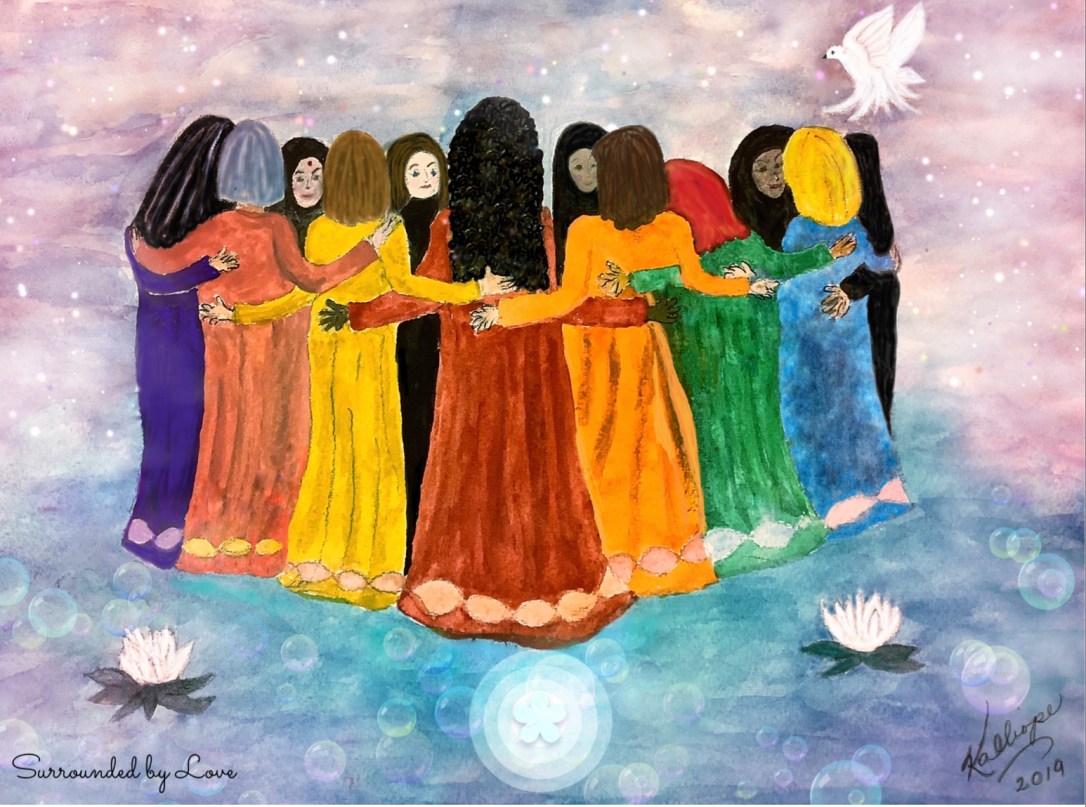
My community — my sisters — often bring to mind the heartbreakingly beautiful story of Jephthah’s daughter from the 11th chapter of the Book of Judges. Jephthah’s daughter was in a place of deep mourning because her father inadvertently betrayed her. She was facing death, but before her time of death, she begged her father to give her time to go up into the hills with her sisters to mourn.

Grant me this one request,” she said. “Give me two months to roam the hills and weep with my friends, because I will never marry.”

“You may go,” he said. And he let her go for two months. She and her friends went into the hills and wept.

— Judges 11:37-38

Such a sad story! Like some of our own sad stories, stories we tell only to our special, safe people. This is a good day to remember and to give thanks for my sisters, those who are nearby and those with whom I share a deep connection across many miles and decades.

Today’s blog was a little bit about sad stories, yes! But it was even more about today — a good day for me to notice an LED sign with bubbles and the comforting message: “Do not be afraid, for I am with you.” There is hope in those words on the LED sign. There is comfort there, even if the words are among the bubbles!

I wish for you the peace of this same assurance, that you will know beyond any doubt that God walks with you on your most frightening pathways, and that your community of friends do, too.


Bondage, Bravery, Call, Calling, Courage, Dancing, Following Christ, Holy Spirit, Inner joy, Mechthild of Magdeburg, Mystic, Singing, Spirit

A Very Unruly Woman of God

228BEA2D-360B-4749-994C-F28F1D756B13
Watercolor by Kathy Manis Findley

She described herself as an unruly woman of God — Mechthild of Magdeburg. “I want also to circle higher still,” she wrote in one of her mystical poems. She had her first vision of the Holy Spirit at the age of twelve. As a young woman, she left her home and “renounced worldly honour and worldly riches.” She was an ascetic, a writer and a mystic who viewed God’s will in unorthodox ways. Her criticism of church dignitaries for religious laxity and claims to theological insight aroused so much opposition that some called for the burning of her writings. Her words seemed to have kept her in deep trouble!

Her story reminded me of Sue Monk Kidd’s book, “The Dance of the Dissident Daughter,” a book that set me on a pilgrimage in 1996 that changed my life. This was a book that screamed out to me, “Find your own soul! Nourish it! Protect it! Bind it closer to God’s soul and, for the first time, live out God’s call to you!”

Sue Monk Kidd said this as she reflected on writing the book’s first edition:

“The Dance of the Dissident Daughter” sparked heated, sometimes scathing reactions, including public accusations of heresy, boycotts of my lectures, and a plethora of derisive letters in my mailbox. One of the more memorable began: Dear Whore of Babylon. It was the “Dear” part that made is so indelible.

This statement rings true when I contemplate the life of Mechthild of Magdeburg. Before we get back to her, though, let’s look for a moment at The Dance of the Dissident Daughter, the book that left me with these nuggets of wisdom I will always hold close.

How many times have I denied my innermost wisdom and silenced this voice? How many times can a woman betray her soul before it gives up and ceases calling to her at all?

We must wake up, journey, name, challenge, shed, reclaim, ground, and heal.

When someone tries to put you back into a box from which you’ve already escaped, you might recall a line from the Indian poet Mirabai. She said, “I have felt the swaying of the elephant’s shoulders and now you want me to climb on a jackass? Try to be serious!}

As women we have a right to ask the hard questions. The only way I have ever understood, broken free, emerged, healed, forgiven, flourished, and grown powerful is by asking the hardest questions and then living into the answers through opening up to my own terror and transmuting it into creativity. I have gotten nowhere by retreating into hand-me-down sureties or resisting the tensions that truth ignited.

The main thing is to stop struggling and nourish yourself. When you nourish yourself, your creative energy is renewed. You are able to pick up your lyre again and sing.

— Sue Monk Kidd, The Dance of the Dissident Daughter

Yes! Sing, and even dance your dissident dance! Your song may sound to all those around you like a revolutionary song, discordant to their ears. Your dancing may scandalize your observers. Still — Sing! Dance! — to the stirrings of Spirit within you!

2869C069-C448-475D-87A3-447D55A041B6That’s exactly what Mechthild of Magdeburg did and the religious world labeled her unruly. In her book, Das fließende Licht der Gottheit (The Flowing Light of Divinity), she described her visions of God. She could not read and write in Latin, but she is known for being the first mystic to write in German. Her confessor, Heinrich von Halle, finally persuaded her in 1250 to write down her visions and spiritual experiences. She did this in her own hand, in the conviction that it was God’s will.

By 1270, six of the seven books of the “Flowing Light” were brought to parchment, collected and given chapter titles by Heinrich. Mechthild saw her book as a message to both believers and clergy, for she feared the church was in danger of being hollowed out from within; she called the powerful church officials, who often enjoyed worldly luxury, “stinking billy-goats.”

Thus, Mechthild was known as a very unruly woman of God — a defiant, dissident and radical rebel! “Stinking billy-goats!” No wonder she became known for her “rebelliousness and unorthodox ways.” The community she was a part of, the Beguine order, was known for the same kind of unorthodox rebelliousness. 

The Beguine order was a Christian religious movement active in Northern Europe during the 13th-16th centuries. The Beguines were women who lived as nuns in semi-monastic communities. Through their intense devotion to God and their somewhat ascetic lifestyle, they came to be known for their acts of rebellion and their unorthodox ways.

99AF81A9-35CC-43E5-A641-B19170914765
Watercolor art: 2019; by Kathy Manis Findley

Mechthild of Magdeburg definitely danced to her own music!

With her order, she was part of a great spiritual revival movement of the thirteenth century, a time when the Catholic Church was falling into disfavor. The Beguines sought to imitate the life Christ through voluntary poverty, care of the poor and sick, and religious devotion.

With advancing age, Mechthild was blind. She was alone, still the object of much criticism. With singing silenced and dancing impossible, she was left to sing songs in her heart and dance the dances of her imagination, always seeking Spirit promptings.

Some scholars have speculated that, due to increased persecution and failing health, Mechthild was forced to retire to the convent of Helfta around 1270. There, she met three other notable writers of the time, Gertrude of Hackeborne, Mechthild of Hackeborne, and Gertrude the Great. Helfta was a good place for a writer such as Mechthild. Under the leadership of Gertrude of Hackeborne, Helfta had become a hub of learning and writing for women and a center for book collecting, copying and illumination.

Still, Mechthild portrayed herself as a reluctant writer urged on by God and her director to continue her work. She calls her director “my dear schoolmaster,” who taught her, “simple and stupid as I am, to write this book.” About the urging of God she said, “I cannot nor do I wish to write “unless feeling the power of the Holy Spirit.” At one point, Mechthild wondered why God did not choose a priest rather than herself for this work, and she is told that God always seeks out the lowest and smallest so that “unlearned lips can teach the learned tongues of the Holy Spirit.”

In spite of the fact that Mechthild was unable to read and write in Latin, these are some powerful quotes by the graceful mystic Mechthild of Magdeburg, from her book Das fließende Licht der Gottheit (The Flowing Light of Divinity), where she describes her visions of God.

The day of my spiritual awakening was the day I saw and knew I saw all things in God and God in all things.

If you love the justice of Jesus Christ more than you fear human judgment then you will seek to do compassion. Compassion means that if I see my friend and my enemy in equal need, I shall help them both equally. Justice demands that we seek and find the stranger, the broken, the prisoner and comfort them and offer them our help. Here lies the holy compassion of God that causes the devils much distress.

From suffering I have learned this: that whoever is sore wounded by love will never be made whole unless she embraces the very same love which wounded her.

A Light of utmost splendor glows on the eyes of my soul. Therein have I seen the inexpressible ordering of all things, and recognized God’s unspeakable glory — that incomprehensible wonder — the tender caress between God and the soul . . . the unmingled joy of union, the living love of eternity as it now is and evermore shall be.


I cannot dance, Lord,
unless you lead me.

If you want me to leap with abandon,
You must intone the song.

Then I shall leap into love,
From love into knowledge,
From knowledge into enjoyment,
And from enjoyment
beyond all human sensations.

There I want to remain,
yet want also to circle higher still.

— Mechthild of Magdeburg

Like her, I want to “circle higher still.” I want to escape from chains that shackle the highest expression of my spirit. I want to sing the songs God placed in my heart! I want to dance to the Spirit’s rhythm hidden in my spirit!

6480931C-BB7C-4745-8CBC-1D2C70C6B09E
Acrylic art by Kathy Manis Findley

Without fear! Without fear . . .

taking the journey set before me to follow Christ into places of poverty, fear, sickness, desperation. Breaking the rules if I must. Taking criticism if I must. Being persecuted if that is in the cards for me. I want to move forward into my calling with the Spirit of God upon me . . .


The Spirit of the Lord is upon me,
because he has anointed me
to bring good news to the poor.

He has sent me to proclaim release to the captives
and recovery of sight to the blind,
to let the oppressed go free.

 — Luke 4:18 New Revised Standard Version (NRSV)

May God make it so for us. Amen.


Community, Disconnections, Friends, Friendship, Relationship

Disconnections

C4EA44E4-B62E-4B45-A072-02678C5ABE28
Kathy, I am so glad to hear from you.
I am a worrier and was anxious to hear that you are well.

That’s how her sweet note began, my friend who lives 1,096 miles from my house. I was so glad to hear from her. Friendship in these days of isolation and anxiety about pandemic 2020 has taken many forms, with new ways of connecting and round-about ways to still be “with” your community. My friend’s note made me suddenly think about my connection with her  — when it happened, how it happened, how it has endured over time.

These hard days of self-isolation, sheltering in place — or whatever we might call the situation we’re living — causes me to think a great deal about my friends and my communities. I am safe in my communities. I belong. I have to admit that not being able to be with the sisters in my church community causes unease in me and a disquieted sense of disconnection. I have discovered, all over again, that my life takes on the rhythms of my community, creating a sacred dance of sisterhood.

C1EF4250-32FD-415F-9789-D40443AB1F83If we have learned one thing from the disconnections this coronavirus has created, it is that disconnection is simply a reality of life. Disconnection is all about human relationship and the many ways our hearts connect to other hearts.


It seems to me that it is important for us to give serious thought to our disconnections, how we could have mislaid friends along the way.
It is also worth our time to think about the connections we do have. Could we ask ourselves some of the following questions and trust ourselves to answer them honestly?

F1913B45-56DF-4289-9E3E-D99385A20D7DWhat connects you to another person?

What do you cherish about your connections?

What does it require relationally to maintain a connection?

How have your past connections broken?

What could you have done to prevent the break in your relationship?

Are there relationships in your life that you need to disconnect?

Where is your heart-place that touches another person’s heart?

How do you protect your soul connections?

So many questions to consider! So much time we have in these days of self-isolation to think about the relationships we cherish so deeply. Thinking about connections and relationships is actually a very good thing to do. If we cherish a certain connection, what can we do to strengthen it?

06D8E6EF-4EC5-4822-97EB-3F43C2631CCCIn my life, there are so many connections that I cherish. I have friends all over the world, some I am in close contact with, but others who have disconnected from me. The many times we disconnect over a lifetime can hardly be counted. The longer we live, the more friends we have lost for one reason or another. My best work is to find ways to connect with my disconnected friends — at least the ones that my heart has held a place for. Wouldn’t it be a wonderful thing to reach across miles or time to connect with a mislaid friend, to rediscover the place where our hearts touched and, perhaps, to restore a deep friendship?

Back to my friend who sent me the note . . .
With her, finding the place where our hearts touch is very easy. Here’s the end of her note:

Hope we stay in touch.
 

Blessings for continued good health.


We will definitely stay in touch because our hearts touched through a miracle. My friend donated her kidney to give me a better, longer life. That day, we were in two different hospitals —  1,002 miles apart —  but a connection happened between us when her kidney came to me just a few hours after her surgery. What a gift she gave me! What a lifelong connection we will have!

I hope you will take some time to think about your connections, the important ones and the ones that don’t feel important to you. Who knows! You may rekindle some connections, pay closer attention to other connections and even break some that need to be broken.

Until next time — be well and stay safe.

Christ's Passion, Christ’s Resurrection, Good Friday, grief, Holy Week, Mourning, Pandemic of 2020, Resurrection, Resurrection People, Weeping, Yiayia

Good Friday — Now and in My Memories

68E974EB-6AE4-4A60-BD35-1C1FD10D821A
The Passage of Scripture that I contemplate on this Good Friday, and on most every Good Friday I can remember, is found in the Book of Isaiah.

He is despised and rejected by men,
A Man of sorrows and acquainted with grief.
And we hid, as it were, our faces from Him;
He was despised, and we did not esteem Him.

Surely He has borne our griefs
And carried our sorrows;
Yet we esteemed Him stricken,
Smitten by God, and afflicted.

But He was wounded for our transgressions,
He was bruised for our iniquities;
The chastisement for our peace was upon Him,
And by His stripes we are healed.

All we like sheep have gone astray;
We have turned, every one, to his own way;
And the Lord has laid on Him the iniquity of us all.

— Isaiah 53:3-7 NKJV

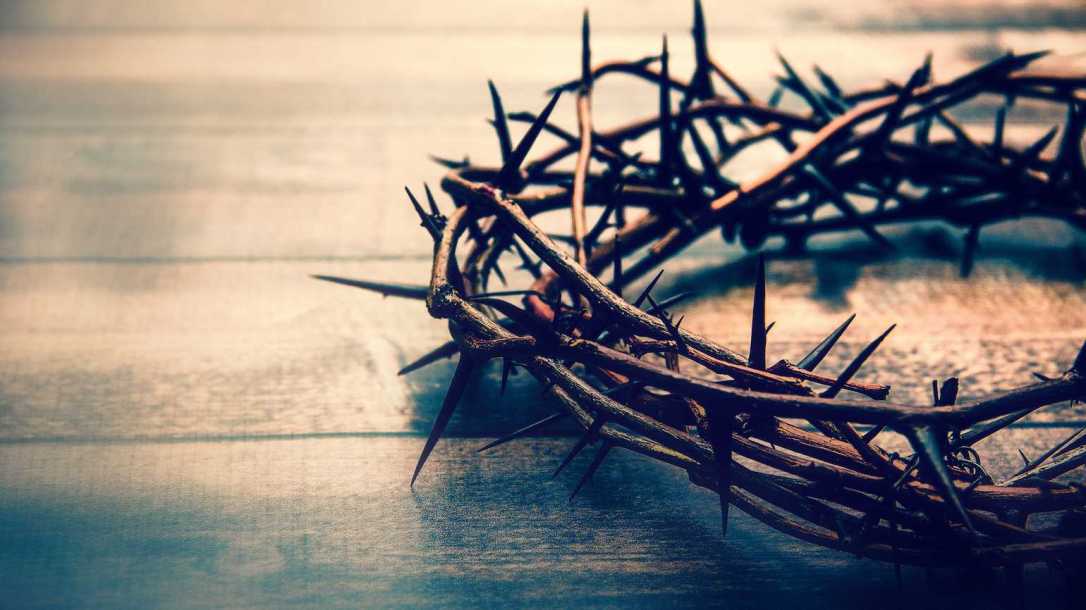
For me, Good Friday holds so many memories. I remember vividly trekking through the woods to find a thorn tree for our crown of thorns; finding just the right tree for Fred to cut down for building our cross; draping cloth on the cross; decorating our church’s Easter Chrismon tree; finding candles blooming dogwood; and finding fabric — Lenten purple, Good Friday black and Resurrection white.

Good Friday also holds for me many memories of worship — so many years leading worship as a pastor, leading worship during my time as minister of worship, leading services in our hospital chapel, holding sunrise services in our community. Honestly, after so many years, they all run together, and I only remember snippets of the times of worship that were most meaningful to me.

There is one memory that is so clear to me that it stands out above all others. I remember it in detail and I believe that this memory shaped my best thoughts about meaningful worship. I was only a young girl, but my grandmother (Yiayia) gave me authoritative instruction about how I should devoutly observe Holy Week. That usually meant going to church every day of Holy Week, but always, it meant Good Friday worship at our Holy Trinity + Holy Cross Greek Orthodox Church in Birmingham.

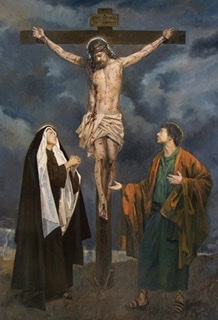
I wondered then about why the day when Christians commemorate Christ’s crucifixion was called Good Friday. The son of God was flogged, insulted and ordered to carry the cross on which he would be crucified. According to Mark’s Gospel, he endured the torment of crucifixion for some six hours from the third hour, at approximately 9 am, until his death at the ninth hour, corresponding to about 3 pm.

It’s difficult to see what is “good” about Good Friday. I studied on the name Good Friday and learned some interesting information. The day was called Long Friday by the Anglo-Saxons and is referred to as such in modern Danish. The Catholic Encyclopedia says that some sources see its origins in the term God’s Friday. In German the day is called Karfreitag, or Sorrowful Friday. In our Greek Orthodox faith, the day is known as the Holy and Great Friday in the Greek Orthodox liturgy.

In truth, that terrible Friday is called Good Friday because it eventually leads us to the Resurrection of Jesus, his victory over death and finally the celebration of resurrection, the very pinnacle of Christian celebrations. According to the Baltimore Catechism, Good Friday is good because Christ “showed His great love for man, and purchased for him every blessing.” Yes! But I must paraphrase that quotation to say “Christ showed His great love for us all, and purchased for us every blessing.“

Sometimes, we tend to rush headlong past the darkness of Christ’s passion, wanting a quicker path to the glorious resurrection. Which is where I begin with my childhood memories of Holy Week. Like most Orthodox Christians, my grandmother made sure we observed Good Friday with fasting, prayer, cleanliness, self-examination, confession and good works. We did not do any chores on Good Friday because we were to honor the day of mourning. I remember that our Good Friday meant a strict fast, no food all day. My Yiayia made up a mini fast for me that included small meals and just a little juice, always calling attention to the food she did not give me because I was fasting. What a teacher and spiritual guide Yiayia was to me! The long day of fasting went on.

On Great and Holy Friday our Orthodox Church commemorated the death of Christ on the Cross. We had to go to church first thing in the morning. In this service, our priest, Father Sam, raised up Christ’s Cross very high and then took it around the church three times. We kneeled the entire time and I wondered if everyone’s knees were hurting like mine were. Anyway, Yiayia had given me instructions. “Kneel correctly and don’t look around until the Cross passes our pew. Then look at the Cross and pray to be forgiven of your sins just like the thief on the Cross who confessed.” I didn’t think I had any sins, but I did it anyway. Father Sam finally finished walking around and took the Cross to the front of the church. Then Yiayia nudged me to move and, along with everyone in the whole church, we went to the Cross and kissed it. I wasn’t a great fan of  Vespers so early in the morning, but we had to be there to see the unnailing of Christ from the Cross.

F606DA9C-27C2-459C-AD12-1CF83EA594CDBefore I knew it, we were on our way back to church, even though I had plans for Friday afternoon. I felt something a little like sadness, I think, when Father Sam and several other men took Jesus from the Cross and placed him in a tomb. What I most remember was wondering why Father Sam was sprinkling the tomb with rosewater and then sprinkling all of us. The sweet smell of roses filled the sanctuary. At the end, we went behind Father Sam in a procession with the entire beautiful structure that was supposed to be the tomb of Jesus. It was like a funeral procession and it was sad. The older ladies in black clothes wept again. I think I felt a tear roll down my face, too. I think my tear came because Father Sam’s chants that day were the saddest, most sorrowful music I had ever heard.

The problem with all of it, I thought, is that we still had to fast all day and all the next day. I didn’t like that part very much, but as a dutiful child, I ate and drank the sparse morsels and juice that Yiayia served me without a single complaint. At least outwardly! Inside, I complained constantly and literally felt like I might starve.

And then it happened! In the dark of night, 11:00 pm, we went to the church — the most special liturgy of our church. Last minute instructions from Yiayia? “Sit up straight, kneel when I kneel, say all the prayers, no talking to your friends, no looking around to see who came, no crossing your legs, and don’t fall asleep” (even though we might be there until 1 am). if I broke any of those rules, Yiayia quietly, but forcefully, pinched my leg.

Father Sam took us first to the Passion of the Christ and his final moments on the cross. I remember having a bit of child like impatience with the very lengthy and heavy service. Yet today, I would give anything to sit up straight, legs uncrossed next to my Yiayia. I had no idea what was going on, but I was again stricken by the tears and the crying of the older ladies wearing black. I know now that they came there to mourn the death of Jesus. At that time, I just felt sad and kind of in awe in hearing their expressions of mourning.

62A22590-A6B4-4D3E-A2B1-02C2C0B9E447
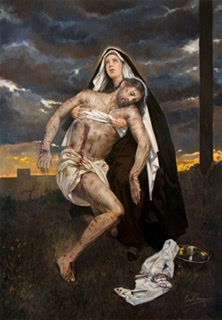
Artist Raúl Berzosa

As the liturgy neared midnight, the sanctuary went dark and we sat in complete darkness for what seemed to me like an hour. Father Sam took light and gave it to those who were holding candles as he sang: “Come ye and receive light from the unwaning life, and glorify Christ, who arose from the dead,” and all the people join him in singing the hymn again and again.

Father Sam then led the entire congregation outside the church. We had begun the procession to the tomb. I was so short in a crowd of taller people that I was unsure what was going on.

51F4B672-11C5-4715-837D-D8044A5E16EA
Artist Raúl Berzosa
“Jesus is down from the cross and placed in the arms of his mother Mary”.
XIII Via Crucis Station for Guatemala.
Oil on canvas
http://www.raulberzosa.com

I did know that on the way to the tomb all the adults were solemn. But somehow I remembered that Father Sam would read the Gospel that gave us the Angel’s statement: “He is Risen; He is not here.” (Mark 16:1-8)

Then came the breathless moment — always the breathless moment — as the people waited for our priest to start the hymn of Resurrection. We sang with him this hymn, our most beloved hymn of Resurrection. “Christ has risen from the dead, by death trampling upon Death, and has bestowed life upon those in the tombs!” We sang it over and over again, holding our candles on a cold, dark night, facing the doors of our church

I remember Father Sam, holding the Paschal candle in his left hand, turned to face the wooden church doors and knocked three times on the closed doors with his hand-cross, saying in a loud voice, “Where is the King of glory?” Everyone responded, “He is not here for he has risen from the grave!”

This was the the high point of worship, but . . . We still had to sit quietly in the pews to hear the sermon of St. John Chrysostom. I was tired and very sleepy, but at long last, our Lenten exile had ended. The fasting was over. The penitential prayers were finished. The stone from the tomb was rolled away and we knew without any doubt that Christ had risen! He had risen indeed!

Today, wherever you are — near your loved ones or apart — know that the fear, anxiety and isolation of this virus will end. Let all of us pray for those who are ill; for the families that have lost loved ones; for medical professionals, chaplains, first responders and the hospital employees who clean and sanitize every area; for the scientists who are working to develop testing and vaccines; for the governors of every state; for those having financial difficulty; for churches facing financial struggles and for ministers who are creating worship alternatives; for all those to whom this virus is an enormous threat because of age, weakened immune system and health issues; for parents who must teach their children at home and for children who wonder where Easter is this year.

This has been a Lent to remember because it included the separation of families, schools and faith communities. Of all the Lents that have passed, I imagine we will remember this one. When we do, I hope we will remember all the compassionate deeds, all the new ways of being community and all the ways we have loved one another. After all, the command to love one another came from the Christ who faced betrayal, sorrow, death and ended his story with resurrection. That’s what all of us, people of resurrection do — suffer all of life’s slings and arrows and still end up resurrected — to newness of life.

Thanks be to God. Amen.

And thanks be to God for my Good Fridays, then and now. Amen.

I am including a video of the song, “Lamb of God” by Twila Paris for your Good Friday meditation time.


A new commandment, Betrayal, Christ's Passion, Comfort, Covenant, Emotions, Maundy Thursday, Passover meal

Maundy Thursday

2171539D-2A43-41D5-893F-F1BFA715E329What does Maundy mean, anyway? Maybe we need Biblical scholars to refresh us on its meaning. Most of them agree that the English word Maundy is derived through Middle English and Old French mandé and from the Latin mandatum, which is origin of the English word “mandate.”

Mandatum is the first word of the phrase, Mandatum novum do vobis ut diligatis invicem sicut dilexi vos, which means “A new commandment I give unto you: That you love one another, as I have loved you, that you also love one another.” This new commandment recorded  in the Gospel of John (13:34) was spoken by Jesus as he explained to the Apostles the significance of his action of washing their feet. But enough of definitions and origins.

Let’s move on to Maundy Thursday’s story.

Good Friday is global, with Christ dying and offering himself for the sins of all of humanity — past, present and future. But the day we know as Maundy Thursday is much more intimate as Jesus gathered with just his disciples on the night before his Passion unfolds. Jesus has gathered his closest friends, those who had given up all to go with him, those fisherfolk who followed him. They are people just like us, followers of Jesus, followers who sometimes disappoint Jesus.

Wouldn’t it be easier to believe that Jesus was unsuspecting of all that was about to happen to him? Could we think of Jesus as a shocked, brave and trusting Jesus who continued to have faith in their loyalty until the bitter end? The truth is, we cannot think of Jesus in that way, for that would be buying into fantasy.

The Gospels simply do not let us hold on to the fantasy. Instead, they tell us of a Jesus who is fully aware of what is inside the hearts of his friends. Jesus knew Judas would betray him and hand him over to the authorities, yet Judas was included in the intimate gathering.

Jesus knew that Peter would deny him. Jesus knew the others would flee, yet he prayed for them and blessed them. And with all of them, he shared a covenant meal — a Passover meal that he transformed into a meal of the “New Covenant in my blood, shed for you”.

I would like to believe that Jesus was not aware of the fickleness and fear and failure that dominated the hearts of his followers, followers like you and me. I would like to know the emotions of the disciples as Jesus washed their feet. Though Peter objected, Jesus washed, humbling himself to serve his disciples. As Jesus performed such an act of love, I wonder if he thought about the betrayals that would break his heart. All of this was a part of their covenant gathering, a feast of love in a modest, unpretentious upper room. Jesus pulled them close in a covenant gathering, around a feast table where they each experienced their own knowing — Judas perhaps knew guilt and Jesus knew betrayal.

Now the covenant gathering reaches us, and we are only fooling ourselves if we think Jesus does not know exactly who we are. Jesus knows us. He knows our hearts and he knows the innermost thoughts we hold inside, the place of our secrets that may well include betrayals.

The shocking and stunning thing is this: knowing all, Jesus invites us to come. Knowing all, Jesus gives us the command, the mandate from which Maundy Thursday derives its name. He commands us to love others, people who are as weak and hopeless as we know ourselves to be. Jesus commands us to love as he has loved us. To love those who are deemed to be “society’s worthless,” but who really are the sick, the poor, the marginalized, the oppressed. These, the least of these, we must love as God loves us. The commandment of Jesus calls us to love these and, always, to invite them into our intimate gatherings.

Somehow the words of Oscar Romero seem appropriate to guide us through Maundy Thursday.

Do you see how life recovers all of its meaning? And suffering then becomes a communion with Christ, the Christ that suffers, and death is a communion with the death that redeemed the world? Who can feel worthless before this treasure that one finds in Christ, that gives meaning to sickness, to pain, to oppression, to torture, to marginalization?

— Oscar Romero

What we find around the Maundy Thursday table — even this year a virtual table — is that in Christ we do find the treasure “that gives meaning to sickness, to pain, to oppression, to torture, to marginalization.” And for this day, the treasure gives meaning to pandemic fear, to pain, to anxiety, to the loneliness of being isolated.

No words are adequate to comfort you or bring hope to your current circumstance, so I leave you with this prayer recorded on the following video. I pray it will remind you of the comfort that comes only from God.

Christ's Passion, Christ’s Resurrection, Church, Community, Courage, Death, Faith, Fear, Holy Monday, Holy Week, Lament, Loss, Pandemic of 2020, Prayer, Social distancing, Suffering

Lament

763AF584-0CFF-4994-BCAA-4202D8FC97CF
Monday of Holy Week
April 6, 2020

I have been thinking today that this Holy Monday is the threshold into Holy Week, and that I am standing at that threshold in fear. It is true that this time of pandemic has brought a season of fear to many of us, as well as a time of heaviness, concern, confusion and lament. Just one year ago, on April 5, 2019, I posted the following thought.

Courage is not the absence of fear but rather the judgment that something is more important than fear. The brave may not live forever but the cautious do not live at all.

— From the movie “The Princess Diaries” (2001)

I testify to the reality that courage really is deciding “that something is more important than fear.” None of us anticipated what 2020 would bring. It was simpler last Holy Week to write eloquent words about fear and courage. We could contemplate such thoughts far more comfortably than we can in this season of pandemic, the virus assailing the earth and the arrival of the season of Lent just to make sure we are all weighted down sufficiently.

I do not know about you, but I am experiencing these days as heavy. It feels heavy to me being confined to home. It feels heavy to be overly worried about my suppressed immune system since the transplant. It feels heavy to know that so many people all over the world are suffering with the coronavirus and that many have died. I just feel an oppressive heaviness. I feel as though the place we must be right now is a place of lament. 

Who brought the world as we know it to such an abrupt halt? Is one purpose of this pandemic to make us stop and take time to heal our souls? Is another purpose a demand for us to be still and allow our stillness to begin to heal an earth rife with environmental destruction? Is it to tell our churches to stop, to re-think worship that is sometimes predictable, stale, spiritless? Is the pandemic’s purpose to teach us to cherish the community of faith we have taken for granted, as now community is somewhat lost to us?

There are so many things to lament in these days, for all of us. But I have not intruded on your time today just to write about my laments in this season, to tell you all about my heaviness and the heaviness of the world. I write on this Holy Monday in hopes that we will sit quietly for a few moments of contemplating passion and promise — the Passion that leads to Christ’s death and the Promise that always ends up with Christ’s resurrection, and ours.

Not only is the lament, the heaviness, the anguish and fear of death that surrounds us this year a global phenomenon, but the things that Christians normally do in Holy Week to create transcendent meaning are painfully denied us for now: our palms and crosses, our washing of feet, our sharing of the bread and cup. These powerful physical and sacramental expressions of our faith we always do together. We cannot do them together this year.

In some ways, though, we are humanly and globally more united now than we have ever been (by this virus), and yet more separated than ever (by our fear of it). It is as if we have crashed suddenly and directly into the emptiness and shock of Jesus’s tragic death, before we have even started the journey to Jerusalem with him. Let us not rush. Instead may we walk the way of Christ’s story this week, through the times of passion, to the moment Jesus died, and on to the glorious resurrection Rushing through Holy Week is like controlling the story.

Controlling the coronavirus “story” is also problematic because it isn’t just a story. We are in it, and for now none of us can get out of it. But the glory of the Passion story is that it also isn’t just a story. It is, as we Christians have to remind ourselves during this time, the final and ultimate story of “the struggle between life and death” and of life being triumphant in the extraordinary power and mystery of the resurrection.

C09A1F72-2855-4EBA-813E-4231D8CE6A9A
Together in Community

God’s Son breaks the bonds of death and shatters the forces of darkness and sin. We must remember that holy mystery in these days. We must remind ourselves that, even when lamenting our separation one from another, Christ’s resurrection binds us together across the boundaries of time and space and even death itself. 

And, wonder of wonders, the fear and anguish of COVID-19 reminds us of this same fact: that we belong together, in need and vulnerability and compassion and mutual belonging. We are one — both in death and in life.

In this Monday of Holy Week, the coronavirus story meets the Passion story. We may be lamenting the worship we will miss this Holy Week. We may yearn for the physical and spiritual comfort of the familiar traditions that the virus has stolen from us. We quake in fear at the pandemic itself. Yet during this time, we are being stretched in new and unthinkable ways, precisely by that fear and by the temporary loss of worship with our faith community. We stretch to consider afresh the core of our baptismal faith: that the resurrected body of Christ sustains us all, even in and through death itself. 

I wonder how I will spend this very different Holy Week, as I am at home feeling alone on Holy Monday. I am lamenting the temporary loss of my worshipping community. You may be lamenting the same loss. As always, this holy day will lead us into the week and through the Passion of Jesus — his heart breaking for the betrayal of Judas, his moment of feeling that God had forsaken him. We face the Passion story reluctantly this year, already troubled and fearful. We may be afraid to add the story of the crucifixion to the loss the pandemic has also brought us.

But I will not leave us in this place, each of us isolated and lamenting. The very core of our faith — during Holy Monday and always — mystically unites us not only to Christ but to each other.

The coronavirus story will not supplant the story of Christ’s passion and resurrection. The virus will not have the last word, because even in its random cruelty, it may yet turn us back to the transcendent source and unity of our faith. In its scourge, it may open us up to the realization that we are the Body of Christ in this world, together, in radiant community that will endure. The circle of the faithful will not be broken, even by a worldwide pandemic. 

O God, abide with us on this holy day
and through the pain of Holy Week.

Grant that our deep lamentations cease,
even as we walk with Jesus and hear again the story of his death. 

Grant that our deep lamentations cease
as we lift our faith and pray for an end to the pandemic
that harms our entire world.

Help,us, God, to endure what lies before us with hope, courage, patience and faith.

Because our faith tells us, God, that as the Holy Week story continues, our laments will be replaced by praises to God as we witness again the glory of the risen Lord.

Amen.


anxiety, Christ's Passion, Christ’s Resurrection, Comfort, Community, Courage, Faith, Fear, God's presence, Heartbreak, Hope, Isolation, Loss, Pandemic of 2020, Psalms, Resurrection, struggle, Sunday of the Palm and Passion

In a Shaken Time . . . The Unshakable

59D5B9FF-187F-47B4-8727-948A56F8268B

I have written often about times when I have been shaken to my core, the hard times and the seasons of angst. Not because hard times have been a constant in my life, but because in the middle of them, I have found a Divine Constant that sustained me at times and saved me at other times.

As we approach the Sunday of the Palm and Passion, we remember the journey Jesus traveled.

. . . the great crowd that had come to the festival heard that Jesus was coming to Jerusalem. So they took branches of palm trees and went out to meet him, shouting,“Hosanna! Blessed is the one who comes in the name of the Lord— the King of Israel!” (John 1:12-13 NRSV)

Yet, before the day is done, the Gospel of John tells us how troubled Jesus was as he spoke about his death.

Now my soul is troubled. And what should I say—‘Father, save me from this hour’? No, it is for this reason that I have come to this hour. (John 1:27-28 NRSV)

As we recall Christ’s passion, we cannot help but recognize our own — and the passion of our families, friends, neighbors scattered throughout the world. Each of us, no matter where we are, are covered with the fear of a pandemic we can not begin to understand, the virus that knows no boundaries. It goes where it will, infecting those exposed to its microorganisms and leaving fear and anxiety in its wake. We are shaken to the core.

Those who are infected, or have watched as their infected loved ones battle the virus, cry out for mercy, for grace and for comfort. They are in search of the Divine Constant, a “very present help,” who keeps vigil with us offering a comfort that surpasses our ability to comprehend it. There is no better description of divine comfort than the words of the Psalmist in the 46th Psalm that tells us to take heart, hang on, fear not.

God is our refuge and strength,
a very present help in trouble.

Therefore we will not fear, though the earth should change,
though the mountains shake in the heart of the sea;
though its waters roar and foam,
though the mountains tremble with its tumult.

There is a river whose streams make glad the city of God,
the holy habitation of the Most High.
God is in the midst of the city; it shall not be moved;
God will help it when the morning dawns.

The nations are in an uproar, the kingdoms totter;
he utters his voice, the earth melts.
The Lord of hosts is with us;
the God of Jacob is our refuge.

Come, behold the works of the Lord;
see what desolations he has brought on the earth.

He makes wars cease to the end of the earth;
he breaks the bow, and shatters the spear;
he burns the shields with fire.

“Be still, and know that I am God!
I am exalted among the nations,
I am exalted in the earth.”

The Lord of hosts is with us;
the God of Jacob is our refuge.

At the very beginning of the Cold War in 1952, Harry Emerson Fosdick spoke to students and faculty at the Pacific School of Religion. After acknowledging the very real fear and uncertainty in the world at that time, he spoke these words: “The highest use of a shaken time is to discover the unshakable.”

Oh, that we might find the highest use of this time! Oh, that we might find it alone — isolated in our homes, in our prayer closets, in the breeze and beauty of springtime! Oh, that we might find the highest use of this time in community — in all the ways we are striving to create holy community despite our isolation.

Yes, we are shaken right now, but again the Psalmist has the last word of divine comfort and hope.

The Lord is close to the brokenhearted
and saves those who are crushed in spirit.
(Psalm 34:18 NIV)

As I look around, hearing from those closest to me and also hearing the stories of people around the world, I witness signs that we are indeed discovering the unshakable in this shaken time — the unshakable in ourselves, the unshakable faith we hold in our hearts, the unshakable spirit within us and the Unshakable Constant God who pours grace upon us when we most need it.

May each of you stay safe and healthy. May you wave your palms and witness Christ’s passion still believing in the resurrection that will dawn upon our lives again. May you find the unshakable within you and hold the Unshakable God near you.

For a time of prayer and meditation, you may be inspired by listening to this beautiful arrangement of the hymn, “Nearer, My God, to Thee.”


anxiety, Art, Community, Complaints, Dancing, Fear, Friends, healing, Home, Hope, Lent, Mindfulness, Pandemic of 2020, Perseverance, Prayer, Rebirth, Resilience, Rest, Spiritual growth

Times Terrifying and Beautiful

5079BD7F-9718-48CB-A9C2-95648BAC59BA
These days are terrifying and beautiful. After all, in times when we are harried with work responsibilities, we might just say, “I wish I was home in my pajamas!” So here we are at home — maybe in our pajamas — settled in, comfortable, rested, and maybe restless. At least some of us are settled in at home. Some of us are rested. Others, no doubt, find themselves restless. It makes me wonder if the opposite of rested is restless. So I turned to my trusted thesaurus to find out. It turns out that the antonyms — the opposites — of “restless” are peaceful, quiet, relaxed, settled, calm and unworried.

I don’t know about you, but I want to be an antonym of restless. That is, if a person can even be an antonym in the first place. I doubt it, but what I do not doubt is the existence of the kind of human resilience that can weather pandemics. Be assured that human resilience is not a “grin and bear it” state of being. Resilience is not merely being resigned to a situation or just sticking it out. Resilience is not passive acquiescence to challenging situations. Resilience resides in a soul that is able to persevere, to rest calmly through struggle, to abide in a state of mindfulness, to meditate on the goodness of God, to walk in the darkness until the light reappears.

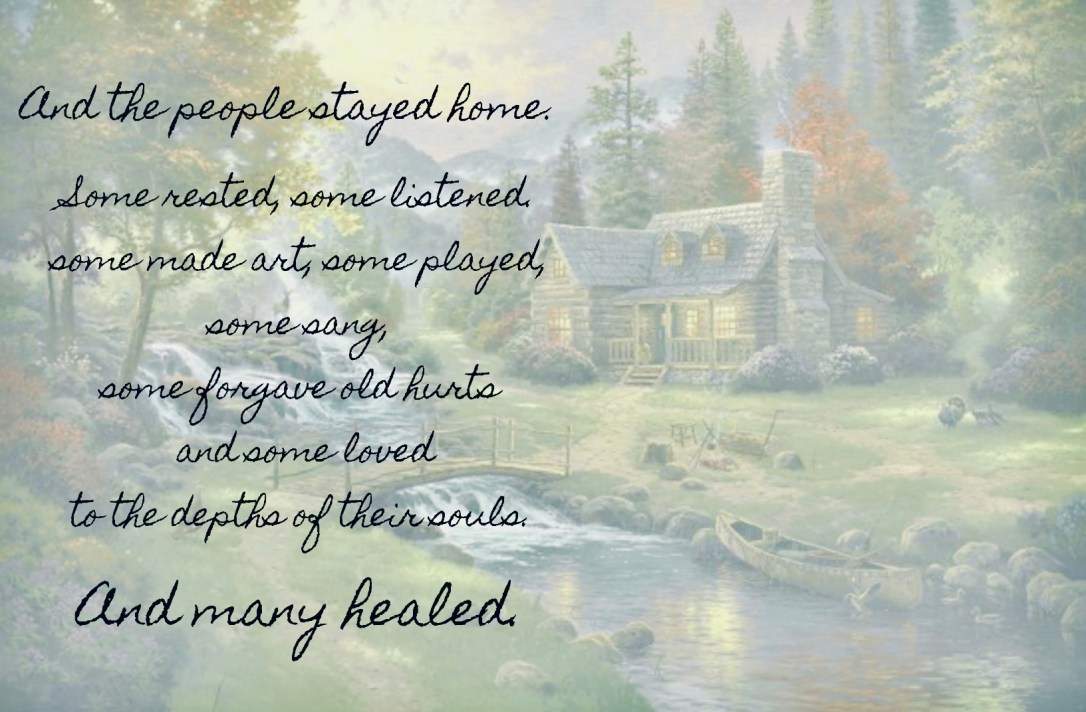
I can certainly identify with the quote that has recently been going around: “And the people stayed home.” It’s striking that, in the midst of the fear and anxiety people feel in these pandemic days, many have recalled and published parts of this quote. Let us spend a few moments contemplating the quote in it’s entirety:

And The People Stayed Home

And the people stayed home. And read books, and listened, and rested, and exercised, and made art, and played games, and learned new ways of being, and were still. And listened more deeply. Some meditated, some prayed, some danced. Some met their shadows. And the people began to think differently.

And the people healed. And, in the absence of people living in ignorant, dangerous, mindless, and heartless ways, the earth began to heal.

And when the danger passed, and the people joined together again, they grieved their losses, and made new choices, and dreamed new images, and created new ways to live and heal the earth fully, as they had been healed.

– Kitty O’Meara

To be clear, I am not suffering this pandemic as one who has contracted the virus. I am suffering the forced isolation, the inability to reach for someone’s hand, to touch a friend, to embrace my grandchildren. And I have not been isolated only because of this pandemic; I have been isolated from others since my kidney transplant on November 12. That’s a very long time to be separated from my community. Through that time, a friend or two visited me, but we could not touch one another or be in close proximity.

And now the coronavirus has isolated virtually everyone, and I suddenly realize that we’re all in this together. It makes me wonder what everyone is doing at home. And it makes me hope that at least a few of us are doing as Kitty O’Meara writes, “Some meditated, some prayed, some danced. Some met their shadows.“

On the idea of meeting our shadows . . .  I consider Lent to be a time of confession, a time of looking into my heart of hearts, my soul of souls, confessing my sins to God and receiving God’s mercy and pardon. I emerge from my confession with my soul cleansed. Only then am I ready. I am ready to steel my heart and set my face toward the journey with Christ to the cross. and then prepare my heart for glorious resurrection.

My confession today is that I have cursed my isolation rather than giving it to God and allowing myself to enter into a place of rest and re-creation, a sacred space that would heal the anxieties of my soul. I confess that I did not dance or pray. I did not rest or make art. But the pandemic changed my soul’s response to my isolation. I found that I was no longer in post transplant isolation, I was now in pandemic isolation and it felt very different to me. It felt dangerous and potentially fatal. It felt far-reaching, pervasive and rampant. It felt lethal, at least potentially lethal.

In the face of the pandemic’s imminent danger, my soul stopped its complaining and began its healing, my healing. It was the healing I needed all along, but now an ominous virus flipped a switch inside me. I did art again for the first time since the transplant. I sang, I prayed, I meditated. And I met my shadow and re-discovered the hidden place where fear reigns within me. That was not a bad thing. Rather, it was a good thing that said to me, “Do not give power to your hidden fear. Let your hidden resilience have the power and let it rise up within you. You will be healed!”

I believed those words — literally, as I hoped for physical healing after my transplant; and completely, body and soul, as I accepted the spiritual and emotional healing my soul craved. I want to leave you with a poem written on March 11, 2020 by Lynn Ungar.

D87DE2F1-852B-4017-B25F-232CA8AB094B
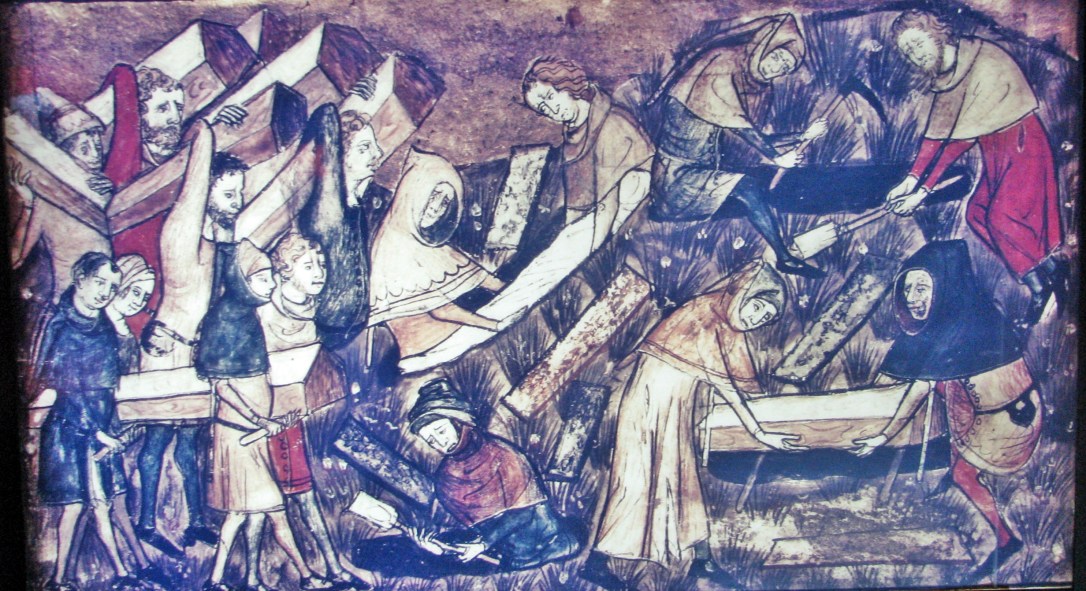
Blackdeath.   Wikimedia Commons

Pandemic

What if you thought of it
as the Jews consider the Sabbath —
the most sacred of times?
Cease from travel.
Cease from buying and selling.
Give up, just for now,
on trying to make the world
different than it is.
Sing. Pray. Touch only those
to whom you commit your life.
Center down.

And when your body has become still,
reach out with your heart.
Know that we are connected
in ways that are terrifying and beautiful.
(You could hardly deny it now.)
Know that our lives
are in one another’s hands.
(Surely, that has come clear.)
Do not reach out your hands.
Reach out your heart.
Reach out your words.
Reach out all the tendrils
of compassion that move, invisibly,
where we cannot touch.

Promise this world your love —
for better or for worse,
in sickness and in health,
so long as we all shall live.

Lynn Ungar is a poet, and wrote this poem on March 11, 2020, in response to the Covid-19 pandemic.


anxiety, Calamity, Change, Comfort, Community, Compassion, Confusion, Darkness, Death, Despair, Fear, God's Faithfulness, Grace, Hope, Illness, Isolation, life, Loneliness, Loss, Love, Mourning, Pandemic of 2020, Sorrow, Suffering, Tears, Terror

“Crimson Contagion,” Grace and Eternal Hope

1639C8B4-DC47-49B6-84A3-CC49557F0464
Today of all days, with the entire world embroiled in a real live pandemic, I will not write out of political bias. Instead, I want to open our eyes to some very troubling present realities. My focus is on the coronavirus pandemic in the United States and how circumstances have transpired, both on a logistical level and a human one. I read a Huffington Post article this morning revealing that last year the U.S. Department of Health and Human Services conducted a months-long exercise that showed that the nation was unprepared for a pandemic. The exercise, code named “Crimson Contagion,” had chilling similarities to the current real-life coronavirus pandemic. That fact got my attention!

microscopic magnification of coronavirus that causes flu and chronic pneumonia leading to deathThis pandemic has taken a toll on so many Americans. Mothers are struggling with children being at home, some having to learn on the fly how to home school them. Families grieve the loss of loved ones who died from the virus. Older adults fear their increased vulnerability and their body’s inability to fight the virus. Immunosuppressed persons like I am are terrified to leave home and are incessantly washing their hands, wearing masks and using hand sanitizer. Many people have lost their jobs while businesses all over the country have shut their doors. Churches have suspended worship services and other gatherings indefinitely. That is merely a tiny snapshot of the human toll the coronavirus is taking.

On top of any list we could make describing loss, inconvenience or isolation, there is widespread, overwhelming fear that has made its way into our very souls. This is a pandemic that has descended upon all of us — real people with real fear.

I’ll get back to the human toll of this virus, but I want to say a bit more about the “Crimson Contagion” exercise, which involved officials from more than a dozen federal agencies. The Huffington Post described the “Crimson Contagion” scenario:

 . . . several states and hospitals responding to a scenario in which a pandemic flu that began in China was spread by international tourists and was deemed a pandemic 47 days after the first outbreak. By then, in the scenario, 110 million Americans were expected to become ill.

The simulation that ran from January to August exposed problems that included funding shortfalls, muddled leadership roles, scarce resources, and a hodgepodge of responses from cities and states . . . It also became apparent that the U.S. was incapable of quickly manufacturing adequate equipment and medicines for such an emergency . . .

According to a New York Times report, White House officials said that an executive order following the exercise improved the availability of flu vaccines. The administration also said it moved this year to increase funding for a pandemic program in HHS.

But Trump’s administration eliminated a pandemic unit within the Department of Homeland Security in 2018. And weeks after the first real coronavirus case was diagnosed in the U.S., Trump submitted a 2021 budget proposal calling for a $693.3 million reduction in funding for the Centers for Disease Control and Prevention.

There you have it! In the throes of our real time pandemic, we hear of a “play-like” pandemic — a simulation conducted in 2019 that might have prepared us all, including our nation’s leadership. That didn’t happen, and those of us who have been in the world for so many years know the saying well: “Don’t cry over spilt milk.”

So we wipe up the milk that’s all over the table in front of us, and then we go about making our way through the dark, murky waters of this pandemic. We wash our hands, distance ourselves from others, stay at home, figure out how to handle our children who are now at home, cancel our travel plans, mourn those who have died, pray for those who are ill from the virus, grieve the loss of the life we knew before and pick up the pieces of what’s left.

What’s left? Well, what’s left is our ability to find ways to help our neighbor, to feed the hungry, to comfort the sick, to reach out to the lonely, to love the children and to pray for one another without ceasing. We may have to learn to do those things by phone or online chatting, but we will find a way.

1CA928D0-F17B-45DA-87F8-BC306F38EA32
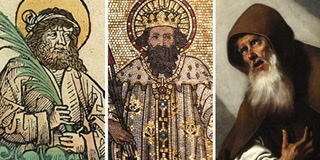
Fr. Lawrence Lew, O.P.; public domain; St. Quirinus of Neuss – for those affected by bubonic plague and smallpox; Edwin the Martyr (St. Edmund) — for victims of pandemics; St. Anthony the Great – Patron of those affected by infectious diseases

Those of us who are religious will pray without ceasing — imploring God to be merciful, asking various saints to intercede for us, lighting candles to express devotion and sitting for a moment in the flickering light that reminds us that God’s promise is about light overcoming the darkness.

The light shines in the darkness,
and the darkness has not overcome it.
(John 1:5)

In the end, perhaps we will have discovered that, through this terrifying and expanding virus, that we have learned how to care more and to love deeper. Perhaps we will find that we have a more heartfelt capacity for compassion. For that, God will pour out grace upon our weariness and renew our eternal hope.

If you pour yourself out for the hungry and satisfy the desire of the afflicted, then shall your light rise in the darkness and your gloom be as the noonday.
(Isaiah 58:10 ESV)

May God make it so. Amen.


anxiety, “God’s Will”, Comfort, Faith, Fear, God’s promises, Isolation, Loneliness, Pain, Pandemic of 2020, peace, Quarantine, Questions, Social distancing, Suffering, Troubles, Unfaith

Peace, Pandemic and Love

A9B89FA8-D79C-4999-B5DE-9695C420F354
What a time in the story of our lives! In my lifetime, I have never been personally affected by a pandemic. I have lived a little over seventy years without having this troubling and potentially deadly experience. My prayer is that once the pandemic of year 2020 has run its course, we will not have to live through another one for at least seventy years.

In the past few days, I have heard from students lamenting the loss of their senior year. I have commiserated with friends who feared for their elderly parents, especially those in nursing homes. I listened recently to a discussion about how we could possibly keep incarcerated persons safe from this virus. I have listened to friends and family express deeply held fears about how the virus might affect them and their families. I have heard almost daily from my adult son (an unprecedented number of calls in such a short time) who is worried about his parents and about his wife and their new baby to be born in early April. I have heard from friends my age who are quarantined at home fearing for their health. I have communicated with post transplant patients like me expressing their most intense fear because of their suppressed immune systems. As a recent transplant recipient myself, I completely understand their angst of being on immunosuppressant medications. Like them, I know I have no immune system right now.

There is no doubt that all over the world people are frightened. People of faith, however, know that faith is stronger than fear, God is stronger than despair and love is stronger than death. Of course, even though we might have great faith, we must admit that we don’t know what God will do or how God can protect us. That is not unfaith; it is the reality of our humanity. Oh, we can take the easy way out and proclaim words like, “God is in control” or “everything happens for a reason.” But doesn’t the past suffering and pain of your life convince you that those words are not your reality?

One of my former seminary professors taught and preached often about the experience of Jesus’ suffering in the Garden of Gethsemane. Dr. Frank Tupper’s answer to the question about how a loving God could allow Christ’s suffering went something like this: “because before the foundation of the world God had chosen the way of self-limitation.”

Dr. Tupper also said some things that some people might consider blasphemy: 

I do not believe that God is in control of everything that happens in our world. Indeed, I would argue that God controls very, very little of what happens in our world. God chose not to be a ‘do anything, anytime, anywhere’ kind of God. In every specific historical context with its possibilities and limitations, God always does the most God can do.

In my mind, and through the crucible of my life, I believe that God wanted authentic and honest relationships with humankind that affirm both divine love and human freedom. God built that kind of relationship with me when, through every life storm, every time of despair, every disappointment, every fear, every loss — and through my life-threatening illness — God did not change any circumstance of my suffering, but God promised me a love that would not let me go, ever.

In these days, God is not stopping the dreaded Coronavirus pandemic. God is not stilling our current storm. God is not taking away our very real fear. God is not telling us, “Go on out to that social gathering, I am in control.” Instead God has promised us peace through the words of Jesus recorded in John 16:33:

These things I have spoken to you, that in Me you may have peace. In the world you will have tribulation; but take courage, I have overcome the world.

I pray that you will find peace in these troubling days and that your faith will be even a little stronger than your fear. I pray that you will not experience economic hardship and that you will have all you need. I pray that illness will spare you and those you love. I pray that your children will thrive even though their schools are closed. I pray that you will find ways to worship God even if the doors of your church are shuttered. Most of all, I pray that you will feel God’s love as a love that will never let you go.

The words of one of my favorite hymns express these thoughts so well:

O Love that wilt not let me go,
I rest my weary soul in thee;
I give thee back the life I owe,
that in thine ocean depths its flow
may richer, fuller be.

O Light that follow’st all my way,
I yield my flick’ring torch to thee;
my heart restores its borrowed ray,
that in thy sunshine’s blaze its day
may brighter, fairer be.

O Joy that seekest me through pain,
I cannot close my heart to thee;
I trace the rainbow thro’ the rain,
and feel the promise is not vain
that morn shall tearless be.

O Cross that liftest up my head,
I dare not ask to fly from thee;
I lay in dust life’s glory dead,
and from the ground there blossoms red,
life that shall endless be.

— Author: George Matheson, 1842-1906

Perhaps you would like to spend a few moments of quiet meditation listening to this beautiful hymn arrangement.

Uncategorized

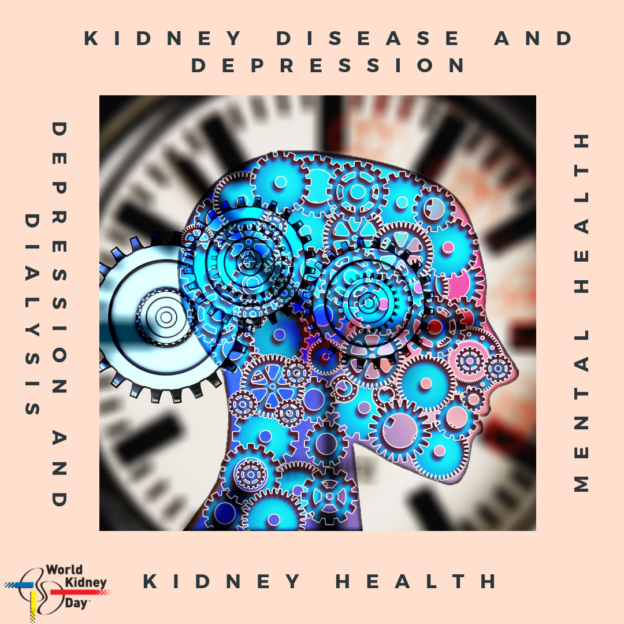
World Kidney Day and . . . My Four Month Transplant Anniversary

71321974-292D-4089-985B-EE1A9613A6CA

March 12th is World Kidney Day.

World Kidney Day is observed every year. All across the globe many hundreds of events take place from public screenings in Argentina to Zumba marathons in Malaysia. But for me, the day means something personal and very real. March 12 will be exactly four months since I had my kidney transplant at Mayo Clinic in Jacksonville, Florida. Five years on dialysis presented its own challenges. But these past four months post transplant have been grueling, challenging and confining. In fact, for various reasons including bouts of infection, I am still quarantined at home. I deal every day with the harsh reality that powerful immunosuppressant medications have decimated my immune system to the point that getting out among people is not possible, for now. On top of that, the side effects of my drugs are harrowing at times. There are so many things I love to do are now very difficult, if not impossible. I knew, of course, that a transplant is not a cure. It is just a treatment, the best treatment available. All of the post transplant realities have been bewildering and unsettling. I sometimes describe post transplant reality as the disarrangement of my way of life.

At the same time, I celebrate the miracle of the living gift I have received. I am deeply grateful and humbled by the living donor who contacted me months ago to offer his kidney — my long-time friend Greg Adams of Little Rock, Arkansas. After almost two years of testing at hospitals in Atlanta and Jacksonville, Florida, Greg was approved to donate. He was not a match for me, so the matching began. I was eventually gifted with a kidney that traveled to me from Mayo Clinic in Rochester, Minnesota, from a kind and lovely woman — Corita. Greg gave his kidney to Autry at Mayo Clinic in Jacksonville, Florida.

But that was only the beginning of the miracle. Greg’s willingness to donate his kidney to someone he did not know created a chain of eight donors and eight recipients. His altruistic donation enabled eight patients to receive new kidneys and new lives.

For all of this, I say: Thanks be to God, the Giver of Life.

11288B80-C8EA-479A-8676-ECC196FAC925It is a difficult prospect to ask someone to consider donating a kidney. I can not forget that they experience the pain of surgery and recovery, as well as feeling the loss of losing a vital organ. So when someone like Greg appears out of the blue and offers his kidney, I can only respond with heartfelt gratefulness and deep humility. Because it is so difficult for most everyone to ask another person to donate, the National Kidney Foundation offers this word of encouragement: A CONVERSATION CAN SAVE A LIFE!

Whether you need a kidney or are considering donation, I encourage you to start the conversation, first with a trusted friend or family member. Get comfortable with the idea of asking someone for a kidney. Begin “the conversation” with anyone that might consider donating. For thise of you who might consider donation, again start the conversation with someone you trust. Then visit some of the websites below to learn all you can. Start the conversation because all of us want kidney health for every person.

Understanding Living Donation

Relatives, loved ones, friends and even individuals who wish to remain anonymous often serve as living donors to spare a patient a long and uncertain wait. In 2019, more than 7,300 transplants were made possible by living donors. If you are considering living donation, it is critical to gather as much information as you can from various sources. Start here for living donor information: https://unos.org/transplant/living-donation/

So celebrating March 12 — World Kidney Day and my own kidney transplant anniversary — is a way to create awareness. Awareness must be about preventive behaviors, about risk factors, about how to live with kidney disease and awareness of the possibility of becoming a living donor. Consider these alarming statements:

    • 15% of US adults—37 million people—are estimated to have Chronic Kidney Disease (CKD).
    • Most (9 in 10) adults with CKD do not know they have it.
    • In 2016, nearly 125,000 people in the United States started treatment for End Stage Kidney Disease (ESKD), and more than 726,000 (2 in every 1,000 people) were on dialysis or were living with a kidney transplant.
    • Over 3,000 new patients are added to the kidney waiting list each month.
    • Every 14 minutes someone is added to the kidney transplant list.13 people die each day while waiting for a life-saving kidney transplant.
    • In 2014, 4,761 patients died while waiting for a kidney transplant. Another, 3,668 people became too sick to receive a kidney transplant.
    • There are currently 121,678 people waiting for lifesaving organ transplants in the U.S. Of these, 100,791 await kidney transplants.
    • The median wait time for an individual’s first kidney transplant is 3.6 years and can vary depending on health, compatibility and availability of organs.
    • Every day, more than 240 people on dialysis die.
    • In 2014, 17,107 kidney transplants took place in the US. Of these, 11,570 came from deceased donors and 5,537 came from living donors.


F7B90784-D9FE-4923-9795-A284C51E6730We don’t want to know this part, but here it is anyway:

— About 1,400 children began care for kidney failure in 2013.

— The number of children with kidney failure is increasing every year.

— About 9,900 children were being treated for kidney failure as of December 31, 2013.

— The most common initial treatment for kidney failure among children overall is hemodialysis (56%).

— Peritoneal dialysis is the most common initial treatment in children younger than 9 years and for those who weigh less than 44 pounds (20 kg).

— There were over 1000 children waiting for a kidney transplant as of November 27, 2015.

— The number of children receiving kidney transplants was highest in 2005 at 899.

— About 700 children received a kidney transplant in 2014.

— About 70% of children with kidney disease will develop kidney failure by age 20.

— Children with kidney disease have a greater chance of dying than children in the general population. 

The organ shortage continues . . .

EE027B6E-5AF0-449D-8682-79B6894E4276Each year, the number of people on the waiting list continues to be much larger than both the number of donors and transplants. Perhaps we can make a difference by supporting persons on dialysis, persons who are making the decision about dialysis, persons who are recovering from a transplant and persons who are considering donating a kidney. Perhaps we could start conversations.

Still, there is good news:

Yes, there is good news in 2019 statistical information for persons who have suffered with kidney disease for years, maybe even their entire lives. I do not exaggerate when I say that thousands of persons languishing on dialysis really need good news!

8B9E500E-C65B-41C3-8D0F-5B2DC961EFEF

I can definitely celebrate these statistics. But I will never forget that Jalen, my youngest grandson, was born with kidney disease and went on dialysis. I will never forget the fear and frustration his parents felt. I will never forget the sheer joy we all experienced when his kidney disease resoled itself as his little body grew.

As I celebrate World Kidney Day on the 12th day of March and my day — on the 12th day of November, it is fair to say that my life has changed in ways I know and in ways I do not yet know. Yet, on this day I will think of Greg’s words about donating and receiving: “We are forever connected in a special way — and that’s a good thing.” On this day, I will know that healing for me will continue. I will be propped up by my dearest and closest friends, by my friends all over the world who pray for me, by my loving church family, by my dear caregiver husband and by my family near and far. 

I will say again: For all of this, thanks be to God, the Giver of Life.


For more information about kidney disease and about Living Donor programs, please visit these links:

https://www.worldkidneyday.org/facts/chronic-kidney-disease/

https://www.cdc.gov/kidneydisease/publications-resources/2019-national-facts.html

https://www.kidney.org/atoz/content/answering

https://www.organdonor.gov/statistics-stories/statistics.html

https://www.kidney.org/news/newsroom/factsheets/Organ-Donation-and-Transplantation-Stats

https://optn.transplant.hrsa.gov/news/organ-donation-again-sets-record-in-2019/


Community, Contemplation, Freedom, Inner joy, peace, Uncategorized

The Path to Inner Peace, Joy and Freedom

C969192F-5A14-440C-866D-D5E5D8D00F36
Peace, joy and freedom.
All three are needed things, soul things that make us content. They are not easily gained, however, as the daily routine we call life attacks them on a regular basis.

How troubling it is to lose one’s sense of peace. A number of life situations can result in a loss of soul-peace — worry about illness, financial concerns, difficulty with children, caring for aging parents, moving to another home. It would be impossible to complete the list of things that can steal our sense of peace.

F96B5DE4-5888-46C4-8956-5E9B8C79538EPerhaps we should go one step further, though, and acknowledge that our loss is not merely the loss of peace, it is the loss of peacefulness. That loss can be disconcerting at best and devastating at worse. All of us long for a deep and abiding sense of peacefulness. We sometimes cry out “peace, peace, when there is no peace.” (Jeremiah 6:14)

09448864-0833-49E4-B38B-EC6E4B5B1BC1
Joy! 
At times, it can be hard for us to feel joy. I think it is because we’re not at all sure what joy hidden inside the soul feels like. For joy is not simply happiness over something that has come to us — a new house or car, a life milestone like graduation or a wedding, a celebration of the birth of a child. Such things seem to bring joy, but our actual response to such events is a brief burst of happiness. Genuine joy — soul joy — happens when something inside of us deeply responds to
joy and we tuck it away safely in our hearts. And that kind of joy is not a brief response to a happy event, it is an abiding, spiritual state of being that comes with a grace-filled assurance that Christ came to make sure we live our lives ‘more abundantly.” The message from Jesus comes to us using various words:

I have come that you might have life, and have it more abundantly.
(John 10:10, paraphrased)

I came to give life with joy and abundance.
(The VOICE translation)

I have come in order that you might have life—life in all its fullness.
(The Good News Bible)

Living “Life in all its fullness” seems to be the end result of abiding joy, in the soul and in the heart. Even when we listened to the song our children learned to sing, “I’ve got that joy, joy, joy, joy down in my heart,” we somehow knew that true joy was internal not external. That joy resided in our hearts and in our souls.

CCBEBC8B-56E7-44EF-A9D0-C73F395A35E6Finally freedom — the kind of freedom we have when peace and joy is hidden in the deepest recesses of our being. Freedom does not leave those who practice gratefulness, prayer, meditation and confession. It is at the altar of confession that God offers us assurance of pardon. It’s the opposite of the soul’s bondage. I cannot help but recall the words of the Apostle Paul about the nature of Christian freedom that so boldly introduce the 5th chapter of Galatians:

For freedom Christ has set us free. Stand firm, therefore, and do not submit again to a yoke of bondage. (Galatians 5:1)

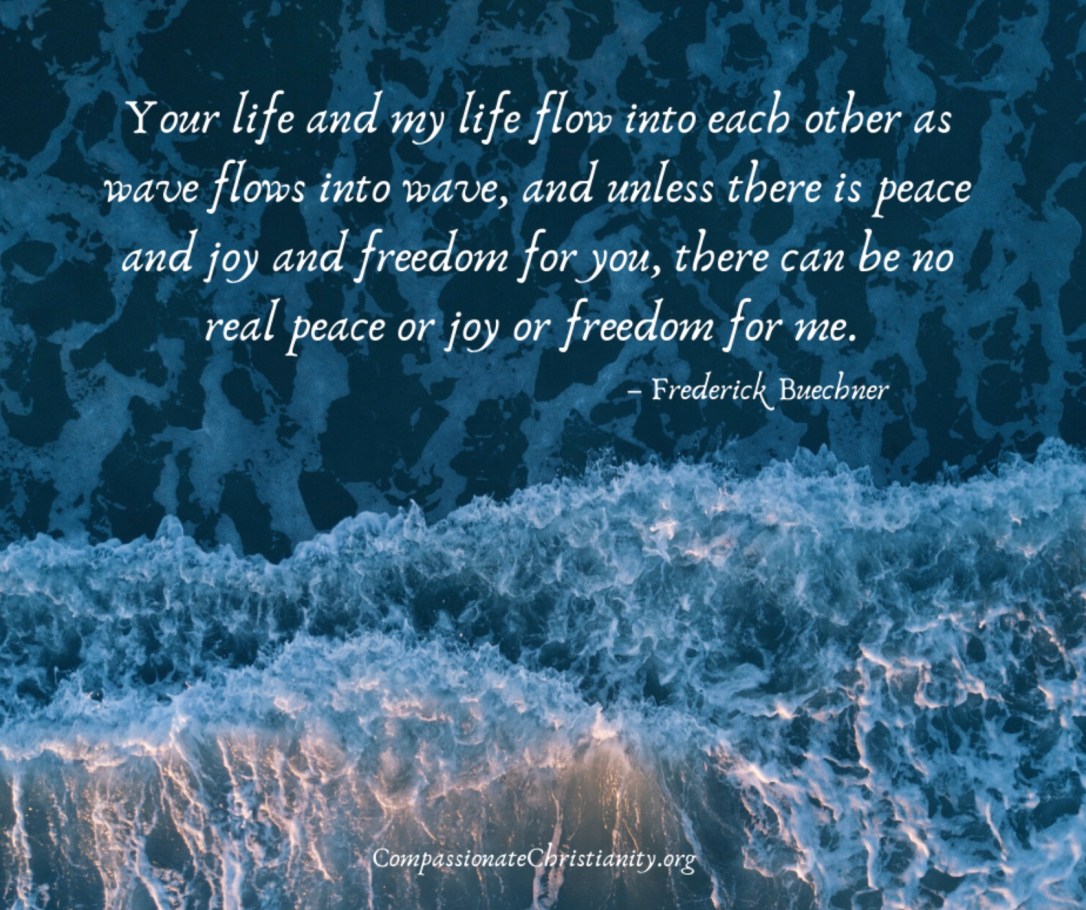
Frederick Buechner added a new dimension to our longing for peace, joy and freedom with this powerful thought:

Unless there is peace and joy and freedom for you,
there can be no real peace or joy or freedom for me.

Therein lies the crux of living the Christian life: an interconnectedness among those who follow Christ, a community of faith in which each one supports the other. It is an interconnectedness that transcends differences of opinion, different ways of practicing faith, disagreements about which hymns are more appropriate in worship or, even more trivial, what kind of light bulbs should we use in the sanctuary.

Our interconnectedness ensures that each of us will have the will and the faithfulness to enjoy the kind of peace, joy and freedom that abides in us when we “do not forsake the assembling of ourselves together and when we exhort and encourage one another. The Message translation by Eugene Peterson calls it “spurring each other on.” (Hebrews 10:25)

Perhaps caring for one another — exhorting, encouraging and “spurring each other on” — is the message of this beloved hymn that so often informs our worship and our community when we sing it together:

Brother, sister, let me serve you;
Let me be as Christ to you;
Pray that I might have the grace to
Let you be my servant, too.

We are pilgrims on a journey;
We are family on the road;
We are here to help each other
Walk the miles and bear the load.

I will hold the Christ-light for you
In the nighttime of your fear;
I will hold my hand out to you,
Speak the peace you long to hear.

I will weep when you are weeping;
When you laugh I’ll laugh with you;
I will share your joys and sorrows
Till we’ve seen this journey through.

When we sing to God in Heaven
We shall find such harmony,
Born of all we’ve known together
Of Christ’s love and agony.

— THE SERVANT SONG, Words and music by Richard Gillard

In our deepest time of prayer and contemplation and in the sacred refuge of our community of faith, our souls find peace, joy and freedom — for all of us, for each of us.

May God make it so. Amen.

Determination, Dreams, Greta Thunberg, Helena Morrissey, International Women’s Day, Malala Yousafzai, Perseverance, Persistence, Sarah Hesterman, Sarah Tenoi, struggle, Stubbornness, Tenacity, Women

On Rearranging Things: 2020 International Women’s Day

C1B6D1BF-6B4B-4737-BFDF-A4B476F3E63D
March 8 — 2020 International Women’s Day

Commemorating 2020 International Women’s Day seems important. It is important to me to pause on this day, because I am a woman who has struggled for equality. My female friends and colleagues have had similar struggled.

In the past weeks we have watched one woman after another end their candidacies for president of the United States. Senator Elizabeth Warren commented that Americans still may not be able to see a woman in the role of president. She said it with obvious sadness and with a catch in her throat, displaying the disappointment of many women and girls. Those of us who are older lament that we will not see a woman as president in our lifetimes, while little girls, teens and young women were hoping beyond hope for evidence in 2020 that dreams are possible. Lily Adams, granddaughter of the late Texas Governor Ann Richards, said this on Thursday night in an MSNBC interview: “Women have to run faster to get half as far.” How true that is!

6ABA8DA9-32CD-49DC-B9A7-BEB584D83D27International Women’s Day gives me an opportunity to celebrate women who are all-in, working tirelessly for equality, justice and positive change and constantly rearranging things. This years theme is “If you can see her, you can be her.” It is an appropriate theme for women who struggle daily to be seen and respected as equals.

In these days, we are seeing, right before our eyes, so many stunning examples of women who champion various causes.

FC5FBE11-6734-47C6-A38E-933B9D902D1FSarah Tenoi
Activist Sarah Tenoi is leading the charge against female genital mutilation (FGM) in Kenya.


92066DDD-0F40-4E55-98AD-AB30B1A9D94BMalala Yousafzai
In 2012 at the age of 15, Malala Yousafzai, was shot in the head by the Taliban in Pakistan. The assassination attempt was a response to her stand for the right of girls to gain an education after the Taliban banned them from attending school.


DD465146-0702-479F-A8E9-67C6EAEF42D3Helena Morrissey
Helena Morrissey is a British businesswoman and mother of nine who is helping to change the face of British boardrooms.

 
6E324393-F712-4FE2-AD26-04DC9FEE1425Sarah Hesterman
As the founder and acting president of Girl Up in Qatar, Sarah Hesterman works with the UN to provide young girls with education in developing countries. Hesterman hopes that providing greater opportunities will allow girls to grow up with more self-confidence.

D50E2B31-E103-4C36-8BE9-9A07B452E4AFGreta Thunberg
Greta is a Swedish environmental activist on climate change whose campaigning has gained international recognition. She is known for her straightforward speaking manner through which she urges immediate action to address the climate crisis.

“We can’t just continue living as if there was no tomorrow, because there is a tomorrow,” she says, tugging on the sleeve of her blue sweatshirt. “That is all we are saying.”

It’s a simple truth, delivered by a teenage girl in a fateful moment in our time. (Time Magazine) 

FA268BA8-7679-4678-9854-8DC8EAEFB454

In the early years of my career as a graphic designer and then through my years of ministry, I was often accused of being aggressive. Now you need to understand that “Aggressive” would be the last word I would have used to describe myself. But like many women, I often found myself biding my time, playing the game of acting “ladylike” around my male colleagues, and choosing my words and my demeanor carefully when I wanted to make a point.

That was Stage 1 of me.
Stage 2 of me is the one that was labeled aggressive. Those who know me well would say that there is not an aggressive bone in my body. And that is true (unless I have to defend my child or my grandchildren). But I can be as aggressive as I need to be when injustice rears its ugly head or someone I love needs defending. Stage 3 of me has learned to be respectfully assertive. “Respectfully assertive” behavior helped to open doors that once were closed to me. That’s a good thing.

But here’s the caveat — as other women have, I have been compelled to learn how to be aggressive/assertive along a continuum, examining my situation and wisely choosing what my aggressive/assertive level should be at any given moment. The continuum looks something like this . . .

4B0B7E39-A6A8-4CDA-BAD4-8BF73C7C95CD
Like many, many women, I know that in order to effect positive change in the world, positive assertiveness is key. It’s all a matter of being self-confident enough to step up even if others criticize, speak out even when others try to silence you, persevere even when your detractors try to stop you from moving forward, hold on to your dreams even when dream-less persons tell you that your dreams are impossible.

My path to ordination was riddled with people around me telling me that ordination for a woman was impossible. At that time, there was only one ordained Baptist woman in the state of Arkansas and she was ordained in another state. My ordination process required enormous change in almost every person and institution around me. That change was not pleasant for anyone. It went on for months with lots of chaos and no resolution in sight. At the time, I thought I had only two choices: to abandon my desire for change or to stay in the struggle until change happened. I faced off with criticizers, silencers, discouragers and dream-less persons. Perseverance won that time!

My ordination quest was only one of many situations in which I had to fight for positive change. So I was almost always on the bad side of someone, and most unfortunately, I earned a reputation of being persistent, stubborn, insistent, resolved, Tenacious, determined, single-minded, resolute, uncompromising, annoying, troublesome, unconscionable and — wait for it — aggressive. I actually like most of those labels!

During a particularly discordant struggle with Little Rock city government about advocacy programs have for young people, a friend and mentor, who was the city’s Director of Community Programs, shared with me a Sierra Leonean Proverb that turned out to be an incredibly practical piece of wisdom. I immediately framed it and put it in my office so that I could see it often. She gave me that proverb in the late 90’s and, to this day, it is visible and prominent in my space.

She who upsets a thing should know how to rearrange it.
— a Sierra Leonean proverb

I seemed to upset lots of things in my lifetime. Often, I had no idea how to rearrange them. So I want to tell you about a woman who achieved what seemed impossible in her life and rearranged many things — discrimination, injustice, racism. She definitely upset things in her workplace, in the people around her and in NASA’s algorithms for space travel. She also rearranged those algorithms and helped send our astronauts into space.

625274F6-C5B5-47FD-A72E-3B8A4BEC9983Today I celebrate and remember Katherine Johnson, famed NASA mathematician and inspiration for the film “Hidden Figures.” She died a few weeks ago at 101 years of age. For almost her entire life, her brilliant work in American space travel went unnoticed. She was a pioneering mathematician who, along with a group of other brilliant black women, made U.S. space travel possible. And no one noticed for decades.

In fact, her work went largely unrecognized until the release of “Hidden Figures,” a film portrayal of Johnson’s accomplishments while the space agency was still largely segregated. Only the film, which was released in 2017, resulted in international recognition of Katherine Johnson’s genius.

Interestingly enough, her talent was evident early on. Her natural aptitude for math was quickly evident, and she became one of three black students chosen to integrate West Virginia’s graduate schools. After graduating from high school at age 14, Katherine Johnson enrolled at West Virginia State, a historically black college. As a student, she took every math course offered by the college. Multiple professors mentored her, including W. W. Schieffelin Claytor, the third African-American to receive a Ph.D. in mathematics. Claytor added new mathematics courses just for Johnson, and she graduated summa cum laude in 1937 at age 18, with degrees in mathematics and French. She started her career as a teacher but had her sights set on mathematical research.

Following an executive order that prohibited racial discrimination in the defense industry, Johnson was hired at the National Advisory Committee for Aeronautics, NASA’s predecessor. She was one of several black researchers with college degrees hired for the agency’s aeronautical lab through the initiative.

Johnson was part of NASA’s Computer Pool, a group of mathematicians whose data powered NASA’s first successful space missions. The group’s success largely hinged on the accomplishments of its black women members. Katherine Johnson was tasked with performing trajectory analysis for Alan Shepherd’s 1961 mission, the first American human spaceflight. She co-authored a paper on the safety of orbital landings in 1960, the first time a woman in the Flight Research Division received credit for a report.

In 1953 she worked in the facility’s segregated wing for women, but was quickly transferred to the Flight Research Division, where she remained for several years. But midway through the ’50s, the space race between the U.S. and the Soviet Union began to intensify. So did Katherine Johnson’s career. Without the precision of “human computer” Katherine Johnson, NASA’s storied history might have looked a lot different. Her calculations were responsible for safely rocketing men into space and securing the American lead in the space race against the Soviet Union.

After the release of the book “Hidden Figures,” which was published in 2016 and turned into a film the following year, officials lobbed heaps of praise on Johnson and two other black women mathematicians in the agency’s Computer Pool, Dorothy Vaughan and Mary Jackson. NASA renamed a facility for Johnson in February 2019. A street in front of NASA headquarters in Washington was renamed “Hidden Figures Way” for the three women in July.

In November of 2019, the three women — plus engineer Christine Darden — received Congressional Gold Medals for their contributions to space travel. Vaughan and Jackson received theirs posthumously. NASA administrator Jim Bridenstine called Johnson an “American Hero who helped our nation enlarge the frontiers of space even as she made huge strides that also opened doors for women and people of color in the universal human quest to explore space.”

President Barack Obama honored Johnson with the Presidential Medal of Freedom for her pivotal work in American space travel. Yet, Johnson’s work was still minimized and unrecognized by her male co-workers. Around her NASA workplace in the 1960s, she and her colleagues were known as “computers in skirts.”

I saved for last the best story of all! In 1962, John Glenn actually demanded Katherine Johnson’s help before his orbit around Earth. He was skeptical of the computers that calculated his spacecraft’s trajectory, so he told engineers to “get the girl” and to compare her handwritten calculations to the computer’s.

“‘If she says they’re good, then I’m ready to go,'” Johnson remembered Glenn saying. She gave the OK, and Glenn’s flight was a success.

Not to be flippant about the 2020 democratic presidential nomination process, but here’s a good message to send to whichever white guy gets the nomination: “When you are choosing your running mate, ‘get the girl!’”

And to all the women who hold up far more than half the sky, I honor you on this International Women’s Day and cheer you on toward your dreams and toward your mission of rearranging the world.


Enneagram, Insight, Inspiration, Self Awareness, Self-understanding, Transformation

A Different Kind of Blog Post: Reviewing the Enneagram

720B12F9-4A15-4E6A-897E-EB03156817EE

Settle in! This is a lengthy post. If you are interested in information about your personality type, the Enneagram is a helpful tool. And if you are interested in the Enneagram, or even curious about it, read on! If you’re not interested in any of that, wait for my next blog post.

“What’s your number?
That is the most frequently asked question about the Enneagram.

The second frequently asked question?
“What in the world is an Enneagram?”

Here’s the official definition according to the Merriam-Webster Dictionary:

en·ne·a·gram
noun
en·​nea·​gram | \ ˈe-nē-ə-ˌgram \ plural : enneagrams

Definition of enneagram
1. a regular geometric figure with nine points : the figure inscribed within a regular nine-sided polygon
2. a system of classifying personality types that is based on a nine-pointed starlike figure inscribed within a circle in which each of the nine points represents a personality type and its psychological motivations (such as the need to be right or helpful) influencing a person’s emotions, attitudes, and behavior).


Imposed Isolation and a Compromised Immune System

When one system is weak — my immune system — why not work on boosting another system? In this case, I mean my psychological system (which actually needs constant attention). So while I am in an immunosuppressed state of imposed isolation inside my house, I have taken some time to look back on the Enneagram notes I have used through the years. When I first studied the Enneagram, I was asking, “Who am I?”

I’m still asking! I now know that determining who I am is a life-long proposition, so I still need a season of introspection from time to time. Hence, I pulled out my Enneagram diagrams and notes. Let me say at the outset that no system can tell you who you are. The best the Enneagram can do is to offer a bit of insight into various personality types. It has been helpful for me, so I decided to share an Enneagram overview today.

I recently read several of Father Richard Rohr’s daily meditations focused on the Enneagram. He understands the Enneagram not merely as a personality typing system, but as a tool for personal transformation. In one of his daily meditations, Father Rohr says this about the Enneagram:

If you know the Enneagram already, my hope is that you will learn something new about yourself, someone you care about, or even someone you don’t care for very much. Compassion, empathy, and forgiveness—for the self and the other—are some of the great fruits of this labor. And if you aren’t familiar with the Enneagram at all, know that these meditations are simply pointing in the direction of a much greater wisdom to be explored.


Some History on the Enneagram

In the late 1960s, Oscar Ichazo began teaching the “Traditional Enneagram” as we know it today. The Enneagram is widely taught as a way of understanding personality, addiction, relationships, vocation and other areas that all of us need more fully understand. However, the Enneagram symbol has roots in antiquity and can be traced back at least as far as the works of Pythagoras. The philosophy behind the Enneagram contains components from mystical Judaism, Christianity, Islam, Taoism, Buddhism, and ancient Greek philosophy (particularly Socrates, Plato, and the Neo-Platonists)—all traditions that stretch back into antiquity. The Enneagram of Personality Types is a modern synthesis of a number of ancient wisdom traditions. (The Enneagram Institute)

People who know the Enneagram in a superficial way think it’s about putting people into boxes, but it actually works to free people from their self-created boxes. While there are tests and quizzes that can help individuals identify their primary Enneagram type, finding our “number” is just the first step. We get to know our “number” so we can begin freeing ourselves from the passions, fixations, and fears to which our ego has become attached.  — Father Richard Rohr

As Father Richard would suggest, we should remember that the Enneagram  does not definitively determine one’s personality type. Its nine categories are not meant to restrict us to a certain way of being or “name” us. Rather, it is  a dynamic system that recognizes that humans are far too complex to fit easily into simple categories. It does, however, offer insight.

The Enneagram  can be  a powerful tool for self-discovery and spiritual transformation, but it shouldn’t be our only tool. The Enneagram is most helpful when used in conjunction with other practices like study, contemplation, therapy, spiritual direction, and life in community with others. The Enneagram’s most important purpose  is  to help us uncover the traps that keep us from being our best selves. That kind of insight is invaluable.
— From the Daily Meditations of Richard Rohr published on February 23, 2020

The Nine Personality Types

85EE4E48-DD90-454E-A9E7-A505DB185E1ELet’s begin by looking at a traditional Enneagram. The types are normally referred to by their numbers, but sometimes their “characteristic roles” are used instead. There are also  “stress” and “security” points which are the types (called Wings) connected by the lines of the enneagram figure and are believed to influence a person who is in more adverse or relaxed circumstances. According to this theory, someone with a primary One type, for example, may begin to think, feel and act more like a Four type when stressed or a Seven type when relaxed.


The Enneagram Wings

Most, but not all, Enneagram of Personality theorists teach that a person’s basic type is affected to some extent by the personality dynamics of the two adjacent types as indicated on the enneagram figure. These two types are often called “wings”. A person with the Three personality type, for example, is understood to have points Two and Four as their wing types. A person may be understood, therefore, to have a core type and one or two wing types which influence but do not change the core type.


The Enneagram at a Glance

The table below offers some of the principal characteristics of the nine types along with their basic relationships. This table expands upon Oscar Ichazo’s ego fixations, holy ideas, passions, and virtues, primarily using material from Understanding the Enneagram: The Practical Guide to Personality Types (revised edition) by Don Richard Riso and Russ Hudson.
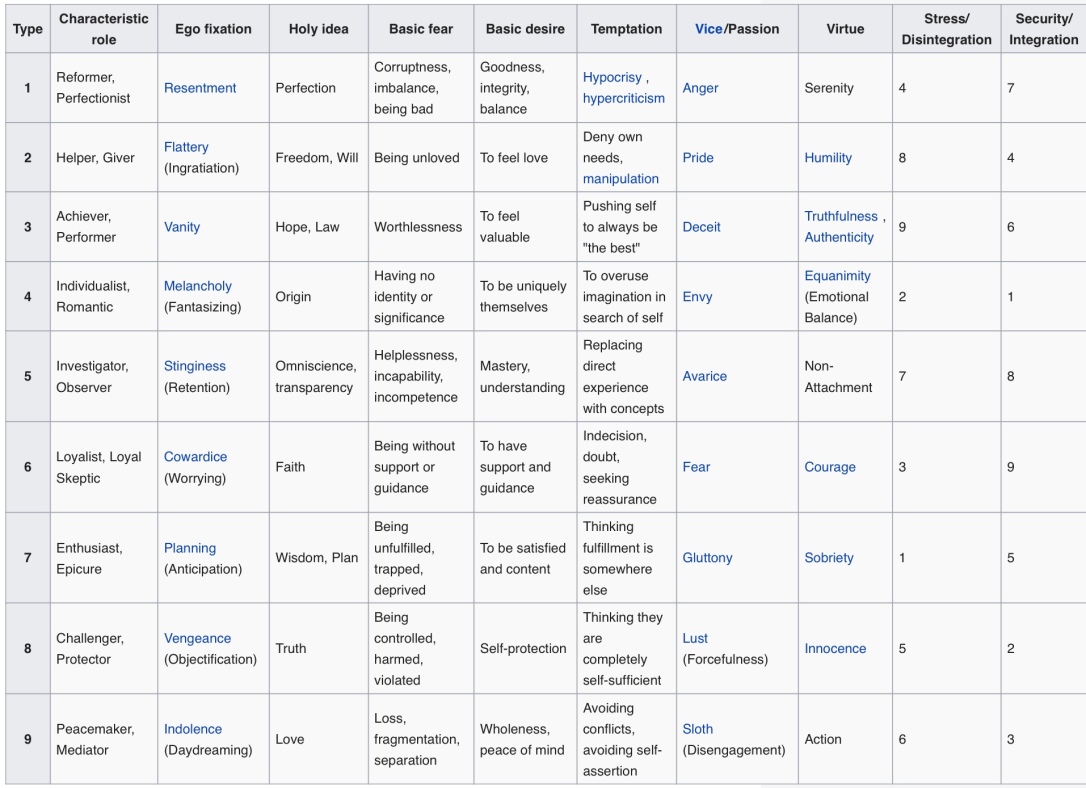
451F46EF-0836-4B25-83F0-039A482AD349

Every single person has access to all nine numbers. Based on nature, nurture, and discipline, you express the values of each number at varying degrees of intensity based on your lived experience. You are not one thing; you are complex and multifaceted; you are interconnected. This is a vital paradigm shift. When you consider having access to all nine numbers simultaneously, you increase and expand your capacity for thriving.  [1] 

Considering what you know of the Enneagram so far, in what numbers do you experience ease, or in Jerome Lubbe’s language, sense “efficiency”? Where do you feel less efficient? Great insight can be gained from Richard Rohr’s February 29th meditation that speaks of understanding the Enneagram as a Whole-Identity Profile instead of a single number personality “type,” He says that by seeing the Enneagram as a Whole-Identity Profile, one can expand their capacity for growth in infinite ways.

 . . . When you shift the Enneagram Framework from being a number to having efficiencies in all nine numbers, the Enneagram language shifts with it. It becomes about nature and values instead of type and reductive behaviors. For example, number Seven, traditionally associated with the title of “Enthusiast,” is instead represented by the innate human capacity for “Enthusiasm” as well as the value of “Experiences. 

“I am an enthusiast” becomes “I value experiences” which allows more room for nuance, invites growth and begs the question, “. . . and what else do I value?”. . . There is no human who is defined by a single number.

If you have resisted being “pinned down” to any one Enneagram number, perhaps Lubbe’s approach will help you see all of these qualities within yourself. Take a few minutes to read the statements below aloud slowly, pausing for reflection after each one. Notice any sensations in your body. Observe the difference between the impact of “I am” statements versus “I value.” After reading all nine, where do you feel the most energy and resonance? What values are especially meaningful to you? What values do you want to spend more time cultivating?   [1]  https://cac.org/enneagram-part-one-body-center-weekly-summary-2020-02-29/


Jerome Lubbe’s Enneagram as a Whole-Identity Profile

Eight: I am a Challenger = I value Autonomy 

Nine: I am a Peacemaker = I value Serenity 

One: I am a Reformer = I value Justice 

Two: I am a Helper = I value Appreciation 

Three: I am an Achiever = I value Creativity

Four: I am an Individualist = I value Authenticity  

Five: I am an Investigator = I value Clarity 

Six: I am a Loyalist = I value Guarantees 

Seven: I am an Enthusiast = I value Experiences   [2] 

When we understand the Enneagram as a Whole-Identity Profile instead of a single number personality “type,” we expand our capacity for growth . . . You are not a personality. You are not even multiple personalities. You have an identity—and what creates and characterizes your identity can be charted by the nine numbers of the Enneagram.
6F063E55-B677-43FB-92DD-CBEA902AD935The anatomy of the brain reflects this: we are not left-brained or right-brained, we are whole brained. [3]  The same is true for the Enneagram.

To put it more plainly, you are not a personality type or number on the Enneagram. You are a whole person who has a whole identity — you are all nine numbers.

https://cac.org/enneagram-part-one-body-center-weekly-summary-2020-02-29/


Too Much Information?

This post may have been too much information for you. Or you may be interested in looking further into the Enneagram. If so, there are many excellent books on the subject as well as online information. You may also be asking how you can determine your Enneagram type. Online you will find many life coaches, spiritual directors, counselors, ministers and others who use Enneagram types with their clients/parishioners. Also at the end of this post I will list some websites that offer free tests that many be helpful to you, with the caveat that after you complete your test, they may offer you further information at a cost.

What’s most important is that whatever personality work you engage in leads you to a deeper knowing of yourself. The goal is to you know who you are, understand your behavior and use the information you have to guide your life journey and follow your dreams. No! The Enneagram test — nor any other personality test — will not make you into your best self. Only you can do that, through self-examination, prayer, contemplation and a process of clearing your soul of anything that might be holding you captive. My prayer for you is that you might search patiently and persistently for whatever brings you inspiration, insight, self-understanding and transformation.

P.S. — I’m a “Three!”


Online Enneagram Tests

The Enneagram Personality Test – Truity
This personality test is based on the Enneagram personality theory, which describes personality in terms of nine types, each driven by their own set of core emotions, fears, and beliefs. This basic 105 question test is free and takes about 10 minutes to complete. https://www.truity.com/test/enneagram-personality-test

The Fast Enneagram Test. https://enneagramtest.net/

Eclectic Energies Enneagram Tests
Offers two online Enneagram tests help you to determine which personality type you are. Your wing will also be indicated. https://www.eclecticenergies.com/enneagram/test

Additional Resources
E48ACE46-6279-41EB-BEA2-20EE99682E02


Book: The Sacred Enneagram: Finding Your Unique Path to Spiritual Growth; 
Paperback – published September 5, 2017 by Christopher L. Heuertz(Author), Richard Rohr(Foreword) Also available: The Sacred Enneagran Workbook.
5BB89D3F-56C9-4AFB-ABDD-9688B5F4AA8C


For Further Study

Chris HeuertzEnneagram MapmakersExploring the Interior Landscapes of the Ego (Center for Action and Contemplation: 2020), podcastcoming March 24, 2020

Richard Rohr and Russ Hudson, The Enneagram as a Tool for Your Spiritual Journey (Center for Action and Contemplation: 2009), CD, DVD, MP3 download  

Don Richard Riso and Russ Hudson, The Wisdom of the Enneagram: The Complete Guide to Psychological and Spiritual Growth for the Nine Personality Types (Bantam Books: 1999) 

Richard Rohr and Andreas Ebert, The Enneagram: A Christian Perspective (The Crossroad Publishing Company: 2001, 2013) 


References

[1] Jerome D. Lubbe, Whole-Identity: A Brain-Based Enneagram Model for (W)holistic Human Thriving (Thrive Neuro: 2019), 30-31. Artwork by Aimee Strickland; used with permission.

[2] Ibid., 32. Dr. Lubbe’s upcoming book, which will be available May 26, 2020, The Brain-Based Enneagram: You are not a number (vol. 1), will share his latest work on whole-brained interpretation of the Enneagram. See https://www.amazon.com/Brain-Based-Enneagram-Jerome-Lubbe/dp/173329452X/

[3]  Dr. Jerome Lubbe, a functional neurologist and co-founder of Thrive NeuroTheology, has developed a science-based method to understand the Enneagram which he explores in his book, Whole-Identity: A Brain-Based Enneagram Model for (W)holistic Human Thriving 


Activism, Advocate, Community activism, Compassion, Discrimination, Division, Hope, Inspiration, Racism, reconciliation, Repair the world

A Picture of Good Hope

0EC37F67-B415-44A7-88FC-DEAB6E8A4A81
Photo credit: A group of black medical students posed in front of the slave quarters on a Louisiana plantation for a powerful photo. (Brian Washington Jr./Doyin Johnson)


It happened in Wallace, Louisiana on December 18, 2019.

On that day, a group of Tulane University medical students posed in front of the slave quarters of a Louisiana plantation for a powerful photo. Sydney Labat, one of the students, said this in an interview on Good Morning America:

Standing at the Whitney Plantation in front of the slave quarters of our ancestors with my medical school classmates . . . We are truly our ancestors’ wildest dreams. I think I speak for myself and my classmates that it was an extremely humbling experience, to say the least. We would not be here without the strength and determination of those enslaved and their strength to live and to press on.

Labat speaks of the resilience of her ancestors and she credits her ancestors’ resilience for her ability to pursue an education. I shared the photo (above) because it represents the realization of dreams that many people might label “impossible.” But seeing Labat and 14 of her Tulane University classmates in their white coats looked to me like a portrait of the realization of dreams, persistence against all odds and an emulation of the determination of the ancestors Labat spoke of. This photo of the students was posted to Twitter and was liked more than 65,000 times.

I like the photo, too —  a picture of good hope.

I cannot adequately express my emotions about seeing the photo of these students. No doubt, it brought up my deep concern about the well-being of black children in this country and the many disparities they endure. I can not begin to lay out those disparities in a coherent way, but I can cite this troubling research.

Black adolescents and young adults are at higher risk for the most physically harmful forms of violence (e.g., homicides, fights with injuries, aggravated assaults) compared with whites. In addition, black adults reported exposure to a higher number of adverse childhood experiences than whites.Disproportionate exposure to violence for blacks may contribute to disparities in physical injury and long-term mental and physical health. https://www.ncbi.nlm.nih.gov/pubmed/30139709

A study regarding youth and suicide revealed an age-related trend in racial disparities in suicide rates in elementary and middle school–aged children. The study, published in JAMA Pediatrics, showed that suicide rates for black children aged 5-12 were roughly 2 times higher than those of similarly-aged white children. https://www.ajmc.com/newsroom/racial-disparities-seen-for-black-children-age-512-in-youth-suicide-

A significant amount of research has documented the overrepresentation of certain racial and ethnic populations — including African-Americans and Native Americans —in the child welfare system when compared with their representation in the general population.Although disproportionality and disparity exist throughout the United States, the extent and the populations affected vary significantly across States and localities. https://www.childwelfare.gov/pubpdfs/racial_disproportionality.pdf

This researched information is definitely not a picture of good hope. The research deepens my concern, but what troubles me the most is that my grandchildren are growing up in a raciallly and ethnically divided world. When we raised our son, we certainly experienced racial discrimination. It was painful for all of us, and I hope beyond hope that my young grandchildren will not face the evil of discrimination. But I know better! I do not want to be pessimistic about it; I want to be optimistic that my grandchildren will not be “judged by the color of their skin” and that they will know the freedom to live out their dreams.

Tulane University Medical Students

So these Tulane University Medical students have given me a gift — a picture of good hope. And the photo of these students also introduced me to another place of hope: the Whitney Plantation, the only plantation museum in Louisiana with an exclusive focus on the lives of enslaved people.

73294CDC-A48F-4E27-ABE0-4DD30A9E02FFThe Whitney Plantation has restored buildings designed to encourage guests to enter the world of a Louisiana sugar plantation and to remember those who built and worked this property. Through an hour-and-a-half guided walking tour, a guide shows guests through slave cabins, a freedmen’s church, a detached kitchen and outbuildings, a 1790s owner’s house and memorials built to honor the enslaved.

22DDD58C-BBB8-40E5-AB21-DEA4D972D431
A stunning bronze memorial at The Whitney Plantation in Louisiana *

Guests learn about the lives of 350 people who were held in bondage on these grounds for over 100 years.

Visitors are able to view beautiful memorials built to honor over 100,000 people held in slavery in Louisiana.

Tickets for the tour are available at the Whitney Plantation’s website: https://www.whitneyplantation.org/

Information overload and emotional response

This blog post has included a bit of information and research. That’s the informational part. The truth is, though, that the harsh realities of divisiveness caused by racism, xenophobia and a host of other factors that divide us are not a part of the information we have. Instead, the realities of racism are part of our emotional angst. If we are honest with ourselves, we will realize that we receive informational material with a yawn. We have heard so many statistics and seen so much empirical evidence in our communities and schools that we have become numb to it. We have heard so much about disproportionate minorities in the criminal justice system and mass incarceration that perhaps we just try to block that information out. But we cannot block out our emotional response.

The only thing that will get our attention is a soul understanding of the pain of racism. Only then will we become agents of change, persons of conscience and advocates for justice. For me, this is a calling from God who desires that we “love our neighbors as we love ourselves.”

Consider these passages of Scripture.

In that renewal there is no longer Greek and Jew, circumcised and uncircumcised, barbarian, Scythian, slave and free; but Christ is all and in all.  — Colossians 3:11

Let mutual love continue. Do not neglect to show hospitality to strangers, for by doing that some have entertained angels without knowing it. Remember those who are in prison, as though you were in prison with them; those who are being tortured, as though you yourselves were being tortured.  — Hebrews 13:1-3

The alien who resides with you shall be to you as the citizen among you; you shall love the alien as yourself, for you were aliens in the land of Egypt: I am the Lord your God.  — Leviticus 19:34

Thus says the Lord of hosts: Render true judgments, show kindness and mercy to one another; do not oppress the widow, the orphan, the alien, or the poor; and do not devise evil in your hearts against one another.  — Zechariah 7:9-10

You have heard that it was said, ‘you shall love your neighbor and hate your enemy’. But I say to you, love your enemy and pray for those who persecute you.
— 
Matthew 5:43-44

May each of us listen carefully to the words of Scripture and allow those words to inspire us and may that inspiration compel us to end divisions that harm. May we be inspired to promote unity and justice. May we be inspired to paint a picture of good hope to guide our world.

* Photo credit: https://www.whitneyplantation.org/photo-gallery/


Ash Wednesday, Conflict, Freedom, Hate, Internal conflict, Lent, Loss, Pain, peace, reconciliation, Uncategorized, War

War!

E1BC8F34-2C8B-4AAD-85B9-141D0938722D

WAR  noun, often attributive
(1)  a state of usually open and declared armed hostile conflict between states or nations
(2)  a period of such armed conflict
(3)  a state of hostility, conflict, or antagonism
(4)  a struggle or competition between opposing forces for a particular end

In a time of turmoil across the earth, I am reminded of the many ways we long for peace and the many times we fail to achieve it. As I hear reports and human stories of the warring among peoples of many nations, I am also very aware of the wars that often rage within. War and peace are complex ideologies that spurn people to action — either action to plunder and kill or action that insists upon peace and tranquillity. The British peace advocate John Bright (1811-1889) gave a speech at the Conference of the Peace Society in Edinburgh in the summer of 1853 to oppose the forthcoming war against Russia (the Crimean War 1854-56). 

What is war?

What is war? I believe that half the people that talk about war have not the slightest idea of what it is. In a short sentence it may be summed up to be the combination and concentration of all the horrors, atrocities, crimes, and sufferings of which human nature on this globe is capable . . . injustice of any kind, be it bad laws, or be it a bloody, unjust, and unnecessary war, of necessity creates perils to every institution in the country.   — John Bright (1811-1889)

Profound truth rests in Bright’s words, and it is a truth every person would do well to contemplate. At some point I recall seeing a provocative image on the poster for Stanley Kubrick’s film Full Metal Jacket. It was an image of the soldier’s helmet with a handwritten “born to kill” slogan . . . and a peace symbol, a provocative juxtaposition of reminding us that human beings have the capacity for both killing and peace.

Who can forget the words of the Prophet Isaiah?

And he shall judge among the nations, and shall rebuke many people: and they shall beat their swords into plowshares, and their spears into pruninghooks: nation shall not lift up sword against nation, neither shall they learn war any more. (Isaiah 2:4)

So why talk of war after Ash Wednesday and into Lent? Perhaps the subject of war occurred to me as I moved closer to this season of repentance and self-reflection. Perhaps I felt a need to consider the futility of war because of Ash Wednesday’s dictum, “Remember that you are dust, and to dust you shall return.”

One who came from dust, and who anticipates returning to dust, must certainly feel a longing for peace, peace in the world as well as peace of the soul and spirit. Neither examples of peace are easily achieved. The machinations of war between nations, and the eternal quest for finding inner peace, are two sides of the same coin. Perhaps it is those persons who have a dearth of inner peace who seriously contemplate making enemies and making war. War flourishes, at times, when the cause seems righteous, while at other times, the cause is greed, lust for power and human depravity. Either way, the losses of war are enormous beyond imagining.

I have been intrigued by the writing of Sebastian Junger in his book War (published in 2010). He echoes the famous words of Winston Churchill:

We sleep soundly in our beds because rough men stand ready in the night to visit violence on those who would do us harm.

Junger also offers interesting insights into war:

The cause doesn’t have to be righteous and battle doesn’t have to be winnable; but over and over again throughout history, men have chosen to die in battle with their friends rather than to flee on their own and survive. 

The Army might screw you and your girlfriend might dump you and the enemy might kill you, but the shared commitment to safeguard one another’s lives is not negotiable and only deepens with time. The willingness to die for another person is a form of love that even religions fail to inspire, and the experience of it changes a person profoundly.

Three Christian denominations have positions on war.

Roman Catholic
The fifth commandment forbids the intentional destruction of human life. Because of the evils and injustices that accompany all war, the Church insistently urges everyone to prayer and to action so that the divine Goodness may free us from the ancient bondage of war.

The Southern Baptist Convention (Adopted on June 14, 2000)
Peace and War. It is the duty of Christians to seek peace with all men on principles of righteousness. In accordance with the spirit and teachings of Christ they should do all in their power to put an end to war.

The United Methodist Church (2000 United Methodist Book of Discipline)
We believe war is incompatible with the teachings and example of Christ. We therefore reject war as a usual instrument of national foreign policy and insist that the first moral duty of all nations is to resolve by peaceful means every dispute that arises between or among them; that human values must outweigh military claims as governments determine their priorities; that the militarization of society must be challenged and stopped; that the manufacture, sale, and deployment of armaments must be reduced and controlled; and that the production, possession, or use of nuclear weapons be condemned. Consequently, we endorse general and complete disarmament under strict and effective international control.

62CD426B-DC5F-4BAB-834D-47EC0FF59251
A map of Afghanistan with bullet holes at a school in the Kandahar Province. Photo by Bryan Denton for The New York Times

No doubt, this is probably more information on the deplorable subject of war than anyone needs to contemplate. And yet, war is not just “far off” in other countries where we can’t see it. “War” is all around us — in this divided nation, in the hate speech that is so prevalent, in the gun violence that takes lives, in violent acts within families, in racial division and the re-emergence of white nationalism. One can scarcely complete the list of the many ways war affects us, within us and around us.

We must remember that war is not only the catastrophic expectation of a nuclear bomb or chemical warfare, it is also a war that could raise its head in our communities, in our churches, even in our hearts, wreaking havoc on our souls. War is famine, homelessness, poverty, racism, family violence, child abuse, trafficking, homophobia and xenophobia. War is the destruction of humanity and all that we know to be right and just. The example of Jesus must be our guide and inspiration. No, Jesus did not explicitly warn against war, but he said so many things about peace.

The words of Jesus

Matthew 5: 38-48 (selected verses)
You have heard that it was said, ‘An eye for an eye and a tooth for a tooth.’ But I say to you, Do not resist an evildoer. But if anyone strikes you on the right cheek, turn the other also . . .

“You have heard that it was said, ‘You shall love your neighbor and hate your enemy.’ But I say to you, Love your enemies and pray for those who persecute you, so that you may be children of your Father in heaven . . . For if you love only those who love you, what reward do you have? Do not even the tax collectors do the same? And if you greet only your brothers and sisters, what more are you doing than others? Do not even the Gentiles do the same? Be perfect, therefore, as your heavenly Father is perfect.

Mark 12:28-31
One of the teachers of the law came and heard them debating. Noticing that Jesus had given them a good answer, he asked him, “Of all the commandments, which is the most important?”

“The most important one,” answered Jesus, “is this: ‘Hear, O Israel: The Lord our God, the Lord is one. Love the Lord your God with all your heart and with all your soul and with all your mind and with all your strength. ‘The second is this: ‘Love your neighbor as yourself.’ There is no commandment greater than these.”

The early Christians took Jesus at his word. They closely identified their religion with peace; they strongly condemned war and bloodshed; they appropriated to themselves the Old Testament prophecy which foretold the transformation of the weapons of war into the implements of agriculture; they declared that it was their Christian commitment to return good for evil and to conquer evil with good.

Might we all do likewise!

What is critical for us is to fully understand that war among us or within us creates profound loss . . . always. The current political divisions are taking a toll on everyone. We no longer live in a time when political leaders held all the divisiveness. In these days,  fractured politics have reached communities, churches and even families. When support for political candidates creates deep separations one from another, we have reached a dangerous and divisive environment. When we live in such a divisive environment, we risk losing relationships with those who “don’t vote like we do.” What a senseless, unfortunate and tragic loss that creates  — breaches between friends, alienation among family members, rifts in communities of faith, deep schism in neighborhoods and communities.

Our spiritual intention must be a quest for peace, reconciliation, unity and respect. This is God’s intention for people of faith. This is God’s intention for the world, that nations, tribes, villages, cities — all the peoples of the world — shall not learn war anymore!

May God make it so, globally and personally!

Betrayal, Bitterness, Comfort, Comfort Zone, Friendship, grief, Loss, Love, Memories, Psalm 139, Relationship, Resilience, sadness, Serenity, Soul, Unfriending

“Unfriended!”

A4346F33-0850-4748-BF01-8C975C6B6912
A book written by Joe Battaglia


When a deep love leaves . . . deep sadness takes residence.

It happens — being unfriended or needing to unfriend someone. It happens not just on Facebook, even though Facebook participants probably coined the word “unfriended.” Unfriending happens in real life — my life and probably yours. When you really unpack it, “unfriended” is an unsettling word. There is even a rather despicable horror movie entitled “Unfriended.”

I sometimes wish we had never added the word to our vocabularies, yet it perfectly describes what we sometimes need to do. In the Facebook world, I have been unfriended more than once. I have also unfriended some of my Facebook friends. It was never easy, never done without some regret. On the other side, being the one who is unfriended is painful. Even on social media, we learned quickly when and how to divide ourselves from others.

Mourning the loss of someone you care about is a very real life response.

The sad reality is that Facebook unfriending closely imitates life. Sometimes I have needed to remove a person from my life. Maybe you have, too. If we are honest with ourselves about cutting someone out of our lives, we have to own the reality of mourning the loss of that friend or family member. The loss is very real. Harmony Yendys wrote this in her blog, The Mighty.com.

It’s OK to mourn the people you’ve had to cut off. Mourning is hard. It doesn’t matter if the person has passed away, is estranged from you or has chosen not to have contact with you. It. is. hard. Mourning can be more complicated when the person is still alive . . . since you cannot see them, speak to them, write to them, tell them about your day, your happy moments or your big achievements in life.

I would say I’m okay but I’m done lying.

8E74E7A2-55E8-4796-8CD6-613FB0F1E16DAmong the most painful separations are estrangements from living parents. I have experienced estrangement from a parent, a situation in which I found it necessary to remove that parent from my life completely because of abuse. The hard choice of removing my parent from my life was mine to make, but was most surely a hard choice with long-lasting effects on my emotional health. Those who must make such a choice suddenly feel orphaned and alone in the world. Over many years, I have known many people who have lost mothers and fathers with whom they’ve shared loving relationships — not through death but through purposeful estrangement. I know that the deep void this loss creates for them is devastating. The pressing question is, “Why don’t we talk about what it is like to feel orphaned by parents who are very much alive and well, but whom we have lost due to estrangement?”

The reason, I have found, is a sense of guilt about having removed a person from my life, becoming an orphan by my own choice. Of course, there are situations in which parents make the choice to become estranged from their children. Either situation leaves an orphan in its wake.

You are dead to me.

The truth is that there are few, if any, support groups for “orphans” like me. There are few instruction manuals or self-help books. We are the orphans who grieve in silence, feeling every bit as empty and abandoned as those who have lost their parents through death. Yet we have no outlet through which to mourn in a safe, nonjudgmental  environment. I hide my grief from others, fearing their judgment and their hurtful comments about how “blood is thicker than water” and how I should “forgive and forget.” And the best advice of all, the one that hurts the most and goes to the very core of the soul is this: “God is not pleased with your failure to love your parents or your refusal to ask forgiveness for it.”

Death does not solve the problem.

Monika Sudakov writes about her own experience:

When a parent dies, you receive the usual appropriate condolences. But when your soul has a deep need to remove a living parent from your life, you get nothing. Like so many people I have known, I sit with the guilt and shame, with the silence of my grief. So for now I continue to grieve, hiding behind my shame of feeling like there must have been something wrong with me . . . And hiding my grief from others for fear of judgment and comments about how blood is thicker than water and how I should just forgive and forget . . . I wish more people understood what this was like and would extend the kind of compassion and sympathy they do toward those who lose a loved one by death. I sit with the silence of my grief, empty-handed. No flowers, no cards, no phone calls, nothing. Just an orphan.

Empty-handed, except for the loss I hold in my hands

As for me, well, I am not completely empty-handed. I hold in my hands — if not in my heart — so many memories, sweet, bittersweet, and even horrific. Fortunately, I have grown old and grown up. Through the years, I have learned how to hold in my heart some of my few good memories. I remember my father praising me when for my accomplishments. I remember him being very proud of me. I remember learning to cook at his feet, and I remember those joyful midnight trips from Tuscaloosa to Birmingham, singing all the way as was his custom. Yet I allowed those happy memories to be replaced by separation, tears, pain, repressed feelings and often anger. It was even more difficult to allow myself the good memories when my father was living. Harmony Yendys explains the feelings of most of us who feel this kind of grief:

Knowing they are still out there somewhere in this big ole world makes it sometimes hard to bear. We don’t know how they are doing, how life has changed for them, we don’t get to celebrate things with them anymore . . .  All of these feelings are completely normal. Beating yourself up for cutting a person out of your life for your better interest is not healthy and shouldn’t be a reason to let that person back into your life. I bought in to all the common philosophies like “love is stronger than hate,” respect your parents,” or “be the better person.” The problem with such philosophies is that they are one-sided. They leave no space for the truth. Sometimes we just have bad parents, friends, relatives or relationships. That doesn’t mean we cannot still love them! It just means we choose to love them from a distance.
Harmony Yendys

I hope the information I’ve shared today will lead to honest and meaningful conversations with trusted persons in your life. Such conversations can lead to healing from the past losses or the present ones. This post has taken us all the way from “unfriending” or being “unfriended” on Facebook to losing friends, parents, children, siblings, spouses and any persons we have lost from our lives. Do not be deceived, separation can be painful, even when separation is necessary for our well-being. People who cause a toxic environment for us must sometimes be removed from our lives. It’s never easy, either to “unfriend” a person or to be “unfriended” by them. It sometimes makes us face the pain of being alone in the world, or at least feeling alone. It whispers to us that our soul is at risk.

DFA4F768-78EA-451B-A39B-5EF15F89F904When your soul is at risk . . .

Know that when your soul is at risk, when your relationship with another person is toxic, chaotic and harmful — either overtly or insidiously — you may need to consider moving apart to a peaceful, more tranquil place. It is most important that you become a self-advocate and diligently seek resilience and serenity. Only enter into relationships that give you comfort and calm your spirit. Still, you live with the loss. The remedy for feeling the loss, feeling orphaned or feeling alone?

That is, of course, a very personal question with many possible answers. At the risk of seeming to offer a too simple or an unhelpful answer, I will share with you what has helped me in the times I have felt most alone — a passage of Scripture from The Voice translation of the Bible, selected verses from Psalm 139:1-16.

O Eternal One, You have explored my heart and know exactly who I am;

You even know the small details like when I take a seat and when I stand up again. Even when I am far away, You know what I’m thinking.

You observe my wanderings and my sleeping, my waking and my dreaming,
and You know everything I do in more detail than even I know.

You know what I’m going to say long before I say it.
It is true, Eternal One, that You know everything and everyone.

You have surrounded me on every side, behind me and before me,
and You have placed Your hand gently on my shoulder.

It is the most amazing feeling to know how deeply You know me, inside and out;
the realization of it is so great that I cannot comprehend it.

Can I go anywhere apart from Your Spirit?
Is there anywhere I can go to escape Your watchful presence?

If I go up into heaven, You are there.
If I make my bed in the realm of the dead, You are there.

If I rise on the wings of the morning,
if I make my home in the most isolated part of the ocean,

Even then You will be there to guide me;
Your right hand will embrace me, for You are always there . . .

For You shaped me, inside and out.
You knitted me together in my mother’s womb long before I took my first breath.

I will offer You my grateful heart, for I am Your unique creation, filled with wonder and awe. You have approached even the smallest details with excellence;

Your works are wonderful; I carry this knowledge deep within my soul.

You see all things; nothing about me was hidden from You
As I took shape in secret,
carefully crafted in the heart of the earth before I was born from its womb.

You see all things;
You saw me growing, changing in my mother’s womb;
Every detail of my life was already written in Your book;
You established the length of my life before I ever tasted the sweetness of it.

For those hurtful times of “unfriending”

C49083A2-34D3-45FF-8579-4C6FF1055F3BI pray today for each of you who have experienced, or are currently experiencing, the grief of separation and alienation from someone with whom you once shared love. I pray that you would enjoy relationships with persons faithful, true and kind. I pray for you a shared love that is pure — both given and received. I pray for you a persevering, faithful and gentle love that helps sustain and fulfill you. I pray, for you and for me, that we might have relationships with persons who help us become our best selves. I pray for genuine and life-giving friendships that grace us with full acceptance and understanding.

May God make it so. Amen.


Beauty of Nature, Bible, Birdsong, Comfort, Darkness, Ecclesiastes, Emotions, God’s Gift of Stars, healing, Hope, Joy, Laughter, life, Loss, Music, Nature, Psalms, Restoration, simple joys, Stars, Trees, Troubles

Almost Magic!

3A2F0634-063D-4F26-B01F-F36B8CFE6EF9
Photo by James Ronan,  FOAP/Getty Images

Today, while minding my own business — and browsing the Better Homes & Gardens website — I stumbled across a stunning image of a tree. Those of you who know me, know that I have had a lifelong passion for trees. Trees, for me, are not only beautiful, they also take me often into a spiritual place. This morning while looking at the bark of the Rainbow Eucalyptus tree (Eucalyptus deglupta), my thought was, “This is almost magic! It can’t be real!”

Rainbow Eucalyptus trees look too beautiful to be real (but they are!) (BH&G) 

These  trees have an astounding multicolored bark that looks like it’s been decorated with a humongous paintbrush. They seem like something one might imagine, or see in a fantasy movie, or discover in a Dr. Seuss book. But they do grow naturally with a brilliantly colored bark. The Rainbow Eucalyptus, which grow 100 to 200 feet tall, are native to tropical regions like the Philippines, Papua New Guinea, Indonesia and even in the most southern parts of the U.S. “Though pictures of these trees are stunning, they don’t quite capture the awe of seeing them in person.

A real rainbow eucalyptus can stop you in your tracks, so if you have the chance to travel to see them, it’s well worth the journey. (BH&G)

As you would expect, I did some research to find places where I could see this magical tree in person. San Diego, California, is actually becoming a travel destination for seeing these trees. One can see them at Balboa Park, along Sports Arena Boulevard, at the San Diego Zoo, and in parts of Mission Bay. One can also see them in parts of Florida, Hawaii and Texas. So there really are a few places you can see a Rainbow Eucalyptus without needing a passport.

You might ask, “What’s so important about a tree that looks fake?” And that would be a good question. I’m not sure I have a coherent answer, but I’ll give it a shot. Sometimes we find ourselves in places that feel “blah.” We’ve lost our sense of direction and maybe even our will to move forward in life. Those times can come to us because of grief, illness, family challenges, concern for our children, stagnancy in our careers, waning spirituality or simply feeling out of sorts. Hundreds of life circumstances can bring us to a lethargic or depressed place in life. It’s not a very good place to be, and most of us wonder how we got to such a place.

In those times (and there have been many) when lethargy got the best of me, I tended to search for a bit of magic. No ordinary remedy seemed adequate. I just needed some magic and I have discovered over many years that magic can be found in a myriad of places, beginning with some very hope-filled passages of Scripture.

There is nothing better for mortals than to eat and drink, and find enjoyment in their toil. This also, I saw, is from the hand of God; for apart from him who can eat or who can have enjoyment? For to the one who pleases him God gives wisdom and knowledge and joy . . .
— Ecclesiastes 2:24-26 (NRSV)

In the day of prosperity be joyful, and in the day of adversity consider; God has made the one as well as the other . . .
— Ecclesiastes 7:14 (NRSV)

So I commend enjoyment, for there is nothing better for people under the sun than to eat, and drink, and enjoy themselves, for this will go with them in their toil through the days of life that God gives them under the sun.
— Ecclesiastes 8:15 (NRSV)

For you shall go out in joy
and be led forth in peace;
the mountains and the hills before you
shall break forth into singing,
and all the trees of the field shall clap their hands.

— Isaiah 55:12 (ESV)

Nehemiah, who was the governor, and Ezra the priest and scribe, and the Levites who taught the people said to all the people, “This day is holy to the Lord your God; do not mourn or weep.” For all the people wept when they heard the words of the law. Then he said to them, “Go your way, eat the fat and drink sweet wine and send portions of them to those for whom nothing is prepared, for this day is holy to our Lord; and do not be grieved, for the joy of the Lord is your strength . . .” And all the people went their way to eat and drink and to send portions and to make great rejoicing . . .
— Nehemiah 8:9-12 (NRSV)

And always, words from the Psalmist:

You show me the path of life.
In your presence there is fullness of joy;
in your right hand are pleasures forevermore.

— Psalm 16:11 (NRSV)

I believe that I shall see the goodness of the Lord in the land of the living.
— Psalm 27:13 (NRSV)

Delight yourself in the Lord, and he will give you the desires of your heart.
— Psalm 37:4 (ESV)

These messages from the pages of the Bible bring me joy and a bit of relief from feeling down. Being lifted from depression, sadness, the doldrums and other similar difficult seasons of life can feel like magic, magic that can be found in lots of places — if we’re paying attention. The magic may be found in a forest with a verdant canopy of leaves we can see if we look up. It may be found in the laughter of a child or in listening to joyful songs, the rhythmic melody moving through the heart. Magic may be found in loving relationships, in a garden, in a place of prayer and contemplation. You and I might find magic in birdsong or in the cloud shapes we see in the morning sky. We can even find magic in the darkest of our nights — for 100 thousand million stars sparkle for us in the Milky Way — a gift from the Creator, shining out of the darkness.

4D690E1C-A9E8-491E-8019-44F2602378A5
Photo by Danita Delimont/Getty Images

Today, I found magic in the most unlikely place — in the bark of Rainbow Eucalyptus trees. At least it felt like almost magic! I happened upon this treasure of nature quite by accident, or perhaps it was by providence. Anyway, catching sight of this whimsical, majestic tree brought me the joy of remembering afresh the varied potpourri of the gifts of creation, coming from God, the Father/Mother of lights.

Every good gift and every perfect gift is from above, and comes down from the Father of lights, with whom there is no variableness nor shadow of turning.
— James 1:17 (NKJV)

Thanks be to God for unspeakable gifts of grace. Amen.


Arkansas, Beginning again, Comfort, Emotions, grief, healing, Home, Loss, Mourning, Self care

Back to Arkansas

67DC7450-EB99-4AF7-BA3A-D4876B06D2E4
Beautiful Hot Springs, Arkansas

My thoughts today take me away, out of this house, out of this state and back to Arkansas. It’s not so much about feeling trapped inside my house because of illness. It’s more about my need to heal, to experience something new, something of beauty that also feels like home. That place would be Arkansas.

Arkansas was most definitely not a place I would have chosen as my home when we accidentally moved there in 1982! It had to be an accidental move because neither Fred nor I knew anything at all about the state of Arkansas, a landlocked state that was constantly maligned by folks that have ever been there. At first, I detested being there, but after living there for 33 years, I grieved deeply when we left our Arkansas home in 2015. It made little sense really, that a born and bred Alabama girl would fall in love with Arkansas, but I did just that.

So today my mind slips away to my Arkansas home. With a lump in my throat, I travel to that beautiful state, lush with green and dotted with stunning lakes and the magnificent Arkansas River. I visit my son and my grandchildren in my imaginary travel, and my spirit somehow feels filled with what I needed today. I walk through what was my dream house and I visit the church I pastored for nine years. I stop by the hospital where I served as a chaplain and by Little Rock City Hall and the Pulaski County Courthouse where I spent much of my time advocating for abused women and children. I head to the banks of the Arkansas River that graces Little Rock and I gaze for a few minutes at the Little Rock skyline.

Why would I make this journey today of all days? I don’t feel well at all physically, and I really don’t feel up to this level of nostalgia. I don’t want to weep for a loss that still lingers with me. And yet, this experience is strangely comforting. It feels almost like opening my arms to a place I loved and allowing myself to feel the lump in my throat for the loss of it. It feels like making peace with the past — embracing it, mourning it, allowing it to comfort me and then walking back to my present home just a little bit healed.

This is what is needed for healing after loss. I am aware that when I stop smothering my regrets and my sorrow, I will have moved my soul and spirit to a new place, a better and healthier place and a place that is open to joy and a sense that all is right in my world. Healing doesn’t happen all at once. It takes some time and some intentionality. It takes walking right through the middle of sorrow until I get to the other side. It takes a sense of knowing when I am finally standing firmly on the other side of grief.

So I journeyed back to Arkansas today to find some joy and to take it back home with me. It was a worthwhile journey. I did return a little more healed. I have learned over many years and through many losses that my spirit knows how healing comes, but sometimes my mind gets in the way, blocking the healing I need. The sign of better times is when my spirit and mind join together to create healing. I think that’s exactly what happened for me today. My mind — my imagination — took me to the place I loved and lost, and while I lingered there for awhile, my spirit tended to the healing.

Thanks be to God for my mind and spirit and for God’s healing of wounds new and old.

Make the most of your regrets; never smother your sorrow, but tend and cherish it . . .
To regret deeply is to live afresh.

— Henry David Thoreau