Call, Calling, Energy, Mission, Uncategorized

Holy Energy!

There is a very special call from God that lets you know that it is your call and that no one else can respond to it quite like you can. It brings with it a kind of holy, inexplicable energy.

Your call may be teaching or preaching, caring for others or working with children, tending the sick or lifting up those who live in poverty. Your call may take you down your street or halfway across the world. But when you hear your call and know it, you will also know the feeling of that holy energy. There’s really nothing quite like it. Its precisely the reason that no human has enough power to thwart your call for any reason — for being a woman, or being too old, too young, too inexperienced. No human can steal the holy energy of your call!

Preaching releases every kind of holy energy for me. Preaching creates in me a unique awareness of my body, mind and spirit. It is, above all, a soul exercise that brings me fresh new life. That’s the best way I can describe the event we call preaching, at least from my view. But it is so much more than just an event; it is a 20 minute pursuit of truth, inspiration and spirit movement. It is for the hearer and for the proclaimer, for both are in this place of spiritual replenishment in need of new awakening to the things of God.

Last fall, I preached at my church in Macon. It was a rare opportunity, a red-letter day really. It was the first time I had preached since my illness. It had been roughly five years since I stood in a pulpit to do what I have been called to do. Those who have a similar calling probably know the angst of not preaching when God has called you, for God’s call is a lifelong agreement. For me, there is something life-giving in the act of preaching a sermon. I experience a special connection to the congregation that feels as if it moves by the wind of the Spirit. 

So it would not be an exaggeration to say that I miss preaching deeply. I miss being a pastor. I miss creating worship experiences for a congregation. 

But back to the opportunity to preach at my church . . . 

I was looking forward to the holy energy, hoping it would come back to me after so long a time. And this was such an important life event for me that I had several conversations with “my village.” Most importantly, I had a conversation with my former pastor and colleague in ministry from the previous church I served in Little Rock. I think I needed some encouragement that I could still preach after so many years of illness. The words — the right words — came just in time from a person I will always consider to be my pastor. He is a person I greatly admire, and a male minister who knows how to serve a congregation in mutuality and communion with a woman. He is a minister who embodies that holy energy I’m talking about, and he inspires others to find or reclaim their holy energy.

How rare it is to enjoy the interrelationship and kinship of male and female in mission and ministry! I miss the time we served New Millennium Church together. I miss Wendell Griffen’s support, encouragement and respect. So when we exchanged messages that day, his words were the right words, the words I really needed to hear, so transformative for me in that moment that I copied them to my journal. This is what I wrote:

From Wendell, September 30, 2018:

“Praying for and with you, Kathy!  Preach like only you can!  New Millennium is praying with you, Reverend!”

It occurs to me that all of us need encouragement at times. We need persons who will cheer us on, persons who will believe in us when we don’t believe so much in ourselves. For me it was an illness that interrupted my life. For others a life interruption can be any sort of change — the loss of a job, the loss of a loved one, dealing with an empty nest, moving to another home, leaving a church and searching for another church. For whatever reason, life interruptions do hold some measure of power that can break us down and assault our confidence.

It is no big news to know that life interruptions can throw us face-down in the dirt, and it is extremely important for us to have the fortitude and the will to pick ourselves up and dust ourselves off. It’s not so easy to do that for so many reasons. With self confidence eroded, we can be motionless, bereft of spirit, with little energy left. 

So then, we must do two things to make sure that we can reposition ourselves — upright and moving forward after a life interruption. The first is to recall the Divine promises of a God who always holds us up. These are three of the promises that give me hope:

We are afflicted in every way, but not crushed; perplexed, but not driven to despair; persecuted, but not forsaken; struck down, but not destroyed . . .So we do not lose heart . . . For this slight momentary affliction is preparing us for an eternal weight of glory beyond all measure.

— 2 Corinthians 4:8-9; 16,17 NRSV

And after you have suffered for a little while, the God of all grace, who has called you to his eternal glory in Christ, will himself restore, support, strengthen, and establish you.

— 1 Peter 5:10 NRSV

Thus says God, the Lord . . .

I am the Lord, I have called you in righteousness,
I have taken you by the hand and kept you;
I have given you as a covenant to the people,
a light to the nations,
to open the eyes that are blind,
to bring out the prisoners from the dungeon,
from the prison those who sit in darkness.

— Isaiah 42:5-7 NRSV

The second thing we must do is to surround ourselves with a community of care, love and grace — individuals who will listen, understand and always encourage. The book of Hebrews offers us good instruction to “consider how to stir up one another to love and good works.” (Hebrews 10:24 RSV)

Each person has the opportunity to open up their hearts and spirits to the calling of God. Each person will hear the call to mission in their own way. Each person will decide whether or not to respond to God’s call on their life. But all of us — together in community — will be able to hear God’s call clearer and find in ourselves more courage to follow. Community, when it is genuine, is like that.

I hope that you will find your genuine community as you listen for God’s call to you, the call that no other person can fulfill. I hope that you will experience holy energy, that fire in your bones that no human can extinguish. There’s really nothing quite like it!


Change, Comfort Zone, Dreams, Fear, Growth, Learning, Uncategorized

Becoming Our Better Selves

295B6520-B0A5-4F94-A0E7-9462C854C39B

I don’t usually write about charts in my blog. I’m not really a chart person at all. But my friend, Kim Rosby, recently sent me a chart that is worth contemplating. The chart is a snapshot of what it might look like when we become our better selves. It’s entitled “The Comfort Zone,” which is a place most of us want to be. 

That’s the problem. There is no growth and maturing in the comfort zone. It can become for us, not just comfortable, but also stagnant.

So I spent some time contemplating this provocative chart, and it definitely provoked some emotions in me. It appears that there are four zones that are possible for us:

  • The Comfort Zone
  • The Fear Zone
  • The Learning Zone
  • The Growth Zone

There you have it! So let’s unpack this chart a bit. When/if we manage to move ourselves out of the comfort zone, a place where we feel safe and in control, we will most likely enter the fear zone. In the fear zone, we are not at all sure of ourselves. We hang on the opinions of other people and use anything we can find as an excuse to remain frozen in place. If we don’t make a move, we can’t make a mistake. Right? We come to a point, though, where we do not believe we can move. We don’t believe we can change. We don’t believe we can seek another way.

Fortunately, some of us do make it out of the fear zone and thus find ourselves in the learning zone. What a renewing place to be, a place where new and fresh ideas are possible. It is in this zone that we realize we have moved at least a few steps past our comfort zone. We learn new skills and we discover that we can navigate challenges and solve problems. As long as we are learning, our path is clear and a future is possible.

So we move with courage into the growth zone, where we will re-invent ourselves in positive and exhilarating ways. As we conquer the objectives that were holding us back, we begin to believe in the possibility of new life goals, a deeper purpose. And then suddenly, we surprise ourselves with dreams and aspirations for something more in our lives, something fresh that inspires us to be our better selves.

I like my friend’s chart. I also like this promise that also says something very compelling about becoming our better selves:

 . . . I came that they might have life, and have it more abundantly.
—Jesus


Aging, Exclusion, Freedom, life, Possibilities, Retirement, Women

I Refuse to Disappear

5465C6E4-7A61-4177-AF37-C8CF97B048C2

I refuse to disappear! All my life, I have experienced forces and people and systems that wished for my disappearance. As an advocate for victims of violence in the court and criminal justice systems, powerful people just wanted me to go away. As a child advocate, the foster care system definitely wanted me to disappear. As chair of the Little Rock Commission on Children, Youth and Families, the city power brokers wanted me gone so that they could pretend rather than acknowledge the reality of caring for the real needs of children and families.

As a pastor, I spoke truth every week, often controversial truth that the congregation might resist. I was never one to shrink back or hide. I was never willing to disappear when proclaiming the Gospel compelled me to speak. I was always fairly brave.

But I digress. The past is the past, and even now, in retirement, I often feel very much like people want me to disappear. I am resisting the way people do “placement,” that is the way people place me in a category called retirement. It feels as if others are most comfortable acknowledging my past career but forgetting that I still have talents and gifts and creativity. So here I sit — placed in one of three slots: 1) a carefree retiree that enjoys a traveling, active lifestyle; 2) a retired “old person” who can’t really do much anymore; or 3) a shut-in who is too disabled to be an active part of society.

But sitting has never been for me. I’m terrible at it. I have never allowed others to set me aside. I have never allowed people to insist on my disappearance.

These days, though, it’s a struggle. Invitations to preach or speak or teach are few and far between. It is true that I have health issues that slow me down. It is also true that a part of retirement includes challenges. But I want to resist being dismissed as irrelevant. I want to urge people to pay attention to my abilities. I want to continue my career in ways that are possible and appropriate for me. I do not want to disappear.

I refuse to be small and quiet. I refuse to hide my fire. I am still capable of disrupting the universe. I am still going to do the next right thing. 

I love these words shared by women just like me who simply won’t disappear. And I love the writing of Glennon Doyle who speaks a lot of truth, inspiring and uplifting truth. She calls out to women, especially, inviting us to be the persons we want to be even when outside forces try to hold us back. “It’s not a woman’s job,” she writes, “to get smaller and smaller until she disappears so the world can be more comfortable.”

Amen, Glennon!

Challenge, Faith, God's Faithfulness, God's presence, Hope, Lent, Life Journeys, Life pathways, Music, Restoration, Serenity, Transformation

I Can Face Tomorrow

Enlight272Yesterday was not my best day. All day long challenges got the best of me — health challenges, schedule challenges, even bad haircut challenges. My sister of the heart, Donna, said I was cranky. My husband, Fred, said I should chalk it up to Ash Wednesday. Martie, my dear Little Rock friend, said that yesterday was the first day of Mercury in retrograde and that I should do my best to survive until it’s over on March 28th.

I’m not so convinced of any of those explanations, but I’ll let it be for now. Today is a new day, a day in which I have chosen peace for the beginning of my Lenten journey. Typically, the way I find peace is through music. So Pandora is on my sacred music station today. It would be an understatement to say that the music has lifted me today and has almost made yesterday’s fiascoes a dim memory.

As I listened, a song from my past brought sweet memories. Years ago, before I learned to renounce masculine pronouns to refer to God, I was inspired greatly by these words: “Because He lives, I can face tomorrow.” We sang this Gospel song often to remind us of hope, of perseverance, of God’s faithfulness and of Christ’s resurrection. Today, those words and that melody on Pandora reminded me of those exact things. In spite of masculine pronoun referring to God, the music moved me as it has always done. The message has not changed. God has not changed. My faith in Christ has not changed. Thanks be to God!

Here’s my truth as I follow my Lenten path, the abiding truth: “Tomorrow” for me seems murky, with the path ahead unknown and somewhat disconcerting. I do not know if I will receive a kidney transplant or live on daily dialysis for the rest of my life. I do not know what tomorrow promises.

But this is as it has always been — before illness and after. I never knew what tomorrow would bring, even in those days when I thought I was fearlessly and fully in control of my life. So it feels like a Lenten testimony of my faith to say that I do not know what tomorrow looks like for me. Leaning into the reality of the unknown future, I feel embraced in the consoling truth that “because He lives, I can face tomorrow.”

Of this, I am confident. Resting on this promise, I can move onto the Lenten path before me with refreshed hope and renewed faith. Amen.

Comfort, Contemplation, Inspiration, Mission, Prayer, Psalms, Reflection, Restoration, Serenity, Silence, Stillness

Find the Stillness

25BC8CF9-6462-4461-A6AE-1746BCFC9B73“I have calmed and quieted my soul.” Words from the Psalmist.

Sometimes we have to get out of the fray for a few minutes. We have to turn off the political rancor, close our eyes to the evil in the world, forget for just a moment that children have been taken from their parents at the southern border, shut out the images of refugee mothers with their children traveling miles to get to safe refuge, and finally, find the stillness that gives us strength.

Sometimes we have to leave the difficult stuff behind as we enter into a sacred place of communion with God. It is God, after all, who calls us to help those in need. So in the silence, God might just tell us how to do that.

How long has it been since you spent time in a quiet and calm place? Since you lingered in a place of holy, sacred beauty? Since you waited in silence hoping to know the healing that comes with stillness?

I must confess that I do not often calm my soul. Instead, I keep myself busy with life things. I get worked up over various injustices and, before I know it, I have spent hours signing petitions, writing my representatives in Congress, or composing opinion articles. But I never stop long enough to hear from God and, in listening, to discover how I should respond to the needs I see.

“I have calmed and quieted my soul,” the Psalmist tells us. And the Psalmist also instructs us to find the stillness: “Be still, and know that I am God.” 

It is such a brief thought, a simple injunction, and yet a part of Scripture that has been quoted again and again to instruct those of us who need to find stllness in our lives.

So what is it that we do that keeps us so busy? What is it that so thoroughly prevents us from stilling our souls? Have we determined that the busyness is worth the effort we give it? God calls us to acts of compassion and justice. God might also be calling us to stillness. 

One of my favorite hymns is Be Still, My Soul.* The author of this hymn, Katharina Amalia Dorothea von Schlegel, was born in Germany in 1697. Very little is known of her life though some hymnologists suggest that she may have become a Lutheran nun. Her hymn text appears at the time of German pietism, a movement led by Philipp Jacob Spener (1635-1705.) Although Spener was not a hymn writer himself, he inspired a revival in German hymnody characterized by faithfulness to Scripture, personal experience, and deep emotional expression. Katharina von Schlegel is thought to be the leading female hymn writer of this period.

To reach us, the hymn must, of course, be understandable in our own language, so it comes to us through a translation by Jane Borthwick (1813-1897), a member of the Free Church of Scotland.

Here are the moving words of the hymn:

Be still, my soul; the Lord is on thy side;
Bear patiently the cross of grief or pain;
Leave to thy God to order and provide;
In every change He faithful will remain.
Be still, my soul; thy best, thy heavenly, Friend
Through thorny ways leads to a joyful end.

Be still, my soul; thy God doth undertake
To guide the future as He has the past.
Thy hope, thy confidence, let nothing shake;
All now mysterious shall be bright at last.
Be still, my soul; the waves and winds still know
His voice who ruled them while He dwelt below.

Be still, my soul, though dearest friends depart
And all is darkened in the vale of tears;
Then shalt thou better know His love, His heart,
Who comes to soothe thy sorrows and thy fears.
Be still, my soul; thy Jesus can repay
From His own fulness all He takes away.

Be still, my soul; the hour is hastening on
When we shall be forever with the Lord,
When disappointment, grief, and fear are gone,
Sorrow forgot, love’s purest joys restored.
Be still, my soul; when change and tears are past,
All safe and blessed we shall meet at last.

Author: Catharine Amalia Dorothea von Schlegel, 1752 – ?
Translated by: Jane Borthwick, 1855
Composer: Jean Sibelius, b. 1865, arr.
Tune: “Finlandia”


In the stillness, we find God’s comfort, presence, faithfulness, grace. And with that, we are able to go into a world of need with resolve, commitment, compassion and mission. The world waits for us. The people frightened and oppressed wait for us. The stillness prepares us for the task.

May God make it so. Amen.

*During your quiet time, you may wish to listen to the hymn, Be Still My Soul. You may do so at this link:

https://m.youtube.com/watch?v=cHNT6G9ZKik

Challenge, Comfort, Courage, Inspiration, life, merry-go-round, Prayer, struggle

Monday’s Merry-go-Round

9BE03E1D-A1FC-4BE9-8BBD-7BCFAA9F6E03It’s one of those Mondays again, those days that just weigh on you a bit too heavily. You have to push yourself to start a new week. You feel that deep-down tiredness that overcomes you and you don’t even know why. Know the feeling?

Nothing has changed. You are still in your familiar schedule. You are still the same you that feels strong one minute and despairing the next. But you feel as if you’re on the proverbial merry-go-round that just keeps circling around the same life and all that’s in it. Round and round, again and again and again.

You might even feel down on yourself for not being “strong” enough to move joyfully through your life. All of this begs the question: Why are you so hard on yourself?

Maybe you should just take a moment for yourself.

Sit back.

Marvel at your life,
at the grief that softened you,
at the heartache that wisened you,
at the suffering that strengthened you.

Despite everything,
you still grow.

Be proud of this.

Today, I pray for you this prayer that has sustained so many through generations.

I pray that, according to the riches of his glory, God may grant that you be strengthened in your inner being with power through his Spirit, and that Christ may dwell in your heart through faith, as you are being rooted and grounded in love. I pray that you may have the power to comprehend, with all the saints, what is the breadth and length and height and depth, and to know the love of Christ that surpasses knowledge, so that you may be filled with all the fullness of God.

— Ephesians 3:16-19 New Revised Standard Version (Paraphrased)


Contemplation, Creating, Iconography, Images of God, Prayer, Restoration, Sacred Art, Silence, Spiritual Discipline, Worship

Seeing the Light: A Spiritual Discipline

DF9BF7FC-6583-4F1A-A78F-3F5CD0D37117I seldom talk much about the spiritual disciplines that have given me strength. A private retreat — just me and God — in a beautifully isolated hermitage was one of the most powerful spiritual experiences of my life. While there, I also practiced another of my spiritual disciplines — iconography.
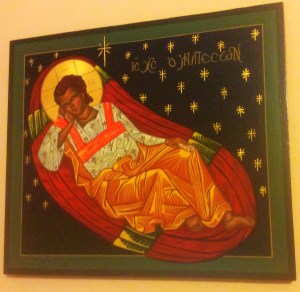
Iconography is not merely a visual art, it is Christian sacred art, and has been an integral part of the worship and mystical life of Christians since apostolic times. Referred to in the Eastern Christian tradition as “windows into heaven,” icons have inspired and uplifted millions of the faithful, and have at times been the instruments for demonstrating God’s miraculous intercession in the life of humankind.

29074C09-C2E4-49B3-ACA8-FAED6A6069B8In describing the purpose of icons, the early Christians used the Greek work anagogic, literally meaning “leading one upward.” Photios Kontoglou, a renowned modern iconographer, expressed this perfectly: “Icons raise the soul and mind of the believer who sees the icon to the realm of the spirit, of the incorruptible, of the kingdom of God, as far as this can be achieved with material means.” 

So to appreciate iconography fully, we must approach it as a liturgical art form whose function is essentially spiritual. Since the creation of an icon is itself a sacred activity, the iconographer must be a person of prayer, not merely a technician. If the iconographer’s work is to inspire and illumine others, then it is essential that she leads a life of prayer and fasting that she may be inspired and illumined by the Holy Spirit, that her iconography becomes itself an expression of her spiritual life. Kontoglou writes: “The iconographers painted as they prayed.”

355CF8CB-A1B6-4D08-B5DD-DF59A9618C9AMy love of iconography resulted from the prompting of my dear Aunt Eirene. She was an artist extraordinaire and a gifted iconographer. She studied and practiced to hone her skills and each year, she went to an intensive iconography workshop at a beautiful retreat center. One year, she persuaded me (forced is a more accurate term) to go with her. Of course, I was extremely reticent to try this new art form.

At first, I called on my artistic skills and was doing a barely decent job. But then a lovely nun who sat next to me said words that literally imprinted on my heart. She said, “Your rendering of the Holy Child is beautiful. Look into his eyes. When you see the Light coming from them, you will fall in love with your icon.”

286998AD-4ACD-4E54-BBD6-EDCC0B0D4ED0She was so wise. I began to think more about the Christ Child’s eyes than my own art, and within a day, my iconography transformed from a painting to a prayer. It was worship, meditation and reverence. It touched my soul as I added color to the board, layer upon layer. It was an incredible experience to see the Light. I share with you here some of icons I created, as I remember the experience I had with each of them that opened my soul to the Light.



Children, Covenant, Inspiration, life, Little Grandmother, Singing, Stories

Birth Song

C02D591A-8BBB-42E1-96D7-9C34C45292E4
“Love” – Himba Mother and Child by Ciska McCormick

Little Grandmother — a world-renowned spiritual teacher, Shaman, Wisdom Keeper and the gatherer of the Tribe of Many Colors — tells this beautiful story.

Of all the African tribes still alive today, the Himba tribe is one of the few that counts the birth date of the children not from the day they are born or conceived, but from the day the mother decides to have the child. When a Himba woman decides to have a child, she goes off and sits under a tree, by herself, and she listens until she can hear the song of the child who wants to come. After she has heard the song of this child, she goes back to the man who will be the child’s father and teaches him the song. When they physically conceive the child, they sing the song of the child as a way of inviting the child to earth.

When she becomes pregnant, the mother teaches the child’s song to the midwives and the old women of the village, so that when the child is born, the old women and the people gather around the child and sing the child’s song to welcome him/her. As the child grows up, the other villagers are taught the child’s song. If the child falls, or gets hurt, someone picks him/her up and sings to him/her his/her song as a gift of comfort.

In the Himba tribe, there is one other occasion when the “child song” is sung to the Himba child, who has now grown up to be a tribesperson. If a Himba tribesperson commits a crime or does something that is against the Himba social norms, the villagers call him or her into the center of the village. The community forms a circle around him/her and they sing his/her birth song.

The Himba people view correction, not as a punishment, but as love and remembrance of identity. For when you recognize your own song, you have no desire or need to do anything that would hurt another person

Finally, when the Himba tribesman/tribeswoman is lying in his/her bed, ready to die, all the villagers that know his or her song come and sing, for the last time, that person’s song.

May you hear, in your heart, your own birth song, and may it give you peace, hope, courage and strength for life.


*Little Grandmother is the author of the book: “Message for the Tribe of Many Colors,” published in 13 different languages. Her talks are freely available on the web and on YouTube and have been viewed by millions of people all over the world. You may follow her work on her Facebook page, Little Grandmother Kiesha, as well as on her website: www.littlegrandmother.net. You may purchase her books at www.earthmotherpublishing.com, or you may contact her at beautyawakens@gmail.com.


Holy Spirit, Inspiration, Life pathways, Mountaintop, Transformation

Can’t Stay on the Mountaintop

909AB186-15E1-4DA7-9027-5FC7B28578BDChrist-followers will always know ascent and descent, knowing and not-knowing. I can recall so many spiritual retreats that ended too soon, leaving me with a reluctance to go back into ordinary time. I wanted to stay in the place where God’s Spirit was moving within me. But every single time, I had to go home, leaving the mountaintop of my transformative spiritual experience.
In the Scriptures, two companion pieces tell of a “God experience.” Moses on Mount Sinai and Jesus on the Mount of Transfiguration. When Moses is on Mount Sinai, God is somehow manifest in thick darkness. “You saw no shape on that day at Horeb.” (Deuteronomy 4:15) Moses “sees” and “hears” to some degree, yet YHWH does not allow Moses to see God’s “glory” or “face.” The most that Moses can see is, humorously, YHWH’s backside. God placed Moses in a cleft in the rock and covered him until He had passed by. Moses would not see his face.

The Lord replied, “My Presence will go with you, and I will give you rest.”

Then Moses said to him, “If your Presence does not go with us, do not send us up from here. How will anyone know that you are pleased with me and with your people unless you go with us? What else will distinguish me and your people from all the other people on the face of the earth?”

And the Lord said to Moses, “I will do the very thing you have asked, because I am pleased with you and I know you by name.”

Then Moses said, “Now show me your glory.”

And the Lord said, “I will cause all my goodness to pass in front of you, and I will proclaim my name, the Lord, in your presence. I will have mercy on whom I will have mercy, and I will have compassion on whom I will have compassion. But,” he said, “you cannot see my face, for no one may see me and live.”

Then the Lord said, “There is a place near me where you may stand on a rock.When my glory passes by, I will put you in a cleft in the rock and cover you with my hand until I have passed by. Then I will remove my hand and you will see my back; but my face must not be seen.”

— Exodus 33:14-23 NIV

In the parallel story of Jesus on the Mount of Transfiguration (Luke 9:28-36; Mark 9:2-8; Matthew 17:1-9), there is first dazzling light. Yet a cloud soon overshadows the whole scene. Richard Rohr explains that “the epiphany is both light and darkness, knowability and unknowability, disclosure and non-disclosure.”

After the astounding experience on the mountain, Jesus deliberately walks with the disciples back down the mountain, onto the plain and desert of everyday life. Richard Rohr says that Jesus wanted to move the disciples “out of this enlightening, but also dangerously ego-inflating experience.”

We know that, always, we must return to the ordinary. We must come down from our mountaintops and walk on the rough road where life happens. We must experience the path’s twists and turns that take us through green pastures as well as through valleys of death’s shadow. That is the life we must live. Our Christian faith does not allow for permanent ascents. Mountaintop experiences for us are times of strength-gathering that make the rough roads bearable.

Jesus tells the disciples who witnessed his glorious transfiguration, “Don’t talk about it!” (Matthew 17:9). Because Jesus knew that talking too soon would only weaken the experience. Silence is important. Silence is necessary to preserve the sacred and the mysterious. Silence helps us remember how we felt on the “mountaintop.” And remembering helps us walk on, facing wherever life’s journey takes us with faith, confidence and perseverance. Thanks be to God. Amen.

Aging, Bible, Dreams, Faith, Holy Spirit, Hope, Inspiration, Luke 2: 21-38, Passing years, Prayer, Preaching, Prophetic, Waiting, Wisdom

At Any Age

D543405F-29D8-492C-B48A-4BB0EC12CF72I asked my husband a rather strange question last night. It was about my recent preaching at First Baptist Church of Christ in Macon. This was how I posed the question to him:

“You have listened to me preach a gazillion times in past years when I was young. But now do I just seem like a little old lady in the pulpit?”

Apologies to all little old ladies who might very well preach as prophetically as ever in a similar situation! But back to my question, and my husband’s response.

“No! Not at all,” he said. “If anything, you seemed more confident and powerful than I have ever seen you.”

So much for my feelings of being inadequate just because I am now a retired senior adult who has not preached a sermon in a very long time. The truth is I agreed with my husband. I felt very confident within myself. I believed that I had received a holy and prophetic word from God, and was honored that God (and my pastor) chose me to speak that word. When I stood in the pulpit, I felt the memory and the wisdom of ministries past, all of them, and that recognition of God’s workings within me over the years filled me with assurance.

Still, we are used to prophets being young, like Jeremiah and John the Baptist. Prophets, after all, are given the mission of looking ahead. On the other hand, we think of elders as caretakers of the past. 

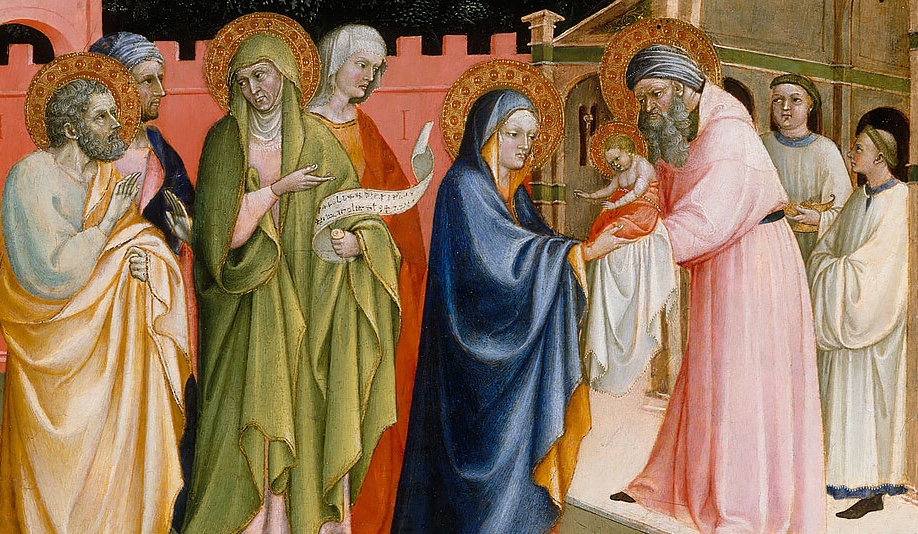
Pope Francis spoke about this in 2014 in his homily on the Feast of the Presentation of the Lord. In that homily, he asks us to see the mission of our elders as looking ahead to the future. And looking ahead to the future as persons who possess the wisdom of age. He gives us Simeon and Anna as our role models, naming them “senior citizen prophets.” And what role models they are! Among all the stories in Scripture, I have long been inspired and moved by the stories of Anna and Simeon.

In the story, this older woman and man have just met the new parents, Mary and Joseph, who were bringing their baby Jesus to the Temple. Pope Francis preached it with these words.

“It is a meeting between young people who are full of joy in observing the Law of the Lord, and the elderly who are filled with joy for the action of the Holy Spirit. It is a unique encounter between observance and prophecy, where young people are the observers and the elderly are prophetic!”

This is their story from the second chapter of Luke, verses 21-38:

And when eight days had passed, before His circumcision, His name was then called Jesus, the name given by the angel before He was conceived in the womb.

And when the days for their purification according to the law of Moses were completed, they brought Him up to Jerusalem to present Him to the Lord (as it is written in the Law of the Lord, “Every firstborn male that opens the womb shall be called holy to the Lord”), and to offer a sacrifice according to what was said in the Law of the Lord, “A pair of turtledoves or two young pigeons.”

And there was a man in Jerusalem whose name was Simeon; and this man was righteous and devout, looking for the consolation of Israel; and the Holy Spirit was upon him. And it had been revealed to him by the Holy Spirit that he would not see death before he had seen the Lord’s Christ. And he came in the Spirit into the temple; and when the parents brought in the child Jesus, to carry out for Him the custom of the Law, then he took Him into his arms, and blessed God, and said,

Lord, now lettest thou thy servant depart in peace, according to thy word:
For mine eyes have seen thy salvation,
Which thou hast prepared before the face of all people;
A light to lighten the Gentiles, and the glory of thy people Israel.

And His father and mother were amazed at the things which were being said about Him. And Simeon blessed them and said to Mary His mother, “Behold, this Child is appointed for the fall and rise of many in Israel, and for a sign to be opposed — and a sword will pierce even your own soul — to the end that thoughts from many hearts may be revealed.”

And there was a prophetess, Anna the daughter of Phanuel, of the tribe of Asher. She was advanced in years and had lived with her husband seven years after her marriage, and then as a widow to the age of eighty-four. She never left the temple, serving night and day with fastings and prayers. At that very moment she came up and began giving thanks to God, and continued to speak of Him to all those who were looking for the redemption of Jerusalem.

— Luke 2: 21-38 (KJV, NASB)

Simeon, a righteous and devout man who was looking for the consolation of Israel, was graced by the Holy Spirit. And in that Spirit, he came into the temple, finally holding Jesus in his arms and blessing him. This was the moment Simeon had hoped for over many years. And after prophesying about the child Jesus, he blessed the parents and began Mary’s preparation for the pain she was destined to experience when her son was crucified.

And the Prophetess Anna, now advanced in age, was there “at that very moment” the Scripture says. Anna never left the temple and she served God “night and day with fasting and prayer.” She lifted up her prayers of thanks to God for this child. And on top of that she proclaimed the message of hope that this child had come! Glorious news it was to “all those who were looking for the redemption of Israel.”

The stories of Anna and Simeon give us a portrait of elderly citizens, full of life’s wisdom and the Holy Spirit, who prophetically present to the world Jesus as Messiah!

And their story is full of hope for us, too. Perhaps those of us who are “of a certain age” are truly senior citizen prophets. Perhaps the hope we need to hear is the hope that, at any age, God calls us to prophetic mission. At any age, God will use our voices to speak hope to a world in despair, a world waiting for the consolation that comes only from God’s Spirit.

Freedom Songs, healing, Hope, John 5, Miracles, Music, Wade in the Water

Troubled Waters and Miracles

abstract background beach color
Photo by Pixabay on Pexels.com

I love the words and the melody of the spiritual, “Wade in the Water.”

Wade in the water.
Wade in the water, children.
Wade in the water.
God’s gonna’ trouble the water.

There is just something about it that is moving to me. It digs down into my spirit and stops me in my tracks. I don’t know why I react so deeply to that simple bit of music. It could be that what draws me to it is its strong reference to healing as it recalls the miracle story recorded in the Gospel of John.

After a feast of the Jews, Jesus went to Jerusalem. Now there is in Jerusalem by the Sheep Gate a pool, which is called in Hebrew, Bethesda. It has five porches, and lying in these porches are many sick people who are blind, lame, paralyzed, each waiting for the moving of the water.

For an angel went down at a certain time into the pool and troubled the water; then whoever stepped in first, after the troubling of the water, was made well of whatever disease she had. 

Now a certain man was there who suffered from an infirmity for thirty-eight years. When Jesus saw him lying there, and knew that he already had been in that condition a long time, He said to him, “Do you want to be made well?”

The sick man answered Him, “Sir, I have no one to put me into the pool when the water is troubled. Before I can get into the water, someone else gets in before me.”

Jesus said to him, “Rise, take up your bed and walk.” And immediately the man was made well, took up his bed, and walked.

— John 5:1-8 NKJV (paraphrased)

Or what inspires me about the song could be the stories that surround it. Some folk claim that “Wade in the Water” contained secret coded instructions to fugitive slaves on how to avoid capture as they followed the route to take them to freedom. The website Pathways to Freedom: Maryland & the Underground Railroad explains how Harriet Tubman used the song to tell escaping slaves to get off the trail and into the water to make sure that the dogs employed by the slavers lost their scent. “Wade in the Water” was one of their most inspiring freedom songs.

Those moving stories remind me of the many ways music touches my life with inspiration, courage, and hope, how it reaches the depths of my soul during the times when nothing else can reach me, how it lifts me up when I have fallen into despair, how it fills my heart with just the melody I need to give voice to my sorrow and then gives me a way to express my moments of greatest joy.

Most of us can recall times in our lives when we needed a dose of Divine healing. We can remember times of sorrow and despair and fear when only an encounter with God could move us toward peace, times when we needed to be made whole again, times when we hoped beyond hope that God would trouble the water. Read it again.

 . . . An angel went down at a certain time into the pool and troubled the water; then whoever stepped in first, after the troubling of the water, was made well of whatever disease she had. 

So in John’s Gospel story, a man who had been sick for thirty-eight years was healed. He was too ill to make it into the troubled waters of the pool no matter how many times he tried. But Jesus was there and asked him, “Do you want to be made well?”

The sick man answered that there was no one to put him into the pool when the water was troubled. “Before I can get into the water,” he said, “someone else gets in before me.”

But Jesus said those extraordinary words to him: “Rise, take up your bed and walk.” 

Immediately it happened. The man was healed, and he picked up his bed and walked. Maybe the man rushed off to tell friends about the wonderful thing that had happened to him. Or maybe could only stand there in awe, not moving at all because the moment was just too overwhelming.

It was a miracle. Actually, the story tells of at least two miracles: that Jesus healed the suffering man and that an angel descended from above and troubled the water in that otherwise ordinary pool.

I don’t know about you, but when I encounter a pool of healing water, troubled and swirling, I want to get in. I want my faith to be big enough to expect a miracle from ordinary water, in an ordinary pool, on an ordinary day.


Please visit this link to hear a stunning arrangement of “Wade in the Water” featuring an excellent soloist and choir from the A Cappella Academy from Los Angeles.

https://m.youtube.com/watch?v=uiqQKZZo-Uc


Beauty of Nature, Birdsong, Inspiration, Joy, Laughter, life, Magic, Nature, simple joys

Life Can Lose Its Magic


ADD6C2DE-A04C-4699-93E8-97923440A118
Photography  from Lize Bard’s blog, Haiku out of Africa at https://wandererhaiku.wordpress.com/2018/07/18/aura/

Life can lose its magic. 

It happens. 

It happens when labor eclipses the joy of leisure. 

It happens when busyness replaces moments of re-creation. 

It happens when meaningless prayers are more common than deep spiritual contemplation. 

It happens when relationships are taken for granted. 

It happens when entitlement replaces gratitude. 

It happens when despondency is more present that genuine laughter. 

It happens when nature becomes commonplace and we miss its breathtaking beauty. 

It happens when we hear the sounds of the birds as white noise instead of captivating birdsong. 

It happens when the dawn’s sunrise happens without our notice.

It happens when a serene, pink sunset that gently paints the sky loses its enchantment.

it happens when music becomes noise rather than the soul’s inspiration.

It happens when the shimmer of the moon is just a nightly expectation and the sparkle of the stars in the night sky becomes ordinary.

Life can lose its magic. 

How tragic.


Immigration, July 4th, Liberty, Patriotism, Uncategorized

“Let America Be America Again”

FA175E90-7908-4E1C-8B8C-76AE402ACC80On this day — the day we usually spend celebrating America each year — some of us are lamenting because we don’t feel much like celebrating. The children and families separated at our borders leave us feeling deep-down-where-it-hurts grief. And it is not that we look at the border fiasco as the crisis “du jour.” No. The toddlers in detention centers have come on the heels of the Parkland shooting and the protests it sparked around the nation and throughout the world when all of us cried out in unified voice, “Not our children,”
Again and again, we have witnessed tragedies inflicted on the children. We have  wept over them and have seen the horror that left our children unprotected and in harm’s way. There are, of course, other issues before us that cause grave concern, but it’s the children that leave us speechless and breathless. If we are a free and just nation at all, then we simply cannot abide the thought of children being in danger.

So what do I do today? What do I celebrate? Do I display the American flag in my front yard? What do I say about today? 

I have determined to say nothing further, but instead to offer the poignant poem written in 1935 by American poet Langston Hughes.

Let America Be America Again
Langston Hughes, 1902 – 1967

Let America be America again.
Let it be the dream it used to be.
Let it be the pioneer on the plain
Seeking a home where he himself is free.

(America never was America to me.)

Let America be the dream the dreamers dreamed—
Let it be that great strong land of love
Where never kings connive nor tyrants scheme
That any man be crushed by one above.

(It never was America to me.)

O, let my land be a land where Liberty
Is crowned with no false patriotic wreath,
But opportunity is real, and life is free,
Equality is in the air we breathe.

(There’s never been equality for me,
Nor freedom in this “homeland of the free.”)

Say, who are you that mumbles in the dark? And who are you that draws your veil across the stars?

I am the poor white, fooled and pushed apart,
I am the Negro bearing slavery’s scars.
I am the red man driven from the land,
I am the immigrant clutching the hope I seek—
And finding only the same old stupid plan
Of dog eat dog, of mighty crush the weak.

I am the young man, full of strength and hope,
Tangled in that ancient endless chain
Of profit, power, gain, of grab the land!
Of grab the gold! Of grab the ways of satisfying need!
Of work the men! Of take the pay!
Of owning everything for one’s own greed!

I am the farmer, bondsman to the soil.
I am the worker sold to the machine.
I am the Negro, servant to you all.
I am the people, humble, hungry, mean—
Hungry yet today despite the dream.

Beaten yet today — O, Pioneers!

I am the man who never got ahead,
The poorest worker bartered through the years.
Yet I’m the one who dreamt our basic dream
In the Old World while still a serf of kings,
Who dreamt a dream so strong, so brave, so true,
That even yet its mighty daring sings
In every brick and stone, in every furrow turned
That’s made America the land it has become.

O, I’m the man who sailed those early seas
In search of what I meant to be my home—
For I’m the one who left dark Ireland’s shore,
And Poland’s plain, and England’s grassy lea,
And torn from Black Africa’s strand I came
To build a “homeland of the free.”

The free?

Who said the free?  Not me?

Surely not me? 

The millions on relief today?
The millions shot down when we strike?
The millions who have nothing for our pay?
For all the dreams we’ve dreamed
And all the songs we’ve sung
And all the hopes we’ve held
And all the flags we’ve hung,
The millions who have nothing for our pay—
Except the dream that’s almost dead today.

O, let America be America again—
The land that never has been yet—
And yet must be—the land where every man is free.
The land that’s mine—the poor man’s, Indian’s, Negro’s, ME—
Who made America,
Whose sweat and blood, whose faith and pain,
Whose hand at the foundry, whose plow in the rain,
Must bring back our mighty dream again.

Sure, call me any ugly name you choose—
The steel of freedom does that not stain.
From those who live like leeches on the people’s lives,
We must take back our land again,

America!

O, yes,

I say it plain,

America never was America to me,
And yet I swear this oath—

America will be!

Out of the rack and ruin of our gangster death,
The rape and rot of graft, and stealth, and lies,
We, the people, must redeem
The land, the mines, the plants, the rivers.
The mountains and the endless plain—
All, all the stretch of these great green states—

And make America again!

Change, Children, Community activism, Courage, Dreams, Freedom, Inspiration, Justice, Little Rock Central High School, Perseverance, Racism, Segregation, Segregation, The Little Rock Nine

Growing Up Inspired: My Granddaughter and The Little Rock Nine

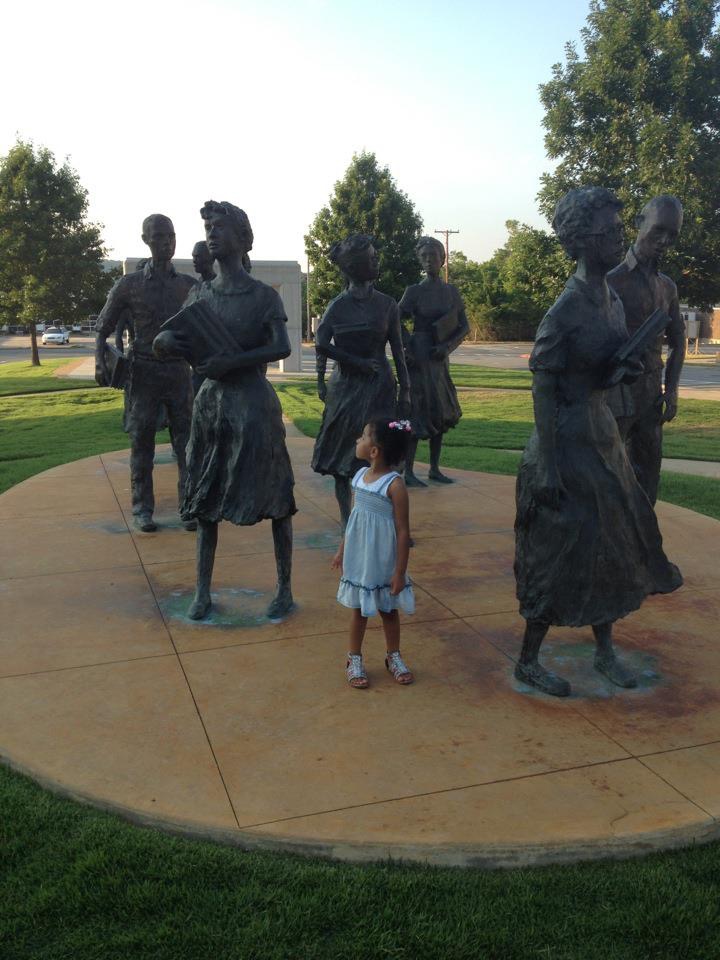
28332D92-A50E-4817-9663-6D13F00790D5June 16, 2012 . . . My three-year-old granddaughter standing among the bronze sculptures of The Little Rock Nine.

Her parents had told her the poignant story of The Little Rock Nine, but at age three she had no idea of the many ways their lives would impact hers. Because they crossed an invisible, but very real, line that divided black children from white children, they opened the door to educational equality in a racially divided state. Because their parents were brave enough to let their children breach the three stately doors of Little Rock Central High School, their world changed in unimaginable ways. And with that change, my granddaughter inherited the highly cherished right to equal education and all the opportunities that would follow. Because of that change, my granddaughter would grow up inspired.

In case you do not know about The Little Rock Nine, here is some background. 

On September 3, 1957, nine African American students — The Little Rock Nine — arrived to enter Little Rock Central High School only to be turned away by the Arkansas National Guard. Governor Orval Faubus had called out the Arkansas National Guard the night before to, as he put it, “maintain and restore order…” The soldiers barred the African American students from entering.

On September 24, 1957, President Dwight D. Eisenhower ordered units of the U.S. Army’s 101st Airborne Division — the “Screaming Eagles”— into Little Rock and federalized the Arkansas National Guard. In a televised speech delivered to the nation, President Eisenhower stated, “Mob rule cannot be allowed to override the decisions of the courts.”

On September 25, 1957, under federal troop escort, The Little Rock Nine made it inside for their first full day of school. The 101st Airborne left in October and the federalized Arkansas National Guard troops remained throughout the year.

They were nine solemn figures, nine teenagers just trying to do what every child up to age 18 had been mandated to do: go to school. Nine figures who entered the annals of American history the day they passed through the front door of Little Rock Central High School.

These nine African American students — Melba Pattillo, Elizabeth Eckford, Ernest Green, Gloria Ray, Carlotta Walls, Terrence Roberts, Jefferson Thomas, Minnijean Brown and Thelma Mothershed — are now immortalized in a striking memorial located on the grounds of the Arkansas State Capitol in Little Rock. The life-size bronze statues, entitled “Testament,” were designed and sculpted by Little Rock artist John Deering, assisted by his wife Kathy, also an artist. A comment from each of The Nine is found on individual bronze plaques identifying each student. Across the street sits the State Department of Education, just a few hundred yards from “Testament.” This Arkansas State Agency has been embroiled in this same desegregation lawsuit for over 50 years. 

Nine young students walked bravely, defiantly, yet filled with fear, in an act against prejudice and ignorance. These nine are heroes of every grueling story of segregation and racism in American history, every story we have heard and the millions of stories we will never hear.

So I am deeply moved by these photos of my granddaughter because there is deep meaning in each one. She seems to be looking up at the sculpture of Melba Pattillo (Beals) with what seems like admiration and awe. Dr. Beals grew up surrounded by family members who knew the importance of education. Her mother, Lois, was one of the first African Americans to graduate from the University of Arkansas in 1954. While attending all-black Horace Mann High School, Melba knew that her educational opportunities were not equal to her white counterparts at Central High. And so she became a part of the effort to integrate Central.

B3083DBA-2BEB-4137-B162-B8CB19B4AD64And my granddaughter stands in front of Little Rock Central High, a school she may choose to attend someday, a school she will be able to attend because The Little Rock Nine took a dangerous risk to make it possible.
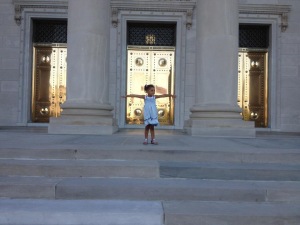


CCBDA845-BD2D-42E4-85B2-28749F2EA762Finally, my granddaughter stands playfully on the steps of the Arkansas State Capitol. I know that it is possible that she may one day proudly walk through its golden doors as a state senator or representative. That is possible because nine Little Rock students were brave enough to be a part of changing history.


At three years old, my granddaughter probably was not very inspired by Central High School, the Little Rock Nine Memorial, or the Arkansas Capitol. But her parents took her there to see and to learn so that she would grow up inspired. When she is older she will remember what she saw and what she learned from that seemingly insignificant sightseeing trip, and she will realize that it wasn’t insignificant at all. It may just be what motivates and inspires her to follow her dreams, because now she knows that all of her dreams are possible. It’s all about growing up inspired. It’s what we want for every child.

Dr. Melba Pattillo Beals, Minniejean Brown Trickey, Elizabeth Eckford, Dr. Carlotta Walls LaNier, Mrs. Thelma Mothershed Wair, Dr. Ernest Green, Gloria Ray Karlmark, Dr. Jefferson Thomas, Dr. Terrence J. Roberts, you made sure that every child can grow up inspired. when you were just young teenagers. When you walked through the doors of segregated Little Rock Central High School, you did so much more . . . for every student who came after you and for my granddaughter 


American Flag, Division, Exclusion, Freedom, Inspiration, Justice, Liberty, National Anthem, Patriotism

Freedom, Liberty, Justice, and the National Anthem

1D1A00B6-C52A-41AF-86D9-50090736E4D6

Patriotism can be defined differently by different people. A plethora of actions and ceremonies cause a lump in the throat. For me, many ceremonies, sights and sounds can create a catch in my voice and a visceral emotional response. 

Singing “America the Beautiful” (1)

Watching the U.S. Navy Blue Angels paint the sky

Singing the song written by Irving Berlin in 1918, “God bless America, land that I love . . .” (2)

Hearing the stunningly beautiful words of Emma Lazarus, “Give me your tired, your poor . . .” (3)

Singing the hymn known as the African American National Anthem:

Lift every voice and sing, 
‘Till earth and heaven ring, 
Ring with the harmonies of liberty . . . 
Stormy the road we trod, 
Bitter the chastening rod, 
Felt in the days when hope unborn had died . . .
Out from the gloomy past,
‘Till now we stand at last
Where the bright gleam of our bright star is cast . . . (4)

And finally, watching the flag billowing in the breeze while the melody of the National Anthem floods a football stadium . . . 

While National Football League players stand tall and sing as they gaze at the American flag; 

While other players place their hands over their hearts in an act of honor; 

While still others kneel because they long for America to be better.

The National Anthem should not be the focus of controversy. The American flag should not be a catalyst for divisiveness. Both are symbols of freedom and liberty that inspire deeply personal acts of patriotism. National symbols should never cause us to ostracize any individual whose patriotism looks different than our own. 

CNN’s Van Jones spoke definitively about what we know as the National Anthem controversy:

People who look like me have put blood in the ground, and put martyrs in the dirt for this country, to have it be liberty and justice for all… It is beyond insulting to have people lecture us about patriotism. (5)

   Van Jones on the NFL National Anthem controversy

Approaching the commemoration of Independence Day reminds me to look more intently to see the acts of patriotism all around me. It prompts me to ask myself what “liberty and justice for all” looks like in these troublesome days. It moves me be a more committed advocate for freedom in all its forms. 

As a Baptist for fifty years, I have been thoroughly immersed in the Biblical concept of soul freedom, an all-encompassing freedom that is, by the way, not just for Baptists. James Dunn provides one of the best descriptions of soul freedom

Soul freedom, all freedom and responsibility are God’s gifts to humanity. God created and endowed people to be free moral agents. Soul freedom and responsibility are not invented by government, or devised by social contract. All dignity and respect afforded persons comes from God as revealed in Scripture. (6) 

For me, a part of soul freedom allows me the right of expression — to worship as I wish, to honor my country as I wish, to exercise my freedom to be the person I was destined to be. I cherish the gift of such extravagant liberty and know full well that it is a tenuous and fragile freedom. That fragility is one cause for the unfortunate and unnecessary controversy surrounding the National Football League and the National Anthem.

My heritage compels me to advocate for the right of every person to express his or her patriotism as they choose. As a child of immigrant parents, I will forever honor the American flag and revere the National Anthem. I may do it as I sing. I may do it through my tears. I may stand proudly and face the waving American flag. I may kneel in solidarity. I may cry as I remember my grandmother’s frightening journey to this country with my infant mother. I may pay tribute in various ways, but I will do it in my own way. As should we all.

So let us move forward in freedom. Let us stand fast in the liberty (7) that has made us free. Let us persist in our resolve to demand justice for all humankind. And as we do, let us go forth boldly with freedom-words on our lips:

Oh, freedom! Oh, freedom! Oh, freedom over me! (8)

Sweet land of liberty . . . (9)

Give me your tired, your poor, your huddled masses yearning to be free . . . 

Sweet justice, climb the mountain though your hands may be weary . . . (10)

Lift every voice and sing ‘till earth and heaven ring, ring with the harmonies of liberty . . .

God bless America!

Amen.


(1) Lyrics by Katharine Lee Bates; music by Samuel A.Ward
(2) Irving Berlin, 1918
(3) Emma Lazarus, From the poem, “The New Colossus “ 1883; inscribed on a bronze plaque placed inside the pedestal of the Statue of Liberty in 1903
(4) James W. Johnson, 1871-1938; J. Rosamond Johnson, 1873-1954
(5) Van Jones on the NFL National Anthem controversy; https://cnn.it/2JxzD36
(6) Jamie’s M. Dunn, Soul Freedom: Universal Human Right in Soul Freedom: Baptist Battle Cry, James M. Dunn and Grady C. Cothen, Smyth and Helwys Publishing, 2000.
(7) Galatians 5:1
(8) Traditional spiritual, arr. by Valeria A. Foster
(9) Samuel Francis Smith
(19) Jill Scott
Beauty of Nature, Birdsong, Inspiration, Joy, Music, Nature, Praise, Singing

Every Bird’s a Songbird

11498DF6-463F-4716-8BB1-C853BBB20654
Art: “Songbirds in Apple Blossoms” by James Hautman.

As I sit on my porch this morning in a light, refreshing rain, the most prominent sound I hear is joyous birdsong, different strains of music from a variety of birds that co-habit in our tiny bird sanctuary. A statue of St. Francis appropriately stands among the feeders and the suet. The hummingbird feeders are in a separate spot, providing a banquet of sweet nectar to these delightful birds, whose fast moving wings create their most unique song.

I love to listen to the songbirds, and we are graciously blessed to live in a neighborhood with very few sounds — no traffic, no motorcycles, no speeding cars, usually not even people voices. Just the birdsong, with an occasional tree frog and the wonderful southern gift of cicadas. 

In my opinion, every bird is a songbird. According to scientists at The Nature Conservancy, the term “songbirds” refers to a wide range of bird species. Songbirds typically include finches, sparrows and warblers, but most often when someone is defining “songbird” they refer to beautifully colored birds that we’ve never heard of. The Nature Conservancy website features three: the Dickcissel, the Blackburnian Warbler, and the Kirtland’s Warbler.

I have never seen any of those birds, but I have heard lots of glorious birdsong. So I stand by my opinion that every bird’s a songbird. And in my better moments, I hear their songs as an offering to God, their songs of praise to God who gave them voice. During those times, I am drawn to the many beautiful and lyrical Psalms. This is one that is particularly moving to me

Praise the Lord, my soul.

Lord my God, you are very great; you are clothed with splendor and majesty.

You wrap yourself in light as with a garment;

You stretch out the heavens like a tent and lay the beams of your upper chambers on their waters.

You make the clouds your chariot and you ride on the wings of the wind.

You make the winds your messengers . . .

How many are your works, Lord!

In wisdom you made them all; the earth is full of your creatures.

There is the sea, vast and spacious, teeming with creatures beyond number — living things both large and small.

When you send your Spirit, they are created, and you renew the face of the ground.

You make springs gush forth in the valleys; they flow between the hills,

You give water to all the beasts of the field; the wild donkeys quench their thirst.

The birds of the sky nest by the waters; they sing among the branches.

— Psalm 104: 1-3;10-12; 24-25, 30 (paraphrased)

Many of the Psalms urge us to sing, to praise God with our voices. 

Sing to the Lord a new song . . .

I will sing to the LORD all my life; I will sing praise to my God as long as I live.

As far as singing, well sometimes we are reluctant, holding back an imperfect voice that does not always make pleasant songs. Sometimes we are convinced that our singing would not be such a worthy offering of praise. So we should probably remember that every bird’s a songbird. And as for us humans, it might help to remember that every person has a voice, every heart has a song, every soul has a melody.

Then sings my soul, my Saviour God, to thee. How great thou art! How great thou art!*

Amen.


* From the hymn, “How Great Thou Art,” a Swedish traditional melody and a poem written by Carl Boberg (1859–1940) in Mönsterås, Sweden in 1885. It was translated into German and then into Russian and became a hymn. It was translated into English from the Russian by English missionary Stuart K. Hine, who also added two original verses of his own.


Celtic Prayers, Comfort, Grace, Inspiration, Irish Blessing, life, Prayer, Worship

Grace for Your Day

75777FD8-6406-4CA0-A2BF-D043F39E8DB3To bring a bit of grace to your day, I offer prayers and blessings that have stood the test of time. Some of them have been used for centuries to lighten a load or brighten a day. In the great tradition of Celtic prayers and blessings, many of these are very much prayers and reflections from daily life, the ebb and flow of ordinary day to day life. They are petitions of the home and hearth.

In every life, there are uplifting moments and anxious moments, there are inspirational times and times of despondency. There are times when the heart is disconsolate. Some of these prayers read like hymns and could be sung as psalms. Others search the heights and depths of our faith.

With hope that you will find a sense of their deep peace, I commend these prayers, blessings and sacred art to you as an attempt to express that God is with us, always, and that in God we live and move and have our being.

Deep peace to you

32072582-2242-46F1-A21A-3560036A395F

D716109E-E232-4CF7-83BC-247DF08EBF18Prayer for evening rest

I lay my head to rest,  and in doing so,
I lay at your feet
the faces I have seen,
the voices I have heard,
the words I have spoken,
the hands I have shaken,
the service I have given,
the joys I have shared,
the sorrows revealed,
I lay them at your feet, and in doing so
lay my head to rest.


635E2A28-E43A-4BCD-8F34-6305A17273DCI arise today

I arise today
Through a mighty strength:
God’s power to guide me,
God’s might to uphold me,
God’s eyes to watch over me;
God’s ear to hear me,
God’s word to give me speech,
God’s hand to guard me,
God’s way to lie before me,
God’s shield to shelter me,
God’s host to secure me.

(first millenium – bridgid of gael)


8BD9F9D4-214E-41CA-B1FA-B86294928292Blessings of light

May the blessings of light be upon you,
Light without and light within,
And in all your comings and goings,
May you ever have a kindly greeting
From them you meet along the road.

May the nourishment of the earth be yours,
May the clarity of light be yours,
May the protection of the ancestors be yours.

May dawn find you awake and alert, approaching your new day with dreams, possibilities, and promises.
May evening find you gracious and fulfilled.
May you go into the night blessed, sheltered, and protected.
May your soul calm, console, and renew you.


40834FE7-48A9-49E1-AE4F-AEB48034D18EThrough the day

As the sun scatters the mist
at the dawning of a new day,
So you calm our fears and anxieties
if we trust you.
You give us strength and courage
to live our daily lives
knowing you are with us
and we do not walk alone.
As the midday sun warms us,
we feel your protecting arms around us
and sense your loving presence.
As the sun sinks in a kaleidoscope of colour
you give us hope and renewal.


7AD0C7EE-0F8D-4414-B99B-71D195BE3957

Dawning of the day

From the dawning of the day through the morning,
guide us,
from the noontide to the setting of the sun,
lead us,
from the evening till we sleep,
keep us,
through the night till daybreak,
protect us,
and all for your love’s sake.
Lord of the day
, Lord of the sunrise,
we give thanks for the birth of each child,
for the freshly opening rose,
for all newborn animals.
Lord of the morning,
we give thanks for energy and enthusiasm,
for the challenges of a new day,
for your Resurrection power.
Lord of the noonday,
we give thanks for the ability to work,
for all we can achieve,
for unrealized potential.
Lord of the sunset,
we give thanks for those who have died
in the faith of Christ,
for all who have inspired us, for our loved ones.
Lord of the night,
we give thanks for rest and refreshment,
for all your love and care,
for the promise of a new day.


F7E8C76C-DEB3-480C-9AF5-99166136E691Comings and goings

In our coming and going,
guide us,
in our living and our being,
protect us,
in our seeing and our hearing,
enrich us,
in our thinking and our speaking,
inspire us,
in our arriving and our departing,
preserve us.


A4E2837D-29C3-4A90-8539-636F307D3B25Morning mist

As the morning mist shrouds the river
and is then lifted by the gentle rays of the rising sun,
so may our clouded spirits be raised
by the warmth of your love.


6816D648-8E81-4524-BB93-740C91627A31This day and every day

I arise today
in your strength to uplift me,
in your power to direct me,
in your love to enfold me,
in your wisdom to guide me,
in your way to lead me
this day and every day.


A3EA52D1-2DA4-4020-A826-8C5FDA2A4C97


May God, the God of all comfort, encourage your heart and protect you from despair. May God’s face shine upon you as you rejoice in the midst of troubles and trials, putting your faith in God and being confident of God’s lovingkindness toward you. May Christ our Savior lift up blessings upon you with the riches of God’s joy and may He grant you on this day deep peace in your heart and soul. Amen.


Belief, Challenge, Change, Christian Witness, Community activism, Dreams, Grace, healing, Hope, Justice, Ministry, Mission, peace

A Broken, Waiting World

B507DED1-C6B2-4332-80BA-4B65623E2196

Do not be dismayed by the brokenness of the world. All things break. And all things can be mended. Not with time, as they say, but with intention. So go. Love intentionally, extravagantly, unconditionally. The broken world waits in darkness for the light that is you. ― L.R. Knost

When I was in seminary so many years ago, I worked part time in the Development Office, that extraordinary place that dreamed up words designed to gain support for the seminary and to tell the world what we were about. The one creative theme I most remember, because we made it our catch phrase and printed it on everything, was “We’re out to change the world!”

Some students left the seminary, degree in hand, and did just that. The rest of us labored mightily and did everything we knew to do to change a world that most assuredly was waiting and broken. What a mission!

I must admit, that short statement from seminary days became my personal quest. In every ministry position, I tried to change the world, much to the dismay of my parishioners. I took on every worthy cause as my own challenge to change the world. I committed myself to justice and set my face toward hope and healing for every person suffering injustice and indignity. It became a life-long quest, a personal commission. And what’s more, I sincerely believed I could do it, at least for the first few years I spent banging my head against various walls.

The song lyrics “to dream the impossible dream” come to mind. For those of you who may be too young to know about the magic of the 1964 Broadway musical, Man of La Mancha, I must give you the lyrics of the song that was the pronunciamento of the primary character, Don Quixote, and that almost instantly became the credo that many people of God embraced in trying to change the world.

To dream the impossible dream …
To fight the unbeatable foe …
To bear with unbearable sorrow …
To run where the brave dare not go …
To right the unrightable wrong …
To love pure and chaste from afar …
To try when your arms are too weary …
To reach the unreachable star …

This is my quest, to follow that star;
No matter how hopeless, no matter how far:
To fight for the right, without question or pause;
To be willing to march into Hell, for a Heavenly cause.

And I know if I’ll only be true, to this glorious quest,
That my heart will lie will lie peaceful and calm,
when I’m laid to my rest.

And the world will be better for this:
That one man, scorned and covered with scars,
Still strove, with his last ounce of courage,
To reach the unreachable star.

— Lyrics by Joe Darion

Today, as I watch military strikes against Syria and know that our country has not welcomed desperate Syrian refugees, I am painfully aware that I did not change the world. I worked in Uganda after the devastation of Idi Amin, but I did not change the world for millions of Ugandan widows and orphans.

I worked with persons who were sick and dying in hospital ministry, and I did not change their hopeless world of suffering. I have written letters, contacted government officials, participated in demonstrations, and signed hundreds of petitions, but I have not changed the world.

It has indeed been an “impossible dream.” And yet, I believe that I lived into my call from God and followed every path God placed before me. I faced off against what I viewed as evil many times and was deeply, demonstrably angry many times. But always, my mission remained in the center of God’s gentle grace and love. How?

I learned along the way — finally — that changing the world God’s way means holding tightly to lovingkindness, compassion, love and gentleness. The Scripture in Galatians 5:22-23 (NIV) says it like this:

. . . the fruit of the Spirit is love, joy, peace, forbearance, kindness, goodness, faithfulness, gentleness and self-control.

“Change the world with gentleness,” God might say to me.

While others stand for bigotry, racism, violence and war, change the world with gentleness. While leaders refuse to welcome refugees who long for a safe haven for their children, change the world with gentleness. While the highest positions in this country are embroiled in collusion, corruption, lies, greed and unkindness, change the world with gentleness.

This is a broken, waiting world that yearns, not for my righteous anger toward the world that is, but rather for my gentle hands of healing for the world that can be.

Change the world with gentleness? How? Why?

Because “Gentleness is not weakness. Just the opposite. Preserving a gentle spirit in a heartless world takes extraordinary courage, determination, and resilience. Do not underestimate the power of gentleness because gentleness is strength wrapped in peace, and therein lies the power to change the world.”

― L.R. Knost

May God lead us all in the paths of righteousness and gentleness. Amen.

Contemplation, Creativity, Discovering, Epiphany, Growth, Inspiration, peace, Relationship, Restoration, Resurrection, Self Awareness, Silence, Spiritual growth, Stories, Transformation, Writing

Magical

3C204C9C-C33B-4AC8-BE97-D8784E8A5D96
Magical Night: A painting by Teressa Nichole

Tell your story. Shout it. Write it.
Whisper it if you have to.
But tell it.
 ― L.R. Knost

These words of LR. Knost are so very true.

During the weeks of Lent, I helped lead a writing group at my church. What a rich experience it was for me — watching each group member spending quiet moments meditating and contemplating the ripples of his/her life. Then witnessing one person after another begin to write as if they were expecting transformation, telling their stories, writing down the highs and lows. It was almost magical.

It seemed as if I saw the throes of stress leave their spirits. It seemed as if I watched their expressions of pain ease as pen flowed across paper. It seemed at times as if a weight was lifted, an emotion discovered, a community created, a sense of understanding settled in.

I know this: no one left the room with a broken spirit or a weight they could not carry. Instead, they left the room in covenant with one another, knowing that someone cared deeply about their story. They left the room knowing that, in this intimate space, they could spew out whatever they needed to release or they could be silent in a peaceful sanctuary of acceptance.

That Sunday School room in the tall-steepled church at the top of a street in Macon, Georgia known as High Place became a sacred space for just a brief time. It became a place almost magical, a place of rest, a place of comfort, a place where each person could feel that they were not alone and that they would never feel alone again. Truly, that was magical.

I end today’s blog post with these words written by L.R. Knost:

Tell your story. Shout it. Write it.
Whisper it if you have to.
But tell it.
Some won’t understand it.
Some will outright reject it.
But many will
thank you for it.
And then the most
magical thing will happen.
One by one, voices will start
whispering, ‘Me, too.’
And your tribe will gather.
And you will never
feel alone again.

Amen.

Beauty of Nature, grief, Hope, life, Mourning, Nature, Stars

Uncommon Commoners


1B1EF9A9-9872-4163-9F93-36F39A9239F8
Terlingua, Texas. Astrophotography of the Milky Way over a field of Chisos bluebonnets.

As I write today, I think of all the ways we are ordinary extraordinary folk. We are complex at times, immersed in thoughts deep and weighty. In the next moment, we may well find ourselves acting like common, ordinary people that avoid deep thoughts at all costs.

We are divergent. We are a kind of paradox, common and uncommon all at once.

I recently saw the stunning photograph featured in today’s blog post. I was intrigued that a photographer was gifted enough to capture the juxtaposition of common flowering bluebonnets and the ethereal brilliance of the Milky Way. It is the kind of breathtaking image that makes me stop in my tracks, suspend time for a moment, and lose myself in the idea of earth and sky.

I studied the common bluebonnets and the uncommon Milky Way above them. And I wondered, “Is there something extraordinary in my ordinary life? Am I just a simple, common person? Or is there something uncommon that lives with the common in me? Inside me, in that place that even I do not fully understand, does common and uncommon grow together, entwined and twisted into one?”

As I pondered these questions that made little sense to me at the time, I read a piece written by my friend, Ken Sehested. I knew instantly that I would borrow one of his intriguing thoughts.

Uncommon commoner.

It worked for me. It defined me, the common part of me and the not-so-common part of me. You see, like most people, there is more to me than anyone can see. All of us can claim that. We are a people that can gaze skyward at the Milky Way while we sit on the ground in a patch of bluebonnets. We are a people of inner strength and resilience, the kind of resilience that makes it possible for us to endure whatever life throws at us and live to tell the story. We are a people with the kind of resilience that makes us uncommon commoners.

I know this because I have seen it time and time again up close and personal. I know this because I have stood at the bedside of a dying woman who was singing hymns of praise to God. I know this because I have kept vigil with a mother who witnessed her son being removed from life support after an accident, and as it was happening, she began to pray through her heavy sobs of grief. I know this because I walked out of the emergency room with her while she shared cherished, happy memories of the son she had just lost.

Uncommon commoners.

Ken Sehested made this so clear with these words.

What makes all of us commoners uncommon is when we experience the pain of trauma up close and personal, find the resilience to endure, take a hammer of righteous rage to that trauma and pound it on the forge of conviction that another world is possible, another way will open if we hold out, hold on, hold up, and hold over . . .

— Ken Sehested

Ah yes. We have seen, and we will see again, the pain of trauma. We will find within ourselves the resilience to endure. We will “hold out, hold on, hold up, hold over” because God has graced us with hope, enduring and abiding hope.

Life will always give us — uncommon commoners that we are — vivid fields of bluebonnets growing in the dirt and a sparkling Milky Way in the sky above. Thanks be to God.