Community, Contemplation, Freedom, Inner joy, peace, Uncategorized

The Path to Inner Peace, Joy and Freedom

C969192F-5A14-440C-866D-D5E5D8D00F36
Peace, joy and freedom.
All three are needed things, soul things that make us content. They are not easily gained, however, as the daily routine we call life attacks them on a regular basis.

How troubling it is to lose one’s sense of peace. A number of life situations can result in a loss of soul-peace — worry about illness, financial concerns, difficulty with children, caring for aging parents, moving to another home. It would be impossible to complete the list of things that can steal our sense of peace.

F96B5DE4-5888-46C4-8956-5E9B8C79538EPerhaps we should go one step further, though, and acknowledge that our loss is not merely the loss of peace, it is the loss of peacefulness. That loss can be disconcerting at best and devastating at worse. All of us long for a deep and abiding sense of peacefulness. We sometimes cry out “peace, peace, when there is no peace.” (Jeremiah 6:14)
09448864-0833-49E4-B38B-EC6E4B5B1BC1
Joy! 
At times, it can be hard for us to feel joy. I think it is because we’re not at all sure what joy hidden inside the soul feels like. For joy is not simply happiness over something that has come to us — a new house or car, a life milestone like graduation or a wedding, a celebration of the birth of a child. Such things seem to bring joy, but our actual response to such events is a brief burst of happiness. Genuine joy — soul joy — happens when something inside of us deeply responds to
joy and we tuck it away safely in our hearts. And that kind of joy is not a brief response to a happy event, it is an abiding, spiritual state of being that comes with a grace-filled assurance that Christ came to make sure we live our lives ‘more abundantly.” The message from Jesus comes to us using various words:

I have come that you might have life, and have it more abundantly.
(John 10:10, paraphrased)

I came to give life with joy and abundance.
(The VOICE translation)

I have come in order that you might have life—life in all its fullness.
(The Good News Bible)

Living “Life in all its fullness” seems to be the end result of abiding joy, in the soul and in the heart. Even when we listened to the song our children learned to sing, “I’ve got that joy, joy, joy, joy down in my heart,” we somehow knew that true joy was internal not external. That joy resided in our hearts and in our souls.
CCBEBC8B-56E7-44EF-A9D0-C73F395A35E6Finally freedom — the kind of freedom we have when peace and joy is hidden in the deepest recesses of our being. Freedom does not leave those who practice gratefulness, prayer, meditation and confession. It is at the altar of confession that God offers us assurance of pardon. It’s the opposite of the soul’s bondage. I cannot help but recall the words of the Apostle Paul about the nature of Christian freedom that so boldly introduce the 5th chapter of Galatians:

For freedom Christ has set us free. Stand firm, therefore, and do not submit again to a yoke of bondage. (Galatians 5:1)

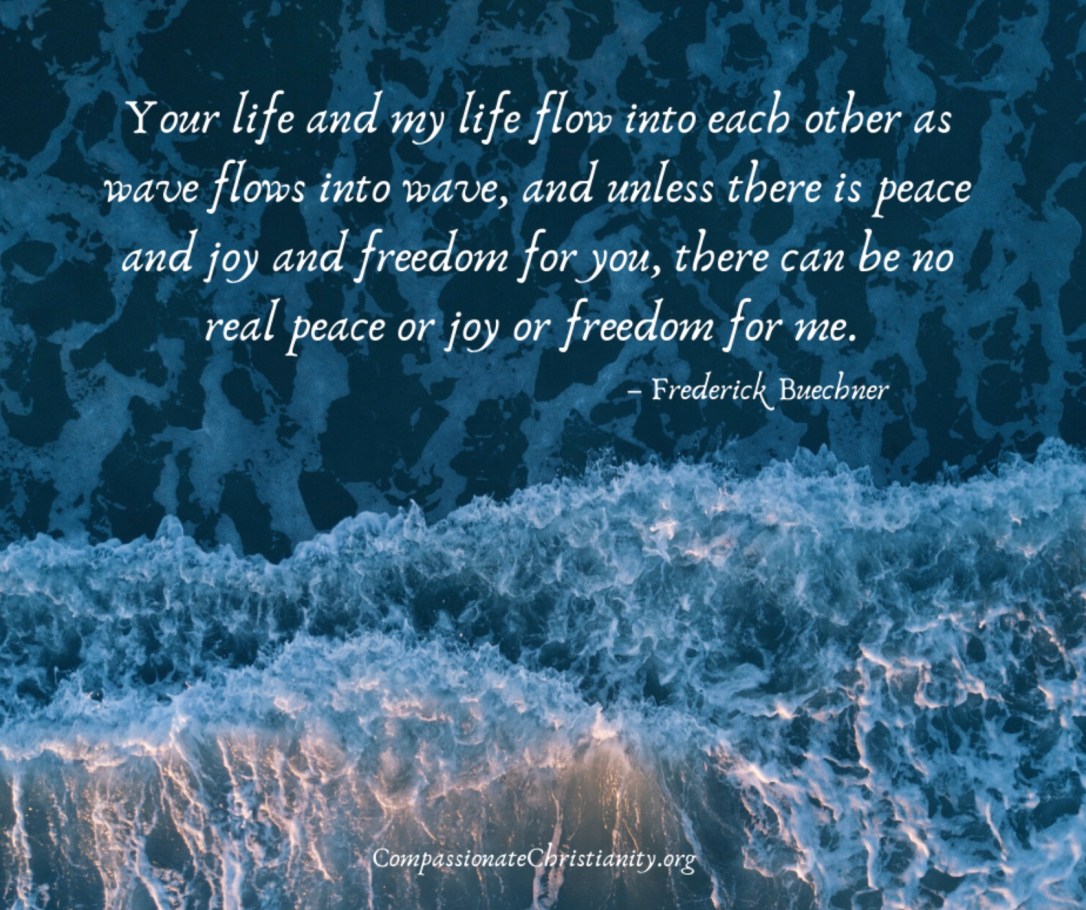
Frederick Buechner added a new dimension to our longing for peace, joy and freedom with this powerful thought:

Unless there is peace and joy and freedom for you,
there can be no real peace or joy or freedom for me.

Therein lies the crux of living the Christian life: an interconnectedness among those who follow Christ, a community of faith in which each one supports the other. It is an interconnectedness that transcends differences of opinion, different ways of practicing faith, disagreements about which hymns are more appropriate in worship or, even more trivial, what kind of light bulbs should we use in the sanctuary.

Our interconnectedness ensures that each of us will have the will and the faithfulness to enjoy the kind of peace, joy and freedom that abides in us when we “do not forsake the assembling of ourselves together and when we exhort and encourage one another. The Message translation by Eugene Peterson calls it “spurring each other on.” (Hebrews 10:25)

Perhaps caring for one another — exhorting, encouraging and “spurring each other on” — is the message of this beloved hymn that so often informs our worship and our community when we sing it together:

Brother, sister, let me serve you;
Let me be as Christ to you;
Pray that I might have the grace to
Let you be my servant, too.

We are pilgrims on a journey;
We are family on the road;
We are here to help each other
Walk the miles and bear the load.

I will hold the Christ-light for you
In the nighttime of your fear;
I will hold my hand out to you,
Speak the peace you long to hear.

I will weep when you are weeping;
When you laugh I’ll laugh with you;
I will share your joys and sorrows
Till we’ve seen this journey through.

When we sing to God in Heaven
We shall find such harmony,
Born of all we’ve known together
Of Christ’s love and agony.

— THE SERVANT SONG, Words and music by Richard Gillard

In our deepest time of prayer and contemplation and in the sacred refuge of our community of faith, our souls find peace, joy and freedom — for all of us, for each of us.

May God make it so. Amen.
Ash Wednesday, Conflict, Freedom, Hate, Internal conflict, Lent, Loss, Pain, peace, reconciliation, Uncategorized, War

War!

E1BC8F34-2C8B-4AAD-85B9-141D0938722D

WAR  noun, often attributive
(1)  a state of usually open and declared armed hostile conflict between states or nations
(2)  a period of such armed conflict
(3)  a state of hostility, conflict, or antagonism
(4)  a struggle or competition between opposing forces for a particular end

In a time of turmoil across the earth, I am reminded of the many ways we long for peace and the many times we fail to achieve it. As I hear reports and human stories of the warring among peoples of many nations, I am also very aware of the wars that often rage within. War and peace are complex ideologies that spurn people to action — either action to plunder and kill or action that insists upon peace and tranquillity. The British peace advocate John Bright (1811-1889) gave a speech at the Conference of the Peace Society in Edinburgh in the summer of 1853 to oppose the forthcoming war against Russia (the Crimean War 1854-56). 

What is war?

What is war? I believe that half the people that talk about war have not the slightest idea of what it is. In a short sentence it may be summed up to be the combination and concentration of all the horrors, atrocities, crimes, and sufferings of which human nature on this globe is capable . . . injustice of any kind, be it bad laws, or be it a bloody, unjust, and unnecessary war, of necessity creates perils to every institution in the country.   — John Bright (1811-1889)

Profound truth rests in Bright’s words, and it is a truth every person would do well to contemplate. At some point I recall seeing a provocative image on the poster for Stanley Kubrick’s film Full Metal Jacket. It was an image of the soldier’s helmet with a handwritten “born to kill” slogan . . . and a peace symbol, a provocative juxtaposition of reminding us that human beings have the capacity for both killing and peace.

Who can forget the words of the Prophet Isaiah?

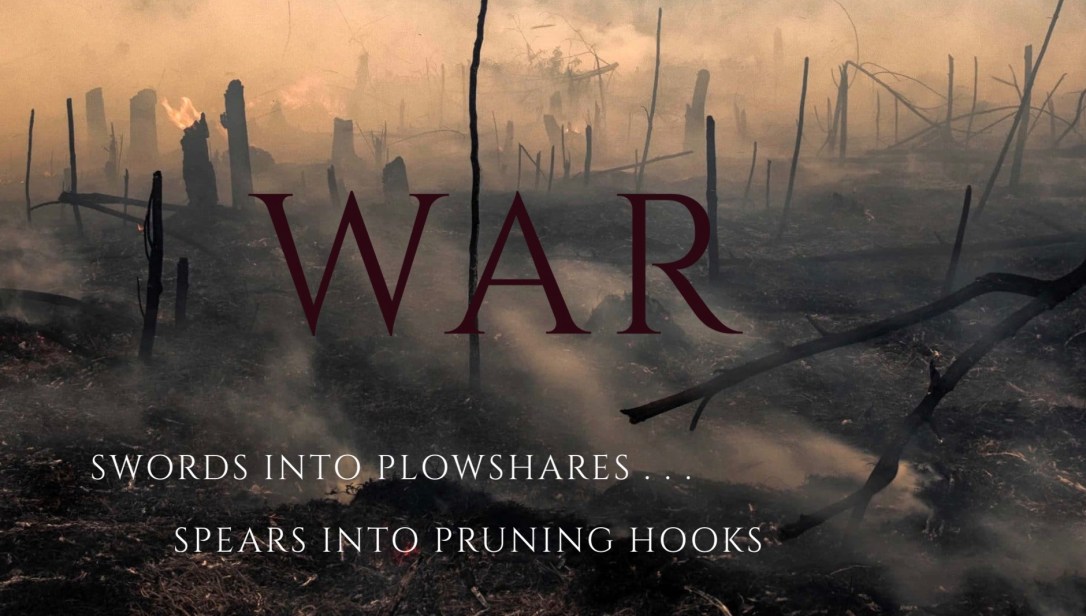
And he shall judge among the nations, and shall rebuke many people: and they shall beat their swords into plowshares, and their spears into pruninghooks: nation shall not lift up sword against nation, neither shall they learn war any more. (Isaiah 2:4)

So why talk of war after Ash Wednesday and into Lent? Perhaps the subject of war occurred to me as I moved closer to this season of repentance and self-reflection. Perhaps I felt a need to consider the futility of war because of Ash Wednesday’s dictum, “Remember that you are dust, and to dust you shall return.”

One who came from dust, and who anticipates returning to dust, must certainly feel a longing for peace, peace in the world as well as peace of the soul and spirit. Neither examples of peace are easily achieved. The machinations of war between nations, and the eternal quest for finding inner peace, are two sides of the same coin. Perhaps it is those persons who have a dearth of inner peace who seriously contemplate making enemies and making war. War flourishes, at times, when the cause seems righteous, while at other times, the cause is greed, lust for power and human depravity. Either way, the losses of war are enormous beyond imagining.

I have been intrigued by the writing of Sebastian Junger in his book War (published in 2010). He echoes the famous words of Winston Churchill:

We sleep soundly in our beds because rough men stand ready in the night to visit violence on those who would do us harm.

Junger also offers interesting insights into war:

The cause doesn’t have to be righteous and battle doesn’t have to be winnable; but over and over again throughout history, men have chosen to die in battle with their friends rather than to flee on their own and survive. 

The Army might screw you and your girlfriend might dump you and the enemy might kill you, but the shared commitment to safeguard one another’s lives is not negotiable and only deepens with time. The willingness to die for another person is a form of love that even religions fail to inspire, and the experience of it changes a person profoundly.

Three Christian denominations have positions on war.

Roman Catholic
The fifth commandment forbids the intentional destruction of human life. Because of the evils and injustices that accompany all war, the Church insistently urges everyone to prayer and to action so that the divine Goodness may free us from the ancient bondage of war.

The Southern Baptist Convention (Adopted on June 14, 2000)
Peace and War. It is the duty of Christians to seek peace with all men on principles of righteousness. In accordance with the spirit and teachings of Christ they should do all in their power to put an end to war.

The United Methodist Church (2000 United Methodist Book of Discipline)
We believe war is incompatible with the teachings and example of Christ. We therefore reject war as a usual instrument of national foreign policy and insist that the first moral duty of all nations is to resolve by peaceful means every dispute that arises between or among them; that human values must outweigh military claims as governments determine their priorities; that the militarization of society must be challenged and stopped; that the manufacture, sale, and deployment of armaments must be reduced and controlled; and that the production, possession, or use of nuclear weapons be condemned. Consequently, we endorse general and complete disarmament under strict and effective international control.

62CD426B-DC5F-4BAB-834D-47EC0FF59251
A map of Afghanistan with bullet holes at a school in the Kandahar Province. Photo by Bryan Denton for The New York Times

No doubt, this is probably more information on the deplorable subject of war than anyone needs to contemplate. And yet, war is not just “far off” in other countries where we can’t see it. “War” is all around us — in this divided nation, in the hate speech that is so prevalent, in the gun violence that takes lives, in violent acts within families, in racial division and the re-emergence of white nationalism. One can scarcely complete the list of the many ways war affects us, within us and around us.

We must remember that war is not only the catastrophic expectation of a nuclear bomb or chemical warfare, it is also a war that could raise its head in our communities, in our churches, even in our hearts, wreaking havoc on our souls. War is famine, homelessness, poverty, racism, family violence, child abuse, trafficking, homophobia and xenophobia. War is the destruction of humanity and all that we know to be right and just. The example of Jesus must be our guide and inspiration. No, Jesus did not explicitly warn against war, but he said so many things about peace.

The words of Jesus

Matthew 5: 38-48 (selected verses)
You have heard that it was said, ‘An eye for an eye and a tooth for a tooth.’ But I say to you, Do not resist an evildoer. But if anyone strikes you on the right cheek, turn the other also . . .

“You have heard that it was said, ‘You shall love your neighbor and hate your enemy.’ But I say to you, Love your enemies and pray for those who persecute you, so that you may be children of your Father in heaven . . . For if you love only those who love you, what reward do you have? Do not even the tax collectors do the same? And if you greet only your brothers and sisters, what more are you doing than others? Do not even the Gentiles do the same? Be perfect, therefore, as your heavenly Father is perfect.

Mark 12:28-31
One of the teachers of the law came and heard them debating. Noticing that Jesus had given them a good answer, he asked him, “Of all the commandments, which is the most important?”

“The most important one,” answered Jesus, “is this: ‘Hear, O Israel: The Lord our God, the Lord is one. Love the Lord your God with all your heart and with all your soul and with all your mind and with all your strength. ‘The second is this: ‘Love your neighbor as yourself.’ There is no commandment greater than these.”

The early Christians took Jesus at his word. They closely identified their religion with peace; they strongly condemned war and bloodshed; they appropriated to themselves the Old Testament prophecy which foretold the transformation of the weapons of war into the implements of agriculture; they declared that it was their Christian commitment to return good for evil and to conquer evil with good.

Might we all do likewise!

What is critical for us is to fully understand that war among us or within us creates profound loss . . . always. The current political divisions are taking a toll on everyone. We no longer live in a time when political leaders held all the divisiveness. In these days,  fractured politics have reached communities, churches and even families. When support for political candidates creates deep separations one from another, we have reached a dangerous and divisive environment. When we live in such a divisive environment, we risk losing relationships with those who “don’t vote like we do.” What a senseless, unfortunate and tragic loss that creates  — breaches between friends, alienation among family members, rifts in communities of faith, deep schism in neighborhoods and communities.

Our spiritual intention must be a quest for peace, reconciliation, unity and respect. This is God’s intention for people of faith. This is God’s intention for the world, that nations, tribes, villages, cities — all the peoples of the world — shall not learn war anymore!

May God make it so, globally and personally!

Awakening, Dancing, Discernment, Discovering, Freedom, God's presence, Holy Spirit, journey, Life Journeys, Morality, New Life, peace, Pilgrim, Pilgrimage, Self Awareness, Singing, Soul, Spirit wind, Spiritual awakening, Stories, Transformation, Walking peacefully, wind

Walking Peacefully

BC2C5B3D-EFB1-4535-9D46-B4D8A9DB76F3
People say walking on water is a miracle,
but to me walking peacefully on earth is the real miracle.

Thich Nhat Hanh

Those words ring so true, but how does one realize “the real miracle?” “Walking peacefully on earth” is much harder than it sounds, much more challenging than it ought to be, at least for most of us. Some have poetically said that walking on earth is our pilgrim journey, and I believe that many people feel that they are walking a pilgrim journey.

In his book, The Pilgrim Journey: A History of Pilgrimage in the Western World, James Harpur asserts that we are now in a new era of pilgrimage and asks: “Why is pilgrimage coming back, especially in a time when many people are questioning traditional religion?” Harpur’s answer is that in these days, there seems to be a deep longing in humans for this form of spiritual practice.

As for me, pilgrimage and journey are very real descriptors of my life. I have often set out on one journey or another, not knowing where to go, only that my soul needs the journey. I am captivated by Harpur’s book, by his tracing the history of why countless people through the ages have embarked on spiritual pilgrimages, by his many stories of pilgrimage through the ages and by his examples of why journey is so relevant to today’s pilgrims. Harpur writes:

If that is done, the destination — a shrine, a holy mountain, or a house of God — will signify not the end of the journey, but the start: a gateway into a new way of being, of seeing life afresh with spiritually cleansed eyes.What is essential is that the journey, by whatever means it is accomplished, gives the pilgrim enough time to expose himself or herself to the possibility of a sacred metamorphosis.

Nothing seems more important to me than seeing my life afresh “with spiritually cleansed eyes.” But getting there is a long process, a journey.

3BCA9FAD-8CD2-4B6A-B300-6609E1318379Walking peacefully on earth requires my full resolve and my desire to reach that place in life. Wouldn’t any of us want to experience transformation and the freedom to be? Wouldn’t any of us want to experience a sacred metamorphosis?

Certainly, it is a long process, a long journey. There are many steps along the way that each person must determine in order to persist on the pilgrimage. There are divergent paths and rough roads and thorny ways and threatening obstacles. Though choosing the path is personal, the graphic at the top of his post illustrates a set of steps we could possibly choose for ourselves. If I chose to take those steps, it would look like this:

First, I must learn to cry again. Crying is very hard for me, as if I dared to cry, my crying might go on forever. Yet, crying is a part of cleansing the soul, and as the quotation says, there is an importance to flowing and finally letting go. Secondly, I need to accept that within me, there is fire and that I must not be afraid to let it burn. I think I must face the flame, adapt and re-ignite my inner fire. Thirdly, I must to open myself up to refreshing air — observe it, breathe it, focus and then decide whatever I need to decide.

The quote also says “remember that you are earth” and ground yourself, give, build and heal. Finally, “remember that you are Spirit” and care for your inner core so that you can connect, listen, know yourself and be still. It’s quite a lesson — a new way of seeing myself — and perhaps it is the way I must journey if I want to walk peacefully on the earth. In these days when peace is in short supply, when nations refuse to beat their swords into plowshares, when political rivals use hate speech against one another, it is so important that peace dwells within my soul.

In the end, all of us long for what James Harpur calls sacred metamorphosis. We all want to realize the miracle of walking peacefully. We want to walk peacefully in our souls. We want to walk peacefully with others. We want to walk peacefully in our families. We simply want to walk peacefully — hand in hand with God and moved by Spirit. We want the choice to walk or to be still, to run or to leap, to breathe or to hold our breath when we kneel before wonder. We want to have the freedom to speak and shout and sing and dance . . . and truly live. That is the miracle!


Acts 42, anxiety, Awareness, Beauty of Nature, Birdsong, Creation, Faith, Fear, Grace, healing, Hope, Humbug, journey, Life Journeys, Light, Mindfulness, Nature, New Year, peace, Quiet, Reflection, Self Awareness, Self care, simple pleasures, Soul

Finding Simple Pleasures

EF207F13-682F-4572-BB5B-F4AAAB1EDA50
A Saturday of football — what a simple pleasure! I am a fan of certain teams (Roll Tide!), but I am definitely not a football fanatic. And yet, this morning while half-watching Sportscenter, I realized that watching with Fred, not having to focus that much, resting in the ordinary seemed like a simple pleasure.

There are many simple pleasures, of course, far more soulful than watching football — taking a walk in the splendor of nature, listening to birdsong, snuggling with your puppy, looking up at the night’s moon and stars, taking a walk on a labyrinth’s spiritual path . . . There are so many more simple pleasures in life, and most of them do not even require a trip to the grocery store. They cost us nothing, but their worth is priceless.

These are the simple moments that caress the soul, bring peace and calm to the heart and enliven a wounded spirit. These moments, and others like them, are the moments we desperately need, especially in times when we are burdened with the weight of the world, languishing in darkness.

I have learned some things about a wounded spirit: that woundedness happens to all of us; that “dark nights of the soul” happen to everyone at some time in life; that the wounded spirit does not always require sophisticated remedies; that a simple pleasure is sometimes all it takes to begin a healing journey.

The important factor is self-awareness, being mindful of the soul’s health, accepting the reality that healing will require us to self-intervene and that our intervention could begin with entering into a simple pleasure. One worthy New Year’s resolution is to intentionally identify the simple pleasures that feed our souls and then to allow a simple pleasure to enfold us in contemplation.

Normally, I would say “bah humbug” to New Year’s Resolutions that we make, break, and then feel guilty about for an entire year! But a resolution to discover the simple pleasures that give us life is one worthy resolution. So I challenge you to look and listen for the simple pleasures that are “you,” and to hold them near whenever you are experiencing a “dark night of the soul.”

“There comes a time when both body and soul enter into such a vast darkness that one loses light,” wrote Mechtild of Magdeburg. There comes a time when the soul “sinks down into the night.”

Her words are the words of one who knew spiritual journey and seasons of darkness. There is no doubt that at some time throughout your life, you will find yourself traveling the spiritual night. I do know this within my place of deep knowing: when I give myself to spiritual journeying, allowing myself the peace of a simple pleasure that calms my spirit, I realize that God always invites us beyond where we are.

God guides us on the spiritual journey that sometimes means winding through a dark wood. The darkness may frighten us, but it is a necessary part of the trip. When we panic in the darkness, we must try to understand that it’s a holy dark and that the idea is to surrender to it and journey through until we reach God’s light.

And then on to simple pleasures!372C6D47-6761-412E-AACF-420F5B1EE76D

God will be present beside us —- in the light of simple pleasures and in the soul’s dark night.

That is the gift, the grace, that God has freely given to us, and for that we give thanks.

Advent, Angels, Belief, Bethlehem’s Star, Candlelight Service, Celebration, Christ Child, Christ’s Birth, Christmas, Christmas Eve, Church, Community, Contemplation, Faith, Hope, Mary, Mystery, peace, Reflection, Stars, Worship

“Within Reach of Our Full Personhood”

Nativity scene, Christmas star on blue sky and birth of Jesus, illustration
The Twenty-Fourth Day of Advent

Christmas Eve
December 24, 2019

As I near the end of Advent 2019, I am contemplating what these Advent days have taught me. Am I closer to God in deep relationship? Have I spent time in contemplation and prayer? Was I so preoccupied with my surgery and recovery to even think about Advent? Did I experience Advent as a time of waiting, expectation, preparation and hope in the coming of the Christ Child? Did I experience Advent at all?

You might ask yourself questions similar to these. They are questions all of us would do well to answer. As for me, I fully resonate with the statement in Ann Weems’ poem: “we are on our knees, where we are within reach of our full personhood.” Isn’t that part of what Christ’s coming was about — to place before us the hope of reaching our full personhood?

As you contemplate that, read a part of Ann Weems’ poem, “The Church Year.”

For no matter how long the darkness,
God will send the light.
In spite of cursing and violence and the massacring
of human dignity,
we will dance in the streets of Bethlehem,
for He will be born!

We search for something more.
And — of all unlikely places
in a stable
the Deity appears.

The borning of our Lord
bursts in upon our ordinary lives
like fireworks in the snow.
Only God would send a little baby King,
and we are on our knees,
where we are within reach of our full personhood.

— Ann Weems

What else can be said on this Eve of Christmas? We sit with a miracle story, an event marked by angels and the brilliance of an unusual star. We gather together in churches around the world, where we sit together in candlelight and contemplate the birth of the Christ Child, the One who came for us, the One who “became flesh and dwelt among us. We have seen His glory, glory as of the only begotten from the Father, full of grace and truth.“ (John 1:14)

I wonder why we gather for candlelight services on Christmas Eve. I think it’s because we want to experience the holy; we want to contemplate the mystery of a young girl who gives birth to the Christ Child; we want to hear the singing of angels and see the sparkling beam of an unusual star in the night sky;  we want to be together in community because, in our heart of hearts, we truly believe that it is here, together, we will be “within reach of our full personhood.”

It is God’s holy mystery, and we are invited to enter and to see the Christ Child as if it were our very first time; to hear angel song as if it were our first time; to gaze upon Bethlehem’s star as if we had never seen it before. That is the mystery: that Christ is born unto us again and again — God Incarnate, the hope of all nations and hope for our hearts. My gift to you is a video of a beautiful Christmas carol, “Candlelight Carol” written by John Rutter. Particularly if you, like me, are unable to attend a Christmas Eve service, this lovely carol might speak to your spirit and give you peace. After the lyrics, you will find the video. Happy Christmas Eve to you all

How do you capture the wind
On the water?
How do you count all the stars
In the sky?
How can you measure the love
Of a mother?
Or how can you write down
A baby’s first cry?

Candlelight, angel light
Firelight and starglow
Shine on his cradle ’til breaking of dawn
Gloria, gloria, in excelsis dear
Angels are singing, the Christ child is born

Shepherds and wise men will kneel
And adore him
Seraphim round him their vigil will keep
Nations proclaim him their Lord
And their Savior
But Mary will hold him, and sing him to sleep

Candlelight, angel light
Firelight and starglow
Shine on his cradle ’til breaking of dawn
Gloria, gloria, in excelsis deo
Angels are singing, the Christ child is born

Find him at Bethlehem laid
In a manger
Christ our Redeemer asleep
In the hay
Godhead incarnate and hope
Of salvation
A child with his mother
That first Christmas Day

Candlelight, angel light
Firelight and starglow
Shine on his cradle ’til breaking of dawn
Gloria, gloria, in excelsis deo
Angels are singing, the Christ child is born.

Advent, Angels, Belief, Bethlehem’s Star, Call, Christ’s Birth, Discernment, Here I am, Lord., Hope, Joy, Kneeling Places, Love, Memories, peace, Reflection, Stars

“In Search of Our Kneeling Places”

DBD1A3AF-D9E4-40CB-A77F-D8CFB3E0E6FB

The Tenth Day of Advent.
December 11, 2019

IN SEARCH OF OUR KNEELING PLACES

In each heart lies a Bethlehem,
an inn where we must ultimately answer
whether there is room or not.
When we are Bethlehem-bound
we experience our own advent in his.
When we are Bethlehem-bound
we can no longer look the other way
conveniently not seeing stars
not hearing angel voices.
We can no longer excuse ourselves by busily
tending our sheep or our kingdoms.

This Advent let’s go to Bethlehem
and see this thing the the Lord has made known to us.
In the midst of shopping sprees
let’s ponder in our hearts the Gift of Gifts.
Through the tinsel
let’s look for the gold of the Christmas Star.
In the excitement and confusion, in the merry chaos,
let’s listen for the brush of angels’ wings.
This Advent, let’s go to Bethlehem
and find our kneeling places.

— Ann Weems

The words of Ann Weems this morning seem to call us to Bethlehem. Perhaps the call intends for us to remember more clearly the birth of the Christ Child, the incarnation of God. Perhaps this call wants us to focus more fully on what this Child’s birth really means for us. Perhaps the call wants us to find our kneeling places, those places that enable us to open ourselves to God’s presence in us, God’s call to us.

When, in your own kneeling place, have you responded to a call from God? Was it a call that would change your life? Was it a call that you could only answer by saying, “Here am I. Send me.”

Among all the meanings of Advent is a call to watch, to wait, to worship, to be full of expectation, to rejoice in the birth of the Christ Child and to offer our lives to God. Advent is a call to find our kneeling places.

So I am thinking today about the many ways God has called me through the years. Some of those calls became divine appointments for me. Some were hard calls, risky and frightening. Some were calls that I answered with an immediate “Yes!” There were calls that summoned me to find my kneeling places. One specific call is the one that emerged from my most impassioned, fervent kneeling place. It was the call that asked, “Whom shall I send? And who will go for us?”

To respond “yes” to that call required extended time spent at my kneeling place. To respond “yes” to that call would alter the course of my life. Looking back, I can see that saying “yes” to that call call brought me life’s deepest sorrows and matchless joys. That call from God was to be transformative for me, transcending whatever I had imagined. I vividly remember that call, and from my kneeling place, I answered, “Here I am, Lord.”

“Here I am,Lord!” Those words from my heart would bring a plethora of emotions in the months that followed — through times of testing, disparagement, condemnation, criticism, disappointment, struggle, and eventually, peace. Thinking back to my ordination service brings a host of special memories: my friends and family gathered for the holy service; the church family that laid hands of blessing on me; my husband and my best friend singing words I remember to this day.

Here I am, Lord.
Is it I Lord?
I have heard You calling in the night.
I will go Lord if You lead me.
I will hold Your people in my heart.

I, the Lord of sea and sky,
I have heard my people cry,
All who dwell in dark and sin
My hand will save.

I have made the stars of night.
I will make their darkness bright.
Who will bear my light to them?
Whom shall I send?

I, the lord of wind and flame,
I will tend the poor and lame,
I will set a feast for them,
My hand will save.
Finest bread I will provide
Till their hearts be satisfied.
I will give my life to them,
Whom shall I send?

— Songwriters: Anna Laura Page / Daniel L. Schutte; Based on Isaiah 6:8 and 1 Samuel 3

If you like, take a few minutes to view the video of this song, reflecting on the words and their meaning for you.


And so it was, from my kneeling place, I answered God’s call: “Here I am, Lord!”

The season of Advent calls us in a voice just as compelling to find our kneeling places . . .
to focus on Advent’s promises of hope, peace, joy and love,
to wait in anticipation for the birth of our Savior,
to lift our eyes and sing with the angels, “Hallelujah!”

Amen.

Advent, Light, peace, Uncategorized

Peace

E9C46343-6738-420D-96FA-E49A5BB1A0D6
The Second Sunday in Advent

The Sunday of Peace
December 8, 2019

PEACE ON EARTH

“Peace on earth, goodwill to all” . . .
The song came out like one loud hosanna
hurled through the earth’s darkness,
lighting the Bethlehem sky.

Sometimes I hear it now,
but it means a baby in a manger;
it means a time of year,
a cozy feeling,
a few coins in the Salvation Army bucket.

It doesn’t mean much —
and then it’s gone,
lost in the tinsel.

Where did the angels’ song go?
Who hushed the alleluias?

Was it death and war and disease and poverty?
Was it darkness and chaos and famine and plague?
Who brought violence and took away the sweet plucking of heavenly harps?
Who brought despair and took away hope?
Who brought barrenness and crushed the flowers?
Who stole the music and brought the silence?
What Herods lurk within our world seeking to kill our children?

Are there are still those
who listen for the brush of angel wings
and look for stars above some godforsaken little stable?

Are there still those
who long to hear an angel’s song
and touch a star?

To kneel beside some shepherd
in the hope of catching a glimpse of eternity
in a baby’s smile?

Are there still those who sing
“Peace on earth, goodwill to all?”

If there are — then, O Lord,
keep ablaze their flickering candle
in the darkness of this world!

— Ann Weems

How to I manage to keep my candle ablaze in the darkness of this world? Doing so is a hard thing at times. I watch. I listen for sights and sounds that herald peace on earth, yet almost every day I see the world’s chaos instead. I contemplate what I might do in creating peace and come up empty. As in the carol I have sung during so many Advents …

Then in despair I bowed my head; 
There is no peace on earth,” I said.
“For hate is strong and mocks the song 
Of peace on earth, goodwill to men.”

Despair seems to be a constant companion in these days. Children separated from parents and detained in cages. Gun violence rampant. Vitriolic relationships among those who govern our nation. Climate change harming communities. Refugees searching for safe havens.

I turn toward the words of Ann Weems and ask, “Who stole the music and brought the silence?”

Are there are still those
who listen for the brush of angel wings
and look for stars above some godforsaken little stable?

Are there still those
who long to hear an angel’s song
and touch a star?

Are people of peace still singing “Peace on earth, goodwill to all?” If there are — even if there are only a few — then we pray to God that their flickering candle of peace would light the world’s darkness,

Advent’s prayer for peace remains on our lips:

O Lord, keep ablaze their flickering candle in the darkness of this world!

Amen.

Advent, Angels, anxiety, Belief, Change, Comfort, Courage, Darkness, God, God’s Gift of Stars, Hope, Kidney Transplant, Laughter, New Normal, peace, Suffering

Sometimes God Flings Stars!

0E6B5F26-6125-45C7-8B3C-48718E5A951D
The Fifth Day of Advent

Transplant Day Twenty-four
December 5, 2019

THIS YEAR

I wonder if God comes to the edge of heaven each Advent
and flings the Star into the December sky,
laughing with joy as it lights the darkness of the earth;
and the angels, hearing the laughter of God,
begin to congregate in some celestial chamber
to practice their alleluias.

I wonder if there’s some ordering of rank among the angels
as they move into procession
the seraphim bumping the cherubim from top spot,
the new inhabitants of heaven standing in the back
until they get the knack of it.
(After all, treading air over a stable and annunciating
at the same time can’t be all that easy!)
Or is everybody — that is, every “soul” — free to fly
wherever the spirit moves?
Or do they even think about it?

Perhaps when God calls, perhaps they just come,
this multitude of heavenly hosts.
Perhaps they come,
winging through the winds of time
full of expectancy
full of hope
that this year
perhaps this year
(perhaps)
the earth will fall to its knees
in a whisper of “Peace.”

— Ann Weems

This year for me is unlike any other year, not at all like Advents of my past. This Advent for me is not at all ordinary. It is an Advent that finds me in a bit of suffering, a bit of pain and, most of all, crying out for peace.

The poet asks: “What might it look like if the earth fell to its knees in a whisper of ‘Peace?’” We are always full of expectancy, full of hope that during some Advent, perhaps this year’s Advent, we will finally hear the earth whispering “Peace.” 

From the place I find myself today, I look for that Peace. Recovering from a kidney transplant and trying to live into a new normal, what I need most is peace. Peace after a life upheaval. Peace after a physical trauma. Peace that might help restore my emotional and spiritual self.

I do so want to fall to my knees in a whisper of “Peace.” But probably not today. Not until some parts of me heal a little more. It’s not always an easy thing, falling to my knees, even in the best of times. Today, though — far from home and family, separated from my friends and my faith community — most things are not easy.

I will remember these recovery days as a season of harsh medications, pain, swelling, itching, tremors, instability and anxiety. But there is another part of my memory that remembers that the Apostle Paul wrote some words that have always spoken deep peace to me. He wrote of being “troubled on every side, yet not distressed; perplexed, but not in despair; persecuted, but not forsaken; cast down, but not destroyed.”

And then his most comforting words of all: “We do not lose heart. . . for our light affliction, which is but for a moment, works for us a far more exceeding and eternal weight of glory.” (From 2 Corinthians 4)

Walking through those words of hope, I think I can make it another day. Even in my darkness of a difficult recovery, perhaps I can gather up my courage and perseverance and walk a few more steps. Yes, this is a hard time.

04E87215-AC50-4CC9-B2F4-6612E56D0CB9And yet, I still believe that, in some mysterious way, God comes to the edge of Advent and flings the Star into the night sky, maybe many stars. I can still envision God laughing with joy as starlights illuminate the darkness. And I can almost hear the singing of angels practicing their alleluias.

It is Advent, after all!

Change, Emotions, Friends, Gratitude, journey, Kidney Transplant, Mayo Clinic, peace, Prayer, Serenity

Numb!

CDB6753B-4835-42F3-B27C-45192AB4B808
Numb! It’s not a very emotive feeling like other emotions. It seems so much more appropriate to feel ecstatic, elated, overjoyed — or even terrified — at receiving the call from Mayo Clinic saying a kidney is available and the transplant is scheduled for November 15th. But numb is all I can get to right now. After all, this is a very tangible way of announcing an end to five years of illness, uncertainty and dialysis. Five years does not seem like such a long time, but it feels in some ways like a lifetime.

So in the immortal words of Pink Floyd, “I have become comfortably numb.” It’s not such a bad way to feel. The journey has been a long one, an emotional one, and now I think it’s time for calm. Numb is actually pretty darn calm, and after traveling this wild and fantastic journey, numb is okay. There’s something about numb that feels like serenity.

So many people have walked alongside me on this journey and, at times, carried me when I could barely take the next step. No one — and I really mean no one — could have been as dedicated and loving a caregiver as Fred. He is forever faithful as he has always been. 

And oh, my friends, my friends nearby and far away from many lives past to this very day! Thinking of them just now and knowing how faithfully and deeply they have prayed for me brings tears to my eyes. I am grateful for extended family who cared for me and Fred enough to urge us to Georgia. They have supported us in so many ways.

No person could have had a more dedicated and caring staff of dialysis professionals as I have had. They have missed nothing, not a change in a blood test, not the signs of an infection, nothing! And they are the ones who have kept me healthy enough to get to today.

My friend who is donating a kidney on my behalf is living a life of selflessness, giving a very precious gift of immeasurable value. I think of him today with such unfettered gratitude.

God’s grace and protection have been near, so near at times that I felt a palpable sense of the holy — within me, surrounding me, above me and below me, behind and before me guiding me on the unknown path.

As I said at the very beginning, I am numb, and although numb is acceptable and appropriate right now, numb is not such a good crucible for words. So I have no more words right now. Except this good word:

I thank my God every time I remember you, constantly praying with joy in every one of my prayers for all of you . . .

— Philippians 1:3-4 (NRSV)


For all that has been — Thanks.        
For all that shall be —Yes!

― Dag Hammarskjöld

Calling, Contemplation, Covenant, Dry seasons of life, Faith, journey, peace, Prayer, Quiet, Silence, Spiritual growth

Sudden Peace and Holy Silence

9B60ABDD-83BD-48D4-9213-3698F680EB93

But the Lord is in his holy temple;
let all the earth keep silence before him!

— Habakkuk 2:20 New Revised Standard Version

On this past Sunday, my pastor brought up a vivid memory for me when he talked about the stark, silent, peaceful beauty of the desert. I listened to him share his experience of a silent contemplative retreat at a Benedictine monastery in the desert. I heard his expression of how keeping silence affected him, with the effects continuing for days after the experience. I heard his description of the ways the barren desert became God’s holy temple. While the New Revised Standard Version of the Bible tells of “keeping silence,” The Message Translation says it like this:

But oh! God is in his holy Temple!
Quiet everyone—a holy silence. Listen!”

The desert does create a kind of holy silence. I remember being in the desert’s silence. I remember the heat of it, the enormity of its sky, the color of beige as far as the eye could see, the silenced sound of it, the sudden peace it gave me. The time was many years ago. The place was a retreat of the Order of Ecumenical Franciscans in the desert of New Mexico.

I had spent months of spiritual direction and personal reflection to prepare to make my profession in the Order’s Novitiate. On the day of the covenant service, I spent hours walking alone in the desert wondering why in the world a Baptist pastor would want to enter into a vocation with this Order. There in the dry desert I owned the reality that I was in a dry season of my life. I knew I could not stay in that dry and barren place where my life force was languishing. In the months before, I had been exploring this crossroads in my faith journey with my Franciscan spiritual director. Over time, I had discerned that this was a call from God, and I had entered the Order’s Postulancy. Now I felt ready to move forward.

I had no idea, really, how the Franciscan journey would affect my life. I did not know how, or if, this journey could lead me into a deeper spirituality, but that is what I longed for. I had finished writing my Personal Rule of Life that afternoon. I knew that my formation would take years, that there would be distinct decision points for me after entering the Postulancy (making Novice vows, Professing lifetime vows). These places in the spiritual journey would be decision points in my discernment process that would most surely include moving forward, stepping back, or perhaps giving more time for the Holy Spirit to speak to me before taking the next step. 

I would be lying if I said I did not have second thoughts about my reasons for seeking this spiritual path. I agonized in the midst of my prayer for clear direction. What I was certain about was that I needed something more. My spirit longed for fuller joy in my faith, a deeper connection to God and to the divine within myself, and peace. Mostly peace. The kind of peace that busy, overcommitted Baptist pastors have a hard time finding. 

In my moments of indecision that afternoon, the parched, hot desert spoke to me out of silence. It spoke to me of peace, and I was certain that on this night I would make my Profession of the Rule and become a Novice in the Order of Ecumenical Franciscans. I was convinced that this faith commitment would bring me peace.

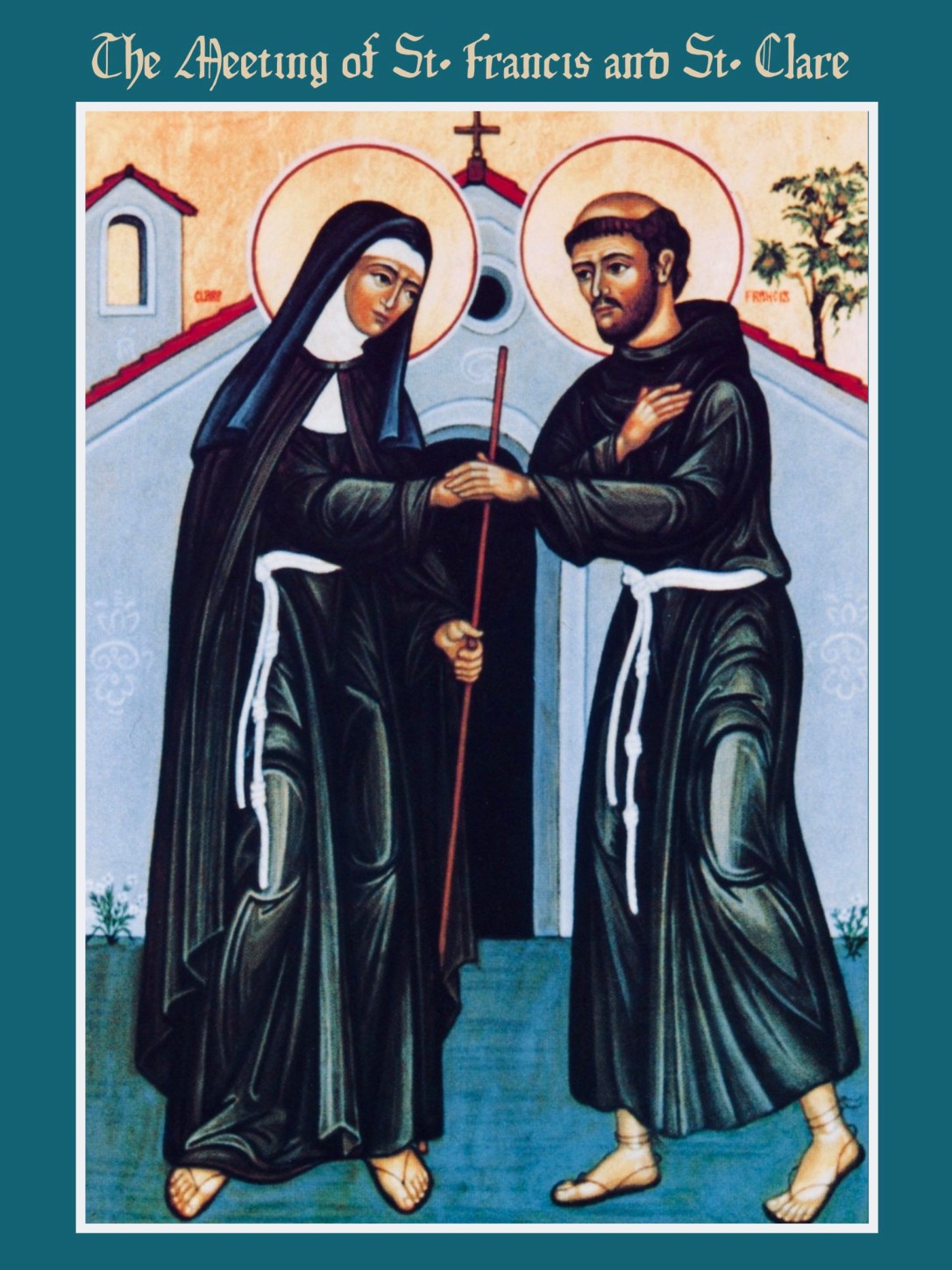
The community prayed over me in the spirit of St. Francis and St. Clare. They laid hands on me as I recited my Rule of Life and spoke my vows, and then they handed me a beautiful San Damiano cross.67401824-A9BD-4B39-857E-97CC62B25B1D I had seen this dramatic crucifix before, but on this night it was even more striking than I remembered. I held it in my hands and gave thanks for God incarnate in Christ, for the hope of glory in us, and for the palpable sense of peace that was enfolding me in that moment.

In Franciscan thought, the incarnation of Christ is foundational. It is not easy to fully describe the spirit and gifts of Franciscan thinking, but its hallmarks are simplicity, reverence, fraternity, ecumenism, ecology, interdependence, and dialogue. Its motto and salutation is “Peace and All Good!” Francis believed that God was nonviolent, the God of Peace. And so it was in that Franciscan order that I found deep, sudden peace.

The years after that took their toll on me and on my faith. Life challenges threatened my peace many times over. But the miracle is that the peace remained. It grew stronger with each trial. It grew stronger with aging and illness and heartbreak. When calamities finished their work on me, peace was still there, every time. In me, where it always needed to be.

I think to end this very serious post with just a little whimsy. I find whimsy so often in the writing of many of my blogging friends. One of them wrote about sudden peace today of all days, just as that idea is on my mind. So I must share it with you. 

I love the honesty in my friend’s words that so vividly describe the aging and changing that sometimes feels so frightening. These are her funny, quirky, very true words that describe a moment of self-realization:

That moment when your flabby underarms slap against your torso, and the sound reminds you of gentle waves lapping on a shore, and you are suddenly at peace.

— Joanna E.S. Campbell

Thank you, Joanna. Spirit-filled moments come to us in a variety of ways, and your picturesque speech reminded me today that I really am “suddenly at peace.” And that sudden peace has happened for me many times in the holy silences of my life.

Just when I needed it the most.

Quiet everyone — a holy silence. Listen!

Thanks be to God.


************************************************************

On another note . . .

please pray for me as I await a life-saving kidney transplant. I am grateful that you are walking with me on this journey that often feels so frightening. Your thoughts and prayers mean so much. If you would like to read the story of my illness, please visit the Georgia Transplant Foundation’s website at this link:

http://client.gatransplant.org/goto/KathyMFindley

A “Go Fund Me” page is set up for contributions to help with the enormous costs related to the transplant, including medications, housing costs for the month we have to stay near the transplant center, and other unforeseeable costs for my care following the transplant. If you can, please be a part of my transplant journey by making a contribution at this link:

https://bit.ly/33KXZOj


Beauty of Nature, Birdsong, Change, Comfort, Inspiration, Introspection, Nature, peace, Prayer, Rebirth, Reflection, simple joys, Trees, Unfaith

Stay Awhile!

E0A3E9A4-310C-4286-8DD1-F07DCB104F2C

I am a lover of trees — all trees. I religiously follow the life cycle of the only tree in my yard. It’s a Chinese Tallow tree and every botanist calls it a nuisance tree, an invasive species that should be controlled. I find the tree fascinating, even mesmerizing, as it changes.

57891E38-0267-4B76-8B1C-7F0BCEEE1412

Not only do the heart-shaped, bright green leaves turn yellow, orange, purple and red in autumn, but the tree produces seeds that start out green, turn brown-black and then white. The changing colors call my attention to my constant life changes and, in a way, bring the comfort of knowing that we really do survive life changes.

87E8B050-CC6B-4AC6-B717-AE5D7FEB5E8A


The tree captures my spirit every year as autumn approaches. In a way, I meditate on my tallow tree. I watch its changes. I feel the raindrops of its sticky sap that drips on me when I’m under it. I listen to the birdsong that echoes among its boughs. I even hear my tree whisper to me sometimes when the breeze blows through it in just the right way. The tree can call me to introspection. It can inspire me on days when inspiration is beyond my grasp and unfaith threatens. On those days, the inspiration that stirs in me is peace. It is prayer.

I have to admit, though, that I walk past my tree dozens of times a day without notice, taking its shade for granted and completely unaware of its enchanting beauty. Therein lies the human dilemma of dispassionate inattention, our failure to notice or to take in nature’s extravagance. It is when a tree is just a tree. It is when we miss the spiritual experience that creation offers us as gift. 

B5263037-5BBB-4505-AF52-1DC541DB2290There is no better expression I could share than Mary Oliver’s poem, When I Am Among Trees.

When I am among the trees, 
especially the willows and the honey locust,
equally the beech, the oaks, and the pines, 
they give off such hints of gladness.

I would almost say that they save me, and daily.

I am so distant from the hope of myself,
in which I have goodness, and discernment, 
and never hurry through the world 
but walk slowly, and bow often. 

Around me the trees stir in their leaves
and call out, “Stay awhile.”

The light flows from their branches.

And they call again, “It’s simple,”
they say, “and you, too, have come
into the world to do this, to go easy,
to be filled with light, and to shine.”

1EBD15F8-1BF9-468E-9543-51C89F27DCCAOh, to claim our place in the world, to go easy, to embody the message of the trees: “It’s simple!” And then to remember that the changing seed pod, as its life cycle moves around, is really a portrait of rebirth.
On my way to the car dozens of times a week, might I take notice as I pass my tree, never hurrying, walking slowly and bowing often. Might I see more and hear more and feel more, recalling Mary Oliver’s words:

Around me the trees stir in their leaves
and call out, “Stay awhile.”


******************************

On another note, please pray for me as I await a life-saving kidney transplant. I am grateful that you are walking with me on this journey that often feels so frightening. Your thoughts and prayers mean so much. If you would like to read the story of my illness, please visit the Georgia Transplant Foundation’s website at this link:

http://client.gatransplant.org/goto/KathyMFindley

A “Go Fund Me” page is set up for contributions to help with the enormous costs related to the transplant, including medications, housing costs for the month we have to stay near the transplant center, and other unforeseeable costs for my care following the transplant. If you can, please be a part of my transplant journey by making a contribution at this link:

https://bit.ly/33KXZOj


Activism, Determination, Ecclesiastes, Mothering, Nonviolence, peace, Perseverance, Prophetic, Sermon on the Mount, Transformation, Women

“Blessed Are the Peacemakers”

A9D2FCDB-B949-42F0-95A3-990C8A5D484D
Image: The Sleeping Gypsy by Henry Rousseau, 1897, Museum of Modern Art, New York, NY.

In a world of division, violence, hate, racism, misogyny, xenophobia, homophobia and all manner of angst, perhaps we need to draw nearer to Jesus for a moment to listen to the thoughts of his heart. It happened before, you know, when Jesus went up on a mountainside and sat down. His disciples came to him, and he began to teach them.

The things he taught them that day are ever so important for us in these days.

Love your enemies . . .

“You have heard that it was said, ‘Love your neighbor and hate your enemy.’ But I tell you, love your enemies and pray for those who persecute you, that you may be children of your Father in heaven. (Matthew 5:43-45 NIV)

Turn your other cheek . . . 

“You have heard that it was said, ‘Eye for eye, and tooth for tooth.’ But I tell you, do not resist an evil person. If anyone slaps you on the right cheek, turn to them the other cheek also. (Matthew 5:38-39 NIV)

Make peace . . .

Blessed are the peacemakers, for they will be called children of God. (Matthew 5:9 NIV)

I have heard it said that one would not likely find the words of Jesus from the Sermon on the Mount on display on any courthouse lawn. They might never be inscribed on a slate in a state capitol building. But the most important inscription for these words of Jesus is an inscription on our hearts. Not physically possible, of course, but spiritually, we can open our hearts to receive these words within us, allowing them to transform us in ways that empower us to create peace.

Richard Rohr asks how it is that many Christians have managed to avoid what Jesus actually taught? How have we evaded major parts of the Sermon on the Mount: Jesus’ clear directive and example of nonviolence, and his command to love our enemies?

Perhaps we do not believe that nonviolence actually possible or that it will not effect any significant change. Many peacemakers know better. The Pope has singled out one active peacemaker we should know. Leymah Gbowee, the 2011 Nobel prize winner from Liberia, organized pray-ins and nonviolent protests that resulted in high-level peace talks to end the second civil war in Liberia. There are other peacemakers living out a commitment to peace. Not surprisingly, most of them are women. The contributions of women such as Leymah Gbowee in Liberia and Marguerite Barankitse in Burundi are showing the way to the eventual end of violence and the dawning of peace. Their work is working.

Two other women, Erica Chenoweth and Maria Stephan, write in their book, Why Civil Resistance Works, about the effectiveness of nonviolence, drawing from examples in Iran, Palestine, the Philippines, and Burma. They insist, based on their research, that nonviolent resistance is “nearly twice as likely to achieve full or partial success as its violent counterparts. ” 

Perhaps it is that mothering, protecting instinct that makes women lovers of peace. Perhaps it is their capacity for hope and determination. Perhaps it is that women persevere in faith. Perhaps women are a prophetic people who insist that transformation is possible. Women who love peace know that nonviolent movements are made of loyalty, resilience, commitment, creativity and love. Fortunately, women are not afraid of love or creativity or commitment. Women do fear the destruction of hate, violence and war.

So sisters in the struggle, let us keep on. Let us persevere in our quest for peace. Let us persist, struggling for as long as it takes to see holy peace gently cover our world from East to West, North to South, so that every man and woman, every child will be able to lie down in safety.

After all, Jesus said, “Blessed are the peacemakers, for they will be called children of God.”

Anger, Hate, Mindfulness, peace

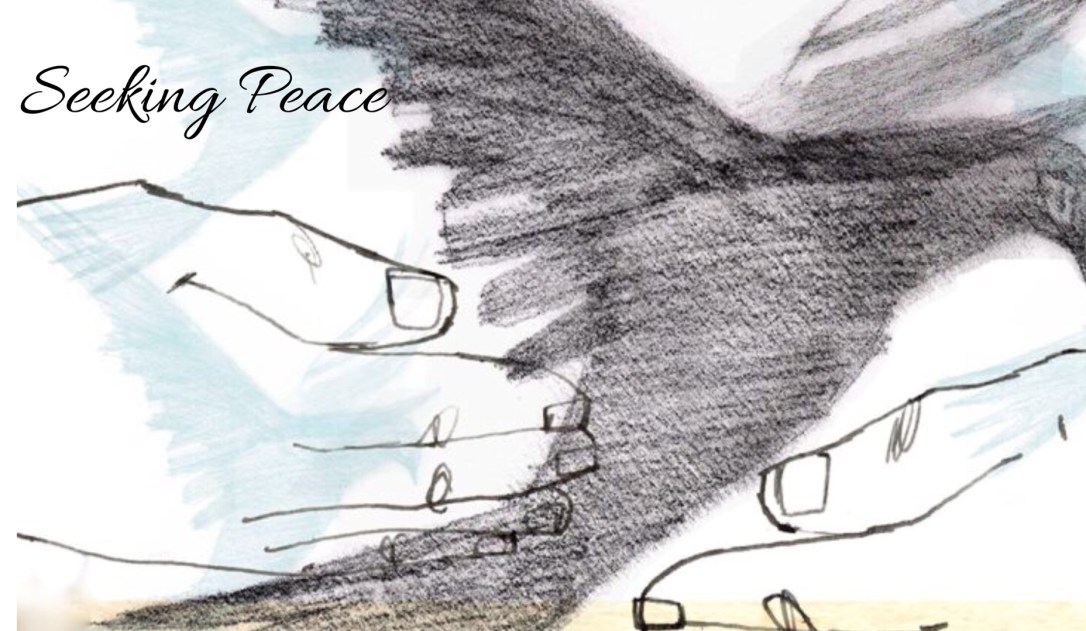
Seeking Peace

598F66C9-A7F5-45E5-9DFD-C9C2F1DA8A3D

I am generally a person of peace, typically quiet and non confrontational to a fault. Most of the time. Still, at times anger can spill out from inside me and, more importantly, I can nurse a good bit of hate. So this morning while reading my daily Richard Rohr meditation, the brilliant Franciscan hits me with some undeniable truth. Here it is:

What does it mean to be nonviolent? Coming from the Hindu/Sanskrit word ahimsa, nonviolence was defined long ago as “causing no harm, no injury, no violence to any living creature.” But Mohandas Gandhi insisted that it means much more than that. He said nonviolence was the active, unconditional love toward others, the persistent pursuit of truth, the radical forgiveness toward those who hurt us, the steadfast resistance to every form of evil, and even the loving willingness to accept suffering in the struggle for justice without the desire for retaliation. . . .

I’m not so sure about “the radical forgiveness toward those who hurt us.” That part sounds a little out of the realm of possibility for me. Maybe completely out of the realm of possibility! Luckily for me, Richard Rohr goes on to describe another way to understand nonviolence. He suggests that we look at nonviolence by setting it within the context of our identity and that we practice nonviolence by claiming our fundamental identity as the beloved children of the God of peace.

Through Holy Scripture, Jesus taught some undeniable truths: 

“Blessed are the peacemakers; for they shall be called the sons and daughters of God (Matthew 5:9)

“Love your enemies and pray for your persecutors, then you shall be sons and daughters of the God who makes the sun rise on the good and the bad, and causes rain to fall on the just and the unjust.” (Matthew 5:44-45). 

There’s that radical Jesus again challenging us in a rather remarkable way. In the context of his visionary nonviolence — radical peacemaking and love for enemies — Jesus tells us that we must be who we already are. Wow! Pretty stunning thought!

Richard Rohr would tell us that living nonviolence requires daily meditation, contemplation, study and mindfulness. These are his words of instruction:

Just as mindlessness leads to violence, steady mindfulness and conscious awareness of our true identities lead to nonviolence and peace. The social, economic, and political implications of this practice are astounding: if we are children of a loving Creator, then every human being is our sibling, and we can never hurt anyone on earth ever again, much less be silent in the face of war, starvation, racism, sexism, nuclear weapons, systemic injustice and environmental destruction. . . .

Gandhi often said that Jesus practiced perfect nonviolence. We have to ask ourselves how it was that Jesus embodied nonviolence so perfectly? The answer can be found at his beginning, at his baptism when he heard a voice say, “You are my beloved son; with you I am well pleased.” 

We do not always accept the announcement that God loves us. But Jesus does accept the announcement of God’s love for him. It happens at his baptism. In that moment, Jesus claims his true identity as the beloved son of the God of peace.

“From then on he knows who he is,” Richard Rohr reminds us, and “He’s faithful to this identity until the moment he dies. From the desert to the cross, he is faithful to who he is. He becomes who he is, and lives up to who he is, and so he acts publicly like God’s beloved.”

Would that we could live up to the persons we are, God’s beloved children of peace? Could it be that accepting God’s love will enable us to truly be a people who desire peace, who envision peace, who create peace in such a warring, violent, broken world?

There is no doubt we must be seekers peace for a world in need. The harder part may well be seeking peace inside ourselves — in our deep-down place where anger lives and where hate can thrive and destroy. May we understand God’s deep love for us. May we rest in God’s desire that peace will reign within us. May we comprehend God’s longing that we will become makers of peace.

May God make it so.


Activism, Change, Christian Witness, Church, Community activism, Gun violence, Hate, Injustice, Mexican border, Mourning, peace, Perseverance, Politics, Prophetic, Racism, Repair the world, Social justice, The Christian Church, Violence

Taking Back Our World

5378F42A-B263-40F4-A454-D497E07BF325

Let’s take back our world! Let us join hands and, in the power of community and holy resolve, reclaim our world from white supremacists, racists and violent actors that threaten our people.

If not us, who? If not now, when?

After the 2012 shooting at Sandy Hook Elementary School in Connecticut that killed 20 young children, British journalist Dan Hodges wrote that the gun control debate in the U.S. was over. This is what he wrote: “Once America decided killing children was bearable, it was over.”

And then we let 2,193 shootings happen. 

The shootings that occurred this week offend us in a very deep place. You see, we are followers of Christ, the Prince of Peace. We are the people of God who know that thoughts and prayers and compassionate sentiments won’t end this kind of terroristic hate.  

The El Paso shooter told law enforcement that he wanted to shoot as many Mexicans as possible. His manifesto, which he posted on the 8chan online community  included details about himself, his weapons and his motivation. He described the El Paso attack as a “response to the Hispanic invasion of Texas,” and proclaimed that he was defending his country from “cultural and ethnic replacement brought on by an invasion.”

Most certainly, these words from an obvious white supremacist should offend every follower of God. His evil intent is also an offense to God. In response to such evil, perhaps we will raise our voices continually and persistently, without becoming weary. Perhaps we will resolve to take back our world, proclaiming God’s word in the darkness of evil just as the prophets did. Like them, perhaps we will persist tirelessly and with a holy resolve, for as long as it takes to end the evil that arises from racism and white supremacy. 

Perhaps our prophetic action will mirror that of the writer of Lamentations who wrote, “Arise, cry out in the night, as the watches of the night begin; pour out your heart like water in the presence of the Lord. Lift up your hands to him for the lives of your children.”

May God so embolden us.

anxiety, Comfort, Emotions, Grace, Hope, Lostness, peace, Restoration, sadness, Serenity

A Balm for Hurting Souls

ED8FACF3-D56C-403C-826A-40C2AB6F1C89

On this Monday, prayer seems difficult to me. It feels as if I need it so much, yet cannot seem to connect with the holy. I need a quiet place, a place of peace and serenity. I need a personal retreat that enables me to touch all that is anxious within me. I need a place that can help me reach into the palpable anxiety just below the surface. I need a place that calls forth my tears so that, without fear, I can let them fall. I need a place that helps me to get to that lump in my throat that lingers with me. At my retreat, I need a person with spiritual insight and wisdom to gently guide me to my emotional and spiritual place of longing.

For many reasons, this kind of retreat is not possible right now, so I carry on. That’s what most of us have to do day in and day out, struggling to touch the holy and falling short of that. And then, on occasion, we are graced with a touch, a word of hope, a friend who understands, a prayer that reaches the heart. Today, I received that prayer from Anne Fraley. It is “a balm for hurting souls,” a word of hope. I hope it lifts your spirit as it has lifted mine.

Blessed One,

who colors our days with the glow of fireflies and the roar of the ocean,

carry us this day on the breath of your love.

Invite us into the nooks and crannies of delight,

where dreams are born and disappointments released.

Tend the bumps we suffer at the hands of the careless and the words of the thoughtless, and soothe the rough patches we inflict on others.

May our prayers resonate with the needs of the world, and our hearts connect to those who hunger for companionship.

May our song bear the imprint of all who seek you, and our chorus be as balm for hurting souls.

In all things, help us to weave the thread of love and light through the worlds in which we move, and raise our voices with joy to proclaim your name.

Amen


Anne Fraley is rector of St. Peter’s Episcopal Church in South Windsor, CT. A life-long dog-lover, she escapes the demands of parish life volunteering for animal rescue groups. She occasionally succeeds at reviving her blog at reverent irreverence. Her prayer today is published at https://revgalblogpals.org/2019/06/24/monday-prayer-214/


“God’s Will”, Discernment, Faith, Fear, Grace, Indecision, John 14, life, Mysticism, peace, Prayer, Relationship, Risk, Teresa of Avila

I Need No Wings

5540C859-1ED6-4324-B35C-D491C8A04BC4

When accusers declared that the thoughts of Joan of Arc were figments of her imagination, she frequently answered them with this shrewd and sensible retort: “How else would God speak to me?”

This is one of the BIG questions most of us have asked ourselves again and again: How does God speak to me? 

And these big questions follow:

How will I know when it is God who is speaking?
Could this strong intuitive thought inside me be God speaking through my inner self?
Can God speak to me through other people?
How do I find God, hear God, feel God?

Richard Rohr, arguably one of the wisest thinkers of our time, wrote this in response to some of our big questions about God:

Intuitive truth, that inner whole-making instinct, just feels too much like our own thoughts and feelings, and most of us are not willing to call this “God,” even when that voice prompts us toward compassion instead of hatred, forgiveness instead of resentment, generosity instead of stinginess, bigness instead of pettiness.

Rohr goes on to explain that mystics like Augustine, Teresa of Ávila, Thomas Merton, Mechthild of Magdeburg, Thérèse of Lisieux, and so many others seem to equate the discovery of their own souls with the very discovery of God.

But to be honest, this post is more about me than it is about the people I admire as spiritual giants. This post is about me making hard life-altering decisions. I admit that making decisions frustrates me, especially at the most critical turning points in my life when I have felt most intensely the need for God’s guidance in the decision. It was easy, as a younger minister, to be confident that whatever I was thinking was “God’s will,” that God had complete control of my thoughts, decisions and actions, that every sermon I preached came “from God’s own lips.”

The passing years brought doubts, questions and the determination to hear God ever more clearly. In the past few years, my most daunting decision was whether or not to have a kidney transplant. My thoughts fluctuated between deciding to leave well enough alone and live my remaining years on dialysis or taking a risk on transplant surgery that has the potential of either making me worse or making my life infinitely better. This has felt like a life or death decision, and I prayed many times, “God, you have to tell me what to do this time. I don’t trust my ability to make this decision.”

Which brings us back to the BIG question: How will I know when it is God who is speaking?

How will I know when “God has spoken” about this decision? 

So let me go ahead and say this out loud in the vernacular of my Bible Belt inspired religious training . . . How will I know “God’s will?”

Now it’s out there where I can really see it. I can theologically skirt around it, but the bottom line is about that errant teaching ingrained in me that if I try hard enough, I will know God’s will about every important matter, and even about not-so-important matters, i.e., “We both wore blue today. It must have been God’s will.” And then there’s the other faith statement declaring that one has (spiritually) reached some decision, a much better statement actually: “I have a peace about it.”

Running as fast as I could from such theological beliefs, I ran way past a simple, quiet faith in a God who wants only my best. I ran past the faith that once told me not to let my heart be troubled or afraid and that the grace-gift I had received was a Comforter who would be with me forever. I ran past the simple truth that I really can have peace about a decision. I ran past the promise of Jesus:

I will ask the Father, and he will give you another comforter . . . to be with you forever. You know him, for he lives with you and will be in you . . . You will realize that I am in my Father, and you are in me, and I am in you.  (From John 14)

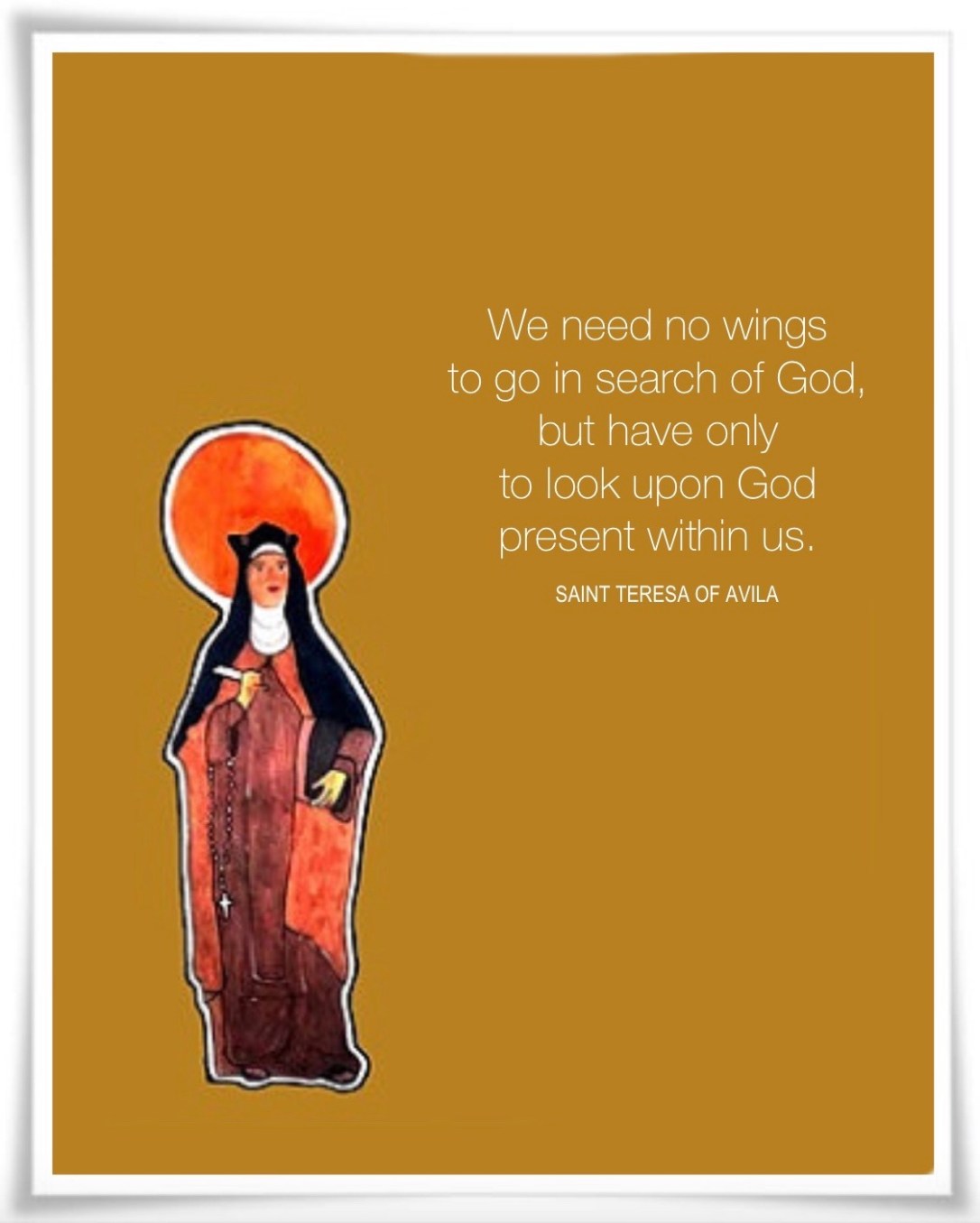
I’m still not certain I have mastered all the questions on the matter of hearing God. And I definitely do not have all the answers. But relying on the promise of scripture is a start. And listening in on the experiences of holy people — people who seem to have a more direct line to God than I ever hope to have — is of immense value to me. The beautiful Carmelite saint, Teresa of Avila, is one of my go-to holy people. This is one of her thoughts that speaks to me powerfully in times of indecision and confusion, times when I doubt my ability to discern God’s direction, times when I wonder if God even hears my prayers.

However quietly we speak, He is so near that He will hear us: we need no wings to go in search of Him but have only to find a place where we can be alone and look upon Him present within us.   — St. Teresa of Avila

I need no wings to go in search of God. 3B5858AA-997E-4D5C-8695-5D41049B2B90

When I can sense God present within me, I can believe in my own decision about a transplant, and any other decision for that matter. But I know that it takes a lifetime, and a lot of life experience, to be able to trust in a spiritual — perhaps mystical — union with the mind of God. It takes a lifetime of relationship for most of us to trust our intentions and our purity of heart enough to believe that our thoughts are God’s thoughts, that our decisions and actions are God’s. But when that day comes, I have an idea that it will feel like a “peace that passes understanding,” like a calm ability to quietly trust myself and trust God at the same time. 

May God’s Spirit make it so in me.

Amen


Change, Chronic illness, God's Faithfulness, peace, Risk, Trust

Inner Warrior

E28E6B69-1115-4DCB-A2DE-9F83713B5505

I got in touch this week with my inner warrior. She was in me all along, in a deep place inside, just waiting for the summons that I needed her. If you have read many of my blog posts, you know that I have been terrified at the thought of having a kidney transplant. For almost five years, the frightened part of me was able to put the transplant possibility away, tucked in a place inside that kept it off my mind. When I did consider transplant — like the times when my nephrologist told me that it was by far the best treatment for me — I reasoned that it was not something I was willing to do.

Why would I want to change anything? Dialysis has been good to me and, most of the time, I have felt well. So I have struggled with the transplant decision, but at the same time, I went through the medical evaluation that kept me on the transplant list. My nephrologist has insisted for years that I would feel better and live longer with a transplant. I remained unconvinced, and then I participated in a webinar that pushed my decision. The physician who was presenting said something that got my attention. He said that patients with end stage renal disease must be on dialysis, and dialysis is essentially end of life care that includes palliative care. If a patient has an illness that cannot be cured, such as end stage renal disease, he explained, palliative care keeps the patient as comfortable as possible by managing pain and other physical challenges, and by providing psychological, social and spiritual support. He went even further by saying that patients who stop dialysis live about two weeks on average.

I have been on the transplant list for five years, and in that time there has been no movement toward a transplant. The last time I went to the transplant center to update my medical evaluation, they told me that a transplant was not likely to happen in the next two years. I was okay with that. Nothing to get anxious about. The transplant decision was not going to happen in the near future. 

And then, out of the blue, I hear from an old friend who tells me he is contemplating the possibility of being a living donor for me. That was March 12. As of Monday, April 15, he had completed the thorough donor evaluation at Piedmont Transplant Institute in Atlanta, and by Wednesday of that week, Piedmont had called me in for testing.

My heart began to race this week and has continued, on and off. I would describe my current state as much, much more than anxious. I texted this week with a friend of mine and shared my fears. She told me about her multiple back surgeries and about how frightening surgery was for her. Then she said this: “I was really afraid before each back surgery, but I somehow dug down deep to a warrior place inside of me.”

Oh my! How well she described my current emotional place! I am certain that, indeed, there is a warrior place inside me. I reached it this week after the racing heart episodes eased up a bit. It is a surprise to me that now I find myself in deep peace, with a sense of calm. Not always have I been able to let God take control of my path. I am a person who will do almost anything to stay in control, to the point of fairly powerful wrestling with God for the proverbial reins of my life.

Not this time. This time, in this season of my life, I have taken a hands off approach, replacing my tendency to hold tightly to the reins with a sense of trust that has covered me like a soft blanket. I have thought in the last few days of the many passages of scripture about trust, but the one that stands out is the simplest one, the short one that we learned to recite as young children.

What time I am afraid, I will trust in you.

— Psalm 56:3

I am certain that there is a warrior place deep inside me. It brought me out of my year of life-threatening illness in 2014. It pushed me to get stronger. No doubt, it will be in play as I move closer to a kidney transplant. I am grateful that my friend reminded me this week of that deep, down warrior place. But I am also comforted in the assurance that, along with my inner warrior, there is in me a heart that can still trust God.

Discovering, Dreams, Faith, Inspiration, peace, Prayer, Serenity

Breath of Wonder

69175F90-305B-48F5-9797-D4F4BA54C428I cannot give you a better thing today than this prayer shared by Anne Fraley, rector of St. Peter’s Episcopal Church in South Windsor, Connecticut. “Listen” to her words and find yourself in them. Let grace from God refresh you as you live into peace and serenity. And as Anne writes it so eloquently, may faith carry you on the delicate breath of wonder and discovery, calling you forth beyond your wildest dreams.

I know these things to be true.

The sun dances and rainbows shine through pearls of water.

The coos of infants elicit contented sighs and gut-deep gladness.

Music stirs and tempers within the beats of its own rhythm.

The earth is rich with nourishment and holds sacred story with gentleness.

Hearts break and find renewal in healing.

Love sustains, encourages, emboldens, and makes us silly.

Divinity is everlasting.

Comfort is found in meatloaf and mashed potatoes. Or maybe sweet potato fries.

We sag and thrive, ponder and muddle through confusion.

We persist.

My prayer this day is that the best of these things will rise and claim their place on our horizons, and that the least of these things will recall our need for each other.

My prayer for this day is that faith will carry us on the delicate breath of wonder and discovery, calling us forth beyond our wildest dreams.

Amen.


Reprinted from https://revgalblogpals.org/2019/02/25/monday-prayer-these-things/.

Paula White, peace, Serenity, simple joys, Wendell Berry, Wisdom

What We Need Is Here

4b9b65d5-ca25-48fa-af5e-a741d86146e3I want a new microwave oven, a new disposal and a new dishwasher — the newest and best models. I want to see my son. I want to hug my grandchildren. I want to go to my church in Little Rock. I want a new dress.

I have most often gotten what I wanted in my life. From the most intense need for human connection to the frivolity of a new frock, I have gotten what I wanted. Chalk that up to being spoiled throughout childhood, or stubbornly persistent until I got what I wanted, or just being a jerk, or maybe having white privilege. 

There is no shortage of gurus telling people how to get what they want. Good health. A slimmer frame. A better television. A nice house in a nice neighborhood with a nice, lush lawn. And just this week evangelist-turned-Trump-advisor Paula White told us that sending money to her would result in riches for us!

The stark reality is that, right now, I don’t have what I want. Most people don’t. It is easy for me to lament over what I am lacking. It is common for me to feel disappointed with my life, disillusioned about my inability to secure all the things I want and think I have to have.

Like my sister and brother consumers in a consumer-driven world, I have survived on things. More and better things.

But when I stop — really stop — and look around me in wonder at this stunningly beautiful world and everything in it . . . When I catch a passing glimpse of the sweet and pure love my husband gives me every day . . . When I feel God’s gentle gift of grace on my life . . . When I stop to count the stars and watch the moon peeking around the clouds, something very surprising happens. My thoughts of the things I want turn to serene gratitude for the things I have. And in that instant, I have peace.

Recently, my pastor shared a poem by Wendell Berry. The very same poem, oddly enough, kept coming up in the things I was reading, and it touched me in the serene place within. Let me share it.

Geese appear high over us,
pass, and the sky closes. Abandon,
as in love or sleep, holds
them to their way, clear
in the ancient faith: what we need
is here. And we pray, not
for new earth or heaven, but to be
quiet in heart, and in eye,
clear. What we need is here.

Oh, to be quiet in heart and see clearly that “what we need is here.”

May God make it so.


Forgiveness, God's presence, Life Journeys, Light, peace

Forgiveness

3904e2f4-b048-4bf3-83f1-bccdd2592165I have long pondered forgiveness, for years! It’s something that confuses me. Like forgiving my abuser. Like parents standing at their child’s graveside and considering how to forgive the shooter. Like a little girl forgiving the people that snatched her from her mother’s arms at the border.

Forgiveness can be confounding and elusive. It is not a merely a thing, or a conviction, or an emotion, or a firmly held belief. It is an act of the heart that can seem all but impossible. But the Bible seems very clear about forgiveness. When you have been wronged or betrayed by another person and you are in a tug of war with yourself about forgiveness, the words of Scripture face off with you as a challenge, perhaps even a rebuke.

Get rid of all bitterness, rage and anger, brawling and slander, along with every form of malice. Be kind and compassionate to one another, forgiving each other, just as in Christ God forgave you. (Ephesians 4:31-32)

Bear with each other and forgive one another if any of you has a grievance against someone. Forgive as the Lord forgave you. (Collosians 3:13)

And when you stand praying, if you hold anything against anyone, forgive them, so that your Father in heaven may forgive you your sins. (Mark 11:25)

For so many years, these and other Biblical admonitions troubled me. I felt as though the words stood in judgement before me. I would pray to be able to forgive. I would pray for light that could shatter the darkness around me. I would pray again, and again. Waiting. Hoping.

Eventually, I shared my inability to forgive with my spiritual director, hoping for guidance and wise counsel. We talked about it at length. I bared my most vulnerable places and revealed the unresolved anger that lived inside of those places. I mined the depths of my spirit and unearthed long-standing wounds of the soul. Our conversations were gently pushing me to a better place and shedding light on the reality that my inability to forgive was not disobedience, but unresolved pain. And then my spiritual director shared this quote with me.

Forgiveness isn’t telling someone it was okay to hurt you. 
It’s telling yourself  it’s okay to stop hurting. 

It doesn’t mean you have to trust them again. 
It means you can learn to trust yourself again. 

It doesn’t mean you have to give them a free pass back into your life. 
It means you are free to take your life back again. 

Forgiveness is simply emptying your past of its power to empty your present of its peace. 

― L.R. Knost

That experience was many years ago, but to this day, I live in the peace I found then. There is no doubt that my past did indeed have the power to empty my “present of its peace.” Reclaiming my peace made forgiveness possible, though it did not happen instantly. It’s not so easy to forgive a person who was never sorry.

Still, it was a process — a journey really — that I had to travel with God, praying all along the way that I would have the strength I needed. The journey was long and sometimes arduous. God was ever-present — patient and persistent. At journey’s end, there really was light, shining brightly where darkness had been. 

Was I healed of my sin of being an unforgiving person? After this journey, do I now forgive every person who hurts me? Sometimes!

Thank you, God, for your patient persistence. Amen.