Activism, Advocate, Beauty of Nature, Bravery, Calling, Committment, Community, Community activism, Conflict, Courage, Dandelions, Faith, Fear, God, Grace, Holy Spirit, Hope, Injustice

Start Something! It’s Easy!

—Mary Oliver

Starting something really is easy, but the pathway from beginning something and then taking it to completion reveals challenges that test our resolve. I always begin projects with enthusiasm and optimism, filled with ideas and plans, but as obstacles arise, my motivation almost always wanes, my progress slows, and distractions multiply. In this environment, fear definitely thrives. But the projects stay on my shoulders as long as I remember them, and so the contrast between the initial excitement versus the realities of sustained effort calls for persistence and commitment. The tumultuous path from beginning to completion can cause me to become weary and quit, just to get the heavy pack of projects off my shoulders.

Of course, most of us can admit that in these days, one important example of our tumultuous path is the dismantling of our democracy. Of course, not everyone agrees about the severity of the situation, but I have to say that in my world, people are afraid, angry, despondent, disheartened . . . although some are elated. Let’s entertain this thought for a few minutes: when people are convinced that real danger is coming, they often gird themselves with “protective gear” (the Bible would say, “gird up your loins”) after which you can attack the stronghold that threatens you. We see an example of this in the protests and/or marches that are happening in cities and towns across the nation and around the world. Let me dare to say this in hopes that no person will take offense. The aim of those who dissent to the actions of the Trump administration are deeply concerned and afraid. Even people of faith are beginning to see this version of the world as something to fear. 

Today, as I write this post, I am thinking of so many people who live in fear: immigrants who are currently locked up like prisoners, children who have been separated from their parents, people who suddenly lose their jobs, thousands of immigrants being rounded up and deported, the community at-large as they lose some of their rights, and even the elected congressional leaders who are afraid of personal repercussions from Donald Tump. Afraid! All of them afraid!

“Here is the world. Beautiful and terrible things will happen.
Don’t be afraid.”

― Frederick Buechner, Beyond Words: Daily Readings in the ABC’s of Faith

You see, whether we support the relentless changes in our government or not, Mr. Trump is stoking fear among Americans as he dismantles institutions, agencies, and departments. Let me list some of them: The Department of Education, the Department of Health and Human Services, the Departments of Agriculture, Defense, Energy, Housing and Urban Development, and Transportation. And then there is the layoff of thousands of federal employees, the closing of USAID, and the indiscriminate and inhumane deportation of thousands of immigrants and immigrant U.S. citizens.

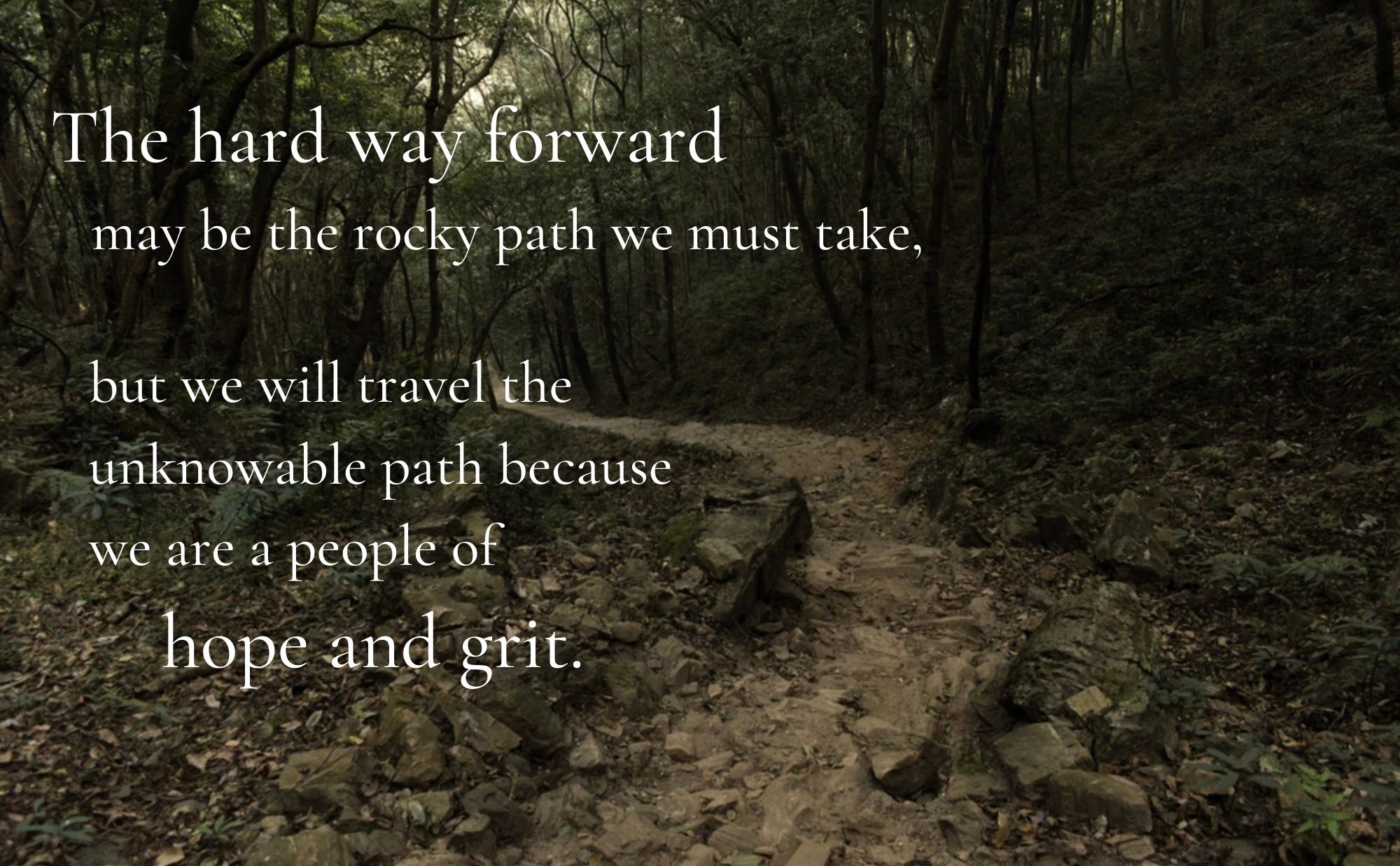
The question I ask myself over and over again is whether there is anything I can do to help end this destruction. Is it really true that starting something is easy? Not always! So what can I do to help change our trajectory. Am I kidding myself? What can one person with zero power do to end this? The answer is “nothing” every time I ask! Good intentions I may have in abundance, but the answer in my spirit does not change, “There is nothing one person can do. I have no power.”

Yet, for all of us who are people of faith, there is always an opportunity to live out our faith through our actions, and within a faith community. Perhaps we can make a significant change, together.

Jesus is our example, showing us how to heal destructive acts committed by power-hungry, destructive people. Jesus left us instructions, as did the prophets, the psalmist, and the epistle writers. Yet, we persist in believing the lie that we have no power. Contemplate these bits of wisdom:

Very truly, I tell you, the one who believes in me will also do the works that I do and, in fact, will do greater works than these      —John 14:12

When you give a banquet, invite the poor, the crippled, the lame, and the blind. And you will be blessed.     —Luke 14:12-14

When Jesus came to Nazareth . . . he went to the synagogue on the sabbath day, as was his custom. He stood up to read, and the scroll of the prophet Isaiah was given to him. He unrolled the scroll and found the place where it was written: ‘The Spirit of the Lord is upon me, because he has anointed me to bring good news to the poor. He has sent me to proclaim release to the captives and recovery of sight to the blind, to let the oppressed go free, to proclaim the year of the Lord’s favor.’      —Luke 4:16-19

But woe to you Pharisees! For you tithe mint and rue and herbs of all kinds, and neglect justice and the love of God.      —Luke 11:40

This is what the LORD Almighty said: ‘Administer true justice; show mercy and compassion to one another. Do not oppress the widow or the fatherless, the foreigner or the poor. Do not plot evil against each other.      —Zechariah 7:9-10

Defend the cause of the weak and the fatherless; maintain the rights of the poor and oppressed. Rescue the weak and needy; deliver them from the hand of the wicked.  —Psalm 82:2-4

He raises the poor from the dust and lifts the needy from the ash heap.   — Psalm 113:7

Speak up for those who cannot speak for themselves, for the rights of all who are destitute. Speak up and judge fairly; defend the rights of the poor and needy.  —Proverbs 31:8-9

Learn to do right; seek justice. Defend the oppressed. Take up the cause of the fatherless; plead the case of the widow.   —Isaiah 1:17

Loose the chains of injustice and untie the cords of the yoke, to set the oppressed free and break every yoke . . . share your food with the hungry and provide the poor wanderer with shelter— when you see the naked, clothe them.     —Isaiah 58:6-7

Do not neglect to show hospitality to strangers, for by doing that some have entertained angels without knowing it. Remember those who are in prison, as though you were in prison with them; those who are being tortured, as though you yourselves were being tortured. —Hebrews 13:1-3

Speak up for those who cannot speak for themselves, for the rights of all who are destitute. Speak up and judge fairly; defend the rights of the poor and needy.     —Proverbs 31:8-9

Defend the cause of the weak and the fatherless; maintain the rights of the poor and oppressed. Rescue the weak and needy; deliver them from the hand of the wicked.  —Psalm 82:2-4

Do not neglect to show hospitality to strangers, for by doing that some have entertained angels without knowing it. Remember those who are in prison, as though you were in prison with them; those who are being tortured, as though you yourselves were being tortured. —Hebrews 13:1-3

Speak up for those who cannot speak for themselves, for the rights of all who are destitute. Speak up and judge fairly; defend the rights of the poor and needy.     —Proverbs 31:8-9

Learn to do right; seek justice. Defend the oppressed. Take up the cause of the fatherless; plead the case of the widow.      —Isaiah 1:17

Loose the chains of injustice and untie the cords of the yoke, to set the oppressed free and break every yoke . . . share your food with the hungry and provide the poor wanderer with shelter— when you see the naked, clothe them.      —Isaiah 58:6-7

Defend the cause of the weak and the fatherless; maintain the rights of the poor and oppressed. Rescue the weak and needy; deliver them from the hand of the wicked.  —Psalm 82:2-4

“My commandment is this: Love each other as I have loved you.
Greater love has no one than this: to lay down one’s life for one’s friends.”

And we claim we have no power! Nothing is farther from the truth. It is not a new revelation that faith will be the holy impetus, the power, that pushes us into kindness, compassion, and love. This kind of kindness, compassion and love will inspire us to head into the rancor and division that currently seems to be having its way. I doubt we will ever see, in my lifetime, the completion of a more gentle and loving community of acceptance and compassion. I don’t believe we will all swing doors open instead of locking them.  I doubt we will complete the work that respects all humanity, but starting the task is easy, and important. As far as finishing the work we have chosen, maybe its “a roll of the dice” sort of thing, or a “stroke of luck,” or being in the right place at the right time. Perhaps it has more to do with being anointed by God to make change through care, compassion, and even anger. 

So I will look for you on the streets as you lead the people to the arc of justice. I will listen for your voice when you are proclaiming the evils of injustice on every corner! I will join in your song that celebrates a new day of peace, love and compassion. I will sense your sacred time of reaching out to God in prayer and lament. I will celebrate when your anger turns into righteous anger that defends the people among us who need protection.

We can start one of two ways. We can fight in anger, motivated by our rage, and risk completely destroying something we are trying to fix. We can do it through sheer human strength and force, knowing we have the power to succeed. Or we can try the better way: the tender way that leads us to solitude, meditation and prayer, and reminds us of dandelions letting go of their seeds. I think that being committed to become part of needed change is holy work. God has anointed us to confront the wrong; Jesus gives us the gift of his example of walking a sacred path; the Spirit gives us the wind to go where we need to be. Can you see yourself looking almost like a dandelion blowing its seeds about in a soft breeze? I can see it!

2024 election, A blessing for voters, Activism, anxiety, Belonging, Betrayal, Bewilderment, Bitterness, Calm, Challenge, Change, Community activism, Courage, Darkness, Daybreak, discouragement, Exclusion, Faith, God, God's presence, God’s creation, healing, Heartbreak, Hope, Kneeling Places, Lament, Liberty, Mourning, Patriotism, Pilgrim, Politics, Pondering, Prayer, Repair the world, Rev. Kathy Manis Findley, Unanswered Prayer

Prayer in Response to Tragic Victory


Together, we will transform our grief into a force for change that will build a more just, equitable society that respects the dignity of all people.

— Omar Angel Perez,  Immigrant Justice Director, Faith in Action

This is my prayer of Hope for the living of these days and my lament for almost losing my faith. It is a too-long treatise, because I release my profound grief through writing. It’s a too-long lesson to teach my class, because at our meeting time, everyone is a spent body of exhaustion that can hardly respond to dark and serious topics. It’s a too-long sermon to preach, because at minute 38.6, the congregation will start leaving. Most of all, it is a too-long dumping of grief. But still my prayer

Guard your hearts and may the week ahead freshen your hope, Kathy


Creator, Spirit of God, Star of the Morning, Son of the Dawn ~

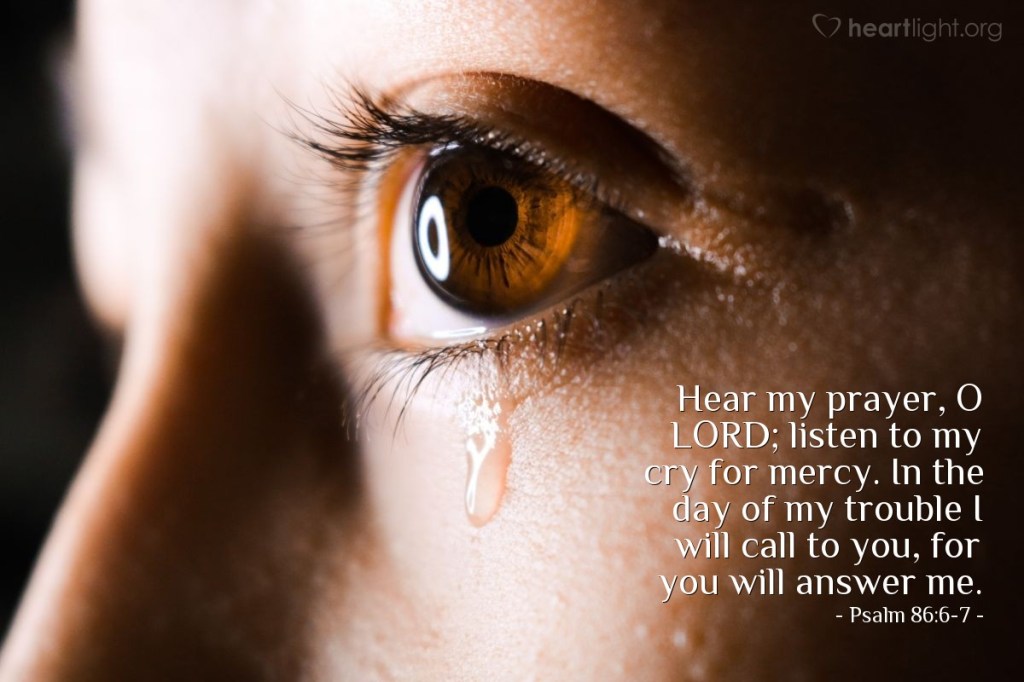
We give you praise for creating each of us and placing us in the brilliance of Holy Light because last Tuesday’s election has left so many of us in a very dark place. We thank you, Creator God, for naming us your beloved children, even if others name us with hurtful words. Yes, it is true, this past election week has been hurtful to so many people. In fact, the entire election season has caused anxiety for at least a few of us. And the outcome? Well, God, I almost said you let us down, but I know better. Still “let down” is only a fraction of the emotion that now hangs closely around us. So, God, if you wouldn’t spare us from our president elect, could you please touch our souls with a gentle hand of comfort and hope.

Gentleness is one thing we need, maybe to minimize the harsh names and the contempt we have endured from our misogynistic brothers and sisters. The outcome of the election has left us feeling disconnected from many of our friends, neighbors and family members. God, you know our emotions and you understand our sense of feeling discarded. You know our fear, confusion and despair. Help us, Mother snd Father God, to remember that you have whispered our names. We are your beloved daughters facing the world with the name you gave us.

One election! Just one has this much power over us! We must have taken a wrong path somewhere along the way, because repairing the world was the real goal, and our destination was to create a community of love, care and decency. We did not make it there, God, and we feel a bit like pilgrims and strangers in a land we have never seen before. We imagine how exiles must feel, and recall a letter from Jeremiah to people in exile, “You will search for me and find me when you search for me with all your heart.”

It was just an election, but it rocked us to the core and left us wandering aimlessly on unfamiliar paths and turns. Yet, we are comforted still by sensing your presence with us. Every journey has paths and turns that can lead us to unexpected danger and unprecedented harm. Paths and turns can be disconcerting and downright frightening. Paths and turns leave us in uncomfortable unknown places, so that our feet walk in unfamiliar dust. Paths and turns can lead us away from all we’ve known, our comfort-place, our “home.” 

Protecting God, can you stay close to us on this harsh path ahead and protect us?

Now, God, we know you have a teaching moment for us, for to you this rocky path we follow is a holy pilgrimage. We can learn and take in the reality that paths and turns can also lead us to holy moments. Those sacred moments can inspire us to search more fervently for you, God. We did not stop believing in a new season of unity. But someone more powerful than we are has taken over our lives.

Still this week of sorrow is about more than just one election.
It is also about hurtful memories of being pushed out because of who we are or what we look like. 
It’s about the pain of being “othered” and never fitting in.
It’s about being diminished over and over again.
It’s about people who need to measure us by our wealth or power. 

There are so many better measures out there. Help us God, to throw away false tools that can only try to measure who we are, but can never measure the Light in our souls or the dreams of our hearts.

For our nation, O God, we ask for seemingly impossible unity and for as much love as we can muster between brothers and sisters. We ask you, God, to restore our hope, bring us to our feet, teach us to stand and set us on our path once again.

God, make of us peacemakers, consolers, and healers of harm. Help us control our tongues, so that we Will always speak respectfully of others. Help us spend holy moments in lament and deep prayer that can re-enliven our souls.

I confess, God, that I am failing at that right now. My soul is filled with anger and disgust. My spirit is not at one with love, but with hate directed at those who managed to do this shameful thing to our nation. I am full of confusion about how this happened; what exactly has happened; what will the repercussions be; how serious is the threat to our future; and specifically what must I do now as one person to minimize the harm for myself and all of us?

In such a time as this, God, I see myself kneeling in your holy presence with a shattered spirit and a broken heart. I see myself questioning how it is that you have the ability and the will to organize the universe, but you do not. I need the breath of Spirit to order my thoughts. I need moments of confession to name my sins. I need to repent of my own actions, whatever they are, because my action or inaction may have helped cause the results of this election.

Even now, leaders—that is political people, elected officials, teachers and professors, ministers, rabbis, Imams, priests, bishops, chaplains, etc.—are encouraging us with hope. Emails still flood my inbox, like, “We can’t give up. Let’s roll up our sleeves.” I have noticed that many people say they can’t think about it right now. They are wise to stop and tend to the grief in their souls.

I feel useless, dismissed, disrespected and weary, God. I even feel that I have completely lost my hope for brighter days. I know that losing hope is a dire place to be, because losing hope almost admits that I have also lost my faith. Yet, even in this very moment, God, you are whispering to me:

Beloved daughter, you are not just ‘one person,’ You are one person of God. A child of God. A beloved daughter. A woman whose spirit is whole with a sacred calling to shepherd the lost and weary ones.”

When circumstances, words, or people threaten us, God, help us respond with decisiveness, truth, kindness, grace, forgiveness, and respect for our brothers and sisters, our neighbors and friends, our classmates and co-workers. Because being harsh to one another can not quickly heal the wounds of political discord, or any other kind of near-fatal wound. It will take time to cast out the dark presence whose only purpose is to darken our souls and leave us in profound darkness.

In this goal, in this time, God, the dark presence has succeeded, and we need you, God, more than ever. We see the truth that we are dangerously vulnerable right now, and that we must fight against spiritual despondency. 

Creator, Spirit of God, Star of the Morning, Son of the Dawn ~ hold us near until the danger has passed. (If it ever passes!) If you can, God, speak peace to the dark presence that is still maneuvering that will harm our democracy and our souls. 

Hold us close in the brilliance of your Light, Creator God! 

Place us securely in your Light, Star of the Morning!

Hold us fast in your Light, Spirit of God!

Draw near to us and grant us Light to see daybreak, Son of the Dawn!

Mother and Father God, we will stand tall in the evil day, if you will help us refresh the Light that lights the world and brightens our hearts.

In this evil day, God, meet us in our sacred place. As we lament, restore our hope and strengthen our faith in this time of grief and confusion. Restore our spirits, God. Restore my spirit, God! 

Creator God, Mother and Father of the universe, fill us to overflowing once again. Cover our bodies and fill our souls with fresh hope, the living hope that guards our faith from any evil.

Amen.

A woman of sacred worth, Becoming, Beginning again, Bravery, Calling, Change, Children, Committment, Courage, Creating, Dreams, Freedom, God’s beloved daughter, I am enough!, Inner peace, life, Living in the soul, Miracles, Repair the world, Rev. Kathy Manis Findley, Self-understanding, Spirit wind, Tears, Tikkun Olam, Valued by God

Living an Unapologetic Life

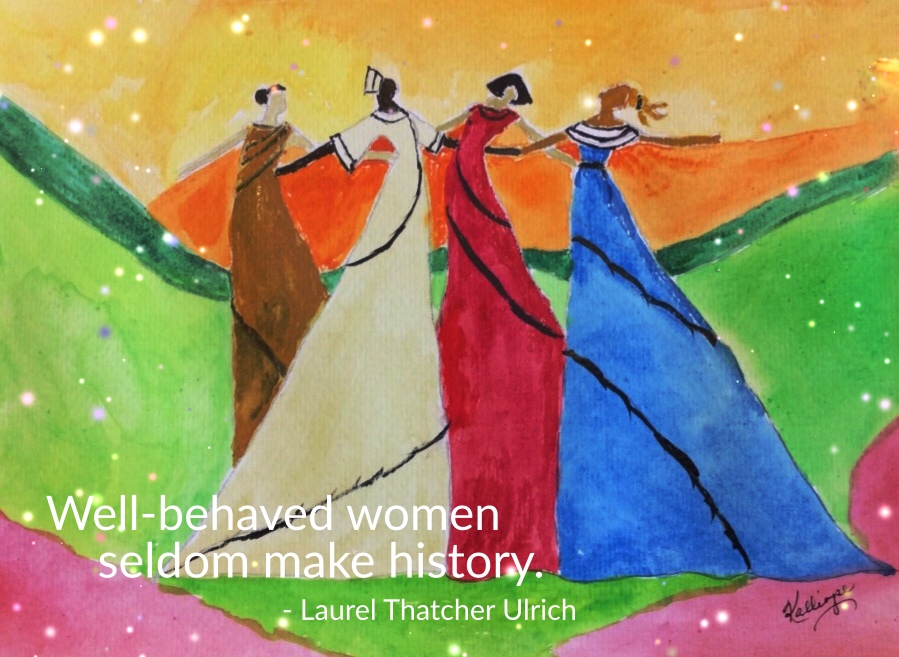
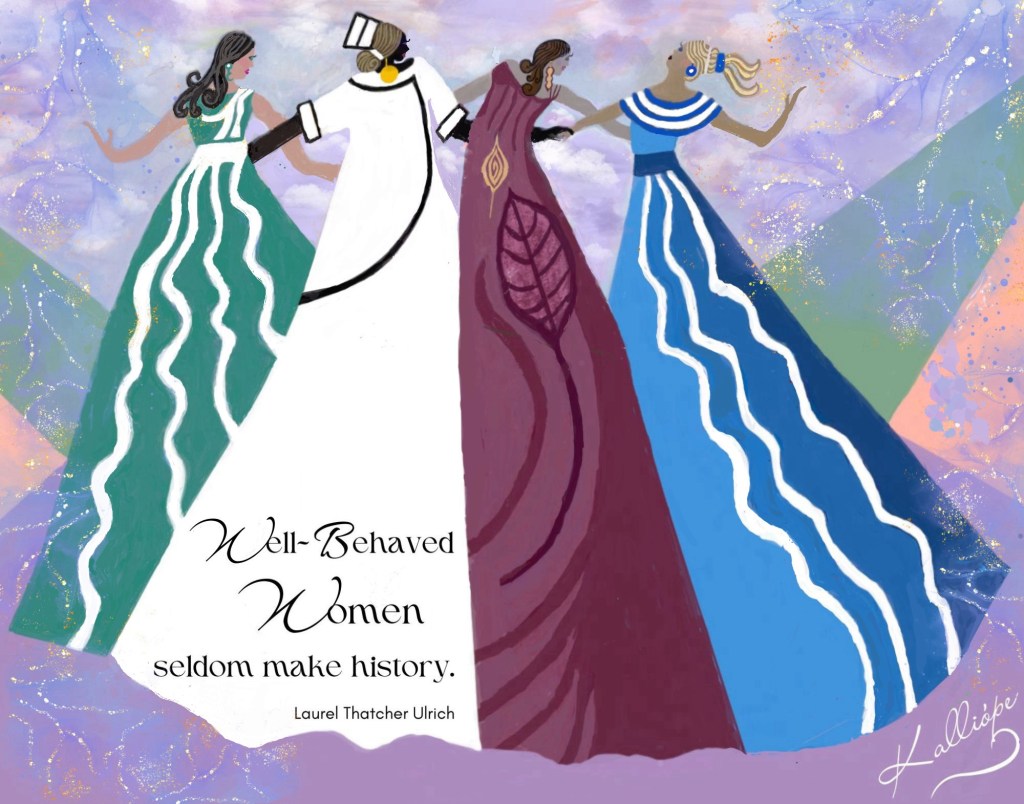
Art: “Well-behaved Women” by Kathy Manis Findley


Rev. Kathy Manis Findley
July 27, 2024

You have probably had that kind of dream at a few junctures on your journey. I know I had many dreams along the way. Sometimes they scared me to death. I dreamed of peace, equality, freedom, changing the world, and many other huge and noble dreams. I dreamed some silly dreams, too! I soon got the hint: changing the world is a formidable task. I followed all the rules, but being a rule-keeper does not make a person effective in dreaming and imagining. Women who follow the rules (someone else made up) could correctly be called well-behaved. They might even be called good girls because they don’t cause much of a flurry. They typically don’t make history and they certainly don’t change the world.

A woman with less-than-good behavior looks like someone at peace with herself, someone who radiates hope, someone with the courage and determination to do justice. I have admired and emulated so many examples of women who did make history, women who were not well-behaved at all. Here are only a few: Rosa Parks, Harriet Tubman, Lucretia Coffin Mott, Sojourner Truth, Susan B. Anthony, Nancy Sehested, Elizabeth Cody Stanton, Prathia Hall, Julian of Norwich, Malala Yousafzai, Mother Theresa of Calcutta, Ann Hasseltine Judson, Lucy Stone, and so many others!

About 24 years ago, a chaplain colleague recommended a book to me: Goodbye Good Girl: Letting Go of the Rules and Taking Back Your Self by Eileen M. Clegg. I think my chaplain friend was suggesting that I should get out of my comfort zone and take some risks, that I should courageously follow God’s call on my life. I knew that the members and churches of my denomination would “throw a fit,” like we say in the south! After all, I was an ordained minister serving as a hospital chaplain, which placed risky challenges before me every day.

So I read the book immediately and set out to become a bad girl, a girl who fully intended to change the world and to make history for it! So far, I have not made history. I have not managed to put my name in lights. I have not started any big public movements. But I have done some things that matter! I have learned how to create sacred space; I have learned the depth of liberation theology; I have found enough grace to endure the consequences of being a “bad girl” and then a woman with questionable behavior; I have held off anyone who tried to tell me who I am; and I have called up the courage to fight for justice. Colleagues, friends, family, co-workers reacted to the change in me, since they never expected me to dissent, or disagree, or refuse to behave.

Suddenly I let go of my “good girl” image and basically said “goodbye” to my restrictive behaviors. I took back my life, put aside all the rules, and followed my soul. I watched for the winds of the Spirit to lead me, and I moved forward to all the places that needed some attention. I was able to help change unjust systems, unjust policies, and unjust processes by not being so well-behaved.

Still, I sometimes think I have reached an uneasy place when it comes to letting go of my “good girl” persona. I’m really not a “good girl” and I don’t think I ever have been. My parents had to endure the sassy exclamations of my toddler years, like “Nobody’s the boss of me!” Creating shock from those who knew me, I mostly remained a “bad girl” from that day to this. I set aside the rules that were designed to keep people down and I took back my life. Today—in my mid-seventies—I continue to spew out uncommon proclamations that are quite annoying to those who are determined to hold on to their power and resist change.

Truly, it was sometimes hard being a change-maker and a rule-keeper! Always a people pleaser. Always the ultimate perfectionist. I discovered along the way that sometimes rule-keeping, people pleasing, and keeping every little thing “perfect” can harm your inner core. In fact, it’s less risky when you follow the leaders, make sure everyone is pleased, and doing everything with glowing perfection. Stepping out of line is always a bit dangerous.

When you become exactly who you are, resolute and unmovable about the things that matter to you, you will raise a few eyebrows, and sometimes people will get angry with you . You see, those people expected something else from you. Each of us becomes “me”— the “real me”— at our own peril. In a sense, we have to fight for the right to be ourselves in the world.

It is true that the people around me reacted strongly when I took back my life and became fully invested in my destiny. They thought that I had become radical, maybe even unhinged. I did not respond appropriately to their demands. To unreasonable demands, this is essentially how I might have responded, sometimes out loud, sometimes under my breath . . .

I will do it. / It’s my right! / It’s my choice! / It’s my prerogative! / It’s my decision! / I’m doing it anyway. / You can’t stop me! / Just watch!

All the while, I felt uncomfortable because of so much disdain from others, who began sending me a new message, You are not enough! I Imagine that many of you have heard someone say to you, You are not enough. At least, we may imagine someone saying those hurtful words. Unfortunately, we believe it because we don’t know ourselves, meaning we don’t know our bright and dark places, we have not yet realized our sacred worth, and we have not yet searched our souls.

For you see, you and I are afraid because it is perilous for the soul when we don’t search diligently for our soul’s passions and dreams. You and I sometimes accept what others say about us and tuck it away in our deepest places. When those words sneak all the way down into the soul, we tend to give up. We start from the moment we make ourselves nonchalant about it all, that moment when we shield our hearts from hurt. One of the saddest phrases we use is “I don’t care.” When we no longer care, we begin, one by one, eliminating the people around us, never realizing that they are hurting, too. And maybe the reason they send the message, You are not enough, is because they believe that they are not enough either.

I can honestly say that I have often heard voices—known voices, unknown voices, and the weak little voice in my head—telling me, You are not enough! I have learned that once I have embodied that negative message, it rolls around in my psyche for a long time, maybe forever. It becomes a state of being that goes deeper than skin. It penetrates in deeper places, and takes its toll on my emotional and physical well-being. I recall many such times, none more painful than the wagging tongues around my ordination . . . You know the scenario, “She can’t be a minister because she is a woman! Anyway, she’s not good enough! Other voices are often hazardous, dangerously breaking down our sense of self-worth. They may be yelling, speaking in a normal tone, whispering, or imagined in our heads. In response, we must prepare ourselves to hear the voice above all voices, saying, “You are my beloved daughter with whom I am well pleased.”

For a long time, I embodied the traits of the good girl, but to embody good girl traits is not really a once-and-done action. Embodied lasts a while! Embody does not have a shallow or surface meaning. It is deeper. I like the word embody. It seems to suggest that we can live a soulful life. In the very middle of the Greek word for “embody” we find the word σώμα, which means body. However, the Greek word for body cannot be translated in a way that reveals the depth of its meaning. The definition of σώμα is deeper than we realize. It is not skin-deep, it is deeper, approaching a definition more like soul.

I do like the word embody and the word soul. In some ways, to embody means to live in your soul. The word embody may whisper to you that in your body’s center, you will find the path to reach your soul. A person who lives in the soul is a person that does not live a shallow life, devoid of the emotion that makes us alive. The soul will help you, if you can just start by daring to touch it.

So what are the things we can actually do to take back our lives and live soulfully? What path do we follow to transform ourselves and change the world? My initial response to that is, “I don’t know.” Not very comforting, I know, but mostly true. We cannot forge the path for any other person. We cannot know what’s best for them. So not knowing anyones path, nor their dreams, I can give you a list of things others are finding the leads to their transformation. Here they are, not at all an exhaustive list, and certainly not a perfect guide for you:

  • Carve out some time for quiet, restful, meditation.
  • If you are a person of faith, get in touch with God or whatever person you worship.
  • Listen.
  • Listen some more—to your heart and your soul.
  • See if you find there a sacred direction especially for you.
  • Do you feel you are getting any closer to discovering your authentic self?
  • Can you begin to believe you will be transformed?
  • Can you take a step or two, in faith, into a holy place of transformation?
  • Pray, making your needs known to the source of your faith.
  • Read! Read the stories of others who found life transformation.
  • Find community, even one other person, who understands your journey.
  • Start all over again, leaning into the wisdom you found on your previous journey.
  • Take as long as it takes, until you realize that suddenly, you are becoming emboldened and scrappy!

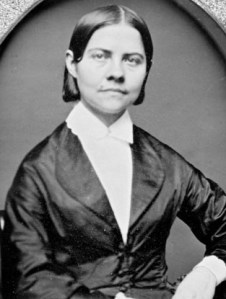
You may not know her name, but Lucy Stone was steadfast in her belief in self-authentication and in her ability to change the world. Lucy Stone was called “emboldened” and “scrappy” because of her tireless work for the abolitionist and women’s rights movements through the 19th century. A bona fide pioneer of her time, Lucy Stone stands as a historical titan. Her book “Unapologetic Life” describes a model of a revolutionary living. As for me, I would count it an honor to be described as emboldened and scrappy.

Life is more fun when you’re emboldened and scrappy. Not that we want to reduce the life experience to just scrappinesses. Life is so much more, like authenticity and the willingness to be a change-agent. Life is about having enough courage to persevere! Life for me is about my soul and all the ways it has been transformed over many years. All along my journey, I knew that my soul was a problem! At every age, there was a part of me that wouldn’t follow the easiest path. I longed to be empowered to make societal change. I chased down injustice and worked to dismantle it. I spent most of my career working with victims of domestic violence, child abuse, and human trafficking. This was not the easiest and most pleasant vocation, but the work had made its way into my soul. To do it, I had to live in the light of self-awareness and soul-awareness. I had to constantly listen to the sighs of my soul, and move only after I had heard them clearly. If I had just one nugget of advice for you, it would be to touch your soul and ride on the wings of the Spirit.

Sisters, don’t forget that when you touch your soul, you might just not be a “good girl” anymore. Or a good boy, for that matter. As for me, I am not a “good girl” living at the whims of other people! And I am definitely not a well-behaved woman! So I fully expect to make history! Because making history means leaving a legacy, creating a world brimming with peace, and embodying your best self!


A frenzied life, All Things New, “I Can See Clearly Now”, Beginning again, Bishop Steven Charleston, Bravery, Calm, Challenge, Contemplation, Courage, Determination, Dreamers, Dreams, Following Christ, God's Faithfulness, Heart, Here I am, Lord., I am enough!, Inspiration, New Things, Re-claiming self, Rev. Kathy Manis Findley, Spiritual growth, strength, struggle, Tenacity, Tikkun Olam, Vision, Whispers of God

A Snail’s Pace to the Mountaintop

By Kathy Manis Findley

Slow, slow, up the mountain I’ll go . . .


A PAUSE FOR SOME WHIMSY . . . Why don’t we have a little whimsy today? I have invited my snail-friend to join us. And anyway, we all need a little whimsy in these troubling days! So here goes!

I’m sorry to tell you that the snail in the picture will take forever to reach that mountaintop, and you and I simply don’t have the patience to walk with a snail. Even so, I feel good about my chances when racing a snail to get up on top of a mountain!

DOES THIS MAKE ANY SENSE AT ALL? . . . Not that this makes any sense at all. Why I would even be considering such a race! In fact, this is completely nonsensical, and if you know me, you know I’m far too serious to entertain whimsy! Makes no sense at all. Oh, but it does make some sense. Let me tell you something about me and what I have learned about the wisdom of the snail and its slow journey!

LIFE CAN BE DEVASTATING . . . When I think of the life catastrophes that have been the hardest for me, the ones that hurt me the most, I immediately recognize that I never slowed down enough to clearly see the unrest brewing around me and inside me. Multi-tasking and acting like an overcommitted, overwhelmed wife, mother, professional minister and hospital chaplain squeezed my spirit enough that I became hopelessly entrapped. That was in my younger days, those days when most of us stretch our commitments to the breaking point.

Before I could change course, I could see my dreams fading and my ability failing. It was impossible for me to reach the top of my mountain. It happened before I realized I was in trouble.

In the light of day, I can somewhat see, but at night, I can hardly see anything—literally and figuratively. But at least I have learned to take time to look up at the stars in a dark sky. It’s easy to see, to envision stars twinkling in the heavens, when you’re still young and when you can still find your hope-filled dreaming place inside you. You can still be breathless, open-eyed and awestruck!

CAN I STILL BE BREATHLESS, OPEN-EYED & AWESTRUCK? . . . To be honest, I must confess to you that I find it difficult to see with my soul, to be open-eyed and enthusiastic. I have lived my life with visions of dreams and hopes, and I have loved the fullness of my days. But being retired is another story altogether.

The story of my young and middle adult days was a story of constant activity, challenges, and tall mountains to climb in search of dreams. Dreams, dreams everywhere! Wherever I looked, I found another dream to dream!

RETIREMENT CAN BE DISHEARTENING . . . Retirement is another thing, and I am there! Illness and aging has nearly shut off my dreaming and visioning. Still, though I am sparring mightily with retirement, in the end I have slowed down to a snail’s pace. And snails probably don’t climb mountains or search for dreams.

What pieces of wisdom can we receive from a snail on a slow slither? Perhaps we should look elsewhere for such wisdom. One of my favorite authors gets to my soul with almost everything he writes. His keen spiritual insight has guided my path time after time. This is what Bishop Steven Charleston has to say about seeing more clearly.

I see more clearly, now that I am aging. Not with my eyesight, but with my soul. I see the fine detail of what I missed in younger years. I see the place of faith and forgiveness in my story. I see the possibilities of life in ways I never imagined. I was not blind in my youth, but my vision was limited to only a few seasons of seeing.

Now I am an old man standing on a hill. I see more clearly. The universe stretches above me in infinite glory and the Earth spreads her shawl to wrap me in creation. Open the eyes of your spirit. Look out in wonder. See the fullness of the life you have received. See the promise of love walking in beauty before you.

— Bishop Steven Charleston

MY FRIENDS FINDING NEW WAYS TO DREAM . . . These are words I can hang on to and patiently learn how aging folk can still hope and dream, and maybe even climb new mountains. It’s possible. I have seen several aging folk on top of the mountains they dreamed of. One of my 70 year old friends travels all over the world. Another has launched out in a new calling to counsel kidney transplant patients. Yet another friend faced a closed door, so she picked up her skills and began a brand new ministry. And one friend left the United States to feed hungry people across the ocean.

All of these friends made it up to the mountaintop, though some of them might have traveled at a snail’s pace. That doesn’t matter, and I have a notion that their secret to life has to do with slowing down and stopping their frenetic pace. Why do that?

To give yourself time to dream, time to contemplate and pray, time to pull your soul back together, time to open your eyes and truly see, time to meet God who may well whisper in your ear . . .

Then I heard the voice of the Lord saying,
“Whom shall I send? And who will go for us?”
And I said, “Here am I. Send me!”


—Isaiah 6:8 NIV

TIME FOR SILENCE AND CONTEMPLATION . . .So walk on, slow if you have to. Take your time and wait until you hear God’s voice or sense the presence of the Spirit. Give yourself time for silence and prayer and a lot of contemplation. Keep your courage ready, and then go with all your courage when your heart says it’s time. Don’t let the snail discourage you. Your pace, whatever it is, will get you there. Don’t let anyone block your path or steal your dreams! And I’ll meet you on a mountaintop somewhere!


A LOVELY HYMN FOR YOUR QUIET TIME . . .

Here I Am, Lord (Anniversary Recording) · Dan Schutte
Here I Am, Lord (30th Anniversary Edition)
℗ 2001 2009 OCP, 5536 NE Hassalo, Portland, OR 97213. All rights reserved. Made in USA.
All selections BMI.


SHARE YOUR STORY . . .

If you are a new to my blog or have been reading it for years, you are welcome here. If you would like to leave a comment about your experience with slowing down your pace, finding time for prayer and contemplation, or renewing your spiritual, physical, and emotional life, please tell us about it in the comments. Your story can help others see life more clearly.

Activism, All Shall Be Well, anxiety, Attachments, Bewilderment, Brokenness, Caged children, Calm, Change, Confusion, Courage, Defiance, Despair, Determination, Dreams, Emerging new, Falling down, Fear, Feelings, Following Christ, healing, Hope, Injustice, Psalms, Questions, Reflection, Transformation

In these Evil Days, Dream a Little Dream

Rev. Kathy Manis Findley

Lately, I have been trying to figure out a number of mysteries, but I have not figured out one single thing-, not lament, not how to fix my life, not transformation, not even the continuous mess in my closet. I simply have not yet been able to go through a reorganization process. The prospect of reorganizing my life—my soul, my spirit, my heart—plus all the treasures in my closet and armoire is so terribly daunting to me. Marie Kondo comes to mind, but I quickly shoo her away from my mess in the closet.

Lots of folk complain about “these days.” I confess that I do my share of complaining. What is it about “these days” that seems so troubling? I cannot fully give you an answer to that question yet, but I have some ideas about it. The issue at hand reminds me that the Bible often refers to “evil days.” I believe that many people see these days as “evil days,” and that cannot turn out well for anyone!

Jennifer Senior, a journalist with The Atlantic, recently wrote a news article in which she asked a another provocative question: What will happen to the American psyche if Trump is reelected? (Don’t worry, this post is not about Donald Trump!) On this question, maybe we really don’t want to know the answer. Instead of taking her question seriously and considering what might happen to “American psyches” following the November election, some folk would rather complain about the division all around, the evil around us, or other things nobody likes.

When we dare to make an honest evaluation of circumstances that surround us, we dig in our heels and balk. We balk because we don’t want to see the division in our nation or the impasse we have reached on important issues. We balk because, in truth, no one wants to lament. Remember, I’m not talking about divisions among us like liberal or conservative, Democrat or Republican, male or female, immigrant or American citizen, black or white . . . I could go on and on naming divisions among us. We have always co-existed with division, but most often in the past we have acknowledged division and simultaneously practiced kindness, respect, and tolerance. Given the current national environment, we might just be justified in calling these days “evil days.

If reading the Bible is something you typically do, then you might understand more fully the term “evil day.” My heart tells me that “evil days” are definitely taking a toll on us. Instinct tells me that “the evil day” is not a single day, but refers to the times in our lives when we face overwhelming , troubling circumstances. If you are willing, meditate on the following words for a few moments.


Therefore, take up the whole armor of God, so that you may be able to withstand the evil day and, having prevailed against everything, to stand firm. 16 Stand, therefore, and belt your waist with truth and put on the breastplate of righteousness15 and lace up your sandals in preparation for the gospel of peace. 16 With all of these, take the shield of faith, with which you will be able to quench all the flaming arrows of the evil one.17 Take the helmet of salvation and the sword of the Spirit, which is the word of God.

Ephesians 6:13-17 NRSVUE

I want to remind us all about the unrest we hold inside, too close to our heart and spirit. The proximity is important to pay attention to, as well as the flashpoints, past and present, that people have endured. I would guess that there are many flashpoints and memories of times that have held power over you. You probably face off with flashpoints, knowing that they not only create stress in our bodies, but also create bondage. We can become chained to our lives. Until we have exert some control of the present time of division, hate, turmoil, distrust, disrespect, contempt and other forms of bondage, we cannot find peace that changes the world. We certainly cannot figure out how to accept the possibility of transformation.

These evil days may well be causing our hearts to lament. These days may be days full of nightmares—no dreams at all, not even little dreams. You can name your own tragedies—the ones that are making it hard to breathe for you, or the ones that cover the whole troubled world with sadness. When I think of choosing my personal places of lament, those places where I can pour out the most anxiety, I feel the heavy burden of hopelessness. If you feel that too, you are not alone.

Always looking for a scapegoat, we try to discern what is bringing us down. Of course, life often brings us unforeseen personal tragedies that we must deal with. And there is certainly enough shared anxiety to go around. If you read the daily news, you will undoubtedly hear about the fierce war in Ukraine, the inability to create peace in the Middle East, the rising cost of food, the food deserts in our country, refugee children separated from their parents, difficult financial challenges, mass shootings, fractured relationships, long-term estrangement from loved ones, the opioid crisis and addiction, racism, injustice of all kinds, and politics. Evil days!

There are so many more ills we could add to this list, but we know them already, and the news programs are anxious to tell us about broken politics, as well as the way politics creates broken people. So there you have it! Among the many sources of stress we each experience, we continually stress over the dozens of pointless news stories about politics and the behavior of politicians every day. To top it off, Gloria Mark points out that “we are once again facing a news cycle that will shove our attention—as well as our output, our nerves, our sanity—through a Cuisinart.” No matter how skillfully we deny it, our bodies are not designed to handle chronic stress and trauma.

Just about now, you might want to say that politics doesn’t affect us that much, certainly doesn’t cause depression and hopelessness. But consider this viewpoint written by Pulitzer Prize winning journalist, Jennifer Senior:

The American Psychological Association’s annual stress survey, conducted by the Harris Poll, found that 68 percent of Americans reported that the 2020 election was a significant source of strain. Kevin B. Smith, a political-science professor at the University of Nebraska at Lincoln, found that about 40 percent of American adults identified politics as “a significant source of stress in their lives,” based on YouGov surveys . . . Even more remarkably, Smith found that about 5 percent reported having had suicidal thoughts because of our politics. Evil days!

And of the most divisive election in decades, psychologists are saying that their research shows that more than two-thirds of U.S. adults (68%) say that the 2020 U.S. presidential election was a significant source of stress in life.

It is not a stretch to say that stress plays havoc on our dreams, even our little dreams. I have to confess that my big dreams disappeared into the “impossible“ file, and were then swallowed up by the churning in my stomach and my psyche. I remember my first year in seminary, working part time jobs and going to class. For a while, I worked in the development office where all the catchy slogans, mottos and themes were born. One year, the staff got together to write a theme for the annual development campaign. I don’t know who came up with our brilliant theme, but we loved it. I really loved it and made it my personal mission.

“We’re Out to Change the World!”

I tried to do just that, and I honestly thought I could, but eventually the scene in my mind of one young woman alone trying to change the world on her own made me shiver. All the lofty goals and the many little dreams, along with a few big dreams, that had my attention were disappearing before me. I despaired at first and then carried long-term grief about it. There would be no big dreams in my heart. I would never see the glory of a big dream come true. Nor would I dream small dreams. People usually don’t dream of whatever is better while they are covered in grief—mourning, lamenting that they lost their dreams in the first place. In “these evil days” we must let go of despair and pray for an extra portion of holy determination!

But people do see the sacred light that sparks dreams. It dawns over them again and again until their dreamless spirit transforms from death, to life, to get their bearings again, and to summon the energ to get up and try

This is my message to you, and to myself: After your time of lament, rejoice! After you have escaped the bondage of evil days, rejoice! After you name your loss, and then put yourself back together, rejoice!

Take heart. Up in the heavens, there is rejoicing for you! Even in the gloomy shadow of dark and evil days, there is rejoicing for you! Even if you are trying to dream even the littlest dream, there is rejoicing for you!

So try a big dream! Change the world a little bit! Your heart longs for it, the world needs it, and the heavens will do what they always do—rejoice!

May even your smallest dreams change the world!

Advocate, All Shall Be Well, Courage, God's presence, God’s promises, Heart, Holy Spirit, Wellspring of life

Guarding My Heart

Proverbs 4:23

With all the chaos blowing about in the world—the swirling debris of discord, fear, hate, division, tumult all around us—we cannot help but try to drill down to the solid place of our foundation. When we shake in the chaos, swaying from side to side until we fear we may by pushed over, our soul speaks up to come to our aid. It’s simple really, to find our sure foundation, the solid rock of who we are and what we must do to stay upright—that means healthy in body, mind and spirit.

I think some of you are pray-ers and others sing until you feel safely grounded. Some of you meditate and others of you read Holy Scripture. Some write poetry or create art. Whatever you might do in your times of unsteadiness, remember that you do not have to repair everything in your life or turn yourself into a person of incomparable strength and courage. I know what you’re thinking! That these are terrifying evil days that require unparalleled faith and perseverance. True enough! I remember the terrifying parts every time I watch the news. And more than once in the past several years, I have thought of this text:

Therefore take up the whole armor of God, that you may be able to withstand in the evil day, and having done all, to stand.

Ephesians 6:13 (NKJV)

That’s the way I learned that verse of scripture, but others have translated it differently, maybe better. The New International Reader’s Version perhaps speaks to us more simply and directly, and with the bold promise that we could be able to stand up to any evil day, any evil person.

So put on all of God’s armor. Evil days will come. But you will be able to stand up to anything. And after you have done everything you can, you will still be standing. —Ephesians 6:13 (NIRV)

I concur that I will still be standing, whatever comes. Too many things in my life have knocked me to the ground, and every time I have gotten up on my feet to try to live another day. I suspect you have had the same experience.We were able to stand, not because we had built up incomparable strength, but because Spirit was strength in us, beside us, before and behind us. You see, that was God’s plan all along. ”I will not leave you comfortless,” said Jesus, carrying out the precise plan of the Creator God. “I will ask the Father, and he will give you another Comforter, to be with you forever … the Spirit of truth.” (From John 14)

Just one more bit of wisdom for evil days! I have a notion that you and I do many things to protect ourselves from evil or chaos or betrayal or difficulty . … the list goes on and on. Every remedy helps a little. Every act of self-help or self-care helps a little. Some of it helps a lot. In my experience, everything I do to maintain my equilibrium and keep myself safe from chaos helps. But there is one word of advice that has stayed with me through the years, and it is this:

Above all else, guard your heart. For from it flows the wellspring of life.

Proverbs 4:23

That admonishment from Proverbs 4 is translated in many different ways—guard your heard with all diligence; with all vigilance; with utmost care; with all watchfulness; guard your heart above all else. I think we get the message clearly. And so I leave you with this blessing .…


As you journey through all manner of evil chaos,
May you walk the road without fear,

Knowing the deep peace of God’s grace,
With the shadow of Christ walking ahead of you,
With the presence of the Holy Spirit dwelling in your soul,
With
your resolve firmly set to guard your heart with all watchfulness,
So that you will know beyond any doubt

that from your heart flows the wellspring of life. Amen

Courage, Emerging new, Guilt, I am enough!, Internal conflict, Introspection, life, Light, Psalm 139, Re-claiming self, Sacred Worth, Self Awareness, Self-understanding, Women

When Light Runs Wild

There are days! Don’t you have those troublesome days when feeling good about yourself seems impossible? I am guessing we all have those days, because there are just too darn many things about ourselves we don’t feel very good about. What are those things? you might ask.

“I missed that deadline.”
“I was too irritable with the kids.”
“I hate my hair.”
“I have gained far too much weight.”
“I have made a mess of my life.”

The list of what we don’t like, or even what we loathe, about ourselves can be a long one, and when we ponder such a list for very long, we can develop a skewed image of ourselves. Fortunately, many of us have been able to see that the person we really are can be measured on many levels, far more important levels than, say, appearance.
Maturity helps, and aging has a way of putting all that negative ”stuff” about me in a box that I keep locked. And the key, well, I threw that key in a river!

What’s left is definitely a healthier perspective that allows me to look at myself in different ways and to make kinder conclusions. I have learned over decades that my image of myself is important, that I have to see my self with accepting eyes and that self-deprecating thoughts have the power to bring me to the edge of despondency.

. . . aging has a way of putting all that negative “stuff” about me in a box that I keep locked. And the key, well, I threw that key in a river!

kmf


Still those days come, bringing me a boatload of reasons to detest myself. There is a certain season of life in which self-flagellation is downright dangerous, wielding power over your life in very destructive ways. You’ll likely know it when you have reached that season of life — you know, the season when you can actually go out without make-up, wear a blouse two days in a row, love yourself for the whole person you are and wearing black support stockings in public, having convinced yourself that they really are stylish!

I don’t know about you, but I have to admit that I do have just a tad of trouble wearing support hose in public. That tells me that I need help, that I do not adequately value myself as a rule, that I still believe that my appearance defines me and that I need a shove to get to the point of loving who I am.

I don’t know about you, but I have to admit that I do have just a tad of trouble wearing support hose in public. That tells me that I need help, that I do not adequately value myself as a rule, that I still believe that my appearance defines me and that I need a shove to get to the point of loving who I am.


There is no better place to seek help with that than in the words of the psalmist in the 139th Psalm that say so much about how God created us and how God knows us inside and out. The Psalm tells us that we are ”fearfully and wonderfully made.” (v.14)

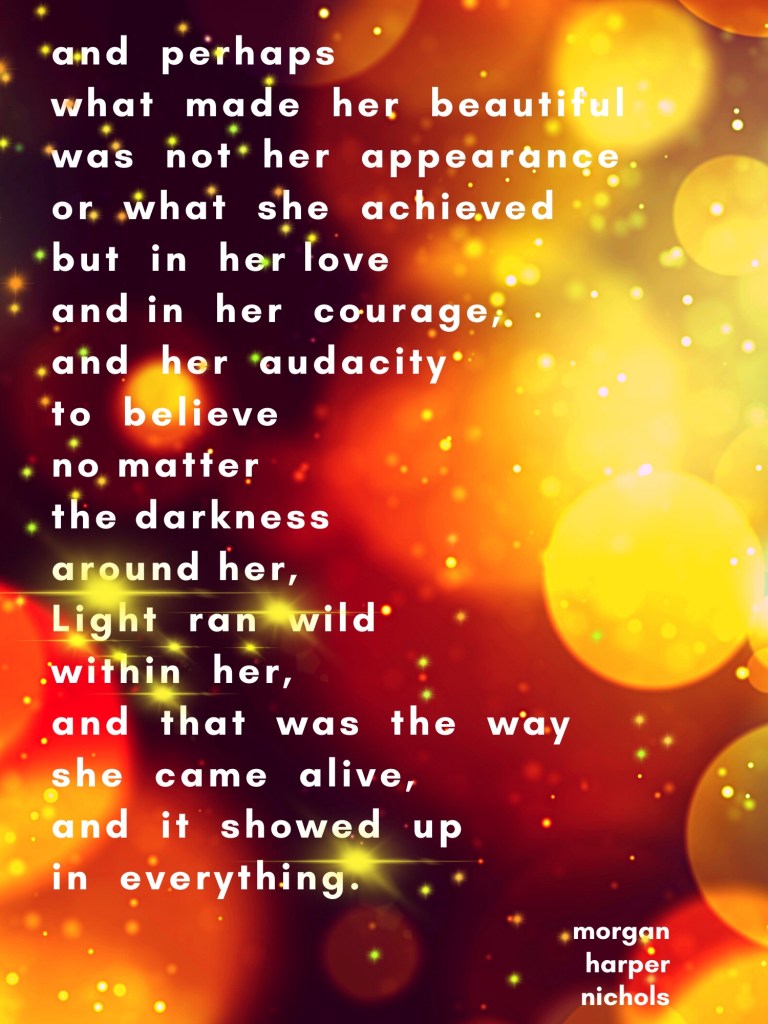
And then there are the inspiring words of artist and writer morgan harper nichols that so inspire me towards love, courage, audacity and the Light that runs wild within me, the Light that shines through my darkness and never goes out.

and  perhaps 
what  made  her  beautiful 

was  not  her  appearance
or  what  she  achieved
but  in  her love

and in  her  courage,
and  her  audacity
to  believe 
no matter

the darkness
around her,
Light  ran  wild
within  her,
and  that  was  the  way
she  came  alive, 
and  it  showed  up

in  everything.
— morgan harper nichols

May you have the strength to navigate those days when darkness threatens your light. May you love yourself and dig deep for the courage and audacity that frees you and lets the Light run wild within you!

Activism, Advocate, Asylum, Black Lives Matter, Caged children, Child trafficking, Committment, Community activism, Compassion, Courage, Creativity, Discrimination, Human trafficking, Immigrant detention, Immigration, Injustice, Justice, Let the oppressed go free, Oppression, Racial injustice, Racism, Social justice

“Let The Oppressed Go Free”

Canadian sculptor Timothy Schmalz’s work on a sculpture depicting modern-day trafficking in humans titled “Let the Oppressed Go Free” — a commentary on how slavery, via human trafficking, continues today. Schmalz laments that the modern-day travesty of forced labor, including for sex, is often ignored, not unlike slavery of the past.

Do you wonder sometimes where God is while people are being oppressed? I mean all kinds of oppression — racial injustice, human trafficking, violence and abuse, prison injustice, sexism, cissexism, classism, ableism, heterosexism. The list can go on and on, all the way down to specific stories about specific oppressed individuals. At that level, the down to earth level where we see a living person suffering, is the heartrending place. It’s the place where we find ourselves face to face and up-close with someone pouring out their story. It’s the place where we learn to talk less and listen more. It is for us an experience of holy listening with just one person.

Have you ever been in that kind of space listening to just one person? Have you ever been with a person suffering oppression who is freely sharing a heartbreaking story with you? I know that this kind of face to face encounter can be intimidating, even frightening. It can be beyond frustrating to listen to someone when you’re pretty sure you can’t do much to help.

There are at least two options for those of us who have a deep desire or calling to liberate those who are oppressed. We can offer what we have, even when we do not have a way to fix things. What do we have? Our presence, our emotional and spiritual support, our ability to advocate, housing assistance, financial assistance, employment assistance, safe shelter, understanding, constancy, presence, presence, presence . . .

The other option is to rail against a God who makes pronouncements about caring for oppressed people, yet seemingly does nothing to liberate them. This may not be our best option. Scripture reveals that God has a way of dealing with complaining people, and it is almost never a positive experience for the complainer. Moses comes to mind, and Miriam, and Job.

Poor, pitiful Job had a rough go of it and he wanted God to do some explaining and answer some questions. After all, he was a devout and faithful man, so why would God allow him to suffer so many losses? Right after Job is schooled by his three “friends” on several theological matters, including that he should never question God, God appears to Job out of a whirlwind. It was probably grand entrance, and then God basically says to him, ”I’ll ask the questions, buddy!”

Here’s a snippet of the long exchange between God and Job.

Then the Lord spoke to Job out of the whirlwind.

“Who is this that obscures my plans
    with words without knowledge?
Brace yourself like a man;
    I will question you,
    and you shall answer me.

“Where were you when I laid the earth’s foundation?
    Tell me, if you understand.
Who marked off its dimensions? Surely you know!
    Who stretched a measuring line across it?
On what were its footings set,
    or who laid its cornerstone—
while the morning stars sang together
    and all the angels shouted for joy?

— Job 38:1; 4-7 (NIV)


Job was oppressed. God was aware of it. God seemed unconcerned for too long, but there actually is a redeeming conclusion for Job. As the story goes in the last chapter of Job, God restored Job’s fortunes and gave him twice as much as he had before. All of Job’s brothers and sisters, and everyone else he knew, went to his house for Sunday dinner and they consoled him for all the trouble he had been through. Then each one gave him a piece of silver and a gold ring. It worked out!

Canadian sculptor Timothy Schmalz’s sculpture, ‘Monument of Oppression’ depicts hands emerging desperately from behind bars.

“I can’t think of one single nation of the world that did not practise slavery, including among Indigenous people,” the sculptor says.

(Photo by Handout)


What does Job’s story say to us? What does it teach us about oppression? In my mind, in order to confront oppression and free persons from every yoke on a societal scale, we must first be aware that systemic oppression exists. It is stark reality! It darkens our world! Right now, approximately 40 million people are trapped in slavery in the world. One in four of these is a child. This shame that pervades and plagues the planet does not seem to disturb people very much. Unfortunately, it is in some people’s best interest to maintain the oppressive systems that benefit them, that is fill their pockets with wealth (which is the primary reason for trafficking human beings, for instance).

Systems of oppression are very large, very complex and very powerful. Ending oppression is way too big for us to tackle alone. After sincerely asking the all-powerful God to help us bring down these all-powerful oppressive systems, we can add our hands and feet to the holy project. Contact senators, representatives, governors, mayors. Urge them, persist with them to use their position to help break down injustice. Know what you’re talking about when you contact them by reading about the work the many of anti-oppression organizations that exist. Join in their work. Look for those resources at this link.

“Angels Unawares” by Canadian sculptor Timothy Schmalz portrays the saga of Migrants and Refugees. Among the 140 faces in the sculpture are Africans, Vietnamese, a Cherokee, Jews, Irish immigrants, and Syrians. The Holy Family is also included in the sculpture. St. Joseph can be identified by his toolbox.

Finally, we must open our eyes to the people in our own communities who need our compassion, our concern, our caring presence and our advocacy on their behalf. It takes some creativity, some committment and compassion, a lot of courage and a covenant with our God of justice to change an unjust world. The outcome might just look something like what the prophet Isaiah described:

Is this not the fast that I choose:
To release the bonds of wickedness,
To undo the ropes of the yoke,
And to let the oppressed go free,
And break every yoke?

Is it not to break your bread with the hungry
And bring the homeless poor into the house;
When you see the naked, to cover him . . .

Then your light will break out like the dawn,
And your recovery will spring up quickly;
And your righteousness will go before you;
The glory of the Lord will be your rear guard.

Then you will call, and the Lord will answer;
You will cry for help, and He will say, ‘Here I am. . .’

10 And if you offer yourself to the hungry
And satisfy the need of the afflicted,
Then your light will rise in darkness,
And your gloom will become like midday.

11 And the Lord will continually guide you,
And satisfy your desire in scorched places,
And give strength to your bones;
And you will be like a watered garden,
And like a spring of water whose waters do not fail.

12 Those from among you will rebuild the ancient ruins;
You will raise up the age-old foundations;
And you will be called the repairers of the breach,
The restorer of the streets in which to dwell.

— Isaiah 58 (NASB)


I don’t know about you, but I want to be among the ”repairers of the breach.” I don’t want to live in a situation where I “hope for light, but there is darkness.” (Isaiah 59:9) Instead, let me find myself looking far beyond the world’s darkness, looking to the Creator who demands justice, looking upward to claim the promise, ” . . . satisfy the need of the afflicted, Then your light will rise in darkness, and your gloom will become like midday . . . And your light will break forth like the dawn.”

May it be so for all of us.

Aging, Change, Contemplation, Courage, discouragement, Fear, Illness, Risk, Stillness

Here’s to the Crazy Ones!

It’s true, isn’t it? Without the risk of going too far, stepping out of our comfort zone, we will probably never know just how far we can possibly go. But oh, the complete comfort of that comfort zone hems us in completely. We cannot move. We cannot take a step into new life. We cannot know what we might have accomplished. We cannot free ourselves from the bondage of fear.

I’ve been there and I have a notion you have, too. In fact, I can recall many times when I could not overcome my fear enough to take a risk. One time in particular has haunted me for almost 30 years. I wonder what my life would look like today if I had taken that particular risk — moving to a new state, to a new position, to a larger city, to a different house on a different street. That one single refusal to step out of my comfort zone has troubled me to this day.

Risk-taking is not easy. Change is difficult for some people, and some of us can convince ourselves to avoid change at any cost. Huge changes, even tiny changes, simply frighten those of us who have convinced ourselves that we are not risk-takers. Yet, I can think of so many persons who have decided that changing their lives — maybe even changing the world — is worth the risk. I will never forget one of my seminary professors whose words in a chapel sermon changed the course of my life.

Is what you’re doing worth giving your life for? Because every day you live, you are actually expending your life a little at a time doing whatever it is you’re doing.

– Dr. Paul Simmons

I left the chapel that day, walked across the campus to my office and resigned from my job, setting my sights on enrolling in classes to complete a Theology degree. A risk! A big risk that I was determined to take for two reasons: 1) I actually believed I could change the world; and 2) I was young, bold and unafraid. I’m not so young anymore, and the courage and boldness to change is small in me. It feels like being stuck, and I think it’s the first time in my life I have felt so thoroughly stuck. A brand new mantra for my life is this: “Stuck is more harmful to me than risk. I am not afraid to take a risk!”

Still, there is a part of me who longs to change the world, at least my corner of it. There is this alter ego inside me who actually believes she can change the world. That is the part of me that believes injustice can be conquered, wrongs can be righted, equality can be reality and liberation can emerge out of any form of bondage. Crazy? Probably, but I know of many kindred spirits who would be all-in on changing the world — Malala Yousafzai, Emma Gonzalez, Greta Thunberg, Crystal Echo Hawk, Amanda Gorman. Men are on the list of risk-takers, too. One in particular died in 2011 at age 56, but left behind a lasting legacy that was an example of what a human being is capable of doing.

The ones who are crazy enough to think they can change the world, are the ones who do.

– Steve Jobs

I have given thought to those words, as well as something else Steve Jobs said when he was dying of pancreatic cancer: “Death is mankind’s best invention! I looked in the mirror every day wondering if what I am doing today is fun for me. If the answer was no for several consecutive days, then I have to change something!”

Yes, I am stuck right now, and for several days I have had to admit that what I am doing every day is not fun for me. Nor is it anything significant enough to change the world. So I do need to change something. I’m not sure what sort of change I need to make or how risky the change might be. STUCK! No matter what I decide to change — big risk or small risk — it won’t be easy. And I have to look into myself, into my soul, and ask myself if I am able to take a risk or even willing to take a risk. Truthfully, I know in the depths of my being that refusing to take a risk right now will leave me stuck, maybe even permanently stuck. I don’t like the sound of that. I don’t like the stark reality of that. Small risk or big risk — I know I need to change something in order to truly live!

Like the little goldfish in the small bowl, I’ll skip the bigger bowl and shoot for the ocean.

– Rev. Kathy Manis Findley


I used to be “one of the crazy ones,” always taking risks and most often taking big ones. The visual goldfish metaphor is one that described me well throughout my years. I was not one to leap from a small fishbowl to one that was a little larger. I was much more likely to take a brave, risky leap out of a fishbowl and into an ocean! Until now! Until aging and illness and displacement took its toll. I’m definitely not as young as I was in my former and more courageous days. I am not as physically well as I used to be, and I am not living in the town that was my home.

I am facing a three-headed enemy — age, health and displacement. In truth, this enemy does have enough power to keep me stuck, depressed and disheartened. At this moment, I don’t yet know what I plan to do about it, but I do know it will probably call for a leap, a risk, a change and maybe doing something a little crazy.

At this moment, I’m not up for crazy. I need a little contemplative time in my safe space to look deeper into my soul. I’m not at all sure what will come out of my time looking at soul things —maybe some extra peace or maybe renewed hope, new thinking, fresh courage, some sort of healing. Maybe even a little craziness that helps me consider some risky changes in my life. What I am sure of is that I do not enter my soul-searching space alone, for God has walked with me on every step of my journey. I cannot plan anything right now, but there is someone who watches over me who is making plans I cannot make.

For I know what I have planned for you,’ says the Lord.
‘I have plans to prosper you, not to harm you.
I have plans to give you a future filled with hope.
When you call out to me and come to me in prayer,
I will hear your prayers.’

Jeremiah 29:11-12 NET

I will take risks again someday. I will reclaim the “crazy” part of myself that was never afraid to risk going too far. I will embrace change, inevitable change, with more courage than I have at this moment. I will take another big risk one day soon that will remind me how far I can go and how high I can leap. Like the little goldfish in the small bowl, I’ll skip the bigger bowl and shoot for the ocean. Until I can do that, I’ll be in my sacred space with the One who has never left me and has never let me walk alone.

Thanks be to God. Amen.

You Do Not Walk Alone, Elaine Hagenberg


#MeToo, Activism, Beloved Community, Bondage, Challenge, Change, Community activism, Courage, Discrimination, Freedom, Hate, Holy Spirit, Hope, Injustice, Lament, peace, Racism, Social justice, Spirit wind, Transformation, Transforming Injustice, White supremacy

Removing Yokes of Bondage

“We Sound a Call to Freedom” Hymn text by Rev. Dr. Jann Aldredge-Clanton; http://jannaldredgeclanton.com/changing-church-resource-“we-sound-a-call-to-freedom”-video-2/


Stand fast therefore in the freedom by which Christ has made us free,
and do not be entangled again with a yoke of bondage.
Galatians 5:1 (NKJV)

What is it about freedom that scares us? What is it about freedom that causes us to refuse to offer it to everyone? Are we afraid that giving freedom to another person or group of persons will diminish our own freedom? What does freedom really mean to persons who are oppressed and to those who live inside the throes of injustice?

I have written very little lately about justice and accountability, the two words most used to describe Derek Chauvin’s conviction. I can’t help but mark this very moment on the “long arc that bends toward justice.” I feel compelled to call our attention to this week! Actually it’s last week now, but you get the idea. Let’s call it “the week of the verdict.”

The week of the verdict has come full circle from George Floyd’s murder on May 25, 2020 to the conviction of Derick Chauvin almost one year later on April 29, 2021. It was a week we will not forget. It brought up emotions in me and perhaps in most people. Most of what I felt mirrored the emotions I imagine George Floyd’s family feeling — happy, calm, relieved, conflicted, hopeful, determined, vindicated. I also felt sad and helpless because the conviction did not end murders of black and brown brothers and sisters. And I felt joyful and hopeful because perhaps this flashpoint in the long history of racial injustice will help us turn the corner and finally see in our communities the justice we long for.

How can that happen? How can we turn the corner and move away from oppressive systems and oppressive people? How do we do that when just minutes after the verdict and less than ten miles away, 16 year old Ma’Khia Bryant was shot and killed by police in Ohio? It happened in the shadow of “the week of the verdict.”

Perhaps for us this is the week of the verdict — the week when the verdict will be read on our failure to end the systemic racism in our communities! Isn’t it past time for us to stand up and stand strong and stand determined and woke? My friends, it is time! This moment in the history of injustice may well be the turning point we need to end racism!

I have said this many times: We cannot just reform injustice, we must transform it. The transformation that results in genuine, lasting justice must begin in the soul and in the heart where intentions are formed. I must lament injustice, confess my own complicity in it, repent of the white supremacy within me, own other forms of oppression and commit to the hard work of transforming injustice in my community and in my world. Only then will transformation happen in the systems that oppress people.

Only transformed people can love neighbors as Jesus loved us. My friend and sister blogger never fails to remind me to answer the ultimate question, “How then shall I live?”* She offers this scripture to us today.

We know love by this, that he laid down his life for us — and we ought to lay down our lives for one another. How does God’s love abide in anyone who has the world’s goods and sees a brother or sister in need and yet refuses help?

1 John 3:16-17 

She then reminded us that conditions in India are dire and the people languish.

In India, today the virus surges
almost beyond control,

hospitals are choked,
people die in line waiting for a doctor.

How can those of us
rejoicing in vaccination,
cautious travel, new gatherings,
not ask how we can help?

Maren

How does God’s love abide in anyone who has the world’s goods and sees a brother or sister in need and yet refuses help?

And that is the soul-critical question we must answer. How then shall we live when all around us people suffer every kind of calamity — every kind of violence, disaster, racism, discrimination, dehumanization? Every kind of heartache. How do we, in our suffering world, become the heart, hands and feet of Jesus?

Getting back to the lament of my own heart, that one thing that inspires my passion — transforming the injustice of racism, xenophobia, misogyny, homophobia and all forms of evil exclusion and oppression. Transforming injustice! Setting our faces toward the hope of Beloved Community! This one thing I know, the steps of Jesus would have led him to the “healing” of injustice in any form. On every day he walked on this earth, Jesus would be loving every person who was in need and he would be lamenting every injustice that caused harm.

How can we not lament? How can we not expend ourselves in the hard work of transforming injustice? How can we not care for, and pray for, and love our brothers and sisters who are in need? How can we refuse to work for the freedom of black and brown people, indigenous peoples, LGBTQ+ people, immigrants and asylum seekers, and to any person who is enslaved? How can we deny God’s desire for justice and peace?

How can we refuse freedom to black and brown people, indigenous peoples, LGBTQ+ people, immigrants and asylum seekers, and to any person who is enslaved? How can we deny them God’s peace?

— Rev. Kathy Manis Findley

I do not have the answer for how we might do this. But I do have some convictions about it, especially about racism and white supremacy. One of my convictions is that dismantling racism begins in me, in my soul. And eradicating white supremacy begins when I look seriously at my own white supremacy. For you see, as long as white supremacy looks to me like a white-draped person burning a cross, I will never acknowledge that white supremacy is in me. As long as white supremacy looks to me like a man I might see on TV news with a truck, a confederate flag, a rifle and a mission, I can easily distance myself. I am not that white person; I am a different white person that would never tolerate racism.

Am I? Am I that different white person? Or are there ways I contribute to an unjust society? Are there ways I fail to seek Beloved Community? Are there thoughts and feelings within me that diminish other persons, persons not like me? Am I complacent about injustice? Am I complicit? Am I reticent? Am I avoiding, looking the other way?

As long as white supremacy looks to me like a white-draped person burning a cross in someone’s yard, I will never see that white supremacy is in me. As long as white supremacy looks to me like a man I might see on TV news with a pick-up truck, a confederate flag, a rifle and a mission, I can easily distance myself. I am not that kind of white person! Or am I?

Rev. Kathy Manis Findley

Racial injustice may currently be the most visible form of oppression, but we must remember that many groups of people are oppressed. Many people long for freedom from oppression. Only when we “see” and “hear” all of their voices, will we be on the way to transforming injustice. I don’t know everything about oppression, and I don’t know exactly how to make a difference. I don’t really know how to join hands with my community and set about to transform injustice. I do know that I must begin with my own lament, for only lament can open my eyes to every manner of suffering and oppression.

So meet me on the mountain where we find the strength from God to persevere, and then descend with me to all the places where oppression enslaves people. Come with me to the people, and together, let us remove from them the yoke of bondage and offer them new freedom. And may Spirit Wind surround us with courage. Thanks be to God.


*”How then Shall We Live?” was the inspiring theme of the Alliance of Baptists Annual Gathering.

VIDEO CREDITS
Words  © Jann Aldredge-Clanton, from Inclusive Hymns for Liberating Christians (Eakin Press, 2006).

Visual Artists:
David Clanton: “The Magic Begins” and dancing children photos: http://www.davidclanton.com/http://david-clanton.artistwebsites.com/

Shannon Kincaid: woman carrying torch paintings:http://www.shannonkincaid.com/

Mirta Toledo: Christ-Sophia painting:  https://www.facebook.com/mirtatoledoarthttp://www.jannaldredgeclanton.com/books.php#book3

Chad Clanton: purple irises photo

Instrumentalists:
Keyboard: Ron DiIulio
Percussion: Warren Dewey
Guitar: Danny Hubbard
Bass & Percussion: Jerry Hancock

Music Producer/Arranger:
Ron DiIulio: http://www.silverdollarsounds.com/personality-profiles/ron-diiulioSource

Advent, Angels, Bethlehem’s Star, Bewilderment, Courage, Elizabeth, Mary

Those Who Dream — Advent 2020

THOSE WHO DREAM

That’s the problem, isn’t it, that the Angel Gabriel departed from her!

It happens to us, too.

Our angel departs
Leaves us

Goes away
Just when the deepest shadow of fear hovers over us.

Goes away
Just when grief has shattered our hearts.

Goes away
Just when our deep, deep life losses have left us disconsolate.

Our angel goes away.
Just at the moment of our most profound impoverishment,
Just at the moment when we know, beyond doubt,
That we will never dream again.

As for the dreams we long held hidden in our hearts . . .

Well, those dreams disappeared!

Vanished!

The dreams we held so closely are not in us anymore
Can not be dreamed anymore.

Suddenly, our angel left
And we were no longer those who dream.

Yet, we moved headlong into Mary’s story and Elizabeth’s;
Life growing in their wombs;
Holy Life growing in their wombs.
Both of them holding the dreams God gave them
Both dreaming into an unknown and unknowable journey

As women often do.


And on that journey, as we follow these two dreaming women, we see it!
The Star in the East!
The Bethlehem Star sparkling in night sky!

Our angel left us
But courage and hope still courses inside us.

We lift our gaze still and we see Bethlehem’s star

And the dark indigo sky sparkles
Brilliance incarnate!
Manifested before us in human form!

The Word Made Flesh who would never leave us like our angel did.

We follow that holy star
Determined.
Undaunted.
Unrestrained.

Because we know what we hold deeply in our souls;

We know exactly who we are —

Those who dream!

We are those who dream!

Rev. Kathy Manis Findley, Advent 2020


In your sacred pauses during this Advent season, may you find peace, knowing all is calm. Listen to this music in your contemplative time.


Advent, Bewilderment, Bravery, coronavirus, Courage, Defiance, Dreams, God’s promises, Joy, Magnificat, Mary’s Song

MARY’S SONG OF JOY FOR A WORLD THAT’S NOT SO JOYFUL

19FB6970-6B88-4C22-9C98-7E7295E78D3B
The angel visit left Mary confused. And so — in a haze — she runs away, seeking refuge in the hill country with a family that would keep her safe and help her make sense of her world turned upside down . . . As soon as she fell into Elizabeth’s arms, Elizabeth knows and feels it to be true . . . “Yes, I feel it too. We are pregnant with promise . . . a dream that will birth joy.”


My soul magnifies the Lord, and my spirit rejoices in God my Savior.

He has exalted me and, humbly, His servant I will be.
All generations, henceforth, shall call be blessed.
For He has done great things for me and holy is His name.

I will probably always remember those words penned by a lyricist whose name I cannot remember. (Apologies to John W. Peterson, Anna Laura Page, Ragan Courtney or whoever helped create this arrangement. I remember the tune and every word, but I can’t remember you.)

I have sung, in my short lifetime, dozens of versions of Mary’s song that we know from the Gospel of Luke. We often call it Mary’s Magnificat. I sang the version quoted above many, many years ago as a part of my church’s Advent music. I looked through the music in our first Advent choir rehearsal and immediately turned the pages to this one that was called “Mary’s Song.” I knew I would sing it since the churches we served seldom had willing sopranos.

As November and December moved along, I rehearsed Mary’s Song over and over again, not to enunciate all the lyrics clearly or to sing all the notes correctly. I sang it again and again because the act of getting into Mary’s skin brought me to tears every time I sang it. Tears were okay, but being unable to sing because I was weeping was not okay with me. And yet, I didn’t want to rehearse the emotion out of it. I wanted to “be” Mary for just those moments and I wanted the hearers in the sanctuary to emotionally connect with her.

In the end, I prayed and left it in God’s hands, because in the end, that’s what people of faith  do. Today, as we do every year, we lit the Advent candle of joy — the pink candle, Mary’s candle — hoping that the sheer joy of her news to Elizabeth would ring true enough in us to bring us joy. How? “How can this be?” as Mary said to the angel.

I suppose that in these Advent days, in this particular year, many of us have asked “How?” How will we get through this bewildering time? How can joy fill us, enter into our souls and enliven our spirits, as we bury our loved ones? As we wait for word by phone about the person we love who is hospitalized? As we touch the hand of our grandmother through the window of her nursing home? As health care professionals become almost too weary to go on while people with the virus keep coming? As we know we will not see our family this Christmas — to keep them safe, to keep us safe?

How can we sing, this year, “My spirit rejoices in God my Savior” — Mary’s magnificat? Joy is a hard thing this year, for 2020 has brought us grief upon grief, fear upon fear and uncertainty upon uncertainty. Yet, we have held one another close, even over Zoom, because together we have found strength to go on. Over the senseless racially motivated violence we saw on our televisions this year, we saw also a people languishing in a pandemic that took so much.

We saw politicians fighting each other over what some of them see as truth and others see as deliberate, hurtful lies. We saw children who wondered about where school would be and parents agonizing over hard decisions. We saw congregations gathering in parking lots and sanctuaries still, silent, without voices. We saw devastating unemployment and small businesses closing their doors. We saw medically vulnerable or immunosuppressed people locked in their homes. We saw people struggling to pay their bills — very poor people wanting and the very rich, as always, continuing their lavish lifestyles. We saw the rich continuing to oppress the poor, if not in their direct actions, then in their greed that, at least indirectly, deprives those among them who are poor.

The young girl Mary spoke about that, too, in the words of her Magnificat from the Gospel of Luke.

He has shown strength with his arm;
he has scattered the proud in the thoughts of their hearts.

He has brought down the powerful from their thrones,
and lifted up the lowly;
he has filled the hungry with good things,
and sent the rich away empty.

Luke 1:51-53 (NRSV)

The young girl we have called the Virgin Mary, the holy one that accepted the strange and frightening mission from God to bear God’s Son — this Mary is also the subversive one who called out the rich, the powerful and the proud. In her Magnificat? Oh yes, Mary said that God would scatter the proud in the thoughts of their hearts, bring down the powerful from their thrones and send the rich away empty.

Subversive! Courageous! Defiant! Bold! Audacious! Wise! She was all those things when she spoke the kind of subversive truth no young girl in those days would have dared to speak. The miracle of it is that God chose a young girl who possessed the tenderness to nurture a newborn, the wisdom to raise him to live into his mission and the courage to help him stand in a world that would both adore him and hate him — worship him at a manger and then crucify him on a hill. Dr. Marcia Riggs described Mary’s Magnificat like this: “The song sows joy that is the seed of a social revolution.” Indeed!

This was the Mary of our pink candle, the Mary who would be submissive enough to agree to a holy life of chaos and the Mary whose inner strength enabled her to look up and watch her son die.

To be sure, her Magnificat has been read and sung in millions of voices, with thousands of tunes, in cathedral-like sanctuaries and in mud huts. The words have been translated into various versions of the Bible and composers have woven paraphrases of her words into hundreds of melodies and rhythms. Still to this day, one phrase remains . . .

Holy! Holy! Holy is His name.

May Mary’s joy find us on this day and in our own worlds — wherever we are, however we feel, whatever sadness we hold. Amen.

For your quiet, meditative time — one version of Mary’s song:

Activism, Bravery, Calling, Challenge, Courage, Divine Feminine, Here I am, Lord., Hope, Insight, Inspiration, March for Our Lives, Social justice, Spirit wind, Transformation

Ah! Women!

228BEA2D-360B-4749-994C-F28F1D756B13
Ah! Women!

With your heart of compassion, your mind full of creative force, your spirit empowered with the rush of Spirit wind and fire!

Ah! Women, with your steady and sturdy will that stands straight and tall and moves into the fray — any fray that harms others, devalues human beings, threatens all of God’s created order, brandishes violence and acts against God’s divine desires!

Ah! Women! Silenced, dismissed, diminished from ages past to this very day!

Ah! Women, now you will summon your courage and move forward with hope and grit! Now — in these unfathomable days of pandemic and protest — you will enter the fray in ways only you can. You will enter the fray bringing with you a transformative power for righting wrongs. You will inter the fray bringing your womanwisdom and the insight that is inside you, given by Spirit!

Ah! Women! Daughters of God,

I will pour out my spirit on all flesh, and your daughters shall rise up and find their own voices, dreaming dreams and seeing visions . . . In these days, even on my female slaves, I will pour out my Spirit.

— From the Prophet Joel 2:28-29 NRSV (a feminist paraphrase)

Ah! Women! As you go forth, never forget when you enter any holy fray God has placed before you, that you do not go alone. From the wisdom of Maya Angelou:

Whenever you go forth into a new project, task or vision, remember that you do not go alone. Behind you is Harriet Tubman In front of you is Sojourner Truth. Beside you is Fannie Lou Hamer and next to you is your grandmother.

Fill in the names of your own revered women, and know that you are going forward with the power of other people.

Ah! Women!
Perhaps, like Esther, God has called you for such a time as this! 

Ah! Women! In you, there is hope and grit!
In you, there is unbridled courage!
In you, there is transformation of every wrong!!

May God continue to empower your spirit, steel your heart and grace the sound of your own voice! Amen. A*women.

Hear this choral music and contemplate the calling of God:


Activism, Calling, Change, Courage, Forgiveness, God's Faithfulness, Hate, Injustice, journey, Love story, Repentance, Transformation

The Hard Way Forward

5834D9E4-A63C-485C-9129-9BDB644B6113

Rev. Kathy Manis Findley
The Hard Way Forward

A sermon preached in virtual worship for New Millennium Church
Little Rock, Arkansas
October 11, 2020
Scripture: Exodus 32:1-14; Psalm 106 (selected verses)

Have you ever come to a point in your life when you had to take the hard way forward? You had no other choices! In fact, the phrase “the hard way forward” paints a an unvarnished picture of these tumultuous days, and the paints on the artist’s brush are dark and foreboding.

What a journey 2020 has been! I have often called it a journey of lament — a journey that has forced us to be in places we never wanted to be and to see things we never wanted to see. 

We look around and watch people in shock and dismay — disillusioned and despondent. So many have been personally touched, even ravaged, by the deadly coronavirus, while others are overcome with fear of it. We have witnessed evil, racist assaults; watched police brutality and murder on our television screens; we have grieved over wildfires that threaten to swallow up forests, animals, homes and lives; and over it all we have felt contempt for the reprehensible leadership of an incompetent, insensitive, egocentric, self-serving president. I think it’s safe to assume that many people in this broken nation feel hopeless and heartbroken.

I often ask: 
God, are you still leading us on this hard journey?  Or have you forsaken us?
Do you have some kind of plan we do not yet see?

These months for so many people have definitely been a hard way forward. As we try to put one foot in front of the other on this journey, perhaps we can imagine ourselves walking with the people of Israel.

So let us listen and hear the Word of God in Holy Scripture

From Exodus, Chapter 32, (selected verses):

When the people saw that Moses delayed to come down from the mountain, the people gathered around Aaron, and said, “Come, make us gods who shall go before us.”

“As for this Moses, the man who brought us out of the land of Egypt, we do not know what has become of him.” 

Aaron said to them, “Take off the gold rings that are on the ears of your wives, your sons, and your daughters, and bring them to me.” 

So the people took off the gold rings and gave them to Aaron. He took the gold, formed it in a mold, and cast an image of a calf; and the people said, 

“These are your gods, O Israel, who brought you up out of the land of Egypt!” 

When Aaron saw this, he built an altar before the calf and said, “Tomorrow shall be a festival to the Lord.” They rose early the next day and offered burnt offerings and brought sacrifices; and they sat down to eat and drink, and then rose up to carouse. [my word choice]

(Now the scene changes locations.)

The Lord said to Moses, “Go down at once! Your people have acted perversely . . . they have cast for themselves an image of a calf, and have worshiped it and sacrificed to it. I have seen how stiff-necked these people are. Now leave me alone, so that my wrath may burn hot against them and I may consume them.”

But Moses implored the Lord, and said, “O Lord, why does your wrath burn hot against your people, whom you brought out of Egypt with great power and with a mighty hand? Turn from your fierce wrath; change your mind and do not bring disaster on your people.

And the Lord changed his mind about the disaster that he planned to bring on his people.

And from Psalm 106 (selected verses):

O give thanks to the LORD . . . for God’s steadfast love endures forever.
Both we and our ancestors have sinned; we have committed iniquity, have acted wickedly. They made a calf at Horeb and worshiped a cast image. They exchanged the glory of God for the image of an ox that eats grass. They forgot God who had done great things in Egypt, wondrous works in the land of Ham, and awesome deeds by the Red Sea.

Therefore he said he would destroy them — had not Moses stood in the breach before him, to turn away his wrath.

This is the word of God for the people of God.

The story of the Israelites reminds us that our kindred sojourners also traveled some rough paths. The text gives a glimpse of just one snippet of their journey. We see the Israelites on their wilderness pilgrimage, complaining, as they often did — and as we often do.

Apparently, Moses who had just received the ten commandments, stayed on Mount Horeb for a long time, patiently listening as God engaged him in a presentation of all manner of laws, rules and instructions. It took awhile — 40 days and forty nights, a very long time. And the Israelites started complaining about it to the one Moses left in charge — Aaron.

What has become of Moses?

What would he eat on that mountain, anyway?

This Moses, that brought us out here in this mess — where is he?

And then their fateful request to Aaron:

You are the one who is here with us now — make us something we can see. Make us something that will lead us forward, and we will follow it.

Now you probably remember that the Israelites had complained before:

Why did you bring us out of Egypt? To kill us with thirst?
Why have you led us into this forsaken, dangerous wilderness? To kill us with hunger?

Their complaints may sound a bit like our own complaining during the terrible months of pandemic, racial unrest, political rancor, and all manner of upheaval. 

Hey God! Are you planning to obliterate this coronavirus, or not?

Are you still with us, God, or not? 

Have you brought us to this season for some purpose? 

Like the Israelites, we sometimes lose sight of our leader — the God that would give us the courage to move. We are left as a wandering, unsettled people that simply cannot see our way forward.

As Wendell asked in last Sunday’s sermon, “Shouldn’t God do something?”

Shouldn’t a God of enduring, everlasting love do something?

Now remember — we are in good company with several holy bible people. The prophet Isaiah, for one, who asked:

“How long, O Lord
And God actually replied to him:

Until the cities lie ruined and without inhabitant,
until the land is desolate and ravaged,
until the land is utterly forsaken.

Not so reassuring!

The Psalm singer asked, too, in Psalm 94.

How much longer will the wicked be glad?
How much longer, Lord?
How much longer will criminals boast about their crimes?

They crush your people, Lord; they oppress those who belong to you.
They kill widows and orphans, and murder the strangers who live in our land.

Who stood up for me against the wicked? Who took my side against evil?

If God hadn’t been there for me, I never would have made it.
The minute I said, “I’m slipping, I’m falling!
Your love, God, took hold and held me fast.”

Like those holy bible people, we ask — in our impatience and fear — “How long, O Lord? 

And even as we ask, we have a wee inkling that God’s love is still holding us in safe arms of grace. George Matheson was a Scottish clergyman and theologian who lived in the late 1800’s. He was blind by the age of 18. Matheson wrote something quite profound about God’s love — the text of the hymn, “O Love That Will Not Let Me Go.” The hymn text formed in his mind during a “dark night of the soul” he experienced, a deeply emotional and spiritual crisis. He tells us about it in his own words.

My hymn was composed in the manse on the evening of the 6th of June, 1882. Something happened to me which was known only to myself, and which caused me the most severe mental suffering. The hymn was the fruit of that suffering. It was the quickest bit of work I ever did in my life . . . the whole work was completed in five minutes, and it never received at my hands any retouching or correction. All the other verses I have ever written are manufactured articles; this one came like a dayspring from on high.

In a time of emotional anguish, God’s creative grace rose up in George Matheson and he wrote about the kind of divine love that would never let him go. I think we owe Rev. George for reminding us about God’s unwavering love. The hymn text is most assuredly Gospel Good News that people throughout the centuries have desperately needed to remember

As you and I walk this journey, we need to know that God’s love will hold us fast, but sometimes we don’t know it. Like George Matheson, we could use a visit from the Dayspring from on high!

In truth, we need assurance — that no matter how hard the way forward, God’s love will not let us go. Threatened by a deadly virus, God’s love will not let us go. In our most disconsolate moments, God’s love will not let us go. When we courageously stand up to denounce racism, white supremacy, police violence and all manner of evil that surrounds us, God’s stubborn love will never let us go!

But that kind of love also places before us a holy mission undergirded with the foundational principle that evil cannot be reformed, it must be transformed — transformed within us before it can be transformed in the world, and transformed in the way described by Dr. King:

Only through an inner spiritual transformation do we gain the strength to fight vigorously the evils of the world in a humble and loving spirit.

You might be wondering what any of this has to do with the Israelites and their golden calf, or the psalm singer who sang something about God’s steadfast love enduring forever, or the idea that someone might possibly stand in the breach for us.

My friends, each of us are traveling through these days with at least some fear and anxiety. It is a hard way forward, and as some clever people have said, “The light at the end of the tunnel is probably a freight train!” 

Still, we are inheritors of the hope and grit of so many others who have journeyed hard roads before us — walking, marching, sometimes crawling — at times standing tall, at other times falling face-down in the dust of a hard rocky ground. We have navigated perilous roads and turbulent waters in this season. Yet we walk on, just as those who walked before us and who walk beside us.

I recently saw a news report about a little girl walking with her family among crowds of protesters. She stops at a makeshift memorial to George Floyd. As she pauses there, we can read the sign she carries — a hand printed cardboard sign that says:

My daddy plays with me. My daddy reads to me.
My daddy tucks me in at night. Please don’t kill my daddy.

The little girl walks on with her family.

Tamika Palmer walks on too, tears flowing freely. Tamika Palmer, Breonna’s mother, vows she will never stop walking forward towards justice for the daughter she lost.

It strengthens us to remember those who walked before us in years past and those who walk with us today who are those sparkling examples of hope and grit: Sojourner Truth, Harriet Tubman, Elizabeth Cady Stanton, Oscar Romero, Fannie Lou Hamer, Prathia Hall, Greta Thunberg, Rev Dr. William J. Barber, II, Rosa Parks, Dr. Martin Luther King,Jr., Dorothy Day, Bishop Michael Curry, Nelson Mandela, Ruth Bader Ginsberg, Dr. J. Alfred Smith, Jr,. US Representative John Lewis, Rev. Pastor Judge Wendell Griffen and countless others whose names we revere, as well as so many whose names we do not even know.

Walking, marching, protesting, advocating, praying, writing, speaking, weeping — throughout centuries and to this very time. Compelled by prevailing, persisting injustice, they walk on — we walk on —taking the hard way forward.

So having eavesdropped on a people constructing a golden calf to worship, will we allow their story to call our attention to our own idols? Those idols we have made for ourselves out of our own Egyptian gold?  “Idols” might just be the next sermon point, if I used sermon points!

It’s tempting to mistake our own creations for our God. It’s tempting to shape our self-made idols into an image that soothes our anxiety, feeds our anger and our egos, and convinces us it will demolish whatever is evil around us. I don’t know about you, but I can get obsessed at times. My tasks, my work, my advocacy sometimes rise up out of my obsessions. I don’t like that, but have to admit the truth.

So I have to ask myself: Is my work to dismantle injustice part of God’s call and my holy mission, or have I made it my idol?

Whatever that thing is that we have made from Egypt’s gold is not our god. That thing we idolize may symbolize strength and power. It may personify bravery. It may embody rebellion or protest. But as close as we draw to it and place it at the center of our lives, we must understand that it will not lead us to transformation, just as the Israelites’ golden calf could have never led them to the land of promise. 

Instead it will shackle us in our impatience, audacity and self-importance. It will shackle us because of our insistence on following our own way instead of God’s way. 

Here is another honest confession:  It is tempting for me to let hate become my idol, to allow my desire for retribution to goad me into facing off against injustice with hate. But God’s way is always love. 

Is it possible that our idol is our hate for people, people who may actually deserve it like white supremacists, neo-Nazis, violent police officers, men wielding projectiles and tear gas, corrupt politicians and leaders? Do we rise up against such people with hate as our weapon, while all the time, God calls us to love our enemies!

The hard way forward is the way of higher ground that invites us to turn away from the idols created by our lesser angels and walk forward in the persistent love that will never let us go. 

The hard way forward knows the pain of fear and doubt, but still chooses to follow cloud and fire through the desert-landscape and on to freedom. The hard way forward is to live into God’s abiding, never-ending love.

For you see, seekers of justice who marched the hard way before us faced firehoses and dogs because they longed for holy transformation and because they trusted that God’s love would not let them go. Seekers of justice protesting in the streets of Louisville and in other cities in these hard days face tear gas, police brutality, violent government intervention because they long for holy transformation and because their faith whispers to them, “God’s love will not let you go.”

You and I, in whatever ways we are dismantling injustice, MUST take the hard way forward — facing censure, criticism, indifference, ridicule, disrespect, even violence, because we long for holy transformation and because deep-down, we believe in our hearts that God’s love will never let us go.

That hard way forward is the path to transforming injustice! Doing the same things we’ve done the same way we’ve done them might bring some manner of reform. But we must not settle for reformation. We must set our eyes on transformation. 

One last caveat: the change we seek may never be realized even if we are brave enough to take the hard way forward, because the saved up baggage we carry weighs us down — the anger we hold on to, the hatred we feel, the impatience that makes us volatile, the fear that besets us, the hostility we refuse to let go of. Isn’t it time for you and me to kneel before God, confess our sins and accept the healing grace that wipes away our tears and transforms us into a new creation?

Kneeling at the altar of repentance, we will stand up straight and tall and brave — and most importantly, forgiven — and we will take the hard way forward, knowing in our souls that we cannot just act to reform evil, we must resolve to transform it. 

So let us bravely and confidently take the hard way forward, knowing that God is standing in the breach on our behalf and that the Dayspring from on high visits us, giving light when we walk through the darkness and the shadow of death, and guiding our feet into the way of peace.

Let us take the hard way forward, proclaiming from the depths of our being that no matter how dark and difficult and long the journey is, God’s love will never let us go. Amen.

I invite you now to spend a few moments of reflection and prayer as you listen to a benediction of choral music in the video below. May you listen in the music for the whisper of God, for Christ’s blessing of grace, for the brush of Spirit wings. 

And as you leave this time of holy worship, persevering on the hard way forward, may the God of love go with you and fill you with gentle peace through every tribulation, so that your soul may rise up in hope by the power of the Holy Spirit. Amen.


Bravery, Comfort, Confusion, Contemplation, Courage, Fogginess, Mists, Perseverance, Resilience, Sacred Pauses, Serenity, Silence, Soul, Spirit, Stillness, Vulnerability

Being Brave in the Mists

Are we brave enough to imagine beyond the boundaries of “the real” and then do the hard work of sculpting reality from our dreams? 

Walidah Imarisha


I read a wonderful article this morning written by Madisyn Taylor, who wrote about being in a fog. I related immediately, having just taken my immunosuppressant medications that create all manner of “foggy-ness” for me. Tayler defined it as a feeling of being “muddled and unfocused, unsure of which way to turn.” I resonate with that definition, but beyond the physical fogginess of my mind, I experience an occasional fogginess of spirit. Know what I’m talking about? I would guess you do, since all of us fall into a spirit-fog once in a while.

A fog can feel downright eerie. It isn’t straightforward like darkness, yet we may feel like we can’t see where we’re going or where we’ve come from. We feel fear, as real as our fear of the darkness, afraid that if we move, we might run into something hidden in the mists that surround us. If we’re brave enough to move at all, we move slowly, feeling our way and keeping our eyes open for shapes emerging from the eerie haze.

Maybe being brave is what spirit fogginess is about. Spirit-fog is, of course, is a season of involuntary inactivity (perhaps even precipitated by coronavirus isolation). Although you and I much prefer to be able to see where we are going and move unwaveringly in that direction, maybe we can encourage our spirits to see that being in a fog often brings gifts to us — gifts of stillness, of doing absolutely nothing, a respite from forward inertia, a time to gather up our “brave” to move with forward inertia, even moments of finding for our spirits the Spirit of Comfort and Peace. We might find in the mists of fog the sacred pause that our spirit needs — the kind of sacred pause that creates resilience in us, and perseverance, and whatever we need to be brave.

In the fog, we really do need to be brave. When we are hidden in the mist, we may look within and find that the source of our fogginess is inside us — perhaps an emotional issue that needs tending before we can safely move ahead with steady resolve. The fog that engulfs us may simply be teaching us important lessons about how to continue moving forward even if we have been brought to a standstill by circumstances of life.

If we’re brave, we do not have to wait for the fog to lift. If we’re brave enough, we can center ourselves in the haze, wait for guidance and then move — move on into the unknown places on the journey. I have been a long-time fan of the song “Brave” sung by Sara Bareilles, written by Sara Bareilles and Jack Antonoff. “Brave” is on her 2013 album, “The Blessed Unrest.” The song hits me hard with these words, “sometimes the shadow wins.” I know that to be the hard truth, but I also latch onto the rest of this song’s message: I can be brave! I often think that this section of the lyrics calls out directly to me — calling me, urging me on, encouraging me to “show everyone how big my brave is.”

I wanna see you be brave

Everybody’s been there, everybody’s been stared down
By the enemy
Fallen for the fear and done some disappearing

Bow down to the mighty
Don’t run, stop holding your tongue

Maybe there’s a way out of the cage where you live
Maybe one of these days you can let the light in

Show me how big your brave is

Say what you wanna say
And let the words fall out
Honestly
I wanna see you be brave

Spend a few minutes enjoying this Sara Bereilles song and immerse yourself in the thought of how amazingly brave you are.

Comfort, Contemplation, Courage, Discernment, Discovering, Feelings, Freedom, God's presence, God’s promises, journey, Life Journeys, Meditation, Memories

What Do I Do with My Feelings?

How are you feeling today?

“Fine” is almost always the answer because usually the one who asked the question doesn’t really want to know all about how we feel. Not really. So we answer with a word — “fine.” Just “fine.” After all, we don’t often want to reveal our true feelings to anyone, and on top of that, telling them how we really feel would take more time than either of us want to spend on the conversation.

There may also be another reason for responding with just the word “fine.” Sometimes we don’t know how we’re really feeling. Some people are too busy with life responsibilities to consider how they feel. Others know there are deep feelings inside themselves, but they too are too busy to feel them. Still others sense dark, foreboding feelings in their deepest place, and they will not risk the emotional repercussions they might face by lettings their feelings rise into their consciousness. In Leo Tolstoy’s book, Anna Karenina, the dialogue asks, “Is it really possible to tell someone else what one feels?” Perhaps at that point — the seeming impossibility of telling another person how we feel — is where you and I find ourselves.

What happens when you refuse to allow your deepest feelings to enter your consciousness?

The question on the left is a very good question, even a crucial question. What does happen in us when we simply refuse to allow our feelings to come to the light os acknowledgment. The answer is at the very center of our quest for emotional wellness. We start, as the image above instructs, at owning our deepest feelings. Owning means to look at our feelings honestly and without fear. Owning means making no excuses for feelings. Owning means not blaming our feelings on others. Owning means holding our feelings in high esteem and acknowledging how they came to be. Owning means accepting our feelings, embracing then and honoring them

I was so deeply hurt that I just hold it inside until it becomes so unbearable I think I will snap.

He made me feel invisible and I just can’t let go of that feeling. I still feel invisible after all these years.

She made me so angry and I am letting that anger rage inside me and it will not go away. I don’t dare express it or let it surface.

Owning our feelings means being willing to truly “see” them, even when seeing them frightens us or creates in us a sense of dread. We sense we may experience a season of dread that the feelings will hurt us, again and for a long time. We fear what we will see. There is some truth in the fact that we tend to live into our “false self,” the self that is external and often shows little resemblance to our internal self. Contemplation is internal work. For those of us who believe in God, something divine happens when we are immersed in contemplating our hidden feelings — this thing that happens is that God meets us there, at the very moment when a buried feeling begins that awful hurting. I think of the words of promise in Holy Scripture, Jeremiah 29:11.

For I know the plans I have for you, says the Lord, thoughts of peace and not of evil, to give you a future and a hope.

I cannot help but find comfort in the presence of God in my life’s most painful times, and honestly, I have to say that some of those painful times were a part of contemplation and, through contemplation, beginning to own my down-deep feelings. The wise words of Thomas Merton are both instructive and provocative.

Everyone of us is shadowed by an illusory person: a false self . . . We are not very good at recognizing illusions, least of all the ones we cherish about ourselves. Contemplation is not and cannot be a function of this external self. There is an irreducible opposition between the deep transcendent self that awakens only in contemplation, and the superficial, external self which we commonly identify with the first person singular. Our reality, our true self, is hidden . . . We can rise above this unreality and recover our hidden reality . . . God begins to live in me not only as my Creator but as my other and true self.
Thomas Merton, New Seeds of Contemplation

In finding pieces of my hidden, true self, I also found release from harmful feelings, hurtful memories and oppressive people I held on to. Finally, after contemplation, we find the ability to share our feelings — the real ones — with the people we trust to hold them sacred and to help us better understand them. At the moment when I understood my feelings — where they came from; why I was holding on to them; who caused them; what would happen if I let my feelings rise from my depths to the light of day — that was the moment I felt free. I could live again as my best self. I could love myself, my real self. And I could be my best self. Not a small thing! A turning point in my life!

I hope you will spend some time studyIng the Feelings image above. I invite you to look at the seven feelings in the center and to then move to the outer circles. If I feel sad, for instance, the next expansion of the circle further clarifies what “sad” means for me, i.e. lonely, vulnerable or depressed. The outer section may reveal to me that I was victimized or abandoned, grieving or isolated.

Continue to contemplate your hidden, unspoken feelings. Learn to look at them and “own” them without fear, and know that God will meet you at the point of your deepest pain and that you are God’s own creation — cherished, loved, comforted and protected by a God who will never let you go. 

As a part of your contemplative moments, I hope you are strengthened by this arrangement of the  hymn, “O Love that Will Not Let Me Go.” Play it before you begin your meditation time and let its message clear your mind and comfort your soul.

anxiety, Art, Comfort, Courage, Despair, God’s promises, grief, Hope, Life Journeys, Soul, struggle, Suffering, Transformation, Uncategorized

Hope and the Soul’s Struggle

620F798A-69A5-4B11-8719-189E926AEB6C
Struggles abound in this unwelcome COVID19 season we are experiencing. Most of us are touched by this virus in some way. We have struggled with so many life changes. I have watched strugglers of the soul work through the illness, others deal with the suffering and death of a friend or family member, often being unable to be with them at their death. Some parents are struggling with decisions affecting school for their children and teachers fear they will be unable to keep their students (and themselves) safe. Others long to see loved they have not seen in months of social distancing.

My circle of friends and family are feeling short on hope while they experience struggles of the soul. Yet, Herman Melville asserts that “Hope is the struggle of the soul.” I have been wondering what exactly that might mean. Perhaps hope gives us the courage we need to move boldly and full of hope into the place where the soul struggles, moving there with the assurance that the hope that led us there will also lead us to healing.

As I look closer at Melville’s words, I begin to see and understand that hope’s struggle eventually empowers us to break loose from the perishable things we hold on to — our wealth, our home, our “things” like cars, boats, RVs, whatever “things” we cherish. Looking at what this virus could bring, knowing that we are facing real life and death situations, cannot help but move our souls to throw off the things that don’t seem so critical anymore — perishable things we do not need. This thought prompts me to look at two of my favorite passages of Scripture.

For you know that it was not with perishable things such as silver or gold that you were redeemed from the empty way of life handed down to you from your ancestors . . .

— 1 Peter 1:18-19 (New International Version)

When the perishable has been clothed with the imperishable, and the mortal with immortality, then the saying that is written will come true: “Death has been swallowed up in victory.”

— 1 Corinthians 15:54 (New International Version)

How do we get there? How do we get through the soul struggles that can bring us to our knees?

I don’t think there is a well developed plan or a series of definite steps to take. The path, the plan, will be unique to each struggler. But the soul struggles I have felt throughout my life have taught me to place hope where hope must be: in Comforter Spirit who hovers over me with her sheltering wings; in the Christ who lives in and through me guiding me as a good shepherd and empowering me to walk with courage in his footsteps; in the Eternal God who holds before me, always, my own eternity.

This is what is available to you as well as you lean into hope’s struggle of the soul and break loose from things that are not important as you bear witness to your own eternity.

May God make it so.

As you leave these words and move with hope into your soul struggles,

May the God of hope go with you and fill you with all joy and peace as you trust in God, so that you may overflow with hope by the power of the Holy Spirit.

— Romans 15:13 (New International Version)

Amen.

I hope you can spend a few minutes in prayer and contemplation as you watch this beautiful, comforting music video, “Still with Thee,” with text written by Harriet Beecher Stowe.

Beloved Community, Black Lives Matter, Civil Rights Movement, Courage, Good Trouble, In Memorium, John Lewis, Justice, Nonviolence, Perseverance, Persistence, Politics, Prophetic, Racism, strength, struggle, Tenacity

Remembering John Lewis

89BE8169-640A-4DDD-A2AC-E9680BE67E02
Because I am a citizen of the state of Georgia, I can call him mine — my congressman, my conscience, my inspiration.

John Lewis
A warrior in building the soul of America

Representative John Lewis, a son of sharecroppers and an apostle of nonviolence who was bloodied at Selma and across the Jim Crow South in the historic struggle for racial equality, and who then carried a mantle of moral authority into Congress, died on Friday. He was 80.*

Twice he was beaten to an inch of his life.

I have been in some kind of fight — for freedom, equality, basic human rights — for nearly my entire life.    — John Lewis

On the front lines of the bloody campaign to end Jim Crow laws, with blows to his body and a fractured skull to prove it, Mr. Lewis was a valiant stalwart of the civil rights movement and the last surviving speaker from the 1963 March on Washington — where King delivered his famous “I Have a Dream” speech — but Lewis was almost refused to be allowed to speak by march organizers because of his strident criticism of the Kennedy administration.

Lewis went on to serve 17 terms in the US House of Representatives, where he was considered the north star of conscience in Congress.**

Tributes to the life and legacy of John Lewis came from hundreds of voices.

“Not many of us get to live to see our own legacy play out in such a meaningful, remarkable way. John Lewis did,” former President Obama said in a written tribute. “And thanks to him, we now all have our marching orders — to keep believing in the possibility of remaking this country we love until it lives up to its full promise.”

Joe Biden, and his wife, Jill, issued a statement that began, “We are made in the image of God, and then there is John Lewis. How could someone in flesh and blood be so courageous, so full of hope and love in the face of so much hate, violence, and vengeance?”

Sen. Bernie Sanders of Vermont said: “His courage helped transform this country. He won’t ever be forgotten by those who believe America can change when the people stand together and demand it.”

Sen. Kamala Harris of California said of Lewis, “He carried the baton of progress and justice to the very end. It now falls on us to pick it up and march on.” ***

And so we will, to honor his memory and to persist in the fight against injustice.


John Lewis.

America’s inspiration for getting into “good trouble”

Do not get lost in a sea of despair. Be hopeful, be optimistic. Our struggle is not the struggle of a day, a week, a month, or a year, it is the struggle of a lifetime. Never, ever be afraid to make some noise and get in good trouble, necessary trouble.
— A tweet from June 2018

I appeal to all of you to get into this great revolution that is sweeping this nation.  Get in and stay in the streets of every city, every village and hamlet of this nation until true freedom comes, until the revolution of 1776 is complete.
— At the 1963 March on Washington

Freedom is not a state; it is an act. It is not some enchanted garden perched high on a distant plateau where we can finally sit down and rest. Freedom is the continuous action we all must take, and each generation must do its part to create an even more fair, more just society.
From his 2017 memoir, “Across That Bridge: A Vision for Change and the Future of America”

My dear friends: Your vote is precious, almost sacred. It is the most powerful nonviolent tool we have to create a more perfect union.
— From a 2012 speech in Charlotte, North Carolina

You are a light. You are the light. Never let anyone—any person or any force—dampen, dim or diminish your light. Study the path of others to make your way easier and more abundant.
From his 2017 memoir, “Across That Bridge: A Vision for Change and the Future of America”

We have been too quiet for too long. There comes a time when you have to say something. You have to make a little noise. You have to move your feet. This is the time.
— At a 2016 House sit-in following the Pulse shooting in Orlando

When you see something that is not right, not just, not fair, you have a moral obligation to say something. To do something. Our children and their children will ask us, ‘What did you do? What did you say?’ For some, this vote may be hard. But we have a mission and a mandate to be on the right side of history.
— 2019 remarks in the House on impeachment of President Trump


May his words echo in our hearts and reach the soul of every American. 

May he rest in peace and — from above — inspire us to “do justice, love mercy and walk humbly with our God” as he did.


John Lewis
Servant of God and champion for justice, now called to his heavenly home


With thanks to:
* Katharine Q. Seelye, https://www.nytimes.com/2020/07/17/us/john-lewis-dead.html

** Ken Sehested, http://www.prayerandpolitiks.org/

*** Janet Hook, https://www.latimes.com/politics/story/2020-07-18/tributes-rep-john-lewis-dies-civil-rights


Aging, anxiety, Bewilderment, Bravery, Challenge, Child protection, Children, Conflict, Confusion, Contemplation, Courage, Dangerous and noble things, Discernment, Dreams, Indecision, Internal conflict, Introspection, life, Pandemic of 2020, Questions, Sacred Worth, struggle, Transformation

When Plans Are Dreams

05D8F2C8-83DB-40E3-9FEC-43A543D80EC3
Plans!
We find it almost impossible to make them in a life ruled by COVID19. Currently, school  plans are foremost in the minds of parents and students.

“Is it safe to send my child back to school? What safety and social distancing measures will schools have in place? Do I choose to keep them at home, opting for virtual learning? How do I manage online school?”

In light of such critical plans and decisions, consider this current news report:

A document prepared for the White House Coronavirus Task Force but not publicized suggests more than a dozen states should revert to more stringent protective measures, limiting social gatherings to 10 people or fewer, closing bars and gyms and asking residents to wear masks at all times.

The document, dated July 14 and obtained by the Center for Public Integrity, says 18 states are in the “red zone” for COVID-19 cases, meaning they had more than 100 new cases per 100,000 population last week. [Georgia is in the “red zone.”]

Eleven states are in the “red zone” for test positivity, meaning more than 10 percent of diagnostic test results came back positive. [Georgia is in this “red zone” too.] https://publicintegrity.org/health/coronavirus-and-inequality/exclusive-white-house-document-shows-18-states-in-coronavirus-red-zone-covid-19/

Even with troubling reports like this one, Georgia’s governor, Gov. Brian Kemp, signed an order on Wednesday, July 15, 2020 banning localities from requiring masks. On this information, parents have to agonize about what’s best for their children. They simply cannot make firm plans as long as the virus is waxing and waning. Mostly waxing!

Plans are difficult for us for all sorts of reasons and circumstances. Every now and then over the years, my life would take un unexpected pause to contemplate this thought written by the late Mary Oliver:

 So tell me, what is it that you plan to do with your one wild and precious life?

Unpacking that brief question has been a periodic constant in my life, popping up for me mostly in my down and disheartened times. I hear the poet describing my life as “wild and precious” and it almost shocks me. Yet, my life really has been consistently wild and mostly precious. Anything that urges me to examine my life is a good thing. I can almost always pull up memories of the times when I was wild and free — insistent upon rising higher, realizing a near-impossible dream, charging with courage into new and uncharted places, planning for a future of fresh and sparkling heights, observing just how wild I could dare to be. Unpacking that question has been exhilarating at times, exhausting at other times.

Musing on a life that could be described as precious

Entertaining the thought that my life was precious happened in my deepest soul place. It happened in my moments of introspection, meditative times that urged me to examine all the ways I saw my life as precious, cherished, valued. Of course, I have experienced many precious life moments — my wedding day, my work in Africa, my ordination, awards and recognitions of my work and career and, most of all, the adoption of my one wild and precious son, JonathanExamining my precious life was most real when I almost lost my life, my full year of serious illness, five years of dialysis and a kidney transplant made possible by the selflessness of a lovely woman I know only through email.

Such thoughts bring me back to plans. What is it I plan to do with my one wild and precious life? Even a life precious and wild is a life that requires plans, and right now trying to make plans is an exercise fraught with anxiety. I cannot find any words that can minimize this depth of anxiety. There is not one thing you or I can do about plans that have been ravaged by the pandemic we are experiencing, and yet we must make critical plans in this season of uncertainty. 

School plans are most difficult in my state and perhaps in yours. As parents agonize over the safety of their children, Georgia’s governor, Brian Kemp, offered this unhelpful comment this morning in a press conference:

I am a believer that kids need to be in the classroom and we’re working with the schools to do that. We’re going to have cases that break out in schools, either with personnel or perhaps students, just like you do with a stomach bug or a flu or anything else. Our schools know how to handle those situations.

The parents and teachers in my life know that this coronavirus is not just a run-of-the-mill “stomach bug or flu.” This virus is deadly, and parents and teachers faced with difficult school decisions know that all too well. During these pandemic days, it is a constant reality that many of us are having to make potentially hazardous plans, but just for a moment, I wonder if we can redirect our thoughts to plans we make for our “one wild and precious life.”

Can we rise above the plans we must make today, even for a moment, and instead consider the bold and courageous plans we could make? Can we set our hearts to think about plans we can make when we are our brave, adventurous and fearless selves? Can we contemplate the plans we might make when we feel bold, resolute and undaunted?

I can remember the times when I was able to make such adventurous plans, times when my plans were dreams — high and lofty dreams of changing the world. I can also remember the time when I no longer dreamed any dreams at all. It was a time when I no longer saw my life as a wild and precious one. I still entertained plans, but my plans were definitely not dreams. I believed I could no longer change the world. I believed I could no longer live a life that made a difference. I believed that my soul was dry and my spirit barren. I believed that, in my life, dangerous and noble things were no longer possible

Why can’t you and I dream dreams instead of making plans? Why can’t my “one wild and precious life” rise higher, high enough to make dreams of my plans? Sometimes I will go to one of my many favorite passages of Scripture hoping to find God’s word to me. Being true to my theological education, I always look at the words in context before I do anything else. But after that hermeneutical exercise I learned in New Testament 101, I might twist the text a bit and maybe even paraphrase it, inviting the text to speak to me specifically, just me. For this day, one of the texts found in the book of Acts reaches into my soul, and, yes, I did paraphrase it.

“In your season of most need,” God says,
“I will restore your soul and make your spirit rise within you.
I will pour out my Spirit on all people.

Your sons and daughters will prophesy,
your youthful hearts will see visions,
your aging hearts will dream dreams.”

— Acts 2:17 (my paraphrase)

Amen. 

May God lift our hearts and spirits, assure us that our lives are precious and help us transform our plans into dreams.

So tell me, what is it that you plan to do with your one wild and precious life?


Activism, Ahmaud Arbery, Anger, anxiety, Art, Beloved Community, Brokenness, Change, Comfort, Community, Community activism, Conflict, Courage, Death, Despair, discouragement, Division, Emotions, Exhaustion, Fear, Freedom, Friendship, George Floyd, grief, Hate, healing, Heartbreak, Holy Spirit, Injustice, Nonviolence, peace, Pentecost, Perseverance, sadness, Sorrow, Spirit, Spirit wind, struggle, Together, Violence, White supremacy

Together!

74F3F032-5117-4474-98A7-A2171243B45E
A blending of two photos: One is an image of protesters in Minneapolis. The second image is a portrayal of people raising their hands to celebrate Pentecost.

This morning I have no words. I have tears. I have sadness. I even have some anger that the people I love whose skin is not “white” are living in grief and frustration. I say only that injustice and oppression cling so close to my friends, today and in centuries past.

F0ABFCC6-C312-44E2-A39F-35F520174256I hear my dear friends cry out for justice. I hear them using words to make sense of it all, and I hear their voices fall silent. Silent, with just these words, “I’m tired.” A dear friend posted the words on the left this morning. I want to see her face to face. I want to be together. I want to comfort her, hoping beyond hope that it is not too late for comfort.
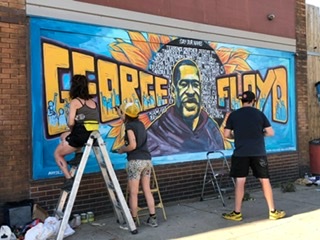
I read this horrific headline this morning.

Prosecutors in Hennepin County, Minnesota, say evidence shows Chauvin had his knee on Floyd’s neck for a total of 8 minutes and 46 seconds, including two minutes and 53 seconds of which Floyd was non-responsive.   — ABC News

99398631-7958-42F7-9F51-718EE1C289DD
Artists honor George Floyd by painting a mural in Minneapolis on Thursday, May 28, 2020. Artists began work on the mural that morning. (Photo: Jacqueline Devine/Sun-News)

Today I find myself deeply in mourning for the violence that happens in our country. I find myself trying to share in the grief of my friend and knowing I cannot fully feel the depth of it. Today I find myself unable to emotionally move away from it all. Today I contemplate George Floyd’s cry, “I can’t breathe.”

If there is any comfort at all, it comes as a gift of the artists pictured here. In an act of caring, they offer this mural at a memorial for George Floyd.

The names of other victims of violence are painted in the background. The words, “I can’t breathe!” will remain in our memories. Today we are together in mourning.

But tomorrow, I will celebrate Pentecost. I wonder how to celebrate in a time when lamentation feels more appropriate. I wonder how to celebrate when brothers and sisters have died violent deaths and when thousands of protesters line the streets of many U.S. cities. I wonder how to celebrate when protesters are obviously exposing themselves to COVID19.

Still, tomorrow — even in such a time as this — I will celebrate the breath of the Spirit. Tomorrow I will join the celebration that has something to do with being together, being one. To juxtapose the joyous celebration of Pentecost with the horrible picture of what we saw in cities throughout our country for the past few nights seems an impossible undertaking. What does one have to do with the other?

Perhaps they do share a common message. From those who protest, this message:

“We bring our broken hearts and our anger for the killing of our people, for the murders across the ages of people who are not like you. You treat us differently than you treat the people who look like you. For as long as we can remember, you have visited upon us oppression, slavery, racist violence, injustice. And we are tired. We are spent. We are beside ourselves with collective mourning. We can’t breathe!“

From those who celebrate Pentecost, this message:

18bbdca6-8ece-4df4-aa13-fe110e3298cb“How we celebrate the day when the Holy Spirit breathed upon those gathered together, with gifts of wind and fire!

How we celebrate the story told in the 2nd chapter of Acts!”

When the day of Pentecost came, they were all together in one place. Suddenly a sound like the blowing of a violent wind came from heaven and filled the whole house where they were sitting.

They saw what seemed to be tongues of fire that separated and came to rest on each of them. All of them were filled with the Holy Spirit and began to speak in other tongues as the Spirit enabled them.

Now there were staying in Jerusalem God-fearing Jews from every nation under heaven. When they heard this sound, a crowd came together in bewilderment, because each one heard their own language being spoken. Utterly amazed, they asked: “Aren’t all these who are speaking Galileans? Then how is it that each of us hears them in our native language? Parthians, Medes and Elamites; residents of Mesopotamia, Judea and Cappadocia, Pontus and Asia, Phrygia and Pamphylia, Egypt and the parts of Libya near Cyrene; visitors from Rome (both Jews and converts to Judaism); Cretans and Arabs—we hear them declaring the wonders of God in our own tongues!” Amazed and perplexed, they asked one another, “What does this mean?”

Some, however, made fun of them and said, “They have had too much wine.”

Then Peter stood up with the Eleven, raised his voice and addressed the crowd: “Fellow Jews and all of you who live in Jerusalem, let me explain this to you; listen carefully to what I say. These people are not drunk, as you suppose. It’s only nine in the morning! No, this is what was spoken by the prophet Joel:

“‘In the last days, God says,
I will pour out my Spirit on all people.

Your sons and your daughters will prophesy, last days, God says,
your young men will see visions,
your old men will dream dreams.

Even on my servants, both men and women,
I will pour out my Spirit in those days,
and they will prophesy.’”   —
Acts 2:1-18 NIV

The people did not, in fact, have too much wine. Peter made it clear that wine did not empower the people who gathered in Jerusalem —  “every people under heaven” — to speak and understand as they heard every word spoken in their own language. That would be a start, would it not, if we could speak the same language and truly understand — people who have flesh-colored skin, and brown and bronze, and red and black . . . every skin color under the sun. If only we could understand each other.

And then, what if we could gather together, welcoming every person? What if we could truly gather together and wait for Spirit to fall upon us with empowerment like we have never known before? What if we allowed the Spirit to give us breath, together?

41F5FD83-6B7A-4393-BF9E-57F0E4D51023In the end, there is a tiny bit of joy in George Floyd’s tragic story. It is a joy much deeper than reality’s sorrow. The artists completed their mural, and in the very center near the bottom, they had painted words that express the greatest truth of all.

Can you see it behind the little girl? “I can breathe now!”

What if we welcome Spirit Breath that will change us? What if we embrace empowerment from the Holy Spirit to help us change our world? What if we end oppression and injustice, together? What if holy perseverance could inspire us to live and act in solidarity with our sisters and brothers, all of them?

What if we dare to give our soul’s very breath to help bring about Beloved Community, together?

Together! Together!

May my God — and the God of every other person — make it so. Amen.