Change, Community, Faith, Family, Fear, Friends, God's Faithfulness, healing, Holy Ground, Hope, Magic, Mayo Clinic, Miracles, New Normal, Pain, Rest, Rhythm, Sacred Space, Secrets, Social justice, struggle, Suffering, Tears, Transformation, Unfaith

A Million Seconds

0A265C1F-2FB5-49A6-95D1-6CB6E1E3AB12
Transplant Day Twelve
November 23, 2019

I have just reached a milestone — a million seconds. My kidney transplant started the clock on Tuesday, November 12, 2019. Today it is a million seconds later. I will remember those million seconds as a time of fear and faith, laughter and tears, rest and painful sleeplessness. I will remember a million seconds filled with hard things, the pain of a large incision spreading halfway across my abdomen, and swallowing pills, lots of pills.

I may one day see those million seconds as hidden secrets, secrets hidden from me by pain and by my body’s struggle to regain some normalcy. I may in time look at those million seconds with glittering eyes and see them as the magic they were. But today I can just share with you what I experienced in a million seconds that began on a Tuesday — November 12th to be exact.

I will remember a million seconds of so many strange things happening to my body and the numerous assaults my body endured. I will remember a million seconds of awe in knowing that a kidney was removed from a living donor at Mayo Clinic in Rochester, Minnesota and hand carried by a doctor to me, to Mayo Clinic in Jacksonville, Florida — a  distance of 1,115 miles “as the crow flies.”

I will remember a million seconds that began when my surgeon took a picture of the kidney, brought the photo on her phone to my room to show it to me, and said, “This is a beautiful, perfect kidney for you.” She planted that kidney, tucked it carefully inside me, took a photo of the incision and about five hours later came to my room to show me a picture she took on her iPhone of a large incision, impeccably sutured.

I will not forget those million seconds of the prayers of my friends, doctors and nurses caring for me and family members hovering over me with concern and relief.

I will not forget the hymn that came to my mind in the long, sleepless nights in the hospital — a million seconds of leaning on God’s everlasting arms.

What have I to dread, what have I to fear,
Leaning on the everlasting arms?
I have blessed peace with my Lord so near,
Leaning on the everlasting arms.

Leaning, leaning,
Safe and secure from all alarms;
Leaning, leaning,
Leaning on the everlasting arms.

A million seconds have changed my life, while all the while, I was leaning on the everlasting arms. It was a million seconds of holy ground, sacred space. Yet I hardly noticed it as magic or miracle as the pain of my humanity took center stage.

Yes, I focused on suffering, physical pain, worry, concern, tears. Instead, I might have focused on the hidden secrets and witnessed the miracle of holy ground inside a hospital room. I could have had a million seconds of miracle, but instead I experienced a million seconds of the raw and real humanity of suffering. In some ways, a million seconds of transformation were lost to me as I invited unfaith into my room.

And by the way, a million seconds is 12 days.

Bravery, Challenge, Change, Courage, Emotions, Faith, Grace, grief, Loss, Music, Pain, Soul, Tears, Weeping

“I Can Do This Hard Thing!”

E32E4944-6CCD-4D2D-AE7E-712C6C8A3191
From https://contemplativemonk.com/about/

I can do this hard thing, this recovery from a kidney transplant. But sometimes I need to shed some tears about it all. Tears do not come out of weakness. In fact, tears are the mark of power. Called “the soap of the soul,” tears can help diminish the angst my soul clings to so tightly. Unfortunately, I tend to fight back tears as if they will hurt as they slip down my cheeks. I also nurse the irrational desire to not let anyone see my tears. After all, someone might consider them a sign of my weakness.

Yet, God has another thought about our tears. God counts our tears, keeps up with them, gathers them up and stores them in a bottle. I can imagine the scene of a loving God gently catching every tear and preserving it as a precious elixir worth saving.

Still I avoid weeping at all costs, portraying a false, less-than-honest strength — especially if someone might see.

Today, I am so aware that if I could just cry, the hard time I am going through would feel easier. If I could cry, my tears would cleanse my heart and help minimize my physical, emotional and spiritual pain. If I could just let my tears fall, I would be reclaiming my power.

The truth is that I did not fully understand how hard it would be to endure a kidney transplant and the very, very difficult aftercare regimen. Nor could I have ever imagined the range of emotions I would experience. This is one of life’s hard things.

Last night though, a dear friend sent me a video of a song she chose just for me, just for this moment of my life. I had never heard the song before, but it was exactly what I needed to hear. A mesmerizing tune and simple lyrics written and performed by Carrie Newcomer, “You Can Do This Hard Thing” brought me to tears, tears that really needed to flow.

You can do this hard thing.
It’s not easy I know,
But I believe that its so.
You can do this hard thing.

My faith tells me that I really can do this hard thing, although most of the time I don’t feel that I can. The friends and family who surround me with love remind me that I can. My heart tells me I can do this, but my rational mind tries to convince me that I cannot. I am reminded by the hymn writer that grace for this hard thing comes from God . . .

God giveth more grace when the burdens grow greater;
He sendeth more strength when the labors increase;
To added afflictions He addeth His mercy,
To multiplied trials, His multiplied peace.

When we have exhausted our store of endurance,
When our strength has failed ere the day is half done,
When we reach the end of our hoarded resources
Our Father’s full giving is only begun.

So perhaps it does require our tears, our lament that humbles us before our God of grace. The writer of the Book of James seems to suggest that grieving and weeping brings God near and that our mourning actually strengthens us to live through hard things.

God gives all the more grace . . .
Submit yourselves therefore to God . . .
Draw near to God, and he will draw near to you . . .
Lament and mourn and weep.
Let your laughter be turned into mourning and your joy into dejection.

— From James 4 (NRSV)

It doesn’t make much sense that mourning is a good thing, that flowing tears actually cleanse the soul. But I need to see things this way: Life brings changes — hard changes sometimes. Along with the miracle of my kidney transplant comes the end of one season of life and the advent of a new season of life. While I do celebrate the transplant and the ways it will be life-giving for me, I must also grieve the loss of my previous life that had become so comfortable, so easy.

I will call out to my buried tears. I will open up my heart’s pain, grieve my losses and let my tears fall freely down my cheeks. It seems to be the best way to make sure I can do this hard thing.

Change, Christianity, Knowing, Love, Relationship, Transformation

A Deep Unknowing

7FCC4253-B8C4-4A52-8798-8BADAEFA0519
Arkansas’ White River. Photo by Darla Young.
“The fog was rising from the White River at Bull Shoals. I decided to walk a nearby trail. The sun was showing it’s appearance thru the foggy forest of lightly autumn painted leaves. I looked to the left and this was my sight.. I’ll just leave it at that..  It was beautiful!!” 
— Darla Young

When the fog descends in a forest, the path ahead looks very unknown. Even if you know the forest path well, suddenly it’s unknowable. The stunning photo by Darla Young reminds me of a phrase I heard last week: “a deep unknowing.” I’m not sure what a derp unknowing is yet, but it seems to me to describe an inner state of being that actually frees you from indecision. With a deep unknowing, you move from your inner core into the “right” places. But let’s get away from deep unknowing for a minute.

A good friend gave me a wonderful birthday gift — a journal with a lovely decorative cover that says, “She believed she was loved, so it made her brave.” Knowing that you’re loved may well be the most important thing you’ll ever know. The kind of love we need knows no boundaries and loves us exactly as we are, unconditionally. That kind of love is not easy to find. There are no guarantees that we will enjoy the emotional benefits of unconditional love. But we can be watchful for it, patiently seeking it and knowing how and when to reject love that is not genuine.

An important way of living into love is to be contemplative enough to know who we are, to embrace our true self. No masks. No disguises. No attempts to please another person and, as a result, realize that we’re not being true to ourselves. Richard Rohr recently wrote about what he calls, “the True Self in God.” 

You are not your gender, your nationality, your ethnicity, your skin color, or your social class. These are not qualities of the True Self in God. Why, oh why, do Christians allow temporary costumes, or what Thomas Merton called the “false self,” to pass for the substantial self, which is always “hidden with Christ in God”

So when we embrace our true selves that are “hidden with Christ in God” we find that we live and breathe in a different way. We find ourselves suddenly loving ourselves, and loving others as we love ourselves. What a novel idea! It’s a timeless idea that is as ancient as the Christ who taught us about love long ago. It is a state of being that places us squarely in God’s law of love. In some ways, we are transformed as something deep inside gives itself over to pure love, for self and others. Cynthia Bourgeault explains the law of love that compels us through “a deep unknowing.” This is how she says it:

As a Christian, when confronted by a tension between a religious certainty which leads me to violate the law of love and a deep unknowing that still moves in the direction of “loving my neighbor as myself,” I am bound to choose the latter course.  — Cynthia Bourgeault

I am pondering the idea of “a deep unknowing that still moves in the direction of ‘loving my neighbor as myself.’” I think it must require engaging in frequent contemplation and spiritual discipline to discover within myself a deep unknowing that prompts me to follow Christ’s example . . . as opposed to a decision of my will that eventually wins out to achieve the same result.

Perhaps the spiritual discipline I undertake can identify all of the indecision, confusion, stubbornness, refusal of love toward others, and cover it with that deep unknowing that still leads me in the direction of eventually knowing my true self within the perfect will of God.

May God make it so.

F9FA5D3C-53F0-4043-8A72-F9E2D63F7349

On another note, please pray for me as I look toward my kidney transplant on November 15th. I am grateful that you are walking with me on this journey that often felt so frightening. Your thoughts and prayers mean so much. If you would like to read the story of my illness, please visit the Georgia Transplant Foundation’s website at this link:

http://client.gatransplant.org/goto/KathyMFindley

“Go Fund Me” page is set up for contribution to help with the enormous costs related to the transplant, including medications, housing costs for the month we have to stay near the transplant center, and other unforeseeable costs for my care following the transplant. If you can, please be a part of my transplant journey by making a contribution at this link:

https://bit.ly/33KXZOj


Change, Emotions, Friends, Gratitude, journey, Kidney Transplant, Mayo Clinic, peace, Prayer, Serenity

Numb!

CDB6753B-4835-42F3-B27C-45192AB4B808
Numb! It’s not a very emotive feeling like other emotions. It seems so much more appropriate to feel ecstatic, elated, overjoyed — or even terrified — at receiving the call from Mayo Clinic saying a kidney is available and the transplant is scheduled for November 15th. But numb is all I can get to right now. After all, this is a very tangible way of announcing an end to five years of illness, uncertainty and dialysis. Five years does not seem like such a long time, but it feels in some ways like a lifetime.

So in the immortal words of Pink Floyd, “I have become comfortably numb.” It’s not such a bad way to feel. The journey has been a long one, an emotional one, and now I think it’s time for calm. Numb is actually pretty darn calm, and after traveling this wild and fantastic journey, numb is okay. There’s something about numb that feels like serenity.

So many people have walked alongside me on this journey and, at times, carried me when I could barely take the next step. No one — and I really mean no one — could have been as dedicated and loving a caregiver as Fred. He is forever faithful as he has always been. 

And oh, my friends, my friends nearby and far away from many lives past to this very day! Thinking of them just now and knowing how faithfully and deeply they have prayed for me brings tears to my eyes. I am grateful for extended family who cared for me and Fred enough to urge us to Georgia. They have supported us in so many ways.

No person could have had a more dedicated and caring staff of dialysis professionals as I have had. They have missed nothing, not a change in a blood test, not the signs of an infection, nothing! And they are the ones who have kept me healthy enough to get to today.

My friend who is donating a kidney on my behalf is living a life of selflessness, giving a very precious gift of immeasurable value. I think of him today with such unfettered gratitude.

God’s grace and protection have been near, so near at times that I felt a palpable sense of the holy — within me, surrounding me, above me and below me, behind and before me guiding me on the unknown path.

As I said at the very beginning, I am numb, and although numb is acceptable and appropriate right now, numb is not such a good crucible for words. So I have no more words right now. Except this good word:

I thank my God every time I remember you, constantly praying with joy in every one of my prayers for all of you . . .

— Philippians 1:3-4 (NRSV)


For all that has been — Thanks.        
For all that shall be —Yes!

― Dag Hammarskjöld

Change, Grace, Memories, Pricks, Rebirth, Spiritual growth, St. Francis, Transformation

Pricked

4D3FD02C-69DE-4486-8517-EC0C85346DBB
In years past I remember hearing, in sermon and scripture, a rather provocative phrase that always got my attention. As a child, I was mesmerized whenever someone would speak about “the heart being pricked” and I was pretty sure I did not want any heart pricking to happen to me.

Grabbing hold of a prickly stem always results in immediately letting it go and coming up with another plan. God may well be using the pricks of uncomfortable instances in our lives to change our direction. He did this in Paul’s life, as the unsaved, but religious, man traveled on the Damascus road:

And he said, Who are you, Lord? And the Lord said, I am Jesus whom you persecute: it is hard for you to kick against the pricks.

— Acts 9:5 (paraphrased)

We also read in Acts about being pricked in the heart happening when the Holy Spirit was poured out from heaven. Just as Jesus had promised His disciples, the Holy Spirit came in a mighty way on Pentecost Sunday, and Acts 2 tells us that many wondrous things happened that day. One of the great wonders of that day is described like this:

Therefore let all the house of Israel know assuredly, that God has made that same Jesus, whom you crucified, both Lord and Christ. Now when they heard this, they were pricked in their hearts, and said to Peter and to the rest of the apostles, Brothers, what shall we do?”

— Acts 2:36-37 (paraphrased)

And in Psalm 73:

When my soul was embittered,
    when I was pricked in heart,
I was brutish and ignorant.

—Psalm 73:21-22 (ESV)

There you have it: two examples of the disconcerting messages I heard about heart and soul pricking. Obviously, I had no idea what it all meant, so I was safe and content in my ignorance. I did not intend to put myself anywhere near a heart-pricking situation. So all was well in my spiritual world.

Until I got a few years on me, and a few pricking life experiences.

“Putting away childish things” as the years passed resulted in maturity in my understanding and in my spirituality. I would know many times over the pricking of the heart, even the pricking of my soul. It was never comfortable, never welcomed, but it was a necessary part of living.

Hard times, sickness, failures, broken relationships, aggravating situations, disasters, loss of many kinds: all pricking events that change one’s life, turn a life around really. I experienced most all of them, and in those experiences, I learned what comes after the pricking.

I was reminded this morning of the life of St. Francis as told by the Dominican friar, Augustine Thompson from Richard Rohr’s daily meditation. He writes this:

[His] encounter with lepers would always be for Francis the core of his religious conversion. . . . Wherever the leprosarium was, Francis lodged there with the residents and earned his keep caring for them. . . . It was a dramatic personal reorientation that brought forth spiritual fruit. As Francis showed mercy to these outcasts, he came to experience God’s own gift of mercy to himself. As he cleaned the lepers’ bodies, dressed their wounds, and treated them as human beings, not as refuse to be fled from in horror, his perceptions changed. What before was ugly and repulsive now caused him delight and joy, not only spiritually, but also viscerally and physically.

Francis’s aesthetic sense, so central to his personality, had been transformed, even inverted. [He] sensed himself, by God’s grace and no power of his own, remade into a different man. Just as suddenly, the sins which had been tormenting him seemed to melt away, and Francis experienced a kind of spiritual rebirth and healing. Not long after this encounter, later accounts tell us, perhaps in allegory, that Francis was walking down a road and met one of these same lepers. He embraced the man in his arms and kissed him. Francis’s spiritual nightmare was over; he had found peace.

In the pricks we experience, we may well find peace. We may experience inner healing, a spiritual rebirth, a transformation of life. In any event, we will become immersed in a transformative dance through which we find ourselves being made new. God invites us to such a dance, many times through pricks of the heart and soul, but always covered in the grace of forgiveness and restoration.

When my soul was embittered,
when I was pricked in heart,
I was brutish and ignorant.

—Psalm 73:21-22 (ESV)

Let’s not stop there. Let’s read the next part of the Psalm, which does not end with the heart being pricked. Instead it ends like this:

Nevertheless, I am continually with you;
you hold my right hand.
You guide me with your counsel,
and afterward you will receive me to glory.
Whom have I in heaven but you?
And there is nothing on earth that I desire besides you.
My flesh and my heart may fail,
but God is the strength of my heart and my portion forever.

—Psalm 73:23-26 (ESV)

Thanks be to God for the pricks and afterwards, the transformation. Amen. 

*******************************************************

On another note, please pray for me as I await a life-saving kidney transplant. I am grateful that you are walking with me on this journey that often feels so frightening. Your thoughts and prayers mean so much. If you would like to read the story of my illness, please visit the Georgia Transplant Foundation’s website at this link:

http://client.gatransplant.org/goto/KathyMFindley

A “Go Fund Me” page is set up for contributions to help with the enormous costs related to the transplant, including medications, housing costs for the month we have to stay near the transplant center, and other unforeseeable costs for my care following the transplant. If you can, please be a part of my transplant journey by making a contribution at this link:

https://bit.ly/33KXZOj


Change, God's presence, Holy Spirit, Inspiration, Pentecost, Quiet, Rebirth, Repair the world, Sacred Space, Silence, wind

Who Has Seen the Wind?

5D279BA7-5431-4872-93DC-BDF5BFA11178

. . . And the wind? Ah, who has seen the wind go by? Neither you nor I. But when we see the trees bow down their heads, we know the wind is passing by. That is the way the Holy Spirit works: silently and effectively. *

There was never a more needful time for the fresh winds of the Holy Spirit. We inhabit a world divided . . . nations divided by tenuous agreements; white people divided from brothers and sisters black and brown; people of faith divided by differing traditions; immigrants divided from those who claim to “own” this nation; citizens divided from their president; politicians divided by ideology, greed and self-interest. There are so many examples of division. And whether we will admit it or not, division diminishes us.

The divisions among us — the ones we personally experience and the ones we observe — create an unsettled environment around us and an unsettled spirit within us. The acrimony, the hate and the disrespect we witness all around creates an unrest in us. Perhaps, from the weariness of the constant hostility we see, our heart becomes hardened. Perhaps we are closed off from the Spirit Wind that fills us and creates in us rebirth, fresh and new.

We can never think of wind without recalling the day of Pentecost. The disciples of Jesus and other followers were gathered together when a rushing, mighty wind filled the entire house, and all of them were filled with the Holy Spirit. (Acts 2:1-4) That day was the beginning, and from that day when Spirit Wind came, the holy promise came into view: that God would pour out the Spirit on all people, that sons and daughters would prophesy, that some would have visions and others dreams.

We need it again, the Spirit Wind. We need it to fill us with courage for the living of these days. We need it to fill us with love that can change the world. We need it for the will to save our planet from devastating climate change. We need it to responsibly open our borders, to become again a nation of welcome, to reach out our hands to sojourners searching for safe refuge, to rescue children from the unwelcoming places where they are detained and kept from their parents. We need it to repair the world in all the ways possible to us, to repair its brokenness.

To become God’s people in a broken world, we need the wind of the Spirit. Now.

But how does Spirit Wind come in these days? I have heard of no “Pentecostal” experiences of rushing mighty wind. I have heard of no one who has seen a sudden whirlwind. (1 Kings 19:11)  I do not know of a person who saw the winds cease at the command, “Peace. Be still.” (Mark 4:39)

So how does the Spirit Wind come? I can share only what I know from my own experience, and that is this: when I am very still and very present with God, the Spirit comes quietly, gently — but surely. I do not see her. I do not hear her come with any sound of rushing wind. I cannot touch her. Yet I feel her, covering me, filling me, empowering me. I go away with that sense of being reborn and renewed, like I might be “born from above.”

2CE74B96-9488-4F0B-81B2-69824F5EAEC8
Art by Charlotte Nickel, “Mighty Rushing Wind,” acrylic on canvas.

You know well enough how the wind blows this way and that. You hear it rustling through the trees, but you have no idea where it comes from or where it’s headed next. That’s the way it is with everyone ‘born from above’ by the wind of God, the Spirit of God.

— John 3:8 (The Message Bible)


*From the Carmelite Bulletin, Carmel of Saint Teresa of Jesus, Little Rock, Arkansas, “Who Has Seen the Wind?” Christina Rossetti – 1830-1894


*******************************************************

On another note . . .

Please pray for me as I await a life-saving kidney transplant. I am grateful that you are walking with me on this journey that often feels so frightening. Your thoughts and prayers mean so much. If you would like to read the story of my illness, please visit the Georgia Transplant Foundation’s website at this link:

http://client.gatransplant.org/goto/KathyMFindley

A “Go Fund Me” page is set up for contributions to help with the enormous costs related to the transplant, including medications, housing costs for the month we have to stay near the transplant center, and other unforeseeable costs for my care following the transplant. If you can, please be a part of my transplant journey by making a contribution at this link:

https://bit.ly/33KXZOj


Beauty of Nature, Birdsong, Change, Comfort, Inspiration, Introspection, Nature, peace, Prayer, Rebirth, Reflection, simple joys, Trees, Unfaith

Stay Awhile!

E0A3E9A4-310C-4286-8DD1-F07DCB104F2C

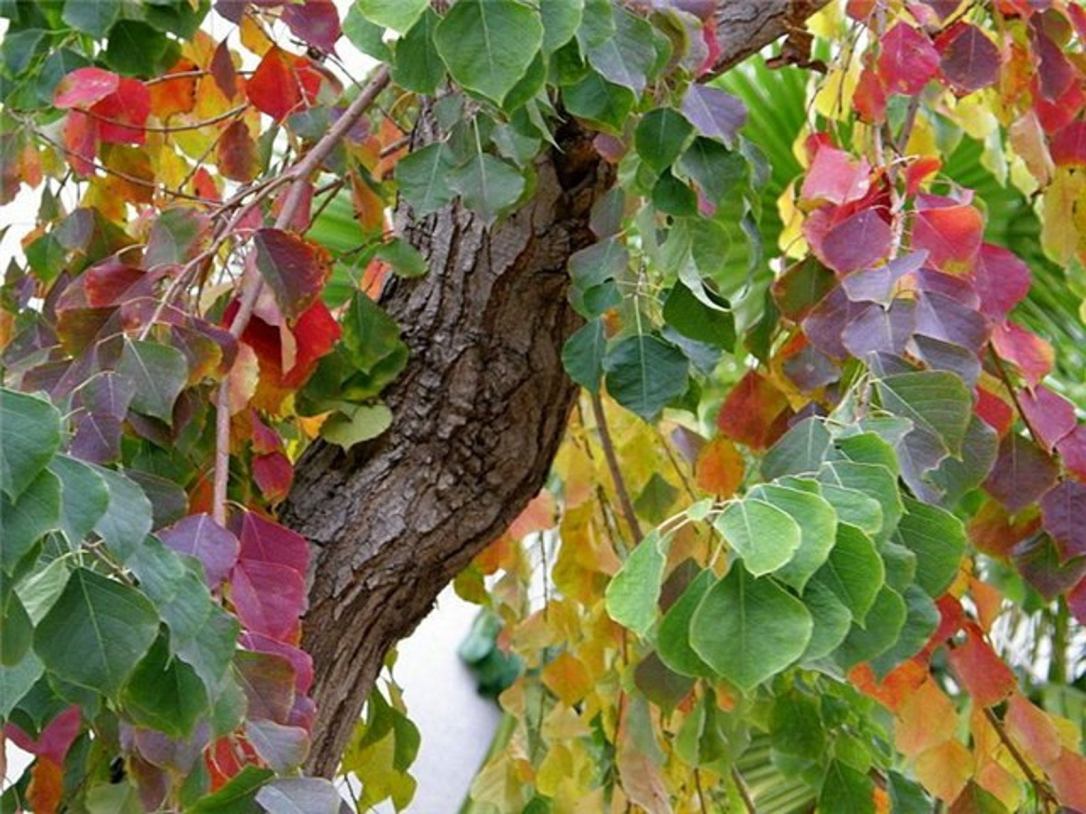
I am a lover of trees — all trees. I religiously follow the life cycle of the only tree in my yard. It’s a Chinese Tallow tree and every botanist calls it a nuisance tree, an invasive species that should be controlled. I find the tree fascinating, even mesmerizing, as it changes.

57891E38-0267-4B76-8B1C-7F0BCEEE1412

Not only do the heart-shaped, bright green leaves turn yellow, orange, purple and red in autumn, but the tree produces seeds that start out green, turn brown-black and then white. The changing colors call my attention to my constant life changes and, in a way, bring the comfort of knowing that we really do survive life changes.

87E8B050-CC6B-4AC6-B717-AE5D7FEB5E8A


The tree captures my spirit every year as autumn approaches. In a way, I meditate on my tallow tree. I watch its changes. I feel the raindrops of its sticky sap that drips on me when I’m under it. I listen to the birdsong that echoes among its boughs. I even hear my tree whisper to me sometimes when the breeze blows through it in just the right way. The tree can call me to introspection. It can inspire me on days when inspiration is beyond my grasp and unfaith threatens. On those days, the inspiration that stirs in me is peace. It is prayer.

I have to admit, though, that I walk past my tree dozens of times a day without notice, taking its shade for granted and completely unaware of its enchanting beauty. Therein lies the human dilemma of dispassionate inattention, our failure to notice or to take in nature’s extravagance. It is when a tree is just a tree. It is when we miss the spiritual experience that creation offers us as gift. 

B5263037-5BBB-4505-AF52-1DC541DB2290There is no better expression I could share than Mary Oliver’s poem, When I Am Among Trees.

When I am among the trees, 
especially the willows and the honey locust,
equally the beech, the oaks, and the pines, 
they give off such hints of gladness.

I would almost say that they save me, and daily.

I am so distant from the hope of myself,
in which I have goodness, and discernment, 
and never hurry through the world 
but walk slowly, and bow often. 

Around me the trees stir in their leaves
and call out, “Stay awhile.”

The light flows from their branches.

And they call again, “It’s simple,”
they say, “and you, too, have come
into the world to do this, to go easy,
to be filled with light, and to shine.”

1EBD15F8-1BF9-468E-9543-51C89F27DCCAOh, to claim our place in the world, to go easy, to embody the message of the trees: “It’s simple!” And then to remember that the changing seed pod, as its life cycle moves around, is really a portrait of rebirth.

On my way to the car dozens of times a week, might I take notice as I pass my tree, never hurrying, walking slowly and bowing often. Might I see more and hear more and feel more, recalling Mary Oliver’s words:

Around me the trees stir in their leaves
and call out, “Stay awhile.”


******************************

On another note, please pray for me as I await a life-saving kidney transplant. I am grateful that you are walking with me on this journey that often feels so frightening. Your thoughts and prayers mean so much. If you would like to read the story of my illness, please visit the Georgia Transplant Foundation’s website at this link:

http://client.gatransplant.org/goto/KathyMFindley

A “Go Fund Me” page is set up for contributions to help with the enormous costs related to the transplant, including medications, housing costs for the month we have to stay near the transplant center, and other unforeseeable costs for my care following the transplant. If you can, please be a part of my transplant journey by making a contribution at this link:

https://bit.ly/33KXZOj


Beauty of Nature, Change, Defiance, Determination, Faith, Grace, Hope, life, Life’s murk, Lotus, Perseverance, Rebirth, Resurrection, Transformation

Rebirth

47A0C7FC-3DCC-4CC5-AF55-D993D1032FDC

I love the simple beauty of a lotus blossom. Since the lotus is often associated with yoga (a practice I avoid with every fiber of my being), I have never really considered the lotus and its intriguing life cycle. But lately I have been curious about the story of the lotus, which has long been considered one of the most sacred flowers. I wondered what it is about this mysterious bloom makes it so enrapturing and symbolic to so many people and cultures.

I think the answer is that the life cycle of the lotus is unlike any other flower. With its roots buried in mud, the lotus submerges every night into murky river water and miraculously re-blooms the next morning without any muddy residue on its petals.

The general consensus among ancient texts that the lotus symbolizes spiritual enlightenment and rebirth. Over centuries and across cultures, the lotus stunned people with its ability to dip into the grime and revive itself unscathed—an incredible daily cycle of life, death, and a sudden immaculate rebirth that can only be described as spiritual. In fact, the lotus flower blooms most beautifully from the deepest and thickest mud.

The lotus flower’s daily resurrection is certainly interesting and symbolic of revival, transformation and new life. But even more interesting is the flower’s stubborn will to live. A lotus seed can withstand thousands of years without water, able to germinate over two centuries later.

The lotus also blooms in the most unlikely of places such as the mud of murky river water in Australia or Southern Asia. Not only does it find sanctuary in the muck, but due to the waxy protection layer on its petals, its beauty is unaffected when it re-blooms each morning. It continues to resurrect itself, coming back just as beautiful as it was last seen. With such refusal to accept defeat, it’s almost impossible not to associate the lotus flower with unwavering faith, more specifically the faith within ourselves. 

My serendipitous lotus research did what my research often does: It prompted me to re-examine my faith. I can readily identify times when I had to wade through the murky, muddy waters that life sometimes brings. And although it seemed impossible to re-emerge from the mud clean and renewed, I did, every time, because of a God who understands both the murk and the rebirth.

It’s all about faith, after all is said and done. Once again God’s creation gives us a stunning example of experiencing thick, murky, dark life experiences; going under into the thickest mud when you no longer have the strength to stay above water; and miraculously emerging again — clean, new, reborn. We can learn a valuable lesson about determination, defiance and perseverance from the determined, defiant lotus seed that can survive over centuries. It hints to me about God’s “long game” for my life that simply shouts “hope” not just in my present circumstance, but in a future I can not begin to envision. God envisions it, though — a year from now, two years, my future, the years God has already numbered for me and the mystery we name “eternity.”

Thanks be to God for my eternity and for a faith that is reborn again and again and again by grace.


*********************

On another note, please pray for me as I await a life-saving kidney transplant. I am grateful that you are walking with me on this journey that often feels so frightening. Your thoughts and prayers mean so much. If you would like to read the story of my illness, visit the Georgia Transplant Foundation’s website at this link:

http://client.gatransplant.org/goto/KathyMFindley

A “Go Fund Me” page is set up for contributions to help with the enormous costs related to the transplant, including medications, housing costs near the transplant center, and other unforeseeable costs for my care following the transplant. If you can, please make a contribution at this link:

https://bit.ly/33KXZOj

Change, Family, Friendship, life, Patience, struggle, Surprise, Waiting

Waiting

4C2E439F-D260-4410-8330-259452828A93

Most people don’t really like waiting. Being stopped at one of those very long red lights can be frustrating. Waiting your turn in the grocery line is trying on the more impatient among us. Waiting for a wisp of autumn in the south — when it’s 100 degrees in late September — is particularly exasperating. But these are trivial waiting experiences.

There are persons who are waiting today for a diagnosis from their doctor. Students wait for results from important tests, hoping to at least get a passing grade. Others wait at the bedside of an elderly parent, hoping for and dreading that last breath. These are serious seasons of waiting, life-changing experiences of waiting.

There is at least one more example of waiting — the one I’m experiencing today. My waiting is an exciting, joyful waiting for the car full of my grandchildren to pull up in our driveway. I seldom get to see them, or my son, since they live 11 hours away in Little Rock, Arkansas. So this is a special waiting time. Today I’m waiting expectantly, joyfully, gleefully for my family. It’s the best kind of waiting.

These days whenever I ponder what it means to wait, my thoughts go immediately to my five years of waiting for a life-altering kidney transplant. In these years, my teacher has been faith and my lesson has been patience. I have managed to develop an abundance of patience that has served me in every area of my life.

Patience has not always been one of my strongest character traits, though. I used to have very little patience, and that reality led me to some very raucous encounters with other people. As a victim advocate, I was very trying on judges — to my detriment. As a hospital chaplain, I was insistent when a patient’s medication was delayed. I could cite many examples of my impatience causing upheaval.

Which leads me to my memories of Ethel. I will never forget Ethel — my parishioner, my friend, my sister, my mother — the one person who was loyal to me and protective of me to a fault. To Ethel, it seemed I could do no wrong. She was wrong about that, of course.

Ethel was with me during the difficult time when my church refused my request for ordination. For six months they refused in every way that could hurt me. Ethel was in my corner through every pain-filled business meeting, including the final one that sealed the church’s decision to decline the opportunity to ordain the first Baptist woman in Arkansas.

I was impatiently devastated and saw no way toward ordination or toward the continuation of my ministry as a chaplain. I was “surrounded by a cloud of witnesses” that had seen what I had endured from my church. They lifted me up with their prayers and their constant encouragement. Ethel, however, did more than pray for and encourage me. In the midst of holding my pain with me, Ethel brought up the important fact that I needed to learn patience. Ethel loved me enough to be honest, and so with Bible in hand, she gave me this gift:

For the vision is yet for the appointed time;
It hastens toward the goal and it will not fail.
Though it tarries, wait for it;
For it will certainly come, it will not delay.   
(Habakkuk 2:3 NASB)

Wait for it, Ethel insisted, with a faith that knew exactly how to insist.

Wait for it!

She was right, as always.

So that is my personal experience of learning how to wait. It was a life lesson I needed to learn. And I did learn it (sort of). In the end, I did not become the first Baptist woman ordained in Arkansas, but I did become the first woman in Arkansas to serve as the pastor of a Baptist church. What a surprise from a constantly surprising God who did not intend for me to be a hospital chaplain, but instead led me into a nine-year ministry of being a pastor.

Today, though, I am just waiting for my beautiful grandchildren.

That’s the best surprise of all!


*************************************************

On another note, please pray for me as I wait for my kidney transplant. I am grateful that you are walking with me on this journey that often feels frightening. Your thoughts and prayers mean so much. If you would like to read the story of my journey at the Georgia Transplant Foundation’s website, please visit this link:

http://client.gatransplant.org/goto/KathyMFindley

A “Go Fund Me” page is set up for contributions to help with the enormous costs related to the transplant, including medications, housing costs near the transplant center, and other unforeseeable costs for my care following the transplant. If you can, please make a contribution at this link:

https://bit.ly/33KXZOj


Awakening, Call, Calling, Change, Discovering, journey, Kidney Transplant, life, Life pathways, Perseverance, Preaching, Rebirth, Self Awareness, Spiritual growth, Spirituality or Religion?, Transformation, Wholeness

“Me!”

D661FB1C-FE24-4C0D-9614-F12695893AEA

When I was younger, my primary life goal was to make people like me. It was something of an obsession, and it caused great harm to my spirit. For you see, I thought I had to be everyone else’s image of me. So “me” became changeable and malleable in the hands of a variety of other people. In my mind, they just had to like me.

The conundrum of life: how to accept that not everyone will like me. Maybe even most people won’t like me. So here’s the sad, but inevitable result: “me” became someone I didn’t even know. I lost myself in the impossible quest to be accepted and liked.

Then came the metamorphosis. It happened around age 47. I think what started it may have been reading the book by Sue Monk Kidd, The Dance of the Dissident Daughter.

My sisters in cyberspace, you should read that book. The thing that nearly frightened me enough to make me put the book away is the descriptor after the main title. So here’s the title of the book, in all of its feminist fullness: The Dance of the Dissident Daughter: A Woman’s Journey from Christian Tradition to the Sacred Feminine.

Well, when I read part of the book’s description — the “journey from the Christian tradition” part — it scared me to death! I had no intention at all to journey away from my Christian tradition.

I read the book anyway, and it changed my life and launched me into a journey I could never have envisioned. Sue Monk Kidd led me on an incredible, circuitous journey through fear, anger, healing, and eventually, awakening and transformation. Of course, I could never see myself turning away from my deep connection to what Kidd described as “the deep song of Christianity,” But I did discard the voices that kept me in my place, and kept me quiet, for so many years of my life.

When those discouraging, disparaging voices were silenced, I heard my own voice, finally. With clarity, my voice declared “me,” exactly the woman I was meant to be, precisely the woman God was calling to ministry. By embracing my full humanity and my spirituality — that looked very different than my religiosity had looked — I found myself.

“Me” was awakened, out in the open, in the middle of God’s world and smack dab in the center of God’s will. Oh my! Now no one would like me! When my words spoke Gospel truth, people didn’t like me. When I tenaciously followed God’s call to ordination, people didn’t like me. When I dared to preach (from a real pulpit) lots of people didn’t like me. When I worked as an advocate for women and children harmed by violence … well, no one at all liked me then because I refused to back down.

I like this quote from Denzel Washington:

“Some people will never like you because your spirit irritates their demons.”

There it is! The real, unadulterated truth! So as my spirit continued to irritate everyone’s demons, I was finally living my life as “me!” And that, my sisters, was a good place to be.

I hope you are in your own “good place.”

—————————————————————————

On another note, please pray for me as I await a life-saving kidney transplant. I am grateful that you are walking with me on this journey that often feels frightening. Your thoughts and prayers mean so much. If you would like to read the story of my illness at the Georgia Transplant Foundation’s website, please visit this link:

http://client.gatransplant.org/goto/KathyMFindley

A Go Fund Me page is set up for contributions to help with the enormous costs related to the transplant, including medications, housing costs near the transplant center, and other unforeseeable costs for my care following the transplant. If you can, please make a contribution at this link: 

https://bit.ly/33KXZOj

Activism, Change, Christian Witness, Church, Community activism, Gun violence, Hate, Injustice, Mexican border, Mourning, peace, Perseverance, Politics, Prophetic, Racism, Repair the world, Social justice, The Christian Church, Violence

Taking Back Our World

5378F42A-B263-40F4-A454-D497E07BF325

Let’s take back our world! Let us join hands and, in the power of community and holy resolve, reclaim our world from white supremacists, racists and violent actors that threaten our people.

If not us, who? If not now, when?

After the 2012 shooting at Sandy Hook Elementary School in Connecticut that killed 20 young children, British journalist Dan Hodges wrote that the gun control debate in the U.S. was over. This is what he wrote: “Once America decided killing children was bearable, it was over.”

And then we let 2,193 shootings happen. 

The shootings that occurred this week offend us in a very deep place. You see, we are followers of Christ, the Prince of Peace. We are the people of God who know that thoughts and prayers and compassionate sentiments won’t end this kind of terroristic hate.  

The El Paso shooter told law enforcement that he wanted to shoot as many Mexicans as possible. His manifesto, which he posted on the 8chan online community  included details about himself, his weapons and his motivation. He described the El Paso attack as a “response to the Hispanic invasion of Texas,” and proclaimed that he was defending his country from “cultural and ethnic replacement brought on by an invasion.”

Most certainly, these words from an obvious white supremacist should offend every follower of God. His evil intent is also an offense to God. In response to such evil, perhaps we will raise our voices continually and persistently, without becoming weary. Perhaps we will resolve to take back our world, proclaiming God’s word in the darkness of evil just as the prophets did. Like them, perhaps we will persist tirelessly and with a holy resolve, for as long as it takes to end the evil that arises from racism and white supremacy. 

Perhaps our prophetic action will mirror that of the writer of Lamentations who wrote, “Arise, cry out in the night, as the watches of the night begin; pour out your heart like water in the presence of the Lord. Lift up your hands to him for the lives of your children.”

May God so embolden us.

Change, God's Faithfulness, Gratitude, Hope, Illness, Joy, Kidney Transplant, Spirit wind

What If?

3F8E988B-E9A5-4886-A622-18BD1D033438

Sometimes blogs express grief or anger, indignation or angst, fear or struggle. But today, this blog, must express joy, relief, hope and gratitude. If you saw my last post about my week-long medical evaluation at Mayo Clinic in Jacksonville, Florida, you know that my hope was that I would be approved for a kidney transplant.

Today, I received the phone call from Mayo letting me know that I am now on the transplant list and ready for a kidney. It was a phone call that rekindled my hope. It brought instant joy and a sense of relief. And then there’s gratitude, that the God who holds the universe holds me, too. 

Through the fear and struggle of 2014, through these five years of daily dialysis, God has held me in arms of love and care. I do not know if fear and struggle are over. Transplant surgery is an ominous thought at times. Strong, immunosuppressant medication for life is an ominous thought at times. My body rejecting the kidney is an ominous thought. There are dozens of “what ifs!” But I try to always look at “what ifs” through this empowering lens:

There is freedom waiting for you,
On the breezes of the sky,

And you ask 
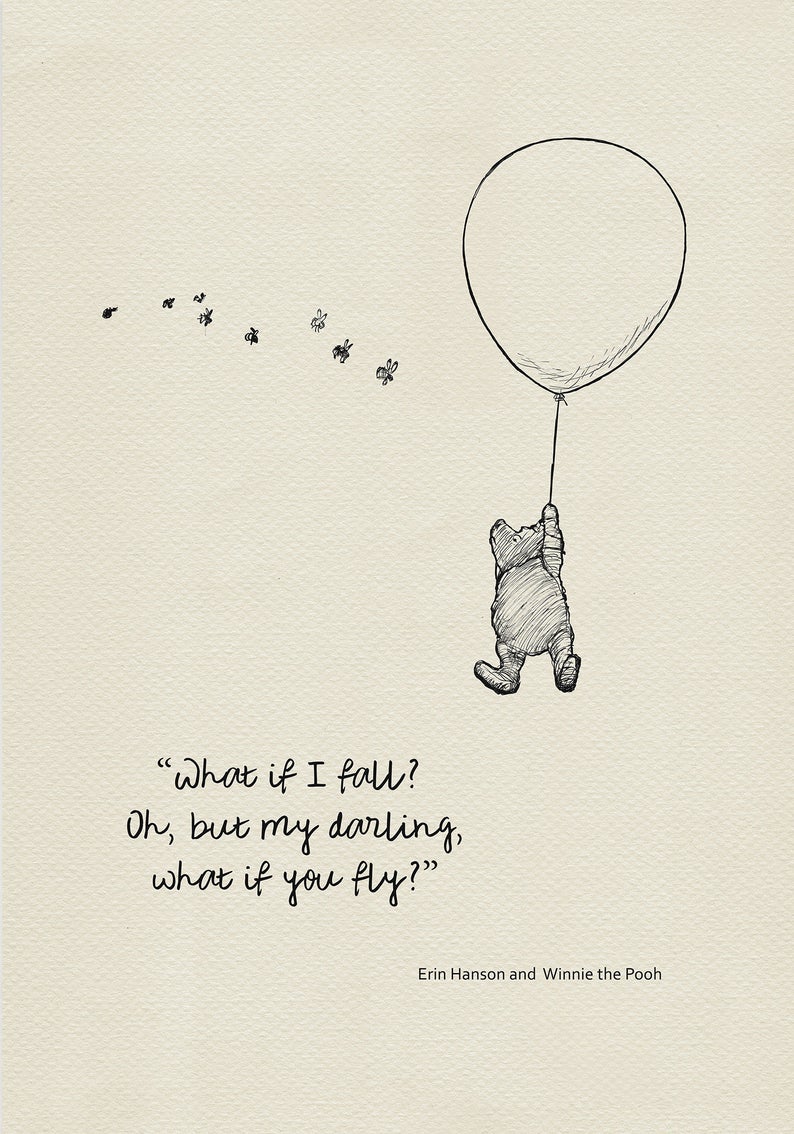
“What if I fall?”
Oh, but my darling,
What if you fly?

― Erin Hanson

What if I fly? What if I take the “wings of the morning?” What if I soar? What if the Spirit Wind blows across my life?

What if?


Change, Comfort Zone, Dreams, Fear, Growth, Learning, Uncategorized

Becoming Our Better Selves

295B6520-B0A5-4F94-A0E7-9462C854C39B

I don’t usually write about charts in my blog. I’m not really a chart person at all. But my friend, Kim Rosby, recently sent me a chart that is worth contemplating. The chart is a snapshot of what it might look like when we become our better selves. It’s entitled “The Comfort Zone,” which is a place most of us want to be. 

That’s the problem. There is no growth and maturing in the comfort zone. It can become for us, not just comfortable, but also stagnant.

So I spent some time contemplating this provocative chart, and it definitely provoked some emotions in me. It appears that there are four zones that are possible for us:

  • The Comfort Zone
  • The Fear Zone
  • The Learning Zone
  • The Growth Zone

There you have it! So let’s unpack this chart a bit. When/if we manage to move ourselves out of the comfort zone, a place where we feel safe and in control, we will most likely enter the fear zone. In the fear zone, we are not at all sure of ourselves. We hang on the opinions of other people and use anything we can find as an excuse to remain frozen in place. If we don’t make a move, we can’t make a mistake. Right? We come to a point, though, where we do not believe we can move. We don’t believe we can change. We don’t believe we can seek another way.

Fortunately, some of us do make it out of the fear zone and thus find ourselves in the learning zone. What a renewing place to be, a place where new and fresh ideas are possible. It is in this zone that we realize we have moved at least a few steps past our comfort zone. We learn new skills and we discover that we can navigate challenges and solve problems. As long as we are learning, our path is clear and a future is possible.

So we move with courage into the growth zone, where we will re-invent ourselves in positive and exhilarating ways. As we conquer the objectives that were holding us back, we begin to believe in the possibility of new life goals, a deeper purpose. And then suddenly, we surprise ourselves with dreams and aspirations for something more in our lives, something fresh that inspires us to be our better selves.

I like my friend’s chart. I also like this promise that also says something very compelling about becoming our better selves:

 . . . I came that they might have life, and have it more abundantly.
—Jesus


Challenge, Change, Faith, Gratitude, Hope, journey, Kidney Transplant, Life Journeys, Mountaintop, Mustard seed faith

Who will move this mountain?

DC7FCDE2-12A4-45E9-B90E-BFA83D56417C

Who will move this mountain? I’m referring to the high, steep mountain that includes hundreds of processes that might eventually (possibly, probably) lead to a kidney transplant for me. So which is it, I keep asking myself? Is a kidney transplant possible? Is it probable? Is it a done deal?

I know with pretty much certainty that having a kidney transplant is never a done deal. The possibility of a kidney transplant for anyone is always tenuous. The possibility of having a donor is even more tenuous. I keep repeating the description offered by Piedmont transplant nephrologist, Dr. Christina Klein: “99% of people who call with interest in donating are screened out by phone and 50% of the people who do the full-day evaluation are screened out.” With deep gratitude, I can say that the person who has offered to be my living donor has passed through both of these screenings and has been accepted as a donor. It is no small thing for a living donor and a recipient to both be determined healthy enough for a transplant.

Piedmont Transplant Institute personnel spent the day yesterday testing me to determine if I’m still healthy enough for a transplant. They do a re-evaluation every two years for persons on the transplant list. It was probably the last re-evaluation I will have before a transplant surgery date is determined.

I said all of that to say that, as always, I think of God as the one who moves these kinds of obstacle mountains. I am standing at the base of a pretty big one this time, looking up at the peak and whispering to myself, “Impossible!”

But that’s not the end of the story, is it? For me, the story aways ends with sacred words that remind me who has the control, who it is that can move this mountain. Sacred words about moving life’s mountains can be found in all three Synoptic Gospels — Matthew, Luke and Mark. The Gospel writers make multiple references that go to the question of who moves mountains, as told by Jesus in parable. Interestingly, Jesus never says, “God will move your mountain.” Instead the words of Jesus in the parables go something like this:

If you had faith even as small as a tiny mustard seed, you could say to this mountain, ‘Move!’ and it would go far away. Nothing would be impossible to you.

— Mark 17:20 (TLB)

What? Can this be true? That God does not move the mountain after all. That it has everything to do with faith, even my very small mustard-seed-like faith. Is it true that I am my own mountain mover? That nothing is impossible?

In reading this Scripture text that is so familiar, it seems that perhaps I am the one who can say to this mountain, “Move!” Without stretching this Gospel text beyond its original intent, I can affirm that its message is about faith, and that message is timeless. It can begin as a thought that Jesus expresses in parable and end up as a reality of faith that empowers my life and quickens my journey.

So stand with me at the bottom of this mountain. Look up at the mountain with me and pray that my mustard-seed faith will get me to the peak. I may very well receive the gift of a kidney transplant. It seems very possible at this point in my five-year journey. But whatever happens, my faith will be with me — sustaining me, guiding me, empowering me still for every future mountain that raises up before me.

For this faith that was born in me decades ago, thanks be to God.


Change, Chronic illness, God's Faithfulness, peace, Risk, Trust

Inner Warrior

E28E6B69-1115-4DCB-A2DE-9F83713B5505

I got in touch this week with my inner warrior. She was in me all along, in a deep place inside, just waiting for the summons that I needed her. If you have read many of my blog posts, you know that I have been terrified at the thought of having a kidney transplant. For almost five years, the frightened part of me was able to put the transplant possibility away, tucked in a place inside that kept it off my mind. When I did consider transplant — like the times when my nephrologist told me that it was by far the best treatment for me — I reasoned that it was not something I was willing to do.

Why would I want to change anything? Dialysis has been good to me and, most of the time, I have felt well. So I have struggled with the transplant decision, but at the same time, I went through the medical evaluation that kept me on the transplant list. My nephrologist has insisted for years that I would feel better and live longer with a transplant. I remained unconvinced, and then I participated in a webinar that pushed my decision. The physician who was presenting said something that got my attention. He said that patients with end stage renal disease must be on dialysis, and dialysis is essentially end of life care that includes palliative care. If a patient has an illness that cannot be cured, such as end stage renal disease, he explained, palliative care keeps the patient as comfortable as possible by managing pain and other physical challenges, and by providing psychological, social and spiritual support. He went even further by saying that patients who stop dialysis live about two weeks on average.

I have been on the transplant list for five years, and in that time there has been no movement toward a transplant. The last time I went to the transplant center to update my medical evaluation, they told me that a transplant was not likely to happen in the next two years. I was okay with that. Nothing to get anxious about. The transplant decision was not going to happen in the near future. 

And then, out of the blue, I hear from an old friend who tells me he is contemplating the possibility of being a living donor for me. That was March 12. As of Monday, April 15, he had completed the thorough donor evaluation at Piedmont Transplant Institute in Atlanta, and by Wednesday of that week, Piedmont had called me in for testing.

My heart began to race this week and has continued, on and off. I would describe my current state as much, much more than anxious. I texted this week with a friend of mine and shared my fears. She told me about her multiple back surgeries and about how frightening surgery was for her. Then she said this: “I was really afraid before each back surgery, but I somehow dug down deep to a warrior place inside of me.”

Oh my! How well she described my current emotional place! I am certain that, indeed, there is a warrior place inside me. I reached it this week after the racing heart episodes eased up a bit. It is a surprise to me that now I find myself in deep peace, with a sense of calm. Not always have I been able to let God take control of my path. I am a person who will do almost anything to stay in control, to the point of fairly powerful wrestling with God for the proverbial reins of my life.

Not this time. This time, in this season of my life, I have taken a hands off approach, replacing my tendency to hold tightly to the reins with a sense of trust that has covered me like a soft blanket. I have thought in the last few days of the many passages of scripture about trust, but the one that stands out is the simplest one, the short one that we learned to recite as young children.

What time I am afraid, I will trust in you.

— Psalm 56:3

I am certain that there is a warrior place deep inside me. It brought me out of my year of life-threatening illness in 2014. It pushed me to get stronger. No doubt, it will be in play as I move closer to a kidney transplant. I am grateful that my friend reminded me this week of that deep, down warrior place. But I am also comforted in the assurance that, along with my inner warrior, there is in me a heart that can still trust God.

Bible, Birdsong, Change, Christ's Passion, Chronic illness, End Stage Renal Disease, Faith, Holy Week, Hope, Illness, Introspection, Lent, Mindfulness, Palm Sunday, Prayer, Psalm 23, Resurrection, Soft

On Being Soft

5716AC7C-6335-4D5F-8440-52F82A5C320F

Lent for me was quiet this year. I was sick through most of it, and I spent it pretty much alone, except for the sweet presence of my husband. I didn’t write much. I didn’t paint or craft anything. I was just quiet, and as the forty days passed, I was aware at times of being led by still waters.

Still waters was a spiritual and emotional space I discovered after I was diagnosed with end stage renal disease and throughout my lengthy hospital stays in 2014. So today, I am thinking about some life-sustaining words that were a part of my recovery —  the words of the Twenty-third Psalm, my own version of it.

The Lord is my shepherd. I lack nothing. I have around me and within me everything that I need.

The Lord invites me to stop and to lie down in lush, green meadows.
He leads me beside still waters, 
He restores and refreshes my soul.

He guides me along good and safe pathways for his name’s sake. And for my sake.

Even though I walk through the darkest valley, 
the valley of death’s shadow,

I will not be afraid, for you are close beside me.
Your grace and your care comfort me.

You prepare a place for me, even in the presence of my enemies.
You anoint my head with the oil of gladness.

My cup overflows.

Surely your grace and and your love will follow me all the days of my life,
and I will dwell with you forever.

We know the words of this Psalm far too well. We skip past it as a common text we memorized when we were young. We recite it easily. But the Psalm came to life for me during my year-long illness. It was in my heart, and often on my lips, during long, sleepless nights in the hospital. I experienced the Psalm’s comfort as never before.

As we near the beginning of Holy Week, my thoughts are of the resurrection that comes after the passion, for Christ, yes, but also for me. I’m not thinking of “us.” My thoughts tonight are focused on me, how I experienced my illness in 2014 as my own kind of passion, the passion of confusion, grief, worry, fear. I experienced an expansive and disconcerting view of my mortality, and I did not take to the stark reality of it.

I cannot, of course, even begin to compare my passion to the passion of Christ. Yet in some tender way, I experienced suffering. Palm Sunday comes this Sunday, and in Christian churches everywhere, the people of God will celebrate Christ’s “triumphal entry” into Jerusalem. We will raise our palm branches and shout “hosanna,” as well we should. But Palm Sunday moves us abruptly into the week of Christ’s passion, every pain-filled, grace-filled moment of it. We must not skip that part.

But back to my own passion story, the one that happened the year I thought I was going to die. First you must know a bit about me before the illness. I was persistent and stubborn, a fierce advocate for abused women and children. I did not flinch in a courtroom. I did not shrink when I faced-off with an abuser’s defense attorney. I did not cower standing between a woman and her batterer. I searched the nation to find legal advocacy for abused women and their children. I stood my ground against court-ordered child abuse that would consistently place children in the custody of an abusive parent. I railed against a system that refused to protect children. I was hard. 

The illness came and went over the course of a year. I did not die. Resurrection did come to me, in bits and pieces, slowly, but with the certainty of faith. I was no longer hard. I was movable, malleable, able to be blown about with good and gentle, life-giving breezes. We settled into a new home in a new state, and mostly, I embraced it over time. I fed hummingbirds, listened more deliberately for birdsong, and discovered the way of mindfulness.

When I recovered — slowly — from my illness, I remember the feeling of being soft, though I was not sure what that meant for me. Most certainly, God granted me the patience to move into my resurrection, to embrace it in God’s time, and to wait for it gratefully.

My family said that I emerged from my illness with a change in personality. I was quiet, they said, not like me at all. Inside myself, I knew that they were right. I felt the change. I sat in my own quiet for months. And even now I sense a quietness that wraps me softly as if it were a warm, light blanket. It’s a good place for me, this soft, warm, comforting place.

It’s a good place to continue my resurrection, to learn more about what it means to be soft. As it often happens, I stumbled upon this quote as I wrote this piece. I love the thought it expresses. It resonates with my soul.

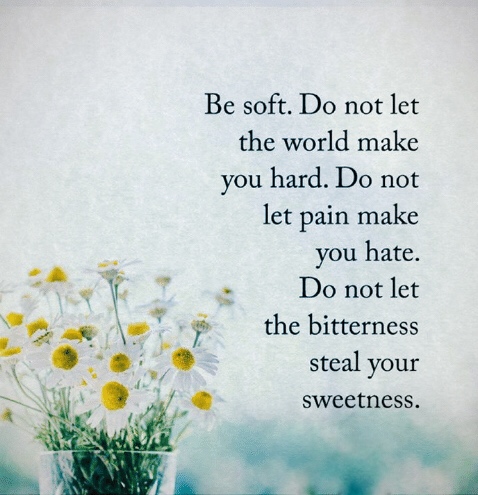
Be soft. Do not let the world make you hard.
Do not let the pain make you hate.
Do not let the bitterness steal your sweetness.

— Iain Thomas

These days, I am sensing that a kidney transplant is imminent for me. So to go through that process, I will lean even more into my soft side. That will be a good emotional and spiritual space for me. Soft! Soft facing change and fear. Soft facing uncertainty and new, scary medications. Soft facing the hope of a healthy kidney bringing me a new beginning, a resurrection.

May God continue to lead me beside these still waters. It’s a good place for me to greet resurrection.


Change, Compassion, Gofts in Open Hands, grief, journey, Lent, Life Journeys, Life pathways, Lostness, Maren Tirabassi, Risk, Travel, Vulnerability, Wisdom

Rough, Broken Roads

5E982E74-6C78-42E3-BA27-C642528A9C0CI think often about roads, the roads that take people where they want to go, or not. I think with deep fondness about the terribly rough and broken roads we traveled in Uganda. The time was immediately after the horrific reign of Idi Amin that left the roads, and the entire country, in shambles. I remember the difficulty in traveling those rough, broken roads — washed out, bombed out, neglected for years.
I remember the fear of traveling those roads, the frightening military roadblocks, the pointed machine guns, the soldier’s demand for all that we carried in the vehicle and even the vehicle itself. I remember how some of our missionaries were left in the bush with their vehicle “confiscated” by the occupying army. I remember the roadblock murder of the dear Ugandan man who drove our mission’s supply truck.

I think of traveling a road in the middle of the night that led to my brother’s funeral, made rough by grief. I think of the rough road I traveled in leaving my home of 32 years for a new and unfamiliar place. I can never forget my rough road through serious illness and difficult recovery.

I think of roads that take people where they do not want to go — to war, to prisons, to rehabilitation centers, to the sites of natural disasters. I think about the roads in disaster areas that are simply gone.

I remember a song in a Christian musical of many years ago titled “Rough Old Roads.” It told of the rough roads Jesus walked. The song’s climactic moment gave us these words: “the road that was roughest of all to walk was the road that led to the cross.”

It is appropriate for us during Lent to recall the rough roads Jesus walked, rough for so many reasons: rejection, danger, soul temptation, angry crowds and lynch mobs, and ultimately the rough road that Jesus walked to the cross, to his death. To learn of his roads means that we get a glimpse of our own. The roads we all walk.

None of us can avoid walking the rough and broken roads that appear before us, but it is in traversing those roads that we learn who we are. Rough roads force us to take the hard and narrow way, and thus become who we must ultimately become. Roads can wind around so that we are lost, thus inviting us to take the risk of vulnerability required for an unknown and uncharted journey. Our roads teach and challenge us. When the road ahead of us is rough or broken, our commitment to stay the course results in wisdom. I call it wisdom from the journey. Our rough, broken roads make us stronger and more resilient. The rougher they are, the more we change and grow.

I could bore you with even more personal reflection about rough roads, but instead I want to share a moving poem written by Maren Tirabassi.* In the poem, she writes of broken roads and calls for a God who attends to all who find themselves on broken roads.

Here are Maren’s moving words:

I was praying this morning, God,
for all the people in Mozambique
and Malawi and Zimbabwe,
in the midst of the terrible losses
from cyclone Idai —
the deaths and injury and destruction,
the ongoing need for rescue

and I learned that the roads are broken.

I should have known —

the roads between towns
are impassable,
the bridges smashed, ports unusable.
Also those other paths —
electricity, telephone, Internet,
are gone as well.

And I went from that
flat-hand-on-the-newspaper prayer,
to the jail and my meeting
for spiritual care
and walked among others
with no access

and realized that journey
is not a parable for Lent
for these,
your children on the inside.

And so holy Valley-uplifter,
Rough-place-leveler,
I call you to attend
to all who suffer broken roads —

broken highways or heartways,
or sometimes minds that cannot
find a way out of whatever
dead end they are in,

and teach me to pay attention, too,
put my back against
every road block,
become an opener of the way home.


May God make it so. Amen.


*Maren served as a pastor in the United Church of Christ for thirty-seven years in Massachusetts and New Hampshire and is the author or editor of 20 books. You may read more of her creative and soulful writing at her blog, “Gifts in Open Hands” at the following link:

https://giftsinopenhands.wordpress.com/2019/03/21/10101/


Brokenness, Change, Chronic illness, Discovering, Emotions, grief, healing, life, Loss, New Normal

On to a New “New Normal”

7519DB43-1B31-43A9-9528-84655345CC44I’m getting to know myself. Again! Moving through life takes one through changes large and small. We slip past the small ones pretty much unscathed. But oh, those large ones! The large changes are another story altogether. Sometimes they cause us to miss a step or two. Sometimes they stop us right where we stand. Sometimes they throw us all the way to the ground. But they always get our attention.

Chronic illness is one of those ‘knock-you-to-the-ground” changes, especially when an illness happens suddenly. In a recent New York Times article, Tessa Miller shares how sudden illness changes one’s life and how chronic illness changes life forever. 

“Seven Thanksgiving ago, I got sick and I never got better,” Miller writes. She goes on to describe the conundrum of chronic illness. 

When I was diagnosed, I didn’t know how much my life would change. There’s no conversation about that foggy space between the common cold and terminal cancer, where illness won’t go away but won’t kill you, so none of us know what “chronic illness” means until we’re thrown into being sick forever.

I can identify with the changes Tessa Miller describes. The onset of my chronic illness five years ago was sudden, unexpected and permanent. My kidneys failed — simple as that. And I entered into the unfamiliar world of daily dialysis, a world I never expected to be in. And, yes, it was life-changing.

Tessa Miller makes another very insightful point. She explains how, once you find yourself in the fog of the changes you’re facing because of a chronic illness, one change presents the biggest challenge – the change in your relationship with yourself.

There is no debate: when chronic illness disturbs the equilibrium of your life, your relationship with yourself changes. You grieve a version of yourself that doesn’t exist anymore, and a future version that looks different than what you had ever imagined.

Chronic illness can shatter career goals and life plans. You learn learn a “new normal” in their place. But the acceptance of a “new normal” comes after the trauma. And trauma does happen, trauma that necessarily calls for therapy, either formal or informal.

Emotional work definitely needs to be done, and emotional work around chronic illness can look a lot like grief therapy for a passing loved one. You lose your self, at least temporarily. Your self changes.

So make sure to spend some time looking for YOU. Intentionally. Being open to whatever you find in yourself. Practice seeing yourself as the person you are instead of the person you were. Looking in the proverbial mirror gives you an image of the new version of yourself. Get to know her. Celebrate her resilience. Above all, be patient as you get to know her. You may be surprised at how much you like and admire her.


Change, Discovering, Illness, life, Loss, Pondering

Giving Primary Energy to Primary Things

ee555bd0-af25-43cd-aa2c-67edd555abba
Abstract energy formation

Yesterday was “one of those days.” I spent the day pondering my illness, the constant medical processes in my life, my sense of isolation and my losses. It seems I have failed in the work of giving primary energy to primary things. In fact, yesterday I gave up a great deal of energy obsessing on circumstances I cannot change. But there are circumstances in my life that I can change, and I made some promises to myself: 1) I will try to get out more;  2) I will work on dwelling on life’s positive aspects; and 3) I will focus on primary things and put secondary things on hold.

I received some unexpected help with Number 3 late last night. It was in the blog of Guy Sayles,* a friend I haven’t heard from in years. Stumbling across his thoughts was a serendipity for me. This is part of what he wrote.

I don’t want to reach the end, however soon or later I reach it, and have to admit that I’ve given primary energy to secondary things, toured the periphery rather than made a pilgrimage to the center, and complied with external demands instead of responding to the internal and eternal Voice. For the love of God—I mean it: for the love of God—it’s time to discover or rediscover what I most deeply believe to be true in response to questions like:

What keeps people from knowing, deep in their bones, that they are God’s beloved children? How can we help each other to know?

How can we trust that, because of God’s vast and self-giving love, there is “no condemnation” by God and “no separation” from God? What do communities enlivened by such trust look, sound and feel like? How can we fashion and sustain such communities?

How do grace and mercy heal our brokenness, even when they don’t cure our illnesses or end our pain?

How does love displace fear—in individuals; in families, tribes, and communities; and among nations?

What are the ways of life that place and keep us in harmony with the “grain of the universe”? How do we learn and encourage one another to honor them?

What does it mean—what could it mean?—that Jesus calls us his friends?

There are more. Questions like these shape my vocation now. I can’t number the times the Spirit used the poetry of Mary Oliver to call me back to my calling. It happened again last week. After she died, these words were everywhere:

“Doesn’t everything die at last, and too soon?
Tell me, what is it you plan to do with your one wild and precious life?”

That has been my question for a very long time, for years in fact: What is it you plan to do with your one wild and precious life?

I really must answer that one, knowing that what’s left of my life is much shorter than it used to be. It’s time — it’s past time — for me to give primary energy to primary things, and that’s not a bad idea for you either. For you see, we only get one wild and precious life — just one!


* I invite you to visit the blog written by Guy Sayles at this link: https://fromtheintersection.org/blog/

Activism, Change, Community activism, Division, Dreams, Freedom, Freedom Songs, Legacy, Martin Luther King, Jr., Segregation, Social justice, Walls

Thinking about Justice

a89df87d-2896-4507-8e5f-f08d575972ae
Dr. Martin Luther King, Jr. in Berlin on September 12, 1964;  PhotoquestGetty Images

Coffee, aloneness and silence. A perfect time to think! It’s what I need in the morning. I may be running around the rest of the day doing those tasks that most of us have to do. But in the morning, I crave the quiet time that allows me to think.

So here’s what I’m thinking. Since yesterday when we remembered Dr. Martin Luther King, Jr., I have been pondering a very intriguing article I read about him yesterday in Time Magazine. It was about Dr. King’s 1964 visit to West Berlin.

Now you need to understand this: being a lifelong student of Dr. King’s life and legacy, I should have known about this visit. I did not! According to Time, West Berlin’s Mayor Willy Brandt invited Dr. King to participate in a memorial ceremony for President John F. Kennedy, who had been assassinated the year before. Simultaneously, Dr. King also received an invitation to speak in East Berlin from Heinrich Grüber, who had been a pastor at a church there and a prisoner in a concentration camp for three years during World War II for openly criticizing the Nazi Party. So it would seem that Dr. King was in the company of leaders who, like him, challenged systemic injustice.

Historian Britta Waldschmidt-Nelson wrote that Grüber had been driven out because of his “anti-government views.” In a letter to Dr. King, Grüber wrote, “I write in the bond of the same faith and hope, knowing your experiences are the same as ours were. During the time of Hitler, I was often ashamed of being a German, as today I am ashamed of being white,” Grüber wrote. “I am grateful to you, dear brother, and to all who stand with you in this fight for justice, which you are conducting in the spirit of Jesus Christ.”

The Time article reported that on Sept. 13, 1964 — two months after the Civil Rights Act was enacted and a month before he won the Nobel Peace Prize — King addressed 20,000 people at a rally at the outdoor stadium Waldbühne in West Berlin. Later, King delivered the same sermon at St. Mary’s Church in East Berlin, which was over its 2,000-person capacity, and then gave another, unscheduled speech to the overflow crowd at Sophia Church, similarly over its 2,000-person capacity.

It is interesting to me, in light of the demagoguery of our day, that standing in the shadow of the Berlin Wall, Dr. King said, “While I am no expert in German politics, I know about walls.”

As always, Dr. King’s eloquence was evident in the words he spoke to East Berliners:

It is indeed an honor to be in this city, which stands as a symbol of the divisions of men on the face of the earth. For here on either side of the wall are God’s children and no man-made barrier can obliterate that fact. Whether it be East or West, men and women search for meaning, hope for fulfillment, yearn for faith in something beyond themselves, and cry desperately for love and community to support them in this pilgrim journey.

As you might expect, the U.S. State Department nervously monitored this visit. Historian Michael P. Steinberg explained the nervousness: “King is determined to cross the wall and see East Berlin, and it’s very clear, at this point, that the U.S. embassy does not want him to do this. They do not want the press.” American officials were particularly concerned as racial violence in the United States was frequently held up within East Germany and the Soviet Union as “an indication of the failure of American society.”

The embassy did confiscate Dr. King’s U.S. passport, hoping that doing so would deter him from crossing into East Berlin. But Dr. King managed to get into East Berlin by flashing his American Express card. 

German scholars have written that the visit was key, not only to raising the Germans’ awareness of the American civil-rights struggle, but also to sow the seeds of non-violent resistance there. Some say it inspired participants in the Prague Spring four years later, as well as the activists who campaigned for the Berlin Wall to be torn down in 1989. 

A final interesting historical fact from Waldschmidt-Nelson: East German opposition movements marched to “We Shall Overcome” in the 1980s.

So there you have it: a little-known story about a very well-known man! And thanks to him for a lasting legacy that continues to inspire us toward justice.