A woman of sacred worth, Becoming, Beginning again, Bravery, Calling, Change, Children, Committment, Courage, Creating, Dreams, Freedom, God’s beloved daughter, I am enough!, Inner peace, life, Living in the soul, Miracles, Repair the world, Rev. Kathy Manis Findley, Self-understanding, Spirit wind, Tears, Tikkun Olam, Valued by God

Living an Unapologetic Life

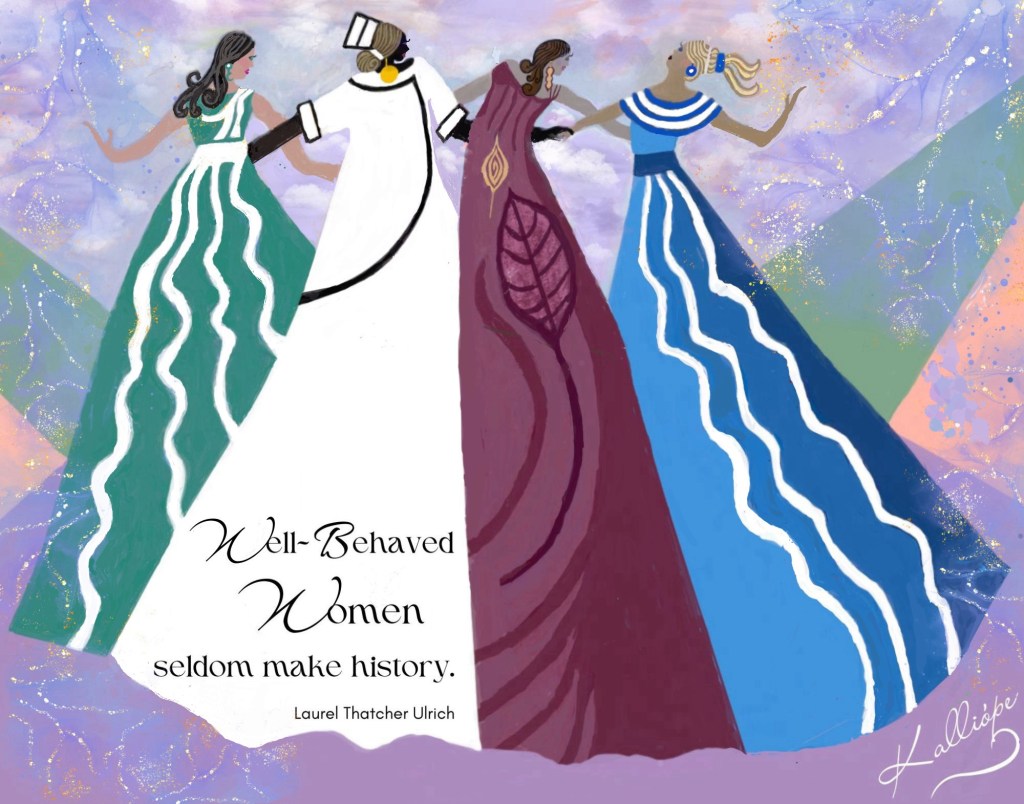
Art: “Well-behaved Women” by Kathy Manis Findley


Rev. Kathy Manis Findley
July 27, 2024

You have probably had that kind of dream at a few junctures on your journey. I know I had many dreams along the way. Sometimes they scared me to death. I dreamed of peace, equality, freedom, changing the world, and many other huge and noble dreams. I dreamed some silly dreams, too! I soon got the hint: changing the world is a formidable task. I followed all the rules, but being a rule-keeper does not make a person effective in dreaming and imagining. Women who follow the rules (someone else made up) could correctly be called well-behaved. They might even be called good girls because they don’t cause much of a flurry. They typically don’t make history and they certainly don’t change the world.

A woman with less-than-good behavior looks like someone at peace with herself, someone who radiates hope, someone with the courage and determination to do justice. I have admired and emulated so many examples of women who did make history, women who were not well-behaved at all. Here are only a few: Rosa Parks, Harriet Tubman, Lucretia Coffin Mott, Sojourner Truth, Susan B. Anthony, Nancy Sehested, Elizabeth Cody Stanton, Prathia Hall, Julian of Norwich, Malala Yousafzai, Mother Theresa of Calcutta, Ann Hasseltine Judson, Lucy Stone, and so many others!

About 24 years ago, a chaplain colleague recommended a book to me: Goodbye Good Girl: Letting Go of the Rules and Taking Back Your Self by Eileen M. Clegg. I think my chaplain friend was suggesting that I should get out of my comfort zone and take some risks, that I should courageously follow God’s call on my life. I knew that the members and churches of my denomination would “throw a fit,” like we say in the south! After all, I was an ordained minister serving as a hospital chaplain, which placed risky challenges before me every day.

So I read the book immediately and set out to become a bad girl, a girl who fully intended to change the world and to make history for it! So far, I have not made history. I have not managed to put my name in lights. I have not started any big public movements. But I have done some things that matter! I have learned how to create sacred space; I have learned the depth of liberation theology; I have found enough grace to endure the consequences of being a “bad girl” and then a woman with questionable behavior; I have held off anyone who tried to tell me who I am; and I have called up the courage to fight for justice. Colleagues, friends, family, co-workers reacted to the change in me, since they never expected me to dissent, or disagree, or refuse to behave.

Suddenly I let go of my “good girl” image and basically said “goodbye” to my restrictive behaviors. I took back my life, put aside all the rules, and followed my soul. I watched for the winds of the Spirit to lead me, and I moved forward to all the places that needed some attention. I was able to help change unjust systems, unjust policies, and unjust processes by not being so well-behaved.

Still, I sometimes think I have reached an uneasy place when it comes to letting go of my “good girl” persona. I’m really not a “good girl” and I don’t think I ever have been. My parents had to endure the sassy exclamations of my toddler years, like “Nobody’s the boss of me!” Creating shock from those who knew me, I mostly remained a “bad girl” from that day to this. I set aside the rules that were designed to keep people down and I took back my life. Today—in my mid-seventies—I continue to spew out uncommon proclamations that are quite annoying to those who are determined to hold on to their power and resist change.

Truly, it was sometimes hard being a change-maker and a rule-keeper! Always a people pleaser. Always the ultimate perfectionist. I discovered along the way that sometimes rule-keeping, people pleasing, and keeping every little thing “perfect” can harm your inner core. In fact, it’s less risky when you follow the leaders, make sure everyone is pleased, and doing everything with glowing perfection. Stepping out of line is always a bit dangerous.

When you become exactly who you are, resolute and unmovable about the things that matter to you, you will raise a few eyebrows, and sometimes people will get angry with you . You see, those people expected something else from you. Each of us becomes “me”— the “real me”— at our own peril. In a sense, we have to fight for the right to be ourselves in the world.

It is true that the people around me reacted strongly when I took back my life and became fully invested in my destiny. They thought that I had become radical, maybe even unhinged. I did not respond appropriately to their demands. To unreasonable demands, this is essentially how I might have responded, sometimes out loud, sometimes under my breath . . .

I will do it. / It’s my right! / It’s my choice! / It’s my prerogative! / It’s my decision! / I’m doing it anyway. / You can’t stop me! / Just watch!

All the while, I felt uncomfortable because of so much disdain from others, who began sending me a new message, You are not enough! I Imagine that many of you have heard someone say to you, You are not enough. At least, we may imagine someone saying those hurtful words. Unfortunately, we believe it because we don’t know ourselves, meaning we don’t know our bright and dark places, we have not yet realized our sacred worth, and we have not yet searched our souls.

For you see, you and I are afraid because it is perilous for the soul when we don’t search diligently for our soul’s passions and dreams. You and I sometimes accept what others say about us and tuck it away in our deepest places. When those words sneak all the way down into the soul, we tend to give up. We start from the moment we make ourselves nonchalant about it all, that moment when we shield our hearts from hurt. One of the saddest phrases we use is “I don’t care.” When we no longer care, we begin, one by one, eliminating the people around us, never realizing that they are hurting, too. And maybe the reason they send the message, You are not enough, is because they believe that they are not enough either.

I can honestly say that I have often heard voices—known voices, unknown voices, and the weak little voice in my head—telling me, You are not enough! I have learned that once I have embodied that negative message, it rolls around in my psyche for a long time, maybe forever. It becomes a state of being that goes deeper than skin. It penetrates in deeper places, and takes its toll on my emotional and physical well-being. I recall many such times, none more painful than the wagging tongues around my ordination . . . You know the scenario, “She can’t be a minister because she is a woman! Anyway, she’s not good enough! Other voices are often hazardous, dangerously breaking down our sense of self-worth. They may be yelling, speaking in a normal tone, whispering, or imagined in our heads. In response, we must prepare ourselves to hear the voice above all voices, saying, “You are my beloved daughter with whom I am well pleased.”

For a long time, I embodied the traits of the good girl, but to embody good girl traits is not really a once-and-done action. Embodied lasts a while! Embody does not have a shallow or surface meaning. It is deeper. I like the word embody. It seems to suggest that we can live a soulful life. In the very middle of the Greek word for “embody” we find the word σώμα, which means body. However, the Greek word for body cannot be translated in a way that reveals the depth of its meaning. The definition of σώμα is deeper than we realize. It is not skin-deep, it is deeper, approaching a definition more like soul.

I do like the word embody and the word soul. In some ways, to embody means to live in your soul. The word embody may whisper to you that in your body’s center, you will find the path to reach your soul. A person who lives in the soul is a person that does not live a shallow life, devoid of the emotion that makes us alive. The soul will help you, if you can just start by daring to touch it.

So what are the things we can actually do to take back our lives and live soulfully? What path do we follow to transform ourselves and change the world? My initial response to that is, “I don’t know.” Not very comforting, I know, but mostly true. We cannot forge the path for any other person. We cannot know what’s best for them. So not knowing anyones path, nor their dreams, I can give you a list of things others are finding the leads to their transformation. Here they are, not at all an exhaustive list, and certainly not a perfect guide for you:

  • Carve out some time for quiet, restful, meditation.
  • If you are a person of faith, get in touch with God or whatever person you worship.
  • Listen.
  • Listen some more—to your heart and your soul.
  • See if you find there a sacred direction especially for you.
  • Do you feel you are getting any closer to discovering your authentic self?
  • Can you begin to believe you will be transformed?
  • Can you take a step or two, in faith, into a holy place of transformation?
  • Pray, making your needs known to the source of your faith.
  • Read! Read the stories of others who found life transformation.
  • Find community, even one other person, who understands your journey.
  • Start all over again, leaning into the wisdom you found on your previous journey.
  • Take as long as it takes, until you realize that suddenly, you are becoming emboldened and scrappy!

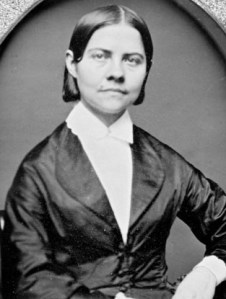
You may not know her name, but Lucy Stone was steadfast in her belief in self-authentication and in her ability to change the world. Lucy Stone was called “emboldened” and “scrappy” because of her tireless work for the abolitionist and women’s rights movements through the 19th century. A bona fide pioneer of her time, Lucy Stone stands as a historical titan. Her book “Unapologetic Life” describes a model of a revolutionary living. As for me, I would count it an honor to be described as emboldened and scrappy.

Life is more fun when you’re emboldened and scrappy. Not that we want to reduce the life experience to just scrappinesses. Life is so much more, like authenticity and the willingness to be a change-agent. Life is about having enough courage to persevere! Life for me is about my soul and all the ways it has been transformed over many years. All along my journey, I knew that my soul was a problem! At every age, there was a part of me that wouldn’t follow the easiest path. I longed to be empowered to make societal change. I chased down injustice and worked to dismantle it. I spent most of my career working with victims of domestic violence, child abuse, and human trafficking. This was not the easiest and most pleasant vocation, but the work had made its way into my soul. To do it, I had to live in the light of self-awareness and soul-awareness. I had to constantly listen to the sighs of my soul, and move only after I had heard them clearly. If I had just one nugget of advice for you, it would be to touch your soul and ride on the wings of the Spirit.

Sisters, don’t forget that when you touch your soul, you might just not be a “good girl” anymore. Or a good boy, for that matter. As for me, I am not a “good girl” living at the whims of other people! And I am definitely not a well-behaved woman! So I fully expect to make history! Because making history means leaving a legacy, creating a world brimming with peace, and embodying your best self!


Contemplation, Creation, Faith, Meditation, Night sky, Quietude, Sacred Pauses, Sacred Space, Supermoon, Uncategorized

Supermoons and Sacred Pauses

F1BC2288-D107-4584-AE59-9D319BA1F8E9

What’s all this about supermoons and sacred pauses?

You might legitimately ask that question!

Well, this stream of thought began for me when astrological experts said that the Super Pink Moon that appeared on April 7th would be the “most super” of all supermoons this year. They also said that the moon would not be pink at all.

Before you get your hopes up, this “Super Pink Moon” won’t actually look “super pink”—or any hue of pink, really. The Moon will be its usual golden color near the horizon and fade to a bright white as it glides overhead.

— The Old Farmer’s Almanac (https://www.almanac.com/content/full-moon-april)

That information did not please me at all. I had really looked forward to seeing a pink moon. The Farmer’s Almanac — always a reliable source of information since its founding in 1792 — described what the April 7th moon would look like.

It is not to be missed — The Super Pink Moon: The Biggest and Brightest Supermoon of the Year! April’s full Moon will be closer to Earth than any other supermoon in the series. It will be the biggest and brightest full Moon of 2020! How big and how bright, exactly? On average, supermoons are about 7% bigger and about 15% brighter than a typical full Moon.

There you have it, from every farmer’s most tried and tested source on all things earth! But in addition to the disappointment that this supermoon would not be pink in any way, the most devastating disappointment of all was that on April 7, 2020, Macon, Georgia was completely overcast! For all gazing intentions, there was no moon at all that night, not a pink moon and not even a white one. Like other Middle Georgia folk, I missed the whole thing, the entire phenomenally astounding sight!

Other people in other places saw it, though, in all its splendor. They took pictures, some of which looked like a round, dull white ball in the sky. But others — including NASA of course — posted pictures of a brilliant, unforgettable moon. And one person took a stunning picture of this supermoon that was brilliant white and surrounded by an ethereal pink ring! And they said it would definitely not be pink!

The pink-ringed moon picture made me very happy! It was the emotional boost I needed in a time of pandemic isolation. In the midst of such a troubling and fear-filled time when all over the earth, a supervirus was touching people with upheaval, sickness and death, it was a very opportune time for an uplifting supermoon. Still, I wonder why it even mattered to me or anyone else. After all, moons rise and fall every single day. Even supermoons rise on a predictable astrological schedule.

So maybe my lesson here is acknowledging that I seldom go out at night just to gaze at the moon. When I notice a moon in passing, it’s as if I’m thinking, “So what! It’s just another moon!” And yet, the moon might be in the night sky just to remind me that the moon is the Creator’s metaphor for something that is everlasting, permanent and yet changing. I actually do look to the sky once in a while and see a new sliver of a moon on a cloudless night or a full moon glowing brightly enough to light my path. Ever so often, I’m thrilled by the discovery, as though I were seeing it for the first time.

Instead of ignoring a moon that appears most every night, perhaps moon gazing can be a spiritual moment that helps me know that at least something in my life is everlasting, that the promises of God are ever near, that my faith can light my path, that, as the Psalmist writes, the moon is eternal, a “faithful witness in the sky!”

It will be as eternal as the moon,
    my faithful witness in the sky!

— Psalm 89:37 NLT

Moon gazing can also be my time of spiritual comfort as I recall the words of the prophet Isaiah, who speaks of the rising of the sun and the moon as a part of binding up those who are injured and healing the wounds of God’s people.

Moreover the light of the moon will be like the light of the sun, and the light of the sun will be sevenfold, like the light of seven days, on the day when the Lord binds up the injuries of his people, and heals the wounds inflicted by his blow.

— Isaiah 30:26 NRSV

At the end of the day, we can know this: gazing at the moon can remind us of the magnificent smallness of humanity and the overwhelming magnificence of God. The Psalmist invites us to marvel at how we dearly we are prized by God in a Psalm that lifts up both Divine majesty and human dignity, unequivocally declaring that God cares for me, and that God cares for you.

O Lord, our Sovereign,
how majestic is your name in all the earth!
You have set your glory above the heavens . . .

When I look at your heavens, the work of your fingers,
the moon and the stars that you have established;
what are human beings that you are mindful of them,
mortals that you care for them?

Yet you have made them a little lower than God,
and crowned them with glory and honor.

You have given them dominion over the works of your hands;
you have put all things under their feet,

all sheep and oxen,
and also the beasts of the field,

the birds of the air, and the fish of the sea,
whatever passes along the paths of the seas.

O Lord, our Sovereign,
how majestic is your name in all the earth!

— Psalm 8:1, 3-9 NRSV

The last word in my story On this day is that the moon, the sun, the stars — all created things — are not merely created, they are God-created, and God’s creation may very well be worth a few extra moments of gazing into night’s quiet pauses — praying and praising, reflecting and listening. Listening for the voice of God. Listening for the sigh of the soul!

I love the photo of that moon surrounded by a pink circle of reflected light, because it was for me a divine and holy light. I know that it was divine and holy, because it abruptly stopped me. Just a picture it was, not the real moon that I might have seen in my night sky. Yet, it took on the power of my faith that has always assured me that God can be found in all things, simple or sacred, ordinary or holy.

My faith has taught me that, more times than not, a very ordinary thing — an ordinary act or an ordinary moment — can suddenly and surprisingly become holy. Just that one ethereal moon captured in a commonplace photograph silenced me, calmed me, reached into my soul and divinely interrupted me for a much needed sacred pause.

Maybe that’s the meaning of the words we often say about a picture being worth a thousand words. As for me, I will just say thanks be to God for beckoning me to night’s quiet pauses, sacred pauses that I needed so deeply.


Adventures, Beauty of Nature, Contemplation, Creation, God's presence, Introspection, Meditation, Mindfulness, Praise, Prayer, Psalms, Questions, Restoration, Sacred Space, Serenity, Silence, simple joys, simple pleasures, Soul, Stillness

“My Soul in Silence Waits”

85612761-C3E4-4F2A-ADDE-7BF472AE54D8
Photography by Jim Dailey: January 1, 2020, Lake Ouachita, Hot Springs, Arkansas

My dear, long-time friend, former Little Rock Mayor Jim Daily, sent me this photo this afternoon. Mayor Jim is a hiker, a camper, a photographer and a naturalist. He loves the outdoors. He is a person of profound thought, and he spends a good amount of his time in thoughtful contemplation — on a lake or an Arkansas River, in a verdant valley or on a mountaintop. He frequently blogs on what he calls his “adventures,” and his blog is filled with thoughts about wherever he is and whatever beauty he has found. For Jim, every day is a new adventure, and his adventures hold sway over him. They change him in so many ways

One more thing — As a tribute to my friend, Mayor Jim, I want to introduce you to his Blog, which you may enjoy viewing at this link: Last Pair of Boots

His Blog, called “Last Pair of Boots,” tells a poignant story — of nature’s beauty, of God’s presence in it, of friendships, of Arkansas’ and America’s holy places, of worship and contemplation and prayer. Here’s what Jim says about naming his blog:

The name “Last Pair of Boots” came to me when my ten year old boots broke down and it occurred to me that at my age the new pair of boots might be my last pair. Metaphorically my boots represent the trails and travels of life.

10648F62-3E20-4939-86D9-97A565CFD322
Whitaker Point … aka Hawksbill Crag! At the Buffalo National River

This is such a thought-provoking description that fits Jim’s love of nature’s splendor. He also hints at endings, not in a melancholy  way, but in words the reveal his life of contemplation and curiosity. Jim’s outings are hiking and wilderness camping, skiing, fishing, exploring, visiting every Arkansas State Park through his job as Arkansas Tourism Director, finding friendships in every small Arkansas hamlet, searching for Arkansas treasures,
finding God in all the places and faces.

I imagine he will hold all of these adventures in his heart now that he has finished his work as Arkansas Tourism Director this past December.

1F0E0755-F01A-4E45-A3BB-92C22820A3D8
HamfestWhatever it is …  it’s gotta be something special to celebrate 50 consecutive years on top of the second highest mountain in Arkansas — Rich Mountain — in the beautiful Ouachita Mountains, Queen Wilhelmina State Park.

Congratulations, Jim, for your many years of service to the citizens of Little Rock and of Arkansas. Your wisdom, your love of nature, your unquenchable thirst for adventure and your unfailing commitment will remain as one of our enduring Arkansas’ treasures.

As I mused about Jim’s outings tonight, I asked myself about the places and times that created my contemplative times. They are few, too few.

For whatever lame reason, I do not take the contemplative times I need. I think that my kidney transplant on November 12th pushed me into a soul-need that beckons me to solitude, silence, contemplation, adventure — new things to examine in the stunning beauty of nature. It calls me out of the house and into the sunlight or under the stars of the night. It calls me to breathe in the fresh air of God’s creation and, with that breath, to take in the miracle of God’s presence.

Now that I’m retired and have time, I tend to fill my time with all manner of preoccupation. At times, I feel busy and frazzled and don’t really know why. Why am I unable to make enough time to spend in the mesmerizing beauty of nature, keeping silence in God’s creation? Why do I not spend time beside still waters, listening to the silence of a pond? What is wrong with my soul that it is rarely drawn to God’s quiet places, and my heart that does not often seek God’s presence in silent space?

I dare not answer those questions until I am prepared to make some life changes. But what I can do is to hold near these reminders of what God desires for me until I can change my life. These reminders might even inspire me to seek change:

O Lord, my heart is not lifted up,
my eyes are not raised too high;
I do not occupy myself with things
too great and too marvelous for me.

But I have calmed and quieted my soul,
like a weaned child with its mother.   
(Psalm 131:1-2)

For God alone my soul in silence waits.   (Psalm 62:1)

The Lord is my shepherd, I shall not be in want. He makes me lie down in green pastures, he leads me beside quiet waters, he restores my soul.   (Psalm 23:1-3)

Let him sit alone in silence, for the Lord has laid it on him.   (Lamentations 3:28)

To you, O God, silence is praise.   (Psalm 65:1)

It is never a bad thing to offer God the praise of silence, to invite God into my contemplation and to allow God’s presence in my moments of prayer and meditation. The truth is that God has always been present with me. But my deepest desire is that I be present with God. As the Psalmist wrote, “My soul in silence waits.”

May those words become my words . . . and yours. Amen.

Contemplation, God's presence, Holy Ground, Meditation, Prayer, Reflection, Serenity, Silence, Spiritual Discipline

The Great Silence

F40CF356-14B8-489C-A6CE-0DC8F34C0B95

I struggle with the life of contemplation I most desire. I long to stand on the Holy Ground of God’s presence. And yet, I often fail in my attempts to enter that spiritual space. My mind is filled with thoughts, words, concerns, plans, worries. And with so active a mind, I am hard pressed to meditate on the divine presence of God. I simple cannot seem to find a way to enter the great silence that enables me to hear the whisper of God I so desperately need to hear.

In a recent meditation, Richard Rohr spoke of “the great silence” as he described the prayer of the contemplative. This is his thought:

The prayer of the contemplative is, essentially, an attention to the omnipresence of God. God is omnipresent not as a theological doctrine, but as the great silence that is present in every moment—but from which we are usually distracted by an overactive mind that refuses to wait in a humble unknowing for a pure wisdom from above.

As always, he nailed it, describing the kind of waiting in silence we must do if we are to encounter an omnipresent God. Certain ways of being can move us more fully into the great silence. 

The beauty of nature, the sound of a gentle breeze, the patter of a soft rain can lead us on the contemplative path. Intentional prayer, journaling, experiencing the healing of music, walking the sacred path on a labyrinth — all of these can encourage us into a more contemplative life.

Most of all, we need the longing, our deepest soul desire, to encounter God. The Psalmist expressed such a longing.

As a deer longs for flowing streams,
so my soul longs for you, O God.
My soul thirsts for God . . .

— Psalm 42:1-2 (NRSV)

Emotions, Exhaustion, Isaiah, Meditation, Perseverance, Rest, Restoration, Self care, Visualization

Tired

D2D90CC8-02E8-4C6D-8DAB-07F25D307639

I’m tired. Down deep bone tired. Not because I trimmed bushes in the hot sun today. Not because I spent two hours in my doctor’s office today. I’m tired for no obvious reason. Or maybe for the most obvious reason. Maybe I’m tired of trying and persevering and persisting like we women are expected to do, if we’re strong enough.

It doesn’t matter, really, what I persist in doing. It doesn’t really matter what cause it is that is worth my perseverance. Whatever it is — whatever goal or outcome — it has made me tired and depleted my strength. When I try to describe the feeling, I am almost at a loss for descriptors that adequately express the reality I’m experiencing. 

Drained. Exhausted. Spent. Worn down. Frazzled. Weary. 

I’m not quite sure which words to choose and it really doesn’t matter. What does matter is finding ways of replenishing. My doctor suggested meditative visualization. Like visualizing myself as active, moving and full of energy. I actually think visualization is a good tool and a way to open up the emotional doors that will allow me to recharge my life. I’ll try it.

But I have another tool as well. I will meditate on a promise God made many centuries ago. I will hold on to the assurance that “God gives strength to the weary and increases the power of the weak.” (Isaiah 40:30)

From there, I still need to go somewhere to rest, so I go to a place I know — a safe, refreshing resting place where I have rested before. I find that place in the words of the Prophet Isaiah. 

They that wait upon the Lord shall renew their strength. They shall mount up with wings as eagles. They shall run and not be weary. They shall walk and not faint. 

— Isaiah 40:31


Discovering, life, Lightheartedness, Mindfulness, peace, Self Awareness, Self care, Serenity, Sorrow, Spiritual growth, Tears

Mindfulness

9B848BD6-A066-4F2C-ADFC-E8EA7D4C99D6mind·ful·ness
ˈmīn(d)f(ə)lnəs/
noun

  1. the quality or state of being conscious or aware of something.”their mindfulness of the wider cinematic tradition”

  2. a mental state achieved by focusing one’s awareness on the present moment, while calmly acknowledging and accepting one’s feelings, thoughts, and bodily sensations, used as a therapeutic technique.

Now that we have an official definition of mindfulness out of the way, we can explore what mindfulness might mean in our lives. Mindfulness prompts us to maintain a moment by moment awareness of our thoughts, emotions, body sensations, spiritual longings and surrounding environment. Mindfulness asks us to pay close attention to our thoughts and feelings without self judgment, to fully accept the spiritual, physical and emotional space we are in, and to let go of any thought that there is a “right” or “wrong” way to feel. When we practice mindfulness, our thoughts tune into what we’re sensing in the present moment rather than rehashing the past or imagining the future.

Try this breathing meditation. It will take just three minutes out of your day.

Three-Minute Breathing Space Practice

  1. You are invited to attend to what is. The first step invites attending broadly to one’s experience, noting it, but without the need to change it. Experience your self in a wider and more open manner that is not selecting or choosing or evaluating, but simply holding—becoming a container for thoughts feelings or sensations present in the body and spirit. Linger here for about one minute.
  2. Now focus on your breathing. Let go of the wider view of step one and bring a focus that’s much more concentrated and centered on breathing in one region of your body —the breath of the abdomen, or the chest, or the nostrils, or anywhere that your breath makes itself known. The attention here is narrow, while in the first step it’s wide. Breath deeply and slowly for one minute.
  3. Now widen your attention again to include your body as a whole. Become aware of sensations in your body. Sit with your whole body, your whole breath. Spend this last minute moving back to being mindful of yourself, of who you are in te present moment, your whole being — physical, emotional and spiritual.*

Mindfulness will not allow you to miss the vibrant color of a daylily or the sweet scent of jasmine. Mindfulness will move you to notice the graceful flight of a butterfly and to really hear the delightful strains of birdsong. Mindfulness also leads you to be fully in touch with the depths of your spirit. Mindfulness creates a kind of choreography of awareness. Though it has its roots in Buddhist meditation, we find so many references to meditation in the Psalms.

Meditate in your heart upon your bed, and be still. (Psalm 4:4)

Let the words of my mouth and the meditation of my heart Be acceptable in Your sight, O LORD, my strength and my Redeemer. (Psalm 19:14)

When I remember You on my bed, I meditate on You in the night watches. (Psalm 63:6)

On the glorious splendor of Your majesty and on Your wonderful works, I will meditate. (Psalm 145:5)

So you might be asking, “What is the point?.”

The point is that all of us tend to rush through this beautiful life and miss the real and deep beauty of it. We push our bodies to accomplish its daily tasks without cherishing the workings of the body — its breathing, its moving, tasting and seeing, hearing and enjoying the aromas that surround us. And most often, we fail to pay close attention to the longings of our souls and the promptings of our spirits — what makes us whole, what fills our hearts with joy, what moves our soul, what is God saying to us, how is God calling us to satisfy both our soul’s yearning and the world’s deepest need. We simply do not cherish it enough, all of it, this life we have been given by God’s grace. Life passes through us and around us in every passing moment, and we miss it.

And yet, a life of mindfulness can almost make magic in our lives, filling us with serenity and peacefulness, with lightheartedness and laughter, even bringing us to the honesty of our sorrows and the cleansing power of our tears.

I, for one, want to be continually mindful of my life, in my body, my mind, my world, my soul, my heart, my yearnings and my sorrows, my dreams, and the deepest desires that fill me with hope for the future.

Tell me, what is it you plan to do with your one wild and precious life?
— From Mary Oliver’s poem, The Summer Day


* The Three-Minute Breathing Space Practice was developed by Zindel Segal, Distinguished Professor of Psychology in Mood Disorders at the University of Toronto Scarborough.