Change, Children, Community activism, Courage, Dreams, Freedom, Inspiration, Justice, Little Rock Central High School, Perseverance, Racism, Segregation, Segregation, The Little Rock Nine

Growing Up Inspired: My Granddaughter and The Little Rock Nine

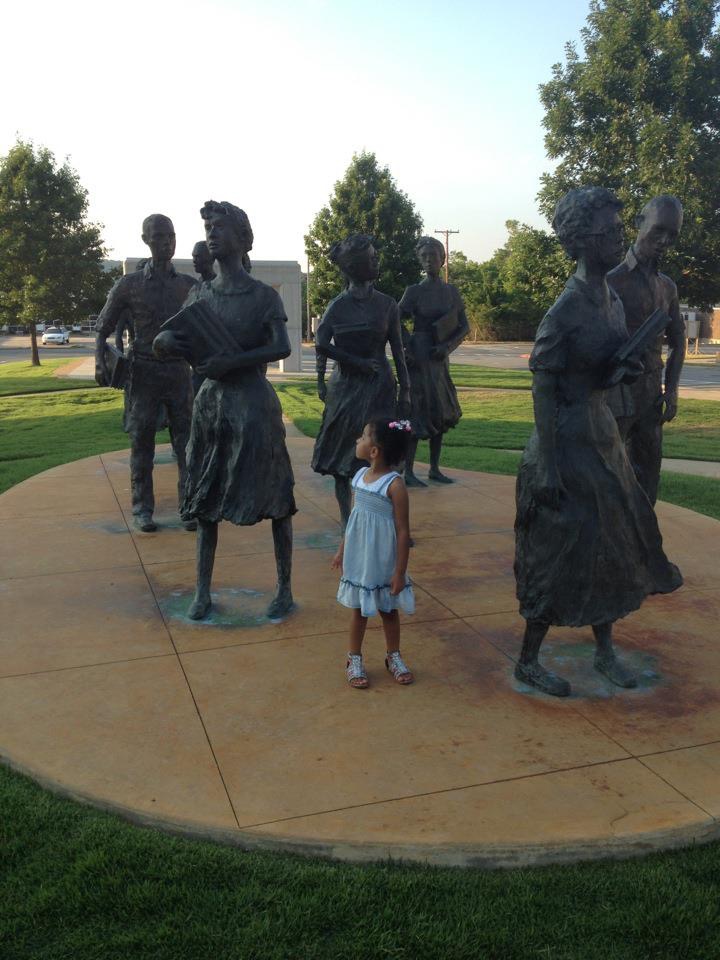
28332D92-A50E-4817-9663-6D13F00790D5June 16, 2012 . . . My three-year-old granddaughter standing among the bronze sculptures of The Little Rock Nine.

Her parents had told her the poignant story of The Little Rock Nine, but at age three she had no idea of the many ways their lives would impact hers. Because they crossed an invisible, but very real, line that divided black children from white children, they opened the door to educational equality in a racially divided state. Because their parents were brave enough to let their children breach the three stately doors of Little Rock Central High School, their world changed in unimaginable ways. And with that change, my granddaughter inherited the highly cherished right to equal education and all the opportunities that would follow. Because of that change, my granddaughter would grow up inspired.

In case you do not know about The Little Rock Nine, here is some background. 

On September 3, 1957, nine African American students — The Little Rock Nine — arrived to enter Little Rock Central High School only to be turned away by the Arkansas National Guard. Governor Orval Faubus had called out the Arkansas National Guard the night before to, as he put it, “maintain and restore order…” The soldiers barred the African American students from entering.

On September 24, 1957, President Dwight D. Eisenhower ordered units of the U.S. Army’s 101st Airborne Division — the “Screaming Eagles”— into Little Rock and federalized the Arkansas National Guard. In a televised speech delivered to the nation, President Eisenhower stated, “Mob rule cannot be allowed to override the decisions of the courts.”

On September 25, 1957, under federal troop escort, The Little Rock Nine made it inside for their first full day of school. The 101st Airborne left in October and the federalized Arkansas National Guard troops remained throughout the year.

They were nine solemn figures, nine teenagers just trying to do what every child up to age 18 had been mandated to do: go to school. Nine figures who entered the annals of American history the day they passed through the front door of Little Rock Central High School.

These nine African American students — Melba Pattillo, Elizabeth Eckford, Ernest Green, Gloria Ray, Carlotta Walls, Terrence Roberts, Jefferson Thomas, Minnijean Brown and Thelma Mothershed — are now immortalized in a striking memorial located on the grounds of the Arkansas State Capitol in Little Rock. The life-size bronze statues, entitled “Testament,” were designed and sculpted by Little Rock artist John Deering, assisted by his wife Kathy, also an artist. A comment from each of The Nine is found on individual bronze plaques identifying each student. Across the street sits the State Department of Education, just a few hundred yards from “Testament.” This Arkansas State Agency has been embroiled in this same desegregation lawsuit for over 50 years. 

Nine young students walked bravely, defiantly, yet filled with fear, in an act against prejudice and ignorance. These nine are heroes of every grueling story of segregation and racism in American history, every story we have heard and the millions of stories we will never hear.

So I am deeply moved by these photos of my granddaughter because there is deep meaning in each one. She seems to be looking up at the sculpture of Melba Pattillo (Beals) with what seems like admiration and awe. Dr. Beals grew up surrounded by family members who knew the importance of education. Her mother, Lois, was one of the first African Americans to graduate from the University of Arkansas in 1954. While attending all-black Horace Mann High School, Melba knew that her educational opportunities were not equal to her white counterparts at Central High. And so she became a part of the effort to integrate Central.

B3083DBA-2BEB-4137-B162-B8CB19B4AD64And my granddaughter stands in front of Little Rock Central High, a school she may choose to attend someday, a school she will be able to attend because The Little Rock Nine took a dangerous risk to make it possible.


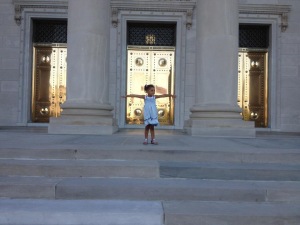
CCBDA845-BD2D-42E4-85B2-28749F2EA762Finally, my granddaughter stands playfully on the steps of the Arkansas State Capitol. I know that it is possible that she may one day proudly walk through its golden doors as a state senator or representative. That is possible because nine Little Rock students were brave enough to be a part of changing history.


At three years old, my granddaughter probably was not very inspired by Central High School, the Little Rock Nine Memorial, or the Arkansas Capitol. But her parents took her there to see and to learn so that she would grow up inspired. When she is older she will remember what she saw and what she learned from that seemingly insignificant sightseeing trip, and she will realize that it wasn’t insignificant at all. It may just be what motivates and inspires her to follow her dreams, because now she knows that all of her dreams are possible. It’s all about growing up inspired. It’s what we want for every child.

Dr. Melba Pattillo Beals, Minniejean Brown Trickey, Elizabeth Eckford, Dr. Carlotta Walls LaNier, Mrs. Thelma Mothershed Wair, Dr. Ernest Green, Gloria Ray Karlmark, Dr. Jefferson Thomas, Dr. Terrence J. Roberts, you made sure that every child can grow up inspired. when you were just young teenagers. When you walked through the doors of segregated Little Rock Central High School, you did so much more . . . for every student who came after you and for my granddaughter 


Belief, Faith, God's presence, Grace, Images of God

God Images

B33BBCE1-46BB-404E-8429-32535C46106FHow do you see God? What images of God do you see? How do you find God? Where do you find God?

Most of us have at least one image of God. It may be a vague image, but still, we have an image in our minds of a higher power. There are as many images of God as there are people. People have images of a “god” they may or may not know as a part of their spiritual journey. Some imagine God as a benevolent spirit, others as an omnipotent ruler. Some imagine God as as a father, others as a mother. Some imagine God as a protector, others as a punisher.

I remember a sermon I heard many years ago proclaimed by a passionate, animated African American preacher. “Tell me brother,” he preached with a lyrical chant. “Tell me brother, how do you find God? Tell me sister, how do you find God?”

And he repeated the questions again and again, building into a spirited crescendo, after which he said, “You find God when you get little enough that God can get big in you!”

And all the congregation responded with exuberant “Amens” and “Hallelujahs.”

I would surmise that the image of God held by that congregation, at least in that moment, was the image of an all-powerful, mighty Spirit just waiting to hear their praises and then responding with little miracles of answered prayer.

God images fill the world: there is the Creator God, the gentle shepherd, the God of vengeance, the God Most High, and from sacred music, the Mighty God, Wonderful Counselor, Everlasting Father, Prince of Peace.*

But we must acknowledge a significant exception. Some people simply say that they do not believe in God at all, any God. No images. No spiritual need for God. Nothing. They call themselves atheists.

I have known people who profess to be atheists. By no means am I an authority on this, but in my years as a hospital chaplain, I have never known a dying patient — whether believer or atheist — fail to cry out to God. In my years as a trauma specialist, pastor and pastoral counselor, I have never known an atheist who is in the depths of trouble fail to cry out to God.

I do not say that every person who does not believe in God always reaches for God in times of trouble. I am simply saying that in my experience, people in the midst of pain, grief, fear or other kinds of chaos search for a God who, by the way, is always there.

I recently read an intriguing quote by Marcus J. Borg:

When somebody says to me, “I don’t believe in God,” my first response is, “Tell me about the God you don’t believe in.”

― Marcus J. Borg, Jesus: Uncovering the Life, Teachings, and Relevance of a Religious Revolutionary

What a wonderful response, to affirm a person’s choice of unbelief while opening the door for meaningful conversation. That response is so much more respectful than a response that 1) forces a person to listen to a treatise on the existence of God; and 2) insists that the person must immediately become a believer by following a series of simple steps.

In the last analysis, a person does not find God on our timetable or through our methods. A person will find God in his or her own way and, on the spiritual journey, will see very personal images of God. They will discover the timeless grace offered to us all: a presence of God that is is constant and never-ending.

Where can I go from Your Spirit?
Or where can I flee from Your presence?

If I ascend into heaven, You are there;
If I make my bed in hell, behold, You are there.

If I take the wings of the morning,
And dwell in the uttermost parts of the sea,

Even there Your hand shall lead me,
And Your right hand shall hold me.

— Psalm 139:7-10 (NKJV)

As for me, I hold on to the image of a constant and ever-present God. Of all the images I have of God, the God I find “on the wings of the morning” most comforts me. I see God in many ways and in many places . . .  in Scripture, in nature, in my spirit. How do you see God?

For all who have eyes to see, let them see . . . images of a God strong and true, powerful and gentle, loving and accepting. God images are most assuredly there for us, for those of us who believe in God and for those who do not.


* “Hallelujah Chorus” from Handel’s Messiah


Bondage, Child protection, Children, Fear, Freedom, Hope, Immigration, Liberty, Mexican border, Risk, sunrise, Taking immigrant children, Violence

Moving Towards the Sunrise: An Essay on Immigration

F6C9AEAC-5F90-4F42-B0D9-FF50DDA7D60F.jpegI could decide to stand on this side wondering what life might hold on the other side. I can see the brilliant sunrise, perhaps a symbol for a bright new life for my children. I can see the tiny lights of dwellings or businesses. I’m not sure what they are but perhaps each tiny light is a warm welcome, a place of refuge, a safe haven.

I hold on tightly to the hands of my children, and now I look back and remember the violence, the fear, the drugs, the hopelessness for the future of my children. I consider going back, barricading my family in our tiny hovel and hoping for the best. It’s the life we know. It’s what we’re used to. But do I want my children to grow us “used to” violence and crime? Do I want then to be used to fear and hopelessness?

I decide to take a chance toward the sunrise and the tiny lights that will surely open their doors to a mother and her children. The land of the sunrise is called “the land of the free.” The land of the sunrise offers the wonderful promise of welcome . . .

Give me your tired, your poor, your huddled masses yearning to be free . . . 

Give these, the homeless tempest tossed to me. 

I lift my lamp beside the golden door.

Yes, I resolve. We will go forward. Yes!

I make, in this very moment, the most significant and life-altering decision of our lives. I choose  hope! We will go!

With great fear in the depths of my spirit, I move us toward the sunrise. I hold tightly to my children and begin the hope-filled crossing. Holding them all close on a grueling hike, I can see that we have almost made it to the other side.

Now we are actually standing in the light of the sunrise. We have crossed. Those who are to welcome us are approaching. Finally, I have made the journey to new hope for my beautiful children. Thanks be to God for safe passage! 

The welcoming people come near. But they are loud, boisterous, frightening. I never expected this. Oh my God, they have ripped my children from me. The youngest is crying, pleading for me, struggling to get away. The others are screaming “no” as they try in vain to work themselves loose from the powerful arms of those who restrain them. But the grip on them is too strong. I cry out and plead that they will not harm my children. I fall into the dirt, sobbing as they take my children away. 

Dear God, what have I done?

May God have mercy on us all.

Aging, Change, Comfort, Faith, Fear, God's Faithfulness, God's presence, Hope, Joy, Life Journeys, Life pathways, peace, Psalms

Around the Bend

8354B3D7-3728-454F-B1E7-FAB7901C5EB8
Photo by Steven Nawojczyk

I wonder sometimes what I might find around the bend. “Around the bend” is an apt metaphor for the twists and turns of life’s pathway. No matter how long I have traveled my journey, no matter how much life wisdom I have gained, I never, ever know what what’s around the bend.

The pathway before me can frighten, even while I strain to see as far as I can into what lies ahead. The bend is sharp most times, and the angle hides my view. As I age, fear on the journey looms large, for I am completely aware of the dangers I might encounter around the first bend, and the next, and all the bends that are ahead of me. And yet, I am constantly graced with flashes of hope and faith whispering that what is ahead of me could be even better than what I have left behind.

The beautiful photo above by Steven Nawojczyk is a gift of calm waters bending in a gentle flow at the foot of a mountain, lightened by the golden rays of the sun. The image makes me believe that whatever is around the bend is lovely, peaceful, comforting, safe. And that is exactly what God would want me to believe, and woukd want us all to believe. I cannot help but think of the Psalmist’s affirmation that God “leads me beside still waters.”

In so many comfort-filled passages, the Psalmist offers sure and certain comfort. Hear the Psalmist’s words . . .

Keep me safe, my God, for in you I take refuge.

Lord, you alone are my portion and my cup; you make my lot secure.

The boundary lines have fallen for me in pleasant places;
Surely I have a delightful inheritance.

I keep my eyes always on the Lord. With him at my right hand, I will not be shaken.
   Therefore my heart is glad and my tongue rejoices; my body also will rest secure . . .

You make known to me the path of life;
you will fill me with joy in your presence,
with eternal pleasures at your right hand.

— Psalm 16:1, 5-6, 8-9, 11 (NIV)

And hear the words of the Prophet Isaiah . . .

Even to your old age and gray hairs, I am he, I am he who will sustain you. 
I have made you and I will carry you; I will sustain you and I will rescue you.  

— Isaiah 46:4 (NIV)

And so “around the bend” is not so frightening after all. In God — “who makes known the path of life” —  there is comfort, safety, protection, constancy, and even joy. Thanks be to God.

American Flag, Division, Exclusion, Freedom, Inspiration, Justice, Liberty, National Anthem, Patriotism

Freedom, Liberty, Justice, and the National Anthem

1D1A00B6-C52A-41AF-86D9-50090736E4D6

Patriotism can be defined differently by different people. A plethora of actions and ceremonies cause a lump in the throat. For me, many ceremonies, sights and sounds can create a catch in my voice and a visceral emotional response. 

Singing “America the Beautiful” (1)

Watching the U.S. Navy Blue Angels paint the sky

Singing the song written by Irving Berlin in 1918, “God bless America, land that I love . . .” (2)

Hearing the stunningly beautiful words of Emma Lazarus, “Give me your tired, your poor . . .” (3)

Singing the hymn known as the African American National Anthem:

Lift every voice and sing, 
‘Till earth and heaven ring, 
Ring with the harmonies of liberty . . . 
Stormy the road we trod, 
Bitter the chastening rod, 
Felt in the days when hope unborn had died . . .
Out from the gloomy past,
‘Till now we stand at last
Where the bright gleam of our bright star is cast . . . (4)

And finally, watching the flag billowing in the breeze while the melody of the National Anthem floods a football stadium . . . 

While National Football League players stand tall and sing as they gaze at the American flag; 

While other players place their hands over their hearts in an act of honor; 

While still others kneel because they long for America to be better.

The National Anthem should not be the focus of controversy. The American flag should not be a catalyst for divisiveness. Both are symbols of freedom and liberty that inspire deeply personal acts of patriotism. National symbols should never cause us to ostracize any individual whose patriotism looks different than our own. 

CNN’s Van Jones spoke definitively about what we know as the National Anthem controversy:

People who look like me have put blood in the ground, and put martyrs in the dirt for this country, to have it be liberty and justice for all… It is beyond insulting to have people lecture us about patriotism. (5)

   Van Jones on the NFL National Anthem controversy

Approaching the commemoration of Independence Day reminds me to look more intently to see the acts of patriotism all around me. It prompts me to ask myself what “liberty and justice for all” looks like in these troublesome days. It moves me be a more committed advocate for freedom in all its forms. 

As a Baptist for fifty years, I have been thoroughly immersed in the Biblical concept of soul freedom, an all-encompassing freedom that is, by the way, not just for Baptists. James Dunn provides one of the best descriptions of soul freedom

Soul freedom, all freedom and responsibility are God’s gifts to humanity. God created and endowed people to be free moral agents. Soul freedom and responsibility are not invented by government, or devised by social contract. All dignity and respect afforded persons comes from God as revealed in Scripture. (6) 

For me, a part of soul freedom allows me the right of expression — to worship as I wish, to honor my country as I wish, to exercise my freedom to be the person I was destined to be. I cherish the gift of such extravagant liberty and know full well that it is a tenuous and fragile freedom. That fragility is one cause for the unfortunate and unnecessary controversy surrounding the National Football League and the National Anthem.

My heritage compels me to advocate for the right of every person to express his or her patriotism as they choose. As a child of immigrant parents, I will forever honor the American flag and revere the National Anthem. I may do it as I sing. I may do it through my tears. I may stand proudly and face the waving American flag. I may kneel in solidarity. I may cry as I remember my grandmother’s frightening journey to this country with my infant mother. I may pay tribute in various ways, but I will do it in my own way. As should we all.

So let us move forward in freedom. Let us stand fast in the liberty (7) that has made us free. Let us persist in our resolve to demand justice for all humankind. And as we do, let us go forth boldly with freedom-words on our lips:

Oh, freedom! Oh, freedom! Oh, freedom over me! (8)

Sweet land of liberty . . . (9)

Give me your tired, your poor, your huddled masses yearning to be free . . . 

Sweet justice, climb the mountain though your hands may be weary . . . (10)

Lift every voice and sing ‘till earth and heaven ring, ring with the harmonies of liberty . . .

God bless America!

Amen.


(1) Lyrics by Katharine Lee Bates; music by Samuel A.Ward
(2) Irving Berlin, 1918
(3) Emma Lazarus, From the poem, “The New Colossus “ 1883; inscribed on a bronze plaque placed inside the pedestal of the Statue of Liberty in 1903
(4) James W. Johnson, 1871-1938; J. Rosamond Johnson, 1873-1954
(5) Van Jones on the NFL National Anthem controversy; https://cnn.it/2JxzD36
(6) Jamie’s M. Dunn, Soul Freedom: Universal Human Right in Soul Freedom: Baptist Battle Cry, James M. Dunn and Grady C. Cothen, Smyth and Helwys Publishing, 2000.
(7) Galatians 5:1
(8) Traditional spiritual, arr. by Valeria A. Foster
(9) Samuel Francis Smith
(19) Jill Scott
Uncategorized

Fighting with Demons, Wrestling with Angels

F01A76CE-6B4A-450D-B178-93665F765C71I am digging deep to find strength for the living of these days. Certainly, I am dealing with health issues and aging, enough to wrap a comforting cloak of depression around my self. I am deeply concerned about a dear family member who is working through sorrow. I am sad that people come to the abyss of life feeling that the only answer for them is to take their own lives.

My faith is filled with questions . . . How does faith really work? How can I place myself in God’s comforting presence? How do I pray, for myself, for my family and friends, for this nation, for the world? And most of all my question is simply “Why?”

I hear news reports that cause me sadness. I see photos of parentless immigrant children that break my heart. I hear the voices of individuals who still demean women. I watch senior adults in our nation trying to live without adequate healthcare. I share the shame of homeless veterans who placed their lives in harm’s way for this country. I hear the ringing of gunshots echoing from past school shootings, a sound in my spirit that I cannot silence.

I listen to the voices of young school children who say they are afraid to go to school, and Imsee their anxious parents who just want to hold their children close, far away from danger. And I hear the loud, clear and confident voices of teenagers marching to Washington to demand change. That is the best sound of all, one that should give us all hope.

And then there are the things I don’t see or hear — like the voices of congressional leaders that prefer comfortable complacency over uncomfortable confrontation. Where are their voices of reason? Where is their collective wisdom that could well ease some of our nation’s unease?

That’s it. I’m a bit down about it all. And the honest truth is this: my religious rituals don’t really help. My faith, held for so many years and through so much turbulence, is faltering. My prayers seem to float into the unknown, unheard and unanswered. My laments are in vain. I fight with the demons that tell me my faith will not hold and I wrestle with the angels that whisper, “There is yet a quiet hope that does hold you in holy, gentle hands.”

That’s what I bank on.

Often, I am comforted and inspired by the writing of Bishop Steven Charleston. In this brief writing, he eloquently expresses the difficultly in finding a way to faith.

I am a thinking being not a religious robot, 

And I often find my way to faith,

Finding the holy in questions,

Seeking the sacred in lament;

Wrestling with angels before the dawn finds me . . .

— Bishop Steven Charleston

If we are honest, we will admit that we find the holy in our questioning and we stumble upon the sacred in our laments. Perhaps that is faith’s true path, not the easy path we expected. In the end of all things that bring despondency, we still find our way to faith. We find the holy again and again. We find the sacred over and over even through our laments. 

Faith begins to live in us while we are drowning in sorrow. No, we do not get to the very center of our faith by acting as religious robots. We get there when we stand courageously against our demons and wrestle with the angels that have the power to lift us from the depths.

Anthony Bordain, Kate Spade, Mental health, simple joys, Suicide prevention, Suicide prevention resources, Travel

Depression’s Heartbreaking Hold

5E69C503-6D6B-410A-A75D-9B1E048AD4B5
Depression’s Heartbreaking Hold

Depression wields a heartbreaking hold on those who suffer its relentless assault. It has a harsh clench, a grasp on one’s life that steals all traces of well-being. Men and women suffer depression’s attack. Young people are besieged by depression’s terror. Even the youngest among us suffer from that elusive sadness that a young child could never understand. Depression sometimes results in the most tragic of outcomes: suicide. Depression overwhelms people we know and care about, our children, our parents, our close friends, and the friends we know from afar.

Anthony Bourdain was such a friend to many. My husband and I loved watching Parts Unknown, just relaxing while Anthony Bourdain took us on exotic journeys near and far. He had a way of bursting into our living room through the television, grabbing our attention with his friendly swagger, and taking us along on an adventure in food and culture. We took for granted the delightful experiences he created for us, but now that he is gone, we are grieving as if he had been a best friend.

He had this special way of inviting us into his life experience. He was gifted in making us feel present with him in his current adventure. He took us to places we never dreamed of going, and made us see the possibility of eating foods we would not normally put even near our mouths. He expanded our wanderlust and our taste buds. He made us feel that we really knew him.

But we really did not know him, it seems. We did not know the depth of his emotional life, his bouts with depression, the dark place that he was obviously dealing with. Even his close friends and family did not expect that he would take his own life. But he did and, as his colleagues expressed, it will be a loss of creativity, talent, and the delightful quirkiness that would say, “Your body is not a temple; it’s an amusement park. Enjoy the ride.” (Anthony Bourdain)

We are left to wonder, though. Perhaps Anthony Bourdain did not always enjoy the ride. Mental health challenges can take all that one enjoys and twist all of it into something unrecognizable, something hurtful, something that steals one’s joy. It has been too much to take in, the deaths of Kate Spade and then, so soon, Anthony Bourdain, both apparent suicides. We cower at the thought of an epidemic that we are not prepared to control. Those who know tell us, again and again, that the interventions for mental health in this country are woefully inadequate. The current reality is that suicide rates rose steadily in nearly every state from 1999 to 2016, increasing 25 percent nationally, according to a report this past Thursday by the Centers for Disease Control and Prevention. In 2016, there were more than twice as many suicides as homicides.

These are statistics that should cause us heartbreak, enough heartbreak to compel us to use our voices to advocate for more appropriate and effective mental health interventions in our nation. But the heartbreak gets more personal when we lose a friend, a bigger than life friend like Anthony Bordain. It appears that he, too, knew something about heartbreak. In his own words:

Travel isn’t always pretty. It isn’t always comfortable. Sometimes it hurts, it even breaks your heart. But that’s OK. The journey changes you; it should change you . . . You take something with you. Hopefully, you leave something good behind.

Anthony Bordain did leave something good behind, something that he showed us each week: how to open ourselves to other cultures, how to join strangers around tables of friendship, how to try new things and learn new things, how to enjoy food, drink and friends, and how to know yourself better because you stepped out of your comfort zone to know another person from another land.

He gets the last word, the last poignant word:

It’s been an adventure. We took some casualties over the years. Things got broken. Things got lost. But I wouldn’t have missed it for the world.


How to Help a Loved One Who Is Severely Depressed

Don’t underestimate the power of showing up

You may not feel that your presence is wanted. But just being by the side of someone who is depressed, and reminding her that she is special to you, is important to ensuring that she does not feel alone, said Dr. Norman Rosenthal, a clinical professor of psychiatry at Georgetown University School of Medicine.


Don’t try to cheer him up or offer advice

Your friend has an enviable job and two lovely children. He’s still ridiculously handsome even though he hasn’t gone to the gym for six months. It’s tempting to want to remind him of all these good things. Not only is that unlikely to boost his mood, it could backfire by reinforcing his sense that you just don’t get it, said Megan Devine, a psychotherapist and the author of “It’s O.K. That You’re Not O.K.”

“Your job as a support person is not to cheer people up. It’s to acknowledge that it sucks right now, and their pain exists,” she said.


It’s O.K. to ask if she is having suicidal thoughts

Lots of people struggle with depression without ever considering suicide. But depression is often a factor. Although you may worry that asking, “Are you thinking about killing yourself?” will insult someone you’re trying to help — or worse, encourage her to go in that direction — experts say the opposite is true.

“It’s important to know you can’t trigger suicidal thinking just by asking about it,”  said Allen Doederlein, the executive vice president of external affairs at the Depression and Bipolar Support Alliance. If the answer is yes, it’s crucial that you calmly ask when and how; it’s much easier to help prevent a friend from hurting herself if you know the specifics.


Take any mention of death seriously

Even when a person with depression casually mentions death or suicide, it’s important to ask follow-up questions. If the answers don’t leave you feeling confident that a depressed person is safe, experts advised involving a professional as soon as possible. If this person is seeing a psychiatrist or therapist, get him or her on the phone. If that’s not an option, have the person you’re worried about call a suicide prevention line, such as a 1-800-273-TALK, or take her to the hospital emergency room; say aloud that this is what one does when a loved one’s life is in danger.


Make getting to that first appointment as easy as possible

You alone cannot fix this problem, no matter how patient and loving you are. A severely depressed friend needs professional assistance from a psychologist, psychiatrist, social worker or another medical professional. What you can do is to try to make getting to that first appointment as easy as possible. That might mean sitting next to your friend as he calls to make the appointment, finding counseling that he can afford, or even going with him that first time, if you’re comfortable with it.


Take care of yourself and set boundaries

When the thoughtful and kind people we’ve loved for years are depressed, they may also become uncharacteristically mean and self-centered. It’s exhausting, painful and hard to know how to respond when they pick fights or send nasty texts. Just because someone is depressed is not a reason to let their abusive behavior slide. Set clear boundaries with straightforward language such as, “It sounds like you’re in a lot of pain right now. But you can’t call me names.”

Boundaries about how much you can help and how much time you can give are important. Although you want to be present with your friend, set boundaries that keep you healthy and stick to them.


Remember, people do recover from depression

It can be hard when you’re in the middle of the storm with a depressed friend to remember that there was a time before, and hopefully a time after, this miserable state. It is important to remind yourself — and the person you’re trying to help — that people do emerge from depression. Because they do. 

(From a New York Times article, “What to Do When a Loved One Is Severely Depressed” by Heather Murphy, June 7, 2018, http://tiny.cc/yqyiuy)


A helpful website providing many resources for help:

https://www.speakingofsuicide.com/resources/


Recommended Reading:

4D1432A6-EA0F-47EB-B111-A35D095D42DARethinking Depression: How to Shed Mental Health Labels and Create Personal Meaning, February 14, 2012, by Eric Maisel.

0884DF97-5977-4D3B-A210-6E4EC4EB106C


Why Smart People Hurt: A Guide for the Bright, the Sensitive and the Creative by Eric Maisel, https://www.amazon.com/Why-Smart-People-Hurt-Sensitive/dp/1573246263/ref=pd_lpo_sbs_14_t_2?_encoding=UTF8&psc=1&refRID=72HYRNBE90SYMTN8PMY7


586E4722-3446-4E8C-B392-7EA2034922DD

Mindfulness for Kids: Create a Happier Life for Your Kids by Reducing Stress, Anxiety and Depression, November 27, 2017 by Jasmine Warren.

Available on Amazon: https://www.amazon.com/Jasmine-Warren/e/B0788M6G2R/ref=dp_byline_cont_book_1


The following website offers an excellent resource:

http://www.drugrehab.com/guides/suicide-risks/
 

Crossing the Jordan, Death, Faith, Gardner Taylor, Preaching

“Feeling the Spray of Jordan”


AA96E303-3AB1-4552-9DCD-8BF2977C7A64
Crossing the Jordan River. Photo by Siiri Bigalke/ICSD.

As a hospital chaplain, I kept vigil at the bedside of many persons who were preparing themselves to die. For me, being present with a person who is approaching death is, without equal, the most sacred and holy privilege of a minister’s life. Yet, I found it difficult at times to keep myself emotionally and spiritually healthy. During my darkest times, one phrase of the beloved hymn, “Softly and Tenderly” washed over me: “Shadows are gathering, deathbeds are coming.” With those words, the hymn text gives us a striking image of death.

Each of us has images of death. Every person has uniquely personal ideas about death. Some meet death with fear. Others who come near to death, whether their own or someone else’s, feel anger. Some have a sense of doom, while others are filled with a comforting calm. Always through the years, I heard the phrase, “crossing the Jordan,” most definitely a preacher’s expression meant to celebrate a life well-lived while standing at the end of life, the edge of the Jordan.

Rev. Gardner Taylor was one of those preachers who proclaimed death as a celebration of life and a joyous passing into eternity. An American preacher noted for his eloquence, Taylor was known as “the dean of American preaching.” Today my professor/preacher brother, who is always sending me something to read or listen to, sent me a stunning piece of Gardner Taylor’s preaching. The sermon was from the 1976 Lyman Beecher Lectures.

Gardner Taylor shared about one of his beloved deacons who was on his deathbed. The deacon expressed the wish that he could hear Taylor preach one more time. Reflecting on that experience, Taylor inspired those attending the lecture with the following message of eternal Christian hope. As my brother wrote, “It may be the most poetically beautiful thirty seconds of preaching I have ever encountered.”

Indeed, it is . . . so full of abiding Christian hope. This is what he preached:

Now, no preacher has of himself or herself anything of real significance to say to anyone who is within the view of the swelling of Jordan. But there is a Gospel, and you are privileged to be summoned to declare it. It can stand people on their feet for the living of their days. And, also – what a privilege almost too precious to be mentioned – it may be that the gospel which you preach will then steady some poor pilgrims as they come to where the bridgeless river is and some of them, feeling the spray of Jordan misting in the face, might thank God, as they cross the river, that he made you a preacher.

As for me, I do expect to feel “the spray of Jordan,” and as I cross the river for the last time, I will most humbly thank God that he made me a preacher.

That is the secret of greeting death for us all, I think, being able to stand — with a steady heart and a calm spirit — and give thanks to God for what he made you. You might very well feel “the spray of Jordan” as a mist on your face.

Thanks be to God.

Bible, Comfort, Despair, Faith, God's Faithfulness, God's presence, grief, healing, Heartbreak, Hope, Isaiah, Pain, Psalms, Skies, Stars, Suffering

The Hands that Made the Stars

7AA0FE34-BEE8-4CFC-AEF3-1E8D99948530
Comfort in the magnificent Arkansas skies. Photography by Steven Nawojczyk.

As I write on this day, I am aware that many friends are in the throes of darkness and despair. Some are facing devastating medical diagnoses. Some are yearning to have a child and are going through difficult medical procedures. Some are grieving for a family member in trouble. Some are waiting with hope for a cure for a disease that is bringing them to their knees. Others are enduring harsh medical treatments, hoping their lives will be saved. Many of them are at the point of losing all hope.

It hurts me deeply every time I am at a loss for comforting words. A little part of my heart breaks because I know I cannot “do something” to ease the suffering. And so I search for my own comfort as I search for ways to hold my friends in the light. As always, I am led to Scripture, not for easy answers, miraculous cures, or an instant panacea. I peek into the Bible to find words that will lift up hope in the middle of dark days and darker nights.

Often the words I find point me to the skies, as if gazing into an expanse beyond imagination might open my eyes to a radiant and holy hope. In truth, the words of Scripture do point me to hope. 

From the Prophet Isaiah:

Look up into the heavens. Who created all the stars? He brings them out like an army, one after another, calling each by its name. Because of his great power and incomparable strength, not a single one is missing. O Jacob, how can you say the LORD does not see your troubles?

Have you never heard? The LORD is the everlasting God, the Creator of all the earth. He never grows weak or weary. No one can measure the depths of his understanding. He gives power to the weak and strength to the powerless.

— Isaiah 40:26-29

From the Psalmist:

When I look at the night sky and see the work of your fingers — the moon and the stars you have set in place — what are mere mortals that you should think about them, human beings that you should care for them?

— Psalm 8:3-4

And so whoever you are, whatever pain you are carrying, know that the hands that made the stars are holding your heart.

Martin Luther King, Jr., Politics, Prayer, Robert F. Kennedy, Tribute, Uncategorized

Robert F. Kennedy: A Tribute

3DBDB3DF-6217-4BB9-8558-F5C4BF3F3CC3It was called the greatest speech ever written — April 4, 1968.

A predominantly black crowd gathered in the streets of Indianapolis. They had had not yet heard the devastating news of Dr. Martin Luther King Jr.’s assassination. It was Robert F. Kennedy who brought them the pain-filled news in a brief announcement. And then he shared the unending pain he felt, but seldom mentioned publicly, of his brother’s death in Dallas. He pleaded with the crowd to “return home, to say a prayer . . . for understanding and compassion . . . to make gentle the life of the world.” 

They did go home, and Indianapolis was one of the few American cities that did not burn that night. 

When we contemplate today’s headlines, some of us can hear Robert Kennedy’s voice and imagine him speaking out in our country — on the madness of gun violence, on the shame of police brutality, on the need for compassion in welcoming immigrants and refugees, on the moral necessity to seek peace instead of war, and on the divisiveness of race, gender, sexual orientation, religion and all other challenges to our quest for unity. His way of communicating with others — personally or in crowds of people — was calming and inspiring.

When he spoke, he often called for peace and unity:

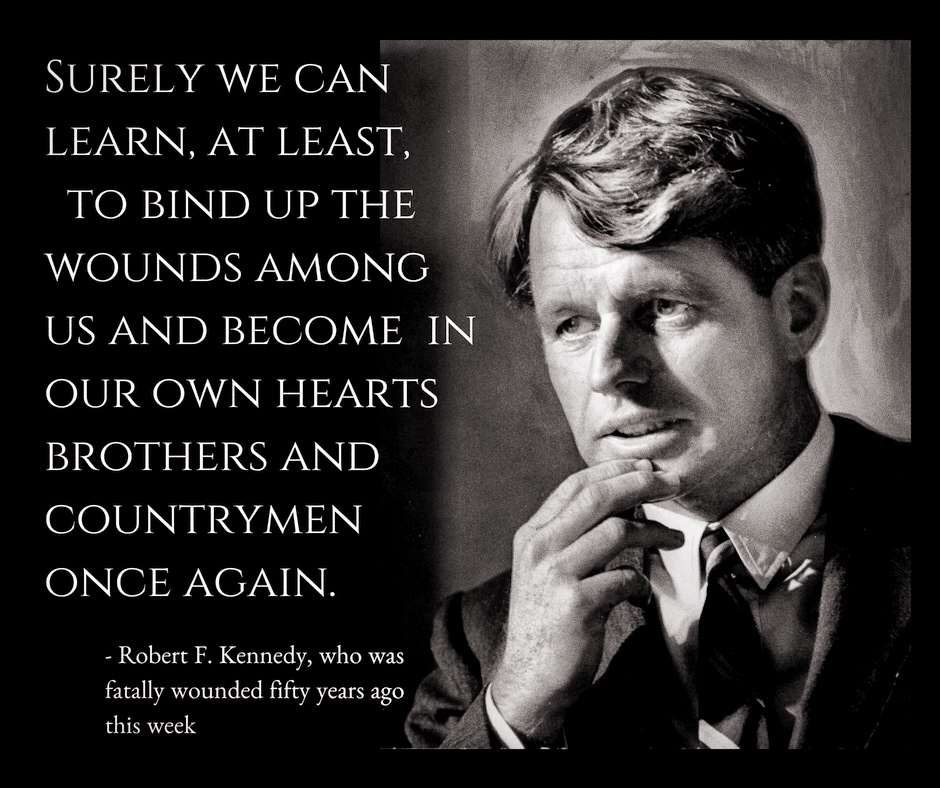
Surely we can learn, at least, to bind up the wounds among us and become in our own hearts brothers and countrymen once again.

— Robert F. Kennedy

Clearly, Robert F. Kennedy was loved by the everyday people of this nation — the factory and farm workers, the coal miners and the steel workers, the teachers and the doctors, the people who lived in the most modest neighborhoods as well as the people in the mansions on the hilltops. Why such an appeal? It could well be because his life and leadership were forged in the civil rights battles he faced as attorney general and in his own harrowing introspection after his brother’s assassination on November 22, 1963. 

Less than five years after losing his brother, “as he lay shot and bleeding on the kitchen floor of the Ambassador Hotel in Los Angeles, he looked up and asked: “Is everybody OK?”

— Robert Morris Shrum, Director and Carmen H. and Louis Warschaw Chair in Practical Politics, UNiversity of Southern California

The books and films on Robert F. Kennedy’s life are so compelling that even persons who were not yet born then can grasp why millions flocked to rail sides as his funeral train traveled ever so slowly from New York to Washington, DC. In the midst of a nation’s despondency at losing the third great American leader, the train carrying his body was a kind of defiant last rally, a tribute not only to who he had been, but to what might have been. His daughter described that day.

A train carried his body from New York City to the nation’s capital. Crowds lined the train tracks, and waved, and cried. That train ride was supposed to be three hours, and instead it turned out to be almost seven hours. Two million people came out.  African Americans in Baltimore singing the “Battle Hymn of the Republic.” Nobody organized this; it was spontaneous.

— Robert F. Kennedy’s daughter, Kathleen Kennedy Townsend

As always, we have the opportunity to grow and learn on the other side of tragic loss. We would do well to listen carefully to the plea spoken so many years ago by Robert F. Kennedy to the people grieving the death of Dr. King.

Say a prayer . . . for understanding and compassion . . . to make gentle the life of the world.

Let’s do that, right in the face of today’s angst over so many ills and wrongs. Let’s “say a prayer . . . to make gentle the life of the world.”

Amen


Comfort, Faith, God's presence, Inspiration, Nature

My Lord Is Near Me All the Time

635D7269-16B0-4C30-8A96-05536FDFF587Magnificent power! On a ride through the Georgia countryside, I witnessed nature’s beauty in a thunderstorm. The sky lit up from one end of the horizon to the other and then enormous streaks of lightning flashed in astounding display. It took my breath away, not because of its danger, but because of its brilliance. I struggle to find words to describe it.

Here’s how to scientifically explain it. Within a thundercloud way up in the sky, many small bits of ice (frozen raindrops) bump into each other as they move around in the air. All of those collisions create an electric charge. After a while, the whole cloud fills up with electrical charges.

And so it was tonight. I do not always find spiritual significance in acts of nature, but this night I was overwhelmed with the idea of the absolute power of God’s creation. At the same time, I considered my close relationship with Jesus.

God, whose ultimate power can be beyond our human comprehension, visited us through his Son who walked among us on this earth. All of it dawned on me in the midst of a powerful, resplendent thunderstorm that reminded me of the eternal truth of a beautiful hymn, “My Lord Is Near Me All The Time.” *

In the lightning flash across the sky
His mighty pow’r I see,
And I know if He can reign on high,
His light can shine on me.

I’ve seen it in the lightning, heard it in the thunder,
And felt it in the rain;
My Lord is near me all the time, My Lord is near me all the time.

When the thunder shakes the mighty hills
And trembles ev’ry tree,
Then I know a God so great and strong
Can surely harbor me.

I’ve seen it in the lightning, heard it in the thunder,
And felt it in the rain;
My Lord is near me all the time, My Lord is near me all the time.

When refreshing showers cool the earth
And sweep across the sea,
Then His rainbow shines within my heart,
His nearness comforts me.

I’ve seen it in the lightning, heard it in the thunder,
And felt it in the rain;
My Lord is near me all the time, My Lord is near me all the time.

As a child my overprotective grandmother made sure that lightening would frighten me. It worked because of her very frightened demeanor at the first sign of a storm. I remember how she gathered my brothers and me close beside her on the sofa, wrapping her gentle arms around us. At every clap of thunder, she screamed.

But as an adult, I actually love thunderstorms. When thunder roars, I hear it as a reminder of God’s strength. When lightning flashes across the sky, I see it as a marvel of God’s power. When I feel showers of rain, I feel God’s presence in the provision of life-giving water. In all of it, I am grateful for the nearness of a relationship with Christ. It is abiding truth: my Lord really is near me all the time.

Amen.

To listen to the hymn, “My Lord Is Near Me All the Time” click on the video below:

 
* Georgia hymn writer, Barbara Fowler Gaultney (1935-1974), turned to writing hymns as a source of hope and an expression of her faith. In tenuous health throughout her life, Gaultney was educated in the Atlanta public schools and attended the University of Georgia. While a member of the First Baptist Church of Forest Park near the Atlanta airport, she penned both the words and music to “My Lord Is Near Me All the Time.” Her minister of music, Julian Wilson, assisted her in submitting it for publication. Her hymn was first published in the Baptist church music periodical, The Church Musician, April 1960. It then appeared in the 1975 Baptist Hymnal and has become a favorite of many congregations.  (Harry Eskew, https://gabaptistworshipmusic.org/my-lord-is-near-me-all-the-time/)


Please feel free to contact me by completing the following form.

← Back

Thank you for your response. ✨

Contemplation, Courage, Darkness, Discovering, Fear, Forest, life, Lostness, Nature, Spiritual growth

Finding Ourselves Lost

C61646A1-BE50-4157-A898-E77F1FF191AABecause I have no sense of direction at all, I have an irrational fear of getting lost. Do not tell me to go north or south. I will have no idea how to do that. You must instead say something like, “When you see McDonalds on the right, go past it. Then go past Wendys, Burger King and Barbaritos. Look just past Barbaritos, but on the other side of the road, and you’re there.” It’s a convoluted way of making sure I don’t lose my way. And if one of those fast food places were to close down, I’m lost. 

So as I am contemplating the fear of being lost, I find in my email this morning a meditation by Richard Rohr entitled, “Practice: Being Lost.” I wanted to slip right past that meditation, as I do not need or want to practice being lost. But something held me there, captive to this bizarre meditation that described being lost as a spiritual practice.

Psychologist and wilderness guide Bill Plotkin* highly recommends wandering in nature and experiencing the great gift of “finding ourselves lost.” He calls it “Soulcraft: Crossing into the Mysteries of Nature and Psyche,” and he means that we should find ourselves lost both literally in nature and metaphorically in the midst of life’s changes.

His words remind me that at least four conditions contribute to finding oneself lost: density that conceals paths, obstacles in the pathways that force you to detour, cluelessness about direction, and darkness. I would not like finding myself in a dense forest with boulders blocking some of the pathways, hopelessly lacking any sense of direction after a few detours, and knowing that the sun is setting and darkness will make everything even worse.

And yet . . . finding myself lost as a spiritual discipline seems to be beckoning to me to enter. As a lost wanderer, I might just learn to look deeply into the face of my aloneness and discover what truly gives me life and what doesn’t. I could discover inspiration, belonging, strength, resilience and wisdom in my own company — all by myself — not knowing which way to turn. Knowing only that God will meet me there and that I can “be” who I am, right where I am, lost in a discovering moment.

As David Whyte writes:

When wandering, there is immense value in “finding ourselves lost” because we can find something when we are lost, we can find our selves . . . 

Sometimes it takes darkness and the sweet confinement of your aloneness to learn that anything or anyone that does not bring you alive is too small for you.*   

I would like to be brave enough to give it a try in some spring wood where the verdant trees form a deep, dark canopy of privacy over my soul and where aloneness takes over my psyche. A place where God will meet me, where I can fully embrace finding myself lost, and where I might just find a few sparkles of light along the way.

I have to admit that this is a terrifying prospect for me. Darkness in a dense forest, alone, lost and scared . . . I’m just not sure about that. So maybe I should settle for the swing in my yard that’s just on the edge of the woods. Safer. More acceptable. And God will meet me there, too.

*Bill Plotkin, Soulcraft: Crossing into the Mysteries of Nature and Psyche (New World Library: 2003), 234, 248-249, 263.

*David Whyte, “Fire in the Earth,” Fire in the Earth, Many Rivers Press: 1992, 8.


Beauty of Nature, Discovering, Forest, Inspiration, Light, Nature, Ocean, peace, Serenity, Transformation

Beauty. Serenity. And a Spark of the Divine

4C981E9F-B1F2-4849-81D2-C7BA782BCDEE
Loon Park on Arkansas’ Lake Maumelle. Photography by Steven Nawojczyk. Entitled “Beauty. Serenity.”

In the middle of the natural beauty of Arkansas, my friend took a photograph and entitled it “Beauty. Serenity.” It prompted me to ponder that for a few moments.

Beauty. Serenity.

I wondered what in my life brings beauty and serenity to me and to those around me. The questions trickled through my mind slowly as I tried to place qualitative and quantitative strictures on beauty and serenity. (As if one could really quantify the whole of what beauty is or see pure serenity through a human lens.) My quest to try to interpret beauty and serenity went on into the night and into the rise of a new day. Still I could not nail it down. It is as elusive as a butterfly in flight, defying explanation.

As for beauty, it seems to be something I can see, something I can look at and see what lies beneath shapes and colors and texture and form. It is when something I see takes on life, and in it, I see a spark of the Divine.

To truly see beauty, I must intentionally expose myself to it and to its full potential. The blossom of a flower. The trees in a verdant forest. The ocean waves moving gently upon the shore. The sparkle of a flowing stream. The majesty of a range of mountains and the vibrant green of a valley.

In each of these visual images, I might very well see a spark of the Divine. But I must first look, and see, and linger before such beauty long enough to see its depth. I must look into a blossom and into the leaves of a forest. I must gaze upon the glory of a mountaintop and walk slowly through a valley of green. I must sit at the edge of the sea and watch the waves greet the shore.

And then there’s serenity, the state of being that always seems to escape me. Serenity is the peaceful sense of calm that envelops a person’s soul and spirit. But I must first allow it, embrace it, and welcome it. When I can do that — and I readily admit that I seldom can — the spark of the Divine I will see most clearly is the light of the spark within myself. I love the wonderfully positive affirmation written by Llewellyn Vaughan-Lee.

We have in us a divine spark that you can see. It’s a Light that shines in the human being. It’s our direct access to truth, our direct access to God. The purpose of all the spiritual practices that exist are to awaken that spark, to give it life, to give it energy, so that it can transform you. 

God, I would be transformed. Awaken that spark within me, so that its light will become a part of my very soul, Enliven in me the spark that brings transformation to every part of me that yearns for your Divine impulse.

The spark of the Divine is beauty and serenity all at once. It is in the moments that stop us in our tracks that we can truly see the beauty around us and within us.

It is in those unforgettable moments of life’s splendor, when we allow serenity to fully embrace us in gentle arms of peace, that we finally know deep rest.

It is when beauty and serenity link arms to surround us that we can truly know the spark of the Divine within. I recognize that spark, ever so often, in just a handful of my best moments. Even for that seldom-experienced grace, I am most thankful. 

So I wish for you the same kind of grace, that you might see beauty, know serenity, and visualize, within yourself, the spark of the Divine. The blessing I leave with you is best expressed by the 14th Century Persian poet, Hafiz.

I wish I could show you, when you are lonely or in the darkness, the astonishing light of your own being.


Faith, God's Faithfulness, Heartbreak, Hope, Prayer, Unanswered Prayer

Unanswered Prayer

EE073AB1-5433-429E-90B2-4400B2C20C2BUnanswered prayer leaves me disconsolate. At times,  I have offered pleas to a God that seemed absent. On difficult days, I lifted up my longings to a God who was often silent. There were times when I languished in God’s silences and lamented as one who has no hope. Sometimes I cried out as one whose faith is spent.

There you have it: my candid and disturbingly honest confession about unanswered prayer. I could offer excuses for it. Or I could try to minimize the reality that this is a serious lapse of my faith. I could try to explain how, through the years, I have known trauma and trouble, as I hope for your sympathy. Or I could rest comfortably in your commiseration with me, together admitting that God is indeed absent, silent and uncaring.

But to believe those things about God would harm my faith and yours.

Good news: I am not alone in my feeling of abandonment. Remember David, who in his darkest hour, felt that God was absent:

How long, Lord? Will you forget me forever?
How long will you hide your face from me?  (Psalm 13:1)

And hear also these words from the Psalmist that bring to light a sense of abandonment by God:

My God, my God, why have you forsaken me?
Why are you so far from helping me, from the words of my groaning?
O my God, I cry by day, but you do not answer;
and by night, but find no rest.
   (Psalm 22:1-2)

So back to unanswered prayer.

To buy in to a “silent God” theology would be to deny that God has, in fact, sustained me on every step of my faith journey. When God seemed most absent, God’s presence in time became most clear. When I felt that God had abandoned me, I soon felt embraced by God’s strong, grace-filled hands. When I cried out, “My God, why have you forsaken me?” I found God very near, saying to me: “I will never leave you or forsake you.”  (Isaiah 41:10; Hebrews 13:5)

Most of all, I discovered that unanswered prayer, in the throes of deep angst, creates a stronger faith and a more abiding hope. I love the hymn, “Spirit of God, Descend Upon My Heart” especially this stanza:

Teach me to feel that thou art always nigh;
Teach me the struggles of the soul to bear.
To check the rising doubt, the rebel sigh,
Teach me the patience of unanswered prayer.*

Amen.

*Hymn Text: George Croley, 1854, public domain)

Please take a few minutes to hear this beautiful hymn In the video below:


Holy Spirit, Pentecost

Wind and Flame

2E00E9CE-6DD5-449C-A11E-A0C9B7874B61Pentecost Sunday! I won’t let it pass without giving thanks for the Spirit-wind that rushes through my life. In and out, at times a gentle breeze, at times a rushing, mighty wind. I enjoy a windswept life, always able to count on the wind of the Spirit to move me where I need to be.

The Holy Spirit, though, comes in other forms. How it comforts me to experience the Holy Spirit as a descending dove, peaceful, gentle, bringing the accepting voice of God as it did in the story of the baptism of Jesus.

At that time Jesus came from Nazareth in Galilee and was baptized by John in the Jordan. Just as Jesus was coming up out of the water, he saw heaven being torn open and the Spirit descending on him like a dove. And a voice came from heaven: “You are my Son, whom I love; with you I am well pleased.”   (Mark 1: 9-11)

I do experience that kind of Holy Spirit — the descent upon me of a gentle peace, a comforting presence that declares, “You are my beloved daughter.” What an uplifting experience that affirms who I am. I need the Holy Spirit who whispers to me, “You are enough.”

Still, the rushing, mighty Spirit-wind is what I long for. It’s what I hope for. I wait expectantly, full of faith that I will know beyond a doubt the very moment that the Holy Spirit comes upon me. 

Like the wind that appeared on the Day of Pentecost, the wind of the Spirit breathes life into me, again and again. 

When the Day of Pentecost had fully come, they were all with one accord in one place. And suddenly there came a sound from heaven, as of a rushing mighty wind, and it filled the whole house where they were sitting. Then there appeared to them divided tongues, as of fire, and one sat upon each of them. And they were all filled with the Holy Spirit and began to speak with other tongues, as the Spirit gave them utterance. (Acts 2:1-4)

After this, in a time of confusion over what had happened and the claim that the people were drunk with wine, Peter stood up, lifted his voice, and preached a sermon.

 . . . this is what was spoken by the prophet Joel:

 And it shall come to pass in the last days, says God,
That I will pour out of My Spirit on all flesh;

Your sons and your daughters shall prophesy,
Your young men shall see visions,
Your old men shall dream dreams.
And on My menservants and on My maidservants
I will pour out My Spirit in those days;

And they shall prophesy. (Acts 2:16-18)

My how we love the Spirit’s wind. But something else appeared on the Day of Pentecost. Fire! The Holy Spirit as flame can be shocking. It can be fierce and unbridled, the power of fire, the incinerating blaze — all-consuming, refining —a force that can destroy in an instant. 

Can I be grateful, also, for the presence of Spirit fire in my life? Is it Spirit fire that gives me tenacity? Is it Spirit fire that refines me with flame that, even when reduced to ashes, I miraculously emerge alive, completely changed, with a heart rekindled and a soul ablaze for God’s greatest use?

One of the most moving hymns for Pentecost was written in 1983 by Thomas H. Troeger.

Wind who makes all winds that blow—
    gusts that bend the saplings low,
    gales that heave the sea in waves,
    stirrings in the mind’s deep caves—
aim your breath with steady power
    on your church, this day, this hour.
Raise, renew the life we’ve lost,
Spirit God of Pentecost.

Fire who fuels all fires that burn—
    suns around which planets turn,
    beacons marking reefs and shoals,
    shining truth to guide our souls—
come to us as once you came;
    burst in tongues of sacred flame!
Light and Power, Might and Strength,
fill your church, its breadth and length.

Holy Spirit, Wind and Flame,
    move within our mortal frame.
Make our hearts an altar pyre.
Kindle them with your own fire.
Breathe and blow upon that blaze
    till our lives, our deeds, and ways 
    speak that tongue which every land 
    by your grace shall understand. 

I dare not add a single word of commentary to the sacred message of that hymn, but this is my sincerest prayer:

 . . . Come to us as once you came; burst in tongues of sacred flame!
Light and Power, Might and Strength, fill your church, its breadth and length.

Amen.


Fear, Gun control, Gun violence, Prayer, School shooting, Violence

A Prayer for the Children of Santa Fe High School

06AC883D-E9C6-4CA8-B4D4-41FF5192FB9FGod whose love holds our children in your hands,

You must be weeping today, as we are.
Again.

School children in Santa Fe, Texas gunned down.  And then explosive devices — including pipe bombs and pressure cookers — found in and near the school.
The horror. Again.

Terrified children run from their schoolrooms into the woods, sit in the brush, hiding until the terror passes. Tears and screaming, chaos and fear.
Again.

A tenth grade girl spoke truth to tragedy:
Every school shooting, kids getting killed, innocent kids getting killed.

The Governor of Texas, Greg Abbott, described the shooting: 
One of the most heinous attacks that we’ve ever seen in the history of Texas schools.*

Another student spoke of her fear:
It’s been happening everywhere. I’ve always kind of felt like eventually it was going to happen here, too. I don’t know. I wasn’t surprised. I was just scared.

We acknowledge, God, that the unsafeness of our children in their schoolrooms is our national shame.

And we talk incessantly, God, about what should be done and what could be done, what ought to be done and what must be done.

And we promise our “thoughts and prayers” — empty without our action.

Then we ask you to intervene, God, but we fail to give our own energy and commitment. We refuse to stand courageously and work diligently until we see change. We refuse to storm the offices of our Congressional representatives demanding their promises to address this national failure.

Discussions cover the news channels. Again.

The president says he’s heartbroken and orders flags flown at half staff. Again.

Empty words, God. 
Again.

Grant us, God, a shield of protection over our innocent children. Give grace and peace to parents, siblings, grandparents, teachers, friends who grieve great loss in this very moment.

Give extra strength to those attending those who are wounded. 

And most of all, God, we ask that you ennoble us — every one of us — with the courage and the resolve to seek what is just and right, so that this kind of horrific tragedy will not befall another school, will not terrorize another child, again.

Amen.


863AC3BB-D069-4A76-AA47-FBF0262F269E


Uncategorized

WomanSpirit Tree of Life: Watercolor Art

I have always loved Tree of Life images. They remind us of our rootedness, our connectedness, our potential for flourishing growth. This Tree of Life watercolor features a woman as the giver of life. She is strong and steady, with arms ourstretched, and she stands as the symbol of a foundation at the center of life.

On her chest is an amulet called the “Mati” or the evil eye. The evil eye amulet originated in Greece where it was known as an “apotropaic” amulet, meaning that it reflected harm and thus protected the wearer.

The most powerful symbol in the painting is the WomanSpirit, a symbol of wisdom, strength and life-giving power.

To order an 8″ by 10″ print of this and other watercolor pieces, visit the link below. You will see a variety of watercolors such as:

Enchanted Forest

Holy Ghosts

Ugandan Washday at the River

Circle of Friends

Well-Behaved Women

Circle of Women

Dance!

The Hummingbird

East African Sunset

Bird in Stillness

Gentle Forest

Plains of Africa

Ugandan Crested Cranes

Masai Mara

Branches

Whimsy

Flight

The Gentle Forest

https://kalliopeswatercolors.wordpress.com/2016/03/25/watercolor-prints/

Beauty of Nature, Birdsong, Inspiration, Joy, Music, Nature, Praise, Singing

Every Bird’s a Songbird

11498DF6-463F-4716-8BB1-C853BBB20654
Art: “Songbirds in Apple Blossoms” by James Hautman.

As I sit on my porch this morning in a light, refreshing rain, the most prominent sound I hear is joyous birdsong, different strains of music from a variety of birds that co-habit in our tiny bird sanctuary. A statue of St. Francis appropriately stands among the feeders and the suet. The hummingbird feeders are in a separate spot, providing a banquet of sweet nectar to these delightful birds, whose fast moving wings create their most unique song.

I love to listen to the songbirds, and we are graciously blessed to live in a neighborhood with very few sounds — no traffic, no motorcycles, no speeding cars, usually not even people voices. Just the birdsong, with an occasional tree frog and the wonderful southern gift of cicadas. 

In my opinion, every bird is a songbird. According to scientists at The Nature Conservancy, the term “songbirds” refers to a wide range of bird species. Songbirds typically include finches, sparrows and warblers, but most often when someone is defining “songbird” they refer to beautifully colored birds that we’ve never heard of. The Nature Conservancy website features three: the Dickcissel, the Blackburnian Warbler, and the Kirtland’s Warbler.

I have never seen any of those birds, but I have heard lots of glorious birdsong. So I stand by my opinion that every bird’s a songbird. And in my better moments, I hear their songs as an offering to God, their songs of praise to God who gave them voice. During those times, I am drawn to the many beautiful and lyrical Psalms. This is one that is particularly moving to me

Praise the Lord, my soul.

Lord my God, you are very great; you are clothed with splendor and majesty.

You wrap yourself in light as with a garment;

You stretch out the heavens like a tent and lay the beams of your upper chambers on their waters.

You make the clouds your chariot and you ride on the wings of the wind.

You make the winds your messengers . . .

How many are your works, Lord!

In wisdom you made them all; the earth is full of your creatures.

There is the sea, vast and spacious, teeming with creatures beyond number — living things both large and small.

When you send your Spirit, they are created, and you renew the face of the ground.

You make springs gush forth in the valleys; they flow between the hills,

You give water to all the beasts of the field; the wild donkeys quench their thirst.

The birds of the sky nest by the waters; they sing among the branches.

— Psalm 104: 1-3;10-12; 24-25, 30 (paraphrased)

Many of the Psalms urge us to sing, to praise God with our voices. 

Sing to the Lord a new song . . .

I will sing to the LORD all my life; I will sing praise to my God as long as I live.

As far as singing, well sometimes we are reluctant, holding back an imperfect voice that does not always make pleasant songs. Sometimes we are convinced that our singing would not be such a worthy offering of praise. So we should probably remember that every bird’s a songbird. And as for us humans, it might help to remember that every person has a voice, every heart has a song, every soul has a melody.

Then sings my soul, my Saviour God, to thee. How great thou art! How great thou art!*

Amen.


* From the hymn, “How Great Thou Art,” a Swedish traditional melody and a poem written by Carl Boberg (1859–1940) in Mönsterås, Sweden in 1885. It was translated into German and then into Russian and became a hymn. It was translated into English from the Russian by English missionary Stuart K. Hine, who also added two original verses of his own.


Dreams, Laughter, Legacy, Life Journeys, Relationship

Dream, Always!

3EBA32DC-4D61-4073-9AEF-78FFD295DE48Today, I am celebrating my granddaughter’s birthday. More accurately, I am contemplating my granddaughter’s birthday. I do not celebrate the day, really, I celebrate her, the person she has become in the last nine years. I celebrate her smile, her humor, her laughter, her sweet spirit, her strength, her talent and her beauty. I celebrate hope for the ways she will grow and mature.

I want to tell her everything about life, how it will lift her up and also let her down. I want to tell her about love and how to know when it’s real. I want to talk with her about faith and what it means to draw close to God. I want to tell her about the joy of life so that she will know how to transcend the sorrows of the world and claim abiding happiness and contentment. I want to tell her about the healing power of laughter, and of tears. I want to tell her that she has within her all the resilience she needs to overcome adversity. I want to tell her to dream, always. And I want to tell her about inner strength and how to develop the ability to rise up on wings of confidence and soar. 

I want to tell her that I will be near her always, so that when she falls, I can pick her up, wipe off the dust, clean her wounds, tell her she is okay, and set her back on her life journey. But that I cannot promise, because I won’t be with her forever in this life.

So I want to tell her about the adventures that marked my life and how each one made me wiser and stronger. And that’s really my point for this day’s post: that I need to make adventures! I need to live a life full of new experiences and new discoveries. I need to fill my life with substance. What I do and what I discover in this life will be my legacy for my granddaughter and for my other grandchildren. I think of the words of Cristina Garcia on this subject.

Before you know it you’ll be my age telling your own granddaughter the story of your life, and you wanna make it an interesting one, don’t you? You wanna be able to tell her some adventures, some excitements, some something. How you live your life . . . is a gift for those who come after you, a kind of inheritance.   (Cristina Garcia)

I hope the story I leave for my granddaughter will give her courage and determination. I hope she will find in my life story an example of one who chased dreams always and actually caught them, sometimes. I hope that in my story, she will see perseverance and persistence, so that she will know that she can run like the wind toward every dream she chooses.

Happy birthday, my sweet Jordan! I love you.


Bitterness, Comfort, Despair, Faith, God's Faithfulness, grief, Holy Spirit, Hope

“Therefore, I have hope . . .”

2E96D7A1-A558-4147-B7E0-F61BFB145AF7
The quiet beauty of Arkansas. Photo by Steven Nawojczyk.

This I call to mind, and therefore I have hope.

I have been without hope at times, disconsolate, forsaken, wondering why my faith seemed to fail me. My struggle overcame my hope even as I listened desperately to hear the Spirit of hope. I heard nothing. Day after day, in the long dark night of my soul’s anguish, I heard nothing.

That’s the thing about hope. She doesn’t shout our her presence. She doesn’t get your attention in a loud, thunderous manner. Hope, it seems to me, is the quiet whisper of the Holy Spirit that goes beyond your conscious mind deep into the depths of your soul. That is the only kind of hope that works, the only kind of hope that can comfort us in times of affliction. The Scripture offers a promise in the book of Romans: “By the Holy Spirit you may abound in hope.” 

The prophet Jeremiah speaks in the book of Lamentations with words filled with devastating pain. Certainly Jeremiah was a man of abiding and genuine faith. Yet, he suffered. Although it may not be our understanding, Jeremiah understood his times of anguish to be at the hand of the God he served. In hearing Jeremiah’s words of lament, we hear his loss of hope. Listen to this prophet’s heart.

I am one who has seen affliction under the rod of God’s wrath; he has driven and brought me into darkness without any light;

against me alone he turns his hand again and again, all day long.

though I call and cry for help, he shuts out my prayer;

He has blocked my ways with hewn stones, he has made my paths crooked. He has filled me with bitterness . . . My soul is bereft of peace;

I have forgotten what happiness is; so I say, “Gone is my glory, and all that I had hoped for from the Lord.”

The thought of my affliction and my homelessness is wormwood and gall! My soul continually thinks of it and is bowed down within me.

But this I call to mind, and therefore I have hope:

The steadfast love of the Lord never ceases,  his mercies never come to an end; they are new every morning; great is your faithfulness.

“The Lord is my portion,” says my soul, “therefore I will hope in him.”

— Lamentations 3: 1-3; 8-10; 17-24 (New Revised Standard Version)

To reassure the prophet, God did not shout out a proclamation of new hope. There were no loud, boisterous declarations. Instead, the prophet calls to mind the mercies of God. And as he calls God’s faithfulness to mind, his soul speaks of hope.

If you are a long-time Baptist, you may have sung an old hymn that speaks of the quiet presence of hope. The hymn, Whispering Hope,* promises a gentle hope that comforts us in a whisper. Here is a portion of that hymn.

Soft as the voice of an angel breathing a lesson unheard,

Hope with a gentle persuasion whispers her comforting word:

Wait till the darkness is over, Wait till the tempest is done,

Hope for the sunshine tomorrow, after the shower is gone.

Whispering hope, oh, how welcome thy voice, making my heart in its sorrow rejoice.

— Septimus Winner, 1868

Hope with a gentle persuasion whispers her comforting word . . . To me, that sounds like the whisper of the Holy Spirit who, in our times of despair, in the times when we feel that we have lost all hope, brings her comfort, her assurance, her peace to us again and again.

May you hear the Spirit’s whisper when you need it most.

And may the God of hope fill you with all joy and peace in believing, so that by the power of the Holy Spirit you may abound in hope. (Romans 15:13)

Amen.


* If you would like to listen to a lovely arrangement of “Whispering Hope” sung by Hayley Westenra, or if you have not heard this hymn in a while, please visit this link: https://m.youtube.com/watch?v=zj3N9LE9FPs