
Subscribe to continue reading
Subscribe to get access to the rest of this post and other subscriber-only content.
God of the Sparrow 🌱 By Kathy Manis Findley
"Do not be afraid. You are worth more than many sparrows." —Jesus
Subscribe to get access to the rest of this post and other subscriber-only content.

You may have noticed there have been no words coming from this blog in quite a while. No new posts. No graphics. No music. The reason is that inside me, there is nothing, and that has been my situation for several weeks. Part of the reason is that I was very sick for a while, hospitalized actually. In addition, I simply felt empty, without a creative spark that is usually so common for me.
Physically, I have felt unwell for a long time. Emotionally, I have felt the continued sting of isolation because getting Covid could be deadly for my immunocompromised body. Spiritually, I would have to say that the gun violence that has taken the lives of children and teachers in Uvalde has wounded my spirit and left me with so many unanswerable questions about faith and hope.
When all of those things rustle through my mind, it cannot help but reduce me into a silent kind of melancholia that affects my body, mind and spirit. It seems that this time, I can’t move past it. My husband asked me today if I am depressed. I answered, ”yes,” but honestly, I feel more sad than depressed. I don’t understand it this time. I can’t put my finger on the cause no matter how hard I have tried to figure it out.
The myth is that figuring out the root of depression or sadness will help one overcome it. Once you understand your depression and where it comes from, you can get beyond it. Also not necessarily true! Understanding is not a bad thing, but it is also not a cure-all.
These days, I simply cannot understand things—all things me! I recognize my sense of feeling empty, and I still have the ability to use reason and discernment to try to understand my feelings. But the truth is I don’t understand what’s going on in me. The internal web of my physical hurts, my emotional disturbance and my spiritual emptiness defy explanation and understanding. It’s complicated, outside of my ability to understand. So I have craved any flicker of light and life I could find.
I found it today, in a quote shared by a dear friend. This is the quote.
I didn’t need to understand the hypostatic unity of the Trinity; I just needed to turn my life over to whoever came up with redwood trees.
~ Anne Lamott
I can rest in that. I can find peace beyond my understanding. I can lean into the treasure of not being compelled to understand complicated things, even complicated things about myself. By the way, complicated things about myself may well be the most difficult things to understand, sometimes baffling and elusive. So Instead of the constant struggle to understand, I plan to turn my life over, again, to the One who created me to be complicated in the first place.
Thanks be to God for the ”peace that passes all understanding.” Amen.

There are times when sound does nothing but cause pain—the harsh words of disagreement, the disturbing reverberation of gunfire, the abrasive words of political battles, the crying of a baby. This Christmas season for me has been a tender time. I have longed for Christmases past that were more simple and free of worry. I have not heard this year the sound of Christmas bells ringing in this joyful season. Instead, I have needed to find a holy, silent place.
A dear friend captured my emotions in her blog today:
Many of us miss Christmas moments
familiar from other years
and expected for this one.
Many of us miss someone so precious
who was with us and will not be.
Perhaps mourning loss has made me unable to hear all the ”joyful and triumphant” sounds of Christmas. Instead of craving those familiar joyful sounds, I have been drawn to a place of silence. I feel compelled in these days to seek silent spaces and to open my soul to holy whispers. It seems that silence brings peace as nothing else can.
As I have thought through all that I feel, an old hymn came to mind. It seems to capture where my soul is right now. I will listen to it a few times today, as I try to rest in the silence I need, ”Let all the earth keep silence before him.”
I will also turn again to these comforting words in my friend’s blog:
Look around on Christmas Eve
and Christmas Day
for the tip of angel wing prepared for you.
If sounds of Christmas joy feel painful to you this year, I invite you to find the holy silence you need. As you do, listen to this calming hymn.
Most of all, I wish for you ”the tip of angel wing.”

I ran across this painting by Eric Dowdle as I was nursing a bit of holiday doldrums. It’s easy to fall into doldrums while anticipating Christmas. We expect an ”all is calm, all is bright” kind of Christmas, but sometimes that’s not reality at all. Instead, we can’t hear the singing of choirs, the sweet sounds of the organ or the ringing of Christmas bells.
When I look at this art, I see everything we long for as Christmas nears: a bright and beautiful tree with a sparking star on top, Santas everywhere and the people encircling the tree as if to say, ”Right here among us, there is peace on earth among people of good will.” If the painting miraculously had sound, I imagine I would hear the ringing of church bells heralding the magnificent coming of peace on earth.
Yet, we have reality in our sight instead of this joyful painting. Peace among us in these days, even peace within us, seems to be in short supply as division, war, poverty, and racial injustice continues to hold sway on our world. Not insignificant is that our personal relationships seem to be less than peaceful. The place within us where peace ought to be is often in chaos, filled with anxiety or just plain empty. Peace in our hearts and spirits—that sacred sense of serenity and inner calm—simply eludes us.
When my spirit is not at peace, I can barely see peace anywhere, even at Christmas. Such was the story of Henry Wadsworth Longfellow who wrote the words of the beloved carol, ”I Heard the Bells on Christmas Day.” Some of the stanzas of Longfellow’s beautiful poem are familiar to us, but other stanzas we have seldom, if ever, heard. Here is the poem in its entirety.
I heard the bells on Christmas Day
Their old, familiar carols play,
    And wild and sweet
    The words repeat
Of peace on earth, good-will to men!

And thought how, as the day had come,
The belfries of all Christendom
    Had rolled along
    The unbroken song
Of peace on earth, good-will to men!

Till ringing, singing on its way,
The world revolved from night to day,
    A voice, a chime,
    A chant sublime
Of peace on earth, good-will to men!

Then from each black, accursed mouth
The cannon thundered in the South,
    And with the sound
    The carols drowned
Of peace on earth, good-will to men!

It was as if an earthquake rent
The hearth-stones of a continent,
    And made forlorn
    The households born
Of peace on earth, good-will to men!

And in despair I bowed my head;
"There is no peace on earth," I said;
    "For hate is strong,
    And mocks the song
Of peace on earth, good-will to men!"

Then pealed the bells more loud and deep:
"God is not dead, nor doth He sleep;
    The Wrong shall fail,
    The Right prevail,
With peace on earth, good will to all!
I cannot help but look around at what I see and hear on the streets of this city and all over the world and see despair, hatred, division and violence taking over the peace I so need. So as the carol says, ”And in despair I bowed my head; “There is no peace on earth,” I said;” For hate is strong, And mocks the song of peace on earth, good-will to men!”
As you seek peace this Christmas season, know that God is the giver of a deep peace that abides in our hearts. I invite you to take a few moments out of your day to enjoy these videos. The first is a choral and orchestra performance of the carol. The second is a lovely group of young people singing the hymn with the addition of handbells. The third is a beautiful performance by the Mormon Tabernacle Choir with the narrated story of Longfellow’s writing of the carol.
May the Christmas blessing of peace fill your heart, and may you hear, above all other sounds, the wild and sweet ringing of the bells of Christmas.

In this second week of Advent, I am searching for peace. I feel a little like the prophet Jeremiah who said, ”They have treated the wound of my people carelessly, saying, ‘Peace, peace,’ when there is no peace.” (Jeremiah 6:1)
Indeed, how difficult it is to embody a sense of peace when we look around us only to see yet another school shooting, yet another Covid variant (Omicron), yet another tragic example of police brutality, yet another child abused . . . and more, one after another un-peaceful thing in our world. Yet, one of our lectionary texts for this week seems to promise that peace can be within reach.
Through the tender mercy of our God,
the Dayspring from on high has visited us;
To give light to those who sit in darkness and in the shadow of death,
To guide our feet into the way of peace.
Luke 1:78-79 NKJV
But on this day, in the middle of Advent’s week of peace, I wonder how I might find even a bit of God’s promised peace. Peace remains elusive to me as I look around me at a world of chaos, discontent, oppression, unrelenting pandemic, fear, uncertainty and all manner of disturbance. ”I need peace of mind!” the people cry. If I have ears to hear their cry, and my own, I must own the reality that I need peace of mind, too. But I also need peace of the soul. I need deep down peace to make its way to where my emotions live.
Isn’t it true that Advent Peace is about soul transformation—the kind of transformation that stops with the decorating, baking, shopping and all things frenzy? Isn’t it true that instead of Christmas frenzy, all of us yearn for Advent peace?
And so I stop and close my eyes.
I breathe slowly and deeply.
Again. Again. Again.
I breathe deeply and, as I slowly exhale, I feel my heart beating slower.
I feel my arms relaxing
and my muscles releasing the tightness they always hold on to.
I rest in arms of grace and listen for Spirit breeze that calms me.
I contemplate what’s in my heart
and wait silently to hear my soul’s whisper.
Does deep breathing allow the Spirit of Peace to envelop me with her tranquility? Do those few quiet moments take me to that place inside me where all is calm? It seems so, at least for a while. Interspersing my frenzied life with brief moments of contemplation makes all the difference in the world for me. I do sense Advent peace in those moments. Or is it that I reached down deeply enough into my soul and found the peace that was already there? Either way, I still held on to a few moments of peace.
If you and I are able to find that place of peace, we can then pass it on to others who need it and even to the chaotic world around us. During this week of Advent peace, wouldn’t it be wonderful to see dozens of random acts of peace? Whether that’s raking a neighbor’s yard, or taking a meal to a family with a new baby, or doing a home repair for an elderly couple, or sending a card, might we seek out someone who could use a little more peace in their lives?
When we reach out to other souls with random acts of peace, we give human form to the Peace of Christ. Christ clothes us in His humanity. We are His continuing incarnation in the world. These thoughts are described beautifully by Joseph B. Clower in his book, ”The Church in the Thought of Jesus.”
If the indwelling Christ is not confined,
then our eyes flow with His tears,
our hearts are moved with His compassion,
our hands are coarsened with His labor,
our feet are wearied with His walking among all people.
(Slightly paraphrased)
Now, take a slow, deep breath. Let it out. Take another breath. Contemplate the Prince of Peace and how much He wants peace for your life. Breathe deeply. Let it out.
Now keep breathing, and find something peaceful to do today for another person who needs peace as much as you do—a random act of peace. Amen.
I invite you to spend a few moments of contemplation by listening to this video, Dona Nobis Pacem— Grant Us Peace.

I’m not sure I know what it feels like to have God “undo me with grace,” but I have learned how it feels to need more grace, to long for Spirit breezes to gently blow around me with winds of grace. I need grace for enduring illness, grace for being separated from my son and his family, especially my five grandchildren. I need grace when I’m angry or disappointed or heartbroken. I need grace when I feel like giving up and giving in. I need God’s grace — the grace of the Spirit — to help me live in this season of my life.
I read a provocative prayer today. It kind of grabbed at my heart, asking me what exactly is in my heart right now. It asked me what I’m struggling with. The brilliant writer of prayers, Diane Strickland, writes again and again in her prayer the words, ”Undo my life with your grace,” leaving me asking myself what might happen if God decided to undo my life, even through God would likely be merciful enough to undo my life with grace.
The truth is that those words so grabbed me that my prayer was, ”God, I think I need to let you undo my life.” Maybe I feel the need to re-do my life with string of second chances. Maybe I need forgiveness for regrets, release from memories of pain. Whatever it means to have one’s life undone by God, my heart responded, with longing, to this prayer.
In the injustice of my country I caught a glimpse of the bottom of the iceberg this week. I saw how my life lived above the waterline rests on wrong assumptions of privilege, great and small and many. I am cold inside. I don’t want to be cold inside.
Undo my life with your grace. Pick out the seams sewn by fear and mend the tears made by violence. Patch the holes that were always there from the start because I don’t know much about the rest of the world or how life works for others you love just as much as you love me.
Undo me with your grace. Shake out the fabric of me. Unfold and fold me anew. Reveal your image in there somewhere and surprise me with what You make of me when mercy prevails and justice leads and love accompanies us.
Undo me with your grace. I’ve lived a long time now, long enough to know there’s more to be if I can lay down what has mattered more than it needed to, and take up what I’ve barely used at all.
I don’t feel there’s so much wrong with me that we must start over. I feel there’s more of me somewhere that fits better for now and will make room for later. Release more gospel into my life and from my life. Warm me up again. Humble me with wisdom and truth and promise and hold me together with those same gifts.
Undo me with your grace. Just a little bit more today, Spirit. Just a little more.
“Undo me with your grace. Just a little bit more today, Spirit. Just a little more.”
As I reflected on those words, my thoughts ended up with this conclusion. I don’t need grace to extricate me or liberate me from all that is difficult, heartbreaking and oppressive about my life. But I definitely need Spirit wind to live my life.
I don’t need grace to rescue me. But I do need Spirit-grace that moves in my life with me, giving me life-saving and healing grace for each moment. I need Spirit because I have known her holy presence with me and I have learned to experience the wonder of being moved by wind wild and calm, her breeze blowing around me with both tender comfort and empowering promise.
With that kind of sacred promise, I can live into my life, not shrink from it or fear it. I can move into my life, whatever it brings, with Spirit’s blessing. That’s how she impels me to honor the grace I have received — by giving it away. Her winds have impelled me for many years to minister to God’s people, and I do not intend to stop now. My call from God was for life, not meant to expire when I retired or when my health failed.
I know that God gives grace for waning health and I have it on good authority that God gives “more grace when burdens grow greater.”* When I consider the grace that has so filled my life, I think of the story of Annie Johnson Flint who wrote the text of the hymn, ”He Giveth More Grace.”
Annie Johnson Flint, born in 1866, was an inspiration to all who knew her. This is just a tiny bit of her story. The fullness of Annie Johnson Flint’s story includes a life-long string of losses and difficulties. By the time she was six years old, she had lost her mother and father to illnesses and was adopted by a family named Flint. She loved poetry and dreamed of being a composer and concert pianist. After graduating from high school, Annie went on to become an elementary school teacher, but in her second year was afflicted with arthritis that steadily and quickly worsened. She lost her ability to walk, but she became a prolific writer of poems and hymn texts.
The many stories written about her stories tell how later in life she was unable to open her hands and could no longer write, yet continued to compose her on a typewriter using her knuckles. And that “she sought healing, but in the end she was thoroughly convinced that God intended to glory Himself through her, in her weak earthen vessel.”
The words of the hymn text she wrote, ”He Giveth More Grace,” reflect the many disheartening moments she experienced throughout her life. She died at the age of 66, leaving as her legacy so many faith-strengthening words, including these:
He giveth more grace when the burdens grow greater,
He sendeth more strength when the labours increase;
To added afflictions He addeth His mercy,
To multiplied trials, His multiplied peace.
When we have exhausted our store of endurance,
When our strength has failed ere the day is half done,
When we reach the end of our hoarded resources
Our Father’s full giving is only begun.
Fear not that your need shall exceed His provision,
Our God ever yearns His resources to share;
Lean hard on the arm everlasting, availing;
The Father, both you and your load will upbear.
His love has no limits, His grace has no measure,
His power no boundary known unto men;
For out of His infinite riches in Jesus
He giveth, and giveth, and giveth again.
I have loved this hymn for years in spite of its masculine language. It moves me and uplifts me. It always reminds me of the infinite grace I have known in my life. I hope you will listen to this hymn as a part of your contemplative time.
*Diane Strickland is in her 33rd year as an ordained minister now serving in The United Church of Canada as retired clergy. She is a Certified Community and Workplace Traumatologist, Compassion Fatigue Specialist-Therapist, and Critical Incident Responder, author and creator of trauma informed resources.

I feel exasperated sometimes with the constant ups and downs that are a normal part of my life. I would surmise that ups and downs are probably a part of your life, too.
Don’t we have a knack for riding them out on something akin to a roller coaster? I have truly become a master at riding out ups and downs since my kidney transplant, but then I never really wanted a roller coaster life. So much for life plans!
Even with ups and downs, I am comforted when my faith opens up insight I have gained over the years, like not worrying about tomorrow (Matthew 6:34), not leaning on my own understanding (Proverbs 3:5) and not being anxious about anything (Philippians 4:6-7). Those stay-the-course words should surely be enough to help, shouldn’t they?
Not always! Faith and spiritual maturity and scripture are simply not enough at times to keep me from the despondency of the “downs.” That’s just the way my psyche reacts when I feel down or when a circumstance pushes me down. The trouble is, things that get me down are not always enormously critical things. Even an insignificant down moment can let depression plant itself in my spirit. That just doesn’t work for me, so I need to find a way to even out my roller coaster life and not let everything that happens be a potential for depression.
What do I want? I cannot say it simpler than this: stabilizing peace. It is not an exaggeration to say that since my transplant eighteen months ago, almost nothing has been stable. Immunosuppression medications are constantly being moved up or down; my lab numbers are constantly fluctuating; my emotions are up and down; my energy waxes and wanes; my blood sugar rises and plummets; and, on one day my kidney might be okay, but on another day, I am dealing with kidney rejection. My physical, emotional and spiritual well being rises and falls with each change.
Oh, for some stabilizing peace that stays constant through the ups and downs!
I keep going back, though, to the ultimate words that promise me the kind of constant, stabilizing peace that I so need:
Always be glad because of the Lord! I will say it again: Be glad.
Always be gentle with others. The Lord will soon be here.
Don’t worry about anything, but pray about everything.
With thankful hearts offer up your prayers and requests to God.
Then, because you belong to Christ Jesus,
God will bless you with peace that no one can completely understand.
And this peace will control the way you think and feel.
Finally, my friends, keep your minds on whatever is true, pure, right, holy, friendly, and proper.
Don’t ever stop thinking about what is truly worthwhile
and worthy of praise.
You know the teachings I gave you,
and you know what you heard me say and saw me do.
So follow my example. And God, who gives peace, will be with you.
Philippians 4:4-9 CEV
I wage war, much of the time, with depression that continues its haunting presence. It is not the debilitating kind of depression that can knock one to the ground to the point of needing medication. It is not the kind of depression that leaves one in tears and prevents any meaningful activity. It is not even the kind of depression that affects one’s life to the point of complete stagnancy. But it is a depression that hurts the heart and leaves the spirit languishing — on some days more than others.
Yet, I am grateful for lessons learned. In my times of depression — through my ups and downs — I have learned a few helpful and hopeful lessons.
These are just a few of them:
I admit I haven’t made peace with my ups and downs. I suspect I will have them as lifelong companions, but I have made peace with the soul of my being. I have discovered that there are some soul-things that I can never really touch unless I have gone as low as I can go. In those times, my emotions are discernible and my spirit is tender. In those times, there is a holy presence that will take my hands and lift me up. Of that, I am confident.
Debasiah Mridha wrote these words that are so true and so full of wisdom, “Life has its ups and downs. When you are up, enjoy the scenery. When you are down, touch the soul of your being and feel the beauty.”
I would like to be able to leave you with a sparkling, new solution for all of the times you go from up to down. I would like to be able to tell you in your ups, and in your downs, that you will find peace enough to sustain you. I wish I could tell you, even, that your life will be all “ups.” I wish I could believe it for myself. But there are very few things that any of us can count on. I intend to keep holding on tightly to my faith and my belief that God’s Spirit of Wisdom walks beside me. Sits next to me on that terrifying roller coaster!
I also love this thought that I stumbled upon in a most unlikely place. Brent Schlender, in his book entitled, Becoming Steve Jobs: The Evolution of a Reckless Upstart into a Visionary Leader, made the most lovely, comforting observation. This is what he wrote: “The sun will set and the sun will rise, and it will shine upon us tomorrow in our grief and our gratitude, and we will continue to live with purpose, memory, passion, and love.”
May the Holy One make it so. Amen

There was a time when I believed that I was invincible, with all the time in the world. Lately, though, I have thought a lot about how quickly time passes and about how I tend to constantly say, “I don’t have time.” I have also been thinking about healing. The reason for my healing thoughts could well be because at least two parts of my body really need physical healing, and soon. I don’t have time to be incapacitated, or so I believe. I don’t have time for pain and I wonder if my two places of physical pain were of my own making. For instance, my wrist sprain — now an orangey ochre color from my knuckles to halfway up my elbow — that the doctor says will heal in 6 to 10 weeks is taking way too long to mend. 6 to 10 weeks is entirely unacceptable! Was my ungraceful fall in the kitchen due to my carelessness or my lack of mindfulness?
And then there’s the terribly painful throat invasion, allegedly identified as a cricopharyngeal spasm, that feels like choking with a large object stuck in my throat while something is tightening around my neck. Direct from Healthline.com: “Anxiety about the condition can aggravate your symptoms.”
Aha! Anxiety! Therein may be the source of many ailments. That, and a lack of rest, relaxation, quietness, peacefulness or mindfulness, all of which are highly touted methods of natural healing. Healing of the body, yes, but also the critically important healing of my heart, my mind, my soul and my spirit — emotional and spiritual healing. That healing is often harder than physical healing.
So I turned my thoughts, while suffering incessant physical pain, on the subject of emotional and spiritual healing. My thoughts raised the question of what exactly is the difference between the soul and the spirit, and how in the world would I heal there.
Here’s my attempt at an answer. Most of us would agree that we consist of body, soul and spirit. In fact, the Bible affirms the existence of all three:
May your whole spirit, soul and body
be preserved blameless at the coming of our Lord Jesus.
(I Thessalonians 5:23).
Our physical bodies are fairly evident to us, but our souls and spirits are less distinguishable. In the preceding scripture passage, the Greek word for soul is psuche (ψυχή), or as we might call it, “psyche.” This word “soul” implies our mind, our will and desires as evidenced by our personal preferences, choices, and emotional responses to life’s situations. Our soul is reflected in our personality. Our soul is our life.
“Spirit” is a completely different word. The Greek word for spirit is pneuma (πνεύμα). It refers to the part of us that connects with God and receives the breath of life from the Holy Spirit (Άγιο πνεύμα). Our spirit is our breath, the breath that animates and enlivens us from deep within. I like the way Theologian David Galston explains it:
The soul is life, and the Greek word is psyche. The spirit is breath, and the Greek word is pneuma. Natural confusion exists between the [meaning of the] spirit and the soul since both words, in their roots, mean breath. But for the Greeks, there were two kinds of breath: the kind necessary for life, the psyche, and the kind necessary for [our very breath], the pneuma. In modern English, we might distinguish the two as life and energy.
I often ask my clients, mentees and friends this question: How is your heart? They usually have an understanding of how their heart is and why. But ask these questions — How is your soul? How is your spirit? — and the answers don’t come as easily. I’m not sure exactly why, but I think that, for myself, it is that I am able to more easily know my heart. I am more in touch with it. On the many times throughout my life when I was brokenhearted, I knew how my heart reacted and why. When I am sorrowful, happy, excited, surprised or feel many other emotions, I can place my hand over my heart and feel is as if I have literally touched it, that my heart has told me what emotion is there.
As for my soul and my spirit, well, they are deeper in me. In the innermost places of me, my soul mourns and celebrates and holds all manner of emotions. In my innermost parts, my spirit lies quietly within me always waiting for the brush of Spirit wings, waiting in stillness for the breath that animates and enlivens and ennobles. There was a time when I would always find time for the healing my soul and spirit needed.
So in the dense forrest of all of the 700+ words I just wrote, what is the lesson? What is the message from God we need to hear? Believe it or not, it’s not complicated. Isn’t it just like God to send us an uncomplicated message that we immediately make complicated? God’s bottom line here is easy, simple, uncomplicated: “Guard your heart, your soul, your spirit . . . all that is within you.
From Joshua
Now, vigilantly guard your souls: Love God, your God.
From Deuteronomy
Keep your soul diligently, so that you do not forget the things which your eyes have seen
and they do not depart from your heart all the days of your life.
From Proverbs
Above all, guard your heart with all diligence; for from it flow the wellsprings of life.
From 1 Thessalonians
And the God of peace sanctify you wholly, and may your spirit and soul and body be preserved complete, without blame, at the coming of our Lord Jesus Christ.
And that’s it. There was a time when I would write 700 more words to tell you specifically how to do that. But today, I am not going to tell you how to heal. The ways are individually unique and the paths are many. So I will leave you with just one path that you may choose to follow: the path that leads you deep within yourself to your sacred, quiet place and then implores you to listen for God’s whisper and wait for the breeze of the Spirit. Where? In a beautiful, peaceful place, under a starlit sky, in a quiet filled with sounds of music.
In these many months of pandemic, experiencing loss and lostness, loneliness and isolation, mourning and tears, may you find comfort in the words of poet, William Wadsworth, here turned into beautiful music by Elaine Hagenberg.
Though nothing can bring back the hour
Of splendour in the grass, of glory in the flower;
We will grieve not, rather find
Strength in what remains behind.
Complete text of anthem:
There was a time when meadow, grove, and stream,
The earth, and every common sight,
To me did seem
Apparell’d in celestial light,
The glory of a dream.
The rainbow comes and goes,
And lovely is the rose;
The moon doth with delight
Look round her when the heavens are bare;
Waters on a starry night
Are beautiful and fair;
The sunshine is a glorious birth;
But yet I know, where’er I go,
That there hath pass’d away a glory from the earth.
Though nothing can bring back the hour
Of splendour in the grass, of glory in the flower;
We will grieve not, rather find
Strength in what remains behind.
“There Was a Time” by Elaine Hagenberg
Poem by William Wordsworth
https://www.elainehagenberg.com/there…
Stand fast therefore in the freedom by which Christ has made us free,
and do not be entangled again with a yoke of bondage.
Galatians 5:1 (NKJV)
What is it about freedom that scares us? What is it about freedom that causes us to refuse to offer it to everyone? Are we afraid that giving freedom to another person or group of persons will diminish our own freedom? What does freedom really mean to persons who are oppressed and to those who live inside the throes of injustice?
I have written very little lately about justice and accountability, the two words most used to describe Derek Chauvin’s conviction. I can’t help but mark this very moment on the “long arc that bends toward justice.” I feel compelled to call our attention to this week! Actually it’s last week now, but you get the idea. Let’s call it “the week of the verdict.”
The week of the verdict has come full circle from George Floyd’s murder on May 25, 2020 to the conviction of Derick Chauvin almost one year later on April 29, 2021. It was a week we will not forget. It brought up emotions in me and perhaps in most people. Most of what I felt mirrored the emotions I imagine George Floyd’s family feeling — happy, calm, relieved, conflicted, hopeful, determined, vindicated. I also felt sad and helpless because the conviction did not end murders of black and brown brothers and sisters. And I felt joyful and hopeful because perhaps this flashpoint in the long history of racial injustice will help us turn the corner and finally see in our communities the justice we long for.
How can that happen? How can we turn the corner and move away from oppressive systems and oppressive people? How do we do that when just minutes after the verdict and less than ten miles away, 16 year old Ma’Khia Bryant was shot and killed by police in Ohio? It happened in the shadow of “the week of the verdict.”
Perhaps for us this is the week of the verdict — the week when the verdict will be read on our failure to end the systemic racism in our communities! Isn’t it past time for us to stand up and stand strong and stand determined and woke? My friends, it is time! This moment in the history of injustice may well be the turning point we need to end racism!
I have said this many times: We cannot just reform injustice, we must transform it. The transformation that results in genuine, lasting justice must begin in the soul and in the heart where intentions are formed. I must lament injustice, confess my own complicity in it, repent of the white supremacy within me, own other forms of oppression and commit to the hard work of transforming injustice in my community and in my world. Only then will transformation happen in the systems that oppress people.
Only transformed people can love neighbors as Jesus loved us. My friend and sister blogger never fails to remind me to answer the ultimate question, “How then shall I live?”* She offers this scripture to us today.
We know love by this, that he laid down his life for us — and we ought to lay down our lives for one another. How does God’s love abide in anyone who has the world’s goods and sees a brother or sister in need and yet refuses help?
1 John 3:16-17
She then reminded us that conditions in India are dire and the people languish.
In India, today the virus surges
Maren
almost beyond control,
hospitals are choked,
people die in line waiting for a doctor.
How can those of us
rejoicing in vaccination,
cautious travel, new gatherings,
not ask how we can help?
How does God’s love abide in anyone who has the world’s goods and sees a brother or sister in need and yet refuses help?
And that is the soul-critical question we must answer. How then shall we live when all around us people suffer every kind of calamity — every kind of violence, disaster, racism, discrimination, dehumanization? Every kind of heartache. How do we, in our suffering world, become the heart, hands and feet of Jesus?Getting back to the lament of my own heart, that one thing that inspires my passion — transforming the injustice of racism, xenophobia, misogyny, homophobia and all forms of evil exclusion and oppression. Transforming injustice! Setting our faces toward the hope of Beloved Community! This one thing I know, the steps of Jesus would have led him to the “healing” of injustice in any form. On every day he walked on this earth, Jesus would be loving every person who was in need and he would be lamenting every injustice that caused harm.
How can we not lament? How can we not expend ourselves in the hard work of transforming injustice? How can we not care for, and pray for, and love our brothers and sisters who are in need? How can we refuse to work for the freedom of black and brown people, indigenous peoples, LGBTQ+ people, immigrants and asylum seekers, and to any person who is enslaved? How can we deny God’s desire for justice and peace?

How can we refuse freedom to black and brown people, indigenous peoples, LGBTQ+ people, immigrants and asylum seekers, and to any person who is enslaved? How can we deny them God’s peace?
— Rev. Kathy Manis Findley
I do not have the answer for how we might do this. But I do have some convictions about it, especially about racism and white supremacy. One of my convictions is that dismantling racism begins in me, in my soul. And eradicating white supremacy begins when I look seriously at my own white supremacy. For you see, as long as white supremacy looks to me like a white-draped person burning a cross, I will never acknowledge that white supremacy is in me. As long as white supremacy looks to me like a man I might see on TV news with a truck, a confederate flag, a rifle and a mission, I can easily distance myself. I am not that white person; I am a different white person that would never tolerate racism.
Am I? Am I that different white person? Or are there ways I contribute to an unjust society? Are there ways I fail to seek Beloved Community? Are there thoughts and feelings within me that diminish other persons, persons not like me? Am I complacent about injustice? Am I complicit? Am I reticent? Am I avoiding, looking the other way?
As long as white supremacy looks to me like a white-draped person burning a cross in someone’s yard, I will never see that white supremacy is in me. As long as white supremacy looks to me like a man I might see on TV news with a pick-up truck, a confederate flag, a rifle and a mission, I can easily distance myself. I am not that kind of white person! Or am I?
Rev. Kathy Manis Findley
Racial injustice may currently be the most visible form of oppression, but we must remember that many groups of people are oppressed. Many people long for freedom from oppression. Only when we “see” and “hear” all of their voices, will we be on the way to transforming injustice. I don’t know everything about oppression, and I don’t know exactly how to make a difference. I don’t really know how to join hands with my community and set about to transform injustice. I do know that I must begin with my own lament, for only lament can open my eyes to every manner of suffering and oppression.
So meet me on the mountain where we find the strength from God to persevere, and then descend with me to all the places where oppression enslaves people. Come with me to the people, and together, let us remove from them the yoke of bondage and offer them new freedom. And may Spirit Wind surround us with courage. Thanks be to God.
*”How then Shall We Live?” was the inspiring theme of the Alliance of Baptists Annual Gathering.
VIDEO CREDITS
Words © Jann Aldredge-Clanton, from Inclusive Hymns for Liberating Christians (Eakin Press, 2006).
Visual Artists:
David Clanton: “The Magic Begins” and dancing children photos: http://www.davidclanton.com/; http://david-clanton.artistwebsites.com/
Shannon Kincaid: woman carrying torch paintings:http://www.shannonkincaid.com/
Mirta Toledo: Christ-Sophia painting: https://www.facebook.com/mirtatoledoart; http://www.jannaldredgeclanton.com/books.php#book3
Chad Clanton: purple irises photo
Instrumentalists:
Keyboard: Ron DiIulio
Percussion: Warren Dewey
Guitar: Danny Hubbard
Bass & Percussion: Jerry Hancock
Music Producer/Arranger:
Ron DiIulio: http://www.silverdollarsounds.com/personality-profiles/ron-diiulioSource
I wonder if you would be willing to stop what you’re doing right now and spend a quiet moment with me, just listening? Your time might well be a needed time for you and for your soul.
There is always so much to listen to — traffic, sirens, video game sounds, annoying household noise like the washing machine/dryer, food processor, mixer, fans, buzzers and alarms and the awful sound of the disposal trying to crush that inadvertent chicken bone. These, of course, are not our favorite sounds, but they are the myriad sounds and noises we hear in a typical day.
There are sweeter sounds, too, like the sound of a gentle, falling rain or the sound of rain when it hits hard on the roof; the sound of a gusty breeze as it rustles the leaves on a tree; the sound of a flowing stream, a rolling river and constant, ever-rushing ocean sounds; the flutter of a hummingbird’s wings; the sound of cicadas on a Southern summer night; the sound of a child’s laughter; the sweet, peaceful sound of a purring kitten; and birdsong, always birdsong.
Of course, listening as pure joy is listening to music — quiet music, lyrical melodies, rhythms that slow the pulse, the sound of a bow moving across a cello’s strings, the mesmerizing sound of a harp, the velvet sound of voices in harmony or the enthralling sound of a symphony orchestra.
Sounds fill the space that surrounds us, all the time. What is rarer for us is to hear the sound of silence. Some of us fear the silence or dread silent moments. Others of us avoid it at all costs because the silence tends to bring up whatever we are afraid to hear. So the noise that enfolds us fills the place that might otherwise hear the sighs of the soul — its cries and laments, its laughter, its sound of contentedness. It seems to me that this is the place we long to be, in the soul’s sound chamber where whatever we hear — if we’re listening carefully — is the song of the soul that tells us who we are and why we are.
There is a poem that many of you will remember (if you’re old enough) as a Simon and Garfunkel song from the 1960s. The poem was written by Paul Simon and it presents a frightening picture of the modern world doomed by the lack of spirituality and the people’s aversion to the true meaning of life. It is not so different in these days that spirituality and life meaning can be elusive, no matter how hard we may search for it and yearn for it.
The poem, entitled The Sound of Silence, is written by the voice of a visionary asking people to be serious about the true meaning of life. The poem’s message is that people are moving further and further away from true happiness because they have ignored life’s true meaning. They debate and quarrel about worthless things. They listen to or watch meaningless things. The poet writes that the people “speak and hear without listening. Like we often do?
Throughout its five stanzas, the poem presents the conflict between spiritual and material values. The poetic persona is a person of vision who warns against the lack of spiritual seriousness. The poem begins with an address by the poet persona to the darkness, saying that he has come to talk with the darkness. When he awakens, he says that the vision still remains as the sound of silence.
Some of us fear the silence or dread silent moments. Others avoid it at all costs because the silence tends to bring up whatever they are afraid to hear. So the noise that enfolds us fills the place that might otherwise hear the sighs of the soul — its cries and laments, its laughter, its sounds of contentedness. It seems to me that this is the place we long to be, in the soul’s sound chamber where whatever we hear — if we’re listening carefully — is the song of the soul that tells us who we are and why we are.
The words of the poet . . .
And in the naked light, I saw
Ten thousand people, maybe more
People talking without speaking
People hearing without listening
People writing songs that voices never share
And no one dared
Disturb the sound of silence
And the people bowed and prayed
To the neon god they made
And the sign flashed out its warning
In the words that it was forming
And the sign said,
“The words of the prophets are written on the subway walls
And tenement halls”
And whispered in the sound of silence
All of that trivia about the poem certainly moved us a little farther away from my point, which is that most, if not all, of us have a deep emotional and spiritual need to listen to our souls, really listen. Even if we don’t know it, we long to hear what the depth of our being wants to say to us. We want to find our true selves, a quest only our souls can accomplish. If we are honest, we would say that we want to do the soulwork that leads us out of the darkness of our own making and into a place of light.
When we do carve out a sacred pause, when we wait in the darkness of that silent space, and when we open ourselves to deep listening, we will likely hear God’s whisper. We will probably move slowly out of darkness and realize the promise that as “God’s own people” we will “proclaim the mighty acts of God who called us out of darkness into his marvelous light.” (1 Peter 2:9)
This is the place we long to be, in the soul’s sound chamber where whatever we hear — if we’re listening carefully — is the song of the soul that tells us who we are and why we are.
— Rev. Kathy Manis Findley
Hearing God’s voice moves us to a deeper experience of life, but hearing our soul’s sighs may take us deeper still, because we open ourselves to self-knowing. It’s not a surface knowing. It is a deep knowing of who it is that lives in our skin. Without hearing the sighs our souls are making, we might never enter into fullness of self. I suggest that only the fullness of who we are can stand before the God who knows us even better than we know ourselves.
In my own experience, I think that perhaps I cannot be in deep communion with God if I try to face God as my superficial self. Perhaps God seeks relationship with my soul, my deepest place of being. To find and define my soul for myself, to know myself fully, I must find the sound of silence and sit with it patiently and expectantly. Maybe that is the essence of spirituality.
So there are a few lessons in these words and these are the obvious lessons:

And who knows? If you linger for a while in your sacred listening space, you might just find the very essence of grace by hearing what your soul whispers to you. It will be the most beautiful sound of all.
— Rev.Kathy Manis Findley
One day I listened — really listened. And I heard the whisper of God and the song of my soul. Thanks be to God.
I invite you to hear the poem, “The Sound of Silence,” through music. It can rightly be said that no group or person could ever sing this as well as Simon and Garfunkel, but I thought you might enjoy it covered by a very popular contemporary a cappella group, Pentatonix.

The year was 1963. I was 14 years old. So it could not have been that I was unaware of what was going on in my city, but more likely that I was sheltered from it. I’m referring to two events: the day Dr. Martin Luther King, Jr. was arrested and incarcerated in the Birmingham jail; and in that same year — Sunday, September 13 — the 16th Street Baptist Church was bombed, taking the lives of four little girls as they left their Sunday School class to go into the sanctuary.
It was a white supremacist terrorist bombing, just before 11 o’clock, when instead of rising to begin prayers, the congregation was knocked to the ground. As the bomb exploded under the steps of the church, the congregants sought safety under the pews and shielded each other from falling debris.
Five months earlier, on April 12, 1963, Dr. Martin Luther King, Jr. was arrested with SCLC activists Ralph Abernathy, Fred Shuttlesworth, and other marchers, while thousands of African Americans dressed for Good Friday wondered what in the world the future might hold.
As a child, I would proudly sing a song I learned in school, “Birmingham’s My Home. In the days of 1963, I was not so proud that Birmingham, Alabama was my home. Today, I feel deep shame to admit that even at age 14, I had no idea what was happening or why it was happening. To be sure, I was not yet “woke” in any sense of the word.
While incarcerated, Dr. King wrote a letter. Some of his most eloquent, scorching, but hopeful words were penned during his time in the Birmingham Jail. These words he wrote from there are quite striking to me:
“. . . in some not too distant tomorrow the radiant stars of love and brotherhood will shine over our great nation with all their scintillating beauty.”
How is it that we have not yet seen the “radiant stars of love and brotherhood” [and sisterhood] “shining over our great nation with all their scintillating beauty?” Why does the struggle for racial justice still play out in the streets of this nation’s cities as the oppressed still cry out against the injustice that continues to hold them in chains?
I will not attempt to answer those unanswerable questions. I will point out the mountains that still stand ominously before us. We cannot move those mountains, it seems, as they loom over us — immense, towering, formidable, oppressive. The rocks, crags and peaks of them looking like peaceful protests by persons crying out for freedom in June, white supremacists violently storming the United States Capitol just 12 days ago, and the terrifying Coronavirus that still threatens after so many months.
How will we see the radiant stars of beloved community, of hope, of peace when we cannot move those mountains? Words cannot move mountains, but words can give us the strength and courage to try. And so I leave you with Dr. King’s words as we honor him on this day:
“Out of the mountain of despair, the stone of hope.”*
I wish for you radiant stars of love, the sunlight of hope that is new every morning, and the glistening wings of peace to guide your way.
*Dr. King delivered this line during his “I Have a Dream” speech in Washington, D.C. on August 28, 1963. It now appears is one of the most prominently featured quotes on the Martin Luther King, Jr. Memorial in Washington.

Welcome to “ALL SHALL BE WELL,” my video blog designed to help us examine our spiritual center, to create sacred pauses, to join together in contemplation and silence.

I once preached a sermon entitled, “What Do You Say to a Broken World?” In this week, after our nation’s Capitol was breached and defiled, I have wondered if ministers who will stand before congregations in two days are asking themselves a similar question: “What will I say on this day to a broken world?”
A friend of mine is preaching this week. I am praying that she will have an extra measure of wisdom, because standing before a congregation while the nation is in chaos is not a responsibility to be taken lightly. My first feeling as I thought about preaching for this Sunday was relief that I was no longer a pastor with such a heavy responsibility, that I did not have to summon the wisdom to speak to a people with heavy hearts who need to hear of healing grace and hope. But my most intense feeling was envy, not hostile envy, but heart envy about my deep desire to speak Gospel Good News to people who need to hear good news. Still I envied my friend and wished that, this Sunday, I could stand before a congregation with wisdom, open my spirit and invite God to speak through me. It is a heavy responsibility and a sacred calling.
Dr. Greg Carey, Professor of New Testament at Lancaster Theological Seminary, wrote an essay this week entitled “Preaching When It’s Broken.” In the essay he says this:
God bless you, preachers who will address congregations this Sunday . . . Here in the United States, things are broken, most people know they’re broken, and we all need healing and truth.
For many of us, the invasion of the Capitol and the response to it by people we know, love and admire, brings this brokenness to the foreground. Since that terrible, violent day, I have heard dozens of interviews that expressed anger, frustration, contempt, indignation and all manner of raw emotion. I have also heard wise leaders express their resoluteness to lead this nation into healing, unity and hope.
Indeed, the questions about this Sunday’s preaching call us to attention: How do our pastors, our priests, our rabbis, our imams, our bhikkhus and bhikkhunis stand before their congregations offering comfort when our nation is so broken, so angry, so mournful in the face of violent acts? What will they proclaim? What will they preach? What will they pray? What will they sing?
Minneapolis Pastor and Poet, Rev. Meta Herrick Carlson, has given us a grace-gift with this poem entitled, “A Blessing for Grieving Terrorism.”
A Blessing for Grieving Terrorism
There is sickness
with symptoms as old as humankind,
a rush of power born by inciting fear in others,
a wave of victoryin causing enemies pain.
There is a push to solve the mystery,
to isolate the suspect and
explain the evil simply
to a safe distance from the anomaly.
There is a temptation
to skip the part that feels
near the suffering
that shares the sadness,
that names our shared humanity.
There is a courage
in rejecting the numbing need for data
in favor of finding the helpers,
loving the neighbor,
resisting terror through random acts of connection.
There is a sickness
with symptoms as old as humankind,
but so is the remedy.
From Rev. Meta Herrick Carlson’s book “Ordinary Blessings: Prayers, Poems, and Meditations for Everyday Life.” Used with permission.
So much truth in her words, so much wisdom “for the living of these days.” In her words, I feel all over again the desire of my heart, the impossible dream of standing in a pulpit this Sunday, speaking to a congregation that needs strength in the midst of adversity. I will not stand behind a pulpit this week, but I will pray for those who will stand in that sacred space. I will pray for them, the proclaimers, and I will pray for their hearers across this nation. I will lean on this beautiful prayer written by Reverend Valerie Bridgeman:
May God Strengthen You for Adversity
A blessing for today:
May God strengthen you for adversity
and companion you in joy.
May God give you the courage of your conviction
and the wisdom to know when to speak and act.
May you know peace.
May you be gifted with deep,true friendship and love.
May every God-breathed thing
you put your hand to prosper and succeed.
May you have laughter to fortify you
against the disappointments.
May you be brave.
© Valerie Bridgeman, December 18, 2013
When all is said and done, more important than what the “proclaimer in the pulpit” says is what the hearers hear. For in this time — when violence, riots, terrorism, pandemic and all manner of chaos is so much a part of life — those who listen need to hear a clear message of a God who dwells among us, a Christ who leads us, a Spirit who comforts us under the shadow of her wings. For hearts in these days are heavy, souls are wounded, spirits seek hope. And all the people want to believe that they do not walk alone through their present angst.
I pray that you know that you are not alone, that God’s grace-filled presence is with you and that “in God you live and move and have your being. As some of your poets have said, ‘We are God’s children.’” (Acts 17:28)
I pray that your heart will heal and be filled anew with hope. I pray that the wounds of your soul and spirit will heal and be filled anew with the peace of God. I pray that, when you listen in faith, you will hear the voice of God whispering in your ear, “You do not walk alone.”
I invite you to spend a few moments of meditation hearing the message of this music:
May you see God’s light on the path ahead
when the road you walk is dark.
May you always hear
even in your hour of sorrow
the gentle singing of the lark.
When times are hard
May you always remember when the shadows fall–
You do not walk alone.

A passage of Scripture that encourages me every time I read it came up this week in my Advent devotional booklet entitled, “Those Who Dream.” The beauty of reflection I have found in this booklet has definitely awakened dreams in me. As I reflected on Advent Scripture each morning, God never failed to remind me that the world is in chaos in so many ways. In the year we will remember as 2020, people languished and lamented through a seemingly uncontrollable pandemic. Many people prayed, many died, many wept, and some were even able to dream.
The sacred text for this past Thursday was from the eloquent Prophet Isaiah. I have always thought of this Prophet as a realistic dreamer who never failed to paint a true picture of a world both evil and good. Isaiah had a way of proclaiming the deep need for repentance while also calling the people to dream of all that could be better and brighter. The bottom line for this Prophet was sin followed by repentance, what that would look like and what a world of righteousness would look like. Thursday’s prophetic and inspiring word was from Isaiah 61.
The spirit of the Lord God is upon me, because the Lord has anointed me; he has sent me to bring good news to the oppressed, to bind up the brokenhearted, to proclaim liberty to the captives, and release to the prisoners; to proclaim the year of the Lord’s favor, and the day of vengeance of our God; to comfort all who mourn; to provide for those who mourn in Zion — to give them a garland instead of ashes, the oil of gladness instead of mourning, the mantle of praise instead of a faint spirit.
They will be called oaks of righteousness, the planting of the Lord, to display his glory.
They shall build up the ancient ruins; they shall raise up the former devastations; they shall repair the ruined cities, the devastations of many generations.
Isaiah 61:1-4 NRSV
For I the Lord love justice, I hate robbery and wrongdoing; I will faithfully give them their recompense, and I will make an everlasting covenant with them. Their descendants shall be known among the nations, and their offspring among the peoples; all who see them shall acknowledge that they are a people whom the Lord has blessed.
I will greatly rejoice in the Lord, my whole being shall exult in my God, ffor he has clothed me with the garments of salvation, he has covered me with the robe of righteousness as a bridegroom decks himself with a garland, and as a bride adorns herself with her jewels.
For as the earth brings forth its shoots, and as a garden causes what is sown in it to spring up, so the Lord God will cause righteousness and praise to spring up before all the nations.
Isaiah 61:8-11 NRSV
Standing in the midst of a pandemic world with all the grave challenges before us, Advent sends us a message. The last good word in these proclamations from Isaiah tell us that our Lord will cause righteousness to spring up before us, before all nations. When righteousness has her way in us, then — and only then — will we dream again. Our dreams empowered with God’s anointing will bring the advent of righteousness.
After repentance! Only after repentance!
Look closely at Isaiah’s words and you will see anew that God has anointed us to bring good news to oppressed people, to hold in our arms those who are brokenhearted, to comfort the mourning people, to set free people who are bound with chains of their own making and finally, as the Prophet said, “to give them a garland instead of ashes, the oil of gladness instead of mourning, the mantle of praise instead of a faint spirit.”
What Isaiah tells us after that is my dream for this Advent 2020: “They shall build up the ancient ruins; they shall raise up the former devastations; they shall repair the ruined cities, the devastations of many generations.”
All around us are the ruins we have left behind from all that we have done to our world, collectively and individually. The politicians make war among themselves, increasing the chasm that divides them. The people put politics before unity and spew hate at one another. The white supremacists barrage our cities with evil. Some of our people protest the racial injustice they have long endured. Hungry people still wait in the cold for a morsel of sustenance. People who have no home shiver in cold porticos, in parks, under bridges. Violence with its many faces is ever with us. The Coronavirus ravages on. The teachers and parents languish in confusion and disappointment. The frontline health professionals fall in literal exhaustion. Our children ask us when life will be normal again.
Every year, I recall the text of one of my favorite Christmas carols, “I Heard the Bells on Christmas Day.” The carol’s text, written by Henry Wadsworth Longfellow on Christmas Day of 1863, is a poem in which he expresses the terror of peace evolving into a world of darkness, hate and war. Two years before writing this poem, Longfellow‘s personal peace was shaken when his wife of 18 years was fatally burned in an accidental fire. Then in 1862, during the American Civil War, Longfellow’s oldest son joined the Union Army and was severely wounded in November of 1863 in the Battle of Mine Run. Longfellow’s words reach deeply into my soul and plant sadness there. Yet, the words are real and true about his world and perhaps, in some ways, his words are real in the world in which we live.
Till, ringing, singing on its way,
The world revolved from night to day
A voice, a chime,
A chant sublime
Of peace on earth, good-will to men!
Then from each black, accursed mouth,
The cannon thundered in the South,
And with the sound
The carols drowned
Of peace on earth, good-will to men!
It was as if an earthquake rent
The hearth-stones of a continent,
And made forlorn
The households born
Of peace on earth, good-will to men!
And in despair I bowed my head ;
“There is no peace on earth,” I said;
“For hate is strong
And mocks the song
Of peace on earth, good-will to men!”
Then pealed the bells more loud and deep:
“God is not dead ; nor doth he sleep!
The Wrong shall fail,
The Right prevail,
With peace on earth, good-will to men!”
We do not fully understand the ways that Longfellow suffered when he wrote this poem. Yet, we might have an inkling that some of the words describe us, describe our world. In the end, when all is said and done, the carol proclaims that the bells are still ringing loudly and deeply, that God is not dead, nor is God sleeping. Instead God is speaking to us so that we will know, beyond any doubt, that “the Spirit of the Lord is upon us.” And with that anointing, we will fulfill a covenant with God — the mission God has given us to pray and labor and dream God’s dream of repairing the ruined cities, the devastations of past generations, as well as the devastations we are seeing before us in this moment in time.
May God make it so. Amen.
An version of Longfellow’s carol was sung by The Carpenters many years ago. Here is the video:

Before we begin Advent’s journey on November 29th, I think we need start a few days early to create some peace for our souls — enough peace to open ourselves to Advent’s life-giving message. For you see, the Advent journey always has a particular and unique message for each of us. The message weaves through our spirit as Advent days move on, gently sparking tiny lights is us that open us up to beginning again, to dreaming again. Advent nurtures and caresses us until we can dream new dreams.
Since we saw Advent past, we have languished in the chaos of 2020. Held in bondage by a terrible pandemic, lamenting racial unrest and the violence that caused it, watching political rancor and division. This was the year of “I can’t breathe” and also the year when we found that we could not breathe. Nor could we dream, because the future was unknowable — not at all conducive to dreaming.
And yet, there remains this good word — Psalm 126:1:
When the Lord restored the fortunes of Zion, we were like those who dream.
What does it look like to live as those who dream? The prophets, the psalmists, Mary, Elizabeth, Joseph, Simeon, Anna, the shepherds and the Magi—they were all dreamers. They received, discovered, and responded to God’s dreams for the world. In Advent’s journey, we travel step by step into the mystery and awe of God’s dreams and we pray that they will shape our reality.
Advent is for the dreamers in all of us — those who dream of a deeper connection with God and those who dream of a better world. Advent is for those who dream of comfort and also for those who have given up on their dreams. Advent is for those whose dreams have been crushed and for those who wisely teach us that dreams take soul time.
In this approaching Advent, perhaps we will dream alongside prophets and angels, Mary and the Magi. Perhaps we will seek and know God’s dreams for our world.
Will you pray with me?
In this Advent of expectation, God,
draw us nearer to grace,
that our songs of worship
might echo in the hills and valleys of this journey
and also through our lives.
In this Advent of expectation,
grant us a sense of peace and silence and steady calm,
that the hope within our souls
might be the dreams we dream,
the songs we sing, and the melody of our lives.
In this Advent of expectation,
grant us a vision of a shimmering star in the night sky,
that the path we follow
might lead us from a stable
to a glimpse of eternity. Amen.
Those Who Dream Theme Song—PREVIEW VERSION from A Sanctified Art on Vimeo.

A friend sent me a lovely blessing today and I want to share it with you. These days, many neighbors and friends — people all over the world actually — have a new dream, a new calling to change the world. It’s an important dream right about now. Pandemic and protests — and all the causes lying underneath them — desperately need to change, and it will take huge dreams to change them. Trouble is, most people like me and you have only small dreams, a few small dreams that sometimes seem so insignificant. Certainly, they are dreams too small to change the big world.
But maybe not!
The message my friend sent me (actually she posted it on Facebook) reminded me that huge change can most certainly come from small acts. The message was today’s grace for me. So I share the message with you. It comes from The Cosmic Dancer* and is written by Scott Stabile.
She felt like doing her part to change the world, so she started by giving thanks for all of the blessings in her life, rather than bemoaning all that was missing from it.
Then she complimented her reflection in the mirror, instead of criticizing it as she usually did.
Next she walked into her neighborhood and offered her smile to everyone she passed, whether or not they offered theirs to her.
Each day she did these things, and soon they became a habit. Each day she lived with more gratitude, more acceptance, more kindness. And sure enough, the world around her began to change.
Because she had decided so, she was single-handedly doing her part to change it.
— Scott Stabile
Hope is tucked into these words, hidden there and bringing to mind that God highly values gratitude, acceptance, kindness and our smallest, powerful dreams. My dreams and yours can change a world filled with violence, hate, grief, fear and so many more hurts and harms.

There is a lovely Hebrew phrase, Tikkun Olam, that means “repair the world” or “heal the world.” The call of Tikkun Olam has always inspired me to more fully offer my life to be a part of the healing God desires for creation, for the earth’s protection and for kindness, equality and justice for all people.
Can we heal the big world with even the smallest acts of kindness and compassion? Doesn’t God whisper to us that we should begin healing the injustice, the violence, the hate, the fear, the mistrust and the deep divisions in the world? Doesn’t God inspire us to know the truth that our dreams are never too small? And doesn’t God promise to guide us and to lead us in following the compassionate footprints of Jesus until we see the world begin to change?
Resting in the grace of inspiration given to us by God, we truly can cast off the gloomy thoughts that our dreams are too small, too weak and too insignificant. And we can hide inside our hearts God’s promise that our dreams can become reality, that our tiny dreams really can change this big world. God will enlarge our smallest dreams if we offer them. We can count on it!
May each of us live “with more gratitude, more acceptance, more kindness” and may even our smallest dreams change — heal — the world.
* The Cosmic Dancer is a Facebook community that shares insights through art, poetry, dance and other “revolutionary rhythms.”

This morning I have no words. I have tears. I have sadness. I even have some anger that the people I love whose skin is not “white” are living in grief and frustration. I say only that injustice and oppression cling so close to my friends, today and in centuries past.
 I hear my dear friends cry out for justice. I hear them using words to make sense of it all, and I hear their voices fall silent. Silent, with just these words, “I’m tired.” A dear friend posted the words on the left this morning. I want to see her face to face. I want to be together. I want to comfort her, hoping beyond hope that it is not too late for comfort.
I read this horrific headline this morning.
Prosecutors in Hennepin County, Minnesota, say evidence shows Chauvin had his knee on Floyd’s neck for a total of 8 minutes and 46 seconds, including two minutes and 53 seconds of which Floyd was non-responsive. — ABC News
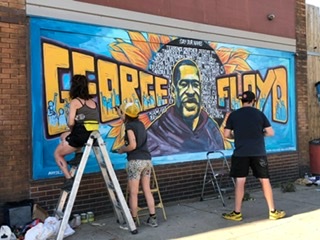
Today I find myself deeply in mourning for the violence that happens in our country. I find myself trying to share in the grief of my friend and knowing I cannot fully feel the depth of it. Today I find myself unable to emotionally move away from it all. Today I contemplate George Floyd’s cry, “I can’t breathe.”
If there is any comfort at all, it comes as a gift of the artists pictured here. In an act of caring, they offer this mural at a memorial for George Floyd.
The names of other victims of violence are painted in the background. The words, “I can’t breathe!” will remain in our memories. Today we are together in mourning.
But tomorrow, I will celebrate Pentecost. I wonder how to celebrate in a time when lamentation feels more appropriate. I wonder how to celebrate when brothers and sisters have died violent deaths and when thousands of protesters line the streets of many U.S. cities. I wonder how to celebrate when protesters are obviously exposing themselves to COVID19.
Still, tomorrow — even in such a time as this — I will celebrate the breath of the Spirit. Tomorrow I will join the celebration that has something to do with being together, being one. To juxtapose the joyous celebration of Pentecost with the horrible picture of what we saw in cities throughout our country for the past few nights seems an impossible undertaking. What does one have to do with the other?
Perhaps they do share a common message. From those who protest, this message:
“We bring our broken hearts and our anger for the killing of our people, for the murders across the ages of people who are not like you. You treat us differently than you treat the people who look like you. For as long as we can remember, you have visited upon us oppression, slavery, racist violence, injustice. And we are tired. We are spent. We are beside ourselves with collective mourning. We can’t breathe!“
From those who celebrate Pentecost, this message:
 “How we celebrate the day when the Holy Spirit breathed upon those gathered together, with gifts of wind and fire!
How we celebrate the story told in the 2nd chapter of Acts!”
When the day of Pentecost came, they were all together in one place. Suddenly a sound like the blowing of a violent wind came from heaven and filled the whole house where they were sitting.
They saw what seemed to be tongues of fire that separated and came to rest on each of them. All of them were filled with the Holy Spirit and began to speak in other tongues as the Spirit enabled them.
Now there were staying in Jerusalem God-fearing Jews from every nation under heaven. When they heard this sound, a crowd came together in bewilderment, because each one heard their own language being spoken. Utterly amazed, they asked: “Aren’t all these who are speaking Galileans? Then how is it that each of us hears them in our native language? Parthians, Medes and Elamites; residents of Mesopotamia, Judea and Cappadocia, Pontus and Asia, Phrygia and Pamphylia, Egypt and the parts of Libya near Cyrene; visitors from Rome (both Jews and converts to Judaism); Cretans and Arabs—we hear them declaring the wonders of God in our own tongues!” Amazed and perplexed, they asked one another, “What does this mean?”
Some, however, made fun of them and said, “They have had too much wine.”
Then Peter stood up with the Eleven, raised his voice and addressed the crowd: “Fellow Jews and all of you who live in Jerusalem, let me explain this to you; listen carefully to what I say. These people are not drunk, as you suppose. It’s only nine in the morning! No, this is what was spoken by the prophet Joel:
“‘In the last days, God says,
I will pour out my Spirit on all people.
Your sons and your daughters will prophesy, last days, God says,
your young men will see visions,
your old men will dream dreams.
Even on my servants, both men and women,
I will pour out my Spirit in those days,
and they will prophesy.’” — Acts 2:1-18 NIV
The people did not, in fact, have too much wine. Peter made it clear that wine did not empower the people who gathered in Jerusalem — “every people under heaven” — to speak and understand as they heard every word spoken in their own language. That would be a start, would it not, if we could speak the same language and truly understand — people who have flesh-colored skin, and brown and bronze, and red and black . . . every skin color under the sun. If only we could understand each other.
And then, what if we could gather together, welcoming every person? What if we could truly gather together and wait for Spirit to fall upon us with empowerment like we have never known before? What if we allowed the Spirit to give us breath, together?
 In the end, there is a tiny bit of joy in George Floyd’s tragic story. It is a joy much deeper than reality’s sorrow. The artists completed their mural, and in the very center near the bottom, they had painted words that express the greatest truth of all.
Can you see it behind the little girl? “I can breathe now!”
What if we welcome Spirit Breath that will change us? What if we embrace empowerment from the Holy Spirit to help us change our world? What if we end oppression and injustice, together? What if holy perseverance could inspire us to live and act in solidarity with our sisters and brothers, all of them?
What if we dare to give our soul’s very breath to help bring about Beloved Community, together?
Together! Together!
May my God — and the God of every other person — make it so. Amen.

As we celebrate Eastertide with the death of Jesus behind us and his resurrection still in our hearts, the stories that led up to Easter remain in our memories. One of those stories tells of Jesus comforting his disciples. They were bewildered, confused, wanting to know what would happen next.
I can identify with those emotions as this time of distancing grows longer and the spread of the coronavirus continues to threaten. What will happen next? I don’t know about you, but I want an answer to that question. Like the disciples discussing their lives with Jesus in the fourteenth chapter of John’s Gospel, if an answer does come to us, we probably won’t quite understand it.
First Thomas has a pressing question for Jesus. “We don’t know where you are going,” Lord, “so how can we know the way?” The answer from Jesus wasn’t very clear or understandable to Thomas.
Jesus answered, “I am the way and the truth and the life. No one comes to the Father except through me. If you really know me, you will know my Father as well. From now on, you do know him and have seen him.”
— John 14:6-7
Then Philip takes a shot at it, telling Jesus to show them the Father. That would be enough for them to feel comfortable about what was going on around them. But the answer Jesus offered did not clear up the conundrum very much.
Jesus answered: “Don’t you know me, Philip, even after I have been among you such a long time? Anyone who has seen me has seen the Father. How can you say, ‘Show us the Father’? Don’t you believe that I am in the Father, and that the Father is in me? — John 14:9-10

Finally, Judas (not Judas Iscariot) asked Jesus why he would show himself to them and not to the world. Again, Jesus answered with what might have seemed like a platitude that did not provide much understanding at all.
Jesus replied, “Anyone who loves me will obey my teaching. My Father will love them, and we will come to them and make our home with them. Anyone who does not love me will not obey my teaching. These words you hear are not my own; they belong to the Father who sent me.
— John 14:23-24
We should remember that this entire conversation began with words of comfort from Jesus to his friends. He told them that day, as he tells us in this day, “Do not let your hearts be troubled.” As they began to end this time with Jesus, the disciples still did not fully understand. But finally Jesus speaks to them with a very clear and grace-filled word of comfort.
All this I have spoken while still with you. But the Advocate, the Holy Spirit, whom the Father will send in my name, will teach you all things and will remind you of everything I have said to you. Peace I leave with you; my peace I give you. I do not give to you as the world gives. Do not let your hearts be troubled and do not be afraid. — John 14:25-27
In the end, that’s all we have that can guide us through uncertainty, confusion and fear. What Jesus left to his disciples, and what Jesus leaves to us, is something simple and pure: PEACE.
I am not fully certain how this peace really works. I know only that sensing it in my soul is a miracle — every time. When my heart is troubled — PEACE. When I am confused and afraid — PEACE.
And that’s enough!
Thanks be to God. Amen.

In my kitchen window hangs a small faceted crystal ball. It’s purpose is to hang in the sunlight and make tiny rainbows in my kitchen. When I open the blinds in the morning, the facets on the ball do their job.

I see about eight small rainbows on the floor — just tiny, insignificant rainbows on the kitchen floor. That’s it!
My first response is, “That’s all you got?”
I had hoped for more, like refracted rainbows all over the kitchen. The little ball hanging in the window apparently needed some human help. So I twisted it several times. When I let it go, the little ball’s gift to me was dancing rainbows, not only on the kitchen floor, but also all over the walls of the kitchen, dining room and living room. Now that’s more like it!

It suddenly occurred to me that I could let the ball just hang motionless in the window, settling for the few rainbows on the floor, or I could twist it and see rainbows in motion creating a celebration all around the walls. So this morning, I made my own rainbows, which is a pretty good mental picture of creating rainbow-like times in life.
It reminds me of part of Noah’s story told in the ninth chapter of Genesis. It’s about the covenant God made with Noah after the great flood had receded. You probably know the story well, but it bears revisiting.
And God said, “This is the sign of the covenant I am making between me and you and every living creature with you, a covenant for all generations to come: I have set my rainbow in the clouds, and it will be the sign of the covenant between me and the earth.
Whenever I bring clouds over the earth and the rainbow appears in the clouds, I will remember my covenant between me and you and all living creatures of every kind. Never again will the waters become a flood to destroy all life. Whenever the rainbow appears in the clouds, I will see it and remember the everlasting covenant between God and all living creatures of every kind on the earth.”
So God said to Noah, “This is the sign of the covenant I have established between me and all life on the earth.”
— Genesis 9:12-17 NIV
 I never see a rainbow without remembering the story of God’s covenant with Noah. I always remember that God made the rainbow a sign, the sign of a covenant promise.
What does that have to do with me and you? Maybe not much for some. But for some of us — those of us who want to see tangible signs of God’s promises — the appearance of a rainbow means that God still covenants with us, God still makes promises to us and God still keeps those promises. That is God’s grace to us — God’s hope, God’s light, the very peace that comes to us from God.
With that assurance, we are able to make our own rainbows. Yes, in these days we are covered with a terrible, deadly virus, along with the fear it causes us. But we also know that, in days past, we have faced life storms, dark times that threatened to destroy us. And yet, we survived — with scars from old wounds, to be sure — but we weathered each terrifying time and found our way to better days. To survive the worst times of our lives — times when dark, heavy clouds loomed over us — I’m pretty sure we found ways to make our own rainbows.
What does it look like to make our own rainbows? It looks like seeking out a comforting friend, making sacred space for nurturing your soul, owning heartbreak so that you can be open to the healing of your heart, naming in prayer the wounds and scars of your soul so that your spirit can be made whole.
It seems to me that this is what “making your own rainbows” means — being open to healing through whatever ways you find soul-nurturing. Rainbows are not a bad analogy for the living of these days. A pandemic threatens us. We cannot change that, but we can change our response to this dark time. I believe that we really can make our own rainbows. Maybe for me it will simply be the act of twisting the crystal ball in my kitchen window. But if that insignificant act reminds me of God’s promise to be with me, to be in covenant with me, then I think I can make it through another dark time.
I am confident that, if you listen, your soul will whisper to you and tell you how to make your own rainbows — during these troubling days and for all the troubling times you may face on your journey.
May God make it so for you and those you love!
Be well and stay safe.
— KMF

What a time in the story of our lives! In my lifetime, I have never been personally affected by a pandemic. I have lived a little over seventy years without having this troubling and potentially deadly experience. My prayer is that once the pandemic of year 2020 has run its course, we will not have to live through another one for at least seventy years.
In the past few days, I have heard from students lamenting the loss of their senior year. I have commiserated with friends who feared for their elderly parents, especially those in nursing homes. I listened recently to a discussion about how we could possibly keep incarcerated persons safe from this virus. I have listened to friends and family express deeply held fears about how the virus might affect them and their families. I have heard almost daily from my adult son (an unprecedented number of calls in such a short time) who is worried about his parents and about his wife and their new baby to be born in early April. I have heard from friends my age who are quarantined at home fearing for their health. I have communicated with post transplant patients like me expressing their most intense fear because of their suppressed immune systems. As a recent transplant recipient myself, I completely understand their angst of being on immunosuppressant medications. Like them, I know I have no immune system right now.
There is no doubt that all over the world people are frightened. People of faith, however, know that faith is stronger than fear, God is stronger than despair and love is stronger than death. Of course, even though we might have great faith, we must admit that we don’t know what God will do or how God can protect us. That is not unfaith; it is the reality of our humanity. Oh, we can take the easy way out and proclaim words like, “God is in control” or “everything happens for a reason.” But doesn’t the past suffering and pain of your life convince you that those words are not your reality?
One of my former seminary professors taught and preached often about the experience of Jesus’ suffering in the Garden of Gethsemane. Dr. Frank Tupper’s answer to the question about how a loving God could allow Christ’s suffering went something like this: “because before the foundation of the world God had chosen the way of self-limitation.”
Dr. Tupper also said some things that some people might consider blasphemy:
I do not believe that God is in control of everything that happens in our world. Indeed, I would argue that God controls very, very little of what happens in our world. God chose not to be a ‘do anything, anytime, anywhere’ kind of God. In every specific historical context with its possibilities and limitations, God always does the most God can do.
In my mind, and through the crucible of my life, I believe that God wanted authentic and honest relationships with humankind that affirm both divine love and human freedom. God built that kind of relationship with me when, through every life storm, every time of despair, every disappointment, every fear, every loss — and through my life-threatening illness — God did not change any circumstance of my suffering, but God promised me a love that would not let me go, ever.
In these days, God is not stopping the dreaded Coronavirus pandemic. God is not stilling our current storm. God is not taking away our very real fear. God is not telling us, “Go on out to that social gathering, I am in control.” Instead God has promised us peace through the words of Jesus recorded in John 16:33:
These things I have spoken to you, that in Me you may have peace. In the world you will have tribulation; but take courage, I have overcome the world.
I pray that you will find peace in these troubling days and that your faith will be even a little stronger than your fear. I pray that you will not experience economic hardship and that you will have all you need. I pray that illness will spare you and those you love. I pray that your children will thrive even though their schools are closed. I pray that you will find ways to worship God even if the doors of your church are shuttered. Most of all, I pray that you will feel God’s love as a love that will never let you go.
The words of one of my favorite hymns express these thoughts so well:
O Love that wilt not let me go,
I rest my weary soul in thee;
I give thee back the life I owe,
that in thine ocean depths its flow
may richer, fuller be.
O Light that follow’st all my way,
I yield my flick’ring torch to thee;
my heart restores its borrowed ray,
that in thy sunshine’s blaze its day
may brighter, fairer be.
O Joy that seekest me through pain,
I cannot close my heart to thee;
I trace the rainbow thro’ the rain,
and feel the promise is not vain
that morn shall tearless be.
O Cross that liftest up my head,
I dare not ask to fly from thee;
I lay in dust life’s glory dead,
and from the ground there blossoms red,
life that shall endless be.
— Author: George Matheson, 1842-1906
Perhaps you would like to spend a few moments of quiet meditation listening to this beautiful hymn arrangement.
 God of the Sparrow 🌱 By Kathy Manis Findley