“Surrounded by Love” — A watercolor by Kathy Manis Findley
On May 17th, I received some devastating news from Piedmont Transplant Center in Atlanta where I had been four years on the transplant list for a kidney. They abruptly placed me on the inactive list, which meant they would no longer be working to match a kidney for me. I was devastated. My friend told me recently that she feared I would give up on the process, but instead she watched me gather up my courage and move forward.
There’s a reason for that, something that empowered me to find another route on the journey that would eventually lead to a transplant. The reason? I call it surrounded by love and all that goes with that kind of love. I found it, I think, at a meeting of Baptist women ministers held at my house on May 17th. After the news from Piedmont, the last thing I felt like doing was hosting a gathering. But they came, a group of women I didn’t really know so well. One of them was a close and trusted friend. The others were friends I needed to know better.
As we enjoyed one another’s company, I avoided talking about my disheartening news, but eventually someone asked about my progress toward a transplant. I could have responded by sobbing uncontrollably. I could have simply said that the process toward a transplant is ongoing. Instead I took a deep breath and gave them the details.
Now you must know that each one of them is a trained and gifted minister, so they knew what to say and how to say it. But the end of the conversation caught me completely off guard. Everyone stood and they created a huddle with me in the middle. It was a hugging huddle — one big, comforting hug. Those moments were comforting, empowering, encouraging, full of grace. My friends mothered me and then they prayed for me, each one.
In those moments I was surrounded by love that has grown deeper with the passing days. From that huddle I was graced with the will to go on, and I did. On November 15, if all goes well, I am scheduled for a transplant at Jacksonville’s Mayo Clinic.
All because I was surrounded by love, a love that I know will not let me go.
October Hunter’s moon rising over Arkansas’ Mallard Lake. Photography by Debbie Marie Smith.
Life can be swampy and murky at times, with not enough light to see the way forward. Not to mention the danger of being mired in the mud unable to move! You have probably been there. I know I have, and when the journey has taken me through those murky waters, I have despaired. So many circumstances can take us through rough places, but the circumstance that immediately comes to mind for me is indecision.
Indecision is that uncomfortably in-between place where you have no idea how to find the way forward, yet you cannot stay in the place you are. Waiting is born of indecision and waiting can be excruciating. Right about now, I wish I could report that one must simply pray and God will instantly change indecision into forward motion, out of any murky swamp.
I cannot say, however, that a single prayer can make that happen. At least for me, there have been no instant-miraculous-life-changing answers to my prayers. Not even once in my faith journey of many years! What I can tell you with deep assurance is that, although no single prayer has changed my life, continual prayer has changed my life. It is not the prayer of occasional consolation that changes the course of one’s life journey. It is the life of prayer that seeks God in prayer, abiding in God’s presence, for as long as it takes. Richard Rohr says this wise thing about prayer:
The only people who pray well are those who keep praying! In fact, continued re-connecting is what I mean by prayer, not occasional consolations that we may experience.
No doubt, life’s journey will take us through murky, swampy places without enough light to find our way through them. The murkiness of indecision is real, and with it we may experience confusion, fear, despair, desperation. We may even lose hope and question our faith. But we cannot stay there. People of faith are people of resilience and courage. We have within us all the resilience and courage we need. So we must believe in ourselves enough to take a step forward and out, through the mud and the sludge, trusting in faith that God’s light will light up the dark places and give us the strength to move through to the other side.
That’s what I have to believe about painful, oppressive places of indecision. That’s what I have to believe about getting through swampy, murky places. That’s what I have to believe about God.
In the beginning was the Word, and the Word was with God, and the Word was God. He was in the beginning with God. All things came into being through him, and without him not one thing came into being. In him was life, and the life was the light of all people. The light shines in the darkness, and the darkness has not overcome it.
I love the simple beauty of a lotus blossom. Since the lotus is often associated with yoga (a practice I avoid with every fiber of my being), I have never really considered the lotus and its intriguing life cycle. But lately I have been curious about the story of the lotus, which has long been considered one of the most sacred flowers. I wondered what it is about this mysterious bloom makes it so enrapturing and symbolic to so many people and cultures.
I think the answer is that the life cycle of the lotus is unlike any other flower. With its roots buried in mud, the lotus submerges every night into murky river water and miraculously re-blooms the next morning without any muddy residue on its petals.
The general consensus among ancient texts that the lotus symbolizes spiritual enlightenment and rebirth. Over centuries and across cultures, the lotus stunned people with its ability to dip into the grime and revive itself unscathed—an incredible daily cycle of life, death, and a sudden immaculate rebirth that can only be described as spiritual. In fact, the lotus flower blooms most beautifully from the deepest and thickest mud.
The lotus flower’s daily resurrection is certainly interesting and symbolic of revival, transformation and new life. But even more interesting is the flower’s stubborn will to live. A lotus seed can withstand thousands of years without water, able to germinate over two centuries later.
The lotus also blooms in the most unlikely of places such as the mud of murky river water in Australia or Southern Asia. Not only does it find sanctuary in the muck, but due to the waxy protection layer on its petals, its beauty is unaffected when it re-blooms each morning. It continues to resurrect itself, coming back just as beautiful as it was last seen. With such refusal to accept defeat, it’s almost impossible not to associate the lotus flower with unwavering faith, more specifically the faith within ourselves.
My serendipitous lotus research did what my research often does: It prompted me to re-examine my faith. I can readily identify times when I had to wade through the murky, muddy waters that life sometimes brings. And although it seemed impossible to re-emerge from the mud clean and renewed, I did, every time, because of a God who understands both the murk and the rebirth.
It’s all about faith, after all is said and done. Once again God’s creation gives us a stunning example of experiencing thick, murky, dark life experiences; going under into the thickest mud when you no longer have the strength to stay above water; and miraculously emerging again — clean, new, reborn. We can learn a valuable lesson about determination, defiance and perseverance from the determined, defiant lotus seed that can survive over centuries. It hints to me about God’s “long game” for my life that simply shouts “hope” not just in my present circumstance, but in a future I can not begin to envision. God envisions it, though — a year from now, two years, my future, the years God has already numbered for me and the mystery we name “eternity.”
Thanks be to God for my eternity and for a faith that is reborn again and again and again by grace.
*********************
On another note, please pray for me as I await a life-saving kidney transplant. I am grateful that you are walking with me on this journey that often feels so frightening. Your thoughts and prayers mean so much. If you would like to read the story of my illness, visit the Georgia Transplant Foundation’s website at this link:
A “Go Fund Me” page is set up for contributions to help with the enormous costs related to the transplant, including medications, housing costs near the transplant center, and other unforeseeable costs for my care following the transplant. If you can, please make a contribution at this link:
What does it mean to be in the presence of God? How do we get there? How do we rest there long enough for our souls to be restored?
Had I ever been able to answer those questions, I imagine my life would have been different — fuller, gentler, more peaceful. But like many people who work to achieve inner peace and a spirituality with staying power, I have struggled around the prize, never quite being able to grasp it.
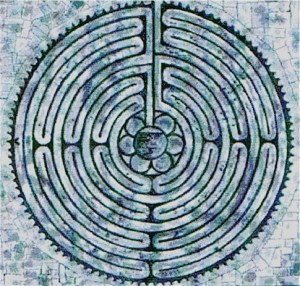
I have used all of the tools available to me — my bible, my bookcase full of contemplative writing, my labyrinth, my hymnal, my writing, my art, my prayer. The list goes on, and I go on, still struggling to find God’s presence.
The worse thing I can do is to cast blame on myself for a small spirituality and an even smaller faith. Truth is, I think I do have spirituality and faith. Faith has lifted me up through many difficult times. Faith was present when fire destroyed part of our home. My faith held when I was forced to close the doors our nonprofit. My faith carried me through sudden kidney failure. Faith showed up every time I wept bitter tears of grief and mourned my life losses. My faith was present with me when I thought I was dying and when I left my home of 32 years, my son and my grandchildren.
My faith held. My anchor gripped God’s solid rock. I picked myself up every time and moved on with hope. Yet, this thing we call “the presence of God” has eluded me. I mostly can’t experience it or feel it or sense it as a reality.
I guess it gets back to faith, doesn’t it. For it is faith that whispers to us, “Know the presence of God. If you cannot sense it, know it. If you cannot feel it, believe it anyway.”
The book of Jeremiah offers this comforting advice: “You will seek me and find me, when you seek me with all your heart.”
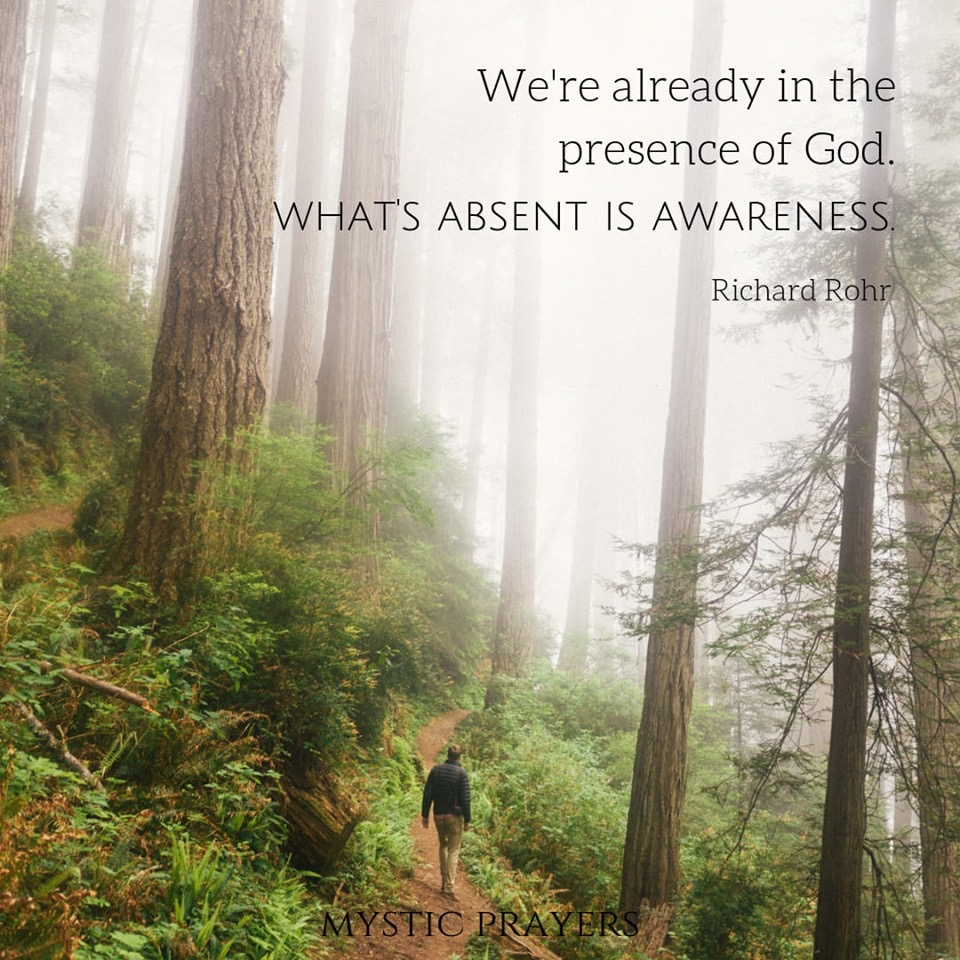
And then I can always fall back on Richard Rohr wisdom:
“We’re already in the presence of God. What’s absent is awareness.”
O Lord, you have searched me and known me!
You know when I sit down and when I rise up;
You discern my thoughts from afar.
You search out my path and my lying down
and are acquainted with all my ways.
Even before a word is on my tongue,
O Lord, you know it.
You hem me in, behind and before me,
and you gently lay your hand upon me.
Such knowledge is too wonderful for me;
I cannot begin to understand it.
Where shall I go from your Spirit?
Where shall I flee from your presence?
If I ascend to heaven, you are there!
If I make my bed in Sheol, you are there!
If I take the wings of the morning
and dwell in the uttermost parts of the sea,
even there your hand shall lead me,
and your right hand shall hold me.
If you know me well, you will know that I have a love affair with trees. I always have, ever since I was a little girl playing among the protruding, gnarly roots of the enormous, beautiful magnolia tree in our yard. I would stay there for hours sometimes, finding under the tree’s canopy my own personal and private hiding place. Though it was ill advised, the tree endured carvings in its trunk without complaining even once. That tree had multiple carved hearts, each with an arrow and the names of boyfriends that came and went.
Today I was reminded how much I love trees when I received a mailing from the Arbor Day Foundation asking me to complete a survey, which I promptly did. As a token of appreciation for completing the survey, the Arbor Day Foundation will send me a calendar, a tree book and ten free trees.
It was an offer I couldn’t refuse, dreaming of having ten new trees in my yard, but of course, knowing that the free trees they send me will be five inches tall. No matter. I’ll plant them and nurse them and hope for the best.
I was also prompted by the Arbor Day Foundation to wonder about state trees. Fred and I tried to guess a few, but eventually resorted to Wikipedia for a list. Interesting list, ranging from common trees like the ubiquitous pine all the way to more exotic-sounding trees like Utah’s Quaking Aspen, Pennsylvania’s Eastern Hemlock and Arizona’s Blue Palo Verde.
Now that you’ve had a lesson on state trees that you did not ask for, I will tell you what’s up with me and trees. The lifelong connection happened when I was just a little girl. I lived with an abusive father who made my home a very unsafe place. Other forms of violence were prevalent as well: shouting and abusive language, threats of physical harm and a violent uncle that came with a gun and broke into our house by smashing the glass in our front door.
I was a child of fear, constant fear, and so I found hiding places under our trees, two huge magnolias, an even taller pecan tree, and even under the branches of Miss Martha Tebshereny’s plum tree. An occasional plum was a bonus!
Here’s the best truth: that it is incredibly powerful that out of a troubled childhood, I brought happy memories. I brought with me into my adult years images of safety; moments of playfulness; an appreciation of nature’s beauty; the taste of fresh figs, plums and pecans; a lovely collection of magnolia cones; the treasure of memories and an abiding love of trees.
She wept a river of tears holy water, sent to soften the sharp edges of sorrow a gentle hollowing out, carving new chambers in her heart a hallowed vessel . . . ― Kate Mullane Robertson
There was healing under the weeping branches of those trees. There was hope. I think it was Holy Ground.
That’s something for which I am very grateful. I am grateful to a loving and compassionate God, who, I am quite sure, met me a few times under one of those childhood trees. God, who knows how important it is to protect children, and graced me with a safe and gentle presence. Because of that, I made it out of a home filled with violence to a better, safer world.
Come now Spirit of power.
Come now quickly and seize this moment.
Come Spirit from all four sacred directions,
from every color and culture,
come and use this sorrowful moment for good.
Very often, the prayers of Bishop Steven Charleston become a part of my meditation time. His prayers have a way of calming my heart, comforting my spirit and inspiring me to greater works. His words are expressive and full of energy. He paints pictures of things as they are and things as they should be.
In response to the tragedies in El Paso and Dayton, Bishop Charleston speaks of the deep divisions in our nation and the old wounds that have been opened. Indeed. He is right. But then he calls us to better things, to a time for love that has the power to heal.
So let us pray this prayer today, in this moment, as we long for healing.
Come now Spirit of power, come now quickly and seize this moment. The conscience of our nation teeters on the edge of change. Old wounds between us have opened. Deep divisions have been revealed. We are stunned by the cost of our own behavior.
Now is the time. Now is an historic opportunity for love.
Pull prejudice from us like a poison.
Draw out the fear that breeds our racism.
Open our eyes to behold our common humanity.
Silence the justifications and the denials before they begin and keep our eyes fixed firmly on the prize, not on the politics.
Come Spirit from all four sacred directions, from every color and culture, come and use this sorrowful moment for good. Heal our racism now.
May God make it so. Amen.
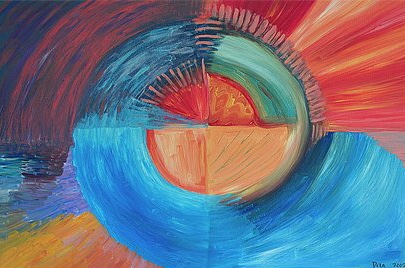
Art: “Four Sacred Directions” by Drea Jensen, 2002
There was never a time when God’s people needed a prophetic voice more than in these days. We keep hearing the phrase, “children locked up in cages,” and we continually feel righteous anger rising up within us. At the same time, we nurse a sense of hopelessness that holds us captive.
We ask, what has happened that has created the environment in which we now live? How do we respond to this toxic environmental of racial division, harsh words and name-calling? Why is there such a blindness to gun violence? Wh is white supremacy now acceptable? When did we stop caring about the lives of immigrant families who flee for safe haven to our country? How did it happen that hate and meanness has all but replaced love and kindness?
As we watch these things happen, we recognize that voices of reason give silent ascent to the evils of the day as our leaders fail to stand for the values we hold dear. Where is their courage? Where is their ability to lead and govern? Where is their willingness to speak truth and champion change? Why are self-proclaimed people of faith giving permission for words and acts of racism, xenophobia, misogyny, and just plain out hate?
And as for us — the people of faith who see the ills of our world so clearly — where is our prophetic voice, and when and where will we use it? Yes, we may be feeling the kind of hopelessness that breeds apathy and inaction. That feeling is normal when evil looms large over us and when the wrongs and the injustices we observe far outweigh what is right and just. We are understandably overwhelmed with all that is happening in these challenging days:
The president is escalating his racist attacks against everyone from women of color in Congress to the people of Baltimore.
Attorney General William Barr is bringing back the federal death penalty.
The Trump administration wants to ban new asylum requests and new refugees, closing America’s doors to families fleeing violence and seeking a safe place of refuge.
And almost constantly, Trump’s allies on the religious right, people who call themselves Christians, continue cheering him on, constantly twisting the Gospel to help re-elect him.
It is no accident that these actions came at us all at once. The president and his allies think that if he does enough hateful things all at once, they can overwhelm and silence us. What they cannot seem to understand is that, as God’s people and as followers of Jesus Christ, we are not listening to their message of fear and hatred. Instead, we hear the voice of God proclaiming a call for justice, mercy and compassion. We are listening to Christ’s message of hope and love, and that is our clarion call to act.
Of course, there are so many things we cannot make happen, so many wrongs we cannot right. Many of the remedies for the evil that assails us are out of our hands. Yet, we must not feel disempowered. Though we may feel that we have no recourse and that there is simply nothing we can do to create real change, we must remember that our voices hold a certain power, the power of the Spirit of God. Words are powerful tools. There is deep wisdom in the quotation, “The pen is mightier than the sword.”
As for me, I pray that God will grant me a prophetic voice, and that with boldness, courage and perseverance, I will use my voice . . .
To speak truth to power through constant letters, phone calls and messages to members of Congress and to the President.
To confront those who maintain silent ascent to the evils happening at our Southern border.
To challenge a president who speaks ill of people, who demonizes his enemies, who acts with blatant disregard for humanity and who ignores the suffering of the migrant families he has abused.
And to speak with deep compassion and caring to all who suffer injustice, oppression and harm.
Finally, I pray for my brothers and sisters of faith, that God will grant a prophetic voice, and that with that voice, you are able to speak God’s message of Good News with courage, boldness and perseverance.
At times, words find their most powerful expression in music. To that end, I have included the following hymn text, which is actually a prayer. Please use it with my permission in any way that is empowering to you.
God, Give Us a Prophetic Voice
God, give us a prophetic voice that speaks of harm and pain;
A voice that claims injustice wrong, that calls the hurt by name.
God, give us a courageous voice that speaks against all wrong;
A voice that sees when harm is done and sings oppression’s song.
Our Mother God, we seek your grace to offer words of life,
To reach our hands toward hurting hearts who live in endless strife.
We ask for courage to persist when violence owns the day,
When children live in fear and want, protect them, God, we pray.
Empower us for good, we pray, that justice may increase;
Ennoble us to speak your Word that pain may find release;
Give us a voice to speak your truth in places of despair;
Grant wisdom, God, and make us bold with courage, is our prayer.
God, give us now compassion’s voice that we might offer peace;
A voice that comforts through the night, that bids the darkness cease.
God, help us find our voice again when silence words erase,
When evil overtakes the words of righteousness and grace.
Words: Kathy Manis Findley, 2019
Hymn Tune: Kingsfold
Meter: 8.6.8.6.
Source: English Traditional; English Country Songs, 1893
Copyright: Public Domain
Every once in a while, something unexpected shows up. It may be a nice surprise that lightens a burden, like receiving a kind note or getting a phone call from a friend. It may be a sudden light that breaks the darkness we’re experiencing or a melody that lifts our spirits. It may be a little beauty in the middle of an ugly place. It may be a touch of color in a patch of gray.
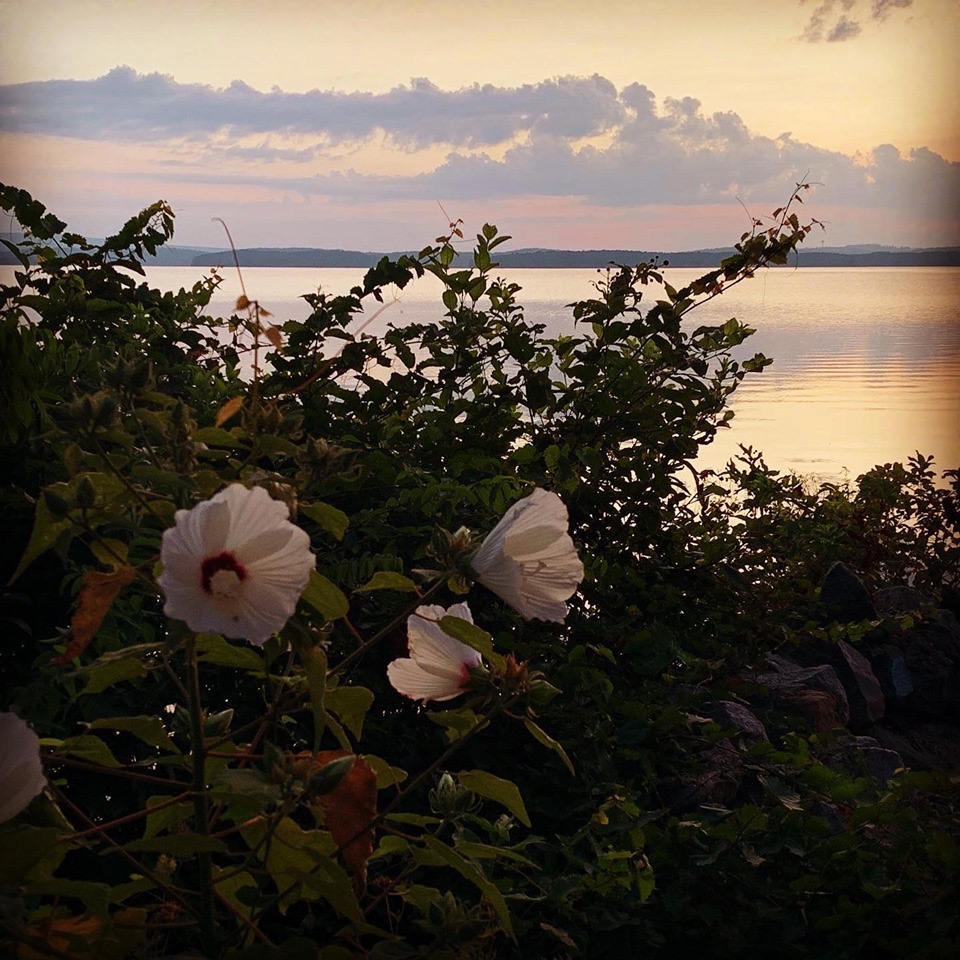
That’s what struck me about the photo at the beginning of this post. The creative photographer, my friend Steven Nawojczyk, must have noticed something bright and beautiful in the middle of a bramble of deep green foliage. It was unexpected — the brilliant, white flowers that bloomed there. No one planted them in that thick brush. They just appeared. Unexpected!
But we know all too well that an unexpected event is not always a good one. The surprises that break into our lives sometimes harm and hurt. My family experienced it this week: a nasty fall on Sunday that resulted in my very sprained, swollen and bruised knee; my cousin falling a few days later and injuring both legs; my son dealing with serious illness; my husband Fred spending all of last night in the ER.
Unexpected! And not-so-good unexpected!
So sometimes the thought of not-so-good unexpected can create fear in us. Of course, we know that our finest plans sometimes fall through. Our projects implode. Our dreams meet the toughest resistance.
Doesn’t it seem as if our “plans” are lightning rods for the unexpected? When our plans crumble underneath us, we sometimes question the very faith that has always, always sustained us.
Now there is no Biblical text for every life occasion, and picking out a text to prove a point or to make us feel better is not the best way to approach the Bible. And yet, our sacred Scripture does speak to the unexpected happenings of life. This time, it’s the wise prophet Jeremiah who offers the word of hope.
For I know the plans I have for you,” declares the Lord, “plans to prosper you and not to harm you, plans to give you hope and a future.
— Jeremiah 29:11 New International Version
A hope and a future! What more do we need? For me, white flowers unexpectedly blooming in the bushes and brambles will just about do it.
Sometimes blogs express grief or anger, indignation or angst, fear or struggle. But today, this blog, must express joy, relief, hope and gratitude. If you saw my last post about my week-long medical evaluation at Mayo Clinic in Jacksonville, Florida, you know that my hope was that I would be approved for a kidney transplant.
Today, I received the phone call from Mayo letting me know that I am now on the transplant list and ready for a kidney. It was a phone call that rekindled my hope. It brought instant joy and a sense of relief. And then there’s gratitude, that the God who holds the universe holds me, too.
Through the fear and struggle of 2014, through these five years of daily dialysis, God has held me in arms of love and care. I do not know if fear and struggle are over. Transplant surgery is an ominous thought at times. Strong, immunosuppressant medication for life is an ominous thought at times. My body rejecting the kidney is an ominous thought. There are dozens of “what ifs!” But I try to always look at “what ifs” through this empowering lens:
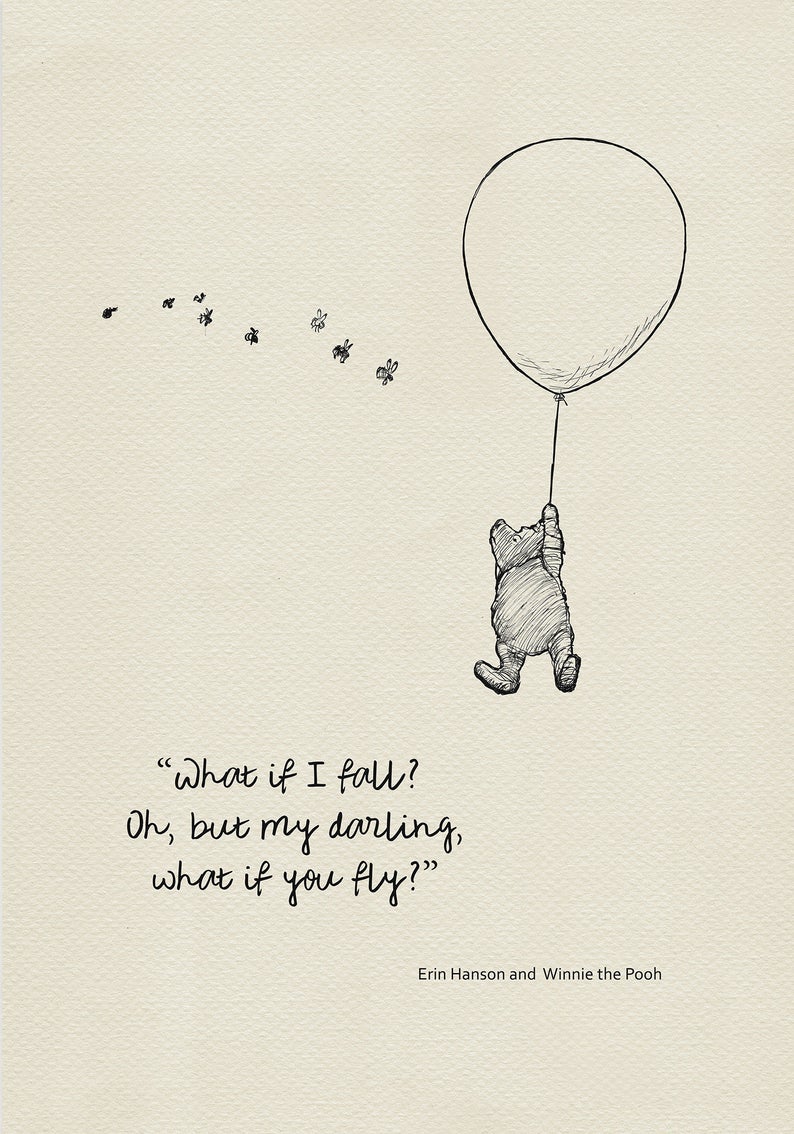
There is freedom waiting for you, On the breezes of the sky,
And you ask “What if I fall?” Oh, but my darling, What if you fly?
― Erin Hanson
What if I fly? What if I take the “wings of the morning?” What if I soar? What if the Spirit Wind blows across my life?
In a tiny book of the Bible that has only 24 verses, we find an exhortation for understanding faith and unfaith. The writer must have known us — and known our lives and our frailties and our actions — ahead of time. He must have known about our faith, and about our unfaith.
It’s troubling at times to experience the many ways unfaith moves in on us until our faith is pushed out for a time. It happens, those times of unfaith. And I have to confess that unfaith has certainly been a part of my journey at times. How does it come on me? What causes it to attack my faith? I can describe a number of ways.
Disappointment and disillusionment in the unjust actions of the leaders of our government — That’s a big one these days.
Anger that children and families are suffering at the Southern border as our country behaves as an unwelcoming place — This is a very serious one for me.
Watching God’s Church go through the motions of religion while failing to create spaces for spiritual contemplation and justice making — Always, this has been a struggle for the Church.
Experiencing personal failure to the point of feeling completely defeated — It happens when one puts herself out into the real world.
Falling down in a state of exhaustion, frustrated with the struggle, ready to give up — It’s such a common state of being for me.
It is true that the preceding situations should not have the power to create unfaith in me. Surely my faith, a faith of so many decades, is strong enough to sustain me. The little Book of Jude offers 24 verses of exhortation to me and to us all:
“But you, Beloved, build yourselves up on your most holy faith; pray in the Holy Spirit; keep yourselves in the love of God” (v. 20). In other words, keep unfaith at bay, stand firm in God’s love, keep yourself from falling.
I happen to know about falling, spiritually and literally. I can recall times in my life when I fell into a brief place of unfaith, times when my hope was small and my spirit was assailed. I know all too well that falling is a situation in which you lose control as you completely lose your footing. It happened to me last night, in fact. In one moment, I was getting ready for bed, and in the next, I was tripping over a power cord, ending up on my back end with an excruciatingly painful knee, and slightly less excruciating pain in several other places on my body.
As my knee swelled to more than twice its size, Fred rushed in and together we plotted how I would get up off the floor. It was not easy, and on top of that, now I have to deal with the repercussions of falling: a hurt knee, painful toes, pain in my shoulder, my arm, my back, my hand and my bottom. It would have been much easier to keep from falling in the first place.
And that’s what Jude, brother of James, told us in the most beautiful benediction in all of Scripture.
Jude, a servant of Jesus Christ and brother of James,
To those who are called, who are beloved in God the Father and kept safe for Jesus Christ:
May mercy, peace, and love be yours in abundance.
Now to him who is able to keep you from falling, and to make you stand without blemish in the presence of his glory with rejoicing, to the only God our Savior, through Jesus Christ our Lord, be glory, majesty, power, and authority, before all time and now and forever. Amen.
Here we have some glorious, sublime Gospel Good News that we can count on:
We are kept safe.
God is able to make us stand without blemish in the presence of God’s glory.
I’m pretty sure it’s not cool to get emotional about having a medical evaluation. But I did. I passed a life milestone yesterday when I completed my week long medical evaluation at Mayo Clinic in Jacksonville, Florida. Getting to an actual kidney transplant is a long journey, five years, ten years, people wait even longer.
I arrived exhausted and holding on to a fair amount of cynicism, barely able to believe that I might actually get a kidney transplant some day. As is my custom, I have trusted God along the way for the best outcome for me, most of the time. But five years of dialysis — every single day for eight hours a day — can wear down one’s hope. Five years of waiting on a transplant list with thousands of other waiters can test one’s faith.
About a month ago, I had a very bad experience with my first transplant center. It took me to a very low place of feeling that I had been devalued by the caregivers who had known me for almost four years. I was on the transplant list, but there was virtually no communication with me during those years. And just as we were about to turn a corner with a transplant actually in view, they abruptly took me off of the active transplant list. It became very clear that the process with this particular transplant center would probably not lead to a transplant for me anytime soon. I was emotionally devastated, but more importantly, I no longer felt comfortable placing my life in their hands. So I gathered up all my emotional baggage and took it with me to Mayo Clinic. I did not expect what happened to me there.
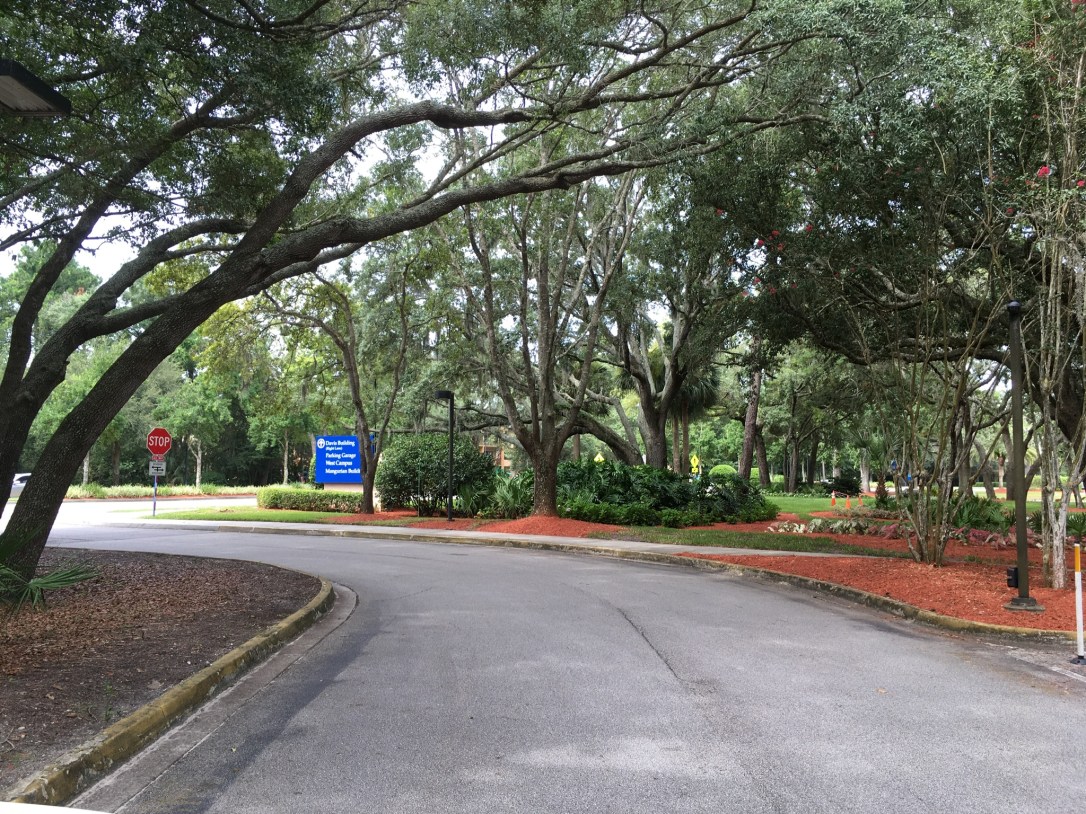
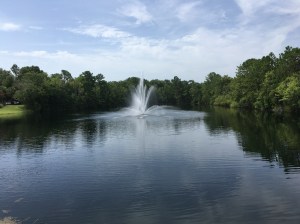
We turned in to the Mayo campus on a road framed with lush, spreading trees. Palm trees were interspersed among the large trees and plants covered the ground. The landscape was made even more beautiful by a large pond with a fountain sending water into the air. It reminded me of the Living Water that quenches our thirst forever. I looked up and saw the words, “Mayo Clinic” and suddenly felt a sense of being home, of being in a place with people who would care for me. A silent tear slid down my face and I felt very full, the lump in my throat extending into my chest.
The week was full of appointments and medical tests, beginning with the transplant nephrologist, Dr. Mai, who is one of the most compassionate and personable physicians I have ever met. He took a complete history, examined me thoroughly and answered ever question we had.
I must say that every single employee at Mayo Clinic was professional, pleasant and kind. It was an atmosphere of caring and compassion. It was a busy place that never felt rushed. They pulled off a “medical miracle” of a sorts, scheduling about thirty appointments for me and never being off schedule for even one of them.
There are places throughout the buildings to stop and rest, many of them filled with the sounds of soothing classical music. It is a place that values art, which you will find in every nook and cranny. And then there is the atrium for meditation, a space closed off from the rest of the clinic. When you enter, a large flowing fountain makes the only sound you will hear. In that silent place, the lighting is dimmed and there are comfortable places to sit. A beautiful altar-like table draws your focus.
After the full week of tests, scans, blood draws and consultations, we were back with Dr. Mai who patiently explained every test result. He was encouraging about the kidney transplant and said more than once that I needed a transplant as soon as possible. “But what do I know?” he said. “I’m just a regular doctor. The surgeon is the one who will tell us if a transplant is possible.”
Then we moved to our very last appointment with the transplant surgeon, the one who would hold my fate in her hands. I feared this last appointment and worried about it throughout the week. The surgeon would have the last word.
How delighted we were to meet Dr. Perry, a rather young woman who obviously knew her craft. She looked over all the scans and examined the potential site of the incision. After a lengthy Q & A, she sent us on our way. She had the final word, the last words of the week. “Let’s get you a kidney!” she said enthusiastically, and all the hope I thought I had lost rose up inside me.
When we drove away, I felt incredibly sad to be leaving that caring place. The lump in my throat came back and I was filled with gratitude, confident that God had chosen Mayo Clinic to help me take back my life.
This morning I was reading an interesting article about Michael, the Archangel. The headline read “Call upon the Archangel to stand guard over you . . . at night.” The article pointed out that we are the most vulnerable when we are asleep, unable to protect ourselves from harm. The Archangel Michael can protect us. The information, while interesting, was not all that earth shattering. But reading it brought to mind an unforgettable childhood memory.
As a child around the age of five, I didn’t think much of this particular day, but as an adult, I count it as one of my most cherished memories. On top of that, I now see it as an early childhood experience that shaped my view of God and began to prepare me for the vocation of ministry. But I must begin at the beginning to paint a picture of a precocious, spoiled five year old.
My mother was expecting a new baby, my first sibling. I was all in if the baby was a sister, but for some reason, I loathed the idea of a baby brother, which is exactly what I got. I was NOT happy! I remember it like it was yesterday. Yiayia (my grandmother) broke the news. I stomped my feet and declared that my mother could absolutely not return home with a boy baby!
Going on alongside my childish impertinence, the adults were experiencing a completely different reality. It appeared, in fact, that my baby brother would not come home and that his survival was doubtful. As in many Greek families, my brother’s dangerous situation remained “between us,” which meant my grandmother, my father and my two aunts, Eirene and Koula. At all costs, my mother was not to be told of the seriousness of her new baby’s health. And of course, nothing was to be said in the presence of five-year-old Kalliope, though that made no difference at all because my ears had always been finely attuned to family secrets and whispers. When adults spoke, even in hushed whispers, I heard.
So I knew, at least, that something was amiss, and if I am honest, I have to confess that I was glad I would not be having a brother in my world. Until the next day. As soon as I woke up, Yiayia washed my face, made me brush my teeth, and began to dress me. For reasons I did not yet understand, she was dressed in her church clothes and she pulled out a church dress for me. I knew it wasn’t Sunday, but I did not know that I was about to have a life-altering experience. Now you might think that a five-year-old cannot really understand a life-altering experience. But you would be mistaken. This life-altering experience has been lying in my memories for more than six decades.
Both dressed impeccably, we put on our winter coats and walked across the street and down the block to the bus stop. I was cold, ready for the bus to show up. Of course, I asked where we were going and why we were so dressed up. “Siopi! Min milas tora!” was Yiayia’s response. “Hush! Don’t talk right now!” Sensing the fear and grief in Yiayia’s mood, I sat quietly and didn’t say another word as the bus took us to downtown Birmingham. When we disembarked, I knew exactly where we were going, but I did not know why.
As we walked up the front steps at our Greek Orthodox church, I felt the warmth of the building easing the February cold. I was glad to be warm. I smelled the incense, comforted by the familiar fragrance. And I watched the flames of hundreds of thin white candles placed in a bed of sand as Yiayia lit another one, placed it in the sand, and made her cross. Immediately, I made my cross, too, three times, as I was taught to do.
The church was silent. With dim lights, it had never looked more beautiful. As we walked down the aisle through the nave, I looked to each side to see the stained glass windows. I looked up above the nave into the dome of the church where the icon of Christ, Ruler of All, looked back directly at me in a way that almost seemed eerie. I realize that we are going up the steps to the iconostasis, the wall of doors that each had an icon on them. I had never, ever been up those few steps. It was the place, I thought, where only the priest and the altar boys could be.
But up we went, and stood directly in front of the door bearing the image of Michael the Archangel. Finally, Yiayia spoke. “Your brother is going to die. We have to pray for him to St Michael, the protector of all. You pray too.
And so we did, Yiayia with a deep, reverent, desperate fervency that pleaded for the Archangel to save the baby, offering Saint Michael a promise in return for the baby’s life. As for me, I can only remember having a lump in my throat and trying not to cry. But tears streamed down my cheeks as we finished, and I made my cross three times.
We headed silently back to the bus stop to go home. The house was much quieter than usual, and I stayed quiet too, which was a huge feat for me. I didn’t say anything about not wanting my baby brother for a few days, which proves the cunning wisdom of a five-year-old. I played quietly in my room the rest of the morning, but the mood in the house lifted that very afternoon.
My father and aunts came home not many hours after our church experience and announced with unbridled joy that the baby was going to be fine. Yiayia made her cross three times and gave exuberant thanks to God and St. Michael the Archangel who heard our prayers, gave us a miracle, and saved the baby boy.
My mother did come home with the miracle baby, Andrew Michael (named after the Archangel who saved his life). I stood my ground, refused to hold him or look at him, and sternly pronounced that they should take him back and bring me a sister!
So much for my spiritual act of devotion in the church. On the other hand, isn’t that just the way God works with us? Planting spiritual experiences in us when we hardly take notice, knowing that we will hide them somewhere in our hearts for a later time in our lives.
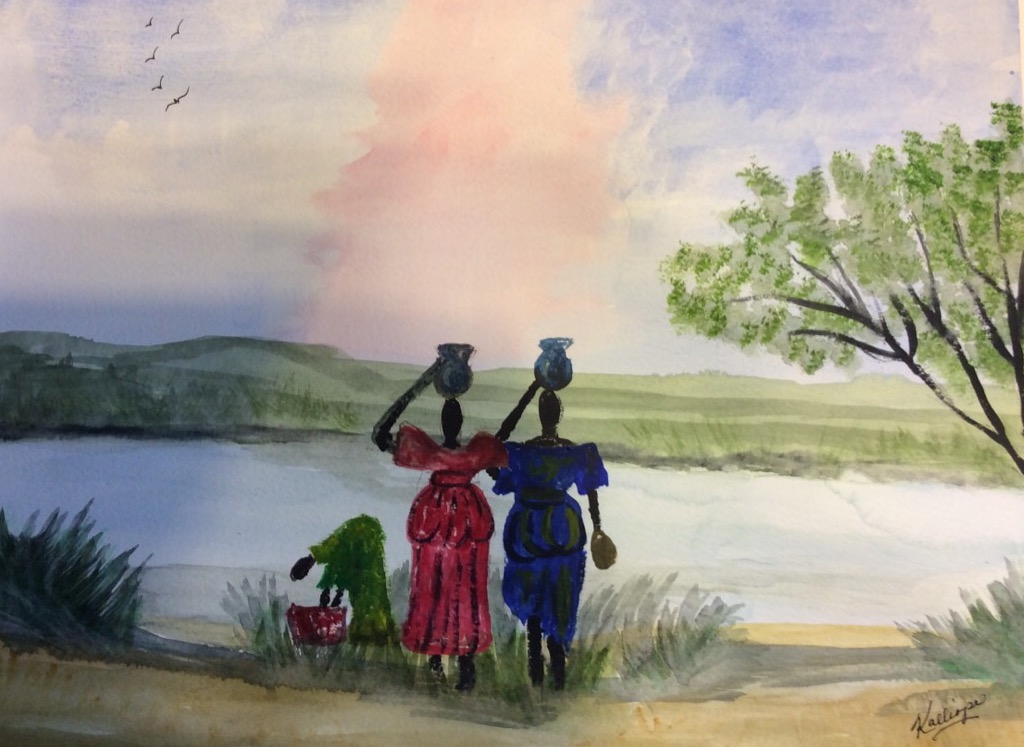
Ugandan Women at the River; Watercolor by Kathy Manis Findley
I tell my story best when I tell the stories of the people that God has placed in my life. Quite often, my heart recalls beautiful memories of a people that became an important part of my life. They are a people who touched me beyond measure when my husband and I served as missionaries to Uganda, East Africa.
The Ugandan people captured our hearts quickly and completely. We saw the great need and set about our work in village after village, doing whatever we could to promote self sufficiency and good health. We worshipped in their churches and learned about the amazing resilience of their Christian faith. Perhaps we helped make their lives better in small ways. There is no doubt that the Ugandan people made our lives better in big ways. It was so many years ago, but I remember it as if it happened yesterday. The two of us stepped off of a plane in the Nairobi airport to begin a new life. As very young missionaries, we had no idea what we would face in the days to come.
Getting to Uganda from Kenya was a long, dusty ride through the most beautiful places we had ever seen. Through bush country and savannah, through banana groves and rain forests, through tea plantations on the mountainsides and the deep waters of Lake Victoria, we were getting acquainted with this continent.
Ugandan Crested Cranes; Watercolor
The terrain was ever-changing, and the way was marked by the majestic beauty of elephants, giraffe, cape buffalo, gazelles, flamingos and Ugandan crested cranes.
The most moving sight of all was the people, barefoot and downtrodden, wearing rags and carrying heavy water containers. Yet, the sight of women at the banks of a river dipping their water jugs to carry to their families was a portrait of beauty and community. In spite of the toll the war had taken, these women retained their pride and dignity, and their joy. They wore basutis (native Ugandan dresses) of many vibrant African colors. In spite of the fact that their basutis were torn and tattered, they caught the rays of the equatorial sun and were bright with the greens, oranges, burgundies blues and yellows that mirrored the Ugandan landscape. The women stood together in the river, at times laughing and talking to one another, and at other times singing, in spite of their ominous sociopolitical world.
Their country had all but been destroyed by the evil dictator Idi Amin, who orchestrated the genocide of 100,000 to 500,000 Ugandans. Churches were burned to the ground, schools pillaged, roads were in shambles. Children were left orphaned in a country of widows. Their faces showed the wear of grief, their bodies the mask of mourning.
They were why we had come, sent by God to comfort a grieving people. The days ahead found us digging water wells, distributing agricultural tools and vegetable seeds, giving out books, bibles, blankets and sewing supplies, bringing in simple medicines and vaccines.
I can never think of the Ugandan people without recalling Lamentations 5, a scripture passage that was read in a church service to describe the plight of the people. As the reader read through her tears, the entire congregation wept, mourning so many losses. I offer the text here in its entirety:
Remember, Lord, what has happened to us; look, and see our disgrace.
Our inheritance has been turned over to strangers, our homes to foreigners.
We have become fatherless, our mothers are widows.
We must buy the water we drink; our wood can be had only at a price.
Those who pursue us are at our heels; we are weary and find no rest.
We submitted to Egypt and Assyria to get enough bread.
Our ancestors sinned and are no more, and we bear their punishment.
Slaves rule over us, and there is no one to free us from their hands.
We get our bread at the risk of our lives because of the sword in the desert.
Our skin is hot as an oven, feverish from hunger.
Women have been violated in Zion, and virgins in the towns of Judah.
Princes have been hung up by their hands; elders are shown no respect.
Young men toil at the millstones; boys stagger under loads of wood.
The elders are gone from the city gate; the young men have stopped their music.
Joy is gone from our hearts; our dancing has turned to mourning.
The crown has fallen from our head.
Woe to us, for we have sinned!
Because of this our hearts are faint, because of these things our eyes grow dim for Mount Zion, which lies desolate, with jackals prowling over it.You, Lord, reign forever; your throne endures from generation to generation.
Why do you always forget us?
Why do you forsake us so long?
Restore us to yourself, Lord, that we may return; renew our days as of old
unless you have utterly rejected us and are angry with us beyond measure.
— Lamentations 5, New International Version
That worship service in the Church of Uganda (Anglican) sanctuary was unlike any I had ever experienced. The people wept freely and openly, grieving the loss of husbands, children, parents. Once described as “the pearl of Africa” by Sir Winston Churchill, Uganda was a land of incomparable natural beauty that now had been ravaged by war.
As the reading of the scripture in Lamentations came to an end, one woman with tears flowing down her cheeks began to sing and dance. The congregation joined her, singing with great fervency, “Dance then, wherever you may be. I am the Lord of the Dance said he. And I’ll lead you on wherever you may be, I am the Lord of the Dance said he.”
The aisles of the sanctuary filled with dancing and weeping all at once.
Their mourning had turned to dancing. The inner joy of a people was not, and could never be, destroyed. Their hearts, so filled with the music of their faith, could not be silenced. They could sing. They could dance. Even through their tears. That is the music of abiding, persistent faith.
How grateful I am to God for choosing us to enter into community for a time with these wonderful people.
My friend and sister blogger, Maren, never fails to inspire, convict or challenge me. I look forward to her blog posts, knowing that by the end, I will find myself in a gasp, or at least a sigh. She is gifted at helping her readers stay in touch with the current angst of the times, the events and realities of our world. This is her latest post:
My little hand holds (and not the great world)
the small shining of shook foil
and there is no beauty that I see,
only the blankets on children detained —
alone and frightened, cold,
and without care,
without — O you grand and broken God,
toothpaste and soap,
and parents,
without justice, compassion,
but not without hope,
because that alone, hope
is never spent, but lights the western sky
as night falls
on the long walk from the south,
even if dimly, touches
with fingers a rim of east
every morning, every detention center.
Hope brought them here
to the terrible inhospitality
that smears
all this country ever thought to be.
And it is left to us and the Holy Spirit
to brood
over those who are lost,
and bend the world
so that the living children
might someday be found
by bright wings.
And here is where it grabbed my heart . . .
What does it mean for me to join with the Holy Breath of Life “to brood over those who are lost, and bend the world?” What would that look like? How do I do it? Does it mean to “brood” over the lostness of our world and call forth life?
What a need that is! How desperately we need to bend the world toward mercy and justice. To lift up the children who sleep on cold concrete floors. To lift them high above the world’s cruelty to the place of “bright wings!”
May God help us to comprehend the brooding Spirit and her open arms. And may she reach down to grab us and hold us up inside the wind that heals.
On this Monday, prayer seems difficult to me. It feels as if I need it so much, yet cannot seem to connect with the holy. I need a quiet place, a place of peace and serenity. I need a personal retreat that enables me to touch all that is anxious within me. I need a place that can help me reach into the palpable anxiety just below the surface. I need a place that calls forth my tears so that, without fear, I can let them fall. I need a place that helps me to get to that lump in my throat that lingers with me. At my retreat, I need a person with spiritual insight and wisdom to gently guide me to my emotional and spiritual place of longing.
For many reasons, this kind of retreat is not possible right now, so I carry on. That’s what most of us have to do day in and day out, struggling to touch the holy and falling short of that. And then, on occasion, we are graced with a touch, a word of hope, a friend who understands, a prayer that reaches the heart. Today, I received that prayer from Anne Fraley. It is “a balm for hurting souls,” a word of hope. I hope it lifts your spirit as it has lifted mine.
Blessed One,
who colors our days with the glow of fireflies and the roar of the ocean,
carry us this day on the breath of your love.
Invite us into the nooks and crannies of delight,
where dreams are born and disappointments released.
Tend the bumps we suffer at the hands of the careless and the words of the thoughtless, and soothe the rough patches we inflict on others.
May our prayers resonate with the needs of the world, and our hearts connect to those who hunger for companionship.
May our song bear the imprint of all who seek you, and our chorus be as balm for hurting souls.
In all things, help us to weave the thread of love and light through the worlds in which we move, and raise our voices with joy to proclaim your name.
Amen
Anne Fraley is rector of St. Peter’s Episcopal Church in South Windsor, CT. A life-long dog-lover, she escapes the demands of parish life volunteering for animal rescue groups. She occasionally succeeds at reviving her blog at reverent irreverence. Her prayer today is published at https://revgalblogpals.org/2019/06/24/monday-prayer-214/
Blue skies and gentle breezes. That’s Macon most of the time. Oh, and you have to factor in the gnats, the annoying gnats that we have because we live on the gnat line.
You will find that not only is the gnat line a real thing, but that it also sits directly on top of Macon, Georgia. No one told me that before I moved here.
Still, there are blue skies and gentle breezes this morning. For a few seconds, I am fully in the moment, fully aware of the blue skies over me and the warm breeze that points my mind to all that is good, to all the things about nature that we can count on.
Gnats notwithstanding.
In some ways, it’s a picture of life —the beauty of blue skies and gentle breezes, right along with the persistent aggravation of gnats buzzing your face. Certainly, life is like that for me. There are every day graces accompanied with aggravations, challenges and sometimes troubles. Life brings days of deep mourning sometimes and times for gladness at other times.
Most thoughts these days take me to the very real possibility that I will receive a new kidney. The thought of it is both exhilarating and terrifying. I would not be me if I did not have the troubling thought that I might die in the middle of surgery. Or that I might contract a lethal infection and die of that. Or maybe I’ll be be compromised from the procedure and not recover.
On the other hand, maybe I’ll thrive with a new kidney. Maybe I will feel better than I have felt in five years. Maybe it’s true that I’ll live longer. Maybe life will begin again, fresh and new and full of possibilities. I love this message from the writer of Ecclesiastes.
So I commend the enjoyment of life, because there is nothing better for a person under the sun than to eat and drink and be glad. Then joy will accompany them in their toil all the days of the life God has given them under the sun.
— Ecclesiastes 8:15 (New International Version (NIV)
What a good and gracious thought! The promise that as we are enjoying life, joy will be in us through whatever “toil” we face. Struggle, trouble, travail — we experience all of these in life, right along with the joy.
So as I contemplate a kidney transplant, I might just think of it as one of life’s “toils” that, by God’s grace, will be accompanied by joy.
I think I can do this. After all, “the joy of the Lord is my strength.” (Nehemiah 8:10)
Mine is a lonely road on a journey of one.
To be sure, I have a dear, dear life partner
And a family
Friends all over the world.
Yet, I am making this journey all by myself.
All around me, friends are working, vacationing, writing, preaching
All those things I long to do
Simple things, but out of my reach.
In the meantime, I am dialyzing for hours every day
Willing myself to eat less, much less
Focusing on healthy
Exercising through pain
And waiting for a kidney transplant.
Friends are still working, vacationing, writing, preaching
All those things I long to do, still out of my reach.
Waiting for an organ transplant is lonely.
No one I know is doing the same thing.
But everyone knows someone who had one
And died
Or did poorly
Or maybe they even did great
But I never hear much about them.
Waiting for an organ transplant is lonely.
I cannot help but second-guess myself
Why the risk?
Hard decision.
A Good decision about a dangerous thing takes time
Maybe years
Info rattles around in your head for a while
Moves on as it discerns the rhythm of your spirit
Then listens for the whisper of God
And at last finds its rest in your heart
And then you know.
Friends are still working, vacationing, writing, preaching
All those things out of my reach.
They stop their busyness long enough to give me counsel
Everyone knows someone who had a transplant
And died
Or did poorly
And so they tell me that
With all the medical details they know
And mostly they don’t know
But I am holding the good decision in my heart
The right decision
The one with all the risks
Just like life
Full of risks.
Mine is a lonely road.
But I am ennobled to move forward in good hope
My mustard seed faith is enough
I leave them in the dust
All those who are working, vacationing, writing, preaching
All those things out of my reach.
I leave them in the dust
All those who knew someone who had a transplant
And died.
Because I am not moving toward death.
I am moving toward life
And light.
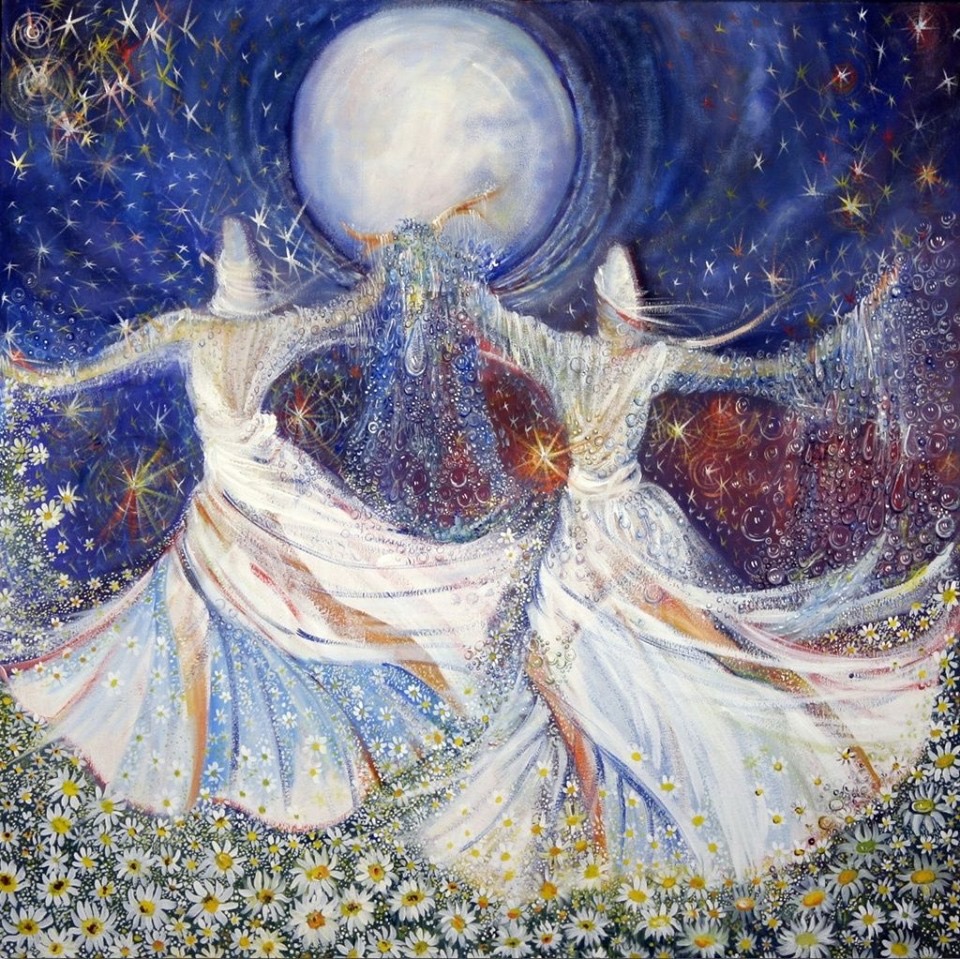
Unafraid, unbound, unleashed from this earth, rising with every step, a dance to lift the human soul.
What do I do through these dark hours? How do I endure them, the lostness, the fear, the spiritual suffering? How do I make my journey and avoid the dark hours that overwhelm me along the way?
Dark hours are a part of our living, a part of our journey. They cover us — even those who are most religious and devout — like an ominous black cloud. Dark hours bring us fear, dread, a lack of hope. Dark hours steal the joy of our faith.
The term “dark night (of the soul)” describes a spiritual crisis in the journey with God, like that described by St. John of the Cross in his poem, “The Dark Night.”
In her letters, St. Teresa of Calcutta described how she endured a dark night of the soul from 1948 almost until her death in 1997, with only brief interludes of relief.
St Thérèse of the Child Jesus wrote of her own experience of the dark night, as she found herselfdoubting the existence of eternity. She struggled and suffered through a prolonged period of spiritual darkness, declaring to her fellow nuns: “If you only knew what darkness I am plunged into..!”
Examples of the experiences of those we look to as spiritual patrons of the faith do not really enlighten our own faith journeys. We walk our own spiritual paths, always hoping for the best, always striving to experience the holy along the way. And we hope beyond hope that we will not have to endure the suffering of dark hours.
The truth is that dark hours are required on the journey. We cannot walk around our dark hours, moving them aside like the sticks and brush we can so easily move off of our path. Our only option is to keep walking, to stay the course and to embrace the journey just as it is.
As I look back to take stock of my own journey, I see the the dark hours as powerful reminders of struggle and spiritual crisis. As I examine the past, I can say without hesitation that the dark hours were times I do not want to experience again. I can feel the intense pain of them, even now, the formidable affect of them on my spirit. The thought of them brings on a queasy feeling in the pit of my stomach that makes me want to quickly move on to the next life metaphor I might use in this post.
And yet . . . And yet, how clear it is from this vantage point that I endured my dark hours and emerged stronger, better, with faith intact and with a living hope to take with me on the rest of the journey. From the cloud of dark hours, I learned that I could believe again, hope again, move farther into my journey with joy — even unrestrained joy — because of God’s grace that gave me strength.
There is probably no writer that inspires me more than Bishop Steven Charleston. He has taught us how to live in his many writings over the years. In this piece, he shows us the way through our dark hours in these beautiful words:
Let us dance through these dark hours, while others crouch down, seeking shelter from a worried world, hiding in the shadows, afraid to hope for tomorrow, let us give them a sign they can see, a message made of music and motion, two dancers spinning light out of darkness, a waltz in an air raid shelter, unafraid, unbound, unleashed from this earth, rising with every step, a dance to lift the human soul. Let us dance so others can dance, dancers from every direction, standing up to join us, music filling the sky, a revolution of unrestrained joy, an invitation to believe again, to hope again, to be free again, dancing through these dark hours, as if dancing was all that we were born to do.
To be sure, I have felt the pressing urge to “crouch down” many times, “to seek shelter from a worried world, hiding in the shadows, afraid to hope for tomorrow.” But in the end, through dark hours I learned to dance.
Dance then, wherever you may be. I am the Lord of the Dance, said he . . .
It’s a good way to live.
It’s a good way to give witness to the world of our living faith and unrestrained joy!
Who will move this mountain? I’m referring to the high, steep mountain that includes hundreds of processes that might eventually (possibly, probably) lead to a kidney transplant for me. So which is it, I keep asking myself? Is a kidney transplant possible? Is it probable? Is it a done deal?
I know with pretty much certainty that having a kidney transplant is never a done deal. The possibility of a kidney transplant for anyone is always tenuous. The possibility of having a donor is even more tenuous. I keep repeating the description offered by Piedmont transplant nephrologist, Dr. Christina Klein: “99% of people who call with interest in donating are screened out by phone and 50% of the people who do the full-day evaluation are screened out.” With deep gratitude, I can say that the person who has offered to be my living donor has passed through both of these screenings and has been accepted as a donor. It is no small thing for a living donor and a recipient to both be determined healthy enough for a transplant.
Piedmont Transplant Institute personnel spent the day yesterday testing me to determine if I’m still healthy enough for a transplant. They do a re-evaluation every two years for persons on the transplant list. It was probably the last re-evaluation I will have before a transplant surgery date is determined.
I said all of that to say that, as always, I think of God as the one who moves these kinds of obstacle mountains. I am standing at the base of a pretty big one this time, looking up at the peak and whispering to myself, “Impossible!”
But that’s not the end of the story, is it? For me, the story aways ends with sacred words that remind me who has the control, who it is that can move this mountain. Sacred words about moving life’s mountains can be found in all three Synoptic Gospels — Matthew, Luke and Mark. The Gospel writers make multiple references that go to the question of who moves mountains, as told by Jesus in parable. Interestingly, Jesus never says, “God will move your mountain.” Instead the words of Jesus in the parables go something like this:
If you had faith even as small as a tiny mustard seed, you could say to this mountain, ‘Move!’ and it would go far away. Nothing would be impossible to you.
— Mark 17:20 (TLB)
What? Can this be true? That God does not move the mountain after all. That it has everything to do with faith, even my very small mustard-seed-like faith. Is it true that I am my own mountain mover? That nothing is impossible?
In reading this Scripture text that is so familiar, it seems that perhaps I am the one who can say to this mountain, “Move!” Without stretching this Gospel text beyond its original intent, I can affirm that its message is about faith, and that message is timeless. It can begin as a thought that Jesus expresses in parable and end up as a reality of faith that empowers my life and quickens my journey.
So stand with me at the bottom of this mountain. Look up at the mountain with me and pray that my mustard-seed faith will get me to the peak. I may very well receive the gift of a kidney transplant. It seems very possible at this point in my five-year journey. But whatever happens, my faith will be with me — sustaining me, guiding me, empowering me still for every future mountain that raises up before me.
For this faith that was born in me decades ago, thanks be to God.
Lent for me was quiet this year. I was sick through most of it, and I spent it pretty much alone, except for the sweet presence of my husband. I didn’t write much. I didn’t paint or craft anything. I was just quiet, and as the forty days passed, I was aware at times of being led by still waters.
Still waters was a spiritual and emotional space I discovered after I was diagnosed with end stage renal disease and throughout my lengthy hospital stays in 2014. So today, I am thinking about some life-sustaining words that were a part of my recovery —the words of the Twenty-third Psalm, my own version of it.
The Lord is my shepherd. I lack nothing. I have around me and within me everything that I need.
The Lord invites me to stop and to lie down in lush, green meadows.
He leads me beside still waters,
He restores and refreshes my soul.
He guides me along good and safe pathways for his name’s sake. And for my sake.
Even though I walk through the darkest valley,
the valley of death’s shadow,
I will not be afraid, for you are close beside me.
Your grace and your care comfort me.
You prepare a place for me, even in the presence of my enemies.
You anoint my head with the oil of gladness. My cup overflows.
Surely your grace and and your love will follow me all the days of my life,
and I will dwell with you forever.
We know the words of this Psalm far too well. We skip past it as a common text we memorized when we were young. We recite it easily. But the Psalm came to life for me during my year-long illness. It was in my heart, and often on my lips, during long, sleepless nights in the hospital. I experienced the Psalm’s comfort as never before.
As we near the beginning of Holy Week, my thoughts are of the resurrection that comes after the passion, for Christ, yes, but also for me. I’m not thinking of “us.” My thoughts tonight are focused on me, how I experienced my illness in 2014 as my own kind of passion, the passion of confusion, grief, worry, fear. I experienced an expansive and disconcerting view of my mortality, and I did not take to the stark reality of it.
I cannot, of course, even begin to compare my passion to the passion of Christ. Yet in some tender way, I experienced suffering. Palm Sunday comes this Sunday, and in Christian churches everywhere, the people of God will celebrate Christ’s “triumphal entry” into Jerusalem. We will raise our palm branches and shout “hosanna,” as well we should. But Palm Sunday moves us abruptly into the week of Christ’s passion, every pain-filled, grace-filled moment of it. We must not skip that part.
But back to my own passion story, the one that happened the year I thought I was going to die. First you must know a bit about me before the illness. I was persistent and stubborn, a fierce advocate for abused women and children. I did not flinch in a courtroom. I did not shrink when I faced-off with an abuser’s defense attorney. I did not cower standing between a woman and her batterer. I searched the nation to find legal advocacy for abused women and their children. I stood my ground against court-ordered child abuse that would consistently place children in the custody of an abusive parent. I railed against a system that refused to protect children. I was hard.
The illness came and went over the course of a year. I did not die. Resurrection did come to me, in bits and pieces, slowly, but with the certainty of faith. I was no longer hard. I was movable, malleable, able to be blown about with good and gentle, life-giving breezes. We settled into a new home in a new state, and mostly, I embraced it over time. I fed hummingbirds, listened more deliberately for birdsong, and discovered the way of mindfulness.
When I recovered — slowly — from my illness, I remember the feeling of being soft, though I was not sure what that meant for me. Most certainly, God granted me the patience to move into my resurrection, to embrace it in God’s time, and to wait for it gratefully.
My family said that I emerged from my illness with a change in personality. I was quiet, they said, not like me at all. Inside myself, I knew that they were right. I felt the change. I sat in my own quiet for months. And even now I sense a quietness that wraps me softly as if it were a warm, light blanket. It’s a good place for me, this soft, warm, comforting place.
It’s a good place to continue my resurrection, to learn more about what it means to be soft. As it often happens, I stumbled upon this quote as I wrote this piece. I love the thought it expresses. It resonates with my soul.
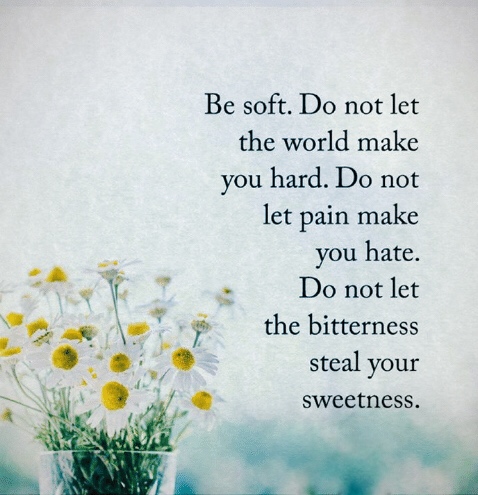
Be soft. Do not let the world make you hard. Do not let the pain make you hate. Do not let the bitterness steal your sweetness.
— Iain Thomas
These days, I am sensing that a kidney transplant is imminent for me. So to go through that process, I will lean even more into my soft side. That will be a good emotional and spiritual space for me. Soft! Soft facing change and fear. Soft facing uncertainty and new, scary medications. Soft facing the hope of a healthy kidney bringing me a new beginning, a resurrection.
May God continue to lead me beside these still waters. It’s a good place for me to greet resurrection.



 If you know me well, you will know that I have a love affair with trees. I always have, ever since I was a little girl playing among the protruding, gnarly roots of the enormous, beautiful magnolia tree in our yard. I would stay there for hours sometimes, finding under the tree’s canopy my own personal and private hiding place. Though it was ill advised, the tree endured carvings in its trunk without complaining even once. That tree had multiple carved hearts, each with an arrow and the names of boyfriends that came and went.
 Now that you’ve had a lesson on state trees that you did not ask for, I will tell you what’s up with me and trees. The lifelong connection happened when I was just a little girl. I lived with an abusive father who made my home a very unsafe place. Other forms of violence were prevalent as well: shouting and abusive language, threats of physical harm and a violent uncle that came with a gun and broke into our house by smashing the glass in our front door.











 God of the Sparrow 🌱 By Kathy Manis Findley