I am aware, as you are, that time is fleeting and moments are passing. Life has taught us that. But there is more, like a dandelion will scatter with the wind as we hold it in our hand. There is no stopping any of that. Nor can we control it.
Still, there are messages for us here, right now, as we contemplate a little reality. If you know me personally, you know that I have lived an uneasy life full of trouble. In a way, tragedy became the path I traveled. I would struggle my way through one tragedy and then steeled myself waiting for the next one. The next tragedy always came eventually, a tragedy large or small.
When tragedy cruelly and abruptly stopped me in my tracks, I found that most of the time, I was resilient and full of hope. Yet, I became exhausted by the trauma, or the sorrow, or the grief.
It is true that when I fell to my knees, I always got up. Good for me! It’s not like that, though, that “good for me” attitude. I was strong enough to get up and move forward, but it was more like God graced me with the courage and hope I needed for to pick myself up and take my next step.
Void of any pending tragedy, I have felt positive for the past weeks. I finally have a stable, working kidney. My frequent falls have stopped. I didn’t get seriously hurt by falling, just a sprained wrist and later a bruised rib cage. So I firmly believed the words of faith from Julian of Norwich, “All shall be well, and all shall be well, and all manner of thing shall be well.”
Until, until, I heard the doctor say to my husband Fred and me, “You have advanced prostate cancer.”That’s when I broke my streak of resilient responses to tragedy. I have been happily married to this good, good man for 55 years! He cared for me during my long illness, five years of dialysis, and my kidney transplant. He cares for me every day in a thousand different ways! I honestly don’t know how I would live without him. Then I heard a whisper, “Where is your hope, my daughter? Where is the resilience that has always carried you through the hard times?”
That whisper was what I needed to hear, because everything about this felt different to me than any other time I had heard bad news. Questions and concerns and worries about every kind of life change flooded my psyche. I was assuming the worst right at the very beginning of this current life tragedy. I could not put my finger on it, until I saw this bit of insight from C.S. Lewis.
No one ever told me that grief felt so like fear
—C.S. Lewis, from “A Grief Observed”
I felt instantly that my feeling since the awful diagnosis day was indeed fear. That’s why it felt so different. It was not my normal response of sadness, anger, devastation, aliveness, fatigue, and more sadness. This time my grief felt more like fear. So there you have it. The gentle make up of a dandelion is not one you can hold together. It scatters with the breeze. Time continues to fleet no matter how we try to stop it. Moments are passing and that will not stop.
But we have this moment and all the comfort and peace and hope and joy we can get from it. And we can do just that: consider only the present; feel the emotion of it; recognize it as completely yours; and summon the courage to hold it in your arms and grab the good things. That is one simple definition of resilience, and you have it! You have resilience! Everyone has it! Keep it close and continue to move on your sacred path.
Most folk don’t take nearly enough time to notice it. These days way too much ugliness hides the beauty that’s always around us. Even when we don’t pay attention, beauty surprises us with magic and mystery. Beauty is a lot like hope.
The magical appearance of beauty is, indeed, in the eye of the beholder. For me, beauty can inspire me by color and movement, by the shimmering stars on a clear night, by the magnificence of a tree’s movement in the breeze, by looking into the eyes of my grandchildren. Beauty is there for us always—to be seen, to be heard, to be sensed deeply in our bodies and in our spirits.
These days, I need more of it—more hope, more beauty. I need more visions of beauty to supersede the ugliness of injustice, division, racism, misogyny, homophobia, political warring, brokenhearted immigrants looking for life, mass shootings, Covid, gun violence, child trafficking, suffering in Ukraine—all the varied chaos around the world.
And then there are the people here and there who bring grace to us all by transforming ugliness into beautyand hope.
As for the beauty revealed in the opening photo, I don’t know who created it or photographed it. I do know that he or she is a person who finds beauty in unlikely places at unexpected times, and translates that beauty into grace to be shared with those who most need it.
Who knows about that image? The striking silhouette of the trees, the birds flying above, the twinkling stars in the sky, and all of that with swirls of color that seem to me like holy movement. Regardless of the source of that photograph, I like to believe that its beauty—all beauty—comes directly from God as grace for me, and for you.
Stand fast therefore in the freedom by which Christ has made us free, and do not be entangled again with a yoke of bondage. Galatians 5:1 (NKJV)
What is it about freedom that scares us? What is it about freedom that causes us to refuse to offer it to everyone? Are we afraid that giving freedom to another person or group of persons will diminish our own freedom? What does freedom really mean to persons who are oppressed and to those who live inside the throes of injustice?
I have written very little lately about justice and accountability, the two words most used to describe Derek Chauvin’s conviction. Ican’t help but mark this very moment on the “long arc that bends toward justice.” I feel compelled to call our attention to this week! Actually it’s last week now, but you get the idea. Let’s call it “the week of the verdict.”
The week of the verdict has come full circle from George Floyd’s murder on May 25, 2020 to the conviction of Derick Chauvin almost one year later on April 29, 2021. It was a week we will not forget. It brought up emotions in me and perhaps in most people. Most of what I felt mirrored the emotions I imagine George Floyd’s family feeling — happy, calm, relieved, conflicted, hopeful, determined, vindicated. I also felt sad and helpless because the conviction did not end murders of black and brown brothers and sisters. And I felt joyful and hopeful because perhaps this flashpoint in the long history of racial injustice will help us turn the corner and finally see in our communities the justice we long for.
How can that happen? How can we turn the corner and move away from oppressive systems and oppressive people? How do we do that when just minutes after the verdict and less than ten miles away, 16 year old Ma’Khia Bryant was shot and killed by police in Ohio? It happened in the shadow of “the week of the verdict.”
Perhaps for us this is the week of the verdict — the week when the verdict will be read on our failure to end the systemic racism in our communities! Isn’t it past time for us to stand up and stand strong and stand determined and woke? My friends, it is time! This moment in the history of injustice may well be the turning point we need to end racism!
I have said this many times: We cannot just reform injustice, we must transform it. The transformation that results in genuine, lasting justice must begin in the soul and in the heart where intentions are formed. I must lament injustice, confess my own complicity in it, repent of the white supremacy within me, own other forms of oppression and commit to the hard work of transforming injustice in my community and in my world. Only then will transformation happen in the systems that oppress people.
Only transformed people can love neighbors as Jesus loved us. My friend and sister blogger never fails to remind me to answer the ultimate question, “How then shall I live?”* She offers this scripture to us today.
We know love by this, that he laid down his life for us — and we ought to lay down our lives for one another. How does God’s love abide in anyone who has the world’s goods and sees a brother or sister in need and yet refuses help?
1 John 3:16-17
She then reminded us that conditions in India are dire and the people languish.
In India, today the virus surges almost beyond control, hospitals are choked, people die in line waiting for a doctor. How can those of us rejoicing in vaccination, cautious travel, new gatherings, not ask how we can help?
How does God’s love abide in anyone who has the world’s goods and sees a brother or sister in need and yet refuses help?
And that is the soul-critical question we must answer. How then shall we live when all around us people suffer every kind of calamity — every kind of violence, disaster, racism, discrimination, dehumanization? Every kind of heartache. How do we, in our suffering world, become the heart, hands and feet of Jesus?
Getting back to the lament of my own heart, that one thing that inspires my passion — transforming the injustice of racism, xenophobia, misogyny, homophobia and all forms of evil exclusion and oppression. Transforming injustice! Setting our faces toward the hope of Beloved Community! This one thing I know, the steps of Jesus would have led him to the “healing” of injustice in any form. On every day he walked on this earth, Jesus would be loving every person who was in need and he would be lamenting every injustice that caused harm.
How can we not lament? How can we not expend ourselves in the hard work of transforming injustice? How can we not care for, and pray for, and love our brothers and sisters who are in need? How can we refuse to work for the freedom of black and brown people, indigenous peoples, LGBTQ+ people, immigrants and asylum seekers, and to any person who is enslaved? How can we deny God’s desire for justice and peace?
How can we refuse freedom to black and brown people, indigenous peoples, LGBTQ+ people, immigrants and asylum seekers, and to any person who is enslaved? How can we deny them God’s peace?
— Rev. Kathy Manis Findley
I do not have the answer for how we might do this. But I do have some convictions about it, especially about racism and white supremacy. One of my convictions is that dismantling racism begins in me, in my soul. And eradicating white supremacy begins when I look seriously at my own white supremacy. For you see, as long as white supremacy looks to me like a white-draped person burning a cross, I will never acknowledge that white supremacy is in me. As long as white supremacy looks to me like a man I might see on TV news with a truck, a confederate flag, a rifle and a mission, I can easily distance myself. I am not that white person; I am a different white person that would never tolerate racism.
Am I? Am I that different white person? Or are there ways I contribute to an unjust society? Are there ways I fail to seek Beloved Community? Are there thoughts and feelings within me that diminish other persons, persons not like me? Am I complacent about injustice? Am I complicit? Am I reticent? Am I avoiding, looking the other way?
As long as white supremacy looks to me like a white-draped person burning a cross in someone’s yard, I will never see that white supremacy is in me. As long as white supremacy looks to me like a man I might see on TV news with a pick-up truck, a confederate flag, a rifle and a mission, I can easily distance myself. I am not that kind of white person! Or am I?
Rev. Kathy Manis Findley
Racial injustice may currently be the most visible form of oppression, but we must remember that many groups of people are oppressed. Many people long for freedom from oppression. Only when we “see” and “hear” all of their voices, will we be on the way to transforming injustice. I don’t know everything about oppression, and I don’t know exactly how to make a difference. I don’t really know how to join hands with my community and set about to transform injustice. I do know that I must begin with my own lament, for only lament can open my eyes to every manner of suffering and oppression.
So meet me on the mountain where we find the strength from God to persevere, and then descend with me to all the places where oppression enslaves people. Come with me to the people, and together, let us remove from them the yoke of bondage and offer them new freedom. And may Spirit Wind surround us with courage. Thanks be to God.
*”How then Shall We Live?” was the inspiring theme of the Alliance of Baptists Annual Gathering.
I once preached a sermon entitled, “What Do You Say to a Broken World?” In this week, after our nation’s Capitol was breached and defiled, I have wondered if ministers who will stand before congregations in two days are asking themselves a similar question: “What will I say on this day to a broken world?”
A friend of mine is preaching this week. I am praying that she will have an extra measure of wisdom, because standing before a congregation while the nation is in chaos is not a responsibility to be taken lightly. My first feeling as I thought about preaching for this Sunday was relief that I was no longer a pastor with such a heavy responsibility, that I did not have to summon the wisdom to speak to a people with heavy hearts who need to hear of healing grace and hope. But my most intense feeling was envy, not hostile envy, but heart envy about my deep desire to speak Gospel Good News to people who need to hear good news. Still I envied my friend and wished that, this Sunday, I could stand before a congregation with wisdom, open my spirit and invite God to speak through me. It is a heavy responsibility and a sacred calling.
Dr. Greg Carey, Professor of New Testament at Lancaster Theological Seminary, wrote an essay this week entitled “Preaching When It’s Broken.” In the essay he says this:
God bless you, preachers who will address congregations this Sunday . . . Here in the United States, things are broken, most people know they’re broken, and we all need healing and truth.
For many of us, the invasion of the Capitol and the response to it by people we know, love and admire, brings this brokenness to the foreground. Since that terrible, violent day, I have heard dozens of interviews that expressed anger, frustration, contempt, indignation and all manner of raw emotion. I have also heard wise leaders express their resoluteness to lead this nation into healing, unity and hope.
Indeed, the questions about this Sunday’s preaching call us to attention: How do our pastors, our priests, our rabbis, our imams, our bhikkhus and bhikkhunis stand before their congregations offering comfort when our nation is so broken, so angry, so mournful in the face of violent acts? What will they proclaim? What will they preach? What will they pray? What will they sing?
Minneapolis Pastor and Poet, Rev. Meta Herrick Carlson, has given us a grace-gift with this poem entitled, “A Blessing for Grieving Terrorism.”
A Blessing for Grieving Terrorism
There is sickness
with symptoms as old as humankind,
a rush of power born by inciting fear in others,
a wave of victoryin causing enemies pain.
There is a push to solve the mystery,
to isolate the suspect and
explain the evil simply
to a safe distance from the anomaly.
There is a temptation
to skip the part that feels
near the suffering
that shares the sadness,
that names our shared humanity.
There is a courage
in rejecting the numbing need for data
in favor of finding the helpers,
loving the neighbor,
resisting terror through random acts of connection.
There is a sickness
with symptoms as old as humankind,
but so is the remedy.
From Rev. Meta Herrick Carlson’s book “Ordinary Blessings: Prayers, Poems, and Meditations for Everyday Life.” Used with permission.
So much truth in her words, so much wisdom “for the living of these days.” In her words, I feel all over again the desire of my heart, the impossible dream of standing in a pulpit this Sunday, speaking to a congregation that needs strength in the midst of adversity. I will not stand behind a pulpit this week, but I will pray for those who will stand in that sacred space. I will pray for them, the proclaimers, and I will pray for their hearers across this nation. I will lean on this beautiful prayer written by Reverend Valerie Bridgeman:
May God Strengthen You for Adversity
A blessing for today:
May God strengthen you for adversity
and companion you in joy.
May God give you the courage of your conviction
and the wisdom to know when to speak and act.
May you know peace.
May you be gifted with deep,true friendship and love.
May every God-breathed thing
you put your hand to prosper and succeed.
May you have laughter to fortify you
against the disappointments.
May you be brave.
When all is said and done, more important than what the “proclaimer in the pulpit” says is what the hearers hear. For in this time — when violence, riots, terrorism, pandemic and all manner of chaos is so much a part of life — those who listen need to hear a clear message of a God who dwells among us, a Christ who leads us, a Spirit who comforts us under the shadow of her wings. For hearts in these days are heavy, souls are wounded, spirits seek hope. And all the people want to believe that they do not walk alone through their present angst.
I pray that you know that you are not alone, that God’s grace-filled presence is with you and that “in God you live and move and have your being. As some of your poets have said, ‘We are God’s children.’” (Acts 17:28)
I pray that your heart will heal and be filled anew with hope. I pray that the wounds of your soul and spirit will heal and be filled anew with the peace of God. I pray that, when you listen in faith, you will hear the voice of God whispering in your ear, “You do not walk alone.”
I invite you to spend a few moments of meditation hearing the message of this music:
May you see God’s light on the path ahead
when the road you walk is dark.
May you always hear
even in your hour of sorrow
the gentle singing of the lark.
When times are hard
May you always remember when the shadows fall–
You do not walk alone.
Rev. Kathy Manis Findley The Hard Way Forward A sermon preached in virtual worship for New Millennium Church Little Rock, Arkansas October 11, 2020 Scripture: Exodus 32:1-14; Psalm 106 (selected verses)
Have you ever come to a point in your life when you had to take the hard way forward? You had no other choices! In fact, the phrase “the hard way forward” paints a an unvarnished picture of these tumultuous days, and the paints on the artist’s brush are dark and foreboding.
What a journey 2020 has been! I have often called it a journey of lament — a journey that has forced us to be in places we never wanted to be and to see things we never wanted to see.
We look around and watch people in shock and dismay — disillusioned and despondent. So many have been personally touched, even ravaged, by the deadly coronavirus, while others are overcome with fear of it. We have witnessed evil, racist assaults; watched police brutality and murder on our television screens; we have grieved over wildfires that threaten to swallow up forests, animals, homes and lives; and over it all we have felt contempt for the reprehensible leadership of an incompetent, insensitive, egocentric, self-serving president. I think it’s safe to assume that many people in this broken nation feel hopeless and heartbroken.
I often ask: God, are you still leading us on this hard journey?Or have you forsaken us? Do you have some kind of plan we do not yet see?
These months for so many people have definitely been a hard way forward. As we try to put one foot in front of the other on this journey, perhaps we can imagine ourselves walking with the people of Israel.
So let us listen and hear the Word of God in Holy Scripture
From Exodus, Chapter 32, (selected verses):
When the people saw that Moses delayed to come down from the mountain, the people gathered around Aaron, and said,“Come, make us gods who shall go before us.”
“As for this Moses, the man who brought us out of the land of Egypt, we do not know what has become of him.”
Aaron said to them, “Take off the gold rings that are on the ears of your wives, your sons, and your daughters, and bring them to me.”
So the people took off the gold rings and gave them to Aaron. He took the gold, formed it in a mold, and cast an image of a calf; and the people said,
“These are your gods, O Israel, who brought you up out of the land of Egypt!”
When Aaron saw this, he built an altar before the calf and said, “Tomorrow shall be a festival to the Lord.”They rose early the next day and offered burnt offerings and brought sacrifices; and they sat down to eat and drink, and then rose up to carouse. [my word choice]
(Now the scene changes locations.)
The Lord said to Moses, “Go down at once! Your people have acted perversely . . . they have cast for themselves an image of a calf, and have worshiped it and sacrificed to it. I have seen how stiff-necked these people are. Now leave me alone, so that my wrath may burn hot against them and I may consume them.”
But Moses implored the Lord, and said,“O Lord, why does your wrath burn hot against your people, whom you brought out of Egypt with great power and with a mighty hand?Turn from your fierce wrath; change your mind and do not bring disaster on your people.
And the Lord changed his mind about the disaster that he planned to bring on his people.
And from Psalm 106 (selected verses):
O give thanks to the LORD . . . for God’s steadfast love endures forever. Both we and our ancestors have sinned; we have committed iniquity, have acted wickedly. They made a calf at Horeb and worshiped a cast image. They exchanged the glory of God for the image of an ox that eats grass. They forgot God who had done great things in Egypt, wondrous works in the land of Ham, and awesome deeds by the Red Sea.
Therefore he said he would destroy them — had not Moses stood in the breach before him, to turn away his wrath.
This is the word of God for the people of God.
The story of the Israelites reminds us that our kindred sojourners also traveled some rough paths. The text gives a glimpse of just one snippet of their journey. We see the Israelites on their wilderness pilgrimage, complaining, as they often did — and as we often do.
Apparently, Moses who had just received the ten commandments, stayed on Mount Horeb for a long time, patiently listening as God engaged him in a presentation of all manner of laws, rules and instructions. It took awhile — 40 days and forty nights, a very long time. And the Israelites started complaining about it to the one Moses left in charge — Aaron.
What has become of Moses?
What would he eat on that mountain, anyway?
This Moses, that brought us out here in this mess — where is he?
And then their fateful request to Aaron:
You are the one who is here with us now — make us something we can see. Make us something that will lead us forward, and we will follow it.
Now you probably remember that the Israelites had complained before:
Why did you bring us out of Egypt? To kill us with thirst? Why have you led us into this forsaken, dangerous wilderness? To kill us with hunger?
Their complaints may sound a bit like our own complaining during the terrible months of pandemic, racial unrest, political rancor, and all manner of upheaval.
Hey God! Are you planning to obliterate this coronavirus, or not?
Are you still with us, God, or not?
Have you brought us to this season for some purpose?
Like the Israelites, we sometimes lose sight of our leader — the God that would give us the courage to move. We are left as a wandering, unsettled people that simply cannot see our way forward.
As Wendell asked in last Sunday’s sermon, “Shouldn’t God do something?”
Shouldn’t a God of enduring, everlasting love do something?
Now remember — we are in good company with several holy bible people. The prophet Isaiah, for one, who asked:
“How long, O Lord And God actually replied to him:
Until the cities lie ruined and without inhabitant, until the land is desolate and ravaged, until the land is utterly forsaken.
Not so reassuring!
The Psalm singer asked, too, in Psalm 94.
How much longer will the wicked be glad? How much longer, Lord? How much longer will criminals boast about their crimes?
They crush your people, Lord; they oppress those who belong to you. They kill widows and orphans, and murder the strangers who live in our land.
Who stood up for me against the wicked? Who took my side against evil?
If God hadn’t been there for me, I never would have made it. The minute I said, “I’m slipping, I’m falling! Your love, God, took hold and held me fast.”
Like those holy bible people, we ask — in our impatience and fear — “How long, O Lord?
And even as we ask, we have a wee inkling that God’s love is still holding us in safe arms of grace. George Matheson was a Scottish clergyman and theologian who lived in the late 1800’s. He was blind by the age of 18. Matheson wrote something quite profound about God’s love — the text of the hymn, “O Love That Will Not Let Me Go.” The hymn text formed in his mind during a “dark night of the soul” he experienced, a deeply emotional and spiritual crisis. He tells us about it in his own words.
My hymn was composed in the manse on the evening of the 6th of June, 1882. Something happened to me which was known only to myself, and which caused me the most severe mental suffering. The hymn was the fruit of that suffering. It was the quickest bit of work I ever did in my life . . . the whole work was completed in five minutes, and it never received at my hands any retouching or correction. All the other verses I have ever written are manufactured articles; this one came like a dayspring from on high.
In a time of emotional anguish, God’s creative grace rose up in George Matheson and he wrote about the kind of divine love that would never let him go. I think we owe Rev. George for reminding us about God’s unwavering love. The hymn text is most assuredly Gospel Good News that people throughout the centuries have desperately needed to remember
As you and I walk this journey, we need to know that God’s love will hold us fast, but sometimes we don’t know it. Like George Matheson, we could use a visit from the Dayspring from on high!
In truth, we need assurance — that no matter how hard the way forward, God’s love will not let us go.Threatened by a deadly virus, God’s love will not let us go.In our most disconsolate moments, God’s love will not let us go.When we courageously stand up to denounce racism, white supremacy, police violence and all manner of evil that surrounds us, God’s stubborn love will never let us go!
But that kind of love also places before us a holy mission undergirded with the foundational principle that evil cannot be reformed, it must be transformed — transformed within us before it can be transformed in the world, and transformed in the way described by Dr. King:
Only through an inner spiritual transformation do we gain the strengthto fight vigorously the evils of the world in a humble and loving spirit.
You might be wondering what any of this has to do with the Israelites and their golden calf, or the psalm singer who sang something about God’s steadfast love enduring forever, or the idea that someone might possibly stand in the breach for us.
My friends, each of us are traveling through these days with at least some fear and anxiety. It is a hard way forward, and as some clever people have said, “The light at the end of the tunnel is probably a freight train!”
Still, we are inheritors of the hope and grit of so many others who have journeyed hard roads before us — walking, marching, sometimes crawling — at times standing tall, at other times falling face-down in the dust of a hard rocky ground.We have navigated perilous roads and turbulent waters in this season. Yet we walk on, just as those who walked before us and who walk beside us.
I recently saw a news report about a little girl walking with her family among crowds of protesters. She stops at a makeshift memorial to George Floyd. As she pauses there, we can read the sign she carries — a hand printed cardboard sign that says:
My daddy plays with me. My daddy reads to me. My daddy tucks me in at night. Please don’t kill my daddy.
The little girl walks on with her family.
Tamika Palmer walks on too, tears flowing freely. Tamika Palmer, Breonna’s mother, vows she will never stop walking forward towards justice for the daughter she lost.
It strengthens us to remember those who walked before us in years past and those who walk with us today who are those sparkling examples of hope and grit: Sojourner Truth, Harriet Tubman, Elizabeth Cady Stanton, Oscar Romero, Fannie Lou Hamer, Prathia Hall, Greta Thunberg, Rev Dr. William J. Barber, II, Rosa Parks, Dr. Martin Luther King,Jr., Dorothy Day, Bishop Michael Curry, Nelson Mandela, Ruth Bader Ginsberg, Dr. J. Alfred Smith, Jr,. US Representative John Lewis, Rev. Pastor Judge Wendell Griffen and countless others whose names we revere, as well as so many whose names we do not even know.
Walking, marching, protesting, advocating, praying, writing, speaking, weeping — throughout centuries and to this very time. Compelled by prevailing, persisting injustice, they walk on — we walk on —taking the hard way forward.
So having eavesdropped on a people constructing a golden calf to worship, will we allow their story to call our attention to our own idols? Those idols we have made for ourselves out of our own Egyptian gold?“Idols” might just be the next sermon point, if I used sermon points!
It’s tempting to mistake our own creations for our God. It’s tempting to shape our self-made idols into an image that soothes our anxiety, feeds our anger and our egos, and convinces us it will demolish whatever is evil around us. I don’t know about you, but I can get obsessed at times. My tasks, my work, my advocacy sometimes rise up out of my obsessions. I don’t like that, but have to admit the truth.
So I have to ask myself: Is my work to dismantle injustice part of God’s call and my holy mission, or have I made it my idol?
Whatever that thing is that we have made from Egypt’s gold is not our god. That thing we idolize may symbolize strength and power. It may personify bravery. It may embody rebellion or protest.But as close as we draw to it and place it at the center of our lives, we must understand that it will not lead us to transformation, just as the Israelites’ golden calf could have never led them to the land of promise.
Instead it will shackle us in our impatience, audacity and self-importance. It will shackle us because of our insistence on following our own way instead of God’s way.
Here is another honest confession:It is tempting for me to let hate become my idol, to allow my desire for retribution to goad me into facing off against injustice with hate. But God’s way is always love.
Is it possible that our idol is our hate for people, people who may actually deserve it like white supremacists, neo-Nazis, violent police officers, men wielding projectiles and tear gas, corrupt politicians and leaders? Do we rise up against such people with hate as our weapon, while all the time, God calls us to love our enemies!
The hard way forward is the way of higher ground that invites us to turn away from the idols created by our lesser angels and walk forward in the persistent love that will never let us go.
The hard way forward knows the pain of fear and doubt, but still chooses to follow cloud and fire through the desert-landscape and on to freedom.The hard way forward is to live into God’s abiding, never-ending love.
For you see, seekers of justice who marched the hard way before us faced firehoses and dogs because they longed for holy transformation and because they trusted that God’s love would not let them go. Seekers of justice protesting in the streets of Louisville and in other cities in these hard days face tear gas, police brutality, violent government intervention because they long for holy transformation and because their faith whispers to them, “God’s love will not let you go.”
You and I, in whatever ways we are dismantling injustice, MUST take the hard way forward — facing censure, criticism, indifference, ridicule, disrespect, even violence, because we long for holy transformation and because deep-down, we believe in our hearts that God’s love will never let us go.
That hard way forward is the path to transforming injustice! Doing the same things we’ve done the same way we’ve done them might bring some manner of reform. But we must not settle for reformation. We must set our eyes on transformation.
One last caveat: the change we seek may never be realized even if we are brave enough to take the hard way forward, because the saved up baggage we carry weighs us down — the anger we hold on to, the hatred we feel, the impatience that makes us volatile, the fear that besets us, the hostility we refuse to let go of. Isn’t it time for you and me to kneel before God, confess our sins and accept the healing grace that wipes away our tears and transforms us into a new creation?
Kneeling at the altar of repentance, we will stand up straight and tall and brave — and most importantly, forgiven — and we will take the hard way forward, knowing in our souls that we cannot just act to reform evil, we must resolve to transform it.
So let us bravely and confidently take the hard way forward, knowing that God is standing in the breach on our behalf and that the Dayspring from on high visits us, giving light when we walk through the darkness and the shadow of death, and guiding our feet into the way of peace.
Let us take the hard way forward, proclaiming from the depths of our being that no matter how dark and difficult and long the journey is, God’s love will never let us go. Amen.
I invite you now to spend a few moments of reflection and prayer as you listen to a benediction of choral music in the video below. May you listen in the music for the whisper of God, for Christ’s blessing of grace, for the brush of Spirit wings.
And as you leave this time of holy worship, persevering on the hard way forward,may the God of love go with you and fill you with gentle peace through every tribulation,so that your soul may rise up in hope by the power of the Holy Spirit. Amen.
I received an inspiring blessing today from Auburn Seminary, a video entitled “May You Vote.” My first thought as I watched the video was that all of us and each of us need a blessing as we vote in this important election. For in these restless days, we are engulfed by a lethal pandemic, isolation, quarantine, violence by police, the death of many of our black, brown and indigenous brothers and sisters, protests in city streets and violence against the protesters. It is almost too much to bear.
But as people of faith who long for transformation, our vote is a part of a holy mission from God. So if we are able, we will vote, and we will vote as a part of God’s holy mission, hoping that God’s love and our perseverance will soon lead us to the gracious gift of “beloved community.”
The Senior Fellows of Auburn Seminary, faith leaders from a multifaith movement for justice, have a deeply personal video blessing for us:
May You Vote!
This is note from their president:
The Fellows gathered in their homes across the country to remind us that a government of the people only works when it’s of the people and by the people.We all have a part to play now! May you be inspired by their words and share them with others. So much is on the line with this election, and with your vote, you can help shape the future of this nation.
By mail or in person if you are able—May You Vote!
Rev. Dr. Katharine R. Henderson
President, Auburn
Please listen to their blessing in this video message:
This morning, I prayed a prayer of lament. Lament was the only prayer in my spirit. It is difficult to express the deep sorrow I felt yesterday when I learned that no charges were brought against the police who shot six bullets into Breonna Taylor’s body.
Shortly after midnight on March 13, 2020, Louisville police officers used a battering ram to enter the apartment of Breonna Taylor, a 26-year-old emergency medical technician who had dreams of a bright career ahead. She and her boyfriend had settled in to watch a movie in her bedroom on that tragic night. Police came to her door and minutes later, she was fatally shot. Her death sparked months of protests in Louisville.
Yesterday, six months after the fatal shooting — six bullets — a grand jury indicted a former Louisville police officer on Wednesday for wanton endangerment for his actions during the raid. A grand jury delivered the long-awaited answer about whether the officers would be punished. No charges were announced against the other two officers who fired shots, and no one was charged for causing Breonna Taylor’s death.
For me, there was only lament. I imagine that for Breonna’s family, there was the deepest kind of lament. For her mother, lament was the only response she could express as she wept uncontrollably. And, even for the protesters who filled the streets, I believe there was lament.
Theologian Soong-Chan Rah explains in his book, Prophetic Lament, that in the Bible lament is “a liturgical response to the reality of suffering and engages God in the context of pain and suffering.” He goes on to say that it is a way to “express indignation and even outrage about the experience of suffering.” Racism has inflicted incalculable suffering on black people throughout the history of the United States, and in such a context, lament is not only understandable but necessary.
Perhaps white Christians and all people of faith have an opportunity to mourn with those who mourn and to help bear the burden that racism has heaped on black people. (Romans 12:15) — Jemar Tisby, The Color of Compromise
In the end, many people see only the rage, anger, impatience, violence of the protesters. Can we also see their lament for Breonna, as well as for centuries of racially motivated murder — beatings, burnings, lynchings and murder committed by police officers?
People of faith — white people of faith — will we try to understand the rage of our black and brown sisters and brothers? Will we join them in righteous anger? Will we mourn with them? Will we lament when lament fills their souls and overflows in cries for justice?
We must, in the name of our God who created every person in God’s own image!
Last night, I heard an interview with Brittany Packnett Cunningham on MSNBC. Her words were eloquent pleas for justice. She spoke about how persistent and all-encompassing racism is in our country and about the murders and the protests and the political rancor that fuels it. She acknowledged racism’s strong, unrelenting hold on this nation, a hold that is virtually impossible to break. And she said something I have said for a long time, “Racism cannot be reformed. It must be transformed.”
To me that means a transformation of the heart and soul that compels each of us to lament, to comfort, to speak truth in government’s halls of power, to stand openly against any form of racial injustice.
May God make it so.
Will you pray this prayer of lament with me?
O God, who heals our brokenness, Receive our cries of lament and teach us how to mourn with those who mourn. Receive even our angry lament and transform our anger into righteous action. Hear the anguish of every mother assaulted by violence against her child. Hear the angry shouts of young people as shouts of frustration, fear and despair. Grant us the courage to persist in shouting out your demand for justice, for as long as it takes. When deepest suffering causes us to lament, grant us Spirit wind and help us soar. If we resist your call for justice, compel us to holy action. May our soul’s lament stir us to transform injustice, in every place, for every person, whenever racism threatens, for this is your will and our holy mission. Amen.
Art by Catrin Welz-Stein, from The Cosmic Dancer Facebook community
A friend sent me a lovely blessing today and I want to share it with you. These days, many neighbors and friends — people all over the world actually — have a new dream, a new calling to change the world. It’s an important dream right about now. Pandemic and protests — and all the causes lying underneath them — desperately need to change, and it will take huge dreams to change them. Trouble is, most people like me and you have only small dreams, a few small dreams that sometimes seem so insignificant. Certainly, they are dreams too small to change the big world.
But maybe not!
The message my friend sent me (actually she posted it on Facebook) reminded me that huge change can most certainly come from small acts. The message was today’s grace for me. So I share the message with you. It comes from The Cosmic Dancer* and is written by Scott Stabile.
She felt like doing her part to change the world, so she started by giving thanks for all of the blessings in her life, rather than bemoaning all that was missing from it.
Then she complimented her reflection in the mirror, instead of criticizing it as she usually did.
Next she walked into her neighborhood and offered her smile to everyone she passed, whether or not they offered theirs to her.
Each day she did these things, and soon they became a habit. Each day she lived with more gratitude, more acceptance, more kindness. And sure enough, the world around her began to change.
Because she had decided so, she was single-handedly doing her part to change it.
— Scott Stabile
Hope is tucked into these words, hidden there and bringing to mind that God highly values gratitude, acceptance, kindness and our smallest, powerful dreams. My dreams and yours can change a world filled with violence, hate, grief, fear and so many more hurts and harms.
Tikkun Olam Together provides cultural learning opportunities for mothers and daughters’ grades 6-9 as they work to improve the world – Tikkun Olam.
There is a lovely Hebrew phrase, Tikkun Olam, that means “repair the world” or “heal the world.” The call of Tikkun Olam has always inspired me to more fully offer my life to be a part of the healing God desires for creation, for the earth’s protection and for kindness, equality and justice for all people.
Can we heal the big world with even the smallest acts of kindness and compassion? Doesn’t God whisper to us that we should begin healing the injustice, the violence, the hate, the fear, the mistrust and the deep divisions in the world? Doesn’t God inspire us to know the truth that our dreams are never too small? And doesn’t God promise to guide us and to lead us in following the compassionate footprints of Jesus until we see the world begin to change?
Resting in the grace of inspiration given to us by God, we truly can cast off the gloomy thoughts that our dreams are too small, too weak and too insignificant. And we can hide inside our hearts God’s promise that our dreams can become reality, that our tiny dreams really can change this big world. God will enlarge our smallest dreams if we offer them. We can count on it!
May each of us live “with more gratitude, more acceptance, more kindness” and may even our smallest dreams change — heal — the world.
* The Cosmic Dancer is a Facebook community that shares insights through art, poetry, dance and other “revolutionary rhythms.”
liminal in American English (ˈlɪmɪnəl ; ˈlaɪmɪnəl )
ADJECTIVE
1. Relating to a transitional or initial stage of a process.
2. At a boundary or transitional point between two conditions, stages in a process, ways of life, etc.
“Liminal” used in a sentence:We are in a transitional and liminal time: this makes everything unsettled and awkward, and most of us feel tremendous unrest and a sense of urgency.
I choose to mark this particular time in history as a liminal time that demands my courage to stand — to stand in solidarity with every person who is demanding an end to racial injustice. I cannot choose my partners in this struggle. Instead, I have to accept those that appear in my life, bringing with them a determined will to stand for justice.
I must understand that liminal time does not last forever. Liminal time is a place of transition, a liminal stage between justice and oppression, between life and death. So my choices and yours in this liminal time might very well affect what’s going on in the streets of American cities, in police precincts in every community and rural hamlet, in the halls of Congress and in the White House, in our hearts and in the hearts of those we could see as our “enemies.“
Here is where I must focus. My heart must long for an end to injustice. So must yours, because God’s heart grieves over the mayhem in our streets and the violence that has its way when a white police officer murders a black man or woman, even a black child.
You and I must yearn for an end to racial injustice — any kind of injustice and oppression — because God’s heart yearns to see us living in holy unity as brothers and sisters.
These days have dramatically shown us our liminal time, and it is NOW.
I have a strong sense that this liminal time has brought the widespread unrest we are witnessing, and that unrest emerges directly from a deep desire for change and transformation. It must be now!
Those of us who remember, know that the Civil Rights Movement came to its boiling point when every marcher, every protester, every non-violent activist and every violent one knew when their liminal time had come. Some people, of course, did not like that time at all, but even those who resisted that movement towards justice knew in their hearts that it was the liminal time, the time of NOW.
The fight was fought by people who spoke and marched, prayed and worshipped, who resisted and stood their ground, who preached and sang their freedom songs. Ah, how those songs of the civil rights movement helped motivate people of all ages and races, from Student Nonviolent Coordinating Committee (SNCC) activists and Freedom Riders to the thousands who marched on Washington, Selma, and Montgomery!
Yet not one person — Civil Rights leader or non-violent protester — could achieve civil rights alone. It required persons living in the poorest neighborhoods and their affluent neighbors across town. It took white folk and black folk, protestors and preachers, eloquent advocates and those who fought silently, lawyers and congresspeople and attorneys general and presidents. It required a community in solidarity. In fact, during the Civil Rights Movement, the creation of community was the quintessential coming-of-age story for Black people.
Of that historically significant time, Father Richard Rohr writes this:
It was the particular time in history when nonviolent initiatives seeded with contemplative worship practices became acts of public theology and activism. You see, activism and contemplation are not functional opposites. Rather, contemplation is the heart’s reflective activity that is always seeking the spiritual balance between individual piety and communal justice-seeking.
Who could have predicted that America’s apartheid would fall as decisively as the walls of Jericho, when the people marched around the bastions of power carrying little more than their faith and resolve? How audacious it was to take just the remnants of a chattel community, the vague memories of mother Africa, and a desperate need to be free, and translate those wisps into a liberating vision of community. The idea of a beloved community emerged from the deeply contemplative activities of a besieged people — the people of the Civil Rights movement. — Fr. Richard Rohr
One would think that such a movement that was so powerful, so eloquent and so determined would see its dream become reality, and that such a stunning reality would last forever. So that every person, from that time to this, would live as beneficiaries of beloved community. But here we are in another liminal space of racial indignity, cities in chaos and families mourning the death of their loved ones in Minnesota, in Georgia, in Kentucky and beyond. We did not really believe we would be in this time and space, a time that would demand a civil rights movement of its own.
The in-between liminal spaces of Scripture are pregnant with God’s transformational possibilities:
Noah and his family rebuilding the world after the flood; Abraham holding the knife above Isaac; Jacob’s struggle with the angel; Joseph in the pit; Moses and the Israelites at the edge of the Reed Sea; Israel in the wilderness; Joshua crossing the Jordan; Jesus suffering on the tree; the women at His tomb; the disciples waiting in Jerusalem.
Scripture indeed is fraught with liminal moments – moments of imminent expectation, infused with both hope and doubt — that lead to transformation and change. So change involves tension, and those of us who are longing for a paradigm shift that insists on justice, know that tension all too well.
Betwixt and Between — neither here nor there. It would be safe to say that this liminal time is mostly uncomfortable and confusing. Liminal time is the time between what was and what will be. And not one of us can predict what will be, either in this struggle against injustice or in the uncertain waxing and waning of the deadly coronavirus. The convergence of virus and death and sickness and distancing with racial injustice, violence and protest is almost too much uncertainty for us to navigate.
In the end, I want to believe that this liminal time and every liminal space is the dwelling place of God, the place where God meets us and says, “I will never leave you or forsake you . . . And remember, the Spirit of the Lord is upon you and has anointed you to announce Good News to the poor, to proclaim freedom for the imprisoned and renewed sight for the blind, to release those who have been oppressed. [my paraphrase]
Even in our current time of disconcerting fluid borders, God is with us in this liminal time. God is inseparably bound with us in this moment, and it is in this liminal space where heaven and earth, life and death, joy and sorrow, ecstasy and despair, sleeping and waking, justice and injustice, commingle.
So here’s my challenge to myself and to all of us. What if we choose to experience this liminal time, this uncomfortable now, as a time for insisting upon full solidarity with all of our brothers and sisters? What if we choose to make this particular time — with all of its pandemic and death, chaos and destruction, fire and protest, upheaval and violence as if no lives matter — a liminal time for construction and deconstruction, choice and transformation? What if you and I choose to hold hands and march on in solidarity and community until we reach the mountaintop where injustice is no more?
A blending of two photos: One is an image of protesters in Minneapolis. The second image is a portrayal of people raising their hands to celebrate Pentecost.
This morning I have no words. I have tears. I have sadness. I even have some anger that the people I love whose skin is not “white” are living in grief and frustration. I say only that injustice and oppression cling so close to my friends, today and in centuries past.
I hear my dear friends cry out for justice. I hear them using words to make sense of it all, and I hear their voices fall silent. Silent, with just these words, “I’m tired.” A dear friend posted the words on the left this morning. I want to see her face to face. I want to be together. I want to comfort her, hoping beyond hope that it is not too late for comfort.
I read this horrific headline this morning.
Prosecutors in Hennepin County, Minnesota, say evidence shows Chauvin had his knee on Floyd’s neck for a total of 8 minutes and 46 seconds, including two minutes and 53 seconds of which Floyd was non-responsive. — ABC News
Artists honor George Floyd by painting a mural in Minneapolis on Thursday, May 28, 2020. Artists began work on the mural that morning. (Photo: Jacqueline Devine/Sun-News)
Today I find myself deeply in mourning for the violence that happens in our country. I find myself trying to share in the grief of my friend and knowing I cannot fully feel the depth of it. Today I find myself unable to emotionally move away from it all. Today I contemplate George Floyd’s cry, “I can’t breathe.”
If there is any comfort at all, it comes as a gift of the artists pictured here. In an act of caring, they offer this mural at a memorial for George Floyd.
The names of other victims of violence are painted in the background. The words, “I can’t breathe!” will remain in our memories. Today we are together in mourning.
But tomorrow, I will celebrate Pentecost. I wonder how to celebrate in a time when lamentation feels more appropriate. I wonder how to celebrate when brothers and sisters have died violent deaths and when thousands of protesters line the streets of many U.S. cities. I wonder how to celebrate when protesters are obviously exposing themselves to COVID19.
Still, tomorrow — even in such a time as this — I will celebrate the breath of the Spirit. Tomorrow I will join the celebration that has something to do with being together, being one. To juxtapose the joyous celebration of Pentecost with the horrible picture of what we saw in cities throughout our country for the past few nights seems an impossible undertaking. What does one have to do with the other?
Perhaps they do share a common message. From those who protest, this message:
“We bring our broken hearts and our anger for the killing of our people, for the murders across the ages of people who are not like you. You treat us differently than you treat the people who look like you. For as long as we can remember, you have visited upon us oppression, slavery, racist violence, injustice. And we are tired. We are spent. We are beside ourselves with collective mourning. We can’t breathe!“
From those who celebrate Pentecost, this message:
“How we celebrate the day when the Holy Spirit breathed upon those gathered together, with gifts of wind and fire!
How we celebrate the story told in the 2nd chapter of Acts!”
When the day of Pentecost came, they were all together in one place.Suddenly a sound like the blowing of a violent wind came from heaven and filled the whole house where they were sitting.
They saw what seemed to be tongues of fire that separated and came to rest on each of them.All of them were filled with the Holy Spirit and began to speak in other tongues as the Spirit enabled them.
Now there were staying in Jerusalem God-fearing Jews from every nation under heaven.When they heard this sound, a crowd came together in bewilderment, because each one heard their own language being spoken.Utterly amazed, they asked: “Aren’t all these who are speaking Galileans?Then how is it that each of us hears them in our native language? Parthians, Medes and Elamites; residents of Mesopotamia, Judea and Cappadocia, Pontus and Asia, Phrygia and Pamphylia, Egypt and the parts of Libya near Cyrene; visitors from Rome(both Jews and converts to Judaism); Cretans and Arabs—we hear them declaring the wonders of God in our own tongues!”Amazed and perplexed, they asked one another, “What does this mean?”
Some, however, made fun of them and said, “They have had too much wine.”
Then Peter stood up with the Eleven, raised his voice and addressed the crowd: “Fellow Jews and all of you who live in Jerusalem, let me explain this to you; listen carefully to what I say.These people are not drunk, as you suppose. It’s only nine in the morning!No, this is what was spoken by the prophet Joel:
“‘In the last days, God says,
I will pour out my Spirit on all people.
Your sons and your daughters will prophesy, last days, God says,
your young men will see visions,
your old men will dream dreams.
Even on my servants, both men and women,
I will pour out my Spirit in those days,
and they will prophesy.’” — Acts 2:1-18 NIV
The people did not, in fact, have too much wine. Peter made it clear that wine did not empower the people who gathered in Jerusalem — “every people under heaven” — to speak and understand as they heard every word spoken in their own language. That would be a start, would it not, if we could speak the same language and truly understand — people who have flesh-colored skin, and brown and bronze, and red and black . . . every skin color under the sun. If only we could understand each other.
And then, what if we could gather together, welcoming every person? What if we could truly gather together and wait for Spirit to fall upon us with empowerment like we have never known before? What if we allowed the Spirit to give us breath, together?
In the end, there is a tiny bit of joy in George Floyd’s tragic story. It is a joy much deeper than reality’s sorrow. The artists completed their mural, and in the very center near the bottom, they had painted words that express the greatest truth of all.
Can you see it behind the little girl? “I can breathe now!”
What if we welcome Spirit Breath that will change us? What if we embrace empowerment from the Holy Spirit to help us change our world? What if we end oppression and injustice, together? What if holy perseverance could inspire us to live and act in solidarity with our sisters and brothers, all of them?
What if we dare to give our soul’s very breath to help bring about Beloved Community, together?
Together! Together!
May my God — and the God of every other person — make it so. Amen.
WAR noun, often attributive (1)a state of usually open and declared armed hostile conflict between states or nations
(2)a period of such armed conflict
(3)a state of hostility, conflict, or antagonism
(4)a struggle or competition between opposing forces for a particular end
In a time of turmoil across the earth, I am reminded of the many ways we long for peace and the many times we fail to achieve it. As I hear reports and human stories of the warring among peoples of many nations, I am also very aware of the wars that often rage within. War and peace are complex ideologies that spurn people to action — either action to plunder and kill or action that insists upon peace and tranquillity. The British peace advocate John Bright (1811-1889) gave a speech at the Conference of the Peace Society in Edinburgh in the summer of 1853 to oppose the forthcoming war against Russia (the Crimean War 1854-56).
What is war?
What is war? I believe that half the people that talk about war have not the slightest idea of what it is. In a short sentence it may be summed up to be the combination and concentration of all the horrors, atrocities, crimes, and sufferings of which human nature on this globe is capable . . . injustice of any kind, be it bad laws, or be it a bloody, unjust, and unnecessary war, of necessity creates perils to every institution in the country. — John Bright (1811-1889)
Profound truth rests in Bright’s words, and it is a truth every person would do well to contemplate. At some point I recall seeing a provocative image on the poster for Stanley Kubrick’s film Full Metal Jacket. It was an image of the soldier’s helmet with a handwritten “born to kill” slogan . . . and a peace symbol, a provocative juxtaposition of reminding us that human beings have the capacity for both killing and peace.
Who can forget the words of the Prophet Isaiah?
And he shall judge among the nations, and shall rebuke many people: and they shall beat their swords into plowshares, and their spears into pruninghooks: nation shall not lift up sword against nation, neither shall they learn war any more. (Isaiah 2:4)
So why talk of war after Ash Wednesday and into Lent? Perhaps the subject of war occurred to me as I moved closer to this season of repentance and self-reflection. Perhaps I felt a need to consider the futility of war because of Ash Wednesday’s dictum, “Remember that you are dust, and to dust you shall return.”
One who came from dust, and who anticipates returning to dust, must certainly feel a longing for peace, peace in the world as well as peace of the soul and spirit. Neither examples of peace are easily achieved. The machinations of war between nations, and the eternal quest for finding inner peace, are two sides of the same coin. Perhaps it is those persons who have a dearth of inner peace who seriously contemplate making enemies and making war. War flourishes, at times, when the cause seems righteous, while at other times, the cause is greed, lust for power and human depravity. Either way, the losses of war are enormous beyond imagining.
I have been intrigued by the writing of Sebastian Junger in his book War (published in 2010). He echoes the famous words of Winston Churchill:
We sleep soundly in our beds because rough men stand ready in the night to visit violence on those who would do us harm.
Junger also offers interesting insights into war:
The cause doesn’t have to be righteous and battle doesn’t have to be winnable; but over and over again throughout history, men have chosen to die in battle with their friends rather than to flee on their own and survive.
The Army might screw you and your girlfriend might dump you and the enemy might kill you, but the shared commitment to safeguard one another’s lives is not negotiable and only deepens with time. The willingness to die for another person is a form of love that even religions fail to inspire, and the experience of it changes a person profoundly.
Three Christian denominations have positions on war.
Roman Catholic The fifth commandment forbids the intentional destruction of human life. Because of the evils and injustices that accompany all war, the Church insistently urges everyone to prayer and to action so that the divine Goodness may free us from the ancient bondage of war.
The Southern Baptist Convention (Adopted on June 14, 2000) Peace and War. It is the duty of Christians to seek peace with all men on principles of righteousness. In accordance with the spirit and teachings of Christ they should do all in their power to put an end to war.
The United Methodist Church (2000 United Methodist Book of Discipline)
We believe war is incompatible with the teachings and example of Christ. We therefore reject war as a usual instrument of national foreign policy and insist that the first moral duty of all nations is to resolve by peaceful means every dispute that arises between or among them; that human values must outweigh military claims as governments determine their priorities; that the militarization of society must be challenged and stopped; that the manufacture, sale, and deployment of armaments must be reduced and controlled; and that the production, possession, or use of nuclear weapons be condemned. Consequently, we endorse general and complete disarmament under strict and effective international control.
A map of Afghanistan with bullet holes at a school in the Kandahar Province. Photo by Bryan Denton for The New York Times
No doubt, this is probably more information on the deplorable subject of war than anyone needs to contemplate. And yet, war is not just “far off” in other countries where we can’t see it. “War” is all around us — in this divided nation, in the hate speech that is so prevalent, in the gun violence that takes lives, in violent acts within families, in racial division and the re-emergence of white nationalism. One can scarcely complete the list of the many ways war affects us, within us and around us.
We must remember that war is not only the catastrophic expectation of a nuclear bomb or chemical warfare, it is also a war that could raise its head in our communities, in our churches, even in our hearts, wreaking havoc on our souls. War is famine, homelessness, poverty, racism, family violence, child abuse, trafficking, homophobia and xenophobia. War is the destruction of humanity and all that we know to be right and just. The example of Jesus must be our guide and inspiration. No, Jesus did not explicitly warn against war, but he said so many things about peace.
The words of Jesus
Matthew 5: 38-48 (selected verses) You have heard that it was said, ‘An eye for an eye and a tooth for a tooth.’ But I say to you, Do not resist an evildoer. But if anyone strikes you on the right cheek, turn the other also . . .
“You have heard that it was said, ‘You shall love your neighbor and hate your enemy.’ But I say to you, Love your enemies and pray for those who persecute you, so that you may be children of your Father in heaven . . . For if you love only those who love you, what reward do you have? Do not even the tax collectors do the same? And if you greet only your brothers and sisters, what more are you doing than others? Do not even the Gentiles do the same? Be perfect, therefore, as your heavenly Father is perfect.
Mark 12:28-31 One of the teachers of the law came and heard them debating. Noticing that Jesus had given them a good answer, he asked him, “Of all the commandments, which is the most important?”
“The most important one,” answered Jesus, “is this: ‘Hear, O Israel: The Lord our God, the Lord is one. Love the Lord your God with all your heart and with all your soul and with all your mind and with all your strength. ‘The second is this: ‘Love your neighbor as yourself.’ There is no commandment greater than these.”
The early Christians took Jesus at his word. They closely identified their religion with peace; they strongly condemned war and bloodshed; they appropriated to themselves the Old Testament prophecy which foretold the transformation of the weapons of war into the implements of agriculture; they declared that it was their Christian commitment to return good for evil and to conquer evil with good.
Might we all do likewise!
What is critical for us is to fully understand that war among us or within us creates profound loss . . . always. The current political divisions are taking a toll on everyone. We no longer live in a time when political leaders held all the divisiveness. In these days, fractured politics have reached communities, churches and even families. When support for political candidates creates deep separations one from another, we have reached a dangerous and divisive environment. When we live in such a divisive environment, we risk losing relationships with those who “don’t vote like we do.” What a senseless, unfortunate and tragic loss that creates — breaches between friends, alienation among family members, rifts in communities of faith, deep schism in neighborhoods and communities.
Our spiritual intention must be a quest for peace, reconciliation, unity and respect. This is God’s intention for people of faith. This is God’s intention for the world, that nations, tribes, villages, cities — all the peoples of the world — shall not learn war anymore!
I am generally a person of peace, typically quiet and non confrontational to a fault. Most of the time. Still, at times anger can spill out from inside me and, more importantly, I can nurse a good bit of hate. So this morning while reading my daily Richard Rohr meditation, the brilliant Franciscan hits me with some undeniable truth. Here it is:
What does it mean to be nonviolent? Coming from the Hindu/Sanskrit word ahimsa, nonviolence was defined long ago as “causing no harm, no injury, no violence to any living creature.” But Mohandas Gandhi insisted that it means much more than that. He said nonviolence was the active, unconditional love toward others, the persistent pursuit of truth, the radical forgiveness toward those who hurt us, the steadfast resistance to every form of evil, and even the loving willingness to accept suffering in the struggle for justice without the desire for retaliation. . . .
I’m not so sure about “the radical forgiveness toward those who hurt us.” That part sounds a little out of the realm of possibility for me. Maybe completely out of the realm of possibility! Luckily for me, Richard Rohr goes on to describe another way to understand nonviolence. He suggests that we look at nonviolence by setting it within the context of our identity and that we practice nonviolence by claiming our fundamental identity as the beloved children of the God of peace.
Through Holy Scripture, Jesus taught some undeniable truths:
“Blessed are the peacemakers; for they shall be called the sons and daughters of God (Matthew 5:9)
“Love your enemies and pray for your persecutors, then you shall be sons and daughters of the God who makes the sun rise on the good and the bad, and causes rain to fall on the just and the unjust.” (Matthew 5:44-45).
There’s that radical Jesus again challenging us in a rather remarkable way. In the context of his visionary nonviolence — radical peacemaking and love for enemies — Jesus tells us that we must be who we already are. Wow! Pretty stunning thought!
Richard Rohr would tell us that living nonviolence requires daily meditation, contemplation, study and mindfulness. These are his words of instruction:
Just as mindlessness leads to violence, steady mindfulness and conscious awareness of our true identities lead to nonviolence and peace. The social, economic, and political implications of this practice are astounding: if we are children of a loving Creator, then every human being is our sibling, and we can never hurt anyone on earth ever again, much less be silent in the face of war, starvation, racism, sexism, nuclear weapons, systemic injustice and environmental destruction. . . .
Gandhi often said that Jesus practiced perfect nonviolence. We have to ask ourselves how it was that Jesus embodied nonviolence so perfectly? The answer can be found at his beginning, at his baptism when he heard a voice say, “You are my beloved son; with you I am well pleased.”
We do not always accept the announcement that God loves us. But Jesus does accept the announcement of God’s love for him. It happens at his baptism. In that moment, Jesus claims his true identity as the beloved son of the God of peace.
“From then on he knows who he is,” Richard Rohr reminds us, and “He’s faithful to this identity until the moment he dies. From the desert to the cross, he is faithful to who he is. He becomes who he is, and lives up to who he is, and so he acts publicly like God’s beloved.”
Would that we could live up to the persons we are, God’s beloved children of peace? Could it be that accepting God’s love will enable us to truly be a people who desire peace, who envision peace, who create peace in such a warring, violent, broken world?
There is no doubt we must be seekers peace for a world in need. The harder part may well be seeking peace inside ourselves — in our deep-down place where anger lives and where hate can thrive and destroy. May we understand God’s deep love for us. May we rest in God’s desire that peace will reign within us. May we comprehend God’s longing that we will become makers of peace.
Come now Spirit of power.
Come now quickly and seize this moment.
Come Spirit from all four sacred directions,
from every color and culture,
come and use this sorrowful moment for good.
Very often, the prayers of Bishop Steven Charleston become a part of my meditation time. His prayers have a way of calming my heart, comforting my spirit and inspiring me to greater works. His words are expressive and full of energy. He paints pictures of things as they are and things as they should be.
In response to the tragedies in El Paso and Dayton, Bishop Charleston speaks of the deep divisions in our nation and the old wounds that have been opened. Indeed. He is right. But then he calls us to better things, to a time for love that has the power to heal.
So let us pray this prayer today, in this moment, as we long for healing.
Come now Spirit of power, come now quickly and seize this moment. The conscience of our nation teeters on the edge of change. Old wounds between us have opened. Deep divisions have been revealed. We are stunned by the cost of our own behavior.
Now is the time. Now is an historic opportunity for love.
Pull prejudice from us like a poison.
Draw out the fear that breeds our racism.
Open our eyes to behold our common humanity.
Silence the justifications and the denials before they begin and keep our eyes fixed firmly on the prize, not on the politics.
Come Spirit from all four sacred directions, from every color and culture, come and use this sorrowful moment for good. Heal our racism now.
May God make it so. Amen.
Art: “Four Sacred Directions” by Drea Jensen, 2002
Let’s take back our world! Let us join hands and, in the power of community and holy resolve, reclaim our world from white supremacists, racists and violent actors that threaten our people.
If not us, who? If not now, when?
After the 2012 shooting at Sandy Hook Elementary School in Connecticut that killed 20 young children, British journalist Dan Hodges wrote that the gun control debate in the U.S. was over. This is what he wrote: “Once America decided killing children was bearable, it was over.”
The shootings that occurred this week offend us in a very deep place. You see, we are followers of Christ, the Prince of Peace. We are the people of God who know that thoughts and prayers and compassionate sentiments won’t end this kind of terroristic hate.
The El Paso shooter told law enforcement that he wanted to shoot as many Mexicans as possible. His manifesto, which he posted on the 8chan online community included details about himself, his weapons and his motivation. He described the El Paso attack as a “response to the Hispanic invasion of Texas,” and proclaimed that he was defending his country from “cultural and ethnic replacement brought on by an invasion.”
Most certainly, these words from an obvious white supremacist should offend every follower of God. His evil intent is also an offense to God. In response to such evil, perhaps we will raise our voices continually and persistently, without becoming weary. Perhaps we will resolve to take back our world, proclaiming God’s word in the darkness of evil just as the prophets did. Like them, perhaps we will persist tirelessly and with a holy resolve, for as long as it takes to end the evil that arises from racism and white supremacy.
Perhaps our prophetic action will mirror that of the writer of Lamentations who wrote, “Arise, cry out in the night, as the watches of the night begin; pour out your heart like water in the presence of the Lord. Lift up your hands to him for the lives of your children.”
“Dozens of institutions across the country
received email threats Thursday afternoon,
prompting evacuations and sweeps of buildings.” (CNN)
This troubling news juxtaposed with the words of the music playing as I work.
“Peace on earth, good will to all people . . .”
“The glories of His righteousness and wonders of his love . . .”
“All is calm, all is bright . . .”
It is a contrast for us. The songs of peace, hope and joy sung during this season are in conflict with the acts of violence and hatred we see in the world. And thus we are conflicted. As people of faith, we search for our place in being agents of change. We believe that our faith calls us to scatter love wherever there is hate. But we don’t know how.
We are powerless and paralyzed, and the songs of the season just make it more pronounced. I remember singing the compelling words of Henry Wadsworth Longfellow’s poem that eventually became a carol:
“And in despair, I bowed my head. ‘There is no peace on earth,” I said. ‘For hate is strong and mocks the song of peace on earth goodwill to men.’”
For now, peace on earth is elusive. The email and bomb threats have been sent to places throughout the country: Pennsylvania, Seattle, Chicago, San Francisco, Utah. Threats were also emailed to locations in New York City and Atlanta; the Charlotte News & Observer and the Raleigh News & Observer newspapers in North Carolina; and to three sites in Miami.
Over these terrible signs of hate, we have no control. But we do have control over what we will allow into our hearts. To be sure, we should be informed by the events in the world. We should be persistent in raising our voices in the face of hate, denouncing it, and praying for its end. But we must not choose to dwell completely on the violence all around us. We can give our souls a break from the harsh reality bynfinding ways to meditate on the peace and love of God. Even when hate triumphs, we have full access to the Prince of Peace who will visit us and dwell in our hearts.
Still . . . “Hate is strong and mocks the song of peace on earth . . . “
These words are as true today as on the day they were penned on Christmas Day, 1863. Henry Wadsworth Longfellow wrote the poem, “Christmas Bells” during a time of personal despair and in deep concern over the American Civil War. The poem was set to music in 1872, and Longfellow’s references to the Civil War are prevalent in some of the verses that are not commonly sung. This is the entire text of Longfellow’s poem:
I heard the bells on Christmas Day
Their old, familiar carols play,
and wild and sweet
The words repeat
Of peace on earth, good-will to men!
And thought how, as the day had come,
The belfries of all Christendom
Had rolled along
The unbroken song
Of peace on earth, good-will to men!
Till ringing, singing on its way,
The world revolved from night to day,
A voice, a chime,
A chant sublime
Of peace on earth, good-will to men!
Then from each black, accursed mouth
The cannon thundered in the South,
And with the sound
The carols drowned
Of peace on earth, good-will to men!
It was as if an earthquake rent
The hearth-stones of a continent,
And made forlorn
The households born
Of peace on earth, good-will to men!
And in despair I bowed my head;
“There is no peace on earth,” I said;
“For hate is strong,
And mocks the song
Of peace on earth, good-will to men!”
Then pealed the bells more loud and deep:
“God is not dead, nor doth He sleep;
The Wrong shall fail,
The Right prevail,
With peace on earth, good-will to men.
What the poet concluded is truth: “to God is not dead nor doth He sleep. The wrong shall fail, the right prevail . . .”
“Shoes on the Danube Promenade” by Can Togay and Gyula Pauer.
I cannot let it go — the unconscionable tragedy against the worshippers at Pittsburgh’s Tree of Life Synagogue. One week after eleven people were gunned down there, 100 people gathered on a cold, drizzly Saturday outside the still unopened place of worship for a “healing service.”
We gathered in Macon as well, to stand in solidarity, remember those who lost their lives, pray for their grieving families, and keep vigil with our Middle Georgia Jewish community. I do not know the capacity of Temple Beth Israel, but I do know that every pew was filled, people were standing along every wall and in every corner and flowing out onto the sidewalk. I was moved, as were many, by the outpouring of love and support expressed in the Macon Shabbat Service.
And so it should be. All of us must pay close attention to the stark reality that this was one of the deadliest attacks on Jews in United States history. To guard against this kind of violence, wemust link hands without considering race, ethnicity, religious tradition, gender, age, sexual orientation or any label that divides us. We must love our neighbor as we love ourselves. We must never forget the history that allowed hate and violence to harm various groups of people.
During WWII, Jews in Budapest were brought to the edge of the Danube, ordered to remove their shoes, and shot, falling into the water below. Sixty pairs of iron shoes now line the river’s bank, a ghostly memorial to the victims. It is one of many memorials erected to remind us, to ensure that we will never forget and never repeat such history.
We all need a glimpse of hope and comfort in these troubling days. Our thoughts and prayers are with our brothers and sisters of the Tree of Life Synagogue, and we are shocked at this and other recent acts of violence and evil. So today, I share with you the writing of Jemma Allen* in hopes that you will find her words as compelling and comforting as I have.
This week in many liturgical traditions we observe All Saints Day, and perhaps All Souls. In some places there is an opportunity to say the names, to light candles for, to ring the bell for those we love but see no longer, parted from us by death.
All Saints and All Souls compel us to look death squarely in the face,
to acknowledge our mortality, and the mortality of those we love,
and still to make our song: Alleluia!
This is a season where we boldly proclaim
that death is not the last word.
Death, and fear of death, does not hold the power
to determine how we will live.
We are the dearly beloved children of the living God,
we are baptized into Christ’s death and resurrection,
we are looking to a future where justice and mercy kiss,
where nations will not learn war anymore,
where the lion lies down with the lamb,
where all things are reconciled to God.
This is our hope.
It is a hope that no power can destroy, tarnish or mar:
not white supremacy,
not anti-Semitism,
not any kind of hatred,
not any system of domination,
not any disease,
not any heartbreak.
And when we cannot hold that hope for ourselves,
let us lean into the hope we can hold together
as communities of life, as communities of resistance,
as hope-bearers and pilgrims on the Way.
Give rest, O Christ, to your servants, with your saints,
where sorrow and pain are no more, neither sighing, but life everlasting.
You only are immortal, our Creator and Maker;
and we are mortal, formed of the earth, and to earth we shall return.
All of us go down to the dust; yet even at the grave we make our song: Alleluia, alleluia, alleluia.
– Russian Orthodox Kontakion of the Departed, Jim Cotter’s translation.
*Jemma Allen is a priest in the Anglican Church of Aotearoa, New Zealand and Polynesia and a counsellor and spiritual director in private practice. She serves on the Board of RevGalBlogPals and counts the RevGal community as one of her communities of life and resistance.
Because of the recent opening of The National Memorial for Peace and Justice in Montgomery, Alabama, I have been contemplating the terror of lynching in our history. The Montgomery site is the nation’s first memorial dedicated to the legacy of enslaved black people, people terrorized by lynching, African Americans humiliated by racial segregation and Jim Crow, and people of color burdened with police violence.
“Set on a six-acre site, the memorial uses sculpture, art, and design to contextualize racial terror. The site includes a memorial square with 800 six-foot monuments to symbolize thousands of racial terror lynching victims in the United States and the counties and states where this terrorism took place.” (eji.org)
But racial injustice is not merely art used to contextualize racism and violence. We also have the cold, hard facts. For instance, The Tuskegee Institute reports that 4,743 people were lynched between 1882 and 1968, including 3,446 African Americans and 1,297 whites, mostly white individuals who tried to help their African American neighbors.
Who were the prophets among us who proclaimed in those days a Christian Gospel of justice?
The NAACP reports that today African Americans are incarcerated at more than 5 times the rate of white people.
Who are the prophets among us in these days? Who is calling for justice, for liberation and freedom for those who are oppressed?
Across a range of human rights issues in 2017, the United States moved backward on human rights issues. The current U.S. president has targeted refugees and immigrants, calling them criminals and security threats. He has emboldened racism by promoting white nationalism. He consistently champions anti-Muslim ideas. His administration has embraced policies that will roll back access to reproductive health care for women and has created health insurance changes that would leave many Americans without access to affordable health care. He has undermined police accountability for abuse. He has expressed disdain for independent media and for federal courts that have blocked some of his actions.
The individuals most likely to suffer abuse in our nation include members of racial and ethnic minorities, immigrants, children, the poor, prisoners and other vulnerable groups, who endure renewed attacks on their rights. Issues of injustice include gender equity, poverty, the right to health care, immigration and the rights of non-citizens, sexual orientation and gender identity, criminal and juvenile justice, harsh criminal sentencing and mass incarceration,.
Where is justice today? Who will call each injustice by name? Where is the prophetic voice among us that will proclaim liberation?
While in seminary, I immersed myself in the study of liberation theologies. Not surprisingly, my research led me to the writings of black liberation theologian, The Rev. Dr. James H. Cone. I became what some might call a follower of Dr. Cone. I saw him as a Christ-like superhero. Much of my research and writing in those days delved into the history of liberation theology, so Dr. Cone’s books covered my desk for months.
On Saturday, I learned of his death and experienced both sadness and gladness. Glad, because of his enormous contribution to Christian theology’s imperative response to injustice. And sad, because his voice of justice is now silent. By his death, we lost a prophet, a persevering voice that championed racial justice. We lost a voice that gave the world an interpretation of the Christian Gospel that paid attention to the voices of the oppressed.
YES! “A prophet was among us.”
These words from Judge Wendell Griffen honored the prophet, Rev. Dr. James H. Cone, and named him as the central figure in the development of black liberation theology in the 1960s and ’70s.
The prophet and scholar was raised in a small Arkansas town, giving him a clear view of the harsh reality of racial injustice. Dr. Cone rose up from his simple roots to become the foremost voice of his day on black liberation theology.
Google it.
“Black liberation theology”
The first image you will see is that of James H. Cone. And then you will see image after image of him as well as a list of the plethora of books he has written and a list of the places around the world where he taught and preached.
What is my point?
First of all, I want to add my voice to those who are honoring this prophet of justice. But more importantly, I want to own and name the present reality: that there has never been a time in history that needs the message of liberation more than this day. To be sure, the horrific lynchings of African Americans in this country took place many years ago, between 1882 and 1968.
And this is a new day, is it not?
It is a new day, a new day that has moved our society to the national shame of mass incarceration of African Americans. Consider this research:
By the age of 14, approximately 25 percent of African American children have experienced a parent — in most cases a father — being imprisoned for some period of time.
On any given school day, approximately 10 percent of African American schoolchildren have a parent who is in jail or prison, more than four times the share in 1980.
The comparable share for white children is 4 percent; an African American child is six times as likely as a white child to have or have had an incarcerated parent.
In 2014, African Americans constituted 2.3 million, or 34%, of the total 6.8 million correctional population.
The imprisonment rate for African American women is twice that of white women.
Nationwide, African American children represent 32% of children who are arrested, 42% of children who are detained, and 52% of children whose cases are judicially waived to criminal court.
TMI . . . Too much information, right? Perhaps it is too much information, but the amount of information here barely scratches the surface of the many ways injustice has gripped our nation in these days. We can turn our backs, stop up our ears, and blind our eyes to it, but that will not change the fact that people are being oppressed, injustice is doing its horrific work, and liberation seems a distant, unreachable dream.
The people of God must bethe people of God and accept the mantle placed by God on our shoulders — being a prophetic voice in a land where injustice has its way.
The spirit of the Lord God is upon me,
because the Lord has anointed me;
he has sent me to bring good news to the oppressed,
to bind up the brokenhearted,
to proclaim liberty to the captives,
and release to the prisoners;
to proclaim the year of the Lord’s favor,
and the day of vengeance of our God;
to comfort all who mourn;
to provide for those who mourn in Zion—
to give them a garland instead of ashes,
the oil of gladness instead of mourning,
the mantle of praise instead of a faint spirit. (Isaiah 61:1-3 NRSV)
But let justice roll down like waters,
and righteousness like an ever-flowing stream. (Amos 6:24 NRSV)
The memorial is inspired by the Holocaust Memorial in Berlin and the Apartheid Museum in Johannesburg. Photography: Audra Melton for The New York Times
Nothing casts as long and shameful a shadow on our history than does lynching. Lynching is a part of America’s history that we want to ignore. As a people, we cringe at the thought of it, yet do not often allow ourselves to think of it. We do not own lynching. It happened in another time in history, with decades separating us from its shame. We secretly hope that if we do not talk about it, we can move forward without acknowleding the depth of its impact. And above all, we cannot admit that such violence is still possible in this day.
The National Memorial for Peace and Justice is a living reminder for us. The Memorial, which opened today on a six-acre site overlooking the Alabama State Capitol, is dedicated to the victims of American white supremacy. It demands a reckoning with one of the nation’s least recognized atrocities: the lynching of thousands of black people in a decades-long campaign of racist terror.
At the center of the Memorial is a grim cloister, a walkway with 800 weathered steel columns, all hanging from a roof. Etched on each column is the name of an American county and the people who were lynched there, most listed by name, many simply as “unknown.” The columns meet you first at eye level, like the headstones that lynching victims were rarely given. But as you walk, the floor steadily descends; by the end, the columns are all dangling above, leaving you in the position of the callous spectators in old photographs of public lynchings.
Bryan Stevenson and a small group of lawyers spent years immersing themselves in archives and county libraries to document thousands of lynchings. Photography: Audra Melton for The New York Times
The magnitude of the killing is harrowing, all the more so when paired with the circumstances of individual lynchings, some described in brief summaries along the walk:
Parks Banks, lynched in Mississippi in 1922 for carrying a photograph of a white woman;
Caleb Gadly, hanged in Kentucky in 1894 for “walking behind the wife of his white employer”;
Mary Turner, who after denouncing her husband’s lynching by a rampaging white mob, was hung upside down, burned and then sliced open so that her unborn child fell to the ground.
A 2017 sculpture by Titus Kaphar, “Doubt,” sat amid accounts of slaves and former slaves at the museum. Photography: Audra Melton for The New York Times
A grassy hill rises in the middle of the memorial. From there you can see the Montgomery skyline through the thicket of hanging columns, the river where the enslaved were sold, and the State Capitol building that once housed the Confederacy. It is a striking view.
The striking exhibits and sculptures in this Memorial exist to remind us, to challenge us, to create in us a determination to always fight injustice.
Jars Hundreds of jars of soil from the sites of documented lynchings, collected by families of victims or community volunteers, are on display at the museum. Photography: Audra Melton for The New York Times
May we more deeply understand our tragically unjust and violent history. May we vow to make peace and demand justice. May we never forget what happened in this nation so that it will never happen again. It is very real that our history of lynching innocent people casts a long and dark shadow upon our existence. May we intentionally work for justice so that we will no longer live in that shadow.
This blog post is words, just words. But our words are not enough. Our declarations are empty and meaningless if we do not also immerse ourselves in the hard and grueling work that makes for justice. God does not care about our words and promises. God does not accept our carefully planned events — filled with flags and crowds and songs — held in American cities and counties and town squares to commemorate our history. God demands pure and genuine righteousness that vows to do whatever it takes to create justice in our nation and in the world.
May God lead us in making it so. May God help us to step out of lynching’s long shadow and walk in the light of justice and righteousness.
Take away from me the noise of your songs;
I will not listen to the melody of your harps.
But let justice roll down like waters,
and righteousness like an ever-flowing stream.
I invite you to read “Out of Africa: White supremacy and the Church’s silence,” a provocative opinion piece by our guest blogger, Dr. Bill J. Leonard. Many thanks to Dr. Leonard for prompting us to more fully commemorate the day honoring Dr. Martin Luther King, Jr. If you are willing to challenge yourself, these words will shed the light you need to do so.
Out of Africa: White supremacy and the Church’s silence
Dr. Bill J. Leonard
OPINION | BILL LEONARD | JANUARY 15, 2018
“Give me your tired, your poor, your huddled [Caucasian?] masses, yearning to breathe free.”
Three days before the 2018 Martin Luther King Jr. memorial observances, and in the 50th year after Dr. King’s assassination, the plague of racism in America continued, even as white supremacy, long lingering just below the surface, reasserted itself with a vengeance.
On Jan. 12, the president of the United States, at a White House meeting on immigration, allegedly asked why “all these people from shithole countries,” specifically Haiti and Africa, should be admitted to the U.S. He was also said to have wondered aloud why the U.S. could not secure more immigrants from countries like Norway (83 percent Caucasian). Confirmation of his remarks vary from those in attendance. Some confirm the alleged statements; others deny them. Somebody’s lying.
The mere report of the comments was immediately celebrated across the country’s white supremacist network, much as when Trump affirmed “good people on both sides” in last year’s violent neo-Nazi-led demonstrations in Charlottesville, Va. White nationalist Richard Spencer chastised Trump’s defenders for suggesting the statements were related to law or economics, since they were actually “all about race.” Spencer was, of course, delighted. The Neo-Nazi blog, the Daily Stormer, hailed the President’s words as “encouraging and refreshing” since they indicated that “Trump is more or less on the same page as us” regarding “race and immigration.” In America, 2018, white supremacy is now apparently “refreshing.”
Dallas Baptist pastor Robert Jeffress defended the president, noting that “apart from the vocabulary attributed to him,” Trump’s comments were “right on target” with his presidential responsibility “to place the interests of our nation above the needs of other countries.” That’s unlike Christians’ “biblical responsibility” to “place the needs of others” above themselves. (Racism’s OK; it’s vulgar language that’s the problem.)
Amid debates over the veracity of witnesses to the White House event, the fact remains that the dogmas of white supremacy lie at the center of America’s long night of racism, in politics, social structures, and racial stereotypes. At this moment in history, how can American Christians, themselves deeply divided over scripture, doctrine, sexuality, abortion, and other culture war accoutrements, foster a common compulsion to speak out against white supremacist fiction before it gains an even stronger implicit or explicit influence?
Even if President Trump did not use vulgar words to highlight his views on immigration, did he in fact wistfully promote a 21st century America where Aryans (remember the history of that word?) are preferred to immigrants of color? Surely it is time to break the silence, not simply because of those shameful remarks, but because they are part of a larger litany of racial dog whistles from Trump’s birther campaign, to attacks on a “Mexican” judge and a Gold Star Muslim family, to the infamous Charlottesville slurs.
We have many reasons to break the silence: First, because white supremacy itself is an inherently evil yet an enduring vision of the nature of humanity, and must be resisted for that fact alone. It has polluted our national psyche long enough!
Second, we break the silence on this matter because we hear again Dr. King’s words from that Birmingham jail: “Shallow understanding from people of good will is more frustrating than absolute misunderstanding from people of ill will. Lukewarm acceptance is much more bewildering than outright rejection.”
Third, we Aryan Christians cannot be silent because it’s our racial ancestors who first planted the banner of racism in our laws, our institutions (churches included), and in our hearts. And some among us still won’t let it go. We need to get “saved” from it.
Fourth, we speak out now because American churches, at least many of them, remained silent for too long. Indeed, Trump’s only a symptom; we scapegoat him at our peril. When his remarks hit the fan, I returned to James Baldwin’s The Fire Next Time, a book that has taught me, shamed me, blessed me, and broken me for decades. Baldwin writes: “It is not too much to say that whoever wishes to become a truly moral human being (and let us not ask whether or not this is possible) must first divorce him[her]self from all the prohibitions, crimes and hypocrisies of the Christian church. If the concept of God has had any validity or any use, it can only be to make us larger, freer, and more loving. If God cannot do this, then it is time we got rid of Him.” (Whatever God is, it damn sure isn’t white supremacy.)
Mercer University professor Robert Nash illustrates Baldwin’s point in a superb essay entitled, “Peculiarly Chosen: Anglo-Saxon Supremacy and Baptist Missions in the South,” documenting that ecclesiastical collusion with the case of James Franklin Love, corresponding secretary of the Foreign Mission Board of the Southern Baptist Convention, 1915-1928. Nash notes that Love “was profoundly influenced by the concept of Anglo-Saxon supremacy … that white races possessed a superior intellect, religion, and civilization.”
Love’s mission strategy focused on evangelization of Europe since white Christians could more readily convert the darker races. He wrote: “Let us not forget that to the white man God gave the instinct and talent to disseminate His ideals among other people and that he did not, to the same degree, give this instinct and talent to the yellow, brown or black race. The white race only has the genius to introduce Christianity into all lands and among all people.” (In 2017, the Southern Baptist Convention went on record condemning white supremacy then and now. It’s about time.)
Finally, we break the silence, confronting white supremacy and its accompanying racism at this moment because we will neither deny nor sully the African heritage of our African-American sisters and brothers, who as W.E.B. Dubois wrote, “would not bleach … [their] Negro soul in a flood of white Americanism,” since they know “that Negro blood has a message for the world.”
On what would have been his 89th birthday, Dr. King retains his prophetic voice for black and white alike, declaring from his jail cell then and now: “We will have to repent in this generation not merely for the hateful words and actions of the bad people but for the appalling silence of the good people. Human progress never rolls in on wheels of inevitability; it comes through the tireless efforts of men [women] willing to be co-workers with God, and without this hard work, time itself becomes an ally of the forces of social stagnation.”
Today, we read again Matthew’s haunting assessment of the Holy Family’s immigration from Herod’s not-so-holy-land:
“Out of Egypt I have called my son.”
Sweet Jesus, Egypt’s in Africa! Amen”
Bill J. Leonard is the James and Marilyn Dunn Professor of Baptist Studies, Professor of Church History, School of Divinity, Wake Forest University.





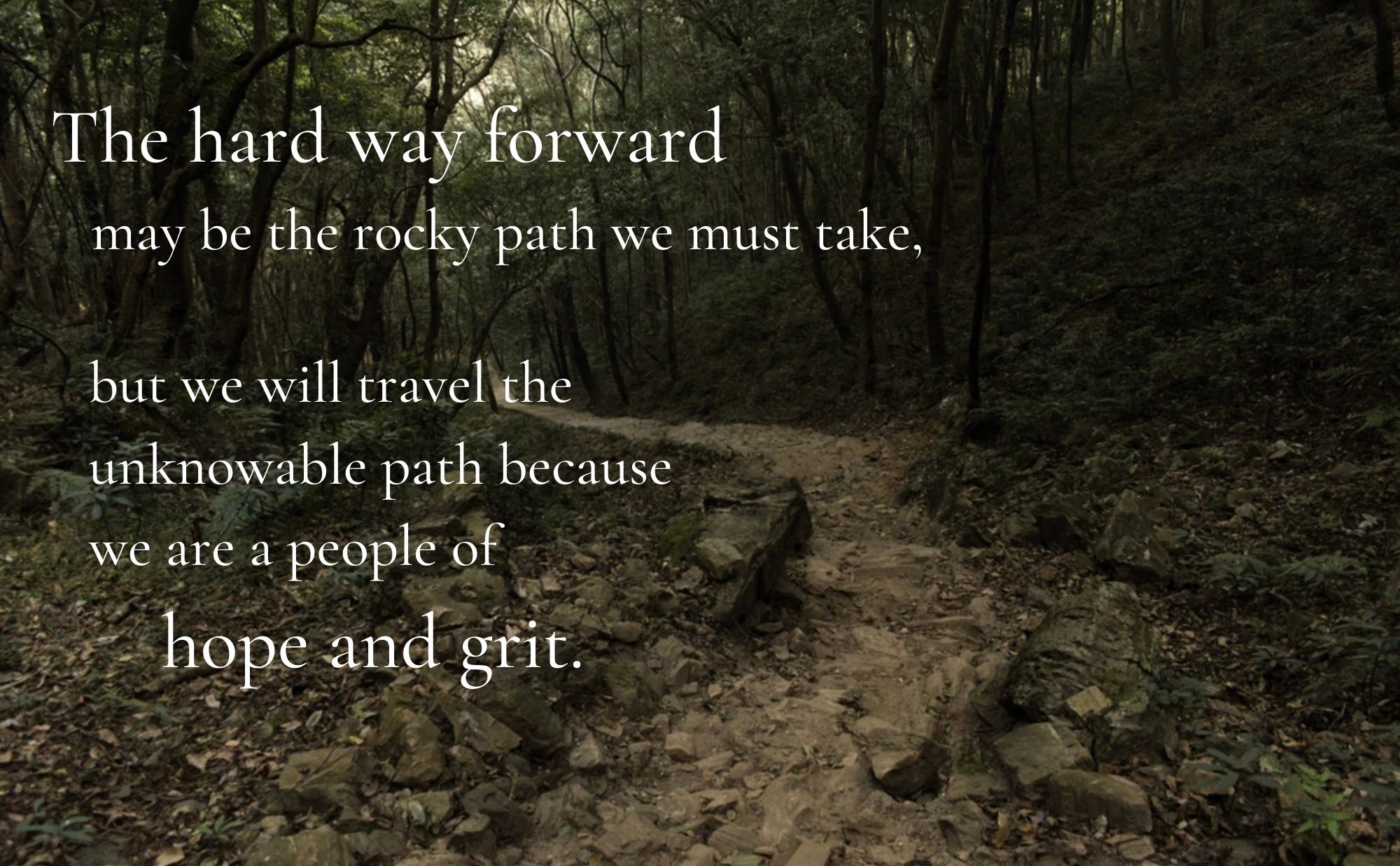


 Here is where I must focus. My heart must long for an end to injustice. So must yours, because God’s heart grieves over the mayhem in our streets and the violence that has its way when a white police officer murders a black man or woman, even a black child.
 I hear my dear friends cry out for justice. I hear them using words to make sense of it all, and I hear their voices fall silent. Silent, with just these words, “I’m tired.” A dear friend posted the words on the left this morning. I want to see her face to face. I want to be together. I want to comfort her, hoping beyond hope that it is not too late for comfort.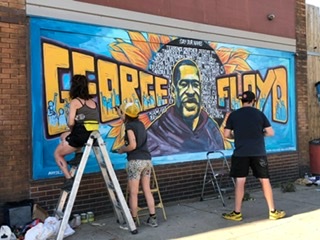
 “How we celebrate the day when the Holy Spirit breathed upon those gathered together, with gifts of wind and fire!
 In the end, there is a tiny bit of joy in George Floyd’s tragic story. It is a joy much deeper than reality’s sorrow. The artists completed their mural, and in the very center near the bottom, they had painted words that express the greatest truth of all.
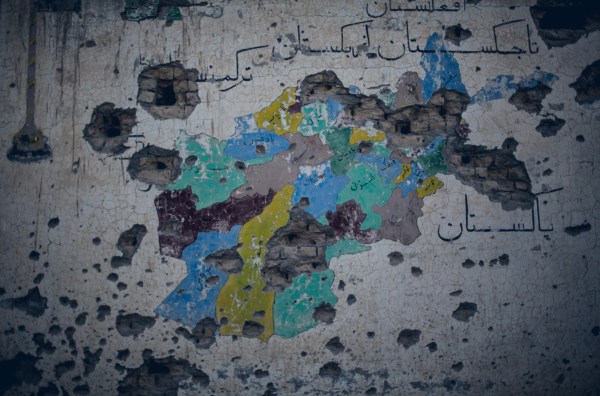
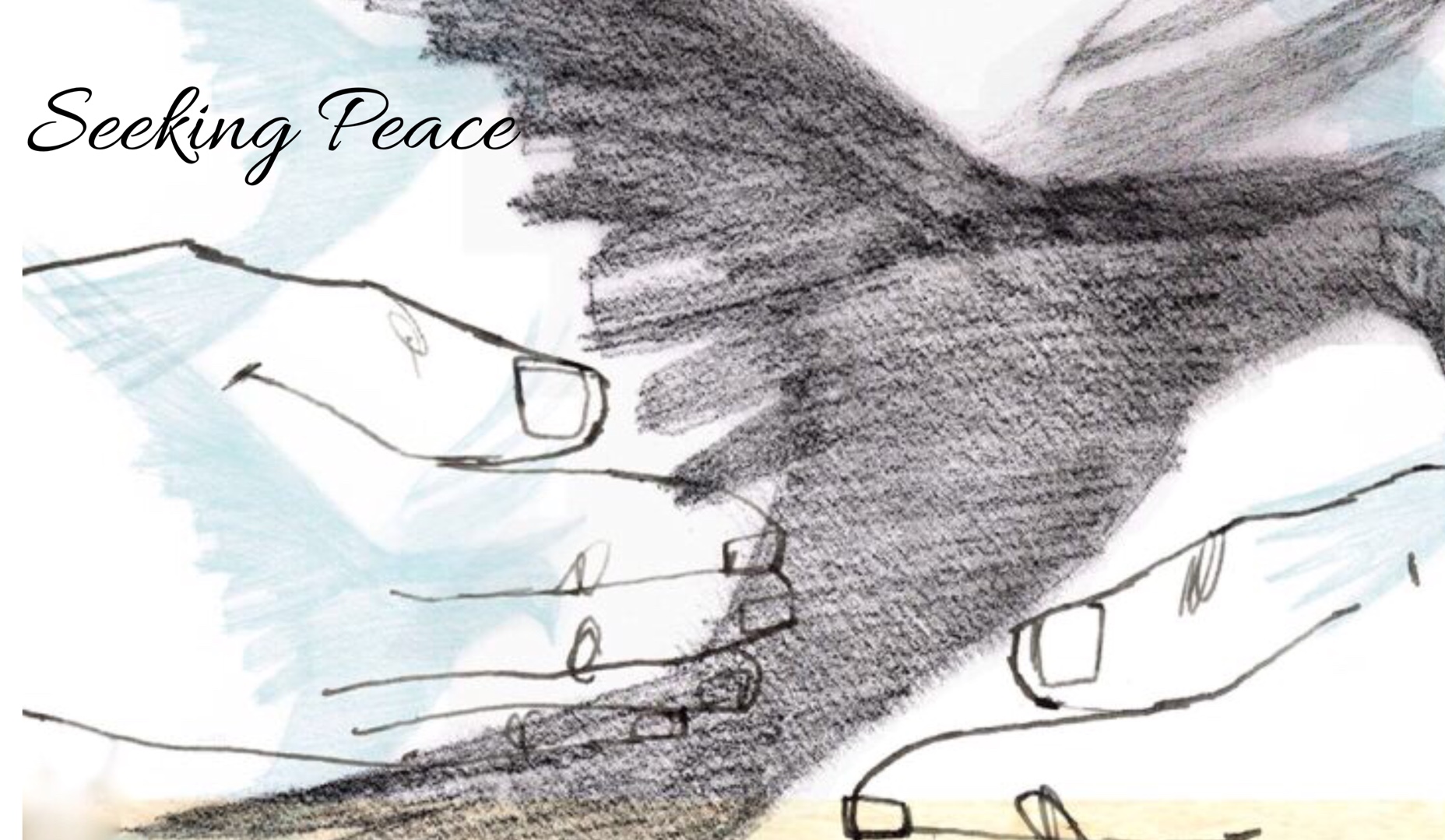


 “Dozens of institutions across the country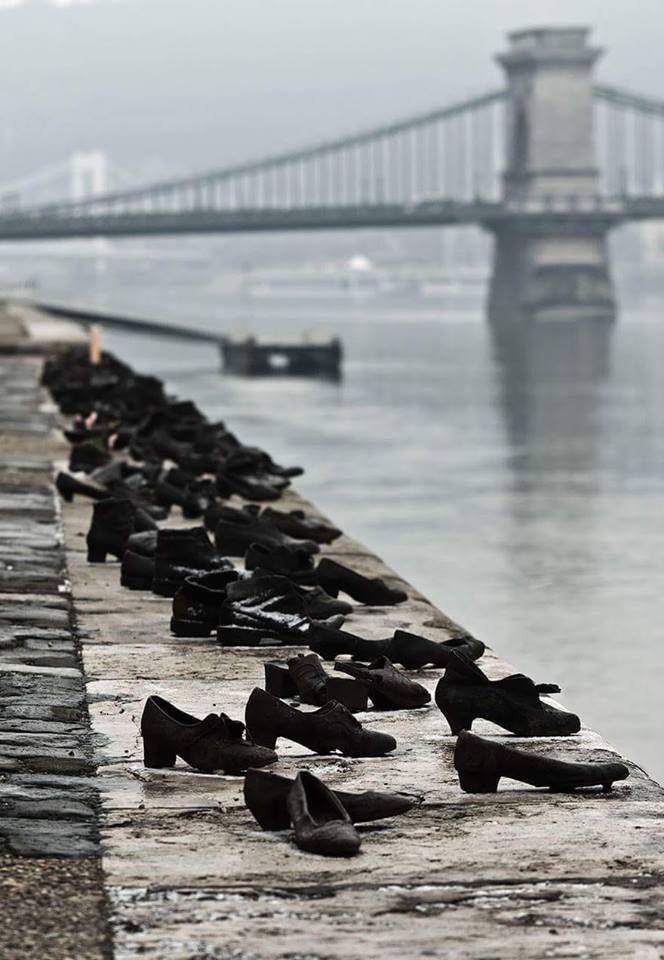
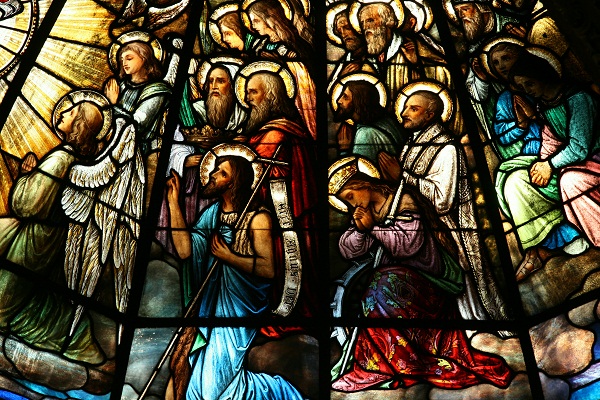 We all need a glimpse of hope and comfort in these troubling days. Our thoughts and prayers are with our brothers and sisters of the Tree of Life Synagogue, and we are shocked at this and other recent acts of violence and evil. So today, I share with you the writing of Jemma Allen* in hopes that you will find her words as compelling and comforting as I have.
 Because of the recent opening of The National Memorial for Peace and Justice in Montgomery, Alabama, I have been contemplating the terror of lynching in our history. The Montgomery site is the nation’s first memorial dedicated to the legacy of enslaved black people, people terrorized by lynching, African Americans humiliated by racial segregation and Jim Crow, and people of color burdened with police violence.
 While in seminary, I immersed myself in the study of liberation theologies. Not surprisingly, my research led me to the writings of black liberation theologian, The Rev. Dr. James H. Cone. I became what some might call a follower of Dr. Cone. I saw him as a Christ-like superhero. Much of my research and writing in those days delved into the history of liberation theology, so Dr. Cone’s books covered my desk for months.
 Google it.


 I invite you to read “Out of Africa: White supremacy and the Church’s silence,” a provocative opinion piece by our guest blogger, Dr. Bill J. Leonard. Many thanks to Dr. Leonard for prompting us to more fully commemorate the day honoring Dr. Martin Luther King, Jr. If you are willing to challenge yourself, these words will shed the light you need to do so.
 God of the Sparrow 🌱 By Kathy Manis Findley