A way in the wilderness, All Shall Be Well, Alone, Anger, anxiety, Awareness, Belief, Bewilderment, Bitterness, Brokenness, Challenge, Change, Come, Ye Disconsolate, Comfort, Confusion, Creativity, Depression, Determination, Disconsolate, Emotions, Faith, Falling down, Fear, Feelings, Freedom, God's Faithfulness, God’s beloved daughter, grief, Gun control, Gun violence, Harbinger, Hate, healing, Heartbreak, Hope, Isolation, Joy, Julian of Norwich, Kidney Transplant, Life pathways, Loneliness, Loss

Fleeting Time, Passing Moments


I am aware, as you are, that time is fleeting and moments are passing. Life has taught us that. But there is more, like a dandelion will scatter with the wind as we hold it in our hand. There is no stopping any of that. Nor can we control it.

Still, there are messages for us here, right now, as we contemplate a little reality. If you know me personally, you know that I have lived an uneasy life full of trouble. In a way, tragedy became the path I traveled. I would struggle my way through one tragedy and then steeled myself waiting for the next one. The next tragedy always came eventually, a tragedy large or small.

When tragedy cruelly and abruptly stopped me in my tracks, I found that most of the time, I was resilient and full of hope. Yet, I became exhausted by the trauma, or the sorrow, or the grief.

It is true that when I fell to my knees, I always got up. Good for me! It’s not like that, though, that “good for me” attitude. I was strong enough to get up and move forward, but it was more like God graced me with the courage and hope I needed for to pick myself up and take my next step.

Void of any pending tragedy, I have felt positive for the past weeks. I finally have a stable, working kidney. My frequent falls have stopped. I didn’t get seriously hurt by falling, just a sprained wrist and later a bruised rib cage. So I firmly believed the words of faith from Julian of Norwich, “All shall be well, and all shall be well, and all manner of thing shall be well.” 

Until, until, I heard the doctor say to my husband Fred and me, “You have advanced prostate cancer.”That’s when I broke my streak of resilient responses to tragedy. I have been happily married to this good, good man for 55 years! He cared for me during my long illness, five years of dialysis, and my kidney transplant. He cares for me every day in a thousand different ways! I honestly don’t know how I would live without him. Then I heard a whisper, “Where is your hope, my daughter? Where is the resilience that has always carried you through the hard times?”

That whisper was what I needed to hear, because everything about this felt different to me than any other time I had heard bad news. Questions and concerns and worries about every kind of life change flooded my psyche. I was assuming the worst right at the very beginning of this current life tragedy. I could not put my finger on it, until I saw this bit of insight from C.S. Lewis.

I felt instantly that my feeling since the awful diagnosis day was indeed fear. That’s why it felt so different. It was not my normal response of sadness, anger, devastation, aliveness, fatigue, and more sadness. This time my grief felt more like fear. So there you have it. The gentle make up of a dandelion is not one you can hold together. It scatters with the breeze. Time continues to fleet no matter how we try to stop it. Moments are passing and that will not stop.

But we have this moment and all the comfort and peace and hope and joy we can get from it. And we can do just that: consider only the present; feel the emotion of it; recognize it as completely yours; and summon the courage to hold it in your arms and grab the good things. That is one simple definition of resilience, and you have it! You have resilience! Everyone has it! Keep it close and continue to move on your sacred path.

Despair, Fear, Hope, Life Journeys, Life pathways

When There Was No Road

Superior National Forest emcompasses much of the Northeastern corner of Minnesota and is bordered by Lake Superior to the east, Canada to the North. Hiking trail to Eagle Mountain

Hope is like a road in the country;
there was never a road, but when many people walk on it,
the road comes into existence.

Author, poet, critic and Chinese literary giant Lu Xun. (Lu was a pen name; his real name was Zhou Shuren.)

I have stumbled upon places where there was no road and no way to move forward. I am mulling over the poet’s affirmation that ”Hope is like a road in the country.” I know a little about hope, a little less about country roads, and even less about walking trails in a forest. I also know many, many people who hang on to hope through every narrow, rocky path they encounter. These hope-filled ones follow the path ahead of them and persist on their journey, in spite of the reality that the path is steep, arduous and sometimes not beaten down enough to walk on.

That’s the important thing about paths—that travelers might walk on one for years when it is barely passable, beating it down for smoother walking. It’s called a beaten path. I imagine you have walked some beaten paths.


Even I have walked a few, like when I was just a wee girl. The path for me was a short one, but nevertheless ominous. It went from my back yard to Miss Martha’s back yard next door. But wait! You must know that the path also led us to Miss Martha’s plum tree, filled with delicIous plums just waiting for my brothers and me to devour. We felt hope every time we got to the tree and began to shake it so that the plums would come tumbling to the ground. We hoped—until we heard Miss Martha’s shrill, frightening voice yelling, ”Get away from my plum tree!”

Because we so feared Miss Martha, hearing her loud voice chastening us made us run immediately home and into the house. We also knew she would tell our Yiayiá (grandmother), and we feared that too. Like Miss Martha, Yiayia could give rise in us the most daunting fear of all. We hoped for plums that day, but got fear instead.

Fear can be the enemy of hope, which brings us back to our path. The poet says to us that hope is like a country road. While reading the poet’s words, I imagine reaching a place where is no road and no way forward—a situation of facing a path without much hope. But there is hope after all! Because many people had walked on the path, it was eventually beaten down. Now the people could travel on with hope. There was an open way, a possible path. There was hope.

What’s the message in this parable-like tale? Just this. All of us walk a journey that leads us to pleasant places as well as to sorrowful and terrible places. No one can make the pilgrimage we call life without encountering rough and rocky roads and impassable paths along the way. They are the places that hold the power to steal our hope and leave us paralyzed.

I know how it feels to lose hope. I have known abuse, violence, illness, betrayal, loss, grief. And I have known it first hand, these things that took my hope. I can also bear witness that my hope has returned many times, just in time, but not before I had to struggle with the real, deep despair of absent hope. When I stood at the entrance of the way where there was no way, at the beginning of the path that was impassable and impossible, I often thought of this testimony of hope and faith found in 2 Corinthians 4:8-9; 16-17.

We are hard-pressed on every side, yet not crushed;
we are perplexed, but not in despair;
persecuted, but not forsaken;
cast down, but not destroyed . . .

Therefore we do not lose heart.
Even though we are outwardly perishing,
the inner place in us is being renewed day by day.

For our light affliction, which is but for a moment,
is working for us a far more exceeding and eternal weight of glory.

Yes, you and I may feel cast down and almost crushed by the weight of the world. We may feel the strongest despair. But we must know that, even on this day of threats and pandemics, some of our paths will be smooth and passable. We will feel hope when we least expect it. Hope will surprise us and flood us with grace, directly at the juncture of our despair. A beaten path might appear before us today—right now—and invite us to travel from fear to hope.

May it be so for all of us.

Alone, “I Can See Clearly Now”, Darkness, Daybreak, Faith, God's love, God's presence, Hope, journey, Life Journeys, Life pathways, Light

Protection from Nothing

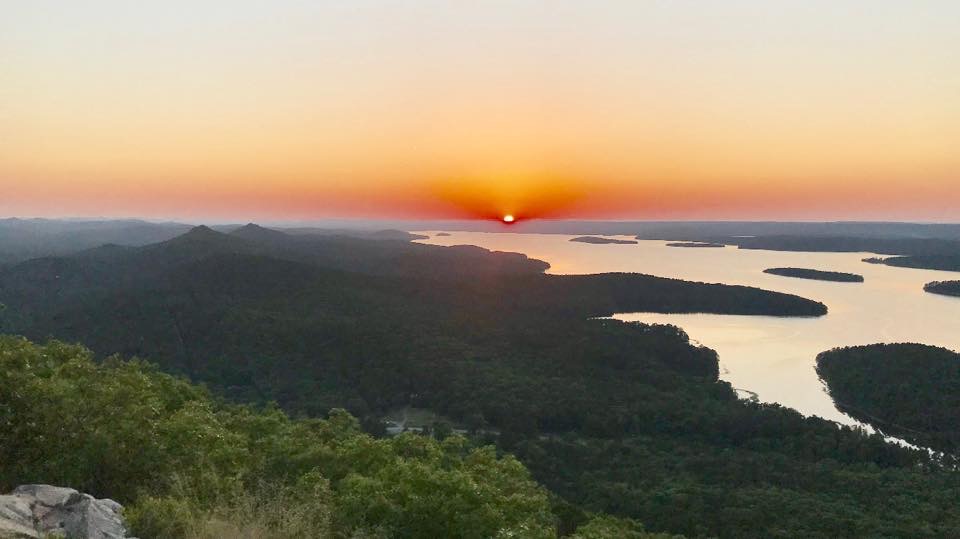
Sunrise at Collegeville Institute ~ Photography by Bryan Whitfield

God’s love protects us from nothing! Yet… sustains us in everything!

Jim Finley

I am intrigued by the words I read this morning in a community chat about God’s love. I’m not sure which part is more compelling to me: that ”God’s love protects us from nothing!” or that God’s love ”sustains us in everything.” The truth is I have experienced both in my life. I imagine you have as well. The circuitous journey we call life leads us through rocky paths, crises of every kind, dark and dense places that make us feel lost, daunting mountains to climb, roads we take that take us to dead ends, roads to nowhere.

God did not protect me from any of the real-life crises that came my way—abuse as a child, a serious eye disease in Africa, the loss of my youngest brother, the fire that almost destroyed our home, the kidney disease that almost killed me at least three times, the years of dialysis, the miraculous, but very hard, kidney transplant. I assume God kept watch over all of it, but God did not protect me from it. God did not spare me from the traumatic events that marked my life.

So I have to ask questions, honest questions, about how God’s love really affects my life. How do I experience God’s love? How do I sense it in my spirit? Do I really believe that God loves me, especially in my life’s dark times? Do I believe that God should spare me from every life danger?

In my experience, God’s love is elusive, intangible, difficult to hold onto. At times, I don’t sense it at all. At times there are no holy ”everlasting arms” holding me until my darkness turns to light. The only way I sense it at all is by faith, the faith that is ”the substance of all things hoped for, the evidence of things not seen.”
(Hebrews 11:1)

To understand this love thing fully, I think I have to read the rest of that chapter in Hebrews, where we find a litany of what important Bible people did by faith. You may remember the list: “By faith, Abel; By faith, Moses; By faith, Jacob: By faith, Sarah: By faith, Rahab . . .” Many more are listed, each having done some great thing by faith. This chapter, though, presses hard on the things that can happen to the faithful ones. Listen to this part:

Women received their dead by resurrection. Others were tortured, refusing to accept release, in order to obtain a better resurrection. Others suffered mocking and flogging, and even chains and imprisonment. They were stoned to death, they were sawn in two,[l] they were killed by the sword; they went about in skins of sheep and goats, destitute, persecuted, tormented—of whom the world was not worthy. They wandered in deserts and mountains, and in caves and holes in the ground. Yet all these, though they were commended for their faith, did not receive what was promised . . .

Oh, my! They did everything right. Their faith was commendable. Yet, they did not see the promise they expected, the great and good things that would come to them because they were faithful. In the end, did they hold on to their faith—without experiencing their reward? Without seeing God’s promise?

What do each of them—Moses, Abraham, Josua, Rahab and the rest— have to do with us? Was their faith like ours? Were their challenges and obstacles like ours? Did they feel void of God’s love like we sometimes feel? Without the promise the expected, did their faith still hold?

We can only speculate about all those questions. But we do not have to speculate about our own faith. We know it. We live with it—when it is strong and when it falters. Did our faith, and God’s love, protect me from every hurt and every harm? I have to answer, ”No.” Yet, the opposite statement—God sustains us in everything—has been real and true throughout my life, in sunshine and in shadow.

I have not known where I was going or where I would end up most of the time, but I kept walking even in my soul’s dark times. The journey has had its rough passages. The journey has most definitely lead me through the dark. Yet, I have also experienced the sunrise that always comes, day after day without fail. And as for God . . . well, God’s love has been present, covering me in the warmth of the love that would not let me go, not by sparing me every hard time, but by “sustaining me in everything.”

The beautiful sunrise image at the beginning of this post points me to the thought that God’s love is a little like the sunrise—a calming light, a gentle light, forever dependable. I have yet to experience even one day without a sunrise. The photo also graces me with the image of footsteps in the snow. Look at them. They are the footprints of someone walking alone, and in truth, we all walk our journeys alone. I imagine, though, that we also depend upon the invisible footprints of the God who leads us on the path.

If we see God’s holy footsteps at all, we see them by faith. That will always be true, that by faith, we ”see” the footsteps that go before us. Only by faith can we claim the ”evidence of things not seen.” So when all is said and done, I believe this to be true: God’s love protects us from nothing! Yet… sustains us in everything!

I believe it by faith.

I hope you can spend a few quiet moments listening to this beautiful choral arrangement. Pay close attention to the words. This is just one sentence among other words of assurance . . .
I walk in footsteps of God’s love.

I see His footsteps in the way,
And follow them through darkest night,
Unafraid, I stumble not,
In the glow of perfect light,
I see.

I walk in footsteps of His love,
And find His light leads on before,
Then He gently turns to me,
Softly whispers, “trust Me more,
I walk.

Then as I follow in His way,
My path ahead will brightly shine,
For in His path of guiding light,
I find His footsteps first,
Then mine.

anxiety, Bewilderment, Depression, Depth of Mercy, Depth of Soul, Emotions, Feelings, God’s Mercy, Hope, Life pathways, Rev. Kathy Manis Findley, Soul, Trails, Unknowing

The Trails I Take

I have taken many trails throughout my life and I imagine that you have as well. It’s one of the things all of us have in common. The trails we take can sometimes lead us to places unknown. Not just places on a map, but places in the soul. Our more difficult trails can push us to our limits, mostly the limits of the soul at its depth. Sometimes, today maybe, my soul is in the depths of unknowing.

What does that sentence even mean? My soul is in the depths of unknowing? If I don’t know what that means, how can I possibly talk about it with you? I can try!

I’ll try.
I’ll search for words
that explain
how I feel, how my soul feels
and what it means —
the depth of unknowing.

These days I sense an unease in my soul, in its depths. I have named it depression. I have tried in vain to make an appointment with my therapist. Isn’t that what people do when they are depressed? Anyway, I did that, but cannot see her until the end of July. So I determined that I had to become my own therapist. In doing that, I decided to search myself more deeply. I determined that perhaps what I feel isn’t depression after all. Instead, what I feel may be the depth of unknowing.

For me that means chasing away the unknowing, getting rid of it because I want to know when I will feel stronger physically, or when I will see my grandchildren, or how I will handle my emotional fragility, or where I will live for the rest of my life. Just to name a few things I need to know.

And yet, the depth of the soul’s unknowing may well be exactly where my soul begins to fully know. The trails I take while inside my soul’s depths contain lessons and treasures and wisdom. The trails bend and wind leading to an unknown path that opens its way for me. I follow it willingly, blindly, yet for some reason, expectantly. The trails are most surely my depression, their unknown, perilous way distressing me as I walk. Jagged rocks on the trails, vines creeping their way onto my path, thorns, bristles and barbs — boulders sometimes — all to remind me of the hard path I walk and the heavy load I carry.

The trails I walk may be no more ominous than yours. We all walk them and we all carry burdens on the way. You and I walk no easy trails. There is “no easy walk to freedom,” the song reminds us. Truth! The trails I walk, and your trails, are many and winding, hard and confusing. The obstacles overwhelm. I suppose this describes my depression as well as any words could, and it is precisely that unease in my soul’s depths that has come to me in these days.

The difficult thing about soul-deep depression is its dogged persistence. That kind of depression has staying power and it sits in the soul, creating that terrible sense of the soul’s unknowing. It has the power to convince me that I will never know the things I want to know. Mostly, I want to know destination. Where am I headed? What jagged rocks and prickly thorns will injure me along the way? And will I survive my injuries?

There lies the depth of depression. It lies in the desire, the need, to know. We need to know the unknown — where will the trails take us and what formidable obstacles will stop us. Now understand this, if I had answers, I would have given them to you several hundred words ago. I have no answers of my own, but I do have a nugget of wisdom written by author Angie Weiland-Crosby.

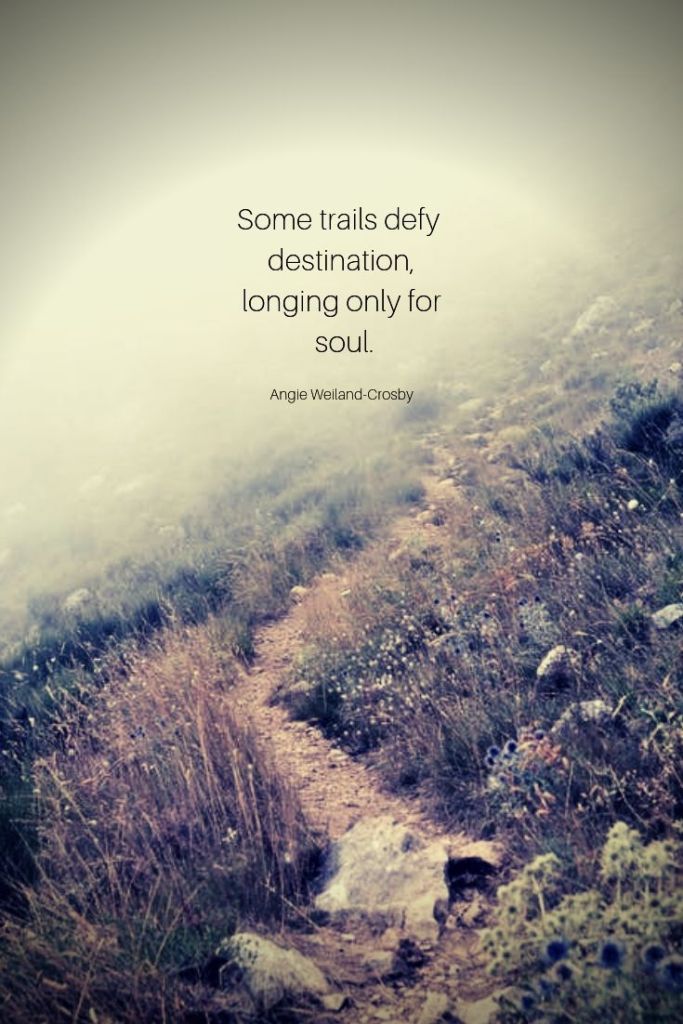
Some trails defy definition,
longing only for the soul.

Angie Weiland-Crosby

There may be something in her words. If the trails defy our attempts to define them or to know them, perhaps we can find comfort knowing that the trails long only for our soul. The trails only want us to bare our souls along the way and to open them up to the new. The trails are meant for our good, for our spiritual maturing. And as for another comfort, the God we know has seen and known the trails before us. However you see and know God, you can rest in the knowledge that God has some hand in the work of the soul. God knows about the trails we take.

Haven’t I commanded you? Strength! Courage! Don’t be timid. Don’t get discouraged. God, your God, is with you every step you take.”

Joshua 1:9 (The Message Bible)

When all is said and done, I believe the trails I take are necessary ones. In a way, perhaps the trails I take are sacred ones, meant for opening up my soul to its depths where transformation can occur. No, God does not lay out my every trail or remove its thorns and rocks. The trails I take are strewn with rocks meant for me, thorns that pierce just enough to get my soul’s attention. I believe that. And I believe that there is for me a way to trust God wholly. My personal translation of Proverbs 3:5-6 gives me a tiny inkling of hope even when depression ravages my soul.

Trust in whoever you believe God to be in your life.
Trust God with all your heart,

and don’t rely only on what you understand.
In all the twists and turns in your life,

perceive this God as one who offers a depth of mercy,
A God who sees and knows the trails you walk.
And be assured, know deeply in your soul

that God will direct your paths.

I want to share with you a video of a beautiful, meditative song entitled, “Depth of Mercy,” performed by students of Fountainview Academy, a Christian high school based in southern British Columbia, Canada. I also share this because of where it is filmed — a beautiful wooded area with various trails. Whatever trail the students took to arrive at their destination seemed a treacherous pathway to me, and even more treacherous, the place where they stood to play and sing.

They were on top of a magnificent ridge, but way too close to the edge for my comfort. At the end, as they sang, “Depth of mercy, can there be mercy still reserved for me?” The image pans across them to the jagged edge and then reveals a very deep and ominous gorge. Panning even farther across, you will see a most beautiful portrayal of nature, one that stirs the senses and reminds us of the depth of mercy our God reserves for us. I hope the video is meaningful to you.

A new commandment, Anger, Christian Witness, Christianity, Committment, Community, Compassion, Faith, Gun violence, Hemmed in, Here I am, Lord., Jesus, Jesus Follower, Justice, Life pathways, Magnolia Court Motel

The Car at Magnolia Court

Magnolia Court Motel, Macon Georgia

In my normal outings, I frequently ride with my husband past the Magnolia Court Motel. It’s the one with a gas station in its courtyard where a pool used to be back in the 50s. It’s not a place you would want to stay on your vacation. In fact, I doubt anyone goes there for a vacation. Still, it’s always at capacity, because people live there. It’s not in the safest part of town. Magnolia Court itself is not safe. I know that because TV news frequently reports that homicides happen there.

For the past five years, I have seen a dingy, old, light brown car in front of the last unit of Magnolia Court, closest to the street. The same brown car, day or night, is in its parking space. I don’t think the car ever moves and I have wondered if it needs repairs. I assumed that the owner of the brown car didn’t have a job, because the car never moved. I hoped, though, that the owner of the brown car worked an 11 to 7 shift somewhere. I wouldn’t have known that, because I would never go past Magnolia Court at that time of night. Not in that neighborhood!

For five years, I never once mentioned that car to my husband. For five years, I silently looked at the dingy brown car and wondered who was in the motel room. Who was he or she? I always thought it would be a male, so let’s go with that. Why is he living there? Does he have a job? Is he young or old? Does he need food? Is he ill or disabled? Does he have friends or family? What does his room look like? Is it decent or dirty? How does he feel about his life? Does he know about Jesus and God? Is he okay?

My next thought was, “I would never go up to his door at Magnolia Court, knock on it and ask him if he’s okay or if he needs anything or if he knows about Jesus.” Just as quickly, my thoughts switch from the man (or woman) with the dingy brown car at the Magnolia Court to these hard questions . . . What could I do, as a Christian, to see if this man needed help? How could I help? What would I do? And what do the answers to those questions say about my faith?

I don’t know, of course, but I imagine that in a similar situation, Jesus might have gone straight to the inn and checked on the people. Finding out how they were doing might have led him to heal one, encourage another, give another a basket of food or do all the blessing-kind-of-things Jesus always did.

Last week, we drove by Magnolia Court. The dingy brown car was not parked in its place. I looked around the Court to see if he had changed rooms, but the car was not there. I felt my heart quicken and my mind rushing through scenarios of what might have happened to the man in the end room of Magnolia Court. I was sad. Guilty. After about ten minutes, I managed to move on with my day and not think too much about the man.

Today, we again passed by Magnolia Court, twice! The car was gone. The man was probably gone too. I never saw him. I never checked on him. Why would I? Who would do that sort of thing in the violent, unsafe world we live in?

I don’t want to be trite about things like faith, but honestly, I really did wonder “What would Jesus do?”

“WWJD” might be an old, overused, trendy slogan, but for me this is just being concerned about a man I never saw.


I don’t have any idea what Jesus would do, but I suspect he may have done lots of things, including something similar to what he did with the tables of the money changers. You see, turning over those tables was about doing what is just and right. Jesus might have turned over some tables or lamps or nasty mattresses at Magnolia Court Motel, because it is a place of violence, drugs, and all manner of things that harm people.

I felt my heart quicken and my mind rushing through scenarios of what might have happened to the man in the end room of Magnolia Court. I was sad. Guilty.

Kathy Manis Findley

I have to wonder now, probably will always wonder, what became of the car at Magnolia Court and, more importantly, what became of the man who lived in a room at Magnolia Court Motel. As far as I can tell, he never left his room until the day he left. My thoughts of him over five years of trying to eavesdrop on his life yielded nothing for him. For me, it became an examination of just exactly what kind of faith I have and in what ways am I willing to go out into a world of need where God’s people live in shadows like Magnolia Court. It became a self-examination that prompted me to ask myself, “What do you intend to actually do when you proclaim yourself as a Jesus follower?”

So this is not a morality tale to urge you to examine your faith. It is for me. I am the one who needs to examine my faith, to ask what Jesus would do and then to admit what I will or won’t do. As for the old, dingy, brown car and the man who owns it . . . well, I did do one thing that Jesus would do. I blessed the man I never knew, whispering under my breath as we passed by this morning, “May God go with you and give you peace.”


This is one of my favorite Christian songs. It brings me to tears every time I hear it, especially on the day of my ordination in 1992. As the words were sung that day in a duet by my husband and best friend, my heart sang, “Here I am, Lord.”

anxiety, Community, Darkness, Death, Despair, discouragement, healing, Heartbreak, Indecision, journey, Lament, life, Life Journeys, Life pathways, Mystery, Restoration, Sorrow, Spirit, struggle, Tears, Thin Places, Yiayia

That Mysterious and Mystical Reality

EC73BB1C-C3BB-4B52-8D03-279FE90ADEDE
Watercolor art by Kalliope, Holy Ghosts

You might be thinking that both mysterious and mystical are the antithesis of reality. If you are thinking that, you might be wrong. So might I. But in my experience, life itself is a mysterious and mystical reality. That reality fills my spirit with hope in my darkest moments. Dark moments, hours of grief, dark nights of the soul, lamentations of the spirit — all have been part of my life journey. My pathways have often been rough and rocky. My life’s travel has often taken me to disconcerting forks in the road and confusing crossroads. I have known times of despairing and times of uncertainty — reluctance, despondency, angst, heartbreak, fear — “break-out-in-a-sweat times” that forced me into dangerous depths of anguish. For me, taking my own life was not something I could consider. Yet there was that one day — that span of just a few moments — when I was alone, afraid and very far from home.

IMG_5744
Japan’s Aokigahara Suicide Forest

One of the most thoughtful and intriguing movies I have ever experienced is The Sea of Trees. I was captivated by the film that tells the story of a despondent professor. After the death of his wife, he despaired of life and searched for a way to end his. His reflective, angst-filled search led him to Aokigahara, a forest in Japan known also as The Sea of Trees or The Suicide Forest. Aokigahara Forest has been home to over 500 confirmed suicides since the 1950s. It is called “the perfect place to die” and is the world’s second most popular place for suicide.

Don’t worry. This post is not about suicide. Rather it is about the people who loved us in life and continue to love us in death, those who watch over us in our times of deepest anguish. It is about the mysterious and mystical reality that between us and our loved ones in heaven, there is but a thin separation. Heaven and earth,” the Celtic saying goes, “are only three feet apart, but in thin places that distance is even shorter.”

To know that my sweet Yiayia (grandmother in Greek) and my Thea Koula might still be protecting me from harm and life disaster is soul-comforting for me. Perhaps the strength and hope I felt as I was chaplain to disheartened hospital patients came from them. Perhaps they sent me the staying power to comfort, protect and advocate for thousands of abused women and children. Maybe the deep grief of losing my brother to cancer was eased by their prayers from heaven.

I often wondered if my mourning of the loss of the life I knew — replaced by daily dialysis — was lightened by their loving presence with me in a horrible time. I wonder, Yiayia, were you watching over me on November 12th when I closed my eyes in the operating room to receive my kidney transplant? I wonder, Thea Koula, did your intercession save my life on those times when my life literally hung in the balance?

This life is not an easy one. No person gets through life unscathed. No one travels a path smooth and straight. Like me, you have more than likely walked on a rough pathway with stones in the road, dangerous curves and life-altering crossroads. Robert Frost wrote eloquently in his poem, The Road Not Taken, about someone standing at a fork in the road pondering a life-altering choice:

Two roads diverged in a yellow wood,
And sorry I could not travel both
And be one traveler, long I stood
And looked down one as far as I could
To where it bent in the undergrowth . . .

Then took the other, as just as fair,
and having perhaps the better claim
because it was grassy and wanted wear . . .

Oh, I kept the first for another day!
Yet knowing how way leads on to way,
I doubted if I should ever come back.

I shall be telling this with a sigh
Somewhere ages and ages hence:
Two roads diverged in a wood, and I—
I took the one less traveled by,
And that has made all the difference.

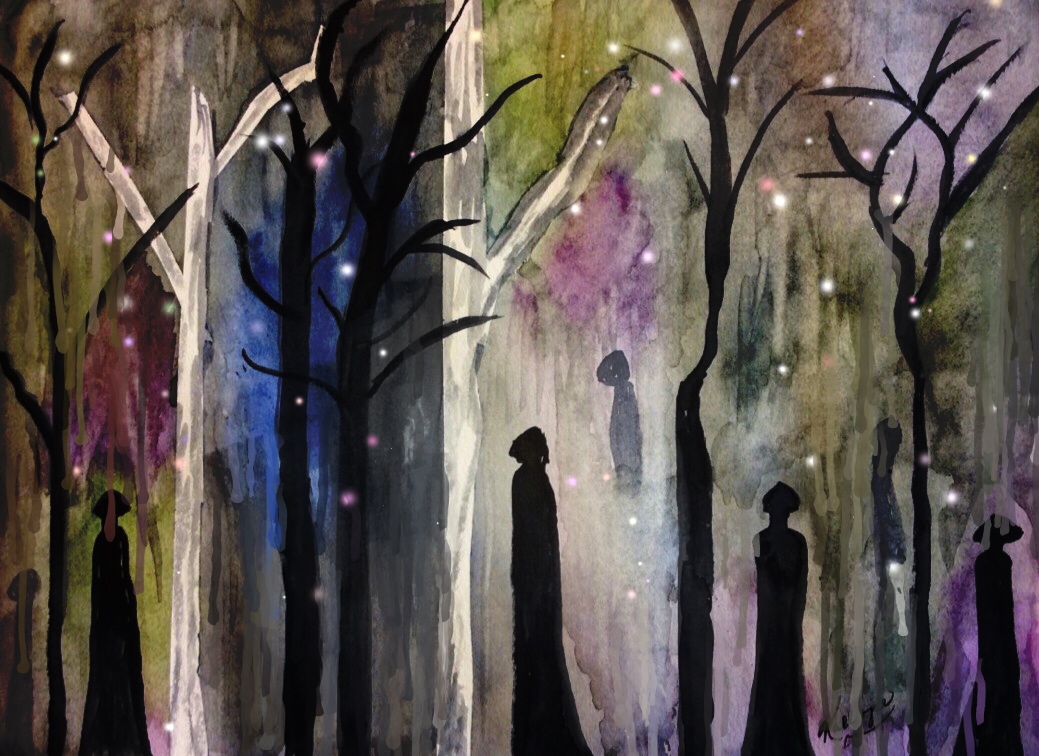
My life is filled with “roads not taken,” some not taken by my choice, others thwarted by chance or fate or maybe even God. It is almost like traveling through a “sea of trees” that hide our view of the way ahead, causing us to lose our way. For my art today, I chose one of my watercolor paintings. A few years ago, I painted this “sea” of leafless trees against an ethereal, melancholy wash of color. Interspersed among the trees are ghost-like figures hovering. Actually I titled the painting Holy Ghosts. The painting was inspired by the words of a friend.

When the dead come to mind, they are like holy ghosts, as real as hope or faith, as tangible as trust and love.  – Ragan Courtney

This painting was never meant to be disconcerting or morbid. It represents just the opposite for me. It represents the souls who hover over me for protection, those with whom I shared love and life. It represents my aunt and my Yiayia and my brother because I am certain they protect me, pray for me, lift me up and cheer me on.

Who knows! Maybe my brother Pete, who died of renal cell carcinoma, hovered above me in a kind of holy kidney disease kinship and protected me when I was diagnosed with end stage renal disease in 2014. Maybe he prayed for me during my transplant surgery in 2019. I can, of course, never know that for sure. The veil between heaven and earth, between the dead and the living, is a mystery we simply do not understand. Our understanding does not reach that far, but what we feel in our spirit does reach that far.

In the end, my spirit senses that between us there is but a thin separation, that the spirits of my loved ones are are connected to mine, especially when I am disconsolate and in despair.

In the comfort of that mysterious and mystical reality, I can heal. I can rest. I can continue my journey of dangers, toils and snares. I can know the amazing grace that comes from sacred connections. I can know peace after sorrow. And so can you.

May God make it so. Amen.


Adventures, Awareness, Change, Contemplation, Exploration, Grace, Growth, Holy Spirit, Introspection, Life Journeys, Life pathways, Meditation, New Life, Reflection, Spirit wind, Transformation

Uncreated Grace

AA19F30F-F0BC-46B3-9F62-E084BF61258A

I have been reflecting on a phrase I read this morning in Father Richard Rohr’s meditation— Uncreated Grace. It is an intriguing phrase and makes me wonder why I received it at this particular time and place on my journey. I have had a very long journey — many miles of life —- and, in fact, there have been many other forks on the path that seem more sacred places to contemplate uncreated grace. But here it is, today, brought to me at this place on my journey.

As I did some processing on this phrase, I thought of one of my dear friends from ages past, seminary days to be exact. Often, he would share his favorite quotes. This was one of them, an intriguing and thought-provoking quote. This quote always stayed in his favorites file. It hints at a long journey we all must take . . .

We shall not cease from exploration
and the end of all our exploring
will be to arrive where we started
and know the place for the first time.

— T. S. Eliot

We were always left with the question “What do T.S Eliot’s words mean?” Sitting in small groups, the seminarians discussed but never reached an answer, to the question. I imagine that, like me, some of them took the words along with them on their journeys, hoping to discover the meaning at some place of enlightenment on their path.

On my journey, Eliot’s words came to mind many times. Never quite discovering a finite meaning, I did discover infinite applications that touched my life in ways simple and profound. Most always, I came away from reflecting on the words to a better place inside myself and a better space in my world. Still, I wonder why these T.S. Eliot words were brought to my mind today.

The power in these words, I think, is that they are not a directive, not a call to mission, not words of piety, not gleaned from scripture. They are words meant to be understood individually rather than offering a universal message. I identify these words as an invitation, and so today I am left alone with them to intentionally create space for reflection and understanding.

When I do that, I hear many, many other words from different places — from scripture, hymn, poetry, prose and from within myself. It feels like a Spirit encounter, the presence of “another comforter” who will be with us forever, who will, as Jesus promised, “teach you all things, and bring to your remembrance all that I said to you.”

Spirit teaches us and helps us remember. Spirit grounds us so that our circuitous journey will not frighten us. We are free to never “cease from exploration,” because we are comforted to know that we will “arrive where we started . . .”

9889AA3B-16BB-4F9F-9B56-D883A74A49AEAnd know the place for the first time . . .

When the journey leads us back to where we started, how is it that we “know the place for the first time?” I urge you to not take my interpretation as the correct one, because I believe that a “correct” interpretation comes from the soul of each person who chooses to explore. But here is an understanding based on my own musings . . . we can take what comes in our lives, or we can explore places on the journey — our encounters, our joys and sorrows, our events and calamities, our crises and emotions, our disappointments and betrayals, the chance and the wonder.

For me, there is no doubt that exploring all of these life events brings that sense of getting back to the beginning and truly knowing the place for the first time, not necessarily because the beginning place has changed, but that I have changed. The Spirit’s holy breath transformed me with gentleness again and again, transformed by the blowing of Spirit wind into my being.

Father Richard Rohr says that “the Holy Spirit is never created by our actions or behavior. It is naturally indwelling, our inner being with God. In Catholic theology, we called the Holy Spirit “Uncreated Grace.”

How I love those words . . . Uncreated Grace! Perhaps that’s what we all hope for in our explorations on the journey — that in us and through us, there is Uncreated Grace. If we present to the Spirit our selves as uncreated grace, I wonder if Spirit then creates grace within us again and again and again, all along the way. If we never cease from exploration, presenting ourselves as uncreated grace, the Holy Spirit will breathe on us and we will be transformed!

No wonder we know the place where we started for the first time! The place hasn’t changed, we have changed, transformed in our deepest places!

Thanks be to God and to the touch of Spirit breath. Amen

anxiety, Awakening, Awareness, Challenge, Change, Community, Contemplation, Despair, Discernment, Discovering, Emotions, Epiphany, Friends, healing, Hope, Illness, Inspiration, Introspection, Kidney Transplant, Knowing, Life Journeys, Life pathways, Meditation, New Normal, Pain, Perseverance, Reflection, Relationship, Restoration, Rhythm, Soul, Spiritual Direction, strength, struggle, Suffering, Transformation, Troubles, Wholeness, Wisdom

Spiritual Direction

E82BA236-43E0-4EDA-B57B-4E7F6E31779A
Transplant Day Thirteen
November 24, 2019

I have been offered a blessing. From a stranger. 

I met this kind person through a group of clergywomen called RevGalBlogPals. She is a spiritual director from British Columbia. Through the RevGalBlogPals Facebook group, she happened upon parts of my transplant journey in my blog posts. She began praying for me. Then she offered me the gift of spiritual direction as I pass through this complicated time in my life. 

9299C4C7-3373-43D8-A11E-C2349150F942It has been several years since I worked with a spiritual director, so I was very humbled and thankful to hear from her. These were the words of lovingkindness she wrote to me in our first session.

May you feel the gentle touch of Spirit in this session.
May you know that I am holding you in healing Love.
May you be reminded of your worth and strength…
As you rest.
~ This is spiritual direction when pain does not allow for words.

Burning BushOn the day I received her message, it was so true that pain did not allow for words. The assault on my body was unspeakable on that day. I remember when many years ago my husband’s cardiologist came into his hospital room a few days after his heart surgery. The cardiologist said this: “Let’s look at this terrible thing we’ve done to you.”

His words resonated with me post transplant when, in the throes of struggle and pain, I definitely was looking at the terrible thing they had done to me. I could not quite see a brighter, pain-free future. I could only focus on the physical systems that were in complete disarray after the transplant. It did not help when medical staff told me it was all normal. The way I was experiencing it all was far from normal.

I wondered if I would ever live “normal” again. Or if perhaps I would live into a new normal of life after receiving a transplanted organ. I was not sure, and definitely not confident, that all systems would levelize into something I could tolerate. My spiritual director’s wisdom knows that to have physical normalcy, I must also seek emotional and spiritual normalcy. That would mean healing wholly — from the outer visible body to the inner invisible one. It would mean transformation. It would mean living my life while watching constantly and diligently for any sign that something was physically wrong.

Red Wooden Directional Arrow Signs In Green Forest BackgroundWhen my spiritual director suddenly appeared, I knew that she would help me explore my spiritual state, entering into community with me and pointing to the healing I could not yet see.


Thanks be to God for the beloved community she has offered me, community that forms in unexpected places, in unexpected times, just when I needed community the most.

Community, Fear, Inspiration, journey, Kidney Transplant, Life Journeys, Life pathways, Terror

On Beauty and Terror

C32F3609-3C34-4205-A88A-7EAF8178F181
Photo by Steven Nawojczyk.

Life is all about beauty and terror, each descending on us at will and rearranging everything. I think of the wise words of Frederick Buechner:

Here is the world. Beautiful and terrible things will happen. Don’t be afraid.

The constant picture in my mind is a rough, rocky path with unknown crooks and turns,  and the destination unseen. That image of life’s journey is enough to cause anyone fear, and though the path has its own beauty, it also holds the terror of unexpected twists on a rocky way.

For quite a long time, I have been facing a time of beauty and terror in the guise of my upcoming kidney transplant. How beautiful it is to know that a kidney donor is willingly offering a kidney to a stranger. At the same time, I nurse a small feeling of terror at times about the outcome of the surgery. Will I have pain? Will I recover quickly? Will the kidney work? Will I tolerate my lifelong immunosuppressant medications? Will the transplant really happen?

“Don’t be afraid” is indeed the strongest and best word of encouragement. It is quite wonderful when we reach a point in life — if ever we do — where fear is no longer our constant companion. The way to get there, I think, has everything to do with two things: enjoying a close relationship with God (something that is not always easy to accomplish); and being a part of a genuine, caring community. Being close to God and being encouraged by your community keeps fear at bay so that the beautiful part of living can emerge.

Richard Rohr would say that our “work” is to know God’s desire for us to live into the fullness of our humanity and our identity. In other words, recognize that our humanity is certainly open to fear, but be vigilant about claiming our identity as God’s own children. Because it is that identity, that holy relationship with God, that brings us the beautiful part of life.

Richard Rohr shares the words of one of his favorite poets, Rainer Maria Rilke:

God speaks to each of us as he makes us,
then walks with us silently out of the night.
These are the words we dimly hear:
You, sent out beyond your recall,
go to the limits of your longing.
Embody me.
Flare up like flame
and make big shadows I can move in.
Let everything happen to you: beauty and terror.
Just keep going. No feeling is final.
Don’t let yourself lose me.
Nearby is the country they call life.
You will know it by its seriousness.
Give me your hand.

“Let everything happen to you: beauty and terror,” the poet writes. This is surely the poetry of life: to admonish us to let it all happen, all the beauty, all the terror. Because God uses all of it, together, to create in me the person I am meant to be.

So the end of the story is this: I will get a transplant and I will let it all happen — all of it — so that the beauty and the terror can renew my life and embolden my spirit.


F9FA5D3C-53F0-4043-8A72-F9E2D63F7349

On another note, please pray for me as I look toward my kidney transplant on November 15th. I am grateful that you are walking with me on this journey that often felt so frightening. Your thoughts and prayers mean so much. If you would like to read the story of my illness, please visit the Georgia Transplant Foundation’s website at this link:

://client.gatransplant.org/goto/KathyMFindley

“Go Fund Me” page is set up for contribution to help with the enormous costs related to the transplant, including medications, housing costs for the month we have to stay near the transplant center, and other unforeseeable costs for my care following the transplant. If you can, please be a part of my transplant journey by making a contribution at this link:

https://bit.ly/33KXZOj


Faith, Fear, God's presence, journey, Life Journeys, Life pathways, sunrise, Travel, Trust, Wendell Berry

Journey

F7F886FF-E09B-42BF-A992-04A0884A1A0A
Sunrise at Stout’s Point, Petit Jean State Park, Arkansas. Photography by Beth Buckley

“There is meaning in every journey that is unknown to the traveler.”
— Dietrich Bonhoeffer

I am a student of the journey, always examining the stones in the road, the twists of the path, the crossroads that demand decision, the mountains that must be climbed and the valley of rest that replenishes the soul. All of it has been there on my journey, and I imagine on yours as well. The milestones along the way — those that are challenging and those that offer respite — are ever common for those who travel.

I question it often, the journey, asking where it next will lead me and what obstacles I might face along the way. But the journey does not tell. It does not speak, nor does it provide a map. The journey is wise, and it knows that if we know what the journey holds as we travel, we might turn back in fear. We might determine that the journey’s risks are too great.

So the beauty of the journey is this: that we give ourselves to it with at least some sense of trust. Somehow we are able to follow journey’s path blindly, accepting whatever we face next. Embracing the changing terrain, using every ounce of strength to go forward, taking paths unknown, binding up the wounds of the falls. We move onward with our soul’s faith spurring us on and in the certain knowledge that God knows the journey and that the Comforter walks beside us.

For after all, we are strangers and pilgrims (1 Peter 2: 11) on this journey, sojourners in a world that will not always be our home. We are just passing through this life, and so we take the journey as it appears before us, by faith. We trust the journey as if preordained for us by God. We hold fast to the journey in the faith that it was destined for us, and we do not set our sights on the destination, for that remains unknown and unknowable.

I share the eloquent words of Wendell Berry, who seems to understand the journey better than most:

We travelers, walking to the sun, can’t see
ahead, but looking back the very light
that blinded us shows us the way we came,
along which blessings now appear, risen
as if from sightlessness to sight, and we
by blessing brightly lit, keep going toward
that blessed light that yet to us is dark.

— Wendell Berry

May we trust the journey, moving “toward that blessed light that yet to us is dark.” Amen.


*******************************************************

On another note, please pray for me as I await a life-saving kidney transplant. I am grateful that you are walking with me on this journey that often feels so frightening. Your thoughts and prayers mean so much. If you would like to read the story of my illness, please visit the Georgia Transplant Foundation’s website at this link:

http://client.gatransplant.org/goto/KathyMFindley

A “Go Fund Me” page is set up for contributions to help with the enormous costs related to the transplant, including medications, housing costs for the month we have to stay near the transplant center, and other unforeseeable costs for my care following the transplant. If you can, please be a part of my transplant journey by making a contribution at this link:

https://bit.ly/33KXZOj


Awakening, Call, Calling, Change, Discovering, journey, Kidney Transplant, life, Life pathways, Perseverance, Preaching, Rebirth, Self Awareness, Spiritual growth, Spirituality or Religion?, Transformation, Wholeness

“Me!”

D661FB1C-FE24-4C0D-9614-F12695893AEA

When I was younger, my primary life goal was to make people like me. It was something of an obsession, and it caused great harm to my spirit. For you see, I thought I had to be everyone else’s image of me. So “me” became changeable and malleable in the hands of a variety of other people. In my mind, they just had to like me.

The conundrum of life: how to accept that not everyone will like me. Maybe even most people won’t like me. So here’s the sad, but inevitable result: “me” became someone I didn’t even know. I lost myself in the impossible quest to be accepted and liked.

Then came the metamorphosis. It happened around age 47. I think what started it may have been reading the book by Sue Monk Kidd, The Dance of the Dissident Daughter.

My sisters in cyberspace, you should read that book. The thing that nearly frightened me enough to make me put the book away is the descriptor after the main title. So here’s the title of the book, in all of its feminist fullness: The Dance of the Dissident Daughter: A Woman’s Journey from Christian Tradition to the Sacred Feminine.

Well, when I read part of the book’s description — the “journey from the Christian tradition” part — it scared me to death! I had no intention at all to journey away from my Christian tradition.

I read the book anyway, and it changed my life and launched me into a journey I could never have envisioned. Sue Monk Kidd led me on an incredible, circuitous journey through fear, anger, healing, and eventually, awakening and transformation. Of course, I could never see myself turning away from my deep connection to what Kidd described as “the deep song of Christianity,” But I did discard the voices that kept me in my place, and kept me quiet, for so many years of my life.

When those discouraging, disparaging voices were silenced, I heard my own voice, finally. With clarity, my voice declared “me,” exactly the woman I was meant to be, precisely the woman God was calling to ministry. By embracing my full humanity and my spirituality — that looked very different than my religiosity had looked — I found myself.

“Me” was awakened, out in the open, in the middle of God’s world and smack dab in the center of God’s will. Oh my! Now no one would like me! When my words spoke Gospel truth, people didn’t like me. When I tenaciously followed God’s call to ordination, people didn’t like me. When I dared to preach (from a real pulpit) lots of people didn’t like me. When I worked as an advocate for women and children harmed by violence … well, no one at all liked me then because I refused to back down.

I like this quote from Denzel Washington:

“Some people will never like you because your spirit irritates their demons.”

There it is! The real, unadulterated truth! So as my spirit continued to irritate everyone’s demons, I was finally living my life as “me!” And that, my sisters, was a good place to be.

I hope you are in your own “good place.”

—————————————————————————

On another note, please pray for me as I await a life-saving kidney transplant. I am grateful that you are walking with me on this journey that often feels frightening. Your thoughts and prayers mean so much. If you would like to read the story of my illness at the Georgia Transplant Foundation’s website, please visit this link:

http://client.gatransplant.org/goto/KathyMFindley

A Go Fund Me page is set up for contributions to help with the enormous costs related to the transplant, including medications, housing costs near the transplant center, and other unforeseeable costs for my care following the transplant. If you can, please make a contribution at this link: 

https://bit.ly/33KXZOj

Dancing, Darkness, Despair, Faith, Fear, Freedom, Hope, Joy, Life Journeys, Life pathways, Pain

Through These Dark Hours

521C7942-66C7-4FF0-A54B-6720CF0EB419
Unafraid, unbound, unleashed from this earth, rising with every step, a dance to lift the human soul.

What do I do through these dark hours? How do I endure them, the lostness, the fear, the spiritual suffering? How do I make my journey and avoid the dark hours that overwhelm me along the way?

Dark hours are a part of our living, a part of our journey. They cover us — even those who are most religious and devout — like an ominous black cloud. Dark hours bring us fear, dread, a lack of hope. Dark hours steal the joy of our faith.

The term “dark night (of the soul)” describes a spiritual crisis in the journey with God, like that described by St. John of the Cross in his poem, “The Dark Night.”

In her letters, St. Teresa of Calcutta described how she endured a dark night of the soul from 1948 almost until her death in 1997, with only brief interludes of relief.

St Thérèse of the Child Jesus wrote of her own experience of the dark night, as she found herself doubting the existence of eternity. She struggled and suffered through a prolonged period of spiritual darkness, declaring to her fellow nuns: “If you only knew what darkness I am plunged into..!”

Examples of the experiences of those we look to as spiritual patrons of the faith do not really enlighten our own faith journeys. We walk our own spiritual paths, always hoping for the best, always striving to experience the holy along the way. And we hope beyond hope that we will not have to endure the suffering of dark hours.

The truth is that dark hours are required on the journey. We cannot walk around our dark hours, moving them aside like the sticks and brush we can so easily move off of our path. Our only option is to keep walking, to stay the course and to embrace the journey just as it is.

As I look back to take stock of my own journey, I see the the dark hours as powerful reminders of struggle and spiritual crisis. As I examine the past, I can say without hesitation that the dark hours were times I do not want to experience again. I can feel the intense pain of them, even now, the formidable affect of them on my spirit. The thought of them brings on a queasy feeling in the pit of my stomach that makes me want to quickly move on to the next life metaphor I might use in this post.

And yet . . . And yet, how clear it is from this vantage point that I endured my dark hours and emerged stronger, better, with faith intact and with a living hope to take with me on the rest of the journey. From the cloud of dark hours, I learned that I could believe again, hope again, move farther into my journey with joy — even unrestrained joy — because of God’s grace that gave me strength.

There is probably no writer that inspires me more than Bishop Steven Charleston. He has taught us how to live in his many writings over the years. In this piece, he shows us the way through our dark hours in these beautiful words:

Let us dance through these dark hours, while others crouch down, seeking shelter from a worried world, hiding in the shadows, afraid to hope for tomorrow, let us give them a sign they can see, a message made of music and motion, two dancers spinning light out of darkness, a waltz in an air raid shelter, unafraid, unbound, unleashed from this earth, rising with every step, a dance to lift the human soul. Let us dance so others can dance, dancers from every direction, standing up to join us, music filling the sky, a revolution of unrestrained joy, an invitation to believe again, to hope again, to be free again, dancing through these dark hours, as if dancing was all that we were born to do.

To be sure, I have felt the pressing urge to “crouch down” many times, “to seek shelter from a worried world, hiding in the shadows, afraid to hope for tomorrow.” But in the end, through dark hours I learned to dance.

Dance then, wherever you may be. I am the Lord of the Dance, said he . . .

It’s a good way to live.

It’s a good way to give witness to the world of our living faith and unrestrained joy!

Amen.

Change, Compassion, Gofts in Open Hands, grief, journey, Lent, Life Journeys, Life pathways, Lostness, Maren Tirabassi, Risk, Travel, Vulnerability, Wisdom

Rough, Broken Roads

5E982E74-6C78-42E3-BA27-C642528A9C0CI think often about roads, the roads that take people where they want to go, or not. I think with deep fondness about the terribly rough and broken roads we traveled in Uganda. The time was immediately after the horrific reign of Idi Amin that left the roads, and the entire country, in shambles. I remember the difficulty in traveling those rough, broken roads — washed out, bombed out, neglected for years.
I remember the fear of traveling those roads, the frightening military roadblocks, the pointed machine guns, the soldier’s demand for all that we carried in the vehicle and even the vehicle itself. I remember how some of our missionaries were left in the bush with their vehicle “confiscated” by the occupying army. I remember the roadblock murder of the dear Ugandan man who drove our mission’s supply truck.

I think of traveling a road in the middle of the night that led to my brother’s funeral, made rough by grief. I think of the rough road I traveled in leaving my home of 32 years for a new and unfamiliar place. I can never forget my rough road through serious illness and difficult recovery.

I think of roads that take people where they do not want to go — to war, to prisons, to rehabilitation centers, to the sites of natural disasters. I think about the roads in disaster areas that are simply gone.

I remember a song in a Christian musical of many years ago titled “Rough Old Roads.” It told of the rough roads Jesus walked. The song’s climactic moment gave us these words: “the road that was roughest of all to walk was the road that led to the cross.”

It is appropriate for us during Lent to recall the rough roads Jesus walked, rough for so many reasons: rejection, danger, soul temptation, angry crowds and lynch mobs, and ultimately the rough road that Jesus walked to the cross, to his death. To learn of his roads means that we get a glimpse of our own. The roads we all walk.

None of us can avoid walking the rough and broken roads that appear before us, but it is in traversing those roads that we learn who we are. Rough roads force us to take the hard and narrow way, and thus become who we must ultimately become. Roads can wind around so that we are lost, thus inviting us to take the risk of vulnerability required for an unknown and uncharted journey. Our roads teach and challenge us. When the road ahead of us is rough or broken, our commitment to stay the course results in wisdom. I call it wisdom from the journey. Our rough, broken roads make us stronger and more resilient. The rougher they are, the more we change and grow.

I could bore you with even more personal reflection about rough roads, but instead I want to share a moving poem written by Maren Tirabassi.* In the poem, she writes of broken roads and calls for a God who attends to all who find themselves on broken roads.

Here are Maren’s moving words:

I was praying this morning, God,
for all the people in Mozambique
and Malawi and Zimbabwe,
in the midst of the terrible losses
from cyclone Idai —
the deaths and injury and destruction,
the ongoing need for rescue

and I learned that the roads are broken.

I should have known —

the roads between towns
are impassable,
the bridges smashed, ports unusable.
Also those other paths —
electricity, telephone, Internet,
are gone as well.

And I went from that
flat-hand-on-the-newspaper prayer,
to the jail and my meeting
for spiritual care
and walked among others
with no access

and realized that journey
is not a parable for Lent
for these,
your children on the inside.

And so holy Valley-uplifter,
Rough-place-leveler,
I call you to attend
to all who suffer broken roads —

broken highways or heartways,
or sometimes minds that cannot
find a way out of whatever
dead end they are in,

and teach me to pay attention, too,
put my back against
every road block,
become an opener of the way home.


May God make it so. Amen.


*Maren served as a pastor in the United Church of Christ for thirty-seven years in Massachusetts and New Hampshire and is the author or editor of 20 books. You may read more of her creative and soulful writing at her blog, “Gifts in Open Hands” at the following link:

https://giftsinopenhands.wordpress.com/2019/03/21/10101/


Challenge, Faith, God's Faithfulness, God's presence, Hope, Lent, Life Journeys, Life pathways, Music, Restoration, Serenity, Transformation

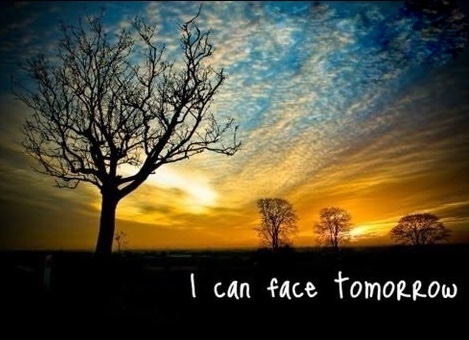
I Can Face Tomorrow

Enlight272Yesterday was not my best day. All day long challenges got the best of me — health challenges, schedule challenges, even bad haircut challenges. My sister of the heart, Donna, said I was cranky. My husband, Fred, said I should chalk it up to Ash Wednesday. Martie, my dear Little Rock friend, said that yesterday was the first day of Mercury in retrograde and that I should do my best to survive until it’s over on March 28th.
I’m not so convinced of any of those explanations, but I’ll let it be for now. Today is a new day, a day in which I have chosen peace for the beginning of my Lenten journey. Typically, the way I find peace is through music. So Pandora is on my sacred music station today. It would be an understatement to say that the music has lifted me today and has almost made yesterday’s fiascoes a dim memory.

As I listened, a song from my past brought sweet memories. Years ago, before I learned to renounce masculine pronouns to refer to God, I was inspired greatly by these words: “Because He lives, I can face tomorrow.” We sang this Gospel song often to remind us of hope, of perseverance, of God’s faithfulness and of Christ’s resurrection. Today, those words and that melody on Pandora reminded me of those exact things. In spite of masculine pronoun referring to God, the music moved me as it has always done. The message has not changed. God has not changed. My faith in Christ has not changed. Thanks be to God!

Here’s my truth as I follow my Lenten path, the abiding truth: “Tomorrow” for me seems murky, with the path ahead unknown and somewhat disconcerting. I do not know if I will receive a kidney transplant or live on daily dialysis for the rest of my life. I do not know what tomorrow promises.

But this is as it has always been — before illness and after. I never knew what tomorrow would bring, even in those days when I thought I was fearlessly and fully in control of my life. So it feels like a Lenten testimony of my faith to say that I do not know what tomorrow looks like for me. Leaning into the reality of the unknown future, I feel embraced in the consoling truth that “because He lives, I can face tomorrow.”

Of this, I am confident. Resting on this promise, I can move onto the Lenten path before me with refreshed hope and renewed faith. Amen.

Change, Growth, Hope, life, Life pathways, Wisdom

Starting Over

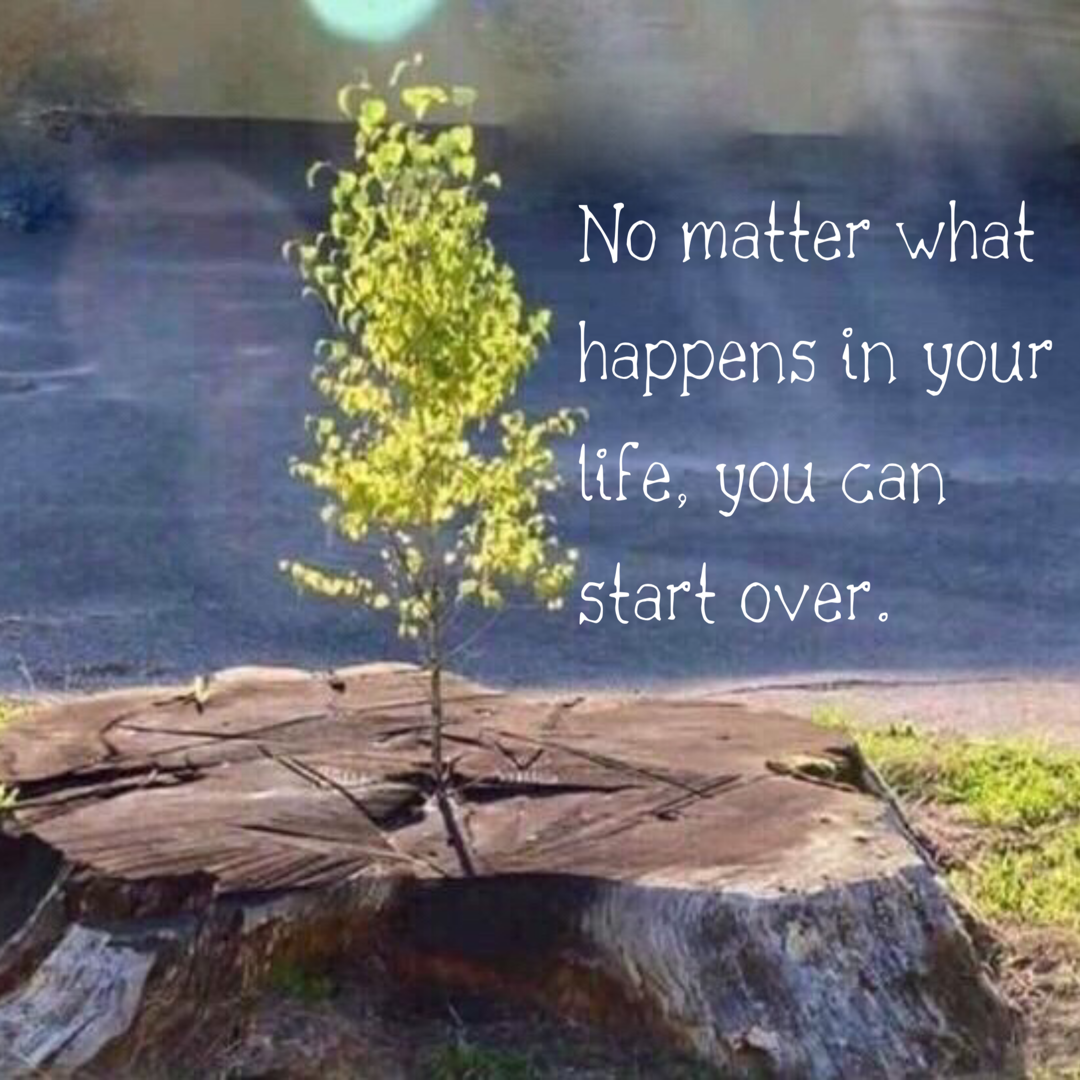
775D14C9-8802-4DEA-BD06-33C669F187B7Here’s the thing about life: things crash and break, obstacles can stop you in your tracks, you can get completely cut down. It happens to all of us.

One option is simply to give up on life. Or maybe to retreat into a private place for sulking. Another option is to be angry and to live the rest of your life angry.

But the reality is much more optimistic than any of those dismal options. Because no matter what happens in your life, you can start over. Starting over is really not so bad. I’ve done it many times and I survived it. So if we can accept the fact that something in life is over, there is hope for the days to come. 

I choose to see starting over as a fresh new beginning, another chance to do life differently. If I start over with a positive attitude, it can be an opportunity to head into the future wiser and more confident. Starting over can offer a path ahead that’s full of promise.

That’s what I’ll count on.

Holy Spirit, Inspiration, Life pathways, Mountaintop, Transformation

Can’t Stay on the Mountaintop

909AB186-15E1-4DA7-9027-5FC7B28578BDChrist-followers will always know ascent and descent, knowing and not-knowing. I can recall so many spiritual retreats that ended too soon, leaving me with a reluctance to go back into ordinary time. I wanted to stay in the place where God’s Spirit was moving within me. But every single time, I had to go home, leaving the mountaintop of my transformative spiritual experience.
In the Scriptures, two companion pieces tell of a “God experience.” Moses on Mount Sinai and Jesus on the Mount of Transfiguration. When Moses is on Mount Sinai, God is somehow manifest in thick darkness. “You saw no shape on that day at Horeb.” (Deuteronomy 4:15) Moses “sees” and “hears” to some degree, yet YHWH does not allow Moses to see God’s “glory” or “face.” The most that Moses can see is, humorously, YHWH’s backside. God placed Moses in a cleft in the rock and covered him until He had passed by. Moses would not see his face.

The Lord replied, “My Presence will go with you, and I will give you rest.”

Then Moses said to him, “If your Presence does not go with us, do not send us up from here. How will anyone know that you are pleased with me and with your people unless you go with us? What else will distinguish me and your people from all the other people on the face of the earth?”

And the Lord said to Moses, “I will do the very thing you have asked, because I am pleased with you and I know you by name.”

Then Moses said, “Now show me your glory.”

And the Lord said, “I will cause all my goodness to pass in front of you, and I will proclaim my name, the Lord, in your presence. I will have mercy on whom I will have mercy, and I will have compassion on whom I will have compassion. But,” he said, “you cannot see my face, for no one may see me and live.”

Then the Lord said, “There is a place near me where you may stand on a rock.When my glory passes by, I will put you in a cleft in the rock and cover you with my hand until I have passed by. Then I will remove my hand and you will see my back; but my face must not be seen.”

— Exodus 33:14-23 NIV

In the parallel story of Jesus on the Mount of Transfiguration (Luke 9:28-36; Mark 9:2-8; Matthew 17:1-9), there is first dazzling light. Yet a cloud soon overshadows the whole scene. Richard Rohr explains that “the epiphany is both light and darkness, knowability and unknowability, disclosure and non-disclosure.”

After the astounding experience on the mountain, Jesus deliberately walks with the disciples back down the mountain, onto the plain and desert of everyday life. Richard Rohr says that Jesus wanted to move the disciples “out of this enlightening, but also dangerously ego-inflating experience.”

We know that, always, we must return to the ordinary. We must come down from our mountaintops and walk on the rough road where life happens. We must experience the path’s twists and turns that take us through green pastures as well as through valleys of death’s shadow. That is the life we must live. Our Christian faith does not allow for permanent ascents. Mountaintop experiences for us are times of strength-gathering that make the rough roads bearable.

Jesus tells the disciples who witnessed his glorious transfiguration, “Don’t talk about it!” (Matthew 17:9). Because Jesus knew that talking too soon would only weaken the experience. Silence is important. Silence is necessary to preserve the sacred and the mysterious. Silence helps us remember how we felt on the “mountaintop.” And remembering helps us walk on, facing wherever life’s journey takes us with faith, confidence and perseverance. Thanks be to God. Amen.

Aging, Change, Comfort, Faith, Fear, God's Faithfulness, God's presence, Hope, Joy, Life Journeys, Life pathways, peace, Psalms

Around the Bend

8354B3D7-3728-454F-B1E7-FAB7901C5EB8
Photo by Steven Nawojczyk

I wonder sometimes what I might find around the bend. “Around the bend” is an apt metaphor for the twists and turns of life’s pathway. No matter how long I have traveled my journey, no matter how much life wisdom I have gained, I never, ever know what what’s around the bend.

The pathway before me can frighten, even while I strain to see as far as I can into what lies ahead. The bend is sharp most times, and the angle hides my view. As I age, fear on the journey looms large, for I am completely aware of the dangers I might encounter around the first bend, and the next, and all the bends that are ahead of me. And yet, I am constantly graced with flashes of hope and faith whispering that what is ahead of me could be even better than what I have left behind.

The beautiful photo above by Steven Nawojczyk is a gift of calm waters bending in a gentle flow at the foot of a mountain, lightened by the golden rays of the sun. The image makes me believe that whatever is around the bend is lovely, peaceful, comforting, safe. And that is exactly what God would want me to believe, and woukd want us all to believe. I cannot help but think of the Psalmist’s affirmation that God “leads me beside still waters.”

In so many comfort-filled passages, the Psalmist offers sure and certain comfort. Hear the Psalmist’s words . . .

Keep me safe, my God, for in you I take refuge.

Lord, you alone are my portion and my cup; you make my lot secure.

The boundary lines have fallen for me in pleasant places;
Surely I have a delightful inheritance.

I keep my eyes always on the Lord. With him at my right hand, I will not be shaken.
   Therefore my heart is glad and my tongue rejoices; my body also will rest secure . . .

You make known to me the path of life;
you will fill me with joy in your presence,
with eternal pleasures at your right hand.

— Psalm 16:1, 5-6, 8-9, 11 (NIV)

And hear the words of the Prophet Isaiah . . .

Even to your old age and gray hairs, I am he, I am he who will sustain you. 
I have made you and I will carry you; I will sustain you and I will rescue you.  

— Isaiah 46:4 (NIV)

And so “around the bend” is not so frightening after all. In God — “who makes known the path of life” —  there is comfort, safety, protection, constancy, and even joy. Thanks be to God.

Beauty of Nature, Comfort, Grace, Life pathways, Nature, peace, Restoration, Serenity, simple joys, Transformation, Writing

Beside Still Waters


7C49B5E1-CD3A-4F00-B8CC-B55E370984B4
Still waters near Pulaski County, Arkansas. Photo by Steve Nawojczyk.

I long each day to live beside still waters, to dwell in serenity, to find peace in the depths of my soul. Not such a simple task, that. 

The problem is that life is not that much about still waters. It’s more often about churning waters and swelling currents. Don’t get me wrong, I love the sound of waves crashing in the ocean and then coming to the shoreline with a special kind of energy. I love the rolling of a mighty river, the trickling sounds of creeks, and the splashing sounds that streams make as  they ripple over stones.

But the sheer silence of still waters . . . That’s when you can skip a rock across the top of the water and watch its antics. In still waters, you can hear the sounds of fish flying up to the surface and turtles paddling almost silently acreoss the waters with only their heads visible in search for a morsel of food. In still waters, a family of ducklings can move through the waters with just a hint of a sound and the graceful swan can glide by with hardly any sound at all while its webbed feet move swiftly to push the waters aside.

Those still waters! Their silence and their calm show us how to be.

The truth is that rushing waters do describe our lives at times. That is our reality. Life brings what feels like raging storms. Life assails us with a power that reminds us of the breaking waves of the ocean. In this life, we come upon rivers too deep and too wide and too turbulent to cross. We will feel a force against us that may come because of serious illness or the loss of a loved one. It may come with the pain of broken relationships or with devastating financial hardship.

Life brings brokenheartedness, but it brings brokenheartedness in the midst of grace. For on this journey we call life, we travel with a divine guide, One who does lead us beside still waters. And it is there that our soul is restored and comforted in the midst of green pastures of sacred serenity and holy calm.

I am thinking, of course, of the words of the Psalmist.

The Lord is my shepherd, I shall not want.

He makes me lie down in green pastures; he leads me beside still waters;

       he restores my soul.

He leads me in right paths for his name’s sake.

Even though I walk through the darkest valley, I fear no evil; for you are with me;

        your rod and your staff — they comfort me.

— Psalm 23:1-4 (New Revised Standard Version)

I also think of my friend, Steven Nawojczyk, who is finding his much-needed peace in the forests, mountains and valleys of Arkansas. His stunning photograph illustrates today’s blog post. With his beautiful dog and companion, Feebi, he follows a path of serenity and healing, hiking through nature’s beauty most every day.

His life has not been an easy one. As a public servant — many years as Pulaski County Coroner — he has seen far too much anguish for one person. He was integrally involved, literally in the trenches, with ending and preventing Little Rock gang violence, and has been a staunch champion for young people.

He faces serious illness and harsh treatment in his retirement. but he knows that life really does have a pathway that goes around the dangers, toils and snares. He knows that he and Feebi will find lightheartedness in exploring a forest or watching a flowing stream. He knows that the simple joy of a mountain view can bring transformation. He knows about peace, and he has chosen to follow the life path that passes beside still waters. I admire him. I have always admired him, but even more so now as I witness his unwavering commitment to serenity.

That’s what it’s all about in the end — a commitment to serenity, a firm resolve to walk beside the still waters of life, and in that intentional journey, to find our souls.

May the grace and peace of God fill your soul, and may your journey, wherever it leads, bring you serenity.


Change, Courage, Darkness, Fear, God's presence, healing, Heartbreak, Hope, Life pathways, Pain, Restoration, Uncategorized

Through the Fire

892264FE-E803-4E0E-B598-C7503D77F674Sometimes life hurts.
We suffer. We heal. We move on.
But sometimes life hits back. Harder.
Lethal in its cruelty.
Shattering us into a million glittering shards
of pain and loss and anguish.
And we suffer, too broken to heal,
to become what we once were.
— L.R Knost

How deeply I know that feeling of brokenness. I am personally acquainted — well acquainted — with the lethal cruelty that life can present. To heal the past requires that I pay close attention to the spiritual and emotional places within me in the present, to make sure I am healthy and whole right now. Only then will I find the strength to invite the pain of the past into my psyche so that I can face off against it.

I have learned through the years that it is not a good option to leave past pain where it is, to let it occupy the place within me it has claimed. This writing by L.R Knost is one of the best descriptions I have ever seen on healing from past pain.

Healing is not a straight and narrow road
that leads from darkness to light.
There’s no sudden epiphany to take
us from despair to serenity, no orchestrated
steps to move us from hurting to healed.
Healing is a winding mountain road with steep
climbs and sudden descents, breathtaking views
and breath-stealing drop-offs, dark tunnels
and blinding exposures, dead ends and
endless backtracks, rest stops and break downs,
sheer rock walls and panoramic vistas.
Healing is a journey with no destination,
because healing is the journey of every lifetime.

Indeed, “healing is the journey of every lifetime.” The reality is that the only way to heal from the pain of the past is to walk directly through the center of that pain in the present. Does it feel safer to just let the pain continue to smolder in the dark parts of myself? Of course it feels safer. It feels terrifying, in fact, downright terrifying.

But the dark places in me will never heal spontaneously. I have to conquer the fear and open up to the possibility that God’s Spirit can breathe life back into those embers of pain snd rekindle the fires of unhealed hurts. So as I sit cautiously at the very edge of the fires of past pain, I cannot help but recall the comforting words of the prophet Isaiah.

When you pass through the waters,
I will be with you;
and when you pass through the rivers,
they will not sweep over you.
When you walk through the fire,
you will not be burned;
the flames will not set you ablaze.

— Isaiah 43:2 New International Version (NIV)

And so many times, I have found deep comfort in singing the beloved hymn, How Firm a Foundation.

When through fiery trials thy pathway shall lie,
 My grace, all sufficient, shall be thy supply.
 The flame shall not hurt thee; I only design
 Thy dross to consume and thy gold to refine.*

Text: Attr. to Robert Keen, ca. 1787.
Music: Attr. to J. Ellis, ca. 1889

So the flames aren’t there to burn me. The flames are there to light my way through pain to healing. At times, I have approached those flames with courage and confidence. But at other times, I met the flames with terror.

Courage or terror — it didn’t matter really. I just walked through it just as I was, and as I did, the hurt transformed into hope. I had wounds, for sure, and lasting scars. But the scars tell a story of the battles I won and the battles I lost, and most importantly, the scars tell the story of a human who survived. So, in spite of fiery places of past pain, we learn to live as L.R. Knost says

. . . with the shards of pain and loss and anguish forever embedded in our souls,

and with shaking fingers we piece together the bloody fragments of who we were into a mosaic grotesque in its stark reality,

yet exquisite in its sharp-edged story of the tragic, breathless beauty of a human who survived life.

And we move on, often unaware of the light glittering behind us
showing others the way through the darkness.

This is a resilience we can be thankful for, a perseverance we can cherish, a strength straight from a present and faithful God that will ever — forever — sustain us. Amen.


* Hear the entire hymn, How Firm a Foundation, at this link:
https://m.youtube.com/watch?v=G0S62se1hAE

Challenge, Courage, Faith, Hope, Life pathways, Perseverance

Moving a Mountain with a Teaspoon

1FFB2D29-8A6E-4363-9AF5-B3744373776B
Quote by Napoleon Bonaparte

Moving a mountain with a teaspoon!

Ever feel like that’s exactly what you’re trying to do? I know the feeling personally, and I have also witnessed others in the middle of this kind of daunting task.

Making ends meet in a single parent family . . . moving a mountain with a teaspoon.

Caring for an aging loved one who needs constant attention . . . moving a mountain with a teaspoon.

Fighting a debilitating and relentless illness . . . moving a mountain with a teaspoon.

None of us are immune to life situations that get the best of us, sometimes bringing us to our knees in desperation. And sometimes, these life challenges move us to the precipice of almost giving in and giving up. There is simply not enough strength and fortitude to go on, and we find that we are sitting in the dust where we collapsed, contemplating if it’s even worth it to try to get back up.

With inner resilience and a tiny bit of hope, we do get up. We move farther along our path, part of us dreading the next collapse, and the other part of us filled with certainty that we will survive. Moving a mountain with a teaspoon is most certainly a part of life, every person’s life.

And yet, from somewhere in our past, there is this faint whisper of hope. We may not remember where the whisper comes from, and it may be ever-so-quiet. But still we hear it . . .  echoing from ages past, coming from somewhere in our lives at some devastating moment, maybe even becoming a sigh from the deepest place in the soul.

Truly I tell you, if you say to this mountain, ‘Be taken up and thrown into the sea,’ and if you do not doubt in your heart, but believe that what you say will come to pass, it will be done for you.

— Mark 11:23 NRSV

What a promise to remember when we feel as if we are moving a mountain with a teaspoon! It is a God-sent word of assurance, a message of hope that encourages us to pick ourselves up and move forward, to try one more time.

Thanks be to God.