
The saints have left us a legacy of wisdom, inspiration and challenge. I often browse through readings by the saints and find myself enthralled in the words, wondering what in their lives prompted the words they have written. Most often, there is a back story that offers a glimpse into their lives.
One of the saints that calls for my attention is Teresa of Avila. I became especially interested in her life during the years our progressive Baptist church worshipped each week in the chapel of Carmel of Saint Teresa of Jesus in Little Rock, Arkansas. I was the pastor of a church where Baptist congregants worshipped in a beautiful chapel cared for and consecrated by Carmelite Sisters, thirteen of them at that time.
How rich an experience it was for us! As we lived out our spiritual commitments in the world, we were blessed immeasurably by the inner life the Sisters modeled before us . . . a life of silence, reverence, prayer and contemplation.
Recently I came across a quote by Saint Teresa of Avila, also known as Saint Teresa of Jesus, that touched my heart.
Close your eyes and follow your breath to the still place that leads to the invisible path that leads you home.
Those words were intriguing to me, calling me to a still place. Calling me to allow my breath to lead me to the still place on the invisible path. I contemplated the meaning and what the meaning might say to me. I could not help but wonder what prompted Saint Teresa’s words. And then I looked at her back story.
It seems that Teresa of Avila was a reformer of the Carmelite Order. The movement she initiated was later joined by the younger Spanish Carmelite friar and mystic, Saint John of the Cross. It led eventually to the establishment of the Discalced Carmelites. A formal papal decree adopting the split was issued in 1580. Throughout her life, Teresa founded several new reformed Carmelite Orders.
Saint Teresa experienced years of excruciating pain and serious illness. Her spiritual life was one of dreams, visions and mystical experiences. Unfortunately, when her mystical experiences, including visions, became widely known, she was treated with ridicule and even persecution. Her religious ecstasies caused jealousy and suspicion. She lived in the period of the Spanish inquisition, a time in history when any deviation from the orthodox religious experience came under strict observation and scrutiny.
So her experiences of spiritual ecstasy subjected her to the investigations of the Inquisition. In 1576, a series of persecutions began on the part of the older observant Carmelite order against Teresa, her friends, and her reforms. Pursuant to a body of resolutions adopted at the general chapter at Piacenza, the “definitors” of the order forbade all further founding of convents. The general chapter condemned Teresa to “voluntary” retirement to one of her institutions.
But prior to her forced retirement, Saint Teresa devoted her life to traveling around Spain setting up new convents based upon ancient monastic traditions. Her travels and work were not always greeted with enthusiasm, as many resented her reforms and the implied criticism of existing religious orders. She often met with criticism, including the papal nuncio, who used the rather descriptive phrase “a restless disobedient gadabout who has gone about teaching as though she were a professor.”
Saint Teresa of Avila most assuredly had a great deal to teach us about the importance of an inner life of deep contemplation and an outer life of immersion into the hurt of the world. What a lesson we could learn about doing the inner work that enables us to do the outer work in a suffering world!
So the one who spoke those words about a “still place” had so much more to say when we readthe entirety of her writings. The following are but two small glimpses into her depth of devotion.
This magnificent refuge is inside you. Enter. Shatter the darkness that shrouds the doorway. Be bold. Be humble. Put away the incense and forget the incantations they taught you. Ask no permission from the authorities. Close your eyes and follow your breath to the still place that leads to the invisible path that leads you home.
Christ has no body now, but yours.
No hands, no feet on earth, but yours.
Yours are the eyes through which
Christ looks compassion into the world.
Yours are the feet
with which Christ walks to do good.
Yours are the hands
with which Christ blesses the world.
Saint Teresa was a contemplative mystic that showed us a life of silence and prayer. But she was also a brilliant revolutionary in the best sense of that word. We would do well in our quest to follow God to emulate her life that spoke so eloquently of our hands and feet being those of Christ on earth. She showed us deep contemplation and revolution. Our world needs both.

 Today, a friend’s blog posed a provocative question. It was provocative enough to stop me in my tracks. Likely, I was right in the middle of a tirade of complaints when this question challenged me. This was the question: “If I let go of my complaints, what might be underneath?” *
 “I have calmed and quieted my soul.” Words from the Psalmist.
 What is Advent’s invitation to me? What does this season want to
 Yesterday, I mused on the tenderness of this season of Advent. The waiting. The darkness. The need to linger in the season with a sense of mindfulness.
 I seldom talk much about the spiritual disciplines that have given me strength. A private retreat — just me and God — in a beautifully isolated hermitage was one of the most powerful spiritual experiences of my life. While there, I also practiced another of my spiritual disciplines — iconography.
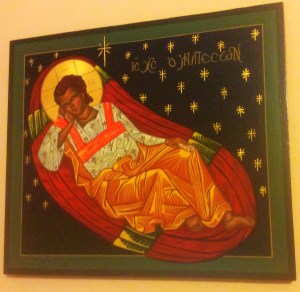 In describing the purpose of icons, the early Christians used the Greek work anagogic, literally meaning “leading one upward.” Photios Kontoglou, a renowned modern iconographer, expressed this perfectly: “Icons raise the soul and mind of the believer who sees the icon to the realm of the spirit, of the incorruptible, of the kingdom of God, as far as this can be achieved with material means.”
 My love of iconography resulted from the prompting of my dear Aunt Eirene. She was an artist extraordinaire and a gifted iconographer. She studied and practiced to hone her skills and each year, she went to an intensive iconography workshop at a beautiful retreat center. One year, she persuaded me (forced is a more accurate term) to go with her. Of course, I was extremely reticent to try this new art form.
 She was so wise. I began to think more about the Christ Child’s eyes than my own art, and within a day, my iconography transformed from a painting to a prayer. It was worship, meditation and reverence. It touched my soul as I added color to the board, layer upon layer. It was an incredible experience to see the Light. I share with you here some of icons I created, as I remember the experience I had with each of them that opened my soul to the Light.
 What is it like to sit open-handed before God? To abide with a compassionate God who knows the grief we are carrying? To sit in the glowing presence of a God who, not only knows the deep angst of our nation, but who can also transform it?
 Because I have no sense of direction at all, I have an irrational fear of getting lost. Do not tell me to go north or south. I will have no idea how to do that. You must instead say something like, “When you see McDonalds on the right, go past it. Then go past Wendys, Burger King and Barbaritos. Look just past Barbaritos, but on the other side of the road, and you’re there.” It’s a convoluted way of making sure I don’t lose my way. And if one of those fast food places were to close down, I’m lost.
 My adult son is a master at denial. He can get very upset over a situation, but before you can blink, he has moved on as if it never happened. To be honest, I have often envied that part of his personality. As one who tends to brood over life’s challenges and problems, I would love to just be able to blow things off.
 Wandering may well be a spiritual discipline. Many years ago, young Annie Morgan sang about it as she wandered in the hills and hollows of Appalachia. . . “I wonder as I wander out under the sky.”*
 The truth is I never expected to have an illness with the ominous descriptor “end stage.” I never saw it coming, but after a very brief, sudden and inexplicable illness, I was diagnosed in 2014 with end stage kidney disease. I was put on dialysis immediately and spent the rest of that year struggling and suffering.


 God of the Sparrow 🌱 By Kathy Manis Findley