2024 election, A blessing for voters, Activism, anxiety, Belonging, Betrayal, Bewilderment, Bitterness, Calm, Challenge, Change, Community activism, Courage, Darkness, Daybreak, discouragement, Exclusion, Faith, God, God's presence, God’s creation, healing, Heartbreak, Hope, Kneeling Places, Lament, Liberty, Mourning, Patriotism, Pilgrim, Politics, Pondering, Prayer, Repair the world, Rev. Kathy Manis Findley, Unanswered Prayer

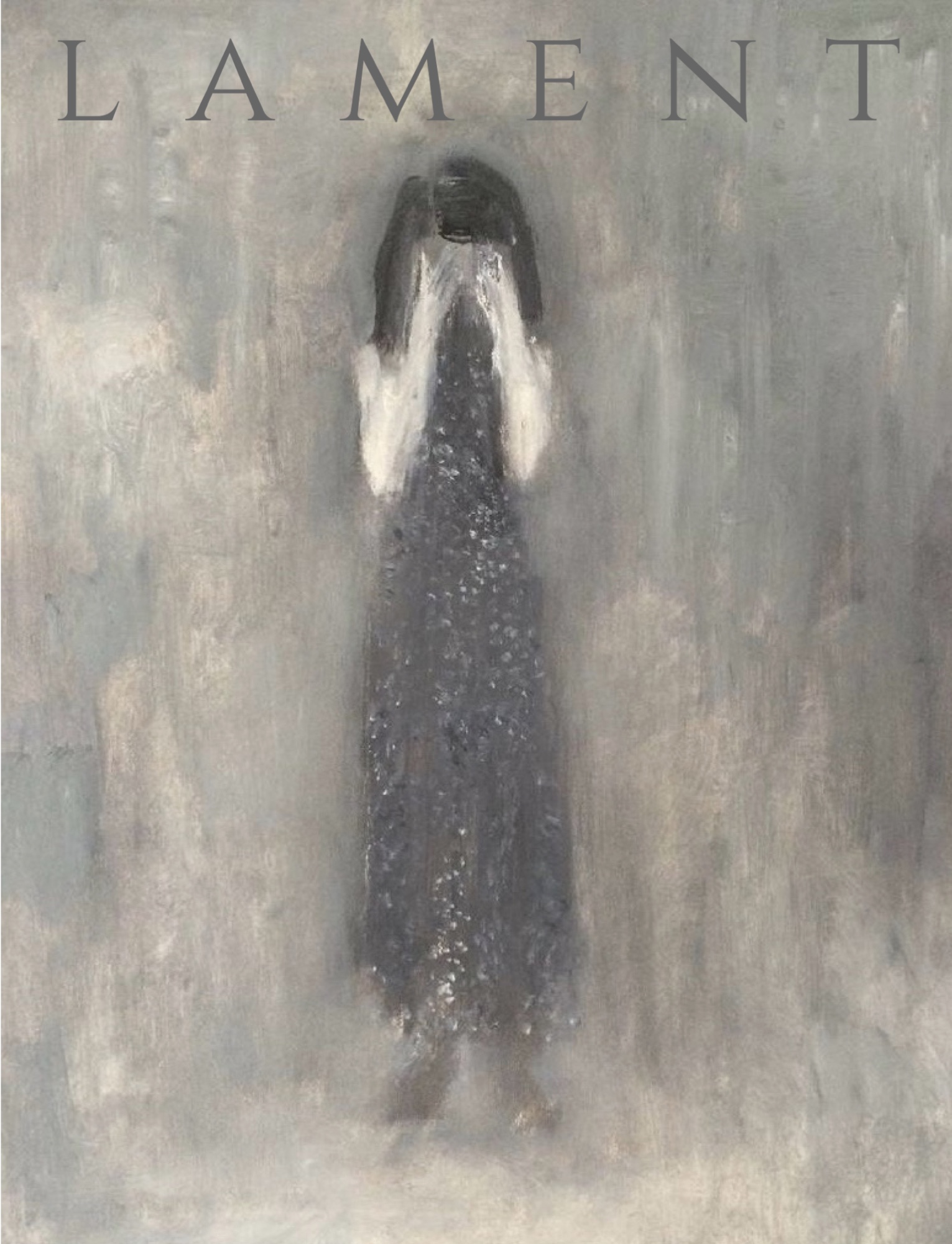
Prayer in Response to Tragic Victory


Together, we will transform our grief into a force for change that will build a more just, equitable society that respects the dignity of all people.

— Omar Angel Perez,  Immigrant Justice Director, Faith in Action

This is my prayer of Hope for the living of these days and my lament for almost losing my faith. It is a too-long treatise, because I release my profound grief through writing. It’s a too-long lesson to teach my class, because at our meeting time, everyone is a spent body of exhaustion that can hardly respond to dark and serious topics. It’s a too-long sermon to preach, because at minute 38.6, the congregation will start leaving. Most of all, it is a too-long dumping of grief. But still my prayer

Guard your hearts and may the week ahead freshen your hope, Kathy


Creator, Spirit of God, Star of the Morning, Son of the Dawn ~

We give you praise for creating each of us and placing us in the brilliance of Holy Light because last Tuesday’s election has left so many of us in a very dark place. We thank you, Creator God, for naming us your beloved children, even if others name us with hurtful words. Yes, it is true, this past election week has been hurtful to so many people. In fact, the entire election season has caused anxiety for at least a few of us. And the outcome? Well, God, I almost said you let us down, but I know better. Still “let down” is only a fraction of the emotion that now hangs closely around us. So, God, if you wouldn’t spare us from our president elect, could you please touch our souls with a gentle hand of comfort and hope.

Gentleness is one thing we need, maybe to minimize the harsh names and the contempt we have endured from our misogynistic brothers and sisters. The outcome of the election has left us feeling disconnected from many of our friends, neighbors and family members. God, you know our emotions and you understand our sense of feeling discarded. You know our fear, confusion and despair. Help us, Mother snd Father God, to remember that you have whispered our names. We are your beloved daughters facing the world with the name you gave us.

One election! Just one has this much power over us! We must have taken a wrong path somewhere along the way, because repairing the world was the real goal, and our destination was to create a community of love, care and decency. We did not make it there, God, and we feel a bit like pilgrims and strangers in a land we have never seen before. We imagine how exiles must feel, and recall a letter from Jeremiah to people in exile, “You will search for me and find me when you search for me with all your heart.”

It was just an election, but it rocked us to the core and left us wandering aimlessly on unfamiliar paths and turns. Yet, we are comforted still by sensing your presence with us. Every journey has paths and turns that can lead us to unexpected danger and unprecedented harm. Paths and turns can be disconcerting and downright frightening. Paths and turns leave us in uncomfortable unknown places, so that our feet walk in unfamiliar dust. Paths and turns can lead us away from all we’ve known, our comfort-place, our “home.” 

Protecting God, can you stay close to us on this harsh path ahead and protect us?

Now, God, we know you have a teaching moment for us, for to you this rocky path we follow is a holy pilgrimage. We can learn and take in the reality that paths and turns can also lead us to holy moments. Those sacred moments can inspire us to search more fervently for you, God. We did not stop believing in a new season of unity. But someone more powerful than we are has taken over our lives.

Still this week of sorrow is about more than just one election.
It is also about hurtful memories of being pushed out because of who we are or what we look like. 
It’s about the pain of being “othered” and never fitting in.
It’s about being diminished over and over again.
It’s about people who need to measure us by our wealth or power. 

There are so many better measures out there. Help us God, to throw away false tools that can only try to measure who we are, but can never measure the Light in our souls or the dreams of our hearts.

For our nation, O God, we ask for seemingly impossible unity and for as much love as we can muster between brothers and sisters. We ask you, God, to restore our hope, bring us to our feet, teach us to stand and set us on our path once again.

God, make of us peacemakers, consolers, and healers of harm. Help us control our tongues, so that we Will always speak respectfully of others. Help us spend holy moments in lament and deep prayer that can re-enliven our souls.

I confess, God, that I am failing at that right now. My soul is filled with anger and disgust. My spirit is not at one with love, but with hate directed at those who managed to do this shameful thing to our nation. I am full of confusion about how this happened; what exactly has happened; what will the repercussions be; how serious is the threat to our future; and specifically what must I do now as one person to minimize the harm for myself and all of us?

In such a time as this, God, I see myself kneeling in your holy presence with a shattered spirit and a broken heart. I see myself questioning how it is that you have the ability and the will to organize the universe, but you do not. I need the breath of Spirit to order my thoughts. I need moments of confession to name my sins. I need to repent of my own actions, whatever they are, because my action or inaction may have helped cause the results of this election.

Even now, leaders—that is political people, elected officials, teachers and professors, ministers, rabbis, Imams, priests, bishops, chaplains, etc.—are encouraging us with hope. Emails still flood my inbox, like, “We can’t give up. Let’s roll up our sleeves.” I have noticed that many people say they can’t think about it right now. They are wise to stop and tend to the grief in their souls.

I feel useless, dismissed, disrespected and weary, God. I even feel that I have completely lost my hope for brighter days. I know that losing hope is a dire place to be, because losing hope almost admits that I have also lost my faith. Yet, even in this very moment, God, you are whispering to me:

Beloved daughter, you are not just ‘one person,’ You are one person of God. A child of God. A beloved daughter. A woman whose spirit is whole with a sacred calling to shepherd the lost and weary ones.”

When circumstances, words, or people threaten us, God, help us respond with decisiveness, truth, kindness, grace, forgiveness, and respect for our brothers and sisters, our neighbors and friends, our classmates and co-workers. Because being harsh to one another can not quickly heal the wounds of political discord, or any other kind of near-fatal wound. It will take time to cast out the dark presence whose only purpose is to darken our souls and leave us in profound darkness.

In this goal, in this time, God, the dark presence has succeeded, and we need you, God, more than ever. We see the truth that we are dangerously vulnerable right now, and that we must fight against spiritual despondency. 

Creator, Spirit of God, Star of the Morning, Son of the Dawn ~ hold us near until the danger has passed. (If it ever passes!) If you can, God, speak peace to the dark presence that is still maneuvering that will harm our democracy and our souls. 

Hold us close in the brilliance of your Light, Creator God! 

Place us securely in your Light, Star of the Morning!

Hold us fast in your Light, Spirit of God!

Draw near to us and grant us Light to see daybreak, Son of the Dawn!

Mother and Father God, we will stand tall in the evil day, if you will help us refresh the Light that lights the world and brightens our hearts.

In this evil day, God, meet us in our sacred place. As we lament, restore our hope and strengthen our faith in this time of grief and confusion. Restore our spirits, God. Restore my spirit, God! 

Creator God, Mother and Father of the universe, fill us to overflowing once again. Cover our bodies and fill our souls with fresh hope, the living hope that guards our faith from any evil.

Amen.

A way in the wilderness, All Shall Be Well, Alone, Anger, anxiety, Awareness, Belief, Bewilderment, Bitterness, Brokenness, Challenge, Change, Come, Ye Disconsolate, Comfort, Confusion, Creativity, Depression, Determination, Disconsolate, Emotions, Faith, Falling down, Fear, Feelings, Freedom, God's Faithfulness, God’s beloved daughter, grief, Gun control, Gun violence, Harbinger, Hate, healing, Heartbreak, Hope, Isolation, Joy, Julian of Norwich, Kidney Transplant, Life pathways, Loneliness, Loss

Fleeting Time, Passing Moments


I am aware, as you are, that time is fleeting and moments are passing. Life has taught us that. But there is more, like a dandelion will scatter with the wind as we hold it in our hand. There is no stopping any of that. Nor can we control it.

Still, there are messages for us here, right now, as we contemplate a little reality. If you know me personally, you know that I have lived an uneasy life full of trouble. In a way, tragedy became the path I traveled. I would struggle my way through one tragedy and then steeled myself waiting for the next one. The next tragedy always came eventually, a tragedy large or small.

When tragedy cruelly and abruptly stopped me in my tracks, I found that most of the time, I was resilient and full of hope. Yet, I became exhausted by the trauma, or the sorrow, or the grief.

It is true that when I fell to my knees, I always got up. Good for me! It’s not like that, though, that “good for me” attitude. I was strong enough to get up and move forward, but it was more like God graced me with the courage and hope I needed for to pick myself up and take my next step.

Void of any pending tragedy, I have felt positive for the past weeks. I finally have a stable, working kidney. My frequent falls have stopped. I didn’t get seriously hurt by falling, just a sprained wrist and later a bruised rib cage. So I firmly believed the words of faith from Julian of Norwich, “All shall be well, and all shall be well, and all manner of thing shall be well.” 

Until, until, I heard the doctor say to my husband Fred and me, “You have advanced prostate cancer.”That’s when I broke my streak of resilient responses to tragedy. I have been happily married to this good, good man for 55 years! He cared for me during my long illness, five years of dialysis, and my kidney transplant. He cares for me every day in a thousand different ways! I honestly don’t know how I would live without him. Then I heard a whisper, “Where is your hope, my daughter? Where is the resilience that has always carried you through the hard times?”

That whisper was what I needed to hear, because everything about this felt different to me than any other time I had heard bad news. Questions and concerns and worries about every kind of life change flooded my psyche. I was assuming the worst right at the very beginning of this current life tragedy. I could not put my finger on it, until I saw this bit of insight from C.S. Lewis.

I felt instantly that my feeling since the awful diagnosis day was indeed fear. That’s why it felt so different. It was not my normal response of sadness, anger, devastation, aliveness, fatigue, and more sadness. This time my grief felt more like fear. So there you have it. The gentle make up of a dandelion is not one you can hold together. It scatters with the breeze. Time continues to fleet no matter how we try to stop it. Moments are passing and that will not stop.

But we have this moment and all the comfort and peace and hope and joy we can get from it. And we can do just that: consider only the present; feel the emotion of it; recognize it as completely yours; and summon the courage to hold it in your arms and grab the good things. That is one simple definition of resilience, and you have it! You have resilience! Everyone has it! Keep it close and continue to move on your sacred path.

Awe, Bewilderment, Calling, Church, Community, Hope, Informal Poll, Ordination, Presidential Poll, The Christian Church, Uncategorized

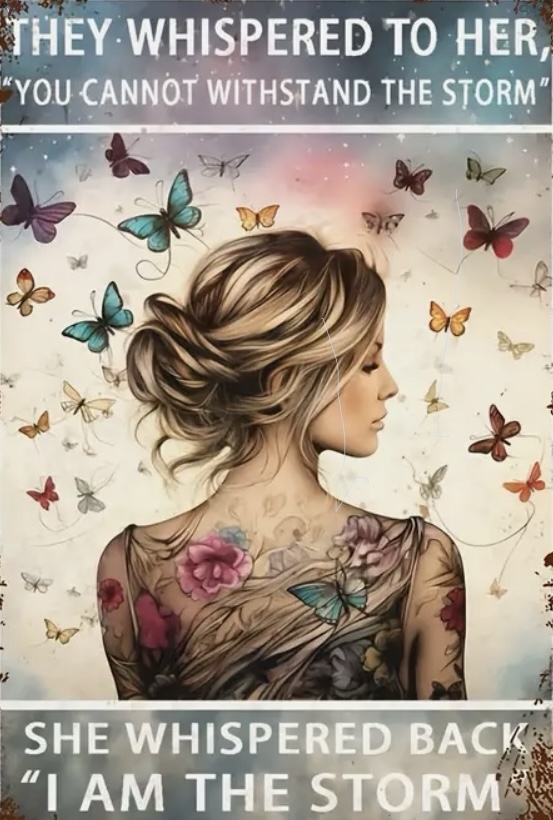
I am the Storm!


Rev Kathy Manis Findley
August 15, 2024

Photo by Jeremy Bishop  on Unsplash

Writing a blog post is never easy, at least not for me. It’s just me musing, after all, a “me” who is a quirky person who can’t write good words because of trying so hard to find the best words. Anyway, I often cringe at the thought of talking about one particular milestone that happened in a certain moment of my time line! And pointing out my milestones is really what this blog does much of the time. The milestone may seem significant to me, but you, dear readers, might not care one bit about it. The people or events that take my breath away may not move your breath at all. If that’s the case for you, just delete this and continue with your life.

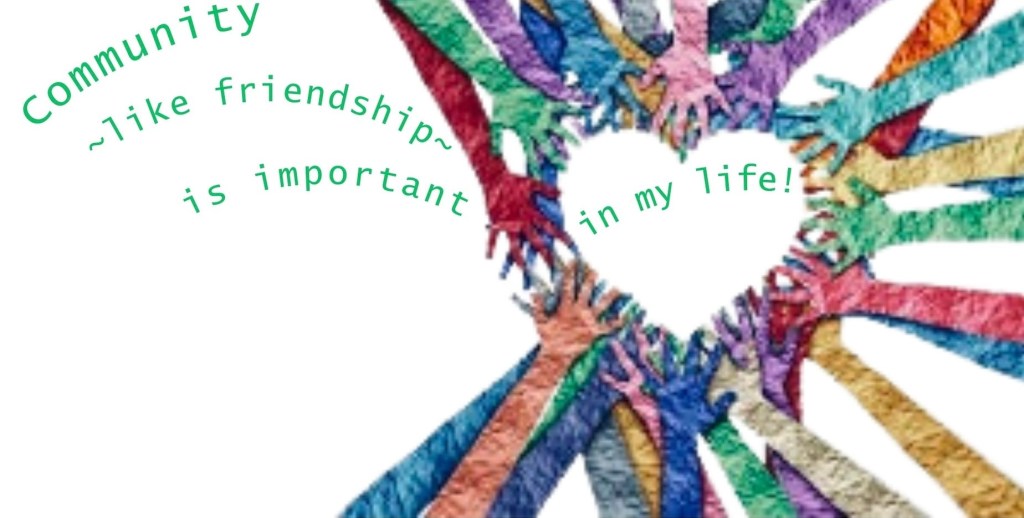
I want to briefly comment on the ideas of friendship and community, two of the most important elements of life. Like you, I need people in my life who are honest and authentic. I am too far along in age and wisdom to mess around with dishonest people. Nor do I want people around me who are unkind, cruel, and uncaring. That’s the way it must be in friendship and community. I need a caring companion on my journey, a compassionate community that has my back over time. They know that I have their backs, too.

Through the years, I have tried to be a part of a personal friendship or a community that is strong, loyal, and lasting, only to discover that the subject of my friendship actually cares nothing about what is meaningful and necessary for people. This is simply not what genuine community looks like. And friendship is downright superb when it is real and true friendship.

One of the most beautiful stories about community found in Scripture tells the story of a large gathering of people in a certain time and place when “Great awe fell on everyone.”

When the day of Pentecost had finally arrived, they were all together in the same place.  Suddenly there came from heaven a noise like the sound of a strong, blowing wind, and it filled the whole house where they were sitting . . . All of those who believed came together, and held everything in common. They sold their possessions and belongings and divided them up to everyone in proportion to their various needs . . . In the last days, declares God, I will pour out my spirit on all people. Your sons and your daughters will prophesy.
(From Acts 2:1 NTFE)

To be honest, I don’t know a community of people who would agree on the idea of holding “all things common.” I know that communities like this do exist, but I have never seen one in person. The shining, glimmering idea of pouring out God’s Spirit on every single person moves me in the depths of my heart and spirit. If that were not blessing enough, the text mentions “sons and daughters” who will prophesy!

“And daughters!” This gives me great hope. The truth is that for much of my life I have longed to experience community in a group like this—dedicated to each other and knowing that they can stand for righteousness. On top of that, in the scripture text, the wind of the Spirit was felt by everyone, sons and daughters. This picture of community is the kind of community God desires for every person. In some ways throughout my ministry, I saw the worst of community, even a church community that would reject my gifts for ministry and my call to ministry. Soon they would know that I was stronger than I seemed to be.

In 1992, I asked my home church to enter with me into a process of ordination for me. The process continued for months, each month postponing, delaying, making motions to table. I received somewhat frightening threats both from people in my faith community, and from leaders of the Arkansas Baptist State Convention.


Was it true what they told me, “You are destroying our church!”

That accusation troubled me a great deal. But I did not relent. I did not shrink. The outcome was not pretty, and my church ended up responding with a definitive “NO!” They did not yet know about my dogged persistence. In spite of this painful decision my church made, I was ordained the same year, in March of 1992, by a different congregation, in a different state.” God called the plays!

by a different congregation.


I did not know where this blog post would end, but I want it to end with a hope-infused vision of the refreshing winds of the Spirit falling upon us, filling our spirits, and planting hope in our hearts. We all need that in these troubling days. May God make it so for all of us and each of us. Amen.

~ THE END ~


Just for Fun . . .

Activism, All Shall Be Well, anxiety, Attachments, Bewilderment, Brokenness, Caged children, Calm, Change, Confusion, Courage, Defiance, Despair, Determination, Dreams, Emerging new, Falling down, Fear, Feelings, Following Christ, healing, Hope, Injustice, Psalms, Questions, Reflection, Transformation

In these Evil Days, Dream a Little Dream

Rev. Kathy Manis Findley

Lately, I have been trying to figure out a number of mysteries, but I have not figured out one single thing-, not lament, not how to fix my life, not transformation, not even the continuous mess in my closet. I simply have not yet been able to go through a reorganization process. The prospect of reorganizing my life—my soul, my spirit, my heart—plus all the treasures in my closet and armoire is so terribly daunting to me. Marie Kondo comes to mind, but I quickly shoo her away from my mess in the closet.

Lots of folk complain about “these days.” I confess that I do my share of complaining. What is it about “these days” that seems so troubling? I cannot fully give you an answer to that question yet, but I have some ideas about it. The issue at hand reminds me that the Bible often refers to “evil days.” I believe that many people see these days as “evil days,” and that cannot turn out well for anyone!

Jennifer Senior, a journalist with The Atlantic, recently wrote a news article in which she asked a another provocative question: What will happen to the American psyche if Trump is reelected? (Don’t worry, this post is not about Donald Trump!) On this question, maybe we really don’t want to know the answer. Instead of taking her question seriously and considering what might happen to “American psyches” following the November election, some folk would rather complain about the division all around, the evil around us, or other things nobody likes.

When we dare to make an honest evaluation of circumstances that surround us, we dig in our heels and balk. We balk because we don’t want to see the division in our nation or the impasse we have reached on important issues. We balk because, in truth, no one wants to lament. Remember, I’m not talking about divisions among us like liberal or conservative, Democrat or Republican, male or female, immigrant or American citizen, black or white . . . I could go on and on naming divisions among us. We have always co-existed with division, but most often in the past we have acknowledged division and simultaneously practiced kindness, respect, and tolerance. Given the current national environment, we might just be justified in calling these days “evil days.

If reading the Bible is something you typically do, then you might understand more fully the term “evil day.” My heart tells me that “evil days” are definitely taking a toll on us. Instinct tells me that “the evil day” is not a single day, but refers to the times in our lives when we face overwhelming , troubling circumstances. If you are willing, meditate on the following words for a few moments.


Therefore, take up the whole armor of God, so that you may be able to withstand the evil day and, having prevailed against everything, to stand firm. 16 Stand, therefore, and belt your waist with truth and put on the breastplate of righteousness15 and lace up your sandals in preparation for the gospel of peace. 16 With all of these, take the shield of faith, with which you will be able to quench all the flaming arrows of the evil one.17 Take the helmet of salvation and the sword of the Spirit, which is the word of God.

Ephesians 6:13-17 NRSVUE

I want to remind us all about the unrest we hold inside, too close to our heart and spirit. The proximity is important to pay attention to, as well as the flashpoints, past and present, that people have endured. I would guess that there are many flashpoints and memories of times that have held power over you. You probably face off with flashpoints, knowing that they not only create stress in our bodies, but also create bondage. We can become chained to our lives. Until we have exert some control of the present time of division, hate, turmoil, distrust, disrespect, contempt and other forms of bondage, we cannot find peace that changes the world. We certainly cannot figure out how to accept the possibility of transformation.

These evil days may well be causing our hearts to lament. These days may be days full of nightmares—no dreams at all, not even little dreams. You can name your own tragedies—the ones that are making it hard to breathe for you, or the ones that cover the whole troubled world with sadness. When I think of choosing my personal places of lament, those places where I can pour out the most anxiety, I feel the heavy burden of hopelessness. If you feel that too, you are not alone.

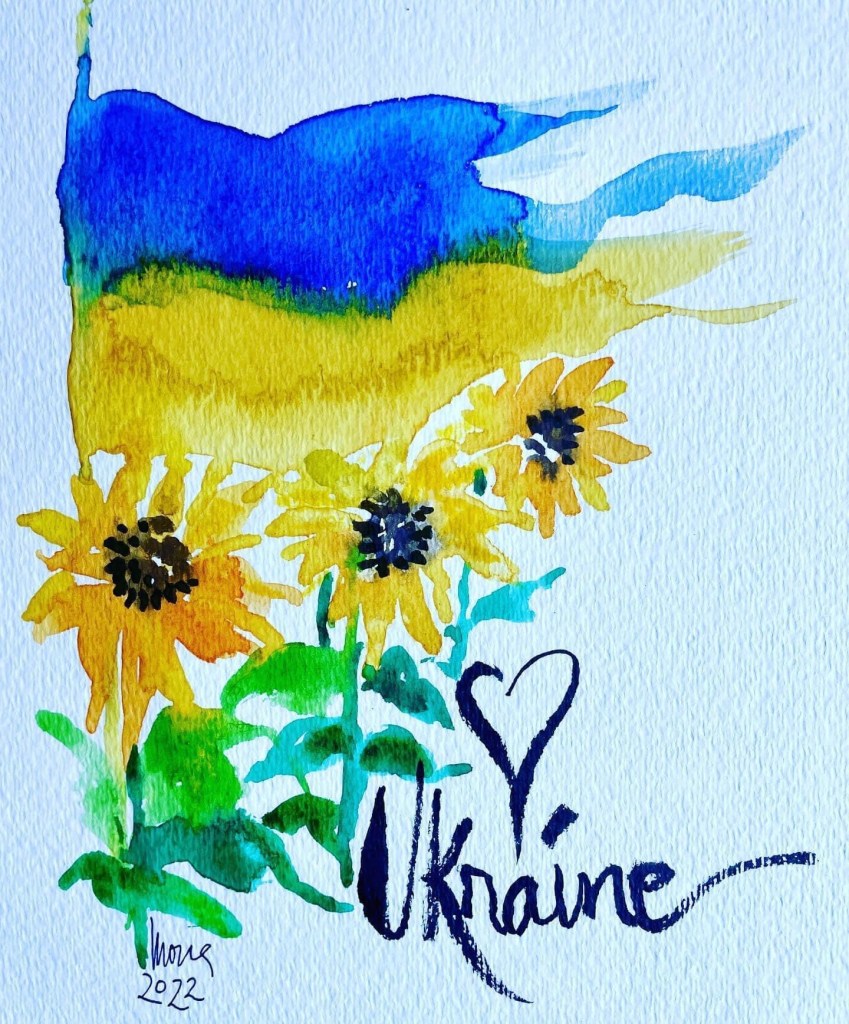
Always looking for a scapegoat, we try to discern what is bringing us down. Of course, life often brings us unforeseen personal tragedies that we must deal with. And there is certainly enough shared anxiety to go around. If you read the daily news, you will undoubtedly hear about the fierce war in Ukraine, the inability to create peace in the Middle East, the rising cost of food, the food deserts in our country, refugee children separated from their parents, difficult financial challenges, mass shootings, fractured relationships, long-term estrangement from loved ones, the opioid crisis and addiction, racism, injustice of all kinds, and politics. Evil days!

There are so many more ills we could add to this list, but we know them already, and the news programs are anxious to tell us about broken politics, as well as the way politics creates broken people. So there you have it! Among the many sources of stress we each experience, we continually stress over the dozens of pointless news stories about politics and the behavior of politicians every day. To top it off, Gloria Mark points out that “we are once again facing a news cycle that will shove our attention—as well as our output, our nerves, our sanity—through a Cuisinart.” No matter how skillfully we deny it, our bodies are not designed to handle chronic stress and trauma.

Just about now, you might want to say that politics doesn’t affect us that much, certainly doesn’t cause depression and hopelessness. But consider this viewpoint written by Pulitzer Prize winning journalist, Jennifer Senior:

The American Psychological Association’s annual stress survey, conducted by the Harris Poll, found that 68 percent of Americans reported that the 2020 election was a significant source of strain. Kevin B. Smith, a political-science professor at the University of Nebraska at Lincoln, found that about 40 percent of American adults identified politics as “a significant source of stress in their lives,” based on YouGov surveys . . . Even more remarkably, Smith found that about 5 percent reported having had suicidal thoughts because of our politics. Evil days!

And of the most divisive election in decades, psychologists are saying that their research shows that more than two-thirds of U.S. adults (68%) say that the 2020 U.S. presidential election was a significant source of stress in life.

It is not a stretch to say that stress plays havoc on our dreams, even our little dreams. I have to confess that my big dreams disappeared into the “impossible“ file, and were then swallowed up by the churning in my stomach and my psyche. I remember my first year in seminary, working part time jobs and going to class. For a while, I worked in the development office where all the catchy slogans, mottos and themes were born. One year, the staff got together to write a theme for the annual development campaign. I don’t know who came up with our brilliant theme, but we loved it. I really loved it and made it my personal mission.

“We’re Out to Change the World!”

I tried to do just that, and I honestly thought I could, but eventually the scene in my mind of one young woman alone trying to change the world on her own made me shiver. All the lofty goals and the many little dreams, along with a few big dreams, that had my attention were disappearing before me. I despaired at first and then carried long-term grief about it. There would be no big dreams in my heart. I would never see the glory of a big dream come true. Nor would I dream small dreams. People usually don’t dream of whatever is better while they are covered in grief—mourning, lamenting that they lost their dreams in the first place. In “these evil days” we must let go of despair and pray for an extra portion of holy determination!

But people do see the sacred light that sparks dreams. It dawns over them again and again until their dreamless spirit transforms from death, to life, to get their bearings again, and to summon the energ to get up and try

This is my message to you, and to myself: After your time of lament, rejoice! After you have escaped the bondage of evil days, rejoice! After you name your loss, and then put yourself back together, rejoice!

Take heart. Up in the heavens, there is rejoicing for you! Even in the gloomy shadow of dark and evil days, there is rejoicing for you! Even if you are trying to dream even the littlest dream, there is rejoicing for you!

So try a big dream! Change the world a little bit! Your heart longs for it, the world needs it, and the heavens will do what they always do—rejoice!

May even your smallest dreams change the world!

Beauty, Bewilderment, Brokenness, Color, Covid-19, God’s creation, Grace, Gun violence, Hate, Heartbreak, Hope, Injustice, Inspiration, Movement, Rev. Kathy Manis Findley, Ukraine

Beauty

Beauty

I know some things about beauty . . .

Most folk don’t take nearly enough time to notice it.
These days way too much ugliness hides the beauty that’s always around us.
Even when we don’t pay attention, beauty surprises us with magic and mystery.
Beauty is a lot like hope.

The magical appearance of beauty is, indeed, in the eye of the beholder. For me, beauty can inspire me by color and movement, by the shimmering stars on a clear night, by the magnificence of a tree’s movement in the breeze, by looking into the eyes of my grandchildren. Beauty is there for us always—to be seen, to be heard, to be sensed deeply in our bodies and in our spirits.

These days, I need more of it—more hope, more beauty. I need more visions of beauty to supersede the ugliness of injustice, division, racism, misogyny, homophobia, political warring, brokenhearted immigrants looking for life, mass shootings, Covid, gun violence, child trafficking, suffering in Ukraine—all the varied chaos around the world.

And then there are the people here and there who bring grace to us all by transforming ugliness into beauty and hope.


As for the beauty revealed in the opening photo, I don’t know who created it or photographed it. I do know that he or she is a person who finds beauty in unlikely places at unexpected times, and translates that beauty into grace to be shared with those who most need it.

Who knows about that image? The striking silhouette of the trees, the birds flying above, the twinkling stars in the sky, and all of that with swirls of color that seem to me like holy movement. Regardless of the source of that photograph, I like to believe that its beauty—all beauty—comes directly from God as grace for me, and for you.

Hope! Beauty! Even in the ugliest of times!

#Uvalde, Texas, Bewilderment, Discernment, Emotions, Feelings, God's presence, Indecision, peace, Understanding

Elusive Understanding

Photography by Andrew Charney on Unsplash

You may have noticed there have been no words coming from this blog in quite a while. No new posts. No graphics. No music. The reason is that inside me, there is nothing, and that has been my situation for several weeks. Part of the reason is that I was very sick for a while, hospitalized actually. In addition, I simply felt empty, without a creative spark that is usually so common for me.

Physically, I have felt unwell for a long time. Emotionally, I have felt the continued sting of isolation because getting Covid could be deadly for my immunocompromised body. Spiritually, I would have to say that the gun violence that has taken the lives of children and teachers in Uvalde has wounded my spirit and left me with so many unanswerable questions about faith and hope.

When all of those things rustle through my mind, it cannot help but reduce me into a silent kind of melancholia that affects my body, mind and spirit. It seems that this time, I can’t move past it. My husband asked me today if I am depressed. I answered, ”yes,” but honestly, I feel more sad than depressed. I don’t understand it this time. I can’t put my finger on the cause no matter how hard I have tried to figure it out.

The myth is that figuring out the root of depression or sadness will help one overcome it. Once you understand your depression and where it comes from, you can get beyond it. Also not necessarily true! Understanding is not a bad thing, but it is also not a cure-all.

These days, I simply cannot understand things—all things me! I recognize my sense of feeling empty, and I still have the ability to use reason and discernment to try to understand my feelings. But the truth is I don’t understand what’s going on in me. The internal web of my physical hurts, my emotional disturbance and my spiritual emptiness defy explanation and understanding. It’s complicated, outside of my ability to understand. So I have craved any flicker of light and life I could find.

I found it today, in a quote shared by a dear friend. This is the quote.

I didn’t need to understand the hypostatic unity of the Trinity; I just needed to turn my life over to whoever came up with redwood trees.
~ Anne Lamott

I can rest in that. I can find peace beyond my understanding. I can lean into the treasure of not being compelled to understand complicated things, even complicated things about myself. By the way, complicated things about myself may well be the most difficult things to understand, sometimes baffling and elusive. So Instead of the constant struggle to understand, I plan to turn my life over, again, to the One who created me to be complicated in the first place.

Thanks be to God for the ”peace that passes all understanding.” Amen.

#Uvalde, Texas, Bewilderment, Birdsong, Consolation, Leo Tolstoy, Melancholia, Rev. Kathy Manis Findley

Melancholia and Consolation

Overlayed photos by Jeremy Bishop and Christian Holzinger on Unsplash.

I don’t like feeling melancholy. The feeling is just too tentative and unspecific. Trying to get free of melancholia is not an easy feat. You can curse it and yank it around trying to break it. You can throw big rocks at it or try to drown it in a bathtub. But it is so uncatchable. You can’t get your hands around it, and if you do, you can’t hold on to it. It just slips away from you before you know it. You cannot control melancholia. Perhaps you cannot even get consolation from it.

Other states of mind are more responsive to being removed or conquered or broken or even thrown out. Sadness, anger, rage—those you can eventually grab and choke out. Melancholia is enduring and constant, and it can hold you hostage for undetermined amounts of time, making a nest in you and dwelling there without your permission. Relentless, hardy, pervasive, persistent!

Understand this: I am not writing about melancholia as a clinical depressive episode and I’m certainly not trying to scientifically classify melancholia in a range of psychiatric disorders. I simply mean to unravel the threads of the state of being of feeling trapped inside melancholia.

I know there are circumstances that brought me here this week, not the least of which is that I have experienced a full week of a severe stomach virus. And then, there is the constant news reporting of horrible cases of gun violence. In fact, ABC News published this troubling statement about gun violence on May 31, 2022: “374 deaths and 782 injuries over the past week.”

I cannot help but weep about the terrible loss of nineteen children, two teachers, one teacher’s husband, and the perpetrator of the murders in #Uvalde, Texas.

I cannot help but be emotionally moved by the gift a Texas man gave the grieving families. Trey Ganem refused to be paid for the 19 hand-painted caskets. (Picture: SoulShine Industries)


Have these circumstances resulted in my feeling melancholy? I’m not sure. Melancholia might not primarily be situational. Rather, it might be embedded in a person’a psyche and brought to the heart by a gloomy, cold morning in winter, or a long-lived rainstorm, or a gloomy, foggy night without a smidgen of light. Perhaps melancholia can come upon a person by a sad movie, by hearing a hauntingly beautiful requiem, by the melodic strains of birdsong, or the somber sounds of a viola.

Melancholia is rather unexplainable for me. When it takes over my psyche from time to time, I feel multiple emotions. Not just a depression-like sadness, but also a lump-in-the-throat nostalgic feeling. I think that’s what’s going on with me right now. Truthfully, I have found the best description of melancholia in the words of Leo Tolstoy.

There is something so enchanting in the smile of melancholy. It is a ray of light in the darkness, a shade between sadness and despair, showing the possibility of consolation.

— Leo Tolstoy, War and Peace

It does feel to me like ”a shade between sadness and despair.” Whatever melancholy is, however it comes to me, whatever it feels like and whenever it visits me, I like Tolstoy’s phrase about melancholy ”showing the possibility of consolation.” In my mind, that is the Godsend part of it: that when I feel the emotion “between sadness and despair,” covered in a misty veil of melancholy, God’s holy way is that consolation is always possible. Always!

The Apostle Paul has the last word in the beautiful blessing he wrote to the church in Corinth:

3 Blessed be the God and Father of our Lord Jesus Christ, the Father of mercies and the God of all consolation, who consoles us in all our affliction, so that we may be able to console those who are in any affliction with the consolation with which we ourselves are consoled by God. For just as the sufferings of Christ are abundant for us, so also our consolation is abundant through Christ. If we are being afflicted, it is for your consolation and salvation; if we are being consoled, it is for your consolation, which you experience when you patiently endure the same sufferings that we are also suffering. Our hope for you is unshaken, for we know that as you share in our sufferings, so also you share in our consolation.

— 2 Corinthians 1:3-7 NRSV

Thanks be to God.

Abundance, All Things New, Beginning again, Belonging, Bewilderment, Change, Comfort, Contemplation, Daybreak, Dreams, Fear, Freedom, God's love, Grace, healing, Heartbreak, I am enough!, Joy, New Life, Re-claiming self, Rev. Kathy Manis Findley, Sorrow, Tears, Weeping

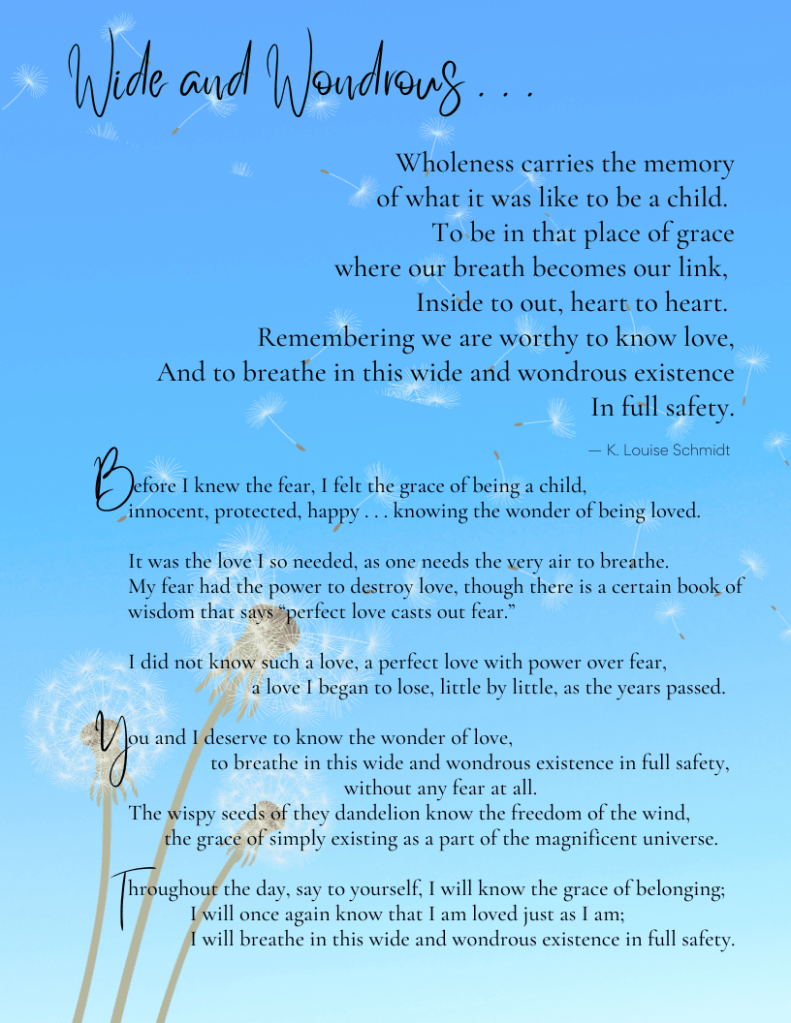
Wide and Wondrous

How true it is that when we know nights of sorrow, when weeping is all we can muster, that daybreak does eventually come as it always has. And with the rising of the sun, perhaps our tears are replaced with at least some measure of inner joy.

The universe is wide and wondrous, full of love, full of grace, and sparked by freedom. Those three—love, grace and freedom—are the things we most need, all of us.

I offer you this meditation, praying that you are surrounded in love, that you know the grace that accepts every part of yourself, and that you feel the the freedom to run with the wind in wide and wondrous places, toward your dreams.

As you continue the quiet time you claim for yourself today, I hope you will be be inspired and comforted by this beautiful choral piece by the brilliant composer Elaine Hagenberg, ”All Things New.”

Poem by Frances Havergal
and text adapted from
Revelation 21:5-6

Light after darkness, gain after loss
Strength after weakness, crown after cross;
Sweet after bitter, hope after fears
Home after wandering, praise after tears

Alpha and Omega
Beginning and the end
He is making all things new
Springs of living water
Shall wash away each tear
He is making all things new


Sight after mystery, sun after rain
Joy after sorrow, peace after pain;
Near after distant, gleam after gloom
Love aftеr wandering, life after tomb

A way in the wilderness, Alone, Bewilderment, Comfort, Dry seasons of life, Exclusion, Exhaustion, Hope

A Door of Hope

How often we find ourselves wandering in what feels like wilderness. We wander, and then wander some more, in barren places — in parched, dusty and dry deserts of the soul. We wander in aimless travel that moves us from one nowhere to another. The truth is that we have been nowhere and we’re going nowhere.

It’s a long, hard way, this wilderness wandering. I have found myself there at times. You probably know the desert, too. Like the people of Israel, we don’t much like wilderness wanderings. Remember their laments and complaints?

The Israelites looked up, and there were the Egyptians, marching after them.
They were terrified and cried out to the Lord.
They said to Moses, “Was it because there were no graves in Egypt
that you brought us to the desert to die?
What have you done to us by bringing us out of Egypt?
Didn’t we say to you in Egypt, ‘Leave us alone; let us serve the Egyptians’?
It would have been better for us to serve the Egyptians than to die in the desert!”
Exodus 14:10-12 (NIV)

Other Biblical passages speak more favorably about walking in a desert wilderness and about finding there comfort and hope. One of my favorite passages is rather obscure, so I want to share it with you.

The Lord said, “Therefore, I will now persuade Israel,
and bring her into the wilderness,
and speak tenderly to her.
From there I will give her her vineyards,
and make the Valley of Achor a door of hope.
Hosea 2:14-23 (NRSV)

Finding ourselves wandering in a parched and barren desert can cause us to feel, not only exhaustion, but also exclusion. How bewildering it is when we are excluded, left alone to wander and feeling that no one is near, no one hears our laments, no one cares. My hope for you this day is that, whenever you have to wander in the wilderness, you will find on your way a friend beside you and at the end of your path, a door of hope.

I leave you with these words, a benediction spoken by a dear friend.

A way in the wilderness, Art, Bewilderment, Rivers in the desert

Rivers in the Desert

“A Way in the Wilderness,” A watercolor by Kathy Manis Findley; https://kalliopeswatercolors.com/

What is it about this statement from God and recorded by the Prophet Isaiah?

I will make a way in the wilderness
and rivers in the desert.

This statement, or this promise, recorded in Isaiah 43 touches me to the core. It reaches into my soul that is so often parched by the events of life. As for the watercolor painting above, A Way in the Wilderness, you may have seen it before. I published it in this blog already. But this time, I would like for you to engage with me in a few moments of art appreciation. Consider the following questions.

What do you see in the painting?

What strikes you about it?

If you could choose one word or phrase or sentence in it that most relates to your life, what would you choose?

What do you see in the images and colors?

What do you see as the overarching theme of it?

What does it say to you? Or ask of you?

Okay! So maybe the painting says nothing to you! You’re not into art appreciation and it has no deeper meaning than paint to paper! I totally get that, but still, I want to tell you what it meant for me as I was creating it.

So much more than paint on paper, painting it was an emotional and spiritual release from my own wilderness. It was my way of learning to find rivers in my desert. Understand, it did not mean I could leave the desert and put the wilderness in my rear view. Instead, it allowed me to express my reality: that I live in the wilderness, but streams of river water quench my soul’s thirst in the desert.

That’s real and honest. A gut-punch of reality for me. Wilderness and desert terrain are common life habitations, for me and probably for you as well. I don’t live near the breezes of an ocean or on a ridge in breathtaking, snow-capped mountains.

I just live on a regular street in a regular town, and sometimes that can feel like wilderness.


What does that have to do with anything? Just this: During the times I feel as if I’m living in a desert wilderness, I need to remember the river. Or putting it another way, what I feel emotionally may be MY reality, but it is not THE reality.

It is not the ultimate reality of a life that is so filled with deserts and streams, storms and sunshine, smooth ways and rocky pathways, despair and hope, doubt and faith, sorrow and joy, death and life . . .

May your life be filled to overflowing with all of those things.

anxiety, Bewilderment, Depression, Depth of Mercy, Depth of Soul, Emotions, Feelings, God’s Mercy, Hope, Life pathways, Rev. Kathy Manis Findley, Soul, Trails, Unknowing

The Trails I Take

I have taken many trails throughout my life and I imagine that you have as well. It’s one of the things all of us have in common. The trails we take can sometimes lead us to places unknown. Not just places on a map, but places in the soul. Our more difficult trails can push us to our limits, mostly the limits of the soul at its depth. Sometimes, today maybe, my soul is in the depths of unknowing.

What does that sentence even mean? My soul is in the depths of unknowing? If I don’t know what that means, how can I possibly talk about it with you? I can try!

I’ll try.
I’ll search for words
that explain
how I feel, how my soul feels
and what it means —
the depth of unknowing.

These days I sense an unease in my soul, in its depths. I have named it depression. I have tried in vain to make an appointment with my therapist. Isn’t that what people do when they are depressed? Anyway, I did that, but cannot see her until the end of July. So I determined that I had to become my own therapist. In doing that, I decided to search myself more deeply. I determined that perhaps what I feel isn’t depression after all. Instead, what I feel may be the depth of unknowing.

For me that means chasing away the unknowing, getting rid of it because I want to know when I will feel stronger physically, or when I will see my grandchildren, or how I will handle my emotional fragility, or where I will live for the rest of my life. Just to name a few things I need to know.

And yet, the depth of the soul’s unknowing may well be exactly where my soul begins to fully know. The trails I take while inside my soul’s depths contain lessons and treasures and wisdom. The trails bend and wind leading to an unknown path that opens its way for me. I follow it willingly, blindly, yet for some reason, expectantly. The trails are most surely my depression, their unknown, perilous way distressing me as I walk. Jagged rocks on the trails, vines creeping their way onto my path, thorns, bristles and barbs — boulders sometimes — all to remind me of the hard path I walk and the heavy load I carry.

The trails I walk may be no more ominous than yours. We all walk them and we all carry burdens on the way. You and I walk no easy trails. There is “no easy walk to freedom,” the song reminds us. Truth! The trails I walk, and your trails, are many and winding, hard and confusing. The obstacles overwhelm. I suppose this describes my depression as well as any words could, and it is precisely that unease in my soul’s depths that has come to me in these days.

The difficult thing about soul-deep depression is its dogged persistence. That kind of depression has staying power and it sits in the soul, creating that terrible sense of the soul’s unknowing. It has the power to convince me that I will never know the things I want to know. Mostly, I want to know destination. Where am I headed? What jagged rocks and prickly thorns will injure me along the way? And will I survive my injuries?

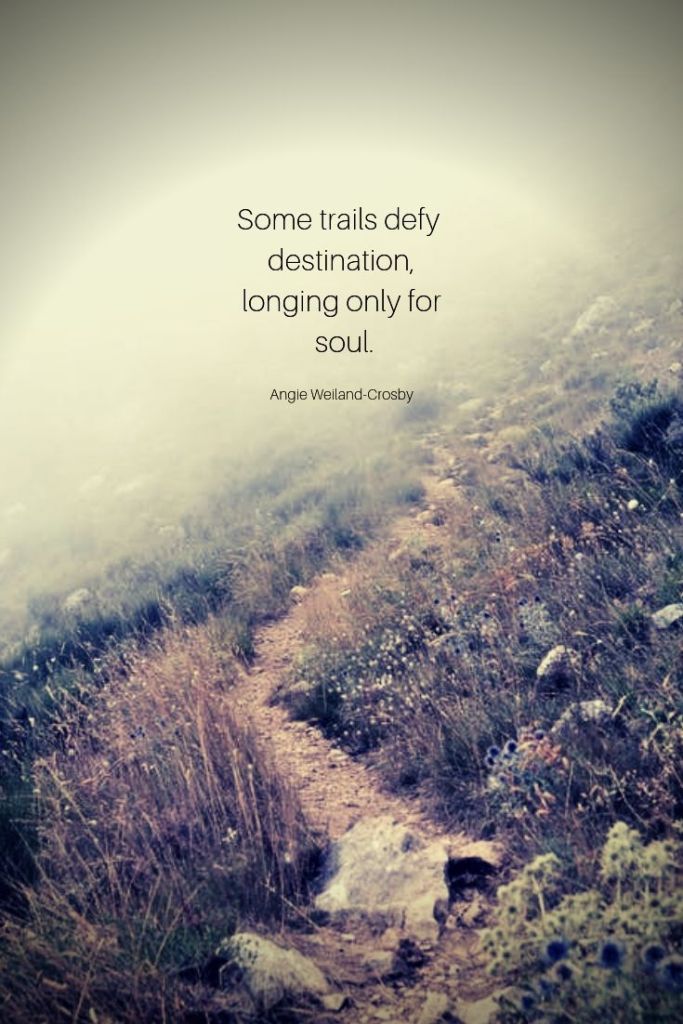
There lies the depth of depression. It lies in the desire, the need, to know. We need to know the unknown — where will the trails take us and what formidable obstacles will stop us. Now understand this, if I had answers, I would have given them to you several hundred words ago. I have no answers of my own, but I do have a nugget of wisdom written by author Angie Weiland-Crosby.

Some trails defy definition,
longing only for the soul.

Angie Weiland-Crosby

There may be something in her words. If the trails defy our attempts to define them or to know them, perhaps we can find comfort knowing that the trails long only for our soul. The trails only want us to bare our souls along the way and to open them up to the new. The trails are meant for our good, for our spiritual maturing. And as for another comfort, the God we know has seen and known the trails before us. However you see and know God, you can rest in the knowledge that God has some hand in the work of the soul. God knows about the trails we take.

Haven’t I commanded you? Strength! Courage! Don’t be timid. Don’t get discouraged. God, your God, is with you every step you take.”

Joshua 1:9 (The Message Bible)

When all is said and done, I believe the trails I take are necessary ones. In a way, perhaps the trails I take are sacred ones, meant for opening up my soul to its depths where transformation can occur. No, God does not lay out my every trail or remove its thorns and rocks. The trails I take are strewn with rocks meant for me, thorns that pierce just enough to get my soul’s attention. I believe that. And I believe that there is for me a way to trust God wholly. My personal translation of Proverbs 3:5-6 gives me a tiny inkling of hope even when depression ravages my soul.

Trust in whoever you believe God to be in your life.
Trust God with all your heart,

and don’t rely only on what you understand.
In all the twists and turns in your life,

perceive this God as one who offers a depth of mercy,
A God who sees and knows the trails you walk.
And be assured, know deeply in your soul

that God will direct your paths.

I want to share with you a video of a beautiful, meditative song entitled, “Depth of Mercy,” performed by students of Fountainview Academy, a Christian high school based in southern British Columbia, Canada. I also share this because of where it is filmed — a beautiful wooded area with various trails. Whatever trail the students took to arrive at their destination seemed a treacherous pathway to me, and even more treacherous, the place where they stood to play and sing.

They were on top of a magnificent ridge, but way too close to the edge for my comfort. At the end, as they sang, “Depth of mercy, can there be mercy still reserved for me?” The image pans across them to the jagged edge and then reveals a very deep and ominous gorge. Panning even farther across, you will see a most beautiful portrayal of nature, one that stirs the senses and reminds us of the depth of mercy our God reserves for us. I hope the video is meaningful to you.

All Shall Be Well, anxiety, Bewilderment, Brokenness, Comfort, Despair, discouragement, Emotions, Feelings, God's Faithfulness, Grace, healing, Heartbreak, Holy Spirit, Hope, life, Loss, Rev. Kathy Manis Findley, Sacred Pauses, sadness, Sorrow, Stories, Weeping

How Is Your Heart?

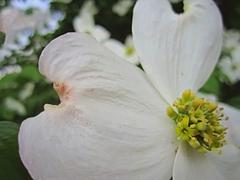
Yesterday I noticed a dogwood tree in full bloom, the first blooming dogwood I have seen this year. The sight of it did my heart good, because it reminded me that some simple and beautiful things remain. They return every year. They mark a season. They grow, and their blooms become ever more vibrant, or so it seems.

The dogwood has its own story, a lovely legend that explains the tree’s qualities. The legend holds that the tree was once very large, like a Great Oak tree, and because its wood was strong and sturdy, it provided building material for a variety of purposes. According to the story, it was the dogwood tree that provided the wood used to build the cross on which Jesus was crucified.

Because of its role in the crucifixion, it is said that God both cursed and blessed the tree. It was cursed to forever be small, so that it would never grow large enough again for its wood to be used as a cross for a crucifixion. Its branches would be narrow and crooked — not good for building at all. At the same time, the tree was blessed so that it would produce beautiful flowers each spring, just in time for Easter. The legend says that God it is gave it a few traits so that whoever looks upon it will never forget. 

81189983-8ADE-4D60-9088-C52DA3983583The petals of the dogwood actually form the shape of a cross. The blooms have four petals. The tips of each of the petals are indented, as if they bear a nail dent. The hint of color at the indentation bring to mind the drops of blood spilled during the crucifixion.
8DEA0FBE-8A3E-4AF8-8142-DA825CA72359


Diana Butler Bass tells the story like this:

There’s an old southern legend that dogwoods grew in Jerusalem — and that one gave its wood for Jesus’s cross. Because of this, the dogwood was cursed (its short stature a ‘punishment’ for being the wood of death) but it also became a blessing. Blessing? For on each twisted branch burst forth petals of lightness and light.

So let’s leave the dogwood’s story and look at our stories — your story and my story. People often use the term “storied past.” Well, a storied past is something all of us have.

In talking with a friend a few days ago, I asked, “How is your heart?” She began to tell me her story, which was a long and winding one that included many mini-stories — happy ones snd sad ones — from her life’s journey. Toward the end of her story, she said, “I feel as if I am cursed by God.” That was her bottom line answer to my question, “How is your heart?” Hers was an honest, heartbroken response that instantly revealed that her heart was not all that good, but that was a critical part of her story.

If you and I are honest, we will admit that our hearts were broken and hurting at several places in our stories. Recalling our brokenhearted times is something we always do when we tell our stories, and it’s an important part of the telling. My story and yours is never complete if we leave out the heartbroken moments, for at those points, what feels like God’s curse almost always transforms into God’s grace.

If not for our heartbroken moments, the hurting places in our hearts might never “burst forth with lightness and light.” Our heartbroken moments change us and grow us. They set us on better paths and they embrace our pain with grace. Our heartbroken moments give us pause, and in that pause, we find that once again, our hearts are good. Our broken hearts are once again peaceful hearts — healed, restored, transformed, filled with God’s grace.

How is your heart? That is a question we would do well to ask ourselves often, because languishing with our heartbreak for long spans of time can cause our stories to be stories mostly of pain. Instead, stop right here in this post for just a few moments and ask yourself, “How is my heart?”

48BB4DCE-068F-4CC2-B1D0-A6B95549B35D

Your answer may well be your path to a contemplative, sacred pause that can become a moment of healing, a time for God’s grace to embrace whatever is broken in your heart and to transform it into love, light and hope. So don’t be afraid to look into your heart when pain is there. In looking, you may find reasons, many and and complex, that are causing deep pain and brokenness. You may also find the healing touch of the Spirit of God waiting there for you and offering healing grace — a Godburst of new hope.

May your story be filled always with times when your was light with joy and times when your heart was broken with loss, mourning, discouragement, disappointment. Both create your extraordinary story — the joyful parts and the sorrowful parts. So tell your story again and again to encourage yourself and to give the hope of God’s healing grace to all who hear it.

I remember a beloved hymn that is a prayer for the Spirit of God to “descend upon my heart.” May this be your prayer today.

Spirit of God, descend upon my heart;
Wean it from earth; through all its pulses move.
Stoop to my weakness, mighty as Thou art,
And make me love Thee as I ought to love.

Hast Thou not bid me love Thee, God and King?
All, all Thine own, soul, heart and strength and mind.
I see Thy cross; there teach my heart to cling:
Oh, let me seek Thee, and, oh, let me find!

Teach me to feel that Thou art always nigh;
Teach me the struggles of the soul to bear,
To check the rising doubt, the rebel sigh;
Teach me the patience of unanswered prayer.

Teach me to love Thee as Thine angels love,
One holy passion filling all my frame;
The kindling of the heav’n-descended Dove,
My heart an altar, and Thy love the flame.

Advent, Angels, Bethlehem’s Star, Bewilderment, Courage, Elizabeth, Mary

Those Who Dream — Advent 2020

THOSE WHO DREAM

That’s the problem, isn’t it, that the Angel Gabriel departed from her!

It happens to us, too.

Our angel departs
Leaves us

Goes away
Just when the deepest shadow of fear hovers over us.

Goes away
Just when grief has shattered our hearts.

Goes away
Just when our deep, deep life losses have left us disconsolate.

Our angel goes away.
Just at the moment of our most profound impoverishment,
Just at the moment when we know, beyond doubt,
That we will never dream again.

As for the dreams we long held hidden in our hearts . . .

Well, those dreams disappeared!

Vanished!

The dreams we held so closely are not in us anymore
Can not be dreamed anymore.

Suddenly, our angel left
And we were no longer those who dream.

Yet, we moved headlong into Mary’s story and Elizabeth’s;
Life growing in their wombs;
Holy Life growing in their wombs.
Both of them holding the dreams God gave them
Both dreaming into an unknown and unknowable journey

As women often do.


And on that journey, as we follow these two dreaming women, we see it!
The Star in the East!
The Bethlehem Star sparkling in night sky!

Our angel left us
But courage and hope still courses inside us.

We lift our gaze still and we see Bethlehem’s star

And the dark indigo sky sparkles
Brilliance incarnate!
Manifested before us in human form!

The Word Made Flesh who would never leave us like our angel did.

We follow that holy star
Determined.
Undaunted.
Unrestrained.

Because we know what we hold deeply in our souls;

We know exactly who we are —

Those who dream!

We are those who dream!

Rev. Kathy Manis Findley, Advent 2020


In your sacred pauses during this Advent season, may you find peace, knowing all is calm. Listen to this music in your contemplative time.


Advent, Bewilderment, Bravery, coronavirus, Courage, Defiance, Dreams, God’s promises, Joy, Magnificat, Mary’s Song

MARY’S SONG OF JOY FOR A WORLD THAT’S NOT SO JOYFUL

19FB6970-6B88-4C22-9C98-7E7295E78D3B
The angel visit left Mary confused. And so — in a haze — she runs away, seeking refuge in the hill country with a family that would keep her safe and help her make sense of her world turned upside down . . . As soon as she fell into Elizabeth’s arms, Elizabeth knows and feels it to be true . . . “Yes, I feel it too. We are pregnant with promise . . . a dream that will birth joy.”


My soul magnifies the Lord, and my spirit rejoices in God my Savior.

He has exalted me and, humbly, His servant I will be.
All generations, henceforth, shall call be blessed.
For He has done great things for me and holy is His name.

I will probably always remember those words penned by a lyricist whose name I cannot remember. (Apologies to John W. Peterson, Anna Laura Page, Ragan Courtney or whoever helped create this arrangement. I remember the tune and every word, but I can’t remember you.)

I have sung, in my short lifetime, dozens of versions of Mary’s song that we know from the Gospel of Luke. We often call it Mary’s Magnificat. I sang the version quoted above many, many years ago as a part of my church’s Advent music. I looked through the music in our first Advent choir rehearsal and immediately turned the pages to this one that was called “Mary’s Song.” I knew I would sing it since the churches we served seldom had willing sopranos.

As November and December moved along, I rehearsed Mary’s Song over and over again, not to enunciate all the lyrics clearly or to sing all the notes correctly. I sang it again and again because the act of getting into Mary’s skin brought me to tears every time I sang it. Tears were okay, but being unable to sing because I was weeping was not okay with me. And yet, I didn’t want to rehearse the emotion out of it. I wanted to “be” Mary for just those moments and I wanted the hearers in the sanctuary to emotionally connect with her.

In the end, I prayed and left it in God’s hands, because in the end, that’s what people of faith  do. Today, as we do every year, we lit the Advent candle of joy — the pink candle, Mary’s candle — hoping that the sheer joy of her news to Elizabeth would ring true enough in us to bring us joy. How? “How can this be?” as Mary said to the angel.

I suppose that in these Advent days, in this particular year, many of us have asked “How?” How will we get through this bewildering time? How can joy fill us, enter into our souls and enliven our spirits, as we bury our loved ones? As we wait for word by phone about the person we love who is hospitalized? As we touch the hand of our grandmother through the window of her nursing home? As health care professionals become almost too weary to go on while people with the virus keep coming? As we know we will not see our family this Christmas — to keep them safe, to keep us safe?

How can we sing, this year, “My spirit rejoices in God my Savior” — Mary’s magnificat? Joy is a hard thing this year, for 2020 has brought us grief upon grief, fear upon fear and uncertainty upon uncertainty. Yet, we have held one another close, even over Zoom, because together we have found strength to go on. Over the senseless racially motivated violence we saw on our televisions this year, we saw also a people languishing in a pandemic that took so much.

We saw politicians fighting each other over what some of them see as truth and others see as deliberate, hurtful lies. We saw children who wondered about where school would be and parents agonizing over hard decisions. We saw congregations gathering in parking lots and sanctuaries still, silent, without voices. We saw devastating unemployment and small businesses closing their doors. We saw medically vulnerable or immunosuppressed people locked in their homes. We saw people struggling to pay their bills — very poor people wanting and the very rich, as always, continuing their lavish lifestyles. We saw the rich continuing to oppress the poor, if not in their direct actions, then in their greed that, at least indirectly, deprives those among them who are poor.

The young girl Mary spoke about that, too, in the words of her Magnificat from the Gospel of Luke.

He has shown strength with his arm;
he has scattered the proud in the thoughts of their hearts.

He has brought down the powerful from their thrones,
and lifted up the lowly;
he has filled the hungry with good things,
and sent the rich away empty.

Luke 1:51-53 (NRSV)

The young girl we have called the Virgin Mary, the holy one that accepted the strange and frightening mission from God to bear God’s Son — this Mary is also the subversive one who called out the rich, the powerful and the proud. In her Magnificat? Oh yes, Mary said that God would scatter the proud in the thoughts of their hearts, bring down the powerful from their thrones and send the rich away empty.

Subversive! Courageous! Defiant! Bold! Audacious! Wise! She was all those things when she spoke the kind of subversive truth no young girl in those days would have dared to speak. The miracle of it is that God chose a young girl who possessed the tenderness to nurture a newborn, the wisdom to raise him to live into his mission and the courage to help him stand in a world that would both adore him and hate him — worship him at a manger and then crucify him on a hill. Dr. Marcia Riggs described Mary’s Magnificat like this: “The song sows joy that is the seed of a social revolution.” Indeed!

This was the Mary of our pink candle, the Mary who would be submissive enough to agree to a holy life of chaos and the Mary whose inner strength enabled her to look up and watch her son die.

To be sure, her Magnificat has been read and sung in millions of voices, with thousands of tunes, in cathedral-like sanctuaries and in mud huts. The words have been translated into various versions of the Bible and composers have woven paraphrases of her words into hundreds of melodies and rhythms. Still to this day, one phrase remains . . .

Holy! Holy! Holy is His name.

May Mary’s joy find us on this day and in our own worlds — wherever we are, however we feel, whatever sadness we hold. Amen.

For your quiet, meditative time — one version of Mary’s song:

Aging, anxiety, Bewilderment, Bravery, Challenge, Child protection, Children, Conflict, Confusion, Contemplation, Courage, Dangerous and noble things, Discernment, Dreams, Indecision, Internal conflict, Introspection, life, Pandemic of 2020, Questions, Sacred Worth, struggle, Transformation

When Plans Are Dreams

05D8F2C8-83DB-40E3-9FEC-43A543D80EC3
Plans!
We find it almost impossible to make them in a life ruled by COVID19. Currently, school  plans are foremost in the minds of parents and students.

“Is it safe to send my child back to school? What safety and social distancing measures will schools have in place? Do I choose to keep them at home, opting for virtual learning? How do I manage online school?”

In light of such critical plans and decisions, consider this current news report:

A document prepared for the White House Coronavirus Task Force but not publicized suggests more than a dozen states should revert to more stringent protective measures, limiting social gatherings to 10 people or fewer, closing bars and gyms and asking residents to wear masks at all times.

The document, dated July 14 and obtained by the Center for Public Integrity, says 18 states are in the “red zone” for COVID-19 cases, meaning they had more than 100 new cases per 100,000 population last week. [Georgia is in the “red zone.”]

Eleven states are in the “red zone” for test positivity, meaning more than 10 percent of diagnostic test results came back positive. [Georgia is in this “red zone” too.] https://publicintegrity.org/health/coronavirus-and-inequality/exclusive-white-house-document-shows-18-states-in-coronavirus-red-zone-covid-19/

Even with troubling reports like this one, Georgia’s governor, Gov. Brian Kemp, signed an order on Wednesday, July 15, 2020 banning localities from requiring masks. On this information, parents have to agonize about what’s best for their children. They simply cannot make firm plans as long as the virus is waxing and waning. Mostly waxing!

Plans are difficult for us for all sorts of reasons and circumstances. Every now and then over the years, my life would take un unexpected pause to contemplate this thought written by the late Mary Oliver:

 So tell me, what is it that you plan to do with your one wild and precious life?

Unpacking that brief question has been a periodic constant in my life, popping up for me mostly in my down and disheartened times. I hear the poet describing my life as “wild and precious” and it almost shocks me. Yet, my life really has been consistently wild and mostly precious. Anything that urges me to examine my life is a good thing. I can almost always pull up memories of the times when I was wild and free — insistent upon rising higher, realizing a near-impossible dream, charging with courage into new and uncharted places, planning for a future of fresh and sparkling heights, observing just how wild I could dare to be. Unpacking that question has been exhilarating at times, exhausting at other times.

Musing on a life that could be described as precious

Entertaining the thought that my life was precious happened in my deepest soul place. It happened in my moments of introspection, meditative times that urged me to examine all the ways I saw my life as precious, cherished, valued. Of course, I have experienced many precious life moments — my wedding day, my work in Africa, my ordination, awards and recognitions of my work and career and, most of all, the adoption of my one wild and precious son, JonathanExamining my precious life was most real when I almost lost my life, my full year of serious illness, five years of dialysis and a kidney transplant made possible by the selflessness of a lovely woman I know only through email.

Such thoughts bring me back to plans. What is it I plan to do with my one wild and precious life? Even a life precious and wild is a life that requires plans, and right now trying to make plans is an exercise fraught with anxiety. I cannot find any words that can minimize this depth of anxiety. There is not one thing you or I can do about plans that have been ravaged by the pandemic we are experiencing, and yet we must make critical plans in this season of uncertainty. 

School plans are most difficult in my state and perhaps in yours. As parents agonize over the safety of their children, Georgia’s governor, Brian Kemp, offered this unhelpful comment this morning in a press conference:

I am a believer that kids need to be in the classroom and we’re working with the schools to do that. We’re going to have cases that break out in schools, either with personnel or perhaps students, just like you do with a stomach bug or a flu or anything else. Our schools know how to handle those situations.

The parents and teachers in my life know that this coronavirus is not just a run-of-the-mill “stomach bug or flu.” This virus is deadly, and parents and teachers faced with difficult school decisions know that all too well. During these pandemic days, it is a constant reality that many of us are having to make potentially hazardous plans, but just for a moment, I wonder if we can redirect our thoughts to plans we make for our “one wild and precious life.”

Can we rise above the plans we must make today, even for a moment, and instead consider the bold and courageous plans we could make? Can we set our hearts to think about plans we can make when we are our brave, adventurous and fearless selves? Can we contemplate the plans we might make when we feel bold, resolute and undaunted?

I can remember the times when I was able to make such adventurous plans, times when my plans were dreams — high and lofty dreams of changing the world. I can also remember the time when I no longer dreamed any dreams at all. It was a time when I no longer saw my life as a wild and precious one. I still entertained plans, but my plans were definitely not dreams. I believed I could no longer change the world. I believed I could no longer live a life that made a difference. I believed that my soul was dry and my spirit barren. I believed that, in my life, dangerous and noble things were no longer possible

Why can’t you and I dream dreams instead of making plans? Why can’t my “one wild and precious life” rise higher, high enough to make dreams of my plans? Sometimes I will go to one of my many favorite passages of Scripture hoping to find God’s word to me. Being true to my theological education, I always look at the words in context before I do anything else. But after that hermeneutical exercise I learned in New Testament 101, I might twist the text a bit and maybe even paraphrase it, inviting the text to speak to me specifically, just me. For this day, one of the texts found in the book of Acts reaches into my soul, and, yes, I did paraphrase it.

“In your season of most need,” God says,
“I will restore your soul and make your spirit rise within you.
I will pour out my Spirit on all people.

Your sons and daughters will prophesy,
your youthful hearts will see visions,
your aging hearts will dream dreams.”

— Acts 2:17 (my paraphrase)

Amen. 

May God lift our hearts and spirits, assure us that our lives are precious and help us transform our plans into dreams.

So tell me, what is it that you plan to do with your one wild and precious life?


Activism, Beloved Community, Bewilderment, Change, Community, Community activism, Confusion, Contemplation, Covenant, Creating, Division, Exhaustion, God's presence, Hate, Hope, Injustice, Liminal time, Uncategorized

This Liminal Time

FDAFE7CF-FBCA-47E5-A560-EFA6C17EEC75


liminal

in American English
(ˈlɪmɪnəl ; ˈlaɪmɪnəl )

ADJECTIVE

1.  Relating to a transitional or initial stage of a process.

2.  At a boundary or transitional point between two conditions, stages in a process, ways of life, etc.

“Liminal” used in a sentence: We are in a transitional and liminal time: this makes everything unsettled and awkward, and most of us feel tremendous unrest and a sense of urgency.


I choose to mark this particular time in history as a liminal time that demands my courage to stand — to stand in solidarity with every person who is demanding an end to racial injustice. I cannot choose my partners in this struggle. Instead, I have to accept those that appear in my life, bringing with them a determined will to stand for justice.

I must understand that liminal time does not last forever. Liminal time is a place of transition, a liminal stage between justice and oppression, between life and death. So my choices and yours in this liminal time might very well affect what’s going on in the streets of American cities, in police precincts in every community and rural hamlet, in the halls of Congress and in the White House, in our hearts and in the hearts of those we could see as our “enemies.“

CB60C28A-A33B-4386-9B35-C3DC950FC905Here is where I must focus. My heart must long for an end to injustice. So must yours, because God’s heart grieves over the mayhem in our streets and the violence that has its way when a white police officer murders a black man or woman, even a black child.

You and I must yearn for an end to racial injustice — any kind of injustice and oppression — because God’s heart yearns to see us living in holy unity as brothers and sisters.

These days have dramatically shown us our liminal time, and it is NOW.

I have a strong sense that this liminal time has brought the widespread unrest we are witnessing, and that unrest emerges directly from a deep desire for change and transformation. It must be now!

Those of us who remember, know that the Civil Rights Movement came to its boiling point when every marcher, every protester, every non-violent activist and every violent one knew when their liminal time had come. Some people, of course, did not like that time at all, but even those who resisted that movement towards justice knew in their hearts that it was the liminal time, the time of NOW.

The fight was fought by people who spoke and marched, prayed and worshipped, who resisted and stood their ground, who preached and sang their freedom songs. Ah, how those songs of the civil rights movement helped motivate people of all ages and races, from Student Nonviolent Coordinating Committee (SNCC) activists and Freedom Riders to the thousands who marched on Washington, Selma, and Montgomery!

Yet not one person — Civil Rights leader or non-violent protester — could achieve civil rights alone. It required persons living in the poorest neighborhoods and their affluent neighbors across town. It took white folk and black folk, protestors and preachers, eloquent advocates and those who fought silently, lawyers and congresspeople and attorneys general and presidents. It required a community in solidarity. In fact, during the Civil Rights Movement, the creation of community was the quintessential coming-of-age story for Black people. 

Of that historically significant time, Father Richard Rohr writes this:

It was the particular time in history when nonviolent initiatives seeded with contemplative worship practices became acts of public theology and activism. You see, activism and contemplation are not functional opposites. Rather, contemplation is the heart’s reflective activity that is always seeking the spiritual balance between individual piety and communal justice-seeking.

Who could have predicted that America’s apartheid would fall as decisively as the walls of Jericho, when the people marched around the bastions of power carrying little more than their faith and resolve? How audacious it was to take just the remnants of a chattel community, the vague memories of mother Africa, and a desperate need to be free, and translate those wisps into a liberating vision of community. The idea of a beloved community emerged from the deeply contemplative activities of a besieged people — the people of the Civil Rights movement.
— Fr. Richard Rohr

One would think that such a movement that was so powerful, so eloquent and so determined would see its dream become reality, and that such a stunning reality would last forever. So that every person, from that time to this, would live as beneficiaries of beloved community. But here we are in another liminal space of racial indignity, cities in chaos and families mourning the death of their loved ones in Minnesota, in Georgia, in Kentucky and beyond. We did not really believe we would be in this time and space, a time that would demand a civil rights movement of its own.

The in-between liminal spaces of Scripture are pregnant with God’s transformational possibilities:

Noah and his family rebuilding the world after the flood; Abraham holding the knife above Isaac; Jacob’s struggle with the angel; Joseph in the pit; Moses and the Israelites at the edge of the Reed Sea; Israel in the wilderness; Joshua crossing the Jordan; Jesus suffering on the tree; the women at His tomb; the disciples waiting in Jerusalem.

Scripture indeed is fraught with liminal moments – moments of imminent expectation, infused with both hope and doubt — that lead to transformation and change. So change involves tension, and those of us who are longing for a paradigm shift that insists on justice, know that tension all too well.

Betwixt and Between — neither here nor there. It would be safe to say that this liminal time is mostly uncomfortable and confusing. Liminal time is the time between what was and what will be. And not one of us can predict what will be, either in this struggle against injustice or in the uncertain waxing and waning of the deadly coronavirus. The convergence of virus and death and sickness and distancing with racial injustice, violence and protest is almost too much uncertainty for us to navigate.

In the end, I want to believe that this liminal time and every liminal space is the dwelling place of God, the place where God meets us and says, “I will never leave you or forsake you . . . And remember, the Spirit of the Lord is upon you and has anointed you to announce Good News to the poor, to proclaim freedom for the imprisoned and renewed sight for the blind, to release those who have been oppressed. [my paraphrase]

Even in our current time of disconcerting fluid borders, God is with us in this liminal time. God is inseparably bound with us in this moment, and it is in this liminal space where heaven and earth, life and death, joy and sorrow, ecstasy and despair, sleeping and waking, justice and injustice, commingle.

So here’s my challenge to myself and to all of us. What if we choose to experience this liminal time, this uncomfortable now, as a time for insisting upon full solidarity with all of our brothers and sisters? What if we choose to make this particular time — with all of its pandemic and death, chaos and destruction, fire and protest, upheaval and violence as if no lives matter — a liminal time for construction and deconstruction, choice and transformation? What if you and I choose to hold hands and march on in solidarity and community until we reach the mountaintop where injustice is no more?

I want to. Do you?


anxiety, Beginning again, Bewilderment, Calamity, Despair, Emotions, Faith, Fear, grief, healing, Hope, New Normal, Patience, Psalms, Sorrow, Soul

How Long?

f0db89f4-cc06-4910-8d2b-99ed8dff46de
How long? How long will we have to feel imprisoned by social distancing? How long will we feel this loneliness? How long must we wear masks? How long until my children can safely visit their grandparents? How long until we’re past the danger of catching this virus? How long until life is normal again?

Most people I know had at least one bad day this week. At least three of us had a bad day on the same day, and I was not comforted to learn that two of my close friends suffered on the very same day that brought me suffering. It seems the longer we travel the journey of these distancing days, the more disheartened we become. We are ready to see our families and friends. We are ready to venture out of our secluded place and walk freely and without worry. We are ready to travel, to worship together in the same place and to celebrate with friends that the danger of Covid19 is over.

But it is not over. Not by a long shot. And what seems to be the second wave of the virus brings a second wave of emotion for us — a deep grief that we simply do not know when, or if, our lives will return to the lives we once enjoyed. Some of us can give our grief a name — sadness, anger, confusion, heartbreak, loneliness — maybe a combination of all of these names, and so many others.

Sadly, some people cannot name their grief. They will not! Instead they lash out in a kind of rage that hurts others. Call it domestic violence, child abuse, sexual abuse, interpersonal violation that causes permanent trauma to the soul and spirit. Call it a tragic situation. It happens, in part, to people who refuse to look at their grief and allow it to turn into rage.

Other people who cannot name their grief turn it inward, deep inside themselves. These are the people who are suffering great emotional harm that can last for a lifetime. We can call it trauma, battle fatigue, post traumatic stress injury, etc. Whatever we call it, the grief that people are experiencing as a result of this pandemic seems to be increasing the probability of a widespread mental health crisis.

The COVID-19 virus is not only attacking our physical health; it is also increasing psychological suffering: grief at the loss of loved ones, shock at the loss of jobs, isolation and restrictions on movement, difficult family dynamics, uncertainty and fear for the future. Mental health problems, including depression and anxiety, are some of the greatest causes of misery in our world.  
— U.N. Secretary-General António Guterres

The more we watch our communities relax social distancing, the more we experience a visceral response that speaks to our fear, disappointment and confusion. I asked my Mayo Clinic doctor yesterday via video chat — “When can I get out?” Hoping beyond hope for an answer that meant release, I listened as he gave a thorough scientific, doctor-like explanation. His primary concern, of course, was my physical outcome if  I should be exposed to the virus, but he also spoke about my emotional and social needs. In the end his answer was what I feared it might be: “You must take extreme social distancing precautions, at least until you are one year post transplant.”

That means November for me, provided all goes well with my kidney and with the level of safety in my community. I think my question to my doctor was a common one, “How Long?” Sufferers ask it often. With heartbreaking angst, sufferers in hospital beds ask — “How Long?” — as do persons near death, persons with painful chronic health conditions, persons who wait for mourning to ease, persons who search desperately for work, persons who suffer from unrelenting traumatic stress, persons in a far away place who just long to go home.

“How Long?” is a question of the soul for persons of faith and for persons without faith, for persons who believe in God and for persons who believe there is no God. All persons languish with that question on their lips. People who trust in God have asked the questions in the 13th Psalm for ages, every age with its own sudden catastrophe or its own long, enduring adversity. Every person asks, as did the Psalmist, “How long?”

How long, Lord? Will you forget me forever?
    How long will you hide your face from me?
How long must I wrestle with my thoughts
    and day after day have sorrow in my heart?
Psalm 13: 1-2  (NIV)

If you have been asking, “How long, O Lord?” during this pandemic, you probably know already that you will not receive easy answers. There simply are no easy answers. The current separations from family and friends are painful. The realities and risks of re-entering life as we once knew it are daunting. The irresponsibility of many people who move about without masks and closer to one another than 6 feet is troubling. The worry we carry about our safety and the safety of those we love is constant. And the heaviness of heart we are feeling is unrelenting.

So yes, you are probably asking God, “How long?”as I am. How in the world do we get to “rejoicing” during such a time as this? In these unprecedented days, it seems much harder to move ourselves all the way through Psalm 13 in order to get to a glorious utterance of praise, a declaration of trust, a rejoicing of heart, and even a song of praise to a God of “unfailing love.” The Psalmist seems to have made it all the way through the questions to a time of rejoicing and singing. 

But I trust in your unfailing love;
    my heart rejoices in your salvation.
I will sing the Lord’s praise,
    for he has been good to me.

— Psalm 13:5-6 (NIV)

So ask your questions honestly. God can take whatever questions you ask. Go ahead and ask God, “How long?” But then allow God to restore your weary spirit, to nourish your soul and to make your heart long for something much greater than answers to your questions. 

That’s what I want to do. Now if I can just muster up enough energy — and enough faith and hope — to do it.

May God make it so. For me and for you. Amen.


For your quiet time today, I invite you to use this meditative video as your prayer. 


Bewilderment, Confusion, Fear, peace, Understanding

In Bewilderment: Peace

image
Watercolor art by Kathy Manis Findley

As we celebrate Eastertide with the death of Jesus behind us and his resurrection still in our hearts, the stories that led up to Easter remain in our memories. One of those stories tells of Jesus comforting his disciples. They were bewildered, confused, wanting to know what would happen next.

I can identify with those emotions as this time of distancing grows longer and the spread of the coronavirus continues to threaten. What will happen next? I don’t know about you, but I want an answer to that question. Like the disciples discussing their lives with Jesus in the fourteenth chapter of John’s Gospel, if an answer does come to us, we probably won’t quite understand it.

First Thomas has a pressing question for Jesus. “We don’t know where you are going,” Lord, “so how can we know the way?” The answer from Jesus wasn’t very clear or understandable to Thomas.

Jesus answered, “I am the way and the truth and the life. No one comes to the Father except through me. If you really know me, you will know my Father as well. From now on, you do know him and have seen him.”
— John 14:6-7

Then Philip takes a shot at it, telling Jesus to show them the Father. That would be enough for them to feel comfortable about what was going on around them. But the answer Jesus offered did not clear up the conundrum very much.

Jesus answered: “Don’t you know me, Philip, even after I have been among you such a long time? Anyone who has seen me has seen the Father. How can you say, ‘Show us the Father’? Don’t you believe that I am in the Father, and that the Father is in me?     — John 14:9-10

51E6E9C2-5124-495F-8092-3F0B2579C757
Hands on their faces, the disciples seem bewildered and confused, even fearful.

Finally, Judas (not Judas Iscariot) asked Jesus why he would show himself to them and not to the world. Again, Jesus answered with what might have seemed like a platitude that did not provide much understanding at all.

Jesus replied, “Anyone who loves me will obey my teaching. My Father will love them, and we will come to them and make our home with them. Anyone who does not love me will not obey my teaching. These words you hear are not my own; they belong to the Father who sent me.
— John 14:23-24

We should remember that this entire conversation began with words of comfort from Jesus to his friends. He told them that day, as he tells us in this day, “Do not let your hearts be troubled.” As they began to end this time with Jesus, the disciples still did not fully understand. But finally Jesus speaks to them with a very clear and grace-filled word of comfort.

All this I have spoken while still with you. But the Advocate, the Holy Spirit, whom the Father will send in my name, will teach you all things and will remind you of everything I have said to you. Peace I leave with you; my peace I give you. I do not give to you as the world gives. Do not let your hearts be troubled and do not be afraid.    — John 14:25-27

In the end, that’s all we have that can guide us through uncertainty, confusion and fear. What Jesus left to his disciples, and what Jesus leaves to us, is something simple and pure: PEACE. 

I am not fully certain how this peace really works. I know only that sensing it in my soul is a miracle — every time. When my heart is troubled — PEACE. When I am confused and afraid — PEACE.

And that’s enough!

Thanks be to God. Amen.