Activism, Advocate, Beauty of Nature, Bravery, Calling, Committment, Community, Community activism, Conflict, Courage, Dandelions, Faith, Fear, God, Grace, Holy Spirit, Hope, Injustice

Start Something! It’s Easy!

—Mary Oliver

Starting something really is easy, but the pathway from beginning something and then taking it to completion reveals challenges that test our resolve. I always begin projects with enthusiasm and optimism, filled with ideas and plans, but as obstacles arise, my motivation almost always wanes, my progress slows, and distractions multiply. In this environment, fear definitely thrives. But the projects stay on my shoulders as long as I remember them, and so the contrast between the initial excitement versus the realities of sustained effort calls for persistence and commitment. The tumultuous path from beginning to completion can cause me to become weary and quit, just to get the heavy pack of projects off my shoulders.

Of course, most of us can admit that in these days, one important example of our tumultuous path is the dismantling of our democracy. Of course, not everyone agrees about the severity of the situation, but I have to say that in my world, people are afraid, angry, despondent, disheartened . . . although some are elated. Let’s entertain this thought for a few minutes: when people are convinced that real danger is coming, they often gird themselves with “protective gear” (the Bible would say, “gird up your loins”) after which you can attack the stronghold that threatens you. We see an example of this in the protests and/or marches that are happening in cities and towns across the nation and around the world. Let me dare to say this in hopes that no person will take offense. The aim of those who dissent to the actions of the Trump administration are deeply concerned and afraid. Even people of faith are beginning to see this version of the world as something to fear. 

Today, as I write this post, I am thinking of so many people who live in fear: immigrants who are currently locked up like prisoners, children who have been separated from their parents, people who suddenly lose their jobs, thousands of immigrants being rounded up and deported, the community at-large as they lose some of their rights, and even the elected congressional leaders who are afraid of personal repercussions from Donald Tump. Afraid! All of them afraid!

“Here is the world. Beautiful and terrible things will happen.
Don’t be afraid.”

― Frederick Buechner, Beyond Words: Daily Readings in the ABC’s of Faith

You see, whether we support the relentless changes in our government or not, Mr. Trump is stoking fear among Americans as he dismantles institutions, agencies, and departments. Let me list some of them: The Department of Education, the Department of Health and Human Services, the Departments of Agriculture, Defense, Energy, Housing and Urban Development, and Transportation. And then there is the layoff of thousands of federal employees, the closing of USAID, and the indiscriminate and inhumane deportation of thousands of immigrants and immigrant U.S. citizens.

The question I ask myself over and over again is whether there is anything I can do to help end this destruction. Is it really true that starting something is easy? Not always! So what can I do to help change our trajectory. Am I kidding myself? What can one person with zero power do to end this? The answer is “nothing” every time I ask! Good intentions I may have in abundance, but the answer in my spirit does not change, “There is nothing one person can do. I have no power.”

Yet, for all of us who are people of faith, there is always an opportunity to live out our faith through our actions, and within a faith community. Perhaps we can make a significant change, together.

Jesus is our example, showing us how to heal destructive acts committed by power-hungry, destructive people. Jesus left us instructions, as did the prophets, the psalmist, and the epistle writers. Yet, we persist in believing the lie that we have no power. Contemplate these bits of wisdom:

Very truly, I tell you, the one who believes in me will also do the works that I do and, in fact, will do greater works than these      —John 14:12

When you give a banquet, invite the poor, the crippled, the lame, and the blind. And you will be blessed.     —Luke 14:12-14

When Jesus came to Nazareth . . . he went to the synagogue on the sabbath day, as was his custom. He stood up to read, and the scroll of the prophet Isaiah was given to him. He unrolled the scroll and found the place where it was written: ‘The Spirit of the Lord is upon me, because he has anointed me to bring good news to the poor. He has sent me to proclaim release to the captives and recovery of sight to the blind, to let the oppressed go free, to proclaim the year of the Lord’s favor.’      —Luke 4:16-19

But woe to you Pharisees! For you tithe mint and rue and herbs of all kinds, and neglect justice and the love of God.      —Luke 11:40

This is what the LORD Almighty said: ‘Administer true justice; show mercy and compassion to one another. Do not oppress the widow or the fatherless, the foreigner or the poor. Do not plot evil against each other.      —Zechariah 7:9-10

Defend the cause of the weak and the fatherless; maintain the rights of the poor and oppressed. Rescue the weak and needy; deliver them from the hand of the wicked.  —Psalm 82:2-4

He raises the poor from the dust and lifts the needy from the ash heap.   — Psalm 113:7

Speak up for those who cannot speak for themselves, for the rights of all who are destitute. Speak up and judge fairly; defend the rights of the poor and needy.  —Proverbs 31:8-9

Learn to do right; seek justice. Defend the oppressed. Take up the cause of the fatherless; plead the case of the widow.   —Isaiah 1:17

Loose the chains of injustice and untie the cords of the yoke, to set the oppressed free and break every yoke . . . share your food with the hungry and provide the poor wanderer with shelter— when you see the naked, clothe them.     —Isaiah 58:6-7

Do not neglect to show hospitality to strangers, for by doing that some have entertained angels without knowing it. Remember those who are in prison, as though you were in prison with them; those who are being tortured, as though you yourselves were being tortured. —Hebrews 13:1-3

Speak up for those who cannot speak for themselves, for the rights of all who are destitute. Speak up and judge fairly; defend the rights of the poor and needy.     —Proverbs 31:8-9

Defend the cause of the weak and the fatherless; maintain the rights of the poor and oppressed. Rescue the weak and needy; deliver them from the hand of the wicked.  —Psalm 82:2-4

Do not neglect to show hospitality to strangers, for by doing that some have entertained angels without knowing it. Remember those who are in prison, as though you were in prison with them; those who are being tortured, as though you yourselves were being tortured. —Hebrews 13:1-3

Speak up for those who cannot speak for themselves, for the rights of all who are destitute. Speak up and judge fairly; defend the rights of the poor and needy.     —Proverbs 31:8-9

Learn to do right; seek justice. Defend the oppressed. Take up the cause of the fatherless; plead the case of the widow.      —Isaiah 1:17

Loose the chains of injustice and untie the cords of the yoke, to set the oppressed free and break every yoke . . . share your food with the hungry and provide the poor wanderer with shelter— when you see the naked, clothe them.      —Isaiah 58:6-7

Defend the cause of the weak and the fatherless; maintain the rights of the poor and oppressed. Rescue the weak and needy; deliver them from the hand of the wicked.  —Psalm 82:2-4

“My commandment is this: Love each other as I have loved you.
Greater love has no one than this: to lay down one’s life for one’s friends.”

And we claim we have no power! Nothing is farther from the truth. It is not a new revelation that faith will be the holy impetus, the power, that pushes us into kindness, compassion, and love. This kind of kindness, compassion and love will inspire us to head into the rancor and division that currently seems to be having its way. I doubt we will ever see, in my lifetime, the completion of a more gentle and loving community of acceptance and compassion. I don’t believe we will all swing doors open instead of locking them.  I doubt we will complete the work that respects all humanity, but starting the task is easy, and important. As far as finishing the work we have chosen, maybe its “a roll of the dice” sort of thing, or a “stroke of luck,” or being in the right place at the right time. Perhaps it has more to do with being anointed by God to make change through care, compassion, and even anger. 

So I will look for you on the streets as you lead the people to the arc of justice. I will listen for your voice when you are proclaiming the evils of injustice on every corner! I will join in your song that celebrates a new day of peace, love and compassion. I will sense your sacred time of reaching out to God in prayer and lament. I will celebrate when your anger turns into righteous anger that defends the people among us who need protection.

We can start one of two ways. We can fight in anger, motivated by our rage, and risk completely destroying something we are trying to fix. We can do it through sheer human strength and force, knowing we have the power to succeed. Or we can try the better way: the tender way that leads us to solitude, meditation and prayer, and reminds us of dandelions letting go of their seeds. I think that being committed to become part of needed change is holy work. God has anointed us to confront the wrong; Jesus gives us the gift of his example of walking a sacred path; the Spirit gives us the wind to go where we need to be. Can you see yourself looking almost like a dandelion blowing its seeds about in a soft breeze? I can see it!


A woman of sacred worth, Aha! Moment, Epiphany, God’s beloved daughter, God’s Mercy, Grace, Hope, Rev. Kathy Manis Findley, Singing, Skies, Spirit wind, wind

“Measure Me, Sky”*

By Rev. Kathy Manis Findley


You might have received a blog post from me yesterday. It would be the one with the photo of the sky and with random words printed on the page in a totally “cattywonkered” fashion! (not of my own doing) It was a mess, and I tried to write and publish it for at least 8 hours!

What a frustrating yesterday and a discombobulated writing and publishing process! My computer took control and declared sovereignty over my blog post! The document disappeared at least seven times. There was literally nothing I could do. The computer had a mind of her own (urged on with the help of WordPress) and I was the focus of her destructive acts.

Sometimes I long for the days before computers, those olden days when thoughts would just tumble gently out of my soul as I wrote with ink and paper and exceptionally good handwriting. (Remember cursive?) Yes, I lived in those days when I had no computer or even a manual typewriter with striker arms with the letter engraved on them that popped up on to the paper! (And often three or four of those would come up too fast so that they stuck together!) On top of that, my 6th grade teacher, Miss Hamill, made us use a fountain pen and manually fill it with real, bona fide black ink, even when doing math! How impractical that was—with absolutely no way to erase so many math errors!

If I think I’m frustrated writing my blog post using a perfectly fine online publishing site, I should try to remember the “good old days” when my fingers were always marked with black ink. In all seriousness, I just sat down in my special writing chair hoping to share thoughts from my soul for a few minutes, but instead ended up spending hours trying to get my blog post to format correctly! It’s enough to frustrate even experienced bloggers. Therefore, I want you to know that, since yesterday, I have been annoyed and distressed because of my inability to achieve anything resembling a blog post!

End of the rant!


I confess that I spend a lot of time measuring my self. Can I even format this so that it makes sense? Are my rambling thoughts worth all this toil and trouble? Does anyone read my blog anyway? Do I even write well enough to publish? I don’t know the answers, so I am still insisting on continuing to measure my self.

Beyond my rigid, strict, and stringent measuring standards, there is good news—Holy Good News that God is well pleased with me. God is pleased with you, too! I love the way the writer of this article expresses it.

I had an “aha” moment recently when I realized that, while I had never struggled with the false belief that I had to work to earn my salvation, or even to earn God’s love, I did live and think as if I needed to earn God’s pleasure in me. For me, salvation was a free gift, love was a free gift, but pleasure was earned. I subconsciously believed that if I did a lot of good things and earned a lot of “spiritual gold stars,” I would gain more of [God’s] pleasure.

https://mercymultiplied.com/god-is-well-pleased-with-   you/#:~:text=He%20reminded%20me%20of%20how,love%2C%20delight%20of%20my%20life.


Ditto!
For me, it’s still about Epiphany! Epiphany always graced me with lovely “aha moments.” Epiphany also brought clear vision and keen awareness, so I could see that I was making a habit of measuring. I knew all along that I had to learn how to stop measuring my self. Self-measuring is a hard practice to break, but the nasty little secret about it is that virtually no one measures themselves accurately or fairly. We get the measurements wrong every time, or at least most of the time! Instead of continuing the frustrating task of measuring my self and finding the results abyssmal, maybe I will figure out how to let God do the measuring. The alternative is to continue to measure my self as I always have, exhausted and disheartened by the measurements that never measure up to my aspirations.

Remember that when Jesus was baptized the Spirit descended on him and God said, “This is my son, whom I love; in him I am well pleased.” (Matthew 3:17, NIV) God affirmed God’s love for Jesus before Jesus had performed a single miracle! Jesus’ ministry had not even started, but God’s pleasure already rested on Jesus just because Jesus was God’s Son. God was pleased because of relationship, not because of achievement or good-ness.

Wouldn’t we be encouraged if we truly believed that God’s pleasure fully rests on us? Period. I have a notion that God is not even measuring us with much precision and scrutiny. Instead, God is well pleased with you and with me. I hope that this knowledge frees me up to move forward without working to earn something that’s already mine. So I for one am holding my head up, eyes toward the skies, and with a song on my lips, because I know that God’s pleasure in me isn’t going anywhere. Zephaniah 3:17 says that God delights in us and rejoices over us with singing.

I know there is a better way to live my life. Measuring my self constantly to determine if I’m a good enough person—as in smart, gifted, compassionate, resilient, educated, beautiful, articulate, personable, spiritual, good enough to please God. Knowing all the while that by my self-measurements, I am not even close to “good enough.”

I wonder . . . What could be wrong with letting God take over the measuring? Why not let my “self” be measured by God’s golden yardstick in the clouds? To be honest, God does not really need a physical, wooden, for-real measuring stick. And I don’t need to toil for and worry about how I am measuring up. Why not just look up into the sky and wait until I hear God’s voice?

You are my beloved daughter. In you, I am well pleased.
God delights in us and rejoices over us with singing.

Singing is the place where my heart meets God’s heart. Singing lifts my soul and lifts my eyes toward the skies, even through the darkest times and on the rockiest pathways. It seems that, in response to the eternal grace God gives us, we would want to honor God by breaking out into song, singing God’s praise with reckless abandon . . .

Come, thou Fount of every blessing; Tune my heart to sing thy grace;
Streams of mercy, never ceasing, Call for songs of loudest praise.
Teach me some melodious sonnet, sung by flaming tongues above;
Praise the mount! I’m fixed upon it, mount of God’s redeeming love!

In the beautifully written poem below, the poet speaks of being able to reach for the sky by a song! I can identify with that thought from my experiences of reaching for the music of my soul during difficult times. It was as if I could ease closer to sky and breathe in the cleansing wind of transformation. I have pondered the meaning of the words “measure me, sky.” You can probably guess how I twist things to make a point, so maybe this is worthless: Sky— God; Clouds—Music; Wind—Transformation. It’s a hard, hard concept to define, so I don’t try. I just take in the imagery and allow it to perfect my spiritual vision. As many of the other phrases in this poem, “measure me, sky” likely has as many meanings as the people who have read it. This poem must be interpreted by its readers as each one contemplates the meaning they find there. When all our pondering brings no conclusion on the meaning, we can know, at least, that poet Leonora Speyer writes of wisdom that leads us as we walk our sacred path . . .

September Sunset in Fort Worth; photo by Pam Overton Stoker

As you consider the message of this post and rhe image of the sky, please spend a few minutes listening to this hymn and meditating on its meaning to you.

“Measure Me, Sky!”
SATB and piano by Elaine Hagenberg
Poem by Leonora Speyer https://www.elainehagenberg.com/measu…
Performed by the Tallgrass Chamber Choir Jacob Narverud, conductor

* Measure Me, Sky is a soulful poem written by Leonora Speyer and later used as a hymn text.

Beauty, Bewilderment, Brokenness, Color, Covid-19, God’s creation, Grace, Gun violence, Hate, Heartbreak, Hope, Injustice, Inspiration, Movement, Rev. Kathy Manis Findley, Ukraine

Beauty

Beauty

I know some things about beauty . . .

Most folk don’t take nearly enough time to notice it.
These days way too much ugliness hides the beauty that’s always around us.
Even when we don’t pay attention, beauty surprises us with magic and mystery.
Beauty is a lot like hope.

The magical appearance of beauty is, indeed, in the eye of the beholder. For me, beauty can inspire me by color and movement, by the shimmering stars on a clear night, by the magnificence of a tree’s movement in the breeze, by looking into the eyes of my grandchildren. Beauty is there for us always—to be seen, to be heard, to be sensed deeply in our bodies and in our spirits.

These days, I need more of it—more hope, more beauty. I need more visions of beauty to supersede the ugliness of injustice, division, racism, misogyny, homophobia, political warring, brokenhearted immigrants looking for life, mass shootings, Covid, gun violence, child trafficking, suffering in Ukraine—all the varied chaos around the world.

And then there are the people here and there who bring grace to us all by transforming ugliness into beauty and hope.


As for the beauty revealed in the opening photo, I don’t know who created it or photographed it. I do know that he or she is a person who finds beauty in unlikely places at unexpected times, and translates that beauty into grace to be shared with those who most need it.

Who knows about that image? The striking silhouette of the trees, the birds flying above, the twinkling stars in the sky, and all of that with swirls of color that seem to me like holy movement. Regardless of the source of that photograph, I like to believe that its beauty—all beauty—comes directly from God as grace for me, and for you.

Hope! Beauty! Even in the ugliest of times!

Abundance, All Things New, Beginning again, Belonging, Bewilderment, Change, Comfort, Contemplation, Daybreak, Dreams, Fear, Freedom, God's love, Grace, healing, Heartbreak, I am enough!, Joy, New Life, Re-claiming self, Rev. Kathy Manis Findley, Sorrow, Tears, Weeping

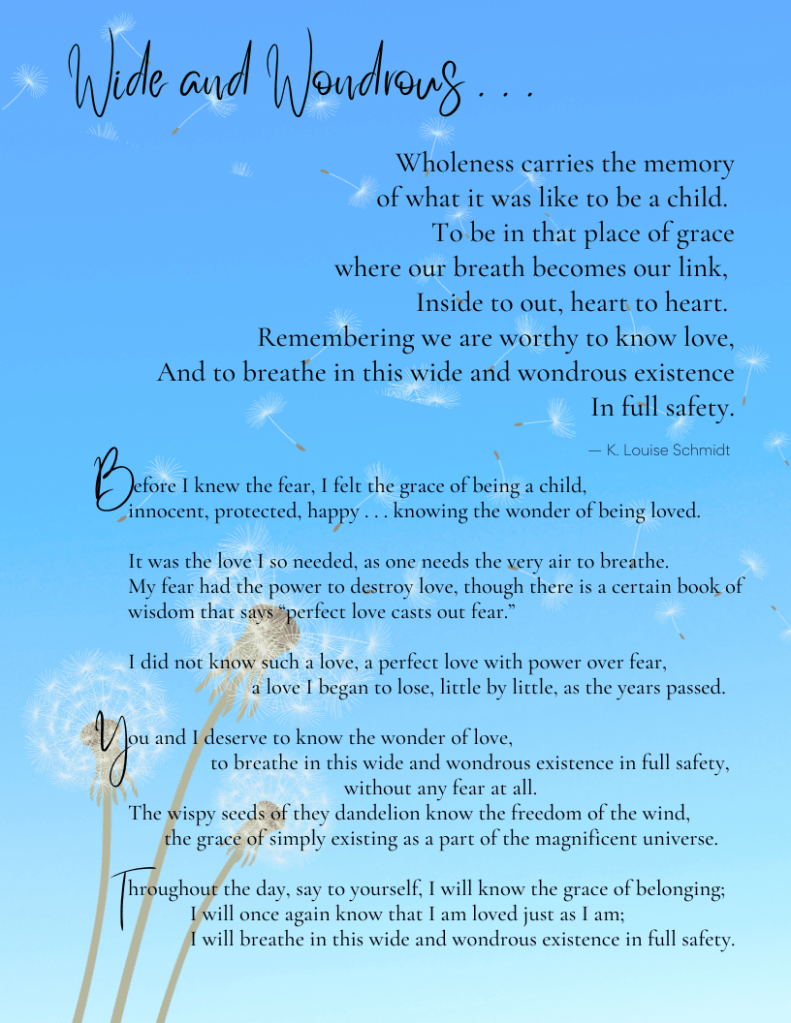
Wide and Wondrous

How true it is that when we know nights of sorrow, when weeping is all we can muster, that daybreak does eventually come as it always has. And with the rising of the sun, perhaps our tears are replaced with at least some measure of inner joy.

The universe is wide and wondrous, full of love, full of grace, and sparked by freedom. Those three—love, grace and freedom—are the things we most need, all of us.

I offer you this meditation, praying that you are surrounded in love, that you know the grace that accepts every part of yourself, and that you feel the the freedom to run with the wind in wide and wondrous places, toward your dreams.

As you continue the quiet time you claim for yourself today, I hope you will be be inspired and comforted by this beautiful choral piece by the brilliant composer Elaine Hagenberg, ”All Things New.”

Poem by Frances Havergal
and text adapted from
Revelation 21:5-6

Light after darkness, gain after loss
Strength after weakness, crown after cross;
Sweet after bitter, hope after fears
Home after wandering, praise after tears

Alpha and Omega
Beginning and the end
He is making all things new
Springs of living water
Shall wash away each tear
He is making all things new


Sight after mystery, sun after rain
Joy after sorrow, peace after pain;
Near after distant, gleam after gloom
Love aftеr wandering, life after tomb

Grace, Hope, Potter, Potter’s clay, Remolding and remaking

Gentle, Intentional Remolding

The Potter

We could have a long conversation about the potter’s messy hands, about the mud under his nails, about the strength of hands that look as if they are using every muscle to shape the pot. We would probably talk about the dynamic force of his hands that hold the pot lightly enough to form it, but controlled enough to avoid marring or damaging it.

In our conversation, we would probably remember the prophet Jeremiah’s encounter with a potter and the ways we have used that passage of scripture over the years. I don’t know about you, but my teachers and preachers used this text to teach me about the ways God can mold me into a worthy vessel that can hold enough faith and hope to get me through the hard times. Plus, being remolded would mean I was being ”obedient to God!”

We certainly do not want to use scripture out of its historical context, but another use of a scripture passage is to consider its imagery, its symbolism and its relevance to us in a given life situation. The following scripture, as translated in The Voice, contains a powerful section after verse 1 that tells us how God’s message comes through a prophetic drama played out at a potter’s wheel, and that there, the prophet sees an ordinary event from which he receives an extraordinary message.

The word of the Eternal came to Jeremiah

Now God’s message comes through another prophetic drama played out in a potter’s shop somewhere in the city. The prophet sees an ordinary event but receives an extraordinary message.

Eternal One: Go down to the potter’s shop in the city, and wait for My word.

So I went down to the potter’s shop and found him making something on his wheel.

And as I watched, the clay vessel in his hands became flawed and unusable. So the potter started again with the same clay. He crushed and squeezed and shaped it into another vessel that was to his liking.  
                              —
Jeremiah 18:1-4 (The VOICE)

I cannot help but remember the many times throughout my life that this passage was interpreted as a potter (God) forming me. The message inevitably moved to the part where ”God is not pleased with me and is trying to remold me into a more worthy vessel for God’s glory.” Not the best biblical message we could glean from Jeremiah’s drama! Not only that, but I don’t much like the idea of the potter ”crushing, squeezing and shaping” me.

The best truth is that God does remold us in so many ways, gently and intentionally, so that we are always in the process of change and growth. In our case, the God who loves us just as we are, also holds us, as if in a potter’s hands. Though this passage does speak of serious remolding, it never indicates that the potter throws the damaged pot into the trash pile.

It is true that we are damaged again and again in this life, but God loves who we are, and like the potter, God gently remolds us along the way, creating of us the best we can be. God never throws us away, no matter how severe our damage — damage on the outside, visible to all; and on the inside, where the deepest damage rests, in the soul and spirit. Visible to no one, excruciatingly visible to us.

We can choose to be like clay in the potter’s hands, allowing a gentle God to remold us, repair our damaged life, and empower us to be new, remade. This sounds like hope to me, and grace.

This is Jeremian’s story, his vision. He sees it as an ordinary event that graces us with an extraordinary message. Jeremiah’s story is ours to ponder and to ask ourselves if there is any damage to us or in us. If you sometimes view yourself as damaged, seek help from someone you trust — a friend or family member, a therapist, a spiritual director, your minister.

And remember, the potter is always near for gentle remolding.

Aging, All Shall Be Well, Art, Faith, God's Faithfulness, Grace, Lastingness

Lastingness

Aging — the beauty of petals as they age


My cousins visited this weekend for the first time in months, a needed visit for all of us. We laughed and played and enjoyed one another. We talked a lot, too, into the wee hours. We talked about sweet memories, of course, remembering so many good and fun times. We talked about old boyfriends and childhood disagreements and family idiosyncrasies.

I think we talked most about aging and the physical and emotional changes it brings. We lamented it, of course, and wished it away. We cursed it just a bit, and tried in vain to find ways around it. In the end, we agreed that we can’t get around it, but just have to go through it. Right through the middle of it until the pathway ends.

Right smack dab in the middle of dialogue about age spots, edema, muscle pain and a plethora of bodily ills, we stopped, suddenly realizing that there must be more to the aging process than physical symptoms. Where is life’s meaning when we draw nearer to life’s end? How do we grow old held by the same grace that held us when we were children, young adults, middle aged?

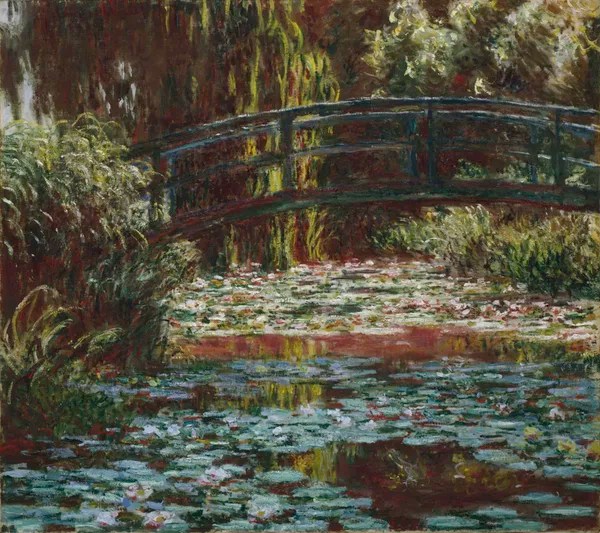
I came across an intriguing word this morning in an NPR article. The word is Lastingness What an astounding word to ponder. Perhaps we should consider lastingness instead of aging. Various creative artists are the subjects of Nicholas Delbanco’s latest book, Lastingness: The Art of Old Age. Delbanco examines artists who either maintained or advanced their work past the age of 70 — from Claude Monet, to Giuseppe Verdi, to Georgia O’Keeffe. Because I am an artist, I was captivated by the idea of lastingness, especially when Delbanco told the story of Monet’s later years.

Delbanco writes that French impressionist Claude Monet — who painted well into his 80s, even after his vision was clouded by cataracts — created some of his most well-known works in the last decades of his life. After a long career as a renowned and financially successful artist, Monet retreated to the beloved gardens of his home in Giverny, 20 miles outside of Paris. His gardens became his artistic obsession. It was Monet’s failing eyesight that posed the greatest threat to his work. “He became more or less legally blind as we would describe it now,” Delbanco says. “So Monet compensated for, or focused on, the visible world in very different ways in his older age.” The works Monet created in his last years at Giverny are regarded as masterpieces.

In the last decades of his life, French impressionist painter Claude Monet focused much of his work on the water lilies in his garden at Giverny. He continued painting well into his 80s, even after his vision had been clouded by cataracts.

The Art Institute of Chicago

Monet’s exquisite impressionist paintings eventually ended because of his cataracts. The poet Lisel Mueller has captured Monet’s cataract story brilliantly, in “Monet Refuses the Operation.” As of 1919, the Monet was urged to have the cataracts attended to; in 1923 he had operations on his right eye, and glasses improved his eyesight — but only briefly, fitfully, and he had trouble distinguishing color. Mueller’s poem begins:

Doctor, you say there are no haloes
around the streetlights in Paris
and what I see is an aberration
caused by old age, an affliction.
I tell you it has taken me all my life
to arrive at the vision of gas lamps as angels,
to soften and blur and finally banish
the edges you regret I don’t see,
to learn that the line I called the horizon
does not exist and sky and water,
so long apart, are the same state of being . . .

I don’t know exactly what “lastingness” means, but I think it might mean seeing haloes glowing around street lights or the ”vision of gas lamps as angels.” I’m pretty sure it means learning to look at life as softened and blurred, banishing life’s sharp edges. Perhaps “lastingness” means that my writing or my art will have a lasting impact on the world. Maybe it means that I will pass on my wisdom to my grandchildren. Or that the child I helped recover from long-term sexual abuse will find happiness in her life. Perhaps “lastingness” means that my faith in God will carry me to the grace that is the end of life. That kind of “lastingness” brings a kind of peace to my aging, a grace that assures me that aging is much more than painful joints and aching muscles. “Lastingness” is holier than physical afflictions and I think it blurs and softens them until they are tolerable.

When I cannot find the right words, I can always count on Bishop Steven Charleston to write them.

I see more clearly, now that I am aging. Not with my eyesight, but with my soul. I see the fine detail of what I missed in younger years. I see the place of faith and forgiveness in my story. I see the possibilities of life in ways I never imagined. I was not blind in my youth, but my vision was limited to only a few seasons of seeing. Now I am an old man standing on a hill. I see more clearly. The universe stretches above me in infinite glory and the Earth spreads her shawl to wrap me in creation. Open the eyes of your spirit. Look out in wonder. See the fullness of the life you have received. See the promise of love walking in beauty before you.

Bishop Charleston’s words might just be the very best description of ”lastingness.” Maybe “lastingness” means that because I am aging, I now see not only with my eyesight, but with my soul. Maybe it means that now I can clearly see the fullness of the life I have received and the promise of lasting grace holding me close.


Even to your old age I will be the same,
And even to your graying years I will bear you!
I have done it, and I will carry you;
And I will bear you and I will deliver you.

— Isaiah 46:4 —

#RevGalBlogPals, Diane Strickland, God’s Mercy, Grace, mercy, peace, Spirit, Spirit wind, Suffering

“Undo Me With Your Grace”

I’m not sure I know what it feels like to have God “undo me with grace,” but I have learned how it feels to need more grace, to long for Spirit breezes to gently blow around me with winds of grace. I need grace for enduring illness, grace for being separated from my son and his family, especially my five grandchildren. I need grace when I’m angry or disappointed or heartbroken. I need grace when I feel like giving up and giving in. I need God’s grace — the grace of the Spirit — to help me live in this season of my life.

I read a provocative prayer today. It kind of grabbed at my heart, asking me what exactly is in my heart right now. It asked me what I’m struggling with. The brilliant writer of prayers, Diane Strickland, writes again and again in her prayer the words, ”Undo my life with your grace,” leaving me asking myself what might happen if God decided to undo my life, even through God would likely be merciful enough to undo my life with grace.

The truth is that those words so grabbed me that my prayer was, ”God, I think I need to let you undo my life.” Maybe I feel the need to re-do my life with string of second chances. Maybe I need forgiveness for regrets, release from memories of pain. Whatever it means to have one’s life undone by God, my heart responded, with longing, to this prayer.

O, my Creator,

In the injustice of my country I caught a glimpse of the bottom of the iceberg this week. I saw how my life lived above the waterline rests on wrong assumptions of privilege, great and small and many. I am cold inside. I don’t want to be cold inside.

Undo my life with your grace. Pick out the seams sewn by fear and mend the tears made by violence. Patch the holes that were always there from the start because I don’t know much about the rest of the world or how life works for others you love just as much as you love me.

Undo me with your grace. Shake out the fabric of me. Unfold and fold me anew. Reveal your image in there somewhere and surprise me with what You make of me when mercy prevails and justice leads and love accompanies us.

Undo me with your grace. I’ve lived a long time now, long enough to know there’s more to be if I can lay down what has mattered more than it needed to, and take up what I’ve barely used at all.

I don’t feel there’s so much wrong with me that we must start over. I feel there’s more of me somewhere that fits better for now and will make room for later. Release more gospel into my life and from my life. Warm me up again. Humble me with wisdom and truth and promise and hold me together with those same gifts.

Undo me with your grace. Just a little bit more today, Spirit. Just a little more.

“Undo me with your grace. Just a little bit more today, Spirit. Just a little more.”

As I reflected on those words, my thoughts ended up with this conclusion. I don’t need grace to extricate me or liberate me from all that is difficult, heartbreaking and oppressive about my life. But I definitely need Spirit wind to live my life.

I don’t need grace to rescue me. But I do need Spirit-grace that moves in my life with me, giving me life-saving and healing grace for each moment. I need Spirit because I have known her holy presence with me and I have learned to experience the wonder of being moved by wind wild and calm, her breeze blowing around me with both tender comfort and empowering promise.

With that kind of sacred promise, I can live into my life, not shrink from it or fear it. I can move into my life, whatever it brings, with Spirit’s blessing. That’s how she impels me to honor the grace I have received — by giving it away. Her winds have impelled me for many years to minister to God’s people, and I do not intend to stop now. My call from God was for life, not meant to expire when I retired or when my health failed.

I know that God gives grace for waning health and I have it on good authority that God gives “more grace when burdens grow greater.”* When I consider the grace that has so filled my life, I think of the story of Annie Johnson Flint who wrote the text of the hymn, ”He Giveth More Grace.”

Annie Johnson Flint, born in 1866, was an inspiration to all who knew her. This is just a tiny bit of her story. The fullness of Annie Johnson Flint’s story includes a life-long string of losses and difficulties. By the time she was six years old, she had lost her mother and father to illnesses and was adopted by a family named Flint. She loved poetry and dreamed of being a composer and concert pianist. After graduating from high school, Annie went on to become an elementary school teacher, but in her second year was afflicted with arthritis that steadily and quickly worsened. She lost her ability to walk, but she became a prolific writer of poems and hymn texts.

The many stories written about her stories tell how later in life she was unable to open her hands and could no longer write, yet continued to compose her on a typewriter using her knuckles. And that “she sought healing, but in the end she was thoroughly convinced that God intended to glory Himself through her, in her weak earthen vessel.”

The words of the hymn text she wrote, ”He Giveth More Grace,” reflect the many disheartening moments she experienced throughout her life. She died at the age of 66, leaving as her legacy so many faith-strengthening words, including these:

He giveth more grace when the burdens grow greater,
He sendeth more strength when the labours increase;
To added afflictions He addeth His mercy,
To multiplied trials, His multiplied peace.

When we have exhausted our store of endurance,
When our strength has failed ere the day is half done,
When we reach the end of our hoarded resources
Our Father’s full giving is only begun.

Fear not that your need shall exceed His provision,
Our God ever yearns His resources to share;
Lean hard on the arm everlasting, availing;
The Father, both you and your load will upbear.

His love has no limits, His grace has no measure,
His power no boundary known unto men;
For out of His infinite riches in Jesus
He giveth, and giveth, and giveth again.

I have loved this hymn for years in spite of its masculine language. It moves me and uplifts me. It always reminds me of the infinite grace I have known in my life. I hope you will listen to this hymn as a part of your contemplative time.

“He Giveth More Grace” performed by The Celebrant Singers.
From their album, “Still Standing.”

*Diane Strickland is in her 33rd year as an ordained minister now serving in The United Church of Canada as retired clergy. She is a Certified Community and Workplace Traumatologist, Compassion Fatigue Specialist-Therapist, and Critical Incident Responder, author and creator of trauma informed resources.

Aging, anxiety, Awareness, Beauty of Nature, Bishop Steven Charleston, Change, Faith, Forest, Grace, life, Life Journeys, Living Hope, Pondering, Spirit

Pondering a Soul in Transit

“A soul in transit.” What does that phrase even mean? It sounds a bit ominous to me, like something bad couched in flowery language. Maybe like words of a poem that make little sense because they point to something otherworldly. Perhaps it means something related to a soul that lives, gets old, and dies — in transit from birth to death and beyond. Pondering!

I’m not up for those thoughts right now, because I am in the troubling place of feeling old sometimes. It’s something like aging anxiety, I think. Feeling old should not be so surprising to me since I really am kind of old. But sometimes I feel old in a bad way, the way that sends negative thoughts through my mind. Thoughts like . . .

I can’t do much anymore,
I don’t feel well most of the time,
my joints hurt,
or even, I may die soon.

It is not helpful for my soul to entertain such thoughts, even though some of them are downright truth. Pondering! You have probably heard that “getting old is not for sissies.” It holds some truth, I imagine, for those of us who have come face to face with normal aging, aging that feels not so normal at all. But what about the great juxtaposition? What about the positive exercise that puts thoughts side by side so that we can see what is life-giving instead of what is troubling? For instance . . .

I am old. — I am wise.

I feel weak. — My spirit is strong and still vibrant.

My back aches when I exert myself. — I can still move.

So much for pondering juxtaposed thoughts. They may not be all that helpful, although re-imagining so that we recognize what is spirited and sparkling about ourselves can be very helpful. Still my words on this subject are pretty empty. I think I need assurance from someone else’s words, and I can’t help but turn to a very wise and insightful spiritual guide, Bishop Steven Charleston, whose thoughts are captivating, enlightening and filled with wisdom. And on top of that, the wise bishop is the one who offered up the phrase, “a soul in transit” in the first place.

We will not grow old, not in spirit. In mind and body, yes, we will age as all things age, all making the pilgrimage through time to find the place of sources. But in our spirit, no, we will not grow old. The child that was us will run forever through the fields. The dreams we spun from the fine wool of cloud watching will forever lead us to the next wonder that awaits us. The love we knew, so quiet, so life giving, will always be there to lift us up and hold us close. The spirit of life is eternal. It does not diminish. It does not forget. It does not alter. The spirit within us is the sum total of our sacred experience. It is what we were sent here to be and to do. Our spirit, a soul in transit, has a life outside of time. It will not grow old because it is on loan from a source more ancient than time itself.

Bishop Steven Charleston

Still pondering! I see more clearly that the “soul in transit” has “a life outside of time.” Eternal! That is what our faith has taught us for generations, for ages, always. But it is a truth that we can barely fathom, much less find comfort in. It’s not so easy to accept a truth that ultimately represents death, even if it includes that timeless and stunning place that is called eternity. The introductory words of 1 Peter give us a most glorious glimpse of eternity, a living hope.

May grace and peace be yours in abundance. Blessed be the God and Father of our Lord Jesus Christ! By his great mercy he has given us a new birth into a living hope through the resurrection of Jesus Christ from the dead, and into an inheritance that is imperishable, undefiled, and unfading, kept in heaven for you, who are being protected by the power of God through faith for a salvation ready to be revealed in the last time.

— 1 Peter 1: 2-5 NRSV


Pondering still as I ask, “what does it all mean for me, the words, the images?” I feel much like the Psalmist who said, “my eyes are not raised too high; I do not occupy myself with things too great and too marvelous for me.” (Psalm 131:1) And yet, I do search and struggle with the thought of aging, of what it means for me and of what comes next. I hear the words:

“. . . in our spirit, no, we will not grow old. The child that was us will run forever through the fields. The dreams we spun from the fine wool of cloud watching will forever lead us to the next wonder that awaits us. The love we knew, so quiet, so life giving, will always be there to lift us up and hold us close. The spirit of life is eternal. It does not diminish. It does not forget. It does not alter. The spirit within us is the sum total of our sacred experience.”

I hear the words, and the spirit of me understands, even if my mind does not. When I write, I ponder deeply. In my pondering this day, I am compelled to admit that I definitely feel the sting of aging. I am very human, after all! But I can usually move from anxiety to a good kind of awareness. That good awareness shows me that it is comforting to hold on tightly to the thought that the spirit is eternal, that my spirit is eternal. Dwelling on aging isolates me, but knowing in my heart that my spirit is eternal is a grace-gift that sets me free to really live.

I know from experience that pondering can be hurtful, leading me through all kinds of unpleasant scenarios. But sacred pondering, the kind that allows one’s faith to sit with a problem until it seems acceptable, can open the mind and heart to the eternal and empower us to see the plans for good that God has for us, “a future and a hope.” (Jeremiah 29:11)

So, after a time of sacred pondering, I am blessed with a fresh awareness. I can see more clearly God’s truth that my spirit will remain with my grandchildren, always. My spirit will hold on to the sweet love I have known. My spirit will immerse itself in the beauty of nature that has always been present. My spirit will run through the fields like a young person, and through the forests, it will love the trees I have always loved.

My body will do what bodies do, but my spirit will not die and will not grow old!

Thanks be to God. Amen.

Disconsolate, Grace, Hesed, Hope, Soul work, Waiting, Wounds of the Soul

It Was Worth the Wait!

Wait for the Lord;
be strong, and let your heart take courage;
wait for the Lord.

Psalm 27:14 ESV

Waiting is no easy thing. Most of us don’t really like it. We’re not good at it. We are impatient people. We want things to happen quickly. Isn’t it excruciating at times to wait when a traffic light stays red far too long, and no traffic can be seen anywhere! How often we have stood in a long, slow-moving line and frustratingly declared, “This is not worth the wait!”

The more important matter, though, is when the soul must wait, when our hearts must wait for pain to ease. When our hearts have to wait, when our souls have to wait in the silence of suffering, it’s almost impossible for us to bear. Yet the the words of the psalmist and the prophets echo through the ages:

For God alone my soul waits in silence;from God comes my salvation;
God alone is my rock and my salvation, my fortress.
I shall never be shaken.

Psalm 62:1-2 ESV

Those who wait on the LORD shall renew their strength;
They shall mount up with wings like eagles,
They shall run and not be weary,
They shall walk and not faint.

Isaiah 40:31 NKJV


Messages of hope, yes. Yet when we are suffering, when we are in pain or disheartened or in trouble, nothing really sounds much like hope. Waiting for pain to ease is difficult, even excruciating. I like the way Sue Monk Kidd offers insight about waiting in her book, “When the Heart Waits.”

I had tended to view waiting as mere passivity. When I looked it up in my dictionary however, I found that the words passive and passion come from the same Latin root, pati, which means “to endure.” Waiting is thus both passive and passionate. It’s a vibrant, contemplative work. It means descending into self, into God, into the deeper labyrinths of prayer. It involves listening to disinherited voices within, facing the wounded holes in the soul, the denied and undiscovered, the places one lives falsely. It means struggling with the vision of who we really are in God and molding the courage to live that vision.

Sue Monk Kidd, “When the Heart Waits”

I cannot explain it better than that and I won’t try. My deepest self desperately grasps for these words, “listening to disinherited voices within, facing the wounded holes in the soul.” I cannot respond with any meaningful comments, but I will offer another insight about waiting for a God who covers us with pure, merciful, amazing grace.

GRACE. The Hebrew word is Hesed.

Hesed is a Hebrew word that means grace in all its fulness. Hesed is defined as compassion, mercy, love, faithfulness  and most often, grace. But none of these words fully capture this Hebrew word that means grace. Hesed is not just an emotion or a feeling. It describes the way God lavishly pours grace upon us in our most needful moments.

And so we learn to wait for God’s outpouring of grace. Sometimes we wait impatiently. Sometimes we wait in anger. Sometimes we wait with a holy sense of peace. Sometimes we wait with hope, joyfully expectant. And sometimes we wait in silence, without words, disconsolate and cast down.

A number of years ago, I found myself nursing a disconsolate, cast down soul and spirit. I had been through a trying time in my life that I can only remember as one of deep sorrow. I remember one day when I sat down at the piano after reading Psalm 42. One particular verse of the Psalm reverberated in my mind. Over and over again, I heard the words, but I did not hear them read. I heard them sung, with a simple, but hopeful strength. I heard myself singing, a soul-song from somewhere inside me. I began to play what I heard, first the melody and rhythm, then the chords that arose from somewhere I could not pinpoint. It sounded beautiful, and it sounded like it was emerging from a sacred promise from God — unequivocally for me. This was my soul song:

Why are you cast down, O my soul,
and why are you disquieted within me?

Hope in God; for I shall again praise him,
my help and my God.

Psalm 42:11 NRSV


I think I was waiting that day, though I was not sure what I was waiting for. I just know that I found hope again that day, if just for a few moments of holy music. And in my disquieted spirit, I sensed pure grace once again — grace, hesed — God’s infinite, matchless, amazing grace.

It was worth the wait!

Thanks be to God.


Birdsong, Calm, Creation, Fear, Grace, Knowing, Life’s meaning, Listening, Paul Simon, peace, Prayer, Quiet, Reflection, Sacred Pauses, Sacred Space, Self Awareness, Self care, Self-understanding, Serenity, Silence, Simon and Garfunkel, Soul, Soul work, Spirituality, Stillness, The Sound of Silence, Whispers of the Soul, Wholeness

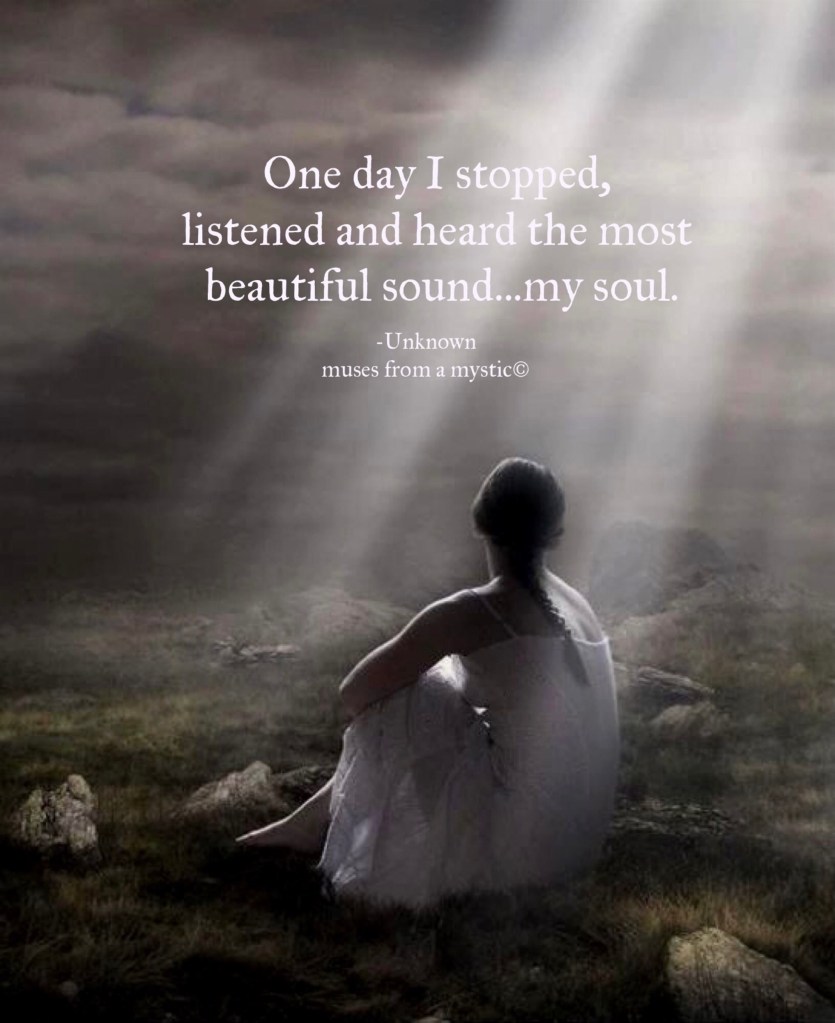
One Day I Listened

I wonder if you would be willing to stop what you’re doing right now and spend a quiet moment with me, just listening? Your time might well be a needed time for you and for your soul.

There is always so much to listen to — traffic, sirens, video game sounds, annoying household noise like the washing machine/dryer, food processor, mixer, fans, buzzers and alarms and the awful sound of the disposal trying to crush that inadvertent chicken bone. These, of course, are not our favorite sounds, but they are the myriad sounds and noises we hear in a typical day.

There are sweeter sounds, too, like the sound of a gentle, falling rain or the sound of rain when it hits hard on the roof; the sound of a gusty breeze as it rustles the leaves on a tree; the sound of a flowing stream, a rolling river and constant, ever-rushing ocean sounds; the flutter of a hummingbird’s wings; the sound of cicadas on a Southern summer night; the sound of a child’s laughter; the sweet, peaceful sound of a purring kitten; and birdsong, always birdsong.

Of course, listening as pure joy is listening to music — quiet music, lyrical melodies, rhythms that slow the pulse, the sound of a bow moving across a cello’s strings, the mesmerizing sound of a harp, the velvet sound of voices in harmony or the enthralling sound of a symphony orchestra.

Sounds fill the space that surrounds us, all the time. What is rarer for us is to hear the sound of silence. Some of us fear the silence or dread silent moments. Others of us avoid it at all costs because the silence tends to bring up whatever we are afraid to hear. So the noise that enfolds us fills the place that might otherwise hear the sighs of the soul — its cries and laments, its laughter, its sound of contentedness. It seems to me that this is the place we long to be, in the soul’s sound chamber where whatever we hear — if we’re listening carefully — is the song of the soul that tells us who we are and why we are.

There is a poem that many of you will remember (if you’re old enough) as a Simon and Garfunkel song from the 1960s. The poem was written by Paul Simon and it presents a frightening picture of the modern world doomed by the lack of spirituality and the people’s aversion to the true meaning of life. It is not so different in these days that spirituality and life meaning can be elusive, no matter how hard we may search for it and yearn for it.

The poem, entitled The Sound of Silence, is written by the voice of a visionary asking people to be serious about the true meaning of life. The poem’s message is that people are moving further and further away from true happiness because they have ignored life’s true meaning. They debate and quarrel about worthless things. They listen to or watch meaningless things. The poet writes that the people “speak and hear without listening. Like we often do?

Throughout its five stanzas, the poem presents the conflict between spiritual and material values. The poetic persona is a person of vision who warns against the lack of spiritual seriousness. The poem begins with an address by the poet persona to the darkness, saying that he has come to talk with the darkness. When he awakens, he says that the vision still remains as the sound of silence.

Some of us fear the silence or dread silent moments. Others avoid it at all costs because the silence tends to bring up whatever they are afraid to hear. So the noise that enfolds us fills the place that might otherwise hear the sighs of the soul — its cries and laments, its laughter, its sounds of contentedness. It seems to me that this is the place we long to be, in the soul’s sound chamber where whatever we hear — if we’re listening carefully — is the song of the soul that tells us who we are and why we are.

The words of the poet . . .

And in the naked light, I saw
Ten thousand people, maybe more
People talking without speaking

People hearing without listening
People writing songs that voices never share
And no one dared
Disturb the sound of silence

And the people bowed and prayed
To the neon god they made
And the sign flashed out its warning
In the words that it was forming
And the sign said,
“The words of the prophets are written on the subway walls

And tenement halls”
And whispered in the sound of silence

All of that trivia about the poem certainly moved us a little farther away from my point, which is that most, if not all, of us have a deep emotional and spiritual need to listen to our souls, really listen. Even if we don’t know it, we long to hear what the depth of our being wants to say to us. We want to find our true selves, a quest only our souls can accomplish. If we are honest, we would say that we want to do the soulwork that leads us out of the darkness of our own making and into a place of light.

When we do carve out a sacred pause, when we wait in the darkness of that silent space, and when we open ourselves to deep listening, we will likely hear God’s whisper. We will probably move slowly out of darkness and realize the promise that as “God’s own people” we will “proclaim the mighty acts of God who called us out of darkness into his marvelous light.”   (1 Peter 2:9)

This is the place we long to be, in the soul’s sound chamber where whatever we hear — if we’re listening carefully — is the song of the soul that tells us who we are and why we are.

— Rev. Kathy Manis Findley

Hearing God’s voice moves us to a deeper experience of life, but hearing our soul’s sighs may take us deeper still, because we open ourselves to self-knowing. It’s not a surface knowing. It is a deep knowing of who it is that lives in our skin. Without hearing the sighs our souls are making, we might never enter into fullness of self. I suggest that only the fullness of who we are can stand before the God who knows us even better than we know ourselves. 

In my own experience, I think that perhaps I cannot be in deep communion with God if I try to face God as my superficial self. Perhaps God seeks relationship with my soul, my deepest place of being. To find and define my soul for myself, to know myself fully, I must find the sound of silence and sit with it patiently and expectantly. Maybe that is the essence of spirituality.

So there are a few lessons in these words and these are the obvious lessons:

  • Limit the harsh sounds in your life.
  • Surround yourself with tender, gentle sounds.
  • Make sacred space and holy time to listen deeply for the sounds that speak to your soul.
  • Listen for God’s whispers. They are important to hear.
  • Always consider what is, for you, the true meaning of life.
  • Listen to your soul — its sighs, its cries, its songs. 

And who knows? If you linger for a while in your sacred listening space, you might just find the very essence of grace by hearing what your soul whispers to you. It will be the most beautiful sound of all.

— Rev.Kathy Manis Findley


One day I listened — really listened. And I heard the whisper of God and the song of my soul. Thanks be to God.


I invite you to hear the poem, “The Sound of Silence,” through music. It can rightly be said that no group or person could ever sing this as well as Simon and Garfunkel, but I thought you might enjoy it covered by a very popular contemporary a cappella group, Pentatonix. 


The Sound of Silence by Paul Simon

All Shall Be Well, anxiety, Bewilderment, Brokenness, Comfort, Despair, discouragement, Emotions, Feelings, God's Faithfulness, Grace, healing, Heartbreak, Holy Spirit, Hope, life, Loss, Rev. Kathy Manis Findley, Sacred Pauses, sadness, Sorrow, Stories, Weeping

How Is Your Heart?

Yesterday I noticed a dogwood tree in full bloom, the first blooming dogwood I have seen this year. The sight of it did my heart good, because it reminded me that some simple and beautiful things remain. They return every year. They mark a season. They grow, and their blooms become ever more vibrant, or so it seems.

The dogwood has its own story, a lovely legend that explains the tree’s qualities. The legend holds that the tree was once very large, like a Great Oak tree, and because its wood was strong and sturdy, it provided building material for a variety of purposes. According to the story, it was the dogwood tree that provided the wood used to build the cross on which Jesus was crucified.

Because of its role in the crucifixion, it is said that God both cursed and blessed the tree. It was cursed to forever be small, so that it would never grow large enough again for its wood to be used as a cross for a crucifixion. Its branches would be narrow and crooked — not good for building at all. At the same time, the tree was blessed so that it would produce beautiful flowers each spring, just in time for Easter. The legend says that God it is gave it a few traits so that whoever looks upon it will never forget. 

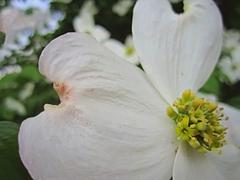
81189983-8ADE-4D60-9088-C52DA3983583The petals of the dogwood actually form the shape of a cross. The blooms have four petals. The tips of each of the petals are indented, as if they bear a nail dent. The hint of color at the indentation bring to mind the drops of blood spilled during the crucifixion.
8DEA0FBE-8A3E-4AF8-8142-DA825CA72359


Diana Butler Bass tells the story like this:

There’s an old southern legend that dogwoods grew in Jerusalem — and that one gave its wood for Jesus’s cross. Because of this, the dogwood was cursed (its short stature a ‘punishment’ for being the wood of death) but it also became a blessing. Blessing? For on each twisted branch burst forth petals of lightness and light.

So let’s leave the dogwood’s story and look at our stories — your story and my story. People often use the term “storied past.” Well, a storied past is something all of us have.

In talking with a friend a few days ago, I asked, “How is your heart?” She began to tell me her story, which was a long and winding one that included many mini-stories — happy ones snd sad ones — from her life’s journey. Toward the end of her story, she said, “I feel as if I am cursed by God.” That was her bottom line answer to my question, “How is your heart?” Hers was an honest, heartbroken response that instantly revealed that her heart was not all that good, but that was a critical part of her story.

If you and I are honest, we will admit that our hearts were broken and hurting at several places in our stories. Recalling our brokenhearted times is something we always do when we tell our stories, and it’s an important part of the telling. My story and yours is never complete if we leave out the heartbroken moments, for at those points, what feels like God’s curse almost always transforms into God’s grace.

If not for our heartbroken moments, the hurting places in our hearts might never “burst forth with lightness and light.” Our heartbroken moments change us and grow us. They set us on better paths and they embrace our pain with grace. Our heartbroken moments give us pause, and in that pause, we find that once again, our hearts are good. Our broken hearts are once again peaceful hearts — healed, restored, transformed, filled with God’s grace.

How is your heart? That is a question we would do well to ask ourselves often, because languishing with our heartbreak for long spans of time can cause our stories to be stories mostly of pain. Instead, stop right here in this post for just a few moments and ask yourself, “How is my heart?”

48BB4DCE-068F-4CC2-B1D0-A6B95549B35D

Your answer may well be your path to a contemplative, sacred pause that can become a moment of healing, a time for God’s grace to embrace whatever is broken in your heart and to transform it into love, light and hope. So don’t be afraid to look into your heart when pain is there. In looking, you may find reasons, many and and complex, that are causing deep pain and brokenness. You may also find the healing touch of the Spirit of God waiting there for you and offering healing grace — a Godburst of new hope.

May your story be filled always with times when your was light with joy and times when your heart was broken with loss, mourning, discouragement, disappointment. Both create your extraordinary story — the joyful parts and the sorrowful parts. So tell your story again and again to encourage yourself and to give the hope of God’s healing grace to all who hear it.

I remember a beloved hymn that is a prayer for the Spirit of God to “descend upon my heart.” May this be your prayer today.

Spirit of God, descend upon my heart;
Wean it from earth; through all its pulses move.
Stoop to my weakness, mighty as Thou art,
And make me love Thee as I ought to love.

Hast Thou not bid me love Thee, God and King?
All, all Thine own, soul, heart and strength and mind.
I see Thy cross; there teach my heart to cling:
Oh, let me seek Thee, and, oh, let me find!

Teach me to feel that Thou art always nigh;
Teach me the struggles of the soul to bear,
To check the rising doubt, the rebel sigh;
Teach me the patience of unanswered prayer.

Teach me to love Thee as Thine angels love,
One holy passion filling all my frame;
The kindling of the heav’n-descended Dove,
My heart an altar, and Thy love the flame.

anxiety, Calm, Comfort, Emotions, Fear, Feelings, God's Faithfulness, God’s promises, Grace, grief, Hate, healing, Hope, Pain, Pandemic of 2020, peace, Prayer, Preaching, Present moment, Resilience, Sacred Space, Spirit, Violence

What Do You Say to a Broken World?

I once preached a sermon entitled, “What Do You Say to a Broken World?” In this week, after our nation’s Capitol was breached and defiled, I have wondered if ministers who will stand before congregations in two days are asking themselves a similar question: “What will I say on this day to a broken world?”

A friend of mine is preaching this week. I am praying that she will have an extra measure of wisdom, because standing before a congregation while the nation is in chaos is not a responsibility to be taken lightly. My first feeling as I thought about preaching for this Sunday was relief that I was no longer a pastor with such a heavy responsibility, that I did not have to summon the wisdom to speak to a people with heavy hearts who need to hear of healing grace and hope. But my most intense feeling was envy, not hostile envy, but heart envy about my deep desire to speak Gospel Good News to people who need to hear good news. Still I envied my friend and wished that, this Sunday, I could stand before a congregation with wisdom, open my spirit and invite God to speak through me. It is a heavy responsibility and a sacred calling.

Dr. Greg Carey, Professor of New Testament at Lancaster Theological Seminary, wrote an essay this week entitled “Preaching When It’s Broken.” In the essay he says this:

God bless you, preachers who will address congregations this Sunday . . . Here in the United States, things are broken, most people know they’re broken, and we all need healing and truth.

For many of us, the invasion of the Capitol and the response to it by people we know, love and admire, brings this brokenness to the foreground. Since that terrible, violent day, I have heard dozens of interviews that expressed anger, frustration, contempt, indignation and all manner of raw emotion. I have also heard wise leaders express their resoluteness to lead this nation into healing, unity and hope.

Indeed, the questions about this Sunday’s preaching call us to attention: How do our pastors, our priests, our rabbis, our imams, our bhikkhus and bhikkhunis stand before their congregations offering comfort when our nation is so broken, so angry, so mournful in the face of violent acts? What will they proclaim? What will they preach? What will they pray? What will they sing?

Minneapolis Pastor and Poet, Rev. Meta Herrick Carlson, has given us a grace-gift with this poem entitled, “A Blessing for Grieving Terrorism.”

A Blessing for Grieving Terrorism

There is sickness
with symptoms as old as humankind,
a rush of power born by inciting fear in others,
a wave of victoryin causing enemies pain.

There is a push to solve the mystery,
to isolate the suspect and
explain the evil simply
to a safe distance from the anomaly.

There is a temptation
to skip the part that feels
near the suffering
that shares the sadness,
that names our shared humanity.

There is a courage
in rejecting the numbing need for data
in favor of finding the helpers,
loving the neighbor,
resisting terror through random acts of connection.

There is a sickness
with symptoms as old as humankind,
but so is the remedy.

From Rev. Meta Herrick Carlson’s book “Ordinary Blessings: Prayers, Poems, and Meditations for Everyday Life.” Used with permission.

So much truth in her words, so much wisdom “for the living of these days.” In her words, I feel all over again the desire of my heart, the impossible dream of standing in a pulpit this Sunday, speaking to a congregation that needs strength in the midst of adversity. I will not stand behind a pulpit this week, but I will pray for those who will stand in that sacred space. I will pray for them, the proclaimers, and I will pray for their hearers across this nation. I will lean on this beautiful prayer written by Reverend Valerie Bridgeman:

May God Strengthen You for Adversity

A blessing for today: 

May God strengthen you for adversity
and companion you in joy.

May God give you the courage of your conviction
and the wisdom to know when to speak and act.

May you know peace.
May you be gifted with deep,true friendship and love. 

May every God-breathed thing
you put your hand to prosper and succeed.

May you have laughter to fortify you
against the disappointments.
May you be brave. 

© Valerie Bridgeman, December 18, 2013

When all is said and done, more important than what the “proclaimer in the pulpit” says is what the hearers hear. For in this time — when violence, riots, terrorism, pandemic and all manner of chaos is so much a part of life — those who listen need to hear a clear message of a God who dwells among us, a Christ who leads us, a Spirit who comforts us under the shadow of her wings. For hearts in these days are heavy, souls are wounded, spirits seek hope. And all the people want to believe that they do not walk alone through their present angst.

I pray that you know that you are not alone, that God’s grace-filled presence is with you and that “in God you live and move and have your being. As some of your poets have said, ‘We are God’s children.’” (Acts 17:28)

I pray that your heart will heal and be filled anew with hope. I pray that the wounds of your soul and spirit will heal and be filled anew with the peace of God. I pray that, when you listen in faith, you will hear the voice of God whispering in your ear, “You do not walk alone.”

I invite you to spend a few moments of meditation hearing the message of this music:

May you see God’s light on the path ahead
when the road you walk is dark.

May you always hear
even in your hour of sorrow
the gentle singing of the lark.

When times are hard

May you always remember when the shadows fall–
You do not walk alone.

Awakening, Bondage, Change, Creativity, Feelings, Freedom, Grace, Insanity, Mental health, Mindfulness, Nature, New Life, Night sky, Sacred Pauses, Self care, simple joys, simple pleasures, Skies, Stars, Transformation

From Insanity’s Bondage to Creativity’s Freedom

68C9C79A-BF63-420C-A135-37505D96C6C5
INSANITY
 

Not a word we are fond of. Nothing inspiring about the word. And when the word insanity is more than just a word, we shudder in its grasp. Insanity brings its own bondage, stealing one’s freedom to live, confiscating one’s creative expression. Insanity can be a complete, all-encompassing mental breakdown, even bordering on madness, OR it can be a state of being that most of us have experienced — irrationality, instability, disorientation, mania. Many people (noted scholars) have mused that “the definition of insanity is the most overused expression of all time.” (Salon.com)

Remember the declaration about “doing the same thing over and over again and expecting a different result?” Yes, I know you remember that definition, probably have said it yourself in an exasperating moment!

Where am I going with these bizarre introductory words?

I’m actually going to a place you may not expect. I’m going to the rush and swirl of color in one of my favorite paintings, A Starry Night by the Dutch Post-Impressionist painter Vincent van Gogh. The painting draws me in — into the little village with its steepled church, into a sky filled with sparkling stars, into the glorious luminance of the crescent moon, into the swirls of blues and whites and yellows. I have pondered many times what sort of mind and soul could have created a painting like this one.

The story behind A Starry Night is the unnerving story of Van Gogh. A few months after experiencing a mental breakdown on December 23, 1988 that resulted in the self-mutilation of his left ear, Van Gogh voluntarily admitted himself to the Saint-Paul-de-Mausole Lunatic Asylum. During the year Van Gogh stayed at the asylum, his prolific output of paintings continued and he produced some of the best-known works of his career. A Starry Night was painted by around June 18, the date he wrote to his brother Theo to say he had a new study of a starry sky.

A Starry Night was the only nocturnal painting in the series of views he saw from his bedroom window. In early June, Vincent wrote to Theo, “This morning I saw the countryside from my window a long time before sunrise with nothing but the morning star, which looked very big”. Researchers have determined that Venus was indeed visible at dawn in Provence in the spring of 1889, and was at that time nearly as bright as it could be. So the brightest “star” in the painting, just to the viewer’s right of the cypress tree, is actually Venus.

Too much information? Probably, but here’s my point that is not really about insanity at all. Rather, it’s about breaking free from bondage and taking back my life. You see, sometimes the sight of a big, bright morning star can replace whatever fear or angst I am feeling. Sometimes looking into the deep of a starry night can carry me to resplendent places. Sometimes even my slight insanity can transport me to my deepest expressions of creativity.

For me, insanity is my incessant scurrying around with too many things to do, a kind of mania. That frenzied scurrying is of my own choosing and therefore, leans a little too close to self-imposed insanity. I wonder if instead of that scurrying life of bondage, I could make time for moments of thought that would enable me to say something like what Vincent Van Gogh said from his asylum: 

“This morning I saw the countryside from my window a long time before sunrise with nothing but the morning star — the brightest star — which looked very big!“

Contemplate for a moment the insanity of a life encumbered — filled to overflowing with too many things to do — compared with a life of stargazing that might just awaken fresh and bright creativity in you.

As for me, I’m heading toward a spiritual transformation — a life of sacred pauses, a stargazing life, a grace-filled re-awakening!

I hope you are, too.

Aging, anxiety, Confusion, Despair, discouragement, Faith, Fear, Feelings, God's Faithfulness, God’s promises, Grace, healing, Hope, Isolation, Loneliness, Loss, Music, Prayer, Psalms, Singing, Sorrow, Soul, struggle, Tears, Worry

When Branches Are Flimsy and Songs Cannot Be Sung

I have a certain fondness for sparrows and the spiritual stories we have ascribed to them. That my blog is named “God of the Sparrow” is no accident. I have aspired many times in my life to live like the sparrow lives. I wanted my human, adult, mature and seasoned self to know, beyond any doubt, that God is watching over me. I do not live the simple, sparrow-like life I always hoped to live. But my unshakable faith has always told me that the God who watches over my every moment is also the God of the sparrow. I remember well the words written in the Gospel of Matthew . . .

So do not be afraid; you are of more value than many sparrows. 
— Matthew 10:41 NRSV

Such a comforting passage of Scripture! Yet, its message to us often pales in comparison to all the things that so frighten us. The state of the world that surrounds us in these days seems to have even more power over us than Matthew’s words about our value to God.

How is it that we are valuable to God when God does not act to protect us from all of life’s slings and arrows? Yesterday in my blog post I listed our world’s bad and scary things, so I won’t list them again today. But I will venture a prognosis that many, many people are suffering in many ways in this confusing season. I am one of those suffering people, feeling a bit of hopelessness in these days of racial unrest, coronavirus unsettledness and political divisions.

I heard a moving choral performance this morning. Its text lifted up my helplessness before me and turned it into a prayer so attuned to where I find myself.

God of the sparrow, sing through us
Songs of deliverance, songs of peace. 
Helpless we seek You, God our joy, 
Quiet our troubles, bid them cease. 

Jonathan Cook

I need the sparrow’s God to sing through me. Perhaps you do, too. I need that God-given song because my own music seems to have become quiet, my singing turned to mourning. (Amos 8:10) But this week, I took hold of that mourning. With strong intention, I spent most of one day this week singing my heart out. 

You need to know that I had to choose a day when my husband would be away so that I could sing loud, with abandon. Why did he have to be away? That’s a long story, but in a nutshell, my singing is awful these days. Probably my vocal cords have lost some of their youthful elasticity and, on top of that, I did not sing at all for more than a year. Serious illness took my music.

When I (literally) came back from the dead in 2015, I realized that I had lost so many of my former abilities. Singing was one of them. It felt strange to me when I realized I could no longer sing. My former life was filled with song. Since childhood, there was never a choir I did not join, never a solo I did not sing.

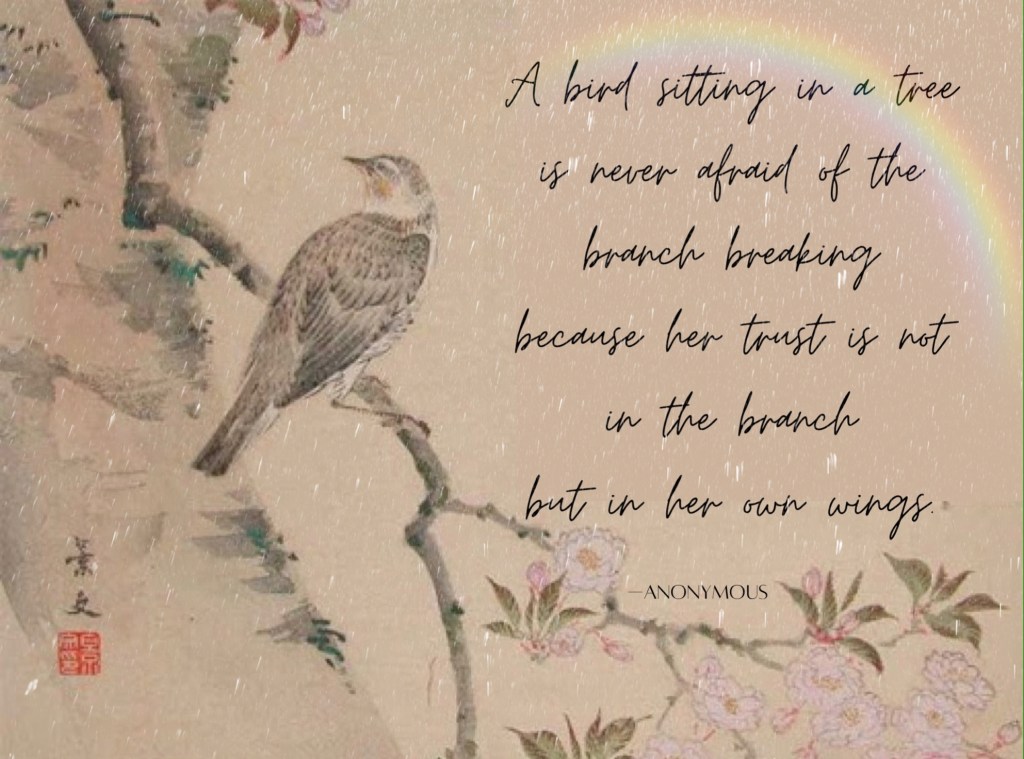
Acknowledging my inability to sing was difficult, just as my life after kidney transplant and this coronavirus is difficult. My isolation has been lengthy, most of nine months, and it is taking its toll on my spirit. Prayer has become both a burden and a grace to me. My singing was my prayer for so many years, and I really need my singing in these hard days. I need to sing my praises to God. I need to sing my lamentations. I need to sing like the sparrow who doesn’t worry about her vocal chords. I need to be like the sparrow who sits on her branch — without fear, without worry — because she knows that if she happens to light on a flimsy branch that does not hold her, her wings will lift her. 

The end of this story is that I need the God of the sparrow to sing through me once again — to sing through me in shadowy days, in times of trouble, in isolation, in fear, in hopelessness. That’s what God does, after all. In a troubled and despairing soul, God creates music, tucking it into every crevice, filling it with songs that can sing out both mourning and celebration. As an added bonus, I have it on good authority that God also turns mourning into dancing.

You have turned my mourning into dancing;
you have taken off my sackcloth
so that my soul may praise you and not be silent.
O Lord my God, I will give thanks to you forever.

Psalm 30 11-12 NRSV

So as you sing, dance to the new rhythms of your soul! Because you can!

Thanks be to God.

Please spend your meditation time today listening to this beautiful song with text written by Jonathan Cook and music by Craig Courtney. The video follows the text.

God of the Sparrow

God of the sparrow, sing through us,
Songs of deliverance, songs of peace.
Helpless we seek You, God our joy,
Quiet our troubles, bid them cease.
Alleluia.

God of the sparrow, God of hope,
Tenderly guide us, be our song,
God of affliction, pain and hurt,
Comfort Your children, make us strong.
Alleluia, alleluia, alleluia.

God of the sparrow, care for us.
Speak in our sorrow, Lord of grief.
Sing us Your music, lift our hearts,
Pour out Your mercy, send relief.

God, like the sparrow, we abide
In Your protection, love and grace.
Just as the sparrow in Your care,

May Your love keep us all our days.

Amen.

Awakening, Awareness, Beauty of Nature, Bondage, Change, Contemplation, Creation, Creativity, Emotions, Feelings, God's presence, Grace, Hemmed in, Here I am, Lord., Holy Ground, Holy Spirit, Hope, Insight, Inspiration, Introspection, Isolation, Loneliness, Mystery, Psalm 139, Sacred Pauses, Sacred Space, Soul, Spirit, Transformation, Walls, Wisdom, Writing

Hemmed In!


There are large scale, widespread forces that can trap thousands of people, even millions. Dachau, Katrina, earthquakes, tsunamis, wildfires, natural disasters all over the world and the Coronavirus of 2020. Enormous, catastrophic events can trap people. COVID19 has literally trapped me inside my home. I have to admit, the isolation has taken a toll on my spirit. No visitors! No visits with friends or family. No trips! No haircuts! I have been trapped at some level since my kidney transplant in November. Just at the March milestone that would have allowed me to break the isolation of the transplant, I was even more fully trapped by the infectiousness of this pervasive, unrelenting virus.

Being trapped for so many months has raised up in me feelings of loneliness, isolation, powerlessness, despair, anxiety, even abandonment. And yet, often there is something very good in the center of something very bad. It has been so for me. Yes, I feel trapped in the pervasive power of the coronavirus, but I also sense the arms of God and the embrace of Spirit hemming me in even further. Such a grace-gift it has been to me, as if God has said, “l am hemming you in, and in this space you will hear me clearer and sense me more fully.”

God’s words were truth. Hemmed in, my mind flourished, my heart leapt and my soul entered spaces of calm. I felt enhanced awareness! Even awakening. I saw nature in a different way and basked in the beauty of the rising sun. The sound of the hummingbirds’ trill and the rapid fluttering of their translucent wings were sounds meant just for me. I began to write and paint, to listen more carefully to God’s voice, to allow my spirit to overflow with Holy Spirit. To my hemmed-in call from God, I was compelled to answer, “Here I am, Lord!” When I finally answered God, my hemmed-in place became Holy Ground — a very good place to be that feels more like a holy mystery than a state of being.

Was this pandemic a good thing for me and for millions of people? Absolutely not! But trapped in its dark cloud, God hemmed me in further in ways I am just now beginning to understand. I can say with all honesty that being hemmed in by God has been grace to me.

If I could even begin to choose a favorite Psalm from among the many that inspire me, I would choose Psalm 139. In its weaving of words, there are many passages that are full of comfort. From childhood, I memorized a lot of Scripture and throughout Psalm 139 I memorized several snippets that I often call to mind. One verse that I did not memorize is verse 5: “You hem me in behind and before, and you lay your hand upon me.”

You have searched me, Lord,
and you know me.

You know when I sit and when I rise;
you perceive my thoughts from afar.

You discern my going out and my lying down;
you are familiar with all my ways.

Before a word is on my tongue
you, Lord, know it completely.

You hem me in behind and before,
and you lay your hand upon me.

— Psalm 139:1-5 NIV

I deplore the coronavirus and what it has done to so many people. I deplore the ways it was able to trap me, physically and emotionally. But the virus, with all its ominous, far-reaching force could not trap me spiritually. That was God’s work — hemming me in so that my spirit could rise to fresh, new heights of spiritual consciousness. Being hemmed in by our Creator has been grace for me in these days of isolation. It has become a transforming sacred pause. For in my hemmed-in space, the Creator helped me create — from my mind, from my heart, from my soul. Thanks be to God.

Change, Dreams, Fear, Following Christ, God's Faithfulness, Grace, Gratitude, Hate, healing, Hope, Inspiration, Kindness, Nonviolence, peace, Tikkun Olam, Wholeness

Our Smallest Dreams Can Change the Big World

E43FB412-D00A-458E-8DA7-561F269CCC27
Art by Catrin Welz-Stein, from The Cosmic Dancer Facebook community

A friend sent me a lovely blessing today and I want to share it with you. These days, many neighbors and friends — people all over the world actually — have a new dream, a new calling to change the world. It’s an important dream right about now. Pandemic and protests — and all the causes lying underneath them — desperately need to change, and it will take huge dreams to change them. Trouble is, most people like me and you have only small dreams, a few small dreams that sometimes seem so insignificant. Certainly, they are dreams too small to change the big world.

But maybe not!

The message my friend sent me (actually she posted it on Facebook) reminded me that huge change can most certainly come from small acts. The message was today’s grace for me. So I share the message with you. It comes from The Cosmic Dancer* and is written by Scott Stabile.

She felt like doing her part to change the world, so she started by giving thanks for all of the blessings in her life, rather than bemoaning all that was missing from it.

Then she complimented her reflection in the mirror, instead of criticizing it as she usually did.

Next she walked into her neighborhood and offered her smile to everyone she passed, whether or not they offered theirs to her.

Each day she did these things, and soon they became a habit. Each day she lived with more gratitude, more acceptance, more kindness. And sure enough, the world around her began to change.

Because she had decided so, she was single-handedly doing her part to change it.
— Scott Stabile

Hope is tucked into these words, hidden there and bringing to mind that God highly values gratitude, acceptance, kindness and our smallest, powerful dreams. My dreams and yours can change a world filled with violence, hate, grief, fear and so many more hurts and harms.

EC0B46CE-B762-4C67-933A-BEC6BDE65077
Tikkun Olam Together provides cultural learning opportunities for mothers and  daughters’ grades 6-9 as they work to improve the world – Tikkun Olam.

There is a lovely Hebrew phrase, Tikkun Olam, that means “repair the world” or “heal the world.” The call of Tikkun Olam has always inspired me to more fully offer my life to be a part of the healing God desires for creation, for the earth’s protection and for kindness, equality and justice for all people.

Can we heal the big world with even the smallest acts of kindness and compassion? Doesn’t God whisper to us that we should begin healing the injustice, the violence, the hate, the fear, the mistrust and the deep divisions in the world? Doesn’t God inspire us to know the truth that our dreams are never too small? And doesn’t God promise to guide us and to lead us in following the compassionate footprints of Jesus until we see the world begin to change?

Resting in the grace of inspiration given to us by God, we truly can cast off the gloomy thoughts that our dreams are too small, too weak and too insignificant. And we can hide inside our hearts God’s promise that our dreams can become reality, that our tiny dreams really can change this big world. God will enlarge our smallest dreams if we offer them. We can count on it!

May each of us live “with more gratitude, more acceptance, more kindness” and may even our smallest dreams change — heal — the world.


* The Cosmic Dancer is a Facebook community that shares insights through art, poetry, dance and other “revolutionary rhythms.”


Africa, Aging, Bravery, Challenge, Change, Clouds, Comfort, Courage, discouragement, Grace, healing, Hope, Magic, mercy, Mystery, Resilience, Skies, Soul, Spirit, Sue Monk Kidd, Troubles, Uganda, wind, Wings of the morning

Leaving Our MAGIC Behind

EEAFAF51-CE51-42EA-9E96-881CDE08643B
Ugandan Washday at the River. Watercolor art by Kathy Manis Findley

When life moves on — from twenty to forty to seventy — you take into your inner place the ominous idea that if ever there was magic in your life, at some point, you left it behind. You know what I mean. The magic of your first love. The magic of the birth of your child. The magic of the time when you believed you could accomplish anything and everything you set your heart on. The magic that you actually did accomplish that thing, that sparkling thing that made you stand tall and celebrate yourself.

You might be wondering what in the world set my mind on life-magic this morning. I think it might have been carryover from my musings on yesterday’s blog post. But mostly, it came from reading a novel by one of my favorite authors, Sue Monk Kidd. This is the passage that captivated me, captured me as if it were some sort of sacred scripture.

There was a time in Africa the people could fly. Mauma told me this one night when I was ten years old. She said, “Handful, your granny-mauma saw it for herself. She say they flew over trees and clouds. She say they flew like blackbirds. When we came here, we left that magic behind.”

My mauma was shrewd. She didn’t get any reading and writing like me. Everything she knew came from living on the scarce side of mercy.. She looked at my face, how it flowed with such sorrow and doubt, and she said, “You don’t believe me? Where do you think these shoulder blades of yours come from, girl?”

Those skinny bones stuck out from my back like nubs. She patted them and said, “This all what left of your wings. They nothing but these flat bones now, but one day you gon get ‘em back.”

I was shrewd like mauma. Even at ten I knew this story about people flying was pure malarkey. We weren’t some special people who lost our magic. We were slave people, and we weren’t going anywhere. It was later I saw what she meant. 

— Sue Monk Kidd, from her novel, The Invention of Wings

Part of why these words so thoroughly captured me is in the very first sentence that mentions the place I so love, Africa. And even though the words don’t really have all that much to do with Africa, I found myself transported, walking among the banana trees in East Africa — Fort Portal, Uganda to be exact. Walking into a village brimming with people, and oh, the children! So many glimmering eyes, wide smiles and glowing dark faces that expressed everything from sheer delight to excruciating sorrow, and everything in between.

That was in one of my former lives, and pure magic it was! Because when you are able to make a child smile with a sweety (a piece of hard candy), there’s magic in that moment and it is a moment you carry through your day and through the rest of your life. Maybe that’s the grace of growing older — that you carry with you moments of magic from every place you have been, from every soul who touched your life so deeply.

In Sue Monk Kidd’s words, the magic was being able to fly, probably meaning to soar into the clouds above your troubles and woes. It hit me in my deep place, that the Ugandan people we came to know and love did soar into the clouds. Indeed, they left the agonizing hardships of life on the dusty earth below as their wings lifted them up, higher and higher to where life’s pain was replaced by pure exhilaration.

Back on the earth, in their world, not much was very exhilarating. Life was the same, predictable day after predictable day that disheartened them with hunger, malnutrition, thirst for clean water, oppression, soldiers with their machine guns and all the commonplace bad things that formed their lives. But there were better things too, like lush banana groves and children singing; like the music of drums at dusk; like the shimmering embers from their cooking fires rising into the night sky and reminding them that the day’s toil was not so bad when family could still gather together around a centering, comforting fire. There was magic in all of it. It was the magic of surviving war and embracing the loved ones who were still alive. It was the magic of celebrating the extraordinary lives of loved ones who had died and knowing that generations would move forward carrying the family’s magic into the future. It was the magic in their remembering, remembering the holy words they had hidden in their hearts . . .

“For I know the plans I have for you,” says the Lord,
“plans for well-being and not for trouble, to give you a future and a hope.”

— Jeremiah 29:11 New Life Version (NLV)

Maybe you, like me, have forgotten that we brought our magic with us to this day from the scenes of our past, from the happenings and the people we have known. This kind of magic never leaves one’s spirit. This kind of magic is holy mystery, really. It is tucked away within us for the times when we most need to take wing. Still, it does take some courage on our part, some brave resolve that we can lift up our heads and embrace “a future and a hope.”

No, we have not left our magic behind! It waits in us for a moment when we are languishing, when we feel sorrow or discouragement, fear or desperation — for a time when we feel disconsolate. It is in that moment we fly, by the grace-filled mercy of God, on the wings of the morning,* forever lifted above the troubles of the world.

I need that sometimes. Don’t you?


For your meditation time, I share with you this beloved hymn, “Come, Ye Disconsolate.”*


* Psalm 139:9

* “Come, Ye Disconsolate”
Lyrics: Thomas Moore (1779-1852); Altered by Thomas Hastings (1784-1872)
Music: Samuel Webbe (1740-1816)

anxiety, Comfort, Community, Compassion, Emotions, Faith, Fear, God's presence, God’s promises, Grace, grief, healing, Irish Blessing, Isolation, Life Journeys, Soul

You Do Not Walk Alone

AA8964A5-A6E9-4EC6-A5E4-C2177BF87D7D
Do not be afraid; do not be discouraged,
for the Lord your God will be with you wherever you go.

— Joshua 1:9

Sometimes our reliance on Scripture fails us. We still believe. We still hold on tightly to our faith. We still delve into Biblical promises that we find throughout Scripture. Yet, the trappings of our faith seem to fail us. We feel alone, walking life’s journey alone.

In the past many weeks, several friends and former clients have shared with me intense feelings of being alone. Some of them are not physically alone, but others are. From every one of them, I hear the inner cries of aloneness. They have thought through what might be the source of their despondency and, without exception, all of them believe that the isolation of the coronavirus is causing their distressing feelings.

It’s not helpful, of course, to remind them that they do not walk alone. It does not help to assure them of my presence with them, even if separated by miles and circumstances. It does not help to tell them that they are surrounded by a community of faith. It does not help to tell them that their circle of friends will always walk with them in solidarity and comfort. It does not help to recite to them endless Bible promises that declare God’s abiding presence.

What they feel in their spirits supersedes any spoken assurance I could give, because aloneness is very real, very pervasive in the throes of this pandemic. It’s about many things: actual separation from friends and family; fear of contracting the virus; loss of normal routines of daily living; loss of employment; heavy responsibilities for aging parents; deeply held fears of the virus harming their children; pervasive uncertainty about the future. This list could continue for several lines of writing.

The isolation, the fear, the uncertainty — all of it is simply taking a significant toll on so many people. One effect is that sinking feeling of being alone.

One of my long-time friends said this to me last week as we chatted online: “Kathy, I am in this house with my family, so I should be grateful. But why do I feel so burdened, so despairing and, in the deepest recesses of myself, so completely alone?”

Of course, her words broke my heart. In years past when she was in crisis, I would simply go to her. Today I cannot do that. Even if we were not in this shelter-in-place situation, I could not go to her now. I am in Georgia and she is in the UK. Chatting online, talking by phone and Zooming will just have to do. That’s the best we can do.

Fortunately, I am learning a new pastoral care skill: how to be fully present with someone who is thousands of miles away. I am learning that compassionate care has no boundaries. I am learning that, if I am willing to enter into a soul-to-soul conversation with another person, we can be truly in one another’s presence. I think it’s a grace gift from God specially sent to us in these days of pandemic.

So if I can find my way into my friend’s person’s soul-space, in spite of miles of separation, she tells me that she does not walk alone anymore. And suddenly, by God’s grace, I do not walk alone either.

I must share with you a beautiful video I watched in our church’s virtual worship experience last Sunday. Please spend a few contemplative moments listening to the words from an old Irish blessing and watching the serene images. May it bring you peace and remind you that you do not walk alone.

anxiety, Challenge, Clouds, Comfort, Darkness, discouragement, Faith, Fear, God’s promises, Grace, healing, Heartbreak, Hope, life, Light, Noah, Pandemic of 2020, peace, Prayer, Rainbows, Reflection, Restoration, Sacred Space, Soul, Spirit

On Making Your Own Rainbows

A4907FB5-C512-4C7D-AA48-A1445E359B91

In my kitchen window hangs a small faceted crystal ball. It’s purpose is to hang in the sunlight and make tiny rainbows in my kitchen. When I open the blinds in the morning, the facets on the ball do their job.
AB5CB98D-F367-4BB8-A219-0D201CA5347E

I see about eight small rainbows on the floor — just tiny, insignificant rainbows on the kitchen floor. That’s it!

My first response is, “That’s all you got?”

I had hoped for more, like refracted rainbows all over the kitchen. The little ball hanging in the window apparently needed some human help. So I twisted it several times. When I let it go, the little ball’s gift to me was dancing rainbows, not only on the kitchen floor, but also all over the walls of the kitchen, dining room and living room. Now that’s more like it!

0936BD45-60F2-4663-A251-3FAEC7160D4D

It suddenly occurred to me that I could let the ball just hang motionless in the window, settling for the few rainbows on the floor, or I could twist it and see rainbows in motion creating a celebration all around the walls. So this morning, I made my own rainbows, which is a pretty good mental picture of creating rainbow-like times in life.

It reminds me of part of Noah’s story told in the ninth chapter of Genesis. It’s about the covenant God made with Noah after the great flood had receded. You probably know the story well, but it bears revisiting.

And God said, “This is the sign of the covenant I am making between me and you and every living creature with you, a covenant for all generations to come: I have set my rainbow in the clouds, and it will be the sign of the covenant between me and the earth.

Whenever I bring clouds over the earth and the rainbow appears in the clouds, I will remember my covenant between me and you and all living creatures of every kind. Never again will the waters become a flood to destroy all life. Whenever the rainbow appears in the clouds, I will see it and remember the everlasting covenant between God and all living creatures of every kind on the earth.”

So God said to Noah, “This is the sign of the covenant I have established between me and all life on the earth.”

— Genesis 9:12-17 NIV

EAB02D98-3E58-48CF-B77D-1C2426E32954I never see a rainbow without remembering the story of God’s covenant with Noah. I always remember that God made the rainbow a sign, the sign of a covenant promise.

What does that have to do with me and you? Maybe not much for some. But for some of us — those of us who want to see tangible signs of God’s promises — the appearance of a rainbow means that God still covenants with us, God still makes promises to us and God still keeps those promises. That is God’s grace to us — God’s hope, God’s light, the very peace that comes to us from God.

With that assurance, we are able to make our own rainbows. Yes, in these days we are covered with a terrible, deadly virus, along with the fear it causes us. But we also know that, in days past, we have faced life storms, dark times that threatened to destroy us. And yet, we survived — with scars from old wounds, to be sure — but we weathered each terrifying time and found our way to better days. To survive the worst times of our lives — times when dark, heavy clouds loomed over us — I’m pretty sure we found ways to make our own rainbows.

What does it look like to make our own rainbows? It looks like seeking out a comforting friend, making sacred space for nurturing your soul, owning heartbreak so that you can be open to the healing of your heart, naming in prayer the wounds and scars of your soul so that your spirit can be made whole.

It seems to me that this is what “making your own rainbows” means — being open to healing through whatever ways you find soul-nurturing. Rainbows are not a bad analogy for the living of these days. A pandemic threatens us. We cannot change that, but we can change our response to this dark time. I believe that we really can make our own rainbows. Maybe for me it will simply be the act of twisting the crystal ball in my kitchen window. But if that insignificant act reminds me of God’s promise to be with me, to be in covenant with me, then I think I can make it through another dark time.

I am confident that, if you listen, your soul will whisper to you and tell you how to make your own rainbows — during these troubling days and for all the troubling times you may face on your journey.

May God make it so for you and those you love!

Be well and stay safe.

— KMF

anxiety, Calamity, Change, Comfort, Community, Compassion, Confusion, Darkness, Death, Despair, Fear, God's Faithfulness, Grace, Hope, Illness, Isolation, life, Loneliness, Loss, Love, Mourning, Pandemic of 2020, Sorrow, Suffering, Tears, Terror

“Crimson Contagion,” Grace and Eternal Hope

1639C8B4-DC47-49B6-84A3-CC49557F0464
Today of all days, with the entire world embroiled in a real live pandemic, I will not write out of political bias. Instead, I want to open our eyes to some very troubling present realities. My focus is on the coronavirus pandemic in the United States and how circumstances have transpired, both on a logistical level and a human one. I read a Huffington Post article this morning revealing that last year the U.S. Department of Health and Human Services conducted a months-long exercise that showed that the nation was unprepared for a pandemic. The exercise, code named “Crimson Contagion,” had chilling similarities to the current real-life coronavirus pandemic. That fact got my attention!

microscopic magnification of coronavirus that causes flu and chronic pneumonia leading to deathThis pandemic has taken a toll on so many Americans. Mothers are struggling with children being at home, some having to learn on the fly how to home school them. Families grieve the loss of loved ones who died from the virus. Older adults fear their increased vulnerability and their body’s inability to fight the virus. Immunosuppressed persons like I am are terrified to leave home and are incessantly washing their hands, wearing masks and using hand sanitizer. Many people have lost their jobs while businesses all over the country have shut their doors. Churches have suspended worship services and other gatherings indefinitely. That is merely a tiny snapshot of the human toll the coronavirus is taking.
On top of any list we could make describing loss, inconvenience or isolation, there is widespread, overwhelming fear that has made its way into our very souls. This is a pandemic that has descended upon all of us — real people with real fear.

I’ll get back to the human toll of this virus, but I want to say a bit more about the “Crimson Contagion” exercise, which involved officials from more than a dozen federal agencies. The Huffington Post described the “Crimson Contagion” scenario:

 . . . several states and hospitals responding to a scenario in which a pandemic flu that began in China was spread by international tourists and was deemed a pandemic 47 days after the first outbreak. By then, in the scenario, 110 million Americans were expected to become ill.

The simulation that ran from January to August exposed problems that included funding shortfalls, muddled leadership roles, scarce resources, and a hodgepodge of responses from cities and states . . . It also became apparent that the U.S. was incapable of quickly manufacturing adequate equipment and medicines for such an emergency . . .

According to a New York Times report, White House officials said that an executive order following the exercise improved the availability of flu vaccines. The administration also said it moved this year to increase funding for a pandemic program in HHS.

But Trump’s administration eliminated a pandemic unit within the Department of Homeland Security in 2018. And weeks after the first real coronavirus case was diagnosed in the U.S., Trump submitted a 2021 budget proposal calling for a $693.3 million reduction in funding for the Centers for Disease Control and Prevention.

There you have it! In the throes of our real time pandemic, we hear of a “play-like” pandemic — a simulation conducted in 2019 that might have prepared us all, including our nation’s leadership. That didn’t happen, and those of us who have been in the world for so many years know the saying well: “Don’t cry over spilt milk.”

So we wipe up the milk that’s all over the table in front of us, and then we go about making our way through the dark, murky waters of this pandemic. We wash our hands, distance ourselves from others, stay at home, figure out how to handle our children who are now at home, cancel our travel plans, mourn those who have died, pray for those who are ill from the virus, grieve the loss of the life we knew before and pick up the pieces of what’s left.

What’s left? Well, what’s left is our ability to find ways to help our neighbor, to feed the hungry, to comfort the sick, to reach out to the lonely, to love the children and to pray for one another without ceasing. We may have to learn to do those things by phone or online chatting, but we will find a way.

1CA928D0-F17B-45DA-87F8-BC306F38EA32
Fr. Lawrence Lew, O.P.; public domain; St. Quirinus of Neuss – for those affected by bubonic plague and smallpox; Edwin the Martyr (St. Edmund) — for victims of pandemics; St. Anthony the Great – Patron of those affected by infectious diseases

Those of us who are religious will pray without ceasing — imploring God to be merciful, asking various saints to intercede for us, lighting candles to express devotion and sitting for a moment in the flickering light that reminds us that God’s promise is about light overcoming the darkness.

The light shines in the darkness,
and the darkness has not overcome it.
(John 1:5)

In the end, perhaps we will have discovered that, through this terrifying and expanding virus, that we have learned how to care more and to love deeper. Perhaps we will find that we have a more heartfelt capacity for compassion. For that, God will pour out grace upon our weariness and renew our eternal hope.

If you pour yourself out for the hungry and satisfy the desire of the afflicted, then shall your light rise in the darkness and your gloom be as the noonday.
(Isaiah 58:10 ESV)

May God make it so. Amen.