Activism, Advocate, Beauty of Nature, Bravery, Calling, Committment, Community, Community activism, Conflict, Courage, Dandelions, Faith, Fear, God, Grace, Holy Spirit, Hope, Injustice

Start Something! It’s Easy!

—Mary Oliver

Starting something really is easy, but the pathway from beginning something and then taking it to completion reveals challenges that test our resolve. I always begin projects with enthusiasm and optimism, filled with ideas and plans, but as obstacles arise, my motivation almost always wanes, my progress slows, and distractions multiply. In this environment, fear definitely thrives. But the projects stay on my shoulders as long as I remember them, and so the contrast between the initial excitement versus the realities of sustained effort calls for persistence and commitment. The tumultuous path from beginning to completion can cause me to become weary and quit, just to get the heavy pack of projects off my shoulders.

Of course, most of us can admit that in these days, one important example of our tumultuous path is the dismantling of our democracy. Of course, not everyone agrees about the severity of the situation, but I have to say that in my world, people are afraid, angry, despondent, disheartened . . . although some are elated. Let’s entertain this thought for a few minutes: when people are convinced that real danger is coming, they often gird themselves with “protective gear” (the Bible would say, “gird up your loins”) after which you can attack the stronghold that threatens you. We see an example of this in the protests and/or marches that are happening in cities and towns across the nation and around the world. Let me dare to say this in hopes that no person will take offense. The aim of those who dissent to the actions of the Trump administration are deeply concerned and afraid. Even people of faith are beginning to see this version of the world as something to fear. 

Today, as I write this post, I am thinking of so many people who live in fear: immigrants who are currently locked up like prisoners, children who have been separated from their parents, people who suddenly lose their jobs, thousands of immigrants being rounded up and deported, the community at-large as they lose some of their rights, and even the elected congressional leaders who are afraid of personal repercussions from Donald Tump. Afraid! All of them afraid!

“Here is the world. Beautiful and terrible things will happen.
Don’t be afraid.”

― Frederick Buechner, Beyond Words: Daily Readings in the ABC’s of Faith

You see, whether we support the relentless changes in our government or not, Mr. Trump is stoking fear among Americans as he dismantles institutions, agencies, and departments. Let me list some of them: The Department of Education, the Department of Health and Human Services, the Departments of Agriculture, Defense, Energy, Housing and Urban Development, and Transportation. And then there is the layoff of thousands of federal employees, the closing of USAID, and the indiscriminate and inhumane deportation of thousands of immigrants and immigrant U.S. citizens.

The question I ask myself over and over again is whether there is anything I can do to help end this destruction. Is it really true that starting something is easy? Not always! So what can I do to help change our trajectory. Am I kidding myself? What can one person with zero power do to end this? The answer is “nothing” every time I ask! Good intentions I may have in abundance, but the answer in my spirit does not change, “There is nothing one person can do. I have no power.”

Yet, for all of us who are people of faith, there is always an opportunity to live out our faith through our actions, and within a faith community. Perhaps we can make a significant change, together.

Jesus is our example, showing us how to heal destructive acts committed by power-hungry, destructive people. Jesus left us instructions, as did the prophets, the psalmist, and the epistle writers. Yet, we persist in believing the lie that we have no power. Contemplate these bits of wisdom:

Very truly, I tell you, the one who believes in me will also do the works that I do and, in fact, will do greater works than these      —John 14:12

When you give a banquet, invite the poor, the crippled, the lame, and the blind. And you will be blessed.     —Luke 14:12-14

When Jesus came to Nazareth . . . he went to the synagogue on the sabbath day, as was his custom. He stood up to read, and the scroll of the prophet Isaiah was given to him. He unrolled the scroll and found the place where it was written: ‘The Spirit of the Lord is upon me, because he has anointed me to bring good news to the poor. He has sent me to proclaim release to the captives and recovery of sight to the blind, to let the oppressed go free, to proclaim the year of the Lord’s favor.’      —Luke 4:16-19

But woe to you Pharisees! For you tithe mint and rue and herbs of all kinds, and neglect justice and the love of God.      —Luke 11:40

This is what the LORD Almighty said: ‘Administer true justice; show mercy and compassion to one another. Do not oppress the widow or the fatherless, the foreigner or the poor. Do not plot evil against each other.      —Zechariah 7:9-10

Defend the cause of the weak and the fatherless; maintain the rights of the poor and oppressed. Rescue the weak and needy; deliver them from the hand of the wicked.  —Psalm 82:2-4

He raises the poor from the dust and lifts the needy from the ash heap.   — Psalm 113:7

Speak up for those who cannot speak for themselves, for the rights of all who are destitute. Speak up and judge fairly; defend the rights of the poor and needy.  —Proverbs 31:8-9

Learn to do right; seek justice. Defend the oppressed. Take up the cause of the fatherless; plead the case of the widow.   —Isaiah 1:17

Loose the chains of injustice and untie the cords of the yoke, to set the oppressed free and break every yoke . . . share your food with the hungry and provide the poor wanderer with shelter— when you see the naked, clothe them.     —Isaiah 58:6-7

Do not neglect to show hospitality to strangers, for by doing that some have entertained angels without knowing it. Remember those who are in prison, as though you were in prison with them; those who are being tortured, as though you yourselves were being tortured. —Hebrews 13:1-3

Speak up for those who cannot speak for themselves, for the rights of all who are destitute. Speak up and judge fairly; defend the rights of the poor and needy.     —Proverbs 31:8-9

Defend the cause of the weak and the fatherless; maintain the rights of the poor and oppressed. Rescue the weak and needy; deliver them from the hand of the wicked.  —Psalm 82:2-4

Do not neglect to show hospitality to strangers, for by doing that some have entertained angels without knowing it. Remember those who are in prison, as though you were in prison with them; those who are being tortured, as though you yourselves were being tortured. —Hebrews 13:1-3

Speak up for those who cannot speak for themselves, for the rights of all who are destitute. Speak up and judge fairly; defend the rights of the poor and needy.     —Proverbs 31:8-9

Learn to do right; seek justice. Defend the oppressed. Take up the cause of the fatherless; plead the case of the widow.      —Isaiah 1:17

Loose the chains of injustice and untie the cords of the yoke, to set the oppressed free and break every yoke . . . share your food with the hungry and provide the poor wanderer with shelter— when you see the naked, clothe them.      —Isaiah 58:6-7

Defend the cause of the weak and the fatherless; maintain the rights of the poor and oppressed. Rescue the weak and needy; deliver them from the hand of the wicked.  —Psalm 82:2-4

“My commandment is this: Love each other as I have loved you.
Greater love has no one than this: to lay down one’s life for one’s friends.”

And we claim we have no power! Nothing is farther from the truth. It is not a new revelation that faith will be the holy impetus, the power, that pushes us into kindness, compassion, and love. This kind of kindness, compassion and love will inspire us to head into the rancor and division that currently seems to be having its way. I doubt we will ever see, in my lifetime, the completion of a more gentle and loving community of acceptance and compassion. I don’t believe we will all swing doors open instead of locking them.  I doubt we will complete the work that respects all humanity, but starting the task is easy, and important. As far as finishing the work we have chosen, maybe its “a roll of the dice” sort of thing, or a “stroke of luck,” or being in the right place at the right time. Perhaps it has more to do with being anointed by God to make change through care, compassion, and even anger. 

So I will look for you on the streets as you lead the people to the arc of justice. I will listen for your voice when you are proclaiming the evils of injustice on every corner! I will join in your song that celebrates a new day of peace, love and compassion. I will sense your sacred time of reaching out to God in prayer and lament. I will celebrate when your anger turns into righteous anger that defends the people among us who need protection.

We can start one of two ways. We can fight in anger, motivated by our rage, and risk completely destroying something we are trying to fix. We can do it through sheer human strength and force, knowing we have the power to succeed. Or we can try the better way: the tender way that leads us to solitude, meditation and prayer, and reminds us of dandelions letting go of their seeds. I think that being committed to become part of needed change is holy work. God has anointed us to confront the wrong; Jesus gives us the gift of his example of walking a sacred path; the Spirit gives us the wind to go where we need to be. Can you see yourself looking almost like a dandelion blowing its seeds about in a soft breeze? I can see it!

2024 election, A blessing for voters, Activism, anxiety, Belonging, Betrayal, Bewilderment, Bitterness, Calm, Challenge, Change, Community activism, Courage, Darkness, Daybreak, discouragement, Exclusion, Faith, God, God's presence, God’s creation, healing, Heartbreak, Hope, Kneeling Places, Lament, Liberty, Mourning, Patriotism, Pilgrim, Politics, Pondering, Prayer, Repair the world, Rev. Kathy Manis Findley, Unanswered Prayer

Prayer in Response to Tragic Victory


Together, we will transform our grief into a force for change that will build a more just, equitable society that respects the dignity of all people.

— Omar Angel Perez,  Immigrant Justice Director, Faith in Action

This is my prayer of Hope for the living of these days and my lament for almost losing my faith. It is a too-long treatise, because I release my profound grief through writing. It’s a too-long lesson to teach my class, because at our meeting time, everyone is a spent body of exhaustion that can hardly respond to dark and serious topics. It’s a too-long sermon to preach, because at minute 38.6, the congregation will start leaving. Most of all, it is a too-long dumping of grief. But still my prayer

Guard your hearts and may the week ahead freshen your hope, Kathy


Creator, Spirit of God, Star of the Morning, Son of the Dawn ~

We give you praise for creating each of us and placing us in the brilliance of Holy Light because last Tuesday’s election has left so many of us in a very dark place. We thank you, Creator God, for naming us your beloved children, even if others name us with hurtful words. Yes, it is true, this past election week has been hurtful to so many people. In fact, the entire election season has caused anxiety for at least a few of us. And the outcome? Well, God, I almost said you let us down, but I know better. Still “let down” is only a fraction of the emotion that now hangs closely around us. So, God, if you wouldn’t spare us from our president elect, could you please touch our souls with a gentle hand of comfort and hope.

Gentleness is one thing we need, maybe to minimize the harsh names and the contempt we have endured from our misogynistic brothers and sisters. The outcome of the election has left us feeling disconnected from many of our friends, neighbors and family members. God, you know our emotions and you understand our sense of feeling discarded. You know our fear, confusion and despair. Help us, Mother snd Father God, to remember that you have whispered our names. We are your beloved daughters facing the world with the name you gave us.

One election! Just one has this much power over us! We must have taken a wrong path somewhere along the way, because repairing the world was the real goal, and our destination was to create a community of love, care and decency. We did not make it there, God, and we feel a bit like pilgrims and strangers in a land we have never seen before. We imagine how exiles must feel, and recall a letter from Jeremiah to people in exile, “You will search for me and find me when you search for me with all your heart.”

It was just an election, but it rocked us to the core and left us wandering aimlessly on unfamiliar paths and turns. Yet, we are comforted still by sensing your presence with us. Every journey has paths and turns that can lead us to unexpected danger and unprecedented harm. Paths and turns can be disconcerting and downright frightening. Paths and turns leave us in uncomfortable unknown places, so that our feet walk in unfamiliar dust. Paths and turns can lead us away from all we’ve known, our comfort-place, our “home.” 

Protecting God, can you stay close to us on this harsh path ahead and protect us?

Now, God, we know you have a teaching moment for us, for to you this rocky path we follow is a holy pilgrimage. We can learn and take in the reality that paths and turns can also lead us to holy moments. Those sacred moments can inspire us to search more fervently for you, God. We did not stop believing in a new season of unity. But someone more powerful than we are has taken over our lives.

Still this week of sorrow is about more than just one election.
It is also about hurtful memories of being pushed out because of who we are or what we look like. 
It’s about the pain of being “othered” and never fitting in.
It’s about being diminished over and over again.
It’s about people who need to measure us by our wealth or power. 

There are so many better measures out there. Help us God, to throw away false tools that can only try to measure who we are, but can never measure the Light in our souls or the dreams of our hearts.

For our nation, O God, we ask for seemingly impossible unity and for as much love as we can muster between brothers and sisters. We ask you, God, to restore our hope, bring us to our feet, teach us to stand and set us on our path once again.

God, make of us peacemakers, consolers, and healers of harm. Help us control our tongues, so that we Will always speak respectfully of others. Help us spend holy moments in lament and deep prayer that can re-enliven our souls.

I confess, God, that I am failing at that right now. My soul is filled with anger and disgust. My spirit is not at one with love, but with hate directed at those who managed to do this shameful thing to our nation. I am full of confusion about how this happened; what exactly has happened; what will the repercussions be; how serious is the threat to our future; and specifically what must I do now as one person to minimize the harm for myself and all of us?

In such a time as this, God, I see myself kneeling in your holy presence with a shattered spirit and a broken heart. I see myself questioning how it is that you have the ability and the will to organize the universe, but you do not. I need the breath of Spirit to order my thoughts. I need moments of confession to name my sins. I need to repent of my own actions, whatever they are, because my action or inaction may have helped cause the results of this election.

Even now, leaders—that is political people, elected officials, teachers and professors, ministers, rabbis, Imams, priests, bishops, chaplains, etc.—are encouraging us with hope. Emails still flood my inbox, like, “We can’t give up. Let’s roll up our sleeves.” I have noticed that many people say they can’t think about it right now. They are wise to stop and tend to the grief in their souls.

I feel useless, dismissed, disrespected and weary, God. I even feel that I have completely lost my hope for brighter days. I know that losing hope is a dire place to be, because losing hope almost admits that I have also lost my faith. Yet, even in this very moment, God, you are whispering to me:

Beloved daughter, you are not just ‘one person,’ You are one person of God. A child of God. A beloved daughter. A woman whose spirit is whole with a sacred calling to shepherd the lost and weary ones.”

When circumstances, words, or people threaten us, God, help us respond with decisiveness, truth, kindness, grace, forgiveness, and respect for our brothers and sisters, our neighbors and friends, our classmates and co-workers. Because being harsh to one another can not quickly heal the wounds of political discord, or any other kind of near-fatal wound. It will take time to cast out the dark presence whose only purpose is to darken our souls and leave us in profound darkness.

In this goal, in this time, God, the dark presence has succeeded, and we need you, God, more than ever. We see the truth that we are dangerously vulnerable right now, and that we must fight against spiritual despondency. 

Creator, Spirit of God, Star of the Morning, Son of the Dawn ~ hold us near until the danger has passed. (If it ever passes!) If you can, God, speak peace to the dark presence that is still maneuvering that will harm our democracy and our souls. 

Hold us close in the brilliance of your Light, Creator God! 

Place us securely in your Light, Star of the Morning!

Hold us fast in your Light, Spirit of God!

Draw near to us and grant us Light to see daybreak, Son of the Dawn!

Mother and Father God, we will stand tall in the evil day, if you will help us refresh the Light that lights the world and brightens our hearts.

In this evil day, God, meet us in our sacred place. As we lament, restore our hope and strengthen our faith in this time of grief and confusion. Restore our spirits, God. Restore my spirit, God! 

Creator God, Mother and Father of the universe, fill us to overflowing once again. Cover our bodies and fill our souls with fresh hope, the living hope that guards our faith from any evil.

Amen.

A way in the wilderness, All Shall Be Well, Alone, Anger, anxiety, Awareness, Belief, Bewilderment, Bitterness, Brokenness, Challenge, Change, Come, Ye Disconsolate, Comfort, Confusion, Creativity, Depression, Determination, Disconsolate, Emotions, Faith, Falling down, Fear, Feelings, Freedom, God's Faithfulness, God’s beloved daughter, grief, Gun control, Gun violence, Harbinger, Hate, healing, Heartbreak, Hope, Isolation, Joy, Julian of Norwich, Kidney Transplant, Life pathways, Loneliness, Loss

Fleeting Time, Passing Moments


I am aware, as you are, that time is fleeting and moments are passing. Life has taught us that. But there is more, like a dandelion will scatter with the wind as we hold it in our hand. There is no stopping any of that. Nor can we control it.

Still, there are messages for us here, right now, as we contemplate a little reality. If you know me personally, you know that I have lived an uneasy life full of trouble. In a way, tragedy became the path I traveled. I would struggle my way through one tragedy and then steeled myself waiting for the next one. The next tragedy always came eventually, a tragedy large or small.

When tragedy cruelly and abruptly stopped me in my tracks, I found that most of the time, I was resilient and full of hope. Yet, I became exhausted by the trauma, or the sorrow, or the grief.

It is true that when I fell to my knees, I always got up. Good for me! It’s not like that, though, that “good for me” attitude. I was strong enough to get up and move forward, but it was more like God graced me with the courage and hope I needed for to pick myself up and take my next step.

Void of any pending tragedy, I have felt positive for the past weeks. I finally have a stable, working kidney. My frequent falls have stopped. I didn’t get seriously hurt by falling, just a sprained wrist and later a bruised rib cage. So I firmly believed the words of faith from Julian of Norwich, “All shall be well, and all shall be well, and all manner of thing shall be well.” 

Until, until, I heard the doctor say to my husband Fred and me, “You have advanced prostate cancer.”That’s when I broke my streak of resilient responses to tragedy. I have been happily married to this good, good man for 55 years! He cared for me during my long illness, five years of dialysis, and my kidney transplant. He cares for me every day in a thousand different ways! I honestly don’t know how I would live without him. Then I heard a whisper, “Where is your hope, my daughter? Where is the resilience that has always carried you through the hard times?”

That whisper was what I needed to hear, because everything about this felt different to me than any other time I had heard bad news. Questions and concerns and worries about every kind of life change flooded my psyche. I was assuming the worst right at the very beginning of this current life tragedy. I could not put my finger on it, until I saw this bit of insight from C.S. Lewis.

I felt instantly that my feeling since the awful diagnosis day was indeed fear. That’s why it felt so different. It was not my normal response of sadness, anger, devastation, aliveness, fatigue, and more sadness. This time my grief felt more like fear. So there you have it. The gentle make up of a dandelion is not one you can hold together. It scatters with the breeze. Time continues to fleet no matter how we try to stop it. Moments are passing and that will not stop.

But we have this moment and all the comfort and peace and hope and joy we can get from it. And we can do just that: consider only the present; feel the emotion of it; recognize it as completely yours; and summon the courage to hold it in your arms and grab the good things. That is one simple definition of resilience, and you have it! You have resilience! Everyone has it! Keep it close and continue to move on your sacred path.

All Things New, Bishop Steven Charleston, Blessing, Call, Change, Covenant, Faith, healing, Holy Spirit, Hope, Meditation, New Things, Rev. Kathy Manis Findley

Help Me Call a Blessing Down


Help me call a blessing down, for I think our poor old world needs it, a blessing of peace, a blessing of the ordinary, a blessing of national life without chaos and personal life without fear. 

Help me pray a healing down, for I know how much we need it, a strengthening of the bonds between us, simple respect and patient listening, a new beginning for us all. 

Help me welcome the sacred down, the wide-winged Spirit, drawn from every corner of heaven, to walk among us once more, to show us again how it can be, when justice is the path and love the destination.

~ Bishop Steven Charleston

Alliance of Baptists, Call, Calling, Challenge, Cooperative Baptist Fellowship, Faith, journey, Labyrinth, Ministry, Mission, New Book Release, Perseverance, Resilience, Southern Baptists, Stories of Journey, When God Whispered My Name

Unapologetically!

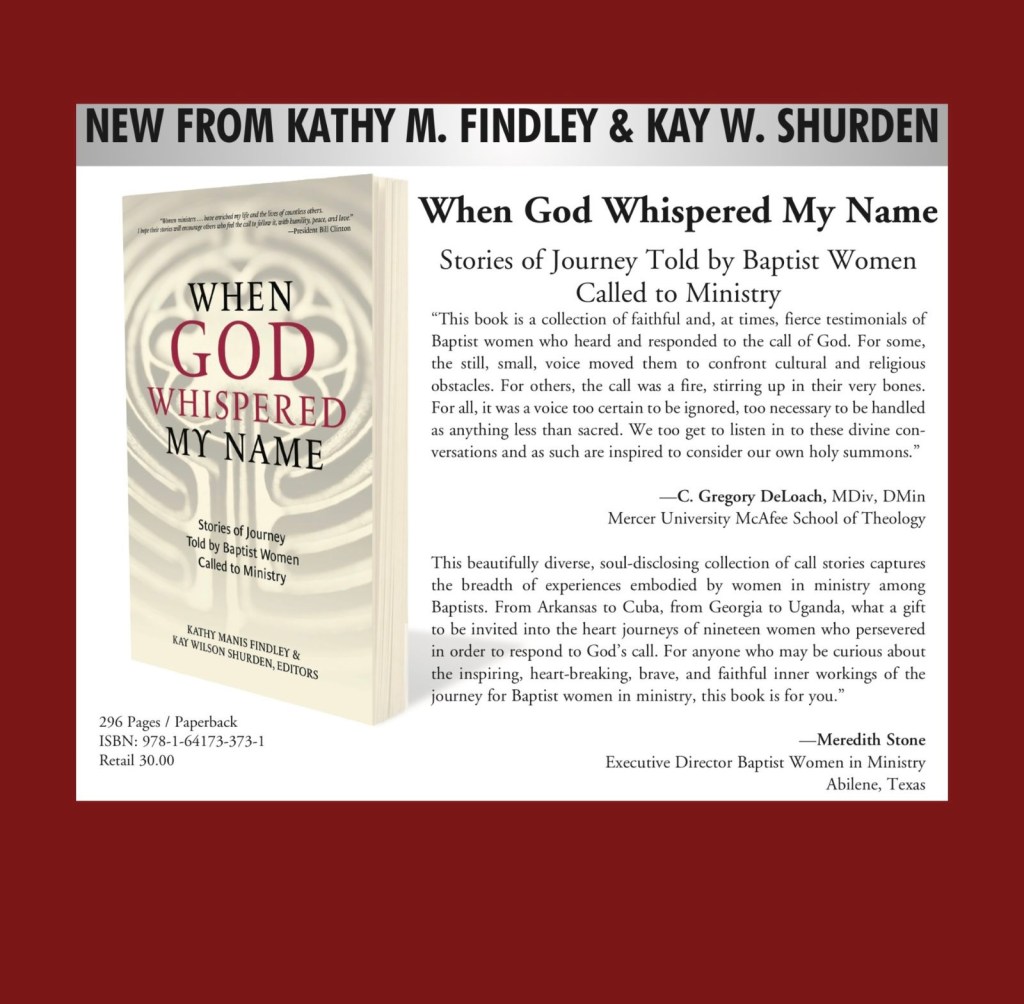
I confess that this is an unapologetic promotion of our newly released book . . .

When God Whispered My Name!

Stories of Journey Told by Baptist Women Called to Ministry

Rev. Kathy Manis Findley and Dr. Kay Wilson Shurden, Editors


Let me tell you why I recommend this book, unapologetically.

In its pages, you will find not only my story, but also the poignant stories of eighteen women who were called to ministry, only to face challenges and obstacles along the way. Simply because they are women! These are diverse women, each one unique, and their journeys follow winding paths, uncharted and serendipitous.


You will be mesmerized by these heartfelt stories about how nineteen ministers each heard a Holy Whisper calling her to a life of ministry and compassionate service to others. Get your copy today at these links:

Smyth & Helwys Publishing

Amazon

Barnes and Noble Bookstores

“There is power in a story well told, a sacredness that speaks to shared experiences, and draws us closer to God and to one another. When God Whispered My Name is full of such stories. Equal parts inspiring, sobering, and challenging, the stories of these women bear witness to the Good News that flourishes when one dares say yes to God’s call. This timely volume is sure to offer hope, encouragement, and community to women and men who are wrestling with that same mysterious call from God and those seeking to empower them.”

—Mandy McMichael
Associate Director and J. David Slover Assistant Professor of Ministry Guidance
Baylor University

For more information, visit the When God Whispered My Name website.

Faith, God's Faithfulness, Labyrinth, Spirituality

“This is the way. Walk in it.”

Art by Kalliope

If you know about labyrinths, you might get this. People often ask me what a labyrinth is or what it’s for. Truth is, you can’t fully understand a labyrinth by definition, nor by reading about it. You won’t get the significance of a labyrinth by what I write here, no matter how eloquent my writing may be. To know a labyrinth, you have to walk one, or trace the circuits of a finger labyrinth, or trace the path on a sand labyrinth and feel the sand under your fingers.

As a part of spiritual direction, many folk tell me that a labyrinth looks like a maze to them, and they fear they’ll get hopelessly lost, unable to make it out. That sounds a lot like life to me. Isn’t there always fear that we’ll get lost on this journey we call life? After we’ve made a few wrong turns in life, we are often fearful of living it. Afraid our wrong turns will end badly. Afraid we’ll get lost.

The truth of the labyrinth is that it is a clearly marked path that will lead you in—to the center—and then lead you out by the same path. Perhaps that’s why it has been called “the sacred path.”

If you know me or follow my blog, you already know that my life has been made up of many curves, turns, twists, dead ends and crossroads. At times, it has felt unnavigable, a dangerous and unpredictable journey. Yours has probably felt much the same. I have learned a few good lessons along the way, though, lessons that I hope will stick with me.

The one overarching lesson is that I can neither predict, nor control my path. The twists and turns will appear before me, and I will walk through them. The curves will seem treacherous at times, and I will lean into them hoping to stay firmly on the road. I will stop in my tracks at the dead ends and simply turn around and start over. The crossroads? Well, they have their own precariousness, danger. The crossroads demand a decision. The road I choose could make a world of difference, good or bad.

It’s enough to make life frightening! And it does. Life is frightening, especially for those of us who need to control our pathways. Here’s where the labyrinth offers me so much comfort. It is a pre-created path in and then out, and when I follow it’s path, I am reminded of one of the core beliefs of my faith: that God has laid out a path uniquely for me. Whether I follow it or not is another part of my faith. I get to make that decision.

When I walk a labyrinth or even trace its circular pathways with my finger, I am aware of a guiding hand, a Comforter beside me, and the peace of knowing the path was created for me. I feel Spirit winds and hear the holy voices of thousands of years of Wisdom whispering into my ear.

And when you turn to the right or when you turn to the left, your ears shall hear a word behind you, saying, “This is the way; walk in it.”

—Isaiah 30:21 (NRSVUE)

Amen.

Alone, “I Can See Clearly Now”, Darkness, Daybreak, Faith, God's love, God's presence, Hope, journey, Life Journeys, Life pathways, Light

Protection from Nothing

Sunrise at Collegeville Institute ~ Photography by Bryan Whitfield

God’s love protects us from nothing! Yet… sustains us in everything!

Jim Finley

I am intrigued by the words I read this morning in a community chat about God’s love. I’m not sure which part is more compelling to me: that ”God’s love protects us from nothing!” or that God’s love ”sustains us in everything.” The truth is I have experienced both in my life. I imagine you have as well. The circuitous journey we call life leads us through rocky paths, crises of every kind, dark and dense places that make us feel lost, daunting mountains to climb, roads we take that take us to dead ends, roads to nowhere.

God did not protect me from any of the real-life crises that came my way—abuse as a child, a serious eye disease in Africa, the loss of my youngest brother, the fire that almost destroyed our home, the kidney disease that almost killed me at least three times, the years of dialysis, the miraculous, but very hard, kidney transplant. I assume God kept watch over all of it, but God did not protect me from it. God did not spare me from the traumatic events that marked my life.

So I have to ask questions, honest questions, about how God’s love really affects my life. How do I experience God’s love? How do I sense it in my spirit? Do I really believe that God loves me, especially in my life’s dark times? Do I believe that God should spare me from every life danger?

In my experience, God’s love is elusive, intangible, difficult to hold onto. At times, I don’t sense it at all. At times there are no holy ”everlasting arms” holding me until my darkness turns to light. The only way I sense it at all is by faith, the faith that is ”the substance of all things hoped for, the evidence of things not seen.”
(Hebrews 11:1)

To understand this love thing fully, I think I have to read the rest of that chapter in Hebrews, where we find a litany of what important Bible people did by faith. You may remember the list: “By faith, Abel; By faith, Moses; By faith, Jacob: By faith, Sarah: By faith, Rahab . . .” Many more are listed, each having done some great thing by faith. This chapter, though, presses hard on the things that can happen to the faithful ones. Listen to this part:

Women received their dead by resurrection. Others were tortured, refusing to accept release, in order to obtain a better resurrection. Others suffered mocking and flogging, and even chains and imprisonment. They were stoned to death, they were sawn in two,[l] they were killed by the sword; they went about in skins of sheep and goats, destitute, persecuted, tormented—of whom the world was not worthy. They wandered in deserts and mountains, and in caves and holes in the ground. Yet all these, though they were commended for their faith, did not receive what was promised . . .

Oh, my! They did everything right. Their faith was commendable. Yet, they did not see the promise they expected, the great and good things that would come to them because they were faithful. In the end, did they hold on to their faith—without experiencing their reward? Without seeing God’s promise?

What do each of them—Moses, Abraham, Josua, Rahab and the rest— have to do with us? Was their faith like ours? Were their challenges and obstacles like ours? Did they feel void of God’s love like we sometimes feel? Without the promise the expected, did their faith still hold?

We can only speculate about all those questions. But we do not have to speculate about our own faith. We know it. We live with it—when it is strong and when it falters. Did our faith, and God’s love, protect me from every hurt and every harm? I have to answer, ”No.” Yet, the opposite statement—God sustains us in everything—has been real and true throughout my life, in sunshine and in shadow.

I have not known where I was going or where I would end up most of the time, but I kept walking even in my soul’s dark times. The journey has had its rough passages. The journey has most definitely lead me through the dark. Yet, I have also experienced the sunrise that always comes, day after day without fail. And as for God . . . well, God’s love has been present, covering me in the warmth of the love that would not let me go, not by sparing me every hard time, but by “sustaining me in everything.”

The beautiful sunrise image at the beginning of this post points me to the thought that God’s love is a little like the sunrise—a calming light, a gentle light, forever dependable. I have yet to experience even one day without a sunrise. The photo also graces me with the image of footsteps in the snow. Look at them. They are the footprints of someone walking alone, and in truth, we all walk our journeys alone. I imagine, though, that we also depend upon the invisible footprints of the God who leads us on the path.

If we see God’s holy footsteps at all, we see them by faith. That will always be true, that by faith, we ”see” the footsteps that go before us. Only by faith can we claim the ”evidence of things not seen.” So when all is said and done, I believe this to be true: God’s love protects us from nothing! Yet… sustains us in everything!

I believe it by faith.

I hope you can spend a few quiet moments listening to this beautiful choral arrangement. Pay close attention to the words. This is just one sentence among other words of assurance . . .
I walk in footsteps of God’s love.

I see His footsteps in the way,
And follow them through darkest night,
Unafraid, I stumble not,
In the glow of perfect light,
I see.

I walk in footsteps of His love,
And find His light leads on before,
Then He gently turns to me,
Softly whispers, “trust Me more,
I walk.

Then as I follow in His way,
My path ahead will brightly shine,
For in His path of guiding light,
I find His footsteps first,
Then mine.

Contemplation, Faith, Joy, Music, Singing, Theology

Where Is Our Joy?

Graphic by Kathy Manis Findleyo

After about five years of co-teaching my Sunday School class, known as the Voices Class, I have had an insight, a rather critical insight. Teaching this class, in particular, has been a gift for me and possibly for the other class members. We have bonded in important and meaningful ways. Most importantly, we “bear one another’s burdens” (Galatians 6:2) and most definitely, we weep with our sisters who have found themselves weeping along the journey. (Romans 12:15)

And what a journey it has been for our class. We began with a lovely Lenten study titled, “Praying with Your Pen,” which took us into the wonderful world of contemplative writing. Such a spiritual disciple leads into all manner of emotional and spiritual discovery, not all of which is positive. The study was emotionally and spiritually taxing at times, while being life-giving for us all.

We then studied a three-month series of biblical women who faced various hardships and later revisited that study for an additional seven weeks. As we followed the journeys of these biblical women, we found kindred spirits and grace for our own journeys. But the lives of the biblical women were harsh, harsh enough to bring up in us an examination of the harshness we have encountered. So this study was a difficult one as well.

Other Lenten and Advent studies through the years kept us in a contemplative, and often melancholy, space where we learned so much about ourselves, our faith and our relationship with God and with each other. We followed Christ Sophia for a while, as we considered the feminine nature of God, and as we followed her, we uncovered spiritual layers in us that have long been touched by Spirit Wisdom.

All of our studies along the way took us to tender places within, places where spiritual maturity occurs and faith deepens. A deepened faith, it seems, was especially important as we entered the pandemic that separated us from each other, at least physically. We adapted valiantly and immediately, and our class continued via virtual Zoom meetings. The meetings, that regularly lasted two hours or more, seemed to ensure our sanity as we navigated pandemic lifestyles that we certainly did not choose. Suddenly, the day to day living became harder, school more complicated, safety measures all-encompassing, family isolation straining. Figuring out this new way to live became draining beyond belief.

That, too, we navigated together, holding one another in the light, learning to find church in uncommon places and keeping each other gathered close, covered in the love each of us brought to our circle. Gathering close to each other was critically important as we lost friends, church members and close family members to this pandemic. Apart from the pandemic tragedies we watched, our class was brought low by other illness and deaths of persons close to us.

So a few weeks ago, my soul cried out, “Enough!” Then I asked myself, ”Where is our joy?” We’ve got the ‘weep with those who weep’ part, God. Can we just move on to the ‘rejoicing with those who rejoice’ part?”

Where is our joy? That’s the part of faith I cannot discern, because right now, it’s just too far away. Still, I asked myself the question.

And I answered myself immediately.
It’s in our hymns! Our joy is in our singing.


So the Voices Class started a new study titled,

Singing Theology: Hymns & the Formation of Faith
Our Worship, Hymnody and Theology

A delightful study it has been for us, as we explore how hymns express the theology of a particular Christian community or tradition. Searching deeply into one hymn each week, we have asked: how does the hymn’s theology shape and form our faith, our belief, our mission and our action? “As the church sings, so she believes,” writes Beth Bowers. We had discovered in this new study an informative, important—and fun—exploration of song!

Hymns We Have Studied Each Week . . .


Here is our joy, in the hymns we sing — in their rhythms and their melodies, their thoughts and words. Hymns express our faith, our longing, our petition, our awe, our need, our regret, our grief, our testimony, our theology, our conviction and the deepest joy of our hearts. May it always be so!

My life goes on in endless song
Above earth´s lamentations,
I hear the real, though far-off hymn
That hails a new creation.

Through all the tumult and the strife
I hear its music ringing,
It sounds an echo in my soul.
How can I keep from singing?

While though the tempest loudly roars,
I hear the truth, it liveth.
And though the darkness ’round me close,
Songs in the night it giveth.

No storm can shake my inmost calm,
While to that rock I´m clinging.
Since love is lord of heaven and earth
How can I keep from singing?

When tyrants tremble in their fear
And hear their death knell ringing,
When friends rejoice both far and near
How can I keep from singing?

In prison cell and dungeon vile
Our thoughts to them are winging,
When friends by shame are undefiled
How can I keep from singing?

Songwriters: Eithne Ni Bhraonain / Nicky Ryan / Roma Ryan

Aging, All Shall Be Well, Art, Faith, God's Faithfulness, Grace, Lastingness

Lastingness

Aging — the beauty of petals as they age


My cousins visited this weekend for the first time in months, a needed visit for all of us. We laughed and played and enjoyed one another. We talked a lot, too, into the wee hours. We talked about sweet memories, of course, remembering so many good and fun times. We talked about old boyfriends and childhood disagreements and family idiosyncrasies.

I think we talked most about aging and the physical and emotional changes it brings. We lamented it, of course, and wished it away. We cursed it just a bit, and tried in vain to find ways around it. In the end, we agreed that we can’t get around it, but just have to go through it. Right through the middle of it until the pathway ends.

Right smack dab in the middle of dialogue about age spots, edema, muscle pain and a plethora of bodily ills, we stopped, suddenly realizing that there must be more to the aging process than physical symptoms. Where is life’s meaning when we draw nearer to life’s end? How do we grow old held by the same grace that held us when we were children, young adults, middle aged?

I came across an intriguing word this morning in an NPR article. The word is Lastingness What an astounding word to ponder. Perhaps we should consider lastingness instead of aging. Various creative artists are the subjects of Nicholas Delbanco’s latest book, Lastingness: The Art of Old Age. Delbanco examines artists who either maintained or advanced their work past the age of 70 — from Claude Monet, to Giuseppe Verdi, to Georgia O’Keeffe. Because I am an artist, I was captivated by the idea of lastingness, especially when Delbanco told the story of Monet’s later years.

Delbanco writes that French impressionist Claude Monet — who painted well into his 80s, even after his vision was clouded by cataracts — created some of his most well-known works in the last decades of his life. After a long career as a renowned and financially successful artist, Monet retreated to the beloved gardens of his home in Giverny, 20 miles outside of Paris. His gardens became his artistic obsession. It was Monet’s failing eyesight that posed the greatest threat to his work. “He became more or less legally blind as we would describe it now,” Delbanco says. “So Monet compensated for, or focused on, the visible world in very different ways in his older age.” The works Monet created in his last years at Giverny are regarded as masterpieces.

In the last decades of his life, French impressionist painter Claude Monet focused much of his work on the water lilies in his garden at Giverny. He continued painting well into his 80s, even after his vision had been clouded by cataracts.

The Art Institute of Chicago

Monet’s exquisite impressionist paintings eventually ended because of his cataracts. The poet Lisel Mueller has captured Monet’s cataract story brilliantly, in “Monet Refuses the Operation.” As of 1919, the Monet was urged to have the cataracts attended to; in 1923 he had operations on his right eye, and glasses improved his eyesight — but only briefly, fitfully, and he had trouble distinguishing color. Mueller’s poem begins:

Doctor, you say there are no haloes
around the streetlights in Paris
and what I see is an aberration
caused by old age, an affliction.
I tell you it has taken me all my life
to arrive at the vision of gas lamps as angels,
to soften and blur and finally banish
the edges you regret I don’t see,
to learn that the line I called the horizon
does not exist and sky and water,
so long apart, are the same state of being . . .

I don’t know exactly what “lastingness” means, but I think it might mean seeing haloes glowing around street lights or the ”vision of gas lamps as angels.” I’m pretty sure it means learning to look at life as softened and blurred, banishing life’s sharp edges. Perhaps “lastingness” means that my writing or my art will have a lasting impact on the world. Maybe it means that I will pass on my wisdom to my grandchildren. Or that the child I helped recover from long-term sexual abuse will find happiness in her life. Perhaps “lastingness” means that my faith in God will carry me to the grace that is the end of life. That kind of “lastingness” brings a kind of peace to my aging, a grace that assures me that aging is much more than painful joints and aching muscles. “Lastingness” is holier than physical afflictions and I think it blurs and softens them until they are tolerable.

When I cannot find the right words, I can always count on Bishop Steven Charleston to write them.

I see more clearly, now that I am aging. Not with my eyesight, but with my soul. I see the fine detail of what I missed in younger years. I see the place of faith and forgiveness in my story. I see the possibilities of life in ways I never imagined. I was not blind in my youth, but my vision was limited to only a few seasons of seeing. Now I am an old man standing on a hill. I see more clearly. The universe stretches above me in infinite glory and the Earth spreads her shawl to wrap me in creation. Open the eyes of your spirit. Look out in wonder. See the fullness of the life you have received. See the promise of love walking in beauty before you.

Bishop Charleston’s words might just be the very best description of ”lastingness.” Maybe “lastingness” means that because I am aging, I now see not only with my eyesight, but with my soul. Maybe it means that now I can clearly see the fullness of the life I have received and the promise of lasting grace holding me close.


Even to your old age I will be the same,
And even to your graying years I will bear you!
I have done it, and I will carry you;
And I will bear you and I will deliver you.

— Isaiah 46:4 —

Covid-19, Disconsolate, discouragement, Faith, Holy Spirit, Hope, Isolation, Social distancing, Spirit, Spirit wind

Just Gray!

5A2EB8AE-EAB9-4CD6-9915-CBFC3BBE670F
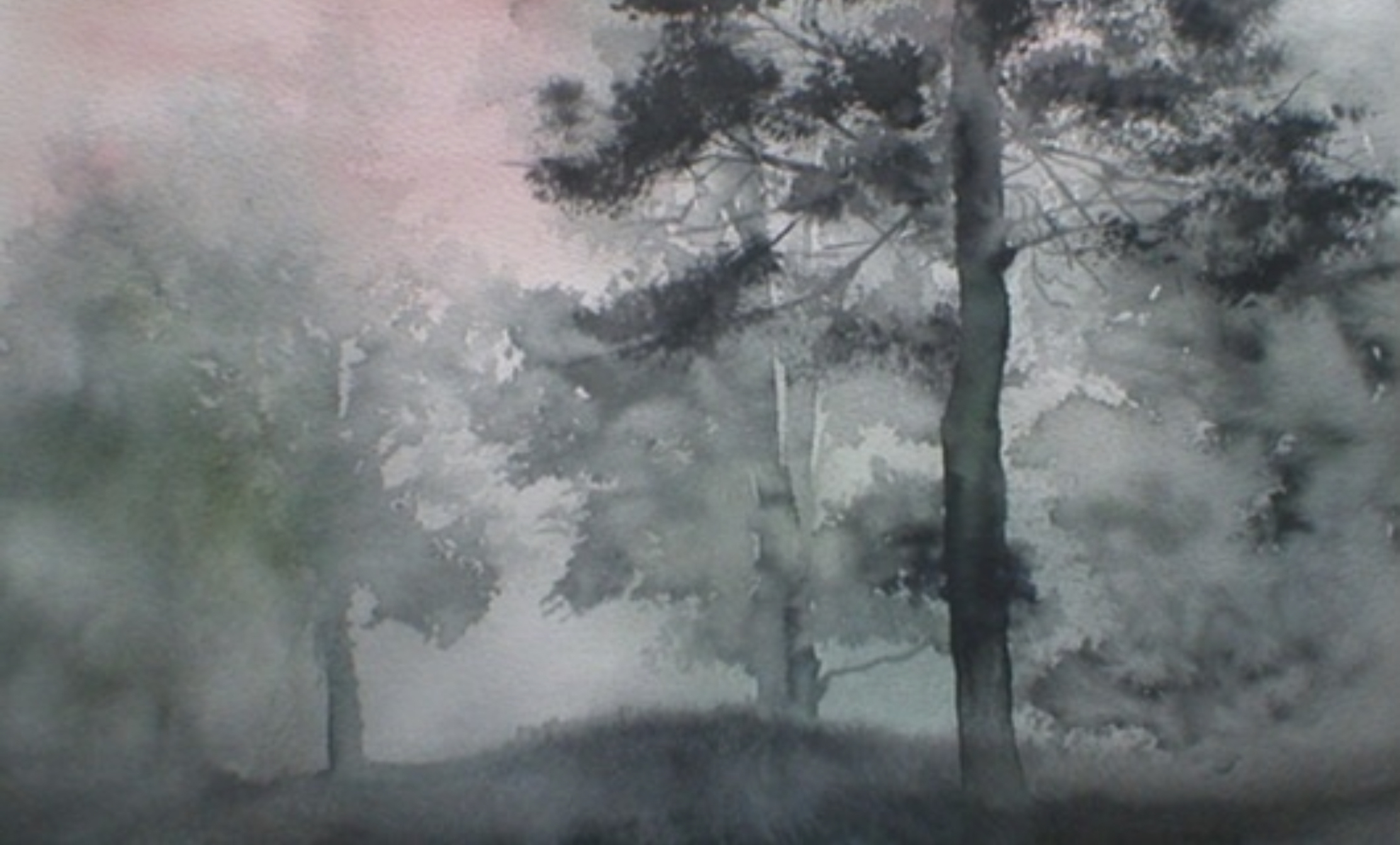
“Grays” A watercolor painting by Kathy Manis Findley
https://kalliopeswatercolors.com/

Sometimes some things don’t work! Like today as I am trying to insert the image for this post. It’s a watercolor painting I did a couple of years ago titled “Grays.” I don’t remember what was gray about that day or why I felt surrounded by gray, but I know that something was troubling about the day.

Like today! No, it’s definitely not gray outdoors. No gray skies above while the sun is shining brightly. Yet, I feel the “gray” closing in on me today, and for the past few days. News of the world’s hurt certainly has something to do about it. I can’t bear to hear of the spike in Covid cases, the danger of the Delta variant, exhausted health care providers gasping for relief, maltreated children at the overcrowded migrant center in Fort Bliss, Texas. I can hardly bear to hear another report about my friend who is very ill or about another friend I spoke to this morning who lost two love ones this week.

It feels gray in me right now. I think the gray feeling has a lot to do with the chat I had with my nephrologist at Mayo Clinic this week. He was beyond concerned about our current pandemic situation for his transplant patients. Of course, I am one of those patients. He was adamant that we immunosuppressed patients must begin isolating again immediately.

So again, the outlook for me is bleak. Not only am I one of his patients who are on high doses of immunosuppressant medications, but also I am one of the people for whom vaccines are not very effective. So while the general vaccinated public is around 90% protected from the virus, we are 50% (or less) protected. My doctor ordered an antibody test and, sure enough, it revealed that I have zero antibodies, which means I am not protected from Covid and that I can infect others.

I think that means retreating again from public gatherings — from stores, from groups of friends, from medical offices, from church. The time I was so looking forward to — seeing my grandchildren — is now a more distant possibility. All of that looks pretty darn gray to me!

I know in the depths of my soul that there are no simple answers for the gray times, the times when I am disconsolate and despondent. I know that I cannot change every adverse circumstance of my life. I know, too, that we cannot always change our soul’s response to those difficult circumstances. Sometimes, the “gray” of despondency simply has its way in me, and I cannot pull myself up and out. Sometimes I feel as if I am in a desert wilderness, and although streams of water may be there, I do not find them.

In such times, I have found that my ability to hold on to my very self comes directly from the Spirit, who is my sure and certain comforter. And I have learned that, while Holy Scripture and contemplative space do not always mysteriously rescue me or magically change my circumstance, I receive the peace and strength I need to live.

Jesus said to them:
“I must leave you, but I will ask God,
and our Mother snd Father God will give you another Comforter.
This Comforter will stay with you forever. 
She is the Spirit, who reveals all that is true and real about God. . . .
So when I go, you will not be left all alone . . .
I leave my peace with you. I give my peace to you.
So do not let your hearts be troubled. And do not be afraid.”

John 14:1, 16-18, 27 (my translation)


My flesh and my heart may fail,
    but God is the strength of my heart
and my portion forever.

Psalm 73:26


May you find that Spirit wind is moving gently within your spirit, and may God be the strength of your heart forever. Amen

A way in the wilderness, Aging, anxiety, Change, Depression, Disconsolate, Faith, Former things, Isaiah 43:18-19, New Things, Rivers in the desert, sadness, Sorrow, The past

“I AM ABOUT TO DO A NEW THING!” – god

“A New Thing” ~ Watercolor by Kalliope Manis Findley, July 2021

For Jennifer


It’s part of human nature to sometimes want to hold on to the past, cling to the “good old days” and resist the change that moves us forward. Especially when days past were very, very good and prospects for the future are less good!

I, for one, find myself clinging to the past with all my might, looking at my past life as a full and exciting one and viewing my present as being a bit of an empty wilderness. I chalk it up to aging and retirement, but this sense of emptiness, sadness, is really more than that. I think it’s more about my ability to accept myself for who I am, who I will become in the future and, most of all, what I truly need in order to be at peace with myself and my world.

Our worlds change all the time, and change brings with it the question all of us must answer: Who are you in relation to this world you are now in? If before retirement I was a nonprofit executive and an advocate for victims of violence and abuse, who am I in retirement? When I no longer have to adapt to the leadership roles I used to be a part of, what “self” might I discover in these days of new things? When I no longer have to adapt to the role of pastor, what “self” might I find myself to be when there is no congregation to care for?

According to Isaiah, my go-to Prophet, God advises us not to remember “the former things” or “the things of old.” Instead God apparently makes a provocative statement and asks an even more provocative question:

I am about to do a new thing;
now it springs forth.

Do you not perceive it?

Isaiah 43:18 NRSV

I definitely had not perceived it, that new thing! In fact, I have been languishing about losing my “former things” for the last six years, not able to make the most of my present and certainly unable to envision a bright future. It might surprise even those who know me best how deeply disconsolate I have felt at times. Six years of languishing is not a good way to live. I made a gallant effort to make the best of it, but these six years took a toll on me in most every way — physically, emotionally and spiritually. My closest friends have ridden out this storm with me, so they know what I’ve been dealing with in clinging so closely to my good past and not being able to live into a good present.

And what is this “new thing” that God speaks of? What does the way through the wilderness take me and where are the winding, refreshing rivers in the desert?

– KMF

Two weeks ago, one of those close friends gave me a passage of scripture printed on a piece of paper. I received it in quite a serendipitous way. Neither of us chose the passage (Isaiah 43:18-19). It ended up with me in a very random manner. But as it spoke of former things, old things and new things, it got my attention so completely that I pondered it several times a day for a week or so. I didn’t obsess over it or look up its context or attempt to exegete it. I simply pondered it in my heart in the quiet times.

This scripture is truly a lovely God-promise, filled with a gentle, healing grace. I appreciated it for that. I also appreciated it because its words gave me the gift of sacred pause. And in the sacred pauses it gave me, I realized that the crux of this matter is not not how I react to change or how I survive it. What I discovered is that this is not about what I can do or should do when my world changes. It’s about who I am when my world changes.

With that in mind, maybe every time my world changes, I will still be the person of deep faith that I have always been. Maybe I will greet “the new things” with gratefulness, knowing that God has made before me a way in the wilderness and has provided cool, rolling rivers in the desert. And even when my soul longs for days gone by, perhaps I will know that I will see God’s light on the path ahead of me, even in the dark, even through the wilderness, even as I feel the inevitable sorrow of letting go of all the former things I so deeply cherished. Even then, I will know that I do not walk alone.

Thanks be to God.

“You Do Not Walk Alone” Traditional Irish blessing. Original music by Elaine Hagenberg http://www.elainehagenberg.com
Comfort, Faith, Hope, Preaching, Whispers of God

Whispers of God

Word cloud by Kathy Manis Findley

Then afterward I will pour out my spirit on all flesh;
your sons and your daughters shall prophesy,
your old men shall dream dreams,
and your young men shall see visions.

Joel 2:28 NRSV

Because I am an ordained Baptist minister, I followed a path that made hearing the whispers of God necessary. I heard God whisper to me on many a dark day. So I am fairly certain about it when I do hear the whisper of God. Only that kind of holy whisper could cause one to face off about ordination with a patriarchal system. But truth be told, I did accept that face-off almost forty years ago. And I persisted through a long season of unkind challenges and lengthy treatises about all the reasons a woman could not be ordained.

In the end, I was ordained. I am deeply grateful to have experienced a rich and varied ministry through those years, including serving as pastor of two churches. I preached every Sunday, real sermons. You might say — borrowing the words of the prophet Joel — that I “prophesied.”

Oh, my!
God whispered. I followed. It’s just that simple.

The truth is that throughout my life, I have heard the whispers of God many times. God’s whispers were just for my hearing, sometimes to comfort me, sometimes to gently correct my steps, sometimes to encourage me, sometimes to lift my spirits, sometimes to show me a vision and sometimes to call me to a mission, like prophesying or preaching.

I have learned a very important life lesson: that when I am grieving, confused, sorrowful, hurt, betrayed, beaten down . . . God’s whispers give me hope. When I am disheartened, God’s whispers touch me with healing. When mourning has stolen my songs, God’s whispers move me to sing again.

I am reminded of the inspiring words of Rev. Dr. Prathia Laura Ann Hall (1940-2002), an undersung leader in both the civil rights movement, womanist thought, social justice and African American theology. These are her words:

Out there in the brush arbors, the wilderness, and the woods, the God of our ancestors, the God we had known on the other side of the waters met us and whispered words in our ears, and stirred a song in our souls . . . 

– Prathia Hall, Quoted by Courtney Pace in Freedom Faith: The Womanist Vision of Prathia Hall

Right now, I am in “the wilderness and the woods.” In other words, I am in a shaky place. I need that quiet, familiar, sacred sound of God whispering in my ear. I wonder if maybe you, too, need to hear that sacred whisper that can make all the difference. Wherever you are, however you feel, in whatever place you are in your life, in whatever way you experience God, I pray that you will listen closely for the holy whispers you need to hear.

Aging, anxiety, Awareness, Beauty of Nature, Bishop Steven Charleston, Change, Faith, Forest, Grace, life, Life Journeys, Living Hope, Pondering, Spirit

Pondering a Soul in Transit

“A soul in transit.” What does that phrase even mean? It sounds a bit ominous to me, like something bad couched in flowery language. Maybe like words of a poem that make little sense because they point to something otherworldly. Perhaps it means something related to a soul that lives, gets old, and dies — in transit from birth to death and beyond. Pondering!

I’m not up for those thoughts right now, because I am in the troubling place of feeling old sometimes. It’s something like aging anxiety, I think. Feeling old should not be so surprising to me since I really am kind of old. But sometimes I feel old in a bad way, the way that sends negative thoughts through my mind. Thoughts like . . .

I can’t do much anymore,
I don’t feel well most of the time,
my joints hurt,
or even, I may die soon.

It is not helpful for my soul to entertain such thoughts, even though some of them are downright truth. Pondering! You have probably heard that “getting old is not for sissies.” It holds some truth, I imagine, for those of us who have come face to face with normal aging, aging that feels not so normal at all. But what about the great juxtaposition? What about the positive exercise that puts thoughts side by side so that we can see what is life-giving instead of what is troubling? For instance . . .

I am old. — I am wise.

I feel weak. — My spirit is strong and still vibrant.

My back aches when I exert myself. — I can still move.

So much for pondering juxtaposed thoughts. They may not be all that helpful, although re-imagining so that we recognize what is spirited and sparkling about ourselves can be very helpful. Still my words on this subject are pretty empty. I think I need assurance from someone else’s words, and I can’t help but turn to a very wise and insightful spiritual guide, Bishop Steven Charleston, whose thoughts are captivating, enlightening and filled with wisdom. And on top of that, the wise bishop is the one who offered up the phrase, “a soul in transit” in the first place.

We will not grow old, not in spirit. In mind and body, yes, we will age as all things age, all making the pilgrimage through time to find the place of sources. But in our spirit, no, we will not grow old. The child that was us will run forever through the fields. The dreams we spun from the fine wool of cloud watching will forever lead us to the next wonder that awaits us. The love we knew, so quiet, so life giving, will always be there to lift us up and hold us close. The spirit of life is eternal. It does not diminish. It does not forget. It does not alter. The spirit within us is the sum total of our sacred experience. It is what we were sent here to be and to do. Our spirit, a soul in transit, has a life outside of time. It will not grow old because it is on loan from a source more ancient than time itself.

Bishop Steven Charleston

Still pondering! I see more clearly that the “soul in transit” has “a life outside of time.” Eternal! That is what our faith has taught us for generations, for ages, always. But it is a truth that we can barely fathom, much less find comfort in. It’s not so easy to accept a truth that ultimately represents death, even if it includes that timeless and stunning place that is called eternity. The introductory words of 1 Peter give us a most glorious glimpse of eternity, a living hope.

May grace and peace be yours in abundance. Blessed be the God and Father of our Lord Jesus Christ! By his great mercy he has given us a new birth into a living hope through the resurrection of Jesus Christ from the dead, and into an inheritance that is imperishable, undefiled, and unfading, kept in heaven for you, who are being protected by the power of God through faith for a salvation ready to be revealed in the last time.

— 1 Peter 1: 2-5 NRSV


Pondering still as I ask, “what does it all mean for me, the words, the images?” I feel much like the Psalmist who said, “my eyes are not raised too high; I do not occupy myself with things too great and too marvelous for me.” (Psalm 131:1) And yet, I do search and struggle with the thought of aging, of what it means for me and of what comes next. I hear the words:

“. . . in our spirit, no, we will not grow old. The child that was us will run forever through the fields. The dreams we spun from the fine wool of cloud watching will forever lead us to the next wonder that awaits us. The love we knew, so quiet, so life giving, will always be there to lift us up and hold us close. The spirit of life is eternal. It does not diminish. It does not forget. It does not alter. The spirit within us is the sum total of our sacred experience.”

I hear the words, and the spirit of me understands, even if my mind does not. When I write, I ponder deeply. In my pondering this day, I am compelled to admit that I definitely feel the sting of aging. I am very human, after all! But I can usually move from anxiety to a good kind of awareness. That good awareness shows me that it is comforting to hold on tightly to the thought that the spirit is eternal, that my spirit is eternal. Dwelling on aging isolates me, but knowing in my heart that my spirit is eternal is a grace-gift that sets me free to really live.

I know from experience that pondering can be hurtful, leading me through all kinds of unpleasant scenarios. But sacred pondering, the kind that allows one’s faith to sit with a problem until it seems acceptable, can open the mind and heart to the eternal and empower us to see the plans for good that God has for us, “a future and a hope.” (Jeremiah 29:11)

So, after a time of sacred pondering, I am blessed with a fresh awareness. I can see more clearly God’s truth that my spirit will remain with my grandchildren, always. My spirit will hold on to the sweet love I have known. My spirit will immerse itself in the beauty of nature that has always been present. My spirit will run through the fields like a young person, and through the forests, it will love the trees I have always loved.

My body will do what bodies do, but my spirit will not die and will not grow old!

Thanks be to God. Amen.

A new commandment, Anger, Christian Witness, Christianity, Committment, Community, Compassion, Faith, Gun violence, Hemmed in, Here I am, Lord., Jesus, Jesus Follower, Justice, Life pathways, Magnolia Court Motel

The Car at Magnolia Court

Magnolia Court Motel, Macon Georgia

In my normal outings, I frequently ride with my husband past the Magnolia Court Motel. It’s the one with a gas station in its courtyard where a pool used to be back in the 50s. It’s not a place you would want to stay on your vacation. In fact, I doubt anyone goes there for a vacation. Still, it’s always at capacity, because people live there. It’s not in the safest part of town. Magnolia Court itself is not safe. I know that because TV news frequently reports that homicides happen there.

For the past five years, I have seen a dingy, old, light brown car in front of the last unit of Magnolia Court, closest to the street. The same brown car, day or night, is in its parking space. I don’t think the car ever moves and I have wondered if it needs repairs. I assumed that the owner of the brown car didn’t have a job, because the car never moved. I hoped, though, that the owner of the brown car worked an 11 to 7 shift somewhere. I wouldn’t have known that, because I would never go past Magnolia Court at that time of night. Not in that neighborhood!

For five years, I never once mentioned that car to my husband. For five years, I silently looked at the dingy brown car and wondered who was in the motel room. Who was he or she? I always thought it would be a male, so let’s go with that. Why is he living there? Does he have a job? Is he young or old? Does he need food? Is he ill or disabled? Does he have friends or family? What does his room look like? Is it decent or dirty? How does he feel about his life? Does he know about Jesus and God? Is he okay?

My next thought was, “I would never go up to his door at Magnolia Court, knock on it and ask him if he’s okay or if he needs anything or if he knows about Jesus.” Just as quickly, my thoughts switch from the man (or woman) with the dingy brown car at the Magnolia Court to these hard questions . . . What could I do, as a Christian, to see if this man needed help? How could I help? What would I do? And what do the answers to those questions say about my faith?

I don’t know, of course, but I imagine that in a similar situation, Jesus might have gone straight to the inn and checked on the people. Finding out how they were doing might have led him to heal one, encourage another, give another a basket of food or do all the blessing-kind-of-things Jesus always did.

Last week, we drove by Magnolia Court. The dingy brown car was not parked in its place. I looked around the Court to see if he had changed rooms, but the car was not there. I felt my heart quicken and my mind rushing through scenarios of what might have happened to the man in the end room of Magnolia Court. I was sad. Guilty. After about ten minutes, I managed to move on with my day and not think too much about the man.

Today, we again passed by Magnolia Court, twice! The car was gone. The man was probably gone too. I never saw him. I never checked on him. Why would I? Who would do that sort of thing in the violent, unsafe world we live in?

I don’t want to be trite about things like faith, but honestly, I really did wonder “What would Jesus do?”

“WWJD” might be an old, overused, trendy slogan, but for me this is just being concerned about a man I never saw.


I don’t have any idea what Jesus would do, but I suspect he may have done lots of things, including something similar to what he did with the tables of the money changers. You see, turning over those tables was about doing what is just and right. Jesus might have turned over some tables or lamps or nasty mattresses at Magnolia Court Motel, because it is a place of violence, drugs, and all manner of things that harm people.

I felt my heart quicken and my mind rushing through scenarios of what might have happened to the man in the end room of Magnolia Court. I was sad. Guilty.

Kathy Manis Findley

I have to wonder now, probably will always wonder, what became of the car at Magnolia Court and, more importantly, what became of the man who lived in a room at Magnolia Court Motel. As far as I can tell, he never left his room until the day he left. My thoughts of him over five years of trying to eavesdrop on his life yielded nothing for him. For me, it became an examination of just exactly what kind of faith I have and in what ways am I willing to go out into a world of need where God’s people live in shadows like Magnolia Court. It became a self-examination that prompted me to ask myself, “What do you intend to actually do when you proclaim yourself as a Jesus follower?”

So this is not a morality tale to urge you to examine your faith. It is for me. I am the one who needs to examine my faith, to ask what Jesus would do and then to admit what I will or won’t do. As for the old, dingy, brown car and the man who owns it . . . well, I did do one thing that Jesus would do. I blessed the man I never knew, whispering under my breath as we passed by this morning, “May God go with you and give you peace.”


This is one of my favorite Christian songs. It brings me to tears every time I hear it, especially on the day of my ordination in 1992. As the words were sung that day in a duet by my husband and best friend, my heart sang, “Here I am, Lord.”

Aging, anxiety, Confusion, Despair, discouragement, Faith, Fear, Feelings, God's Faithfulness, God’s promises, Grace, healing, Hope, Isolation, Loneliness, Loss, Music, Prayer, Psalms, Singing, Sorrow, Soul, struggle, Tears, Worry

When Branches Are Flimsy and Songs Cannot Be Sung

I have a certain fondness for sparrows and the spiritual stories we have ascribed to them. That my blog is named “God of the Sparrow” is no accident. I have aspired many times in my life to live like the sparrow lives. I wanted my human, adult, mature and seasoned self to know, beyond any doubt, that God is watching over me. I do not live the simple, sparrow-like life I always hoped to live. But my unshakable faith has always told me that the God who watches over my every moment is also the God of the sparrow. I remember well the words written in the Gospel of Matthew . . .

So do not be afraid; you are of more value than many sparrows. 
— Matthew 10:41 NRSV

Such a comforting passage of Scripture! Yet, its message to us often pales in comparison to all the things that so frighten us. The state of the world that surrounds us in these days seems to have even more power over us than Matthew’s words about our value to God.

How is it that we are valuable to God when God does not act to protect us from all of life’s slings and arrows? Yesterday in my blog post I listed our world’s bad and scary things, so I won’t list them again today. But I will venture a prognosis that many, many people are suffering in many ways in this confusing season. I am one of those suffering people, feeling a bit of hopelessness in these days of racial unrest, coronavirus unsettledness and political divisions.

I heard a moving choral performance this morning. Its text lifted up my helplessness before me and turned it into a prayer so attuned to where I find myself.

God of the sparrow, sing through us
Songs of deliverance, songs of peace. 
Helpless we seek You, God our joy, 
Quiet our troubles, bid them cease. 

Jonathan Cook

I need the sparrow’s God to sing through me. Perhaps you do, too. I need that God-given song because my own music seems to have become quiet, my singing turned to mourning. (Amos 8:10) But this week, I took hold of that mourning. With strong intention, I spent most of one day this week singing my heart out. 

You need to know that I had to choose a day when my husband would be away so that I could sing loud, with abandon. Why did he have to be away? That’s a long story, but in a nutshell, my singing is awful these days. Probably my vocal cords have lost some of their youthful elasticity and, on top of that, I did not sing at all for more than a year. Serious illness took my music.

When I (literally) came back from the dead in 2015, I realized that I had lost so many of my former abilities. Singing was one of them. It felt strange to me when I realized I could no longer sing. My former life was filled with song. Since childhood, there was never a choir I did not join, never a solo I did not sing.

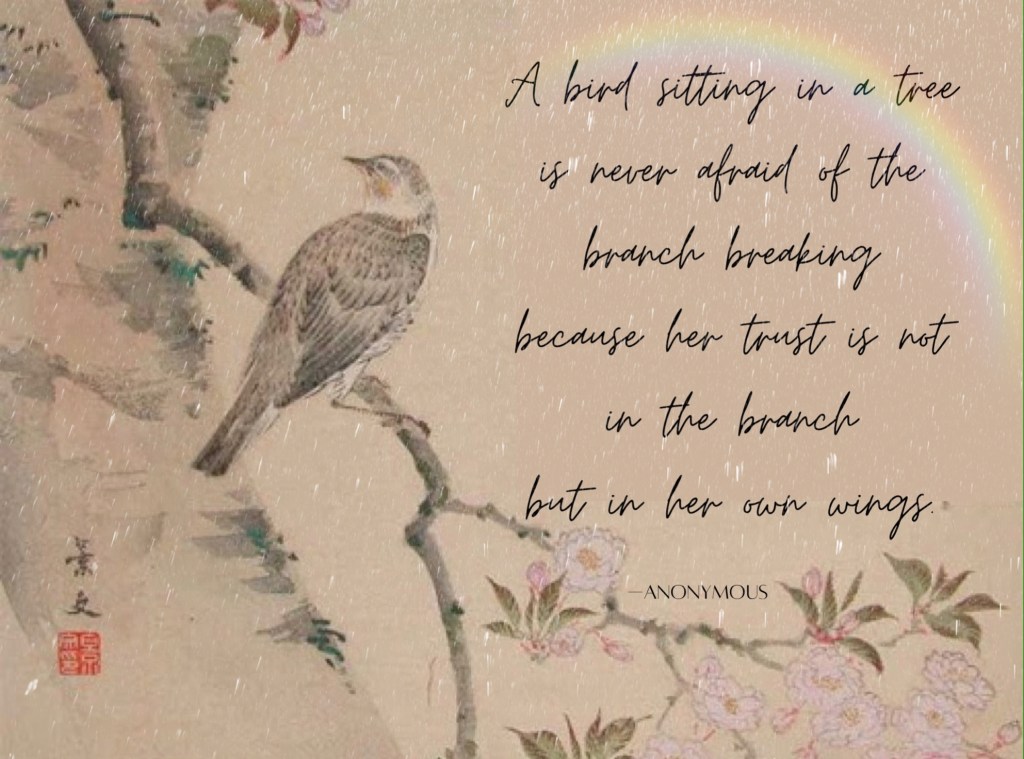
Acknowledging my inability to sing was difficult, just as my life after kidney transplant and this coronavirus is difficult. My isolation has been lengthy, most of nine months, and it is taking its toll on my spirit. Prayer has become both a burden and a grace to me. My singing was my prayer for so many years, and I really need my singing in these hard days. I need to sing my praises to God. I need to sing my lamentations. I need to sing like the sparrow who doesn’t worry about her vocal chords. I need to be like the sparrow who sits on her branch — without fear, without worry — because she knows that if she happens to light on a flimsy branch that does not hold her, her wings will lift her. 

The end of this story is that I need the God of the sparrow to sing through me once again — to sing through me in shadowy days, in times of trouble, in isolation, in fear, in hopelessness. That’s what God does, after all. In a troubled and despairing soul, God creates music, tucking it into every crevice, filling it with songs that can sing out both mourning and celebration. As an added bonus, I have it on good authority that God also turns mourning into dancing.

You have turned my mourning into dancing;
you have taken off my sackcloth
so that my soul may praise you and not be silent.
O Lord my God, I will give thanks to you forever.

Psalm 30 11-12 NRSV

So as you sing, dance to the new rhythms of your soul! Because you can!

Thanks be to God.

Please spend your meditation time today listening to this beautiful song with text written by Jonathan Cook and music by Craig Courtney. The video follows the text.

God of the Sparrow

God of the sparrow, sing through us,
Songs of deliverance, songs of peace.
Helpless we seek You, God our joy,
Quiet our troubles, bid them cease.
Alleluia.

God of the sparrow, God of hope,
Tenderly guide us, be our song,
God of affliction, pain and hurt,
Comfort Your children, make us strong.
Alleluia, alleluia, alleluia.

God of the sparrow, care for us.
Speak in our sorrow, Lord of grief.
Sing us Your music, lift our hearts,
Pour out Your mercy, send relief.

God, like the sparrow, we abide
In Your protection, love and grace.
Just as the sparrow in Your care,

May Your love keep us all our days.

Amen.

Contemplation, Creation, Faith, Meditation, Night sky, Quietude, Sacred Pauses, Sacred Space, Supermoon, Uncategorized

Supermoons and Sacred Pauses

F1BC2288-D107-4584-AE59-9D319BA1F8E9

What’s all this about supermoons and sacred pauses?

You might legitimately ask that question!

Well, this stream of thought began for me when astrological experts said that the Super Pink Moon that appeared on April 7th would be the “most super” of all supermoons this year. They also said that the moon would not be pink at all.

Before you get your hopes up, this “Super Pink Moon” won’t actually look “super pink”—or any hue of pink, really. The Moon will be its usual golden color near the horizon and fade to a bright white as it glides overhead.

— The Old Farmer’s Almanac (https://www.almanac.com/content/full-moon-april)

That information did not please me at all. I had really looked forward to seeing a pink moon. The Farmer’s Almanac — always a reliable source of information since its founding in 1792 — described what the April 7th moon would look like.

It is not to be missed — The Super Pink Moon: The Biggest and Brightest Supermoon of the Year! April’s full Moon will be closer to Earth than any other supermoon in the series. It will be the biggest and brightest full Moon of 2020! How big and how bright, exactly? On average, supermoons are about 7% bigger and about 15% brighter than a typical full Moon.

There you have it, from every farmer’s most tried and tested source on all things earth! But in addition to the disappointment that this supermoon would not be pink in any way, the most devastating disappointment of all was that on April 7, 2020, Macon, Georgia was completely overcast! For all gazing intentions, there was no moon at all that night, not a pink moon and not even a white one. Like other Middle Georgia folk, I missed the whole thing, the entire phenomenally astounding sight!

Other people in other places saw it, though, in all its splendor. They took pictures, some of which looked like a round, dull white ball in the sky. But others — including NASA of course — posted pictures of a brilliant, unforgettable moon. And one person took a stunning picture of this supermoon that was brilliant white and surrounded by an ethereal pink ring! And they said it would definitely not be pink!

The pink-ringed moon picture made me very happy! It was the emotional boost I needed in a time of pandemic isolation. In the midst of such a troubling and fear-filled time when all over the earth, a supervirus was touching people with upheaval, sickness and death, it was a very opportune time for an uplifting supermoon. Still, I wonder why it even mattered to me or anyone else. After all, moons rise and fall every single day. Even supermoons rise on a predictable astrological schedule.

So maybe my lesson here is acknowledging that I seldom go out at night just to gaze at the moon. When I notice a moon in passing, it’s as if I’m thinking, “So what! It’s just another moon!” And yet, the moon might be in the night sky just to remind me that the moon is the Creator’s metaphor for something that is everlasting, permanent and yet changing. I actually do look to the sky once in a while and see a new sliver of a moon on a cloudless night or a full moon glowing brightly enough to light my path. Ever so often, I’m thrilled by the discovery, as though I were seeing it for the first time.

Instead of ignoring a moon that appears most every night, perhaps moon gazing can be a spiritual moment that helps me know that at least something in my life is everlasting, that the promises of God are ever near, that my faith can light my path, that, as the Psalmist writes, the moon is eternal, a “faithful witness in the sky!”

It will be as eternal as the moon,
    my faithful witness in the sky!

— Psalm 89:37 NLT

Moon gazing can also be my time of spiritual comfort as I recall the words of the prophet Isaiah, who speaks of the rising of the sun and the moon as a part of binding up those who are injured and healing the wounds of God’s people.

Moreover the light of the moon will be like the light of the sun, and the light of the sun will be sevenfold, like the light of seven days, on the day when the Lord binds up the injuries of his people, and heals the wounds inflicted by his blow.

— Isaiah 30:26 NRSV

At the end of the day, we can know this: gazing at the moon can remind us of the magnificent smallness of humanity and the overwhelming magnificence of God. The Psalmist invites us to marvel at how we dearly we are prized by God in a Psalm that lifts up both Divine majesty and human dignity, unequivocally declaring that God cares for me, and that God cares for you.

O Lord, our Sovereign,
how majestic is your name in all the earth!
You have set your glory above the heavens . . .

When I look at your heavens, the work of your fingers,
the moon and the stars that you have established;
what are human beings that you are mindful of them,
mortals that you care for them?

Yet you have made them a little lower than God,
and crowned them with glory and honor.

You have given them dominion over the works of your hands;
you have put all things under their feet,

all sheep and oxen,
and also the beasts of the field,

the birds of the air, and the fish of the sea,
whatever passes along the paths of the seas.

O Lord, our Sovereign,
how majestic is your name in all the earth!

— Psalm 8:1, 3-9 NRSV

The last word in my story On this day is that the moon, the sun, the stars — all created things — are not merely created, they are God-created, and God’s creation may very well be worth a few extra moments of gazing into night’s quiet pauses — praying and praising, reflecting and listening. Listening for the voice of God. Listening for the sigh of the soul!

I love the photo of that moon surrounded by a pink circle of reflected light, because it was for me a divine and holy light. I know that it was divine and holy, because it abruptly stopped me. Just a picture it was, not the real moon that I might have seen in my night sky. Yet, it took on the power of my faith that has always assured me that God can be found in all things, simple or sacred, ordinary or holy.

My faith has taught me that, more times than not, a very ordinary thing — an ordinary act or an ordinary moment — can suddenly and surprisingly become holy. Just that one ethereal moon captured in a commonplace photograph silenced me, calmed me, reached into my soul and divinely interrupted me for a much needed sacred pause.

Maybe that’s the meaning of the words we often say about a picture being worth a thousand words. As for me, I will just say thanks be to God for beckoning me to night’s quiet pauses, sacred pauses that I needed so deeply.


Activism, Ahmaud Arbery, Christian Witness, Community activism, Conflict, Courage, Death, Faith, Freedom, Injustice, Nonviolence, Social justice, struggle, Urgency, Violence, Wendell Griffen, White supremacy, wind

The Whirlwind Is Here


3BDCF281-2B6E-45CE-88C8-BE5FE50667AA
Moon Over Harlem, William H. johnson, 1943-1944. © Washington, DC,                           Smithsonian American Art Museum

I share this blog post today in memory of Ahmaud Arbery, who was killed in the state of Georgia, the state in which I live in full and free safety. Ahmaud Arbery did not know such safety. But today we say his name and honor his memory. There are so many names we could speak today: Tamir Rice, Trayvon Martin, George Floyd. Breonna Taylor and hundreds more, even thousands. What can black parents possibly tell their kids now about staying safe? I also honor the parents who try to find the right words, the right admonitions to say to their children. Most of all, I honor the strong and powerful voices who continually cry out: “Justice!” My friend and pastor, Wendell Griffen, is one who cries “justice” with a particular eloquence.

Wendell Griffen is a pastor, state court trial judge, and social justice activist in Little Rock, Arkansas who lectures and writes about social justice. I am pleased to share with you his most recent article. He will call you out. He will speak plainly to those of us who are white. He will call you to act against injustice, drawing your courage from God, who whose children are deeply loved — all of them!


For they sow the wind, and they shall reap the whirlwind.
Hosea 8:7 (NRSV)

Have you viewed the ten minute and twelve second video of the May 25, 2020 killing of George Floyd by former members of the Minneapolis Police Department?

Why haven’t you? What are you afraid you will see? What are you unwilling to see? What are you unwilling to admit?

Have the four now former members of the Minneapolis Police Department responsible for killing George Floyd in broad daylight before onlookers who also videotaped their conduct been arrested on suspicion of committing a homicide (causing the death of another person) of George Floyd?

Why haven’t they been arrested? Why have they not been held in custody and required to post bond? Who decided they should not be arrested? What message was sent when they were not arrested?

The killing of George Floyd was a criminal act. There are witnesses to the act. The fact of Mr. Floyd’s death is indisputable.  Mr. Floyd was not threatening anyone — none of the officers nor anyone else — when he was killed. The actions of the officers were not taken or necessary to prevent him from threatening anyone.

In other words, there is no legal justification for the actions of the four former police officers who killed George Floyd.  None.  Period.  Full stop.

We should not be surprised that people around the world, including Minneapolis, are furious. George Floyd was slain by agents of the state. His killers are still at large. They have not been arrested. We should not be surprised that people in Minneapolis are outraged by statements on Thursday from local and federal prosecutors calling for “patience.” Why should they be patient about deliberate refusals to arrest known homicide suspects? Why should they “trust” a “process” that reeks with corruption and injustice?

We should not be surprised that people are outraged by the decision of the Minnesota Governor to mobilize the state militia — the Minnesota National Guard. Minneapolis is not under siege or being attacked. The “peace” and “order” of the Minneapolis area is not threatened by the civilians who protested while four Minneapolis police officers killed Mr. Floyd.  It is not threatened by Mr. Floyd’s family members and friends. It is not threatened by the many people who took to the streets to protest his death and how local authorities refused to arrest his killers.

Do the Mayor of Minneapolis and Governor of Minnesota believe that it takes 500 National Guard soldiers to arrest four suspected killers?

And does anyone really believe that the fiery protests seen tonight would have happened if the four suspected killers had been already arrested?

Let’s talk plainly. George Floyd was killed. At minimum, he was recklessly killed. At worse, he was knowingly killed. In Minnesota and every other US jurisdiction, recklessly causing the death of another person is manslaughter. In Minnesota, state prosecutors can charge people who commit manslaughter without convening a grand jury.

Let’s talk plainly. In Minnesota and elsewhere in the United States, a person who cooperates with, assists, helps to conceal, or otherwise interferes with efforts to stop a homicide is liable for the homicide as an accomplice. Each of the officers involved in the homicide of George Floyd should have been arrested and charged days ago with manslaughter! The prosecutors can later seek grand jury indictments for murder if other evidence is uncovered.

Let’s talk plainly.  The Minnesota Governor and Minneapolis Police Department, and the Hennepin County prosecutor are demonstrating their cultural incompetence. That incompetence is not merely personal. It is institutional, pervasive, pernicious, and infuriating!

The same cultural incompetence happened when Ahmaud Arbery was killed in Georgia.

The same cultural incompetence happened when Breonna Taylor was killed in Kentucky.

The same cultural incompetence happened when a white woman named Amy Cooper falsely accused a black man named Christian Cooper (no relationship) of threatening her life.

That cultural incompetence is not new.

The Louisville Police officers who killed Breonna Taylor in her home have not been arrested – yet!

The killers of Ahmaud Arbery were not arrested for months after he was attacked and slain. They were only arrested after (and because) a video was exposed that chronicled how he was killed and who killed him.

We should also demand that the former police officers involved in the Floyd matter be arrested immediately on suspicion of manslaughter. There is plainly probable cause for arresting the officer who held his knees on Floyd.  However, there is also probable cause for arresting the other officers as accessories (accomplices) because of their active presence and complicity in the homicide (manslaughter).

Few statements to date have stressed this fundamental issue. Arrests do not need simultaneous charging actions. There is no need to await charges before each of the former officers who were involved in the homicide of George Floyd is arrested on suspicion of manslaughter. There is no requirement that the autopsy be completed before persons suspected of manslaughter are arrested. There is no requirement that ALL possible information be gathered before suspected killers are arrested.

Each former officer should be arrested on suspicion of having committed manslaughter in the death of George Floyd.

Prophetic people know that refusal to arrest of the former officers is a political statement by the Minneapolis Police Department. The Department has chosen to not arrest killers.  That fact should be strongly proclaimed. Prosecutors do not arrest suspects. That is a policing decision, and the police have deliberately exercised their discretion to NOT arrest four homicide suspects.

Telling people to “trust the process” is infuriating when “the process” is openly working to perpetuate a blatant injustice.

Stop saying “you feel the anger” of people in Minneapolis, and especially “feel the anger” of black and brown people. No, you don’t!  You haven’t suffered this mess. You haven’t dealt with it every day and night.

You haven’t seen people be called “lawless” for loudly protesting a homicide except when the victim is a person of color.

You don’t “feel our anger.” You may feel your own anger. Good. But don’t claim that you “feel our anger” or “share our anger.” You don’t unless you have shared our pain, shared our discrimination, and shared the centuries of blatant state sanctioned slaughter of black and brown people by law enforcement officials. We know you don’t feel and share our anger. Stop fooling yourselves and stop trying to fool us!

Black people are not fools. The U.S. Justice Department is headed by William Barr, the same person who decided that the United States would not charge Daniel Pantaleo, the NYPD officer who killed Eric Garner by choking him to death, with violating Garner’s civil rights.

We live with discrimination every day. We do not have to act like we like it. We do not have to put on a good face about it. And we will not do so. If you aren’t comfortable with our anger and the way we express it, get out of the way. If you aren’t turning over the institutions responsible for our anger and angry behavior, get out of the way.

As the prophet Hosea wrote concerning the ancient Hebrew nation of Israel, this society has always sown the wind of white supremacy with its tolerance of state-sponsored terrorism and slaughter of black, brown, red, yellow, and poor white people. People of color have long known that this society “shall reap the whirlwind.”

The whirlwind from the seeds of long pent-up outrage about systemic law enforcement abusive and homicidal conduct has arrived at the same time the nation and world are gripped by the global Covid 19 pandemic which highlights racial disparities in countless areas of life. The whirlwind from generations of corrupt and racist political leadership now has arrived when the US is led by a vicious idiot, despot, racist, and sociopath named Donald John Trump.

The whirlwind is here. The United States cannot, should not, and will not escape.

©Wendell Griffen, 2020


Amen, my brother. Yes, our country has reaped the whirlwind. We have reaped the whirlwind. Let us gather our resolve and look to our faith to guide us, and then let each of us work to break the bonds of injustice in whatever ways we are able. Today I committed to using my art and writing to portray the rise of white supremacy and the oppression of non-white persons. What gifts could you use to enter the struggle for justice? Can each of us work for justice with a sense of urgency?

May our God find us faithful to the creation of Beloved Community.  Amen.

KMF

anxiety, Beginning again, Bewilderment, Calamity, Despair, Emotions, Faith, Fear, grief, healing, Hope, New Normal, Patience, Psalms, Sorrow, Soul

How Long?

f0db89f4-cc06-4910-8d2b-99ed8dff46de
How long? How long will we have to feel imprisoned by social distancing? How long will we feel this loneliness? How long must we wear masks? How long until my children can safely visit their grandparents? How long until we’re past the danger of catching this virus? How long until life is normal again?

Most people I know had at least one bad day this week. At least three of us had a bad day on the same day, and I was not comforted to learn that two of my close friends suffered on the very same day that brought me suffering. It seems the longer we travel the journey of these distancing days, the more disheartened we become. We are ready to see our families and friends. We are ready to venture out of our secluded place and walk freely and without worry. We are ready to travel, to worship together in the same place and to celebrate with friends that the danger of Covid19 is over.

But it is not over. Not by a long shot. And what seems to be the second wave of the virus brings a second wave of emotion for us — a deep grief that we simply do not know when, or if, our lives will return to the lives we once enjoyed. Some of us can give our grief a name — sadness, anger, confusion, heartbreak, loneliness — maybe a combination of all of these names, and so many others.

Sadly, some people cannot name their grief. They will not! Instead they lash out in a kind of rage that hurts others. Call it domestic violence, child abuse, sexual abuse, interpersonal violation that causes permanent trauma to the soul and spirit. Call it a tragic situation. It happens, in part, to people who refuse to look at their grief and allow it to turn into rage.

Other people who cannot name their grief turn it inward, deep inside themselves. These are the people who are suffering great emotional harm that can last for a lifetime. We can call it trauma, battle fatigue, post traumatic stress injury, etc. Whatever we call it, the grief that people are experiencing as a result of this pandemic seems to be increasing the probability of a widespread mental health crisis.

The COVID-19 virus is not only attacking our physical health; it is also increasing psychological suffering: grief at the loss of loved ones, shock at the loss of jobs, isolation and restrictions on movement, difficult family dynamics, uncertainty and fear for the future. Mental health problems, including depression and anxiety, are some of the greatest causes of misery in our world.  
— U.N. Secretary-General António Guterres

The more we watch our communities relax social distancing, the more we experience a visceral response that speaks to our fear, disappointment and confusion. I asked my Mayo Clinic doctor yesterday via video chat — “When can I get out?” Hoping beyond hope for an answer that meant release, I listened as he gave a thorough scientific, doctor-like explanation. His primary concern, of course, was my physical outcome if  I should be exposed to the virus, but he also spoke about my emotional and social needs. In the end his answer was what I feared it might be: “You must take extreme social distancing precautions, at least until you are one year post transplant.”

That means November for me, provided all goes well with my kidney and with the level of safety in my community. I think my question to my doctor was a common one, “How Long?” Sufferers ask it often. With heartbreaking angst, sufferers in hospital beds ask — “How Long?” — as do persons near death, persons with painful chronic health conditions, persons who wait for mourning to ease, persons who search desperately for work, persons who suffer from unrelenting traumatic stress, persons in a far away place who just long to go home.

“How Long?” is a question of the soul for persons of faith and for persons without faith, for persons who believe in God and for persons who believe there is no God. All persons languish with that question on their lips. People who trust in God have asked the questions in the 13th Psalm for ages, every age with its own sudden catastrophe or its own long, enduring adversity. Every person asks, as did the Psalmist, “How long?”

How long, Lord? Will you forget me forever?
    How long will you hide your face from me?
How long must I wrestle with my thoughts
    and day after day have sorrow in my heart?
Psalm 13: 1-2  (NIV)

If you have been asking, “How long, O Lord?” during this pandemic, you probably know already that you will not receive easy answers. There simply are no easy answers. The current separations from family and friends are painful. The realities and risks of re-entering life as we once knew it are daunting. The irresponsibility of many people who move about without masks and closer to one another than 6 feet is troubling. The worry we carry about our safety and the safety of those we love is constant. And the heaviness of heart we are feeling is unrelenting.

So yes, you are probably asking God, “How long?”as I am. How in the world do we get to “rejoicing” during such a time as this? In these unprecedented days, it seems much harder to move ourselves all the way through Psalm 13 in order to get to a glorious utterance of praise, a declaration of trust, a rejoicing of heart, and even a song of praise to a God of “unfailing love.” The Psalmist seems to have made it all the way through the questions to a time of rejoicing and singing. 

But I trust in your unfailing love;
    my heart rejoices in your salvation.
I will sing the Lord’s praise,
    for he has been good to me.

— Psalm 13:5-6 (NIV)

So ask your questions honestly. God can take whatever questions you ask. Go ahead and ask God, “How long?” But then allow God to restore your weary spirit, to nourish your soul and to make your heart long for something much greater than answers to your questions. 

That’s what I want to do. Now if I can just muster up enough energy — and enough faith and hope — to do it.

May God make it so. For me and for you. Amen.


For your quiet time today, I invite you to use this meditative video as your prayer. 


Emotions, Faith, Illness, Isaiah, Psalm 73, Questions, struggle, Uncategorized, Unfaith

Musings on Unfaith

5F472BF2-E04D-496D-AC90-5437A0EA2384
Unfaith! Such an unsettling word that may well describe where we sometimes find ourselves! I am certain that unfaith applies to me, to the times when my soul is troubled, to the seasons when my faith becomes small. Unfaith most definitely takes over in my heart at times, and in those times, my journey is a struggle. So I battle against unfaith, all the while simply wanting to understand it. This is my truth: I fight unfaith, praying to be rid of it, writing down my emotions around it, reading my Bible when I cannot live with unfaith another minute. My skirmish with unfaith often leads me to the words of the Psalmist.

In yesterday’s struggle with unfaith, I happened upon Psalm 73. It is a rather lengthy Psalm, as Psalms go, and it spends a great deal of time describing wicked people. I rushed through it, I think, because I was searching for inspiring words about unfaith and because I all already know a lot about wicked people. I can, in fact, describe wicked people almost as passionately as does the Psalmist. On top of that, my description of wicked people often includes some choice and inappropriate words.

I plowed on through the Psalm when, out of the blue, one particular verse “hit me upside the head!” (That’s southern slang!) Verse 14 came much too close to my soul. It described my emotions and showed me myself.

All day long I have been afflicted,
and every morning brings new punishments.

— Psalm 73:14 NIV

Oh my! There it is: a succinct statement that so fully reflects what I had been feeling for the past week. It is unpleasant to read, as if it is stating my disconcerting reality and then forcing me to ask myself a question I would rather avoid. Still, I dare to ask myself — “So what are you going to do about your current state?” — knowing that I will likely not have an immediate answer nor a reassuring one. Sometimes I think that all of my feelings and responses come from my unfaith.

I should give you the backdrop for my Psalm 73 experience. I have felt unwell for several days — unrelenting fatigue, deep muscle aches, shortness of breath, trembling, hand tremors and several other troubling symptoms. The reality is that since my kidney transplant in November, I have been plagued with less than perfect health and a very compromised immune system.

Last week, my immunosuppressant medication dosage was increased, something I always dread because I know the distress that usually follows. This time, the side-effects seem worse than they have ever been. I struggle with the reality that so many parts of my body are just not working normally and despair is one of my recurring feelings, despair that, on most days, I have to fight against.

I have learned that I can fight against despair and that often I must. Despair does a number on the soul and spirit, on the place where my emotions live. So, yes, I can fight it, but the fight is exhausting. I can stand courageously and face off with despair. At times, I can even rise above it, but the encounter leaves me deep-down weary.

As for my spirit? Well, my spirit constantly searches for God’s comfort, for holy relief and answers to my questions. I try to attend to my spiritual health, as well as my emotional and physical health, often without much success. I sometimes experience God as a comforter who is far away. I do not often hear God’s voice, and I am not one to beg God for healing. Is all of this struggle because of my unfaith?

I have shared far more confession and self-revelation than anyone needs to hear. I do it because sometimes I believe that release might come if I can give voice to my pain and discouragement, if I can own my weariness and tell my story. Telling is not a quick-fix miracle cure, but telling another person how I feel gives me an extra measure of strength and resolve. And telling all of you who read my blog always means that many of you will offer prayers for me.

After sharing with you that I sometimes feel distant from God, this morning I caught an unexpected glimpse of God. It was just a tiny glimpse, though it was also a comforting, healing glimpse. I caught a glimpse of God in the place I find God most often — through the words of the Prophet Isaiah. The Book of Isaiah is my go-to place when I find myself so weary that I feel as if I cannot take another step.

Selected passages from Isaiah 40 and 41:

Do you not know?  Have you not heard?
The Lord is the everlasting God, the Creator of the ends of the earth.
He will not grow tired or weary, and his understanding no one can fathom.

He gives strength to the weary and increases the power of the weak.

Even youths grow tired and weary, and young men stumble and fall;
but those who hope in the Lord will renew their strength.
They will soar on wings like eagles;
they will run and not grow weary,
they will walk and not be faint.

Isaiah 40:28-31 NIV

So do not fear, for I am with you; do not be dismayed, for I am your God.
I will strengthen you and help you; 
I will uphold you with my righteous right hand.

For I am the Lord your God who takes hold of your right hand
and says to you, Do not fear; I will help you.

— Isaiah 41:10,13 NIV

For some reason, I felt an urging to read Psalm 73 again. As I read it again, I found a clear and enduring declaration of God’s presence that rings so true to me on my best days.

Yet I am always with you; you hold me by my right hand.

You guide me with your counsel, and afterward you will take me into glory.

Whom have I in heaven but you? And earth has nothing I desire besides you.

My flesh and my heart may fail,
but God is the strength of my heart
 and my portion forever.

—Psalm 73:23-26 NIV

This is the spiritual place I want to be — the place where I know that God is the strength of my heart and my portion forever — in spite of pain, in spite of discomfort, in spite of uncertainty, in spite of the life reality that my questions will not always have answers, in spite of my unfaith. I am convinced that unfaith is always with us like “a thorn in the flesh,” an ever-present oppressor, a silent demon that steals into the soul. But I am even more certain that, along with unfaith, there is pure and true faith. Perhaps we cannot know abiding faith without also knowing the disconcerting seasons of unfaith.

So these are my musings about unfaith, prompted by a Psalm. Isn’t that just like God, though, offering me a grace gift by gently guiding me through a Psalm that reaffirms God’s protection? Isn’t that like God, to freely give me reassuring grace? Isn’t it just like God, to give me the gift of presence, a gift freely given to me even when I doubt, even when I am struggling with a season of unfaith?

Thanks be to God for the epiphany that, in my heart and soul, faith has most assuredly come, though bringing unfaith with it. Thanks be to God for this insight: that growing in faith means descending into my unfaith for as long as it takes for its oppressive darkness to give way to God’s wonderful light.

As I walked through this part of my faith journey, I could not help but remember the words of a hymn that declares that we are held by a firm foundation and, through words spoken by God, promises us protection, strength and grace.

* Fear not, I am with thee, O be not dismayed,
For I am thy God, and will still give thee aid;
I’ll strengthen thee, help thee, and cause thee to stand,
Upheld by My righteous, omnipotent hand.

When through the deep waters I call thee to go,
The rivers of sorrow shall not overflow;
For I will be with thee, thy troubles to bless,
And sanctify to thee thy deepest distress.

When through fiery trials thy pathway shall lie,
My grace, all sufficient, shall be thy supply;
The flame shall not hurt thee; I only design
Thy dross to consume, and thy gold to refine.

In your quiet time, spend a few moments hearing this hymn as you worship with the congregation of First-Plymouth Church in Lincoln, Nebraska.

*Author: George Keith 1787; R. Keen, 1787
Source: Rippon’s A Selection of Hymns, 1787
Copyright: Public Domain

#MeToo, Activism, Bravery, Courage, Faith, healing, Injustice, Justice, March for Our Lives, Perseverance, Persistence, Prathia Hall, Questions, Racism, Social justice, Violence against women and children, Women

The Civil Rights Movement and Womanist Theology


217FA8EB-CEFC-4F9F-896B-D1FCD86FFD34
The civil rights movement and womanist theology? Not much in common between the two, it seems. Maybe, maybe not! The thing is: God’s people are guided by Spirit into an unjust world where people are oppressed, not just through a particular movement, whether it is for civil rights or equity for women. People are oppressed beyond any movement. People are oppressed in everyday life, today, as well as in past struggles for liberation.

God is all about liberation from oppression, now and in the future. The battle for liberation is ongoing and never-ending. And God’s people — you and I — cannot follow Christ in “loving our neighbors as we love ourselves” unless we stand alongside people who are oppressed, unless we pour our lives into building a just society where every person is treated according to the well worn and well loved declaration that “all people are created equal.”

If you believe there is nothing in common between the civil rights movement and womanist theology, then you do not know much about The Rev. Dr. Prathia LauraAnn Hall (1940 – 2002), who was an undersung leader for civil rights, a bulwark of the black church in the United States and an advocate of the womanist vision of equity and equality.

In the recently published book, Freedom Faith: The Womanist Vision of Prathia Hall, Courtney Cox paints the portrait of Prathia Hall as a woman of deep conviction, courage and eloquence who literally embodied the longing for the rights of every person and the womanist vision of equality.

You may not know much about her, but Prathia Hall electrified audiences through her speaking and preaching.

I say to you our daughters and sons, it is in you! Every time you behold the world as it is and dare to dream of what it must become that’s the fire of freedom’s faith. . . Every time you grab hold of the United States of America and like Israel dare to wrestle and declare to it — We will not let you go until you bless us — That is freedom faith’s fire. It is in you — It’s in us.     — Prathia Hall

You may not know much about her, but Prathia Hall was an inspiring leader in the Southwest Georgia Project in Albany, Georgia, in the civil rights struggle in Selma, Alabama, and in the multiorganization Atlanta, Georgia project.

Prathia Hall literally changed the course of the civil rights movement. As a “firebrand” in the Student Nonviolent Coordinating Committee (SNCC), Hall labored tirelessly under the central guiding principle of her life, her activism and her ministry. Her life’s guiding principle was “Freedom Faith, the belief that God wants people to be free and equips and empowers those who work for freedom.”

In Hall’s work in door-to-door voter registration, in church-based educational programs, inspirational mass meetings, and through her scholarship and preaching, Freedom Faith found its ultimate expression in her womanist vision of the liberation of all people. For Hall, freedom was not only about the goals of the civil rights movement, it was about the many layered forms of oppression — racism, classism, sexism, ageism, heterosexism, denominationalism — all formidable obstacles to human rights.

You may not know her name, but Prathia Hall was listed in Ebony Magazine’s 1997 “15 Greatest Black Women Preachers.” It is said of Prathia Hall that her call to ministry was both her glory and her burden. Yet her preaching electrified masses of people bowed low by oppression.

They called us: ‘nigger,’ ‘winch,’ ‘buck,’ ‘slave,’ but out there in the brush arbors, the wilderness, and the woods, the God of our ancestors, the God we had known on the other side of the waters met us and whispered words in our ears, and stirred a song in our souls . . .     — Prathia Hall

You may not know much about Prathia Hall, but she was an indefatigable activist for human rights, a brilliant scholar, an engaging speaker, a compelling preacher, a distinguished theologian. Hall’s theology focused on liberation from all forms of oppression, and she did not shrink from the womanist theology that called out sexism and the duplicity of the Black Church in recognizing the call of women only in narrow and constricted ways. In an absolute articulation of her womanist vision of inclusion, Hall espoused a multidimensional structure of oppression. “Gender-based oppression,” she wrote, “isn’t a trivial inconvenuence. It’s human devastation.” As an insider, choosing to remain in ministry in the Baptist Church, Hall’s courage and conviction never ceased from criticizing a Church that opposed racism, but tolerated sexism.

It absolutely boggles my mind as well as grieves my spirit that brothers, with whom I have stood side by side in the struggle, brothers with whom I have bowed, knelt, prayed, worked, struggled, gone to jail, dodged bullets, and caught bullets, claim to be unable to make the transition from the critique of race-based oppression to the critique of gender and class-based oppression.    — Prathia Hall

You may not know much about Prathia Hall, but her very soul was embroiled in the civil rights drama. In the summer of 1962, four black churches in Georgia’s Lee and Terrell Counties, all associated with the movement, were burned by white supremacists.

Hall and other SNCC workers wept together in the ashes of the Mount Olive Baptist Church. The next day the SNCC received a phone call that Martin Luther King, Jr. intended to visit Albany to attend a prayer vigil over the ashes of Mount Olive Baptist Church in Sasser. According to the New York Times, “As the sun sets across the cotton fields, some fifty Negroes and two whites met at Mount Olive for a prayer vigil. Joining hands, they sang softly, ‘We Shall Overcome.’”

After the song, Prathia Hall led the group in prayer, her voice breaking in grief. According to oral tradition, Hall repeated the phrase “I have a dream,” each time followed by a specific vision of racial justice. After the service, King asked for her permission to use the “I have a dream” phrase, which she granted. From the oral evidence gathered from several witnesses, one can definitely make a case for Prathia Hall as the source of King’s “I Have a Dream” speech.      — Courtney Cox, Freedom Faith: The Womanist Vision of Prathia Hall

You may not know much about Prathia Hall, but in the pages of Freedom Faith: The Womanist Vision of Prathia Hall, author Courtney Cox lays bare the world of this fascinating woman of God. She presents Prathia Hall through various lenses: Christian minister, liberation theologian, civil rights activist and leader, professor and scholar, preacher and speaker, mother, daughter, wife, agitator, womanist theologian.

Until now, you may not have known much about Prathia Hall, but many notables spoke of her abilities:

One in a million . . . A model that needs to be lifted up in every seminary of all races . . . so people can get a glimpse of what someone who has really said yes to ministry and who went to her grave living that ministry daily.     — Jeremiah Wright

The best preacher in the United States, possessing proven ability to exegete, illustrate, celebrate and apply the scriptures healingly to the problems, pains and perplexities of the people who sit ready to hear a word from Yahweh.     — Charles Adams, former president of the Progressive National Baptist Convention

. . . She was known for her commitment, her dedication, her stick-to-it-ness, for hanging in there, for never giving up or giving in.      — Rep. John Lewis

So what about the civil rights movement and womanist equality? Is there any commonality between them? Certainly there is commonality — both are never-ending struggles for justice, because we are a country where various groups of people are still denied their civil rights and woman are still suppressed and oppressed. Both movements — and many other struggles for justice — require our commitment, our resolve, our persistence, our courage, our compassion, our best efforts and our faithfulness to God.

At least for me, Prathia Hall’s life begs several questions:

What is it that I am passionate about, willing to follow God with courage to fulfill that passion?

Is there an injustice I must stand against?

Is there any oppression, any wrong, that I am compelled to confront?

Is there anything I care about deeply enough that I will dig deep into myself to find the courage to defend it?

Fair questions, I think, for those who are trying to follow God into places of need! Compelling questions for those who are trying to follow God in offering compassionate  care to the oppressed and hurting people who need us! Compelling questions for those who are trying to follow God in freeing people who live in various forms of bondage!

These are urgent questions for God followers!

I pray that I am able to sit with those questions and respond to them boldly as an act of my faith. I pray that for you, too.

Finally, do we dare we ask what will be our reward for seeking justice for the oppressed people around us? Probably not, yet this beloved passage of Scripture does speak of both our call from God and what we will receive for our commitment to our call.

. . . Remove the chains of oppression and the yoke of injustice, and let the oppressed go free. Share your food with the hungry and open your homes to the homeless poor. Give clothes to those who have nothing to wear . . .

Then my favor will shine on you like the morning sun, and your wounds will be quickly healed. I will always be with you to save you; my presence will protect you on every side. When you pray, I will answer you. When you call to me, I will respond.

If you put an end to oppression, to every gesture of contempt, and to every evil word; if you give food to the hungry and satisfy those who are in need, then the darkness around you will turn to the brightness of noon. And I will always guide you and satisfy you with good things. I will keep you strong and well. You will be like a garden that has plenty of water, like a spring of water that never goes dry.

— Isaiah 58:6-11 Good News Translation (GNT)

So let us follow God into every place of need, every place of injustice, every place where oppression has raised its evil head. Let us follow God — as an embodiment of Christ’s love and compassion — until that day when “the darkness around us turns to the brightness of noon.”

May God make it so. May God find us faithful. Amen.


I offer you this music to listen to as you spend time in prayer and meditation