Magnificent power! On a ride through the Georgia countryside, I witnessed nature’s beauty in a thunderstorm. The sky lit up from one end of the horizon to the other and then enormous streaks of lightning flashed in astounding display. It took my breath away, not because of its danger, but because of its brilliance. I struggle to find words to describe it.
Here’s how to scientifically explain it. Within a thundercloud way up in the sky, many small bits of ice (frozen raindrops) bump into each other as they move around in the air. All of those collisions create an electric charge. After a while, the whole cloud fills up with electrical charges.
And so it was tonight. I do not always find spiritual significance in acts of nature, but this night I was overwhelmed with the idea of the absolute power of God’s creation. At the same time, I considered my close relationship with Jesus.
God, whose ultimate power can be beyond our human comprehension, visited us through his Son who walked among us on this earth. All of it dawned on me in the midst of a powerful, resplendent thunderstorm that reminded me of the eternal truth of a beautiful hymn, “My Lord Is Near Me All The Time.” *
In the lightning flash across the sky
His mighty pow’r I see,
And I know if He can reign on high,
His light can shine on me.
I’ve seen it in the lightning, heard it in the thunder,
And felt it in the rain;
My Lord is near me all the time, My Lord is near me all the time.
When the thunder shakes the mighty hills
And trembles ev’ry tree,
Then I know a God so great and strong
Can surely harbor me.
I’ve seen it in the lightning, heard it in the thunder,
And felt it in the rain;
My Lord is near me all the time, My Lord is near me all the time.
When refreshing showers cool the earth
And sweep across the sea,
Then His rainbow shines within my heart,
His nearness comforts me.
I’ve seen it in the lightning, heard it in the thunder,
And felt it in the rain;
My Lord is near me all the time, My Lord is near me all the time.
As a child my overprotective grandmother made sure that lightening would frighten me. It worked because of her very frightened demeanor at the first sign of a storm. I remember how she gathered my brothers and me close beside her on the sofa, wrapping her gentle arms around us. At every clap of thunder, she screamed.
But as an adult, I actually love thunderstorms. When thunder roars, I hear it as a reminder of God’s strength. When lightning flashes across the sky, I see it as a marvel of God’s power. When I feel showers of rain, I feel God’s presence in the provision of life-giving water. In all of it, I am grateful for the nearness of a relationship with Christ. It is abiding truth: my Lord really is near me all the time.
Amen.
To listen to the hymn, “My Lord Is Near Me All the Time” click on the video below:
* Georgia hymn writer, Barbara Fowler Gaultney (1935-1974), turned to writing hymns as a source of hope and an expression of her faith. In tenuous health throughout her life, Gaultney was educated in the Atlanta public schools and attended the University of Georgia. While a member of the First Baptist Church of Forest Park near the Atlanta airport, she penned both the words and music to “My Lord Is Near Me All the Time.” Her minister of music, Julian Wilson, assisted her in submitting it for publication. Her hymn was first published in the Baptist church music periodical, The Church Musician, April 1960. It then appeared in the 1975 Baptist Hymnal and has become a favorite of many congregations. (Harry Eskew, https://gabaptistworshipmusic.org/my-lord-is-near-me-all-the-time/)
Please feel free to contact me by completing the following form.
Unanswered prayer leaves me disconsolate. At times,I have offered pleas to a God that seemed absent. On difficult days, I lifted up my longings to a God who was often silent. There were times when I languished in God’s silences and lamented as one who has no hope. Sometimes I cried out as one whose faith is spent.
There you have it: my candid and disturbingly honest confession about unanswered prayer. I could offer excuses for it. Or I could try to minimize the reality that this is a serious lapse of my faith. I could try to explain how, through the years, I have known trauma and trouble, as I hope for your sympathy. Or I could rest comfortably in your commiseration with me, together admitting that God is indeed absent, silent and uncaring.
But to believe those things about God would harm my faith and yours.
Good news: I am not alone in my feeling of abandonment. Remember David, who in his darkest hour, felt that God was absent:
How long, Lord? Will you forget me forever? How long will you hide your face from me? (Psalm 13:1)
And hear also these words from the Psalmist that bring to light a sense of abandonment by God:
My God, my God, why have you forsaken me?
Why are you so far from helping me, from the words of my groaning?
O my God, I cry by day, but you do not answer;
and by night, but find no rest. (Psalm 22:1-2)
So back to unanswered prayer.
To buy in to a “silent God” theology would be to deny that God has, in fact, sustained me on every step of my faith journey. When God seemed most absent, God’s presence in time became most clear. When I felt that God had abandoned me, I soon felt embraced by God’s strong, grace-filled hands. When I cried out, “My God, why have you forsaken me?” I found God very near, saying to me: “I will never leave you or forsake you.” (Isaiah 41:10; Hebrews 13:5)
Most of all, I discovered that unanswered prayer, in the throes of deep angst, creates a stronger faith and a more abiding hope. I love the hymn, “Spirit of God, Descend Upon My Heart” especially this stanza:
Teach me to feel that thou art always nigh;
Teach me the struggles of the soul to bear.
To check the rising doubt, the rebel sigh,
Teach me the patience of unanswered prayer.*
Amen.
*Hymn Text: George Croley, 1854, public domain)
Please take a few minutes to hear this beautiful hymn In the video below:
The quiet beauty of Arkansas. Photo by Steven Nawojczyk.
This I call to mind, and therefore I have hope.
I have been without hope at times, disconsolate, forsaken, wondering why my faith seemed to fail me. My struggle overcame my hope even as I listened desperately to hear the Spirit of hope. I heard nothing. Day after day, in the long dark night of my soul’s anguish, I heard nothing.
That’s the thing about hope. She doesn’t shout our her presence. She doesn’t get your attention in a loud, thunderous manner. Hope, it seems to me, is the quiet whisper of the Holy Spirit that goes beyond your conscious mind deep into the depths of your soul. That is the only kind of hope that works, the only kind of hope that can comfort us in times of affliction. The Scripture offers a promise in the book of Romans: “By the Holy Spirit you may abound in hope.”
The prophet Jeremiah speaks in the book of Lamentations with words filled with devastating pain. Certainly Jeremiah was a man of abiding and genuine faith. Yet, he suffered. Although it may not be our understanding, Jeremiah understood his times of anguish to be at the hand of the God he served. In hearing Jeremiah’s words of lament, we hear his loss of hope. Listen to this prophet’s heart.
I am one who has seen affliction under the rod of God’s wrath; he has driven and brought me into darkness without any light;
against me alone he turns his hand again and again, all day long.
though I call and cry for help, he shuts out my prayer;
He has blocked my ways with hewn stones, he has made my paths crooked. He has filled me with bitterness . . . My soul is bereft of peace;
I have forgotten what happiness is; so I say, “Gone is my glory, and all that I had hoped for from the Lord.”
The thought of my affliction and my homelessness is wormwood and gall! My soul continually thinks of it and is bowed down within me.
But this I call to mind, and therefore I have hope:
The steadfast love of the Lord never ceases, his mercies never come to an end; they are new every morning; great is your faithfulness.
“The Lord is my portion,” says my soul, “therefore I will hope in him.”
— Lamentations 3: 1-3; 8-10; 17-24 (New Revised Standard Version)
To reassure the prophet, God did not shout out a proclamation of new hope. There were no loud, boisterous declarations. Instead, the prophet calls to mind the mercies of God. And as he calls God’s faithfulness to mind, his soul speaks of hope.
If you are a long-time Baptist, you may have sung an old hymn that speaks of the quiet presence of hope. The hymn, Whispering Hope,* promises a gentle hope that comforts us in a whisper. Here is a portion of that hymn.
Soft as the voice of an angel breathing a lesson unheard,
Hope with a gentle persuasion whispers her comforting word:
Wait till the darkness is over, Wait till the tempest is done,
Hope for the sunshine tomorrow, after the shower is gone.
Whispering hope, oh, how welcome thy voice, making my heart in its sorrow rejoice.
— Septimus Winner, 1868
Hope with a gentle persuasion whispers her comforting word . . . To me, that sounds like the whisper of the Holy Spirit who, in our times of despair, in the times when we feel that we have lost all hope, brings her comfort, her assurance, her peace to us again and again.
May you hear the Spirit’s whisper when you need it most.
And may the God of hope fill you with all joy and peace in believing, so that by the power of the Holy Spirit you may abound in hope. (Romans 15:13)
Amen.
* If you would like to listen to a lovely arrangement of “Whispering Hope” sung by Hayley Westenra, or if you have not heard this hymn in a while, please visit this link: https://m.youtube.com/watch?v=zj3N9LE9FPs
Two of my dear family members are carrying a heavy weight in their workplace. I watch them struggle week after week, carrying oppressive burdens. Both love their work and are dedicated to it. Both speak well of their co-workers. Both take on more responsibility than they should. Neither of them see an end to the high level of work they must accomplish. I can sense their need for comfort and healing, for rest and peace.
I have wondered what the solution might be. What is it that could make their existence more tolerable? What is it that could mitigate their stress and ease their chaotic spirits?
I believe that their need is for peace. Not just run-of-mill, ordinary peace. But deep peace that goes down into the very depths of the tumultuous spirit. They need deep peace, even while trapped in the midst of chaos, even when the tasks before them are overwhelming.
Deep peace is what makes life tolerable, even if we find ourselves in the center of chaos. To be sure, in this life, in these days, we will know chaos. Chaos can come with work stress and overachieving. Chaos can come with hurtful relationships, with financial stress, with aging, with illness, with divorce, with abuse, addiction, violence in the home. Chaos is very painfully real. It engulfs us when we experience life trauma of any kind.
We need deep peace.
But acknowledging the need for peace is definitely not the same as being filled with it. How in the world does one find peace when all around things are falling apart? It’s a fair question. It’s a question many of us have asked when yearning for even a brief moment of peace.
So it’s worth asking yourself the question: what is it that swirls around my life and robs my peace? What chaotic frenzy am I facing every day? What turmoil assails my life and wounds my spirit?
I wish I could say that I have a no-fail solution. I wish that I could declare for you the end of turmoil and the advent of deep peace. I wish I could proclaim the definitive answer for you, and for myself. But I cannot. I can say what I always say, knowing that people who desperately need peace might hear just empty words. Still, this is all I have: the promise of Scripture and a heartfelt blessing.
Do not be anxious about anything, but in every situation, by prayer and petition . . . present your requests to God. And the peace of God, which transcends all understanding, will guard your hearts and your minds in Christ Jesus.
— Philippians 4:6-7 (New International Version)
Finding your own path to deep peace may be a challenging path, a journey of winding and confusing roads. But it is a journey out of turmoil, and it is a journey worth taking. It is a journey that leads to serenity and peace. And when you have found deep peace dwelling within your spirit, your soul will rejoice and finally find its rest. With deep peace, you will experience fresh signs of hope, a faith reborn and renewed, and a refreshing shower of grace, grace for the present moment and for the days to come.
With my hope and prayer that you will find deep peace, please accept the words of this Gaelic Blessing, a benediction of peace:
Deep peace of the running wave to you,
Deep peace of the flowing air to you,
Deep peace of the quiet earth to you,
Deep peace of the shining stars to you,
Deep peace of the gentle night to you,
Moon and stars pour their healing light on you,
Deep peace of Christ, of Christ,
Of Christ the light of the world to you,
Deep peace of Christ to you.
— A Gaelic blessing
I invite you to listen to this video* of a choral performance of John Rutter’s beautiful music set to the adapted text of this ancient Gaelic Blessing. It is performed by the Cambridge Singers and the City of London Sinfonia. Conducted by John Rutter.
* This video features stunning photography as well as two painted versions of “The Light of the World” by artist William Holman Hunt.
Do not be dismayed by the brokenness of the world. All things break. And all things can be mended. Not with time, as they say, but with intention. So go. Love intentionally, extravagantly, unconditionally. The broken world waits in darkness for the light that is you. ― L.R. Knost
When I was in seminary so many years ago, I worked part time in the Development Office, that extraordinary place that dreamed up words designed to gain support for the seminary and to tell the world what we were about. The one creative theme I most remember, because we made it our catch phrase and printed it on everything, was “We’re out to change the world!”
Some students left the seminary, degree in hand, and did just that. The rest of us labored mightily and did everything we knew to do to change a world that most assuredly was waiting and broken. What a mission!
I must admit, that short statement from seminary days became my personal quest. In every ministry position, I tried to change the world, much to the dismay of my parishioners. I took on every worthy cause as my own challenge to change the world. I committed myself to justice and set my face toward hope and healing for every person suffering injustice and indignity. It became a life-long quest, a personal commission. And what’s more, I sincerely believed I could do it, at least for the first few years I spent banging my head against various walls.
The song lyrics “to dream the impossible dream” come to mind. For those of you who may be too young to know about the magic of the 1964 Broadway musical, Man of La Mancha, I must give you the lyrics of the song that was the pronunciamento of the primary character, Don Quixote, and that almost instantly became the credo that many people of God embraced in trying to change the world.
To dream the impossible dream …
To fight the unbeatable foe …
To bear with unbearable sorrow …
To run where the brave dare not go …
To right the unrightable wrong …
To love pure and chaste from afar …
To try when your arms are too weary …
To reach the unreachable star …
This is my quest, to follow that star;
No matter how hopeless, no matter how far:
To fight for the right, without question or pause;
To be willing to march into Hell, for a Heavenly cause.
And I know if I’ll only be true, to this glorious quest,
That my heart will lie will lie peaceful and calm,
when I’m laid to my rest.
And the world will be better for this:
That one man, scorned and covered with scars,
Still strove, with his last ounce of courage,
To reach the unreachable star.
— Lyrics by Joe Darion
Today, as I watch military strikes against Syria and know that our country has not welcomed desperate Syrian refugees, I am painfully aware that I did not change the world. I worked in Uganda after the devastation of Idi Amin, but I did not change the world for millions of Ugandan widows and orphans.
I worked with persons who were sick and dying in hospital ministry, and I did not change their hopeless world of suffering. I have written letters, contacted government officials, participated in demonstrations, and signed hundreds of petitions, but I have not changed the world.
It has indeed been an “impossible dream.” And yet, I believe that I lived into my call from God and followed every path God placed before me. I faced off against what I viewed as evil many times and was deeply, demonstrably angry many times. But always, my mission remained in the center of God’s gentle grace and love. How?
I learned along the way — finally — that changing the world God’s way means holding tightly to lovingkindness, compassion, love and gentleness. The Scripture in Galatians 5:22-23 (NIV) says it like this:
. . . the fruit of the Spirit is love, joy, peace, forbearance, kindness, goodness, faithfulness, gentleness and self-control.
“Change the world with gentleness,” God might say to me.
While others stand for bigotry, racism, violence and war, change the world with gentleness. While leaders refuse to welcome refugees who long for a safe haven for their children, change the world with gentleness. While the highest positions in this country are embroiled in collusion, corruption, lies, greed and unkindness, change the world with gentleness.
This is a broken, waiting world that yearns, not for my righteous anger toward the world that is, but rather for my gentle hands of healing for the world that can be.
Change the world with gentleness? How? Why?
Because “Gentleness is not weakness. Just the opposite. Preserving a gentle spirit in a heartless world takes extraordinary courage, determination, and resilience. Do not underestimate the power of gentleness because gentleness is strength wrapped in peace, and therein lies the power to change the world.”
― L.R. Knost
May God lead us all in the paths of righteousness and gentleness. Amen.
Ever feel like that’s exactly what you’re trying to do? I know the feeling personally, and I have also witnessed others in the middle of this kind of daunting task.
Making ends meet in a single parent family . . . moving a mountain with a teaspoon.
Caring for an aging loved one who needs constant attention . . . moving a mountain with a teaspoon.
Fighting a debilitating and relentless illness . . . moving a mountain with a teaspoon.
None of us are immune to life situations that get the best of us, sometimes bringing us to our knees in desperation. And sometimes, these life challenges move us to the precipice of almost giving in and giving up. There is simply not enough strength and fortitude to go on, and we find that we are sitting in the dust where we collapsed, contemplating if it’s even worth it to try to get back up.
With inner resilience and a tiny bit of hope, we do get up. We move farther along our path, part of us dreading the next collapse, and the other part of us filled with certainty that we will survive. Moving a mountain with a teaspoon is most certainly a part of life, every person’s life.
And yet, from somewhere in our past, there is this faint whisper of hope. We may not remember where the whisper comes from, and it may be ever-so-quiet. But still we hear it . . . echoing from ages past, coming from somewhere in our lives at some devastating moment, maybe even becoming a sigh from the deepest place in the soul.
Truly I tell you, if you say to this mountain, ‘Be taken up and thrown into the sea,’ and if you do not doubt in your heart, but believe that what you say will come to pass, it will be done for you.
— Mark 11:23 NRSV
What a promise to remember when we feel as if we are moving a mountain with a teaspoon! It is a God-sent word of assurance, a message of hope that encourages us to pick ourselves up and move forward, to try one more time.
My adult son is a master at denial. He can get very upset over a situation, but before you can blink, he has moved on as if it never happened. To be honest, I have often envied that part of his personality. As one who tends to brood over life’s challenges and problems, I would love to just be able to blow things off.
There is no chance of that happening for me. I think that this brooding part of me emerges from the trauma I have experienced over the years. My world has ended many times, or so it seemed. Yet, there has been a positive aspect of my brooding: that I have learned to sit with an issue for a while, dissect what has happened, feel the depth of hurt, and reflect on the depth of the emotional assault I’m experiencing. Blowing off pain just doesn’t work for me. Denial is not my way.
Denial never makes hurt go away. Denial never even diminishes hurt. So be warned. Blowing off pain is a path to internal disaster. As difficult as introspection can be, I am grateful that I am able to deeply feel the feelings I feel, to let the hurt wash over me, and finally to emerge better and stronger. Feeling the depth of my heartaches has served to disempower them and, most importantly, to enable me to harness my inner power to be free.
This, I believe, is the path that takes us beyond despair. This is the path that lets us own our heartbreak and then leave it behind to move into a fresh, new day. I am strengthened by the words of poet Nayyirah Waheed.
feel it.
the thing that you don’t
want to feel.
feel it and be free.
the thing you are most afraid to write, write that.
it is being honest
about
my pain
that
makes me invincible.
i don’t pay attention to the
world ending.
it has ended for me
many times
and began again in the morning.
To sit with your pain, to touch the heart of your hurt . . . that is what makes you free. And that freedom will be for you this miracle . . . when your world ends, and it may end many times, it begins again in the morning.
Terlingua, Texas. Astrophotography of the Milky Way over a field of Chisos bluebonnets.
As I write today, I think of all the ways we are ordinary extraordinary folk. We are complex at times, immersed in thoughts deep and weighty. In the next moment, we may well find ourselves acting like common, ordinary people that avoid deep thoughts at all costs.
We are divergent. We are a kind of paradox, common and uncommon all at once.
I recently saw the stunning photograph featured in today’s blog post. I was intrigued that a photographer was gifted enough to capture the juxtaposition of common flowering bluebonnets and the ethereal brilliance of the Milky Way. It is the kind of breathtaking image that makes me stop in my tracks, suspend time for a moment, and lose myself in the idea of earth and sky.
I studied the common bluebonnets and the uncommon Milky Way above them. And I wondered, “Is there something extraordinary in my ordinary life? Am I just a simple, common person? Or is there something uncommon that lives with the common in me? Inside me, in that place that even I do not fully understand, does common and uncommon grow together, entwined and twisted into one?”
As I pondered these questions that made little sense to me at the time, I read a piece written by my friend, Ken Sehested. I knew instantly that I would borrow one of his intriguing thoughts.
Uncommon commoner.
It worked for me. It defined me, the common part of me and the not-so-common part of me. You see, like most people, there is more to me than anyone can see. All of us can claim that. We are a people that can gaze skyward at the Milky Way while we sit on the ground in a patch of bluebonnets. We are a people of inner strength and resilience, the kind of resilience that makes it possible for us to endure whatever life throws at us and live to tell the story. We are a people with the kind of resilience that makes us uncommon commoners.
I know this because I have seen it time and time again up close and personal. I know this because I have stood at the bedside of a dying woman who was singing hymns of praise to God. I know this because I have kept vigil with a mother who witnessed her son being removed from life support after an accident, and as it was happening, she began to pray through her heavy sobs of grief. I know this because I walked out of the emergency room with her while she shared cherished, happy memories of the son she had just lost.
Uncommon commoners.
Ken Sehested made this so clear with these words.
What makes all of us commoners uncommon is when we experience the pain of trauma up close and personal, find the resilience to endure, take a hammer of righteous rage to that trauma and pound it on the forge of conviction that another world is possible, another way will open if we hold out, hold on, hold up, and hold over . . .
— Ken Sehested
Ah yes. We have seen, and we will see again, the pain of trauma. We will find within ourselves the resilience to endure. We will “hold out, hold on, hold up, hold over” because God has graced us with hope, enduring and abiding hope.
Life will always give us — uncommon commoners that we are — vivid fields of bluebonnets growing in the dirt and a sparkling Milky Way in the sky above. Thanks be to God.
How do you live when you know what’s coming? Jesus might have asked himself that question when the crowds were shouting “Hosanna!” and making a big deal of the fact that he was riding into town on a donkey. The Gospel of Mark tells the story well.
Many people spread their cloaks on the road, and others spread leafy branches that they had cut in the fields.
Then those who went ahead and those who followed were shouting, “Hosanna! Blessed is the one who comes in the name of the Lord! Blessed is the coming kingdom of our ancestor David! Hosanna in the highest heaven!”
Then he entered Jerusalem and went into the temple; and when he had looked around at everything, as it was already late, he went out to Bethany with the twelve.
— Mark 11:8-11 New International Version
So how do you live when you know what’s coming? Jesus went to the temple as was his custom and then set off to Bethany with his disciples. He knew what was coming, yet he did nothing very earth shattering. He sent his disciples into the city to prepare for for the Passover meal they would share. They ate the meal together, Jesus told then they would all desert him, and each one declared that they would never do such a thing.
They did. But life went on as life does. The Gospel then continues the sorrow-filled story as Jesus goes on with his disciples to a place called Gethsemane.
. . . And Jesus said to his disciples, “Sit here while I pray.”
He took with him Peter and James and John, and began to be distressed and agitated.
And said to them, “I am deeply grieved, even to death; remain here, and keep awake.”
And going a little farther, he threw himself on the ground and prayed that, if it were possible, the hour might pass from him. He said, “Abba, Father, for you all things are possible; remove this cup from me; yet, not what I want, but what you want.”
He came and found them sleeping; and he said to Peter, “Simon, are you asleep? Could you not keep awake one hour? Keep awake and pray that you may not come into the time of trial; the spirit indeed is willing, but the flesh is weak.”
And again he went away and prayed, saying the same words. And once more he came and found them sleeping, for their eyes were very heavy; and they did not know what to say to him.
He came a third time and said to them, “Are you still sleeping and taking your rest? Enough! The hour has come; the Son of Man is betrayed into the hands of sinners.
Get up, let us be going. See, my betrayer is at hand.”
Immediately, while he was still speaking, Judas, one of the twelve, arrived; and with him there was a crowd with swords and clubs, from the chief priests, the scribes, and the elders. Now the betrayer had given them a sign, saying, “The one I will kiss is the man; arrest him and lead him away under guard.”
So when he came, he went up to him at once and said, “Rabbi!” and kissed him.
Then they laid hands on him and arrested him.
— Mark 14:33-46 New Internation Versioned
So now life is earth shattering for Jesus. How do you live when you know what’s coming?
Right now in deep Lent, this is a question we probably should ask. I don’t know about you, but as for me, I know what’s coming, at least some of what’s coming. There’s aging and illness, separation from children and grandchildren, the inevitable loss of loved ones, waning energy and more loss of independence. It happens to persons of a certain age. What’s coming for me includes things that are not so positive.So how do I live when I know what’s coming?
The preacher in me wants to offer a religious platitude that minimizes the troubling reality and lifts up abiding hope. The preacher in me wants to proclaim with a great deal of passion that all will be well. The preacher in me wants to declare that whatever happens to me, God will be glorified.
How do I live when I know what’s coming?
Right smack dab through the middle of it! Living strong in the face of fear. Holding tightly to hope. Summoning my inner courage. Standing steady through the winds of change, depending on the inner resilience that has always sustained me. That’s how I live in the days I have left in this world.
But, by the way, there really is a religious word that upholds and sustains me. The preacher in me is still alive and well, so I can proclaim with great certainty the comforting truth I find in my favorite passage of scripture
You have searched me, O God,
and you know me. You know whenI sit down and when I rise;
You perceive my thoughts from afar. You discern my going out and my lying down; you are familiar with all my ways . .
You hem me in behind and before, you protect me, and you lay your hand upon me.
Such knowledge is too wonderful, too lofty for me to comprehend.
Where can I go from your Spirit?
Where can I flee from your presence?
If I go up to the heavens, you are there;
if I make my bed in the depths, you are there.
If I take the wings of the morning and dwell in the uttermost parts of the sea, even there shall your hand guide me and your right hand will hold me fast.
— Psalm 139:1-10 New International Version (paraphrased)
With that sacred promise and with the strength that has grown in me over many years, I really do know how to live when I know what’s coming. Thanks be to God.
At the risk of being too dramatic, I must say that on some days, my path seems dark. Whether caused by chronic pain, illness, or other challenges, I sometimes walk through patches of darkness — often immense patches of darkness that seem to go on forever. Dark thoughts about an uncertain future can flood my mind.
Much wiser persons than I have made sense about the veil of darkness that often covers our lives. Francis Bacon left us with these words:
In order for the light to shine so brightly, the darkness must be present.
— Francis Bacon (1561-1626)
It is the dramatic contrast between darkness and light that leaves us perplexed. We can feel the promise of light on one day, and on the next, darkness prevails. So often, it is the darkness that wins the day, having its way with us. But then there is this thing we call faith.
Faith, we recall, is something that Jesus tried to explain over and over again to his disciples. They couldn’t quite get it. And like those twelve, we don’t quite get it either, that “faith” is at once simple and complex, available yet impossibly unattainable. At best, faith can be elusive.
But getting back to me on this dark day, here is a brief personal anecdote. I have my dialysis treatments for seven and a half hours every night. My dialysis machine has a screen that lights up in our dark bedroom. I have to read the screen at times during the night, and that troublesome screen shines in my eyes so intensely that I cannot see anything else in front of me.
That mundane daily experience teaches me that the most effective light in a dark place is not the light in my eyes that blinds me, rather it is the light behind me.
The light behind me stirs the depths of my soul, because I know that God’s light truly is behind me as I travel this journey. To know that the Light will guide my way is to again find my faith, in spite of illness, in spite of pain and suffering, in spite of uncertainty.
We uncover the holy mystery and the divine promise in the living words of Scripture.
The people living in darkness
have seen a great light;
on those living in the land of the shadow of death
a light has dawned.
— Matthew 4:16 New International Version (NIV)
I do not know how it all happens, that this Scripture comes to life within me and gives me life. I do not understand a God that can find me in every dark place. I do not comprehend the miracle that shines light behind me in the middle of my darkest days. I do not understand how a light can dawn “in the land of the shadow of death.”
But I do know that my fickle faith transforms at times into something solid and steadfast, comforting and constant.
A Recolor page that brought me fond memories of my beloved Uganda
My mind needs rest and renewal. My soul needs trasformation. My heart needs peace and serenity.
The problem is that not many activities relax me. Being the wretched Type A personality that I am, I turn every pursuit into a production. A dear friend has a saying that she uses when a task morphs into more than it should have been. “That was a production!” she would say, and we all knew what she meant — a project got way out of hand!
Such is my life. Compulsive. Driven. Perfectionist. All words that have often been used to describe me. I have to work on it diligently, this need for serenity and the renewal of my mind. Reading Scripture leads to writing a sermon, an opinion piece, or a blog post. Praying leads to a plethora of things I feel I must do. Swinging in the sunshine leads to working in flower beds that need tending.
My first waking thought is always about what project I will do or what meal I will cook. That decision influences my day. When I have decided what I will do, I’m off. I’m all in to get it done.
My greatest need is to find my way to peacefulness and serenity, to experience a renewal of my mind, to learn to be quiet and still so that in the stillness, I might find God in new ways. And I might even find myself in new ways and learn some things about the depth of my “self” snd the longings of my soul.
It is my soul, of course, that craves the serenity. I work on it often — deep breathing, brief praying at many times during the day, singing hymns (to myself) as I fall asleep at night. All of it helps. None of it makes a permanent difference.
Interestingly, I have found a pursuit that does not lead to a production. It is a computer app called Recolor, which is simply for coloring on devices like the IPad. Each day, Recolor adds two or more pages for coloring with your finger or a stylus. I have found nothing that relaxes me more than getting lost on a coloring page. As of today, I have colored 1,062 pages and have received 66 thousand “likes.”
One might observe that this pursuit is not at all a spiritual practice, not a contemplative activity, and is pretty much a waste of time. The thing is, it really is a spiritual practice for me because I am learning how to waste time. I needed to find a way to immerse myself into a creative activity that did not consume me. I needed an activity that would clear and renew my mind. As the Scripture urges, I need to be transformed by the renewal of my mind.
Do not be conformed to this world but be transformed by the renewal of your mind, that you may prove what is the will of God, what is good and acceptable and perfect.
— Romans 12:2 Revised Standard Version (RSV)
So I will continue coloring to clear my mind and slow me down. And I will keep working on the renewal of my very busy mind. Who knows? Someday I might find myself transformed.
These days, I find myself in the very center of worry and discontent. I feel vulnerable, out of place in a new place I never expected to make my home. The problem is, I think, that I have not really made this place my home, and that reality has left me unsettled. I left forever friends behind when we moved here. I think the reason for my worry, my occasional despondency, even my fear, is that I feel alone. I recalled this week the well-known lyrics of a Carole King song from the seventies.
When you’re down and troubled
And you need a helping hand
And nothing, nothing is going right
Close your eyes and think of me
And soon I will be there
To brighten up even your darkest night.
You just call out my name
And you know wherever I am
I’ll come running to see you again;
Winter, spring, summer or fall
All you have to do is call
And I’ll be there, yeah, yeah, yeah.
You’ve got a friend.
If the sky above you
Should turn dark and full of clouds
And that old north wind should begin to blow;
Keep your head together
And call my name out loud, yeah
Soon I’ll be knocking upon your door . . .
It is a frightening state of being facing worry or illness or aging or loneliness, finding yourself disconsolate at times, and alone, without a loyal friend. But we have a mystical, magical force that leads us through the dark nights of the soul every time, without fail. I’ll name it faith.
A dear friend who just faced some devastating news reminded me of a deep-down, rock-solid truth about faith when she wrote, “My faith is bigger than my fear.” And that’s how we live a life filled with times of worry, aloneness, days of grief, fear, and sometimes mourning that engulfs us hard and long.
No person escapes such times, for they are an inevitable part of life. So we meet hard times face-to-face, up close, and we survive. We are, as the Bible says, “troubled on every hand, yet not distressed; perplexed, but not in despair . . . cast down, but not destroyed,” (2 Corinthians 4:8-9)
To be sure, we are left with scars of the soul and spirit. Yet we live on, knowing that after times of despondency, we are stronger than we were before. There is no deeper consolation than the words of Scripture proclaimed by the Prophet Isaiah.
When you pass through the waters, I will be with you;
And through the rivers, they shall not overflow you.
When you walk through the fire, you shall not be burned,
Nor shall the flame scorch you.
— Isaiah 43:2
I hang on Isaiah’s words, and I have rested on them so many times when sadness overwhelmed me and fear had its way. These Isaiah words are enough, more than enough for my disconsolate times.
But then I happened upon just the right message of consolation for me in this particular time of my life. And I found it in a most unlikely place. It’s a delightful little message of real and true comfort that speaks so sweetly to me, and perhaps to all of us who need a friend and an extra boost of encouragement in a time of worry.
Are you upset little friend? Have you been lying awake worrying? Well, don’t worry . . . I’m here. The flood waters will recede, the famine will end, the sun will shine tomorrow, and I will always be here to take care of you.
I invite you to read “Out of Africa: White supremacy and the Church’s silence,” a provocative opinion piece by our guest blogger, Dr. Bill J. Leonard. Many thanks to Dr. Leonard for prompting us to more fully commemorate the day honoring Dr. Martin Luther King, Jr. If you are willing to challenge yourself, these words will shed the light you need to do so.
Out of Africa: White supremacy and the Church’s silence
Dr. Bill J. Leonard
OPINION | BILL LEONARD | JANUARY 15, 2018
“Give me your tired, your poor, your huddled [Caucasian?] masses, yearning to breathe free.”
Three days before the 2018 Martin Luther King Jr. memorial observances, and in the 50th year after Dr. King’s assassination, the plague of racism in America continued, even as white supremacy, long lingering just below the surface, reasserted itself with a vengeance.
On Jan. 12, the president of the United States, at a White House meeting on immigration, allegedly asked why “all these people from shithole countries,” specifically Haiti and Africa, should be admitted to the U.S. He was also said to have wondered aloud why the U.S. could not secure more immigrants from countries like Norway (83 percent Caucasian). Confirmation of his remarks vary from those in attendance. Some confirm the alleged statements; others deny them. Somebody’s lying.
The mere report of the comments was immediately celebrated across the country’s white supremacist network, much as when Trump affirmed “good people on both sides” in last year’s violent neo-Nazi-led demonstrations in Charlottesville, Va. White nationalist Richard Spencer chastised Trump’s defenders for suggesting the statements were related to law or economics, since they were actually “all about race.” Spencer was, of course, delighted. The Neo-Nazi blog, the Daily Stormer, hailed the President’s words as “encouraging and refreshing” since they indicated that “Trump is more or less on the same page as us” regarding “race and immigration.” In America, 2018, white supremacy is now apparently “refreshing.”
Dallas Baptist pastor Robert Jeffress defended the president, noting that “apart from the vocabulary attributed to him,” Trump’s comments were “right on target” with his presidential responsibility “to place the interests of our nation above the needs of other countries.” That’s unlike Christians’ “biblical responsibility” to “place the needs of others” above themselves. (Racism’s OK; it’s vulgar language that’s the problem.)
Amid debates over the veracity of witnesses to the White House event, the fact remains that the dogmas of white supremacy lie at the center of America’s long night of racism, in politics, social structures, and racial stereotypes. At this moment in history, how can American Christians, themselves deeply divided over scripture, doctrine, sexuality, abortion, and other culture war accoutrements, foster a common compulsion to speak out against white supremacist fiction before it gains an even stronger implicit or explicit influence?
Even if President Trump did not use vulgar words to highlight his views on immigration, did he in fact wistfully promote a 21st century America where Aryans (remember the history of that word?) are preferred to immigrants of color? Surely it is time to break the silence, not simply because of those shameful remarks, but because they are part of a larger litany of racial dog whistles from Trump’s birther campaign, to attacks on a “Mexican” judge and a Gold Star Muslim family, to the infamous Charlottesville slurs.
We have many reasons to break the silence: First, because white supremacy itself is an inherently evil yet an enduring vision of the nature of humanity, and must be resisted for that fact alone. It has polluted our national psyche long enough!
Second, we break the silence on this matter because we hear again Dr. King’s words from that Birmingham jail: “Shallow understanding from people of good will is more frustrating than absolute misunderstanding from people of ill will. Lukewarm acceptance is much more bewildering than outright rejection.”
Third, we Aryan Christians cannot be silent because it’s our racial ancestors who first planted the banner of racism in our laws, our institutions (churches included), and in our hearts. And some among us still won’t let it go. We need to get “saved” from it.
Fourth, we speak out now because American churches, at least many of them, remained silent for too long. Indeed, Trump’s only a symptom; we scapegoat him at our peril. When his remarks hit the fan, I returned to James Baldwin’s The Fire Next Time, a book that has taught me, shamed me, blessed me, and broken me for decades. Baldwin writes: “It is not too much to say that whoever wishes to become a truly moral human being (and let us not ask whether or not this is possible) must first divorce him[her]self from all the prohibitions, crimes and hypocrisies of the Christian church. If the concept of God has had any validity or any use, it can only be to make us larger, freer, and more loving. If God cannot do this, then it is time we got rid of Him.” (Whatever God is, it damn sure isn’t white supremacy.)
Mercer University professor Robert Nash illustrates Baldwin’s point in a superb essay entitled, “Peculiarly Chosen: Anglo-Saxon Supremacy and Baptist Missions in the South,” documenting that ecclesiastical collusion with the case of James Franklin Love, corresponding secretary of the Foreign Mission Board of the Southern Baptist Convention, 1915-1928. Nash notes that Love “was profoundly influenced by the concept of Anglo-Saxon supremacy … that white races possessed a superior intellect, religion, and civilization.”
Love’s mission strategy focused on evangelization of Europe since white Christians could more readily convert the darker races. He wrote: “Let us not forget that to the white man God gave the instinct and talent to disseminate His ideals among other people and that he did not, to the same degree, give this instinct and talent to the yellow, brown or black race. The white race only has the genius to introduce Christianity into all lands and among all people.” (In 2017, the Southern Baptist Convention went on record condemning white supremacy then and now. It’s about time.)
Finally, we break the silence, confronting white supremacy and its accompanying racism at this moment because we will neither deny nor sully the African heritage of our African-American sisters and brothers, who as W.E.B. Dubois wrote, “would not bleach … [their] Negro soul in a flood of white Americanism,” since they know “that Negro blood has a message for the world.”
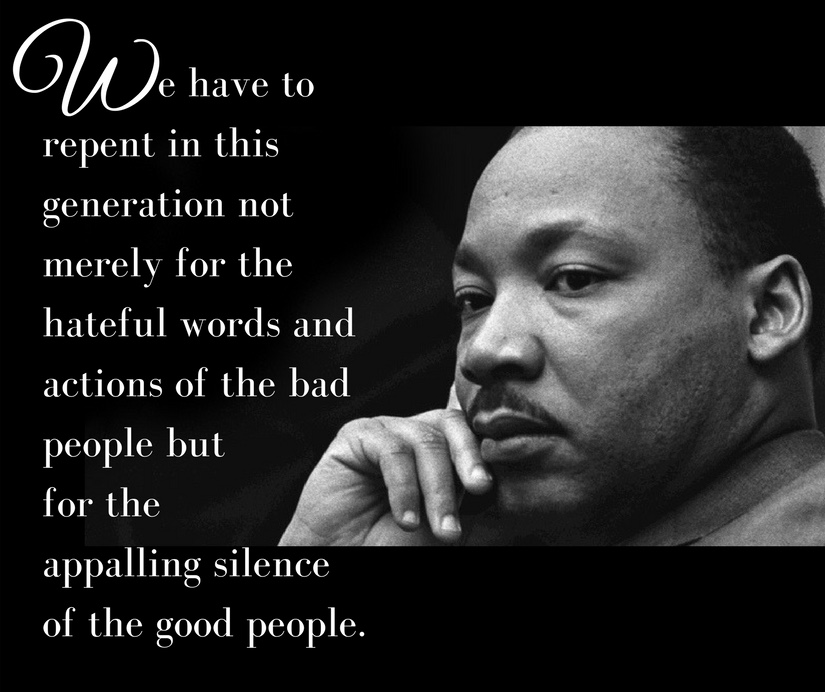
On what would have been his 89th birthday, Dr. King retains his prophetic voice for black and white alike, declaring from his jail cell then and now: “We will have to repent in this generation not merely for the hateful words and actions of the bad people but for the appalling silence of the good people. Human progress never rolls in on wheels of inevitability; it comes through the tireless efforts of men [women] willing to be co-workers with God, and without this hard work, time itself becomes an ally of the forces of social stagnation.”
Today, we read again Matthew’s haunting assessment of the Holy Family’s immigration from Herod’s not-so-holy-land:
“Out of Egypt I have called my son.”
Sweet Jesus, Egypt’s in Africa! Amen”
Bill J. Leonard is the James and Marilyn Dunn Professor of Baptist Studies, Professor of Church History, School of Divinity, Wake Forest University.
Despair has its way at times. It sneaks into my spirit and dwells there for a while, Although despair is thoroughly unwelcome and unwanted, it has a way of making a home in me at times. It has its way. It does its damage. It enslaves me with a devastating kind of bondage. It forces me into an uneasy and oppressive place.
Despair’s most damaging legacy is fear. These days are, for me at least, days of fear. I watch the current president and listen to his words in horror. He speaks with hostility. He gives welcome to divisiveness, racism, misogyny and disrespect. His words are often divisive, rude and insensitive. He uses his power to build an unsettled nation. I despair for the nation, and I despair for a world filled with violence, war, hunger, poverty, and natural disasters born of climate change.
My faith tells me that there is a remedy for despair, that fear can be conquered, and that peace might be restored in me. The poetry of Wendell Berry is a beautiful reminder.
When despair for the world grows in me
and I wake in the night at the least sound
in fear of what my life and my children’s lives may be,
I go and lie down where the wood drake
rests in his beauty on the water, and the great heron feeds.
I come into the peace of wild things
who do not tax their lives with forethought
of grief.
I come into the presence of still water.
And I feel above me the day-blind stars
waiting with their light.
For a time I rest in the grace of the world, and am free.
— From Wendell Berry’s “The Peace of Wild Things“
When despair casts its damaging spell within me, my faith still holds. They are waiting for me, always, the peace that is a balm for grief and despair, the presence of still waters and the stars sparkling in my night sky. This otherworldly beauty causes me to rest in the arms of faith and to recall the many times of despair in my life that served only to make me stronger and more resilient.
It’s hard to imagine a greater illustration of Christians losing the plot than when they defend predators. — John Pavlovitz. Photo: MANDEL NGAN/AFP/Getty Images.
I so hate to publish this photo. But it is a fitting image for these troubling days for people of faith. However, just so you know, this post is not about politics. It is about ethics, morality and living one’s faith authentically. I happen to be a follower of Jesus, and my Bible speaks to me about “loving the least,” allowing little children to come to Jesus, and calling peacemakers blessed.
So from that sacred place, I simply cannot comprehend persons of faith who claim faith in Jesus while defending a sexual abuser. As John Pavlovitz states so eloquently,
I don’t know how to understand the mind of a man or woman who attempts to profess devotion to Jesus while simultaneously defending a molester—and I’m not sure I want to. That’s a darker place than I think I can go without losing hope or sanity. I can’t imagine how a human being can so horribly distort the “love the least,” “blessed are the peacemakers” message of Christ, enough to stand on a wooden or social media platform—and knowingly bless a man who rapes, patently excuse violence to a child, or passionately campaigns for a predator. It’s all about as stomach-turning as it gets.
There are few bastardizations of the life and the message of Jesus . . . as grievous as taking the side of rapists and pedophiles and genitalia grabbers—but this is where we are now. With the Evangelicals embracing Donald Trump and with those now rallying to the defense of Roy Moore, this is what we’re watching in America . . . Regardless of the Bible verses they drop or the high-profile ministries they wield or how sanctified they try to sound—when Christians defend predators, they deny Jesus and they sell off their souls. It’s really as simple as that.
Yes, indeed. It’s really as simple as that. To my brother and sisters who call yourselves Evangelicals, clean up your act! It’s past time.
And may God help us live our faith with integrity, hold the vulnerable among us in high esteem, stand firmly against those who would cheapen our faith, and allow the life of Jesus to inform our thinking and guide our steps.
Like many of you, I have experienced dark nights of the soul. I have faced illness, betrayal, disillusionment and loss. I have faced the dark side of life more than a few times. In the midst of those times, I found the courage of faith, the gift of hope, and the promise of Scripture.
If you have known me through the years, you may know that one of the New Testament passages that gives me strength is in the fourth chapter of Second Corinthians. The following words are part of that chapter.
We are troubled on every side, yet not distressed; we are perplexed, but not in despair; Persecuted, but not forsaken; cast down, but not destroyed . . .
Therefore we do not lose heart. Though outwardly we are wasting away, yet inwardly we are being renewed day by day. For our light and momentary troubles are achieving for us an eternal glory that far outweighs them all.
So we fix our eyes not on what is seen, but on what is unseen, since what is seen is temporary, but what is unseen is eternal.
– 2 Corinthians 4:8-9, 16-18 18 (KJV, NIV)
The passage speaks of “wasting away.” When I was so ill for all of 2014, I can honestly say that I believed I was wasting away. It was a frightening emotion, one that I would rather not hold in my memories. But my memories of that time also include mercies and blessings, blessings of gradual healing, blessings of compassionate and competent health care, blessings of being surrounded by a loving faith community, blessings of my husband’s devoted care, blessings of hope and faith in a God whose mercies covered me in so many ways. Clearly, my blessings came through adversity.
Today while listening to Pandora, I heard a song that touched me with its faith-filled lyrics.
. . . What if Your blessings come through raindrops?
What if Your healing comes through tears?
What if a thousand sleepless nights are what it takes to know You’re near?
What if the trials of this life are Your mercies in disguise?
What if my greatest disappointments or the aching of this life is the revealing of a greater thirst this world can’t satisfy?
What if trials of this life — the rain, the storms, the hardest nights — are Your mercies in disguise?
I learned that through serious illness, the fear was greatest at night. The nights were the hardest. But I also learned that what I had read so many times was true — God’s mercies are new every morning.
The steadfast love of the Lord never ceases;
his mercies never come to an end;
they are new every morning; great is your faithfulness.
For whatever reason, several people I know are currently going through an exacerbation of fibromyalgia. I am one of those people dealing with debilitating pain right now. Fortunately, the pain cycles usually pass over time. But when the pain is raging, it slaps us in the face with a significant challenge.
The truth is that chronic pain is much more than just physical pain. It is physical and emotional suffering. Quite often, it is also spiritual suffering. In the years I served as a hospital chaplain, I learned so much about what people experience when they are ill. The most important lesson I learned is that there is a very real difference between pain and suffering.
Experiencing chronic pain most often goes far beyond physical pain. Pain is the actual physical /physiological response to an injury or illness. It is rooted in the body. But all too often, it is accompanied by debilitating suffering. Suffering is how the brain perceives pain based on past experience and future expectations and fears. It is rooted in the mind, even in the spirit.
Suffering asks “How long can this pain last? Will I feel this way forever? What have I done to deserve this? Has God forsaken me? Does God care about my suffering? Am I going to die?”
It is true that sometimes our suffering questions are irrational, but pain that has permeated the mind and spirit causes a very deep fear, a feeling of disorder, a sense of terror, and constant questioning. It takes an act of the will to keep suffering at bay, but it can be done. Deepak Chopra speaks of pain and suffering in many of his teachings.
Many people confuse pain with suffering. Pain is not the same as suffering. Left to itself, the body discharges pain spontaneously, letting go of it the moment that the underlying cause is healed.
Suffering is pain that we hold on to. It comes from the mind’s mysterious instinct to believe that pain cannot be escaped or that the person deserves it . . . It takes a force of mind to create suffering, a blend of belief and perception that one thinks one has no control over. But as inescapable as suffering may appear, what brings escape is not attacking the suffering itself but getting at the unreality that makes us cling to pain.
– Deepak Chopra
Is it easier said than done, modifying the beliefs and perceptions that accompany pain? To be sure, it is difficult. But suffering people find a number of ways to accomplish it: yoga, meditation, prayer, and for people of faith, leaning on the strength of their religious practice. In a very real sense, we can create within ourselves the kind of healing that rises above physiological pain.
Perhaps it sounds simplistic, but while in the throes of physical pain, I am often able to find a measure of relief by meditating on the truth of Scripture, not just reading it, but abiding in it, letting its words penetrate my spirit, opening my heart to its comforting truth.
Psalm 42 has been called a Psalm for the fainting soul. The Psalm is the voice of a spiritual believer who is enduring deep depression, who is longing for the renewal of the divine presence, who is struggling with doubts and fears, yet holding on to hope. The Psalm twice repeats this comforting refrain.
Why are you cast down, O my soul? And why are you so disquieted within me? Hope in God, for I again will praise him, my help and my God.
– Psalm 42: 5, 11
In the final analysis, people of faith really do have the ability to endure chronic pain while avoiding suffering. Perhaps we cannot stop physical pain or reverse the source of the pain. Perhaps we do not have the power to heal ourselves from physical pain when physiological realities are at play in our bodies. But our faith assures us again and again that we do have the power to end suffering at its source — suffering of the mind, the heart, the spirit, the soul.
If you are in physical pain, my prayer is that your faith will quiet the questions of your mind, that your inner strength will calm the anxiety of your spirit, that your depth of hope will strengthen your heart, that your soul’s resilience will transcend your suffering. This is the ultimate healing.
A breathtaking sunset over Arkansas’ Mount Nebo photographed by Josh McCray.
Some Christians tend to be frightened by the word “mysticism.” The word “mystic” raises irrational fears based on a misunderstanding of mysticism as a part of the Christian’s spiritual experience. So what exactly is a mystic? A mystic is simply one who has moved from mere belief systems to an actual inner experience with God.
That brings us to the sticky concept of belief systems. Christians definitely have belief systems, sometimes rigid and judgmental belief systems. The reality is that there is never a shortage of persons spouting out their beliefs, beliefs that are often based on systems of fake religious piety.
A life lived in the spiritual realm of God is much, much more than a set of rigid beliefs. Spirituality is much more than what we think or what we say. Spirituality is whoweare, our inner spirit, our soul that dances to the rhythms of the God who dwells within us.
Richard Rohr understands the inner spiritual experience.
Until people have had some mystical, inner spiritual experience, there is no point in asking them to follow the ethical ideals of Jesus or to really understand religious beliefs beyond the level of formula. At most, such moral ideals and doctrinal affirmations are only a source of deeper anxiety because we don’t have the power to follow any of Jesus’ major teachings about forgiveness, love of enemies, nonviolence, humble use of power, and so on, except in and through radical union with God. Further, doctrines like the Trinity, the Real Presence, and the significance of Incarnation itself have little active power. They are just “believed” at the rational level.
Any of us can believe at the rational level. We can easily formulate a set of personal doctrines, doctrines that often hold us captive to self-righteousness and rigid relationships with others. To be truly free is to be open to the winds of the Spirit, to rest in the presence of God, to follow Christ into places of deep need, to give ourselves over to inner spiritual experiences.
When we live in the comforting place of the mysticism of spirituality, we will not find in ourselves a judgmental spirit that uses our beliefs to denigrate those whose beliefs differ from ours. We will not find in ourselves the need for the criticism and condemnation that results in divisions.
What we will find within ourselves is the ability to love as Christ loved, the longing to bury our souls in the gentle grace of God, the deepest desire to transform the world around us and thus create the “beloved community.”
So I, for one, want to be a mystic. I want to live in the very center God’s spiritual realm, to be moved by the Spirit, to scatter the love of Christ in all the places I walk.
Sometimes, the heart cries out in anguish, “Comfort me, God, in this my life’s darkest place.” There are times when all of us find ourselves in the midst of darkness. Almost despairing, we hope beyond hope for a new dawn. We speak our prayers, often with groanings too deep for words. We look deeper within, hoping that in the depths of our spirits, we will find an enduring faith. We turn to the comfort of Scripture.
If I had to choose one passage of Scripture that has been for me a source of constant comfort, I would turn to Second Corinthians.
In times of betrayal, I turned to this passage. In times times when I felt persecuted, I turned to this passage. In serious illness, I whispered the words of this passage in the deepest darkness of the night.
We are troubled on every side, yet not distressed; we are perplexed, but not in despair;
Persecuted, but not forsaken; cast down, but not destroyed . . .
For all things are for our good, that the abundant grace might through the thanksgiving of many redound to the glory of God.
For which cause we faint not; but though outwardly we may perish, inwardly we are renewed day by day. For our light affliction, which is but for a moment, works within us a far more exceeding and eternal weight of glory;
So we look not at the things which are seen, but at the things which are not seen: for the things which are seen are temporary; but the things which are not seen are eternal.
– From II Corinthians 4 (paraphrased)
I can only imagine how many survivors of the recent natural disasters have spoken the words of this passage, prayerfully and with hearts disconsolate. I can imagine many of them crying out from what feels like life’s darkest place. The hymn writer expresses so eloquently the presence of hope for all of us who find ourselves languishing, inviting us to bring our sorrows to the mercy seat of God.
Come, ye disconsolate, where’er ye languish,
Come to the mercy seat, fervently kneel.
Here bring your wounded hearts, here tell your anguish;
Earth has no sorrow that heav’n cannot heal.
– Thomas Moore, 1816
May those who are disconsolate this day find consolation in the lavish grace of God. May those who languish find respite in God’s never-ending mercy. May those who are suffering in what feels like life’s darkest place experience the brilliance of a new dawn. Amen.
 Magnificent power! On a ride through the Georgia countryside, I witnessed nature’s beauty in a thunderstorm. The sky lit up from one end of the horizon to the other and then enormous streaks of lightning flashed in astounding display. It took my breath away, not because of its danger, but because of its brilliance. I struggle to find words to describe it.

 Unanswered prayer leaves me disconsolate. At times,
 Two of my dear family members are carrying a heavy weight in their workplace. I watch them struggle week after week, carrying oppressive burdens. Both love their work and are dedicated to it. Both speak well of their co-workers. Both take on more responsibility than they should. Neither of them see an end to the high level of work they must accomplish. I can sense their need for comfort and healing, for rest and peace.

 My adult son is a master at denial. He can get very upset over a situation, but before you can blink, he has moved on as if it never happened. To be honest, I have often envied that part of his personality. As one who tends to brood over life’s challenges and problems, I would love to just be able to blow things off.
 How do you live when you know what’s coming? Jesus might have asked himself that question when the crowds were shouting “Hosanna!” and making a big deal of the fact that he was riding into town on a donkey. The Gospel of Mark tells the story well.


 I invite you to read “Out of Africa: White supremacy and the Church’s silence,” a provocative opinion piece by our guest blogger, Dr. Bill J. Leonard. Many thanks to Dr. Leonard for prompting us to more fully commemorate the day honoring Dr. Martin Luther King, Jr. If you are willing to challenge yourself, these words will shed the light you need to do so.
 Despair has its way at times. It sneaks into my spirit and dwells there for a while, Although despair is thoroughly unwelcome and unwanted, it has a way of making a home in me at times. It has its way. It does its damage. It enslaves me with a devastating kind of bondage. It forces me into an uneasy and oppressive place.
 Loving God, Creator of all,
 Like many of you, I have experienced dark nights of the soul. I have faced illness, betrayal, disillusionment and loss. I have faced the dark side of life more than a few times. In the midst of those times, I found the courage of faith, the gift of hope, and the promise of Scripture.
 For whatever reason, several people I know are currently going through an exacerbation of fibromyalgia. I am one of those people dealing with debilitating pain right now. Fortunately, the pain cycles usually pass over time. But when the pain is raging, it slaps us in the face with a significant challenge.
 Sometimes, the heart cries out in anguish, “Comfort me, God, in this my life’s darkest place.” There are times when all of us find ourselves in the midst of darkness. Almost despairing, we hope beyond hope for a new dawn. We speak our prayers, often with groanings too deep for words. We look deeper within, hoping that in the depths of our spirits, we will find an enduring faith. We turn to the comfort of Scripture.
 God of the Sparrow 🌱 By Kathy Manis Findley