“ALL SHALL BE WELL” is a video blog that will help us enhance our personal spirituality and lead us into sacred pauses that will nourish our souls.
Welcome to “All Shall Be Well,” where we will explore together our spiritual center, create a moment of sacred pause and join together in contemplation and silence. In this episode, I want to focus our thoughts on the spirituality of Lent. On Ash Wednesday, the first day of Lent. God speaks to us through the Prophet Joel in chapter 2, saying,
“Even now,” declares the Lord, “return to me with all your heart, with fasting and weeping and mourning.”
“Rend your heart and not your garments.”
We begin Lent with Ash Wednesday, the day that we receive a cross on our foreheads — a cross of ashes blended with just a drop of sanctified oil. I do not wipe off the cross, but let it remain for the entire day.
In a way, it’s comforting to know that something holy and tangible interrupted my ordinary day, a cross of ashes to remind me of sacred things I already know — that Lent is a time of reflection, penitence, repentance, prayer, fasting, giving up things, returning to God. And on top of all of those things I must ponder for forty days, things that weigh heavily on my heart, a minister says this to me as she (he) forms the ashen cross on my forehead:
Remember you are dust, and to dust you will return.
God’s words to Adam in Genesis 3:19
There are so many life events to remind us that we are but dust. But is that really what a Lenten journey is about? Is it really meant to hold our sins over us and urge us to do penance? Is Lent just a time of repentance, remembering our sin and our frailty?
Maybe Lent is also about God’s extravagant mercy, God’s grace that is greater than all our sins, and the ultimate sacrifice of Jesus that made us all beloved children of God.
Imagine for a moment that our cross of ashes is really not really made of ashes at all. If you look at it closely — as you imagine God’s lavish grace — you might not see ashes, but instead, stardust!
Please join me via video for a few moments of Lenten reflection . . .
Ever wonder what’s real and what’s not-so-real? Once in a while, I do look at what’s going on around me and ask myself how real it is. This friendship — is it real? This situation I’m dealing with — is it real? This life I’m living — how real is it, really? Such questions are problematic for one major reason — that we take things so much for granted that we cannot gauge their real value. Friendships just are; situations just happen; life is pretty much a destined routine.
That is, until betrayal breaks friendships, crisis suddenly creates a situation that cannot be ignored and an unplanned event brings total upheaval to our lives. These are the times when we ponder what is real and what is not. These are the times when all things in us and around us are downright messy. These are flash points in life that force us to examine what we believe is real. Maybe these flash point times take us inward to the private space in us, and in that space, we examine and evaluate what is truly real. Problem is that sometimes our examining leads us into mulling over things that are a mess, and looking at our “real” feels like brooding.
Such downcast and disconsolate moments are not the best times for any of us to ponder what we believe to be real. Could we not open our eyes to what is real all the time? Like when we are overcome with nature’s beauty or the sweet melodies of birdsong. Like when our souls are touched by moments of worship or the mesmerizing sounds of a symphony orchestra.
It seems important to face life with listening ears and open eyes ready to embrace “the real!” It seems important to do so in sunshine and in shadow, when our souls are burdened and when our souls are stirred to sing songs of joy. It seems important to look at what’s real even when we have to do so while feeling a deep down melancholy.
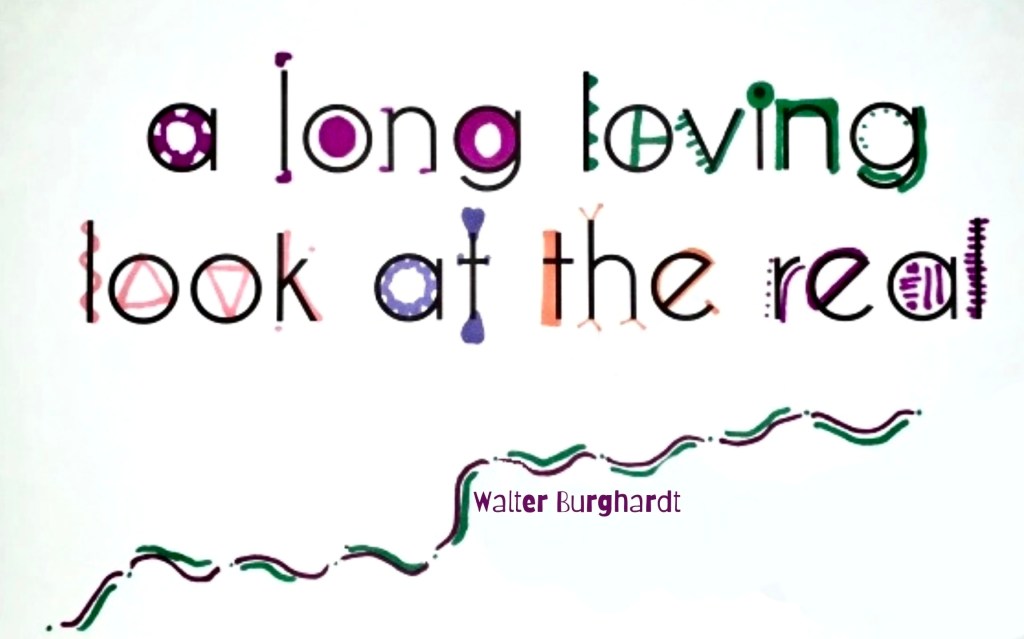
Still, I invite you to choose to “see,” the real that surrounds you — the real that is inside you, above you, below you and beside you. As Jesuit theologian Walter Burghardt summons us, “take a long, loving look at the real.” That’s how Burghardt characterized contemplation, describing it as a sustained gaze, never merely a glance.
“Flash point times take us inward to the private space in us, and in that space, we examine what is truly real.”
So value “your real.” Do it as you go and as your journey moves forward on varied paths. Look at all that is “your real” — the commotion in your soul, the catastrophes of your relationships, the messes in your life. Take a sustained, contemplative look. Look bravely snd without fear, because whoever or whatever God is for you is waiting to meet you at the crossroads of what is real and what is not real.
More than you think, your soul needs you to open your eyes and “take a long, loving look at the real.” No matter how messy it is!
“ALL SHALL BE WELL” is a video blog that will help us enhance our personal spirituality and lead us into sacred pauses that will nourish our souls.
Welcome to “All Shall Be Well,” where we will explore together our spiritual center, create a moment of sacred pause and join together in contemplation and silence. In this episode, I want to focus our thoughts on spirituality and Lent. Today, Ash Wednesday, is the first day of Lent. God speaks to us through the Prophet Joel in chapter 2, saying,
Even now,” declares the Lord, “return to me with all your heart, with fasting and weeping and mourning.”
13 Rend your heart and not your garments.
Finding sacred space as Ash Wednesday leads us into Lent
“ALL SHALL BE WELL” is a video blog that will help us enhance our personal spirituality and lead us into sacred pauses that will nourish our souls.
Welcome to “All Shall Be Well,” where we will together explore our spiritual center, create a moment of sacred pause and join together in contemplation and silence. Tonight my thoughts will focus on the dark times of our lives, the spiritual and emotional darkness that sometimes engulfs us and the ways we can dwell in our darkness to learn the secrets the darkness teaches us. We will listen in sacred space to hear the sigh of our souls.
Finding sacred spaces while hopelessly trapped in darkness
Are we brave enough to imagine beyond the boundaries of “the real” and then do the hard work of sculpting reality from our dreams?
Walidah Imarisha
I read a wonderful article this morning written by Madisyn Taylor, who wrote about being in a fog. I related immediately, having just taken my immunosuppressant medications that create all manner of “foggy-ness” for me. Tayler defined it as a feeling of being “muddled and unfocused, unsure of which way to turn.” I resonate with that definition, but beyond the physical fogginess of my mind, I experience an occasional fogginess of spirit. Know what I’m talking about? I would guess you do, since all of us fall into a spirit-fog once in a while.
A fog can feel downright eerie. It isn’t straightforward like darkness, yet we may feel like we can’t see where we’re going or where we’ve come from. We feel fear, as real as our fear of the darkness, afraid that if we move, we might run into something hidden in the mists that surround us. If we’re brave enough to move at all, we move slowly, feeling our way and keeping our eyes open for shapes emerging from the eerie haze.
Maybe being brave is what spirit fogginess is about. Spirit-fog is, of course, is a season of involuntary inactivity (perhaps even precipitated by coronavirus isolation). Although you and I much prefer to be able to see where we are going and move unwaveringly in that direction, maybe we can encourage our spirits to see that being in a fog often brings gifts to us — gifts of stillness, of doing absolutely nothing, a respite from forward inertia, a time to gather up our “brave” to move with forward inertia, even moments of finding for our spirits the Spirit of Comfort and Peace. We might find in the mists of fog the sacred pause that our spirit needs — the kind of sacred pause that creates resilience in us, and perseverance, and whatever we need to be brave.
In the fog, we really do need to be brave. When we are hidden in the mist, we may look within and find that the source of our fogginess is inside us — perhaps an emotional issue that needs tending before we can safely move ahead with steady resolve. The fog that engulfs us may simply be teaching us important lessons about how to continue moving forward even if we have been brought to a standstill by circumstances of life.
If we’re brave, we do not have to wait for the fog to lift. If we’re brave enough, we can center ourselves in the haze, wait for guidance and then move — move on into the unknown places on the journey. I have been a long-time fan of the song “Brave” sung by Sara Bareilles, written by Sara Bareilles and Jack Antonoff. “Brave” is on her 2013 album, “The Blessed Unrest.” The song hits me hard with these words, “sometimes the shadow wins.” I know that to be the hard truth, but I also latch onto the rest of this song’s message: I can be brave! I often think that this section of the lyrics calls out directly to me — calling me, urging me on, encouraging me to “show everyone how big my brave is.”
I wanna see you be brave
Everybody’s been there, everybody’s been stared down By the enemy Fallen for the fear and done some disappearing
Bow down to the mighty Don’t run, stop holding your tongue
Maybe there’s a way out of the cage where you live Maybe one of these days you can let the light in
Show me how big your brave is
Say what you wanna say And let the words fall out Honestly
I wanna see you be brave
Spend a few minutes enjoying this Sara Bereilles song and immerse yourself in the thought of how amazingly brave you are.
“Fine” is almost always the answer because usually the one who asked the question doesn’t really want to know all about how we feel. Not really. So we answer with a word — “fine.” Just “fine.” After all, we don’t often want to reveal our true feelings to anyone, and on top of that, telling them how we really feel would take more time than either of us want to spend on the conversation.
There may also be another reason for responding with just the word “fine.” Sometimes we don’t know how we’re really feeling. Some people are too busy with life responsibilities to consider how they feel. Others know there are deep feelings inside themselves, but they too are too busy to feel them. Still others sense dark, foreboding feelings in their deepest place, and they will not risk the emotional repercussions they might face by lettings their feelings rise into their consciousness. In Leo Tolstoy’s book, Anna Karenina, the dialogue asks, “Is it really possible to tell someone else what one feels?” Perhaps at that point — the seeming impossibility of telling another person how we feel — is where you and I find ourselves.
What happens when you refuse to allow your deepest feelings to enter your consciousness?
The question on the left is a very good question, even a crucial question. What does happen in us when we simply refuse to allow our feelings to come to the light os acknowledgment. The answer is at the very center of our quest for emotional wellness. We start, as the image above instructs, at owning our deepest feelings. Owning means to look at our feelings honestly and without fear. Owning means making no excuses for feelings. Owning means not blaming our feelings on others. Owning means holding our feelings in high esteem and acknowledging how they came to be. Owning means accepting our feelings, embracing then and honoring them
I was so deeply hurt that I just hold it inside until it becomes so unbearable I think I will snap.
He made me feel invisible and I just can’t let go of that feeling. I still feel invisible after all these years.
She made me so angry and I am letting that anger rage inside me and it will not go away. I don’t dare express it or let it surface.
Owning our feelings means being willing to truly “see” them, even when seeing them frightens us or creates in us a sense of dread. We sense we may experience a season of dread that the feelings will hurt us, again and for a long time. We fear what we will see. There is some truth in the fact that we tend to live into our “false self,” the self that is external and often shows little resemblance to our internal self. Contemplation is internal work. For those of us who believe in God, something divine happens when we are immersed in contemplating our hidden feelings — this thing that happens is that God meets us there, at the very moment when a buried feeling begins that awful hurting. I think of the words of promise in Holy Scripture, Jeremiah 29:11.
For I know the plans I have for you, says the Lord, thoughts of peace and not of evil, to give you a future and a hope.
I cannot help but find comfort in the presence of God in my life’s most painful times, and honestly, I have to say that some of those painful times were a part of contemplation and, through contemplation, beginning to own my down-deep feelings. The wise words of Thomas Merton are both instructive and provocative.
Everyone of us is shadowed by an illusory person: a false self . . . We are not very good at recognizing illusions, least of all the ones we cherish about ourselves. Contemplation is not and cannot be a function of this external self. There is an irreducible opposition between the deep transcendent self that awakens only in contemplation, and the superficial, external self which we commonly identify with the first person singular. Our reality, our true self, is hidden . . . We can rise above this unreality and recover our hidden reality . . . God begins to live in me not only as my Creator but as my other and true self. ― Thomas Merton, New Seeds of Contemplation
In finding pieces of my hidden, true self, I also found release from harmful feelings, hurtful memories and oppressive people I held on to. Finally, after contemplation, we find the ability to share our feelings — the real ones — with the people we trust to hold them sacred and to help us better understand them. At the moment when I understood my feelings — where they came from; why I was holding on to them; who caused them; what would happen if I let my feelings rise from my depths to the light of day — that was the moment I felt free. I could live again as my best self. I could love myself, my real self. And I could be my best self. Not a small thing! A turning point in my life!
I hope you will spend some time studyIng the Feelings image above. I invite you to look at the seven feelings in the center and to then move to the outer circles. If I feel sad, for instance, the next expansion of the circle further clarifies what “sad” means for me, i.e. lonely, vulnerable or depressed. The outer section may reveal to me that I was victimized or abandoned, grieving or isolated.
Continue to contemplate your hidden, unspoken feelings. Learn to look at them and “own” them without fear, and know that God will meet you at the point of your deepest pain and that you are God’s own creation — cherished, loved, comforted and protected by a God who will never let you go.
As a part of your contemplative moments, I hope you are strengthened by this arrangement of the hymn, “O Love that Will Not Let Me Go.” Play it before you begin your meditation time and let its message clear your mind and comfort your soul.
Photography by Jim Dailey: January 1, 2020, Lake Ouachita, Hot Springs, Arkansas
My dear, long-time friend, former Little Rock Mayor Jim Daily, sent me this photo this afternoon. Mayor Jim is a hiker, a camper, a photographer and a naturalist. He loves the outdoors. He is a person of profound thought, and he spends a good amount of his time in thoughtful contemplation — on a lake or an Arkansas River, in a verdant valley or on a mountaintop. He frequently blogs on what he calls his “adventures,” and his blog is filled with thoughts about wherever he is and whatever beauty he has found. For Jim, every day is a new adventure, and his adventures hold sway over him. They change him in so many ways
One more thing — As a tribute to my friend, Mayor Jim, I want to introduce you to his Blog, which you may enjoy viewing at this link: Last Pair of Boots
His Blog, called “Last Pair of Boots,” tells a poignant story — of nature’s beauty, of God’s presence in it, of friendships, of Arkansas’ and America’s holy places, of worship and contemplation and prayer. Here’s what Jim says about naming his blog:
The name “Last Pair of Boots” came to me when my ten year old boots broke down and it occurred to me that at my age the new pair of boots might be my last pair. Metaphorically my boots represent the trails and travels of life.
Whitaker Point … aka Hawksbill Crag! At the Buffalo National River
This is such a thought-provoking description that fits Jim’s love of nature’s splendor. He also hints at endings, not in a melancholy way, but in words the reveal his life of contemplation and curiosity. Jim’s outings are hiking and wilderness camping, skiing, fishing, exploring, visiting every Arkansas State Park through his job as Arkansas Tourism Director, finding friendships in every small Arkansas hamlet, searching for Arkansas treasures,
finding God in all the places and faces.
I imagine he will hold all of these adventures in his heart now that he has finished his work as Arkansas Tourism Director this past December.
Hamfest — Whatever it is … it’s gotta be something special to celebrate 50 consecutive years on top of the second highest mountain in Arkansas — Rich Mountain — in the beautiful Ouachita Mountains, Queen Wilhelmina State Park.
Congratulations, Jim, for your many years of service to the citizens of Little Rock and of Arkansas. Your wisdom, your love of nature, your unquenchable thirst for adventure and your unfailing commitment will remain as one of our enduring Arkansas’ treasures.
As I mused about Jim’s outings tonight, I asked myself about the places and times that created my contemplative times. They are few, too few.
For whatever lame reason, I do not take the contemplative times I need. I think that my kidney transplant on November 12th pushed me into a soul-need that beckons me to solitude, silence, contemplation, adventure — new things to examine in the stunning beauty of nature. It calls me out of the house and into the sunlight or under the stars of the night. It calls me to breathe in the fresh air of God’s creation and, with that breath, to take in the miracle of God’s presence.
Now that I’m retired and have time, I tend to fill my time with all manner of preoccupation. At times, I feel busy and frazzled and don’t really know why. Why am I unable to make enough time to spend in the mesmerizing beauty of nature, keeping silence in God’s creation? Why do I not spend time beside still waters, listening to the silence of a pond? What is wrong with my soul that it is rarely drawn to God’s quiet places, and my heart that does not often seek God’s presence in silent space?
I dare not answer those questions until I am prepared to make some life changes. But what I can do is to hold near these reminders of what God desires for me until I can change my life. These reminders might even inspire me to seek change:
O Lord, my heart is not lifted up,
my eyes are not raised too high;
I do not occupy myself with things
too great and too marvelous for me.
But I have calmed and quieted my soul,
like a weaned child with its mother. (Psalm 131:1-2)
For God alone my soul in silence waits. (Psalm 62:1)
The Lord is my shepherd, I shall not be in want. He makes me lie down in green pastures, he leads me beside quiet waters, he restores my soul. (Psalm 23:1-3)
Let him sit alone in silence, for the Lord has laid it on him. (Lamentations 3:28)
To you, O God, silence is praise. (Psalm 65:1)
It is never a bad thing to offer God the praise of silence, to invite God into my contemplation and to allow God’s presence in my moments of prayer and meditation. The truth is that God has always been present with me. But my deepest desire is that I be present with God. As the Psalmist wrote, “My soul in silence waits.”
May those words become my words . . . and yours. Amen.
Often one of the things we do as we approach a new year is to lament the old year. We take stock of our days, good and bad — and we disparage the bad far more than we celebrate the good. We spend moments of regret and self-recrimination for the things we left undone or for the things we did not do well. We spend moments blaming ourselves for things that were out of our control, and we critique our performance of those things we did control.
Perhaps we need to check ourselves if we find that we are reviewing the old year with too much reproach, regret and recrimination. It’s not a very good use of precious time. Instead, might we review the old year’s times of celebration — the days of joy, accomplishment, the days when our health was good and our hearts were strong, the days we survived calamity and dodged a few bullets.
Perhaps we should recall the times precious and poignant when our souls rejoiced in sweeter days we will remember with fondness. Perhaps we need to take stock of the ways we became stronger and found resilience in ourselves. Perhaps we need to celebrate the times we were gentle and kind, loving and compassionate. Perhaps we should count our friendships and the loving acts of those who love us.
Might we refuse to see the old year as a series of burdens and see it, instead, as a year that poured blessings on our lives. Is it possible that spending our reflections on the old year, seeing the grace it brought us, will enable us to believe in the grace that the new year will most surely bring?
It is true that this old year will end, for good or ill. Some might long to have it back, while others curse it as it leaves. This poem by Ella Wheeler Wilcox that speaks of “the burden of the year” reminds us of the ways we experienced the old year with both weeping and laughing. That is life’s reality that surely promises that the new year 2020 will bring us the twofold, paradoxical gift of fear and faith, despair and hope.
The Year
Ella Wheeler Wilcox – 1850-1919
What can be said in New Year rhymes,
That’s not been said a thousand times?
The new years come, the old years go,
We know we dream, we dream we know.
We rise up laughing with the light,
We lie down weeping with the night.
We hug the world until it stings,
We curse it then and sigh for wings.
We live, we love, we woo, we wed,
We wreathe our brides, we sheet our dead.
We laugh, we weep, we hope, we fear,
And that’s the burden of the year.
If you will miss the year behind, celebrate what it left you. If it took and demanded your very life-breath, curse it if you need to, and then accept the ways it strengthened you. May we all spend a few moments or a few hours reviewing the year behind us, and find there laughter and weeping, hope and fear. All were meant to teach and to guide and to create strength in us.
The only people who pray well are those who keep praying!
— Richard Rohr
Sometimes you just need to get away. You need to push back from your daily grind and be in a space that gives you life-restoring energy. The place may be a mountaintop or beside a sea. The place you love might be on a sailboat watching the changing colors of the sky. The need is a time of contemplation although I admit that contemplation is easier said than done.
Richard Rohr describes contemplation using the frightening word, “dying,” something we usually do not want to consider. Still his definition is compelling.
Contemplative prayer is one way to practice imposing “silence upon our cares, our desires and our imaginings.” Contemplative practice might be five or twenty minutes of “dying,” of letting go of the small mind in order to experience the big mind, of letting go of the false self in order to experience the True Self, of letting go of the illusion of our separation from God in order to experience our inherent union.
I am intrigued by the phrases “imposing silence upon our cares!” dying” and “letting go of the illusion of our separation from God.” We readily recall words we have long known: “Be still, and know that I am God,” and we know that we can move into God’s real and palpable presence. Still moving into God’s presence and lingering there is easier said than done. We are slaves to our lives, to our every day concerns and responsibilities. And sometimes times our responsibilities — though they may be important to us — take too much from us, robbing us of our life’s spiritual depth.
Again, Richard Rohr offers deep wisdom:
Each day that dawns is a celebration of the fact that we have been invited to consider how our lives are spent; how we embrace and recoil from the . . . darkness.
So for me, I would like to watch the hued, expansive skies — the moving clouds and the sparkle of the sun. I would like to find silence in the vastness of God’s creation, in a place where my view includes the beauty of verdant green pastures, the sound of the never-ending surf, the feel of the wind in my face, the shadows cast upon a high mountain. It takes the beauty of such a place to calm my spirit and stop the whirring of my mind. In such a place, I can try to enter into the posture of prayer and contemplation.
Don’t be fooled. Contemplation is called a practice because it truly is a practice that we must try again and again. Contemplation is not easy for many of us. It can even be disconcerting because, in truth, contemplation is meeting as much reality as we can handle in its most simple and immediate form — without filters, judgments, or commentaries. Contemplation moves us to the space our soul craves, and in that place we gain a renewal of our spirit.
Anything worth doing is worth practicing for as much or as long as it takes. Yes, at times it feels like forcing ourselves to be still for an interminable length of time and to force ourselves to fully concentrate on petitioning and listening prayer. No doubt, being silent with ourselves can be frightening. “Imposing silence upon our cares” can be threatening. But in the practice of contemplation we can hear God’s whisper clearer and sense God’s presence more deeply and fully.
I wish for you the time and space you need, the time to take in the breathtaking beauty of God’s creation, the stilling of your mind and the calming of your spirit that can guide you into the presence of God.
God is our refuge and strength, a very present help in trouble.
Therefore we will not fear, though the earth should change,
though the mountains shake in the heart of the sea,
though its waters roar and foam,
though the mountains tremble with its tumult.
“Be still, and know that I am God!”
The Lord of hosts is with us; the God of Jacob is our refuge.
I always write in the moment — what I’m feeling or experiencing, what fills me with joy or what brings forth tears of sadness. That’s my blog. It’s not about me really. It’s more about what exists before me, behind me, around me, within me . . . in the moment. This morning’s moment is all about sweet memories of being surprised. Completely surprised by the surprise birthday party planned and executed by my wonderful Sunday School class.
Last night was a night to remember for me. It was indeed a surprise —an unexpected, shocking, out-of-the-blue, lavish, wonderfully loving surprise. This morning I am giving thanks for the grace gift of that group of women. And I am enjoying one of the gifts they gave me — a beautiful Lectio Divina prayer bible.
I began my reading this morning at the beginning — Genesis 1: 1-19 — with the intention of reading the passage as if it were my first time. I read it using the pattern of reflective bible reading that included the following steps of Lectio Divina:
A slow, thoughtful reading of the Biblical text
Reflection on the meaning of the text
Prayer
A decision on what I should do in my life as a result of my contemplative experience
In other words, how does action and contemplation meet for me in this time, in this place?
Gathering all the parts of me into a quiet place, I read the first part of the creation story. I took it in as a story fresh and new, and within seconds I was struck by these words:
When God began to create the heavens and the earth — the earth was without shape or form, it was dark over the deep sea, and God’s wind swept over the waters — God said, “Let there be light.” And so light appeared.
God’s wind swept over the waters . . . I could visualize it. I could hear its sound. I could feel the wind sweeping over me gently, but surely. It was fresh and new, as if I was reading it for the first time. Funny how sacred Scripture can do that “fresh and new” magic!
Today’s life lesson? It’s all about gracious gifts from a loving God . . . Wind and water, sea and sky, light and darkness, and friends of the heart who offer acts of love. Like a birthday party full of meaning beyond the hats and the food and the gifts and the cake.
At the back of the prayer bible, there is a collection of classic Christian prayers. This one — “A Prayer to the Holy Spirit” — is a Native American Traditional prayer that expresses wonderfully the thoughts of my life lesson for today.
O Great Spirit,
whose breath gives life to the world,
and whose voice is heard in the soft breeze:
We need your strength and wisdom.
Cause us to walk in beauty. Give us eyes
ever to behold the red and purple sunset.
Make us wise so that we may understand
what you have taught us.
Help us learn the lessons you have hidden
in every leaf and rock.
Make us always ready to come to you
with clean hands and steady eyes,
so when life fades, like the fading sunset,
our spirits may come to you without shame. Amen.
May God — the Mother of all created things, the Father of life itself — make it so.
I am deeply grateful on this day for:
Quiet moments of reflection
The story of God’s hand in all created things
The ability to pray
The will to point my life toward actions inspired by faith
The gift of friends of the heart (who throw spectacular, startling, and
completely surprising birthday parties!)
Thanks be to God.
***************************************
On another note, please pray for me as I await a life-saving kidney transplant. I am grateful that you are walking with me on this journey that often feels so frightening. Your thoughts and prayers mean so much. If you would like to read the story of my illness, please visit the Georgia Transplant Foundation’s website at this link:
A “Go Fund Me” page is set up for contributions to help with the enormous costs related to the transplant, including medications, housing costs for the month we have to stay near the transplant center, and other unforeseeable costs for my care following the transplant. If you can, please be a part of my transplant journey by making a contribution at this link:
I am a lover of trees — all trees. I religiously follow the life cycle of the only tree in my yard. It’s a Chinese Tallow tree and every botanist calls it a nuisance tree, an invasive species that should be controlled. I find the tree fascinating, even mesmerizing, as it changes.
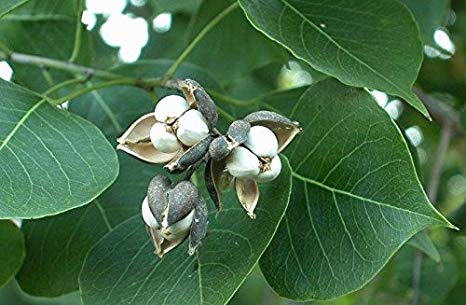
Not only do the heart-shaped, bright green leaves turn yellow, orange, purple and red in autumn, but the tree produces seeds that start out green, turn brown-black and then white. The changing colors call my attention to my constant life changes and, in a way, bring the comfort of knowing that we really do survive life changes.
The tree captures my spirit every year as autumn approaches. In a way, I meditate on my tallow tree. I watch its changes. I feel the raindrops of its sticky sap that drips on me when I’m under it. I listen to the birdsong that echoes among its boughs. I even hear my tree whisper to me sometimes when the breeze blows through it in just the right way. The tree can call me to introspection. It can inspire me on days when inspiration is beyond my grasp and unfaith threatens. On those days, the inspiration that stirs in me is peace. It is prayer.
I have to admit, though, that I walk past my tree dozens of times a day without notice, taking its shade for granted and completely unaware of its enchanting beauty. Therein lies the human dilemma of dispassionate inattention, our failure to notice or to take in nature’s extravagance. It is when a tree is just a tree. It is when we miss the spiritual experience that creation offers us as gift.
There is no better expression I could share than Mary Oliver’s poem, When I Am Among Trees.
When I am among the trees,
especially the willows and the honey locust,
equally the beech, the oaks, and the pines,
they give off such hints of gladness.
I would almost say that they save me, and daily.
I am so distant from the hope of myself,
in which I have goodness, and discernment,
and never hurry through the world
but walk slowly, and bow often.
Around me the trees stir in their leaves
and call out, “Stay awhile.”
The light flows from their branches.
And they call again, “It’s simple,”
they say, “and you, too, have come
into the world to do this, to go easy,
to be filled with light, and to shine.”
Oh, to claim our place in the world, to go easy, to embody the message of the trees: “It’s simple!” And then to remember that the changing seed pod, as its life cycle moves around, is really a portrait of rebirth.
On my way to the car dozens of times a week, might I take notice as I pass my tree, never hurrying, walking slowly and bowing often. Might I see more and hear more and feel more, recalling Mary Oliver’s words:
Around me the trees stir in their leaves
and call out, “Stay awhile.”
******************************
On another note, please pray for me as I await a life-saving kidney transplant. I am grateful that you are walking with me on this journey that often feels so frightening. Your thoughts and prayers mean so much. If you would like to read the story of my illness, please visit the Georgia Transplant Foundation’s website at this link:
A “Go Fund Me” page is set up for contributions to help with the enormous costs related to the transplant, including medications, housing costs for the month we have to stay near the transplant center, and other unforeseeable costs for my care following the transplant. If you can, please be a part of my transplant journey by making a contribution at this link:
Himalayan blue poppies in the rain, Valley of Flowers National Park, Uttarakhand, India
The beauty of God’s creation often takes my breath away. This image did that. When I first saw it, I stared at for quite a long time. You might say it stopped me in my tracks, slowed me down for a moment, caused me to wonder. That’s not a bad thing, slowing me down. It does not happen easily.
So what does it mean to slow down and linger, to linger in God’s presence? One of my favorite stories in the Bible is the very brief story of Anna.
There was also a prophet, Anna, the daughter of Penuel, of the tribe of Asher. She was very old; she had lived with her husband seven years after her marriage, and then was a widow until she was eighty-four.She never left the temple but worshiped night and day, fasting and praying. Coming up to them at that very moment, she gave thanks to God and spoke about the child to all who were looking forward to the redemption of Jerusalem. (Luke 2:36-38 NIV)
What strikes me about Anna is that “she never left the temple but worshipped night and day, fasting and praying.” She lingered in God’s presence. Perhaps God honored her devotion by allowing her to see the Christ child.
And then there’s this small snippet of Joshua’s story:
. . . When Moses entered the tabernacle, that the pillar of cloud descended and stood at the door of the tabernacle, and the Lord talked with Moses. All the people saw the pillar of cloud standing at the tabernacle door, and all the people rose and worshiped, each man in his tent door. So the Lord spoke to Moses face to face, as a man speaks to his friend. And he would return to the camp, but his servant Joshua the son of Nun, a young man, did not depart from the tabernacle. (Exodus 33:9-11 NKJV)
Joshua lingered in the tabernacle even when Moses, his mentor, left it. Perhaps it changed him. Perhaps because of his devotion in lingering in God’s presence, it was Joshua, and not Moses, who received the honor of leading the Israelites into the Promised Land.
Of course, we are not certain about any of that. Certainly we do not linger in God’s presence in hopes of receiving some reward or honor. At the same time, developing the spiritual discipline of abiding — lingering — in God’s presence brings its own reward.
What are your ways of spending time in God’s presence? Reading scripture? Writing scripture in a prayer journal? Yoga? Walking a labyrinth? Praying? Journaling? Taking in the beauty of nature? Creating a place of silence? The ways of spiritual discipline are endless.
One thing is certain: lingering in God’s presence does not just happen. We enter that sacred space and linger there only if we commit ourselves to do it. Not in a legalistic manner that is more religious than spiritual, but in ways that slowly open us up to craving that time with God, needing it more than we need to “accomplish” our never-ending daily tasks.
When we reach that place, we might discover that lingering in God’s presence is life-giving. We might suddenly realize that we are lingering in God’s presence easily and often, that it has become a part of life.
So how in the world did a blue flower get me here?
I’m not sure, but I think it is because God can be found everywhere, in any moment, in any space, in every stillness, in silence and music and birdsong, in whatever we hear and feel, through anything our eyes can see — even a blue flower covered with dew.
Wordless stillness: a place in Arkansas captured by Steven Nawojczyk
A friend of posts a unique message on her blog on Wednesdays. She calls it “Wordless Wednesday.” In the post, she offers beautiful photo images.
I have often wondered how she came up with the title, “Wordless Wednesdays.” Did she have writer’s block on a particular Wednesday? Did she borrow the title from another place? Did she know that on some days, she would simply have nothing to say, so she just planned it to be on Wednesdays?
It occurs to me that this is a Wednesday and I have nothing much to say. It seems like one of my empty days, when words don’t seem to emerge. My readers probably know that it is a very unusual state of being for me to not have anything to say. It rarely happens.
Sitting in my quiet time without words is a bit disconcerting for me. And yet, maybe without words, I can find a holy stillness, a silence in which God can talk to me. Maybe it is not a bad thing to be without words. Maybe a wordless stillness is exactly where God needs me to be.
A friend of mine has a way with wordless stillness. He loves nature and visits it every single day. And in the places he visits, his keen eye always catches breathtaking views of nature. I am struck by his images every time he posts them. Interestingly, he captures images from one particular place more often than not. He loves that view, capturing Arkansas sunrises, sunsets, and everything in between . . . always from that one spot. He admits it. He tells us straight up that this spot is his favorite view in Arkansas.
But here’s the thing I have discovered about his photographs of that Arkansas scene: what he captures, always, is stillness. Stillness without words.
Maybe wordless stillness is something all of us need to capture. God can find us in that place, that place that feels like Holy Ground. God can comfort us there, encourage us, forgive us, work in us, speak to our souls.
The Psalmist finds silence again and again:
Be still and know that I am God.
— Psalm 46:10 (NRSV)
For God alone my soul waits in silence, for my hope is from him. He alone is my rock and my salvation, my fortress; I shall not be shaken.
— Psalm 62:5-6 (NRSV)
Elijah found silence on Horeb, the mountain of God:
“Go out and stand on the mountain before the Lord, for the Lord is about to pass by.” Now there was a great wind, so strong that it was splitting mountains and breaking rocks in pieces before the Lord, but the Lord was not in the wind; and after the wind an earthquake, but the Lord was not in the earthquake; and after the earthquake a fire, but the Lord was not in the fire; and after the fire a sound of sheer silence.
— I Kings 19:11-12 (NRSV)
Wordless stillness. Silence in the presence of God. Holy Ground.
What does it mean to be in the presence of God? How do we get there? How do we rest there long enough for our souls to be restored?
Had I ever been able to answer those questions, I imagine my life would have been different — fuller, gentler, more peaceful. But like many people who work to achieve inner peace and a spirituality with staying power, I have struggled around the prize, never quite being able to grasp it.
I have used all of the tools available to me — my bible, my bookcase full of contemplative writing, my labyrinth, my hymnal, my writing, my art, my prayer. The list goes on, and I go on, still struggling to find God’s presence.
The worse thing I can do is to cast blame on myself for a small spirituality and an even smaller faith. Truth is, I think I do have spirituality and faith. Faith has lifted me up through many difficult times. Faith was present when fire destroyed part of our home. My faith held when I was forced to close the doors our nonprofit. My faith carried me through sudden kidney failure. Faith showed up every time I wept bitter tears of grief and mourned my life losses. My faith was present with me when I thought I was dying and when I left my home of 32 years, my son and my grandchildren.
My faith held. My anchor gripped God’s solid rock. I picked myself up every time and moved on with hope. Yet, this thing we call “the presence of God” has eluded me. I mostly can’t experience it or feel it or sense it as a reality.
I guess it gets back to faith, doesn’t it. For it is faith that whispers to us, “Know the presence of God. If you cannot sense it, know it. If you cannot feel it, believe it anyway.”
The book of Jeremiah offers this comforting advice: “You will seek me and find me, when you seek me with all your heart.”
And then I can always fall back on Richard Rohr wisdom:
“We’re already in the presence of God. What’s absent is awareness.”
O Lord, you have searched me and known me!
You know when I sit down and when I rise up;
You discern my thoughts from afar.
You search out my path and my lying down
and are acquainted with all my ways.
Even before a word is on my tongue,
O Lord, you know it.
You hem me in, behind and before me,
and you gently lay your hand upon me.
Such knowledge is too wonderful for me;
I cannot begin to understand it.
Where shall I go from your Spirit?
Where shall I flee from your presence?
If I ascend to heaven, you are there!
If I make my bed in Sheol, you are there!
If I take the wings of the morning
and dwell in the uttermost parts of the sea,
even there your hand shall lead me,
and your right hand shall hold me.
I struggle with the life of contemplation I most desire. I long to stand on the Holy Ground of God’s presence. And yet, I often fail in my attempts to enter that spiritual space. My mind is filled with thoughts, words, concerns, plans, worries. And with so active a mind, I am hard pressed to meditate on the divine presence of God. I simple cannot seem to find a way to enter the great silence that enables me to hear the whisper of God I so desperately need to hear.
In a recent meditation, Richard Rohr spoke of “the great silence” as he described the prayer of the contemplative. This is his thought:
The prayer of the contemplative is, essentially, an attention to the omnipresence of God. God is omnipresent not as a theological doctrine, but as the great silence that is present in every moment—but from which we are usually distracted by an overactive mind that refuses to wait in a humble unknowing for a pure wisdom from above.
As always, he nailed it, describing the kind of waiting in silence we must do if we are to encounter an omnipresent God. Certain ways of being can move us more fully into the great silence.
The beauty of nature, the sound of a gentle breeze, the patter of a soft rain can lead us on the contemplative path. Intentional prayer, journaling, experiencing the healing of music, walking the sacred path on a labyrinth — all of these can encourage us into a more contemplative life.
Most of all, we need the longing, our deepest soul desire, to encounter God. The Psalmist expressed such a longing.
As a deer longs for flowing streams,
so my soul longs for you, O God.
My soul thirsts for God . . .
This morning, I read a meditation from the Center for Action and Contemplation as I often do to start my day. In it, Sister Joan Chittister explores the relationship between prophetic witness through compassion and contemplation. Sounds risky to me! And that’s very close to the point Sister Joan makes:
. . . contemplation is a very dangerous activity. It not only brings us face to face with God, it brings us, as well, face to face with the world, and then it brings us face to face with the self; and then, of course, something must be done.
Something must be filled up, added to, freed from, begun again, ended at once, changed, or created or healed, because nothing stays the same once we have found the God within. . . . We become connected to everything, to everyone. We carry the whole world in our hearts, the oppression of all peoples, the suffering of our friends, the burdens of our enemies, the raping of the earth, the hunger of the starving, the joyous expectation every laughing child has a right to. Then, the zeal for justice consumes us. Then, action and prayer are one.
Bolder prophetic words were never written! Would that all of us who profess a relationship with God might rise from our knees and be ennobled by our prayers to do justice and love mercy! Largely, this is not the case for us. Our prayers feel empty, devoid of the compassion of Christ and the power of the Holy Spirit. After we have prayed, have we changed? Has our heart been softened by moments of communion with God? Does our heart move into a tragic world with the tenderness of a compassionate Christ?
As we are praying, children and families still languish at our borders, suffering in living conditions that seem impossible in America. And we hear the distant echo of Jesus asking for the children to come to him.
As we are praying, the ever-changing climate exacts its harm on oceans and rivers, having significant impact on ecosystems, economies and communities. Rising average temperatures mean balmier winters for some regions and extreme heat for others.Flooding, drought and violent storms take a dangerous toll on our beloved earth.
As we are praying, gun injuries cause the deaths of 18 children and young adults each day in the U.S. And every day, 100 Americans are killed with guns. Can we ignore the fact that nearly 1 million women alive today have been shot, or shot at, by an intimate partner?
All the while, we comfortably rest in our own kind of contemplation. Yet, contemplation must be redefined. We must learn to experience it as a change in consciousness that forces us to see the big picture, to see beyond our own boundaries, beyond our denominations, our churches. Sister Joan again says it best:
Contemplation brings us to see beyond even our own doctrines and dogmas and institutional self-interest, straight into the face of a mothering God from whose womb has come all the life that is.
Transformed from within then, the contemplative becomes a new kind of presence in the world who signals another way of being. . . . The contemplative can never again be a complacent, non-participant in an oppressive system. . . . From contemplation comes not only the consciousness of the universal connectedness of life, but the courage to model it as well.
Those who have no flame in their hearts for justice, no consciousness of personal responsibility for the reign of God, no raging commitment to human community may, indeed, be seeking God; but make no mistake, God is still, at best, only an idea to them, not a living reality.
So we struggle, Christ followers in a world of cruelty and insanity. Our struggle is about what exactly we can do when we face the world after our contemplative practice. Isn’t contemplation and compassion a pilgrimage to the heart, my own heart and God’s heart? When our moments of contemplation reveal a clear-eyed view of a suffering world, what does Christ’s love and the Holy Spirit’s prompting move us to do?
I often refer to the words Tikkun Olam, the Jewish teaching that means repair the world. Tikkun Olam is any activity that improves the world, bringing it closer to the harmonious state for which it was created. So how does our contemplation lead us to practice Tikkun Olam, to repair the world? What is it that “must be filled up, added to, freed from, begun again, ended at once, changed, or created or healed?”
It is a critical question for all of us and each of us. Indeed, each person must find her own answer and must follow her own path. The way ahead may lead to U.S. border towns. The way ahead may lead to phone calling or letter writing. It may lead to community activism or bearing witness in places where injustices occur. It may lead to protesting and marching or teaching and preaching. It may lead to deeper communion with God through even more time spent in prayer and contemplation.
It will, beyond any doubt, lead us to the places in our world where compassion touches pain. Dangerous contemplation will most definitely lead usto those places.
The saints have left us a legacy of wisdom, inspiration and challenge. I often browse through readings by the saints and find myself enthralled in the words, wondering what in their lives prompted the words they have written. Most often, there is a back story that offers a glimpse into their lives.
One of the saints that calls for my attention is Teresa of Avila. I became especially interested in her life during the years our progressive Baptist church worshipped each week in the chapel of Carmel of Saint Teresa of Jesus in Little Rock, Arkansas. I was the pastor of a church where Baptist congregants worshipped in a beautiful chapel cared for and consecrated by Carmelite Sisters, thirteen of them at that time.
How rich an experience it was for us! As we lived out our spiritual commitments in the world, we were blessed immeasurably by the inner life the Sisters modeled before us . . . a life of silence, reverence, prayer and contemplation.
Recently I came across a quote by Saint Teresa of Avila, also known as Saint Teresa of Jesus, that touched my heart.
Close your eyes and follow your breath to the still place that leads to the invisible path that leads you home.
Those words were intriguing to me, calling me to a still place. Calling me to allow my breath to lead me to the still place on the invisible path. I contemplated the meaning and what the meaning might say to me. I could not help but wonder what prompted Saint Teresa’s words. And then I looked at her back story.
It seems that Teresa of Avila was a reformer of the Carmelite Order. The movement she initiated was later joined by the younger Spanish Carmelite friar and mystic, Saint John of the Cross. It led eventually to the establishment of the Discalced Carmelites. A formal papal decree adopting the split was issued in 1580. Throughout her life, Teresa founded several new reformed Carmelite Orders.
Saint Teresa experienced years of excruciating pain and serious illness. Her spiritual life was one of dreams, visions and mystical experiences. Unfortunately, when her mystical experiences, including visions, became widely known, she was treated with ridicule and even persecution. Her religious ecstasies caused jealousy and suspicion. She lived in the period of the Spanish inquisition, a time in history when any deviation from the orthodox religious experience came understrict observation and scrutiny.
So her experiences of spiritual ecstasy subjected her to the investigations of the Inquisition. In 1576, a series of persecutions began on the part of the older observant Carmelite order against Teresa, her friends, and her reforms. Pursuant to a body of resolutions adopted at the general chapter at Piacenza, the “definitors” of the order forbade all further founding of convents. The general chapter condemned Teresa to “voluntary” retirement to one of her institutions.
But prior to her forced retirement, Saint Teresa devoted her life to traveling around Spain setting up new convents based upon ancient monastic traditions. Her travels and work were not always greeted with enthusiasm, as many resented her reforms and the implied criticism of existing religious orders. She often met with criticism, including the papal nuncio, who used the rather descriptive phrase “a restless disobedient gadabout who has gone about teaching as though she were a professor.”
Saint Teresa of Avila most assuredly had a great deal to teach us about the importance of an inner life of deep contemplation and an outer life of immersion into the hurt of the world. What a lesson we could learn about doing the inner work that enables us to do the outer work in a suffering world!
So the one who spoke those words about a “still place” had so much more to say when we readthe entirety of her writings. The following are but two small glimpses into her depth of devotion.
This magnificent refuge is inside you. Enter. Shatter the darkness that shrouds the doorway. Be bold. Be humble. Put away the incense and forget the incantations they taught you. Ask no permission from the authorities. Close your eyes and follow your breath to the still place that leads to the invisible path that leads you home.
Christ has no body now, but yours. No hands, no feet on earth, but yours. Yours are the eyes through which Christ looks compassion into the world. Yours are the feet with which Christ walks to do good. Yours are the hands with which Christ blesses the world.
Saint Teresa was a contemplative mystic that showed us a life of silence and prayer. But she was also a brilliant revolutionary in the best sense of that word. We would do well in our quest to follow God to emulate her life that spoke so eloquently of our hands and feet being those of Christ on earth. She showed us deep contemplation and revolution. Our world needs both.
“I have calmed and quieted my soul.” Words from the Psalmist.
Sometimes we have to get out of the fray for a few minutes. We have to turn off the political rancor, close our eyes to the evil in the world, forget for just a moment that children have been taken from their parents at the southern border, shut out the images of refugee mothers with their children traveling miles to get to safe refuge, and finally, find the stillness that gives us strength.
Sometimes we have to leave the difficult stuff behind as we enter into a sacred place of communion with God. It is God, after all, who calls us to help those in need. So in the silence, God might just tell us how to do that.
How long has it been since you spent time in a quiet and calm place? Since you lingered in a place of holy, sacred beauty? Since you waited in silence hoping to know the healing that comes with stillness?
I must confess that I do not often calm my soul. Instead, I keep myself busy with life things. I get worked up over various injustices and, before I know it, I have spent hours signing petitions, writing my representatives in Congress, or composing opinion articles. But I never stop long enough to hear from God and, in listening, to discover how I should respond to the needs I see.
“I have calmed and quieted my soul,” the Psalmist tells us. And the Psalmist also instructs us to find the stillness: “Be still, and know that I am God.”
It is such a brief thought, a simple injunction, and yet a part of Scripture that has been quoted again and again to instruct those of us who need to find stllness in our lives.
So what is it that we do that keeps us so busy? What is it that so thoroughly prevents us from stilling our souls? Have we determined that the busyness is worth the effort we give it? God calls us to acts of compassion and justice. God might also be calling us to stillness.
One of my favorite hymns is Be Still, My Soul.* The author of this hymn, Katharina Amalia Dorothea von Schlegel, was born in Germany in 1697. Very little is known of her life though some hymnologists suggest that she may have become a Lutheran nun. Her hymn text appears at the time of German pietism, a movement led by Philipp Jacob Spener (1635-1705.) Although Spener was not a hymn writer himself, he inspired a revival in German hymnody characterized by faithfulness to Scripture, personal experience, and deep emotional expression. Katharina von Schlegel is thought to be the leading female hymn writer of this period.
To reach us, the hymn must, of course, be understandable in our own language, so itcomes to us through a translation by Jane Borthwick (1813-1897), a member of the Free Church of Scotland.
Here are the moving words of the hymn:
Be still, my soul; the Lord is on thy side;
Bear patiently the cross of grief or pain;
Leave to thy God to order and provide;
In every change He faithful will remain.
Be still, my soul; thy best, thy heavenly, Friend
Through thorny ways leads to a joyful end.
Be still, my soul; thy God doth undertake
To guide the future as He has the past.
Thy hope, thy confidence, let nothing shake;
All now mysterious shall be bright at last.
Be still, my soul; the waves and winds still know
His voice who ruled them while He dwelt below.
Be still, my soul, though dearest friends depart
And all is darkened in the vale of tears;
Then shalt thou better know His love, His heart,
Who comes to soothe thy sorrows and thy fears.
Be still, my soul; thy Jesus can repay
From His own fulness all He takes away.
Be still, my soul; the hour is hastening on
When we shall be forever with the Lord,
When disappointment, grief, and fear are gone,
Sorrow forgot, love’s purest joys restored.
Be still, my soul; when change and tears are past,
All safe and blessed we shall meet at last.
Author: Catharine Amalia Dorothea von Schlegel, 1752 – ?
Translated by: Jane Borthwick, 1855
Composer: Jean Sibelius, b. 1865, arr.
Tune: “Finlandia”
In the stillness, we find God’s comfort, presence, faithfulness, grace. And with that, we are able to go into a world of need with resolve, commitment, compassion and mission. The world waits for us. The people frightened and oppressed wait for us. The stillness prepares us for the task.
May God make it so. Amen.
*During your quiet time, you may wish to listen to the hymn, Be Still My Soul. You may do so at this link:
What a holiday whirlwind! I survived it, but I did go through the predictable path of cooking and baking, wrapping packages and decorating, entertaining family and friends, and leaving a heavy dusting of glitter behind . . . all through the house!
I managed to work in the slightest bit of contemplation, reflection and drawing nearer to the God-child in the stable. I managed to reflect on the young girl who would give birth to the Messiah, to think about her emotions throughout her most miraculous ordeal. I thought of her joy, her surprise, her confusion, her sense of wonder, her fear — emotions that began after an angel appeared to her.
I contemplated the angels all around — Mary’s angel and Joseph’s, Zachariah‘s angel, the angels that comforted the shepherds. I wondered how the angel visits must have seemed, especially to Joseph who communed with an angel multiple times.
Most of all, though, I related to the mother Mary, and the things she discovered along the way about being a mother to this particular child. It’s appropriate, I think, to reflect on the mother’s emotions, to compare them with my own mother emotions.
To miss my son who lives hundreds of miles away.
To long to see my grandchildren opening their Christmas gifts.
To think about all the joy, and all the pain, of being a mother.
And from that contemplative activity, to learn and grow, to gain a fresh understanding about mothering, and to learn what mothering has to do with faith.
When all is said and done — with Christmas wrappings in the trash and glitter all vacuumed up — I recall the wise words of Meister Eckhart about mothering:
“We are all meant to be mothers of God for God is always needing to be born.”
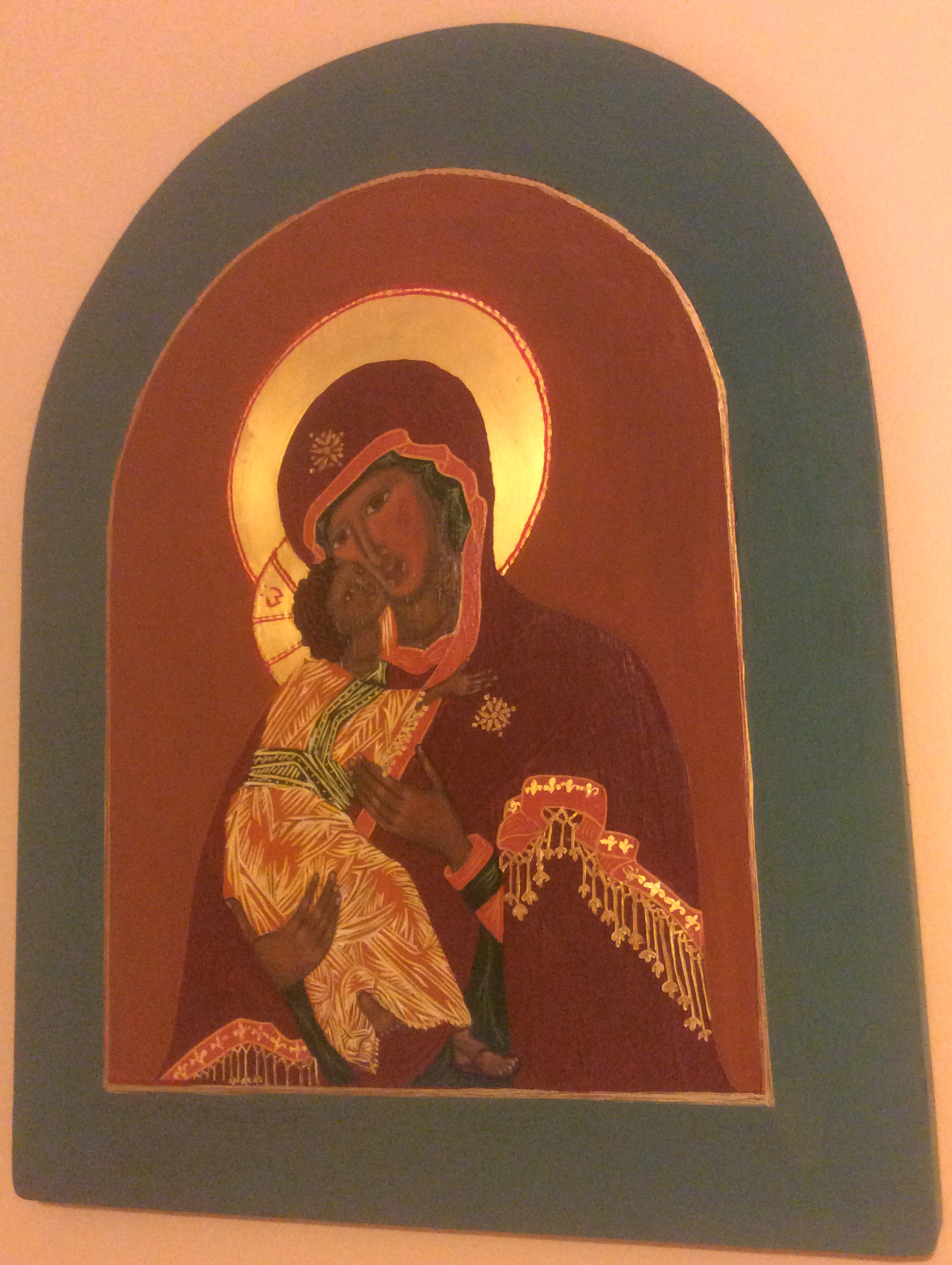
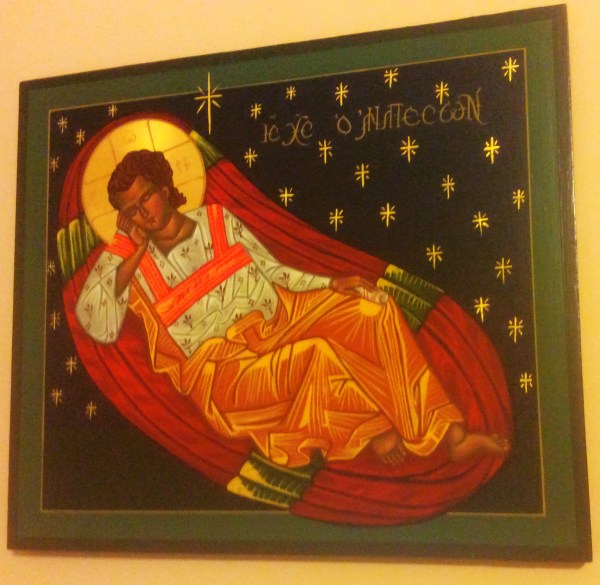
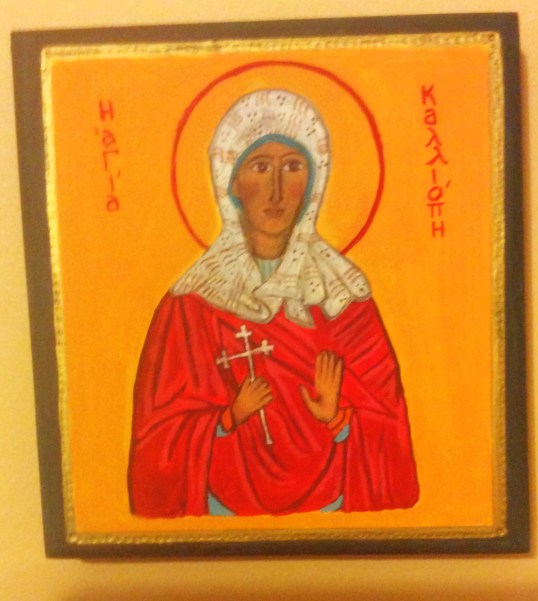
I seldom talk much about the spiritual disciplines that have given me strength. A private retreat — just me and God — in a beautifully isolated hermitage was one of the most powerful spiritual experiences of my life. While there, I also practiced another of my spiritual disciplines — iconography.
Iconography is not merely a visual art, it is Christian sacred art, and has been an integral part of the worship and mystical life of Christians since apostolic times. Referred to in the Eastern Christian tradition as “windows into heaven,” icons have inspired and uplifted millions of the faithful, and have at times been the instruments for demonstrating God’s miraculous intercession in the life of humankind.
In describing the purpose of icons, the early Christians used the Greek work anagogic, literally meaning “leading one upward.” Photios Kontoglou, a renowned modern iconographer, expressed this perfectly: “Icons raise the soul and mind of the believer who sees the icon to the realm of the spirit, of the incorruptible, of the kingdom of God, as far as this can be achieved with material means.”
So to appreciate iconography fully, we must approach it as a liturgical art form whose function is essentially spiritual. Since the creation of an icon is itself a sacred activity, the iconographer must be a person of prayer, not merely a technician. If the iconographer’s work is to inspire and illumine others, then it is essential that she leads a life of prayer and fasting that she may be inspired and illumined by the Holy Spirit, that her iconography becomes itself an expression of her spiritual life. Kontoglou writes: “The iconographers painted as they prayed.”
My love of iconography resulted from the prompting of my dear Aunt Eirene. She was an artist extraordinaire and a gifted iconographer. She studied and practiced to hone her skills and each year, she went to an intensive iconography workshop at a beautiful retreat center. One year, she persuaded me (forced is a more accurate term) to go with her. Of course, I was extremely reticent to try this new art form.
At first, I called on my artistic skills and was doing a barely decent job. But then a lovely nun who sat next to me said words that literally imprinted on my heart. She said, “Your rendering of the Holy Child is beautiful. Look into his eyes. When you see the Light coming from them, you will fall in love with your icon.”
She was so wise. I began to think more about the Christ Child’s eyes than my own art, and within a day, my iconography transformed from a painting to a prayer. It was worship, meditation and reverence. It touched my soul as I added color to the board, layer upon layer. It was an incredible experience to see the Light. I share with you here some of icons I created, as I remember the experience I had with each of them that opened my soul to the Light.






 Like a birthday party full of meaning beyond the hats and the food and the gifts and the cake.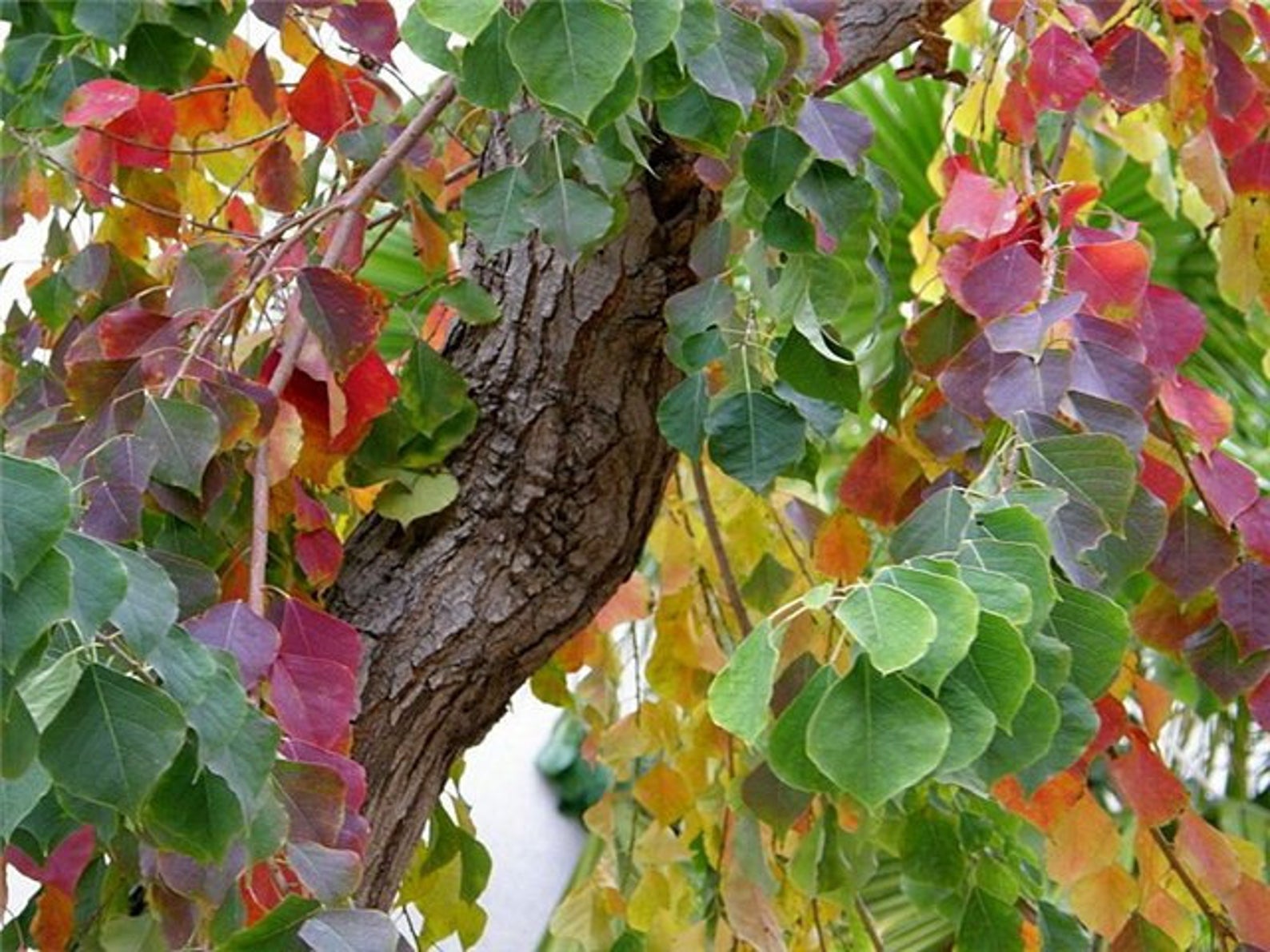

 There is no better expression I could share than Mary Oliver’s poem, When I Am Among Trees.
 Oh, to claim our place in the world, to go easy, to embody the message of the trees: “It’s simple!”


 As we are praying, gun injuries cause the deaths of 18 children and young adults each day in the U.S. And every day, 100 Americans are killed with guns. Can we ignore the fact that nearly 1 million women alive today have been shot, or shot at, by an intimate partner?
 “I have calmed and quieted my soul.” Words from the Psalmist.
 I seldom talk much about the spiritual disciplines that have given me strength. A private retreat — just me and God — in a beautifully isolated hermitage was one of the most powerful spiritual experiences of my life. While there, I also practiced another of my spiritual disciplines — iconography.
 In describing the purpose of icons, the early Christians used the Greek work anagogic, literally meaning “leading one upward.” Photios Kontoglou, a renowned modern iconographer, expressed this perfectly: “Icons raise the soul and mind of the believer who sees the icon to the realm of the spirit, of the incorruptible, of the kingdom of God, as far as this can be achieved with material means.”
 My love of iconography resulted from the prompting of my dear Aunt Eirene. She was an artist extraordinaire and a gifted iconographer. She studied and practiced to hone her skills and each year, she went to an intensive iconography workshop at a beautiful retreat center. One year, she persuaded me (forced is a more accurate term) to go with her. Of course, I was extremely reticent to try this new art form.
 She was so wise. I began to think more about the Christ Child’s eyes than my own art, and within a day, my iconography transformed from a painting to a prayer. It was worship, meditation and reverence. It touched my soul as I added color to the board, layer upon layer. It was an incredible experience to see the Light. I share with you here some of icons I created, as I remember the experience I had with each of them that opened my soul to the Light.
 God of the Sparrow 🌱 By Kathy Manis Findley