Change, Covenant, God's Faithfulness, Hope, life, Loss, Mourning

A Holy Thread

Enlight137Years ago, I served The Providence Baptist Church of Little Rock as their pastor. In those days, 1992, I was the only ordained woman who was a Baptist pastor in the state. Because of the strong and vocal disapproval and disdain from Baptists in Arkansas, my ministry at Providence was a lonely nine years.


I had just experienced months of open animosity from the Arkansas Baptist State Convention as I went through a hard, hard ordination process. Threatening phone calls were just the tip of a very ugly iceberg. And I was hurt, almost broken, from the experience. But that story is a blog post in itself that I will save for another day.

I was given a rare gift, though, in the people of Providence — a congregation of deep love and unwavering support. They were a courageous people, each having come to Providence from other Baptist churches to live out their faith. They took a risk to join Providence. Many convictions led them to do so, the role of women in the church, the inclusion of all persons, the re-visioning of the idea of “Baptist,” the desire to create a covenant with like-minded brothers and sisters, the quest to build a “beloved community” in our city.

I will always remember Ethel, one of our deacons and a dear mother-figure for me, who gave me constant encouragement. She would say to me almost weekly, “Tie a knot in the rope and hang on.” One of the times she said that, I was experiencing a particularly difficult time. I responded that what she was calling a rope felt much more like a thread.

I often recall those years with a mixture of joy and pain. In those years, many of us were grieving the loss of the denomination that had long nurtured us. We mourned for the loss of our seminaries, our beloved professors scattered in a deliberate and abusive diaspora. We mourned the loss of our Foreign Mission Board and worried about our missionaries around the world and the people they ministered to in towns and villages, plains and forests.

What I can say is that the pain slowly faded and healing covered us. I can also say with firm certainty that there was always a thread to hold on to, a thread that represented hope. I am inspired by the writing of William Stafford, who must know something about the thread we grip so tightly.

There’s a thread you follow. It goes among
things that change. But it doesn’t change.
People wonder about what you are pursuing.
You have to explain about the thread.
But it is hard for others to see.
While you hold it you can’t get lost.
Tragedies happen; people get hurt
or die; and you suffer and get old.
Nothing you do can stop time’s unfolding.
You don’t ever let go of the thread.

– William Stafford, The Way It Is: New and Selected Poems (Graywolf Press: 1998), 42.

Oh, what a comfort it is to hold on to the thread that never changes, even as everything around us changes constantly. What a comfort it is to find that sacred thread and to hold it tightly through all manner of life tragedy. What a comfort it is to move through change, suffering, loss, the many threatening events of life, and to feel the holy thread in your hands . . . constant, unbreakable, given to us by a compassionate God who always knew that our pathway would be scattered with stumbling stones and ominous boulders.

Thanks be to God for the holy thread. Hold it tightly.

Darkness, Fear, God's presence, Light

Afraid of the Night

Design
From the poem, “The Old Astronomer to His Pupil” by Sarah Williams. The last line of the poem was used as an epitaph for an Astronomer-couple
buried at Allegheny Observatory.


Almost every night as bedtime approaches, I experience a feeling of panic. I have thought a lot about what is going on in me when this happens. Hoping to overcome the fear, I say to myself again and again, “I need not be afraid of the night.” And yet the panic persists. What I do know is that there is a part of me that fears going to sleep and never waking up. I have thought long and hard about where such a feeling might come from.

I recently worked through this and discovered that the panic is related to my many nights spent in the hospital in 2014. I remember well the long nights of sleeplessness and anxiety. I remember the irrational fear that clung tightly to me following a few brushes with death. I remember that, even when I was stronger and out of imminent danger, I continued to be afraid. And I remember that the nights in the hospital were lonely and seemingly endless.

When I was discharged and safely back home, I continued to be sleepless, eyes wide open every night, all night. I stayed exhausted, of course, and slept soundly during the day. It is interesting to me how the body adjusts itself to changing circumstances and schedules, physically and emotionally, even spiritually. Body and soul, I easily accepted an intense fear of the night. Perhaps I could just as easily embrace the reality of a caring God who watches over me through every dark time. Perhaps I could find the God of the Psalmist.

You have searched me, Lord, and you know me.
You know when I sit and when I rise;
you perceive my thoughts from afar.

You discern my going out and my lying down;
you are familiar with all my ways.

Before a word is on my tongue, you, Lord, know it completely.

You hem me in behind and before, and you lay your hand upon me.

Such knowledge is too wonderful for me, too lofty for me to attain.

Where can I go from your Spirit?
Where can I flee from your presence?

If I go up to the heavens, you are there;
if I make my bed in the depths, you are there.

If I take the wings of the morning,
and dwell in the uttermost parts of the sea,

even there your hand will guide me,
your right hand will hold me fast.

If I say, “Surely the darkness will hide me
and the light become night around me,”

even the darkness will not be dark to you;
the night will shine like the day,
for darkness is as light to you.

– Psalm 139:1-13

I need not be afraid of the night.

It is true. Through every dark day, I could not flee from God’s presence. In the “dark night of my soul, in every difficult time, there was a reality I needed to learn, an eternal truth waiting fir me to discover. My discovery was about the captivity of fear, especially fear that descended on me in the dark of night. My discovery was also about a Light that is brighter than any darkness I could ever experience.

I need not be afraid of the night. Thanks be to God.


Africa, Beauty of Nature, Trees

For the Love of Trees

IMG_5780
Image by Diane Walker@Contemplative Photography

I have had a lifelong love affair with trees. Trees have inspired and strengthened me in many ways. The huge magnolia tree from my troubled childhood was a place of safety, giving me a place to hide from danger, offering to me a place to feel protected.

Miss Martha’s sprawling fig tree on the edge of our back yard bore wonderfully unusual fruit, soft and sweet and delectable. Her plum trees were loaded with plums, sweet and sour and delicious both ways. The fond memory I have of Miss Martha’s trees is punctuated with an angry Miss Martha catching us stealing figs and plums, yelling at us with an ominous voice, and chasing us from her yard.

The African plains graced my life with the gift of watching giraffes feeding on flat-topped thorn trees and elephants pushing their weight against misshaped baobab trees. The colorful swaying of ten foot tall bougainvillea trees was a mesmerizing sight. And in Africa, poinsettia plants are trees, trees like I had never before seen.

IMG_5782  IMG_5781

IMG_5783  IMG_5784

Beyond this crash course on botany, and dendrology, I share a heart-and-soul love of trees. It is almost a spiritual connection for me, one that keeps me fully grounded, one that represents life, growth, rootedness, protection and sheer enjoyment.

My friend, Elaine, writes a beautiful blog entitled The Edge. In today’s blog post, Elaine shares a quote about what we learn from trees written by Diane Walker. (https://theedgeishere.wordpress.com/2017/08/10/contemplative2017-rooted/)

It’s possible, you know — we learn it from the trees —
to be full of grace and humor, dancing in the light
while remaining fully grounded,
rooted in the gravitas of being . . .

– Diane Walker

God is pleased, I think, when we dance in the light full of grace and humor. We learn it from the trees, Diane Walker says. I believe she’s right. So today, I will be spending a few moments sitting in the shade of our Chinese Tallow tree and swinging underneath a towering Pin Oak. Perhaps in the leaves that rustle gently in the breeze, I will hear God’s  whispers.


Grace, Hope, Illness, life

Life Is a Gift

IMG_5772

Today I read an inspiring blog post written by my long-time friend, Guy Sayles. He recalls his medical diagnosis of Multiple Myeloma three years ago and describes the experience of “vivid remembering of hard days of treatment.”

Around the same time, I entered a time of serious and unexpected illness which led to a diagnosis of end stage kidney disease. I spent most of 2014 in the hospital, literally fighting for my life on at least three occasions. My husband was terrified. Mercifully, I knew nothing of the urgency of what was happening to me.

Guy Sayles writes of a reality that I completely understand when he says, “The first two years of my having Multiple Myeloma were so challenging that I didn’t expect to be alive now. That I am is sheer and surprising gift to me.” (http://www.fromtheintersection.org/blog/2017/8/8/its-all-gift)

For me, it was not so much that I expected imminent death, but throughout my long period of recovery and rehabilitation, I never expected to be able to care for myself again. That I now am able to live a relatively normal life is most certainly a gift of grace I never expected. Healing and recuperating was much like a resurrection for me. I got my life back.

So my constant question to myself is what will I do with this gift of life? I am inspired by the way Mary Oliver asks this question in her poem, The Summer Day.

Tell me, what is it you plan to do with your one wild and precious life?

I am compelled to answer that question, to use the gift of my life as a gift to others. To care for people with compassion. To do justice where oppression reigns. To make peace in the face of violence. To scatter hope in the places where despair has taken hold.

I hope you will truly hear the way Guy Sayles expresses this.

The awareness which gently and repeatedly washed over me was, “Life is gift and my response may, can, and should be gift-giving.”

And my calling is to lavish gift-giving—to share freely and fully whatever I manage to harvest. There’s no need now for barns and bins, for storing up for another day, or for worrying about markets and prices. “Freely you have received,” Paul said, “freely give.”

These days, I aspire, in every dimension of life, to this the wisdom Annie Dillard offered to writers:

“One of the few things I know about writing is this: spend it all, shoot it, play it, lose it all, right away, every time. Do not hoard what seems good for a later place in the book, or for another book; give it, give it all, give it now . . . something more will arise for later, something better. These things fill from behind, from beneath, like well water . . . The impulse to keep to yourself what you have learned is shameful, it is destructive.  Anything you do not give freely and abundantly becomes lost to you. You open your safe and find ashes.” (The Writing Life, pp. 78-79)

Amen and amen. May God make it so.

Contemplation, Darkness, Faith, Fear, Grace, grief, Loss

In the Dark


IMG_5755

I was asked recently to write about faith and chronic illness. The request prompted me to recall the year I lived in the dark, the year that I was so seriously ill. It made me think about the losses I have experienced since the diagnosis of end stage kidney disease. It reminded me of the freedom I have lost because of the eight hours I spend on dialysis every day.

The truth is that, in 2014, I thought I was going to die. The greater truth is that I did not die. In fact, I slowly grew physically stronger. Spiritually and emotionally, I descended into grief and despair and somehow managed to emerge with fresh hope and deeper faith.

It was a grueling process learning to write again, practicing with the occupational therapist’s endless pages of ABCs over and over until I began to form legible letters. It was hard learning to walk again, regaining the strength and balance I had lost. It was hard being unable to cook, to care for the house, to bathe myself, to browse the web, to do all the simple things I used to do so easily.

To be sure, it was a dark time of frightening uncertainty and doubt. I mourned for the life I once enjoyed. But in time, I discovered an unexpected grace: that spiritual transformation often happens in the dark. The writing of Richard Rohr offers a way to describe this time of my life. This is what he writes.

We seldom go willingly into the belly of the beast. Unless we face a major disaster . . . we usually will not go there on our own accord. Mature spirituality will always teach us to enter willingly, trustingly into the dark periods of life, which is why we speak so much of “faith” or trust.

Transformative power is discovered in the dark—in questions and doubts, seldom in the answers . . . Wise people tell us we must learn to stay with the pain of life, without answers, without conclusions, and some days without meaning. That is the dark path of contemplative prayer. Grace leads us to a state of emptiness, to that momentary sense of meaninglessness in which we ask, “What is it all for?” 

– Richard Rohr

It was indeed “the belly of the beast” for me. And as Richard Rohr writes so eloquently, I needed to learn to “stay with the pain of life, without answers, without conclusions, and some days without meaning.”

Here’s the outcome. Smack dab in the middle of the darkness I experienced, there was God. There was grace. There was transformation. And there was renewed life. Thanks be to God.

Faith, God's presence, grief, Hope, Prayer

Nearer, My God, to Thee

Enlight136

While enjoying some quiet time on my new pergola swing, I listened to the hymn “Nearer, My God, to Thee” sung by Brigham Young University’s male choral group, Vocal Point. It would not be an exaggeration to say that I was transported to a sacred place in those few moments. The hymn I had sung for so many years took on fresh, new meaning for me. It could be because of my aging, my illness, my need for a closer relationship with God. Perhaps the hymn spoke to me simply because I needed it. I have long loved this old hymn and its simple, but profound, message.

Nearer, my God, to Thee, nearer to Thee!
E’en though it be a cross that raiseth me,
Still all my song shall be, nearer, my God, to Thee.

Refrain:
Nearer, my God, to Thee, nearer to Thee!

Though like the wanderer, the sun gone down,
Darkness be over me, my rest a stone;
Yet in my dreams I’d be nearer, my God, to Thee.

There let the way appear, steps unto Heav’n;
All that Thou sendest me, in mercy giv’n;
Angels to beckon me nearer, my God, to Thee.

Then, with my waking thoughts bright with Thy praise,
Out of my stony griefs Bethel I’ll raise;
So by my woes to be nearer, my God, to Thee.

Or, if on joyful wing cleaving the sky,
Sun, moon, and stars forgot, upward I’ll fly,
Still all my song shall be, nearer, my God, to Thee.

– Lyrics by Sarah F. Adams, 1805–1848
Music by Lowell Mason, 1792–1872
Published 1841, Hymn in public domain.

What makes this particular performance of the hymn so compelling is the inclusion of a counter melody. While a solo voice sings the words of “Nearer, My God to Thee” and paints a portrait of a life drawing near to God, the chorus sings a counter melody in Latin. The music is stunningly beautiful. The message reaches the depths of a soul in need of God’s presence. One listener described it like this:

So wonderful. It feels like angels paying a visit to earth with a hymn.

So I want to share with you the Latin text and the translation, which brings new meaning to the hymn.

In articulo mortis // At the moment of death

Caelitus mihi vires // My strength is from heaven

Deo adjuvante non timendum // God helping, nothing should be feared

In perpetuum // Forever

Dirige nos Domine // Direct us, O Lord

Ad augusta per angusta // To high places by narrow roads

Sic itur ad astra // Such is the path to the stars

Excelsior // Ever upward

Why, you might ask, am I writing a music review on my blog today? I suppose my words are an attempt to describe a need for the nearness of God. In times of grief, when sorrow overwhelms, when darkness is all we see, drawing near to a God of compassion is our healing balm and our highest hope. As I contemplate this truth, I am thinking of what was called the greatest disaster in maritime history — April 14, 1912 — the S.S. Titanic sank after striking an iceberg. As the ship disappeared into the vast ocean, Mr. W. Hartley, the ship’s bandmaster, led the band in playing “Nearer, My God, To Thee.”

I pray that, in whatever crisis you face, you will rest in the nearness of God. And I invite you to listen to BYU Vocal Point’s performance of this hymn:


Contemplation, Courage, Covenant, Prayer

Raising Cain

IMG_5745
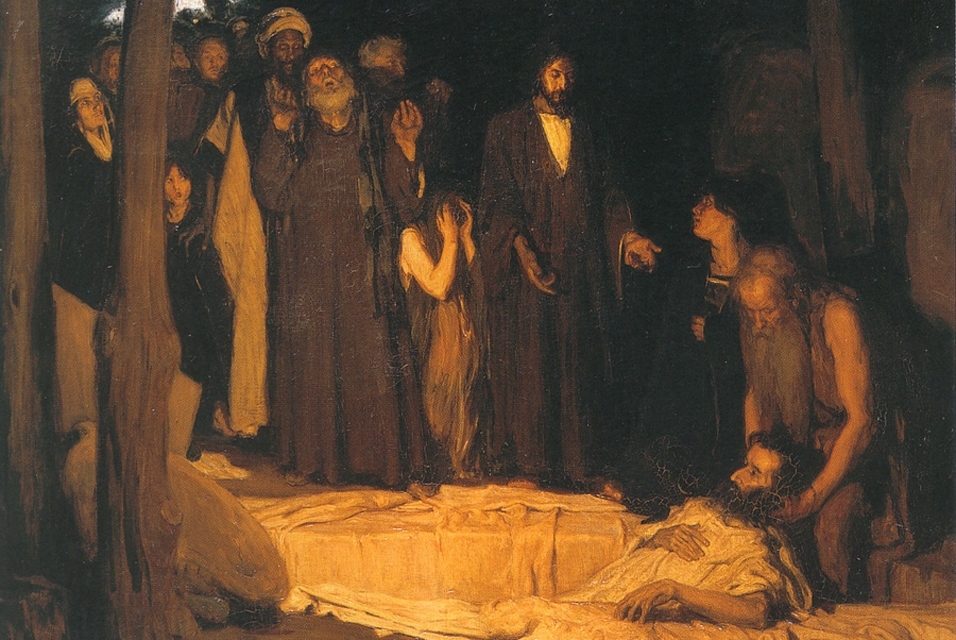
“The Resurrection of Lazarus.” Oil on canvas painting by Henry Ossawa Tanner, 1896 

As someone born and raised in the south, I know a lot about “piddlin’ around.” I do it all the time, and when the day’s light comes to an end, I always wonder if I have done anything at all worthwhile.

Don’t get me wrong. I heartily approve of some piddlin’ around in life. Especially holy piddlin’ like getting quiet and getting in touch with God. Holy piddlin’ like sitting in silent contemplation can bring God close to me. Praying can take me to a special place for sensing God’s touch. Listening to sacred music opens my soul to the whisper of God.

Piddlin’ can be a very life-giving pastime. On the other hand, some of us God followers long to change the world, to face off against oppression, to do justice, to end wars . . . to do something of eternal meaning.

Our problem is that changing the world can be a heavy burden that we simply cannot carry around for long. The secret, I think, is a balance between pensive spiritual moments with God and those once-in-a-while moments of sparkling mission and calling, those moments when we rise courageously above ourselves and almost see miracles. Truth is, it is not a common happening for us to find ourselves raising anyone from the dead or healing someone who is suffering illness.

It seems that the best we can do is to say to God, “I offer you, God, my silent devotion. And I offer you my willingness to follow your highest calling and your most extraordinary mission, wherever it leads and whatever the cost. Here’s my heart. Do with my life as you will.”

I very much enjoy the writing of Annie Dillard, and she has written eloquently on this very subject. Here’s what she writes.

There is always the temptation in life to diddle around making itsy-bitsy friends and meals and journeys for years on end… But I won’t have it. The world is wilder than that in all directions, more dangerous…more extravagant and bright. We are…raising tomatoes when we should be raising Cain, or Lazarus.

– Annie Dillard

I hope that you will find many of those sacred “be still, my soul” moments with God. But I pray also that you will, along the way, have eyes wide open for those bright and extravagant miracle moments when it just might be possible to raise Cain or raise Lazarus.

Faith, God's presence, healing, Hope

A Perfect Place to Die

IMG_5744
Japan’s Aokigahara Suicide Forest

I watched a very thoughtful and intriguing movie last week — The Sea of Trees. The film was captivating, telling the story of a despondent professor who despaired of life and searched for a way to end his life. His search led him to Aokigahara, a forest in Japan known also as the Sea of Trees or the Suicide Forest.  Aokigahara Forest has been home to over 500 confirmed suicides since the 1950s. It is called “the perfect place to die” and is the world’s second most popular place for suicide.

One might say that suicide is not the most uplifting subject for a blog. But suicide is a very real and present tragedy in the world. Consider these startling statistics reported by The Jason Foundation. (http://prp.jasonfoundation.com/facts/youth-suicide-statistics/)

▪️Suicide is the second leading cause of death for ages 10-24. (2015 CDC)

▪️Suicide is the second leading cause of death for college-age youth and ages 12-18. (2015 CDC)

▪️More teenagers and young adults die from suicide than from cancer, heart disease, AIDS, birth defects, stroke, pneumonia, influenza, and chronic lung disease, combined.

▪️Each day in our nation, there are an average of over 5,240 attempts by young people grades 7-12.

▪️Each year, 30,000 Americans die by suicide. An additional 500,000 Americans attempt suicide annually. (http://www.mentalhealthamerica.net/suicide)

Some people have found help through suicide prevention programs. Others choose to turn to 24-hour suicide helplines available around the clock to provide crisis intervention. (https://suicidepreventionlifeline.org/) Still others find that it is their faith that raises fresh hope within them and lifts their sight above the darkest of days.

There is a special kind of renewed hope when people who have been on the brink of taking their own lives share their stories of faith, the depth of faith that ultimately gave them the inner strength to live. Samuel Trevor Francis (1835-1925) told such a story of faith. He experienced a spiritual turning point as a teenager, contemplating suicide one night on a bridge over the River Thames. An unexpected renewal of his faith saved his life that night. At age 41, Samuel Trevor Francis recalled the faith that saved him and penned the words of the well-known Christian hymn, “O the Deep Deep, Love of Jesus.”

O the deep, deep love of Jesus, vast, unmeasured, boundless, free!
Rolling as a mighty ocean in its fullness over me!
Underneath me, all around me, is the current of Thy love
Leading onward, leading homeward to Thy glorious rest above!

O the deep, deep love of Jesus, spread His praise from shore to shore!
How He loveth, ever loveth, changeth never, nevermore!
How He watches o’er His loved ones, died to call them all His own;
How for them He intercedeth, watcheth o’er them from the throne!

O the deep, deep love of Jesus, love of every love the best!
‘Tis an ocean vast of blessing, ’tis a haven sweet of rest!
O the deep, deep love of Jesus, ’tis a heaven of heavens to me;
And it lifts me up to glory, for it lifts me up to Thee!

But let’s go back to where we began —  the best place to die.

Many years ago, I looked for that place, a way out of many years of relentless, chronic pain. I traveled alone to Mayo Clinic to receive two weeks of specialized medical care and physical therapy.  Perhaps a city very far from my home would be the best place to die. After an upsetting treatment at the clinic, I managed to make it to my hotel room. I took out all the bottles of prescription medication I had with me. The phone rang, and a friend distracted my focus from the tablets I had poured out in front of me. And through our conversation, with tears falling on my freshly-made bed, I learned something very life-giving about the depth of my faith, and most of all, about the depth of God’s abiding, ever-present love.

And so today I can say with strong assurance that the best place to die — or to live — is in middle of the deep, deep love of Jesus, a love that is for me “vast, unmeasured, boundless, free!” A love that restored hope in the midst of my despair. A love that was enough.

Today, as I silently sing “O the Deep, Deep Love of Jesus,” the words of that beautiful hymn ring real and true. God’s love truly was underneath me and all around me, even on that cold and lonely night in Minnesota.

Thanks be to God.


Change, Courage, Dreams, Hope, Justice, peace, Perseverance

Raise Beautiful Trouble!

IMG_5737Raise beautiful trouble!

Resist! Resist all actions that hinder peace and cause the madness of warring. Women have long dreamed of peace, dreaming of a world without war, hatred, racism, homophobia, xenophobia, and all forms of injustice. Our Jewish brothers and sisters proclaim “Tikkun Olam” calling us to heal the world. Tukkun Olam is a jewish concept defined by acts of kindness performed to perfect or repair the world. The phrase is found in the Mishnah, a body of classical rabbinic teachings and is often used when discussing issues of social policy.

Raise beautiful trouble!

Diane Wilson climbed over the fence at the White House, skinning her stomach on the steel barbs. Two weeks later she got a visit from two guys in black suits, black shoes, and wearing sunglasses, Secret Service agents who wanted to know if she had an authority complex.

Diane is active in the organization, CODEPINK, a women-led grassroots organization working to end U.S. wars and militarism, support peace and human rights initiatives, and redirect tax dollars into healthcare, education, green jobs and other life-affirming programs. (http://www.codepink.org)

Century after century women have yearned for and worked for peace. Through the years, women have walked hand in hand as they reflected on ways to create a just and peaceful world. Maybe it’s just a woman thing! Julia Ward Howe proclaimed these words in 1870.

Arise, then, women of this day! Arise all women who have hearts, whether our baptism be that of water or of tears! . . . We women of one country will be too tender of those of another country to allow our sons to be trained to injure theirs. From the bosom of the devastated earth a voice goes up with our own. It says, “Disarm! Disarm! The sword of murder is not the balance of justice.”

— Julia Ward Howe, 1870, From her Mother’s Day Proclamation for Peace

IMG_5734
Art by Ayla Mahler

The dream persists. The peacemakers persevere, longing for a day when all people will “hammer their swords into plowshares and their spears into pruning hooks. Nation will not lift up sword against nation, And never again will they learn war.” (Isaiah 2:4 NASB)

The words of T.E. Lawrence offer stunning hope for better days.

. . . the dreamers of the day are dangerous men and women, for they may act their dream with open eyes, and make it possible.

Sisters (and brothers too), continue to dream of peace with eyes wide open. Raise beautiful trouble! Resist! Persist! The peace of the world is your reward.


Change, Courage, Hate, Justice, Transformation

The Power of a Whisper

IMG_5727Speak your mind. Don’t be afraid. Don’t whisper in the deep.

These words, composed by Ray Phiri, the South African guitarist and anti-apartheid bandleader who played behind Paul Simon on “Graceland,” opened my mind and heart to a stark reality— that hate hovers ominously all around. That hate’s power can dessimate all that is right and just and good in the world. That hate can be conquered only by a courageous people willing to speak truth and love whatever the cost.

Ray Phiri died last week at age 70, but in this seventy years, his controversial ideas made an impact. His song,”Whispers in the Deep” was banned from broadcast on the South African government-controlled radio station, SABC, when it was released in 1986.

Stand up! Wake up!
Call me angry, call me mad.
A soul that whispers in the deep.
I’m inspired.
But I can’t understand hate.

I imagine that is exactly where we find ourselves, unable to understand hate. We see enough of it, to be sure. We hear about it every day. We know about the dry, brittle bones that remain when a person experiences enough hate.

Hate is war. It is hunger and poverty. It is racism and homophobia and xenophobia. It is violence and abuse. It is unbridled anger. It is injustice in many forms, injustice that shatters lives and leaves dust and ashes in its wake.

Standing amidst hate is not unlike standing in a personal hell. Hate, whether around us or within us, has the power to crush the soul. And yet, always present with us is a protective God who can deliver us from hate’s destruction.

For me, it is true that I do not always know that God is nearby. I seldom see God as my personal vanquishing superhero that destroys the power of hate. Rather, the God I know is much more like the God in the story of Elijah. (1 Kings 19:11-13)

As the story goes, Elijah clings to a cave while God unleashes natural forces far beyond anything Elijah has ever seen or heard. But even in the midst of the tempest, Elijah realizes that something is terribly wrong. The text tells us three times that God is nowhere to be found. But the text also insists that God is passing by.

Elijah looked for God in the great whirlwind, in the shattering earthquake, in the blazing fire. But Elijah did not experience God’s presence in any of those mighty and supernatural happenings. Elijah experienced God in the sound of a light whisper. Biblical translators have often called it “the still, small voice.”

The question I ask myself is whether or not I will gather enough strength from God’s tentative presence with me to wake up, to stand up against hate. As in Ray Phiri’s compelling lyric, I do not understand hate. He warns against whispering in the deep, probably a warning against being too quiet in a world that needs to hear confident voices. But it seems to me that even a whisper can be full of power. A persevering whisper can vanquish hate. A persistent whisper can transform the world.

May God make it so.


Change, Christian Witness, Courage, Freedom, Hope, Justice, peace, Perseverance, Politics

Persevering Hope

IMG_5700


PAX

(pɑks ; päks; pæks ; paks). noun

1. the Roman goddess of peace, identified with the Greek Irene

2. sign of peace


The Reverend Jennifer Butler was wearing a white clergy stole with Pax embroidered over a cross and an olive branch. Enlight126She Was singing as police officers restrained her, arms behind her back, both thumbs held tightly together with plastic straps. Next to be arrested was The Reverend Traci Blackmon, who chanted “justice, mercy” again and again as police restrained her and led her away.

The Charlotte Examiner described the event, The March to Save Medicaid, Save Lives.

Capitol Hill police arrested the president of the North Carolina NAACP on Thursday morning after he led a protest of the Senate’s proposed health care repeal-and-replace bill.

Rev. William J. Barber II, who was protesting in his role as president of Repairers of the Breach, was released from jail by 2 p.m. On that morning, July 13, 2017, Dr. Barber and other faith leaders led a group of about 50 people to Senate Majority Leader Mitch McConnell’s office in the Capitol.

The group gathered a few blocks away at 10 a.m. and walked to the Capitol, chanting and singing along the way. Eleven protesters were arrested.

Read more at this link:

http://www.charlotteobserver.com/latest-news/article161200048.html#storylink=cpy

As I watched the live feed of this moral and courageous expression of civil disobedience, I hoped that the police would not arrest The Reverend Dr. William Butler, who was obviously experiencing pain from his physical disabilities. I hoped that other faith leaders would not be arrested.

The band of justice-seekers, clergy and persons of all faiths, gathered together in a prophetic action to protect the 22 million Americans in danger of losing healthcare because of what the group calls “immoral Congressional legislation.” The Repairers of the Breach Facebook page gives details of the event.

Together, we’ll join in song and march through the halls of power, sending a moral message that we cannot cut Medicaid — a lifeline for so many children, seniors and people with disabilities.

My heart was with them in Washington. My prayers pleaded for hope for a brighter day, for justice for those who are oppressed, for peace for every person. My mind recalled the words of the prophet Isaiah . . .

And if you spend yourselves in behalf of the hungry
and satisfy the needs of the oppressed,
then your light will rise in the darkness,
and your night will become like the noonday.

The Lord will guide you always;
And will satisfy your needs in a sun-scorched land
and will strengthen your frame.

You will be like a watered garden,
like a spring whose waters never fail.

Those from among you will rebuild the ancient ruins;
You will raise up the age-old foundations;
And you will be called the repairer of the breach,
The restorer of the streets in which to dwell.

– Isaiah 58:10-12

I watched them stand bravely as they faced the powers before them, living into the words spoken by Hannibal of Carthage, “We will either find a way or make one.” I listened to their voices echoing through the halls of the building, singing with persisting, persevering hope.

Ain’t gonna let injustice turn me around
Turn me around, turn me around
Ain’t gonna let injustice turn me around
I’m gonna keep on a-walkin’, keep on a-talkin’
Marchin’ up to freedom’s land.

Ain’t gonna let no jail cell turn me around
Turn me around, turn me around
Ain’t gonna let no jail cell turn me around
I’m gonna keep on a-walkin’, keep on a-talkin’
Marchin’ up to freedom’s land.

Ain’t gonna let nobody turn me around
Turn me around, turn me around
Ain’t gonna let nobody turn me around
I’m gonna keep on a-walkin’, keep on a-talkin’
Marchin’ up to freedom’s land.

Repairers of the Breach — http://www.breachrepairers.org/

Covenant, Freedom, Perseverance

Reach for the Stars

Enlight124

We greet this year’s Independence Day still reaching for the stars. We also come to this day with a measure of confusion, disillusionment, and even fear. We have a president who is revered by some Americans and feared by most Americans. We feel concern when the president Tweets divisive messages. We feel concern about the ways he interacts with international leaders. We feel concern about health care. We feel concern about the loss of the freedoms we have enjoyed for centuries. We are concerned for our neighbors who have come to America as immigrants and who now face an uncertain future.

This Fourth of July we remember that eight immigrants signed the Declaration of Independence we celebrate today. We recall the words written on that historical document that was signed on July 4, 1776:

We hold these truths to be self-evident, that all men are created equal, that they are endowed by their Creator with certain unalienable Rights, that among these are Life, Liberty and the pursuit of Happiness.

. . . And for the support of this Declaration, with a firm reliance on the protection of divine Providence, we mutually pledge to each other our Lives, our Fortunes and our sacred Honor.

We are still the United States of America. We persist in loving our brothers and sisters and in cherishing the unity that goes far beyond our differences. Creating “a more perfect union” remains our sacred calling though we know that mutually pledging our lives to each other requires constancy and dedication. It requires our willingness to accept one another and to honor each other’s differences. It requires offering mutual respect. Dr. Martin Luther King, Jr. spoke about the sheer work of human progress, work to which we must commit and recommit.

Human progress is neither automatic nor inevitable . . . Every step toward the goal of justice requires sacrifice, suffering, and struggle; the tireless exertions and passionate concern of dedicated individuals.

– Martin Luther King, Jr. in Stride Toward Freedom, 1957

On this day that is a celebration of our independence, we know that we we cannot always determine the destiny of our country. We know that our freedom often feels precarious. We know that we cannot always be led by the president we prefer. But we also know that the citizens of this country will always reach for the stars as we labor for our nation’s honor, and in the end, will join hands and rise to meet a brighter future.

More than any time in recent history, America’s destiny is not of our own choosing. We did not seek nor did we provoke an assault on our freedom and our way of life . . . Yet the true measure of a people’s strength is how they rise. We will do what is hard. We will achieve what is great. This is a time for American heroes and we reach for the stars.

– President Josiah Bartlet, The West Wing

Family, Love, reconciliation, Restoration

Pete and Peter

Enlight123
Impulsive, spunky, fiery, colorful Pete. RIP.

My youngest brother, Pete, was taken from us too early. Cancer ravaged his body, but could never damage his indomitable, spunky spirit. Pete was spirited, colorful and full of life, fiery in one moment, gentle in the next. He was funny. He was fiercely loyal. And he loved lavishly.

I could easily compare Pete to his namesake, the disciple Peter. You know the one, the disciple who kept putting his foot in his mouth, who tried to walk on a lake and began to sink because of a faith too small. He was the disciple who betrayed Jesus three times and in the end, in the very last verse of the 22nd Chapter of the Gospel of Luke, verse 62 ends the pain-filled story with these words: “And he went out and wept bitterly.”

You see, in spite of his mistakes, his denials, his impulsive behavior, Disciple Peter loved Jesus deeply. And my baby brother was a bit like this flawed disciple. Pete was often impulsive, volatile, frequently unreasonable, quick-tempered. Yet, he was full of love that opens its arms to protect with extravagant caring.

So for the 29th of June, St. Peter’s Day, I remember the impulsive disciple who, for all his mistakes, learned how to hold on to his better self, to recover from wrong turns in his life, and to make peace with his wavering self. Jesus called this seemingly undisciplined man “the rock.” I suspect Jesus chose that name because he saw that Peter knew how to live again, standing strong against his own demons and ultimately learning that any betrayal, every betrayal, can miraculously be restored by love.

My brother Pete’s life, also filled of rough roads and wrong turns, taught him the same lesson: that love restored him to himself, to his estranged family, to the sister that had been lost to him for years. Love did that. And love is what keeps Pete close, even in death.

Poet Malcolm Guite has written a beautiful piece entitled “A Sonnet for Petertide.”

Impulsive master of misunderstanding
You comfort me with all your big mistakes;

Jumping the ship before you make the landing,

Placing the bet before you know the stakes.

I love the way you step out without knowing,

The way you sometimes speak before you think,

The way your broken faith is always growing,

The way he holds you even when you sink.

Born to a world that always tried to shame you,

Your shaky ego vulnerable to shame,

I love the way that Jesus chose to name you,
Before you knew how to deserve that name.

And in the end your Saviour let you prove
That each denial is undone by love.

Thank you for your life, Disciple Peter. You give us hope that we can overcome our imperfect actions, make it through dusty roads covered with the boulders of our mistakes, and find love at the end.

And as for my baby brother, Pete, I will always remember your ornery ways, your explosive temper, your intense loyalty and your lavish love.

Happy Name Day, sweet little brother. I miss you.

Friendship, Generosity, Justice

“You Shall Also Love the Stranger”

Design

In December of 2000, the United Nations General Assembly approved a resolution to inaugurate World Refugee Day, to be observed annually on the twentieth of June. Protestant bodies as diverse as the World Evangelical Alliance and the World Council of Churches (which include Orthodox bodies as well) urge member congregations to commemorate World Refugee Sunday each year on the Sunday before or after June 20th. The Roman Catholic Church observes the World Day of Migrants and Refugees in January.

According to 60 Minutes, hundreds of houses of worship in the United States have volunteered to shelter illegal immigrants and their families who face deportation. In fact, since Donald Trump was elected in November, the number of churches in the United States expressing willingness to offer sanctuary has doubled to more than 800, according to the Rev. Noel Anderson, national grassroots coordinator at Church World Service. Illegal immigrants can be arrested in places of worship, but ICE has a long-time policy of avoiding religious spaces, schools and hospitals.

Katy Long of The Guardian news organization tells the story of a Christian couple who own and operate Refugee Coffee, a company that hires newly arrived refugees. Long also writes about Clarkston, a small town in Georgia, that has received over 40,000 refugees over the past 25 years. They come to Clarkston from every corner of the globe. This year there are more Congolese than Syrians. Past waves of refugee resettlement have brought Bhutanese, Eritreans, Ethiopians, Somalis, Sudanese, Liberians, Vietnamese. All have landed in an otherwise unremarkable city in the Deep South, population 13,500.

TIME magazine called Clarkston the most diverse square mile in America with almost 32% of the city being foreign born. Their story is recounted in the best selling book, Outcasts United: An American Town, a Refugee Team, and One Woman’s Quest to Make a Difference.

Good for a Clarkston, Georgia, a shining example to us in our increasingly xenophobic nation! As people of God, we have our mandate: to love and respect those who come to seek refuge among us.

I share with you a litany for worship written by Ken Sehested, “You Shall Also Love the Stranger.”

Gracious One, who jealously guards the lives of those at every edge, we lift our heavy hearts to your Mercy.

We live in a fretful land, anxious over the ebbing away of privilege, fearful that strangers are stealing our birthright.

Aliens breaching our borders.

Refugees threatening our security . . .

IMG_5632

“Cursed be anyone who deprives the alien, the orphan, and the widow of justice.”
(Deuteronomy 27:19)
All the people shall say, “Amen!”

“You shall also love the stranger, for you were strangers in the land of Egypt.” (Deuteronomy10:19).
All the people shall say, “Amen!”

“There shall be one law for the native and for the alien who resides among you” (Exodus 12:49).
All the people shall say, “Amen!”

“When an alien resides with you in your land, you shall not oppress the alien” (Leviticus 19:33).
All the people shall say, “Amen!”

“Then I will draw near to you for judgment; I will be swift to bear witness against . . . those who thrust aside the alien, and do not fear me, says the LORD of hosts”  (Malachi 3:5).
All the people shall say, “Amen!”

[Speaking to those destined for paradise, Jesus explained:] “For I was a stranger and you welcomed me.” (Matthew 25:35)
All the people shall say, “Amen!”

For we, who were formerly illegal aliens and undocumented workers in Creation’s midst, “are no longer strangers and aliens, but you with the saints and also members of the household of God.” (Ephesians 2:19)

Amen, Amen and Amen!

©ken sehested @ prayerandpolitiks.org

Covenant, healing, peace, Politics, Relationship, Transformation

Reconciliation: The Heart’s Repentance

IMG_5630

The long and arduous presidential campaign left behind a fractured nation. The political parties displayed unprecedented enmity between Democrats and Republicans. The citizenry followed their lead, and the result was broken relationships among friends and even within families. My own family exchanged sharp and hurtful words during the campaign, words that continue to affect our relationships.

We have made enemies of other nations. Some among us have made enemies based on race, culture, gender, national identity, religious practice, sexual orientation. And we remain divided and hostile, with no apparent desire to reconcile. And yet, we desperately need true reconciliation.

The Biblical concept of reconciliation suggests the presence of spiritual, divine intervention that creates reconciliation in the hearts of those who are estranged. Reconciliation assumes there has been a breakdown in a relationship, but through the heart’s repentance, there is a change from a state of enmity and fragmentation to one of harmony and fellowship.

It is going to require the heart’s repentance to restore a climate of unity, mutual respect, love and peace. Michael Curry, the Presiding Bishop of the Episcopal Church in America, offers these insightful thoughts about reconciliation.

Reconciliation isn’t just singing Kumbaya and everyone being nice. Reconciliation is about the hard work of working through our differences, maybe acknowledging them and not changing them, necessarily. Working through our differences, honestly and with integrity, and sometimes repenting of where our differences or my differences or yours has actually hurt relationship and not helped the human family.

Shall we just leave everything as it is? Shall we allow the distance to continue between us and those we have lost because of our differences? Shall we accept a fractured world and the divisiveness that now assails us? Or shall we instead commit ourselves to the holy work of reconciliation?

Our sacred calling is to restore peace within the human family, creating a world that can nurture our children and grandchildren, striving for genuine reconciliation among those from whom we are estranged, restoring peace and a community of love, transforming fractured and hurting humanity. This is what God implores us to do.

. . . This is from God, who through Christ reconciled us to himself and gave us the ministry of reconciliation; that is, in Christ God was reconciling the world to himself, not counting their trespasses against them, and entrusting to us the message of reconciliation.

2 Corinthians 5:18-19


Faith, Perseverance, Prayer

Pleading for the Future

Enlight120

Attorney and prominent advocate for economic reform Clarence Darrow used a compelling statement as a part of his closing argument in the 1924 Leopold-Loeb trial in Chicago. “I am pleading for the future,” he said.

I am pleading for the future; I am pleading for a time when hatred and cruelty will not control the hearts of men. When we can learn by reason and justice and understanding and faith that all life is worth saving and that mercy is the highest attribute of man.

– Clarence Darrow
April 18, 1857 – March 13, 1938

Perhaps we should engage in some sincere pleading for the future in light of the recent and very disturbing news reports that describe our world as a precarious one.

A serious opioid epidemic is swamping hospitals, with government data showing 1.27 million emergency room visits or inpatient stays for opioid-related issues in a single year. (The Washington Post)

Otto Warmbier, the University of Virginia student who was detained in North Korea for nearly a year and a half, died Monday afternoon, days after he returned home in a coma. (The Washington Post)

Two “terrorist incidents” include reports of a van plowing into pedestrians on London Bridge and stabbings at the nearby Borough Market. (ABC News)

U.S. Representative Steve Scalise and three others were shot at a GOP baseball practice in Alexandria, Virginia. The shooter, James T. Hodgkinson, was killed by police after firing dozens of bullets during the congressional practice session. (NPR)

A suicide terrorist killed 22 people outside of an Ariana Grande concert in Manchester, England. (Fox News)

To the God who knows the woes of our world, who is our refuge and strength, we do plead for the future. As Clarence Darrow wrote, “we have learned by reason and justice and understanding and faith that all life is worth saving and that mercy is the highest attribute of humankind.” So, in spite of the world’s troubles that threaten us, we persevere in faith, inspired by the Psalmist who speaks this good news.

God is our refuge and strength,
an ever-present help in trouble.
Therefore we will not fear, though the earth give way
and the mountains fall into the heart of the sea,
though its waters roar and foam
and the mountains quake with their surging . . .

Nations are in uproar, kingdoms fall;
he lifts his voice, the earth melts.

The Lord Almighty is with us;
the God of Jacob is our fortress . . .

He makes wars cease
to the ends of the earth.

He breaks the bow and shatters the spear;
he burns the shields with fire.

He says, “Be still, and know that I am God;
I will be exalted among the nations,
I will be exalted in the earth.”

The Lord Almighty is with us;
the God of Jacob is our fortress.

– From Psalm 46

Darkness, Faith, God's Faithfulness, Grace, Life pathways, Light

Light for a Dark Path

IMG_5623

Life can be a very dark path, frightenly uncharted. Inching through life often finds us hesitating in dark places, afraid to take even one step into an unknown future. The darkness can be daunting. Still, for me light has at times eased the darkness, and with even a tiny ray of light, I was able to move forward.

Brother Curtis Almquist writes of the grace-filled presence of beacons of light.

There have been people in our past who have been beacons of light, and whose life still shines into the present . . . and we remember them because they help us find our way and know our place in life, which is otherwise so terribly uncharted.

– Brother Curtis Almquist
Society of Saint John the Evangelist

How fondly I remember and give thanks for the people who were beacons of light for me.

Yiayia, my beloved grandmother, who was my faithful and loving protector and whose energy nurtured me.

Thea Koula, my favorite aunt, who was like a mother to me and who brought joy and lightheartedness to my life.

Ethel, my forever friend, who was a constant beacon of light, always helping me find my way.

In the darkness, the light of faith endured and made the journey possible. Most certainly, the people in my life strengthened my faith and were for me a welcomed light for a dark path. And yes, I stumbled over more than a few nasty obstacles and rough spots. But even when I languished in the darkness of an uncharted path, my faith was enough. My faith was my brightest light.

I will be forever grateful for the beacons of light that helped guide me on the journey and for the enduring, constant presence of a faithful God.

The Lord will guide you always;
will satisfy your needs in a sun-scorched land
and will strengthen your frame.
You will be like a well-watered garden,
like a spring whose waters never fail.

– Isaiah 58:11 NIV

Aging, Change, Life Journeys, Serenity

Struggle and Wonder

Enlight119

Aging, they say, is not for sissies. The person who coined that statement must have known about the many ways getting older would take its toll. Physically, emotionally, spiritually, our lives change,

We have at least two ways to live through these days that bring aging’s challenges. We can languish under the weight of life, fighting through every day to maintain our elusive youth. Or we can live deeply, embracing the sweetness and the sorrow, and savoring the memories that have brought us to this time in our lives. We can hold on tightly to the “small bagful of stars” that make our every moment a wonder.

Bishop Steven Charleston speaks great wisdom, describing a “place of struggle and wonder.”

We do not have long to linger in this place of struggle and wonder, surrounded by the clamoring throng, or sitting silently beneath the moon. We have only a measure of moments, a small bagful of stars, to spend here among the laughter and sighs, before the days of our counting are complete. Let each one, each day, each moment be lived then, as if it was the only hour creation will ever know, lived in as deeply as love will allow, lived in for all of its sweetness and sorrow. We do not have long to linger, but we have forever to remember.

Struggle and wonder, sweetness and sorrow . . . inextricably joined, woven together to create the tapestry of our lives. And so we grasp the struggle and cling tightly to the wonder. We welcome the sweetness, knowing full well that the sorrow is a necessary emotion of a life well lived.

We have forever to remember the struggle and wonder that swaddled us, abided with us, made its home within us, and fashioned our wondrous lives.

And this is God’s good news for us.

Consider it pure joy, my brothers and sisters, whenever you face struggles of many kinds, because you know that the testing of your faith produces perseverance. Let perseverance finish its work so that you may be mature and complete, not lacking anything.

James 1:2-4

Change, Memories

Goodbye, Cotham’s!

IMG_5557

“it wasn’t just the food that made me love Cotham’s.”

The person posting on Facebook lamented the loss of a historical landmark in Scott, Arkansas. A roaring fire leveled the country store/restaurant last night, and in the fire were memories of days gone by. Cotham’s Mercantile was erected in 1917 and since 1984 served as the go-to eating place for local farmers and visitors to Arkansas. It was a place frequented by politicians, notable visitors, and families who wanted to get a taste of Cotham’s enormous Hubcap hamburgers, onion rings and a hefty serving of Mississippi Mud Cake.

There is a Cotham’s in the City, of course, but it is an understatement to say that it is definitely not Cotham’s in Scott. It’s simply a citified facsimile that barely bears any resemblance to the original. For sure it does not carry the years of memories that come from a place of such cultural richness.

Cotham’s was a frame building with leaning walls and unlevel floors. It was nestled on the side of a little-traveled country road under towering moss-covered trees. The back of Cotham’s was on the water, a bayou of murky, marshy water teeming with fish, other wildlife, and a stately stand of cypress trees, their gnarly knees growing above the surface.

So why write about a burned down restaurant in the Arkansas countryside? Because it’s the end of an era. Because it is a landmark that holds treasures of day’s past. Because it is a place whose walls heard many family tales. Because you could buy a hamburger or a bag of nails there.

Most of all, I should write about it because we will miss its quaint ambience, and because future diners will miss the experience of being there, right off the road, backed up to a boggy bayou. All kinds of history moves on and we move on with the years. We cling to the past and become melancholy over the changes we experience.

Goodbye, Cotham’s. And thanks for the memories. Thanks for the sad reminder that life moves forward at its own pace and that we must savor every moment, every experience . . . every hubcap hamburger.

Courage, Darkness, grief, healing, Light, Mourning, Sorrow

Out of the Darkness

Design

The heart that broke for all the broken-hearted
Is whole and Heaven-centred now, and sings,
Sings in the strength that rises out of weakness,
Sings through the clouds
that veil him from our sight,
Whilst we ourselves become his clouds of witness
And sing the waning darkness into light . . .

– Excerpt from “A Sonnet for Ascension Day” by poet Malcolm Guite

Out of the bombing in Manchester emerge brokenhearted families — mothers, fathers, grandparents, children. We live in a brokenhearted world. We wonder what we might do with our broken hearts. Do we respond with anger, sorrow, disinterest? Do we chalk it up as just another tragedy that is inevitable in a world of terrorism and unbridled violence? How must we respond in a way that honors our faith in the Prince of Peace?

I certainly do not have answers to all the questions we may be asking in the face of this tragedy, but these things I know. We must stand firmly, always, for peace. We must speak boldly when our words might ease violence. We must pray without ceasing for a world without violence, and hope constantly for a world that is gentle and hospitable for every person.

Finally, as poet Malcolm Guite writes, we must raise our voices in the strength that comes after weakness. We must sing on, people of God, for our songs might just help bring the world out of darkness into God’s wondrous light!

. . . You are a chosen people, a royal priesthood, a holy nation, God’s special possession, that you may declare the praises of him who called you out of darkness into his wonderful light.

– 1 Peter 2:9, NIV