Courage, Emerging new, Guilt, I am enough!, Internal conflict, Introspection, life, Light, Psalm 139, Re-claiming self, Sacred Worth, Self Awareness, Self-understanding, Women

When Light Runs Wild

There are days! Don’t you have those troublesome days when feeling good about yourself seems impossible? I am guessing we all have those days, because there are just too darn many things about ourselves we don’t feel very good about. What are those things? you might ask.

“I missed that deadline.”
“I was too irritable with the kids.”
“I hate my hair.”
“I have gained far too much weight.”
“I have made a mess of my life.”

The list of what we don’t like, or even what we loathe, about ourselves can be a long one, and when we ponder such a list for very long, we can develop a skewed image of ourselves. Fortunately, many of us have been able to see that the person we really are can be measured on many levels, far more important levels than, say, appearance.
Maturity helps, and aging has a way of putting all that negative ”stuff” about me in a box that I keep locked. And the key, well, I threw that key in a river!

What’s left is definitely a healthier perspective that allows me to look at myself in different ways and to make kinder conclusions. I have learned over decades that my image of myself is important, that I have to see my self with accepting eyes and that self-deprecating thoughts have the power to bring me to the edge of despondency.

. . . aging has a way of putting all that negative “stuff” about me in a box that I keep locked. And the key, well, I threw that key in a river!

kmf


Still those days come, bringing me a boatload of reasons to detest myself. There is a certain season of life in which self-flagellation is downright dangerous, wielding power over your life in very destructive ways. You’ll likely know it when you have reached that season of life — you know, the season when you can actually go out without make-up, wear a blouse two days in a row, love yourself for the whole person you are and wearing black support stockings in public, having convinced yourself that they really are stylish!

I don’t know about you, but I have to admit that I do have just a tad of trouble wearing support hose in public. That tells me that I need help, that I do not adequately value myself as a rule, that I still believe that my appearance defines me and that I need a shove to get to the point of loving who I am.

I don’t know about you, but I have to admit that I do have just a tad of trouble wearing support hose in public. That tells me that I need help, that I do not adequately value myself as a rule, that I still believe that my appearance defines me and that I need a shove to get to the point of loving who I am.


There is no better place to seek help with that than in the words of the psalmist in the 139th Psalm that say so much about how God created us and how God knows us inside and out. The Psalm tells us that we are ”fearfully and wonderfully made.” (v.14)

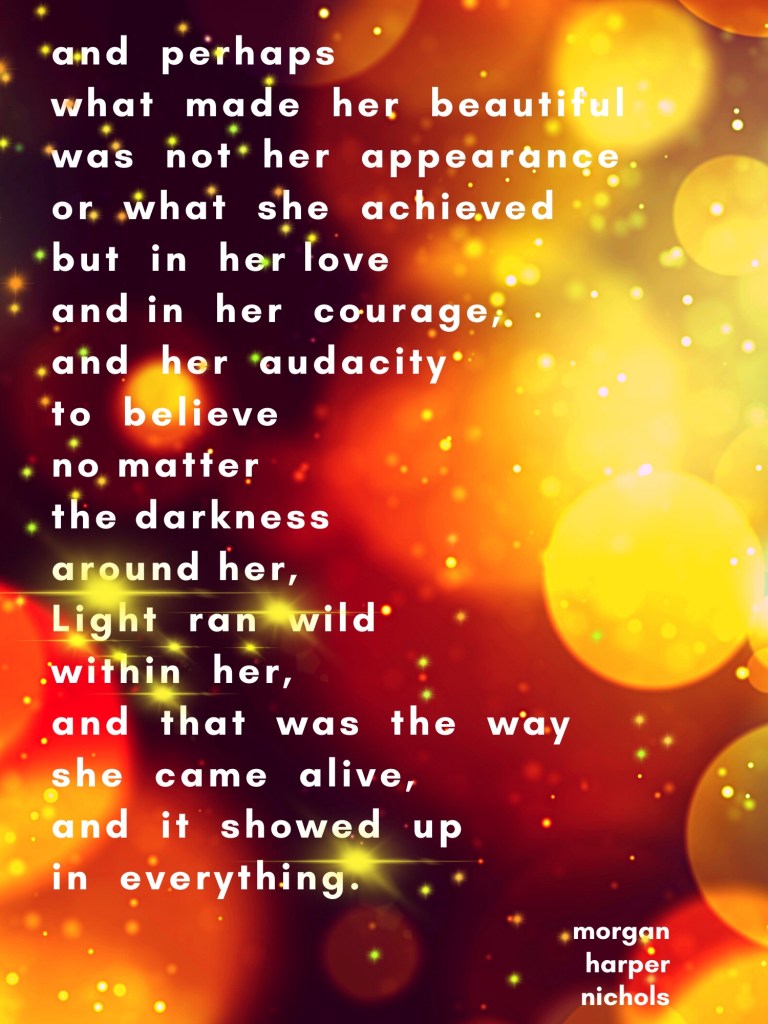
And then there are the inspiring words of artist and writer morgan harper nichols that so inspire me towards love, courage, audacity and the Light that runs wild within me, the Light that shines through my darkness and never goes out.

and  perhaps 
what  made  her  beautiful 

was  not  her  appearance
or  what  she  achieved
but  in  her love

and in  her  courage,
and  her  audacity
to  believe 
no matter

the darkness
around her,
Light  ran  wild
within  her,
and  that  was  the  way
she  came  alive, 
and  it  showed  up

in  everything.
— morgan harper nichols

May you have the strength to navigate those days when darkness threatens your light. May you love yourself and dig deep for the courage and audacity that frees you and lets the Light run wild within you!

Afghanistan, Maren Tirabassi, Prayer, Women

Afghanistan: Grace and Mercy

Afghan woman in traditional cover, known as a burka, at the Blue Mosque in Mazar.
Photo: Jawad Jalail


Part One

A Story of Grace and Mercy


The following story printed in the Daily Beast tells how the villagers of a small Afghan village rescued and saved the life of a gravely wounded U.S. Navy Seal. Their motivation? What motivated them was their culture of kindness and their respect of the ‘Pashtunwali Code’, which admonishes that hospitality, asylum, mercy and shelter must be provided for all who require it, friend or enemy.

Nearly eight-and-a-half years after Mohammad Gulab and his fellow villagers harbored and saved the life of a gravely wounded U.S. Navy SEAL, they say they are still proud of their courageous action and would do it again in spite of the disappointments and troubles that have followed.

In the face of point-blank Taliban threats to overrun the small village of Sabray in remote Kunar Province, along the porous and mountainous frontier with Pakistan, the villagers bravely protected, gave first aid to, fed, and clothed Marcus Luttrell, the wounded Special Warfare Operator, the only survivor of a four-man SEAL patrol. A village elder even secretly carried a note hidden inside his clothing—written by Luttrell and indicating the exact spot where he could be rescued—through Taliban lines at great personal danger. “I have no regrets for what my family, my fellow villagers and I have done,” Gulab tells the Daily Beast. “We knew what the Taliban’s reaction would be from the day we carried him in our door.”

Gulab and the other villagers insist that they saved Luttrell out of obedience to the ages-old ethnic-Pashtun tradition known as Pashtunwali. That ancient code obliges Pashtuns to help and protect anyone in need, friend or enemy. “We did not rescue Marcus for money or privileges,” Gulab says. “By rescuing and keeping him safe for five nights in our home we were only doing our cultural obligation.”

And Jesus told us,
“You shall love your neighbor as you love yourself.”


Part Two

Advocating for the Women of Afghanistan

The Taliban have been in charge of Kabul for 48 hours. Women have already disappeared from the streets.

Photo: AP News
https://apnews.com/article/religion-taliban-7ab054c063e4ea1c14be9e4811f42982


As an advocate for women for many decades, I must share today the terrible plight of Afghan women as a result of the Taliban takeover of Afghanistan.

In only 10 days, Taliban militants captured dozens of provincial capitals left vulnerable by the withdrawal of US and allied troops. 

In only 10 days, the freedom of Afghan women was taken back 20 years.

In only 10 days . . .

The speed of the militants’ advance caught the people of Afghanistan off guard, especially Afghan women. Some women said they had no time to buy a burqa to comply with Taliban rules that women should be covered up and accompanied by a male relative when they leave the house.

To Afghanistan’s women, the flowing cloth represents the sudden and devastating loss of rights gained over 20 years — the right to work, study, move and even live in peace — that they fear will never be regained.

Burqas hang in a market in Kabul on July 31. The price has surged tenfold as women rush to cover themselves to avoid attracting the militants’ attention.


Over the last 10 days, a succession of Taliban victories over dozens of provincial capitals took Afghan women closer to a past they desperately wanted to leave behind. 

When the Taliban last ruled Afghanistan between 1996 and 2001, they closed girls’ schools and banned women from working. After the US invaded in 2001, restrictions on women eased, and even as the war raged, a local commitment to improving women’s rights, supported by international groups and donors, led to the creation of new legal protections. But gains for women were partial and fragile. In 2009, the Elimination of Violence Against Women law criminalized rape, battery and forced marriage and made it illegal to stop women or girls from working or studying.

Afghan women stand to lose 20 years of gains as the Taliban seize control.


According to an article by Mitchell Hartman published today, the situation is fluid and chaotic in Afghanistan, as the Taliban continue consolidating power over the country and the capital, Kabul. Afghans with connections to the U.S. Embassy or military over the past 20 years are still hoping to get out of the country. But many who stand to lose rights and jobs and possibly their freedom under a new Taliban regime are hunkering down, hiding, covering their tracks. 

Especially women, and when it comes to women’s freedom to participate in society and the economy, people who’ve been observing the Taliban aren’t optimistic. “The Taliban are no friends of girls and women. And for many years they really had control over the country, girls education and women’s education was forbidden,” said Rebecca Winthrop, who co-directs the Center for Universal Education at the Brookings Institution. Winthrop helped get Afghan girls into new government schools after the Taliban fell in 2001.

She said the U.S. has invested more than $700 million in girls’ and women’s education, and attendance has increased. So has Afghan women’s participation in the labor force — up from 15% to nearly 22%. 

But where the Taliban have taken control in recent years, Winthrop said, “we were seeing girls not being able to go past seventh grade – which is when they hit puberty; bombing girls schools; targeting female teachers.” In the big cities, many women have gone to university and entered business, government, academia and the media. But now “they’re literally finding safe houses where they can hide,” said Elisa Lees Munoz, who directs the International Women’s Media Foundation.

You and I may feel helpless, unable to find ways to ease the fear and desperation of women a world away. We cannot know their world, and we definitely cannot fix it. We are at a loss when we consider options that could help. And yet, the words of Jesus remain, imprinted upon our hearts . . . “You shall love your neighbor as you love yourself.” And we know that one important thing we can do is to pray for the well-being of every Afghan woman and girl. At least we can pray, and pray with a fervency that holds the power to change hearts and minds. We can pray even without words because the Spirit intercedes for us.

So as we pray, I want to share with you this moving prayer for Afghanistan written by my friend who always prays prayers from her beautiful and compassionate heart. It was published today on her blog, “Gifts in Open Hands.”

God of many names, the Generous,
the All-Merciful, the Source of Peace,

we pray in thanks for Afghanistan
land of pomegranates and grapes,
birthplace of Rumi,
and ‘I am the beggar of the world,’
landays of contemporary Afghan women.

We celebrate people –
Tajik and Hazaras, Uzbek and Pashtun.
We hear tabla, sitar, santur, tabur, flute,
and watch the attan danced.
We gaze upon art ancient and new –
miniatures and the weaves of rugs,
like no other in the world.

All earth opens its hands
and receives the gifts of Afghans,
and all the people pray,
each in their own many names and words
for safety of Afghans in these days –
seeking evacuation in the airport
moving quickly on the street,
hiding in homes,
wondering about schools.

For those who evacuate
and for those who wait for what is next,

for those who are foreign nationals,
and those bone-deep with history in the hills,

for faithful journalists still reporting,
and medical facilities desperate
for blocked supplies,

for Sikh and Hindu communities
and their holy places,

for the welcome of Australia,
and families across the ocean and near at hand
grieving loved ones lost,
life, body, mind in the long war.

for the afghan elder who has seen much
and the child born today
who will grow up to give a new gift,

we pray, O Compassionate, O Preserver. amen

— Maren C. Tirabassi


*Please take time to follow this link to a poignant, timely and very real story about the fears of Afghan women published by “Vanity Fair.”

Self Awareness, Self care, Self-understanding, Soul, Wisdom, Women

203 PILLS! PLUS WISE AND WONDERFUL WOMEN


71C9865D-0EF8-482D-B6E0-CBA6F36196B9Two hundred and three pills!
Twenty-eight injections!
Fourteen inhalations and fourteen nasal sprays!

Every week!

But I am most focused on the 203 pillsevery week! Presumably it takes that many to keep my body from rejecting my kidney and keep me otherwise healthy. 

203 pills! Insignificant when I explore the state of my soul — what lies inside there, what its longings are, what has become of its dreams and, most of all, whether or not I am carefully and gently tending to it. A healthy body is important, of course, but I have been thinking more and more about how to keep my soul healthy. In some ways, that’s harder. And harder to explain.

So rather than launching into a chorus of my own words about how I might care for my soul, I looked to the words of my sisters —  near and far, from the past and the present. There I found the depths of wisdom I needed on this day. So clear and true it is that so many women possess an extraordinary depth of wisdom. Their voices speak their truth, and sometimes ours. Their voices call us to stand taller and to rise higher. They call us to dream and to reach into our souls to find our dreams. These wise and wonderful women invite us to care for our souls. So hear their voices and listen for whispers that give strength to your soul.

Get in touch with and resurrect the free spirit deep inside me. Being one with the spirit allowed me to soar above my everyday reality. I marveled at the beauty of all life and savored the power and possibilities of my imagination.   — Maria Nhambu

Of all the paths you take, follow only those where your heart is wide open, mind enriched and your soul learns to dance.   — Nikki Rowe

A wise woman wishes to be no one’s enemy; a wise woman refuses to be anyone’s victim.   — Maya Angelou

We were willing to explore and be surprised. Willing to trust that there was beauty out there and love and joy. Ready to have our hearts touched and our souls hugged.   — Meara O’Hara

You will never see me surrender, never see me cry, but you will often see me walk away. Turn around and just leave, without looking back.   — Charlotte Eriksson

Big spirits don’t fit in small spaces.Our energy is built for open fields and wide places, room to breathe — room to grow. Room to live authentically and room to roam.   — Nikki Rowe

I am homesick for a place where silence is the only language, love is the only religion, and freedom is not something to be fought for….  — Samiha Totanji

When we discover who we are We will be free   — Mimi Novic

I never said it was easy to find your place in this world, but I’m coming to the conclusion that if you seek to please others, you will forever be changing because you will never be yourself, only fragments of someone you could be. You need to belong to yourself, and let others belong to themselves too. You need to be free.   — Charlotte Eriksson

We have not been abandoned. We have, perhaps, in that leaving been given the gift of ourselves in a new, deeper, and more lasting way.
Macrina Wiederkehr

If you’re always trying to be normal you will never know how amazing you can be.   — Maya Angelou

I know that no one is my judge. I live according to my own conscience and value discernment which is governed by Holy Spirit. I know my intentions and I walk my path with a clear conscience.   —  Mishi McCoy

The truth is, in order to heal we need to tell our stories and have them witnessed…The story itself becomes a vessel that holds us up, that sustains, that allows us to order our jumbled experiences into meaning. As I told my stories of fear, awakening, struggle, and transformation and had them received, heard, and validated by other women, I found healing.   — Sue Monk Kidd

You can’t put a leash on me. I’m unleashable!   — Tiffany Winfree

All too often we bemoan our imperfections rather than embrace them as part of the process in which we are brought to God. Cherished emptiness gives God space in which to work. We are pure capacity for God. Let us not, then, take our littleness lightly. It is a wonderful grace. It is a gift to receive. At the same time, let us not get trapped in the confines of our littleness, but keep pushing on to claim our greatness. Remind yourself often, “I am pure capacity for God; I can be more.”   ― Macrina Wiederkehr

you got to figure out which end of the needle you’re gon be, the one that’s fastened to the thread or the end that pierces the cloth.   — Sue Monk Kidd

Steal my wild heart, but do not ask me to live under an umbrella when I like being soaked by the rain.   — Jacqueline Simon Gunn

Honeybees depend not only on physical contact with the colony, but also require it’s social companionship and support. Isolate a honeybee from her sisters and she will soon die.   — Sue Monk Kidd

I’ve never been a woman who will settle to fit in, i’d always have rathered find a little world all on my own. If people come they come and if they go they go, but for me staying authentic to my soul’s purpose is all i’ll ever know.  — Nikki Rowe

You may write me down in history
With your bitter, twisted lies,
You may trod me in the very dirt
But still, like dust, I’ll rise.   — Maya Angelou

You have to find a mother inside yourself. We all do. Even if we already have a mother, we still have to find this part of ourselves inside.  — Sue Monk Kidd

Do you want to paint your life using two colors (good and bad) or do you want to paint the best piece of your life with colors beyond your wildest imagination?   — Helen Edwards

There is no place so awake and alive as the edge of becoming. But more than that, birthing the kind of woman who can authentically say, “My soul is my own,” and then embody it in her life, her spirituality, and her community is worth the risk and hardship.   — Sue Monk Kidd

It’s an unquietness I feel deep inside. It’s not about being extraordinary, you see. It’s not about standing out. It’s simply about shedding all that’s false. And believing with everything I have that you can too.   — Jacqueline Simon Gunn

When it’s time to die, go ahead and die, and when it’s time to live, live. Don’t sort-of-maybe live, but live like you’re going all out, like you’re not afraid.
— Sue Monk Kidd

Let your life reflect the faith you have in God. Fear nothing and pray about everything. Be strong, trust God’s word, and trust the process.
— Germany Kent

The cage wasn’t insignificant in the shaping of my wings, stillness is an experience only the deep souls can go. A quiet solitude in the midst of it all. A getting to know yourself once more.   — Nikki Rowe

O God, help me to believe the truth about myself, no matter how beautiful it is.   ― Macrina Wiederkehr

You’ve got to trust yourself. Be gentle with yourself. Listen to yourself.You’re the only person who can get you through this now. You’re the only one who can survive your story, the only one who can write your future. All you’ve got to do, when you’re ready, is stand up, {and begin again.}.  — Tessa Shaffer

Journal became a sanctuary where I could pour out in honesty my pain and joy. It recorded my footsteps and helped me understand where I was standing, where I had been, and even where God pointed.   — Sue Monk Kidd

Nothing has transformed my life more than realizing that it’s a waste of time to evaluate my worthiness by weighing the reaction of the people in the stands.   Brené Brown

Be who God meant you to be and you will set the world on fire!
St. Catherine of Siena

That’s the sacred intent of life, of God — to move us continuously toward growth, toward recovering all that is lost and orphaned within us and restoring the divine image imprinted on our soul.  — Sue Monk Kidd

The seasons of my heart change like the seasons of the fields. There are seasons of wonder and hope, seasons of suffering and love, seasons of healing. There are seasons of dying and rising, seasons of faith.
Macrina Wiederkehr

You only need to lose track of who you are, or who you thought you were supposed to be, so that you end up lying flat on the dirt floor basement of your heart. Do this, Jesus says, and you will live.  — Barbara Brown Taylor

I now see how owning our story and loving ourselves through that process is the bravest thing that we will ever do.   Brené Brown

Without the burden of afflictions it is impossible to reach the height of grace.  The gift of grace increases as the struggle increases.   St. Rose of Lima

Only when we are brave enough to explore the darkness will we discover the infinite power of our light.  — Brené Brown

I have learned things in the dark that I could never have learned in the light, things that have saved my life over and over again … there is only one logical conclusion. I need darkness as much as I need light.   — Barbara Brown Taylor

Go forth in peace, for you have followed the good road. Go forth without fear, for he who created you has made you holy, has always protected you, and loves you as a mother.   St. Clare of Assisi

For these wise women, O God, we give you thanks.
For their words, so full of grace, we are grateful.

For those we call our sisters, we ask your presence — in their days of light and in their dark nights of the soul.

Heal us, God our Mother, and give us grace for the living of these days.
Heal us, God our Father, and give us courage for the living of these days.
Heal us, Jesus, and walk beside us as we heal the world just as you urged us to do.
Heal us, Spirit, and give us your wind and fire — to live, to stand, to persist — to heal the souls of others as we heal our own souls. Amen.


599FBE6C-0696-46CC-B8F3-19823066126BThis blog post is dedicated to the memory of my friend, Sister Macrina Wiederkehr, a wise and wonderful woman who left us this year and is now walking among “trees full of angels.”

Adventures, Family, Grandmothers, Home, Immigration, Inspiration, Love, Memories, Resilience, Stories, Tribute, Voting, Women, Yiayia, Yiayiá

GREEK GIRLS and THEIR YIAYIÁS

BDCED6EE-E650-4ADE-A941-B87FA4AD86D3
For Suzanne who graced me with a delightful story about her Yiayiá

This story really has two titles: “Greek Girls and their Yiayiás” or “How to Love America by Two Greek Women who Emigrated to America.” Either title fits the nostalgic stories told by two granddaughters, me and my life-long friend Suzanne. I hope you find in our tales a touch of wisdom for your life, a reminder of the spirit of love, and a portrait of sacrifice and resilience.

It was a gift of grace to be a young Greek girl and have your Yiayiá (grandmother) close by, although at times being trapped in an endless, one-sided conversation could be annoying. In my teenage years there were “from her lips to God’s ears” conversations that were aimed directly at me — endless rules for good Greek girls, how to behave in church and wearing the proper church attire, old Greek sayings that sort of made sense to me, very long stories about the “old country” (which was a small Greek island), diatribes about how other families’ allowed their Greek daughters to be “loose,” and best of all, reciting to me stanza after stanza of stunningly poignant Greek poetry.

The problem was that I had to memorize those poems and dutifully stand before our house guests reciting them — for every visitor, even the ones who didn’t care at all about Greek poems. I think Yiayiá probably made me recite Greek poetry to some visitors who knew no Greek at all and had no idea what I was saying! The poems, though, remain a lovely part of my memories of her. To this very day — with a seventy year old memory — I can recite them word for word, especially my favorite one about the Greek revolutionaries who fought for nine years (1821-1830) against the Ottoman Empire for independence. Every time I recited it, my Yiayiá’s eyes filled with tears. Today, I cannot recite it without tears.

There was always a political side of my Yiayiá, although those around her ignored it. I cherish the fact that I saw parts her that others never saw, and one significant part of her was her keen interest in all things political. She always entered the voting booth with knowledge about candidates and issues that she had learned from devouring The Birmingham News every day. It’s safe to say that my Yiayiá was an “old country” style political junkie.

After she immigrated from Karpathos with a two year old (my mother) and a baby boy, she resolved to make America her home. Adjusting wasn’t easy for her, and many times at night, I would hear her weeping. Hearing her long, intricate stories of her homeland, it seemed obvious that she missed her home. Leaving one’s homeland can be a sacrifice. It was for my Yiayiá.

She was so young when she left her island and boarded a ship for a very long ocean voyage, only to end up in a land that must have seemed so different and unfamiliar to her. Ellis Island processing was grueling, especially for one who did not know a word of English. Just a glance at early portraits of Yiayiá would tell anyone of the grief and loss she experienced during her early days in America. Still, she moved forward in her new life because of her grit and her resilience, and maybe because she was among the early “dreamers” who made their home in the land of Lady Liberty bringing just a suitcase and a dream.

What uncommon resilience and perseverance Yiayiá had! She taught herself to read and speak English. Every morning without fail, she sat at the kitchen table near the radiator to read the newspaper while she drank her coffee. She knew the local and national news, the weather forecast and the latest scoop about every politician. She enjoyed election seasons and, with her own specialized vetting process, she chose the candidates she would vote for.

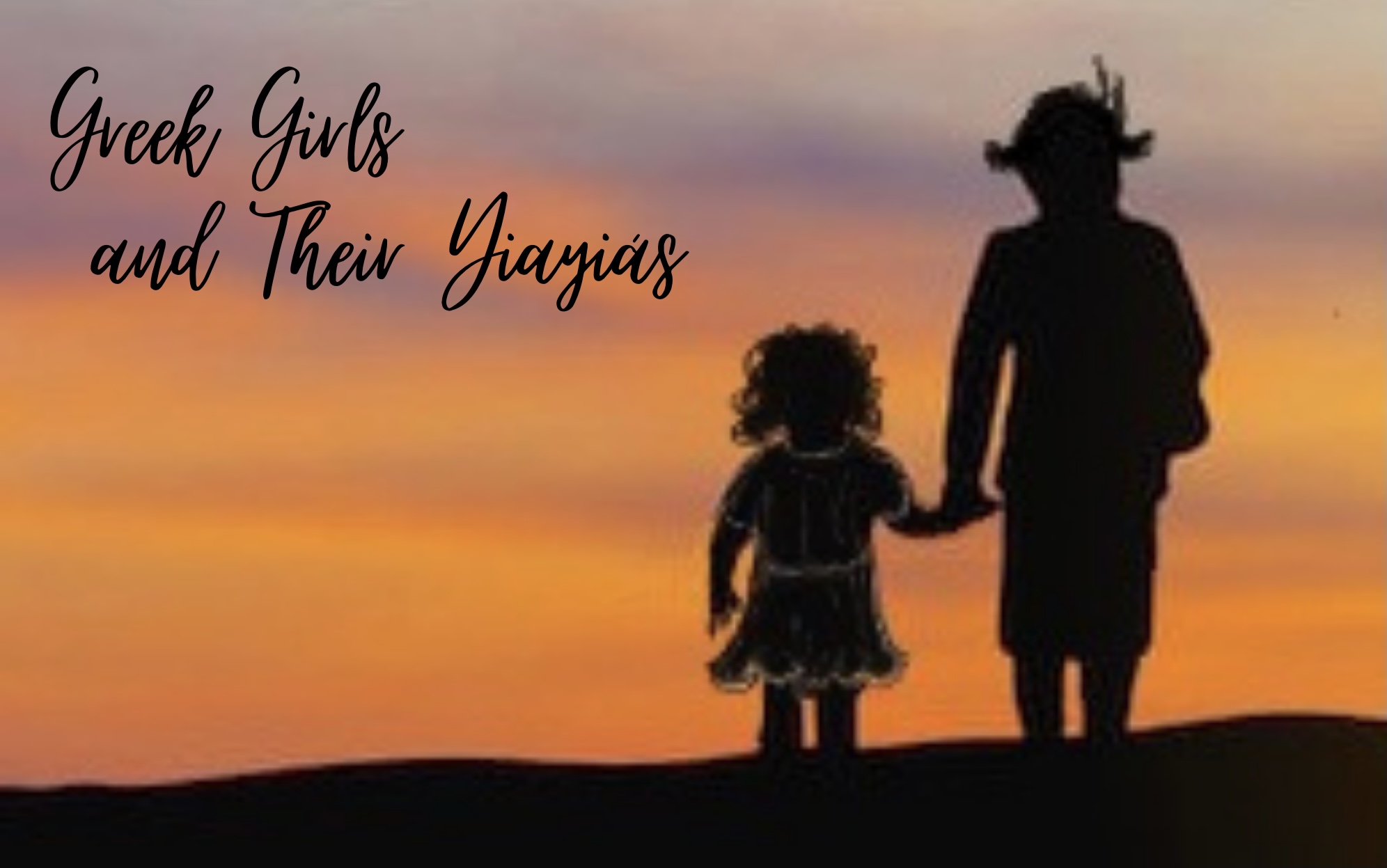
Voting day for her was a big deal. During election seasons, I always have Yiayiá memories that inspire me. So on election day, she would put on her finest dress, make-up, jewelry and always a hat — maybe even a hat with an exotic-looking black veil that I admired and coveted for myself. Then she would dress me in a frilly dress accessorized with my gold cross, white socks trimmed with lace and black patent leather shoes. With a quick brush of my black curls, we were off to the polls, walking down the hill from our house hand in hand.

She always took me into the polling booth with her. When she pulled the red privacy drape around us. I was just tall enough for the bottom of it to brush my face, but my head was inside that private place. When Yiayiá finished voting, she looked down at me and gave me a stern and irrevocable political mandate: “Kalliope, remember you are a Democrat! Never vote for a Republican!” I never have!

I could always see in my Yiayiá a deep love for her adopted country. She was a true and loyal American, to her bones. And she cared deeply about what this country stood for in the world. When I see the way immigrants are treated in these troubled days, I always think of my Yiayiá — what she would think about our America, what forcefully spoken diatribe she might offer to this day’s politicians, how she would grieve over the state of our nation. I had no doubt at all — my Yiayiá loved America!

I was talking this week with my dearest childhood friend, Suzanne. It was common for us to talk about our Yiayiás as we often do when we visit. I told my “excursion to the polls” story and Suzanne told a delightful story about the time when she and her Yiayiá took an extended trip to Greece. One caveat: the story is much more delightful in Greek. Anyway, they stayed in Greece long enough that they began to miss America. When they landed at the airport in Birmingham, Alabama, they walked down the airplane’s stairs onto the concrete. As soon as their feet hit the ground, Yiayiá said in Greek, “My America! I love you so much that I will kiss the ground (in Greek — “soil”).” Suzanne adamantly replied, “No, Yiayiá! You will not kiss the ground!”

I just must add this translation for my Greek friends:

Η Αμερική μου! Σε αγαπώ τόσο πολύ. Θα το φιλήσω το χώμα. 

Όχι Γιαγιά, δεν θα φιλήσεις το χώμα.

Suzanne’s sweet Yiayiá dropped to her knees and kissed the ground! 

There’s something about that enchanting story that has “love” written all over it. Suzanne’s Yiayiá loved America. My Yiayiá loved America. Probably more than their granddaughters ever did! To honor their memory, Suzanne and I vote, every time there’s an election. In fact, we both have already voted in this important 2020 election.

Suzanne’s beautiful Yiayiá said, “My America! I love you so much that I will kiss the soil!”

May it be so for us, even in these politically troublesome days. 

#MeToo, Activism, Bravery, Courage, Faith, healing, Injustice, Justice, March for Our Lives, Perseverance, Persistence, Prathia Hall, Questions, Racism, Social justice, Violence against women and children, Women

The Civil Rights Movement and Womanist Theology


217FA8EB-CEFC-4F9F-896B-D1FCD86FFD34
The civil rights movement and womanist theology? Not much in common between the two, it seems. Maybe, maybe not! The thing is: God’s people are guided by Spirit into an unjust world where people are oppressed, not just through a particular movement, whether it is for civil rights or equity for women. People are oppressed beyond any movement. People are oppressed in everyday life, today, as well as in past struggles for liberation.

God is all about liberation from oppression, now and in the future. The battle for liberation is ongoing and never-ending. And God’s people — you and I — cannot follow Christ in “loving our neighbors as we love ourselves” unless we stand alongside people who are oppressed, unless we pour our lives into building a just society where every person is treated according to the well worn and well loved declaration that “all people are created equal.”

If you believe there is nothing in common between the civil rights movement and womanist theology, then you do not know much about The Rev. Dr. Prathia LauraAnn Hall (1940 – 2002), who was an undersung leader for civil rights, a bulwark of the black church in the United States and an advocate of the womanist vision of equity and equality.

In the recently published book, Freedom Faith: The Womanist Vision of Prathia Hall, Courtney Cox paints the portrait of Prathia Hall as a woman of deep conviction, courage and eloquence who literally embodied the longing for the rights of every person and the womanist vision of equality.

You may not know much about her, but Prathia Hall electrified audiences through her speaking and preaching.

I say to you our daughters and sons, it is in you! Every time you behold the world as it is and dare to dream of what it must become that’s the fire of freedom’s faith. . . Every time you grab hold of the United States of America and like Israel dare to wrestle and declare to it — We will not let you go until you bless us — That is freedom faith’s fire. It is in you — It’s in us.     — Prathia Hall

You may not know much about her, but Prathia Hall was an inspiring leader in the Southwest Georgia Project in Albany, Georgia, in the civil rights struggle in Selma, Alabama, and in the multiorganization Atlanta, Georgia project.

Prathia Hall literally changed the course of the civil rights movement. As a “firebrand” in the Student Nonviolent Coordinating Committee (SNCC), Hall labored tirelessly under the central guiding principle of her life, her activism and her ministry. Her life’s guiding principle was “Freedom Faith, the belief that God wants people to be free and equips and empowers those who work for freedom.”

In Hall’s work in door-to-door voter registration, in church-based educational programs, inspirational mass meetings, and through her scholarship and preaching, Freedom Faith found its ultimate expression in her womanist vision of the liberation of all people. For Hall, freedom was not only about the goals of the civil rights movement, it was about the many layered forms of oppression — racism, classism, sexism, ageism, heterosexism, denominationalism — all formidable obstacles to human rights.

You may not know her name, but Prathia Hall was listed in Ebony Magazine’s 1997 “15 Greatest Black Women Preachers.” It is said of Prathia Hall that her call to ministry was both her glory and her burden. Yet her preaching electrified masses of people bowed low by oppression.

They called us: ‘nigger,’ ‘winch,’ ‘buck,’ ‘slave,’ but out there in the brush arbors, the wilderness, and the woods, the God of our ancestors, the God we had known on the other side of the waters met us and whispered words in our ears, and stirred a song in our souls . . .     — Prathia Hall

You may not know much about Prathia Hall, but she was an indefatigable activist for human rights, a brilliant scholar, an engaging speaker, a compelling preacher, a distinguished theologian. Hall’s theology focused on liberation from all forms of oppression, and she did not shrink from the womanist theology that called out sexism and the duplicity of the Black Church in recognizing the call of women only in narrow and constricted ways. In an absolute articulation of her womanist vision of inclusion, Hall espoused a multidimensional structure of oppression. “Gender-based oppression,” she wrote, “isn’t a trivial inconvenuence. It’s human devastation.” As an insider, choosing to remain in ministry in the Baptist Church, Hall’s courage and conviction never ceased from criticizing a Church that opposed racism, but tolerated sexism.

It absolutely boggles my mind as well as grieves my spirit that brothers, with whom I have stood side by side in the struggle, brothers with whom I have bowed, knelt, prayed, worked, struggled, gone to jail, dodged bullets, and caught bullets, claim to be unable to make the transition from the critique of race-based oppression to the critique of gender and class-based oppression.    — Prathia Hall

You may not know much about Prathia Hall, but her very soul was embroiled in the civil rights drama. In the summer of 1962, four black churches in Georgia’s Lee and Terrell Counties, all associated with the movement, were burned by white supremacists.

Hall and other SNCC workers wept together in the ashes of the Mount Olive Baptist Church. The next day the SNCC received a phone call that Martin Luther King, Jr. intended to visit Albany to attend a prayer vigil over the ashes of Mount Olive Baptist Church in Sasser. According to the New York Times, “As the sun sets across the cotton fields, some fifty Negroes and two whites met at Mount Olive for a prayer vigil. Joining hands, they sang softly, ‘We Shall Overcome.’”

After the song, Prathia Hall led the group in prayer, her voice breaking in grief. According to oral tradition, Hall repeated the phrase “I have a dream,” each time followed by a specific vision of racial justice. After the service, King asked for her permission to use the “I have a dream” phrase, which she granted. From the oral evidence gathered from several witnesses, one can definitely make a case for Prathia Hall as the source of King’s “I Have a Dream” speech.      — Courtney Cox, Freedom Faith: The Womanist Vision of Prathia Hall

You may not know much about Prathia Hall, but in the pages of Freedom Faith: The Womanist Vision of Prathia Hall, author Courtney Cox lays bare the world of this fascinating woman of God. She presents Prathia Hall through various lenses: Christian minister, liberation theologian, civil rights activist and leader, professor and scholar, preacher and speaker, mother, daughter, wife, agitator, womanist theologian.

Until now, you may not have known much about Prathia Hall, but many notables spoke of her abilities:

One in a million . . . A model that needs to be lifted up in every seminary of all races . . . so people can get a glimpse of what someone who has really said yes to ministry and who went to her grave living that ministry daily.     — Jeremiah Wright

The best preacher in the United States, possessing proven ability to exegete, illustrate, celebrate and apply the scriptures healingly to the problems, pains and perplexities of the people who sit ready to hear a word from Yahweh.     — Charles Adams, former president of the Progressive National Baptist Convention

. . . She was known for her commitment, her dedication, her stick-to-it-ness, for hanging in there, for never giving up or giving in.      — Rep. John Lewis

So what about the civil rights movement and womanist equality? Is there any commonality between them? Certainly there is commonality — both are never-ending struggles for justice, because we are a country where various groups of people are still denied their civil rights and woman are still suppressed and oppressed. Both movements — and many other struggles for justice — require our commitment, our resolve, our persistence, our courage, our compassion, our best efforts and our faithfulness to God.

At least for me, Prathia Hall’s life begs several questions:

What is it that I am passionate about, willing to follow God with courage to fulfill that passion?

Is there an injustice I must stand against?

Is there any oppression, any wrong, that I am compelled to confront?

Is there anything I care about deeply enough that I will dig deep into myself to find the courage to defend it?

Fair questions, I think, for those who are trying to follow God into places of need! Compelling questions for those who are trying to follow God in offering compassionate  care to the oppressed and hurting people who need us! Compelling questions for those who are trying to follow God in freeing people who live in various forms of bondage!

These are urgent questions for God followers!

I pray that I am able to sit with those questions and respond to them boldly as an act of my faith. I pray that for you, too.

Finally, do we dare we ask what will be our reward for seeking justice for the oppressed people around us? Probably not, yet this beloved passage of Scripture does speak of both our call from God and what we will receive for our commitment to our call.

. . . Remove the chains of oppression and the yoke of injustice, and let the oppressed go free. Share your food with the hungry and open your homes to the homeless poor. Give clothes to those who have nothing to wear . . .

Then my favor will shine on you like the morning sun, and your wounds will be quickly healed. I will always be with you to save you; my presence will protect you on every side. When you pray, I will answer you. When you call to me, I will respond.

If you put an end to oppression, to every gesture of contempt, and to every evil word; if you give food to the hungry and satisfy those who are in need, then the darkness around you will turn to the brightness of noon. And I will always guide you and satisfy you with good things. I will keep you strong and well. You will be like a garden that has plenty of water, like a spring of water that never goes dry.

— Isaiah 58:6-11 Good News Translation (GNT)

So let us follow God into every place of need, every place of injustice, every place where oppression has raised its evil head. Let us follow God — as an embodiment of Christ’s love and compassion — until that day when “the darkness around us turns to the brightness of noon.”

May God make it so. May God find us faithful. Amen.


I offer you this music to listen to as you spend time in prayer and meditation


Determination, Dreams, Greta Thunberg, Helena Morrissey, International Women’s Day, Malala Yousafzai, Perseverance, Persistence, Sarah Hesterman, Sarah Tenoi, struggle, Stubbornness, Tenacity, Women

On Rearranging Things: 2020 International Women’s Day

C1B6D1BF-6B4B-4737-BFDF-A4B476F3E63D
March 8 — 2020 International Women’s Day

Commemorating 2020 International Women’s Day seems important. It is important to me to pause on this day, because I am a woman who has struggled for equality. My female friends and colleagues have had similar struggled.

In the past weeks we have watched one woman after another end their candidacies for president of the United States. Senator Elizabeth Warren commented that Americans still may not be able to see a woman in the role of president. She said it with obvious sadness and with a catch in her throat, displaying the disappointment of many women and girls. Those of us who are older lament that we will not see a woman as president in our lifetimes, while little girls, teens and young women were hoping beyond hope for evidence in 2020 that dreams are possible. Lily Adams, granddaughter of the late Texas Governor Ann Richards, said this on Thursday night in an MSNBC interview: “Women have to run faster to get half as far.” How true that is!

6ABA8DA9-32CD-49DC-B9A7-BEB584D83D27International Women’s Day gives me an opportunity to celebrate women who are all-in, working tirelessly for equality, justice and positive change and constantly rearranging things. This years theme is “If you can see her, you can be her.” It is an appropriate theme for women who struggle daily to be seen and respected as equals.

In these days, we are seeing, right before our eyes, so many stunning examples of women who champion various causes.

FC5FBE11-6734-47C6-A38E-933B9D902D1FSarah Tenoi
Activist Sarah Tenoi is leading the charge against female genital mutilation (FGM) in Kenya.


92066DDD-0F40-4E55-98AD-AB30B1A9D94BMalala Yousafzai
In 2012 at the age of 15, Malala Yousafzai, was shot in the head by the Taliban in Pakistan. The assassination attempt was a response to her stand for the right of girls to gain an education after the Taliban banned them from attending school.


DD465146-0702-479F-A8E9-67C6EAEF42D3Helena Morrissey
Helena Morrissey is a British businesswoman and mother of nine who is helping to change the face of British boardrooms.

 
6E324393-F712-4FE2-AD26-04DC9FEE1425Sarah Hesterman
As the founder and acting president of Girl Up in Qatar, Sarah Hesterman works with the UN to provide young girls with education in developing countries. Hesterman hopes that providing greater opportunities will allow girls to grow up with more self-confidence.

D50E2B31-E103-4C36-8BE9-9A07B452E4AFGreta Thunberg
Greta is a Swedish environmental activist on climate change whose campaigning has gained international recognition. She is known for her straightforward speaking manner through which she urges immediate action to address the climate crisis.

“We can’t just continue living as if there was no tomorrow, because there is a tomorrow,” she says, tugging on the sleeve of her blue sweatshirt. “That is all we are saying.”

It’s a simple truth, delivered by a teenage girl in a fateful moment in our time. (Time Magazine) 

FA268BA8-7679-4678-9854-8DC8EAEFB454

In the early years of my career as a graphic designer and then through my years of ministry, I was often accused of being aggressive. Now you need to understand that “Aggressive” would be the last word I would have used to describe myself. But like many women, I often found myself biding my time, playing the game of acting “ladylike” around my male colleagues, and choosing my words and my demeanor carefully when I wanted to make a point.

That was Stage 1 of me.
Stage 2 of me is the one that was labeled aggressive. Those who know me well would say that there is not an aggressive bone in my body. And that is true (unless I have to defend my child or my grandchildren). But I can be as aggressive as I need to be when injustice rears its ugly head or someone I love needs defending. Stage 3 of me has learned to be respectfully assertive. “Respectfully assertive” behavior helped to open doors that once were closed to me. That’s a good thing.

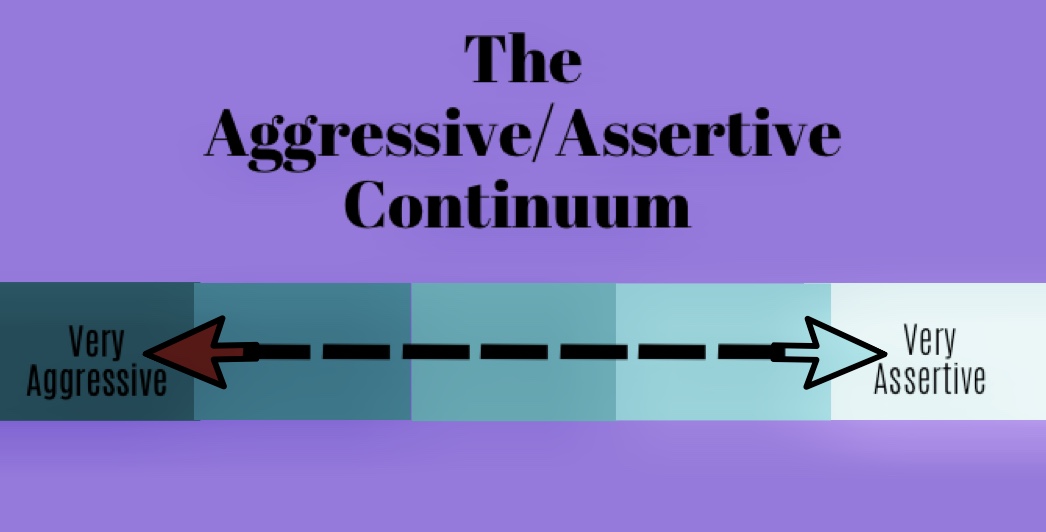
But here’s the caveat — as other women have, I have been compelled to learn how to be aggressive/assertive along a continuum, examining my situation and wisely choosing what my aggressive/assertive level should be at any given moment. The continuum looks something like this . . .

4B0B7E39-A6A8-4CDA-BAD4-8BF73C7C95CD
Like many, many women, I know that in order to effect positive change in the world, positive assertiveness is key. It’s all a matter of being self-confident enough to step up even if others criticize, speak out even when others try to silence you, persevere even when your detractors try to stop you from moving forward, hold on to your dreams even when dream-less persons tell you that your dreams are impossible.

My path to ordination was riddled with people around me telling me that ordination for a woman was impossible. At that time, there was only one ordained Baptist woman in the state of Arkansas and she was ordained in another state. My ordination process required enormous change in almost every person and institution around me. That change was not pleasant for anyone. It went on for months with lots of chaos and no resolution in sight. At the time, I thought I had only two choices: to abandon my desire for change or to stay in the struggle until change happened. I faced off with criticizers, silencers, discouragers and dream-less persons. Perseverance won that time!

My ordination quest was only one of many situations in which I had to fight for positive change. So I was almost always on the bad side of someone, and most unfortunately, I earned a reputation of being persistent, stubborn, insistent, resolved, Tenacious, determined, single-minded, resolute, uncompromising, annoying, troublesome, unconscionable and — wait for it — aggressive. I actually like most of those labels!

During a particularly discordant struggle with Little Rock city government about advocacy programs have for young people, a friend and mentor, who was the city’s Director of Community Programs, shared with me a Sierra Leonean Proverb that turned out to be an incredibly practical piece of wisdom. I immediately framed it and put it in my office so that I could see it often. She gave me that proverb in the late 90’s and, to this day, it is visible and prominent in my space.

She who upsets a thing should know how to rearrange it.
— a Sierra Leonean proverb

I seemed to upset lots of things in my lifetime. Often, I had no idea how to rearrange them. So I want to tell you about a woman who achieved what seemed impossible in her life and rearranged many things — discrimination, injustice, racism. She definitely upset things in her workplace, in the people around her and in NASA’s algorithms for space travel. She also rearranged those algorithms and helped send our astronauts into space.

625274F6-C5B5-47FD-A72E-3B8A4BEC9983Today I celebrate and remember Katherine Johnson, famed NASA mathematician and inspiration for the film “Hidden Figures.” She died a few weeks ago at 101 years of age. For almost her entire life, her brilliant work in American space travel went unnoticed. She was a pioneering mathematician who, along with a group of other brilliant black women, made U.S. space travel possible. And no one noticed for decades.

In fact, her work went largely unrecognized until the release of “Hidden Figures,” a film portrayal of Johnson’s accomplishments while the space agency was still largely segregated. Only the film, which was released in 2017, resulted in international recognition of Katherine Johnson’s genius.

Interestingly enough, her talent was evident early on. Her natural aptitude for math was quickly evident, and she became one of three black students chosen to integrate West Virginia’s graduate schools. After graduating from high school at age 14, Katherine Johnson enrolled at West Virginia State, a historically black college. As a student, she took every math course offered by the college. Multiple professors mentored her, including W. W. Schieffelin Claytor, the third African-American to receive a Ph.D. in mathematics. Claytor added new mathematics courses just for Johnson, and she graduated summa cum laude in 1937 at age 18, with degrees in mathematics and French. She started her career as a teacher but had her sights set on mathematical research.

Following an executive order that prohibited racial discrimination in the defense industry, Johnson was hired at the National Advisory Committee for Aeronautics, NASA’s predecessor. She was one of several black researchers with college degrees hired for the agency’s aeronautical lab through the initiative.

Johnson was part of NASA’s Computer Pool, a group of mathematicians whose data powered NASA’s first successful space missions. The group’s success largely hinged on the accomplishments of its black women members. Katherine Johnson was tasked with performing trajectory analysis for Alan Shepherd’s 1961 mission, the first American human spaceflight. She co-authored a paper on the safety of orbital landings in 1960, the first time a woman in the Flight Research Division received credit for a report.

In 1953 she worked in the facility’s segregated wing for women, but was quickly transferred to the Flight Research Division, where she remained for several years. But midway through the ’50s, the space race between the U.S. and the Soviet Union began to intensify. So did Katherine Johnson’s career. Without the precision of “human computer” Katherine Johnson, NASA’s storied history might have looked a lot different. Her calculations were responsible for safely rocketing men into space and securing the American lead in the space race against the Soviet Union.

After the release of the book “Hidden Figures,” which was published in 2016 and turned into a film the following year, officials lobbed heaps of praise on Johnson and two other black women mathematicians in the agency’s Computer Pool, Dorothy Vaughan and Mary Jackson. NASA renamed a facility for Johnson in February 2019. A street in front of NASA headquarters in Washington was renamed “Hidden Figures Way” for the three women in July.

In November of 2019, the three women — plus engineer Christine Darden — received Congressional Gold Medals for their contributions to space travel. Vaughan and Jackson received theirs posthumously. NASA administrator Jim Bridenstine called Johnson an “American Hero who helped our nation enlarge the frontiers of space even as she made huge strides that also opened doors for women and people of color in the universal human quest to explore space.”

President Barack Obama honored Johnson with the Presidential Medal of Freedom for her pivotal work in American space travel. Yet, Johnson’s work was still minimized and unrecognized by her male co-workers. Around her NASA workplace in the 1960s, she and her colleagues were known as “computers in skirts.”

I saved for last the best story of all! In 1962, John Glenn actually demanded Katherine Johnson’s help before his orbit around Earth. He was skeptical of the computers that calculated his spacecraft’s trajectory, so he told engineers to “get the girl” and to compare her handwritten calculations to the computer’s.

“‘If she says they’re good, then I’m ready to go,'” Johnson remembered Glenn saying. She gave the OK, and Glenn’s flight was a success.

Not to be flippant about the 2020 democratic presidential nomination process, but here’s a good message to send to whichever white guy gets the nomination: “When you are choosing your running mate, ‘get the girl!’”

And to all the women who hold up far more than half the sky, I honor you on this International Women’s Day and cheer you on toward your dreams and toward your mission of rearranging the world.


Adventures, Belief, Bravery, Children, Courage, Dreams, Faith, Falling down, Flying, fun, Growing up, Hope, Learning, Magic, Space Jam, Women

A95FCCB7-F996-42AF-B208-DB286900D4EF

When I was a teenager, I was conscripted many times to “watch” my younger brothers. It was a loathsome task for me! Yet, occasionally the two of them were interesting to watch, especially through their superhero fascination. They seemed to favor the superheroes who could fly, like Superman or Batman (who could sort of fly, but was likely to perish when attempting to land). It occurred to me that in the scene I watched in the back yard, the two young guys looked much more like flight-challenged Batman!

One afternoon after school, the boys were outside playing. Through the window, I watched them as they donned their makeshift capes. Then — without a care in the world and believing that they really could take flight — they stood tall on wooden boxes and launched themselves, arms extended, looking up to the sky. They didn’t fly that day, but they believed, they dreamed. And they had great fun!

I also noticed during those days that I never saw girls stand on boxes with arms outstretched ready to launch into flight. I certainly never thought of doing it myself. But it made me wonder if girls had dreams like the boys did. That thought brought my mood low and, looking back on it, I think I might have felt a bit of heaviness and disillusionment. I didn’t believe I could fly, but rather that I would leap off the box straight into the ground with a thud that probably resulted in a skinned knee. As the years passed, I learned for sure that if women had dreams, they would not likely realize them in our reality, which was “a man’s world.” Dreaming, hoping, flying may not be possible for a “girl.”

When my son was growing up, we saw the motion picture, Space Jam, a terrific movie for son Jonathan, who was an avid Michael Jordan fanatic. No doubt, my 6’6” son wanted to “Be Like Mike.” In Space Jam’s soundtrack was the song, I Believe I Can Fly, a 1996 song written and performed by American singer, songwriter and former professional basketball player R. Kelly.  This mom was not very fond of R. Kelly, but the song he wrote literally moved me and filled me up with hopes and dreams for my son. R. Kelly’s message was a great one:

I used to think that I could not go on
And life was nothing but an awful song
But now I know the meaning of true love
I’m leaning on the everlasting arms

If I can see it, then I can do it
If I just believe it, there’s nothing to it

I believe I can fly
I believe I can touch the sky
I think about it every night and day (Night and day)
Spread my wings and fly away
I believe I can soar
I see me running through that open door
I believe I can fly

See I was on the verge of breaking down
Sometimes silence can seem so loud

There are miracles in life I must achieve
But first I know it starts inside of me

If I can see it, then I can be it
If I just believe it, there’s nothing to it
I believe I can fly

believe I can touch the sky
I think about it every night and day
Spread my wings and fly away
I believe I can soar
I see me running through that open door
I believe I can fly
Oh, I believe I can fly ‘cause I believe in me . . .

I hope you will enjoy the video below, which I place here in honor of my son, Jonathan .

If God would grant me just one request, it would be that every boy — and every girl — would climb on their wooden box and believe in their souls that flying is possible. I would want them to stand tall, with hope and courage, dreaming their dreams and seeing the magic of watching them grow.

Activism, Advocate, Bravery, Call, Courage, Defiance, Faith, healing, Justice, Perseverance, Persistence, Protection, Resilience, Stubbornness, Tenacity, Uncategorized, Vulnerability, Women

Stubbornness, Tenacity, Faith

61C5F6CB-7BD9-42ED-8FC4-A47EECD57FB6
Jesus and the Stubbornly Tenacious Woman from Canaan


Leaving that place, Jesus withdrew to the region of Tyre and Sidon. A Canaanite woman from that vicinity came to him, crying out, “Lord, Son of David, have mercy on me! My daughter is demon-possessed and suffering terribly.”

Jesus did not answer a word. So his disciples came to him and urged him, “Send her away, for she keeps crying out after us.”

He answered, “I was sent only to the lost sheep of Israel.”
The woman came and knelt before him. “Lord, help me!” she said. He replied,

“It is not right to take the children’s bread and toss it to the dogs.”

“Yes it is, Lord,” she said. “Even the dogs eat the crumbs that fall from their master’s table.”

Then Jesus said to her, “Woman, you have great faith! Your request is granted.” And her daughter was healed at that moment.

(Matthew 15:21-28)

I wonder . . . was it her faith or her stubborn tenacity that led to her daughter’s healing? Stubbornness is typically not one of the virtues to which Christians aspire. In fact most of Christendom would rebuke a stubborn woman, in ages past as well as in our day. I know this to be truth! I have been rebuked a time or two, or at least received “strong suggestions” that I should dial back my demeanor. The woman of Canaan, though, returned to Jesus again and again until he healed her suffering daughter.

I can be a bit tenacious, but no one would describe me as stubborn. I typically have a very calm and quiet demeanor, but I remember well one of the few times in my life when I was fierce and stubborn. Our son Jonathan was quite young and very sick with severe vomiting, along with strong spasms that caused him to be unable to breathe. The loud inhalations as he struggled to get a breath were extremely frightening to us, especially to him. Jonathan was a strong boy, an athlete, and very self-sufficient, but these long episodes brought him directly to his Momma. We had been to the hospital emergency room and were now in his pediatrician’s office. This violent gasping for air had been going on for hours, and it should have been obvious to the office staff that Jonathan was in trouble.

Now they would know real trouble!

Jonathan had another violent attack. I jumped up from my chair, went to the desk, and had some strong words to say, in a loud voice, with the passion of a mother desperate to protect her child. I got the familiar line about the doctor running behind.

You know, I don’t care if the doctor is behind! (in my loudest voice) Can you not see and hear that my child is throwing up all over your waiting area and is unable to breathe? Do you realize that he could be infecting every child in here? Take us to an exam room, NOW, and get the doctor away from whatever he’s doing! Because if you don’t, I am headed to the president of Baptist Medical Center who knows me very well because I am a chaplain in this hospital!

Not like me at all! But that is a “Momma response” that almost always erupts when her child is hurting or in trouble. We were in a desperate place and were being ignored. Jonathan was terribly frightened and had been dealing with these spasms for hours. In time (too much time) it was resolved and we were able to get Jonathan settled and resting.

And about the “Canaanite Momma” . . . well, she was definitely stubborn and persistent that day. Clearly, Jesus did not realize who he was dealing with. Maybe he did know! Perhaps Jesus knew precisely what he was doing and chose to use his encounter with the woman from Canaan as a teaching moment for his hearers. Or perhaps he was simply in a stubborn mood and found himself facing someone who could easily match him, stubborn for stubborn!

Either way, the story shows us that when it comes to saving what needs to be saved, being merely nice and calm won’t usually win the day. Sometimes we need to dig in our heels and do some hollering! The text simply portrays the Canaanite woman as a stubborn, persistent mother of a very sick daughter.

Remember, the disciples urged Jesus to send her away. She was obviously making a lot of noise, crying out and disturbing their quietude! On top of that, Jesus was somewhat stubborn himself, saying that he was sent only to the lost sheep of Israel.

But this “Canaanite Momma” went back to Jesus straightaway, knelt down before him, saying, “Lord, help me!”

And we know what Jesus finally did. He praised her faith and healed her daughter. So was it faith or was it stubbornness, persistence? Maybe it was both, that her faith empowered her to stubborn persistence. Clearly, she believed Jesus was able to heal her daughter, so she tried to convince Jesus more than once. The disciples didn’t deter her. Jesus Could not dissuade her with his statement about dogs!

“Woman, you have great faith.”

A wonderful portrayal of what this woman might have said about her encounter with Jesus is a poem written by Jan Richardson entitled “Stubborn Blessing.”

Stubborn Blessing

Don’t tell me no.
i have seen you
feed the thousands,
seen miracles spill from your hands like water, like wine,
seen you with circles and circles of crowds pressed around you
and not one soul turned away.

Don’t start with me.

i am saying
you can close the door
but i will keep knocking.
You can go silent
but i will keep shouting.
You can tighten the circle
but i will trace a bigger one
around you,
around the life of my child
who will tell you
no one surpasses a mother for stubbornness.

i am saying
i know what you
can do with crumbs
and i am claiming mine,
every morsel and scrap
you have up your sleeve.
unclench your hand,
your heart.
let the scraps fall
like manna,
like mercy
for the life
of my child,
the life of
the world.

Don’t you tell me no.

— Jan Richardson
https://paintedprayerbook.com/2014/08/11/stubborn-blessing/

The work of protection is definitely not for the faint of heart. The work of advocacy on behalf of another person may take some stubborn persistence, the kind of stubborn persistence that Jesus seemed to call by another name — “great faith.” When we advocate for people who are suffering, especially people in need of profound physical healing or deep spiritual healing, their greatest need calls us to our greatest resolve, a fierce resolve. Maybe a touch of defiance! It is in those moments that we call on our hearts to give us strength for sacred stubbornness that will heal the broken, comfort the brokenhearted, restore justice to those who are oppressed.

That is faith! “Great faith!”

Bethlehem’s Star, Christ’s Birth, Epiphany, journey, Life Journeys, New Year, Restoration, Sacred Worth, Women

“Wise Women Also Came”

4716B5CE-43A8-4204-8C0D-CECBE609C55F
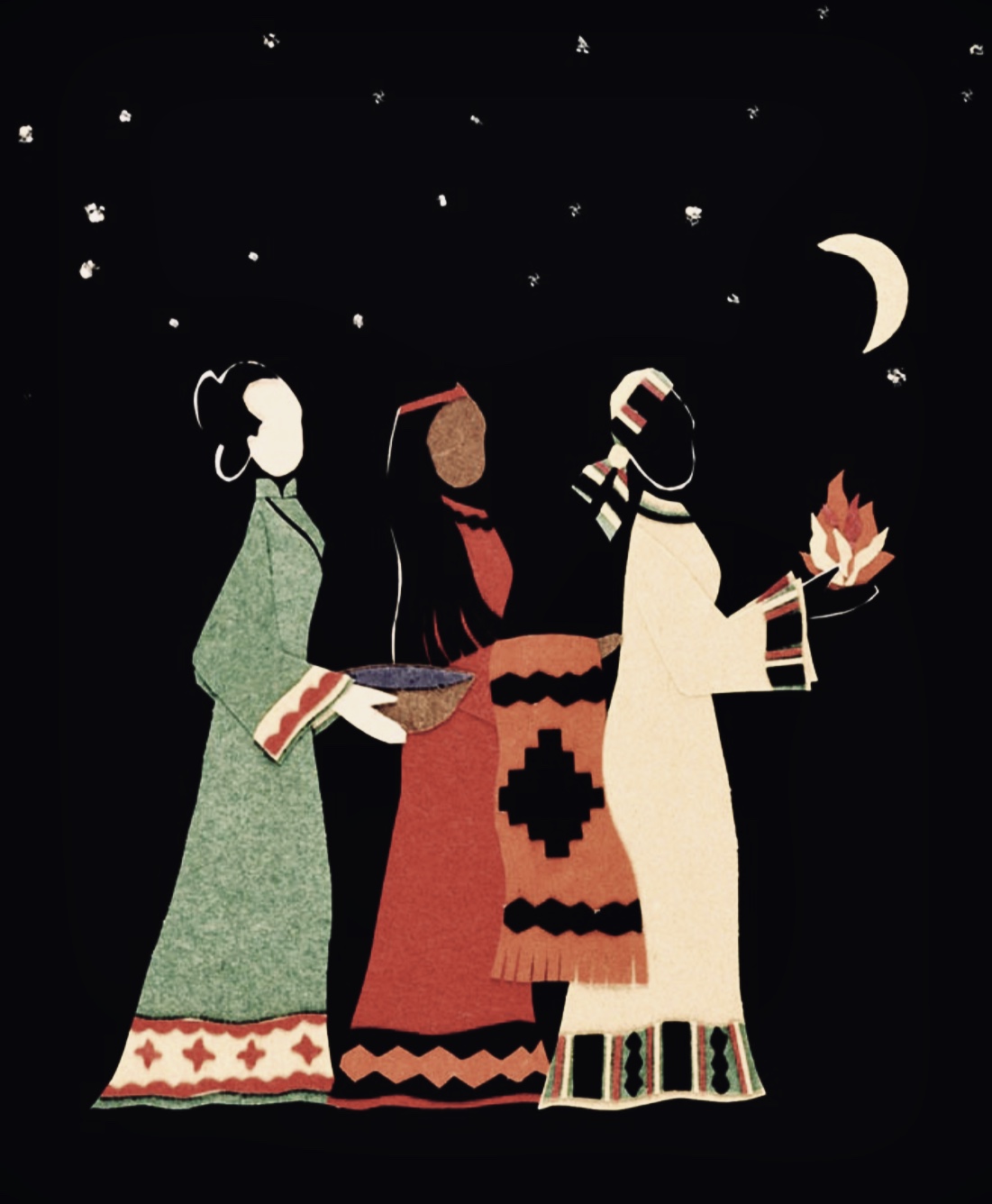
Art: “Wise Women Also Came” by Jan Richardson

Women’s Christmas! What Is That?

There is a custom, rooted in ireland, of celebrating Epiphany as Women’s Christmas. On January 6, Epiphany brings the Christmas season to a close. Called Nollaig na mBan in irish, Women’s Christmas originated as a day when the women, who often carried the domestic responsibilities all year, took Epiphany as an occasion to celebrate together at the end of the holidays, leaving hearth and home to the men for a few hours. 

Whether your domestic commitments are many or few, Women’s Christmas offers a timely opportunity to pause and step back from whatever has kept you busy and hurried in the past weeks or months. As the Christmas season ends, this is an occasion both to celebrate with friends and also to spend time in reflection before diving into the responsibilities of the new year.

Epiphany might be for you an invitation to rest, to reflect, to contemplate where you are on your journey. Epiphany reminds us of the wise persons who traveled to welcome the Christ Child and who returned home by another way. Perhaps we might consider turning our attention toward questions about our own journey. Epiphany brings us The Wise Men, The Three Kings. But did others also make the journey, following a brilliant star? Were there other travelers whose names we don’t know?

Jan Richardson tells about an experience she had years ago when she was beginning to find her artist soul. She sat down to create a collage to use for Epiphany. She began to imagine who else might have made the journey to welcome Jesus. In her soul, a trio of women began to take shape, carrying their treasures to offer the Child. She named the piece Wise Women Also Came.

I love the idea that three wise women made that journey and saw the Christ Child. There are so many accounts in the Scriptures about women having no rights, no protection, no ability to speak. Many of their names are not even recorded. Even in this day — 2020 — we have been socialized to keep silence in meetings or gatherings. We may even believe that our opinions are not important enough to speak out loud. We shrink back into what is determined to be “our place.” Maybe not all the time, but we have to admit we’ve done it sometimes. It’s all about how much we value ourselves and how much we believe others value us.

But shrinking back behind the scenes and quashing our voice has significant consequences — that our vision will not be given, our inspiration will fail to inspire, our dreams will be lost, our influence will not flourish, our wisdom will not be spoken. And our world will suffer for it, losing our passion for a world that needs passion.

Imagine with me that three wise women made the incredible journey to see the Child. Imagine the gifts they might have brought. Imagine what social constraints they might have broken to go on this journey of a lifetime, and the courage that motivated them. Imagine whether or not you could take such a journey, forbidden by your society, yet moving ahead on the path. Imagine your bravery and your resolve, your your sense of adventure, your hopes and your dreams.

So let’s accept two challenges in the days to come:

To celebrate Women’s Christmas with our friends and also to spend time in personal reflection before diving into the responsibilities of the new year.

To find our voices and our wisdom. To claim our courage, our strength and our passion. And even if others scoff at us, to follow our dreams.

The world needs us!

Comfort, Friends, Friendship, Hope, Love, Mayo Clinic, Mothering, Prayer, Women

Surrounded by Love

266D9A02-403A-44DF-A1CF-54CE9D1C3462
“Surrounded by Love” —  A watercolor by Kathy Manis Findley

On May 17th, I received some devastating news from Piedmont Transplant Center in Atlanta where I had been four years on the transplant list for a kidney. They abruptly placed me on the inactive list, which meant they would no longer be working to match a kidney for me. I was devastated. My friend told me recently that she feared I would give up on the process, but instead she watched me gather up my courage and move forward.

There’s a reason for that, something that empowered me to find another route on the journey that would eventually lead to a transplant. The reason? I call it surrounded by love and all that goes with that kind of love. I found it, I think, at a meeting of Baptist women ministers held at my house on May 17th. After the news from Piedmont, the last thing I felt like doing was hosting a gathering. But they came, a group of women I didn’t really know so well. One of them was a close and trusted friend. The others were friends I needed to know better.

As we enjoyed one another’s company, I avoided talking about my disheartening news, but eventually someone asked about my progress toward a transplant. I could have responded by sobbing uncontrollably. I could have simply said that the process toward a transplant is ongoing. Instead I took a deep breath and gave them the details.

Now you must know that each one of them is a trained and gifted minister, so they knew what to say and how to say it. But the end of the conversation caught me completely off guard. Everyone stood and they created a huddle with me in the middle. It was a hugging huddle — one big, comforting hug. Those moments were comforting, empowering, encouraging, full of grace. My friends mothered me and then they prayed for me, each one.

In those moments I was surrounded by love that has grown deeper with the passing days. From that huddle I was graced with the will to go on, and I did. On November 15, if all goes well, I am scheduled for a transplant at Jacksonville’s Mayo Clinic.

All because I was surrounded by love, a love that I know will not let me go.

Bible, Birthday parties, Celebration, Contemplation, Creation, Friends, Grace, Gratitude, Lectio Divina, Prayer, Reflection, Surprise, Women

Surprised!

B493965F-0A08-42CD-9D12-475A36EFB534

I always write in the moment — what I’m feeling or experiencing, what fills me with joy or what brings forth tears of sadness. That’s my blog. It’s not about me really. It’s more about what exists before me, behind me, around me, within me . . . in the moment. This morning’s moment is all about sweet memories of being surprised. Completely surprised by the surprise birthday party planned and executed by my wonderful Sunday School class.

Last night was a night to remember for me. It was indeed a surprise —an unexpected, shocking, out-of-the-blue, lavish, wonderfully loving surprise. This morning I am giving thanks for the grace gift of that group of women. And I am enjoying one of the gifts they gave me — a beautiful Lectio Divina prayer bible. 

I began my reading this morning at the beginning — Genesis 1: 1-19 — with the intention of reading the passage as if it were my first time. I read it using the pattern of reflective bible reading that included the following steps of Lectio Divina:

  1. A slow, thoughtful reading of the Biblical text
  2. Reflection on the meaning of the text
  3. Prayer
  4. A decision on what I should do in my life as a result of my contemplative experience

In other words, how does action and contemplation meet for me in this time, in this place?

Gathering all the parts of me into a quiet place, I read the first part of the creation story. I took it in as a story fresh and new, and within seconds I was struck by these words:

When God began to create the heavens and the earth — the earth was without shape or form, it was dark over the deep sea, and God’s wind swept over the waters — God said, “Let there be light.” And so light appeared.

God’s wind swept over the waters . . . I could visualize it. I could hear its sound. I could feel the wind sweeping over me gently, but surely. It was fresh and new, as if I was reading it for the first time. Funny how sacred Scripture can do that “fresh and new” magic!

Today’s life lesson? It’s all about gracious gifts from a loving God . . . Wind and water, sea and sky, light and darkness, and friends of the heart who offer acts of love. 8A5E3A3F-C6E4-47B2-9F75-245B231ADA55Like a birthday party full of meaning beyond the hats and the food and the gifts and the cake.

At the back of the prayer bible, there is a collection of classic Christian prayers. This one — “A Prayer to the Holy Spirit” — is a Native American Traditional prayer that expresses wonderfully the thoughts of my life lesson for today.

O Great Spirit, 
whose breath gives life to the world,
and whose voice is heard in the soft breeze:


We need your strength and wisdom.
Cause us to walk in beauty. Give us eyes
ever to behold the red and purple sunset.
Make us wise so that we may understand
what you have taught us.
Help us learn the lessons you have hidden
in every leaf and rock.
Make us always ready to come to you
with clean hands and steady eyes,
so when life fades, like the fading sunset,
our spirits may come to you without shame. Amen.

May God — the Mother of all created things, the Father of life itself — make it so.

I am deeply grateful on this day for:

  • Quiet moments of reflection
  • The story of God’s hand in all created things
  • The ability to pray
  • The will to point my life toward actions inspired by faith
  • The gift of friends of the heart (who throw spectacular, startling, and
    completely surprising birthday parties!)

Thanks be to God.


***************************************

On another note, please pray for me as I await a life-saving kidney transplant. I am grateful that you are walking with me on this journey that often feels so frightening. Your thoughts and prayers mean so much. If you would like to read the story of my illness, please visit the Georgia Transplant Foundation’s website at this link:

http://client.gatransplant.org/goto/KathyMFindley

A “Go Fund Me” page is set up for contributions to help with the enormous costs related to the transplant, including medications, housing costs for the month we have to stay near the transplant center, and other unforeseeable costs for my care following the transplant. If you can, please be a part of my transplant journey by making a contribution at this link:

https://bit.ly/33KXZOj


Community, Emotions, Friendship, Introspection, Laughter, Life Journeys, Memories, Reflection, Relationship, Stories, Vulnerability, Women

All Because of the Stories

9B0410BB-65D0-4A15-82BC-F05226DB1028

Telling our stories is one of the most sacred things we do. I am reminded of that as I enjoy my church’s annual women’s retreat on St. Simon’s Island. Now understand this: being on an island means sun and breezes, ocean waves, white sand and palm trees. So the physical environment of this retreat is very conducive to re-creating. On top of that, our sessions have focused our thoughts on knowing ourselves and finding the peace that comes from mindfulness and balance.

But at lunch today with three of the women, I rediscovered the power of our stories as we each told about vivid snippets of our lives and histories. One person commented that we might never have known these things about each other by just greeting one another in church. She was so right! The retreat gave us the gift of safe space in which to tell our stories.

All four of us delighted in the stories the others told. Each of us grew in our own spirituality as we told one another things about our faith. We shared our dreams. One shared her 15-year plan. Another shared her hopes for the year ahead. Two of us shared parts of life past, as the other two celebrated us.

We shared some pain, too, and some loss. We shared times of disappointment and times of plain old survival. We shared stories that brought laughter to the lunch table. We shared communion, in a way, when we created community — a safe community for sharing some of the experiences that brought such meaning to our lives.

We spoke and we listened. We told our stories, each voice around the table willing to be vulnerable enough to share their lives. There was power in the telling. And then there was another kind of power in the listening.

Each of us — just the four of us — were enriched, emboldened, supported and celebrated in the brief lunch activity of hearing one another’s story.

For today at least, four strangers became friends — all because of the stories.

Activism, Determination, Ecclesiastes, Mothering, Nonviolence, peace, Perseverance, Prophetic, Sermon on the Mount, Transformation, Women

“Blessed Are the Peacemakers”

A9D2FCDB-B949-42F0-95A3-990C8A5D484D
Image: The Sleeping Gypsy by Henry Rousseau, 1897, Museum of Modern Art, New York, NY.

In a world of division, violence, hate, racism, misogyny, xenophobia, homophobia and all manner of angst, perhaps we need to draw nearer to Jesus for a moment to listen to the thoughts of his heart. It happened before, you know, when Jesus went up on a mountainside and sat down. His disciples came to him, and he began to teach them.

The things he taught them that day are ever so important for us in these days.

Love your enemies . . .

“You have heard that it was said, ‘Love your neighbor and hate your enemy.’ But I tell you, love your enemies and pray for those who persecute you, that you may be children of your Father in heaven. (Matthew 5:43-45 NIV)

Turn your other cheek . . . 

“You have heard that it was said, ‘Eye for eye, and tooth for tooth.’ But I tell you, do not resist an evil person. If anyone slaps you on the right cheek, turn to them the other cheek also. (Matthew 5:38-39 NIV)

Make peace . . .

Blessed are the peacemakers, for they will be called children of God. (Matthew 5:9 NIV)

I have heard it said that one would not likely find the words of Jesus from the Sermon on the Mount on display on any courthouse lawn. They might never be inscribed on a slate in a state capitol building. But the most important inscription for these words of Jesus is an inscription on our hearts. Not physically possible, of course, but spiritually, we can open our hearts to receive these words within us, allowing them to transform us in ways that empower us to create peace.

Richard Rohr asks how it is that many Christians have managed to avoid what Jesus actually taught? How have we evaded major parts of the Sermon on the Mount: Jesus’ clear directive and example of nonviolence, and his command to love our enemies?

Perhaps we do not believe that nonviolence actually possible or that it will not effect any significant change. Many peacemakers know better. The Pope has singled out one active peacemaker we should know. Leymah Gbowee, the 2011 Nobel prize winner from Liberia, organized pray-ins and nonviolent protests that resulted in high-level peace talks to end the second civil war in Liberia. There are other peacemakers living out a commitment to peace. Not surprisingly, most of them are women. The contributions of women such as Leymah Gbowee in Liberia and Marguerite Barankitse in Burundi are showing the way to the eventual end of violence and the dawning of peace. Their work is working.

Two other women, Erica Chenoweth and Maria Stephan, write in their book, Why Civil Resistance Works, about the effectiveness of nonviolence, drawing from examples in Iran, Palestine, the Philippines, and Burma. They insist, based on their research, that nonviolent resistance is “nearly twice as likely to achieve full or partial success as its violent counterparts. ” 

Perhaps it is that mothering, protecting instinct that makes women lovers of peace. Perhaps it is their capacity for hope and determination. Perhaps it is that women persevere in faith. Perhaps women are a prophetic people who insist that transformation is possible. Women who love peace know that nonviolent movements are made of loyalty, resilience, commitment, creativity and love. Fortunately, women are not afraid of love or creativity or commitment. Women do fear the destruction of hate, violence and war.

So sisters in the struggle, let us keep on. Let us persevere in our quest for peace. Let us persist, struggling for as long as it takes to see holy peace gently cover our world from East to West, North to South, so that every man and woman, every child will be able to lie down in safety.

After all, Jesus said, “Blessed are the peacemakers, for they will be called children of God.”

Aging, Exclusion, Freedom, life, Possibilities, Retirement, Women

I Refuse to Disappear

5465C6E4-7A61-4177-AF37-C8CF97B048C2

I refuse to disappear! All my life, I have experienced forces and people and systems that wished for my disappearance. As an advocate for victims of violence in the court and criminal justice systems, powerful people just wanted me to go away. As a child advocate, the foster care system definitely wanted me to disappear. As chair of the Little Rock Commission on Children, Youth and Families, the city power brokers wanted me gone so that they could pretend rather than acknowledge the reality of caring for the real needs of children and families.

As a pastor, I spoke truth every week, often controversial truth that the congregation might resist. I was never one to shrink back or hide. I was never willing to disappear when proclaiming the Gospel compelled me to speak. I was always fairly brave.

But I digress. The past is the past, and even now, in retirement, I often feel very much like people want me to disappear. I am resisting the way people do “placement,” that is the way people place me in a category called retirement. It feels as if others are most comfortable acknowledging my past career but forgetting that I still have talents and gifts and creativity. So here I sit — placed in one of three slots: 1) a carefree retiree that enjoys a traveling, active lifestyle; 2) a retired “old person” who can’t really do much anymore; or 3) a shut-in who is too disabled to be an active part of society.

But sitting has never been for me. I’m terrible at it. I have never allowed others to set me aside. I have never allowed people to insist on my disappearance.

These days, though, it’s a struggle. Invitations to preach or speak or teach are few and far between. It is true that I have health issues that slow me down. It is also true that a part of retirement includes challenges. But I want to resist being dismissed as irrelevant. I want to urge people to pay attention to my abilities. I want to continue my career in ways that are possible and appropriate for me. I do not want to disappear.

I refuse to be small and quiet. I refuse to hide my fire. I am still capable of disrupting the universe. I am still going to do the next right thing. 

I love these words shared by women just like me who simply won’t disappear. And I love the writing of Glennon Doyle who speaks a lot of truth, inspiring and uplifting truth. She calls out to women, especially, inviting us to be the persons we want to be even when outside forces try to hold us back. “It’s not a woman’s job,” she writes, “to get smaller and smaller until she disappears so the world can be more comfortable.”

Amen, Glennon!

Covenant, Friendship, Introspection, Jephthah's Daughter, Judges 11, Lent, life, Reflection, Rhythm, Women

Together Through Lent

0373B40D-24BE-4EAE-8E78-3357B8EC97C7
Watercolor art by Kathy Manis Findley. The watercolor — “Together” — represents the spiritual covenants we share with one another, bonds that strengthen our faith. 

I have always thought of Lent as a spiritual journey we take alone, a solitary season of introspection and self-reflection during which we contemplate our own spiritual well-being and our relationship with God. For me, Lent has always been alone work. But what if it wasn’t? Suppose I experienced Lent with my community — the close community of people with whom I share my spiritual life.

I cannot help but recall the story of Jephthah’s daughter as told in Judges 11. When she faces a terrible crisis that will result in her death at the hands of her father, she makes only one request of her father. “Do what you must do, only grant me this one request: Give me two months to roam the hills and weep with my sisters.”

So she will take this journey up into the hills with her sisters — to mourn, to reflect, to pray. She will not make this journey alone. She makes the journey with the sisters who surrounded her in life and now in death. They climb up into the hills together.

Lent’s forty days represent the time Jesus spent in the wilderness, enduring the temptation of Satan and preparing to begin his ministry. He was there alone, and most often the Lenten journey is a time for reflecting alone. But I think that perhaps there is spiritual benefit in making a Lenten journey together, in community, joining together through invisible rhythms of friendship and caring.

As I make my Lenten journey this year, in my mind I will take my community with me. There into my alone places where God comforts me in my contemplative moments, in my repentance and in my penitence, I will be more mindful this Lent of my spiritual circle of friends. I will make a covenant with them in my mind and heart. I will send them positive thoughts as they make their Lenten journey and I will pray for them intentionally and faithfully.

It will be a together Lent, inspired by the sisters who went into the hills with Jephthah’s daughter where they spent a season of grief in community, together.

I hope that, together, we might embrace a sense of community as one of our Lenten spiritual disciplines, that we might journey together for these forty days, praying for one another, seeking together the serenity, the reflection and the transformation of Lent.

In that spirit of prayer, I leave with you this beautiful prayer written by Rabbi Naomi Levy:

The rabbi in me would like to offer a prayer for you.
I pray you will learn to see you life as a meaningful story.
I pray you will learn to listen to your soul’s insistent yearning.
I pray you will learn to believe you can transform your life.
I pray you will learn to live and shine inside your imperfect life
and find meaning and joy right where you are.
Most of all I pray you will uncover a great miracle: your extra-ordinary life.

— From Hope Will Find You by Rabbi Naomi Levy

Activism, Bravery, Challenge, Change, Community activism, Courage, Injustice, Social justice, Women

Moving Elephants

1d7ce45b-06ac-4a0a-92a0-8d51176ca80fThe wisdom for this day comes from Hannibal of Carthage: “We will either find a way or make one.” It was a Latin proverb, most commonly attributed to Hannibal in response to his generals who had declared it impossible to cross the Alps with elephants.

We need this wisdom for today because for the past two years, racism and other divisions have been promoted by the extremist in the White House and his enablers in the Congress. In general, Congressional leaders are creating policies that enforce systemic poverty. Plain and simple!

The truth is that this country has a long and tragic history of classicism, sexism, misogyny, and violence against women. And those who participate in oppression against women are often on the same side as racism, homophobia, xenophobia, and fascism.

This is not the way a nation and government should be moving, and the masses have said it will not be tolerated. They have looked squarely at the injustices and have determined to “find a way or make one.” They cannot be deterred or thwarted. They will persist as they have always done. “A change is gonna’ come,” sisters!

What are the signs? 

Sign number 1: a record number women were elected to seats in the House of Representatives, many of them flipping districts from red to blue. This nation elected the first Native American and Muslim women to Congress, and the first openly bisexual woman to the Senate. South Dakota elected its first female governor. North Carolina elected another African American woman to the state supreme court.

Sign number 2: the powers that be fear women who persist. As Rev. William Barber points out, they are afraid of women like Rosa Parks. They cower in the presence of women like Rev. Dr. Liz Theoharis of the Poor People’s Campaign’s who has fought to tear down systemic poverty and oppression. They are terrified of women like Women’s March national co-chairs ― Carmen Perez, Linda Sarsour and Tamika Mallory ― who are bringing women together across every race, creed, color, religion, sexuality, and class. They fear women like Sister Simone who fights for affordable health care or like Lucy Parsons who fought for labor rights and living wages.

They’re afraid we’ll march, or vote, or advocate, or speak the truth, or run for office, or persist. But “a change is gonna’ come,” sisters! It won’t be easy. It won’t happen overnight. But if any people can find a way to cross the Alps with elephants, sisters standing together in solidarity can do it! Women have shown that they will “either find a way or make one!”

But there is one caveat: stick together! Forget about infighting.

Yes, There may be realities of real conflict that need to be addressed head on. No social justice movement is without conflict, and disagreements around the Women’s March were there from the start: Should the march include anti-abortion women? Were the needs of women of color overshadowed by the priorities of white women? What about transgender women? Is it true that accusations of anti-semitism hang over the march?

Let us pray that women and those who support women will find ways to mitigate these concerns and show up on Saturday ready to march. After all, we made history together. That was our stellar beginning. Remember?

It started just days after the fateful 2016 election. A small group of women who feared the Trump presidency joined together at a New York restaurant to plan a demonstration. What resulted from that meeting was the largest single-day protest in U.S history, the Women’s March, which took place in about 600 American cities and towns and on every continent in the world. And that march was a part of what inspired a record number of women to run for office and win. Elephants or not, we “will either find a way or make one!”

So let us march on Saturday and if we cannot march, send positive energy in solidarity with those who do march. Be encouraged. Be encouraged by the words of Dr. William J. Barber:

As you march this weekend and as you step into the new year, I urge you to keep fighting. Do not relax until poverty is eradicated, until every American receives a living wage for their work, until racism, bigotry, homophobia, xenophobia, and misogyny are words of the past. Continue to register your friends and family and neighbors to vote. Continue to run for office. Continue to march, protest, and make your voices heard.

Keep the faith. Keep fighting.


Celebration, Change, Light, Politics, Women

Celebrate!

45270512-74C2-48EE-8432-2FAB7129D11C
New Faces of Congress!  Top row (L>R) Deb Haaland, Rashida Tlaib, Judge Veronica Escobar, Jahanna Hayes;   Bottom row (L>R) Ayanna Pressley, Sharice Davids, Ilhan Omar, Alexandria Ocasio-Cortez

Some voters hoped for a Blue Wave, others a Red Wave. There wasn’t much of a wave on either side of the aisle, at least not the enormous wave they wanted to see. What we did see was a Women’s Wave, at least 117 women elected on Tuesday, 100 Democrats and 17 Republicans. Now that is something to celebrate! Here’s the scoop, by the numbers:

  • Of the 117 women elected, 42 are women of color, and at least three are L.G.B.T.Q.
  • With some ballots still being counted, women have so far claimed 96 of the House’s 435 seats (it is expected to rise to 100), up from the current 84.
  • At least 12 women won Senate seats, which will bring the total in that chamber to at least 22 (that number is expected to rise by two), of the 100 seats that exist. There are now 23 women.
  • Women won nine governorships, of 50 total. Six women currently serve.
  • Overall, at least 10 more Congressional seats will be occupied by women than before.

On a night to remember and celebrate, here is what some of the women who made history said in their victory speeches:

“When it comes to women of color candidates, folks don’t just talk about a glass ceiling; what they describe is a concrete one. But you know what breaks through concrete? Seismic shifts.” 

  • Ayanna Pressley, who will become the first African-American woman to represent Massachusetts in Congress. She beat a 10-term incumbent in the Democratic primary and vowed to pursue “activist leadership” to advance a progressive agenda.

“We have the opportunity to reset expectations about what people think when they think of Kansas. We know there are so many of us who welcome everyone, who see everyone and who know that everyone should have the opportunity to succeed.”

  • Sharice Davids, a former White House fellow, is a lesbian; she and fellow Democrat Debra Haaland of New Mexico are the first Native-American women elected to Congress.

“In my family, there were no girl chores or boy chores. There’s just things to get done. So that’s what we’re going to do. I’ve got some big plans for this state.”

  • Kristi Noem, a Republican, will be the first female governor of South Dakota. She’s a four-term congresswoman who campaigned on her conservative record and her experience working on her family’s farm.

“We launched this campaign, because in the absence of anyone giving a clear voice on the moral issues of our time, then it is up to us to voice them.” 

  • Alexandria Ocasio-Cortez, Democrat from New York, became the youngest woman elected to Congress at age 29. She has never held elected office, and like Ms. Pressley, she defeated a white man who had served 10 terms in a Democratic primary.

So there you have it — a real occasion for celebration. No doubt, these women will re-shape America’s leadership. If you know women at all, you know that they often work harder, work longer, work with a passion that changes the world.

Congratulations and God speed to each of them. 

To the new faces of leadership: We applaud you. We celebrate you. We’re proud of you. We’re holding you in the light. We’re counting on you.


Statistics in this blog are from Maya Salam, published in a special post-election edition of The New York Times Gender Letter.


Bible, Death, Despair, Mourning, Sexual abuse, Stories, Violence, Women

Remembering the Levite’s Concubine


B4F66D38-E516-4C36-84D1-1AE521D2CCFA
“The Levite’s Concubine” by artist, Dee Jones

It is art we do not want to see, art that so closely mimics reality that we are compelled to turn away. But the artist, Dee Jones, captures every emotion, all the terror, every horrific aspect of sexual violence. If we care, we must look. And we must see all the ways in which sexual and domestic violence is a travesty. 

It is true that, when we find such depraved violence in our Scripture, it is shocking. But we find It today in the 19th chapter of the Book of Judges, and we must steel ourselves to truly hear this awful story. Ken Sehested describes it with these words: “The narrative is monstrous, quite possibly the most visually brutal story in all the Bible.”

The story is about a Levite traveler and his concubine. Though you may be daunted by reading the entire 30 verses of this chapter, it’s worth your time to hear the whole story of another nameless woman in Scripture.

In those days Israel had no king.

Now a Levite who lived in a remote area in the hill country of Ephraim took a concubine from Bethlehem in Judah. But she was unfaithful to him. She left him and went back to her parents’ home in Bethlehem, Judah. After she had been there four months, her husband went to her to persuade her to return. He had with him his servant and two donkeys. She took him into her parents’ home, and when her father saw him, he gladly welcomed him. 

His father-in-law, the woman’s father, prevailed on him to stay; so he remained with him three days, eating and drinking, and sleeping there.

On the fourth day they got up early and he prepared to leave, but the woman’s father said to his son-in-law, “Refresh yourself with something to eat; then you can go.” So the two of them sat down to eat and drink together. Afterward the woman’s father said, “Please stay tonight and enjoy yourself.” And when the man got up to go, his father-in-law persuaded him, so he stayed there that night. On the morning of the fifth day, when he rose to go, the woman’s father said, “Refresh yourself. Wait till afternoon!” So the two of them ate together.

Then when the man, with his concubine and his servant, got up to leave, his father-in-law, the woman’s father, said, “Now look, it’s almost evening. Spend the night here; the day is nearly over. Stay and enjoy yourself. Early tomorrow morning you can get up and be on your way home.” But, unwilling to stay another night, the man left and went toward Jebus (that is, Jerusalem), with his two saddled donkeys and his concubine.

When they were near Jebus and the day was almost gone, the servant said to his master, “Come, let’s stop at this city of the Jebusites and spend the night.”

His master replied, “No. We won’t go into any city whose people are not Israelites. We will go on to Gibeah.” He added, “Come, let’s try to reach Gibeah or Ramah and spend the night in one of those places.” 

So they went on, and the sun set as they neared Gibeah in Benjamin. There they stopped to spend the night. They went and sat in the city square, but no one took them in for the night.

That evening an old man from the hill country of Ephraim, who was living in Gibeah (the inhabitants of the place were Benjamites), came in from his work in the fields. When he looked and saw the traveler in the city square, the old man asked, “Where are you going? Where did you come from?”

He answered, “We are on our way from Bethlehem in Judah to a remote area in the hill country of Ephraim where I live. I have been to Bethlehem in Judah and now I am going to the house of the Lord. No one has taken me in for the night. We have both straw and fodder for our donkeys and bread and wine for ourselves your servants — me, the woman and the young man with us. We don’t need anything.”

“You are welcome at my house,” the old man said. “Let me supply whatever you need. Only don’t spend the night in the square.” So he took him into his house and fed his donkeys. After they had washed their feet, they had something to eat and drink.

While they were enjoying themselves, some of the wicked men of the city surrounded the house. Pounding on the door, they shouted to the old man who owned the house, “Bring out the man who came to your house so we can have sex with him.”

The owner of the house went outside and said to them, “No, my friends, don’t be so vile. Since this man is my guest, don’t do this outrageous thing. Look, here is my virgin daughter, and his concubine. I will bring them out to you now, and you can use them and do to them whatever you wish. But as for this man, don’t do such an outrageous thing.”

But the men would not listen to him. So the man took his concubine and sent her outside to them, and they raped her and abused her throughout the night, and at dawn they let her go. At daybreak the woman went back to the house where her master was staying, fell down at the door and lay there until daylight.

When her master got up in the morning and opened the door of the house and stepped out to continue on his way, there lay his concubine, fallen in the doorway of the house, with her hands on the threshold. 

He said to her, “Get up; let’s go.” But there was no answer. Then the man put her on his donkey and set out for home.

When he reached home, he took a knife and cut up his concubine, limb by limb, into twelve parts and sent them into all the areas of Israel. Everyone who saw it was saying to one another, “Such a thing has never been seen or done, not since the day the Israelites came up out of Egypt. Just imagine! We must do something! So speak up!”

— Judges 19: 16-30 NIV

The story begins by telling us that Israel had no king, thus describing a violent and lawless situation in the land. The structures of justice had collapsed. The rest of the story is a brutal account of rape, torture and murder. In her book, Texts of Terror, Phyllis Trible offers this commentary:

Of all the characters in Scripture, she is the least. Appearing at the beginning and close of a story that rapes her, she is alone in a world of men. Neither the other characters nor the narrator recognizes her humanity. She is property, object, tool, and literary device. Without name, speech, or power, she has no friends to aid her in life or mourn her in death. Passing her back and forth among themselves, the men of Israel have obliterated her totally. Captured, betrayed, raped, tortured, murdered, dismembered and scattered—this woman is the most sinned against.” (pp. 80-81)      

The story closes with the woman’s dismemberment and the scattering of her body parts across Israel. The last verse says: “Everyone who saw it was saying to one another, ‘Such a thing has never been seen or done, not since the day the Israelites came up out of Egypt. Just imagine! We must do something! So speak up!’”

Ken sehested observes that the narrative closes with three imperatives: “Consider this, take counsel, speak.” Ken says it like this: “Let this horrible story instruct you. And finally, ‘speak.’”

For us, in these violent days, the message is just as critical, and yes, we must speak! The silence around violence against women must end. If we can find the courage to end our silence through the stories of unnamed, forgotten and reviled Biblical sisters, then their horrific stories have sacred meaning and divine purpose. 

“They have names, and we must learn them,” Ken Sehested insists. “They have histories and we must tell them. In the end, we must nurture a vision where our security and theirs are bound up together.”

It’s the only name we have for her, the Levite’s Concubine. Yet, we must mourn her and remember her and know her story. So let us hear, if we can, this monstrous Biblical narrative and allow it to instill deep within us an unwavering commitment to do everything in our power to end violence in the world.

Absolom, Bible, Church, Darkness, Daybreak, Family, Grace, Justice, Preaching, Sexual abuse, Tamar, Violence, Women, Worship

“Think Justice!”

DFDDBB19-8E9F-4852-9804-4F97B176E9A3

A sermon preached on September 30, 2018 at the First Baptist Church of Christ, Macon, Georgia

Let the words of my mouth and the meditations of our hearts be acceptable in your sight, O Lord, our hope and our refuge. Amen.

I

In July, I received a note from Ellen. She is 22-years-old, a college graduate with honors, a strong, confident young woman. This is what she wrote:

“I love all of you so much. None of this would be possible without you. My time with you had such an enormous impact on who I am, and I can’t thank you enough for everything you’ve done to get me to this point. You’re my family forever and always.    Ellen.”       (Written on her wedding day, July 8, 2018)

Thirteen-year-old Ellen came to us at Safe Places, an organization where my staff and I cared for women who had been abused, children exposed to violence, and young girls who had escaped the evil grip of human trafficking. When we first met Ellen, she was silent, lifeless, angry — hurt deeply in her soul. But after a few months, Ellen’s vivacious personality began to emerge. Slowly, she opened up her hurt place and let healing in. 

Ellen was eventually strong enough to be a part of our Princess Program, where girls who had experienced violence spent the summer learning and sharing, and discovering their inner courage, resilience, and sacred worth. After the summer, we celebrated the girls at the Arkansas Governor’s Mansion with a grand ball, a very grand ball. 

When they put on their sparkling gowns, and the most glittering shoes I had ever seen, they believed — for at least one magical night — that truly they were princesses. Our wise staff taught them that even princesses can be violated, but they already knew that. They had lived through the humiliation of verbal abuse, the pain of physical and sexual abuse, and the long-lasting effects of emotional abuse. For many of them, it happened in the one place that should have been safe — in their homes.

II

Throughout history, we encounter stories of violence. Such is our story today, a story about how violence devastates Princess Tamar, King David’s daughter. Sometimes historians, biblical expositors and even story-telling preachers come upon stories that are hard to tell. This is one of those stories. It’s probably not included in any anthology of  “The World’s Most Inspiring Bible Stories.” It’s a story we don’t tell to our children. We might prefer to skip this story altogether. Theologian, Phyllis Trible, would call it a text of terror. And yet, it is the word of the Lord, and, as such, it offers some truths, some warnings, some questions, and maybe even a smidgen of grace.

So even though we find trouble in this text, God might just whisper, and gently nudge us to listen and to let the story reveal some important ways God calls us to do justice. 

Listen for the whisper of God in the reading of sacred scripture, 2 Samuel 13: 1-22.

In the course of time, Amnon son of David fell in love with Tamar, the beautiful sister of Absalom son of David. Amnon became so obsessed with his sister Tamar that he made himself ill. She was a virgin, and it seemed impossible for him to do anything to her.

Now Amnon had an adviser named Jonadab son of Shimeah, David’s brother. Jonadab was a very shrewd man. He asked Amnon, “Why do you, the king’s son, look so haggard morning after morning? Won’t you tell me?”

Amnon said to him, “I’m in love with Tamar, my brother Absalom’s sister.”

”Go to bed and pretend to be ill,” Jonadab said. “When your father comes to see you, say to him, ‘I would like my sister Tamar to come and give me something to eat. Let her prepare the food in my sight so I may watch her and then eat it from her hand.’”

So Amnon lay down and pretended to be ill. When the king came to see him, Amnon said to him, “I would like my sister Tamar to come and make some special bread in my sight, so I may eat from her hand.”

David sent word to Tamar at the palace: “Go to the house of your brother Amnon and prepare some food for him.” So Tamar went to the house of her brother Amnon, who was lying down. She took some dough, kneaded it, made the bread in his sight and baked it. Then she took the pan and served him the bread, but he refused to eat.

“Send everyone out of here,” Amnon said. So everyone left him. Then Amnon said to Tamar, “Bring the food here into my bedroom so I may eat from your hand.” And Tamar took the bread she had prepared and brought it to her brother Amnon in his bedroom. But when she took it to him to eat, he grabbed her and said, “Come to bed with me, my sister.”

“No, my brother!” she said to him. “Don’t force me! Such a thing should not be done in Israel! Don’t do this wicked thing. What about me? Where could I get rid of my disgrace? And what about you? You would be like one of the wicked fools in Israel. Please speak to the king; he will not keep me from being married to you.” But he refused to listen to her, and since he was stronger than she, he raped her.

Then Amnon hated her with intense hatred. In fact, he hated her more than he had loved her. Amnon said to her, “Get up and get out!”

“No!” she said to him. “Sending me away would be a greater wrong than what you have already done to me.”

But he refused to listen to her. He called his personal servant and said, “Get this woman out of my sight and bolt the door after her.” So his servant put her out and bolted the door after her. She was wearing an ornate robe, for this was the kind of garment the virgin daughters of the king wore. Tamar put ashes on her head and tore the ornate robe she was wearing. She put her hands on her head and went away, weeping aloud as she went.

Her brother Absalom said to her, “Has that Amnon, your brother, been with you? Be quiet for now, my sister; he is your brother. Don’t take this thing to heart.” And Tamar lived in her brother Absalom’s house, a desolate woman.

When King David heard all this, he was furious. And Absalom never said a word to Amnon, either good or bad; he hated Amnon because he had disgraced his sister Tamar.

III

Indeed, there is trouble in this disturbing text. We discover it when we eavesdrop on Princess Tamar — daughter of King David, sister of Absolom, and half sister of Amnon. We learn that Amnon conspired to be alone with her. His sly servant came up with a plan, and she ended up in Amnon’s room. After hurting her, he rejected her harshly. He called for his servant: “Get rid of this woman! Banish her from my presence! Bolt the door after her!” 

He would not even use her name.

Tamar collapsed outside the door, plunged her hand into the cooling ashes of the fire, and rubbed the ashes into her hair. As she staggered away, she tore her richly embroidered gown as a sign of her deep-down despair. Even princesses can be violated!

King David was angry, but did nothing either to punish his beloved son or to comfort his despairing daughter. There was no consolation from father to daughter, not a single trace of compassion.  And her mother is silent.

Near the end of the story, we stumble upon a tiny touch of grace when we learn that brother Absolom takes Tamar into his home. But she is no longer a princess of royal lineage. She fades into oblivion and lives out her days as a refugee in her brother’s house, a desolate woman who will never marry and bear children. But did Tamar fade into oblivion? 

I don’t think so! Tamar’s voice was not silenced. She told someone her story, and that someone heard her, and remembered her story, and re-told her story, and told it at the right time to the right person so that this story made its way into our holy scripture. Thousands of years later, we do know Tamar’s name. Across all barriers of history and culture, and if we imagine, we can hear her speak across the ages:  

“I lost my life that day. Here in my brother Absolom’s house, I am a prisoner. I will never have children that will bear my name through the generations. I will not know that deepest of joys.”

IV

So just keep silence, King David!  Stay silent, mother of Tamar! Protect your violent son at all costs. 

What a deadly picture of family violence — the violence of a brother overpowering his sister, and emotional violence because both parents remained silent.

We might ask: where were the voices of her parents? We cannot help but wonder how Tamar’s father and mother might have responded differently. But this royal family decided to keep silence to protect Amnon.

In her sermon, “The Silences We Keep,” Rev. MarQuita Carmichael Burton speaks of “conspiratorial silence.” Reflecting on Tamar’s story, Rev. Burton speaks these words:

Reclaim our voices, shatter the façade of the deadly silence we keep. . .

We must trade in our torn robes and ashes for a bull horn and a listening ear and tell the truth of our story, so that our souls, minds, bodies and the people we say we love might be healed. 

As former silenced victims choose to no longer acquiesce to the demands of the clan elders and refuse the false healing promised by our conspiratorial muteness,  we move forward to reclaim freedom and wholeness on our terms, because we need it and so does the village.

V

In the end, it’s all about justice, and the Prophet Isaiah knew a lot about that.

Break every yoke!  Then your light shall rise in the darkness! 

You shall be called the repairers of the breach!

We have seen a breach, and from the abyss of that breach, the “Me Too” movement erupted. The movement is a wonder to behold, and perhaps the cry of “Me Too” is precisely where we find the movement of God. Secrets held for decades came out of the darkness into the light, and grief-filled silences found words. Tears flowed freely from hearts that held on far too long to painful stories.

But I wish that no person had ever needed to cry out “MeToo.” That no one had ever endured the horrifying violence that caused them to live with a silence and secrecy that held such power over their lives. 

I wish they had never felt the grief that tormented them in the voiceless spaces of their spirits. 

I wish that Tamar had always been a princess — loved, cherished, protected by her parents. 

But she was not. And so many of our sisters and brothers and neighbors and friends are not. 

We may not always know who they are, but perhaps it is most important for them to know who we are, a people committed to justice.

VI

Dear people of First Baptist Church of Christ, I marvel at the many and mighty ways you do justice — creating beloved community across racial and cultural and ethnic divides, feeding the hungry, caring for the poor, seeing the sacred worth of every person. 

Can we also find ways to do justice within families? One in four of us in this sanctuary have experienced — or are currently experiencing — family violence. 

Among all the things that doing justice is, it is also being healers of the wounds that happen in the prisons of family secrecy. What does that mean exactly? 

I believe it means finding healing and gentle ways to give voice to a family’s secrets and silences. 

It means being ever a kind listener and never a judgmental voice. 

It means making sure that church is a safe and sacred space. 

It means keeping a watchful eye, always, over children, teaching them to be safe, not only from strangers, but from people they know and trust. 

It means being aware of the invisible wounds that others carry, and reaching out with tenderness that brings healing. 

If Jesus were among us today, I imagine him speaking justice to the unconscionable abuse of power that causes violence. He would call out husbands who abuse their wives, brothers who hurt their sisters, parents who harm their children.  Jesus might look into homes and cry out, “Woe to you!” 

And then, in his gentle, loving way, Jesus would reach out to the those who suffer violence, take their hands, and speak hope to despair. 

Jesus is not physically among us. but he left us in charge. So when we fail to seek justice in every place where abuse happens, we confine him. Joseph B. Clower, Jr. expresses this most eloquently in the final lines of his book, The Church in the Thought of Jesus:

If the indwelling Christ is not confined, then the Church’s eyes flow with his tears, her heart is moved with his compassion, her hands are coarsened with his labor, her feet are wearied with his walking among men [people].

 When we accept this weighty call and this daunting responsibility, the prophet Isaiah might call us repairers of the breach!

VII

So let’s end our story . . . Yes, Princess Tamar lost her royal status. But the final word in this story belongs to the brother who loved and esteemed her, and who honored her. In the chapter following our text, we learn that Absalom was the father of three sons and a beautiful daughter he named Tamar, in honor of his sister.  

Can you imagine Tamar taking her infant niece into longing arms that never expected to cradle a child who would carry her name? 

Can you imagine her full heart as she envisions the future of Princess Tamar the Second, daughter of Absalom, granddaughter of King David, niece of Princess Tamar the First?

What a surprise from God — anointing Tamar’s wounds with a holy, healing balm! 

And this is the very foundation of our Christian hope: the faith, the conviction, the assurance, the certainty that when Tamar was crying, God was listening. 

People of God, we must repair the breach and seize this holy task: covering survivors of family violence with the compassionate cloak of justice, confronting violence wherever it casts its shadow, following God into every place where justice must overcome oppression.

On the campus of Philander Smith College in Little Rock, Arkansas, there is a building that faces the interstate. On that building is a huge sign declaring a strong, prophetic message to over 100,000 motorists traveling past it every day. The sign reads “Think Justice!” But it means so much more! 

It means longing for justice, praying for justice, insisting upon justice — persisting, prevailing, creating — doing justice, breathing justice — in families, in communities, and to the ends of the earth. 

Then the mighty waters of justice will roll over us, and we will wade together in ever-flowing streams of righteousness. Amen.
Wisdom, Women

Woman Wisdom

C9DDA313-A81D-4148-8B30-33C313F12802
Watercolor art by Kathy Manis Findley.

I remember the many spirited discussions in meetings during my career. Often the dialogue deteriorated into a rancorous exchange, but inevitably, someone would rise to speak words of conciliation and wisdom. The gathering would settle down, and forward progress was possible. The voice of wisdom? Well, nine times out of ten, it was a woman’s voice.

When things are as they should be, women form themselves into positive friendships and relationships. In such groups, their collective energy and gathered wisdom can be a force to be reckoned with. Groups of women are unstoppable. They get things done. They serve others and they serve one another. At the very foundation of that kind of group is wisdom, the kind of wisdom that sees beyond the present situation and is able to dream something better and stronger.

Wisdom births strength and the courage to lead. It was this kind of wisdom that compelled Deborah, a prophet and judge of Israel, who rendered her wise judgments beneath a date palm tree. Deborah offered counsel before battle and declared that the glory of the victory would belong to a woman. The Song of Deborah is a hymn that celebrates a military victory helped by two women: Deborah and Jael. The Biblical account ends with the statement that after the battle, there was peace in the land for 40 years (Judges 5:31). 

Wisdom formed the bond between Shiphrah and Puah, Hebrew midwives who refused to follow the Egyptian Pharaoh’s genocidal instruction to murder all Hebrew male children. Their courage to refuse his order may well be the first known incident of civil disobedience in history. Some scholars have called the two midwives the earliest, and in some ways the most powerful, examples, of resistance to an evil regime.

Woman wisdom can be a powerful force of change, of compassion, and of love. At their best, women join together to create invisible nets of love and caring that hold up those who are weak and protect those who are in harm’s way. Women can dance into hope in the presence of danger and sing with great joy when life brings celebration.

Unstoppable! Wise! Committed! Calm! Courageous! Persistent! 

Just a few words that describe woman wisdom, and words that remind us of the inner strength, courage, and power we possess in great measure. Enough measure to change the world!

So sisters, let us join hands and do it. The world needs us. The children at the border ripped from their parents need us. The places of pain all around the world need us. Our sick neighbor needs us. The hungry families in downtown alcoves need us. The woman being beaten by her husband needs us. Children, abused and neglected, need us. 

To help them, all of them, is no easy calling. To know how to help them is no simple mission. We will need to dig deep, call up every ounce of wisdom we have, and then follow that wisdom, hand in hand, toward a better day.

May God strengthen us for the task.