Lovely!
God of the Sparrow 🌱 By Kathy Manis Findley
"Do not be afraid. You are worth more than many sparrows." —Jesus

Rev Kathy Manis Findley
August 15, 2024

Writing a blog post is never easy, at least not for me. It’s just me musing, after all, a “me” who is a quirky person who can’t write good words because of trying so hard to find the best words. Anyway, I often cringe at the thought of talking about one particular milestone that happened in a certain moment of my time line! And pointing out my milestones is really what this blog does much of the time. The milestone may seem significant to me, but you, dear readers, might not care one bit about it. The people or events that take my breath away may not move your breath at all. If that’s the case for you, just delete this and continue with your life.
I want to briefly comment on the ideas of friendship and community, two of the most important elements of life. Like you, I need people in my life who are honest and authentic. I am too far along in age and wisdom to mess around with dishonest people. Nor do I want people around me who are unkind, cruel, and uncaring. That’s the way it must be in friendship and community. I need a caring companion on my journey, a compassionate community that has my back over time. They know that I have their backs, too.
Through the years, I have tried to be a part of a personal friendship or a community that is strong, loyal, and lasting, only to discover that the subject of my friendship actually cares nothing about what is meaningful and necessary for people. This is simply not what genuine community looks like. And friendship is downright superb when it is real and true friendship.
One of the most beautiful stories about community found in Scripture tells the story of a large gathering of people in a certain time and place when “Great awe fell on everyone.”
When the day of Pentecost had finally arrived, they were all together in the same place. Suddenly there came from heaven a noise like the sound of a strong, blowing wind, and it filled the whole house where they were sitting . . . All of those who believed came together, and held everything in common. They sold their possessions and belongings and divided them up to everyone in proportion to their various needs . . . In the last days, declares God, I will pour out my spirit on all people. Your sons and your daughters will prophesy.
(From Acts 2:1 NTFE)
To be honest, I don’t know a community of people who would agree on the idea of holding “all things common.” I know that communities like this do exist, but I have never seen one in person. The shining, glimmering idea of pouring out God’s Spirit on every single person moves me in the depths of my heart and spirit. If that were not blessing enough, the text mentions “sons and daughters” who will prophesy!
“And daughters!” This gives me great hope. The truth is that for much of my life I have longed to experience community in a group like this—dedicated to each other and knowing that they can stand for righteousness. On top of that, in the scripture text, the wind of the Spirit was felt by everyone, sons and daughters. This picture of community is the kind of community God desires for every person. In some ways throughout my ministry, I saw the worst of community, even a church community that would reject my gifts for ministry and my call to ministry. Soon they would know that I was stronger than I seemed to be.
In 1992, I asked my home church to enter with me into a process of ordination for me. The process continued for months, each month postponing, delaying, making motions to table. I received somewhat frightening threats both from people in my faith community, and from leaders of the Arkansas Baptist State Convention.
Was it true what they told me, “You are destroying our church!”
That accusation troubled me a great deal. But I did not relent. I did not shrink. The outcome was not pretty, and my church ended up responding with a definitive “NO!” They did not yet know about my dogged persistence. In spite of this painful decision my church made, I was ordained the same year, in March of 1992, by a different congregation, in a different state.” God called the plays!
by a different congregation.
I did not know where this blog post would end, but I want it to end with a hope-infused vision of the refreshing winds of the Spirit falling upon us, filling our spirits, and planting hope in our hearts. We all need that in these troubling days. May God make it so for all of us and each of us. Amen.
~ THE END ~
A poignant prayer shared by my friend.
God, the Merciful, the Loving One,
we ask your compassion upon Sudan.
For those who are grieving,
for those who are hiding,
for those who are weary of conflict,
for the very old and the very young,
and for those who feel abandoned
by all the world,
we ask your strength.
For those who shape words of faith
by the Qu’ran or by the Bible,
we ask your guidance,
and for those who will enter
into the tenderness of life beyond life,
by violence today and tomorrows
we ask your embrace,
For those who can help make peace,
outside and within the borders
we ask that you make them willing,
and for all of us who might forget,
bring the word ‘Sudan’
to our lips in every time of prayer.
amen

Sometimes I counsel persons who feel hopeless. I tell them that I will hold their hope for them until they are ready to hold it for themselves. I have always liked that image of holding hope for another person. It respects the genuine difficulty of feeling hopeless, while leaving the door open for hope to return in another and better time. Just so you know, I am not feeling hopeless, but many times in every day brings a hopeless moment—my hands might shake when I try to thread a needle; my legs might get suddenly weak; I might be very dizzy while cooking dinner; I might fall face-first into the flower bed and fracture my wrist while trimming a shrub. In those times and others like them, I need someone to hold my hope until I can again hold hope for myself!
I have to tell you: I am a pretty strong person that doesn’t yet know how to live my life being unable to trim a bush in my front flower bed! But at the same time, physical deficiencies bring on feelings of hopelessness that take a toll on my soul and spirit. Deep down grief it causes, when you are gradually losing your ability to do something you loved to do in the past. I tell myself that maybe I should admit the losses I’m experiencing and ask a friend to hold my hope until I can hold it for myself. But of course, that would be falling of a pedestal marked “Super Woman.” How could I do that?
So on this day, since I have been suffering with Covid for six weeks, I turned my thoughts to the subject of emotional and spiritual healing. My thoughts raised the questions of what exactly is the difference between the soul and the spirit, and how in the world would I heal those places inside me?
Here’s my attempt at an answer. Most of us would agree that we consist of body, soul and spirit. In fact, the Bible affirms the existence of all three:
May your whole spirit, soul and body be preserved blameless
at the coming of our Lord Jesus.
(I Thessalonians 5:23)
Our physical bodies are fairly evident to us, but our souls and spirits are so much less distinguishable. In the preceding scripture passage, the Greek word for soul is psuche (ψυχή), or as we might call it, “psyche.” This word “soul” implies our mind, our will and desires and our emotional responses to life’s situations. Our soul is reflected in our personality. Our soul is our life.
“Spirit” is a completely different word. The Greek word for spirit is pneuma (πνεύμα). It refers to the part of us that connects with God and receives the breath of life from the Holy Spirit (Άγιο πνεύμα). Our spirit is our breath, the breath that animates and enlivens us from deep within. I like the way theologian David Galston explains it:
“The soul is life, and the Greek word is psyche. The spirit is breath, and the Greek word is pneuma. Natural confusion exists between the [meaning of the] spirit and the soul . . . both words, in their roots, mean breath. But for the Greeks, there were two kinds of breath: the kind necessary for life, the psyche, and the kind necessary for [our very breath], the pneuma. In modern English, we might distinguish the two as life and energy.”
I often ask my clients, mentees and friends this question: How is your heart? They almost always understand how their heart is and why. But ask these questions — How is your soul? How is your spirit? — and the answers don’t come as easily. I’m not sure exactly why, but I think that, for myself, it is that I am able to know my heart more easily. I am more in touch with it. When I am sorrowful, happy, excited, surprised and I place my hand over my heart, it is as if I have literally touched it, and my heart tells me what emotion is there.
As for my soul and my spirit, well, they are deeper in me. In the innermost places of me, my soul mourns and celebrates and holds all manner of emotions. In my innermost parts, my spirit lies quietly within me, always waiting for the brush of Spirit wind, waiting in stillness for the breath that animates and enlivens.
So what is the lesson here? What is the message from God we need to hear? Believe it or not, it’s not complicated. Isn’t it just like God to send us a thoroughly uncomplicated message that we immediately make complicated? God’s bottom line here is easy, simple, and uncomplicated: “Guard your heart, your soul, your spirit . . . all that is within you.”
From Joshua:
“Now, vigilantly guard your souls: Love God, your God.”
From Deuteronomy:
“Only give heed to yourself and keep your soul diligently, so that you do not forget the things which your eyes have seen and they do not depart from your heart all the days of your life.”
From Proverbs:
“Above all, guard your heart with all diligence; for from it flow the wellsprings of life.”
From 1 Thessalonians:
“And the God of peace Himself sanctify you wholly, and may your spirit and soul and body be preserved complete, without blame, at the coming of our Lord Jesus Christ.”
And that’s it! So I will leave you with just one path that you may choose to follow: the path that leads you deep within yourself to your sacred, quiet place and then implores you to listen for God’s whisper and wait for the breeze of the Spirit. Where? In a beautiful, peaceful place, under a starlit sky, in a quiet room filled with sounds of music. Whatever your experience of loss and lostness, loneliness and isolation, mourning and tears, may you find comfort. Whatever your experience of being unable to hold your own hope, may you find someone who will hold hope for you until you are healed enough to hold it for yourself. And may you hear the sounds of soul and spirit nearby, and perhaps find the brightest hope yet in the words of poet, Henry Wadsworth Longfellow, here turned into beautiful music.
Until another day, hold on to hope,
Kathy
Though nothing can bring back the hour
Of splendour in the grass, of glory in the flower;
We will grieve not, rather find
Strength in what remains behind.
There was a time when meadow, grove, and stream,
The earth, and every common sight,
To me did seem
Apparell’d in celestial light,
The glory of a dream.
The rainbow comes and goes,
And lovely is the rose;
The moon doth with delight
Look round her when the heavens are bare;
Waters on a starry night
Are beautiful and fair;
The sunshine is a glorious birth;
But yet I know, where’er I go,
That there hath pass’d away a glory from the earth.
Though nothing can bring back the hour
Of splendour in the grass, of glory in the flower;
We will grieve not, rather find
Strength in what remains behind.
“There Was a Time” by Elaine Hagenberg
Poem by William Wordsworth
https://www.elainehagenberg.com/there…
The Sunday of the Palm and Passion
Let the same mind be in you that was in Christ Jesus,
who, though he was in the form of God,
did not regard equality with God
as something to be exploited,
but emptied himself,
taking the form of a slave,
being born in human likeness.
And being found in human form,
he humbled himself
and became obedient to the point of death—
even death on a cross.
Therefore God also highly exalted him
and gave him the name
that is above every name,
so that at the name of Jesus
every knee should bend,
in heaven and on earth and under the earth,
and every tongue should confess
that Jesus Christ is Lord,
to the glory of God the Father.
Philippians 2:5-11 NRSV

This is Palm Sunday, of course. This morning I saw proof of that. Proof that today is Palm Sunday was all around my church this morning—the bright flower arrangement with palm branches as its foundation; the children who processed down the aisles joyfully waving palm branches; the live artist painting beautiful palm branches on her painting; the jubilant singing so filled with ”Hosannas.”
But there is more. In many churches, today is called ”The Sunday of the Palm and Passion.” When we hear the story of Jesus riding a donkey into Jerusalem, greeted by a jubilant crowd shouting ”Hosanna!” and waving palm branches, we cannot help but rejoice. But notice also how quickly the cheers of the crowd turned into jeers. Almost instantly, the palm waving stopped and the passion began.
After the green fronds moving gracefully in the breeze become still, we immediately sense passion—the passion that moved Jesus toward death on the cross, the passion we will see and feel in the week ahead.

In this stained glass window entitled ”Christ Crucified,” one can most definitely see an aura of passion. We see color, shape, movement and light that tells all of the story—Palm and Passion and everything in between. The window portrays a Black Jesus with arms outstretched, his right hand symbolizing oppression, his left forgiveness. We see pathos in the stained glass artist’s symbolism of oppression and forgiveness, and perhaps we interpret it as a message for us: that embracing both oppression and forgiveness creates our fullness of life.
The window was a gift to the Sixteenth Street Baptist Church in Birmingham, Alabama, from the people of Wales, U.K. in 1964. You might remember that on September 15, 1963, the congregation of the Sixteenth Street Baptist Church in Birmingham, Alabama were greeting one another before the start of their Sunday service. In the basement of the church, five young girls, two of them sisters, gathered in the ladies room in their best dresses. It was Youth Day and they were excited about taking part in the Sunday worship service.
Just before 11 o’clock, instead of rising to begin prayers, the congregation was knocked to the ground. As a bomb exploded under the steps of the church, they sought safety under the pews and shielded each other from falling debris. In the basement, four little girls, 14-year-olds Addie Mae Collins, Denise McNair, Carole Robertson, and 11-year-old Cynthia Wesley, were killed. Addie’s sister Sarah survived, but lost her right eye.
There it is. The oppression and forgiveness—The Passion—the passion of Christ, the passion that a church family in Birmingham faced in 1963, the passion being endured right now among the people of Ukraine . . . and the passion that at times leaves each of us brokenhearted and despairing.
Yet, I call your attention back to the stained glass window. Of course, it portrays the passion of Christ, but surrounding his image are signs of hope beyond passion. From across the ocean, another country felt the angst of a church in mourning, parents of little girls laid low. I imagine that this extravagant gift from Wales represents hope beyond passion to this very day for the congregation of the Sixteenth Street Baptist Church.
The stained glass visually expresses oppression and forgiveness, yet in its vibrant color and light, shouts of hope beyond passion:
Above Christ’s head, the rainbow colors of his halo.
Surrounding him, the large circle of blues that looks like eternity.
And Christ’s hands—
his right hand symbolizing oppression and his left, forgiveness.
Whenever we dare to reach down into the soul to find our faith at its very core, we will always find oppression and forgiveness. I think that’s what passion is really about, when all is said and done—oppression and forgiveness.

A Prayer in Remembrance of Christ’s Passion
God of Life and Death,
As we lean into this holiest of weeks, we will see both,
Life and Death.
Life in the waving of palms.
Life in the cheering of crowd celebrating a king riding a donkey.
Life in the washing of feet.
Life in the sharing of the supper we call “Last.”
Even in the sound of the cock, loudly crowing.
But we sense this feeling of dread,
because we know also that this will be a week of death,
Even death on a cross.
Comfort us as we relive the death of Jesus,
The Passion of Christ.
And help us to remember that in life and in death, there is more;
There is more oppression and there is more forgiveness,
and it brings us hope.
There is so much more . . .
After life
After death
There is Resurrection!
Amen.

There are no words enraged enough to write about the horrific devastation in Ukraine!
There are no words angry enough to write about the devastating loss, the despondent people, the frightened children!
There are no words incendiary enough to decry a violent, inhumane Russian military or the power-hungry, evil man that commands them!
There are no words poweful enough to condemn what happened today: that at least 50 people were killed and around 100 injured in a Russian rocket attack on the Kramatorsk train station. The station was being used to evacuate civilians from eastern Ukraine’s Donbas region. At least five children were killed in the attack.
There are not enough words to intercede in prayer and lament for a nation destroyed, with a wasteland left behind. Not enough words to cry out for peace. Not enough words to whisper in mourning for the Ukrainian people and their children who have been killed, wounded, and forced to leave their homeland. When will wars be over?

Of course, butterflies will still be beautiful after war, but what do we do in this season of war? How do we help? How should we pray? Where do we go to search for hope for the despondent people of Ukraine? How do we help repair Ukraine’s ruined cities? Of all the sources of hope we could seek, this passage of scripture, Isaiah 61: 1-4, always offers me a sense of new hope amidst devastation.
The spirit of the Lord God is upon me,
because the Lord has anointed me;
he has sent me to bring good news to the oppressed,
to bind up the brokenhearted,
to proclaim liberty to the captives,
and release to the prisoners;
to proclaim the year of the Lord’s favor,
and the day of vengeance of our God;
to comfort all who mourn;
to provide for those who mourn in Zion—
to give them a garland instead of ashes,
the oil of gladness instead of mourning,
the mantle of praise instead of a faint spirit.
They will be called oaks of righteousness,
the planting of the Lord, to display his glory.
They shall build up the ancient ruins,
they shall raise up the former devastations;
they shall repair the ruined cities,
the devastations of many generations.
God of mercy, Prince of Peace
help us to listen to your holy voice,
a voice that speaks of peace to all people,
and in this moment, to the despairing people of Ukraine.
Let the sound of your voice resonate within us,
until a whisper becomes a shout
which cannot be ignored.

Move us with your love,
so that our actions echo your peace,
so that we may offer compassion and comfort to the Ukrainian people, brought low by conflict.
Comfort them, God,
with your peace that is beyond understanding,
beyond all conflict,
stronger than war’s destruction.
Fill us with your hope, O Lord, and
let peace begin with us.
Quiet the fear and hatred that divides us
as we live into your calling to “repair the ruined cities” in our world,
grace us, in your mercy, with courage and hope,
so that we may see beyond the dark clouds of war, a true and lasting peace;
so that we may see that beyond destruction, there is restoration;
so that we may see that beyond death, there is life everlasting and eternal.
We offer this prayer, O God, with heavy hearts,
Lamenting the evils of war,
longing for a fresh breeze of peace by Spirit wind,
Through Christ our Lord, the eternal Prince of Peace. Amen.
Hear this message of peace offered by the Harlem Boys’ Choir.
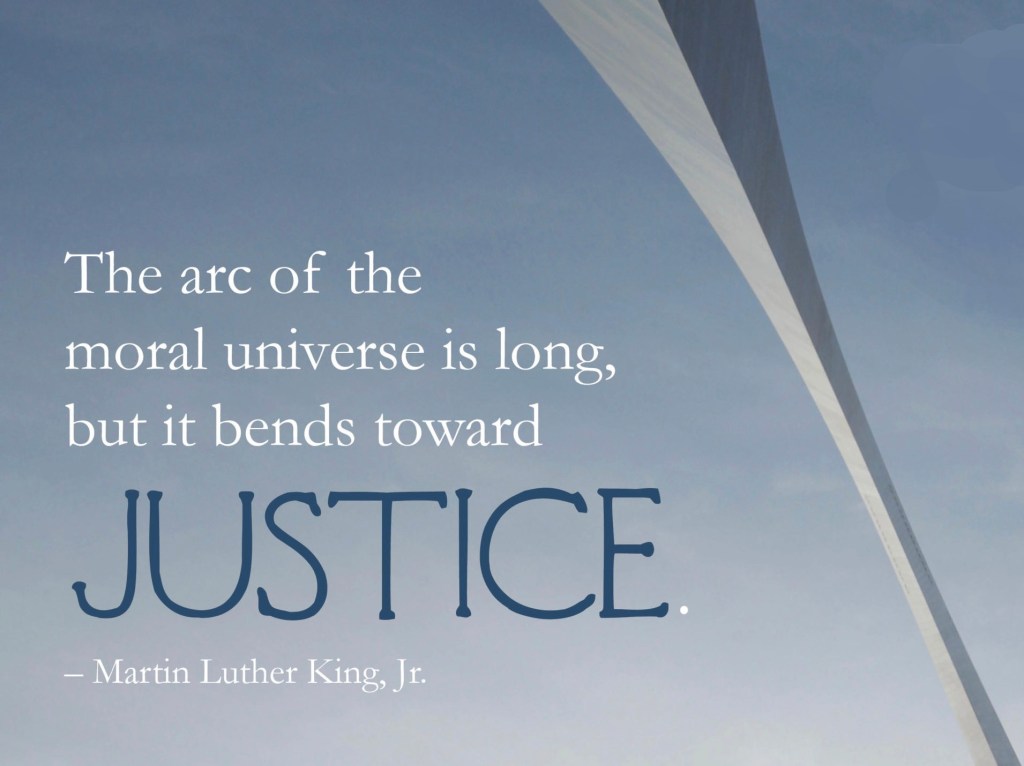
This is a moment to remember and celebrate! By a vote of 53 to 4, we will call a Black woman “Justice!” The historic pronouncement was made in the United States Senate Chamber by another Black woman, Vice President Kamala Harris.

What a clear picture of the arc of the moral universe bending toward justice! The arc does indeed bend toward all that is right and just. Today the arc bent ever so slightly, yet far enough to cause a nation to celebrate.
This confirmation of soon to be Justice Ketanji Brown Jackson is historic for this nation. The first Black woman will serve as a Supreme Court Justice, while her presence will make the Supreme Court look more like America and will more closely reflect the American people.
I stood up from my chair in the living room to join the Democrats who stood to their feet in an extended standing ovation! While we cheered, the Republicans filed out silently, unwilling to offer this highly qualified woman the respect she deserves. I wonder if the fact that they could not get out of there fast enough reflects their shame of how they treated her. I doubt it. I heard this today.
White women have to break glass ceilings.
Black women have to break out of a glass cube.
It’s true I think, especially when I consider that soon to be Justice Jackson endured 24 hours of grueling and often disrespectful questioning. She responded to every disparaging question with grace and dignity throughout the long hours. She knew, as women know all too well, that the first would have to be the best. She probably also knew that her ancestors, remembering their centuries of enslavement, encircled her in solidarity and celebration! A cloud of witnesses, witnessing what must look to them like a miracle!
It was not a resounding YES, but it will be a bright day in our history of days!

Congratulations, Justice Ketanji Brown Jackson!

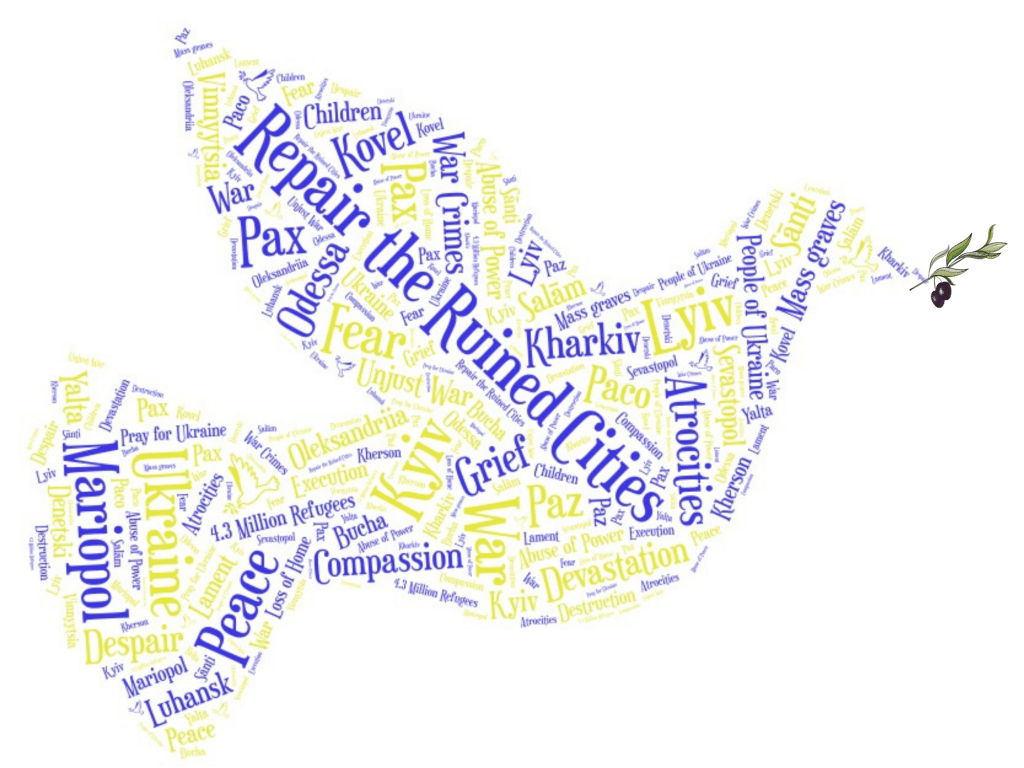
OThrough eight years of serious illness, dialysis, kidney transplant and all the other areas of my angst, I have heard one very special message again and again from folks I love all over the world. Each person said it to me in a unique way, and remembering their message makes me want to reach out to all of them with deep gratitude. I could never begin to list each of their names, although I tried to in the image of the dove. Their message was a cherished gift . . .
”I need you to survive.”
During a personal life assessment this past week, I thought a lot about this message I heard so many times. I realized that these might be the most loving words I have ever heard. Hearing the words again moved me to a tender time, one of those times when life and death and mortality somehow come to mind. Truth is, I am able to think about these kinds of life things only in my tender times. This week my favorite doctor, who knows a lot about all things tender, said something to me I won’t soon forget . . .
“When you first came to me five years ago, I didn’t think you would live another five years.”
Such a statement would most definitely bring to one’s mind all that is important and all that isn’t. Thinking on her words brought me to the tender moment I have needed for quite a while. I lingered there for a few days, hoping to let my soul rest and my spirit begin to see things in a new way.
It isn’t such a bad place to be right now in the midst of Lent. In fact, Lent is the perfect time to pay attention to my soul and spirit. Lent is the perfect time for tender moments and tender thoughts. Lent is the best time to be tender with myself while searching my spirit for the parts of me that must repent and return to God with all my heart. (Joel 2:12)
Search me, O God, and know my heart;
test me and know my thoughts.
See if there is any wicked way in me,
and lead me in the way everlasting.
Psalm 139:23-24 NRSV
Lent draws me to this psalm and its invitation to God. I might very well need to send this very invitation to God about searching me and knowing me, testing me and knowing my every thought. I come, though, to the part that asks God to see if in me there are “wicked ways.” I’m not so sure I want to do that. I know there are wicked ways in me that I try my best to keep secret. But this is Lent, and God already knows all about that.
During these Lenten days, be tender with yourself. Take a look at your secret wicked ways, but remember that God sends you the message clearly — that you are God’s beloved and that you receive the grace of God’s forgiveness even before you utter a single word of repentance. God’s like that, especially in our tender moments.
In your quiet time, listen for even a minute to this music video and celebrate its joyful message. It lifts my heart every time I hear it.

May the angels of light
glisten for us this day.
May the sparks of God’s beauty
dance in the eyes of those we love.
May the universe
be on fire with Presence for us this day.
May the new sun’s rising
grace us with gratitude.
Let earth’s greenness shine
and its waters breathe with Spirit.
Let heaven’s winds stir the soil of our soul
and fresh awakenings rise within us.
May the mighty angels of light
glisten in all things this day.
May they summon us to reverence,
may they call us to life.
— John Philip Newell
Please enjoy this video.
This is all!


I’m sitting on the front porch watching the birds and the bugs, admiring my flowers and feeling strong gusts of wind blow everything that’s movable and some things that are not so movable. Like my patio chair! I love a rushing wind blowing over me and, always, it reminds me of Pentecost.
Sunday is my favorite Sunday in the church year — Pentecost Sunday! I hold it as my favorite because I long for Spirit wind in my life — to move me, change me, fill me, refresh me and set me free. Spirit fills me with passion and sets me on a journey, a mission really, to bring Spirit to those who most need new hope. On the Sunday of Pentecost, I feel as if the wind is ready to blow!
When the day of Pentecost had come,
they were all together in one place.
And suddenly from heaven there came a sound
like the rush of a violent wind,
and it filled the entire house where they were sitting.
Divided tongues, as of fire, appeared among them,
and a tongue rested on each of them.
All of them were filled with the Holy Spirit
and began to speak in other languages,
as the Spirit gave them ability.
This is what was spoken through the prophet Joel:
”In the last days it will be, God declares,
that I will pour out my Spirit upon all flesh,;
and your sons and your daughters shall prophesy,
and your young men shall see visions,
and your old men shall dream dreams.
Even upon my slaves, both men and women,
in those days I will pour out my Spirit;
and they shall prophesy.”
Acts 2:1-4, 16-18
It must have been a shocking surprise, even stunning in its drama. It is no wonder that of all the church seasons, Pentecost has arguably inspired the most stunning art. Artists depict wind, fire, people receiving tongues of fire and all manner of colorful Spirit movement. Pentecost art is filled with movement, unpredictable and free!

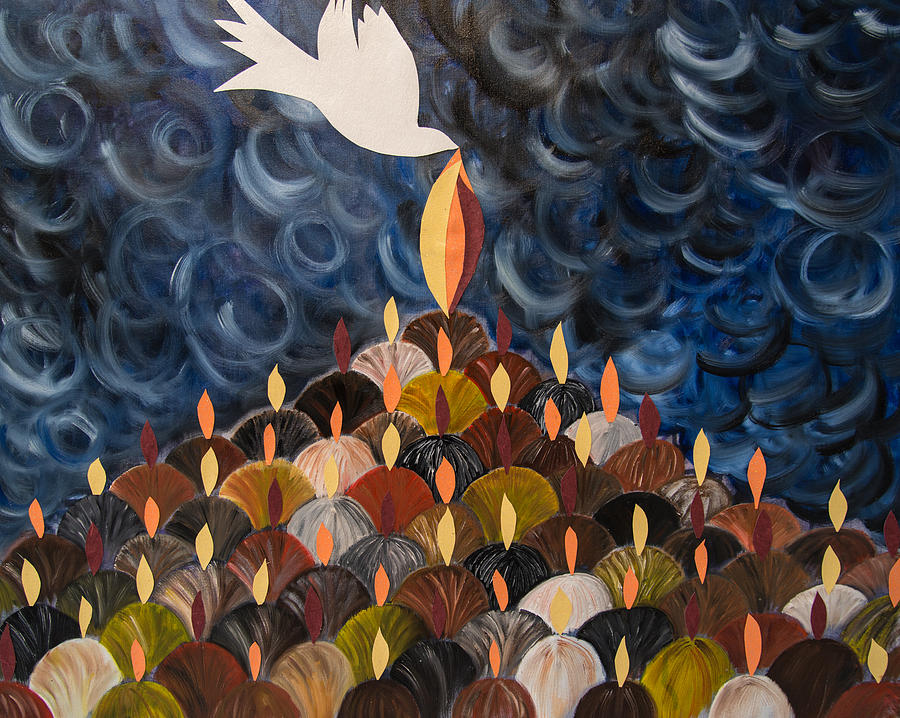


 No doubt, the artists who create art for the season of Pentecost offer us images of color, vibrancy, movement and freedom. I suppose that these qualities are the ones we want in our own lives, especially movement and freedom. The Spirit Wind that blows through my life and yours brings us that movement and freedom, almost as if Spirit removes the bonds that keep us still and stagnant. Instead “we live and move and have our being”* in a God who brings new life when we most need it.
And as for Pentecostal fire, well, we need that, too. It is a Refiner’s fire, a holy fire with the power to burn away everything that holds us back and then to put the “fire” of passion in our souls that inspires us to live out the calling and mission of our lives.
The wonderful news of Pentecost is that we do not have to rely on our own limited power. The great news of all Pentecost is the promise we hear in our souls, “The wind is ready to blow!” This is the hour for us to be permeated with the courage to run with Pentecostal winds and burn with Pentecostal fire.
God’s Spirit filling means very little to us in the midst of easy days, but in times life these, Spirit within us means everything. In these days of pandemic, police violence, mass shootings, violence in families, hungry children, adults desperate to find work, racial conflict, people marginalized and oppressed, we need to hold on to the promise of holy wind and fire.
As always, we are left with questions:
In the midst of this kind of world, what can we possibly do?
In the midst of my weakness, can I feel the Spirit-wind?
In the midst of grief and loss, can I feel the Spirit-wind?
In the midst of illness and pain, can I feel the Spirit-wind?
The answer is “YES!”
Pentecost can come upon us in the darkest of times, in the most impossible of circumstances . . . when only the wind and the fire of God’s Spirit could begin to pull off the miracle of new life. The Prophet Haggai would say to us: “Take courage! For I am with you. My Spirit abides among you.”
And so I proclaim to us this day, that if we are willing to be moved and changed by Spirit wind and fire, God’s Spirit is able to empower us. God’s Spirit is able to move us from limitedness into new life, to give us courage, to give our tired feet new strength to keep moving forward instead of giving up.
If we are willing, God’s Spirit wind is able to breathe life into us. And when our days become dreary with low-hovering clouds and our nights become darker than a thousand midnights, I hope we will remember . . .

That the Spirit of Pentecost will ignite us with a fiery passion that disturbs our complacency.
That the Spirit of Pentecost longs to baptize us again and again and again with Spirit-fire and move us with Spirit-wind.
That the Spirit of Pentecost is able to re-kindle within us the courage to proclaim the Gospel of liberation to the ends of the earth.
Take courage! The wind is ready to blow!
John Robert Lewis
Laid to Rest on July 30, 2020
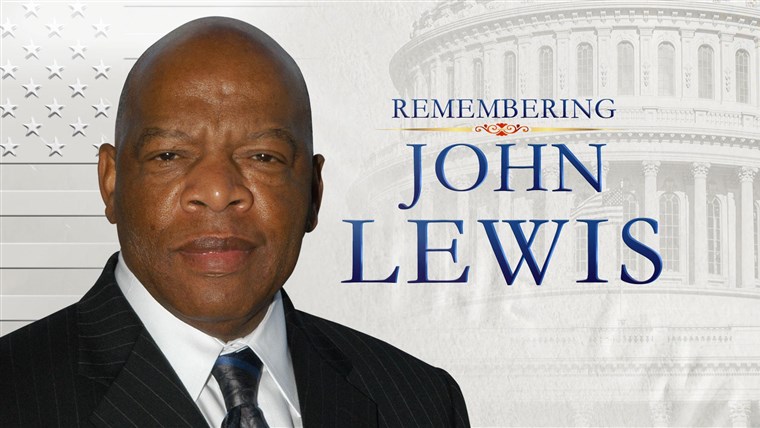
One might have been able to hear church bells ringing this morning, eighty times,
in cities and towns across America, to pay homage to his eighty years of life.
Later, the headline read, “Three living presidents came together to honor Congressman John Lewis at his funeral today in Atlanta, Georgia.” Yes, three presidents spoke words of mourning, and celebration today — President George W. Bush, President William J Clinton, President Barak Obama. President Jimmy Carter sent his words to be read.
So four living United States Presidents honored John Lewis today. A fifth living United States President did not.
Eloquent words were spoken by so many today at Atlanta’s historic Ebenezer Baptist Church, which has been known best because of its most famous pastor, Dr. Martin Luther King, Jr. We heard stories, memories, words marked with laughter and tears from friends and family members of John Lewis — Rev. Dr. Bernice King, an activist and Martin Luther King Jr.‘s daughter, civil rights pioneer Xernona Clayton, James Lawson, an activist, Speaker of the House Nancy Pelosi, our three living presidents and many others.
Years later, when I was elected a U.S. Senator, I told him that I stood on his shoulders. When I was elected President of the United States, I hugged him on the inauguration stand before I was sworn in and told him I was only there because of the sacrifices he made. And through all those years, he never stopped providing wisdom and encouragement to me and Michelle and our family. We will miss him dearly.
— President Barak Obama
Americans live in a country that is better today because of John Lewis. John always looked outward, not inward. He always thought of others. He always believed in preaching the gospel, in word and in deed, insisting that hate and fear had to be answered with love and hope. John Lewis believed in the Lord. He believed in humanity, and he believed in America.
— President George W. Bush
John always kept walking to reach the beloved community. He got into a lot of good trouble along the way, but let’s not forget, he developed an absolutely uncanny ability to heal troubled waters. When he could have been angry and determined to cancel his adversaries, he tried to get converts instead. He thought the open hand was better than the clenched fist. He lived by the faith and promise of St. Paul: “Let us not grow weary in doing good, for in due season we will reap if we do not lose heart.” He never lost heart. He fought the good fight, he kept the faith, but we got our last letter from him today on the pages of the New York Times. Keep moving. It is so fitting on the day of his service, he leaves us our marching orders: Keep moving.
John Lewis was many things, but he was a man, a friend and sunshine in the storm, a friend who would walk the stony road that he asked you to walk, that would brave the chastening rods he asked you to be whipped by, always keeping his eyes on the prize, always believing none of us would be free until all of us are equal. I just loved him. I always will. And I’m so grateful that he stayed true to form. He’s gone up yonder and left us with marching orders. I suggest since he’s close enough to God to keep his eye on the sparrow and on us, we salute, suit up and march on.
— President Bill Clinton
We come with a flag flown over the Capitol the night that John passed. When this flag flew there, it said goodbye. It waved goodbye to John. Our friend, our mentor, our colleague. This beautiful man that we all had the privilege of serving with.
— Speaker of the House Nancy Pelosi
That’s when I cried, as I did many times during the four hours I watched this morning, bearing witness to his life, holding vigil at his glag-draped casket I had watched all week. There is no doubt that moving words were uttered today in that holy place where Beloved Community gathered to mourn John Lewis, but none were more full of heart that the words of Ebenezer’s senior pastor, the Rev. Dr. Raphael G. Warnock:
We have come to say goodbye to our friend in these difficult days. Come on, let the nation celebrate, let the angels rejoice … John Lewis, the boy from Troy, the conscience of the Congress. His deeds etched into eternity, he loved America until America learned to love him back.
From 1 Corinthians 15:51-55
Behold, I show you a mystery; We shall not all sleep, but we shall all be changed, In a moment, in the twinkling of an eye, at the last trump: for the trumpet shall sound, and the dead shall be raised incorruptible, and we shall be changed. For this corruptible must put on incorruption, and this mortal must put on immortality.
So when this corruptible shall have put on incorruption, and this mortal shall have put on immortality, then shall be brought to pass the saying that is written, Death is swallowed up in victory. O death, where is thy sting? O grave, where is thy victory?
From Revelation 14: 12-13
Here is a call for the endurance of the saints, those who keep the commandments of God and hold fast to the faith of Jesus. And I heard a voice from heaven saying, “Write this: Blessed are the dead who from now on die in the Lord.” “Yes,” says the Spirit, “they will rest from their labors, for their deeds will follow them.”
From the works of William Shakespeare
When he shall die,
Take him and cut him out in little stars,
And he will make the face of heaven so fine
That all the world will be in love with night
And pay no worship to the garish sun.
I cried today, but I laughed a lot, too. I sang a little and — though I did not rise to my feet to dance in celebration of his life well-lived — I still celebrated more than I mourned, because that’s what John Lewis would do. In the end I laughed out loud at the image of mourners dancing their way out of the sanctuary, following the casket, and being glad that John Lewis loved dancing to the music of “Happy Feet!”
Why don’t we all dance our way to Beloved Community!
May God make it so!
Rest in Peace, John Lewis. Rest in Celebration. We got this!

Struggles abound in this unwelcome COVID19 season we are experiencing. Most of us are touched by this virus in some way. We have struggled with so many life changes. I have watched strugglers of the soul work through the illness, others deal with the suffering and death of a friend or family member, often being unable to be with them at their death. Some parents are struggling with decisions affecting school for their children and teachers fear they will be unable to keep their students (and themselves) safe. Others long to see loved they have not seen in months of social distancing.
My circle of friends and family are feeling short on hope while they experience struggles of the soul. Yet, Herman Melville asserts that “Hope is the struggle of the soul.” I have been wondering what exactly that might mean. Perhaps hope gives us the courage we need to move boldly and full of hope into the place where the soul struggles, moving there with the assurance that the hope that led us there will also lead us to healing.
As I look closer at Melville’s words, I begin to see and understand that hope’s struggle eventually empowers us to break loose from the perishable things we hold on to — our wealth, our home, our “things” like cars, boats, RVs, whatever “things” we cherish. Looking at what this virus could bring, knowing that we are facing real life and death situations, cannot help but move our souls to throw off the things that don’t seem so critical anymore — perishable things we do not need. This thought prompts me to look at two of my favorite passages of Scripture.
For you know that it was not with perishable things such as silver or gold that you were redeemed from the empty way of life handed down to you from your ancestors . . .
— 1 Peter 1:18-19 (New International Version)
When the perishable has been clothed with the imperishable, and the mortal with immortality, then the saying that is written will come true: “Death has been swallowed up in victory.”
— 1 Corinthians 15:54 (New International Version)
How do we get there? How do we get through the soul struggles that can bring us to our knees?
I don’t think there is a well developed plan or a series of definite steps to take. The path, the plan, will be unique to each struggler. But the soul struggles I have felt throughout my life have taught me to place hope where hope must be: in Comforter Spirit who hovers over me with her sheltering wings; in the Christ who lives in and through me guiding me as a good shepherd and empowering me to walk with courage in his footsteps; in the Eternal God who holds before me, always, my own eternity.
This is what is available to you as well as you lean into hope’s struggle of the soul and break loose from things that are not important as you bear witness to your own eternity.
May God make it so.
As you leave these words and move with hope into your soul struggles,
May the God of hope go with you and fill you with all joy and peace as you trust in God, so that you may overflow with hope by the power of the Holy Spirit.
— Romans 15:13 (New International Version)
Amen.
I hope you can spend a few minutes in prayer and contemplation as you watch this beautiful, comforting music video, “Still with Thee,” with text written by Harriet Beecher Stowe.

“The Wings of the Morning” reflects on Psalm 139:9, 10. The Psalm has been one of Great comfort to me in difficult times. I hope you enjoy this piece, calligraphic art rendered in ink and pastels.
To purchase this or other prints in my collection, click HERE.

What’s all this about supermoons and sacred pauses?
You might legitimately ask that question!
Well, this stream of thought began for me when astrological experts said that the Super Pink Moon that appeared on April 7th would be the “most super” of all supermoons this year. They also said that the moon would not be pink at all.
Before you get your hopes up, this “Super Pink Moon” won’t actually look “super pink”—or any hue of pink, really. The Moon will be its usual golden color near the horizon and fade to a bright white as it glides overhead.
— The Old Farmer’s Almanac (https://www.almanac.com/content/full-moon-april)
That information did not please me at all. I had really looked forward to seeing a pink moon. The Farmer’s Almanac — always a reliable source of information since its founding in 1792 — described what the April 7th moon would look like.
It is not to be missed — The Super Pink Moon: The Biggest and Brightest Supermoon of the Year! April’s full Moon will be closer to Earth than any other supermoon in the series. It will be the biggest and brightest full Moon of 2020! How big and how bright, exactly? On average, supermoons are about 7% bigger and about 15% brighter than a typical full Moon.
There you have it, from every farmer’s most tried and tested source on all things earth! But in addition to the disappointment that this supermoon would not be pink in any way, the most devastating disappointment of all was that on April 7, 2020, Macon, Georgia was completely overcast! For all gazing intentions, there was no moon at all that night, not a pink moon and not even a white one. Like other Middle Georgia folk, I missed the whole thing, the entire phenomenally astounding sight!
Other people in other places saw it, though, in all its splendor. They took pictures, some of which looked like a round, dull white ball in the sky. But others — including NASA of course — posted pictures of a brilliant, unforgettable moon. And one person took a stunning picture of this supermoon that was brilliant white and surrounded by an ethereal pink ring! And they said it would definitely not be pink!
The pink-ringed moon picture made me very happy! It was the emotional boost I needed in a time of pandemic isolation. In the midst of such a troubling and fear-filled time when all over the earth, a supervirus was touching people with upheaval, sickness and death, it was a very opportune time for an uplifting supermoon. Still, I wonder why it even mattered to me or anyone else. After all, moons rise and fall every single day. Even supermoons rise on a predictable astrological schedule.
So maybe my lesson here is acknowledging that I seldom go out at night just to gaze at the moon. When I notice a moon in passing, it’s as if I’m thinking, “So what! It’s just another moon!” And yet, the moon might be in the night sky just to remind me that the moon is the Creator’s metaphor for something that is everlasting, permanent and yet changing. I actually do look to the sky once in a while and see a new sliver of a moon on a cloudless night or a full moon glowing brightly enough to light my path. Ever so often, I’m thrilled by the discovery, as though I were seeing it for the first time.
Instead of ignoring a moon that appears most every night, perhaps moon gazing can be a spiritual moment that helps me know that at least something in my life is everlasting, that the promises of God are ever near, that my faith can light my path, that, as the Psalmist writes, the moon is eternal, a “faithful witness in the sky!”
It will be as eternal as the moon,
my faithful witness in the sky!
— Psalm 89:37 NLT
Moon gazing can also be my time of spiritual comfort as I recall the words of the prophet Isaiah, who speaks of the rising of the sun and the moon as a part of binding up those who are injured and healing the wounds of God’s people.
Moreover the light of the moon will be like the light of the sun, and the light of the sun will be sevenfold, like the light of seven days, on the day when the Lord binds up the injuries of his people, and heals the wounds inflicted by his blow.
— Isaiah 30:26 NRSV
At the end of the day, we can know this: gazing at the moon can remind us of the magnificent smallness of humanity and the overwhelming magnificence of God. The Psalmist invites us to marvel at how we dearly we are prized by God in a Psalm that lifts up both Divine majesty and human dignity, unequivocally declaring that God cares for me, and that God cares for you.
O Lord, our Sovereign,
how majestic is your name in all the earth!
You have set your glory above the heavens . . .
When I look at your heavens, the work of your fingers,
the moon and the stars that you have established;
what are human beings that you are mindful of them,
mortals that you care for them?
Yet you have made them a little lower than God,
and crowned them with glory and honor.
You have given them dominion over the works of your hands;
you have put all things under their feet,
all sheep and oxen,
and also the beasts of the field,
the birds of the air, and the fish of the sea,
whatever passes along the paths of the seas.
O Lord, our Sovereign,
how majestic is your name in all the earth!
— Psalm 8:1, 3-9 NRSV
The last word in my story On this day is that the moon, the sun, the stars — all created things — are not merely created, they are God-created, and God’s creation may very well be worth a few extra moments of gazing into night’s quiet pauses — praying and praising, reflecting and listening. Listening for the voice of God. Listening for the sigh of the soul!
I love the photo of that moon surrounded by a pink circle of reflected light, because it was for me a divine and holy light. I know that it was divine and holy, because it abruptly stopped me. Just a picture it was, not the real moon that I might have seen in my night sky. Yet, it took on the power of my faith that has always assured me that God can be found in all things, simple or sacred, ordinary or holy.
My faith has taught me that, more times than not, a very ordinary thing — an ordinary act or an ordinary moment — can suddenly and surprisingly become holy. Just that one ethereal moon captured in a commonplace photograph silenced me, calmed me, reached into my soul and divinely interrupted me for a much needed sacred pause.
Maybe that’s the meaning of the words we often say about a picture being worth a thousand words. As for me, I will just say thanks be to God for beckoning me to night’s quiet pauses, sacred pauses that I needed so deeply.

Today may be a Juneteenth like no other.
Juneteenth is a celebration. It’s not solemn, it’s filled with joy and pageantry. It’s not a funeral. But 2020 Juneteenth is uncomfortably juxtaposed with police violence against Black people, protesters in cities all over the nation and funerals — too many funerals.
A Bit of History . . .
Juneteenth is one of America’s oldest holidays and is observed each year on June 19 to mark the official end of slavery in the United States. The day has long been celebrated by black Americans as a symbol of their long-awaited emancipation. But the story behind the holiday starts 155 years ago today in Galveston, Texas.
On June 19, 1865, Union troops led by General Gordon Granger arrived in Galveston, Texas, to break the news to the last remaining Confederate sympathizers that they had lost the Civil War and that all slaves must be freed. The Union general read aloud to the residents of Galveston:
The people of Texas are informed that in accordance with a Proclamation from the Executive of the United States, all slaves are free. This involves an absolute equality of rights and rights of property between former masters and slaves, and the connection heretofore existing between them becomes that between employer and hired laborer.
The newly freed slaves celebrated emancipation with prayer, feasting, song, and dance, and the following year, the first official Juneteenth celebration was born. But the importance of Juneteenth is that it is rooted in a long history of struggle for freedom and then perhaps the greater struggle to maintain freedom in the face of the enormous repression that was to come.
The Struggle for Freedom Continued
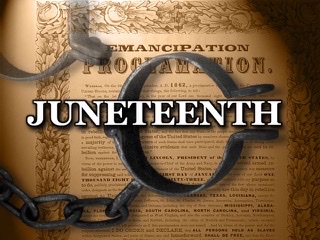 It turned out that being free did not mean being being treated with respect. Yes, it was the true end of the Civil War, but it was also the beginning of Reconstruction, a time that was supposed to be very happy and hopeful. Yet the period of Reconstruction became a miserable time for freed Black people because Reconstruction became part of the redemption of the South. As such, it set out to move African Americans to indentured servitude. While President Abraham Lincoln abolished slavery in his Jan. 1, 1863, Emancipation Proclamation, rebellious Confederate strongholds dotted across the South delayed the widespread implementation.
The South would not hear of the end of slavery, and landowners moved heaven and earth to make sure they had plenty of indentured servants. They were determined to continue the ostentatious lifestyle that they believed was their right and their legacy. They were resolute in their quest to maintain their master/servant status.
Still Today, Elusive Freedom
Juneteenth has been “passed down” through black communities since 1866, but in this year — 2020 — this nation seems to be at the height of a modern-day civil rights movement. My friend says, “2020 is the year of reset!” People throughout this nation of every race and creed hope beyond hope the 2020 will go even beyond “reset” to reconciliation, transformation and rebirth. So that every person is free, respected and cherished as a part of beloved community.
 The cruel and violent death of George Floyd under the knee of a Minneapolis police officer might mean that this year Juneteenth may not be only about festivals, parades and cookouts. It may well be somewhat of a silent, reflective vigil for George Floyd, Breonna Taylor, Ahmaud Arbery, Rayshard Brooks, Caine Van Pelt, Michael Thomas, Lewis Ruffin, Kamal Flowers, Momodou Lamin Sisay, Ruben Smith, Modesto Reyes . . . and the list could continue.
It is a list of tragedy and horror. It is a list that is a stain that will ever remain on this nation, an indelible mark of shame. It is a list of names we must never forget. So in your commemoration of Juneteenth today, honor those names, pray for their mourning families, and pray that you will confront racial injustice with an unshakeable resolve.
Juneteenth was meant to be a celebration, although many people might not be able to celebrate today. Heartbreak and horror have a tendency to override celebration and joy. Even with hearts broken, I hope we will find in our hearts even a tiny desire to celebrate this day that was, and is, all about freedom.
May the change that comes from the “2020 movement for racial justice” cause us to celebrate, not mourn, every time Juneteenth comes around — today and forevermore. And may each of us and all of us — a people of God’s creation — witness the rebirth of a nation where every person lives under a worldwide canopy of justice, peace, equality, respect and freedom.
May God make it so through us. Amen.
Celebrate, or mourn, today as you spend a few moments watching this moving and poignant video, “Oh Freedom.”

liminal
in American English
(ˈlɪmɪnəl ; ˈlaɪmɪnəl )ADJECTIVE
1. Relating to a transitional or initial stage of a process.
2. At a boundary or transitional point between two conditions, stages in a process, ways of life, etc.
“Liminal” used in a sentence: We are in a transitional and liminal time: this makes everything unsettled and awkward, and most of us feel tremendous unrest and a sense of urgency.
I choose to mark this particular time in history as a liminal time that demands my courage to stand — to stand in solidarity with every person who is demanding an end to racial injustice. I cannot choose my partners in this struggle. Instead, I have to accept those that appear in my life, bringing with them a determined will to stand for justice.
I must understand that liminal time does not last forever. Liminal time is a place of transition, a liminal stage between justice and oppression, between life and death. So my choices and yours in this liminal time might very well affect what’s going on in the streets of American cities, in police precincts in every community and rural hamlet, in the halls of Congress and in the White House, in our hearts and in the hearts of those we could see as our “enemies.“
 Here is where I must focus. My heart must long for an end to injustice. So must yours, because God’s heart grieves over the mayhem in our streets and the violence that has its way when a white police officer murders a black man or woman, even a black child.
You and I must yearn for an end to racial injustice — any kind of injustice and oppression — because God’s heart yearns to see us living in holy unity as brothers and sisters.
These days have dramatically shown us our liminal time, and it is NOW.
I have a strong sense that this liminal time has brought the widespread unrest we are witnessing, and that unrest emerges directly from a deep desire for change and transformation. It must be now!
Those of us who remember, know that the Civil Rights Movement came to its boiling point when every marcher, every protester, every non-violent activist and every violent one knew when their liminal time had come. Some people, of course, did not like that time at all, but even those who resisted that movement towards justice knew in their hearts that it was the liminal time, the time of NOW.
The fight was fought by people who spoke and marched, prayed and worshipped, who resisted and stood their ground, who preached and sang their freedom songs. Ah, how those songs of the civil rights movement helped motivate people of all ages and races, from Student Nonviolent Coordinating Committee (SNCC) activists and Freedom Riders to the thousands who marched on Washington, Selma, and Montgomery!
Yet not one person — Civil Rights leader or non-violent protester — could achieve civil rights alone. It required persons living in the poorest neighborhoods and their affluent neighbors across town. It took white folk and black folk, protestors and preachers, eloquent advocates and those who fought silently, lawyers and congresspeople and attorneys general and presidents. It required a community in solidarity. In fact, during the Civil Rights Movement, the creation of community was the quintessential coming-of-age story for Black people.
Of that historically significant time, Father Richard Rohr writes this:
It was the particular time in history when nonviolent initiatives seeded with contemplative worship practices became acts of public theology and activism. You see, activism and contemplation are not functional opposites. Rather, contemplation is the heart’s reflective activity that is always seeking the spiritual balance between individual piety and communal justice-seeking.
Who could have predicted that America’s apartheid would fall as decisively as the walls of Jericho, when the people marched around the bastions of power carrying little more than their faith and resolve? How audacious it was to take just the remnants of a chattel community, the vague memories of mother Africa, and a desperate need to be free, and translate those wisps into a liberating vision of community. The idea of a beloved community emerged from the deeply contemplative activities of a besieged people — the people of the Civil Rights movement.
— Fr. Richard Rohr
One would think that such a movement that was so powerful, so eloquent and so determined would see its dream become reality, and that such a stunning reality would last forever. So that every person, from that time to this, would live as beneficiaries of beloved community. But here we are in another liminal space of racial indignity, cities in chaos and families mourning the death of their loved ones in Minnesota, in Georgia, in Kentucky and beyond. We did not really believe we would be in this time and space, a time that would demand a civil rights movement of its own.
The in-between liminal spaces of Scripture are pregnant with God’s transformational possibilities:
Noah and his family rebuilding the world after the flood; Abraham holding the knife above Isaac; Jacob’s struggle with the angel; Joseph in the pit; Moses and the Israelites at the edge of the Reed Sea; Israel in the wilderness; Joshua crossing the Jordan; Jesus suffering on the tree; the women at His tomb; the disciples waiting in Jerusalem.
Scripture indeed is fraught with liminal moments – moments of imminent expectation, infused with both hope and doubt — that lead to transformation and change. So change involves tension, and those of us who are longing for a paradigm shift that insists on justice, know that tension all too well.
Betwixt and Between — neither here nor there. It would be safe to say that this liminal time is mostly uncomfortable and confusing. Liminal time is the time between what was and what will be. And not one of us can predict what will be, either in this struggle against injustice or in the uncertain waxing and waning of the deadly coronavirus. The convergence of virus and death and sickness and distancing with racial injustice, violence and protest is almost too much uncertainty for us to navigate.
In the end, I want to believe that this liminal time and every liminal space is the dwelling place of God, the place where God meets us and says, “I will never leave you or forsake you . . . And remember, the Spirit of the Lord is upon you and has anointed you to announce Good News to the poor, to proclaim freedom for the imprisoned and renewed sight for the blind, to release those who have been oppressed. [my paraphrase]
Even in our current time of disconcerting fluid borders, God is with us in this liminal time. God is inseparably bound with us in this moment, and it is in this liminal space where heaven and earth, life and death, joy and sorrow, ecstasy and despair, sleeping and waking, justice and injustice, commingle.
So here’s my challenge to myself and to all of us. What if we choose to experience this liminal time, this uncomfortable now, as a time for insisting upon full solidarity with all of our brothers and sisters? What if we choose to make this particular time — with all of its pandemic and death, chaos and destruction, fire and protest, upheaval and violence as if no lives matter — a liminal time for construction and deconstruction, choice and transformation? What if you and I choose to hold hands and march on in solidarity and community until we reach the mountaintop where injustice is no more?
I want to. Do you?

Holy Anger! What does it mean for us as followers of the Prince of Peace?
I have learned to use my anger for good . . .
Without it, we would not be motivated to rise to a challenge.
It is an energy that compels us to define what is just and unjust.
—- Gandhi
Holy Anger! What in the world does holy anger mean for me?
We can begin to understand holy anger in the context of the present reality — the very real truth that so many of us are angry. After all, we saw with our own eyes a video of a white police officer with his knee on the neck of a black man. After all, we heard the man’s plea for mercy as he cried out, “I can’t breathe!” How could we not be angry? And shocked? And filled with grief? What we saw on a street in Minneapolis was a striking portrait of the kind of racial injustice and oppression that black people have suffered throughout history, now fully visible to us in the year of our Lord, 2020.
The tragic moments — 8 minutes and 46 seconds — are burned in our memories by the righteous fire of everything that is so wrong about George Floyd’s life slipping away, his breathing becoming more and more labored as the minutes moved on. I suggest that we who are God’s people are appropriately seething with holy anger.
Still, we seek an answer to the question, “What must we do with our holy anger?“ As we follow the way of Christ, what must we do to “overturn the tables of the money changers?” (Matthew 21:12-13) What do we do with our holy anger when we recall the anger of Jesus who threw tables to the ground and said, “My house shall be called a house of prayer; but you are making it a den of robbers.”
Perhaps, like me, you have been dealing with the struggle of reconciling your heart’s faith with the anger you hold in your heart right now. Dr. Barbara Holmes describes our dilemma well and gives us a construct that is true to our faith.
We all need a way to channel and reconcile our anger with our faith. . . . A theology of anger [for communities under siege] assumes that anger as a response to injustice is spiritually healthy.
Dr. Holmes suggests that, even though we serve a God of love, a theology of anger can wake us up and ask us to stand firmly on the holy ground of “justice for all.” Indeed, our holy anger can wake us up to the reality of racial oppression, of white privilege and of the violent brutality of systemic racism in our nation. Perhaps our holy anger will compel us to throw off the chains of weak resignation, as well as our persistent denial of the high cost of racial injustice. Perhaps our holy anger can empower us to transform our despair into compassionate action that transforms racial injustice and oppression. Perhaps we could even be labeled “justice-seeking folks.”
During a 2016 demonstration in Minneapolis, Minnesota, after the police shot an unarmed black man, Pastor Danny Givens publicly and peacefully challenged the Governor of Minnesota as he shouted these words into a microphone:
Your people keep killing my people. You keep telling me that you are going to do something. I just want you to put some action on it, put some respect on our people’s names . . . This isn’t black anger. This is black grief! [1]
How do we even begin to separate our anger from our grief? Pastor Danny Givens spoke in 2016. Understand that racial violence did not suddenly take over our community in 2020. It was a plague hovering over us in 2016, and before that — centuries of white supremacy, systemic brutality, lynchings and lashings, system-sanctioned murders. People of God, how can we not be angry?
I wonder how our holy anger will move us to holy action. I wonder where our holy anger will lead us with the mandate of ending racial injustice and creating Beloved Community. I am a long-time member of the Alliance of Baptists. Through many years, I have been proud of their broad influence against injustice and oppression. Today I am particularly proud of their recent statement on racism in the United States and I share portions of it here.

A Joint Statement on Racism in the United States
from the The Alliance of Baptists,
Baptist Peace Fellowship of North America – Bautistas por la Paz,
and the American Baptist Home Mission Societies.
June 9, 2020
We have seen with dismay, pain and horror the destructive mark of racism on the soul of the U.S. Throughout our history, racism being the backbone of this nation’s development and unjust enrichment of many has become the choking source of black communities and people of color affecting every aspect of our collective life. The coronavirus pandemic has exposed these racial inequities that hurt black and brown communities by hindering their access to health but also their development, freedom, and pursuit of happiness. George Floyd’s words became prophetic for as a nation, we can’t breathe anymore.
The brutal and disturbing deaths of George Floyd, Breonna Taylor, Ahmaud Arbery, and Tony McDade have shaken our nation to its soul and painfully demonstrated the daily danger of being black in this nation . . .
The undersigned organizations publicly denounce the murder of George Floyd, its race-related violence, including the police brutality shown, and demand that each one of the four police officers involved in his death face justice for all engaged in disdaining the worth of this man as a human being and as a citizen. As peacemakers, we painfully recognize the sinful prejudice ingrained in our hearts, the violent actions deflecting the affirmation of justice, and the biased attitudes justifying hurting other human beings just because of the color of their skin and commit ourselves to dismantle racial oppression however we can . . .
We acknowledge our present time is difficult. We have become overwhelmed with a pandemic death toll surpassing 100,000 deaths, the desperation of millions unemployed, and the continuous disregard of black human lives. While these successive “pangs of birth,” can madden us, as peacemakers, it is essential to remember that grace and forgiveness heal our hearts, that we belong to each other (Rom 12:4-5) and that justice will be done for we seek it (Matt. 6:33). Under this yoke of darkness our actions today will define the future we want to build. We ask the Spirit to break us free and help us breathe.*
Amen! I can enthusiastically sign this transformational statement, with my commitment to respond to our beckoning God, to follow Christ in the way of peace, to breathe in the Spirit’s wind and fire, to use my holy anger against evil oppression. For me, the task of dismantling racial oppression is a holy calling that demands decisive action motivated by my holy anger.
May the holy anger in my soul abide with the holy peace in my heart, and may both compel and empower me to do the holy work of transforming injustice.
May God make it so for all of us and each of us. Amen.
*Please read the full statement from the Alliance of Baptists that includes five points that call for justice HERE.
[1] Morgan Winsor and Julia Jacobo, “Pastor Shouts at Governor: ‘This Is Black Grief,’ After Police Shooting of Minnesota Man,” ABC News (July 7, 2016). Available at http://abcnews.go.com/US/pastor-challenges-minnesota-gov-put-action-cop-shooting/story?id=40406186
Unfaith! Such an unsettling word that may well describe where we sometimes find ourselves! I am certain that unfaith applies to me, to the times when my soul is troubled, to the seasons when my faith becomes small. Unfaith most definitely takes over in my heart at times, and in those times, my journey is a struggle. So I battle against unfaith, all the while simply wanting to understand it. This is my truth: I fight unfaith, praying to be rid of it, writing down my emotions around it, reading my Bible when I cannot live with unfaith another minute. My skirmish with unfaith often leads me to the words of the Psalmist.
In yesterday’s struggle with unfaith, I happened upon Psalm 73. It is a rather lengthy Psalm, as Psalms go, and it spends a great deal of time describing wicked people. I rushed through it, I think, because I was searching for inspiring words about unfaith and because I all already know a lot about wicked people. I can, in fact, describe wicked people almost as passionately as does the Psalmist. On top of that, my description of wicked people often includes some choice and inappropriate words.
I plowed on through the Psalm when, out of the blue, one particular verse “hit me upside the head!” (That’s southern slang!) Verse 14 came much too close to my soul. It described my emotions and showed me myself.
All day long I have been afflicted,
and every morning brings new punishments.
— Psalm 73:14 NIV
Oh my! There it is: a succinct statement that so fully reflects what I had been feeling for the past week. It is unpleasant to read, as if it is stating my disconcerting reality and then forcing me to ask myself a question I would rather avoid. Still, I dare to ask myself — “So what are you going to do about your current state?” — knowing that I will likely not have an immediate answer nor a reassuring one. Sometimes I think that all of my feelings and responses come from my unfaith.
I should give you the backdrop for my Psalm 73 experience. I have felt unwell for several days — unrelenting fatigue, deep muscle aches, shortness of breath, trembling, hand tremors and several other troubling symptoms. The reality is that since my kidney transplant in November, I have been plagued with less than perfect health and a very compromised immune system.
Last week, my immunosuppressant medication dosage was increased, something I always dread because I know the distress that usually follows. This time, the side-effects seem worse than they have ever been. I struggle with the reality that so many parts of my body are just not working normally and despair is one of my recurring feelings, despair that, on most days, I have to fight against.
I have learned that I can fight against despair and that often I must. Despair does a number on the soul and spirit, on the place where my emotions live. So, yes, I can fight it, but the fight is exhausting. I can stand courageously and face off with despair. At times, I can even rise above it, but the encounter leaves me deep-down weary.
As for my spirit? Well, my spirit constantly searches for God’s comfort, for holy relief and answers to my questions. I try to attend to my spiritual health, as well as my emotional and physical health, often without much success. I sometimes experience God as a comforter who is far away. I do not often hear God’s voice, and I am not one to beg God for healing. Is all of this struggle because of my unfaith?
I have shared far more confession and self-revelation than anyone needs to hear. I do it because sometimes I believe that release might come if I can give voice to my pain and discouragement, if I can own my weariness and tell my story. Telling is not a quick-fix miracle cure, but telling another person how I feel gives me an extra measure of strength and resolve. And telling all of you who read my blog always means that many of you will offer prayers for me.
After sharing with you that I sometimes feel distant from God, this morning I caught an unexpected glimpse of God. It was just a tiny glimpse, though it was also a comforting, healing glimpse. I caught a glimpse of God in the place I find God most often — through the words of the Prophet Isaiah. The Book of Isaiah is my go-to place when I find myself so weary that I feel as if I cannot take another step.
Selected passages from Isaiah 40 and 41:
Do you not know? Have you not heard?
The Lord is the everlasting God, the Creator of the ends of the earth.
He will not grow tired or weary, and his understanding no one can fathom.
He gives strength to the weary and increases the power of the weak.
Even youths grow tired and weary, and young men stumble and fall;
but those who hope in the Lord will renew their strength.
They will soar on wings like eagles;
they will run and not grow weary,
they will walk and not be faint.
— Isaiah 40:28-31 NIV
So do not fear, for I am with you; do not be dismayed, for I am your God.
I will strengthen you and help you; I will uphold you with my righteous right hand.
For I am the Lord your God who takes hold of your right hand
and says to you, Do not fear; I will help you.
— Isaiah 41:10,13 NIV
For some reason, I felt an urging to read Psalm 73 again. As I read it again, I found a clear and enduring declaration of God’s presence that rings so true to me on my best days.
Yet I am always with you; you hold me by my right hand.
You guide me with your counsel, and afterward you will take me into glory.
Whom have I in heaven but you? And earth has nothing I desire besides you.
My flesh and my heart may fail,
but God is the strength of my heart and my portion forever.
—Psalm 73:23-26 NIV
This is the spiritual place I want to be — the place where I know that God is the strength of my heart and my portion forever — in spite of pain, in spite of discomfort, in spite of uncertainty, in spite of the life reality that my questions will not always have answers, in spite of my unfaith. I am convinced that unfaith is always with us like “a thorn in the flesh,” an ever-present oppressor, a silent demon that steals into the soul. But I am even more certain that, along with unfaith, there is pure and true faith. Perhaps we cannot know abiding faith without also knowing the disconcerting seasons of unfaith.
So these are my musings about unfaith, prompted by a Psalm. Isn’t that just like God, though, offering me a grace gift by gently guiding me through a Psalm that reaffirms God’s protection? Isn’t that like God, to freely give me reassuring grace? Isn’t it just like God, to give me the gift of presence, a gift freely given to me even when I doubt, even when I am struggling with a season of unfaith?
Thanks be to God for the epiphany that, in my heart and soul, faith has most assuredly come, though bringing unfaith with it. Thanks be to God for this insight: that growing in faith means descending into my unfaith for as long as it takes for its oppressive darkness to give way to God’s wonderful light.
As I walked through this part of my faith journey, I could not help but remember the words of a hymn that declares that we are held by a firm foundation and, through words spoken by God, promises us protection, strength and grace.
* Fear not, I am with thee, O be not dismayed,
For I am thy God, and will still give thee aid;
I’ll strengthen thee, help thee, and cause thee to stand,
Upheld by My righteous, omnipotent hand.
When through the deep waters I call thee to go,
The rivers of sorrow shall not overflow;
For I will be with thee, thy troubles to bless,
And sanctify to thee thy deepest distress.
When through fiery trials thy pathway shall lie,
My grace, all sufficient, shall be thy supply;
The flame shall not hurt thee; I only design
Thy dross to consume, and thy gold to refine.
In your quiet time, spend a few moments hearing this hymn as you worship with the congregation of First-Plymouth Church in Lincoln, Nebraska.
*Author: George Keith 1787; R. Keen, 1787
Source: Rippon’s A Selection of Hymns, 1787
Copyright: Public Domain

 God of the Sparrow 🌱 By Kathy Manis Findley