2024 election, A blessing for voters, Activism, anxiety, Belonging, Betrayal, Bewilderment, Bitterness, Calm, Challenge, Change, Community activism, Courage, Darkness, Daybreak, discouragement, Exclusion, Faith, God, God's presence, God’s creation, healing, Heartbreak, Hope, Kneeling Places, Lament, Liberty, Mourning, Patriotism, Pilgrim, Politics, Pondering, Prayer, Repair the world, Rev. Kathy Manis Findley, Unanswered Prayer

Prayer in Response to Tragic Victory


Together, we will transform our grief into a force for change that will build a more just, equitable society that respects the dignity of all people.

— Omar Angel Perez,  Immigrant Justice Director, Faith in Action

This is my prayer of Hope for the living of these days and my lament for almost losing my faith. It is a too-long treatise, because I release my profound grief through writing. It’s a too-long lesson to teach my class, because at our meeting time, everyone is a spent body of exhaustion that can hardly respond to dark and serious topics. It’s a too-long sermon to preach, because at minute 38.6, the congregation will start leaving. Most of all, it is a too-long dumping of grief. But still my prayer

Guard your hearts and may the week ahead freshen your hope, Kathy


Creator, Spirit of God, Star of the Morning, Son of the Dawn ~

We give you praise for creating each of us and placing us in the brilliance of Holy Light because last Tuesday’s election has left so many of us in a very dark place. We thank you, Creator God, for naming us your beloved children, even if others name us with hurtful words. Yes, it is true, this past election week has been hurtful to so many people. In fact, the entire election season has caused anxiety for at least a few of us. And the outcome? Well, God, I almost said you let us down, but I know better. Still “let down” is only a fraction of the emotion that now hangs closely around us. So, God, if you wouldn’t spare us from our president elect, could you please touch our souls with a gentle hand of comfort and hope.

Gentleness is one thing we need, maybe to minimize the harsh names and the contempt we have endured from our misogynistic brothers and sisters. The outcome of the election has left us feeling disconnected from many of our friends, neighbors and family members. God, you know our emotions and you understand our sense of feeling discarded. You know our fear, confusion and despair. Help us, Mother snd Father God, to remember that you have whispered our names. We are your beloved daughters facing the world with the name you gave us.

One election! Just one has this much power over us! We must have taken a wrong path somewhere along the way, because repairing the world was the real goal, and our destination was to create a community of love, care and decency. We did not make it there, God, and we feel a bit like pilgrims and strangers in a land we have never seen before. We imagine how exiles must feel, and recall a letter from Jeremiah to people in exile, “You will search for me and find me when you search for me with all your heart.”

It was just an election, but it rocked us to the core and left us wandering aimlessly on unfamiliar paths and turns. Yet, we are comforted still by sensing your presence with us. Every journey has paths and turns that can lead us to unexpected danger and unprecedented harm. Paths and turns can be disconcerting and downright frightening. Paths and turns leave us in uncomfortable unknown places, so that our feet walk in unfamiliar dust. Paths and turns can lead us away from all we’ve known, our comfort-place, our “home.” 

Protecting God, can you stay close to us on this harsh path ahead and protect us?

Now, God, we know you have a teaching moment for us, for to you this rocky path we follow is a holy pilgrimage. We can learn and take in the reality that paths and turns can also lead us to holy moments. Those sacred moments can inspire us to search more fervently for you, God. We did not stop believing in a new season of unity. But someone more powerful than we are has taken over our lives.

Still this week of sorrow is about more than just one election.
It is also about hurtful memories of being pushed out because of who we are or what we look like. 
It’s about the pain of being “othered” and never fitting in.
It’s about being diminished over and over again.
It’s about people who need to measure us by our wealth or power. 

There are so many better measures out there. Help us God, to throw away false tools that can only try to measure who we are, but can never measure the Light in our souls or the dreams of our hearts.

For our nation, O God, we ask for seemingly impossible unity and for as much love as we can muster between brothers and sisters. We ask you, God, to restore our hope, bring us to our feet, teach us to stand and set us on our path once again.

God, make of us peacemakers, consolers, and healers of harm. Help us control our tongues, so that we Will always speak respectfully of others. Help us spend holy moments in lament and deep prayer that can re-enliven our souls.

I confess, God, that I am failing at that right now. My soul is filled with anger and disgust. My spirit is not at one with love, but with hate directed at those who managed to do this shameful thing to our nation. I am full of confusion about how this happened; what exactly has happened; what will the repercussions be; how serious is the threat to our future; and specifically what must I do now as one person to minimize the harm for myself and all of us?

In such a time as this, God, I see myself kneeling in your holy presence with a shattered spirit and a broken heart. I see myself questioning how it is that you have the ability and the will to organize the universe, but you do not. I need the breath of Spirit to order my thoughts. I need moments of confession to name my sins. I need to repent of my own actions, whatever they are, because my action or inaction may have helped cause the results of this election.

Even now, leaders—that is political people, elected officials, teachers and professors, ministers, rabbis, Imams, priests, bishops, chaplains, etc.—are encouraging us with hope. Emails still flood my inbox, like, “We can’t give up. Let’s roll up our sleeves.” I have noticed that many people say they can’t think about it right now. They are wise to stop and tend to the grief in their souls.

I feel useless, dismissed, disrespected and weary, God. I even feel that I have completely lost my hope for brighter days. I know that losing hope is a dire place to be, because losing hope almost admits that I have also lost my faith. Yet, even in this very moment, God, you are whispering to me:

Beloved daughter, you are not just ‘one person,’ You are one person of God. A child of God. A beloved daughter. A woman whose spirit is whole with a sacred calling to shepherd the lost and weary ones.”

When circumstances, words, or people threaten us, God, help us respond with decisiveness, truth, kindness, grace, forgiveness, and respect for our brothers and sisters, our neighbors and friends, our classmates and co-workers. Because being harsh to one another can not quickly heal the wounds of political discord, or any other kind of near-fatal wound. It will take time to cast out the dark presence whose only purpose is to darken our souls and leave us in profound darkness.

In this goal, in this time, God, the dark presence has succeeded, and we need you, God, more than ever. We see the truth that we are dangerously vulnerable right now, and that we must fight against spiritual despondency. 

Creator, Spirit of God, Star of the Morning, Son of the Dawn ~ hold us near until the danger has passed. (If it ever passes!) If you can, God, speak peace to the dark presence that is still maneuvering that will harm our democracy and our souls. 

Hold us close in the brilliance of your Light, Creator God! 

Place us securely in your Light, Star of the Morning!

Hold us fast in your Light, Spirit of God!

Draw near to us and grant us Light to see daybreak, Son of the Dawn!

Mother and Father God, we will stand tall in the evil day, if you will help us refresh the Light that lights the world and brightens our hearts.

In this evil day, God, meet us in our sacred place. As we lament, restore our hope and strengthen our faith in this time of grief and confusion. Restore our spirits, God. Restore my spirit, God! 

Creator God, Mother and Father of the universe, fill us to overflowing once again. Cover our bodies and fill our souls with fresh hope, the living hope that guards our faith from any evil.

Amen.
A woman of sacred worth, Becoming, Beginning again, Bravery, Calling, Change, Children, Committment, Courage, Creating, Dreams, Freedom, God’s beloved daughter, I am enough!, Inner peace, life, Living in the soul, Miracles, Repair the world, Rev. Kathy Manis Findley, Self-understanding, Spirit wind, Tears, Tikkun Olam, Valued by God

Living an Unapologetic Life

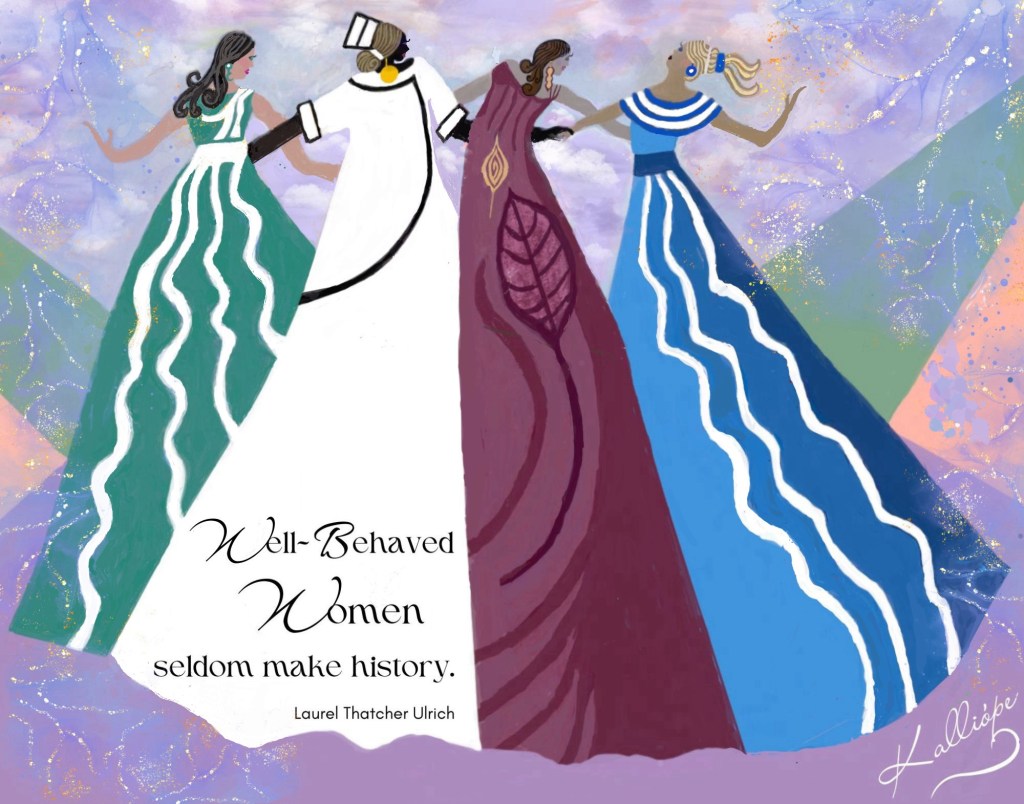
Art: “Well-behaved Women” by Kathy Manis Findley


Rev. Kathy Manis Findley
July 27, 2024

You have probably had that kind of dream at a few junctures on your journey. I know I had many dreams along the way. Sometimes they scared me to death. I dreamed of peace, equality, freedom, changing the world, and many other huge and noble dreams. I dreamed some silly dreams, too! I soon got the hint: changing the world is a formidable task. I followed all the rules, but being a rule-keeper does not make a person effective in dreaming and imagining. Women who follow the rules (someone else made up) could correctly be called well-behaved. They might even be called good girls because they don’t cause much of a flurry. They typically don’t make history and they certainly don’t change the world.

A woman with less-than-good behavior looks like someone at peace with herself, someone who radiates hope, someone with the courage and determination to do justice. I have admired and emulated so many examples of women who did make history, women who were not well-behaved at all. Here are only a few: Rosa Parks, Harriet Tubman, Lucretia Coffin Mott, Sojourner Truth, Susan B. Anthony, Nancy Sehested, Elizabeth Cody Stanton, Prathia Hall, Julian of Norwich, Malala Yousafzai, Mother Theresa of Calcutta, Ann Hasseltine Judson, Lucy Stone, and so many others!

About 24 years ago, a chaplain colleague recommended a book to me: Goodbye Good Girl: Letting Go of the Rules and Taking Back Your Self by Eileen M. Clegg. I think my chaplain friend was suggesting that I should get out of my comfort zone and take some risks, that I should courageously follow God’s call on my life. I knew that the members and churches of my denomination would “throw a fit,” like we say in the south! After all, I was an ordained minister serving as a hospital chaplain, which placed risky challenges before me every day.

So I read the book immediately and set out to become a bad girl, a girl who fully intended to change the world and to make history for it! So far, I have not made history. I have not managed to put my name in lights. I have not started any big public movements. But I have done some things that matter! I have learned how to create sacred space; I have learned the depth of liberation theology; I have found enough grace to endure the consequences of being a “bad girl” and then a woman with questionable behavior; I have held off anyone who tried to tell me who I am; and I have called up the courage to fight for justice. Colleagues, friends, family, co-workers reacted to the change in me, since they never expected me to dissent, or disagree, or refuse to behave.

Suddenly I let go of my “good girl” image and basically said “goodbye” to my restrictive behaviors. I took back my life, put aside all the rules, and followed my soul. I watched for the winds of the Spirit to lead me, and I moved forward to all the places that needed some attention. I was able to help change unjust systems, unjust policies, and unjust processes by not being so well-behaved.

Still, I sometimes think I have reached an uneasy place when it comes to letting go of my “good girl” persona. I’m really not a “good girl” and I don’t think I ever have been. My parents had to endure the sassy exclamations of my toddler years, like “Nobody’s the boss of me!” Creating shock from those who knew me, I mostly remained a “bad girl” from that day to this. I set aside the rules that were designed to keep people down and I took back my life. Today—in my mid-seventies—I continue to spew out uncommon proclamations that are quite annoying to those who are determined to hold on to their power and resist change.

Truly, it was sometimes hard being a change-maker and a rule-keeper! Always a people pleaser. Always the ultimate perfectionist. I discovered along the way that sometimes rule-keeping, people pleasing, and keeping every little thing “perfect” can harm your inner core. In fact, it’s less risky when you follow the leaders, make sure everyone is pleased, and doing everything with glowing perfection. Stepping out of line is always a bit dangerous.

When you become exactly who you are, resolute and unmovable about the things that matter to you, you will raise a few eyebrows, and sometimes people will get angry with you . You see, those people expected something else from you. Each of us becomes “me”— the “real me”— at our own peril. In a sense, we have to fight for the right to be ourselves in the world.

It is true that the people around me reacted strongly when I took back my life and became fully invested in my destiny. They thought that I had become radical, maybe even unhinged. I did not respond appropriately to their demands. To unreasonable demands, this is essentially how I might have responded, sometimes out loud, sometimes under my breath . . .

I will do it. / It’s my right! / It’s my choice! / It’s my prerogative! / It’s my decision! / I’m doing it anyway. / You can’t stop me! / Just watch!

All the while, I felt uncomfortable because of so much disdain from others, who began sending me a new message, You are not enough! I Imagine that many of you have heard someone say to you, You are not enough. At least, we may imagine someone saying those hurtful words. Unfortunately, we believe it because we don’t know ourselves, meaning we don’t know our bright and dark places, we have not yet realized our sacred worth, and we have not yet searched our souls.

For you see, you and I are afraid because it is perilous for the soul when we don’t search diligently for our soul’s passions and dreams. You and I sometimes accept what others say about us and tuck it away in our deepest places. When those words sneak all the way down into the soul, we tend to give up. We start from the moment we make ourselves nonchalant about it all, that moment when we shield our hearts from hurt. One of the saddest phrases we use is “I don’t care.” When we no longer care, we begin, one by one, eliminating the people around us, never realizing that they are hurting, too. And maybe the reason they send the message, You are not enough, is because they believe that they are not enough either.

I can honestly say that I have often heard voices—known voices, unknown voices, and the weak little voice in my head—telling me, You are not enough! I have learned that once I have embodied that negative message, it rolls around in my psyche for a long time, maybe forever. It becomes a state of being that goes deeper than skin. It penetrates in deeper places, and takes its toll on my emotional and physical well-being. I recall many such times, none more painful than the wagging tongues around my ordination . . . You know the scenario, “She can’t be a minister because she is a woman! Anyway, she’s not good enough! Other voices are often hazardous, dangerously breaking down our sense of self-worth. They may be yelling, speaking in a normal tone, whispering, or imagined in our heads. In response, we must prepare ourselves to hear the voice above all voices, saying, “You are my beloved daughter with whom I am well pleased.”

For a long time, I embodied the traits of the good girl, but to embody good girl traits is not really a once-and-done action. Embodied lasts a while! Embody does not have a shallow or surface meaning. It is deeper. I like the word embody. It seems to suggest that we can live a soulful life. In the very middle of the Greek word for “embody” we find the word σώμα, which means body. However, the Greek word for body cannot be translated in a way that reveals the depth of its meaning. The definition of σώμα is deeper than we realize. It is not skin-deep, it is deeper, approaching a definition more like soul.

I do like the word embody and the word soul. In some ways, to embody means to live in your soul. The word embody may whisper to you that in your body’s center, you will find the path to reach your soul. A person who lives in the soul is a person that does not live a shallow life, devoid of the emotion that makes us alive. The soul will help you, if you can just start by daring to touch it.

So what are the things we can actually do to take back our lives and live soulfully? What path do we follow to transform ourselves and change the world? My initial response to that is, “I don’t know.” Not very comforting, I know, but mostly true. We cannot forge the path for any other person. We cannot know what’s best for them. So not knowing anyones path, nor their dreams, I can give you a list of things others are finding the leads to their transformation. Here they are, not at all an exhaustive list, and certainly not a perfect guide for you:

  • Carve out some time for quiet, restful, meditation.
  • If you are a person of faith, get in touch with God or whatever person you worship.
  • Listen.
  • Listen some more—to your heart and your soul.
  • See if you find there a sacred direction especially for you.
  • Do you feel you are getting any closer to discovering your authentic self?
  • Can you begin to believe you will be transformed?
  • Can you take a step or two, in faith, into a holy place of transformation?
  • Pray, making your needs known to the source of your faith.
  • Read! Read the stories of others who found life transformation.
  • Find community, even one other person, who understands your journey.
  • Start all over again, leaning into the wisdom you found on your previous journey.
  • Take as long as it takes, until you realize that suddenly, you are becoming emboldened and scrappy!

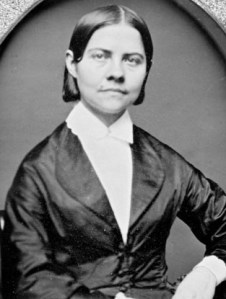
You may not know her name, but Lucy Stone was steadfast in her belief in self-authentication and in her ability to change the world. Lucy Stone was called “emboldened” and “scrappy” because of her tireless work for the abolitionist and women’s rights movements through the 19th century. A bona fide pioneer of her time, Lucy Stone stands as a historical titan. Her book “Unapologetic Life” describes a model of a revolutionary living. As for me, I would count it an honor to be described as emboldened and scrappy.

Life is more fun when you’re emboldened and scrappy. Not that we want to reduce the life experience to just scrappinesses. Life is so much more, like authenticity and the willingness to be a change-agent. Life is about having enough courage to persevere! Life for me is about my soul and all the ways it has been transformed over many years. All along my journey, I knew that my soul was a problem! At every age, there was a part of me that wouldn’t follow the easiest path. I longed to be empowered to make societal change. I chased down injustice and worked to dismantle it. I spent most of my career working with victims of domestic violence, child abuse, and human trafficking. This was not the easiest and most pleasant vocation, but the work had made its way into my soul. To do it, I had to live in the light of self-awareness and soul-awareness. I had to constantly listen to the sighs of my soul, and move only after I had heard them clearly. If I had just one nugget of advice for you, it would be to touch your soul and ride on the wings of the Spirit.

Sisters, don’t forget that when you touch your soul, you might just not be a “good girl” anymore. Or a good boy, for that matter. As for me, I am not a “good girl” living at the whims of other people! And I am definitely not a well-behaved woman! So I fully expect to make history! Because making history means leaving a legacy, creating a world brimming with peace, and embodying your best self!


Change, Compassion, Contemplation, healing, Inner joy, Repair the world, Repairing broken things, Tikkun Olam

Trying To Save The Whole World

Some of us feel compelled to rescue the world, and we try to do it in so many ways. The ways we rescue may be simple or complex, close to home or global. We try to repair them all, from multiple interventions when our kids get in trouble at school to advocating for an end to the climate change that’s currently burning down the beautiful Greek island of Evia.

For me, it’s a given that I should rescue things and people. After all, I am a minister. Isn’t that what we do? I really do want to save the whole world from whatever ailments or tragedies are inflicted upon it — the earth itself and the people in it. The thought that writer and theologian Frederick Buechner writes about this makes so much sense to me: “Your vocation in life is where your greatest joy meets the world’s greatest need.” I suppose that my desire to change, rescue and fix could very well be my undoing, because the stark reality is that I — one person — can do very little that would make much of a difference.

That’s the overwhelming part. How can we watch the world’s great need and not answer our inner compulsion to repair it? When asking myself this kind of question, I always think of tikkun olam, which is a jewish concept defined by acts of kindness performed to perfect or repair the world.


The phrase tikkun olam is found in the Mishnah, a body of classical rabbinic teachings. It is often used when discussing issues of social policy, insuring a safeguard to those who may be at a disadvantage. In modern Jewish circles, tikkun olam has become synonymous with the notion of social action and the pursuit of social justice.

To those who, like me, have this inner desire to change things and fix things, I can not offer any easy answers, because I do not have any. There simply aren’t any. I’m fond, though, of this idea: do the next right thing. When faced with big needs and small ones, sometimes that’s all we know to do, the next right thing.

I think that’s okay. The “next right thing” is like following the light we have or following God into the pressing needs the Spirit shows us. One thing I have learned is that before any act of repairing or helping, there must be a time of waiting, a time when the soul finds a sacred pause and waits there for holy direction. Then, just maybe we will have discovered what we need to “save the whole world.”

I love the way that poet and author Martha Postlethwaite describes a way forward for us fixers. I also love the way she invites us to find “the song that is our life” and to open our hands to receive it. Her thoughts come through so powerfully in her beautiful poem, “The Clearing.”

Do not try to save
the whole world
or do anything grandiose.

Instead, create
a clearing
in the dense forest
of your life
and wait there
patiently
until the song
that is your life
falls into your own cupped hands
and you recognize and greet it.

Only then will you know
how to give yourself to this world
so worthy of rescue.
Creating a clearing.

“The Clearing” by Martha Postlethwaite

We probably can all agree with the song John Mayer sings that we’re “waiting on the world to change.” We need changes big and small for bees, elephants, giraffes, oceans, blue whales, sea turtles, polar bears, monarch butterflies and all things nature. And then we need to clearly see the humans who probably need help most of all. So many humans live lives of deep need through no fault of their own, suffering because they’re facing incredible hardships and personal tragedies.

Martha Postlethwaite would suggest that we clear away the forest of our life and wait patiently in the clearing until what she calls, “the song that is our life,” becomes crystal clear. With that song, we will find the place of the world’s great need that is calling out to us for help.

So be present and mindful in the clearing. May God help each of us open our hands to receive our song, and then go out into the needy world singing. Amen.

Bethlehem’s Star, Christ’s Birth, Conflict, Confusion, Darkness, Epiphany, Hope, Light, Magi, Meditation, Night sky, Repair the world, Sacred Pauses, Singing, Spirit, Stars, Tears, Transcendence

A TRANSCENDENT MOMENT IN THE SHADOW OF CHAOS

Although churches all over the world celebrated Epiphany last Sunday, today is the actual day of Epiphany. So I invite you to pause for a few moments today and celebrate Epiphany with me. Epiphany, also known as Theophany in the east, is a Christian feast day that celebrates the revelation of God incarnate that came to us in the form of the infant Christ.

In Western Christianity, Epiphany commemorates the visit of the Magi to the Christ Child, and thus Jesus’ physical manifestation to the Gentiles. Epiphany always includes the story of the star that appeared in the dark sky to guide the Magi to the infant Christ. Epiphany also reminds us to “see” and to open our hearts to the coming of God to us in the form of an infant.

So having decided to sit quietly and contemplate the light of Epiphany, I am suddenly disturbed by terrible sounds coming from the television in the next room. What sort of chaos can so forcefully disrupt my sacred pause on this day? Crowds are storming the United States Capitol, breaching the doors, pushing past the Capitol police, violent confrontations, breaking windows, persons shot, members of Congress made to shelter of place in the building, protesters engaged in an armed standoff in front of the House of Representatives’ chamber. In this very moment — on the day of Epiphany — this is what I am hearing. I feel sad, frightened, disappointed, ashamed  — tears come and I ask why the light of Epiphany seems so dim.

Why this darkness? Why this danger? Why, on the day of Epiphany?

Then I suddenly have my own personal Epiphany and it is this: God is present. In some way, by some miracle, in the mystical wind of Spirit, God is present. With me! With our nation! With the melee! With the confused crowds that have gathered!

“Celebrate through this!” the Spirit is saying to me. “Celebrate the Epiphany — keep listening for God’s voice, pray, praise, worship, sing — because the Magi followed the star in the darkness and found the Prince of Peace!”

As I celebrate Epiphany today, I am surprised by my personal epiphany — a sudden, striking realization that indeed, “The people who walked in darkness have seen a great light; those who lived in a land of deep darkness— on them light has shined.” (Isaiah 9:2)

God of light and of darkness,

My epiphany came today when I realized anew that your divine power is working in my life. When I still know that your divine power is working, even in anarchy, even in the intentions of the violent, chaotic crowds that now gather. I know, God, that your divine power brings light in the midst of darkness, as it always has. I know that your divine power brings sudden, transcendent moments, even in the shadow of chaos.

I have encountered you, God, in these troubling moments. I weep and I grieve. Yet you, God, have given me a transcendent moment of awe that will forever change how I experience this violent world that has always been violent. And so, God, I am lifting my eyes to the dark sky and I am seeing the gleaming Epiphany star in the darkness. I pray to you, God, and I worship you. My heart is filled with gratitude for your constant presence. I praise you and I sing, because singing in the darkness is the way I always get to the light. 

Grant us your peace, God. Send your Spirit of peace to hover over us in this moment of violence in our nation’s Capitol. Send your Spirit of peace for this day of darkness, for the strife of disunity, for the hate and chaos. Send us your Spirit of peace to remain with us forever. 

Help us, God, to keep our eyes on Epiphany’s star. Help us to never choose violence and hate. Help us to persist in faith. Help us to proclaim abiding hope as we lift our voices. As we sing! Amen.

And now, friends, I invite you to lift your voice with the Aeolians of Oakwood University, as they sing of the kind of hope we need, their interpretation of “Lift Every Voice and Sing” arranged by Roland M. Carter. 

Songwriters: R.M. Carter / J.R. Johnson / J.W. Johnson. Lyrics are below.

Lift every voice and sing
Till earth and heaven ring
Ring with the harmonies of Liberty;
Let our rejoicing rise,
High as the list’ning skies, let it resound loud as the rolling sea

Sing a song full of faith that the dark past has taught us,
Sing a song full of the hope that the present has brought us;
Facing the rising sun of our new day begun,
Let us march on till victory is won.

Stony the road we trod,
Bitter the chast’ning rod,
Felt in the day that hope unborn had died;
Yet with a steady beat,
Have not our weary feet,
Come to the place on which our fathers sighed?

We have come over a way that with tears has been watered,
We have come, treading our path through the blood of the slaughtered,
Out from the gloomy past, till now we stand at last
Where the white gleam of our star is cast.

God of our weary years,
God of our silent tears,
Thou who has brought us thus far on the way;
Thou who has by thy might,
Led us into the light,
Keep us forever in the path, we pray

Lest our feet stray from the places, our God, where we met thee,
Least our hearts, drunk with the wine of the world, we forget thee,
Shadowed beneath the hand,
May we forever stand,
True to our God, True to our native land.

Activism, Advocate, Community activism, Compassion, Discrimination, Division, Hope, Inspiration, Racism, reconciliation, Repair the world

A Picture of Good Hope

0EC37F67-B415-44A7-88FC-DEAB6E8A4A81
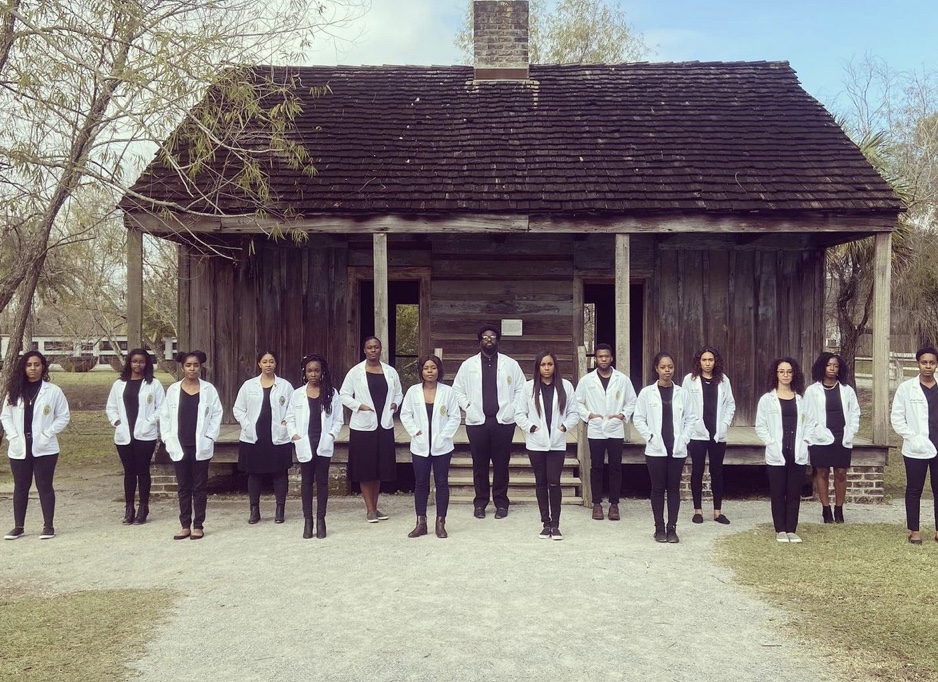
Photo credit: A group of black medical students posed in front of the slave quarters on a Louisiana plantation for a powerful photo. (Brian Washington Jr./Doyin Johnson)


It happened in Wallace, Louisiana on December 18, 2019.

On that day, a group of Tulane University medical students posed in front of the slave quarters of a Louisiana plantation for a powerful photo. Sydney Labat, one of the students, said this in an interview on Good Morning America:

Standing at the Whitney Plantation in front of the slave quarters of our ancestors with my medical school classmates . . . We are truly our ancestors’ wildest dreams. I think I speak for myself and my classmates that it was an extremely humbling experience, to say the least. We would not be here without the strength and determination of those enslaved and their strength to live and to press on.

Labat speaks of the resilience of her ancestors and she credits her ancestors’ resilience for her ability to pursue an education. I shared the photo (above) because it represents the realization of dreams that many people might label “impossible.” But seeing Labat and 14 of her Tulane University classmates in their white coats looked to me like a portrait of the realization of dreams, persistence against all odds and an emulation of the determination of the ancestors Labat spoke of. This photo of the students was posted to Twitter and was liked more than 65,000 times.

I like the photo, too —  a picture of good hope.

I cannot adequately express my emotions about seeing the photo of these students. No doubt, it brought up my deep concern about the well-being of black children in this country and the many disparities they endure. I can not begin to lay out those disparities in a coherent way, but I can cite this troubling research.

Black adolescents and young adults are at higher risk for the most physically harmful forms of violence (e.g., homicides, fights with injuries, aggravated assaults) compared with whites. In addition, black adults reported exposure to a higher number of adverse childhood experiences than whites.Disproportionate exposure to violence for blacks may contribute to disparities in physical injury and long-term mental and physical health. https://www.ncbi.nlm.nih.gov/pubmed/30139709

A study regarding youth and suicide revealed an age-related trend in racial disparities in suicide rates in elementary and middle school–aged children. The study, published in JAMA Pediatrics, showed that suicide rates for black children aged 5-12 were roughly 2 times higher than those of similarly-aged white children. https://www.ajmc.com/newsroom/racial-disparities-seen-for-black-children-age-512-in-youth-suicide-

A significant amount of research has documented the overrepresentation of certain racial and ethnic populations — including African-Americans and Native Americans —in the child welfare system when compared with their representation in the general population.Although disproportionality and disparity exist throughout the United States, the extent and the populations affected vary significantly across States and localities. https://www.childwelfare.gov/pubpdfs/racial_disproportionality.pdf

This researched information is definitely not a picture of good hope. The research deepens my concern, but what troubles me the most is that my grandchildren are growing up in a raciallly and ethnically divided world. When we raised our son, we certainly experienced racial discrimination. It was painful for all of us, and I hope beyond hope that my young grandchildren will not face the evil of discrimination. But I know better! I do not want to be pessimistic about it; I want to be optimistic that my grandchildren will not be “judged by the color of their skin” and that they will know the freedom to live out their dreams.

Tulane University Medical Students

So these Tulane University Medical students have given me a gift — a picture of good hope. And the photo of these students also introduced me to another place of hope: the Whitney Plantation, the only plantation museum in Louisiana with an exclusive focus on the lives of enslaved people.

73294CDC-A48F-4E27-ABE0-4DD30A9E02FFThe Whitney Plantation has restored buildings designed to encourage guests to enter the world of a Louisiana sugar plantation and to remember those who built and worked this property. Through an hour-and-a-half guided walking tour, a guide shows guests through slave cabins, a freedmen’s church, a detached kitchen and outbuildings, a 1790s owner’s house and memorials built to honor the enslaved.

22DDD58C-BBB8-40E5-AB21-DEA4D972D431
A stunning bronze memorial at The Whitney Plantation in Louisiana *

Guests learn about the lives of 350 people who were held in bondage on these grounds for over 100 years.

Visitors are able to view beautiful memorials built to honor over 100,000 people held in slavery in Louisiana.

Tickets for the tour are available at the Whitney Plantation’s website: https://www.whitneyplantation.org/

Information overload and emotional response

This blog post has included a bit of information and research. That’s the informational part. The truth is, though, that the harsh realities of divisiveness caused by racism, xenophobia and a host of other factors that divide us are not a part of the information we have. Instead, the realities of racism are part of our emotional angst. If we are honest with ourselves, we will realize that we receive informational material with a yawn. We have heard so many statistics and seen so much empirical evidence in our communities and schools that we have become numb to it. We have heard so much about disproportionate minorities in the criminal justice system and mass incarceration that perhaps we just try to block that information out. But we cannot block out our emotional response.

The only thing that will get our attention is a soul understanding of the pain of racism. Only then will we become agents of change, persons of conscience and advocates for justice. For me, this is a calling from God who desires that we “love our neighbors as we love ourselves.”

Consider these passages of Scripture.

In that renewal there is no longer Greek and Jew, circumcised and uncircumcised, barbarian, Scythian, slave and free; but Christ is all and in all.  — Colossians 3:11

Let mutual love continue. Do not neglect to show hospitality to strangers, for by doing that some have entertained angels without knowing it. Remember those who are in prison, as though you were in prison with them; those who are being tortured, as though you yourselves were being tortured.  — Hebrews 13:1-3

The alien who resides with you shall be to you as the citizen among you; you shall love the alien as yourself, for you were aliens in the land of Egypt: I am the Lord your God.  — Leviticus 19:34

Thus says the Lord of hosts: Render true judgments, show kindness and mercy to one another; do not oppress the widow, the orphan, the alien, or the poor; and do not devise evil in your hearts against one another.  — Zechariah 7:9-10

You have heard that it was said, ‘you shall love your neighbor and hate your enemy’. But I say to you, love your enemy and pray for those who persecute you.
— 
Matthew 5:43-44

May each of us listen carefully to the words of Scripture and allow those words to inspire us and may that inspiration compel us to end divisions that harm. May we be inspired to promote unity and justice. May we be inspired to paint a picture of good hope to guide our world.

* Photo credit: https://www.whitneyplantation.org/photo-gallery/


Activism, Advocate, Black History Month, Challenge, Change, Courage, Covenant, Injustice, Justice, Racism, reconciliation, Repair the world, Segregation

I NEED YOU to join the fight for change!

24E7C406-2AD0-47CB-A702-2E259A76DCC3
We are well into Black History Month, also called African American History Month.  We celebrate it every year in February. All manner of celebrations and commemorations happen during this month, from school plays, choral concerts, historical dramas to formal tributes and ceremonies in cities, colleges and churches. In the midst of this month, I have been contemplating the idea of white fragility drawing on the books, White Fragility by Robin DeAngelo and Radical Reconciliation: Beyond Political Pietism and Christian Quietism by Alan Boesak and Curtiss Paul De Young. I highly recommend both books to you if you want to advocate for racial justice.

A dear and very wise friend of mine would exhort us to know the history of black people, but more importantly, to enter into serious conversations about equality and unity. She would tell white people to accept the reality that we will never completely understand her history and that we should be sure our conversations include deep listening. She would remind us that the history of injustice to black people has not ended yet and that we must all continue our work for justice and equality. I want to share with you some of the history behind this month.

As a Harvard-trained historian, Carter G. Woodson, like W. E. B. Du Bois before him, believed that truth could not be denied and that reason would prevail over prejudice. His hopes to raise awareness of African American’s contributions to civilization was realized when he and the organization he founded, the Association for the Study of Negro Life and History (ASNLH), conceived and announced Negro History Week in 1925.

The event was first celebrated during a week in February 1926 that encompassed the birthdays of both Abraham Lincoln and Frederick Douglass. The response was overwhelming: Black history clubs sprang up; teachers demanded materials to instruct their pupils; and progressive whites, not simply white scholars and philanthropists, stepped forward to endorse the effort.

The Black Awakening of the 1960s dramatically expanded the consciousness of African Americans about the importance of black history, and the Civil Rights movement focused Americans of all colors on the subject of the contributions of African Americans to our history and culture.

B5AF969F-8A72-44B0-A65B-9EF5BCB8102E

Then the celebration was expanded to a month in 1976, the nation’s bicentennial. President Gerald R. Ford urged Americans to “seize the opportunity to honor the too-often neglected accomplishments of black Americans in every area of endeavor throughout our history.” That year, fifty years after the first celebration, the association held the first African American History Month. By this time, the entire nation had come to recognize the importance of Black history in the drama of the American story

There is so much more I could include, but I will finish with some random thoughts my friend would like for us to know.

— The G.I. Bill of 1944 was denied to a million black veterans of WWII (history.com). These things matter. PUBLIC POLICY throughout American history has deliberately and purposefully limited economic opportunities and advancement of black people.

— It never occurred to me that some white people thought black history month DID NOT involve them.

— During this Black History Month, I ask: Do the white people within our networks remotely get how glorious AND exhausting it is being black in America? Can we talk about why it’s exhausting? Can you handle sitting in an uncomfortable space for awhile? Can you handle it? Can you take it in without deflection, pointing fingers, becoming defensive or proclaiming yourself the victim? Can we REALLY talk?

And finally her heartfelt words about a confrontation that happened in her city, in a neighborhood she knows well, to two people who are her friends.

My soul weeps. My body trembles. Anger and fear take turns occupying the same space. Why? Two people that I hold in high regard experienced the policing of their bodies in a PUBLIC space by white people who feel they get to decide where black people can and cannot be!

As I learned of what occurred I was immediately grateful their positions (elected official and one running for office AND a friend who STEPPED UP) along with their “training “ allowed them to walk away from this experience. Yes this was potentially a life and death event.

43274C05-47A6-49F7-979E-B91258D1809CSo many what if’s ran through my mind. If you are black you will understand what I mean. If you are white, I CHALLENGE you to discuss this LOCAL event with your WHITE friends! I NEED you to discuss it in YOUR churches. I NEED you to discuss with YOUR family.

I NEED YOU to join the fight for change! YOU play a KEY role in ensuring change happens.

I thank my friend for challenging me and encouraging me, not only during Black History Month, but throughout time — every day, every month and for years ahead. To black people, Black History Month begins on January 1st and ends December 31st, and the message of the month for black people has been lifelong. As for those of us who are white, let us not be shackled by “white fragility.” Instead let us move boldly — and with courage — into our communities and confront racism wherever we find it. It is true that racism and white supremacy have been a part of our history always, but we can end this tragic injustice with resolve, unity, faith, courage and the blessing of God who created all people in One image. May God make it so.

Angels, Bethlehem’s Star, Call, Calling, Challenge, Here I am, Lord., Hope, Repair the world, The Work of Christmas

The Work of Christmas Begins in Us!

E4CC4385-77BF-4A27-AEEC-E2CE48786502

The angels, the star, the kings and princes, the shepherds — all have moved away from us, taking their splendor with them. Does that mean that the movements and dances of Christmas have ceased? Perhaps.

But the reality that strikes a chord in my spirit every year is the thought that this is the very time when “the work of Christmas begins.” That may be the ultimate hope of Christmas. That might be the call from God that we cannot ignore, but instead answer, “Here I am, Lord. Send me.” No one ever spoke of the idea of the work of Christmas with more heart than Howard Thurman:

When the song of the angels is stilled,
When the star in the sky is gone,
When the kings and princes are home,
When the shepherds are back with their flock,
The work of Christmas begins:
…To find the lost,
To heal the broken,
To feed the hungry,
To release the prisoner,
To rebuild the nations,
To bring peace among brothers,
To make music in the heart.

Howard Thurman

May the work of Christmas begin in us. Amen.

Please take a few moments to hear this song by Dan Forest, “The Work of Christmas.” You will be inspired.

Advent, Angels, Bethlehem’s Star, Christ Child, Christmas, Relationship, Repair the world

Ah Yes! Christmas Will Come!

D9EE4E52-B049-4C4E-A78A-FACC59E5D781


The Nineteenth Day of Advent

December 19, 2019

For those with ears to hear the holy and eyes to see the sacred moment of the coming of the Christ Child, Christmas comes again and again each Advent season. Yet, Christmas also comes for us in the eyes of a child, in the words of a friend, in the music of hymns and carols tucked into our hearts, in the kind spirit of a stranger. If we take time to see! If we take a moment to hear! If we spend a few moments engaging with another person! Then we experience the holy moments of Christmas. Ann Weems writes of the ways Christmas comes.

CHRISTMAS COMES

Christmas comes every time we see God in other persons.
The human and the holy meet in Bethlehem
or in Times Square,
for Christmas comes like a golden storm on its way
to Jerusalem —
determinedly, inevitably . . .

Even now it comes
in the face of hatred and warring —
no atrocity too terrible to stop it,
no Herod strong enough,
no hurt deep enough,
no curse shocking enough,
no disaster shattering enough.

For someone on earth will see the star,
someone will hear the angel voices,
someone will run to Bethlehem,
someone will know peace and goodwill:
the Christ will be born!

— Ann Weems

There is little doubt that our world is filled with “hatred and warring.” There are hurts, atrocities and disasters. We see it on our televisions, every nightly news program describing it in full detail. We are now seeing the rancor of our Congress, one party hopelessly divided from the other, in the impeachment of a president. We mourn the losses of war, natural disasters, wildfires, gun violence and all the harms caused between people.

Yet, someone on earth will indeed see the star. Some of us might just hear angel voices because we live on holy ground. Some of us might repair the world. We might just find that we are anointed by God’s Spirit to bring good news to the poor; to heal the brokenhearted, to proclaim release to the captives and recovery of sight to the blind, to let the oppressed go free! (Paraphrased from Luke 4:18 NRSV) Advent may inspire us to live into our anointing and to embrace the high calling of repairing our world in whatever ways we can. Advent might call us to heal, to free, to proclaim release, to offer good news to the poor and to cause the blind to see.

7EF76C61-3A9F-4808-ABDD-D10C92202890But Advent will also lead us by the light of Bethlehem’s star, guiding us again to Bethlehem. Advent opens our hearts to know peace and goodwill afresh and anew. Christ will be born in us again. Christmas will come — into our lives, into our hearts, lifting our spirits. Ah yes, Christmas will come!
And throughout this Advent, we will again be reminded of what we proclaim from our hearts of faith:

Emmanuel, God with us!

Amen.

Activism, Awakening, Brokenness, Christian Witness, Community activism, Compassion, Contemplation, Hope, Immigration, Injustice, Introspection, Justice, Ministry, Mysticism, Politics, Reflection, Repair the world, Social justice, Tikkun Olam, Violence against women and children

What does the world need?

256F00BB-10F5-4D89-93E1-FD4534BFCD0F
“To repair, heal the world” by artist and calligrapher Michael Noyes http://www.michaelnoyes.com/gifts/religious/jewish-judaica/tikkun-olam-to-repair-heal-the-world

What does the world need?

What do I have to give in a broken world? 

I have asked myself these questions before — many times before. I have asked these questions when teaching classes and writing my blog. I have asked these questions in a sermon — actually multiple sermons. So one might expect that, through my sermon preparation through Biblical study and other research, I might have found an answer by now. I have not. Because my finding the answer is as complicated as the myriad places of brokenness i see in the world around me.

Of course, I have to pay attention to the image of a hungry child, a refugee family at the border, entire African villages that subsist without clean water, the violent streets in cities across the United States, the mother protecting her children from abuse and herself from domestic violence, racially motivated hate crimes that terrorize, the climate crisis that to some is so real and to others just a hoax, the active shooters that have terrified school children and threatened life at many other places where people are vulnerable. I can continue this list into perpetuity.

But then I have to acknowledge the more insidiously evil side of the world’s brokenness — not the actual broken places, but the injustices that create them. I have to be woke to the societal and political forces of greed that deny complicity in the oppression of the most vulnerable among us. 

So when I ask myself the question, “What do I have to give in a broken world?” I am really asking if I will: 1) personally tackle a person’s specific need; 2) seek radical change of the societal and political forces that cause oppression; 3) become both a political activist and a compassionate hands-on Samaritan; or 4) engage in a contemplative life by getting in touch with the mystic inside that prays and longs for an end to every form of brokenness.

If I were a mystic, if could pray away the brokenness, I would most assuredly enter my prayer closet and do so. Admitting to being a mystic, though, is slightly uncomfortable. I’m not completely sure what a mystic is or what a mystic does. And isn’t being a mystic reserved for monks and nuns? 

Richard Rohr is my go-to person on the duality of action and contemplation. One can find in his meditations —every day — the inseparable link between our compassionate acts and the inner spiritual work that drives us. Matthew Fox writes:

Deep down, each one of us is a mystic. When we tap into that energy we become alive again and we give birth. From the creativity that we release is born the prophetic vision and work that we all aspire to realize as our gift to the world. We want to serve in whatever capacity we can. Getting in touch with the mystic inside is the beginning of our deep service.

“Our gift to the world,” he writes. And all around that “gift,” he lifts up prophetic vision, the energy to come alive, touching our inner mystic and engaging in deep service to people and places of deep need. I can never broach this subject of a broken world without revisiting the Jewish concept known as Tikkun olam – “repair the world,” that manifests itself in acts of kindness performed to perfect or repair the world. The phrase — found in the Mishnah, a body of classical rabbinic teachings — is often used when discussing issues of social policy, insuring compassionate remedies to those who may be at a disadvantage.

As for me . . . I really do want to touch my inner mystic, to enter into a silent, deep inner space that compels me to serve humanity. I also want to enter a place of tikkun olam. I want to repair the world and tangibly care for the persons who have need. Is it even possible to do both? Isn’t it imperative for a follower of Jesus to do both? Is it not because of the hope of the Good News in Christ that I must be about ministries of compassion and justice?

It seems pretty clear when reading the words of Jesus that caring for broken persons in a broken world is most certainly a compassionate imperative. 

When the Son of Man comes in his glory, and all the angels with him, then he will sit on the throne of his glory. All the nations will be gathered before him, and he will separate people one from another as a shepherd separates the sheep from the goats, and he will put the sheep at his right hand and the goats at the left. 

Then the king will say to those at his right hand, “Come, you that are blessed by my Father, inherit the kingdom prepared for you from the foundation of the world; for I was hungry and you gave me food, I was thirsty and you gave me something to drink, I was a stranger and you welcomed me, I was naked and you gave me clothing, I was sick and you took care of me, I was in prison and you visited me.” 

Then the righteous will answer him, “Lord, when was it that we saw you hungry and gave you food, or thirsty and gave you something to drink? And when was it that we saw you a stranger and welcomed you, or naked and gave you clothing? And when was it that we saw you sick or in prison and visited you?” 

And the king will answer them, “Truly I tell you, just as you did it to one of the least of these who are members of my family, you did it to me.”

— Matthew 25:31-40 New Revised Standard Version (NRSV

It’s just downright confusing and complex. Bottom line is this: I have no idea how to repair the world or how to get in touch with my inner mystic. But I also do not want to be permanently consigned to the goat-group mentioned in this Gospel text! I would rather struggle to figure out what I must do to care compassionately for my brothers and sisters and to get in touch with the contemplative mystic that makes me come alive.

Sound advice comes from a plethora of good and wise people. This time Howard Thurman gets the last word:

Don’t ask what the world needs. Ask what makes you come alive and go do it, because what the world needs is people who have come alive.

May God make us people who have come alive. Amen


F9FA5D3C-53F0-4043-8A72-F9E2D63F7349

On another note, please pray for me as I look toward my kidney transplant currently scheduled for November 12th at Mayo Clinic in Jacksonville, Florida. I am so grateful that you are walking with me on this journey that often felt so frightening. Your thoughts and prayers mean so much. If you would like to read the story of my illness, please visit the Georgia Transplant Foundation’s website at this link:

://client.gatransplant.org/goto/KathyMFindley

“Go Fund Me” page is set up for contributions to help with the enormous costs related to the transplant, including medications, housing costs for the month we have to stay near the transplant center, and other unforeseeable costs for my care following the transplant. If you can, please be a part of my transplant journey by making a contribution at this link

https://bit.ly/33KXZOj

Change, God's presence, Holy Spirit, Inspiration, Pentecost, Quiet, Rebirth, Repair the world, Sacred Space, Silence, wind

Who Has Seen the Wind?

5D279BA7-5431-4872-93DC-BDF5BFA11178

. . . And the wind? Ah, who has seen the wind go by? Neither you nor I. But when we see the trees bow down their heads, we know the wind is passing by. That is the way the Holy Spirit works: silently and effectively. *

There was never a more needful time for the fresh winds of the Holy Spirit. We inhabit a world divided . . . nations divided by tenuous agreements; white people divided from brothers and sisters black and brown; people of faith divided by differing traditions; immigrants divided from those who claim to “own” this nation; citizens divided from their president; politicians divided by ideology, greed and self-interest. There are so many examples of division. And whether we will admit it or not, division diminishes us.

The divisions among us — the ones we personally experience and the ones we observe — create an unsettled environment around us and an unsettled spirit within us. The acrimony, the hate and the disrespect we witness all around creates an unrest in us. Perhaps, from the weariness of the constant hostility we see, our heart becomes hardened. Perhaps we are closed off from the Spirit Wind that fills us and creates in us rebirth, fresh and new.

We can never think of wind without recalling the day of Pentecost. The disciples of Jesus and other followers were gathered together when a rushing, mighty wind filled the entire house, and all of them were filled with the Holy Spirit. (Acts 2:1-4) That day was the beginning, and from that day when Spirit Wind came, the holy promise came into view: that God would pour out the Spirit on all people, that sons and daughters would prophesy, that some would have visions and others dreams.

We need it again, the Spirit Wind. We need it to fill us with courage for the living of these days. We need it to fill us with love that can change the world. We need it for the will to save our planet from devastating climate change. We need it to responsibly open our borders, to become again a nation of welcome, to reach out our hands to sojourners searching for safe refuge, to rescue children from the unwelcoming places where they are detained and kept from their parents. We need it to repair the world in all the ways possible to us, to repair its brokenness.

To become God’s people in a broken world, we need the wind of the Spirit. Now.

But how does Spirit Wind come in these days? I have heard of no “Pentecostal” experiences of rushing mighty wind. I have heard of no one who has seen a sudden whirlwind. (1 Kings 19:11)  I do not know of a person who saw the winds cease at the command, “Peace. Be still.” (Mark 4:39)

So how does the Spirit Wind come? I can share only what I know from my own experience, and that is this: when I am very still and very present with God, the Spirit comes quietly, gently — but surely. I do not see her. I do not hear her come with any sound of rushing wind. I cannot touch her. Yet I feel her, covering me, filling me, empowering me. I go away with that sense of being reborn and renewed, like I might be “born from above.”

2CE74B96-9488-4F0B-81B2-69824F5EAEC8
Art by Charlotte Nickel, “Mighty Rushing Wind,” acrylic on canvas.

You know well enough how the wind blows this way and that. You hear it rustling through the trees, but you have no idea where it comes from or where it’s headed next. That’s the way it is with everyone ‘born from above’ by the wind of God, the Spirit of God.

— John 3:8 (The Message Bible)


*From the Carmelite Bulletin, Carmel of Saint Teresa of Jesus, Little Rock, Arkansas, “Who Has Seen the Wind?” Christina Rossetti – 1830-1894


*******************************************************

On another note . . .

Please pray for me as I await a life-saving kidney transplant. I am grateful that you are walking with me on this journey that often feels so frightening. Your thoughts and prayers mean so much. If you would like to read the story of my illness, please visit the Georgia Transplant Foundation’s website at this link:

http://client.gatransplant.org/goto/KathyMFindley

A “Go Fund Me” page is set up for contributions to help with the enormous costs related to the transplant, including medications, housing costs for the month we have to stay near the transplant center, and other unforeseeable costs for my care following the transplant. If you can, please be a part of my transplant journey by making a contribution at this link:

https://bit.ly/33KXZOj


Activism, Change, Christian Witness, Church, Community activism, Gun violence, Hate, Injustice, Mexican border, Mourning, peace, Perseverance, Politics, Prophetic, Racism, Repair the world, Social justice, The Christian Church, Violence

Taking Back Our World

5378F42A-B263-40F4-A454-D497E07BF325

Let’s take back our world! Let us join hands and, in the power of community and holy resolve, reclaim our world from white supremacists, racists and violent actors that threaten our people.

If not us, who? If not now, when?

After the 2012 shooting at Sandy Hook Elementary School in Connecticut that killed 20 young children, British journalist Dan Hodges wrote that the gun control debate in the U.S. was over. This is what he wrote: “Once America decided killing children was bearable, it was over.”

And then we let 2,193 shootings happen. 

The shootings that occurred this week offend us in a very deep place. You see, we are followers of Christ, the Prince of Peace. We are the people of God who know that thoughts and prayers and compassionate sentiments won’t end this kind of terroristic hate.  

The El Paso shooter told law enforcement that he wanted to shoot as many Mexicans as possible. His manifesto, which he posted on the 8chan online community  included details about himself, his weapons and his motivation. He described the El Paso attack as a “response to the Hispanic invasion of Texas,” and proclaimed that he was defending his country from “cultural and ethnic replacement brought on by an invasion.”

Most certainly, these words from an obvious white supremacist should offend every follower of God. His evil intent is also an offense to God. In response to such evil, perhaps we will raise our voices continually and persistently, without becoming weary. Perhaps we will resolve to take back our world, proclaiming God’s word in the darkness of evil just as the prophets did. Like them, perhaps we will persist tirelessly and with a holy resolve, for as long as it takes to end the evil that arises from racism and white supremacy. 

Perhaps our prophetic action will mirror that of the writer of Lamentations who wrote, “Arise, cry out in the night, as the watches of the night begin; pour out your heart like water in the presence of the Lord. Lift up your hands to him for the lives of your children.”

May God so embolden us.

Activism, Christian Witness, Community activism, Compassion, Contemplation, Gun violence, Injustice, Ministry, Prayer, Repair the world, Social justice, struggle, Tikkun Olam, Violence, Violence against women and children

Dangerous Contemplation

4374BEEE-0A02-4B14-BE5E-E3914C3ADFAA

This morning, I read a meditation from the Center for Action and Contemplation as I often do to start my day. In it, Sister Joan Chittister explores the relationship between prophetic witness through compassion and contemplation. Sounds risky to me! And that’s very close to the point Sister Joan makes:

. . . contemplation is a very dangerous activity. It not only brings us face to face with God, it brings us, as well, face to face with the world, and then it brings us face to face with the self; and then, of course, something must be done. 

Something must be filled up, added to, freed from, begun again, ended at once, changed, or created or healed, because nothing stays the same once we have found the God within. . . . We become connected to everything, to everyone. We carry the whole world in our hearts, the oppression of all peoples, the suffering of our friends, the burdens of our enemies, the raping of the earth, the hunger of the starving, the joyous expectation every laughing child has a right to. Then, the zeal for justice consumes us. Then, action and prayer are one.

Bolder prophetic words were never written! Would that all of us who profess a relationship with God might rise from our knees and be ennobled by our prayers to do justice and love mercy! Largely, this is not the case for us. Our prayers feel empty, devoid of the compassion of Christ and the power of the Holy Spirit. After we have prayed, have we changed? Has our heart been softened by moments of communion with God? Does our heart move into a tragic world with the tenderness of a compassionate Christ?

As we are praying, children and families still languish at our borders, suffering in living conditions that seem impossible in America. And we hear the distant echo of Jesus asking for the children to come to him.

As we are praying, the ever-changing climate exacts its harm on oceans and rivers, having significant impact on ecosystems, economies and communities. Rising average temperatures mean balmier winters for some regions and extreme heat for others. Flooding, drought and violent storms take a dangerous toll on our beloved earth.

250ACCE1-377E-4980-9A7B-546C7B31A8FEAs we are praying, gun injuries cause the deaths of 18 children and young adults each day in the U.S. And every day, 100 Americans are killed with guns. Can we ignore the fact that nearly 1 million women alive today have been shot, or shot at, by an intimate partner?


All the while, we comfortably rest in our own kind of contemplation. Yet, contemplation must be redefined. We must learn to experience it as a change in consciousness that forces us to see the big picture, to see beyond our own boundaries, beyond our denominations, our churches. Sister Joan again says it best:

Contemplation brings us to see beyond even our own doctrines and dogmas and institutional self-interest, straight into the face of a mothering God from whose womb has come all the life that is.

Transformed from within then, the contemplative becomes a new kind of presence in the world who signals another way of being. . . . The contemplative can never again be a complacent, non-participant in an oppressive system. . . . From contemplation comes not only the consciousness of the universal connectedness of life, but the courage to model it as well.

Those who have no flame in their hearts for justice, no consciousness of personal responsibility for the reign of God, no raging commitment to human community may, indeed, be seeking God; but make no mistake, God is still, at best, only an idea to them, not a living reality.

So we struggle, Christ followers in a world of cruelty and insanity. Our struggle is about what exactly we can do when we face the world after our contemplative practice. Isn’t contemplation and compassion a pilgrimage to the heart, my own heart and God’s heart? When our moments of contemplation reveal a clear-eyed view of a suffering world, what does Christ’s love and the Holy Spirit’s prompting move us to do?

I often refer to the words Tikkun Olam, the Jewish teaching that means repair the world. Tikkun Olam is any activity that improves the world, bringing it closer to the harmonious state for which it was created. So how does our contemplation lead us to practice Tikkun Olam, to repair the world? What is it that “must be filled up, added to, freed from, begun again, ended at once, changed, or created or healed?”

It is a critical question for all of us and each of us. Indeed, each person must find her own answer and must follow her own path. The way ahead may lead to U.S. border towns. The way ahead may lead to phone calling or letter writing. It may lead to community activism or bearing witness in places where injustices occur. It may lead to protesting and marching or teaching and preaching. It may lead to deeper communion with God through even more time spent in prayer and contemplation.

It will, beyond any doubt, lead us to the places in our world where compassion touches pain. Dangerous contemplation will most definitely lead us to those places.

May God make it so!


Child protection, Children, Compassion, healing, Holy Spirit, Hope, Immigration, Justice, Maren Tirabassi, Repair the world, Spirit wind

Brooding

1A4072F7-B30A-43DB-9F51-A5AFBF363C94

My friend and sister blogger, Maren, never fails to inspire, convict or challenge me. I look forward to her blog posts, knowing that by the end, I will find myself in a gasp, or at least a sigh. She is gifted at helping her readers stay in touch with the current angst of the times, the events and realities of our world. This is her latest post:

My little hand holds (and not the great world)
the small shining of shook foil

and there is no beauty that I see,
only the blankets on children detained —
alone and frightened, cold,

and without care,
without — O you grand and broken God,
toothpaste and soap,

and parents,

without justice, compassion,
but not without hope,
because that alone, hope

is never spent, but lights the western sky
as night falls
on the long walk from the south,
even if dimly, touches
with fingers a rim of east
every morning, every detention center.

Hope brought them here
to the terrible inhospitality
that smears
all this country ever thought to be.

And it is left to us and the Holy Spirit
to brood
over those who are lost,
and bend the world
so that the living children
might someday be found
by bright wings.

And here is where it grabbed my heart . . .

What does it mean for me to join with the Holy Breath of Life “to brood over those who are lost, and bend the world?” What would that look like? How do I do it? Does it mean to “brood” over the lostness of our world and call forth life?

What a need that is! How desperately we need to bend the world toward mercy and justice. To lift up the children who sleep on cold concrete floors. To lift them high above the world’s cruelty to the place of “bright wings!”

May God help us to comprehend the brooding Spirit and her open arms. And may she reach down to grab us and hold us up inside the wind that heals.


Maren C. Tirabassi served as local church pastor in the United Church of Christ for thirty-seven years in Massachusetts and New Hampshire.  She is the author or editor of twenty books. Visit her blog at:
https://giftsinopenhands.wordpress.com/2019/06/26/prayer-for-the-immigration-crisis-an-homage-to-gerard-manley-hopkins-gods-grandeur/

Holy Spirit, Mission, Pentecost, Repair the world, Tikkun Olam

Pentecost!

18bbdca6-8ece-4df4-aa13-fe110e3298cb

The Day of Pentecost — my favorite Sunday of the church year! A grand and glorious celebration of the coming of the Holy Spirit.

“Do not let your hearts be troubled,” Jesus told his friends. “I’m going to prepare a place for you. And in the meantime, know that I will ask the Father and he will send you another Comforter to be with you forever.” (From John 14:1-18,  paraphrased)

On the day we celebrate as Pentecost, Jesus made good on the promise that the Comforter would come. They gathered in the upper room that day, men and women, disciples and kinfolk, perhaps waiting to be baptized with the Holy Spirit as Jesus promised. (Acts 1) Or maybe they were just there to have good conversation, to discuss the politics of the day. Or maybe they just wanted to hang out.

Whatever their reason for gathering, they were in for the surprise of a lifetime, the coming of the Holy Spirit. I can try to find the best words to tell you how it happened, but I cannot say it any better than this: 

When the day of Pentecost had come, they were all together in one place. And suddenly from heaven there came a sound like the rush of a violent wind, and it filled the entire house where they were sitting. Divided tongues, as of fire, appeared among them, and a tongue rested on each of them. All of them were filled with the Holy Spirit and began to speak in other languages, as the Spirit gave them ability.

The Church was born on that day, born on the wind. The rush of the violent wind blew through their lives. Tongues that looked like flames of fire rested on every one of them, and from that dayon, their lives were changed. They left that room with renewed courage, with a confident boldness. Maybe they even believed they could change the world!

Ah, that renewing Holy Spirit! That breath of life that sweeps through us and prepares us for holy mission. In these days of ours, so many things need the kind of change that can only happen through the wind of the Spirit. There are divisions to heal and children to protect. There are wrongs that need to be righted and truth that needs to be told. There are walls to tear down and people to shelter. The world, so broken, needs repairing. To be summoned to the mission of repairing the world is our honor. 

I am inspired by the Jewish teaching Tikkun Olam, which means “repair the world.”  Rabbi Menachem M. Schneerson described tikkun olam as the mission of every human being. With a voice of urgency, he spoke with the conviction that in our times, one small deed could bring the world to the resolution for which it has yearned since its creation.

For this kind of mission, the Holy Spirit comes to us, bringing the breath of holy change and inviting us to be a part of it. That refreshing, renewing Holy Spirit, Pentecostal power, wind and flame that can change our world! May the wind blow among us and the flame kindle our passions to bring that change!

It is as the hymn says:

O Breath of Life, come sweeping through us,
revive your church with life and power;
O Breath of Life, come, cleanse, renew us,
and fit your church to meet this hour.

— Bessie Porter Head

Spirit of God, make it so.