Beauty of Nature, Change, Defiance, Determination, Faith, Grace, Hope, life, Life’s murk, Lotus, Perseverance, Rebirth, Resurrection, Transformation

Rebirth

47A0C7FC-3DCC-4CC5-AF55-D993D1032FDC

I love the simple beauty of a lotus blossom. Since the lotus is often associated with yoga (a practice I avoid with every fiber of my being), I have never really considered the lotus and its intriguing life cycle. But lately I have been curious about the story of the lotus, which has long been considered one of the most sacred flowers. I wondered what it is about this mysterious bloom makes it so enrapturing and symbolic to so many people and cultures.

I think the answer is that the life cycle of the lotus is unlike any other flower. With its roots buried in mud, the lotus submerges every night into murky river water and miraculously re-blooms the next morning without any muddy residue on its petals.

The general consensus among ancient texts that the lotus symbolizes spiritual enlightenment and rebirth. Over centuries and across cultures, the lotus stunned people with its ability to dip into the grime and revive itself unscathed—an incredible daily cycle of life, death, and a sudden immaculate rebirth that can only be described as spiritual. In fact, the lotus flower blooms most beautifully from the deepest and thickest mud.

The lotus flower’s daily resurrection is certainly interesting and symbolic of revival, transformation and new life. But even more interesting is the flower’s stubborn will to live. A lotus seed can withstand thousands of years without water, able to germinate over two centuries later.

The lotus also blooms in the most unlikely of places such as the mud of murky river water in Australia or Southern Asia. Not only does it find sanctuary in the muck, but due to the waxy protection layer on its petals, its beauty is unaffected when it re-blooms each morning. It continues to resurrect itself, coming back just as beautiful as it was last seen. With such refusal to accept defeat, it’s almost impossible not to associate the lotus flower with unwavering faith, more specifically the faith within ourselves. 

My serendipitous lotus research did what my research often does: It prompted me to re-examine my faith. I can readily identify times when I had to wade through the murky, muddy waters that life sometimes brings. And although it seemed impossible to re-emerge from the mud clean and renewed, I did, every time, because of a God who understands both the murk and the rebirth.

It’s all about faith, after all is said and done. Once again God’s creation gives us a stunning example of experiencing thick, murky, dark life experiences; going under into the thickest mud when you no longer have the strength to stay above water; and miraculously emerging again — clean, new, reborn. We can learn a valuable lesson about determination, defiance and perseverance from the determined, defiant lotus seed that can survive over centuries. It hints to me about God’s “long game” for my life that simply shouts “hope” not just in my present circumstance, but in a future I can not begin to envision. God envisions it, though — a year from now, two years, my future, the years God has already numbered for me and the mystery we name “eternity.”

Thanks be to God for my eternity and for a faith that is reborn again and again and again by grace.


*********************

On another note, please pray for me as I await a life-saving kidney transplant. I am grateful that you are walking with me on this journey that often feels so frightening. Your thoughts and prayers mean so much. If you would like to read the story of my illness, visit the Georgia Transplant Foundation’s website at this link:

http://client.gatransplant.org/goto/KathyMFindley

A “Go Fund Me” page is set up for contributions to help with the enormous costs related to the transplant, including medications, housing costs near the transplant center, and other unforeseeable costs for my care following the transplant. If you can, please make a contribution at this link:

https://bit.ly/33KXZOj

anxiety, Comfort, Emotions, Grace, Hope, Lostness, peace, Restoration, sadness, Serenity

A Balm for Hurting Souls

ED8FACF3-D56C-403C-826A-40C2AB6F1C89

On this Monday, prayer seems difficult to me. It feels as if I need it so much, yet cannot seem to connect with the holy. I need a quiet place, a place of peace and serenity. I need a personal retreat that enables me to touch all that is anxious within me. I need a place that can help me reach into the palpable anxiety just below the surface. I need a place that calls forth my tears so that, without fear, I can let them fall. I need a place that helps me to get to that lump in my throat that lingers with me. At my retreat, I need a person with spiritual insight and wisdom to gently guide me to my emotional and spiritual place of longing.

For many reasons, this kind of retreat is not possible right now, so I carry on. That’s what most of us have to do day in and day out, struggling to touch the holy and falling short of that. And then, on occasion, we are graced with a touch, a word of hope, a friend who understands, a prayer that reaches the heart. Today, I received that prayer from Anne Fraley. It is “a balm for hurting souls,” a word of hope. I hope it lifts your spirit as it has lifted mine.

Blessed One,

who colors our days with the glow of fireflies and the roar of the ocean,

carry us this day on the breath of your love.

Invite us into the nooks and crannies of delight,

where dreams are born and disappointments released.

Tend the bumps we suffer at the hands of the careless and the words of the thoughtless, and soothe the rough patches we inflict on others.

May our prayers resonate with the needs of the world, and our hearts connect to those who hunger for companionship.

May our song bear the imprint of all who seek you, and our chorus be as balm for hurting souls.

In all things, help us to weave the thread of love and light through the worlds in which we move, and raise our voices with joy to proclaim your name.

Amen


Anne Fraley is rector of St. Peter’s Episcopal Church in South Windsor, CT. A life-long dog-lover, she escapes the demands of parish life volunteering for animal rescue groups. She occasionally succeeds at reviving her blog at reverent irreverence. Her prayer today is published at https://revgalblogpals.org/2019/06/24/monday-prayer-214/


“God’s Will”, Discernment, Faith, Fear, Grace, Indecision, John 14, life, Mysticism, peace, Prayer, Relationship, Risk, Teresa of Avila

I Need No Wings

5540C859-1ED6-4324-B35C-D491C8A04BC4

When accusers declared that the thoughts of Joan of Arc were figments of her imagination, she frequently answered them with this shrewd and sensible retort: “How else would God speak to me?”

This is one of the BIG questions most of us have asked ourselves again and again: How does God speak to me? 

And these big questions follow:

How will I know when it is God who is speaking?
Could this strong intuitive thought inside me be God speaking through my inner self?
Can God speak to me through other people?
How do I find God, hear God, feel God?

Richard Rohr, arguably one of the wisest thinkers of our time, wrote this in response to some of our big questions about God:

Intuitive truth, that inner whole-making instinct, just feels too much like our own thoughts and feelings, and most of us are not willing to call this “God,” even when that voice prompts us toward compassion instead of hatred, forgiveness instead of resentment, generosity instead of stinginess, bigness instead of pettiness.

Rohr goes on to explain that mystics like Augustine, Teresa of Ávila, Thomas Merton, Mechthild of Magdeburg, Thérèse of Lisieux, and so many others seem to equate the discovery of their own souls with the very discovery of God.

But to be honest, this post is more about me than it is about the people I admire as spiritual giants. This post is about me making hard life-altering decisions. I admit that making decisions frustrates me, especially at the most critical turning points in my life when I have felt most intensely the need for God’s guidance in the decision. It was easy, as a younger minister, to be confident that whatever I was thinking was “God’s will,” that God had complete control of my thoughts, decisions and actions, that every sermon I preached came “from God’s own lips.”

The passing years brought doubts, questions and the determination to hear God ever more clearly. In the past few years, my most daunting decision was whether or not to have a kidney transplant. My thoughts fluctuated between deciding to leave well enough alone and live my remaining years on dialysis or taking a risk on transplant surgery that has the potential of either making me worse or making my life infinitely better. This has felt like a life or death decision, and I prayed many times, “God, you have to tell me what to do this time. I don’t trust my ability to make this decision.”

Which brings us back to the BIG question: How will I know when it is God who is speaking?

How will I know when “God has spoken” about this decision? 

So let me go ahead and say this out loud in the vernacular of my Bible Belt inspired religious training . . . How will I know “God’s will?”

Now it’s out there where I can really see it. I can theologically skirt around it, but the bottom line is about that errant teaching ingrained in me that if I try hard enough, I will know God’s will about every important matter, and even about not-so-important matters, i.e., “We both wore blue today. It must have been God’s will.” And then there’s the other faith statement declaring that one has (spiritually) reached some decision, a much better statement actually: “I have a peace about it.”

Running as fast as I could from such theological beliefs, I ran way past a simple, quiet faith in a God who wants only my best. I ran past the faith that once told me not to let my heart be troubled or afraid and that the grace-gift I had received was a Comforter who would be with me forever. I ran past the simple truth that I really can have peace about a decision. I ran past the promise of Jesus:

I will ask the Father, and he will give you another comforter . . . to be with you forever. You know him, for he lives with you and will be in you . . . You will realize that I am in my Father, and you are in me, and I am in you.  (From John 14)

I’m still not certain I have mastered all the questions on the matter of hearing God. And I definitely do not have all the answers. But relying on the promise of scripture is a start. And listening in on the experiences of holy people — people who seem to have a more direct line to God than I ever hope to have — is of immense value to me. The beautiful Carmelite saint, Teresa of Avila, is one of my go-to holy people. This is one of her thoughts that speaks to me powerfully in times of indecision and confusion, times when I doubt my ability to discern God’s direction, times when I wonder if God even hears my prayers.

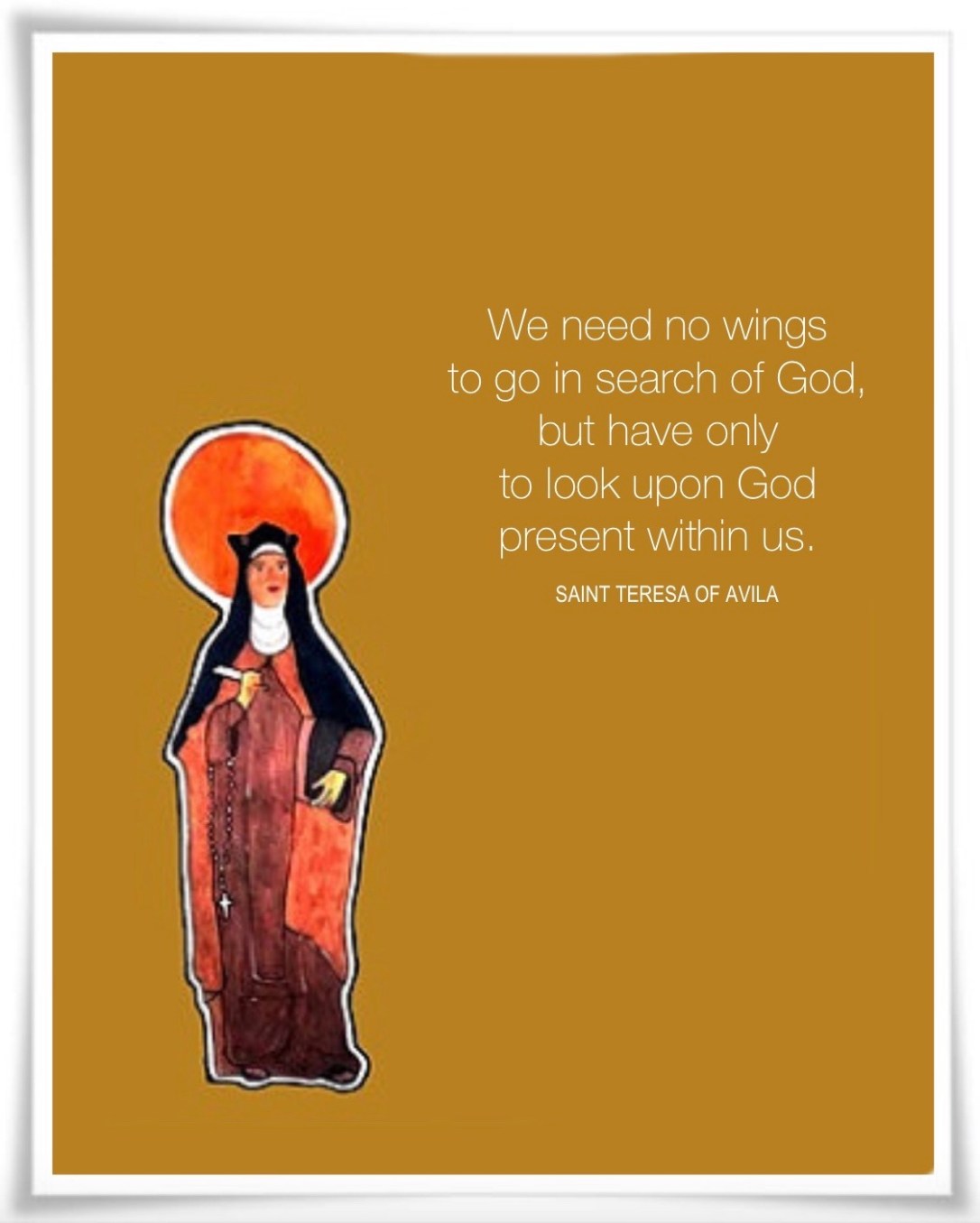
However quietly we speak, He is so near that He will hear us: we need no wings to go in search of Him but have only to find a place where we can be alone and look upon Him present within us.   — St. Teresa of Avila

I need no wings to go in search of God. 3B5858AA-997E-4D5C-8695-5D41049B2B90

When I can sense God present within me, I can believe in my own decision about a transplant, and any other decision for that matter. But I know that it takes a lifetime, and a lot of life experience, to be able to trust in a spiritual — perhaps mystical — union with the mind of God. It takes a lifetime of relationship for most of us to trust our intentions and our purity of heart enough to believe that our thoughts are God’s thoughts, that our decisions and actions are God’s. But when that day comes, I have an idea that it will feel like a “peace that passes understanding,” like a calm ability to quietly trust myself and trust God at the same time. 

May God’s Spirit make it so in me.

Amen


Falling down, God's presence, Grace

Falling Down!

324D54C7-5FB4-4D11-9649-5A3C500C9C2E

I really do hate falling down. Yesterday I fell in the kitchen. There was no banana peel on the floor to make me slip. Not a grape or a kalamata olive. I fell through no fault of any squishy piece of fruit on the floor. And I fell through no fault of my own, although I have to say that every time I fall or hurt myself in any way, Fred gently scolds me for being careless.

Well, yesterday I was not careless. I just fell in the kitchen with potholders in both hands. Good thing I had those grimy old potholders. My right hand potholder won the day because it broke my fall when I grabbed for the oven handle. So I only fell halfway, not all the way to the floor. A gracious gift!

Isn’t this a picture of life, all this falling? Over and over again, we nearly fall. And in between times of nearly falling, we really fall.

We fall hard sometimes. We fall all the way to hard ground sometimes. Sometimes we fall just part of the way to the ground. Sometimes we get hurt badly, and sometimes we can brush it off and move on as if it never happened.

Falling is not all bad. We learn a few things by falling:

  • We learn that people are often nearby to help us get up.
    or that no one is around to help us get up.
  • We learn that we can get up all by ourselves most of the time.
  • We learn that moving or twisting a certain way is a fall waiting to happen.
  • We learn not to be so careless.
  • We learn how not to do it again.

And we learn that there is someone always near us who can keep us from falling, someone who is mentioned in the tiny New Testament epistle we know as Jude. In one of the most beautiful benedictions in all of the Bible, Jude gives praise to this One who keeps us from falling, “the only God our Savior.”

Now to him who is able to keep you from falling, and to make you stand without blemish in the presence of his glory with rejoicing, to the only God our Savior, through Jesus Christ our Lord, be glory, majesty, power, and authority, before all time and now and forever. Amen. (Jude 24-25 NRSV)

And amen.

It’s one thing to be protected from falling. It’s quite another to “stand without blemish in the presence of God’s glory.”

That place where we stand without blemish is a sacred place, holy because of the presence of God, safe because of the protection of God. It is a good place to stand.

Thanks be to God.


Chronic illness, Comfort, Darkness, Despair, Emotions, Faith, Grace, grief, Holy Spirit, Hope, Illness, Inspiration, Introspection, life, Light, Pain, Romans 8:26, Silence, Sorrow, struggle, Trust, Wisdom

To the Other Side of Silence

9F2CA72F-217D-4CF9-A56D-D75B789A45C1
Barbara Resch Marincel, lifeisgrace.blog

Today is another “Wordless Wednesday.” My friend, Barbara Resch Marincel, is a sister blogger, an insightful writer, and a photographer extraordinaire. You can see one of her amazing works in the image on this post. The image reminds me of a dark time that is slowly changing with the glow of new light. And in that light, the flying birds speak to me of the wind of the Spirit. Barbara’s images are a gift to me, always bringing up a range of emotions.

Here is a bit of how she describes herself on her blog, lifeisgrace.blog.

Blogger, writer, photographer, in varying order. Finding the grace in the everyday—and the not so everyday, while living a full and creative life despite chronic pain and depression.

If you take a few moments of your day to visit Barbara’s blog, you will find enchantingly stunning photography that speaks of joy, pain, life and grace.

Back to “Wordless Wednesday.” So many reasons to be wordless. Some people may not have adequate words to express joy. Others cannot speak of deep sorrow. Some of us have no words because of pain, while others are wordless because they have fallen into the depths of depression.

There is no end to the reasons people are wordless, no end to the seasons in which they find they are without words. I have lived in that season many times, and in that place I could not speak of my pain because words were completely inadequate. I could not speak the pain out loud to any friend, and even for prayer, I had no words. Silence was my close companion.

I love that my friend, Barbara, entitles her blog post “Wordless Wednesday” every week, because in the middle of every week, she reminds me of my seasons without words. Her art is a reminder for me to give thanks that I survived those times, and celebrate that I am now on the other side of silence.

But will not forget that it is no small feat to get to the other side of silence. I must remember that it is not easy to endure silent, grief-filled times and to the other side of them. While living in my seasons of unspoken angst, one passage of Scripture brought me comfort and hope.

The Spirit helps us in our weakness; for we do not know how to pray as we ought, but that very Spirit intercedes with sighs too deep for words. 
— Romans 8:26 (NRSV)

When grief has stolen our words, when we cannot speak and find ourselves in silence, may open our lives to hope, trusting the intercession of the Spirit’s sighs that are far deeper than words. 

Thank you, my friend, for “Wordless Wednesdays.”

And thanks be to God for allowing me to move to the other side of silence.

Amen.

Calamity, Grace, Hope, Lightheartedness, mercy, Psalm 57, Repairing broken things, Uncategorized

Calamities and Grace

C6D6035A-FE70-4B02-8AEA-5E5E607F3278

Psalm 57 has been called “a prayer of safety from enemies.” When we believe that danger threatens to harm us, body and soul, that is the time that makes us cry out to God with the fervency of the Psalmist. Hear the Psalm’s second verse.

Be merciful to me, O God, be merciful to me!
For my soul trusts in You;
And in the shadow of Your wings I will make my refuge,
Until these calamities have passed by.

Ah, the calamities! So ever-present with us in uncertain times. Calamities! The synonyms are many and ominous:

Disaster, catastrophe, tragedy, cataclysm, crisis, adversity, blight, tribulation, woe, affliction, evil.

And those are just the first few listed in my trusty Thesaurus. There are many more, describing a state of being that is frightening, all-consuming and dangerous. Such a state of being we want to avoid at all costs. We want to take refuge swiftly before evil overtakes us.

Can you recall a time when your life was in calamity mode? So many situations can place us in calamity mode: illness, relationship problems, addictions, loneliness, aging, financial distress, the loss of a loved one and so many other situations of distress.

We feel as if “enemies” are chasing us, unrelenting in their threat. We run like the wind, if we can, to get away from them. But all too often, we look behind us and an “enemy” is right there, looming large before us and bringing us face to face with the cataclysm we feared. So we are now in the clutches of adversity, and we wonder if where we are is where we’ll ever be.

We are very good at laying out our calamities, lining them up one by one for all to see. Because when others see our calamities, we believe they will help us. We believe that our friends can help us escape our calamity du jour. In their help, we place our hope. Trouble is, sometimes we’re disappointed because hope does not often come through friends. Those around us have their own calamities. When they don’t (or won’t) reach into our troubled place and help us, we despair. What can we do? Where will we turn?

The truth is that when our soul trusts in God, we will wake up from our nightmare and find that we are sheltered in the shadow of God’s wings. Safe from calamity. Nestled in a place of refuge. Brokenness repaired. Watching gratefully as calamity after calamity passes us by.

What a grace is that! What unmitigated compassion! What sheer loving mercy from the God who might just as well have left us in the danger of our calamities.

Thanks be to God for every safe refuge, from every calamity. Amen

Comfort, End Stage Renal Disease, Friendship, God's presence, Grace, Hospital, Illness, Memories

A Horribly Wonderful Year

65398410-819B-4DB4-B114-256AC088A2D4
Art in foreground: “Horribly Wonderful” from The Land of Froud by Brian Froud, 1976.

Celebrating a five-year anniversary can be a fine excuse for a party! Definitely a five-year milestone can offer a chance to revisit and recall memories. My five-year anniversary is tonight, the night a phone call from my doctor ordered me to get to the ER. It was the night we learned that my kidneys had failed, just like that, out of nowhere, no notice. It was the night that end stage kidney disease turned my world upside down. It was the night that was the advent of a full year of hospital stays, biopsies, surgeries, physical and occupational therapy, loads of questions, very few answers and most of all, a very concerned and fatigued husband.

Fred was my rock, as he has always been. He slept next to me in that horrible excuse for a family bed. He kept vigil at the hospital day and night. When I was able to persuade him to go home to get some rest, he answered my phone calls in the middle of the night when I was sleepless, frightened or lonely.

“Are you up?” I would ask.

“I am now!” 

I don’t really think this anniversary calls for a party, but it does call for some reminiscing and remembering. So last night, Fred and I recalled the year I was so ill, that horribly wonderful year. Interestingly, we have two separate and differing sets of memories. He tells me that, most of that year, I was not aware of much, to the point of not even recognizing him. He tells me that I almost died during three separate critical events.

On my end, I remember none of that. I did lose time in that year, with confusion about losing days, even weeks, when I was unresponsive. I endured hundreds of needle sticks, maybe thousands since I am told my veins had collapsed. I received a port for hemodialysis that promptly caused me to nearly die of sepsis. I had a kidney biopsy that developed a painful bleed. I ate terrible food most of the time. I spent a lot of time in therapy learning to walk, write, identify colors and place square blocks in round holes.

Together we remember the love and care of my church, the family that constantly clamored for updates, the handful of good friends that were present, the food that the church brought to us every single week, and the nurses, angels in disguise.

I must say that, even to this day, I miss the sweet nurses that cared for me with great compassion. They were ever-present when I needed help and, during those long nights, they would often come in with a popsicle, sugar-free of course!

A final memory for today’s blog is the soft, fluffy afghan that my dear friend, Rev. Donna Rountree, brought me from her church. The Disciples of Christ church where my friend served as pastor barely knew me. I had preached there once. The congregation prayed for me, over the afghan, during a church service. Then Donna brought the afghan to the hospital, placed it on me, and told me that it was covered with the prayers of the people. What a special gift! What a special grace!

07CC221A-DFBC-4372-8E66-854CA41B0296When I think of that year, my description of it is “horribly wonderful.” Wonderful because, in the worst of times, God breaks in through the grace of a devoted husband, a caring family, an attentive nurse, a gentle phlebotomist, a close friend, a skilled physical therapist, a loving church family. 

So, yes, I took from that horrible year some wonderful memories, and that is what I can celebrate at this five-year milestone. And what’s more, I am here, still on this side of heaven and grateful for better health and life-saving dialysis. Pure grace!

Thanks be to God.


All Saints, Brokenness, Fear, Grace, grief, Gun violence, Hate, healing, Hope, Mourning, Prayer, Tikkun Olam, Tree of Life Synagogue, Violence

All Saints

05314FDF-2986-4602-8EF9-B1839FE693CEWe all need a glimpse of hope and comfort in these troubling days. Our thoughts and prayers are with our brothers and sisters of the Tree of Life Synagogue, and we are shocked at this and other recent acts of violence and evil. So today, I share with you the writing of Jemma Allen* in hopes that you will find her words as compelling and comforting as I have.

This week in many liturgical traditions we observe All Saints Day, and perhaps All Souls. In some places there is an opportunity to say the names, to light candles for, to ring the bell for those we love but see no longer, parted from us by death.  

All Saints and All Souls compel us to look death squarely in the face,
to acknowledge our mortality, and the mortality of those we love,
and still to make our song: Alleluia!

This is a season where we boldly proclaim
that death is not the last word.
Death, and fear of death, does not hold the power
to determine how we will live.

We are the dearly beloved children of the living God,
we are baptized into Christ’s death and resurrection,
we are looking to a future where justice and mercy kiss,
where nations will not learn war anymore,
where the lion lies down with the lamb,
where all things are reconciled to God.

This is our hope.
It is a hope that no power can destroy, tarnish or mar:
not white supremacy,
not anti-Semitism,
not any kind of hatred,
not any system of domination,
not any disease,
not any heartbreak. 

And when we cannot hold that hope for ourselves,
let us lean into the hope we can hold together
as communities of life, as communities of resistance,
as hope-bearers and pilgrims on the Way. 

0F547F1D-1DC0-40C3-A16E-E34DB2350099

Give rest, O Christ, to your servants, with your saints,
where sorrow and pain are no more, neither sighing, but life everlasting.
You only are immortal, our Creator and Maker;
and we are mortal, formed of the earth, and to earth we shall return.
All of us go down to the dust; yet even at the grave we make our song: Alleluia, alleluia, alleluia.

 – Russian Orthodox Kontakion of the Departed, Jim Cotter’s translation.  


*Jemma Allen is a priest in the Anglican Church of Aotearoa, New Zealand and Polynesia and a counsellor and spiritual director in private practice.  She serves on the Board of RevGalBlogPals and counts the RevGal community as one of her communities of life and resistance.

Comfort, Compassion, Despair, Friendship, Generosity, Grace, healing, Heartbreak, Hope, Loss, Ministry, Mourning, Restoration, sadness, Sorrow, Stars, struggle, Tears, Weeping

Weep with Those Who Weep

AD620082-4B5E-47C6-B2B0-0D553454614BWhat a caring and compassionate ministry it is to sit beside someone who is grieving and remind them of God’s grace. In recent days, I have wept for and with so many friends who are grieving for what they have lost because of the Florida hurricane. To be sure, there were losses in Georgia and in the Carolinas, but the devastation in and around Panama City was catastrophic.

Hordes of compassionate people traveled to Florida to help. They will clean up debris, repair or rebuild homes that sustained damage, do electrical work, provide help in the shelters, share their hearts and God’s heart, and stand beside families as they pick up the shattered pieces of their lives. Mostly, they will weep with people, and that’s what will help more than anything else.

Author Ann Weems paints a sparkling vision with her words that speak of the “godforsaken obscene quicksand of life.” But then she tells of a deafening alleluia arising from the souls of those who weep and from the souls of those who weep with them. From that weeping, Ann Weems tells us what will happen next. “If you watch,” she writes, you will see the hand of God putting the stars back in their skies one by one.”

I like to think that the caregivers who traveled to Florida did a lot of weeping with those who needed it and that they stayed near them long enough for them to “see the hand of God putting the stars back in their skies one by one.” When all is lost — when you learn that your loved one has died or you stand in a pile of rubble on the ground that used to be your home — seeing the hand of God putting the stars back in their skies would be for you a manifestation of pure and holy hope.

Without a doubt, Florida is experiencing “the godforsaken obscene quicksand of life.” Their memories of this devastating time will be cruel and long-lasting. They will remember better days, neighborhoods that once thrived, schools that were destroyed and friends who are trying their best to recover. But what grieving people will remember most is the care someone gave them and the loving compassion of strangers who became forever friends. I am reminded of the words of poet Khalil Gibran:

You may forget with whom you laughed, but you will never forget with whom you wept.

― Kahlil Gibran, Sand and Foam

Rejoice with those who rejoice, weep with those who weep.    Romans 12:15

Absolom, Bible, Church, Darkness, Daybreak, Family, Grace, Justice, Preaching, Sexual abuse, Tamar, Violence, Women, Worship

“Think Justice!”

DFDDBB19-8E9F-4852-9804-4F97B176E9A3

A sermon preached on September 30, 2018 at the First Baptist Church of Christ, Macon, Georgia

Let the words of my mouth and the meditations of our hearts be acceptable in your sight, O Lord, our hope and our refuge. Amen.

I

In July, I received a note from Ellen. She is 22-years-old, a college graduate with honors, a strong, confident young woman. This is what she wrote:

“I love all of you so much. None of this would be possible without you. My time with you had such an enormous impact on who I am, and I can’t thank you enough for everything you’ve done to get me to this point. You’re my family forever and always.    Ellen.”       (Written on her wedding day, July 8, 2018)

Thirteen-year-old Ellen came to us at Safe Places, an organization where my staff and I cared for women who had been abused, children exposed to violence, and young girls who had escaped the evil grip of human trafficking. When we first met Ellen, she was silent, lifeless, angry — hurt deeply in her soul. But after a few months, Ellen’s vivacious personality began to emerge. Slowly, she opened up her hurt place and let healing in. 

Ellen was eventually strong enough to be a part of our Princess Program, where girls who had experienced violence spent the summer learning and sharing, and discovering their inner courage, resilience, and sacred worth. After the summer, we celebrated the girls at the Arkansas Governor’s Mansion with a grand ball, a very grand ball. 

When they put on their sparkling gowns, and the most glittering shoes I had ever seen, they believed — for at least one magical night — that truly they were princesses. Our wise staff taught them that even princesses can be violated, but they already knew that. They had lived through the humiliation of verbal abuse, the pain of physical and sexual abuse, and the long-lasting effects of emotional abuse. For many of them, it happened in the one place that should have been safe — in their homes.

II

Throughout history, we encounter stories of violence. Such is our story today, a story about how violence devastates Princess Tamar, King David’s daughter. Sometimes historians, biblical expositors and even story-telling preachers come upon stories that are hard to tell. This is one of those stories. It’s probably not included in any anthology of  “The World’s Most Inspiring Bible Stories.” It’s a story we don’t tell to our children. We might prefer to skip this story altogether. Theologian, Phyllis Trible, would call it a text of terror. And yet, it is the word of the Lord, and, as such, it offers some truths, some warnings, some questions, and maybe even a smidgen of grace.

So even though we find trouble in this text, God might just whisper, and gently nudge us to listen and to let the story reveal some important ways God calls us to do justice. 

Listen for the whisper of God in the reading of sacred scripture, 2 Samuel 13: 1-22.

In the course of time, Amnon son of David fell in love with Tamar, the beautiful sister of Absalom son of David. Amnon became so obsessed with his sister Tamar that he made himself ill. She was a virgin, and it seemed impossible for him to do anything to her.

Now Amnon had an adviser named Jonadab son of Shimeah, David’s brother. Jonadab was a very shrewd man. He asked Amnon, “Why do you, the king’s son, look so haggard morning after morning? Won’t you tell me?”

Amnon said to him, “I’m in love with Tamar, my brother Absalom’s sister.”

”Go to bed and pretend to be ill,” Jonadab said. “When your father comes to see you, say to him, ‘I would like my sister Tamar to come and give me something to eat. Let her prepare the food in my sight so I may watch her and then eat it from her hand.’”

So Amnon lay down and pretended to be ill. When the king came to see him, Amnon said to him, “I would like my sister Tamar to come and make some special bread in my sight, so I may eat from her hand.”

David sent word to Tamar at the palace: “Go to the house of your brother Amnon and prepare some food for him.” So Tamar went to the house of her brother Amnon, who was lying down. She took some dough, kneaded it, made the bread in his sight and baked it. Then she took the pan and served him the bread, but he refused to eat.

“Send everyone out of here,” Amnon said. So everyone left him. Then Amnon said to Tamar, “Bring the food here into my bedroom so I may eat from your hand.” And Tamar took the bread she had prepared and brought it to her brother Amnon in his bedroom. But when she took it to him to eat, he grabbed her and said, “Come to bed with me, my sister.”

“No, my brother!” she said to him. “Don’t force me! Such a thing should not be done in Israel! Don’t do this wicked thing. What about me? Where could I get rid of my disgrace? And what about you? You would be like one of the wicked fools in Israel. Please speak to the king; he will not keep me from being married to you.” But he refused to listen to her, and since he was stronger than she, he raped her.

Then Amnon hated her with intense hatred. In fact, he hated her more than he had loved her. Amnon said to her, “Get up and get out!”

“No!” she said to him. “Sending me away would be a greater wrong than what you have already done to me.”

But he refused to listen to her. He called his personal servant and said, “Get this woman out of my sight and bolt the door after her.” So his servant put her out and bolted the door after her. She was wearing an ornate robe, for this was the kind of garment the virgin daughters of the king wore. Tamar put ashes on her head and tore the ornate robe she was wearing. She put her hands on her head and went away, weeping aloud as she went.

Her brother Absalom said to her, “Has that Amnon, your brother, been with you? Be quiet for now, my sister; he is your brother. Don’t take this thing to heart.” And Tamar lived in her brother Absalom’s house, a desolate woman.

When King David heard all this, he was furious. And Absalom never said a word to Amnon, either good or bad; he hated Amnon because he had disgraced his sister Tamar.

III

Indeed, there is trouble in this disturbing text. We discover it when we eavesdrop on Princess Tamar — daughter of King David, sister of Absolom, and half sister of Amnon. We learn that Amnon conspired to be alone with her. His sly servant came up with a plan, and she ended up in Amnon’s room. After hurting her, he rejected her harshly. He called for his servant: “Get rid of this woman! Banish her from my presence! Bolt the door after her!” 

He would not even use her name.

Tamar collapsed outside the door, plunged her hand into the cooling ashes of the fire, and rubbed the ashes into her hair. As she staggered away, she tore her richly embroidered gown as a sign of her deep-down despair. Even princesses can be violated!

King David was angry, but did nothing either to punish his beloved son or to comfort his despairing daughter. There was no consolation from father to daughter, not a single trace of compassion.  And her mother is silent.

Near the end of the story, we stumble upon a tiny touch of grace when we learn that brother Absolom takes Tamar into his home. But she is no longer a princess of royal lineage. She fades into oblivion and lives out her days as a refugee in her brother’s house, a desolate woman who will never marry and bear children. But did Tamar fade into oblivion? 

I don’t think so! Tamar’s voice was not silenced. She told someone her story, and that someone heard her, and remembered her story, and re-told her story, and told it at the right time to the right person so that this story made its way into our holy scripture. Thousands of years later, we do know Tamar’s name. Across all barriers of history and culture, and if we imagine, we can hear her speak across the ages:  

“I lost my life that day. Here in my brother Absolom’s house, I am a prisoner. I will never have children that will bear my name through the generations. I will not know that deepest of joys.”

IV

So just keep silence, King David!  Stay silent, mother of Tamar! Protect your violent son at all costs. 

What a deadly picture of family violence — the violence of a brother overpowering his sister, and emotional violence because both parents remained silent.

We might ask: where were the voices of her parents? We cannot help but wonder how Tamar’s father and mother might have responded differently. But this royal family decided to keep silence to protect Amnon.

In her sermon, “The Silences We Keep,” Rev. MarQuita Carmichael Burton speaks of “conspiratorial silence.” Reflecting on Tamar’s story, Rev. Burton speaks these words:

Reclaim our voices, shatter the façade of the deadly silence we keep. . .

We must trade in our torn robes and ashes for a bull horn and a listening ear and tell the truth of our story, so that our souls, minds, bodies and the people we say we love might be healed. 

As former silenced victims choose to no longer acquiesce to the demands of the clan elders and refuse the false healing promised by our conspiratorial muteness,  we move forward to reclaim freedom and wholeness on our terms, because we need it and so does the village.

V

In the end, it’s all about justice, and the Prophet Isaiah knew a lot about that.

Break every yoke!  Then your light shall rise in the darkness! 

You shall be called the repairers of the breach!

We have seen a breach, and from the abyss of that breach, the “Me Too” movement erupted. The movement is a wonder to behold, and perhaps the cry of “Me Too” is precisely where we find the movement of God. Secrets held for decades came out of the darkness into the light, and grief-filled silences found words. Tears flowed freely from hearts that held on far too long to painful stories.

But I wish that no person had ever needed to cry out “MeToo.” That no one had ever endured the horrifying violence that caused them to live with a silence and secrecy that held such power over their lives. 

I wish they had never felt the grief that tormented them in the voiceless spaces of their spirits. 

I wish that Tamar had always been a princess — loved, cherished, protected by her parents. 

But she was not. And so many of our sisters and brothers and neighbors and friends are not. 

We may not always know who they are, but perhaps it is most important for them to know who we are, a people committed to justice.

VI

Dear people of First Baptist Church of Christ, I marvel at the many and mighty ways you do justice — creating beloved community across racial and cultural and ethnic divides, feeding the hungry, caring for the poor, seeing the sacred worth of every person. 

Can we also find ways to do justice within families? One in four of us in this sanctuary have experienced — or are currently experiencing — family violence. 

Among all the things that doing justice is, it is also being healers of the wounds that happen in the prisons of family secrecy. What does that mean exactly? 

I believe it means finding healing and gentle ways to give voice to a family’s secrets and silences. 

It means being ever a kind listener and never a judgmental voice. 

It means making sure that church is a safe and sacred space. 

It means keeping a watchful eye, always, over children, teaching them to be safe, not only from strangers, but from people they know and trust. 

It means being aware of the invisible wounds that others carry, and reaching out with tenderness that brings healing. 

If Jesus were among us today, I imagine him speaking justice to the unconscionable abuse of power that causes violence. He would call out husbands who abuse their wives, brothers who hurt their sisters, parents who harm their children.  Jesus might look into homes and cry out, “Woe to you!” 

And then, in his gentle, loving way, Jesus would reach out to the those who suffer violence, take their hands, and speak hope to despair. 

Jesus is not physically among us. but he left us in charge. So when we fail to seek justice in every place where abuse happens, we confine him. Joseph B. Clower, Jr. expresses this most eloquently in the final lines of his book, The Church in the Thought of Jesus:

If the indwelling Christ is not confined, then the Church’s eyes flow with his tears, her heart is moved with his compassion, her hands are coarsened with his labor, her feet are wearied with his walking among men [people].

 When we accept this weighty call and this daunting responsibility, the prophet Isaiah might call us repairers of the breach!

VII

So let’s end our story . . . Yes, Princess Tamar lost her royal status. But the final word in this story belongs to the brother who loved and esteemed her, and who honored her. In the chapter following our text, we learn that Absalom was the father of three sons and a beautiful daughter he named Tamar, in honor of his sister.  

Can you imagine Tamar taking her infant niece into longing arms that never expected to cradle a child who would carry her name? 

Can you imagine her full heart as she envisions the future of Princess Tamar the Second, daughter of Absalom, granddaughter of King David, niece of Princess Tamar the First?

What a surprise from God — anointing Tamar’s wounds with a holy, healing balm! 

And this is the very foundation of our Christian hope: the faith, the conviction, the assurance, the certainty that when Tamar was crying, God was listening. 

People of God, we must repair the breach and seize this holy task: covering survivors of family violence with the compassionate cloak of justice, confronting violence wherever it casts its shadow, following God into every place where justice must overcome oppression.

On the campus of Philander Smith College in Little Rock, Arkansas, there is a building that faces the interstate. On that building is a huge sign declaring a strong, prophetic message to over 100,000 motorists traveling past it every day. The sign reads “Think Justice!” But it means so much more! 

It means longing for justice, praying for justice, insisting upon justice — persisting, prevailing, creating — doing justice, breathing justice — in families, in communities, and to the ends of the earth. 

Then the mighty waters of justice will roll over us, and we will wade together in ever-flowing streams of righteousness. Amen.
Belief, Faith, God's presence, Grace, Images of God

God Images

B33BBCE1-46BB-404E-8429-32535C46106FHow do you see God? What images of God do you see? How do you find God? Where do you find God?

Most of us have at least one image of God. It may be a vague image, but still, we have an image in our minds of a higher power. There are as many images of God as there are people. People have images of a “god” they may or may not know as a part of their spiritual journey. Some imagine God as a benevolent spirit, others as an omnipotent ruler. Some imagine God as as a father, others as a mother. Some imagine God as a protector, others as a punisher.

I remember a sermon I heard many years ago proclaimed by a passionate, animated African American preacher. “Tell me brother,” he preached with a lyrical chant. “Tell me brother, how do you find God? Tell me sister, how do you find God?”

And he repeated the questions again and again, building into a spirited crescendo, after which he said, “You find God when you get little enough that God can get big in you!”

And all the congregation responded with exuberant “Amens” and “Hallelujahs.”

I would surmise that the image of God held by that congregation, at least in that moment, was the image of an all-powerful, mighty Spirit just waiting to hear their praises and then responding with little miracles of answered prayer.

God images fill the world: there is the Creator God, the gentle shepherd, the God of vengeance, the God Most High, and from sacred music, the Mighty God, Wonderful Counselor, Everlasting Father, Prince of Peace.*

But we must acknowledge a significant exception. Some people simply say that they do not believe in God at all, any God. No images. No spiritual need for God. Nothing. They call themselves atheists.

I have known people who profess to be atheists. By no means am I an authority on this, but in my years as a hospital chaplain, I have never known a dying patient — whether believer or atheist — fail to cry out to God. In my years as a trauma specialist, pastor and pastoral counselor, I have never known an atheist who is in the depths of trouble fail to cry out to God.

I do not say that every person who does not believe in God always reaches for God in times of trouble. I am simply saying that in my experience, people in the midst of pain, grief, fear or other kinds of chaos search for a God who, by the way, is always there.

I recently read an intriguing quote by Marcus J. Borg:

When somebody says to me, “I don’t believe in God,” my first response is, “Tell me about the God you don’t believe in.”

― Marcus J. Borg, Jesus: Uncovering the Life, Teachings, and Relevance of a Religious Revolutionary

What a wonderful response, to affirm a person’s choice of unbelief while opening the door for meaningful conversation. That response is so much more respectful than a response that 1) forces a person to listen to a treatise on the existence of God; and 2) insists that the person must immediately become a believer by following a series of simple steps.

In the last analysis, a person does not find God on our timetable or through our methods. A person will find God in his or her own way and, on the spiritual journey, will see very personal images of God. They will discover the timeless grace offered to us all: a presence of God that is is constant and never-ending.

Where can I go from Your Spirit?
Or where can I flee from Your presence?

If I ascend into heaven, You are there;
If I make my bed in hell, behold, You are there.

If I take the wings of the morning,
And dwell in the uttermost parts of the sea,

Even there Your hand shall lead me,
And Your right hand shall hold me.

— Psalm 139:7-10 (NKJV)

As for me, I hold on to the image of a constant and ever-present God. Of all the images I have of God, the God I find “on the wings of the morning” most comforts me. I see God in many ways and in many places . . .  in Scripture, in nature, in my spirit. How do you see God?

For all who have eyes to see, let them see . . . images of a God strong and true, powerful and gentle, loving and accepting. God images are most assuredly there for us, for those of us who believe in God and for those who do not.


* “Hallelujah Chorus” from Handel’s Messiah


Beauty of Nature, Comfort, Grace, Life pathways, Nature, peace, Restoration, Serenity, simple joys, Transformation, Writing

Beside Still Waters


7C49B5E1-CD3A-4F00-B8CC-B55E370984B4
Still waters near Pulaski County, Arkansas. Photo by Steve Nawojczyk.

I long each day to live beside still waters, to dwell in serenity, to find peace in the depths of my soul. Not such a simple task, that. 

The problem is that life is not that much about still waters. It’s more often about churning waters and swelling currents. Don’t get me wrong, I love the sound of waves crashing in the ocean and then coming to the shoreline with a special kind of energy. I love the rolling of a mighty river, the trickling sounds of creeks, and the splashing sounds that streams make as  they ripple over stones.

But the sheer silence of still waters . . . That’s when you can skip a rock across the top of the water and watch its antics. In still waters, you can hear the sounds of fish flying up to the surface and turtles paddling almost silently acreoss the waters with only their heads visible in search for a morsel of food. In still waters, a family of ducklings can move through the waters with just a hint of a sound and the graceful swan can glide by with hardly any sound at all while its webbed feet move swiftly to push the waters aside.

Those still waters! Their silence and their calm show us how to be.

The truth is that rushing waters do describe our lives at times. That is our reality. Life brings what feels like raging storms. Life assails us with a power that reminds us of the breaking waves of the ocean. In this life, we come upon rivers too deep and too wide and too turbulent to cross. We will feel a force against us that may come because of serious illness or the loss of a loved one. It may come with the pain of broken relationships or with devastating financial hardship.

Life brings brokenheartedness, but it brings brokenheartedness in the midst of grace. For on this journey we call life, we travel with a divine guide, One who does lead us beside still waters. And it is there that our soul is restored and comforted in the midst of green pastures of sacred serenity and holy calm.

I am thinking, of course, of the words of the Psalmist.

The Lord is my shepherd, I shall not want.

He makes me lie down in green pastures; he leads me beside still waters;

       he restores my soul.

He leads me in right paths for his name’s sake.

Even though I walk through the darkest valley, I fear no evil; for you are with me;

        your rod and your staff — they comfort me.

— Psalm 23:1-4 (New Revised Standard Version)

I also think of my friend, Steven Nawojczyk, who is finding his much-needed peace in the forests, mountains and valleys of Arkansas. His stunning photograph illustrates today’s blog post. With his beautiful dog and companion, Feebi, he follows a path of serenity and healing, hiking through nature’s beauty most every day.

His life has not been an easy one. As a public servant — many years as Pulaski County Coroner — he has seen far too much anguish for one person. He was integrally involved, literally in the trenches, with ending and preventing Little Rock gang violence, and has been a staunch champion for young people.

He faces serious illness and harsh treatment in his retirement. but he knows that life really does have a pathway that goes around the dangers, toils and snares. He knows that he and Feebi will find lightheartedness in exploring a forest or watching a flowing stream. He knows that the simple joy of a mountain view can bring transformation. He knows about peace, and he has chosen to follow the life path that passes beside still waters. I admire him. I have always admired him, but even more so now as I witness his unwavering commitment to serenity.

That’s what it’s all about in the end — a commitment to serenity, a firm resolve to walk beside the still waters of life, and in that intentional journey, to find our souls.

May the grace and peace of God fill your soul, and may your journey, wherever it leads, bring you serenity.


Celtic Prayers, Comfort, Grace, Inspiration, Irish Blessing, life, Prayer, Worship

Grace for Your Day

75777FD8-6406-4CA0-A2BF-D043F39E8DB3To bring a bit of grace to your day, I offer prayers and blessings that have stood the test of time. Some of them have been used for centuries to lighten a load or brighten a day. In the great tradition of Celtic prayers and blessings, many of these are very much prayers and reflections from daily life, the ebb and flow of ordinary day to day life. They are petitions of the home and hearth.

In every life, there are uplifting moments and anxious moments, there are inspirational times and times of despondency. There are times when the heart is disconsolate. Some of these prayers read like hymns and could be sung as psalms. Others search the heights and depths of our faith.

With hope that you will find a sense of their deep peace, I commend these prayers, blessings and sacred art to you as an attempt to express that God is with us, always, and that in God we live and move and have our being.

Deep peace to you

32072582-2242-46F1-A21A-3560036A395F

D716109E-E232-4CF7-83BC-247DF08EBF18Prayer for evening rest

I lay my head to rest,  and in doing so,
I lay at your feet
the faces I have seen,
the voices I have heard,
the words I have spoken,
the hands I have shaken,
the service I have given,
the joys I have shared,
the sorrows revealed,
I lay them at your feet, and in doing so
lay my head to rest.


635E2A28-E43A-4BCD-8F34-6305A17273DCI arise today

I arise today
Through a mighty strength:
God’s power to guide me,
God’s might to uphold me,
God’s eyes to watch over me;
God’s ear to hear me,
God’s word to give me speech,
God’s hand to guard me,
God’s way to lie before me,
God’s shield to shelter me,
God’s host to secure me.

(first millenium – bridgid of gael)


8BD9F9D4-214E-41CA-B1FA-B86294928292Blessings of light

May the blessings of light be upon you,
Light without and light within,
And in all your comings and goings,
May you ever have a kindly greeting
From them you meet along the road.

May the nourishment of the earth be yours,
May the clarity of light be yours,
May the protection of the ancestors be yours.

May dawn find you awake and alert, approaching your new day with dreams, possibilities, and promises.
May evening find you gracious and fulfilled.
May you go into the night blessed, sheltered, and protected.
May your soul calm, console, and renew you.


40834FE7-48A9-49E1-AE4F-AEB48034D18EThrough the day

As the sun scatters the mist
at the dawning of a new day,
So you calm our fears and anxieties
if we trust you.
You give us strength and courage
to live our daily lives
knowing you are with us
and we do not walk alone.
As the midday sun warms us,
we feel your protecting arms around us
and sense your loving presence.
As the sun sinks in a kaleidoscope of colour
you give us hope and renewal.


7AD0C7EE-0F8D-4414-B99B-71D195BE3957

Dawning of the day

From the dawning of the day through the morning,
guide us,
from the noontide to the setting of the sun,
lead us,
from the evening till we sleep,
keep us,
through the night till daybreak,
protect us,
and all for your love’s sake.
Lord of the day
, Lord of the sunrise,
we give thanks for the birth of each child,
for the freshly opening rose,
for all newborn animals.
Lord of the morning,
we give thanks for energy and enthusiasm,
for the challenges of a new day,
for your Resurrection power.
Lord of the noonday,
we give thanks for the ability to work,
for all we can achieve,
for unrealized potential.
Lord of the sunset,
we give thanks for those who have died
in the faith of Christ,
for all who have inspired us, for our loved ones.
Lord of the night,
we give thanks for rest and refreshment,
for all your love and care,
for the promise of a new day.


F7E8C76C-DEB3-480C-9AF5-99166136E691Comings and goings

In our coming and going,
guide us,
in our living and our being,
protect us,
in our seeing and our hearing,
enrich us,
in our thinking and our speaking,
inspire us,
in our arriving and our departing,
preserve us.


A4E2837D-29C3-4A90-8539-636F307D3B25Morning mist

As the morning mist shrouds the river
and is then lifted by the gentle rays of the rising sun,
so may our clouded spirits be raised
by the warmth of your love.


6816D648-8E81-4524-BB93-740C91627A31This day and every day

I arise today
in your strength to uplift me,
in your power to direct me,
in your love to enfold me,
in your wisdom to guide me,
in your way to lead me
this day and every day.


A3EA52D1-2DA4-4020-A826-8C5FDA2A4C97


May God, the God of all comfort, encourage your heart and protect you from despair. May God’s face shine upon you as you rejoice in the midst of troubles and trials, putting your faith in God and being confident of God’s lovingkindness toward you. May Christ our Savior lift up blessings upon you with the riches of God’s joy and may He grant you on this day deep peace in your heart and soul. Amen.


Despair, Grace, grief, Heartbreak, Hope, life

A Life Breathtakingly Beautiful


C25B5F81-E091-4C5D-B357-414955E5AF53
Art by Darlene Gibson-Piper

Life can be tricky. Life is a living thing just waiting to grab you and pull you down, or so it seems at times. Bad things do happen to all of us. Misfortune can suddenly engulf our lives and leave us, any of us, in a heap on the ground, heads bowed low.

I know all too well the stark reality of being brought low, but when I find myself face down in the dirt, I always recall one of the most comforting passages of Scripture.

We are troubled on every side, yet not distressed; we are perplexed, but not in despair; Persecuted, but not forsaken; cast down, but not destroyed . . .

— 2 Corinthians 4:8-9 (King James Version)

At this time in my life, I am thankfully on the other side of a very serious illness. But the year 2014 was a nightmare year for me and for my family. I spent a good part of that year in the hospital, at times leaning very close to death’s door. Much of that year, I spent in a mental haze not even knowing the loved ones caring for me. I was often very afraid, but one thought came to mind again and again.

Here is the world. Beautiful and terrible things will happen. Don’t be afraid.
― Frederick Buechner, Beyond Words: Daily Readings in the ABC’s of Faith

So many people find themselves afraid and in despair. In the time it takes me to write this piece, five people in the U.S. will take their own lives. For every suicide, there will be 25 attempted suicides. Some people will suddenly and unexpectedly lose a job and plunge into financial ruin. Others will lose someone they love by death or divorce. Others will fall deeply into illness. Others will face the challenges of aging and lose their homes. Some will experience the terror of addiction. Every person — every person — will know the lowest depths of despair, an existence void of hope.

I love the writing of L.R. Knost. She is an award-winning author, feminist, and social justice activist, the founder and director of the children’s rights advocacy and family consulting group, Little Hearts/Gentle Parenting Resources, and the Editor-in-Chief of Holistic Parenting Magazine. Her writing is down to earth and uplifting, always filled with snippets of pure wisdom. This is what she writes about life.

Life is amazing. And then it’s awful. And then it’s amazing again. And in between the amazing and awful it’s ordinary and mundane and routine. Breathe in the amazing, hold on through the awful, and relax and exhale during the ordinary. That’s just living heartbreaking, soul-healing, amazing, awful, ordinary life. And it’s breathtakingly beautiful.

She is so spot-on about life, so thoroughly wise. She knows about muddling through the muck of life to the best part of it, the beautiful part of it. And that’s what we must do, muddle through until we get to the beauty. It is true that life doesn’t always get better. Sometimes the thing that breaks us down just lingers with us and keeps us on the lowest ground of desperation. Yet there is that life-giving, life-saving thing called grace, the gentle and persistent grace that is ever-present with us during every low season in life.

Here is the reality, the tried and true foundation of truth that keeps us moving forward after a difficult patch. Again, L.R. Knost describes it.

Life doesn’t always get better.
But you do. You get stronger.
You get wiser. You get softer.
With tattered wings you rise.
And the world watches in wonder at the breathless beauty of a human who survived life.

Going back to that wonderful passage in 2 Corinthians, we find this:

. . . We do not lose heart. Though outwardly we are wasting away, yet inwardly we are being renewed day by day. For our light and momentary troubles are achieving for us an eternal glory that far outweighs them all.

— 2 Corinthians 4:16-17 (New International Version)

This is, indeed, a soul-healing life, utterly beautiful during the good times, but still heart-breaking and frightening at other times. You and I will pick ourselves up from the dusty earth again and again. We will most certainly rise to our feet for another day. We will find the gentle, persistent grace that holds us upright. We will not lose heart. We will make it to the breathtakingly beautiful part of our lives. Count on it!

Belief, Challenge, Change, Christian Witness, Community activism, Dreams, Grace, healing, Hope, Justice, Ministry, Mission, peace

A Broken, Waiting World

B507DED1-C6B2-4332-80BA-4B65623E2196

Do not be dismayed by the brokenness of the world. All things break. And all things can be mended. Not with time, as they say, but with intention. So go. Love intentionally, extravagantly, unconditionally. The broken world waits in darkness for the light that is you. ― L.R. Knost

When I was in seminary so many years ago, I worked part time in the Development Office, that extraordinary place that dreamed up words designed to gain support for the seminary and to tell the world what we were about. The one creative theme I most remember, because we made it our catch phrase and printed it on everything, was “We’re out to change the world!”

Some students left the seminary, degree in hand, and did just that. The rest of us labored mightily and did everything we knew to do to change a world that most assuredly was waiting and broken. What a mission!

I must admit, that short statement from seminary days became my personal quest. In every ministry position, I tried to change the world, much to the dismay of my parishioners. I took on every worthy cause as my own challenge to change the world. I committed myself to justice and set my face toward hope and healing for every person suffering injustice and indignity. It became a life-long quest, a personal commission. And what’s more, I sincerely believed I could do it, at least for the first few years I spent banging my head against various walls.

The song lyrics “to dream the impossible dream” come to mind. For those of you who may be too young to know about the magic of the 1964 Broadway musical, Man of La Mancha, I must give you the lyrics of the song that was the pronunciamento of the primary character, Don Quixote, and that almost instantly became the credo that many people of God embraced in trying to change the world.

To dream the impossible dream …
To fight the unbeatable foe …
To bear with unbearable sorrow …
To run where the brave dare not go …
To right the unrightable wrong …
To love pure and chaste from afar …
To try when your arms are too weary …
To reach the unreachable star …

This is my quest, to follow that star;
No matter how hopeless, no matter how far:
To fight for the right, without question or pause;
To be willing to march into Hell, for a Heavenly cause.

And I know if I’ll only be true, to this glorious quest,
That my heart will lie will lie peaceful and calm,
when I’m laid to my rest.

And the world will be better for this:
That one man, scorned and covered with scars,
Still strove, with his last ounce of courage,
To reach the unreachable star.

— Lyrics by Joe Darion

Today, as I watch military strikes against Syria and know that our country has not welcomed desperate Syrian refugees, I am painfully aware that I did not change the world. I worked in Uganda after the devastation of Idi Amin, but I did not change the world for millions of Ugandan widows and orphans.

I worked with persons who were sick and dying in hospital ministry, and I did not change their hopeless world of suffering. I have written letters, contacted government officials, participated in demonstrations, and signed hundreds of petitions, but I have not changed the world.

It has indeed been an “impossible dream.” And yet, I believe that I lived into my call from God and followed every path God placed before me. I faced off against what I viewed as evil many times and was deeply, demonstrably angry many times. But always, my mission remained in the center of God’s gentle grace and love. How?

I learned along the way — finally — that changing the world God’s way means holding tightly to lovingkindness, compassion, love and gentleness. The Scripture in Galatians 5:22-23 (NIV) says it like this:

. . . the fruit of the Spirit is love, joy, peace, forbearance, kindness, goodness, faithfulness, gentleness and self-control.

“Change the world with gentleness,” God might say to me.

While others stand for bigotry, racism, violence and war, change the world with gentleness. While leaders refuse to welcome refugees who long for a safe haven for their children, change the world with gentleness. While the highest positions in this country are embroiled in collusion, corruption, lies, greed and unkindness, change the world with gentleness.

This is a broken, waiting world that yearns, not for my righteous anger toward the world that is, but rather for my gentle hands of healing for the world that can be.

Change the world with gentleness? How? Why?

Because “Gentleness is not weakness. Just the opposite. Preserving a gentle spirit in a heartless world takes extraordinary courage, determination, and resilience. Do not underestimate the power of gentleness because gentleness is strength wrapped in peace, and therein lies the power to change the world.”

― L.R. Knost

May God lead us all in the paths of righteousness and gentleness. Amen.

Church, Covenant, Creativity, Easter, Friendship, Grace, Lent, Memories, Resurrection, Resurrection People, Roots, Tears, The Christian Church

Resurrection People

C1D1BB39-1AD2-4D57-8ED7-8464718B35D8On Resurrection Sunday, I cry joy-tears — every time, without fail. For me, holding on to my emotions on Resurrection Sunday is impossible. After going through Lent, after hearing again of the betrayal Jesus experienced, after witnessing the suffering and execution of Christ, after acknowledging anew that Christ’s sacrifice was for the whole world and for me, I celebrate Christ’s resurrection. And when I do, I just cry.

But on Resurrection Sunday 2018, I wept with a heavy heart and a flood of memories. I thought of Easters past and the people of God with whom I celebrated. All of those precious friends now live miles away, others live in heaven. I was their pastor, and that is as holy a relationship as I can describe.

I walked with them through joy and tragedy, through days of health and days of illness, through crushing family problems, through death and divorce. But through every devastation, we celebrated Resurrection Sundays in our beautiful monastery chapel, in our little country church in small town Arkansas, at an altar on a lakeside, in the baptismal waters. We celebrated our covenant, our deep friendship, and gave thanks for the grace that gifted us with those relationships.

We were a fun and creative group. With some of them, I cut and stitched and glued and appliqued huge banners proclaiming, “Christ Is Risen!” With others, I burned palm branches for Ash Wednesday. With others, I lifted up the wooden cross onto thevaltar of the church sanctuary. And with others, I wandered through the woods searching for dogwood blossoms to adorn the wooden cross. I most fondly remember a circuitous and hilarious trek through the forest with Ethel.

Ethel was a true jewel, one of a kind. Never would you find a more loyal and loving parishioner than Ethel, who will always be known as the persevering founder of our church. She refused to let it fail. She was persistent and feisty and determined. And because of her, the church still stands firm, even now that she is gone.

But getting back to our trek in the forest, I have to say that Ethel was one of those unstoppable “elderly” people. She could barely walk at times because she suffered with a muscle disease that weakened her legs. But she pushed her way through the forest that day, leading me, pushing aside the limbs, vines and thorns, and dauntlessly creating our path over rocks and depressions in the ground. We were looking for a thorn tree . . . you guessed it . . . to use in making a crown of thorns.

Eventually we found a perfect thorn vine with angry-looking three-inch thorns on it. We carefully hauled it through the woods, trying to avoid getting stabbed by one of those sharp thorns. Then we put it in a bathtub full of water to soften it. When we began to bend it into a crown shape, we both sustained painful thorn wounds. Never to be deterred, Ethel managed to shape and finally fasten the two ends together, and the prickly vine became the crown of thorns that we used for many years.

When we placed it for the first time on the Good Friday cross during the church service, I wept. Many of us wept. We were like that because we remembered the words of the prophet Isaiah.

He is despised and rejected by men,
A Man of sorrows and acquainted with grief.
And we hid, as it were, our faces from Him;
He was despised, and we did not esteem Him.

Surely He has borne our griefs
And carried our sorrows;
Yet we esteemed Him stricken,
Smitten by God, and afflicted.

But He was wounded for our transgressions,
He was bruised for our iniquities;
The chastisement for our peace was upon Him,
And by His stripes we are healed.

All we like sheep have gone astray;
We have turned, every one, to his own way;
And the Lord has laid on Him the iniquity of us all.

He was oppressed and He was afflicted,
Yet He opened not His mouth . . .

— Isaiah 53:3-7, KJV

We knew that after the suffering, the resurrection would most surely come. Through the passion and emotion of Good Friday, we wept. But we wept even more when the stark cross flowered on Easter morning, when we lit the Christ candle, when the black shroud was removed, and when we draped the cross in glistening white cloth.

So on Resurrection Sunday 2018, while singing “Christ the Lord Is Risen Today,”I wept with tears of gratitude, gratitude for the people of God through the years who made my Easters such sacred experiences of worship.

Ethel, Barbara, Johnnie, April, Bo, Michael, Stan, Dianna, Eric and Emily, Ann, Sister Bernadette, Gail, Noah, Wendell, Pat, Joyce, Suzette, Deborah, Cindy, Barbara Fay, Regina, Tonya, Vallory, Leroy, Mary, LaVante, Shirley, Ken, Steve, Jenna . . .

So many names! So many others. My memories of them brought me to tears on Easter Sunday. I saw them in my mind and remembered our shared times of worship. They are Resurrection people all, people who know how to proclaim Christ’s resurrection with passion, devotion and celebration. For all of them, today I give thanks.

Grace, Growth, Restoration

The Dew in the Morning

9661C088-0011-4593-95AD-A1C0438649A9In some traditions, dew is celebrated in poetry and prayer as a bringer of life. Dew that accumulates during the night surrounds plant leaves every morning for approximately two to three hours past sunrise. In the early morning, the time of day when plants grow, the droplets of dew surrounds the leaves of a plant with moisture. The plant does not close its pores, so it receives the life-giving moisture that makes it grow.

I have contemplated that thought today in thinking about my own growth, about morning and night, light and darkness. All of us experience times of darkness, nights of emptiness when even the stars seem to give no light. A life faces those dark times in illness, aging, the loss of a loved one, financial problems, a difficult relationship, a fatal diagnosis.

Indeed, we live through those kinds of dark times. But our Christian faith assures us that after the night, the morning comes — every day, without fail. The miracle is that many people claim that when darkness falls on their lives, they experience growth.

I can attest to the fact that it truly is in the darkness where my soul and spirit has grown and matured. Without a doubt, it was a painful growing time, a testing time, but a time that made me stronger and more resilient.

So I find comfort in the thought that after dark nights, morning comes, and with the morning, the refreshing and healing dew. Like tender plants that open their pores to drink life-giving dew that falls gently on them, we can open ourselves to the soft touch of the “dew in the morning.” That is a gift to us, a grace-gift that we receive from a loving and caring God who knows that we hurt, but also knows that we survive and grow.

The dew in the morning just might bring us comfort after a long darkness, bringing life, healing, refreshment, growth, and new beginnings.

Grace, Hope, Illness, life

Life Is a Gift

IMG_5772

Today I read an inspiring blog post written by my long-time friend, Guy Sayles. He recalls his medical diagnosis of Multiple Myeloma three years ago and describes the experience of “vivid remembering of hard days of treatment.”

Around the same time, I entered a time of serious and unexpected illness which led to a diagnosis of end stage kidney disease. I spent most of 2014 in the hospital, literally fighting for my life on at least three occasions. My husband was terrified. Mercifully, I knew nothing of the urgency of what was happening to me.

Guy Sayles writes of a reality that I completely understand when he says, “The first two years of my having Multiple Myeloma were so challenging that I didn’t expect to be alive now. That I am is sheer and surprising gift to me.” (http://www.fromtheintersection.org/blog/2017/8/8/its-all-gift)

For me, it was not so much that I expected imminent death, but throughout my long period of recovery and rehabilitation, I never expected to be able to care for myself again. That I now am able to live a relatively normal life is most certainly a gift of grace I never expected. Healing and recuperating was much like a resurrection for me. I got my life back.

So my constant question to myself is what will I do with this gift of life? I am inspired by the way Mary Oliver asks this question in her poem, The Summer Day.

Tell me, what is it you plan to do with your one wild and precious life?

I am compelled to answer that question, to use the gift of my life as a gift to others. To care for people with compassion. To do justice where oppression reigns. To make peace in the face of violence. To scatter hope in the places where despair has taken hold.

I hope you will truly hear the way Guy Sayles expresses this.

The awareness which gently and repeatedly washed over me was, “Life is gift and my response may, can, and should be gift-giving.”

And my calling is to lavish gift-giving—to share freely and fully whatever I manage to harvest. There’s no need now for barns and bins, for storing up for another day, or for worrying about markets and prices. “Freely you have received,” Paul said, “freely give.”

These days, I aspire, in every dimension of life, to this the wisdom Annie Dillard offered to writers:

“One of the few things I know about writing is this: spend it all, shoot it, play it, lose it all, right away, every time. Do not hoard what seems good for a later place in the book, or for another book; give it, give it all, give it now . . . something more will arise for later, something better. These things fill from behind, from beneath, like well water . . . The impulse to keep to yourself what you have learned is shameful, it is destructive.  Anything you do not give freely and abundantly becomes lost to you. You open your safe and find ashes.” (The Writing Life, pp. 78-79)

Amen and amen. May God make it so.

Contemplation, Darkness, Faith, Fear, Grace, grief, Loss

In the Dark


IMG_5755

I was asked recently to write about faith and chronic illness. The request prompted me to recall the year I lived in the dark, the year that I was so seriously ill. It made me think about the losses I have experienced since the diagnosis of end stage kidney disease. It reminded me of the freedom I have lost because of the eight hours I spend on dialysis every day.

The truth is that, in 2014, I thought I was going to die. The greater truth is that I did not die. In fact, I slowly grew physically stronger. Spiritually and emotionally, I descended into grief and despair and somehow managed to emerge with fresh hope and deeper faith.

It was a grueling process learning to write again, practicing with the occupational therapist’s endless pages of ABCs over and over until I began to form legible letters. It was hard learning to walk again, regaining the strength and balance I had lost. It was hard being unable to cook, to care for the house, to bathe myself, to browse the web, to do all the simple things I used to do so easily.

To be sure, it was a dark time of frightening uncertainty and doubt. I mourned for the life I once enjoyed. But in time, I discovered an unexpected grace: that spiritual transformation often happens in the dark. The writing of Richard Rohr offers a way to describe this time of my life. This is what he writes.

We seldom go willingly into the belly of the beast. Unless we face a major disaster . . . we usually will not go there on our own accord. Mature spirituality will always teach us to enter willingly, trustingly into the dark periods of life, which is why we speak so much of “faith” or trust.

Transformative power is discovered in the dark—in questions and doubts, seldom in the answers . . . Wise people tell us we must learn to stay with the pain of life, without answers, without conclusions, and some days without meaning. That is the dark path of contemplative prayer. Grace leads us to a state of emptiness, to that momentary sense of meaninglessness in which we ask, “What is it all for?” 

– Richard Rohr

It was indeed “the belly of the beast” for me. And as Richard Rohr writes so eloquently, I needed to learn to “stay with the pain of life, without answers, without conclusions, and some days without meaning.”

Here’s the outcome. Smack dab in the middle of the darkness I experienced, there was God. There was grace. There was transformation. And there was renewed life. Thanks be to God.

Darkness, Faith, God's Faithfulness, Grace, Life pathways, Light

Light for a Dark Path

IMG_5623

Life can be a very dark path, frightenly uncharted. Inching through life often finds us hesitating in dark places, afraid to take even one step into an unknown future. The darkness can be daunting. Still, for me light has at times eased the darkness, and with even a tiny ray of light, I was able to move forward.

Brother Curtis Almquist writes of the grace-filled presence of beacons of light.

There have been people in our past who have been beacons of light, and whose life still shines into the present . . . and we remember them because they help us find our way and know our place in life, which is otherwise so terribly uncharted.

– Brother Curtis Almquist
Society of Saint John the Evangelist

How fondly I remember and give thanks for the people who were beacons of light for me.

Yiayia, my beloved grandmother, who was my faithful and loving protector and whose energy nurtured me.

Thea Koula, my favorite aunt, who was like a mother to me and who brought joy and lightheartedness to my life.

Ethel, my forever friend, who was a constant beacon of light, always helping me find my way.

In the darkness, the light of faith endured and made the journey possible. Most certainly, the people in my life strengthened my faith and were for me a welcomed light for a dark path. And yes, I stumbled over more than a few nasty obstacles and rough spots. But even when I languished in the darkness of an uncharted path, my faith was enough. My faith was my brightest light.

I will be forever grateful for the beacons of light that helped guide me on the journey and for the enduring, constant presence of a faithful God.

The Lord will guide you always;
will satisfy your needs in a sun-scorched land
and will strengthen your frame.
You will be like a well-watered garden,
like a spring whose waters never fail.

– Isaiah 58:11 NIV