Bible, Comfort, Despair, Faith, God's Faithfulness, God's presence, grief, healing, Heartbreak, Hope, Isaiah, Pain, Psalms, Skies, Stars, Suffering

The Hands that Made the Stars

7AA0FE34-BEE8-4CFC-AEF3-1E8D99948530
Comfort in the magnificent Arkansas skies. Photography by Steven Nawojczyk.

As I write on this day, I am aware that many friends are in the throes of darkness and despair. Some are facing devastating medical diagnoses. Some are yearning to have a child and are going through difficult medical procedures. Some are grieving for a family member in trouble. Some are waiting with hope for a cure for a disease that is bringing them to their knees. Others are enduring harsh medical treatments, hoping their lives will be saved. Many of them are at the point of losing all hope.

It hurts me deeply every time I am at a loss for comforting words. A little part of my heart breaks because I know I cannot “do something” to ease the suffering. And so I search for my own comfort as I search for ways to hold my friends in the light. As always, I am led to Scripture, not for easy answers, miraculous cures, or an instant panacea. I peek into the Bible to find words that will lift up hope in the middle of dark days and darker nights.

Often the words I find point me to the skies, as if gazing into an expanse beyond imagination might open my eyes to a radiant and holy hope. In truth, the words of Scripture do point me to hope. 

From the Prophet Isaiah:

Look up into the heavens. Who created all the stars? He brings them out like an army, one after another, calling each by its name. Because of his great power and incomparable strength, not a single one is missing. O Jacob, how can you say the LORD does not see your troubles?

Have you never heard? The LORD is the everlasting God, the Creator of all the earth. He never grows weak or weary. No one can measure the depths of his understanding. He gives power to the weak and strength to the powerless.

— Isaiah 40:26-29

From the Psalmist:

When I look at the night sky and see the work of your fingers — the moon and the stars you have set in place — what are mere mortals that you should think about them, human beings that you should care for them?

— Psalm 8:3-4

And so whoever you are, whatever pain you are carrying, know that the hands that made the stars are holding your heart.

Comfort, Faith, God's presence, Inspiration, Nature

My Lord Is Near Me All the Time

635D7269-16B0-4C30-8A96-05536FDFF587Magnificent power! On a ride through the Georgia countryside, I witnessed nature’s beauty in a thunderstorm. The sky lit up from one end of the horizon to the other and then enormous streaks of lightning flashed in astounding display. It took my breath away, not because of its danger, but because of its brilliance. I struggle to find words to describe it.

Here’s how to scientifically explain it. Within a thundercloud way up in the sky, many small bits of ice (frozen raindrops) bump into each other as they move around in the air. All of those collisions create an electric charge. After a while, the whole cloud fills up with electrical charges.

And so it was tonight. I do not always find spiritual significance in acts of nature, but this night I was overwhelmed with the idea of the absolute power of God’s creation. At the same time, I considered my close relationship with Jesus.

God, whose ultimate power can be beyond our human comprehension, visited us through his Son who walked among us on this earth. All of it dawned on me in the midst of a powerful, resplendent thunderstorm that reminded me of the eternal truth of a beautiful hymn, “My Lord Is Near Me All The Time.” *

In the lightning flash across the sky
His mighty pow’r I see,
And I know if He can reign on high,
His light can shine on me.

I’ve seen it in the lightning, heard it in the thunder,
And felt it in the rain;
My Lord is near me all the time, My Lord is near me all the time.

When the thunder shakes the mighty hills
And trembles ev’ry tree,
Then I know a God so great and strong
Can surely harbor me.

I’ve seen it in the lightning, heard it in the thunder,
And felt it in the rain;
My Lord is near me all the time, My Lord is near me all the time.

When refreshing showers cool the earth
And sweep across the sea,
Then His rainbow shines within my heart,
His nearness comforts me.

I’ve seen it in the lightning, heard it in the thunder,
And felt it in the rain;
My Lord is near me all the time, My Lord is near me all the time.

As a child my overprotective grandmother made sure that lightening would frighten me. It worked because of her very frightened demeanor at the first sign of a storm. I remember how she gathered my brothers and me close beside her on the sofa, wrapping her gentle arms around us. At every clap of thunder, she screamed.

But as an adult, I actually love thunderstorms. When thunder roars, I hear it as a reminder of God’s strength. When lightning flashes across the sky, I see it as a marvel of God’s power. When I feel showers of rain, I feel God’s presence in the provision of life-giving water. In all of it, I am grateful for the nearness of a relationship with Christ. It is abiding truth: my Lord really is near me all the time.

Amen.

To listen to the hymn, “My Lord Is Near Me All the Time” click on the video below:

 
* Georgia hymn writer, Barbara Fowler Gaultney (1935-1974), turned to writing hymns as a source of hope and an expression of her faith. In tenuous health throughout her life, Gaultney was educated in the Atlanta public schools and attended the University of Georgia. While a member of the First Baptist Church of Forest Park near the Atlanta airport, she penned both the words and music to “My Lord Is Near Me All the Time.” Her minister of music, Julian Wilson, assisted her in submitting it for publication. Her hymn was first published in the Baptist church music periodical, The Church Musician, April 1960. It then appeared in the 1975 Baptist Hymnal and has become a favorite of many congregations.  (Harry Eskew, https://gabaptistworshipmusic.org/my-lord-is-near-me-all-the-time/)


Please feel free to contact me by completing the following form.

← Back

Thank you for your response. ✨

Change, Courage, Darkness, Fear, God's presence, healing, Heartbreak, Hope, Life pathways, Pain, Restoration, Uncategorized

Through the Fire

892264FE-E803-4E0E-B598-C7503D77F674Sometimes life hurts.
We suffer. We heal. We move on.
But sometimes life hits back. Harder.
Lethal in its cruelty.
Shattering us into a million glittering shards
of pain and loss and anguish.
And we suffer, too broken to heal,
to become what we once were.
— L.R Knost

How deeply I know that feeling of brokenness. I am personally acquainted — well acquainted — with the lethal cruelty that life can present. To heal the past requires that I pay close attention to the spiritual and emotional places within me in the present, to make sure I am healthy and whole right now. Only then will I find the strength to invite the pain of the past into my psyche so that I can face off against it.

I have learned through the years that it is not a good option to leave past pain where it is, to let it occupy the place within me it has claimed. This writing by L.R Knost is one of the best descriptions I have ever seen on healing from past pain.

Healing is not a straight and narrow road
that leads from darkness to light.
There’s no sudden epiphany to take
us from despair to serenity, no orchestrated
steps to move us from hurting to healed.
Healing is a winding mountain road with steep
climbs and sudden descents, breathtaking views
and breath-stealing drop-offs, dark tunnels
and blinding exposures, dead ends and
endless backtracks, rest stops and break downs,
sheer rock walls and panoramic vistas.
Healing is a journey with no destination,
because healing is the journey of every lifetime.

Indeed, “healing is the journey of every lifetime.” The reality is that the only way to heal from the pain of the past is to walk directly through the center of that pain in the present. Does it feel safer to just let the pain continue to smolder in the dark parts of myself? Of course it feels safer. It feels terrifying, in fact, downright terrifying.

But the dark places in me will never heal spontaneously. I have to conquer the fear and open up to the possibility that God’s Spirit can breathe life back into those embers of pain snd rekindle the fires of unhealed hurts. So as I sit cautiously at the very edge of the fires of past pain, I cannot help but recall the comforting words of the prophet Isaiah.

When you pass through the waters,
I will be with you;
and when you pass through the rivers,
they will not sweep over you.
When you walk through the fire,
you will not be burned;
the flames will not set you ablaze.

— Isaiah 43:2 New International Version (NIV)

And so many times, I have found deep comfort in singing the beloved hymn, How Firm a Foundation.

When through fiery trials thy pathway shall lie,
 My grace, all sufficient, shall be thy supply.
 The flame shall not hurt thee; I only design
 Thy dross to consume and thy gold to refine.*

Text: Attr. to Robert Keen, ca. 1787.
Music: Attr. to J. Ellis, ca. 1889

So the flames aren’t there to burn me. The flames are there to light my way through pain to healing. At times, I have approached those flames with courage and confidence. But at other times, I met the flames with terror.

Courage or terror — it didn’t matter really. I just walked through it just as I was, and as I did, the hurt transformed into hope. I had wounds, for sure, and lasting scars. But the scars tell a story of the battles I won and the battles I lost, and most importantly, the scars tell the story of a human who survived. So, in spite of fiery places of past pain, we learn to live as L.R. Knost says

. . . with the shards of pain and loss and anguish forever embedded in our souls,

and with shaking fingers we piece together the bloody fragments of who we were into a mosaic grotesque in its stark reality,

yet exquisite in its sharp-edged story of the tragic, breathless beauty of a human who survived life.

And we move on, often unaware of the light glittering behind us
showing others the way through the darkness.

This is a resilience we can be thankful for, a perseverance we can cherish, a strength straight from a present and faithful God that will ever — forever — sustain us. Amen.


* Hear the entire hymn, How Firm a Foundation, at this link:
https://m.youtube.com/watch?v=G0S62se1hAE

Comfort, God's presence, healing, Heartbreak, Inspiration, life, Mourning, Pain, peace, Restoration, sadness, Serenity, Sorrow

Guard Your Heart

FF412EF2-E311-4F00-9859-65D0582E5935A heart can break so easily. Life is filled with heartbreaking things, and no person is immune to heartbreak. Hurt from one’s children, the loss of a loved one, a marriage rife with anger, abuse by a trusted person, betrayal by a lifelong friend — all of these can leave a heart crushed.

How important it is, though, to find healing for our hearts, to find the healing balm that will ease the pain. We recall the comfort of Scripture that says, “Do not let your hearts be troubled, neither let them be afraid.” We lean on the everlasting arms that always hold us, we rest on the promise that “God heals the brokenhearted and binds up their wounds,” (Psalm 147:3) and we hear again the tender words of the Psalmist.

The Lord is near to the brokenhearted and saves those who are crushed in spirit.

— Psalm 34:18

So we take these promises into our souls, and we give ourselves the time we need to heal our broken hearts. To be sure, the healing depends upon letting enough time pass for restoration to happen. Never do we heal on a swift timetable. The clock must move and the days must pass on our heartbreak. The weeks may well turn into months, even years. Yet we move ahead with confidence in our resiliency and faith in the Great Healer who abides with us for as long as it takes.

The final message is this: Be patient, but persevering, for the healing of your heart must be a life priority. Always guard your heart. Believe in the healing that will surely come. Know that your broken heart will mend as it rests in the hands of the One who heals every broken heart, every time, always.

Why is healing so important? It’s all about “the springs of life.”

Above all else, guard your heart,
For from it flow the springs of life.

— Proverbs 4:23

Contemplation, Discovering, God's presence, Inspiration, life, Life Journeys, Nature, Spiritual growth, Stars

Holy Wondering

7CD31664-E73F-4B6B-B168-4291D78B28DBWandering may well be a spiritual discipline. Many years ago, young Annie Morgan sang about it as she wandered in the hills and hollows of Appalachia. . . “I wonder as I wander out under the sky.”*

Wondering while we wander makes wandering a spiritual act. It is not merely aimless meandering. Nor is it rolling on pointlessly as if there is really nowhere to go. It is not wandering around in circles because we are hopelessly lost. It is more like a contemplative journey of discovery. J.R.R. Tolkien observed a truth about wandering. He said, “Not all those who wander are lost.”

We wander, most certainly, but might there be a purpose in our wandering? Suppose our wandering becomes a joy to us. Suppose we learn and grow as we wander about. Suppose our wandering leads us to a deeper relationship with God. Suppose in our wandering we do some wondering, looking up into the sky for new light and sparkling new thoughts that change our lives forever.

So I wonder . . . How are the stars set in their places? Apart from the certainties of astronomy, of course.

I wonder . . . Why does the sun rise every day, and then set in a wondrously painted sky at dusk making way for the rising of a luminous moon? Apart from the scientific explanation, of course.

Wondering is not about science at all. It is about discovery of beauty in most unlikely places. Perhaps it is about practicing mindfulness atop a majestic mountaintop, or contemplating life on the edge of the sea, or meditating in a forest filled with all manner of living things. It is about the exploration of the heart to know its deepest desires and longings. It is about looking into the soul, and there finding both the intense pain and the tender healing that completes a life.

A well known Christmas carol, “I Wonder as I Wander”* was first sung by young Annie Morgan, a destitute girl in Appalachian North Carolina. At a Christian fundraising meeting, Annie stepped out on the edge of the platform and stood before a crowd of people. Although she wore rags, unwashed and in shreds, she stood proudly. It is said that she smiled as she sang, “smiled rather sadly, and sang only a single line of a song the people had never heard.”

I wonder as I wander out under the sky . . .

I imagine that Annie, a girl living in poverty, wondered about many things as she wandered through the Appalachian mountains. She probably wondered about the stars in the sky, the rising and setting of the sun, the brilliant moon that lit the path before her in the night. I imagine she wondered about God and about the ways God might be present with her. I imagine she wondered about herself and about what would become of her. Like her, we wander through this life, mostly alone.

As this is my very own blog, I can freely change tenses to say with great certainty that, as I have wandered through many years, I have grown by myself, but not alone. For as I wandered, I learned to wonder.

So I highly recommend wandering for the sole purpose of wondering. Our wondering might well reveal the longing in our hearts. Our wondering might lay bare the pain hidden in our souls, but also show us the balm of healing that dwells there. Our wondering might open up a place within us to hold God, all of God, more completely than ever before.

I don’t know about you, but I plan to do even more wandering. And on the journey, I will pour myself into some holy wondering. Who knows what I might discover!


* “I Wonder as I Wander” is a Christian folk hymn, typically performed as a Christmas carol, written by American folklorist and singer John Jacob Niles. The hymn has its origins in a song fragment collected by Niles on July 16, 1933.

While in the town of Murphy in Appalachian North Carolina, Niles attended a fundraising meeting held by group of evangelicals. In his unpublished autobiography, he wrote of hearing the song:

“A girl had stepped out to the edge of the little platform and began to sing. Her clothes were unbelievable dirty and ragged, and she, too, was unwashed. Her ash-blond hair hung down in long skeins…. But, best of all, she was beautiful, and in her untutored way, she could sing. She smiled as she sang, smiled rather sadly, and sang only a single line of a song.”

The girl, named Annie Morgan, repeated the fragment seven times in exchange for a quarter per performance, and Niles left with “three lines of verse, a garbled fragment of melodic material. In various accounts of this story, Niles hears between one and three lines of the song.

Based on this fragment, Niles composed the version of “I Wonder as I Wander” that is known today . . . His composition was completed on October 4, 1933. Niles first performed the song on December 19, 1933, at the John C. Campbell Folk School in Brasstown, North Carolina. It was originally published in Songs of the Hill Folk in 1934.
Change, Comfort, God's presence, Home, Loneliness, Uncategorized, Violence

Even There!

D2954ADE-75B4-4134-8B99-77B434376264Today, my pastor reminded me of a cherished truth, that we are not just loved by God, we are also known by God. Today’s scripture, Psalm 139, is indeed a precious gift. The Psalmist assures us that God knows when we sit down, when we lie down, and when we rise up.

The Psalmist declares that God knows our every thought. God knows our path. God knows our ways and the words we will speak, even before we speak them. The miracle? God truly and thoroughly knows us — every flaw, every bad habit, every unkind action. And God loves us anyway.

But for me, even more comforting than that grace-filled promise, is the truth beginning in verse seven, that God is with me when I feel alone. In the past few weeks, in fact, I have felt very much alone, far away from my child and grandchildren, far away from close friends, living in a new place that does not yet feel like home.

I am blessed with a loving husband of 48 years, my very best friend. We enjoy each other. We love being together day in and day out. We live in a lovely place in a pleasant neighborhood. But we are not really home.

So from the place I find myself these days, I find great comfort in hearing the Psalmist speaking, maybe even singing, about God’s abiding presence. In this part of the Psalm, one of the most meaningful scripture passages of my faith journey, I find the promise of God’s presence with me. The message calms my soul and consoles my heart.

Where can I go from Your Spirit?
Where can I flee from Your presence?

If I ascend into heaven, You are there;
If I make my bed in hell, behold, You are there.

If I take the wings of the morning,
And dwell in the uttermost parts of the sea,

Even there shall Your hand lead me,
And Your right hand shall hold me.

— Psalm 139:7-9 (NKJV)

Wherever I go, even there God’s Spirit is with me. Wherever I am, even there God is with me. Even there!

Thanks be to God for the gift of presence.

Darkness, Death, Despair, God's presence, grief, Loss, Mourning, Sorrow, Stars

Stars in Our Darkened Skies

IMG_6048In these tumultuous days, so many people are grieving. And for them, the skies above are dark, starless, devoid of any promise of hope.

In California, wildfires that are still burning have been called “the greatest tragedy that California has ever faced.” At least 40 people have died and more than 200 people are missing. An estimated 217,000 acres have burned, more than 5,700 structures have been destroyed, and approximately 75,000 people have been evacuated. Evacuees are returning home to a heartbreaking new reality.

The Las Vegas mass shooting reminded us that any community, any event, any neighborhood can become a place of grave danger.

In the September earthquake in Mexico, 255 people died. More than 44 buildings were completely destroyed and another 3,000 were severely damaged, forcing thousands of people to evacuate and leaving countless more mourning their tragic losses.

The 2017 hurricane season has been catastrophic. Hurricane Harvey killed 75 people, mostly in Texas, while Irma killed 87 people in the U.S. and its territories. As of yesterday, 48 people have died in Puerto Rico as Hurricane Maria left so many people without shelter, clean water, electricity or hope.

At least 500 people are believed to have been killed or seriously injured in Mogadishu, the capital of Somalia, in one of the most lethal terrorist acts anywhere in the world for many years. The death toll from yesterday’s attack, which was caused by a truck packed with several hundred pounds of explosives, stood at 276 today as more bodies are removed from the rubble spread over an area hundreds of miles wide.

Perhaps some people feel abandoned by God, lost in their grief, not knowing where to turn. Perhaps some people look upward to find comfort and find instead a starless sky that speaks only of sadness and loss. Words of consolation seem empty. Sermons are never enough comfort. Sometimes prayers are not enough either. And yet our faith offers us the image of one who comforts and who understands our deepest sorrows. This comforting presence is beautifully portrayed in the poetry of Ann Weems. These are her words.

In the quiet times this image comes to me: Jesus weeping.

Jesus wept,
and in his weeping,
he joined himself forever to those who mourn.

He stands now throughout all time, this Jesus weeping,
with his arms about the weeping ones:
‘Blessed are those who mourn, for they shall be comforted.’

He stands with the mourners, for his name is God-with-us.


‘Blessed are those who weep, for they shall be comforted.’

Someday. Someday God will wipe the tears from Rachel’s eyes.

In the godforsaken, obscene quicksand of life,
there is a deafening alleluia rising from the souls of those who weep,
and of those who weep with those who weep.

If you watch, you will see the hand of God
putting the stars back in their skies
one by one.

– From Psalms of Lament, Ann Weems

If we have anything at all to share with the thousands of our brothers and sisters who mourn today, it is this image of a weeping Christ who “was acquainted with grief” and who always — always — puts the stars back in our darkened skies, one by one. That is hope. Amen.

Despair, Dry seasons of life, Faith, Fear, God's Faithfulness, God's presence, healing, Hope, Illness, Life storms, Prayer

Mercies and Blessings

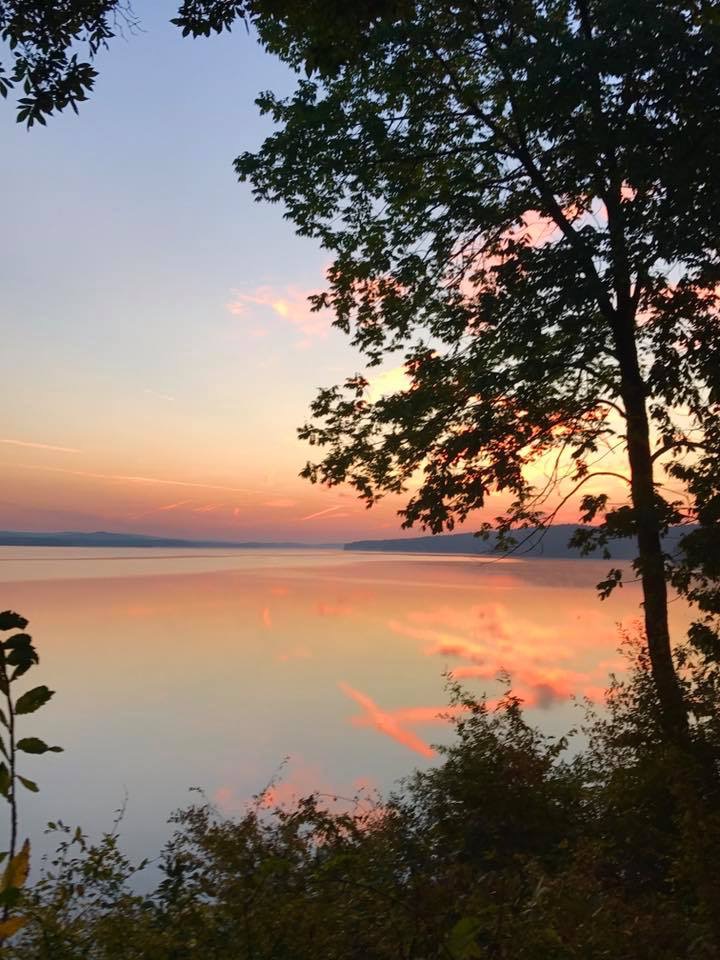
IMG_6014Like many of you, I have experienced dark nights of the soul. I have faced illness, betrayal, disillusionment and loss. I have faced the dark side of life more than a few times. In the midst of those times, I found the courage of faith, the gift of hope, and the promise of Scripture.
If you have known me through the years, you may know that one of the New Testament passages that gives me strength is in the fourth chapter of Second Corinthians. The following words are part of that chapter.

We are troubled on every side, yet not distressed; we are perplexed, but not in despair; Persecuted, but not forsaken; cast down, but not destroyed . . .

Therefore we do not lose heart. Though outwardly we are wasting away, yet inwardly we are being renewed day by day. For our light and momentary troubles are achieving for us an eternal glory that far outweighs them all.

So we fix our eyes not on what is seen, but on what is unseen, since what is seen is temporary, but what is unseen is eternal.

– 2 Corinthians 4:8-9, 16-18 18 (KJV, NIV)

The passage speaks of “wasting away.” When I was so ill for all of 2014, I can honestly say that I believed I was wasting away. It was a frightening emotion, one that I would rather not hold in my memories. But my memories of that time also include mercies and blessings, blessings of gradual healing, blessings of compassionate and competent health care, blessings of being surrounded by a loving faith community, blessings of my husband’s devoted care, blessings of hope and faith in a God whose mercies covered me in so many ways. Clearly, my blessings came through adversity.

Today while listening to Pandora, I heard a song that touched me with its faith-filled lyrics.

. . . What if Your blessings come through raindrops?
What if Your healing comes through tears?
What if a thousand sleepless nights are what it takes to know You’re near?
What if the trials of this life are Your mercies in disguise?

What if my greatest disappointments or the aching of this life is the revealing of a greater thirst this world can’t satisfy?
What if trials of this life — the rain, the storms, the hardest nights — are Your mercies in disguise?

– Written by Liz Story • Copyright © Warner/Chappell Music, Inc, Universal Music Publishing Group

I learned that through serious illness, the fear was greatest at night. The nights were the hardest. But I also learned that what I had read so many times was true — God’s mercies are new every morning.

The steadfast love of the Lord never ceases;
his mercies never come to an end;
they are new every morning; great is your faithfulness.

– Lamentations 3:22-23 (ESV)


Darkness, Daybreak, Despair, Faith, God's presence, Hope, Light

Life’s Darkest Place

IMG_5929Sometimes, the heart cries out in anguish, “Comfort me, God, in this my life’s darkest place.” There are times when all of us find ourselves in the midst of darkness. Almost despairing, we hope beyond hope for a new dawn. We speak our prayers, often with groanings too deep for words. We look deeper within, hoping that in the depths of our spirits, we will find an enduring faith. We turn to the comfort of Scripture.
If I had to choose one passage of Scripture that has been for me a source of constant comfort, I would turn to Second Corinthians.

In times of betrayal, I turned to this passage. In times times when I felt persecuted, I turned to this passage. In serious illness, I whispered the words of this passage in the deepest darkness of the night.

We are troubled on every side, yet not distressed; we are perplexed, but not in despair;
Persecuted, but not forsaken; cast down, but not destroyed . . .

For all things are for our good, that the abundant grace might through the thanksgiving of many redound to the glory of God.

For which cause we faint not; but though outwardly we may perish, inwardly we are renewed day by day. For our light affliction, which is but for a moment, works within us a far more exceeding and eternal weight of glory;

So we look not at the things which are seen, but at the things which are not seen: for the things which are seen are temporary; but the things which are not seen are eternal.

– From II Corinthians 4 (paraphrased)

I can only imagine how many survivors of the recent natural disasters have spoken the words of this passage, prayerfully and with hearts disconsolate. I can imagine many of them crying out from what feels like life’s darkest place. The hymn writer expresses so eloquently the presence of hope for all of us who find ourselves languishing, inviting us to bring our sorrows to the mercy seat of God.

Come, ye disconsolate, where’er ye languish,
Come to the mercy seat, fervently kneel.
Here bring your wounded hearts, here tell your anguish;
Earth has no sorrow that heav’n cannot heal.

– Thomas Moore, 1816

May those who are disconsolate this day find consolation in the lavish grace of God. May those who languish find respite in God’s never-ending mercy. May those who are suffering in what feels like life’s darkest place experience the brilliance of a new dawn. Amen.


Despair, Faith, God's presence, healing, Loss, peace, Prayer, Restoration

Wounds of the Soul

IMG_5942
Early morning comes to a green valley near Marshall, Arkansas.
Photo by Paul Barrows.

Hurricanes and earthquakes of the soul . . .

The lush vegetation of Puerto Rico has been replaced by broken trees, homes lying in ruins, a painfully barren landscape. “Hurricane Maria destroyed us,” said Edwin Serrano, a construction worker in Old San Juan.

Dominica was devastated. Thousands of trees snapped and were strewn across the landscape, leaving the island completely stripped of vegetation. Dozens of mudslides turned the sparkling blue-green sea to a murky, muddy brown.

At least 286 people were killed in Mexico City by a magnitude 7.1 earthquake. A rescue operation at the city’s Enrique Rébsamen school resulted in the rescue of eleven children, but nineteen children and six adults were killed. Extreme urgency permeated the school as more than 700 rescue workers continued digging after two days without sleep, knowing that survivors would be able to last only about four days.

In a very real sense, nature turned on the survivors, leaving them despairing from disasters that created devastation in many forms. Destroyed cities, of course, physical injuries and homes left in the rubble, yes. But also wounds of the soul that are lasting and life-changing.

People who live through natural disasters live with a kind of violence, violence that is perpetrated randomly by nature. When one depends upon nature’s rhythms to provide sunlight and moonlight, rain and breeze, the predictable tide of breaking waves and calm waters, the suddenness of violent storms and earthquakes assault the psyche. Nature is usually a constant, comforting presence, but a natural disaster leaves those in its wake coping with an environment that resembles a war zone. Living in that kind of environment day in and day out causes behaviors similar to those identified with persons who suffer from PTSD (Post-traumatic stress disorder).

The assault by nature creates a chronic and debilitating state of fight or flight. To cope, survivors develop the ability to numb their feelings and repress intrusive memories. This leaves many of them with enormous anxiety, feeling that the world is no longer a safe place. While many symptoms of PTSD are evident, often the most frightening symptoms are those not readily visible, secret symptoms and reactions such as disorientation, memory lapses and night terrors. These symptoms are buried in the deep crevices of the psyche.

Wounds to the soul and spirit are caused by events that violate one’s most deeply held sense of safety and security, and it is important to address PTSD not as a “disorder,” but as a response, an appropriately normal response to an overwhelmingly abnormal situation.

So when we send positive thoughts, donate, and pray for the restoration of these ruined cities, we must also be intentional in praying for healing of the soul and spirit of every survivor. Long after buildings and homes have been repaired, survivors will live with a deep wound of the soul that can only heal with time, prayer, faith and hope, as wounded people learn to abide with the God who walks with us through every “valley of the shadow of death.” The Scripture can be a comfort in such times, and often the most familiar passages are the ones we lean on.

The Lord is my shepherd; I shall not want.

He maketh me to lie down in green pastures: he leadeth me beside the still waters.

He restoreth my soul: he leadeth me in the paths of righteousness for his name’s sake.

Yea, though I walk through the valley of the shadow of death, I will fear no evil: for thou art with me; thy rod and thy staff they comfort me.

Thou preparest a table before me in the presence of mine enemies: thou anointest my head with oil; my cup runneth over.

Surely goodness and mercy shall follow me all the days of my life: and I will dwell in the house of the Lord for ever.

– Psalm 23

Until that day when tender green shoots once again begin to fill the landscape in those devastated countries, may the wounded people walk through the green pastures of the heart and the still waters of the spirit with the Gentle Shepherd who restores the soul and leads to peace.

Darkness, Fear, God's presence, Light

Afraid of the Night

Design
From the poem, “The Old Astronomer to His Pupil” by Sarah Williams. The last line of the poem was used as an epitaph for an Astronomer-couple
buried at Allegheny Observatory.


Almost every night as bedtime approaches, I experience a feeling of panic. I have thought a lot about what is going on in me when this happens. Hoping to overcome the fear, I say to myself again and again, “I need not be afraid of the night.” And yet the panic persists. What I do know is that there is a part of me that fears going to sleep and never waking up. I have thought long and hard about where such a feeling might come from.

I recently worked through this and discovered that the panic is related to my many nights spent in the hospital in 2014. I remember well the long nights of sleeplessness and anxiety. I remember the irrational fear that clung tightly to me following a few brushes with death. I remember that, even when I was stronger and out of imminent danger, I continued to be afraid. And I remember that the nights in the hospital were lonely and seemingly endless.

When I was discharged and safely back home, I continued to be sleepless, eyes wide open every night, all night. I stayed exhausted, of course, and slept soundly during the day. It is interesting to me how the body adjusts itself to changing circumstances and schedules, physically and emotionally, even spiritually. Body and soul, I easily accepted an intense fear of the night. Perhaps I could just as easily embrace the reality of a caring God who watches over me through every dark time. Perhaps I could find the God of the Psalmist.

You have searched me, Lord, and you know me.
You know when I sit and when I rise;
you perceive my thoughts from afar.

You discern my going out and my lying down;
you are familiar with all my ways.

Before a word is on my tongue, you, Lord, know it completely.

You hem me in behind and before, and you lay your hand upon me.

Such knowledge is too wonderful for me, too lofty for me to attain.

Where can I go from your Spirit?
Where can I flee from your presence?

If I go up to the heavens, you are there;
if I make my bed in the depths, you are there.

If I take the wings of the morning,
and dwell in the uttermost parts of the sea,

even there your hand will guide me,
your right hand will hold me fast.

If I say, “Surely the darkness will hide me
and the light become night around me,”

even the darkness will not be dark to you;
the night will shine like the day,
for darkness is as light to you.

– Psalm 139:1-13

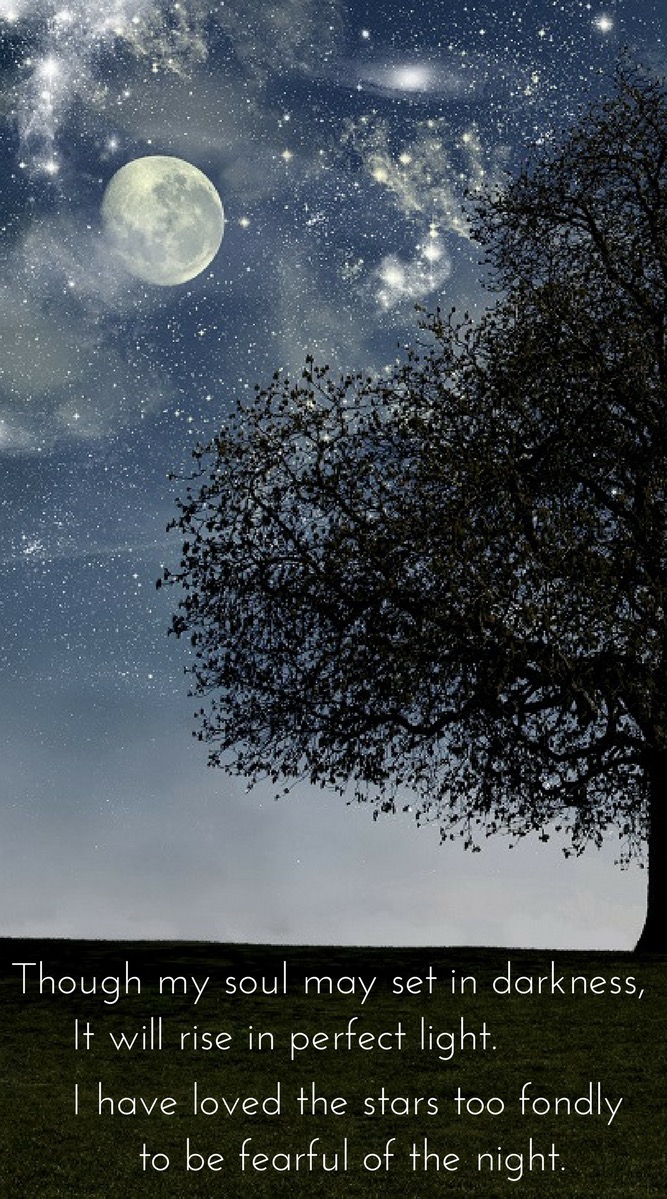
I need not be afraid of the night.

It is true. Through every dark day, I could not flee from God’s presence. In the “dark night of my soul, in every difficult time, there was a reality I needed to learn, an eternal truth waiting fir me to discover. My discovery was about the captivity of fear, especially fear that descended on me in the dark of night. My discovery was also about a Light that is brighter than any darkness I could ever experience.

I need not be afraid of the night. Thanks be to God.


Faith, God's presence, grief, Hope, Prayer

Nearer, My God, to Thee

Enlight136

While enjoying some quiet time on my new pergola swing, I listened to the hymn “Nearer, My God, to Thee” sung by Brigham Young University’s male choral group, Vocal Point. It would not be an exaggeration to say that I was transported to a sacred place in those few moments. The hymn I had sung for so many years took on fresh, new meaning for me. It could be because of my aging, my illness, my need for a closer relationship with God. Perhaps the hymn spoke to me simply because I needed it. I have long loved this old hymn and its simple, but profound, message.

Nearer, my God, to Thee, nearer to Thee!
E’en though it be a cross that raiseth me,
Still all my song shall be, nearer, my God, to Thee.

Refrain:
Nearer, my God, to Thee, nearer to Thee!

Though like the wanderer, the sun gone down,
Darkness be over me, my rest a stone;
Yet in my dreams I’d be nearer, my God, to Thee.

There let the way appear, steps unto Heav’n;
All that Thou sendest me, in mercy giv’n;
Angels to beckon me nearer, my God, to Thee.

Then, with my waking thoughts bright with Thy praise,
Out of my stony griefs Bethel I’ll raise;
So by my woes to be nearer, my God, to Thee.

Or, if on joyful wing cleaving the sky,
Sun, moon, and stars forgot, upward I’ll fly,
Still all my song shall be, nearer, my God, to Thee.

– Lyrics by Sarah F. Adams, 1805–1848
Music by Lowell Mason, 1792–1872
Published 1841, Hymn in public domain.

What makes this particular performance of the hymn so compelling is the inclusion of a counter melody. While a solo voice sings the words of “Nearer, My God to Thee” and paints a portrait of a life drawing near to God, the chorus sings a counter melody in Latin. The music is stunningly beautiful. The message reaches the depths of a soul in need of God’s presence. One listener described it like this:

So wonderful. It feels like angels paying a visit to earth with a hymn.

So I want to share with you the Latin text and the translation, which brings new meaning to the hymn.

In articulo mortis // At the moment of death

Caelitus mihi vires // My strength is from heaven

Deo adjuvante non timendum // God helping, nothing should be feared

In perpetuum // Forever

Dirige nos Domine // Direct us, O Lord

Ad augusta per angusta // To high places by narrow roads

Sic itur ad astra // Such is the path to the stars

Excelsior // Ever upward

Why, you might ask, am I writing a music review on my blog today? I suppose my words are an attempt to describe a need for the nearness of God. In times of grief, when sorrow overwhelms, when darkness is all we see, drawing near to a God of compassion is our healing balm and our highest hope. As I contemplate this truth, I am thinking of what was called the greatest disaster in maritime history — April 14, 1912 — the S.S. Titanic sank after striking an iceberg. As the ship disappeared into the vast ocean, Mr. W. Hartley, the ship’s bandmaster, led the band in playing “Nearer, My God, To Thee.”

I pray that, in whatever crisis you face, you will rest in the nearness of God. And I invite you to listen to BYU Vocal Point’s performance of this hymn:


Faith, God's presence, healing, Hope

A Perfect Place to Die

IMG_5744
Japan’s Aokigahara Suicide Forest

I watched a very thoughtful and intriguing movie last week — The Sea of Trees. The film was captivating, telling the story of a despondent professor who despaired of life and searched for a way to end his life. His search led him to Aokigahara, a forest in Japan known also as the Sea of Trees or the Suicide Forest.  Aokigahara Forest has been home to over 500 confirmed suicides since the 1950s. It is called “the perfect place to die” and is the world’s second most popular place for suicide.

One might say that suicide is not the most uplifting subject for a blog. But suicide is a very real and present tragedy in the world. Consider these startling statistics reported by The Jason Foundation. (http://prp.jasonfoundation.com/facts/youth-suicide-statistics/)

▪️Suicide is the second leading cause of death for ages 10-24. (2015 CDC)

▪️Suicide is the second leading cause of death for college-age youth and ages 12-18. (2015 CDC)

▪️More teenagers and young adults die from suicide than from cancer, heart disease, AIDS, birth defects, stroke, pneumonia, influenza, and chronic lung disease, combined.

▪️Each day in our nation, there are an average of over 5,240 attempts by young people grades 7-12.

▪️Each year, 30,000 Americans die by suicide. An additional 500,000 Americans attempt suicide annually. (http://www.mentalhealthamerica.net/suicide)

Some people have found help through suicide prevention programs. Others choose to turn to 24-hour suicide helplines available around the clock to provide crisis intervention. (https://suicidepreventionlifeline.org/) Still others find that it is their faith that raises fresh hope within them and lifts their sight above the darkest of days.

There is a special kind of renewed hope when people who have been on the brink of taking their own lives share their stories of faith, the depth of faith that ultimately gave them the inner strength to live. Samuel Trevor Francis (1835-1925) told such a story of faith. He experienced a spiritual turning point as a teenager, contemplating suicide one night on a bridge over the River Thames. An unexpected renewal of his faith saved his life that night. At age 41, Samuel Trevor Francis recalled the faith that saved him and penned the words of the well-known Christian hymn, “O the Deep Deep, Love of Jesus.”

O the deep, deep love of Jesus, vast, unmeasured, boundless, free!
Rolling as a mighty ocean in its fullness over me!
Underneath me, all around me, is the current of Thy love
Leading onward, leading homeward to Thy glorious rest above!

O the deep, deep love of Jesus, spread His praise from shore to shore!
How He loveth, ever loveth, changeth never, nevermore!
How He watches o’er His loved ones, died to call them all His own;
How for them He intercedeth, watcheth o’er them from the throne!

O the deep, deep love of Jesus, love of every love the best!
‘Tis an ocean vast of blessing, ’tis a haven sweet of rest!
O the deep, deep love of Jesus, ’tis a heaven of heavens to me;
And it lifts me up to glory, for it lifts me up to Thee!

But let’s go back to where we began —  the best place to die.

Many years ago, I looked for that place, a way out of many years of relentless, chronic pain. I traveled alone to Mayo Clinic to receive two weeks of specialized medical care and physical therapy.  Perhaps a city very far from my home would be the best place to die. After an upsetting treatment at the clinic, I managed to make it to my hotel room. I took out all the bottles of prescription medication I had with me. The phone rang, and a friend distracted my focus from the tablets I had poured out in front of me. And through our conversation, with tears falling on my freshly-made bed, I learned something very life-giving about the depth of my faith, and most of all, about the depth of God’s abiding, ever-present love.

And so today I can say with strong assurance that the best place to die — or to live — is in middle of the deep, deep love of Jesus, a love that is for me “vast, unmeasured, boundless, free!” A love that restored hope in the midst of my despair. A love that was enough.

Today, as I silently sing “O the Deep, Deep Love of Jesus,” the words of that beautiful hymn ring real and true. God’s love truly was underneath me and all around me, even on that cold and lonely night in Minnesota.

Thanks be to God.


Faith, Fear, God's presence, healing, Loss, Mourning, Perseverance

We Can Overcome

Design

Young girls run frantically from the sound of a bomb, screaming, crying, confused, and terribly afraid. An evening of sheer joy listening to the music of Ariana Grande had turned into an evening of terror.

In a British music venue, a suicide bomb killed 22 people, some of them children. Eight-year-old Saffie Rose Roussos lost her life, and 59 other people were wounded, some suffering life-threatening injuries. Many others are still missing.

The response? Muslim men pray for victims of the attack at a mosque in Manchester. Police officers look at flowers and messages left for the victims. A Union Jack flag is lowered at half-mast in honor of the victims. Religious leaders hold a prayer meeting in central Manchester. Ariana Grande spoke about the attack: “broken. from the bottom of my heart, I am so so sorry. I don’t have words.”

Is this a portrait of the world we live in? Must we fear for our children and lament the lives they must live? Do we place our faith in a God we sometimes question when tragedies happen?

One of my favorite Scripture passages is also one of the most poignant laments in the Bible. It is found in the fifth chapter of Lamentations. The words express deep mourning and profound loss, leaving the writer asking God, “Why do you always forget us? Why do you forsake us so long?” The hurting people who had lost everything they cherished cried out . . .

Joy is gone from our hearts;
our dancing has turned to mourning.

– Lamentations 5:15, NIV

Sometimes our dancing really does turn to mourning. All of us are acquainted with loss. Our world is a dangerous place, and tragedies like Manchester remind us of our vulnerability. So how do we live? How do we go on? How do people of God live this kind of dangerous life?

The musical group Hillsong sings “This Is How We Overcome.” The song, which is written by Reuben Morgan, echoes the celebration of the Psalmist in the fifth chapter of Psalms.

You have turned my mourning into dancing
You have turned my sorrow into joy.

The song continues with these words.

Your hand lifted me up. I stand on higher ground.
Your praise rose through my heart and made this valley sing.

They sing of the continual presence of God, even in times of deep mourning, profound loss, and grave danger. That kind of song speaks of our faith, a faith that still holds us and always picks us up when we have fallen. Our faith is our resilience.

We can overcome. Every time. Every time life circumstances assail us and steal our music, we persist. We sing. We dance. We praise a God who is eternally near. So let us persevere, always proclaiming the source of our strength.

The Rev. Michelle L. Torigian prays this prayer.

Let us resiliently resume our dancing.
Let us sing louder. Let us speak out voices with determination.

May it be so. Amen.

(Rev. Torigian’s prayer may be found at https://revgalblogpals.org/2017/05/23/tuesday-prayer-95/.)

God's presence, grief, healing, Hope, Light, Love, Mourning, Transformation

The Balm for Our Heartbreak

IMG_5138

We do not anticipate much to happen on Holy Monday. It is a Monday, after all, not a great time for hope and expectation. It’s more a time for heartbreak. For on this Holy Monday, we need a reminder that God’s love is ever-present with us.

Mary has prepared Jesus’ body for burial, for death, and we know all too well where the road to Jerusalem leads. We know that the hosannas have fallen silent. We know that the high ranking officials are meeting secretly to plan for the death of Jesus. We know that Judas will betray Jesus and Peter will deny him.

We know that what comes next will break our hearts. But broken hearts are not so bad. At least that’s what Glennon Doyle Melton says.

I have learned that when I run from heartbreak, from pain, I bypass transformation — like a caterpillar constantly jumping out of its cocoon right before it was about to become a butterfly.

Pain knocks on everyone’s door. It we are wise we will greet it and say, “Come in, sit down, and don’t leave until you’ve taught me what I need to know.”

She tells us to ask ourselves what breaks our hearts. And then she explains that the heart, like every other muscle, has to be worked, even ripped apart. That’s how it grows stronger. So instead of shrinking back from our heartbreak and finding ways to disconnect from our suffering, perhaps we should run right into the painful middle of it.

Heartbreak in our lives, like heartbreak on Holy Monday, is very real. That’s why the words of the Psalmist sing so loudly in our hearts, bringing us hope and love and light.

Your mercy, O Lord, is in the heavens;
Your faithfulness reaches to the clouds.

Your righteousness is like the great mountains;
Your judgments are a great deep;

How precious is Your lovingkindness, O God!
Therefore the children of men put their trust under the shadow of Your wings.

They are abundantly satisfied with the fullness of Your house,
And You give them drink from the river of Your pleasures.

For with You is the fountain of life;
In Your light we see light.

— Psalm 36: 5-9

God’s love is the balm for our heartbreak — today, tomorrow and forever.

Beauty of Nature, Forest, God's presence, Silence, Trees

Silence and Solace

Enlight34

Sometimes all of us need a way to escape the ordinary day. Sometimes we need silence and solace. Sometimes we need the shimmering colors of a forest and the scents that waft through the trees. Sometimes we just need to leave behind all the concerns that hold us in bonds.

I imagine that my place of solace is in a forest. It’s only my imagination, mind you, because I never ever enter a forest. It’s a shame really, because I think I would be nurtured and comforted in a forest. I think I would find inner renewal and refreshment. I think that in a forest, I might very well hear God in the whispers of the branches.

Regrettably, I can only imagine. I will probably never make my way into a forest. Too many, bugs, poisonous plants, and creatures. Still I imagine spending some quiet time in a forest. I recently read a piece written by Ishmael Beah that said “The branches of the trees looked as if they were holding hands and bowing their heads in prayer.”

His words confirm that perhaps the forest is a place I really do need to visit, and maybe even to hold hands with the trees and bow my head in prayer. It would be a lovely escape, a life-giving escape. It would be a place that would call to me to forget the things that worry me and hold me fast.

Patricia Anne McKillip is a creative author of fantasy and science fiction novels. One of her novels, Winter Rose, expresses the way I feel about the notion of an escape into silence and solace. This is what she wrote:

I did not want to think about people. I wanted the trees, the scents and colors, the shifting shadows of the wood, which spoke a language I understood. I wished I could simply disappear in it, live like a bird or a fox through the winter, and leave the things I had glimpsed to resolve themselves without me.

I’m off to find a forest. Before spring breaks through, I just might find silence and solace in the whispering branches of the towering, bare trees. I might even hear God.

God's presence, Life pathways

Bridges and Tunnels

IMG_4783
River bridge and tunnel over the White River at Cotter, Arkansas. Photo by Ray Brooks.

Life has its share of bridges and tunnels. I have traversed both. The bridges were nearly always open to the world and promised to take me to the other side of something. And although long bridges, old rickety bridges, and high-over-a-river bridges do present some measure of fear in crossing, bridges are pretty welcoming. They offer a wide-open promise to get you across.

Tunnels, on the other hand, are not wide open at all. They represent a more mysterious part of the journey, a few dark moments when you must enter the tunnel with faith that it won’t collapse on top of you and that there will be light at the end of it. Tunnels bury you for a time under rock, mountains, or water.

I’m prepared for crossing bridges and going through tunnels. So many life events have been my preparation, teaching me to move forward with confidence and courage. And God has proven to be present with me no matter how deep the tunnel or how long the bridge.

So I’ll keep moving, and along the way, I will enjoy the breathtaking vistas I see from the bridges. And I might even enjoy going into the tunnels, which could well be a time for me to experience the kind of darkness that touches the peaceful darkness inside me.


God's Faithfulness, God's presence, healing, Hope

Safe in God’s Care

enlight1

There are times when I need to draw close to God and stay there. There are moments that define us, and sometimes they are seasons of despair when prayer is the only thing to do. I have been through those hard seasons many times and found a way to reach out to God. I wanted to stay there, near to God’s heart of compassion, near to God’s glory, safe under God’s sheltering wings.

Peter, James and John found themselves on a high mountain with Jesus. Glory filled the place and the story tells us that Jesus became “as bright as a flash of lightening.” They wanted to stay there. Wouldn’t you? Peter, James and John were in the glow of the glory of Jesus. Peter spoke up and said, “We need to stay here, Master. Let us put up three shelters for you, Moses and Elijah. Let’s just stay here on this holy mountain.”

The story begins with Jesus praying in private with his disciples. He asked them, “Who do the crowds say I am?”

They replied by telling Jesus that some people were saying he was John the Baptist; others were saying he was Elijah. Others were saying that Jesus was one of the prophets of long ago who had come back to life. But Jesus wanted them to answer the question, “Who do you say I am?”

As he often did, Peter answered for the group. “God’s Messiah.”

Then Jesus strictly warned them not to tell this to anyone, predicting his imminent death and telling them that they would suffer as well. But then we get to the redeeming part of this story, the part that looks past the suffering and reveals the glory. Here is the Transfiguration text from the Gospel of Luke:

About eight days after Jesus said this, he took Peter, John and James with him and went up onto a mountain to pray. As he was praying, the appearance of his face changed, and his clothes became as bright as a flash of lightning. Two men, Moses and Elijah, appeared in glorious splendor, talking with Jesus. They spoke about his departure, which he was about to bring to fulfillment at Jerusalem. Peter and his companions were very sleepy, but when they became fully awake, they saw his glory and the two men standing with him. As the men were leaving Jesus, Peter said to him, “Master, it is good for us to be here. Let us put up three shelters—one for you, one for Moses and one for Elijah.”

– Luke 9:28-33 New International Version (NIV)

Without a doubt, the disciples of Jesus were about to enter one of those difficult life seasons. They would be tested to their limits, and would find themselves longing to draw close to Jesus once again and rest in that place of safety.

Mary Austin relates a story told by pastor and theologian Jennifer Bailey. (https://revgalblogpals.org/2017/02/21/narrative-lectionary-glory-then-guts-luke-928-45/). In a time of deep distress, Jennifer recalls the depth of her pain. This is how she describes her experience:

I folded into myself: my arms wrapped tightly around my knees and found their rest on my heaving chest . . . As I opened my mouth to cry out to God, as I often do in moments of hopelessness, no sound emerged…Rocking back and forth on the cool linoleum floor, I finally uttered the only words that I could find, “I don’t feel safe. I don’t feel safe.”

Like a gust of wind, I could suddenly feel the soulful presence of my ancestors surround me, holding me and bearing witness to my pain. Then I heard my mama’s spirit whisper gently, gently in my ear, “Baby, we ain’t never been safe”.

Jesus proclaimed the hard truth that there is no safety for those who follow him. Yet we live on, knowing that sometimes seasons of pain will engulf us. But also knowing that we are safe in God’s care, that God is faithful and present with us always.

Yes, sometimes I need to draw close to God and stay there. I hope I’ll have the wisdom and the will to stay there long enough.

God's Faithfulness, God's presence

Under the Shadow of God’s Wings

enlight1

How comforting it is to know that we can find refuge under the shadow of God’s wings. It is a beautiful metaphor of divine protection. One of the emotions of aging, at least for me, is that of feeling orphaned. When parents and other significant people in my life are no longer present, I often feel unprotected and vulnerable. Never was it more true than when I spent most of 2014 in the hospital.

The nights were long and lonely, and often sleep would not come to ease my anxiety. During those nights, I sometimes longed for the comfort of my grandmother who was probably the most constant protector in my younger years.

Like I did in those long nights, all of us experience times of utter aloneness. I am so blessed to be able to recall scripture, and during that hospitalization, two Psalms came to mind.

Have mercy on me, my God, have mercy on me,
for in you I take refuge.
I will take refuge in the shadow of your wings
until the disaster has passed.

– Psalm 57:1 New International Version (NIV)

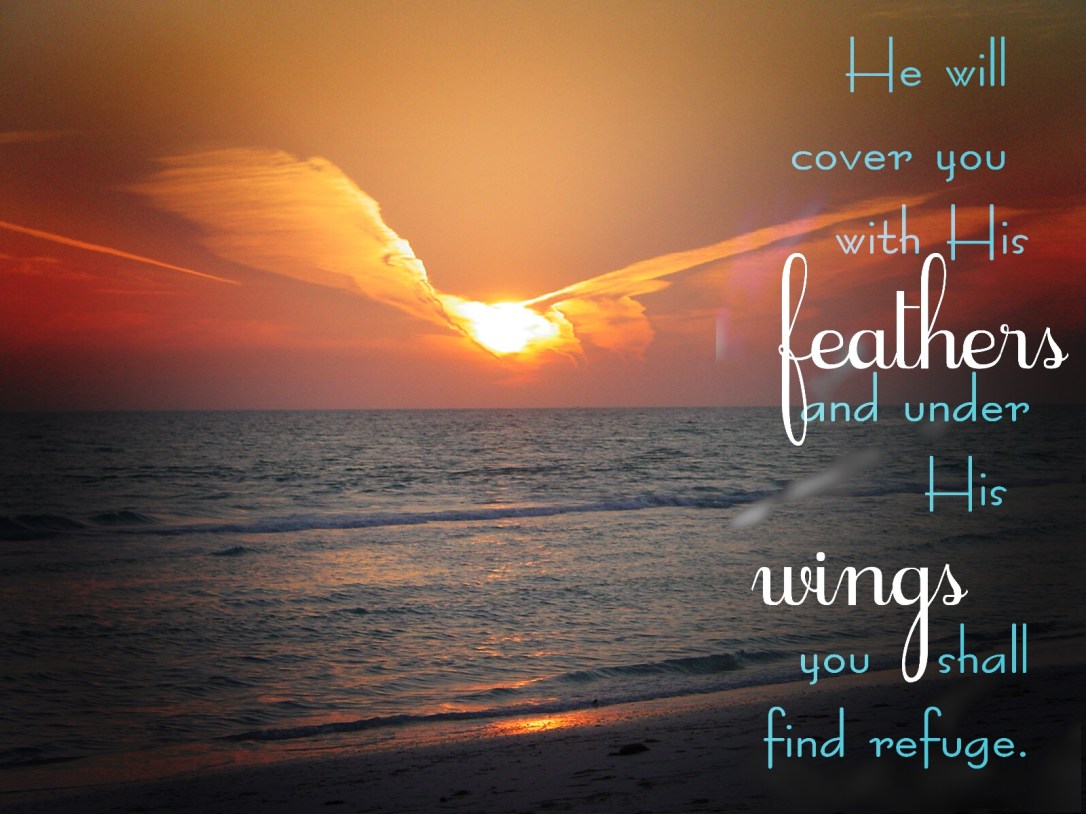
He will cover you with his feathers,
and under his wings you will find refuge . . .

– Psalm 91:4 New International Version (NIV)

I learned what it feels like to be in the shadow of God’s wings. I learned how to feel safe during unsafe times. Thanks be to the God of comfort who covers us with wings of refuge when we most need to feel protected.

Adventures, Freedom, God's presence

Waist-Deep into Life

img_4627

Shrink back from the raging waves if you want to. Stand at ocean’s edge and barely get your toes wet. Or wade waist-deep into the ocean where real life happens. It holds its risks and certain dangers. It challenges one’s sense of safety. It risks being overturned and overwhelmed by a huge, strong, breaking wave. But wading in deeply is the best way of living life, a metaphor for life at its most adventurous.

Alas, I didn’t grow up as a risk-taker. Under my skittish grandmother’s care, I became fearful of many things. She forbade riding bicycles down the street. She gave us each only one skate, fearing that to skate on two would land us face down on the pavement. And yes, to this day, I am afraid of deep water.

She raised me to be fearful of going all-in on many fronts. So I missed out on all kinds of youthful adventures. I miss the things I missed. I wish I had learned to skate well on two skates. I wish I had not been afraid to ride my bicycle down a steep hill, feeling the wind in my face.

So now, all grown up and aging every day, I still don’t plunge waist-deep into the crashing waves called life. I stay in my safer place. It’s too bad, really, and maybe it’s time to make a life change.

Here’s to life adventures!

When you pass through the waters, I will be with you; and when you pass through the rivers, they will not sweep over you.

– Isaiah 43:2