Compassion, Freedom, Immigration, July 4th, Lady Liberty, Liberty, Mother of Exiles, Statue of Liberty, Welcome the Stranger

Mother of Exiles

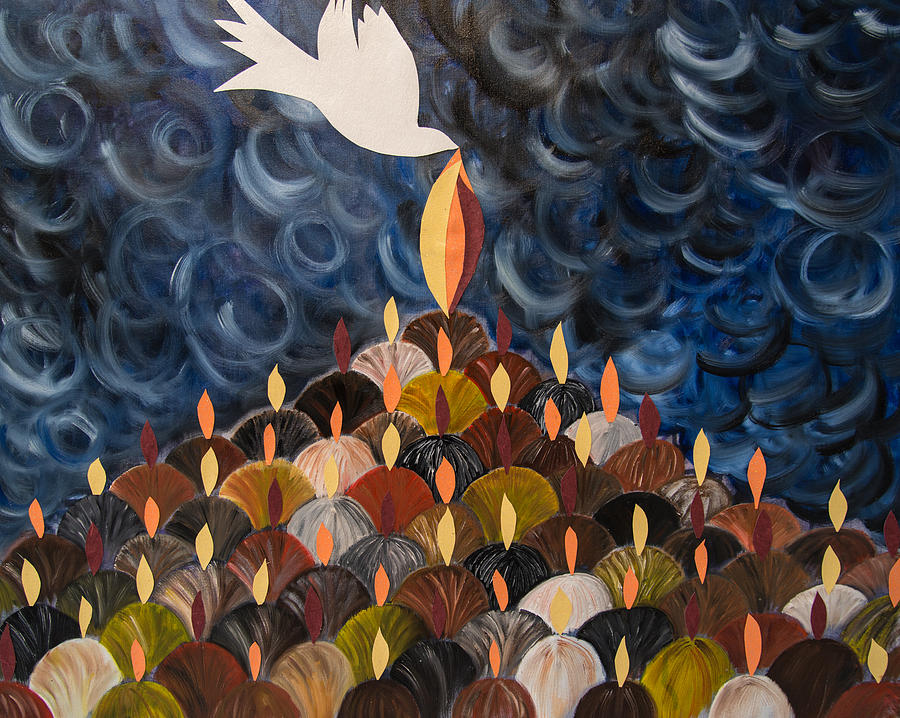
Freedom” is a painting by Tamer and Cindy Elsharouni which was uploaded to Fine Art America on March 5th, 2012.

Not like the brazen giant of Greek fame,
With conquering limbs astride from land to land;
Here at our sea-washed, sunset gates shall stand
A mighty woman with a torch, whose flame
Is the imprisoned lightning, and her name
. . .

From her beacon-hand Glows world-wide welcome;
her mild eyes command
The air-bridged harbor that twin cities frame.


“Keep, ancient lands, your storied pomp!” cries she with silent lips.


“Give me your tired, your poor,
Your huddled masses yearning to breathe free,
The wretched refuse of your teeming shore.
Send these, the homeless, tempest-tost to me,
I lift my lamp beside the golden door.”

— Emma Lazarus


In the year 1883, Poet Emma Lazarus wrote this sonnet, “The New Colossus,” to raise money for the pedestal on which the Statue of Liberty would stand. The sonnet ends with the poignant, passionate words that were added to the base of the statue in 1903: “Give me your tired, your poor, Your huddled masses yearning to breathe free, The wretched refuse of your teeming shore. Send these, the homeless, tempest-tost to me, I lift my lamp beside the golden door.”

For me, these words always held deep significance, first of all, because both of my parents emigrated to this country from Greece and secondly, because I worked as an advocate and trauma counselor for victims of human trafficking, both adults and children. My work was not merely a job; it was a calling that took me into emotionally and physically dark places that challenged my theology of good and evil. It opened my eyes to the intrinsic evil of politics, wealth, greed, inhumanity and depravity. As I toiled with broken, traumatized women, men and children, trying to help them change their lives, my own life was changed, transformed really.

Lady Liberty spoke to me in those days. I know she is a mere statue with no human attributes to admire, but she is to me a powerful symbol. The Statue of Liberty has been called “Mother of Exiles.” People who have been exiled for so many different reasons have found inspiration in her, in this inanimate sculpture that comes alive in people who yearn for freedom. Lady Liberty is sculpted from the inspiration of Libertas, the Roman goddess of liberty with broken shackle and chain at her feet. The Statue of Liberty became an icon of freedom, a symbol of welcome to immigrants, especially immigrants arriving by sea. I remember hearing my grandmother’s many stories of sailing to America, and one of her memories was seeing the Statue of Liberty’s welcoming light.

I’m writing this today as my commemoration of July 4th, a day that represents freedom, yet not for all. For if you ask your African American brother or sister, “What does July 4th mean to you? You will get an answer expressing something like this: “Are you asking me, a descendant of the American slave, what the 4th of July means to me? I answer: It is a day that reveals to me, more than all other days in the year, the gross injustice and cruelty to which I am a constant victim.”

So I am always uncomfortable “celebrating” the 4th of July with fireworks and cookouts and a proliferation of mini American flags. Instead, I choose to commemorate, not celebrate. So I will acknowledge the day, yet never forget its full meaning, its meaning not just to me, but to my brothers and sisters — descendants of slaves, immigrants fleeing from oppression, victims of human trafficking.

Are you asking me, a descendant of the American slave, what the 4th of July means to me? I answer: it is a day that reveals to me, more than all other days in the year, the gross injustice and cruelty to which I am a constant victim.

So think of Lady Liberty for a moment. The image of a woman, not a man — a woman who is standing tall and steady, with her torch lifted to offer light to all who need light. She is an image of a woman who represents compassion, invitation, protection, acceptance, freedom. The broken shackles at her feet declare the end of enslavement, cruelty and bondage for all people as she proclaims welcome for the tired, the poor, the ones who yearn to breathe free, the homeless, those tossed by the tempests of their lives. “Send them to me,” she says, “I lift my lamp to light their way!”

In our country, we entertain hard questions in these days, questions about our nation’s borders, about how welcoming we will be, about equality and equity and whether or not black lives really matter. So today I wonder. Will we lock our gates of welcome? Will we turn away persons escaping tyranny, danger and oppression seeking a land of freedom in our homeland? Will we act as if black and brown lives truly matter? Will we act in the spirit of the Lady, the “mother of exiles” who stands in New York Harbor? Or will we pick up the broken chains at her feet, forge them back together and use them to enslave?

These are the questions we should be asking in these days. Of course, political debate continues dissecting our nation’s immigration policies, as always. Politicians do that, often with little thought about the real people, the real families who bring their children to our nation for safety, protection and freedom. Politicians will do what they do as they always have, but I must ask my American compatriots, “What will we do? Will you and I speak in solidarity with the people who seek to live free in our country? I pray that we will show up when it matters and speak from our hearts of compassion, advocating for a nation that will always say, “Give me your tired, your poor.”

Mother of Exiles, may we stand in welcome with you, and in the spirit of our loving God, may we always love the stranger as we love ourselves. Amen.

You shall also love the stranger,
for you were strangers in the land of Egypt.

Deuteronomy 10:19

Aging, Change, Contemplation, Courage, discouragement, Fear, Illness, Risk, Stillness

Here’s to the Crazy Ones!

It’s true, isn’t it? Without the risk of going too far, stepping out of our comfort zone, we will probably never know just how far we can possibly go. But oh, the complete comfort of that comfort zone hems us in completely. We cannot move. We cannot take a step into new life. We cannot know what we might have accomplished. We cannot free ourselves from the bondage of fear.

I’ve been there and I have a notion you have, too. In fact, I can recall many times when I could not overcome my fear enough to take a risk. One time in particular has haunted me for almost 30 years. I wonder what my life would look like today if I had taken that particular risk — moving to a new state, to a new position, to a larger city, to a different house on a different street. That one single refusal to step out of my comfort zone has troubled me to this day.

Risk-taking is not easy. Change is difficult for some people, and some of us can convince ourselves to avoid change at any cost. Huge changes, even tiny changes, simply frighten those of us who have convinced ourselves that we are not risk-takers. Yet, I can think of so many persons who have decided that changing their lives — maybe even changing the world — is worth the risk. I will never forget one of my seminary professors whose words in a chapel sermon changed the course of my life.

Is what you’re doing worth giving your life for? Because every day you live, you are actually expending your life a little at a time doing whatever it is you’re doing.

– Dr. Paul Simmons

I left the chapel that day, walked across the campus to my office and resigned from my job, setting my sights on enrolling in classes to complete a Theology degree. A risk! A big risk that I was determined to take for two reasons: 1) I actually believed I could change the world; and 2) I was young, bold and unafraid. I’m not so young anymore, and the courage and boldness to change is small in me. It feels like being stuck, and I think it’s the first time in my life I have felt so thoroughly stuck. A brand new mantra for my life is this: “Stuck is more harmful to me than risk. I am not afraid to take a risk!”

Still, there is a part of me who longs to change the world, at least my corner of it. There is this alter ego inside me who actually believes she can change the world. That is the part of me that believes injustice can be conquered, wrongs can be righted, equality can be reality and liberation can emerge out of any form of bondage. Crazy? Probably, but I know of many kindred spirits who would be all-in on changing the world — Malala Yousafzai, Emma Gonzalez, Greta Thunberg, Crystal Echo Hawk, Amanda Gorman. Men are on the list of risk-takers, too. One in particular died in 2011 at age 56, but left behind a lasting legacy that was an example of what a human being is capable of doing.

The ones who are crazy enough to think they can change the world, are the ones who do.

– Steve Jobs

I have given thought to those words, as well as something else Steve Jobs said when he was dying of pancreatic cancer: “Death is mankind’s best invention! I looked in the mirror every day wondering if what I am doing today is fun for me. If the answer was no for several consecutive days, then I have to change something!”

Yes, I am stuck right now, and for several days I have had to admit that what I am doing every day is not fun for me. Nor is it anything significant enough to change the world. So I do need to change something. I’m not sure what sort of change I need to make or how risky the change might be. STUCK! No matter what I decide to change — big risk or small risk — it won’t be easy. And I have to look into myself, into my soul, and ask myself if I am able to take a risk or even willing to take a risk. Truthfully, I know in the depths of my being that refusing to take a risk right now will leave me stuck, maybe even permanently stuck. I don’t like the sound of that. I don’t like the stark reality of that. Small risk or big risk — I know I need to change something in order to truly live!

Like the little goldfish in the small bowl, I’ll skip the bigger bowl and shoot for the ocean.

– Rev. Kathy Manis Findley


I used to be “one of the crazy ones,” always taking risks and most often taking big ones. The visual goldfish metaphor is one that described me well throughout my years. I was not one to leap from a small fishbowl to one that was a little larger. I was much more likely to take a brave, risky leap out of a fishbowl and into an ocean! Until now! Until aging and illness and displacement took its toll. I’m definitely not as young as I was in my former and more courageous days. I am not as physically well as I used to be, and I am not living in the town that was my home.

I am facing a three-headed enemy — age, health and displacement. In truth, this enemy does have enough power to keep me stuck, depressed and disheartened. At this moment, I don’t yet know what I plan to do about it, but I do know it will probably call for a leap, a risk, a change and maybe doing something a little crazy.

At this moment, I’m not up for crazy. I need a little contemplative time in my safe space to look deeper into my soul. I’m not at all sure what will come out of my time looking at soul things —maybe some extra peace or maybe renewed hope, new thinking, fresh courage, some sort of healing. Maybe even a little craziness that helps me consider some risky changes in my life. What I am sure of is that I do not enter my soul-searching space alone, for God has walked with me on every step of my journey. I cannot plan anything right now, but there is someone who watches over me who is making plans I cannot make.

For I know what I have planned for you,’ says the Lord.
‘I have plans to prosper you, not to harm you.
I have plans to give you a future filled with hope.
When you call out to me and come to me in prayer,
I will hear your prayers.’

Jeremiah 29:11-12 NET

I will take risks again someday. I will reclaim the “crazy” part of myself that was never afraid to risk going too far. I will embrace change, inevitable change, with more courage than I have at this moment. I will take another big risk one day soon that will remind me how far I can go and how high I can leap. Like the little goldfish in the small bowl, I’ll skip the bigger bowl and shoot for the ocean. Until I can do that, I’ll be in my sacred space with the One who has never left me and has never let me walk alone.

Thanks be to God. Amen.

You Do Not Walk Alone, Elaine Hagenberg


Comfort, Faith, Hope, Preaching, Whispers of God

Whispers of God

Word cloud by Kathy Manis Findley

Then afterward I will pour out my spirit on all flesh;
your sons and your daughters shall prophesy,
your old men shall dream dreams,
and your young men shall see visions.

Joel 2:28 NRSV

Because I am an ordained Baptist minister, I followed a path that made hearing the whispers of God necessary. I heard God whisper to me on many a dark day. So I am fairly certain about it when I do hear the whisper of God. Only that kind of holy whisper could cause one to face off about ordination with a patriarchal system. But truth be told, I did accept that face-off almost forty years ago. And I persisted through a long season of unkind challenges and lengthy treatises about all the reasons a woman could not be ordained.

In the end, I was ordained. I am deeply grateful to have experienced a rich and varied ministry through those years, including serving as pastor of two churches. I preached every Sunday, real sermons. You might say — borrowing the words of the prophet Joel — that I “prophesied.”

Oh, my!
God whispered. I followed. It’s just that simple.

The truth is that throughout my life, I have heard the whispers of God many times. God’s whispers were just for my hearing, sometimes to comfort me, sometimes to gently correct my steps, sometimes to encourage me, sometimes to lift my spirits, sometimes to show me a vision and sometimes to call me to a mission, like prophesying or preaching.

I have learned a very important life lesson: that when I am grieving, confused, sorrowful, hurt, betrayed, beaten down . . . God’s whispers give me hope. When I am disheartened, God’s whispers touch me with healing. When mourning has stolen my songs, God’s whispers move me to sing again.

I am reminded of the inspiring words of Rev. Dr. Prathia Laura Ann Hall (1940-2002), an undersung leader in both the civil rights movement, womanist thought, social justice and African American theology. These are her words:

Out there in the brush arbors, the wilderness, and the woods, the God of our ancestors, the God we had known on the other side of the waters met us and whispered words in our ears, and stirred a song in our souls . . . 

– Prathia Hall, Quoted by Courtney Pace in Freedom Faith: The Womanist Vision of Prathia Hall

Right now, I am in “the wilderness and the woods.” In other words, I am in a shaky place. I need that quiet, familiar, sacred sound of God whispering in my ear. I wonder if maybe you, too, need to hear that sacred whisper that can make all the difference. Wherever you are, however you feel, in whatever place you are in your life, in whatever way you experience God, I pray that you will listen closely for the holy whispers you need to hear.

Depression, Friendship, Heart, Seat of Emotions, Words

Words!

I wonder if writers sometimes just write words — words devoid of emotion or conviction or passion. I wonder if you would read my dispassionate words today just as you read my more passionate ones on other days. And does it even matter to you if the words I write come from my heart? Or not.

I ask because today my heart feels empty, just as it has felt for several days past. It’s that sense of numbness, maybe even a soul emptiness that hurts more than full-on despair. I cannot put my finger on a reason for it. I say to my friends, “I’m depressed,” but only because I can’t think of a better description, at least not one that most people would understand.

I have two particular friends, friends with whom I have a special relationship. We talk often about our feelings, about depression or anxiety, excitement or joy. We also ask one another a question that bypasses all superfluous language and tedious, spiritless conversation. The question is this:

How is Your heart?

The question gets us to the heart of the matter (pun not at all intended). The question gets us past the need to reticently enter into meaningful conversation. It bypasses all the fluff. It requires no long discourses on how depression feels or where we think it came from. It just asks a straightforward question that calls for an upfront, honest answer.

Just this: “How is your heart?” That’s it. We save a lot of time that way!

Either we struggle for a just a few seconds to figure out our honest answer, or we simply say, “I don’t know.” I realized not too long ago when my friend asked me about my heart that I was receiving her question as one of genuine concern for my well being. I did not feel that she was asking for a bunch of words like a treatise on my current state of being. I did not feel that she was asking me to bare the plethora of my feelings. I did not feel that she wanted to hear a string of words. I certainly did not feel that she was asking for a “How are you? I am fine,” conversation (likely the most meaningless set of words ever spoken).

She was not asking me for any of that, words and words and more words. She was asking about my heart, the seat of emotions, they say. All she wanted to know about was the condition of my heart — what longing was there; what heartache was there; what joy was there in that moment.

I always answer that question because it is a holy one. It’s never just words — her question or my answer. Instead, it is a sacred pause we enter, knowing that we will share with one another thoughts that are much deeper than words. We will share from the wellsprings of our lives.

The Egyptians taught that the heart was the seat of the soul. The ancient Hindus believed that the soul was located in the heart. The Aztecs said, “The heart is the seat of the soul.


“How is your heart?”

It is a question overflowing with meaning. The wise Greek philosopher Aristotle (384–322 BC) wrote that the heart is the seat of the soul. Another man of wisdom, Augustine of Hippo, actually behaved quite unwisely for a time, causing speculation that he was perhaps suffering from depression. The many wild wanderings of his youth caused him to harm his very soul and left him sitting at the salt pools of death. From that place, Augustine returned to God, like a bird to its forsaken nest. And he said in his Confessions, “Thou hast made us for thyself, O Lord, and our heart is restless until it finds rest in thee.”

― Augustine of Hippo, Confessions

I empathize with Augustine, if indeed he did suffer from depression. And yes, it is true that all these words have emerged from my own place of depression. Yet, even from that deep place where my heart feels wounded, I can still rest in knowing that my heart is the seat of my soul, a place I diligently guard. Gratefully, I can still rest in the fact that I am clothed in the comforting presence of my friends who never fail to ask, “How is your heart?”

To them — Sister Lee Ann and Monica — I dedicate this post.

For them, for us, the question is not just empty, superfluous words. Between us the words are sacred words, a holy question that taps into the “wellsprings” of my life. I always answer that kind of question. For these two friends, and a few other friends who keep vigil with me whenever I am depressed, I give thanks to God. Amen.

Guard your heart with all diligence,
for from it flow the wellsprings of life.

Proverbs 4:23

anxiety, Bewilderment, Depression, Depth of Mercy, Depth of Soul, Emotions, Feelings, God’s Mercy, Hope, Life pathways, Rev. Kathy Manis Findley, Soul, Trails, Unknowing

The Trails I Take

I have taken many trails throughout my life and I imagine that you have as well. It’s one of the things all of us have in common. The trails we take can sometimes lead us to places unknown. Not just places on a map, but places in the soul. Our more difficult trails can push us to our limits, mostly the limits of the soul at its depth. Sometimes, today maybe, my soul is in the depths of unknowing.

What does that sentence even mean? My soul is in the depths of unknowing? If I don’t know what that means, how can I possibly talk about it with you? I can try!

I’ll try.
I’ll search for words
that explain
how I feel, how my soul feels
and what it means —
the depth of unknowing.

These days I sense an unease in my soul, in its depths. I have named it depression. I have tried in vain to make an appointment with my therapist. Isn’t that what people do when they are depressed? Anyway, I did that, but cannot see her until the end of July. So I determined that I had to become my own therapist. In doing that, I decided to search myself more deeply. I determined that perhaps what I feel isn’t depression after all. Instead, what I feel may be the depth of unknowing.

For me that means chasing away the unknowing, getting rid of it because I want to know when I will feel stronger physically, or when I will see my grandchildren, or how I will handle my emotional fragility, or where I will live for the rest of my life. Just to name a few things I need to know.

And yet, the depth of the soul’s unknowing may well be exactly where my soul begins to fully know. The trails I take while inside my soul’s depths contain lessons and treasures and wisdom. The trails bend and wind leading to an unknown path that opens its way for me. I follow it willingly, blindly, yet for some reason, expectantly. The trails are most surely my depression, their unknown, perilous way distressing me as I walk. Jagged rocks on the trails, vines creeping their way onto my path, thorns, bristles and barbs — boulders sometimes — all to remind me of the hard path I walk and the heavy load I carry.

The trails I walk may be no more ominous than yours. We all walk them and we all carry burdens on the way. You and I walk no easy trails. There is “no easy walk to freedom,” the song reminds us. Truth! The trails I walk, and your trails, are many and winding, hard and confusing. The obstacles overwhelm. I suppose this describes my depression as well as any words could, and it is precisely that unease in my soul’s depths that has come to me in these days.

The difficult thing about soul-deep depression is its dogged persistence. That kind of depression has staying power and it sits in the soul, creating that terrible sense of the soul’s unknowing. It has the power to convince me that I will never know the things I want to know. Mostly, I want to know destination. Where am I headed? What jagged rocks and prickly thorns will injure me along the way? And will I survive my injuries?

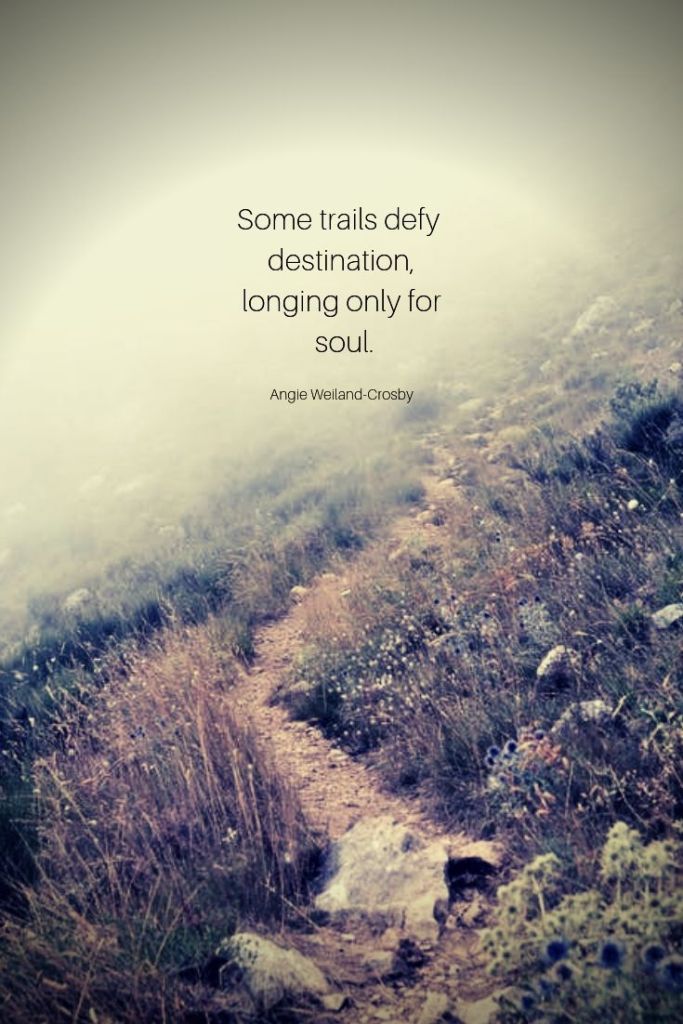
There lies the depth of depression. It lies in the desire, the need, to know. We need to know the unknown — where will the trails take us and what formidable obstacles will stop us. Now understand this, if I had answers, I would have given them to you several hundred words ago. I have no answers of my own, but I do have a nugget of wisdom written by author Angie Weiland-Crosby.

Some trails defy definition,
longing only for the soul.

Angie Weiland-Crosby

There may be something in her words. If the trails defy our attempts to define them or to know them, perhaps we can find comfort knowing that the trails long only for our soul. The trails only want us to bare our souls along the way and to open them up to the new. The trails are meant for our good, for our spiritual maturing. And as for another comfort, the God we know has seen and known the trails before us. However you see and know God, you can rest in the knowledge that God has some hand in the work of the soul. God knows about the trails we take.

Haven’t I commanded you? Strength! Courage! Don’t be timid. Don’t get discouraged. God, your God, is with you every step you take.”

Joshua 1:9 (The Message Bible)

When all is said and done, I believe the trails I take are necessary ones. In a way, perhaps the trails I take are sacred ones, meant for opening up my soul to its depths where transformation can occur. No, God does not lay out my every trail or remove its thorns and rocks. The trails I take are strewn with rocks meant for me, thorns that pierce just enough to get my soul’s attention. I believe that. And I believe that there is for me a way to trust God wholly. My personal translation of Proverbs 3:5-6 gives me a tiny inkling of hope even when depression ravages my soul.

Trust in whoever you believe God to be in your life.
Trust God with all your heart,

and don’t rely only on what you understand.
In all the twists and turns in your life,

perceive this God as one who offers a depth of mercy,
A God who sees and knows the trails you walk.
And be assured, know deeply in your soul

that God will direct your paths.

I want to share with you a video of a beautiful, meditative song entitled, “Depth of Mercy,” performed by students of Fountainview Academy, a Christian high school based in southern British Columbia, Canada. I also share this because of where it is filmed — a beautiful wooded area with various trails. Whatever trail the students took to arrive at their destination seemed a treacherous pathway to me, and even more treacherous, the place where they stood to play and sing.

They were on top of a magnificent ridge, but way too close to the edge for my comfort. At the end, as they sang, “Depth of mercy, can there be mercy still reserved for me?” The image pans across them to the jagged edge and then reveals a very deep and ominous gorge. Panning even farther across, you will see a most beautiful portrayal of nature, one that stirs the senses and reminds us of the depth of mercy our God reserves for us. I hope the video is meaningful to you.

Aging, anxiety, Awareness, Beauty of Nature, Bishop Steven Charleston, Change, Faith, Forest, Grace, life, Life Journeys, Living Hope, Pondering, Spirit

Pondering a Soul in Transit

“A soul in transit.” What does that phrase even mean? It sounds a bit ominous to me, like something bad couched in flowery language. Maybe like words of a poem that make little sense because they point to something otherworldly. Perhaps it means something related to a soul that lives, gets old, and dies — in transit from birth to death and beyond. Pondering!

I’m not up for those thoughts right now, because I am in the troubling place of feeling old sometimes. It’s something like aging anxiety, I think. Feeling old should not be so surprising to me since I really am kind of old. But sometimes I feel old in a bad way, the way that sends negative thoughts through my mind. Thoughts like . . .

I can’t do much anymore,
I don’t feel well most of the time,
my joints hurt,
or even, I may die soon.

It is not helpful for my soul to entertain such thoughts, even though some of them are downright truth. Pondering! You have probably heard that “getting old is not for sissies.” It holds some truth, I imagine, for those of us who have come face to face with normal aging, aging that feels not so normal at all. But what about the great juxtaposition? What about the positive exercise that puts thoughts side by side so that we can see what is life-giving instead of what is troubling? For instance . . .

I am old. — I am wise.

I feel weak. — My spirit is strong and still vibrant.

My back aches when I exert myself. — I can still move.

So much for pondering juxtaposed thoughts. They may not be all that helpful, although re-imagining so that we recognize what is spirited and sparkling about ourselves can be very helpful. Still my words on this subject are pretty empty. I think I need assurance from someone else’s words, and I can’t help but turn to a very wise and insightful spiritual guide, Bishop Steven Charleston, whose thoughts are captivating, enlightening and filled with wisdom. And on top of that, the wise bishop is the one who offered up the phrase, “a soul in transit” in the first place.

We will not grow old, not in spirit. In mind and body, yes, we will age as all things age, all making the pilgrimage through time to find the place of sources. But in our spirit, no, we will not grow old. The child that was us will run forever through the fields. The dreams we spun from the fine wool of cloud watching will forever lead us to the next wonder that awaits us. The love we knew, so quiet, so life giving, will always be there to lift us up and hold us close. The spirit of life is eternal. It does not diminish. It does not forget. It does not alter. The spirit within us is the sum total of our sacred experience. It is what we were sent here to be and to do. Our spirit, a soul in transit, has a life outside of time. It will not grow old because it is on loan from a source more ancient than time itself.

Bishop Steven Charleston

Still pondering! I see more clearly that the “soul in transit” has “a life outside of time.” Eternal! That is what our faith has taught us for generations, for ages, always. But it is a truth that we can barely fathom, much less find comfort in. It’s not so easy to accept a truth that ultimately represents death, even if it includes that timeless and stunning place that is called eternity. The introductory words of 1 Peter give us a most glorious glimpse of eternity, a living hope.

May grace and peace be yours in abundance. Blessed be the God and Father of our Lord Jesus Christ! By his great mercy he has given us a new birth into a living hope through the resurrection of Jesus Christ from the dead, and into an inheritance that is imperishable, undefiled, and unfading, kept in heaven for you, who are being protected by the power of God through faith for a salvation ready to be revealed in the last time.

— 1 Peter 1: 2-5 NRSV


Pondering still as I ask, “what does it all mean for me, the words, the images?” I feel much like the Psalmist who said, “my eyes are not raised too high; I do not occupy myself with things too great and too marvelous for me.” (Psalm 131:1) And yet, I do search and struggle with the thought of aging, of what it means for me and of what comes next. I hear the words:

“. . . in our spirit, no, we will not grow old. The child that was us will run forever through the fields. The dreams we spun from the fine wool of cloud watching will forever lead us to the next wonder that awaits us. The love we knew, so quiet, so life giving, will always be there to lift us up and hold us close. The spirit of life is eternal. It does not diminish. It does not forget. It does not alter. The spirit within us is the sum total of our sacred experience.”

I hear the words, and the spirit of me understands, even if my mind does not. When I write, I ponder deeply. In my pondering this day, I am compelled to admit that I definitely feel the sting of aging. I am very human, after all! But I can usually move from anxiety to a good kind of awareness. That good awareness shows me that it is comforting to hold on tightly to the thought that the spirit is eternal, that my spirit is eternal. Dwelling on aging isolates me, but knowing in my heart that my spirit is eternal is a grace-gift that sets me free to really live.

I know from experience that pondering can be hurtful, leading me through all kinds of unpleasant scenarios. But sacred pondering, the kind that allows one’s faith to sit with a problem until it seems acceptable, can open the mind and heart to the eternal and empower us to see the plans for good that God has for us, “a future and a hope.” (Jeremiah 29:11)

So, after a time of sacred pondering, I am blessed with a fresh awareness. I can see more clearly God’s truth that my spirit will remain with my grandchildren, always. My spirit will hold on to the sweet love I have known. My spirit will immerse itself in the beauty of nature that has always been present. My spirit will run through the fields like a young person, and through the forests, it will love the trees I have always loved.

My body will do what bodies do, but my spirit will not die and will not grow old!

Thanks be to God. Amen.

anxiety, Friends, Friendship, Worry

Not to Worry!

Do not be anxious about anything, but in every situation, by prayer and petition, with thanksgiving, present your requests to God.

Philippians 4:6 NIV

Don’t be anxious about anything? Not so easy.

Everyone struggles with anxiety at times — religious people and not-so-religious people, the wealthy people who have everything and the poor people who will always be with us. After all, Jesus said, “The poor you will always have with you” (Matthew 26:11). We don’t understand exactly what Jesus meant, but the disciples did. They would have been very familiar with the verse from Deuteronomy, and therefore would have had in mind the rest of the verse that Jesus was quoting.

There will always be poor people in the land. Therefore I command you to be openhanded toward your fellow Israelites who are poor and needy in your land.

Deuteronomy 15:11

To be sure, people who are poor become anxious at times. So do those people who have everything. Any of us can be anxious. There is plenty of “stuff” inside of us to cause us to be anxious and, all around us, there is just as much to be anxious about. I don’t know about you, but I am pretty obedient to the words in Philippians. When I am anxious, I most definitely present my requests “by prayer and petition” to God.

Trouble is, sometimes I think that God doesn’t hear me. I feel worried beyond my normal worry level. My anxiety rages on uncontrollably, and there is no sign of relief, no glimpse of hope, no word from God. In those times, I ask myself, “What exactly do I expect God to do?” One of my dearest spiritual teachers, Bishop Steven Charleston, would answer my question by saying, “Open your mind and heart to the living presence of love that surrounds you.”

I had to sit with that answer for quite a while, breathing into it, searching for the silence I needed to take it in. It was definitely not a clear answer for me at first. But the more I let my heart receive it, the more I began to know how to open my mind and heart to the living presence of love the Bishop described. And then I read all that he had written. These are his words about being anxious.

“Whatever comes into your life, do not be anxious. There will be someone standing beside you. You will not be alone or forgotten. A great and compassionate love will hold you up, even through the longest night. A wisdom, as ancient as the stones of the earth, will whisper in your ear to help you in your choices, to comfort you in your losses, to show you the path forward. You will not be left unknowing and uncertain, but filled with a deep sense of hope. Whatever comes into your life, whether sunlight or shadow, open your mind and heart to the living presence of love that surrounds you. Listen to the urgings of your own common sense and the call of what you know to be sacred. Your life will be secure, come what may, for faith will be your home and kinship, your blessed band of believers.”

As Bishop Charleston suggested, when I listen to my common sense and the voice of what I know to be sacred, the love of God and the love of my friends gently lift me from the depths Every time! I cannot give you any wiser words about being anxious than Bishop Charleston just did from the very depth of his spiritual wisdom. I will simply pray that you will know the grace of the “great and compassionate love” he speaks of — to hold you up, to give you hope, to fill you with peace.

By the way, “not to worry, there is a Love that will not let you go. Thanks be to God. Amen.


“I Can See Clearly Now”, Birdsong, Bravery, Change, Contemplation, Ignatian Spirituality

What’s Real!

Ever wonder what’s real and what’s not-so-real? Once in a while, I do look at what’s going on around me and ask myself how real it is. This friendship — is it real? This situation I’m dealing with — is it real? This life I’m living — how real is it, really? Such questions are problematic for one major reason — that we take things so much for granted that we cannot gauge their real value. Friendships just are; situations just happen; life is pretty much a destined routine.

That is, until betrayal breaks friendships, crisis suddenly creates a situation that cannot be ignored and an unplanned event brings total upheaval to our lives. These are the times when we ponder what is real and what is not. These are the times when all things in us and around us are downright messy. These are flash points in life that force us to examine what we believe is real. Maybe these flash point times take us inward to the private space in us, and in that space, we examine and evaluate what is truly real. Problem is that sometimes our examining leads us into mulling over things that are a mess, and looking at our “real” feels like brooding.

Such downcast and disconsolate moments are not the best times for any of us to ponder what we believe to be real. Could we not open our eyes to what is real all the time? Like when we are overcome with nature’s beauty or the sweet melodies of birdsong. Like when our souls are touched by moments of worship or the mesmerizing sounds of a symphony orchestra.

It seems important to face life with listening ears and open eyes ready to embrace “the real!” It seems important to do so in sunshine and in shadow, when our souls are burdened and when our souls are stirred to sing songs of joy. It seems important to look at what’s real even when we have to do so while feeling a deep down melancholy.

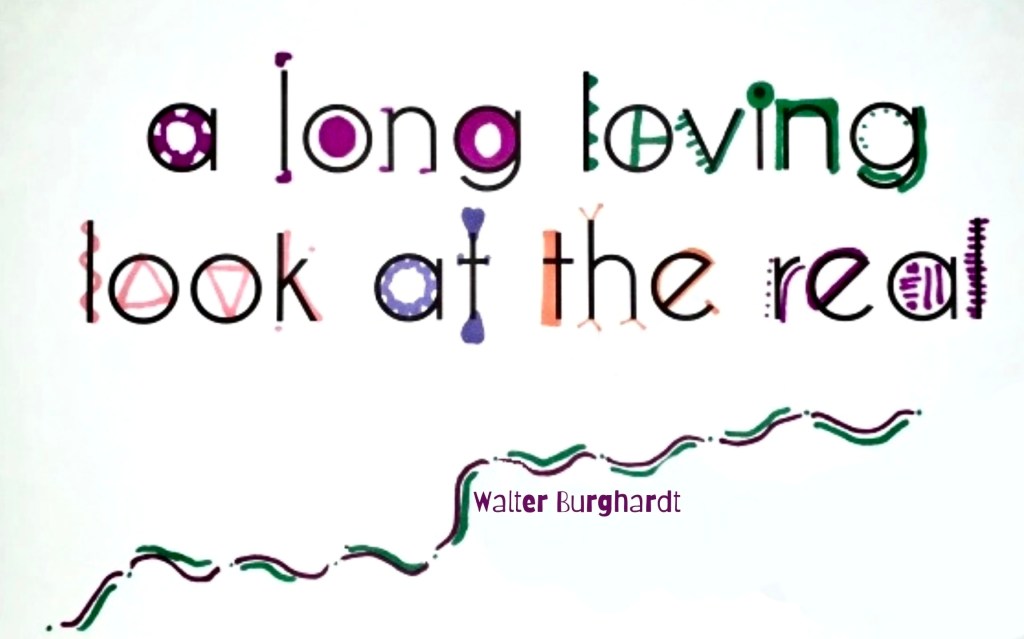
Still, I invite you to choose to “see,” the real that surrounds you — the real that is inside you, above you, below you and beside you. As Jesuit theologian Walter Burghardt summons us, “take a long, loving look at the real.” That’s how Burghardt characterized contemplation, describing it as a sustained gaze, never merely a glance. 

Flash point times take us inward to the private space in us, and in that space, we examine what is truly real.


So value “your real.” Do it as you go and as your journey moves forward on varied paths. Look at all that is “your real” — the commotion in your soul, the catastrophes of your relationships, the messes in your life. Take a sustained, contemplative look. Look bravely snd without fear, because whoever or whatever God is for you is waiting to meet you at the crossroads of what is real and what is not real. 

More than you think, your soul needs you to open your eyes and “take a long, loving look at the real.” No matter how messy it is!

A new commandment, Anger, Christian Witness, Christianity, Committment, Community, Compassion, Faith, Gun violence, Hemmed in, Here I am, Lord., Jesus, Jesus Follower, Justice, Life pathways, Magnolia Court Motel

The Car at Magnolia Court

Magnolia Court Motel, Macon Georgia

In my normal outings, I frequently ride with my husband past the Magnolia Court Motel. It’s the one with a gas station in its courtyard where a pool used to be back in the 50s. It’s not a place you would want to stay on your vacation. In fact, I doubt anyone goes there for a vacation. Still, it’s always at capacity, because people live there. It’s not in the safest part of town. Magnolia Court itself is not safe. I know that because TV news frequently reports that homicides happen there.

For the past five years, I have seen a dingy, old, light brown car in front of the last unit of Magnolia Court, closest to the street. The same brown car, day or night, is in its parking space. I don’t think the car ever moves and I have wondered if it needs repairs. I assumed that the owner of the brown car didn’t have a job, because the car never moved. I hoped, though, that the owner of the brown car worked an 11 to 7 shift somewhere. I wouldn’t have known that, because I would never go past Magnolia Court at that time of night. Not in that neighborhood!

For five years, I never once mentioned that car to my husband. For five years, I silently looked at the dingy brown car and wondered who was in the motel room. Who was he or she? I always thought it would be a male, so let’s go with that. Why is he living there? Does he have a job? Is he young or old? Does he need food? Is he ill or disabled? Does he have friends or family? What does his room look like? Is it decent or dirty? How does he feel about his life? Does he know about Jesus and God? Is he okay?

My next thought was, “I would never go up to his door at Magnolia Court, knock on it and ask him if he’s okay or if he needs anything or if he knows about Jesus.” Just as quickly, my thoughts switch from the man (or woman) with the dingy brown car at the Magnolia Court to these hard questions . . . What could I do, as a Christian, to see if this man needed help? How could I help? What would I do? And what do the answers to those questions say about my faith?

I don’t know, of course, but I imagine that in a similar situation, Jesus might have gone straight to the inn and checked on the people. Finding out how they were doing might have led him to heal one, encourage another, give another a basket of food or do all the blessing-kind-of-things Jesus always did.

Last week, we drove by Magnolia Court. The dingy brown car was not parked in its place. I looked around the Court to see if he had changed rooms, but the car was not there. I felt my heart quicken and my mind rushing through scenarios of what might have happened to the man in the end room of Magnolia Court. I was sad. Guilty. After about ten minutes, I managed to move on with my day and not think too much about the man.

Today, we again passed by Magnolia Court, twice! The car was gone. The man was probably gone too. I never saw him. I never checked on him. Why would I? Who would do that sort of thing in the violent, unsafe world we live in?

I don’t want to be trite about things like faith, but honestly, I really did wonder “What would Jesus do?”

“WWJD” might be an old, overused, trendy slogan, but for me this is just being concerned about a man I never saw.


I don’t have any idea what Jesus would do, but I suspect he may have done lots of things, including something similar to what he did with the tables of the money changers. You see, turning over those tables was about doing what is just and right. Jesus might have turned over some tables or lamps or nasty mattresses at Magnolia Court Motel, because it is a place of violence, drugs, and all manner of things that harm people.

I felt my heart quicken and my mind rushing through scenarios of what might have happened to the man in the end room of Magnolia Court. I was sad. Guilty.

Kathy Manis Findley

I have to wonder now, probably will always wonder, what became of the car at Magnolia Court and, more importantly, what became of the man who lived in a room at Magnolia Court Motel. As far as I can tell, he never left his room until the day he left. My thoughts of him over five years of trying to eavesdrop on his life yielded nothing for him. For me, it became an examination of just exactly what kind of faith I have and in what ways am I willing to go out into a world of need where God’s people live in shadows like Magnolia Court. It became a self-examination that prompted me to ask myself, “What do you intend to actually do when you proclaim yourself as a Jesus follower?”

So this is not a morality tale to urge you to examine your faith. It is for me. I am the one who needs to examine my faith, to ask what Jesus would do and then to admit what I will or won’t do. As for the old, dingy, brown car and the man who owns it . . . well, I did do one thing that Jesus would do. I blessed the man I never knew, whispering under my breath as we passed by this morning, “May God go with you and give you peace.”


This is one of my favorite Christian songs. It brings me to tears every time I hear it, especially on the day of my ordination in 1992. As the words were sung that day in a duet by my husband and best friend, my heart sang, “Here I am, Lord.”

Languages, Maren Tirabassi, Pentecost, Poetry, Spirit wind, Tongues of Flame, wind, Wind and flame

Pentecost!


As the Sunday of Pentecost nears, please contemplate the message of this wonderful poem by my friend, Maren C. Tirabassi, posted on her blog, Gifts in Open Hands.

Pentecost Poem, 2021

Not this year,
the images that have nurtured me before

Don’t get me wrong! I’ve loved
the blowing wind,
but deadly storms of climate change
have taken the air out of that one.

Wordcloud by Kathy Manis Findley

Tongues of flame remind me too much
of cremation in India and Nepal.

Certainly even reading about
the crowded streets
sends me digging in my pocket
for a mask,
in these tentative,
emotionally so complicated
days of re-community.

This year it is the languages
that … speak to me, in me, through me

not even so much celebrating
the holy, beautiful syllabification
of global diversity,
or the most successful sermon ever
giving birth to a church,

as one hundred twenty people
being willing to speak
without being in control of their words.

We all have learned this –
how we said the right thing at the right time
buried in ordinary conversation,or a small public courage
of naming truth we didn’t know we knew.

This year my simple pentecost
is just lending my tongue to something
someone needs to hear,

because I am waiting in the right place,
and willing to open my mouth.

Read more of Maren’s writing at this link:
https://giftsinopenhands.wordpress.com/2021/05/21/pentecost-poem-2021/#comment-10406

Uncategorized

The Wind Is Ready to Blow!

Pentecost ~ Our Lady of Pentecost Catholic Church ~ Quezon City, Philippines

I’m sitting on the front porch watching the birds and the bugs, admiring my flowers and feeling strong gusts of wind blow everything that’s movable and some things that are not so movable. Like my patio chair! I love a rushing wind blowing over me and, always, it reminds me of Pentecost.

Sunday is my favorite Sunday in the church year — Pentecost Sunday! I hold it as my favorite because I long for Spirit wind in my life — to move me, change me, fill me, refresh me and set me free. Spirit fills me with passion and sets me on a journey, a mission really, to bring Spirit to those who most need new hope. On the Sunday of Pentecost, I feel as if the wind is ready to blow!

When the day of Pentecost had come,
they were all together in one place.
And suddenly from heaven there came a sound
like the rush of a violent wind,
and it filled the entire house where they were sitting.
Divided tongues, as of fire, appeared among them,
and a tongue rested on each of them.
All of them were filled with the Holy Spirit
and began to speak in other languages,
as the Spirit gave them ability.

This is what was spoken through the prophet Joel:

In the last days it will be, God declares,
that I will pour out my Spirit upon all flesh,;
    and your sons and your daughters shall prophesy,
and your young men shall see visions,
    and your old men shall dream dreams.

Even upon my slaves, both men and women,
    in those days I will pour out my Spirit;
        and they shall prophesy.”

Acts 2:1-4, 16-18

It must have been a shocking surprise, even stunning in its drama. It is no wonder that of all the church seasons, Pentecost has arguably inspired the most stunning art. Artists depict wind, fire, people receiving tongues of fire and all manner of colorful Spirit movement. Pentecost art is filled with movement, unpredictable and free!

D2D60A56-1290-40BA-A47B-45010F087477No doubt, the artists who create art for the season of Pentecost offer us images of color, vibrancy, movement and freedom. I suppose that these qualities are the ones we want in our own lives, especially movement and freedom. The Spirit Wind that blows through my life and yours brings us that movement and freedom, almost as if Spirit removes the bonds that keep us still and stagnant. Instead “we live and move and have our being”* in a God who brings new life when we most need it.

And as for Pentecostal fire, well, we need that, too. It is a Refiner’s fire, a holy fire with the power to burn away everything that holds us back and then to put the “fire” of passion in our souls that inspires us to live out the calling and mission of our lives.

The wonderful news of Pentecost is that we do not have to rely on our own limited power. The great news of all Pentecost is the promise we hear in our souls, “The wind is ready to blow!” This is the hour for us to be permeated with the courage to run with Pentecostal winds and burn with Pentecostal fire. 

God’s Spirit filling means very little to us in the midst of easy days, but in times life these, Spirit within us means everything. In these days of pandemic, police violence, mass shootings, violence in families, hungry children, adults desperate to find work, racial conflict, people marginalized and oppressed, we need to hold on to the promise of holy wind and fire. 

As always, we are left with questions: 

In the midst of this kind of world, what can we possibly do? 
In the midst of my weakness, can I feel the Spirit-wind?
In the midst of grief and loss, can I feel the Spirit-wind?
In the midst of illness and pain, can I feel the Spirit-wind?

The answer is “YES!”

Pentecost can come upon us in the darkest of times, in the most impossible of circumstances . . . when only the wind and the fire of God’s Spirit could begin to pull off the miracle of new life. The Prophet Haggai would say to us: “Take courage! For I am with you. My Spirit abides among you.”

And so I proclaim to us this day, that if we are willing to be moved and changed by Spirit wind and fire, God’s Spirit is able to empower us. God’s Spirit is able to move us from limitedness into new life, to give us courage, to give our tired feet new strength to keep moving forward instead of giving up.

If we are willing, God’s Spirit wind is able to breathe life into us. And when our days become dreary with low-hovering clouds and our nights become darker than a thousand midnights, I hope we will remember . . .

That the Spirit of Pentecost will ignite us with a fiery passion that disturbs our complacency. 


That the Spirit of Pentecost longs to baptize us again and again and again with Spirit-fire and move us with Spirit-wind. 

That the Spirit of Pentecost is able to re-kindle within us the courage to proclaim the Gospel of liberation to the ends of the earth.

Take courage! The wind is ready to blow!

Disconsolate, Grace, Hesed, Hope, Soul work, Waiting, Wounds of the Soul

It Was Worth the Wait!

Wait for the Lord;
be strong, and let your heart take courage;
wait for the Lord.

Psalm 27:14 ESV

Waiting is no easy thing. Most of us don’t really like it. We’re not good at it. We are impatient people. We want things to happen quickly. Isn’t it excruciating at times to wait when a traffic light stays red far too long, and no traffic can be seen anywhere! How often we have stood in a long, slow-moving line and frustratingly declared, “This is not worth the wait!”

The more important matter, though, is when the soul must wait, when our hearts must wait for pain to ease. When our hearts have to wait, when our souls have to wait in the silence of suffering, it’s almost impossible for us to bear. Yet the the words of the psalmist and the prophets echo through the ages:

For God alone my soul waits in silence;from God comes my salvation;
God alone is my rock and my salvation, my fortress.
I shall never be shaken.

Psalm 62:1-2 ESV

Those who wait on the LORD shall renew their strength;
They shall mount up with wings like eagles,
They shall run and not be weary,
They shall walk and not faint.

Isaiah 40:31 NKJV


Messages of hope, yes. Yet when we are suffering, when we are in pain or disheartened or in trouble, nothing really sounds much like hope. Waiting for pain to ease is difficult, even excruciating. I like the way Sue Monk Kidd offers insight about waiting in her book, “When the Heart Waits.”

I had tended to view waiting as mere passivity. When I looked it up in my dictionary however, I found that the words passive and passion come from the same Latin root, pati, which means “to endure.” Waiting is thus both passive and passionate. It’s a vibrant, contemplative work. It means descending into self, into God, into the deeper labyrinths of prayer. It involves listening to disinherited voices within, facing the wounded holes in the soul, the denied and undiscovered, the places one lives falsely. It means struggling with the vision of who we really are in God and molding the courage to live that vision.

Sue Monk Kidd, “When the Heart Waits”

I cannot explain it better than that and I won’t try. My deepest self desperately grasps for these words, “listening to disinherited voices within, facing the wounded holes in the soul.” I cannot respond with any meaningful comments, but I will offer another insight about waiting for a God who covers us with pure, merciful, amazing grace.

GRACE. The Hebrew word is Hesed.

Hesed is a Hebrew word that means grace in all its fulness. Hesed is defined as compassion, mercy, love, faithfulness  and most often, grace. But none of these words fully capture this Hebrew word that means grace. Hesed is not just an emotion or a feeling. It describes the way God lavishly pours grace upon us in our most needful moments.

And so we learn to wait for God’s outpouring of grace. Sometimes we wait impatiently. Sometimes we wait in anger. Sometimes we wait with a holy sense of peace. Sometimes we wait with hope, joyfully expectant. And sometimes we wait in silence, without words, disconsolate and cast down.

A number of years ago, I found myself nursing a disconsolate, cast down soul and spirit. I had been through a trying time in my life that I can only remember as one of deep sorrow. I remember one day when I sat down at the piano after reading Psalm 42. One particular verse of the Psalm reverberated in my mind. Over and over again, I heard the words, but I did not hear them read. I heard them sung, with a simple, but hopeful strength. I heard myself singing, a soul-song from somewhere inside me. I began to play what I heard, first the melody and rhythm, then the chords that arose from somewhere I could not pinpoint. It sounded beautiful, and it sounded like it was emerging from a sacred promise from God — unequivocally for me. This was my soul song:

Why are you cast down, O my soul,
and why are you disquieted within me?

Hope in God; for I shall again praise him,
my help and my God.

Psalm 42:11 NRSV


I think I was waiting that day, though I was not sure what I was waiting for. I just know that I found hope again that day, if just for a few moments of holy music. And in my disquieted spirit, I sensed pure grace once again — grace, hesed — God’s infinite, matchless, amazing grace.

It was worth the wait!

Thanks be to God.


Images, Injustice, Racism, Slavery, The moan

Moans of Mourning

“Images” A Collage of Remembrance


Images can affect us profoundly, leaving indelible marks on us, on the inside of us. When I saw on video the images and sounds of George Floyd’s murder, I knew that I would never forget what I saw on that day of terror, May 25, 2020. When even the date is indelibly marked in my mind, I know that what happened disturbed me to the core. 

This is true of most, if not all, of us. When images flash before our eyes — shocking images — they register immediately in us. We usually hold those events in our mind’s eye and in our spirits for a long time, perhaps forever if the shock hits us hard enough. But when some time has separated us from the initial shock, we begin the welcomed process of forgetting. Passing time melts the shocking vision away, and it gradually becomes unnoticed, leaving the seat of our emotions with fewer harsh and weighty memories.

I read their names today, these eight names and hundreds more. The names represented persons whose stories touched my soul when they were killed. Yet, I had forgotten so many of them, could not remember exactly how they died or what led to their murders. No wonder the demonstrators and marchers for justice bear signs that read, “#Say their names!”

So that we will not forget!
So that we will not forget our unspeakable history and thus risk repeating it!


The history of murder on the streets of American cities, large and small, is long and distressing. The moans of mourning can be heard still if we listen carefully, yes the moaning of today’s atrocities, but also moans echoing across the tragic history of slavery. Through history, through time, they moan and mourn.

It is worth remembering, as Black liberation theologian James Cone (1938–2018) points out, that the lynchings of African Americans and the crucifixion of Jesus share much in common: “Both the cross and the lynching tree were symbols of terror, instruments of torture and execution, reserved primarily for slaves, criminals, and insurrectionists — the lowest of the low in society.”

Yet, somehow in the midst of the horrific, there is God — perhaps seen in the unshakable voices of demonstrators, perhaps seen in people of all colors marching together, perhaps seen in the messages of the brilliant art created on old buildings, bridges and underpasses, perhaps seen in the hope-filled eyes of a child creating a protest sign. God is present in these images.

In an article entitled, “Human Cargo,” Fr. Richard Rohr points to the writing of Barbara Holmes, who suggests that “crisis contemplation” actually arose out of necessity during slavery, beginning in the Middle Passage when people were transported across the ocean as human cargo. In difficult times, contemplation becomes the soul’s strategy of survival.

The poignant words of Barbara Holmes:

The only sound that would carry Africans over the bitter waters was the moan. Moans flowed through each wracked body and drew each soul toward the center of contemplation. On the slave ships, the moan became the language of stolen strangers, the sound of unspeakable fears . . . The moan is the birthing sound The first movement toward a creative response to, the entry into the heart of contemplation through the crucible of crisis.

Barbara Holmes

Holmes explains how the stolen slaves often formed a community. “Yet, more often than not, these Africans were strangers to each other by virtue of language, culture, and tribe,” she says. “Their journey was a rite of passage of sorts that stripped captives of their personal control over the situation and forced them to turn to the spirit realm for relief and guidance.”

The reality is that contemplative moments can be found at the very center of these kinds of crises — in the holds of slave ships, on the auction blocks and in the brush arbors where slaves worshipped in secret.

In the words of Howard Thurman, “when all hope for release in this world seems unrealistic and groundless, the heart turns to a way of escape beyond the present order.” For captured Africans, there was no hope except in common cause and through the development of spiritual fortitude.

The stark and inconvenient truth is that we are hearing the echoing moan of black and brown communities today, crying out “How long, O Lord, must our people suffer?”

Poet Felicia Murrell has written words of poetry that combine a deep awareness of God’s presence while clearly naming the collective trauma of police brutality and lynchings. We must set our wills to remember. Of her poem, “Silence,” Richard Rohr says, “There is something about poetry that gives us permission to sit with the paradoxes of our pain, perhaps especially when addressing traumatic suffering.” 

He is right, so I invite you to read Felicia Murrell’s challenging poem, reading her words slowly and contemplatively, “allowing your heart to break open to God’s love amidst the suffering of the world.”

Silence

If you’re silent,

you can hear the forest breathe,
the holy hush of the tree’s limb.

“Silence,” said Thomas Merton, “is God’s first language”:
the way it soaks into your skin,
surrounds you,
blanketing you like the forest’s breath.

Silence:
The cadence of the land at rest,
the body asleep,

the heart awake.

Silence:
The deep rhythmic breathing of a mind slowed down,
an ocean still,
wet dew clinging to grass blade.

Silence:
The sacred song trapped in a bird’s breast before its first 
             chirp,
the still of night across a desert landscape
wrapped in a bone-aching chill

before the sun rises to scorch its parched earth.

Silence:
The lusty gaze of onlookers staring at the negro on the
          lynching tree,
neck snapped,
life ended,

feet dangling,
back and forth,
back and forth.

Silenced:
Hands up, don’t shoot!
Body thrumming with a heady sense of power.
Hands in pocket,
resting pose, knees embedded into a man’s neck.

Silence, please.

I. Can’t. Breathe.

Silenced.


I challenge you to remember the names,
to listen for the moans of mourning echoing across centuries,
to hear the moans of present suffering and count the tears of those who mourn,
to hear the voice of God who longs for justice. As it is written in the Book of Isaiah . . .

Therefore the Lord waits to be gracious to you, and therefore he exalts himself to show mercy to you. For the Lord is a God of justice; blessed are all those who wait for him . . . you shall weep no more. He will surely be gracious to you at the sound of your cry. As soon as he hears it, he answers you.

Isaiah 13: 18-19 ESV


I invite you to listen to “The Moan” sung by Marion Williams.

Marion Williams moans her heart out, and then goes into a heartfelt, down home rendition of “Father I Stretch My Hands To Thee.” From the album, “My Soul Looks Back”
anxiety, Calm, Contemplation, Feelings, grief, healing, Heartbreak, life, Loneliness, Loss, Lostness, Mindfulness, Pain, Pandemic of 2020, peace, Quiet, Rest, Restoration, Sacred Pauses, Sacred Space, Soul, Spirit, Spirit wind, Time

There Was a Time


There was a time when I believed that I was invincible, with all the time in the world. Lately, though, I have thought a lot about how quickly time passes and about how I tend to constantly say, “I don’t have time.” I have also been thinking about healing. The reason for my healing thoughts could well be because at least two parts of my body really need physical healing, and soon. I don’t have time to be incapacitated, or so I believe. I don’t have time for pain and I wonder if my two places of physical pain were of my own making. For instance, my wrist sprain — now an orangey ochre color from my knuckles to halfway up my elbow — that the doctor says will heal in 6 to 10 weeks is taking way too long to mend. 6 to 10 weeks is entirely unacceptable! Was my ungraceful fall in the kitchen due to my carelessness or my lack of mindfulness?

And then there’s the terribly painful throat invasion, allegedly identified as a cricopharyngeal spasm, that feels like choking with a large object stuck in my throat while something is tightening around my neck. Direct from Healthline.com: “Anxiety about the condition can aggravate your symptoms.”

Aha! Anxiety! Therein may be the source of many ailments. That, and a lack of rest, relaxation, quietness, peacefulness or mindfulness, all of which are highly touted methods of natural healing. Healing of the body, yes, but also the critically important healing of my heart, my mind, my soul and my spirit — emotional and spiritual healing. That healing is often harder than physical healing. 

So I turned my thoughts, while suffering incessant physical pain, on the subject of emotional and spiritual healing. My thoughts raised the question of what exactly is the difference between the soul and the spirit, and how in the world would I heal there.

Here’s my attempt at an answer. Most of us would agree that we consist of body, soul and spirit. In fact, the Bible affirms the existence of all three:

May your whole spirit, soul and body
be preserved blameless at the coming of our Lord Jesus.

(I Thessalonians 5:23). 

Our physical bodies are fairly evident to us, but our souls and spirits are less distinguishable. In the preceding scripture passage, the Greek word for soul is psuche (ψυχή), or as we might call it, “psyche.” This word “soul” implies our mind, our will and desires as evidenced by our personal preferences, choices, and emotional responses to life’s situations. Our soul is reflected in our personality. Our soul is our life.

“Spirit” is a completely different word. The Greek word for spirit is pneuma (πνεύμα). It refers to the part of us that connects with God and receives the breath of life from the Holy Spirit (Άγιο πνεύμα). Our spirit is our breath, the breath that animates and enlivens us from deep within. I like the way Theologian David Galston explains it: 

The soul is life, and the Greek word is psyche. The spirit is breath, and the Greek word is pneuma. Natural confusion exists between the [meaning of the] spirit and the soul since both words, in their roots, mean breath. But for the Greeks, there were two kinds of breath: the kind necessary for life, the psyche, and the kind necessary for [our very breath], the pneuma. In modern English, we might distinguish the two as life and energy.

I often ask my clients, mentees and friends this question: How is your heart? They usually have an understanding of how their heart is and why. But ask these questions — How is your soul? How is your spirit? — and the answers don’t come as easily. I’m not sure exactly why, but I think that, for myself, it is that I am able to more easily know my heart. I am more in touch with it. On the many times throughout my life when I was brokenhearted, I knew how my heart reacted and why. When I am sorrowful, happy, excited, surprised or feel many other emotions, I can place my hand over my heart and feel is as if I have literally touched it, that my heart has told me what emotion is there.

As for my soul and my spirit, well, they are deeper in me. In the innermost places of me, my soul mourns and celebrates and holds all manner of emotions. In my innermost parts, my spirit lies quietly within me always waiting for the brush of Spirit wings, waiting in stillness for the breath that animates and enlivens and ennobles. There was a time when I would always find time for the healing my soul and spirit needed.

So in the dense forrest of all of the 700+ words I just wrote, what is the lesson? What is the message from God we need to hear? Believe it or not, it’s not complicated. Isn’t it just like God to send us an uncomplicated message that we immediately make complicated? God’s bottom line here is easy, simple, uncomplicated: “Guard your heart, your soul, your spirit . . . all that is within you.

From Joshua
Now, vigilantly guard your souls: Love God, your God.

From Deuteronomy
Keep your soul diligently, so that you do not forget the things which your eyes have seen
and they do not depart from your heart all the days of your life.

From Proverbs
Above all, guard your heart with all diligence; for from it flow the wellsprings of life.

From 1 Thessalonians
And the God of peace sanctify you wholly, and may your spirit and soul and body be preserved complete, without blame, at the coming of our Lord Jesus Christ.


And that’s it. There was a time when I would write 700 more words to tell you specifically how to do that. But today, I am not going to tell you how to heal. The ways are individually unique and the paths are many. So I will leave you with just one path that you may choose to follow: the path that leads you deep within yourself to your sacred, quiet place and then implores you to listen for God’s whisper and wait for the breeze of the Spirit. Where? In a beautiful, peaceful place, under a starlit sky, in a quiet filled with sounds of music.

In these many months of pandemic, experiencing loss and lostness, loneliness and isolation, mourning and tears, may you find comfort in the words of poet, William Wadsworth, here turned into beautiful music by Elaine Hagenberg.


Though nothing can bring back the hour
Of splendour in the grass, of glory in the flower;
We will grieve not, rather find
Strength in what remains behind.


Complete text of anthem:

There was a time when meadow, grove, and stream,
The earth, and every common sight,
To me did seem
Apparell’d in celestial light,
The glory of a dream.

The rainbow comes and goes,
And lovely is the rose;
The moon doth with delight
Look round her when the heavens are bare;
Waters on a starry night
Are beautiful and fair;
The sunshine is a glorious birth;
But yet I know, where’er I go,
That there hath pass’d away a glory from the earth.

Though nothing can bring back the hour
Of splendour in the grass, of glory in the flower;
We will grieve not, rather find
Strength in what remains behind.

“There Was a Time” by Elaine Hagenberg
Poem by William Wordsworth
https://www.elainehagenberg.com/there…

Gun violence, Prayer, School shooting

Prayer for Peace in our Schools

Sometimes prayer is literally all we have. I share with you this poignant and moving prayer from my friend, Maren. I call her the pray-er of prayers.

God, hen, gatherer of chicks,
Savior, weeper over all places
that have no peace,
Spirit, whom to receive
is to feel the breath of wind
in a breeze across a playground,

we pray this morning
for Rigby, Idaho,
where a sixth grader started shooting
in the school hallway …
for two students and an adult injured,
and for all the fear,

and we pray this morning
for Columbia, South Carolina,
where a school bus hijacker threatened
driver and eighteen children
with a rifle,
and for all the fear.

Holy One, we pray for everyone
who has power
to take the guns away –
would that they know,
maybe their hearts tipped over
by this day

the things that make for peace.

amen.

Posted on May 7, 2021 by Maren

#MeToo, Activism, Beloved Community, Bondage, Challenge, Change, Community activism, Courage, Discrimination, Freedom, Hate, Holy Spirit, Hope, Injustice, Lament, peace, Racism, Social justice, Spirit wind, Transformation, Transforming Injustice, White supremacy

Removing Yokes of Bondage

“We Sound a Call to Freedom” Hymn text by Rev. Dr. Jann Aldredge-Clanton; http://jannaldredgeclanton.com/changing-church-resource-“we-sound-a-call-to-freedom”-video-2/


Stand fast therefore in the freedom by which Christ has made us free,
and do not be entangled again with a yoke of bondage.
Galatians 5:1 (NKJV)

What is it about freedom that scares us? What is it about freedom that causes us to refuse to offer it to everyone? Are we afraid that giving freedom to another person or group of persons will diminish our own freedom? What does freedom really mean to persons who are oppressed and to those who live inside the throes of injustice?

I have written very little lately about justice and accountability, the two words most used to describe Derek Chauvin’s conviction. I can’t help but mark this very moment on the “long arc that bends toward justice.” I feel compelled to call our attention to this week! Actually it’s last week now, but you get the idea. Let’s call it “the week of the verdict.”

The week of the verdict has come full circle from George Floyd’s murder on May 25, 2020 to the conviction of Derick Chauvin almost one year later on April 29, 2021. It was a week we will not forget. It brought up emotions in me and perhaps in most people. Most of what I felt mirrored the emotions I imagine George Floyd’s family feeling — happy, calm, relieved, conflicted, hopeful, determined, vindicated. I also felt sad and helpless because the conviction did not end murders of black and brown brothers and sisters. And I felt joyful and hopeful because perhaps this flashpoint in the long history of racial injustice will help us turn the corner and finally see in our communities the justice we long for.

How can that happen? How can we turn the corner and move away from oppressive systems and oppressive people? How do we do that when just minutes after the verdict and less than ten miles away, 16 year old Ma’Khia Bryant was shot and killed by police in Ohio? It happened in the shadow of “the week of the verdict.”

Perhaps for us this is the week of the verdict — the week when the verdict will be read on our failure to end the systemic racism in our communities! Isn’t it past time for us to stand up and stand strong and stand determined and woke? My friends, it is time! This moment in the history of injustice may well be the turning point we need to end racism!

I have said this many times: We cannot just reform injustice, we must transform it. The transformation that results in genuine, lasting justice must begin in the soul and in the heart where intentions are formed. I must lament injustice, confess my own complicity in it, repent of the white supremacy within me, own other forms of oppression and commit to the hard work of transforming injustice in my community and in my world. Only then will transformation happen in the systems that oppress people.

Only transformed people can love neighbors as Jesus loved us. My friend and sister blogger never fails to remind me to answer the ultimate question, “How then shall I live?”* She offers this scripture to us today.

We know love by this, that he laid down his life for us — and we ought to lay down our lives for one another. How does God’s love abide in anyone who has the world’s goods and sees a brother or sister in need and yet refuses help?

1 John 3:16-17 

She then reminded us that conditions in India are dire and the people languish.

In India, today the virus surges
almost beyond control,

hospitals are choked,
people die in line waiting for a doctor.

How can those of us
rejoicing in vaccination,
cautious travel, new gatherings,
not ask how we can help?

Maren

How does God’s love abide in anyone who has the world’s goods and sees a brother or sister in need and yet refuses help?

And that is the soul-critical question we must answer. How then shall we live when all around us people suffer every kind of calamity — every kind of violence, disaster, racism, discrimination, dehumanization? Every kind of heartache. How do we, in our suffering world, become the heart, hands and feet of Jesus?

Getting back to the lament of my own heart, that one thing that inspires my passion — transforming the injustice of racism, xenophobia, misogyny, homophobia and all forms of evil exclusion and oppression. Transforming injustice! Setting our faces toward the hope of Beloved Community! This one thing I know, the steps of Jesus would have led him to the “healing” of injustice in any form. On every day he walked on this earth, Jesus would be loving every person who was in need and he would be lamenting every injustice that caused harm.

How can we not lament? How can we not expend ourselves in the hard work of transforming injustice? How can we not care for, and pray for, and love our brothers and sisters who are in need? How can we refuse to work for the freedom of black and brown people, indigenous peoples, LGBTQ+ people, immigrants and asylum seekers, and to any person who is enslaved? How can we deny God’s desire for justice and peace?

How can we refuse freedom to black and brown people, indigenous peoples, LGBTQ+ people, immigrants and asylum seekers, and to any person who is enslaved? How can we deny them God’s peace?

— Rev. Kathy Manis Findley

I do not have the answer for how we might do this. But I do have some convictions about it, especially about racism and white supremacy. One of my convictions is that dismantling racism begins in me, in my soul. And eradicating white supremacy begins when I look seriously at my own white supremacy. For you see, as long as white supremacy looks to me like a white-draped person burning a cross, I will never acknowledge that white supremacy is in me. As long as white supremacy looks to me like a man I might see on TV news with a truck, a confederate flag, a rifle and a mission, I can easily distance myself. I am not that white person; I am a different white person that would never tolerate racism.

Am I? Am I that different white person? Or are there ways I contribute to an unjust society? Are there ways I fail to seek Beloved Community? Are there thoughts and feelings within me that diminish other persons, persons not like me? Am I complacent about injustice? Am I complicit? Am I reticent? Am I avoiding, looking the other way?

As long as white supremacy looks to me like a white-draped person burning a cross in someone’s yard, I will never see that white supremacy is in me. As long as white supremacy looks to me like a man I might see on TV news with a pick-up truck, a confederate flag, a rifle and a mission, I can easily distance myself. I am not that kind of white person! Or am I?

Rev. Kathy Manis Findley

Racial injustice may currently be the most visible form of oppression, but we must remember that many groups of people are oppressed. Many people long for freedom from oppression. Only when we “see” and “hear” all of their voices, will we be on the way to transforming injustice. I don’t know everything about oppression, and I don’t know exactly how to make a difference. I don’t really know how to join hands with my community and set about to transform injustice. I do know that I must begin with my own lament, for only lament can open my eyes to every manner of suffering and oppression.

So meet me on the mountain where we find the strength from God to persevere, and then descend with me to all the places where oppression enslaves people. Come with me to the people, and together, let us remove from them the yoke of bondage and offer them new freedom. And may Spirit Wind surround us with courage. Thanks be to God.


*”How then Shall We Live?” was the inspiring theme of the Alliance of Baptists Annual Gathering.

VIDEO CREDITS
Words  © Jann Aldredge-Clanton, from Inclusive Hymns for Liberating Christians (Eakin Press, 2006).

Visual Artists:
David Clanton: “The Magic Begins” and dancing children photos: http://www.davidclanton.com/http://david-clanton.artistwebsites.com/

Shannon Kincaid: woman carrying torch paintings:http://www.shannonkincaid.com/

Mirta Toledo: Christ-Sophia painting:  https://www.facebook.com/mirtatoledoarthttp://www.jannaldredgeclanton.com/books.php#book3

Chad Clanton: purple irises photo

Instrumentalists:
Keyboard: Ron DiIulio
Percussion: Warren Dewey
Guitar: Danny Hubbard
Bass & Percussion: Jerry Hancock

Music Producer/Arranger:
Ron DiIulio: http://www.silverdollarsounds.com/personality-profiles/ron-diiulioSource

A woman of sacred worth, Changing my name, Emerging new, God’s beloved daughter, In Memory of Her, Re-claiming self

In Memory of Her

The Good Place — glistening, vibrant, dangerous — from which we emerge . . .

Dedicated to my dear friends, T and J, and celebrating their new names


Two of my close friends, members of my Sunday School class, changed their names. And no, they didn’t get married. They just changed their names. The outer process, the legal process of changing their names was cumbersome, but not overly difficult. The inner process was harder, more introspective. It was a process of the heart, with the change-journey mapped out in the soul.

Why do I feel the need to do this? What should my name be, what name would most fully reflect who I am? Will I face repercussions? Will people “get it?” Why would I spend my energy to do this?

The answer to all the questions ended up being simple and straightforward and honest . . . I want to re-claim myself as I claim my new name.

We discussed this very thing when our class met on Sunday. In some ways, we honored our newly-named friends and acknowledged the soulwork and stamina it took for them to take the path to newness. We acknowledged the inner path to be dimly lit at times, filled with branches that could have blocked the way, and dangerous, as our paths and journeys often are. You know the dangerous places — our self-doubt, our rejections and betrayals, our times of being marginalized, misunderstood and dismissed. And Yet, when we memorialized and solemnized this journey to new names, we discovered the glistening light and vibrant color of it, the place from which our friends with new names emerged.

I want to re-claim myself as I claim my new name. I want to embrace who I really am as I embrace my new name.

Emerging . . .
From a Good and Dangerous Place of Glistening Light and Vibrant Color


Over the past few years, our Sunday School class studied Biblical women who faced challenges, changes or trauma. There were many. We traveled their journeys with them and imagined their emotions. One of the things we noticed about many of them is that they were unnamed, dismissed, invisible. Their stories led us to our own stories of being dismissed, ignored, invisible unremembered and unnamed. Our grief rose up from our souls as we traveled with them, and we were taken aback by all the ways we have been “unnamed” and “unremembered” in our lives.

I read a post this morning by Dianna Butler Bass. As always, her words struck a chord. Interestingly, she cited one of my all-time favorite books, “In Memory of Her: A Feminist Theological Reconstruction of Christian Origins,” written by Elisabeth Schüssler Fiorenza, which uncovered the story of an unnamed Biblical woman. This is what Dianna wrote:

1BE99A1F-D11C-41E1-B223-9AD66F056763The opening image from Fiorenza’s “In Memory of Her” made me gasp.

“In the passion account of Mark’s Gospel three disciples figure prominently,” she wrote. Those three were Judas, Peter, and “the unnamed woman who anoints Jesus.” Fiorenza claims, “While the stories of Judas and Peter are engraved in the memory of Christians, the story of the woman is virtually forgotten. Although Jesus pronounces in Mark: ‘And truly I say to you, wherever the gospel is preached in the whole world, what she has done will be told in memory of her.’”

Yet, as Fiorenza notes, the woman has been largely passed over; “even her name is lost to us.” The women had disappeared to history — the very woman whom Jesus promised would live in memory. I realized that I didn’t want to disappear — that I wanted to be seen as fully human, to be remembered as one who loved Jesus, and as a faithful follower. I had lived too long in a theological community that erased women, excluded us from the story, and trivialized our experiences of Jesus. I wanted the disappearing act to end.” (p. 209).


Isn’t that what we all want and need? To not be unnamed or erased. To be named and remembered for the person ps we really are, not the persons, others define, describe and name. My comfort, as always, is that God knows my name. God never forgets who I am and, in fact, helps me to continually become the woman of worth I am meant to be. God has always guided me through that “good, glistening and dangerous place,” where I often go when I’m searching for my self. I emerge from that good and hard place every time, better and stronger.

The mystery and miracle is that God calls me “Beloved Daughter,” always, and that makes all the difference. So, if you need to, change your name! Change yourself, not into the person others want you to be, but into the person that is fully YOU. Dare to enter that good and hard place, that “good and glistening place” with the courage to meet your soul there and the assurance that you will emerge — new, renewed, known, named and cherished. God does that!

I am confident, friends, that my name and yours is locked in God’s heart, forever. God even knows our name when we change it! And the fullness of God’s grace is evident in the words of Mark’s Gospel:

And truly I say to you, wherever the gospel is preached in the whole world, what she has done will be told in memory of her.

— Jesus

Jesus spoke those grace-filled words, and his words are true of us, each of us. Imagine this for a moment. Whatever you do in Christ’s name, whatever kindness, compassion, assistance you offer to another person, whatever act of love you do or act of grace you give, what you have done will be told and remembered. Imagine overhearing the words Jesus spoke that day: “What she has done will be told in memory of her.”

Thanks be to God who always holds our names close and never, ever forgets them.

I searched for uplifting music to leave with you today, but could not decide between these two very different presentations. Enjoy and be inspired!

Birdsong, Calm, Creation, Fear, Grace, Knowing, Life’s meaning, Listening, Paul Simon, peace, Prayer, Quiet, Reflection, Sacred Pauses, Sacred Space, Self Awareness, Self care, Self-understanding, Serenity, Silence, Simon and Garfunkel, Soul, Soul work, Spirituality, Stillness, The Sound of Silence, Whispers of the Soul, Wholeness

One Day I Listened

I wonder if you would be willing to stop what you’re doing right now and spend a quiet moment with me, just listening? Your time might well be a needed time for you and for your soul.

There is always so much to listen to — traffic, sirens, video game sounds, annoying household noise like the washing machine/dryer, food processor, mixer, fans, buzzers and alarms and the awful sound of the disposal trying to crush that inadvertent chicken bone. These, of course, are not our favorite sounds, but they are the myriad sounds and noises we hear in a typical day.

There are sweeter sounds, too, like the sound of a gentle, falling rain or the sound of rain when it hits hard on the roof; the sound of a gusty breeze as it rustles the leaves on a tree; the sound of a flowing stream, a rolling river and constant, ever-rushing ocean sounds; the flutter of a hummingbird’s wings; the sound of cicadas on a Southern summer night; the sound of a child’s laughter; the sweet, peaceful sound of a purring kitten; and birdsong, always birdsong.

Of course, listening as pure joy is listening to music — quiet music, lyrical melodies, rhythms that slow the pulse, the sound of a bow moving across a cello’s strings, the mesmerizing sound of a harp, the velvet sound of voices in harmony or the enthralling sound of a symphony orchestra.

Sounds fill the space that surrounds us, all the time. What is rarer for us is to hear the sound of silence. Some of us fear the silence or dread silent moments. Others of us avoid it at all costs because the silence tends to bring up whatever we are afraid to hear. So the noise that enfolds us fills the place that might otherwise hear the sighs of the soul — its cries and laments, its laughter, its sound of contentedness. It seems to me that this is the place we long to be, in the soul’s sound chamber where whatever we hear — if we’re listening carefully — is the song of the soul that tells us who we are and why we are.

There is a poem that many of you will remember (if you’re old enough) as a Simon and Garfunkel song from the 1960s. The poem was written by Paul Simon and it presents a frightening picture of the modern world doomed by the lack of spirituality and the people’s aversion to the true meaning of life. It is not so different in these days that spirituality and life meaning can be elusive, no matter how hard we may search for it and yearn for it.

The poem, entitled The Sound of Silence, is written by the voice of a visionary asking people to be serious about the true meaning of life. The poem’s message is that people are moving further and further away from true happiness because they have ignored life’s true meaning. They debate and quarrel about worthless things. They listen to or watch meaningless things. The poet writes that the people “speak and hear without listening. Like we often do?

Throughout its five stanzas, the poem presents the conflict between spiritual and material values. The poetic persona is a person of vision who warns against the lack of spiritual seriousness. The poem begins with an address by the poet persona to the darkness, saying that he has come to talk with the darkness. When he awakens, he says that the vision still remains as the sound of silence.

Some of us fear the silence or dread silent moments. Others avoid it at all costs because the silence tends to bring up whatever they are afraid to hear. So the noise that enfolds us fills the place that might otherwise hear the sighs of the soul — its cries and laments, its laughter, its sounds of contentedness. It seems to me that this is the place we long to be, in the soul’s sound chamber where whatever we hear — if we’re listening carefully — is the song of the soul that tells us who we are and why we are.

The words of the poet . . .

And in the naked light, I saw
Ten thousand people, maybe more
People talking without speaking

People hearing without listening
People writing songs that voices never share
And no one dared
Disturb the sound of silence

And the people bowed and prayed
To the neon god they made
And the sign flashed out its warning
In the words that it was forming
And the sign said,
“The words of the prophets are written on the subway walls

And tenement halls”
And whispered in the sound of silence

All of that trivia about the poem certainly moved us a little farther away from my point, which is that most, if not all, of us have a deep emotional and spiritual need to listen to our souls, really listen. Even if we don’t know it, we long to hear what the depth of our being wants to say to us. We want to find our true selves, a quest only our souls can accomplish. If we are honest, we would say that we want to do the soulwork that leads us out of the darkness of our own making and into a place of light.

When we do carve out a sacred pause, when we wait in the darkness of that silent space, and when we open ourselves to deep listening, we will likely hear God’s whisper. We will probably move slowly out of darkness and realize the promise that as “God’s own people” we will “proclaim the mighty acts of God who called us out of darkness into his marvelous light.”   (1 Peter 2:9)

This is the place we long to be, in the soul’s sound chamber where whatever we hear — if we’re listening carefully — is the song of the soul that tells us who we are and why we are.

— Rev. Kathy Manis Findley

Hearing God’s voice moves us to a deeper experience of life, but hearing our soul’s sighs may take us deeper still, because we open ourselves to self-knowing. It’s not a surface knowing. It is a deep knowing of who it is that lives in our skin. Without hearing the sighs our souls are making, we might never enter into fullness of self. I suggest that only the fullness of who we are can stand before the God who knows us even better than we know ourselves. 

In my own experience, I think that perhaps I cannot be in deep communion with God if I try to face God as my superficial self. Perhaps God seeks relationship with my soul, my deepest place of being. To find and define my soul for myself, to know myself fully, I must find the sound of silence and sit with it patiently and expectantly. Maybe that is the essence of spirituality.

So there are a few lessons in these words and these are the obvious lessons:

  • Limit the harsh sounds in your life.
  • Surround yourself with tender, gentle sounds.
  • Make sacred space and holy time to listen deeply for the sounds that speak to your soul.
  • Listen for God’s whispers. They are important to hear.
  • Always consider what is, for you, the true meaning of life.
  • Listen to your soul — its sighs, its cries, its songs. 

And who knows? If you linger for a while in your sacred listening space, you might just find the very essence of grace by hearing what your soul whispers to you. It will be the most beautiful sound of all.

— Rev.Kathy Manis Findley


One day I listened — really listened. And I heard the whisper of God and the song of my soul. Thanks be to God.


I invite you to hear the poem, “The Sound of Silence,” through music. It can rightly be said that no group or person could ever sing this as well as Simon and Garfunkel, but I thought you might enjoy it covered by a very popular contemporary a cappella group, Pentatonix. 


The Sound of Silence by Paul Simon

All Shall Be Well, anxiety, Bewilderment, Brokenness, Comfort, Despair, discouragement, Emotions, Feelings, God's Faithfulness, Grace, healing, Heartbreak, Holy Spirit, Hope, life, Loss, Rev. Kathy Manis Findley, Sacred Pauses, sadness, Sorrow, Stories, Weeping

How Is Your Heart?

Yesterday I noticed a dogwood tree in full bloom, the first blooming dogwood I have seen this year. The sight of it did my heart good, because it reminded me that some simple and beautiful things remain. They return every year. They mark a season. They grow, and their blooms become ever more vibrant, or so it seems.

The dogwood has its own story, a lovely legend that explains the tree’s qualities. The legend holds that the tree was once very large, like a Great Oak tree, and because its wood was strong and sturdy, it provided building material for a variety of purposes. According to the story, it was the dogwood tree that provided the wood used to build the cross on which Jesus was crucified.

Because of its role in the crucifixion, it is said that God both cursed and blessed the tree. It was cursed to forever be small, so that it would never grow large enough again for its wood to be used as a cross for a crucifixion. Its branches would be narrow and crooked — not good for building at all. At the same time, the tree was blessed so that it would produce beautiful flowers each spring, just in time for Easter. The legend says that God it is gave it a few traits so that whoever looks upon it will never forget. 

81189983-8ADE-4D60-9088-C52DA3983583The petals of the dogwood actually form the shape of a cross. The blooms have four petals. The tips of each of the petals are indented, as if they bear a nail dent. The hint of color at the indentation bring to mind the drops of blood spilled during the crucifixion.
8DEA0FBE-8A3E-4AF8-8142-DA825CA72359


Diana Butler Bass tells the story like this:

There’s an old southern legend that dogwoods grew in Jerusalem — and that one gave its wood for Jesus’s cross. Because of this, the dogwood was cursed (its short stature a ‘punishment’ for being the wood of death) but it also became a blessing. Blessing? For on each twisted branch burst forth petals of lightness and light.

So let’s leave the dogwood’s story and look at our stories — your story and my story. People often use the term “storied past.” Well, a storied past is something all of us have.

In talking with a friend a few days ago, I asked, “How is your heart?” She began to tell me her story, which was a long and winding one that included many mini-stories — happy ones snd sad ones — from her life’s journey. Toward the end of her story, she said, “I feel as if I am cursed by God.” That was her bottom line answer to my question, “How is your heart?” Hers was an honest, heartbroken response that instantly revealed that her heart was not all that good, but that was a critical part of her story.

If you and I are honest, we will admit that our hearts were broken and hurting at several places in our stories. Recalling our brokenhearted times is something we always do when we tell our stories, and it’s an important part of the telling. My story and yours is never complete if we leave out the heartbroken moments, for at those points, what feels like God’s curse almost always transforms into God’s grace.

If not for our heartbroken moments, the hurting places in our hearts might never “burst forth with lightness and light.” Our heartbroken moments change us and grow us. They set us on better paths and they embrace our pain with grace. Our heartbroken moments give us pause, and in that pause, we find that once again, our hearts are good. Our broken hearts are once again peaceful hearts — healed, restored, transformed, filled with God’s grace.

How is your heart? That is a question we would do well to ask ourselves often, because languishing with our heartbreak for long spans of time can cause our stories to be stories mostly of pain. Instead, stop right here in this post for just a few moments and ask yourself, “How is my heart?”

48BB4DCE-068F-4CC2-B1D0-A6B95549B35D

Your answer may well be your path to a contemplative, sacred pause that can become a moment of healing, a time for God’s grace to embrace whatever is broken in your heart and to transform it into love, light and hope. So don’t be afraid to look into your heart when pain is there. In looking, you may find reasons, many and and complex, that are causing deep pain and brokenness. You may also find the healing touch of the Spirit of God waiting there for you and offering healing grace — a Godburst of new hope.

May your story be filled always with times when your was light with joy and times when your heart was broken with loss, mourning, discouragement, disappointment. Both create your extraordinary story — the joyful parts and the sorrowful parts. So tell your story again and again to encourage yourself and to give the hope of God’s healing grace to all who hear it.

I remember a beloved hymn that is a prayer for the Spirit of God to “descend upon my heart.” May this be your prayer today.

Spirit of God, descend upon my heart;
Wean it from earth; through all its pulses move.
Stoop to my weakness, mighty as Thou art,
And make me love Thee as I ought to love.

Hast Thou not bid me love Thee, God and King?
All, all Thine own, soul, heart and strength and mind.
I see Thy cross; there teach my heart to cling:
Oh, let me seek Thee, and, oh, let me find!

Teach me to feel that Thou art always nigh;
Teach me the struggles of the soul to bear,
To check the rising doubt, the rebel sigh;
Teach me the patience of unanswered prayer.

Teach me to love Thee as Thine angels love,
One holy passion filling all my frame;
The kindling of the heav’n-descended Dove,
My heart an altar, and Thy love the flame.

“I Can See Clearly Now”, Beginning again, Bright Monday, Bright Week, Celebration, Change, Christ’s Resurrection, Community, coronavirus, Daybreak, Easter Monday, Isolation, journey, Joy, Lent, Life Journeys, Resurrection, Rev. Kathy Manis Findley, sunrise, Sunshine, Together

Bright Monday

Bright Monday Out of Darkness ~ Digital image by Kathy Manis Findley

Bright Monday is here! You might be wondering if “Bright Monday” is even a thing. It is, in fact. Just keep reading.

I suppose when you and I look back on all that we experienced throughout Lent — what thoughts we had, what emotions we felt, what we wrote or said, what we saw and heard, what was painful and what was dark — we might see our experience through many facets. We have had to look at our multilayered experiences alone for the most part, because many of us are still in full or partial Covid isolation. You know that isolation, the one that has made Lent 2021 even more somber, quiet and reflective than Lents past have been. Doesn’t Covid seem to do that — magnify the parts of our lives that are disheartening and make them worse? Being alone has been one of the hardships of this Lenten journey, at least for me. I was forced to look at my Lenten experiences alone, for the most part, and I discovered that making some journeys alone can be emotionally and spiritually detrimental to the soul.

Someday we would do well to look our experience of this past Lent together, with our faith community. Someday we shoukd gather up all of our memories of Lent 2021, look through them together and realize that some of them held pain and some of them held joy — all at once — pain and joy intermingled. Still, we have journeyed through the darker days of this Lent — each of us walking alone and separated at times, but walking together, side by side at other times. Together or alone, we have arrived today to Easter Monday, Bright Monday. We are here, “out of the darkness and into the light!” We are here in the light, together!

Practically speaking, what does happen on Easter Monday? You may be asking the same thing, and you may even say, “We’ve walked some hard roads through Lent, we have endured the darkness of Holy Week, we have celebrated Easter. But, come Monday, its all over!” You might be right. After looking at a few websites and a few religious websites, I learned that nothing happens today! Nothing happens on Easter Monday! But how can that be true? After the drama of Good Friday, the depression of Black Saturday and the pure joy of Resurrection Sunday, surely something remarkable must happen today.

Did you know that all over the world Christians celebrate this day. If we look at other religious traditions, this day is called “Bright Monday” and is it the first day of “Bright Week.” For Christians, Bright Monday is the first day of our renewed, restored and resurrected lives. It is also the first day of Jesus’s 40 days on earth before he ascended to heaven — the time in Christian history when Jesus appeared to believers, healed the sick, raised the dead, spread the word of God and set the believers on the path of becoming God’s Body and building God’s Church. How wonderful is that!

Looking back to the story of Jesus we have just told and remembered, I wonder what the disciples and other followers who loved Jesus would tell us about what happened on Easter Monday. Just imagine you are Mary or Peter or any of the other disciples. How would you feel? What would you be saying to others? Would you shake off the events of the last few days and just go back to work thinking,“Wow, that was some weekend!”

You would probably be stunned, confused, overjoyed, disoriented and asking yourself, “Did that really happen? Is this a dream? Is Jesus really alive?”

It was real on that first Bright Monday! All of it was real! It is still real on this Bright Monday! It is unbelievable Good News! Because of the empty tomb, because of Christ’s act of love in his darkest hour, Bright Monday can only be called a bright, sunlit and wonderfully sunshiny new day! We can see clearly now! Everything has changed!

Let us offer praise to the God of all things bright! Let us see ourselves standing in the light and warmth of the sun! Let us sing in the sunshine! Let us continue our Resurrection celebration into this Bright Week, because what was dark has now become bright!

Every good and perfect gift is from above. It comes down to us from the God of lights,
with whom there is no variableness, neither shadow of turning.

James 1:17 (paraphrased)

You, my children, are a chosen race, a royal priesthood, a holy nation,
God’s own people, and you will proclaim the mighty acts of the one who called you
out of darkness and into God’s marvelous light.

I Peter 2:9 (paraphrased)

Thanks be to God that you and I were called by God to come out of the darkness and to stand in God’s marvelous light!

Happy Bright Monday to you!

Song: “I Can See Clearly Now”
Artist: Johnny Nash

I can see clearly now, the rain is gone,
I can see all obstacles in my way
Gone are the dark clouds that had me blind
It’s gonna be a bright (bright), bright (bright)
Sun-Shiny day.

I think I can make it now, the pain is gone
All of the bad feelings have disappeared
Here is the rainbow I’ve been praying for
It’s gonna be a bright (bright), bright (bright)
Sun-Shiny day.

Look all around, there’s nothin but blue skies
Look straight ahead, nothin but blue skies

I can see clearly now, the rain is gone . . .