Beauty of Nature, Creation, Darkness, God’s creation, Light, Night sky, Spiritual and emotional darkness

Needing More than Light

Northern Lights illuminate the dark sky in Kolari, Finland on January 15, 2022.
Photo by Irene Stachon Lehtikuva/AFP/Getty Images

If you know me at all, you know that I am a minister, an artist and a writer. Those three are not all of who I am, but they encompass a big chunk of my identity. You may also know that I find deep spiritual nurture from images like the Northern Lights image above. It’s breathtaking. I cannot fathom the sense of wonder of a person who is physically present, in person, looking up into this wondrous sky.

What sort of Creator gave us the ethereal experience of witnessing these Lights of the North? What grace we receive when we take even a moment to breathe it in, to see its splendor, even in a photograph! As spiritual beings who are on a pilgrimage on this earth, we know what it is like to experience darkness.

I imagine that we do everything we can to avoid the dark places of our journey. You know about those dark places—losing a loved one, living with illness, being suddenly injured, moving out of your home, dealing with a troubled child . . . We know about the dark places. We know about the pandemic that has upended our lives and left us in an unknowable, seemingly endless darkness.

We also know about struggling to get to light. We know about walking through the darkness for so long that we become almost desperate to see light again. The LIGHT—that amazing miracle that shatters the darkness and brightens our path.

Of course, we long for it! Sometimes we live through so much darkness—physical, emotional and spiritual darkness—that we almost need more than light. Sometimes we need release, room to breathe, freedom to experience. Sometimes we need an expanse above us, a newness we can fully experience and the inspiration to soar in the clouds until we sense something new and fresh. Sometimes we just need more than light.

So there is light, and then there are the Northern Lights. And we can at least see them in images. When we do see them, our souls might take a deep breath. These lights are different than the lights we usually count on. These Lights of the North are more than the lights that guide us along the journey and through the darkness. These lights are almost mystical—light and color and vastness. These are lights that come as if God is writing “hope” in the sky with an electric-neon crayon. Angela Abraham describes the Northern Lights in a unique way.

The Northern lights were a river of green in the midnight blue. They were what dreams could be if they were ever allowed to dance so free. The northern lights were green rivers in the black heavens, a congregation of stars, how they resonate with my soul.

— Angela Abraham

That’s it! Lights that resonate with the soul. For you, the light that feeds your soul could come from the light of brilliant stars, or moonlight, or sunrise, or even holiday lights. For me on this day, my soul awakened when I took the time to see the splendor of the Northern Lights. In a way I can’t really explain, I looked and I lingered, and then the dancing green light against the black sky caused my spirit to take flight, just for a few minutes. I realized that this was not just about light, it was also about indescribable beauty that can be seen best in God’s creation.

In the words of Angela Abraham, ”Nature’s beauty is an echo of creation’s song, it lives out there and within, as if we are spoken into being together.” I was transported to thoughts of a Creator who gave us not only life and breath, but also gave us extravagant beauty.

Maybe you need more than light right now. When circumstances are dark and bleak in my life, I often need more than light. In fact, like most strugglers and travelers on this journey of life, I have learned to get around in the dark. Most of the time, I can walk through darkness blindly and reach my destination. Barbara Brown Taylor’s book, ”Learning to Walk in the Dark,” is filled with bits of wisdom that I hang on to when I’m in a dark place.

I have learned things in the dark that I could never have learned in the light, things that have saved my life over and over again, so that there is really only one logical conclusion. I need darkness as much as I need light. There is a light that shines in the darkness, which is only visible there.

— Barbara Brown Taylor

It is true that sometimes I need more than light. Sometimes I need a grace-gift that reminds me that I am a small speck in a vast universe, and that the Creator that formed our immense, extravagant, beautiful world also created us, each of us tiny specks known by God. Sometimes I need more than light, but what I need is already mine to see—a world filled with beauty that takes my breath away.

Oh, just one more thing about me . . . when beauty really reaches the deep places of my soul, I often burst into song. For today, looking at the beauty of the Lights of the North, I am singing John Rutter’s, ”For the Beauty of the Earth.” Maybe you would like to sing it too, or at least listen to it. Find it below, turn up your volume and give praise to the Creator for giving us the beauty of the earth.

For the beauty of the earth,
For the beauty of the skies,
For the love which from our birth
Over and around us lies,
Lord of all, to thee we raise
This our hymn of grateful praise.

For the beauty of each hour
Of the day and of the night,
Hill and vale, and tree and flow’r,
Sun and moon, and stars of light,
Lord of all, to thee we raise
This our hymn of grateful praise.

For the joy of human love,
Brother, sister, parent, child,
Friends on earth, and friends above,
For all gentle thoughts and mild,
Lord of all, to thee we raise
This our hymn of grateful praise.

Music by John Rutter (1980) 
Lyrics by Folliott S. Pierpoint, 1835-1917

Alone, “I Can See Clearly Now”, Darkness, Daybreak, Faith, God's love, God's presence, Hope, journey, Life Journeys, Life pathways, Light

Protection from Nothing

Sunrise at Collegeville Institute ~ Photography by Bryan Whitfield

God’s love protects us from nothing! Yet… sustains us in everything!

Jim Finley

I am intrigued by the words I read this morning in a community chat about God’s love. I’m not sure which part is more compelling to me: that ”God’s love protects us from nothing!” or that God’s love ”sustains us in everything.” The truth is I have experienced both in my life. I imagine you have as well. The circuitous journey we call life leads us through rocky paths, crises of every kind, dark and dense places that make us feel lost, daunting mountains to climb, roads we take that take us to dead ends, roads to nowhere.

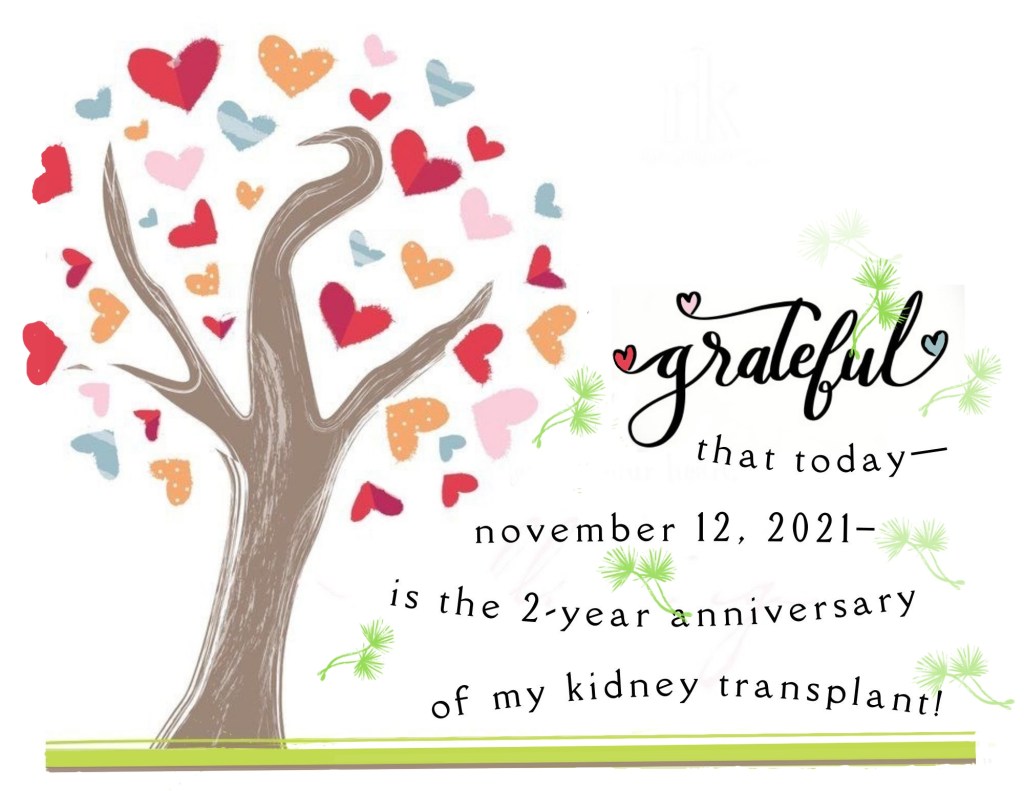
God did not protect me from any of the real-life crises that came my way—abuse as a child, a serious eye disease in Africa, the loss of my youngest brother, the fire that almost destroyed our home, the kidney disease that almost killed me at least three times, the years of dialysis, the miraculous, but very hard, kidney transplant. I assume God kept watch over all of it, but God did not protect me from it. God did not spare me from the traumatic events that marked my life.

So I have to ask questions, honest questions, about how God’s love really affects my life. How do I experience God’s love? How do I sense it in my spirit? Do I really believe that God loves me, especially in my life’s dark times? Do I believe that God should spare me from every life danger?

In my experience, God’s love is elusive, intangible, difficult to hold onto. At times, I don’t sense it at all. At times there are no holy ”everlasting arms” holding me until my darkness turns to light. The only way I sense it at all is by faith, the faith that is ”the substance of all things hoped for, the evidence of things not seen.”
(Hebrews 11:1)

To understand this love thing fully, I think I have to read the rest of that chapter in Hebrews, where we find a litany of what important Bible people did by faith. You may remember the list: “By faith, Abel; By faith, Moses; By faith, Jacob: By faith, Sarah: By faith, Rahab . . .” Many more are listed, each having done some great thing by faith. This chapter, though, presses hard on the things that can happen to the faithful ones. Listen to this part:

Women received their dead by resurrection. Others were tortured, refusing to accept release, in order to obtain a better resurrection. Others suffered mocking and flogging, and even chains and imprisonment. They were stoned to death, they were sawn in two,[l] they were killed by the sword; they went about in skins of sheep and goats, destitute, persecuted, tormented—of whom the world was not worthy. They wandered in deserts and mountains, and in caves and holes in the ground. Yet all these, though they were commended for their faith, did not receive what was promised . . .

Oh, my! They did everything right. Their faith was commendable. Yet, they did not see the promise they expected, the great and good things that would come to them because they were faithful. In the end, did they hold on to their faith—without experiencing their reward? Without seeing God’s promise?

What do each of them—Moses, Abraham, Josua, Rahab and the rest— have to do with us? Was their faith like ours? Were their challenges and obstacles like ours? Did they feel void of God’s love like we sometimes feel? Without the promise the expected, did their faith still hold?

We can only speculate about all those questions. But we do not have to speculate about our own faith. We know it. We live with it—when it is strong and when it falters. Did our faith, and God’s love, protect me from every hurt and every harm? I have to answer, ”No.” Yet, the opposite statement—God sustains us in everything—has been real and true throughout my life, in sunshine and in shadow.

I have not known where I was going or where I would end up most of the time, but I kept walking even in my soul’s dark times. The journey has had its rough passages. The journey has most definitely lead me through the dark. Yet, I have also experienced the sunrise that always comes, day after day without fail. And as for God . . . well, God’s love has been present, covering me in the warmth of the love that would not let me go, not by sparing me every hard time, but by “sustaining me in everything.”

The beautiful sunrise image at the beginning of this post points me to the thought that God’s love is a little like the sunrise—a calming light, a gentle light, forever dependable. I have yet to experience even one day without a sunrise. The photo also graces me with the image of footsteps in the snow. Look at them. They are the footprints of someone walking alone, and in truth, we all walk our journeys alone. I imagine, though, that we also depend upon the invisible footprints of the God who leads us on the path.

If we see God’s holy footsteps at all, we see them by faith. That will always be true, that by faith, we ”see” the footsteps that go before us. Only by faith can we claim the ”evidence of things not seen.” So when all is said and done, I believe this to be true: God’s love protects us from nothing! Yet… sustains us in everything!

I believe it by faith.

I hope you can spend a few quiet moments listening to this beautiful choral arrangement. Pay close attention to the words. This is just one sentence among other words of assurance . . .
I walk in footsteps of God’s love.

I see His footsteps in the way,
And follow them through darkest night,
Unafraid, I stumble not,
In the glow of perfect light,
I see.

I walk in footsteps of His love,
And find His light leads on before,
Then He gently turns to me,
Softly whispers, “trust Me more,
I walk.

Then as I follow in His way,
My path ahead will brightly shine,
For in His path of guiding light,
I find His footsteps first,
Then mine.

Dark night of the soul, Darkness, Light, Spiritual and emotional darkness, Vision

So Much Light We Cannot See

Photo by Shane McNary in Poprad | Slovakia
“The clouds may hang heavy, but the light still shines.”

Clouds hang heavy at times. They loom overhead as if they are holding something destructive. Rain, snow storms, hurricanes, tornados . . . whatever disaster our minds might envision. Sometimes ominous-looking clouds just move away or dissipate, as if to remind us that our deepest apprehensions are able to resolve themselves without our help. Other times, the dark clouds release their fury.

There is a point to all of this, and I think it is this: Humans have a tendency to see only what is dark and ominous, and fail to see the light surrounding it. Sometimes the light is there all the time, but we cannot see it. I want to borrow some words, actually the title of a beautiful war novel written by Anthony Doerr, All the Light We Cannot See.

An abundance of light surrounds us to warm us and brighten our days. Dark clouds do come into view, but the light is still there. We simply cannot, or will not, see it. I cannot help but name what we do as being unaware in the light. I know that, for me, the words, ”all the light we cannot see” stand as a description of my faulty vision, both physically and spiritually. It is in the spiritually dark times that I read again the treasure of Isaiah’s prophecy.

The people that walked in darkness have seen a great light: they that dwell in the land of the shadow of death, on them has the light shined. No longer will the sun be your light by day, nor the brightness of the moon shine on your night; for the LORD will be your everlasting light, and your God will be your splendor. Arise, shine; for your light has come, and the glory of the LORD is risen upon you . . .

From Isaiah chapter 9 and chapter 60

Physically, emotionally and spiritually, there is so much light we cannot see. or perhaps we refuse to see it. Realities claim their strongholds. Realities harm us, to be sure—realities of war and rumors of war, realities of violence, injustice, poverty, racism, abuse. The list of harms among us could go on and on. It harms our vision and steals our light. And there is much light we cannot see.

We cannot see the good around us against backdrops of the many forms of evil. We cannot see kind people, because so many people are unkind. We cannot see the dreams we dreamed in the light, because ominous darkness has hidden them. We cannot see the light of trust, because we have seen betrayal. We cannot see the people we love when we see only their flaws. We cannot accept the light of love from another person, because other persons in our lives have refused to love us. Even the light in our own souls suffers the darkness at times when the ”dark night of the soul” takes over within us.

Could we believe that, around us and in us, there is an abundance of light we cannot see? Might we push our hearts nearer to the light we can see? And can we acknowledge that ”all the light we cannot see” has been our reality far too long?

May God help us see all the light we have never seen before. May we see the light of Christ within us, and the light of the Spirit in the world. Amen.


Please spend a few moments listening to this lovely song, ”I See the Light.”
Vocals by Olivia Collingsworth and Joseph O’Brien,


Piano: Kim Collingsworth
Bass: Phillip Collingsworth
Guitar: Grayson Lilly
Mixed By: Phillip Collingsworth (Solid Sound Studios)
Video Edited By: William Blair

Frederick Buechner, Lostness, Madness, Noise, Silence

Silence ~ Holding Your Breath to Listen

“Silence” Photography by Daniele Colucci

Silence is at a premium at my house. The only time of day that is silent in my house is in the early morning—after the meowing cat goes outside; before anyone else in the house wakes up; before the iPad starts with its incessant sounds for incoming messages; and even before the sound of brewing coffee. I cherish that silence because, immersed in it, I learn all kinds of important things about myself. Including how much my soul needs silence and how little it gets.

I suppose silence is hard to come by for most people, at least those of us who are barraged by life’s incessant activity. Many culprits steal silence from us, but they are not always bad culprits. Many silence breakers are wonderful sounds like children’s laughter or a baby making baby sounds, or soothing music, gently falling rain, gentle breezes, the ebb and flow of the ocean, a flowing stream, birdsong. Some sounds are beautiful sounds.

The silence thieves I’m talking about are those that assault our places of solitude and peace. I think you will know some of them—like the sounds of gunfire in cities and communities, the sounds of family violence, the sounds of war, and even the sound of the broadcast news that tells us about all of those sounds and so many more. You will name your own sounds, the ones that strike fear in you, create inner turmoil for you, shatter your silenced places.

I think it’s important, at least for me, to find moments of silence and, in those silences, to think deeply, to calm my soul, to help mend my broken places, to discover my self and learn the truth of who I really am. And for me, I need silence to help me find my spiritual center. Believe me, silence eases every kind of headache and relaxes every painful muscle.

But then there’s that incessant news on tv! I know—I can just turn it off. The problem is that turning it off feels like turning my back on news I need to hear. If people are languishing from hunger, or suffering the violence of war, or living in fear for their lives, or dodging the violent fists of an abusive parent, or running away in fear of a terrorizing spouse, I need to know. I need to know because I care and just maybe I can do something about it. Like pray, reach out, call an ambulance, call the police, pray, offer words of comfort, cook a meal, call my Congress people, pray.

So yes, the television gives information that makes us care about our neighbor, about our communities and about the world. Still, it creates noise and sometimes we need silence. Our silence gives us the compassionate heart and the strength to help other when we can. The silence helps me find my own truth, and it is my truth that motivates me to care about what happens to others. A quote by Maxime Lagacé is full of wisdom, ”Noise creates illusions. Silence brings truth.”

I need silence and I need truth, about myself and about the world of chaos we seem to have created for ourselves. In his wonderful book, Whistling in the Dark, Frederick Buechner tells a story about Advent, how much we need to silently wait during the season of Advent for the coming of the Christ child, and also how we usually don’t get a silent moment. What overtakes our world is the noise of traffic, the noise of shoppers in overcrowded stores, the terrible noise of violence that the season always brings and, this year again, the noise of lament about those suffering from Covid-19 and the noise of the news that tells us about all of it—again and again and again. We can’t get a break and we can’t get even a smidgen of silence.

I am deeply moved by Frederick Buechner’s Advent story, especially when he writes about what he calls “the silence of a midwinter dusk.” In that dusk, he says, ”there is far off in the deeps of it somewhere a sound so faint that for all you can tell it may be only the sound of the silence itself. You hold your breath to listen.”

For me and for you, I hope for an escape from noise and constant activity, and instead slipping into a sacred space where we find silence and stillness. I don’t know about you, but I need that. I think we can somehow break away from the “madness and lostness” of the world and hightail it towards our places of silence.

But if you concentrate just for an instant, far off in the deeps of yourself somewhere you can feel the beating of your heart. For all its madness and lostness, not to mention your own, you can hear the world itself holding its breath.  

– Frederick Buechner

May it be so for you.

Epiphany, Star Words

The Star Word on the Floor

In my Voices Sunday school class . . . 
On Epiphany Sunday,
After we all had chosen our Star Words,
And discussed their most profound meaning,
Our Zoom call ended.

I spiritedly rose up to my feet! With great enthusiasm!

After all, the Star Word I had just chosen
Read, “RISE UP?”
The “Rise Up” worried me a bit,
       As Star Words often do,
Because those words always make me feel.

So I as I was “rising up” from my desk chair 
Expecting new vigor for a new year,
Suddenly . . .
       Something startled me.

Oh, my! There’s a Star Word on the floor!
Thank goodness it’s face down.

For a long time, I just carefully walked around the Star Word on the floor,
Wondering what I should do about it.

I couldn’t leave it on the floor;
        Because then people feet, cat feet and the desk chair wheels would destroy it.

What should I do?
Was this another Star Word meant for me?
          Or could it be for our Voices class, for all of us?

I decided to pick it up, turn it over, and see the Star Word;

But I couldn’t just pick it up
          Unceremoniously, without any sacred intent.

Remember, I always feel something when I choose a Star Word.
         Every time! 

Every year on the day we celebrate Epiphany,
         And hear again Epiphany’s story of the Magi getting a glimpse,
                 An extraordinary glimpse, to be sure;
                          Of a brilliant star in the night sky!

A star that probably left them breathless.
         A star that would miraculously show them the way ahead,
                  Even in the dark.

In the retelling of the Magis’ story, 
I always feel something;
       Always!

Just like I always feel something 
When it’s time to choose my Star Word,

Breathless, anxious, excited, afraid . . . 
     I wonder where and how my Star Word might lead me
              Into night’s darkness.
              Into the uncertainty of the year to come.
              Into a new way of being . . . 

All the while, pondering . . . 
       Things to change, 
            Resolutions to honor,
                 Amends to make,
                      Newness to discover,
                             New and holy promptings that will beckon me to rise up!

What will they be? Could my Star Word give me a hint?

All of these thoughts swept over me 
As I picked up that Star Word from the floor
And held it in my hands,
Holding my breath,
Hesitant to look on the other side.

Finally, I turned over the Star Word I had rescued from the floor.

When I read the Star Word, I knew instantly!
That this Star Word from the floor was for me.
It was for all of us.
It was for everyone

Who prays for,
               Who hopes for,
                               Who longs for,
6e31efa1-56e5-4867-b0d7-b62d4db5de5f

What about the Star Word on the floor?
What was its holy message for us?

Forgiveness.

Amen.

Christmas, Christmas bells, Inner peace, Mourning, peace, Silence

Let All the Earth Keep Silence

A silent, holy night

There are times when sound does nothing but cause pain—the harsh words of disagreement, the disturbing reverberation of gunfire, the abrasive words of political battles, the crying of a baby. This Christmas season for me has been a tender time. I have longed for Christmases past that were more simple and free of worry. I have not heard this year the sound of Christmas bells ringing in this joyful season. Instead, I have needed to find a holy, silent place.

A dear friend captured my emotions in her blog today:

Many of us miss Christmas moments
familiar from other years
and expected for this one.
Many of us miss someone so precious
who was with us and will not be.

Perhaps mourning loss has made me unable to hear all the ”joyful and triumphant” sounds of Christmas. Instead of craving those familiar joyful sounds, I have been drawn to a place of silence. I feel compelled in these days to seek silent spaces and to open my soul to holy whispers. It seems that silence brings peace as nothing else can.

As I have thought through all that I feel, an old hymn came to mind. It seems to capture where my soul is right now. I will listen to it a few times today, as I try to rest in the silence I need, ”Let all the earth keep silence before him.”

I will also turn again to these comforting words in my friend’s blog:

Look around on Christmas Eve
and Christmas Day
for the tip of angel wing prepared for you.

If sounds of Christmas joy feel painful to you this year, I invite you to find the holy silence you need. As you do, listen to this calming hymn.

Most of all, I wish for you ”the tip of angel wing.”

Christmas bells, Inner peace, peace, Peace on earth

Hear the Bells

“Spirit of Christmas” by Eric Dowdle

I ran across this painting by Eric Dowdle as I was nursing a bit of holiday doldrums. It’s easy to fall into doldrums while anticipating Christmas. We expect an ”all is calm, all is bright” kind of Christmas, but sometimes that’s not reality at all. Instead, we can’t hear the singing of choirs, the sweet sounds of the organ or the ringing of Christmas bells.

When I look at this art, I see everything we long for as Christmas nears: a bright and beautiful tree with a sparking star on top, Santas everywhere and the people encircling the tree as if to say, ”Right here among us, there is peace on earth among people of good will.” If the painting miraculously had sound, I imagine I would hear the ringing of church bells heralding the magnificent coming of peace on earth.

Yet, we have reality in our sight instead of this joyful painting. Peace among us in these days, even peace within us, seems to be in short supply as division, war, poverty, and racial injustice continues to hold sway on our world. Not insignificant is that our personal relationships seem to be less than peaceful. The place within us where peace ought to be is often in chaos, filled with anxiety or just plain empty. Peace in our hearts and spirits—that sacred sense of serenity and inner calm—simply eludes us.

When my spirit is not at peace, I can barely see peace anywhere, even at Christmas. Such was the story of Henry Wadsworth Longfellow who wrote the words of the beloved carol, ”I Heard the Bells on Christmas Day.” Some of the stanzas of Longfellow’s beautiful poem are familiar to us, but other stanzas we have seldom, if ever, heard. Here is the poem in its entirety.

I heard the bells on Christmas Day
Their old, familiar carols play,
    And wild and sweet
    The words repeat
Of peace on earth, good-will to men!

And thought how, as the day had come,
The belfries of all Christendom
    Had rolled along
    The unbroken song
Of peace on earth, good-will to men!

Till ringing, singing on its way,
The world revolved from night to day,
    A voice, a chime,
    A chant sublime
Of peace on earth, good-will to men!

Then from each black, accursed mouth
The cannon thundered in the South,
    And with the sound
    The carols drowned
Of peace on earth, good-will to men!

It was as if an earthquake rent
The hearth-stones of a continent,
    And made forlorn
    The households born
Of peace on earth, good-will to men!

And in despair I bowed my head;
"There is no peace on earth," I said;
    "For hate is strong,
    And mocks the song
Of peace on earth, good-will to men!"

Then pealed the bells more loud and deep:
"God is not dead, nor doth He sleep;
    The Wrong shall fail,
    The Right prevail,
With peace on earth, good will to all!


I cannot help but look around at what I see and hear on the streets of this city and all over the world and see despair, hatred, division and violence taking over the peace I so need. So as the carol says, ”And in despair I bowed my head; “There is no peace on earth,” I said;” For hate is strong, And mocks the song of peace on earth, good-will to men!”

As you seek peace this Christmas season, know that God is the giver of a deep peace that abides in our hearts. I invite you to take a few moments out of your day to enjoy these videos. The first is a choral and orchestra performance of the carol. The second is a lovely group of young people singing the hymn with the addition of handbells. The third is a beautiful performance by the Mormon Tabernacle Choir with the narrated story of Longfellow’s writing of the carol.

May the Christmas blessing of peace fill your heart, and may you hear, above all other sounds, the wild and sweet ringing of the bells of Christmas.


Advent, Love

A Contemplative Advent ~ Love

We end Advent with Love—that heart emotion that makes its way into our souls and remains there. Love isn’t always easy. Love may well require putting away your self-interest, your tendency to be self-absorbed and your compulsion to hold grudges.

There are much better things to hold than grudges. Like the constant Love you hold for your children and grandchildren. Like the lasting Love of a life partner. Like the deep love you hold for your family. Like the soul-Love you experience when you remember a baby laying in a manger in Bethlehem.

When you remember that baby, with a brilliant star shining over him and angels singing overhead, that is when you know genuine Love. That is the Love of “God With Us.” That is the Love that dwells in us for eternity. That is the Love that helps us Love one another as God has Loved us.

God loves you simply because God has chosen to do so. God loves you when you don’t feel lovely. God loves you when no one else loves you. Others may abandon you, divorce you, and ignore you, but God will love you always. No matter what!
— Max Lucado

Don’t let anyone or anything take that Love from you like the grinch stole Christmas! Don’t let your quarrels and your anger steal that Love from you. Don’t let petty misunderstandings crush the Love that is in you, because that Love became flesh and came to live among us and in us.


Glory to God in the highest,
and on earth peace,
good will toward all people!

Advent, Love

A Contemplative Advent ~ Love

I’m a little short on words this year for Advent’s Sunday of Love.
Love is fragile, you know. Love can turn on a dime.
Or at least love can turn on the turn of a phrase
A difficult conversation
Or a harsh word.

Then you lose it—love, that is
If only for a time
But you look around for it
And love is gone
Replaced with heartbreak
Uncertainty
Bitterness
Broken hearts
Angry words.

Can’t get it back, either
At least not right away.

Left then with Advent Hope
You hope for a kinder moment
To make its way into your heart.

Left with Advent Peace
You look for other things
That might fill your heart
With calm
With serenity.

Left with Advent Joy
You can only mourn its passing.

But Advent Love
Well, you just hold your heart tightly
so that it doesn’t shatter completely
Before Love comes down at Christmas.

Emmanuel!
God with us!

Uncategorized

Angels of Light

Angels of Grace ~ Artist, Christine Bell

May the angels of light
glisten for us this day.

May the sparks of God’s beauty
dance in the eyes of those we love.

May the universe
be on fire with Presence for us this day.

May the new sun’s rising
grace us with gratitude.

Let earth’s greenness shine
and its waters breathe with Spirit.

Let heaven’s winds stir the soil of our soul
and fresh awakenings rise within us.

May the mighty angels of light
glisten in all things this day.

May they summon us to reverence,
may they call us to life.


— John Philip Newell

Please enjoy this video.

Advent, Inner joy, Jude

A Contemplative Advent ~ Joy

I learned today that happiness in America is at an all-time low. A recent survey from the University of Chicago found that happiness among Americans has fallen lowere than it has been in five decades. What has caused the public’s happiness to plummet is fairly simple—living in the midst of the coronavirus. And that’s the current status of happiness in America.

But happiness is not joy. We can be happy when we find success, or a have a new relationship, or a win a sweepstakes, or watch our children graduate. Yet, even in a state of happiness, we can be without joy. Happiness is an emotion that brings bursts of intense pleasure, excitement, and satisfaction, while joy is a enduring state of being that results in feelings of inner peace and contentment. Joy does not depend on our good luck or our happy circumstances. Joy lives in our hearts, in the deep recesses of our souls. Happiness comes and goes; joy is abiding and eternal.

Still, joy can seem elusive in troubled times. No one escapes trouble. It is an inevitable part of life and, at times, all of us encounter pain, grief, hardship, sorrow, loneliness. Life brings us joy-destroying circumstances. Even Advent Joy cannot change that. We can light the pink candle in our Advent wreaths over and over again, but the pink joy candle cannot bring us joy. The hope, peace, joy and love that Advent might bring to us does not always reach us.

I ask myself: What is it in me that prevents joy from filling my heart? Why does melancholy replace joy in me so often? How do I find joy?

Often, children teach us by their words and actions. Most of them exude joy. I remember hearing children sing, ”I’ve got that joy, joy, joy, joy down in my heart.” The song is actually good theology for children. It is also good theology for adults, especially adults that have lost their joy. I don’t have to search for joy after all. It is ”down in my heart” or maybe down deeply in my soul.

Advent joy is not something you have to work for. Instead, it is something that you hold in your soul that stays with you always. Consider this wise thought:

When you do things from your soul, you feel a river moving in you, a joy.
― Rumi 

Or maybe this thought:

I will give thanks to you, O Lord,
    for though you were angry with me,
your anger turned away,
    and you comforted me.i

Surely God is my salvation;
    I will trust, and will not be afraid,
for the Lord God is my strength and my might;
    he has become my salvation.

With joy you will draw water from the wells of salvation.

Isaiah 12: 1-3 NRSV


Advent, peace, Prince of Peace

A Contemplative Advent ~ Peace


In this second week of Advent, I am searching for peace. I feel a little like the prophet Jeremiah who said, ”They have treated the wound of my people carelessly, saying, ‘Peace, peace,’ when there is no peace.” (Jeremiah 6:1)

Indeed, how difficult it is to embody a sense of peace when we look around us only to see yet another school shooting, yet another Covid variant (Omicron), yet another tragic example of police brutality, yet another child abused . . . and more, one after another un-peaceful thing in our world. Yet, one of our lectionary texts for this week seems to promise that peace can be within reach.

Through the tender mercy of our God,
the Dayspring from on high has visited us;
To give light to those who sit in darkness and in the shadow of death,
To guide our feet into the way of peace.

Luke 1:78-79 NKJV

But on this day, in the middle of Advent’s week of peace, I wonder how I might find even a bit of God’s promised peace. Peace remains elusive to me as I look around me at a world of chaos, discontent, oppression, unrelenting pandemic, fear, uncertainty and all manner of disturbance. ”I need peace of mind!” the people cry. If I have ears to hear their cry, and my own, I must own the reality that I need peace of mind, too. But I also need peace of the soul. I need deep down peace to make its way to where my emotions live.

Isn’t it true that Advent Peace is about soul transformation—the kind of transformation that stops with the decorating, baking, shopping and all things frenzy? Isn’t it true that instead of Christmas frenzy, all of us yearn for Advent peace?

And so I stop and close my eyes.
I breathe slowly and deeply.
Again. Again. Again.
I breathe deeply and, as I slowly exhale, I feel my heart beating slower.
I feel my arms relaxing
and my muscles releasing the tightness they always hold on to.

I rest in arms of grace and listen for Spirit breeze that calms me.
I contemplate what’s in my heart
and wait silently to hear my soul’s whisper.

Does deep breathing allow the Spirit of Peace to envelop me with her tranquility? Do those few quiet moments take me to that place inside me where all is calm? It seems so, at least for a while. Interspersing my frenzied life with brief moments of contemplation makes all the difference in the world for me. I do sense Advent peace in those moments. Or is it that I reached down deeply enough into my soul and found the peace that was already there? Either way, I still held on to a few moments of peace.

If you and I are able to find that place of peace, we can then pass it on to others who need it and even to the chaotic world around us. During this week of Advent peace, wouldn’t it be wonderful to see dozens of random acts of peace? Whether that’s raking a neighbor’s yard, or taking a meal to a family with a new baby, or doing a home repair for an elderly couple, or sending a card, might we seek out someone who could use a little more peace in their lives?

When we reach out to other souls with random acts of peace, we give human form to the Peace of Christ. Christ clothes us in His humanity. We are His continuing incarnation in the world. These thoughts are described beautifully by Joseph B. Clower in his book, ”The Church in the Thought of Jesus.”

If the indwelling Christ is not confined,
then our eyes flow with His tears,
our hearts are moved with His compassion,
our hands are coarsened with His labor,
our feet are wearied with His walking among all people.

(Slightly paraphrased)

Now, take a slow, deep breath. Let it out. Take another breath. Contemplate the Prince of Peace and how much He wants peace for your life. Breathe deeply. Let it out. 

Now keep breathing, and find something peaceful to do today for another person who needs peace as much as you do—a random act of peace. Amen.


I invite you to spend a few moments of contemplation by listening to this video, Dona Nobis Pacem— Grant Us Peace.

Advent, Angels, Hope, Jesus, Prince of Peace, Shepherds, The Incarnation of Christ

A Contemplative Advent ~ Hope

When the angels had left them and gone into heaven,
the shepherds said to one another,
“Let’s go to Bethlehem and see this thing that has happened,
which the Lord has told us about.”
So they hurried off and found Mary and Joseph,
and the baby, who was lying in the manger.
Luke 2:15-16  NIV


I am searching this Advent season for hope—hope that’s a tiny bit brighter, hope that lifts up my eyes to see more than I have seen before, hope that stirs in my heart, even for a moment. I feel the words of this hymn, ”I come in half-belief.” It’s not the most promising mood to bring to Advent, but it’s all I’ve got. The reasons don’t matter. They are myriad, as perhaps your reasons for hesitatingly approaching Advent.

The truth is that many of us have experienced struggles in the past year. The truth is that our country has seemed unbalanced, troubled, confused. It is also true that suffering has made its way into villages and cities and hamlets all over the world. I feel the strain. It affects my soul and troubles my spirit, so I longing for a gentle sign of hope to make its home in my heart.

My contemplation led me today to the hymn I share with you for your own reflection as we approach Advent’s first Sunday. I hope you will ponder the text and listen to the video of the choral arrangement. I am moved by this hymn every time I hear or sing it. The words invite me to the manger, the place where there is room and welcome always and forever. Even as hope eludes me, the eternal truth still stirs my soul: How could I forget how Love was born, and burned its way into my heart—unasked, unforced, unearned, to die, to live, and not alone for me. For all the world, the Hope of the world!

For to us a child is born,
    to us a son is given,
    and the government will be on his shoulders.
And he will be called
    Wonderful Counselor, Mighty God,
    Everlasting Father, Prince of Peace.

Isaiah 9:6 NIV

Where shepherds lately knelt and kept the angel’s word,
I come in half-belief, a pilgrim strangely stirred;
But there is room and welcome there for me,
But there is room and welcome there for me.

In that unlikely place I find him as they said:
Sweet newborn Babe, how frail!  And in a manger bed:
A still, small voice to cry one day for me,
A still, small voice to cry one day for me.

How should I not have known Isaiah would be there,
His prophecies fulfilled?  With pounding heart I stare:
A child, a son, the Prince of Peace for me,
A child, a son, the Prince of Peace for me.

Can I, will I forget how Love was born, and burned
It’s way into my heart—unasked, unforced, unearned,
To die, to live, and not alone for me,
To die, to live, and not alone for me?

Dr. Jaroslav Vajda (1919-2008) 

Where Shepherds Lately Knelt” arranged by Craig Courtney | BYU Men’s Chorus
featuring Laurence Lowe, French horn

Advocate, All Shall Be Well, Courage, God's presence, God’s promises, Heart, Holy Spirit, Wellspring of life

Guarding My Heart

Proverbs 4:23

With all the chaos blowing about in the world—the swirling debris of discord, fear, hate, division, tumult all around us—we cannot help but try to drill down to the solid place of our foundation. When we shake in the chaos, swaying from side to side until we fear we may by pushed over, our soul speaks up to come to our aid. It’s simple really, to find our sure foundation, the solid rock of who we are and what we must do to stay upright—that means healthy in body, mind and spirit.

I think some of you are pray-ers and others sing until you feel safely grounded. Some of you meditate and others of you read Holy Scripture. Some write poetry or create art. Whatever you might do in your times of unsteadiness, remember that you do not have to repair everything in your life or turn yourself into a person of incomparable strength and courage. I know what you’re thinking! That these are terrifying evil days that require unparalleled faith and perseverance. True enough! I remember the terrifying parts every time I watch the news. And more than once in the past several years, I have thought of this text:

Therefore take up the whole armor of God, that you may be able to withstand in the evil day, and having done all, to stand.

Ephesians 6:13 (NKJV)

That’s the way I learned that verse of scripture, but others have translated it differently, maybe better. The New International Reader’s Version perhaps speaks to us more simply and directly, and with the bold promise that we could be able to stand up to any evil day, any evil person.

So put on all of God’s armor. Evil days will come. But you will be able to stand up to anything. And after you have done everything you can, you will still be standing. —Ephesians 6:13 (NIRV)

I concur that I will still be standing, whatever comes. Too many things in my life have knocked me to the ground, and every time I have gotten up on my feet to try to live another day. I suspect you have had the same experience.We were able to stand, not because we had built up incomparable strength, but because Spirit was strength in us, beside us, before and behind us. You see, that was God’s plan all along. ”I will not leave you comfortless,” said Jesus, carrying out the precise plan of the Creator God. “I will ask the Father, and he will give you another Comforter, to be with you forever … the Spirit of truth.” (From John 14)

Just one more bit of wisdom for evil days! I have a notion that you and I do many things to protect ourselves from evil or chaos or betrayal or difficulty . … the list goes on and on. Every remedy helps a little. Every act of self-help or self-care helps a little. Some of it helps a lot. In my experience, everything I do to maintain my equilibrium and keep myself safe from chaos helps. But there is one word of advice that has stayed with me through the years, and it is this:

Above all else, guard your heart. For from it flows the wellspring of life.

Proverbs 4:23

That admonishment from Proverbs 4 is translated in many different ways—guard your heard with all diligence; with all vigilance; with utmost care; with all watchfulness; guard your heart above all else. I think we get the message clearly. And so I leave you with this blessing .…


As you journey through all manner of evil chaos,
May you walk the road without fear,

Knowing the deep peace of God’s grace,
With the shadow of Christ walking ahead of you,
With the presence of the Holy Spirit dwelling in your soul,
With
your resolve firmly set to guard your heart with all watchfulness,
So that you will know beyond any doubt

that from your heart flows the wellspring of life. Amen

Contemplation, Faith, Joy, Music, Singing, Theology

Where Is Our Joy?

Graphic by Kathy Manis Findleyo

After about five years of co-teaching my Sunday School class, known as the Voices Class, I have had an insight, a rather critical insight. Teaching this class, in particular, has been a gift for me and possibly for the other class members. We have bonded in important and meaningful ways. Most importantly, we “bear one another’s burdens” (Galatians 6:2) and most definitely, we weep with our sisters who have found themselves weeping along the journey. (Romans 12:15)

And what a journey it has been for our class. We began with a lovely Lenten study titled, “Praying with Your Pen,” which took us into the wonderful world of contemplative writing. Such a spiritual disciple leads into all manner of emotional and spiritual discovery, not all of which is positive. The study was emotionally and spiritually taxing at times, while being life-giving for us all.

We then studied a three-month series of biblical women who faced various hardships and later revisited that study for an additional seven weeks. As we followed the journeys of these biblical women, we found kindred spirits and grace for our own journeys. But the lives of the biblical women were harsh, harsh enough to bring up in us an examination of the harshness we have encountered. So this study was a difficult one as well.

Other Lenten and Advent studies through the years kept us in a contemplative, and often melancholy, space where we learned so much about ourselves, our faith and our relationship with God and with each other. We followed Christ Sophia for a while, as we considered the feminine nature of God, and as we followed her, we uncovered spiritual layers in us that have long been touched by Spirit Wisdom.

All of our studies along the way took us to tender places within, places where spiritual maturity occurs and faith deepens. A deepened faith, it seems, was especially important as we entered the pandemic that separated us from each other, at least physically. We adapted valiantly and immediately, and our class continued via virtual Zoom meetings. The meetings, that regularly lasted two hours or more, seemed to ensure our sanity as we navigated pandemic lifestyles that we certainly did not choose. Suddenly, the day to day living became harder, school more complicated, safety measures all-encompassing, family isolation straining. Figuring out this new way to live became draining beyond belief.

That, too, we navigated together, holding one another in the light, learning to find church in uncommon places and keeping each other gathered close, covered in the love each of us brought to our circle. Gathering close to each other was critically important as we lost friends, church members and close family members to this pandemic. Apart from the pandemic tragedies we watched, our class was brought low by other illness and deaths of persons close to us.

So a few weeks ago, my soul cried out, “Enough!” Then I asked myself, ”Where is our joy?” We’ve got the ‘weep with those who weep’ part, God. Can we just move on to the ‘rejoicing with those who rejoice’ part?”

Where is our joy? That’s the part of faith I cannot discern, because right now, it’s just too far away. Still, I asked myself the question.

And I answered myself immediately.
It’s in our hymns! Our joy is in our singing.


So the Voices Class started a new study titled,

Singing Theology: Hymns & the Formation of Faith
Our Worship, Hymnody and Theology

A delightful study it has been for us, as we explore how hymns express the theology of a particular Christian community or tradition. Searching deeply into one hymn each week, we have asked: how does the hymn’s theology shape and form our faith, our belief, our mission and our action? “As the church sings, so she believes,” writes Beth Bowers. We had discovered in this new study an informative, important—and fun—exploration of song!

Hymns We Have Studied Each Week . . .


Here is our joy, in the hymns we sing — in their rhythms and their melodies, their thoughts and words. Hymns express our faith, our longing, our petition, our awe, our need, our regret, our grief, our testimony, our theology, our conviction and the deepest joy of our hearts. May it always be so!

My life goes on in endless song
Above earth´s lamentations,
I hear the real, though far-off hymn
That hails a new creation.

Through all the tumult and the strife
I hear its music ringing,
It sounds an echo in my soul.
How can I keep from singing?

While though the tempest loudly roars,
I hear the truth, it liveth.
And though the darkness ’round me close,
Songs in the night it giveth.

No storm can shake my inmost calm,
While to that rock I´m clinging.
Since love is lord of heaven and earth
How can I keep from singing?

When tyrants tremble in their fear
And hear their death knell ringing,
When friends rejoice both far and near
How can I keep from singing?

In prison cell and dungeon vile
Our thoughts to them are winging,
When friends by shame are undefiled
How can I keep from singing?

Songwriters: Eithne Ni Bhraonain / Nicky Ryan / Roma Ryan

Courage, Emerging new, Guilt, I am enough!, Internal conflict, Introspection, life, Light, Psalm 139, Re-claiming self, Sacred Worth, Self Awareness, Self-understanding, Women

When Light Runs Wild

There are days! Don’t you have those troublesome days when feeling good about yourself seems impossible? I am guessing we all have those days, because there are just too darn many things about ourselves we don’t feel very good about. What are those things? you might ask.

“I missed that deadline.”
“I was too irritable with the kids.”
“I hate my hair.”
“I have gained far too much weight.”
“I have made a mess of my life.”

The list of what we don’t like, or even what we loathe, about ourselves can be a long one, and when we ponder such a list for very long, we can develop a skewed image of ourselves. Fortunately, many of us have been able to see that the person we really are can be measured on many levels, far more important levels than, say, appearance.
Maturity helps, and aging has a way of putting all that negative ”stuff” about me in a box that I keep locked. And the key, well, I threw that key in a river!

What’s left is definitely a healthier perspective that allows me to look at myself in different ways and to make kinder conclusions. I have learned over decades that my image of myself is important, that I have to see my self with accepting eyes and that self-deprecating thoughts have the power to bring me to the edge of despondency.

. . . aging has a way of putting all that negative “stuff” about me in a box that I keep locked. And the key, well, I threw that key in a river!

kmf


Still those days come, bringing me a boatload of reasons to detest myself. There is a certain season of life in which self-flagellation is downright dangerous, wielding power over your life in very destructive ways. You’ll likely know it when you have reached that season of life — you know, the season when you can actually go out without make-up, wear a blouse two days in a row, love yourself for the whole person you are and wearing black support stockings in public, having convinced yourself that they really are stylish!

I don’t know about you, but I have to admit that I do have just a tad of trouble wearing support hose in public. That tells me that I need help, that I do not adequately value myself as a rule, that I still believe that my appearance defines me and that I need a shove to get to the point of loving who I am.

I don’t know about you, but I have to admit that I do have just a tad of trouble wearing support hose in public. That tells me that I need help, that I do not adequately value myself as a rule, that I still believe that my appearance defines me and that I need a shove to get to the point of loving who I am.


There is no better place to seek help with that than in the words of the psalmist in the 139th Psalm that say so much about how God created us and how God knows us inside and out. The Psalm tells us that we are ”fearfully and wonderfully made.” (v.14)

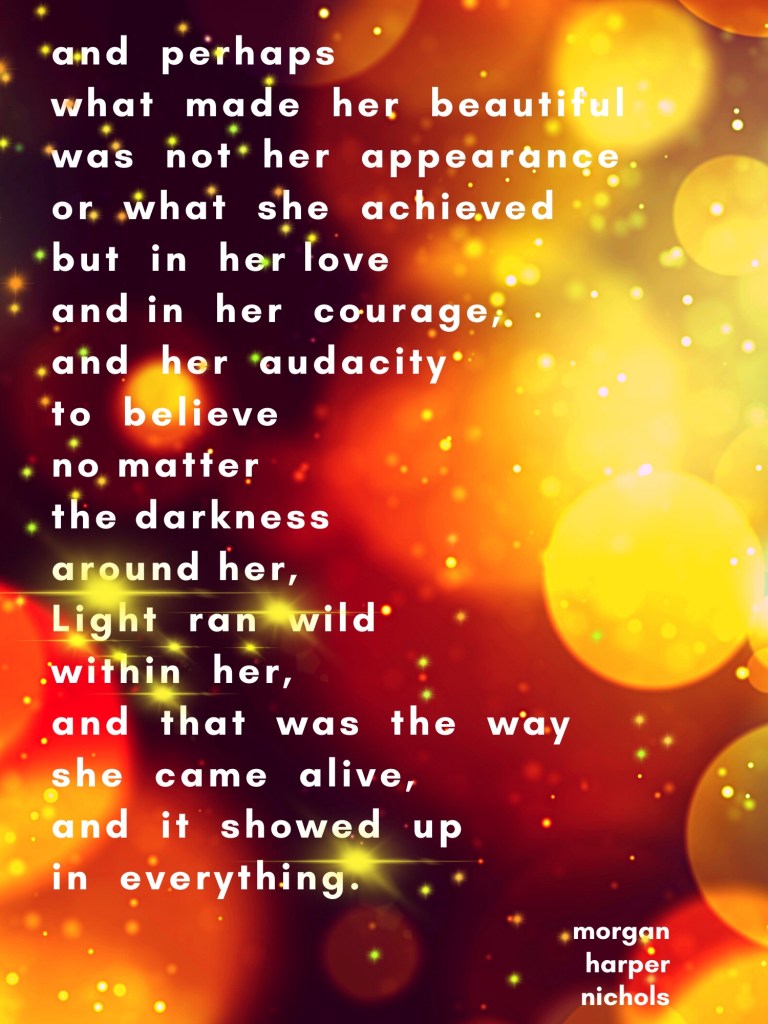
And then there are the inspiring words of artist and writer morgan harper nichols that so inspire me towards love, courage, audacity and the Light that runs wild within me, the Light that shines through my darkness and never goes out.

and  perhaps 
what  made  her  beautiful 

was  not  her  appearance
or  what  she  achieved
but  in  her love

and in  her  courage,
and  her  audacity
to  believe 
no matter

the darkness
around her,
Light  ran  wild
within  her,
and  that  was  the  way
she  came  alive, 
and  it  showed  up

in  everything.
— morgan harper nichols

May you have the strength to navigate those days when darkness threatens your light. May you love yourself and dig deep for the courage and audacity that frees you and lets the Light run wild within you!

Aging, All Shall Be Well, Art, Faith, God's Faithfulness, Grace, Lastingness

Lastingness

Aging — the beauty of petals as they age


My cousins visited this weekend for the first time in months, a needed visit for all of us. We laughed and played and enjoyed one another. We talked a lot, too, into the wee hours. We talked about sweet memories, of course, remembering so many good and fun times. We talked about old boyfriends and childhood disagreements and family idiosyncrasies.

I think we talked most about aging and the physical and emotional changes it brings. We lamented it, of course, and wished it away. We cursed it just a bit, and tried in vain to find ways around it. In the end, we agreed that we can’t get around it, but just have to go through it. Right through the middle of it until the pathway ends.

Right smack dab in the middle of dialogue about age spots, edema, muscle pain and a plethora of bodily ills, we stopped, suddenly realizing that there must be more to the aging process than physical symptoms. Where is life’s meaning when we draw nearer to life’s end? How do we grow old held by the same grace that held us when we were children, young adults, middle aged?

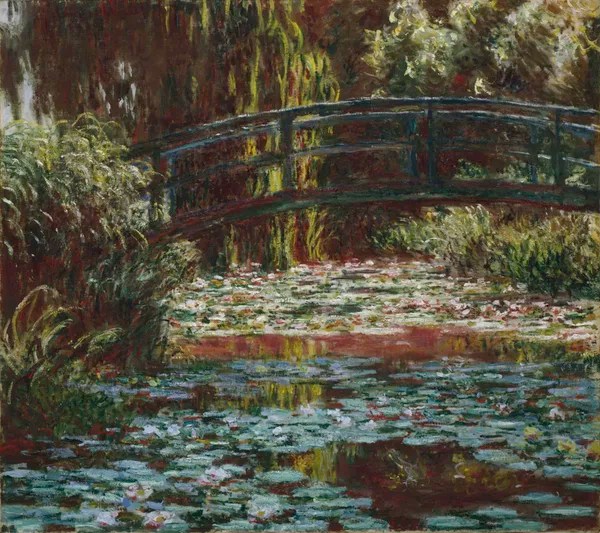
I came across an intriguing word this morning in an NPR article. The word is Lastingness What an astounding word to ponder. Perhaps we should consider lastingness instead of aging. Various creative artists are the subjects of Nicholas Delbanco’s latest book, Lastingness: The Art of Old Age. Delbanco examines artists who either maintained or advanced their work past the age of 70 — from Claude Monet, to Giuseppe Verdi, to Georgia O’Keeffe. Because I am an artist, I was captivated by the idea of lastingness, especially when Delbanco told the story of Monet’s later years.

Delbanco writes that French impressionist Claude Monet — who painted well into his 80s, even after his vision was clouded by cataracts — created some of his most well-known works in the last decades of his life. After a long career as a renowned and financially successful artist, Monet retreated to the beloved gardens of his home in Giverny, 20 miles outside of Paris. His gardens became his artistic obsession. It was Monet’s failing eyesight that posed the greatest threat to his work. “He became more or less legally blind as we would describe it now,” Delbanco says. “So Monet compensated for, or focused on, the visible world in very different ways in his older age.” The works Monet created in his last years at Giverny are regarded as masterpieces.

In the last decades of his life, French impressionist painter Claude Monet focused much of his work on the water lilies in his garden at Giverny. He continued painting well into his 80s, even after his vision had been clouded by cataracts.

The Art Institute of Chicago

Monet’s exquisite impressionist paintings eventually ended because of his cataracts. The poet Lisel Mueller has captured Monet’s cataract story brilliantly, in “Monet Refuses the Operation.” As of 1919, the Monet was urged to have the cataracts attended to; in 1923 he had operations on his right eye, and glasses improved his eyesight — but only briefly, fitfully, and he had trouble distinguishing color. Mueller’s poem begins:

Doctor, you say there are no haloes
around the streetlights in Paris
and what I see is an aberration
caused by old age, an affliction.
I tell you it has taken me all my life
to arrive at the vision of gas lamps as angels,
to soften and blur and finally banish
the edges you regret I don’t see,
to learn that the line I called the horizon
does not exist and sky and water,
so long apart, are the same state of being . . .

I don’t know exactly what “lastingness” means, but I think it might mean seeing haloes glowing around street lights or the ”vision of gas lamps as angels.” I’m pretty sure it means learning to look at life as softened and blurred, banishing life’s sharp edges. Perhaps “lastingness” means that my writing or my art will have a lasting impact on the world. Maybe it means that I will pass on my wisdom to my grandchildren. Or that the child I helped recover from long-term sexual abuse will find happiness in her life. Perhaps “lastingness” means that my faith in God will carry me to the grace that is the end of life. That kind of “lastingness” brings a kind of peace to my aging, a grace that assures me that aging is much more than painful joints and aching muscles. “Lastingness” is holier than physical afflictions and I think it blurs and softens them until they are tolerable.

When I cannot find the right words, I can always count on Bishop Steven Charleston to write them.

I see more clearly, now that I am aging. Not with my eyesight, but with my soul. I see the fine detail of what I missed in younger years. I see the place of faith and forgiveness in my story. I see the possibilities of life in ways I never imagined. I was not blind in my youth, but my vision was limited to only a few seasons of seeing. Now I am an old man standing on a hill. I see more clearly. The universe stretches above me in infinite glory and the Earth spreads her shawl to wrap me in creation. Open the eyes of your spirit. Look out in wonder. See the fullness of the life you have received. See the promise of love walking in beauty before you.

Bishop Charleston’s words might just be the very best description of ”lastingness.” Maybe “lastingness” means that because I am aging, I now see not only with my eyesight, but with my soul. Maybe it means that now I can clearly see the fullness of the life I have received and the promise of lasting grace holding me close.


Even to your old age I will be the same,
And even to your graying years I will bear you!
I have done it, and I will carry you;
And I will bear you and I will deliver you.

— Isaiah 46:4 —

#RevGalBlogPals, Diane Strickland, God’s Mercy, Grace, mercy, peace, Spirit, Spirit wind, Suffering

“Undo Me With Your Grace”

I’m not sure I know what it feels like to have God “undo me with grace,” but I have learned how it feels to need more grace, to long for Spirit breezes to gently blow around me with winds of grace. I need grace for enduring illness, grace for being separated from my son and his family, especially my five grandchildren. I need grace when I’m angry or disappointed or heartbroken. I need grace when I feel like giving up and giving in. I need God’s grace — the grace of the Spirit — to help me live in this season of my life.

I read a provocative prayer today. It kind of grabbed at my heart, asking me what exactly is in my heart right now. It asked me what I’m struggling with. The brilliant writer of prayers, Diane Strickland, writes again and again in her prayer the words, ”Undo my life with your grace,” leaving me asking myself what might happen if God decided to undo my life, even through God would likely be merciful enough to undo my life with grace.

The truth is that those words so grabbed me that my prayer was, ”God, I think I need to let you undo my life.” Maybe I feel the need to re-do my life with string of second chances. Maybe I need forgiveness for regrets, release from memories of pain. Whatever it means to have one’s life undone by God, my heart responded, with longing, to this prayer.

O, my Creator,

In the injustice of my country I caught a glimpse of the bottom of the iceberg this week. I saw how my life lived above the waterline rests on wrong assumptions of privilege, great and small and many. I am cold inside. I don’t want to be cold inside.

Undo my life with your grace. Pick out the seams sewn by fear and mend the tears made by violence. Patch the holes that were always there from the start because I don’t know much about the rest of the world or how life works for others you love just as much as you love me.

Undo me with your grace. Shake out the fabric of me. Unfold and fold me anew. Reveal your image in there somewhere and surprise me with what You make of me when mercy prevails and justice leads and love accompanies us.

Undo me with your grace. I’ve lived a long time now, long enough to know there’s more to be if I can lay down what has mattered more than it needed to, and take up what I’ve barely used at all.

I don’t feel there’s so much wrong with me that we must start over. I feel there’s more of me somewhere that fits better for now and will make room for later. Release more gospel into my life and from my life. Warm me up again. Humble me with wisdom and truth and promise and hold me together with those same gifts.

Undo me with your grace. Just a little bit more today, Spirit. Just a little more.

“Undo me with your grace. Just a little bit more today, Spirit. Just a little more.”

As I reflected on those words, my thoughts ended up with this conclusion. I don’t need grace to extricate me or liberate me from all that is difficult, heartbreaking and oppressive about my life. But I definitely need Spirit wind to live my life.

I don’t need grace to rescue me. But I do need Spirit-grace that moves in my life with me, giving me life-saving and healing grace for each moment. I need Spirit because I have known her holy presence with me and I have learned to experience the wonder of being moved by wind wild and calm, her breeze blowing around me with both tender comfort and empowering promise.

With that kind of sacred promise, I can live into my life, not shrink from it or fear it. I can move into my life, whatever it brings, with Spirit’s blessing. That’s how she impels me to honor the grace I have received — by giving it away. Her winds have impelled me for many years to minister to God’s people, and I do not intend to stop now. My call from God was for life, not meant to expire when I retired or when my health failed.

I know that God gives grace for waning health and I have it on good authority that God gives “more grace when burdens grow greater.”* When I consider the grace that has so filled my life, I think of the story of Annie Johnson Flint who wrote the text of the hymn, ”He Giveth More Grace.”

Annie Johnson Flint, born in 1866, was an inspiration to all who knew her. This is just a tiny bit of her story. The fullness of Annie Johnson Flint’s story includes a life-long string of losses and difficulties. By the time she was six years old, she had lost her mother and father to illnesses and was adopted by a family named Flint. She loved poetry and dreamed of being a composer and concert pianist. After graduating from high school, Annie went on to become an elementary school teacher, but in her second year was afflicted with arthritis that steadily and quickly worsened. She lost her ability to walk, but she became a prolific writer of poems and hymn texts.

The many stories written about her stories tell how later in life she was unable to open her hands and could no longer write, yet continued to compose her on a typewriter using her knuckles. And that “she sought healing, but in the end she was thoroughly convinced that God intended to glory Himself through her, in her weak earthen vessel.”

The words of the hymn text she wrote, ”He Giveth More Grace,” reflect the many disheartening moments she experienced throughout her life. She died at the age of 66, leaving as her legacy so many faith-strengthening words, including these:

He giveth more grace when the burdens grow greater,
He sendeth more strength when the labours increase;
To added afflictions He addeth His mercy,
To multiplied trials, His multiplied peace.

When we have exhausted our store of endurance,
When our strength has failed ere the day is half done,
When we reach the end of our hoarded resources
Our Father’s full giving is only begun.

Fear not that your need shall exceed His provision,
Our God ever yearns His resources to share;
Lean hard on the arm everlasting, availing;
The Father, both you and your load will upbear.

His love has no limits, His grace has no measure,
His power no boundary known unto men;
For out of His infinite riches in Jesus
He giveth, and giveth, and giveth again.

I have loved this hymn for years in spite of its masculine language. It moves me and uplifts me. It always reminds me of the infinite grace I have known in my life. I hope you will listen to this hymn as a part of your contemplative time.

“He Giveth More Grace” performed by The Celebrant Singers.
From their album, “Still Standing.”

*Diane Strickland is in her 33rd year as an ordained minister now serving in The United Church of Canada as retired clergy. She is a Certified Community and Workplace Traumatologist, Compassion Fatigue Specialist-Therapist, and Critical Incident Responder, author and creator of trauma informed resources.