A Recolor page that brought me fond memories of my beloved Uganda
My mind needs rest and renewal. My soul needs trasformation. My heart needs peace and serenity.
The problem is that not many activities relax me. Being the wretched Type A personality that I am, I turn every pursuit into a production. A dear friend has a saying that she uses when a task morphs into more than it should have been. “That was a production!” she would say, and we all knew what she meant — a project got way out of hand!
Such is my life. Compulsive. Driven. Perfectionist. All words that have often been used to describe me. I have to work on it diligently, this need for serenity and the renewal of my mind. Reading Scripture leads to writing a sermon, an opinion piece, or a blog post. Praying leads to a plethora of things I feel I must do. Swinging in the sunshine leads to working in flower beds that need tending.
My first waking thought is always about what project I will do or what meal I will cook. That decision influences my day. When I have decided what I will do, I’m off. I’m all in to get it done.
My greatest need is to find my way to peacefulness and serenity, to experience a renewal of my mind, to learn to be quiet and still so that in the stillness, I might find God in new ways. And I might even find myself in new ways and learn some things about the depth of my “self” snd the longings of my soul.
It is my soul, of course, that craves the serenity. I work on it often — deep breathing, brief praying at many times during the day, singing hymns (to myself) as I fall asleep at night. All of it helps. None of it makes a permanent difference.
Interestingly, I have found a pursuit that does not lead to a production. It is a computer app called Recolor, which is simply for coloring on devices like the IPad. Each day, Recolor adds two or more pages for coloring with your finger or a stylus. I have found nothing that relaxes me more than getting lost on a coloring page. As of today, I have colored 1,062 pages and have received 66 thousand “likes.”
One might observe that this pursuit is not at all a spiritual practice, not a contemplative activity, and is pretty much a waste of time. The thing is, it really is a spiritual practice for me because I am learning how to waste time. I needed to find a way to immerse myself into a creative activity that did not consume me. I needed an activity that would clear and renew my mind. As the Scripture urges, I need to be transformed by the renewal of my mind.
Do not be conformed to this world but be transformed by the renewal of your mind, that you may prove what is the will of God, what is good and acceptable and perfect.
— Romans 12:2 Revised Standard Version (RSV)
So I will continue coloring to clear my mind and slow me down. And I will keep working on the renewal of my very busy mind. Who knows? Someday I might find myself transformed.
These days, I find myself in the very center of worry and discontent. I feel vulnerable, out of place in a new place I never expected to make my home. The problem is, I think, that I have not really made this place my home, and that reality has left me unsettled. I left forever friends behind when we moved here. I think the reason for my worry, my occasional despondency, even my fear, is that I feel alone. I recalled this week the well-known lyrics of a Carole King song from the seventies.
When you’re down and troubled
And you need a helping hand
And nothing, nothing is going right
Close your eyes and think of me
And soon I will be there
To brighten up even your darkest night.
You just call out my name
And you know wherever I am
I’ll come running to see you again;
Winter, spring, summer or fall
All you have to do is call
And I’ll be there, yeah, yeah, yeah.
You’ve got a friend.
If the sky above you
Should turn dark and full of clouds
And that old north wind should begin to blow;
Keep your head together
And call my name out loud, yeah
Soon I’ll be knocking upon your door . . .
It is a frightening state of being facing worry or illness or aging or loneliness, finding yourself disconsolate at times, and alone, without a loyal friend. But we have a mystical, magical force that leads us through the dark nights of the soul every time, without fail. I’ll name it faith.
A dear friend who just faced some devastating news reminded me of a deep-down, rock-solid truth about faith when she wrote, “My faith is bigger than my fear.” And that’s how we live a life filled with times of worry, aloneness, days of grief, fear, and sometimes mourning that engulfs us hard and long.
No person escapes such times, for they are an inevitable part of life. So we meet hard times face-to-face, up close, and we survive. We are, as the Bible says, “troubled on every hand, yet not distressed; perplexed, but not in despair . . . cast down, but not destroyed,” (2 Corinthians 4:8-9)
To be sure, we are left with scars of the soul and spirit. Yet we live on, knowing that after times of despondency, we are stronger than we were before. There is no deeper consolation than the words of Scripture proclaimed by the Prophet Isaiah.
When you pass through the waters, I will be with you;
And through the rivers, they shall not overflow you.
When you walk through the fire, you shall not be burned,
Nor shall the flame scorch you.
— Isaiah 43:2
I hang on Isaiah’s words, and I have rested on them so many times when sadness overwhelmed me and fear had its way. These Isaiah words are enough, more than enough for my disconsolate times.
But then I happened upon just the right message of consolation for me in this particular time of my life. And I found it in a most unlikely place. It’s a delightful little message of real and true comfort that speaks so sweetly to me, and perhaps to all of us who need a friend and an extra boost of encouragement in a time of worry.
Are you upset little friend? Have you been lying awake worrying? Well, don’t worry . . . I’m here. The flood waters will recede, the famine will end, the sun will shine tomorrow, and I will always be here to take care of you.
I invite you to read “Out of Africa: White supremacy and the Church’s silence,” a provocative opinion piece by our guest blogger, Dr. Bill J. Leonard. Many thanks to Dr. Leonard for prompting us to more fully commemorate the day honoring Dr. Martin Luther King, Jr. If you are willing to challenge yourself, these words will shed the light you need to do so.
Out of Africa: White supremacy and the Church’s silence
Dr. Bill J. Leonard
OPINION | BILL LEONARD | JANUARY 15, 2018
“Give me your tired, your poor, your huddled [Caucasian?] masses, yearning to breathe free.”
Three days before the 2018 Martin Luther King Jr. memorial observances, and in the 50th year after Dr. King’s assassination, the plague of racism in America continued, even as white supremacy, long lingering just below the surface, reasserted itself with a vengeance.
On Jan. 12, the president of the United States, at a White House meeting on immigration, allegedly asked why “all these people from shithole countries,” specifically Haiti and Africa, should be admitted to the U.S. He was also said to have wondered aloud why the U.S. could not secure more immigrants from countries like Norway (83 percent Caucasian). Confirmation of his remarks vary from those in attendance. Some confirm the alleged statements; others deny them. Somebody’s lying.
The mere report of the comments was immediately celebrated across the country’s white supremacist network, much as when Trump affirmed “good people on both sides” in last year’s violent neo-Nazi-led demonstrations in Charlottesville, Va. White nationalist Richard Spencer chastised Trump’s defenders for suggesting the statements were related to law or economics, since they were actually “all about race.” Spencer was, of course, delighted. The Neo-Nazi blog, the Daily Stormer, hailed the President’s words as “encouraging and refreshing” since they indicated that “Trump is more or less on the same page as us” regarding “race and immigration.” In America, 2018, white supremacy is now apparently “refreshing.”
Dallas Baptist pastor Robert Jeffress defended the president, noting that “apart from the vocabulary attributed to him,” Trump’s comments were “right on target” with his presidential responsibility “to place the interests of our nation above the needs of other countries.” That’s unlike Christians’ “biblical responsibility” to “place the needs of others” above themselves. (Racism’s OK; it’s vulgar language that’s the problem.)
Amid debates over the veracity of witnesses to the White House event, the fact remains that the dogmas of white supremacy lie at the center of America’s long night of racism, in politics, social structures, and racial stereotypes. At this moment in history, how can American Christians, themselves deeply divided over scripture, doctrine, sexuality, abortion, and other culture war accoutrements, foster a common compulsion to speak out against white supremacist fiction before it gains an even stronger implicit or explicit influence?
Even if President Trump did not use vulgar words to highlight his views on immigration, did he in fact wistfully promote a 21st century America where Aryans (remember the history of that word?) are preferred to immigrants of color? Surely it is time to break the silence, not simply because of those shameful remarks, but because they are part of a larger litany of racial dog whistles from Trump’s birther campaign, to attacks on a “Mexican” judge and a Gold Star Muslim family, to the infamous Charlottesville slurs.
We have many reasons to break the silence: First, because white supremacy itself is an inherently evil yet an enduring vision of the nature of humanity, and must be resisted for that fact alone. It has polluted our national psyche long enough!
Second, we break the silence on this matter because we hear again Dr. King’s words from that Birmingham jail: “Shallow understanding from people of good will is more frustrating than absolute misunderstanding from people of ill will. Lukewarm acceptance is much more bewildering than outright rejection.”
Third, we Aryan Christians cannot be silent because it’s our racial ancestors who first planted the banner of racism in our laws, our institutions (churches included), and in our hearts. And some among us still won’t let it go. We need to get “saved” from it.
Fourth, we speak out now because American churches, at least many of them, remained silent for too long. Indeed, Trump’s only a symptom; we scapegoat him at our peril. When his remarks hit the fan, I returned to James Baldwin’s The Fire Next Time, a book that has taught me, shamed me, blessed me, and broken me for decades. Baldwin writes: “It is not too much to say that whoever wishes to become a truly moral human being (and let us not ask whether or not this is possible) must first divorce him[her]self from all the prohibitions, crimes and hypocrisies of the Christian church. If the concept of God has had any validity or any use, it can only be to make us larger, freer, and more loving. If God cannot do this, then it is time we got rid of Him.” (Whatever God is, it damn sure isn’t white supremacy.)
Mercer University professor Robert Nash illustrates Baldwin’s point in a superb essay entitled, “Peculiarly Chosen: Anglo-Saxon Supremacy and Baptist Missions in the South,” documenting that ecclesiastical collusion with the case of James Franklin Love, corresponding secretary of the Foreign Mission Board of the Southern Baptist Convention, 1915-1928. Nash notes that Love “was profoundly influenced by the concept of Anglo-Saxon supremacy … that white races possessed a superior intellect, religion, and civilization.”
Love’s mission strategy focused on evangelization of Europe since white Christians could more readily convert the darker races. He wrote: “Let us not forget that to the white man God gave the instinct and talent to disseminate His ideals among other people and that he did not, to the same degree, give this instinct and talent to the yellow, brown or black race. The white race only has the genius to introduce Christianity into all lands and among all people.” (In 2017, the Southern Baptist Convention went on record condemning white supremacy then and now. It’s about time.)
Finally, we break the silence, confronting white supremacy and its accompanying racism at this moment because we will neither deny nor sully the African heritage of our African-American sisters and brothers, who as W.E.B. Dubois wrote, “would not bleach … [their] Negro soul in a flood of white Americanism,” since they know “that Negro blood has a message for the world.”
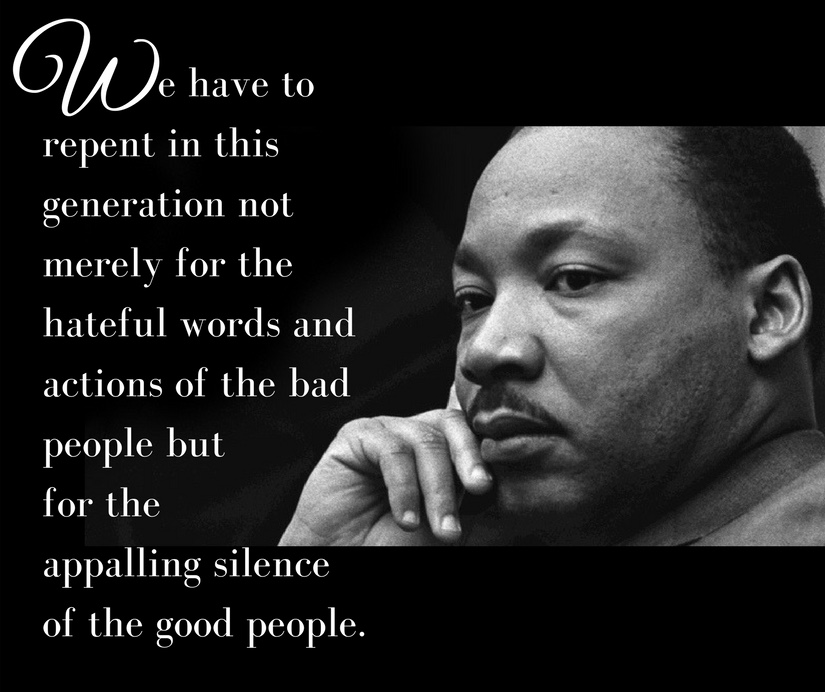
On what would have been his 89th birthday, Dr. King retains his prophetic voice for black and white alike, declaring from his jail cell then and now: “We will have to repent in this generation not merely for the hateful words and actions of the bad people but for the appalling silence of the good people. Human progress never rolls in on wheels of inevitability; it comes through the tireless efforts of men [women] willing to be co-workers with God, and without this hard work, time itself becomes an ally of the forces of social stagnation.”
Today, we read again Matthew’s haunting assessment of the Holy Family’s immigration from Herod’s not-so-holy-land:
“Out of Egypt I have called my son.”
Sweet Jesus, Egypt’s in Africa! Amen”
Bill J. Leonard is the James and Marilyn Dunn Professor of Baptist Studies, Professor of Church History, School of Divinity, Wake Forest University.
Despair has its way at times. It sneaks into my spirit and dwells there for a while, Although despair is thoroughly unwelcome and unwanted, it has a way of making a home in me at times. It has its way. It does its damage. It enslaves me with a devastating kind of bondage. It forces me into an uneasy and oppressive place.
Despair’s most damaging legacy is fear. These days are, for me at least, days of fear. I watch the current president and listen to his words in horror. He speaks with hostility. He gives welcome to divisiveness, racism, misogyny and disrespect. His words are often divisive, rude and insensitive. He uses his power to build an unsettled nation. I despair for the nation, and I despair for a world filled with violence, war, hunger, poverty, and natural disasters born of climate change.
My faith tells me that there is a remedy for despair, that fear can be conquered, and that peace might be restored in me. The poetry of Wendell Berry is a beautiful reminder.
When despair for the world grows in me
and I wake in the night at the least sound
in fear of what my life and my children’s lives may be,
I go and lie down where the wood drake
rests in his beauty on the water, and the great heron feeds.
I come into the peace of wild things
who do not tax their lives with forethought
of grief.
I come into the presence of still water.
And I feel above me the day-blind stars
waiting with their light.
For a time I rest in the grace of the world, and am free.
— From Wendell Berry’s “The Peace of Wild Things“
When despair casts its damaging spell within me, my faith still holds. They are waiting for me, always, the peace that is a balm for grief and despair, the presence of still waters and the stars sparkling in my night sky. This otherworldly beauty causes me to rest in the arms of faith and to recall the many times of despair in my life that served only to make me stronger and more resilient.
It’s hard to imagine a greater illustration of Christians losing the plot than when they defend predators. — John Pavlovitz. Photo: MANDEL NGAN/AFP/Getty Images.
I so hate to publish this photo. But it is a fitting image for these troubling days for people of faith. However, just so you know, this post is not about politics. It is about ethics, morality and living one’s faith authentically. I happen to be a follower of Jesus, and my Bible speaks to me about “loving the least,” allowing little children to come to Jesus, and calling peacemakers blessed.
So from that sacred place, I simply cannot comprehend persons of faith who claim faith in Jesus while defending a sexual abuser. As John Pavlovitz states so eloquently,
I don’t know how to understand the mind of a man or woman who attempts to profess devotion to Jesus while simultaneously defending a molester—and I’m not sure I want to. That’s a darker place than I think I can go without losing hope or sanity. I can’t imagine how a human being can so horribly distort the “love the least,” “blessed are the peacemakers” message of Christ, enough to stand on a wooden or social media platform—and knowingly bless a man who rapes, patently excuse violence to a child, or passionately campaigns for a predator. It’s all about as stomach-turning as it gets.
There are few bastardizations of the life and the message of Jesus . . . as grievous as taking the side of rapists and pedophiles and genitalia grabbers—but this is where we are now. With the Evangelicals embracing Donald Trump and with those now rallying to the defense of Roy Moore, this is what we’re watching in America . . . Regardless of the Bible verses they drop or the high-profile ministries they wield or how sanctified they try to sound—when Christians defend predators, they deny Jesus and they sell off their souls. It’s really as simple as that.
Yes, indeed. It’s really as simple as that. To my brother and sisters who call yourselves Evangelicals, clean up your act! It’s past time.
And may God help us live our faith with integrity, hold the vulnerable among us in high esteem, stand firmly against those who would cheapen our faith, and allow the life of Jesus to inform our thinking and guide our steps.
Like many of you, I have experienced dark nights of the soul. I have faced illness, betrayal, disillusionment and loss. I have faced the dark side of life more than a few times. In the midst of those times, I found the courage of faith, the gift of hope, and the promise of Scripture.
If you have known me through the years, you may know that one of the New Testament passages that gives me strength is in the fourth chapter of Second Corinthians. The following words are part of that chapter.
We are troubled on every side, yet not distressed; we are perplexed, but not in despair; Persecuted, but not forsaken; cast down, but not destroyed . . .
Therefore we do not lose heart. Though outwardly we are wasting away, yet inwardly we are being renewed day by day. For our light and momentary troubles are achieving for us an eternal glory that far outweighs them all.
So we fix our eyes not on what is seen, but on what is unseen, since what is seen is temporary, but what is unseen is eternal.
– 2 Corinthians 4:8-9, 16-18 18 (KJV, NIV)
The passage speaks of “wasting away.” When I was so ill for all of 2014, I can honestly say that I believed I was wasting away. It was a frightening emotion, one that I would rather not hold in my memories. But my memories of that time also include mercies and blessings, blessings of gradual healing, blessings of compassionate and competent health care, blessings of being surrounded by a loving faith community, blessings of my husband’s devoted care, blessings of hope and faith in a God whose mercies covered me in so many ways. Clearly, my blessings came through adversity.
Today while listening to Pandora, I heard a song that touched me with its faith-filled lyrics.
. . . What if Your blessings come through raindrops?
What if Your healing comes through tears?
What if a thousand sleepless nights are what it takes to know You’re near?
What if the trials of this life are Your mercies in disguise?
What if my greatest disappointments or the aching of this life is the revealing of a greater thirst this world can’t satisfy?
What if trials of this life — the rain, the storms, the hardest nights — are Your mercies in disguise?
I learned that through serious illness, the fear was greatest at night. The nights were the hardest. But I also learned that what I had read so many times was true — God’s mercies are new every morning.
The steadfast love of the Lord never ceases;
his mercies never come to an end;
they are new every morning; great is your faithfulness.
For whatever reason, several people I know are currently going through an exacerbation of fibromyalgia. I am one of those people dealing with debilitating pain right now. Fortunately, the pain cycles usually pass over time. But when the pain is raging, it slaps us in the face with a significant challenge.
The truth is that chronic pain is much more than just physical pain. It is physical and emotional suffering. Quite often, it is also spiritual suffering. In the years I served as a hospital chaplain, I learned so much about what people experience when they are ill. The most important lesson I learned is that there is a very real difference between pain and suffering.
Experiencing chronic pain most often goes far beyond physical pain. Pain is the actual physical /physiological response to an injury or illness. It is rooted in the body. But all too often, it is accompanied by debilitating suffering. Suffering is how the brain perceives pain based on past experience and future expectations and fears. It is rooted in the mind, even in the spirit.
Suffering asks “How long can this pain last? Will I feel this way forever? What have I done to deserve this? Has God forsaken me? Does God care about my suffering? Am I going to die?”
It is true that sometimes our suffering questions are irrational, but pain that has permeated the mind and spirit causes a very deep fear, a feeling of disorder, a sense of terror, and constant questioning. It takes an act of the will to keep suffering at bay, but it can be done. Deepak Chopra speaks of pain and suffering in many of his teachings.
Many people confuse pain with suffering. Pain is not the same as suffering. Left to itself, the body discharges pain spontaneously, letting go of it the moment that the underlying cause is healed.
Suffering is pain that we hold on to. It comes from the mind’s mysterious instinct to believe that pain cannot be escaped or that the person deserves it . . . It takes a force of mind to create suffering, a blend of belief and perception that one thinks one has no control over. But as inescapable as suffering may appear, what brings escape is not attacking the suffering itself but getting at the unreality that makes us cling to pain.
– Deepak Chopra
Is it easier said than done, modifying the beliefs and perceptions that accompany pain? To be sure, it is difficult. But suffering people find a number of ways to accomplish it: yoga, meditation, prayer, and for people of faith, leaning on the strength of their religious practice. In a very real sense, we can create within ourselves the kind of healing that rises above physiological pain.
Perhaps it sounds simplistic, but while in the throes of physical pain, I am often able to find a measure of relief by meditating on the truth of Scripture, not just reading it, but abiding in it, letting its words penetrate my spirit, opening my heart to its comforting truth.
Psalm 42 has been called a Psalm for the fainting soul. The Psalm is the voice of a spiritual believer who is enduring deep depression, who is longing for the renewal of the divine presence, who is struggling with doubts and fears, yet holding on to hope. The Psalm twice repeats this comforting refrain.
Why are you cast down, O my soul? And why are you so disquieted within me? Hope in God, for I again will praise him, my help and my God.
– Psalm 42: 5, 11
In the final analysis, people of faith really do have the ability to endure chronic pain while avoiding suffering. Perhaps we cannot stop physical pain or reverse the source of the pain. Perhaps we do not have the power to heal ourselves from physical pain when physiological realities are at play in our bodies. But our faith assures us again and again that we do have the power to end suffering at its source — suffering of the mind, the heart, the spirit, the soul.
If you are in physical pain, my prayer is that your faith will quiet the questions of your mind, that your inner strength will calm the anxiety of your spirit, that your depth of hope will strengthen your heart, that your soul’s resilience will transcend your suffering. This is the ultimate healing.
Sometimes, the heart cries out in anguish, “Comfort me, God, in this my life’s darkest place.” There are times when all of us find ourselves in the midst of darkness. Almost despairing, we hope beyond hope for a new dawn. We speak our prayers, often with groanings too deep for words. We look deeper within, hoping that in the depths of our spirits, we will find an enduring faith. We turn to the comfort of Scripture.
If I had to choose one passage of Scripture that has been for me a source of constant comfort, I would turn to Second Corinthians.
In times of betrayal, I turned to this passage. In times times when I felt persecuted, I turned to this passage. In serious illness, I whispered the words of this passage in the deepest darkness of the night.
We are troubled on every side, yet not distressed; we are perplexed, but not in despair;
Persecuted, but not forsaken; cast down, but not destroyed . . .
For all things are for our good, that the abundant grace might through the thanksgiving of many redound to the glory of God.
For which cause we faint not; but though outwardly we may perish, inwardly we are renewed day by day. For our light affliction, which is but for a moment, works within us a far more exceeding and eternal weight of glory;
So we look not at the things which are seen, but at the things which are not seen: for the things which are seen are temporary; but the things which are not seen are eternal.
– From II Corinthians 4 (paraphrased)
I can only imagine how many survivors of the recent natural disasters have spoken the words of this passage, prayerfully and with hearts disconsolate. I can imagine many of them crying out from what feels like life’s darkest place. The hymn writer expresses so eloquently the presence of hope for all of us who find ourselves languishing, inviting us to bring our sorrows to the mercy seat of God.
Come, ye disconsolate, where’er ye languish,
Come to the mercy seat, fervently kneel.
Here bring your wounded hearts, here tell your anguish;
Earth has no sorrow that heav’n cannot heal.
– Thomas Moore, 1816
May those who are disconsolate this day find consolation in the lavish grace of God. May those who languish find respite in God’s never-ending mercy. May those who are suffering in what feels like life’s darkest place experience the brilliance of a new dawn. Amen.
Early morning comes to a green valley near Marshall, Arkansas. Photo by Paul Barrows.
Hurricanes and earthquakes of the soul . . .
The lush vegetation of Puerto Rico has been replaced by broken trees, homes lying in ruins, a painfully barren landscape. “Hurricane Maria destroyed us,” said Edwin Serrano, a construction worker in Old San Juan.
Dominica was devastated. Thousands of trees snapped and were strewn across the landscape, leaving the island completely stripped of vegetation. Dozens of mudslides turned the sparkling blue-green sea to a murky, muddy brown.
At least 286 people were killed in Mexico City by a magnitude 7.1 earthquake. A rescue operation at the city’s Enrique Rébsamen school resulted in the rescue of eleven children, but nineteen children and six adults were killed. Extreme urgency permeated the school as more than 700 rescue workers continued digging after two days without sleep, knowing that survivors would be able to last only about four days.
In a very real sense, nature turned on the survivors, leaving them despairing from disasters that created devastation in many forms. Destroyed cities, of course, physical injuries and homes left in the rubble, yes. But also wounds of the soul that are lasting and life-changing.
People who live through natural disasters live with a kind of violence, violence that is perpetrated randomly by nature. When one depends upon nature’s rhythms to provide sunlight and moonlight, rain and breeze, the predictable tide of breaking waves and calm waters, the suddenness of violent storms and earthquakes assault the psyche. Nature is usually a constant, comforting presence, but a natural disaster leaves those in its wake coping with an environment that resembles a war zone. Living in that kind of environment day in and day out causes behaviors similar to those identified with persons who suffer from PTSD (Post-traumatic stress disorder).
The assault by nature creates a chronic and debilitating state of fight or flight. To cope, survivors develop the ability to numb their feelings and repress intrusive memories. This leaves many of them with enormous anxiety, feeling that the world is no longer a safe place. While many symptoms of PTSD are evident, often the most frightening symptoms are those not readily visible, secret symptoms and reactions such as disorientation, memory lapses and night terrors. These symptoms are buried in the deep crevices of the psyche.
Wounds to the soul and spirit are caused by events that violate one’s most deeply held sense of safety and security, and it is important to address PTSD not as a “disorder,” but as a response, an appropriately normal response to an overwhelmingly abnormal situation.
So when we send positive thoughts, donate, and pray for the restoration of these ruined cities, we must also be intentional in praying for healing of the soul and spirit of every survivor. Long after buildings and homes have been repaired, survivors will live with a deep wound of the soul that can only heal with time, prayer, faith and hope, as wounded people learn to abide with the God who walks with us through every “valley of the shadow of death.” The Scripture can be a comfort in such times, and often the most familiar passages are the ones we lean on.
The Lord is my shepherd; I shall not want.
He maketh me to lie down in green pastures: he leadeth me beside the still waters.
He restoreth my soul: he leadeth me in the paths of righteousness for his name’s sake.
Yea, though I walk through the valley of the shadow of death, I will fear no evil: for thou art with me; thy rod and thy staff they comfort me.
Thou preparest a table before me in the presence of mine enemies: thou anointest my head with oil; my cup runneth over.
Surely goodness and mercy shall follow me all the days of my life: and I will dwell in the house of the Lord for ever.
– Psalm 23
Until that day when tender green shoots once again begin to fill the landscape in those devastated countries, may the wounded people walk through the green pastures of the heart and the still waters of the spirit with the Gentle Shepherd who restores the soul and leads to peace.
Pierce Creek Public Boat Landing, Mayflower, Arkansas. Photo by Steven Nawojczyk.
Therefore take the whole armor of God, that you may be able to withstand in the evil day, and having done all, to stand.
– Ephesians 6:13 Revised Standard Version (RSV)
And if you spend yourselves in behalf of the hungry
and satisfy the needs of the oppressed,
then your light will rise in the darkness,
and your night will become like the noonday.
– Isaiah 58:10 New International Version (NIV)
—————————————————————————————-
A friend recently described this time in history as “days of despair.” She talked about “a veil of darkness” that has covered our world. I have thought a great deal about her comments and have spent time pondering the kind of fear people might be feeling. Certainly, the natural disasters we are experiencing are causing feelings of great unease. Floods and fires, mighty winds and life-changing storms have left millions of people despairing. They have experienced loss of life, loss of their homes, loss of belongings, loss of their place in community. Perhaps some of them doubt the promise of a dawning day that brings back hope.
Add to that the far too frequent expressions of hate, xenophobia and racism that exacerbate distress. Clearly, there is enough fear and despair to go around in these unsettling days. After many years of acceptance and belonging, the young people we call DREAMERS suddenly feel the fear of losing all that they have worked for, including the country that has been “home” to them since they were children.
So how do disconsolate people move forward when a sense of despair holds them captive? How do people in the midst of fear and grief believe that a new dawn will break their current darkness? How do they hold on to their faith in the God who cares deeply for them, protects them, holds them close?
Can we join hearts and hands and stand courageously against injustice, standing with those who have been marginalized, believing that we will overcome the “evil day” that threatens us?
One voice throughout history declares with certain, living faith that, whatever we face, we shall overcome. I do not even need to mention his name because we hear his voice clearly during every trial. These are his words:
We shall overcome because Carlisle is right. “No lie can live forever.”
We shall overcome because William Cullen Bryant is right. “Truth crushed to earth will rise again.”
We shall overcome because James Russell Lowell is right. “Truth forever on the scaffold, wrong forever on the throne. Yet that scaffold sways the future and behind them unknown stands God within the shadows keeping watch above his own.”
We shall overcome because the Bible is right. “You shall reap what you sow.”
With this faith we will be able to hew out of the mountain of despair, a stone of hope.
— Dr. Martin Luther King, Jr., 1966
These days of darkness and division will pass. These days of dim uncertainty will pass. We shall overcome despair. As it always has, the breaking dawn will drive out the darkness of night. Hope will again rise within us as we embrace the promise of another glorious daybreak.
I was asked recently to write about faith and chronic illness. The request prompted me to recall the year I lived in the dark, the year that I was so seriously ill. It made me think about the losses I have experienced since the diagnosis of end stage kidney disease. It reminded me of the freedom I have lost because of the eight hours I spend on dialysis every day.
The truth is that, in 2014, I thought I was going to die. The greater truth is that I did not die. In fact, I slowly grew physically stronger. Spiritually and emotionally, I descended into grief and despair and somehow managed to emerge with fresh hope and deeper faith.
It was a grueling process learning to write again, practicing with the occupational therapist’s endless pages of ABCs over and over until I began to form legible letters. It was hard learning to walk again, regaining the strength and balance I had lost. It was hard being unable to cook, to care for the house, to bathe myself, to browse the web, to do all the simple things I used to do so easily.
To be sure, it was a dark time of frightening uncertainty and doubt. I mourned for the life I once enjoyed. But in time, I discovered an unexpected grace: that spiritual transformation often happens in the dark. The writing of Richard Rohr offers a way to describe this time of my life. This is what he writes.
We seldom go willingly into the belly of the beast. Unless we face a major disaster . . . we usually will not go there on our own accord. Mature spirituality will always teach us to enter willingly, trustingly into the dark periods of life, which is why we speak so much of “faith” or trust.
Transformative power is discovered in the dark—in questions and doubts, seldom in the answers . . . Wise people tell us we must learn to stay with the pain of life, without answers, without conclusions, and some days without meaning. That is the dark path of contemplative prayer. Grace leads us to a state of emptiness, to that momentary sense of meaninglessness in which we ask, “What is it all for?”
– Richard Rohr
It was indeed “the belly of the beast” for me. And as Richard Rohr writes so eloquently, I needed to learn to “stay with the pain of life, without answers, without conclusions, and some days without meaning.”
Here’s the outcome. Smack dab in the middle of the darkness I experienced, there was God. There was grace. There was transformation. And there was renewed life. Thanks be to God.
While enjoying some quiet time on my new pergola swing, I listened to the hymn “Nearer, My God, to Thee” sung by Brigham Young University’s male choral group, Vocal Point. It would not be an exaggeration to say that I was transported to a sacred place in those few moments. The hymn I had sung for so many years took on fresh, new meaning for me. It could be because of my aging, my illness, my need for a closer relationship with God. Perhaps the hymn spoke to me simply because I needed it. I have long loved this old hymn and its simple, but profound, message.
Nearer, my God, to Thee, nearer to Thee!
E’en though it be a cross that raiseth me,
Still all my song shall be, nearer, my God, to Thee.
Refrain:
Nearer, my God, to Thee, nearer to Thee!
Though like the wanderer, the sun gone down,
Darkness be over me, my rest a stone;
Yet in my dreams I’d be nearer, my God, to Thee.
There let the way appear, steps unto Heav’n;
All that Thou sendest me, in mercy giv’n;
Angels to beckon me nearer, my God, to Thee.
Then, with my waking thoughts bright with Thy praise,
Out of my stony griefs Bethel I’ll raise;
So by my woes to be nearer, my God, to Thee.
Or, if on joyful wing cleaving the sky,
Sun, moon, and stars forgot, upward I’ll fly,
Still all my song shall be, nearer, my God, to Thee.
– Lyrics by Sarah F. Adams, 1805–1848
Music by Lowell Mason, 1792–1872
Published 1841, Hymn in public domain.
What makes this particular performance of the hymn so compelling is the inclusion of a counter melody. While a solo voice sings the words of “Nearer, My God to Thee” and paints a portrait of a life drawing near to God, the chorus sings a counter melody in Latin. The music is stunningly beautiful. The message reaches the depths of a soul in need of God’s presence. One listener described it like this:
So wonderful. It feels like angels paying a visit to earth with a hymn.
So I want to share with you the Latin text and the translation, which brings new meaning to the hymn.
In articulo mortis // At the moment of death
Caelitus mihi vires // My strength is from heaven
Deo adjuvante non timendum // God helping, nothing should be feared
In perpetuum // Forever
Dirige nos Domine // Direct us, O Lord
Ad augusta per angusta // To high places by narrow roads
Sic itur ad astra // Such is the path to the stars
Excelsior // Ever upward
Why, you might ask, am I writing a music review on my blog today? I suppose my words are an attempt to describe a need for the nearness of God. In times of grief, when sorrow overwhelms, when darkness is all we see, drawing near to a God of compassion is our healing balm and our highest hope. As I contemplate this truth, I am thinking of what was called the greatest disaster in maritime history — April 14, 1912 — the S.S. Titanic sank after striking an iceberg. As the ship disappeared into the vast ocean, Mr. W. Hartley, the ship’s bandmaster, led the band in playing “Nearer, My God, To Thee.”
I pray that, in whatever crisis you face, you will rest in the nearness of God. And I invite you to listen to BYU Vocal Point’s performance of this hymn:
I watched a very thoughtful and intriguing movie last week — The Sea of Trees. The film was captivating, telling the story of a despondent professor who despaired of life and searched for a way to end his life. His search led him to Aokigahara, a forest in Japan known also as the Sea of Trees or the Suicide Forest. Aokigahara Forest has been home to over 500 confirmed suicides since the 1950s. It is called “the perfect place to die” and is the world’s second most popular place for suicide.
One might say that suicide is not the most uplifting subject for a blog. But suicide is a very real and present tragedy in the world. Consider these startling statistics reported by The Jason Foundation. (http://prp.jasonfoundation.com/facts/youth-suicide-statistics/)
▪️Suicide is the second leading cause of death for ages 10-24. (2015 CDC)
▪️Suicide is the second leading cause of death for college-age youth and ages 12-18. (2015 CDC)
▪️More teenagers and young adults die from suicide than from cancer, heart disease, AIDS, birth defects, stroke, pneumonia, influenza, and chronic lung disease, combined.
▪️Each day in our nation, there are an average of over 5,240 attempts by young people grades 7-12.
Some people have found help through suicide prevention programs. Others choose to turn to 24-hour suicide helplines available around the clock to provide crisis intervention. (https://suicidepreventionlifeline.org/) Still others find that it is their faith that raises fresh hope within them and lifts their sight above the darkest of days.
There is a special kind of renewed hope when people who have been on the brink of taking their own lives share their stories of faith, the depth of faith that ultimately gave them the inner strength to live. Samuel Trevor Francis (1835-1925) told such a story of faith. He experienced a spiritual turning point as a teenager, contemplating suicide one night on a bridge over the River Thames. An unexpected renewal of his faith saved his life that night. At age 41, Samuel Trevor Francis recalled the faith that saved him and penned the words of the well-known Christian hymn, “O the Deep Deep, Love of Jesus.”
O the deep, deep love of Jesus, vast, unmeasured, boundless, free!
Rolling as a mighty ocean in its fullness over me!
Underneath me, all around me, is the current of Thy love
Leading onward, leading homeward to Thy glorious rest above!
O the deep, deep love of Jesus, spread His praise from shore to shore!
How He loveth, ever loveth, changeth never, nevermore!
How He watches o’er His loved ones, died to call them all His own;
How for them He intercedeth, watcheth o’er them from the throne!
O the deep, deep love of Jesus, love of every love the best!
‘Tis an ocean vast of blessing, ’tis a haven sweet of rest!
O the deep, deep love of Jesus, ’tis a heaven of heavens to me;
And it lifts me up to glory, for it lifts me up to Thee!
But let’s go back to where we began — the best place to die.
Many years ago, I looked for that place, a way out of many years of relentless, chronic pain. I traveled alone to Mayo Clinic to receive two weeks of specialized medical care and physical therapy. Perhaps a city very far from my home would be the best place to die. After an upsetting treatment at the clinic, I managed to make it to my hotel room. I took out all the bottles of prescription medication I had with me. The phone rang, and a friend distracted my focus from the tablets I had poured out in front of me. And through our conversation, with tears falling on my freshly-made bed, I learned something very life-giving about the depth of my faith, and most of all, about the depth of God’s abiding, ever-present love.
And so today I can say with strong assurance that the best place to die — or to live — is in middle of the deep, deep love of Jesus, a love that is for me “vast, unmeasured, boundless, free!” A love that restored hope in the midst of my despair. A love that was enough.
Today, as I silently sing “O the Deep, Deep Love of Jesus,” the words of that beautiful hymn ring real and true. God’s love truly was underneath me and all around me, even on that cold and lonely night in Minnesota.
Attorney and prominent advocate for economic reform Clarence Darrow used a compelling statement as a part of his closing argument in the 1924 Leopold-Loeb trial in Chicago. “I am pleading for the future,” he said.
I am pleading for the future; I am pleading for a time when hatred and cruelty will not control the hearts of men. When we can learn by reason and justice and understanding and faith that all life is worth saving and that mercy is the highest attribute of man.
– Clarence Darrow
April 18, 1857 – March 13, 1938
Perhaps we should engage in some sincere pleading for the future in light of the recent and very disturbing news reports that describe our world as a precarious one.
A serious opioid epidemic is swamping hospitals, with government data showing 1.27 million emergency room visits or inpatient stays for opioid-related issues in a single year. (The Washington Post)
Otto Warmbier, the University of Virginia student who was detained in North Korea for nearly a year and a half, died Monday afternoon, days after he returned home in a coma. (The Washington Post)
Two “terrorist incidents” include reports of a van plowing into pedestrians on London Bridge and stabbings at the nearby Borough Market. (ABC News)
U.S. Representative Steve Scalise and three others were shot at a GOP baseball practice in Alexandria, Virginia. The shooter, James T. Hodgkinson, was killed by police after firing dozens of bullets during the congressional practice session. (NPR)
A suicide terrorist killed 22 people outside of an Ariana Grande concert in Manchester, England. (Fox News)
To the God who knows the woes of our world, who is our refuge and strength, we do plead for the future. As Clarence Darrow wrote, “we have learned by reason and justice and understanding and faith that all life is worth saving and that mercy is the highest attribute of humankind.” So, in spite of the world’s troubles that threaten us, we persevere in faith, inspired by the Psalmist who speaks this good news.
God is our refuge and strength,
an ever-present help in trouble.
Therefore we will not fear, though the earth give way
and the mountains fall into the heart of the sea,
though its waters roar and foam
and the mountains quake with their surging . . .
Nations are in uproar, kingdoms fall;
he lifts his voice, the earth melts.
The Lord Almighty is with us;
the God of Jacob is our fortress . . .
He makes wars cease
to the ends of the earth. He breaks the bow and shatters the spear;
he burns the shields with fire.
He says, “Be still, and know that I am God;
I will be exalted among the nations,
I will be exalted in the earth.”
The Lord Almighty is with us;
the God of Jacob is our fortress.
Life can be a very dark path, frightenly uncharted. Inching through life often finds us hesitating in dark places, afraid to take even one step into an unknown future. The darkness can be daunting. Still, for me light has at times eased the darkness, and with even a tiny ray of light, I was able to move forward.
Brother Curtis Almquist writes of the grace-filled presence of beacons of light.
There have been people in our past who have been beacons of light, and whose life still shines into the present . . . and we remember them because they help us find our way and know our place in life, which is otherwise so terribly uncharted.
– Brother Curtis Almquist
Society of Saint John the Evangelist
How fondly I remember and give thanks for the people who were beacons of light for me.
Yiayia, my beloved grandmother, who was my faithful and loving protector and whose energy nurtured me.
Thea Koula, my favorite aunt, who was like a mother to me and who brought joy and lightheartedness to my life.
Ethel, my forever friend, who was a constant beacon of light, always helping me find my way.
In the darkness, the light of faith endured and made the journey possible. Most certainly, the people in my life strengthened my faith and were for me a welcomed light for a dark path. And yes, I stumbled over more than a few nasty obstacles and rough spots. But even when I languished in the darkness of an uncharted path, my faith was enough. My faith was my brightest light.
I will be forever grateful for the beacons of light that helped guide me on the journey and for the enduring, constant presence of a faithful God.
The Lord will guide you always;
will satisfy your needs in a sun-scorched land
and will strengthen your frame.
You will be like a well-watered garden,
like a spring whose waters never fail.
Young girls run frantically from the sound of a bomb, screaming, crying, confused, and terribly afraid. An evening of sheer joy listening to the music of Ariana Grande had turned into an evening of terror.
In a British music venue, a suicide bomb killed 22 people, some of them children. Eight-year-old Saffie Rose Roussos lost her life, and 59 other people were wounded, some suffering life-threatening injuries. Many others are still missing.
The response? Muslim men pray for victims of the attack at a mosque in Manchester. Police officers look at flowers and messages left for the victims. A Union Jack flag is lowered at half-mast in honor of the victims. Religious leaders hold a prayer meeting in central Manchester. Ariana Grande spoke about the attack: “broken. from the bottom of my heart, I am so so sorry. I don’t have words.”
Is this a portrait of the world we live in? Must we fear for our children and lament the lives they must live? Do we place our faith in a God we sometimes question when tragedies happen?
One of my favorite Scripture passages is also one of the most poignant laments in the Bible. It is found in the fifth chapter of Lamentations. The words express deep mourning and profound loss, leaving the writer asking God, “Why do you always forget us? Why do you forsake us so long?” The hurting people who had lost everything they cherished cried out . . .
Joy is gone from our hearts;
our dancing has turned to mourning.
– Lamentations 5:15, NIV
Sometimes our dancing really does turn to mourning. All of us are acquainted with loss. Our world is a dangerous place, and tragedies like Manchester remind us of our vulnerability. So how do we live? How do we go on? How do people of God live this kind of dangerous life?
The musical group Hillsong sings “This Is How We Overcome.” The song, which is written by Reuben Morgan, echoes the celebration of the Psalmist in the fifth chapter of Psalms.
You have turned my mourning into dancing
You have turned my sorrow into joy.
The song continues with these words.
Your hand lifted me up. I stand on higher ground.
Your praise rose through my heart and made this valley sing.
They sing of the continual presence of God, even in times of deep mourning, profound loss, and grave danger. That kind of song speaks of our faith, a faith that still holds us and always picks us up when we have fallen. Our faith is our resilience.
We can overcome. Every time. Every time life circumstances assail us and steal our music, we persist. We sing. We dance. We praise a God who is eternally near. So let us persevere, always proclaiming the source of our strength.
The Rev. Michelle L. Torigian prays this prayer.
Let us resiliently resume our dancing.
Let us sing louder. Let us speak out voices with determination.
When an eight year old child takes his own life after being viciously bullied, a mother is left in deep bereavement holding a deep sadness that will forever mark her life. Every day, life stories like hers come through on our news feeds. We hear them; we feel a moment of strong empathy; we move on to the next like task.
The reality is that any of us, all of us, may face the worse of life’s pain at any time. None of us is immune to tragedies that turn life upside down. Each of us will at times endure gale force winds that rearrange everything we hold dear.
As always, we are left to figure out how to navigate hard times, how to summon the faith we need to persevere. We must find within ourselves a living hope that cannot be destroyed. Only then will we be able to endure the difficulty life can hand us.
Often, I find wisdom and comfort in the words of Bishop Steven Charleston. This is what he writes about faith during difficult times.
It is hard. Life is hard. The losses, the sudden arrival of illness, the struggles within families, the pressure of a world trying to find a reason to hope. Spirituality that is sugar is no help in such a reality. Feel good philosophy cannot withstand the weight of what many of us have had to face. If it is to endure the gale force winds of chance, faith must be deeply rooted, anchored in trust, strengthened by courage, able to bend but never break. So here is a prayer for all of you living in the real world: may you find your faith as tough as you are and as resilient as the love that keeps you going.
– Steven Charleston
The good news is that God graced us with a resilient faith that perseveres when we endure trials, a living hope that can never fail. Thanks be to God.
Praise be to the God and Father of our Lord Jesus Christ! In his great mercy he has given us new birth into a living hope through the resurrection of Jesus Christ from the dead, and into an inheritance that can never perish, spoil or fade. This inheritance is kept in heaven for you, who through faith are shielded by God’s power until the coming of the salvation that is ready to be revealed in the last time. In all this you greatly rejoice, though now for a little while you may have had to suffer grief in all kinds of trials. These have come so that the proven genuineness of your faith—of greater worth than gold, which perishes even though refined by fire—may result in praise, glory and honor when Jesus Christ is revealed.
Change happens always, but not always for the better. It is simply a reality of living life. Change comes to us; we try our best to navigate it; and with any luck, we will end up stronger for it. In the best of all worlds, going through change will strengthen our hope and bolster our faith. To be sure, best laid plans change all the time, often leaving us shaken. But it is good to know that God knows all about changes and what they do to our equilibrium.
For I know the plans I have for you, declares the Lord, plans for welfare and not for evil, to give you a future and a hope.
– Jeremiah 29:11
Change does not always feel like hope to us. What we face tomorrow, and all the tomorrows to come, is always an unknown, an unknown that causes fear in us. And yet, so much of our contentment depends on our outlook, how we see change, how we move ourselves through it, how we end up on the other side. I like the outlook that journalist, Linda Ellerbee shares in this statement.
What I like most about change is that it can be a synonym for hope. If you are taking a risk what you’re really saying is, “Ibelieve in tomorrow and I will be a part of it.”
– Linda Ellerbee
So if there is any good advice here, it is to hang on to your life even in the face of change. Try to see change as hope. Navigate those life risks, all the while proclaiming, “I believe in tomorrow and I will be a part of it.” Living that way is the way of God, the way of faith, the way of hope.
Life is full of narrow and wide gates, beckoning us to choose which gate to enter. On one hand, the idea of gates — narrow ones and wide ones — is a Biblical idea describing the kind of life a Christian person might choose. On the other hand, narrow and wide gates are simply a part of our life pilgrimage.
The Scripture reference is found in the Gospel of Matthew.
Enter through the narrow gate. For wide is the gate and broad is the road that leads to destruction, and many enter through it. But small is the gate and narrow the road that leads to life, and only a few find it.
– Matthew 7:13-14 New International Version (NIV)
The pilgrimage that we call life is, most certainly, a series of challenges we must face. How common it is for us to complain when the gate before us is narrow and the road ahead is rocky. Why do I struggle financially? Why must I endure failing health? Why am I in the middle of a failing relationship? Why did I lose someone I love so deeply?
Didn’t I choose the narrow gate, God? Did I not commit my life to the way that leads to life? Then why? Why the suffering?
God seldom answers us when we ask these questions. We listen constantly for God’s voice and a satisfactory explanation of life’s suffering.
We hear nothing.
Just relentless, ominous silence. It can try one’s faith.
Gratefully, I came across an encouraging quote. Before collapsing on my life’s dusty road, I found a place to lean in the words of Brother Luke Ditewig. Here’s what he said:
After making much fuss about our great accomplishment at having found a narrow and obscure gate and walked through, we’re often surprised at the ordinary challenges of life that follow, again and again. I’m embarrassed by how much I say: “Wow, this road is hard!” or “Why are we still in the wilderness?” But if you look around right now, you’ll notice divine love in the ordinary stuff of life.
– Brother Luke Ditewig
Society of Saint John the Evangelist
So let us persist, moving forward with even a tiny fistful of faith. And may we look around on the way, passing through the gates we encounter and always noticing the divine love that is ever present in the “ordinary stuff of life.”


 I invite you to read “Out of Africa: White supremacy and the Church’s silence,” a provocative opinion piece by our guest blogger, Dr. Bill J. Leonard. Many thanks to Dr. Leonard for prompting us to more fully commemorate the day honoring Dr. Martin Luther King, Jr. If you are willing to challenge yourself, these words will shed the light you need to do so.
 Despair has its way at times. It sneaks into my spirit and dwells there for a while, Although despair is thoroughly unwelcome and unwanted, it has a way of making a home in me at times. It has its way. It does its damage. It enslaves me with a devastating kind of bondage. It forces me into an uneasy and oppressive place.
 Loving God, Creator of all,
 Like many of you, I have experienced dark nights of the soul. I have faced illness, betrayal, disillusionment and loss. I have faced the dark side of life more than a few times. In the midst of those times, I found the courage of faith, the gift of hope, and the promise of Scripture.
 For whatever reason, several people I know are currently going through an exacerbation of fibromyalgia. I am one of those people dealing with debilitating pain right now. Fortunately, the pain cycles usually pass over time. But when the pain is raging, it slaps us in the face with a significant challenge.
 Sometimes, the heart cries out in anguish, “Comfort me, God, in this my life’s darkest place.” There are times when all of us find ourselves in the midst of darkness. Almost despairing, we hope beyond hope for a new dawn. We speak our prayers, often with groanings too deep for words. We look deeper within, hoping that in the depths of our spirits, we will find an enduring faith. We turn to the comfort of Scripture.






 God of the Sparrow 🌱 By Kathy Manis Findley