A woman of sacred worth, Becoming, Beginning again, Bravery, Calling, Change, Children, Committment, Courage, Creating, Dreams, Freedom, God’s beloved daughter, I am enough!, Inner peace, life, Living in the soul, Miracles, Repair the world, Rev. Kathy Manis Findley, Self-understanding, Spirit wind, Tears, Tikkun Olam, Valued by God

Living an Unapologetic Life

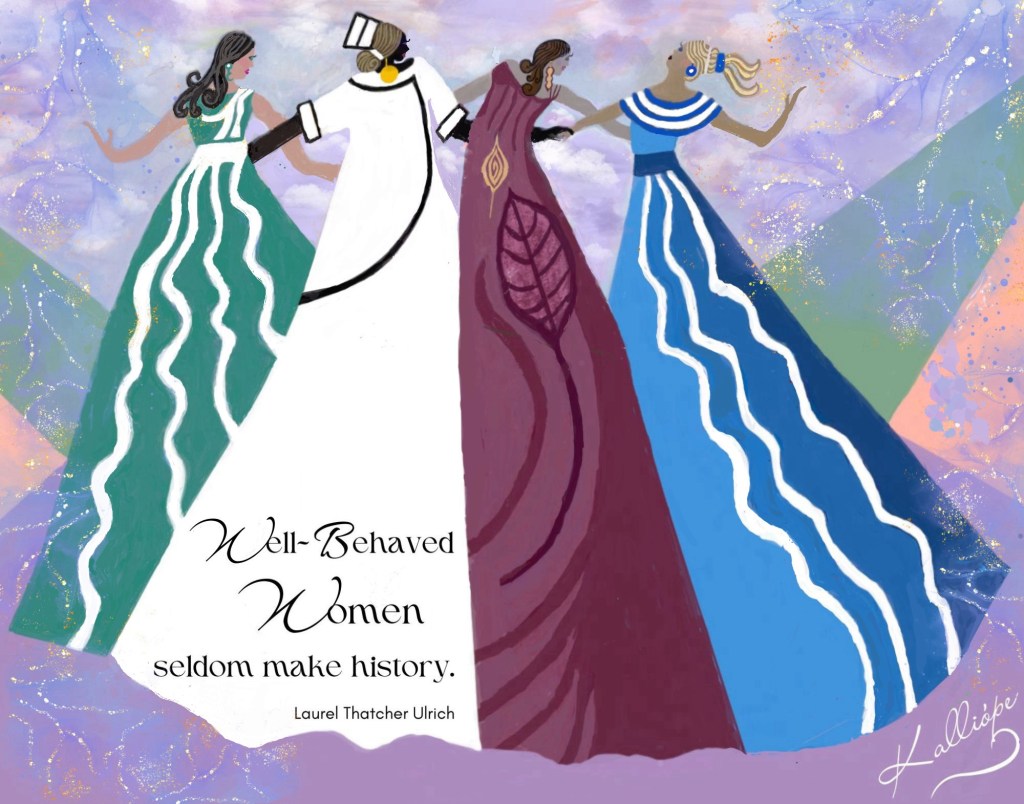
Art: “Well-behaved Women” by Kathy Manis Findley


Rev. Kathy Manis Findley
July 27, 2024

You have probably had that kind of dream at a few junctures on your journey. I know I had many dreams along the way. Sometimes they scared me to death. I dreamed of peace, equality, freedom, changing the world, and many other huge and noble dreams. I dreamed some silly dreams, too! I soon got the hint: changing the world is a formidable task. I followed all the rules, but being a rule-keeper does not make a person effective in dreaming and imagining. Women who follow the rules (someone else made up) could correctly be called well-behaved. They might even be called good girls because they don’t cause much of a flurry. They typically don’t make history and they certainly don’t change the world.

A woman with less-than-good behavior looks like someone at peace with herself, someone who radiates hope, someone with the courage and determination to do justice. I have admired and emulated so many examples of women who did make history, women who were not well-behaved at all. Here are only a few: Rosa Parks, Harriet Tubman, Lucretia Coffin Mott, Sojourner Truth, Susan B. Anthony, Nancy Sehested, Elizabeth Cody Stanton, Prathia Hall, Julian of Norwich, Malala Yousafzai, Mother Theresa of Calcutta, Ann Hasseltine Judson, Lucy Stone, and so many others!

About 24 years ago, a chaplain colleague recommended a book to me: Goodbye Good Girl: Letting Go of the Rules and Taking Back Your Self by Eileen M. Clegg. I think my chaplain friend was suggesting that I should get out of my comfort zone and take some risks, that I should courageously follow God’s call on my life. I knew that the members and churches of my denomination would “throw a fit,” like we say in the south! After all, I was an ordained minister serving as a hospital chaplain, which placed risky challenges before me every day.

So I read the book immediately and set out to become a bad girl, a girl who fully intended to change the world and to make history for it! So far, I have not made history. I have not managed to put my name in lights. I have not started any big public movements. But I have done some things that matter! I have learned how to create sacred space; I have learned the depth of liberation theology; I have found enough grace to endure the consequences of being a “bad girl” and then a woman with questionable behavior; I have held off anyone who tried to tell me who I am; and I have called up the courage to fight for justice. Colleagues, friends, family, co-workers reacted to the change in me, since they never expected me to dissent, or disagree, or refuse to behave.

Suddenly I let go of my “good girl” image and basically said “goodbye” to my restrictive behaviors. I took back my life, put aside all the rules, and followed my soul. I watched for the winds of the Spirit to lead me, and I moved forward to all the places that needed some attention. I was able to help change unjust systems, unjust policies, and unjust processes by not being so well-behaved.

Still, I sometimes think I have reached an uneasy place when it comes to letting go of my “good girl” persona. I’m really not a “good girl” and I don’t think I ever have been. My parents had to endure the sassy exclamations of my toddler years, like “Nobody’s the boss of me!” Creating shock from those who knew me, I mostly remained a “bad girl” from that day to this. I set aside the rules that were designed to keep people down and I took back my life. Today—in my mid-seventies—I continue to spew out uncommon proclamations that are quite annoying to those who are determined to hold on to their power and resist change.

Truly, it was sometimes hard being a change-maker and a rule-keeper! Always a people pleaser. Always the ultimate perfectionist. I discovered along the way that sometimes rule-keeping, people pleasing, and keeping every little thing “perfect” can harm your inner core. In fact, it’s less risky when you follow the leaders, make sure everyone is pleased, and doing everything with glowing perfection. Stepping out of line is always a bit dangerous.

When you become exactly who you are, resolute and unmovable about the things that matter to you, you will raise a few eyebrows, and sometimes people will get angry with you . You see, those people expected something else from you. Each of us becomes “me”— the “real me”— at our own peril. In a sense, we have to fight for the right to be ourselves in the world.

It is true that the people around me reacted strongly when I took back my life and became fully invested in my destiny. They thought that I had become radical, maybe even unhinged. I did not respond appropriately to their demands. To unreasonable demands, this is essentially how I might have responded, sometimes out loud, sometimes under my breath . . .

I will do it. / It’s my right! / It’s my choice! / It’s my prerogative! / It’s my decision! / I’m doing it anyway. / You can’t stop me! / Just watch!

All the while, I felt uncomfortable because of so much disdain from others, who began sending me a new message, You are not enough! I Imagine that many of you have heard someone say to you, You are not enough. At least, we may imagine someone saying those hurtful words. Unfortunately, we believe it because we don’t know ourselves, meaning we don’t know our bright and dark places, we have not yet realized our sacred worth, and we have not yet searched our souls.

For you see, you and I are afraid because it is perilous for the soul when we don’t search diligently for our soul’s passions and dreams. You and I sometimes accept what others say about us and tuck it away in our deepest places. When those words sneak all the way down into the soul, we tend to give up. We start from the moment we make ourselves nonchalant about it all, that moment when we shield our hearts from hurt. One of the saddest phrases we use is “I don’t care.” When we no longer care, we begin, one by one, eliminating the people around us, never realizing that they are hurting, too. And maybe the reason they send the message, You are not enough, is because they believe that they are not enough either.

I can honestly say that I have often heard voices—known voices, unknown voices, and the weak little voice in my head—telling me, You are not enough! I have learned that once I have embodied that negative message, it rolls around in my psyche for a long time, maybe forever. It becomes a state of being that goes deeper than skin. It penetrates in deeper places, and takes its toll on my emotional and physical well-being. I recall many such times, none more painful than the wagging tongues around my ordination . . . You know the scenario, “She can’t be a minister because she is a woman! Anyway, she’s not good enough! Other voices are often hazardous, dangerously breaking down our sense of self-worth. They may be yelling, speaking in a normal tone, whispering, or imagined in our heads. In response, we must prepare ourselves to hear the voice above all voices, saying, “You are my beloved daughter with whom I am well pleased.”

For a long time, I embodied the traits of the good girl, but to embody good girl traits is not really a once-and-done action. Embodied lasts a while! Embody does not have a shallow or surface meaning. It is deeper. I like the word embody. It seems to suggest that we can live a soulful life. In the very middle of the Greek word for “embody” we find the word σώμα, which means body. However, the Greek word for body cannot be translated in a way that reveals the depth of its meaning. The definition of σώμα is deeper than we realize. It is not skin-deep, it is deeper, approaching a definition more like soul.

I do like the word embody and the word soul. In some ways, to embody means to live in your soul. The word embody may whisper to you that in your body’s center, you will find the path to reach your soul. A person who lives in the soul is a person that does not live a shallow life, devoid of the emotion that makes us alive. The soul will help you, if you can just start by daring to touch it.

So what are the things we can actually do to take back our lives and live soulfully? What path do we follow to transform ourselves and change the world? My initial response to that is, “I don’t know.” Not very comforting, I know, but mostly true. We cannot forge the path for any other person. We cannot know what’s best for them. So not knowing anyones path, nor their dreams, I can give you a list of things others are finding the leads to their transformation. Here they are, not at all an exhaustive list, and certainly not a perfect guide for you:

  • Carve out some time for quiet, restful, meditation.
  • If you are a person of faith, get in touch with God or whatever person you worship.
  • Listen.
  • Listen some more—to your heart and your soul.
  • See if you find there a sacred direction especially for you.
  • Do you feel you are getting any closer to discovering your authentic self?
  • Can you begin to believe you will be transformed?
  • Can you take a step or two, in faith, into a holy place of transformation?
  • Pray, making your needs known to the source of your faith.
  • Read! Read the stories of others who found life transformation.
  • Find community, even one other person, who understands your journey.
  • Start all over again, leaning into the wisdom you found on your previous journey.
  • Take as long as it takes, until you realize that suddenly, you are becoming emboldened and scrappy!

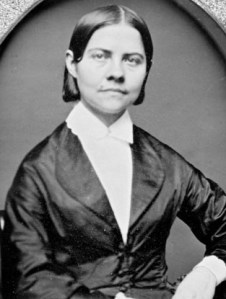
You may not know her name, but Lucy Stone was steadfast in her belief in self-authentication and in her ability to change the world. Lucy Stone was called “emboldened” and “scrappy” because of her tireless work for the abolitionist and women’s rights movements through the 19th century. A bona fide pioneer of her time, Lucy Stone stands as a historical titan. Her book “Unapologetic Life” describes a model of a revolutionary living. As for me, I would count it an honor to be described as emboldened and scrappy.

Life is more fun when you’re emboldened and scrappy. Not that we want to reduce the life experience to just scrappinesses. Life is so much more, like authenticity and the willingness to be a change-agent. Life is about having enough courage to persevere! Life for me is about my soul and all the ways it has been transformed over many years. All along my journey, I knew that my soul was a problem! At every age, there was a part of me that wouldn’t follow the easiest path. I longed to be empowered to make societal change. I chased down injustice and worked to dismantle it. I spent most of my career working with victims of domestic violence, child abuse, and human trafficking. This was not the easiest and most pleasant vocation, but the work had made its way into my soul. To do it, I had to live in the light of self-awareness and soul-awareness. I had to constantly listen to the sighs of my soul, and move only after I had heard them clearly. If I had just one nugget of advice for you, it would be to touch your soul and ride on the wings of the Spirit.

Sisters, don’t forget that when you touch your soul, you might just not be a “good girl” anymore. Or a good boy, for that matter. As for me, I am not a “good girl” living at the whims of other people! And I am definitely not a well-behaved woman! So I fully expect to make history! Because making history means leaving a legacy, creating a world brimming with peace, and embodying your best self!


A frenzied life, All Things New, “I Can See Clearly Now”, Beginning again, Bishop Steven Charleston, Bravery, Calm, Challenge, Contemplation, Courage, Determination, Dreamers, Dreams, Following Christ, God's Faithfulness, Heart, Here I am, Lord., I am enough!, Inspiration, New Things, Re-claiming self, Rev. Kathy Manis Findley, Spiritual growth, strength, struggle, Tenacity, Tikkun Olam, Vision, Whispers of God

A Snail’s Pace to the Mountaintop

By Kathy Manis Findley

Slow, slow, up the mountain I’ll go . . .


A PAUSE FOR SOME WHIMSY . . . Why don’t we have a little whimsy today? I have invited my snail-friend to join us. And anyway, we all need a little whimsy in these troubling days! So here goes!

I’m sorry to tell you that the snail in the picture will take forever to reach that mountaintop, and you and I simply don’t have the patience to walk with a snail. Even so, I feel good about my chances when racing a snail to get up on top of a mountain!

DOES THIS MAKE ANY SENSE AT ALL? . . . Not that this makes any sense at all. Why I would even be considering such a race! In fact, this is completely nonsensical, and if you know me, you know I’m far too serious to entertain whimsy! Makes no sense at all. Oh, but it does make some sense. Let me tell you something about me and what I have learned about the wisdom of the snail and its slow journey!

LIFE CAN BE DEVASTATING . . . When I think of the life catastrophes that have been the hardest for me, the ones that hurt me the most, I immediately recognize that I never slowed down enough to clearly see the unrest brewing around me and inside me. Multi-tasking and acting like an overcommitted, overwhelmed wife, mother, professional minister and hospital chaplain squeezed my spirit enough that I became hopelessly entrapped. That was in my younger days, those days when most of us stretch our commitments to the breaking point.

Before I could change course, I could see my dreams fading and my ability failing. It was impossible for me to reach the top of my mountain. It happened before I realized I was in trouble.

In the light of day, I can somewhat see, but at night, I can hardly see anything—literally and figuratively. But at least I have learned to take time to look up at the stars in a dark sky. It’s easy to see, to envision stars twinkling in the heavens, when you’re still young and when you can still find your hope-filled dreaming place inside you. You can still be breathless, open-eyed and awestruck!

CAN I STILL BE BREATHLESS, OPEN-EYED & AWESTRUCK? . . . To be honest, I must confess to you that I find it difficult to see with my soul, to be open-eyed and enthusiastic. I have lived my life with visions of dreams and hopes, and I have loved the fullness of my days. But being retired is another story altogether.

The story of my young and middle adult days was a story of constant activity, challenges, and tall mountains to climb in search of dreams. Dreams, dreams everywhere! Wherever I looked, I found another dream to dream!

RETIREMENT CAN BE DISHEARTENING . . . Retirement is another thing, and I am there! Illness and aging has nearly shut off my dreaming and visioning. Still, though I am sparring mightily with retirement, in the end I have slowed down to a snail’s pace. And snails probably don’t climb mountains or search for dreams.

What pieces of wisdom can we receive from a snail on a slow slither? Perhaps we should look elsewhere for such wisdom. One of my favorite authors gets to my soul with almost everything he writes. His keen spiritual insight has guided my path time after time. This is what Bishop Steven Charleston has to say about seeing more clearly.

I see more clearly, now that I am aging. Not with my eyesight, but with my soul. I see the fine detail of what I missed in younger years. I see the place of faith and forgiveness in my story. I see the possibilities of life in ways I never imagined. I was not blind in my youth, but my vision was limited to only a few seasons of seeing.

Now I am an old man standing on a hill. I see more clearly. The universe stretches above me in infinite glory and the Earth spreads her shawl to wrap me in creation. Open the eyes of your spirit. Look out in wonder. See the fullness of the life you have received. See the promise of love walking in beauty before you.

— Bishop Steven Charleston

MY FRIENDS FINDING NEW WAYS TO DREAM . . . These are words I can hang on to and patiently learn how aging folk can still hope and dream, and maybe even climb new mountains. It’s possible. I have seen several aging folk on top of the mountains they dreamed of. One of my 70 year old friends travels all over the world. Another has launched out in a new calling to counsel kidney transplant patients. Yet another friend faced a closed door, so she picked up her skills and began a brand new ministry. And one friend left the United States to feed hungry people across the ocean.

All of these friends made it up to the mountaintop, though some of them might have traveled at a snail’s pace. That doesn’t matter, and I have a notion that their secret to life has to do with slowing down and stopping their frenetic pace. Why do that?

To give yourself time to dream, time to contemplate and pray, time to pull your soul back together, time to open your eyes and truly see, time to meet God who may well whisper in your ear . . .

Then I heard the voice of the Lord saying,
“Whom shall I send? And who will go for us?”
And I said, “Here am I. Send me!”


—Isaiah 6:8 NIV

TIME FOR SILENCE AND CONTEMPLATION . . .So walk on, slow if you have to. Take your time and wait until you hear God’s voice or sense the presence of the Spirit. Give yourself time for silence and prayer and a lot of contemplation. Keep your courage ready, and then go with all your courage when your heart says it’s time. Don’t let the snail discourage you. Your pace, whatever it is, will get you there. Don’t let anyone block your path or steal your dreams! And I’ll meet you on a mountaintop somewhere!


A LOVELY HYMN FOR YOUR QUIET TIME . . .

Here I Am, Lord (Anniversary Recording) · Dan Schutte
Here I Am, Lord (30th Anniversary Edition)
℗ 2001 2009 OCP, 5536 NE Hassalo, Portland, OR 97213. All rights reserved. Made in USA.
All selections BMI.


SHARE YOUR STORY . . .

If you are a new to my blog or have been reading it for years, you are welcome here. If you would like to leave a comment about your experience with slowing down your pace, finding time for prayer and contemplation, or renewing your spiritual, physical, and emotional life, please tell us about it in the comments. Your story can help others see life more clearly.

Activism, All Shall Be Well, anxiety, Attachments, Bewilderment, Brokenness, Caged children, Calm, Change, Confusion, Courage, Defiance, Despair, Determination, Dreams, Emerging new, Falling down, Fear, Feelings, Following Christ, healing, Hope, Injustice, Psalms, Questions, Reflection, Transformation

In these Evil Days, Dream a Little Dream

Rev. Kathy Manis Findley

Lately, I have been trying to figure out a number of mysteries, but I have not figured out one single thing-, not lament, not how to fix my life, not transformation, not even the continuous mess in my closet. I simply have not yet been able to go through a reorganization process. The prospect of reorganizing my life—my soul, my spirit, my heart—plus all the treasures in my closet and armoire is so terribly daunting to me. Marie Kondo comes to mind, but I quickly shoo her away from my mess in the closet.

Lots of folk complain about “these days.” I confess that I do my share of complaining. What is it about “these days” that seems so troubling? I cannot fully give you an answer to that question yet, but I have some ideas about it. The issue at hand reminds me that the Bible often refers to “evil days.” I believe that many people see these days as “evil days,” and that cannot turn out well for anyone!

Jennifer Senior, a journalist with The Atlantic, recently wrote a news article in which she asked a another provocative question: What will happen to the American psyche if Trump is reelected? (Don’t worry, this post is not about Donald Trump!) On this question, maybe we really don’t want to know the answer. Instead of taking her question seriously and considering what might happen to “American psyches” following the November election, some folk would rather complain about the division all around, the evil around us, or other things nobody likes.

When we dare to make an honest evaluation of circumstances that surround us, we dig in our heels and balk. We balk because we don’t want to see the division in our nation or the impasse we have reached on important issues. We balk because, in truth, no one wants to lament. Remember, I’m not talking about divisions among us like liberal or conservative, Democrat or Republican, male or female, immigrant or American citizen, black or white . . . I could go on and on naming divisions among us. We have always co-existed with division, but most often in the past we have acknowledged division and simultaneously practiced kindness, respect, and tolerance. Given the current national environment, we might just be justified in calling these days “evil days.

If reading the Bible is something you typically do, then you might understand more fully the term “evil day.” My heart tells me that “evil days” are definitely taking a toll on us. Instinct tells me that “the evil day” is not a single day, but refers to the times in our lives when we face overwhelming , troubling circumstances. If you are willing, meditate on the following words for a few moments.


Therefore, take up the whole armor of God, so that you may be able to withstand the evil day and, having prevailed against everything, to stand firm. 16 Stand, therefore, and belt your waist with truth and put on the breastplate of righteousness15 and lace up your sandals in preparation for the gospel of peace. 16 With all of these, take the shield of faith, with which you will be able to quench all the flaming arrows of the evil one.17 Take the helmet of salvation and the sword of the Spirit, which is the word of God.

Ephesians 6:13-17 NRSVUE

I want to remind us all about the unrest we hold inside, too close to our heart and spirit. The proximity is important to pay attention to, as well as the flashpoints, past and present, that people have endured. I would guess that there are many flashpoints and memories of times that have held power over you. You probably face off with flashpoints, knowing that they not only create stress in our bodies, but also create bondage. We can become chained to our lives. Until we have exert some control of the present time of division, hate, turmoil, distrust, disrespect, contempt and other forms of bondage, we cannot find peace that changes the world. We certainly cannot figure out how to accept the possibility of transformation.

These evil days may well be causing our hearts to lament. These days may be days full of nightmares—no dreams at all, not even little dreams. You can name your own tragedies—the ones that are making it hard to breathe for you, or the ones that cover the whole troubled world with sadness. When I think of choosing my personal places of lament, those places where I can pour out the most anxiety, I feel the heavy burden of hopelessness. If you feel that too, you are not alone.

Always looking for a scapegoat, we try to discern what is bringing us down. Of course, life often brings us unforeseen personal tragedies that we must deal with. And there is certainly enough shared anxiety to go around. If you read the daily news, you will undoubtedly hear about the fierce war in Ukraine, the inability to create peace in the Middle East, the rising cost of food, the food deserts in our country, refugee children separated from their parents, difficult financial challenges, mass shootings, fractured relationships, long-term estrangement from loved ones, the opioid crisis and addiction, racism, injustice of all kinds, and politics. Evil days!

There are so many more ills we could add to this list, but we know them already, and the news programs are anxious to tell us about broken politics, as well as the way politics creates broken people. So there you have it! Among the many sources of stress we each experience, we continually stress over the dozens of pointless news stories about politics and the behavior of politicians every day. To top it off, Gloria Mark points out that “we are once again facing a news cycle that will shove our attention—as well as our output, our nerves, our sanity—through a Cuisinart.” No matter how skillfully we deny it, our bodies are not designed to handle chronic stress and trauma.

Just about now, you might want to say that politics doesn’t affect us that much, certainly doesn’t cause depression and hopelessness. But consider this viewpoint written by Pulitzer Prize winning journalist, Jennifer Senior:

The American Psychological Association’s annual stress survey, conducted by the Harris Poll, found that 68 percent of Americans reported that the 2020 election was a significant source of strain. Kevin B. Smith, a political-science professor at the University of Nebraska at Lincoln, found that about 40 percent of American adults identified politics as “a significant source of stress in their lives,” based on YouGov surveys . . . Even more remarkably, Smith found that about 5 percent reported having had suicidal thoughts because of our politics. Evil days!

And of the most divisive election in decades, psychologists are saying that their research shows that more than two-thirds of U.S. adults (68%) say that the 2020 U.S. presidential election was a significant source of stress in life.

It is not a stretch to say that stress plays havoc on our dreams, even our little dreams. I have to confess that my big dreams disappeared into the “impossible“ file, and were then swallowed up by the churning in my stomach and my psyche. I remember my first year in seminary, working part time jobs and going to class. For a while, I worked in the development office where all the catchy slogans, mottos and themes were born. One year, the staff got together to write a theme for the annual development campaign. I don’t know who came up with our brilliant theme, but we loved it. I really loved it and made it my personal mission.

“We’re Out to Change the World!”

I tried to do just that, and I honestly thought I could, but eventually the scene in my mind of one young woman alone trying to change the world on her own made me shiver. All the lofty goals and the many little dreams, along with a few big dreams, that had my attention were disappearing before me. I despaired at first and then carried long-term grief about it. There would be no big dreams in my heart. I would never see the glory of a big dream come true. Nor would I dream small dreams. People usually don’t dream of whatever is better while they are covered in grief—mourning, lamenting that they lost their dreams in the first place. In “these evil days” we must let go of despair and pray for an extra portion of holy determination!

But people do see the sacred light that sparks dreams. It dawns over them again and again until their dreamless spirit transforms from death, to life, to get their bearings again, and to summon the energ to get up and try

This is my message to you, and to myself: After your time of lament, rejoice! After you have escaped the bondage of evil days, rejoice! After you name your loss, and then put yourself back together, rejoice!

Take heart. Up in the heavens, there is rejoicing for you! Even in the gloomy shadow of dark and evil days, there is rejoicing for you! Even if you are trying to dream even the littlest dream, there is rejoicing for you!

So try a big dream! Change the world a little bit! Your heart longs for it, the world needs it, and the heavens will do what they always do—rejoice!

May even your smallest dreams change the world!

Activism, Advocate, Challenge, Change, Community activism, Compassion, Covenant, Dreamers, Dreams, God’s Gift of Stars, Good Trouble, Hope, In Memorium, Justice, Racial injustice, reconciliation, Rev. Kathy Manis Findley, Separation, Sheltering children, Social justice, Transcendence, Transforming Injustice, Violence, Wade in the Water, War

Do You Have a Dream?

Consolation, Despair, Dreams, Epiphany, God’s creation, God’s Gift of Stars, Godburst, Hope, Injustice, Isaiah 6, Lament

Epiphany’s GodBurst!

By Rev. Kathy Manis Findley

Fowler, John. Rising Star, Milky Way, from Art in the Christian Tradition, a project of the Vanderbilt Divinity Library, Nashville, TN. https://diglib.library.vanderbilt.edu/act-imagelink.pl?RC=56313 [retrieved January 6, 2024].
Original source: https://commons.wikimedia.org/wiki/File:Milky_Way_-_28_June_2014.jpg.


Epiphany ~ January 6, 2024

Isaiah 60:1-6

Arise, shine; for your light has come, and the glory of the LORD has risen upon you. For darkness shall cover the earth, and thick darkness the peoples; but the LORD will arise upon you, and his glory will appear over you. Nations shall come to your light, and kings to the brightness of your dawn.

Lift up your eyes and look around; they all gather together, they come to you; your sons shall come from far away, and your daughters shall be carried on their nurses’ arms. Then you shall see and be radiant; your heart shall thrill and rejoice, because the abundance of the sea shall be brought to you, the wealth of the nations shall come to you.

A multitude of camels shall cover you, the young camels of Midian and Ephah; all those from Sheba shall come. They shall bring gold and frankincense, and shall proclaim the praise of the LORD.


On this particular day, I am finding it difficult to declare that Epiphany is my favorite day in the Liturgical Calendar. But it is my favorite day of celebration in the Church year! The truth is that this day of Epiphany, 2023 reminds me that today is both a day of shining splendor and a day of shameful scourge. After all, this year Epiphany falls on the sixth day of January, the third anniversary of the day the United States Capitol was violated by a mob of insurrectionists. Thousands of attendees, some armed, walked to the Capitol, with hundreds breaching police perimeters as Congress was beginning the electoral vote count. Among the rioters were leaders of the Proud Boys and the Oath Keepers militia groups, who conspired to use violence to interfere with the peaceful transfer of power.

Within 36 hours of the event, five people had died: one was shot by Capitol Police, another died of a drug overdose, and three died of natural causes, including a police officer. Many people were injured, including 174 police officers. Four officers who responded to the attack died by suicide within seven months.

That day was a disgraceful moment in this nation and beyond, as many countries around the globe lost confidence in America. American citizens also reacted strongly and suddenly questioned our nation’s democracy, the sovereignty of free and fair elections, and the participation in “a historic and profound abuse of the judicial process.” We were questioning our ethics, our morals, our human decency, our abhorrence for violence, and sadly, our sudden refusal to discern the vast difference between peaceful protest and seditious mutiny.

Can we finish this unpleasant conversation and change our view to the stars, thousands and thousands of stars in the Milky Way galaxy? They are perhaps a sparkling reminder of other sparkling things that are worth remembering—the birth of America’s democracy, the toil of creating the United States Constitution, the Veteran’s Day commemorations year after year, the moving inaugurations of the line of U.S. presidents, America’s many fragile freedoms, the outstanding individuals we become when we give the best of our hearts and spirits to dreams of peace and justice.

And yet, these are earthly accomplishments and events. We must keep looking up into the heavens, listening for the Prophet’s voice saying, “Arise, shine; for your light has come, and the glory of the LORD has risen upon you. For darkness shall cover the earth, and thick darkness the peoples; but the LORD will arise upon you, and his glory will appear over you.”

This is the holy proclamation from the Prophet that Epiphany gives us every January. It is the soulful serendipity of the new year. It is a kind of GodBurst that gives us the energy to keep moving closer to dreams of peace and justice.

I need Epiphany this year. Perhaps you do too. There is far too much darkness surrounding us all—war, violence, abuse, division, rancor, injustice, racism, misogyny, xenophobia, gun violence, illness, drug abuse, homelessness, hopelessness—darkness. I think maybe our Epiphany prayer needs to be a prayer of lament for the part, large or small, that we have played to bring the darkness upon us and our world.

But after lament, we can always look up to see the stars. You know the ones, the ones God placed in the galaxies to brighten our darkest nights and lift our darkest spirits. God set these glittering Stars in the sky to always remind us to look for Epiphanies, and find them when we least expect to. Even if we have only one brief, transcendent, shining moment, we can claim as our own the brilliance of the stars that hover above us in the night sky. Our GodBurst! Your sacred path and mine definitely does take us through dark and frightening places sometimes, but look up! That’s the command I keep saying to myself. Look up! “Arise, shine, for your light has come and the glory of the Lord has risen upon you!”So look up into the heavens and see the most brilliant, glimmering stars giving light for your journey.

May God make it so. Amen.


A Prayer of Lament


Radiant Star of Hope, we lament the darkness of our world.

Forgive us the darkness we ourselves create.
Star of our deepest Hope, you grace us with guidance and mystery, 
Visit our troubled rest with disturbing dreams,

and our journeys with strange companions. 
Grace us with the hospitality to open our hearts and homes

to visitors filled with unfamiliar wisdom, bearing profound and unusual gifts.

Guide us on Epiphany’s path and disturb us with Stars, O God,

that the radiance and Spirit working in the world

might gather together all peoples and nations in one community 
to offer you worship and proclaim your everlasting splendor. Amen.

Fowler, John. Milky Way, from Art Original source: https://commons.wikimedia.org/wiki/File:Milky_Way_-_28_June_2014.jpg. John Fowler, CC BY 2.0 https://creativecommons.org/licenses/by/2.0, via Wikimedia Commons [retrieved January 6, 2024].

Abundance, All Things New, Beginning again, Belonging, Bewilderment, Change, Comfort, Contemplation, Daybreak, Dreams, Fear, Freedom, God's love, Grace, healing, Heartbreak, I am enough!, Joy, New Life, Re-claiming self, Rev. Kathy Manis Findley, Sorrow, Tears, Weeping

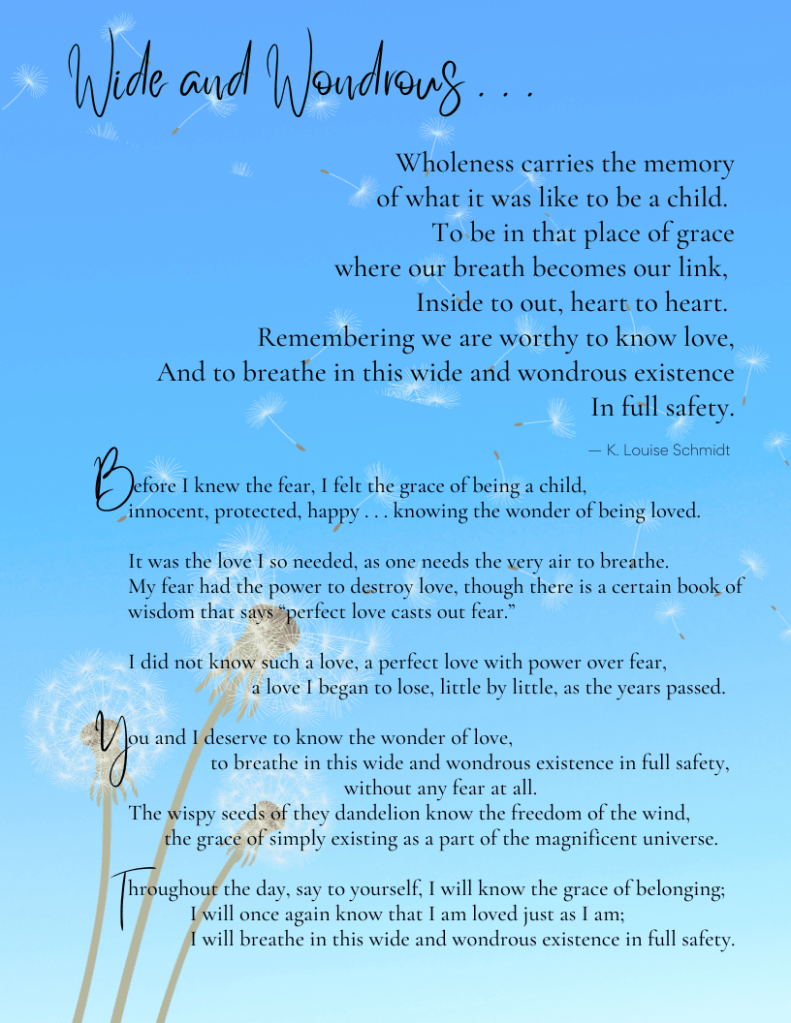
Wide and Wondrous

How true it is that when we know nights of sorrow, when weeping is all we can muster, that daybreak does eventually come as it always has. And with the rising of the sun, perhaps our tears are replaced with at least some measure of inner joy.

The universe is wide and wondrous, full of love, full of grace, and sparked by freedom. Those three—love, grace and freedom—are the things we most need, all of us.

I offer you this meditation, praying that you are surrounded in love, that you know the grace that accepts every part of yourself, and that you feel the the freedom to run with the wind in wide and wondrous places, toward your dreams.

As you continue the quiet time you claim for yourself today, I hope you will be be inspired and comforted by this beautiful choral piece by the brilliant composer Elaine Hagenberg, ”All Things New.”

Poem by Frances Havergal
and text adapted from
Revelation 21:5-6

Light after darkness, gain after loss
Strength after weakness, crown after cross;
Sweet after bitter, hope after fears
Home after wandering, praise after tears

Alpha and Omega
Beginning and the end
He is making all things new
Springs of living water
Shall wash away each tear
He is making all things new


Sight after mystery, sun after rain
Joy after sorrow, peace after pain;
Near after distant, gleam after gloom
Love aftеr wandering, life after tomb

Advent, Calling, Challenge, Compassion, Confusion, coronavirus, Covenant, Dreamers, Dreams, Isaiah, Justice, Mission, Pandemic of 2020, peace, Repentance, Righteousness, Sin, Sorrow, Spirit

THOSE WHO DREAM

Copyright A Sanctified Artsanctifiedart.org

A passage of Scripture that encourages me every time I read it came up this week in my Advent devotional booklet entitled, “Those Who Dream.” The beauty of reflection I have found in this booklet has definitely awakened dreams in me. As I reflected on Advent Scripture each morning, God never failed to remind me that the world is in chaos in so many ways. In the year we will remember as 2020, people languished and lamented through a seemingly uncontrollable pandemic. Many people prayed, many died, many wept, and some were even able to dream.

The sacred text for this past Thursday was from the eloquent Prophet Isaiah. I have always thought of this Prophet as a realistic dreamer who never failed to paint a true picture of a world both evil and good. Isaiah had a way of proclaiming the deep need for repentance while also calling the people to dream of all that could be better and brighter. The bottom line for this Prophet was sin followed by repentance, what that would look like and what a world of righteousness would look like. Thursday’s prophetic and inspiring word was from Isaiah 61.

The spirit of the Lord God is upon me, because the Lord has anointed me; he has sent me to bring good news to the oppressed, to bind up the brokenhearted, to proclaim liberty to the captives, and release to the prisoners; to proclaim the year of the Lord’s favor, and the day of vengeance of our God; to comfort all who mourn; to provide for those who mourn in Zion — to give them a garland instead of ashes, the oil of gladness instead of mourning, the mantle of praise instead of a faint spirit.

They will be called oaks of righteousness, the planting of the Lord, to display his glory.

They shall build up the ancient ruins; they shall raise up the former devastations; they shall repair the ruined cities, the devastations of many generations.

Isaiah 61:1-4 NRSV


For I the Lord love justice, I hate robbery and wrongdoing; I will faithfully give them their recompense, and I will make an everlasting covenant with them. Their descendants shall be known among the nations, and their offspring among the peoples; all who see them shall acknowledge that they are a people whom the Lord has blessed.

I will greatly rejoice in the Lord, my whole being shall exult in my God, ffor he has clothed me with the garments of salvation, he has covered me with the robe of righteousness as a bridegroom decks himself with a garland, and as a bride adorns herself with her jewels.

For as the earth brings forth its shoots, and as a garden causes what is sown in it to spring up, so the Lord God will cause righteousness and praise to spring up before all the nations.

Isaiah 61:8-11 NRSV


Standing in the midst of a pandemic world with all the grave challenges before us, Advent sends us a message. The last good word in these proclamations from Isaiah tell us that our Lord will cause righteousness to spring up before us, before all nations. When righteousness has her way in us, then — and only then — will we dream again. Our dreams empowered with God’s anointing will bring the advent of righteousness.

After repentance! Only after repentance!

Look closely at Isaiah’s words and you will see anew that God has anointed us to bring good news to oppressed people, to hold in our arms those who are brokenhearted, to comfort the mourning people, to set free people who are bound with chains of their own making and finally, as the Prophet said, “to give them a garland instead of ashes, the oil of gladness instead of mourning, the mantle of praise instead of a faint spirit.

What Isaiah tells us after that is my dream for this Advent 2020: “They shall build up the ancient ruins; they shall raise up the former devastations; they shall repair the ruined cities, the devastations of many generations.”

All around us are the ruins we have left behind from all that we have done to our world, collectively and individually. The politicians make war among themselves, increasing the chasm that divides them. The people put politics before unity and spew hate at one another. The white supremacists barrage our cities with evil. Some of our people protest the racial injustice they have long endured. Hungry people still wait in the cold for a morsel of sustenance. People who have no home shiver in cold porticos, in parks, under bridges. Violence with its many faces is ever with us. The Coronavirus ravages on. The teachers and parents languish in confusion and disappointment. The frontline health professionals fall in literal exhaustion. Our children ask us when life will be normal again.

Every year, I recall the text of one of my favorite Christmas carols, “I Heard the Bells on Christmas Day.” The carol’s text, written by Henry Wadsworth Longfellow on Christmas Day of 1863, is a poem in which he expresses the terror of peace evolving into a world of darkness, hate and war. Two years before writing this poem, Longfellow‘s personal peace was shaken when his wife of 18 years was fatally burned in an accidental fire. Then in 1862, during the American Civil War, Longfellow’s oldest son joined the Union Army and was severely wounded in November of 1863 in the Battle of Mine Run. Longfellow’s words reach deeply into my soul and plant sadness there. Yet, the words are real and true about his world and perhaps, in some ways, his words are real in the world in which we live.

Till, ringing, singing on its way,
The world revolved from night to day
    A voice, a chime,
    A chant sublime
Of peace on earth, good-will to men!

Then from each black, accursed mouth,
The cannon thundered in the South,
    And with the sound
    The carols drowned
Of peace on earth, good-will to men!

It was as if an earthquake rent
The hearth-stones of a continent,
    And made forlorn
    The households born
Of peace on earth, good-will to men!

And in despair I bowed my head ; 
“There is no peace on earth,” I said; 
    “For hate is strong
    And mocks the song
Of peace on earth, good-will to men!”

Then pealed the bells more loud and deep: 
“God is not dead ; nor doth he sleep!
    The Wrong shall fail,
    The Right prevail,
With peace on earth, good-will to men!”

We do not fully understand the ways that Longfellow suffered when he wrote this poem. Yet, we might have an inkling that some of the words describe us, describe our world. In the end, when all is said and done, the carol proclaims that the bells are still ringing loudly and deeply, that God is not dead, nor is God sleeping. Instead God is speaking to us so that we will know, beyond any doubt, that “the Spirit of the Lord is upon us.” And with that anointing, we will fulfill a covenant with God — the mission God has given us to pray and labor and dream God’s dream of repairing the ruined cities, the devastations of past generations, as well as the devastations we are seeing before us in this moment in time.

May God make it so. Amen.

An version of Longfellow’s carol was sung by The Carpenters many years ago. Here is the video:

Advent, Bewilderment, Bravery, coronavirus, Courage, Defiance, Dreams, God’s promises, Joy, Magnificat, Mary’s Song

MARY’S SONG OF JOY FOR A WORLD THAT’S NOT SO JOYFUL

19FB6970-6B88-4C22-9C98-7E7295E78D3B
The angel visit left Mary confused. And so — in a haze — she runs away, seeking refuge in the hill country with a family that would keep her safe and help her make sense of her world turned upside down . . . As soon as she fell into Elizabeth’s arms, Elizabeth knows and feels it to be true . . . “Yes, I feel it too. We are pregnant with promise . . . a dream that will birth joy.”


My soul magnifies the Lord, and my spirit rejoices in God my Savior.

He has exalted me and, humbly, His servant I will be.
All generations, henceforth, shall call be blessed.
For He has done great things for me and holy is His name.

I will probably always remember those words penned by a lyricist whose name I cannot remember. (Apologies to John W. Peterson, Anna Laura Page, Ragan Courtney or whoever helped create this arrangement. I remember the tune and every word, but I can’t remember you.)

I have sung, in my short lifetime, dozens of versions of Mary’s song that we know from the Gospel of Luke. We often call it Mary’s Magnificat. I sang the version quoted above many, many years ago as a part of my church’s Advent music. I looked through the music in our first Advent choir rehearsal and immediately turned the pages to this one that was called “Mary’s Song.” I knew I would sing it since the churches we served seldom had willing sopranos.

As November and December moved along, I rehearsed Mary’s Song over and over again, not to enunciate all the lyrics clearly or to sing all the notes correctly. I sang it again and again because the act of getting into Mary’s skin brought me to tears every time I sang it. Tears were okay, but being unable to sing because I was weeping was not okay with me. And yet, I didn’t want to rehearse the emotion out of it. I wanted to “be” Mary for just those moments and I wanted the hearers in the sanctuary to emotionally connect with her.

In the end, I prayed and left it in God’s hands, because in the end, that’s what people of faith  do. Today, as we do every year, we lit the Advent candle of joy — the pink candle, Mary’s candle — hoping that the sheer joy of her news to Elizabeth would ring true enough in us to bring us joy. How? “How can this be?” as Mary said to the angel.

I suppose that in these Advent days, in this particular year, many of us have asked “How?” How will we get through this bewildering time? How can joy fill us, enter into our souls and enliven our spirits, as we bury our loved ones? As we wait for word by phone about the person we love who is hospitalized? As we touch the hand of our grandmother through the window of her nursing home? As health care professionals become almost too weary to go on while people with the virus keep coming? As we know we will not see our family this Christmas — to keep them safe, to keep us safe?

How can we sing, this year, “My spirit rejoices in God my Savior” — Mary’s magnificat? Joy is a hard thing this year, for 2020 has brought us grief upon grief, fear upon fear and uncertainty upon uncertainty. Yet, we have held one another close, even over Zoom, because together we have found strength to go on. Over the senseless racially motivated violence we saw on our televisions this year, we saw also a people languishing in a pandemic that took so much.

We saw politicians fighting each other over what some of them see as truth and others see as deliberate, hurtful lies. We saw children who wondered about where school would be and parents agonizing over hard decisions. We saw congregations gathering in parking lots and sanctuaries still, silent, without voices. We saw devastating unemployment and small businesses closing their doors. We saw medically vulnerable or immunosuppressed people locked in their homes. We saw people struggling to pay their bills — very poor people wanting and the very rich, as always, continuing their lavish lifestyles. We saw the rich continuing to oppress the poor, if not in their direct actions, then in their greed that, at least indirectly, deprives those among them who are poor.

The young girl Mary spoke about that, too, in the words of her Magnificat from the Gospel of Luke.

He has shown strength with his arm;
he has scattered the proud in the thoughts of their hearts.

He has brought down the powerful from their thrones,
and lifted up the lowly;
he has filled the hungry with good things,
and sent the rich away empty.

Luke 1:51-53 (NRSV)

The young girl we have called the Virgin Mary, the holy one that accepted the strange and frightening mission from God to bear God’s Son — this Mary is also the subversive one who called out the rich, the powerful and the proud. In her Magnificat? Oh yes, Mary said that God would scatter the proud in the thoughts of their hearts, bring down the powerful from their thrones and send the rich away empty.

Subversive! Courageous! Defiant! Bold! Audacious! Wise! She was all those things when she spoke the kind of subversive truth no young girl in those days would have dared to speak. The miracle of it is that God chose a young girl who possessed the tenderness to nurture a newborn, the wisdom to raise him to live into his mission and the courage to help him stand in a world that would both adore him and hate him — worship him at a manger and then crucify him on a hill. Dr. Marcia Riggs described Mary’s Magnificat like this: “The song sows joy that is the seed of a social revolution.” Indeed!

This was the Mary of our pink candle, the Mary who would be submissive enough to agree to a holy life of chaos and the Mary whose inner strength enabled her to look up and watch her son die.

To be sure, her Magnificat has been read and sung in millions of voices, with thousands of tunes, in cathedral-like sanctuaries and in mud huts. The words have been translated into various versions of the Bible and composers have woven paraphrases of her words into hundreds of melodies and rhythms. Still to this day, one phrase remains . . .

Holy! Holy! Holy is His name.

May Mary’s joy find us on this day and in our own worlds — wherever we are, however we feel, whatever sadness we hold. Amen.

For your quiet, meditative time — one version of Mary’s song:

Advent, Angels, Beginning again, Comfort, Dreamers, Dreams, God’s Gift of Stars, Hope, Introspection, Isolation, journey, peace, Prayer, Quiet, Sanctified Art, Soul

Those Who Dream: An Advent Journey


AFBBEA2A-D832-4CE0-BD27-96ACE0EDBB4A
Image from “A Sanctified Art” at https://sanctifiedart.org

Before we begin Advent’s journey on November 29th, I think we need start a few days early to create some peace for our souls — enough peace to open ourselves to Advent’s life-giving message. For you see, the Advent journey always has a particular and unique message for each of us. The message weaves through our spirit as Advent days move on, gently sparking tiny lights is us that open us up to beginning again, to dreaming again. Advent nurtures and caresses us until we can dream new dreams.

Since we saw Advent past, we have languished in the chaos of 2020. Held in bondage by a terrible pandemic, lamenting racial unrest and the violence that caused it, watching political rancor and division. This was the year of “I can’t breathe” and also the year when we found that we could not breathe. Nor could we dream, because the future was unknowable — not at all conducive to dreaming.

And yet, there remains this good word — Psalm 126:1:

When the Lord restored the fortunes of Zion, we were like those who dream.

What does it look like to live as those who dream? The prophets, the psalmists, Mary, Elizabeth, Joseph, Simeon, Anna, the shepherds and the Magi—they were all dreamers. They received, discovered, and responded to God’s dreams for the world. In Advent’s journey, we travel step by step into the mystery and awe of God’s dreams and we pray that they will shape our reality.

Advent is for the dreamers in all of us — those who dream of a deeper connection with God and those who dream of a better world. Advent is for those who dream of comfort and also for those who have given up on their dreams. Advent is for those whose dreams have been crushed and for those who wisely teach us that dreams take soul time. 

In this approaching Advent, perhaps we will dream alongside prophets and angels, Mary and the Magi. Perhaps we will seek and know God’s dreams for our world. 

Will you pray with me?


In this Advent of expectation, God,
draw us nearer to grace,
that our songs of worship
might echo in the hills and valleys of this journey
and also through our lives.

In this Advent of expectation,
grant us a sense of peace and silence and steady calm,
that the hope within our souls
might be the dreams we dream,
the songs we sing, and the melody of our lives.

In this Advent of expectation,
grant us a vision of a shimmering star in the night sky,
that the path we follow
might lead us from a stable
to a glimpse of eternity. Amen.

Those Who Dream Theme Song—PREVIEW VERSION from A Sanctified Art on Vimeo.

Aging, anxiety, Bewilderment, Bravery, Challenge, Child protection, Children, Conflict, Confusion, Contemplation, Courage, Dangerous and noble things, Discernment, Dreams, Indecision, Internal conflict, Introspection, life, Pandemic of 2020, Questions, Sacred Worth, struggle, Transformation

When Plans Are Dreams

05D8F2C8-83DB-40E3-9FEC-43A543D80EC3
Plans!
We find it almost impossible to make them in a life ruled by COVID19. Currently, school  plans are foremost in the minds of parents and students.

“Is it safe to send my child back to school? What safety and social distancing measures will schools have in place? Do I choose to keep them at home, opting for virtual learning? How do I manage online school?”

In light of such critical plans and decisions, consider this current news report:

A document prepared for the White House Coronavirus Task Force but not publicized suggests more than a dozen states should revert to more stringent protective measures, limiting social gatherings to 10 people or fewer, closing bars and gyms and asking residents to wear masks at all times.

The document, dated July 14 and obtained by the Center for Public Integrity, says 18 states are in the “red zone” for COVID-19 cases, meaning they had more than 100 new cases per 100,000 population last week. [Georgia is in the “red zone.”]

Eleven states are in the “red zone” for test positivity, meaning more than 10 percent of diagnostic test results came back positive. [Georgia is in this “red zone” too.] https://publicintegrity.org/health/coronavirus-and-inequality/exclusive-white-house-document-shows-18-states-in-coronavirus-red-zone-covid-19/

Even with troubling reports like this one, Georgia’s governor, Gov. Brian Kemp, signed an order on Wednesday, July 15, 2020 banning localities from requiring masks. On this information, parents have to agonize about what’s best for their children. They simply cannot make firm plans as long as the virus is waxing and waning. Mostly waxing!

Plans are difficult for us for all sorts of reasons and circumstances. Every now and then over the years, my life would take un unexpected pause to contemplate this thought written by the late Mary Oliver:

 So tell me, what is it that you plan to do with your one wild and precious life?

Unpacking that brief question has been a periodic constant in my life, popping up for me mostly in my down and disheartened times. I hear the poet describing my life as “wild and precious” and it almost shocks me. Yet, my life really has been consistently wild and mostly precious. Anything that urges me to examine my life is a good thing. I can almost always pull up memories of the times when I was wild and free — insistent upon rising higher, realizing a near-impossible dream, charging with courage into new and uncharted places, planning for a future of fresh and sparkling heights, observing just how wild I could dare to be. Unpacking that question has been exhilarating at times, exhausting at other times.

Musing on a life that could be described as precious

Entertaining the thought that my life was precious happened in my deepest soul place. It happened in my moments of introspection, meditative times that urged me to examine all the ways I saw my life as precious, cherished, valued. Of course, I have experienced many precious life moments — my wedding day, my work in Africa, my ordination, awards and recognitions of my work and career and, most of all, the adoption of my one wild and precious son, JonathanExamining my precious life was most real when I almost lost my life, my full year of serious illness, five years of dialysis and a kidney transplant made possible by the selflessness of a lovely woman I know only through email.

Such thoughts bring me back to plans. What is it I plan to do with my one wild and precious life? Even a life precious and wild is a life that requires plans, and right now trying to make plans is an exercise fraught with anxiety. I cannot find any words that can minimize this depth of anxiety. There is not one thing you or I can do about plans that have been ravaged by the pandemic we are experiencing, and yet we must make critical plans in this season of uncertainty. 

School plans are most difficult in my state and perhaps in yours. As parents agonize over the safety of their children, Georgia’s governor, Brian Kemp, offered this unhelpful comment this morning in a press conference:

I am a believer that kids need to be in the classroom and we’re working with the schools to do that. We’re going to have cases that break out in schools, either with personnel or perhaps students, just like you do with a stomach bug or a flu or anything else. Our schools know how to handle those situations.

The parents and teachers in my life know that this coronavirus is not just a run-of-the-mill “stomach bug or flu.” This virus is deadly, and parents and teachers faced with difficult school decisions know that all too well. During these pandemic days, it is a constant reality that many of us are having to make potentially hazardous plans, but just for a moment, I wonder if we can redirect our thoughts to plans we make for our “one wild and precious life.”

Can we rise above the plans we must make today, even for a moment, and instead consider the bold and courageous plans we could make? Can we set our hearts to think about plans we can make when we are our brave, adventurous and fearless selves? Can we contemplate the plans we might make when we feel bold, resolute and undaunted?

I can remember the times when I was able to make such adventurous plans, times when my plans were dreams — high and lofty dreams of changing the world. I can also remember the time when I no longer dreamed any dreams at all. It was a time when I no longer saw my life as a wild and precious one. I still entertained plans, but my plans were definitely not dreams. I believed I could no longer change the world. I believed I could no longer live a life that made a difference. I believed that my soul was dry and my spirit barren. I believed that, in my life, dangerous and noble things were no longer possible

Why can’t you and I dream dreams instead of making plans? Why can’t my “one wild and precious life” rise higher, high enough to make dreams of my plans? Sometimes I will go to one of my many favorite passages of Scripture hoping to find God’s word to me. Being true to my theological education, I always look at the words in context before I do anything else. But after that hermeneutical exercise I learned in New Testament 101, I might twist the text a bit and maybe even paraphrase it, inviting the text to speak to me specifically, just me. For this day, one of the texts found in the book of Acts reaches into my soul, and, yes, I did paraphrase it.

“In your season of most need,” God says,
“I will restore your soul and make your spirit rise within you.
I will pour out my Spirit on all people.

Your sons and daughters will prophesy,
your youthful hearts will see visions,
your aging hearts will dream dreams.”

— Acts 2:17 (my paraphrase)

Amen. 

May God lift our hearts and spirits, assure us that our lives are precious and help us transform our plans into dreams.

So tell me, what is it that you plan to do with your one wild and precious life?


Change, Dreams, Fear, Following Christ, God's Faithfulness, Grace, Gratitude, Hate, healing, Hope, Inspiration, Kindness, Nonviolence, peace, Tikkun Olam, Wholeness

Our Smallest Dreams Can Change the Big World

E43FB412-D00A-458E-8DA7-561F269CCC27
Art by Catrin Welz-Stein, from The Cosmic Dancer Facebook community

A friend sent me a lovely blessing today and I want to share it with you. These days, many neighbors and friends — people all over the world actually — have a new dream, a new calling to change the world. It’s an important dream right about now. Pandemic and protests — and all the causes lying underneath them — desperately need to change, and it will take huge dreams to change them. Trouble is, most people like me and you have only small dreams, a few small dreams that sometimes seem so insignificant. Certainly, they are dreams too small to change the big world.

But maybe not!

The message my friend sent me (actually she posted it on Facebook) reminded me that huge change can most certainly come from small acts. The message was today’s grace for me. So I share the message with you. It comes from The Cosmic Dancer* and is written by Scott Stabile.

She felt like doing her part to change the world, so she started by giving thanks for all of the blessings in her life, rather than bemoaning all that was missing from it.

Then she complimented her reflection in the mirror, instead of criticizing it as she usually did.

Next she walked into her neighborhood and offered her smile to everyone she passed, whether or not they offered theirs to her.

Each day she did these things, and soon they became a habit. Each day she lived with more gratitude, more acceptance, more kindness. And sure enough, the world around her began to change.

Because she had decided so, she was single-handedly doing her part to change it.
— Scott Stabile

Hope is tucked into these words, hidden there and bringing to mind that God highly values gratitude, acceptance, kindness and our smallest, powerful dreams. My dreams and yours can change a world filled with violence, hate, grief, fear and so many more hurts and harms.

EC0B46CE-B762-4C67-933A-BEC6BDE65077
Tikkun Olam Together provides cultural learning opportunities for mothers and  daughters’ grades 6-9 as they work to improve the world – Tikkun Olam.

There is a lovely Hebrew phrase, Tikkun Olam, that means “repair the world” or “heal the world.” The call of Tikkun Olam has always inspired me to more fully offer my life to be a part of the healing God desires for creation, for the earth’s protection and for kindness, equality and justice for all people.

Can we heal the big world with even the smallest acts of kindness and compassion? Doesn’t God whisper to us that we should begin healing the injustice, the violence, the hate, the fear, the mistrust and the deep divisions in the world? Doesn’t God inspire us to know the truth that our dreams are never too small? And doesn’t God promise to guide us and to lead us in following the compassionate footprints of Jesus until we see the world begin to change?

Resting in the grace of inspiration given to us by God, we truly can cast off the gloomy thoughts that our dreams are too small, too weak and too insignificant. And we can hide inside our hearts God’s promise that our dreams can become reality, that our tiny dreams really can change this big world. God will enlarge our smallest dreams if we offer them. We can count on it!

May each of us live “with more gratitude, more acceptance, more kindness” and may even our smallest dreams change — heal — the world.


* The Cosmic Dancer is a Facebook community that shares insights through art, poetry, dance and other “revolutionary rhythms.”


Determination, Dreams, Greta Thunberg, Helena Morrissey, International Women’s Day, Malala Yousafzai, Perseverance, Persistence, Sarah Hesterman, Sarah Tenoi, struggle, Stubbornness, Tenacity, Women

On Rearranging Things: 2020 International Women’s Day

C1B6D1BF-6B4B-4737-BFDF-A4B476F3E63D
March 8 — 2020 International Women’s Day

Commemorating 2020 International Women’s Day seems important. It is important to me to pause on this day, because I am a woman who has struggled for equality. My female friends and colleagues have had similar struggled.

In the past weeks we have watched one woman after another end their candidacies for president of the United States. Senator Elizabeth Warren commented that Americans still may not be able to see a woman in the role of president. She said it with obvious sadness and with a catch in her throat, displaying the disappointment of many women and girls. Those of us who are older lament that we will not see a woman as president in our lifetimes, while little girls, teens and young women were hoping beyond hope for evidence in 2020 that dreams are possible. Lily Adams, granddaughter of the late Texas Governor Ann Richards, said this on Thursday night in an MSNBC interview: “Women have to run faster to get half as far.” How true that is!

6ABA8DA9-32CD-49DC-B9A7-BEB584D83D27International Women’s Day gives me an opportunity to celebrate women who are all-in, working tirelessly for equality, justice and positive change and constantly rearranging things. This years theme is “If you can see her, you can be her.” It is an appropriate theme for women who struggle daily to be seen and respected as equals.
In these days, we are seeing, right before our eyes, so many stunning examples of women who champion various causes.

FC5FBE11-6734-47C6-A38E-933B9D902D1FSarah Tenoi
Activist Sarah Tenoi is leading the charge against female genital mutilation (FGM) in Kenya.


92066DDD-0F40-4E55-98AD-AB30B1A9D94BMalala Yousafzai
In 2012 at the age of 15, Malala Yousafzai, was shot in the head by the Taliban in Pakistan. The assassination attempt was a response to her stand for the right of girls to gain an education after the Taliban banned them from attending school.


DD465146-0702-479F-A8E9-67C6EAEF42D3Helena Morrissey
Helena Morrissey is a British businesswoman and mother of nine who is helping to change the face of British boardrooms.

 
6E324393-F712-4FE2-AD26-04DC9FEE1425Sarah Hesterman
As the founder and acting president of Girl Up in Qatar, Sarah Hesterman works with the UN to provide young girls with education in developing countries. Hesterman hopes that providing greater opportunities will allow girls to grow up with more self-confidence.

D50E2B31-E103-4C36-8BE9-9A07B452E4AFGreta Thunberg
Greta is a Swedish environmental activist on climate change whose campaigning has gained international recognition. She is known for her straightforward speaking manner through which she urges immediate action to address the climate crisis.

“We can’t just continue living as if there was no tomorrow, because there is a tomorrow,” she says, tugging on the sleeve of her blue sweatshirt. “That is all we are saying.”

It’s a simple truth, delivered by a teenage girl in a fateful moment in our time. (Time Magazine) 

FA268BA8-7679-4678-9854-8DC8EAEFB454

In the early years of my career as a graphic designer and then through my years of ministry, I was often accused of being aggressive. Now you need to understand that “Aggressive” would be the last word I would have used to describe myself. But like many women, I often found myself biding my time, playing the game of acting “ladylike” around my male colleagues, and choosing my words and my demeanor carefully when I wanted to make a point.

That was Stage 1 of me.
Stage 2 of me is the one that was labeled aggressive. Those who know me well would say that there is not an aggressive bone in my body. And that is true (unless I have to defend my child or my grandchildren). But I can be as aggressive as I need to be when injustice rears its ugly head or someone I love needs defending. Stage 3 of me has learned to be respectfully assertive. “Respectfully assertive” behavior helped to open doors that once were closed to me. That’s a good thing.

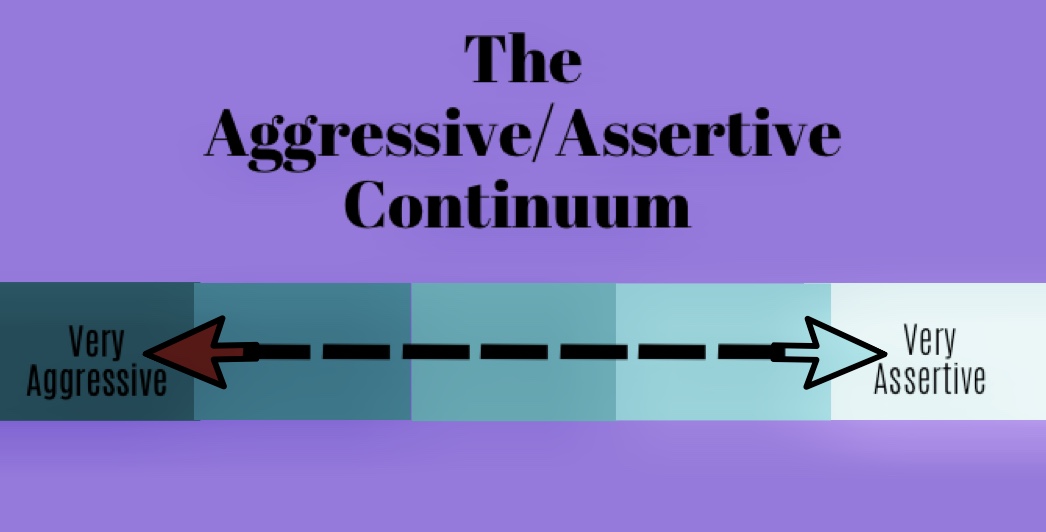
But here’s the caveat — as other women have, I have been compelled to learn how to be aggressive/assertive along a continuum, examining my situation and wisely choosing what my aggressive/assertive level should be at any given moment. The continuum looks something like this . . .

4B0B7E39-A6A8-4CDA-BAD4-8BF73C7C95CD
Like many, many women, I know that in order to effect positive change in the world, positive assertiveness is key. It’s all a matter of being self-confident enough to step up even if others criticize, speak out even when others try to silence you, persevere even when your detractors try to stop you from moving forward, hold on to your dreams even when dream-less persons tell you that your dreams are impossible.

My path to ordination was riddled with people around me telling me that ordination for a woman was impossible. At that time, there was only one ordained Baptist woman in the state of Arkansas and she was ordained in another state. My ordination process required enormous change in almost every person and institution around me. That change was not pleasant for anyone. It went on for months with lots of chaos and no resolution in sight. At the time, I thought I had only two choices: to abandon my desire for change or to stay in the struggle until change happened. I faced off with criticizers, silencers, discouragers and dream-less persons. Perseverance won that time!

My ordination quest was only one of many situations in which I had to fight for positive change. So I was almost always on the bad side of someone, and most unfortunately, I earned a reputation of being persistent, stubborn, insistent, resolved, Tenacious, determined, single-minded, resolute, uncompromising, annoying, troublesome, unconscionable and — wait for it — aggressive. I actually like most of those labels!

During a particularly discordant struggle with Little Rock city government about advocacy programs have for young people, a friend and mentor, who was the city’s Director of Community Programs, shared with me a Sierra Leonean Proverb that turned out to be an incredibly practical piece of wisdom. I immediately framed it and put it in my office so that I could see it often. She gave me that proverb in the late 90’s and, to this day, it is visible and prominent in my space.

She who upsets a thing should know how to rearrange it.
— a Sierra Leonean proverb

I seemed to upset lots of things in my lifetime. Often, I had no idea how to rearrange them. So I want to tell you about a woman who achieved what seemed impossible in her life and rearranged many things — discrimination, injustice, racism. She definitely upset things in her workplace, in the people around her and in NASA’s algorithms for space travel. She also rearranged those algorithms and helped send our astronauts into space.

625274F6-C5B5-47FD-A72E-3B8A4BEC9983Today I celebrate and remember Katherine Johnson, famed NASA mathematician and inspiration for the film “Hidden Figures.” She died a few weeks ago at 101 years of age. For almost her entire life, her brilliant work in American space travel went unnoticed. She was a pioneering mathematician who, along with a group of other brilliant black women, made U.S. space travel possible. And no one noticed for decades.

In fact, her work went largely unrecognized until the release of “Hidden Figures,” a film portrayal of Johnson’s accomplishments while the space agency was still largely segregated. Only the film, which was released in 2017, resulted in international recognition of Katherine Johnson’s genius.

Interestingly enough, her talent was evident early on. Her natural aptitude for math was quickly evident, and she became one of three black students chosen to integrate West Virginia’s graduate schools. After graduating from high school at age 14, Katherine Johnson enrolled at West Virginia State, a historically black college. As a student, she took every math course offered by the college. Multiple professors mentored her, including W. W. Schieffelin Claytor, the third African-American to receive a Ph.D. in mathematics. Claytor added new mathematics courses just for Johnson, and she graduated summa cum laude in 1937 at age 18, with degrees in mathematics and French. She started her career as a teacher but had her sights set on mathematical research.

Following an executive order that prohibited racial discrimination in the defense industry, Johnson was hired at the National Advisory Committee for Aeronautics, NASA’s predecessor. She was one of several black researchers with college degrees hired for the agency’s aeronautical lab through the initiative.

Johnson was part of NASA’s Computer Pool, a group of mathematicians whose data powered NASA’s first successful space missions. The group’s success largely hinged on the accomplishments of its black women members. Katherine Johnson was tasked with performing trajectory analysis for Alan Shepherd’s 1961 mission, the first American human spaceflight. She co-authored a paper on the safety of orbital landings in 1960, the first time a woman in the Flight Research Division received credit for a report.

In 1953 she worked in the facility’s segregated wing for women, but was quickly transferred to the Flight Research Division, where she remained for several years. But midway through the ’50s, the space race between the U.S. and the Soviet Union began to intensify. So did Katherine Johnson’s career. Without the precision of “human computer” Katherine Johnson, NASA’s storied history might have looked a lot different. Her calculations were responsible for safely rocketing men into space and securing the American lead in the space race against the Soviet Union.

After the release of the book “Hidden Figures,” which was published in 2016 and turned into a film the following year, officials lobbed heaps of praise on Johnson and two other black women mathematicians in the agency’s Computer Pool, Dorothy Vaughan and Mary Jackson. NASA renamed a facility for Johnson in February 2019. A street in front of NASA headquarters in Washington was renamed “Hidden Figures Way” for the three women in July.

In November of 2019, the three women — plus engineer Christine Darden — received Congressional Gold Medals for their contributions to space travel. Vaughan and Jackson received theirs posthumously. NASA administrator Jim Bridenstine called Johnson an “American Hero who helped our nation enlarge the frontiers of space even as she made huge strides that also opened doors for women and people of color in the universal human quest to explore space.”

President Barack Obama honored Johnson with the Presidential Medal of Freedom for her pivotal work in American space travel. Yet, Johnson’s work was still minimized and unrecognized by her male co-workers. Around her NASA workplace in the 1960s, she and her colleagues were known as “computers in skirts.”

I saved for last the best story of all! In 1962, John Glenn actually demanded Katherine Johnson’s help before his orbit around Earth. He was skeptical of the computers that calculated his spacecraft’s trajectory, so he told engineers to “get the girl” and to compare her handwritten calculations to the computer’s.

“‘If she says they’re good, then I’m ready to go,'” Johnson remembered Glenn saying. She gave the OK, and Glenn’s flight was a success.

Not to be flippant about the 2020 democratic presidential nomination process, but here’s a good message to send to whichever white guy gets the nomination: “When you are choosing your running mate, ‘get the girl!’”

And to all the women who hold up far more than half the sky, I honor you on this International Women’s Day and cheer you on toward your dreams and toward your mission of rearranging the world.


Adventures, Belief, Bravery, Children, Courage, Dreams, Faith, Falling down, Flying, fun, Growing up, Hope, Learning, Magic, Space Jam, Women

A95FCCB7-F996-42AF-B208-DB286900D4EF

When I was a teenager, I was conscripted many times to “watch” my younger brothers. It was a loathsome task for me! Yet, occasionally the two of them were interesting to watch, especially through their superhero fascination. They seemed to favor the superheroes who could fly, like Superman or Batman (who could sort of fly, but was likely to perish when attempting to land). It occurred to me that in the scene I watched in the back yard, the two young guys looked much more like flight-challenged Batman!

One afternoon after school, the boys were outside playing. Through the window, I watched them as they donned their makeshift capes. Then — without a care in the world and believing that they really could take flight — they stood tall on wooden boxes and launched themselves, arms extended, looking up to the sky. They didn’t fly that day, but they believed, they dreamed. And they had great fun!

I also noticed during those days that I never saw girls stand on boxes with arms outstretched ready to launch into flight. I certainly never thought of doing it myself. But it made me wonder if girls had dreams like the boys did. That thought brought my mood low and, looking back on it, I think I might have felt a bit of heaviness and disillusionment. I didn’t believe I could fly, but rather that I would leap off the box straight into the ground with a thud that probably resulted in a skinned knee. As the years passed, I learned for sure that if women had dreams, they would not likely realize them in our reality, which was “a man’s world.” Dreaming, hoping, flying may not be possible for a “girl.”

When my son was growing up, we saw the motion picture, Space Jam, a terrific movie for son Jonathan, who was an avid Michael Jordan fanatic. No doubt, my 6’6” son wanted to “Be Like Mike.” In Space Jam’s soundtrack was the song, I Believe I Can Fly, a 1996 song written and performed by American singer, songwriter and former professional basketball player R. Kelly.  This mom was not very fond of R. Kelly, but the song he wrote literally moved me and filled me up with hopes and dreams for my son. R. Kelly’s message was a great one:

I used to think that I could not go on
And life was nothing but an awful song
But now I know the meaning of true love
I’m leaning on the everlasting arms

If I can see it, then I can do it
If I just believe it, there’s nothing to it

I believe I can fly
I believe I can touch the sky
I think about it every night and day (Night and day)
Spread my wings and fly away
I believe I can soar
I see me running through that open door
I believe I can fly

See I was on the verge of breaking down
Sometimes silence can seem so loud

There are miracles in life I must achieve
But first I know it starts inside of me

If I can see it, then I can be it
If I just believe it, there’s nothing to it
I believe I can fly

believe I can touch the sky
I think about it every night and day
Spread my wings and fly away
I believe I can soar
I see me running through that open door
I believe I can fly
Oh, I believe I can fly ‘cause I believe in me . . .

I hope you will enjoy the video below, which I place here in honor of my son, Jonathan .

If God would grant me just one request, it would be that every boy — and every girl — would climb on their wooden box and believe in their souls that flying is possible. I would want them to stand tall, with hope and courage, dreaming their dreams and seeing the magic of watching them grow.

Adultery, Art, Awakening, Celebration, Change, Dancing, Discovering, Dreams, Freedom, Growing up, Introspection, Joy, life, New Life, Praise, Psalms, Questions, Surprise, Tambourine

With a Tambourine in My Hand

41C0A436-91ED-4E28-B2C7-8CC3FEA229B7
Water Dancers by Canadian artist, Rob Gonsalves

Women in white gowns emerge from the crashing water of  a moonlit waterfall. What in the world does that have to do with me, other than the fact that I am completely enthralled by this painting? I certainly cannot relate or see myself emerging from rushing waters or even dancing with a tambourine in my hand. Yet, there is something about this art that inspired my soul searching and brought up some questions I want to contemplate.

Where did I come from? Where will I go?
What will I do with my life? Which of my dreams will I realize?

I have asked myself similar questions, questions about what made me who I am and if I will ever feel that I have realized my life dreams. It’s true that I have entered my seventieth year of life, and one might wonder why the need for all the introspective questions. But In the core of my being, I believe that I can still dream and that I can still experience wonder about what I see in and around my life.

What people will enter my life leaving cherished gifts of friendship? What wonder will I see around me as I search for meaning? What will Spirit say to me with the gentle breath of her voice that can also enter my life as a rushing, mighty wind? And how does God continue to call me to new ministries of the heart?

I do not know the answer to those questions. Nor do I know who or what I will be when I grow up. So I struggle to know. I plead with God to give me direction. During this season of my life while I am challenged with so many things related to my kidney transplant, I have been somewhat obsessed with finding the answers to all those “who am I?” questions. I despair a little when I can’t find the answers.

Back to the art. Yesterday, I accidentally came across the painting by Canadian artist Rob Gonsalves which is at the top of this post. I was immediately captivated by the image, especially the rushing waterfall that changed into women living life — some of them dancing, others playing their tambourines, others just emerging, still others just beginning to awaken.

The art reminds me of how we might emerge into life — to grow into life, to be open to change, to be willing to embrace a process of becoming. Each of us is engaged in that kind of process whether we know it or not, whether we embrace it or not. We want to experience an awakening that opens our eyes to wonder and our souls to extraordinary newness of life. We want the freedom to be who we are. We don’t want to stay in our awakening place, reticent about moving into the best part of our lives, refusing to move because of our fear. We want to throw off our hesitation and, in search of our dreams, to sing, to dance, to play our tambourines in celebration of our unique personhood.

I am reminded of a beautiful passage of Scripture from the Psalms.

Let them praise his name with dancing,
making melody to him with tambourine and lyre.

— Psalm 149:3 (NRSV)

Isn’t that precisely what we want for our lives? To lean into our true selves so that we are compelled to sing, to dance with tambourines in our hands, to celebrate our lives, to dream and to praise the God who rejoices when we live into freedom and joy!


Awakening, Dreams, Inspiration, Music, Mysticism, Soul, Spiritual awakening

When Our Souls Play Their Music


DCE47FFD-B0CB-4B8A-B801-00653E8AE8C4
Stellar Babies: Infant stars are glowing gloriously in this infrared image of the Serpens star-forming region, located approximately 848 light-years away in the Serpens constellation. NASA

Who am I? Of course, I know the origin of my physical body, but from where did my soul emerge? How did it become what it is, what it feels, what it knows? Where were my dreams born, and the longings of my being? How do I awaken to all that I am meant to be?

The point is that our souls must be tended and nourished, but in order to do that, we must know them. We must know what our souls need to thrive and we must know intimately the Healer of our souls. I want to share a beautiful song for your time of meditation, Healer of My Soul by John Michael Talbot. Find a comfortable place and spend a few moments in silence before playing the video:

I often wonder about my soul and what it holds so deeply. I search it and find it impossible to reach down far enough to understand the wonder that is the soul. For years I have heard the admonition, “Search your soul,” I always wondered how exactly to do that. What spiritual discipline might help me search the depths of my soul? I remember the words of one of my favorite Psalms.

O Lord, you have searched me and known me!

You know when I sit down and when I rise up;
you discern my thoughts from afar.

You search out my path and my lying down
and are acquainted with all my ways.

Even before a word is on my tongue,
behold, O Lord, you know it altogether.

You hem me in, behind and before,
and lay your hand upon me.

Such knowledge is too wonderful for me;
it is high; I cannot attain it.

Where shall I go from your Spirit?
Or where shall I flee from your presence?

If I ascend to heaven, you are there!
If I make my bed in Sheol, you are there!

If I take the wings of the morning
and dwell in the uttermost parts of the sea,
even there your hand shall lead me,
and your right hand shall hold me.

— Psalm 139:1-10 (ESV)

What stunning words the Psalmist uses to describe how intimately we are known by God. Our challenge is discovering how to know ourselves. And so we plumb the depths of our being, seeking to know what dwells in the soul so that we might live life based on the soul’s longing.

It is true that this soul thing is a mystery, always eluding us and calling us to deeper understanding. And so I come full circle from the beginning of this post? Who am I? And what is my soul’s deepest yearning? Does my soul guide my life? I recently stumbled upon these words:

We are slowed down sound and light waves, a walking bundle of frequencies tuned into the cosmos. We are souls dressed up in sacred biochemical garments and our bodies are the instruments through which our souls play their music.

— Albert Einstein

I love the last thought that our souls play their music. Would that we lived and moved always to our soul’s music! Would that we might see our music creating life and hope and new dreams? When our souls play their music, everything is transformed — within us and around us. That soul music is our gift to the world.


F9FA5D3C-53F0-4043-8A72-F9E2D63F7349

On another note, please pray for me as I look toward my kidney transplant as early as November 6th. I am grateful that you are walking with me on this journey that often felt so frightening. Your thoughts and prayers mean so much. If you would like to read the story of my illness, please visit the Georgia Transplant Foundation’s website at this link:

://client.gatransplant.org/goto/KathyMFindley

“Go Fund Me” page is set up for contributions to help with the enormous costs related to the transplant, including medications, housing costs for the month we have to stay near the transplant center, and other unforeseeable costs for my care following the transplant. If you can, please be a part of my transplant journey by making a contribution at this link

https://bit.ly/33KXZOj

F9FA5D3C-53F0-4043-8A72-F9E2D63F7349

Bible, Dreams, Faith, Fear, God's Faithfulness, Hope, Music, Surprise

Something Unexpected!

4A3337C6-C063-4726-A894-A790420ADBB7
Photo by Steven Nawojczyk 

Every once in a while, something unexpected shows up. It may be a nice surprise that lightens a burden, like receiving a kind note or getting a phone call from a friend. It may be a sudden light that breaks the darkness we’re experiencing or a melody that lifts our spirits. It may be a little beauty in the middle of an ugly place. It may be a touch of color in a patch of gray. 

That’s what struck me about the photo at the beginning of this post. The creative photographer, my friend Steven Nawojczyk, must have noticed something bright and beautiful in the middle of a bramble of deep green foliage. It was unexpected — the brilliant, white flowers that bloomed there. No one planted them in that thick brush. They just appeared. Unexpected!

But we know all too well that an unexpected event is not always a good one. The surprises that break into our lives sometimes harm and hurt. My family experienced it this week: a nasty fall on Sunday that resulted in my very sprained, swollen and bruised knee; my cousin falling a few days later and injuring both legs; my son dealing with serious illness; my husband Fred spending all of last night in the ER.

Unexpected! And not-so-good unexpected!

So sometimes the thought of not-so-good unexpected can create fear in us. Of course, we know that our finest plans sometimes fall through. Our projects implode. Our dreams meet the toughest resistance.

Doesn’t it seem as if our “plans” are lightning rods for the unexpected? When our plans crumble underneath us, we sometimes question the very faith that has always, always sustained us.

Now there is no Biblical text for every life occasion, and picking out a text to prove a point or to make us feel better is not the best way to approach the Bible. And yet, our sacred Scripture does speak to the unexpected happenings of life. This time, it’s the wise prophet Jeremiah who offers the word of hope.

For I know the plans I have for you,” declares the Lord, “plans to prosper you and not to harm you, plans to give you hope and a future.

 — Jeremiah 29:11 New International Version 

A hope and a future! What more do we need? For me, white flowers unexpectedly blooming in the bushes and brambles will just about do it.

Thanks be to God.


Change, Comfort Zone, Dreams, Fear, Growth, Learning, Uncategorized

Becoming Our Better Selves

295B6520-B0A5-4F94-A0E7-9462C854C39B

I don’t usually write about charts in my blog. I’m not really a chart person at all. But my friend, Kim Rosby, recently sent me a chart that is worth contemplating. The chart is a snapshot of what it might look like when we become our better selves. It’s entitled “The Comfort Zone,” which is a place most of us want to be. 

That’s the problem. There is no growth and maturing in the comfort zone. It can become for us, not just comfortable, but also stagnant.

So I spent some time contemplating this provocative chart, and it definitely provoked some emotions in me. It appears that there are four zones that are possible for us:

  • The Comfort Zone
  • The Fear Zone
  • The Learning Zone
  • The Growth Zone

There you have it! So let’s unpack this chart a bit. When/if we manage to move ourselves out of the comfort zone, a place where we feel safe and in control, we will most likely enter the fear zone. In the fear zone, we are not at all sure of ourselves. We hang on the opinions of other people and use anything we can find as an excuse to remain frozen in place. If we don’t make a move, we can’t make a mistake. Right? We come to a point, though, where we do not believe we can move. We don’t believe we can change. We don’t believe we can seek another way.

Fortunately, some of us do make it out of the fear zone and thus find ourselves in the learning zone. What a renewing place to be, a place where new and fresh ideas are possible. It is in this zone that we realize we have moved at least a few steps past our comfort zone. We learn new skills and we discover that we can navigate challenges and solve problems. As long as we are learning, our path is clear and a future is possible.

So we move with courage into the growth zone, where we will re-invent ourselves in positive and exhilarating ways. As we conquer the objectives that were holding us back, we begin to believe in the possibility of new life goals, a deeper purpose. And then suddenly, we surprise ourselves with dreams and aspirations for something more in our lives, something fresh that inspires us to be our better selves.

I like my friend’s chart. I also like this promise that also says something very compelling about becoming our better selves:

 . . . I came that they might have life, and have it more abundantly.
—Jesus


Asylum, Courage, Dreams, Faith, Family, Freedom, Immigration, Life Journeys, Maren Tirabassi, Politics, Roots, Taking immigrant children

Yiayia / Γιαγιά

66642F2E-4B31-4A8F-BCEC-6286D03650A6

In my heart this week, I have held my grandmother, my “Yiayia” who came to America at age 25 with an older husband and two babies. One of them was my mother. December 16, 1916 it was when the ship Guiseppe Verdi reached Ellis Island. My Yiayia — line number 25 on the ship’s passenger manifest — had never envisioned coming to this land. She never considered she might leave the tiny Greek village on the island that was her home.

Her husband, wanted by Mussolini as a political detractor, had no choice but to flee in the dark of night in search of a place of safety and refuge for his little family. He had the courage to survive and to dream. But here’s the thing: my grandparents were welcomed into this country when they arrived to see the brightness of the Lady Liberty’s lighted torch. To be sure, their life in America was not all bright or easy. They worked hard to eek out a living and to become a part of a new community so very far from the home they loved. 

After I was born into the world, a toddler at Yiayia’s knee, I watched her struggling to learn English, to speak English well enough to be understood by her neighbors. One of my most vivid memories was sitting next to her at our kitchen table next to an enormous silver radiator that creaked and groaned, but warmed us famously. With The Birmingham News spread across the table in front of her, she drank her coffee, dipping her Zuieback toast and reading the newspaper, every morning.

She taught herself to read English, but The Birmingham News was not merely a reading primer for Yiayia. She learned from it. She understood the news events of her day. She knew that liberty was a gift worth protecting. So she studied the political climate and the political personalities asking for her vote. She would insist that you MUST vote, that you must know the candidates, that you must cherish the right to free and fair elections.

So Yiayia would dress in her finest clothing, simple but lovely dresses. She would put on her earrings and her brooch, her rings and her watch. Then she would dress me, and off we would go, across the street and down the block to the polling place. We would go together into the booth with the dark brown curtain. She would vote and I would stand in close to her with the view of only that brown curtain and her chunky shoes, heels of course.

Before we exited the booth — every time — she would look down at me and say, “We are Democrats! That’s how we vote, always!” And to this very day, I have followed her voting directive — always. The truth is that her definitive directive about voting had much more to do with the process than the political party she supported. It went deeper than any party loyalty, all the way back to reading The Birmingham News, seeing the beam of the Statue of Liberty, crossing the ominous ocean, remembering how it felt to have to flee from government oppression and grieving the loss of the island of her home.

Today, it’s not so simple for our neighbors who must flee their homes for so many reasons — safety, survival, fear, oppression. Our president says they are not welcome here. Many Americans say they are not welcome here. Just today, The New York Times reported that Mr. Trump’s growing migrant paranoia resulted in the forced resignation of homeland security secretary Kirstjen Nielsen, who resigned on Sunday. She is part of Trump’s wider “housecleaning” designed to appoint persons who will make sure migrants can not get across our southwestern borders. Only department heads who will enthusiastically implement the Trump administration’s “zero tolerance” policy will keep their jobs. May we never forget the images of thousands of migrant children who were separated from their families.

The president, in a not so presidential tweet, took aim again Sunday night when he tweeted, “Our Country is FULL!” So yes, he says that our neighbors are not welcome here. Yet, millions of us, second generation citizens of the United States of America, will never forget where we came from. We will always remember that our roots spanned the ocean and survived in a new land.

In my friend’s blog last week, I found words that touched me in a profound way and caused me to grieve the land of welcome we once knew. Her words express a startling poignancy. 

“A country that unwelcomes the world,” she writes.

I want to share with you her entire blog post — Jericho Walk — because it is well worth your time to ponder it, but first I emphasize this portion:

Often there is a shofar
to remind us just how deep
are the cracks
in the foundation of a country
that unwelcomes the world . . .

Jericho Walk
by Maren

I return to the Jericho walk,
in Manchester,
having not been well enough
for a couple months,
and it feels like home —
this moving vigil, silent, but with signs
and grateful waving for drivers
who honk their support.

We travel around the large block
of the federal building
where people we love and
some people we have never met
come to discover
if this week they’ll be deported.

We walk around seven times
hoping the walls
will come tumbling down —

around this place
that sends into certain danger
kind, hard-working,
tax paying, family-loving people
who contribute so much
to our community

Often there is a shofar
to remind us just how deep
are the cracks
in the foundation of a country
that unwelcomes the world,

but today there is a flautist
playing “Siyahamba”
over and over again —
walking
in the light of God,

and I think of that less-military
Jericho story —
the one that defines neighbor as

anyone from anywhere
who stops to help vulnerable ones
fallen on the side of the road.

Thank you, Maren. 

Thank you, my dear Yiayia, for teaching me that God grants us the grace gifts of refuge, safe haven and freedom. And no human — not even a big, bad, bully president — can take those gifts from us and from the generations that come after us.

May God make it so. Amen.


Discovering, Dreams, Faith, Inspiration, peace, Prayer, Serenity

Breath of Wonder

69175F90-305B-48F5-9797-D4F4BA54C428I cannot give you a better thing today than this prayer shared by Anne Fraley, rector of St. Peter’s Episcopal Church in South Windsor, Connecticut. “Listen” to her words and find yourself in them. Let grace from God refresh you as you live into peace and serenity. And as Anne writes it so eloquently, may faith carry you on the delicate breath of wonder and discovery, calling you forth beyond your wildest dreams.

I know these things to be true.

The sun dances and rainbows shine through pearls of water.

The coos of infants elicit contented sighs and gut-deep gladness.

Music stirs and tempers within the beats of its own rhythm.

The earth is rich with nourishment and holds sacred story with gentleness.

Hearts break and find renewal in healing.

Love sustains, encourages, emboldens, and makes us silly.

Divinity is everlasting.

Comfort is found in meatloaf and mashed potatoes. Or maybe sweet potato fries.

We sag and thrive, ponder and muddle through confusion.

We persist.

My prayer this day is that the best of these things will rise and claim their place on our horizons, and that the least of these things will recall our need for each other.

My prayer for this day is that faith will carry us on the delicate breath of wonder and discovery, calling us forth beyond our wildest dreams.

Amen.


Reprinted from https://revgalblogpals.org/2019/02/25/monday-prayer-these-things/.