Change, Compassion, Contemplation, healing, Inner joy, Repair the world, Repairing broken things, Tikkun Olam

Trying To Save The Whole World

Some of us feel compelled to rescue the world, and we try to do it in so many ways. The ways we rescue may be simple or complex, close to home or global. We try to repair them all, from multiple interventions when our kids get in trouble at school to advocating for an end to the climate change that’s currently burning down the beautiful Greek island of Evia.

For me, it’s a given that I should rescue things and people. After all, I am a minister. Isn’t that what we do? I really do want to save the whole world from whatever ailments or tragedies are inflicted upon it — the earth itself and the people in it. The thought that writer and theologian Frederick Buechner writes about this makes so much sense to me: “Your vocation in life is where your greatest joy meets the world’s greatest need.” I suppose that my desire to change, rescue and fix could very well be my undoing, because the stark reality is that I — one person — can do very little that would make much of a difference.

That’s the overwhelming part. How can we watch the world’s great need and not answer our inner compulsion to repair it? When asking myself this kind of question, I always think of tikkun olam, which is a jewish concept defined by acts of kindness performed to perfect or repair the world.


The phrase tikkun olam is found in the Mishnah, a body of classical rabbinic teachings. It is often used when discussing issues of social policy, insuring a safeguard to those who may be at a disadvantage. In modern Jewish circles, tikkun olam has become synonymous with the notion of social action and the pursuit of social justice.

To those who, like me, have this inner desire to change things and fix things, I can not offer any easy answers, because I do not have any. There simply aren’t any. I’m fond, though, of this idea: do the next right thing. When faced with big needs and small ones, sometimes that’s all we know to do, the next right thing.

I think that’s okay. The “next right thing” is like following the light we have or following God into the pressing needs the Spirit shows us. One thing I have learned is that before any act of repairing or helping, there must be a time of waiting, a time when the soul finds a sacred pause and waits there for holy direction. Then, just maybe we will have discovered what we need to “save the whole world.”

I love the way that poet and author Martha Postlethwaite describes a way forward for us fixers. I also love the way she invites us to find “the song that is our life” and to open our hands to receive it. Her thoughts come through so powerfully in her beautiful poem, “The Clearing.”

Do not try to save
the whole world
or do anything grandiose.

Instead, create
a clearing
in the dense forest
of your life
and wait there
patiently
until the song
that is your life
falls into your own cupped hands
and you recognize and greet it.

Only then will you know
how to give yourself to this world
so worthy of rescue.
Creating a clearing.

“The Clearing” by Martha Postlethwaite

We probably can all agree with the song John Mayer sings that we’re “waiting on the world to change.” We need changes big and small for bees, elephants, giraffes, oceans, blue whales, sea turtles, polar bears, monarch butterflies and all things nature. And then we need to clearly see the humans who probably need help most of all. So many humans live lives of deep need through no fault of their own, suffering because they’re facing incredible hardships and personal tragedies.

Martha Postlethwaite would suggest that we clear away the forest of our life and wait patiently in the clearing until what she calls, “the song that is our life,” becomes crystal clear. With that song, we will find the place of the world’s great need that is calling out to us for help.

So be present and mindful in the clearing. May God help each of us open our hands to receive our song, and then go out into the needy world singing. Amen.

Caged children, Child protection, Child trafficking, Children, Prayer, Sheltering children, Taking immigrant children

The World’s Children Need Us

Here’s the bottom line: in every nation of the world, one can see the oppression of children. No matter how one views the wars and the skirmishes, the occupations and the trafficking, the rationed medical care and the failure to administer the Covid vaccine, the stark reality is a picture of child endangerment and physical, sexual and emotional abuses.

The estimated number of children trafficked around the world is 5.5 million. They suffer violence, exploitation and abuse — ending up in forced marriage, prostitution, illegal adoption, labor, drug smuggling, begging and armed recruitment. They are taken from all around the world and sold by human traffickers as slaves. Child trafficking is linked to demand for cheap labor, especially where the working conditions are poor. Children may be forced into many dangerous and/or illegal situations, including slavery, domestic labor, sexual exploitation or prostitution, drug couriering and/or being turned into child soldiers.

And then, we must remember the immigrant children who have been separated from parents or guardians. An NBC News report on June 8, 2021 cites a 22-page progress report submitted to President Joe Biden last week by the task force for reuniting families. The report indicates that 2,127 children are awaiting their reunions. The report also states that 3,913 children separated from their families between July 2017 and January have been identified. The ACLU has said more than 5,400 children were separated at the border. The discrepancy, the DHS official said, is due to thousands of yet-to-be-reviewed files by the task force.

The estimated number of children trafficked around the world is 5.5 million. They suffer violence, exploitation and abuse — ending up in forced marriage, prostitution, illegal adoption, labor, drug smuggling and armed recruitment.

I could give many more statistics, hundreds of them, but we have all learned to hear statistics and simply dismiss them as irrelevant data. And yet, one single number in a spreadsheet of statistical information represents one particular child. A child stolen from her parents. A child exploited and enslaved. A child taken from the arms of protection and forced into danger. There is high lethality in child trafficking. A child loses his or her life forever because it is impossible to return to the life the child once knew.

So I will spare you from any more abysmal statistics. Instead, I want to share with you a portion of passionate, heartbreaking message I read today.

I wish to request that all those receiving this email pray for the children of Palestine living under a brutal Israeli occupation. Hardly a week goes by when 3-4 Palestinian children are summarily shot. Worst yet, Israel has not allowed the COVID vaccines to be administered in the Occupied West Bank and Gaza. If this is not a genocidal act, then what is? And to think that a $3.8 billion dollar aid package was only last week sent to Israel . . . Folks, if this generous give-away of your hard earned tax dollars does not peeve you, then I urge you to start reading the papers and informing yourselves about the many genocidal acts of terror against brown people – Syria, Palestine, Iraq, Libya, Afghanistan. As Christians, we are called upon to stand up for the oppressed.

In Deep Sorrow,
Raouf J. Halaby

What does this tragic situation as expressed by Mr. Halaby have to do with us? Maybe nothing. Probably nothing. But wait! I want to talk more about the inconceivable practice of modern day slavery — child trafficking.

Could my child be kidnapped and trafficked? It doesn’t happen here!

A very common misconception about human trafficking is that it does not happen in the United States. The truth is that the United States is ranked as one of the worst countries globally for human trafficking. It is estimated that 199,000 incidents occur within the United States every year.


Here are the 10 states with the highest rates of human trafficking:

        1. Nevada 
        2. Mississippi 
        3. Florida 
        4. Georgia 
        5. Ohio 
        6. Delaware 
        7. California 
        8. Missouri 
        9. Michigan 
        10. Texas 

Victims of trafficking frequently do not seek help due to language barriers, fear of their traffickers, or fear of law enforcement. Because human trafficking is considered a hidden crime, we can be diligent in reporting it when we see it happening. But we have to know what to look for. Several key warning signs can help us recognize potential endangerment and notify law enforcement. The United Nations Office on Drugs and Crime has a list of indicators we can use to help identify victims. These indicators include:

      • Appearing malnourished
      • Appearing injured or having signs of physical abuse
      • Avoiding eye contact, social interaction, and law enforcement
      • Responding in manners that seem rehearsed or scripted
      • Lacking personal identification documents
      • Lacking personal possessions

Every day there are things — bad things — that happen. Usually we think they have nothing to do with us, and usually they don’t, not directly at least. But the ministry of the Christ, who walked on this earth and who cared for the most vulnerable and endangered people he encountered, is our example. As Christians, do we follow Christ to the dangerous places? Do we pray for every child in every land, asking God to pay heed their circumstances and protect them from evil?

Prayer is the one thing, perhaps the most important thing, we can do. Mr. Halaby asks this of us: “I wish to request that all those receiving this email pray for the children of Palestine.” Let us start there, with that single request for prayer. And then, may all of us become more aware of the lives of children everywhere and pray that they will be protected from all harm.

Prayer is one thing we can do! Will we?


AWARENESS . . .

If you believe you may have information about a  trafficking situation:

Call the National Human Trafficking Hotline toll-free at 1-888-373-7888:
Anti-Trafficking Hotline Advocates are available 24/7 to take reports of potential human trafficking. 

Text the National Human Trafficking Hotline at 233733. Message and data rates may apply.

Chat with the National Human Trafficking Hotline via www.humantraffickinghotline.org/chat

Submit a tip online through the anonymous online reporting form below. However, please note that if the situation is urgent or occurred within the last 24 hours we would encourage you to call, text or chat.

The information you provide will be reviewed by the Trafficking Hotline. All reports are confidential and you may remain anonymous. Interpreters are available via phone call only. Learn more about the Hotline’s approach and policies regarding reporting trafficking situations to law enforcement.
Report missing children or child pornography to the National Center for Missing and Exploited Children (NCMEC) at 1-800-THE-LOST (843-5678) or through their Cybertipline.

Another good resource is “Not for Sale” at https://www.notforsalecampaign.org/about-us/

Challenge, Child protection, Children, Covid-19, Delta Variant, Fear, Mask mandate, Parenting, Protection, Sheltering children

Free-Flowing Thoughts on Sheltering the Children

What’s on your mind today? I ask because for me there are days, like today, when my mind is free-flowing without one thought, idea or plan. That can be troubling for a person like me who almost constantly churns out thoughts and creative responses to those thoughts. My blog, for instance, is a preaching platform for this retired and frustrated preacher. And there is almost always a sermon in me just itching to see the light of day!

But not today! You’ll get no sermon today, just words without organization and thoughts floating in the wind. Perhaps my thoughts will be energized by Spirit Wind, or not! It seems to me to be a good time for floating thoughts and random words, because in this pandemic world, there are simply no words.

When I look at pandemic facts and trends in my state, Georgia, I am aghast at this reality released today by WMAZ News: “The number of Covid cases in Georgia children has jumped in a month from 40 to 488. That’s more than 1,100 percent.”* Dr. Edward Clark, an Atrium Health Navicent pediatrician, says parents should be very concerned. “We’ve seen a spike in kids ranging from infants anywhere up to age 18,” he said. On top of that, children ages 12 and older have been approved only for the Pfizer vaccine at this time.

The truth is that some parents are very alarmed — even terrified — about the rising number of delta variant cases in children and teenagers. As well they should be, as they watch with great alarm the highly-contagious Delta variant cases increasing so rapidly in children. Parents are frightened and many of them worry that in-person school is not the best decision in these conditions. Teachers, too, are dealing with difficult issues as in-person school begins.

The number of Covid cases in Georgia children has jumped in a month from 40 to 488. That’s more than 1100%!

WMAZ News

In the midst of my free-flowing thoughts today, I am finding focus enough to ask why we did virtual learning last school year when children were less likely to be infected, yet in this school year when the Delta variant is rapidly infecting children, we are sending them to in-person school, some schools without mask mandate. Someone far less cautious than I am must have made that decision! I would have never sent children into harm’s way, into a place where they could spread the surging Delta variant to each other! Is it time for another season of sheltering-in-place?

Let us be careful about the ways we inadvertently expose children to danger. Let us be mindful of our responsibility to protect all children. Let us be diligent in letting our faith inform our compassion and care for children.

After all, Jesus was clear about drawing children close and sheltering them from harm. We should be just as committed to holding children close in a shelter of protection. May God make it so!

* https://www.13wmaz.com/article/news/health/coronavirus/weve-seen-a-spike-in-kids-highly-contagious-delta-variant-cases-increasing-in-children-2/93-a5fa9fea-2365-48da-b5c5-06a67d6c04f2)

Covid-19, Disconsolate, discouragement, Faith, Holy Spirit, Hope, Isolation, Social distancing, Spirit, Spirit wind

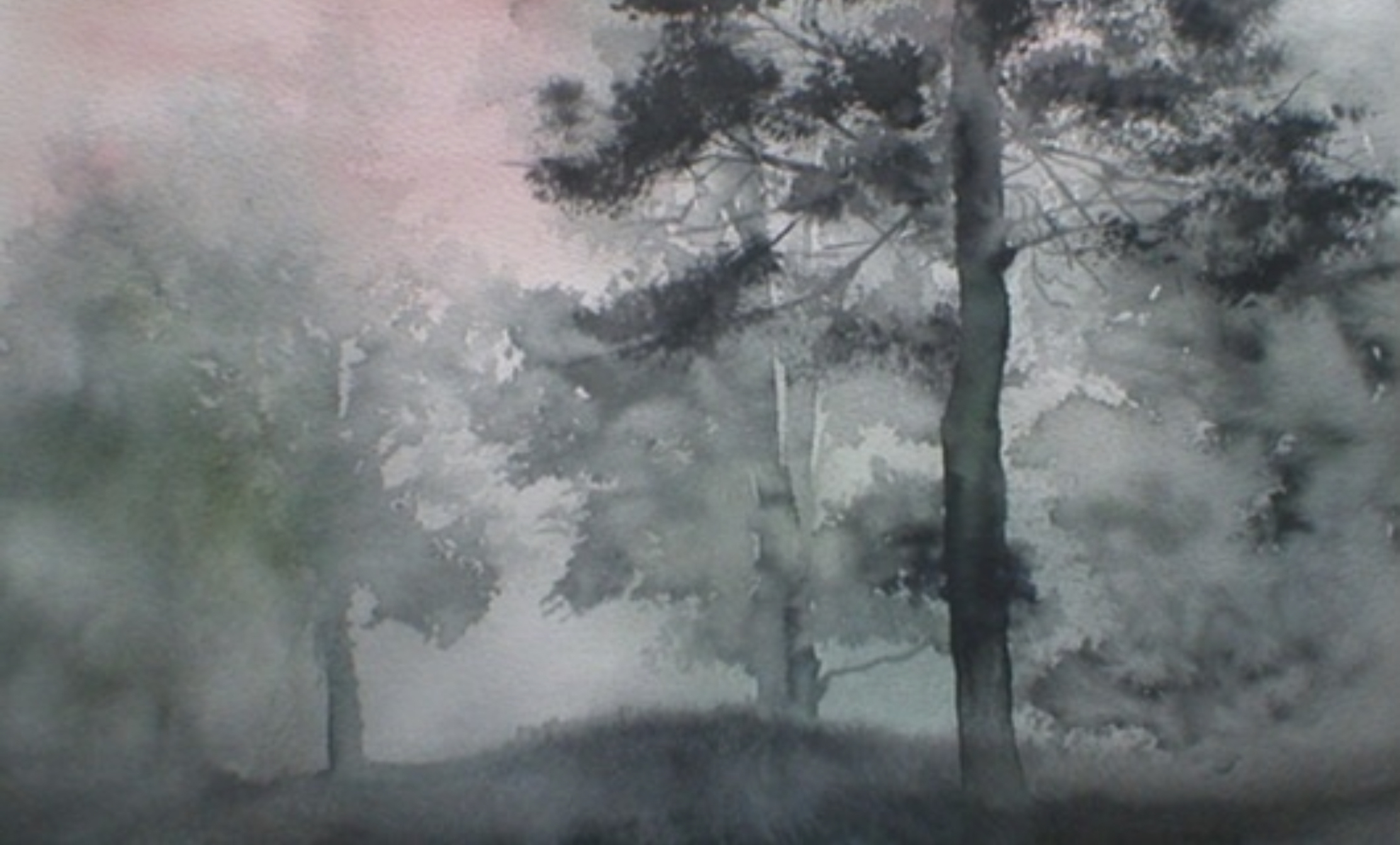
Just Gray!

5A2EB8AE-EAB9-4CD6-9915-CBFC3BBE670F
“Grays” A watercolor painting by Kathy Manis Findley
https://kalliopeswatercolors.com/

Sometimes some things don’t work! Like today as I am trying to insert the image for this post. It’s a watercolor painting I did a couple of years ago titled “Grays.” I don’t remember what was gray about that day or why I felt surrounded by gray, but I know that something was troubling about the day.

Like today! No, it’s definitely not gray outdoors. No gray skies above while the sun is shining brightly. Yet, I feel the “gray” closing in on me today, and for the past few days. News of the world’s hurt certainly has something to do about it. I can’t bear to hear of the spike in Covid cases, the danger of the Delta variant, exhausted health care providers gasping for relief, maltreated children at the overcrowded migrant center in Fort Bliss, Texas. I can hardly bear to hear another report about my friend who is very ill or about another friend I spoke to this morning who lost two love ones this week.

It feels gray in me right now. I think the gray feeling has a lot to do with the chat I had with my nephrologist at Mayo Clinic this week. He was beyond concerned about our current pandemic situation for his transplant patients. Of course, I am one of those patients. He was adamant that we immunosuppressed patients must begin isolating again immediately.

So again, the outlook for me is bleak. Not only am I one of his patients who are on high doses of immunosuppressant medications, but also I am one of the people for whom vaccines are not very effective. So while the general vaccinated public is around 90% protected from the virus, we are 50% (or less) protected. My doctor ordered an antibody test and, sure enough, it revealed that I have zero antibodies, which means I am not protected from Covid and that I can infect others.

I think that means retreating again from public gatherings — from stores, from groups of friends, from medical offices, from church. The time I was so looking forward to — seeing my grandchildren — is now a more distant possibility. All of that looks pretty darn gray to me!

I know in the depths of my soul that there are no simple answers for the gray times, the times when I am disconsolate and despondent. I know that I cannot change every adverse circumstance of my life. I know, too, that we cannot always change our soul’s response to those difficult circumstances. Sometimes, the “gray” of despondency simply has its way in me, and I cannot pull myself up and out. Sometimes I feel as if I am in a desert wilderness, and although streams of water may be there, I do not find them.

In such times, I have found that my ability to hold on to my very self comes directly from the Spirit, who is my sure and certain comforter. And I have learned that, while Holy Scripture and contemplative space do not always mysteriously rescue me or magically change my circumstance, I receive the peace and strength I need to live.

Jesus said to them:
“I must leave you, but I will ask God,
and our Mother snd Father God will give you another Comforter.
This Comforter will stay with you forever. 
She is the Spirit, who reveals all that is true and real about God. . . .
So when I go, you will not be left all alone . . .
I leave my peace with you. I give my peace to you.
So do not let your hearts be troubled. And do not be afraid.”

John 14:1, 16-18, 27 (my translation)


My flesh and my heart may fail,
    but God is the strength of my heart
and my portion forever.

Psalm 73:26


May you find that Spirit wind is moving gently within your spirit, and may God be the strength of your heart forever. Amen

A way in the wilderness, Art, Bewilderment, Rivers in the desert

Rivers in the Desert

“A Way in the Wilderness,” A watercolor by Kathy Manis Findley; https://kalliopeswatercolors.com/

What is it about this statement from God and recorded by the Prophet Isaiah?

I will make a way in the wilderness
and rivers in the desert.

This statement, or this promise, recorded in Isaiah 43 touches me to the core. It reaches into my soul that is so often parched by the events of life. As for the watercolor painting above, A Way in the Wilderness, you may have seen it before. I published it in this blog already. But this time, I would like for you to engage with me in a few moments of art appreciation. Consider the following questions.

What do you see in the painting?

What strikes you about it?

If you could choose one word or phrase or sentence in it that most relates to your life, what would you choose?

What do you see in the images and colors?

What do you see as the overarching theme of it?

What does it say to you? Or ask of you?

Okay! So maybe the painting says nothing to you! You’re not into art appreciation and it has no deeper meaning than paint to paper! I totally get that, but still, I want to tell you what it meant for me as I was creating it.

So much more than paint on paper, painting it was an emotional and spiritual release from my own wilderness. It was my way of learning to find rivers in my desert. Understand, it did not mean I could leave the desert and put the wilderness in my rear view. Instead, it allowed me to express my reality: that I live in the wilderness, but streams of river water quench my soul’s thirst in the desert.

That’s real and honest. A gut-punch of reality for me. Wilderness and desert terrain are common life habitations, for me and probably for you as well. I don’t live near the breezes of an ocean or on a ridge in breathtaking, snow-capped mountains.

I just live on a regular street in a regular town, and sometimes that can feel like wilderness.


What does that have to do with anything? Just this: During the times I feel as if I’m living in a desert wilderness, I need to remember the river. Or putting it another way, what I feel emotionally may be MY reality, but it is not THE reality.

It is not the ultimate reality of a life that is so filled with deserts and streams, storms and sunshine, smooth ways and rocky pathways, despair and hope, doubt and faith, sorrow and joy, death and life . . .

May your life be filled to overflowing with all of those things.

anxiety, Depression, peace, Spiritual growth, Ups and Downs

Ups and Downs

I feel exasperated sometimes with the constant ups and downs that are a normal part of my life. I would surmise that ups and downs are probably a part of your life, too.

Don’t we have a knack for riding them out on something akin to a roller coaster? I have truly become a master at riding out ups and downs since my kidney transplant, but then I never really wanted a roller coaster life. So much for life plans!

Even with ups and downs, I am comforted when my faith opens up insight I have gained over the years, like not worrying about tomorrow (Matthew 6:34), not leaning on my own understanding (Proverbs 3:5) and not being anxious about anything (Philippians 4:6-7). Those stay-the-course words should surely be enough to help, shouldn’t they?

Not always! Faith and spiritual maturity and scripture are simply not enough at times to keep me from the despondency of the “downs.” That’s just the way my psyche reacts when I feel down or when a circumstance pushes me down. The trouble is, things that get me down are not always enormously critical things. Even an insignificant down moment can let depression plant itself in my spirit. That just doesn’t work for me, so I need to find a way to even out my roller coaster life and not let everything that happens be a potential for depression.

What do I want? I cannot say it simpler than this: stabilizing peace. It is not an exaggeration to say that since my transplant eighteen months ago, almost nothing has been stable. Immunosuppression medications are constantly being moved up or down; my lab numbers are constantly fluctuating; my emotions are up and down; my energy waxes and wanes; my blood sugar rises and plummets; and, on one day my kidney might be okay, but on another day, I am dealing with kidney rejection. My physical, emotional and spiritual well being rises and falls with each change.

Oh, for some stabilizing peace that stays constant through the ups and downs!

I keep going back, though, to the ultimate words that promise me the kind of constant, stabilizing peace that I so need:

Always be glad because of the Lord! I will say it again: Be glad. 
Always be gentle with others. The Lord will soon be here.
Don’t worry about anything, but pray about everything.
With thankful hearts offer up your prayers and requests to God.
Then, because you belong to Christ Jesus,
God will bless you with peace that no one can completely understand.
And this peace will control the way you think and feel.

Finally, my friends, keep your minds on whatever is true, pure, right, holy, friendly, and proper.

Don’t ever stop thinking about what is truly worthwhile
and worthy of praise.

You know the teachings I gave you,
and you know what you heard me say and saw me do.
So follow my example. And God, who gives peace, will be with you.

Philippians 4:4-9 CEV


I wage war, much of the time, with depression that continues its haunting presence. It is not the debilitating kind of depression that can knock one to the ground to the point of needing medication. It is not the kind of depression that leaves one in tears and prevents any meaningful activity. It is not even the kind of depression that affects one’s life to the point of complete stagnancy. But it is a depression that hurts the heart and leaves the spirit languishing — on some days more than others.

Yet, I am grateful for lessons learned. In my times of depression — through my ups and downs — I have learned a few helpful and hopeful lessons.

These are just a few of them:


  1. I must not fall into the bottomless pit of anticipatory anxiety. The things that fill me with such anxiety and worry rarely even happen.
  2. My spirit is resilient, much stronger than I think it will be.
  3. The bad things that happen to me don’t usually last forever. I can ride them out.
  4. It is not “pie-in-the-sky” fantasy to fall back on the faith that has always sustained me. The truth is that the God who promised to be with me, really has been with me — every time.
  5. My “downs” have always graced me with a fresh view of my soul and spirit, the deep places in me that fall to the dust but still manage to get up and move forward.

I admit I haven’t made peace with my ups and downs. I suspect I will have them as lifelong companions, but I have made peace with the soul of my being. I have discovered that there are some soul-things that I can never really touch unless I have gone as low as I can go. In those times, my emotions are discernible and my spirit is tender. In those times, there is a holy presence that will take my hands and lift me up. Of that, I am confident.

Debasiah Mridha wrote these words that are so true and so full of wisdom, “Life has its ups and downs. When you are up, enjoy the scenery. When you are down, touch the soul of your being and feel the beauty.” 

I would like to be able to leave you with a sparkling, new solution for all of the times you go from up to down. I would like to be able to tell you in your ups, and in your downs, that you will find peace enough to sustain you. I wish I could tell you, even, that your life will be all “ups.” I wish I could believe it for myself. But there are very few things that any of us can count on. I intend to keep holding on tightly to my faith and my belief that God’s Spirit of Wisdom walks beside me. Sits next to me on that terrifying roller coaster!

I also love this thought that I stumbled upon in a most unlikely place. Brent Schlender, in his book entitled, Becoming Steve Jobs: The Evolution of a Reckless Upstart into a Visionary Leader, made the most lovely, comforting observation. This is what he wrote: “The sun will set and the sun will rise, and it will shine upon us tomorrow in our grief and our gratitude, and we will continue to live with purpose, memory, passion, and love.” 

May the Holy One make it so. Amen


A way in the wilderness, Aging, anxiety, Change, Depression, Disconsolate, Faith, Former things, Isaiah 43:18-19, New Things, Rivers in the desert, sadness, Sorrow, The past

“I AM ABOUT TO DO A NEW THING!” – god

“A New Thing” ~ Watercolor by Kalliope Manis Findley, July 2021

For Jennifer


It’s part of human nature to sometimes want to hold on to the past, cling to the “good old days” and resist the change that moves us forward. Especially when days past were very, very good and prospects for the future are less good!

I, for one, find myself clinging to the past with all my might, looking at my past life as a full and exciting one and viewing my present as being a bit of an empty wilderness. I chalk it up to aging and retirement, but this sense of emptiness, sadness, is really more than that. I think it’s more about my ability to accept myself for who I am, who I will become in the future and, most of all, what I truly need in order to be at peace with myself and my world.

Our worlds change all the time, and change brings with it the question all of us must answer: Who are you in relation to this world you are now in? If before retirement I was a nonprofit executive and an advocate for victims of violence and abuse, who am I in retirement? When I no longer have to adapt to the leadership roles I used to be a part of, what “self” might I discover in these days of new things? When I no longer have to adapt to the role of pastor, what “self” might I find myself to be when there is no congregation to care for?

According to Isaiah, my go-to Prophet, God advises us not to remember “the former things” or “the things of old.” Instead God apparently makes a provocative statement and asks an even more provocative question:

I am about to do a new thing;
now it springs forth.

Do you not perceive it?

Isaiah 43:18 NRSV

I definitely had not perceived it, that new thing! In fact, I have been languishing about losing my “former things” for the last six years, not able to make the most of my present and certainly unable to envision a bright future. It might surprise even those who know me best how deeply disconsolate I have felt at times. Six years of languishing is not a good way to live. I made a gallant effort to make the best of it, but these six years took a toll on me in most every way — physically, emotionally and spiritually. My closest friends have ridden out this storm with me, so they know what I’ve been dealing with in clinging so closely to my good past and not being able to live into a good present.

And what is this “new thing” that God speaks of? What does the way through the wilderness take me and where are the winding, refreshing rivers in the desert?

– KMF

Two weeks ago, one of those close friends gave me a passage of scripture printed on a piece of paper. I received it in quite a serendipitous way. Neither of us chose the passage (Isaiah 43:18-19). It ended up with me in a very random manner. But as it spoke of former things, old things and new things, it got my attention so completely that I pondered it several times a day for a week or so. I didn’t obsess over it or look up its context or attempt to exegete it. I simply pondered it in my heart in the quiet times.

This scripture is truly a lovely God-promise, filled with a gentle, healing grace. I appreciated it for that. I also appreciated it because its words gave me the gift of sacred pause. And in the sacred pauses it gave me, I realized that the crux of this matter is not not how I react to change or how I survive it. What I discovered is that this is not about what I can do or should do when my world changes. It’s about who I am when my world changes.

With that in mind, maybe every time my world changes, I will still be the person of deep faith that I have always been. Maybe I will greet “the new things” with gratefulness, knowing that God has made before me a way in the wilderness and has provided cool, rolling rivers in the desert. And even when my soul longs for days gone by, perhaps I will know that I will see God’s light on the path ahead of me, even in the dark, even through the wilderness, even as I feel the inevitable sorrow of letting go of all the former things I so deeply cherished. Even then, I will know that I do not walk alone.

Thanks be to God.

“You Do Not Walk Alone” Traditional Irish blessing. Original music by Elaine Hagenberg http://www.elainehagenberg.com
Compassion, Freedom, Immigration, July 4th, Lady Liberty, Liberty, Mother of Exiles, Statue of Liberty, Welcome the Stranger

Mother of Exiles

Freedom” is a painting by Tamer and Cindy Elsharouni which was uploaded to Fine Art America on March 5th, 2012.

Not like the brazen giant of Greek fame,
With conquering limbs astride from land to land;
Here at our sea-washed, sunset gates shall stand
A mighty woman with a torch, whose flame
Is the imprisoned lightning, and her name
. . .

From her beacon-hand Glows world-wide welcome;
her mild eyes command
The air-bridged harbor that twin cities frame.


“Keep, ancient lands, your storied pomp!” cries she with silent lips.


“Give me your tired, your poor,
Your huddled masses yearning to breathe free,
The wretched refuse of your teeming shore.
Send these, the homeless, tempest-tost to me,
I lift my lamp beside the golden door.”

— Emma Lazarus


In the year 1883, Poet Emma Lazarus wrote this sonnet, “The New Colossus,” to raise money for the pedestal on which the Statue of Liberty would stand. The sonnet ends with the poignant, passionate words that were added to the base of the statue in 1903: “Give me your tired, your poor, Your huddled masses yearning to breathe free, The wretched refuse of your teeming shore. Send these, the homeless, tempest-tost to me, I lift my lamp beside the golden door.”

For me, these words always held deep significance, first of all, because both of my parents emigrated to this country from Greece and secondly, because I worked as an advocate and trauma counselor for victims of human trafficking, both adults and children. My work was not merely a job; it was a calling that took me into emotionally and physically dark places that challenged my theology of good and evil. It opened my eyes to the intrinsic evil of politics, wealth, greed, inhumanity and depravity. As I toiled with broken, traumatized women, men and children, trying to help them change their lives, my own life was changed, transformed really.

Lady Liberty spoke to me in those days. I know she is a mere statue with no human attributes to admire, but she is to me a powerful symbol. The Statue of Liberty has been called “Mother of Exiles.” People who have been exiled for so many different reasons have found inspiration in her, in this inanimate sculpture that comes alive in people who yearn for freedom. Lady Liberty is sculpted from the inspiration of Libertas, the Roman goddess of liberty with broken shackle and chain at her feet. The Statue of Liberty became an icon of freedom, a symbol of welcome to immigrants, especially immigrants arriving by sea. I remember hearing my grandmother’s many stories of sailing to America, and one of her memories was seeing the Statue of Liberty’s welcoming light.

I’m writing this today as my commemoration of July 4th, a day that represents freedom, yet not for all. For if you ask your African American brother or sister, “What does July 4th mean to you? You will get an answer expressing something like this: “Are you asking me, a descendant of the American slave, what the 4th of July means to me? I answer: It is a day that reveals to me, more than all other days in the year, the gross injustice and cruelty to which I am a constant victim.”

So I am always uncomfortable “celebrating” the 4th of July with fireworks and cookouts and a proliferation of mini American flags. Instead, I choose to commemorate, not celebrate. So I will acknowledge the day, yet never forget its full meaning, its meaning not just to me, but to my brothers and sisters — descendants of slaves, immigrants fleeing from oppression, victims of human trafficking.

Are you asking me, a descendant of the American slave, what the 4th of July means to me? I answer: it is a day that reveals to me, more than all other days in the year, the gross injustice and cruelty to which I am a constant victim.

So think of Lady Liberty for a moment. The image of a woman, not a man — a woman who is standing tall and steady, with her torch lifted to offer light to all who need light. She is an image of a woman who represents compassion, invitation, protection, acceptance, freedom. The broken shackles at her feet declare the end of enslavement, cruelty and bondage for all people as she proclaims welcome for the tired, the poor, the ones who yearn to breathe free, the homeless, those tossed by the tempests of their lives. “Send them to me,” she says, “I lift my lamp to light their way!”

In our country, we entertain hard questions in these days, questions about our nation’s borders, about how welcoming we will be, about equality and equity and whether or not black lives really matter. So today I wonder. Will we lock our gates of welcome? Will we turn away persons escaping tyranny, danger and oppression seeking a land of freedom in our homeland? Will we act as if black and brown lives truly matter? Will we act in the spirit of the Lady, the “mother of exiles” who stands in New York Harbor? Or will we pick up the broken chains at her feet, forge them back together and use them to enslave?

These are the questions we should be asking in these days. Of course, political debate continues dissecting our nation’s immigration policies, as always. Politicians do that, often with little thought about the real people, the real families who bring their children to our nation for safety, protection and freedom. Politicians will do what they do as they always have, but I must ask my American compatriots, “What will we do? Will you and I speak in solidarity with the people who seek to live free in our country? I pray that we will show up when it matters and speak from our hearts of compassion, advocating for a nation that will always say, “Give me your tired, your poor.”

Mother of Exiles, may we stand in welcome with you, and in the spirit of our loving God, may we always love the stranger as we love ourselves. Amen.

You shall also love the stranger,
for you were strangers in the land of Egypt.

Deuteronomy 10:19

Aging, Change, Contemplation, Courage, discouragement, Fear, Illness, Risk, Stillness

Here’s to the Crazy Ones!

It’s true, isn’t it? Without the risk of going too far, stepping out of our comfort zone, we will probably never know just how far we can possibly go. But oh, the complete comfort of that comfort zone hems us in completely. We cannot move. We cannot take a step into new life. We cannot know what we might have accomplished. We cannot free ourselves from the bondage of fear.

I’ve been there and I have a notion you have, too. In fact, I can recall many times when I could not overcome my fear enough to take a risk. One time in particular has haunted me for almost 30 years. I wonder what my life would look like today if I had taken that particular risk — moving to a new state, to a new position, to a larger city, to a different house on a different street. That one single refusal to step out of my comfort zone has troubled me to this day.

Risk-taking is not easy. Change is difficult for some people, and some of us can convince ourselves to avoid change at any cost. Huge changes, even tiny changes, simply frighten those of us who have convinced ourselves that we are not risk-takers. Yet, I can think of so many persons who have decided that changing their lives — maybe even changing the world — is worth the risk. I will never forget one of my seminary professors whose words in a chapel sermon changed the course of my life.

Is what you’re doing worth giving your life for? Because every day you live, you are actually expending your life a little at a time doing whatever it is you’re doing.

– Dr. Paul Simmons

I left the chapel that day, walked across the campus to my office and resigned from my job, setting my sights on enrolling in classes to complete a Theology degree. A risk! A big risk that I was determined to take for two reasons: 1) I actually believed I could change the world; and 2) I was young, bold and unafraid. I’m not so young anymore, and the courage and boldness to change is small in me. It feels like being stuck, and I think it’s the first time in my life I have felt so thoroughly stuck. A brand new mantra for my life is this: “Stuck is more harmful to me than risk. I am not afraid to take a risk!”

Still, there is a part of me who longs to change the world, at least my corner of it. There is this alter ego inside me who actually believes she can change the world. That is the part of me that believes injustice can be conquered, wrongs can be righted, equality can be reality and liberation can emerge out of any form of bondage. Crazy? Probably, but I know of many kindred spirits who would be all-in on changing the world — Malala Yousafzai, Emma Gonzalez, Greta Thunberg, Crystal Echo Hawk, Amanda Gorman. Men are on the list of risk-takers, too. One in particular died in 2011 at age 56, but left behind a lasting legacy that was an example of what a human being is capable of doing.

The ones who are crazy enough to think they can change the world, are the ones who do.

– Steve Jobs

I have given thought to those words, as well as something else Steve Jobs said when he was dying of pancreatic cancer: “Death is mankind’s best invention! I looked in the mirror every day wondering if what I am doing today is fun for me. If the answer was no for several consecutive days, then I have to change something!”

Yes, I am stuck right now, and for several days I have had to admit that what I am doing every day is not fun for me. Nor is it anything significant enough to change the world. So I do need to change something. I’m not sure what sort of change I need to make or how risky the change might be. STUCK! No matter what I decide to change — big risk or small risk — it won’t be easy. And I have to look into myself, into my soul, and ask myself if I am able to take a risk or even willing to take a risk. Truthfully, I know in the depths of my being that refusing to take a risk right now will leave me stuck, maybe even permanently stuck. I don’t like the sound of that. I don’t like the stark reality of that. Small risk or big risk — I know I need to change something in order to truly live!

Like the little goldfish in the small bowl, I’ll skip the bigger bowl and shoot for the ocean.

– Rev. Kathy Manis Findley


I used to be “one of the crazy ones,” always taking risks and most often taking big ones. The visual goldfish metaphor is one that described me well throughout my years. I was not one to leap from a small fishbowl to one that was a little larger. I was much more likely to take a brave, risky leap out of a fishbowl and into an ocean! Until now! Until aging and illness and displacement took its toll. I’m definitely not as young as I was in my former and more courageous days. I am not as physically well as I used to be, and I am not living in the town that was my home.

I am facing a three-headed enemy — age, health and displacement. In truth, this enemy does have enough power to keep me stuck, depressed and disheartened. At this moment, I don’t yet know what I plan to do about it, but I do know it will probably call for a leap, a risk, a change and maybe doing something a little crazy.

At this moment, I’m not up for crazy. I need a little contemplative time in my safe space to look deeper into my soul. I’m not at all sure what will come out of my time looking at soul things —maybe some extra peace or maybe renewed hope, new thinking, fresh courage, some sort of healing. Maybe even a little craziness that helps me consider some risky changes in my life. What I am sure of is that I do not enter my soul-searching space alone, for God has walked with me on every step of my journey. I cannot plan anything right now, but there is someone who watches over me who is making plans I cannot make.

For I know what I have planned for you,’ says the Lord.
‘I have plans to prosper you, not to harm you.
I have plans to give you a future filled with hope.
When you call out to me and come to me in prayer,
I will hear your prayers.’

Jeremiah 29:11-12 NET

I will take risks again someday. I will reclaim the “crazy” part of myself that was never afraid to risk going too far. I will embrace change, inevitable change, with more courage than I have at this moment. I will take another big risk one day soon that will remind me how far I can go and how high I can leap. Like the little goldfish in the small bowl, I’ll skip the bigger bowl and shoot for the ocean. Until I can do that, I’ll be in my sacred space with the One who has never left me and has never let me walk alone.

Thanks be to God. Amen.

You Do Not Walk Alone, Elaine Hagenberg


Comfort, Faith, Hope, Preaching, Whispers of God

Whispers of God

Word cloud by Kathy Manis Findley

Then afterward I will pour out my spirit on all flesh;
your sons and your daughters shall prophesy,
your old men shall dream dreams,
and your young men shall see visions.

Joel 2:28 NRSV

Because I am an ordained Baptist minister, I followed a path that made hearing the whispers of God necessary. I heard God whisper to me on many a dark day. So I am fairly certain about it when I do hear the whisper of God. Only that kind of holy whisper could cause one to face off about ordination with a patriarchal system. But truth be told, I did accept that face-off almost forty years ago. And I persisted through a long season of unkind challenges and lengthy treatises about all the reasons a woman could not be ordained.

In the end, I was ordained. I am deeply grateful to have experienced a rich and varied ministry through those years, including serving as pastor of two churches. I preached every Sunday, real sermons. You might say — borrowing the words of the prophet Joel — that I “prophesied.”

Oh, my!
God whispered. I followed. It’s just that simple.

The truth is that throughout my life, I have heard the whispers of God many times. God’s whispers were just for my hearing, sometimes to comfort me, sometimes to gently correct my steps, sometimes to encourage me, sometimes to lift my spirits, sometimes to show me a vision and sometimes to call me to a mission, like prophesying or preaching.

I have learned a very important life lesson: that when I am grieving, confused, sorrowful, hurt, betrayed, beaten down . . . God’s whispers give me hope. When I am disheartened, God’s whispers touch me with healing. When mourning has stolen my songs, God’s whispers move me to sing again.

I am reminded of the inspiring words of Rev. Dr. Prathia Laura Ann Hall (1940-2002), an undersung leader in both the civil rights movement, womanist thought, social justice and African American theology. These are her words:

Out there in the brush arbors, the wilderness, and the woods, the God of our ancestors, the God we had known on the other side of the waters met us and whispered words in our ears, and stirred a song in our souls . . . 

– Prathia Hall, Quoted by Courtney Pace in Freedom Faith: The Womanist Vision of Prathia Hall

Right now, I am in “the wilderness and the woods.” In other words, I am in a shaky place. I need that quiet, familiar, sacred sound of God whispering in my ear. I wonder if maybe you, too, need to hear that sacred whisper that can make all the difference. Wherever you are, however you feel, in whatever place you are in your life, in whatever way you experience God, I pray that you will listen closely for the holy whispers you need to hear.

Depression, Friendship, Heart, Seat of Emotions, Words

Words!

I wonder if writers sometimes just write words — words devoid of emotion or conviction or passion. I wonder if you would read my dispassionate words today just as you read my more passionate ones on other days. And does it even matter to you if the words I write come from my heart? Or not.

I ask because today my heart feels empty, just as it has felt for several days past. It’s that sense of numbness, maybe even a soul emptiness that hurts more than full-on despair. I cannot put my finger on a reason for it. I say to my friends, “I’m depressed,” but only because I can’t think of a better description, at least not one that most people would understand.

I have two particular friends, friends with whom I have a special relationship. We talk often about our feelings, about depression or anxiety, excitement or joy. We also ask one another a question that bypasses all superfluous language and tedious, spiritless conversation. The question is this:

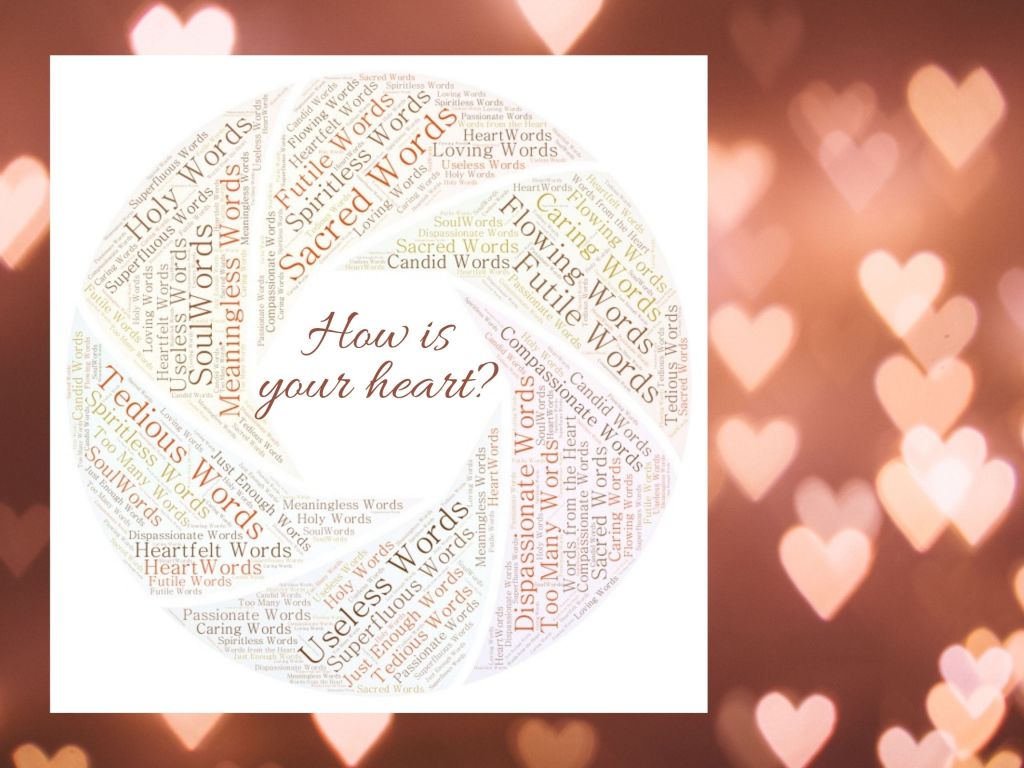
How is Your heart?

The question gets us to the heart of the matter (pun not at all intended). The question gets us past the need to reticently enter into meaningful conversation. It bypasses all the fluff. It requires no long discourses on how depression feels or where we think it came from. It just asks a straightforward question that calls for an upfront, honest answer.

Just this: “How is your heart?” That’s it. We save a lot of time that way!

Either we struggle for a just a few seconds to figure out our honest answer, or we simply say, “I don’t know.” I realized not too long ago when my friend asked me about my heart that I was receiving her question as one of genuine concern for my well being. I did not feel that she was asking for a bunch of words like a treatise on my current state of being. I did not feel that she was asking me to bare the plethora of my feelings. I did not feel that she wanted to hear a string of words. I certainly did not feel that she was asking for a “How are you? I am fine,” conversation (likely the most meaningless set of words ever spoken).

She was not asking me for any of that, words and words and more words. She was asking about my heart, the seat of emotions, they say. All she wanted to know about was the condition of my heart — what longing was there; what heartache was there; what joy was there in that moment.

I always answer that question because it is a holy one. It’s never just words — her question or my answer. Instead, it is a sacred pause we enter, knowing that we will share with one another thoughts that are much deeper than words. We will share from the wellsprings of our lives.

The Egyptians taught that the heart was the seat of the soul. The ancient Hindus believed that the soul was located in the heart. The Aztecs said, “The heart is the seat of the soul.


“How is your heart?”

It is a question overflowing with meaning. The wise Greek philosopher Aristotle (384–322 BC) wrote that the heart is the seat of the soul. Another man of wisdom, Augustine of Hippo, actually behaved quite unwisely for a time, causing speculation that he was perhaps suffering from depression. The many wild wanderings of his youth caused him to harm his very soul and left him sitting at the salt pools of death. From that place, Augustine returned to God, like a bird to its forsaken nest. And he said in his Confessions, “Thou hast made us for thyself, O Lord, and our heart is restless until it finds rest in thee.”

― Augustine of Hippo, Confessions

I empathize with Augustine, if indeed he did suffer from depression. And yes, it is true that all these words have emerged from my own place of depression. Yet, even from that deep place where my heart feels wounded, I can still rest in knowing that my heart is the seat of my soul, a place I diligently guard. Gratefully, I can still rest in the fact that I am clothed in the comforting presence of my friends who never fail to ask, “How is your heart?”

To them — Sister Lee Ann and Monica — I dedicate this post.

For them, for us, the question is not just empty, superfluous words. Between us the words are sacred words, a holy question that taps into the “wellsprings” of my life. I always answer that kind of question. For these two friends, and a few other friends who keep vigil with me whenever I am depressed, I give thanks to God. Amen.

Guard your heart with all diligence,
for from it flow the wellsprings of life.

Proverbs 4:23

anxiety, Bewilderment, Depression, Depth of Mercy, Depth of Soul, Emotions, Feelings, God’s Mercy, Hope, Life pathways, Rev. Kathy Manis Findley, Soul, Trails, Unknowing

The Trails I Take

I have taken many trails throughout my life and I imagine that you have as well. It’s one of the things all of us have in common. The trails we take can sometimes lead us to places unknown. Not just places on a map, but places in the soul. Our more difficult trails can push us to our limits, mostly the limits of the soul at its depth. Sometimes, today maybe, my soul is in the depths of unknowing.

What does that sentence even mean? My soul is in the depths of unknowing? If I don’t know what that means, how can I possibly talk about it with you? I can try!

I’ll try.
I’ll search for words
that explain
how I feel, how my soul feels
and what it means —
the depth of unknowing.

These days I sense an unease in my soul, in its depths. I have named it depression. I have tried in vain to make an appointment with my therapist. Isn’t that what people do when they are depressed? Anyway, I did that, but cannot see her until the end of July. So I determined that I had to become my own therapist. In doing that, I decided to search myself more deeply. I determined that perhaps what I feel isn’t depression after all. Instead, what I feel may be the depth of unknowing.

For me that means chasing away the unknowing, getting rid of it because I want to know when I will feel stronger physically, or when I will see my grandchildren, or how I will handle my emotional fragility, or where I will live for the rest of my life. Just to name a few things I need to know.

And yet, the depth of the soul’s unknowing may well be exactly where my soul begins to fully know. The trails I take while inside my soul’s depths contain lessons and treasures and wisdom. The trails bend and wind leading to an unknown path that opens its way for me. I follow it willingly, blindly, yet for some reason, expectantly. The trails are most surely my depression, their unknown, perilous way distressing me as I walk. Jagged rocks on the trails, vines creeping their way onto my path, thorns, bristles and barbs — boulders sometimes — all to remind me of the hard path I walk and the heavy load I carry.

The trails I walk may be no more ominous than yours. We all walk them and we all carry burdens on the way. You and I walk no easy trails. There is “no easy walk to freedom,” the song reminds us. Truth! The trails I walk, and your trails, are many and winding, hard and confusing. The obstacles overwhelm. I suppose this describes my depression as well as any words could, and it is precisely that unease in my soul’s depths that has come to me in these days.

The difficult thing about soul-deep depression is its dogged persistence. That kind of depression has staying power and it sits in the soul, creating that terrible sense of the soul’s unknowing. It has the power to convince me that I will never know the things I want to know. Mostly, I want to know destination. Where am I headed? What jagged rocks and prickly thorns will injure me along the way? And will I survive my injuries?

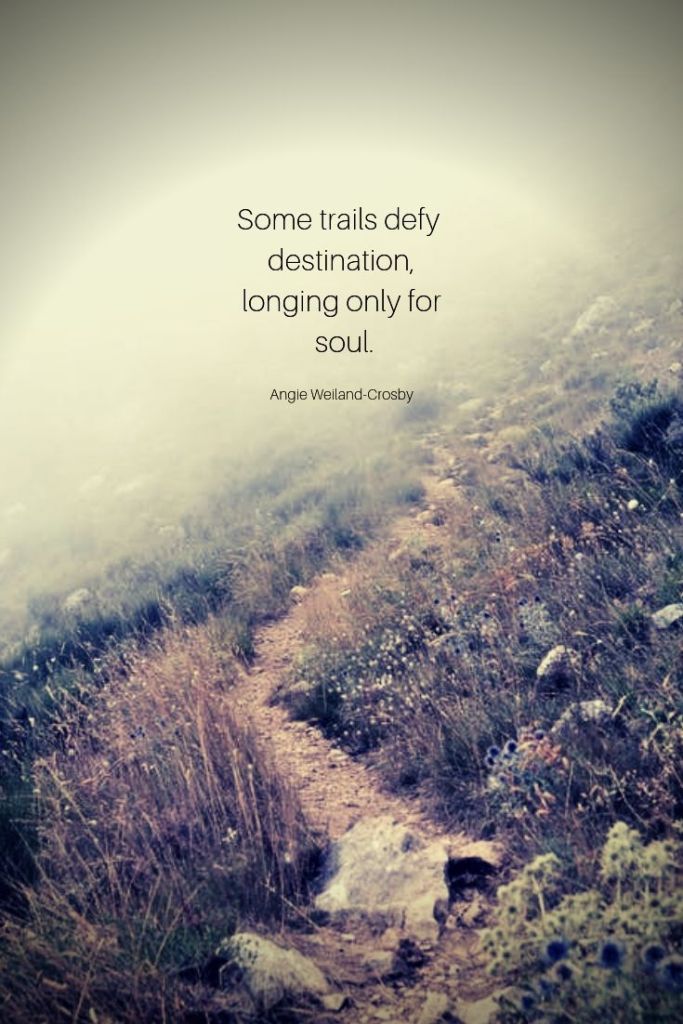
There lies the depth of depression. It lies in the desire, the need, to know. We need to know the unknown — where will the trails take us and what formidable obstacles will stop us. Now understand this, if I had answers, I would have given them to you several hundred words ago. I have no answers of my own, but I do have a nugget of wisdom written by author Angie Weiland-Crosby.

Some trails defy definition,
longing only for the soul.

Angie Weiland-Crosby

There may be something in her words. If the trails defy our attempts to define them or to know them, perhaps we can find comfort knowing that the trails long only for our soul. The trails only want us to bare our souls along the way and to open them up to the new. The trails are meant for our good, for our spiritual maturing. And as for another comfort, the God we know has seen and known the trails before us. However you see and know God, you can rest in the knowledge that God has some hand in the work of the soul. God knows about the trails we take.

Haven’t I commanded you? Strength! Courage! Don’t be timid. Don’t get discouraged. God, your God, is with you every step you take.”

Joshua 1:9 (The Message Bible)

When all is said and done, I believe the trails I take are necessary ones. In a way, perhaps the trails I take are sacred ones, meant for opening up my soul to its depths where transformation can occur. No, God does not lay out my every trail or remove its thorns and rocks. The trails I take are strewn with rocks meant for me, thorns that pierce just enough to get my soul’s attention. I believe that. And I believe that there is for me a way to trust God wholly. My personal translation of Proverbs 3:5-6 gives me a tiny inkling of hope even when depression ravages my soul.

Trust in whoever you believe God to be in your life.
Trust God with all your heart,

and don’t rely only on what you understand.
In all the twists and turns in your life,

perceive this God as one who offers a depth of mercy,
A God who sees and knows the trails you walk.
And be assured, know deeply in your soul

that God will direct your paths.

I want to share with you a video of a beautiful, meditative song entitled, “Depth of Mercy,” performed by students of Fountainview Academy, a Christian high school based in southern British Columbia, Canada. I also share this because of where it is filmed — a beautiful wooded area with various trails. Whatever trail the students took to arrive at their destination seemed a treacherous pathway to me, and even more treacherous, the place where they stood to play and sing.

They were on top of a magnificent ridge, but way too close to the edge for my comfort. At the end, as they sang, “Depth of mercy, can there be mercy still reserved for me?” The image pans across them to the jagged edge and then reveals a very deep and ominous gorge. Panning even farther across, you will see a most beautiful portrayal of nature, one that stirs the senses and reminds us of the depth of mercy our God reserves for us. I hope the video is meaningful to you.

Aging, anxiety, Awareness, Beauty of Nature, Bishop Steven Charleston, Change, Faith, Forest, Grace, life, Life Journeys, Living Hope, Pondering, Spirit

Pondering a Soul in Transit

“A soul in transit.” What does that phrase even mean? It sounds a bit ominous to me, like something bad couched in flowery language. Maybe like words of a poem that make little sense because they point to something otherworldly. Perhaps it means something related to a soul that lives, gets old, and dies — in transit from birth to death and beyond. Pondering!

I’m not up for those thoughts right now, because I am in the troubling place of feeling old sometimes. It’s something like aging anxiety, I think. Feeling old should not be so surprising to me since I really am kind of old. But sometimes I feel old in a bad way, the way that sends negative thoughts through my mind. Thoughts like . . .

I can’t do much anymore,
I don’t feel well most of the time,
my joints hurt,
or even, I may die soon.

It is not helpful for my soul to entertain such thoughts, even though some of them are downright truth. Pondering! You have probably heard that “getting old is not for sissies.” It holds some truth, I imagine, for those of us who have come face to face with normal aging, aging that feels not so normal at all. But what about the great juxtaposition? What about the positive exercise that puts thoughts side by side so that we can see what is life-giving instead of what is troubling? For instance . . .

I am old. — I am wise.

I feel weak. — My spirit is strong and still vibrant.

My back aches when I exert myself. — I can still move.

So much for pondering juxtaposed thoughts. They may not be all that helpful, although re-imagining so that we recognize what is spirited and sparkling about ourselves can be very helpful. Still my words on this subject are pretty empty. I think I need assurance from someone else’s words, and I can’t help but turn to a very wise and insightful spiritual guide, Bishop Steven Charleston, whose thoughts are captivating, enlightening and filled with wisdom. And on top of that, the wise bishop is the one who offered up the phrase, “a soul in transit” in the first place.

We will not grow old, not in spirit. In mind and body, yes, we will age as all things age, all making the pilgrimage through time to find the place of sources. But in our spirit, no, we will not grow old. The child that was us will run forever through the fields. The dreams we spun from the fine wool of cloud watching will forever lead us to the next wonder that awaits us. The love we knew, so quiet, so life giving, will always be there to lift us up and hold us close. The spirit of life is eternal. It does not diminish. It does not forget. It does not alter. The spirit within us is the sum total of our sacred experience. It is what we were sent here to be and to do. Our spirit, a soul in transit, has a life outside of time. It will not grow old because it is on loan from a source more ancient than time itself.

Bishop Steven Charleston

Still pondering! I see more clearly that the “soul in transit” has “a life outside of time.” Eternal! That is what our faith has taught us for generations, for ages, always. But it is a truth that we can barely fathom, much less find comfort in. It’s not so easy to accept a truth that ultimately represents death, even if it includes that timeless and stunning place that is called eternity. The introductory words of 1 Peter give us a most glorious glimpse of eternity, a living hope.

May grace and peace be yours in abundance. Blessed be the God and Father of our Lord Jesus Christ! By his great mercy he has given us a new birth into a living hope through the resurrection of Jesus Christ from the dead, and into an inheritance that is imperishable, undefiled, and unfading, kept in heaven for you, who are being protected by the power of God through faith for a salvation ready to be revealed in the last time.

— 1 Peter 1: 2-5 NRSV


Pondering still as I ask, “what does it all mean for me, the words, the images?” I feel much like the Psalmist who said, “my eyes are not raised too high; I do not occupy myself with things too great and too marvelous for me.” (Psalm 131:1) And yet, I do search and struggle with the thought of aging, of what it means for me and of what comes next. I hear the words:

“. . . in our spirit, no, we will not grow old. The child that was us will run forever through the fields. The dreams we spun from the fine wool of cloud watching will forever lead us to the next wonder that awaits us. The love we knew, so quiet, so life giving, will always be there to lift us up and hold us close. The spirit of life is eternal. It does not diminish. It does not forget. It does not alter. The spirit within us is the sum total of our sacred experience.”

I hear the words, and the spirit of me understands, even if my mind does not. When I write, I ponder deeply. In my pondering this day, I am compelled to admit that I definitely feel the sting of aging. I am very human, after all! But I can usually move from anxiety to a good kind of awareness. That good awareness shows me that it is comforting to hold on tightly to the thought that the spirit is eternal, that my spirit is eternal. Dwelling on aging isolates me, but knowing in my heart that my spirit is eternal is a grace-gift that sets me free to really live.

I know from experience that pondering can be hurtful, leading me through all kinds of unpleasant scenarios. But sacred pondering, the kind that allows one’s faith to sit with a problem until it seems acceptable, can open the mind and heart to the eternal and empower us to see the plans for good that God has for us, “a future and a hope.” (Jeremiah 29:11)

So, after a time of sacred pondering, I am blessed with a fresh awareness. I can see more clearly God’s truth that my spirit will remain with my grandchildren, always. My spirit will hold on to the sweet love I have known. My spirit will immerse itself in the beauty of nature that has always been present. My spirit will run through the fields like a young person, and through the forests, it will love the trees I have always loved.

My body will do what bodies do, but my spirit will not die and will not grow old!

Thanks be to God. Amen.

anxiety, Friends, Friendship, Worry

Not to Worry!

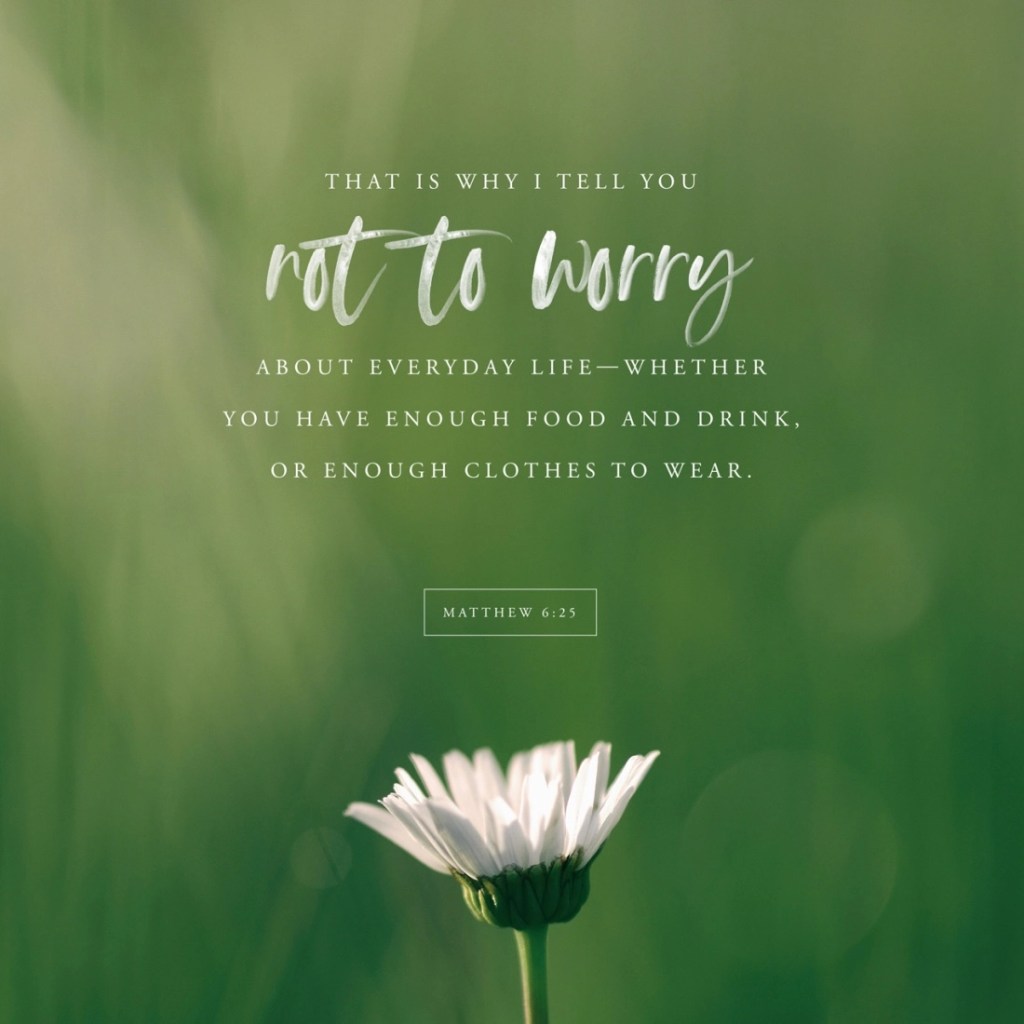
Do not be anxious about anything, but in every situation, by prayer and petition, with thanksgiving, present your requests to God.

Philippians 4:6 NIV

Don’t be anxious about anything? Not so easy.

Everyone struggles with anxiety at times — religious people and not-so-religious people, the wealthy people who have everything and the poor people who will always be with us. After all, Jesus said, “The poor you will always have with you” (Matthew 26:11). We don’t understand exactly what Jesus meant, but the disciples did. They would have been very familiar with the verse from Deuteronomy, and therefore would have had in mind the rest of the verse that Jesus was quoting.

There will always be poor people in the land. Therefore I command you to be openhanded toward your fellow Israelites who are poor and needy in your land.

Deuteronomy 15:11

To be sure, people who are poor become anxious at times. So do those people who have everything. Any of us can be anxious. There is plenty of “stuff” inside of us to cause us to be anxious and, all around us, there is just as much to be anxious about. I don’t know about you, but I am pretty obedient to the words in Philippians. When I am anxious, I most definitely present my requests “by prayer and petition” to God.

Trouble is, sometimes I think that God doesn’t hear me. I feel worried beyond my normal worry level. My anxiety rages on uncontrollably, and there is no sign of relief, no glimpse of hope, no word from God. In those times, I ask myself, “What exactly do I expect God to do?” One of my dearest spiritual teachers, Bishop Steven Charleston, would answer my question by saying, “Open your mind and heart to the living presence of love that surrounds you.”

I had to sit with that answer for quite a while, breathing into it, searching for the silence I needed to take it in. It was definitely not a clear answer for me at first. But the more I let my heart receive it, the more I began to know how to open my mind and heart to the living presence of love the Bishop described. And then I read all that he had written. These are his words about being anxious.

“Whatever comes into your life, do not be anxious. There will be someone standing beside you. You will not be alone or forgotten. A great and compassionate love will hold you up, even through the longest night. A wisdom, as ancient as the stones of the earth, will whisper in your ear to help you in your choices, to comfort you in your losses, to show you the path forward. You will not be left unknowing and uncertain, but filled with a deep sense of hope. Whatever comes into your life, whether sunlight or shadow, open your mind and heart to the living presence of love that surrounds you. Listen to the urgings of your own common sense and the call of what you know to be sacred. Your life will be secure, come what may, for faith will be your home and kinship, your blessed band of believers.”

As Bishop Charleston suggested, when I listen to my common sense and the voice of what I know to be sacred, the love of God and the love of my friends gently lift me from the depths Every time! I cannot give you any wiser words about being anxious than Bishop Charleston just did from the very depth of his spiritual wisdom. I will simply pray that you will know the grace of the “great and compassionate love” he speaks of — to hold you up, to give you hope, to fill you with peace.

By the way, “not to worry, there is a Love that will not let you go. Thanks be to God. Amen.


“I Can See Clearly Now”, Birdsong, Bravery, Change, Contemplation, Ignatian Spirituality

What’s Real!

Ever wonder what’s real and what’s not-so-real? Once in a while, I do look at what’s going on around me and ask myself how real it is. This friendship — is it real? This situation I’m dealing with — is it real? This life I’m living — how real is it, really? Such questions are problematic for one major reason — that we take things so much for granted that we cannot gauge their real value. Friendships just are; situations just happen; life is pretty much a destined routine.

That is, until betrayal breaks friendships, crisis suddenly creates a situation that cannot be ignored and an unplanned event brings total upheaval to our lives. These are the times when we ponder what is real and what is not. These are the times when all things in us and around us are downright messy. These are flash points in life that force us to examine what we believe is real. Maybe these flash point times take us inward to the private space in us, and in that space, we examine and evaluate what is truly real. Problem is that sometimes our examining leads us into mulling over things that are a mess, and looking at our “real” feels like brooding.

Such downcast and disconsolate moments are not the best times for any of us to ponder what we believe to be real. Could we not open our eyes to what is real all the time? Like when we are overcome with nature’s beauty or the sweet melodies of birdsong. Like when our souls are touched by moments of worship or the mesmerizing sounds of a symphony orchestra.

It seems important to face life with listening ears and open eyes ready to embrace “the real!” It seems important to do so in sunshine and in shadow, when our souls are burdened and when our souls are stirred to sing songs of joy. It seems important to look at what’s real even when we have to do so while feeling a deep down melancholy.

Still, I invite you to choose to “see,” the real that surrounds you — the real that is inside you, above you, below you and beside you. As Jesuit theologian Walter Burghardt summons us, “take a long, loving look at the real.” That’s how Burghardt characterized contemplation, describing it as a sustained gaze, never merely a glance. 

Flash point times take us inward to the private space in us, and in that space, we examine what is truly real.


So value “your real.” Do it as you go and as your journey moves forward on varied paths. Look at all that is “your real” — the commotion in your soul, the catastrophes of your relationships, the messes in your life. Take a sustained, contemplative look. Look bravely snd without fear, because whoever or whatever God is for you is waiting to meet you at the crossroads of what is real and what is not real. 

More than you think, your soul needs you to open your eyes and “take a long, loving look at the real.” No matter how messy it is!

A new commandment, Anger, Christian Witness, Christianity, Committment, Community, Compassion, Faith, Gun violence, Hemmed in, Here I am, Lord., Jesus, Jesus Follower, Justice, Life pathways, Magnolia Court Motel

The Car at Magnolia Court

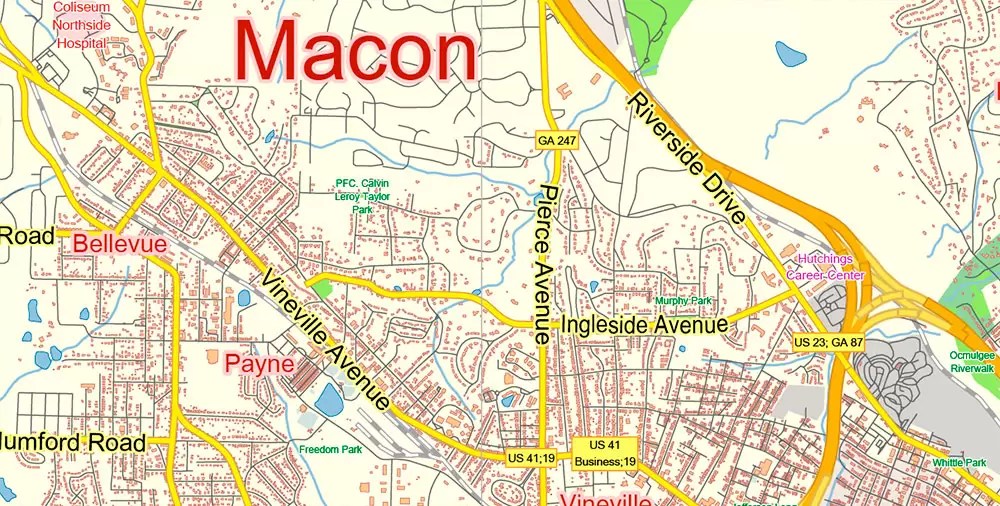
Magnolia Court Motel, Macon Georgia

In my normal outings, I frequently ride with my husband past the Magnolia Court Motel. It’s the one with a gas station in its courtyard where a pool used to be back in the 50s. It’s not a place you would want to stay on your vacation. In fact, I doubt anyone goes there for a vacation. Still, it’s always at capacity, because people live there. It’s not in the safest part of town. Magnolia Court itself is not safe. I know that because TV news frequently reports that homicides happen there.

For the past five years, I have seen a dingy, old, light brown car in front of the last unit of Magnolia Court, closest to the street. The same brown car, day or night, is in its parking space. I don’t think the car ever moves and I have wondered if it needs repairs. I assumed that the owner of the brown car didn’t have a job, because the car never moved. I hoped, though, that the owner of the brown car worked an 11 to 7 shift somewhere. I wouldn’t have known that, because I would never go past Magnolia Court at that time of night. Not in that neighborhood!

For five years, I never once mentioned that car to my husband. For five years, I silently looked at the dingy brown car and wondered who was in the motel room. Who was he or she? I always thought it would be a male, so let’s go with that. Why is he living there? Does he have a job? Is he young or old? Does he need food? Is he ill or disabled? Does he have friends or family? What does his room look like? Is it decent or dirty? How does he feel about his life? Does he know about Jesus and God? Is he okay?

My next thought was, “I would never go up to his door at Magnolia Court, knock on it and ask him if he’s okay or if he needs anything or if he knows about Jesus.” Just as quickly, my thoughts switch from the man (or woman) with the dingy brown car at the Magnolia Court to these hard questions . . . What could I do, as a Christian, to see if this man needed help? How could I help? What would I do? And what do the answers to those questions say about my faith?

I don’t know, of course, but I imagine that in a similar situation, Jesus might have gone straight to the inn and checked on the people. Finding out how they were doing might have led him to heal one, encourage another, give another a basket of food or do all the blessing-kind-of-things Jesus always did.

Last week, we drove by Magnolia Court. The dingy brown car was not parked in its place. I looked around the Court to see if he had changed rooms, but the car was not there. I felt my heart quicken and my mind rushing through scenarios of what might have happened to the man in the end room of Magnolia Court. I was sad. Guilty. After about ten minutes, I managed to move on with my day and not think too much about the man.

Today, we again passed by Magnolia Court, twice! The car was gone. The man was probably gone too. I never saw him. I never checked on him. Why would I? Who would do that sort of thing in the violent, unsafe world we live in?

I don’t want to be trite about things like faith, but honestly, I really did wonder “What would Jesus do?”

“WWJD” might be an old, overused, trendy slogan, but for me this is just being concerned about a man I never saw.


I don’t have any idea what Jesus would do, but I suspect he may have done lots of things, including something similar to what he did with the tables of the money changers. You see, turning over those tables was about doing what is just and right. Jesus might have turned over some tables or lamps or nasty mattresses at Magnolia Court Motel, because it is a place of violence, drugs, and all manner of things that harm people.

I felt my heart quicken and my mind rushing through scenarios of what might have happened to the man in the end room of Magnolia Court. I was sad. Guilty.

Kathy Manis Findley

I have to wonder now, probably will always wonder, what became of the car at Magnolia Court and, more importantly, what became of the man who lived in a room at Magnolia Court Motel. As far as I can tell, he never left his room until the day he left. My thoughts of him over five years of trying to eavesdrop on his life yielded nothing for him. For me, it became an examination of just exactly what kind of faith I have and in what ways am I willing to go out into a world of need where God’s people live in shadows like Magnolia Court. It became a self-examination that prompted me to ask myself, “What do you intend to actually do when you proclaim yourself as a Jesus follower?”

So this is not a morality tale to urge you to examine your faith. It is for me. I am the one who needs to examine my faith, to ask what Jesus would do and then to admit what I will or won’t do. As for the old, dingy, brown car and the man who owns it . . . well, I did do one thing that Jesus would do. I blessed the man I never knew, whispering under my breath as we passed by this morning, “May God go with you and give you peace.”


This is one of my favorite Christian songs. It brings me to tears every time I hear it, especially on the day of my ordination in 1992. As the words were sung that day in a duet by my husband and best friend, my heart sang, “Here I am, Lord.”

Languages, Maren Tirabassi, Pentecost, Poetry, Spirit wind, Tongues of Flame, wind, Wind and flame

Pentecost!


As the Sunday of Pentecost nears, please contemplate the message of this wonderful poem by my friend, Maren C. Tirabassi, posted on her blog, Gifts in Open Hands.

Pentecost Poem, 2021

Not this year,
the images that have nurtured me before

Don’t get me wrong! I’ve loved
the blowing wind,
but deadly storms of climate change
have taken the air out of that one.

Wordcloud by Kathy Manis Findley

Tongues of flame remind me too much
of cremation in India and Nepal.

Certainly even reading about
the crowded streets
sends me digging in my pocket
for a mask,
in these tentative,
emotionally so complicated
days of re-community.

This year it is the languages
that … speak to me, in me, through me

not even so much celebrating
the holy, beautiful syllabification
of global diversity,
or the most successful sermon ever
giving birth to a church,

as one hundred twenty people
being willing to speak
without being in control of their words.

We all have learned this –
how we said the right thing at the right time
buried in ordinary conversation,or a small public courage
of naming truth we didn’t know we knew.

This year my simple pentecost
is just lending my tongue to something
someone needs to hear,

because I am waiting in the right place,
and willing to open my mouth.

Read more of Maren’s writing at this link:
https://giftsinopenhands.wordpress.com/2021/05/21/pentecost-poem-2021/#comment-10406

Uncategorized

The Wind Is Ready to Blow!

Pentecost ~ Our Lady of Pentecost Catholic Church ~ Quezon City, Philippines

I’m sitting on the front porch watching the birds and the bugs, admiring my flowers and feeling strong gusts of wind blow everything that’s movable and some things that are not so movable. Like my patio chair! I love a rushing wind blowing over me and, always, it reminds me of Pentecost.

Sunday is my favorite Sunday in the church year — Pentecost Sunday! I hold it as my favorite because I long for Spirit wind in my life — to move me, change me, fill me, refresh me and set me free. Spirit fills me with passion and sets me on a journey, a mission really, to bring Spirit to those who most need new hope. On the Sunday of Pentecost, I feel as if the wind is ready to blow!

When the day of Pentecost had come,
they were all together in one place.
And suddenly from heaven there came a sound
like the rush of a violent wind,
and it filled the entire house where they were sitting.
Divided tongues, as of fire, appeared among them,
and a tongue rested on each of them.
All of them were filled with the Holy Spirit
and began to speak in other languages,
as the Spirit gave them ability.

This is what was spoken through the prophet Joel:

In the last days it will be, God declares,
that I will pour out my Spirit upon all flesh,;
    and your sons and your daughters shall prophesy,
and your young men shall see visions,
    and your old men shall dream dreams.

Even upon my slaves, both men and women,
    in those days I will pour out my Spirit;
        and they shall prophesy.”

Acts 2:1-4, 16-18

It must have been a shocking surprise, even stunning in its drama. It is no wonder that of all the church seasons, Pentecost has arguably inspired the most stunning art. Artists depict wind, fire, people receiving tongues of fire and all manner of colorful Spirit movement. Pentecost art is filled with movement, unpredictable and free!

D2D60A56-1290-40BA-A47B-45010F087477No doubt, the artists who create art for the season of Pentecost offer us images of color, vibrancy, movement and freedom. I suppose that these qualities are the ones we want in our own lives, especially movement and freedom. The Spirit Wind that blows through my life and yours brings us that movement and freedom, almost as if Spirit removes the bonds that keep us still and stagnant. Instead “we live and move and have our being”* in a God who brings new life when we most need it.

And as for Pentecostal fire, well, we need that, too. It is a Refiner’s fire, a holy fire with the power to burn away everything that holds us back and then to put the “fire” of passion in our souls that inspires us to live out the calling and mission of our lives.

The wonderful news of Pentecost is that we do not have to rely on our own limited power. The great news of all Pentecost is the promise we hear in our souls, “The wind is ready to blow!” This is the hour for us to be permeated with the courage to run with Pentecostal winds and burn with Pentecostal fire. 

God’s Spirit filling means very little to us in the midst of easy days, but in times life these, Spirit within us means everything. In these days of pandemic, police violence, mass shootings, violence in families, hungry children, adults desperate to find work, racial conflict, people marginalized and oppressed, we need to hold on to the promise of holy wind and fire. 

As always, we are left with questions: 

In the midst of this kind of world, what can we possibly do? 
In the midst of my weakness, can I feel the Spirit-wind?
In the midst of grief and loss, can I feel the Spirit-wind?
In the midst of illness and pain, can I feel the Spirit-wind?

The answer is “YES!”

Pentecost can come upon us in the darkest of times, in the most impossible of circumstances . . . when only the wind and the fire of God’s Spirit could begin to pull off the miracle of new life. The Prophet Haggai would say to us: “Take courage! For I am with you. My Spirit abides among you.”

And so I proclaim to us this day, that if we are willing to be moved and changed by Spirit wind and fire, God’s Spirit is able to empower us. God’s Spirit is able to move us from limitedness into new life, to give us courage, to give our tired feet new strength to keep moving forward instead of giving up.

If we are willing, God’s Spirit wind is able to breathe life into us. And when our days become dreary with low-hovering clouds and our nights become darker than a thousand midnights, I hope we will remember . . .

That the Spirit of Pentecost will ignite us with a fiery passion that disturbs our complacency. 


That the Spirit of Pentecost longs to baptize us again and again and again with Spirit-fire and move us with Spirit-wind. 

That the Spirit of Pentecost is able to re-kindle within us the courage to proclaim the Gospel of liberation to the ends of the earth.

Take courage! The wind is ready to blow!

Disconsolate, Grace, Hesed, Hope, Soul work, Waiting, Wounds of the Soul

It Was Worth the Wait!

Wait for the Lord;
be strong, and let your heart take courage;
wait for the Lord.

Psalm 27:14 ESV

Waiting is no easy thing. Most of us don’t really like it. We’re not good at it. We are impatient people. We want things to happen quickly. Isn’t it excruciating at times to wait when a traffic light stays red far too long, and no traffic can be seen anywhere! How often we have stood in a long, slow-moving line and frustratingly declared, “This is not worth the wait!”

The more important matter, though, is when the soul must wait, when our hearts must wait for pain to ease. When our hearts have to wait, when our souls have to wait in the silence of suffering, it’s almost impossible for us to bear. Yet the the words of the psalmist and the prophets echo through the ages:

For God alone my soul waits in silence;from God comes my salvation;
God alone is my rock and my salvation, my fortress.
I shall never be shaken.

Psalm 62:1-2 ESV

Those who wait on the LORD shall renew their strength;
They shall mount up with wings like eagles,
They shall run and not be weary,
They shall walk and not faint.

Isaiah 40:31 NKJV


Messages of hope, yes. Yet when we are suffering, when we are in pain or disheartened or in trouble, nothing really sounds much like hope. Waiting for pain to ease is difficult, even excruciating. I like the way Sue Monk Kidd offers insight about waiting in her book, “When the Heart Waits.”

I had tended to view waiting as mere passivity. When I looked it up in my dictionary however, I found that the words passive and passion come from the same Latin root, pati, which means “to endure.” Waiting is thus both passive and passionate. It’s a vibrant, contemplative work. It means descending into self, into God, into the deeper labyrinths of prayer. It involves listening to disinherited voices within, facing the wounded holes in the soul, the denied and undiscovered, the places one lives falsely. It means struggling with the vision of who we really are in God and molding the courage to live that vision.

Sue Monk Kidd, “When the Heart Waits”

I cannot explain it better than that and I won’t try. My deepest self desperately grasps for these words, “listening to disinherited voices within, facing the wounded holes in the soul.” I cannot respond with any meaningful comments, but I will offer another insight about waiting for a God who covers us with pure, merciful, amazing grace.

GRACE. The Hebrew word is Hesed.

Hesed is a Hebrew word that means grace in all its fulness. Hesed is defined as compassion, mercy, love, faithfulness  and most often, grace. But none of these words fully capture this Hebrew word that means grace. Hesed is not just an emotion or a feeling. It describes the way God lavishly pours grace upon us in our most needful moments.

And so we learn to wait for God’s outpouring of grace. Sometimes we wait impatiently. Sometimes we wait in anger. Sometimes we wait with a holy sense of peace. Sometimes we wait with hope, joyfully expectant. And sometimes we wait in silence, without words, disconsolate and cast down.

A number of years ago, I found myself nursing a disconsolate, cast down soul and spirit. I had been through a trying time in my life that I can only remember as one of deep sorrow. I remember one day when I sat down at the piano after reading Psalm 42. One particular verse of the Psalm reverberated in my mind. Over and over again, I heard the words, but I did not hear them read. I heard them sung, with a simple, but hopeful strength. I heard myself singing, a soul-song from somewhere inside me. I began to play what I heard, first the melody and rhythm, then the chords that arose from somewhere I could not pinpoint. It sounded beautiful, and it sounded like it was emerging from a sacred promise from God — unequivocally for me. This was my soul song:

Why are you cast down, O my soul,
and why are you disquieted within me?

Hope in God; for I shall again praise him,
my help and my God.

Psalm 42:11 NRSV


I think I was waiting that day, though I was not sure what I was waiting for. I just know that I found hope again that day, if just for a few moments of holy music. And in my disquieted spirit, I sensed pure grace once again — grace, hesed — God’s infinite, matchless, amazing grace.

It was worth the wait!

Thanks be to God.