A woman of sacred worth, Becoming, Beginning again, Bravery, Calling, Change, Children, Committment, Courage, Creating, Dreams, Freedom, God’s beloved daughter, I am enough!, Inner peace, life, Living in the soul, Miracles, Repair the world, Rev. Kathy Manis Findley, Self-understanding, Spirit wind, Tears, Tikkun Olam, Valued by God

Living an Unapologetic Life

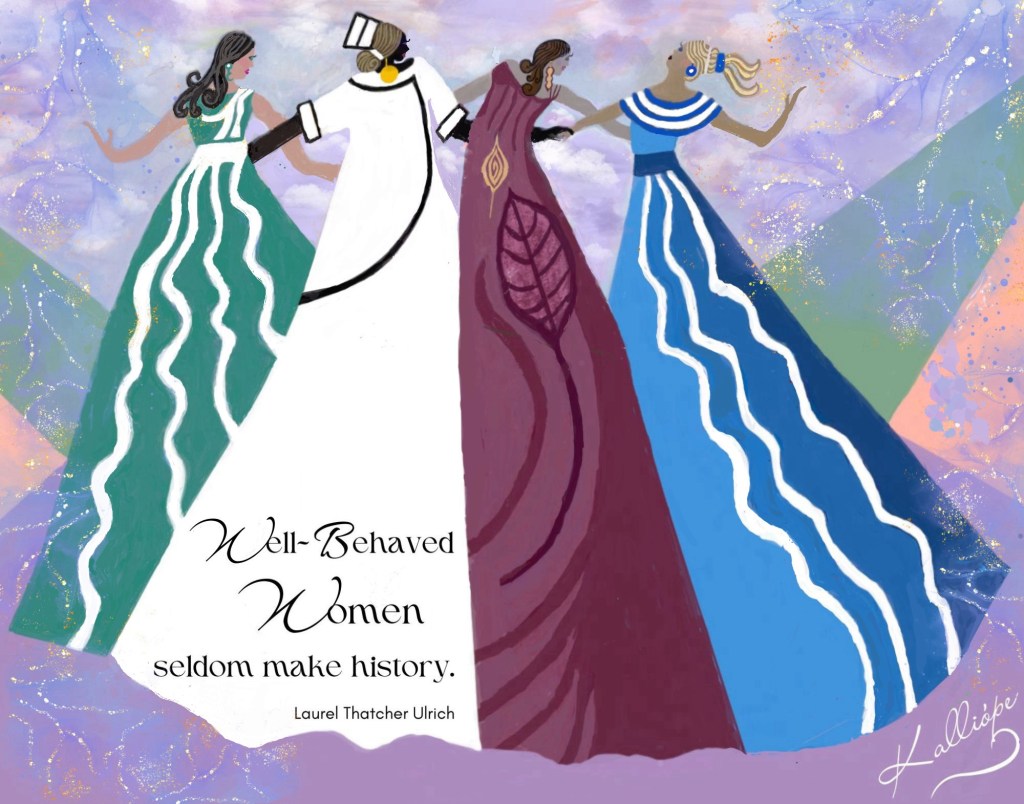
Art: “Well-behaved Women” by Kathy Manis Findley


Rev. Kathy Manis Findley
July 27, 2024

You have probably had that kind of dream at a few junctures on your journey. I know I had many dreams along the way. Sometimes they scared me to death. I dreamed of peace, equality, freedom, changing the world, and many other huge and noble dreams. I dreamed some silly dreams, too! I soon got the hint: changing the world is a formidable task. I followed all the rules, but being a rule-keeper does not make a person effective in dreaming and imagining. Women who follow the rules (someone else made up) could correctly be called well-behaved. They might even be called good girls because they don’t cause much of a flurry. They typically don’t make history and they certainly don’t change the world.

A woman with less-than-good behavior looks like someone at peace with herself, someone who radiates hope, someone with the courage and determination to do justice. I have admired and emulated so many examples of women who did make history, women who were not well-behaved at all. Here are only a few: Rosa Parks, Harriet Tubman, Lucretia Coffin Mott, Sojourner Truth, Susan B. Anthony, Nancy Sehested, Elizabeth Cody Stanton, Prathia Hall, Julian of Norwich, Malala Yousafzai, Mother Theresa of Calcutta, Ann Hasseltine Judson, Lucy Stone, and so many others!

About 24 years ago, a chaplain colleague recommended a book to me: Goodbye Good Girl: Letting Go of the Rules and Taking Back Your Self by Eileen M. Clegg. I think my chaplain friend was suggesting that I should get out of my comfort zone and take some risks, that I should courageously follow God’s call on my life. I knew that the members and churches of my denomination would “throw a fit,” like we say in the south! After all, I was an ordained minister serving as a hospital chaplain, which placed risky challenges before me every day.

So I read the book immediately and set out to become a bad girl, a girl who fully intended to change the world and to make history for it! So far, I have not made history. I have not managed to put my name in lights. I have not started any big public movements. But I have done some things that matter! I have learned how to create sacred space; I have learned the depth of liberation theology; I have found enough grace to endure the consequences of being a “bad girl” and then a woman with questionable behavior; I have held off anyone who tried to tell me who I am; and I have called up the courage to fight for justice. Colleagues, friends, family, co-workers reacted to the change in me, since they never expected me to dissent, or disagree, or refuse to behave.

Suddenly I let go of my “good girl” image and basically said “goodbye” to my restrictive behaviors. I took back my life, put aside all the rules, and followed my soul. I watched for the winds of the Spirit to lead me, and I moved forward to all the places that needed some attention. I was able to help change unjust systems, unjust policies, and unjust processes by not being so well-behaved.

Still, I sometimes think I have reached an uneasy place when it comes to letting go of my “good girl” persona. I’m really not a “good girl” and I don’t think I ever have been. My parents had to endure the sassy exclamations of my toddler years, like “Nobody’s the boss of me!” Creating shock from those who knew me, I mostly remained a “bad girl” from that day to this. I set aside the rules that were designed to keep people down and I took back my life. Today—in my mid-seventies—I continue to spew out uncommon proclamations that are quite annoying to those who are determined to hold on to their power and resist change.

Truly, it was sometimes hard being a change-maker and a rule-keeper! Always a people pleaser. Always the ultimate perfectionist. I discovered along the way that sometimes rule-keeping, people pleasing, and keeping every little thing “perfect” can harm your inner core. In fact, it’s less risky when you follow the leaders, make sure everyone is pleased, and doing everything with glowing perfection. Stepping out of line is always a bit dangerous.

When you become exactly who you are, resolute and unmovable about the things that matter to you, you will raise a few eyebrows, and sometimes people will get angry with you . You see, those people expected something else from you. Each of us becomes “me”— the “real me”— at our own peril. In a sense, we have to fight for the right to be ourselves in the world.

It is true that the people around me reacted strongly when I took back my life and became fully invested in my destiny. They thought that I had become radical, maybe even unhinged. I did not respond appropriately to their demands. To unreasonable demands, this is essentially how I might have responded, sometimes out loud, sometimes under my breath . . .

I will do it. / It’s my right! / It’s my choice! / It’s my prerogative! / It’s my decision! / I’m doing it anyway. / You can’t stop me! / Just watch!

All the while, I felt uncomfortable because of so much disdain from others, who began sending me a new message, You are not enough! I Imagine that many of you have heard someone say to you, You are not enough. At least, we may imagine someone saying those hurtful words. Unfortunately, we believe it because we don’t know ourselves, meaning we don’t know our bright and dark places, we have not yet realized our sacred worth, and we have not yet searched our souls.

For you see, you and I are afraid because it is perilous for the soul when we don’t search diligently for our soul’s passions and dreams. You and I sometimes accept what others say about us and tuck it away in our deepest places. When those words sneak all the way down into the soul, we tend to give up. We start from the moment we make ourselves nonchalant about it all, that moment when we shield our hearts from hurt. One of the saddest phrases we use is “I don’t care.” When we no longer care, we begin, one by one, eliminating the people around us, never realizing that they are hurting, too. And maybe the reason they send the message, You are not enough, is because they believe that they are not enough either.

I can honestly say that I have often heard voices—known voices, unknown voices, and the weak little voice in my head—telling me, You are not enough! I have learned that once I have embodied that negative message, it rolls around in my psyche for a long time, maybe forever. It becomes a state of being that goes deeper than skin. It penetrates in deeper places, and takes its toll on my emotional and physical well-being. I recall many such times, none more painful than the wagging tongues around my ordination . . . You know the scenario, “She can’t be a minister because she is a woman! Anyway, she’s not good enough! Other voices are often hazardous, dangerously breaking down our sense of self-worth. They may be yelling, speaking in a normal tone, whispering, or imagined in our heads. In response, we must prepare ourselves to hear the voice above all voices, saying, “You are my beloved daughter with whom I am well pleased.”

For a long time, I embodied the traits of the good girl, but to embody good girl traits is not really a once-and-done action. Embodied lasts a while! Embody does not have a shallow or surface meaning. It is deeper. I like the word embody. It seems to suggest that we can live a soulful life. In the very middle of the Greek word for “embody” we find the word σώμα, which means body. However, the Greek word for body cannot be translated in a way that reveals the depth of its meaning. The definition of σώμα is deeper than we realize. It is not skin-deep, it is deeper, approaching a definition more like soul.

I do like the word embody and the word soul. In some ways, to embody means to live in your soul. The word embody may whisper to you that in your body’s center, you will find the path to reach your soul. A person who lives in the soul is a person that does not live a shallow life, devoid of the emotion that makes us alive. The soul will help you, if you can just start by daring to touch it.

So what are the things we can actually do to take back our lives and live soulfully? What path do we follow to transform ourselves and change the world? My initial response to that is, “I don’t know.” Not very comforting, I know, but mostly true. We cannot forge the path for any other person. We cannot know what’s best for them. So not knowing anyones path, nor their dreams, I can give you a list of things others are finding the leads to their transformation. Here they are, not at all an exhaustive list, and certainly not a perfect guide for you:

  • Carve out some time for quiet, restful, meditation.
  • If you are a person of faith, get in touch with God or whatever person you worship.
  • Listen.
  • Listen some more—to your heart and your soul.
  • See if you find there a sacred direction especially for you.
  • Do you feel you are getting any closer to discovering your authentic self?
  • Can you begin to believe you will be transformed?
  • Can you take a step or two, in faith, into a holy place of transformation?
  • Pray, making your needs known to the source of your faith.
  • Read! Read the stories of others who found life transformation.
  • Find community, even one other person, who understands your journey.
  • Start all over again, leaning into the wisdom you found on your previous journey.
  • Take as long as it takes, until you realize that suddenly, you are becoming emboldened and scrappy!

You may not know her name, but Lucy Stone was steadfast in her belief in self-authentication and in her ability to change the world. Lucy Stone was called “emboldened” and “scrappy” because of her tireless work for the abolitionist and women’s rights movements through the 19th century. A bona fide pioneer of her time, Lucy Stone stands as a historical titan. Her book “Unapologetic Life” describes a model of a revolutionary living. As for me, I would count it an honor to be described as emboldened and scrappy.

Life is more fun when you’re emboldened and scrappy. Not that we want to reduce the life experience to just scrappinesses. Life is so much more, like authenticity and the willingness to be a change-agent. Life is about having enough courage to persevere! Life for me is about my soul and all the ways it has been transformed over many years. All along my journey, I knew that my soul was a problem! At every age, there was a part of me that wouldn’t follow the easiest path. I longed to be empowered to make societal change. I chased down injustice and worked to dismantle it. I spent most of my career working with victims of domestic violence, child abuse, and human trafficking. This was not the easiest and most pleasant vocation, but the work had made its way into my soul. To do it, I had to live in the light of self-awareness and soul-awareness. I had to constantly listen to the sighs of my soul, and move only after I had heard them clearly. If I had just one nugget of advice for you, it would be to touch your soul and ride on the wings of the Spirit.

Sisters, don’t forget that when you touch your soul, you might just not be a “good girl” anymore. Or a good boy, for that matter. As for me, I am not a “good girl” living at the whims of other people! And I am definitely not a well-behaved woman! So I fully expect to make history! Because making history means leaving a legacy, creating a world brimming with peace, and embodying your best self!


A frenzied life, All Things New, “I Can See Clearly Now”, Beginning again, Bishop Steven Charleston, Bravery, Calm, Challenge, Contemplation, Courage, Determination, Dreamers, Dreams, Following Christ, God's Faithfulness, Heart, Here I am, Lord., I am enough!, Inspiration, New Things, Re-claiming self, Rev. Kathy Manis Findley, Spiritual growth, strength, struggle, Tenacity, Tikkun Olam, Vision, Whispers of God

A Snail’s Pace to the Mountaintop

By Kathy Manis Findley

Slow, slow, up the mountain I’ll go . . .


A PAUSE FOR SOME WHIMSY . . . Why don’t we have a little whimsy today? I have invited my snail-friend to join us. And anyway, we all need a little whimsy in these troubling days! So here goes!

I’m sorry to tell you that the snail in the picture will take forever to reach that mountaintop, and you and I simply don’t have the patience to walk with a snail. Even so, I feel good about my chances when racing a snail to get up on top of a mountain!

DOES THIS MAKE ANY SENSE AT ALL? . . . Not that this makes any sense at all. Why I would even be considering such a race! In fact, this is completely nonsensical, and if you know me, you know I’m far too serious to entertain whimsy! Makes no sense at all. Oh, but it does make some sense. Let me tell you something about me and what I have learned about the wisdom of the snail and its slow journey!

LIFE CAN BE DEVASTATING . . . When I think of the life catastrophes that have been the hardest for me, the ones that hurt me the most, I immediately recognize that I never slowed down enough to clearly see the unrest brewing around me and inside me. Multi-tasking and acting like an overcommitted, overwhelmed wife, mother, professional minister and hospital chaplain squeezed my spirit enough that I became hopelessly entrapped. That was in my younger days, those days when most of us stretch our commitments to the breaking point.

Before I could change course, I could see my dreams fading and my ability failing. It was impossible for me to reach the top of my mountain. It happened before I realized I was in trouble.

In the light of day, I can somewhat see, but at night, I can hardly see anything—literally and figuratively. But at least I have learned to take time to look up at the stars in a dark sky. It’s easy to see, to envision stars twinkling in the heavens, when you’re still young and when you can still find your hope-filled dreaming place inside you. You can still be breathless, open-eyed and awestruck!

CAN I STILL BE BREATHLESS, OPEN-EYED & AWESTRUCK? . . . To be honest, I must confess to you that I find it difficult to see with my soul, to be open-eyed and enthusiastic. I have lived my life with visions of dreams and hopes, and I have loved the fullness of my days. But being retired is another story altogether.

The story of my young and middle adult days was a story of constant activity, challenges, and tall mountains to climb in search of dreams. Dreams, dreams everywhere! Wherever I looked, I found another dream to dream!

RETIREMENT CAN BE DISHEARTENING . . . Retirement is another thing, and I am there! Illness and aging has nearly shut off my dreaming and visioning. Still, though I am sparring mightily with retirement, in the end I have slowed down to a snail’s pace. And snails probably don’t climb mountains or search for dreams.

What pieces of wisdom can we receive from a snail on a slow slither? Perhaps we should look elsewhere for such wisdom. One of my favorite authors gets to my soul with almost everything he writes. His keen spiritual insight has guided my path time after time. This is what Bishop Steven Charleston has to say about seeing more clearly.

I see more clearly, now that I am aging. Not with my eyesight, but with my soul. I see the fine detail of what I missed in younger years. I see the place of faith and forgiveness in my story. I see the possibilities of life in ways I never imagined. I was not blind in my youth, but my vision was limited to only a few seasons of seeing.

Now I am an old man standing on a hill. I see more clearly. The universe stretches above me in infinite glory and the Earth spreads her shawl to wrap me in creation. Open the eyes of your spirit. Look out in wonder. See the fullness of the life you have received. See the promise of love walking in beauty before you.

— Bishop Steven Charleston

MY FRIENDS FINDING NEW WAYS TO DREAM . . . These are words I can hang on to and patiently learn how aging folk can still hope and dream, and maybe even climb new mountains. It’s possible. I have seen several aging folk on top of the mountains they dreamed of. One of my 70 year old friends travels all over the world. Another has launched out in a new calling to counsel kidney transplant patients. Yet another friend faced a closed door, so she picked up her skills and began a brand new ministry. And one friend left the United States to feed hungry people across the ocean.

All of these friends made it up to the mountaintop, though some of them might have traveled at a snail’s pace. That doesn’t matter, and I have a notion that their secret to life has to do with slowing down and stopping their frenetic pace. Why do that?

To give yourself time to dream, time to contemplate and pray, time to pull your soul back together, time to open your eyes and truly see, time to meet God who may well whisper in your ear . . .

Then I heard the voice of the Lord saying,
“Whom shall I send? And who will go for us?”
And I said, “Here am I. Send me!”


—Isaiah 6:8 NIV

TIME FOR SILENCE AND CONTEMPLATION . . .So walk on, slow if you have to. Take your time and wait until you hear God’s voice or sense the presence of the Spirit. Give yourself time for silence and prayer and a lot of contemplation. Keep your courage ready, and then go with all your courage when your heart says it’s time. Don’t let the snail discourage you. Your pace, whatever it is, will get you there. Don’t let anyone block your path or steal your dreams! And I’ll meet you on a mountaintop somewhere!


A LOVELY HYMN FOR YOUR QUIET TIME . . .

Here I Am, Lord (Anniversary Recording) · Dan Schutte
Here I Am, Lord (30th Anniversary Edition)
℗ 2001 2009 OCP, 5536 NE Hassalo, Portland, OR 97213. All rights reserved. Made in USA.
All selections BMI.


SHARE YOUR STORY . . .

If you are a new to my blog or have been reading it for years, you are welcome here. If you would like to leave a comment about your experience with slowing down your pace, finding time for prayer and contemplation, or renewing your spiritual, physical, and emotional life, please tell us about it in the comments. Your story can help others see life more clearly.

Change, Compassion, Contemplation, healing, Inner joy, Repair the world, Repairing broken things, Tikkun Olam

Trying To Save The Whole World

Some of us feel compelled to rescue the world, and we try to do it in so many ways. The ways we rescue may be simple or complex, close to home or global. We try to repair them all, from multiple interventions when our kids get in trouble at school to advocating for an end to the climate change that’s currently burning down the beautiful Greek island of Evia.

For me, it’s a given that I should rescue things and people. After all, I am a minister. Isn’t that what we do? I really do want to save the whole world from whatever ailments or tragedies are inflicted upon it — the earth itself and the people in it. The thought that writer and theologian Frederick Buechner writes about this makes so much sense to me: “Your vocation in life is where your greatest joy meets the world’s greatest need.” I suppose that my desire to change, rescue and fix could very well be my undoing, because the stark reality is that I — one person — can do very little that would make much of a difference.

That’s the overwhelming part. How can we watch the world’s great need and not answer our inner compulsion to repair it? When asking myself this kind of question, I always think of tikkun olam, which is a jewish concept defined by acts of kindness performed to perfect or repair the world.


The phrase tikkun olam is found in the Mishnah, a body of classical rabbinic teachings. It is often used when discussing issues of social policy, insuring a safeguard to those who may be at a disadvantage. In modern Jewish circles, tikkun olam has become synonymous with the notion of social action and the pursuit of social justice.

To those who, like me, have this inner desire to change things and fix things, I can not offer any easy answers, because I do not have any. There simply aren’t any. I’m fond, though, of this idea: do the next right thing. When faced with big needs and small ones, sometimes that’s all we know to do, the next right thing.

I think that’s okay. The “next right thing” is like following the light we have or following God into the pressing needs the Spirit shows us. One thing I have learned is that before any act of repairing or helping, there must be a time of waiting, a time when the soul finds a sacred pause and waits there for holy direction. Then, just maybe we will have discovered what we need to “save the whole world.”

I love the way that poet and author Martha Postlethwaite describes a way forward for us fixers. I also love the way she invites us to find “the song that is our life” and to open our hands to receive it. Her thoughts come through so powerfully in her beautiful poem, “The Clearing.”

Do not try to save
the whole world
or do anything grandiose.

Instead, create
a clearing
in the dense forest
of your life
and wait there
patiently
until the song
that is your life
falls into your own cupped hands
and you recognize and greet it.

Only then will you know
how to give yourself to this world
so worthy of rescue.
Creating a clearing.

“The Clearing” by Martha Postlethwaite

We probably can all agree with the song John Mayer sings that we’re “waiting on the world to change.” We need changes big and small for bees, elephants, giraffes, oceans, blue whales, sea turtles, polar bears, monarch butterflies and all things nature. And then we need to clearly see the humans who probably need help most of all. So many humans live lives of deep need through no fault of their own, suffering because they’re facing incredible hardships and personal tragedies.

Martha Postlethwaite would suggest that we clear away the forest of our life and wait patiently in the clearing until what she calls, “the song that is our life,” becomes crystal clear. With that song, we will find the place of the world’s great need that is calling out to us for help.

So be present and mindful in the clearing. May God help each of us open our hands to receive our song, and then go out into the needy world singing. Amen.

Change, Dreams, Fear, Following Christ, God's Faithfulness, Grace, Gratitude, Hate, healing, Hope, Inspiration, Kindness, Nonviolence, peace, Tikkun Olam, Wholeness

Our Smallest Dreams Can Change the Big World

E43FB412-D00A-458E-8DA7-561F269CCC27
Art by Catrin Welz-Stein, from The Cosmic Dancer Facebook community

A friend sent me a lovely blessing today and I want to share it with you. These days, many neighbors and friends — people all over the world actually — have a new dream, a new calling to change the world. It’s an important dream right about now. Pandemic and protests — and all the causes lying underneath them — desperately need to change, and it will take huge dreams to change them. Trouble is, most people like me and you have only small dreams, a few small dreams that sometimes seem so insignificant. Certainly, they are dreams too small to change the big world.

But maybe not!

The message my friend sent me (actually she posted it on Facebook) reminded me that huge change can most certainly come from small acts. The message was today’s grace for me. So I share the message with you. It comes from The Cosmic Dancer* and is written by Scott Stabile.

She felt like doing her part to change the world, so she started by giving thanks for all of the blessings in her life, rather than bemoaning all that was missing from it.

Then she complimented her reflection in the mirror, instead of criticizing it as she usually did.

Next she walked into her neighborhood and offered her smile to everyone she passed, whether or not they offered theirs to her.

Each day she did these things, and soon they became a habit. Each day she lived with more gratitude, more acceptance, more kindness. And sure enough, the world around her began to change.

Because she had decided so, she was single-handedly doing her part to change it.
— Scott Stabile

Hope is tucked into these words, hidden there and bringing to mind that God highly values gratitude, acceptance, kindness and our smallest, powerful dreams. My dreams and yours can change a world filled with violence, hate, grief, fear and so many more hurts and harms.

EC0B46CE-B762-4C67-933A-BEC6BDE65077
Tikkun Olam Together provides cultural learning opportunities for mothers and  daughters’ grades 6-9 as they work to improve the world – Tikkun Olam.

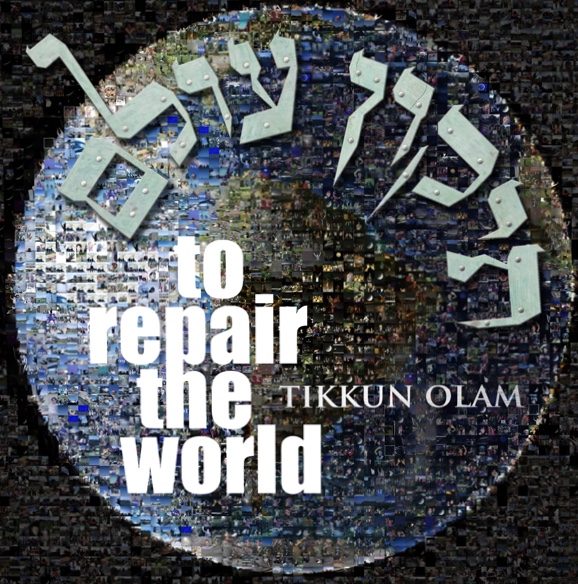
There is a lovely Hebrew phrase, Tikkun Olam, that means “repair the world” or “heal the world.” The call of Tikkun Olam has always inspired me to more fully offer my life to be a part of the healing God desires for creation, for the earth’s protection and for kindness, equality and justice for all people.

Can we heal the big world with even the smallest acts of kindness and compassion? Doesn’t God whisper to us that we should begin healing the injustice, the violence, the hate, the fear, the mistrust and the deep divisions in the world? Doesn’t God inspire us to know the truth that our dreams are never too small? And doesn’t God promise to guide us and to lead us in following the compassionate footprints of Jesus until we see the world begin to change?

Resting in the grace of inspiration given to us by God, we truly can cast off the gloomy thoughts that our dreams are too small, too weak and too insignificant. And we can hide inside our hearts God’s promise that our dreams can become reality, that our tiny dreams really can change this big world. God will enlarge our smallest dreams if we offer them. We can count on it!

May each of us live “with more gratitude, more acceptance, more kindness” and may even our smallest dreams change — heal — the world.


* The Cosmic Dancer is a Facebook community that shares insights through art, poetry, dance and other “revolutionary rhythms.”


Activism, Awakening, Brokenness, Christian Witness, Community activism, Compassion, Contemplation, Hope, Immigration, Injustice, Introspection, Justice, Ministry, Mysticism, Politics, Reflection, Repair the world, Social justice, Tikkun Olam, Violence against women and children

What does the world need?

256F00BB-10F5-4D89-93E1-FD4534BFCD0F
“To repair, heal the world” by artist and calligrapher Michael Noyes http://www.michaelnoyes.com/gifts/religious/jewish-judaica/tikkun-olam-to-repair-heal-the-world

What does the world need?

What do I have to give in a broken world? 

I have asked myself these questions before — many times before. I have asked these questions when teaching classes and writing my blog. I have asked these questions in a sermon — actually multiple sermons. So one might expect that, through my sermon preparation through Biblical study and other research, I might have found an answer by now. I have not. Because my finding the answer is as complicated as the myriad places of brokenness i see in the world around me.

Of course, I have to pay attention to the image of a hungry child, a refugee family at the border, entire African villages that subsist without clean water, the violent streets in cities across the United States, the mother protecting her children from abuse and herself from domestic violence, racially motivated hate crimes that terrorize, the climate crisis that to some is so real and to others just a hoax, the active shooters that have terrified school children and threatened life at many other places where people are vulnerable. I can continue this list into perpetuity.

But then I have to acknowledge the more insidiously evil side of the world’s brokenness — not the actual broken places, but the injustices that create them. I have to be woke to the societal and political forces of greed that deny complicity in the oppression of the most vulnerable among us. 

So when I ask myself the question, “What do I have to give in a broken world?” I am really asking if I will: 1) personally tackle a person’s specific need; 2) seek radical change of the societal and political forces that cause oppression; 3) become both a political activist and a compassionate hands-on Samaritan; or 4) engage in a contemplative life by getting in touch with the mystic inside that prays and longs for an end to every form of brokenness.

If I were a mystic, if could pray away the brokenness, I would most assuredly enter my prayer closet and do so. Admitting to being a mystic, though, is slightly uncomfortable. I’m not completely sure what a mystic is or what a mystic does. And isn’t being a mystic reserved for monks and nuns? 

Richard Rohr is my go-to person on the duality of action and contemplation. One can find in his meditations —every day — the inseparable link between our compassionate acts and the inner spiritual work that drives us. Matthew Fox writes:

Deep down, each one of us is a mystic. When we tap into that energy we become alive again and we give birth. From the creativity that we release is born the prophetic vision and work that we all aspire to realize as our gift to the world. We want to serve in whatever capacity we can. Getting in touch with the mystic inside is the beginning of our deep service.

“Our gift to the world,” he writes. And all around that “gift,” he lifts up prophetic vision, the energy to come alive, touching our inner mystic and engaging in deep service to people and places of deep need. I can never broach this subject of a broken world without revisiting the Jewish concept known as Tikkun olam – “repair the world,” that manifests itself in acts of kindness performed to perfect or repair the world. The phrase — found in the Mishnah, a body of classical rabbinic teachings — is often used when discussing issues of social policy, insuring compassionate remedies to those who may be at a disadvantage.

As for me . . . I really do want to touch my inner mystic, to enter into a silent, deep inner space that compels me to serve humanity. I also want to enter a place of tikkun olam. I want to repair the world and tangibly care for the persons who have need. Is it even possible to do both? Isn’t it imperative for a follower of Jesus to do both? Is it not because of the hope of the Good News in Christ that I must be about ministries of compassion and justice?

It seems pretty clear when reading the words of Jesus that caring for broken persons in a broken world is most certainly a compassionate imperative. 

When the Son of Man comes in his glory, and all the angels with him, then he will sit on the throne of his glory. All the nations will be gathered before him, and he will separate people one from another as a shepherd separates the sheep from the goats, and he will put the sheep at his right hand and the goats at the left. 

Then the king will say to those at his right hand, “Come, you that are blessed by my Father, inherit the kingdom prepared for you from the foundation of the world; for I was hungry and you gave me food, I was thirsty and you gave me something to drink, I was a stranger and you welcomed me, I was naked and you gave me clothing, I was sick and you took care of me, I was in prison and you visited me.” 

Then the righteous will answer him, “Lord, when was it that we saw you hungry and gave you food, or thirsty and gave you something to drink? And when was it that we saw you a stranger and welcomed you, or naked and gave you clothing? And when was it that we saw you sick or in prison and visited you?” 

And the king will answer them, “Truly I tell you, just as you did it to one of the least of these who are members of my family, you did it to me.”

— Matthew 25:31-40 New Revised Standard Version (NRSV

It’s just downright confusing and complex. Bottom line is this: I have no idea how to repair the world or how to get in touch with my inner mystic. But I also do not want to be permanently consigned to the goat-group mentioned in this Gospel text! I would rather struggle to figure out what I must do to care compassionately for my brothers and sisters and to get in touch with the contemplative mystic that makes me come alive.

Sound advice comes from a plethora of good and wise people. This time Howard Thurman gets the last word:

Don’t ask what the world needs. Ask what makes you come alive and go do it, because what the world needs is people who have come alive.

May God make us people who have come alive. Amen


F9FA5D3C-53F0-4043-8A72-F9E2D63F7349

On another note, please pray for me as I look toward my kidney transplant currently scheduled for November 12th at Mayo Clinic in Jacksonville, Florida. I am so grateful that you are walking with me on this journey that often felt so frightening. Your thoughts and prayers mean so much. If you would like to read the story of my illness, please visit the Georgia Transplant Foundation’s website at this link:

://client.gatransplant.org/goto/KathyMFindley

“Go Fund Me” page is set up for contributions to help with the enormous costs related to the transplant, including medications, housing costs for the month we have to stay near the transplant center, and other unforeseeable costs for my care following the transplant. If you can, please be a part of my transplant journey by making a contribution at this link

https://bit.ly/33KXZOj

Activism, Christian Witness, Community activism, Compassion, Contemplation, Gun violence, Injustice, Ministry, Prayer, Repair the world, Social justice, struggle, Tikkun Olam, Violence, Violence against women and children

Dangerous Contemplation

4374BEEE-0A02-4B14-BE5E-E3914C3ADFAA

This morning, I read a meditation from the Center for Action and Contemplation as I often do to start my day. In it, Sister Joan Chittister explores the relationship between prophetic witness through compassion and contemplation. Sounds risky to me! And that’s very close to the point Sister Joan makes:

. . . contemplation is a very dangerous activity. It not only brings us face to face with God, it brings us, as well, face to face with the world, and then it brings us face to face with the self; and then, of course, something must be done. 

Something must be filled up, added to, freed from, begun again, ended at once, changed, or created or healed, because nothing stays the same once we have found the God within. . . . We become connected to everything, to everyone. We carry the whole world in our hearts, the oppression of all peoples, the suffering of our friends, the burdens of our enemies, the raping of the earth, the hunger of the starving, the joyous expectation every laughing child has a right to. Then, the zeal for justice consumes us. Then, action and prayer are one.

Bolder prophetic words were never written! Would that all of us who profess a relationship with God might rise from our knees and be ennobled by our prayers to do justice and love mercy! Largely, this is not the case for us. Our prayers feel empty, devoid of the compassion of Christ and the power of the Holy Spirit. After we have prayed, have we changed? Has our heart been softened by moments of communion with God? Does our heart move into a tragic world with the tenderness of a compassionate Christ?

As we are praying, children and families still languish at our borders, suffering in living conditions that seem impossible in America. And we hear the distant echo of Jesus asking for the children to come to him.

As we are praying, the ever-changing climate exacts its harm on oceans and rivers, having significant impact on ecosystems, economies and communities. Rising average temperatures mean balmier winters for some regions and extreme heat for others. Flooding, drought and violent storms take a dangerous toll on our beloved earth.

250ACCE1-377E-4980-9A7B-546C7B31A8FEAs we are praying, gun injuries cause the deaths of 18 children and young adults each day in the U.S. And every day, 100 Americans are killed with guns. Can we ignore the fact that nearly 1 million women alive today have been shot, or shot at, by an intimate partner?



All the while, we comfortably rest in our own kind of contemplation. Yet, contemplation must be redefined. We must learn to experience it as a change in consciousness that forces us to see the big picture, to see beyond our own boundaries, beyond our denominations, our churches. Sister Joan again says it best:

Contemplation brings us to see beyond even our own doctrines and dogmas and institutional self-interest, straight into the face of a mothering God from whose womb has come all the life that is.

Transformed from within then, the contemplative becomes a new kind of presence in the world who signals another way of being. . . . The contemplative can never again be a complacent, non-participant in an oppressive system. . . . From contemplation comes not only the consciousness of the universal connectedness of life, but the courage to model it as well.

Those who have no flame in their hearts for justice, no consciousness of personal responsibility for the reign of God, no raging commitment to human community may, indeed, be seeking God; but make no mistake, God is still, at best, only an idea to them, not a living reality.

So we struggle, Christ followers in a world of cruelty and insanity. Our struggle is about what exactly we can do when we face the world after our contemplative practice. Isn’t contemplation and compassion a pilgrimage to the heart, my own heart and God’s heart? When our moments of contemplation reveal a clear-eyed view of a suffering world, what does Christ’s love and the Holy Spirit’s prompting move us to do?

I often refer to the words Tikkun Olam, the Jewish teaching that means repair the world. Tikkun Olam is any activity that improves the world, bringing it closer to the harmonious state for which it was created. So how does our contemplation lead us to practice Tikkun Olam, to repair the world? What is it that “must be filled up, added to, freed from, begun again, ended at once, changed, or created or healed?”

It is a critical question for all of us and each of us. Indeed, each person must find her own answer and must follow her own path. The way ahead may lead to U.S. border towns. The way ahead may lead to phone calling or letter writing. It may lead to community activism or bearing witness in places where injustices occur. It may lead to protesting and marching or teaching and preaching. It may lead to deeper communion with God through even more time spent in prayer and contemplation.

It will, beyond any doubt, lead us to the places in our world where compassion touches pain. Dangerous contemplation will most definitely lead us to those places.

May God make it so!


Holy Spirit, Mission, Pentecost, Repair the world, Tikkun Olam

Pentecost!

18bbdca6-8ece-4df4-aa13-fe110e3298cb

The Day of Pentecost — my favorite Sunday of the church year! A grand and glorious celebration of the coming of the Holy Spirit.

“Do not let your hearts be troubled,” Jesus told his friends. “I’m going to prepare a place for you. And in the meantime, know that I will ask the Father and he will send you another Comforter to be with you forever.” (From John 14:1-18,  paraphrased)

On the day we celebrate as Pentecost, Jesus made good on the promise that the Comforter would come. They gathered in the upper room that day, men and women, disciples and kinfolk, perhaps waiting to be baptized with the Holy Spirit as Jesus promised. (Acts 1) Or maybe they were just there to have good conversation, to discuss the politics of the day. Or maybe they just wanted to hang out.

Whatever their reason for gathering, they were in for the surprise of a lifetime, the coming of the Holy Spirit. I can try to find the best words to tell you how it happened, but I cannot say it any better than this: 

When the day of Pentecost had come, they were all together in one place. And suddenly from heaven there came a sound like the rush of a violent wind, and it filled the entire house where they were sitting. Divided tongues, as of fire, appeared among them, and a tongue rested on each of them. All of them were filled with the Holy Spirit and began to speak in other languages, as the Spirit gave them ability.

The Church was born on that day, born on the wind. The rush of the violent wind blew through their lives. Tongues that looked like flames of fire rested on every one of them, and from that dayon, their lives were changed. They left that room with renewed courage, with a confident boldness. Maybe they even believed they could change the world!

Ah, that renewing Holy Spirit! That breath of life that sweeps through us and prepares us for holy mission. In these days of ours, so many things need the kind of change that can only happen through the wind of the Spirit. There are divisions to heal and children to protect. There are wrongs that need to be righted and truth that needs to be told. There are walls to tear down and people to shelter. The world, so broken, needs repairing. To be summoned to the mission of repairing the world is our honor. 

I am inspired by the Jewish teaching Tikkun Olam, which means “repair the world.”  Rabbi Menachem M. Schneerson described tikkun olam as the mission of every human being. With a voice of urgency, he spoke with the conviction that in our times, one small deed could bring the world to the resolution for which it has yearned since its creation.

For this kind of mission, the Holy Spirit comes to us, bringing the breath of holy change and inviting us to be a part of it. That refreshing, renewing Holy Spirit, Pentecostal power, wind and flame that can change our world! May the wind blow among us and the flame kindle our passions to bring that change!

It is as the hymn says:

O Breath of Life, come sweeping through us,
revive your church with life and power;
O Breath of Life, come, cleanse, renew us,
and fit your church to meet this hour.

— Bessie Porter Head

Spirit of God, make it so.


Despair, grief, Gun violence, Heartbreak, Prayer, Tikkun Olam, Tree of Life Synagogue, Violence, Weeping

Call a Blessing Down


16C3A27C-B8C5-4D8C-BC35-A4A550C9662F
“Angels Blessing the Earth” by Suely Eloy

Bishop Steven Charleston writes, “Help me call a blessing down, for I think our poor old world needs it.”

I have listened this week to folk bemoaning the downward movement of the stock market that diminished their retirement savings. I have heard expressions of real fear about what the president is doing and might do. Many people seem despondent about children taken from their parents and placed in detention centers. People are angry that two young children have died there in the past couple of weeks. People are embarrassed about the way other countries now view America. Every day, there is another reason to feel concern, anger, fear,and many other emotions about what our nation has become.

And on top of that, we see the grief and pain of people all over the world. They face repressive governments in countries like North Korea, Syria, Equatorial Guinea, Turkmenistan, Saudi Arabia, Eritrea, Yemen, Uzbekistan and the Central African Republic.

They have endured natural disasters like the earthquake and tsunami in Indonesia, volcanoes in Guatemala and Hawaii, the dust storm in India, the wildfires in California, flooding and mudslides in Japan, numerous earthquakes around the world. People are living in countries in the midst of wars that persist for decades.

They have witnessed with horror events like the Marjory Stoneman Douglas school ahooting, the Waffle House shooting, the shooting at Santa Fe High School, the Capital Gazette shooting, the Jeffersontown, Kentucky shooting, the Tree of Life Synagogue shooting, the Thousand Oaks bar shooting, the Chicago Mercy Hospital shooting. All over the world, disasters — natural disasters and disasters caused by humans — have the power to bring us to our knees.

On our knees is perhaps the very place we must be. And as we fall to our knees to pray for our world, perhaps we might whisper the Hebrew phrase, Tikkum Olam, heal the world.  Perhaps we might repeat the prayer of Bishop Steven Charleston:

Help me call a blessing down, for I think our poor old world needs it, a blessing of peace, a blessing of the ordinary, a blessing of national life without chaos and personal life without fear. 

Help me pray a healing down, for I know how much we need it, a strengthening of the bonds between us, simple respect and patient listening, a new beginning for us all. 

Help me welcome the sacred down, the wide-winged Spirit, drawn from every corner of heaven, to walk among us once more, to show us again how it can be, when justice is the path and love the destination.

Amen.


All Saints, Brokenness, Fear, Grace, grief, Gun violence, Hate, healing, Hope, Mourning, Prayer, Tikkun Olam, Tree of Life Synagogue, Violence

All Saints

05314FDF-2986-4602-8EF9-B1839FE693CEWe all need a glimpse of hope and comfort in these troubling days. Our thoughts and prayers are with our brothers and sisters of the Tree of Life Synagogue, and we are shocked at this and other recent acts of violence and evil. So today, I share with you the writing of Jemma Allen* in hopes that you will find her words as compelling and comforting as I have.

This week in many liturgical traditions we observe All Saints Day, and perhaps All Souls. In some places there is an opportunity to say the names, to light candles for, to ring the bell for those we love but see no longer, parted from us by death.  

All Saints and All Souls compel us to look death squarely in the face,
to acknowledge our mortality, and the mortality of those we love,
and still to make our song: Alleluia!

This is a season where we boldly proclaim
that death is not the last word.
Death, and fear of death, does not hold the power
to determine how we will live.

We are the dearly beloved children of the living God,
we are baptized into Christ’s death and resurrection,
we are looking to a future where justice and mercy kiss,
where nations will not learn war anymore,
where the lion lies down with the lamb,
where all things are reconciled to God.

This is our hope.
It is a hope that no power can destroy, tarnish or mar:
not white supremacy,
not anti-Semitism,
not any kind of hatred,
not any system of domination,
not any disease,
not any heartbreak. 

And when we cannot hold that hope for ourselves,
let us lean into the hope we can hold together
as communities of life, as communities of resistance,
as hope-bearers and pilgrims on the Way. 

0F547F1D-1DC0-40C3-A16E-E34DB2350099

Give rest, O Christ, to your servants, with your saints,
where sorrow and pain are no more, neither sighing, but life everlasting.
You only are immortal, our Creator and Maker;
and we are mortal, formed of the earth, and to earth we shall return.
All of us go down to the dust; yet even at the grave we make our song: Alleluia, alleluia, alleluia.

 – Russian Orthodox Kontakion of the Departed, Jim Cotter’s translation.  


*Jemma Allen is a priest in the Anglican Church of Aotearoa, New Zealand and Polynesia and a counsellor and spiritual director in private practice.  She serves on the Board of RevGalBlogPals and counts the RevGal community as one of her communities of life and resistance.

Brokenness, Courage, Despair, Faith, grief, healing, Hope, Kintsugi, Rabbi Yitzchak Luria, Repairing broken things, Tikkun Olam, Wholeness

Whole Again

23A0B57C-5487-4E6C-B48B-C45552916C23So many people have been broken. I join them in their brokenness, for I, too, have been broken. Not just once, but again and again. So I know how it feels to look down in the dust at my feet and see the shards of a broken spirit. I know the emotional response I have when I sit on the ground examining the broken shards, and I know how I despair of the daunting  task of putting the broken pieces back together.

I know the fear of doubting that I will even be able to put them together again. I know the terror of believing that my broken life will forever be broken. I know the suffocating feeling of having been broken beyond repair, without hope, without the faith I will need to repair my own brokenness.

And then, we look at our world, lamenting its groaning in so many ways and in so many places around the globe. Ours is a world that seems broken into pieces. I often find encouragement in the Jewish concept known as Tikkun Olam, a phrase found in the Mishnah that means to heal or repair the world. While Tikkun Olam is used today to define social action and the pursuit of social justice, the phrase has ancient roots with origins in classical rabbinic literature. It means so much more than examining broken pieces and finding a “glue” that might possibly put them back together.

Rabbi Yitzchak Luria* pondered the world’s brokenness and came to believe that, even before time, something must have gone terribly wrong with the world. As he continued to mull it over in his mind, he proclaimed that the world had shattered. He taught that we are anointed to repair a world which he defined as “all that is eternal,” insisting that “at the very core of reality is G-d’s shattered dream, waiting for us to pick up the pieces.”

Things break. The world breaks. Dreams break. We break. Such is the reality we know. And yes, we can become disconsolate as we take on the task of putting the pieces back together again. But there is a higher truth, a more noble calling than just putting together broken pieces. It is the calling to make things whole again, to make the world whole again, to make your spirit whole again.

In Scripture, we find many stories of persons being made whole. Each one looks like a miracle. Remember the story of the woman who had suffered for twelve years?

A woman, who was very ill for twelve years, came behind Jesus, and touched the hem of his garment: For she said within herself, “If I but touch his garment, I shall be whole.”

Jesus turned about, and when he saw her, he said, “Daughter, be of good comfort; your faith has made you whole.” And the woman was made whole from that hour.

— Matthew 9:20-22

Surely it was a miracle that this woman received. But for us, miracles are rare. We are burdened heavily by the brokenness, usually without the benefit of miracles. So what is it around you that is broken? What broken shards do you have before you? A broken relationship? A broken faith community? A broken dream? Is your city broken? Your nation? Your world? Or it it your own spirit that lies in broken pieces at your feet?

I cannot promise you a miracle. Even so, you must pick up the broken pieces and get started. You may get a little help from the people in your life. Then again, they may offer no help at all. But I do know that you have within yourself all the strength you need to take what is broken, put the pieces back together and find yourself whole again.

She is a beautiful piece of broken pottery, put back together by her own hands. And a critical world judges her cracks while missing the beauty of how she made herself whole again.

— J.M. Foster

The Japanese art of repairing broken pottery is called kintsugi. Repaired with pure gold, the Japanese art embraces the imperfections of the broken object. The flaws are seen as a unique part of the object’s history, which adds to its beauty. The glistening gold cracks are seen as very lovely features of the pottery, and Japanese artists say that the pottery is even stronger at the broken places. 

And so are we!

* https://www.chabad.org/library/article_cdo/aid/3593030/jewish/Fallen-Sparks.htm