Asylum, Courage, Dreams, Faith, Family, Freedom, Immigration, Life Journeys, Maren Tirabassi, Politics, Roots, Taking immigrant children

Yiayia / Γιαγιά

66642F2E-4B31-4A8F-BCEC-6286D03650A6

In my heart this week, I have held my grandmother, my “Yiayia” who came to America at age 25 with an older husband and two babies. One of them was my mother. December 16, 1916 it was when the ship Guiseppe Verdi reached Ellis Island. My Yiayia — line number 25 on the ship’s passenger manifest — had never envisioned coming to this land. She never considered she might leave the tiny Greek village on the island that was her home.

Her husband, wanted by Mussolini as a political detractor, had no choice but to flee in the dark of night in search of a place of safety and refuge for his little family. He had the courage to survive and to dream. But here’s the thing: my grandparents were welcomed into this country when they arrived to see the brightness of the Lady Liberty’s lighted torch. To be sure, their life in America was not all bright or easy. They worked hard to eek out a living and to become a part of a new community so very far from the home they loved. 

After I was born into the world, a toddler at Yiayia’s knee, I watched her struggling to learn English, to speak English well enough to be understood by her neighbors. One of my most vivid memories was sitting next to her at our kitchen table next to an enormous silver radiator that creaked and groaned, but warmed us famously. With The Birmingham News spread across the table in front of her, she drank her coffee, dipping her Zuieback toast and reading the newspaper, every morning.

She taught herself to read English, but The Birmingham News was not merely a reading primer for Yiayia. She learned from it. She understood the news events of her day. She knew that liberty was a gift worth protecting. So she studied the political climate and the political personalities asking for her vote. She would insist that you MUST vote, that you must know the candidates, that you must cherish the right to free and fair elections.

So Yiayia would dress in her finest clothing, simple but lovely dresses. She would put on her earrings and her brooch, her rings and her watch. Then she would dress me, and off we would go, across the street and down the block to the polling place. We would go together into the booth with the dark brown curtain. She would vote and I would stand in close to her with the view of only that brown curtain and her chunky shoes, heels of course.

Before we exited the booth — every time — she would look down at me and say, “We are Democrats! That’s how we vote, always!” And to this very day, I have followed her voting directive — always. The truth is that her definitive directive about voting had much more to do with the process than the political party she supported. It went deeper than any party loyalty, all the way back to reading The Birmingham News, seeing the beam of the Statue of Liberty, crossing the ominous ocean, remembering how it felt to have to flee from government oppression and grieving the loss of the island of her home.

Today, it’s not so simple for our neighbors who must flee their homes for so many reasons — safety, survival, fear, oppression. Our president says they are not welcome here. Many Americans say they are not welcome here. Just today, The New York Times reported that Mr. Trump’s growing migrant paranoia resulted in the forced resignation of homeland security secretary Kirstjen Nielsen, who resigned on Sunday. She is part of Trump’s wider “housecleaning” designed to appoint persons who will make sure migrants can not get across our southwestern borders. Only department heads who will enthusiastically implement the Trump administration’s “zero tolerance” policy will keep their jobs. May we never forget the images of thousands of migrant children who were separated from their families.

The president, in a not so presidential tweet, took aim again Sunday night when he tweeted, “Our Country is FULL!” So yes, he says that our neighbors are not welcome here. Yet, millions of us, second generation citizens of the United States of America, will never forget where we came from. We will always remember that our roots spanned the ocean and survived in a new land.

In my friend’s blog last week, I found words that touched me in a profound way and caused me to grieve the land of welcome we once knew. Her words express a startling poignancy. 

“A country that unwelcomes the world,” she writes.

I want to share with you her entire blog post — Jericho Walk — because it is well worth your time to ponder it, but first I emphasize this portion:

Often there is a shofar
to remind us just how deep
are the cracks
in the foundation of a country
that unwelcomes the world . . .

Jericho Walk
by Maren

I return to the Jericho walk,
in Manchester,
having not been well enough
for a couple months,
and it feels like home —
this moving vigil, silent, but with signs
and grateful waving for drivers
who honk their support.

We travel around the large block
of the federal building
where people we love and
some people we have never met
come to discover
if this week they’ll be deported.

We walk around seven times
hoping the walls
will come tumbling down —

around this place
that sends into certain danger
kind, hard-working,
tax paying, family-loving people
who contribute so much
to our community

Often there is a shofar
to remind us just how deep
are the cracks
in the foundation of a country
that unwelcomes the world,

but today there is a flautist
playing “Siyahamba”
over and over again —
walking
in the light of God,

and I think of that less-military
Jericho story —
the one that defines neighbor as

anyone from anywhere
who stops to help vulnerable ones
fallen on the side of the road.

Thank you, Maren. 

Thank you, my dear Yiayia, for teaching me that God grants us the grace gifts of refuge, safe haven and freedom. And no human — not even a big, bad, bully president — can take those gifts from us and from the generations that come after us.

May God make it so. Amen.


Activism, Change, Community activism, Division, Dreams, Freedom, Freedom Songs, Legacy, Martin Luther King, Jr., Segregation, Social justice, Walls

Thinking about Justice

a89df87d-2896-4507-8e5f-f08d575972ae
Dr. Martin Luther King, Jr. in Berlin on September 12, 1964;  PhotoquestGetty Images

Coffee, aloneness and silence. A perfect time to think! It’s what I need in the morning. I may be running around the rest of the day doing those tasks that most of us have to do. But in the morning, I crave the quiet time that allows me to think.

So here’s what I’m thinking. Since yesterday when we remembered Dr. Martin Luther King, Jr., I have been pondering a very intriguing article I read about him yesterday in Time Magazine. It was about Dr. King’s 1964 visit to West Berlin.

Now you need to understand this: being a lifelong student of Dr. King’s life and legacy, I should have known about this visit. I did not! According to Time, West Berlin’s Mayor Willy Brandt invited Dr. King to participate in a memorial ceremony for President John F. Kennedy, who had been assassinated the year before. Simultaneously, Dr. King also received an invitation to speak in East Berlin from Heinrich Grüber, who had been a pastor at a church there and a prisoner in a concentration camp for three years during World War II for openly criticizing the Nazi Party. So it would seem that Dr. King was in the company of leaders who, like him, challenged systemic injustice.

Historian Britta Waldschmidt-Nelson wrote that Grüber had been driven out because of his “anti-government views.” In a letter to Dr. King, Grüber wrote, “I write in the bond of the same faith and hope, knowing your experiences are the same as ours were. During the time of Hitler, I was often ashamed of being a German, as today I am ashamed of being white,” Grüber wrote. “I am grateful to you, dear brother, and to all who stand with you in this fight for justice, which you are conducting in the spirit of Jesus Christ.”

The Time article reported that on Sept. 13, 1964 — two months after the Civil Rights Act was enacted and a month before he won the Nobel Peace Prize — King addressed 20,000 people at a rally at the outdoor stadium Waldbühne in West Berlin. Later, King delivered the same sermon at St. Mary’s Church in East Berlin, which was over its 2,000-person capacity, and then gave another, unscheduled speech to the overflow crowd at Sophia Church, similarly over its 2,000-person capacity.

It is interesting to me, in light of the demagoguery of our day, that standing in the shadow of the Berlin Wall, Dr. King said, “While I am no expert in German politics, I know about walls.”

As always, Dr. King’s eloquence was evident in the words he spoke to East Berliners:

It is indeed an honor to be in this city, which stands as a symbol of the divisions of men on the face of the earth. For here on either side of the wall are God’s children and no man-made barrier can obliterate that fact. Whether it be East or West, men and women search for meaning, hope for fulfillment, yearn for faith in something beyond themselves, and cry desperately for love and community to support them in this pilgrim journey.

As you might expect, the U.S. State Department nervously monitored this visit. Historian Michael P. Steinberg explained the nervousness: “King is determined to cross the wall and see East Berlin, and it’s very clear, at this point, that the U.S. embassy does not want him to do this. They do not want the press.” American officials were particularly concerned as racial violence in the United States was frequently held up within East Germany and the Soviet Union as “an indication of the failure of American society.”

The embassy did confiscate Dr. King’s U.S. passport, hoping that doing so would deter him from crossing into East Berlin. But Dr. King managed to get into East Berlin by flashing his American Express card. 

German scholars have written that the visit was key, not only to raising the Germans’ awareness of the American civil-rights struggle, but also to sow the seeds of non-violent resistance there. Some say it inspired participants in the Prague Spring four years later, as well as the activists who campaigned for the Berlin Wall to be torn down in 1989. 

A final interesting historical fact from Waldschmidt-Nelson: East German opposition movements marched to “We Shall Overcome” in the 1980s.

So there you have it: a little-known story about a very well-known man! And thanks to him for a lasting legacy that continues to inspire us toward justice.

Clouds, Dreams, Exclusion, Freedom, Immigration, Skies, Stars

Make Room for the Unimaginable

C0F3E414-0365-4F43-890F-EAF928810C56Don’t you love skies . . . blues and purples, the sun’s brightness, the dark black of night, clouds and stars? It is good for us to look into the heavens and lose ourselves in the beauty of God’s creation, to make room for the unimaginable.

There is a beautiful poem in German by Joseph von Eichendorff, in which the poet says to God, “You are the One who breaks up above us those roofs that we so firmly build, so that we may see the heavens. And therefore I will not despair.”

We do build firm roofs that completely cover us, fences that separate us from neighbors, walls that divide us one from another. And we hear a great deal of talk these days about building a wall that is designed to keep people from other countries out. Visitors living in this country despair at the possibility of being deported. Even those who have been here for years and have followed all the rules.

There was a time when immigrants were welcomed here, encouraged to dream of better lives for their families. It was a time when their dreams brought them to a land of freedom, without oppression. My grandparents dreamed that dream when they came to America with my infant mother. And so life began for them here, among neighbors, in a safe and welcoming haven. My brothers and I are the products of that dream. 

So I am sad about the wall and hope in my heart that it will never be built. 

I am reminded of the Berlin Wall. It stood for 10,316 days, from 1961 until 1989. A guarded concrete barrier that physically and ideologically divided Berlin, it was sometimes referred to as the Wall of Shame. Over 100,000 people attempted to escape and over 5,000 people succeeded in escaping over the Wall. More than 200 people died trying to cross the Berlin Wall, but it stood solidly, forbidding passage. It was a blight on Berlin’s landscape that proclaimed absolute division. I remember the day of the wall’s destruction, June 13, 1990.

Brother David Steindl-Rast, OSB shares a beautiful truth:

Build the walls so lightly that you are still aware that you have neighbors. And build the roofs so lightly that you can look through and see the stars.”

That kind of roof God does not have to break. If we build our life in that form, we are people of hope. If we build any more firmly . . . we should expect that God shatters it all, to make room for the unimaginable, so that we will see the stars.

Change, Discovering, End Stage Renal Disease, Freedom, healing, Illness, Life Journeys, Mindfulness, Rest, Restoration, Self care, Serenity, simple joys

I used to be . . .

734D4A65-1E4E-4705-A356-D13DF9C7F9B4I used to be . . . 

It’s a phrase I use a lot these days as I fight off the feeling that in retirement, I am useless. It’s not true, of course, that I am useless. But to be honest, I do feel just a little useless these days, at least some of the time. The reason? I used to be a bona fide workaholic. I used to feel important and productive. I used to be busy all the time, night and day. I used to be a perfectionist. I used to have just a bit of obsessive compulsive disorder, and all,of that drove me to a dangerous place.

The problem is that when you love and believe in your work so much, your work can become your whole life. Then things can get unbearable. So I admit that I am a recovering workaholic. I was the person that put in far more than 40 hours a week and never took a day off. But the critical question I had to answer was this: Is my ego at the root of my workaholism?

What was the job that was important enough to push me to work so hard?

I was a minister and a trauma counselor, and I was executive director of Safe Places, a nonprofit organization that served victims of violence. There was always someone in trouble, someone who had been battered by a spouse, someone trying to escape trafficking, a teen that was recovering from rape, a child that had been abused. So the work was never done.

I loved my work. I believed in it with all my heart. But I could not see what others saw. I could not believe the truth spoken by friends and colleagues, that I needed rest, that my work was hurting me. As much as I didn’t want to admit it, I was working myself sick. Circumstances, and maybe the alignment of the stars, brought me to a “come to Jesus” moment that forced me to take stock of my life. I realized I couldn’t do it all. So I took a very slight respite and pulled back from the constant work. In the meantime, as the stars would have it, we lost our federal funding, and suddenly Safe Places was gone. It was over. 

The stress did not end, though, because those that needed help kept calling . . . my phone. I had no staff left and, though I tried, I simply could not continue helping all these hurting people by myself. So I was forced into an unwanted and unplanned rest. 

During this “rest” time, grief and loss took over my psyche. But miraculously, my body began to rest. My pace slowed down. I was becoming mindful of every moment and what was going on in every moment. And in spite of the grief and sadness, my mind and spirit began to heal. What happened next was the shock of a lifetime. As my mind and spirit began to heal, I finally allowed my body to tell me what was going on. My doctors got to the bottom of it and diagnosed me with end stage kidney disease. Before I could even begin to take it all in, I was hospitalized and on dialysis.

I honestly believe I had worked myself to death, or at least nearer to death than I wanted to be. I spent a great deal of 2014 in the hospital trying to stabilize and then working to take my life back. It was hard work learning to write again, to think again, to walk again. But I made it through to a “new normal” that meant for me at least 7 1/2 hours of dialysis every day for the rest of my life, unless, of course, I am able to get a kidney transplant.

The experience of serious illness changed me. After I began to recover, people told me that I was unusually quiet. I didn’t speak much even when others around me were engaged in meaningful conversations. I knew that I was being quiet, quite unlike my normal personality. I was often silent when normally I would have had a great deal to say. I was different, to be sure, but inside myself I was okay. If I had to describe myself I would say that I was soft, broken open and free. And I was content in that place, although my family was concerned about me. I had traveled to a new place in my life, and it was a good place to be.

So here I sit in my “new normal,” tending plants, painting, cooking, writing, reading, and doing all things for pleasure. Most often I am still tempted to dive in and work on something until I am exhausted. But when the tiredness begins to creep up, something in my body remembers. Remembers I need to rest, to embrace stillness, to just “be.”

Still, I fight my old workaholic ways. Sometimes they push me to do things faster and better and longer. Sometimes my old workaholic ways push my button, the button that accuses me of uselessness, as in, “You are not worth much anymore! What are you going to do to change the world?”

Good news! I have finally given myself permission to not change the world. It has been a major shift for me, but I am seeing the truth more clearly, that I never could have changed the world anyway! So most of the time, when I feel myself pushing past my edge, I walk away. I write a blog post or fiddle with my flowers. I cook something fabulous or watch a little Netflix. So what will I do to live happily in these retirement days? I hope that I will keep studying the secret art of rest. I hope that I will continue to learn the grace of mindfulness, just cherishing the moment, every moment.

I used to be a workaholic. Not anymore.

Oh, and one more thing . . . a prayer. Though my faith tradition has always eschewed prayers to Mary, mother of Jesus, many very beautiful and meaningful prayers are prayed to her. I leave you with this one written by Mirabai Starr.

Mother of Consolation, help me to let myself be consoled. 

I hold it all together, Blessed One. 

I have convinced myself that it is up to me to keep the airplane aloft with my own breath, that I am the only one capable of baking bread and scrubbing floors, that it is my responsibility alone to alleviate the sorrow in the heart of every single person I know. 

But I have forgotten how to weep, Tender One. 

Teach me to reach out to the ones I comfort and ask for their comfort. 

Let me feel the tender touch of the Holy One on my cheek when I wake in the night, weary and frightened. 

Help me to be vulnerable and soft now, broken open and free.

— Mirabai Starr


Change, Children, Community activism, Courage, Dreams, Freedom, Inspiration, Justice, Little Rock Central High School, Perseverance, Racism, Segregation, Segregation, The Little Rock Nine

Growing Up Inspired: My Granddaughter and The Little Rock Nine

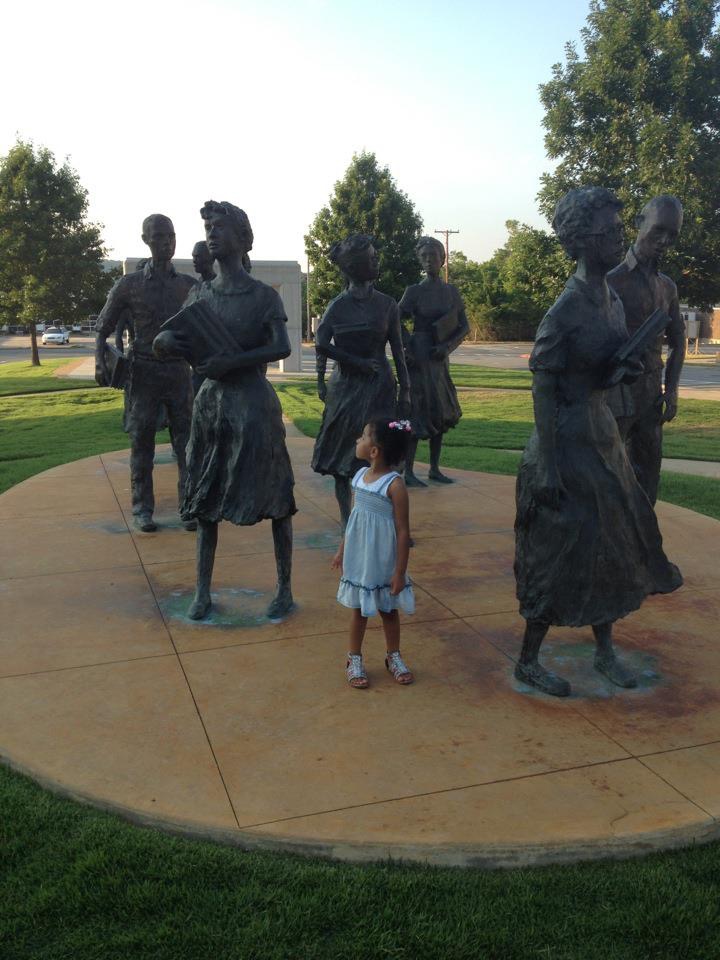
28332D92-A50E-4817-9663-6D13F00790D5June 16, 2012 . . . My three-year-old granddaughter standing among the bronze sculptures of The Little Rock Nine.

Her parents had told her the poignant story of The Little Rock Nine, but at age three she had no idea of the many ways their lives would impact hers. Because they crossed an invisible, but very real, line that divided black children from white children, they opened the door to educational equality in a racially divided state. Because their parents were brave enough to let their children breach the three stately doors of Little Rock Central High School, their world changed in unimaginable ways. And with that change, my granddaughter inherited the highly cherished right to equal education and all the opportunities that would follow. Because of that change, my granddaughter would grow up inspired.

In case you do not know about The Little Rock Nine, here is some background. 

On September 3, 1957, nine African American students — The Little Rock Nine — arrived to enter Little Rock Central High School only to be turned away by the Arkansas National Guard. Governor Orval Faubus had called out the Arkansas National Guard the night before to, as he put it, “maintain and restore order…” The soldiers barred the African American students from entering.

On September 24, 1957, President Dwight D. Eisenhower ordered units of the U.S. Army’s 101st Airborne Division — the “Screaming Eagles”— into Little Rock and federalized the Arkansas National Guard. In a televised speech delivered to the nation, President Eisenhower stated, “Mob rule cannot be allowed to override the decisions of the courts.”

On September 25, 1957, under federal troop escort, The Little Rock Nine made it inside for their first full day of school. The 101st Airborne left in October and the federalized Arkansas National Guard troops remained throughout the year.

They were nine solemn figures, nine teenagers just trying to do what every child up to age 18 had been mandated to do: go to school. Nine figures who entered the annals of American history the day they passed through the front door of Little Rock Central High School.

These nine African American students — Melba Pattillo, Elizabeth Eckford, Ernest Green, Gloria Ray, Carlotta Walls, Terrence Roberts, Jefferson Thomas, Minnijean Brown and Thelma Mothershed — are now immortalized in a striking memorial located on the grounds of the Arkansas State Capitol in Little Rock. The life-size bronze statues, entitled “Testament,” were designed and sculpted by Little Rock artist John Deering, assisted by his wife Kathy, also an artist. A comment from each of The Nine is found on individual bronze plaques identifying each student. Across the street sits the State Department of Education, just a few hundred yards from “Testament.” This Arkansas State Agency has been embroiled in this same desegregation lawsuit for over 50 years. 

Nine young students walked bravely, defiantly, yet filled with fear, in an act against prejudice and ignorance. These nine are heroes of every grueling story of segregation and racism in American history, every story we have heard and the millions of stories we will never hear.

So I am deeply moved by these photos of my granddaughter because there is deep meaning in each one. She seems to be looking up at the sculpture of Melba Pattillo (Beals) with what seems like admiration and awe. Dr. Beals grew up surrounded by family members who knew the importance of education. Her mother, Lois, was one of the first African Americans to graduate from the University of Arkansas in 1954. While attending all-black Horace Mann High School, Melba knew that her educational opportunities were not equal to her white counterparts at Central High. And so she became a part of the effort to integrate Central.

B3083DBA-2BEB-4137-B162-B8CB19B4AD64And my granddaughter stands in front of Little Rock Central High, a school she may choose to attend someday, a school she will be able to attend because The Little Rock Nine took a dangerous risk to make it possible.
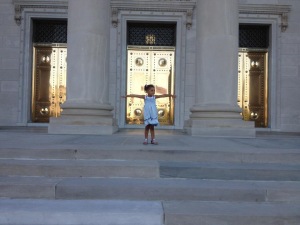


CCBDA845-BD2D-42E4-85B2-28749F2EA762Finally, my granddaughter stands playfully on the steps of the Arkansas State Capitol. I know that it is possible that she may one day proudly walk through its golden doors as a state senator or representative. That is possible because nine Little Rock students were brave enough to be a part of changing history.


At three years old, my granddaughter probably was not very inspired by Central High School, the Little Rock Nine Memorial, or the Arkansas Capitol. But her parents took her there to see and to learn so that she would grow up inspired. When she is older she will remember what she saw and what she learned from that seemingly insignificant sightseeing trip, and she will realize that it wasn’t insignificant at all. It may just be what motivates and inspires her to follow her dreams, because now she knows that all of her dreams are possible. It’s all about growing up inspired. It’s what we want for every child.

Dr. Melba Pattillo Beals, Minniejean Brown Trickey, Elizabeth Eckford, Dr. Carlotta Walls LaNier, Mrs. Thelma Mothershed Wair, Dr. Ernest Green, Gloria Ray Karlmark, Dr. Jefferson Thomas, Dr. Terrence J. Roberts, you made sure that every child can grow up inspired. when you were just young teenagers. When you walked through the doors of segregated Little Rock Central High School, you did so much more . . . for every student who came after you and for my granddaughter 


Bondage, Child protection, Children, Fear, Freedom, Hope, Immigration, Liberty, Mexican border, Risk, sunrise, Taking immigrant children, Violence

Moving Towards the Sunrise: An Essay on Immigration

F6C9AEAC-5F90-4F42-B0D9-FF50DDA7D60F.jpegI could decide to stand on this side wondering what life might hold on the other side. I can see the brilliant sunrise, perhaps a symbol for a bright new life for my children. I can see the tiny lights of dwellings or businesses. I’m not sure what they are but perhaps each tiny light is a warm welcome, a place of refuge, a safe haven.
I hold on tightly to the hands of my children, and now I look back and remember the violence, the fear, the drugs, the hopelessness for the future of my children. I consider going back, barricading my family in our tiny hovel and hoping for the best. It’s the life we know. It’s what we’re used to. But do I want my children to grow us “used to” violence and crime? Do I want then to be used to fear and hopelessness?

I decide to take a chance toward the sunrise and the tiny lights that will surely open their doors to a mother and her children. The land of the sunrise is called “the land of the free.” The land of the sunrise offers the wonderful promise of welcome . . .

Give me your tired, your poor, your huddled masses yearning to be free . . . 

Give these, the homeless tempest tossed to me. 

I lift my lamp beside the golden door.

Yes, I resolve. We will go forward. Yes!

I make, in this very moment, the most significant and life-altering decision of our lives. I choose  hope! We will go!

With great fear in the depths of my spirit, I move us toward the sunrise. I hold tightly to my children and begin the hope-filled crossing. Holding them all close on a grueling hike, I can see that we have almost made it to the other side.

Now we are actually standing in the light of the sunrise. We have crossed. Those who are to welcome us are approaching. Finally, I have made the journey to new hope for my beautiful children. Thanks be to God for safe passage! 

The welcoming people come near. But they are loud, boisterous, frightening. I never expected this. Oh my God, they have ripped my children from me. The youngest is crying, pleading for me, struggling to get away. The others are screaming “no” as they try in vain to work themselves loose from the powerful arms of those who restrain them. But the grip on them is too strong. I cry out and plead that they will not harm my children. I fall into the dirt, sobbing as they take my children away. 

Dear God, what have I done?

May God have mercy on us all.

American Flag, Division, Exclusion, Freedom, Inspiration, Justice, Liberty, National Anthem, Patriotism

Freedom, Liberty, Justice, and the National Anthem

1D1A00B6-C52A-41AF-86D9-50090736E4D6

Patriotism can be defined differently by different people. A plethora of actions and ceremonies cause a lump in the throat. For me, many ceremonies, sights and sounds can create a catch in my voice and a visceral emotional response. 

Singing “America the Beautiful” (1)

Watching the U.S. Navy Blue Angels paint the sky

Singing the song written by Irving Berlin in 1918, “God bless America, land that I love . . .” (2)

Hearing the stunningly beautiful words of Emma Lazarus, “Give me your tired, your poor . . .” (3)

Singing the hymn known as the African American National Anthem:

Lift every voice and sing, 
‘Till earth and heaven ring, 
Ring with the harmonies of liberty . . . 
Stormy the road we trod, 
Bitter the chastening rod, 
Felt in the days when hope unborn had died . . .
Out from the gloomy past,
‘Till now we stand at last
Where the bright gleam of our bright star is cast . . . (4)

And finally, watching the flag billowing in the breeze while the melody of the National Anthem floods a football stadium . . . 

While National Football League players stand tall and sing as they gaze at the American flag; 

While other players place their hands over their hearts in an act of honor; 

While still others kneel because they long for America to be better.

The National Anthem should not be the focus of controversy. The American flag should not be a catalyst for divisiveness. Both are symbols of freedom and liberty that inspire deeply personal acts of patriotism. National symbols should never cause us to ostracize any individual whose patriotism looks different than our own. 

CNN’s Van Jones spoke definitively about what we know as the National Anthem controversy:

People who look like me have put blood in the ground, and put martyrs in the dirt for this country, to have it be liberty and justice for all… It is beyond insulting to have people lecture us about patriotism. (5)

   Van Jones on the NFL National Anthem controversy

Approaching the commemoration of Independence Day reminds me to look more intently to see the acts of patriotism all around me. It prompts me to ask myself what “liberty and justice for all” looks like in these troublesome days. It moves me be a more committed advocate for freedom in all its forms. 

As a Baptist for fifty years, I have been thoroughly immersed in the Biblical concept of soul freedom, an all-encompassing freedom that is, by the way, not just for Baptists. James Dunn provides one of the best descriptions of soul freedom

Soul freedom, all freedom and responsibility are God’s gifts to humanity. God created and endowed people to be free moral agents. Soul freedom and responsibility are not invented by government, or devised by social contract. All dignity and respect afforded persons comes from God as revealed in Scripture. (6) 

For me, a part of soul freedom allows me the right of expression — to worship as I wish, to honor my country as I wish, to exercise my freedom to be the person I was destined to be. I cherish the gift of such extravagant liberty and know full well that it is a tenuous and fragile freedom. That fragility is one cause for the unfortunate and unnecessary controversy surrounding the National Football League and the National Anthem.

My heritage compels me to advocate for the right of every person to express his or her patriotism as they choose. As a child of immigrant parents, I will forever honor the American flag and revere the National Anthem. I may do it as I sing. I may do it through my tears. I may stand proudly and face the waving American flag. I may kneel in solidarity. I may cry as I remember my grandmother’s frightening journey to this country with my infant mother. I may pay tribute in various ways, but I will do it in my own way. As should we all.

So let us move forward in freedom. Let us stand fast in the liberty (7) that has made us free. Let us persist in our resolve to demand justice for all humankind. And as we do, let us go forth boldly with freedom-words on our lips:

Oh, freedom! Oh, freedom! Oh, freedom over me! (8)

Sweet land of liberty . . . (9)

Give me your tired, your poor, your huddled masses yearning to be free . . . 

Sweet justice, climb the mountain though your hands may be weary . . . (10)

Lift every voice and sing ‘till earth and heaven ring, ring with the harmonies of liberty . . .

God bless America!

Amen.


(1) Lyrics by Katharine Lee Bates; music by Samuel A.Ward
(2) Irving Berlin, 1918
(3) Emma Lazarus, From the poem, “The New Colossus “ 1883; inscribed on a bronze plaque placed inside the pedestal of the Statue of Liberty in 1903
(4) James W. Johnson, 1871-1938; J. Rosamond Johnson, 1873-1954
(5) Van Jones on the NFL National Anthem controversy; https://cnn.it/2JxzD36
(6) Jamie’s M. Dunn, Soul Freedom: Universal Human Right in Soul Freedom: Baptist Battle Cry, James M. Dunn and Grady C. Cothen, Smyth and Helwys Publishing, 2000.
(7) Galatians 5:1
(8) Traditional spiritual, arr. by Valeria A. Foster
(9) Samuel Francis Smith
(19) Jill Scott
Bondage, Change, Freedom, Hate, Injustice, Justice, Lynching, Violence

A Prophet Among Us

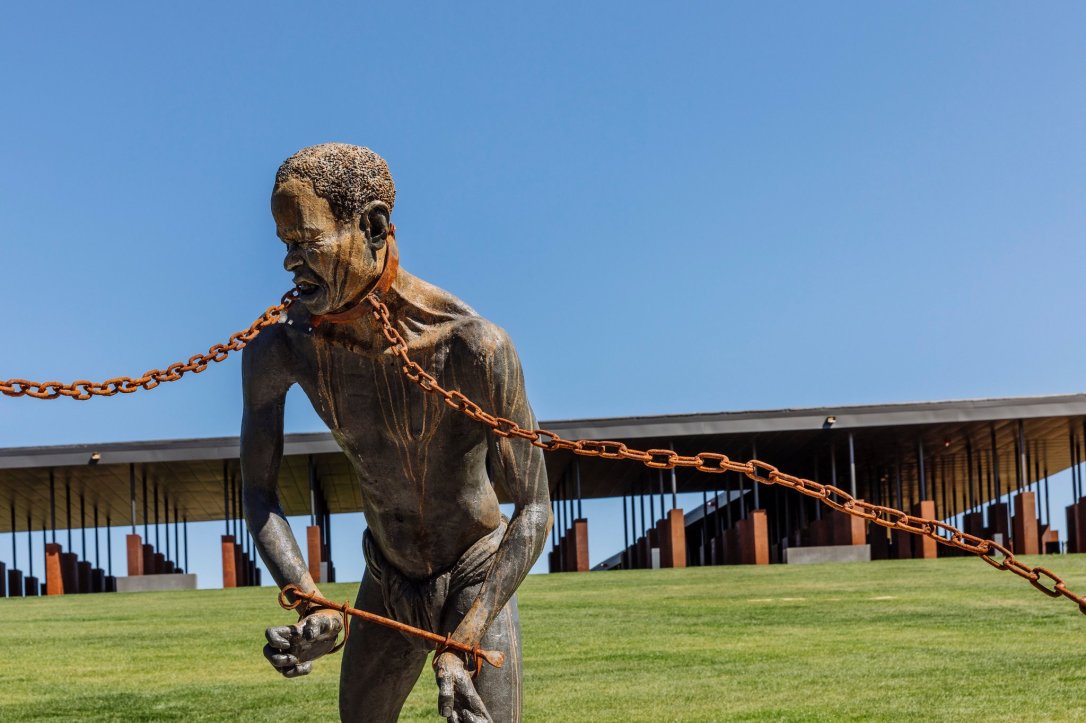
51D84C45-AF36-41C2-824C-3E29EE93E434Because of the recent opening of The National Memorial for Peace and Justice in Montgomery, Alabama, I have been contemplating the terror of lynching in our history. The Montgomery site is the nation’s first memorial dedicated to the legacy of enslaved black people, people terrorized by lynching, African Americans humiliated by racial segregation and Jim Crow, and people of color burdened with police violence.
“Set on a six-acre site, the memorial uses sculpture, art, and design to contextualize racial terror. The site includes a memorial square with 800 six-foot monuments to symbolize thousands of racial terror lynching victims in the United States and the counties and states where this terrorism took place.” (eji.org)

But racial injustice is not merely art used to contextualize racism and violence. We also have the cold, hard facts. For instance, The Tuskegee Institute reports that 4,743 people were lynched between 1882 and 1968, including 3,446 African Americans and 1,297 whites, mostly white individuals who tried to help their African American neighbors.

Who were the prophets among us who proclaimed in those days a Christian Gospel of justice?

The NAACP reports that today African Americans are incarcerated at more than 5 times the rate of white people.

Who are the prophets among us in these days? Who is calling for justice, for liberation and freedom for those who are oppressed?

Across a range of human rights issues in 2017, the United States moved backward on human rights issues. The current U.S. president has targeted refugees and immigrants, calling them criminals and security threats. He has emboldened racism by promoting white nationalism. He consistently champions anti-Muslim ideas. His administration has embraced policies that will roll back access to reproductive health care for women and has created health insurance changes that would leave many Americans without access to affordable health care. He has undermined police accountability for abuse. He has expressed disdain for independent media and for federal courts that have blocked some of his actions.

The individuals most likely to suffer abuse in our nation include members of racial and ethnic minorities, immigrants, children, the poor, prisoners and other vulnerable groups, who endure renewed attacks on their rights. Issues of injustice include gender equity, poverty, the right to health care, immigration and the rights of non-citizens, sexual orientation and gender identity, criminal and juvenile justice, harsh criminal sentencing and mass incarceration,.

Where is justice today? Who will call each injustice by name? Where is the prophetic voice among us that will proclaim liberation?

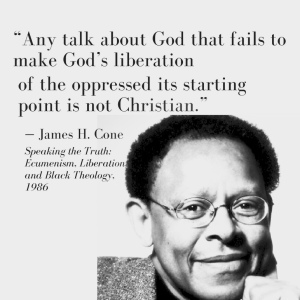
06B7213F-F174-4BD0-9B73-D8AB170F288BWhile in seminary, I immersed myself in the study of liberation theologies. Not surprisingly, my research led me to the writings of black liberation theologian, The Rev. Dr. James H. Cone. I became what some might call a follower of Dr. Cone. I saw him as a Christ-like superhero. Much of my research and writing in those days delved into the history of liberation theology, so Dr. Cone’s books covered my desk for months.
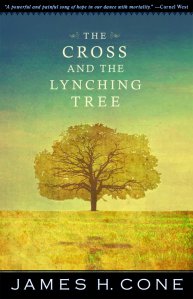
On Saturday, I learned of his death and experienced both sadness and gladness. Glad, because of his enormous contribution to Christian theology’s imperative response to injustice. And sad, because his voice of justice is now silent. By his death, we lost a prophet, a persevering voice that championed racial justice. We lost a voice that gave the world an interpretation of the Christian Gospel that paid attention to the voices of the oppressed.

YES! “A prophet was among us.”

These words from Judge Wendell Griffen honored the prophet, Rev. Dr. James H. Cone, and named him as the central figure in the development of black liberation theology in the 1960s and ’70s.

The prophet and scholar was raised in a small Arkansas town, giving him a clear view of the harsh reality of racial injustice. Dr. Cone rose up from his simple roots to become the foremost voice of his day on black liberation theology.

84C76F50-B538-4A1C-91DA-48E4357609E2Google it.

“Black liberation theology”

The first image you will see is that of James H. Cone. And then you will see image after image of him as well as a list of the plethora of books he has written and a list of the places around the world where he taught and preached.

What is my point?

First of all, I want to add my voice to those who are honoring this prophet of justice. But more importantly, I want to own and name the present reality: that there has never been a time in history that needs the message of liberation more than this day. To be sure, the horrific lynchings of African Americans in this country took place many years ago, between 1882 and 1968.BAD8200A-0958-4FBE-9241-F4E2DDEBCA70

And this is a new day, is it not?

It is a new day, a new day that has moved our society to the national shame of mass incarceration of African Americans. Consider this research:

  • By the age of 14, approximately 25 percent of African American children have experienced a parent — in most cases a father — being imprisoned for some period of time.
  • On any given school day, approximately 10 percent of African American schoolchildren have a parent who is in jail or prison, more than four times the share in 1980.
  • The comparable share for white children is 4 percent; an African American child is six times as likely as a white child to have or have had an incarcerated parent.

(Valerie Strauss, March 15, 2017; The Washington Post; https://www.washingtonpost.com/people/valerie-strauss/?utm_term=.8d67a553a8db)

  • In 2014, African Americans constituted 2.3 million, or 34%, of the total 6.8 million correctional population.
  • The imprisonment rate for African American women is twice that of white women.
  • Nationwide, African American children represent 32% of children who are arrested, 42% of children who are detained, and 52% of children whose cases are judicially waived to criminal court.

(NAACP.org)

TMI . . . Too much information, right? Perhaps it is too much information, but the amount of information here barely scratches the surface of the many ways injustice has gripped our nation in these days. We can turn our backs, stop up our ears, and blind our eyes to it, but that will not change the fact that people are being oppressed, injustice is doing its horrific work, and liberation seems a distant, unreachable dream.

The people of God must be the people of God and accept the mantle placed by God on our shoulders — being a prophetic voice in a land where injustice has its way.

The spirit of the Lord God is upon me,
because the Lord has anointed me;
he has sent me to bring good news to the oppressed,
to bind up the brokenhearted,
to proclaim liberty to the captives,
and release to the prisoners;

to proclaim the year of the Lord’s favor,
and the day of vengeance of our God;
to comfort all who mourn;

to provide for those who mourn in Zion—
to give them a garland instead of ashes,
the oil of gladness instead of mourning,
the mantle of praise instead of a faint spirit.
(Isaiah 61:1-3 NRSV)

But let justice roll down like waters,
and righteousness like an ever-flowing stream.
(Amos 6:24 NRSV)

We are the prophets among us. Let’s act like it!


Bondage, Freedom, Hate, Injustice, Justice, Lynching, Violence

Lynching’s Long Shadow: America’s Shame

0CBDE86D-3CC4-4676-8B23-66975E5DE797
The memorial is inspired by the Holocaust Memorial in Berlin and the Apartheid Museum in Johannesburg.
Photography: Audra Melton for The New York Times

Nothing casts as long and shameful a shadow on our history than does lynching. Lynching is a part of America’s history that we want to ignore. As a people, we cringe at the thought of it, yet do not often allow ourselves to think of it. We do not own lynching. It happened in another time in history, with decades separating us from its shame. We secretly hope that if we do not talk about it, we can move forward without acknowleding the depth of its impact. And above all, we cannot admit that such violence is still possible in this day.

The National Memorial for Peace and Justice is a living reminder for us. The Memorial, which opened today on a six-acre site overlooking the Alabama State Capitol, is dedicated to the victims of American white supremacy. It demands a reckoning with one of the nation’s least recognized atrocities: the lynching of thousands of black people in a decades-long campaign of racist terror.

At the center of the Memorial is a grim cloister, a walkway with 800 weathered steel columns, all hanging from a roof. Etched on each column is the name of an American county and the people who were lynched there, most listed by name, many simply as “unknown.” The columns meet you first at eye level, like the headstones that lynching victims were rarely given. But as you walk, the floor steadily descends; by the end, the columns are all dangling above, leaving you in the position of the callous spectators in old photographs of public lynchings.

17992F10-F6BC-4BD2-9EA3-9125684AB9C0
Bryan Stevenson and a small group of lawyers spent years immersing themselves in archives and county libraries to document thousands of lynchings.
Photography: Audra Melton for The New York Times


The magnitude of the killing is harrowing, all the more so when paired with the circumstances of individual lynchings, some described in brief summaries along the walk:

Parks Banks, lynched in Mississippi in 1922 for carrying a photograph of a white woman;

Caleb Gadly, hanged in Kentucky in 1894 for “walking behind the wife of his white employer”;

Mary Turner, who after denouncing her husband’s lynching by a rampaging white mob, was hung upside down, burned and then sliced open so that her unborn child fell to the ground.

D4193588-22E6-49BB-821F-0C235963ABDF
A 2017 sculpture by Titus Kaphar, “Doubt,” sat amid accounts of slaves and former slaves at the museum.
Photography: Audra Melton for The New York Times

A grassy hill rises in the middle of the memorial. From there you can see the Montgomery skyline through the thicket of hanging columns, the river where the enslaved were sold, and the State Capitol building that once housed the Confederacy. It is a striking view.

The striking exhibits and sculptures in this Memorial exist to remind us, to challenge us, to create in us a determination to always fight injustice.

7D5EAA34-62C5-46A7-98C6-01C6388B3EBD
Jars
Hundreds of jars of soil from the sites of documented lynchings, collected by families of victims or community volunteers, are on display at the museum.
Photography: Audra Melton for The New York Times

May we more deeply understand our tragically unjust and violent history. May we vow to make peace and demand justice. May we never forget what happened in this nation so that it will never happen again. It is very real that our history of lynching innocent people casts a long and dark shadow upon our existence. May we intentionally work for justice so that we will no longer live in that shadow.

This blog post is words, just words. But our words are not enough. Our declarations are empty and meaningless if we do not also immerse ourselves in the hard and grueling work that makes for justice. God does not care about our words and promises. God does not accept our carefully planned events — filled with flags and crowds and songs — held in American cities and counties and town squares to commemorate our history. God demands pure and genuine righteousness that vows to do whatever it takes to create justice in our nation and in the world.

May God lead us in making it so. May God help us to step out of lynching’s long shadow and walk in the light of justice and righteousness.

Take away from me the noise of your songs;
I will not listen to the melody of your harps.

But let justice roll down like waters,
and righteousness like an ever-flowing stream.

— Amos 5:23-24 (New Revised Standard Version)


Change, Contemplation, Darkness, Daybreak, Death, Despair, Faith, Freedom, healing, life

When Your World Ends

66A9AA3C-258F-40E7-AB87-32000E79567EMy adult son is a master at denial. He can get very upset over a situation, but before you can blink, he has moved on as if it never happened. To be honest, I have often envied that part of his personality. As one who tends to brood over life’s challenges and problems, I would love to just be able to blow things off.
There is no chance of that happening for me. I think that this brooding part of me emerges from the trauma I have experienced over the years. My world has ended many times, or so it seemed. Yet, there has been a positive aspect of my brooding: that I have learned to sit with an issue for a while, dissect what has happened, feel the depth of hurt, and reflect on the depth of the emotional assault I’m experiencing. Blowing off pain just doesn’t work for me. Denial is not my way.

Denial never makes hurt go away. Denial never even diminishes hurt. So be warned. Blowing off pain is a path to internal disaster. As difficult as introspection can be, I am grateful that I am able to deeply feel the feelings I feel, to let the hurt wash over me, and finally to emerge better and stronger. Feeling the depth of my heartaches has served to disempower them and, most importantly, to enable me to harness my inner power to be free.

This, I believe, is the path that takes us beyond despair. This is the path that lets us own our heartbreak and then leave it behind to move into a fresh, new day. I am strengthened by the words of poet Nayyirah Waheed.

feel it.
the thing that you don’t
want to feel.
feel it and be free.

the thing you are most afraid to write, write that.

it is being honest
about
my pain
that
makes me invincible.

i don’t pay attention to the
world ending.
it has ended for me
many times
and began again in the morning.

To sit with your pain, to touch the heart of your hurt . . . that is what makes you free. And that freedom will be for you this miracle . . . when your world ends, and it may end many times, it begins again in the morning.

Thanks be to God.


Change, Christian Witness, Courage, Faith, Freedom, Hate, Injustice, Justice, Martin Luther King, Jr., Risk, Segregation, The Christian Church

Out of Africa: White Supremacy and the Church’s Silence

D4B59064-1AD6-4121-B934-261EB10546E6I invite you to read “Out of Africa: White supremacy and the Church’s silence,” a provocative opinion piece by our guest blogger, Dr. Bill J. Leonard. Many thanks to Dr. Leonard for prompting us to more fully commemorate the day honoring Dr. Martin Luther King, Jr. If you are willing to challenge yourself, these words will shed the light you need to do so.

Out of Africa: White supremacy and the Church’s silence

45580E0C-5D54-41B6-8ECA-D4B04AAA7F7C
Dr. Bill J. Leonard

OPINION | BILL LEONARD | JANUARY 15, 2018

“Give me your tired, your poor, your huddled [Caucasian?] masses, yearning to breathe free.”

Three days before the 2018 Martin Luther King Jr. memorial observances, and in the 50th year after Dr. King’s assassination, the plague of racism in America continued, even as white supremacy, long lingering just below the surface, reasserted itself with a vengeance.

On Jan. 12, the president of the United States, at a White House meeting on immigration, allegedly asked why “all these people from shithole countries,” specifically Haiti and Africa, should be admitted to the U.S. He was also said to have wondered aloud why the U.S. could not secure more immigrants from countries like Norway (83 percent Caucasian). Confirmation of his remarks vary from those in attendance. Some confirm the alleged statements; others deny them. Somebody’s lying.

The mere report of the comments was immediately celebrated across the country’s white supremacist network, much as when Trump affirmed “good people on both sides” in last year’s violent neo-Nazi-led demonstrations in Charlottesville, Va. White nationalist Richard Spencer chastised Trump’s defenders for suggesting the statements were related to law or economics, since they were actually “all about race.” Spencer was, of course, delighted. The Neo-Nazi blog, the Daily Stormer, hailed the President’s words as “encouraging and refreshing” since they indicated that “Trump is more or less on the same page as us” regarding “race and immigration.” In America, 2018, white supremacy is now apparently “refreshing.”

Dallas Baptist pastor Robert Jeffress defended the president, noting that “apart from the vocabulary attributed to him,” Trump’s comments were “right on target” with his presidential responsibility “to place the interests of our nation above the needs of other countries.” That’s unlike Christians’ “biblical responsibility” to “place the needs of others” above themselves. (Racism’s OK; it’s vulgar language that’s the problem.)

Amid debates over the veracity of witnesses to the White House event, the fact remains that the dogmas of white supremacy lie at the center of America’s long night of racism, in politics, social structures, and racial stereotypes. At this moment in history, how can American Christians, themselves deeply divided over scripture, doctrine, sexuality, abortion, and other culture war accoutrements, foster a common compulsion to speak out against white supremacist fiction before it gains an even stronger implicit or explicit influence?

Even if President Trump did not use vulgar words to highlight his views on immigration, did he in fact wistfully promote a 21st century America where Aryans (remember the history of that word?) are preferred to immigrants of color? Surely it is time to break the silence, not simply because of those shameful remarks, but because they are part of a larger litany of racial dog whistles from Trump’s birther campaign, to attacks on a “Mexican” judge and a Gold Star Muslim family, to the infamous Charlottesville slurs.

We have many reasons to break the silence: First, because white supremacy itself is an inherently evil yet an enduring vision of the nature of humanity, and must be resisted for that fact alone. It has polluted our national psyche long enough!

Second, we break the silence on this matter because we hear again Dr. King’s words from that Birmingham jail: “Shallow understanding from people of good will is more frustrating than absolute misunderstanding from people of ill will. Lukewarm acceptance is much more bewildering than outright rejection.”

Third, we Aryan Christians cannot be silent because it’s our racial ancestors who first planted the banner of racism in our laws, our institutions (churches included), and in our hearts. And some among us still won’t let it go. We need to get “saved” from it.

Fourth, we speak out now because American churches, at least many of them, remained silent for too long. Indeed, Trump’s only a symptom; we scapegoat him at our peril. When his remarks hit the fan, I returned to James Baldwin’s The Fire Next Time, a book that has taught me, shamed me, blessed me, and broken me for decades. Baldwin writes: “It is not too much to say that whoever wishes to become a truly moral human being (and let us not ask whether or not this is possible) must first divorce him[her]self from all the prohibitions, crimes and hypocrisies of the Christian church. If the concept of God has had any validity or any use, it can only be to make us larger, freer, and more loving. If God cannot do this, then it is time we got rid of Him.” (Whatever God is, it damn sure isn’t white supremacy.)

Mercer University professor Robert Nash illustrates Baldwin’s point in a superb essay entitled, “Peculiarly Chosen: Anglo-Saxon Supremacy and Baptist Missions in the South,” documenting that ecclesiastical collusion with the case of James Franklin Love, corresponding secretary of the Foreign Mission Board of the Southern Baptist Convention, 1915-1928. Nash notes that Love “was profoundly influenced by the concept of Anglo-Saxon supremacy … that white races possessed a superior intellect, religion, and civilization.”

Love’s mission strategy focused on evangelization of Europe since white Christians could more readily convert the darker races. He wrote: “Let us not forget that to the white man God gave the instinct and talent to disseminate His ideals among other people and that he did not, to the same degree, give this instinct and talent to the yellow, brown or black race. The white race only has the genius to introduce Christianity into all lands and among all people.” (In 2017, the Southern Baptist Convention went on record condemning white supremacy then and now. It’s about time.)

Finally, we break the silence, confronting white supremacy and its accompanying racism at this moment because we will neither deny nor sully the African heritage of our African-American sisters and brothers, who as W.E.B. Dubois wrote, “would not bleach … [their] Negro soul in a flood of white Americanism,” since they know “that Negro blood has a message for the world.”

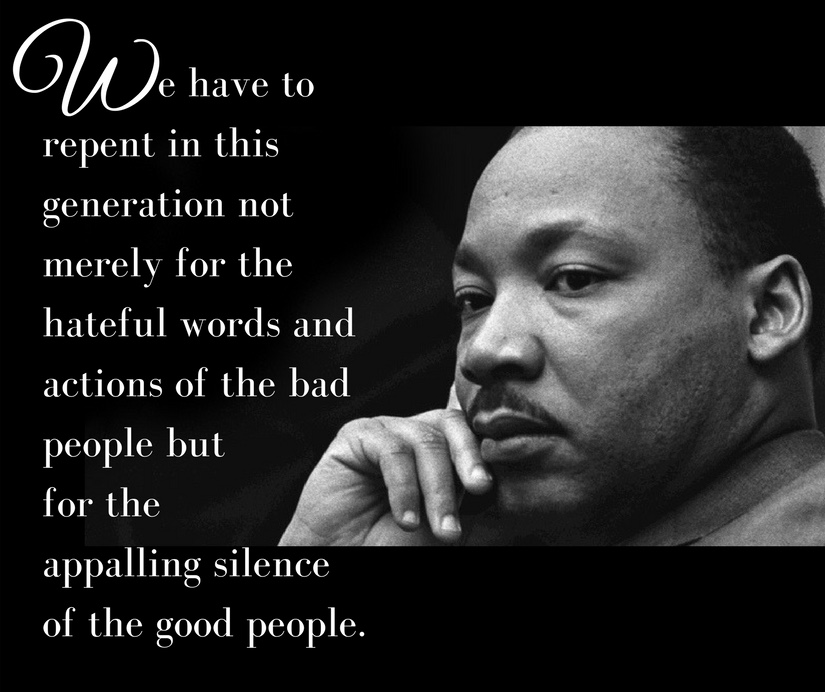
On what would have been his 89th birthday, Dr. King retains his prophetic voice for black and white alike, declaring from his jail cell then and now: “We will have to repent in this generation not merely for the hateful words and actions of the bad people but for the appalling silence of the good people. Human progress never rolls in on wheels of inevitability; it comes through the tireless efforts of men [women] willing to be co-workers with God, and without this hard work, time itself becomes an ally of the forces of social stagnation.”

Today, we read again Matthew’s haunting assessment of the Holy Family’s immigration from Herod’s not-so-holy-land:

“Out of Egypt I have called my son.”

Sweet Jesus, Egypt’s in Africa! Amen”


Bill J. Leonard is the James and Marilyn Dunn Professor of Baptist Studies, Professor of Church History, School of Divinity, Wake Forest University.


Bondage, Despair, Faith, Fear, Freedom, healing, peace, Restoration

Despair

192EA03D-9DFB-4D4A-BB22-A481D2086FCDDespair has its way at times. It sneaks into my spirit and dwells there for a while, Although despair is thoroughly unwelcome and unwanted, it has a way of making a home in me at times. It has its way. It does its damage. It enslaves me with a devastating kind of bondage. It forces me into an uneasy and oppressive place.

Despair’s most damaging legacy is fear. These days are, for me at least, days of fear. I watch the current president and listen to his words in horror. He speaks with hostility. He gives welcome to divisiveness, racism, misogyny and disrespect. His words are often divisive, rude and insensitive. He uses his power to build an unsettled nation. I despair for the nation, and I despair for a world filled with violence, war, hunger, poverty, and natural disasters born of climate change.

My faith tells me that there is a remedy for despair, that fear can be conquered, and that peace might be restored in me. The poetry of Wendell Berry is a beautiful reminder.

When despair for the world grows in me
and I wake in the night at the least sound
in fear of what my life and my children’s lives may be,

I go and lie down where the wood drake
rests in his beauty on the water, and the great heron feeds.

I come into the peace of wild things
who do not tax their lives with forethought
of grief.

I come into the presence of still water.
And I feel above me the day-blind stars
waiting with their light.

For a time I rest in the grace of the world, and am free.

— From Wendell Berry’s “The Peace of Wild Things“

When despair casts its damaging spell within me, my faith still holds. They are waiting for me, always, the peace that is a balm for grief and despair, the presence of still waters and the stars sparkling in my night sky. This otherworldly beauty causes me to rest in the arms of faith and to recall the many times of despair in my life that served only to make me stronger and more resilient.

Thanks be to God.

Change, Christian Witness, Courage, Freedom, Hope, Justice, peace, Perseverance, Politics

Persevering Hope

IMG_5700


PAX

(pɑks ; päks; pæks ; paks). noun

1. the Roman goddess of peace, identified with the Greek Irene

2. sign of peace


The Reverend Jennifer Butler was wearing a white clergy stole with Pax embroidered over a cross and an olive branch. Enlight126She Was singing as police officers restrained her, arms behind her back, both thumbs held tightly together with plastic straps. Next to be arrested was The Reverend Traci Blackmon, who chanted “justice, mercy” again and again as police restrained her and led her away.
The Charlotte Examiner described the event, The March to Save Medicaid, Save Lives.

Capitol Hill police arrested the president of the North Carolina NAACP on Thursday morning after he led a protest of the Senate’s proposed health care repeal-and-replace bill.

Rev. William J. Barber II, who was protesting in his role as president of Repairers of the Breach, was released from jail by 2 p.m. On that morning, July 13, 2017, Dr. Barber and other faith leaders led a group of about 50 people to Senate Majority Leader Mitch McConnell’s office in the Capitol.

The group gathered a few blocks away at 10 a.m. and walked to the Capitol, chanting and singing along the way. Eleven protesters were arrested.

Read more at this link:

http://www.charlotteobserver.com/latest-news/article161200048.html#storylink=cpy

As I watched the live feed of this moral and courageous expression of civil disobedience, I hoped that the police would not arrest The Reverend Dr. William Butler, who was obviously experiencing pain from his physical disabilities. I hoped that other faith leaders would not be arrested.

The band of justice-seekers, clergy and persons of all faiths, gathered together in a prophetic action to protect the 22 million Americans in danger of losing healthcare because of what the group calls “immoral Congressional legislation.” The Repairers of the Breach Facebook page gives details of the event.

Together, we’ll join in song and march through the halls of power, sending a moral message that we cannot cut Medicaid — a lifeline for so many children, seniors and people with disabilities.

My heart was with them in Washington. My prayers pleaded for hope for a brighter day, for justice for those who are oppressed, for peace for every person. My mind recalled the words of the prophet Isaiah . . .

And if you spend yourselves in behalf of the hungry
and satisfy the needs of the oppressed,
then your light will rise in the darkness,
and your night will become like the noonday.

The Lord will guide you always;
And will satisfy your needs in a sun-scorched land
and will strengthen your frame.

You will be like a watered garden,
like a spring whose waters never fail.

Those from among you will rebuild the ancient ruins;
You will raise up the age-old foundations;
And you will be called the repairer of the breach,
The restorer of the streets in which to dwell.

– Isaiah 58:10-12

I watched them stand bravely as they faced the powers before them, living into the words spoken by Hannibal of Carthage, “We will either find a way or make one.” I listened to their voices echoing through the halls of the building, singing with persisting, persevering hope.

Ain’t gonna let injustice turn me around
Turn me around, turn me around
Ain’t gonna let injustice turn me around
I’m gonna keep on a-walkin’, keep on a-talkin’
Marchin’ up to freedom’s land.

Ain’t gonna let no jail cell turn me around
Turn me around, turn me around
Ain’t gonna let no jail cell turn me around
I’m gonna keep on a-walkin’, keep on a-talkin’
Marchin’ up to freedom’s land.

Ain’t gonna let nobody turn me around
Turn me around, turn me around
Ain’t gonna let nobody turn me around
I’m gonna keep on a-walkin’, keep on a-talkin’
Marchin’ up to freedom’s land.

Repairers of the Breach — http://www.breachrepairers.org/

Covenant, Freedom, Perseverance

Reach for the Stars

Enlight124

We greet this year’s Independence Day still reaching for the stars. We also come to this day with a measure of confusion, disillusionment, and even fear. We have a president who is revered by some Americans and feared by most Americans. We feel concern when the president Tweets divisive messages. We feel concern about the ways he interacts with international leaders. We feel concern about health care. We feel concern about the loss of the freedoms we have enjoyed for centuries. We are concerned for our neighbors who have come to America as immigrants and who now face an uncertain future.

This Fourth of July we remember that eight immigrants signed the Declaration of Independence we celebrate today. We recall the words written on that historical document that was signed on July 4, 1776:

We hold these truths to be self-evident, that all men are created equal, that they are endowed by their Creator with certain unalienable Rights, that among these are Life, Liberty and the pursuit of Happiness.

. . . And for the support of this Declaration, with a firm reliance on the protection of divine Providence, we mutually pledge to each other our Lives, our Fortunes and our sacred Honor.

We are still the United States of America. We persist in loving our brothers and sisters and in cherishing the unity that goes far beyond our differences. Creating “a more perfect union” remains our sacred calling though we know that mutually pledging our lives to each other requires constancy and dedication. It requires our willingness to accept one another and to honor each other’s differences. It requires offering mutual respect. Dr. Martin Luther King, Jr. spoke about the sheer work of human progress, work to which we must commit and recommit.

Human progress is neither automatic nor inevitable . . . Every step toward the goal of justice requires sacrifice, suffering, and struggle; the tireless exertions and passionate concern of dedicated individuals.

– Martin Luther King, Jr. in Stride Toward Freedom, 1957

On this day that is a celebration of our independence, we know that we we cannot always determine the destiny of our country. We know that our freedom often feels precarious. We know that we cannot always be led by the president we prefer. But we also know that the citizens of this country will always reach for the stars as we labor for our nation’s honor, and in the end, will join hands and rise to meet a brighter future.

More than any time in recent history, America’s destiny is not of our own choosing. We did not seek nor did we provoke an assault on our freedom and our way of life . . . Yet the true measure of a people’s strength is how they rise. We will do what is hard. We will achieve what is great. This is a time for American heroes and we reach for the stars.

– President Josiah Bartlet, The West Wing

Freedom, Justice, Perseverance

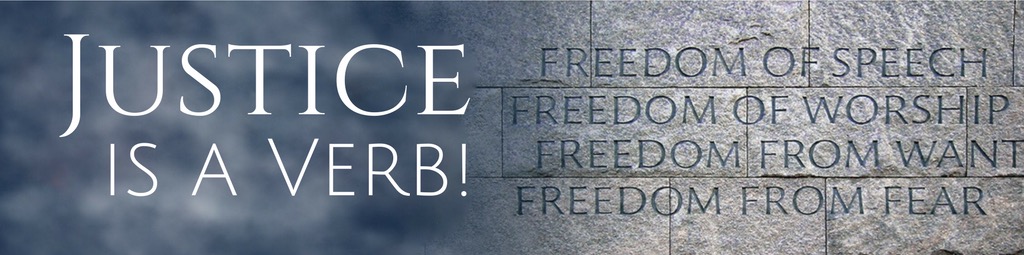
Justice Is a Verb!

Design

Surely someone has written about the challenge of being a Christian in these days of political upheaval and societal angst. I need to read such a book. I need to be emboldened to live out my faith, not as a passive bystander, but as a change-agent that insists on peace and justice.

My close friend and colleague in ministry, Wendell Griffen, insists that justice is a verb. His life beckons us to live into what he calls “the fierce urgency of prophetic hope.” In his book of the same name, he asks people of faith to consider this question: “How can we speak of hope in a time of deep division—a time too often defined by racism, misogyny, materialism, militarism, religious nationalism, and xenophobia?” *

My faith compels me to find ways to speak hope in these unsettled days, to speak truth to power when people suffer oppression, to care deeply about injustice. As I sit in my home dealing with the inevitable aging that marks my days, I think about the past to a time when advocacy was my passion. I remember ministry in the hospital, at the jail, in child sexual abuse forensic interviews, in courtrooms. I remember the energy of speaking for those who were suffering. I recall a life on the edge that made a difference in people’s lives.

But what about today? How does my faith ennoble me at this time of my life? What is my new normal in service and ministry? In what ways will my voice be heard proclaiming hope, justice and equality?

The following words are written by Dr. Cornel West in his book Democracy Matters:  Winning the Fight Against Imperialism:

To be a Christian is to live dangerously, honestly, freely–to step in the name of love as if you may land on nothing, yet keep stepping because the something that sustains you, no empire can give you and no empire can take away. This is the kind of vision and courage required to enable the renewal of prophetic, democratic Christian identity in the age of the American empire. *

I believe there are still battles that I must fight. I believe that the vision and courage of youth remains. I believe that when God calls one to be a prophetic voice, that call is a permanent, lifelong call. My challenge is to keep stepping in the name of love, seeking to do justice, always knowing that God will sustain me.

And the Lord will guide you continually,
and satisfy your soul in parched places,
and will strengthen your bones;
and you’ll be like a watered garden,
like a spring of water,
whose waters never fail.

Isaiah 58:11, ISV
* The Fierce Urgency of Prophetic Hope, Wendell L. Griffen, 2017: Judson Press,
http://www.judsonpress.com/author.cfm?author_id=894

* Democracy Matters: Winning the Fight Against Imperialism, Cornel West, 2004: The Penguin Press

Bondage, Freedom, Hope

Chains

IMG_5468

Chains.

Some folks see a golden necklace with sparkling links. But others see chains as cruel symbols of enslavement. History records thousands of inhumane acts of enslavement. A review of history is about real people whose lives were oppressive, whose chains were heavy, whose slavery was permanent. We remember their lives with a sense of shame and we honor them with genuine repentance.

But we must also bring the reality of chains closer to home as we recall the times of our lives that held us in chains. Serious illnesses. Violent relationships. Troubled children. Careers that became personal enslavement. No, the chains that bound us were not made of steel. Instead, they were chains that bound our very being, holding us fast, oppressing our spirits.

In all of this, there is hope. It is the hope of God’s grace that empowers us to break free. I am reminded of one of my favorite Scripture passages.

It is for freedom that Christ has set us free. Stand firm, then, and do not let yourselves be burdened again by a yoke of slavery.

– Galatians 5:1, New International Version

Of one thing I am certain. God does not desire for us a life of enslavement, but graces us with the courage to free ourselves from all that holds us hostage. Life in Christ is not a life of chains. It is a life of freedom to live, to love, and to thrive. Though we may have been hurt by circumstances that left us in chains, our souls can never be chained.

Laurie Halse Anderson writes this in her brilliant novel series, Chains: Seeds of America.

She cannot chain my soul. Yes, she could hurt me. She’d already done so . . . I would bleed, or not. Scar, or not. Live, or not. But she could not hurt my soul, not unless I gave it to her.

Please listen to a beautiful arrangement of “Amazing Grace/My Chains Are Gone” sung by Noteworthy.  https://m.youtube.com/watch?v=X6Mtpk4jeVA


Courage, Faith, Freedom, Inspiration

Today We Remember

Design

Today, April 4th, marks the 49th anniversary of the assassination of Rev. Martin Luther King Jr. A minister, a change-agent, an advocate for equality, Dr. King was a civil rights leader whose message of non-violence inspired generations.

At 39 years of age, he was fatally shot at the Lorraine Motel in Memphis, Tennessee. Dr. King, who was in Memphis that day to show solidarity for striking sanitation workers, delivered one of his most famous speeches on April 3 at the Mason Temple Church in Memphis. Toward the end of the speech, he referred to threats against his life and used language that seemed to foreshadow his impending death, yet he reaffirmed that he was not afraid to die. His words hung in the air as an ominous predictor of what was to occur the next day.

Well, I don’t know what will happen now. We’ve got some difficult days ahead. But it really doesn’t matter with me now, because I’ve been to the mountaintop.

And I don’t mind. Like anybody, I would like to live a long life; longevity has its place.

But I’m not concerned about that now. I just want to do God’s will.

And He’s allowed me to go up to the mountain. And I’ve looked over. And I’ve seen the Promised Land.

I may not get there with you. But I want you to know tonight, that we, as a people, will get to the Promised Land.

So I’m happy, tonight. I’m not worried about anything. I’m not fearing any man.

Mine eyes have seen the glory of the coming of the Lord.

Just after 6:00 p.m. on the following day, Dr. King and a group of others were standing on the second-floor balcony of the Lorraine Motel when he was hit in the neck by a single bullet. He was taken to the hospital where he was pronounced dead later that evening.

For all of us, for all persons of compassion and good will, for a world filled with racism, his death was a deeply felt loss. We remember his eloquence. We remember his tenacity. We remember his faith and his courage. Today, we remember and we honor his legacy

Freedom, Inspiration, Light

The Light in the Harbor

IMG_4865
Photo from the February 13-20 cover of the New Yorker magazine featuring the light of the Statue of Liberty snuffed out.

Lady Liberty’s torch went out last night due to a power failure. New York harbor was absent her light. There was even online speculation that the move was deliberate, to show solidarity with the “Day Without A Woman” inequality protests taking place today. We will possibly make more of this than we should, seeing the loss of her light as a commentary on our times. For certainly these days, some of our citizens experience the light going out on their freedom.

For those young people we call Dreamers, the light seems dim and their dreams seem to be in jeopardy. For our Muslim brothers and sisters, freedom’s light has dimmed. For Mexicans seeking refuge, there is the shadow of an unwelcoming dividing wall. Women once again fear the affliction of inequality.

Is it true? Has freedom’s light really gone dark in our country? Is there no light in the harbor?

The answer is a resounding “No!”

The Light was out for only two hours. What is more important is that America — the land of diversity, freedom, welcome and acceptance — will endure. The Statue of Liberty lights the harbor again, and the inscription on her base will remain as a testimony of welcome to the immigrants, immigration ban notwithstanding.

Inscribed on the base of the statue is the poem that Emma Lazarus penned in 1883. Protesters across the country cite the Moving poem as a clear argument against President Donald Trump’s travel ban and immigration crackdowns.

Give me your tired, your poor,
Your huddled masses yearning to breathe free,
The wretched refuse of your teeming shore.
Send these, the homeless, tempest-tossed, to me:
I lift my lamp beside the golden door.

God grant that America will always welcome the tired, the poor, from every corner of the world.

Christian Witness, Courage, Freedom

Will Never Perish

img_4652
“Oscar Arnulfo Romero – My Hero”    ▪️   Art  by Curtis Narimatsu

Martyrs of the faith never perish. Their work lives on, inspiring others to sacrificial service. For centuries, God has graced us with men and women of courage whose lives stand before us as examples of faith. One such example is the late Óscar Romero, the Archbishop of San Salvador. Although he spoke out against poverty, social injustice, assassinations and torture, he was assassinated on March 24, 1980, while offering Mass in the chapel of the Hospital of Divine Providence in San Salvador.

Archbishop Romero inspired Christians around the world with his commitment to the poor, the outcast, and the marginalized — those whom Jesus described as the ‘least of these.’ Archbishop Romero’s stirring words from his last sermon capture the essence of his ministry and continue to inspire us all:

Those who surrender to the service of the poor through love of Christ will live like the grain of wheat that dies. It only apparently dies. If it were not to die, it would remain a solitary grain. The harvest comes because of the grain that dies . . . We know that every effort to improve society, above all when society is so full of injustice and sin, is an effort that God blesses; that God wants; that God demands of us.

On May 23rd, 2015, thirty-five years after his assassination, Óscar Romero was beatified in the capital city, San Salvador. At least 250,000 people filled the streets for the ceremony which was the last step before Archbishop Romero is declared a saint. But let us look back on his life. In 1980, the soon-to-be-assassinated Archbishop promised history that life, not death, would have the last word.

“I do not believe in death without resurrection,” he said. “If they kill me, I will be resurrected in the Salvadoran people.”

On each anniversary of his death, the people march through the streets carrying that promise printed on thousands of banners. But his murder was a savage warning. Even some who attended Romero’s funeral were shot in front of the cathedral by army sharpshooters. To this day no investigation has revealed Romero’s killers. What endures is Romero’s promise.

Days before his murder he said this to a reporter, “You can tell the people that if they succeed in killing me, that I forgive and bless those who do it. Hopefully, they will realize they are wasting their time. A bishop will die, but the church of God, which is the people, will never perish.”

In these days of peril, may we all heed the words of Pope Francis, “Let us be moved by the Holy Spirit in order to be courageous in finding new ways to proclaim the Gospel.”

Courageous faith that works on behalf of those who are poor will never perish. Lives dedicated to standing against injustice will never perish. God’s holy church, though it is made up of imperfect humans like you and me, will never perish. Thanks be to God.


Change, Freedom

The Strong Signs of Justice

enlight1

Signs of injustice are ever before us. In these times, we look for any sign at all that justice will prevail. But there is despair enough to go around. The presidential election has led to protests on every hand, persons fearing that they will lose their freedom, undocumented students who were born here fearing deportation, seniors fearing that they will lose their social security, African Americans fearing that new “law and order” policies will result in even more unjust incarceration. People are in fear for many reasons.

All of us long to see compassion and common sense restored. We cling to hope that what we are seeing now is not the end of the story. We want to see justice for every person. And we ask ourselves if there is anything at all we can do. Is there something we must do?

Answers are hard to come by. We almost want to wring our hands and give up. But there is still the light of hope within us and we cannot give in to despair. During these unsettled times, I find hope in the words of Bishop Steven Charleston.

We are not done yet, you and me, and all of us who are crazy enough to keep believing. It will take a lot more than what we have seen so far to break our hold on hope. We will not rest, we will not quit, we will not be quiet until we see the strong signs of justice secure once more around us, until we see compassion and common sense restored. No, we are not done yet, because every day there are more of us, more believers of every kind and culture, rising up, standing up, and walking side by side. The wind is at our back, we are moving forward, and we have only just begun.

It is true. We are not done yet. We will persist. We will persevere. We will stand firmly until we again see the strong signs of Justice secure once more. May God walk beside us as we move forward into hope.