At the moment, I am literally stitched together after a kidney transplant. I know everyone likes to tell how many stitches they have, but I can’t give you that detail because I can’t see my incision well enough to count them. It’s just as well. Those stitches don’t matter all that much. They certainly don’t matter as much as being stitched together by song lyrics, book quotes, adventures . . . and moonlight. What matters most is that I am pieces of all the places I have been and all the people I have loved.
For my Sabbath yesterday, I played hymns on Pandora. As I listened for hours, I heard music that reminded me of places I have been over the years, from the single traffic light in Reform, Alabama to the rugged beauty of the Mountains of the Moon in Uganda, East Africa. And I heard hymn texts that reminded me of people I have loved, from beloved seminary professors to people I served as pastor. I sang along much of the time, singing hymn texts that ranged from “Come, Thou Long Expected Jesus” to “I’ll Fly Away,” and everything in between.
The hymns portrayed the story of my faith with Gospel songs that marked my conversion and my early years to the Great Hymns of the Church that expressed my faith in my later years. I could see myself singing in many different choirs, as a pastor leading congregational singing, as a worship leader at national gatherings, as a missionary in a mud hut and even as a teenager sitting on the back row of the church, inappropriately close to my boyfriend.
Each hymn I heard yesterday reminded me of those times and told the story of my faith journey. Indeed, I envisioned myself as one who truly is pieces of the places I’ve been and the people I have loved along the way. For at least a few hours, I was able to lay aside my physical pain, forget about my surgical stitches and give thanks that I am stitched together by hymns and people and adventures and hope on my journey of faith.
Being a part of a community of faith is one of God’s gifts to us, stitched together with sacred threads that remind us continually who we are. Being stitched together as a faith community is beautifully described in this passage from the book of Acts.
They devoted themselves to the apostles’ teaching and to fellowship, to the breaking of bread and to prayer. Everyone was filled with awe at the many wonders and signs performed by the apostles. All the believers were together and had everything in common. They sold property and possessions to give to anyone who had need. Every day they continued to meet together in the temple courts. They broke bread in their homes and ate together with glad and sincere hearts, praising God and enjoying the favor of all the people.
— Acts 2:42-47
Interesting — and one of God’s very special gifts — that when we are stitched together, we discover that we are whole.
Sometimes I am inspired by the strangest things. This time the inspiration centers around Mexican-born, American-educated artist Enrique Chiu. While the Trump administration remains intent on separating us from our Mexican neighbors with a border wall, Enrique Chiu is leading a cadre of bi-national volunteer artists to paint a mile-long mural on the border fence. The reason? To celebrate unity and peace. Their intent is to turn the fence from a dividing wall into a work of art that spreads a message of hope to families that cross the border.
Enrique Chiu calls the project, “The Mural of Brotherhood” (and “Sisterhood” emphasis mine), and enlisted more than 2,600 volunteers to paint uplifting messages on the Mexico-facing side of the U.S.-owned fence. The goal is to create an artistic riposte to Trump’s nationalist and anti-immigrant politics.
Chui has a very personal motivation for the project. When he was eight, he crossed that border with his mother and lived in Los Angeles for a year without legal status. He grew into a renowned artist and envisioned this project, which he dedicated “to all those people who are looking for a better life. Who take enormous risks. Or those have been deported and are separated from their families.”
That inspires me. Creative gifts used to make a statement; Volunteer work offered to encourage; Personal conviction making a statement about unity, peace and justice . . . through an in-your-face act of resistance to divisive, oppressive policy.
Godspeed, Enrique. May God bless the gift of inspiration you share.
On another note, please pray for me as I look toward my kidney transplant currently scheduled for November 12th at Mayo Clinic in Jacksonville, Florida. I am so grateful that you are walking with me on this journey that often felt so frightening. Your thoughts and prayers mean so much. If you would like to rea the story of my illness, please visit the Georgia Transplant Foundation’s website at this link:
A “Go Fund Me” page is set up for contributions to help with the enormous costs related to the transplant, including medications, housing costs for the month we have to stay near the transplant center, and other unforeseeable costs for my care following the transplant. If you can, please be a part of my transplant journey by making a contribution at this link
I have asked myself these questions before — many times before. I have asked these questions when teaching classes and writing my blog. I have asked these questions in a sermon — actually multiple sermons. So one might expect that, through my sermon preparation through Biblical study and other research, I might have found an answer by now. I have not. Because my finding the answer is as complicated as the myriad places of brokenness i see in the world around me.
Of course, I have to pay attention to the image of a hungry child, a refugee family at the border, entire African villages that subsist without clean water, the violent streets in cities across the United States, the mother protecting her children from abuse and herself from domestic violence, racially motivated hate crimes that terrorize, the climate crisis that to some is so real and to others just a hoax, the active shooters that have terrified school children and threatened life at many other places where people are vulnerable. I can continue this list into perpetuity.
But then I have to acknowledge the more insidiously evil side of the world’s brokenness — not the actual broken places, but the injustices that create them. I have to be woke to the societal and political forces of greed that deny complicity in the oppression of the most vulnerable among us.
So when I ask myself the question, “What do I have to give in a broken world?” I am really asking if I will: 1) personally tackle a person’s specific need; 2) seek radical change of the societal and political forces that cause oppression; 3) become both a political activist and a compassionate hands-on Samaritan; or 4) engage in a contemplative life by getting in touch with the mystic inside that prays and longs for an end to every form of brokenness.
If I were a mystic, if could pray away the brokenness, I would most assuredly enter my prayer closet and do so. Admitting to being a mystic, though, is slightly uncomfortable. I’m not completely sure what a mystic is or what a mystic does. And isn’t being a mystic reserved for monks and nuns?
Richard Rohr is my go-to person on the duality of action and contemplation. One can find in his meditations —every day — the inseparable link between our compassionateacts and the inner spiritual work that drives us. Matthew Fox writes:
Deep down, each one of us is a mystic. When we tap into that energy we become alive again and we give birth. From the creativity that we release is born the prophetic vision and work that we all aspire to realize as our gift to the world. We want to serve in whatever capacity we can. Getting in touch with the mystic inside is the beginning of our deep service.
“Our gift to the world,” he writes. And all around that “gift,” he lifts up prophetic vision, the energy to come alive, touching our inner mystic and engaging in deep service to people and places of deep need. I can never broach this subject of a broken world without revisiting the Jewish concept known as Tikkun olam – “repair the world,” that manifests itself in acts of kindness performed to perfect or repair the world. The phrase — found in the Mishnah, a body of classical rabbinic teachings — is often used when discussing issues of social policy, insuring compassionate remedies to those who may be at a disadvantage.
As for me . . . I really do want to touch my inner mystic, to enter into a silent, deep inner space that compels me to serve humanity. I also want to enter a place of tikkun olam. I want to repair the world and tangibly care for the persons who have need. Is it even possible to do both? Isn’t it imperative for a follower of Jesus to do both? Is it not because of the hope of the Good News in Christ that I must be about ministries of compassion and justice?
It seems pretty clear when reading the words of Jesus that caring for broken persons in a broken world is most certainly a compassionate imperative.
When the Son of Man comes in his glory, and all the angels with him, then he will sit on the throne of his glory. All the nations will be gathered before him, and he will separate people one from another as a shepherd separates the sheep from the goats, and he will put the sheep at his right hand and the goats at the left.
Then the king will say to those at his right hand, “Come, you that are blessed by my Father, inherit the kingdom prepared for you from the foundation of the world; for I was hungry and you gave me food, I was thirsty and you gave me something to drink, I was a stranger and you welcomed me, I was naked and you gave me clothing, I was sick and you took care of me, I was in prison and you visited me.”
Then the righteous will answer him, “Lord, when was it that we saw you hungry and gave you food, or thirsty and gave you something to drink? And when was it that we saw you a stranger and welcomed you, or naked and gave you clothing? And when was it that we saw you sick or in prison and visited you?”
And the king will answer them, “Truly I tell you, just as you did it to one of the least of these who are members of my family, you did it to me.”
— Matthew 25:31-40 New Revised Standard Version (NRSV
It’s just downright confusing and complex. Bottom line is this: I have no idea how to repair the world or how to get in touch with my inner mystic. But I also do not want to be permanently consigned to the goat-group mentioned in this Gospel text! I would rather struggle to figure out what I must do to care compassionately for my brothers and sisters and to get in touch with the contemplative mystic that makes me come alive.
Sound advice comes from a plethora of good and wise people. This time Howard Thurman gets the last word:
Don’t ask what the world needs. Ask what makes you come alive and go do it, because what the world needs is people who have come alive.
May God make us people who have come alive. Amen
On another note, please pray for me as I look toward my kidney transplant currently scheduled for November 12th at Mayo Clinic in Jacksonville, Florida. I am so grateful that you are walking with me on this journey that often felt so frightening. Your thoughts and prayers mean so much. If you would like to read the story of my illness, please visit the Georgia Transplant Foundation’s website at this link:
A “Go Fund Me” page is set up for contributions to help with the enormous costs related to the transplant, including medications, housing costs for the month we have to stay near the transplant center, and other unforeseeable costs for my care following the transplant. If you can, please be a part of my transplant journey by making a contribution at this link
Mother of God, Protectress of the Oppressed. Iconography by Kelly Latimore.
On many fronts, I am troubled today by the appointment of Paula White as head of the White House’s Faith and Opportunity Initiative, a successor to previous administrations’ faith-based office that coordinates outreach to religious communities. The news reports point out that she is neither seminary trained nor qualified to hold this position, and yet the president identifies her as his “pastor.” I cannot help but wonder: When did it become acceptable to evangelicals to tolerate a woman as their president’s pastor?
It appears that Donald Trump has employed a Pentecostal televangelist from Florida, an outsider whose populist brand of Christianity mirrors his own conquest of the Republican Party. She is in many ways a quintessentially Trump figure: a television preacher, married three times, lives in a mansion.
And like her president, Ms. White has survived accusations of financial misconduct and ethical improprieties. Among Christians, she is a divisive figure because of her association with the belief that God wants followers to have wealth — commonly called the prosperity gospel. This theological perspective is highly unorthodox, and is also considered heretical by many Christians.
The Rev. William J. Barber II, who organized the Moral Mondays protests in North Carolina and who spoke at the Democratic National Convention in 2016, calls White’s appointment “a very ominous sign” and signals that “Christian narcissism” has come into the White House. He said this:
The so-called prosperity gospel is a false gospel that can be compared to the theology that justified slavery because of economic prosperity. It is an attempt to interpret the gospel to be primarily about personal wealth and personal power, which is contrary to the theology of Jesus where the good news was always focused on caring for the poor, the least of these, the stranger, the sick.
I just spent five paragraphs trying to show Paula White’s face to the world when what is infinitely more needful is showing Christ’s face to the world. With that in mind, I feel compelled to switch focus to the theology of Jesus that insists upon caring for the oppressed.
Some of you may know that I am an iconographer and one who is very interested in the theology of icons and their call to holy introspection. An iconographer colleague of mine gave me this wise counsel:
Look at the eyes first and see the light that shines through them. Stand reverently and quietly before the icon until the image speaks to you.
Icons hold a spiritual effect, a history and a message. So in thinking about caring for the oppressed, I turn to two icons depicting the Mother of God and her Son.
The first, an icon by Kelly Latimore, is Mother of God, Protectress of the Oppressed. Russian Christians for centuries have called Mary the Protectress of the Oppressed. While some icons embrace traditional forms, this one has been re-imagined. It reflects current political morés related to the treatment of refugees and migrants at our southern border. Christ has assured us that He will always be found among the poor and oppressed. In that light, this depiction of Mary is a refugee mother and child behind the fence our government has erected to separate them from “God-fearing Americans.”
Mother of the Streets. Iconography by Br. Robert Lentz, OFM
The second icon, written by Brother Robert Lentz, OFM, is Mother of the Streets. Each year, larger numbers of homeless people live in the streets of our cities — jobless workers, battered women, the untreated mentally ill, or simply those too poor to get by. They tend to be “invisible” to us. This icon depicts the Mother of God as the mother of those on the streets. Her garments, and those of her Son, are covered with jewels and gold decoration, making manifest the hidden worth and dignity of street people, who are living icons of God. In 1984 the Catholic bishops of the U.S. declared, “To turn aside from those on the margins of society, the needy and the powerless, is to turn aside from Jesus. Such people show His face to the world.”
It matters whose face we show to the world. It matters whose face we see. We can choose to “see” the Donald Trumps and Paula Whites of the world, or we can turn our eyes on Jesus. It matters whose face we “see!” And it really matters whether or not we will be found in the city streets, on the border and at the fences, at the margins of society where so much oppression holds sway. It really matters whether or not our every day, holy acts of compassion show Christ’s face to the world.
May God create in us compassionate hearts. Amen.
On another note, please pray for me as I look toward my kidney transplant currently scheduled for November 12th at Mayo Clinic in Jacksonville, Florida. I am so grateful that you are walking with me on this journey that often felt so frightening. Your thoughts and prayers mean so much. If you would like to read the story of my illness, please visit the Georgia Transplant Foundation’s website at this link:
A “Go Fund Me” page is set up for contributions to help with the enormous costs related to the transplant, including medications, housing costs for the month we have to stay near the transplant center, and other unforeseeable costs for my care following the transplant. If you can, please be a part of my transplant journey by making a contribution at this link
Let’s take back our world! Let us join hands and, in the power of community and holy resolve, reclaim our world from white supremacists, racists and violent actors that threaten our people.
If not us, who? If not now, when?
After the 2012 shooting at Sandy Hook Elementary School in Connecticut that killed 20 young children, British journalist Dan Hodges wrote that the gun control debate in the U.S. was over. This is what he wrote: “Once America decided killing children was bearable, it was over.”
The shootings that occurred this week offend us in a very deep place. You see, we are followers of Christ, the Prince of Peace. We are the people of God who know that thoughts and prayers and compassionate sentiments won’t end this kind of terroristic hate.
The El Paso shooter told law enforcement that he wanted to shoot as many Mexicans as possible. His manifesto, which he posted on the 8chan online community included details about himself, his weapons and his motivation. He described the El Paso attack as a “response to the Hispanic invasion of Texas,” and proclaimed that he was defending his country from “cultural and ethnic replacement brought on by an invasion.”
Most certainly, these words from an obvious white supremacist should offend every follower of God. His evil intent is also an offense to God. In response to such evil, perhaps we will raise our voices continually and persistently, without becoming weary. Perhaps we will resolve to take back our world, proclaiming God’s word in the darkness of evil just as the prophets did. Like them, perhaps we will persist tirelessly and with a holy resolve, for as long as it takes to end the evil that arises from racism and white supremacy.
Perhaps our prophetic action will mirror that of the writer of Lamentations who wrote, “Arise, cry out in the night, as the watches of the night begin; pour out your heart like water in the presence of the Lord. Lift up your hands to him for the lives of your children.”
There was never a time when God’s people needed a prophetic voice more than in these days. We keep hearing the phrase, “children locked up in cages,” and we continually feel righteous anger rising up within us. At the same time, we nurse a sense of hopelessness that holds us captive.
We ask, what has happened that has created the environment in which we now live? How do we respond to this toxic environmental of racial division, harsh words and name-calling? Why is there such a blindness to gun violence? Wh is white supremacy now acceptable? When did we stop caring about the lives of immigrant families who flee for safe haven to our country? How did it happen that hate and meanness has all but replaced love and kindness?
As we watch these things happen, we recognize that voices of reason give silent ascent to the evils of the day as our leaders fail to stand for the values we hold dear. Where is their courage? Where is their ability to lead and govern? Where is their willingness to speak truth and champion change? Why are self-proclaimed people of faith giving permission for words and acts of racism, xenophobia, misogyny, and just plain out hate?
And as for us — the people of faith who see the ills of our world so clearly — where is our prophetic voice, and when and where will we use it? Yes, we may be feeling the kind of hopelessness that breeds apathy and inaction. That feeling is normal when evil looms large over us and when the wrongs and the injustices we observe far outweigh what is right and just. We are understandably overwhelmed with all that is happening in these challenging days:
The president is escalating his racist attacks against everyone from women of color in Congress to the people of Baltimore.
Attorney General William Barr is bringing back the federal death penalty.
The Trump administration wants to ban new asylum requests and new refugees, closing America’s doors to families fleeing violence and seeking a safe place of refuge.
And almost constantly, Trump’s allies on the religious right, people who call themselves Christians, continue cheering him on, constantly twisting the Gospel to help re-elect him.
It is no accident that these actions came at us all at once. The president and his allies think that if he does enough hateful things all at once, they can overwhelm and silence us. What they cannot seem to understand is that, as God’s people and as followers of Jesus Christ, we are not listening to their message of fear and hatred. Instead, we hear the voice of God proclaiming a call for justice, mercy and compassion. We are listening to Christ’s message of hope and love, and that is our clarion call to act.
Of course, there are so many things we cannot make happen, so many wrongs we cannot right. Many of the remedies for the evil that assails us are out of our hands. Yet, we must not feel disempowered. Though we may feel that we have no recourse and that there is simply nothing we can do to create real change, we must remember that our voices hold a certain power, the power of the Spirit of God. Words are powerful tools. There is deep wisdom in the quotation, “The pen is mightier than the sword.”
As for me, I pray that God will grant me a prophetic voice, and that with boldness, courage and perseverance, I will use my voice . . .
To speak truth to power through constant letters, phone calls and messages to members of Congress and to the President.
To confront those who maintain silent ascent to the evils happening at our Southern border.
To challenge a president who speaks ill of people, who demonizes his enemies, who acts with blatant disregard for humanity and who ignores the suffering of the migrant families he has abused.
And to speak with deep compassion and caring to all who suffer injustice, oppression and harm.
Finally, I pray for my brothers and sisters of faith, that God will grant a prophetic voice, and that with that voice, you are able to speak God’s message of Good News with courage, boldness and perseverance.
At times, words find their most powerful expression in music. To that end, I have included the following hymn text, which is actually a prayer. Please use it with my permission in any way that is empowering to you.
God, Give Us a Prophetic Voice
God, give us a prophetic voice that speaks of harm and pain;
A voice that claims injustice wrong, that calls the hurt by name.
God, give us a courageous voice that speaks against all wrong;
A voice that sees when harm is done and sings oppression’s song.
Our Mother God, we seek your grace to offer words of life,
To reach our hands toward hurting hearts who live in endless strife.
We ask for courage to persist when violence owns the day,
When children live in fear and want, protect them, God, we pray.
Empower us for good, we pray, that justice may increase;
Ennoble us to speak your Word that pain may find release;
Give us a voice to speak your truth in places of despair;
Grant wisdom, God, and make us bold with courage, is our prayer.
God, give us now compassion’s voice that we might offer peace;
A voice that comforts through the night, that bids the darkness cease.
God, help us find our voice again when silence words erase,
When evil overtakes the words of righteousness and grace.
Words: Kathy Manis Findley, 2019
Hymn Tune: Kingsfold
Meter: 8.6.8.6.
Source: English Traditional; English Country Songs, 1893
Copyright: Public Domain
This morning, I read a meditation from the Center for Action and Contemplation as I often do to start my day. In it, Sister Joan Chittister explores the relationship between prophetic witness through compassion and contemplation. Sounds risky to me! And that’s very close to the point Sister Joan makes:
. . . contemplation is a very dangerous activity. It not only brings us face to face with God, it brings us, as well, face to face with the world, and then it brings us face to face with the self; and then, of course, something must be done.
Something must be filled up, added to, freed from, begun again, ended at once, changed, or created or healed, because nothing stays the same once we have found the God within. . . . We become connected to everything, to everyone. We carry the whole world in our hearts, the oppression of all peoples, the suffering of our friends, the burdens of our enemies, the raping of the earth, the hunger of the starving, the joyous expectation every laughing child has a right to. Then, the zeal for justice consumes us. Then, action and prayer are one.
Bolder prophetic words were never written! Would that all of us who profess a relationship with God might rise from our knees and be ennobled by our prayers to do justice and love mercy! Largely, this is not the case for us. Our prayers feel empty, devoid of the compassion of Christ and the power of the Holy Spirit. After we have prayed, have we changed? Has our heart been softened by moments of communion with God? Does our heart move into a tragic world with the tenderness of a compassionate Christ?
As we are praying, children and families still languish at our borders, suffering in living conditions that seem impossible in America. And we hear the distant echo of Jesus asking for the children to come to him.
As we are praying, the ever-changing climate exacts its harm on oceans and rivers, having significant impact on ecosystems, economies and communities. Rising average temperatures mean balmier winters for some regions and extreme heat for others.Flooding, drought and violent storms take a dangerous toll on our beloved earth.
As we are praying, gun injuries cause the deaths of 18 children and young adults each day in the U.S. And every day, 100 Americans are killed with guns. Can we ignore the fact that nearly 1 million women alive today have been shot, or shot at, by an intimate partner?
All the while, we comfortably rest in our own kind of contemplation. Yet, contemplation must be redefined. We must learn to experience it as a change in consciousness that forces us to see the big picture, to see beyond our own boundaries, beyond our denominations, our churches. Sister Joan again says it best:
Contemplation brings us to see beyond even our own doctrines and dogmas and institutional self-interest, straight into the face of a mothering God from whose womb has come all the life that is.
Transformed from within then, the contemplative becomes a new kind of presence in the world who signals another way of being. . . . The contemplative can never again be a complacent, non-participant in an oppressive system. . . . From contemplation comes not only the consciousness of the universal connectedness of life, but the courage to model it as well.
Those who have no flame in their hearts for justice, no consciousness of personal responsibility for the reign of God, no raging commitment to human community may, indeed, be seeking God; but make no mistake, God is still, at best, only an idea to them, not a living reality.
So we struggle, Christ followers in a world of cruelty and insanity. Our struggle is about what exactly we can do when we face the world after our contemplative practice. Isn’t contemplation and compassion a pilgrimage to the heart, my own heart and God’s heart? When our moments of contemplation reveal a clear-eyed view of a suffering world, what does Christ’s love and the Holy Spirit’s prompting move us to do?
I often refer to the words Tikkun Olam, the Jewish teaching that means repair the world. Tikkun Olam is any activity that improves the world, bringing it closer to the harmonious state for which it was created. So how does our contemplation lead us to practice Tikkun Olam, to repair the world? What is it that “must be filled up, added to, freed from, begun again, ended at once, changed, or created or healed?”
It is a critical question for all of us and each of us. Indeed, each person must find her own answer and must follow her own path. The way ahead may lead to U.S. border towns. The way ahead may lead to phone calling or letter writing. It may lead to community activism or bearing witness in places where injustices occur. It may lead to protesting and marching or teaching and preaching. It may lead to deeper communion with God through even more time spent in prayer and contemplation.
It will, beyond any doubt, lead us to the places in our world where compassion touches pain. Dangerous contemplation will most definitely lead usto those places.
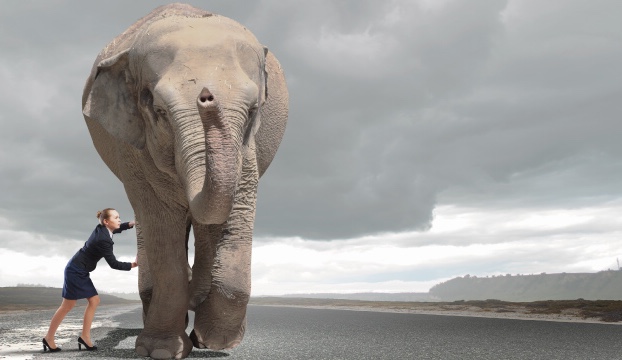
The wisdom for this day comes from Hannibal of Carthage: “We will either find a way or make one.” It was a Latin proverb, most commonly attributed to Hannibal in response to his generals who had declared it impossible to cross the Alps with elephants.
We need this wisdom for today because for the past two years, racism and other divisions have been promoted by the extremist in the White House and his enablers in the Congress. In general, Congressional leaders are creating policies that enforce systemic poverty. Plain and simple!
The truth is that this country has a long and tragic history of classicism, sexism, misogyny, and violence against women. And those who participate in oppression against women are often on the same side as racism, homophobia, xenophobia, and fascism.
This is not the way a nation and government should be moving, and the masses have said it will not be tolerated. They have looked squarely at the injustices and have determined to “find a way or make one.” They cannot be deterred or thwarted. They will persist as they have always done. “A change is gonna’ come,” sisters!
What are the signs?
Sign number 1: a record number women were elected to seats in the House of Representatives, many of them flipping districts from red to blue. This nation elected the first Native American and Muslim women to Congress, and the first openly bisexual woman to the Senate. South Dakota elected its first female governor. North Carolina elected another African American woman to the state supreme court.
Sign number 2: the powers that be fear women who persist. As Rev. William Barber points out, they are afraid of women like Rosa Parks. They cower in the presence of women like Rev. Dr. Liz Theoharis of the Poor People’s Campaign’s who has fought to tear down systemic poverty and oppression. They are terrified of women like Women’s March national co-chairs ― Carmen Perez, Linda Sarsour and Tamika Mallory ― who are bringing women together across every race, creed, color, religion, sexuality, and class. They fear women like Sister Simone who fights for affordable health care or like Lucy Parsons who fought for labor rights and living wages.
They’re afraid we’ll march, or vote, or advocate, or speak the truth, or run for office, or persist. But “a change is gonna’ come,” sisters! It won’t be easy. It won’t happen overnight. But if any people can find a way to cross the Alps with elephants, sisters standing together in solidarity can do it! Women have shown that they will “either find a way or make one!”
But there is one caveat: stick together! Forget about infighting.
Yes, There may be realities of real conflict that need to be addressed head on. No social justice movement is without conflict, and disagreements around the Women’s March were there from the start: Should the march include anti-abortion women? Were the needs of women of color overshadowed by the priorities of white women? What about transgender women? Is it true that accusations of anti-semitism hang over the march?
Let us pray that women and those who support women will find ways to mitigate these concerns and show up on Saturday ready to march. After all, we made history together. That was our stellar beginning. Remember?
It started just days after the fateful 2016 election. A small group of women who feared the Trump presidency joined together at a New York restaurant to plan a demonstration. What resulted from that meeting was the largest single-day protest in U.S history, the Women’s March, which took place in about 600 American cities and towns and on every continent in the world. And that march was a part of what inspired a record number of women to run for office and win. Elephants or not, we “will either find a way or make one!”
So let us march on Saturday and if we cannot march, send positive energy in solidarity with those who do march. Be encouraged. Be encouraged by the words of Dr. William J. Barber:
As you march this weekend and as you step into the new year, I urge you to keep fighting. Do not relax until poverty is eradicated, until every American receives a living wage for their work, until racism, bigotry, homophobia, xenophobia, and misogyny are words of the past. Continue to register your friends and family and neighbors to vote. Continue to run for office. Continue to march, protest, and make your voices heard.
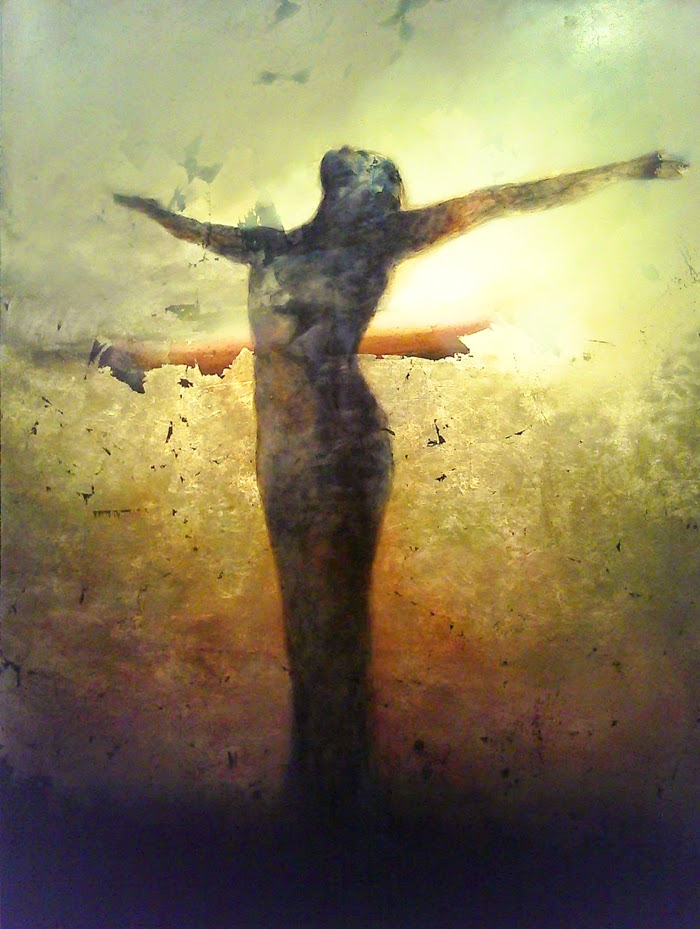
“I have perfect attendance pins for Sunday School going back thirty years, and until last week, I never knew that the Bible told the story of someone who had been raped.”
I have heard similar comments many times when preaching from my book about Biblical women, “Voices of Our Sisters.” The truth is that Scriptural passages like those described by Phillis Trible in “Texts of Terror” are not your Mama’s Bible stories. We don’t teach them in our classes and we definitely do not preach on them in church. The stories of violence against women in the Bible are as hushed as the stories of abused women today. Shame on us.
It was one year ago that The New York Times published an investigative article about how Harvey Weinstein had for decades paid off acusers of sexual harassment.
“Culturally, the article hit like a meteor,” writes Maya Salam in The New York Times Gender Letter, “drastically altering the landscape around how sexual misconduct is perceived, sending the #MeToo hashtag viral and, in turn, triggering an avalanche of accusations against powerful men. It wasn’t long before #MeToo wasn’t just a turn of phrase — it was a movement.”
RAINN*, the country’s largest anti-sexual assault network, experienced a 30 percent increase in calls to the National Sexual Assault Hotline since the current #MeToo resurgence, and last Friday — the day after Christine Blasey Ford and Judge Brett Kavanaugh testified before the Senate Judiciary Committee — was the busiest day in the hotline’s 24-year history.
The women of this nation will not forget Dr. Christine Blasey Ford. Women who have been harmed by sexual violence will revere her for her courage. Because our courage, survivors all, has often been small and our fear very large. We know that people will not believe our stories of abuse, and that instead they will blame us for bringing our terrible stories to light.
We will not forget Dr. Christine Blasey Ford, and we will remember Tarana Burke who first spoke #MeToo in 2007 to let young women of color who survive sexual assault know that they are not alone.
We will remember Alyssa Milano and her Tweet that reached dozens of countries and millions of people — over 1.7 million tweets included the hashtag “#MeToo,” and 85 countries had at least 1,000 #MeToo tweets.
So we join hands with those who understand us, hold on tightly, and speak our truth, because we need to move from darkness to light.
And in the light we will stand, hearts and spirits lighter because we have spoken our terror aloud.
In the light we will stand, even though staying in silence’s darkness would be easier.
In the light we will stand, even as the people around us cling stubbornly to their darkness that screams out to us, “We will not hear you!”
In the light we will stand because that’s the only way to survive.
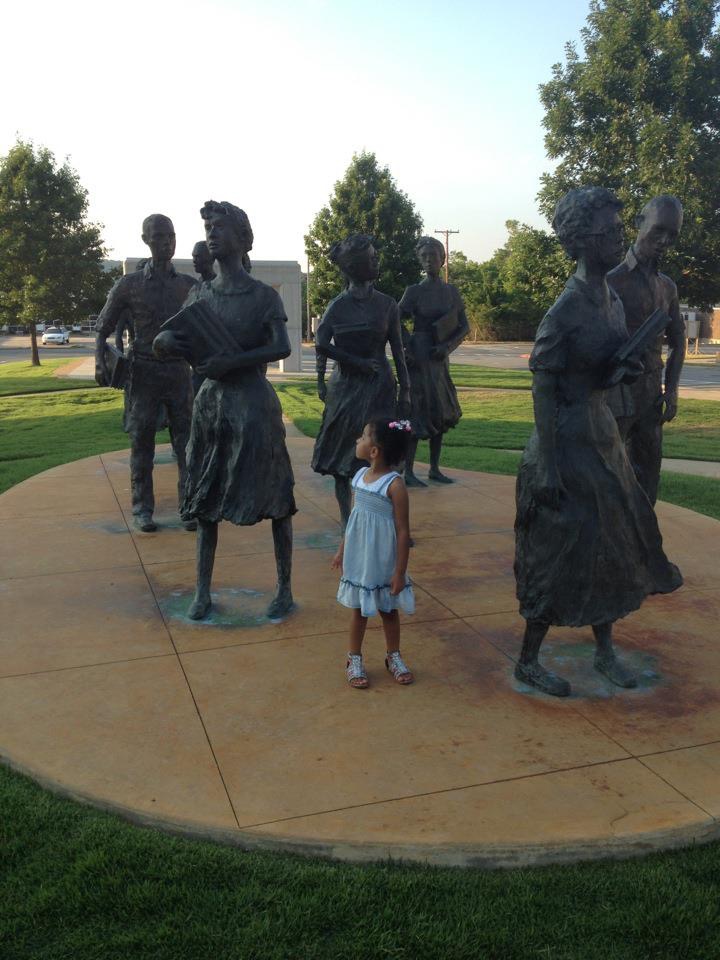
June 16, 2012 . . . My three-year-old granddaughter standing among the bronze sculptures of The Little Rock Nine.
Her parents had told her the poignant story of The Little Rock Nine, but at age three she had no idea of the many ways their lives would impact hers. Because they crossed an invisible, but very real, line that divided black children from white children, they opened the door to educational equality in a racially divided state. Because their parents were brave enough to let their children breach the three stately doors of Little Rock Central High School, their world changed in unimaginable ways. And with that change, my granddaughter inherited the highly cherished right to equal education and all the opportunities that would follow. Because of that change, my granddaughter would grow up inspired.
In case you do not know about The Little Rock Nine, here is some background.
On September 3, 1957, nine African American students — The Little Rock Nine — arrived to enter Little Rock Central High School only to be turned away by the Arkansas National Guard. Governor Orval Faubus had called out the Arkansas National Guard the night before to, as he put it, “maintain and restore order…” The soldiers barred the African American students from entering.
On September 24, 1957, President Dwight D. Eisenhower ordered units of the U.S. Army’s 101st Airborne Division — the “Screaming Eagles”— into Little Rock and federalized the Arkansas National Guard. In a televised speech delivered to the nation, President Eisenhower stated, “Mob rule cannot be allowed to override the decisions of the courts.”
On September 25, 1957, under federal troop escort, The Little Rock Nine made it inside for their first full day of school. The 101st Airborne left in October and the federalized Arkansas National Guard troops remained throughout the year.
They were nine solemn figures, nine teenagers just trying to do what every child up to age 18 had been mandated to do: go to school. Nine figures who entered the annals of American history the day they passed through the front door of Little Rock Central High School.
These nine African American students — Melba Pattillo, Elizabeth Eckford, Ernest Green, Gloria Ray, Carlotta Walls, Terrence Roberts, Jefferson Thomas, Minnijean Brown and Thelma Mothershed — are now immortalized in a striking memorial located on the grounds of the Arkansas State Capitol in Little Rock. The life-size bronze statues, entitled “Testament,” were designed and sculpted by Little Rock artist John Deering, assisted by his wife Kathy, also an artist. A comment from each of The Nine is found on individual bronze plaques identifying each student. Across the street sits the State Department of Education, just a few hundred yards from “Testament.” This Arkansas State Agency has been embroiled in this same desegregation lawsuit for over 50 years.
Nine young students walked bravely, defiantly, yet filled with fear, in an act against prejudice and ignorance. These nine are heroes of every grueling story of segregation and racism in American history, every story we have heard and the millions of stories we will never hear.
So I am deeply moved by these photos of my granddaughter because there is deep meaning in each one. She seems to be looking up at the sculpture of Melba Pattillo (Beals) with what seems like admiration and awe. Dr. Beals grew up surrounded by family members who knew the importance of education. Her mother, Lois, was one of the first African Americans to graduate from the University of Arkansas in 1954. While attending all-black Horace Mann High School, Melba knew that her educational opportunities were not equal to her white counterparts at Central High. And so she became a part of the effort to integrate Central.
And my granddaughter stands in front of Little Rock Central High, a school she may choose to attend someday, a school she will be able to attend because The Little Rock Nine took a dangerous risk to make it possible.
Finally, my granddaughter stands playfully on the steps of the Arkansas State Capitol. I know that it is possible that she may one day proudly walk through its golden doors as a state senator or representative. That is possible because nine Little Rock students were brave enough to be a part of changing history.
At three years old, my granddaughter probably was not very inspired by Central High School, the Little Rock Nine Memorial, or the Arkansas Capitol. But her parents took her there to see and to learn so that she would grow up inspired. When she is older she will remember what she saw and what she learned from that seemingly insignificant sightseeing trip, and she will realize that it wasn’t insignificant at all. It may just be what motivates and inspires her to follow her dreams, because now she knows that all of her dreams are possible. It’s all about growing up inspired. It’s what we want for every child.
Dr. Melba Pattillo Beals, Minniejean Brown Trickey, Elizabeth Eckford, Dr. Carlotta Walls LaNier, Mrs. Thelma Mothershed Wair, Dr. Ernest Green, Gloria Ray Karlmark, Dr. Jefferson Thomas, Dr. Terrence J. Roberts, you made sure that every child can grow up inspired. when you were just young teenagers. When you walked through the doors of segregated Little Rock Central High School, you did so much more . . . for every student who came after you and for my granddaughter
Because of the recent opening of The National Memorial for Peace and Justice in Montgomery, Alabama, I have been contemplating the terror of lynching in our history. The Montgomery site is the nation’s first memorial dedicated to the legacy of enslaved black people, people terrorized by lynching, African Americans humiliated by racial segregation and Jim Crow, and people of color burdened with police violence.
“Set on a six-acre site, the memorial uses sculpture, art, and design to contextualize racial terror. The site includes a memorial square with 800 six-foot monuments to symbolize thousands of racial terror lynching victims in the United States and the counties and states where this terrorism took place.” (eji.org)
But racial injustice is not merely art used to contextualize racism and violence. We also have the cold, hard facts. For instance, The Tuskegee Institute reports that 4,743 people were lynched between 1882 and 1968, including 3,446 African Americans and 1,297 whites, mostly white individuals who tried to help their African American neighbors.
Who were the prophets among us who proclaimed in those days a Christian Gospel of justice?
The NAACP reports that today African Americans are incarcerated at more than 5 times the rate of white people.
Who are the prophets among us in these days? Who is calling for justice, for liberation and freedom for those who are oppressed?
Across a range of human rights issues in 2017, the United States moved backward on human rights issues. The current U.S. president has targeted refugees and immigrants, calling them criminals and security threats. He has emboldened racism by promoting white nationalism. He consistently champions anti-Muslim ideas. His administration has embraced policies that will roll back access to reproductive health care for women and has created health insurance changes that would leave many Americans without access to affordable health care. He has undermined police accountability for abuse. He has expressed disdain for independent media and for federal courts that have blocked some of his actions.
The individuals most likely to suffer abuse in our nation include members of racial and ethnic minorities, immigrants, children, the poor, prisoners and other vulnerable groups, who endure renewed attacks on their rights. Issues of injustice include gender equity, poverty, the right to health care, immigration and the rights of non-citizens, sexual orientation and gender identity, criminal and juvenile justice, harsh criminal sentencing and mass incarceration,.
Where is justice today? Who will call each injustice by name? Where is the prophetic voice among us that will proclaim liberation?
While in seminary, I immersed myself in the study of liberation theologies. Not surprisingly, my research led me to the writings of black liberation theologian, The Rev. Dr. James H. Cone. I became what some might call a follower of Dr. Cone. I saw him as a Christ-like superhero. Much of my research and writing in those days delved into the history of liberation theology, so Dr. Cone’s books covered my desk for months.
On Saturday, I learned of his death and experienced both sadness and gladness. Glad, because of his enormous contribution to Christian theology’s imperative response to injustice. And sad, because his voice of justice is now silent. By his death, we lost a prophet, a persevering voice that championed racial justice. We lost a voice that gave the world an interpretation of the Christian Gospel that paid attention to the voices of the oppressed.
YES! “A prophet was among us.”
These words from Judge Wendell Griffen honored the prophet, Rev. Dr. James H. Cone, and named him as the central figure in the development of black liberation theology in the 1960s and ’70s.
The prophet and scholar was raised in a small Arkansas town, giving him a clear view of the harsh reality of racial injustice. Dr. Cone rose up from his simple roots to become the foremost voice of his day on black liberation theology.
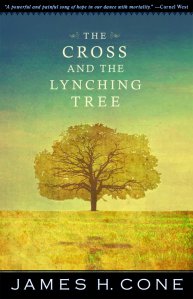
Google it.
“Black liberation theology”
The first image you will see is that of James H. Cone. And then you will see image after image of him as well as a list of the plethora of books he has written and a list of the places around the world where he taught and preached.
What is my point?
First of all, I want to add my voice to those who are honoring this prophet of justice. But more importantly, I want to own and name the present reality: that there has never been a time in history that needs the message of liberation more than this day. To be sure, the horrific lynchings of African Americans in this country took place many years ago, between 1882 and 1968.
And this is a new day, is it not?
It is a new day, a new day that has moved our society to the national shame of mass incarceration of African Americans. Consider this research:
By the age of 14, approximately 25 percent of African American children have experienced a parent — in most cases a father — being imprisoned for some period of time.
On any given school day, approximately 10 percent of African American schoolchildren have a parent who is in jail or prison, more than four times the share in 1980.
The comparable share for white children is 4 percent; an African American child is six times as likely as a white child to have or have had an incarcerated parent.
In 2014, African Americans constituted 2.3 million, or 34%, of the total 6.8 million correctional population.
The imprisonment rate for African American women is twice that of white women.
Nationwide, African American children represent 32% of children who are arrested, 42% of children who are detained, and 52% of children whose cases are judicially waived to criminal court.
TMI . . . Too much information, right? Perhaps it is too much information, but the amount of information here barely scratches the surface of the many ways injustice has gripped our nation in these days. We can turn our backs, stop up our ears, and blind our eyes to it, but that will not change the fact that people are being oppressed, injustice is doing its horrific work, and liberation seems a distant, unreachable dream.
The people of God must bethe people of God and accept the mantle placed by God on our shoulders — being a prophetic voice in a land where injustice has its way.
The spirit of the Lord God is upon me,
because the Lord has anointed me;
he has sent me to bring good news to the oppressed,
to bind up the brokenhearted,
to proclaim liberty to the captives,
and release to the prisoners;
to proclaim the year of the Lord’s favor,
and the day of vengeance of our God;
to comfort all who mourn;
to provide for those who mourn in Zion—
to give them a garland instead of ashes,
the oil of gladness instead of mourning,
the mantle of praise instead of a faint spirit. (Isaiah 61:1-3 NRSV)
But let justice roll down like waters,
and righteousness like an ever-flowing stream. (Amos 6:24 NRSV)
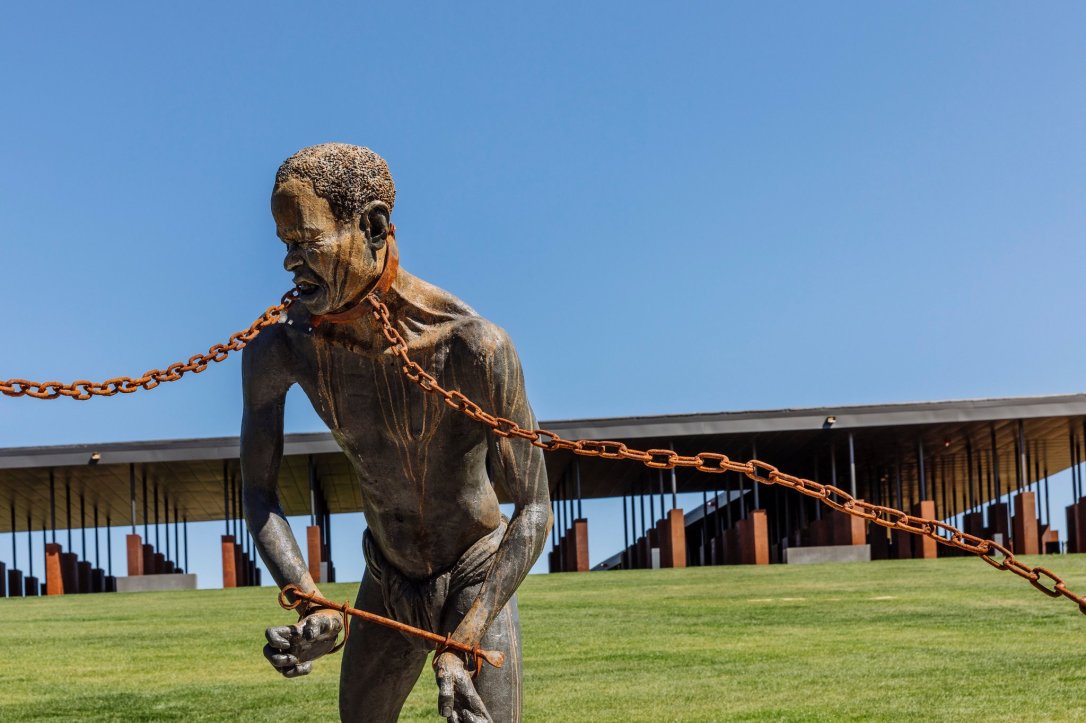
The memorial is inspired by the Holocaust Memorial in Berlin and the Apartheid Museum in Johannesburg. Photography: Audra Melton for The New York Times
Nothing casts as long and shameful a shadow on our history than does lynching. Lynching is a part of America’s history that we want to ignore. As a people, we cringe at the thought of it, yet do not often allow ourselves to think of it. We do not own lynching. It happened in another time in history, with decades separating us from its shame. We secretly hope that if we do not talk about it, we can move forward without acknowleding the depth of its impact. And above all, we cannot admit that such violence is still possible in this day.
The National Memorial for Peace and Justice is a living reminder for us. The Memorial, which opened today on a six-acre site overlooking the Alabama State Capitol, is dedicated to the victims of American white supremacy. It demands a reckoning with one of the nation’s least recognized atrocities: the lynching of thousands of black people in a decades-long campaign of racist terror.
At the center of the Memorial is a grim cloister, a walkway with 800 weathered steel columns, all hanging from a roof. Etched on each column is the name of an American county and the people who were lynched there, most listed by name, many simply as “unknown.” The columns meet you first at eye level, like the headstones that lynching victims were rarely given. But as you walk, the floor steadily descends; by the end, the columns are all dangling above, leaving you in the position of the callous spectators in old photographs of public lynchings.
Bryan Stevenson and a small group of lawyers spent years immersing themselves in archives and county libraries to document thousands of lynchings. Photography: Audra Melton for The New York Times
The magnitude of the killing is harrowing, all the more so when paired with the circumstances of individual lynchings, some described in brief summaries along the walk:
Parks Banks, lynched in Mississippi in 1922 for carrying a photograph of a white woman;
Caleb Gadly, hanged in Kentucky in 1894 for “walking behind the wife of his white employer”;
Mary Turner, who after denouncing her husband’s lynching by a rampaging white mob, was hung upside down, burned and then sliced open so that her unborn child fell to the ground.
A 2017 sculpture by Titus Kaphar, “Doubt,” sat amid accounts of slaves and former slaves at the museum. Photography: Audra Melton for The New York Times
A grassy hill rises in the middle of the memorial. From there you can see the Montgomery skyline through the thicket of hanging columns, the river where the enslaved were sold, and the State Capitol building that once housed the Confederacy. It is a striking view.
The striking exhibits and sculptures in this Memorial exist to remind us, to challenge us, to create in us a determination to always fight injustice.
Jars Hundreds of jars of soil from the sites of documented lynchings, collected by families of victims or community volunteers, are on display at the museum. Photography: Audra Melton for The New York Times
May we more deeply understand our tragically unjust and violent history. May we vow to make peace and demand justice. May we never forget what happened in this nation so that it will never happen again. It is very real that our history of lynching innocent people casts a long and dark shadow upon our existence. May we intentionally work for justice so that we will no longer live in that shadow.
This blog post is words, just words. But our words are not enough. Our declarations are empty and meaningless if we do not also immerse ourselves in the hard and grueling work that makes for justice. God does not care about our words and promises. God does not accept our carefully planned events — filled with flags and crowds and songs — held in American cities and counties and town squares to commemorate our history. God demands pure and genuine righteousness that vows to do whatever it takes to create justice in our nation and in the world.
May God lead us in making it so. May God help us to step out of lynching’s long shadow and walk in the light of justice and righteousness.
Take away from me the noise of your songs;
I will not listen to the melody of your harps.
But let justice roll down like waters,
and righteousness like an ever-flowing stream.
On Resurrection Sunday, I cry joy-tears — every time, without fail. For me, holding on to my emotions on Resurrection Sunday is impossible. After going through Lent, after hearing again of the betrayal Jesus experienced, after witnessing the suffering and execution of Christ, after acknowledging anew that Christ’s sacrifice was for the whole world and for me, I celebrate Christ’s resurrection. And when I do, I just cry.
But on Resurrection Sunday 2018, I wept with a heavy heart and a flood of memories. I thought of Easters past and the people of God with whom I celebrated. All of those precious friends now live miles away, others live in heaven. I was their pastor, and that is as holy a relationship as I can describe.
I walked with them through joy and tragedy, through days of health and days of illness, through crushing family problems, through death and divorce. But through every devastation, we celebrated Resurrection Sundays in our beautiful monastery chapel, in our little country church in small town Arkansas, at an altar on a lakeside, in the baptismal waters. We celebrated our covenant, our deep friendship, and gave thanks for the grace that gifted us with those relationships.
We were a fun and creative group. With some of them, I cut and stitched and glued and appliqued huge banners proclaiming, “Christ Is Risen!” With others, I burned palm branches for Ash Wednesday. With others, I lifted up the wooden cross onto thevaltar of the church sanctuary. And with others, I wandered through the woods searching for dogwood blossoms to adorn the wooden cross. I most fondly remember a circuitous and hilarious trek through the forest with Ethel.
Ethel was a true jewel, one of a kind. Never would you find a more loyal and loving parishioner than Ethel, who will always be known as the persevering founder of our church. She refused to let it fail. She was persistent and feisty and determined. And because of her, the church still stands firm, even now that she is gone.
But getting back to our trek in the forest, I have to say that Ethel was one of those unstoppable “elderly” people. She could barely walk at times because she suffered with a muscle disease that weakened her legs. But she pushed her way through the forest that day, leading me, pushing aside the limbs, vines and thorns, and dauntlessly creating our path over rocks and depressions in the ground. We were looking for a thorn tree . . . you guessed it . . . to use in making a crown of thorns.
Eventually we found a perfect thorn vine with angry-looking three-inch thorns on it. We carefully hauled it through the woods, trying to avoid getting stabbed by one of those sharp thorns. Then we put it in a bathtub full of water to soften it. When we began to bend it into a crown shape, we both sustained painful thorn wounds. Never to be deterred, Ethel managed to shape and finally fasten the two ends together, and the prickly vine became the crown of thorns that we used for many years.
When we placed it for the first time on the Good Friday cross during the church service, I wept. Many of us wept. We were like that because we remembered the words of the prophet Isaiah.
He is despised and rejected by men,
A Man of sorrows and acquainted with grief.
And we hid, as it were, our faces from Him;
He was despised, and we did not esteem Him.
Surely He has borne our griefs
And carried our sorrows;
Yet we esteemed Him stricken,
Smitten by God, and afflicted.
But He was wounded for our transgressions,
He was bruised for our iniquities;
The chastisement for our peace was upon Him,
And by His stripes we are healed.
All we like sheep have gone astray;
We have turned, every one, to his own way;
And the Lord has laid on Him the iniquity of us all.
He was oppressed and He was afflicted,
Yet He opened not His mouth . . .
— Isaiah 53:3-7, KJV
We knew that after the suffering, the resurrection would most surely come. Through the passion and emotion of Good Friday, we wept. But we wept even more when the stark cross flowered on Easter morning, when we lit the Christ candle, when the black shroud was removed, and when we draped the cross in glistening white cloth.
So on Resurrection Sunday 2018, while singing “Christ the Lord Is Risen Today,”I wept with tears of gratitude, gratitude for the people of God through the years who made my Easters such sacred experiences of worship.
Ethel, Barbara, Johnnie, April, Bo, Michael, Stan, Dianna, Eric and Emily, Ann, Sister Bernadette, Gail, Noah, Wendell, Pat, Joyce, Suzette, Deborah, Cindy, Barbara Fay, Regina, Tonya, Vallory, Leroy, Mary, LaVante, Shirley, Ken, Steve, Jenna . . .
So many names! So many others. My memories of them brought me to tears on Easter Sunday. I saw them in my mind and remembered our shared times of worship. They are Resurrection people all, people who know how to proclaim Christ’s resurrection with passion, devotion and celebration. For all of them, today I give thanks.
I invite you to read “Out of Africa: White supremacy and the Church’s silence,” a provocative opinion piece by our guest blogger, Dr. Bill J. Leonard. Many thanks to Dr. Leonard for prompting us to more fully commemorate the day honoring Dr. Martin Luther King, Jr. If you are willing to challenge yourself, these words will shed the light you need to do so.
Out of Africa: White supremacy and the Church’s silence
Dr. Bill J. Leonard
OPINION | BILL LEONARD | JANUARY 15, 2018
“Give me your tired, your poor, your huddled [Caucasian?] masses, yearning to breathe free.”
Three days before the 2018 Martin Luther King Jr. memorial observances, and in the 50th year after Dr. King’s assassination, the plague of racism in America continued, even as white supremacy, long lingering just below the surface, reasserted itself with a vengeance.
On Jan. 12, the president of the United States, at a White House meeting on immigration, allegedly asked why “all these people from shithole countries,” specifically Haiti and Africa, should be admitted to the U.S. He was also said to have wondered aloud why the U.S. could not secure more immigrants from countries like Norway (83 percent Caucasian). Confirmation of his remarks vary from those in attendance. Some confirm the alleged statements; others deny them. Somebody’s lying.
The mere report of the comments was immediately celebrated across the country’s white supremacist network, much as when Trump affirmed “good people on both sides” in last year’s violent neo-Nazi-led demonstrations in Charlottesville, Va. White nationalist Richard Spencer chastised Trump’s defenders for suggesting the statements were related to law or economics, since they were actually “all about race.” Spencer was, of course, delighted. The Neo-Nazi blog, the Daily Stormer, hailed the President’s words as “encouraging and refreshing” since they indicated that “Trump is more or less on the same page as us” regarding “race and immigration.” In America, 2018, white supremacy is now apparently “refreshing.”
Dallas Baptist pastor Robert Jeffress defended the president, noting that “apart from the vocabulary attributed to him,” Trump’s comments were “right on target” with his presidential responsibility “to place the interests of our nation above the needs of other countries.” That’s unlike Christians’ “biblical responsibility” to “place the needs of others” above themselves. (Racism’s OK; it’s vulgar language that’s the problem.)
Amid debates over the veracity of witnesses to the White House event, the fact remains that the dogmas of white supremacy lie at the center of America’s long night of racism, in politics, social structures, and racial stereotypes. At this moment in history, how can American Christians, themselves deeply divided over scripture, doctrine, sexuality, abortion, and other culture war accoutrements, foster a common compulsion to speak out against white supremacist fiction before it gains an even stronger implicit or explicit influence?
Even if President Trump did not use vulgar words to highlight his views on immigration, did he in fact wistfully promote a 21st century America where Aryans (remember the history of that word?) are preferred to immigrants of color? Surely it is time to break the silence, not simply because of those shameful remarks, but because they are part of a larger litany of racial dog whistles from Trump’s birther campaign, to attacks on a “Mexican” judge and a Gold Star Muslim family, to the infamous Charlottesville slurs.
We have many reasons to break the silence: First, because white supremacy itself is an inherently evil yet an enduring vision of the nature of humanity, and must be resisted for that fact alone. It has polluted our national psyche long enough!
Second, we break the silence on this matter because we hear again Dr. King’s words from that Birmingham jail: “Shallow understanding from people of good will is more frustrating than absolute misunderstanding from people of ill will. Lukewarm acceptance is much more bewildering than outright rejection.”
Third, we Aryan Christians cannot be silent because it’s our racial ancestors who first planted the banner of racism in our laws, our institutions (churches included), and in our hearts. And some among us still won’t let it go. We need to get “saved” from it.
Fourth, we speak out now because American churches, at least many of them, remained silent for too long. Indeed, Trump’s only a symptom; we scapegoat him at our peril. When his remarks hit the fan, I returned to James Baldwin’s The Fire Next Time, a book that has taught me, shamed me, blessed me, and broken me for decades. Baldwin writes: “It is not too much to say that whoever wishes to become a truly moral human being (and let us not ask whether or not this is possible) must first divorce him[her]self from all the prohibitions, crimes and hypocrisies of the Christian church. If the concept of God has had any validity or any use, it can only be to make us larger, freer, and more loving. If God cannot do this, then it is time we got rid of Him.” (Whatever God is, it damn sure isn’t white supremacy.)
Mercer University professor Robert Nash illustrates Baldwin’s point in a superb essay entitled, “Peculiarly Chosen: Anglo-Saxon Supremacy and Baptist Missions in the South,” documenting that ecclesiastical collusion with the case of James Franklin Love, corresponding secretary of the Foreign Mission Board of the Southern Baptist Convention, 1915-1928. Nash notes that Love “was profoundly influenced by the concept of Anglo-Saxon supremacy … that white races possessed a superior intellect, religion, and civilization.”
Love’s mission strategy focused on evangelization of Europe since white Christians could more readily convert the darker races. He wrote: “Let us not forget that to the white man God gave the instinct and talent to disseminate His ideals among other people and that he did not, to the same degree, give this instinct and talent to the yellow, brown or black race. The white race only has the genius to introduce Christianity into all lands and among all people.” (In 2017, the Southern Baptist Convention went on record condemning white supremacy then and now. It’s about time.)
Finally, we break the silence, confronting white supremacy and its accompanying racism at this moment because we will neither deny nor sully the African heritage of our African-American sisters and brothers, who as W.E.B. Dubois wrote, “would not bleach … [their] Negro soul in a flood of white Americanism,” since they know “that Negro blood has a message for the world.”
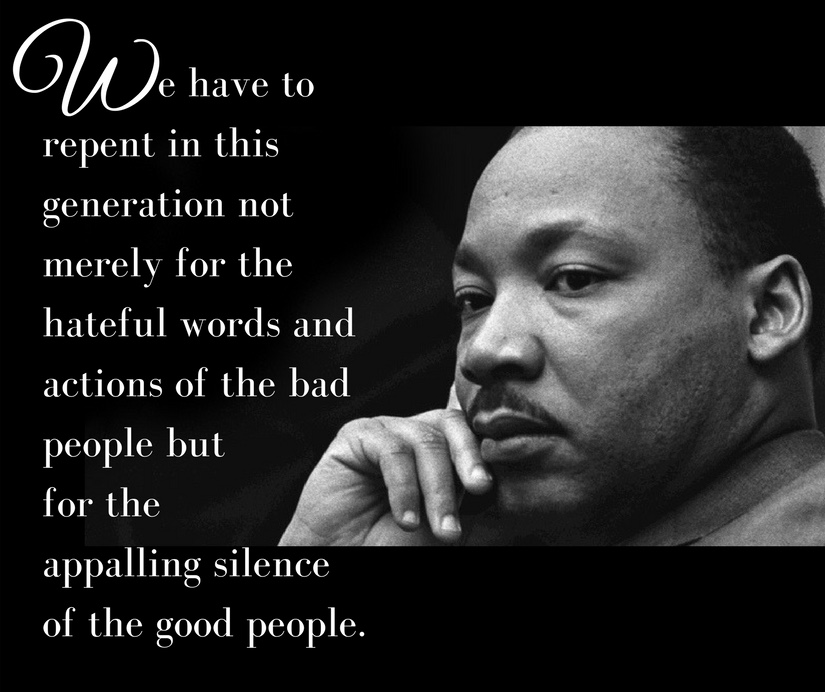
On what would have been his 89th birthday, Dr. King retains his prophetic voice for black and white alike, declaring from his jail cell then and now: “We will have to repent in this generation not merely for the hateful words and actions of the bad people but for the appalling silence of the good people. Human progress never rolls in on wheels of inevitability; it comes through the tireless efforts of men [women] willing to be co-workers with God, and without this hard work, time itself becomes an ally of the forces of social stagnation.”
Today, we read again Matthew’s haunting assessment of the Holy Family’s immigration from Herod’s not-so-holy-land:
“Out of Egypt I have called my son.”
Sweet Jesus, Egypt’s in Africa! Amen”
Bill J. Leonard is the James and Marilyn Dunn Professor of Baptist Studies, Professor of Church History, School of Divinity, Wake Forest University.
Life can seem so ordinary at times. Since being retired, the days seem to run together, one being just like the next. There is no workplace to be every day that can punctuate each day with events. I have discovered, though, that the secret to being happily retired is to find the extraordinary in the ordinary. I like was Steven Charleston says about that.
I look for God when I do the dishes, I search for the Spirit as I take out the trash. The sacred is revealed in brilliant light only rarely, in the flash of some great insight unexpected, but much more than this the holy is to be discovered in our daily lives, in the moments when we are simply being ourselves. Putting the kids to bed, working in the garden, sitting on the porch in the evening: the beauty of eternity is that it hides in plain sight all around us. We are all prophets of the predictable pattern, witnesses to the wonder of the average day.
– Steven Charleston
Finding wonder in the average day is not as easy as it sounds. It requires mindfulness. Mindfulness is the basic human ability to be fully present, aware of where we are and what we’re doing, yet not overly reactive or overwhelmed by what’s going on around us. Mindfulness helps us put some space between ourselves and our reactions, breaking down our conditioned responses. Here are some practical ways to be more mindful:
1) Set aside some time. You don’t need a meditation cushion or bench, or any sort of special equipment to access your mindfulness skills—but you do need to set aside some time and space.
2) Observe the present moment as it is. The aim of mindfulness is not quieting the mind, or attempting to achieve a state of eternal calm. The goal is simple: we’re aiming to pay attention to the present moment, without judgement.
3) Let your judgements roll by. When we notice judgements arise, we can make a mental note of them, and let them pass.
4) Return to observing the present moment as it is. Our minds often get carried away in thought. That’s why mindfulness is the practice of returning, again and again, to the present moment.
5) Be kind to your wandering mind. Don’t judge yourself for whatever thoughts crop up, just practice recognizing when your mind has wandered off, and gently bring it back.
Small blessings are the best! It was 12 midnight and we were tucked in our bed watching “Miss Fisher’s Murder Mysteries.” I had been coughing and, in fact, had taken a dose of my asthma inhaler.
Then Fred mentioned a cup of hot tea. It was just what I needed, Mandarin Orange Tea at midnight, made by a caring husband. Who could ask for a nicer blessing? The tea calmed my soul, and my cough.
I am grateful for a cup of hot tea, for Miss Fisher’s Murder Mysteries, for a nice, warm bed — all small blessings!
Oh, and I’m grateful most of all for an enormous blessing — a husband who will make tea at midnight.
I certainly have days of feeling down, but the truth is that I am blessed with abundance. I am covered with an abundance of love. In early September, my husband and I will celebrate forty-seven years of marriage, a marriage overflowing with love and completely free of discord. My love for my grandchildren is unmatched. And I have the love of a close family who cares for me every day. Friends from all over the world are praying for me. So it’s no exaggeration to say that I am clothed in the love of a wonderful family and a host of friends.
I am also covered with an abundance of peace. My husband and I often marvel at the sheer peacefulness of our home, the quiet neighborhood, the good neighbors we have, the comfortable house we live in.
And I am covered with an abundance of grace, cared for by a faithful God who has continuously poured grace on my life. Day in and day out, in good days and in not so good days, God has blessed me with more grace than I deserve.
Abundance of love, abundance of peace, abundance of grace. Who could want anything more!
“God is able to bless you abundantly, so that in all things at all times, having all that you need, you will abound in every good work.” — 2 Corinthians 9:8


 Chui has a very personal motivation for the project. When he was eight, he crossed that border with his mother and lived in Los Angeles for a year without legal status. He grew into a renowned artist and envisioned this project, which he dedicated “to all those people who are looking for a better life. Who take enormous risks. Or those have been deported and are separated from their families.”


 As we are praying, gun injuries cause the deaths of 18 children and young adults each day in the U.S. And every day, 100 Americans are killed with guns. Can we ignore the fact that nearly 1 million women alive today have been shot, or shot at, by an intimate partner?
 The wisdom for this day comes from Hannibal of Carthage: “We will either find a way or make one.” It was a Latin proverb, most commonly attributed to Hannibal in response to his generals who had declared it impossible to cross the Alps with elephants.
 “I have perfect attendance pins for Sunday School going back thirty years, and until last week, I never knew that the Bible told the story of someone who had been raped.”
 June 16, 2012 . . . My three-year-old granddaughter standing among the bronze sculptures of The Little Rock Nine.
 And my granddaughter stands in front of Little Rock Central High, a school she may choose to attend someday, a school she will be able to attend because The Little Rock Nine took a dangerous risk to make it possible.
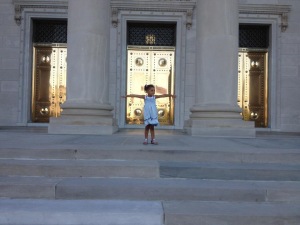 Finally, my granddaughter stands playfully on the steps of the Arkansas State Capitol. I know that it is possible that she may one day proudly walk through its golden doors as a state senator or representative. That is possible because nine Little Rock students were brave enough to be a part of changing history.
 Because of the recent opening of The National Memorial for Peace and Justice in Montgomery, Alabama, I have been contemplating the terror of lynching in our history. The Montgomery site is the nation’s first memorial dedicated to the legacy of enslaved black people, people terrorized by lynching, African Americans humiliated by racial segregation and Jim Crow, and people of color burdened with police violence.
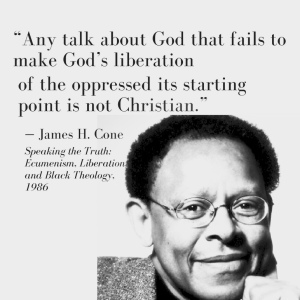 While in seminary, I immersed myself in the study of liberation theologies. Not surprisingly, my research led me to the writings of black liberation theologian, The Rev. Dr. James H. Cone. I became what some might call a follower of Dr. Cone. I saw him as a Christ-like superhero. Much of my research and writing in those days delved into the history of liberation theology, so Dr. Cone’s books covered my desk for months.
 Google it.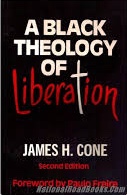



 On Resurrection Sunday, I cry joy-tears — every time, without fail. For me, holding on to my emotions on Resurrection Sunday is impossible. After going through Lent, after hearing again of the betrayal Jesus experienced, after witnessing the suffering and execution of Christ, after acknowledging anew that Christ’s sacrifice was for the whole world and for me, I celebrate Christ’s resurrection. And when I do, I just cry.
 I invite you to read “Out of Africa: White supremacy and the Church’s silence,” a provocative opinion piece by our guest blogger, Dr. Bill J. Leonard. Many thanks to Dr. Leonard for prompting us to more fully commemorate the day honoring Dr. Martin Luther King, Jr. If you are willing to challenge yourself, these words will shed the light you need to do so.


 God of the Sparrow 🌱 By Kathy Manis Findley