
Category: Uncategorized
World Kidney Day and . . . My Four Month Transplant Anniversary
March 12th is World Kidney Day.
World Kidney Day is observed every year. All across the globe many hundreds of events take place from public screenings in Argentina to Zumba marathons in Malaysia. But for me, the day means something personal and very real. March 12 will be exactly four months since I had my kidney transplant at Mayo Clinic in Jacksonville, Florida. Five years on dialysis presented its own challenges. But these past four months post transplant have been grueling, challenging and confining. In fact, for various reasons including bouts of infection, I am still quarantined at home. I deal every day with the harsh reality that powerful immunosuppressant medications have decimated my immune system to the point that getting out among people is not possible, for now. On top of that, the side effects of my drugs are harrowing at times. There are so many things I love to do are now very difficult, if not impossible. I knew, of course, that a transplant is not a cure. It is just a treatment, the best treatment available. All of the post transplant realities have been bewildering and unsettling. I sometimes describe post transplant reality as the disarrangement of my way of life.
At the same time, I celebrate the miracle of the living gift I have received. I am deeply grateful and humbled by the living donor who contacted me months ago to offer his kidney — my long-time friend Greg Adams of Little Rock, Arkansas. After almost two years of testing at hospitals in Atlanta and Jacksonville, Florida, Greg was approved to donate. He was not a match for me, so the matching began. I was eventually gifted with a kidney that traveled to me from Mayo Clinic in Rochester, Minnesota, from a kind and lovely woman — Corita. Greg gave his kidney to Autry at Mayo Clinic in Jacksonville, Florida.
But that was only the beginning of the miracle. Greg’s willingness to donate his kidney to someone he did not know created a chain of eight donors and eight recipients. His altruistic donation enabled eight patients to receive new kidneys and new lives.
For all of this, I say: Thanks be to God, the Giver of Life.
 It is a difficult prospect to ask someone to consider donating a kidney. I can not forget that they experience the pain of surgery and recovery, as well as feeling the loss of losing a vital organ. So when someone like Greg appears out of the blue and offers his kidney, I can only respond with heartfelt gratefulness and deep humility. Because it is so difficult for most everyone to ask another person to donate, the National Kidney Foundation offers this word of encouragement: A CONVERSATION CAN SAVE A LIFE!
Whether you need a kidney or are considering donation, I encourage you to start the conversation, first with a trusted friend or family member. Get comfortable with the idea of asking someone for a kidney. Begin “the conversation” with anyone that might consider donating. For thise of you who might consider donation, again start the conversation with someone you trust. Then visit some of the websites below to learn all you can. Start the conversation because all of us want kidney health for every person.
Understanding Living Donation
Relatives, loved ones, friends and even individuals who wish to remain anonymous often serve as living donors to spare a patient a long and uncertain wait. In 2019, more than 7,300 transplants were made possible by living donors. If you are considering living donation, it is critical to gather as much information as you can from various sources. Start here for living donor information: https://unos.org/transplant/living-donation/
So celebrating March 12 — World Kidney Day and my own kidney transplant anniversary — is a way to create awareness. Awareness must be about preventive behaviors, about risk factors, about how to live with kidney disease and awareness of the possibility of becoming a living donor. Consider these alarming statements:
-
- 15% of US adults—37 million people—are estimated to have Chronic Kidney Disease (CKD).
-
- Most (9 in 10) adults with CKD do not know they have it.
-
- In 2016, nearly 125,000 people in the United States started treatment for End Stage Kidney Disease (ESKD), and more than 726,000 (2 in every 1,000 people) were on dialysis or were living with a kidney transplant.
-
- Over 3,000 new patients are added to the kidney waiting list each month.
-
- Every 14 minutes someone is added to the kidney transplant list.13 people die each day while waiting for a life-saving kidney transplant.
-
- In 2014, 4,761 patients died while waiting for a kidney transplant. Another, 3,668 people became too sick to receive a kidney transplant.
-
- There are currently 121,678 people waiting for lifesaving organ transplants in the U.S. Of these, 100,791 await kidney transplants.
-
- The median wait time for an individual’s first kidney transplant is 3.6 years and can vary depending on health, compatibility and availability of organs.
-
- Every day, more than 240 people on dialysis die.
-
- In 2014, 17,107 kidney transplants took place in the US. Of these, 11,570 came from deceased donors and 5,537 came from living donors.
 We don’t want to know this part, but here it is anyway:
— About 1,400 children began care for kidney failure in 2013.
— The number of children with kidney failure is increasing every year.
— About 9,900 children were being treated for kidney failure as of December 31, 2013.
— The most common initial treatment for kidney failure among children overall is hemodialysis (56%).
— Peritoneal dialysis is the most common initial treatment in children younger than 9 years and for those who weigh less than 44 pounds (20 kg).
— There were over 1000 children waiting for a kidney transplant as of November 27, 2015.
— The number of children receiving kidney transplants was highest in 2005 at 899.
— About 700 children received a kidney transplant in 2014.
— About 70% of children with kidney disease will develop kidney failure by age 20.
— Children with kidney disease have a greater chance of dying than children in the general population.
The organ shortage continues . . .
 Each year, the number of people on the waiting list continues to be much larger than both the number of donors and transplants. Perhaps we can make a difference by supporting persons on dialysis, persons who are making the decision about dialysis, persons who are recovering from a transplant and persons who are considering donating a kidney. Perhaps we could start conversations.
Still, there is good news:
Yes, there is good news in 2019 statistical information for persons who have suffered with kidney disease for years, maybe even their entire lives. I do not exaggerate when I say that thousands of persons languishing on dialysis really need good news!

I can definitely celebrate these statistics. But I will never forget that Jalen, my youngest grandson, was born with kidney disease and went on dialysis. I will never forget the fear and frustration his parents felt. I will never forget the sheer joy we all experienced when his kidney disease resoled itself as his little body grew.
As I celebrate World Kidney Day on the 12th day of March and my day — on the 12th day of November, it is fair to say that my life has changed in ways I know and in ways I do not yet know. Yet, on this day I will think of Greg’s words about donating and receiving: “We are forever connected in a special way — and that’s a good thing.” On this day, I will know that healing for me will continue. I will be propped up by my dearest and closest friends, by my friends all over the world who pray for me, by my loving church family, by my dear caregiver husband and by my family near and far.
I will say again: For all of this, thanks be to God, the Giver of Life.
For more information about kidney disease and about Living Donor programs, please visit these links:
https://www.worldkidneyday.org/facts/chronic-kidney-disease/
https://www.cdc.gov/kidneydisease/publications-resources/2019-national-facts.html
https://www.kidney.org/atoz/content/answering
https://www.organdonor.gov/statistics-stories/statistics.html
https://www.kidney.org/news/newsroom/factsheets/Organ-Donation-and-Transplantation-Stats
https://optn.transplant.hrsa.gov/news/organ-donation-again-sets-record-in-2019/
The Path to Inner Peace, Joy and Freedom
Peace, joy and freedom. All three are needed things, soul things that make us content. They are not easily gained, however, as the daily routine we call life attacks them on a regular basis.
How troubling it is to lose one’s sense of peace. A number of life situations can result in a loss of soul-peace — worry about illness, financial concerns, difficulty with children, caring for aging parents, moving to another home. It would be impossible to complete the list of things that can steal our sense of peace.
 Perhaps we should go one step further, though, and acknowledge that our loss is not merely the loss of peace, it is the loss of peacefulness. That loss can be disconcerting at best and devastating at worse. All of us long for a deep and abiding sense of peacefulness. We sometimes cry out “peace, peace, when there is no peace.” (Jeremiah 6:14)
Joy! At times, it can be hard for us to feel joy. I think it is because we’re not at all sure what joy hidden inside the soul feels like. For joy is not simply happiness over something that has come to us — a new house or car, a life milestone like graduation or a wedding, a celebration of the birth of a child. Such things seem to bring joy, but our actual response to such events is a brief burst of happiness. Genuine joy — soul joy — happens when something inside of us deeply responds to joy and we tuck it away safely in our hearts. And that kind of joy is not a brief response to a happy event, it is an abiding, spiritual state of being that comes with a grace-filled assurance that Christ came to make sure we live our lives ‘more abundantly.” The message from Jesus comes to us using various words:
I have come that you might have life, and have it more abundantly.
(John 10:10, paraphrased)
I came to give life with joy and abundance.
(The VOICE translation)
I have come in order that you might have life—life in all its fullness.
(The Good News Bible)
Living “Life in all its fullness” seems to be the end result of abiding joy, in the soul and in the heart. Even when we listened to the song our children learned to sing, “I’ve got that joy, joy, joy, joy down in my heart,” we somehow knew that true joy was internal not external. That joy resided in our hearts and in our souls.
 Finally freedom — the kind of freedom we have when peace and joy is hidden in the deepest recesses of our being. Freedom does not leave those who practice gratefulness, prayer, meditation and confession. It is at the altar of confession that God offers us assurance of pardon. It’s the opposite of the soul’s bondage. I cannot help but recall the words of the Apostle Paul about the nature of Christian freedom that so boldly introduce the 5th chapter of Galatians:
For freedom Christ has set us free. Stand firm, therefore, and do not submit again to a yoke of bondage. (Galatians 5:1)
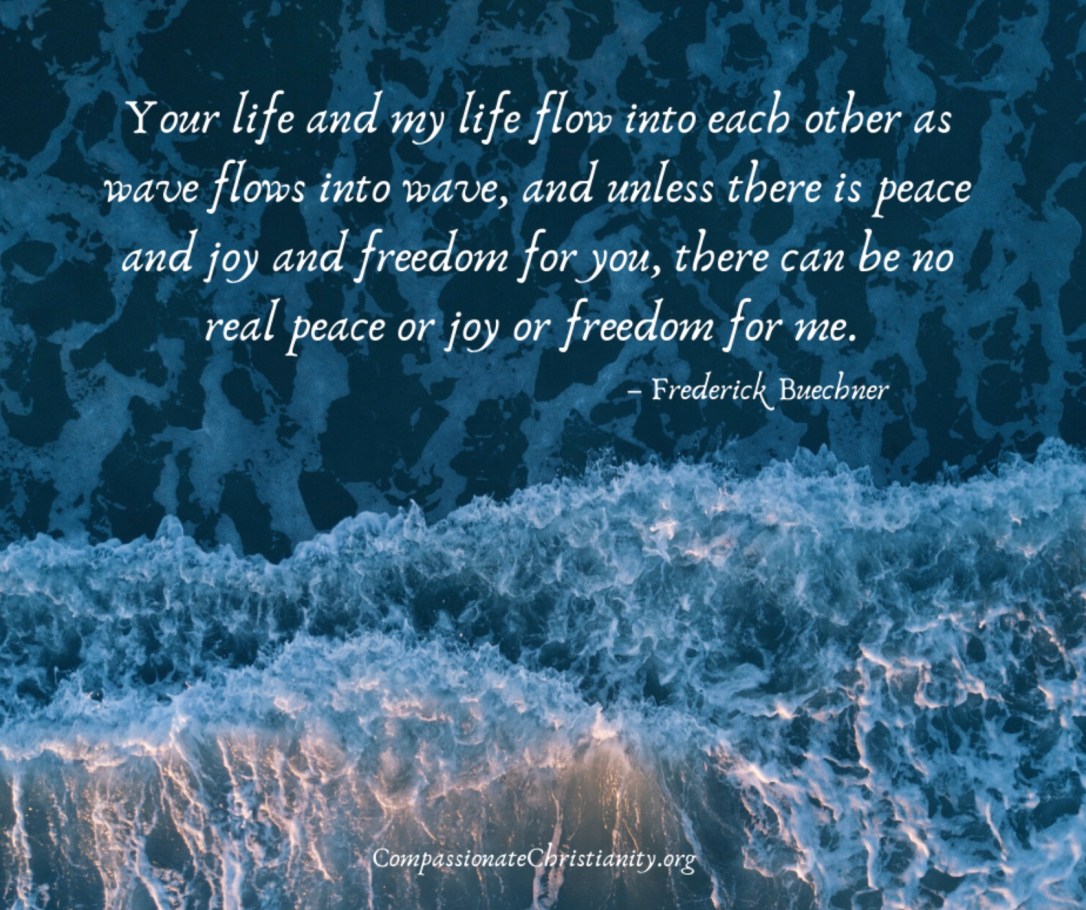
Frederick Buechner added a new dimension to our longing for peace, joy and freedom with this powerful thought:
Unless there is peace and joy and freedom for you,
there can be no real peace or joy or freedom for me.
Therein lies the crux of living the Christian life: an interconnectedness among those who follow Christ, a community of faith in which each one supports the other. It is an interconnectedness that transcends differences of opinion, different ways of practicing faith, disagreements about which hymns are more appropriate in worship or, even more trivial, what kind of light bulbs should we use in the sanctuary.
Our interconnectedness ensures that each of us will have the will and the faithfulness to enjoy the kind of peace, joy and freedom that abides in us when we “do not forsake the assembling of ourselves together and when we exhort and encourage one another. The Message translation by Eugene Peterson calls it “spurring each other on.” (Hebrews 10:25)
Perhaps caring for one another — exhorting, encouraging and “spurring each other on” — is the message of this beloved hymn that so often informs our worship and our community when we sing it together:
Brother, sister, let me serve you;
Let me be as Christ to you;
Pray that I might have the grace to
Let you be my servant, too.
We are pilgrims on a journey;
We are family on the road;
We are here to help each other
Walk the miles and bear the load.
I will hold the Christ-light for you
In the nighttime of your fear;
I will hold my hand out to you,
Speak the peace you long to hear.
I will weep when you are weeping;
When you laugh I’ll laugh with you;
I will share your joys and sorrows
Till we’ve seen this journey through.
When we sing to God in Heaven
We shall find such harmony,
Born of all we’ve known together
Of Christ’s love and agony.
— THE SERVANT SONG, Words and music by Richard Gillard
In our deepest time of prayer and contemplation and in the sacred refuge of our community of faith, our souls find peace, joy and freedom — for all of us, for each of us.
May God make it so. Amen.
War!
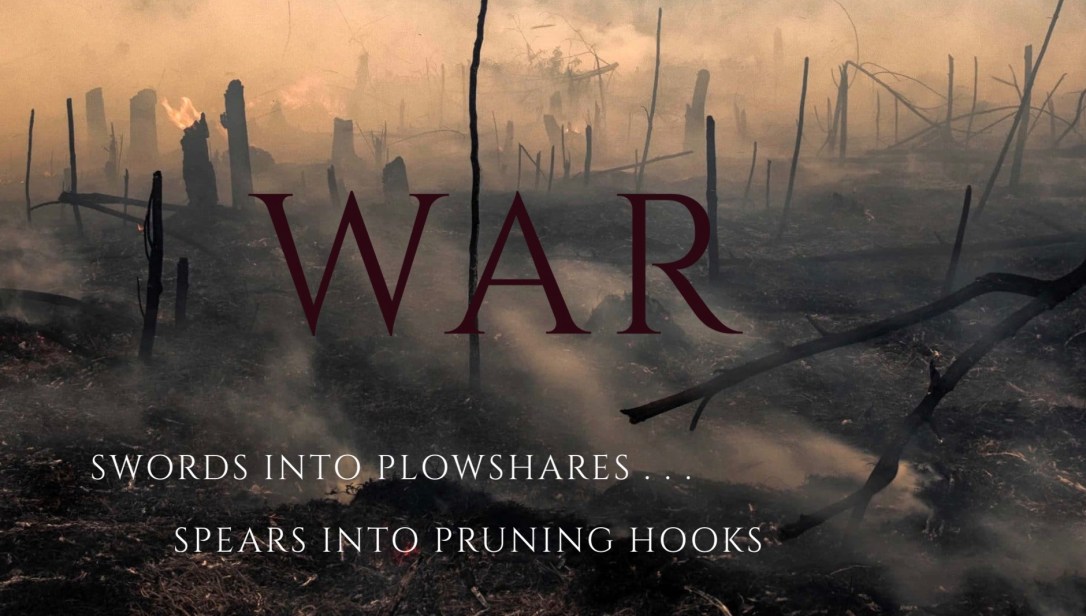
WAR noun, often attributive
(1) a state of usually open and declared armed hostile conflict between states or nations
(2) a period of such armed conflict
(3) a state of hostility, conflict, or antagonism
(4) a struggle or competition between opposing forces for a particular end
In a time of turmoil across the earth, I am reminded of the many ways we long for peace and the many times we fail to achieve it. As I hear reports and human stories of the warring among peoples of many nations, I am also very aware of the wars that often rage within. War and peace are complex ideologies that spurn people to action — either action to plunder and kill or action that insists upon peace and tranquillity. The British peace advocate John Bright (1811-1889) gave a speech at the Conference of the Peace Society in Edinburgh in the summer of 1853 to oppose the forthcoming war against Russia (the Crimean War 1854-56).
What is war?
What is war? I believe that half the people that talk about war have not the slightest idea of what it is. In a short sentence it may be summed up to be the combination and concentration of all the horrors, atrocities, crimes, and sufferings of which human nature on this globe is capable . . . injustice of any kind, be it bad laws, or be it a bloody, unjust, and unnecessary war, of necessity creates perils to every institution in the country. — John Bright (1811-1889)
Profound truth rests in Bright’s words, and it is a truth every person would do well to contemplate. At some point I recall seeing a provocative image on the poster for Stanley Kubrick’s film Full Metal Jacket. It was an image of the soldier’s helmet with a handwritten “born to kill” slogan . . . and a peace symbol, a provocative juxtaposition of reminding us that human beings have the capacity for both killing and peace.
Who can forget the words of the Prophet Isaiah?
And he shall judge among the nations, and shall rebuke many people: and they shall beat their swords into plowshares, and their spears into pruninghooks: nation shall not lift up sword against nation, neither shall they learn war any more. (Isaiah 2:4)
So why talk of war after Ash Wednesday and into Lent? Perhaps the subject of war occurred to me as I moved closer to this season of repentance and self-reflection. Perhaps I felt a need to consider the futility of war because of Ash Wednesday’s dictum, “Remember that you are dust, and to dust you shall return.”
One who came from dust, and who anticipates returning to dust, must certainly feel a longing for peace, peace in the world as well as peace of the soul and spirit. Neither examples of peace are easily achieved. The machinations of war between nations, and the eternal quest for finding inner peace, are two sides of the same coin. Perhaps it is those persons who have a dearth of inner peace who seriously contemplate making enemies and making war. War flourishes, at times, when the cause seems righteous, while at other times, the cause is greed, lust for power and human depravity. Either way, the losses of war are enormous beyond imagining.
I have been intrigued by the writing of Sebastian Junger in his book War (published in 2010). He echoes the famous words of Winston Churchill:
We sleep soundly in our beds because rough men stand ready in the night to visit violence on those who would do us harm.
Junger also offers interesting insights into war:
The cause doesn’t have to be righteous and battle doesn’t have to be winnable; but over and over again throughout history, men have chosen to die in battle with their friends rather than to flee on their own and survive.
The Army might screw you and your girlfriend might dump you and the enemy might kill you, but the shared commitment to safeguard one another’s lives is not negotiable and only deepens with time. The willingness to die for another person is a form of love that even religions fail to inspire, and the experience of it changes a person profoundly.
Three Christian denominations have positions on war.
Roman Catholic
The fifth commandment forbids the intentional destruction of human life. Because of the evils and injustices that accompany all war, the Church insistently urges everyone to prayer and to action so that the divine Goodness may free us from the ancient bondage of war.
The Southern Baptist Convention (Adopted on June 14, 2000)
Peace and War. It is the duty of Christians to seek peace with all men on principles of righteousness. In accordance with the spirit and teachings of Christ they should do all in their power to put an end to war.
The United Methodist Church (2000 United Methodist Book of Discipline)
We believe war is incompatible with the teachings and example of Christ. We therefore reject war as a usual instrument of national foreign policy and insist that the first moral duty of all nations is to resolve by peaceful means every dispute that arises between or among them; that human values must outweigh military claims as governments determine their priorities; that the militarization of society must be challenged and stopped; that the manufacture, sale, and deployment of armaments must be reduced and controlled; and that the production, possession, or use of nuclear weapons be condemned. Consequently, we endorse general and complete disarmament under strict and effective international control.

No doubt, this is probably more information on the deplorable subject of war than anyone needs to contemplate. And yet, war is not just “far off” in other countries where we can’t see it. “War” is all around us — in this divided nation, in the hate speech that is so prevalent, in the gun violence that takes lives, in violent acts within families, in racial division and the re-emergence of white nationalism. One can scarcely complete the list of the many ways war affects us, within us and around us.
We must remember that war is not only the catastrophic expectation of a nuclear bomb or chemical warfare, it is also a war that could raise its head in our communities, in our churches, even in our hearts, wreaking havoc on our souls. War is famine, homelessness, poverty, racism, family violence, child abuse, trafficking, homophobia and xenophobia. War is the destruction of humanity and all that we know to be right and just. The example of Jesus must be our guide and inspiration. No, Jesus did not explicitly warn against war, but he said so many things about peace.
The words of Jesus
Matthew 5: 38-48 (selected verses)
You have heard that it was said, ‘An eye for an eye and a tooth for a tooth.’ But I say to you, Do not resist an evildoer. But if anyone strikes you on the right cheek, turn the other also . . .
“You have heard that it was said, ‘You shall love your neighbor and hate your enemy.’ But I say to you, Love your enemies and pray for those who persecute you, so that you may be children of your Father in heaven . . . For if you love only those who love you, what reward do you have? Do not even the tax collectors do the same? And if you greet only your brothers and sisters, what more are you doing than others? Do not even the Gentiles do the same? Be perfect, therefore, as your heavenly Father is perfect.
Mark 12:28-31
One of the teachers of the law came and heard them debating. Noticing that Jesus had given them a good answer, he asked him, “Of all the commandments, which is the most important?”
“The most important one,” answered Jesus, “is this: ‘Hear, O Israel: The Lord our God, the Lord is one. Love the Lord your God with all your heart and with all your soul and with all your mind and with all your strength. ‘The second is this: ‘Love your neighbor as yourself.’ There is no commandment greater than these.”
The early Christians took Jesus at his word. They closely identified their religion with peace; they strongly condemned war and bloodshed; they appropriated to themselves the Old Testament prophecy which foretold the transformation of the weapons of war into the implements of agriculture; they declared that it was their Christian commitment to return good for evil and to conquer evil with good.
Might we all do likewise!
What is critical for us is to fully understand that war among us or within us creates profound loss . . . always. The current political divisions are taking a toll on everyone. We no longer live in a time when political leaders held all the divisiveness. In these days, fractured politics have reached communities, churches and even families. When support for political candidates creates deep separations one from another, we have reached a dangerous and divisive environment. When we live in such a divisive environment, we risk losing relationships with those who “don’t vote like we do.” What a senseless, unfortunate and tragic loss that creates — breaches between friends, alienation among family members, rifts in communities of faith, deep schism in neighborhoods and communities.
Our spiritual intention must be a quest for peace, reconciliation, unity and respect. This is God’s intention for people of faith. This is God’s intention for the world, that nations, tribes, villages, cities — all the peoples of the world — shall not learn war anymore!
May God make it so, globally and personally!
Duc In Altum . . . A Holy Calling
Duc In Altum . . . a different sort of phrase for beginning a blog post. Until recently, I had no idea what this Latin phrase meant! The phrase Duc In Altum is generally translated to mean “put out into the deep.” The phrase draws its name from Luke 5:4 where Jesus instructs Simon Peter to “launch into the deep” or “put out into deep water” or “draw into the deep.” More specifically, the phrase comes to us from the Latin (Vulgate) translation of Luke’s Gospel of the call of Peter.
But “launching into the deep” does not stop with the experience of Simon Peter. It is a part of the Holy Calling of each of us to go deeper in loving, caring and compassion for others. The dilemma we face as Christ followers is that cannot we go to the deeper level with others unless we do so within our own hearts first. Knowing our hearts, searching our hearts is apart of a contemplative life that prepares us to be “fishers of people.” Holy calling is what Duc In Altum is about and is so clear in the story of Jesus calling his first disciples.
One day as Jesus was standing by the Lake of Gennesaret, the people were crowding around him and listening to the word of God. He saw at the water’s edge two boats, left there by the fishermen, who were washing their nets. He got into one of the boats, the one belonging to Simon, and asked him to put out a little from shore. Then he sat down and taught the people from the boat.
When he had finished speaking, he said to Simon, “Put out into deep water, (Duc In Altum) and let down the nets for a catch.”
Simon answered, “Master, we’ve worked hard all night and haven’t caught anything. But because you say so, I will let down the nets.”
When they had done so, they caught such a large number of fish that their nets began to break. So they signaled their partners in the other boat to come and help them, and they came and filled both boats so full that they began to sink.
When Simon Peter saw this, he fell at Jesus’ knees and said, “Go away from me, Lord; I am a sinful man!” For he and all his companions were astonished at the catch of fish they had taken, and so were James and John, the sons of Zebedee, Simon’s partners.
Then Jesus said to Simon, “Don’t be afraid; from now on you will fish for people.” So they pulled their boats up on shore, left everything and followed him.
— Luke 5:1-11 New International Version (NIV)
Launch out into deep waters . . . Duc In Altum . . . A Holy Calling . . .
It was not only a calling to Simon Peter. It was not only a calling for the other men who were with him on that day to experience that sacred encounter with Jesus of Nazareth. The Holy Calling in those days was also a call to women, just as it is today. For all of us have watched many women go out into the deep places of ministry and service. All of us have borne witness to women of faith who “headed out into the deep waters.”
Duc In Altum is not only a holy message of call, it is a place. In the Holy Land, in the town of Magdala, there is a beautiful architectural offering called Duc In Altum. It has been called “the most unique spiritual center in the Holy Land.” The Center does only commemorate the men Jesus called, but also the women. Included in the design and construction of Duc In Altum is a women’s atrium designed to exalt the presence of women in the Gospel. In what the builders and developers call Divine Providence, the idea for this Center materialized in Magdala, birthplace of Mary Magdalene, who was a follower of Jesus, along with other women who supported him with their own means (Luke 8).
The Women’s Atrium features eight pillars, seven of which represent women in the Bible who followed Jesus, while the eighth honors women of faith across all time.
These are the honored women whose names are on the pillars:
Mary Magdalene – follower of Jesus and present at his crucifixion (Luke 8:2)
Susana and Joanna, the wife of Chuza – followers of Jesus (Luke 8:3)
Mary and her sister Martha – followers of Jesus (Luke 10:38)
Salome, the mother of James and John – supporter of Jesus and wife of Zebedee (Matthew 20:20)
Simon Peter’s mother-in-law – healed by Jesus, then supporter of Jesus (Matthew 8:15)
Mary, wife of Cleopas – follower of Jesus and present at his crucifixion (John 19:25)
The Unmarked Pillar – for women of all time who love God and live by faith
The Unmarked Pillar is for you and me, for all women who have heard the Holy Calling and have responded, “Yes!” The Holy Calling is a call for every age with the same message, Duc In Altum, “launch into the deep waters” in faith and commitment. It is for so many women who have set their faces toward a Holy Calling and headed out into the deep waters to meet people in need wherever they are, whatever their needs. It is for women who have heard the Holy Calling and responded, “Here I am, Lord. Send me.”
Jesus said, “I will make you fishers of people!” Amen.
Stubbornness, Tenacity, Faith

Leaving that place, Jesus withdrew to the region of Tyre and Sidon. A Canaanite woman from that vicinity came to him, crying out, “Lord, Son of David, have mercy on me! My daughter is demon-possessed and suffering terribly.”
Jesus did not answer a word. So his disciples came to him and urged him, “Send her away, for she keeps crying out after us.”
He answered, “I was sent only to the lost sheep of Israel.”
The woman came and knelt before him. “Lord, help me!” she said. He replied,
“It is not right to take the children’s bread and toss it to the dogs.”
“Yes it is, Lord,” she said. “Even the dogs eat the crumbs that fall from their master’s table.”
Then Jesus said to her, “Woman, you have great faith! Your request is granted.” And her daughter was healed at that moment.
(Matthew 15:21-28)
I wonder . . . was it her faith or her stubborn tenacity that led to her daughter’s healing? Stubbornness is typically not one of the virtues to which Christians aspire. In fact most of Christendom would rebuke a stubborn woman, in ages past as well as in our day. I know this to be truth! I have been rebuked a time or two, or at least received “strong suggestions” that I should dial back my demeanor. The woman of Canaan, though, returned to Jesus again and again until he healed her suffering daughter.
I can be a bit tenacious, but no one would describe me as stubborn. I typically have a very calm and quiet demeanor, but I remember well one of the few times in my life when I was fierce and stubborn. Our son Jonathan was quite young and very sick with severe vomiting, along with strong spasms that caused him to be unable to breathe. The loud inhalations as he struggled to get a breath were extremely frightening to us, especially to him. Jonathan was a strong boy, an athlete, and very self-sufficient, but these long episodes brought him directly to his Momma. We had been to the hospital emergency room and were now in his pediatrician’s office. This violent gasping for air had been going on for hours, and it should have been obvious to the office staff that Jonathan was in trouble.
Now they would know real trouble!
Jonathan had another violent attack. I jumped up from my chair, went to the desk, and had some strong words to say, in a loud voice, with the passion of a mother desperate to protect her child. I got the familiar line about the doctor running behind.
You know, I don’t care if the doctor is behind! (in my loudest voice) Can you not see and hear that my child is throwing up all over your waiting area and is unable to breathe? Do you realize that he could be infecting every child in here? Take us to an exam room, NOW, and get the doctor away from whatever he’s doing! Because if you don’t, I am headed to the president of Baptist Medical Center who knows me very well because I am a chaplain in this hospital!
Not like me at all! But that is a “Momma response” that almost always erupts when her child is hurting or in trouble. We were in a desperate place and were being ignored. Jonathan was terribly frightened and had been dealing with these spasms for hours. In time (too much time) it was resolved and we were able to get Jonathan settled and resting.
And about the “Canaanite Momma” . . . well, she was definitely stubborn and persistent that day. Clearly, Jesus did not realize who he was dealing with. Maybe he did know! Perhaps Jesus knew precisely what he was doing and chose to use his encounter with the woman from Canaan as a teaching moment for his hearers. Or perhaps he was simply in a stubborn mood and found himself facing someone who could easily match him, stubborn for stubborn!
Either way, the story shows us that when it comes to saving what needs to be saved, being merely nice and calm won’t usually win the day. Sometimes we need to dig in our heels and do some hollering! The text simply portrays the Canaanite woman as a stubborn, persistent mother of a very sick daughter.
Remember, the disciples urged Jesus to send her away. She was obviously making a lot of noise, crying out and disturbing their quietude! On top of that, Jesus was somewhat stubborn himself, saying that he was sent only to the lost sheep of Israel.
But this “Canaanite Momma” went back to Jesus straightaway, knelt down before him, saying, “Lord, help me!”
And we know what Jesus finally did. He praised her faith and healed her daughter. So was it faith or was it stubbornness, persistence? Maybe it was both, that her faith empowered her to stubborn persistence. Clearly, she believed Jesus was able to heal her daughter, so she tried to convince Jesus more than once. The disciples didn’t deter her. Jesus Could not dissuade her with his statement about dogs!
“Woman, you have great faith.”
A wonderful portrayal of what this woman might have said about her encounter with Jesus is a poem written by Jan Richardson entitled “Stubborn Blessing.”
Stubborn Blessing
Don’t tell me no.
i have seen you
feed the thousands,
seen miracles spill from your hands like water, like wine,
seen you with circles and circles of crowds pressed around you
and not one soul turned away.
Don’t start with me.
i am saying
you can close the door
but i will keep knocking.
You can go silent
but i will keep shouting.
You can tighten the circle
but i will trace a bigger one
around you,
around the life of my child
who will tell you
no one surpasses a mother for stubbornness.
i am saying
i know what you
can do with crumbs
and i am claiming mine,
every morsel and scrap
you have up your sleeve.
unclench your hand,
your heart.
let the scraps fall
like manna,
like mercy
for the life
of my child,
the life of
the world.
Don’t you tell me no.
— Jan Richardson
https://paintedprayerbook.com/2014/08/11/stubborn-blessing/
The work of protection is definitely not for the faint of heart. The work of advocacy on behalf of another person may take some stubborn persistence, the kind of stubborn persistence that Jesus seemed to call by another name — “great faith.” When we advocate for people who are suffering, especially people in need of profound physical healing or deep spiritual healing, their greatest need calls us to our greatest resolve, a fierce resolve. Maybe a touch of defiance! It is in those moments that we call on our hearts to give us strength for sacred stubbornness that will heal the broken, comfort the brokenhearted, restore justice to those who are oppressed.
That is faith! “Great faith!”
Happy New Year, My Friends!

Wishing you and those you love a new year of deep kindness, exuberant joy and gentle peace. And may you go forward into the unknown without fear, knowing that God will lead you safely into the new year ahead.
I said to the man who stood at the gate of the new year:
Give me a light that I may tread safely into the unknown.
And he replied:
“Go out into the darkness and put your hand into the hand of God.
That shall be to you better than light, and safer than a known way.”
—- Minnie Haskins
We Can Still Sing Alleluias!

Christmas Day
December 25, 2019
LATER
Later
after the angels,
after the stable,
after the Child,
they went back …
as we always must,
back to the world that doesn’t understand
our talk of angels and stars
and especially not the Child.
We go back complaining that it doesn’t last.
They went back singing praises to God!
We do have to go back,
but we can still sing the alleluias!
— Ann Weems
Christmas Day — it will pass too soon, out of sight for another year. The angels topping our trees will be packed away. The stars on our garlands will be neatly rolled up and packed into a box. The tinsel gone! The ornaments gone! The lights unplugged! The candles extinguished! Until another year.
And we all go back to a “world that doesn’t understand our talk of angels and stars and especially not the Child.” The world goes back to life as usual, no longer graced with the brilliance of Christmas. The wars rage on across the globe, swords replacing plowshares. The racism again begins to reign. The political parties spew hatred one to the other. Hunger remains and poverty still devastates. The border wall continues to send its message of exclusion.
It’s all the same, just as it was before. It seems that the gentle spirit of Christmas changed our spirits for only a brief moment. We slip back again into our normal lives, perhaps forgetting the silent night when the star shone over a Child. As the poem says so poignantly, Christmas doesn’t last. We do have to go back to a life that can be oppressively normal, a world that can be oppressively cruel.
But there is Good News! Because God Incarnate came to us, there is Gospel Good News! Even though we have to go back, “we can still sing the alleluias!” We can sing year around if we want to. We can sing alleluias in good times and bad, in times of joy and in times of sorrow.
We can sing alleluias, like the angels who still sing in the heavens.  We can sing alleluias because “The Word became flesh and dwelt among us.”
Thanks be to God. Amen.
Peace

The Second Sunday in Advent
The Sunday of Peace
December 8, 2019
PEACE ON EARTH
“Peace on earth, goodwill to all” . . .
The song came out like one loud hosanna
hurled through the earth’s darkness,
lighting the Bethlehem sky.
Sometimes I hear it now,
but it means a baby in a manger;
it means a time of year,
a cozy feeling,
a few coins in the Salvation Army bucket.
It doesn’t mean much —
and then it’s gone,
lost in the tinsel.
Where did the angels’ song go?
Who hushed the alleluias?
Was it death and war and disease and poverty?
Was it darkness and chaos and famine and plague?
Who brought violence and took away the sweet plucking of heavenly harps?
Who brought despair and took away hope?
Who brought barrenness and crushed the flowers?
Who stole the music and brought the silence?
What Herods lurk within our world seeking to kill our children?
Are there are still those
who listen for the brush of angel wings
and look for stars above some godforsaken little stable?
Are there still those
who long to hear an angel’s song
and touch a star?
To kneel beside some shepherd
in the hope of catching a glimpse of eternity
in a baby’s smile?
Are there still those who sing
“Peace on earth, goodwill to all?”
If there are — then, O Lord,
keep ablaze their flickering candle
in the darkness of this world!
— Ann Weems
How to I manage to keep my candle ablaze in the darkness of this world? Doing so is a hard thing at times. I watch. I listen for sights and sounds that herald peace on earth, yet almost every day I see the world’s chaos instead. I contemplate what I might do in creating peace and come up empty. As in the carol I have sung during so many Advents …
Then in despair I bowed my head;
There is no peace on earth,” I said.
“For hate is strong and mocks the song
Of peace on earth, goodwill to men.”
Despair seems to be a constant companion in these days. Children separated from parents and detained in cages. Gun violence rampant. Vitriolic relationships among those who govern our nation. Climate change harming communities. Refugees searching for safe havens.
I turn toward the words of Ann Weems and ask, “Who stole the music and brought the silence?”
Are there are still those
who listen for the brush of angel wings
and look for stars above some godforsaken little stable?
Are there still those
who long to hear an angel’s song
and touch a star?
Are people of peace still singing “Peace on earth, goodwill to all?” If there are — even if there are only a few — then we pray to God that their flickering candle of peace would light the world’s darkness,
Advent’s prayer for peace remains on our lips:
O Lord, keep ablaze their flickering candle in the darkness of this world!
Amen.
Sacred Mystery

Around 3:00 am this morning, I was awake and alert, having tossed and turned for hours, wishing for daybreak. I was also fasted and prepared for medical tests. But before I tell you about this day’s fasting, I need to reach back and call up some of my memories of other times. While wide awake in bed, I thought about some of the fasting times I have experienced, each a singular blessing making way for sacred space.
Fasting was a part of my early childhood. Being a Greek Orthodox child with a religiously devout Yiayia (grandmother), I learned early in life about fasting. Even though I was only 8-years old, Yiayia adamantly believed I was old enough to memorize prayers from the liturgy and recite them — in Greek. And a part of her plan was designed to prepare me for Holy Communion. I must give her some good-grandmothing credit — she did have a fasting experience for me that was age-appropriate, meaning it was not as long a fasting time as the adults observed and certainly not as stringent. No meat, of course, but some laxity on dairy and liquids because I was always an orange juice child that needed to drink a lot.
Yiayia accommodated my need for plenty of juice and chocolate milk. Still, I thought I might starve before my fast was over and I received the wine and, finally, the little square of communion bread that I scarfed down. I am pretty certain, though, that I did not fully embrace this sacred mystery of prayer, fasting and the sacrament of Holy Communion.
Years passed and young adult fasting times came in times of deep angst. There were troubled times when the only hope I thought I had came through prayer and fasting. Looking back on that time, I realize that I experienced just a glimpse of the meaning behind a fast. More awareness and appreciation of the sacred mystery would come much later in life.
Maturity and age created in me a seeking spirit that longed for deep meaning. I remember so vividly my time of fasting for my profession of vows before entering the novitiate of the Order of Ecumenical Franciscans. The occasion happened in the desert of Albuquerque, New Mexico, quite an appropriate setting for my introduction to a contemplative life. Dry, expansive desert and big skies that went on forever captured my imagination. It occurred to me at the time that I was experiencing just a tiny glimmer of desert spirituality. This fast in the desert was really the first time I immersed myself fully in the sacred mystery of fasting.
Now back to this day while waiting for daybreak after a night of tossing and worrying. This fasting morning was not religious at all, but necessary for information the kidney doctors needed from the 30 vials of blood The Mayo Clinic phlebotomist retrieved from my flimsy vein.
But come to think of it, today’s fasting may be the most sacred of all because it leads to the mystery and science of a kidney transplant. When a donor comes forward willing to give a gift of life from his or her own body, that feels very much like sacred mystery.
God orchestrated the entire experience. And by the way, God knows all about my tossing and turning in the wee hours of this morning. God understands my anxiety and fear. God understands the emotional place of anticipating a kidney transplant after five years of waiting.
I have always loved the imagery of this scripture verse written by the Psalmist. Today seems like a good day to ponder it.
You have kept count of my tossings;
put my tears in your bottle.
Are they not in your record?
— Psalm 56:8 (NRSV)
Tomorrow is the day. If all goes well, tomorrow I will get a new kidney. If for some medical reason, the transplant does not happen, I still know and understand the sacred mystery that God keeps count of my tossings and saves my tears in a bottle. And that’s enough for me.

On another note, please pray for me as I look toward my kidney transplant tomorrow at Mayo Clinic in Jacksonville, Florida. I am so grateful that you are walking with me on this journey that often felt so frightening. Your thoughts and prayers mean so much. If you would like to rea the story of my illness, please visit the Georgia Transplant Foundation’s website at this link:
://client.gatransplant.org/goto/KathyMFindley
A “Go Fund Me” page is set up for contributions to help with the enormous costs related to the transplant, including medications, housing costs for the month we have to stay near the transplant center, and other unforeseeable costs for my care following the transplant. If you can, please be a part of my transplant journey by making a contribution at this link
Two Love Stories
This past Friday, Fred and I celebrated our 50th wedding anniversary. My “techie computer geek” husband declared it our 18,262nd Day-versary! Either way, it has been a long run, and one for which I am very grateful.
Not that you care about our love story, but I want to tell it. When we met during my first year of college, neither of us were looking for a romantic relationship. It could not happen, in fact, with the two of us. Our friends insisted we were not a good match. Fred asked me out on a dare from his friends who told him I wouldn’t go out with him.
They were very wrong! After all, Fred had Andy Williams and Roger Miller concert tickets. (Now I have revealed my age and my era!) On top of that, it was Homecoming weekend at the University of Alabama! I really wanted to go to that concert!
After the concert, Fred walked me to the door of my dorm. When I turned to leave, he pulled me back and kissed me. I’m not sure exactly what it was about that kiss, but it was instantaneous. I was in love! Silly, right? I walked up the stairs to my third floor dorm room and found my roommate and my across-the-hall friends waiting for me.
They looked at me with great anticipation. “Well, how was it?” they asked, not at all expecting my response.
I said simply, “I’m going to marry him.”
Raucous laughter filled the room, and as we used to say, “They rolled in the floor laughing!”
I assured them that I was not kidding as all three of them stared at me with expressions that ranged from puzzlement to complete disbelief. And that was that for a Friday night first date!
On Monday, Fred had not called me as I expected he would. So I called him and asked him to come over on Monday evening for a walk on the campus. His response was that he might come after his fraternity meeting.
That kind of noncommittal response was not acceptable to me. I fretted for several hours wondering if he would come.
He came. We walked. And then next to a huge tree in the middle of the campus quadrangle, I said, “God told me we are going to get married.”
His response was a typical “Fred” response. “God has not told me anything about that!”
Be that as it may, we got married nine months’ later, beginning a life journey filled with experiences in five states, several cities, and a few foreign countries, a 50 year journey.
I don’t really need to make this story religious, but I can’t help but think of the love story of Rebekah and Isaac and the ways it intersects with our story. First of all, Rebekah’s family did not arrange her marriage as was the custom. It all began by a well of water where a servant of Abraham landed in his search for a wife for Isaac. He had asked God for a sign, saying that whoever agrees to draw water from the well for him and his camels will be the woman for Isaac.
Rebekah was near that well, and as the story goes, she very kindly drew water for Abraham’s servant and all of his animals. She was the one God had chosen, then.
Almost immediately, the decision was finalized with Rebekah’s parents. The servant asked that they might leave the next day, definitely not enough time to gather a dowry and pack Rebekah’s things. Her parents asked for ten days to prepare, but the servant was insistent that they leave immediately.
Rebekah would very likely be leaving her home and her family forever. So the parents asked her if she was willing to leave the next day. She said, “I will go.” (Genesis 25:50-67) She made the decision to marry a stranger, sight unseen, and began her long journey to Isaac and his homeland and his people.
As for Isaac, he loved her instantly, and it seems that their marriage was good and solid and filled with love. Life had not blessed them with the children they desperately wanted. They waited, and prayed, for twenty years. And then God answered their prayers and Rebekah conceived. Twin boys were born to them, another story in itself.
But in these two love stories, mine and Rebekah’s, there are common threads: love out of the blue; an unexpected, almost spur of the moment, decision to marry; an immediate journey far away from home; a long unrequited desire to have children; God in the center of it all.
I could describe my own relationship with Fred in much the same way as Rebekah might have described hers. There was love — instantaneous love — that came out of the blue, a quick decision to marry, a journey to a new state, the inability to conceive, and most importantly, God in the center of all of it.
Ours has been a beautiful love story, exciting at times and at other times mundane, joyful at times and at other times covered with sorrow. There was disappointment and hope along the way, and times of despair. All of it, we faced together — as one — hanging on to each other and to God. In spite of the risk of sounding syrupy religious, I could say that God wrote our love story.
Our journey has been long and winding, and I would be lying if I said the road we traveled had no rough places. Our journey, in fact, took us over broken roads strewn with jagged rocks, even boulders that stopped us in our tracks for a time. Still, it was a journey we loved.
Over our fifty years together, much has been said about our love story, from the first burst of our friends’ laughter and disbelief, to the comments that we didn’t seem at all like a good match. In the end, if there’s anything to be said, it is that ours has been a love constant and enduring. It was a soul match, actually, and I thank God for giving it to us.
Glistening Waters

You simply cannot underestimate your emotional response to the sight of the ocean and its sunlit glistening waters. It’s almost like being able to take a deep breath when you haven’t breathed deeply for weeks, even months. This morning, for a few minutes of a lovely vacation, I looked down from our balcony to watch the stunning Gulf waters light up like tiny fireworks, such a beautiful escape from reality.
Still, you cannot escape when the world keeps turning, Hurricane Dorian threatens communities, and there is, once again, a reason to grieve the headline news of the day. How disheartening it is when the president of this nation goes lower and lower in his determination to dehumanize people and cause irreparable harm.
All the glistening ocean waters in the world cannot ease this sadness — learning the stories of very sick children who have 33 days to leave hospital intensive care units and return to their countries, while mourning a nation that seems to be disappearing.
Anthony Marino, director of immigration legal services, described the horrific dilemma: “I don’t know how they expect parents to pull their children from hospital beds, disconnect them from lifesaving treatments and go some place where they are know they are going to die. But that is what they are telling them to do.”
Often, I have posted the poignant and beautiful words written by my friend, Maren. I must do that today for the readers of my blog. Maren has captured the emotion of our shared grief.
PRAYER FOR THE SICK CHILDREN DEPORTATION
God, whom I’ve called
to sit with me all night long,
when I rocked children
with sore throats, swollen tonsils,
coughs that wouldn’t let them sleep,
when I promised
a precious one
everything would be better
as they pulled on their ear lobes,
or cried to be brave
with their broken bones,
rest your hands and heart
on parents who have come here
with their children
to be treated for
cancer or cerebral palsy,
cystic fibrosis or HIV,
eye malignancies,
short bowel syndrome,
heart disease,
or during the long wait
for a transplant.
For this government
is taking the lullabies away,
and in this new and cruel
deportation
turned Make-a-Wish
into Lose a Hope.
Visit Maren’s blog at: https://giftsinopenhands.wordpress.com/2019/08/30/prayer-for-the-sick-children-deportation/
Where Is Our Music?
This is not a “ripped from the headlines” opinion article. It is not about a current crisis going on in the world, though I could write about many. But since it’s Friday, how about a gentler and kinder blog post on a subject easier to contemplate, one that hints at real joy!
This blog post is about something as old as time, something timeless and enduring and cherished. Something that is meant, among other things, to bring us joy. It’s about the music that tells our stories — the stories of a nation, of a community, of a church.
The benefits of music on the mind and body have been recognized since the days of the Greek philosophers. According to Plato, music “gives soul to the universe, wings to the mind, flight to the imagination, a charm to sadness, gaiety and life to everything.”
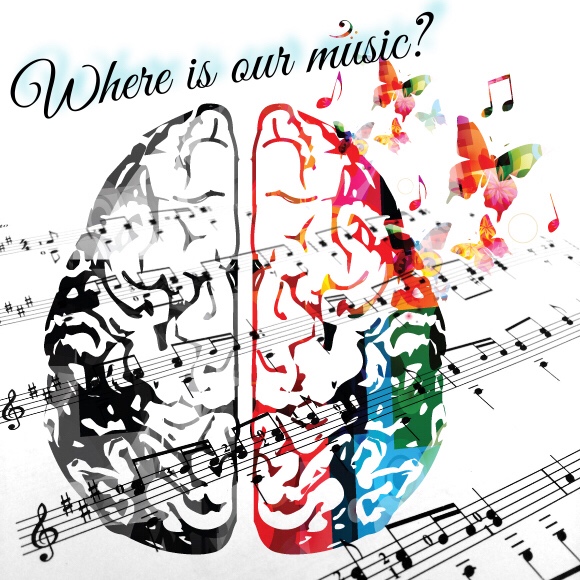
Today, researchers and scientists continue to explore how music affects emotions by improving and enriching the way we think, feel and relate to the world. So we might ask the researchers, “where is our music?” Those in the know say that our music is in the right side of our brains, but researchers also tell us that listening to and performing music impacts the brain as a whole. Music stimulates both halves of the brain — the analytical brain (left) and the subjective-artistic brain (right). While the left brain processes elements in music such as pitch, tempo and structure, the right brain — often considered the more creative hemisphere — focuses on the melody in the music.
And that’s all the physiological and psychological, scientific trivia I have about music. What I really want to share is how music affects worship. Where is our music when we worship?
I happen to be Baptist, and Baptists have deep roots in musical expressions of worship, seldom finding it difficult to sing from the heart — with unbridled joy — making melody and harmony that would soar through church sanctuaries large and small, simple and ornate.
Hymn singing has long been one of the most cherished acts of worship for Baptists. I dare say that many Baptists remember hearing about “the great hymns of the church” from an early age and learning about church music in their Music Makers or Young Musicians choirs. If funds allowed, the minister of music (AKA choir director) would receive music booklets from a subscription service designed so that children would learn about hymnody, music in worship, choir member deportment and, as we used to describe it, “singing parts.”
Not so much today. These days, it seems that joyful, exuberant hymn singing is a little more difficult for worshippers. Many congregations are regrettably a bit more restrained than they once were. As for music in my personal experience, well these days the church music in my world is restrained enough to make me wonder, where is our music?
I have to say that our music is still an important element of our church’s worship, with hymns carefully and creatively selected to enhance worship. Then what’s the problem? I believe problem to be our disimpassioned attitude when we sing. That kind of attitude is robbing us of music’s full spiritual expression. I am not, by any means, a professional musician that can comment on hymn texts, hymn tunes, meter, or the history of Christian hymnody. I am merely a worshipper who finds music to be a primary expression of true worship. With a bit of reticence, I approach the conclusion that some of us sometimes sing words without paying attention to their meaning, sing hymns without noticing their theological message, or sadly, do not really sing at all, certainly not from the heart.
It is not for me to ensure that congregations sing and appreciate the words they are singing. I have no power at all to make individuals sing from their hearts. Yet, music that does not come from the heart is something like “fake worship.”
There are so many ways our hymns can touch the heart and aid worship. I mention only three that seem most important to remember.
MUSIC EXPRESSES JOY . . .
Most certainly, our songs and hymns can and should be expressions of joy. People in church don’t smile much, but singing, “then sings my soul, my Savior, God, to Thee, how great Thou art!” ought to cause us to smile with holy joy! The Scripture calls us to joy:
My lips will shout for joy when I sing praise to you—
I whom you have delivered. — Psalm 71:23
Come, let us sing for joy to the Lord;
let us shout aloud to the Rock of our salvation.
Let us come before God with thanksgiving
and extol God with music and song. — Psalm 95:1-2
MUSIC EXPRESSES THEOLOGICALLY SOUND THOUGHTS . . .
The hymns we sing in worship not only inspire us, they instruct us. A hymn like “A Mighty Fortress Is Our God” is theologically sound, proclaiming the attributes of God. There are many such hymns that enhance our knowledge of God. The Scripture challenges us to wisdom and identifies singing hymns as one way we learn.
Let the message of Christ dwell among you richly as you teach and admonish one another with all wisdom through psalms, hymns, and songs from the Spirit, singing to God with gratitude in your hearts. — Colossians 3:16
MUSIC EXPRESSES OUR BEST WORSHIP . . .
When I contemplate that phrase in Colossians — singing to God with gratitude in your heart — I am prompted to more fully express my faith through song. I hope that our singing truly is an act of true worship, a time when we invite the presence of God and the Holy Spirit to be in our midst. Consider Solomon’s dedication of the temple. When all the preparations were done and the temple was finished, the worshippers sang and played instruments as an expression of praise, and the result was astounding.
The trumpeters and musicians joined in unison to give praise and thanks to the Lord. Accompanied by trumpets, cymbals and other instruments, the singers raised their voices in praise to the Lord and sang:
“He is good; his love endures forever.”
Then the temple of the Lord was filled with the cloud,
and the priests could not perform their service because of the cloud,
for the glory of the Lord filled the temple of God. — 2 Chronicles 5: 13-14
So I wonder: where is our music? Do we find it through our casual singing of three hymns every Sunday, or it is more than that? Could we make our singing more personally meaningful by paying closer attention to the words of a hymn, receiving the thoughts expressed in the hymn into our spirit and reacting to them as part of our expression of worship?
I don’t know exactly what a temple “filled with the cloud” looks like. But it seems that a result of our songs of praise might well become cloud-like, as God’s Holy Spirit joins us in worship and fills the sanctuary with the power of wind and flame.
Don’t we need that kind of worship experience?
Holy Energy!

There is a very special call from God that lets you know that it is your call and that no one else can respond to it quite like you can. It brings with it a kind of holy, inexplicable energy.
Your call may be teaching or preaching, caring for others or working with children, tending the sick or lifting up those who live in poverty. Your call may take you down your street or halfway across the world. But when you hear your call and know it, you will also know the feeling of that holy energy. There’s really nothing quite like it. Its precisely the reason that no human has enough power to thwart your call for any reason — for being a woman, or being too old, too young, too inexperienced. No human can steal the holy energy of your call!
Preaching releases every kind of holy energy for me. Preaching creates in me a unique awareness of my body, mind and spirit. It is, above all, a soul exercise that brings me fresh new life. That’s the best way I can describe the event we call preaching, at least from my view. But it is so much more than just an event; it is a 20 minute pursuit of truth, inspiration and spirit movement. It is for the hearer and for the proclaimer, for both are in this place of spiritual replenishment in need of new awakening to the things of God.
Last fall, I preached at my church in Macon. It was a rare opportunity, a red-letter day really. It was the first time I had preached since my illness. It had been roughly five years since I stood in a pulpit to do what I have been called to do. Those who have a similar calling probably know the angst of not preaching when God has called you, for God’s call is a lifelong agreement. For me, there is something life-giving in the act of preaching a sermon. I experience a special connection to the congregation that feels as if it moves by the wind of the Spirit.
So it would not be an exaggeration to say that I miss preaching deeply. I miss being a pastor. I miss creating worship experiences for a congregation.
But back to the opportunity to preach at my church . . .
I was looking forward to the holy energy, hoping it would come back to me after so long a time. And this was such an important life event for me that I had several conversations with “my village.” Most importantly, I had a conversation with my former pastor and colleague in ministry from the previous church I served in Little Rock. I think I needed some encouragement that I could still preach after so many years of illness. The words — the right words — came just in time from a person I will always consider to be my pastor. He is a person I greatly admire, and a male minister who knows how to serve a congregation in mutuality and communion with a woman. He is a minister who embodies that holy energy I’m talking about, and he inspires others to find or reclaim their holy energy.
How rare it is to enjoy the interrelationship and kinship of male and female in mission and ministry! I miss the time we served New Millennium Church together. I miss Wendell Griffen’s support, encouragement and respect. So when we exchanged messages that day, his words were the right words, the words I really needed to hear, so transformative for me in that moment that I copied them to my journal. This is what I wrote:
From Wendell, September 30, 2018:
“Praying for and with you, Kathy! Preach like only you can! New Millennium is praying with you, Reverend!”
It occurs to me that all of us need encouragement at times. We need persons who will cheer us on, persons who will believe in us when we don’t believe so much in ourselves. For me it was an illness that interrupted my life. For others a life interruption can be any sort of change — the loss of a job, the loss of a loved one, dealing with an empty nest, moving to another home, leaving a church and searching for another church. For whatever reason, life interruptions do hold some measure of power that can break us down and assault our confidence.
It is no big news to know that life interruptions can throw us face-down in the dirt, and it is extremely important for us to have the fortitude and the will to pick ourselves up and dust ourselves off. It’s not so easy to do that for so many reasons. With self confidence eroded, we can be motionless, bereft of spirit, with little energy left.
So then, we must do two things to make sure that we can reposition ourselves — upright and moving forward after a life interruption. The first is to recall the Divine promises of a God who always holds us up. These are three of the promises that give me hope:
We are afflicted in every way, but not crushed; perplexed, but not driven to despair; persecuted, but not forsaken; struck down, but not destroyed . . .So we do not lose heart . . . For this slight momentary affliction is preparing us for an eternal weight of glory beyond all measure.
— 2 Corinthians 4:8-9; 16,17 NRSV
And after you have suffered for a little while, the God of all grace, who has called you to his eternal glory in Christ, will himself restore, support, strengthen, and establish you.
— 1 Peter 5:10 NRSV
Thus says God, the Lord . . .
I am the Lord, I have called you in righteousness,
I have taken you by the hand and kept you;
I have given you as a covenant to the people,
a light to the nations,
to open the eyes that are blind,
to bring out the prisoners from the dungeon,
from the prison those who sit in darkness.
— Isaiah 42:5-7 NRSV
The second thing we must do is to surround ourselves with a community of care, love and grace — individuals who will listen, understand and always encourage. The book of Hebrews offers us good instruction to “consider how to stir up one another to love and good works.” (Hebrews 10:24 RSV)
Each person has the opportunity to open up their hearts and spirits to the calling of God. Each person will hear the call to mission in their own way. Each person will decide whether or not to respond to God’s call on their life. But all of us — together in community — will be able to hear God’s call clearer and find in ourselves more courage to follow. Community, when it is genuine, is like that.
I hope that you will find your genuine community as you listen for God’s call to you, the call that no other person can fulfill. I hope that you will experience holy energy, that fire in your bones that no human can extinguish. There’s really nothing quite like it!
Becoming Our Better Selves

I don’t usually write about charts in my blog. I’m not really a chart person at all. But my friend, Kim Rosby, recently sent me a chart that is worth contemplating. The chart is a snapshot of what it might look like when we become our better selves. It’s entitled “The Comfort Zone,” which is a place most of us want to be.
That’s the problem. There is no growth and maturing in the comfort zone. It can become for us, not just comfortable, but also stagnant.
So I spent some time contemplating this provocative chart, and it definitely provoked some emotions in me. It appears that there are four zones that are possible for us:
- The Comfort Zone
- The Fear Zone
- The Learning Zone
- The Growth Zone
There you have it! So let’s unpack this chart a bit. When/if we manage to move ourselves out of the comfort zone, a place where we feel safe and in control, we will most likely enter the fear zone. In the fear zone, we are not at all sure of ourselves. We hang on the opinions of other people and use anything we can find as an excuse to remain frozen in place. If we don’t make a move, we can’t make a mistake. Right? We come to a point, though, where we do not believe we can move. We don’t believe we can change. We don’t believe we can seek another way.
Fortunately, some of us do make it out of the fear zone and thus find ourselves in the learning zone. What a renewing place to be, a place where new and fresh ideas are possible. It is in this zone that we realize we have moved at least a few steps past our comfort zone. We learn new skills and we discover that we can navigate challenges and solve problems. As long as we are learning, our path is clear and a future is possible.
So we move with courage into the growth zone, where we will re-invent ourselves in positive and exhilarating ways. As we conquer the objectives that were holding us back, we begin to believe in the possibility of new life goals, a deeper purpose. And then suddenly, we surprise ourselves with dreams and aspirations for something more in our lives, something fresh that inspires us to be our better selves.
I like my friend’s chart. I also like this promise that also says something very compelling about becoming our better selves:
. . . I came that they might have life, and have it more abundantly.
—Jesus
Mine Is a Lonely Road

Mine is a lonely road on a journey of one.
To be sure, I have a dear, dear life partner
And a family
Friends all over the world.
Yet, I am making this journey all by myself.
All around me, friends are working, vacationing, writing, preaching
All those things I long to do
Simple things, but out of my reach.
In the meantime, I am dialyzing for hours every day
Willing myself to eat less, much less
Focusing on healthy
Exercising through pain
And waiting for a kidney transplant.
Friends are still working, vacationing, writing, preaching
All those things I long to do, still out of my reach.
Waiting for an organ transplant is lonely.
No one I know is doing the same thing.
But everyone knows someone who had one
And died
Or did poorly
Or maybe they even did great
But I never hear much about them.
Waiting for an organ transplant is lonely.
I cannot help but second-guess myself
Why the risk?
Hard decision.
A Good decision about a dangerous thing takes time
Maybe years
Info rattles around in your head for a while
Moves on as it discerns the rhythm of your spirit
Then listens for the whisper of God
And at last finds its rest in your heart
And then you know.
Friends are still working, vacationing, writing, preaching
All those things out of my reach.
They stop their busyness long enough to give me counsel
Everyone knows someone who had a transplant
And died
Or did poorly
And so they tell me that
With all the medical details they know
And mostly they don’t know
But I am holding the good decision in my heart
The right decision
The one with all the risks
Just like life
Full of risks.
Mine is a lonely road.
But I am ennobled to move forward in good hope
My mustard seed faith is enough
I leave them in the dust
All those who are working, vacationing, writing, preaching
All those things out of my reach.
I leave them in the dust
All those who knew someone who had a transplant
And died.
Because I am not moving toward death.
I am moving toward life
And light.
Alone.
Still lonely.
Determined to persevere
Until the road ends.
“You Can’t Make Me!”

“You can’t make me!” I said emphatically.
Head lifted up. Determined expression in my eyes. Hands on the hips.
I was a defiant, insolent child. I was even more defiant as a teenager. It was not at all unusual for my parents to give me a directive and for me to respond, “You can’t make me!” That was our family process. We each played our roles well, and as a result, defiance became a part of my personality.
That was a very long time ago and, no doubt, I have made some personality changes. More like seismic shifts! Life brings on seismic shifts for most of us, and I am no exception. The series of seismic shifts that rearranged me over the years left me with a rather quiet, docile personality. My acquiescent ways can sometimes make me seem a lot like a doormat.
Being a doormat, though, is most definitely not an option. Just as advanced years made me somewhat docile, advanced years have also given me the courage to, at least occasionally, stand up straight and scream out, “You can’t make me!”
Truth is: I’m still that insolent little girl, and I don’t see that as a bad thing.
You see, here’s how it happens. In fact, it happened for me last week. I met a rather formidable obstacle on my path. I despaired. I grieved. I berated myself and diminished my own worth. I gave up my sense of hope.
But then it happened, as it has so many times before. Today something rose up within me that felt like determination. It felt like a dogged resolve with enough power to propel me forward just when I thought I had been hopelessly pushed back. I never know where that determination comes from, but I can always feel it rising. I know that at least a part of it comes directly from that insolent little girl. But mostly it seems to be what I reverently call a “God-thing”— which is a rather powerful happening that causes me to experience God’s grace fresh and new, just when I least expect it.
If an obstacle has pushed you back, even pushed you all the way to the ground, remember the words of Jesus giving warning and comfort to his disciples: “Take courage. I have overcome the world.” (John 16:33)
Remember, too, that inside of you, there just may be a “hands on the hips” kind of person just about to feel the inner determination rising.
One Step Past Possible
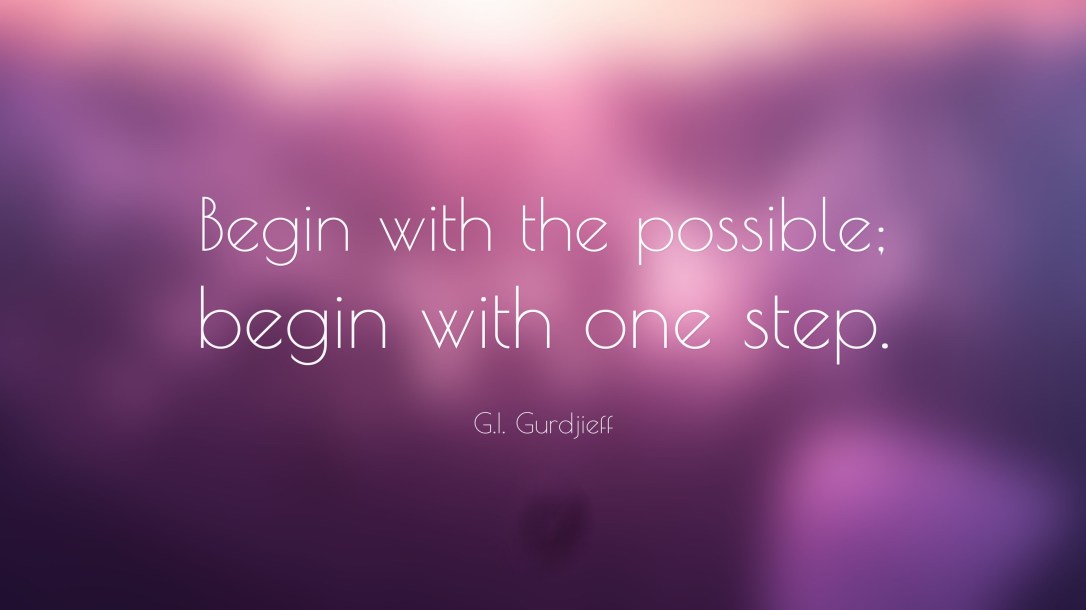
All journeys begin with one step, just one step, usually into the unknown. Each step that follows goes farther into a journey that most often is made up of twists and turns and sometimes stones in the road. It takes a little faith, embarking on a journey.
Still, faith does not make things easy. But faith does makes them possible. Mildred McAfee says something very wise about moving forward in faith. She says “If you have a great ambition, take as big a step as possible in the direction of fulfilling it. The step may only be a tiny one, but trust that it may be the largest one possible for now.”
Tiny steps remind me of the book microShifts by Gary Jansen who suggests that transforming your life happens one small step at a time. The book’s message makes it quite acceptable to take micro shifts toward something in your life. As for me, microshifts are important. I have made dozens of microshifts to get comfortable with the idea of a kidney transplant.
Microshifts are still shifts, and that means change that we sometimes fear. Faith slips in on us at this point. There’s a tiny verse in the Gospel of Luke that those of us who are followers of Christ grab onto. We believe the message because we want to. We hold the message close to our hearts because we need to.
For with God nothing shall be impossible.
That’s it. Luke 1:37. Simple and clear. Without superfluous language, Luke asserts that nothing is impossible. And about the “with God” part. Well, I’m guessing that Luke adds that to remind us that faith includes a contract between us and the God of the possible.
So I am thinking today about what is really is possible, globally and personally. For instance, is it possible to end hate-motivated violence? It is possible to end racial divides? Is it possible to make sure schools are safe places? Is it possible to protect the earth from the effects of climate change? Is it possible for this nation to hold free, fair, respectful political campaigns and elections?
Global questions like those are endless — so many questions, so few answers.
But then I also ask what is possible on a personal level. What’s possible for me or you? Is it possible to live out our faith on the margins where hurt prevails? Is it possible to carve out time for contemplation, meditation and prayer?
And then there’s the question I often ask myself. Is it possible to envision a day of better health? I am thinking specifically about a kidney transplant. Right now, a transplant seems to be one step past possible, meaning that it’s just a little more than possible that it will happen. The possibility , however small, brings up feelings, emotions that have begun to escape from the place inside me that had them locked up.
I finally believe that a kidney transplant for me is probably going to happen. The stars have aligned. A brave and magnanimous donor has been evaluated by Piedmont Transplant Institute in Atlanta where both donor and recipient (me) will have the surgery. The National Kidney Registry will search for matches among paired exchange program participants. Even surgery dates are being contemplated. It’s real! After almost five years of wondering, and doubting a transplant would ever happen, a transplant is imminent.
It would not be an exaggeration to say that I feel panic and fear. My heart beats a bit faster these days. I am taking lots of deep, cleansing, centering breaths. My heart is preparing for a surgery that could well offer a new sense of freedom for me. By coincidence, blasting through my speakers I am hearing one of my favorite old country tunes, Martina McBride’s “Independence Day.” It is reminding me that I lost a certain amount of independence the day I got sick in 2014.
So today feels a bit like an independence day is coming for me. It feels like independence to think about a future of not being tethered to a dialysis machine for eight hours a day, every day. It feels like independence to not have permanent tubing emerging from my body. It feels like independence to be able to travel without the strain of taking large medical equipment and multiple boxes of dialysis supplies.
As with anything medical, things can go wrong. There are numerous disqualifying factors that could still preclude a kidney transplant. But right now, living donor and recipient are fully evaluated and the transplant is at least one step past possible. This is a good place to be.
Resurrection!

As people often say, things come and go. Today the resurrection came, so clearly in our worship service and especially in our Sunday School class. When we are gathered in community, the sharing of our lives becomes resurrection for us all. So for us resurrection came, but it did not go.
It remains in the resurrection stories we share and in the ways we bear witness to the grace-full acts of God. The stories around the circle were about places of darkness and death and about the resurrection that always follows. For some, physical health reaches a dark place and we pray for the resurrection to come in their lives. For others, emotions around fear are on the surface and we pray for the resurrection to overcome the fear. Still others grieve for friendships that feel like the end, and we pray for the resurrection they need. Others mourn the loss of friends to death and, as we pray for the healing of those left behind, we also rejoice in the promise of resurrection for those that leave their earthly life.
Death comes in myriad ways. But resurrection comes, every time, to shatter death’s darkness in ways that seem like mighty wonders and wondrous acts of God. Ready or not, resurrection comes to us and makes its home in us. We are resurrection people because we made the choice to proclaim to the world that Christ is risen!
The Scripture gives us so many stories of resurrection. Sacred texts allow us to look into the lives of many people who have looked at death and have come through it to resurrection. And in our own lives, we can bear witness to the glorious reality that we know the One who is “the resurrection and the life,” that because we believe in the Christ, we will never die. (John 11:25-26)
As you enjoy Easter and lean into the resurrection that never leaves you, think on these Scripture texts:
Mary stood weeping outside the tomb. As she wept, she bent over to look into the tomb; and she saw two angels in white, sitting where the body of Jesus had been lying, one at the head and the other at the feet. They said to her, “Woman, why are you weeping?” She said to them, “They have taken away my Lord, and I do not know where they have laid him.”
When she had said this, she turned around and saw Jesus standing there, but she did not know that it was Jesus. Jesus said to her, “Woman, why are you weeping? Whom are you looking for?” Supposing him to be the gardener, she said to him, “Sir, if you have carried him away, tell me where you have laid him, and I will take him away.”
Jesus said to her, “Mary!”
She turned and said to him in Hebrew, “Rabbouni!” (which means Teacher). Jesus said to her, “Do not hold on to me, because I have not yet ascended to the Father. But go to my brothers and say to them, ‘I am ascending to my Father and your Father, to my God and your God.’” Mary Magdalene went and announced to the disciples, “I have seen the Lord”; and she told them that he had said these things to her.
— John 20:11-18 (NRSV)
Blessed be the God and Father of our Lord Jesus Christ! By his great mercy he has given us a new birth into a living hope through the resurrection of Jesus Christ from the dead, and into an inheritance that is imperishable, undefiled, and unfading, kept in heaven for you, who are being protected by the power of God through faith for a salvation ready to be revealed in the last time.
In this you rejoice, even if now for a little while you have had to suffer various trials, so that the genuineness of your faith—being more precious than gold that, though perishable, is tested by fire—may be found to result in praise and glory and honor when Jesus Christ is revealed.
— 1 Peter 1:3-7 (NRSV)
With great power the apostles gave their testimony to the resurrection of the Lord Jesus, and great grace was upon them all.
— Acts 4:33 (NRSV)
*James Martin’s art is available at http://www.veritasse.me.uk/artists/james-martin/
 God of the Sparrow 🌱 By Kathy Manis Findley