A woman of sacred worth, Becoming, Beginning again, Bravery, Calling, Change, Children, Committment, Courage, Creating, Dreams, Freedom, God’s beloved daughter, I am enough!, Inner peace, life, Living in the soul, Miracles, Repair the world, Rev. Kathy Manis Findley, Self-understanding, Spirit wind, Tears, Tikkun Olam, Valued by God

Living an Unapologetic Life

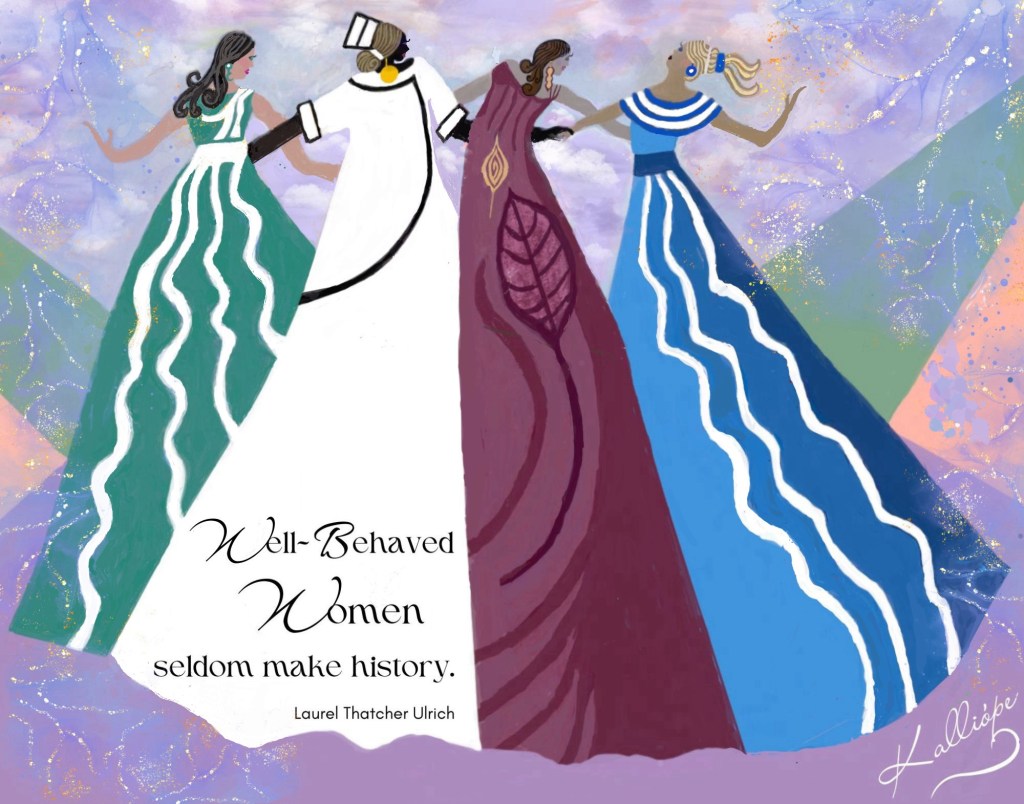
Art: “Well-behaved Women” by Kathy Manis Findley


Rev. Kathy Manis Findley
July 27, 2024

You have probably had that kind of dream at a few junctures on your journey. I know I had many dreams along the way. Sometimes they scared me to death. I dreamed of peace, equality, freedom, changing the world, and many other huge and noble dreams. I dreamed some silly dreams, too! I soon got the hint: changing the world is a formidable task. I followed all the rules, but being a rule-keeper does not make a person effective in dreaming and imagining. Women who follow the rules (someone else made up) could correctly be called well-behaved. They might even be called good girls because they don’t cause much of a flurry. They typically don’t make history and they certainly don’t change the world.

A woman with less-than-good behavior looks like someone at peace with herself, someone who radiates hope, someone with the courage and determination to do justice. I have admired and emulated so many examples of women who did make history, women who were not well-behaved at all. Here are only a few: Rosa Parks, Harriet Tubman, Lucretia Coffin Mott, Sojourner Truth, Susan B. Anthony, Nancy Sehested, Elizabeth Cody Stanton, Prathia Hall, Julian of Norwich, Malala Yousafzai, Mother Theresa of Calcutta, Ann Hasseltine Judson, Lucy Stone, and so many others!

About 24 years ago, a chaplain colleague recommended a book to me: Goodbye Good Girl: Letting Go of the Rules and Taking Back Your Self by Eileen M. Clegg. I think my chaplain friend was suggesting that I should get out of my comfort zone and take some risks, that I should courageously follow God’s call on my life. I knew that the members and churches of my denomination would “throw a fit,” like we say in the south! After all, I was an ordained minister serving as a hospital chaplain, which placed risky challenges before me every day.

So I read the book immediately and set out to become a bad girl, a girl who fully intended to change the world and to make history for it! So far, I have not made history. I have not managed to put my name in lights. I have not started any big public movements. But I have done some things that matter! I have learned how to create sacred space; I have learned the depth of liberation theology; I have found enough grace to endure the consequences of being a “bad girl” and then a woman with questionable behavior; I have held off anyone who tried to tell me who I am; and I have called up the courage to fight for justice. Colleagues, friends, family, co-workers reacted to the change in me, since they never expected me to dissent, or disagree, or refuse to behave.

Suddenly I let go of my “good girl” image and basically said “goodbye” to my restrictive behaviors. I took back my life, put aside all the rules, and followed my soul. I watched for the winds of the Spirit to lead me, and I moved forward to all the places that needed some attention. I was able to help change unjust systems, unjust policies, and unjust processes by not being so well-behaved.

Still, I sometimes think I have reached an uneasy place when it comes to letting go of my “good girl” persona. I’m really not a “good girl” and I don’t think I ever have been. My parents had to endure the sassy exclamations of my toddler years, like “Nobody’s the boss of me!” Creating shock from those who knew me, I mostly remained a “bad girl” from that day to this. I set aside the rules that were designed to keep people down and I took back my life. Today—in my mid-seventies—I continue to spew out uncommon proclamations that are quite annoying to those who are determined to hold on to their power and resist change.

Truly, it was sometimes hard being a change-maker and a rule-keeper! Always a people pleaser. Always the ultimate perfectionist. I discovered along the way that sometimes rule-keeping, people pleasing, and keeping every little thing “perfect” can harm your inner core. In fact, it’s less risky when you follow the leaders, make sure everyone is pleased, and doing everything with glowing perfection. Stepping out of line is always a bit dangerous.

When you become exactly who you are, resolute and unmovable about the things that matter to you, you will raise a few eyebrows, and sometimes people will get angry with you . You see, those people expected something else from you. Each of us becomes “me”— the “real me”— at our own peril. In a sense, we have to fight for the right to be ourselves in the world.

It is true that the people around me reacted strongly when I took back my life and became fully invested in my destiny. They thought that I had become radical, maybe even unhinged. I did not respond appropriately to their demands. To unreasonable demands, this is essentially how I might have responded, sometimes out loud, sometimes under my breath . . .

I will do it. / It’s my right! / It’s my choice! / It’s my prerogative! / It’s my decision! / I’m doing it anyway. / You can’t stop me! / Just watch!

All the while, I felt uncomfortable because of so much disdain from others, who began sending me a new message, You are not enough! I Imagine that many of you have heard someone say to you, You are not enough. At least, we may imagine someone saying those hurtful words. Unfortunately, we believe it because we don’t know ourselves, meaning we don’t know our bright and dark places, we have not yet realized our sacred worth, and we have not yet searched our souls.

For you see, you and I are afraid because it is perilous for the soul when we don’t search diligently for our soul’s passions and dreams. You and I sometimes accept what others say about us and tuck it away in our deepest places. When those words sneak all the way down into the soul, we tend to give up. We start from the moment we make ourselves nonchalant about it all, that moment when we shield our hearts from hurt. One of the saddest phrases we use is “I don’t care.” When we no longer care, we begin, one by one, eliminating the people around us, never realizing that they are hurting, too. And maybe the reason they send the message, You are not enough, is because they believe that they are not enough either.

I can honestly say that I have often heard voices—known voices, unknown voices, and the weak little voice in my head—telling me, You are not enough! I have learned that once I have embodied that negative message, it rolls around in my psyche for a long time, maybe forever. It becomes a state of being that goes deeper than skin. It penetrates in deeper places, and takes its toll on my emotional and physical well-being. I recall many such times, none more painful than the wagging tongues around my ordination . . . You know the scenario, “She can’t be a minister because she is a woman! Anyway, she’s not good enough! Other voices are often hazardous, dangerously breaking down our sense of self-worth. They may be yelling, speaking in a normal tone, whispering, or imagined in our heads. In response, we must prepare ourselves to hear the voice above all voices, saying, “You are my beloved daughter with whom I am well pleased.”

For a long time, I embodied the traits of the good girl, but to embody good girl traits is not really a once-and-done action. Embodied lasts a while! Embody does not have a shallow or surface meaning. It is deeper. I like the word embody. It seems to suggest that we can live a soulful life. In the very middle of the Greek word for “embody” we find the word σώμα, which means body. However, the Greek word for body cannot be translated in a way that reveals the depth of its meaning. The definition of σώμα is deeper than we realize. It is not skin-deep, it is deeper, approaching a definition more like soul.

I do like the word embody and the word soul. In some ways, to embody means to live in your soul. The word embody may whisper to you that in your body’s center, you will find the path to reach your soul. A person who lives in the soul is a person that does not live a shallow life, devoid of the emotion that makes us alive. The soul will help you, if you can just start by daring to touch it.

So what are the things we can actually do to take back our lives and live soulfully? What path do we follow to transform ourselves and change the world? My initial response to that is, “I don’t know.” Not very comforting, I know, but mostly true. We cannot forge the path for any other person. We cannot know what’s best for them. So not knowing anyones path, nor their dreams, I can give you a list of things others are finding the leads to their transformation. Here they are, not at all an exhaustive list, and certainly not a perfect guide for you:

  • Carve out some time for quiet, restful, meditation.
  • If you are a person of faith, get in touch with God or whatever person you worship.
  • Listen.
  • Listen some more—to your heart and your soul.
  • See if you find there a sacred direction especially for you.
  • Do you feel you are getting any closer to discovering your authentic self?
  • Can you begin to believe you will be transformed?
  • Can you take a step or two, in faith, into a holy place of transformation?
  • Pray, making your needs known to the source of your faith.
  • Read! Read the stories of others who found life transformation.
  • Find community, even one other person, who understands your journey.
  • Start all over again, leaning into the wisdom you found on your previous journey.
  • Take as long as it takes, until you realize that suddenly, you are becoming emboldened and scrappy!

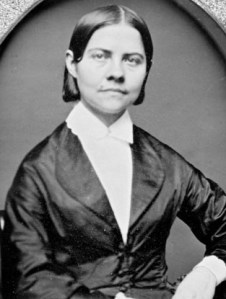
You may not know her name, but Lucy Stone was steadfast in her belief in self-authentication and in her ability to change the world. Lucy Stone was called “emboldened” and “scrappy” because of her tireless work for the abolitionist and women’s rights movements through the 19th century. A bona fide pioneer of her time, Lucy Stone stands as a historical titan. Her book “Unapologetic Life” describes a model of a revolutionary living. As for me, I would count it an honor to be described as emboldened and scrappy.

Life is more fun when you’re emboldened and scrappy. Not that we want to reduce the life experience to just scrappinesses. Life is so much more, like authenticity and the willingness to be a change-agent. Life is about having enough courage to persevere! Life for me is about my soul and all the ways it has been transformed over many years. All along my journey, I knew that my soul was a problem! At every age, there was a part of me that wouldn’t follow the easiest path. I longed to be empowered to make societal change. I chased down injustice and worked to dismantle it. I spent most of my career working with victims of domestic violence, child abuse, and human trafficking. This was not the easiest and most pleasant vocation, but the work had made its way into my soul. To do it, I had to live in the light of self-awareness and soul-awareness. I had to constantly listen to the sighs of my soul, and move only after I had heard them clearly. If I had just one nugget of advice for you, it would be to touch your soul and ride on the wings of the Spirit.

Sisters, don’t forget that when you touch your soul, you might just not be a “good girl” anymore. Or a good boy, for that matter. As for me, I am not a “good girl” living at the whims of other people! And I am definitely not a well-behaved woman! So I fully expect to make history! Because making history means leaving a legacy, creating a world brimming with peace, and embodying your best self!

Courage, Emerging new, Guilt, I am enough!, Internal conflict, Introspection, life, Light, Psalm 139, Re-claiming self, Sacred Worth, Self Awareness, Self-understanding, Women

When Light Runs Wild

There are days! Don’t you have those troublesome days when feeling good about yourself seems impossible? I am guessing we all have those days, because there are just too darn many things about ourselves we don’t feel very good about. What are those things? you might ask.

“I missed that deadline.”
“I was too irritable with the kids.”
“I hate my hair.”
“I have gained far too much weight.”
“I have made a mess of my life.”

The list of what we don’t like, or even what we loathe, about ourselves can be a long one, and when we ponder such a list for very long, we can develop a skewed image of ourselves. Fortunately, many of us have been able to see that the person we really are can be measured on many levels, far more important levels than, say, appearance.
Maturity helps, and aging has a way of putting all that negative ”stuff” about me in a box that I keep locked. And the key, well, I threw that key in a river!

What’s left is definitely a healthier perspective that allows me to look at myself in different ways and to make kinder conclusions. I have learned over decades that my image of myself is important, that I have to see my self with accepting eyes and that self-deprecating thoughts have the power to bring me to the edge of despondency.

. . . aging has a way of putting all that negative “stuff” about me in a box that I keep locked. And the key, well, I threw that key in a river!

kmf


Still those days come, bringing me a boatload of reasons to detest myself. There is a certain season of life in which self-flagellation is downright dangerous, wielding power over your life in very destructive ways. You’ll likely know it when you have reached that season of life — you know, the season when you can actually go out without make-up, wear a blouse two days in a row, love yourself for the whole person you are and wearing black support stockings in public, having convinced yourself that they really are stylish!

I don’t know about you, but I have to admit that I do have just a tad of trouble wearing support hose in public. That tells me that I need help, that I do not adequately value myself as a rule, that I still believe that my appearance defines me and that I need a shove to get to the point of loving who I am.

I don’t know about you, but I have to admit that I do have just a tad of trouble wearing support hose in public. That tells me that I need help, that I do not adequately value myself as a rule, that I still believe that my appearance defines me and that I need a shove to get to the point of loving who I am.


There is no better place to seek help with that than in the words of the psalmist in the 139th Psalm that say so much about how God created us and how God knows us inside and out. The Psalm tells us that we are ”fearfully and wonderfully made.” (v.14)

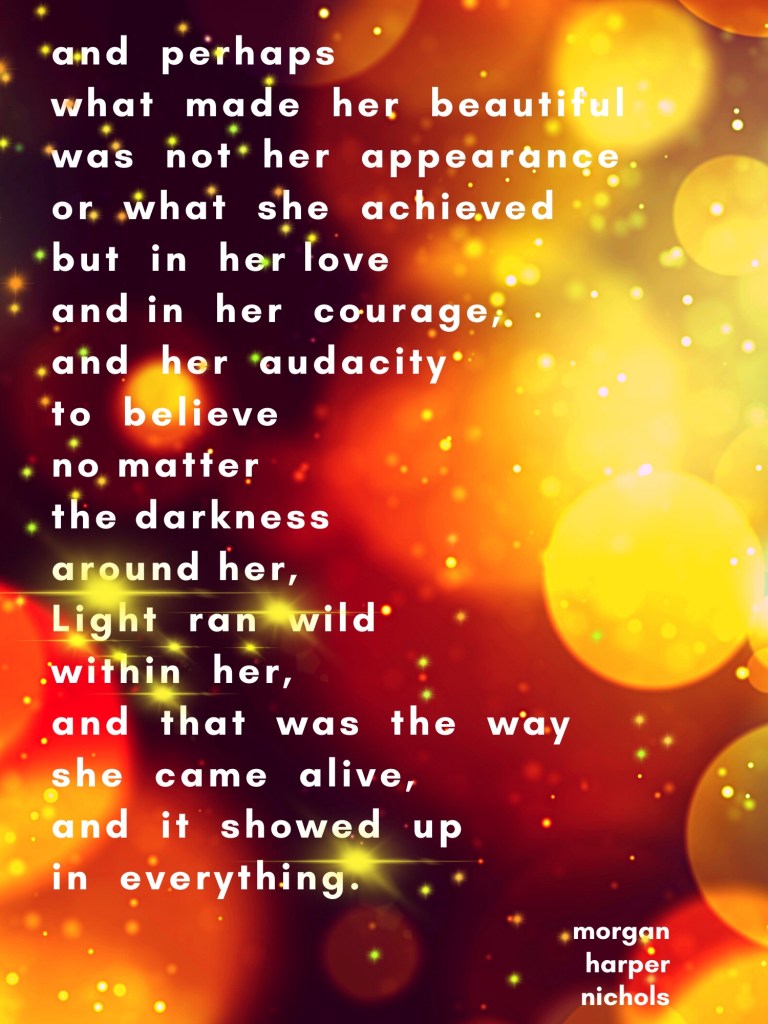
And then there are the inspiring words of artist and writer morgan harper nichols that so inspire me towards love, courage, audacity and the Light that runs wild within me, the Light that shines through my darkness and never goes out.

and  perhaps 
what  made  her  beautiful 

was  not  her  appearance
or  what  she  achieved
but  in  her love

and in  her  courage,
and  her  audacity
to  believe 
no matter

the darkness
around her,
Light  ran  wild
within  her,
and  that  was  the  way
she  came  alive, 
and  it  showed  up

in  everything.
— morgan harper nichols

May you have the strength to navigate those days when darkness threatens your light. May you love yourself and dig deep for the courage and audacity that frees you and lets the Light run wild within you!

Birdsong, Calm, Creation, Fear, Grace, Knowing, Life’s meaning, Listening, Paul Simon, peace, Prayer, Quiet, Reflection, Sacred Pauses, Sacred Space, Self Awareness, Self care, Self-understanding, Serenity, Silence, Simon and Garfunkel, Soul, Soul work, Spirituality, Stillness, The Sound of Silence, Whispers of the Soul, Wholeness

One Day I Listened

I wonder if you would be willing to stop what you’re doing right now and spend a quiet moment with me, just listening? Your time might well be a needed time for you and for your soul.

There is always so much to listen to — traffic, sirens, video game sounds, annoying household noise like the washing machine/dryer, food processor, mixer, fans, buzzers and alarms and the awful sound of the disposal trying to crush that inadvertent chicken bone. These, of course, are not our favorite sounds, but they are the myriad sounds and noises we hear in a typical day.

There are sweeter sounds, too, like the sound of a gentle, falling rain or the sound of rain when it hits hard on the roof; the sound of a gusty breeze as it rustles the leaves on a tree; the sound of a flowing stream, a rolling river and constant, ever-rushing ocean sounds; the flutter of a hummingbird’s wings; the sound of cicadas on a Southern summer night; the sound of a child’s laughter; the sweet, peaceful sound of a purring kitten; and birdsong, always birdsong.

Of course, listening as pure joy is listening to music — quiet music, lyrical melodies, rhythms that slow the pulse, the sound of a bow moving across a cello’s strings, the mesmerizing sound of a harp, the velvet sound of voices in harmony or the enthralling sound of a symphony orchestra.

Sounds fill the space that surrounds us, all the time. What is rarer for us is to hear the sound of silence. Some of us fear the silence or dread silent moments. Others of us avoid it at all costs because the silence tends to bring up whatever we are afraid to hear. So the noise that enfolds us fills the place that might otherwise hear the sighs of the soul — its cries and laments, its laughter, its sound of contentedness. It seems to me that this is the place we long to be, in the soul’s sound chamber where whatever we hear — if we’re listening carefully — is the song of the soul that tells us who we are and why we are.

There is a poem that many of you will remember (if you’re old enough) as a Simon and Garfunkel song from the 1960s. The poem was written by Paul Simon and it presents a frightening picture of the modern world doomed by the lack of spirituality and the people’s aversion to the true meaning of life. It is not so different in these days that spirituality and life meaning can be elusive, no matter how hard we may search for it and yearn for it.

The poem, entitled The Sound of Silence, is written by the voice of a visionary asking people to be serious about the true meaning of life. The poem’s message is that people are moving further and further away from true happiness because they have ignored life’s true meaning. They debate and quarrel about worthless things. They listen to or watch meaningless things. The poet writes that the people “speak and hear without listening. Like we often do?

Throughout its five stanzas, the poem presents the conflict between spiritual and material values. The poetic persona is a person of vision who warns against the lack of spiritual seriousness. The poem begins with an address by the poet persona to the darkness, saying that he has come to talk with the darkness. When he awakens, he says that the vision still remains as the sound of silence.

Some of us fear the silence or dread silent moments. Others avoid it at all costs because the silence tends to bring up whatever they are afraid to hear. So the noise that enfolds us fills the place that might otherwise hear the sighs of the soul — its cries and laments, its laughter, its sounds of contentedness. It seems to me that this is the place we long to be, in the soul’s sound chamber where whatever we hear — if we’re listening carefully — is the song of the soul that tells us who we are and why we are.

The words of the poet . . .

And in the naked light, I saw
Ten thousand people, maybe more
People talking without speaking

People hearing without listening
People writing songs that voices never share
And no one dared
Disturb the sound of silence

And the people bowed and prayed
To the neon god they made
And the sign flashed out its warning
In the words that it was forming
And the sign said,
“The words of the prophets are written on the subway walls

And tenement halls”
And whispered in the sound of silence

All of that trivia about the poem certainly moved us a little farther away from my point, which is that most, if not all, of us have a deep emotional and spiritual need to listen to our souls, really listen. Even if we don’t know it, we long to hear what the depth of our being wants to say to us. We want to find our true selves, a quest only our souls can accomplish. If we are honest, we would say that we want to do the soulwork that leads us out of the darkness of our own making and into a place of light.

When we do carve out a sacred pause, when we wait in the darkness of that silent space, and when we open ourselves to deep listening, we will likely hear God’s whisper. We will probably move slowly out of darkness and realize the promise that as “God’s own people” we will “proclaim the mighty acts of God who called us out of darkness into his marvelous light.”   (1 Peter 2:9)

This is the place we long to be, in the soul’s sound chamber where whatever we hear — if we’re listening carefully — is the song of the soul that tells us who we are and why we are.

— Rev. Kathy Manis Findley

Hearing God’s voice moves us to a deeper experience of life, but hearing our soul’s sighs may take us deeper still, because we open ourselves to self-knowing. It’s not a surface knowing. It is a deep knowing of who it is that lives in our skin. Without hearing the sighs our souls are making, we might never enter into fullness of self. I suggest that only the fullness of who we are can stand before the God who knows us even better than we know ourselves. 

In my own experience, I think that perhaps I cannot be in deep communion with God if I try to face God as my superficial self. Perhaps God seeks relationship with my soul, my deepest place of being. To find and define my soul for myself, to know myself fully, I must find the sound of silence and sit with it patiently and expectantly. Maybe that is the essence of spirituality.

So there are a few lessons in these words and these are the obvious lessons:

  • Limit the harsh sounds in your life.
  • Surround yourself with tender, gentle sounds.
  • Make sacred space and holy time to listen deeply for the sounds that speak to your soul.
  • Listen for God’s whispers. They are important to hear.
  • Always consider what is, for you, the true meaning of life.
  • Listen to your soul — its sighs, its cries, its songs. 

And who knows? If you linger for a while in your sacred listening space, you might just find the very essence of grace by hearing what your soul whispers to you. It will be the most beautiful sound of all.

— Rev.Kathy Manis Findley


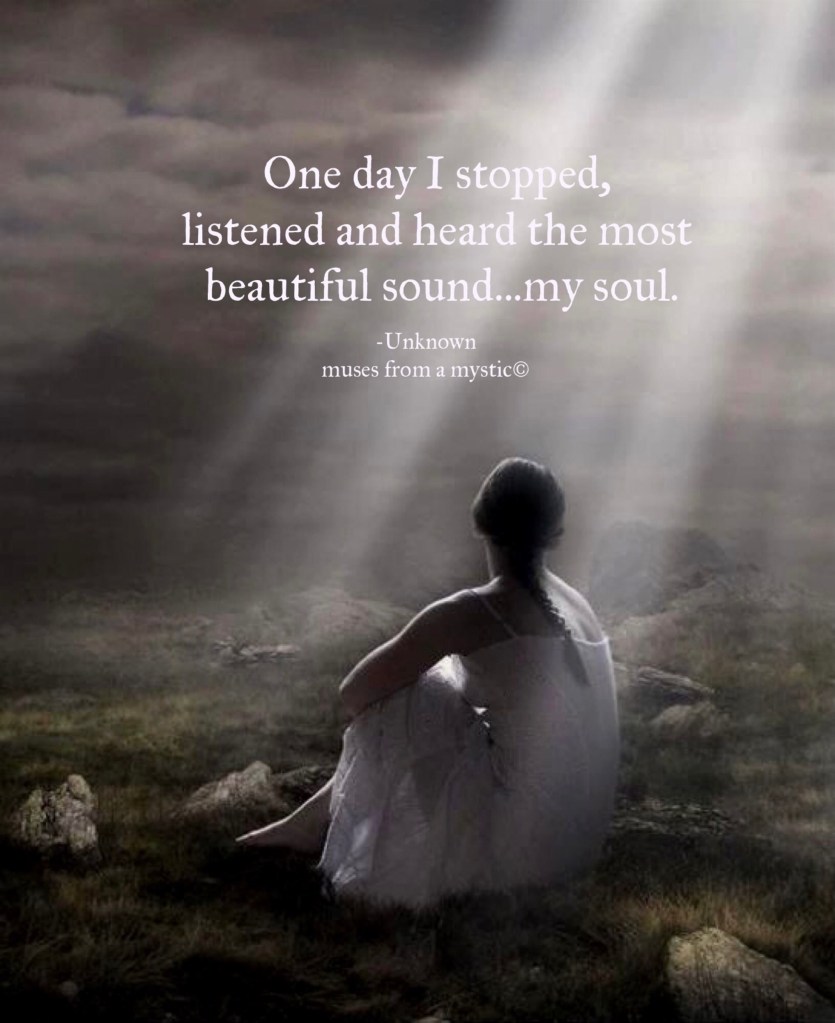
One day I listened — really listened. And I heard the whisper of God and the song of my soul. Thanks be to God.


I invite you to hear the poem, “The Sound of Silence,” through music. It can rightly be said that no group or person could ever sing this as well as Simon and Garfunkel, but I thought you might enjoy it covered by a very popular contemporary a cappella group, Pentatonix. 


The Sound of Silence by Paul Simon

Self Awareness, Self care, Self-understanding, Soul, Wisdom, Women

203 PILLS! PLUS WISE AND WONDERFUL WOMEN


71C9865D-0EF8-482D-B6E0-CBA6F36196B9Two hundred and three pills!
Twenty-eight injections!
Fourteen inhalations and fourteen nasal sprays!

Every week!

But I am most focused on the 203 pillsevery week! Presumably it takes that many to keep my body from rejecting my kidney and keep me otherwise healthy. 

203 pills! Insignificant when I explore the state of my soul — what lies inside there, what its longings are, what has become of its dreams and, most of all, whether or not I am carefully and gently tending to it. A healthy body is important, of course, but I have been thinking more and more about how to keep my soul healthy. In some ways, that’s harder. And harder to explain.

So rather than launching into a chorus of my own words about how I might care for my soul, I looked to the words of my sisters —  near and far, from the past and the present. There I found the depths of wisdom I needed on this day. So clear and true it is that so many women possess an extraordinary depth of wisdom. Their voices speak their truth, and sometimes ours. Their voices call us to stand taller and to rise higher. They call us to dream and to reach into our souls to find our dreams. These wise and wonderful women invite us to care for our souls. So hear their voices and listen for whispers that give strength to your soul.

Get in touch with and resurrect the free spirit deep inside me. Being one with the spirit allowed me to soar above my everyday reality. I marveled at the beauty of all life and savored the power and possibilities of my imagination.   — Maria Nhambu

Of all the paths you take, follow only those where your heart is wide open, mind enriched and your soul learns to dance.   — Nikki Rowe

A wise woman wishes to be no one’s enemy; a wise woman refuses to be anyone’s victim.   — Maya Angelou

We were willing to explore and be surprised. Willing to trust that there was beauty out there and love and joy. Ready to have our hearts touched and our souls hugged.   — Meara O’Hara

You will never see me surrender, never see me cry, but you will often see me walk away. Turn around and just leave, without looking back.   — Charlotte Eriksson

Big spirits don’t fit in small spaces.Our energy is built for open fields and wide places, room to breathe — room to grow. Room to live authentically and room to roam.   — Nikki Rowe

I am homesick for a place where silence is the only language, love is the only religion, and freedom is not something to be fought for….  — Samiha Totanji

When we discover who we are We will be free   — Mimi Novic

I never said it was easy to find your place in this world, but I’m coming to the conclusion that if you seek to please others, you will forever be changing because you will never be yourself, only fragments of someone you could be. You need to belong to yourself, and let others belong to themselves too. You need to be free.   — Charlotte Eriksson

We have not been abandoned. We have, perhaps, in that leaving been given the gift of ourselves in a new, deeper, and more lasting way.
Macrina Wiederkehr

If you’re always trying to be normal you will never know how amazing you can be.   — Maya Angelou

I know that no one is my judge. I live according to my own conscience and value discernment which is governed by Holy Spirit. I know my intentions and I walk my path with a clear conscience.   —  Mishi McCoy

The truth is, in order to heal we need to tell our stories and have them witnessed…The story itself becomes a vessel that holds us up, that sustains, that allows us to order our jumbled experiences into meaning. As I told my stories of fear, awakening, struggle, and transformation and had them received, heard, and validated by other women, I found healing.   — Sue Monk Kidd

You can’t put a leash on me. I’m unleashable!   — Tiffany Winfree

All too often we bemoan our imperfections rather than embrace them as part of the process in which we are brought to God. Cherished emptiness gives God space in which to work. We are pure capacity for God. Let us not, then, take our littleness lightly. It is a wonderful grace. It is a gift to receive. At the same time, let us not get trapped in the confines of our littleness, but keep pushing on to claim our greatness. Remind yourself often, “I am pure capacity for God; I can be more.”   ― Macrina Wiederkehr

you got to figure out which end of the needle you’re gon be, the one that’s fastened to the thread or the end that pierces the cloth.   — Sue Monk Kidd

Steal my wild heart, but do not ask me to live under an umbrella when I like being soaked by the rain.   — Jacqueline Simon Gunn

Honeybees depend not only on physical contact with the colony, but also require it’s social companionship and support. Isolate a honeybee from her sisters and she will soon die.   — Sue Monk Kidd

I’ve never been a woman who will settle to fit in, i’d always have rathered find a little world all on my own. If people come they come and if they go they go, but for me staying authentic to my soul’s purpose is all i’ll ever know.  — Nikki Rowe

You may write me down in history
With your bitter, twisted lies,
You may trod me in the very dirt
But still, like dust, I’ll rise.   — Maya Angelou

You have to find a mother inside yourself. We all do. Even if we already have a mother, we still have to find this part of ourselves inside.  — Sue Monk Kidd

Do you want to paint your life using two colors (good and bad) or do you want to paint the best piece of your life with colors beyond your wildest imagination?   — Helen Edwards

There is no place so awake and alive as the edge of becoming. But more than that, birthing the kind of woman who can authentically say, “My soul is my own,” and then embody it in her life, her spirituality, and her community is worth the risk and hardship.   — Sue Monk Kidd

It’s an unquietness I feel deep inside. It’s not about being extraordinary, you see. It’s not about standing out. It’s simply about shedding all that’s false. And believing with everything I have that you can too.   — Jacqueline Simon Gunn

When it’s time to die, go ahead and die, and when it’s time to live, live. Don’t sort-of-maybe live, but live like you’re going all out, like you’re not afraid.
— Sue Monk Kidd

Let your life reflect the faith you have in God. Fear nothing and pray about everything. Be strong, trust God’s word, and trust the process.
— Germany Kent

The cage wasn’t insignificant in the shaping of my wings, stillness is an experience only the deep souls can go. A quiet solitude in the midst of it all. A getting to know yourself once more.   — Nikki Rowe

O God, help me to believe the truth about myself, no matter how beautiful it is.   ― Macrina Wiederkehr

You’ve got to trust yourself. Be gentle with yourself. Listen to yourself.You’re the only person who can get you through this now. You’re the only one who can survive your story, the only one who can write your future. All you’ve got to do, when you’re ready, is stand up, {and begin again.}.  — Tessa Shaffer

Journal became a sanctuary where I could pour out in honesty my pain and joy. It recorded my footsteps and helped me understand where I was standing, where I had been, and even where God pointed.   — Sue Monk Kidd

Nothing has transformed my life more than realizing that it’s a waste of time to evaluate my worthiness by weighing the reaction of the people in the stands.   Brené Brown

Be who God meant you to be and you will set the world on fire!
St. Catherine of Siena

That’s the sacred intent of life, of God — to move us continuously toward growth, toward recovering all that is lost and orphaned within us and restoring the divine image imprinted on our soul.  — Sue Monk Kidd

The seasons of my heart change like the seasons of the fields. There are seasons of wonder and hope, seasons of suffering and love, seasons of healing. There are seasons of dying and rising, seasons of faith.
Macrina Wiederkehr

You only need to lose track of who you are, or who you thought you were supposed to be, so that you end up lying flat on the dirt floor basement of your heart. Do this, Jesus says, and you will live.  — Barbara Brown Taylor

I now see how owning our story and loving ourselves through that process is the bravest thing that we will ever do.   Brené Brown

Without the burden of afflictions it is impossible to reach the height of grace.  The gift of grace increases as the struggle increases.   St. Rose of Lima

Only when we are brave enough to explore the darkness will we discover the infinite power of our light.  — Brené Brown

I have learned things in the dark that I could never have learned in the light, things that have saved my life over and over again … there is only one logical conclusion. I need darkness as much as I need light.   — Barbara Brown Taylor

Go forth in peace, for you have followed the good road. Go forth without fear, for he who created you has made you holy, has always protected you, and loves you as a mother.   St. Clare of Assisi

For these wise women, O God, we give you thanks.
For their words, so full of grace, we are grateful.

For those we call our sisters, we ask your presence — in their days of light and in their dark nights of the soul.

Heal us, God our Mother, and give us grace for the living of these days.
Heal us, God our Father, and give us courage for the living of these days.
Heal us, Jesus, and walk beside us as we heal the world just as you urged us to do.
Heal us, Spirit, and give us your wind and fire — to live, to stand, to persist — to heal the souls of others as we heal our own souls. Amen.


599FBE6C-0696-46CC-B8F3-19823066126BThis blog post is dedicated to the memory of my friend, Sister Macrina Wiederkehr, a wise and wonderful woman who left us this year and is now walking among “trees full of angels.”

Enneagram, Insight, Inspiration, Self Awareness, Self-understanding, Transformation

A Different Kind of Blog Post: Reviewing the Enneagram

720B12F9-4A15-4E6A-897E-EB03156817EE

Settle in! This is a lengthy post. If you are interested in information about your personality type, the Enneagram is a helpful tool. And if you are interested in the Enneagram, or even curious about it, read on! If you’re not interested in any of that, wait for my next blog post.

“What’s your number?
That is the most frequently asked question about the Enneagram.

The second frequently asked question?
“What in the world is an Enneagram?”

Here’s the official definition according to the Merriam-Webster Dictionary:

en·ne·a·gram
noun
en·​nea·​gram | \ ˈe-nē-ə-ˌgram \ plural : enneagrams

Definition of enneagram
1. a regular geometric figure with nine points : the figure inscribed within a regular nine-sided polygon
2. a system of classifying personality types that is based on a nine-pointed starlike figure inscribed within a circle in which each of the nine points represents a personality type and its psychological motivations (such as the need to be right or helpful) influencing a person’s emotions, attitudes, and behavior).


Imposed Isolation and a Compromised Immune System

When one system is weak — my immune system — why not work on boosting another system? In this case, I mean my psychological system (which actually needs constant attention). So while I am in an immunosuppressed state of imposed isolation inside my house, I have taken some time to look back on the Enneagram notes I have used through the years. When I first studied the Enneagram, I was asking, “Who am I?”

I’m still asking! I now know that determining who I am is a life-long proposition, so I still need a season of introspection from time to time. Hence, I pulled out my Enneagram diagrams and notes. Let me say at the outset that no system can tell you who you are. The best the Enneagram can do is to offer a bit of insight into various personality types. It has been helpful for me, so I decided to share an Enneagram overview today.

I recently read several of Father Richard Rohr’s daily meditations focused on the Enneagram. He understands the Enneagram not merely as a personality typing system, but as a tool for personal transformation. In one of his daily meditations, Father Rohr says this about the Enneagram:

If you know the Enneagram already, my hope is that you will learn something new about yourself, someone you care about, or even someone you don’t care for very much. Compassion, empathy, and forgiveness—for the self and the other—are some of the great fruits of this labor. And if you aren’t familiar with the Enneagram at all, know that these meditations are simply pointing in the direction of a much greater wisdom to be explored.


Some History on the Enneagram

In the late 1960s, Oscar Ichazo began teaching the “Traditional Enneagram” as we know it today. The Enneagram is widely taught as a way of understanding personality, addiction, relationships, vocation and other areas that all of us need more fully understand. However, the Enneagram symbol has roots in antiquity and can be traced back at least as far as the works of Pythagoras. The philosophy behind the Enneagram contains components from mystical Judaism, Christianity, Islam, Taoism, Buddhism, and ancient Greek philosophy (particularly Socrates, Plato, and the Neo-Platonists)—all traditions that stretch back into antiquity. The Enneagram of Personality Types is a modern synthesis of a number of ancient wisdom traditions. (The Enneagram Institute)

People who know the Enneagram in a superficial way think it’s about putting people into boxes, but it actually works to free people from their self-created boxes. While there are tests and quizzes that can help individuals identify their primary Enneagram type, finding our “number” is just the first step. We get to know our “number” so we can begin freeing ourselves from the passions, fixations, and fears to which our ego has become attached.  — Father Richard Rohr

As Father Richard would suggest, we should remember that the Enneagram  does not definitively determine one’s personality type. Its nine categories are not meant to restrict us to a certain way of being or “name” us. Rather, it is  a dynamic system that recognizes that humans are far too complex to fit easily into simple categories. It does, however, offer insight.

The Enneagram  can be  a powerful tool for self-discovery and spiritual transformation, but it shouldn’t be our only tool. The Enneagram is most helpful when used in conjunction with other practices like study, contemplation, therapy, spiritual direction, and life in community with others. The Enneagram’s most important purpose  is  to help us uncover the traps that keep us from being our best selves. That kind of insight is invaluable.
— From the Daily Meditations of Richard Rohr published on February 23, 2020

The Nine Personality Types

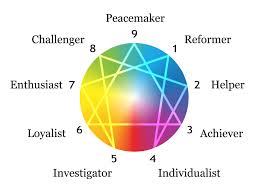
85EE4E48-DD90-454E-A9E7-A505DB185E1ELet’s begin by looking at a traditional Enneagram. The types are normally referred to by their numbers, but sometimes their “characteristic roles” are used instead. There are also  “stress” and “security” points which are the types (called Wings) connected by the lines of the enneagram figure and are believed to influence a person who is in more adverse or relaxed circumstances. According to this theory, someone with a primary One type, for example, may begin to think, feel and act more like a Four type when stressed or a Seven type when relaxed.


The Enneagram Wings

Most, but not all, Enneagram of Personality theorists teach that a person’s basic type is affected to some extent by the personality dynamics of the two adjacent types as indicated on the enneagram figure. These two types are often called “wings”. A person with the Three personality type, for example, is understood to have points Two and Four as their wing types. A person may be understood, therefore, to have a core type and one or two wing types which influence but do not change the core type.


The Enneagram at a Glance

The table below offers some of the principal characteristics of the nine types along with their basic relationships. This table expands upon Oscar Ichazo’s ego fixations, holy ideas, passions, and virtues, primarily using material from Understanding the Enneagram: The Practical Guide to Personality Types (revised edition) by Don Richard Riso and Russ Hudson.

451F46EF-0836-4B25-83F0-039A482AD349

Every single person has access to all nine numbers. Based on nature, nurture, and discipline, you express the values of each number at varying degrees of intensity based on your lived experience. You are not one thing; you are complex and multifaceted; you are interconnected. This is a vital paradigm shift. When you consider having access to all nine numbers simultaneously, you increase and expand your capacity for thriving.  [1] 

Considering what you know of the Enneagram so far, in what numbers do you experience ease, or in Jerome Lubbe’s language, sense “efficiency”? Where do you feel less efficient? Great insight can be gained from Richard Rohr’s February 29th meditation that speaks of understanding the Enneagram as a Whole-Identity Profile instead of a single number personality “type,” He says that by seeing the Enneagram as a Whole-Identity Profile, one can expand their capacity for growth in infinite ways.

 . . . When you shift the Enneagram Framework from being a number to having efficiencies in all nine numbers, the Enneagram language shifts with it. It becomes about nature and values instead of type and reductive behaviors. For example, number Seven, traditionally associated with the title of “Enthusiast,” is instead represented by the innate human capacity for “Enthusiasm” as well as the value of “Experiences. 

“I am an enthusiast” becomes “I value experiences” which allows more room for nuance, invites growth and begs the question, “. . . and what else do I value?”. . . There is no human who is defined by a single number.

If you have resisted being “pinned down” to any one Enneagram number, perhaps Lubbe’s approach will help you see all of these qualities within yourself. Take a few minutes to read the statements below aloud slowly, pausing for reflection after each one. Notice any sensations in your body. Observe the difference between the impact of “I am” statements versus “I value.” After reading all nine, where do you feel the most energy and resonance? What values are especially meaningful to you? What values do you want to spend more time cultivating?   [1]  https://cac.org/enneagram-part-one-body-center-weekly-summary-2020-02-29/


Jerome Lubbe’s Enneagram as a Whole-Identity Profile

Eight: I am a Challenger = I value Autonomy 

Nine: I am a Peacemaker = I value Serenity 

One: I am a Reformer = I value Justice 

Two: I am a Helper = I value Appreciation 

Three: I am an Achiever = I value Creativity

Four: I am an Individualist = I value Authenticity  

Five: I am an Investigator = I value Clarity 

Six: I am a Loyalist = I value Guarantees 

Seven: I am an Enthusiast = I value Experiences   [2] 

When we understand the Enneagram as a Whole-Identity Profile instead of a single number personality “type,” we expand our capacity for growth . . . You are not a personality. You are not even multiple personalities. You have an identity—and what creates and characterizes your identity can be charted by the nine numbers of the Enneagram.

6F063E55-B677-43FB-92DD-CBEA902AD935The anatomy of the brain reflects this: we are not left-brained or right-brained, we are whole brained. [3]  The same is true for the Enneagram.

To put it more plainly, you are not a personality type or number on the Enneagram. You are a whole person who has a whole identity — you are all nine numbers.

https://cac.org/enneagram-part-one-body-center-weekly-summary-2020-02-29/


Too Much Information?

This post may have been too much information for you. Or you may be interested in looking further into the Enneagram. If so, there are many excellent books on the subject as well as online information. You may also be asking how you can determine your Enneagram type. Online you will find many life coaches, spiritual directors, counselors, ministers and others who use Enneagram types with their clients/parishioners. Also at the end of this post I will list some websites that offer free tests that many be helpful to you, with the caveat that after you complete your test, they may offer you further information at a cost.

What’s most important is that whatever personality work you engage in leads you to a deeper knowing of yourself. The goal is to you know who you are, understand your behavior and use the information you have to guide your life journey and follow your dreams. No! The Enneagram test — nor any other personality test — will not make you into your best self. Only you can do that, through self-examination, prayer, contemplation and a process of clearing your soul of anything that might be holding you captive. My prayer for you is that you might search patiently and persistently for whatever brings you inspiration, insight, self-understanding and transformation.

P.S. — I’m a “Three!”


Online Enneagram Tests

The Enneagram Personality Test – Truity
This personality test is based on the Enneagram personality theory, which describes personality in terms of nine types, each driven by their own set of core emotions, fears, and beliefs. This basic 105 question test is free and takes about 10 minutes to complete. https://www.truity.com/test/enneagram-personality-test

The Fast Enneagram Test. https://enneagramtest.net/

Eclectic Energies Enneagram Tests
Offers two online Enneagram tests help you to determine which personality type you are. Your wing will also be indicated. https://www.eclecticenergies.com/enneagram/test

Additional Resources

E48ACE46-6279-41EB-BEA2-20EE99682E02


Book: The Sacred Enneagram: Finding Your Unique Path to Spiritual Growth; 
Paperback – published September 5, 2017 by Christopher L. Heuertz(Author), Richard Rohr(Foreword) Also available: The Sacred Enneagran Workbook.

5BB89D3F-56C9-4AFB-ABDD-9688B5F4AA8C


For Further Study

Chris HeuertzEnneagram MapmakersExploring the Interior Landscapes of the Ego (Center for Action and Contemplation: 2020), podcastcoming March 24, 2020

Richard Rohr and Russ Hudson, The Enneagram as a Tool for Your Spiritual Journey (Center for Action and Contemplation: 2009), CD, DVD, MP3 download  

Don Richard Riso and Russ Hudson, The Wisdom of the Enneagram: The Complete Guide to Psychological and Spiritual Growth for the Nine Personality Types (Bantam Books: 1999) 

Richard Rohr and Andreas Ebert, The Enneagram: A Christian Perspective (The Crossroad Publishing Company: 2001, 2013) 


References

[1] Jerome D. Lubbe, Whole-Identity: A Brain-Based Enneagram Model for (W)holistic Human Thriving (Thrive Neuro: 2019), 30-31. Artwork by Aimee Strickland; used with permission.

[2] Ibid., 32. Dr. Lubbe’s upcoming book, which will be available May 26, 2020, The Brain-Based Enneagram: You are not a number (vol. 1), will share his latest work on whole-brained interpretation of the Enneagram. See https://www.amazon.com/Brain-Based-Enneagram-Jerome-Lubbe/dp/173329452X/

[3]  Dr. Jerome Lubbe, a functional neurologist and co-founder of Thrive NeuroTheology, has developed a science-based method to understand the Enneagram which he explores in his book, Whole-Identity: A Brain-Based Enneagram Model for (W)holistic Human Thriving