A woman of sacred worth, Becoming, Beginning again, Bravery, Calling, Change, Children, Committment, Courage, Creating, Dreams, Freedom, God’s beloved daughter, I am enough!, Inner peace, life, Living in the soul, Miracles, Repair the world, Rev. Kathy Manis Findley, Self-understanding, Spirit wind, Tears, Tikkun Olam, Valued by God

Living an Unapologetic Life

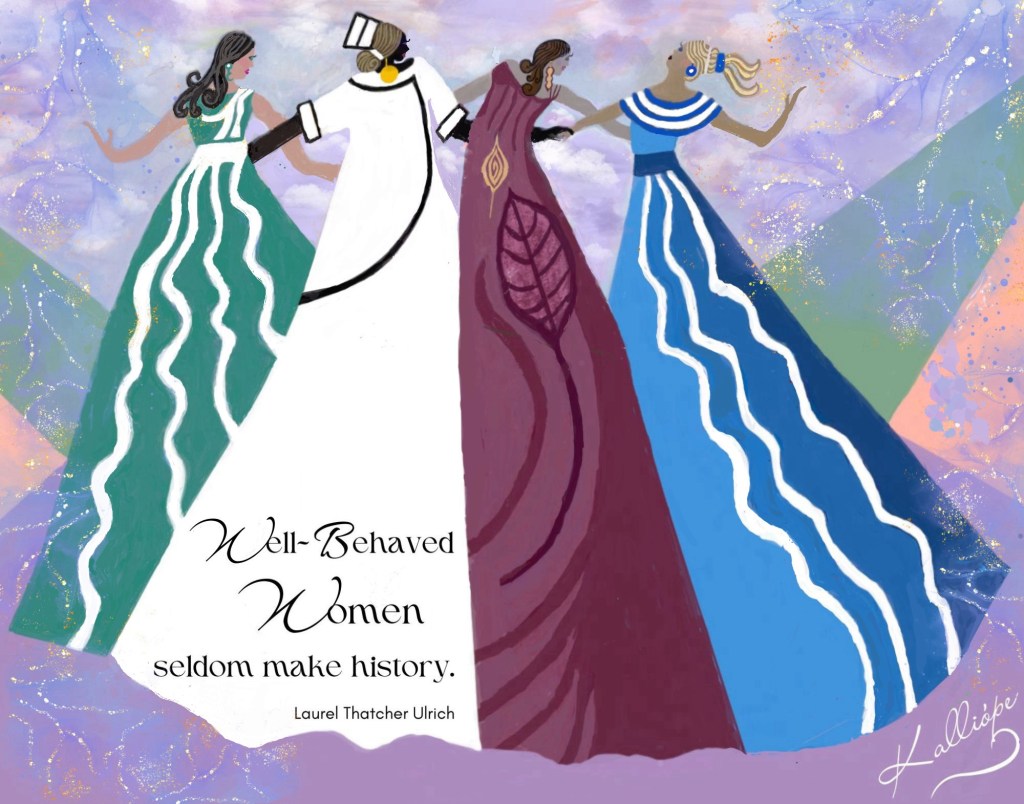
Art: “Well-behaved Women” by Kathy Manis Findley


Rev. Kathy Manis Findley
July 27, 2024

You have probably had that kind of dream at a few junctures on your journey. I know I had many dreams along the way. Sometimes they scared me to death. I dreamed of peace, equality, freedom, changing the world, and many other huge and noble dreams. I dreamed some silly dreams, too! I soon got the hint: changing the world is a formidable task. I followed all the rules, but being a rule-keeper does not make a person effective in dreaming and imagining. Women who follow the rules (someone else made up) could correctly be called well-behaved. They might even be called good girls because they don’t cause much of a flurry. They typically don’t make history and they certainly don’t change the world.

A woman with less-than-good behavior looks like someone at peace with herself, someone who radiates hope, someone with the courage and determination to do justice. I have admired and emulated so many examples of women who did make history, women who were not well-behaved at all. Here are only a few: Rosa Parks, Harriet Tubman, Lucretia Coffin Mott, Sojourner Truth, Susan B. Anthony, Nancy Sehested, Elizabeth Cody Stanton, Prathia Hall, Julian of Norwich, Malala Yousafzai, Mother Theresa of Calcutta, Ann Hasseltine Judson, Lucy Stone, and so many others!

About 24 years ago, a chaplain colleague recommended a book to me: Goodbye Good Girl: Letting Go of the Rules and Taking Back Your Self by Eileen M. Clegg. I think my chaplain friend was suggesting that I should get out of my comfort zone and take some risks, that I should courageously follow God’s call on my life. I knew that the members and churches of my denomination would “throw a fit,” like we say in the south! After all, I was an ordained minister serving as a hospital chaplain, which placed risky challenges before me every day.

So I read the book immediately and set out to become a bad girl, a girl who fully intended to change the world and to make history for it! So far, I have not made history. I have not managed to put my name in lights. I have not started any big public movements. But I have done some things that matter! I have learned how to create sacred space; I have learned the depth of liberation theology; I have found enough grace to endure the consequences of being a “bad girl” and then a woman with questionable behavior; I have held off anyone who tried to tell me who I am; and I have called up the courage to fight for justice. Colleagues, friends, family, co-workers reacted to the change in me, since they never expected me to dissent, or disagree, or refuse to behave.

Suddenly I let go of my “good girl” image and basically said “goodbye” to my restrictive behaviors. I took back my life, put aside all the rules, and followed my soul. I watched for the winds of the Spirit to lead me, and I moved forward to all the places that needed some attention. I was able to help change unjust systems, unjust policies, and unjust processes by not being so well-behaved.

Still, I sometimes think I have reached an uneasy place when it comes to letting go of my “good girl” persona. I’m really not a “good girl” and I don’t think I ever have been. My parents had to endure the sassy exclamations of my toddler years, like “Nobody’s the boss of me!” Creating shock from those who knew me, I mostly remained a “bad girl” from that day to this. I set aside the rules that were designed to keep people down and I took back my life. Today—in my mid-seventies—I continue to spew out uncommon proclamations that are quite annoying to those who are determined to hold on to their power and resist change.

Truly, it was sometimes hard being a change-maker and a rule-keeper! Always a people pleaser. Always the ultimate perfectionist. I discovered along the way that sometimes rule-keeping, people pleasing, and keeping every little thing “perfect” can harm your inner core. In fact, it’s less risky when you follow the leaders, make sure everyone is pleased, and doing everything with glowing perfection. Stepping out of line is always a bit dangerous.

When you become exactly who you are, resolute and unmovable about the things that matter to you, you will raise a few eyebrows, and sometimes people will get angry with you . You see, those people expected something else from you. Each of us becomes “me”— the “real me”— at our own peril. In a sense, we have to fight for the right to be ourselves in the world.

It is true that the people around me reacted strongly when I took back my life and became fully invested in my destiny. They thought that I had become radical, maybe even unhinged. I did not respond appropriately to their demands. To unreasonable demands, this is essentially how I might have responded, sometimes out loud, sometimes under my breath . . .

I will do it. / It’s my right! / It’s my choice! / It’s my prerogative! / It’s my decision! / I’m doing it anyway. / You can’t stop me! / Just watch!

All the while, I felt uncomfortable because of so much disdain from others, who began sending me a new message, You are not enough! I Imagine that many of you have heard someone say to you, You are not enough. At least, we may imagine someone saying those hurtful words. Unfortunately, we believe it because we don’t know ourselves, meaning we don’t know our bright and dark places, we have not yet realized our sacred worth, and we have not yet searched our souls.

For you see, you and I are afraid because it is perilous for the soul when we don’t search diligently for our soul’s passions and dreams. You and I sometimes accept what others say about us and tuck it away in our deepest places. When those words sneak all the way down into the soul, we tend to give up. We start from the moment we make ourselves nonchalant about it all, that moment when we shield our hearts from hurt. One of the saddest phrases we use is “I don’t care.” When we no longer care, we begin, one by one, eliminating the people around us, never realizing that they are hurting, too. And maybe the reason they send the message, You are not enough, is because they believe that they are not enough either.

I can honestly say that I have often heard voices—known voices, unknown voices, and the weak little voice in my head—telling me, You are not enough! I have learned that once I have embodied that negative message, it rolls around in my psyche for a long time, maybe forever. It becomes a state of being that goes deeper than skin. It penetrates in deeper places, and takes its toll on my emotional and physical well-being. I recall many such times, none more painful than the wagging tongues around my ordination . . . You know the scenario, “She can’t be a minister because she is a woman! Anyway, she’s not good enough! Other voices are often hazardous, dangerously breaking down our sense of self-worth. They may be yelling, speaking in a normal tone, whispering, or imagined in our heads. In response, we must prepare ourselves to hear the voice above all voices, saying, “You are my beloved daughter with whom I am well pleased.”

For a long time, I embodied the traits of the good girl, but to embody good girl traits is not really a once-and-done action. Embodied lasts a while! Embody does not have a shallow or surface meaning. It is deeper. I like the word embody. It seems to suggest that we can live a soulful life. In the very middle of the Greek word for “embody” we find the word σώμα, which means body. However, the Greek word for body cannot be translated in a way that reveals the depth of its meaning. The definition of σώμα is deeper than we realize. It is not skin-deep, it is deeper, approaching a definition more like soul.

I do like the word embody and the word soul. In some ways, to embody means to live in your soul. The word embody may whisper to you that in your body’s center, you will find the path to reach your soul. A person who lives in the soul is a person that does not live a shallow life, devoid of the emotion that makes us alive. The soul will help you, if you can just start by daring to touch it.

So what are the things we can actually do to take back our lives and live soulfully? What path do we follow to transform ourselves and change the world? My initial response to that is, “I don’t know.” Not very comforting, I know, but mostly true. We cannot forge the path for any other person. We cannot know what’s best for them. So not knowing anyones path, nor their dreams, I can give you a list of things others are finding the leads to their transformation. Here they are, not at all an exhaustive list, and certainly not a perfect guide for you:

  • Carve out some time for quiet, restful, meditation.
  • If you are a person of faith, get in touch with God or whatever person you worship.
  • Listen.
  • Listen some more—to your heart and your soul.
  • See if you find there a sacred direction especially for you.
  • Do you feel you are getting any closer to discovering your authentic self?
  • Can you begin to believe you will be transformed?
  • Can you take a step or two, in faith, into a holy place of transformation?
  • Pray, making your needs known to the source of your faith.
  • Read! Read the stories of others who found life transformation.
  • Find community, even one other person, who understands your journey.
  • Start all over again, leaning into the wisdom you found on your previous journey.
  • Take as long as it takes, until you realize that suddenly, you are becoming emboldened and scrappy!

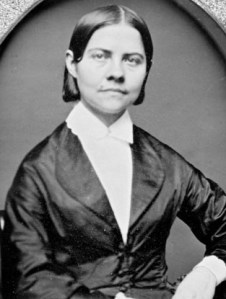
You may not know her name, but Lucy Stone was steadfast in her belief in self-authentication and in her ability to change the world. Lucy Stone was called “emboldened” and “scrappy” because of her tireless work for the abolitionist and women’s rights movements through the 19th century. A bona fide pioneer of her time, Lucy Stone stands as a historical titan. Her book “Unapologetic Life” describes a model of a revolutionary living. As for me, I would count it an honor to be described as emboldened and scrappy.

Life is more fun when you’re emboldened and scrappy. Not that we want to reduce the life experience to just scrappinesses. Life is so much more, like authenticity and the willingness to be a change-agent. Life is about having enough courage to persevere! Life for me is about my soul and all the ways it has been transformed over many years. All along my journey, I knew that my soul was a problem! At every age, there was a part of me that wouldn’t follow the easiest path. I longed to be empowered to make societal change. I chased down injustice and worked to dismantle it. I spent most of my career working with victims of domestic violence, child abuse, and human trafficking. This was not the easiest and most pleasant vocation, but the work had made its way into my soul. To do it, I had to live in the light of self-awareness and soul-awareness. I had to constantly listen to the sighs of my soul, and move only after I had heard them clearly. If I had just one nugget of advice for you, it would be to touch your soul and ride on the wings of the Spirit.

Sisters, don’t forget that when you touch your soul, you might just not be a “good girl” anymore. Or a good boy, for that matter. As for me, I am not a “good girl” living at the whims of other people! And I am definitely not a well-behaved woman! So I fully expect to make history! Because making history means leaving a legacy, creating a world brimming with peace, and embodying your best self!


Advent, Bethlehem’s Star, Darkness, Emotions, Faith, God’s Gift of Stars, healing, Hope, Miracles, Stars, struggle, Trust

Star-Giving

The Third Day of Advent
Transplant Day Twenty-Two
December 3, 2019

4C9D51BE-2835-4353-9899-134D6EF882DE
STAR-GIVING

What I’d really like to give you for Christmas is a star . . . .
Brilliance in a package,
something that you could keep in the pocket of your jeans
or in the pocket of your being.
Something to take out in times of darkness,
something that would never snuff out or tarnish,
something you could hold in your hand,
something for wonderment,
something for pondering,
something that would remind you of
what Christmas has always meant:
God’s Advent Light into the darkness of this world.

But stars are only God’s for giving,
and I must be content to give you words and wishes
and packages without stars.

But I can wish you life
as radiant as the Star
that announced the Christ Child’s coming,
and as filled with awe as the shepherds who stood
beneath its light.

And I can pass on to you the love
that has been given to me,
ignited countless times by others
who have knelt in Bethlehem’s light.

Perhaps, if you ask, God will give you a star.

— Ann Weems

This poem by Ann Weems called me to think about gifts, about giving gifts and receiving them, about learning how to cherish the gifts we receive, even those gifts we fail to recognize as gifts. My husband, Fred, tells stories of delightful Christmas parties at his country church — a full pot luck meal, tables lined with deserts of every kind, a decorated cedar Christmas tree and, of course, the gift exchange. He tells about wondering what gift he would receive days before the party and how the party-goers seemed to bring the same gifts every year: chocolate covered cherries, socks, a Claxton fruitcake, ear muffs, puzzles, home-canned jelly, ornaments, maybe even a knit toboggan from the Dollar Store. As for Fred, he always hoped for the cherries.

The party was mostly about the gifts — humble, simple, inexpensive, cherished. In thinking about gifts, the idea of cherishing gifts seems important. After all, if one can cherish a Claxton fruitcake, it would be easy to learn to cherish other gifts. Ann Weems expressed like this:

What I’d really like to give you for Christmas is a star . . . .Brilliance in a package, something that you could keep in the pocket of your jeans or in the pocket of your being.

Something to take out in times of darkness, something that would never snuff out or tarnish, something you could hold in your hand, Something for wonderment. . .

My attention went directly to “something for wonderment.” A kidney from my living donor is a gift for wonderment, to cherish. My new spiritual director who found me through an online group of female clergy is a gift for wonderment. My compassionate, tireless caregiver during this trying recuperation is a gift for wonderment. My friends and family — constantly caring, constantly praying — is a gift for wonderment. I can cherish those gifts.

Still, cherishing the gifts you receive is not a given. It’s not always easy. Let me offer an example. I had a phone conversation yesterday with a new friend who is also a kidney transplant traveler. Though every transplant recipient is unique in the way they adjust to life after a transplant, the two of us shared some definite commonalities. Both of us spoke of physical pain — his about 15 years ago; mine current, constant and debilitating. I could closely identify with much of what he told me he experienced. He spoke of his lack of faith in the immunosuppressant medications, a lack of trust in decisions doctors made during his year of follow-up care, and even very little hope that having a transplant was a wise decision.

We also talked about gifts for wonderment, gifts to cherish, gifts we should cherish, but sometimes cannot. A kidney transplant — especially when you are in the throes of recovery with a 9 inch incision held together with 33 metal staples — doesn’t always feel like a gift.

The last thing my new friend said about our kidney transplants is this:

“It’s a gift! It’s a miracle!”

Most assuredly, a kidney transplant is a miracle and a gift of wonderment, a gift to be cherished. Much like the stars in Ann Weems’ poem —- “brilliance in a package, something to take out in times of darkness, a gift of wonderment, something like God’s gift of stars.” Such a gift is radiance, light breaking through our darkness, a gift to be cherished.

I think I’ll try to be visionary enough, present enough, hopeful enough to catch one of God’s stars to hold in my hand and to keep until I need them most.04E87215-AC50-4CC9-B2F4-6612E56D0CB9

Amen.

Change, Community, Faith, Family, Fear, Friends, God's Faithfulness, healing, Holy Ground, Hope, Magic, Mayo Clinic, Miracles, New Normal, Pain, Rest, Rhythm, Sacred Space, Secrets, Social justice, struggle, Suffering, Tears, Transformation, Unfaith

A Million Seconds

0A265C1F-2FB5-49A6-95D1-6CB6E1E3AB12
Transplant Day Twelve
November 23, 2019

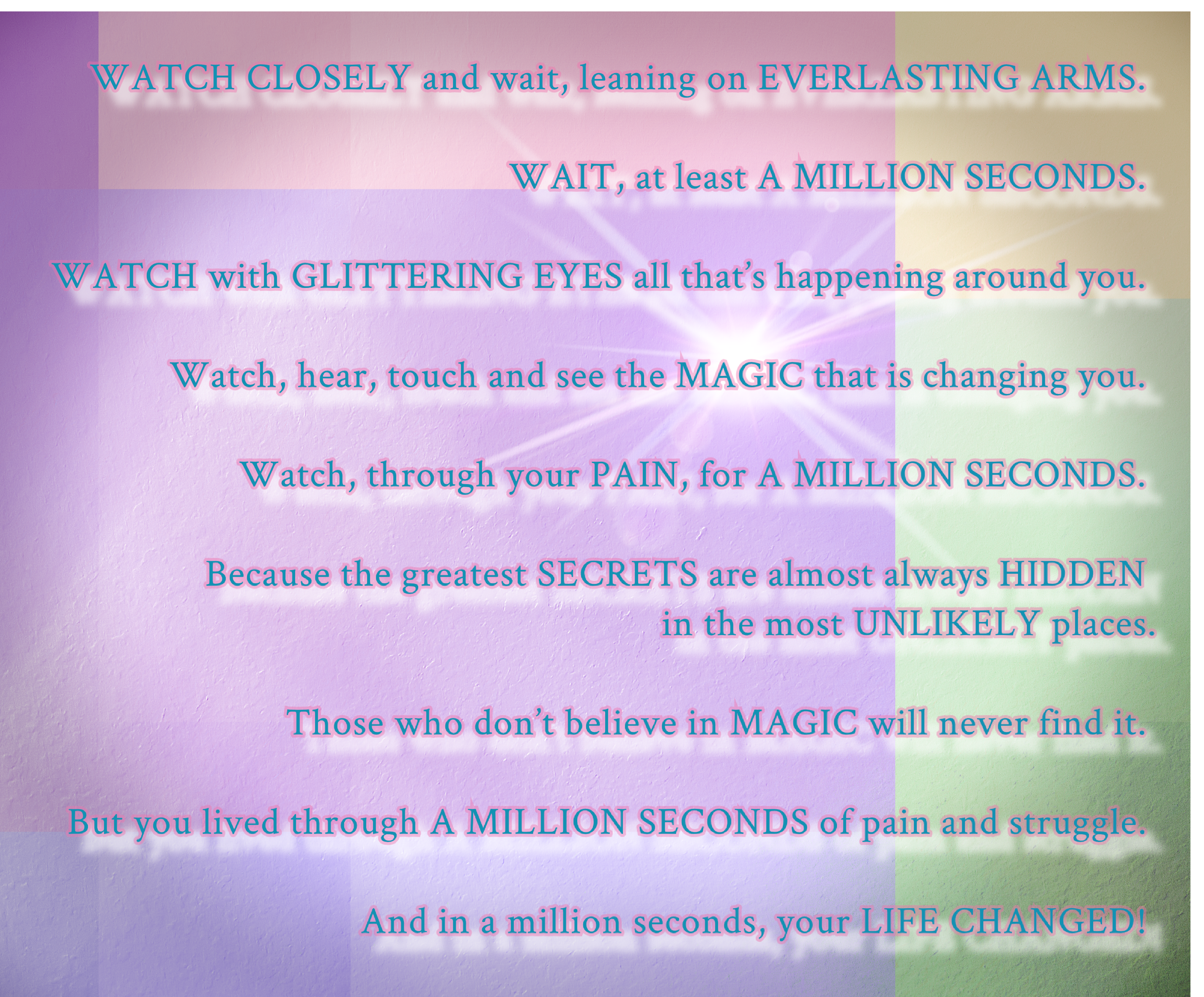
I have just reached a milestone — a million seconds. My kidney transplant started the clock on Tuesday, November 12, 2019. Today it is a million seconds later. I will remember those million seconds as a time of fear and faith, laughter and tears, rest and painful sleeplessness. I will remember a million seconds filled with hard things, the pain of a large incision spreading halfway across my abdomen, and swallowing pills, lots of pills.

I may one day see those million seconds as hidden secrets, secrets hidden from me by pain and by my body’s struggle to regain some normalcy. I may in time look at those million seconds with glittering eyes and see them as the magic they were. But today I can just share with you what I experienced in a million seconds that began on a Tuesday — November 12th to be exact.

I will remember a million seconds of so many strange things happening to my body and the numerous assaults my body endured. I will remember a million seconds of awe in knowing that a kidney was removed from a living donor at Mayo Clinic in Rochester, Minnesota and hand carried by a doctor to me, to Mayo Clinic in Jacksonville, Florida — a  distance of 1,115 miles “as the crow flies.”

I will remember a million seconds that began when my surgeon took a picture of the kidney, brought the photo on her phone to my room to show it to me, and said, “This is a beautiful, perfect kidney for you.” She planted that kidney, tucked it carefully inside me, took a photo of the incision and about five hours later came to my room to show me a picture she took on her iPhone of a large incision, impeccably sutured.

I will not forget those million seconds of the prayers of my friends, doctors and nurses caring for me and family members hovering over me with concern and relief.

I will not forget the hymn that came to my mind in the long, sleepless nights in the hospital — a million seconds of leaning on God’s everlasting arms.

What have I to dread, what have I to fear,
Leaning on the everlasting arms?
I have blessed peace with my Lord so near,
Leaning on the everlasting arms.

Leaning, leaning,
Safe and secure from all alarms;
Leaning, leaning,
Leaning on the everlasting arms.

A million seconds have changed my life, while all the while, I was leaning on the everlasting arms. It was a million seconds of holy ground, sacred space. Yet I hardly noticed it as magic or miracle as the pain of my humanity took center stage.

Yes, I focused on suffering, physical pain, worry, concern, tears. Instead, I might have focused on the hidden secrets and witnessed the miracle of holy ground inside a hospital room. I could have had a million seconds of miracle, but instead I experienced a million seconds of the raw and real humanity of suffering. In some ways, a million seconds of transformation were lost to me as I invited unfaith into my room.

And by the way, a million seconds is 12 days.

Comfort, Darkness, Despair, Faith, Fear, healing, Hope, Illness, Light, Magic, Miracles, Suffering, Surprise

Surprised by Light

297A1795-F8AF-485F-B9E4-68A92714798E
Transplant Day Seven
November 19, 2019

Today, I am singing in my mind a sacred hymn that often speaks hope to me. The
text was written by William Cowper (1731-1800) and the music by William Howard Doane (1832-1915). In the darkness of the past week, I have been surprised by light.

Sometimes a light surprises
The child of God who sings;
It is the Lord who rises
With healing in His wings:
When comforts are declining,
God grants the soul again
A season of clear shining,
To cheer it after the rain

In holy contemplation
We sweetly then pursue
The theme of God’s’ salvation,
And find it ever new;
Set free from present sorrow,
We cheerfully can say,
Let the unknown tomorrow
Bring with it what it may.

Tomorrow can bring us nothing,
But God will bear us through:
Who gives the lilies clothing
Will clothe His people, too:
Beneath the spreading heavens
No creature but is fed;
And God Who feeds the ravens
Will give His children bread.

Though vine nor fig tree neither
Their wonted fruit should bear,
Though all the fields should wither,
Nor flocks or herds be there
Yet, God the same abiding,
God’s praise shall tune my voice;
For, while in Him confiding,
I cannot but rejoice.

It is so true that “sometimes a light surprises the child of God who sings.” The surprise is almost magic. Surely the light is miracle, and I thank God for the miracle of this new day. The miracle, I think, is that I am able to look at this day in a way that leads to gratitude for life.

I am determined that this will not be a day I describe by pain, but that I would declare this day a day of healing. Today, I want to lean into healing, not suffering — faith, not fear. I am convinced that this is God’s desire for me.

There is no doubt that I have walked through darkness in the past week. It is also my truth that light really does shine out of dark places. My pondering light and darkness this morning brings up a Scripture text I have leaned on many times in my life. I love the New Century Version of this text.

God once said, “Let the light shine out of the darkness!” 
This is the same God who made his light shine in our hearts by letting us know the glory of God that is in the face of Christ.

We have this treasure from God, but we are like clay jars that hold the treasure. This shows that the great power is from God, not from us. 

We have troubles all around us, but we are not defeated. 
We do not know what to do, but we do not give up the hope of living. 
We are persecuted, but God does not leave us. 
We are hurt sometimes, but we are not destroyed.

— 2 Corinthians 4:1-11 New Century Version (NCV)

How accurately this text describes my past few days! How true it is that I have not known what to do about the pain and suffering, yet I refuse to “give up the hope of living.” This is as it should be. This is God’s desire for us — to never give up the hope of living and to cling to the good hope that light really does shine out of darkness.

Sometimes a light really does surprise us when we sing. Singing beats weeping every time. Singing drives out darkness. I have heard often that only light can drive out darkness and I believe that truth. In fact, when I find myself in the middle of darkness, I am convinced that darkness is precisely the place where I am able to see the light at its brightest.

Thanks be to God.

Andrew Michael Manis, Angels, Church, Faith, Family, Gratitude, Growing up, Hope, Miracles, Prayer, Stories, Weeping

A Baby Brother! Not for Me!

051DDA23-6104-48A2-B63A-E5B2E72D2EE8
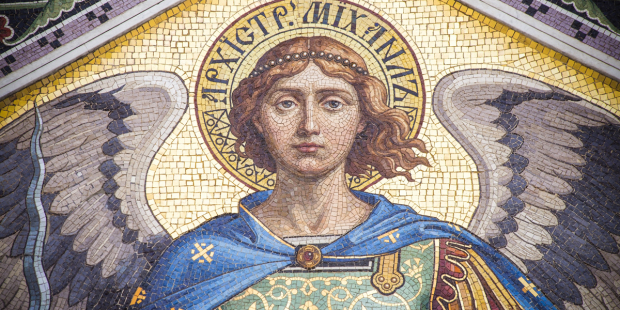
Michael, the Archangel

This morning I was reading an interesting article about Michael, the Archangel. The headline read “Call upon the Archangel to stand guard over you . . . at night.” The article pointed out that we are the most vulnerable when we are asleep, unable to protect ourselves from harm. The Archangel Michael can protect us. The information, while interesting, was not all that earth shattering. But reading it brought to mind an unforgettable childhood memory.

As a child around the age of five, I didn’t think much of this particular day, but as an adult, I count it as one of my most cherished memories. On top of that, I now see it as an early childhood experience that shaped my view of God and began to prepare me for the vocation of ministry. But I must begin at the beginning to paint a picture of a precocious, spoiled five year old.

My mother was expecting a new baby, my first sibling. I was all in if the baby was a sister, but for some reason, I loathed the idea of a baby brother, which is exactly what I got. I was NOT happy! I remember it like it was yesterday. Yiayia (my grandmother) broke the news. I stomped my feet and declared that my mother could absolutely not return home with a boy baby!

Going on alongside my childish impertinence, the adults were experiencing a completely different reality. It appeared, in fact, that my baby brother would not come home and that his survival was doubtful. As in many Greek families, my brother’s dangerous situation remained “between us,” which meant my grandmother, my father and my two aunts, Eirene and Koula. At all costs, my mother was not to be told of the seriousness of her new baby’s health. And of course, nothing was to be said in the presence of five-year-old Kalliope, though that made no difference at all because my ears had always been finely attuned to family secrets and whispers. When adults spoke, even in hushed whispers, I heard.

So I knew, at least, that something was amiss, and if I am honest, I have to confess that I was glad I would not be having a brother in my world. Until the next day. As soon as I woke up, Yiayia washed my face, made me brush my teeth, and began to dress me. For reasons I did not yet understand, she was dressed in her church clothes and she pulled out a church dress for me. I knew it wasn’t Sunday, but I did not know that I was about to have a life-altering experience. Now you might think that a five-year-old cannot really understand a life-altering experience. But you would be mistaken. This life-altering experience has been lying in my memories for more than six decades.

Both dressed impeccably, we put on our winter coats and walked across the street and down the block to the bus stop. I was cold, ready for the bus to show up. Of course, I asked where we were going and why we were so dressed up. “Siopi! Min milas tora!” was Yiayia’s response. “Hush! Don’t talk right now!” Sensing the fear and grief in Yiayia’s mood, I sat quietly and didn’t say another word as the bus took us to downtown Birmingham. When we disembarked, I knew exactly where we were going, but I did not know why.

As we walked up the front steps at our Greek Orthodox church, I felt the warmth of the building easing the February cold. I was glad to be warm. I smelled the incense, comforted by the familiar fragrance. And I watched the flames of hundreds of thin white candles placed in a bed of sand as Yiayia lit another one, placed it in the sand, and made her cross. Immediately, I made my cross, too, three times, as I was taught to do.

The church was silent. With dim lights, it had never looked more beautiful. As we walked down the aisle through the nave, I looked to each side to see the stained glass windows. I looked up above the nave into the dome of the church where the icon of Christ, Ruler of All, looked back directly at me in a way that almost seemed eerie. I realize that we are going up the steps to the iconostasis, the wall of doors that each had an icon on them. I had never, ever been up those few steps. It was the place, I thought, where only the priest and the altar boys could be.

But up we went, and stood directly in front of the door bearing the image of Michael the Archangel. Finally, Yiayia spoke. “Your brother is going to die. We have to pray for him to St Michael, the protector of all. You pray too.

And so we did, Yiayia with a deep, reverent, desperate fervency that pleaded for the Archangel to save the baby, offering Saint Michael a promise in return for the baby’s life. As for me, I can only remember having a lump in my throat and trying not to cry. But tears streamed down my cheeks as we finished, and I made my cross three times.

We headed silently back to the bus stop to go home. The house was much quieter than usual, and I stayed quiet too, which was a huge feat for me. I didn’t say anything about not wanting my baby brother for a few days, which proves the cunning wisdom of a five-year-old. I played quietly in my room the rest of the morning, but the mood in the house lifted that very afternoon.

My father and aunts came home not many hours after our church experience and announced with unbridled joy that the baby was going to be fine. Yiayia made her cross three times and gave exuberant thanks to God and St. Michael the Archangel who heard our prayers, gave us a miracle, and saved the baby boy.

My mother did come home with the miracle baby, Andrew Michael (named after the Archangel who saved his life). I stood my ground, refused to hold him or look at him, and sternly pronounced that they should take him back and bring me a sister!

So much for my spiritual act of devotion in the church. On the other hand, isn’t that just the way God works with us? Planting spiritual experiences in us when we hardly take notice, knowing that we will hide them somewhere in our hearts for a later time in our lives. 

Thanks be to God.


Freedom Songs, healing, Hope, John 5, Miracles, Music, Wade in the Water

Troubled Waters and Miracles

abstract background beach color
Photo by Pixabay on Pexels.com

I love the words and the melody of the spiritual, “Wade in the Water.”

Wade in the water.
Wade in the water, children.
Wade in the water.
God’s gonna’ trouble the water.

There is just something about it that is moving to me. It digs down into my spirit and stops me in my tracks. I don’t know why I react so deeply to that simple bit of music. It could be that what draws me to it is its strong reference to healing as it recalls the miracle story recorded in the Gospel of John.

After a feast of the Jews, Jesus went to Jerusalem. Now there is in Jerusalem by the Sheep Gate a pool, which is called in Hebrew, Bethesda. It has five porches, and lying in these porches are many sick people who are blind, lame, paralyzed, each waiting for the moving of the water.

For an angel went down at a certain time into the pool and troubled the water; then whoever stepped in first, after the troubling of the water, was made well of whatever disease she had. 

Now a certain man was there who suffered from an infirmity for thirty-eight years. When Jesus saw him lying there, and knew that he already had been in that condition a long time, He said to him, “Do you want to be made well?”

The sick man answered Him, “Sir, I have no one to put me into the pool when the water is troubled. Before I can get into the water, someone else gets in before me.”

Jesus said to him, “Rise, take up your bed and walk.” And immediately the man was made well, took up his bed, and walked.

— John 5:1-8 NKJV (paraphrased)

Or what inspires me about the song could be the stories that surround it. Some folk claim that “Wade in the Water” contained secret coded instructions to fugitive slaves on how to avoid capture as they followed the route to take them to freedom. The website Pathways to Freedom: Maryland & the Underground Railroad explains how Harriet Tubman used the song to tell escaping slaves to get off the trail and into the water to make sure that the dogs employed by the slavers lost their scent. “Wade in the Water” was one of their most inspiring freedom songs.

Those moving stories remind me of the many ways music touches my life with inspiration, courage, and hope, how it reaches the depths of my soul during the times when nothing else can reach me, how it lifts me up when I have fallen into despair, how it fills my heart with just the melody I need to give voice to my sorrow and then gives me a way to express my moments of greatest joy.

Most of us can recall times in our lives when we needed a dose of Divine healing. We can remember times of sorrow and despair and fear when only an encounter with God could move us toward peace, times when we needed to be made whole again, times when we hoped beyond hope that God would trouble the water. Read it again.

 . . . An angel went down at a certain time into the pool and troubled the water; then whoever stepped in first, after the troubling of the water, was made well of whatever disease she had. 

So in John’s Gospel story, a man who had been sick for thirty-eight years was healed. He was too ill to make it into the troubled waters of the pool no matter how many times he tried. But Jesus was there and asked him, “Do you want to be made well?”

The sick man answered that there was no one to put him into the pool when the water was troubled. “Before I can get into the water,” he said, “someone else gets in before me.”

But Jesus said those extraordinary words to him: “Rise, take up your bed and walk.” 

Immediately it happened. The man was healed, and he picked up his bed and walked. Maybe the man rushed off to tell friends about the wonderful thing that had happened to him. Or maybe could only stand there in awe, not moving at all because the moment was just too overwhelming.

It was a miracle. Actually, the story tells of at least two miracles: that Jesus healed the suffering man and that an angel descended from above and troubled the water in that otherwise ordinary pool.

I don’t know about you, but when I encounter a pool of healing water, troubled and swirling, I want to get in. I want my faith to be big enough to expect a miracle from ordinary water, in an ordinary pool, on an ordinary day.


Please visit this link to hear a stunning arrangement of “Wade in the Water” featuring an excellent soloist and choir from the A Cappella Academy from Los Angeles.

https://m.youtube.com/watch?v=uiqQKZZo-Uc


God's Faithfulness, Lent, Miracles

There Will Be Miracles

Enlight42
The Lenten journey always reminds me of wandering through a wilderness. Today, I thought about the Exodus story that details a part of the journey of the Israelites. The story tells how the Israelite community traveled from place to place as the Lord commanded. When they camped at Rephidim, they found no water, so, of course, they complained to Moses.

An exasperated Moses cried out to the Lord, “What am I to do with these people? They are almost ready to stone me.”

Of course they were. It was so much easier to blame Moses than to take responsibility for their own decision to make this journey. I am well acquainted with the tendency to blame other people or other circumstances for my own mistakes and missteps. And like the Israelites, I have often been exasperated enough to cry out as they did: “Is the Lord among us or not?”

As always, God showed up to help Moses with this dilemma.

The Lord answered Moses, “Go out in front of the people. Take with you some of the elders of Israel and take in your hand the staff with which you struck the Nile, and go. I will stand there before you by the rock at Horeb. Strike the rock, and water will come out of it for the people to drink. (From Exodus 17)

Moses did just that and obeyed a God who provided the miracle. Water spewed out of Horeb’s rock and the people drank the miracle water until they thirsted no more. They would see God’s miracles again. They would witness the glory of the Lord again, and again.

But the journey continued, the wilderness was barren, the way was long. The people would complain again. They would sin, even as they witnessed life-changing events. They would be very human.

Just as we are. So take heart as you travel your Lenten journey. There will be dry, wilderness patches. But there will also be miracles. Keep your eyes open for them. You’ll be grateful that you did.

Fear, God's Faithfulness, healing, Miracles

Small Miracles


image

Two years. Every day on dialysis. Confined to one room for over seven hours every night, tubes holding me hostage. Tubing and tape under my clothing twenty-four hours a day, seven days a week. Don’t get me wrong. I am deeply grateful for the lifesaving treatments. I am grateful for the medical team that cares for me and examines me carefully twice a month. I am grateful for my husband, the greatest caregiver, who hooks me up every night, keeps our equipment sterile, orders dialysis supplies and medication, and does so much more.

But I still get tired of the confinement of dialysis. I often wonder how long I will be on dialysis and if I’ll ever have a kidney transplant. I wonder how long the dialysis will be effective for me. I wonder about how to stay as healthy as possible. I think about the burden I am on my husband and try to find ways to pull my own weight.

I have many questions and few answers. Sometimes that reality brings me down. It is a constant effort to stay emotionally healthy.

Yet through it all, I trust the protection of God who brought me this far after a year of serious illness. Through a lot of prayer and a series of small miracles, I found my life again. It is true that I experience fear, especially when I wonder what my future holds. But God has been present for me, making sure that my fear does not consume me. I rest often on this scripture passage:

“Fear not, for I am with you; be not dismayed, for I am your God; I will strengthen you, I will help you, I will uphold you with my righteous right hand.” – Isaiah 41:10

Miracles

Giving Thanks for the Memories

image

Retirement can bring a plethora of memories, good memories and some not so good. Giving up a life of ministry leaves a gaping hole in life. Everything and everyone moves on. Most of us are not designated “pastor emeritus.” Yet, our ministry was so much a part of our lives that retirement causes a large, empty space. All those who called upon us to speak or do workshops at various functions have moved on to younger ministers.

On the wall are myriad certificates of education and experience. The shelves are filled with awards and memories of being honored. I look at them now and again and remember fondly all that happened in my past.

Then I move into the present, which fortunately, is mostly a place of contentment. Like many retired ministers, I do feel discarded and forgotten at times, as if my years of experience mean nothing. No one remembers the angst that accompanied my calling and ordination. No one recalls the rancor leveled at all Baptist women seeking ordination in those days. No one seems to remember that women had to work harder and longer than our male colleagues. The newspapers reported the upheaval surrounding our call to a ministry position. No one seems to remember the glorious community-wide celebration when a woman actually found a place of ministry.

But I remember. I remember it well. And although memories can be painful, my life is also filled with sweet memories. I have made peace with retirement and that is a good thing. My memories give me joy and comfort as I remember so many times of ministry, so many different people who graced my life. So I say thanks for the memories. The good far outweighed the bad.

Faith, Miracles

Miracles!

image

Miracles surround us every day, but sometimes we fail to notice them. As for me, I do believe in miracles that make life worth living. Sometimes I notice them only after they are over. But at other times, I find myself right smack dab in the middle of a working miracle. It’s magical. It enlarges my life and boosts my faith. It makes me look forward with joy to another day of life.

I often wonder how many people actually believe in miracles. I wonder if people are able to transcend a mundane life and instead experience a magical life of miracles, small and large. I have discovered, though, that miracles are not magic tricks. Miracles are a product of deep faith and living life on a soul level, embracing not only our physical world, but clinging tightly to our spiritual world.

My son recently told me a story about my one-year old grandson, Jalen, who was born with end stage kidney disease. As they consulted with the doctor recently, they learned that Jalen no longer needed dialysis and the many medications e was taking. The nurse looked at the doctor with surprise and asked, “Is this a miracle baby?” The doctor responded, “Yes!”

Why did they believe? Because they saw miracles. Things one person took as chance, a person of faith took as a sign. A loved one recovering from disease, a fortunate business deal, a chance meeting with a long lost friend. It wasn’t the grand doctrines or the sweeping ideals that seemed to make believers out of people. It was the simple magic in the world around them.

― Brandon Sanderson, The Hero of Ages

And that phrase describes miracles well: “simple magic in the world.” Don’t forget, the most important thing to know about miracles is that they happen.