Activism, Advocate, Beauty of Nature, Bravery, Calling, Committment, Community, Community activism, Conflict, Courage, Dandelions, Faith, Fear, God, Grace, Holy Spirit, Hope, Injustice

Start Something! It’s Easy!

—Mary Oliver

Starting something really is easy, but the pathway from beginning something and then taking it to completion reveals challenges that test our resolve. I always begin projects with enthusiasm and optimism, filled with ideas and plans, but as obstacles arise, my motivation almost always wanes, my progress slows, and distractions multiply. In this environment, fear definitely thrives. But the projects stay on my shoulders as long as I remember them, and so the contrast between the initial excitement versus the realities of sustained effort calls for persistence and commitment. The tumultuous path from beginning to completion can cause me to become weary and quit, just to get the heavy pack of projects off my shoulders.

Of course, most of us can admit that in these days, one important example of our tumultuous path is the dismantling of our democracy. Of course, not everyone agrees about the severity of the situation, but I have to say that in my world, people are afraid, angry, despondent, disheartened . . . although some are elated. Let’s entertain this thought for a few minutes: when people are convinced that real danger is coming, they often gird themselves with “protective gear” (the Bible would say, “gird up your loins”) after which you can attack the stronghold that threatens you. We see an example of this in the protests and/or marches that are happening in cities and towns across the nation and around the world. Let me dare to say this in hopes that no person will take offense. The aim of those who dissent to the actions of the Trump administration are deeply concerned and afraid. Even people of faith are beginning to see this version of the world as something to fear. 

Today, as I write this post, I am thinking of so many people who live in fear: immigrants who are currently locked up like prisoners, children who have been separated from their parents, people who suddenly lose their jobs, thousands of immigrants being rounded up and deported, the community at-large as they lose some of their rights, and even the elected congressional leaders who are afraid of personal repercussions from Donald Tump. Afraid! All of them afraid!

“Here is the world. Beautiful and terrible things will happen.
Don’t be afraid.”

― Frederick Buechner, Beyond Words: Daily Readings in the ABC’s of Faith

You see, whether we support the relentless changes in our government or not, Mr. Trump is stoking fear among Americans as he dismantles institutions, agencies, and departments. Let me list some of them: The Department of Education, the Department of Health and Human Services, the Departments of Agriculture, Defense, Energy, Housing and Urban Development, and Transportation. And then there is the layoff of thousands of federal employees, the closing of USAID, and the indiscriminate and inhumane deportation of thousands of immigrants and immigrant U.S. citizens.

The question I ask myself over and over again is whether there is anything I can do to help end this destruction. Is it really true that starting something is easy? Not always! So what can I do to help change our trajectory. Am I kidding myself? What can one person with zero power do to end this? The answer is “nothing” every time I ask! Good intentions I may have in abundance, but the answer in my spirit does not change, “There is nothing one person can do. I have no power.”

Yet, for all of us who are people of faith, there is always an opportunity to live out our faith through our actions, and within a faith community. Perhaps we can make a significant change, together.

Jesus is our example, showing us how to heal destructive acts committed by power-hungry, destructive people. Jesus left us instructions, as did the prophets, the psalmist, and the epistle writers. Yet, we persist in believing the lie that we have no power. Contemplate these bits of wisdom:

Very truly, I tell you, the one who believes in me will also do the works that I do and, in fact, will do greater works than these      —John 14:12

When you give a banquet, invite the poor, the crippled, the lame, and the blind. And you will be blessed.     —Luke 14:12-14

When Jesus came to Nazareth . . . he went to the synagogue on the sabbath day, as was his custom. He stood up to read, and the scroll of the prophet Isaiah was given to him. He unrolled the scroll and found the place where it was written: ‘The Spirit of the Lord is upon me, because he has anointed me to bring good news to the poor. He has sent me to proclaim release to the captives and recovery of sight to the blind, to let the oppressed go free, to proclaim the year of the Lord’s favor.’      —Luke 4:16-19

But woe to you Pharisees! For you tithe mint and rue and herbs of all kinds, and neglect justice and the love of God.      —Luke 11:40

This is what the LORD Almighty said: ‘Administer true justice; show mercy and compassion to one another. Do not oppress the widow or the fatherless, the foreigner or the poor. Do not plot evil against each other.      —Zechariah 7:9-10

Defend the cause of the weak and the fatherless; maintain the rights of the poor and oppressed. Rescue the weak and needy; deliver them from the hand of the wicked.  —Psalm 82:2-4

He raises the poor from the dust and lifts the needy from the ash heap.   — Psalm 113:7

Speak up for those who cannot speak for themselves, for the rights of all who are destitute. Speak up and judge fairly; defend the rights of the poor and needy.  —Proverbs 31:8-9

Learn to do right; seek justice. Defend the oppressed. Take up the cause of the fatherless; plead the case of the widow.   —Isaiah 1:17

Loose the chains of injustice and untie the cords of the yoke, to set the oppressed free and break every yoke . . . share your food with the hungry and provide the poor wanderer with shelter— when you see the naked, clothe them.     —Isaiah 58:6-7

Do not neglect to show hospitality to strangers, for by doing that some have entertained angels without knowing it. Remember those who are in prison, as though you were in prison with them; those who are being tortured, as though you yourselves were being tortured. —Hebrews 13:1-3

Speak up for those who cannot speak for themselves, for the rights of all who are destitute. Speak up and judge fairly; defend the rights of the poor and needy.     —Proverbs 31:8-9

Defend the cause of the weak and the fatherless; maintain the rights of the poor and oppressed. Rescue the weak and needy; deliver them from the hand of the wicked.  —Psalm 82:2-4

Do not neglect to show hospitality to strangers, for by doing that some have entertained angels without knowing it. Remember those who are in prison, as though you were in prison with them; those who are being tortured, as though you yourselves were being tortured. —Hebrews 13:1-3

Speak up for those who cannot speak for themselves, for the rights of all who are destitute. Speak up and judge fairly; defend the rights of the poor and needy.     —Proverbs 31:8-9

Learn to do right; seek justice. Defend the oppressed. Take up the cause of the fatherless; plead the case of the widow.      —Isaiah 1:17

Loose the chains of injustice and untie the cords of the yoke, to set the oppressed free and break every yoke . . . share your food with the hungry and provide the poor wanderer with shelter— when you see the naked, clothe them.      —Isaiah 58:6-7

Defend the cause of the weak and the fatherless; maintain the rights of the poor and oppressed. Rescue the weak and needy; deliver them from the hand of the wicked.  —Psalm 82:2-4

“My commandment is this: Love each other as I have loved you.
Greater love has no one than this: to lay down one’s life for one’s friends.”

And we claim we have no power! Nothing is farther from the truth. It is not a new revelation that faith will be the holy impetus, the power, that pushes us into kindness, compassion, and love. This kind of kindness, compassion and love will inspire us to head into the rancor and division that currently seems to be having its way. I doubt we will ever see, in my lifetime, the completion of a more gentle and loving community of acceptance and compassion. I don’t believe we will all swing doors open instead of locking them.  I doubt we will complete the work that respects all humanity, but starting the task is easy, and important. As far as finishing the work we have chosen, maybe its “a roll of the dice” sort of thing, or a “stroke of luck,” or being in the right place at the right time. Perhaps it has more to do with being anointed by God to make change through care, compassion, and even anger. 

So I will look for you on the streets as you lead the people to the arc of justice. I will listen for your voice when you are proclaiming the evils of injustice on every corner! I will join in your song that celebrates a new day of peace, love and compassion. I will sense your sacred time of reaching out to God in prayer and lament. I will celebrate when your anger turns into righteous anger that defends the people among us who need protection.

We can start one of two ways. We can fight in anger, motivated by our rage, and risk completely destroying something we are trying to fix. We can do it through sheer human strength and force, knowing we have the power to succeed. Or we can try the better way: the tender way that leads us to solitude, meditation and prayer, and reminds us of dandelions letting go of their seeds. I think that being committed to become part of needed change is holy work. God has anointed us to confront the wrong; Jesus gives us the gift of his example of walking a sacred path; the Spirit gives us the wind to go where we need to be. Can you see yourself looking almost like a dandelion blowing its seeds about in a soft breeze? I can see it!

A woman of sacred worth, Becoming, Beginning again, Bravery, Calling, Change, Children, Committment, Courage, Creating, Dreams, Freedom, God’s beloved daughter, I am enough!, Inner peace, life, Living in the soul, Miracles, Repair the world, Rev. Kathy Manis Findley, Self-understanding, Spirit wind, Tears, Tikkun Olam, Valued by God

Living an Unapologetic Life

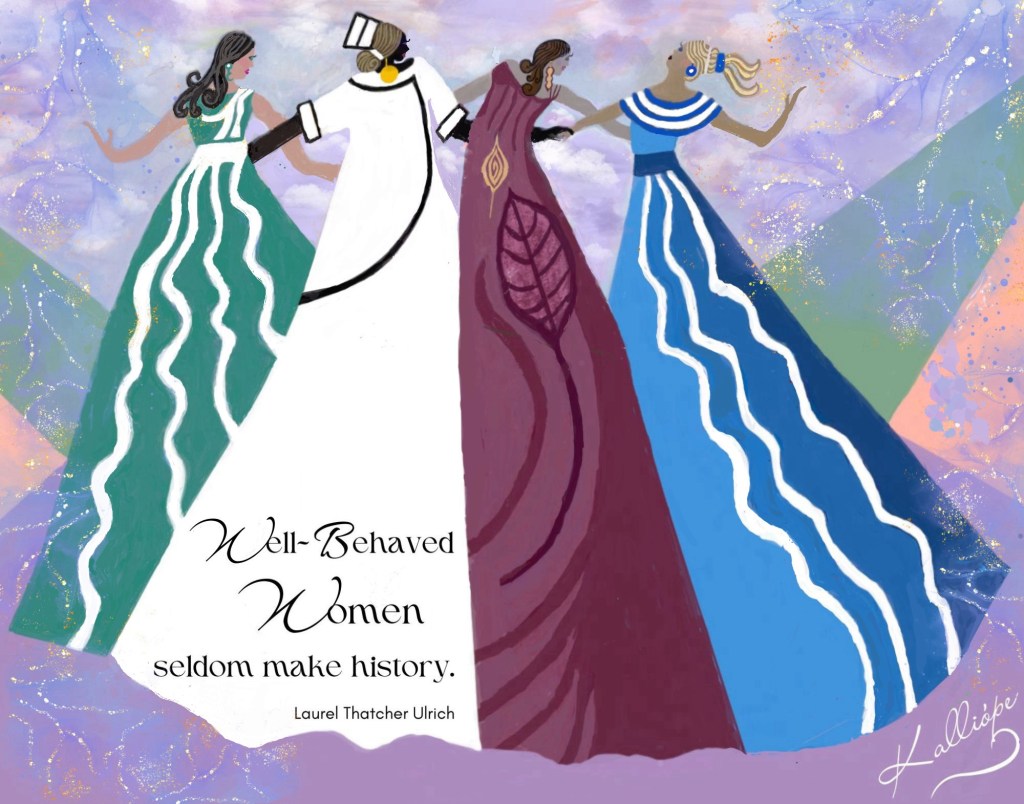
Art: “Well-behaved Women” by Kathy Manis Findley


Rev. Kathy Manis Findley
July 27, 2024

You have probably had that kind of dream at a few junctures on your journey. I know I had many dreams along the way. Sometimes they scared me to death. I dreamed of peace, equality, freedom, changing the world, and many other huge and noble dreams. I dreamed some silly dreams, too! I soon got the hint: changing the world is a formidable task. I followed all the rules, but being a rule-keeper does not make a person effective in dreaming and imagining. Women who follow the rules (someone else made up) could correctly be called well-behaved. They might even be called good girls because they don’t cause much of a flurry. They typically don’t make history and they certainly don’t change the world.

A woman with less-than-good behavior looks like someone at peace with herself, someone who radiates hope, someone with the courage and determination to do justice. I have admired and emulated so many examples of women who did make history, women who were not well-behaved at all. Here are only a few: Rosa Parks, Harriet Tubman, Lucretia Coffin Mott, Sojourner Truth, Susan B. Anthony, Nancy Sehested, Elizabeth Cody Stanton, Prathia Hall, Julian of Norwich, Malala Yousafzai, Mother Theresa of Calcutta, Ann Hasseltine Judson, Lucy Stone, and so many others!

About 24 years ago, a chaplain colleague recommended a book to me: Goodbye Good Girl: Letting Go of the Rules and Taking Back Your Self by Eileen M. Clegg. I think my chaplain friend was suggesting that I should get out of my comfort zone and take some risks, that I should courageously follow God’s call on my life. I knew that the members and churches of my denomination would “throw a fit,” like we say in the south! After all, I was an ordained minister serving as a hospital chaplain, which placed risky challenges before me every day.

So I read the book immediately and set out to become a bad girl, a girl who fully intended to change the world and to make history for it! So far, I have not made history. I have not managed to put my name in lights. I have not started any big public movements. But I have done some things that matter! I have learned how to create sacred space; I have learned the depth of liberation theology; I have found enough grace to endure the consequences of being a “bad girl” and then a woman with questionable behavior; I have held off anyone who tried to tell me who I am; and I have called up the courage to fight for justice. Colleagues, friends, family, co-workers reacted to the change in me, since they never expected me to dissent, or disagree, or refuse to behave.

Suddenly I let go of my “good girl” image and basically said “goodbye” to my restrictive behaviors. I took back my life, put aside all the rules, and followed my soul. I watched for the winds of the Spirit to lead me, and I moved forward to all the places that needed some attention. I was able to help change unjust systems, unjust policies, and unjust processes by not being so well-behaved.

Still, I sometimes think I have reached an uneasy place when it comes to letting go of my “good girl” persona. I’m really not a “good girl” and I don’t think I ever have been. My parents had to endure the sassy exclamations of my toddler years, like “Nobody’s the boss of me!” Creating shock from those who knew me, I mostly remained a “bad girl” from that day to this. I set aside the rules that were designed to keep people down and I took back my life. Today—in my mid-seventies—I continue to spew out uncommon proclamations that are quite annoying to those who are determined to hold on to their power and resist change.

Truly, it was sometimes hard being a change-maker and a rule-keeper! Always a people pleaser. Always the ultimate perfectionist. I discovered along the way that sometimes rule-keeping, people pleasing, and keeping every little thing “perfect” can harm your inner core. In fact, it’s less risky when you follow the leaders, make sure everyone is pleased, and doing everything with glowing perfection. Stepping out of line is always a bit dangerous.

When you become exactly who you are, resolute and unmovable about the things that matter to you, you will raise a few eyebrows, and sometimes people will get angry with you . You see, those people expected something else from you. Each of us becomes “me”— the “real me”— at our own peril. In a sense, we have to fight for the right to be ourselves in the world.

It is true that the people around me reacted strongly when I took back my life and became fully invested in my destiny. They thought that I had become radical, maybe even unhinged. I did not respond appropriately to their demands. To unreasonable demands, this is essentially how I might have responded, sometimes out loud, sometimes under my breath . . .

I will do it. / It’s my right! / It’s my choice! / It’s my prerogative! / It’s my decision! / I’m doing it anyway. / You can’t stop me! / Just watch!

All the while, I felt uncomfortable because of so much disdain from others, who began sending me a new message, You are not enough! I Imagine that many of you have heard someone say to you, You are not enough. At least, we may imagine someone saying those hurtful words. Unfortunately, we believe it because we don’t know ourselves, meaning we don’t know our bright and dark places, we have not yet realized our sacred worth, and we have not yet searched our souls.

For you see, you and I are afraid because it is perilous for the soul when we don’t search diligently for our soul’s passions and dreams. You and I sometimes accept what others say about us and tuck it away in our deepest places. When those words sneak all the way down into the soul, we tend to give up. We start from the moment we make ourselves nonchalant about it all, that moment when we shield our hearts from hurt. One of the saddest phrases we use is “I don’t care.” When we no longer care, we begin, one by one, eliminating the people around us, never realizing that they are hurting, too. And maybe the reason they send the message, You are not enough, is because they believe that they are not enough either.

I can honestly say that I have often heard voices—known voices, unknown voices, and the weak little voice in my head—telling me, You are not enough! I have learned that once I have embodied that negative message, it rolls around in my psyche for a long time, maybe forever. It becomes a state of being that goes deeper than skin. It penetrates in deeper places, and takes its toll on my emotional and physical well-being. I recall many such times, none more painful than the wagging tongues around my ordination . . . You know the scenario, “She can’t be a minister because she is a woman! Anyway, she’s not good enough! Other voices are often hazardous, dangerously breaking down our sense of self-worth. They may be yelling, speaking in a normal tone, whispering, or imagined in our heads. In response, we must prepare ourselves to hear the voice above all voices, saying, “You are my beloved daughter with whom I am well pleased.”

For a long time, I embodied the traits of the good girl, but to embody good girl traits is not really a once-and-done action. Embodied lasts a while! Embody does not have a shallow or surface meaning. It is deeper. I like the word embody. It seems to suggest that we can live a soulful life. In the very middle of the Greek word for “embody” we find the word σώμα, which means body. However, the Greek word for body cannot be translated in a way that reveals the depth of its meaning. The definition of σώμα is deeper than we realize. It is not skin-deep, it is deeper, approaching a definition more like soul.

I do like the word embody and the word soul. In some ways, to embody means to live in your soul. The word embody may whisper to you that in your body’s center, you will find the path to reach your soul. A person who lives in the soul is a person that does not live a shallow life, devoid of the emotion that makes us alive. The soul will help you, if you can just start by daring to touch it.

So what are the things we can actually do to take back our lives and live soulfully? What path do we follow to transform ourselves and change the world? My initial response to that is, “I don’t know.” Not very comforting, I know, but mostly true. We cannot forge the path for any other person. We cannot know what’s best for them. So not knowing anyones path, nor their dreams, I can give you a list of things others are finding the leads to their transformation. Here they are, not at all an exhaustive list, and certainly not a perfect guide for you:

  • Carve out some time for quiet, restful, meditation.
  • If you are a person of faith, get in touch with God or whatever person you worship.
  • Listen.
  • Listen some more—to your heart and your soul.
  • See if you find there a sacred direction especially for you.
  • Do you feel you are getting any closer to discovering your authentic self?
  • Can you begin to believe you will be transformed?
  • Can you take a step or two, in faith, into a holy place of transformation?
  • Pray, making your needs known to the source of your faith.
  • Read! Read the stories of others who found life transformation.
  • Find community, even one other person, who understands your journey.
  • Start all over again, leaning into the wisdom you found on your previous journey.
  • Take as long as it takes, until you realize that suddenly, you are becoming emboldened and scrappy!

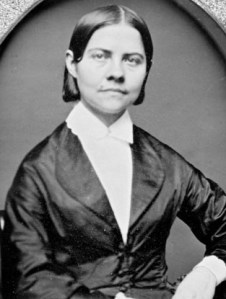
You may not know her name, but Lucy Stone was steadfast in her belief in self-authentication and in her ability to change the world. Lucy Stone was called “emboldened” and “scrappy” because of her tireless work for the abolitionist and women’s rights movements through the 19th century. A bona fide pioneer of her time, Lucy Stone stands as a historical titan. Her book “Unapologetic Life” describes a model of a revolutionary living. As for me, I would count it an honor to be described as emboldened and scrappy.

Life is more fun when you’re emboldened and scrappy. Not that we want to reduce the life experience to just scrappinesses. Life is so much more, like authenticity and the willingness to be a change-agent. Life is about having enough courage to persevere! Life for me is about my soul and all the ways it has been transformed over many years. All along my journey, I knew that my soul was a problem! At every age, there was a part of me that wouldn’t follow the easiest path. I longed to be empowered to make societal change. I chased down injustice and worked to dismantle it. I spent most of my career working with victims of domestic violence, child abuse, and human trafficking. This was not the easiest and most pleasant vocation, but the work had made its way into my soul. To do it, I had to live in the light of self-awareness and soul-awareness. I had to constantly listen to the sighs of my soul, and move only after I had heard them clearly. If I had just one nugget of advice for you, it would be to touch your soul and ride on the wings of the Spirit.

Sisters, don’t forget that when you touch your soul, you might just not be a “good girl” anymore. Or a good boy, for that matter. As for me, I am not a “good girl” living at the whims of other people! And I am definitely not a well-behaved woman! So I fully expect to make history! Because making history means leaving a legacy, creating a world brimming with peace, and embodying your best self!


Activism, Advocate, Asylum, Black Lives Matter, Caged children, Child trafficking, Committment, Community activism, Compassion, Courage, Creativity, Discrimination, Human trafficking, Immigrant detention, Immigration, Injustice, Justice, Let the oppressed go free, Oppression, Racial injustice, Racism, Social justice

“Let The Oppressed Go Free”

Canadian sculptor Timothy Schmalz’s work on a sculpture depicting modern-day trafficking in humans titled “Let the Oppressed Go Free” — a commentary on how slavery, via human trafficking, continues today. Schmalz laments that the modern-day travesty of forced labor, including for sex, is often ignored, not unlike slavery of the past.

Do you wonder sometimes where God is while people are being oppressed? I mean all kinds of oppression — racial injustice, human trafficking, violence and abuse, prison injustice, sexism, cissexism, classism, ableism, heterosexism. The list can go on and on, all the way down to specific stories about specific oppressed individuals. At that level, the down to earth level where we see a living person suffering, is the heartrending place. It’s the place where we find ourselves face to face and up-close with someone pouring out their story. It’s the place where we learn to talk less and listen more. It is for us an experience of holy listening with just one person.

Have you ever been in that kind of space listening to just one person? Have you ever been with a person suffering oppression who is freely sharing a heartbreaking story with you? I know that this kind of face to face encounter can be intimidating, even frightening. It can be beyond frustrating to listen to someone when you’re pretty sure you can’t do much to help.

There are at least two options for those of us who have a deep desire or calling to liberate those who are oppressed. We can offer what we have, even when we do not have a way to fix things. What do we have? Our presence, our emotional and spiritual support, our ability to advocate, housing assistance, financial assistance, employment assistance, safe shelter, understanding, constancy, presence, presence, presence . . .

The other option is to rail against a God who makes pronouncements about caring for oppressed people, yet seemingly does nothing to liberate them. This may not be our best option. Scripture reveals that God has a way of dealing with complaining people, and it is almost never a positive experience for the complainer. Moses comes to mind, and Miriam, and Job.

Poor, pitiful Job had a rough go of it and he wanted God to do some explaining and answer some questions. After all, he was a devout and faithful man, so why would God allow him to suffer so many losses? Right after Job is schooled by his three “friends” on several theological matters, including that he should never question God, God appears to Job out of a whirlwind. It was probably grand entrance, and then God basically says to him, ”I’ll ask the questions, buddy!”

Here’s a snippet of the long exchange between God and Job.

Then the Lord spoke to Job out of the whirlwind.

“Who is this that obscures my plans
    with words without knowledge?
Brace yourself like a man;
    I will question you,
    and you shall answer me.

“Where were you when I laid the earth’s foundation?
    Tell me, if you understand.
Who marked off its dimensions? Surely you know!
    Who stretched a measuring line across it?
On what were its footings set,
    or who laid its cornerstone—
while the morning stars sang together
    and all the angels shouted for joy?

— Job 38:1; 4-7 (NIV)


Job was oppressed. God was aware of it. God seemed unconcerned for too long, but there actually is a redeeming conclusion for Job. As the story goes in the last chapter of Job, God restored Job’s fortunes and gave him twice as much as he had before. All of Job’s brothers and sisters, and everyone else he knew, went to his house for Sunday dinner and they consoled him for all the trouble he had been through. Then each one gave him a piece of silver and a gold ring. It worked out!

Canadian sculptor Timothy Schmalz’s sculpture, ‘Monument of Oppression’ depicts hands emerging desperately from behind bars.

“I can’t think of one single nation of the world that did not practise slavery, including among Indigenous people,” the sculptor says.

(Photo by Handout)


What does Job’s story say to us? What does it teach us about oppression? In my mind, in order to confront oppression and free persons from every yoke on a societal scale, we must first be aware that systemic oppression exists. It is stark reality! It darkens our world! Right now, approximately 40 million people are trapped in slavery in the world. One in four of these is a child. This shame that pervades and plagues the planet does not seem to disturb people very much. Unfortunately, it is in some people’s best interest to maintain the oppressive systems that benefit them, that is fill their pockets with wealth (which is the primary reason for trafficking human beings, for instance).

Systems of oppression are very large, very complex and very powerful. Ending oppression is way too big for us to tackle alone. After sincerely asking the all-powerful God to help us bring down these all-powerful oppressive systems, we can add our hands and feet to the holy project. Contact senators, representatives, governors, mayors. Urge them, persist with them to use their position to help break down injustice. Know what you’re talking about when you contact them by reading about the work the many of anti-oppression organizations that exist. Join in their work. Look for those resources at this link.

“Angels Unawares” by Canadian sculptor Timothy Schmalz portrays the saga of Migrants and Refugees. Among the 140 faces in the sculpture are Africans, Vietnamese, a Cherokee, Jews, Irish immigrants, and Syrians. The Holy Family is also included in the sculpture. St. Joseph can be identified by his toolbox.

Finally, we must open our eyes to the people in our own communities who need our compassion, our concern, our caring presence and our advocacy on their behalf. It takes some creativity, some committment and compassion, a lot of courage and a covenant with our God of justice to change an unjust world. The outcome might just look something like what the prophet Isaiah described:

Is this not the fast that I choose:
To release the bonds of wickedness,
To undo the ropes of the yoke,
And to let the oppressed go free,
And break every yoke?

Is it not to break your bread with the hungry
And bring the homeless poor into the house;
When you see the naked, to cover him . . .

Then your light will break out like the dawn,
And your recovery will spring up quickly;
And your righteousness will go before you;
The glory of the Lord will be your rear guard.

Then you will call, and the Lord will answer;
You will cry for help, and He will say, ‘Here I am. . .’

10 And if you offer yourself to the hungry
And satisfy the need of the afflicted,
Then your light will rise in darkness,
And your gloom will become like midday.

11 And the Lord will continually guide you,
And satisfy your desire in scorched places,
And give strength to your bones;
And you will be like a watered garden,
And like a spring of water whose waters do not fail.

12 Those from among you will rebuild the ancient ruins;
You will raise up the age-old foundations;
And you will be called the repairers of the breach,
The restorer of the streets in which to dwell.

— Isaiah 58 (NASB)


I don’t know about you, but I want to be among the ”repairers of the breach.” I don’t want to live in a situation where I “hope for light, but there is darkness.” (Isaiah 59:9) Instead, let me find myself looking far beyond the world’s darkness, looking to the Creator who demands justice, looking upward to claim the promise, ” . . . satisfy the need of the afflicted, Then your light will rise in darkness, and your gloom will become like midday . . . And your light will break forth like the dawn.”

May it be so for all of us.

A new commandment, Anger, Christian Witness, Christianity, Committment, Community, Compassion, Faith, Gun violence, Hemmed in, Here I am, Lord., Jesus, Jesus Follower, Justice, Life pathways, Magnolia Court Motel

The Car at Magnolia Court

Magnolia Court Motel, Macon Georgia

In my normal outings, I frequently ride with my husband past the Magnolia Court Motel. It’s the one with a gas station in its courtyard where a pool used to be back in the 50s. It’s not a place you would want to stay on your vacation. In fact, I doubt anyone goes there for a vacation. Still, it’s always at capacity, because people live there. It’s not in the safest part of town. Magnolia Court itself is not safe. I know that because TV news frequently reports that homicides happen there.

For the past five years, I have seen a dingy, old, light brown car in front of the last unit of Magnolia Court, closest to the street. The same brown car, day or night, is in its parking space. I don’t think the car ever moves and I have wondered if it needs repairs. I assumed that the owner of the brown car didn’t have a job, because the car never moved. I hoped, though, that the owner of the brown car worked an 11 to 7 shift somewhere. I wouldn’t have known that, because I would never go past Magnolia Court at that time of night. Not in that neighborhood!

For five years, I never once mentioned that car to my husband. For five years, I silently looked at the dingy brown car and wondered who was in the motel room. Who was he or she? I always thought it would be a male, so let’s go with that. Why is he living there? Does he have a job? Is he young or old? Does he need food? Is he ill or disabled? Does he have friends or family? What does his room look like? Is it decent or dirty? How does he feel about his life? Does he know about Jesus and God? Is he okay?

My next thought was, “I would never go up to his door at Magnolia Court, knock on it and ask him if he’s okay or if he needs anything or if he knows about Jesus.” Just as quickly, my thoughts switch from the man (or woman) with the dingy brown car at the Magnolia Court to these hard questions . . . What could I do, as a Christian, to see if this man needed help? How could I help? What would I do? And what do the answers to those questions say about my faith?

I don’t know, of course, but I imagine that in a similar situation, Jesus might have gone straight to the inn and checked on the people. Finding out how they were doing might have led him to heal one, encourage another, give another a basket of food or do all the blessing-kind-of-things Jesus always did.

Last week, we drove by Magnolia Court. The dingy brown car was not parked in its place. I looked around the Court to see if he had changed rooms, but the car was not there. I felt my heart quicken and my mind rushing through scenarios of what might have happened to the man in the end room of Magnolia Court. I was sad. Guilty. After about ten minutes, I managed to move on with my day and not think too much about the man.

Today, we again passed by Magnolia Court, twice! The car was gone. The man was probably gone too. I never saw him. I never checked on him. Why would I? Who would do that sort of thing in the violent, unsafe world we live in?

I don’t want to be trite about things like faith, but honestly, I really did wonder “What would Jesus do?”

“WWJD” might be an old, overused, trendy slogan, but for me this is just being concerned about a man I never saw.


I don’t have any idea what Jesus would do, but I suspect he may have done lots of things, including something similar to what he did with the tables of the money changers. You see, turning over those tables was about doing what is just and right. Jesus might have turned over some tables or lamps or nasty mattresses at Magnolia Court Motel, because it is a place of violence, drugs, and all manner of things that harm people.

I felt my heart quicken and my mind rushing through scenarios of what might have happened to the man in the end room of Magnolia Court. I was sad. Guilty.

Kathy Manis Findley

I have to wonder now, probably will always wonder, what became of the car at Magnolia Court and, more importantly, what became of the man who lived in a room at Magnolia Court Motel. As far as I can tell, he never left his room until the day he left. My thoughts of him over five years of trying to eavesdrop on his life yielded nothing for him. For me, it became an examination of just exactly what kind of faith I have and in what ways am I willing to go out into a world of need where God’s people live in shadows like Magnolia Court. It became a self-examination that prompted me to ask myself, “What do you intend to actually do when you proclaim yourself as a Jesus follower?”

So this is not a morality tale to urge you to examine your faith. It is for me. I am the one who needs to examine my faith, to ask what Jesus would do and then to admit what I will or won’t do. As for the old, dingy, brown car and the man who owns it . . . well, I did do one thing that Jesus would do. I blessed the man I never knew, whispering under my breath as we passed by this morning, “May God go with you and give you peace.”


This is one of my favorite Christian songs. It brings me to tears every time I hear it, especially on the day of my ordination in 1992. As the words were sung that day in a duet by my husband and best friend, my heart sang, “Here I am, Lord.”

Christ in us, Committment, Cross, Following Christ, Palm Sunday, Rev. Kathy Manis Findley, Sunday of the Palm and Passion, The Church-Christ’s Bidy, The Incarnation of Christ, The Old Rugged Cross

Palm Branches & Kaleidoscope Crosses

kaleidoscope cross)
The Kaleidoscope Cross

I collect crosses. All over my house, you will find crosses on the wall. Big crosses, medium sized crosses, tiny crosses and even jewelry crosses! Some are beautiful like my San Damiano cross with an icon of Christ printed on it. Some are ornate. Some are made of wood and others are cast in stone. Some are made of iron and some are simple, lovely crosses made from a palm frond. So today I found the image of the cross you see above. I call it the kaleidoscope cross. The cross is a bit over the top with the palms surrounding its tie dyed, kaleidoscope-ness. Still, it is surrounded by all those palm fronds, so it seems suitable for the day we call Palm Sunday.

People named it Palm Sunday because of all the waving, swaying palm branches in Jerusalem on the day Jesus went there trying to ride in on a donkey. And they named it that because of all the shouts of “Hosanna.” Maybe they even had some kaleidoscope crosses around on Hosanna day, or at least a kaleidoscope of cloaks on the ground. For Jesus and his followers, though, it was just a day to go to Jerusalem, but to go there in an unforgettable way. To be sure, it was a day of palm fronds waving furiously, shouts of Hosanna, cheering and a kaleidoscope of colorful cloaks on the pathway. If only that had been the only reality of that day! But it wasn’t and it isn’t.

In fact, I take exception to Palm Sunday. I take exception to our palm-waving celebration and our kaleidoscope cross, unless we also include the passion story of Christ. For those of us who observe Holy Week, there is no problem. We will relive the story of Christ’s passion all the way to the cross. But if you celebrate only Palm Sunday and Easter Sunday; you will miss the most important part — the passion of Christ. So let’s look at the story.

There is no doubt it was a strange parade. They sang and shouted “Hosanna” at the top of their lungs. Peter might have reached out and grabbed a little kid in the crowd. Then maybe Andrew reached up to break off a branch from a palm tree to give it to the kid. Maybe he placed it in the kid’s hand and watched the child join with the crowd, cheering and waving like mad at their king on a donkey.

There’s something about a people so beaten down with sorrow and fear of Rome. They had little left to lose. Maybe this is what made them join the band of Jesus followers, welcome them and wave branches. Maybe having little left to lose moved them to join the cheering and the singing, the dancing and the shouting. Some stripped off their colorful cloaks and laid them on the path. Jesus was there in the middle of it all, of course, calm and steady, solid and resolute.

I imagine that, if the disciples could tell us the story of that day, it would sound something like this:

Things got a little out of hand. 

But that never seemed to bother Jesus. He got tired sometimes. He needed rest and alone time sometimes, but he didn’t try to control us. He let us be however we were. That day we were happy, and he didn’t bother to explain or tell us anything to make us unhappy.

As for the Pharisees, well, it was one of the things they hated the most about him, the way he refused to control us. He didn’t seem to need to control anyone and, therefore, refused to let anyone control him. He didn’t tell us much either, and that bothered us too, if we’re honest. We couldn’t figure out how he might overthrow the Romans without taking for himself some measure of the power and control they exerted over us. But it bothered us less when we were with him, because when we were with him, we felt like we could believe anything and we really thought things would change when we got to Jerusalem — change in a big way.

To the Pharisees, it was blasphemy — all of it. The way we sang and danced in the street, the image of Jesus on the donkey like some kind of street guy playing king. It was all offensive to the Pharisees. But mostly it smacked of disorder and freedom, two things they feared and fought tooth and nail. 

“Rabbi, tell them to stop, make them stop!” they shouted. 

Jesus turned from watching the dancing children, the singing men and women. We watched him meet the Pharisees’ eyes. Peter’s hand involuntarily clutched the hilt of his sword. Jesus held the donkey still while all around him the crowd rose and swelled. There was amusement in his eyes and he smiled a sad smile. 

“If I tell them to stop,” he said, “the stones you walk on will rise up singing and dancing. You cannot stop joy, my friends, cannot stop praise that flows like a river. Heaven and earth are being un-damned. We will sing and dance while we can.”

If we ever needed permission, we had it. We cheered and sang all the louder, “Hosanna! Hosanna! All glory, laud and honor to Thee, Redeemer, King!”

IMG_4333

It felt like a fresh new day! Like everything we waited for was so close we could almost taste it. It was glorious.

It’s harder now, to talk about everything else that happened. When we reached the inner edge of Jerusalem, Jesus burst into tears and the words he spoke terrified and confused us. Confusion and fear followed us everywhere that week. It hunted us, hounded us. 

For a long time, when we remembered, we felt regret, embarrassment, deep sadness. We now see how little we really understood. But Jesus loved it. In some ways, it seems as if he carried our praise with him through the darkness he would endure. He must have focused on the memory of our singing when the crowds cried out for his death. 

When we look back on it all — all of it — it is so clear that Jesus’ first desire wasn’t to change us. It was to be with us. And his being with us, changed us, slowly into something closer to who he was, what he was. 

We like to remember it like this: Jesus carried us with him — our joy, our love — to the cross. And we carry him with us — his joy, his love — through every week ahead, singing and dancing or weeping in sorrow. We carry him, he carries us.

If only you and I had been there — then maybe we would understand the week that began on Palm Sunday as being more than a “Hosanna moment.” Perhaps we could get beyond palm branches and kaleidoscope crosses, because the cross of Christ wasn’t colorful at all. His cross was a rough, rugged, splintery, stark symbol of crucifixion and of death.

If only we had been there . . . we might have dropped our palm branches to the ground, running after him as fast as our legs could carry us. We might have followed him all the way up the hill, to the cross, the rugged one.

We might have followed him that day.  We could have followed him that day and followed him all the way to the inevitable conclusion of his life. We might have refused to escape his suffering that day and in the days ahead. And we can refuse to escape his suffering in this day. We can follow him in this day, learning about and committing to all the ways we might follow him.

It’s easier now really, because Christ lives. Christ lives in us. “The Church is His body,” writes Joseph B. Clower, Jr., one of the theologians I studied in seminary, who beautifully explained the true meaning of Christ Incarnate. This is the last paragraph in his book, The Church in the Thought of Jesus.

The Church is His Body. He clothes Himself in her humanity. She is His continuing incarnation. It is not fiction, therefore, to say that the Church can share in the suffering of Christ. If the Church will give His Spirit free course in her life, she cannot escape suffering. If the indwelling Christ is not confined, then the Church’s eyes flow with His tears, her heart is moved with His compassion, her hands are coarsened with His labor, her feet are wearied with His walking among [all people] men.

I must ask myself: Is my heart moved with Christ’s compassion? Are my hands coarsened with his labor? Do my feet get weary walking among the people who suffer all around me?

I guess what all of this means is that palm branches snd kaleidoscope crosses cannot even begin to symbolize Christ’s walk past the palms and on to the old rugged cross. Isn’t it a walk we must walk with him? Isn’t it a path of suffering we must take into our souls as Christ’s incarnation on the earth?

The choice is between a kaleidoscope cross and an old rugged one. It’s a choice we have to make every day.

The Old Rugged Cross
Performed by Sandi Patty