On Holy Saturday, we keep vigil at the Lord’s tomb, meditating on his passion and death, and on his descent into hell, awaiting his resurrection and ours.
it is a time of silence, because there is no plausible explanation of what has become of Jesus. It is a time of confusion and sorrow. It is a time of suffering in a place of unknowing. It is a time of wondering.
On Holy Saturday, the earth waits in stillness for the miracle of resurrection. There is not much we can say, so we wait.
He was despised and rejected of men; a man of sorrows, and acquainted with grief: and we hid our faces from him . . . and we esteemed him not.
He was oppressed, and he was afflicted, yet he opened not his mouth: he is brought as a lamb to the slaughter, and he opened not his mouth.
All we like sheep have gone astray; we have turned every one to our own way; and the Lord hath laid on him the iniquity of us all.
Surely he hath borne our griefs, and carried our sorrows: yet we did esteem him stricken, smitten of God, and afflicted.
But he was wounded for our transgressions, he was bruised for our iniquities: the chastisement of our peace was upon him; and with his stripes we are healed.
It happened on Friday — the betrayal, the arrest, the passion, the crucifixion of Jesus. It happened on Friday. But Sunday’s coming! There are Friday’s in every life, Fridays filled with grief, loss and shame. But remember it’s only Friday, Sunday’s coming!
Jesus is dead. He is in the tomb that feels so excruciatingly final. It’s Friday, but Sunday’s coming!*
* From a sermon preached by Tony Campolo, “It’s Friday, but Sunday’s coming!”
How do we make it holy, this special time of the Church year we call Holy Week? We continue with our daily activities. We listen to the news, read books, cook meals and clean our houses. Everything is painfully normal in this Holy Week. What might be the pause in our lives that prompts us to remember the passion of Christ, the betrayal, the arrest, the crucifixion?
How do we remember in an intentional way, so that when the holiest day of the year brings resurrection, we can experience resurrection too?
I know that remembering requires effort. It requires our undivided attention and our most reverent worship. But it’s worth our effort and our devotion, because at the end of the woundedness, there is resurrected life!
I plan to try to walk with Jesus through this week in my mind and in my spirit. For me, music leads me on this path. I recall the hymn “O Sacred Head, Now Wounded” translated by Paul Gerhardt from the medieval Latin poem, Salve mundi salutare. The hymn has eleven stanzas addressing the various parts of Christ’s body hanging on the Cross.
I am going to commit a blogger’s faux pas regarding length and print all eleven stanzas here. I invite you to consider the words of this hymn as a devotional path through Holy Week:
O sacred Head, now wounded, with grief and shame weighed down,
Now scornfully surrounded with thorns, Thine only crown;
How pale Thou art with anguish, with sore abuse and scorn!
How does that visage languish, which once was bright as morn!
What Thou, my Lord, hast suffered, was all for sinners’ gain;
Mine, mine was the transgression, but Thine the deadly pain.
Lo, here I fall, my Savior! ’Tis I deserve Thy place;
Look on me with Thy favor, vouchsafe to me Thy grace.
Men mock and taunt and jeer Thee, Thou noble countenance,
Though mighty worlds shall fear Thee and flee before Thy glance.
How art thou pale with anguish, with sore abuse and scorn!
How doth Thy visage languish that once was bright as morn!
Now from Thy cheeks has vanished their color once so fair;
From Thy red lips is banished the splendor that was there.
Grim death, with cruel rigor, hath robbed Thee of Thy life; Thus Thou hast lost Thy vigor, Thy strength in this sad strife.
My burden in Thy Passion, Lord, Thou hast borne for me,
For it was my transgression which brought this woe on Thee.
I cast me down before Thee, wrath were my rightful lot;
Have mercy, I implore Thee; Redeemer, spurn me not!
What language shall I borrow to thank Thee, dearest friend,
For this Thy dying sorrow, Thy pity without end?
O make me Thine forever, and should I fainting be,
Lord, let me never, never outlive my love to Thee.
My Shepherd, now receive me; my Guardian, own me Thine.
Great blessings Thou didst give me, O source of gifts divine. Thy lips have often fed me with words of truth and love;
Thy Spirit oft hath led me to heavenly joys above.
Here I will stand beside Thee, from Thee I will not part;
O Savior, do not chide me! When breaks Thy loving heart,
When soul and body languish in death’s cold, cruel grasp,
Then, in Thy deepest anguish, Thee in mine arms I’ll clasp.
The joy can never be spoken, above all joys beside,
When in Thy body broken I thus with safety hide.
O Lord of Life, desiring Thy glory now to see,
Beside Thy cross expiring, I’d breathe my soul to Thee.
My Savior, be Thou near me when death is at my door;
Then let Thy presence cheer me, forsake me nevermore!
When soul and body languish, oh, leave me not alone,
But take away mine anguish by virtue of Thine own!
Be Thou my consolation, my shield when I must die;
Remind me of Thy passion when my last hour draws nigh.
Mine eyes shall then behold Thee, upon Thy cross shall dwell,
My heart by faith enfolds Thee. Who dieth thus dies well.
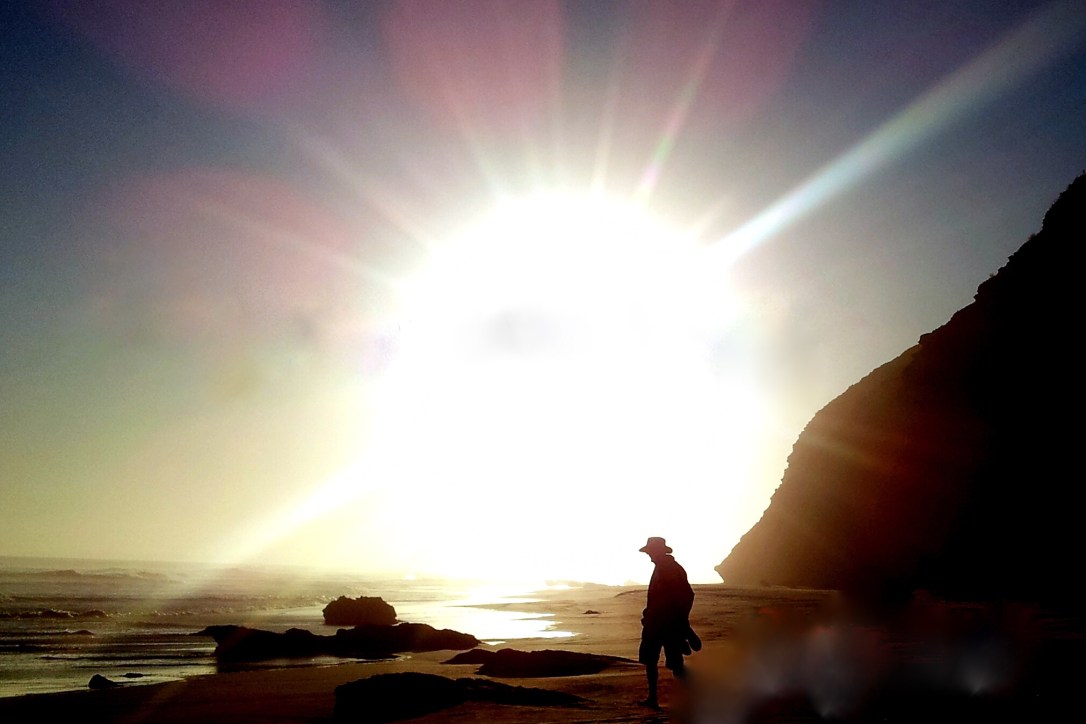
A brilliant star peeking over the ridge of Petit Jean Mountain in Arkansas as seen from Sunrise Point at Mount Nebo, Photo by Jason Garabey
Like most people, I have taken blows in this life. Some of them were pretty serious, serious enough to knock me to the ground. C. JoyBell C. writes of blows that “burst us open” to the point that we believe we are dying. Life is full of these lethal blows, and they hurt. Whether illness, abuse, or other life griefs, we do sometimes feel like we have “burst open.” Our inner strength is spent. Our courage is damaged. Our soul is torn. We may even believe we might die.
But we have the kind of strength and courage that simply does not give in. We have a soul that has been placed in us by our Creator, and that soul is made strong by God’s grace and constant presence. In the deepest darkness, we still shine with a light that cannot be extinguished and with a resilience that cannot be broken. I love the words of C. JoyBell C. that compares us to stars.
I think that we are like stars. Something happens to burst us open; but when we burst open and think we are dying; we’re actually turning into a supernova. And then when we look at ourselves again, we see that we’re suddenly more beautiful than we ever were before!”
“Home is where your heart is.” That’s a popular common quote. It is also a true one. Fred and I have lived in Macon, Georgia for a full year. We like it here. We love having extended family near us. But my heart is in Little a Rock, the place we called home for thirty-three years.
My only son and my grandchildren are in Little Rock. My best friends are in Little Rock. The doctors and the dentist that took care of me are in Little Rock. My favorite pastor is in Little Rock. My very special church family is in Little Rock.
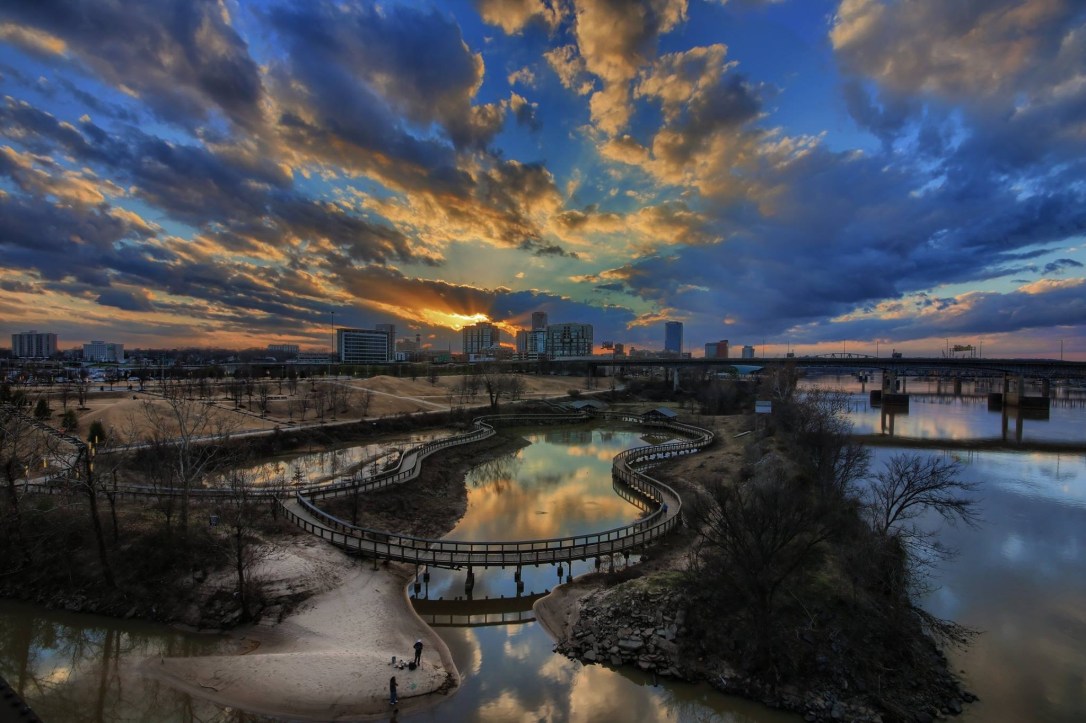
As I look into the melancholy skies over the Arkansas River, I know that the lyrics Wayland Holyfield wrote is true of me. “Arkansas, you run deep in me.”
I have learned that moving furniture and boxes filled with things does not make a home. I have learned that lovely home decor does not make a home. I have learned that the heart makes a home where it will, and that it’s hard to leave that kind of home. I have learned that I will survive the separation. I have learned that I will perhaps make a heart-home again. I have also learned that if I don’t, it’s okay. I can miss home and still go on with my life. These have been important lessons for me.
Perhaps the most important lesson of all is that the incredibly strong bond I have with Fred creates home, our safe and comfortable space, even in Macon. In a very real sense, when we are together, we are home.
There’s something very life-giving about singing. Even those who think they “can’t sing” will often sing along with a favorite country tune on the radio. Shower singing is a terrific way to spend one’s time. The truth is that music lifts the spirit unlike anything else. It brings up a range of emotions from great happiness to a melancholy sorrow. Music whispers a kind of deep truth that we seldom experience. Music expresses what we cannot put into words. It breaks silence with magnificence. Aldous Huxley wrote, “After silence, that which comes nearest to expressing the inexpressible is music.”
I can remember a deeply hurtful time in my life that was so difficult my tears literally dried up. I was filled up with emotional pain, but could not shed a single tear. It was during that time that I learned the power of music. One day, I heard a particular song, the music came into my heart, overwhelmed my soul, filled me up with singing, and the tears spilled out from a place I thought was completely hardened.
It was the song of my soul, sung when every other part of me was silenced in grief. The transformation in me was almost magical, an experience I will never forget. J.K. Rowling wrote of the magic of music in Harry Potter and the Sorcerer’s Stone:
Ah, music,” he said, wiping his eyes. “A magic beyond all we do here!”
What about faith, that elusive concept that is so important in life? How do we muster it up, especially during times when having faith seems so difficult? Faith is not just all the things I hope for. Faith is not luck that brings good things to us. Faith doesn’t even take away the discomfort and pain of life. But what faith is to me matters: an ever present source of comfort and confidence, no matter what the circumstance. Faith stays with us when we find ourselves in the depths of difficulty.
Perhaps the biggest myth about faith is that if you have enough of it, you can have anything you want or need. Enough faith makes you prosperous. Enough faith makes you rich. Enough faith makes you great. That does not ring true in real life. There are so many people of great faith who live lives of pain and disaster.
Yet we have to deal with this scripture: “. . .for truly I say to you, if you have faith as a mustard seed, you shall say to this mountain, ‘Move from here to there,’ and it shall move; and nothing shall be impossible to you.”
I tried it once when I was young. It didn’t work. I tried increasing my faith all throughout my life, and it remained a mystery to me. But in the end, I rely on faith. I cherish it. I believe that it strengthens my life.
I love what Brené Brown says about faith:
“I thought faith would say, ‘I’ll take away the pain and discomfort’, but what it ended up saying was, ‘I’ll sit with you in it.'”
Some people cry out “Peace, peace, but there is no peace!” And so it goes when a life is filled with chaos and turmoil, daily worries and big challenges. Somewhere within us all, though, there is a supreme self who is eternally at peace. In spite of the chaos that sometimes assails us, in spite of the obstacles that stand ominously before us, we can be at peace. So what is the secret, the magic trick that enables us to have peace in the midst of turmoil?
One secret is to surround ourselves with peaceful things – moments of silence, places of beauty, nature’s healers. And we must fill our worlds with people of peace, avoiding those who mete out harshness, anger, violence and rage. It matters what we see on our televisions. It matters who we allow into our lives. It matters what we hear and see and experience.
It’s important that we do all that is possible to create a peace-filled life. The most important thing of all is what we hold in our hearts. What lives inside of us that robs us of the peace we so long for? I can hear my exasperated mother from so many years ago saying, “All I need is some peace!” For she was a person who had not resolved the many hurtful things she brought from her past. Certainly, all of us live with unresolved hurt or anger. But what is unresolved within us need not define us. Hear these words full of wisdom from Ranier Maria Rilke’s Letters to a Young Poet:
“Have patience with everything that remains unsolved in your heart . . . live in the question.” That is the pathway to your peace.
Finally, those of us who believe in God also believe in his eternal presence with us. And so we lean on God’s everlasting arms, ever close to that Creator of peace that passes all understanding. In God we find perfect peace that sustains us in every trial of life.
“Here is the world. Beautiful and terrible things will happen. Don’t be afraid.”
The words of Frederick Buechner inspire me. Just spending a few minutes watching the news tells me that his words are true – beautiful and terrible things will happen.
It seems to me that “terrible” is winning. Children live in poverty. Families live in their cars and under bridges. Refugees are fleeing for their lives from Syria.
Then there are the beautiful things all around us . . . the brilliant sunrise, the purple and pink sunset, the sound of rolling rivers, the crashing of the waves of the sea. And there is so much more indescribable beauty in this world.
But the crux of all of this is found in the words, “Don’t be afraid.”
Enjoy the beauty of your world, face all the terrible things that come your way, but don’t be afraid.
Don’t be afraid, for I am with you. Don’t be dismayed, for I am your God. I will strengthen you. Yes, I will help you. Yes, I will uphold you with the right hand of my righteousness.
– Isaiah 41:10 (World English Bible)
There are times when we are downhearted. There are days that are treacherous and hard to bear. I have a friend of many years who suffers most every day with chronic, unceasing physical pain. The physical pain exacerbates her emotional and spiritual pain. Of course, she has many questions about God and faith, about how God helps those with great need, or even if God helps at all.
My ordination and my years of pastoral care experience does not mean that I have had ready answers for her. Sometimes any answers I have to give are woefully inadequate. So I have searched my own heart and explored my own faith. And I Reach the same conclusion every time. For me, the comfort is tucked in these scripture verses in the fourth chapter of 2 Corinthians.
But we have this treasure in earthen vessels, so that the surpassing greatness of the power will be of God and not from ourselves; we are afflicted in every way, but not crushed; perplexed, but not despairing; persecuted, but not forsaken; struck down, but not destroyed;
Therefore we do not lose heart. Though outwardly we are wasting away, yet inwardly we are being renewed day by day. For our light and momentary troubles are achieving for us an eternal glory that far outweighs them all. So we fix our eyes not on what is seen, but on what is unseen, since what is seen is temporary, but what is unseen is eternal.
Most importantly for me is to not lose heart and to believe that in this earthen vessel dwells the treasure of faith.
For the past few says, dark clouds have hovered over my world. I can’t even put my finger on the real cause. I know only that I have not felt well physically, and that usually opens the door for questioning, concern, worry, and in general, things that bring me down.
These days, I worry that I will lose strength and become unable to engage in daily activities. I worry about how I will respond to the surgery and recovery of a kidney transplant. I worry that a donor kidney will not be available. I worry that the complete weakness I experienced during my last hospital stay will assail me again.
And yet, I need to look more intently at the reality. Most of the time, I do feel well. I am involved in a daily exercise program. And I am able to do several things I enjoy. Most importantly, I cling tightly to faith that can overcome every concern.
In the 18th Century, Jean Pierre Caussade wrote this about faith: “How ever dark the clouds may be, faith breaks through to truth, holds fast to it, and never lets it go.”
That is a message that has remained true through the years. It stands the test of time. It gives me the spiritual strength to move forward, in spite of a life that has its ups and downs.
Hakuna Matata! No Worries! It’s a motto I want to live by.
Sometimes I think of the movie “Sleepless in Seattle.” It’s usually when I am in my bed with my eyes wide open hoping that sleep will come. Those are times of worry and frustration. I worry about my son. I miss my grandchildren. I wonder why I ever left my home in Little Rock. I wonder if I will ever find my way around Macon neighborhoods. I worry about having a kidney transplant. I worry about not having a kidney transplant.
And I am not really a worrier!
Always in times like these, the scripture in Matthew 6 comes to mind:
Therefore I tell you, do not worry about your life, what you will eat or drink; or about your body, what you will wear. Is not life more than food, and the body more than clothes? Look at the birds of the air; they do not sow or reap or store away in barns, and yet your heavenly Father feeds them. Are you not much more valuable than they? Can any one of you by worrying add a single hour to your life? “And why do you worry about clothes? See how the flowers of the field grow. They do not labor or spin. Yet I tell you that not even Solomon in all his splendor was dressed like one of these. If that is how God clothes the grass of the field, which is here today and tomorrow is thrown into the fire, will he not much more clothe you—you of little faith? So do not worry, saying, ‘What shall we eat?’ or ‘What shall we drink?’ or ‘What shall we wear?’ For the pagans run after all these things, and your heavenly Father knows that you need them. But seek first his kingdom and his righteousness, and all these things will be given to you as well. Therefore do not worry about tomorrow, for tomorrow will worry about itself. Each day has enough trouble of its own.
How true it is that each day has enough trouble of its own! I think it’s usually a choice we have to make: refusing to worry about tomorrow. Hakuna Matata!
“A gem cannot be polished without friction. Nor can a person be perfected without trials.” – Lucius Annaeus Seneca
I don’t know about you, but I am no stranger to friction. Life has been full of it, and I feel pretty darn polished at this point in my life. People can define their friction in several ways: illness, strained relationships, failed marriages, loss of financial security. In other words, friction is defined as the trials that life hands out to each of us.
The good news is that we do survive our trials. In fact, we have survived 100 percent of our worst days. We pick ourselves up off the ground, dust ourselves off, and then we move on to face the next challenge. In the process, we are perfected. It’s Gospel good news for us, news we really need to hear.
Count it all joy, my brothers and sisters,when you meet trials of various kinds, for you know that the testing of your faith produces steadfastness. And let steadfastness have its full effect, that you may be perfect and complete, lacking in nothing. (James 1:2-4)
And just for good measure, I offer you the Good News Translation (GNT) of the same text:
My friends, consider yourselves fortunate when all kinds of trials come your way, for you know that when your faith succeeds in facing such trials, the result is the ability to endure. Make sure that your endurance carries you all the way without failing, so that you may be perfect and complete, lacking nothing.
So I plan to face off against life’s trials with confidence and courage, considering myself fortunate, counting it all joy!
In his book, The Silence of Unknowing, Terence Grant writes this:
God comes so we might finally get the picture of the incredible love that has always been given to us. The only real problem here is that we don’t believe this good news. In fact, it’s too good to be true. And because we don’t believe that such a love can exist for us or for others, we hold on to grudges, we repay hurts, we destroy relationships, we commit acts of violence and war. We remain enslaved in negative places.
It is our personal spiritual experience that takes on a path that leads to our liberation from anger and fear, the kind of anger and fear that builds up within us as we pass through life’s obstacles. You might remember the lion in The Wizard of Oz. He was constantly roaring in anger, but eventually we got to know him and learned that underneath the angry roaring was fear.
How wonderful it would be to be liberated from anger and fear. And yet, we live in the kind of world that attacks our soul, takes us to the point of anger, and fills us up with fear. Frederick Buechner writes, “Here is the world. Beautiful and terrible things will happen. Don’t be afraid.”
So do we stay connected to grudges and hurts, destroyed relationships, violence, abuse, war, general nastiness, and a plethora of other negative things? Do we express anger to hide the fear that is really underneath it? Do we continue to separate ourselves from the God who can do nothing but love…. not being able to accept such love or even understand it?
There is for us a very special promise: As it was from the beginning, God is forever reaching out to us, offering us liberation from anger and fear, forever waiting for our return.
The song, “Wade in the Water,” relates to both the Old and New Testaments. The verses reflect the Israelites’ escape out of Egypt as found in Exodus:14. The chorus — “Wade in the water, children; God’s gonna trouble the water” — refers to healing: “For an angel went down at a certain season into the pool, and troubled the water: whosoever then first after the troubling of the water stepped in was made whole of whatsoever disease he had.” (John 5:4)
When I am in trouble, I want to get waist-deep in God’s water and let the healing come. I want to watch for the troubling of the water and then I want to step in it and be made whole. Yes, some people might say it sounds like a fairy tale. Some may call it a magic trick. I prefer to think of it as one of God’s mysteries that can change a life in an instant. I prefer to believe it is a miracle of God, pure and simple.
So when I experience pain, my prayer is “God, trouble the water.” When I experience grief, my prayer is,”God, trouble the water.” When I experience fear, I will pray, “God, trouble the water.” When I am beside myself with troubles, I believe with all my heart that God’s gonna trouble the water so that when I step in, I will be cleansed! Amen.
Listen to “Wade in the Water” on YouTube at this link:
“Everything you ever wanted is on the other side of fear.” (Jack Canfield)
The trick is to get to that other side where fear is behind us, holding us back no more. Fear rises up out of several emotions — low self esteem, a crisis of confidence, indecision. All are conditions that can give rise to paralyzing fear that decimates our noblest dreams.
Consider some of the situations in life when fear stopped you in your tracks. I remember one career opportunity in particular that I passed up because of unreasonable fear. Not taking that job changed the course of my life. I have always wondered how different my life might have been if I had followed that path. There is no doubt in my mind that the path I did not take would have made my life so much richer and fuller.
But the only thing worse than fear is regret, so I will leave that flawed decision behind me and move forward. And I intend to move forward without fear. “Fear is an idea-crippling,experience- crushing, success-stalling inhibitor inflicted only by yourself.” So says Stephanie Melish.
How right she is about the negative power of fear. The problem is that because we are living our fears, we are not living our dreams. So let’s make a pact to get a handle on our fears so that life can be powered by our noblest dreams.
The gospel singer and recording artist, Wintley Phipps, offers a very encouraging word:
“In the quiet crucible of your personal, private sufferings, your noblest dreams are born and God’s greatest gifts are given in compensation for what you have been through.”
I posted this in March. As we commemorate the tragedy of 9/11, I want to repost this with the prayer that all of us will join hands and hearts to repair the world.
“In Judaism, we call it ‘tikkun olam,’ repairing the world.”
That statement was in a message I received yesterday from a good friend. What a wonderful phrase, tikkun olam, repairing the world! Her comment intrigued me and made me sad, all at once, because what we so desperately need in these days is to repair the world.
I think first of the brash, inconsiderate, racist and harmful comments and actions that are marking our presidential race.
I consider that 4.6 million Syrians are refugees, and 6.6 million are displaced within Syria. Half of those are children
I consider that in 2016 there were 2,305 deaths in the U.S. caused by gun violence, and that 611 children and teens were killed or injured.
I consider the health tragedy in Flint, Michigan, where 6,000 to 12,000 children have been exposed to drinking water with high levels of lead which cause then to experience a range of serious health problems. The corrosive Flint River water caused lead from aging pipes to leach into the water supply, causing extremely elevated levels of the heavy metal.
I consider that the tone of our country sounds more like raising walls than like building bridges.
I consider that gentleness, love and kindness seem to be rare among us.
Oh, that we had the courage, the knowledge and the power to repair the world!
We harm our world in so many different ways.
Isaiah 61:4 speaks of days of old that feel much like our days. “Then they will rebuild the ancient ruins, They will raise up the former devastations; And they will repair the ruined cities, The desolations of many generations.”
May God grant that we will not continue in the path that might be described “the desolations of many generations.” May our generation find the will and the way to repair the world . . . Tikkun olam.
Sometimes that’s easier said than done. Life assaults us regularly with illness, financial difficulties, harmful relationships, and all manner of obstacles. Giving thanks for God’s blessings is easy. Giving thanks during difficult times is much harder. And yet, the Bible clearly teaches that we can indeed be thankful, no matter what the circumstance we face.
What kind of devout faith does it take to give thanks when we experience loss? What is it within me that can express thankfulness when we are grieving?
The gospel song “In Everything Give Thanks” by Donna Alley offers inspiration from the story of Job, a devout man who lost everything of value to him. With his life in shambles, Job said, “Though he slay me, yet will I trust in him.” (Job 13:15)
These are the lyrics of Donna Alley’s song:
In everything give Him thanks, give Him thanks.
In everything give Him thanks.
In the good times praise His name;
In the bad times do the same;
In everything give the King of Kings all the thanks.
With all the good things that had come his way,
Is it any wonder you could hear Job say,
“The Lord giveth and He taketh away…I’ll still give Him thanks.”
But when the tables were all turned around,
And Job’s world came crashing down,
His faith in God caused Job to say “I’ll still give Him thanks.”
Why stay earth-bound when you can fly? An interesting question! When I ask people how their day was, I get one very common answer: “Same ol’ same ol,'” meaning things are the same as usual. We expect our days to be mundane and ordinary. We do not expect brilliantly stunning happenings to mark our days.
It’s a shame, really, to face life with such dismal expectations. What if we could make ourselves expect extraordinary events? What if we could anticipate good news days ore often? What if we felt we could spread our imaginary wings and fly off into a glorious sunset?
I guess this is a blog about fantasy, not very practical, for sure. And yet, our spirits often want to soar, to rise above our problems and challenges, to lift ourselves up in a cloud of stunning hope. So I ask myself: what can I do on this very day to escape the things that hold me down? What if I want to fly above the earth, feeling the wind in my face?
I had very few inadequate answers, of course. I could think of only a few few uncommon activities designed to help me escape. But I did think of a few . . . watching a brilliant sunset, sitting out at night and gazing at the stars, watching a river meander across a green valley, walking among the cherry blossoms.
In the end, I decided to at least dream of bright days and star-filled nights. And I decided to think on one of my favorite quotes: “She took the leap of faith and grew her wings on the way down.”
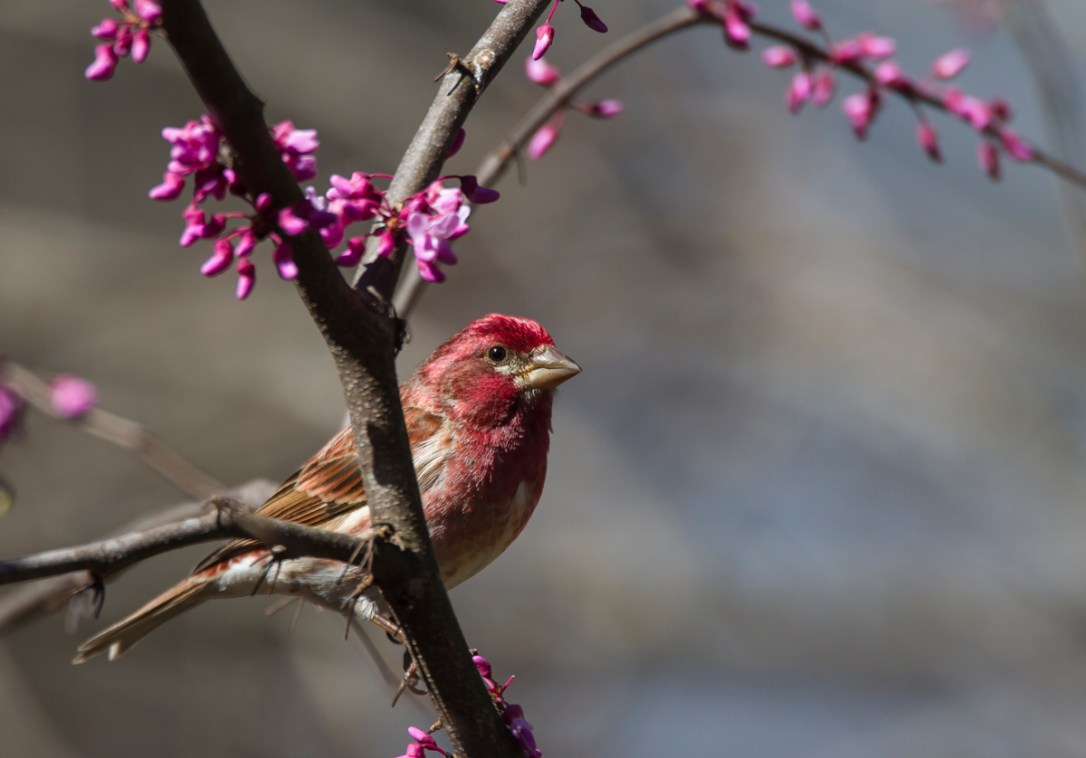
I stood at my kitchen window this morning for at least fifteen minutes, not making a move, so that I could watch the beautiful purple finch at my feeder. I took a couple of very bad photos. But mostly I just stood perfectly still so I wouldn’t scare him away.
I love purple finches. Their song sounds sweet to me. It’s described as “rich, slurred warbling.” Finch songs include the “warbling song,” a fast, rising and falling string of 6-23 notes often sung while flocking. Males usually sing a “territory song” that begins with a few notes on the same pitch before breaking into warbling and ending with a high, emphatic note.
Enough trivia about finches! It’s probably more than you wanted to know.
The point is, watching them relaxes me immensely. It takes me out of myself and transports me into nature’s art gallery where sheer beauty abounds. I forget myself for a few minutes, leaving all my cares behind.
The Purple Finch is the bird that Roger Tory Peterson famously described as a “sparrow dipped in raspberry juice.” I love that description. It reminds me of the many hues that God uses to paint the world, colors that exist to lift us up from the mundane grays of our lives.












 God of the Sparrow 🌱 By Kathy Manis Findley