Africa, Christian Witness, Courage, Freedom, Risk

Sanctuary

enlight1
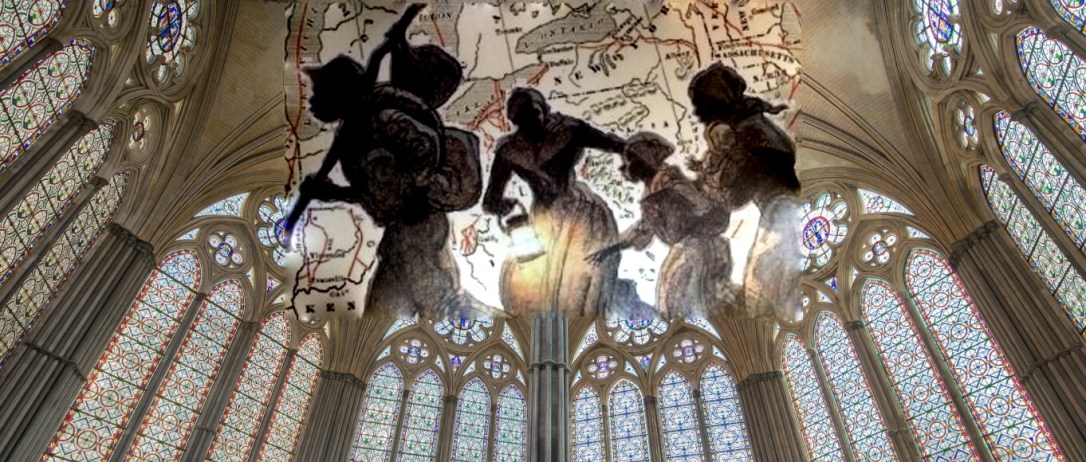
Churches vow to offer sanctuary to undocumented immigrants: At least 450 churches are prepared to act as Trump-era “Underground Railroad”

Sanctuary . . . A sanctuary, in its original meaning, is a sacred place. By the use of sanctuaries as safe havens, the term has come to be used for any place of refuge. For people of faith who are providing sanctuary to undocumented immigrants, a sanctuary is indeed a holy place, sacred and inviolable.

Jeanette Vizguerra is a Mexican mother seeking to avoid deportation. As she held her 6-year-old daughter, Zuri, she spoke during a news conference in a Denver church where she and her children have taken refuge. But when Jeanette Vizguerra walked into that Colorado church, she also walked into the forefront of a possible clash between Donald Trump and many sanctuary churches across the country.

Vizguerra has lived in the U.S. since 1997 with four children, three of them born here. She was due to check in with Immigration and Customs Enforcement. Instead, she took sanctuary inside the First Unitarian Society of Denver.

“I did not make this decision lightly,” Vizguerra said through an interpreter. “I was thinking about it for weeks. But I think that I made the right decision in coming here instead of going to the immigration office.”

The pastor of the church, Rev. Mike Morran, said, “It is our position as a people of faith that this is sacred and faithful work. We know Jeanette. We know her to be an honorable human being.”

But critics say the church is violating the law. While it has been for years federal policy not to do immigration enforcement in churches and other “sensitive locations,” such as schools, unless absolutely necessary, today that may be a lapsed policy.

“President Obama’s administration thought it was prudent to avoid rounding people up in places like hospitals or churches,” says Richard Garnett, director of the program on Church, State and Society at the University of Notre Dame Law School.

But Garnett says if the new administration changes that policy, it could set up a conflict between President Trump’s push for tougher enforcement of immigration laws and his administration’s support for religious freedom.

“Sanctuary works,” says Seth Kaper-Dale, pastor of the Reformed Church of Highland Park in New Jersey. “I can tell you from our own experience that all nine people who lived here have kept their families together, have been able to raise their children, have been able to go back to their jobs. Is sanctuary brutally hard? Yes. But it is a tool that we will use if we’re forced by a brutal regime to use it.”

Sanctuary churches across this country are living out their convictions because of their faith in a welcoming God. The government will, no doubt, enforce immigration law. The Church will live into the law of God . . .

When a foreigner resides among you in your land, do not mistreat them. The foreigner residing among you must be treated as your native-born. Love them as yourself, for you were foreigners in Egypt. I am the Lord your God.

– Leviticus 19:33-34 New International Version (NIV)

The invitation from God’s people proclaims, “In the name of God, come! You are welcome in this holy place of refuge.”

 
(Information about Jeanette Vizguerra is from David Zalubowski/AP.)

Christian Witness, Sharing God's light

Come! Live in the Light!


enlight1

“Come! Live in the light!”

So begins a beautiful hymn Entitled “We Are Called,” I discovered only yesterday. A dear friend sent it, describing it as the new theme song for her life.

When I looked up the hymn and listened to it, I was mesmerized by its melody and its message. The people of God, today facing so many challenges of injustice and divisiveness, would do well to adopt this hymn as their theme song. I hope it speaks to you as deeply as it spoke to me.
“We Are Called”
David Haas

Come! Live in the light!
Shine with the joy and the love of the Lord!
We are called to be light for the kingdom,
to live in the freedom of the city of God!

We are called to act with justice.
We are called to love tenderly.
We are called to serve one another, to walk humbly with God.

Come! Open your heart!
Show your mercy to all those in fear!

We are called to be hope for the hopeless,
so all hatred and blindness will be no more!

Sing! Sing a new song!
Sing of that great day when all will be one!
God will reign and we’ll walk with each other as sisters
and brothers united in love!

Protesters cry out on the streets of our cities, but we are called to live in the light. Immigrants are detained in our airports, but we are called to live in the light. Immigrants are refused refuge in our country, but we are called to live in the light. Our leaders make decisions based on divisive ideologies, but we are called to live in the light.

So while protesters call for compassion, immigrants find no refuge among us, and politicians argue about what’s right and wrong, let us make sure we live as God’s people in a broken world.

Come! Live in the light!
Please listen to this beautiful hymn on YouTube at this link:

Christian Witness, Courage, Freedom, Hope

The Strong, Bold Power of Hope

enlight1

Therefore, since we have such a hope, we are very bold.

– II Corinthians 3:12

Boldness is a part of our Christian witness. Holy boldness makes it possible for us to proclaim, without apology, Christian values, justice for every person, and the radical reconciliation that has the power to unite us. There has never been a time in history when it was more important to hold tightly to a strong, resilient hope that gives its life to restore beloved communities where justice reigns. When I was just beginning my ministry, a Seminary professor, Paul Simmons, asked a compelling and provocative question: “Is what you’re doing worth giving your life for?”

Curtiss Paul DeYoung and Allan Aubrey Boesak wrote a haunting book entitled Radical Reconciliation: Beyond Political Pietism and Christian Quietism. In the book, they present a political theology that proposes the kind of boldness that can result in true reconciliation. They assert that so much of what is being called reconciliation and social justice stops short of completing the complex work required.

Too often “reconciliation” is used merely to reach some political accommodation that does not address the critical questions of justice, equality, and dignity that are so prominent in the biblical understanding of reconciliation . . . When Christians discover that what is happening is in fact not reconciliation, and yet seek to accommodate this situation and refuse to run the risk and challenge of prophetic truth-telling, we become complicit; we deny the demands of the gospel and refuse solidarity with the powerless and oppressed.

The authors continue by denouncing ineffective attempts at reconciliation and calling for bold reconciliation that brings genuine hope. What does it mean, the authors ask, to live out radical reconciliation in our lives? They call the reader to immerse their lives in the work of restoring beloved communities. DeYoung poses this question:

Do racially diverse congregations automatically experience reconciliation or could they simply become demographically diverse but not racially reconciled?

The authors call attention to the “need for a reconciliation that is more than conflict resolution and political accommodation; a reconciliation that resists the temptation to domesticate the radical Jesus, pandering to our need for comfortable reconciliation under the guise of a kind of political pietism and Christian quietism that deny the victims of affliction the comfort of justice.”

Paul Simmons’ question continues to cast its shadow over my life. “Is what you’re doing worth giving your life for?” The question permeated my life from the moment he asked it, prompting me to question myself over and over again. What is it that was guiding my life? Was it worth giving my life for? Did it hold the power that could shift the world on its axis? Did I have the boldness to hope for genuine justice? And did I possess the strong, resilient power of hope necessary to fully engage?

It is a privilege to hold something robust and resilient called hope, which has the power to shift the world on its axis.

― Krista Tippett, Becoming Wise: An Inquiry into the Mystery and Art of Living

Christian Witness, Politics

No Silent Assent to Injustice


No, we cannot give silent assent to injustice.

Many say that President-elect Donald Trump won, in part, because he gained the favor of evangelicals in the United States. Tragically, these evangelicals sold out, bought into a “fake gospel” of racism, bigotry, misogyny, homophobia, xenophobia and divisiveness. In so doing, they sacrificed the justice and righteousness of the true Gospel of Jesus Christ.

I was reminded of that in a beautiful sermon preached this Christmas Eve by Bishop Thabo Makgoba, head of the Anglican Church. He eloquently served notice with his stirring words spoken to the faithful gathered for midnight mass in Cape Town, South Africa’s George’s Cathedral. He draws on his childhood, the example of Walter Sisulu, and God’s Word to explain why religious leaders have a critical role to play in addressing a nation at war with itself.

He also had a forthright message for President Jacob Zuma who has called on churches to stay out of politics.

“We have rejected President Zuma’s comments and have told him very firmly: ‘NO, Mr President, we will not refrain from engagement in the political terrain. Our people live there, work there, suffer, cry and struggle there. We live there too, and cannot and will not stop commenting or acting on what we see and what, in our opinion, is unjust, corrupt and unacceptable to God’s high standards of sacrificial love.’,

As people of faith, we must also speak out against the destructive policies of President-elect Donald Trump.

“No, Mr President-elect, we cannot and will not stop commenting or acting on what we see and what, in our opinion, is unjust, corrupt and unacceptable to God’s high standards.”